Cambridge IGCSE Mathematics (with coursework) 0581 — 2007 Oct/Nov Paper 3 · Variant 1
0581/31/O/N/07 · 104 marks · ≈117 min
The question paper and its mark scheme, free to read here and free to download. This is Cambridge’s own paper, exactly as it was sat.
Question paper12 pages
Mark scheme5 pages
Answers below. Sit the paper first if you are practising.
Paper as text
Question paper, page 1
This document consists of 12 printed pages. IB07 11_0580_03/3RP © UCLES 2007 [Turn over *6355629826* For Examiner's Use UNIVERSITY OF CAMBRIDGE INTERNATIONAL EXAMINATIONS International General Certificate of Secondary Education MATHEMATICS 0580/03, 0581/03 Paper 3 (Core) October/November 2007 2 hours Candidates answer on the Question Paper. Additional Materials: Electronic calculator Geometrical instruments Mathematical tables (optional) Tracing paper (optional) READ THESE INSTRUCTIONS FIRST Write your Centre number, candidate number and name on all the work you hand in. Write in dark blue or black pen. You may use a soft pencil for any diagrams or graphs. Do not use staples, paper clips, highlighters, glue or correction fluid. Answer all questions. If working is needed for any question it must be shown below that question. Electronic calculators should be used. If the degree of accuracy is not specified in the question, and if the answer is not exact, give the answer to three significant figures. Give answers in degrees to one decimal place For π , use either your calculator value or 3.142. At the end of the examination, fasten all your work securely together. The number of marks is given in brackets [ ] at the end of each question or part question. The total of the marks for this paper is 104. www.XtremePapers.com
Question paper, page 2
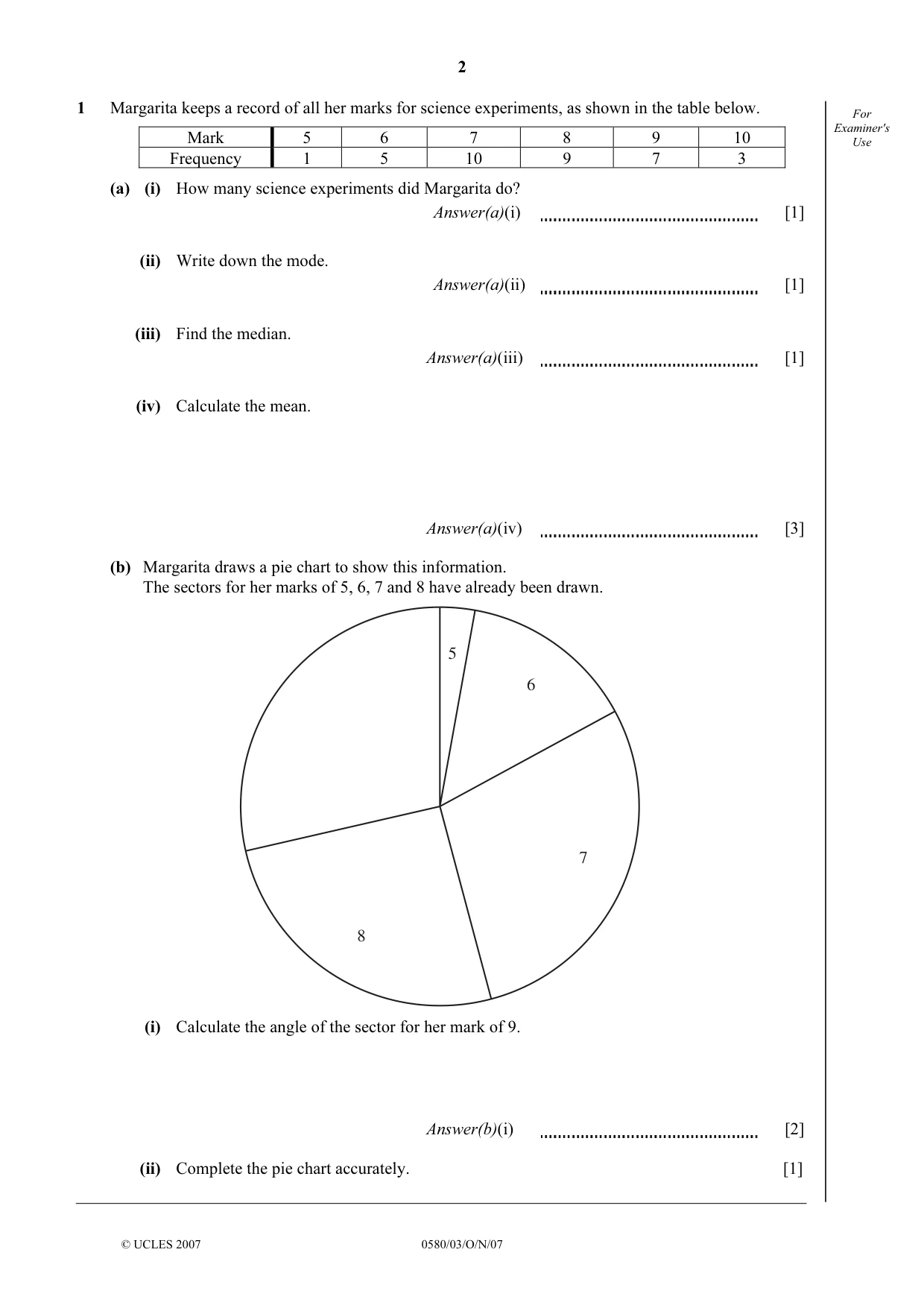
2 © UCLES 2007 0580/03/O/N/07 For Examiner's Use 1 Margarita keeps a record of all her marks for science experiments, as shown in the table below. Mark 5 6 7 8 9 10 Frequency 1 5 10 9 7 3 (a) (i) How many science experiments did Margarita do? Answer(a)(i) [1] (ii) Write down the mode. Answer(a)(ii) [1] (iii) Find the median. Answer(a)(iii) [1] (iv) Calculate the mean. Answer(a)(iv) [3] (b) Margarita draws a pie chart to show this information. The sectors for her marks of 5, 6, 7 and 8 have already been drawn. 5 6 7 8 (i) Calculate the angle of the sector for her mark of 9. Answer(b)(i) [2] (ii) Complete the pie chart accurately. [1]
Question paper, page 3
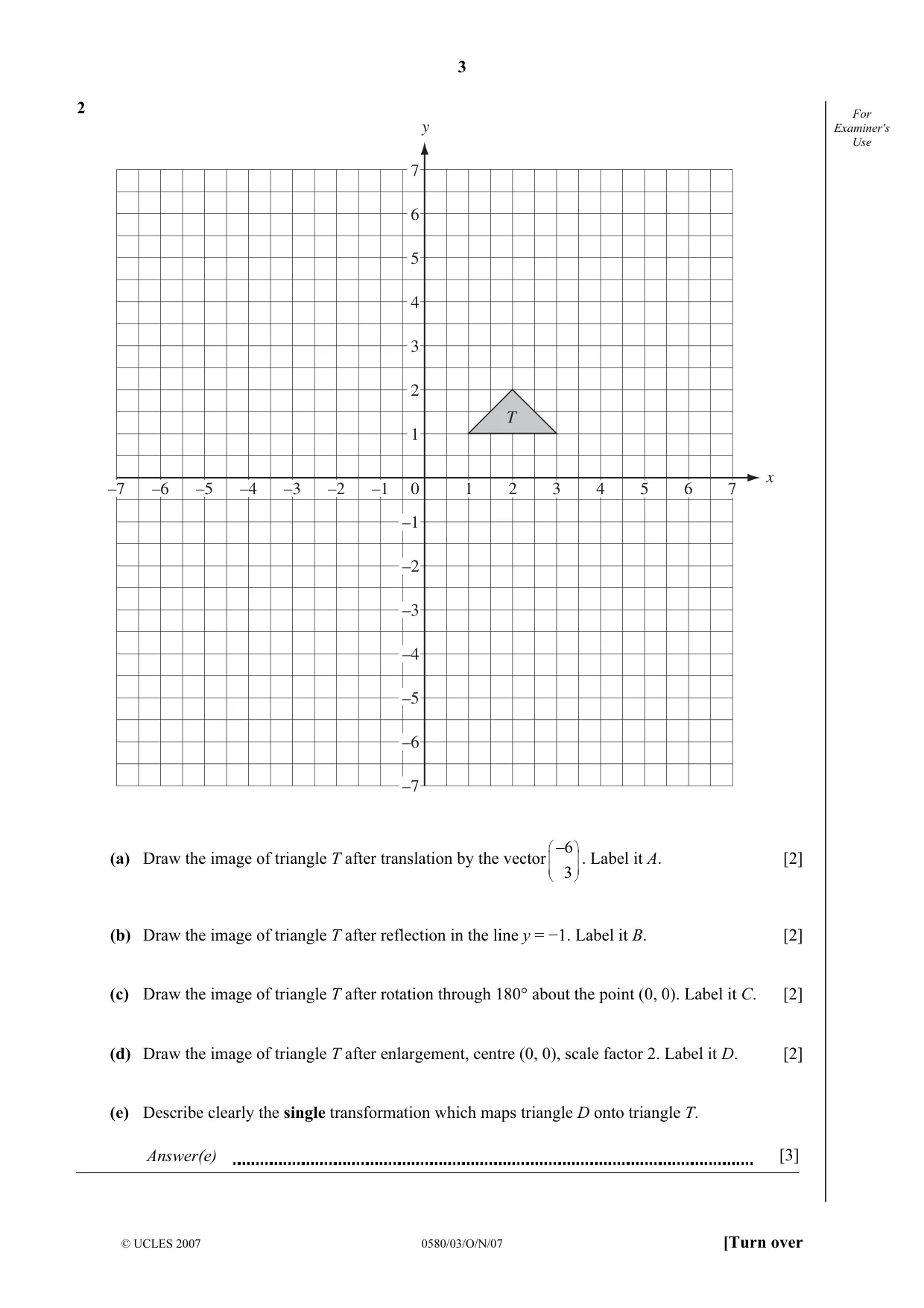
3 © UCLES 2007 0580/03/O/N/07 [Turn over For Examiner's Use 2 y x 0 –1 –2 –3 –4 –5 –6 –7 –1 –2 –3 –4 –5 –6 –7 1 2 3 4 5 6 7 1 2 3 4 5 6 7 T (a) Draw the image of triangle T after translation by the vector _6 3 . Label it A. [2] (b) Draw the image of triangle T after reflection in the line y = −1. Label it B. [2] (c) Draw the image of triangle T after rotation through 180° about the point (0, 0). Label it C. [2] (d) Draw the image of triangle T after enlargement, centre (0, 0), scale factor 2. Label it D. [2] (e) Describe clearly the single transformation which maps triangle D onto triangle T. Answer(e) [3]
Question paper, page 4
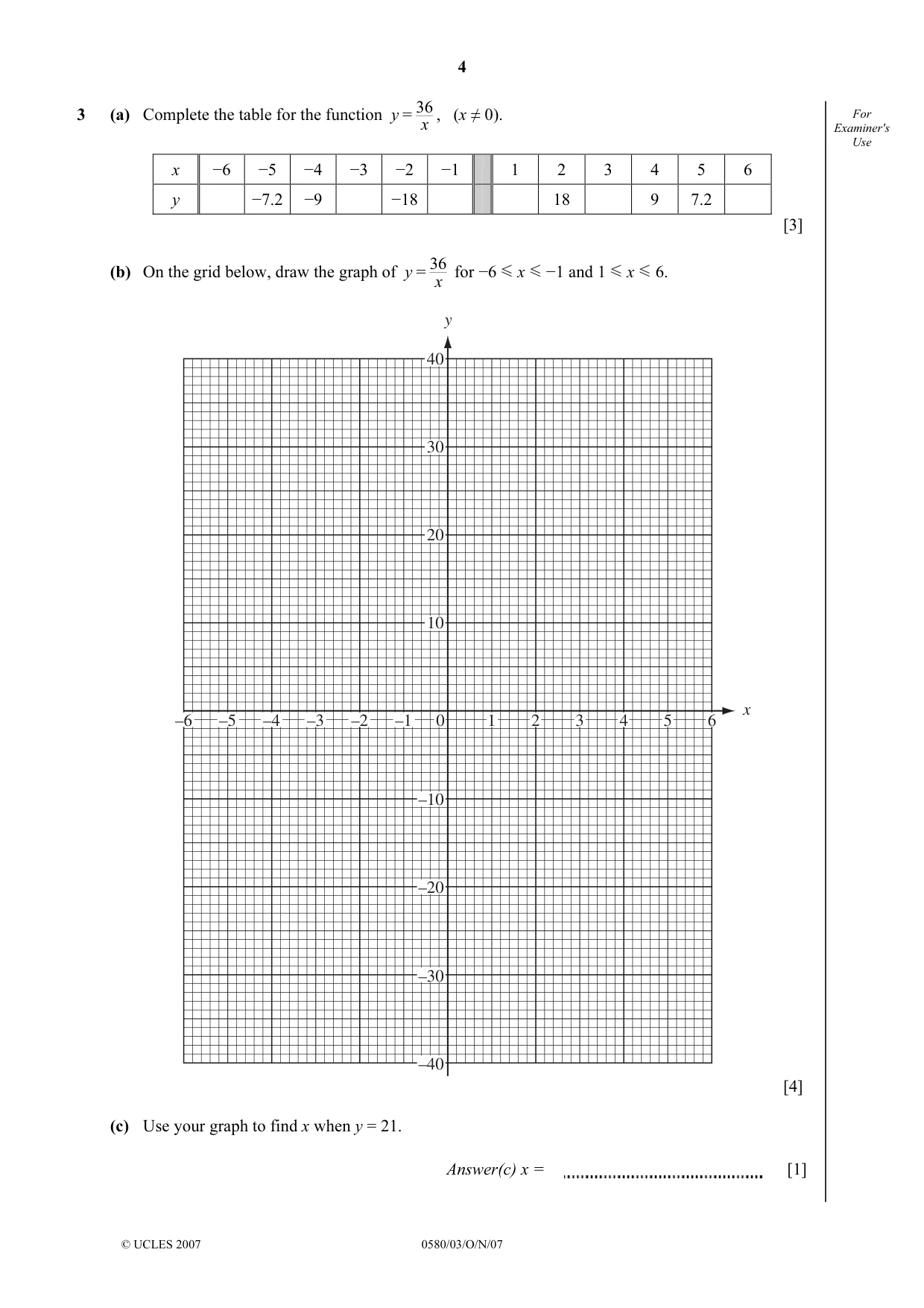
4 © UCLES 2007 0580/03/O/N/07 For Examiner's Use 3 (a) Complete the table for the function 36 = y x , (x ≠ 0). x −6 −5 −4 −3 −2 −1 1 2 3 4 5 6 y −7.2 −9 −18 18 9 7.2 [3] (b) On the grid below, draw the graph of 36 = y x for −6 x −1 and 1 x 6. y x 0 –1 –2 –3 –4 –5 –6 1 2 3 4 5 6 40 30 20 10 –10 –20 –30 –40 [4] (c) Use your graph to find x when y = 21. Answer(c) x = [1]
Question paper, page 5
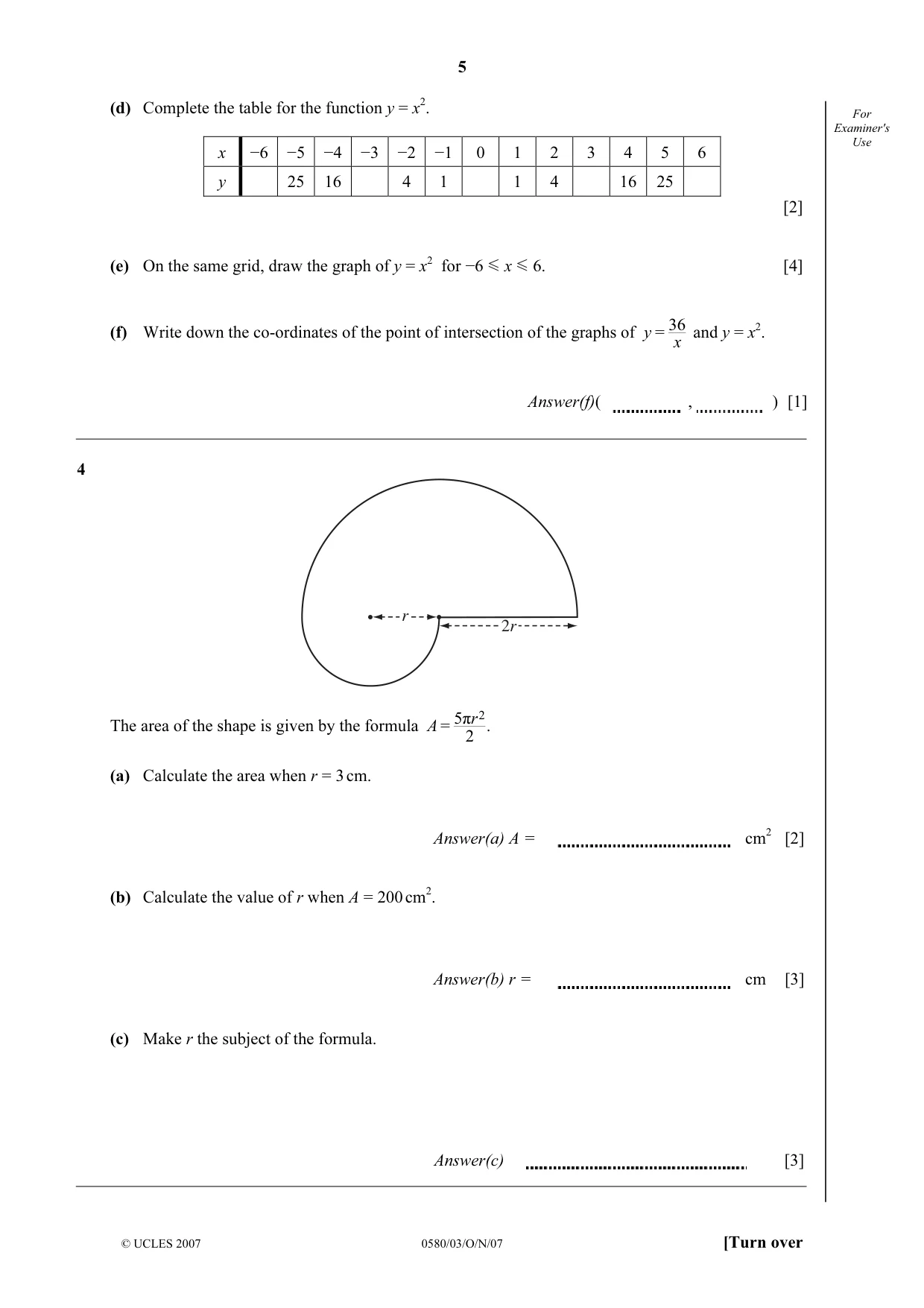
5 © UCLES 2007 0580/03/O/N/07 [Turn over For Examiner's Use (d) Complete the table for the function y = x2. x −6 −5 −4 −3 −2 −1 0 1 2 3 4 5 6 y 25 16 4 1 1 4 16 25 [2] (e) On the same grid, draw the graph of y = x2 for −6 x 6. [4] (f) Write down the co-ordinates of the point of intersection of the graphs of 36 = y x and y = x2. Answer(f)( , ) [1] 4 2r r The area of the shape is given by the formula 2 5π = . 2 r A (a) Calculate the area when r = 3 cm. Answer(a) A = cm2 [2] (b) Calculate the value of r when A = 200 cm2. Answer(b) r = cm [3] (c) Make r the subject of the formula. Answer(c) [3]
Question paper, page 6
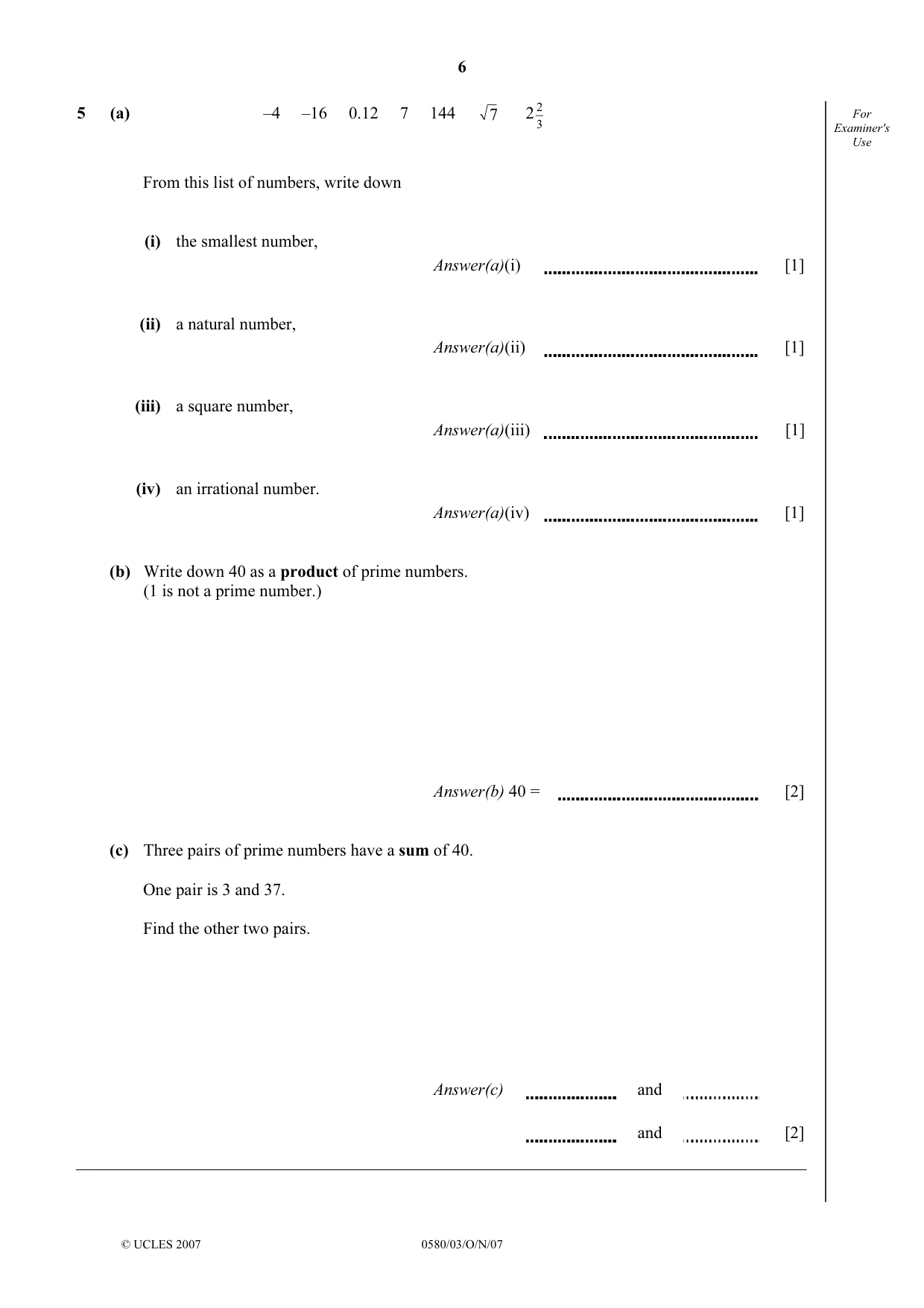
6 © UCLES 2007 0580/03/O/N/07 For Examiner's Use 5 (a) –4 –16 0.12 7 144 7 2 3 2 From this list of numbers, write down (i) the smallest number, Answer(a)(i) [1] (ii) a natural number, Answer(a)(ii) [1] (iii) a square number, Answer(a)(iii) [1] (iv) an irrational number. Answer(a)(iv) [1] (b) Write down 40 as a product of prime numbers. (1 is not a prime number.) Answer(b) 40 = [2] (c) Three pairs of prime numbers have a sum of 40. One pair is 3 and 37. Find the other two pairs. Answer(c) and and [2]
Question paper, page 7
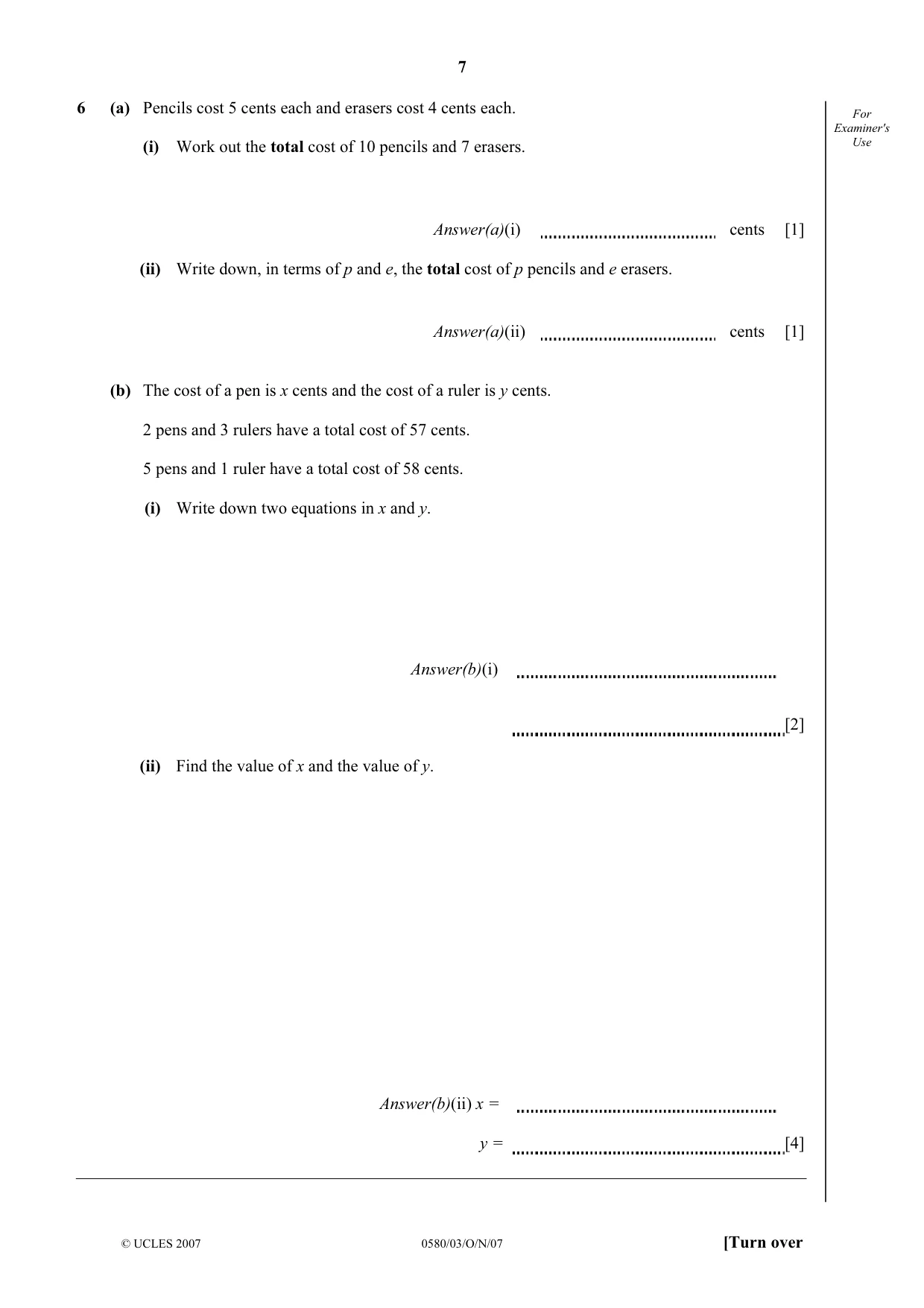
7 © UCLES 2007 0580/03/O/N/07 [Turn over For Examiner's Use 6 (a) Pencils cost 5 cents each and erasers cost 4 cents each. (i) Work out the total cost of 10 pencils and 7 erasers. Answer(a)(i) cents [1] (ii) Write down, in terms of p and e, the total cost of p pencils and e erasers. Answer(a)(ii) cents [1] (b) The cost of a pen is x cents and the cost of a ruler is y cents. 2 pens and 3 rulers have a total cost of 57 cents. 5 pens and 1 ruler have a total cost of 58 cents. (i) Write down two equations in x and y. Answer(b)(i) [2] (ii) Find the value of x and the value of y. Answer(b)(ii) x = y = [4]
Question paper, page 8
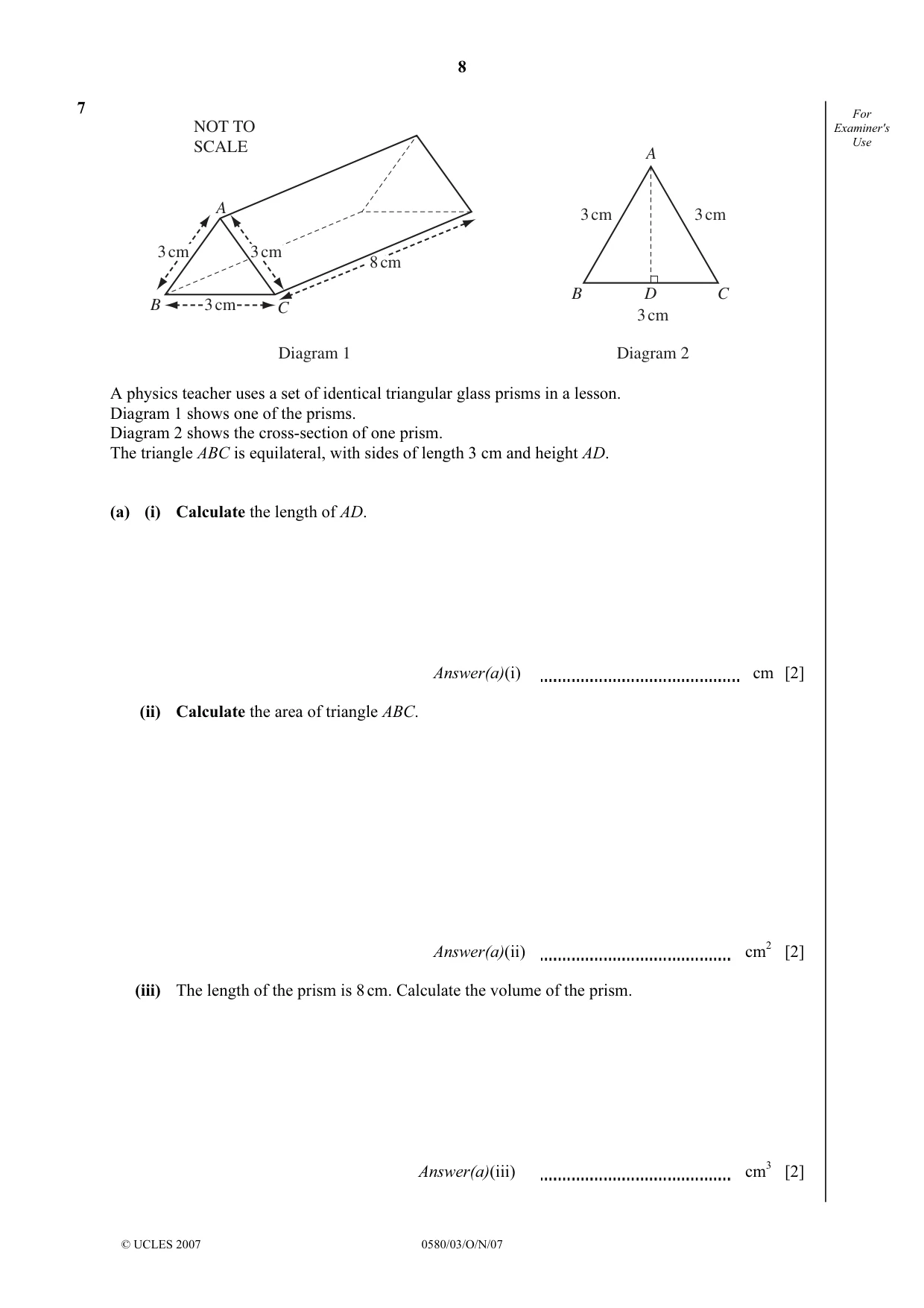
8 © UCLES 2007 0580/03/O/N/07 For Examiner's Use 7 A C B D 3 cm 3 cm 3 cm 8 cm A C B 3 cm 3 cm 3 cm NOT TO SCALE Diagram 1 Diagram 2 A physics teacher uses a set of identical triangular glass prisms in a lesson. Diagram 1 shows one of the prisms. Diagram 2 shows the cross-section of one prism. The triangle ABC is equilateral, with sides of length 3 cm and height AD. (a) (i) Calculate the length of AD. Answer(a)(i) cm [2] (ii) Calculate the area of triangle ABC. Answer(a)(ii) cm2 [2] (iii) The length of the prism is 8 cm. Calculate the volume of the prism. Answer(a)(iii) cm3 [2]
Question paper, page 9
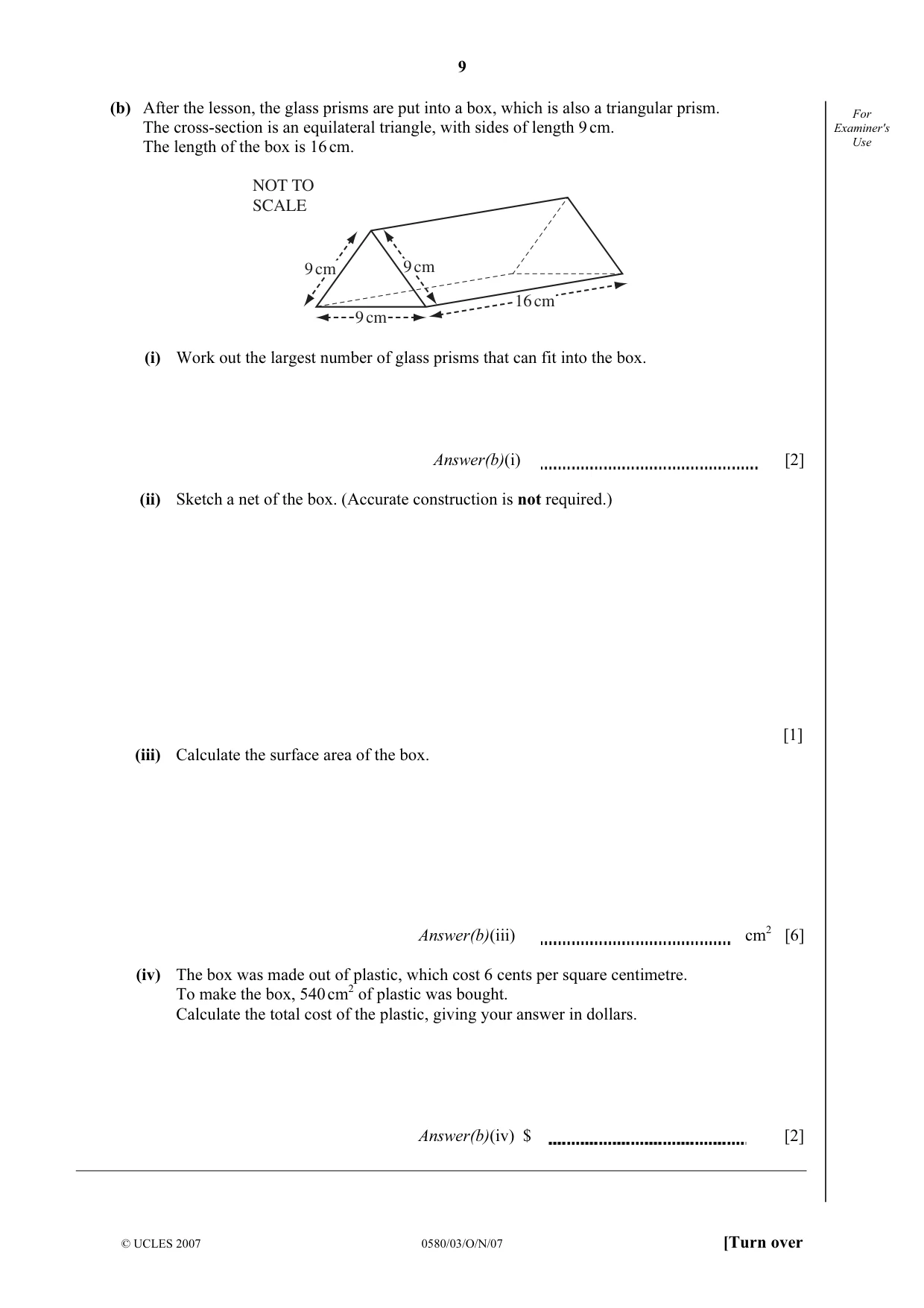
9 © UCLES 2007 0580/03/O/N/07 [Turn over For Examiner's Use (b) After the lesson, the glass prisms are put into a box, which is also a triangular prism. The cross-section is an equilateral triangle, with sides of length 9 cm. The length of the box is 16 cm. 16 cm 9 cm 9 cm 9 cm NOT TO SCALE (i) Work out the largest number of glass prisms that can fit into the box. Answer(b)(i) [2] (ii) Sketch a net of the box. (Accurate construction is not required.) [1] (iii) Calculate the surface area of the box. Answer(b)(iii) cm2 [6] (iv) The box was made out of plastic, which cost 6 cents per square centimetre. To make the box, 540 cm2 of plastic was bought. Calculate the total cost of the plastic, giving your answer in dollars. Answer(b)(iv) $ [2]
Question paper, page 10
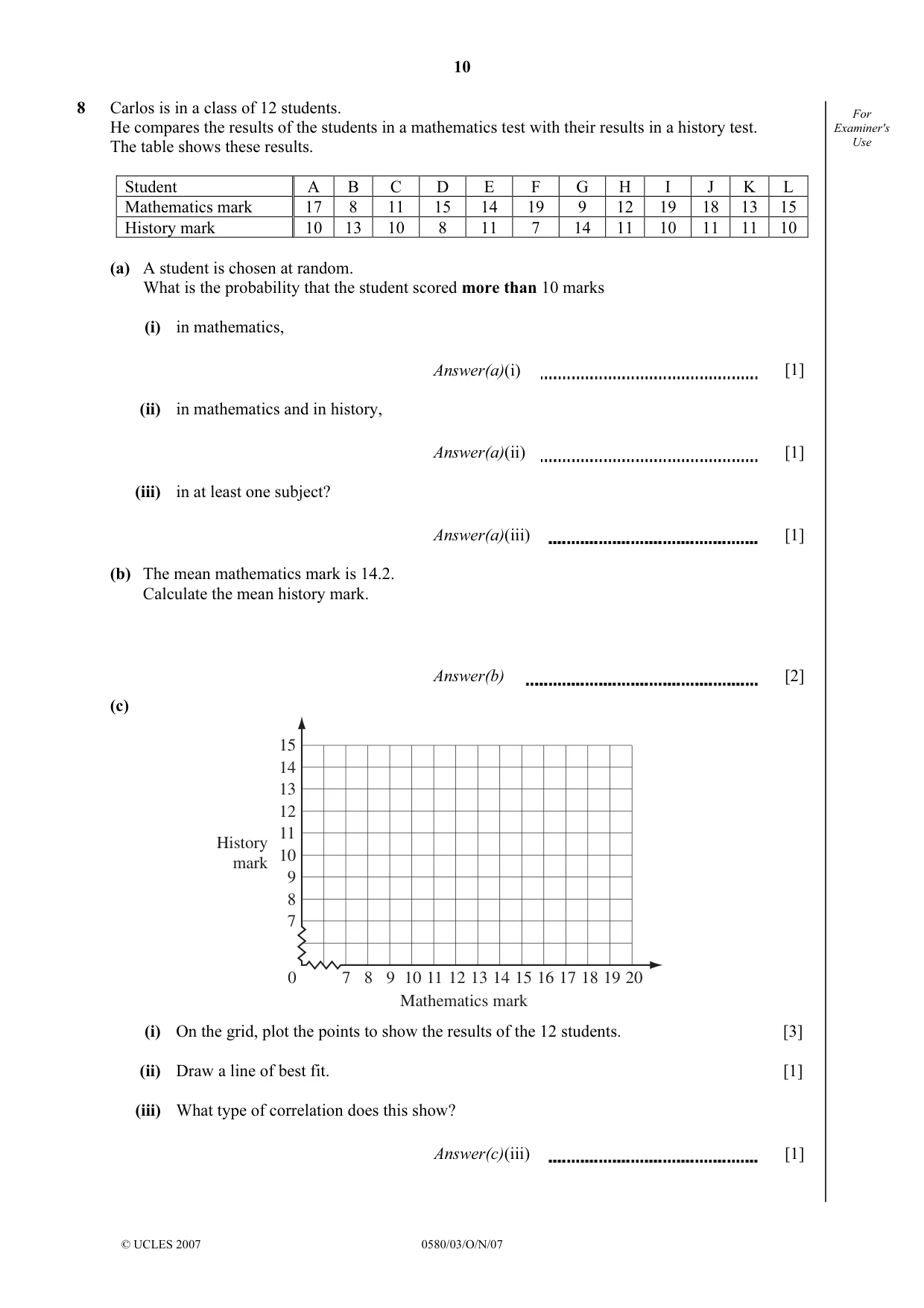
10 © UCLES 2007 0580/03/O/N/07 For Examiner's Use 8 Carlos is in a class of 12 students. He compares the results of the students in a mathematics test with their results in a history test. The table shows these results. Student A B C D E F G H I J K L Mathematics mark 17 8 11 15 14 19 9 12 19 18 13 15 History mark 10 13 10 8 11 7 14 11 10 11 11 10 (a) A student is chosen at random. What is the probability that the student scored more than 10 marks (i) in mathematics, Answer(a)(i) [1] (ii) in mathematics and in history, Answer(a)(ii) [1] (iii) in at least one subject? Answer(a)(iii) [1] (b) The mean mathematics mark is 14.2. Calculate the mean history mark. Answer(b) [2] (c) Mathematics mark History mark 15 14 13 12 11 10 9 8 7 7 8 9 10 11 12 13 14 15 16 17 18 19 20 0 (i) On the grid, plot the points to show the results of the 12 students. [3] (ii) Draw a line of best fit. [1] (iii) What type of correlation does this show? Answer(c)(iii) [1]
Question paper, page 11
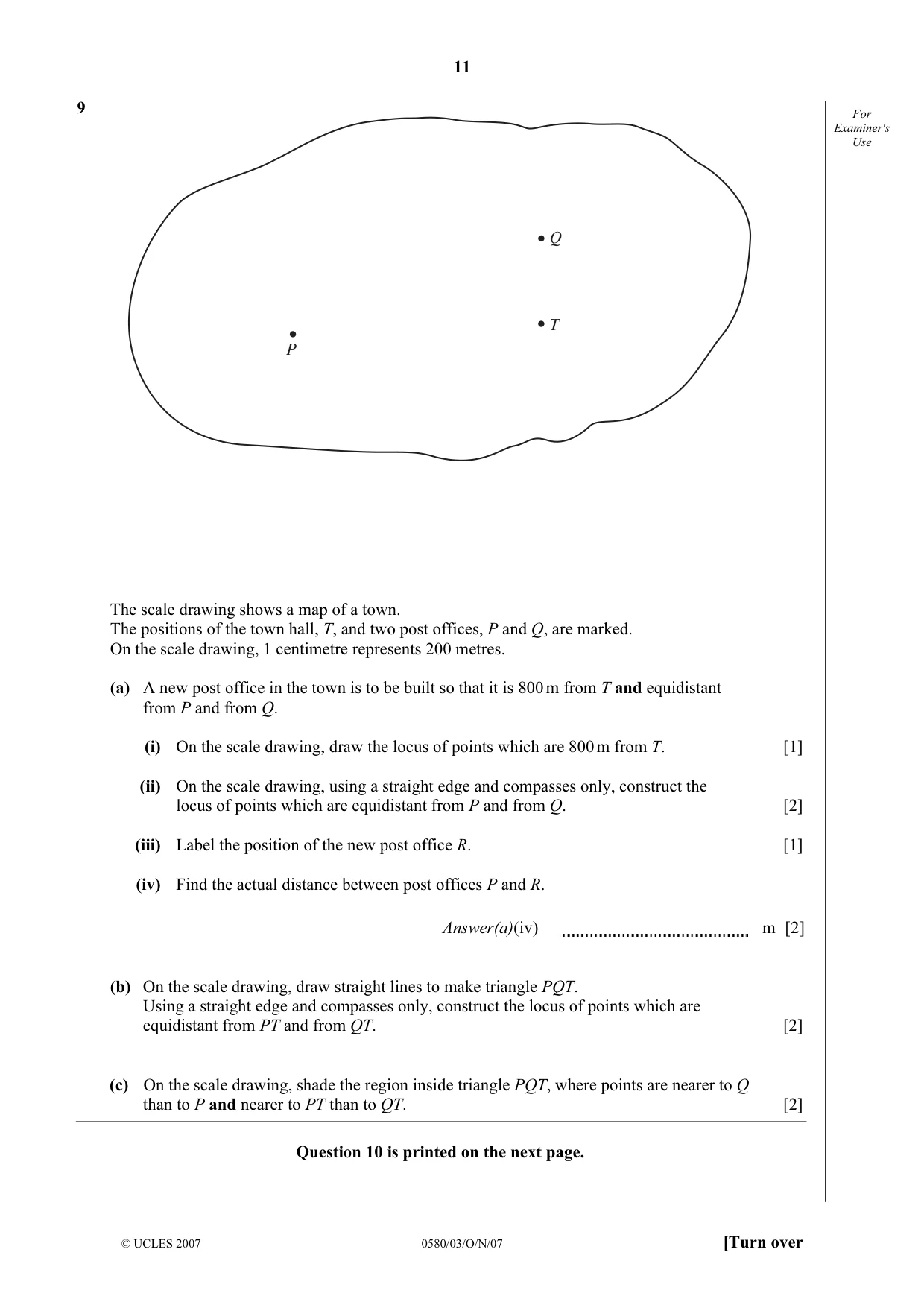
11 © UCLES 2007 0580/03/O/N/07 [Turn over For Examiner's Use 9 Q T P The scale drawing shows a map of a town. The positions of the town hall, T, and two post offices, P and Q, are marked. On the scale drawing, 1 centimetre represents 200 metres. (a) A new post office in the town is to be built so that it is 800 m from T and equidistant from P and from Q. (i) On the scale drawing, draw the locus of points which are 800 m from T. [1] (ii) On the scale drawing, using a straight edge and compasses only, construct the locus of points which are equidistant from P and from Q. [2] (iii) Label the position of the new post office R. [1] (iv) Find the actual distance between post offices P and R. Answer(a)(iv) m [2] (b) On the scale drawing, draw straight lines to make triangle PQT. Using a straight edge and compasses only, construct the locus of points which are equidistant from PT and from QT. [2] (c) On the scale drawing, shade the region inside triangle PQT, where points are nearer to Q than to P and nearer to PT than to QT. [2] Question 10 is printed on the next page.
Question paper, page 12
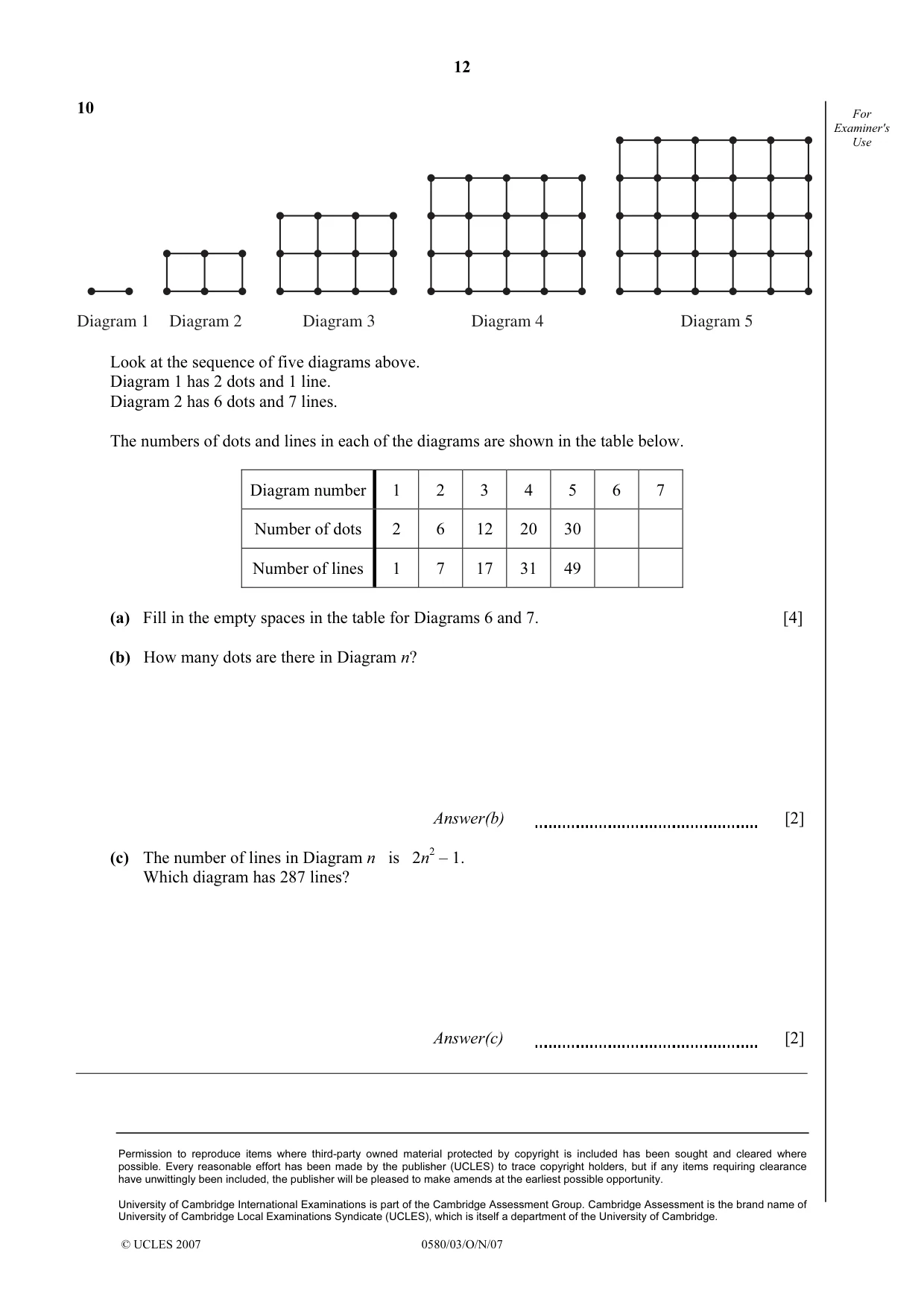
12 Permission to reproduce items where third-party owned material protected by copyright is included has been sought and cleared where possible. Every reasonable effort has been made by the publisher (UCLES) to trace copyright holders, but if any items requiring clearance have unwittingly been included, the publisher will be pleased to make amends at the earliest possible opportunity. University of Cambridge International Examinations is part of the Cambridge Assessment Group. Cambridge Assessment is the brand name of University of Cambridge Local Examinations Syndicate (UCLES), which is itself a department of the University of Cambridge. © UCLES 2007 0580/03/O/N/07 For Examiner's Use 10 Diagram 1 Diagram 2 Diagram 3 Diagram 4 Diagram 5 Look at the sequence of five diagrams above. Diagram 1 has 2 dots and 1 line. Diagram 2 has 6 dots and 7 lines. The numbers of dots and lines in each of the diagrams are shown in the table below. Diagram number 1 2 3 4 5 6 7 Number of dots 2 6 12 20 30 Number of lines 1 7 17 31 49 (a) Fill in the empty spaces in the table for Diagrams 6 and 7. [4] (b) How many dots are there in Diagram n? Answer(b) [2] (c) The number of lines in Diagram n is 2n2 – 1. Which diagram has 287 lines? Answer(c) [2]
Mark scheme, page 1
UNIVERSITY OF CAMBRIDGE INTERNATIONAL EXAMINATIONS International General Certificate of Secondary Education MARK SCHEME for the October/November 2007 question paper 0580 and 0581 MATHEMATICS 0580/03 and 0581/03 Paper 3 (Core), maximum raw mark 104 This mark scheme is published as an aid to teachers and candidates, to indicate the requirements of the examination. It shows the basis on which Examiners were instructed to award marks. It does not indicate the details of the discussions that took place at an Examiners’ meeting before marking began. All Examiners are instructed that alternative correct answers and unexpected approaches in candidates’ scripts must be given marks that fairly reflect the relevant knowledge and skills demonstrated. Mark schemes must be read in conjunction with the question papers and the report on the examination. • CIE will not enter into discussions or correspondence in connection with these mark schemes. CIE is publishing the mark schemes for the October/November 2007 question papers for most IGCSE, GCE Advanced Level and Advanced Subsidiary Level syllabuses and some Ordinary Level syllabuses. www.XtremePapers.com
Mark scheme, page 2
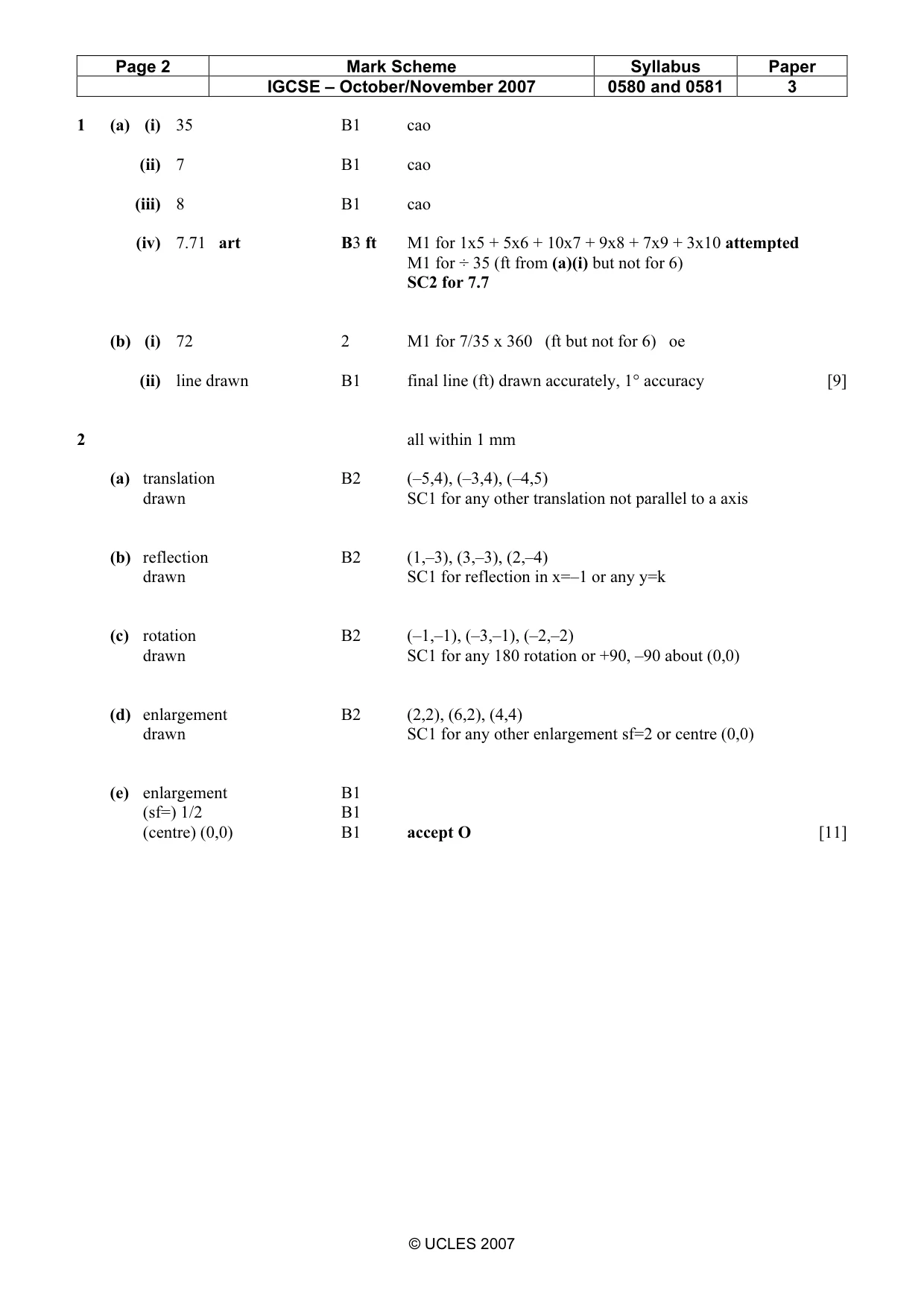
Page 2 Mark Scheme Syllabus Paper IGCSE – October/November 2007 0580 and 0581 3 © UCLES 2007 1 (a) (i) 35 B1 cao (ii) 7 B1 cao (iii) 8 B1 cao (iv) 7.71 art B3 ft M1 for 1x5 + 5x6 + 10x7 + 9x8 + 7x9 + 3x10 attempted M1 for ÷ 35 (ft from (a)(i) but not for 6) SC2 for 7.7 (b) (i) 72 2 M1 for 7/35 x 360 (ft but not for 6) oe (ii) line drawn B1 final line (ft) drawn accurately, 1° accuracy [9] 2 all within 1 mm (a) translation B2 (–5,4), (–3,4), (–4,5) drawn SC1 for any other translation not parallel to a axis (b) reflection B2 (1,–3), (3,–3), (2,–4) drawn SC1 for reflection in x=–1 or any y=k (c) rotation B2 (–1,–1), (–3,–1), (–2,–2) drawn SC1 for any 180 rotation or +90, –90 about (0,0) (d) enlargement B2 (2,2), (6,2), (4,4) drawn SC1 for any other enlargement sf=2 or centre (0,0) (e) enlargement B1 (sf=) 1/2 B1 (centre) (0,0) B1 accept O [11]
Mark scheme, page 3
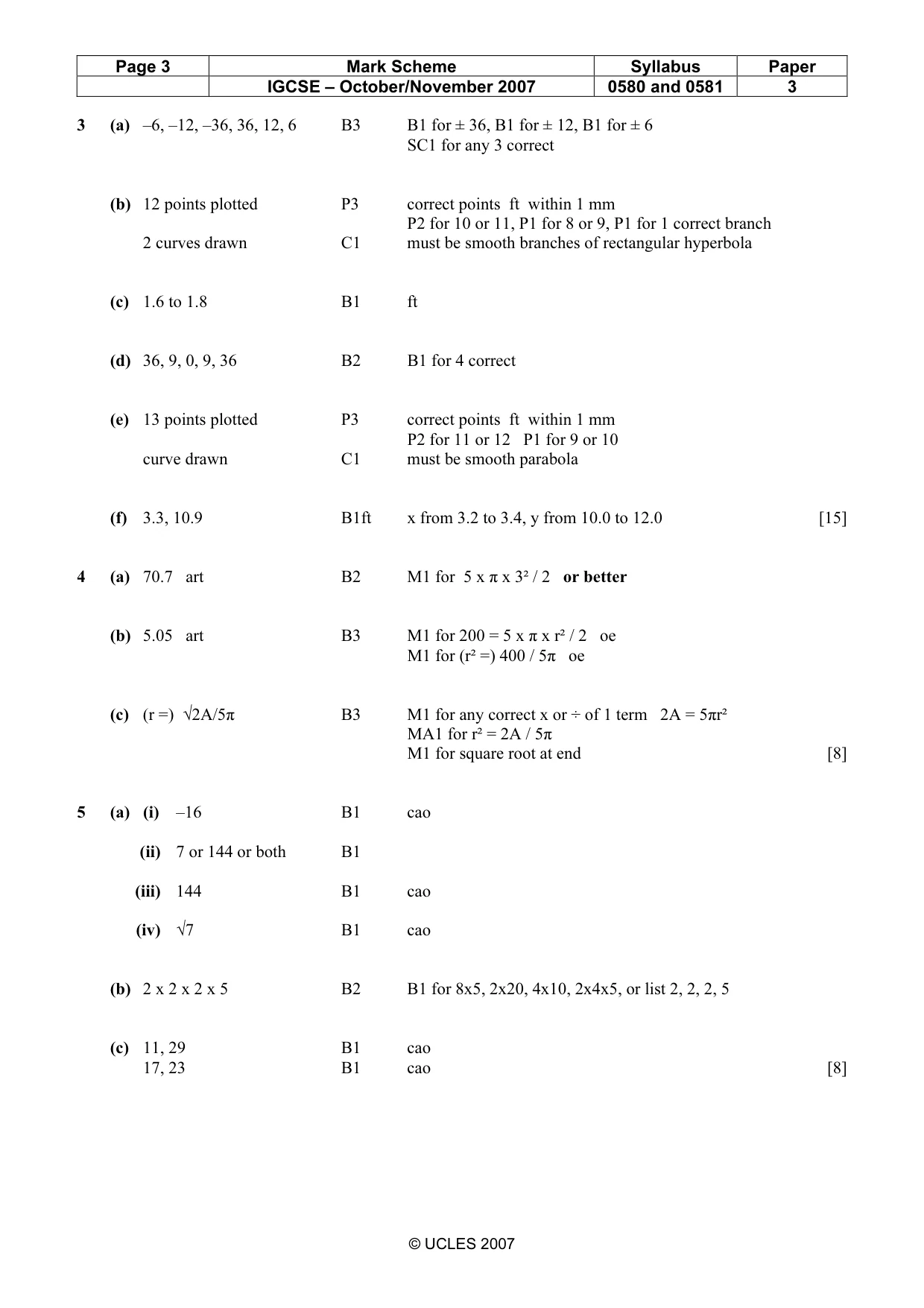
Page 3 Mark Scheme Syllabus Paper IGCSE – October/November 2007 0580 and 0581 3 © UCLES 2007 3 (a) –6, –12, –36, 36, 12, 6 B3 B1 for ± 36, B1 for ± 12, B1 for ± 6 SC1 for any 3 correct (b) 12 points plotted P3 correct points ft within 1 mm P2 for 10 or 11, P1 for 8 or 9, P1 for 1 correct branch 2 curves drawn C1 must be smooth branches of rectangular hyperbola (c) 1.6 to 1.8 B1 ft (d) 36, 9, 0, 9, 36 B2 B1 for 4 correct (e) 13 points plotted P3 correct points ft within 1 mm P2 for 11 or 12 P1 for 9 or 10 curve drawn C1 must be smooth parabola (f) 3.3, 10.9 B1ft x from 3.2 to 3.4, y from 10.0 to 12.0 [15] 4 (a) 70.7 art B2 M1 for 5 x π x 3² / 2 or better (b) 5.05 art B3 M1 for 200 = 5 x π x r² / 2 oe M1 for (r² =) 400 / 5π oe (c) (r =) √2A/5π B3 M1 for any correct x or ÷ of 1 term 2A = 5πr² MA1 for r² = 2A / 5π M1 for square root at end [8] 5 (a) (i) –16 B1 cao (ii) 7 or 144 or both B1 (iii) 144 B1 cao (iv) √7 B1 cao (b) 2 x 2 x 2 x 5 B2 B1 for 8x5, 2x20, 4x10, 2x4x5, or list 2, 2, 2, 5 (c) 11, 29 B1 cao 17, 23 B1 cao [8]
Mark scheme, page 4
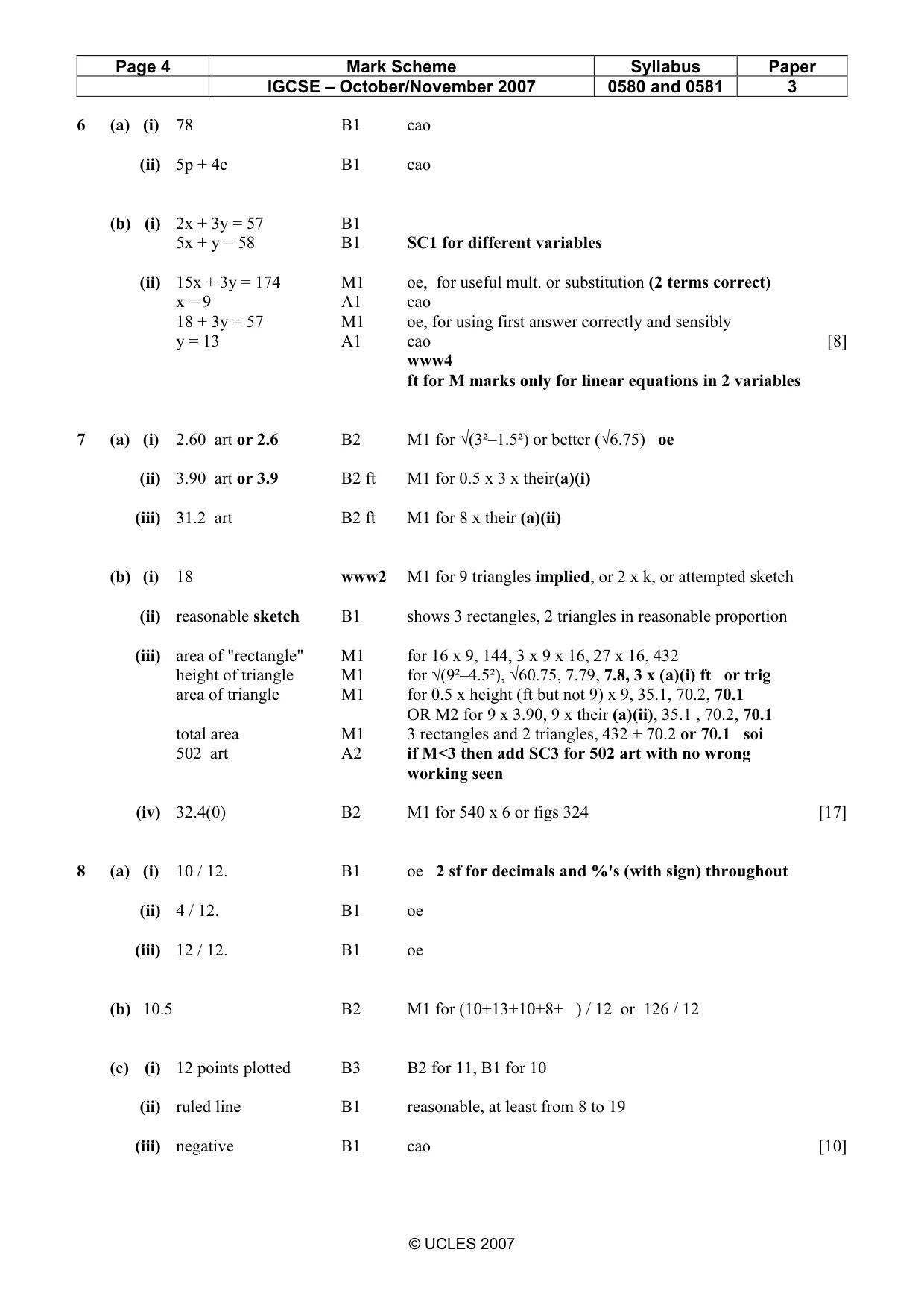
Page 4 Mark Scheme Syllabus Paper IGCSE – October/November 2007 0580 and 0581 3 © UCLES 2007 6 (a) (i) 78 B1 cao (ii) 5p + 4e B1 cao (b) (i) 2x + 3y = 57 B1 5x + y = 58 B1 SC1 for different variables (ii) 15x + 3y = 174 M1 oe, for useful mult. or substitution (2 terms correct) x = 9 A1 cao 18 + 3y = 57 M1 oe, for using first answer correctly and sensibly y = 13 A1 cao [8] www4 ft for M marks only for linear equations in 2 variables 7 (a) (i) 2.60 art or 2.6 B2 M1 for √(3²–1.5²) or better (√6.75) oe (ii) 3.90 art or 3.9 B2 ft M1 for 0.5 x 3 x their(a)(i) (iii) 31.2 art B2 ft M1 for 8 x their (a)(ii) (b) (i) 18 www2 M1 for 9 triangles implied, or 2 x k, or attempted sketch (ii) reasonable sketch B1 shows 3 rectangles, 2 triangles in reasonable proportion (iii) area of "rectangle" M1 for 16 x 9, 144, 3 x 9 x 16, 27 x 16, 432 height of triangle M1 for √(9²–4.5²), √60.75, 7.79, 7.8, 3 x (a)(i) ft or trig area of triangle M1 for 0.5 x height (ft but not 9) x 9, 35.1, 70.2, 70.1 OR M2 for 9 x 3.90, 9 x their (a)(ii), 35.1 , 70.2, 70.1 total area M1 3 rectangles and 2 triangles, 432 + 70.2 or 70.1 soi 502 art A2 if M<3 then add SC3 for 502 art with no wrong working seen (iv) 32.4(0) B2 M1 for 540 x 6 or figs 324 [17] 8 (a) (i) 10 / 12. B1 oe 2 sf for decimals and %'s (with sign) throughout (ii) 4 / 12. B1 oe (iii) 12 / 12. B1 oe (b) 10.5 B2 M1 for (10+13+10+8+ ) / 12 or 126 / 12 (c) (i) 12 points plotted B3 B2 for 11, B1 for 10 (ii) ruled line B1 reasonable, at least from 8 to 19 (iii) negative B1 cao [10]
Mark scheme, page 5
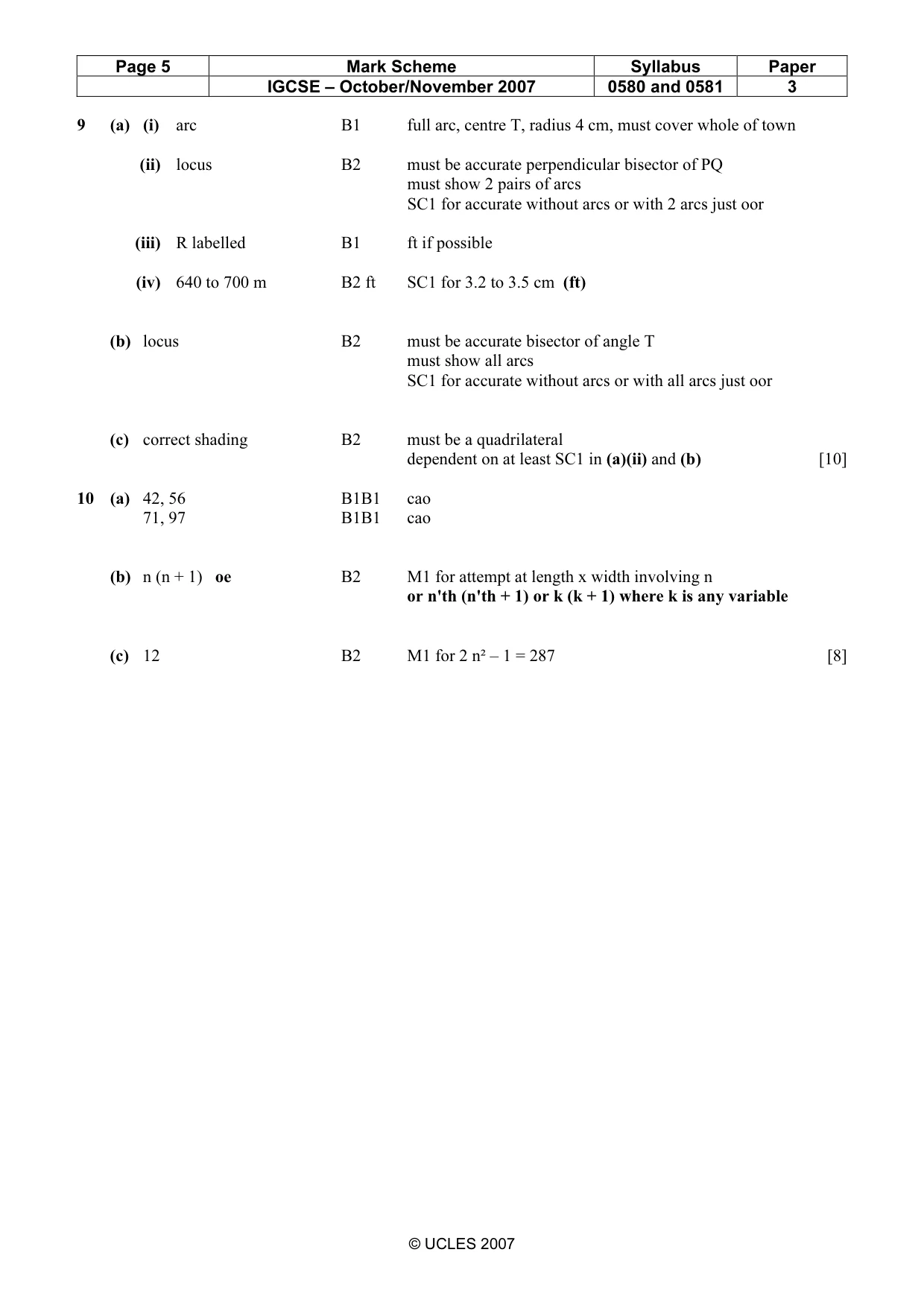
Page 5 Mark Scheme Syllabus Paper IGCSE – October/November 2007 0580 and 0581 3 © UCLES 2007 9 (a) (i) arc B1 full arc, centre T, radius 4 cm, must cover whole of town (ii) locus B2 must be accurate perpendicular bisector of PQ must show 2 pairs of arcs SC1 for accurate without arcs or with 2 arcs just oor (iii) R labelled B1 ft if possible (iv) 640 to 700 m B2 ft SC1 for 3.2 to 3.5 cm (ft) (b) locus B2 must be accurate bisector of angle T must show all arcs SC1 for accurate without arcs or with all arcs just oor (c) correct shading B2 must be a quadrilateral dependent on at least SC1 in (a)(ii) and (b) [10] 10 (a) 42, 56 B1B1 cao 71, 97 B1B1 cao (b) n (n + 1) oe B2 M1 for attempt at length x width involving n or n'th (n'th + 1) or k (k + 1) where k is any variable (c) 12 B2 M1 for 2 n² – 1 = 287 [8]
What you needed in this session
Cambridge’s own grade thresholds for 2007 Oct/Nov, Paper 3 · Variant 1. A higher threshold means an easier paper — the bar moves with how the cohort did.