Cambridge IGCSE Mathematics (with coursework) 0581 — 2007 May/June Paper 4 · Variant 1
0581/41/M/J/07 · 130 marks · ≈146 min
The question paper and its mark scheme, free to read here and free to download. This is Cambridge’s own paper, exactly as it was sat.
Question paper12 pages
Mark scheme8 pages
Answers below. Sit the paper first if you are practising.
Paper as text
Question paper, page 1
This document consists of 11 printed pages and 1 blank page. IB07 06_0580_04/6RP © UCLES 2007 [Turn over *5128615949* UNIVERSITY OF CAMBRIDGE INTERNATIONAL EXAMINATIONS International General Certificate of Secondary Education MATHEMATICS 0580/04, 0581/04 Paper 4 (Extended) May/June 2007 2 hours 30 minutes Additional Materials: Answer Booklet/Paper Graph paper (2 sheets) Electronic calculator Mathematical tables (optional) Geometrical instruments Tracing paper (optional) READ THESE INSTRUCTIONS FIRST If you have been given an Answer Booklet, follow the instructions on the front cover of the Booklet. Write your Centre number, candidate number and name on all the work you hand in. Write in dark blue or black pen. You may use a pencil for any diagrams or graphs. Do not use staples, paper clips, highlighters, glue or correction fluid. Answer all questions. All working must be clearly shown. It should be done on the same sheet as the rest of the answer. Marks will be given for working which shows that you know how to solve the problem even if you get the answer wrong. Electronic calculators should be used. If the degree of accuracy is not specified in the question, and if the answer is not exact, give the answer to three significant figures. Give answers in degrees to one decimal place. For π use either your calculator value or 3.142. At the end of the examination, fasten all your work securely together. The number of marks is given in brackets [ ] at the end of each question or part question. The total of the marks for this paper is 130. www.XtremePapers.com
Question paper, page 2
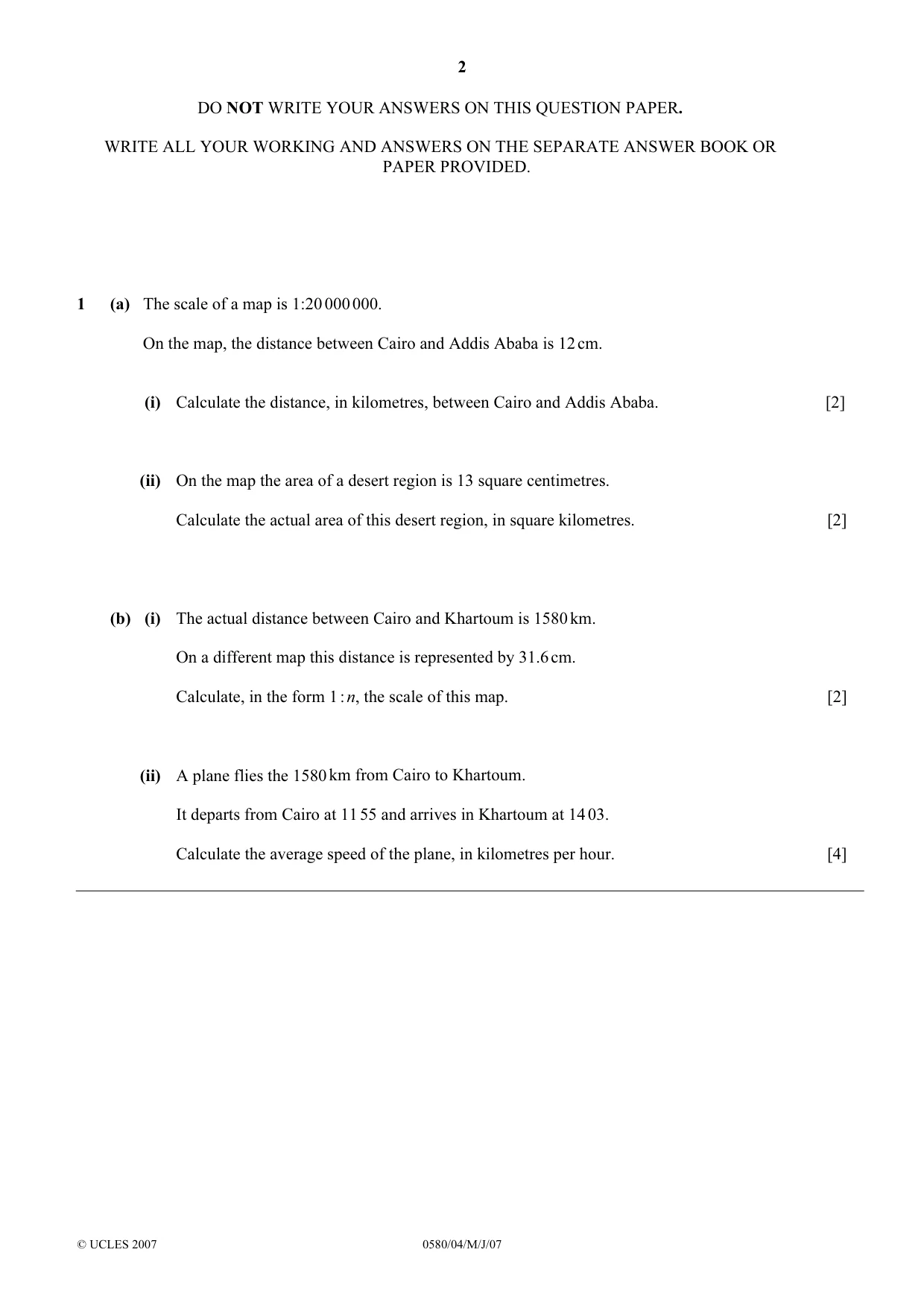
2 © UCLES 2007 0580/04/M/J/07 DO NOT WRITE YOUR ANSWERS ON THIS QUESTION PAPER. WRITE ALL YOUR WORKING AND ANSWERS ON THE SEPARATE ANSWER BOOK OR PAPER PROVIDED. 1 (a) The scale of a map is 1:20 000 000. On the map, the distance between Cairo and Addis Ababa is 12 cm. (i) Calculate the distance, in kilometres, between Cairo and Addis Ababa. [2] (ii) On the map the area of a desert region is 13 square centimetres. Calculate the actual area of this desert region, in square kilometres. [2] (b) (i) The actual distance between Cairo and Khartoum is 1580 km. On a different map this distance is represented by 31.6 cm. Calculate, in the form 1 : n, the scale of this map. [2] (ii) A plane flies the 1580 km from Cairo to Khartoum. It departs from Cairo at 11 55 and arrives in Khartoum at 14 03. Calculate the average speed of the plane, in kilometres per hour. [4]
Question paper, page 3
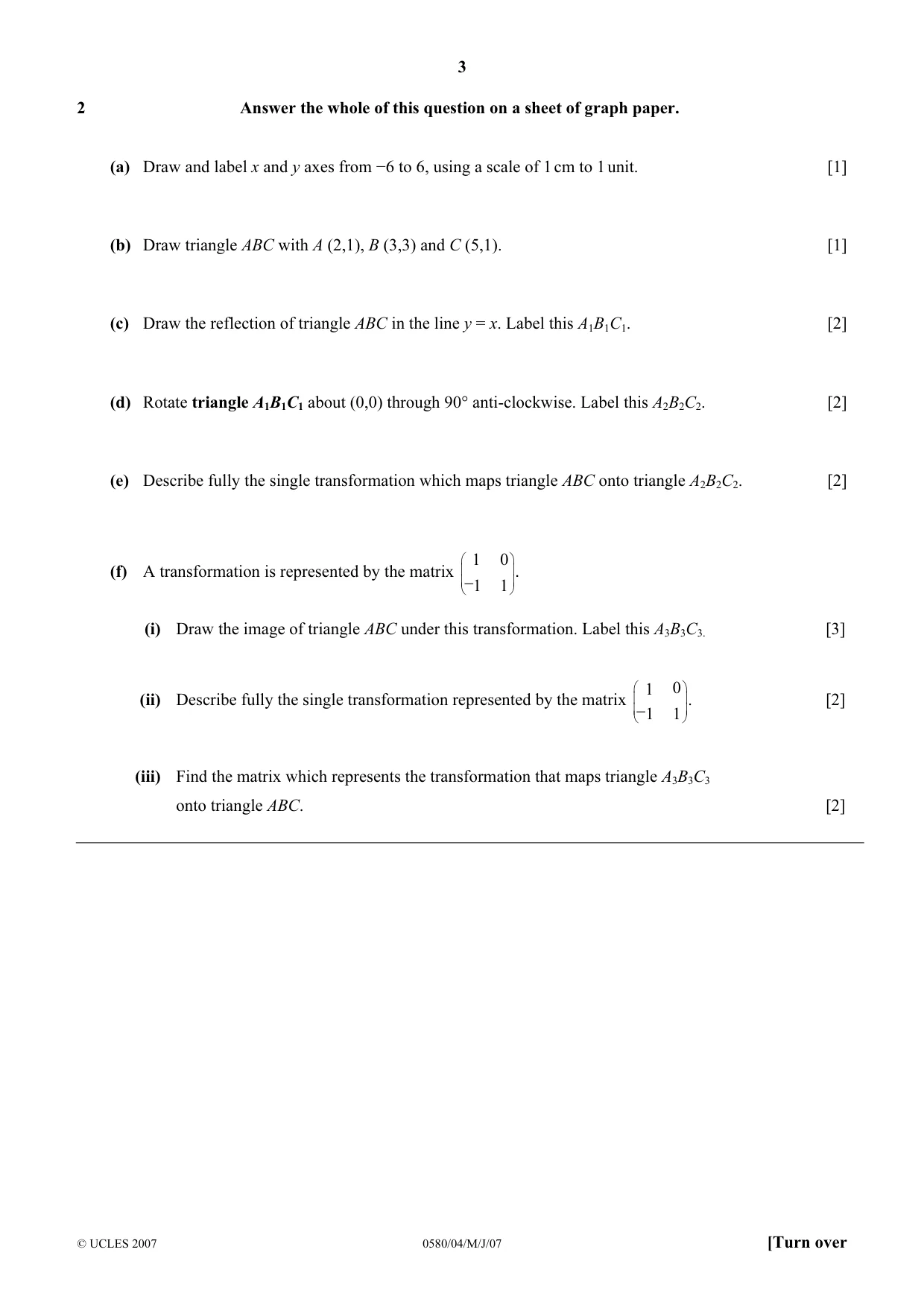
3 © UCLES 2007 0580/04/M/J/07 [Turn over 2 Answer the whole of this question on a sheet of graph paper. (a) Draw and label x and y axes from −6 to 6, using a scale of 1 cm to 1 unit. [1] (b) Draw triangle ABC with A (2,1), B (3,3) and C (5,1). [1] (c) Draw the reflection of triangle ABC in the line y = x. Label this A1B1C1. [2] (d) Rotate triangle A1B1C1 about (0,0) through 90° anti-clockwise. Label this A2B2C2. [2] (e) Describe fully the single transformation which maps triangle ABC onto triangle A2B2C2. [2] (f) A transformation is represented by the matrix 1 0 1 1 . − (i) Draw the image of triangle ABC under this transformation. Label this A3B3C3. [3] (ii) Describe fully the single transformation represented by the matrix 0 1 . 1 1 − [2] (iii) Find the matrix which represents the transformation that maps triangle A3B3C3 onto triangle ABC. [2]
Question paper, page 4
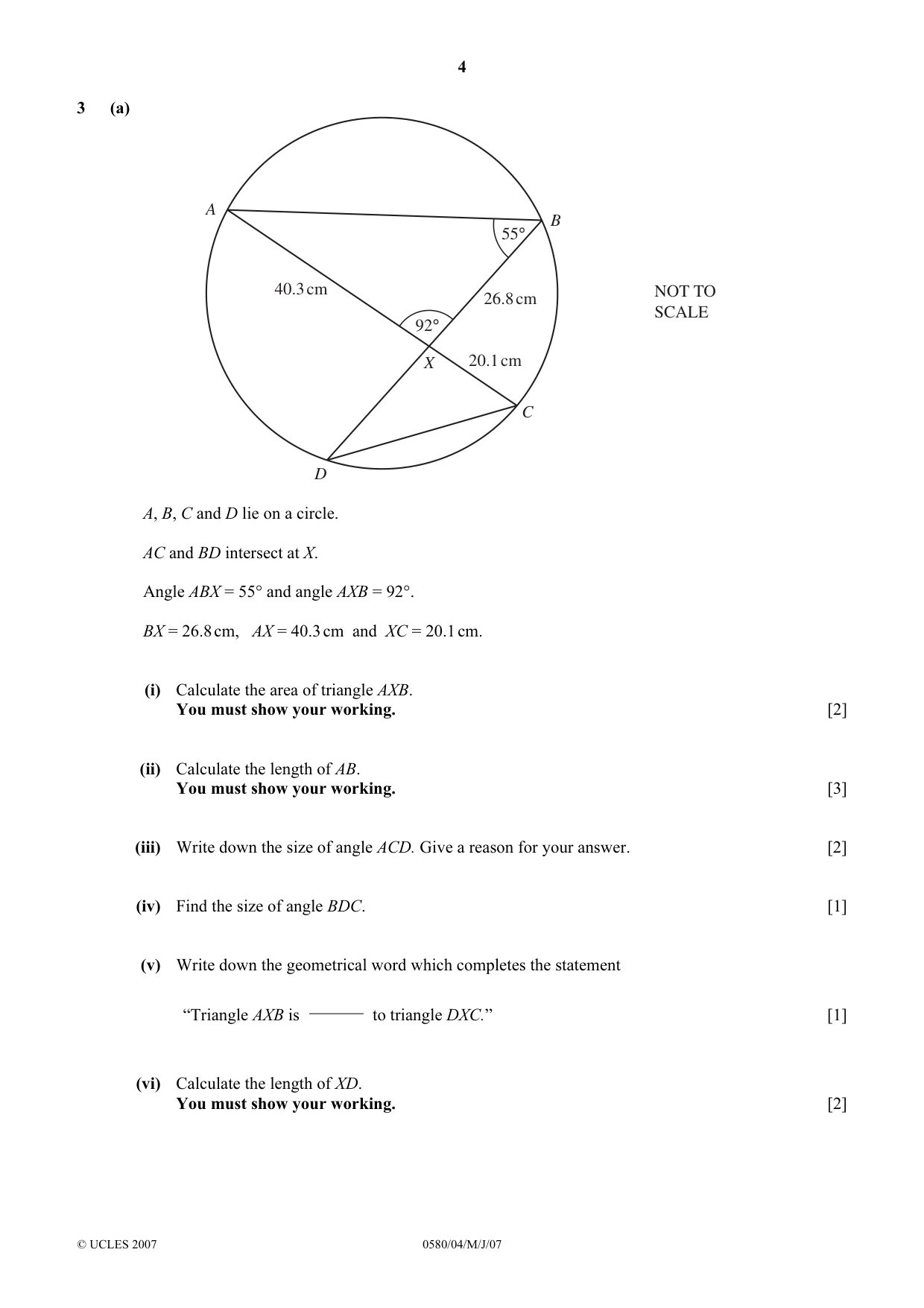
4 © UCLES 2007 0580/04/M/J/07 3 (a) A X B D C 55° 92° 40.3 cm 26.8 cm 26.8 cm 20.1 cm 20.1 cm 26.8 cm 20.1 cm NOT TO SCALE A, B, C and D lie on a circle. AC and BD intersect at X. Angle ABX = 55° and angle AXB = 92°. BX = 26.8 cm, AX = 40.3 cm and XC = 20.1 cm. (i) Calculate the area of triangle AXB. You must show your working. [2] (ii) Calculate the length of AB. You must show your working. [3] (iii) Write down the size of angle ACD. Give a reason for your answer. [2] (iv) Find the size of angle BDC. [1] (v) Write down the geometrical word which completes the statement “Triangle AXB is to triangle DXC.” [1] (vi) Calculate the length of XD. You must show your working. [2]
Question paper, page 5
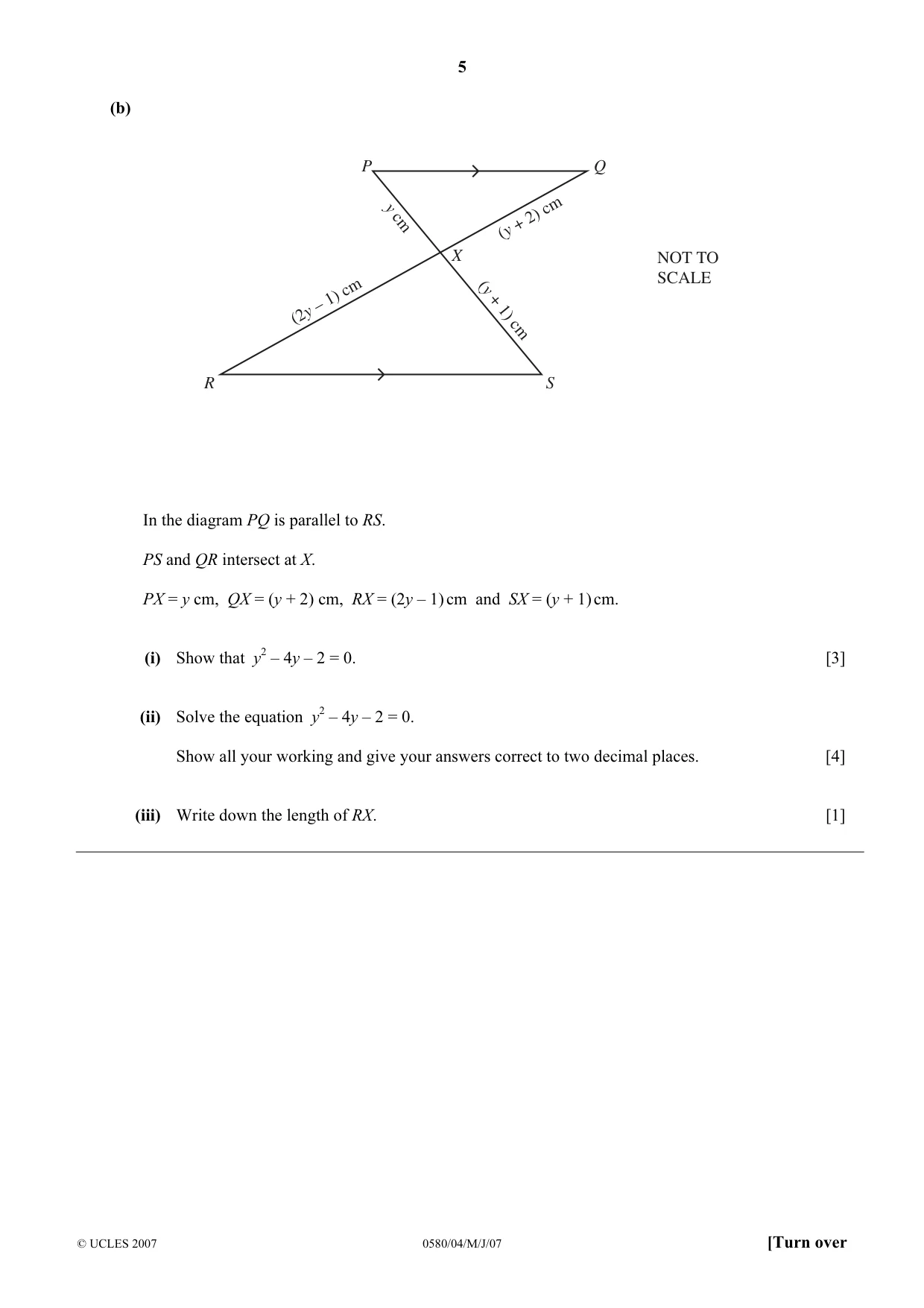
5 © UCLES 2007 0580/04/M/J/07 [Turn over (b) P Q R S X y cm (y + 2) cm (2y – 1) cm (y + 1) cm NOT TO SCALE In the diagram PQ is parallel to RS. PS and QR intersect at X. PX = y cm, QX = (y + 2) cm, RX = (2y – 1) cm and SX = (y + 1) cm. (i) Show that y2 – 4y – 2 = 0. [3] (ii) Solve the equation y2 – 4y – 2 = 0. Show all your working and give your answers correct to two decimal places. [4] (iii) Write down the length of RX. [1]
Question paper, page 6
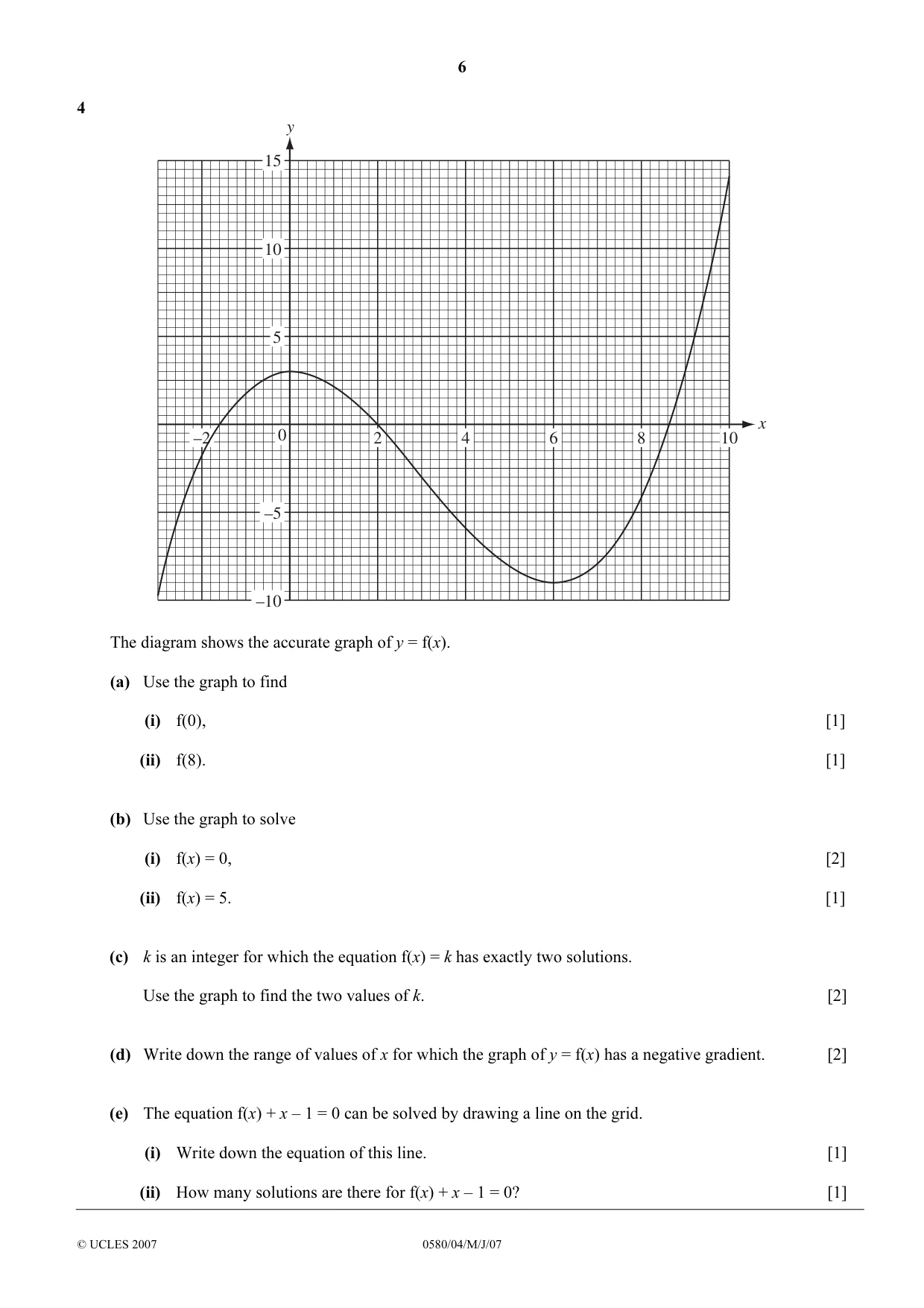
6 © UCLES 2007 0580/04/M/J/07 4 15 10 5 –5 –10 –2 2 4 6 8 10 0 y x The diagram shows the accurate graph of y = f(x). (a) Use the graph to find (i) f(0), [1] (ii) f(8). [1] (b) Use the graph to solve (i) f(x) = 0, [2] (ii) f(x) = 5. [1] (c) k is an integer for which the equation f(x) = k has exactly two solutions. Use the graph to find the two values of k. [2] (d) Write down the range of values of x for which the graph of y = f(x) has a negative gradient. [2] (e) The equation f(x) + x – 1 = 0 can be solved by drawing a line on the grid. (i) Write down the equation of this line. [1] (ii) How many solutions are there for f(x) + x – 1 = 0? [1]
Question paper, page 7
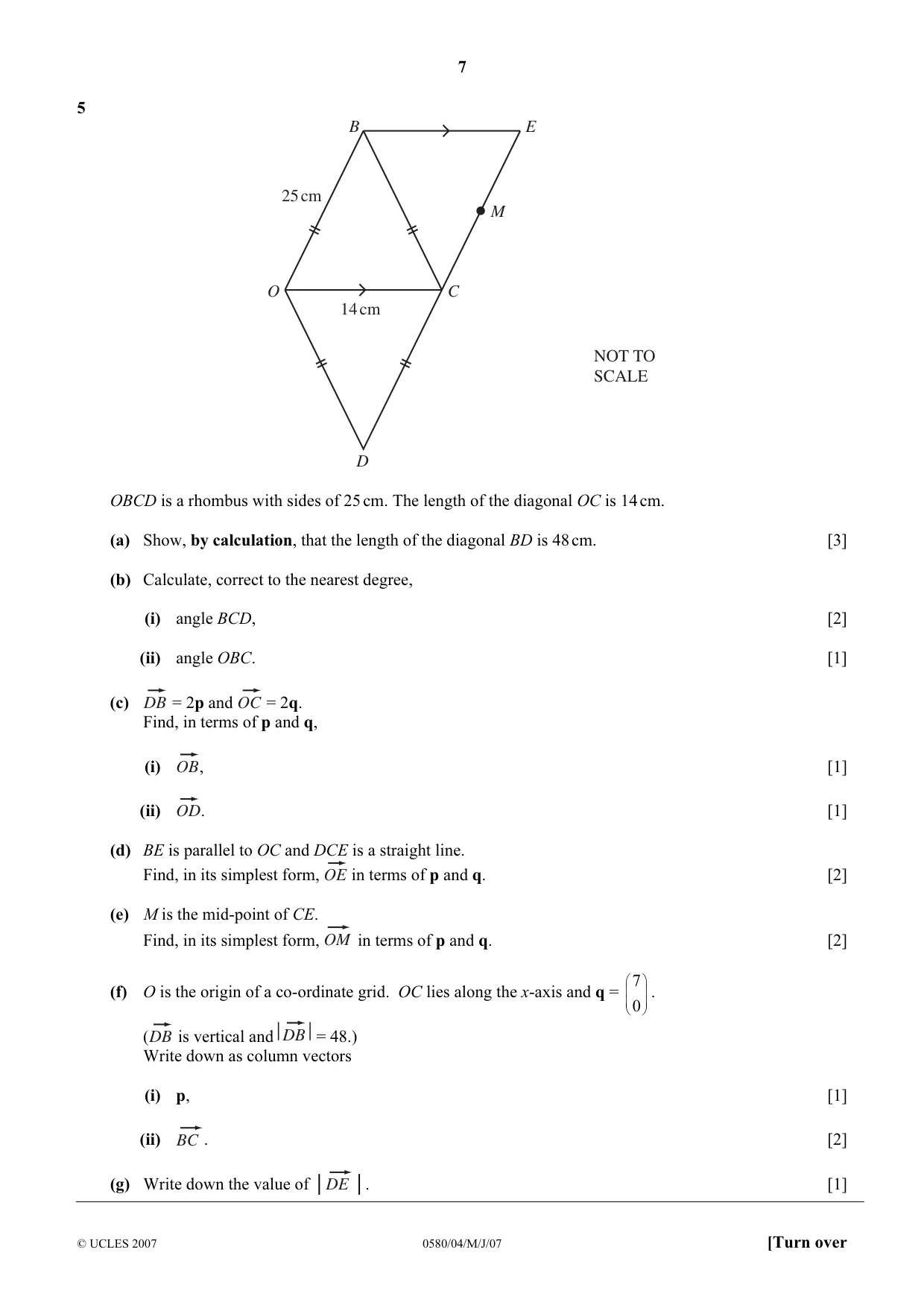
7 © UCLES 2007 0580/04/M/J/07 [Turn over 5 E B O C D 14 cm 25 cm M NOT TO SCALE OBCD is a rhombus with sides of 25 cm. The length of the diagonal OC is 14 cm. (a) Show, by calculation, that the length of the diagonal BD is 48 cm. [3] (b) Calculate, correct to the nearest degree, (i) angle BCD, [2] (ii) angle OBC. [1] (c) DB = 2p and OC = 2q. Find, in terms of p and q, (i) OB, [1] (ii) OD. [1] (d) BE is parallel to OC and DCE is a straight line. Find, in its simplest form, OE in terms of p and q. [2] (e) M is the mid-point of CE. Find, in its simplest form, OM in terms of p and q. [2] (f) O is the origin of a co-ordinate grid. OC lies along the x-axis and q = 7 0 . (DB is vertical and DB = 48.) Write down as column vectors (i) p, [1] (ii) BC . [2] (g) Write down the value of │DE │. [1]
Question paper, page 8
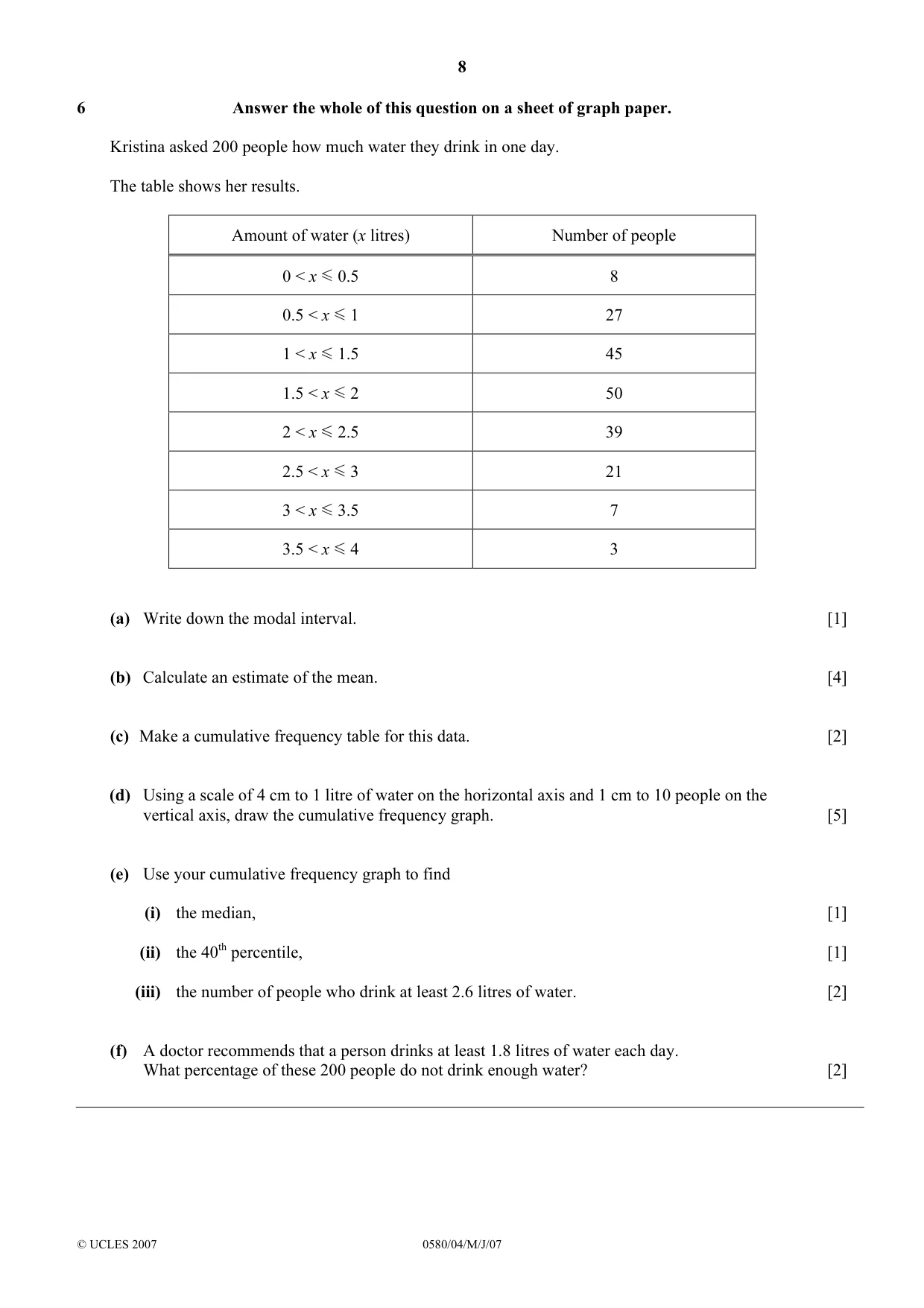
8 © UCLES 2007 0580/04/M/J/07 6 Answer the whole of this question on a sheet of graph paper. Kristina asked 200 people how much water they drink in one day. The table shows her results. Amount of water (x litres) Number of people 0 < x 0.5 8 0.5 < x 1 27 1 < x 1.5 45 1.5 < x 2 50 2 < x 2.5 39 2.5 < x 3 21 3 < x 3.5 7 3.5 < x 4 3 (a) Write down the modal interval. [1] (b) Calculate an estimate of the mean. [4] (c) Make a cumulative frequency table for this data. [2] (d) Using a scale of 4 cm to 1 litre of water on the horizontal axis and 1 cm to 10 people on the vertical axis, draw the cumulative frequency graph. [5] (e) Use your cumulative frequency graph to find (i) the median, [1] (ii) the 40th percentile, [1] (iii) the number of people who drink at least 2.6 litres of water. [2] (f) A doctor recommends that a person drinks at least 1.8 litres of water each day. What percentage of these 200 people do not drink enough water? [2]
Question paper, page 9
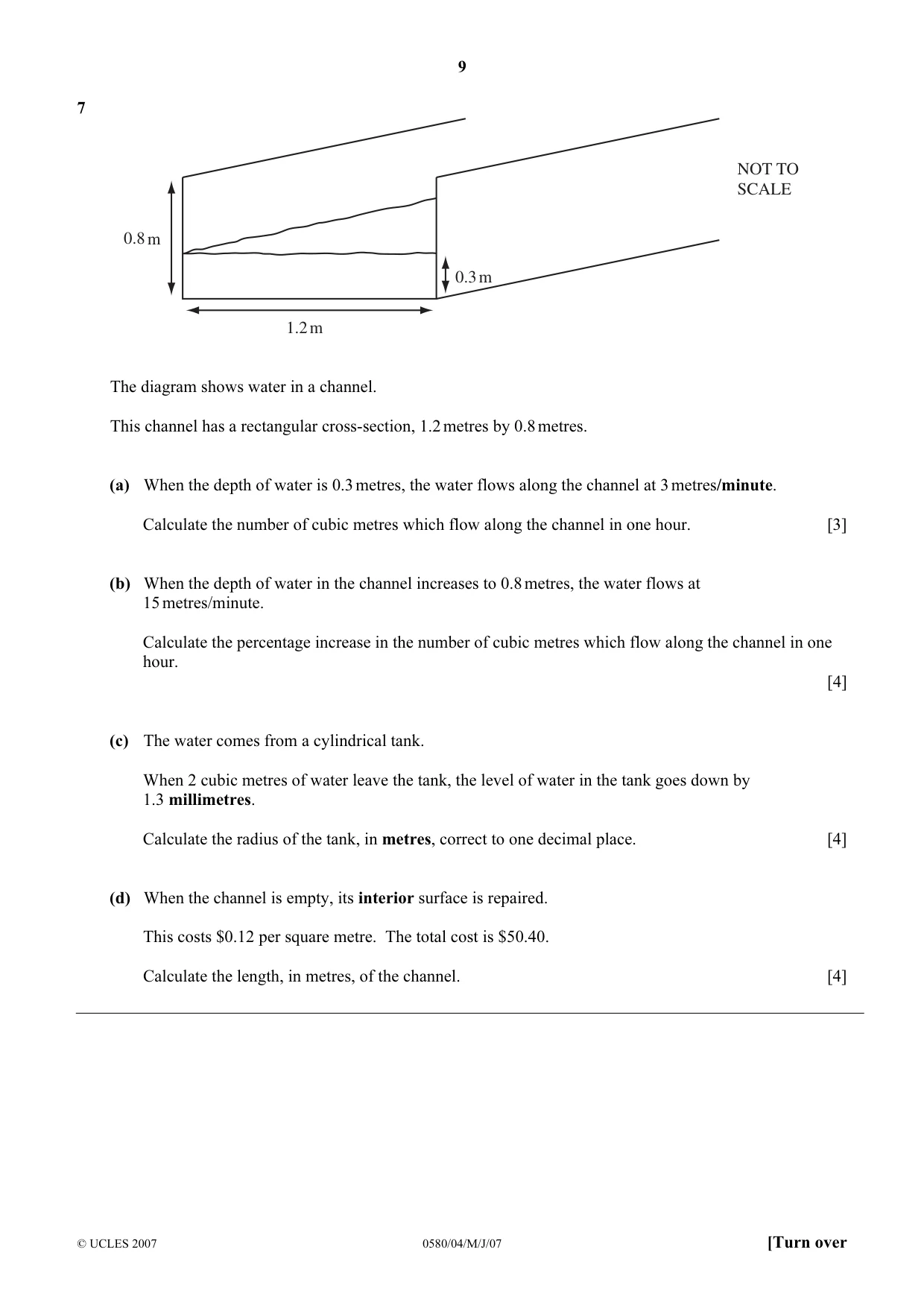
9 © UCLES 2007 0580/04/M/J/07 [Turn over 7 1.2 m 0.8 m 0.3 m NOT TO SCALE The diagram shows water in a channel. This channel has a rectangular cross-section, 1.2 metres by 0.8 metres. (a) When the depth of water is 0.3 metres, the water flows along the channel at 3 metres/minute. Calculate the number of cubic metres which flow along the channel in one hour. [3] (b) When the depth of water in the channel increases to 0.8 metres, the water flows at 15 metres/minute. Calculate the percentage increase in the number of cubic metres which flow along the channel in one hour. [4] (c) The water comes from a cylindrical tank. When 2 cubic metres of water leave the tank, the level of water in the tank goes down by 1.3 millimetres. Calculate the radius of the tank, in metres, correct to one decimal place. [4] (d) When the channel is empty, its interior surface is repaired. This costs $0.12 per square metre. The total cost is $50.40. Calculate the length, in metres, of the channel. [4]
Question paper, page 10
10 © UCLES 2007 0580/04/M/J/07 8 A packet of sweets contains chocolates and toffees. (a) There are x chocolates which have a total mass of 105 grams. Write down, in terms of x, the mean mass of a chocolate. [1] (b) There are x + 4 toffees which have a total mass of 105 grams. Write down, in terms of x, the mean mass of a toffee. [1] (c) The difference between the two mean masses in parts (a) and (b) is 0.8 grams. Write down an equation in x and show that it simplifies to x2 + 4x – 525 = 0. [4] (d) (i) Factorise x2 + 4x – 525. [2] (ii) Write down the solutions of x2 + 4x – 525 = 0. [1] (e) Write down the total number of sweets in the packet. [1] (f) Find the mean mass of a sweet in the packet. [2]
Question paper, page 11
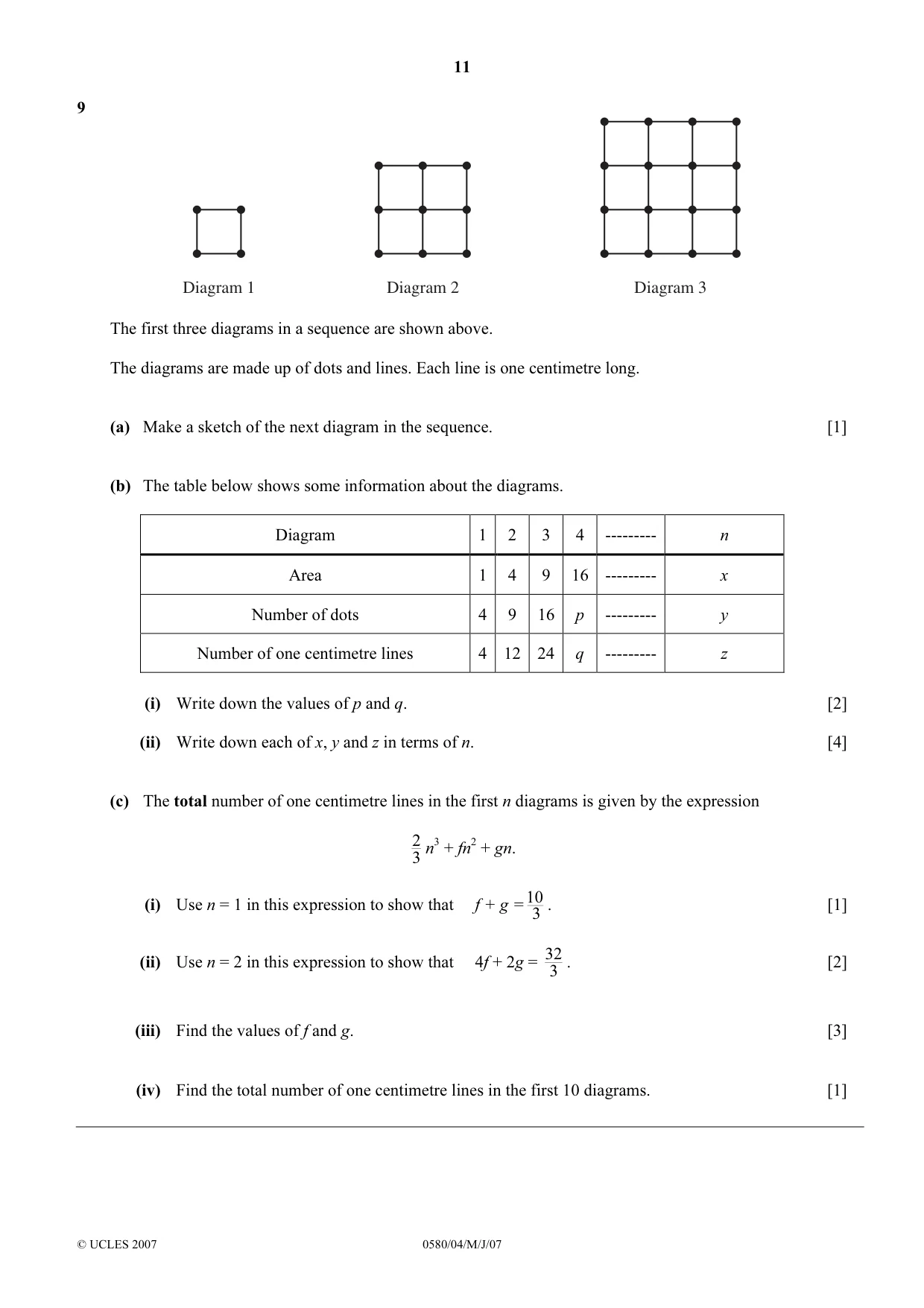
11 © UCLES 2007 0580/04/M/J/07 9 Diagram 1 Diagram 3 Diagram 2 The first three diagrams in a sequence are shown above. The diagrams are made up of dots and lines. Each line is one centimetre long. (a) Make a sketch of the next diagram in the sequence. [1] (b) The table below shows some information about the diagrams. Diagram 1 2 3 4 --------- n Area 1 4 9 16 --------- x Number of dots 4 9 16 p --------- y Number of one centimetre lines 4 12 24 q --------- z (i) Write down the values of p and q. [2] (ii) Write down each of x, y and z in terms of n. [4] (c) The total number of one centimetre lines in the first n diagrams is given by the expression 2 3 n3 + fn2 + gn. (i) Use n = 1 in this expression to show that f + g =10 3 . [1] (ii) Use n = 2 in this expression to show that 4f + 2g = 32 3 . [2] (iii) Find the values of f and g. [3] (iv) Find the total number of one centimetre lines in the first 10 diagrams. [1]
Question paper, page 12
12 Permission to reproduce items where third-party owned material protected by copyright is included has been sought and cleared where possible. Every reasonable effort has been made by the publisher (UCLES) to trace copyright holders, but if any items requiring clearance have unwittingly been included, the publisher will be pleased to make amends at the earliest possible opportunity. University of Cambridge International Examinations is part of the Cambridge Assessment Group. Cambridge Assessment is the brand name of University of Cambridge Local Examinations Syndicate (UCLES), which is itself a department of the University of Cambridge. 0580/04/M/J/07 BLANK PAGE
Mark scheme, page 1
UNIVERSITY OF CAMBRIDGE INTERNATIONAL EXAMINATIONS International General Certificate of Secondary Education MARK SCHEME for the May/June 2007 question paper 0580 and 0581 MATHEMATICS 0580/04 and 0581/04 Paper 4 (Extended), maximum raw mark 130 This mark scheme is published as an aid to teachers and candidates, to indicate the requirements of the examination. It shows the basis on which Examiners were instructed to award marks. It does not indicate the details of the discussions that took place at an Examiners’ meeting before marking began. All Examiners are instructed that alternative correct answers and unexpected approaches in candidates’ scripts must be given marks that fairly reflect the relevant knowledge and skills demonstrated. Mark schemes must be read in conjunction with the question papers and the report on the examination. • CIE will not enter into discussions or correspondence in connection with these mark schemes. CIE is publishing the mark schemes for the May/June 2007 question papers for most IGCSE, GCE Advanced Level and Advanced Subsidiary Level syllabuses and some Ordinary Level syllabuses. www.XtremePapers.com
Mark scheme, page 2
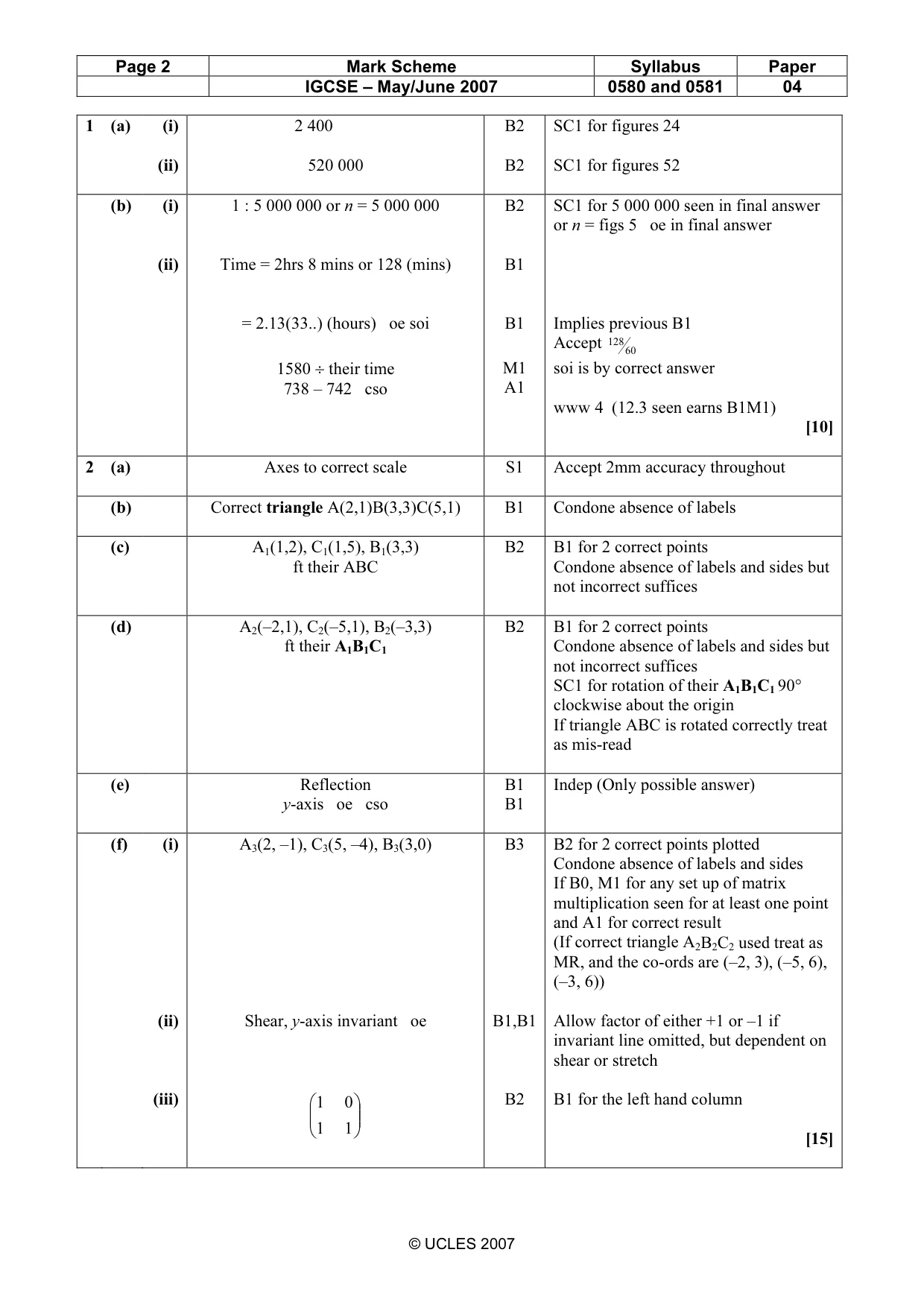
Page 2 Mark Scheme Syllabus Paper IGCSE – May/June 2007 0580 and 0581 04 © UCLES 2007 1 (a) (i) (ii) 2 400 520 000 B2 B2 SC1 for figures 24 SC1 for figures 52 (b) (i) (ii) 1 : 5 000 000 or n = 5 000 000 Time = 2hrs 8 mins or 128 (mins) = 2.13(33..) (hours) oe soi 1580 ÷ their time 738 – 742 cso B2 B1 B1 M1 A1 SC1 for 5 000 000 seen in final answer or n = figs 5 oe in final answer Implies previous B1 Accept 60 128 soi is by correct answer www 4 (12.3 seen earns B1M1) [10] 2 (a) Axes to correct scale S1 Accept 2mm accuracy throughout (b) Correct triangle A(2,1)B(3,3)C(5,1) B1 Condone absence of labels (c) A1(1,2), C1(1,5), B1(3,3) ft their ABC B2 B1 for 2 correct points Condone absence of labels and sides but not incorrect suffices (d) A2(–2,1), C2(–5,1), B2(–3,3) ft their A1B1C1 B2 B1 for 2 correct points Condone absence of labels and sides but not incorrect suffices SC1 for rotation of their A1B1C1 90° clockwise about the origin If triangle ABC is rotated correctly treat as mis-read (e) Reflection y-axis oe cso B1 B1 Indep (Only possible answer) (f) (i) (ii) (iii) A3(2, –1), C3(5, –4), B3(3,0) Shear, y-axis invariant oe 1 0 1 1 B3 B1,B1 B2 B2 for 2 correct points plotted Condone absence of labels and sides If B0, M1 for any set up of matrix multiplication seen for at least one point and A1 for correct result (If correct triangle A2B2C2 used treat as MR, and the co-ords are (–2, 3), (–5, 6), (–3, 6)) Allow factor of either +1 or –1 if invariant line omitted, but dependent on shear or stretch B1 for the left hand column [15]
Mark scheme, page 3
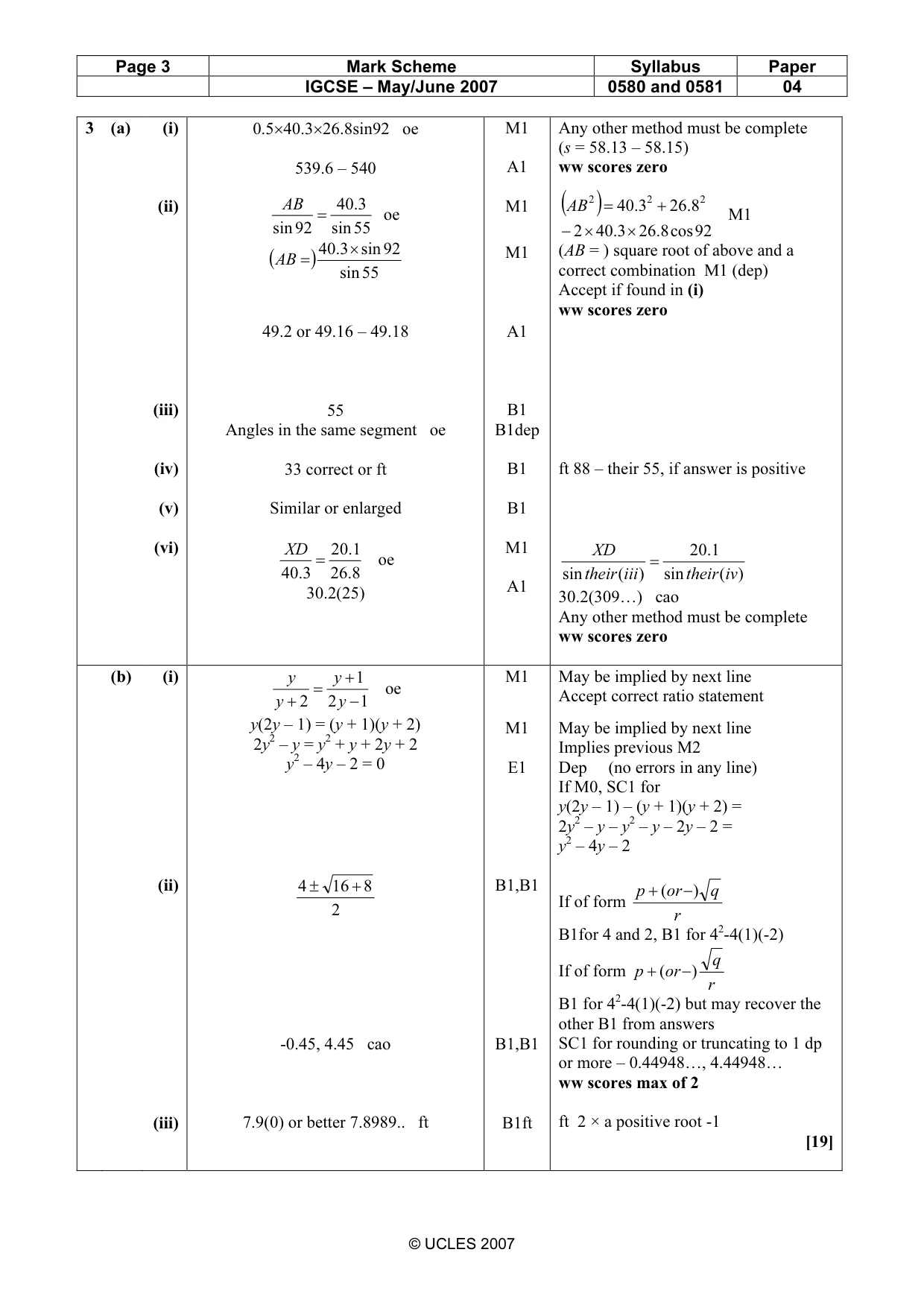
Page 3 Mark Scheme Syllabus Paper IGCSE – May/June 2007 0580 and 0581 04 © UCLES 2007 3 (a) (i) (ii) (iii) (iv) (v) (vi) 0.5×40.3×26.8sin92 oe 539.6 – 540 oe 55 sin 3. 40 92 sin = AB ( ) 55 sin 92 sin 3. 40 × = AB 49.2 or 49.16 – 49.18 55 Angles in the same segment oe 33 correct or ft Similar or enlarged 8. 26 1. 20 3. 40 = XD oe 30.2(25) M1 A1 M1 M1 A1 B1 B1dep B1 B1 M1 A1 Any other method must be complete (s = 58.13 – 58.15) ww scores zero ( ) 92 cos 8. 26 3. 40 2 8. 26 3. 40 2 2 2 × × − + = AB M1 (AB = ) square root of above and a correct combination M1 (dep) Accept if found in (i) ww scores zero ft 88 – their 55, if answer is positive ) ( sin 1. 20 ) ( sin iv their iii their XD = 30.2(309…) cao Any other method must be complete ww scores zero (b) (i) (ii) (iii) 1 2 1 2 − + = + y y y y oe y(2y – 1) = (y + 1)(y + 2) 2y2 – y = y2 + y + 2y + 2 y2 – 4y – 2 = 0 2 8 16 4 + ± -0.45, 4.45 cao 7.9(0) or better 7.8989.. ft M1 M1 E1 B1,B1 B1,B1 B1ft May be implied by next line Accept correct ratio statement May be implied by next line Implies previous M2 Dep (no errors in any line) If M0, SC1 for y(2y – 1) – (y + 1)(y + 2) = 2y2 – y – y2 – y – 2y – 2 = y2 – 4y – 2 If of form r q or p ) ( − + B1for 4 and 2, B1 for 42-4(1)(-2) If of form r q or p ) ( − + B1 for 42-4(1)(-2) but may recover the other B1 from answers SC1 for rounding or truncating to 1 dp or more – 0.44948…, 4.44948… ww scores max of 2 ft 2 × a positive root -1 [19]
Mark scheme, page 4
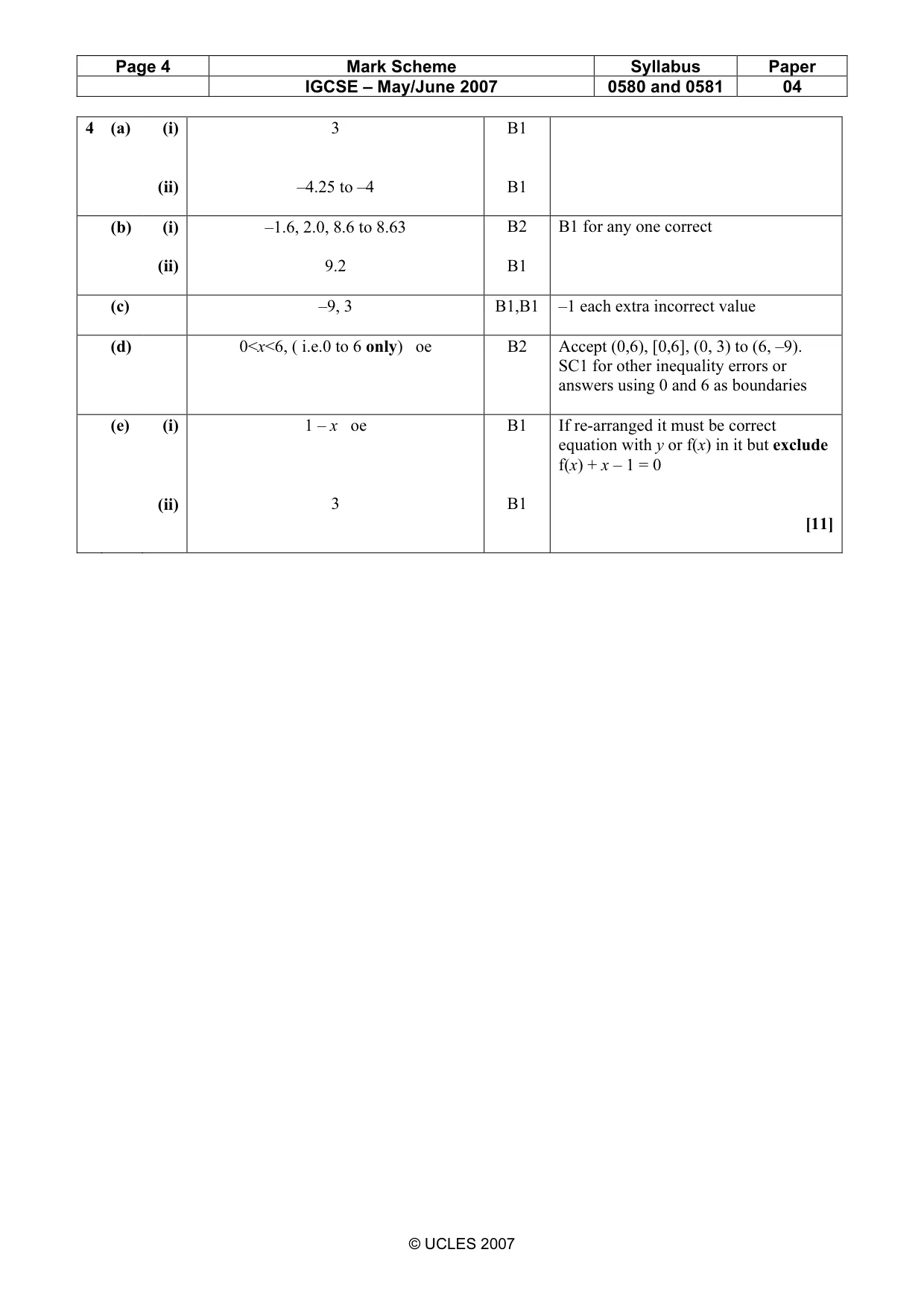
Page 4 Mark Scheme Syllabus Paper IGCSE – May/June 2007 0580 and 0581 04 © UCLES 2007 4 (a) (i) (ii) 3 –4.25 to –4 B1 B1 (b) (i) (ii) –1.6, 2.0, 8.6 to 8.63 9.2 B2 B1 B1 for any one correct (c) –9, 3 B1,B1 –1 each extra incorrect value (d) 0<x<6, ( i.e.0 to 6 only) oe B2 Accept (0,6), [0,6], (0, 3) to (6, –9). SC1 for other inequality errors or answers using 0 and 6 as boundaries (e) (i) (ii) 1 – x oe 3 B1 B1 If re-arranged it must be correct equation with y or f(x) in it but exclude f(x) + x – 1 = 0 [11]
Mark scheme, page 5
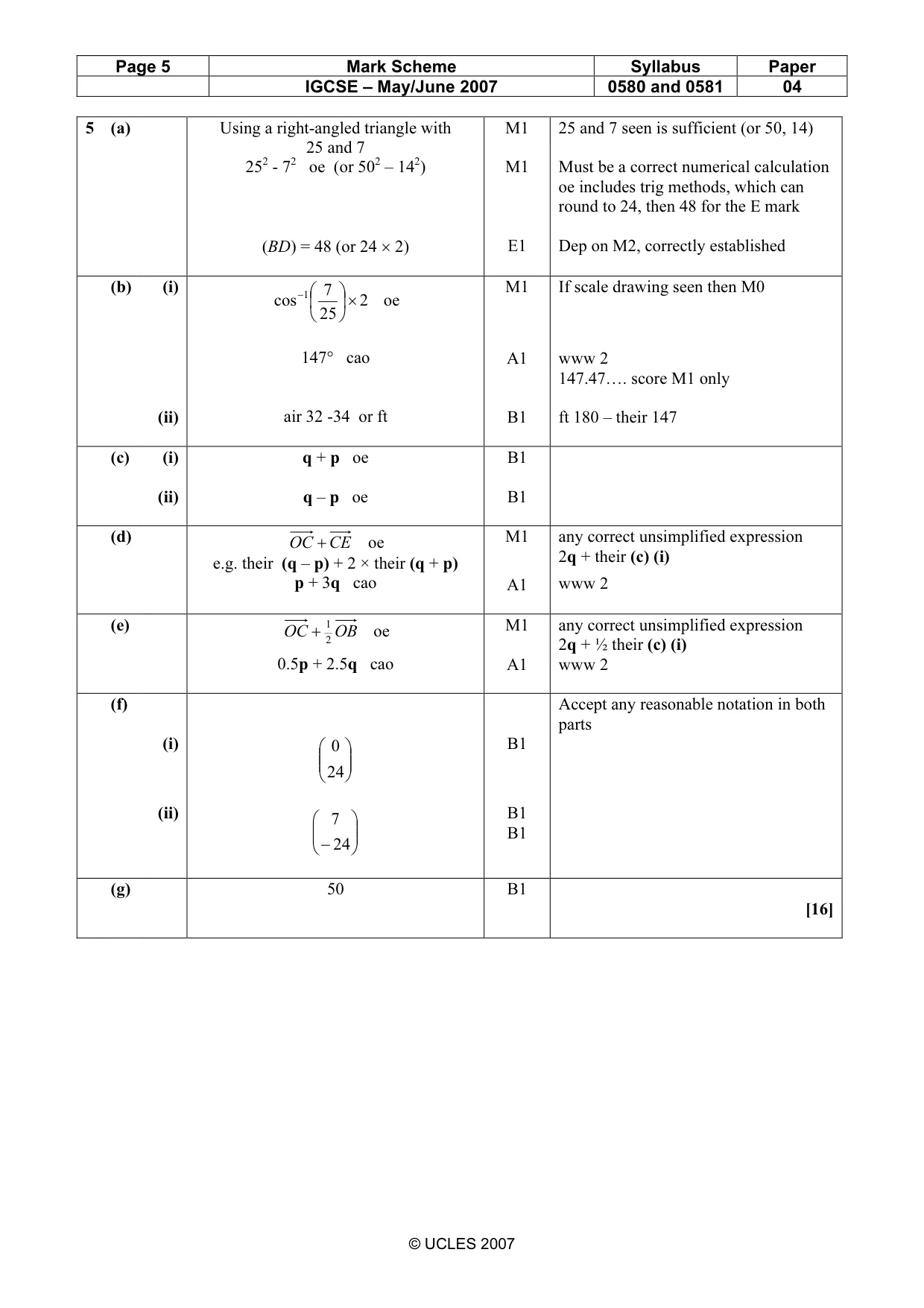
Page 5 Mark Scheme Syllabus Paper IGCSE – May/June 2007 0580 and 0581 04 © UCLES 2007 5 (a) Using a right-angled triangle with 25 and 7 252 - 72 oe (or 502 – 142) (BD) = 48 (or 24 × 2) M1 M1 E1 25 and 7 seen is sufficient (or 50, 14) Must be a correct numerical calculation oe includes trig methods, which can round to 24, then 48 for the E mark Dep on M2, correctly established (b) (i) (ii) 2 25 7 cos 1 × − oe 147° cao air 32 -34 or ft M1 A1 B1 If scale drawing seen then M0 www 2 147.47…. score M1 only ft 180 – their 147 (c) (i) (ii) q + p oe q – p oe B1 B1 (d) CE OC + oe e.g. their (q – p) + 2 × their (q + p) p + 3q cao M1 A1 any correct unsimplified expression 2q + their (c) (i) www 2 (e) OB OC 2 1 + oe 0.5p + 2.5q cao M1 A1 any correct unsimplified expression 2q + ½ their (c) (i) www 2 (f) (i) (ii) 24 0 −24 7 B1 B1 B1 Accept any reasonable notation in both parts (g) 50 B1 [16]
Mark scheme, page 6
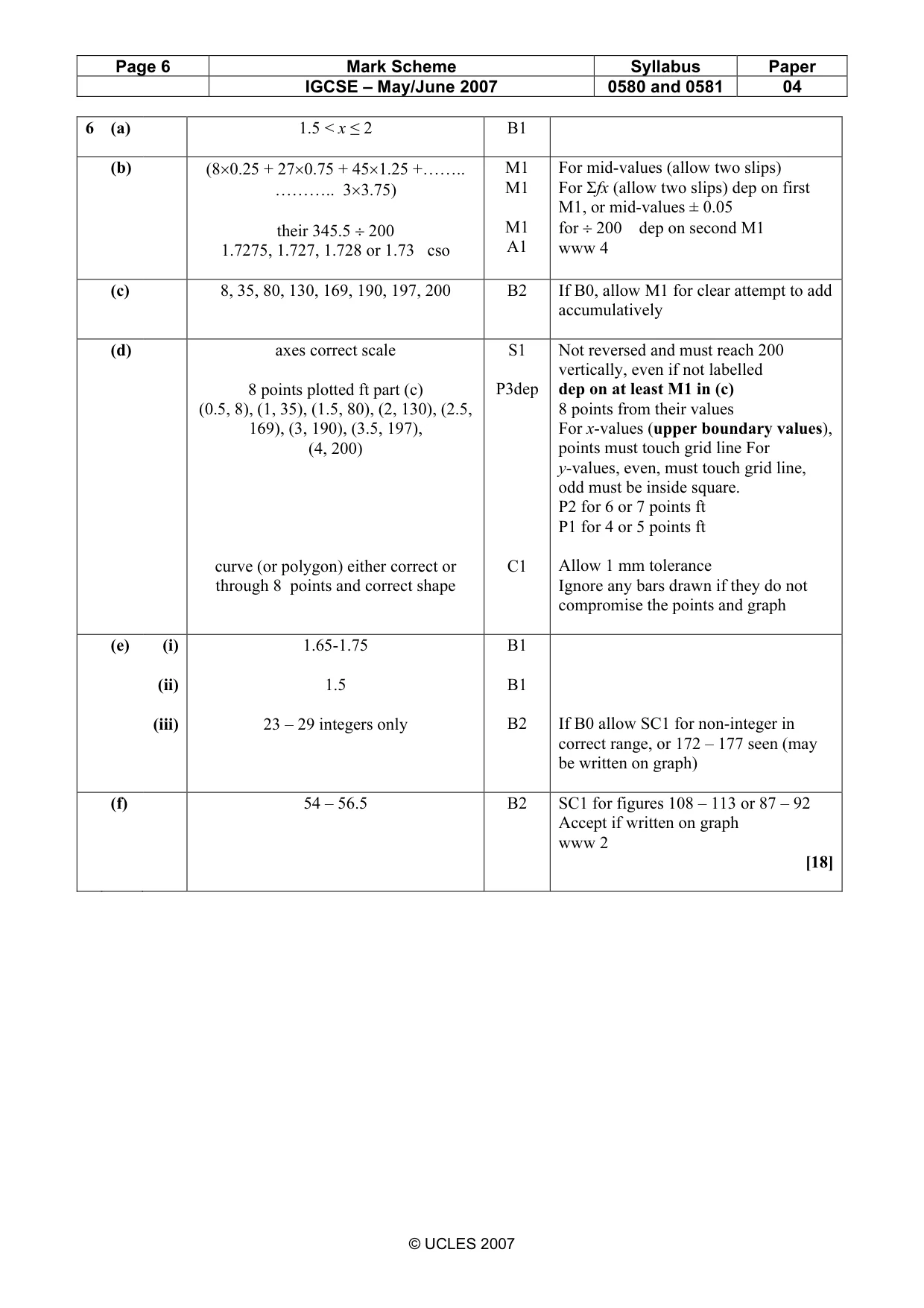
Page 6 Mark Scheme Syllabus Paper IGCSE – May/June 2007 0580 and 0581 04 © UCLES 2007 6 (a) 1.5 < x ≤ 2 B1 (b) (8×0.25 + 27×0.75 + 45×1.25 +…….. ……….. 3×3.75) their 345.5 ÷ 200 1.7275, 1.727, 1.728 or 1.73 cso M1 M1 M1 A1 For mid-values (allow two slips) For Σfx (allow two slips) dep on first M1, or mid-values ± 0.05 for ÷ 200 dep on second M1 www 4 (c) 8, 35, 80, 130, 169, 190, 197, 200 B2 If B0, allow M1 for clear attempt to add accumulatively (d) axes correct scale 8 points plotted ft part (c) (0.5, 8), (1, 35), (1.5, 80), (2, 130), (2.5, 169), (3, 190), (3.5, 197), (4, 200) curve (or polygon) either correct or through 8 points and correct shape S1 P3dep C1 Not reversed and must reach 200 vertically, even if not labelled dep on at least M1 in (c) 8 points from their values For x-values (upper boundary values), points must touch grid line For y-values, even, must touch grid line, odd must be inside square. P2 for 6 or 7 points ft P1 for 4 or 5 points ft Allow 1 mm tolerance Ignore any bars drawn if they do not compromise the points and graph (e) (i) (ii) (iii) 1.65-1.75 1.5 23 – 29 integers only B1 B1 B2 If B0 allow SC1 for non-integer in correct range, or 172 – 177 seen (may be written on graph) (f) 54 – 56.5 B2 SC1 for figures 108 – 113 or 87 – 92 Accept if written on graph www 2 [18]
Mark scheme, page 7
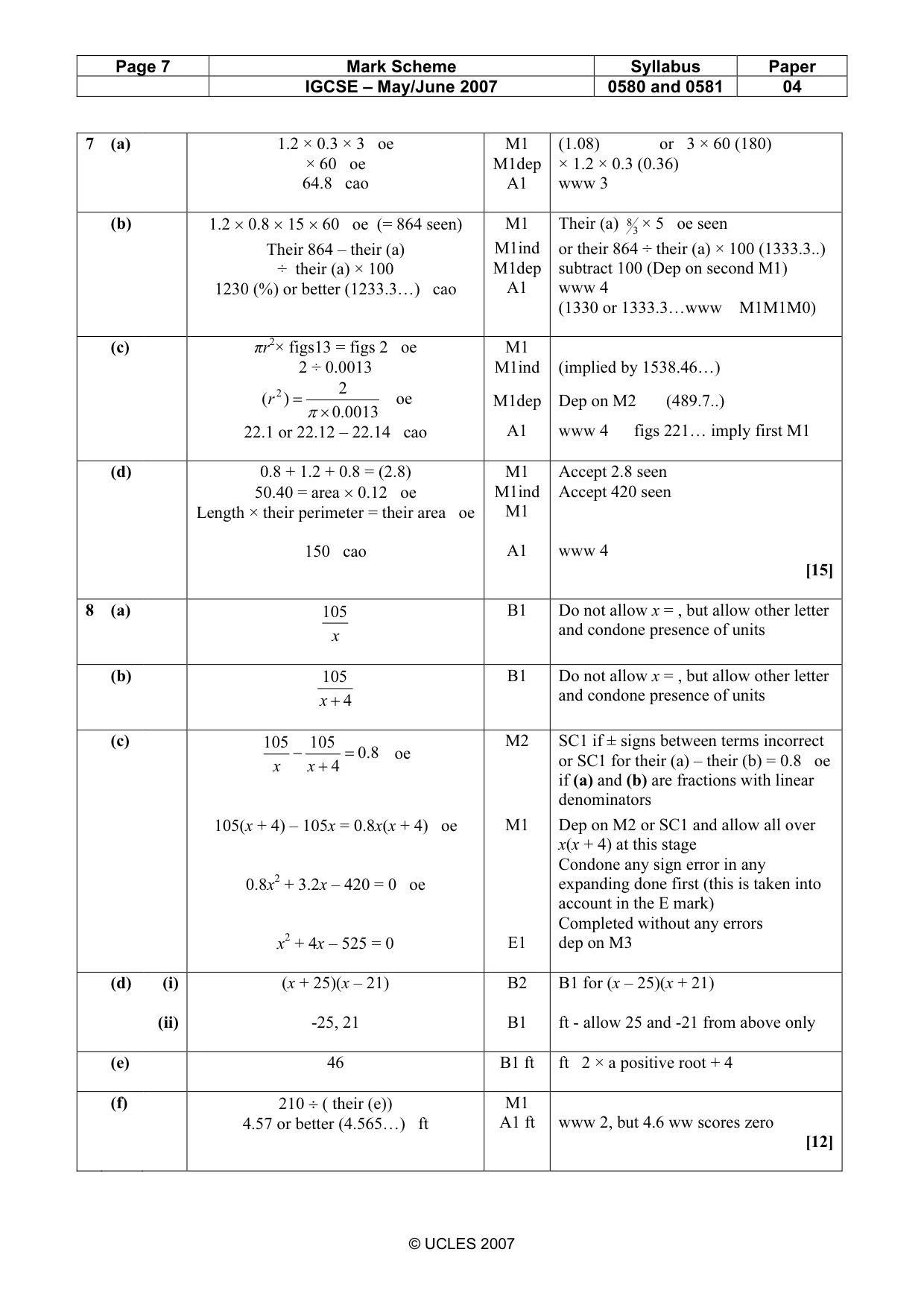
Page 7 Mark Scheme Syllabus Paper IGCSE – May/June 2007 0580 and 0581 04 © UCLES 2007 7 (a) 1.2 × 0.3 × 3 oe × 60 oe 64.8 cao M1 M1dep A1 (1.08) or 3 × 60 (180) × 1.2 × 0.3 (0.36) www 3 (b) 1.2 × 0.8 × 15 × 60 oe (= 864 seen) Their 864 – their (a) ÷ their (a) × 100 1230 (%) or better (1233.3…) cao M1 M1ind M1dep A1 Their (a) 3 8 × 5 oe seen or their 864 ÷ their (a) × 100 (1333.3..) subtract 100 (Dep on second M1) www 4 (1330 or 1333.3…www M1M1M0) (c) πr2× figs13 = figs 2 oe 2 ÷ 0.0013 0013 .0 2 ) ( 2 × = π r oe 22.1 or 22.12 – 22.14 cao M1 M1ind M1dep A1 (implied by 1538.46…) Dep on M2 (489.7..) www 4 figs 221… imply first M1 (d) 0.8 + 1.2 + 0.8 = (2.8) 50.40 = area × 0.12 oe Length × their perimeter = their area oe 150 cao M1 M1ind M1 A1 Accept 2.8 seen Accept 420 seen www 4 [15] 8 (a) x 105 B1 Do not allow x = , but allow other letter and condone presence of units (b) 4 105 + x B1 Do not allow x = , but allow other letter and condone presence of units (c) 8.0 4 105 105 = + −x x oe 105(x + 4) – 105x = 0.8x(x + 4) oe 0.8x2 + 3.2x – 420 = 0 oe x2 + 4x – 525 = 0 M2 M1 E1 SC1 if ± signs between terms incorrect or SC1 for their (a) – their (b) = 0.8 oe if (a) and (b) are fractions with linear denominators Dep on M2 or SC1 and allow all over x(x + 4) at this stage Condone any sign error in any expanding done first (this is taken into account in the E mark) Completed without any errors dep on M3 (d) (i) (ii) (x + 25)(x – 21) -25, 21 B2 B1 B1 for (x – 25)(x + 21) ft - allow 25 and -21 from above only (e) 46 B1 ft ft 2 × a positive root + 4 (f) 210 ÷ ( their (e)) 4.57 or better (4.565…) ft M1 A1 ft www 2, but 4.6 ww scores zero [12]
Mark scheme, page 8
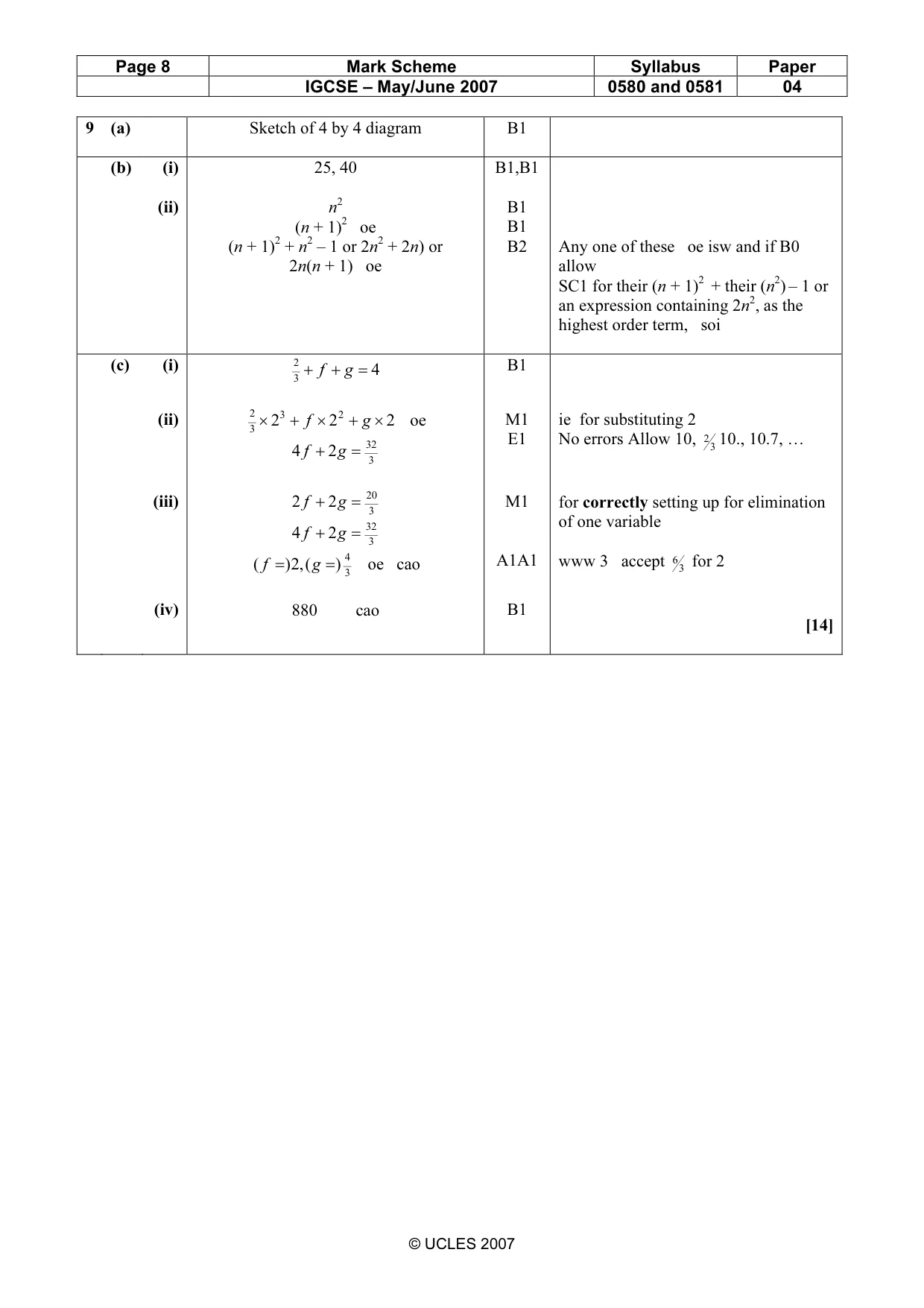
Page 8 Mark Scheme Syllabus Paper IGCSE – May/June 2007 0580 and 0581 04 © UCLES 2007 9 (a) Sketch of 4 by 4 diagram B1 (b) (i) (ii) 25, 40 n2 (n + 1)2 oe (n + 1)2 + n2 – 1 or 2n2 + 2n) or 2n(n + 1) oe B1,B1 B1 B1 B2 Any one of these oe isw and if B0 allow SC1 for their (n + 1)2 + their (n2) – 1 or an expression containing 2n2, as the highest order term, soi (c) (i) (ii) (iii) (iv) 4 3 2 = + + g f 2 2 2 2 3 3 2 × + × + × g f oe 3 32 2 4 = + g f 3 20 2 2 = + g f 3 32 2 4 = + g f 3 4 ) (,2 ) ( = = g f oe cao 880 cao B1 M1 E1 M1 A1A1 B1 ie for substituting 2 No errors Allow 10, 3 2 10., 10.7, … for correctly setting up for elimination of one variable www 3 accept 3 6 for 2 [14]
What you needed in this session
Cambridge’s own grade thresholds for 2007 May/June, Paper 4 · Variant 1. A higher threshold means an easier paper — the bar moves with how the cohort did.