Cambridge IGCSE Mathematics (with coursework) 0581 — 2006 May/June Paper 4 · Variant 1
0581/41/M/J/06 · 130 marks · ≈146 min
The question paper and its mark scheme, free to read here and free to download. This is Cambridge’s own paper, exactly as it was sat.
Question paper8 pages
Mark scheme6 pages
Answers below. Sit the paper first if you are practising.
Paper as text
Question paper, page 1
UNIVERSITY OF CAMBRIDGE INTERNATIONAL EXAMINATIONS International General Certificate of Secondary Education MATHEMATICS 0580/04 0581/04 Paper 4 (Extended) May/June 2006 Additional Materials: Answer Booklet/Paper 2 hours 30 minutes Electronic calculator Geometrical instruments Graph paper (2 sheets) Mathematical tables (optional) Tracing paper (optional) READ THESE INSTRUCTIONS FIRST Write your answers and working on the separate Answer Booklet/Paper provided. Write your name, Centre number and candidate number on all the work you hand in. Write in dark blue or black pen on both sides of the paper. You may use a soft pencil for any diagrams or graphs. Do not use staples, paper clips, highlighters, glue or correction fluid. Answer all questions. At the end of the examination, fasten all your work securely together. The number of marks is given in brackets [ ] at the end of each question or part question. All working must be clearly shown. It should be done on the same sheet as the rest of the answer. Marks will be given for working which shows that you know how to solve the problem even if you get the answer wrong. The total of the marks for this paper is 130. Electronic calculators should be used. If the degree of accuracy is not specified in the question, and if the answer is not exact, give the answer to three significant figures. Give answers in degrees to one decimal place. For π use either your calculator value or 3.142. This document consists of 7 printed pages and 1 blank page. IB06 06_0580_04/7RP UCLES 2006 [Turn over www.XtremePapers.com
Question paper, page 2
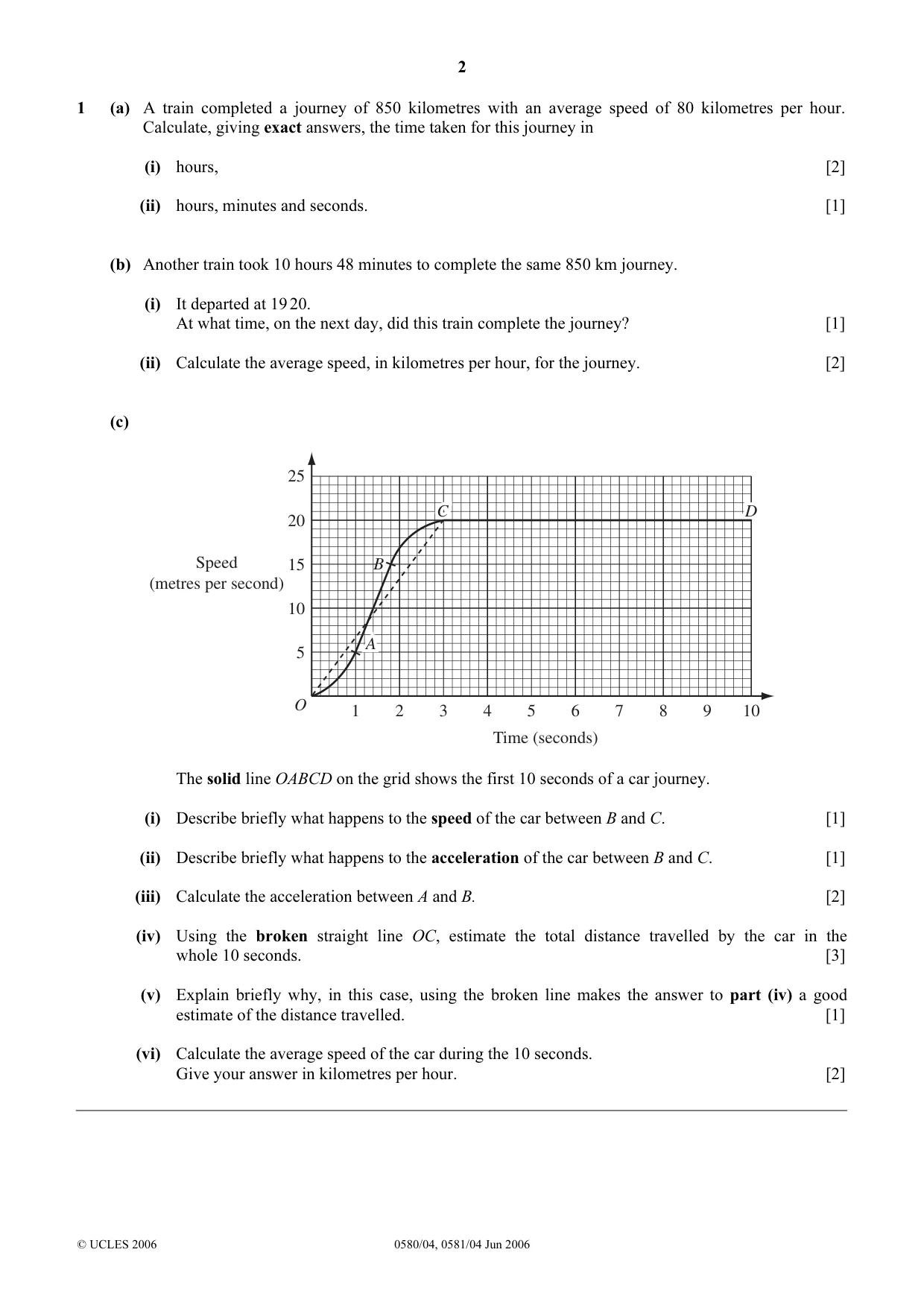
2 © UCLES 2006 0580/04, 0581/04 Jun 2006 1 (a) A train completed a journey of 850 kilometres with an average speed of 80 kilometres per hour. Calculate, giving exact answers, the time taken for this journey in (i) hours, [2] (ii) hours, minutes and seconds. [1] (b) Another train took 10 hours 48 minutes to complete the same 850 km journey. (i) It departed at 19 20. At what time, on the next day, did this train complete the journey? [1] (ii) Calculate the average speed, in kilometres per hour, for the journey. [2] (c) 1 2 3 4 5 6 7 8 9 10 25 20 15 10 5 O A B B C D Time (seconds) Speed (metres per second) The solid line OABCD on the grid shows the first 10 seconds of a car journey. (i) Describe briefly what happens to the speed of the car between B and C. [1] (ii) Describe briefly what happens to the acceleration of the car between B and C. [1] (iii) Calculate the acceleration between A and B. [2] (iv) Using the broken straight line OC, estimate the total distance travelled by the car in the whole 10 seconds. [3] (v) Explain briefly why, in this case, using the broken line makes the answer to part (iv) a good estimate of the distance travelled. [1] (vi) Calculate the average speed of the car during the 10 seconds. Give your answer in kilometres per hour. [2]
Question paper, page 3
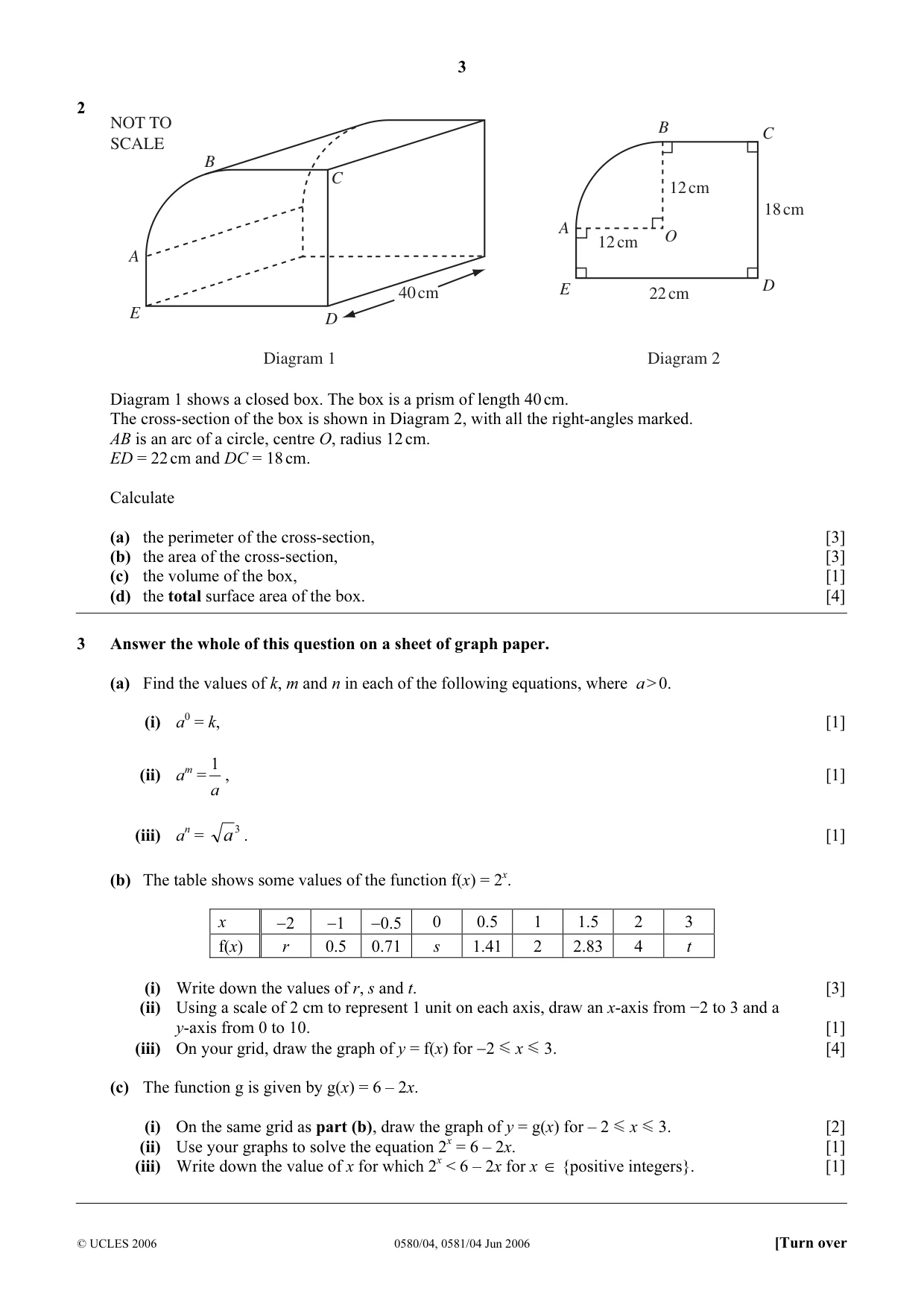
3 © UCLES 2006 0580/04, 0581/04 Jun 2006 [Turn over 2 O A B C D E A B C D E 12 cm 40 cm 22 cm 12 cm 18 cm NOT TO SCALE Diagram 1 Diagram 2 Diagram 1 shows a closed box. The box is a prism of length 40 cm. The cross-section of the box is shown in Diagram 2, with all the right-angles marked. AB is an arc of a circle, centre O, radius 12 cm. ED = 22 cm and DC = 18 cm. Calculate (a) the perimeter of the cross-section, [3] (b) the area of the cross-section, [3] (c) the volume of the box, [1] (d) the total surface area of the box. [4] 3 Answer the whole of this question on a sheet of graph paper. (a) Find the values of k, m and n in each of the following equations, where a > 0. (i) a0 = k, [1] (ii) am = a 1 , [1] (iii) an = 3 a . [1] (b) The table shows some values of the function f(x) = 2x. x −2 −1 −0.5 0 0.5 1 1.5 2 3 f(x) r 0.5 0.71 s 1.41 2 2.83 4 t (i) Write down the values of r, s and t. [3] (ii) Using a scale of 2 cm to represent 1 unit on each axis, draw an x-axis from −2 to 3 and a y-axis from 0 to 10. [1] (iii) On your grid, draw the graph of y = f(x) for −2 x 3. [4] (c) The function g is given by g(x) = 6 – 2x. (i) On the same grid as part (b), draw the graph of y = g(x) for – 2 x 3. [2] (ii) Use your graphs to solve the equation 2x = 6 – 2x. [1] (iii) Write down the value of x for which 2x < 6 – 2x for x ∈ {positive integers}. [1]
Question paper, page 4
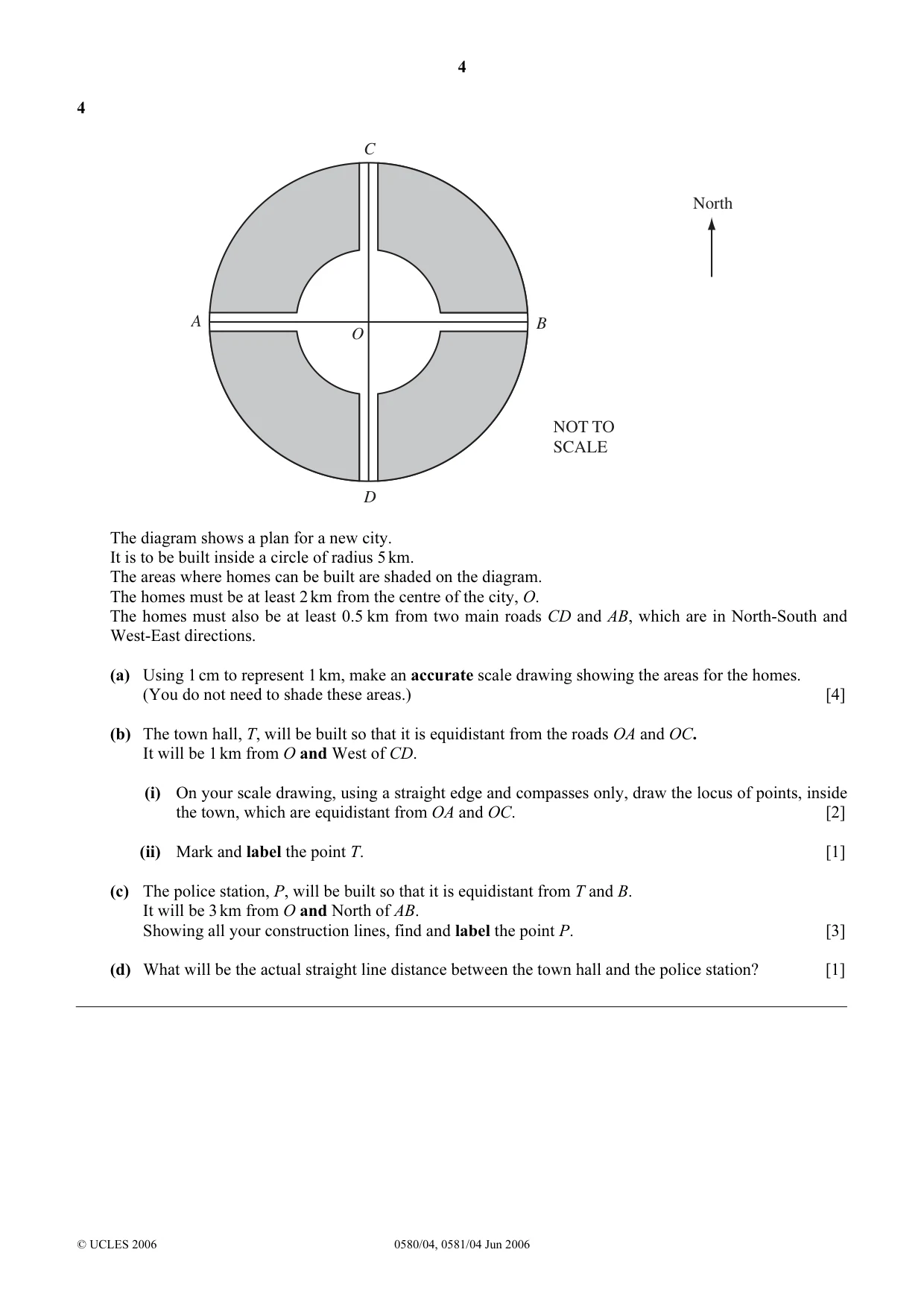
4 © UCLES 2006 0580/04, 0581/04 Jun 2006 4 A B C D O NOT TO SCALE North The diagram shows a plan for a new city. It is to be built inside a circle of radius 5 km. The areas where homes can be built are shaded on the diagram. The homes must be at least 2 km from the centre of the city, O. The homes must also be at least 0.5 km from two main roads CD and AB, which are in North-South and West-East directions. (a) Using 1 cm to represent 1 km, make an accurate scale drawing showing the areas for the homes. (You do not need to shade these areas.) [4] (b) The town hall, T, will be built so that it is equidistant from the roads OA and OC. It will be 1 km from O and West of CD. (i) On your scale drawing, using a straight edge and compasses only, draw the locus of points, inside the town, which are equidistant from OA and OC. [2] (ii) Mark and label the point T. [1] (c) The police station, P, will be built so that it is equidistant from T and B. It will be 3 km from O and North of AB. Showing all your construction lines, find and label the point P. [3] (d) What will be the actual straight line distance between the town hall and the police station? [1]
Question paper, page 5
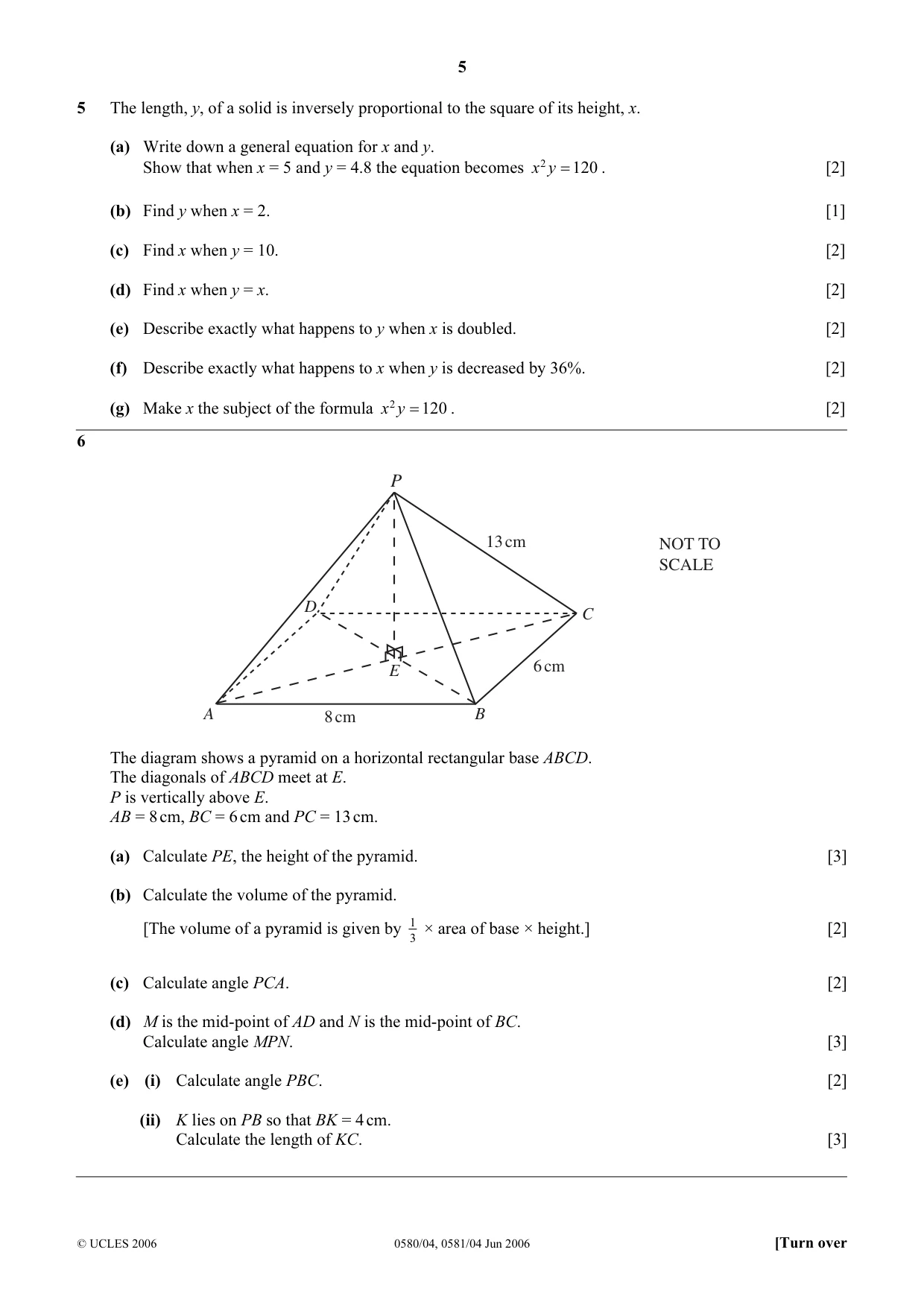
5 © UCLES 2006 0580/04, 0581/04 Jun 2006 [Turn over 5 The length, y, of a solid is inversely proportional to the square of its height, x. (a) Write down a general equation for x and y. Show that when x = 5 and y = 4.8 the equation becomes 120 2 = y x . [2] (b) Find y when x = 2. [1] (c) Find x when y = 10. [2] (d) Find x when y = x. [2] (e) Describe exactly what happens to y when x is doubled. [2] (f) Describe exactly what happens to x when y is decreased by 36%. [2] (g) Make x the subject of the formula 120 2 = y x . [2] 6 8 cm 6 cm 13 cm A B C D E NOT TO SCALE P The diagram shows a pyramid on a horizontal rectangular base ABCD. The diagonals of ABCD meet at E. P is vertically above E. AB = 8 cm, BC = 6 cm and PC = 13 cm. (a) Calculate PE, the height of the pyramid. [3] (b) Calculate the volume of the pyramid. [The volume of a pyramid is given by 3 1 × area of base × height.] [2] (c) Calculate angle PCA. [2] (d) M is the mid-point of AD and N is the mid-point of BC. Calculate angle MPN. [3] (e) (i) Calculate angle PBC. [2] (ii) K lies on PB so that BK = 4 cm. Calculate the length of KC. [3]
Question paper, page 6
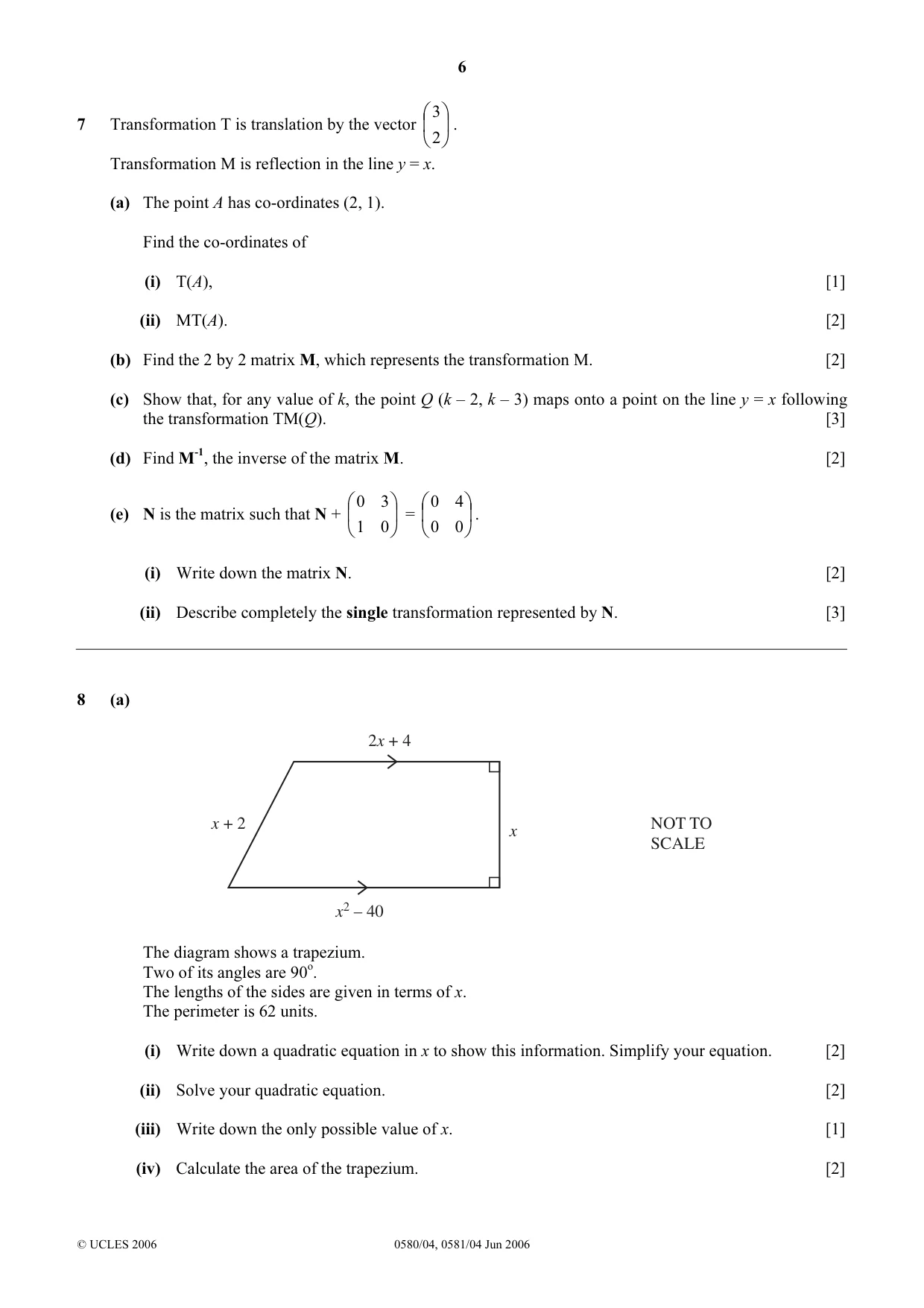
6 © UCLES 2006 0580/04, 0581/04 Jun 2006 7 Transformation T is translation by the vector 2 3 . Transformation M is reflection in the line y = x. (a) The point A has co-ordinates (2, 1). Find the co-ordinates of (i) T(A), [1] (ii) MT(A). [2] (b) Find the 2 by 2 matrix M, which represents the transformation M. [2] (c) Show that, for any value of k, the point Q (k – 2, k – 3) maps onto a point on the line y = x following the transformation TM(Q). [3] (d) Find M-1, the inverse of the matrix M. [2] (e) N is the matrix such that N + 0 1 3 0 = 0 0 4 0 . (i) Write down the matrix N. [2] (ii) Describe completely the single transformation represented by N. [3] 8 (a) x + 2 x x2 – 40 2x + 4 NOT TO SCALE The diagram shows a trapezium. Two of its angles are 90o. The lengths of the sides are given in terms of x. The perimeter is 62 units. (i) Write down a quadratic equation in x to show this information. Simplify your equation. [2] (ii) Solve your quadratic equation. [2] (iii) Write down the only possible value of x. [1] (iv) Calculate the area of the trapezium. [2]
Question paper, page 7
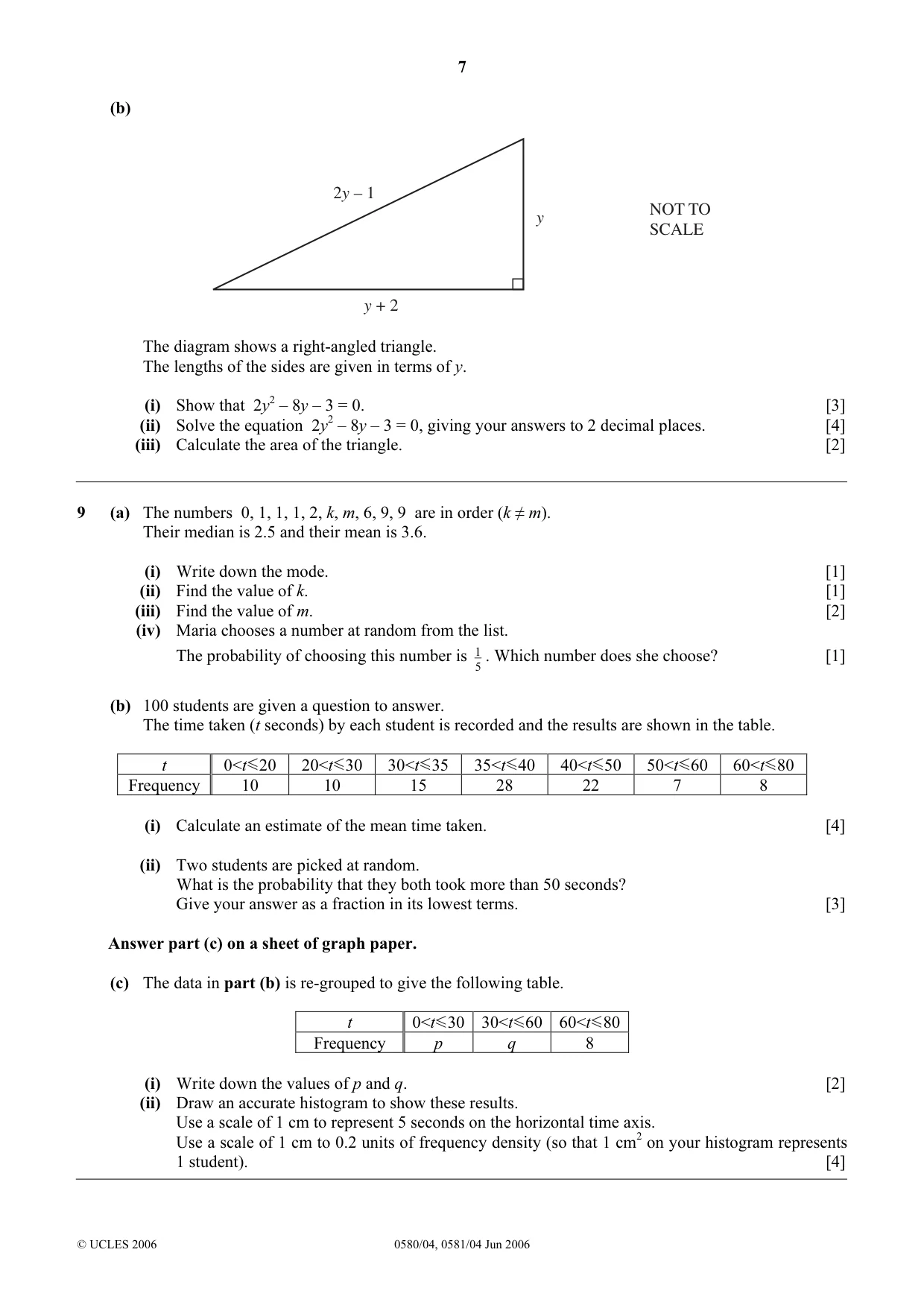
7 © UCLES 2006 0580/04, 0581/04 Jun 2006 (b) y y + 2 2y – 1 NOT TO SCALE The diagram shows a right-angled triangle. The lengths of the sides are given in terms of y. (i) Show that 2y2 – 8y – 3 = 0. [3] (ii) Solve the equation 2y2 – 8y – 3 = 0, giving your answers to 2 decimal places. [4] (iii) Calculate the area of the triangle. [2] 9 (a) The numbers 0, 1, 1, 1, 2, k, m, 6, 9, 9 are in order (k ≠ m). Their median is 2.5 and their mean is 3.6. (i) Write down the mode. [1] (ii) Find the value of k. [1] (iii) Find the value of m. [2] (iv) Maria chooses a number at random from the list. The probability of choosing this number is 1 5 . Which number does she choose? [1] (b) 100 students are given a question to answer. The time taken (t seconds) by each student is recorded and the results are shown in the table. t 0<t 20 20<t 30 30<t 35 35<t 40 40<t 50 50<t 60 60<t 80 Frequency 10 10 15 28 22 7 8 (i) Calculate an estimate of the mean time taken. [4] (ii) Two students are picked at random. What is the probability that they both took more than 50 seconds? Give your answer as a fraction in its lowest terms. [3] Answer part (c) on a sheet of graph paper. (c) The data in part (b) is re-grouped to give the following table. t 0<t 30 30<t 60 60<t 80 Frequency p q 8 (i) Write down the values of p and q. [2] (ii) Draw an accurate histogram to show these results. Use a scale of 1 cm to represent 5 seconds on the horizontal time axis. Use a scale of 1 cm to 0.2 units of frequency density (so that 1 cm2 on your histogram represents 1 student). [4]
Question paper, page 8
8 Permission to reproduce items where third-party owned material protected by copyright is included has been sought and cleared where possible. Every reasonable effort has been made by the publisher (UCLES) to trace copyright holders, but if any items requiring clearance have unwittingly been included, the publisher will be pleased to make amends at the earliest possible opportunity. University of Cambridge International Examinations is part of the University of Cambridge Local Examinations Syndicate (UCLES), which is itself a department of the University of Cambridge. 0580/04, 0581/04 Jun 2006 BLANK PAGE
Mark scheme, page 1
UNIVERSITY OF CAMBRIDGE INTERNATIONAL EXAMINATIONS International General Certificate of Secondary Education MARK SCHEME for the May/June 2006 question paper 0580 and 0581 MATHEMATICS 0580/04 and 0581/04 Paper 4, maximum raw mark 130 These mark schemes are published as an aid to teachers and students, to indicate the requirements of the examination. They show the basis on which Examiners were initially instructed to award marks. They do not indicate the details of the discussions that took place at an Examiners’ meeting before marking began. Any substantial changes to the mark scheme that arose from these discussions will be recorded in the published Report on the Examination. All Examiners are instructed that alternative correct answers and unexpected approaches in candidates’ scripts must be given marks that fairly reflect the relevant knowledge and skills demonstrated. Mark schemes must be read in conjunction with the question papers and the Report on the Examination. The minimum marks in these components needed for various grades were previously published with these mark schemes, but are now instead included in the Report on the Examination for this session. • CIE will not enter into discussion or correspondence in connection with these mark schemes. CIE is publishing the mark schemes for the May/June 2006 question papers for most IGCSE and GCE Advanced Level and Advanced Subsidiary Level syllabuses and some Ordinary Level syllabuses. www.XtremePapers.com
Mark scheme, page 2
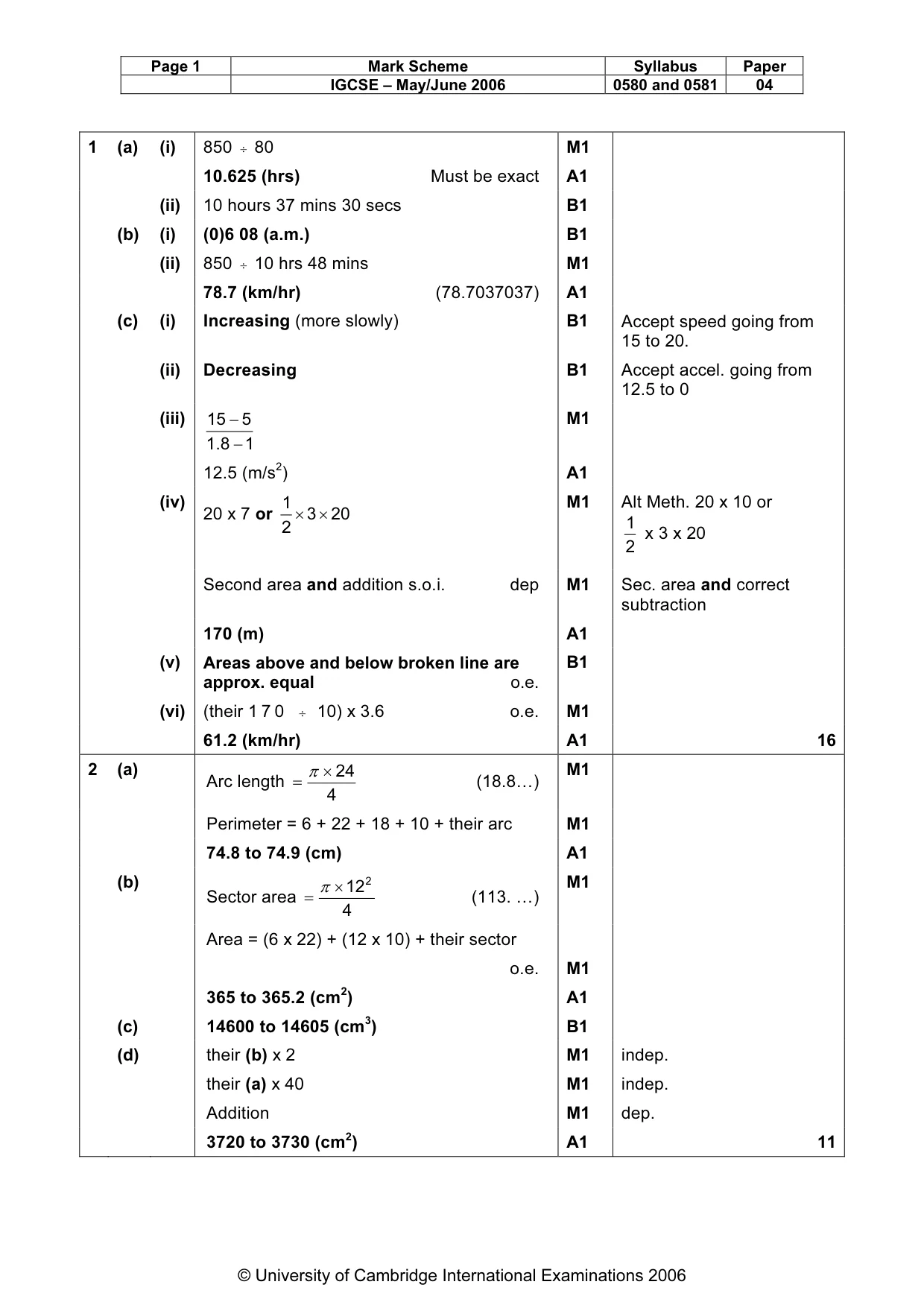
Page 1 Mark Scheme Syllabus Paper IGCSE – May/June 2006 0580 and 0581 04 © University of Cambridge International Examinations 2006 1 (a) (i) 850 ÷ 80 10.625 (hrs) Must be exact M1 A1 (ii) 10 hours 37 mins 30 secs B1 (b) (i) (0)6 08 (a.m.) B1 (ii) 850 ÷ 10 hrs 48 mins M1 78.7 (km/hr) (78.7037037) A1 (c) (i) Increasing (more slowly) B1 Accept speed going from 15 to 20. (ii) Decreasing B1 Accept accel. going from 12.5 to 0 (iii) 1 8 . 1 5 15 − − M1 12.5 (m/s2) A1 (iv) 20 x 7 or 20 3 2 1 × × M1 Alt Meth. 20 x 10 or 2 1 x 3 x 20 Second area and addition s.o.i. dep M1 Sec. area and correct subtraction 170 (m) A1 (v) Areas above and below broken line are approx. equal o.e. B1 (vi) (their 1 7 0 ÷ 10) x 3.6 o.e. M1 61.2 (km/hr) A1 16 2 (a) Arc length 4 24 × = π (18.8…) M1 Perimeter = 6 + 22 + 18 + 10 + their arc M1 74.8 to 74.9 (cm) A1 (b) Sector area 4 122 × = π (113. …) M1 Area = (6 x 22) + (12 x 10) + their sector o.e. M1 365 to 365.2 (cm2) A1 (c) 14600 to 14605 (cm3) B1 (d) their (b) x 2 their (a) x 40 Addition M1 M1 M1 indep. indep. dep. 3720 to 3730 (cm2) A1 11
Mark scheme, page 3
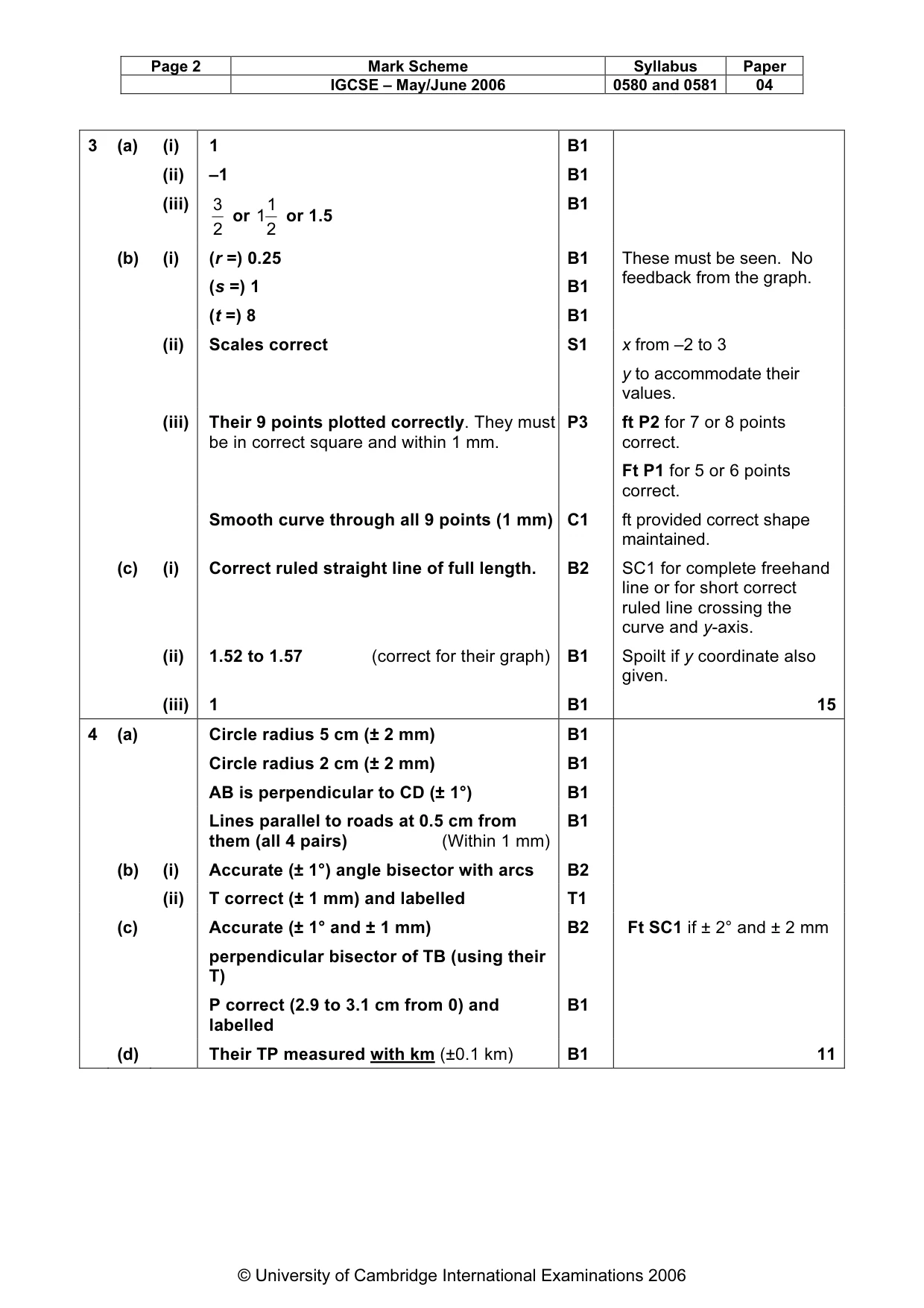
Page 2 Mark Scheme Syllabus Paper IGCSE – May/June 2006 0580 and 0581 04 © University of Cambridge International Examinations 2006 3 (a) (i) 1 B1 (ii) –1 B1 (iii) 2 3 or 2 1 1 or 1.5 B1 (b) (i) (r =) 0.25 (s =) 1 (t =) 8 B1 B1 B1 These must be seen. No feedback from the graph. (ii) Scales correct S1 x from –2 to 3 y to accommodate their values. (iii) Their 9 points plotted correctly. They must be in correct square and within 1 mm. P3 ft P2 for 7 or 8 points correct. Ft P1 for 5 or 6 points correct. Smooth curve through all 9 points (1 mm) C1 ft provided correct shape maintained. (c) (i) Correct ruled straight line of full length. B2 SC1 for complete freehand line or for short correct ruled line crossing the curve and y-axis. (ii) 1.52 to 1.57 (correct for their graph) B1 Spoilt if y coordinate also given. (iii) 1 B1 15 4 (a) Circle radius 5 cm (± 2 mm) Circle radius 2 cm (± 2 mm) AB is perpendicular to CD (± 1°) B1 B1 B1 Lines parallel to roads at 0.5 cm from them (all 4 pairs) (Within 1 mm) B1 (b) (i) Accurate (± 1°) angle bisector with arcs B2 (ii) T correct (± 1 mm) and labelled T1 (c) Accurate (± 1° and ± 1 mm) perpendicular bisector of TB (using their T) P correct (2.9 to 3.1 cm from 0) and labelled B2 B1 Ft SC1 if ± 2° and ± 2 mm (d) Their TP measured with km (±0.1 km) B1 11
Mark scheme, page 4
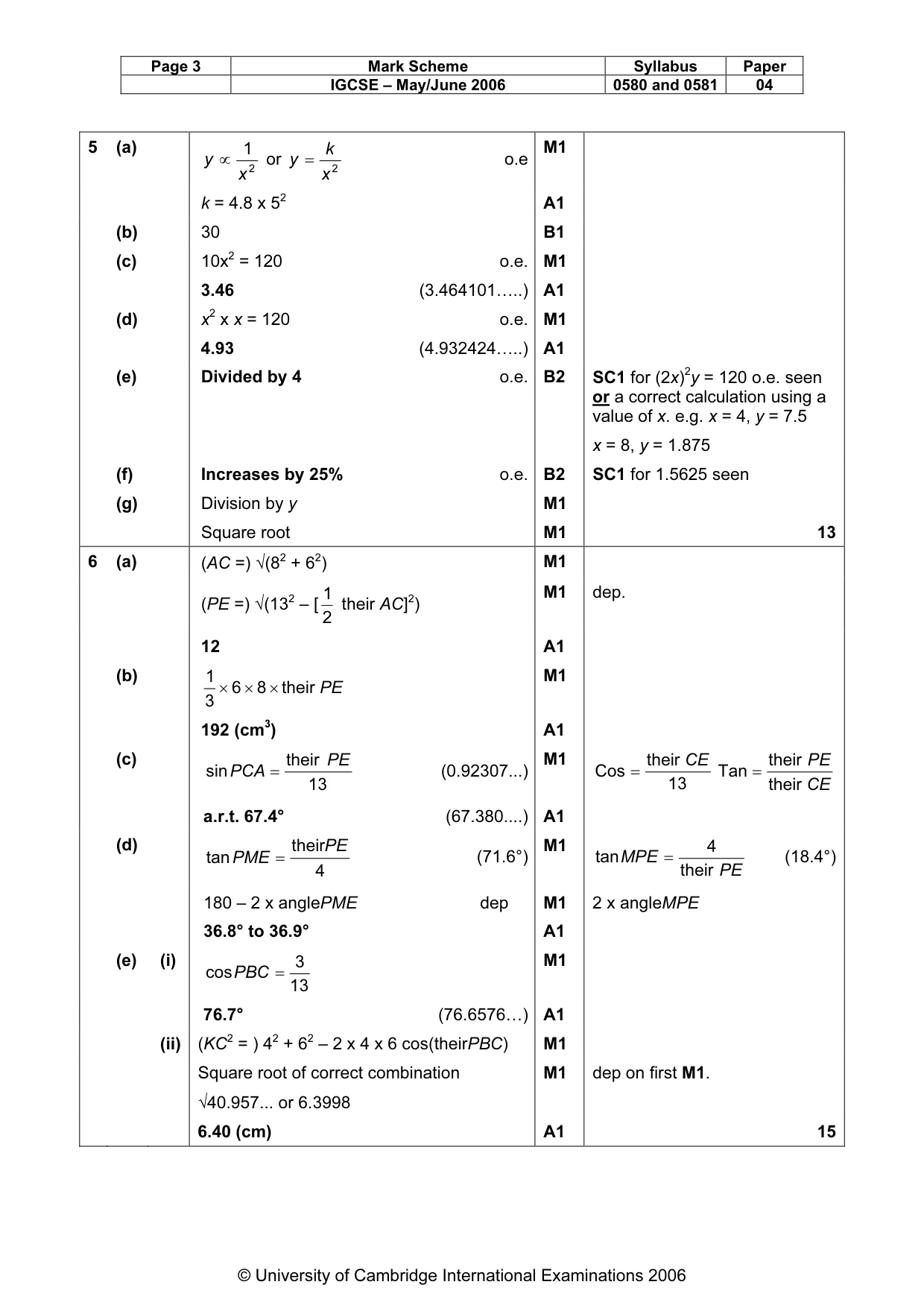
Page 3 Mark Scheme Syllabus Paper IGCSE – May/June 2006 0580 and 0581 04 © University of Cambridge International Examinations 2006 5 (a) 2 1 x y ∝ or 2 x k y = o.e M1 k = 4.8 x 52 A1 (b) 30 B1 (c) 10x2 = 120 o.e. M1 3.46 (3.464101…..) A1 (d) x2 x x = 120 o.e. M1 4.93 (4.932424…..) A1 (e) Divided by 4 o.e. B2 SC1 for (2x)2y = 120 o.e. seen or a correct calculation using a value of x. e.g. x = 4, y = 7.5 x = 8, y = 1.875 (f) Increases by 25% o.e. B2 SC1 for 1.5625 seen (g) Division by y Square root M1 M1 13 6 (a) (AC =) √(82 + 62) M1 (PE =) √(132 – [ 2 1 their AC]2) M1 dep. 12 A1 (b) × × × 8 6 3 1 their PE M1 192 (cm3) A1 (c) 13 sin PE PCA their = (0.92307...) M1 13 CE their Cos = CE PE their their Tan = a.r.t. 67.4° (67.380…) A1 (d) 4 tan PE PME their = (71.6°) M1 PE MPE their 4 tan = (18.4°) 180 – 2 x anglePME dep 36.8° to 36.9° M1 A1 2 x angleMPE (e) (i) 13 3 cos = PBC M1 76.7° (76.6576…) A1 (ii) (KC2 = ) 42 + 62 – 2 x 4 x 6 cos(theirPBC) M1 Square root of correct combination M1 dep on first M1. √40.957... or 6.3998 6.40 (cm) A1 15
Mark scheme, page 5
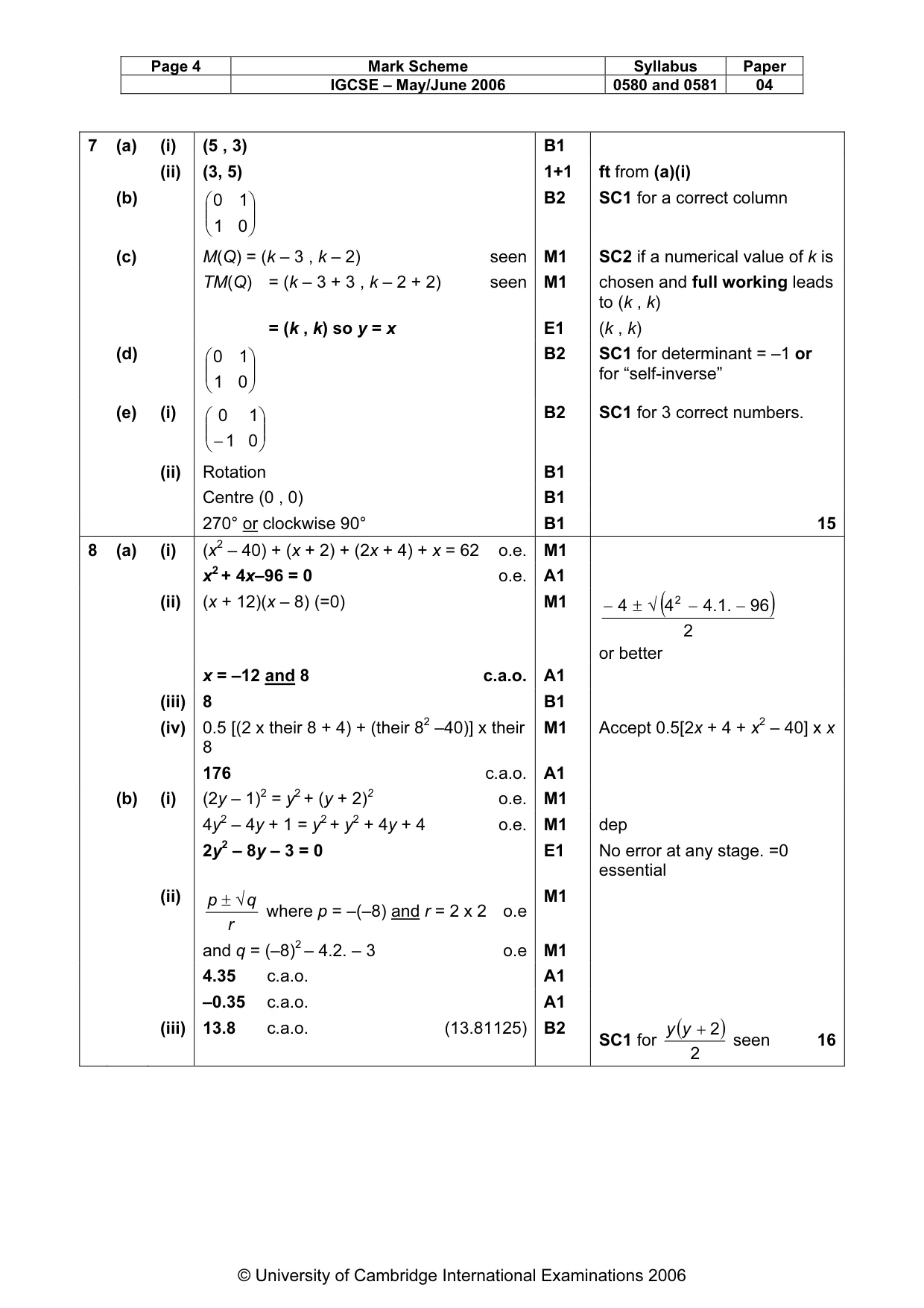
Page 4 Mark Scheme Syllabus Paper IGCSE – May/June 2006 0580 and 0581 04 © University of Cambridge International Examinations 2006 7 (a) (i) (5 , 3) B1 (ii) (3, 5) 1+1 ft from (a)(i) (b) 0 1 1 0 B2 SC1 for a correct column (c) M(Q) = (k – 3 , k – 2) seen M1 SC2 if a numerical value of k is TM(Q) = (k – 3 + 3 , k – 2 + 2) seen M1 chosen and full working leads to (k , k) = (k , k) so y = x E1 (k , k) (d) 0 1 1 0 B2 SC1 for determinant = –1 or for “self-inverse” (e) (i) − 0 1 1 0 B2 SC1 for 3 correct numbers. (ii) Rotation B1 Centre (0 , 0) B1 270° or clockwise 90° B1 15 8 (a) (i) (x2 – 40) + (x + 2) + (2x + 4) + x = 62 o.e. M1 x2 + 4x–96 = 0 o.e. A1 (ii) (x + 12)(x – 8) (=0) M1 ( ) 2 96 . 1 . 4 4 4 2 − − √ ± − or better x = –12 and 8 c.a.o. A1 (iii) 8 B1 (iv) 0.5 [(2 x their 8 + 4) + (their 82 –40)] x their 8 M1 Accept 0.5[2x + 4 + x2 – 40] x x 176 c.a.o. A1 (b) (i) (2y – 1)2 = y2 + (y + 2)2 o.e. M1 4y2 – 4y + 1 = y2 + y2 + 4y + 4 o.e. M1 dep 2y2 – 8y – 3 = 0 E1 No error at any stage. =0 essential (ii) r q p √ ± where p = –(–8) and r = 2 x 2 o.e M1 and q = (–8)2 – 4.2. – 3 o.e M1 4.35 c.a.o. A1 –0.35 c.a.o. A1 (iii) 13.8 c.a.o. (13.81125) B2 SC1 for ( ) 2 2 + y y seen 16
Mark scheme, page 6
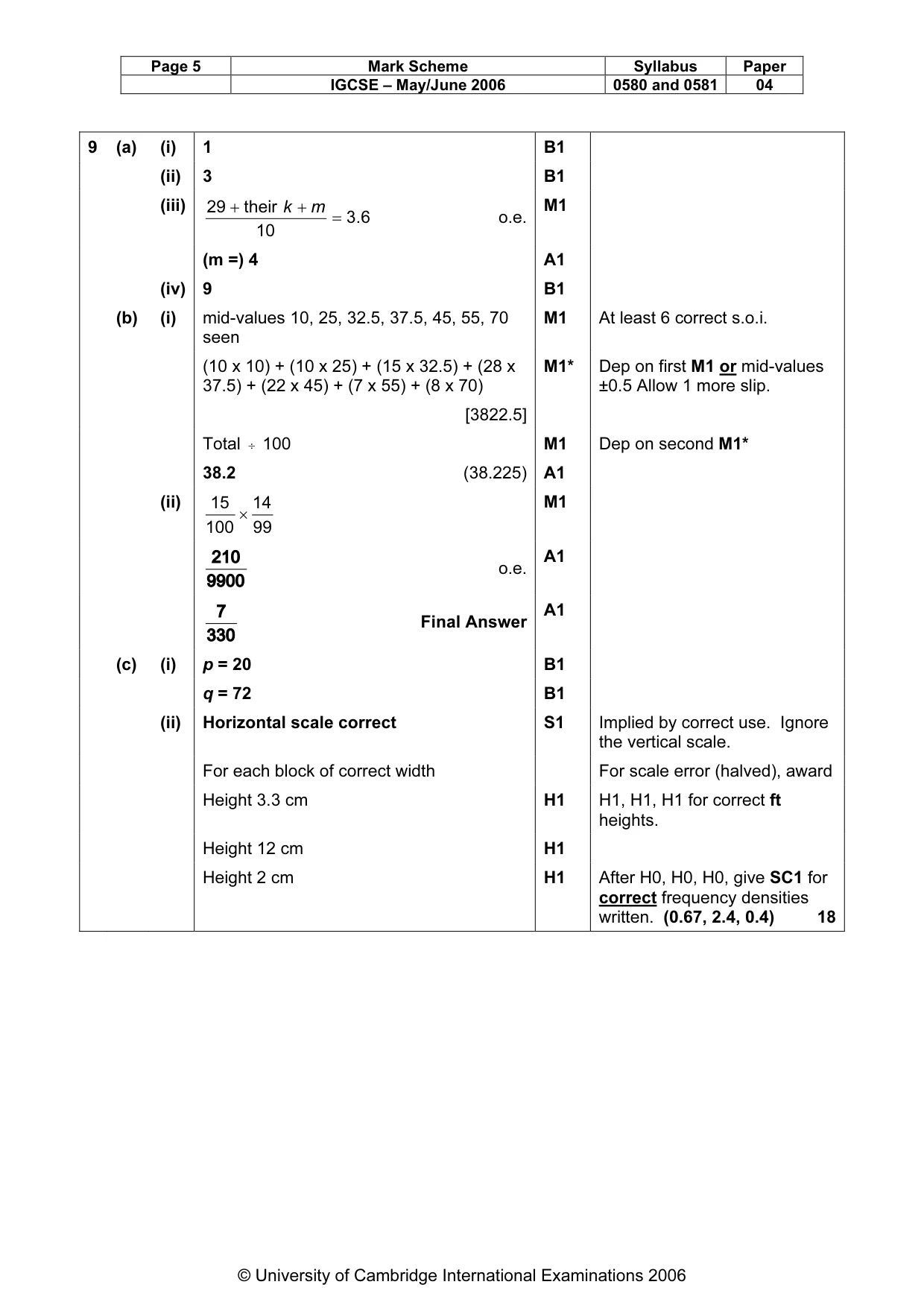
Page 5 Mark Scheme Syllabus Paper IGCSE – May/June 2006 0580 and 0581 04 © University of Cambridge International Examinations 2006 9 (a) (i) 1 B1 (ii) 3 B1 (iii) 6 . 3 10 29 = + + m k their o.e. M1 (m =) 4 A1 (iv) 9 B1 (b) (i) mid-values 10, 25, 32.5, 37.5, 45, 55, 70 seen M1 At least 6 correct s.o.i. (10 x 10) + (10 x 25) + (15 x 32.5) + (28 x 37.5) + (22 x 45) + (7 x 55) + (8 x 70) [3822.5] M1* Dep on first M1 or mid-values ±0.5 Allow 1 more slip. Total ÷ 100 M1 Dep on second M1* 38.2 (38.225) A1 (ii) 99 14 100 15 × M1 9900 210 o.e. A1 330 7 Final Answer A1 (c) (i) p = 20 B1 q = 72 B1 (ii) Horizontal scale correct S1 Implied by correct use. Ignore the vertical scale. For each block of correct width For scale error (halved), award Height 3.3 cm H1 H1, H1, H1 for correct ft heights. Height 12 cm H1 Height 2 cm H1 After H0, H0, H0, give SC1 for correct frequency densities written. (0.67, 2.4, 0.4) 18
What you needed in this session
Cambridge’s own grade thresholds for 2006 May/June, Paper 4 · Variant 1. A higher threshold means an easier paper — the bar moves with how the cohort did.