Cambridge IGCSE Mathematics (with coursework) 0581 — 2005 Oct/Nov Paper 4 · Variant 1
0581/41/O/N/05
The question paper and its mark scheme, free to read here and free to download. This is Cambridge’s own paper, exactly as it was sat.
Question paper8 pages
Mark scheme10 pages
Answers below. Sit the paper first if you are practising.
Paper as text
Question paper, page 1
UNIVERSITY OF CAMBRIDGE INTERNATIONAL EXAMINATIONS International General Certificate of Secondary Education MATHEMATICS 0580/04 0581/04 Paper 4 (Extended) October/November 2005 Additional Materials: Answer Booklet/Paper 2 hours 30 minutes Electronic calculator Geometrical instruments Graph paper (3 sheets) Mathematical tables (optional) Tracing paper (optional) READ THESE INSTRUCTIONS FIRST Write your answers and working on the separate Answer Booklet/Paper provided. Write your name, Centre number and candidate number on all the work you hand in. Write in dark blue or black pen on both sides of the paper. You may use a soft pencil for any diagrams or graphs. Do not use staples, paper clips, highlighters, glue or correction fluid. Answer all questions. At the end of the examination, fasten all your work securely together. The number of marks is given in brackets [ ] at the end of each question or part question. All working must be clearly shown. It should be done on the same sheet as the rest of the answer. Marks will be given for working which shows that you know how to solve the problem even if you get the answer wrong. The total of the marks for this paper is 130. Electronic calculators should be used. If the degree of accuracy is not specified in the question, and if the answer is not exact, give the answer to three significant figures. Give answers in degrees to one decimal place. For π use either your calculator value or 3.142. This document consists of 8 printed pages. IB05 11_0580_04/4RP UCLES 2005 [Turn over www.XtremePapers.com
Question paper, page 2
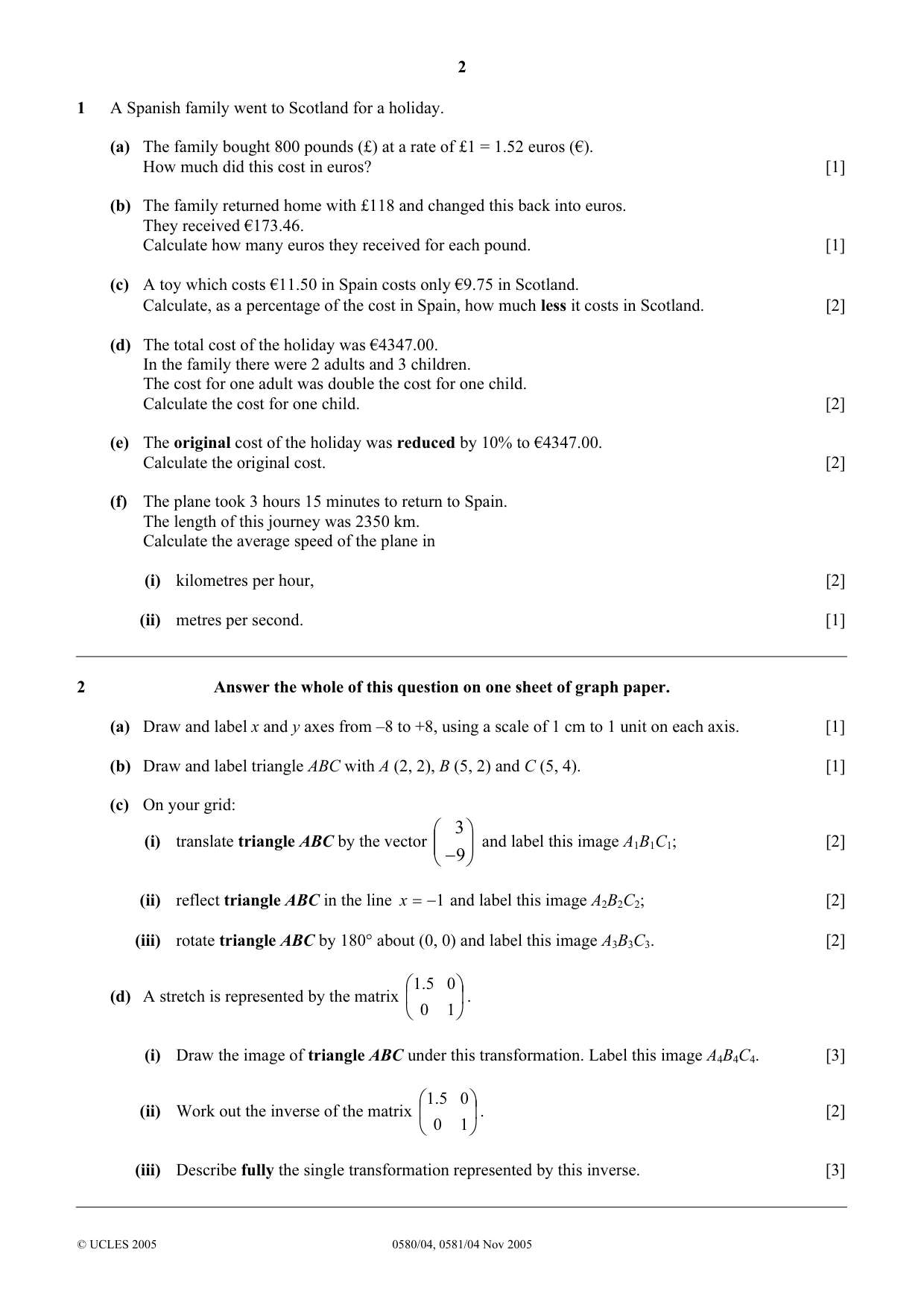
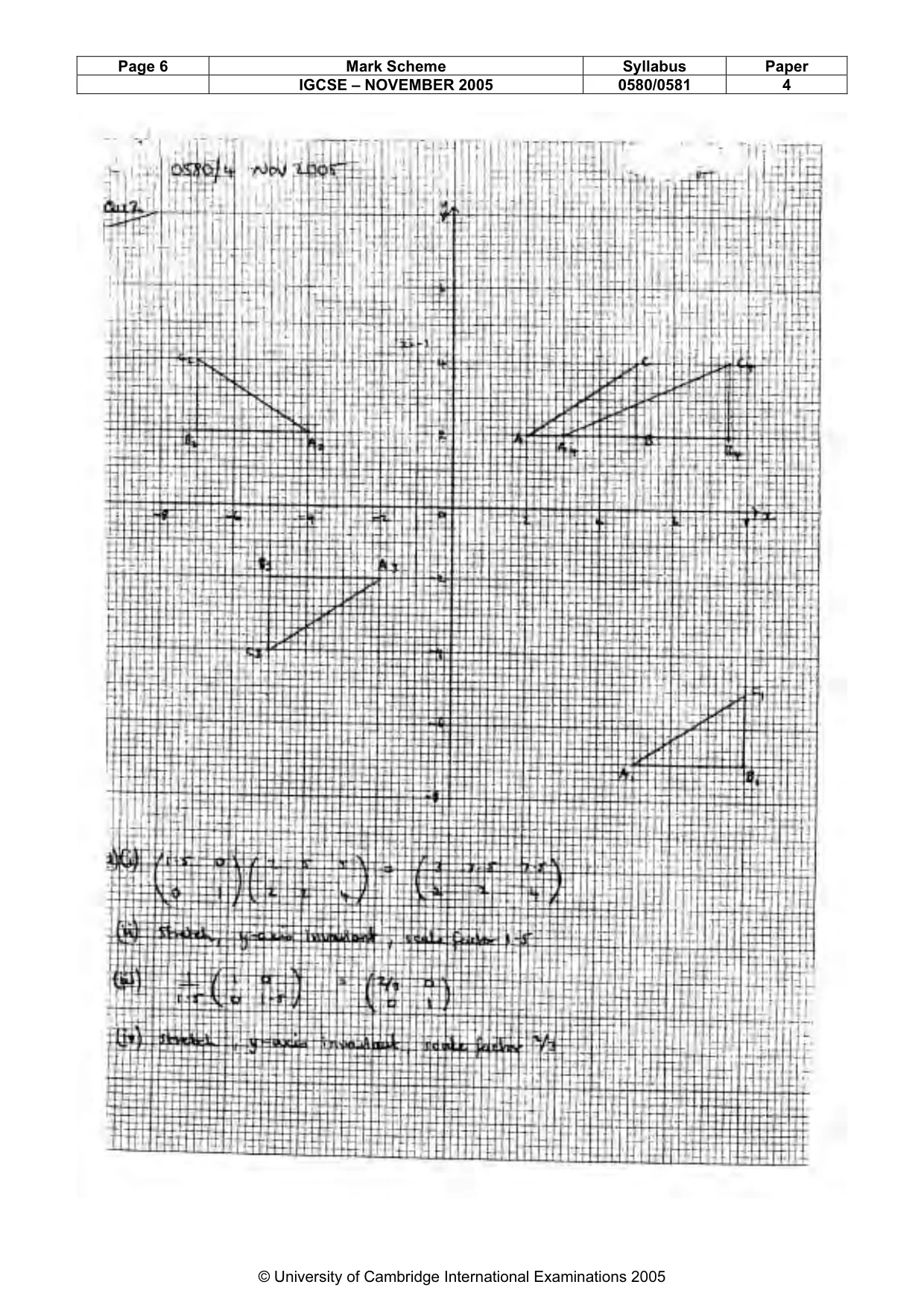
2 © UCLES 2005 0580/04, 0581/04 Nov 2005 1 A Spanish family went to Scotland for a holiday. (a) The family bought 800 pounds (£) at a rate of £1 = 1.52 euros (€). How much did this cost in euros? [1] (b) The family returned home with £118 and changed this back into euros. They received €173.46. Calculate how many euros they received for each pound. [1] (c) A toy which costs €11.50 in Spain costs only €9.75 in Scotland. Calculate, as a percentage of the cost in Spain, how much less it costs in Scotland. [2] (d) The total cost of the holiday was €4347.00. In the family there were 2 adults and 3 children. The cost for one adult was double the cost for one child. Calculate the cost for one child. [2] (e) The original cost of the holiday was reduced by 10% to €4347.00. Calculate the original cost. [2] (f) The plane took 3 hours 15 minutes to return to Spain. The length of this journey was 2350 km. Calculate the average speed of the plane in (i) kilometres per hour, [2] (ii) metres per second. [1] 2 Answer the whole of this question on one sheet of graph paper. (a) Draw and label x and y axes from –8 to +8, using a scale of 1 cm to 1 unit on each axis. [1] (b) Draw and label triangle ABC with A (2, 2), B (5, 2) and C (5, 4). [1] (c) On your grid: (i) translate triangle ABC by the vector −9 3 and label this image A1B1C1; [2] (ii) reflect triangle ABC in the line 1 − = x and label this image A2B2C2; [2] (iii) rotate triangle ABC by 180° about (0, 0) and label this image A3B3C3. [2] (d) A stretch is represented by the matrix 1 0 0 1.5 . (i) Draw the image of triangle ABC under this transformation. Label this image A4B4C4. [3] (ii) Work out the inverse of the matrix 1 0 0 1.5 . [2] (iii) Describe fully the single transformation represented by this inverse. [3]
Question paper, page 3
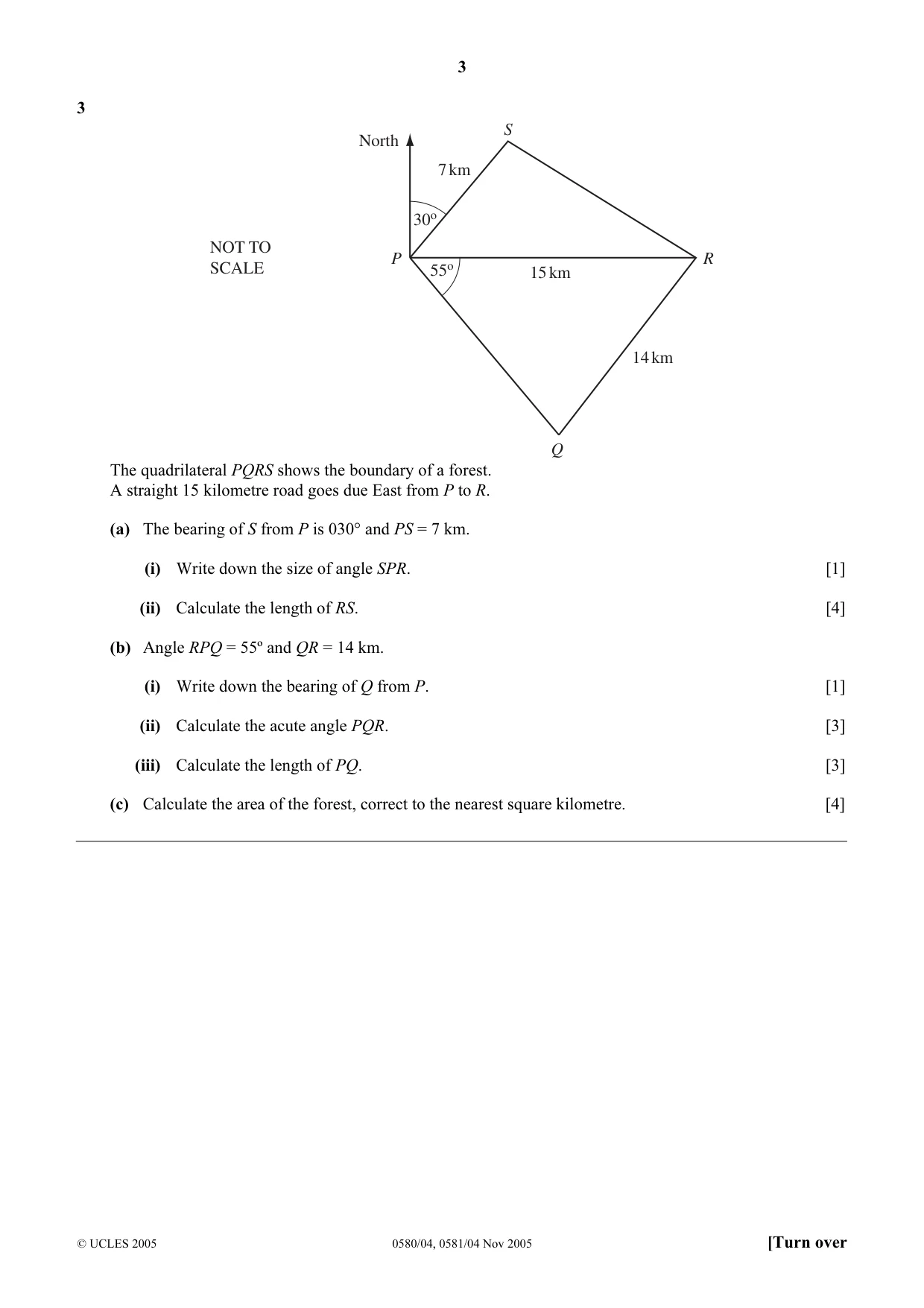
3 © UCLES 2005 0580/04, 0581/04 Nov 2005 [Turn over 3 30o 55o North P R Q S 7 km 15 km 14 km NOT TO SCALE The quadrilateral PQRS shows the boundary of a forest. A straight 15 kilometre road goes due East from P to R. (a) The bearing of S from P is 030° and PS = 7 km. (i) Write down the size of angle SPR. [1] (ii) Calculate the length of RS. [4] (b) Angle RPQ = 55º and QR = 14 km. (i) Write down the bearing of Q from P. [1] (ii) Calculate the acute angle PQR. [3] (iii) Calculate the length of PQ. [3] (c) Calculate the area of the forest, correct to the nearest square kilometre. [4]
Question paper, page 4
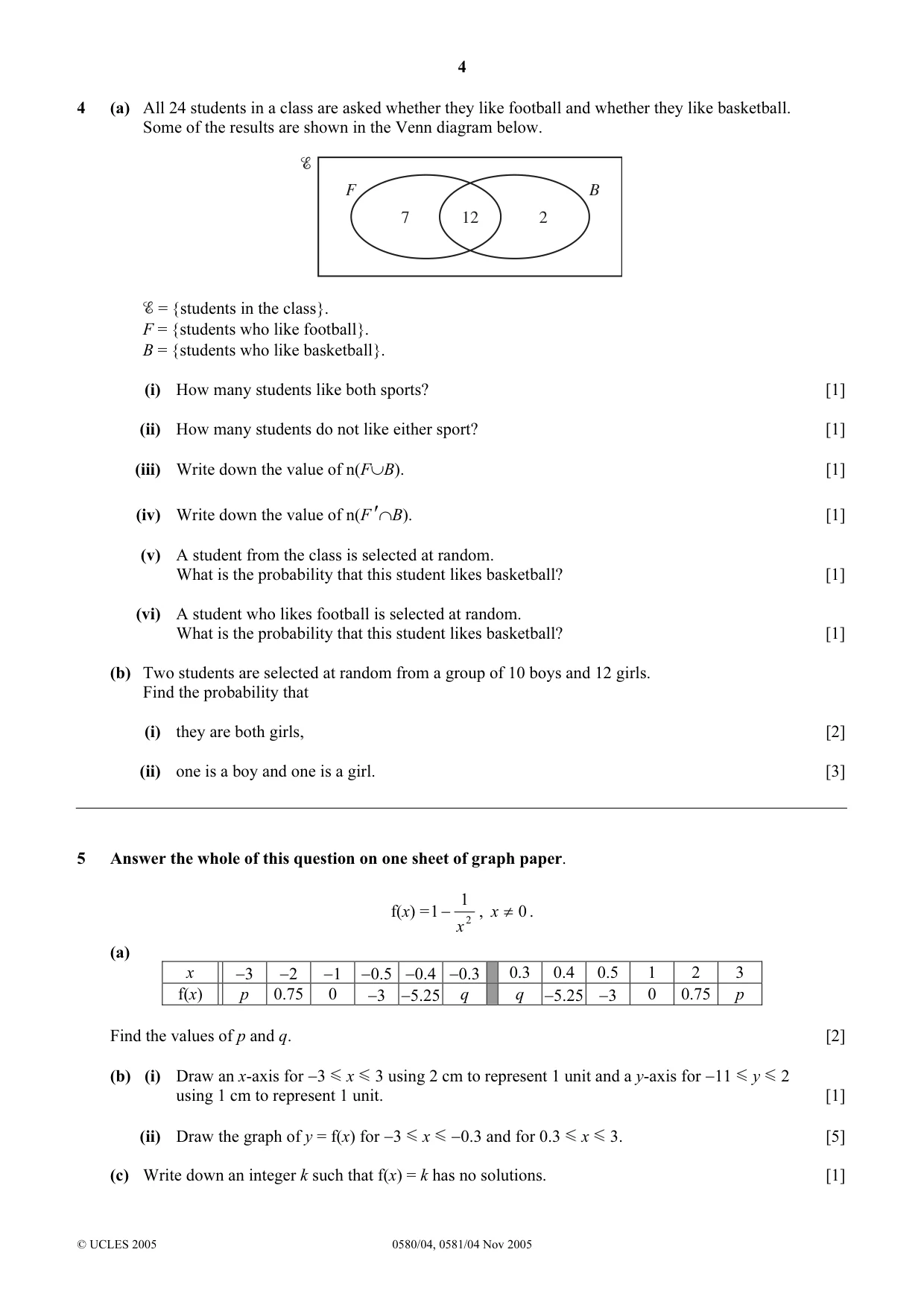
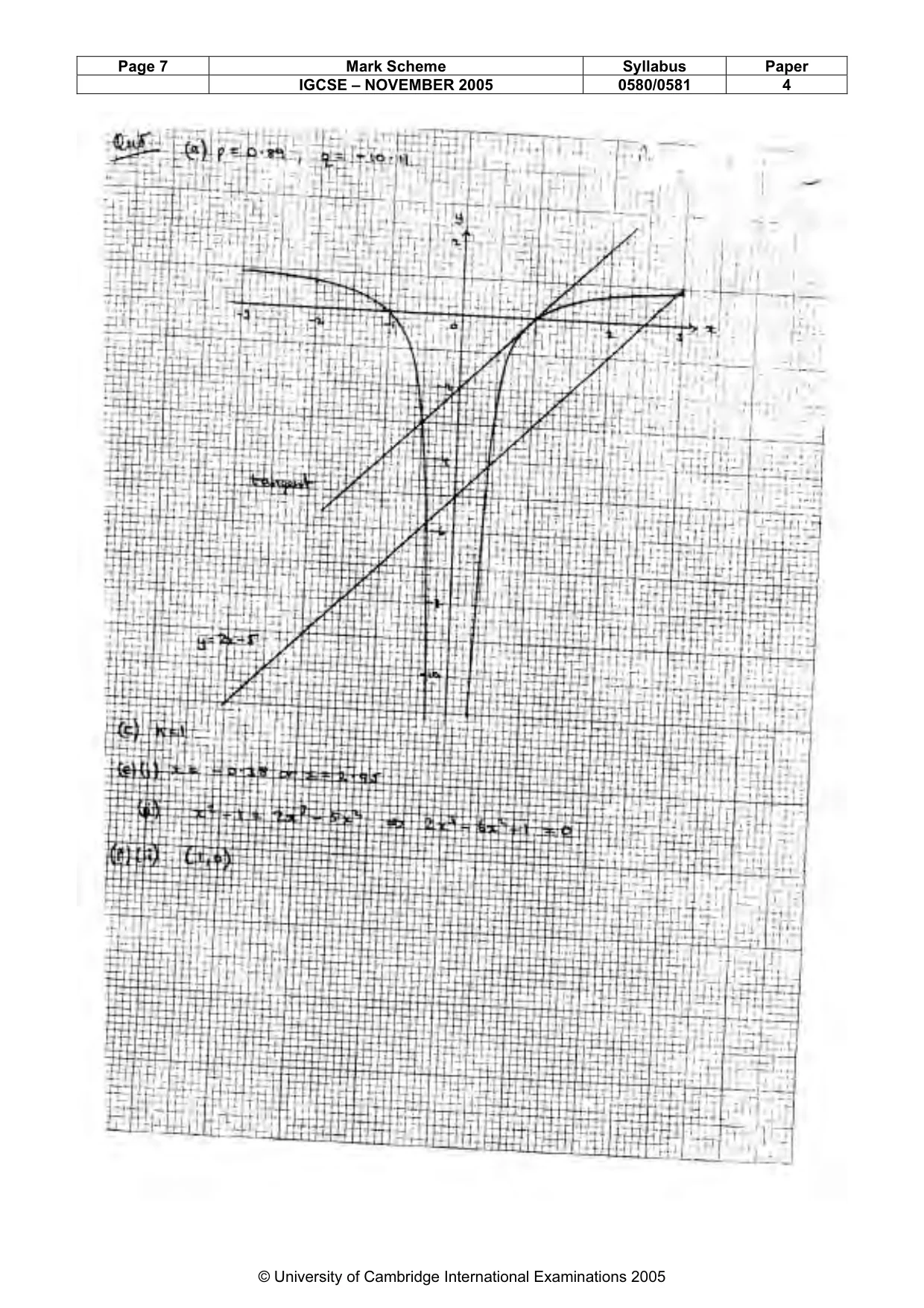
4 © UCLES 2005 0580/04, 0581/04 Nov 2005 4 (a) All 24 students in a class are asked whether they like football and whether they like basketball. Some of the results are shown in the Venn diagram below. F B 12 7 2 = {students in the class}. F = {students who like football}. B = {students who like basketball}. (i) How many students like both sports? [1] (ii) How many students do not like either sport? [1] (iii) Write down the value of n(F∪B). [1] (iv) Write down the value of n(F ′∩B). [1] (v) A student from the class is selected at random. What is the probability that this student likes basketball? [1] (vi) A student who likes football is selected at random. What is the probability that this student likes basketball? [1] (b) Two students are selected at random from a group of 10 boys and 12 girls. Find the probability that (i) they are both girls, [2] (ii) one is a boy and one is a girl. [3] 5 Answer the whole of this question on one sheet of graph paper. f(x) = 2 1 1 x − , 0 ≠ x . (a) x −3 −2 −1 −0.5 −0.4 −0.3 0.3 0.4 0.5 1 2 3 f(x) p 0.75 0 −3 −5.25 q q −5.25 −3 0 0.75 p Find the values of p and q. [2] (b) (i) Draw an x-axis for −3 x 3 using 2 cm to represent 1 unit and a y-axis for −11 y 2 using 1 cm to represent 1 unit. [1] (ii) Draw the graph of y = f(x) for −3 x −0.3 and for 0.3 x 3. [5] (c) Write down an integer k such that f(x) = k has no solutions. [1]
Question paper, page 5
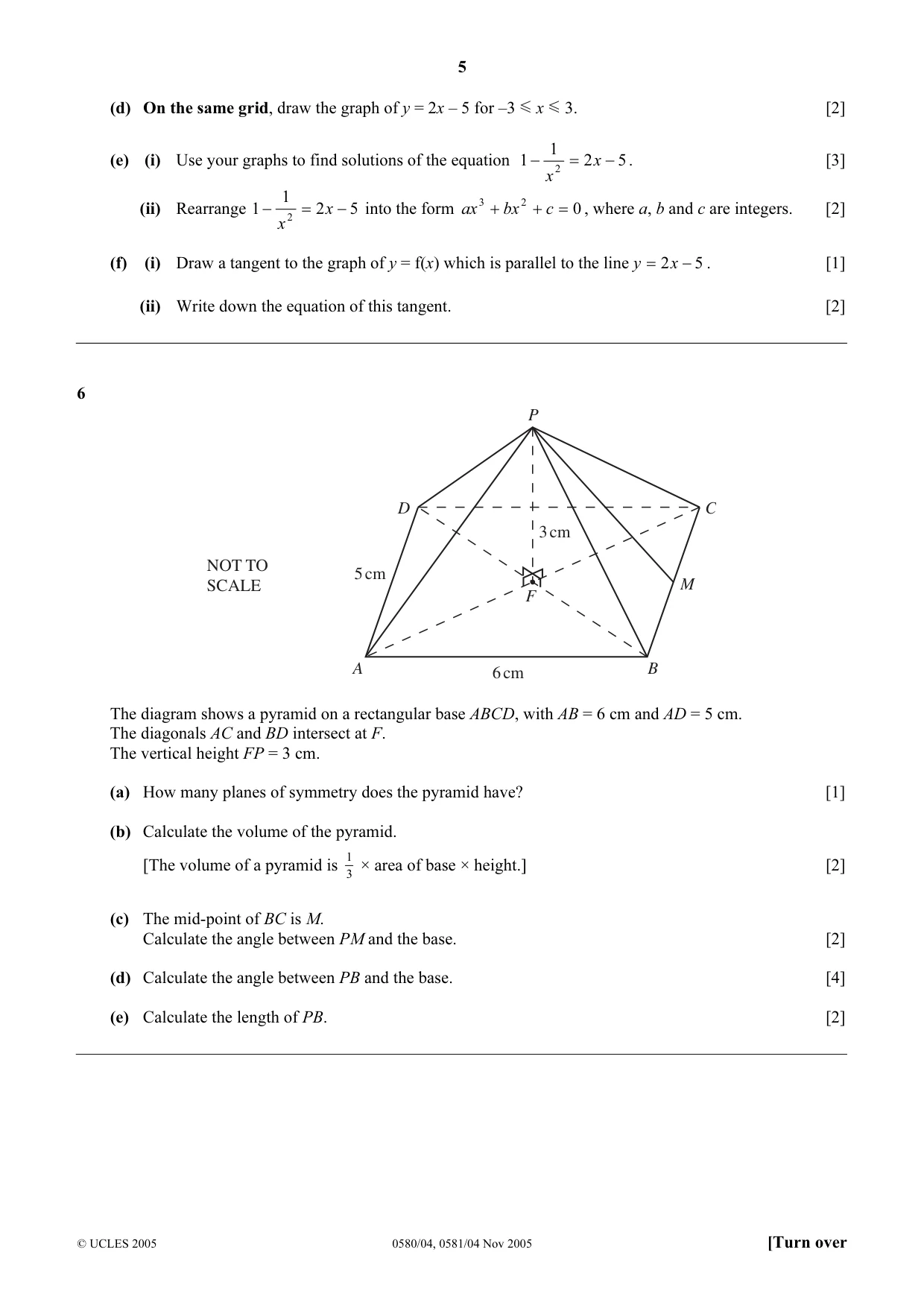
5 © UCLES 2005 0580/04, 0581/04 Nov 2005 [Turn over (d) On the same grid, draw the graph of y = 2x – 5 for –3 x 3. [2] (e) (i) Use your graphs to find solutions of the equation 5 2 1 1 2 − = − x x . [3] (ii) Rearrange 5 2 1 1 2 − = − x x into the form 0 2 3 = + + c bx ax , where a, b and c are integers. [2] (f) (i) Draw a tangent to the graph of y = f(x) which is parallel to the line 5 2 − = x y . [1] (ii) Write down the equation of this tangent. [2] 6 F P C D B A 5 cm 6 cm 3 cm M NOT TO SCALE The diagram shows a pyramid on a rectangular base ABCD, with AB = 6 cm and AD = 5 cm. The diagonals AC and BD intersect at F. The vertical height FP = 3 cm. (a) How many planes of symmetry does the pyramid have? [1] (b) Calculate the volume of the pyramid. [The volume of a pyramid is 3 1 × area of base × height.] [2] (c) The mid-point of BC is M. Calculate the angle between PM and the base. [2] (d) Calculate the angle between PB and the base. [4] (e) Calculate the length of PB. [2]
Question paper, page 6
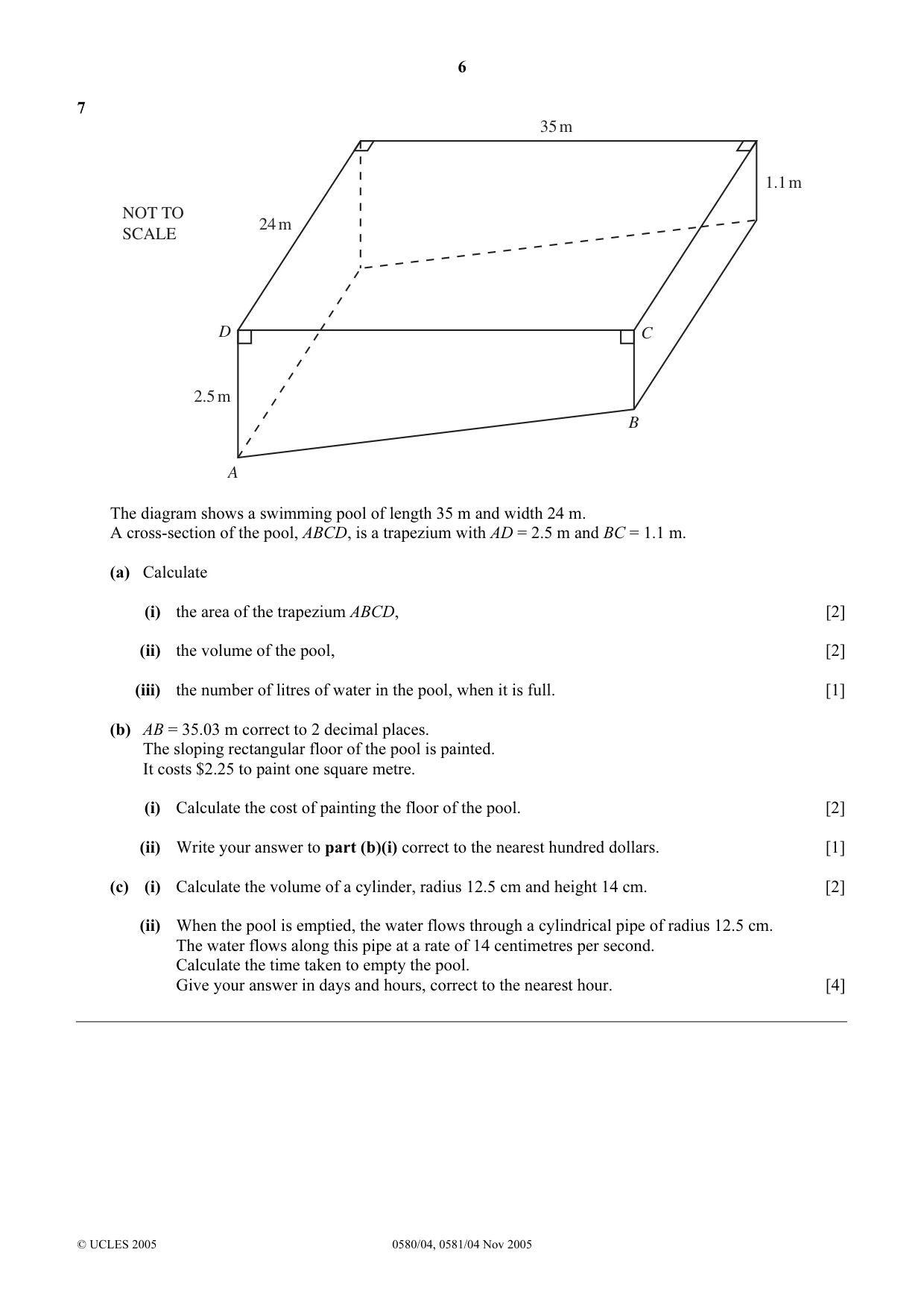
6 © UCLES 2005 0580/04, 0581/04 Nov 2005 7 A B C D 1.1 m 24 m 35 m 2.5 m NOT TO SCALE The diagram shows a swimming pool of length 35 m and width 24 m. A cross-section of the pool, ABCD, is a trapezium with AD = 2.5 m and BC = 1.1 m. (a) Calculate (i) the area of the trapezium ABCD, [2] (ii) the volume of the pool, [2] (iii) the number of litres of water in the pool, when it is full. [1] (b) AB = 35.03 m correct to 2 decimal places. The sloping rectangular floor of the pool is painted. It costs $2.25 to paint one square metre. (i) Calculate the cost of painting the floor of the pool. [2] (ii) Write your answer to part (b)(i) correct to the nearest hundred dollars. [1] (c) (i) Calculate the volume of a cylinder, radius 12.5 cm and height 14 cm. [2] (ii) When the pool is emptied, the water flows through a cylindrical pipe of radius 12.5 cm. The water flows along this pipe at a rate of 14 centimetres per second. Calculate the time taken to empty the pool. Give your answer in days and hours, correct to the nearest hour. [4]
Question paper, page 7
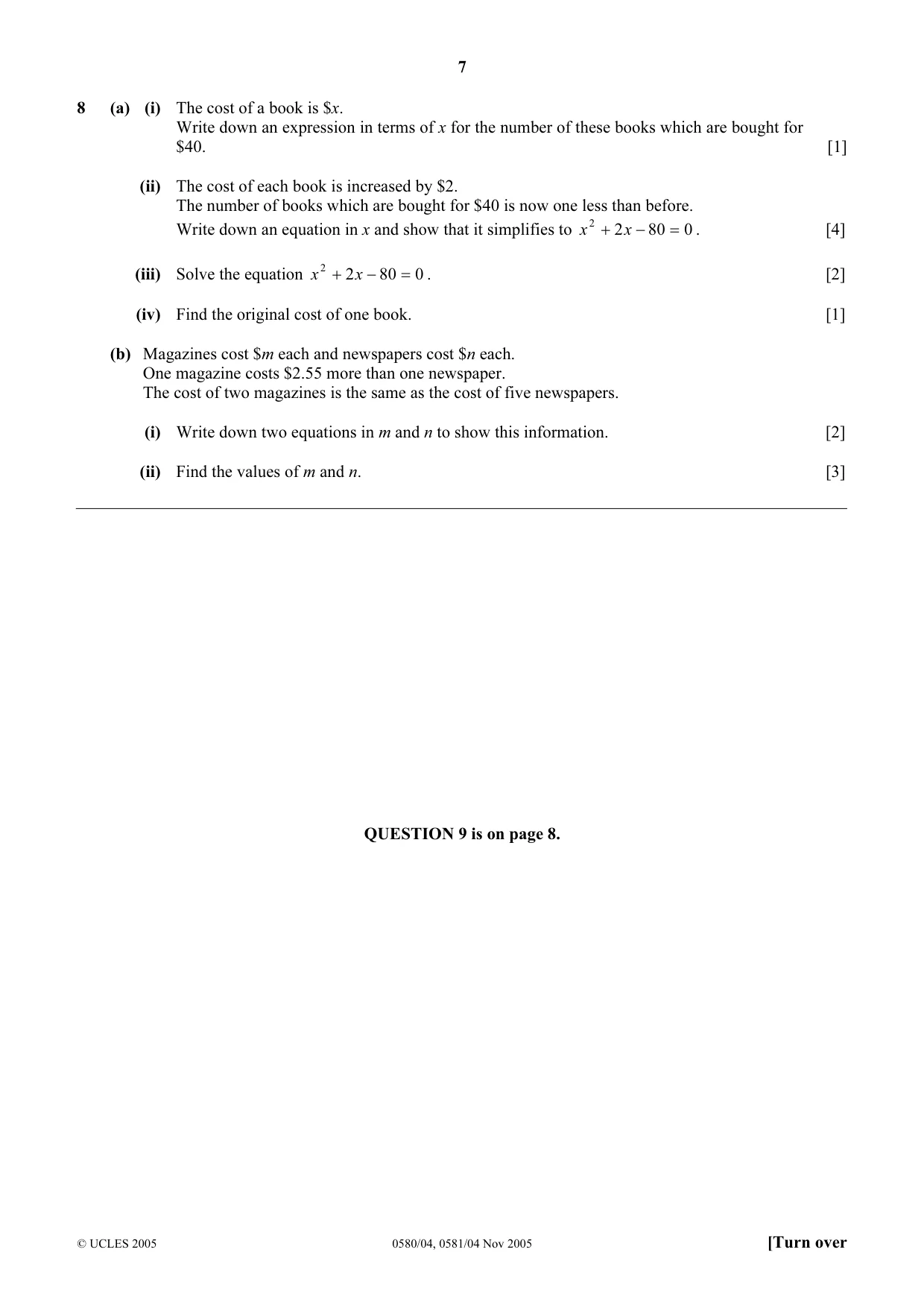
7 © UCLES 2005 0580/04, 0581/04 Nov 2005 [Turn over 8 (a) (i) The cost of a book is $x. Write down an expression in terms of x for the number of these books which are bought for $40. [1] (ii) The cost of each book is increased by $2. The number of books which are bought for $40 is now one less than before. Write down an equation in x and show that it simplifies to 0 80 2 2 = − + x x . [4] (iii) Solve the equation 0 80 2 2 = − + x x . [2] (iv) Find the original cost of one book. [1] (b) Magazines cost $m each and newspapers cost $n each. One magazine costs $2.55 more than one newspaper. The cost of two magazines is the same as the cost of five newspapers. (i) Write down two equations in m and n to show this information. [2] (ii) Find the values of m and n. [3] QUESTION 9 is on page 8.
Question paper, page 8
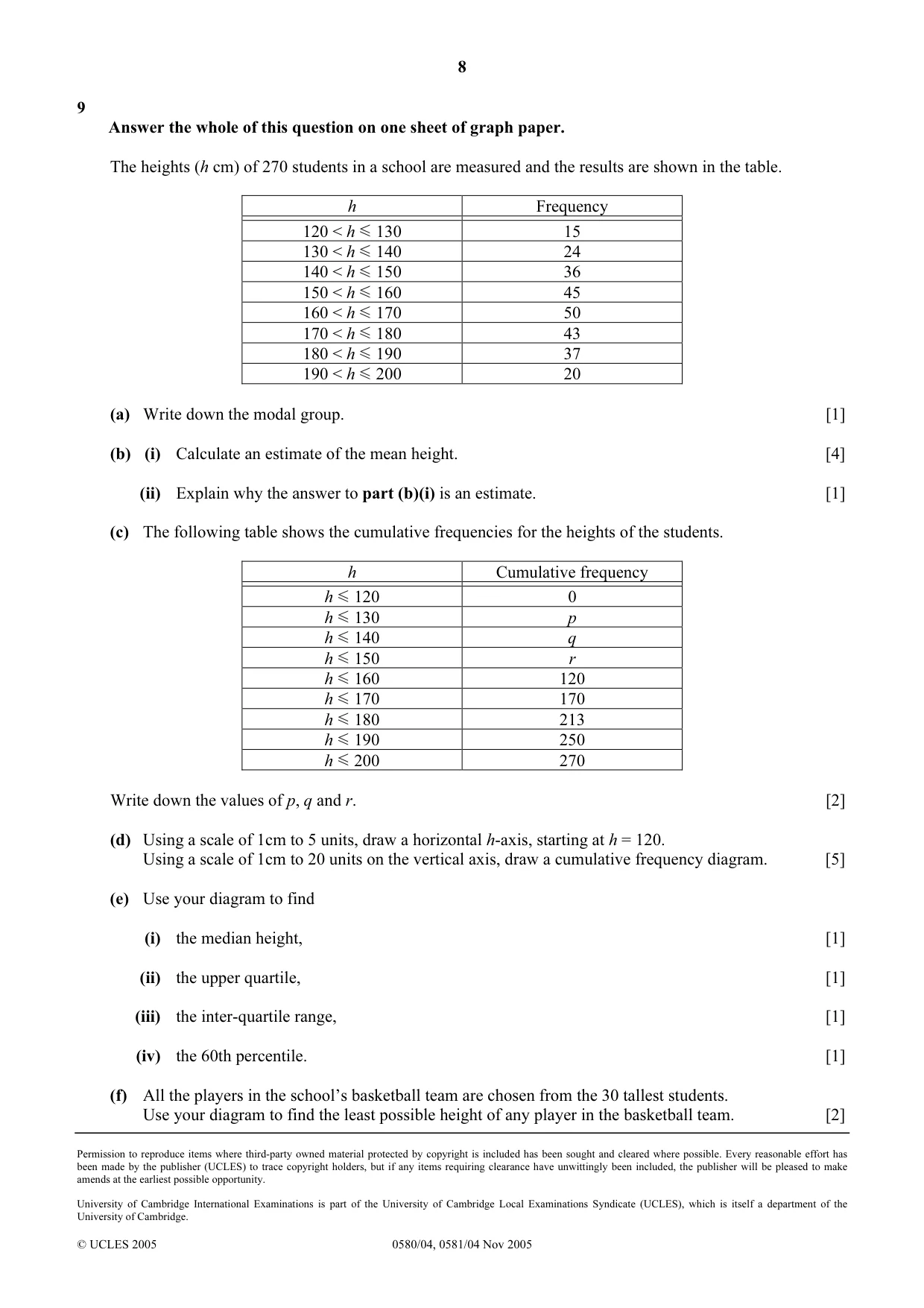
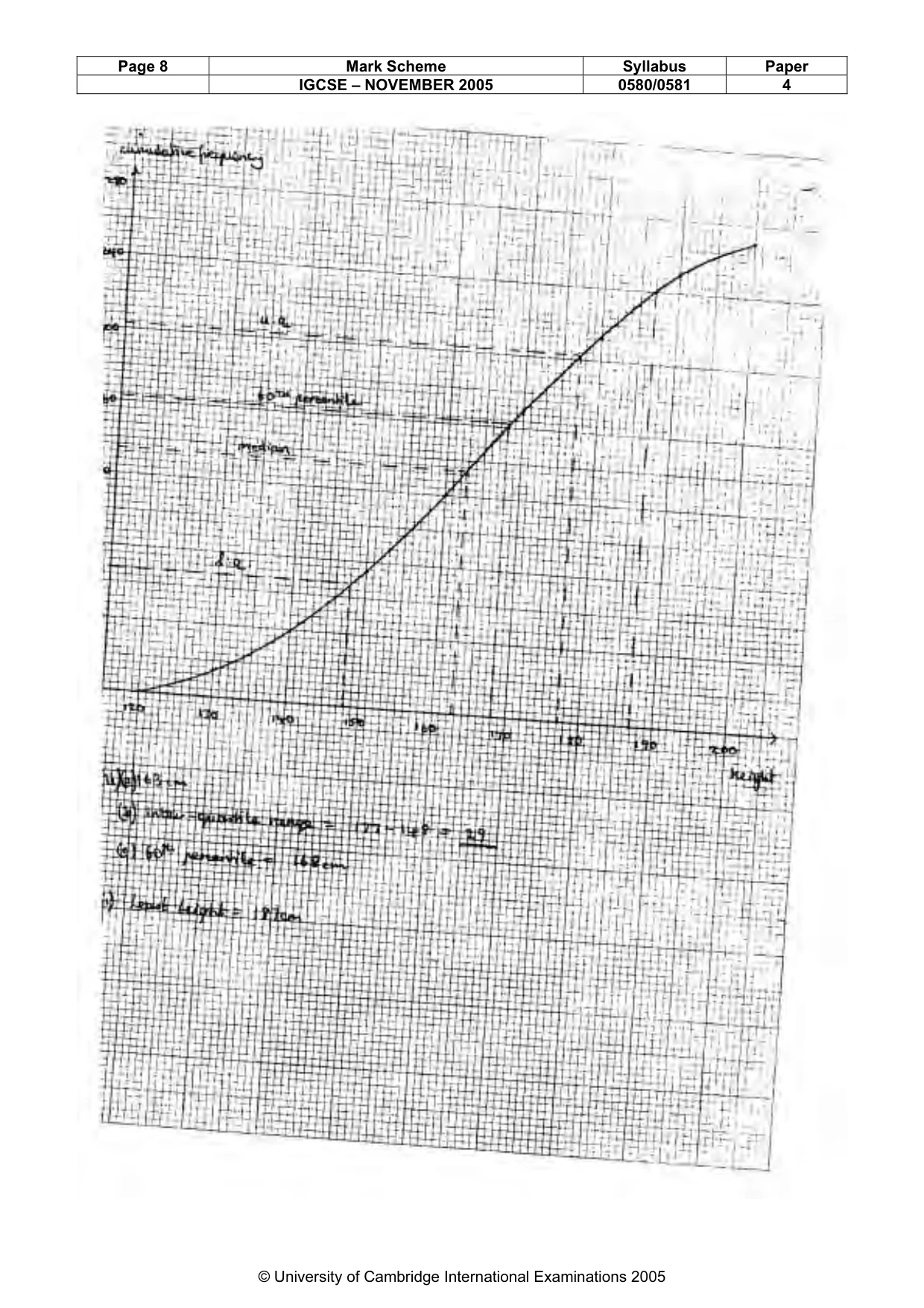
8 Permission to reproduce items where third-party owned material protected by copyright is included has been sought and cleared where possible. Every reasonable effort has been made by the publisher (UCLES) to trace copyright holders, but if any items requiring clearance have unwittingly been included, the publisher will be pleased to make amends at the earliest possible opportunity. University of Cambridge International Examinations is part of the University of Cambridge Local Examinations Syndicate (UCLES), which is itself a department of the University of Cambridge. © UCLES 2005 0580/04, 0581/04 Nov 2005 9 Answer the whole of this question on one sheet of graph paper. The heights (h cm) of 270 students in a school are measured and the results are shown in the table. h Frequency 120 < h 130 15 130 < h 140 24 140 < h 150 36 150 < h 160 45 160 < h 170 50 170 < h 180 43 180 < h 190 37 190 < h 200 20 (a) Write down the modal group. [1] (b) (i) Calculate an estimate of the mean height. [4] (ii) Explain why the answer to part (b)(i) is an estimate. [1] (c) The following table shows the cumulative frequencies for the heights of the students. h Cumulative frequency h 120 0 h 130 p h 140 q h 150 r h 160 120 h 170 170 h 180 213 h 190 250 h 200 270 Write down the values of p, q and r. [2] (d) Using a scale of 1cm to 5 units, draw a horizontal h-axis, starting at h = 120. Using a scale of 1cm to 20 units on the vertical axis, draw a cumulative frequency diagram. [5] (e) Use your diagram to find (i) the median height, [1] (ii) the upper quartile, [1] (iii) the inter-quartile range, [1] (iv) the 60th percentile. [1] (f) All the players in the school’s basketball team are chosen from the 30 tallest students. Use your diagram to find the least possible height of any player in the basketball team. [2]
Mark scheme, page 1
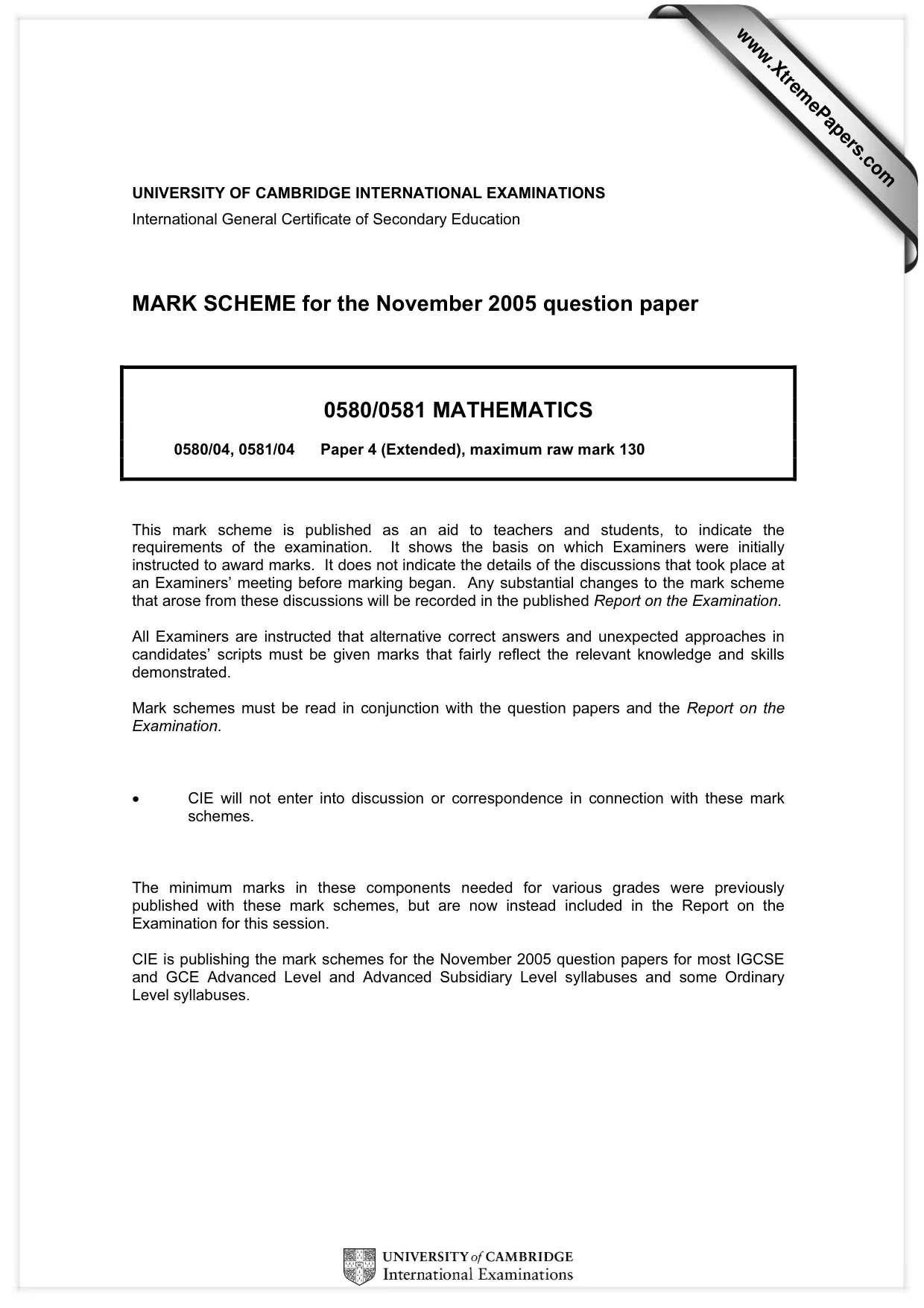
UNIVERSITY OF CAMBRIDGE INTERNATIONAL EXAMINATIONS International General Certificate of Secondary Education MARK SCHEME for the November 2005 question paper 0580/0581 MATHEMATICS 0580/04, 0581/04 Paper 4 (Extended), maximum raw mark 130 This mark scheme is published as an aid to teachers and students, to indicate the requirements of the examination. It shows the basis on which Examiners were initially instructed to award marks. It does not indicate the details of the discussions that took place at an Examiners’ meeting before marking began. Any substantial changes to the mark scheme that arose from these discussions will be recorded in the published Report on the Examination. All Examiners are instructed that alternative correct answers and unexpected approaches in candidates’ scripts must be given marks that fairly reflect the relevant knowledge and skills demonstrated. Mark schemes must be read in conjunction with the question papers and the Report on the Examination. • CIE will not enter into discussion or correspondence in connection with these mark schemes. The minimum marks in these components needed for various grades were previously published with these mark schemes, but are now instead included in the Report on the Examination for this session. CIE is publishing the mark schemes for the November 2005 question papers for most IGCSE and GCE Advanced Level and Advanced Subsidiary Level syllabuses and some Ordinary Level syllabuses. www.XtremePapers.com
Mark scheme, page 2
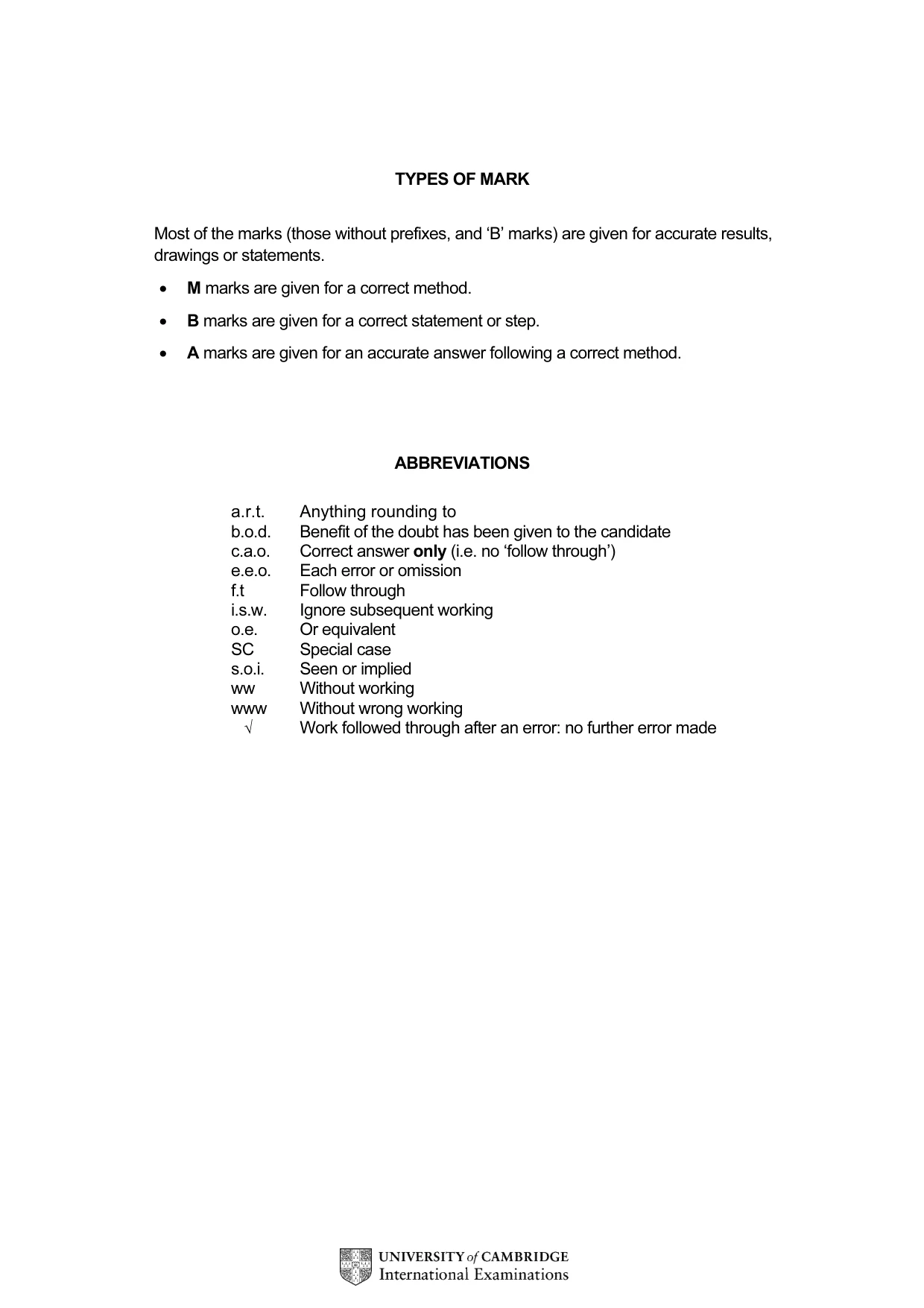
TYPES OF MARK Most of the marks (those without prefixes, and ‘B’ marks) are given for accurate results, drawings or statements. • M marks are given for a correct method. • B marks are given for a correct statement or step. • A marks are given for an accurate answer following a correct method. ABBREVIATIONS a.r.t. Anything rounding to b.o.d. Benefit of the doubt has been given to the candidate c.a.o. Correct answer only (i.e. no ‘follow through’) e.e.o. Each error or omission f.t Follow through i.s.w. Ignore subsequent working o.e. Or equivalent SC Special case s.o.i. Seen or implied ww Without working www Without wrong working √ Work followed through after an error: no further error made
Mark scheme, page 3
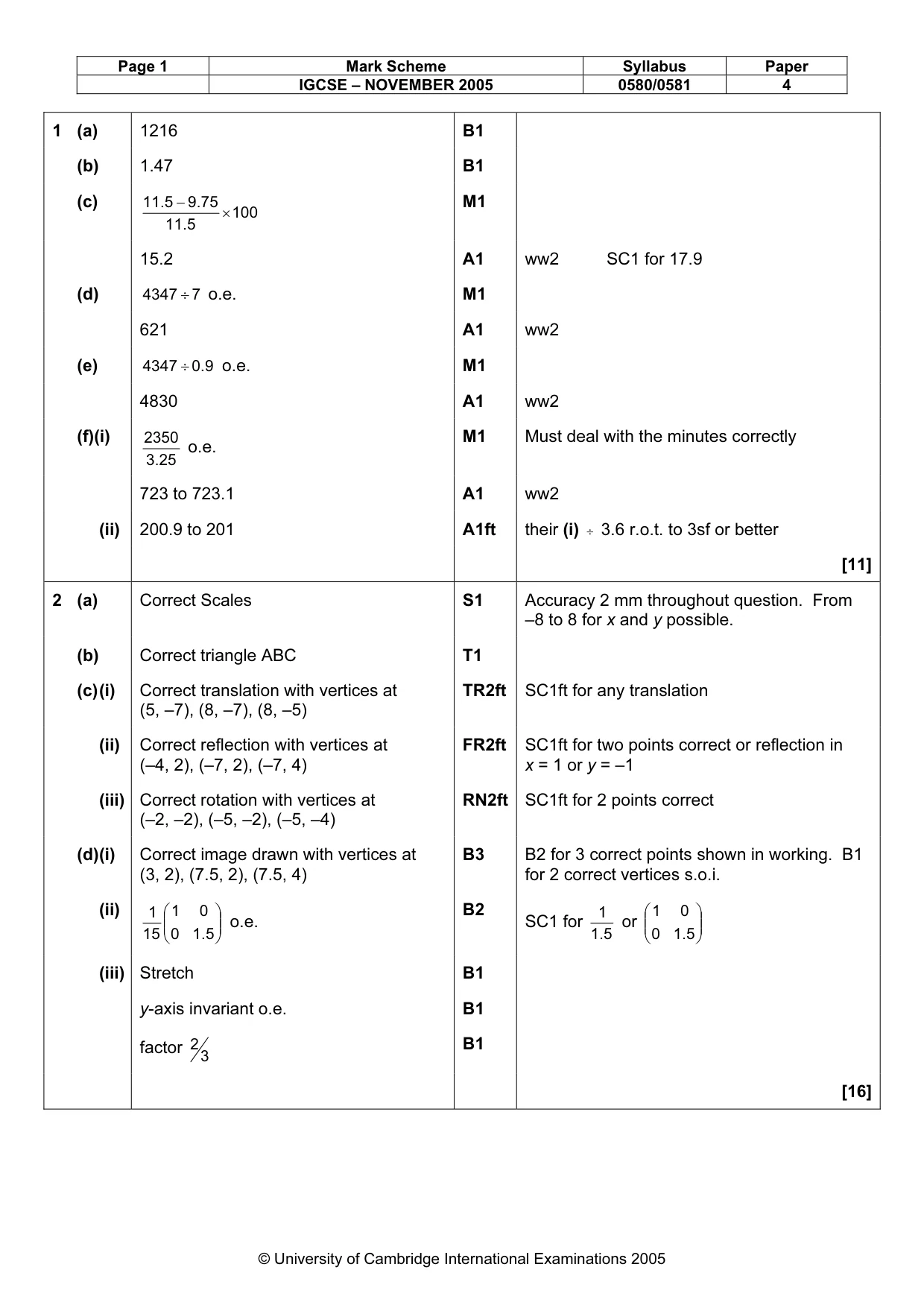
Page 1 Mark Scheme Syllabus Paper IGCSE – NOVEMBER 2005 0580/0581 4 © University of Cambridge International Examinations 2005 1 (a) 1216 B1 (b) 1.47 B1 (c) 100 5 . 11 75 . 9 5 . 11 × − M1 15.2 A1 ww2 SC1 for 17.9 (d) 7 4347 ÷ o.e. M1 621 A1 ww2 (e) 9 . 0 4347 ÷ o.e. M1 4830 A1 ww2 (f)(i) 25 . 3 2350 o.e. M1 Must deal with the minutes correctly 723 to 723.1 A1 ww2 (ii) 200.9 to 201 A1ft their (i) ÷ 3.6 r.o.t. to 3sf or better [11] 2 (a) Correct Scales S1 Accuracy 2 mm throughout question. From –8 to 8 for x and y possible. (b) Correct triangle ABC T1 (c) (i) Correct translation with vertices at (5, –7), (8, –7), (8, –5) TR2ft SC1ft for any translation (ii) Correct reflection with vertices at (–4, 2), (–7, 2), (–7, 4) FR2ft SC1ft for two points correct or reflection in x = 1 or y = –1 (iii) Correct rotation with vertices at (–2, –2), (–5, –2), (–5, –4) RN2ft SC1ft for 2 points correct (d) (i) Correct image drawn with vertices at (3, 2), (7.5, 2), (7.5, 4) B3 B2 for 3 correct points shown in working. B1 for 2 correct vertices s.o.i. (ii) 5 . 1 0 0 1 15 1 o.e. B2 SC1 for 5 . 1 1 or 5 . 1 0 0 1 (iii) Stretch y-axis invariant o.e. factor 3 2 B1 B1 B1 [16]
Mark scheme, page 4
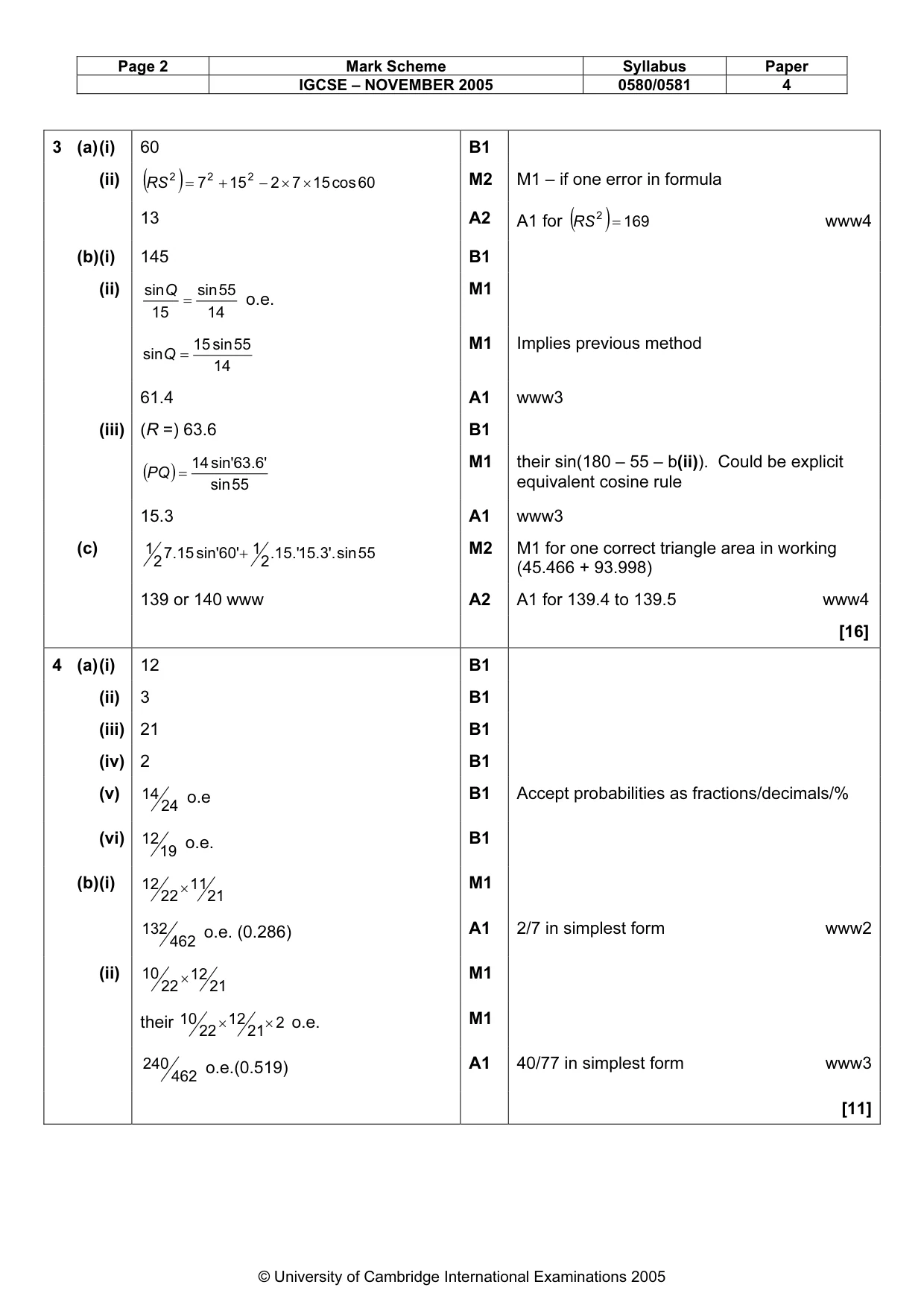
Page 2 Mark Scheme Syllabus Paper IGCSE – NOVEMBER 2005 0580/0581 4 © University of Cambridge International Examinations 2005 3 (a) (i) 60 B1 (ii) ( ) 60 cos 15 7 2 15 7 2 2 2 × × − + = RS M2 M1 – if one error in formula 13 A2 A1 for ( ) 169 2 = RS www4 (b) (i) 145 B1 (ii) 14 55 sin 15 sin = Q o.e. M1 14 55 sin 15 sin = Q M1 Implies previous method 61.4 A1 www3 (iii) (R =) 63.6 B1 ( ) 55 sin '6 . 63 sin' 14 = PQ M1 their sin(180 – 55 – b(ii)). Could be explicit equivalent cosine rule 15.3 A1 www3 (c) 55 sin '. 3 . 15 .' 15 . 2 1 ' 60 sin' 15 . 7 2 1 + M2 M1 for one correct triangle area in working (45.466 + 93.998) 139 or 140 www A2 A1 for 139.4 to 139.5 www4 [16] 4 (a) (i) 12 B1 (ii) 3 B1 (iii) 21 B1 (iv) 2 B1 (v) 24 14 o.e B1 Accept probabilities as fractions/decimals/% (vi) 19 12 o.e. B1 (b) (i) 21 11 22 12 × M1 462 132 o.e. (0.286) A1 2/7 in simplest form www2 (ii) 21 12 22 10 × M1 their 2 21 12 22 10 × × o.e. M1 462 240 o.e.(0.519) A1 40/77 in simplest form www3 [11]
Mark scheme, page 5
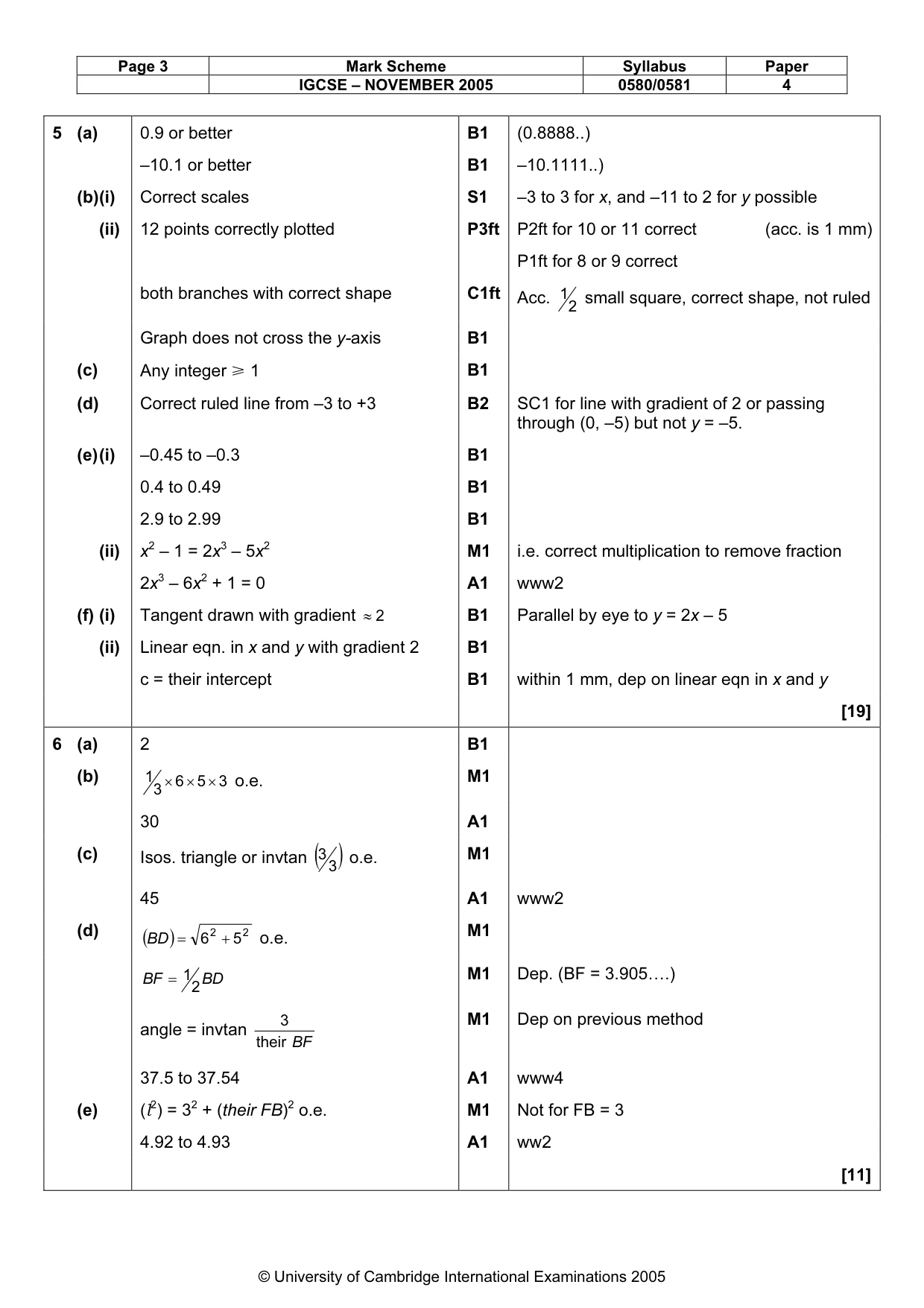
Page 3 Mark Scheme Syllabus Paper IGCSE – NOVEMBER 2005 0580/0581 4 © University of Cambridge International Examinations 2005 5 (a) 0.9 or better B1 (0.8888..) –10.1 or better B1 –10.1111..) (b) (i) Correct scales S1 –3 to 3 for x, and –11 to 2 for y possible (ii) 12 points correctly plotted P3ft P2ft for 10 or 11 correct (acc. is 1 mm) P1ft for 8 or 9 correct both branches with correct shape C1ft Acc. 2 1 small square, correct shape, not ruled Graph does not cross the y-axis B1 (c) Any integer [ 1 B1 (d) Correct ruled line from –3 to +3 B2 SC1 for line with gradient of 2 or passing through (0, –5) but not y = –5. (e) (i) –0.45 to –0.3 B1 0.4 to 0.49 B1 2.9 to 2.99 B1 (ii) x2 – 1 = 2x3 – 5x2 M1 i.e. correct multiplication to remove fraction 2x3 – 6x2 + 1 = 0 A1 www2 (f) (i) Tangent drawn with gradient 2 ≈ B1 Parallel by eye to y = 2x – 5 (ii) Linear eqn. in x and y with gradient 2 B1 c = their intercept B1 within 1 mm, dep on linear eqn in x and y [19] 6 (a) 2 B1 (b) 3 5 6 3 1 × × × o.e. M1 30 A1 (c) Isos. triangle or invtan ( ) 3 3 o.e. M1 45 A1 www2 (d) ( ) 2 2 5 6 + = BD o.e. M1 BD BF 2 1 = M1 Dep. (BF = 3.905….) angle = invtan BF their 3 M1 Dep on previous method 37.5 to 37.54 A1 www4 (e) (l2) = 32 + (their FB)2 o.e. M1 Not for FB = 3 4.92 to 4.93 A1 ww2 [11]
Mark scheme, page 6
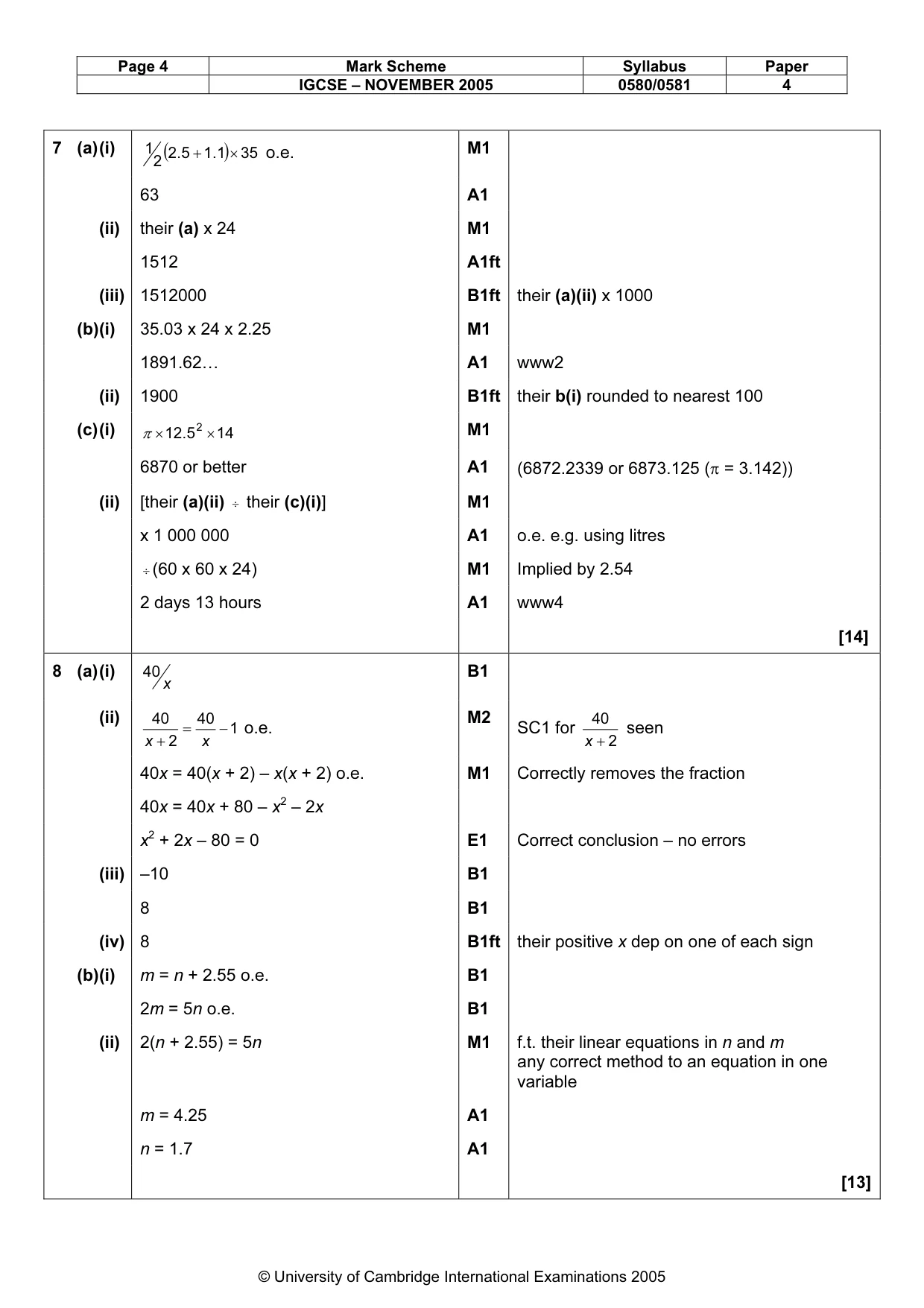
Page 4 Mark Scheme Syllabus Paper IGCSE – NOVEMBER 2005 0580/0581 4 © University of Cambridge International Examinations 2005 7 (a) (i) ( ) 35 1 . 1 5 . 2 2 1 × + o.e. M1 63 A1 (ii) their (a) x 24 M1 1512 A1ft (iii) 1512000 B1ft their (a)(ii) x 1000 (b) (i) 35.03 x 24 x 2.25 M1 1891.62… A1 www2 (ii) 1900 B1ft their b(i) rounded to nearest 100 (c) (i) 14 5 . 12 2 × × π M1 6870 or better A1 (6872.2339 or 6873.125 (π = 3.142)) (ii) [their (a)(ii) ÷ their (c)(i)] M1 x 1 000 000 A1 o.e. e.g. using litres ÷ (60 x 60 x 24) M1 Implied by 2.54 2 days 13 hours A1 www4 [14] 8 (a) (i) x 40 B1 (ii) 1 40 2 40 − = + x x o.e. M2 SC1 for 2 40 + x seen 40x = 40(x + 2) – x(x + 2) o.e. M1 Correctly removes the fraction 40x = 40x + 80 – x2 – 2x x2 + 2x – 80 = 0 E1 Correct conclusion – no errors (iii) –10 B1 8 B1 (iv) 8 B1ft their positive x dep on one of each sign (b) (i) m = n + 2.55 o.e. B1 2m = 5n o.e. B1 (ii) 2(n + 2.55) = 5n M1 f.t. their linear equations in n and m any correct method to an equation in one variable m = 4.25 A1 n = 1.7 A1 [13]
Mark scheme, page 7
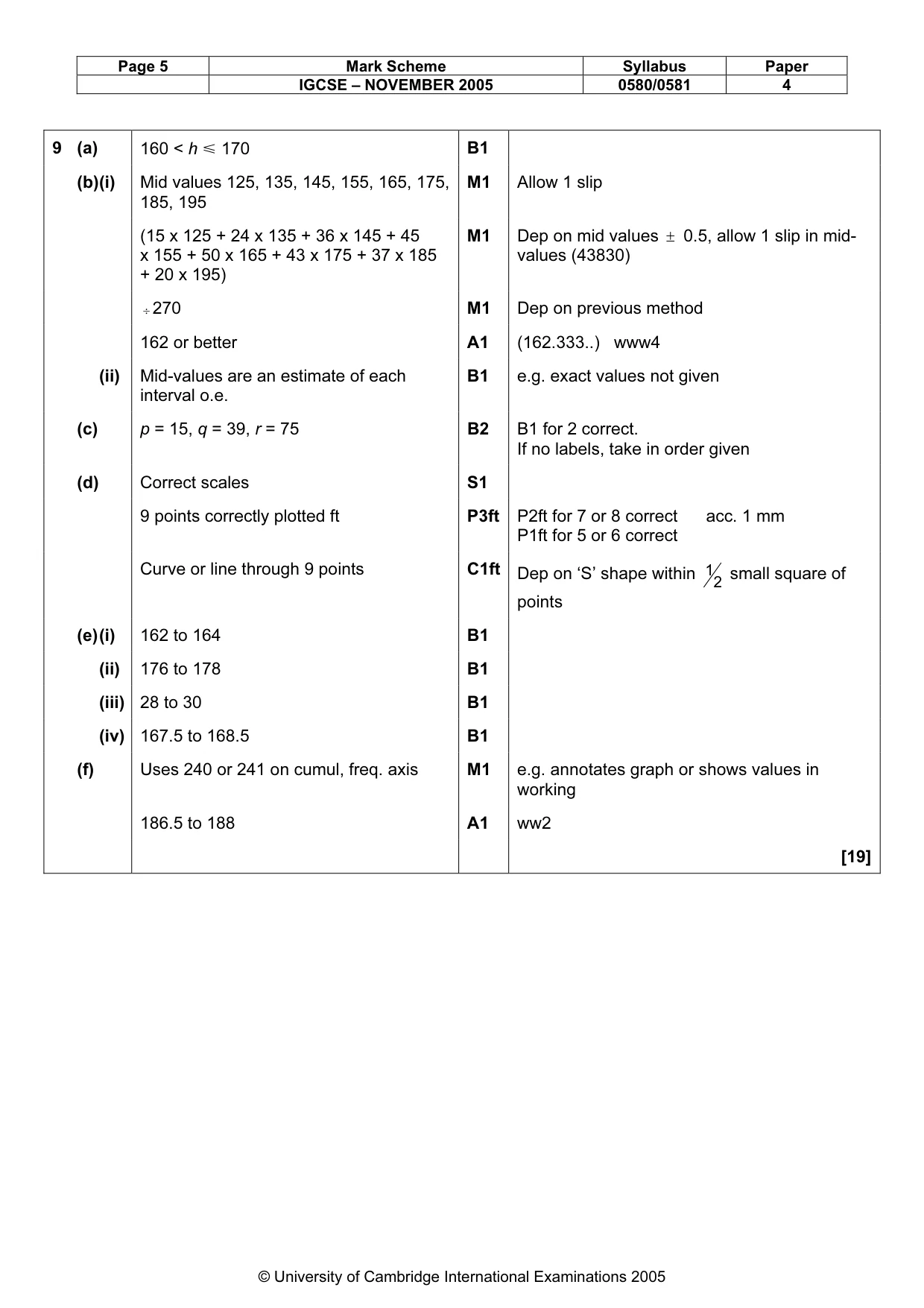
Page 5 Mark Scheme Syllabus Paper IGCSE – NOVEMBER 2005 0580/0581 4 © University of Cambridge International Examinations 2005 9 (a) 160 < h Y 170 B1 (b) (i) Mid values 125, 135, 145, 155, 165, 175, 185, 195 M1 Allow 1 slip (15 x 125 + 24 x 135 + 36 x 145 + 45 x 155 + 50 x 165 + 43 x 175 + 37 x 185 + 20 x 195) M1 Dep on mid values ± 0.5, allow 1 slip in mid- values (43830) ÷ 270 M1 Dep on previous method 162 or better A1 (162.333..) www4 (ii) Mid-values are an estimate of each interval o.e. B1 e.g. exact values not given (c) p = 15, q = 39, r = 75 B2 B1 for 2 correct. If no labels, take in order given (d) Correct scales S1 9 points correctly plotted ft P3ft P2ft for 7 or 8 correct acc. 1 mm P1ft for 5 or 6 correct Curve or line through 9 points C1ft Dep on ‘S’ shape within 2 1 small square of points (e) (i) 162 to 164 B1 (ii) 176 to 178 B1 (iii) 28 to 30 B1 (iv) 167.5 to 168.5 B1 (f) Uses 240 or 241 on cumul, freq. axis M1 e.g. annotates graph or shows values in working 186.5 to 188 A1 ww2 [19]
Mark scheme, page 8
Page 6 Mark Scheme Syllabus Paper IGCSE – NOVEMBER 2005 0580/0581 4 © University of Cambridge International Examinations 2005
Mark scheme, page 9
Page 7 Mark Scheme Syllabus Paper IGCSE – NOVEMBER 2005 0580/0581 4 © University of Cambridge International Examinations 2005
Mark scheme, page 10
Page 8 Mark Scheme Syllabus Paper IGCSE – NOVEMBER 2005 0580/0581 4 © University of Cambridge International Examinations 2005