Cambridge IGCSE Mathematics (with coursework) 0581 — 2005 May/June Paper 4 · Variant 1
0581/41/M/J/05
The question paper and its mark scheme, free to read here and free to download. This is Cambridge’s own paper, exactly as it was sat.
Question paper8 pages
Mark scheme10 pages
Answers below. Sit the paper first if you are practising.
Paper as text
Question paper, page 1
UNIVERSITY OF CAMBRIDGE INTERNATIONAL EXAMINATIONS International General Certificate of Secondary Education MATHEMATICS 0580/04 0581/04 Paper 4 (Extended) May/June 2005 Additional Materials: Answer Booklet/Paper 2 hours 30 minutes Electronic calculator Geometrical instruments Graph paper (3 sheets) Mathematical tables (optional) Tracing paper (optional) READ THESE INSTRUCTIONS FIRST Write your answers and working on the separate Answer Booklet/Paper provided. Write your name, Centre number and candidate number on all the work you hand in. Write in dark blue or black pen on both sides of the paper. You may use a soft pencil for any diagrams or graphs. Do not use staples, paper clips, highlighters, glue or correction fluid. Answer all questions. At the end of the examination, fasten all your work securely together. The number of marks is given in brackets [ ] at the end of each question or part question. All working must be clearly shown. It should be done on the same sheet as the rest of the answer. Marks will be given for working which shows that you know how to solve the problem even if you get the answer wrong. The total of the marks for this paper is 130. Electronic calculators should be used. If the degree of accuracy is not specified in the question, and if the answer is not exact, give the answer to three significant figures. Give answers in degrees to one decimal place. For π use either your calculator value or 3.142. This document consists of 8 printed pages. IB05 06_0580_04/6RP UCLES 2005 [Turn over www.XtremePapers.com
Question paper, page 2
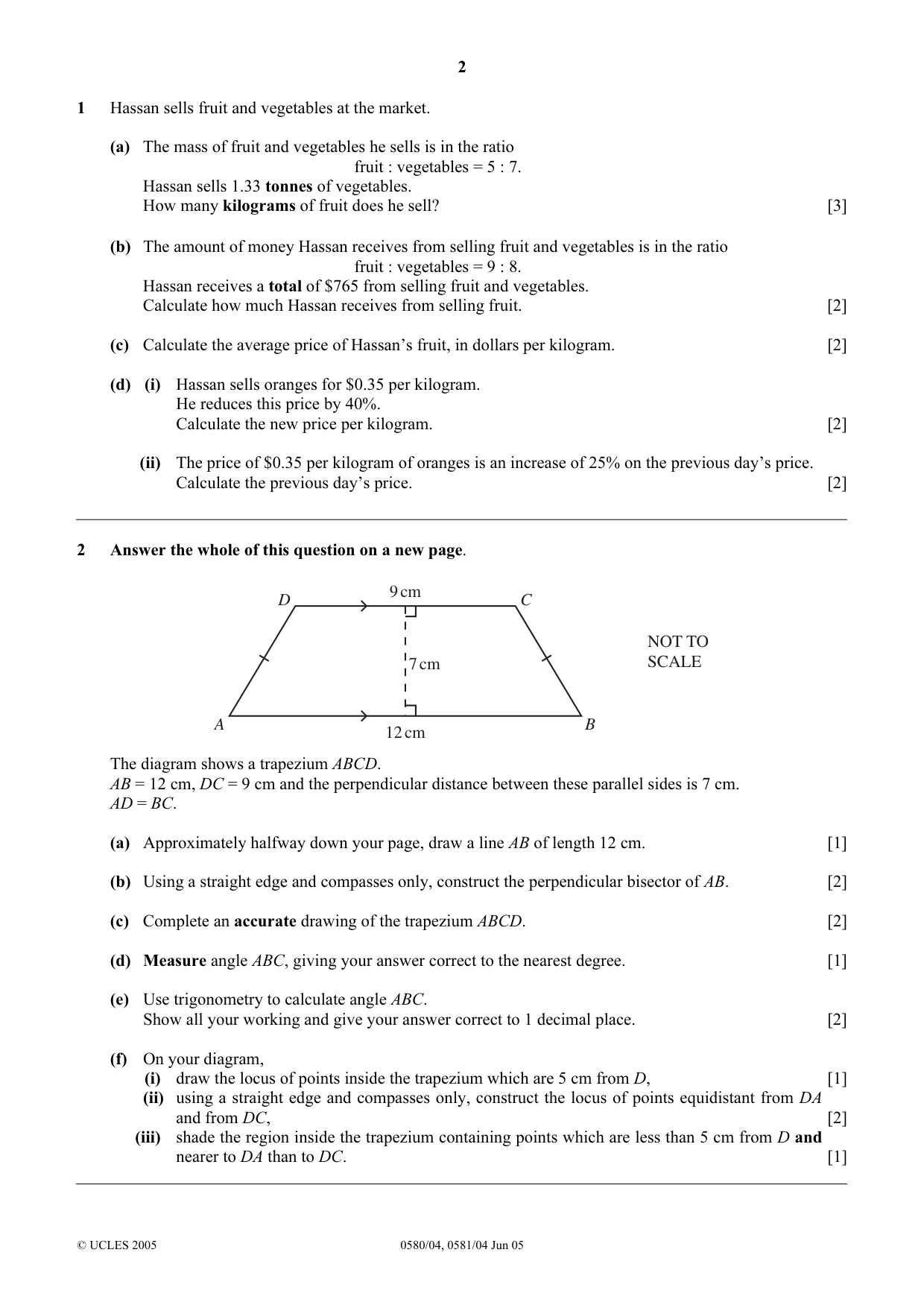
2 © UCLES 2005 0580/04, 0581/04 Jun 05 1 Hassan sells fruit and vegetables at the market. (a) The mass of fruit and vegetables he sells is in the ratio fruit : vegetables = 5 : 7. Hassan sells 1.33 tonnes of vegetables. How many kilograms of fruit does he sell? [3] (b) The amount of money Hassan receives from selling fruit and vegetables is in the ratio fruit : vegetables = 9 : 8. Hassan receives a total of $765 from selling fruit and vegetables. Calculate how much Hassan receives from selling fruit. [2] (c) Calculate the average price of Hassan’s fruit, in dollars per kilogram. [2] (d) (i) Hassan sells oranges for $0.35 per kilogram. He reduces this price by 40%. Calculate the new price per kilogram. [2] (ii) The price of $0.35 per kilogram of oranges is an increase of 25% on the previous day’s price. Calculate the previous day’s price. [2] 2 Answer the whole of this question on a new page. D A B C 9 cm 12 cm 7 cm NOT TO SCALE The diagram shows a trapezium ABCD. AB = 12 cm, DC = 9 cm and the perpendicular distance between these parallel sides is 7 cm. AD = BC. (a) Approximately halfway down your page, draw a line AB of length 12 cm. [1] (b) Using a straight edge and compasses only, construct the perpendicular bisector of AB. [2] (c) Complete an accurate drawing of the trapezium ABCD. [2] (d) Measure angle ABC, giving your answer correct to the nearest degree. [1] (e) Use trigonometry to calculate angle ABC. Show all your working and give your answer correct to 1 decimal place. [2] (f) On your diagram, (i) draw the locus of points inside the trapezium which are 5 cm from D, [1] (ii) using a straight edge and compasses only, construct the locus of points equidistant from DA and from DC, [2] (iii) shade the region inside the trapezium containing points which are less than 5 cm from D and nearer to DA than to DC. [1]
Question paper, page 3
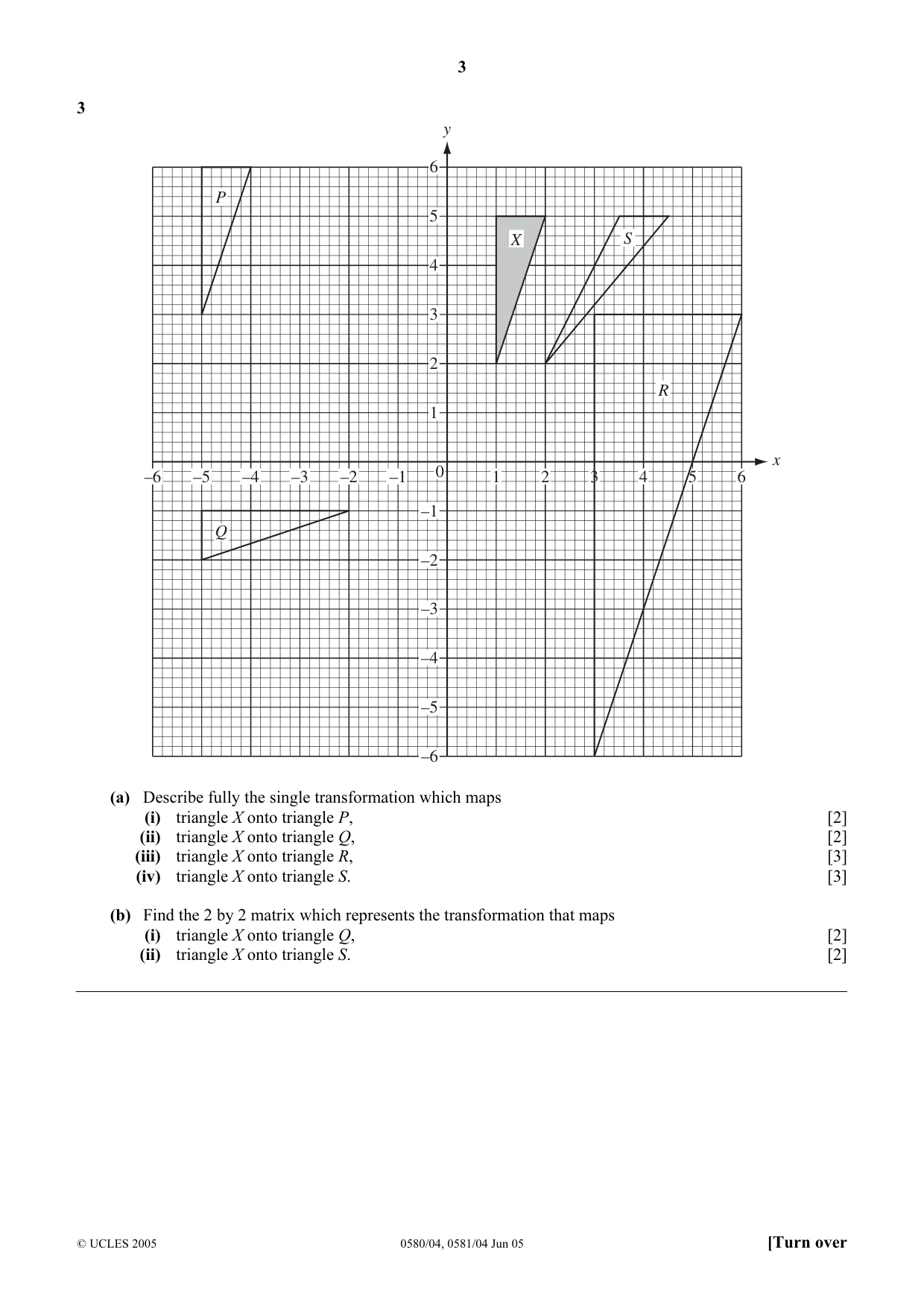
3 © UCLES 2005 0580/04, 0581/04 Jun 05 [Turn over 3 6 5 4 3 2 1 –1 –2 –3 –4 –5 –6 –6 –5 –4 –3 –2 –1 1 2 3 4 5 6 0 P X S Q R y x (a) Describe fully the single transformation which maps (i) triangle X onto triangle P, [2] (ii) triangle X onto triangle Q, [2] (iii) triangle X onto triangle R, [3] (iv) triangle X onto triangle S. [3] (b) Find the 2 by 2 matrix which represents the transformation that maps (i) triangle X onto triangle Q, [2] (ii) triangle X onto triangle S. [2]
Question paper, page 4
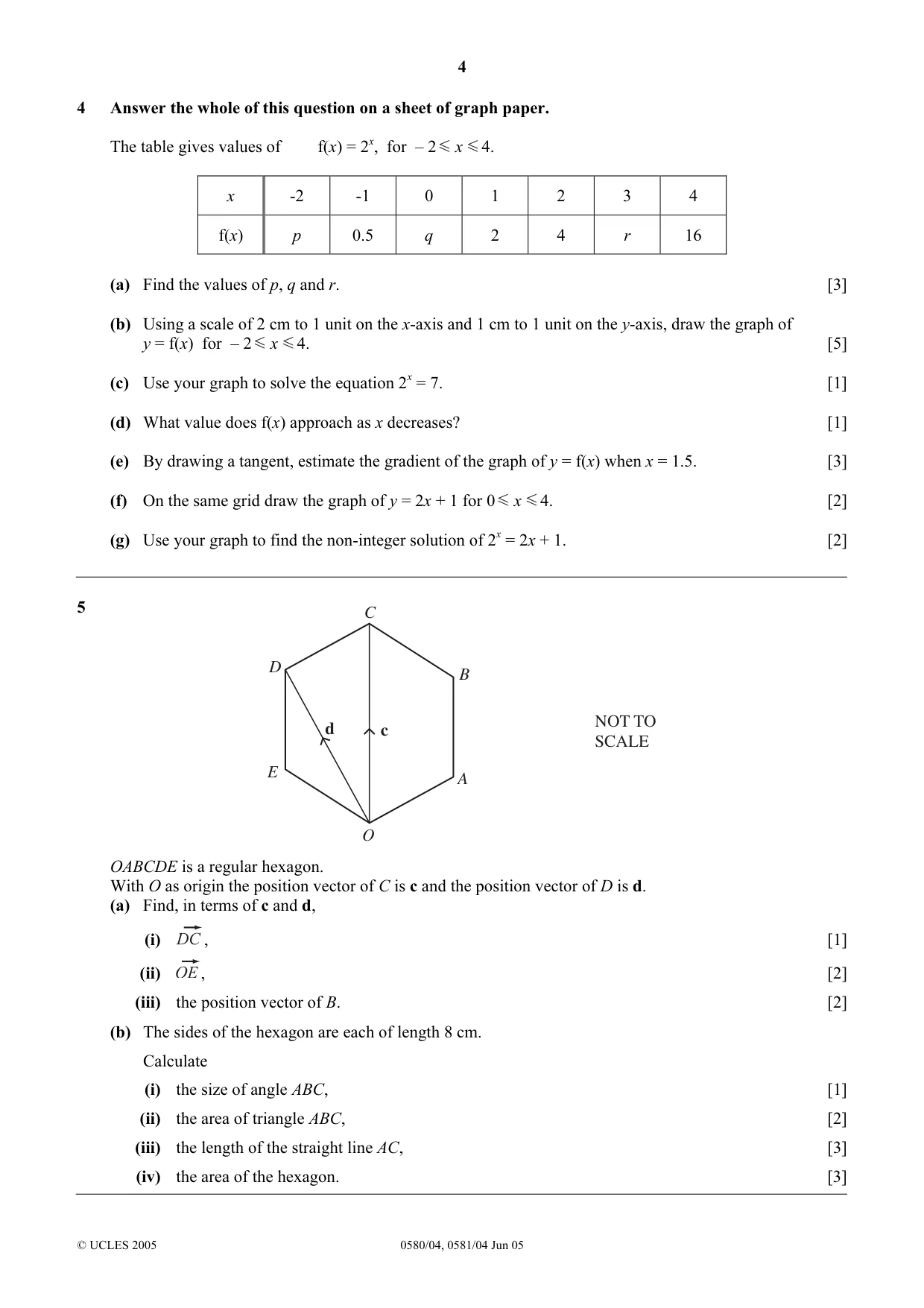
4 © UCLES 2005 0580/04, 0581/04 Jun 05 4 Answer the whole of this question on a sheet of graph paper. The table gives values of f(x) = 2x, for – 2 x 4. x -2 -1 0 1 2 3 4 f(x) p 0.5 q 2 4 r 16 (a) Find the values of p, q and r. [3] (b) Using a scale of 2 cm to 1 unit on the x-axis and 1 cm to 1 unit on the y-axis, draw the graph of y = f(x) for – 2 x 4. [5] (c) Use your graph to solve the equation 2x = 7. [1] (d) What value does f(x) approach as x decreases? [1] (e) By drawing a tangent, estimate the gradient of the graph of y = f(x) when x = 1.5. [3] (f) On the same grid draw the graph of y = 2x + 1 for 0 x 4. [2] (g) Use your graph to find the non-integer solution of 2x = 2x + 1. [2] 5 C D E O A B c d NOT TO SCALE OABCDE is a regular hexagon. With O as origin the position vector of C is c and the position vector of D is d. (a) Find, in terms of c and d, (i) , [1] (ii) , [2] (iii) the position vector of B. [2] (b) The sides of the hexagon are each of length 8 cm. Calculate (i) the size of angle ABC, [1] (ii) the area of triangle ABC, [2] (iii) the length of the straight line AC, [3] (iv) the area of the hexagon. [3]
Question paper, page 5
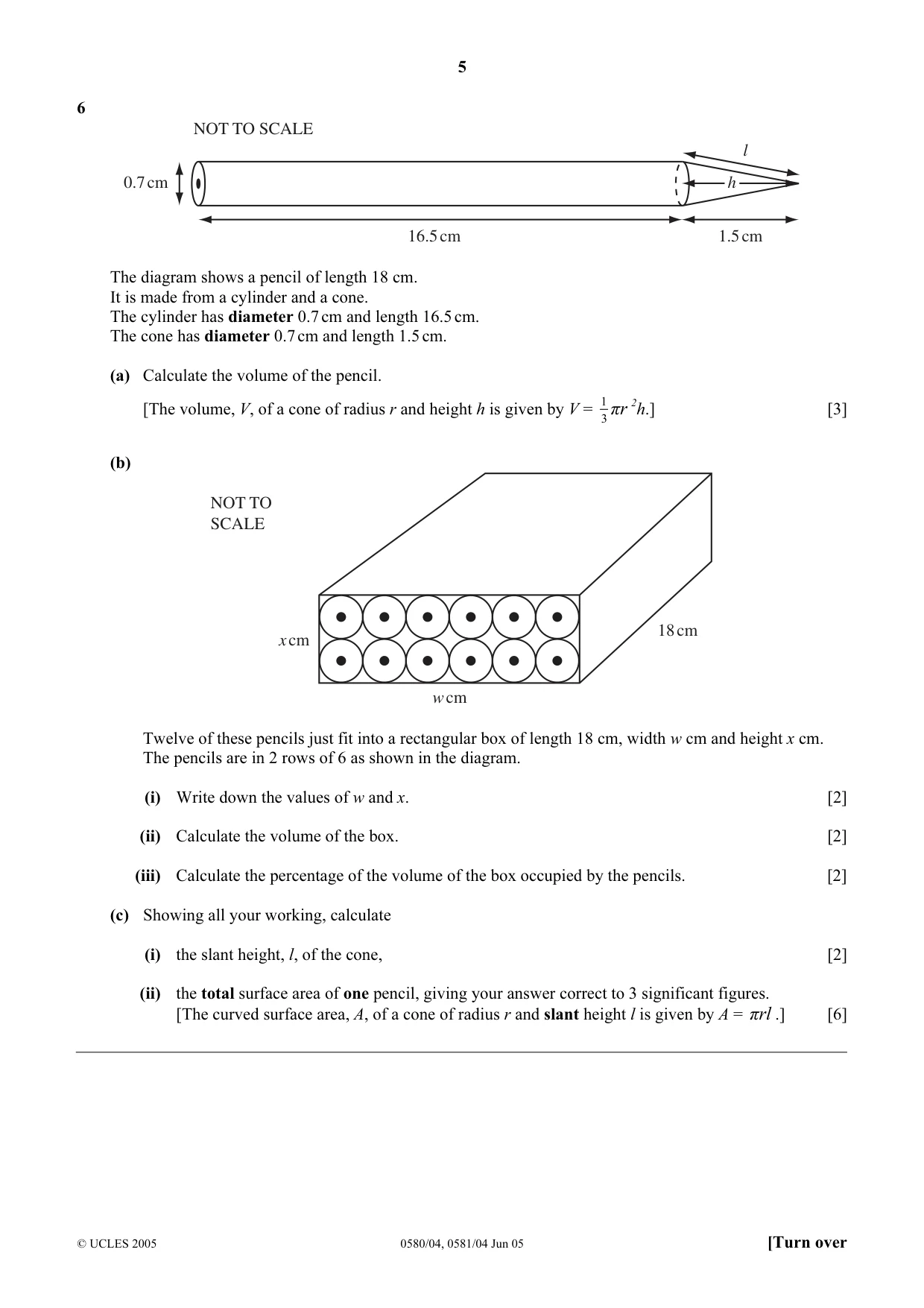
5 © UCLES 2005 0580/04, 0581/04 Jun 05 [Turn over 6 0.7 cm 16.5 cm 1.5 cm h l NOT TO SCALE The diagram shows a pencil of length 18 cm. It is made from a cylinder and a cone. The cylinder has diameter 0.7 cm and length 16.5 cm. The cone has diameter 0.7 cm and length 1.5 cm. (a) Calculate the volume of the pencil. [The volume, V, of a cone of radius r and height h is given by V = πr 3 1 2h.] [3] (b) 18 cm w cm x cm NOT TO SCALE Twelve of these pencils just fit into a rectangular box of length 18 cm, width w cm and height x cm. The pencils are in 2 rows of 6 as shown in the diagram. (i) Write down the values of w and x. [2] (ii) Calculate the volume of the box. [2] (iii) Calculate the percentage of the volume of the box occupied by the pencils. [2] (c) Showing all your working, calculate (i) the slant height, l, of the cone, [2] (ii) the total surface area of one pencil, giving your answer correct to 3 significant figures. [The curved surface area, A, of a cone of radius r and slant height l is given by A = πrl .] [6]
Question paper, page 6
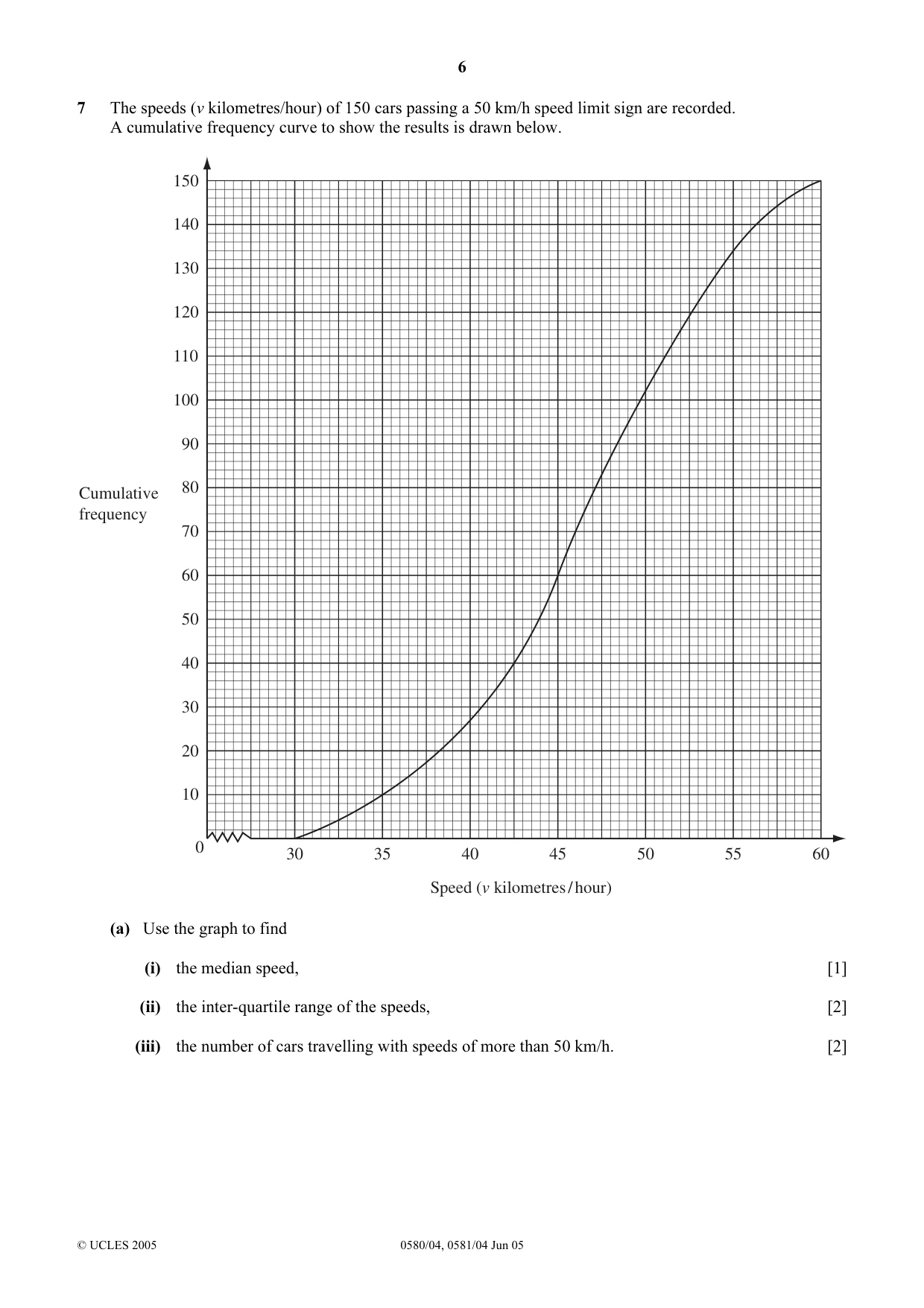
6 © UCLES 2005 0580/04, 0581/04 Jun 05 7 The speeds (v kilometres/hour) of 150 cars passing a 50 km/h speed limit sign are recorded. A cumulative frequency curve to show the results is drawn below. 30 35 40 45 50 55 60 150 140 130 120 110 100 90 80 70 60 50 40 30 20 10 0 Speed (v kilometres / hour) Cumulative frequency (a) Use the graph to find (i) the median speed, [1] (ii) the inter-quartile range of the speeds, [2] (iii) the number of cars travelling with speeds of more than 50 km/h. [2]
Question paper, page 7
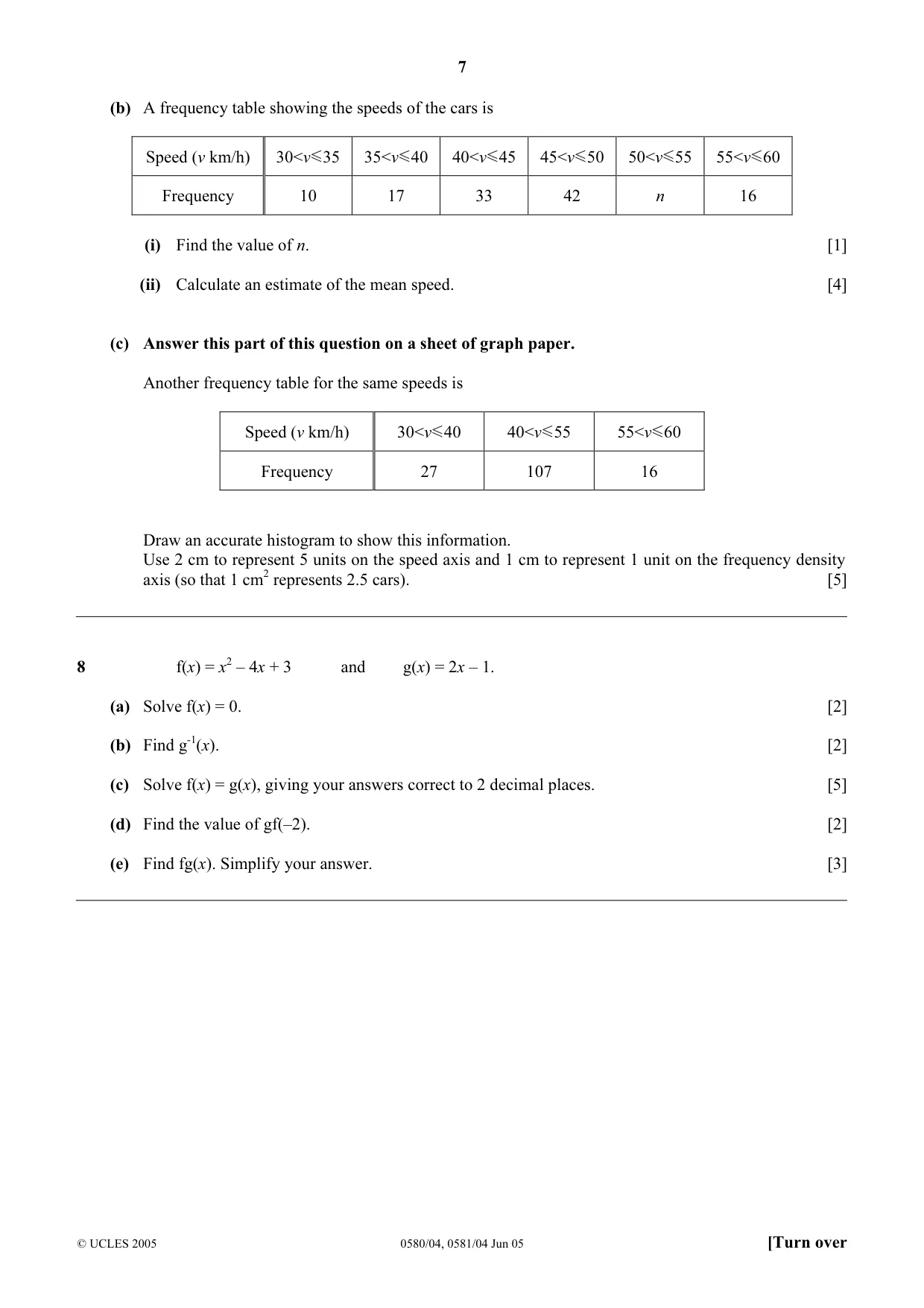
7 © UCLES 2005 0580/04, 0581/04 Jun 05 [Turn over (b) A frequency table showing the speeds of the cars is Speed (v km/h) 30<v 35 35<v 40 40<v 45 45<v 50 50<v 55 55<v 60 Frequency 10 17 33 42 n 16 (i) Find the value of n. [1] (ii) Calculate an estimate of the mean speed. [4] (c) Answer this part of this question on a sheet of graph paper. Another frequency table for the same speeds is Speed (v km/h) 30<v 40 40<v 55 55<v 60 Frequency 27 107 16 Draw an accurate histogram to show this information. Use 2 cm to represent 5 units on the speed axis and 1 cm to represent 1 unit on the frequency density axis (so that 1 cm2 represents 2.5 cars). [5] 8 f(x) = x2 – 4x + 3 and g(x) = 2x – 1. (a) Solve f(x) = 0. [2] (b) Find g-1(x). [2] (c) Solve f(x) = g(x), giving your answers correct to 2 decimal places. [5] (d) Find the value of gf(–2). [2] (e) Find fg(x). Simplify your answer. [3]
Question paper, page 8
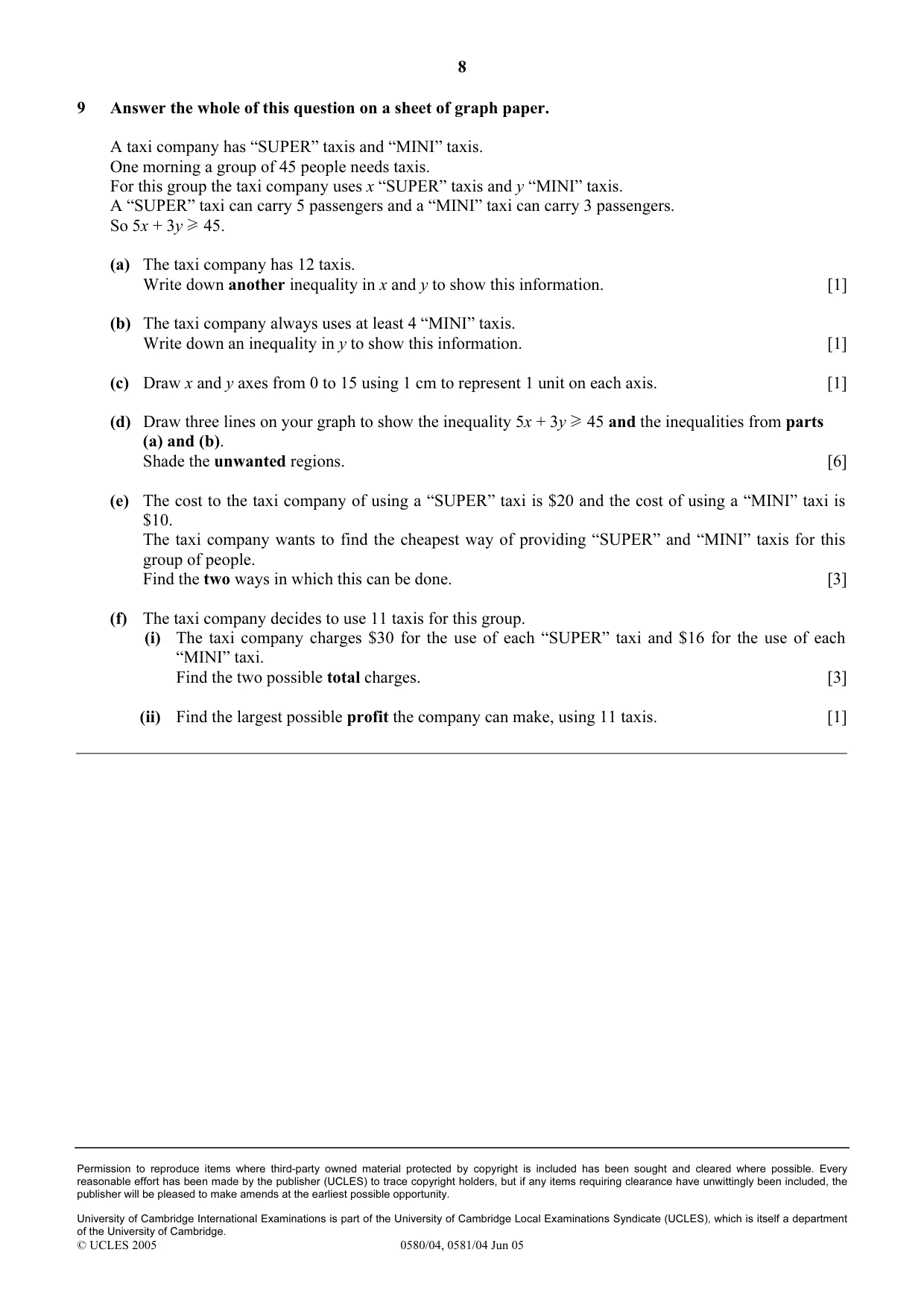
8 Permission to reproduce items where third-party owned material protected by copyright is included has been sought and cleared where possible. Every reasonable effort has been made by the publisher (UCLES) to trace copyright holders, but if any items requiring clearance have unwittingly been included, the publisher will be pleased to make amends at the earliest possible opportunity. University of Cambridge International Examinations is part of the University of Cambridge Local Examinations Syndicate (UCLES), which is itself a department of the University of Cambridge. © UCLES 2005 0580/04, 0581/04 Jun 05 9 Answer the whole of this question on a sheet of graph paper. A taxi company has “SUPER” taxis and “MINI” taxis. One morning a group of 45 people needs taxis. For this group the taxi company uses x “SUPER” taxis and y “MINI” taxis. A “SUPER” taxi can carry 5 passengers and a “MINI” taxi can carry 3 passengers. So 5x + 3y 45. (a) The taxi company has 12 taxis. Write down another inequality in x and y to show this information. [1] (b) The taxi company always uses at least 4 “MINI” taxis. Write down an inequality in y to show this information. [1] (c) Draw x and y axes from 0 to 15 using 1 cm to represent 1 unit on each axis. [1] (d) Draw three lines on your graph to show the inequality 5x + 3y 45 and the inequalities from parts (a) and (b). Shade the unwanted regions. [6] (e) The cost to the taxi company of using a “SUPER” taxi is $20 and the cost of using a “MINI” taxi is $10. The taxi company wants to find the cheapest way of providing “SUPER” and “MINI” taxis for this group of people. Find the two ways in which this can be done. [3] (f) The taxi company decides to use 11 taxis for this group. (i) The taxi company charges $30 for the use of each “SUPER” taxi and $16 for the use of each “MINI” taxi. Find the two possible total charges. [3] (ii) Find the largest possible profit the company can make, using 11 taxis. [1]
Mark scheme, page 1
UNIVERSITY OF CAMBRIDGE INTERNATIONAL EXAMINATIONS International General Certificate of Secondary Education MARK SCHEME for the June 2005 question paper 0580/0581 MATHEMATICS 0580/04, 0581/04 Paper 4 (Extended), maximum raw mark 130 This mark scheme is published as an aid to teachers and students, to indicate the requirements of the examination. It shows the basis on which Examiners were initialy instructed to award marks. It does not indicate the details of the discussions that took place at an Examiners’ meeting before marking began. Any substantial changes to the mark scheme that arose from these discussions will be recorded in the published Report on the Examination. All Examiners are instructed that alternative correct answers and unexpected approaches in candidates’ scripts must be given marks that fairly reflect the relevant knowledge and skills demonstrated. Mark schemes must be read in conjunction with the question papers and the Report on the Examination. • CIE will not enter into discussion or correspondence in connection with these mark schemes. CIE is publishing the mark schemes for the June 2005 question papers for most IGCSE and GCE Advanced Level and Advanced Subsidiary Level syllabuses and some Ordinary Level syllabuses. www.XtremePapers.com
Mark scheme, page 2
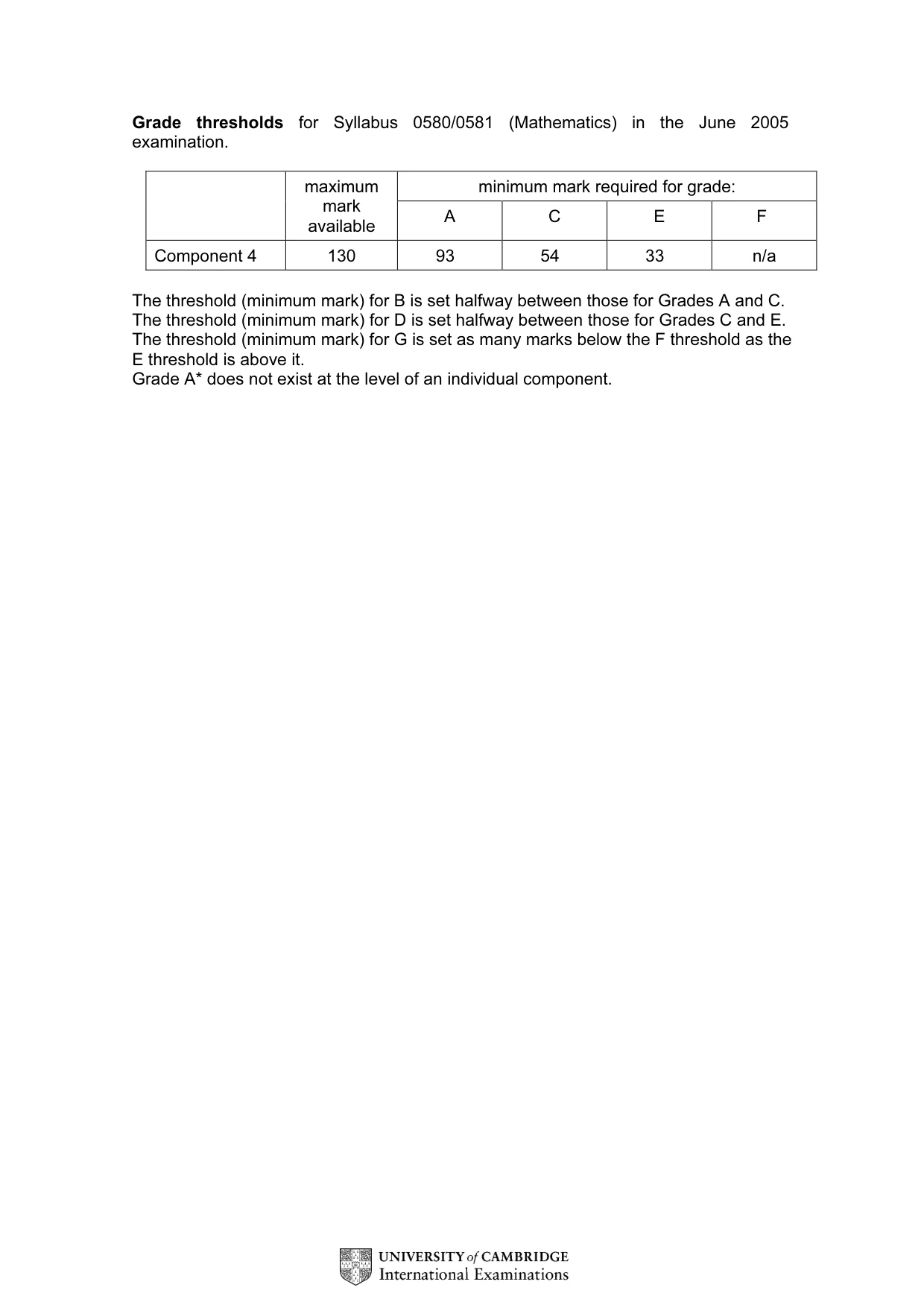
Grade thresholds for Syllabus 0580/0581 (Mathematics) in the June 2005 examination. minimum mark required for grade: maximum mark available A C E F Component 4 130 93 54 33 n/a The threshold (minimum mark) for B is set halfway between those for Grades A and C. The threshold (minimum mark) for D is set halfway between those for Grades C and E. The threshold (minimum mark) for G is set as many marks below the F threshold as the E threshold is above it. Grade A* does not exist at the level of an individual component.
Mark scheme, page 3
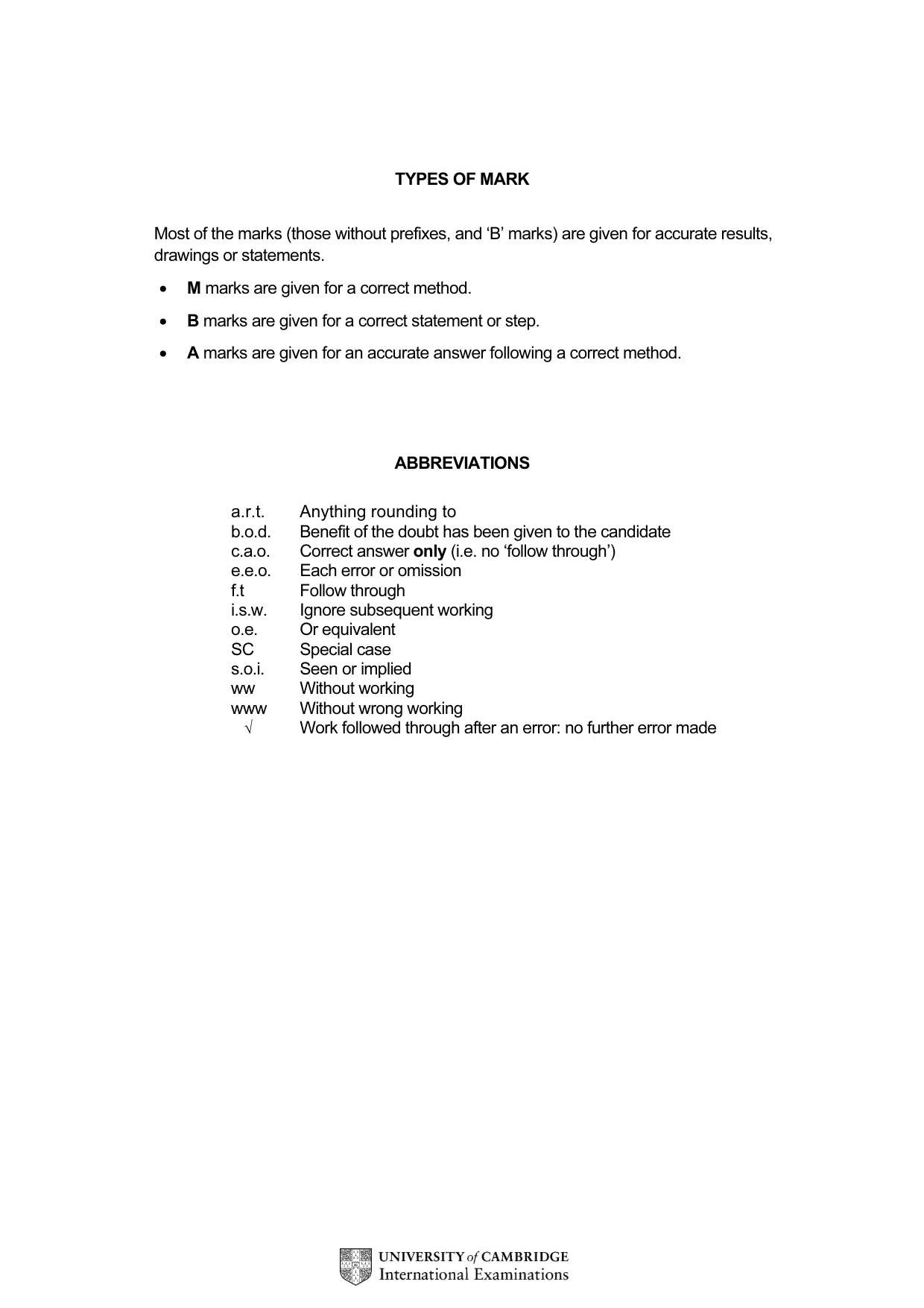
TYPES OF MARK Most of the marks (those without prefixes, and ‘B’ marks) are given for accurate results, drawings or statements. • M marks are given for a correct method. • B marks are given for a correct statement or step. • A marks are given for an accurate answer following a correct method. ABBREVIATIONS a.r.t. Anything rounding to b.o.d. Benefit of the doubt has been given to the candidate c.a.o. Correct answer only (i.e. no ‘follow through’) e.e.o. Each error or omission f.t Follow through i.s.w. Ignore subsequent working o.e. Or equivalent SC Special case s.o.i. Seen or implied ww Without working www Without wrong working √ Work followed through after an error: no further error made
Mark scheme, page 4
June 2005 IGCSE MARK SCHEME MAXIMUM MARK: 130 SYLLABUS/COMPONENT: 0580/04, 0581/04 MATHEMATICS Paper 4 (Extended)
Mark scheme, page 5
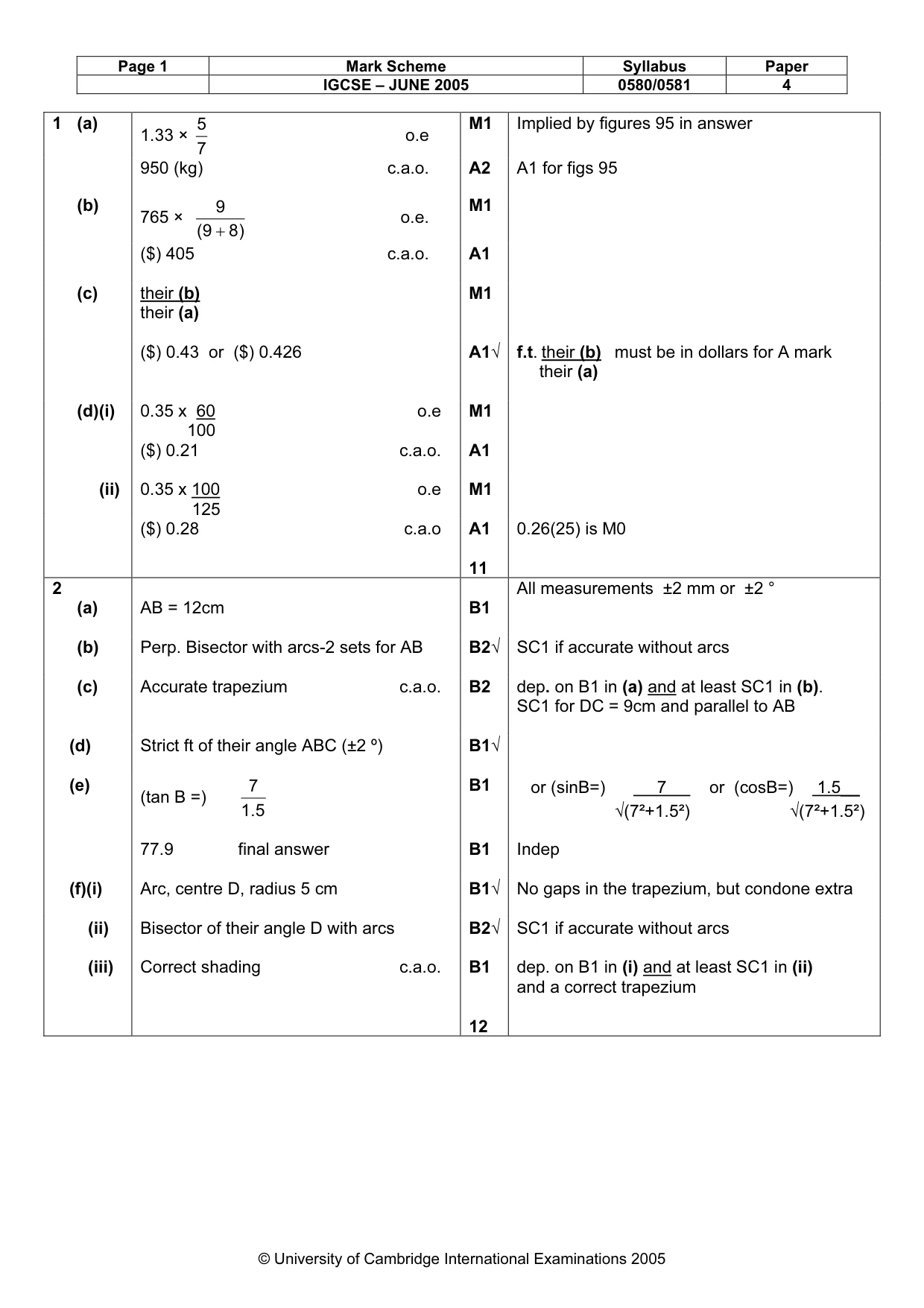
Page 1 Mark Scheme Syllabus Paper IGCSE – JUNE 2005 0580/0581 4 © University of Cambridge International Examinations 2005 1 (a) 1.33 × 7 5 o.e M1 Implied by figures 95 in answer 950 (kg) c.a.o. A2 A1 for figs 95 (b) 765 × ) 8 9 ( 9 + o.e. M1 ($) 405 c.a.o. A1 (c) their (b) their (a) M1 ($) 0.43 or ($) 0.426 A1√ f.t. their (b) must be in dollars for A mark their (a) (d)(i) 0.35 x 60 o.e 100 M1 ($) 0.21 c.a.o. A1 (ii) 0.35 x 100 o.e 125 M1 ($) 0.28 c.a.o A1 11 0.26(25) is M0 2 All measurements ±2 mm or ±2 ° (a) AB = 12cm B1 (b) Perp. Bisector with arcs-2 sets for AB B2√ SC1 if accurate without arcs (c) Accurate trapezium c.a.o. B2 dep. on B1 in (a) and at least SC1 in (b). SC1 for DC = 9cm and parallel to AB (d) Strict ft of their angle ABC (±2 º) B1√ (e) (tan B =) 5 . 1 7 B1 or (sinB=) 7 or (cosB=) 1.5__ √(7²+1.5²) √(7²+1.5²) 77.9 final answer B1 Indep (f)(i) Arc, centre D, radius 5 cm B1√ No gaps in the trapezium, but condone extra (ii) Bisector of their angle D with arcs B2√ SC1 if accurate without arcs (iii) Correct shading c.a.o. B1 12 dep. on B1 in (i) and at least SC1 in (ii) and a correct trapezium
Mark scheme, page 6
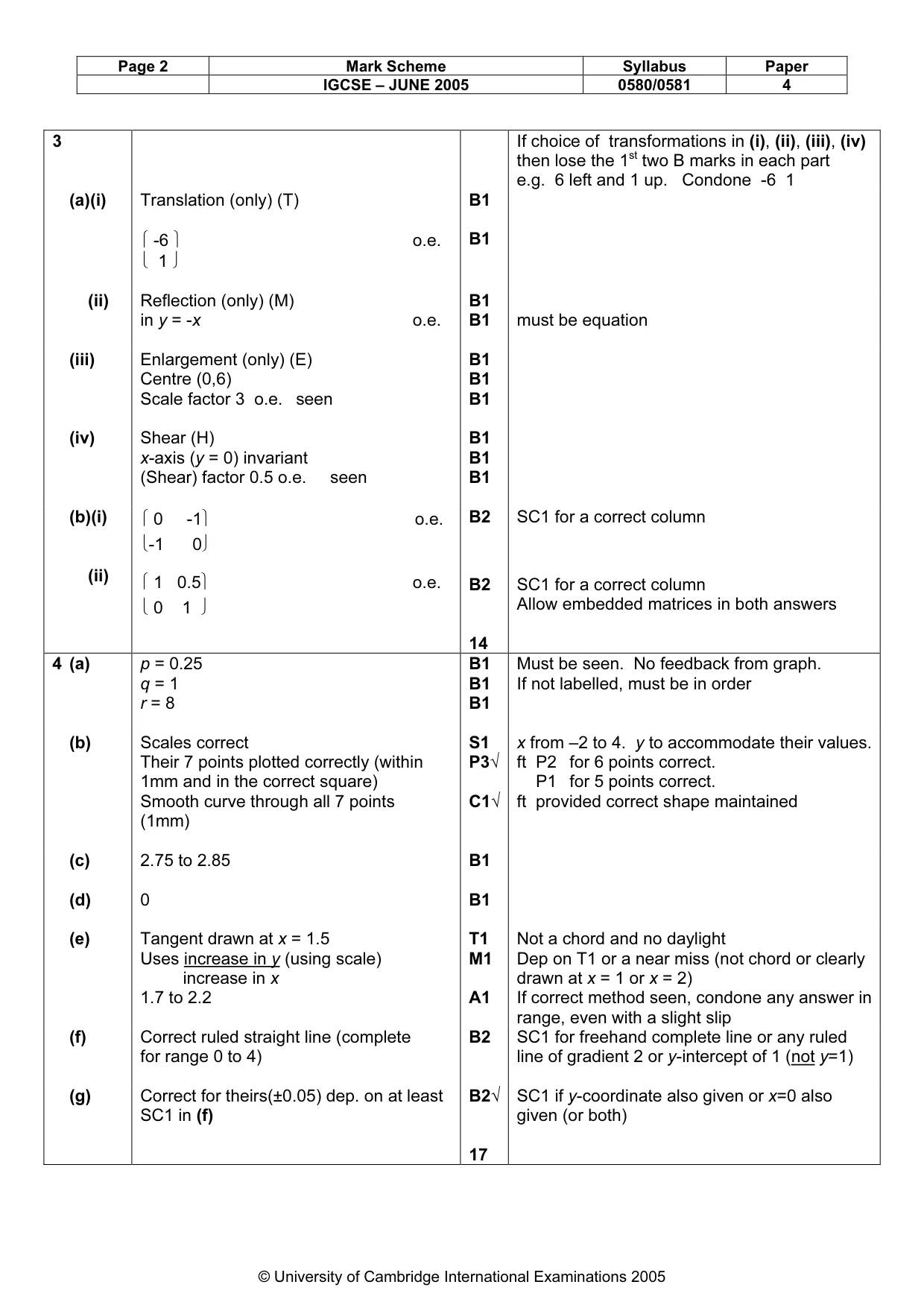
Page 2 Mark Scheme Syllabus Paper IGCSE – JUNE 2005 0580/0581 4 © University of Cambridge International Examinations 2005 3 If choice of transformations in (i), (ii), (iii), (iv) then lose the 1st two B marks in each part e.g. 6 left and 1 up. Condone -6 1 (a)(i) Translation (only) (T) B1 -6 o.e. 1 B1 (ii) Reflection (only) (M) in y = -x o.e. B1 B1 must be equation (iii) Enlargement (only) (E) Centre (0,6) Scale factor 3 o.e. seen B1 B1 B1 (iv) Shear (H) x-axis (y = 0) invariant (Shear) factor 0.5 o.e. seen B1 B1 B1 (b)(i) (ii) 0 -1 o.e. -1 0 1 0.5 o.e. 0 1 B2 B2 14 SC1 for a correct column SC1 for a correct column Allow embedded matrices in both answers 4 (a) p = 0.25 q = 1 r = 8 B1 B1 B1 Must be seen. No feedback from graph. If not labelled, must be in order (b) Scales correct Their 7 points plotted correctly (within 1mm and in the correct square) Smooth curve through all 7 points (1mm) S1 P3√ C1√ x from –2 to 4. y to accommodate their values. ft P2 for 6 points correct. P1 for 5 points correct. ft provided correct shape maintained (c) 2.75 to 2.85 B1 (d) 0 B1 (e) Tangent drawn at x = 1.5 Uses increase in y (using scale) increase in x 1.7 to 2.2 T1 M1 A1 Not a chord and no daylight Dep on T1 or a near miss (not chord or clearly drawn at x = 1 or x = 2) If correct method seen, condone any answer in range, even with a slight slip (f) Correct ruled straight line (complete for range 0 to 4) B2 SC1 for freehand complete line or any ruled line of gradient 2 or y-intercept of 1 (not y=1) (g) Correct for theirs(±0.05) dep. on at least SC1 in (f) B2√ 17 SC1 if y-coordinate also given or x=0 also given (or both)
Mark scheme, page 7
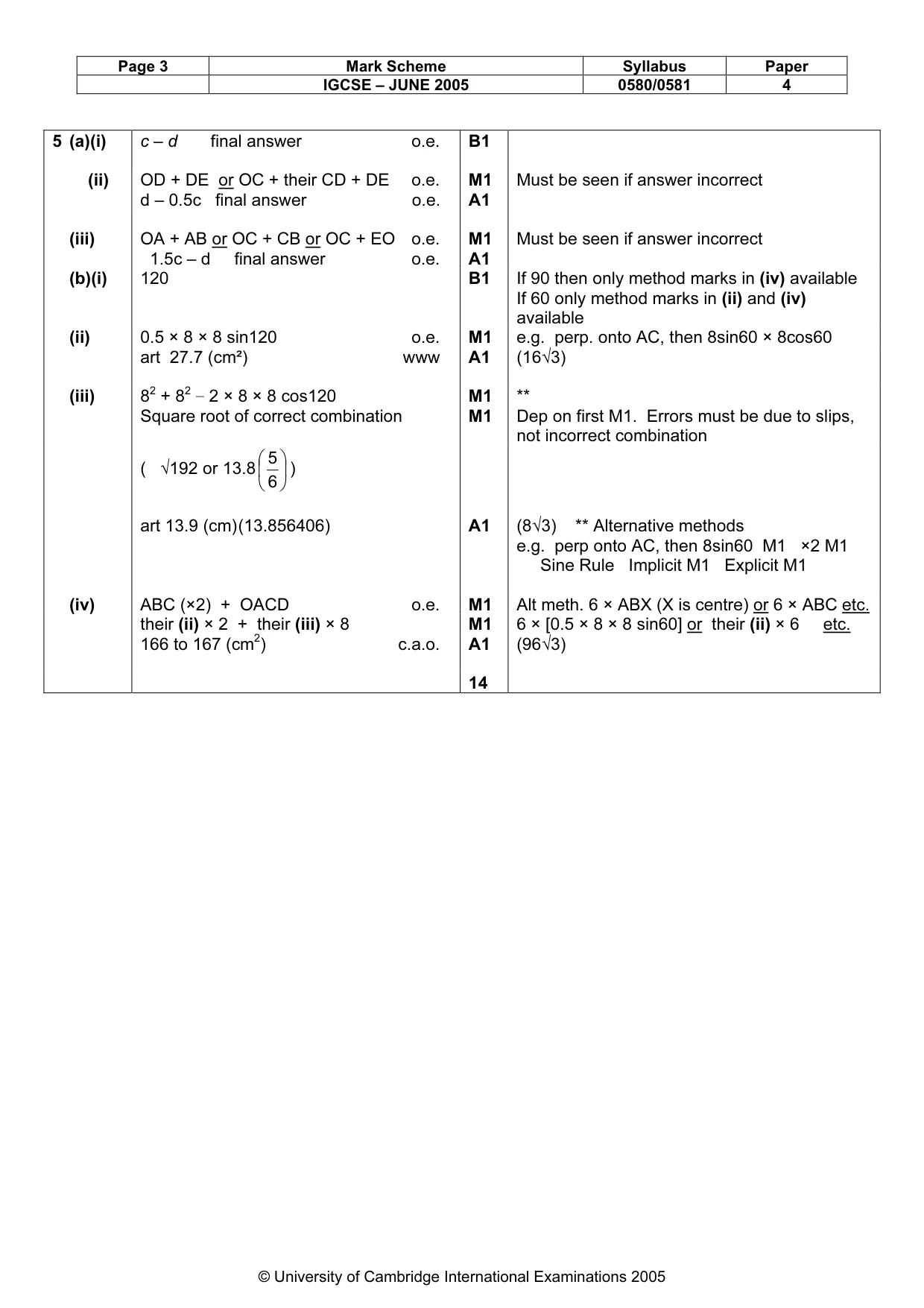
Page 3 Mark Scheme Syllabus Paper IGCSE – JUNE 2005 0580/0581 4 © University of Cambridge International Examinations 2005 5 (a)(i) c – d final answer o.e. B1 (ii) OD + DE or OC + their CD + DE o.e. d – 0.5c final answer o.e. M1 A1 Must be seen if answer incorrect (iii) OA + AB or OC + CB or OC + EO o.e. 1.5c – d final answer o.e. M1 A1 Must be seen if answer incorrect (b)(i) 120 B1 If 90 then only method marks in (iv) available If 60 only method marks in (ii) and (iv) available (ii) 0.5 × 8 × 8 sin120 o.e. M1 e.g. perp. onto AC, then 8sin60 × 8cos60 art 27.7 (cm²) www A1 (16√3) (iii) 82 + 82 − 2 × 8 × 8 cos120 Square root of correct combination M1 M1 ** Dep on first M1. Errors must be due to slips, not incorrect combination ( √192 or 13.8 6 5 ) art 13.9 (cm) (13.856406) A1 (8√3) ** Alternative methods e.g. perp onto AC, then 8sin60 M1 ×2 M1 Sine Rule Implicit M1 Explicit M1 (iv) ABC (×2) + OACD o.e. M1 Alt meth. 6 × ABX (X is centre) or 6 × ABC etc. their (ii) × 2 + their (iii) × 8 M1 6 × [0.5 × 8 × 8 sin60] or their (ii) × 6 etc. 166 to 167 (cm2) c.a.o. A1 (96√3) 14
Mark scheme, page 8
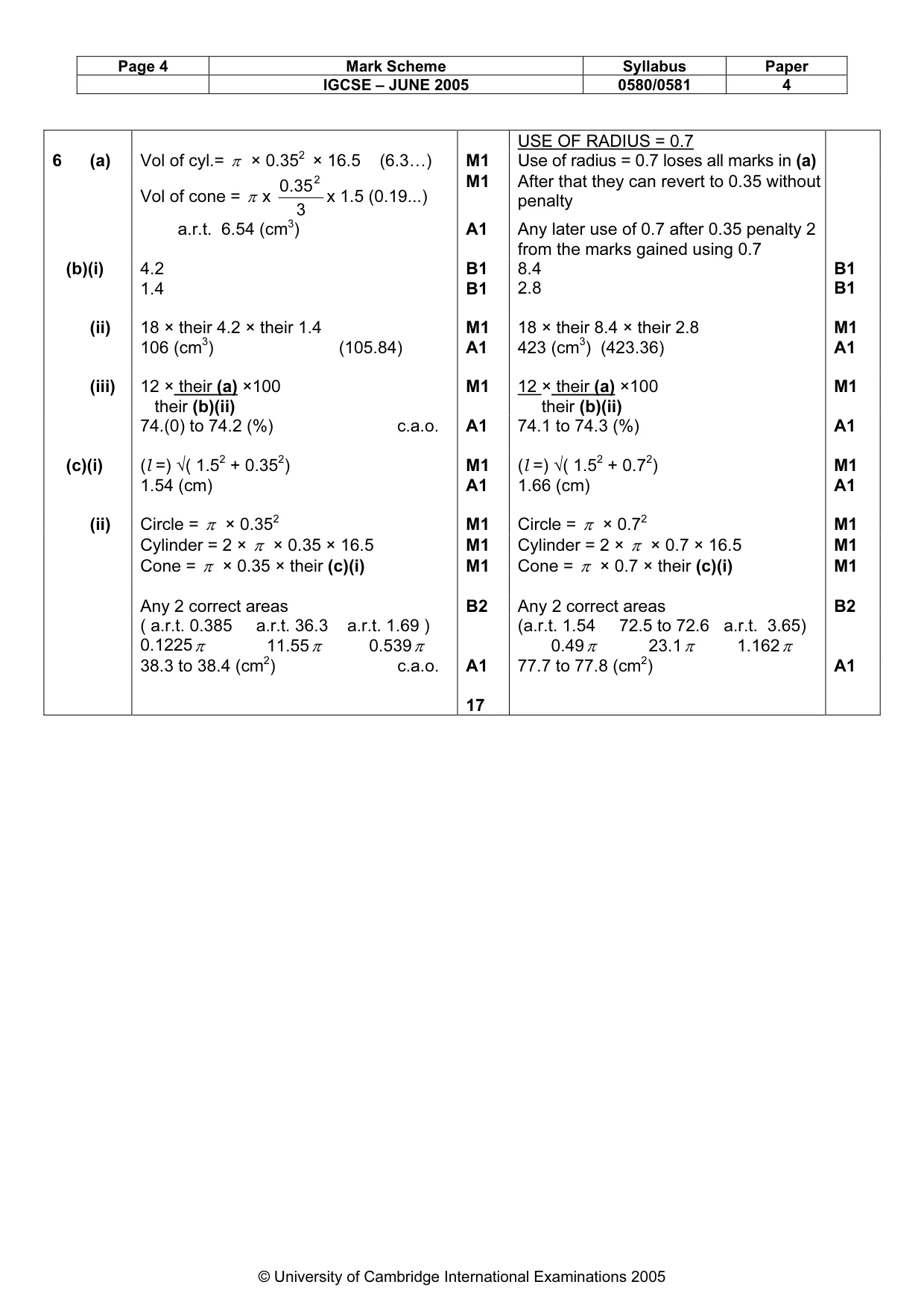
Page 4 Mark Scheme Syllabus Paper IGCSE – JUNE 2005 0580/0581 4 © University of Cambridge International Examinations 2005 USE OF RADIUS = 0.7 6 (a) Vol of cyl.= π × 0.352 × 16.5 (6.3…) M1 Use of radius = 0.7 loses all marks in (a) Vol of cone = π x 3 35 . 0 2 x 1.5 (0.19...) M1 After that they can revert to 0.35 without penalty a.r.t. 6.54 (cm3) A1 Any later use of 0.7 after 0.35 penalty 2 from the marks gained using 0.7 (b)(i) 4.2 1.4 B1 B1 8.4 2.8 B1 B1 (ii) 18 × their 4.2 × their 1.4 M1 18 × their 8.4 × their 2.8 M1 106 (cm3) (105.84) A1 423 (cm3) (423.36) A1 (iii) 12 × their (a) ×100 their (b)(ii) M1 12 × their (a) ×100 their (b)(ii) M1 74.(0) to 74.2 (%) c.a.o. A1 74.1 to 74.3 (%) A1 (c)(i) (l =) √( 1.52 + 0.352) M1 (l =) √( 1.52 + 0.72) M1 1.54 (cm) A1 1.66 (cm) A1 (ii) Circle = π × 0.352 M1 Circle = π × 0.72 M1 Cylinder = 2 × π × 0.35 × 16.5 M1 Cylinder = 2 × π × 0.7 × 16.5 M1 Cone = π × 0.35 × their (c)(i) M1 Cone = π × 0.7 × their (c)(i) M1 Any 2 correct areas B2 Any 2 correct areas B2 ( a.r.t. 0.385 a.r.t. 36.3 a.r.t. 1.69 ) (a.r.t. 1.54 72.5 to 72.6 a.r.t. 3.65) 0.1225π 11.55π 0.539π 0.49π 23.1π 1.162π 38.3 to 38.4 (cm2) c.a.o. A1 77.7 to 77.8 (cm2) A1 17
Mark scheme, page 9
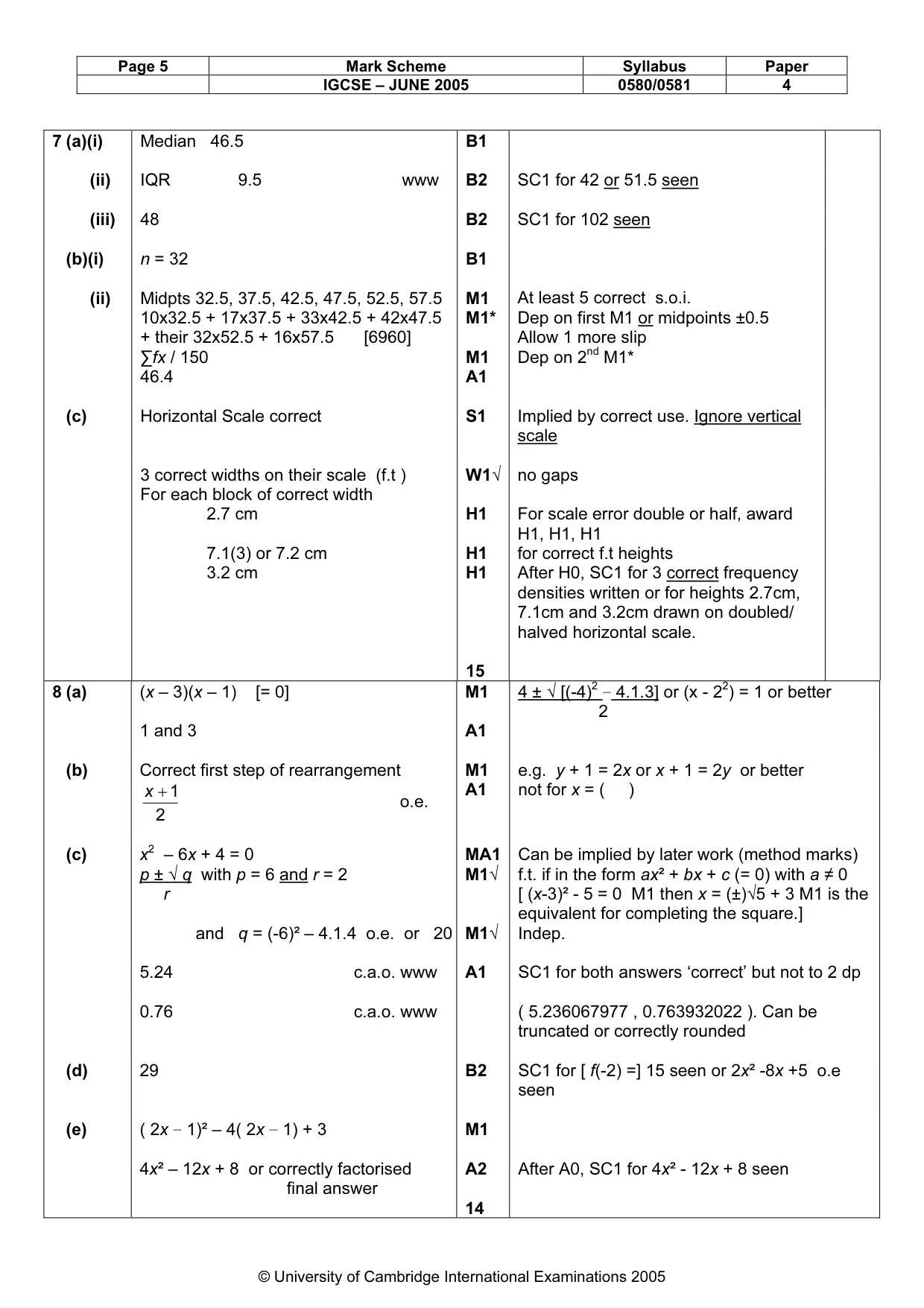
Page 5 Mark Scheme Syllabus Paper IGCSE – JUNE 2005 0580/0581 4 © University of Cambridge International Examinations 2005 7 (a)(i) Median 46.5 B1 (ii) IQR 9.5 www B2 SC1 for 42 or 51.5 seen (iii) 48 B2 SC1 for 102 seen (b)(i) n = 32 B1 (ii) Midpts 32.5, 37.5, 42.5, 47.5, 52.5, 57.5 10x32.5 + 17x37.5 + 33x42.5 + 42x47.5 + their 32x52.5 + 16x57.5 [6960] ∑fx / 150 46.4 M1 M1* M1 A1 At least 5 correct s.o.i. Dep on first M1 or midpoints ±0.5 Allow 1 more slip Dep on 2nd M1* (c) Horizontal Scale correct S1 Implied by correct use. Ignore vertical scale 3 correct widths on their scale (f.t ) W1√ no gaps For each block of correct width 2.7 cm 7.1(3) or 7.2 cm 3.2 cm H1 H1 H1 15 For scale error double or half, award H1, H1, H1 for correct f.t heights After H0, SC1 for 3 correct frequency densities written or for heights 2.7cm, 7.1cm and 3.2cm drawn on doubled/ halved horizontal scale. 8 (a) (x – 3)(x – 1) [= 0] M1 4 ± √ [(-4)2 − 4.1.3] or (x - 22) = 1 or better 2 1 and 3 A1 (b) Correct first step of rearrangement M1 e.g. y + 1 = 2x or x + 1 = 2y or better 2 1 + x o.e. A1 not for x = ( ) (c) x2 – 6x + 4 = 0 MA1 Can be implied by later work (method marks) p ± √ q with p = 6 and r = 2 r M1√ f.t. if in the form ax² + bx + c (= 0) with a ≠ 0 [ (x-3)² - 5 = 0 M1 then x = (±)√5 + 3 M1 is the equivalent for completing the square.] and q = (-6)² – 4.1.4 o.e. or 20 M1√ Indep. 5.24 c.a.o. www A1 SC1 for both answers ‘correct’ but not to 2 dp 0.76 c.a.o. www ( 5.236067977 , 0.763932022 ). Can be truncated or correctly rounded (d) 29 B2 SC1 for [ f(-2) =] 15 seen or 2x² -8x +5 o.e seen (e) ( 2x − 1)² – 4( 2x − 1) + 3 M1 4x² – 12x + 8 or correctly factorised final answer A2 14 After A0, SC1 for 4x² - 12x + 8 seen
Mark scheme, page 10
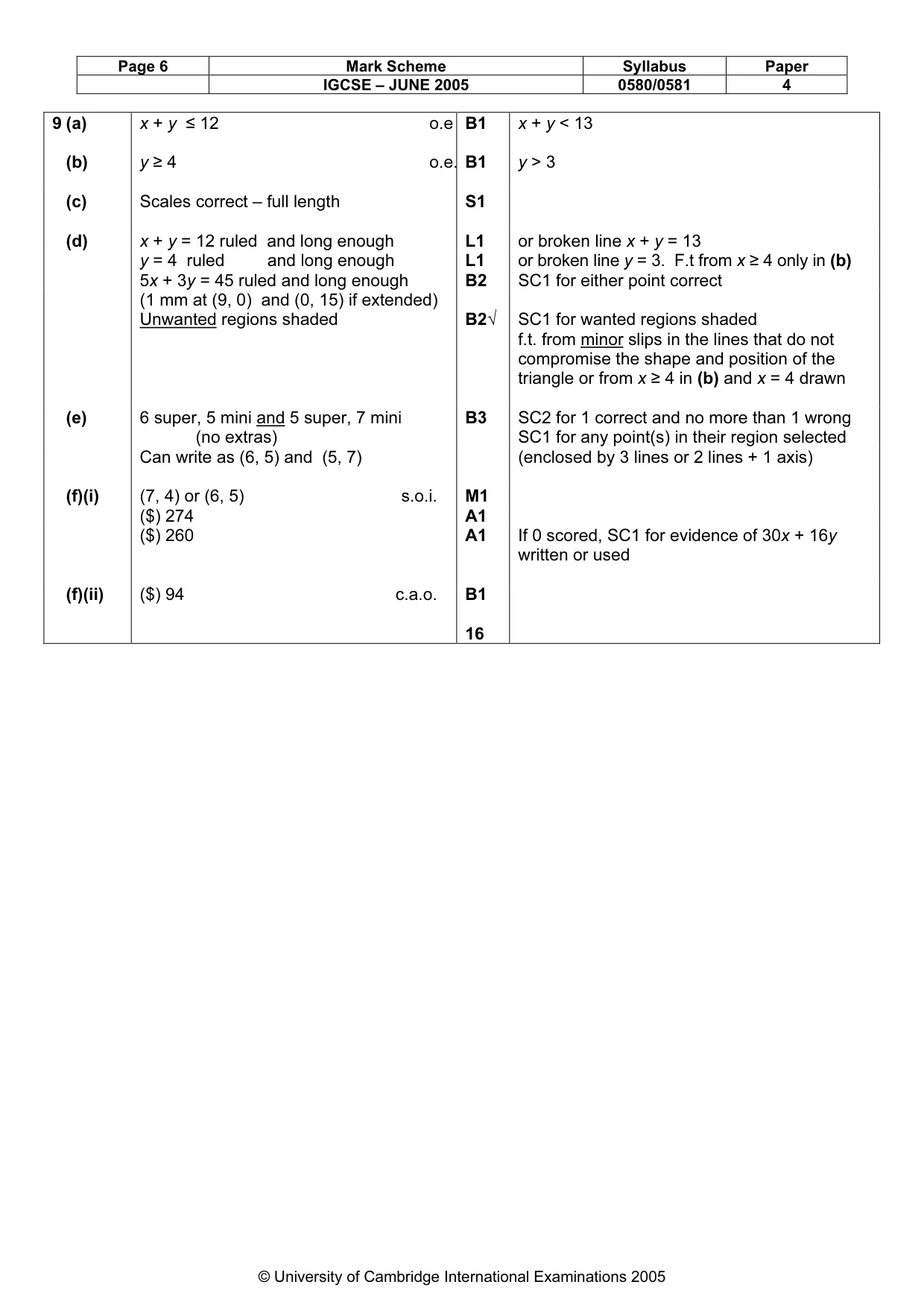
Page 6 Mark Scheme Syllabus Paper IGCSE – JUNE 2005 0580/0581 4 © University of Cambridge International Examinations 2005 9 (a) x + y ≤ 12 o.e B1 x + y < 13 (b) y ≥ 4 o.e. B1 y > 3 (c) Scales correct – full length S1 (d) x + y = 12 ruled and long enough L1 or broken line x + y = 13 y = 4 ruled and long enough L1 or broken line y = 3. F.t from x ≥ 4 only in (b) 5x + 3y = 45 ruled and long enough B2 SC1 for either point correct (1 mm at (9, 0) and (0, 15) if extended) Unwanted regions shaded B2√ SC1 for wanted regions shaded f.t. from minor slips in the lines that do not compromise the shape and position of the triangle or from x ≥ 4 in (b) and x = 4 drawn (e) 6 super, 5 mini and 5 super, 7 mini (no extras) B3 SC2 for 1 correct and no more than 1 wrong SC1 for any point(s) in their region selected Can write as (6, 5) and (5, 7) (enclosed by 3 lines or 2 lines + 1 axis) (f)(i) (7, 4) or (6, 5) s.o.i. M1 ($) 274 A1 ($) 260 A1 If 0 scored, SC1 for evidence of 30x + 16y written or used (f)(ii) ($) 94 c.a.o. B1 16