Cambridge IGCSE Mathematics - International 0607 — 2020 Oct/Nov Paper 2 · Variant 2
0607/22/O/N/20 · 14 questions · 40 marks · ≈45 min
The question paper and its mark scheme, free to read here and free to download. This is Cambridge’s own paper, exactly as it was sat.
Question paper8 pages
Mark scheme5 pages
Answers below. Sit the paper first if you are practising.
Questions as text
Q1 · A quadrilateral has rotational symmetry of order two, two lines of symmetry and its…
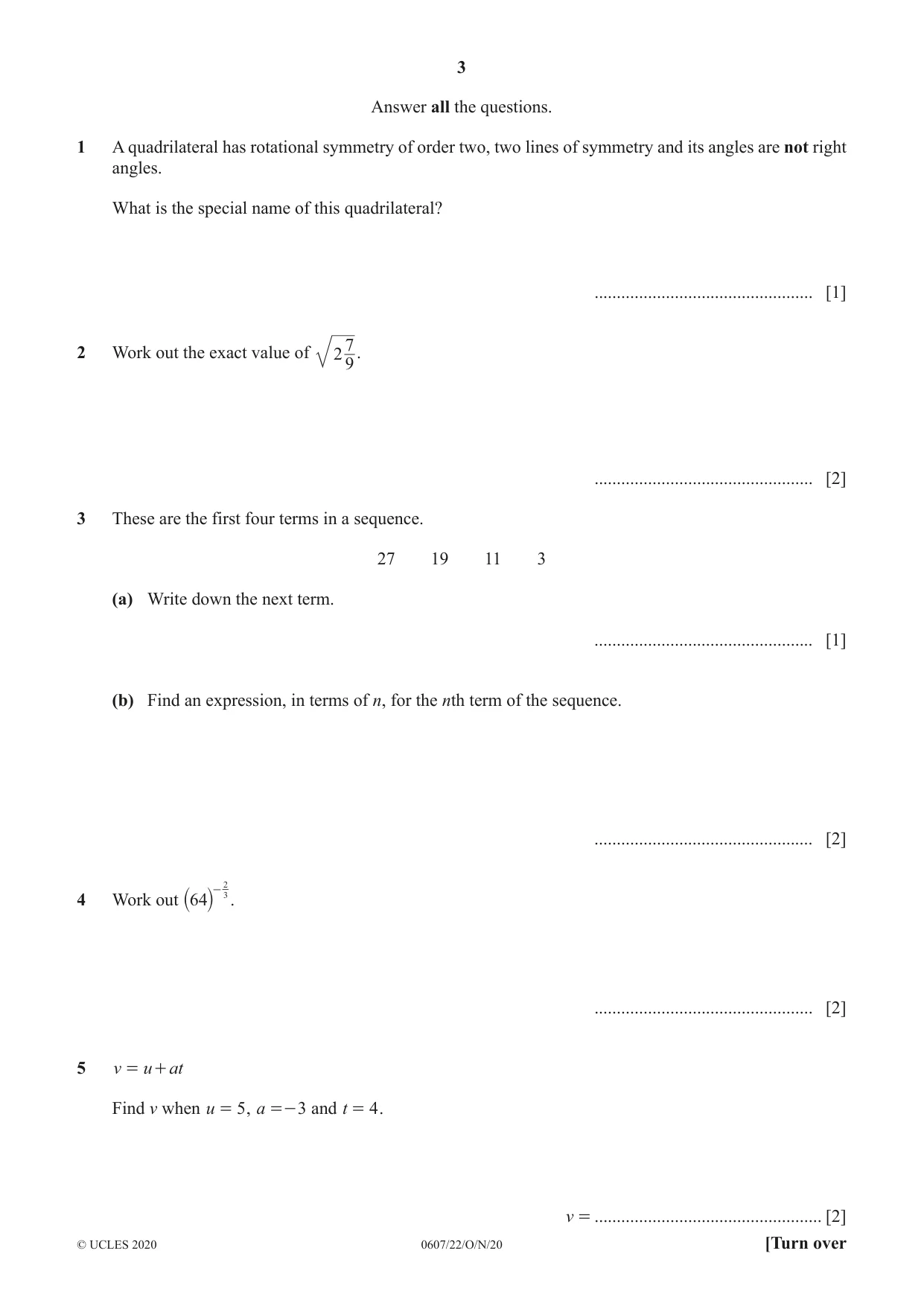
1 A quadrilateral has rotational symmetry of order two, two lines of symmetry and its angles are not right angles. What is the special name of this quadrilateral? ................................................. [1]
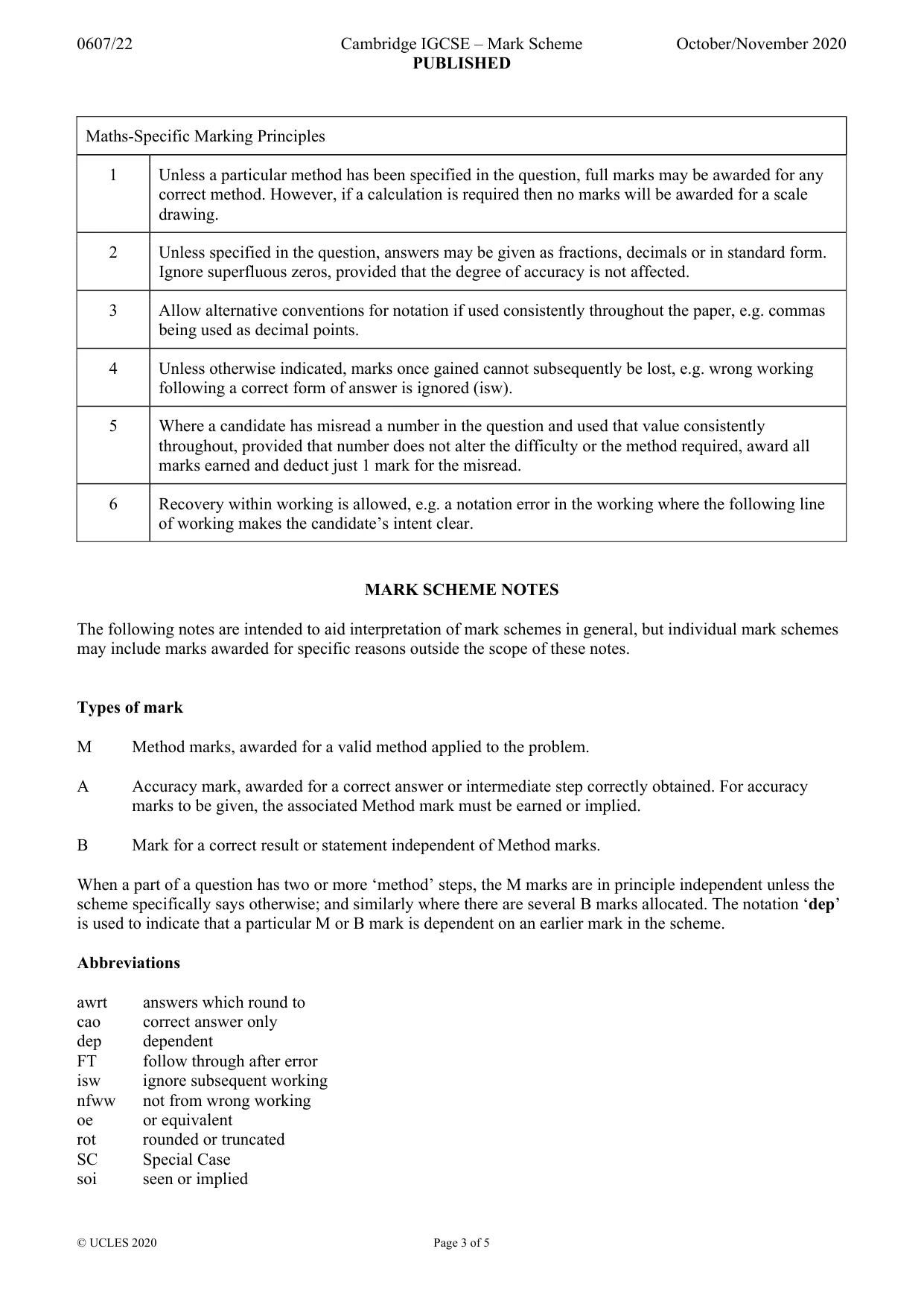
Mark scheme: Question Answer Marks Partial Marks 1 Rhombus [only] 1
Q2 · Work out the exact value of 2
2 Work out the exact value of 2 . 9 ................................................. [2]
Mark scheme: 2 5 2 . 2 25 [ ± ] or 1 or 1. 6 B1 for 3 3 9
Q3 · These are the first four terms in a sequence
3 These are the first four terms in a sequence. 27 19 11 3 (a) Write down the next term. ................................................. [1] (b) Find an expression, in terms of n, for the nth term of the sequence. ................................................. [2] 2
Mark scheme: 3(a) –5 1 3(b) 35 – 8n oe 2 B1 for k – 8n or 35 – kn
Q4 · 4 Work out 64 - ................................................
3 .4 Work out 64 - ................................................. [2]
Mark scheme: 4 1 2 B1 for 4 seen or reciprocal seen at any stage. 16
Q5 · V = u + at Find v when u = 5 , a =- 3 and t = 4
5 v = u + at Find v when u = 5 , a =- 3 and t = 4 . v = ................................................... [2]
Mark scheme: 5 –7 2 M1 for substitution of u = 5, a = –3 and t = 4 into v = u + at
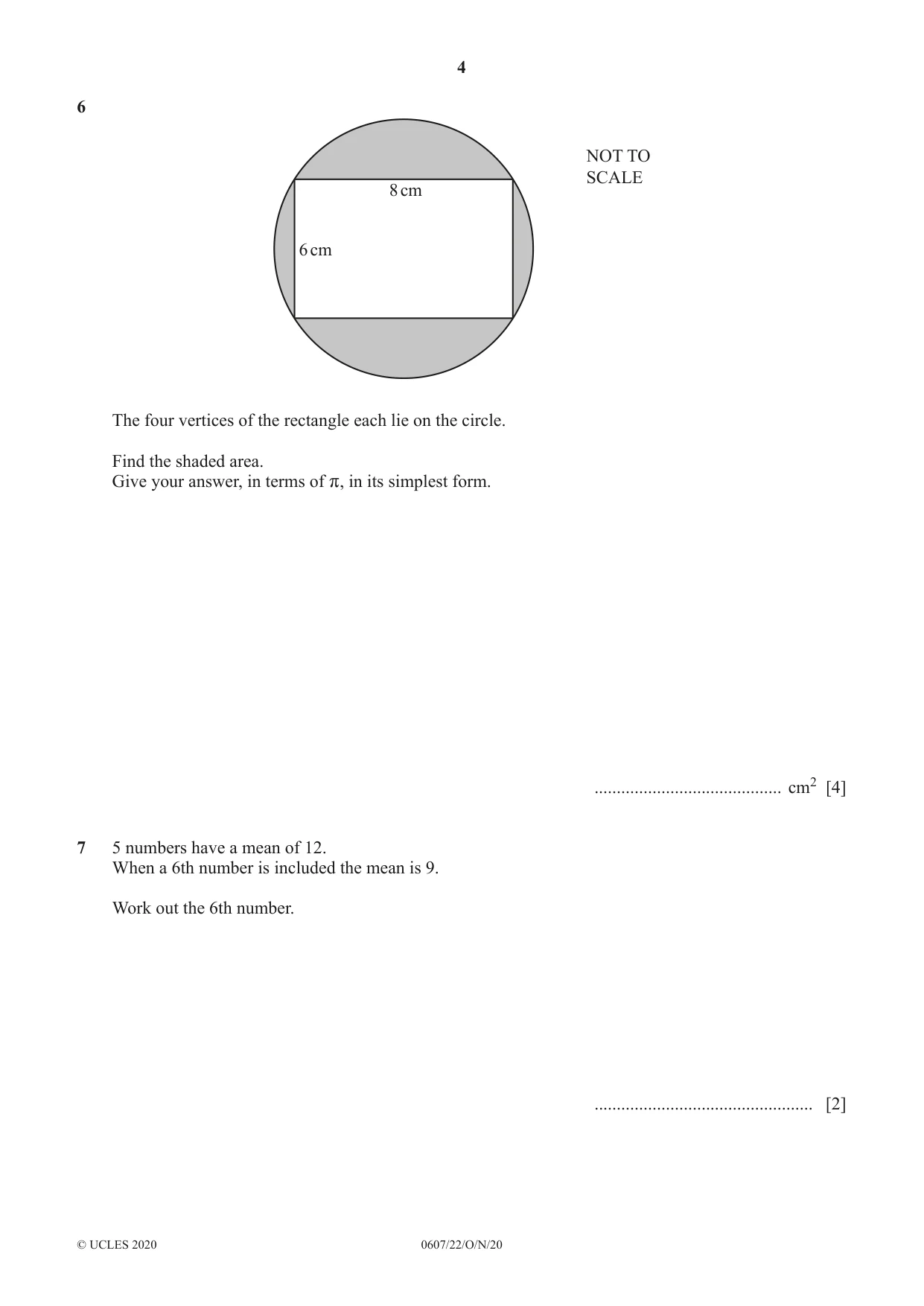
Q6 · NOT TO SCALE 8 cm 6 cm The four vertices of the rectangle each lie on the circle
6 NOT TO SCALE 8 cm 6 cm The four vertices of the rectangle each lie on the circle. Find the shaded area. Give your answer, in terms of r, in its simplest form. .......................................... cm2 [4]
Mark scheme: 6 25π – 48 final answer 4 B2 for [r] = 5 or M1 for 82 + 62 M1 for π × (their 5)2 – 8 × 6
Q7 · 5 numbers have a mean of 12
7 5 numbers have a mean of 12. When a 6th number is included the mean is 9. Work out the 6th number. ................................................. [2]
Mark scheme: 7 –6 2 M1 for 5 × 12 or 6 × 9
Q8 · Written as the product of its prime factors, 540 = 2 2 # 3 3 # 5
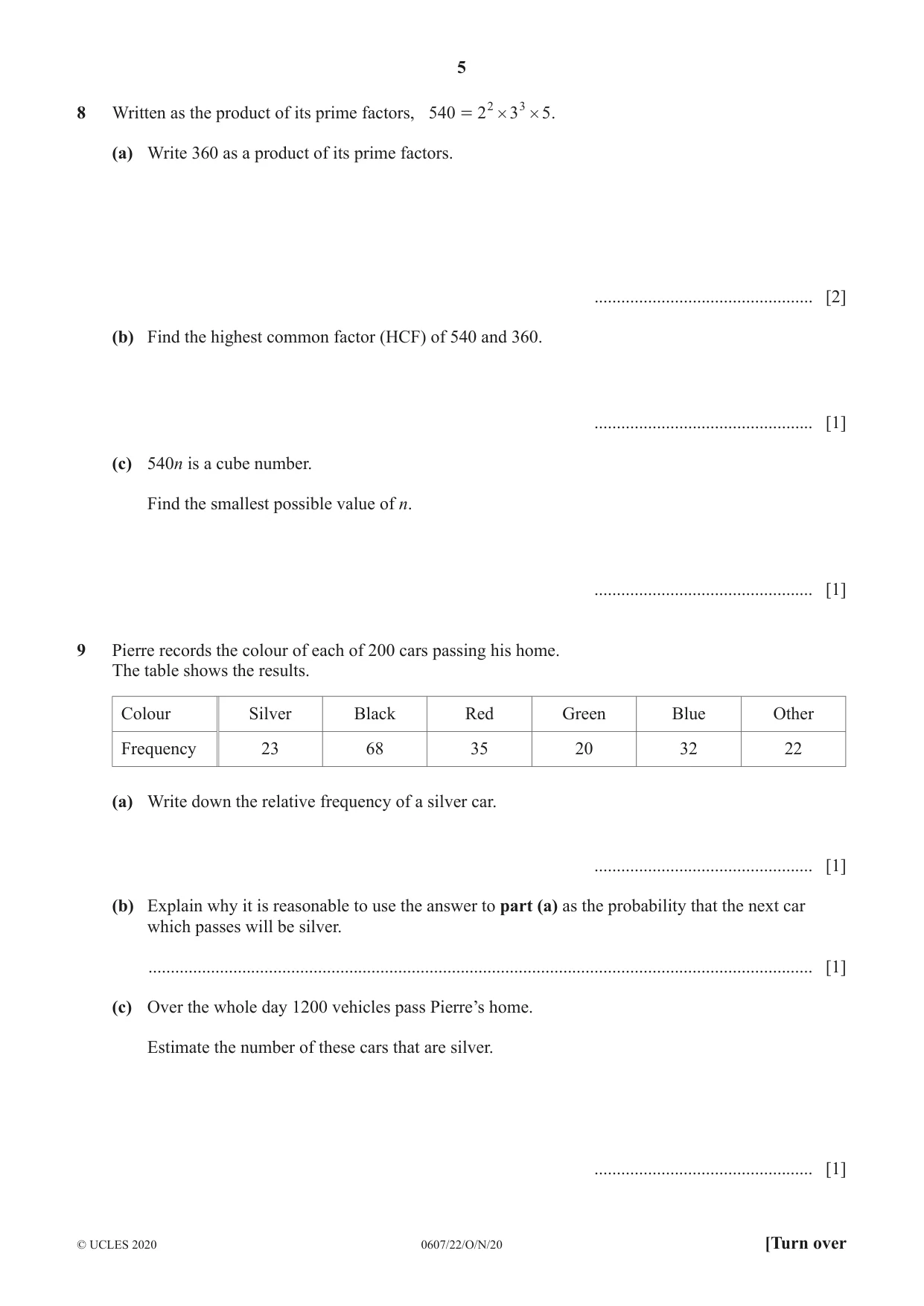
8 Written as the product of its prime factors, 540 = 2 2 # 3 3 # 5 . (a) Write 360 as a product of its prime factors. ................................................. [2] (b) Find the highest common factor (HCF) of 540 and 360. ................................................. [1] (c) 540n is a cube number. Find the smallest possible value of n. ................................................. [1]
Mark scheme: 8(a) 23 × 32 × 5 must be in index form 2 M1 for three steps in a ‘factor tree’ or ‘factor ladder’ or B1 for 2p × 3q × 5 8(b) 180 or 22 × 32 × 5 1 8(c) 50 or 2 × 52 1
Q9 · Pierre records the colour of each of 200 cars passing his home
9 Pierre records the colour of each of 200 cars passing his home. The table shows the results. Colour Silver Black Red Green Blue Other Frequency 23 68 35 20 32 22 (a) Write down the relative frequency of a silver car. ................................................. [1] (b) Explain why it is reasonable to use the answer to part (a) as the probability that the next car which passes will be silver. ..................................................................................................................................................... [1] (c) Over the whole day 1200 vehicles pass Pierre’s home. Estimate the number of these cars that are silver. ................................................. [1]
Mark scheme: 9(a) 23 1 or 0.115 200 9(b) Large sample oe 1 9(c) 138 1
Q10 · Factorise (a) x 2 - x - 6 , ................................................
10 Factorise (a) x 2 - x - 6 , ................................................. [2] (b) 3ax + 2bx - 4by - 6ay . ................................................. [2]
Mark scheme: 10(a) (x – 3)(x + 2) 2 B1 for (x + a)(x + b) where ab = –6 or a + b = –1 or B1 for x(x + 2) – 3(x + 2) or x(x – 3) + 2(x – 3) 10(b) (x – 2y)(3a + 2b) 2 B1 for x(3a + 2b) – 2y(3a + 2b) oe or 3a(x – 2y) + 2b(x – 2y) oe
Q11 · In each Venn diagram, shade the given set
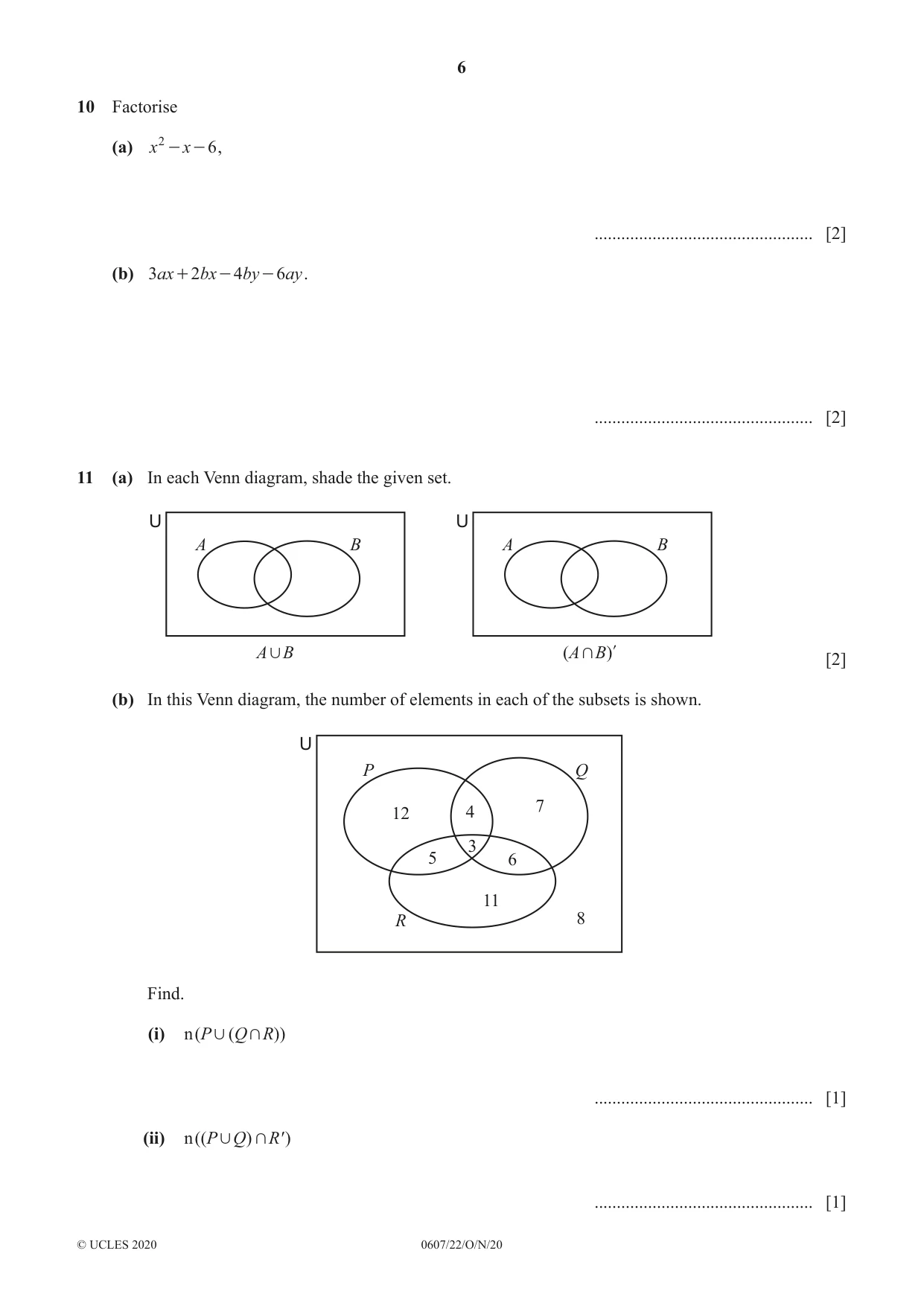
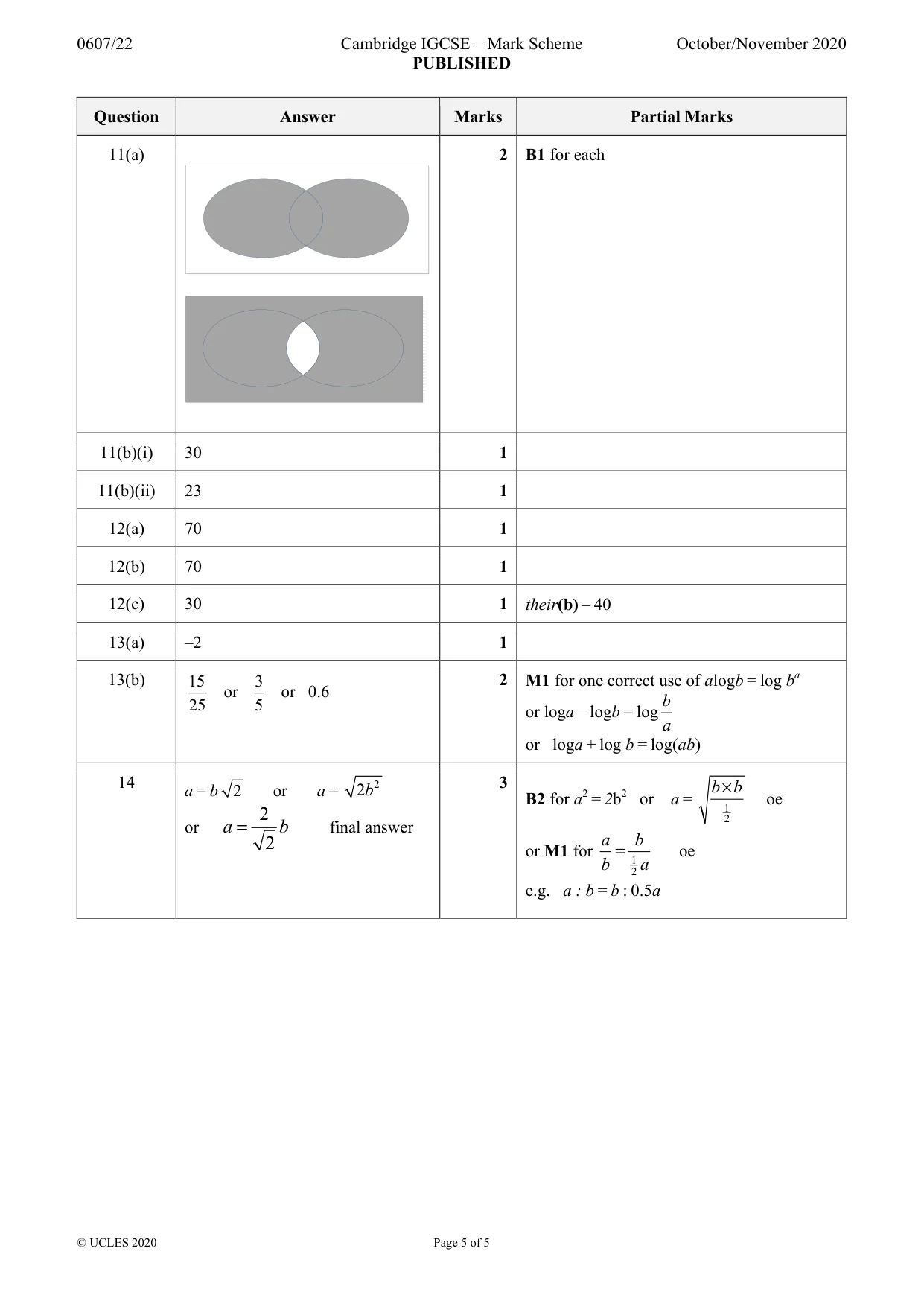
11 (a) In each Venn diagram, shade the given set. U U A B A B A , B ( A + B ) l [2] (b) In this Venn diagram, the number of elements in each of the subsets is shown. U P Q 7 12 4 3 5 6 11 R 8 Find. (i) n ( P , ( Q + R )) ................................................. [1] (ii) n (( P , Q ) + R )' ................................................. [1]
Mark scheme: 11(a) 2 B1 for each 11(b)(i) 30 1 11(b)(ii) 23 1
Q12 · A NOT TO SCALE 30° D 110° B P C Q The points A, B, C and D lie on a circle
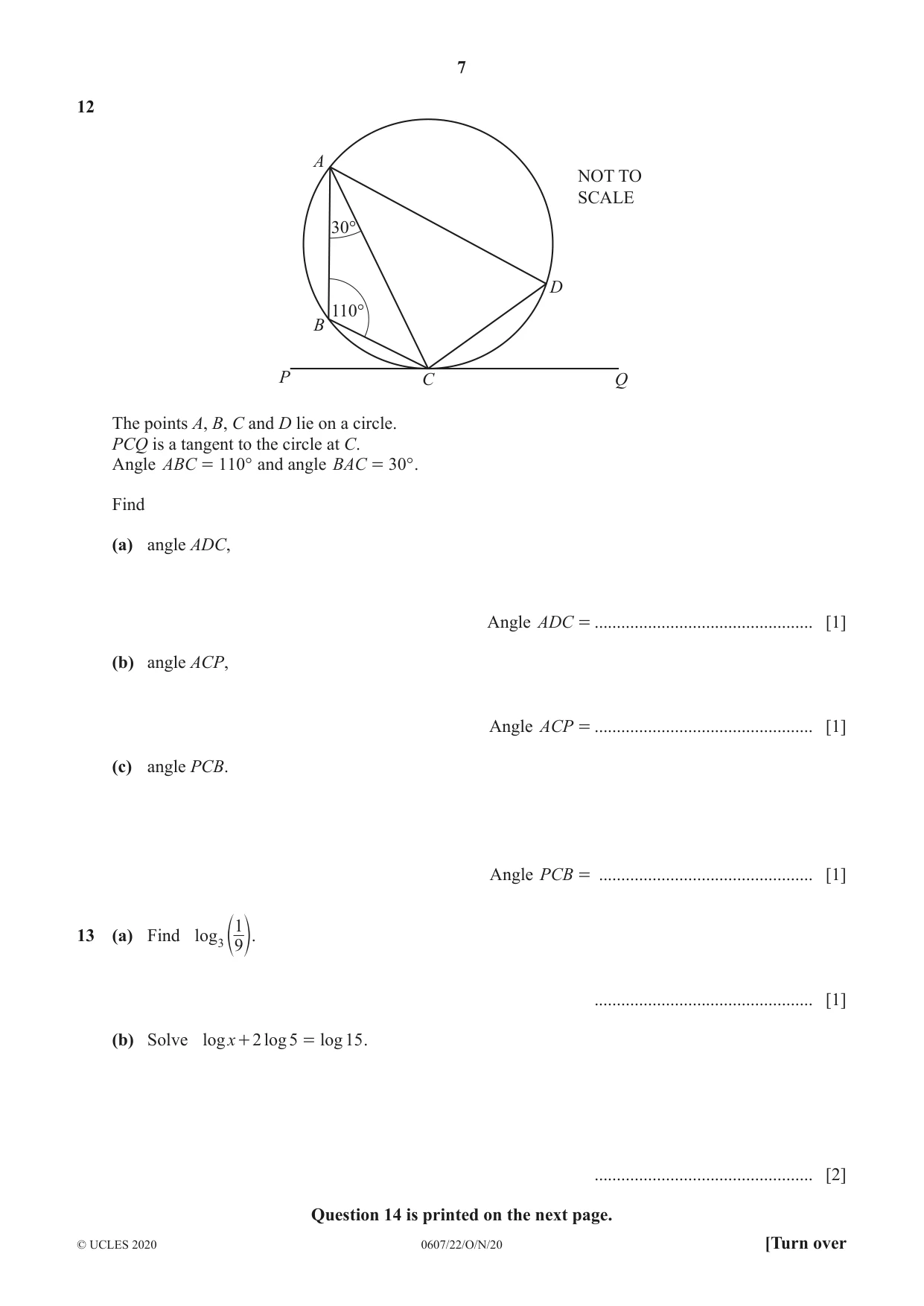
12 A NOT TO SCALE 30° D 110° B P C Q The points A, B, C and D lie on a circle. PCQ is a tangent to the circle at C. Angle ABC = 110° and angle BAC = 30° . Find (a) angle ADC, Angle ADC = ................................................. [1] (b) angle ACP, Angle ACP = ................................................. [1] (c) angle PCB. Angle PCB = ................................................ [1]
Mark scheme: 12(a) 70 1 12(b) 70 1 12(c) 30 1 their(b) – 40
Question 13
13 (a) Find log 3 . 9 ................................................. [1] (b) Solve log x + 2 log 5 = log 15 . ................................................. [2] Question 14 is printed on the next page.
Mark scheme: 13(a) –2 1 13(b) 15 3 2 M1 for one correct use of alogb = log ba or or 0.6 25 5 b or loga – logb = log a or loga + log b = log(ab)
Q14 · A rectangular piece of paper has sides of length a cm and b cm
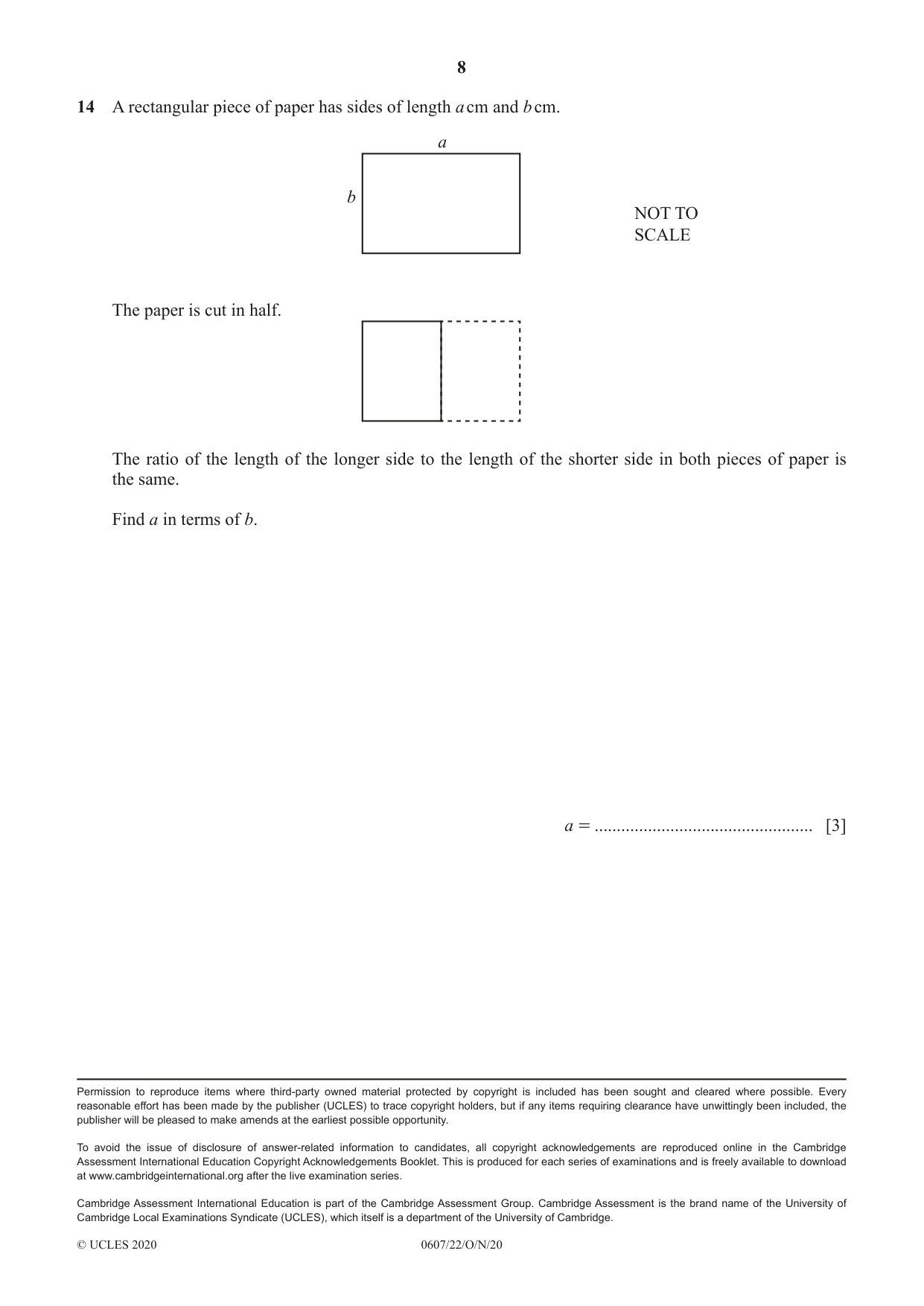
14 A rectangular piece of paper has sides of length a cm and b cm. a b NOT TO SCALE The paper is cut in half. The ratio of the length of the longer side to the length of the shorter side in both pieces of paper is the same. Find a in terms of b. a = ................................................. [3]
Mark scheme: 14 3 b × b a = b 2 or a = 2b 2 B2 for a2 = 2b2 or a = oe 2 12 or a = b final answer 2 a b or M1 for = oe b 12 a e.g. a : b = b : 0.5a
What was in this paper
The subtopics covered by these 14 questions, and how many questions each got. Open one in a new tab to see every Cambridge question on it.
What you needed in this session
Cambridge’s own grade thresholds for 2020 Oct/Nov, Paper 2 · Variant 2. A higher threshold means an easier paper — the bar moves with how the cohort did.