Cambridge IGCSE Mathematics - International 0607 — 2024 Feb/March Paper 2 · Variant 2
0607/22/F/M/24 · 15 questions · 40 marks · ≈45 min
The question paper and its mark scheme, free to read here and free to download. This is Cambridge’s own paper, exactly as it was sat.
Question paper8 pages
Mark scheme5 pages
Answers below. Sit the paper first if you are practising.
Questions as text
Q1 · Write down a fraction between and 8 4
1 Write down a fraction between and 8 4. ................................................. [1]
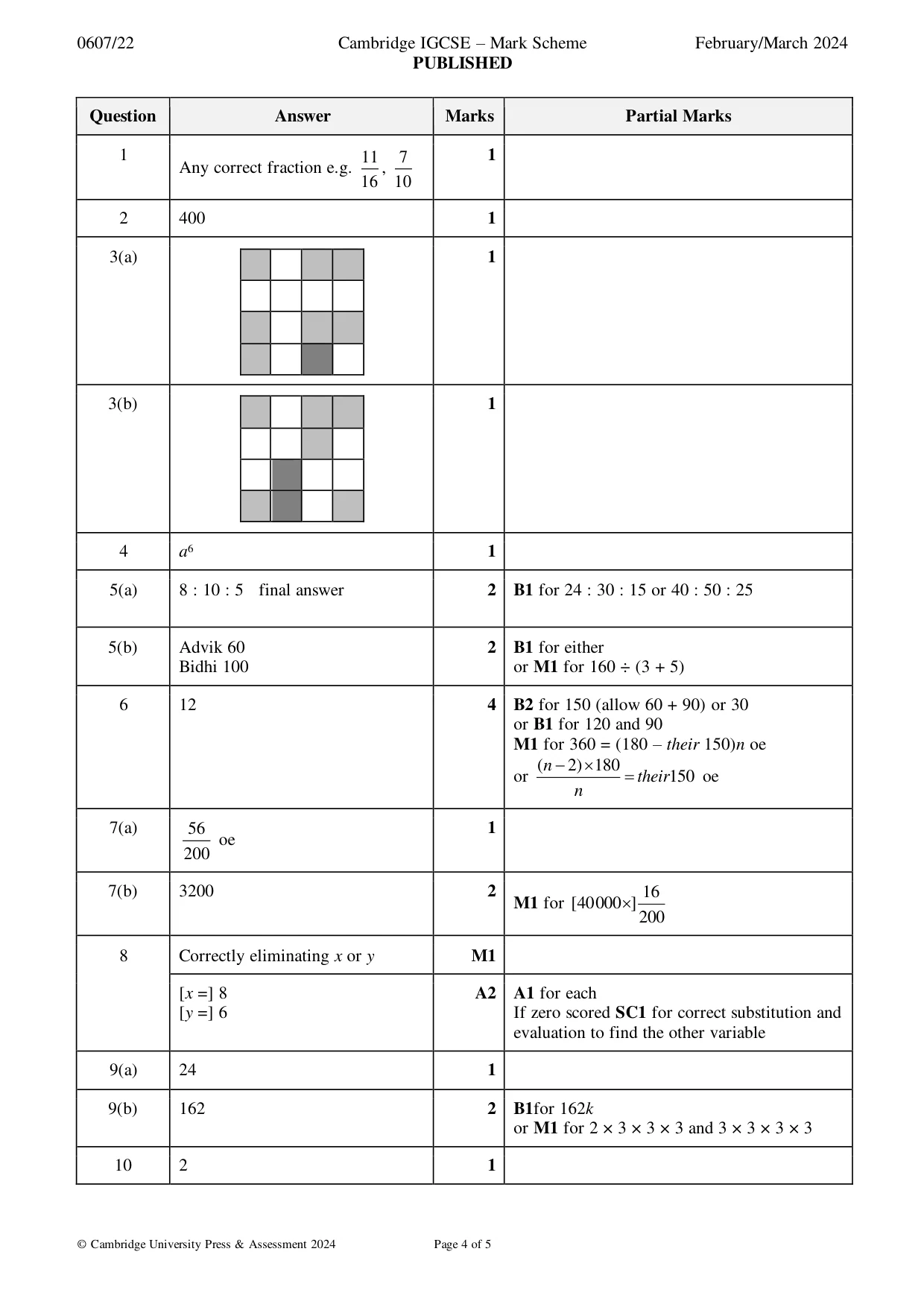
Mark scheme: Question Answer Marks Partial Marks 1 11 7 1 Any correct fraction e.g. , 16 10
Q2 · Work out 8 ' 0.02
2 Work out 8 ' 0.02 . ................................................. [1]
Mark scheme: 2 400 1
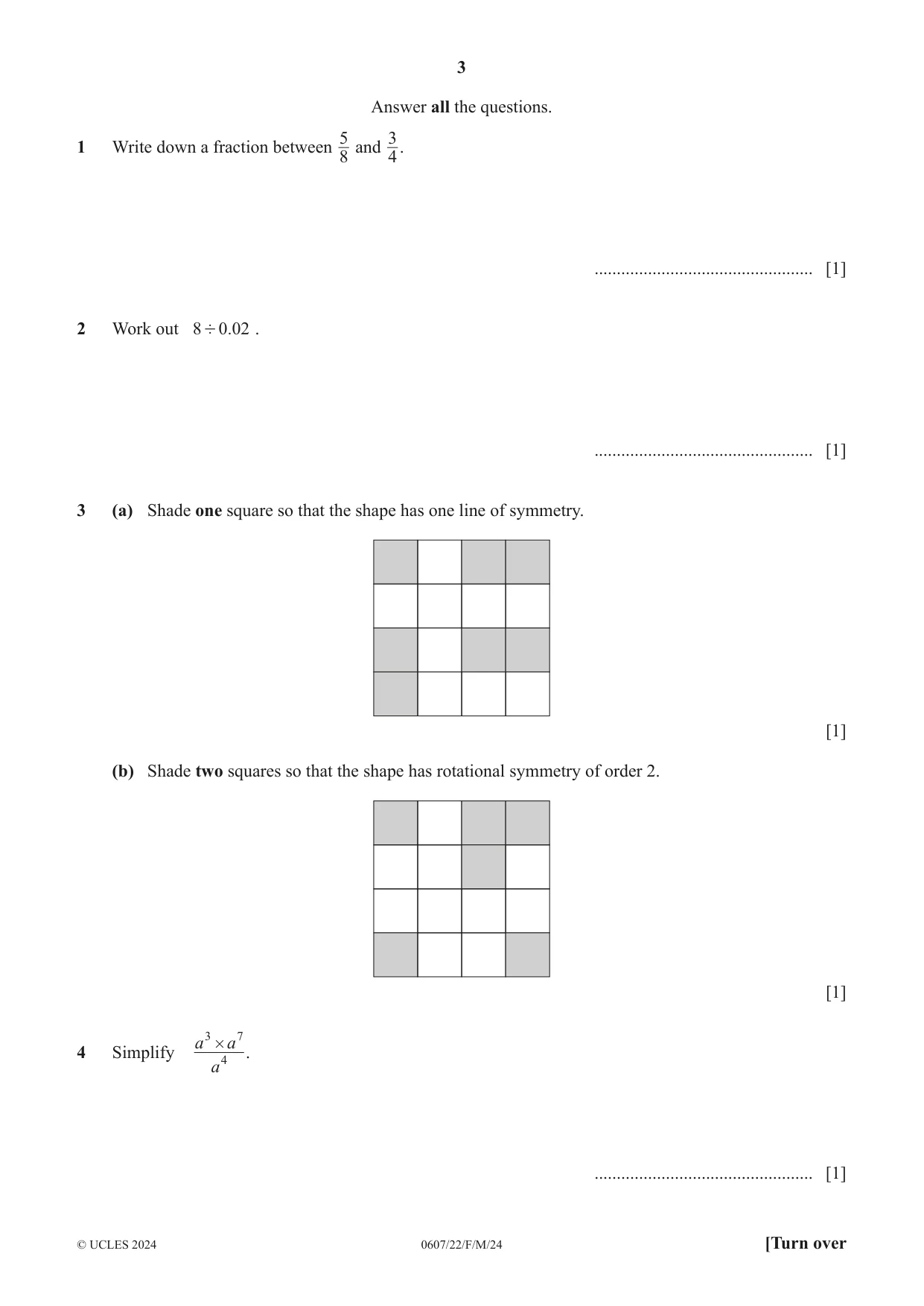
Q3 · Shade one square so that the shape has one line of symmetry
3 (a) Shade one square so that the shape has one line of symmetry. [1] (b) Shade two squares so that the shape has rotational symmetry of order 2. [1]
Mark scheme: 3(a) 1 3(b) 1
Question 4
4 Simplify # . a4 ................................................. [1]
Mark scheme: 4 a6 1
Q5 · Write the ratio 120 : 150 : 75 in its simplest form
5 (a) Write the ratio 120 : 150 : 75 in its simplest form. .............. : .............. : .............. [2] (b) Advik and Bidhi share $160 in the ratio 3 : 5. Calculate how much they each receive. Advik $ ................................................. Bidhi $ ................................................. [2]
Mark scheme: 5(a) 8 : 10 : 5 final answer 2 B1 for 24 : 30 : 15 or 40 : 50 : 25 5(b) Advik 60 2 B1 for either Bidhi 100 or M1 for 160 ÷ (3 + 5)
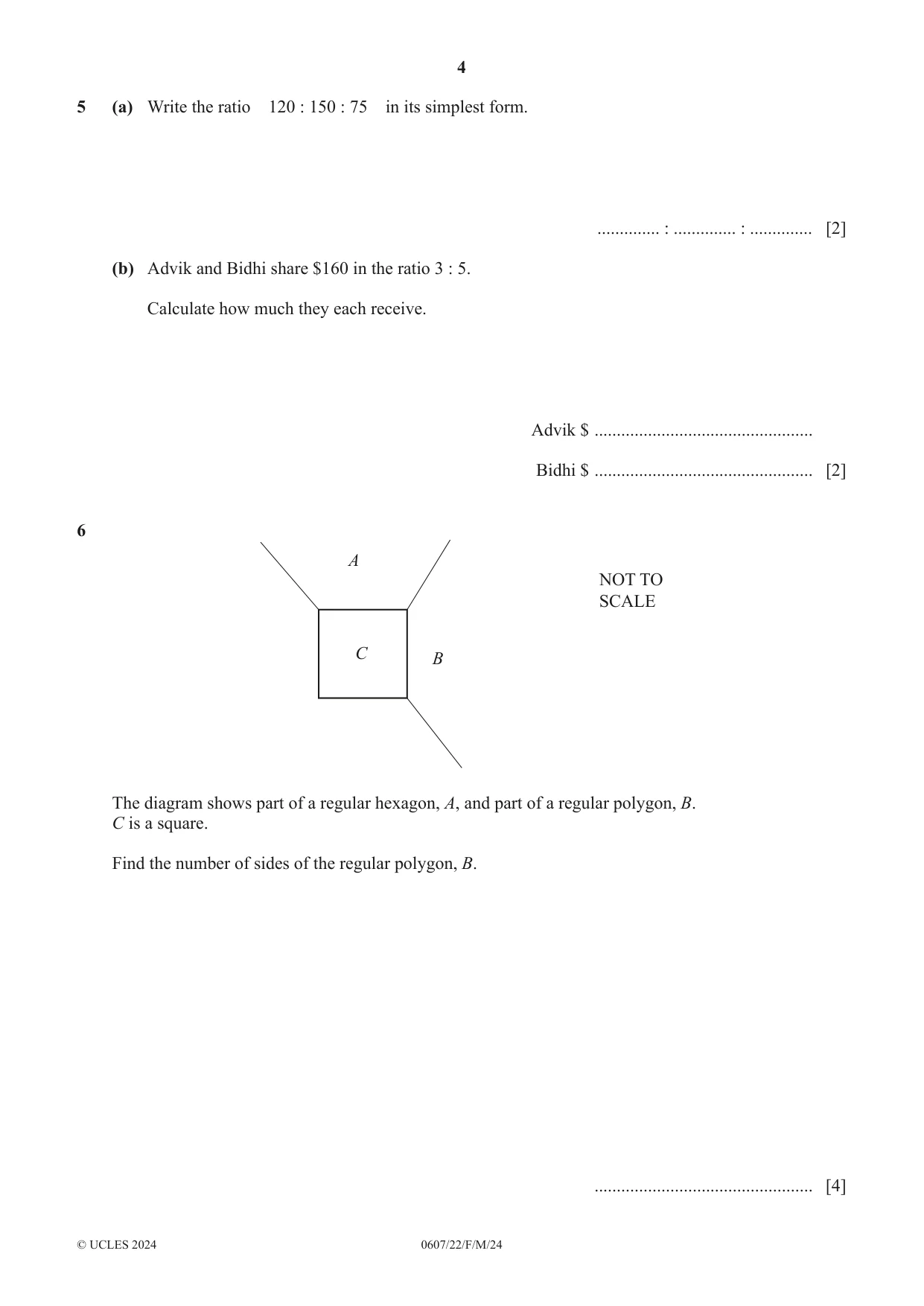
Q6 · A NOT TO SCALE C B The diagram shows part of a regular hexagon, A, and part of a regular…
6 A NOT TO SCALE C B The diagram shows part of a regular hexagon, A, and part of a regular polygon, B. C is a square. Find the number of sides of the regular polygon, B. ................................................. [4]
Mark scheme: 6 12 4 B2 for 150 (allow 60 + 90) or 30 or B1 for 120 and 90 M1 for 360 = (180 – their 150)n oe ( n − 2) 180 or = their150 oe n
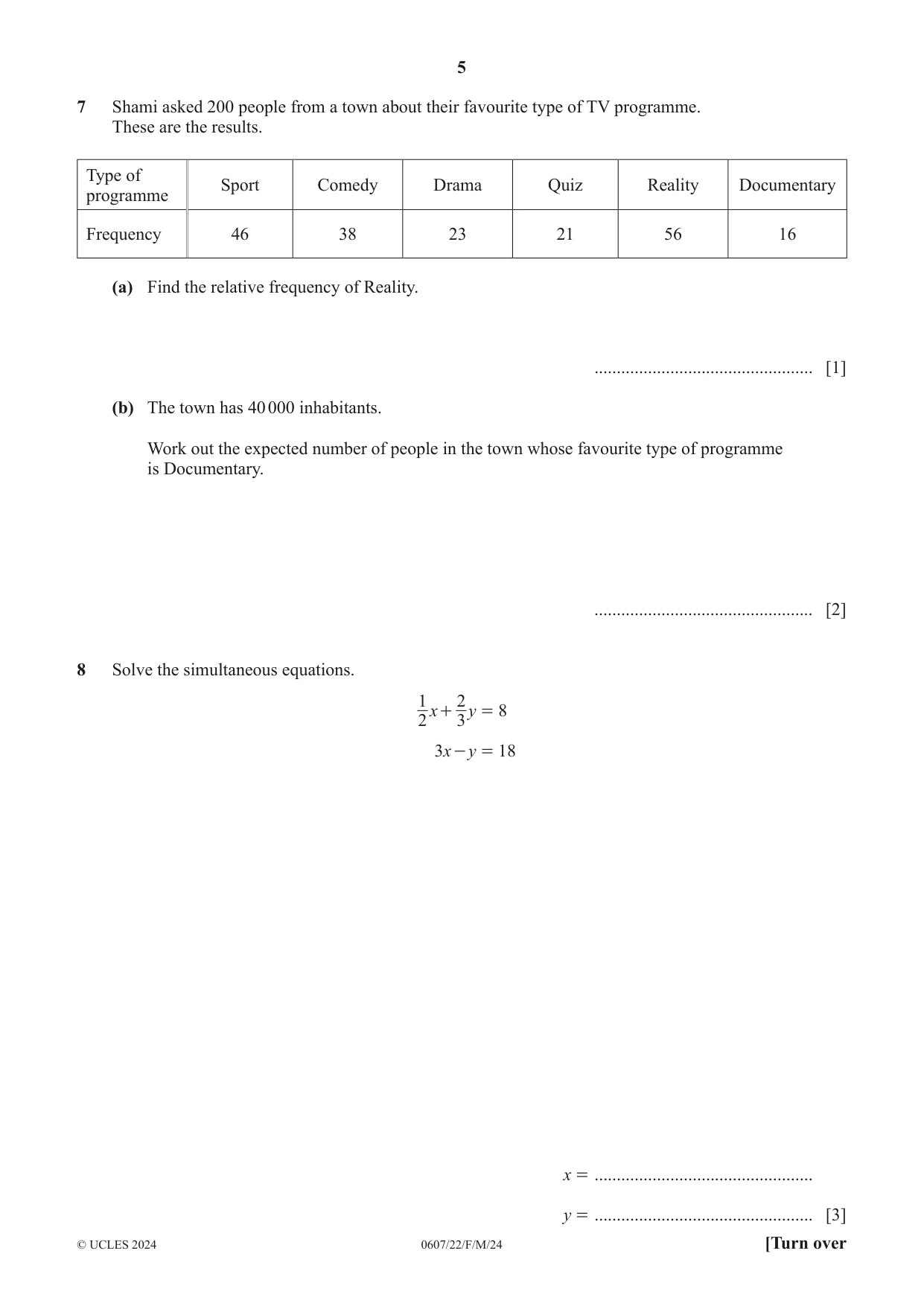
Q7 · Shami asked 200 people from a town about their favourite type of TV programme
7 Shami asked 200 people from a town about their favourite type of TV programme. These are the results. Type of Sport Comedy Drama Quiz Reality Documentary programme Frequency 46 38 23 21 56 16 (a) Find the relative frequency of Reality. ................................................. [1] (b) The town has 40 000 inhabitants. Work out the expected number of people in the town whose favourite type of programme is Documentary. ................................................. [2]
Mark scheme: 7(a) 56 1 oe 200 7(b) 3200 2 16 M1 for [40000 ]200
Q8 · Solve the simultaneous equations
8 Solve the simultaneous equations. 1 2 x + y = 8 2 3 3x - y = 18 x = ................................................. y = ................................................. [3]
Mark scheme: 8 Correctly eliminating x or y M1 [x =] 8 A2 A1 for each [y =] 6 If zero scored SC1 for correct substitution and evaluation to find the other variable
Q9 · Find the highest common factor (HCF) of 72 and 120
9 (a) Find the highest common factor (HCF) of 72 and 120. ................................................. [1] (b) Find the lowest common multiple (LCM) of 54 and 81. ................................................. [2]
Mark scheme: 9(a) 24 1 9(b) 162 2 B1for 162k or M1 for 2 × 3 × 3 × 3 and 3 × 3 × 3 × 3
Q10 · 0 Work out 16 1
410 Work out 16 1. ................................................. [1]
Mark scheme: 10 2 1
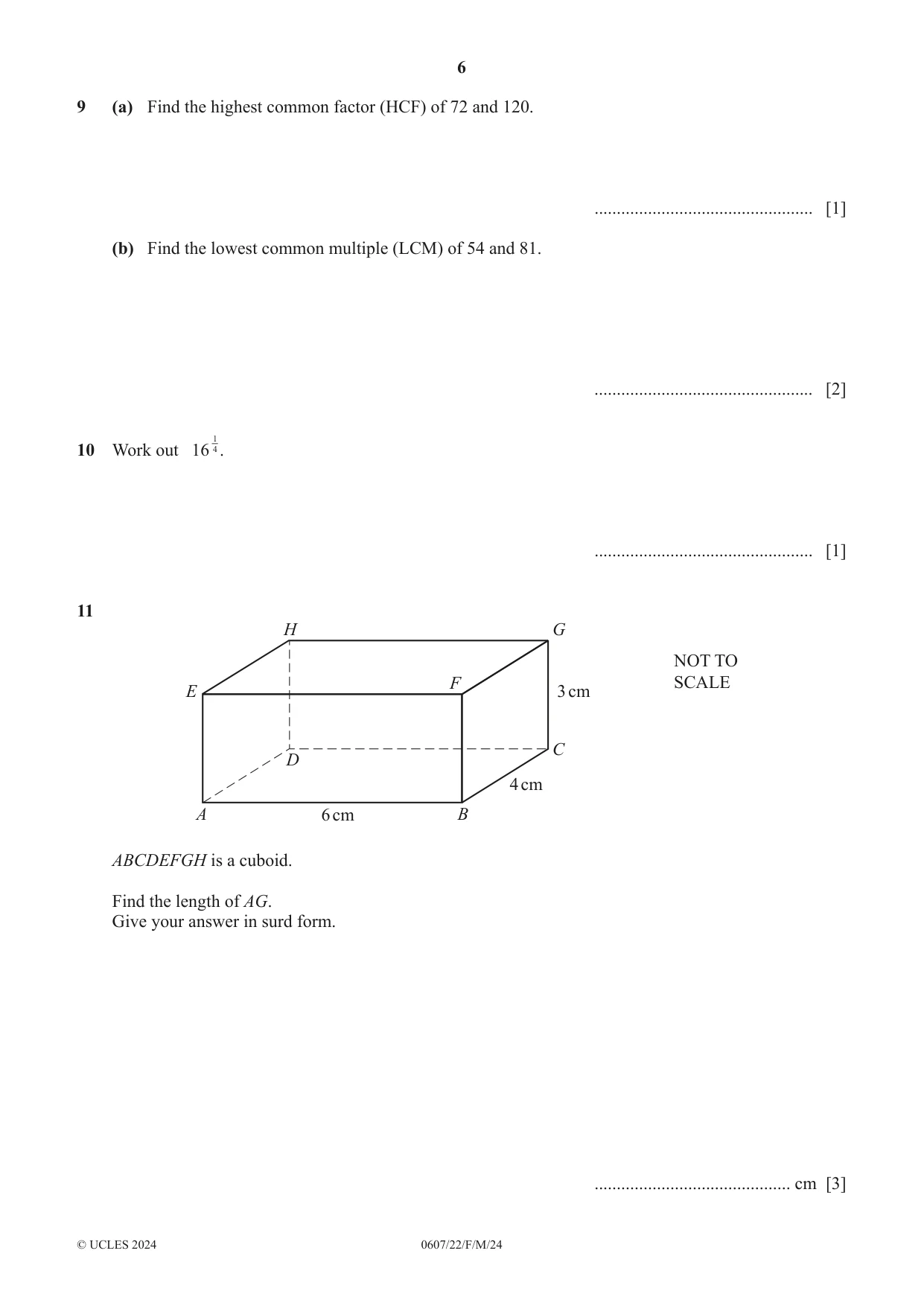
Q11 · H G NOT TO F SCALE E 3 cm C D 4 cm A 6 cm B ABCDEFGH is a cuboid
11 H G NOT TO F SCALE E 3 cm C D 4 cm A 6 cm B ABCDEFGH is a cuboid. Find the length of AG. Give your answer in surd form. ............................................ cm [3]
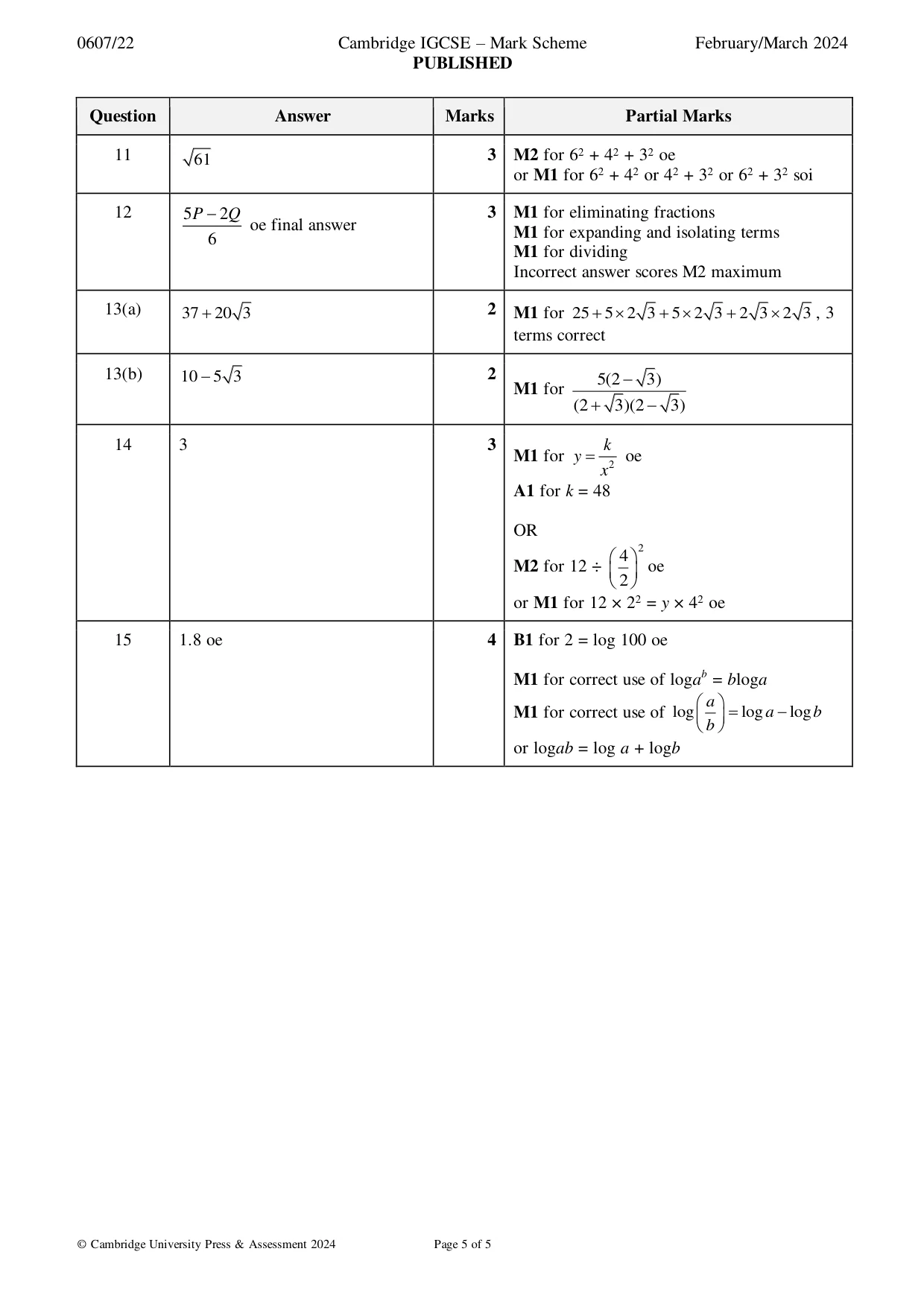
Mark scheme: 11 61 3 M2 for 62 + 42 + 32 oe or M1 for 62 + 42 or 42 + 32 or 62 + 32 soi
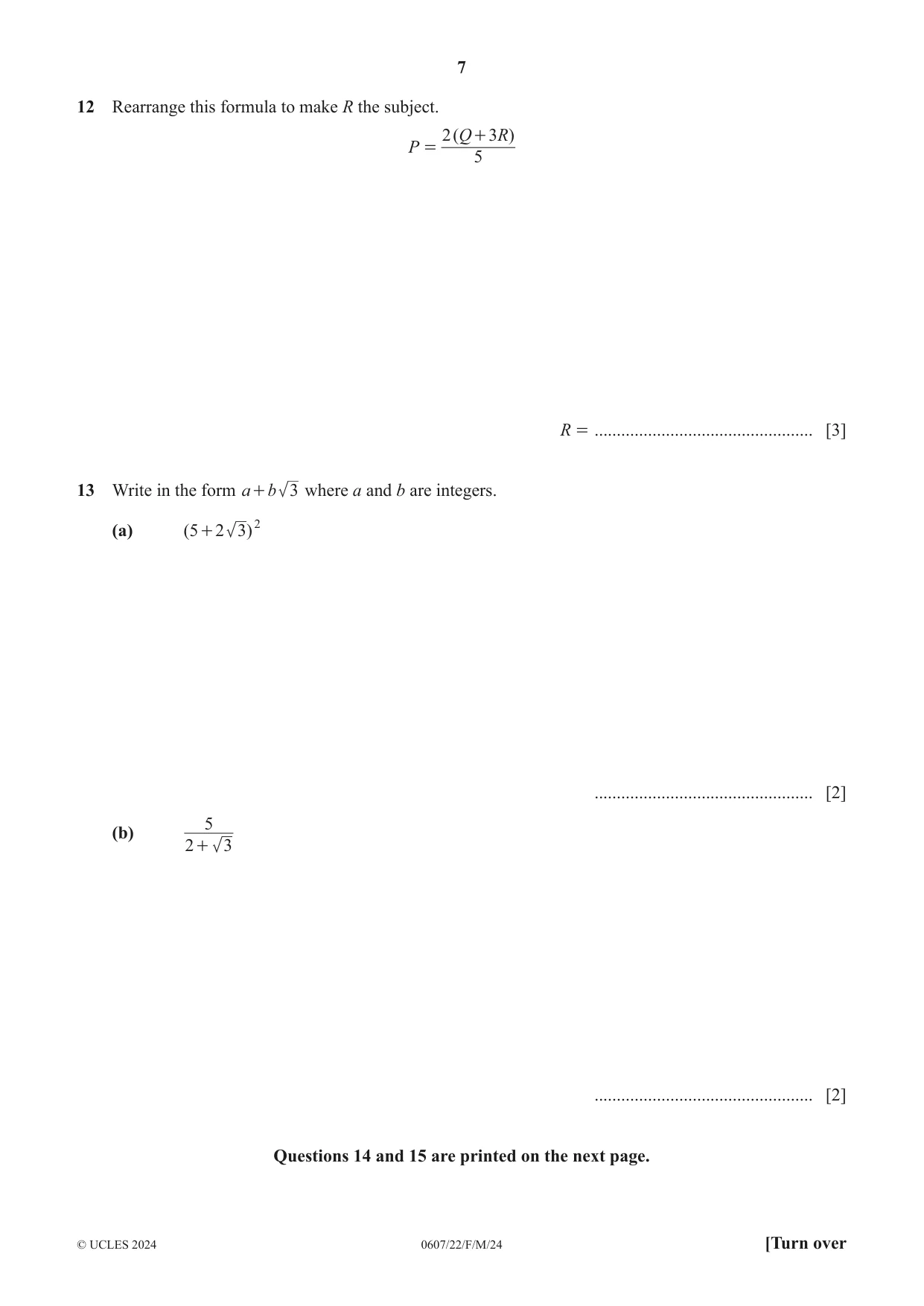
Q12 · Rearrange this formula to make R the subject
12 Rearrange this formula to make R the subject. 2 ( Q + 3 R ) P = 5 R = ................................................. [3]
Mark scheme: 12 5 P − 2Q 3 M1 for eliminating fractions oe final answer M1 for expanding and isolating terms 6 M1 for dividing Incorrect answer scores M2 maximum
Q13 · Write in the form a + b 3 where a and b are integers
13 Write in the form a + b 3 where a and b are integers. (a) ( 5 + 2 3) 2 ................................................. [2] 5 (b) 2 + 3 ................................................. [2] Questions 14 and 15 are printed on the next page.
Mark scheme: 13(a) 37 + 20 3 2 M1 for 25 + 5 2 3 + 5 2 3 + 2 3 2 3 , 3 terms correct 13(b) 10 − 5 3 2 5(2 − 3) M1 for (2 + 3)(2 − 3)
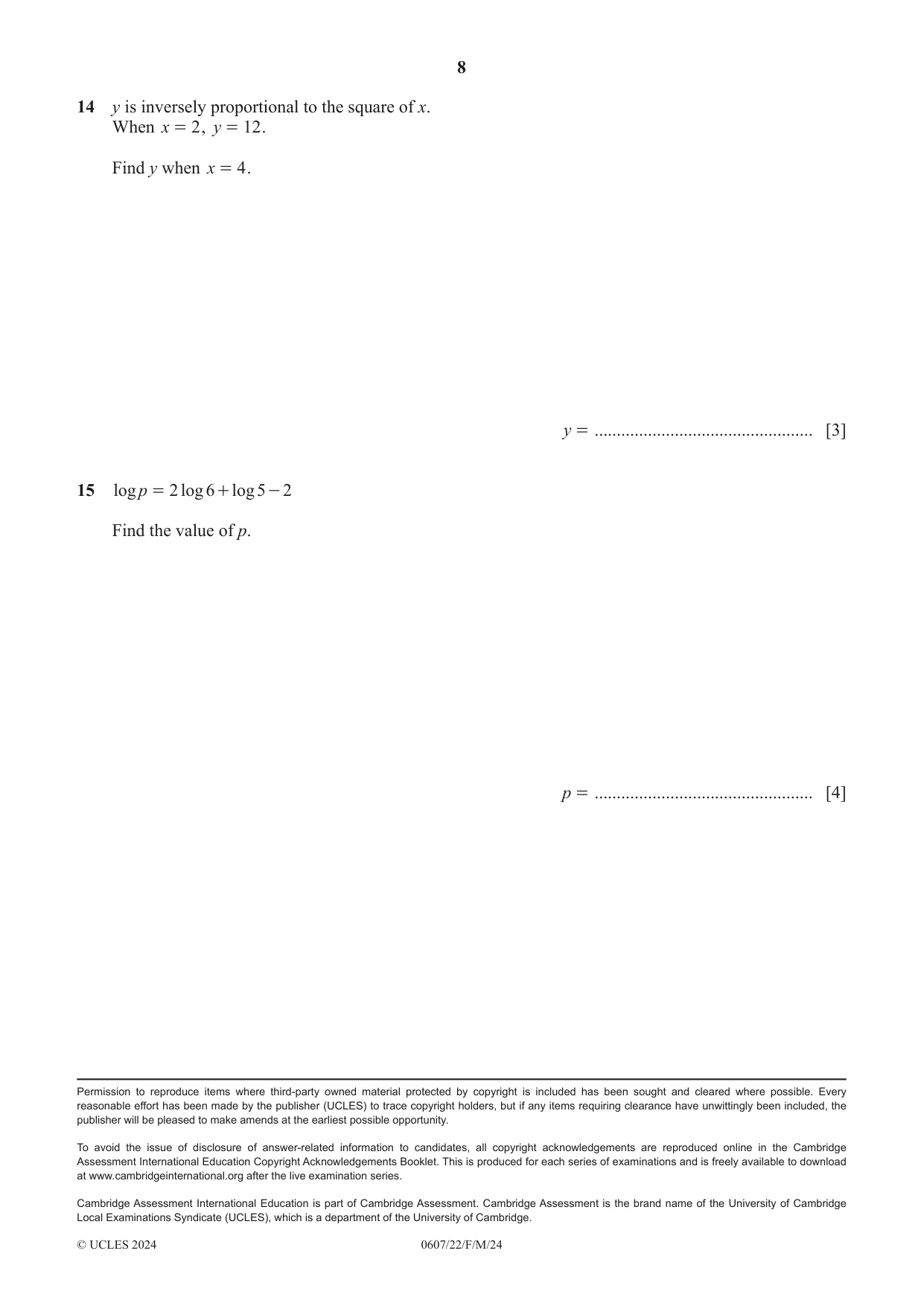
Q14 · Y is inversely proportional to the square of x
14 y is inversely proportional to the square of x. When x = 2 , y = 12 . Find y when x = 4 . y = ................................................. [3]
Mark scheme: 14 3 3 k M1 for y = oe x 2 A1 for k = 48 OR 4 2 M2 for 12 ÷ oe 2 or M1 for 12 × 22 = y × 42 oe
Q15 · Log p = 2 log 6 + log 5 - 2 Find the value of p
15 log p = 2 log 6 + log 5 - 2 Find the value of p. p = ................................................. [4]
Mark scheme: 15 1.8 oe 4 B1 for 2 = log 100 oe M1 for correct use of logab = bloga a M1 for correct use of log = log a − log b b or logab = log a + logb
What was in this paper
The subtopics covered by these 15 questions, and how many questions each got. Open one in a new tab to see every Cambridge question on it.
What you needed in this session
Cambridge’s own grade thresholds for 2024 Feb/March, Paper 2 · Variant 2. A higher threshold means an easier paper — the bar moves with how the cohort did.