Cambridge IGCSE Mathematics - International 0607 — 2025 Feb/March Paper 2 · Variant 2
0607/22/F/M/25 · 22 questions · 75 marks · ≈84 min
The question paper and its mark scheme, free to read here and free to download. This is Cambridge’s own paper, exactly as it was sat.
Question paper16 pages
Mark scheme8 pages
Answers below. Sit the paper first if you are practising.
Questions as text
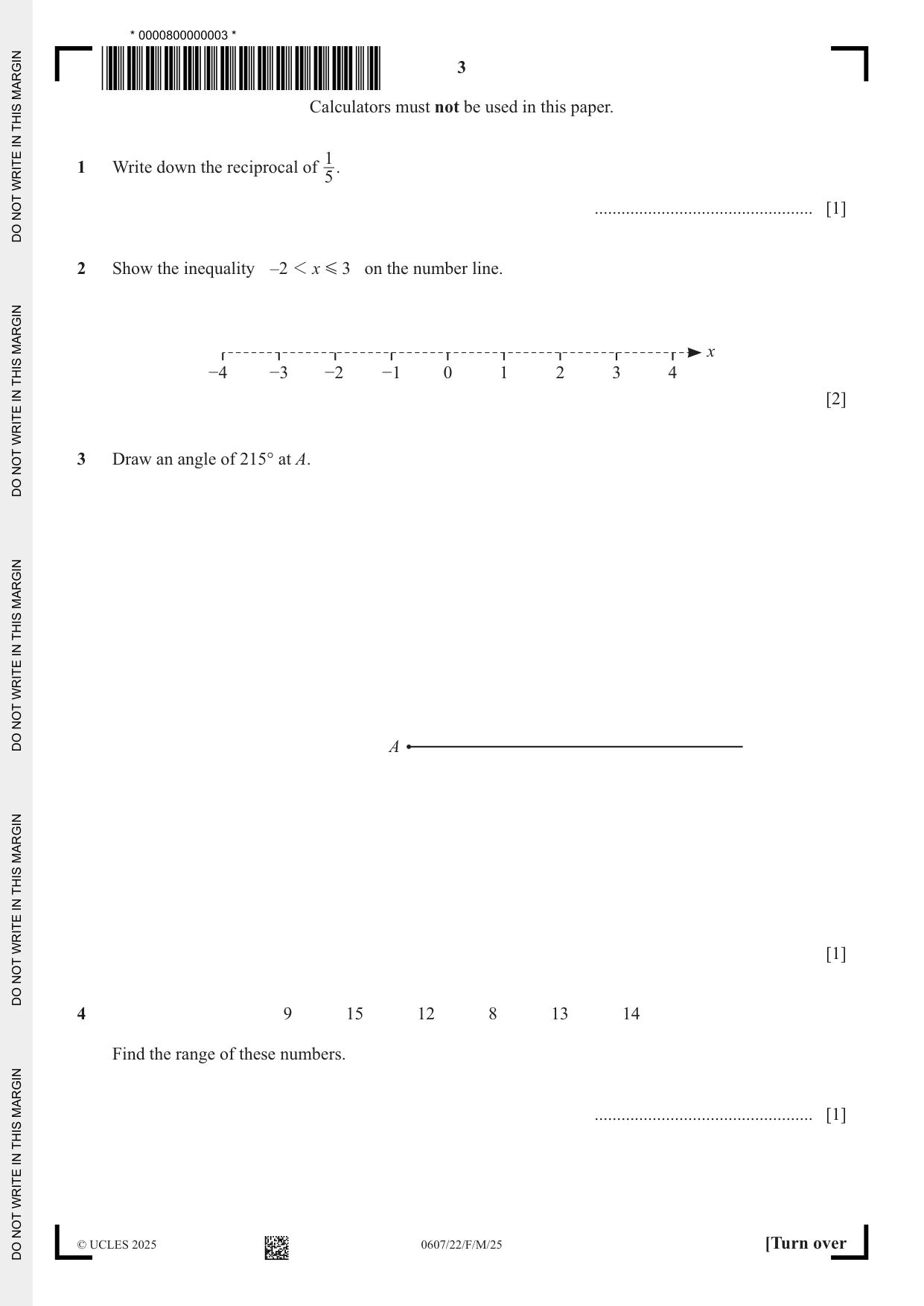
Q1 · Write down the reciprocal of 5
1 Write down the reciprocal of 5. ................................................. [1]
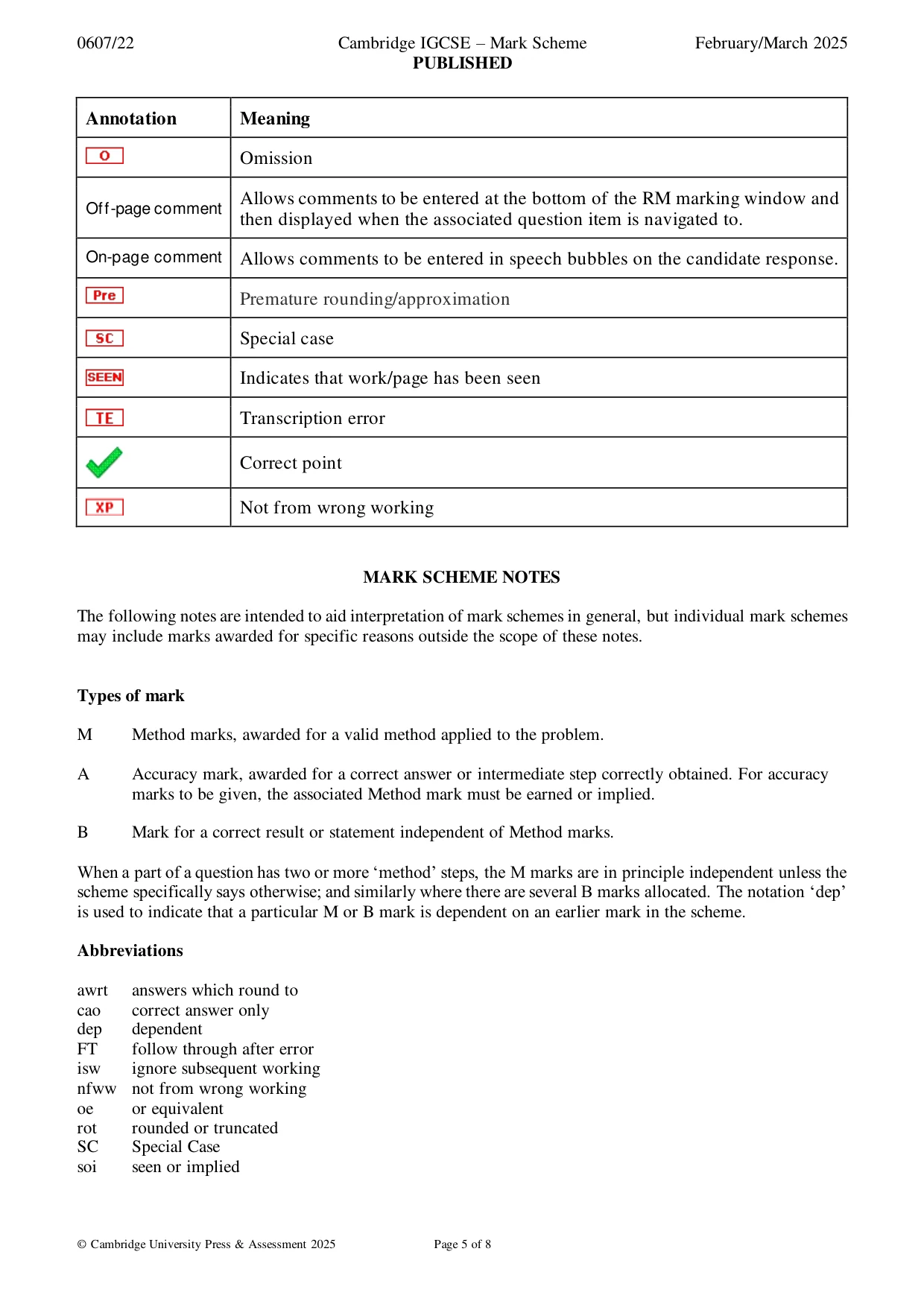
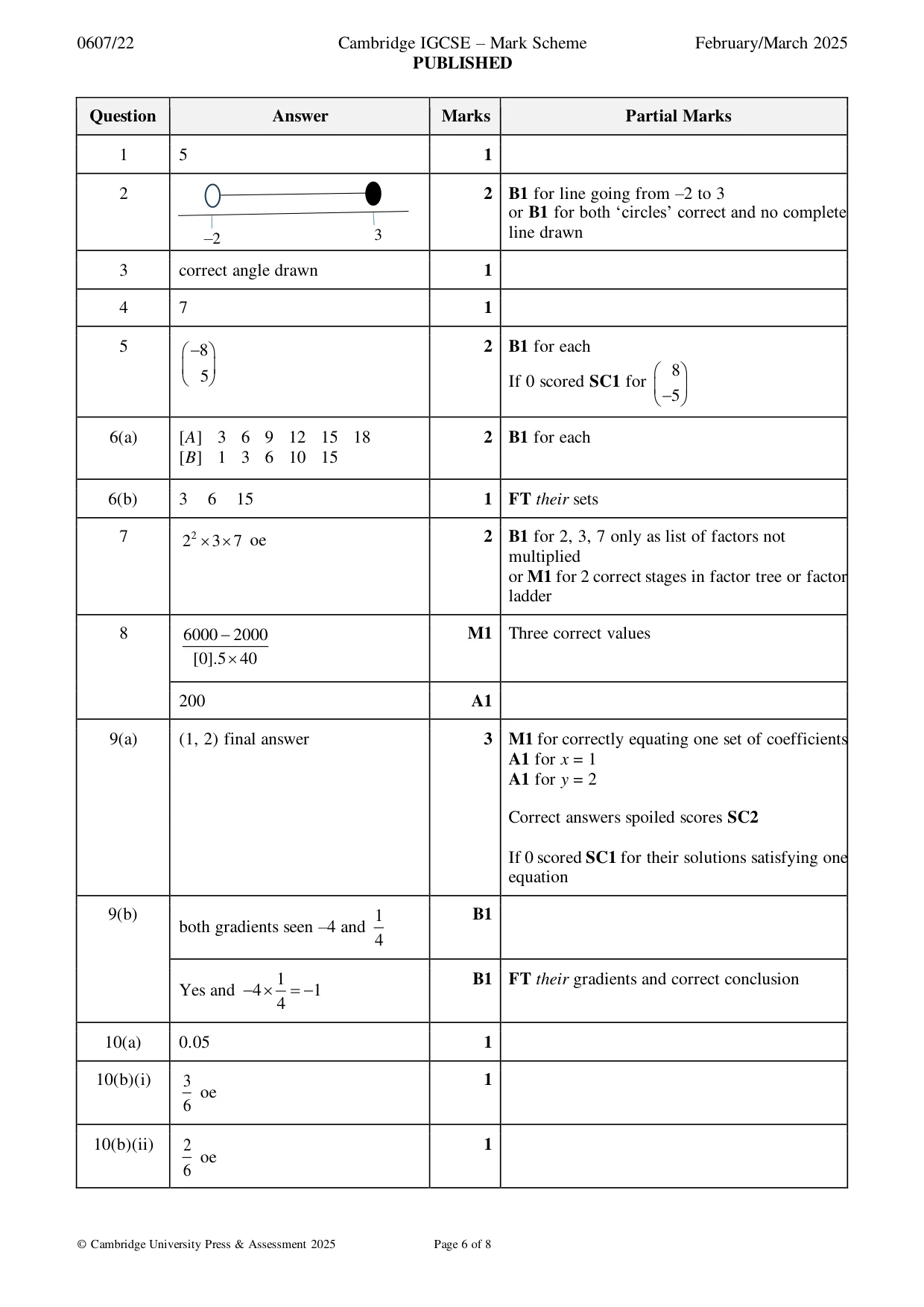
Mark scheme: Question Answer Marks Partial Marks 1 5 1
Q2 · Show the inequality –2 1 x G 3 on the number line
2 Show the inequality –2 1 x G 3 on the number line. x −4 −3 −2 −1 0 1 2 3 4 [2]
Mark scheme: 2 2 B1 for line going from –2 to 3 or B1 for both ‘circles’ correct and no complete –2 3 line drawn
Q4 · 9 15 12 8 13 14 Find the range of these numbers
4 9 15 12 8 13 14 Find the range of these numbers. ................................................. [1]
Mark scheme: 4 7 1
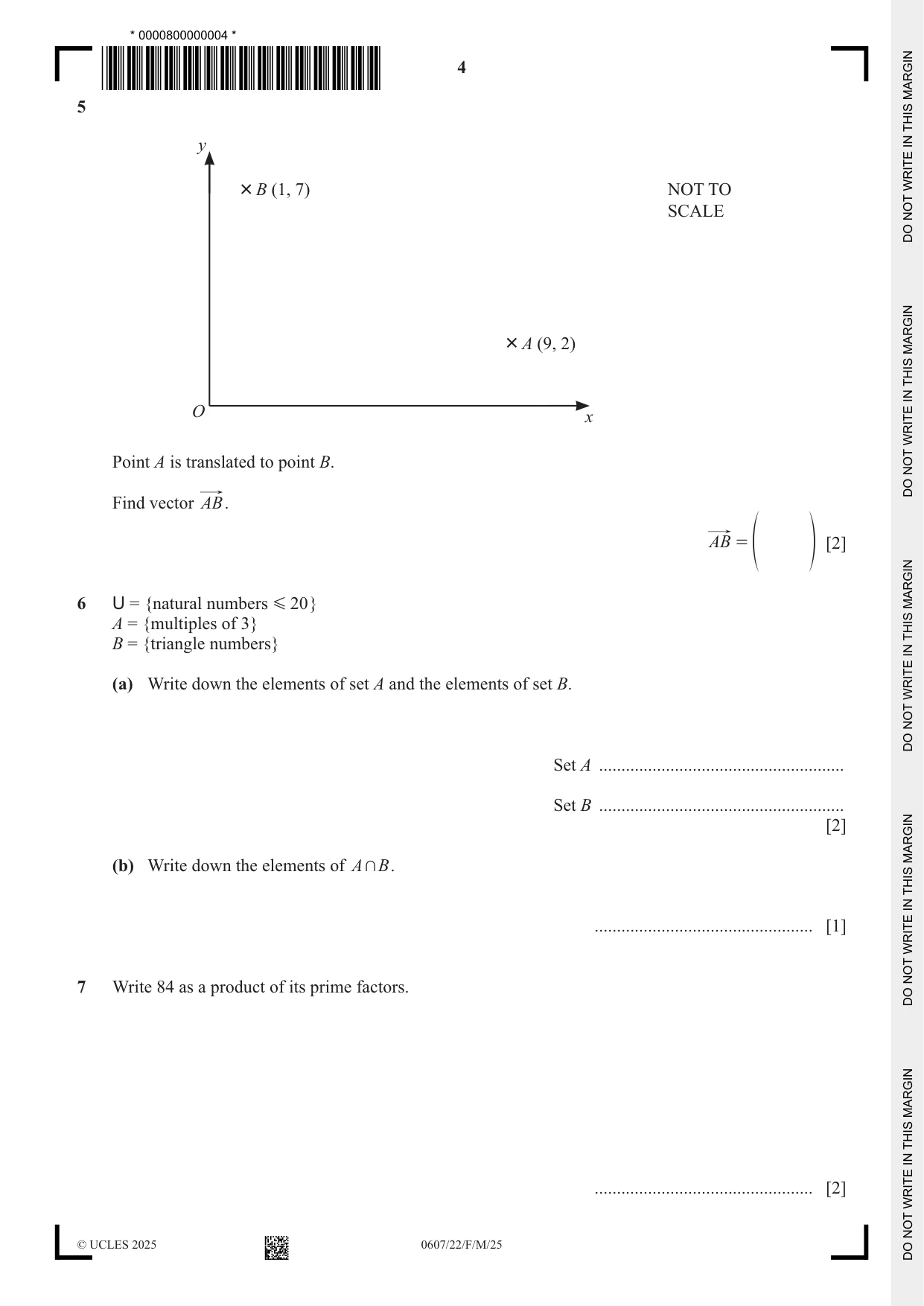
Q5 · Y B (1, 7) NOT TO SCALE A (9, 2) O x Point A is translated to point B
5 y B (1, 7) NOT TO SCALE A (9, 2) O x Point A is translated to point B. Find vector AB. AB = f p [2]
Mark scheme: 5 −8 2 B1 for each 8 5 If 0 scored SC1 for −5
Q6 · U = {natural numbers G 20 } A = {multiples of 3} B = {triangle numbers} (a) Write down…
6 U = {natural numbers G 20 } A = {multiples of 3} B = {triangle numbers} (a) Write down the elements of set A and the elements of set B. Set A ....................................................... Set B ....................................................... [2] (b) Write down the elements of A + B . ................................................. [1]
Mark scheme: 6(a) [A] 3 6 9 12 15 18 2 B1 for each [B] 1 3 6 10 15 6(b) 3 6 15 1 FT their sets
Q7 · Write 84 as a product of its prime factors
7 Write 84 as a product of its prime factors. ................................................. [2]
Mark scheme: 7 2 2 3 7 oe 2 B1 for 2, 3, 7 only as list of factors not multiplied or M1 for 2 correct stages in factor tree or factor ladder
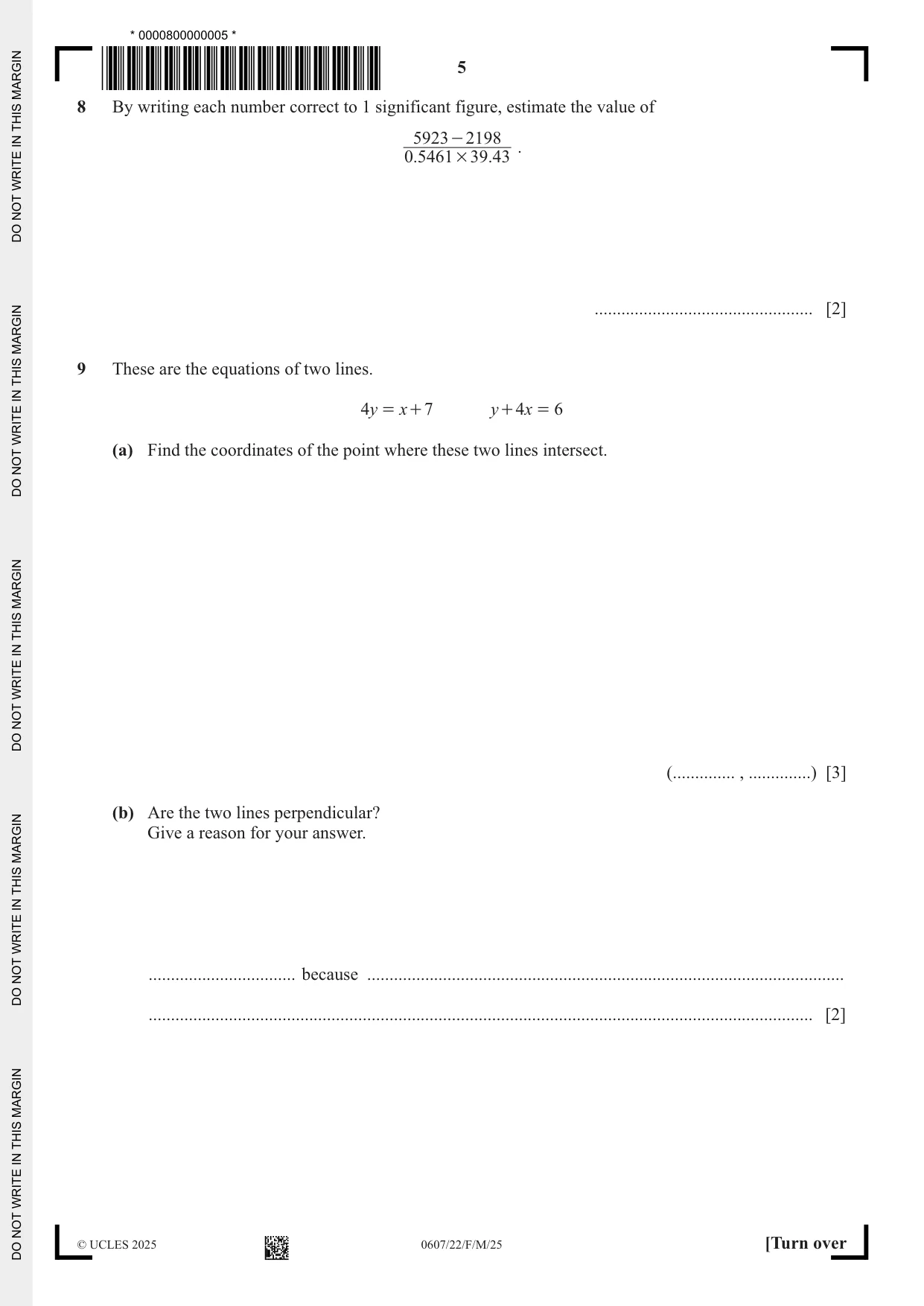
Q8 · By writing each number correct to 1 significant figure, estimate the value of 5923 - 2198
8 By writing each number correct to 1 significant figure, estimate the value of 5923 - 2198 . 0.5461 # 39 .43 ................................................. [2]
Mark scheme: 8 6000 − 2000 M1 Three correct values [0].5 40 200 A1
Q9 · These are the equations of two lines
9 These are the equations of two lines. 4y = x + 7 y + 4x = 6 (a) Find the coordinates of the point where these two lines intersect. (.............. , ..............) [3] (b) Are the two lines perpendicular? Give a reason for your answer. ................................. because ........................................................................................................... ..................................................................................................................................................... [2]
Mark scheme: 9(a) (1, 2) final answer 3 M1 for correctly equating one set of coefficients A1 for x = 1 A1 for y = 2 Correct answers spoiled scores SC2 If 0 scored SC1 for their solutions satisfying one equation 9(b) 1 B1 both gradients seen –4 and 4 1 B1 FT their gradients and correct conclusion Yes and −4 = −1 4
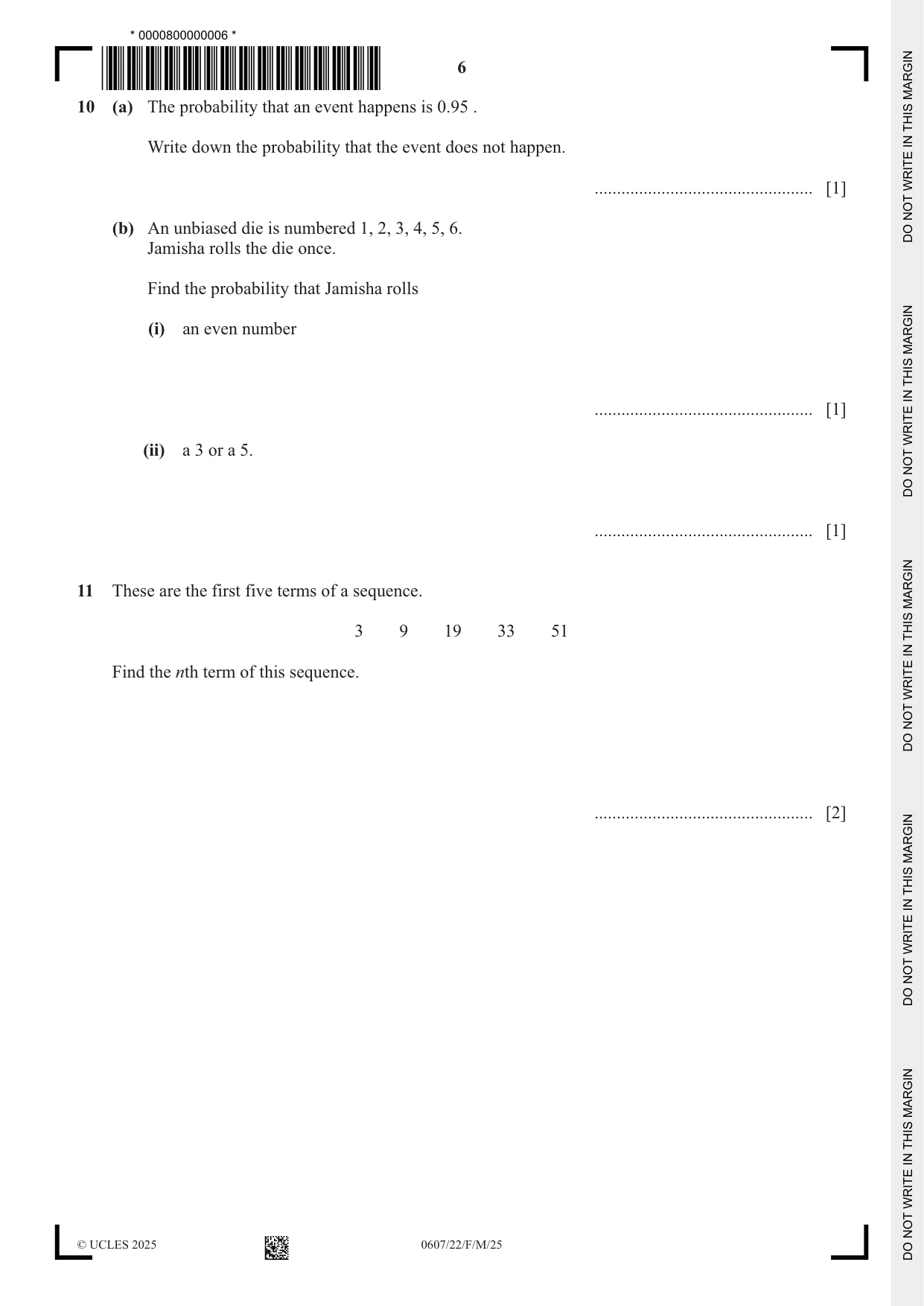
Q10 · The probability that an event happens is 0.95
10 (a) The probability that an event happens is 0.95 . Write down the probability that the event does not happen. ................................................. [1] (b) An unbiased die is numbered 1, 2, 3, 4, 5, 6. Jamisha rolls the die once. Find the probability that Jamisha rolls (i) an even number ................................................. [1] (ii) a 3 or a 5. ................................................. [1]
Mark scheme: 10(a) 0.05 1 10(b)(i) 3 1 oe 6 10(b)(ii) 2 1 oe 6
Q11 · These are the first five terms of a sequence
11 These are the first five terms of a sequence. 3 9 19 33 51 Find the nth term of this sequence. ................................................. [2]
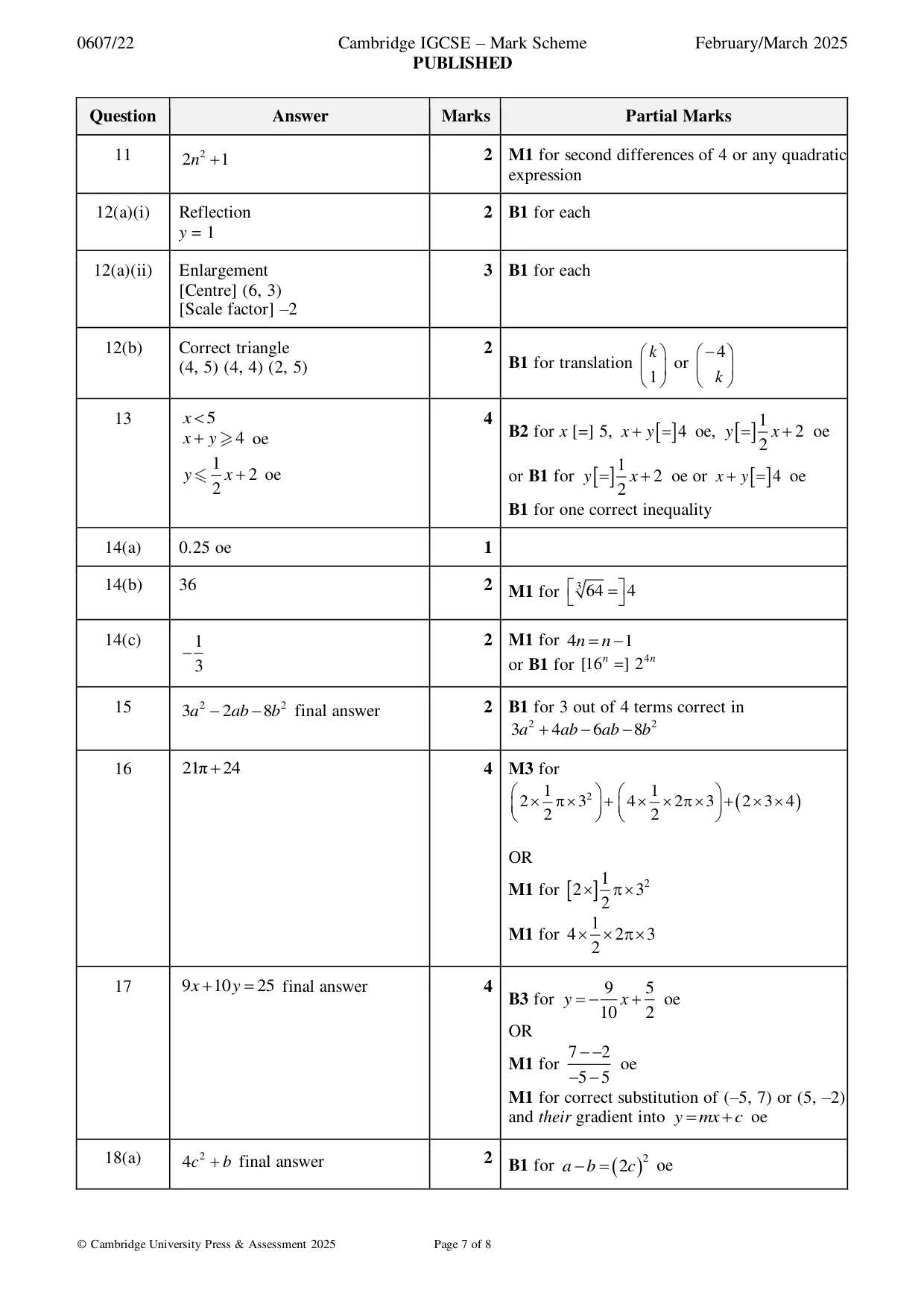
Mark scheme: 11 2n 2 + 1 2 M1 for second differences of 4 or any quadratic expression
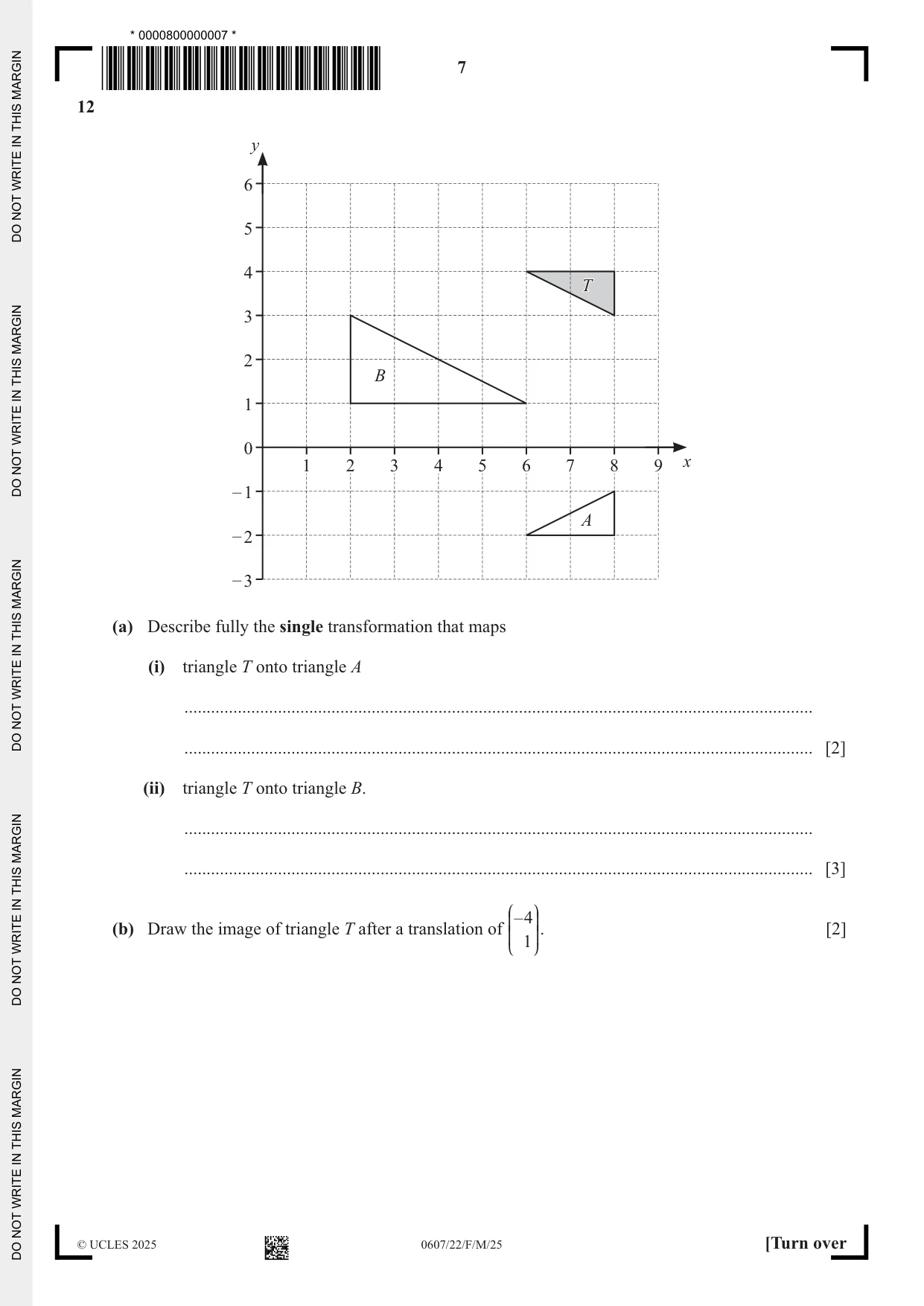
Q12 · Y 6 5 4 T 3 2 B 1 0 1 2 3 4 5 6 7 8 9 x – 1 A – 2 – 3 (a) Describe fully the single…
12 y 6 5 4 T 3 2 B 1 0 1 2 3 4 5 6 7 8 9 x – 1 A – 2 – 3 (a) Describe fully the single transformation that maps (i) triangle T onto triangle A ............................................................................................................................................. ............................................................................................................................................. [2] (ii) triangle T onto triangle B. ............................................................................................................................................. ............................................................................................................................................. [3] J N – 4 (b) Draw the image of triangle T after a translation of [2] KK OO. 1 L P
Mark scheme: 12(a)(i) Reflection 2 B1 for each y = 1 12(a)(ii) Enlargement 3 B1 for each [Centre] (6, 3) [Scale factor] –2 12(b) Correct triangle 2 k − 4 B1 for translation or (4, 5) (4, 4) (2, 5) 1 k
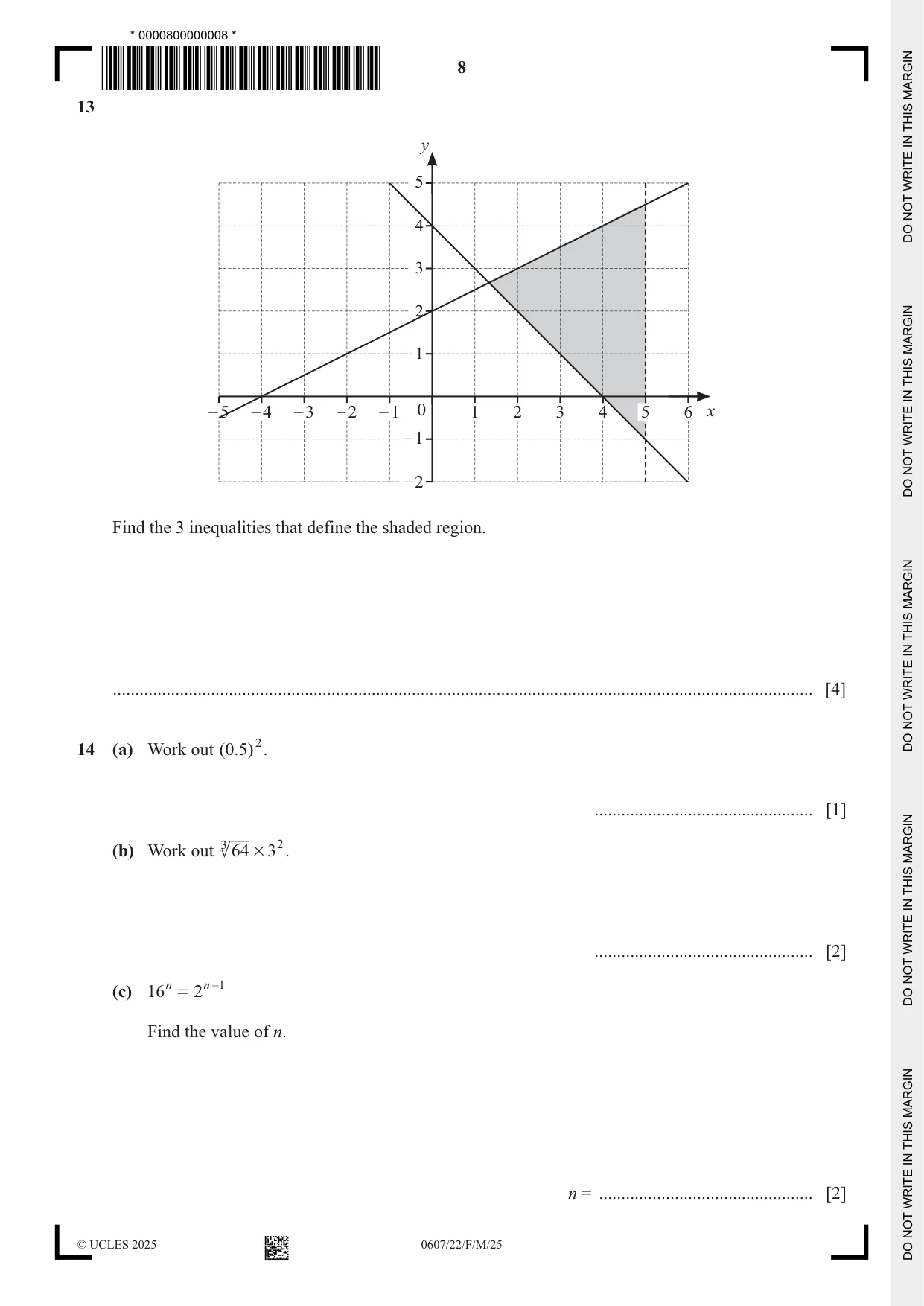
Q13 · Y 5 4 3 2 1 – 5 – 4 – 3 – 2 – 1 0 1 2 3 4 5 6 x – 1 – 2 Find the 3 inequalities that…
13 y 5 4 3 2 1 – 5 – 4 – 3 – 2 – 1 0 1 2 3 4 5 6 x – 1 – 2 Find the 3 inequalities that define the shaded region. ............................................................................................................................................................. [4]
Mark scheme: 13 x 5 4 B2 for x [=] 5, x + y 4= oe, y 1= x + 2 oe x + y 4 oe 2 1 y x + 2 oe or B1 for y 1= x + 2 oe or x + y 4= oe 2 2 B1 for one correct inequality
Q14 · Work out ( 0 .5 ) 2
14 (a) Work out ( 0 .5 ) 2. ................................................. [1] (b) Work out 3 64 # 3 2 . ................................................. [2] (c) 16 n = 2 n – 1 Find the value of n. n = ................................................ [2]
Mark scheme: 14(a) 0.25 oe 1 14(b) 36 2 M1 for 3 64 = 4 14(c) 1 2 M1 for 4n = n − 1 − n 4 n 3 or B1 for [16 = ] 2
Question 15
15 Expand and simplify. ( 3a + 4b)( a - 2 b) ................................................. [2]
Mark scheme: 15 3a 2 − 2ab − 8b 2 final answer 2 B1 for 3 out of 4 terms correct in 3a 2 + 4 ab − 6ab − 8b 2
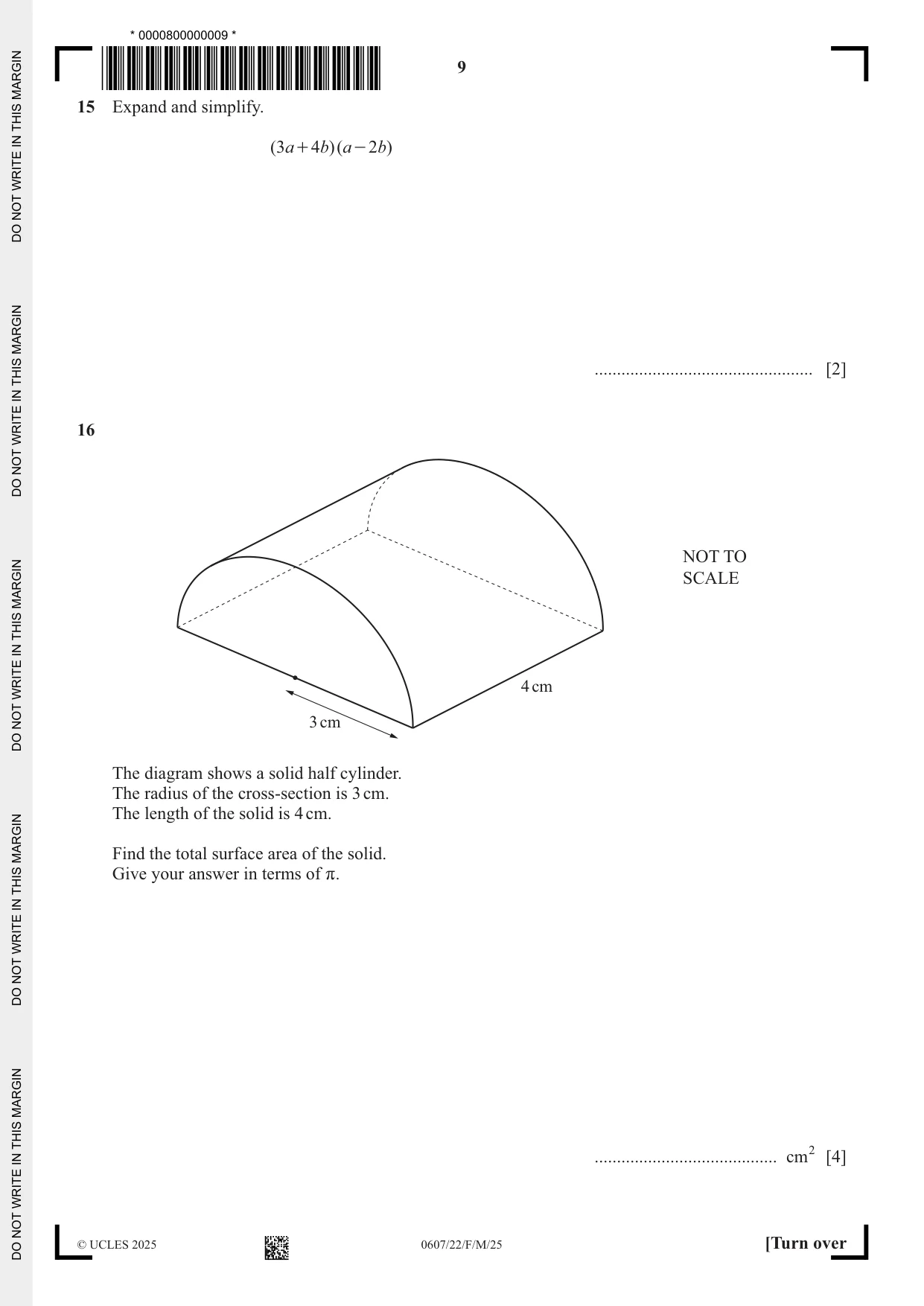
Q16 · NOT TO SCALE 4 cm 3 cm The diagram shows a solid half cylinder
16 NOT TO SCALE 4 cm 3 cm The diagram shows a solid half cylinder. The radius of the cross-section is 3 cm. The length of the solid is 4 cm. Find the total surface area of the solid. Give your answer in terms of r. ......................................... cm2 [4]
Mark scheme: 16 21π + 24 4 M3 for 1 2 1 2 3 + 4 2 3 + ( 2 3 4 ) 2 2 OR 1 2 M1 for 2 3 2 1 M1 for 4 2 3 2
Q17 · A is the point (–5, 7) and B is the point (5, –2)
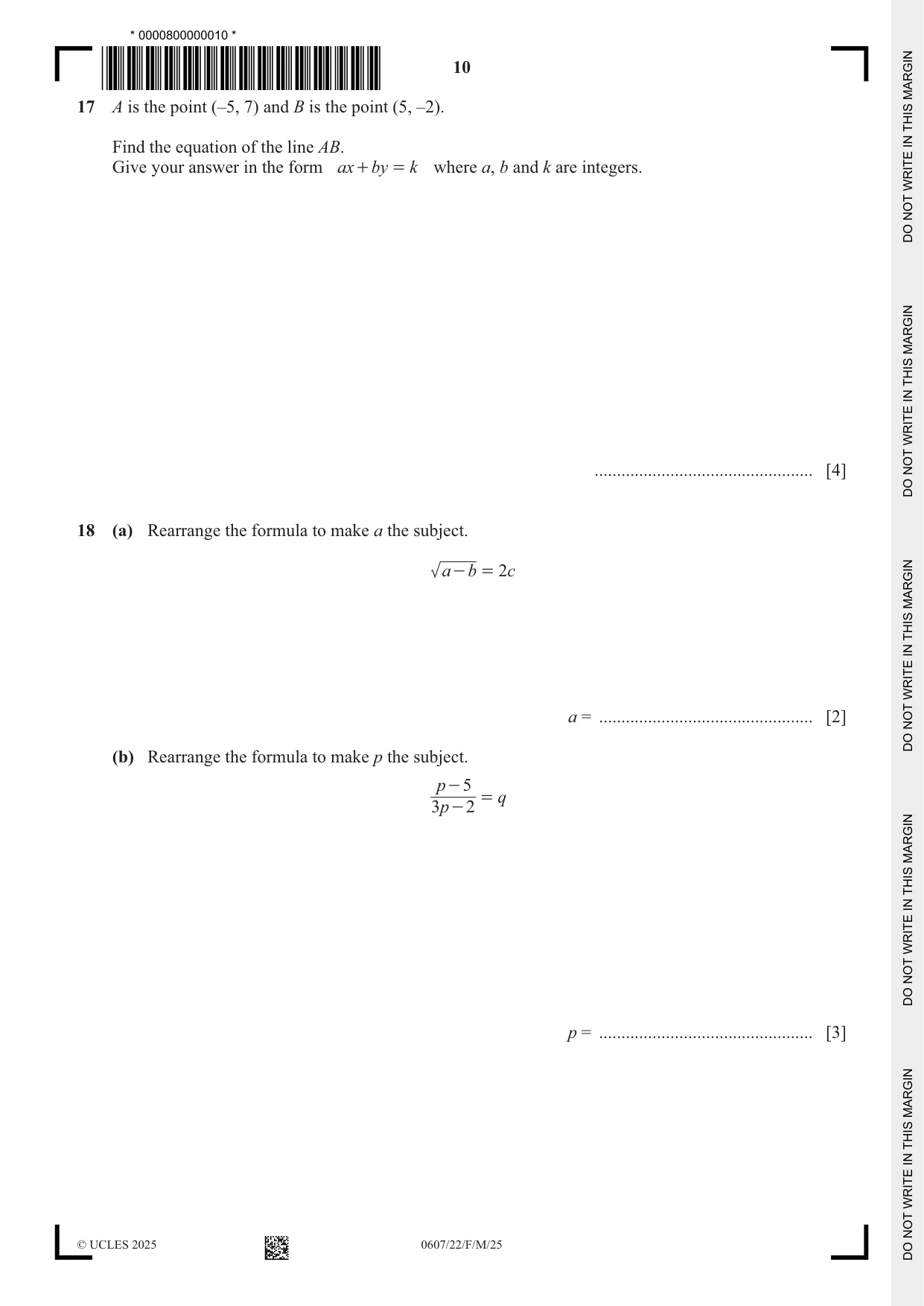
17 A is the point (–5, 7) and B is the point (5, –2). Find the equation of the line AB. Give your answer in the form ax + by = k where a, b and k are integers. ................................................. [4]
Mark scheme: 17 9 x + 10 y = 25 final answer 4 9 5 B3 for y = − x + oe 10 2 OR 7 −−2 M1 for oe −−5 5 M1 for correct substitution of (–5, 7) or (5, –2) and their gradient into y = mx + c oe
Q18 · Rearrange the formula to make a the subject
18 (a) Rearrange the formula to make a the subject. a - b = 2c a = ................................................ [2] (b) Rearrange the formula to make p the subject. p - 5 = q 3p - 2 p = ................................................ [3]
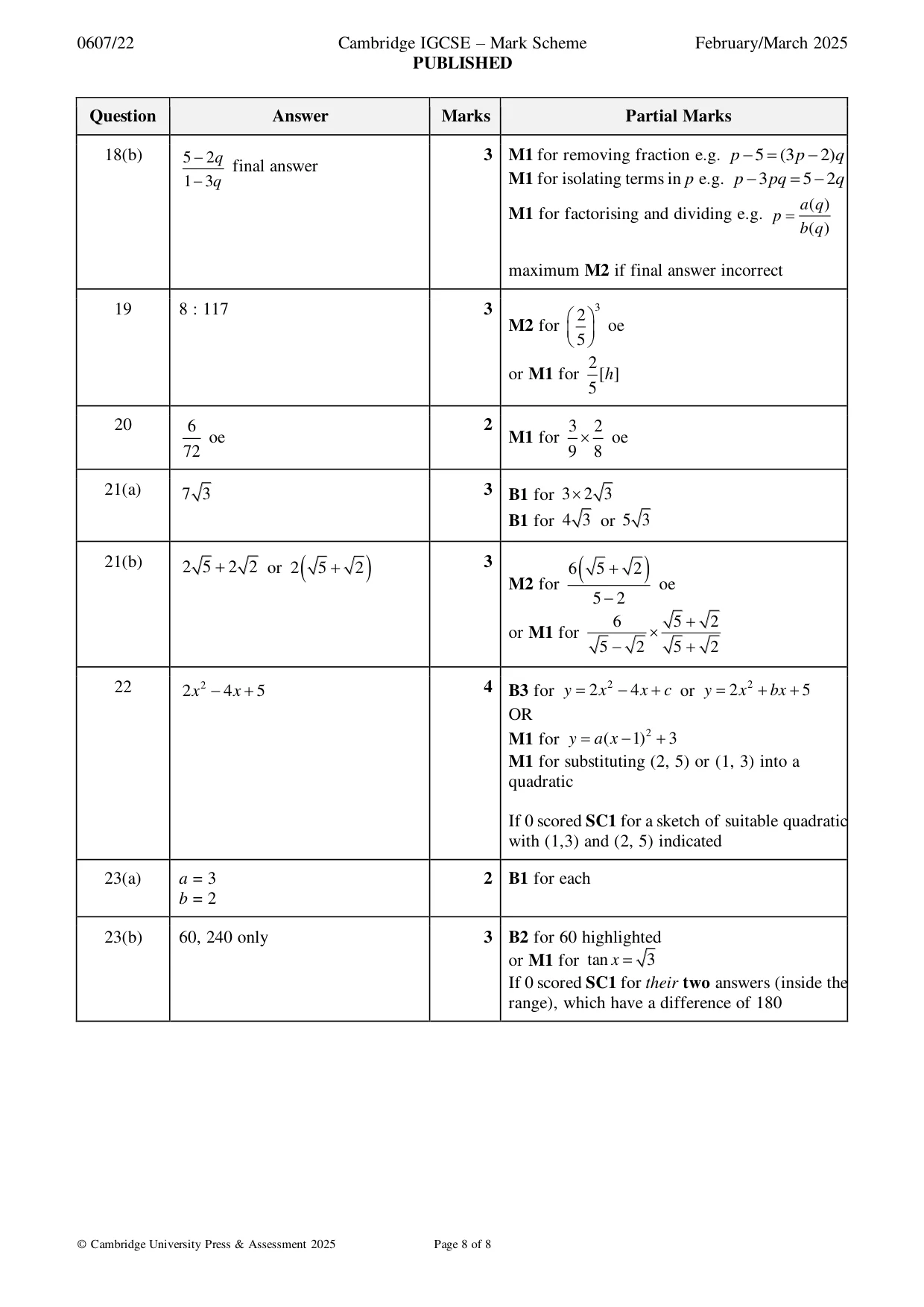
Mark scheme: 18(a) 4 c 2 + b final answer 2 B1 for a − b = ( 2c ) 2 oe 18(b) 5 − 2 q 3 M1 for removing fraction e.g. p −=5 (3 p − 2) q final answer 1 − 3q M1 for isolating terms in p e.g. p − 3 pq = 5 − 2q a ( q ) M1 for factorising and dividing e.g. p = b ( q ) maximum M2 if final answer incorrect
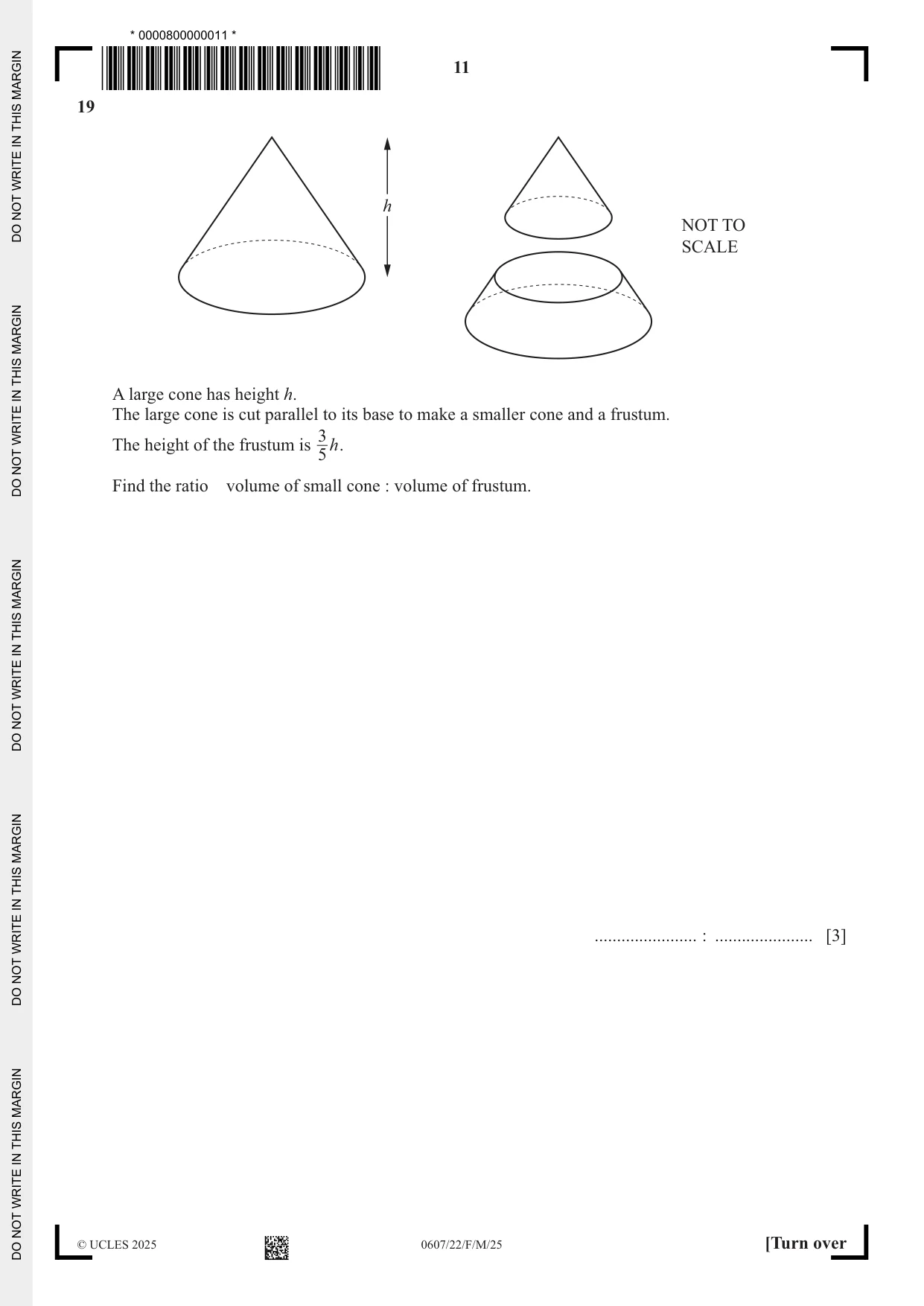
Q19 · H NOT TO SCALE A large cone has height h
19 h NOT TO SCALE A large cone has height h. The large cone is cut parallel to its base to make a smaller cone and a frustum. 3 The height of the frustum is h . 5 Find the ratio volume of small cone : volume of frustum. ....................... : ...................... [3]
Mark scheme: 19 8 : 117 3 3 2 M2 for oe 5 or M1 for 2[ h ] 5
Q20 · A box contains 2 yellow pencils, 3 blue pencils and 4 green pencils
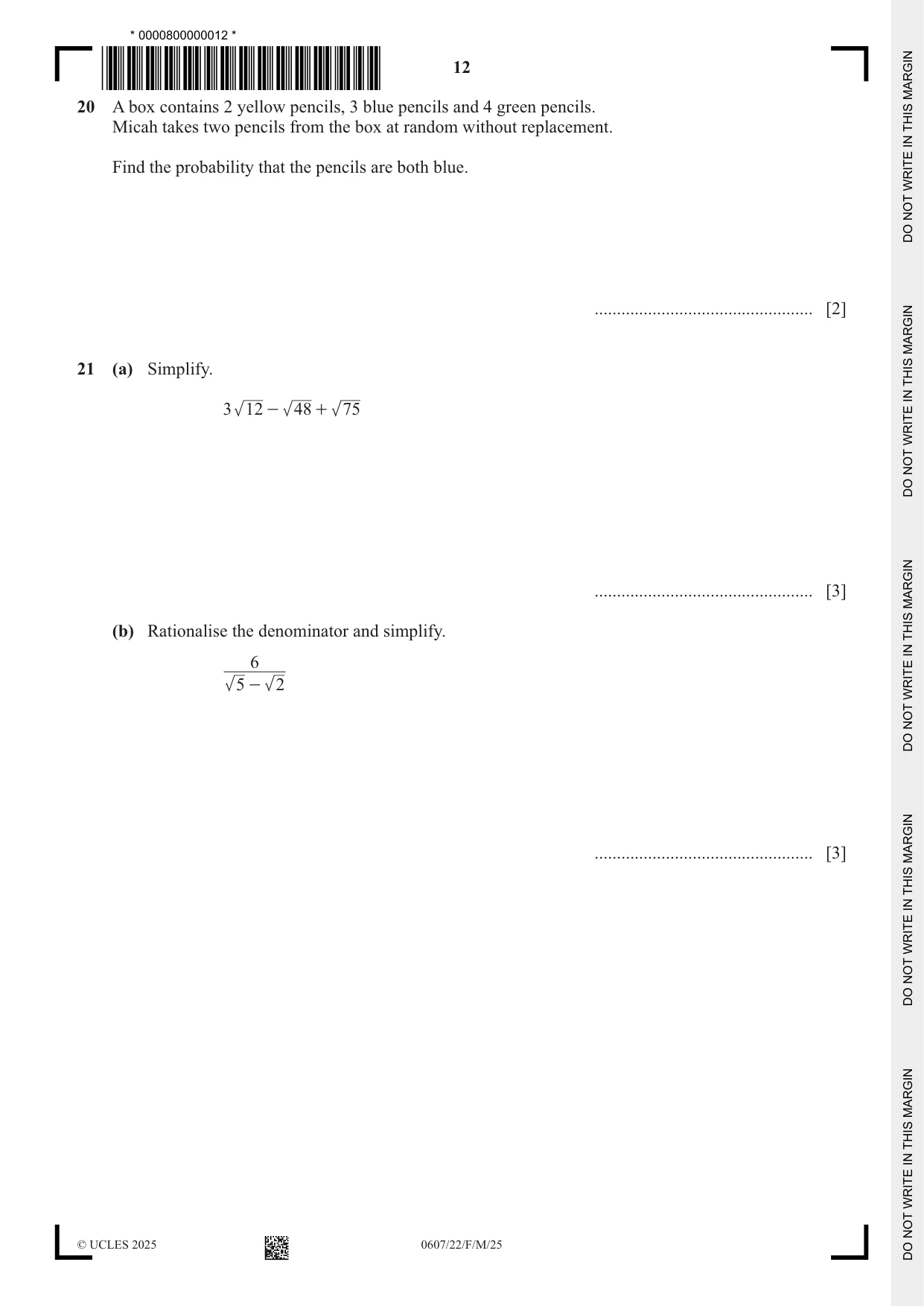
20 A box contains 2 yellow pencils, 3 blue pencils and 4 green pencils. Micah takes two pencils from the box at random without replacement. Find the probability that the pencils are both blue. ................................................. [2]
Mark scheme: 20 6 2 3 2 oe M1 for oe 72 9 8
Question 21
21 (a) Simplify. 3 12 - 48 + 75 ................................................. [3] (b) Rationalise the denominator and simplify. 6 5 - 2 ................................................. [3]
Mark scheme: 21(a) 7 3 3 B1 for 3 2 3 B1 for 4 3 or 5 3 21(b) 3 2 5 + 2 2 or 2 5 + 2 6 5 + 2 ( ) ( ) M2 for oe 5 − 2 6 5 + 2 or M1 for 5 − 2 5 + 2
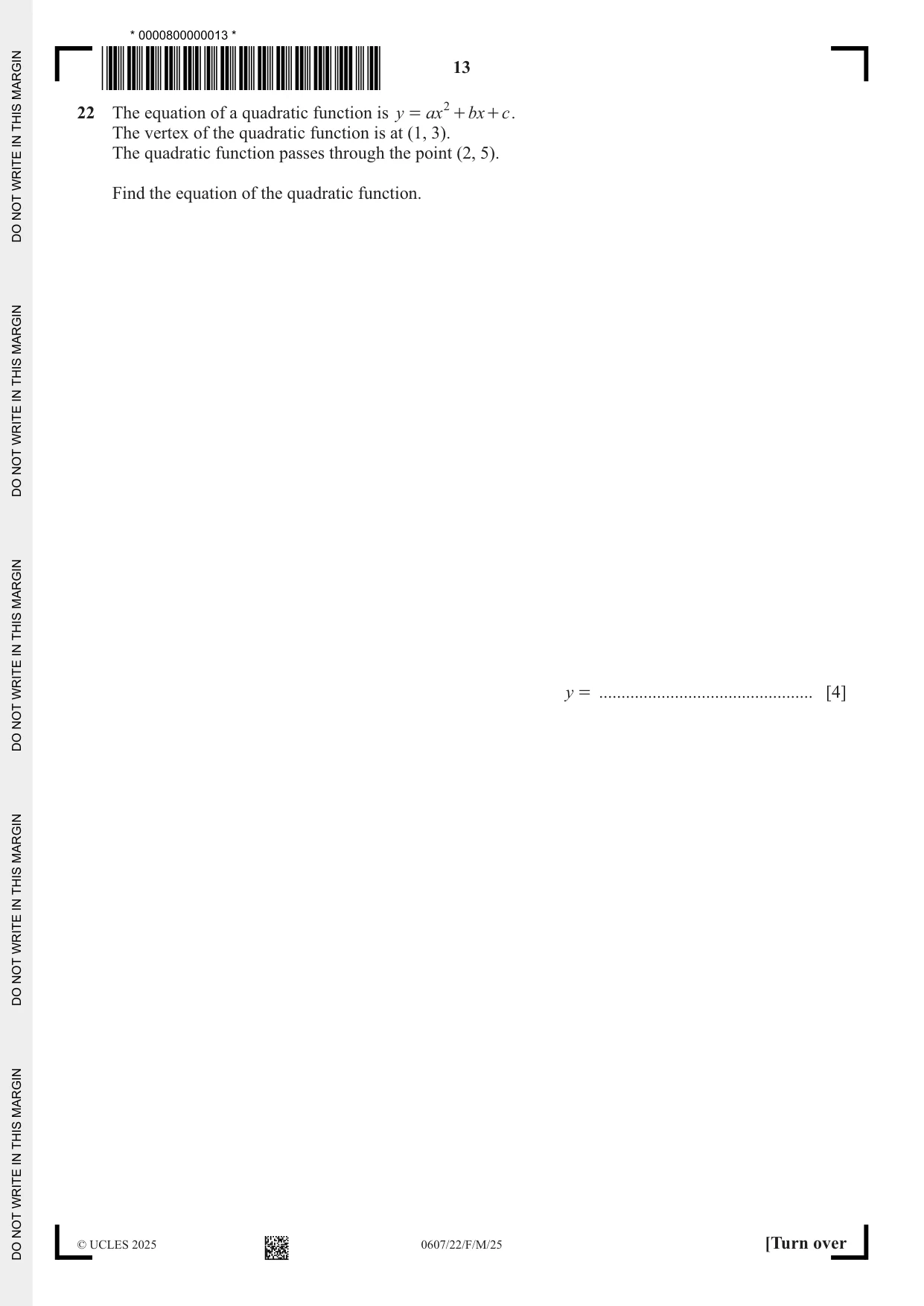
Q22 · The equation of a quadratic function is y = ax 2 + bx + c
22 The equation of a quadratic function is y = ax 2 + bx + c . The vertex of the quadratic function is at (1, 3). The quadratic function passes through the point (2, 5). Find the equation of the quadratic function. y = ................................................ [4]
Mark scheme: 22 2 x 2 − 4 x + 5 4 B3 for y = 2 x 2 − 4 x + c or y = 2 x 2 + bx + 5 OR M1 for y = a ( x − 1) 2 + 3 M1 for substituting (2, 5) or (1, 3) into a quadratic If 0 scored SC1 for a sketch of suitable quadratic with (1,3) and (2, 5) indicated
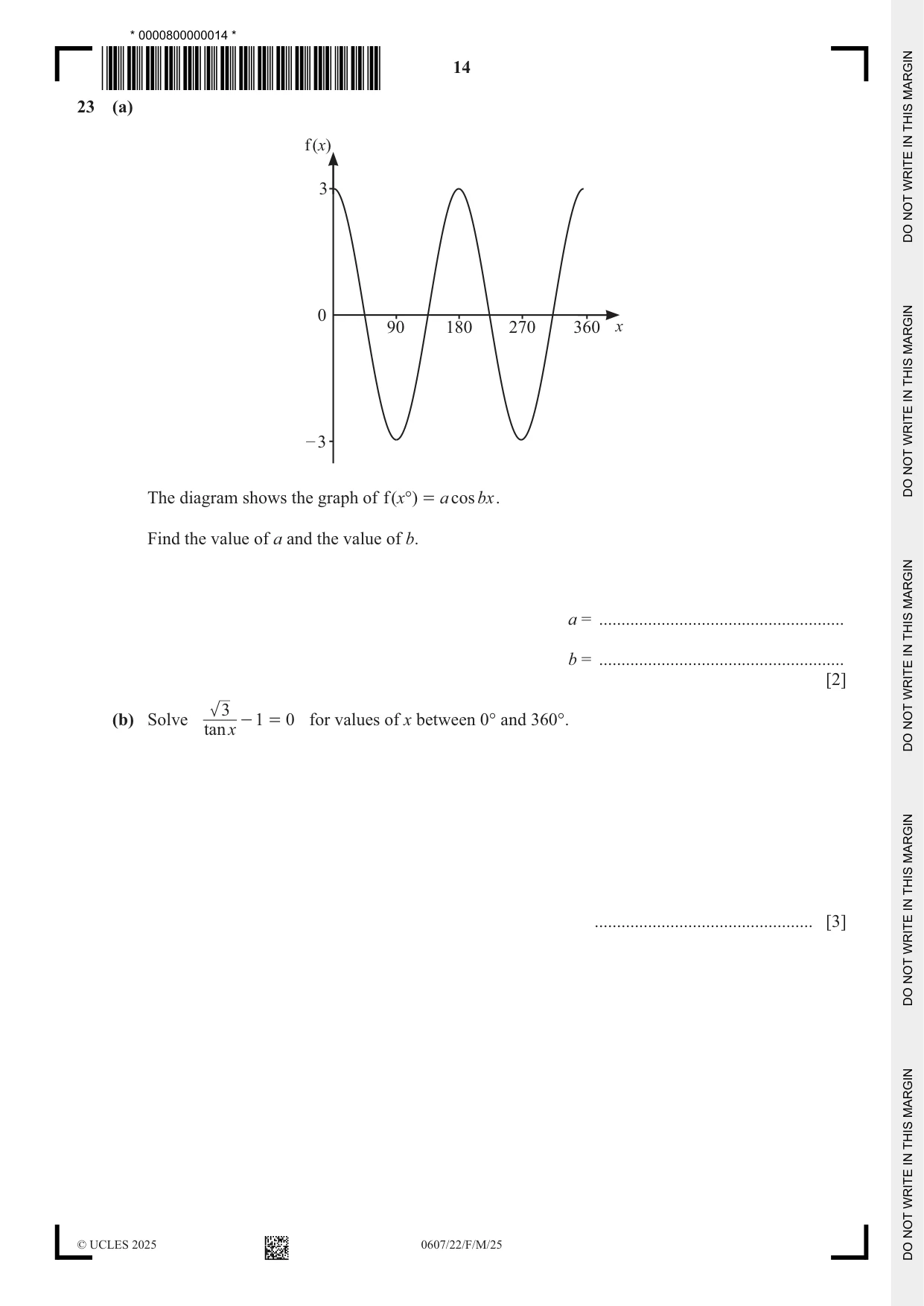
Q23 · F (x) 3 0 90 180 270 360 x – 3 The diagram shows the graph of f ( x°) = a cos bx
23 (a) f (x) 3 0 90 180 270 360 x – 3 The diagram shows the graph of f ( x°) = a cos bx . Find the value of a and the value of b. a = ....................................................... b = ....................................................... [2] 3 (b) Solve - 1 = 0 for values of x between 0° and 360°. tanx ................................................. [3]
Mark scheme: 23(a) a = 3 2 B1 for each b = 2 23(b) 60, 240 only 3 B2 for 60 highlighted or M1 for tan x = 3 If 0 scored SC1 for their two answers (inside the range), which have a difference of 180
What was in this paper
The subtopics covered by these 22 questions, and how many questions each got. Open one in a new tab to see every Cambridge question on it.
2Inequalities2Types of number2Averages and range1Equations1Equations of linear graphs1Estimation1Finding a quadratic function using1Introduction to probability1Powers and roots1Probability of combined events1Sequences1Sets1Similarity1Surds1Surface area and volume1Transformations1Trigonometric functions1Vectors in two dimensions1What you needed in this session
Cambridge’s own grade thresholds for 2025 Feb/March, Paper 2 · Variant 2. A higher threshold means an easier paper — the bar moves with how the cohort did.