Cambridge IGCSE Mathematics - International 0607 — 2020 May/June Paper 2 · Variant 3
0607/23/M/J/20 · 15 questions · 40 marks · ≈45 min
The question paper and its mark scheme, free to read here and free to download. This is Cambridge’s own paper, exactly as it was sat.
Question paper8 pages
Mark scheme5 pages
Answers below. Sit the paper first if you are practising.
Questions as text
Q1 · Write 0.047 996 correct to 4 decimal places
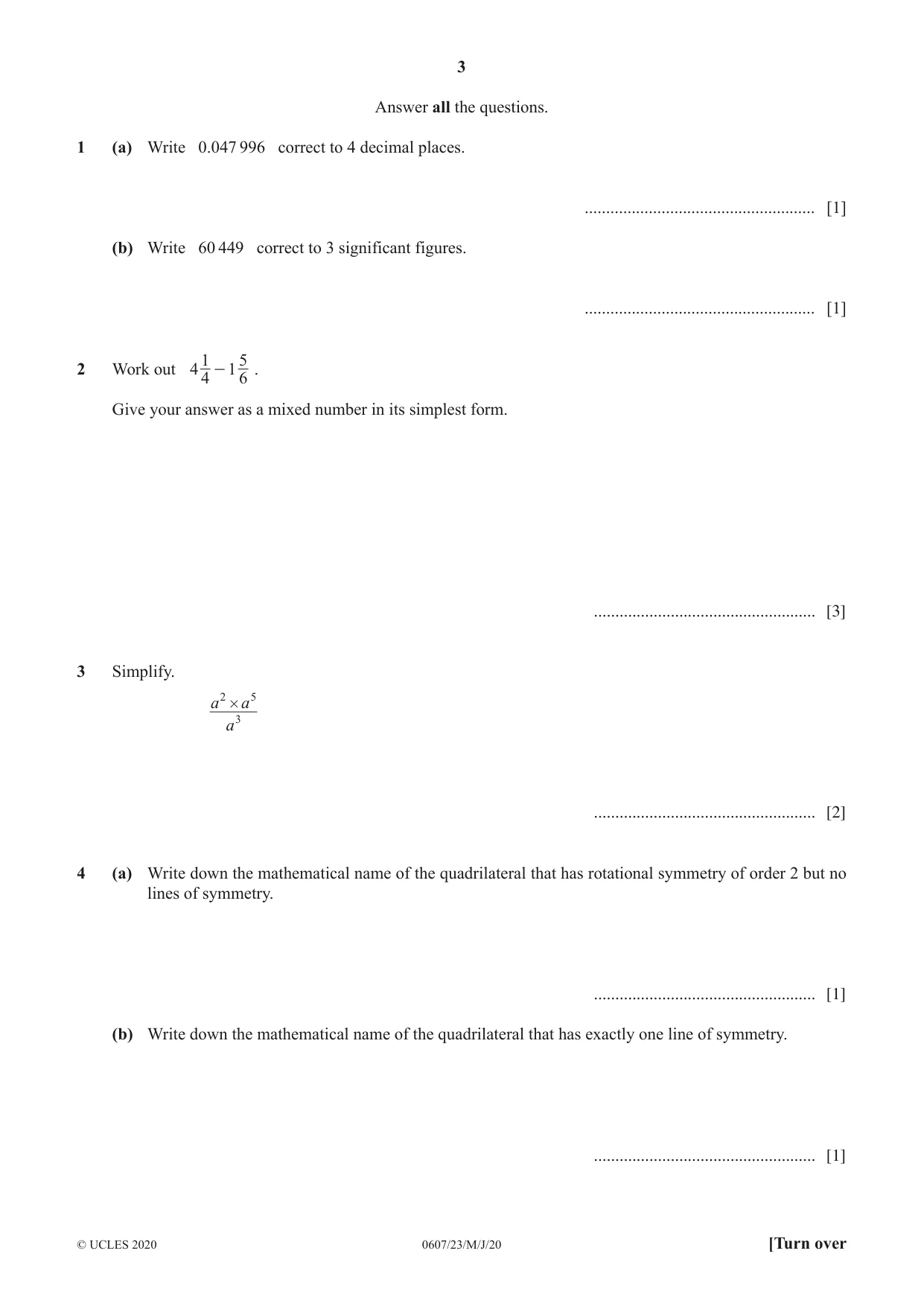
1 (a) Write 0.047 996 correct to 4 decimal places. ...................................................... [1] (b) Write 60 449 correct to 3 significant figures. ...................................................... [1]
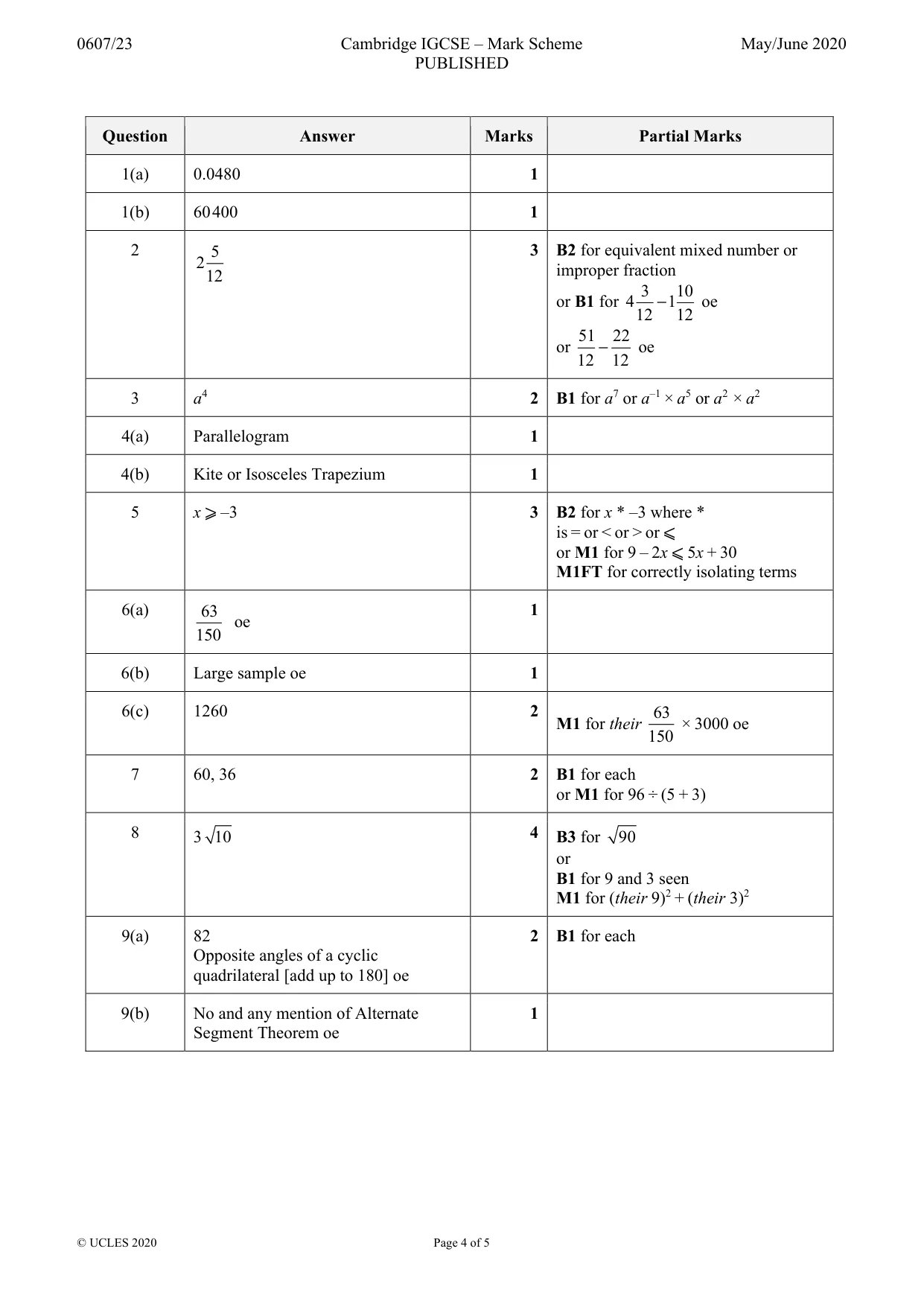
Mark scheme: Question Answer Marks Partial Marks 1(a) 0.0480 1 1(b) 60 400 1
Q2 · Work out 4 - 1
2 Work out 4 - 1 . 4 6 Give your answer as a mixed number in its simplest form. .................................................... [3]
Mark scheme: 2 5 3 B2 for equivalent mixed number or improper fraction 212 3 10 or B1 for 4 − 1 oe 12 12 51 22 or − oe 12 12
Question 3
3 Simplify. a 2 # a 5 a 3 .................................................... [2]
Mark scheme: 3 a4 2 B1 for a7 or a–1 × a5 or a2 × a2
Q4 · Write down the mathematical name of the quadrilateral that has rotational symmetry of…
4 (a) Write down the mathematical name of the quadrilateral that has rotational symmetry of order 2 but no lines of symmetry. .................................................... [1] (b) Write down the mathematical name of the quadrilateral that has exactly one line of symmetry. .................................................... [1]
Mark scheme: 4(a) Parallelogram 1 4(b) Kite or Isosceles Trapezium 1
Question 5
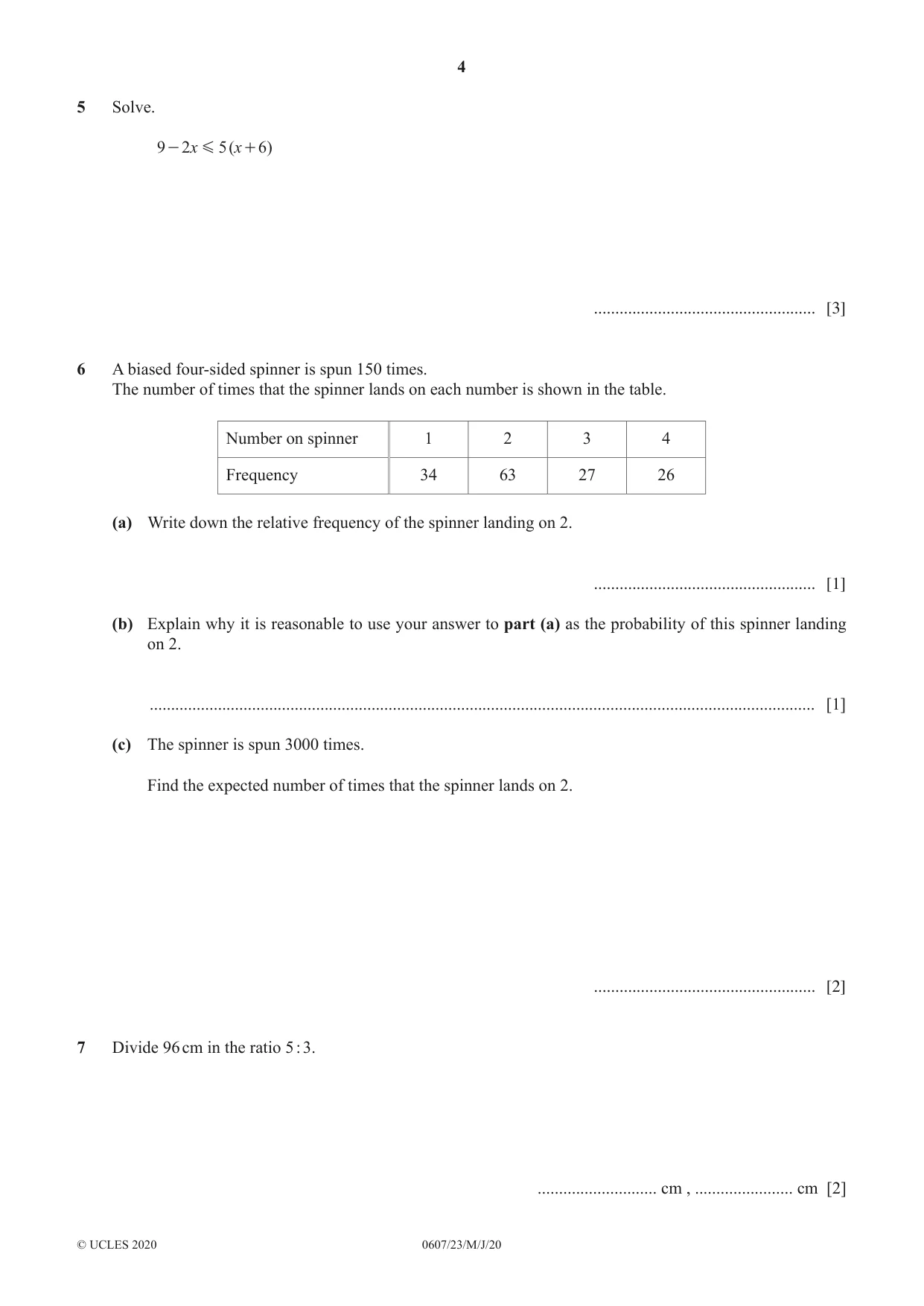
5 Solve. 9 - 2x G 5 (x + 6) .................................................... [3]
Mark scheme: 5 x ⩾ –3 3 B2 for x * –3 where * is = or < or > or ⩽ or M1 for 9 – 2x ⩽ 5x + 30 M1FT for correctly isolating terms
Q6 · A biased four-sided spinner is spun 150 times
6 A biased four-sided spinner is spun 150 times. The number of times that the spinner lands on each number is shown in the table. Number on spinner 1 2 3 4 Frequency 34 63 27 26 (a) Write down the relative frequency of the spinner landing on 2. .................................................... [1] (b) Explain why it is reasonable to use your answer to part (a) as the probability of this spinner landing on 2. ............................................................................................................................................................ [1] (c) The spinner is spun 3000 times. Find the expected number of times that the spinner lands on 2. .................................................... [2]
Mark scheme: 6(a) 63 1 oe 150 6(b) Large sample oe 1 6(c) 1260 2 63 M1 for their × 3000 oe 150
Q7 · Divide 96 cm in the ratio 5 : 3
7 Divide 96 cm in the ratio 5 : 3. ............................ cm , ....................... cm [2]
Mark scheme: 7 60, 36 2 B1 for each or M1 for 96 ÷ (5 + 3)
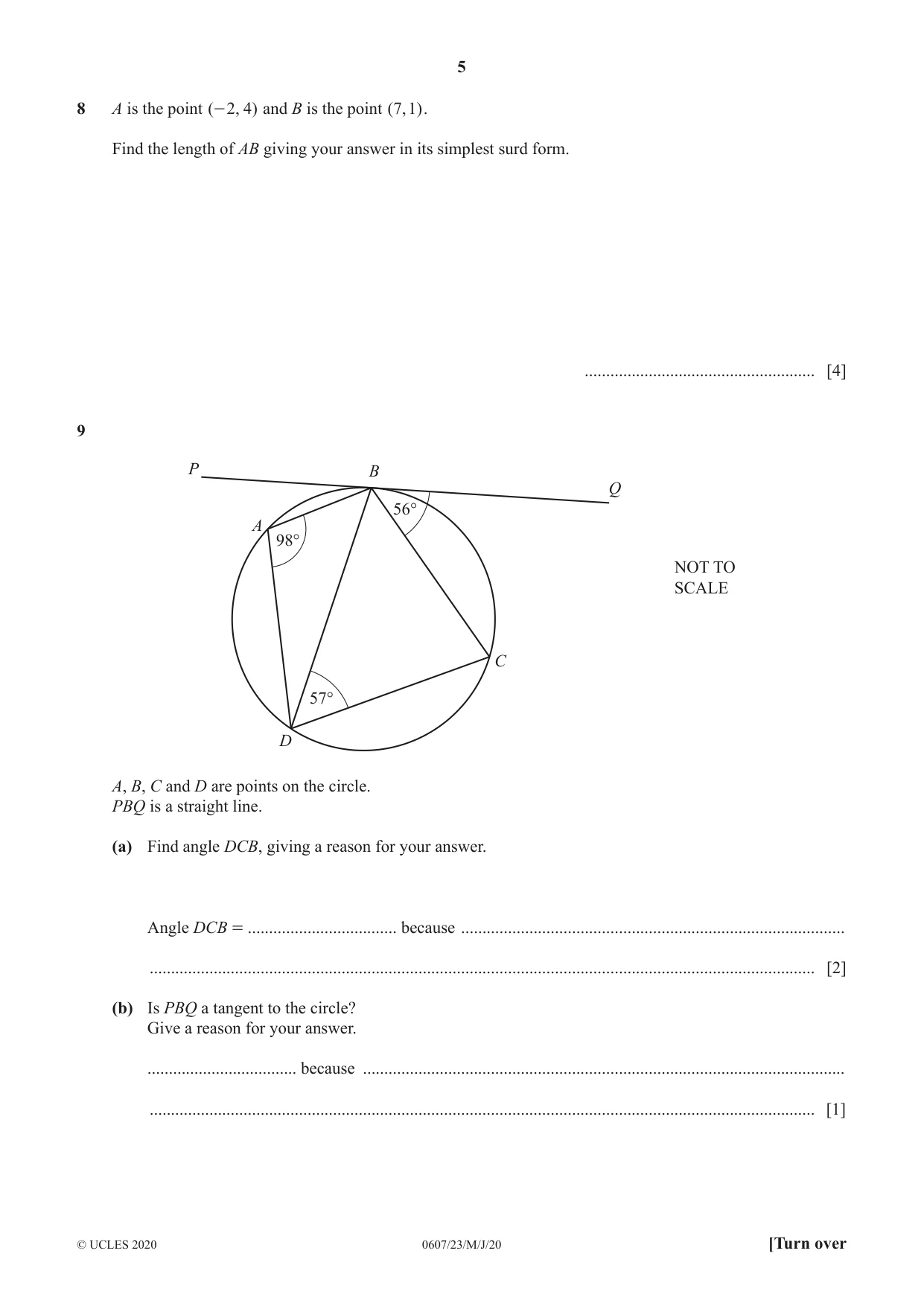
Q8 · A is the point (- 2, 4 ) and B is the point (7, 1 )
8 A is the point (- 2, 4 ) and B is the point (7, 1 ) . Find the length of AB giving your answer in its simplest surd form. ...................................................... [4]
Mark scheme: 8 3 10 4 B3 for 90 or B1 for 9 and 3 seen M1 for (their 9)2 + (their 3)2
Q9 · P B Q 56° A 98° NOT TO SCALE C 57° D A, B, C and D are points on the circle
9 P B Q 56° A 98° NOT TO SCALE C 57° D A, B, C and D are points on the circle. PBQ is a straight line. (a) Find angle DCB, giving a reason for your answer. Angle DCB = ................................... because .......................................................................................... ............................................................................................................................................................ [2] (b) Is PBQ a tangent to the circle? Give a reason for your answer. ................................... because ................................................................................................................. ............................................................................................................................................................ [1]
Mark scheme: 9(a) 82 2 B1 for each Opposite angles of a cyclic quadrilateral [add up to 180] oe 9(b) No and any mention of Alternate 1 Segment Theorem oe
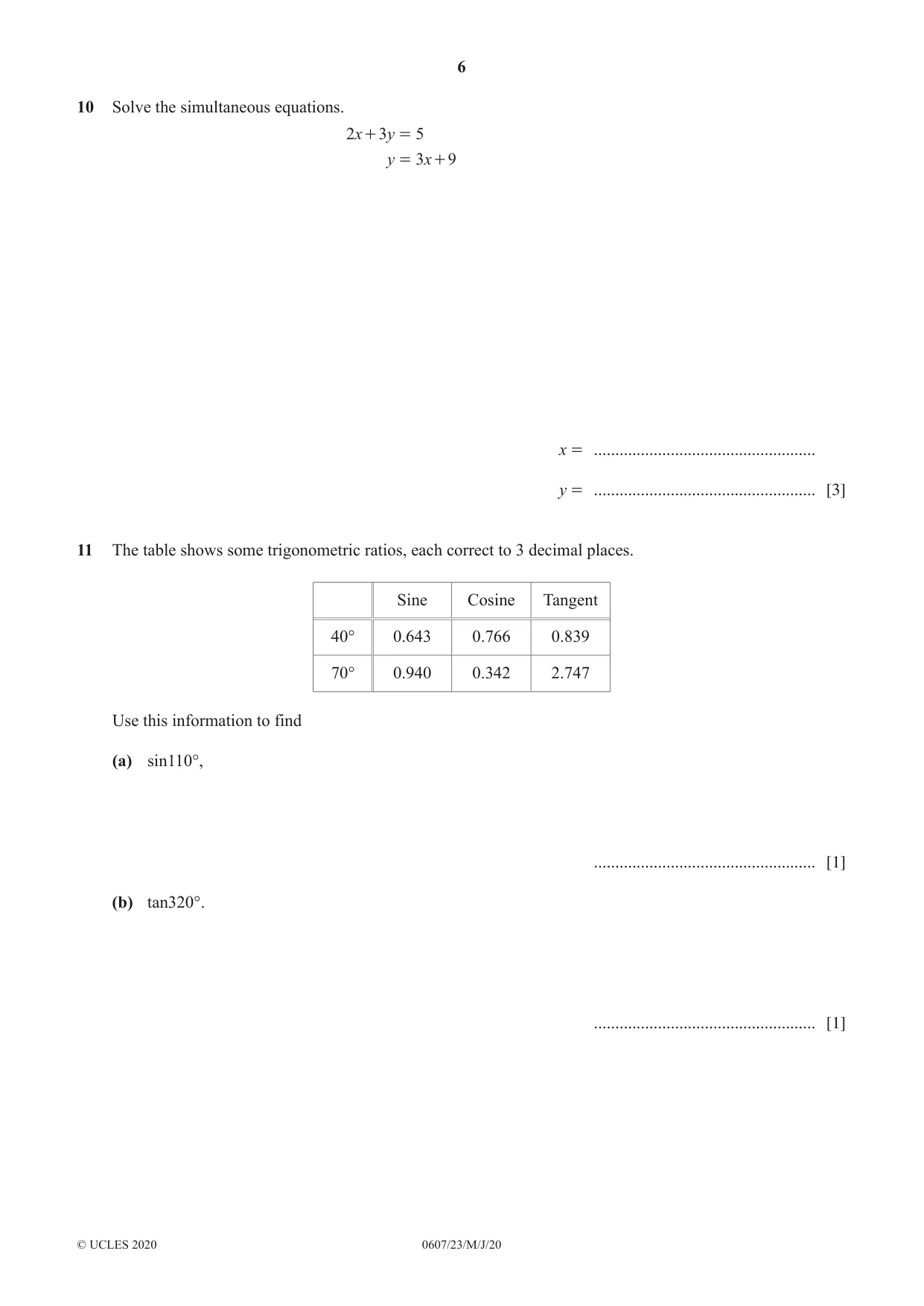
Q10 · Solve the simultaneous equations
10 Solve the simultaneous equations. 2x + 3y = 5 y = 3x + 9 x = .................................................... y = .................................................... [3]
Mark scheme: 10 x = –2, y = 3 3 M1 for correct equation in x or equalising coefficients of x or y and adding / subtracting appropriately. B1 for one correct solution If 0 scored, SC1 for a correct substitution and evaluation of the other variable
Q11 · The table shows some trigonometric ratios, each correct to 3 decimal places
11 The table shows some trigonometric ratios, each correct to 3 decimal places. Sine Cosine Tangent 40° 0.643 0.766 0.839 70° 0.940 0.342 2.747 Use this information to find (a) sin110°, .................................................... [1] (b) tan320°. .................................................... [1]
Mark scheme: 11(a) 0.940 1 11(b) –0.839 1
Question 12
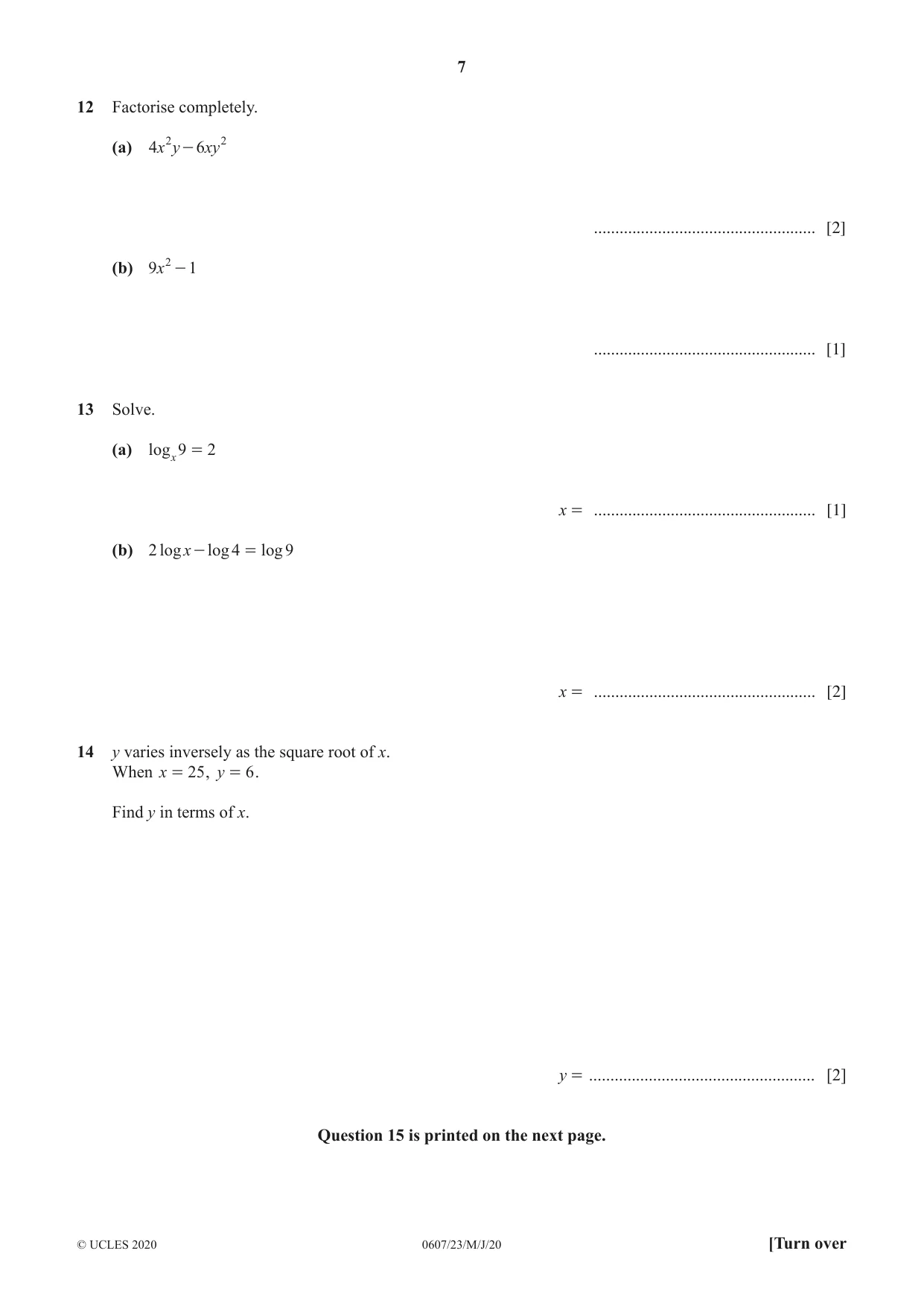
12 Factorise completely. (a) 4x 2 y - 6xy 2 .................................................... [2] (b) 9x 2 - 1 .................................................... [1]
Mark scheme: 12(a) 2xy(2x – 3y) 2 B1 for any correct partially factorised expression 12(b) (3x + 1)(3x – 1) 1
Question 13
13 Solve. (a) log x 9 = 2 x = .................................................... [1] (b) 2 log x - log 4 = log 9 x = .................................................... [2]
Mark scheme: 13(a) 3 1 13(b) 6 2 M1 for any correct use of a loga – log b = log or b loga + log b = log (a × b) or nloga = logan
Q14 · Y varies inversely as the square root of x
14 y varies inversely as the square root of x. When x = 25 , y = 6 . Find y in terms of x. y = ..................................................... [2] Question 15 is printed on the next page.
Mark scheme: 14 30 2 k y = M1 for y = oe x x
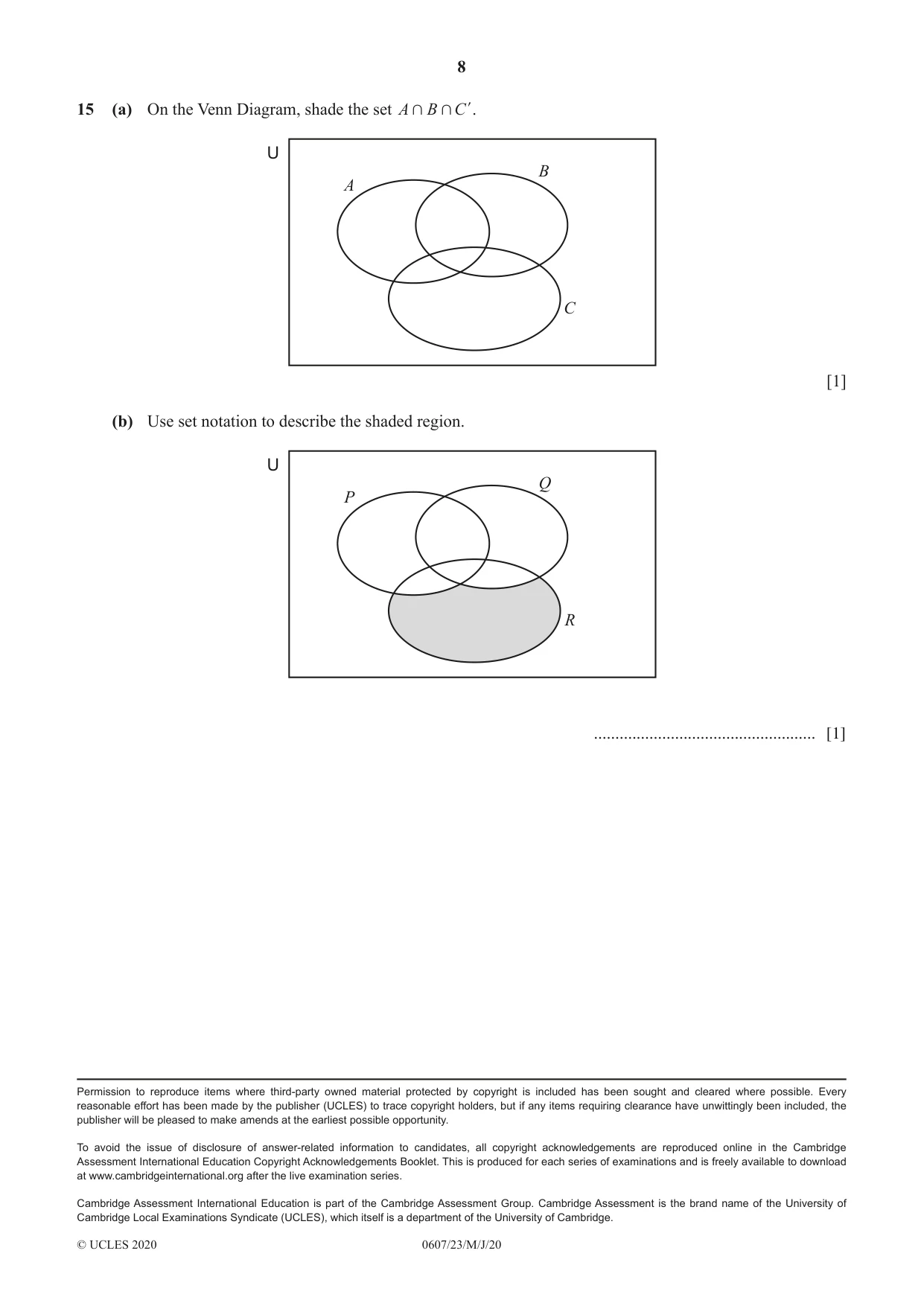
Q15 · On the Venn Diagram, shade the set A + B + C l
15 (a) On the Venn Diagram, shade the set A + B + C l. U B A C [1] (b) Use set notation to describe the shaded region. U Q P R .................................................... [1]
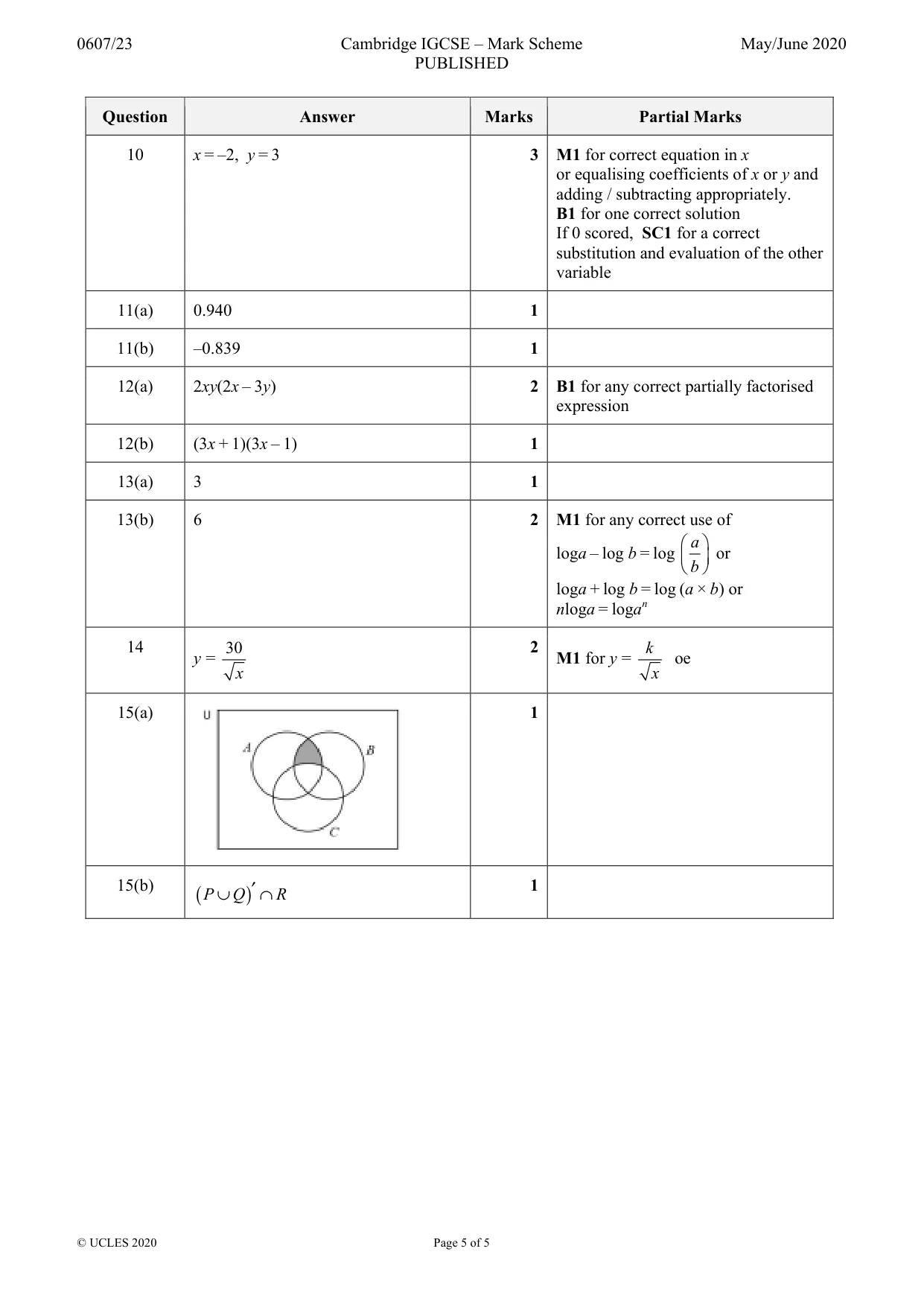
Mark scheme: 15(a) 1 15(b) ′ 1 ( P ∪ Q ) ∩ R
What was in this paper
The subtopics covered by these 15 questions, and how many questions each got. Open one in a new tab to see every Cambridge question on it.