Cambridge IGCSE Mathematics - International 0607 — 2011 May/June Paper 4 · Variant 2
0607/42/M/J/11 · 120 marks · ≈135 min
The question paper and its mark scheme, free to read here and free to download. This is Cambridge’s own paper, exactly as it was sat.
Question paper16 pages
Mark scheme5 pages
Answers below. Sit the paper first if you are practising.
Paper as text
Question paper, page 1
This document consists of 16 printed pages. IB11 06_0607_42/3RP © UCLES 2011 [Turn over *0755012000* For Examiner's Use UNIVERSITY OF CAMBRIDGE INTERNATIONAL EXAMINATIONS International General Certificate of Secondary Education CAMBRIDGE INTERNATIONAL MATHEMATICS 0607/42 Paper 4 (Extended) May/June 2011 2 hours 15 minutes Candidates answer on the Question Paper Additional Materials: Geometrical Instruments Graphics Calculator READ THESE INSTRUCTIONS FIRST Write your Centre number, candidate number and name on all the work you hand in. Write in dark blue or black pen. Do not use staples, paper clips, highlighters, glue or correction fluid. You may use a pencil for any diagrams or graphs. DO NOT WRITE IN ANY BARCODES. Answer all the questions. Unless instructed otherwise, give your answers exactly or correct to three significant figures as appropriate. Answers in degrees should be given to one decimal place. For π, use your calculator value. You must show all the relevant working to gain full marks and you will be given marks for correct methods, including sketches, even if your answer is incorrect. The number of marks is given in brackets [ ] at the end of each question or part question. The total number of marks for this paper is 120. www.XtremePapers.com
Question paper, page 2
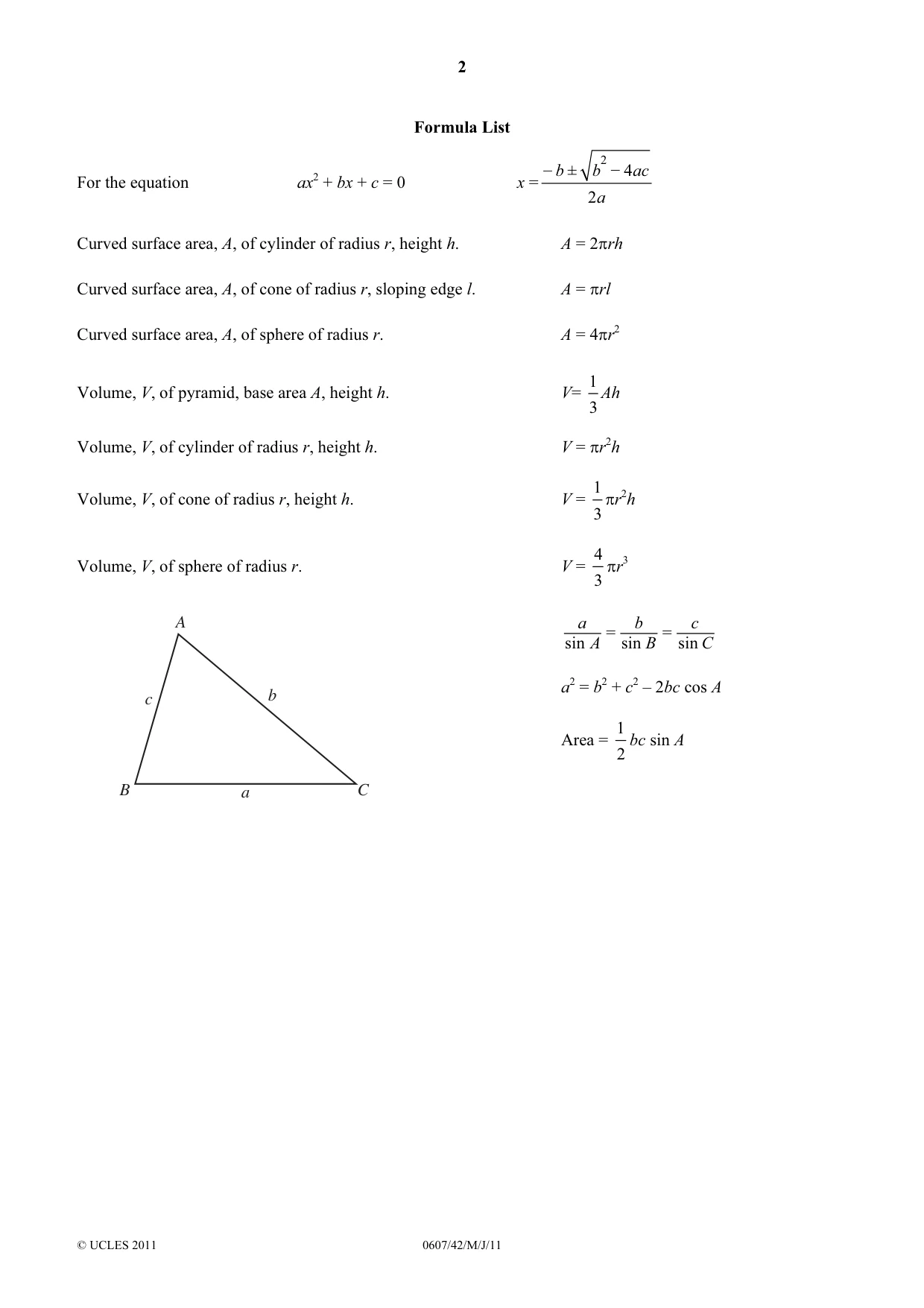
2 © UCLES 2011 0607/42/M/J/11 Formula List For the equation ax2 + bx + c = 0 x = 2 _ ± 4 2 _ b b ac a Curved surface area, A, of cylinder of radius r, height h. A = 2πrh Curved surface area, A, of cone of radius r, sloping edge l. A = πrl Curved surface area, A, of sphere of radius r. A = 4πr2 Volume, V, of pyramid, base area A, height h. V= 1 3 Ah Volume, V, of cylinder of radius r, height h. V = πr2h Volume, V, of cone of radius r, height h. V = 1 3 πr2h Volume, V, of sphere of radius r. V = 4 3 πr3 = = sin sin sin a b c A B C a2 = b2 + c2 – 2bc cos A Area = 1 2 bc sin A A a B C b c
Question paper, page 3
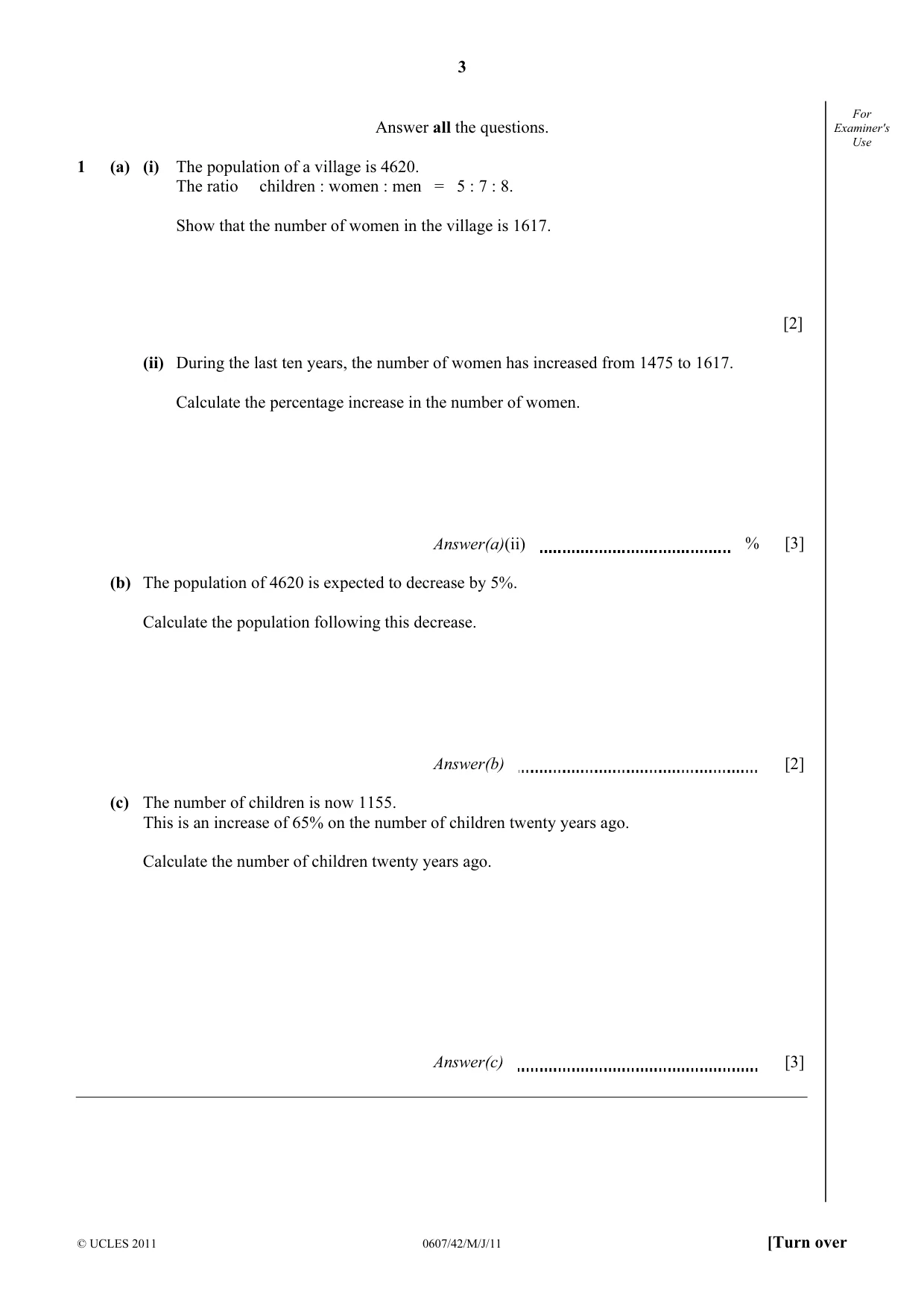
3 © UCLES 2011 0607/42/M/J/11 [Turn over For Examiner's Use Answer all the questions. 1 (a) (i) The population of a village is 4620. The ratio children : women : men = 5 : 7 : 8. Show that the number of women in the village is 1617. [2] (ii) During the last ten years, the number of women has increased from 1475 to 1617. Calculate the percentage increase in the number of women. Answer(a)(ii) % [3] (b) The population of 4620 is expected to decrease by 5%. Calculate the population following this decrease. Answer(b) [2] (c) The number of children is now 1155. This is an increase of 65% on the number of children twenty years ago. Calculate the number of children twenty years ago. Answer(c) [3]
Question paper, page 4
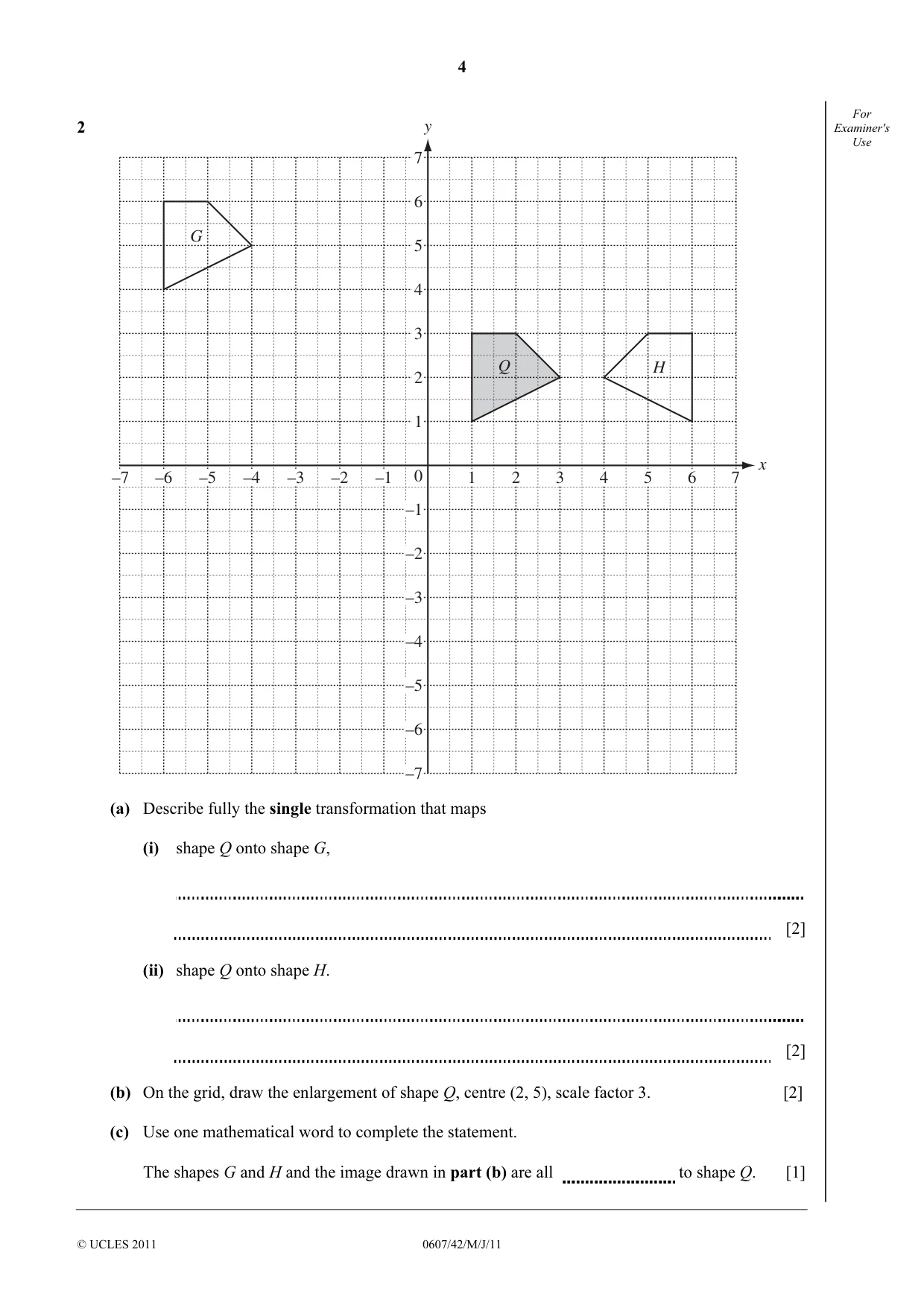
4 © UCLES 2011 0607/42/M/J/11 For Examiner's Use 2 (a) Describe fully the single transformation that maps (i) shape Q onto shape G, [2] (ii) shape Q onto shape H. [2] (b) On the grid, draw the enlargement of shape Q, centre (2, 5), scale factor 3. [2] (c) Use one mathematical word to complete the statement. The shapes G and H and the image drawn in part (b) are all to shape Q. [1] G Q H 7 6 5 4 3 2 1 –1 –2 –3 –4 –5 –6 –7 0 –6 –7 –5 –4 –3 –2 –1 1 2 3 4 5 6 7 y x
Question paper, page 5
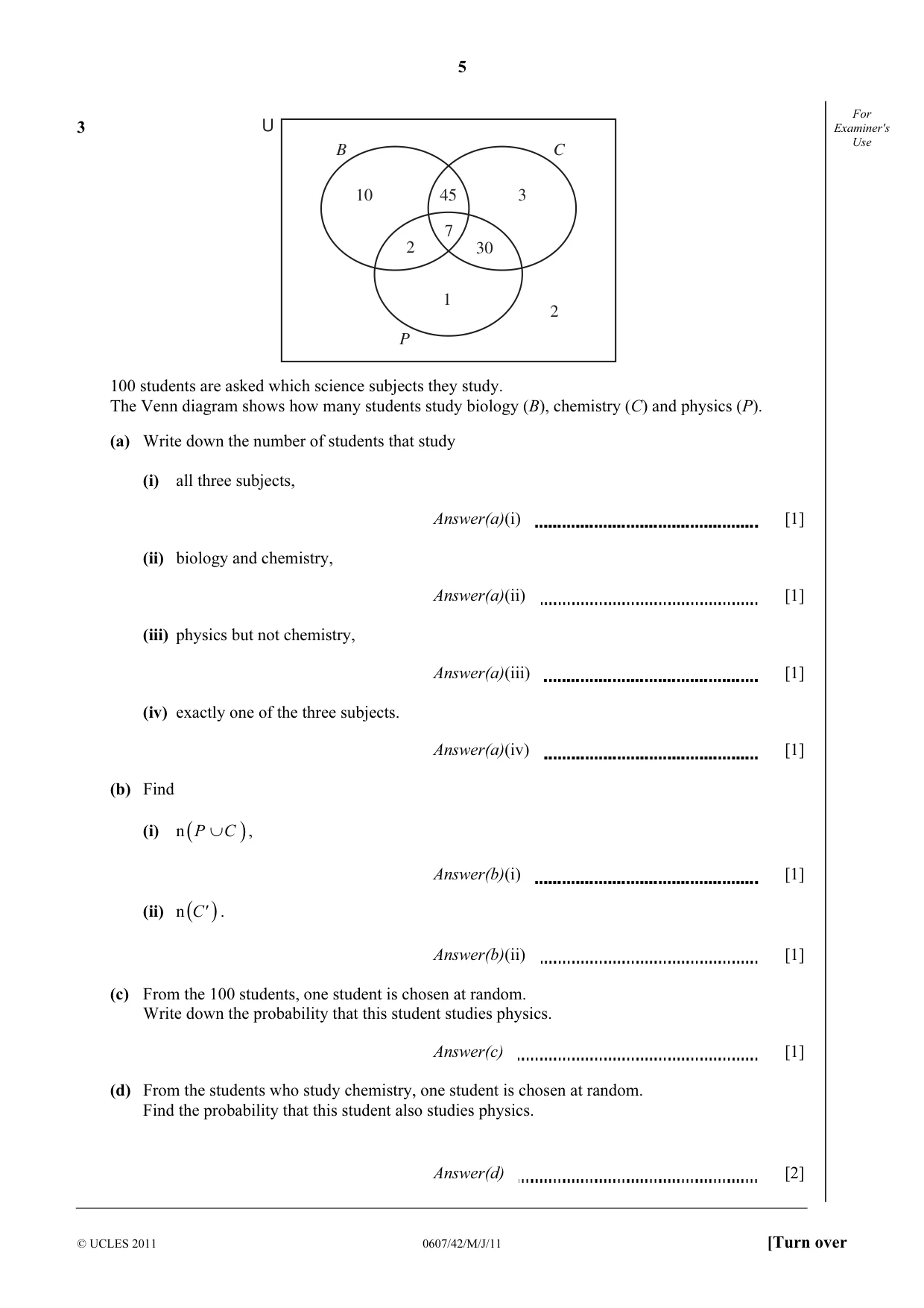
5 © UCLES 2011 0607/42/M/J/11 [Turn over For Examiner's Use 3 100 students are asked which science subjects they study. The Venn diagram shows how many students study biology (B), chemistry (C) and physics (P). (a) Write down the number of students that study (i) all three subjects, Answer(a)(i) [1] (ii) biology and chemistry, Answer(a)(ii) [1] (iii) physics but not chemistry, Answer(a)(iii) [1] (iv) exactly one of the three subjects. Answer(a)(iv) [1] (b) Find (i) n( ) P C ∪ , Answer(b)(i) [1] (ii) n( ) C' . Answer(b)(ii) [1] (c) From the 100 students, one student is chosen at random. Write down the probability that this student studies physics. Answer(c) [1] (d) From the students who study chemistry, one student is chosen at random. Find the probability that this student also studies physics. Answer(d) [2] U B C P 2 1 30 7 2 10 45 3
Question paper, page 6
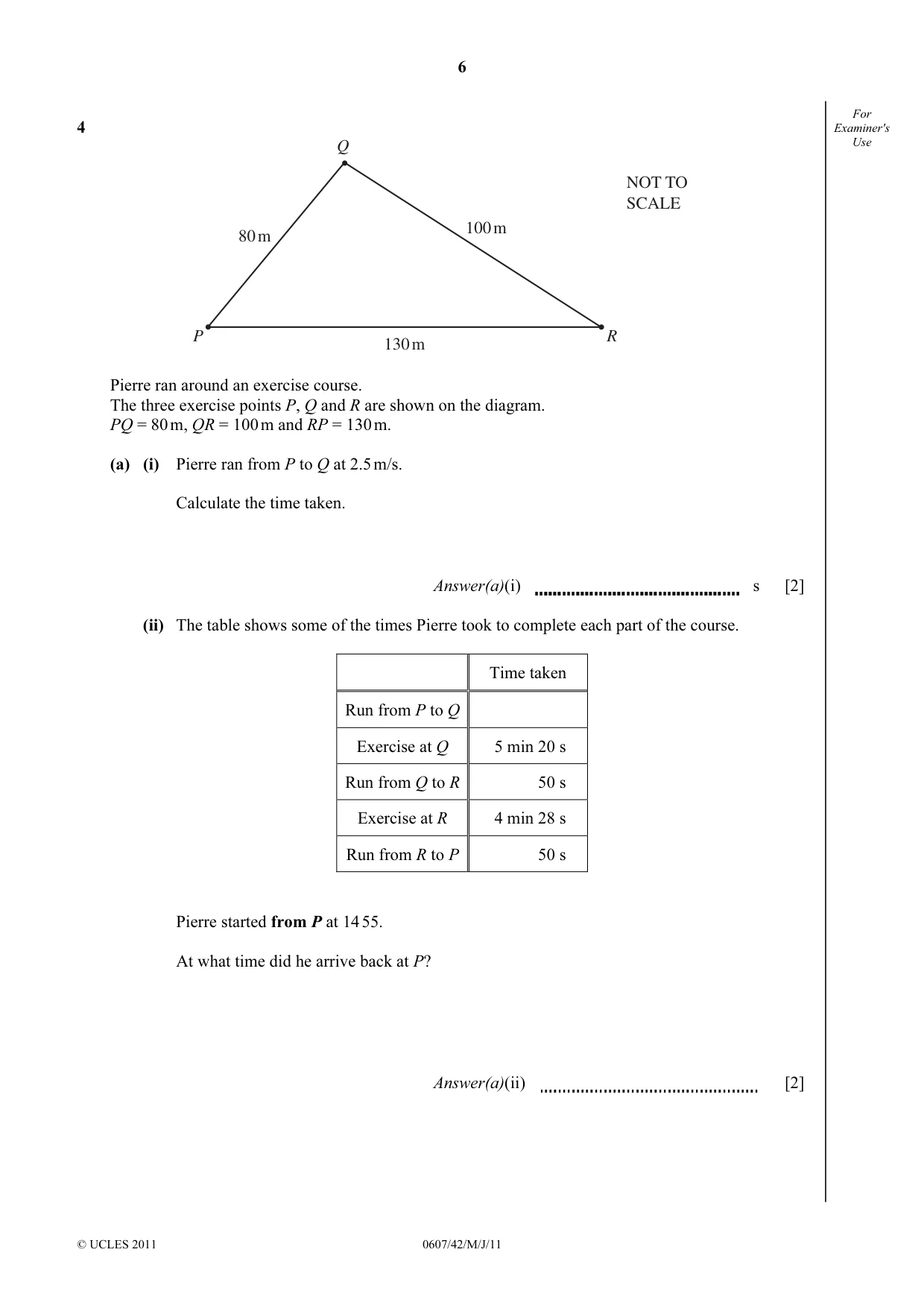
6 © UCLES 2011 0607/42/M/J/11 For Examiner's Use 4 Q P R 100 m 130 m 80 m NOT TO SCALE Pierre ran around an exercise course. The three exercise points P, Q and R are shown on the diagram. PQ = 80 m, QR = 100 m and RP = 130 m. (a) (i) Pierre ran from P to Q at 2.5 m/s. Calculate the time taken. Answer(a)(i) s [2] (ii) The table shows some of the times Pierre took to complete each part of the course. Time taken Run from P to Q Exercise at Q 5 min 20 s Run from Q to R 50 s Exercise at R 4 min 28 s Run from R to P 50 s Pierre started from P at 14 55. At what time did he arrive back at P? Answer(a)(ii) [2]
Question paper, page 7
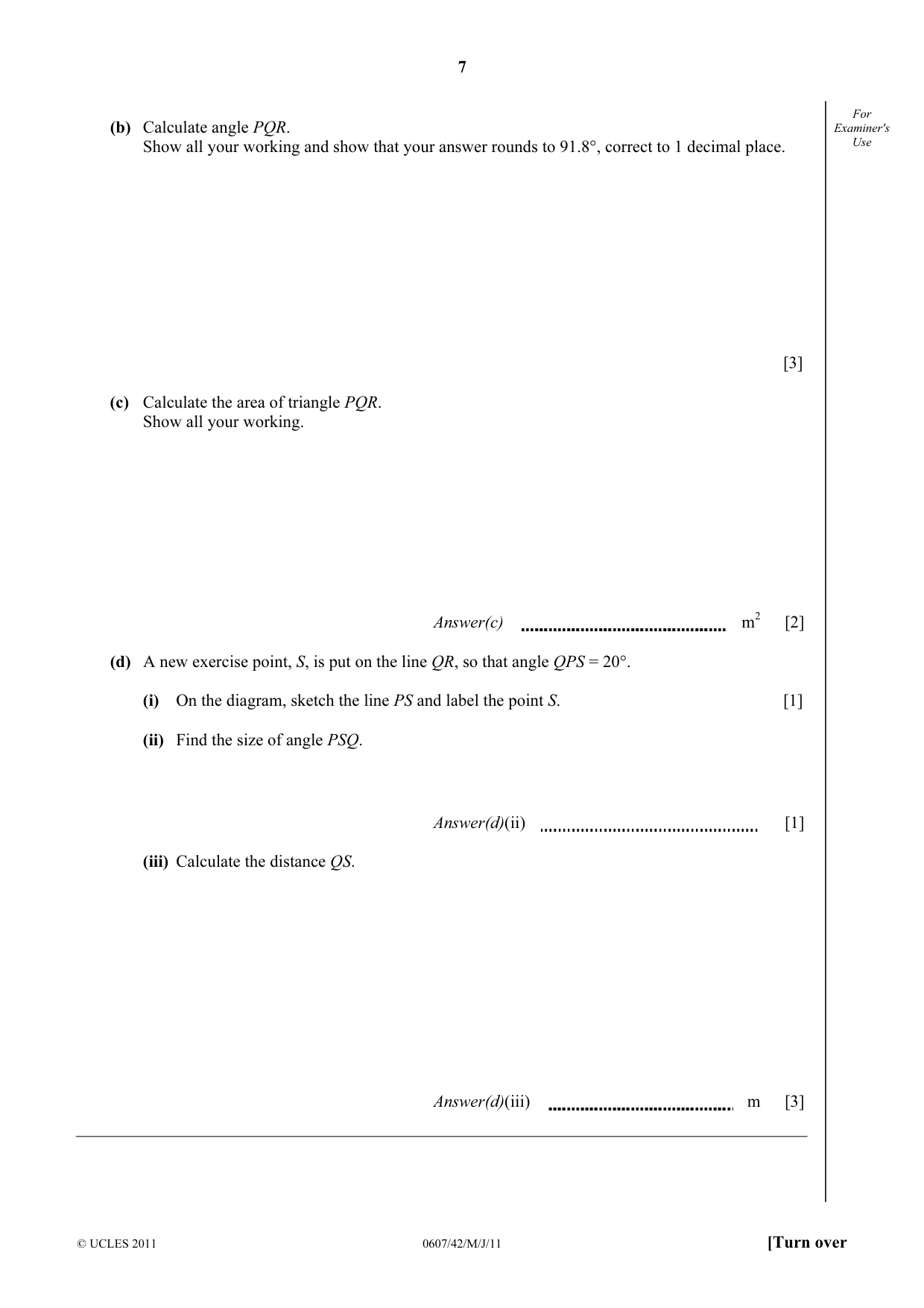
7 © UCLES 2011 0607/42/M/J/11 [Turn over For Examiner's Use (b) Calculate angle PQR. Show all your working and show that your answer rounds to 91.8°, correct to 1 decimal place. [3] (c) Calculate the area of triangle PQR. Show all your working. Answer(c) m2 [2] (d) A new exercise point, S, is put on the line QR, so that angle QPS = 20°. (i) On the diagram, sketch the line PS and label the point S. [1] (ii) Find the size of angle PSQ. Answer(d)(ii) [1] (iii) Calculate the distance QS. Answer(d)(iii) m [3]
Question paper, page 8
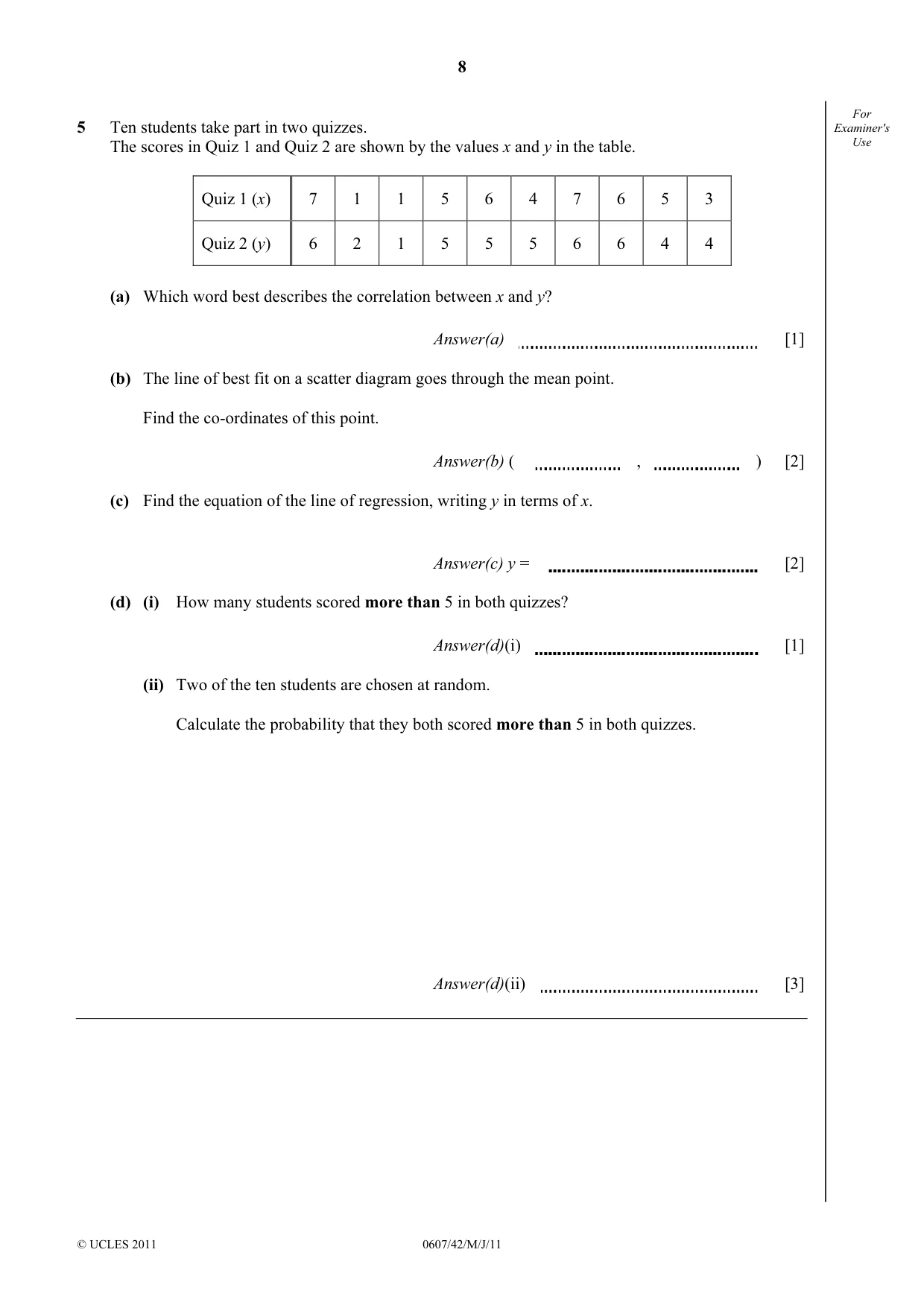
8 © UCLES 2011 0607/42/M/J/11 For Examiner's Use 5 Ten students take part in two quizzes. The scores in Quiz 1 and Quiz 2 are shown by the values x and y in the table. Quiz 1 (x) 7 1 1 5 6 4 7 6 5 3 Quiz 2 (y) 6 2 1 5 5 5 6 6 4 4 (a) Which word best describes the correlation between x and y? Answer(a) [1] (b) The line of best fit on a scatter diagram goes through the mean point. Find the co-ordinates of this point. Answer(b) ( , ) [2] (c) Find the equation of the line of regression, writing y in terms of x. Answer(c) y = [2] (d) (i) How many students scored more than 5 in both quizzes? Answer(d)(i) [1] (ii) Two of the ten students are chosen at random. Calculate the probability that they both scored more than 5 in both quizzes. Answer(d)(ii) [3]
Question paper, page 9
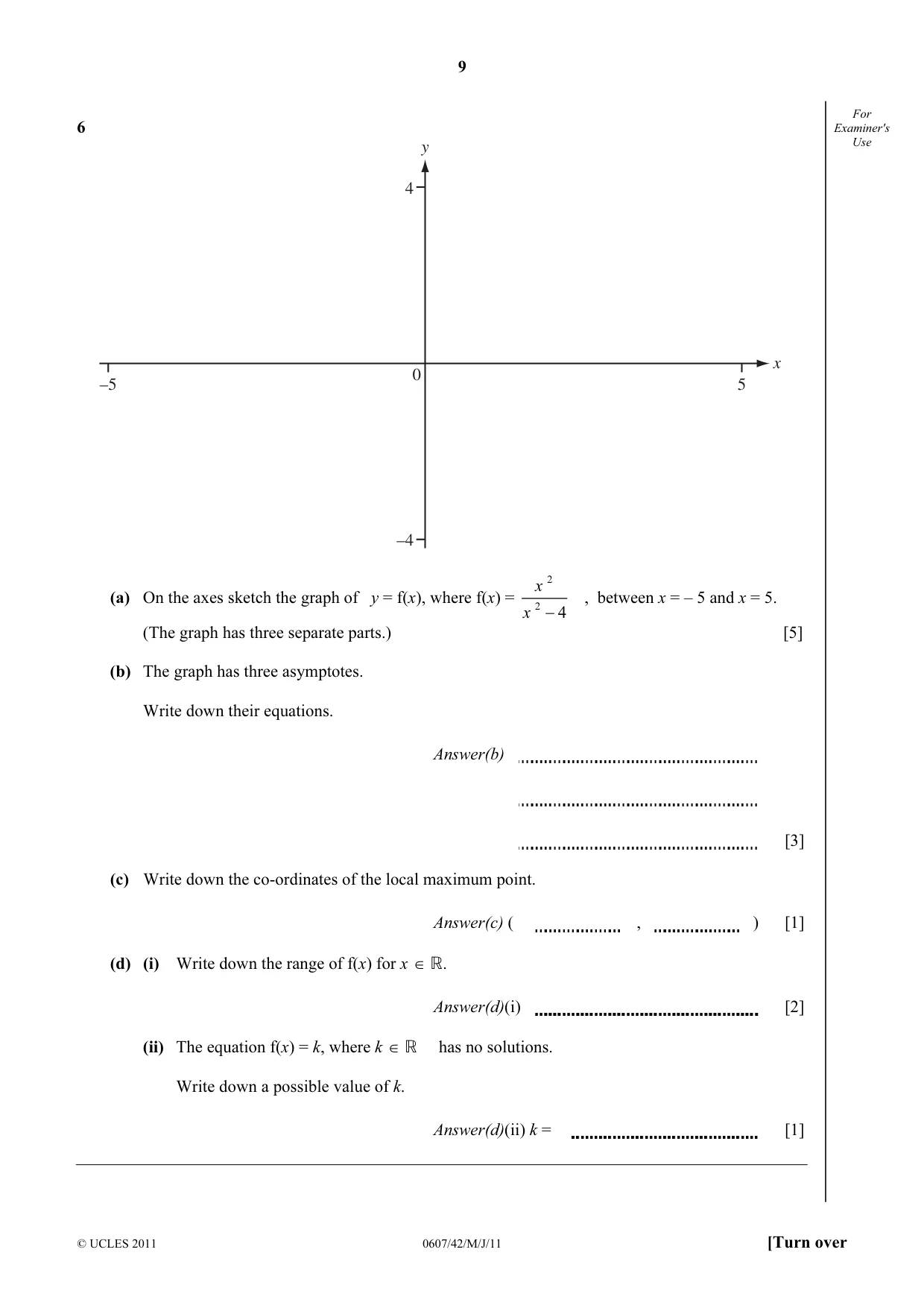
9 © UCLES 2011 0607/42/M/J/11 [Turn over For Examiner's Use 6 y x 4 –4 –5 5 0 (a) On the axes sketch the graph of y = f(x), where f(x) = 2 2 4 x x − , between x = – 5 and x = 5. (The graph has three separate parts.) [5] (b) The graph has three asymptotes. Write down their equations. Answer(b) [3] (c) Write down the co-ordinates of the local maximum point. Answer(c) ( , ) [1] (d) (i) Write down the range of f(x) for x ∈ o. Answer(d)(i) [2] (ii) The equation f(x) = k, where k ∈ o has no solutions. Write down a possible value of k. Answer(d)(ii) k = [1]
Question paper, page 10
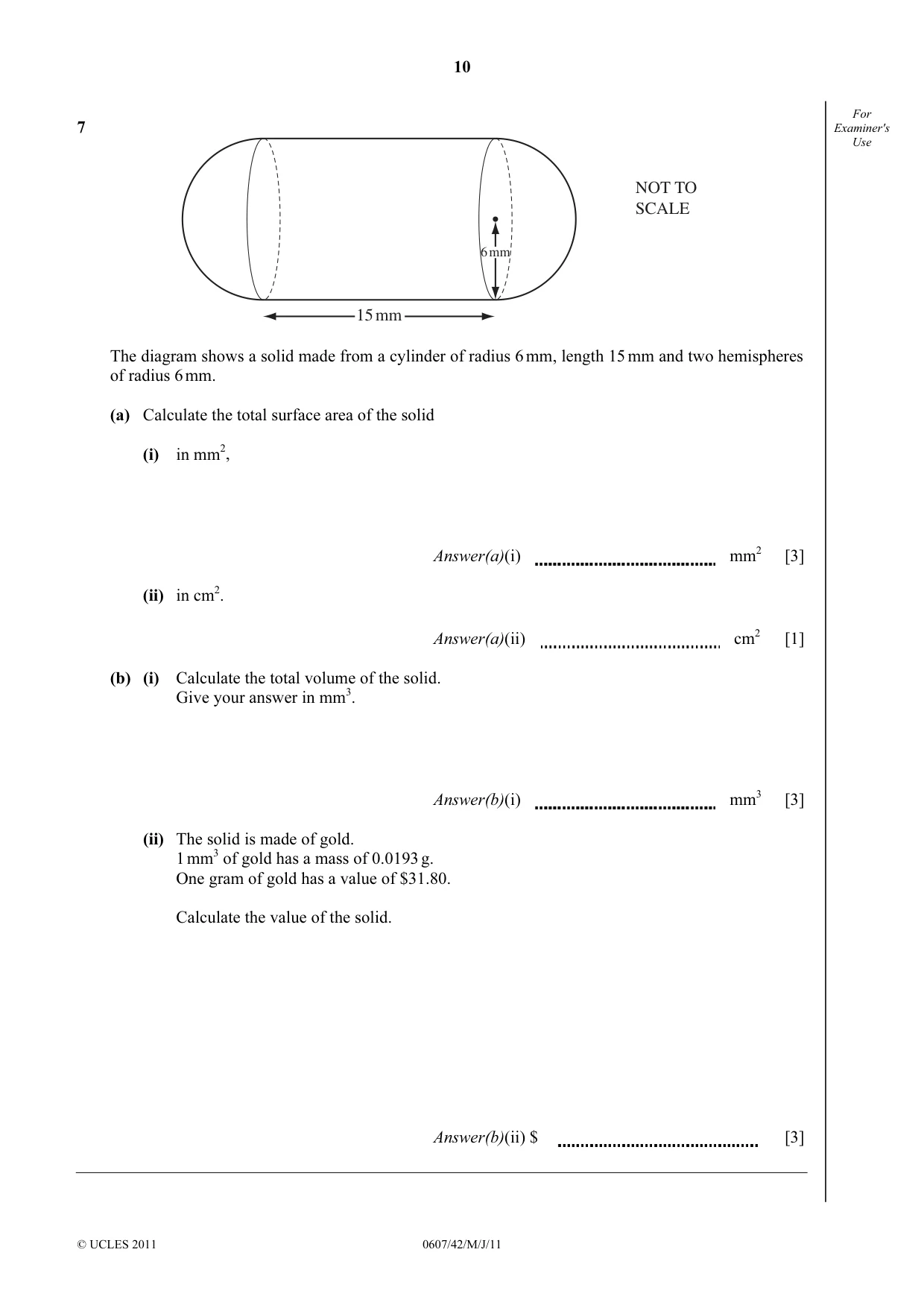
10 © UCLES 2011 0607/42/M/J/11 For Examiner's Use 7 6 mm 15 mm NOT TO SCALE The diagram shows a solid made from a cylinder of radius 6 mm, length 15 mm and two hemispheres of radius 6 mm. (a) Calculate the total surface area of the solid (i) in mm2, Answer(a)(i) mm2 [3] (ii) in cm2. Answer(a)(ii) cm2 [1] (b) (i) Calculate the total volume of the solid. Give your answer in mm3. Answer(b)(i) mm3 [3] (ii) The solid is made of gold. 1 mm3 of gold has a mass of 0.0193 g. One gram of gold has a value of $31.80. Calculate the value of the solid. Answer(b)(ii) $ [3]
Question paper, page 11
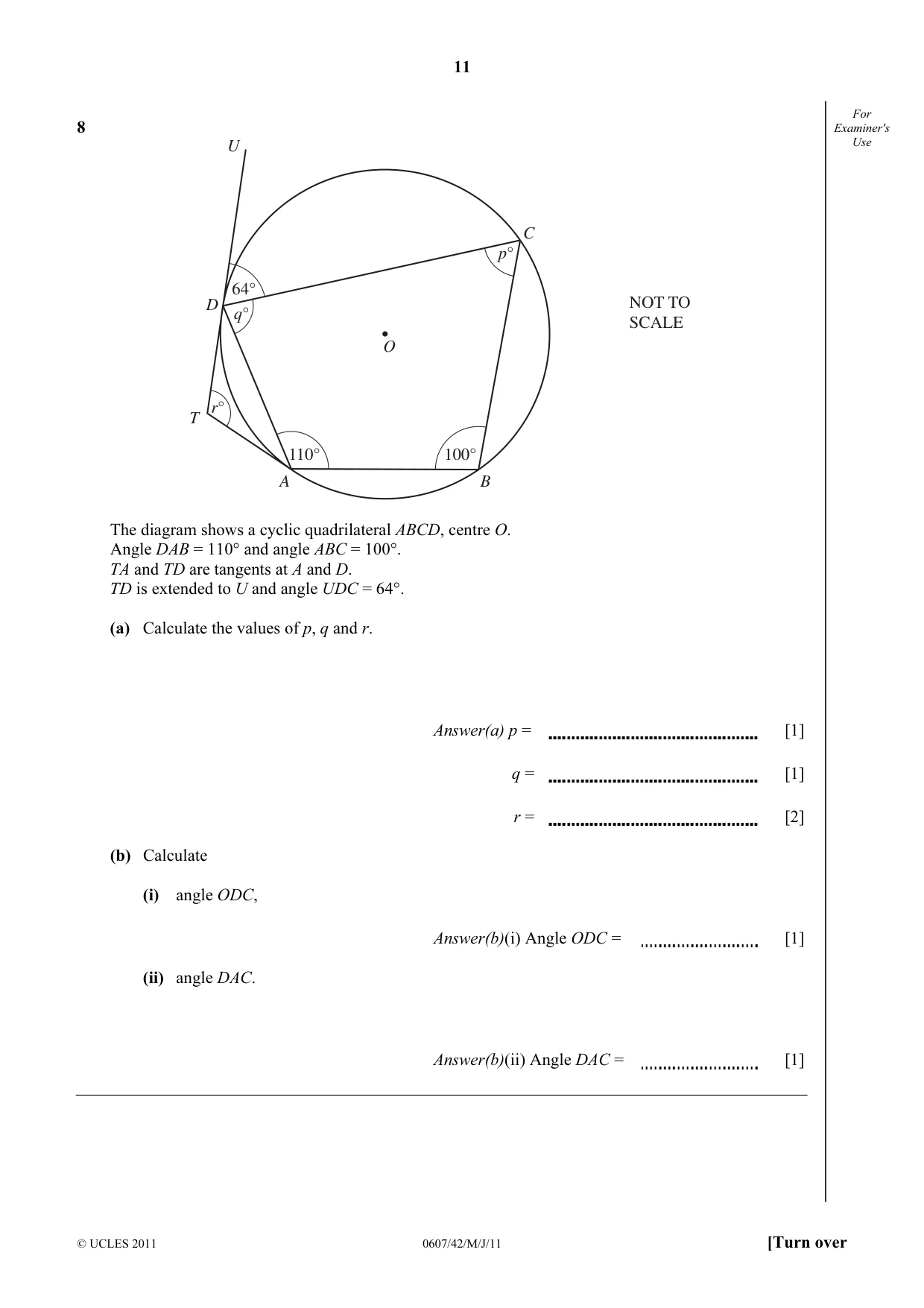
11 © UCLES 2011 0607/42/M/J/11 [Turn over For Examiner's Use 8 64° 100° 110° q° r° p° C U D T A B O NOT TO SCALE The diagram shows a cyclic quadrilateral ABCD, centre O. Angle DAB = 110° and angle ABC = 100°. TA and TD are tangents at A and D. TD is extended to U and angle UDC = 64°. (a) Calculate the values of p, q and r. Answer(a) p = [1] q = [1] r = [2] (b) Calculate (i) angle ODC, Answer(b)(i) Angle ODC = [1] (ii) angle DAC. Answer(b)(ii) Angle DAC = [1]
Question paper, page 12
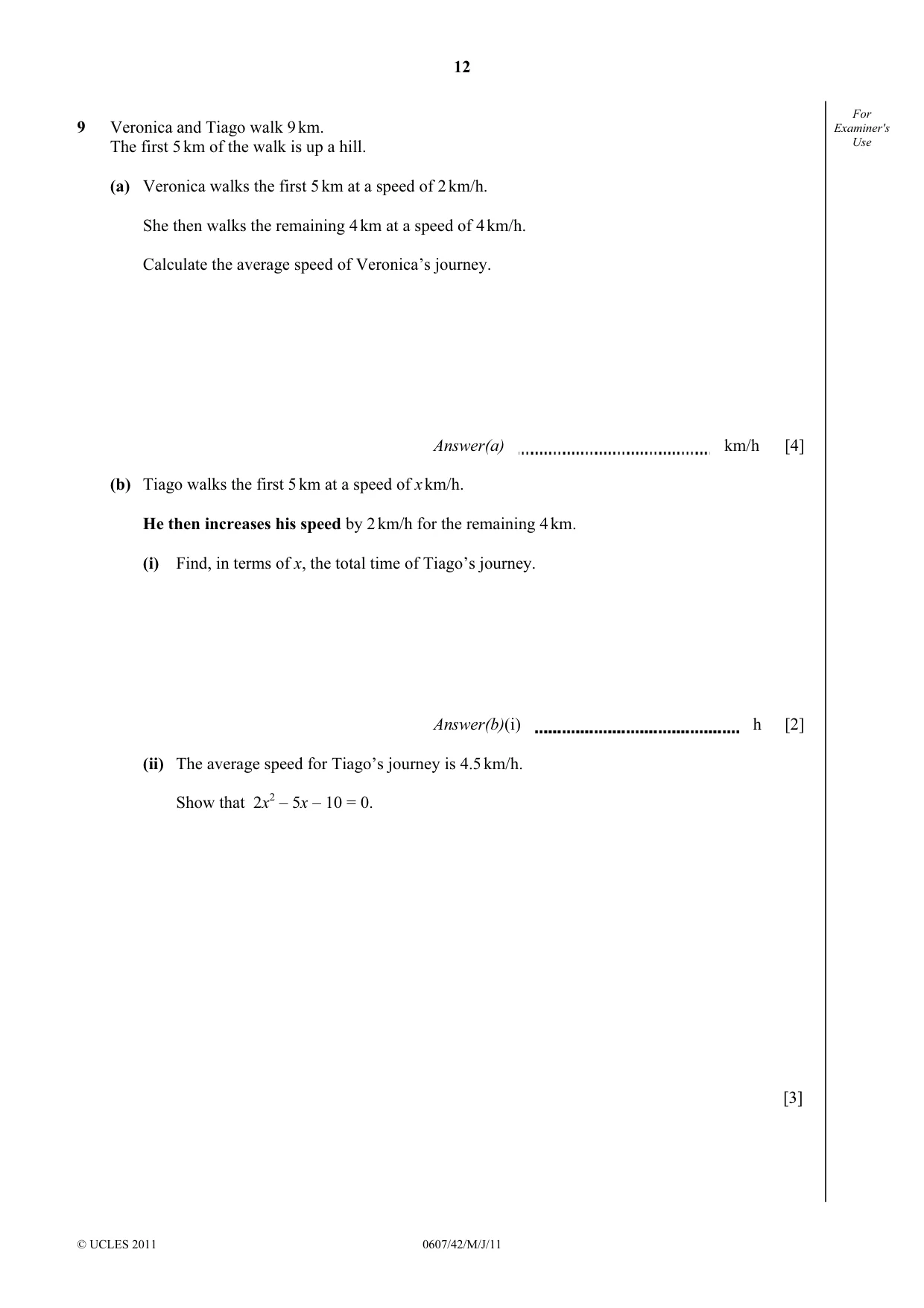
12 © UCLES 2011 0607/42/M/J/11 For Examiner's Use 9 Veronica and Tiago walk 9 km. The first 5 km of the walk is up a hill. (a) Veronica walks the first 5 km at a speed of 2 km/h. She then walks the remaining 4 km at a speed of 4 km/h. Calculate the average speed of Veronica’s journey. Answer(a) km/h [4] (b) Tiago walks the first 5 km at a speed of x km/h. He then increases his speed by 2 km/h for the remaining 4 km. (i) Find, in terms of x, the total time of Tiago’s journey. Answer(b)(i) h [2] (ii) The average speed for Tiago’s journey is 4.5 km/h. Show that 2x2 – 5x – 10 = 0. [3]
Question paper, page 13
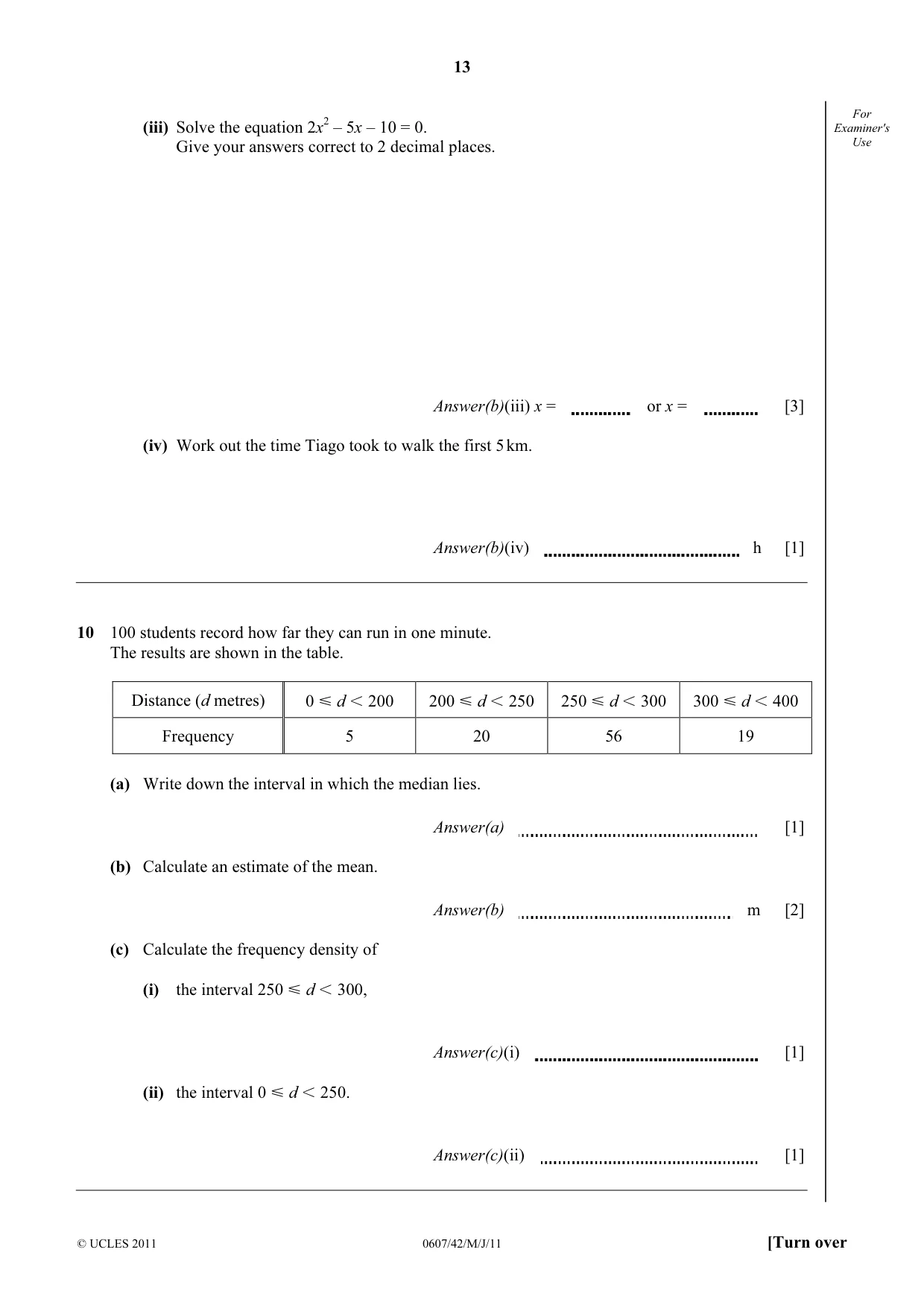
13 © UCLES 2011 0607/42/M/J/11 [Turn over For Examiner's Use (iii) Solve the equation 2x2 – 5x – 10 = 0. Give your answers correct to 2 decimal places. Answer(b)(iii) x = or x = [3] (iv) Work out the time Tiago took to walk the first 5 km. Answer(b)(iv) h [1] 10 100 students record how far they can run in one minute. The results are shown in the table. Distance (d metres) 0 Y d I 200 200 Y d I 250 250 Y d I 300 300 Y d I 400 Frequency 5 20 56 19 (a) Write down the interval in which the median lies. Answer(a) [1] (b) Calculate an estimate of the mean. Answer(b) m [2] (c) Calculate the frequency density of (i) the interval 250 Y d I 300, Answer(c)(i) [1] (ii) the interval 0 Y d I 250. Answer(c)(ii) [1]
Question paper, page 14
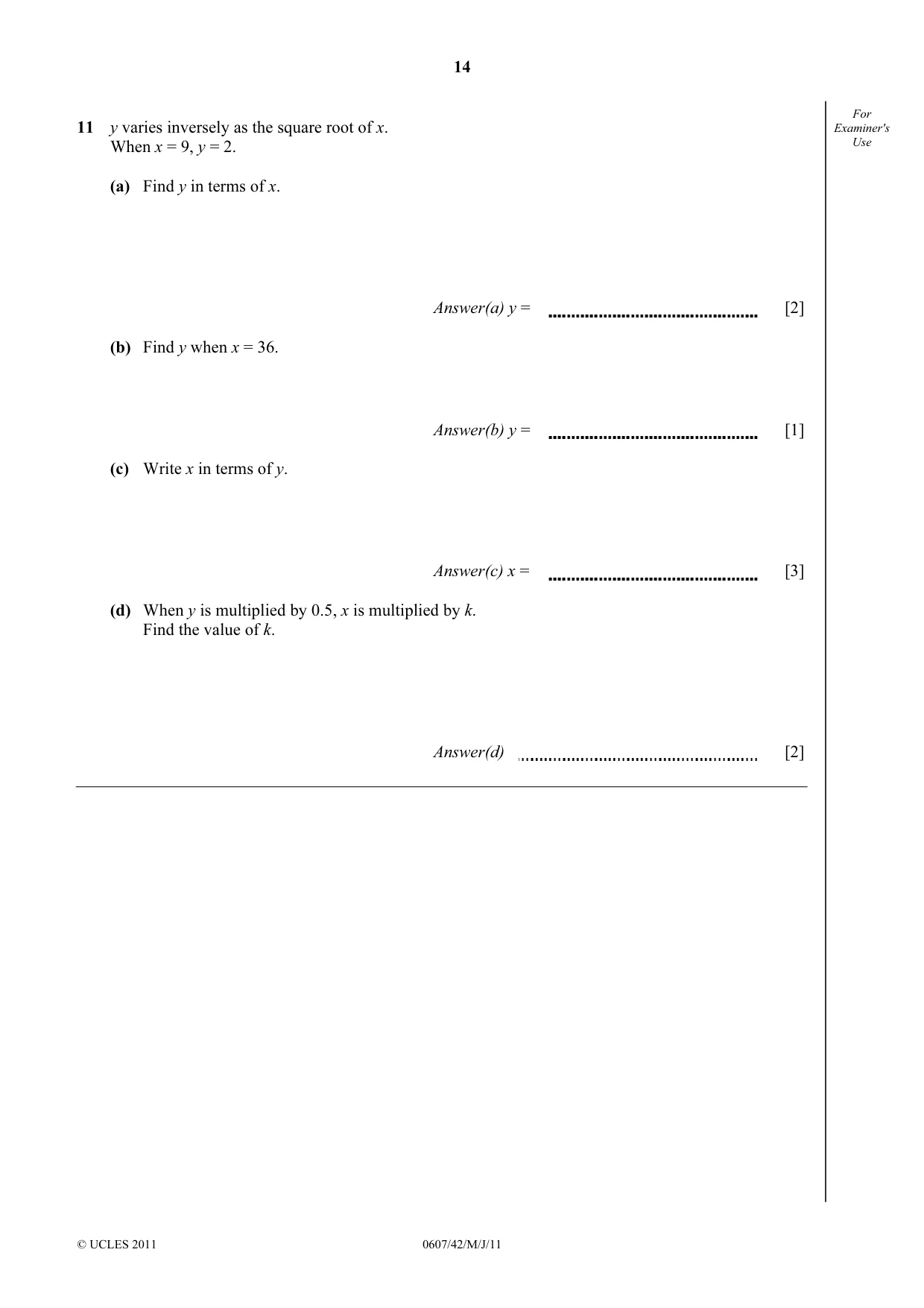
14 © UCLES 2011 0607/42/M/J/11 For Examiner's Use 11 y varies inversely as the square root of x. When x = 9, y = 2. (a) Find y in terms of x. Answer(a) y = [2] (b) Find y when x = 36. Answer(b) y = [1] (c) Write x in terms of y. Answer(c) x = [3] (d) When y is multiplied by 0.5, x is multiplied by k. Find the value of k. Answer(d) [2]
Question paper, page 15
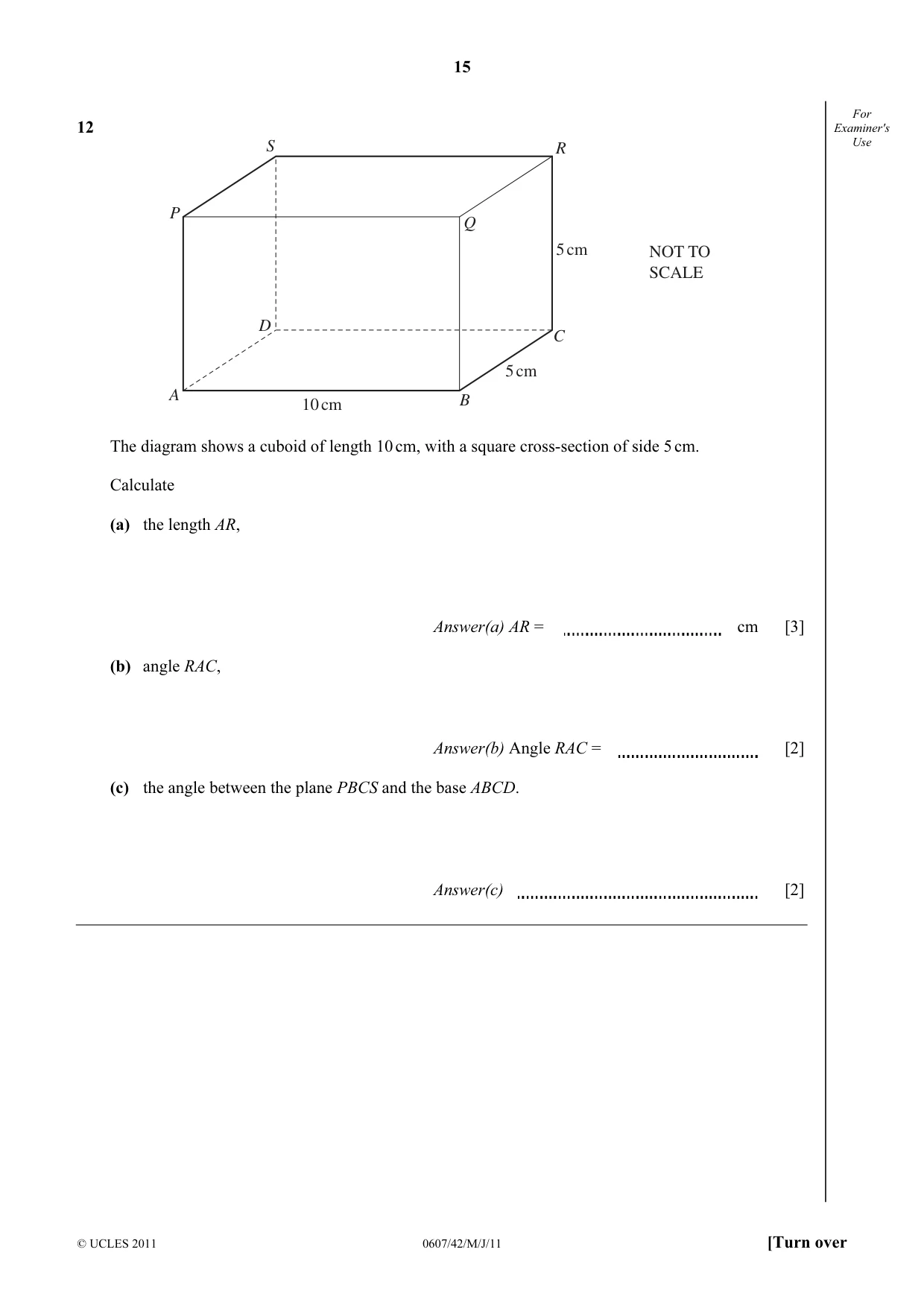
15 © UCLES 2011 0607/42/M/J/11 [Turn over For Examiner's Use 12 S P A D Q R C B 5 cm 5 cm 10 cm NOT TO SCALE The diagram shows a cuboid of length 10 cm, with a square cross-section of side 5 cm. Calculate (a) the length AR, Answer(a) AR = cm [3] (b) angle RAC, Answer(b) Angle RAC = [2] (c) the angle between the plane PBCS and the base ABCD. Answer(c) [2]
Question paper, page 16
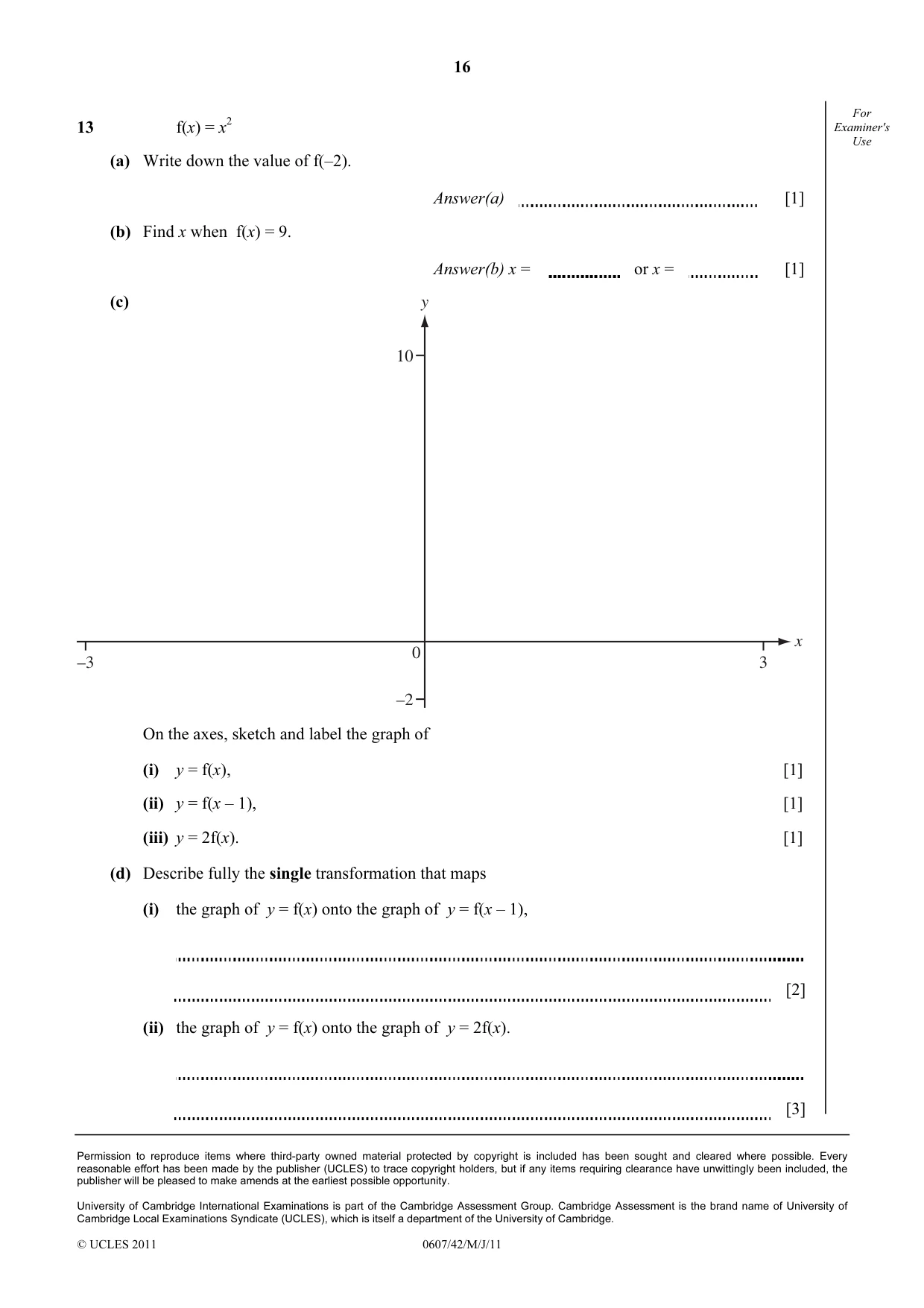
16 Permission to reproduce items where third-party owned material protected by copyright is included has been sought and cleared where possible. Every reasonable effort has been made by the publisher (UCLES) to trace copyright holders, but if any items requiring clearance have unwittingly been included, the publisher will be pleased to make amends at the earliest possible opportunity. University of Cambridge International Examinations is part of the Cambridge Assessment Group. Cambridge Assessment is the brand name of University of Cambridge Local Examinations Syndicate (UCLES), which is itself a department of the University of Cambridge. © UCLES 2011 0607/42/M/J/11 For Examiner's Use 13 f(x) = x2 (a) Write down the value of f(–2). Answer(a) [1] (b) Find x when f(x) = 9. Answer(b) x = or x = [1] (c) On the axes, sketch and label the graph of (i) y = f(x), [1] (ii) y = f(x – 1), [1] (iii) y = 2f(x). [1] (d) Describe fully the single transformation that maps (i) the graph of y = f(x) onto the graph of y = f(x – 1), [2] (ii) the graph of y = f(x) onto the graph of y = 2f(x). [3] y x 10 –2 –3 3 0
Mark scheme, page 1
UNIVERSITY OF CAMBRIDGE INTERNATIONAL EXAMINATIONS International General Certificate of Secondary Education MARK SCHEME for the May/June 2011 question paper for the guidance of teachers 0607 CAMBRIDGE INTERNATIONAL MATHEMATICS 0607/42 Paper 4 (Extended), maximum raw mark 120 This mark scheme is published as an aid to teachers and candidates, to indicate the requirements of the examination. It shows the basis on which Examiners were instructed to award marks. It does not indicate the details of the discussions that took place at an Examiners’ meeting before marking began, which would have considered the acceptability of alternative answers. Mark schemes must be read in conjunction with the question papers and the report on the examination. • Cambridge will not enter into discussions or correspondence in connection with these mark schemes. Cambridge is publishing the mark schemes for the May/June 2011 question papers for most IGCSE, GCE Advanced Level and Advanced Subsidiary Level syllabuses and some Ordinary Level syllabuses. www.XtremePapers.com
Mark scheme, page 2
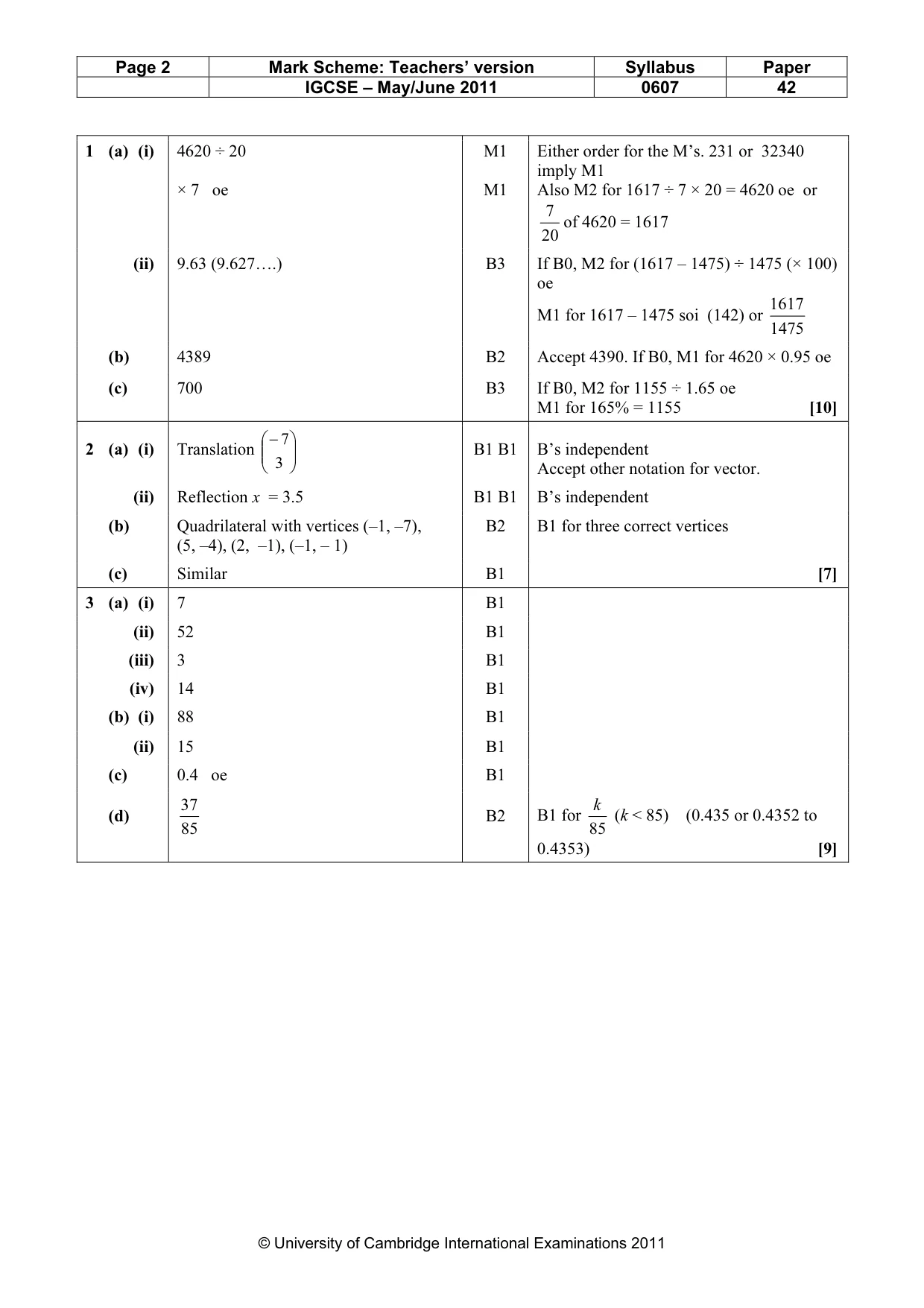
Page 2 Mark Scheme: Teachers’ version Syllabus Paper IGCSE – May/June 2011 0607 42 © University of Cambridge International Examinations 2011 1 (a) (i) 4620 ÷ 20 × 7 oe M1 M1 Either order for the M’s. 231 or 32340 imply M1 Also M2 for 1617 ÷ 7 × 20 = 4620 oe or 20 7 of 4620 = 1617 (ii) 9.63 (9.627….) B3 If B0, M2 for (1617 – 1475) ÷ 1475 (× 100) oe M1 for 1617 – 1475 soi (142) or 1475 1617 (b) 4389 B2 Accept 4390. If B0, M1 for 4620 × 0.95 oe (c) 700 B3 If B0, M2 for 1155 ÷ 1.65 oe M1 for 165% = 1155 [10] 2 (a) (i) Translation − 3 7 B1 B1 B’s independent Accept other notation for vector. (ii) Reflection x = 3.5 B1 B1 B’s independent (b) Quadrilateral with vertices (–1, –7), (5, –4), (2, –1), (–1, – 1) B2 B1 for three correct vertices (c) Similar B1 [7] 3 (a) (i) 7 B1 (ii) 52 B1 (iii) 3 B1 (iv) 14 B1 (b) (i) 88 B1 (ii) 15 B1 (c) 0.4 oe B1 (d) 85 37 B2 B1 for 85 k (k < 85) (0.435 or 0.4352 to 0.4353) [9]
Mark scheme, page 3
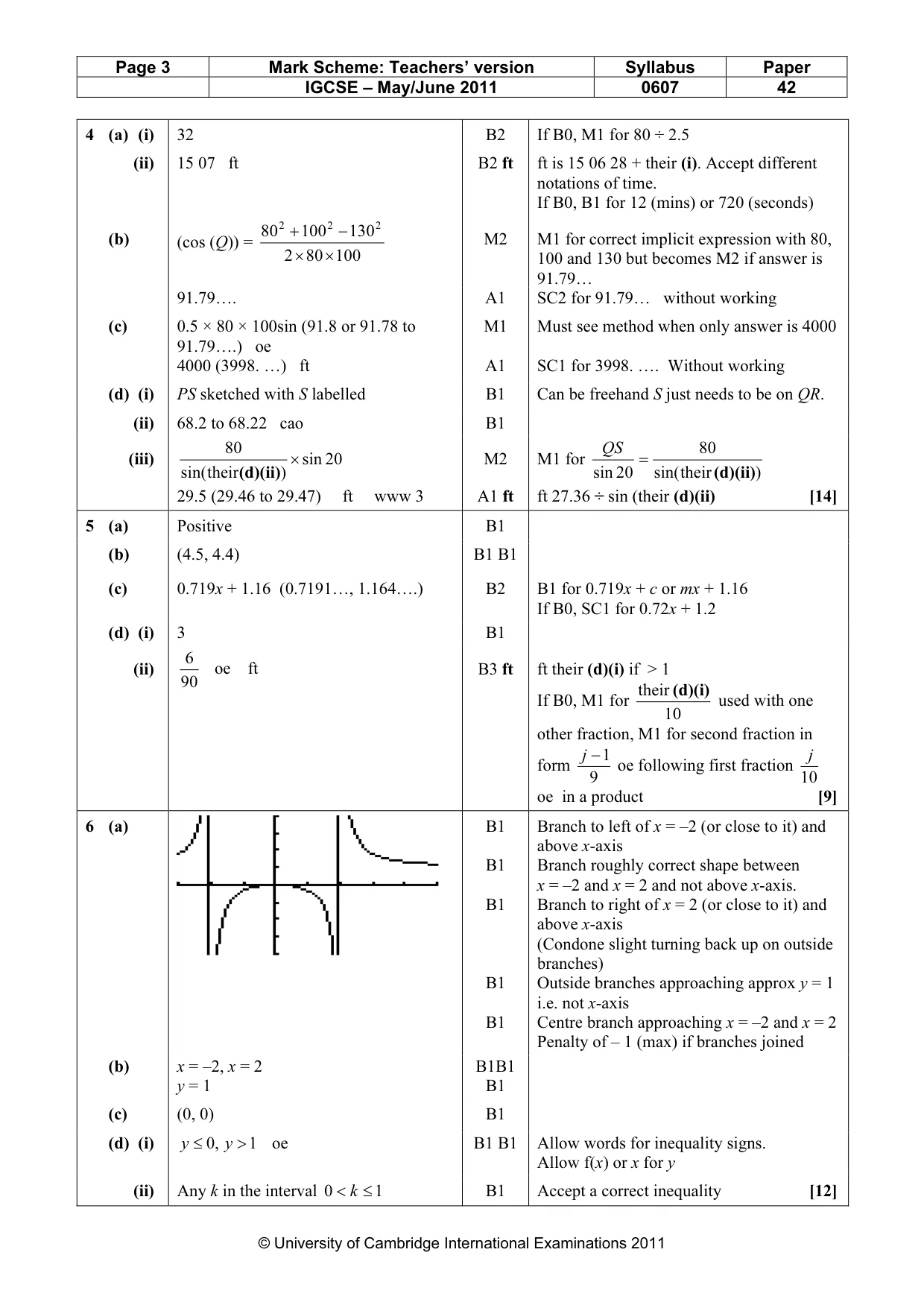
Page 3 Mark Scheme: Teachers’ version Syllabus Paper IGCSE – May/June 2011 0607 42 © University of Cambridge International Examinations 2011 4 (a) (i) 32 B2 If B0, M1 for 80 ÷ 2.5 (ii) 15 07 ft B2 ft ft is 15 06 28 + their (i). Accept different notations of time. If B0, B1 for 12 (mins) or 720 (seconds) (b) (cos (Q)) = 100 80 2 130 100 80 2 2 2 × × − + M2 M1 for correct implicit expression with 80, 100 and 130 but becomes M2 if answer is 91.79… 91.79…. A1 SC2 for 91.79… without working (c) 0.5 × 80 × 100sin (91.8 or 91.78 to 91.79….) oe 4000 (3998. …) ft M1 A1 Must see method when only answer is 4000 SC1 for 3998. …. Without working (d) (i) PS sketched with S labelled B1 Can be freehand S just needs to be on QR. (ii) 68.2 to 68.22 cao B1 (iii) 20 sin ) their sin( 80 × (d)(ii) M2 M1 for ) their sin( 80 20 sin (d)(ii) = QS 29.5 (29.46 to 29.47) ft www 3 A1 ft ft 27.36 ÷ sin (their (d)(ii) [14] 5 (a) Positive B1 (b) (4.5, 4.4) B1 B1 (c) 0.719x + 1.16 (0.7191…, 1.164….) B2 B1 for 0.719x + c or mx + 1.16 If B0, SC1 for 0.72x + 1.2 (d) (i) 3 B1 (ii) 90 6 oe ft B3 ft ft their (d)(i) if > 1 If B0, M1 for 10 their (d)(i) used with one other fraction, M1 for second fraction in form 9 1 − j oe following first fraction 10 j oe in a product [9] 6 (a) B1 B1 B1 B1 B1 Branch to left of x = –2 (or close to it) and above x-axis Branch roughly correct shape between x = –2 and x = 2 and not above x-axis. Branch to right of x = 2 (or close to it) and above x-axis (Condone slight turning back up on outside branches) Outside branches approaching approx y = 1 i.e. not x-axis Centre branch approaching x = –2 and x = 2 Penalty of – 1 (max) if branches joined (b) x = –2, x = 2 y = 1 B1B1 B1 (c) (0, 0) B1 (d) (i) 1 ,0 > ≤ y y oe B1 B1 Allow words for inequality signs. Allow f(x) or x for y (ii) Any k in the interval 1 0 ≤ < k B1 Accept a correct inequality [12]
Mark scheme, page 4
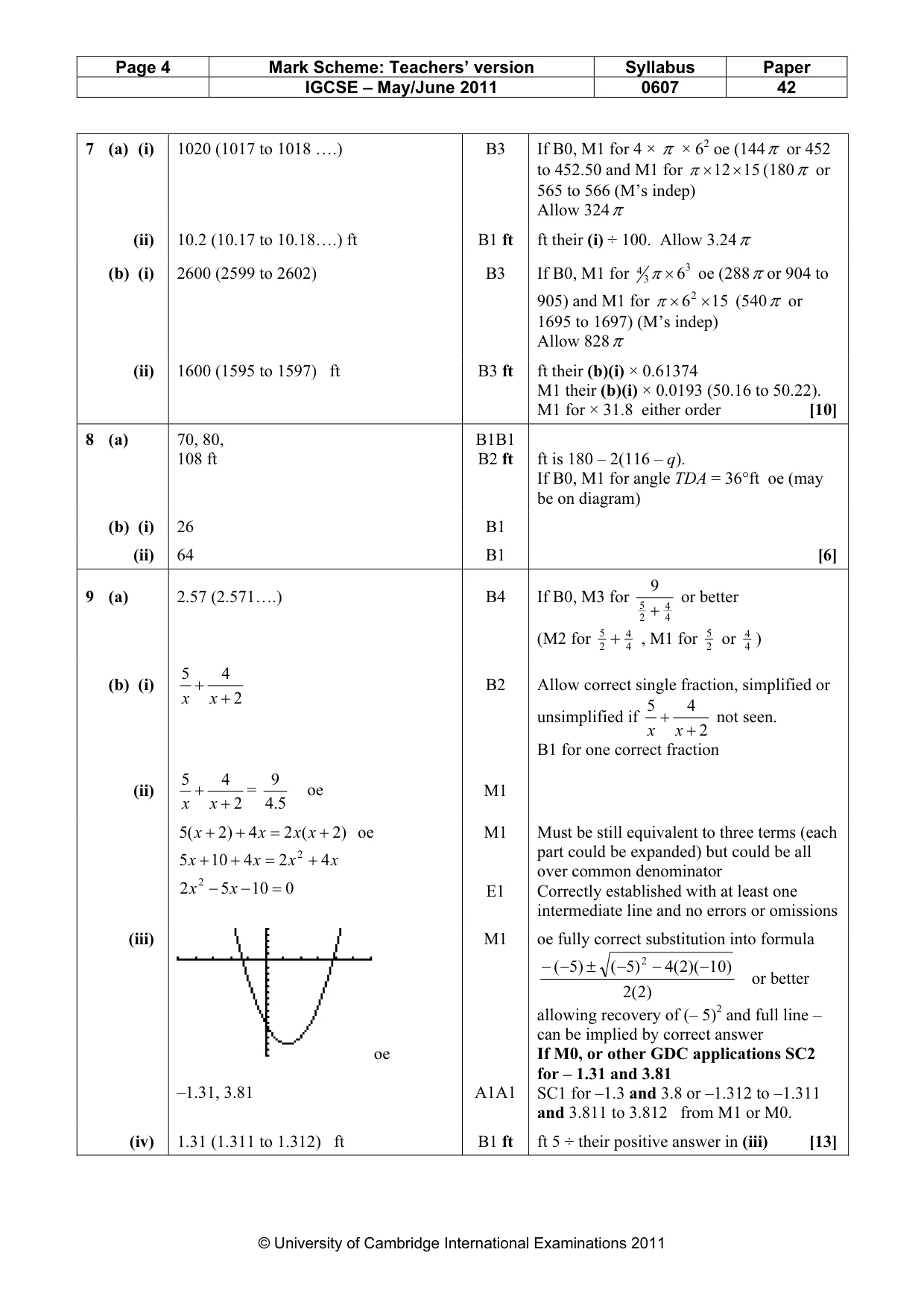
Page 4 Mark Scheme: Teachers’ version Syllabus Paper IGCSE – May/June 2011 0607 42 © University of Cambridge International Examinations 2011 7 (a) (i) 1020 (1017 to 1018 ….) B3 If B0, M1 for 4 × π × 62 oe (144π or 452 to 452.50 and M1 for 15 12× × π (180π or 565 to 566 (M’s indep) Allow 324π (ii) 10.2 (10.17 to 10.18….) ft B1 ft ft their (i) ÷ 100. Allow 3.24π (b) (i) 2600 (2599 to 2602) B3 If B0, M1 for 3 3 4 6 × π oe (288π or 904 to 905) and M1 for 15 62 × × π (540π or 1695 to 1697) (M’s indep) Allow 828π (ii) 1600 (1595 to 1597) ft B3 ft ft their (b)(i) × 0.61374 M1 their (b)(i) × 0.0193 (50.16 to 50.22). M1 for × 31.8 either order [10] 8 (a) 70, 80, 108 ft B1B1 B2 ft ft is 180 – 2(116 – q). If B0, M1 for angle TDA = 36°ft oe (may be on diagram) (b) (i) 26 B1 (ii) 64 B1 [6] 9 (a) 2.57 (2.571….) B4 If B0, M3 for 4 4 2 5 9 + or better (M2 for 4 4 2 5 + , M1 for 2 5 or 4 4 ) (b) (i) 2 4 5 + + x x B2 Allow correct single fraction, simplified or unsimplified if 2 4 5 + + x x not seen. B1 for one correct fraction (ii) 2 4 5 + + x x = 5.4 9 oe M1 ) 2 ( 2 4 ) 2 ( 5 + = + + x x x x oe x x x x 4 2 4 10 5 2 + = + + 0 10 5 2 2 = − −x x M1 E1 Must be still equivalent to three terms (each part could be expanded) but could be all over common denominator Correctly established with at least one intermediate line and no errors or omissions (iii) oe –1.31, 3.81 M1 A1A1 oe fully correct substitution into formula ) 2 ( 2 ) 10 )( 2 ( 4 ) 5 ( ) 5 ( 2 − − − ± − − or better allowing recovery of (– 5)2 and full line – can be implied by correct answer If M0, or other GDC applications SC2 for – 1.31 and 3.81 SC1 for –1.3 and 3.8 or –1.312 to –1.311 and 3.811 to 3.812 from M1 or M0. (iv) 1.31 (1.311 to 1.312) ft B1 ft ft 5 ÷ their positive answer in (iii) [13]
Mark scheme, page 5
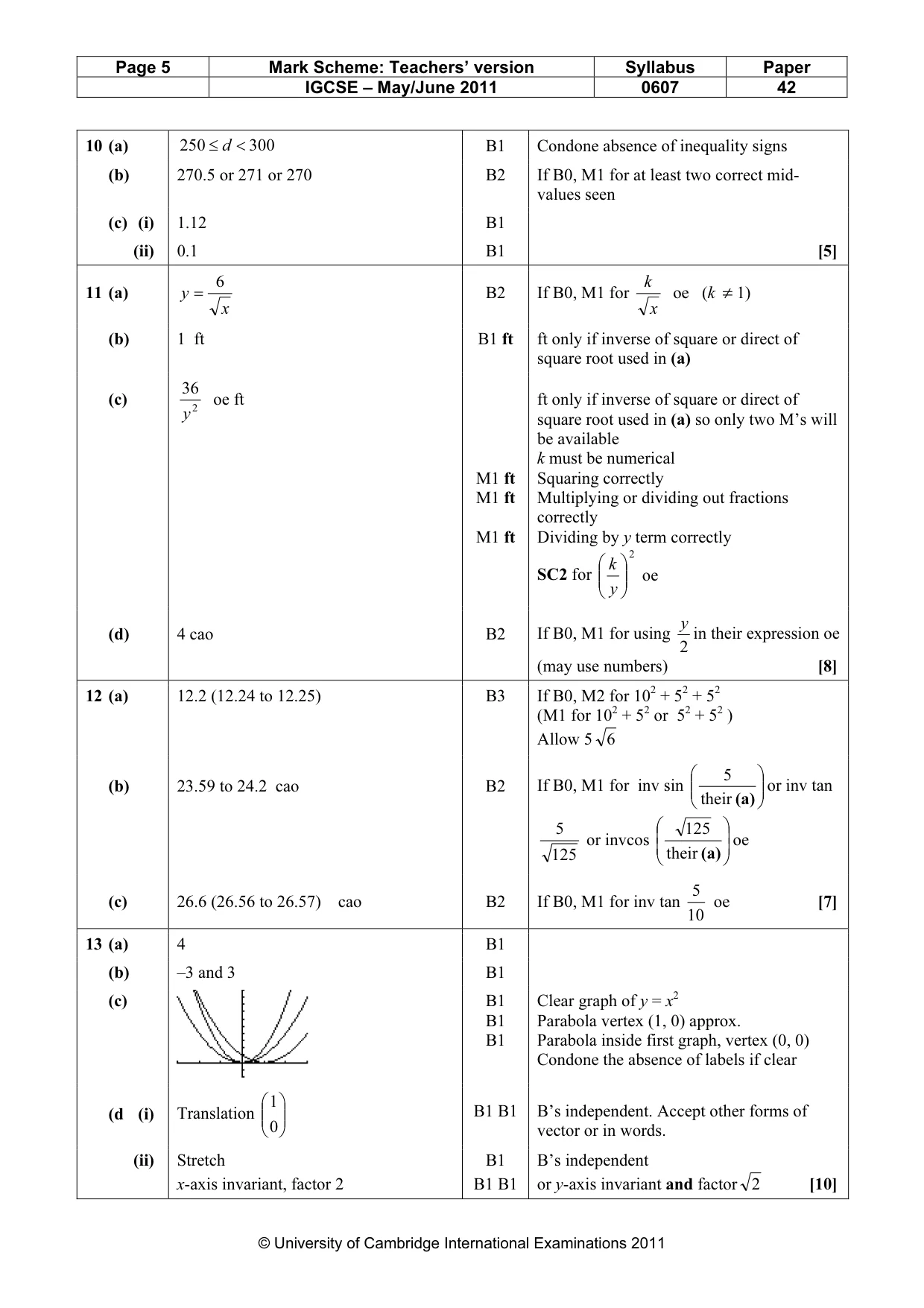
Page 5 Mark Scheme: Teachers’ version Syllabus Paper IGCSE – May/June 2011 0607 42 © University of Cambridge International Examinations 2011 10 (a) 300 250 < ≤d B1 Condone absence of inequality signs (b) 270.5 or 271 or 270 B2 If B0, M1 for at least two correct mid- values seen (c) (i) 1.12 B1 (ii) 0.1 B1 [5] 11 (a) x y 6 = B2 If B0, M1 for x k oe (k ≠1) (b) 1 ft B1 ft ft only if inverse of square or direct of square root used in (a) (c) 2 36 y oe ft M1 ft M1 ft M1 ft ft only if inverse of square or direct of square root used in (a) so only two M’s will be available k must be numerical Squaring correctly Multiplying or dividing out fractions correctly Dividing by y term correctly SC2 for 2 y k oe (d) 4 cao B2 If B0, M1 for using 2 y in their expression oe (may use numbers) [8] 12 (a) 12.2 (12.24 to 12.25) B3 If B0, M2 for 102 + 52 + 52 (M1 for 102 + 52 or 52 + 52 ) Allow 5 6 (b) 23.59 to 24.2 cao B2 If B0, M1 for inv sin (a) their 5 or inv tan 125 5 or invcos (a) their 125 oe (c) 26.6 (26.56 to 26.57) cao B2 If B0, M1 for inv tan 10 5 oe [7] 13 (a) 4 B1 (b) –3 and 3 B1 (c) B1 B1 B1 Clear graph of y = x2 Parabola vertex (1, 0) approx. Parabola inside first graph, vertex (0, 0) Condone the absence of labels if clear (d (i) Translation 0 1 B1 B1 B’s independent. Accept other forms of vector or in words. (ii) Stretch x-axis invariant, factor 2 B1 B1 B1 B’s independent or y-axis invariant and factor 2 [10]
What you needed in this session
Cambridge’s own grade thresholds for 2011 May/June, Paper 4 · Variant 2. A higher threshold means an easier paper — the bar moves with how the cohort did.