Cambridge IGCSE Mathematics - Additional 0606 — 2019 Oct/Nov Paper 2 · Variant 3
0606/23/O/N/19 · 9 questions · 80 marks · ≈90 min
The question paper and its mark scheme, free to read here and free to download. This is Cambridge’s own paper, exactly as it was sat.
Question paper16 pages
Mark scheme7 pages
Answers below. Sit the paper first if you are practising.
Questions as text
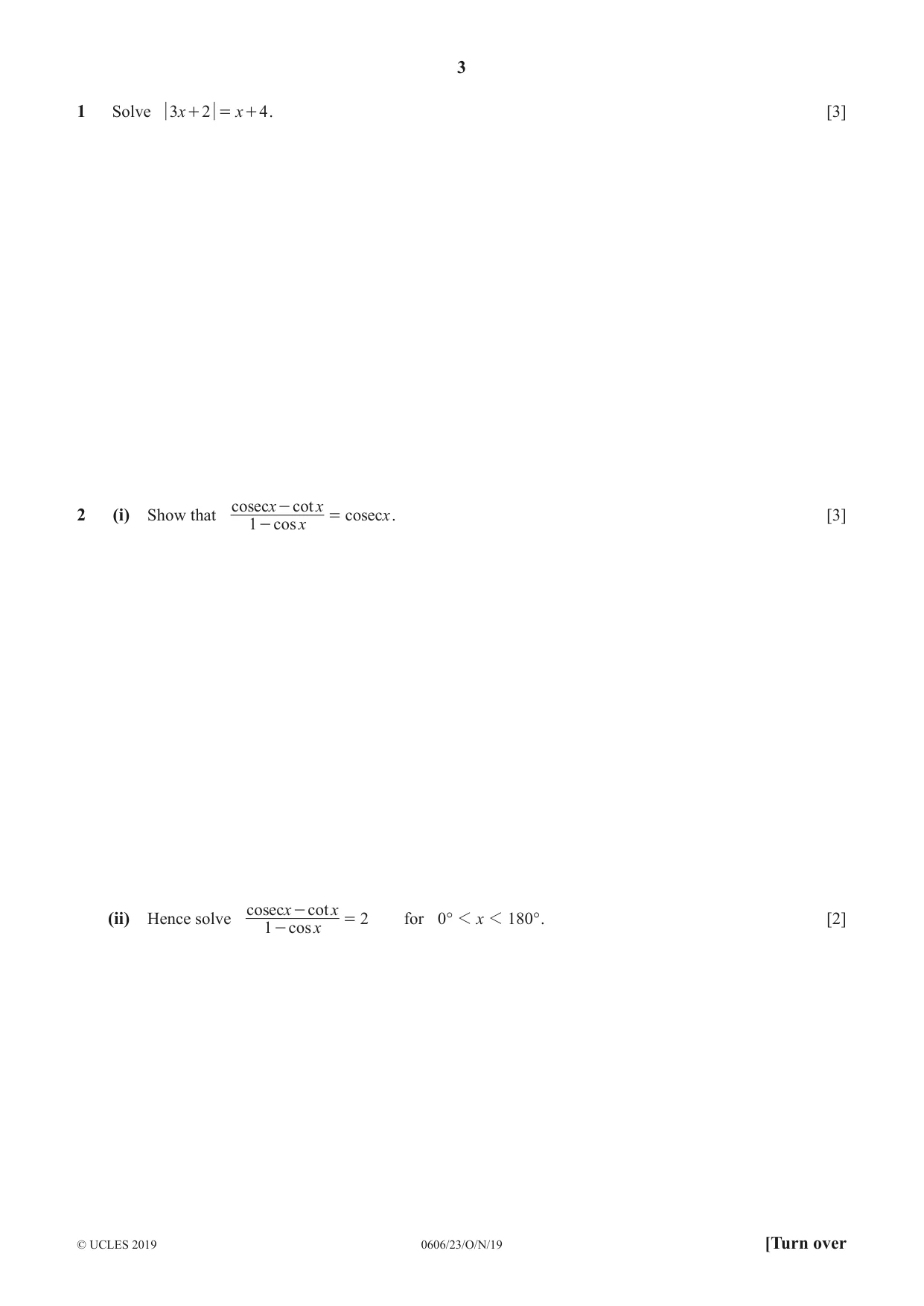
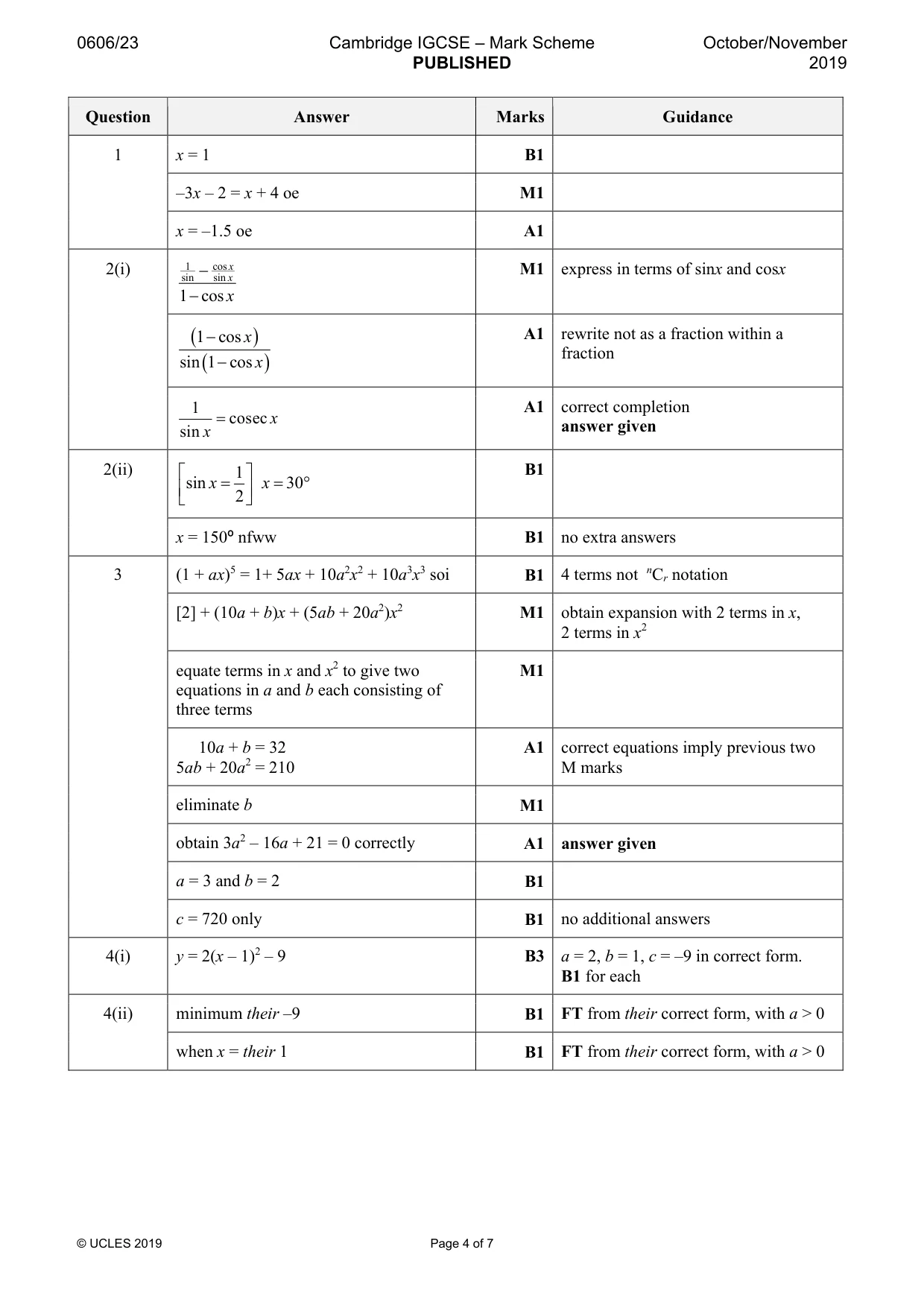
Q2 · Show that - = cosecx
2 (i) Show that - = cosecx . [3] 1 - cos x cosecx - cot x (ii) Hence solve = 2 for 0° 1 x 1 180° . [2] 1 - cos x
Mark scheme: 2(i) sin 1 − cossin xx M1 express in terms of sinx and cosx 1 − cos x (1 − cos x ) A1 rewrite not as a fraction within a fraction sin (1 − cos x ) 1 A1 correct completion = cosec x answer given sin x 2(ii) 1 B1 sin x = x = 30° 2 x = 150º nfww B1 no extra answers
More questions on Prove trigonometric relationships involving the
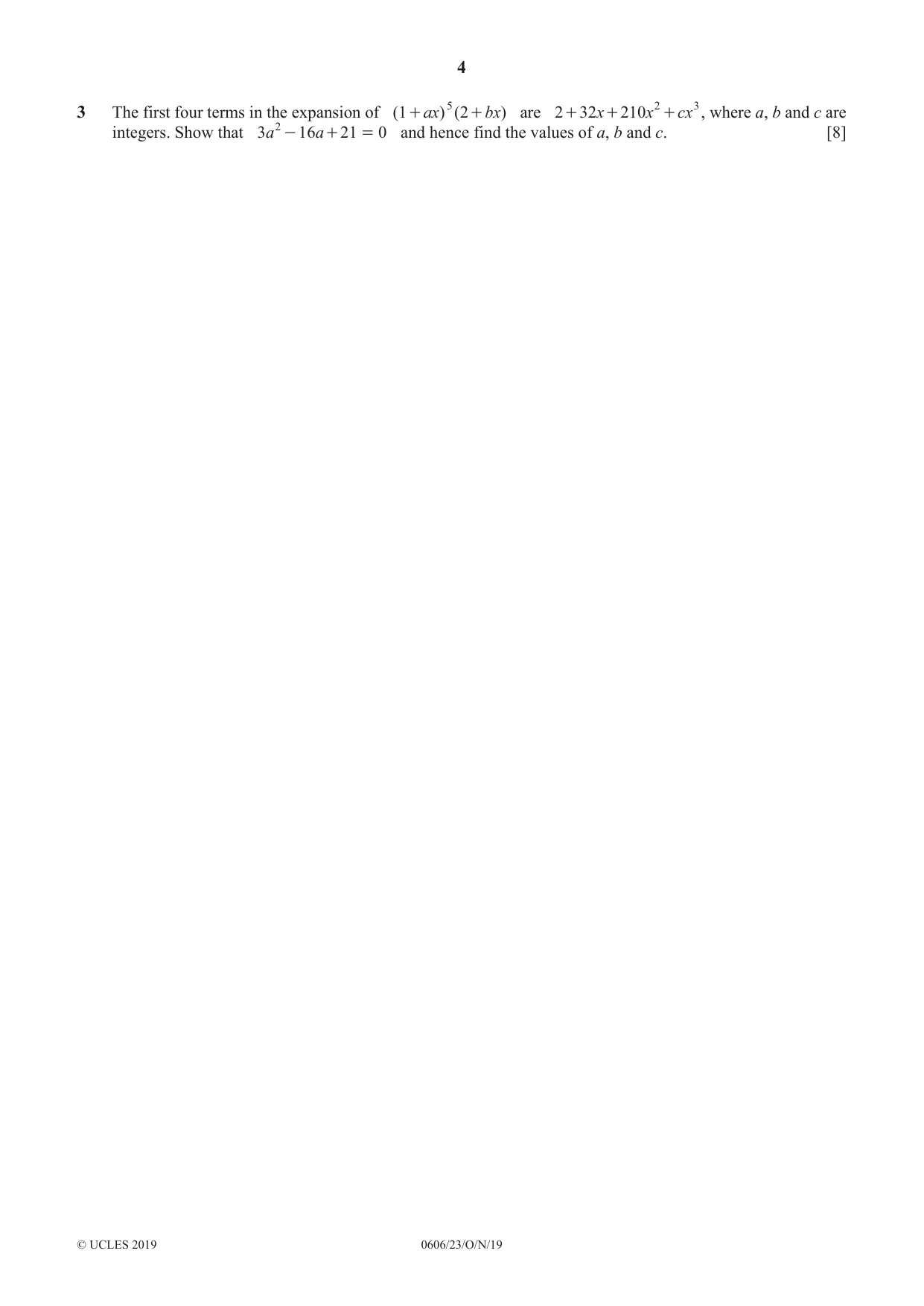
Q3 · The first four terms in the expansion of (1 + ax) 5 (2 + bx) are 2 + 32x + 210x 2 + cx 3…
3 The first four terms in the expansion of (1 + ax) 5 (2 + bx) are 2 + 32x + 210x 2 + cx 3 , where a, b and c are integers. Show that 3a 2 - 16a + 21 = 0 and hence find the values of a, b and c. [8]
Mark scheme: 3 (1 + ax)5 = 1+ 5ax + 10a2x2 + 10a3x3 soi B1 4 terms not nCr notation [2] + (10a + b)x + (5ab + 20a2)x2 M1 obtain expansion with 2 terms in x, 2 terms in x2 equate terms in x and x2 to give two M1 equations in a and b each consisting of three terms 10a + b = 32 A1 correct equations imply previous two 5ab + 20a2 = 210 M marks eliminate b M1 obtain 3a2 – 16a + 21 = 0 correctly A1 answer given a = 3 and b = 2 B1 c = 720 only B1 no additional answers
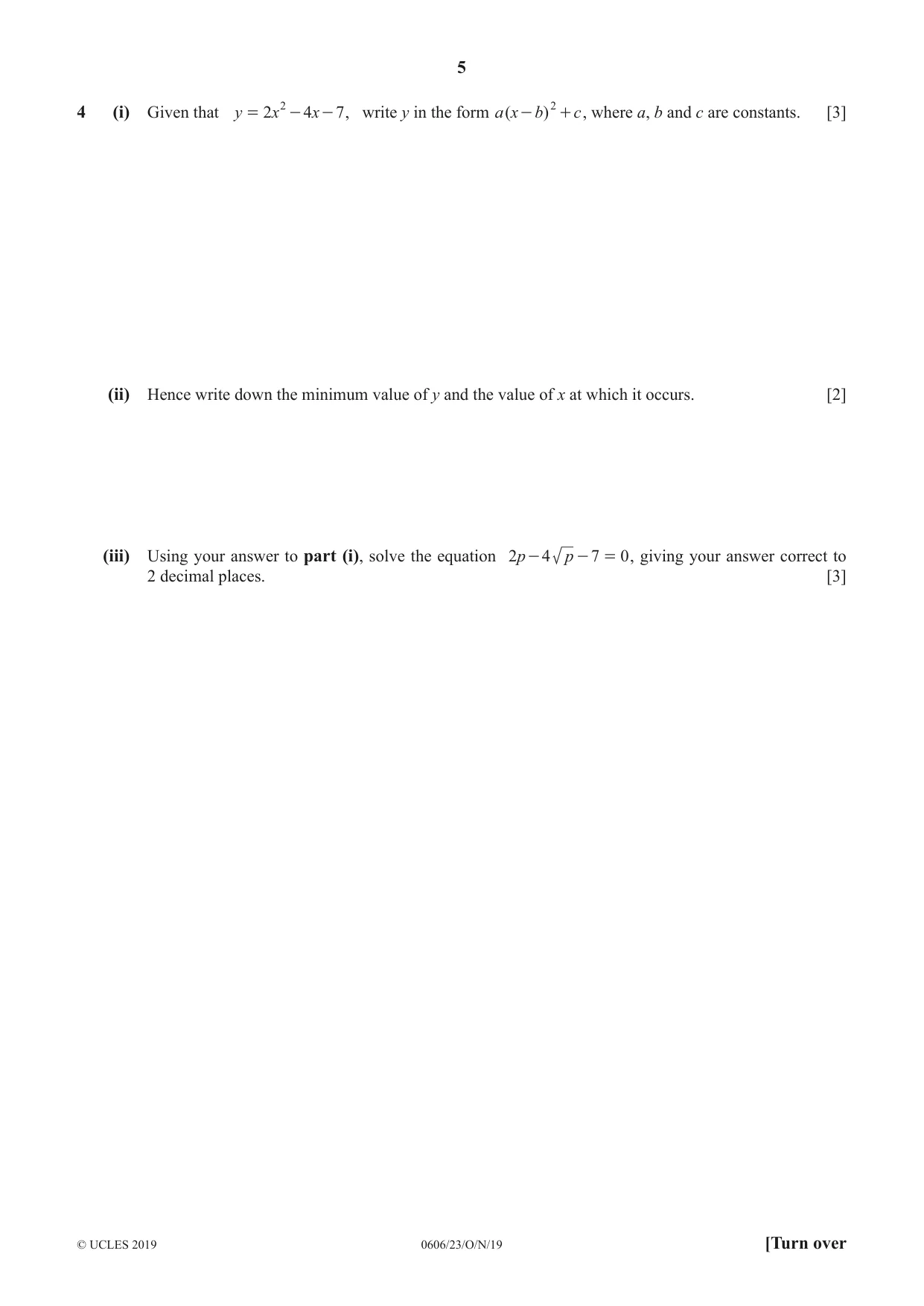
Q4 · Given that y = 2x 2 - 4x - 7 , write y in the form a (x - b) 2 + c , where a, b and c are…
4 (i) Given that y = 2x 2 - 4x - 7 , write y in the form a (x - b) 2 + c , where a, b and c are constants. [3] (ii) Hence write down the minimum value of y and the value of x at which it occurs. [2] (iii) Using your answer to part (i), solve the equation 2p - 4 p - 7 = 0 , giving your answer correct to 2 decimal places. [3]
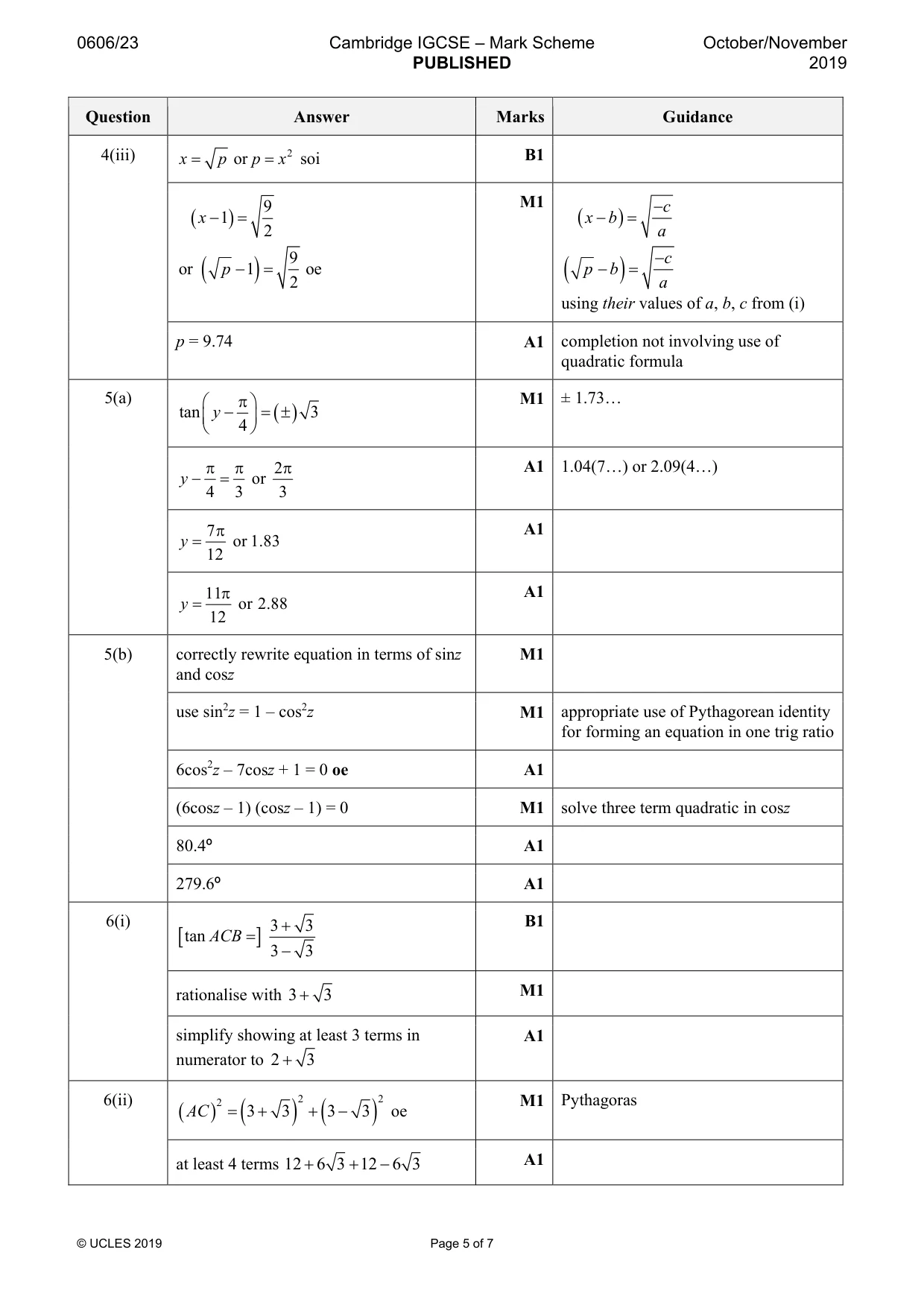
Mark scheme: 4(i) y = 2(x – 1)2 – 9 B3 a = 2, b = 1, c = –9 in correct form. B1 for each 4(ii) minimum their –9 B1 FT from their correct form, with a > 0 when x = their 1 B1 FT from their correct form, with a > 0 4(iii) x = p or p = x 2 soi B1 9 M1 − c ( x − 1) = ( x − b ) = 2 a 9 − c or p − 1 = oe p − b = ( ) ( ) 2 a using their values of a, b, c from (i) p = 9.74 A1 completion not involving use of quadratic formula
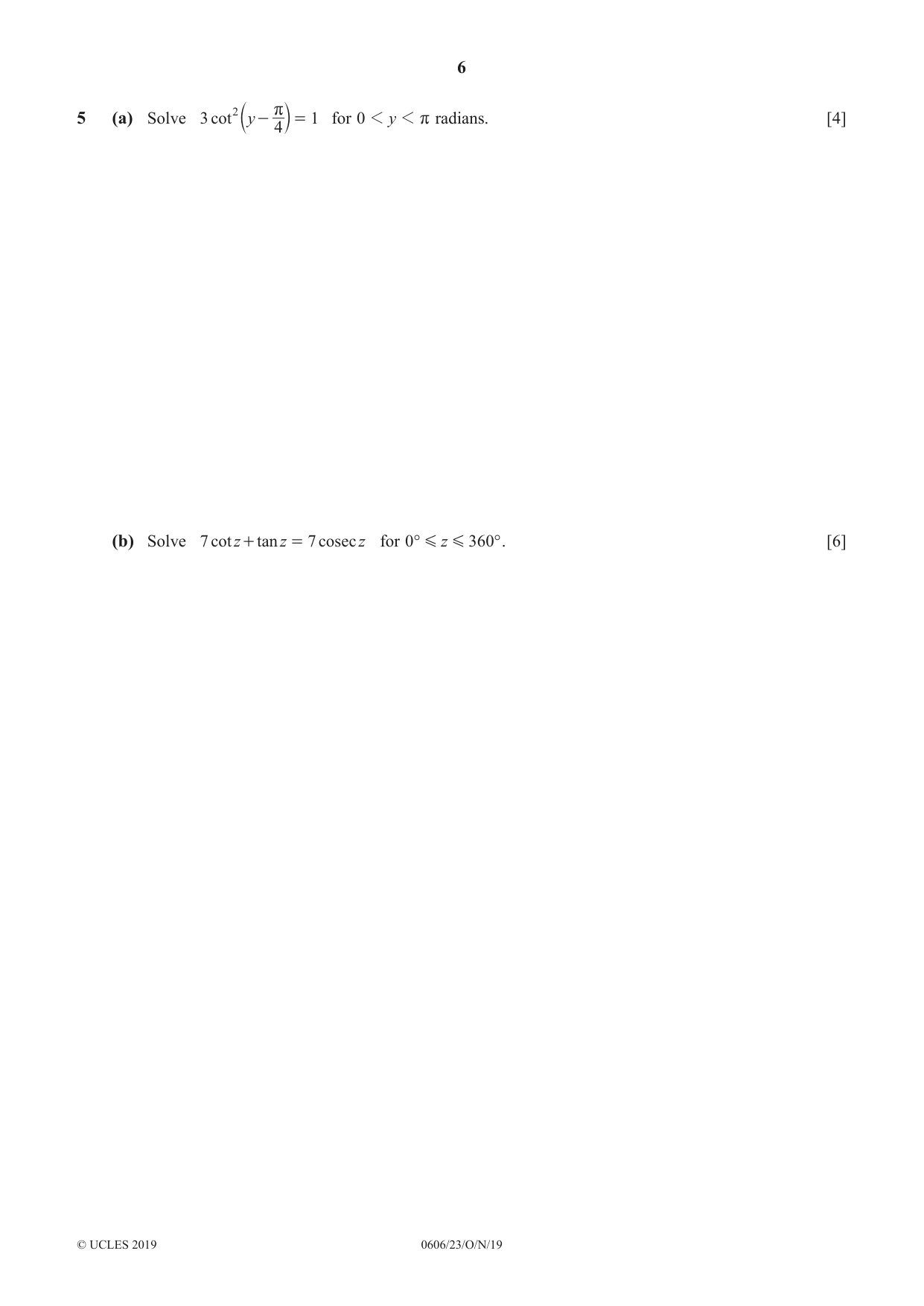
Q5 · Solve 3 cot 2 y - r = 1 for 0 1 y 1 r radians
5 (a) Solve 3 cot 2 y - r = 1 for 0 1 y 1 r radians. [4] 4 (b) Solve 7 cot z + tan z = 7 cosec z for 0° G z G 360° . [6]
Mark scheme: 5(a) π M1 ± 1.73… 3 tan y − = ( ± ) 4 π π 2 π A1 1.04(7…) or 2.09(4…) y − = or 4 3 3 7 π A1 y = or 1.83 12 11π A1 y = or 2.88 12 5(b) correctly rewrite equation in terms of sinz M1 and cosz use sin2z = 1 – cos2z M1 appropriate use of Pythagorean identity for forming an equation in one trig ratio 6cos2z – 7cosz + 1 = 0 oe A1 (6cosz – 1) (cosz – 1) = 0 M1 solve three term quadratic in cosz 80.4º A1 279.6º A1
Q6 · Do not use a calculator in this question
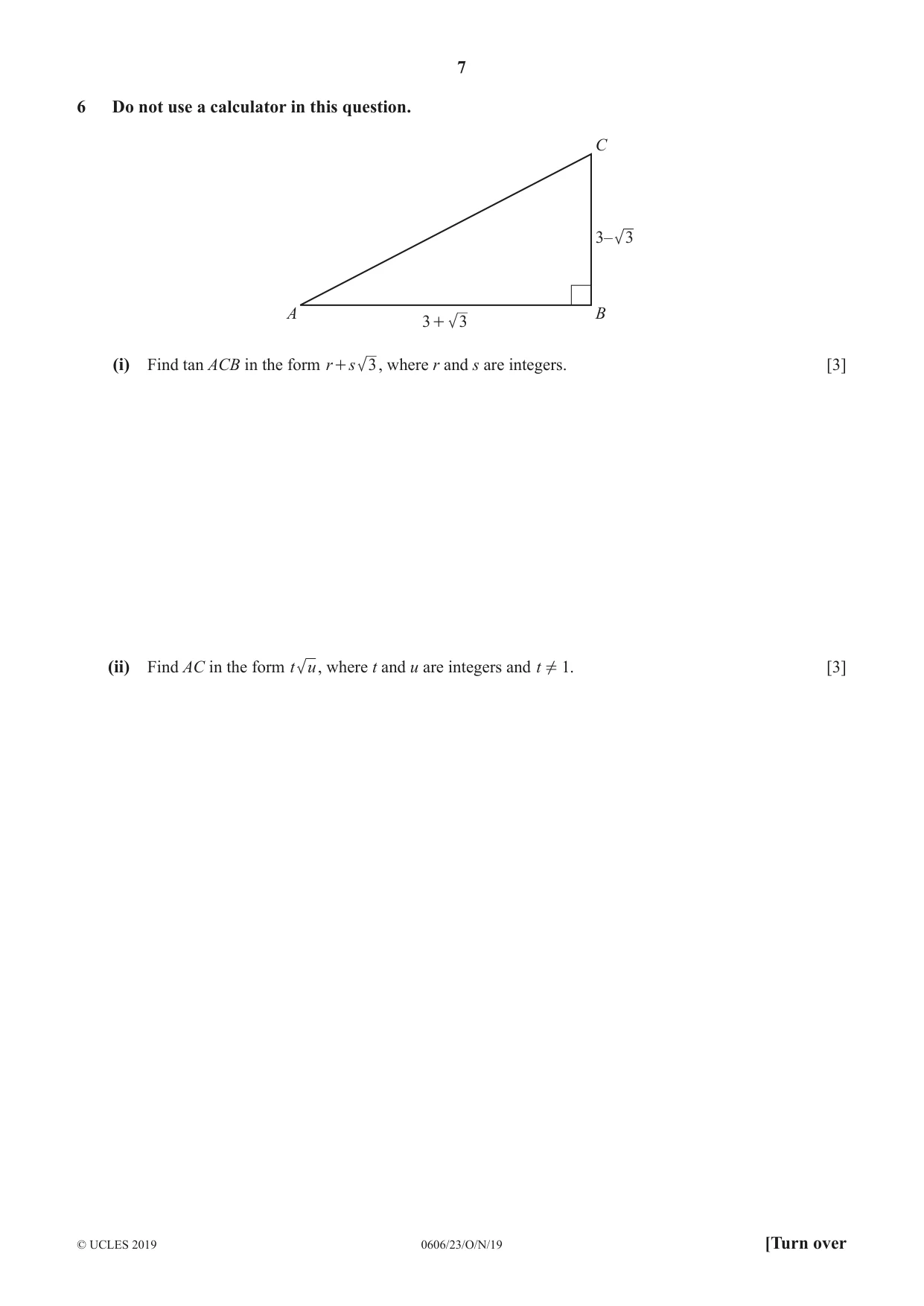
6 Do not use a calculator in this question. C 3– 3 A B 3 + 3 (i) Find tan ACB in the form r + s 3 , where r and s are integers. [3] (ii) Find AC in the form t u, where t and u are integers and t ! 1. [3]
Mark scheme: 6(i) 3 + 3 B1 [ tan ACB = ] 3 − 3 rationalise with 3 + 3 M1 simplify showing at least 3 terms in A1 numerator to 2 + 3 3 + 3 + 3 − 3 oe6(ii) ( AC ) 2 = ( 2 2 M1 Pythagoras ) ( ) at least 4 terms 12 + 6 3 + 12 − 6 3 A1
More questions on Know and use the six trigonometric functions
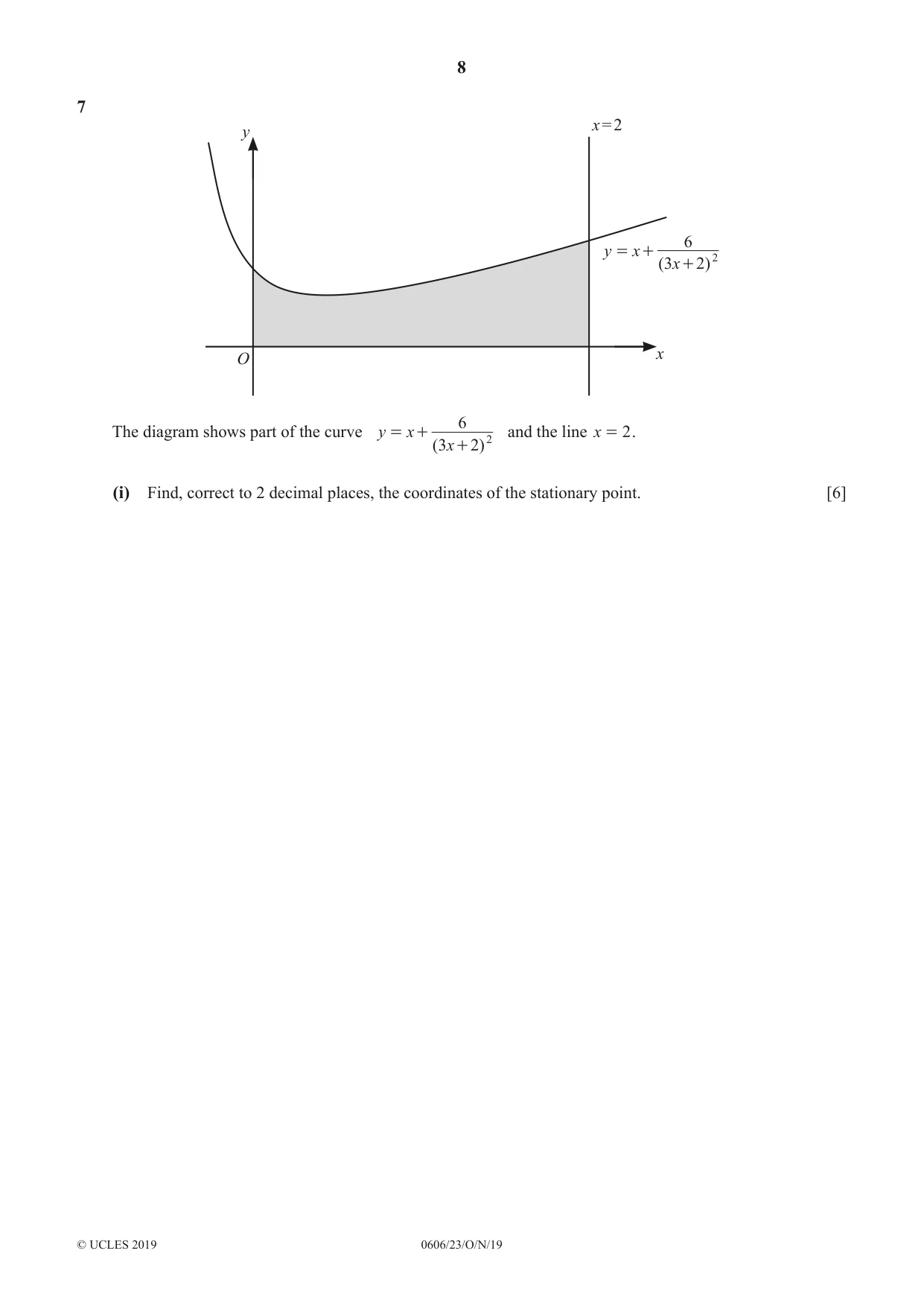
Q7 · X = 2 y 6 y = x + 2 (3 x + 2) x O 6 The diagram shows part of the curve y = x + 2 and the…
7 x = 2 y 6 y = x + 2 (3 x + 2) x O 6 The diagram shows part of the curve y = x + 2 and the line x = 2 . (3x + 2) (i) Find, correct to 2 decimal places, the coordinates of the stationary point. [6]
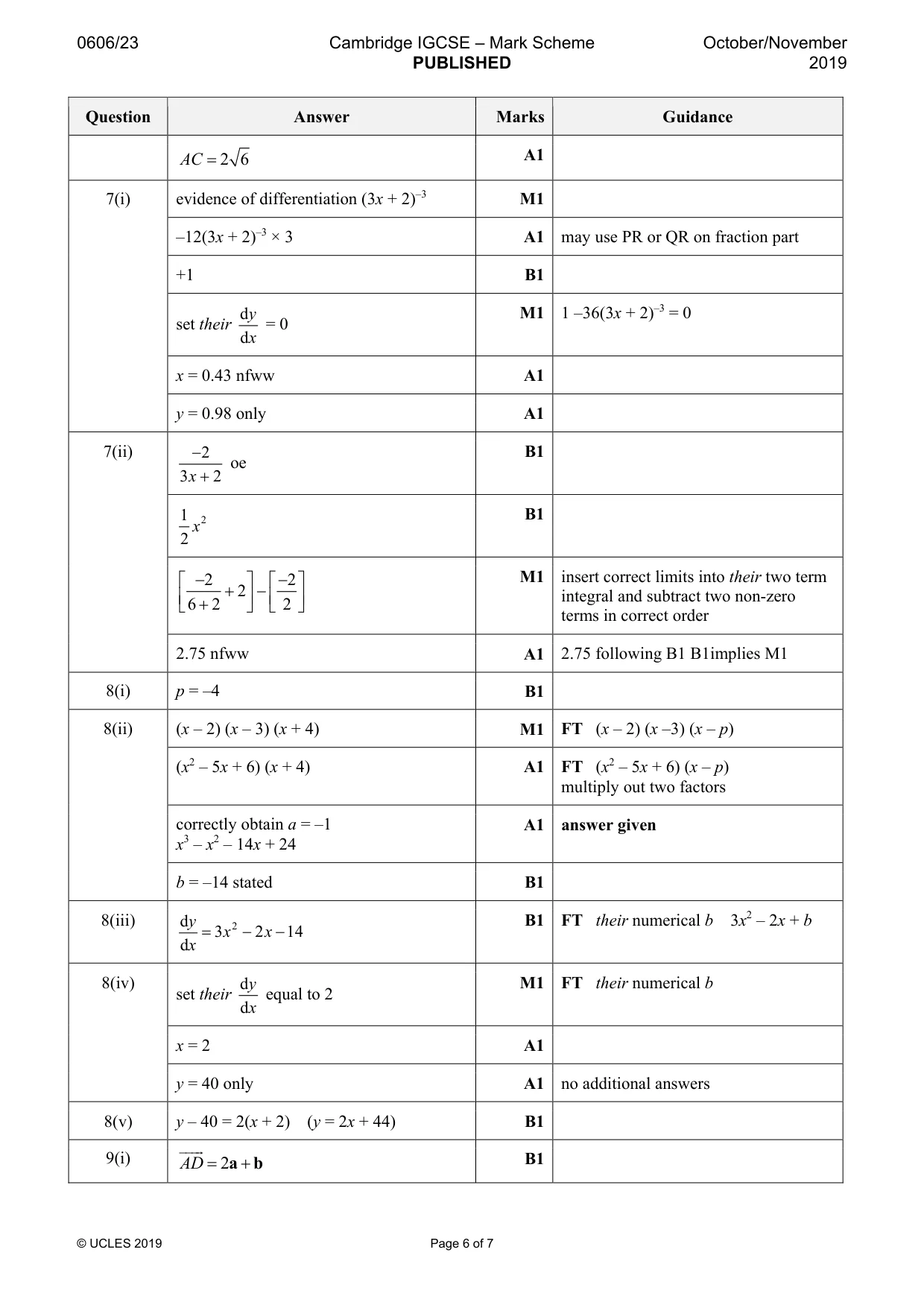
Mark scheme: 7(i) evidence of differentiation (3x + 2)–3 M1 –12(3x + 2)–3 × 3 A1 may use PR or QR on fraction part +1 B1 d y M1 1 –36(3x + 2)–3 = 0 set their = 0 d x x = 0.43 nfww A1 y = 0.98 only A1 7(ii) − 2 B1 oe 3 x + 2 1 2 B1 x 2 −2 −2 M1 insert correct limits into their two term + 2 − integral and subtract two non-zero 6 + 2 2 terms in correct order 2.75 nfww A1 2.75 following B1 B1implies M1
More questions on Use differentiation to find stationary points
Q8 · The roots of the equation x 3 + ax 2 + bx + 24 = 0 are 2, 3 and p, where p is an integer
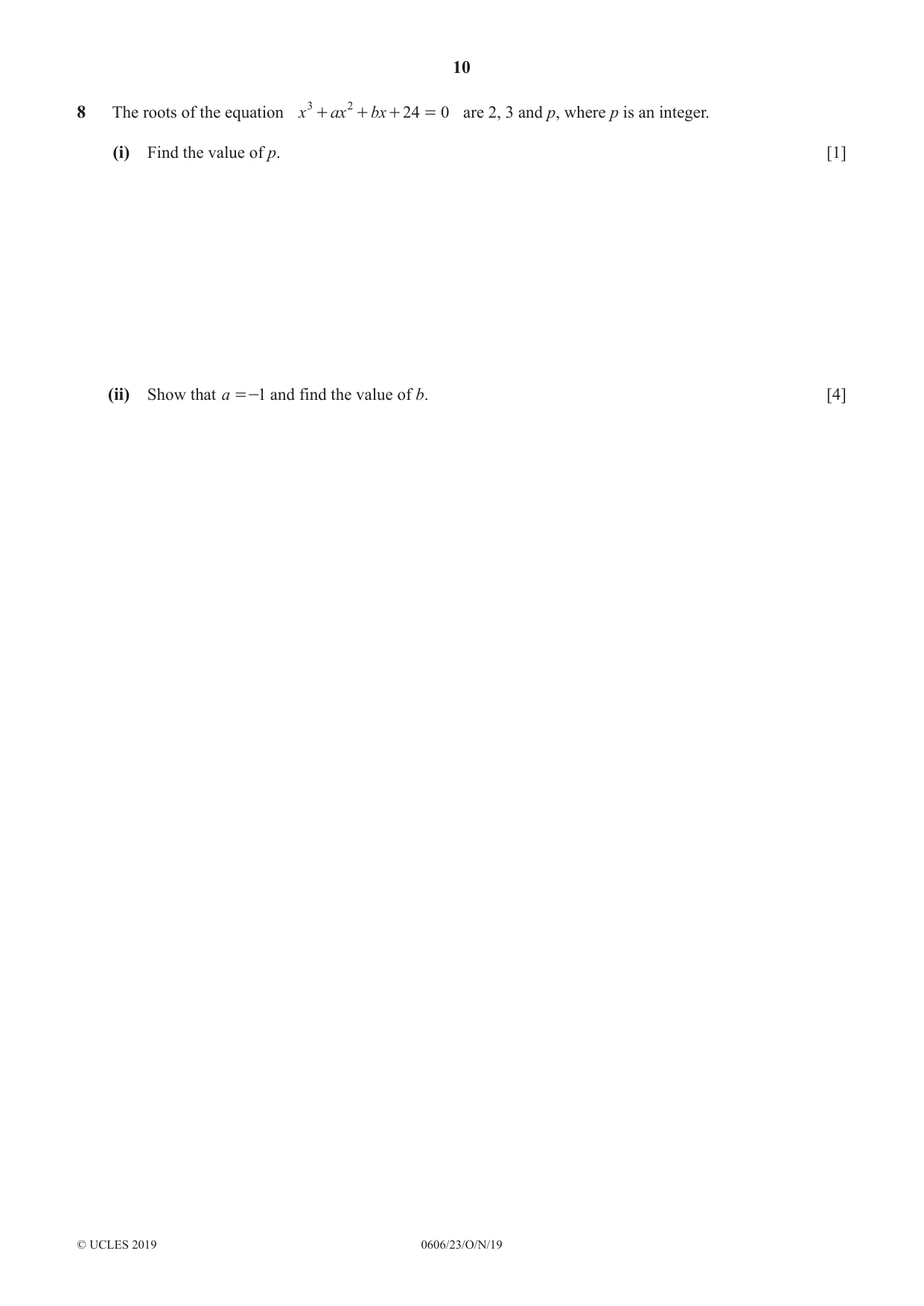
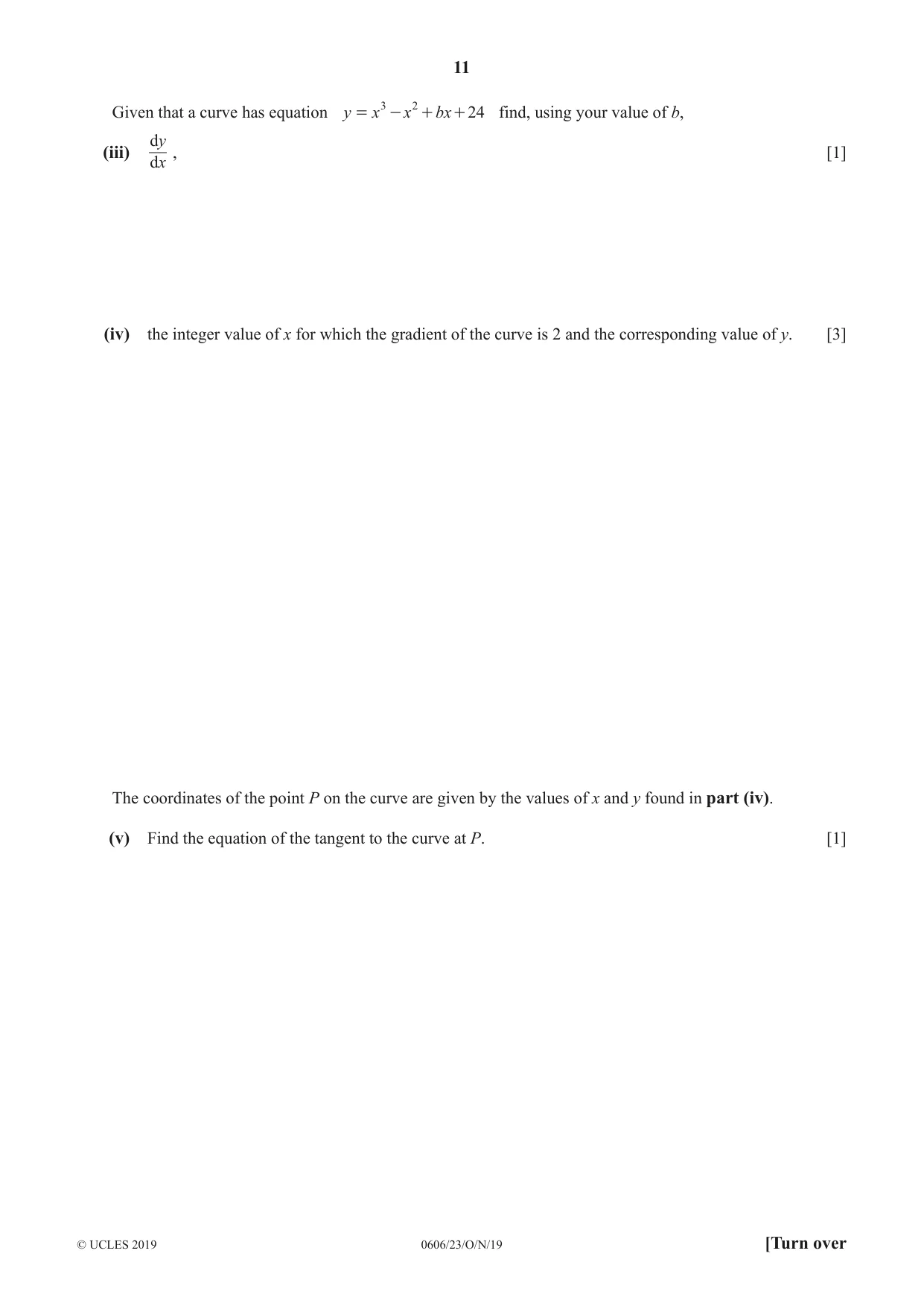
8 The roots of the equation x 3 + ax 2 + bx + 24 = 0 are 2, 3 and p, where p is an integer. (i) Find the value of p. [1] (ii) Show that a =-1 and find the value of b. [4] Given that a curve has equation y = x 3 - x 2 + bx + 24 find, using your value of b, dy (iii) , [1] dx (iv) the integer value of x for which the gradient of the curve is 2 and the corresponding value of y. [3] The coordinates of the point P on the curve are given by the values of x and y found in part (iv). (v) Find the equation of the tangent to the curve at P. [1]
Mark scheme: 8(i) p = –4 B1 8(ii) (x – 2) (x – 3) (x + 4) M1 FT (x – 2) (x –3) (x – p) (x2 – 5x + 6) (x + 4) A1 FT (x2 – 5x + 6) (x – p) multiply out two factors correctly obtain a = –1 A1 answer given x3 – x2 – 14x + 24 b = –14 stated B1 8(iii) d y 2 B1 FT their numerical b 3x2 – 2x + b = 3 x − 2 x − 14 d x 8(iv) d y M1 FT their numerical b set their equal to 2 d x x = 2 A1 y = 40 only A1 no additional answers 8(v) y – 40 = 2(x + 2) (y = 2x + 44) B1
Q9 · B D X O A C The diagram shows points O, A, B, C, D and X
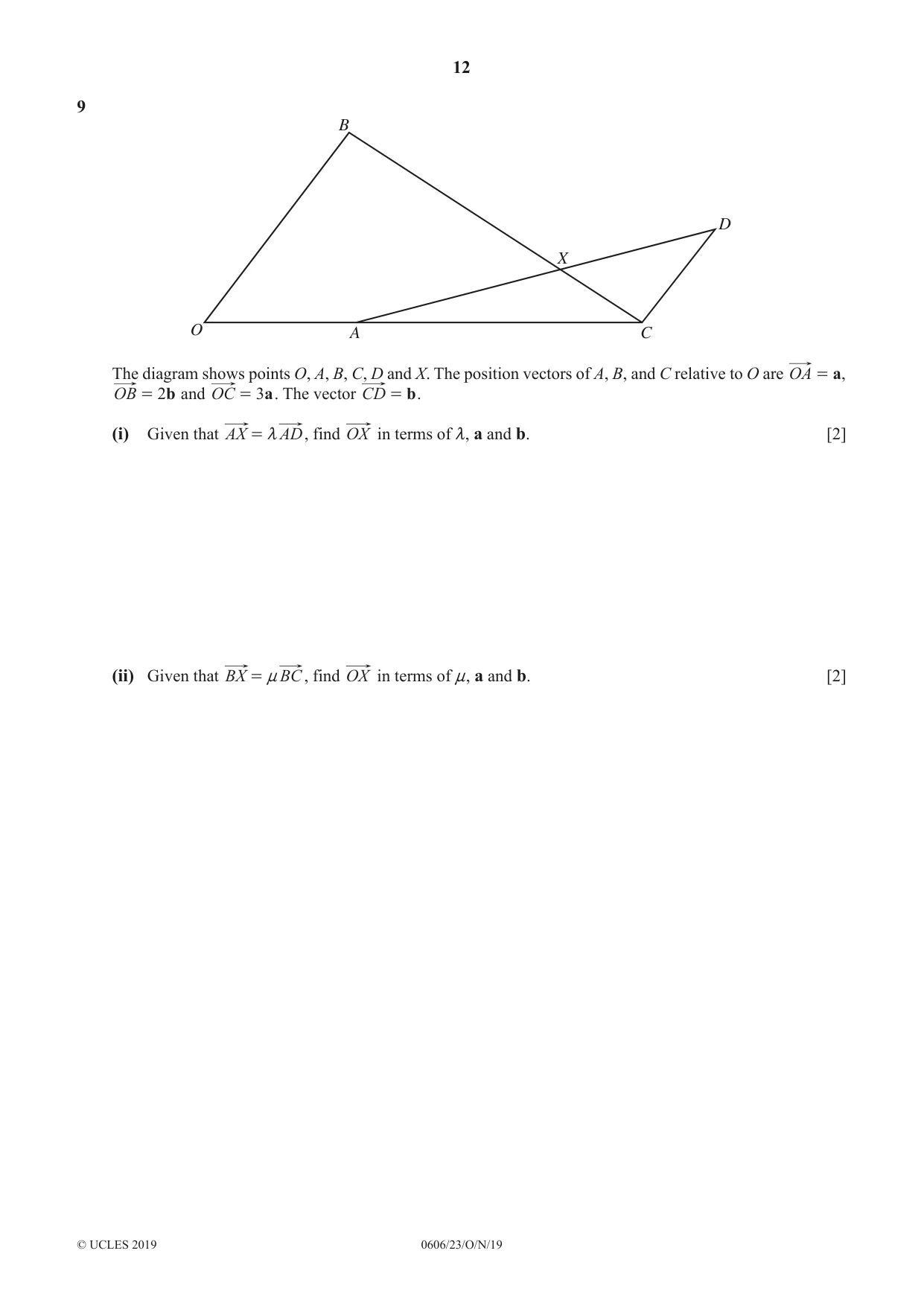
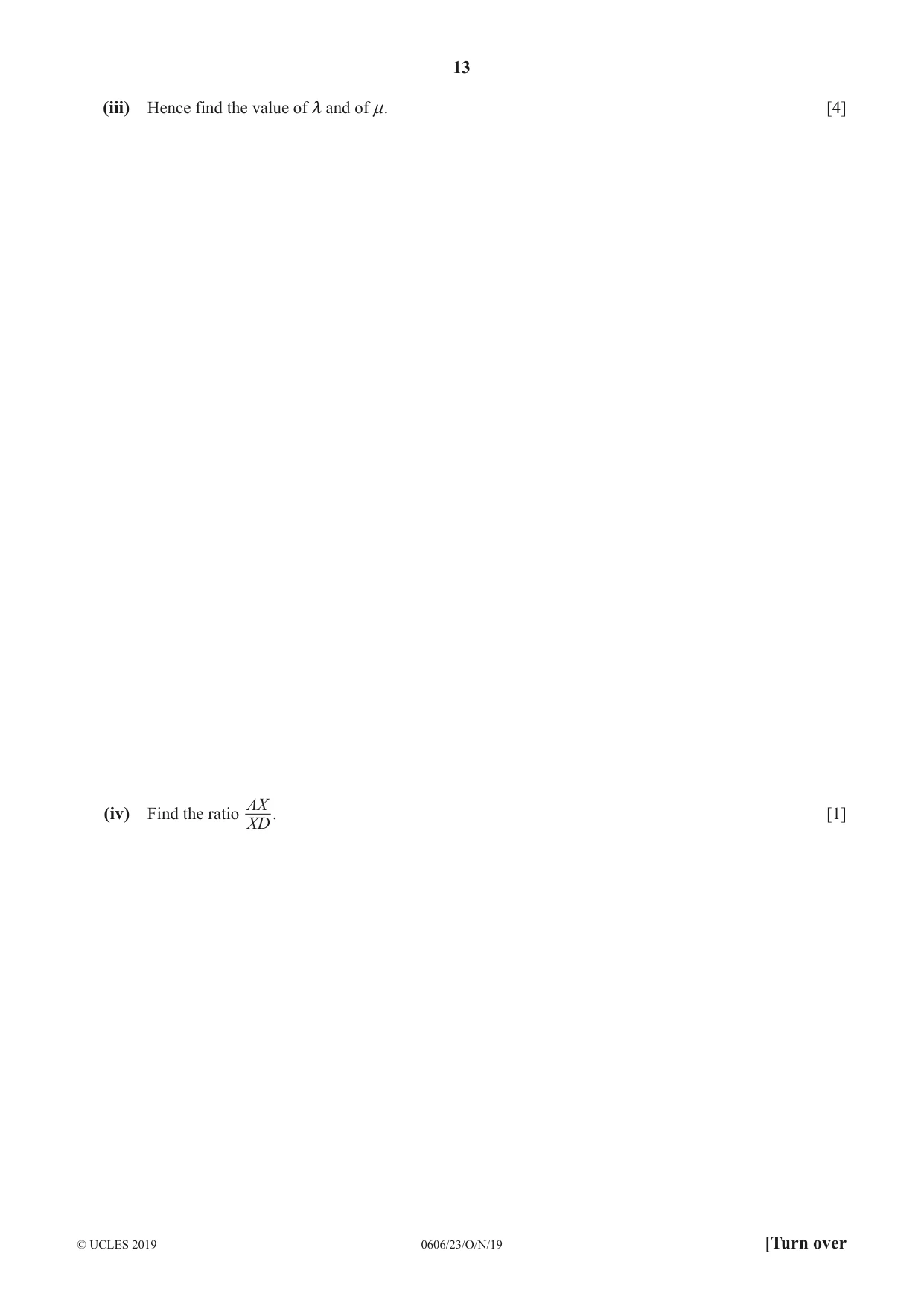
9 B D X O A C The diagram shows points O, A, B, C, D and X. The position vectors of A, B, and C relative to O are OA = a, OB = 2b and OC = 3a . The vector CD = b . (i) Given that AX = m AD , find OX in terms of m, a and b. [2] (ii) Given that BX = n BC , find OX in terms of n, a and b. [2] (iii) Hence find the value of m and of n. [4] AX(iv) Find the ratio . [1] XD
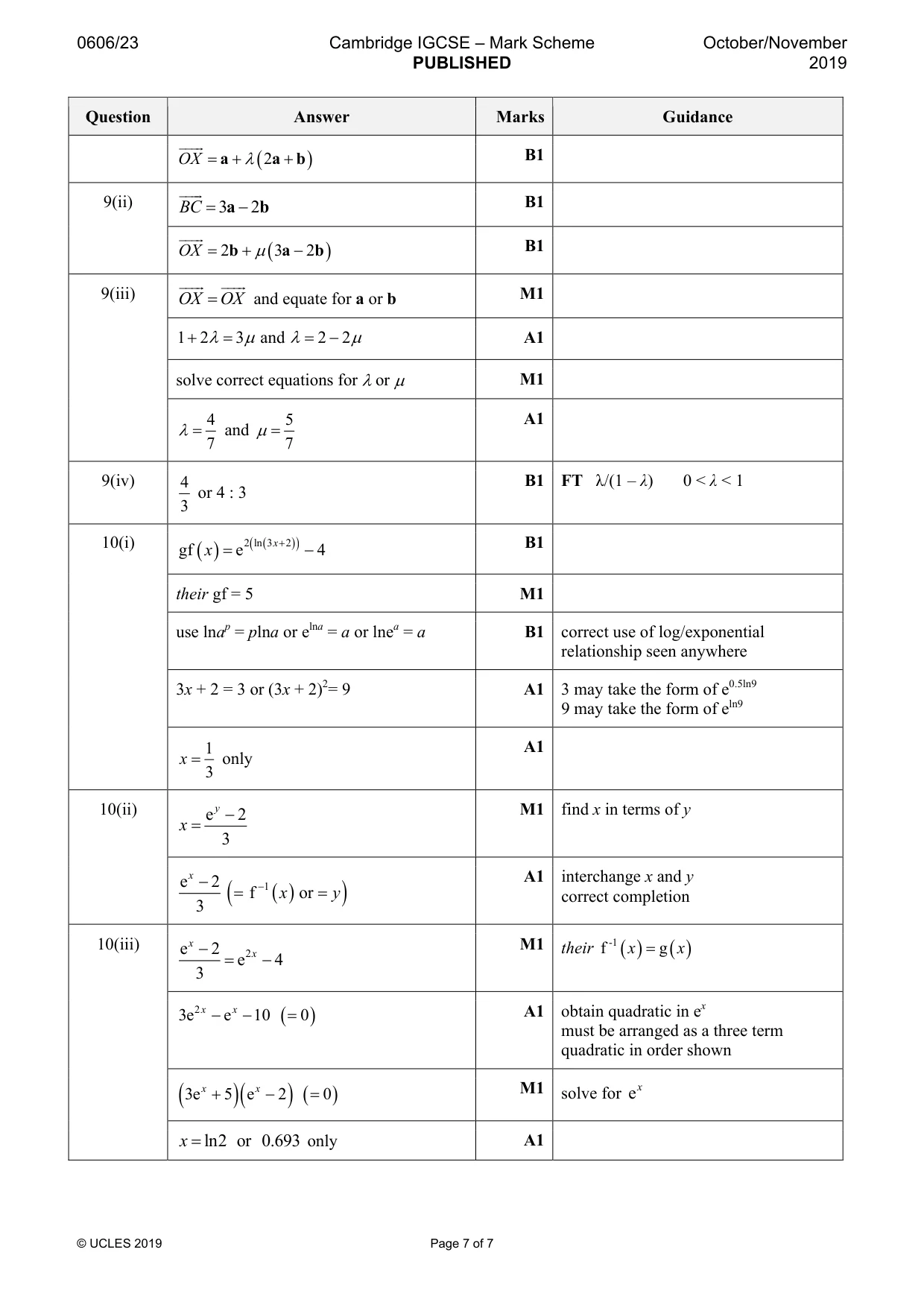
Mark scheme: JJJG 9(i) AD = 2a + b B1 JJJG OX = a + λ( 2a + b ) B1 JJJG 9(ii) BC = 3a − 2b B1 JJJG OX = 2b + µ( 3a − 2b ) B1 JJJG JJJG 9(iii) OX = OX and equate for a or b M1 1 + 2λ= 3µ and λ= 2 − 2µ A1 solve correct equations for λor µ M1 4 5 A1 λ= and µ= 7 7 9(iv) 4 B1 FT λ/(1 – λ) 0 < λ < 1 or 4 : 3 3
Q10 · The functions f and g are defined by 2 f (x) = ln (3x + 2) for x 2 - , 3 g (x) = e 2x - 4…
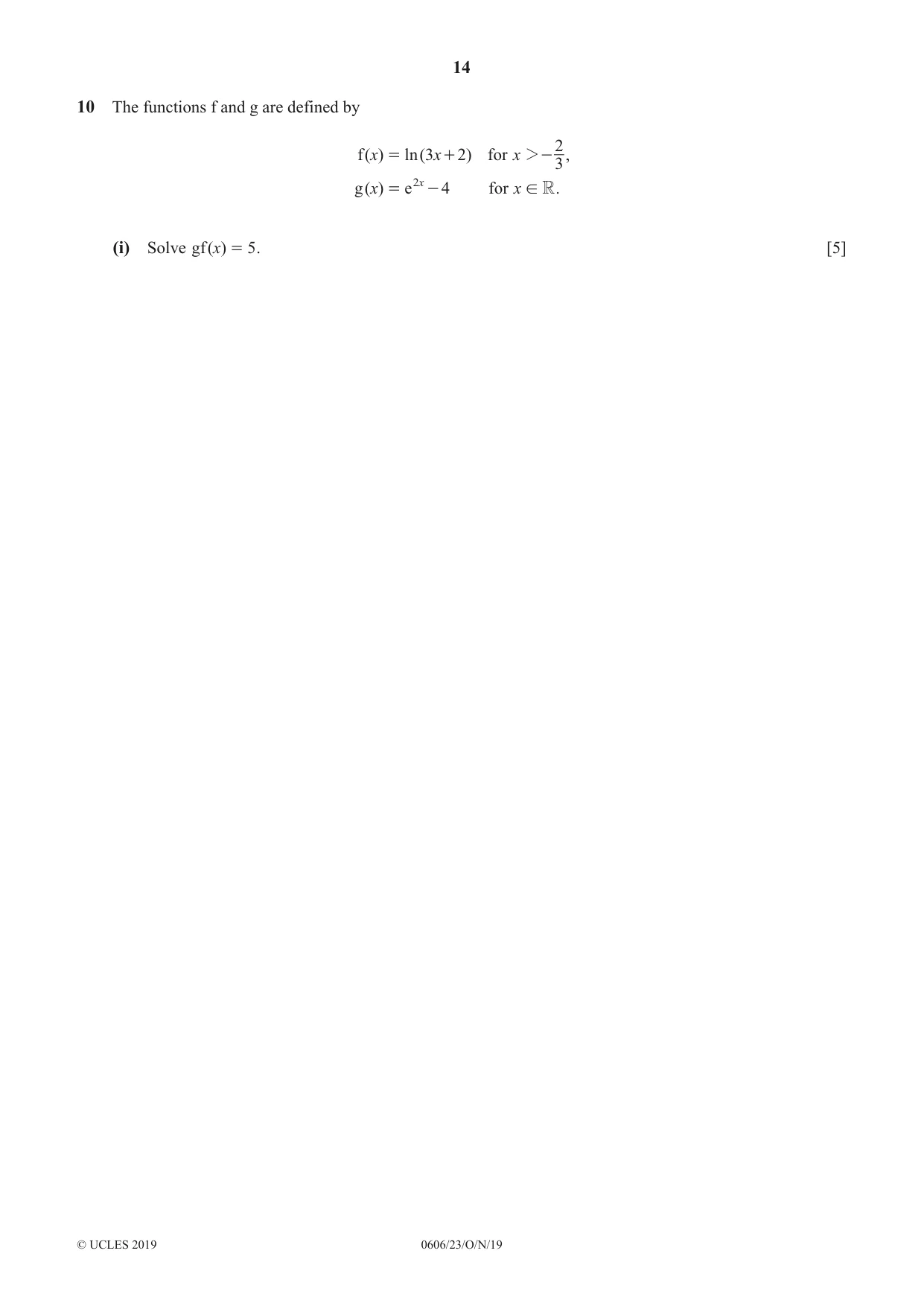
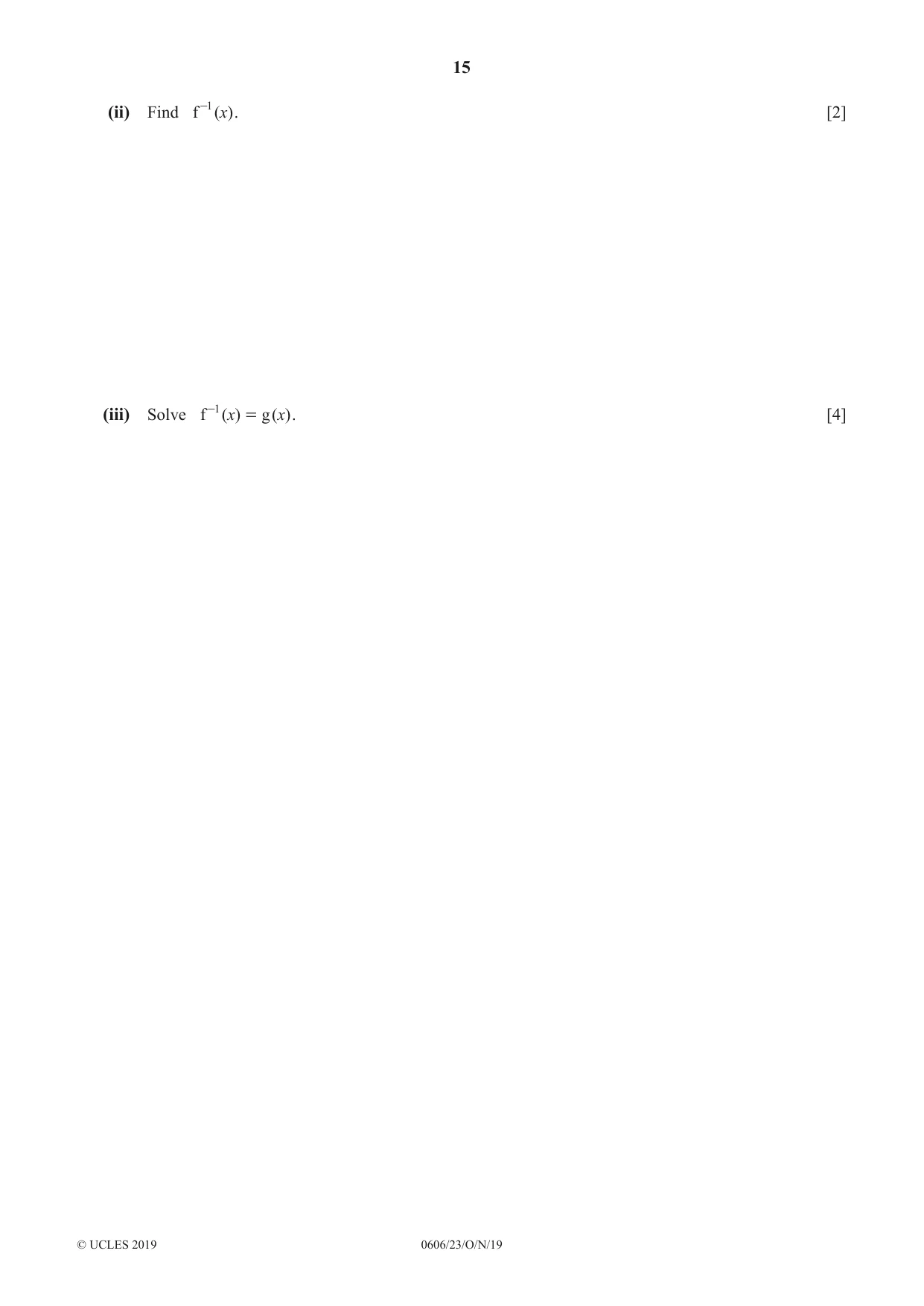
10 The functions f and g are defined by 2 f (x) = ln (3x + 2) for x 2 - , 3 g (x) = e 2x - 4 for x ! R . (i) Solve gf ()x = 5 . [5] (ii) Find f -1 ()x . [2] (iii) Solve f -1 ( x) = g ( x) . [4]
Mark scheme: 10(i) 2 ( ln ( 3 x + 2 ) ) B1 gf ( x ) = e − 4 their gf = 5 M1 use lnap = plna or elna = a or lnea = a B1 correct use of log/exponential relationship seen anywhere 3x + 2 = 3 or (3x + 2)2= 9 A1 3 may take the form of e0.5ln9 9 may take the form of eln9 1 A1 x = only 3 10(ii) e y − 2 M1 find x in terms of y x = 3 e x − 2 ( −1 A1 interchange x and y = f ( x ) or = y ) correct completion 3 10(iii) e x − 2 2 x M1 their f -1 ( x ) = g ( x ) = e − 4 3 3e 2 x − e x − 10 ( = 0 ) A1 obtain quadratic in ex must be arranged as a three term quadratic in order shown 3e x + 5 e x − 2 = 0 ) M1 solve for ex ( )( ) ( x = ln2 or 0.693 only A1
What was in this paper
The subtopics covered by these 9 questions, and how many questions each got. Open one in a new tab to see every Cambridge question on it.
1Find the inverse of a one–one function1Find the magnitude of a vector; add and1Find the maximum or minimum value of the1Know and use the six trigonometric functions1Prove trigonometric relationships involving the1Solve, for a given domain, trigonometric1Use differentiation to find stationary points1Use the binomial theorem for expansion of1What you needed in this session
Cambridge’s own grade thresholds for 2019 Oct/Nov, Paper 2 · Variant 3. A higher threshold means an easier paper — the bar moves with how the cohort did.