Cambridge IGCSE Mathematics - Additional 0606 — 2017 May/June Paper 2 · Variant 3
0606/23/M/J/17 · 11 questions · 80 marks · ≈90 min
The question paper and its mark scheme, free to read here and free to download. This is Cambridge’s own paper, exactly as it was sat.
Question paper16 pages
Mark scheme7 pages
Answers below. Sit the paper first if you are practising.
Questions as text
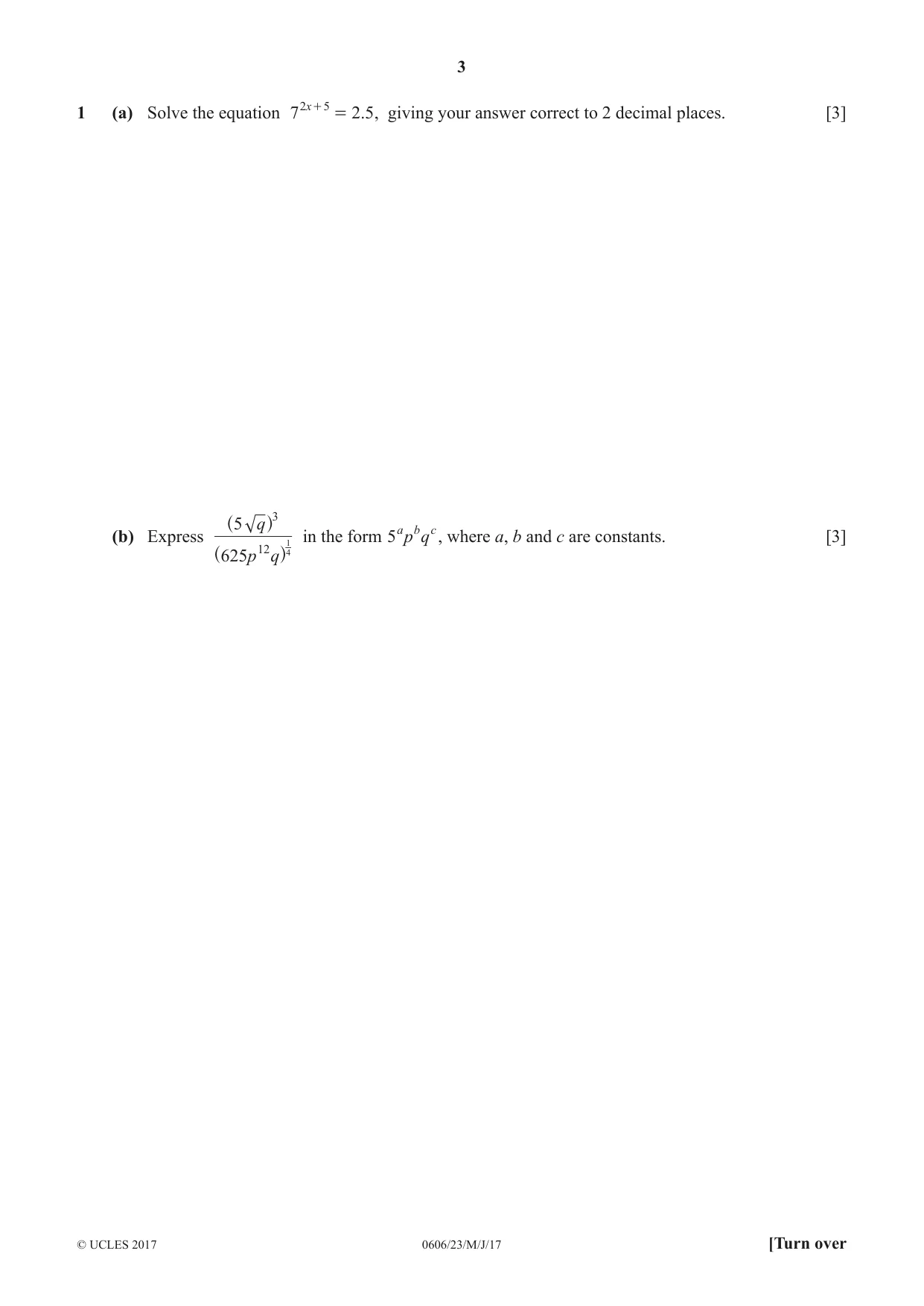
Q1 · Solve the equation 7 2x + 5 = 2.5 , giving your answer correct to 2 decimal places
1 (a) Solve the equation 7 2x + 5 = 2.5 , giving your answer correct to 2 decimal places. [3] 5 q 3 b (b) Express ^ h 1 in the form 5a p q c, where a, b and c are constants. [3] 4 625p 12 q ^ h
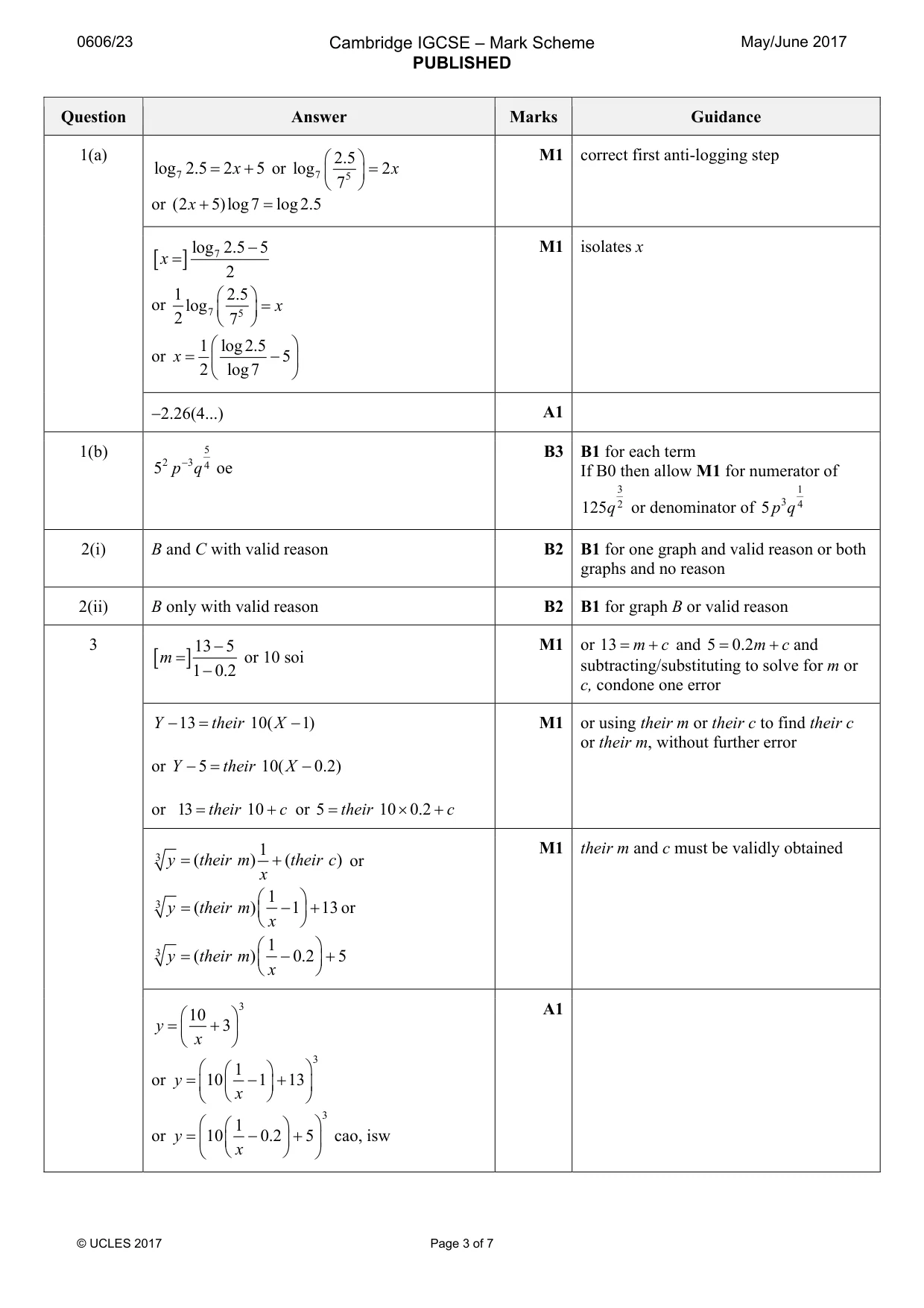
Mark scheme: Question Answer Marks Guidance 1(a) 2.5 M1 correct first anti-logging step 2 x = log 7 2.5 = 2 x + 5 or log 7 5 7 or (2 x + 5)log7 = log2.5 log 7 2.5 − 5 M1 isolates x [ x = ] 2 1 2.5 x = or log 7 5 2 7 1 log2.5 or x = − 5 2 log7 −2.26(4...) A1 1(b) 5 B3 B1 for each term 5 2 p −3 q 4 oe If B0 then allow M1 for numerator of 3 1 125q 2 or denominator of 5p 3 q 4
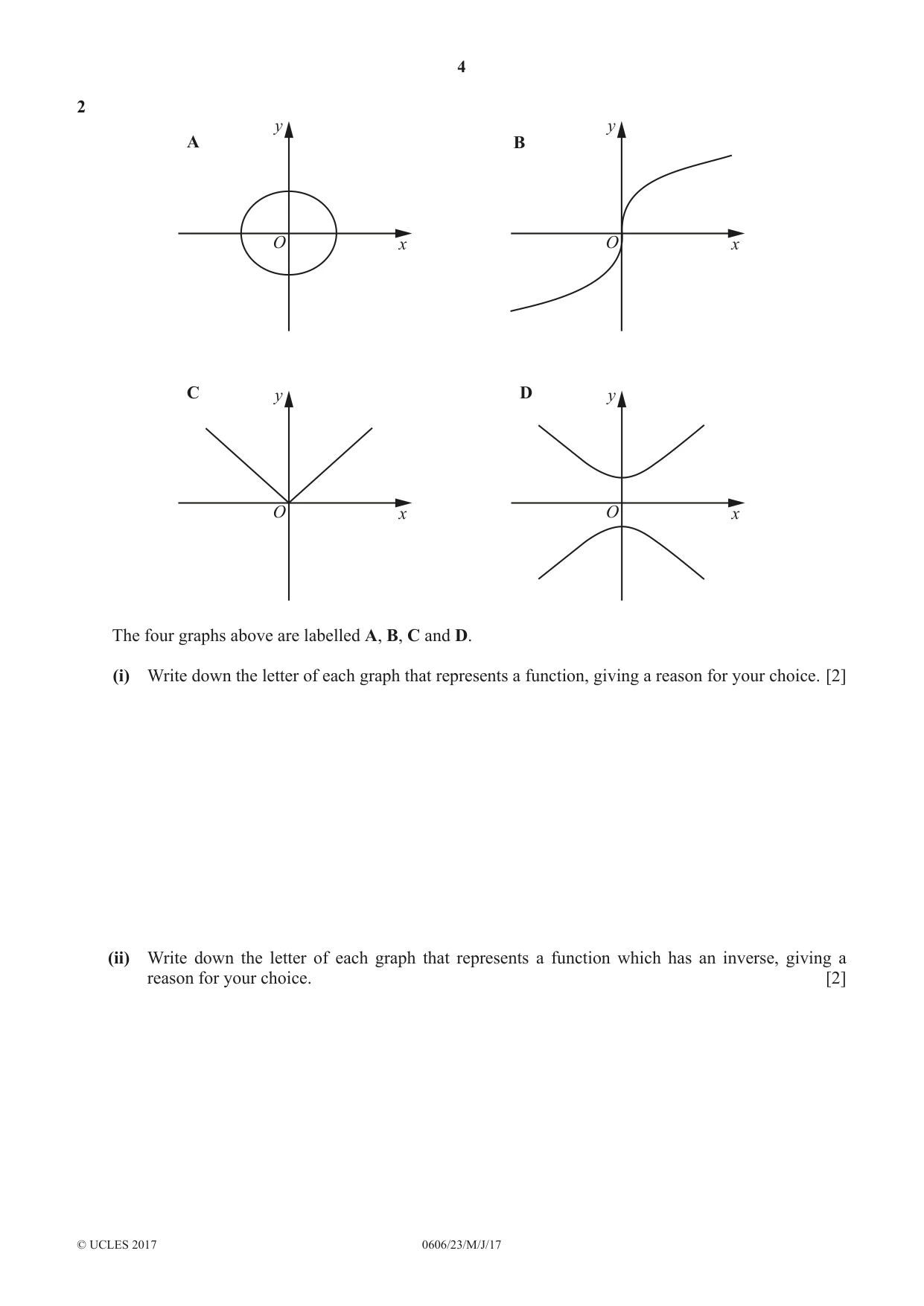
Q2 · Y y A B O x O x C y D y O x O x The four graphs above are labelled A, B, C and D
2 y y A B O x O x C y D y O x O x The four graphs above are labelled A, B, C and D. (i) Write down the letter of each graph that represents a function, giving a reason for your choice. [2] (ii) Write down the letter of each graph that represents a function which has an inverse, giving a reason for your choice. [2]
Mark scheme: 2(i) B and C with valid reason B2 B1 for one graph and valid reason or both graphs and no reason 2(ii) B only with valid reason B2 B1 for graph B or valid reason
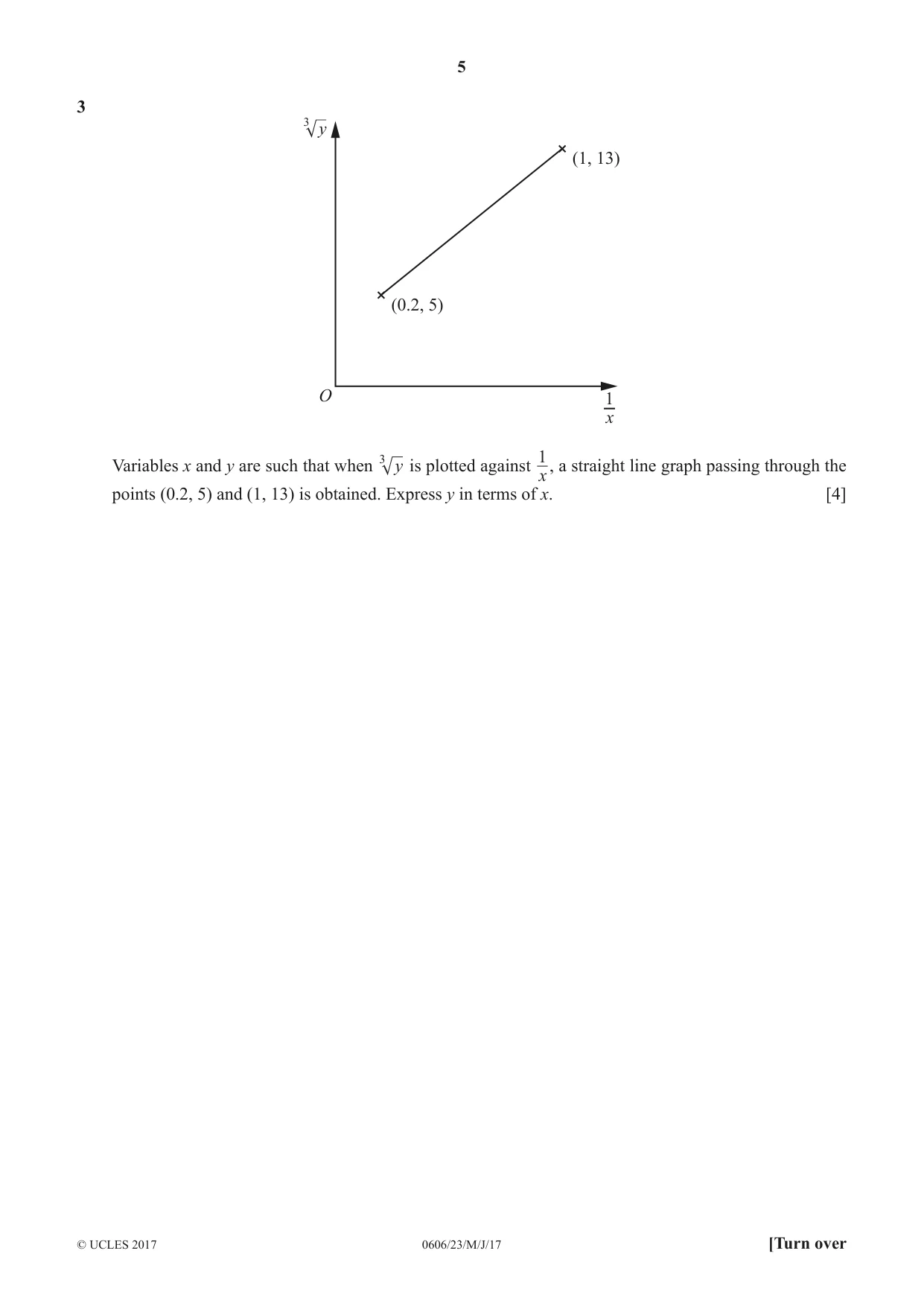
Q3 · 3 y (1, 13) (0.2, 5) O 1 x Variables x and y are such that when 3 y is plotted against 1…
3 3 y (1, 13) (0.2, 5) O 1 x Variables x and y are such that when 3 y is plotted against 1, a straight line graph passing through the x points (0.2, 5) and (1, 13) is obtained. Express y in terms of x. [4]
Mark scheme: 3 13 − 5 M1 or 13 = m + c and 5 = 0.2 m + c and [ m = ] or 10 soi subtracting/substituting to solve for m or 1 − 0.2 c, condone one error Y − 13 = their 10( X − 1) M1 or using their m or their c to find their c or their m, without further error or Y − 5 = their 10( X − 0.2) or 13 = their 10 + c or 5 = their 10 × 0.2 + c 1 M1 their m and c must be validly obtained 3 y = (their m ) + (their c ) or x 3 1 y = (their m ) − 1 + 13 or x 3 1 y = (their m ) − 0.2 + 5 x 3 A1 10 y = + 3 x 1 3 or y = 10 − 1 + 13 x 1 3 or y = 10 − 0.2 + 5 cao, isw x
Q4 · Vectors a, b and c are such that a = KK OO, b = KK OO and 3a + c = b
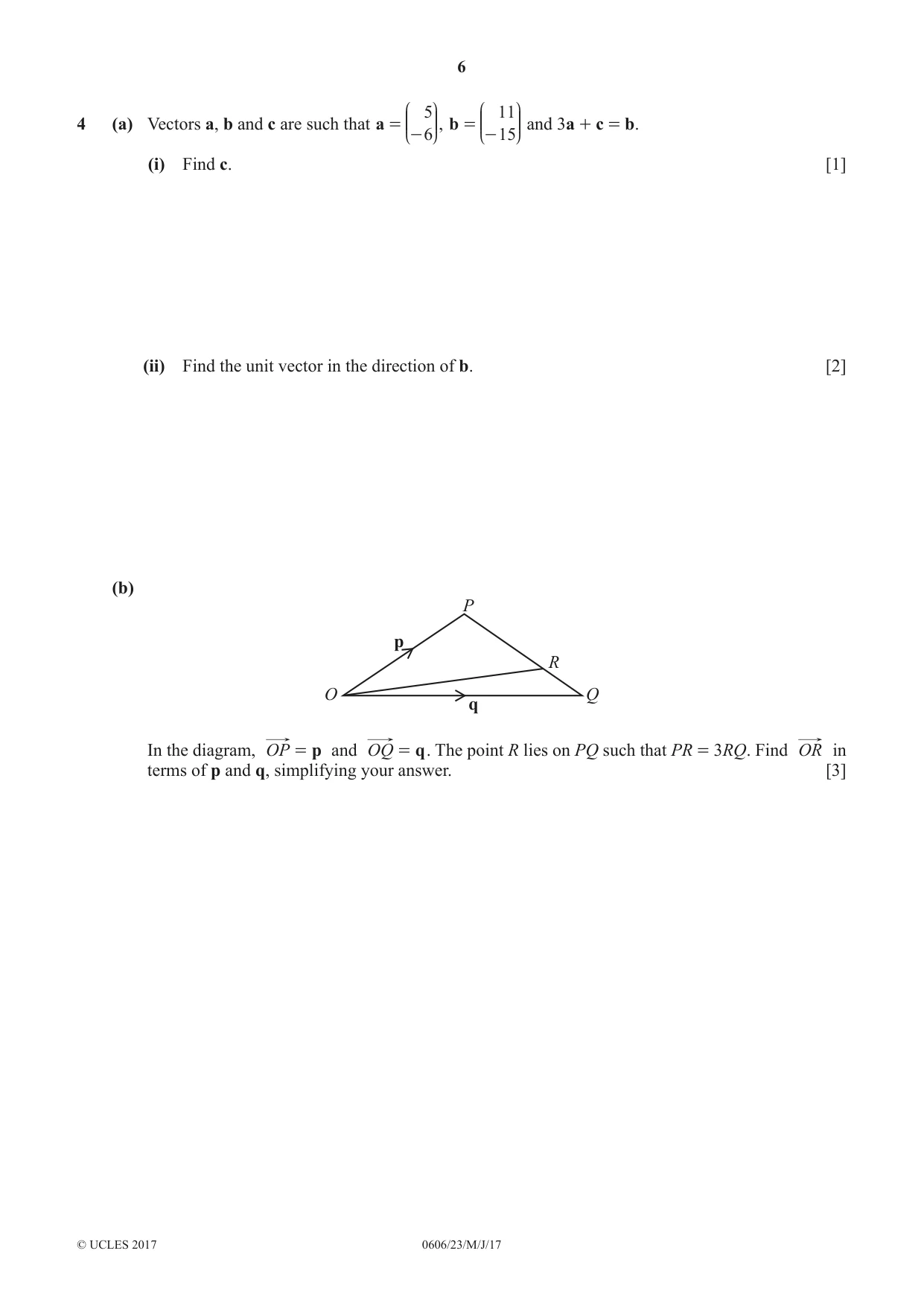
4 (a) Vectors a, b and c are such that a = KK OO, b = KK OO and 3a + c = b. - 6 - 15 L P L P (i) Find c. [1] (ii) Find the unit vector in the direction of b. [2] (b) P p R O Q q In the diagram, OP = p and OQ = q . The point R lies on PQ such that PR = 3RQ. Find OR in terms of p and q, simplifying your answer. [3]
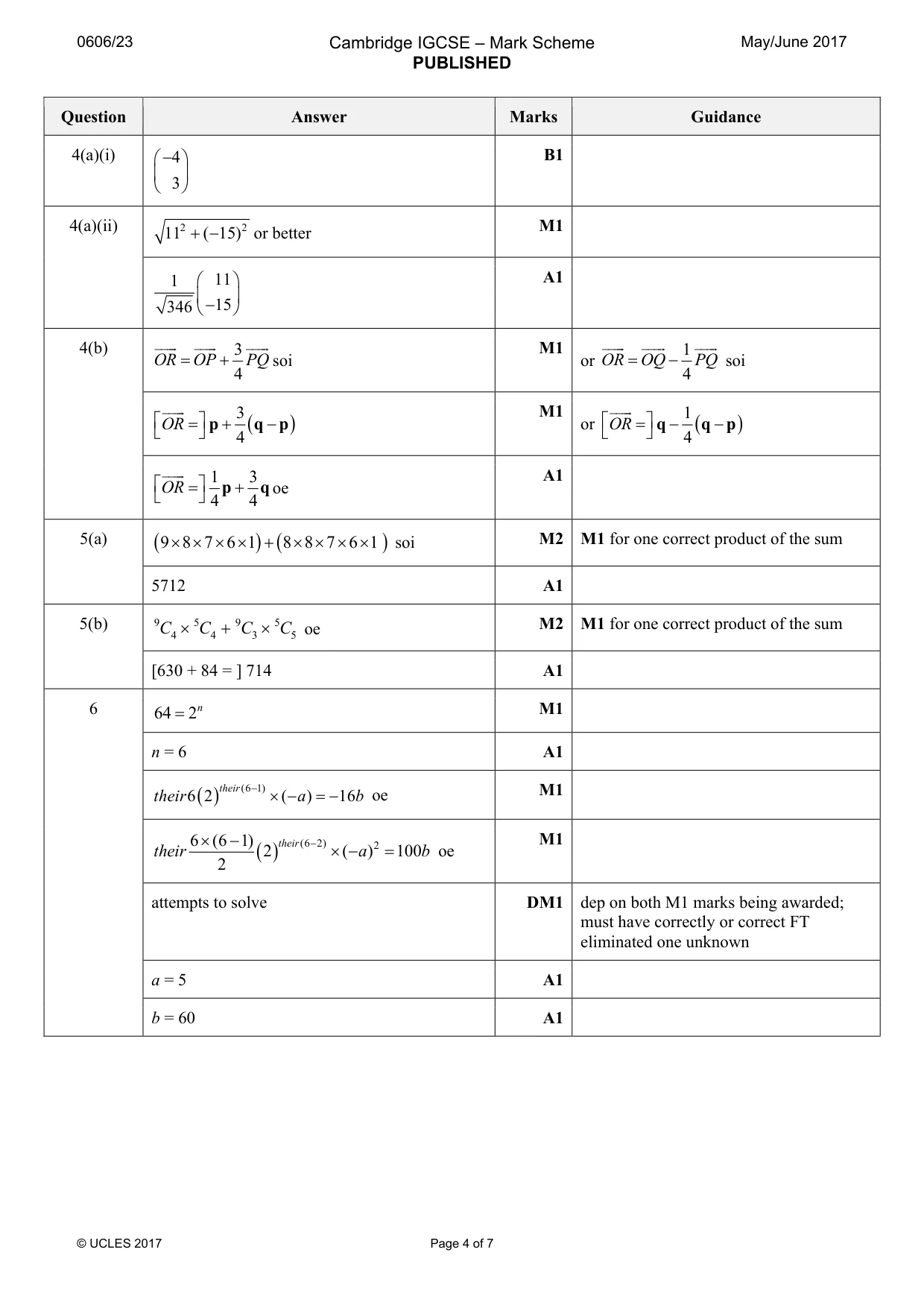
Mark scheme: 4(a)(i) −4 B1 3 4(a)(ii) 2 2 M1 11 + ( −15) or better 1 11 A1 346 −15 4(b) uuur uuur 3 uuur M1 uuur uuur 1 uuur OR = OP + PQ soi or OR = OQ − PQ soi 4 4 uuur 3 M1 uuur 1 OR = + ( q − p ) or OR = − ( q − p ) p q 4 4 uuur 1 3 A1 OR = p + q oe 4 4
Q5 · How many 5-digit numbers are there that have 5 different digits and are divisible by 5?
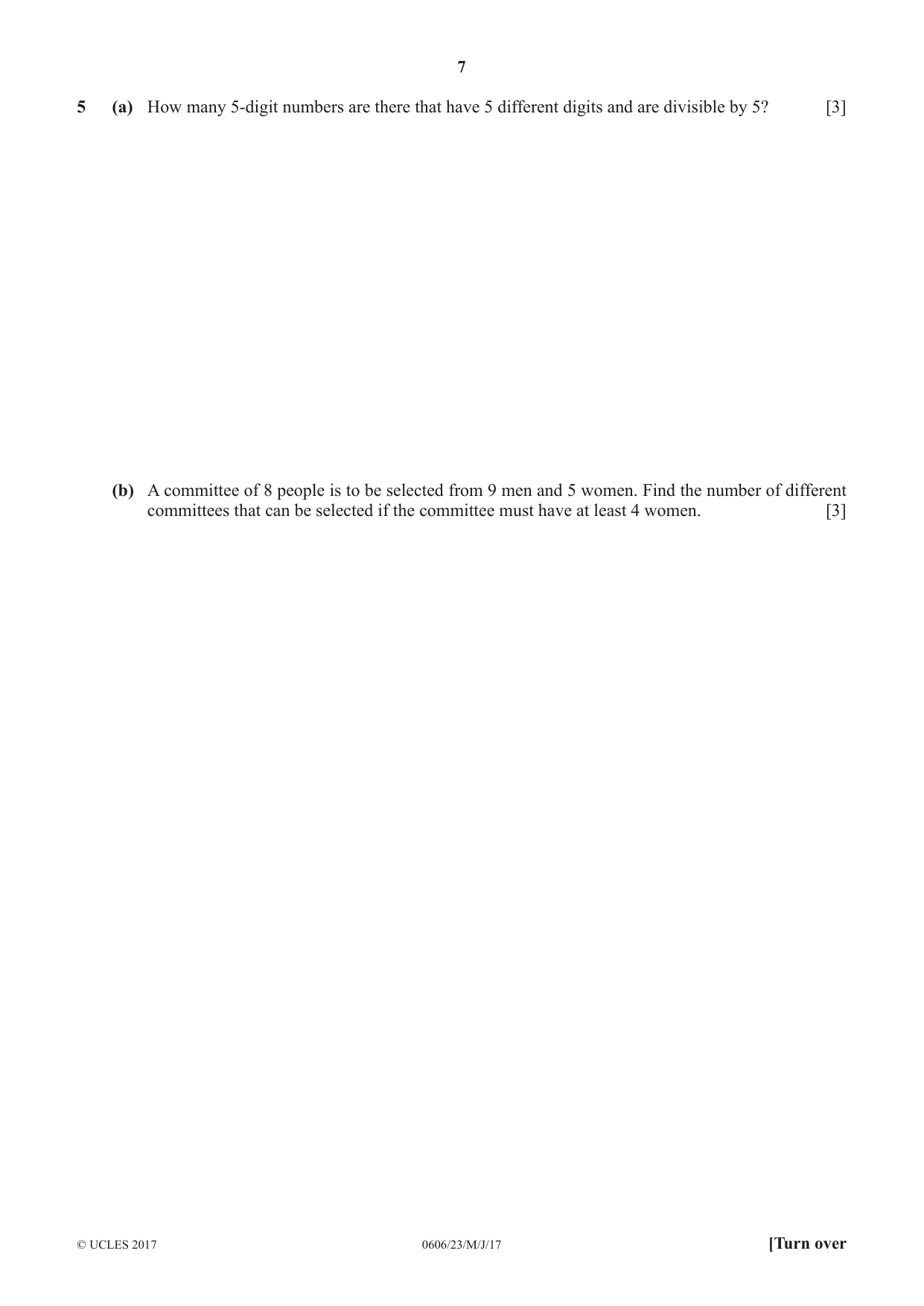
5 (a) How many 5-digit numbers are there that have 5 different digits and are divisible by 5? [3] (b) A committee of 8 people is to be selected from 9 men and 5 women. Find the number of different committees that can be selected if the committee must have at least 4 women. [3]
Mark scheme: 5(a) ( 9 × 8 × 7 × 6 × 1) + ( 8 × 8 × 7 × 6 × 1 ) soi M2 M1 for one correct product of the sum 5712 A1 5(b) 9C4 × 5C4 + 9C3 × 5C5 oe M2 M1 for one correct product of the sum [630 + 84 = ] 714 A1
More questions on Solve problems on arrangement and selection
Q6 · The first three terms of the binomial expansion of 2 - ax n are 64 - 16 bx + 100 bx 2
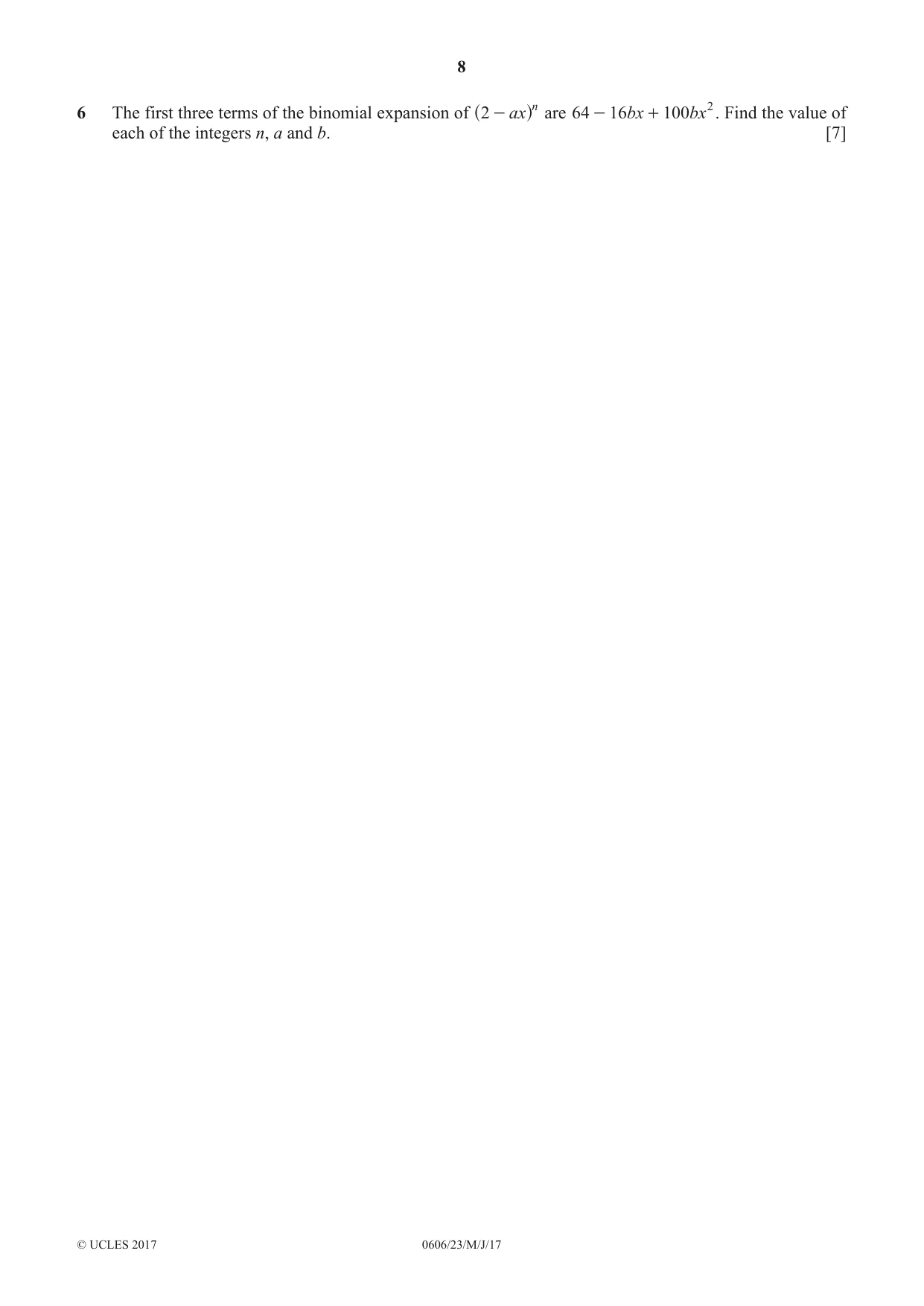
6 The first three terms of the binomial expansion of 2 - ax n are 64 - 16 bx + 100 bx 2 . Find the value of each of the integers n, a and b. [7]
Mark scheme: 6 64 = 2 n M1 n = 6 A1 their (6 1) M1 their 6 ( 2 ) −× ( − a ) = − 16b oe 6 × (6 − 1) their (6 − 2) 2 M1 their ( 2 ) × ( − a ) = 100b oe 2 attempts to solve DM1 dep on both M1 marks being awarded; must have correctly or correct FT eliminated one unknown a = 5 A1 b = 60 A1
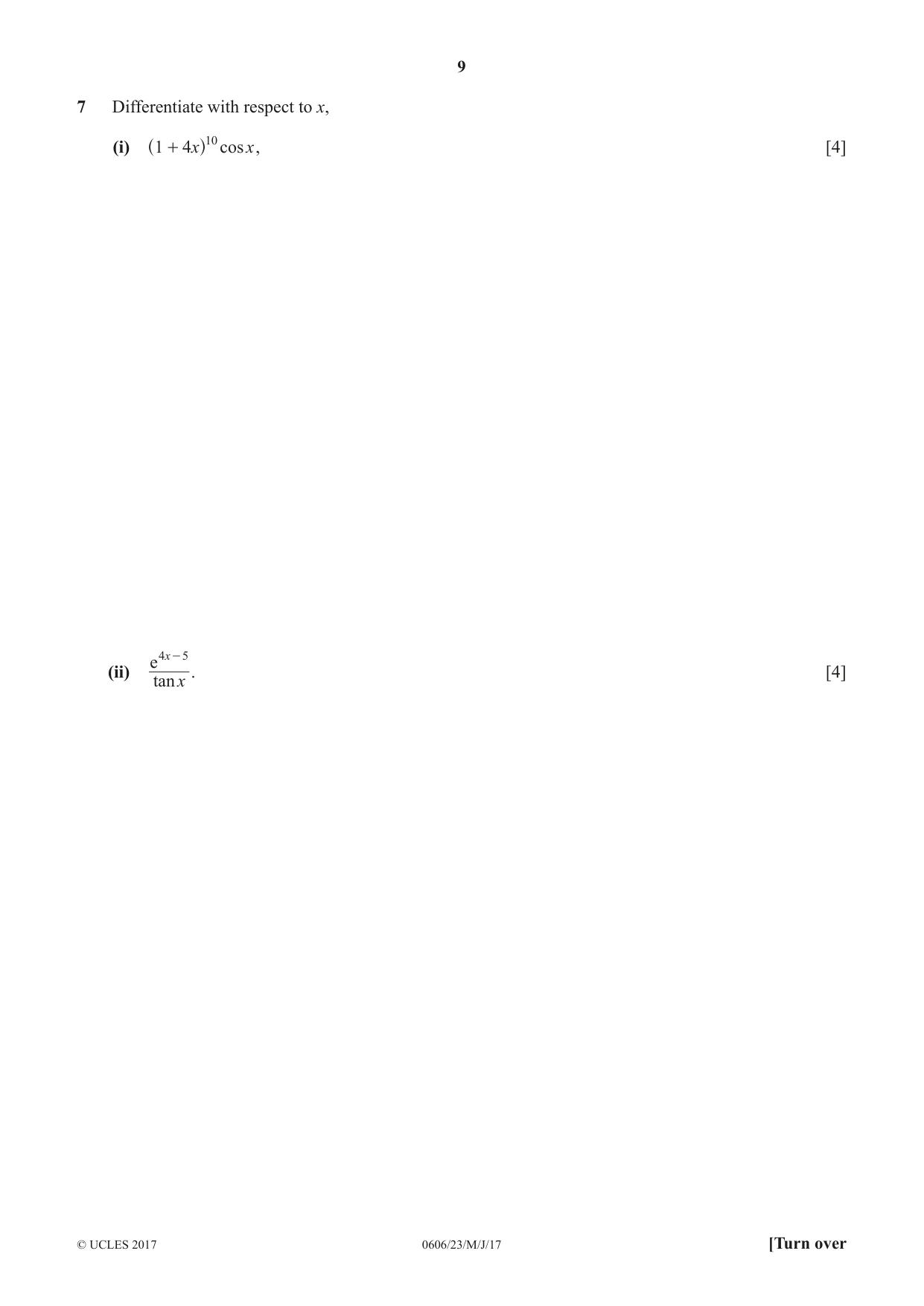
Q7 · Differentiate with respect to x, (i) 1 + 4x 10 cos x , [4] ^ h e 4x - 5 (ii)
7 Differentiate with respect to x, (i) 1 + 4x 10 cos x , [4] ^ h e 4x - 5 (ii) . [4] tanx
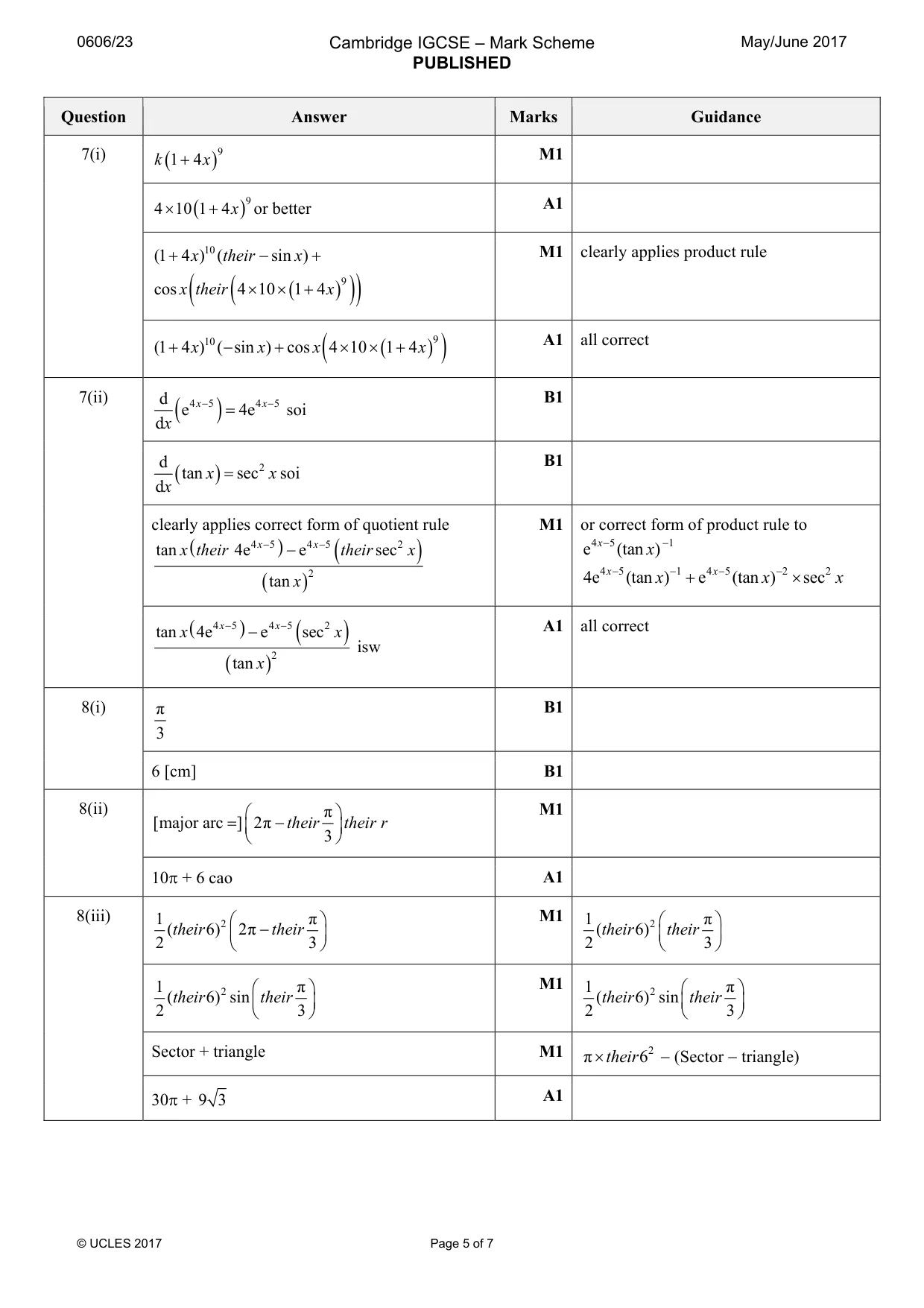
Mark scheme: 7(i) 9 M1 k (1 + 4 x ) 9 A1 4 × 10 (1 + 4 x ) or better (1 + 4 x )10 ( their − sin x ) + M1 clearly applies product rule cos x their 4 × 10 × (1 + 4 x ) 9 ( ( ) ) 10 9 A1 all correct (1 + 4 x ) ( − sin x ) + cos x 4 × 10 × (1 + 4 x ) ( ) 7(ii) d 4 x − 5 4 x − 5 B1 e = 4e soi ( ) dx d 2 B1 ( tan x ) = sec x soi dx clearly applies correct form of quotient rule M1 or correct form of product rule to 4 x − 5 4 x − 5 e 4 x − 5 (tan x ) −1 tan x ( their 4e their sec 2 x ) − e ( ) ( tan x ) 2 4e 4 x − 5 (tan x ) −1 + e 4 x − 5 (tan x ) −2 × sec 2 x 4 x − 5 4 x − 5 A1 all correct tan x ( 4e sec 2 x ) − e ( ) isw ( tan x ) 2
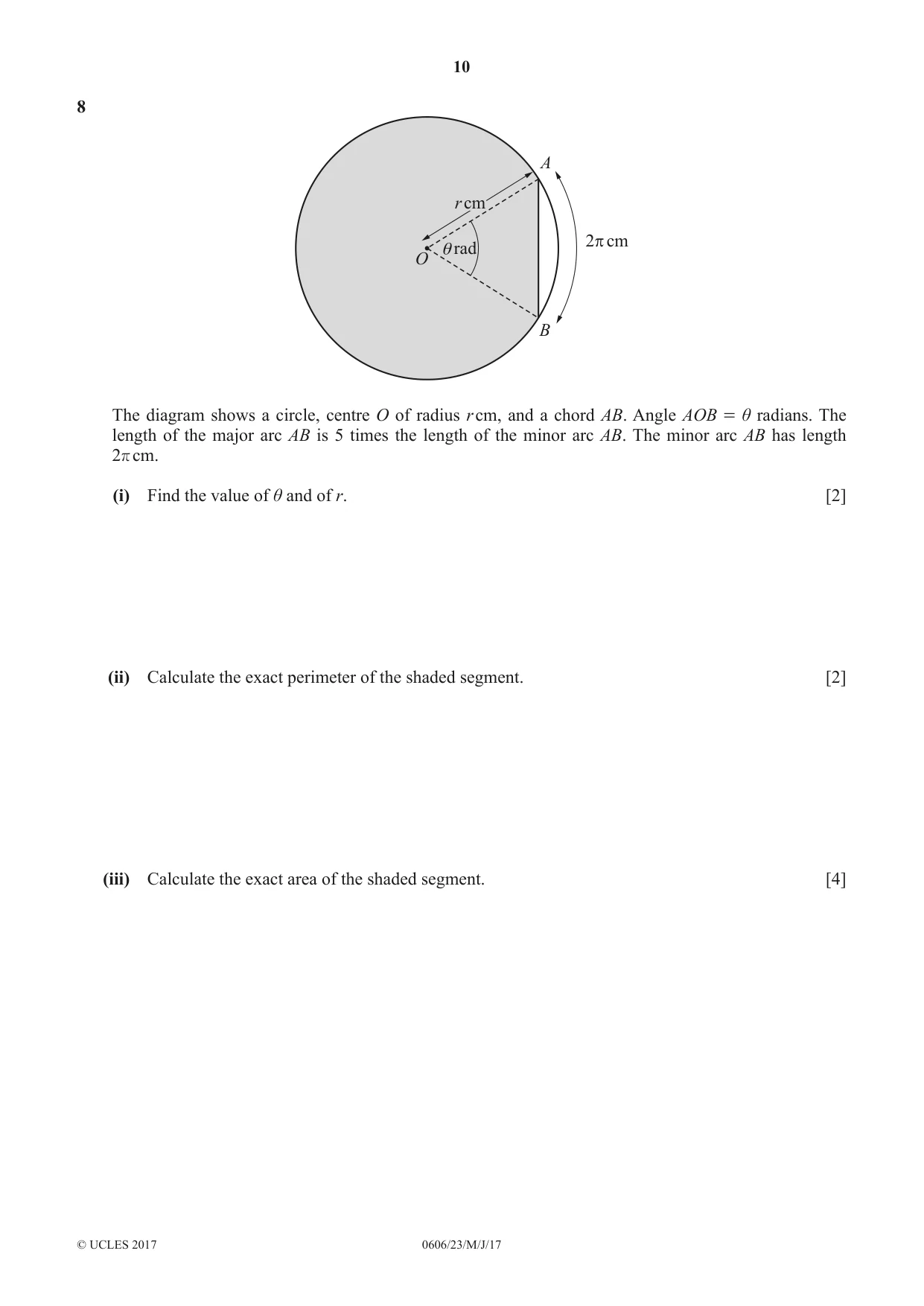
Q8 · A rr cmcm 2 cm θrad O B The diagram shows a circle, centre O of radius r cm, and a chord…
8 A rr cmcm 2 cm θrad O B The diagram shows a circle, centre O of radius r cm, and a chord AB. Angle AOB = θ radians. The length of the major arc AB is 5 times the length of the minor arc AB. The minor arc AB has length 2r cm. (i) Find the value of θ and of r. [2] (ii) Calculate the exact perimeter of the shaded segment. [2] (iii) Calculate the exact area of the shaded segment. [4]
Mark scheme: 8(i) π B1 3 6 [cm] B1 8(ii) π M1 [major arc = ] 2π − their their r 3 10π + 6 cao A1 8(iii) 1 2 π M1 1 2 π (their 6) 2π − their (their 6) their 2 3 2 3 1 2 π M1 1 2 π ( their 6) sin their ( their 6) sin their 2 3 2 3 Sector + triangle M1 π ×their 6 2 − (Sector − triangle) 30π + 9 3 A1
More questions on Solve problems involving the arc length and
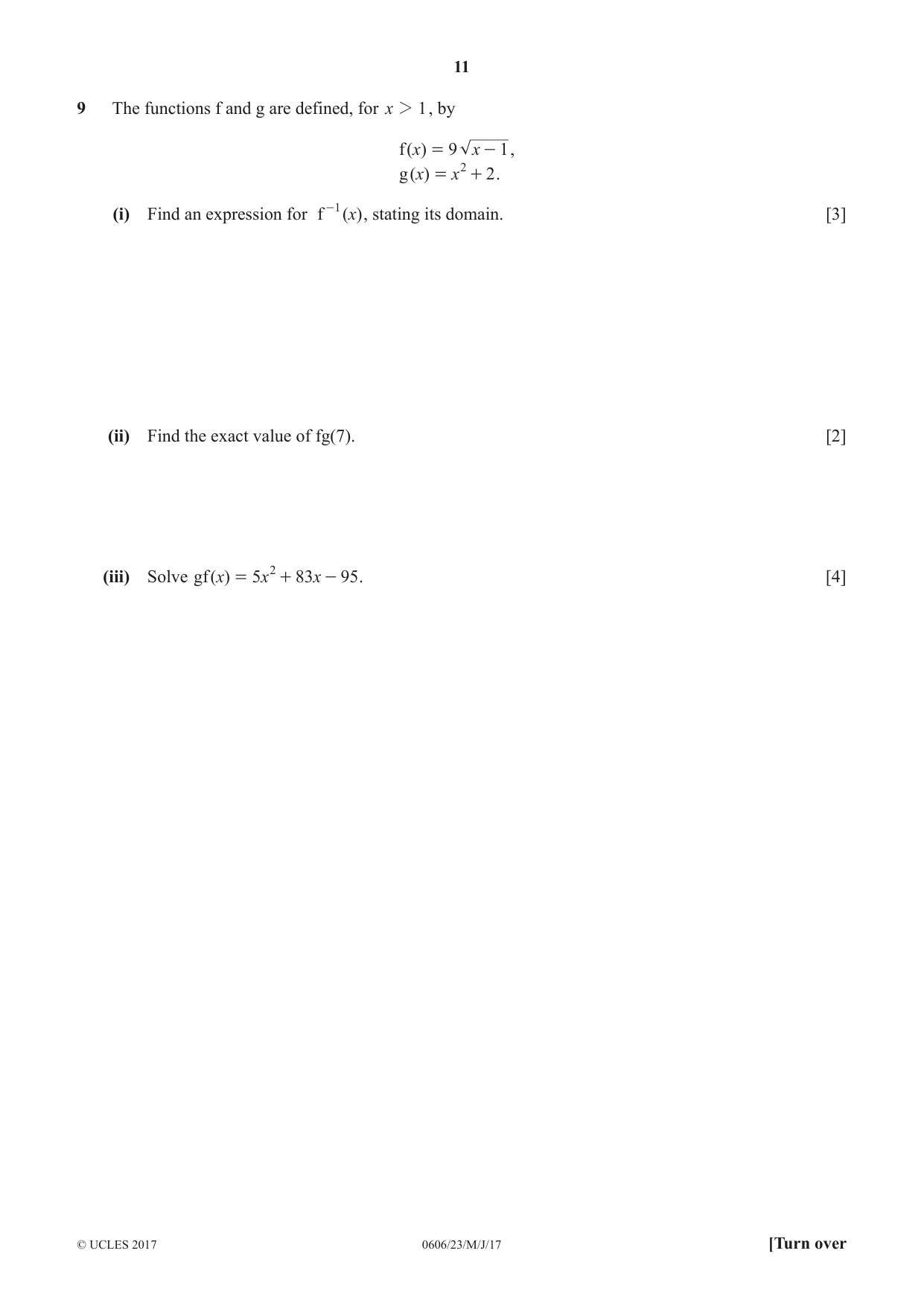
Q9 · The functions f and g are defined, for x 2 1 , by f ( x) = 9 x - 1 , g ( )x = x 2 + 2
9 The functions f and g are defined, for x 2 1 , by f ( x) = 9 x - 1 , g ( )x = x 2 + 2 . (i) Find an expression for f -1 ( )x , stating its domain. [3] (ii) Find the exact value of fg(7). [2] (iii) Solve gf ( )x = 5 x 2 + 83x - 95 . [4]
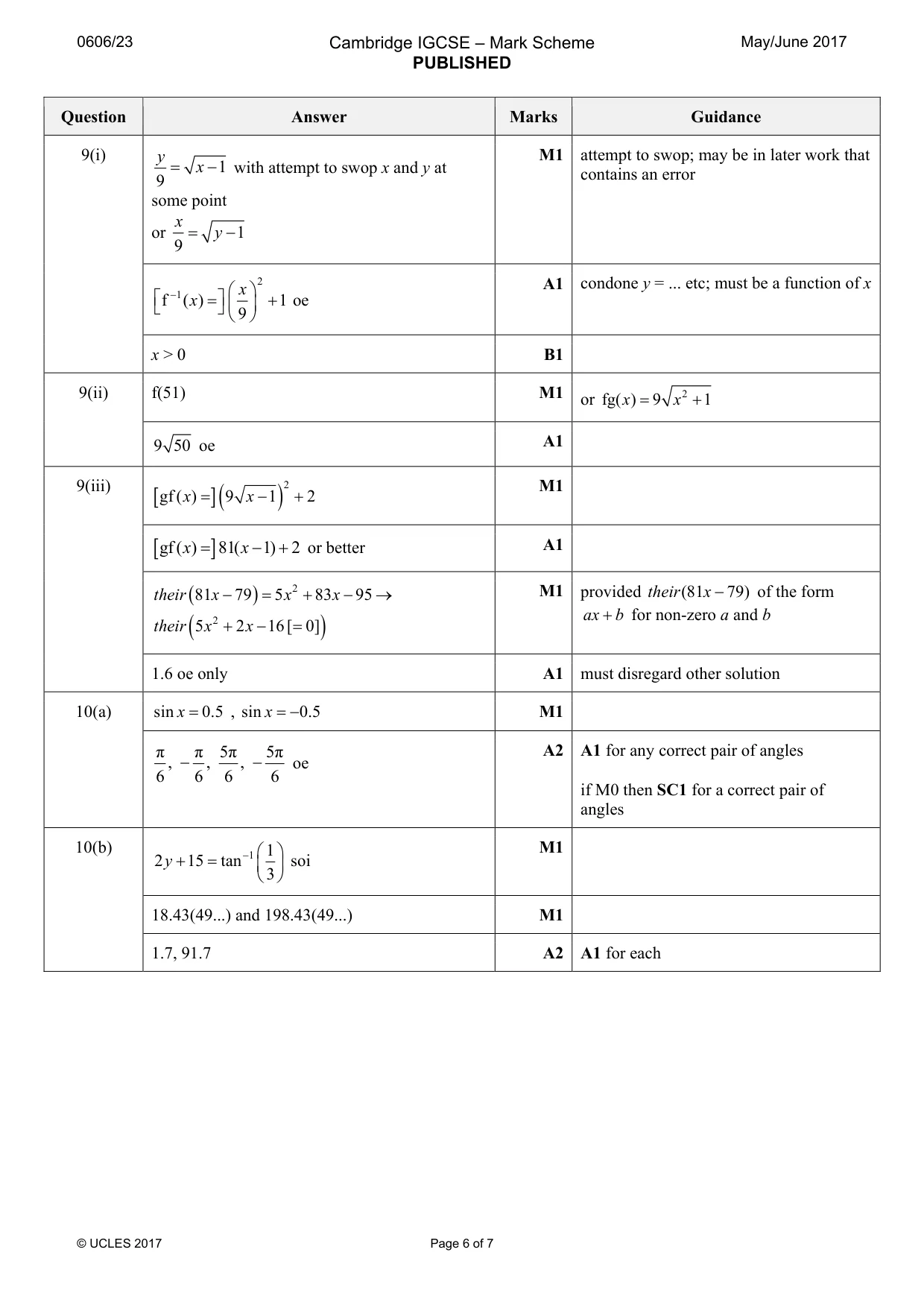
Mark scheme: 9(i) y M1 attempt to swop; may be in later work that = x − 1 with attempt to swop x and y at contains an error 9 some point x or = y − 1 9 2 A1 condone y = ... etc; must be a function of x −1 x f ( x ) = + 1 oe 9 x > 0 B1 9(ii) f(51) M1 2 or fg( x ) = 9 x + 1 9 50 oe A1 9 x − 1 + 29(iii) [ gf ( x ) = ]( 2 M1 ) [ gf( x ) = ] 81( x − 1) + 2 or better A1 their ( 81x − 79 ) = 5 x 2 + 83 x − 95 → M1 provided their (81x − 79) of the form 2 ax + b for non-zero a and b their 5 x + 2 x − 16[ = 0] ( ) 1.6 oe only A1 must disregard other solution
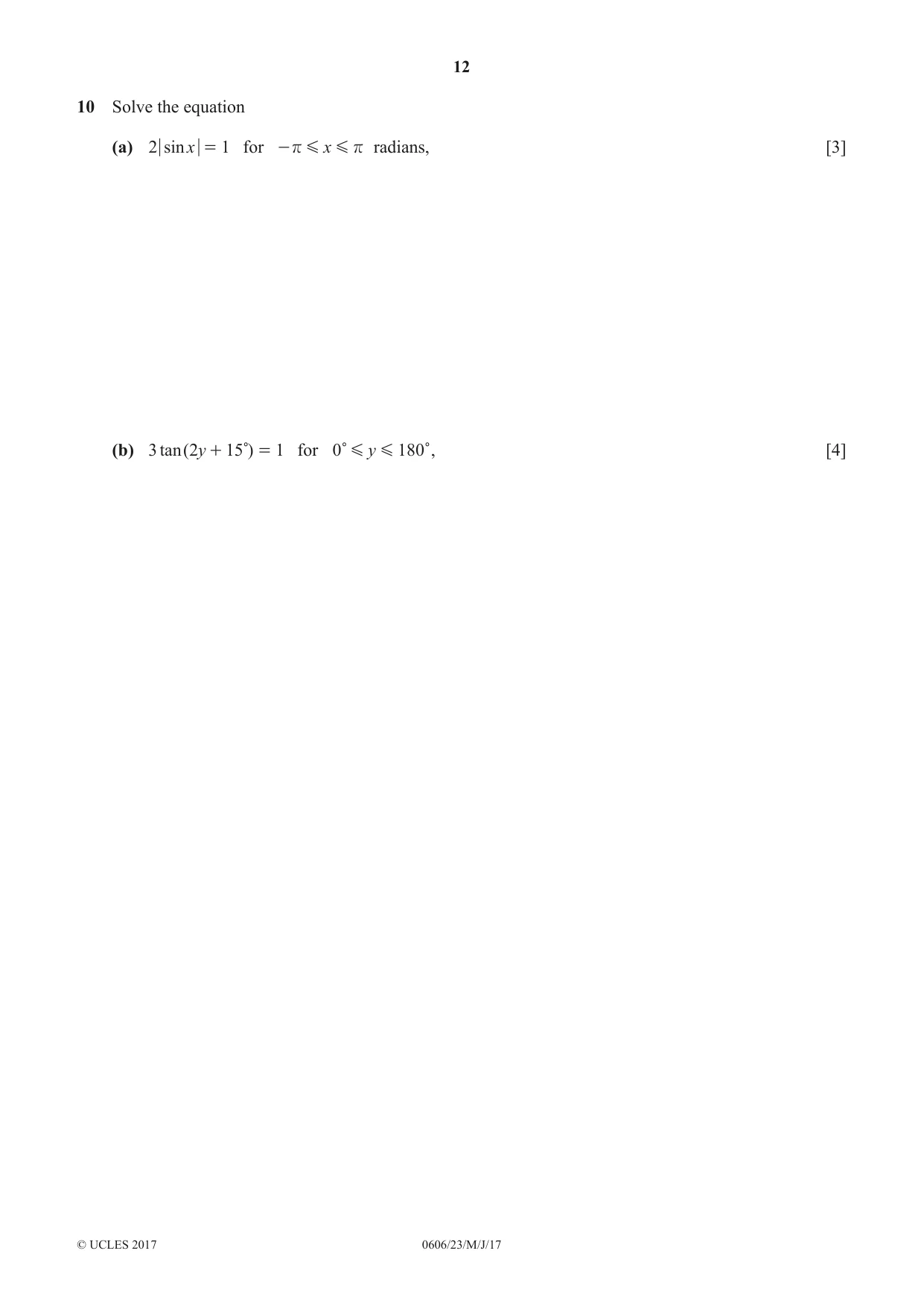
Q10 · Solve the equation (a) 2 sinx = 1 for - r G x G r radians, [3] (b) 3 tan ( 2y + 15c) = 1…
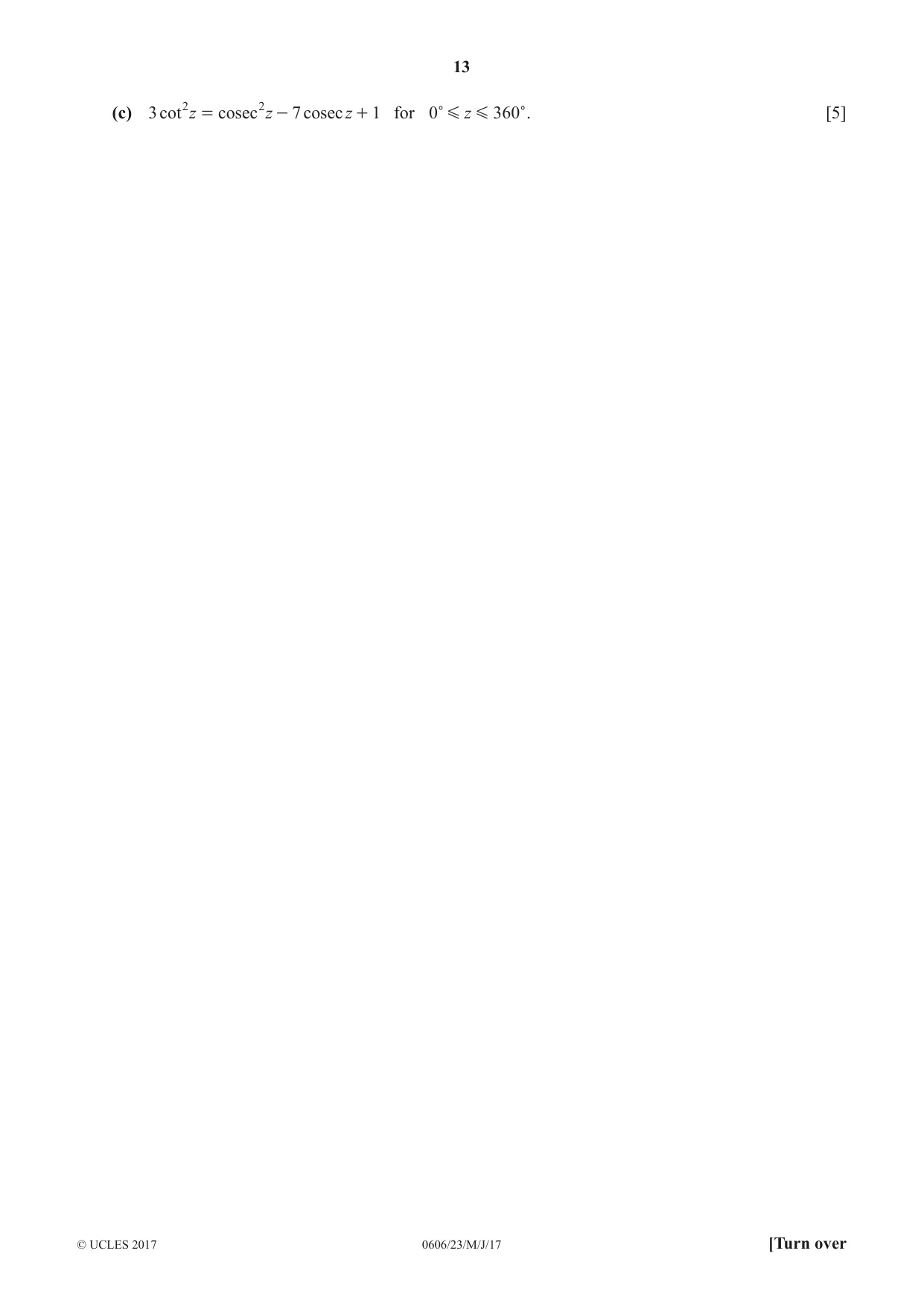
10 Solve the equation (a) 2 sinx = 1 for - r G x G r radians, [3] (b) 3 tan ( 2y + 15c) = 1 for 0c G y G 180c, [4] (c) 3 cot 2 z = cosec 2 z - 7 cosec z + 1 for 0c G z G 360c. [5]
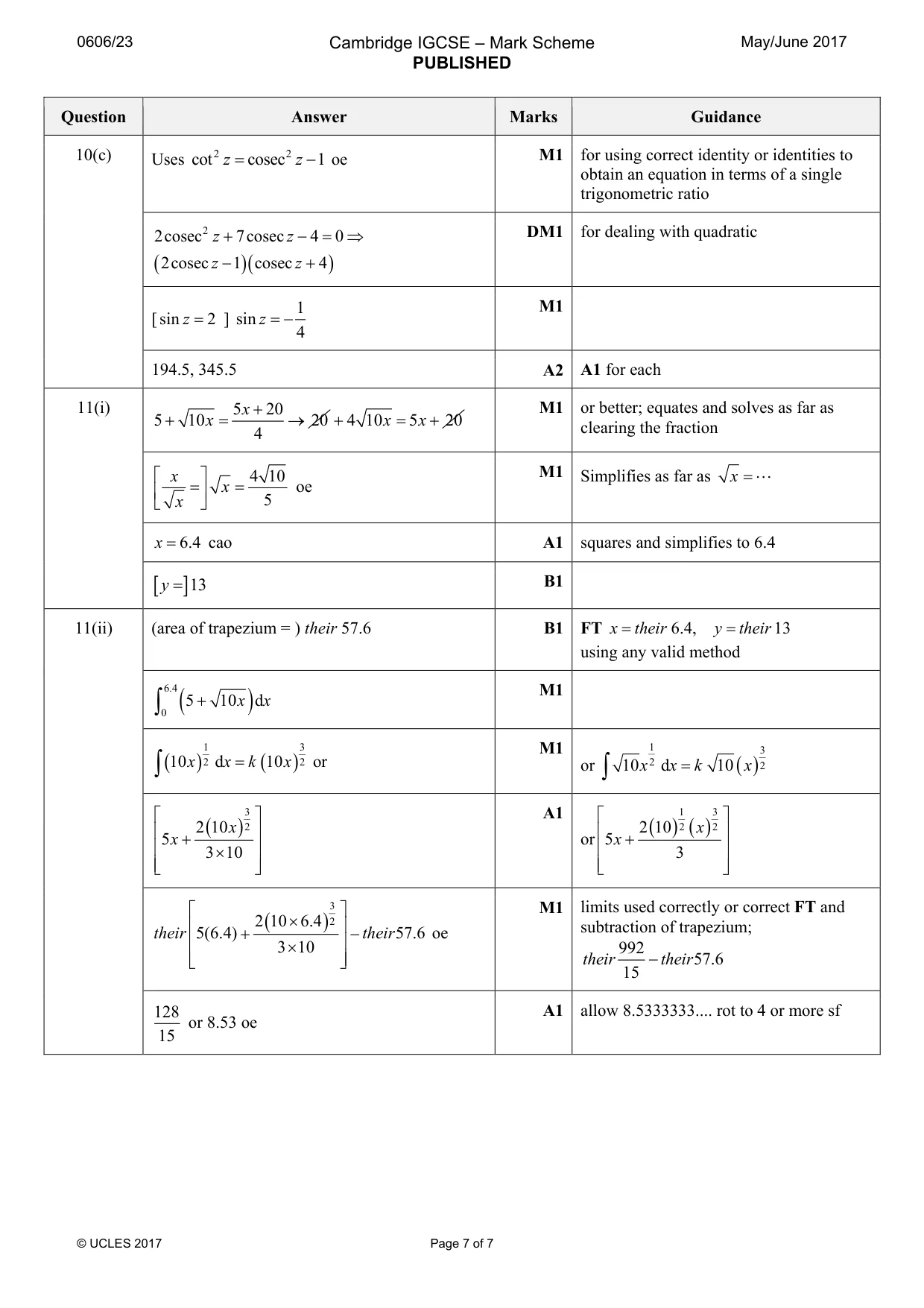
Mark scheme: 10(a) sin x = 0.5 , sin x = − 0.5 M1 π π 5π 5π A2 A1 for any correct pair of angles , − , , − oe 6 6 6 6 if M0 then SC1 for a correct pair of angles 10(b) −1 1 M1 2 y + 15 = tan soi 3 18.43(49...) and 198.43(49...) M1 1.7, 91.7 A2 A1 for each 10(c) Uses cot 2 z = cosec 2 z − 1 oe M1 for using correct identity or identities to obtain an equation in terms of a single trigonometric ratio 2cosec 2 z + 7cosec z − 4 = 0 ⇒ DM1 for dealing with quadratic ( 2cosec z − 1)( cosec z + 4 ) 1 M1 [sin z = 2 ] sin z = − 4 194.5, 345.5 A2 A1 for each
Q11 · Y 4y = 5x + 20 Q y = 5+ 10x P O R x The diagram shows part of the curve y = 5 + 10 x and…
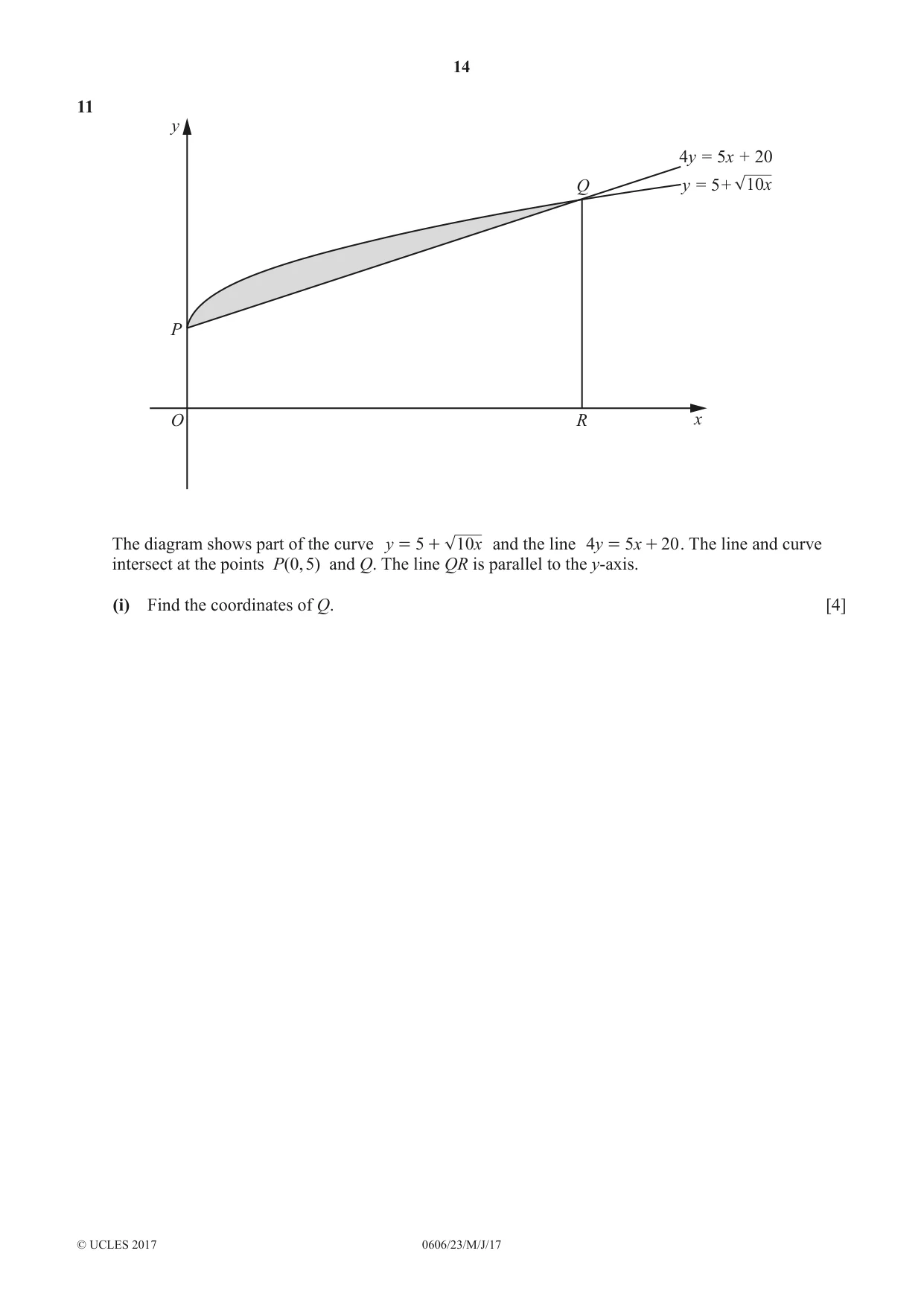
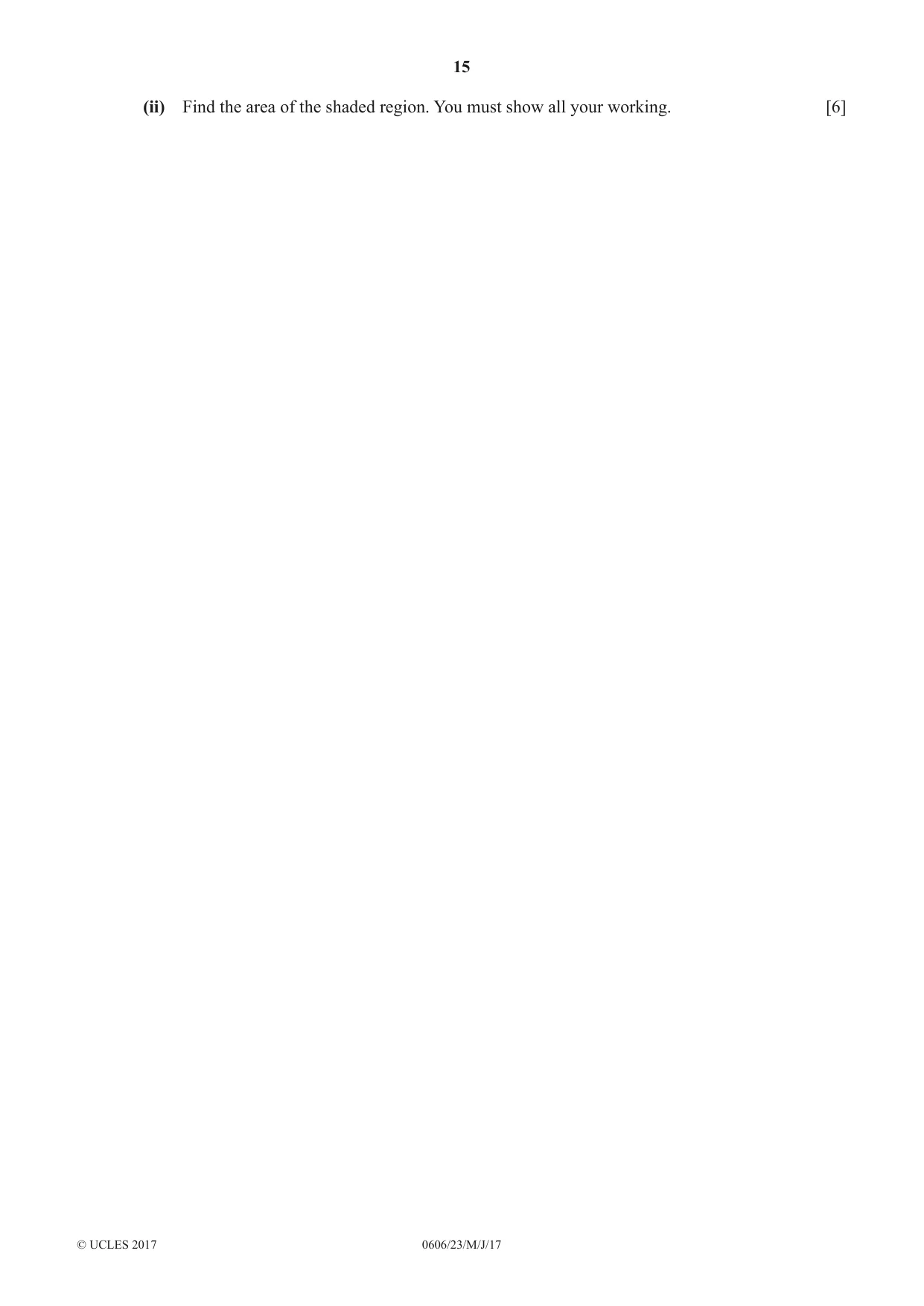
11 y 4y = 5x + 20 Q y = 5+ 10x P O R x The diagram shows part of the curve y = 5 + 10 x and the line 4y = 5x + 20 . The line and curve intersect at the points P(0, 5) and Q. The line QR is parallel to the y-axis. (i) Find the coordinates of Q. [4] (ii) Find the area of the shaded region. You must show all your working. [6]
Mark scheme: 11(i) 5 x + 20 M1 or better; equates and solves as far as 5 + 10 x = → 20 + 4 10 x = 5 x + 20 clearing the fraction 4 x 4 10 M1 Simplifies as far as x =L = x = oe x 5 x = 6.4 cao A1 squares and simplifies to 6.4 [ y = ]13 B1 11(ii) (area of trapezium = ) their 57.6 B1 FT x = their 6.4, y = their 13 using any valid method 6.4 M1 ∫0 ( 5 + 10 x ) d x 1 3 M1 1 3 2 10 x ) 2 dx = k (10 x ) 10 x 2 d x = k 10 ( x ) ∫ ( 2 or or ∫ 3 A1 1 3 2 10 x ) 10 ) ( x ) 2 2 ( 2 2 ( 5 x + or 5 x + 3 × 10 3 3 M1 limits used correctly or correct FT and 10 × 6.4 ) 2 ( 2 subtraction of trapezium; their 5(6.4) + − their 57.6 oe 3 × 10 992 their − their 57.6 15 128 A1 allow 8.5333333.... rot to 4 or more sf or 8.53 oe 15
More questions on Use substitution to form and solve a quadratic
What was in this paper
The subtopics covered by these 11 questions, and how many questions each got. Open one in a new tab to see every Cambridge question on it.
1Find the magnitude of a vector; add and1Form and use composite functions1Solve equations of the form ax = b1Solve problems involving the arc length and1Solve problems on arrangement and selection1Solve, for a given domain, trigonometric1Transform given relationships to and from1Understand the terms: function, domain1Use substitution to form and solve a quadratic1Use the binomial theorem for expansion of1What you needed in this session
Cambridge’s own grade thresholds for 2017 May/June, Paper 2 · Variant 3. A higher threshold means an easier paper — the bar moves with how the cohort did.