Cambridge IGCSE Mathematics - Additional 0606 — 2017 May/June Paper 2 · Variant 2
0606/22/M/J/17 · 10 questions · 80 marks · ≈90 min
The question paper and its mark scheme, free to read here and free to download. This is Cambridge’s own paper, exactly as it was sat.
Question paper12 pages
Mark scheme14 pages
Answers below. Sit the paper first if you are practising.
Questions as text
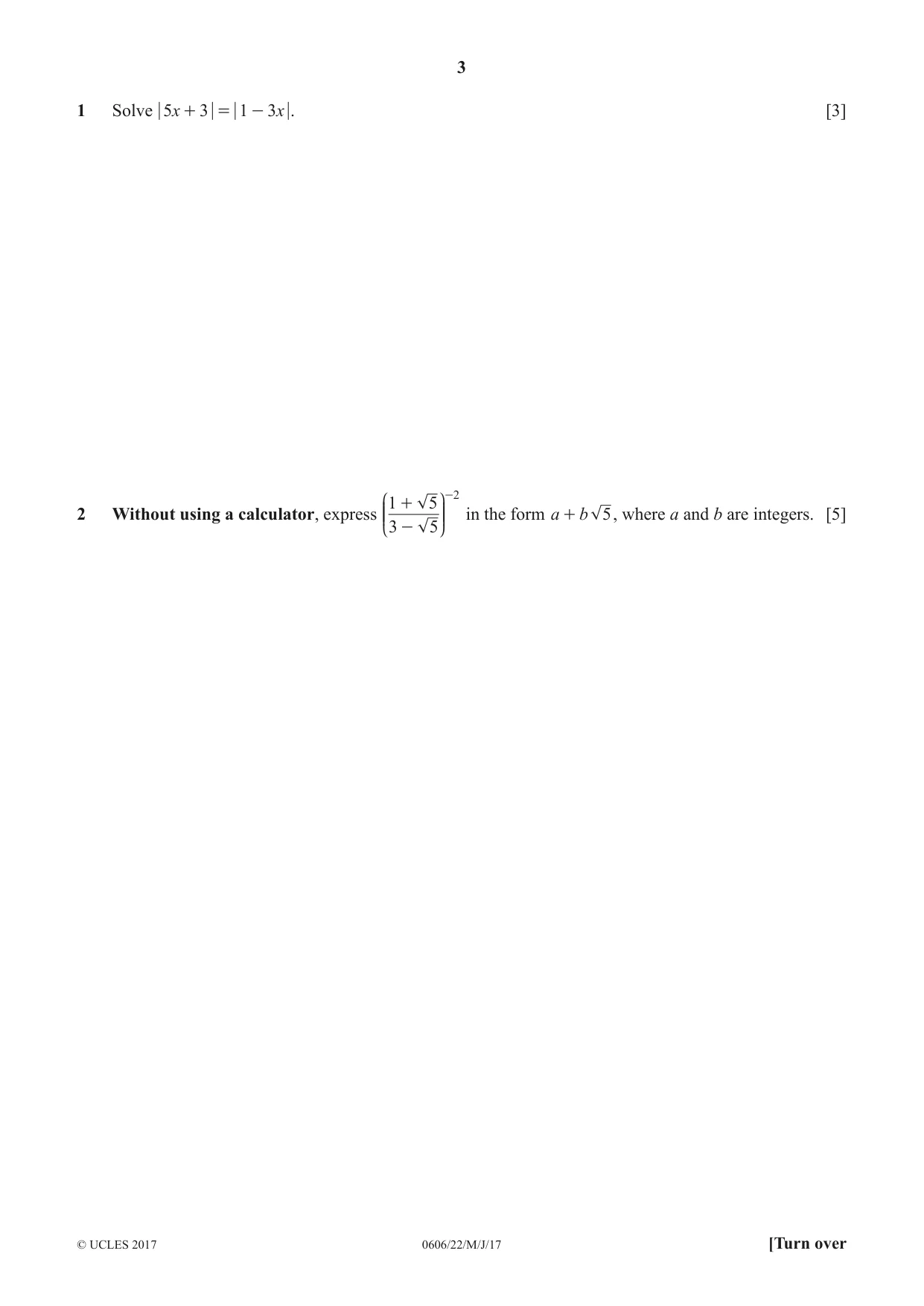
Q2 · Without using a calculator, express KK OO in the form a + b 5 , where a and b are integers
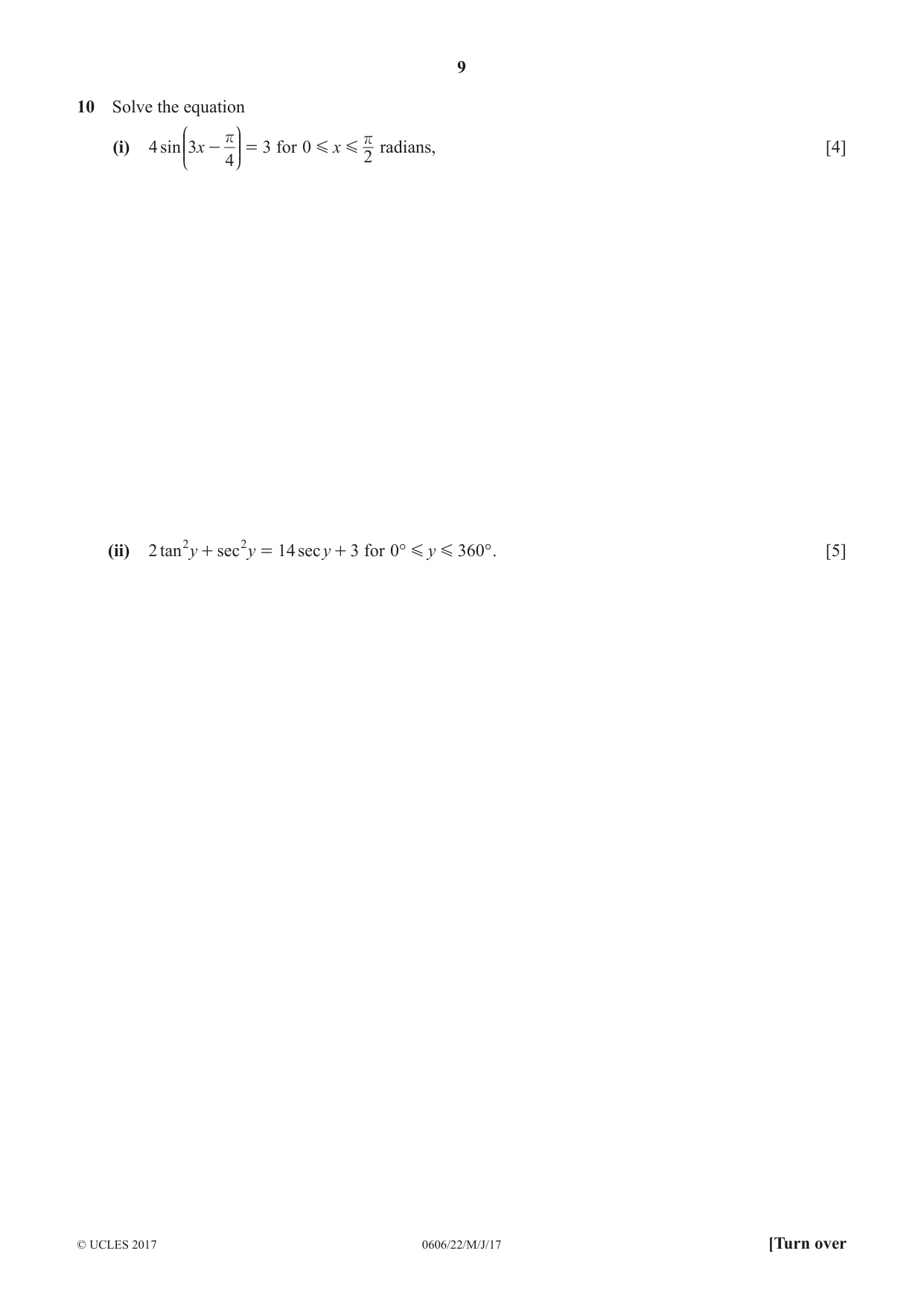
2 Without using a calculator, express KK OO in the form a + b 5 , where a and b are integers. [5] 3 - 5 L P
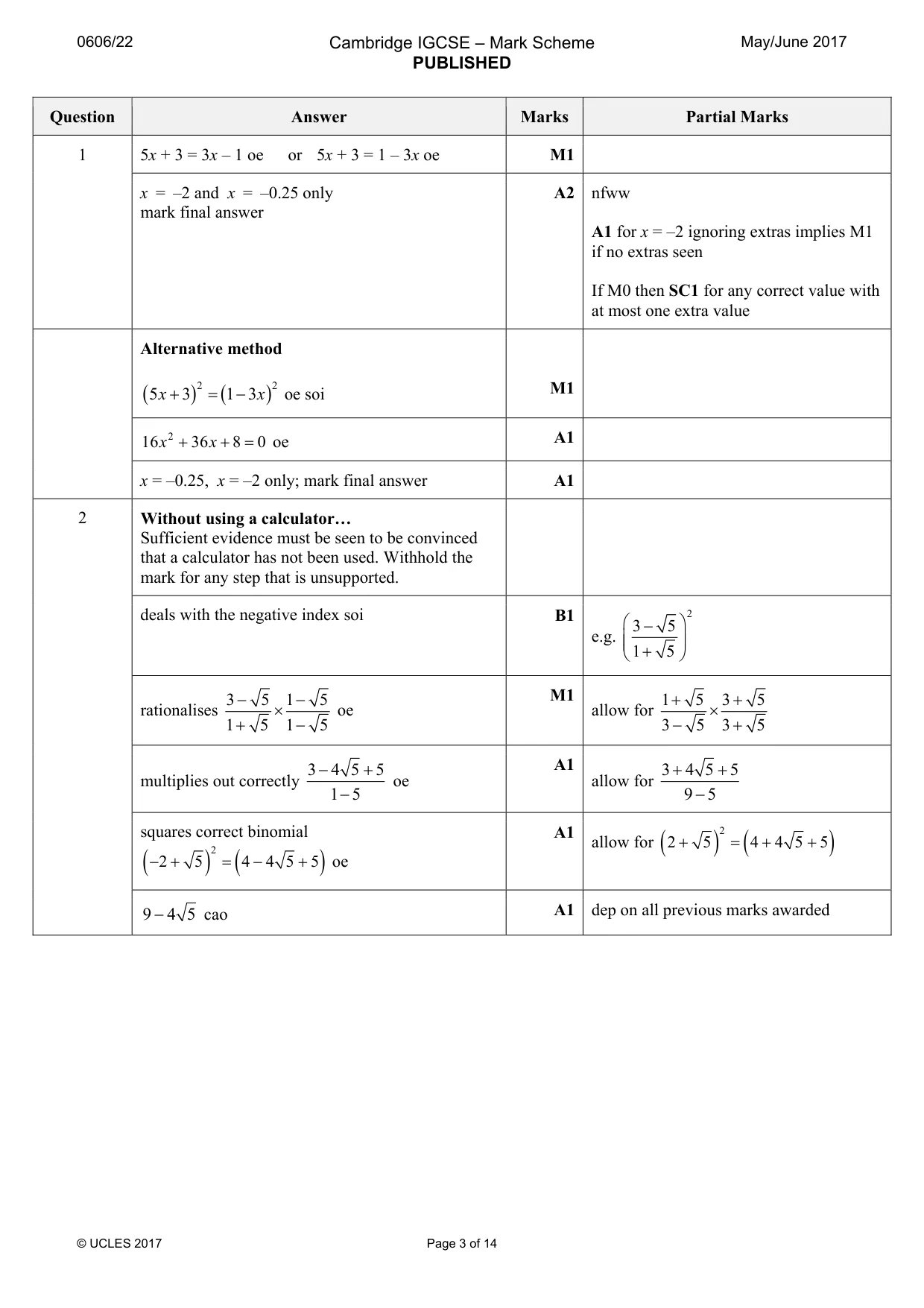
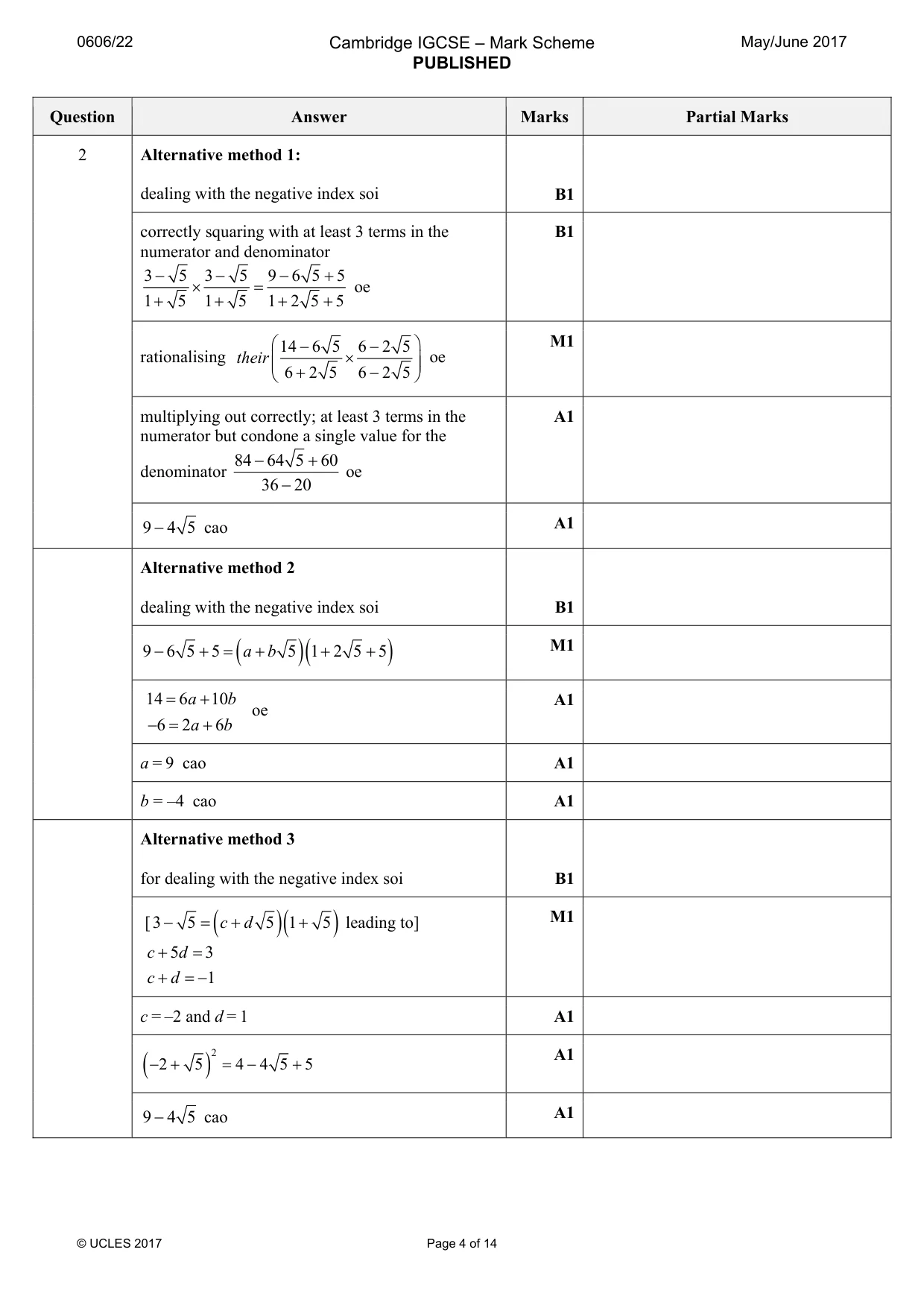
Mark scheme: Question Answer Marks Partial Marks 1 5x + 3 = 3x – 1 oe or 5x + 3 = 1 – 3x oe M1 x = –2 and x = –0.25 only A2 nfww mark final answer A1 for x = –2 ignoring extras implies M1 if no extras seen If M0 then SC1 for any correct value with at most one extra value Alternative method ( 5 x + 3 ) 2 = (1 − 3 x ) 2 oe soi M1 16 x 2 + 36 x + 8 = 0 oe A1 x = –0.25, x = –2 only; mark final answer A1 2 Without using a calculator… Sufficient evidence must be seen to be convinced that a calculator has not been used. Withhold the mark for any step that is unsupported. deals with the negative index soi B1 2 3 − 5 e.g. 1 + 5 3 − 5 1 − 5 M1 1 + 5 3 + 5 rationalises × oe allow for × 1 + 5 1 − 5 3 − 5 3 + 5 3 − 4 5 + 5 A1 3 + 4 5 + 5 multiplies out correctly oe allow for 1 − 5 9 − 5 squares correct binomial A1 2 allow for 2 + 5 = 4 + 4 5 + 5 2 ( ) ( ) −+2 5 = 4 − 4 5 + 5 oe ( ) ( ) 9 − 4 5 cao A1 dep on all previous marks awarded 2 Alternative method 1: dealing with the negative index soi B1 correctly squaring with at least 3 terms in the B1 numerator and denominator 3 − 5 3 − 5 9 − 6 5 + 5 × = oe 1 + 5 1 + 5 1 + 2 5 + 5 14 − 6 5 6 − 2 5 M1 rationalising their × oe 6 + 2 5 6 − 2 5 multiplying out correctly; at least 3 terms in the A1 numerator but condone a single value for the 84 − 64 5 + 60 denominator oe 36 − 20 9 − 4 5 cao A1 Alternative method 2 dealing with the negative index soi B1 M1 9 − 6 5 + 5 = a + b 5 1 + 2 5 + 5 ( )( ) 14 = 6 a + 10b A1 oe −=6 2 a + 6b a = 9 cao A1 b = –4 cao A1 Alternative method 3 for dealing with the negative index soi B1 M1 [ 3 − 5 = c + d 5 1 + 5 leading to] ( )( ) c + 5d = 3 c + d = −1 c = –2 and d = 1 A1 2 A1 −+2 5 = 4 − 4 5 + 5 ( ) 9 − 4 5 cao A1
Q3 · Without using a calculator, factorise the expression 10x 3 - 21x 2 + 4
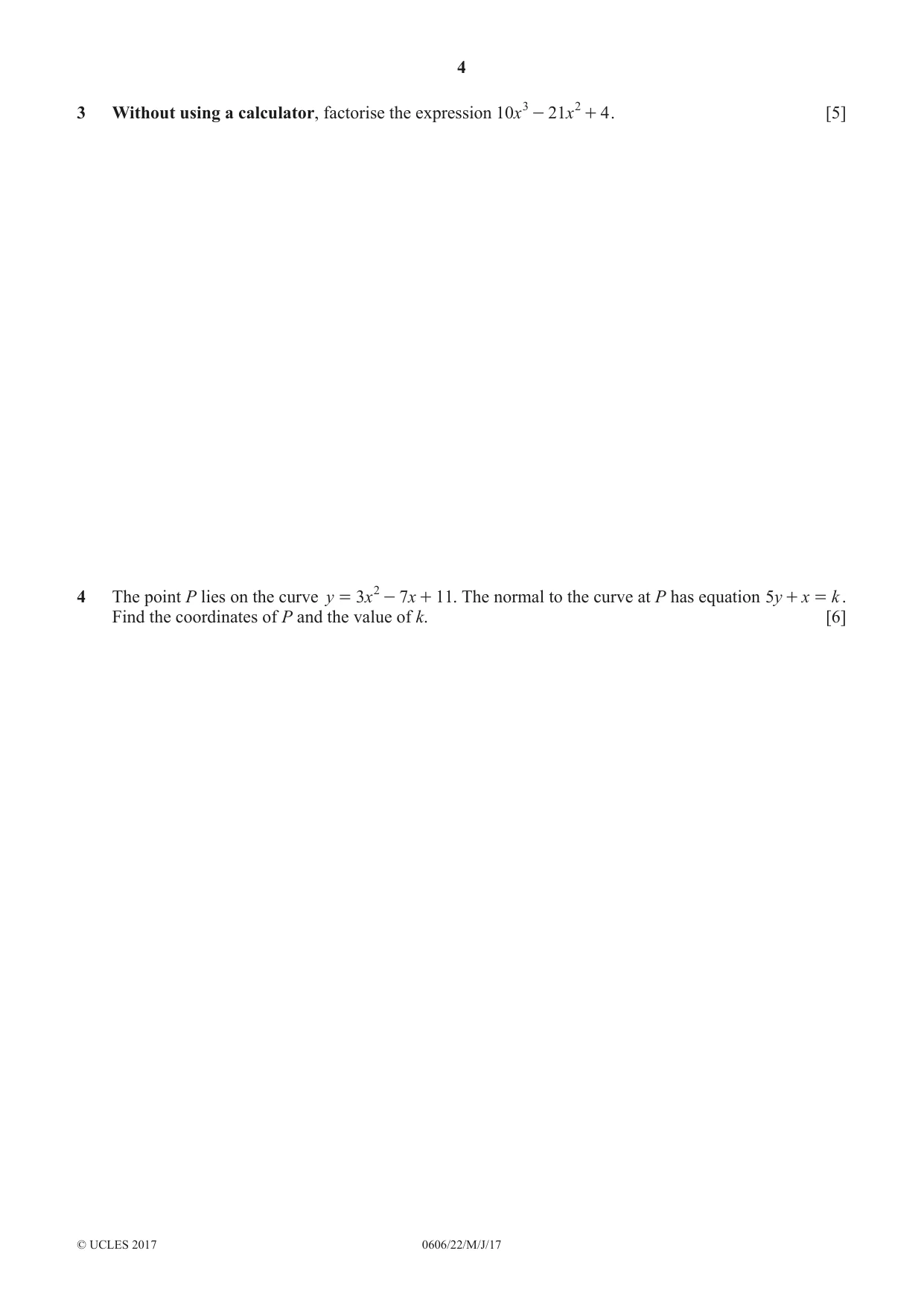
3 Without using a calculator, factorise the expression 10x 3 - 21x 2 + 4 . [5]
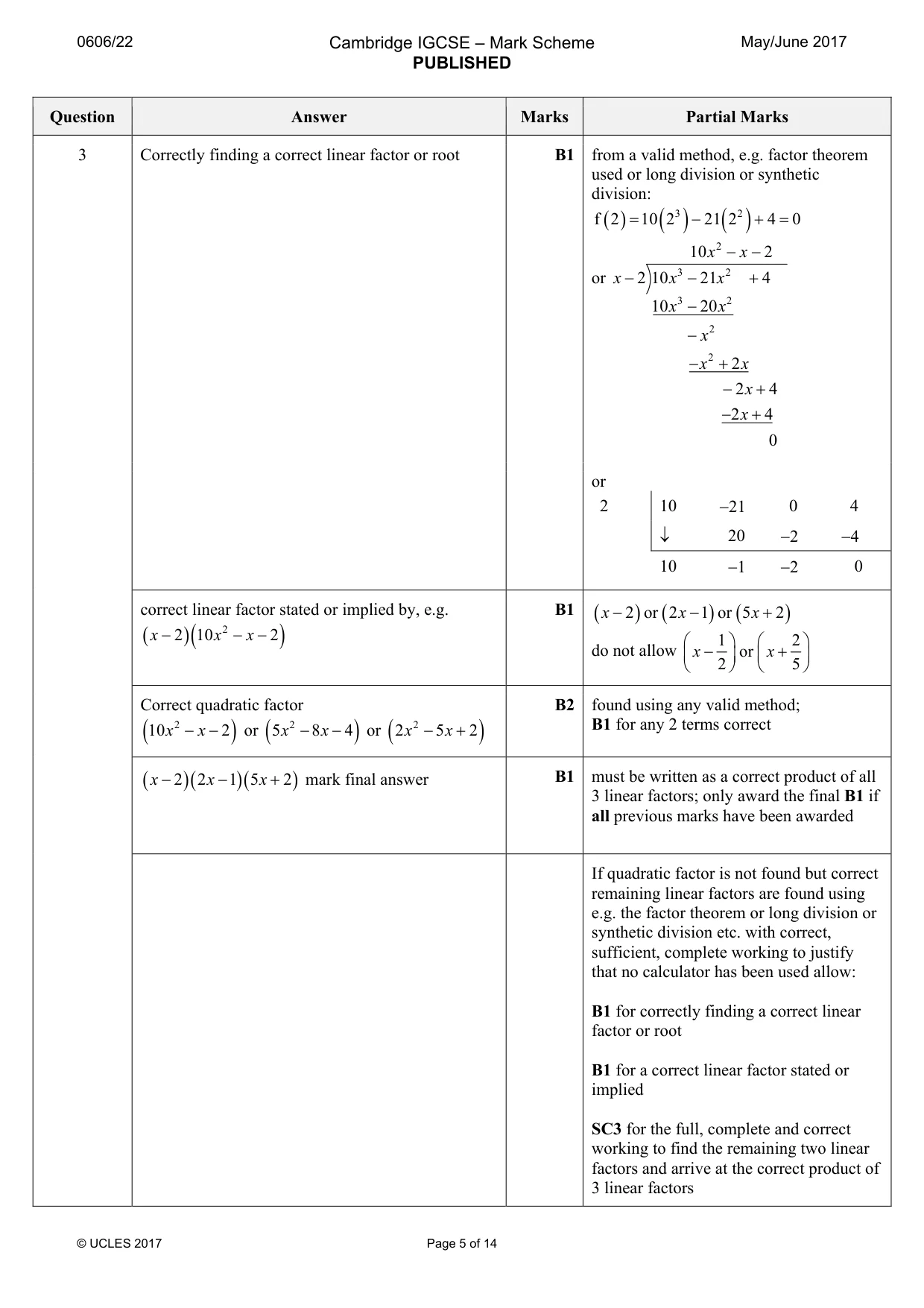
Mark scheme: 3 Correctly finding a correct linear factor or root B1 from a valid method, e.g. factor theorem used or long division or synthetic division: 2 3 2 2 − 21 + 4 = 0 f ( 2 ) = 10 ( ) ( ) 10 x 2 − x − 2 or x − 2 10 x 3 − 21x 2 + 4 10 x 3 − 20 x 2 − x 2 − x 2 + 2 x − 2 x + 4 −2 x + 4 0 or 2 10 −21 0 4 ↓ 20 −2 −4 10 −1 −2 0 correct linear factor stated or implied by, e.g. B1 ( x − 2 ) or ( 2 x − 1) or ( 5 x + 2 ) 10 x 2 − x − 2 ( x − 2 )( ) 1 2 do not allow x − or x + 2 5 Correct quadratic factor B2 found using any valid method; 2 2 2 B1 for any 2 terms correct 10 x − x − 2 or 5 x − 8 x − 4 or 2 x − 5 x + 2 ( ) ( ) ( ) ( x − 2 )( 2 x − 1)( 5 x + 2 ) mark final answer B1 must be written as a correct product of all 3 linear factors; only award the final B1 if all previous marks have been awarded If quadratic factor is not found but correct remaining linear factors are found using e.g. the factor theorem or long division or synthetic division etc. with correct, sufficient, complete working to justify that no calculator has been used allow: B1 for correctly finding a correct linear factor or root B1 for a correct linear factor stated or implied SC3 for the full, complete and correct working to find the remaining two linear factors and arrive at the correct product of 3 linear factors
Q4 · The point P lies on the curve y = 3 x 2 - 7x + 11
4 The point P lies on the curve y = 3 x 2 - 7x + 11. The normal to the curve at P has equation 5y + x = k . Find the coordinates of P and the value of k. [6]
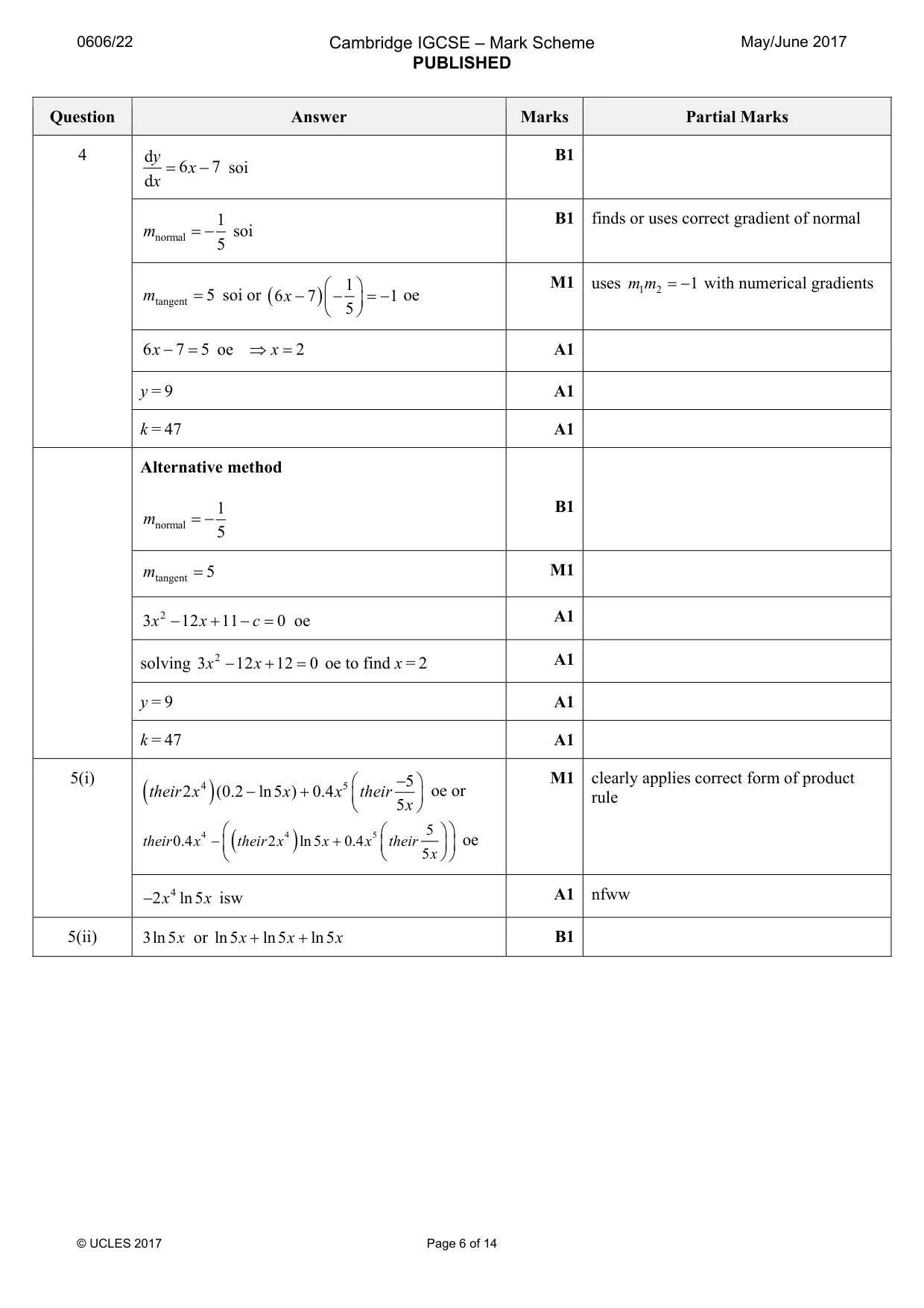
Mark scheme: 4 dy B1 = 6 x − 7 soi dx 1 B1 finds or uses correct gradient of normal mnormal = − soi 5 1 M1 uses m1 m2 = − 1 with numerical gradients oe mtangent = 5 soi or ( 6 x − 7 ) − = − 1 5 6 x − 7 = 5 oe ⇒ x = 2 A1 y = 9 A1 k = 47 A1 Alternative method 1 B1 mnormal = − 5 mtangent = 5 M1 3 x 2 − 12 x + 11 − c = 0 oe A1 solving 3 x 2 − 12 x + 12 = 0 oe to find x = 2 A1 y = 9 A1 k = 47 A1
More questions on Use differentiation to find gradients, tangents
Q5 · Show that [ 0
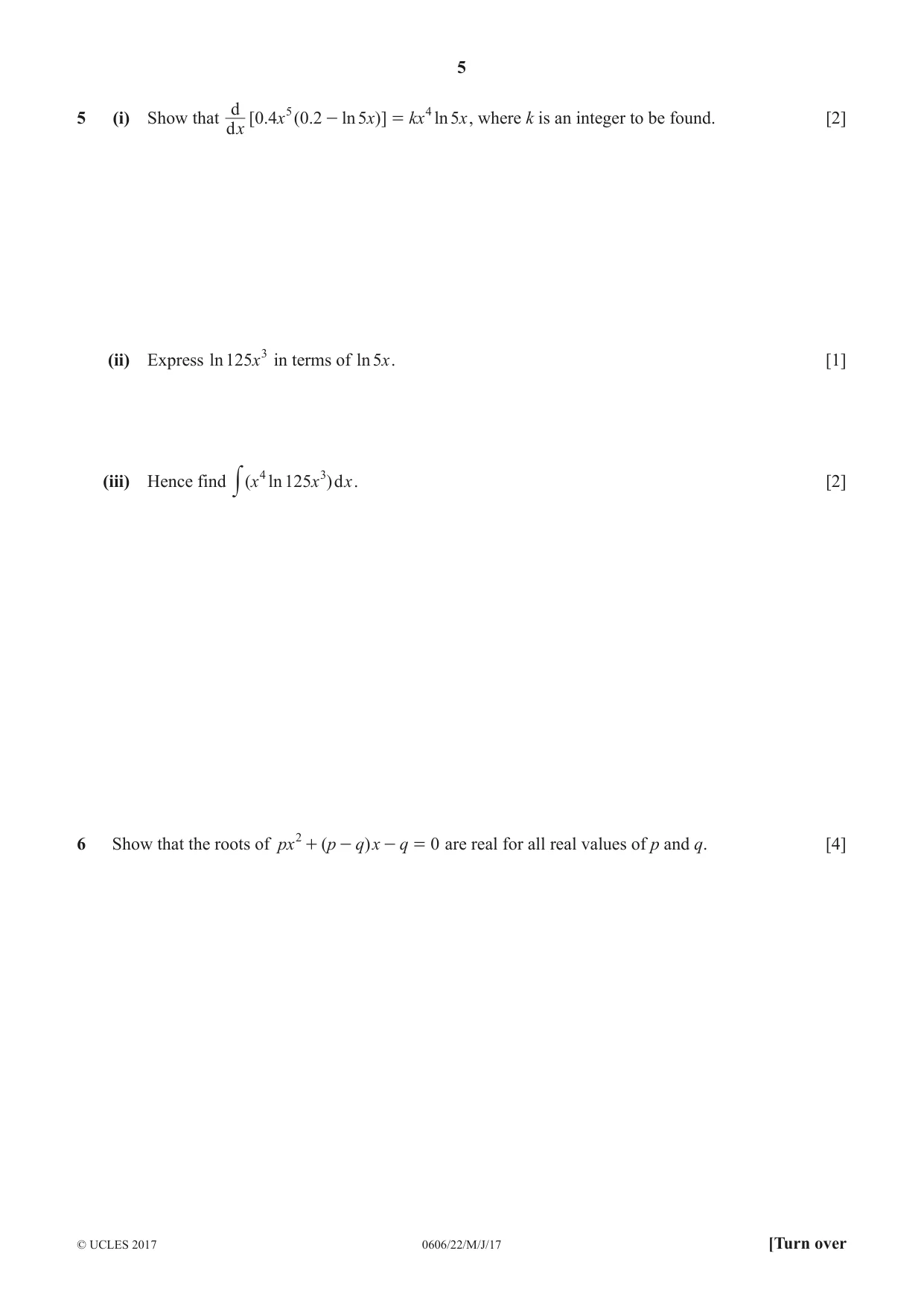
5 (i) Show that [ 0. 4x 5 ( 0. 2 - ln 5 x)] = kx 4 ln 5x , where k is an integer to be found. [2] d x (ii) Express ln 125x 3 in terms of ln 5x . [1] ( x 4 ln 125 x 3) d x . [2] (iii) Hence find y
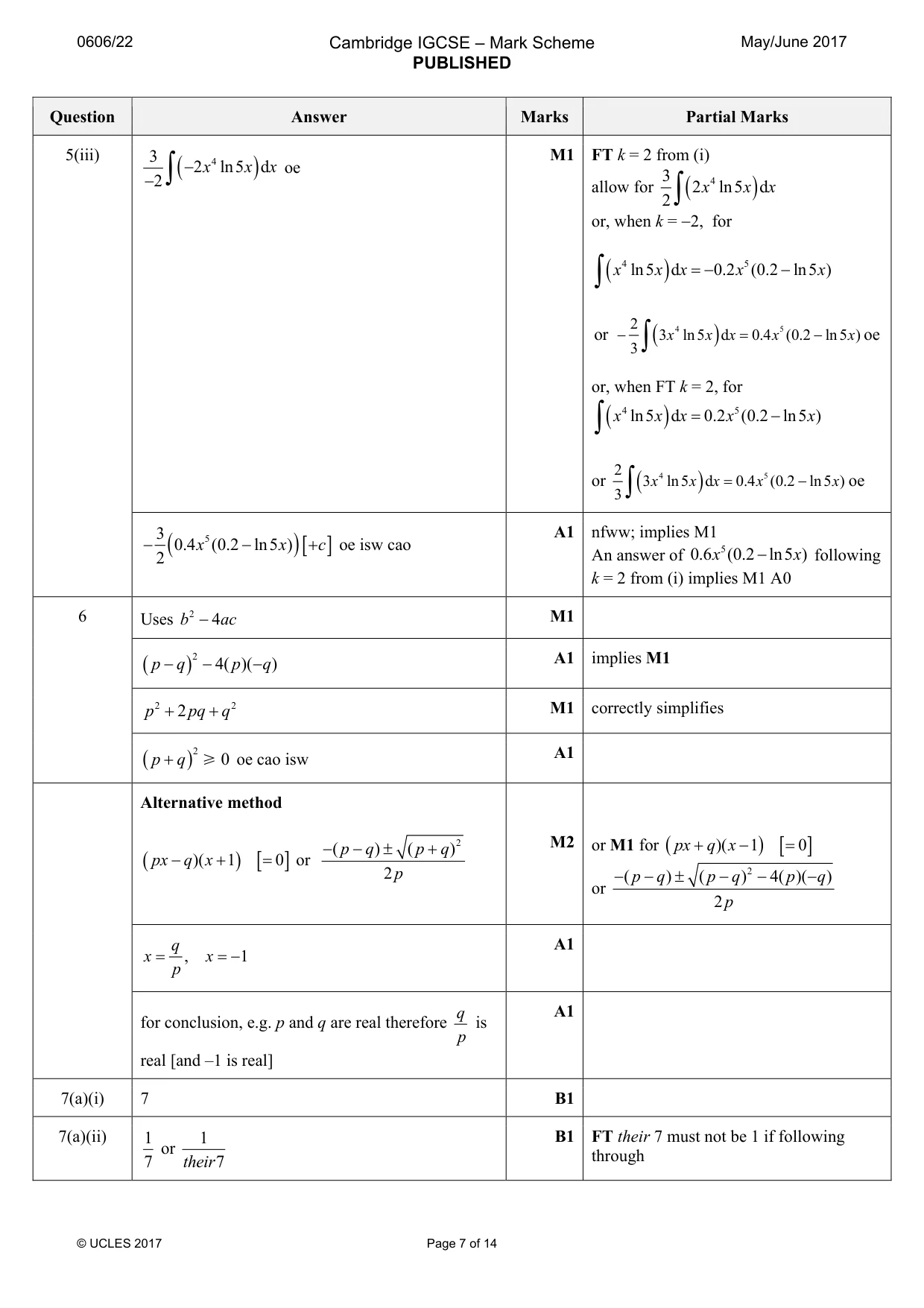
Mark scheme: their 2 x 5(i) ( 4 5 − 5 M1 clearly applies correct form of product ) (0.2 − ln5 x ) + 0.4 x their oe or rule 5 x 4 4 5 5 oe their 0.4 x − ( their 2 x ) ln 5 x + 0 .4 x their 5 x − 2 x 4 ln5 x isw A1 nfww 5(ii) 3ln5x or ln5 x + ln5 x + ln5 x B1 −2 x ln5 x ) dx oe 3 45(iii) −∫32 ( 4 M1 FT k = 2 from (i) allow for ( 2 x ln5 x ) dx 2 ∫ or, when k = −2, for 5 (0.2 − ln5 x ) x 4 ln5 x ) dx = −0.2 x ∫ ( 2 4 5 or − 3 x ln5 x ) dx = 0.4 x (0.2 − ln5 x ) oe 3 ∫ ( or, when FT k = 2, for 5 (0.2 − ln5 x ) x 4 ln5 x ) dx = 0.2 x ∫ ( 2 4 5 or 3 x ln5 x ) dx = 0.4 x (0.2 − ln5 x ) oe 3 ∫ ( 3 5 A1 nfww; implies M1 − ( 0.4 x (0.2 − ln5 x ) )[ + c ] oe isw cao 5 2 An answer of 0.6 x (0.2 − ln5 x ) following k = 2 from (i) implies M1 A0
Q7 · Given that a 7 = b , where a and b are positive constants, find, (i) log a b , [1] (ii)…
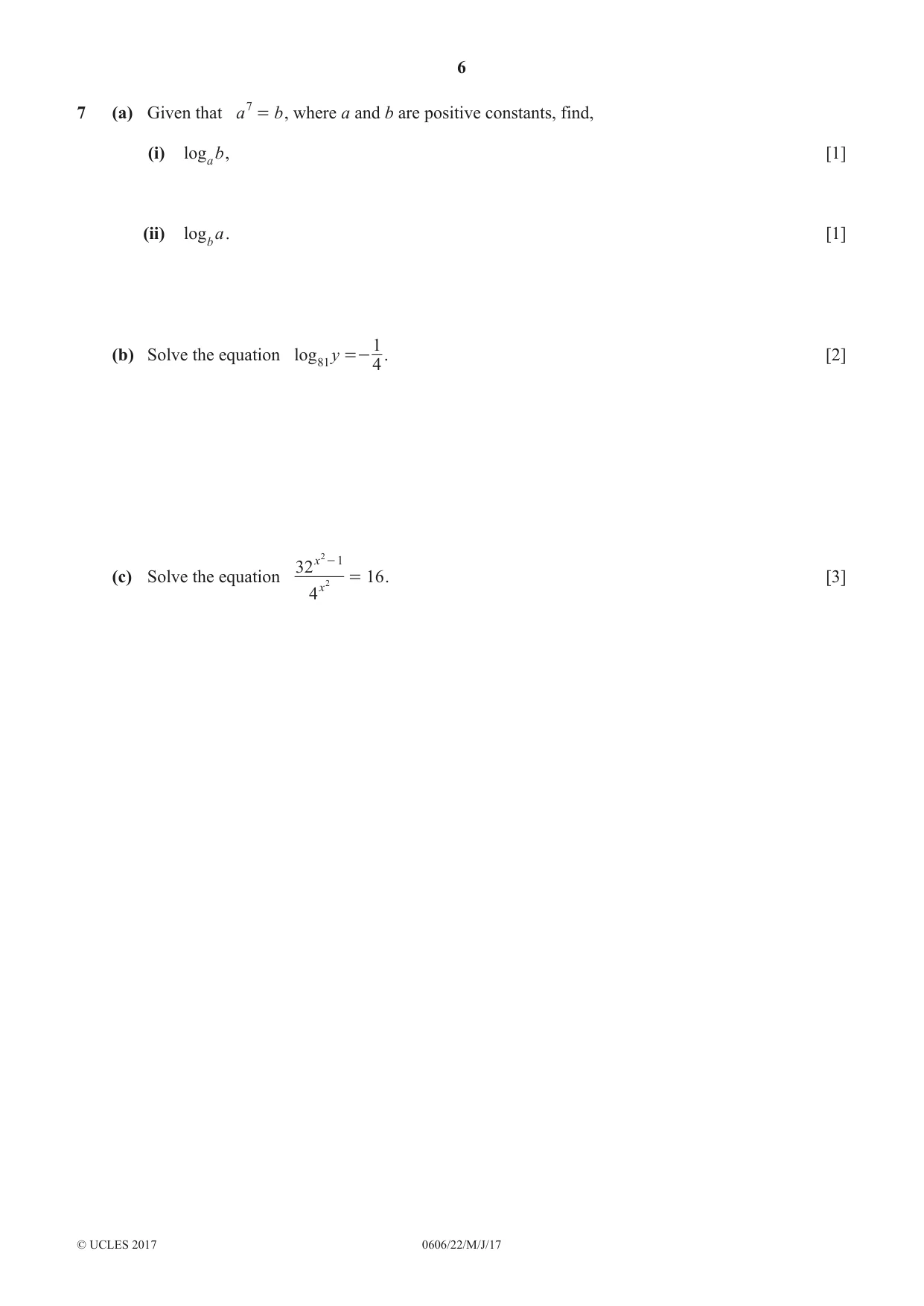
7 (a) Given that a 7 = b , where a and b are positive constants, find, (i) log a b , [1] (ii) log b a . [1] 1 (b) Solve the equation log 81 y =- . [2] 4 32 x 2 - 1 (c) Solve the equation 2 = 16 . [3] 4 x
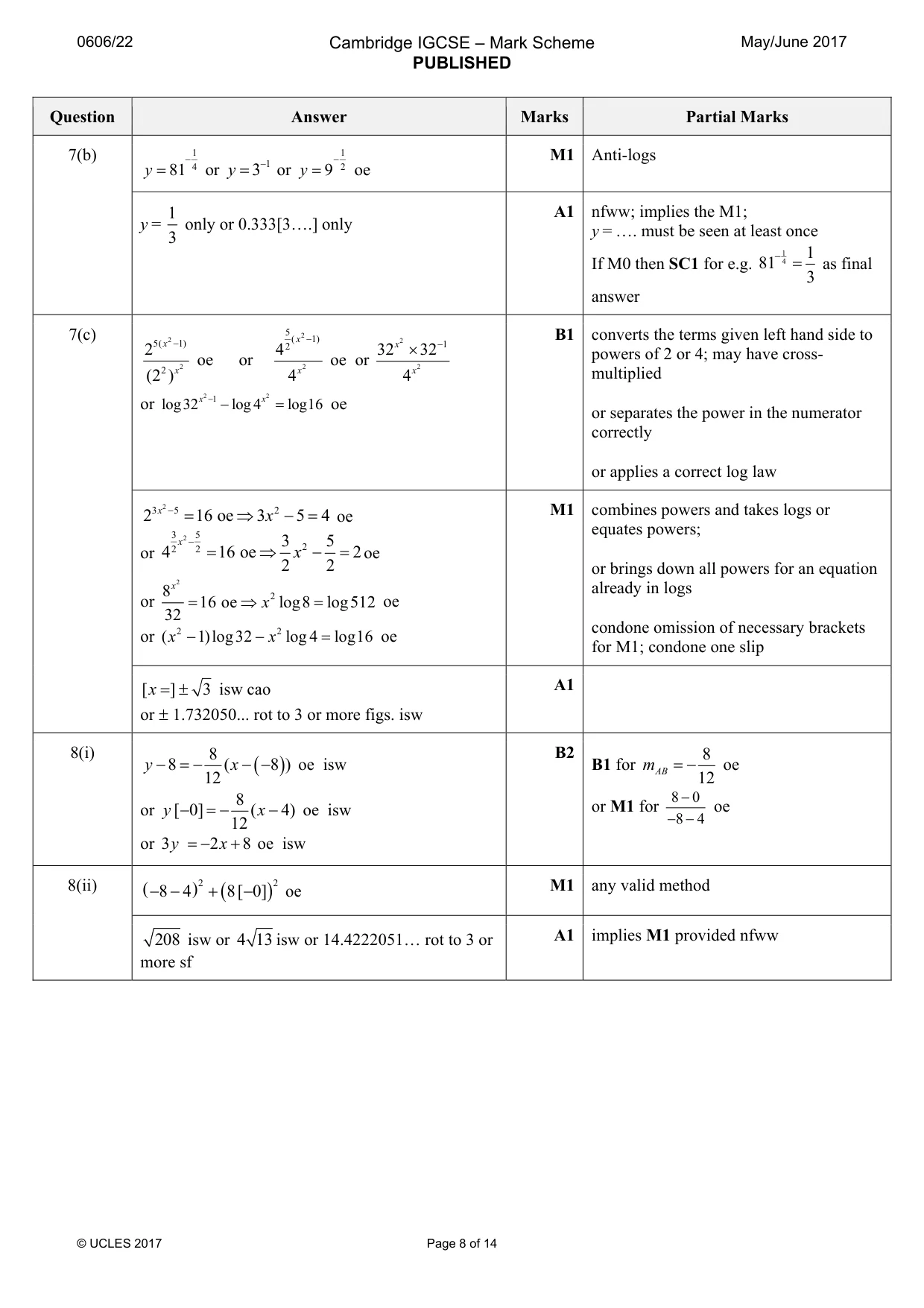
Mark scheme: 7(a)(i) 7 B1 7(a)(ii) 1 1 B1 FT their 7 must not be 1 if following or through 7 their 7 7(b) − 1 − 1 M1 Anti-logs y = 81 4 or y = 3−1 or y = 9 2 oe 1 A1 nfww; implies the M1; y = only or 0.333[3….] only y = …. must be seen at least once 3 1 4 1 If M0 then SC1 for e.g. 81−= as final 3 answer 7(c) 2 5( x 2 −1) 2 B1 converts the terms given left hand side to 2 5( x −1) 4 2 32 x × 32 −1 powers of 2 or 4; may have cross- 2 oe or 2 oe or 2 (2 2 ) x 4 x 4 x multiplied or log32 x 2 −−1 log4 x 2 = log16 oe or separates the power in the numerator correctly or applies a correct log law 3 x 2 5 2 M1 combines powers and takes logs or 2 −= 16 oe ⇒ 3 x − 5 = 4 oe 3 2 5 equates powers; x 2 2 3 2 5 or 4 −= 16 oe ⇒ x − = 2 oe 2 2 or brings down all powers for an equation 8 x 2 2 already in logs or = 16 oe ⇒ x log8 = log512 oe 32 2 2 condone omission of necessary brackets or ( x − 1)log32 − x log 4 = log16 oe for M1; condone one slip [ x = ] ± 3 isw cao A1 or ± 1.732050... rot to 3 or more figs. isw
Q8 · Solutions to this question by accurate drawing will not be accepted
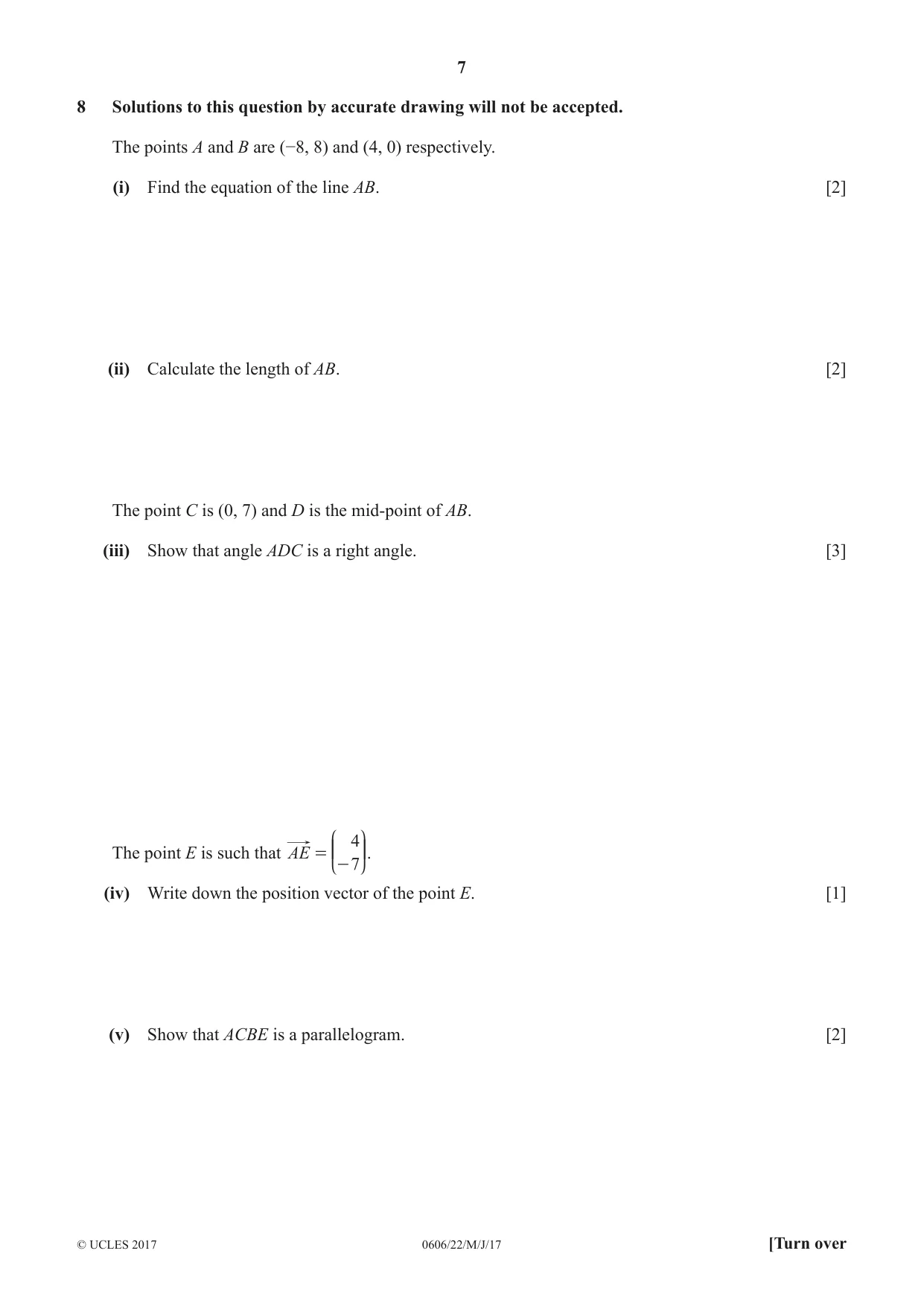
8 Solutions to this question by accurate drawing will not be accepted. The points A and B are (−8, 8) and (4, 0) respectively. (i) Find the equation of the line AB. [2] (ii) Calculate the length of AB. [2] The point C is (0, 7) and D is the mid-point of AB. (iii) Show that angle ADC is a right angle. [3] J N 4 The point E is such that AE = KK OO. - 7 L P (iv) Write down the position vector of the point E. [1] (v) Show that ACBE is a parallelogram. [2]
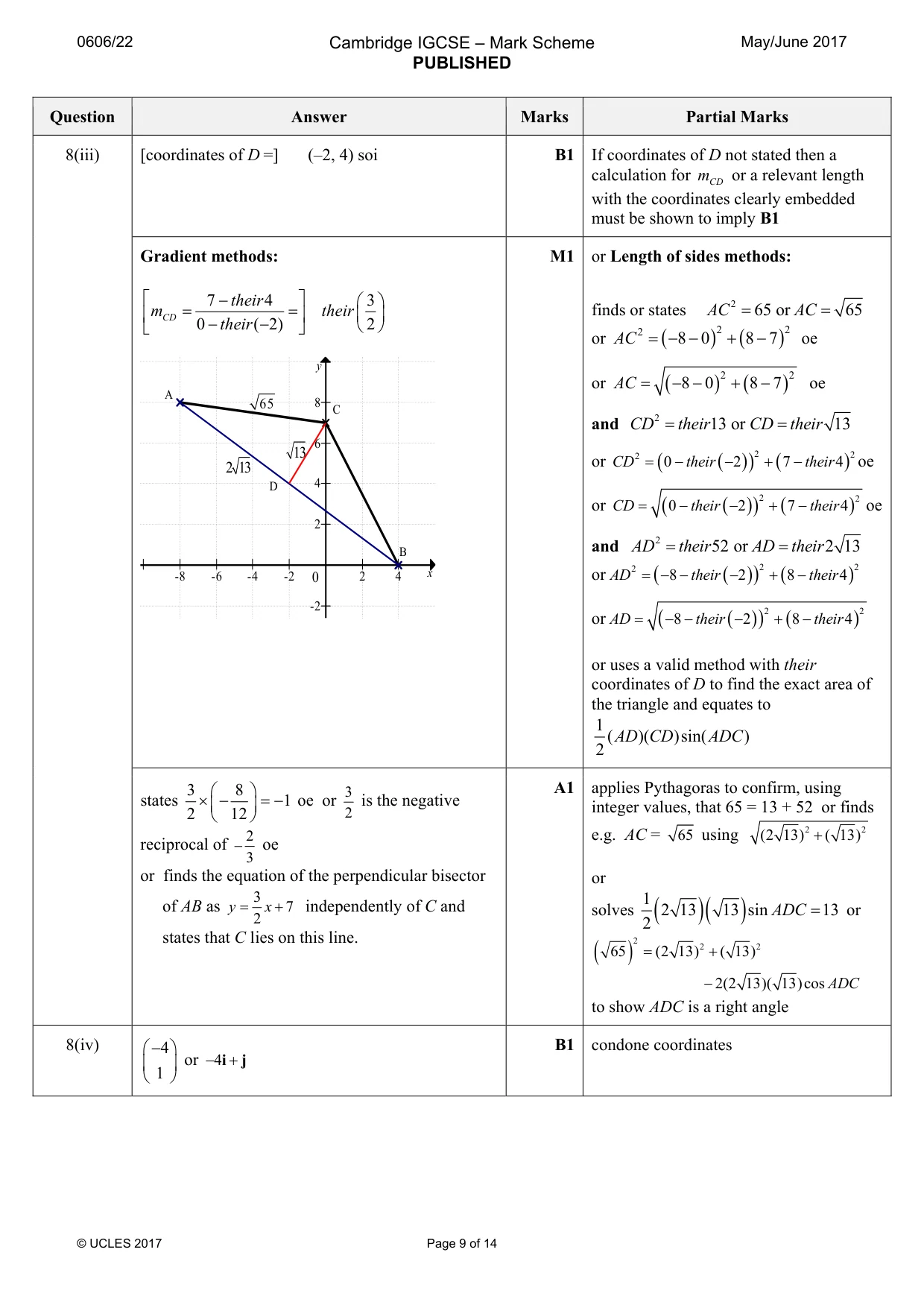
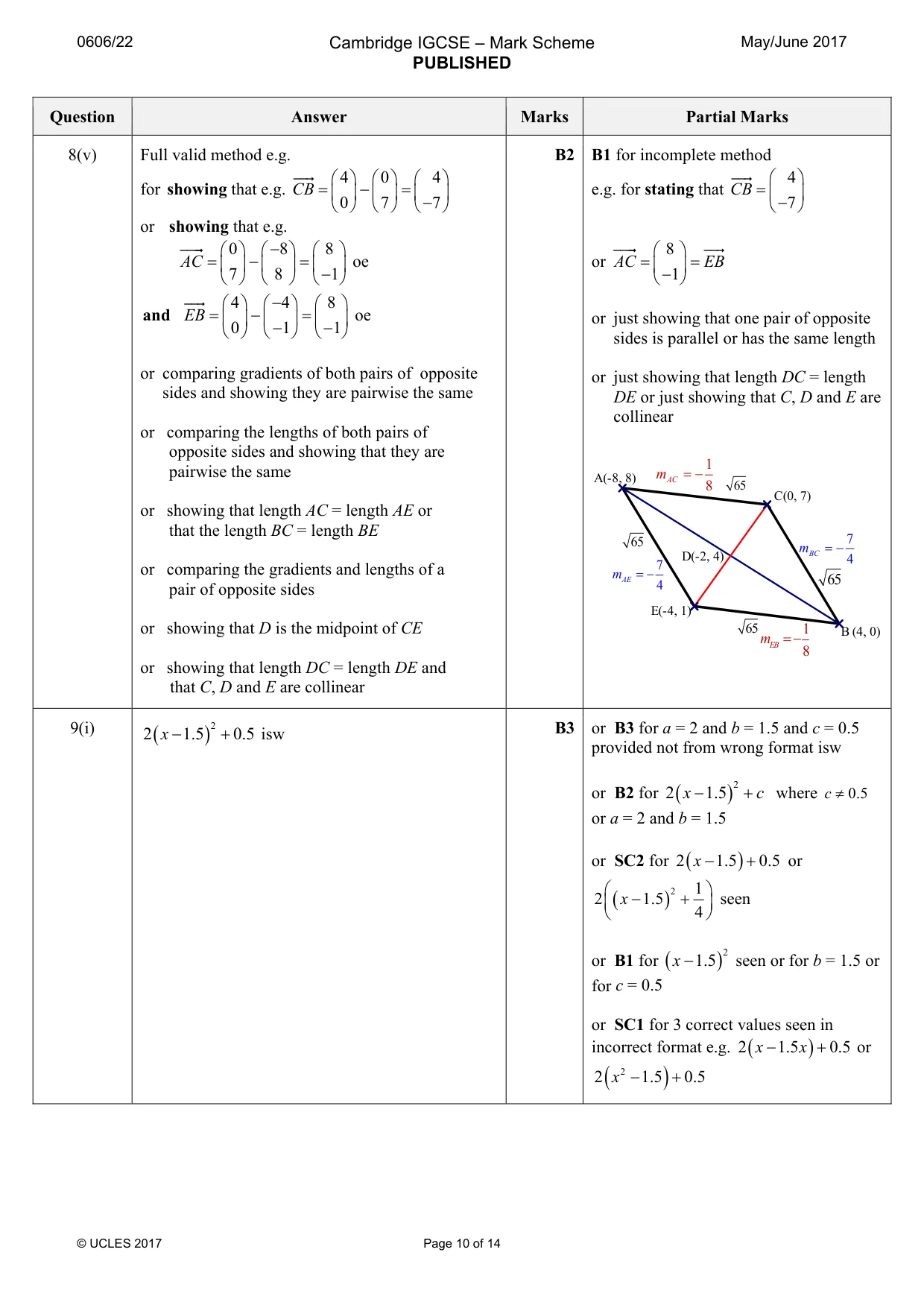
Mark scheme: 8(i) 8 B2 8 y − 8 = − ( x −−( 8 ) ) oe isw B1 for m AB = − oe 12 12 8 8 − 0 or y [ −0] = − ( x − 4) oe isw or M1 for oe −−8 4 12 or 3 y = −2 x + 8 oe isw 8(ii) ( −−8 4 ) 2 + ( 8[ −0] ) 2 oe M1 any valid method 208 isw or 4 13 isw or 14.4222051… rot to 3 or A1 implies M1 provided nfww more sf 8(iii) [coordinates of D =] (–2, 4) soi B1 If coordinates of D not stated then a calculation for mCD or a relevant length with the coordinates clearly embedded must be shown to imply B1 Gradient methods: M1 or Length of sides methods: 7 − their 4 3 2 mCD = = their finds or states AC = 65 or AC = 65 0 − their ( − 2) 2 2 2 2 or AC = ( −−8 0 ) + ( 8 − 7 ) oe y or AC = ( −−8 0 ) 2 + ( 8 − 7 ) 2 oe A 65 8 C and CD 2 = their13 or CD = their 13 6 13 2 2 2 or CD = ( 0 − their ( −2 ) ) + ( 7 − their 4 ) oe 2 13 D 4 or CD = ( 0 − their ( −2 ) ) 2 + ( 7 − their 4 ) 2 oe 2 B and AD 2 = their 52 or AD = their 2 13 -8 -6 -4 -2 0 2 4 x or AD 2 = ( −−8 their ( −2 ) ) 2 + ( 8 − their 4 ) 2 -2 2 2 or AD = ( −−8 their ( −2 ) ) + ( 8 − their 4 ) or uses a valid method with their coordinates of D to find the exact area of the triangle and equates to 1 ( AD )(CD )sin( ADC ) 2 3 8 3 A1 applies Pythagoras to confirm, using states × − = − 1 oe or is the negative integer values, that 65 = 13 + 52 or finds 2 12 2 2 e.g. AC = 65 using (2 13) 2 + ( 13) 2 reciprocal of − oe 3 or finds the equation of the perpendicular bisector or 3 1 of AB as y = x + 7 independently of C and solves 2 13 13 sin ADC = 13 or 2 ( )( ) 2 states that C lies on this line. 2 65 = (2 13) 2 + ( 13) 2 ( ) − 2(2 13)( 13)cos ADC to show ADC is a right angle 8(iv) −4 B1 condone coordinates or −4i + j 1 8(v) Full valid method e.g. B2 B1 for incomplete method JJG 4 0 4 JJG 4 for showing that e.g. CB = − = e.g. for stating that CB = 0 7 − 7 − 7 or showing that e.g. JJJG 0 − 8 8 JJJG 8 JJG AC = − = oe or AC = = EB 7 8 −1 − 1 JJG 4 −4 8 and EB = − = oe or just showing that one pair of opposite 0 −1 −1 sides is parallel or has the same length or comparing gradients of both pairs of opposite or just showing that length DC = length sides and showing they are pairwise the same DE or just showing that C, D and E are collinear or comparing the lengths of both pairs of opposite sides and showing that they are 1 pairwise the same A(-8, 8) m AC = − 8 65 C(0, 7) or showing that length AC = length AE or that the length BC = length BE 65 7 m BC = − D(-2, 4) 4 or comparing the gradients and lengths of a mAE = − 7 65 pair of opposite sides 4 E(-4, 1) or showing that D is the midpoint of CE 65 1 B (4, 0) mEB =− 8 or showing that length DC = length DE and that C, D and E are collinear
More questions on Know and use the condition for two lines to
Q9 · A function f is defined, for x G , by f ( x) = 2 x 2 - 6x + 5
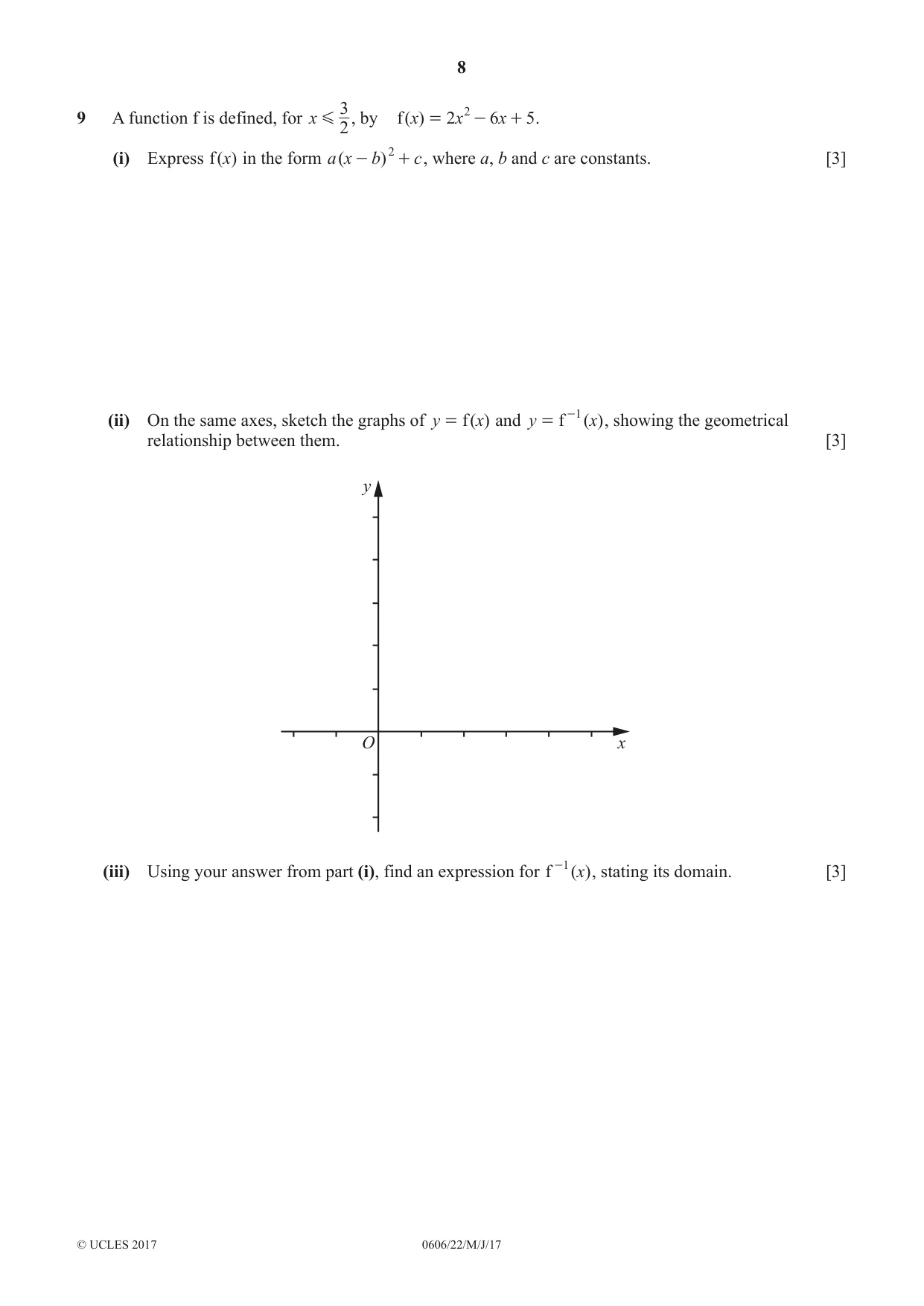
9 A function f is defined, for x G , by f ( x) = 2 x 2 - 6x + 5 . 2 (i) Express f ( x) in the form a ( x - b) 2 + c , where a, b and c are constants. [3] (ii) On the same axes, sketch the graphs of y = f ( x) and y = f -1 ( x) , showing the geometrical relationship between them. [3] y O x (iii) Using your answer from part (i), find an expression for f -1 ( x) , stating its domain. [3]
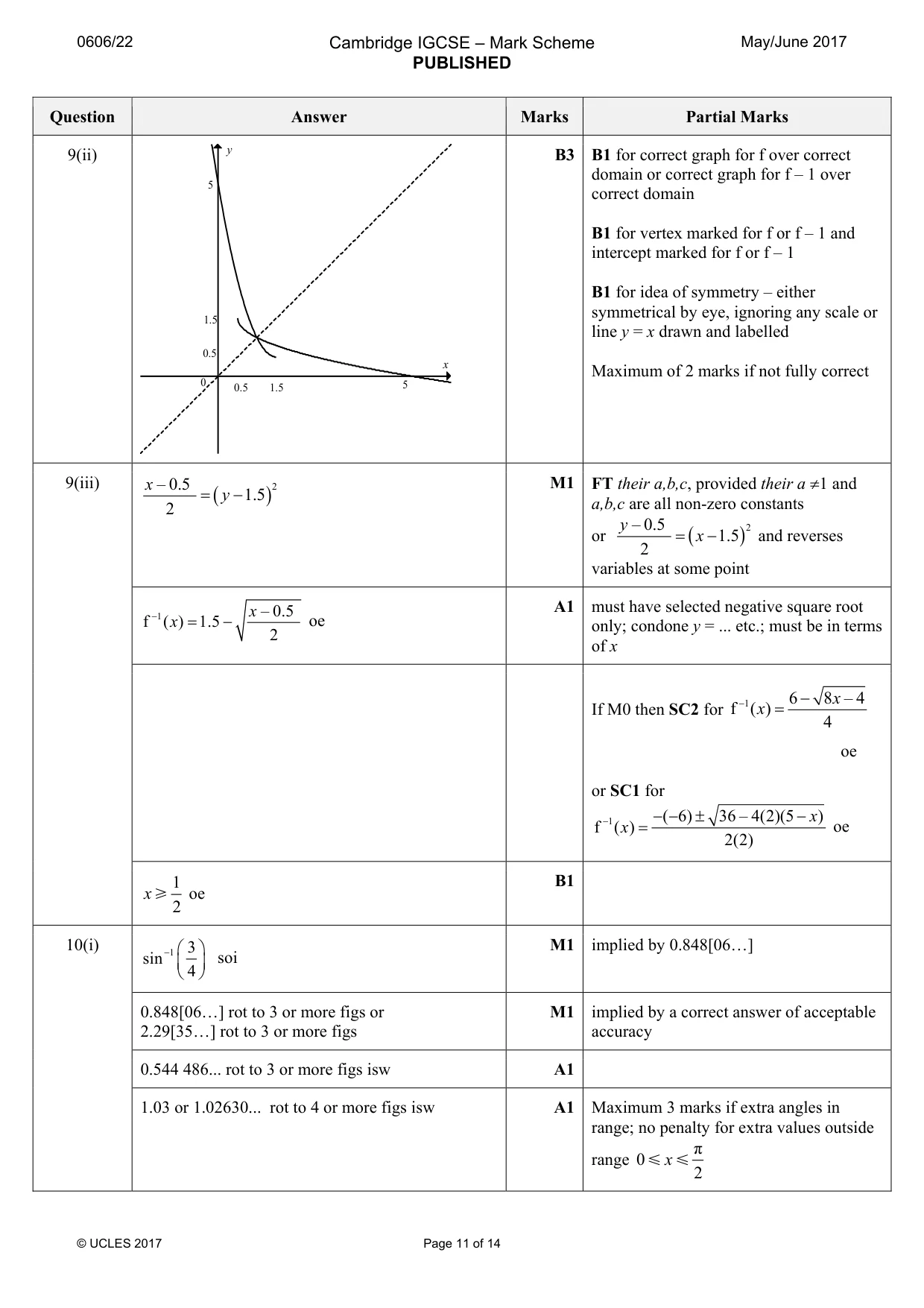
Mark scheme: 9(i) 2 B3 or B3 for a = 2 and b = 1.5 and c = 0.5 2 ( x − 1.5 ) + 0.5 isw provided not from wrong format isw or B2 for 2 ( x − 1.5 ) 2 + c where c ≠ 0.5 or a = 2 and b = 1.5 or SC2 for 2 ( x − 1.5 ) + 0.5 or 2 1 seen 2 ( x − 1.5 ) + 4 or B1 for ( x − 1.5 ) 2 seen or for b = 1.5 or for c = 0.5 or SC1 for 3 correct values seen in incorrect format e.g. 2 ( x − 1.5 x ) + 0.5 or 2 ( x 2 − 1.5 ) + 0.5 9(ii) y B3 B1 for correct graph for f over correct domain or correct graph for f – 1 over 5 correct domain B1 for vertex marked for f or f – 1 and intercept marked for f or f – 1 B1 for idea of symmetry – either symmetrical by eye, ignoring any scale or 1.5 line y = x drawn and labelled 0.5 x Maximum of 2 marks if not fully correct 0 0.5 1.5 5 9(iii) x – 0.5 2 M1 FT their a,b,c, provided their a ≠1 and = ( y − 1.5 ) a,b,c are all non-zero constants 2 y – 0.5 2 or = ( x − 1.5 ) and reverses 2 variables at some point −1 x – 0. 5 A1 must have selected negative square root f ( x ) = 1.5 − oe only; condone y = ... etc.; must be in terms 2 of x −1 6 − 8 x – 4 If M0 then SC2 for f ( )x = 4 oe or SC1 for − 1 −−( 6) ± 36 – 4( 2)(5 − x ) f ( x ) = oe 2(2) 1 B1 x ≥ oe 2
Q10 · Solve the equation J r N r - = 3 for 0 G x G radians, [4] (i) 4 sin KK3x OO 4 2 L P (ii)…
10 Solve the equation J r N r - = 3 for 0 G x G radians, [4] (i) 4 sin KK3x OO 4 2 L P (ii) 2 tan 2 y + sec 2 y = 14 sec y + 3 for 0° G y G 360° . [5]
Mark scheme: 10(i) −1 3 M1 implied by 0.848[06…] sin soi 4 0.848[06…] rot to 3 or more figs or M1 implied by a correct answer of acceptable 2.29[35…] rot to 3 or more figs accuracy 0.544 486... rot to 3 or more figs isw A1 1.03 or 1.02630... rot to 4 or more figs isw A1 Maximum 3 marks if extra angles in range; no penalty for extra values outside π range 0 ≤ x ≤ 2 10(ii) Correctly uses tan 2 y = sec 2 y − 1 and/or M1 for using correct relationship(s) to find an equation in terms of a single trigonometric sin y 2 2 and sin y = 1 − cos y ratio cos y 3sec 2 y − 14sec y − 5 = 0 DM1 for factorising or solving their 3-term quadratic dependent on the first M1 being ⇒ ( 3sec y + 1)( sec y − 5 ) awarded or 5cos 2 y + 14cos y − 3 = 0 ⇒ (5cos y − 1)(cos y + 3) 1 A1 [ cos y = −]3 cos y = 5 78.5 or 78.4630... rot to 2 or more decimal places A1 isw 281.5 or 281.536.... rot to 2 or more decimal places A1 Maximum 4 marks if extra angles in isw range; no penalty for extra values outside range0 ≤ x ≤ 360
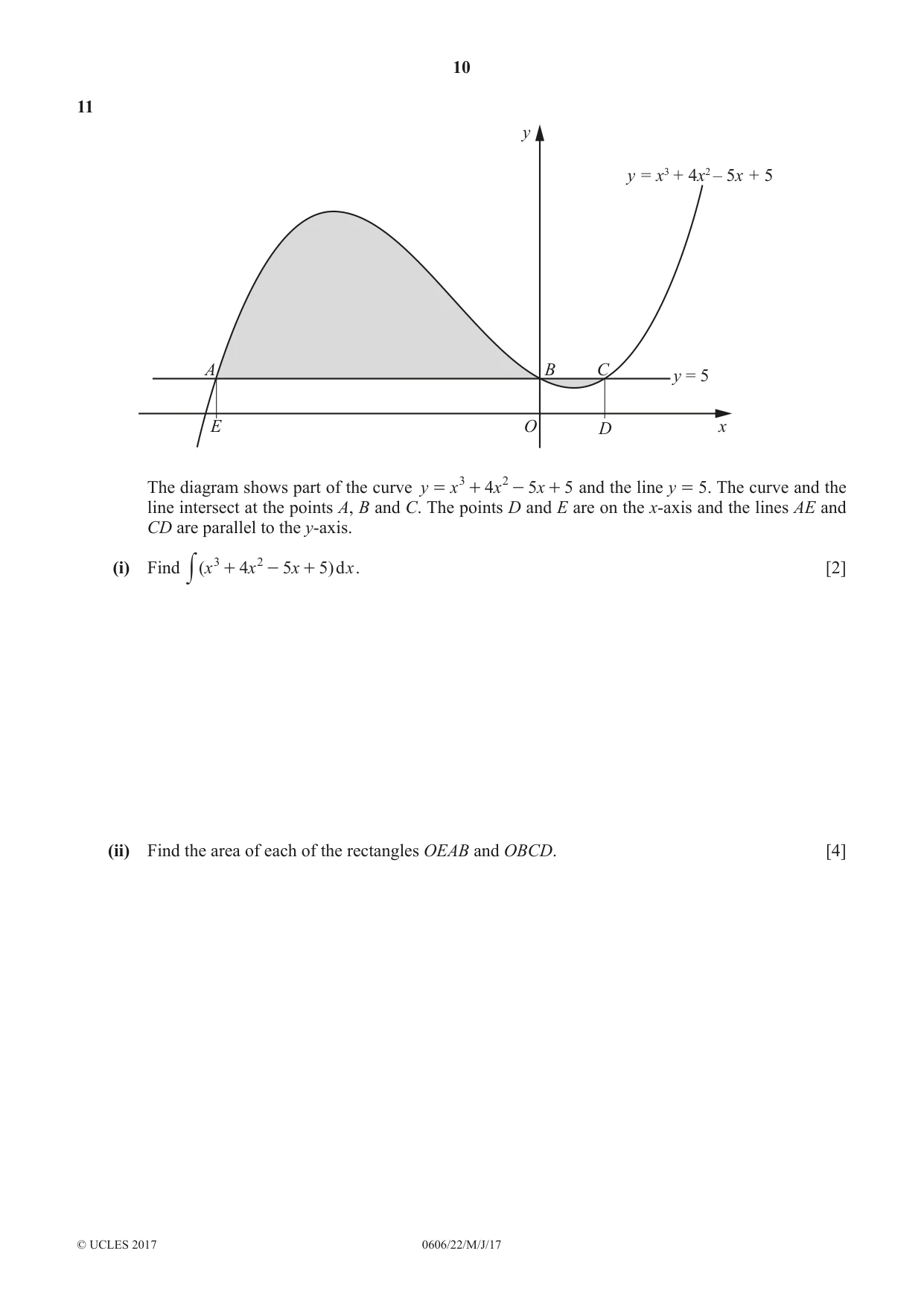
Q11 · Y y = x3 + 4x2 – 5x + 5 A B C y = 5 E O D x The diagram shows part of the curve y = x 3 +…
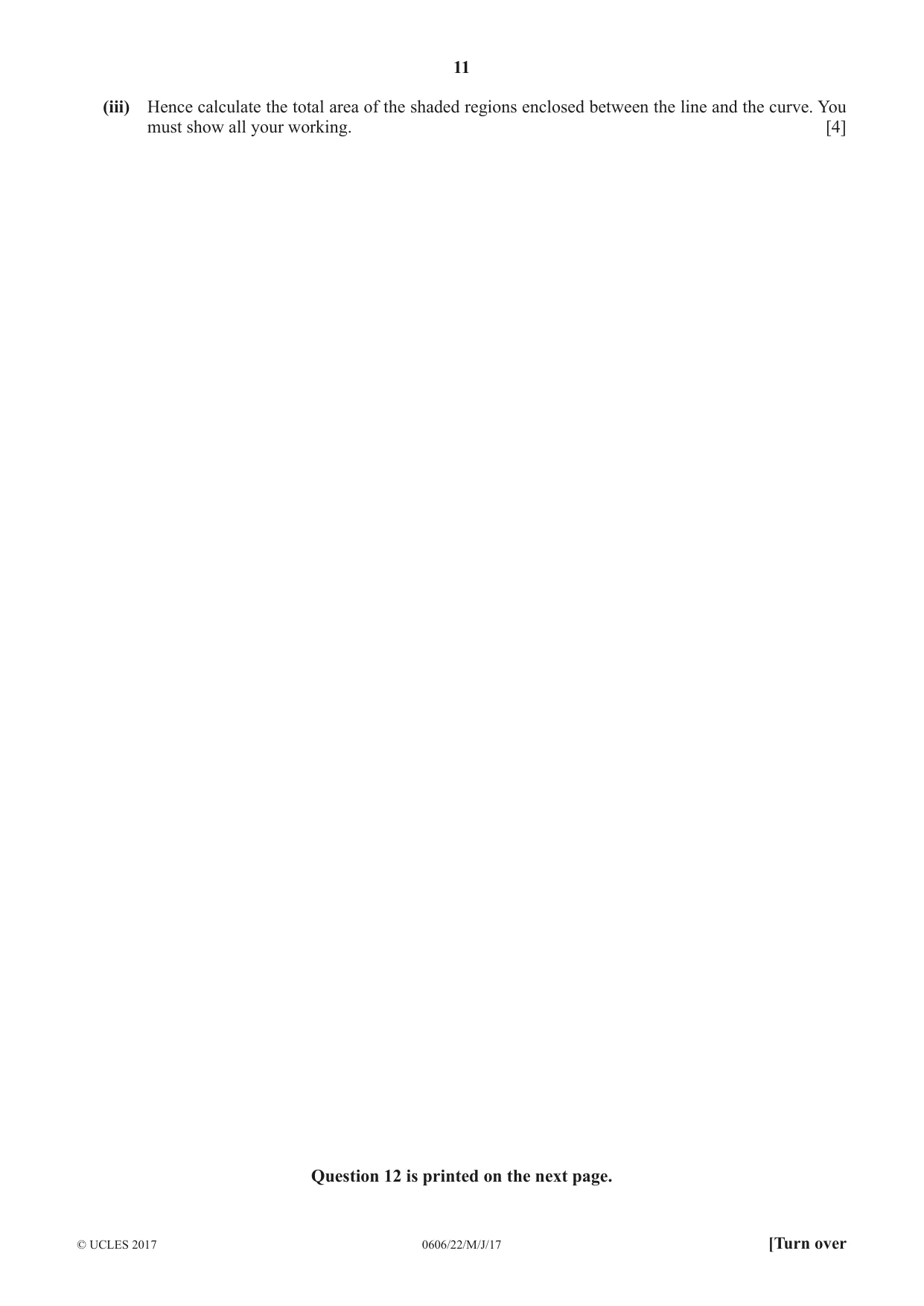
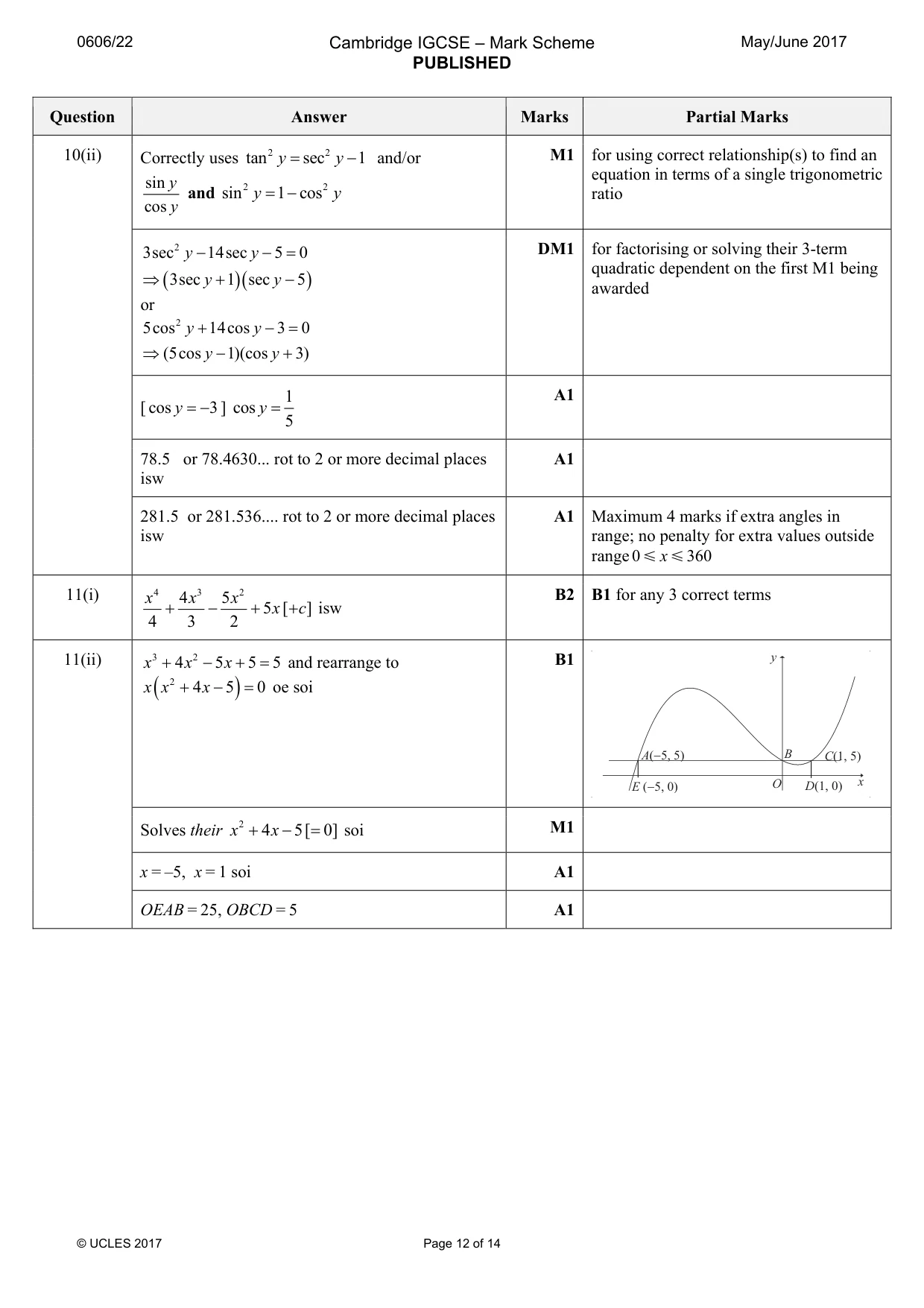
11 y y = x3 + 4x2 – 5x + 5 A B C y = 5 E O D x The diagram shows part of the curve y = x 3 + 4 x 2 - 5 x + 5 and the line y = 5. The curve and the line intersect at the points A, B and C. The points D and E are on the x-axis and the lines AE and CD are parallel to the y-axis. (i) Find y ( x 3 + 4x 2 - 5x + 5 )d x . [2] (ii) Find the area of each of the rectangles OEAB and OBCD. [4] (iii) Hence calculate the total area of the shaded regions enclosed between the line and the curve. You must show all your working. [4] Question 12 is printed on the next page.
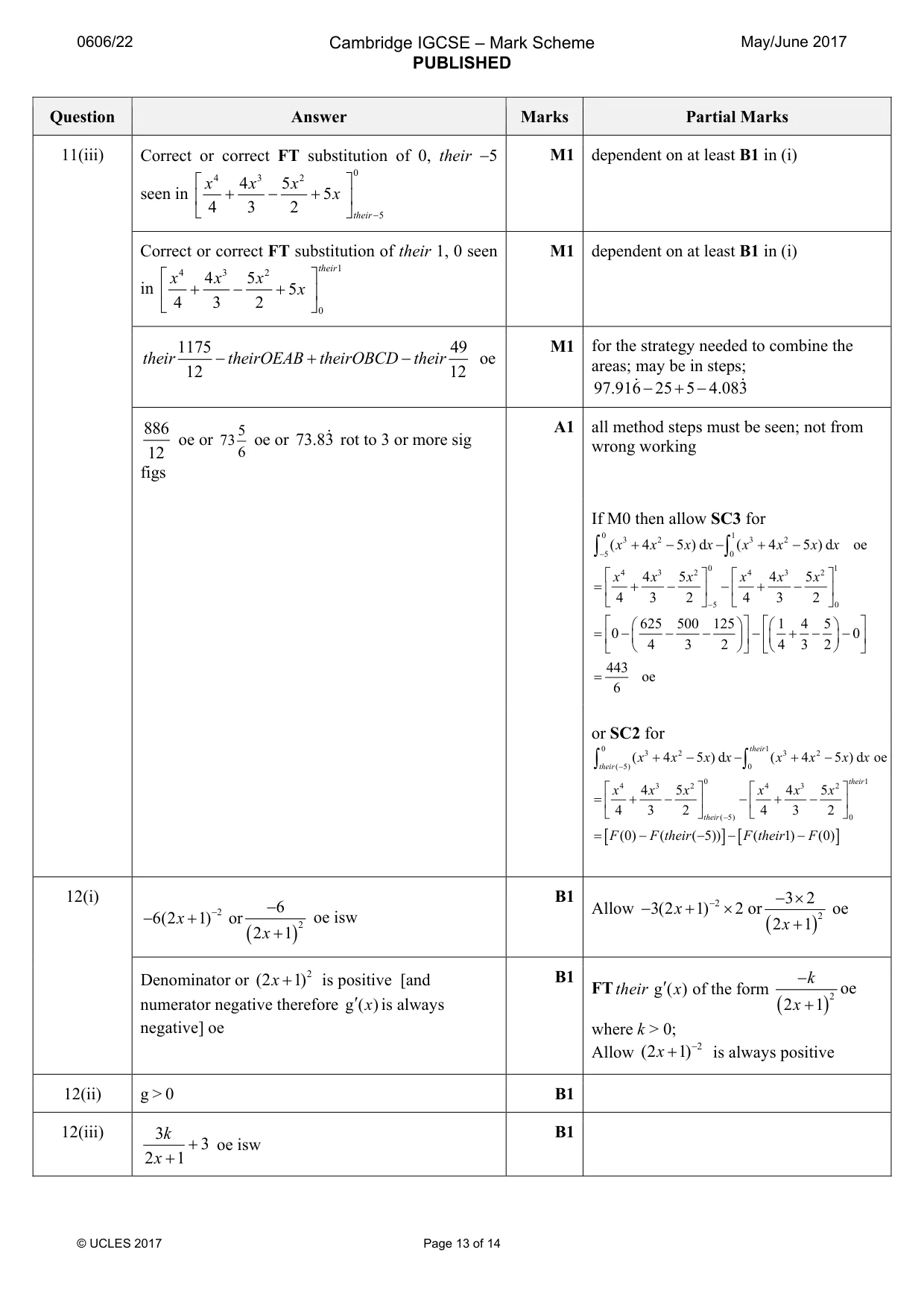
Mark scheme: 11(i) x 4 4 x 3 5 x 2 B2 B1 for any 3 correct terms + − + 5 x [ + c ] isw 4 3 2 11(ii) x 3 + 4 x 2 − 5 x + 5 = 5 and rearrange to B1 y x ( x 2 + 4 x − 5 ) = 0 oe soi A(−5, 5) B C(1, 5) E (−5, 0) O D(1, 0) x Solves their x 2 + 4 x − 5[ = 0] soi M1 x = –5, x = 1 soi A1 OEAB = 25, OBCD = 5 A1 11(iii) Correct or correct FT substitution of 0, their −5 M1 dependent on at least B1 in (i) x 0 4 4 x 3 5 x 2 seen in + − + 5 x 4 3 2 their − 5 Correct or correct FT substitution of their 1, 0 seen M1 dependent on at least B1 in (i) x their 1 4 4 x 3 5 x 2 in + − + 5 x 4 3 2 0 1175 49 M1 for the strategy needed to combine the their − theirOEAB + theirOBCD − their oe areas; may be in steps; 12 12 97.916& − 25 + 5 − 4.083& 886 5 A1 all method steps must be seen; not from oe or 73 oe or 73.83& rot to 3 or more sig wrong working 12 6 figs If M0 then allow SC3 for 0 3 2 1 3 2 ∫−5 ( x + 4 x − 5 x ) dx − ∫0 ( x + 4 x − 5 x ) d x oe x 4 4 x 3 5 x 2 0 x 4 4 x 3 5 x 2 1 = + − − + − 4 3 2 − 5 4 3 2 0 625 500 125 1 4 5 = 0 − − − − + − − 0 4 3 2 4 3 2 443 = oe 6 or SC2 for 0 3 2 their 1 3 2 ∫their ( − 5) ( x + 4 x − 5 x ) d x − ∫0 ( x + 4 x − 5 x ) dx oe x 4 4 x 3 5 x 2 0 x 4 4 x 3 5 x 2 their 1 = + − − + − 4 3 2 their ( −5) 4 3 2 0 = [ F (0) − F (their ( −5)) ] − [ F (their1) − F (0) ]
Q12 · The function g is defined, for x 2- , by g ( x) =
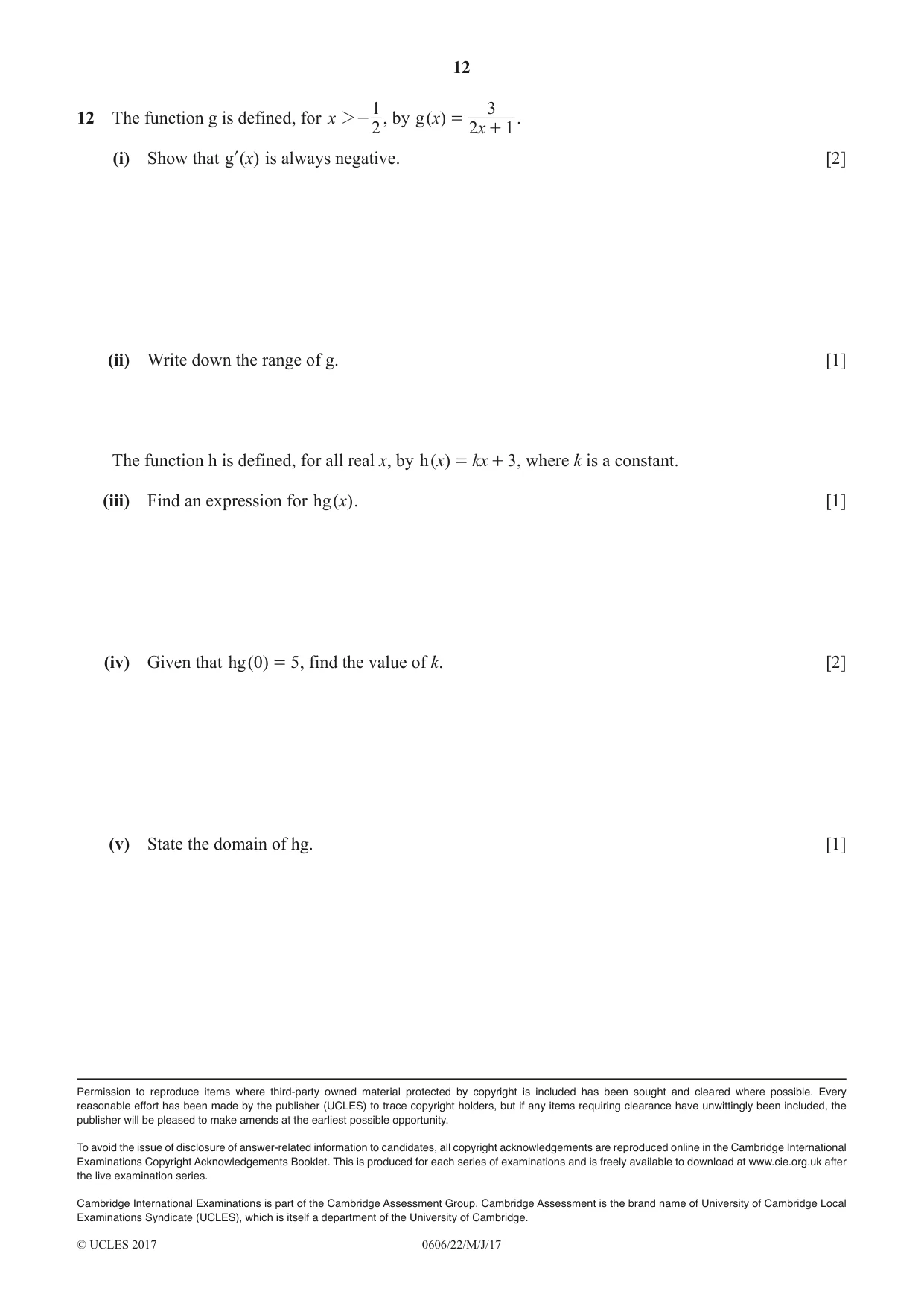
12 The function g is defined, for x 2- , by g ( x) = . 2 2x + 1 (i) Show that g l ( x) is always negative. [2] (ii) Write down the range of g. [1] The function h is defined, for all real x, by h ( x) = kx + 3 , where k is a constant. (iii) Find an expression for hg ( x) . [1] (iv) Given that hg ( 0) = 5 , find the value of k. [2] (v) State the domain of hg. [1]
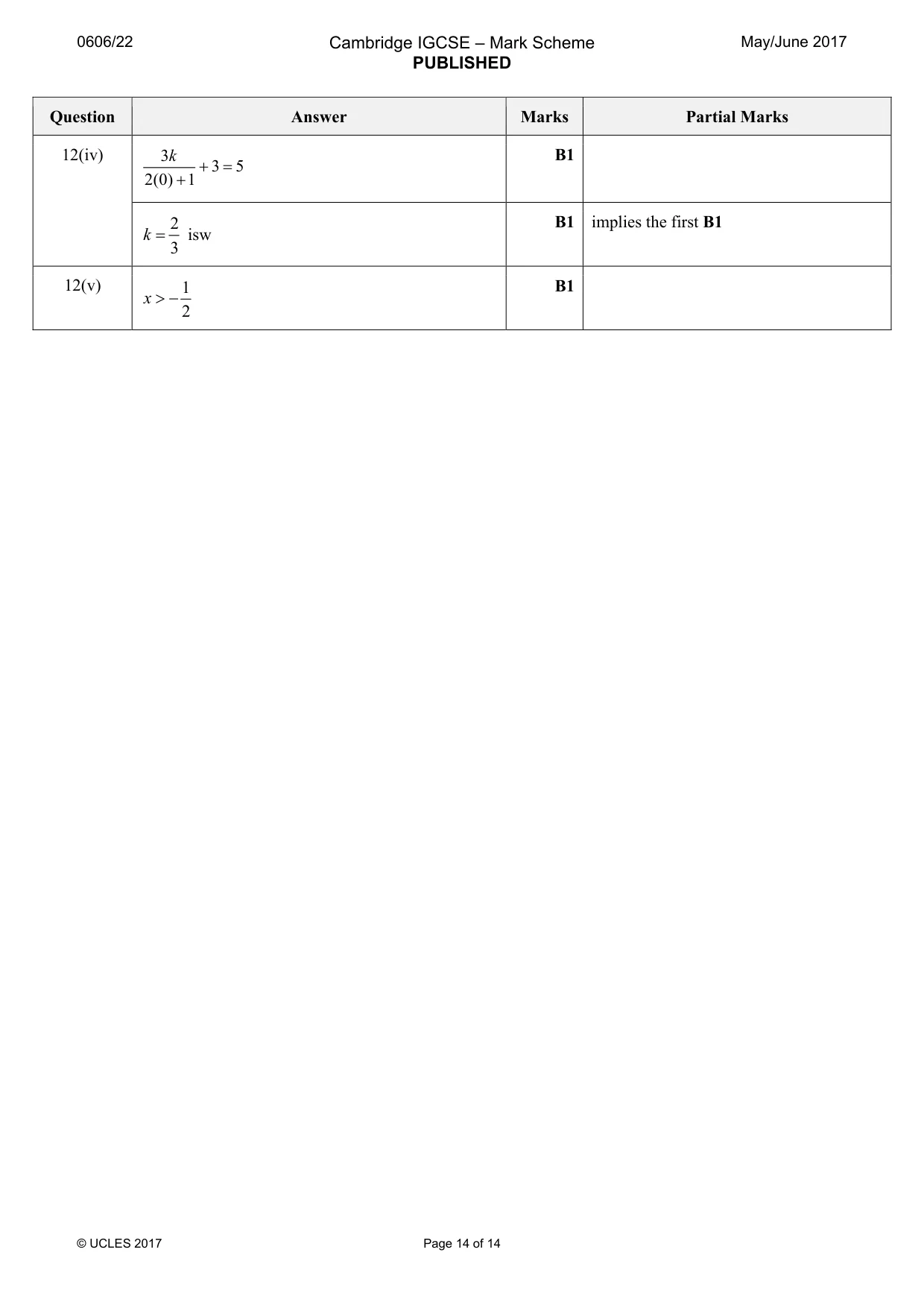
Mark scheme: 12(i) B1 −2 −×3 2 − 2 − 6 Allow − 3(2 x + 1) × 2 or 2 oe −6(2 x + 1) or 2 oe isw ( 2 x + 1) ( 2 x + 1) Denominator or (2 x + 1) 2 is positive [and B1 − k FT their g ′( x ) of the form 2 oe numerator negative therefore g ′( x ) is always ( 2 x + 1) negative] oe where k > 0; Allow (2 x + 1) −2 is always positive 12(ii) g > 0 B1 12(iii) 3k B1 + 3 oe isw 2 x + 1 12(iv) 3k B1 + 3 = 5 2(0) + 1 2 B1 implies the first B1 k = isw 3 12(v) 1 B1 x > − 2
What was in this paper
The subtopics covered by these 10 questions, and how many questions each got. Open one in a new tab to see every Cambridge question on it.
2Differentiate products and quotients of1Find factors of polynomials1Find the maximum or minimum value of the1Form and use composite functions1Know and use the condition for two lines to1Solve simultaneous equations in two1Solve, for a given domain, trigonometric1Use differentiation to find gradients, tangents1What you needed in this session
Cambridge’s own grade thresholds for 2017 May/June, Paper 2 · Variant 2. A higher threshold means an easier paper — the bar moves with how the cohort did.