Cambridge IGCSE Mathematics (9-1) 0980 — 2020 May/June Paper 3 · Variant 2
0980/32/M/J/20 · 10 questions · 104 marks · ≈117 min
The question paper and its mark scheme, free to read here and free to download. This is Cambridge’s own paper, exactly as it was sat.
Question paper16 pages
Mark scheme7 pages
Answers below. Sit the paper first if you are practising.
Questions as text
Q1 · Paul has a set of 8 cards, each with a number written on it
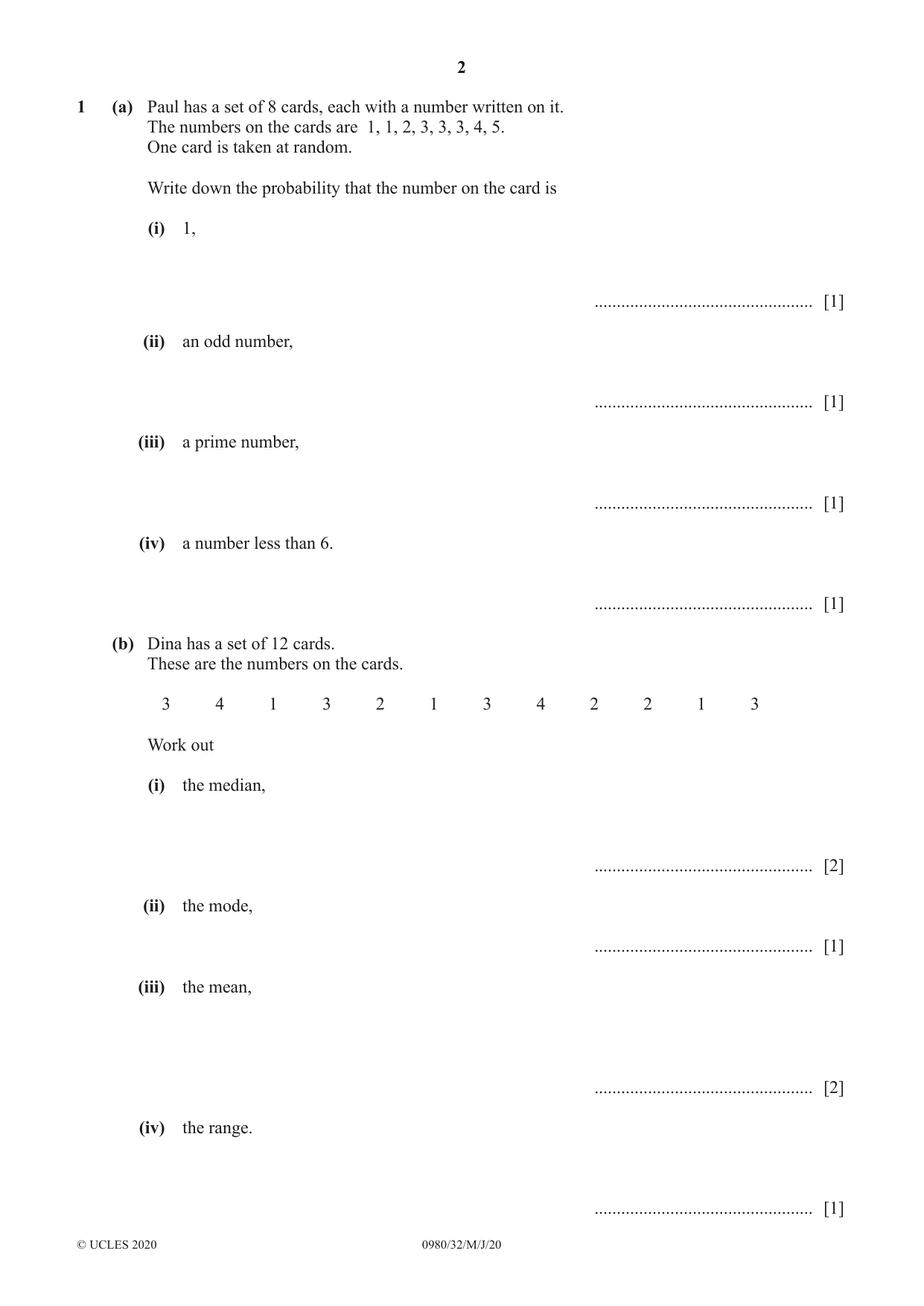
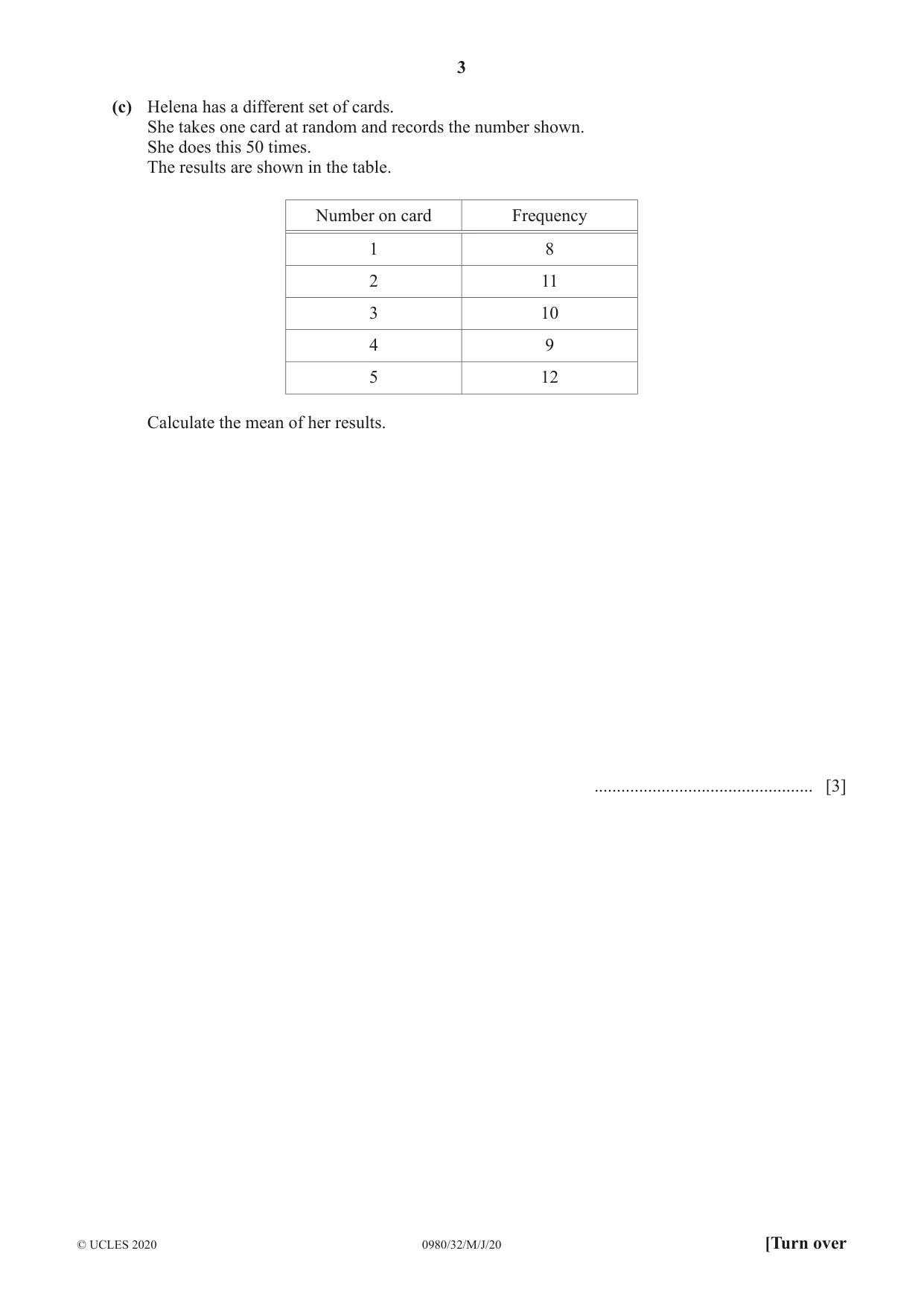
1 (a) Paul has a set of 8 cards, each with a number written on it. The numbers on the cards are 1, 1, 2, 3, 3, 3, 4, 5. One card is taken at random. Write down the probability that the number on the card is (i) 1, ................................................. [1] (ii) an odd number, ................................................. [1] (iii) a prime number, ................................................. [1] (iv) a number less than 6. ................................................. [1] (b) Dina has a set of 12 cards. These are the numbers on the cards. 3 4 1 3 2 1 3 4 2 2 1 3 Work out (i) the median, ................................................. [2] (ii) the mode, ................................................. [1] (iii) the mean, ................................................. [2] (iv) the range. ................................................. [1] (c) Helena has a different set of cards. She takes one card at random and records the number shown. She does this 50 times. The results are shown in the table. Number on card Frequency 1 8 2 11 3 10 4 9 5 12 Calculate the mean of her results. ................................................. [3]
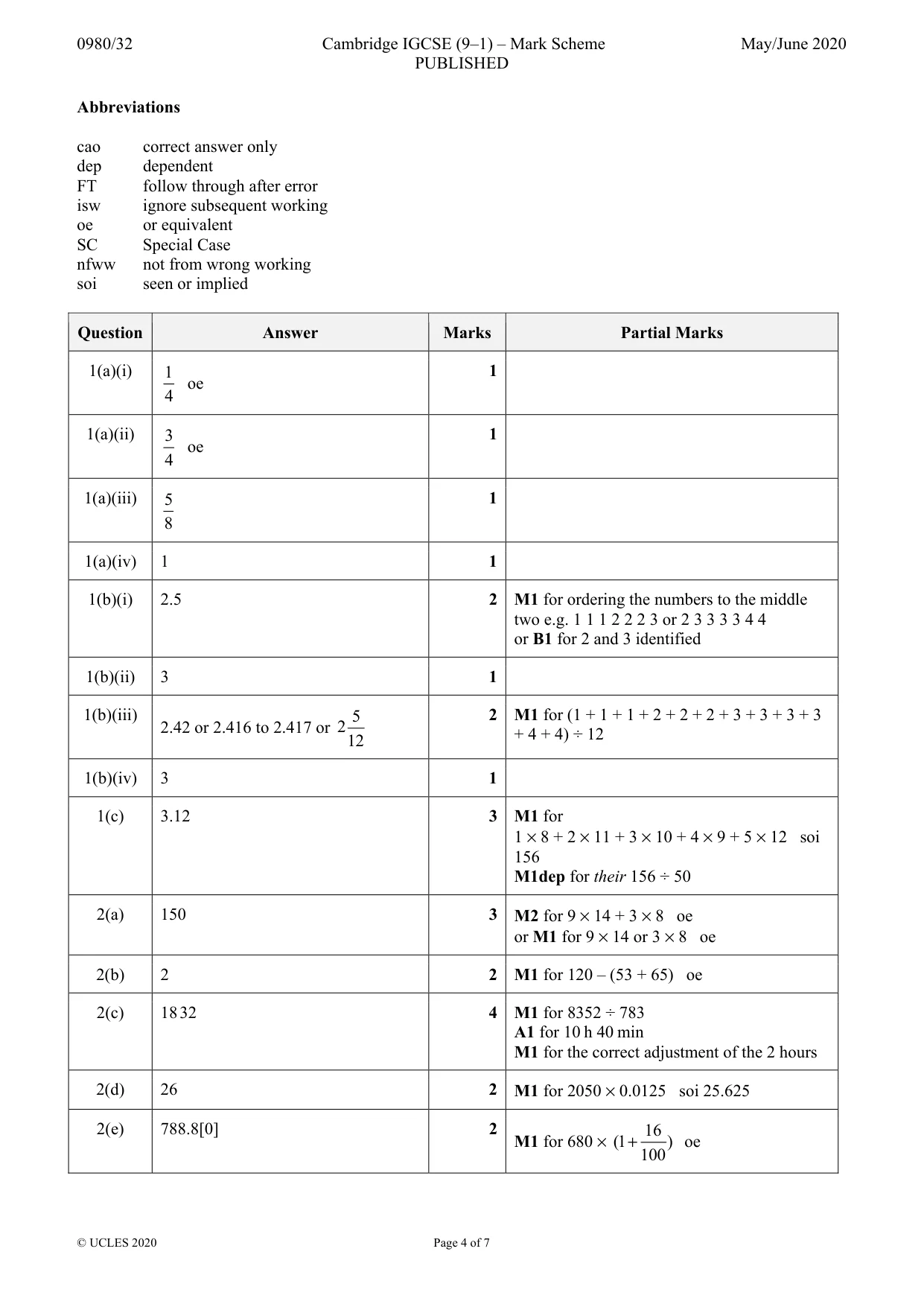
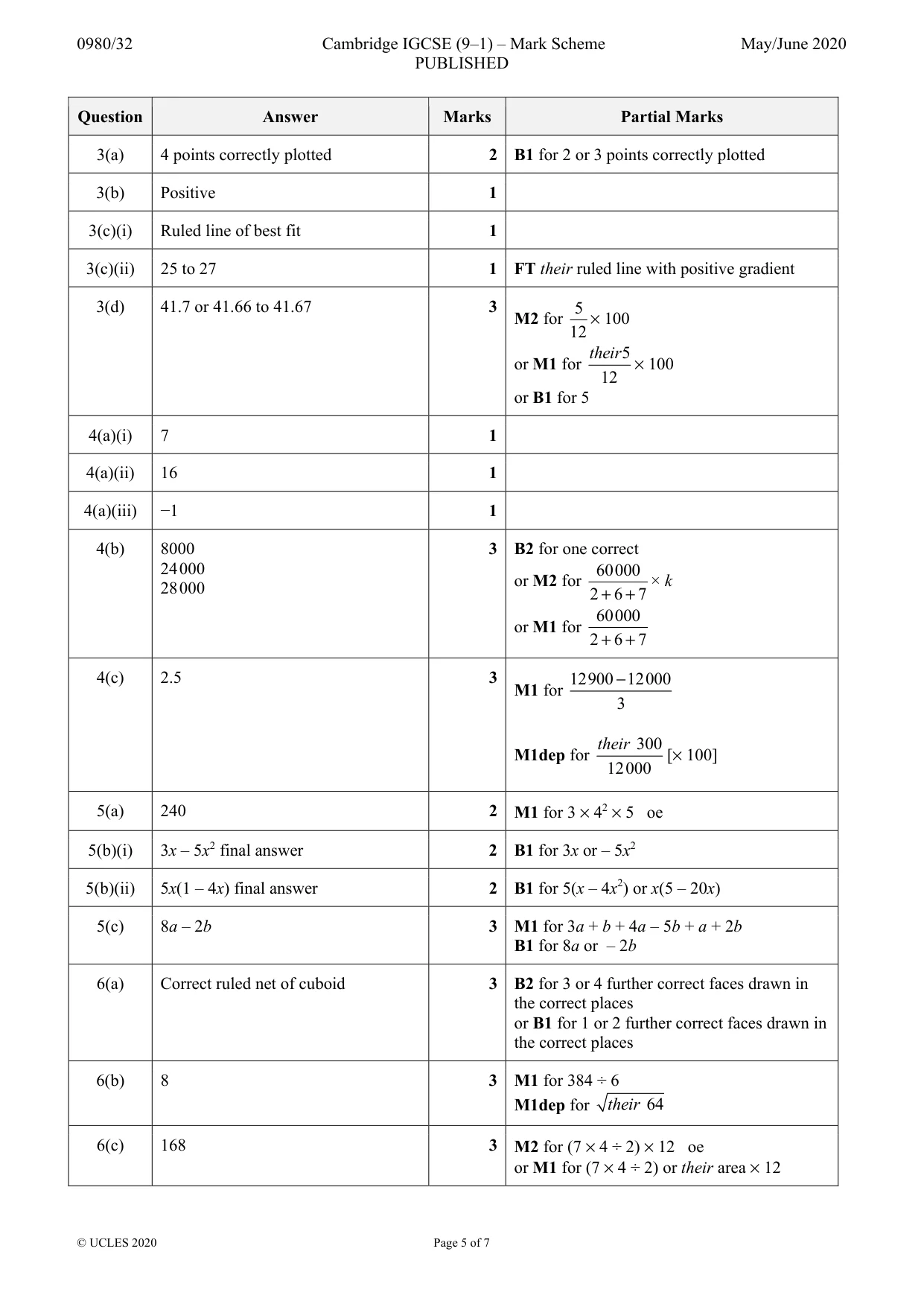
Mark scheme: Question Answer Marks Partial Marks 1(a)(i) 1 1 oe 4 1(a)(ii) 3 1 oe 4 1(a)(iii) 5 1 8 1(a)(iv) 1 1 1(b)(i) 2.5 2 M1 for ordering the numbers to the middle two e.g. 1 1 1 2 2 2 3 or 2 3 3 3 3 4 4 or B1 for 2 and 3 identified 1(b)(ii) 3 1 1(b)(iii) 5 2 M1 for (1 + 1 + 1 + 2 + 2 + 2 + 3 + 3 + 3 + 3 2.42 or 2.416 to 2.417 or + 4 + 4) ÷ 12 212 1(b)(iv) 3 1 1(c) 3.12 3 M1 for 1 × 8 + 2 × 11 + 3 × 10 + 4 × 9 + 5 × 12 soi 156 M1dep for their 156 ÷ 50
Q2 · Jeremy goes on holiday
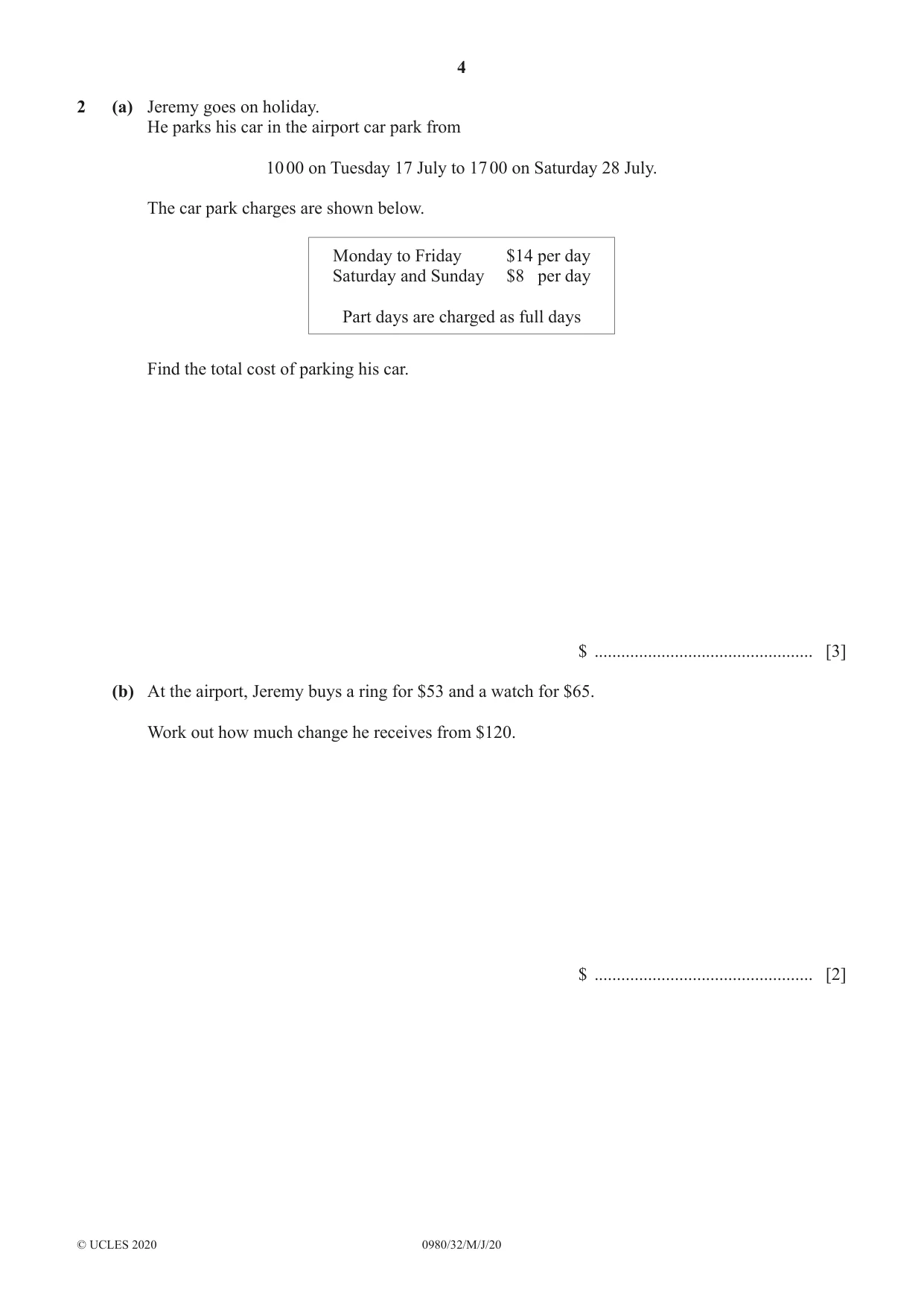
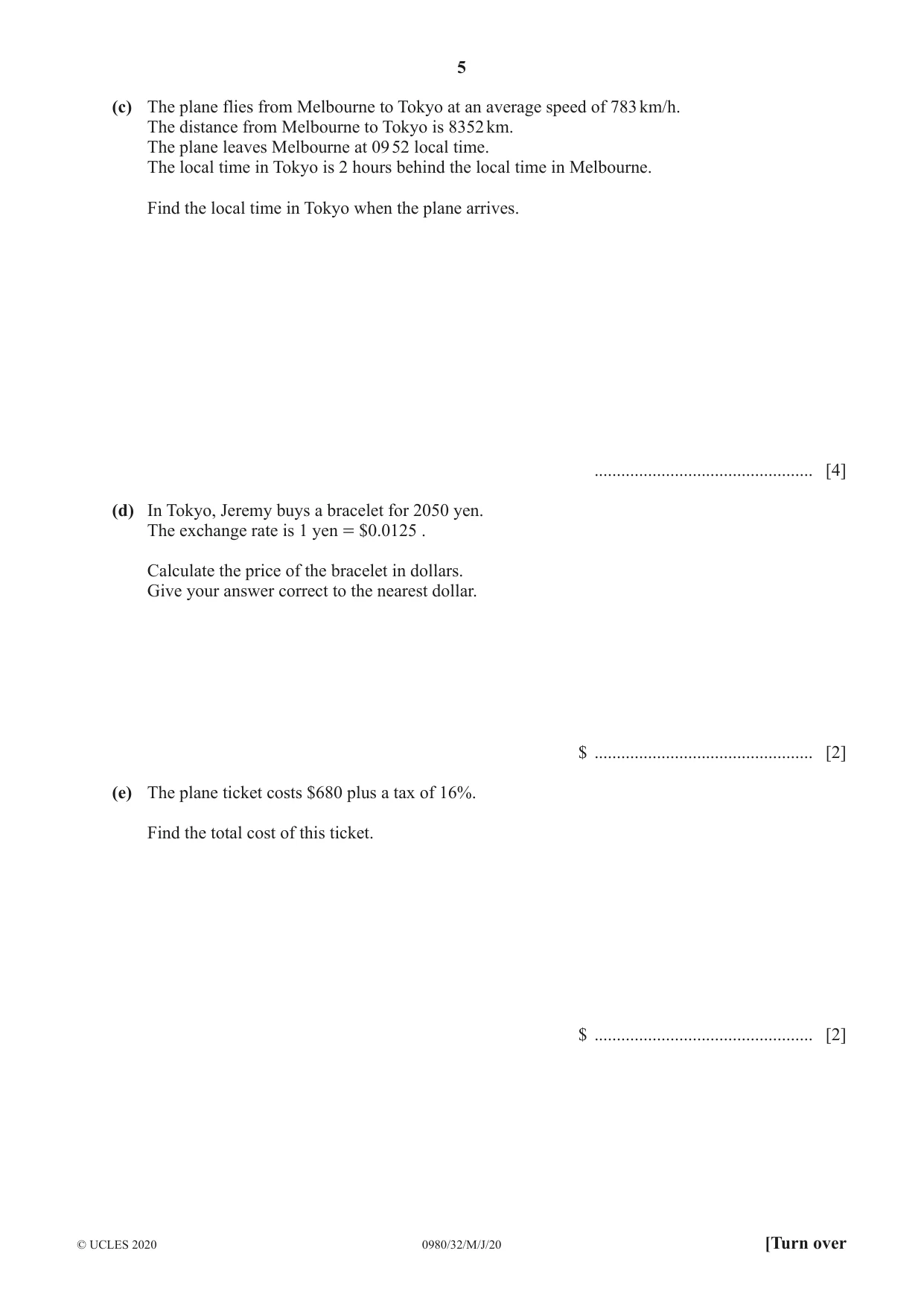
2 (a) Jeremy goes on holiday. He parks his car in the airport car park from 10 00 on Tuesday 17 July to 17 00 on Saturday 28 July. The car park charges are shown below. Monday to Friday $14 per day Saturday and Sunday $8 per day Part days are charged as full days Find the total cost of parking his car. $ ................................................. [3] (b) At the airport, Jeremy buys a ring for $53 and a watch for $65. Work out how much change he receives from $120. $ ................................................. [2] (c) The plane flies from Melbourne to Tokyo at an average speed of 783 km/h. The distance from Melbourne to Tokyo is 8352 km. The plane leaves Melbourne at 09 52 local time. The local time in Tokyo is 2 hours behind the local time in Melbourne. Find the local time in Tokyo when the plane arrives. ................................................. [4] (d) In Tokyo, Jeremy buys a bracelet for 2050 yen. The exchange rate is 1 yen = $0.0125 . Calculate the price of the bracelet in dollars. Give your answer correct to the nearest dollar. $ ................................................. [2] (e) The plane ticket costs $680 plus a tax of 16%. Find the total cost of this ticket. $ ................................................. [2]
Mark scheme: 2(a) 150 3 M2 for 9 × 14 + 3 × 8 oe or M1 for 9 × 14 or 3 × 8 oe 2(b) 2 2 M1 for 120 – (53 + 65) oe 2(c) 18 32 4 M1 for 8352 ÷ 783 A1 for 10 h 40 min M1 for the correct adjustment of the 2 hours 2(d) 26 2 M1 for 2050 × 0.0125 soi 25.625 2(e) 788.8[0] 2 16 M1 for 680 × (1 + ) oe 100
Q3 · Belle records the height, in centimetres, and the mass, in kilograms, of some goats
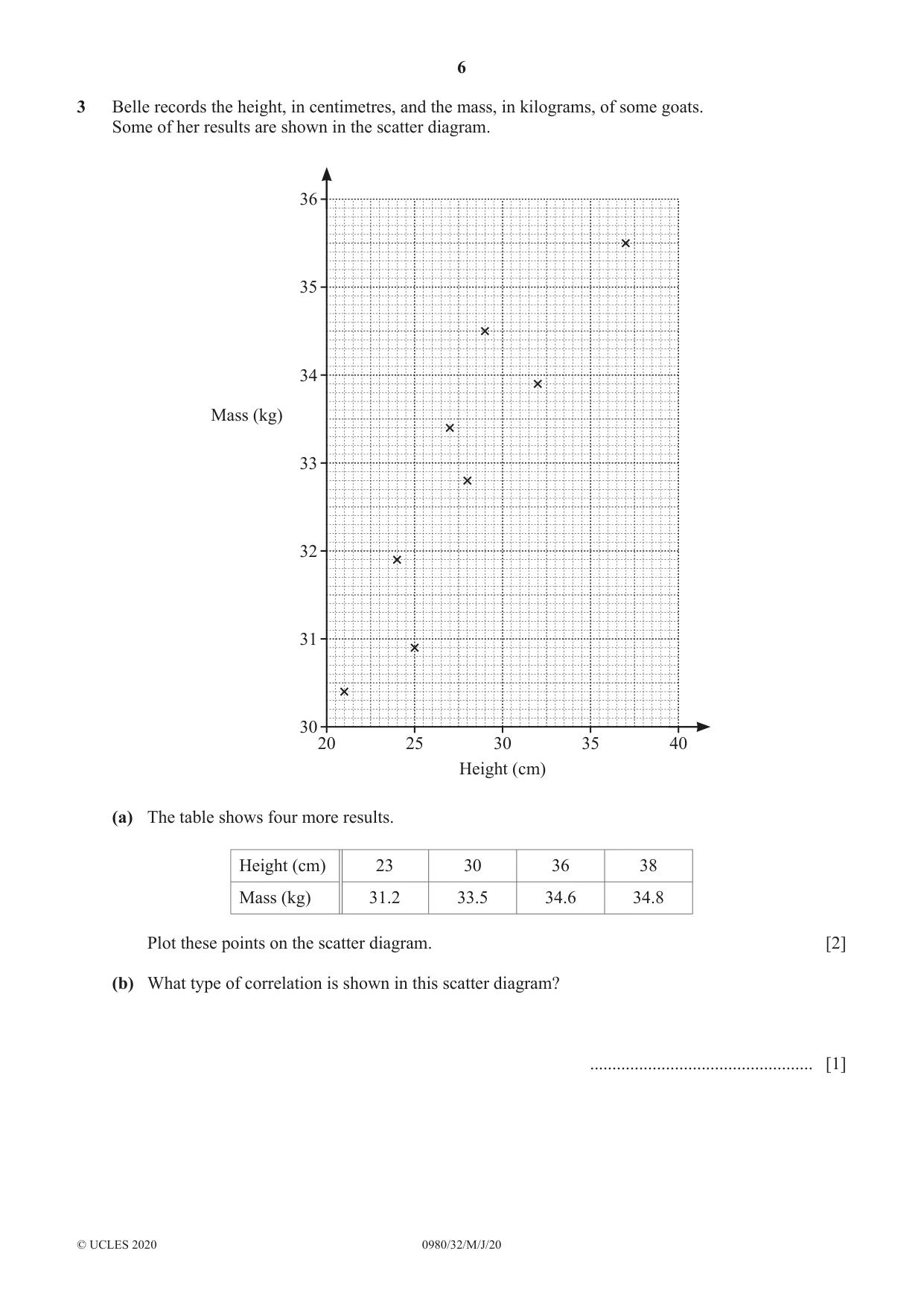
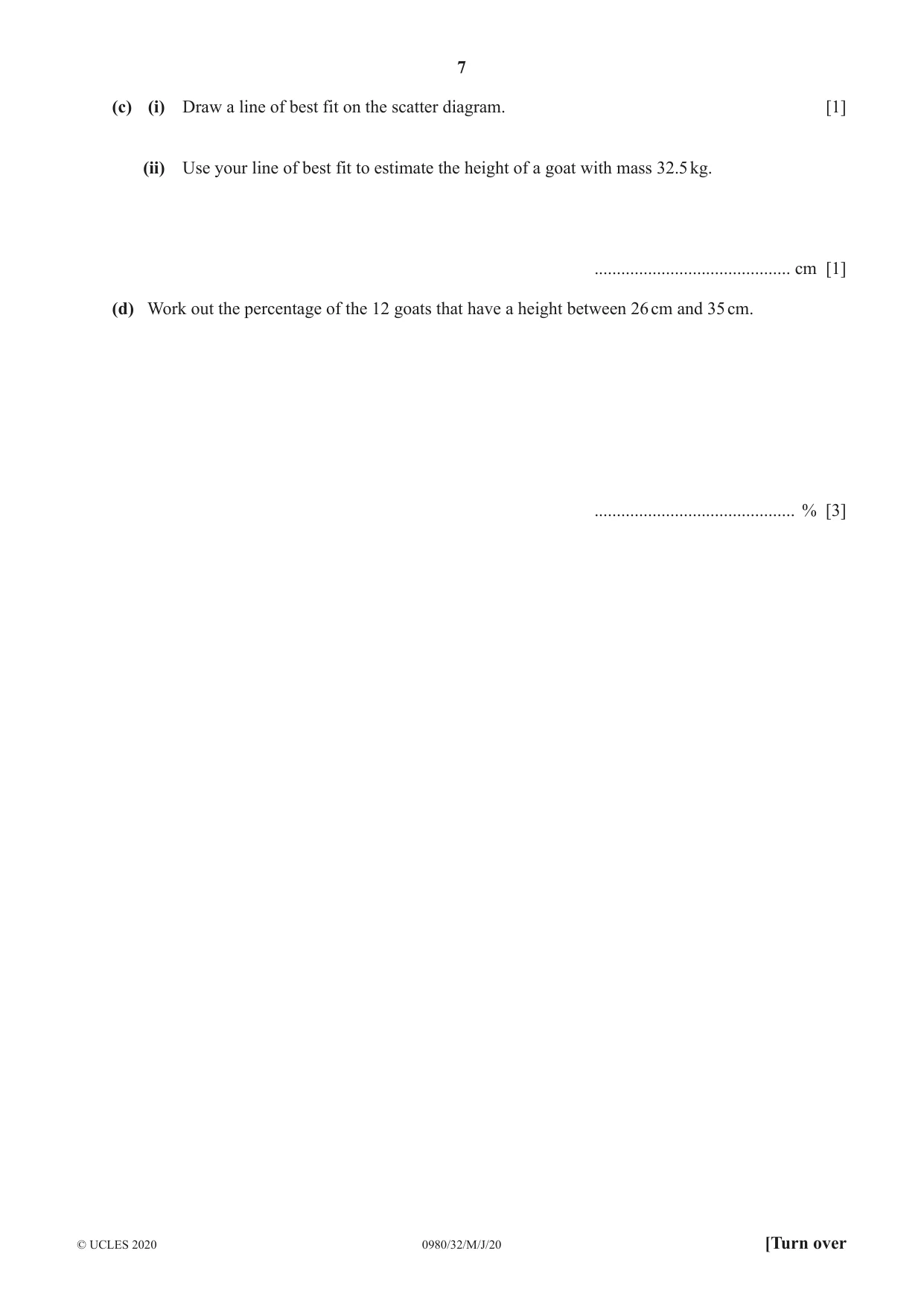
3 Belle records the height, in centimetres, and the mass, in kilograms, of some goats. Some of her results are shown in the scatter diagram. 36 35 34 Mass (kg) 33 32 31 30 20 25 30 35 40 Height (cm) (a) The table shows four more results. Height (cm) 23 30 36 38 Mass (kg) 31.2 33.5 34.6 34.8 Plot these points on the scatter diagram. [2] (b) What type of correlation is shown in this scatter diagram? .................................................. [1] (c) (i) Draw a line of best fit on the scatter diagram. [1] (ii) Use your line of best fit to estimate the height of a goat with mass 32.5 kg. ............................................ cm [1] (d) Work out the percentage of the 12 goats that have a height between 26 cm and 35 cm. ............................................. % [3]
Mark scheme: 3(a) 4 points correctly plotted 2 B1 for 2 or 3 points correctly plotted 3(b) Positive 1 3(c)(i) Ruled line of best fit 1 3(c)(ii) 25 to 27 1 FT their ruled line with positive gradient 3(d) 41.7 or 41.66 to 41.67 3 5 M2 for × 100 12 their 5 or M1 for × 100 12 or B1 for 5
Q4 · Alexa, Ben and Chloe own a restaurant
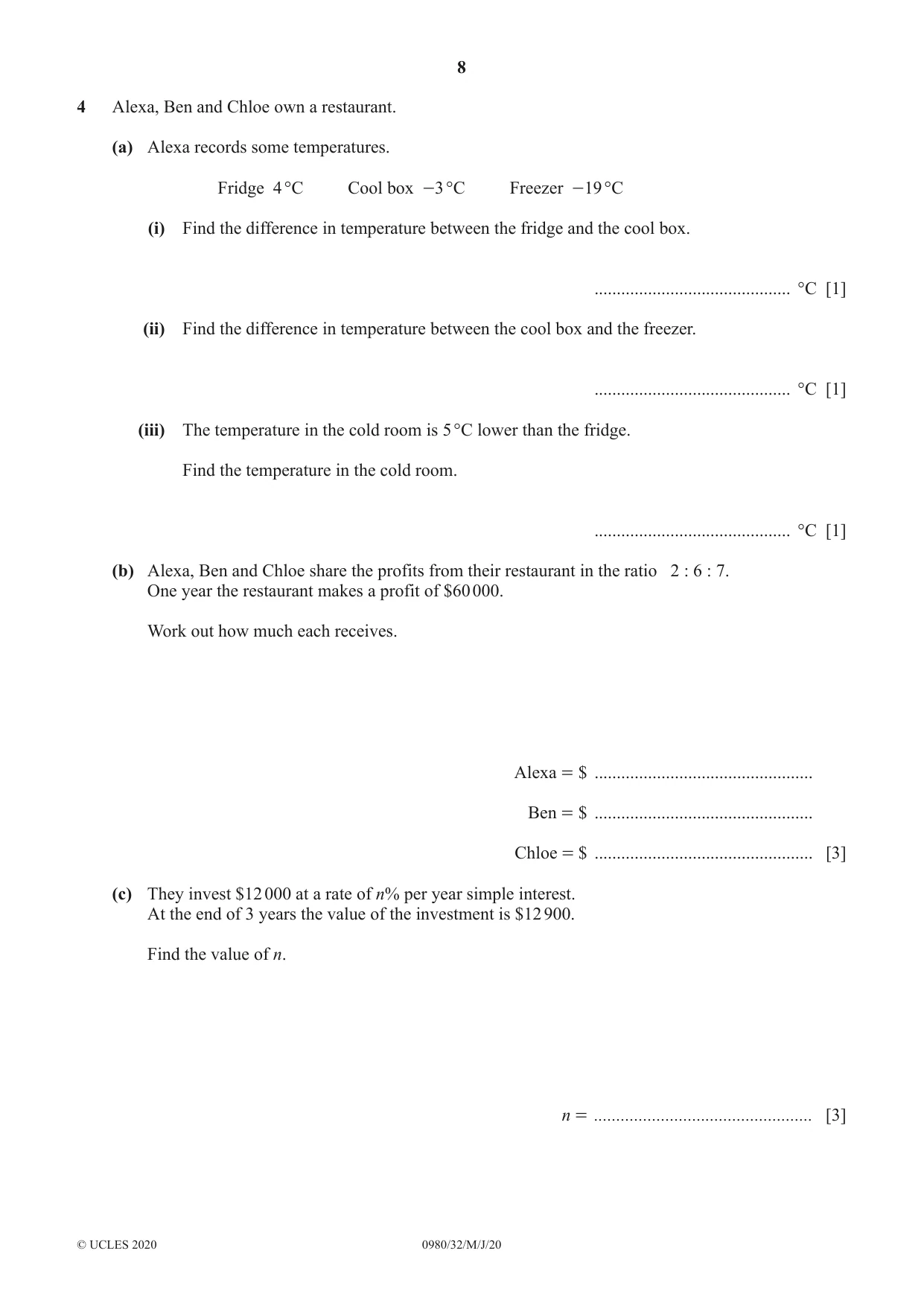
4 Alexa, Ben and Chloe own a restaurant. (a) Alexa records some temperatures. Fridge 4 °C Cool box -3 °C Freezer -19 °C (i) Find the difference in temperature between the fridge and the cool box. ............................................ °C [1] (ii) Find the difference in temperature between the cool box and the freezer. ............................................ °C [1] (iii) The temperature in the cold room is 5 °C lower than the fridge. Find the temperature in the cold room. ............................................ °C [1] (b) Alexa, Ben and Chloe share the profits from their restaurant in the ratio 2 : 6 : 7. One year the restaurant makes a profit of $60 000. Work out how much each receives. Alexa = $ ................................................. Ben = $ ................................................. Chloe = $ ................................................. [3] (c) They invest $12 000 at a rate of n% per year simple interest. At the end of 3 years the value of the investment is $12 900. Find the value of n. n = ................................................. [3]
Mark scheme: 4(a)(i) 7 1 4(a)(ii) 16 1 4(a)(iii) −1 1 4(b) 8000 3 B2 for one correct 24 000 60000 or M2 for × k 28 000 2 + 6 + 7 60000 or M1 for 2 + 6 + 7 4(c) 2.5 3 12900 − 12000 M1 for 3 their 300 M1dep for [× 100] 12000
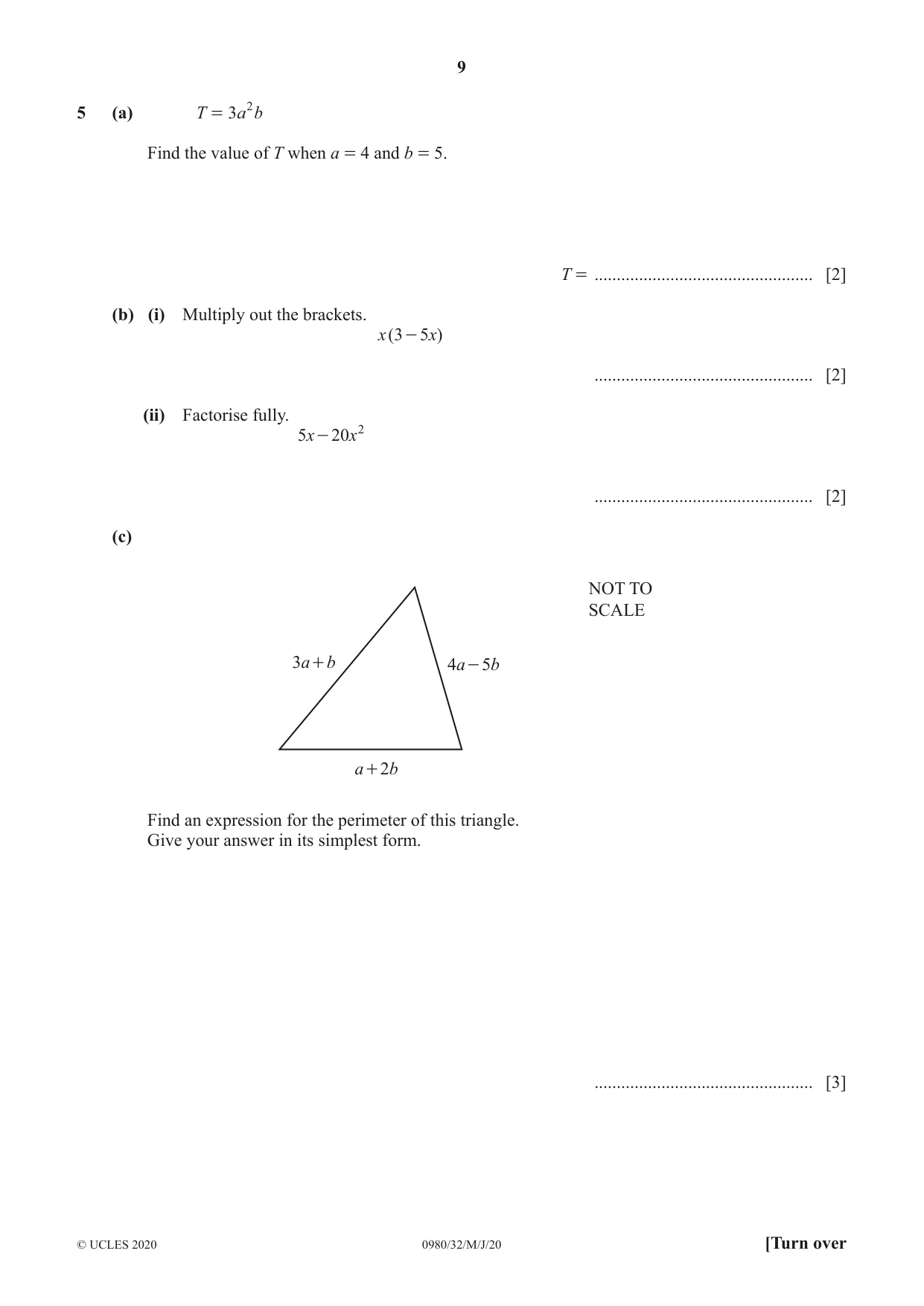
Q5 · T = 3a 2 b Find the value of T when a = 4 and b = 5
5 (a) T = 3a 2 b Find the value of T when a = 4 and b = 5. T = ................................................. [2] (b) (i) Multiply out the brackets. x ( 3 - 5 x) ................................................. [2] (ii) Factorise fully. 5x - 20x 2 ................................................. [2] (c) NOT TO SCALE 3a + b 4a - 5b a + 2b Find an expression for the perimeter of this triangle. Give your answer in its simplest form. ................................................. [3]
Mark scheme: 5(a) 240 2 M1 for 3 × 42 × 5 oe 5(b)(i) 3x – 5x2 final answer 2 B1 for 3x or – 5x2 5(b)(ii) 5x(1 – 4x) final answer 2 B1 for 5(x – 4x2) or x(5 – 20x) 5(c) 8a – 2b 3 M1 for 3a + b + 4a – 5b + a + 2b B1 for 8a or – 2b
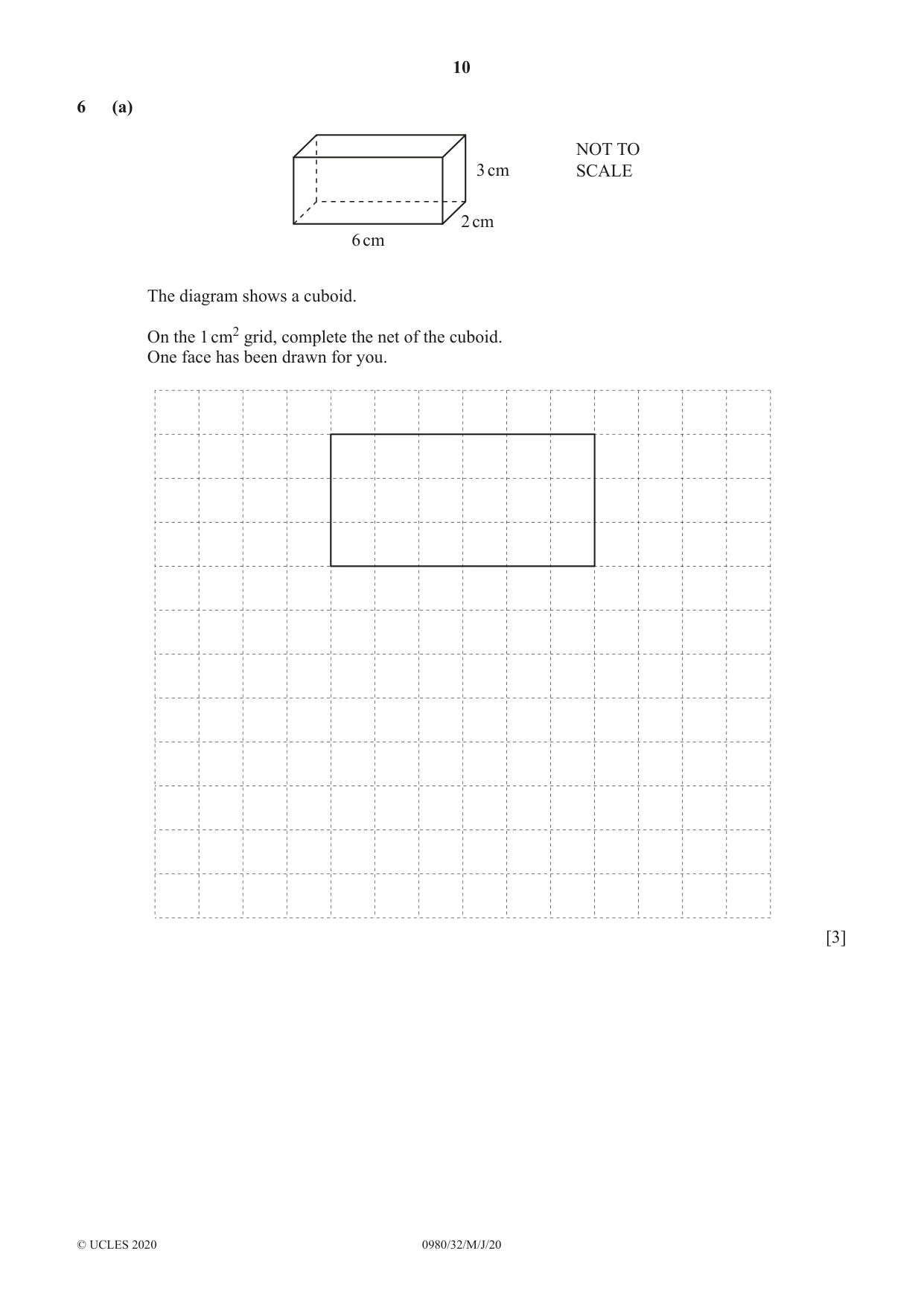
Q6 · NOT TO 3 cm SCALE 2 cm 6 cm The diagram shows a cuboid
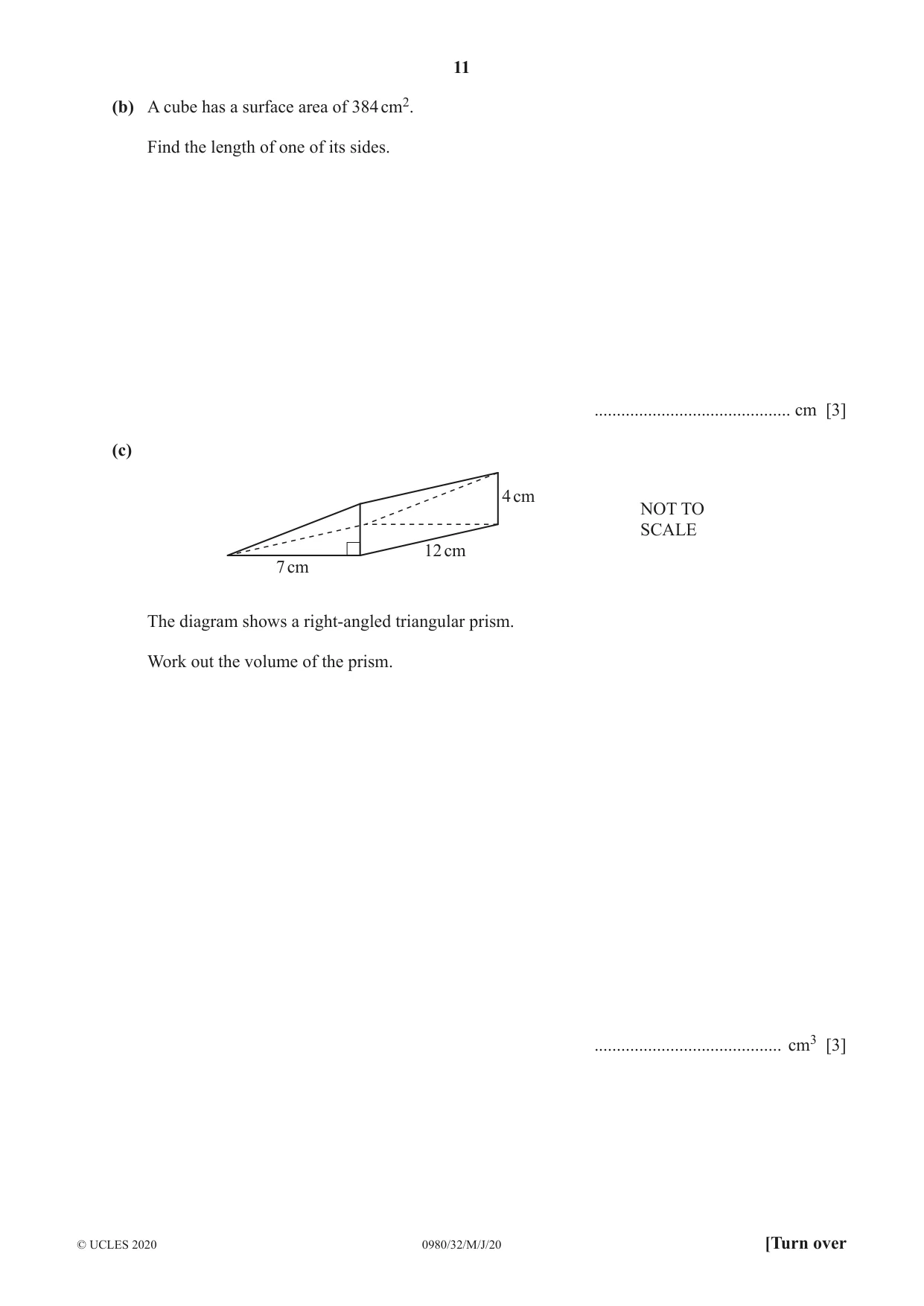
6 (a) NOT TO 3 cm SCALE 2 cm 6 cm The diagram shows a cuboid. On the 1 cm2 grid, complete the net of the cuboid. One face has been drawn for you. [3] (b) A cube has a surface area of 384 cm2. Find the length of one of its sides. ............................................ cm [3] (c) 4 cm NOT TO SCALE 12 cm 7 cm The diagram shows a right-angled triangular prism. Work out the volume of the prism. .......................................... cm3 [3]
Mark scheme: 6(a) Correct ruled net of cuboid 3 B2 for 3 or 4 further correct faces drawn in the correct places or B1 for 1 or 2 further correct faces drawn in the correct places 6(b) 8 3 M1 for 384 ÷ 6 M1dep for their 64 6(c) 168 3 M2 for (7 × 4 ÷ 2) × 12 oe or M1 for (7 × 4 ÷ 2) or their area × 12
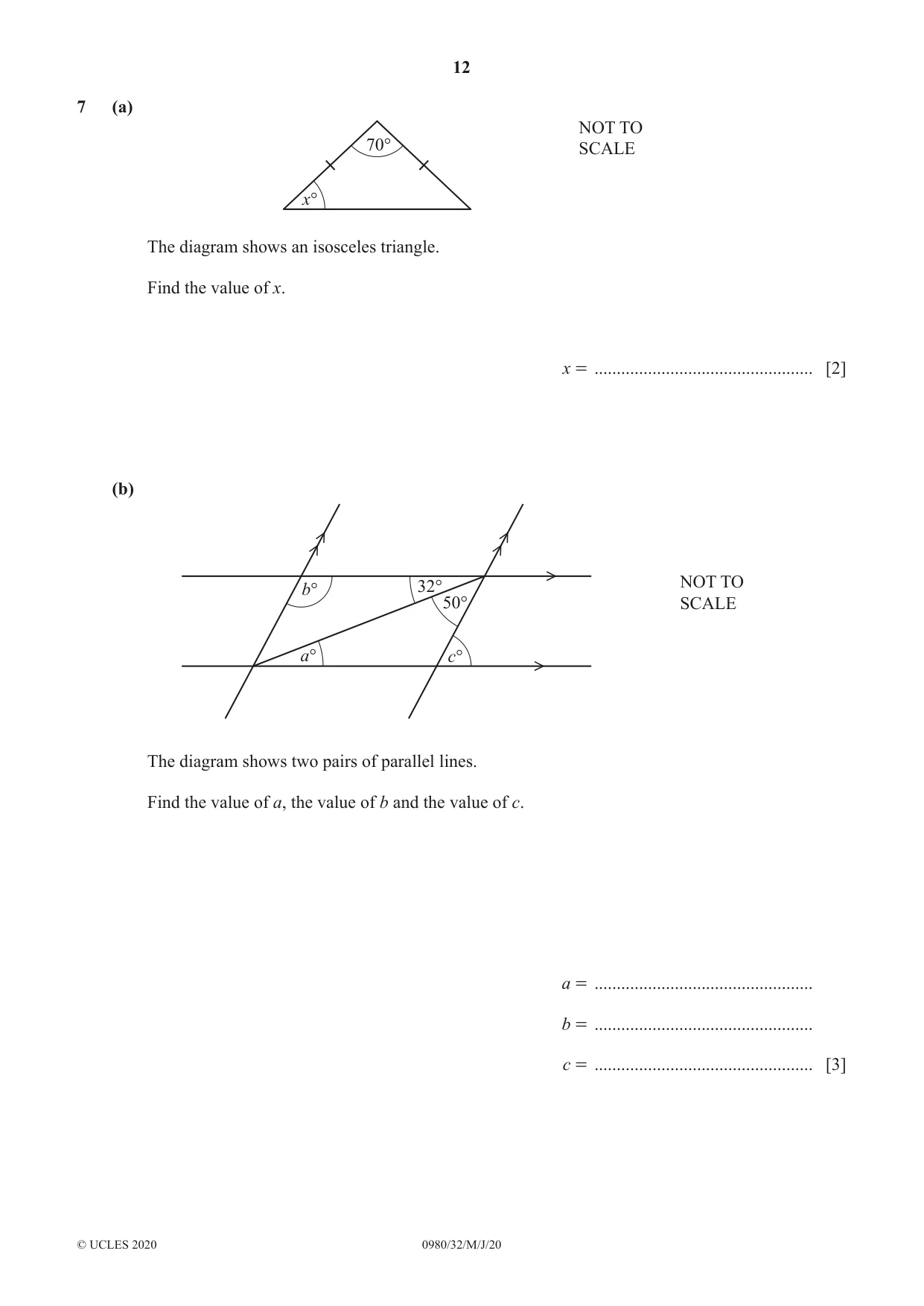
Q7 · NOT TO 70° SCALE x° The diagram shows an isosceles triangle
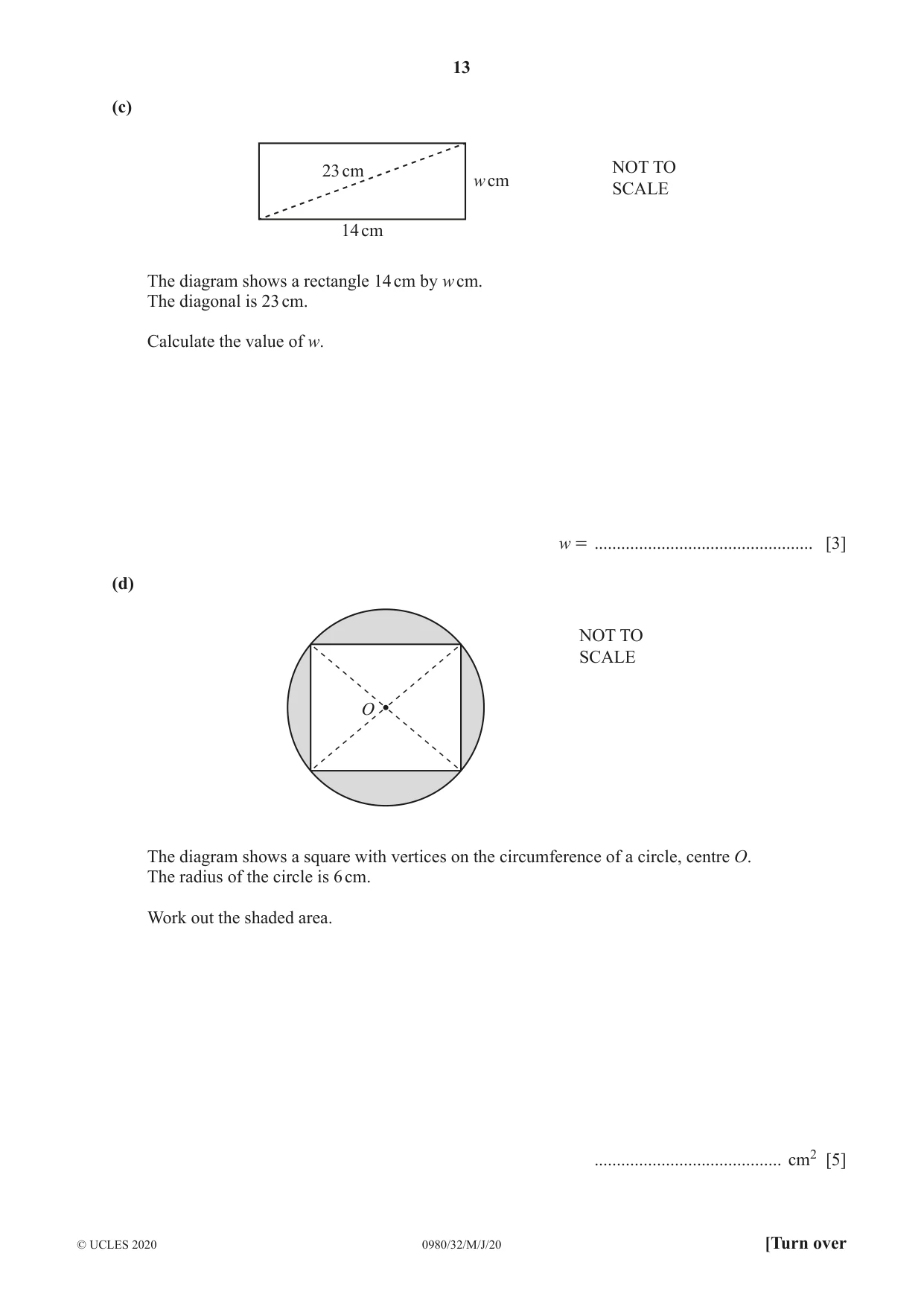
7 (a) NOT TO 70° SCALE x° The diagram shows an isosceles triangle. Find the value of x. x = ................................................. [2] (b) b° 32° NOT TO 50° SCALE a° c° The diagram shows two pairs of parallel lines. Find the value of a, the value of b and the value of c. a = ................................................. b = ................................................. c = ................................................. [3] (c) 23 cm NOT TO w cm SCALE 14 cm The diagram shows a rectangle 14 cm by w cm. The diagonal is 23 cm. Calculate the value of w. w = ................................................. [3] (d) NOT TO SCALE O The diagram shows a square with vertices on the circumference of a circle, centre O. The radius of the circle is 6 cm. Work out the shaded area. .......................................... cm2 [5]
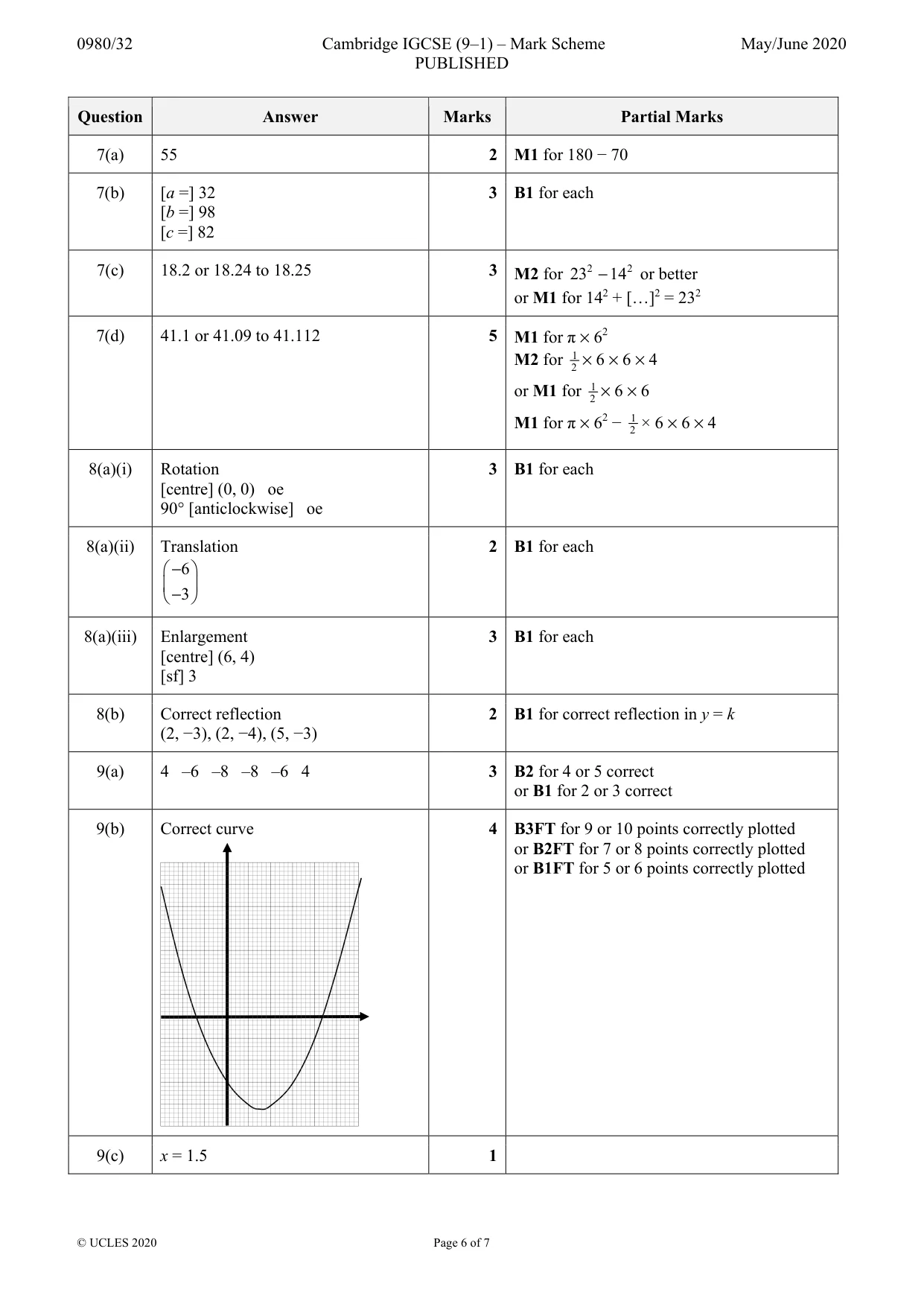
Mark scheme: 7(a) 55 2 M1 for 180 − 70 7(b) [a =] 32 3 B1 for each [b =] 98 [c =] 82 7(c) 18.2 or 18.24 to 18.25 3 M2 for 232 − 14 2 or better or M1 for 142 + […]2 = 232 7(d) 41.1 or 41.09 to 41.112 5 M1 for π × 62 M2 for 21 × 6 × 6 × 4 or M1 for 21 × 6 × 6 M1 for π × 62 − 21 × 6 × 6 × 4
Q8 · Y 6 5 4 3 B 2 A 1 -6 -5 -4 -3 -2 -1 0 1 2 3 4 5 6 x -1 C -2 -3 D -4 -5 -6 (a) Describe…
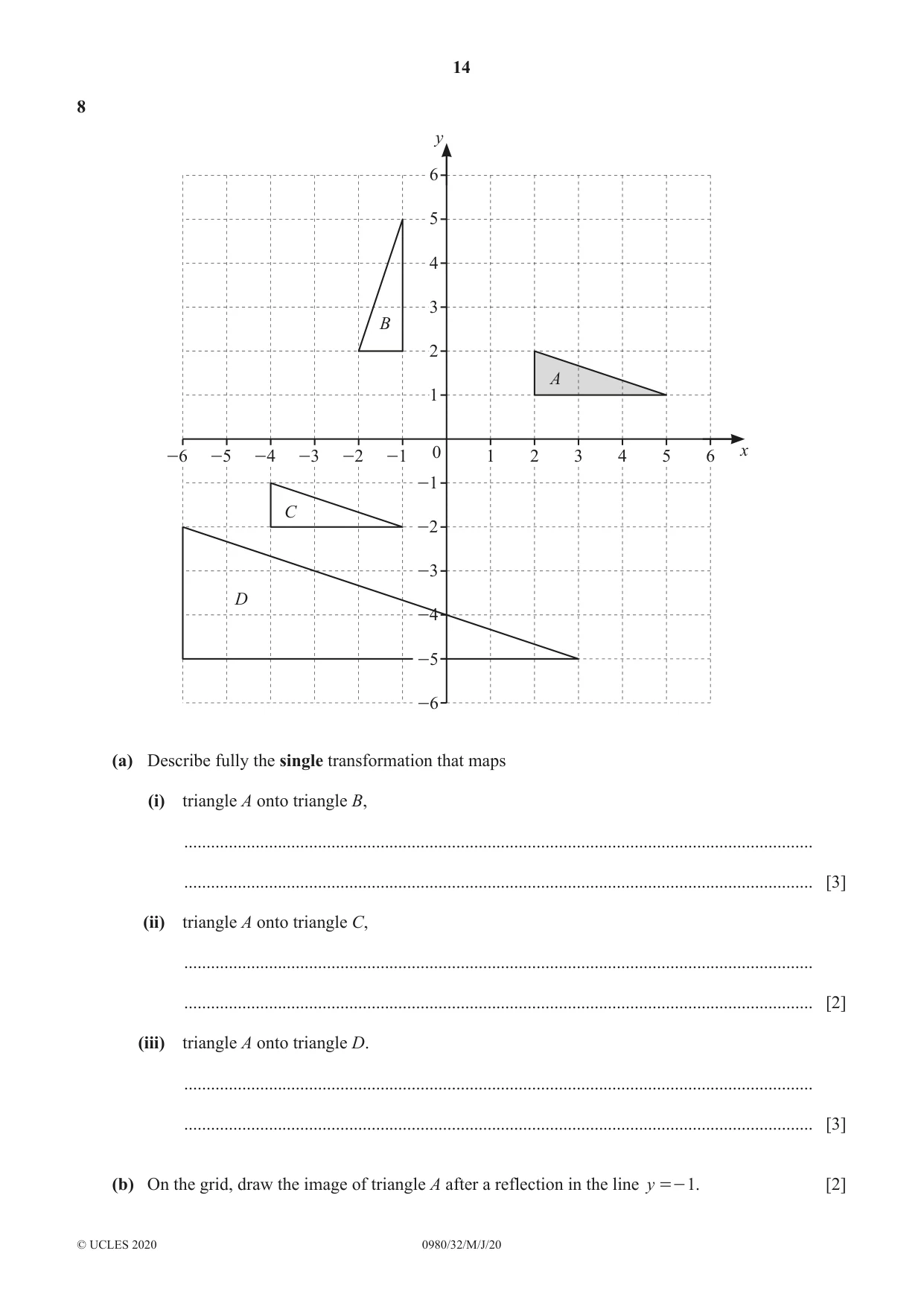
8 y 6 5 4 3 B 2 A 1 -6 -5 -4 -3 -2 -1 0 1 2 3 4 5 6 x -1 C -2 -3 D -4 -5 -6 (a) Describe fully the single transformation that maps (i) triangle A onto triangle B, ............................................................................................................................................. ............................................................................................................................................. [3] (ii) triangle A onto triangle C, ............................................................................................................................................. ............................................................................................................................................. [2] (iii) triangle A onto triangle D. ............................................................................................................................................. ............................................................................................................................................. [3] (b) On the grid, draw the image of triangle A after a reflection in the line y =- 1. [2]
Mark scheme: 8(a)(i) Rotation 3 B1 for each [centre] (0, 0) oe 90° [anticlockwise] oe 8(a)(ii) Translation 2 B1 for each − 6 − 3 8(a)(iii) Enlargement 3 B1 for each [centre] (6, 4) [sf] 3 8(b) Correct reflection 2 B1 for correct reflection in y = k (2, −3), (2, −4), (5, −3)
Q9 · Complete the table of values for y = x 2 - 3x - 6
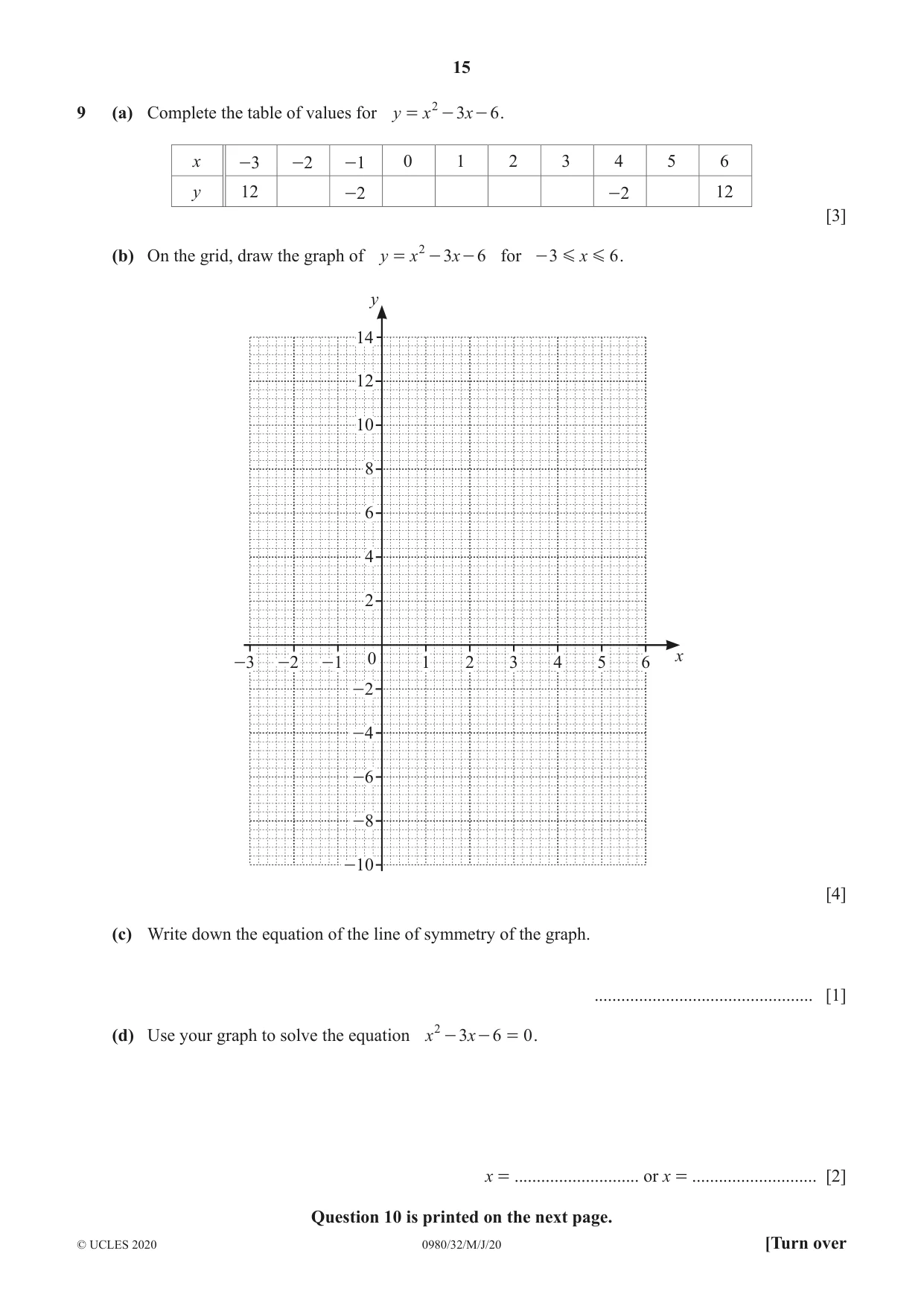
9 (a) Complete the table of values for y = x 2 - 3x - 6 . x -3 -2 -1 0 1 2 3 4 5 6 y 12 -2 -2 12 [3] (b) On the grid, draw the graph of y = x 2 - 3x - 6 for - 3 G x G 6 . y 14 12 10 8 6 4 2 -3 -2 -1 0 1 2 3 4 5 6 x -2 -4 -6 -8 -10 [4] (c) Write down the equation of the line of symmetry of the graph. ................................................. [1] (d) Use your graph to solve the equation x 2 - 3x - 6 = 0 . x = ............................ or x = ............................ [2] Question 10 is printed on the next page.
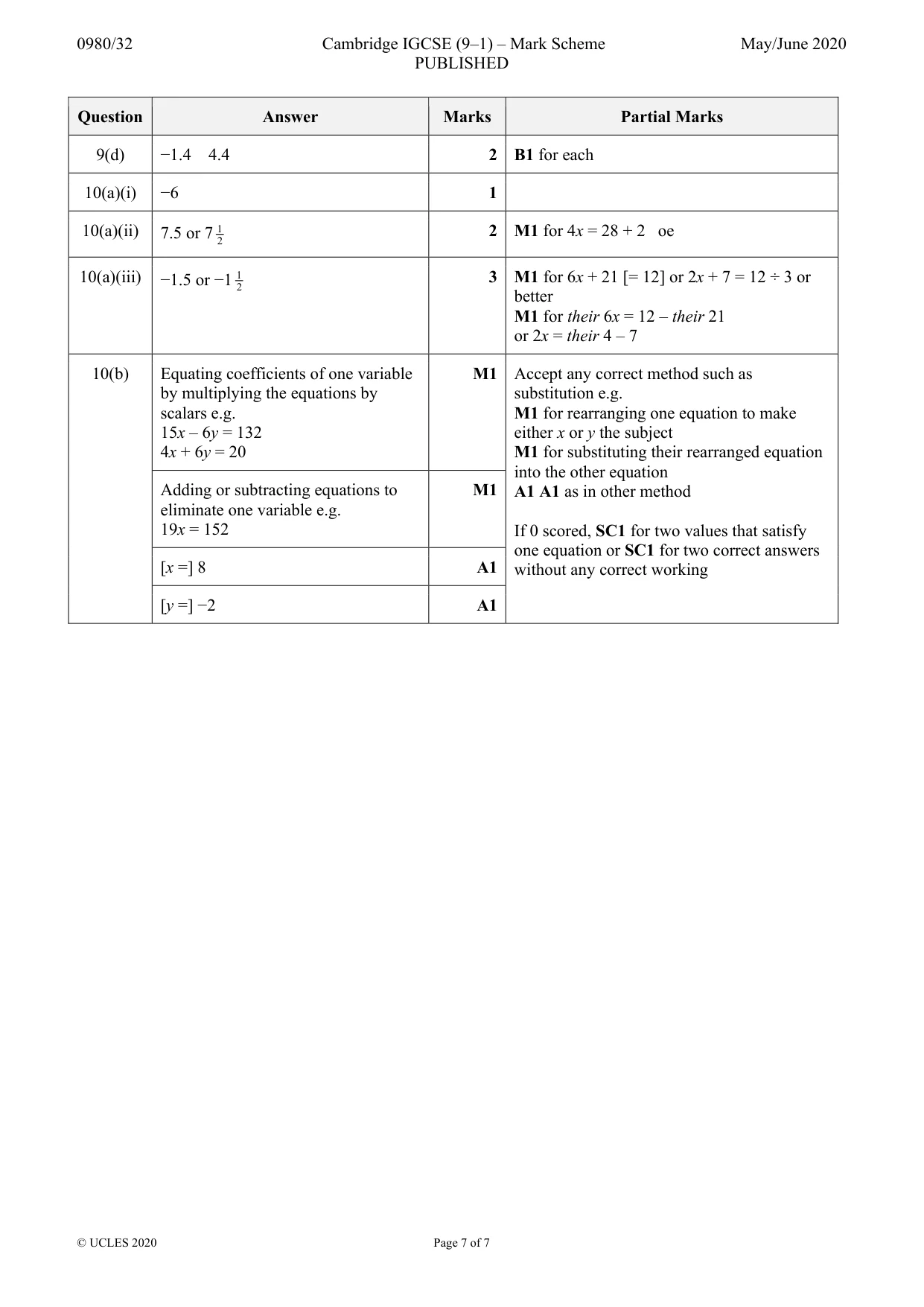
Mark scheme: 9(a) 4 –6 –8 –8 –6 4 3 B2 for 4 or 5 correct or B1 for 2 or 3 correct 9(b) Correct curve 4 B3FT for 9 or 10 points correctly plotted or B2FT for 7 or 8 points correctly plotted or B1FT for 5 or 6 points correctly plotted 9(c) x = 1.5 1 9(d) −1.4 4.4 2 B1 for each
Question 10
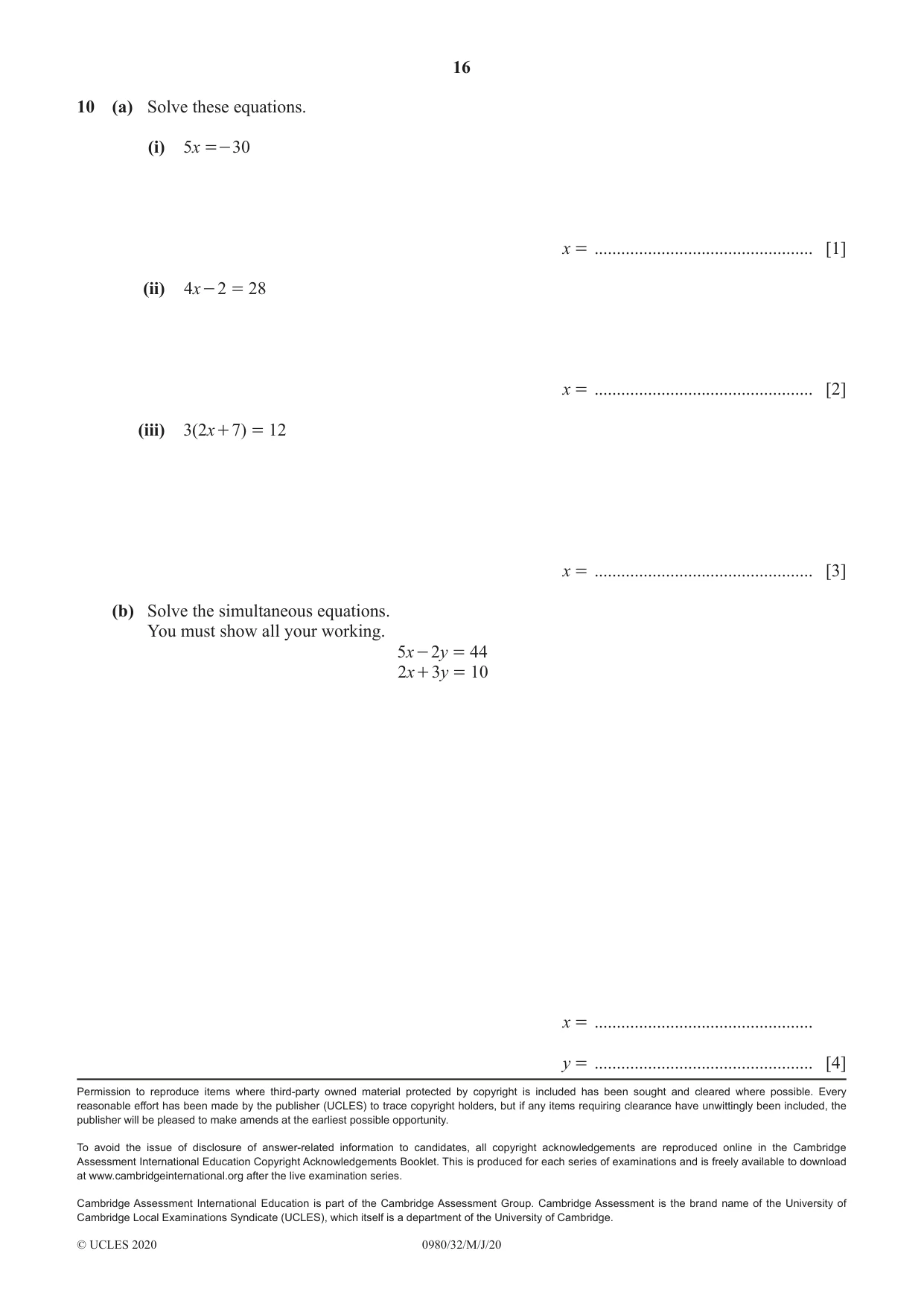
10 (a) Solve these equations. (i) 5x =- 30 x = ................................................. [1] (ii) 4x - 2 = 28 x = ................................................. [2] (iii) 3( 2x + 7) = 12 x = ................................................. [3] (b) Solve the simultaneous equations. You must show all your working. 5x - 2y = 44 2x + 3y = 10 x = ................................................. y = ................................................. [4]
Mark scheme: 10(a)(i) −6 1 10(a)(ii) 7.5 or 7 12 2 M1 for 4x = 28 + 2 oe 10(a)(iii) −1.5 or −1 12 3 M1 for 6x + 21 [= 12] or 2x + 7 = 12 ÷ 3 or better M1 for their 6x = 12 – their 21 or 2x = their 4 – 7 10(b) Equating coefficients of one variable M1 Accept any correct method such as by multiplying the equations by substitution e.g. scalars e.g. M1 for rearranging one equation to make 15x – 6y = 132 either x or y the subject 4x + 6y = 20 M1 for substituting their rearranged equation into the other equation Adding or subtracting equations to M1 A1 A1 as in other method eliminate one variable e.g. 19x = 152 If 0 scored, SC1 for two values that satisfy one equation or SC1 for two correct answers [x =] 8 A1 without any correct working [y =] −2 A1
What was in this paper
The subtopics covered by these 10 questions, and how many questions each got. Open one in a new tab to see every Cambridge question on it.