Cambridge IGCSE Mathematics 0580 — 2021 May/June Paper 2 · Variant 1
0580/21/M/J/21 · 20 questions · 70 marks · ≈79 min
The question paper and its mark scheme, free to read here and free to download. This is Cambridge’s own paper, exactly as it was sat.
Question paper12 pages
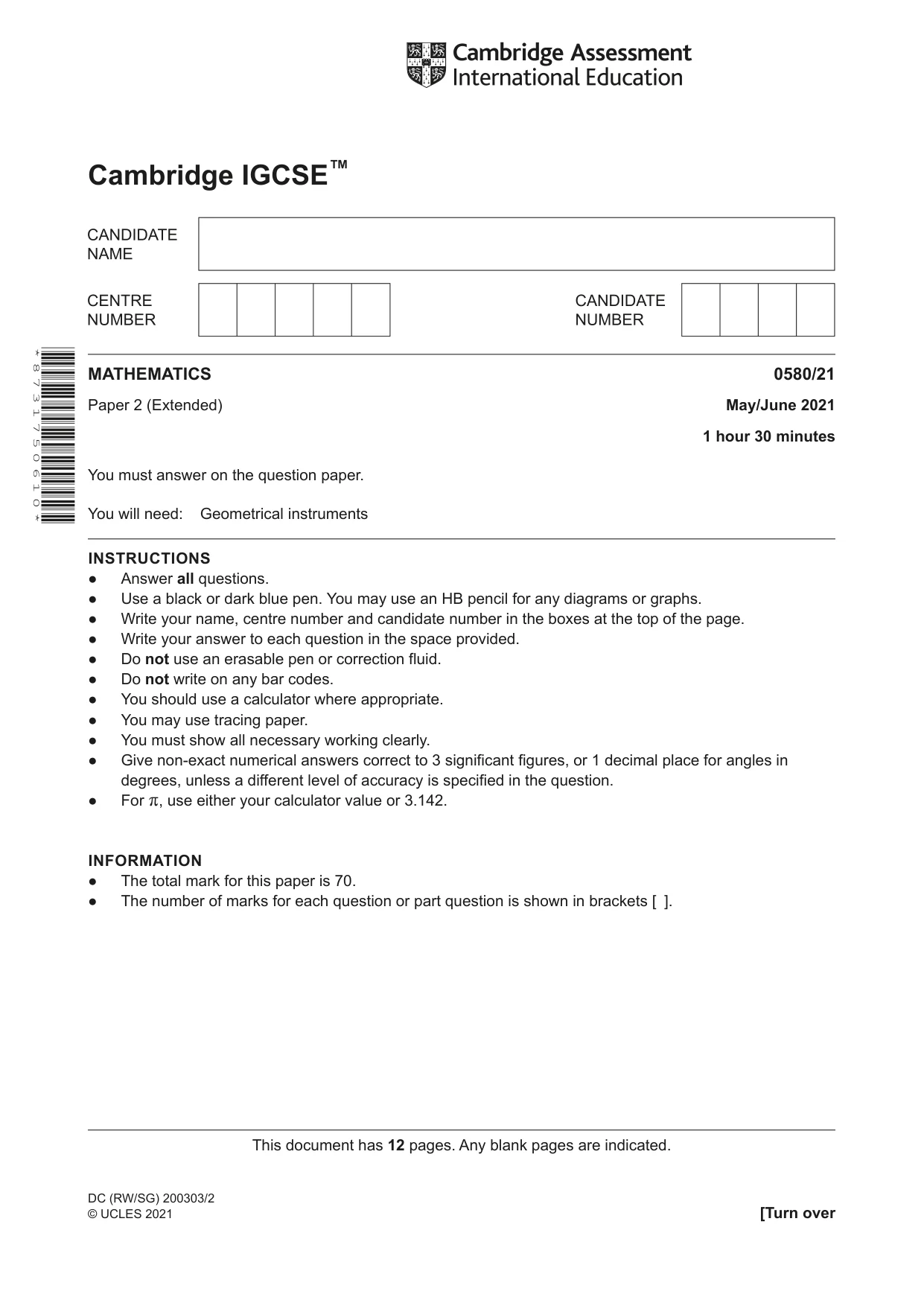
Mark scheme7 pages
Answers below. Sit the paper first if you are practising.
Questions as text
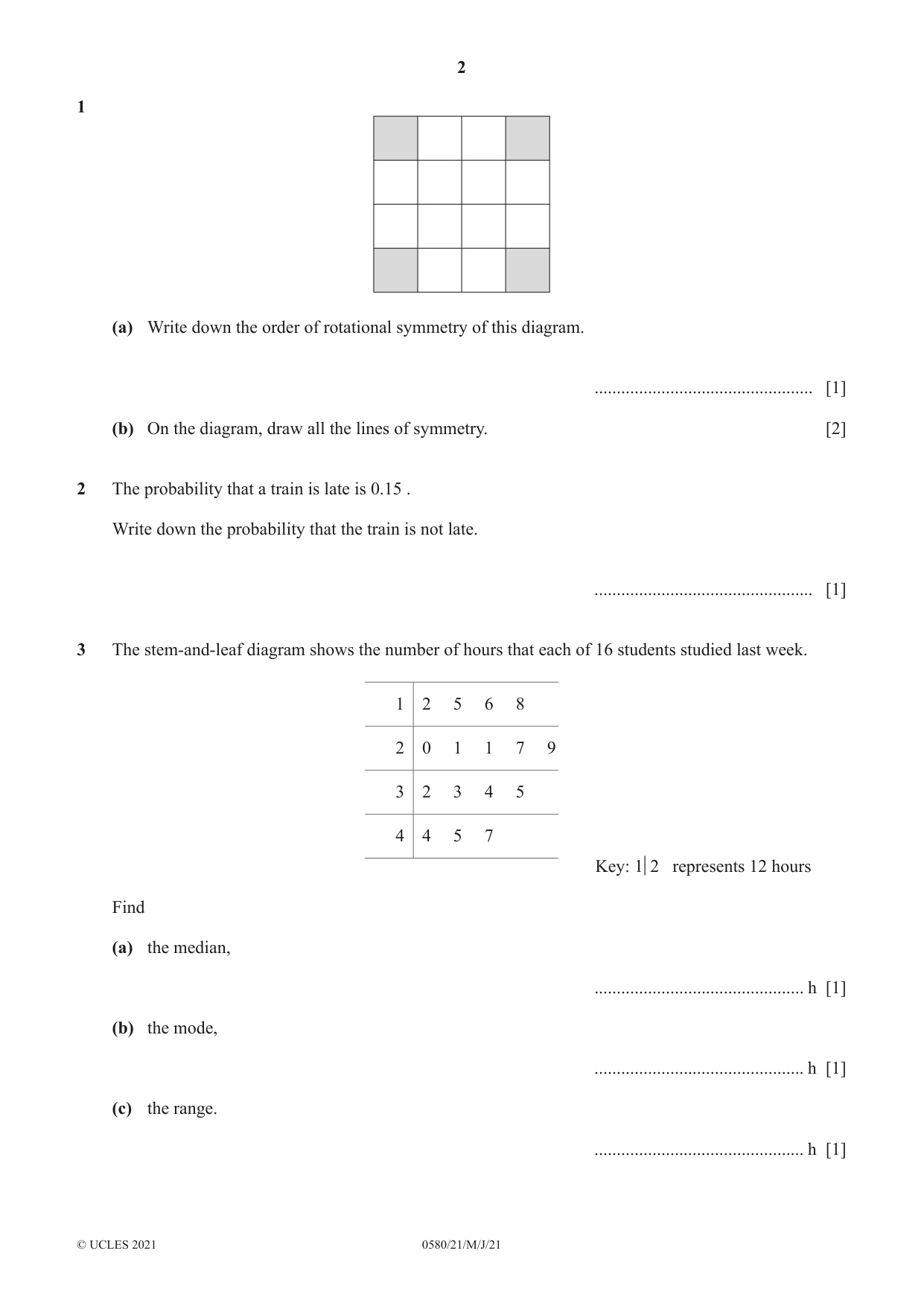
Q1 · Write down the order of rotational symmetry of this diagram
1 (a) Write down the order of rotational symmetry of this diagram. ................................................. [1] (b) On the diagram, draw all the lines of symmetry. [2]
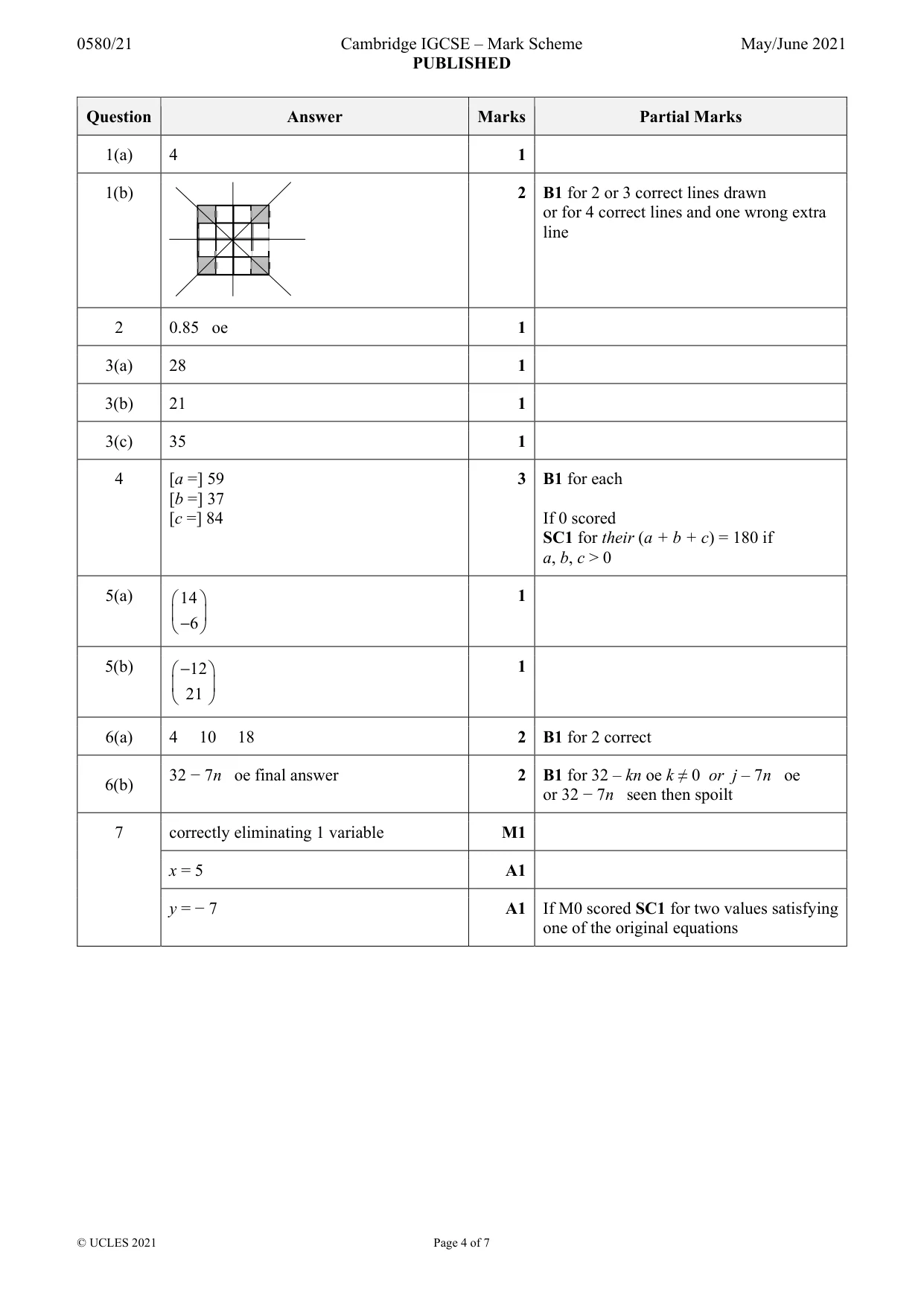
Mark scheme: Question Answer Marks Partial Marks 1(a) 4 1 1(b) 2 B1 for 2 or 3 correct lines drawn or for 4 correct lines and one wrong extra line
Q2 · The probability that a train is late is 0.15
2 The probability that a train is late is 0.15 . Write down the probability that the train is not late. ................................................. [1]
Mark scheme: 2 0.85 oe 1
Q3 · The stem-and-leaf diagram shows the number of hours that each of 16 students studied last…
3 The stem-and-leaf diagram shows the number of hours that each of 16 students studied last week. 1 2 5 6 8 2 0 1 1 7 9 3 2 3 4 5 4 4 5 7 Key: 1q2 represents 12 hours Find (a) the median, ............................................... h [1] (b) the mode, ............................................... h [1] (c) the range. ............................................... h [1]
Mark scheme: 3(a) 28 1 3(b) 21 1 3(c) 35 1
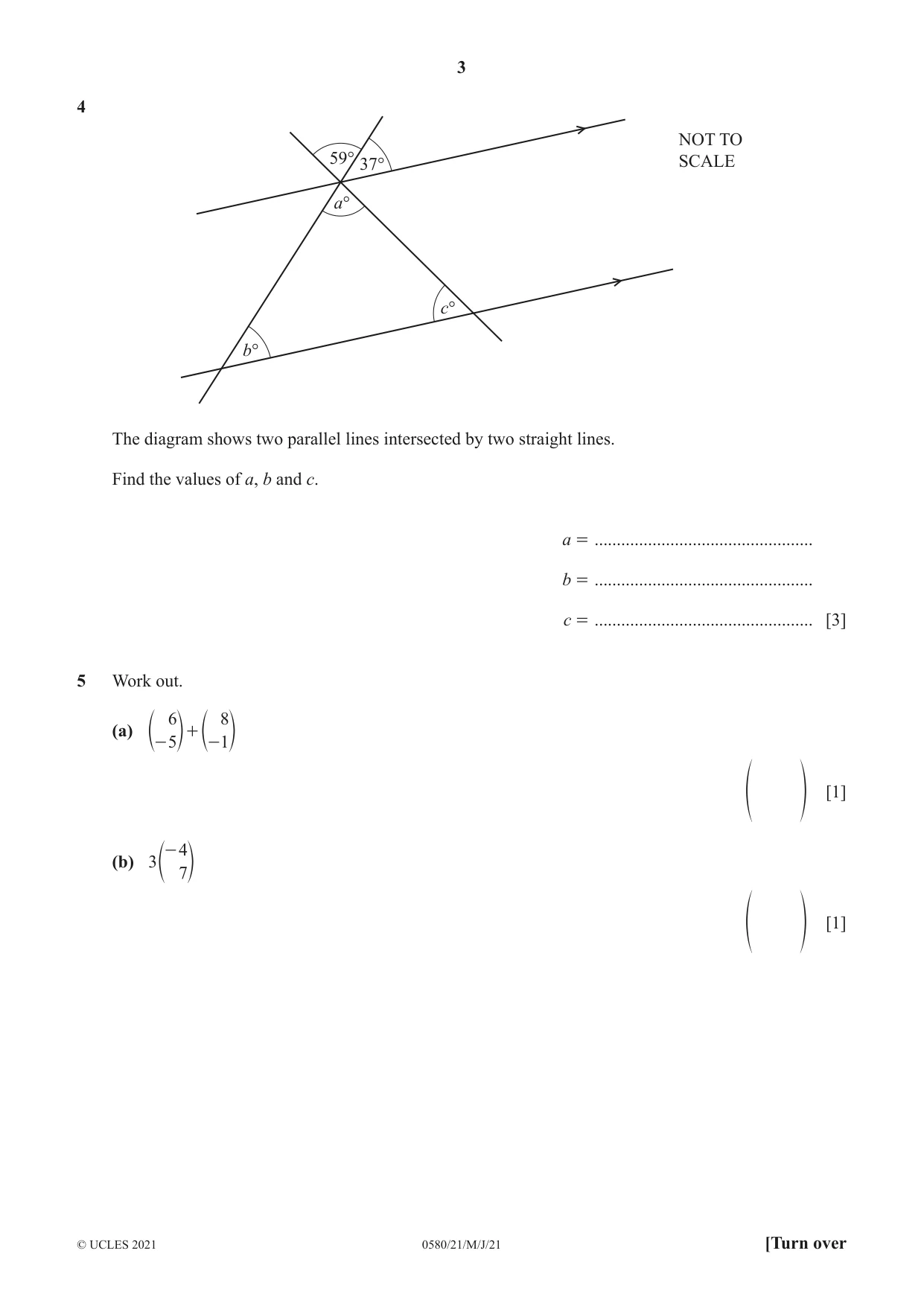
Q4 · NOT TO 59° 37° SCALE a° c° b° The diagram shows two parallel lines intersected by two…
4 NOT TO 59° 37° SCALE a° c° b° The diagram shows two parallel lines intersected by two straight lines. Find the values of a, b and c. a = ................................................. b = ................................................. c = ................................................. [3]
Mark scheme: 4 [a =] 59 3 B1 for each [b =] 37 [c =] 84 If 0 scored SC1 for their (a + b + c) = 180 if a, b, c > 0
Question 5
5 Work out. 6 8 (a) + e- 5o e- 1o [1] f p - 4 (b) 3 e 7o [1] f p
Mark scheme: 5(a) 14 1 − 6 5(b) − 12 1 21
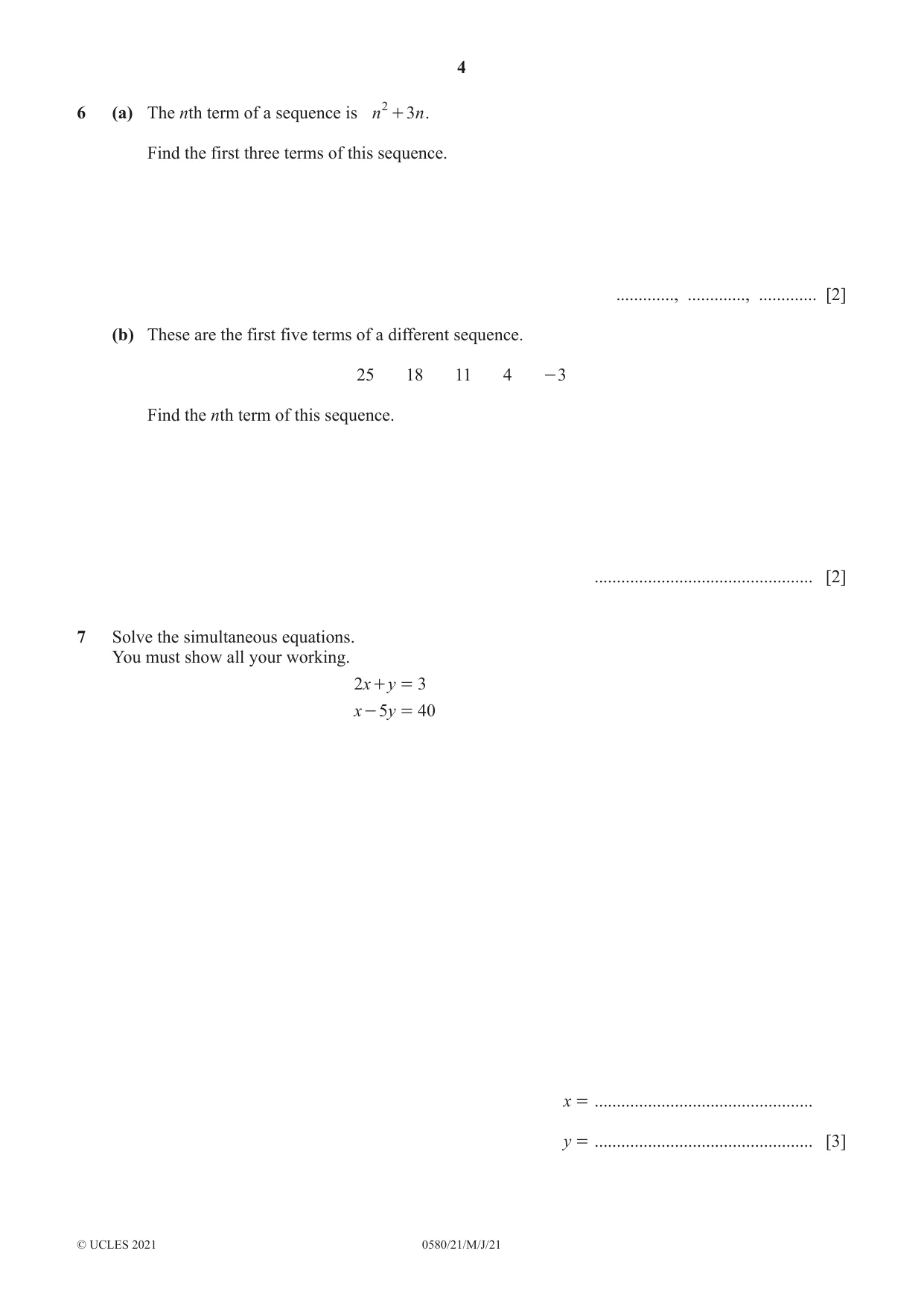
Q6 · The nth term of a sequence is n 2 + 3n
6 (a) The nth term of a sequence is n 2 + 3n . Find the first three terms of this sequence. ............., ............., ............. [2] (b) These are the first five terms of a different sequence. 25 18 11 4 - 3 Find the nth term of this sequence. ................................................. [2]
Mark scheme: 6(a) 4 10 18 2 B1 for 2 correct 32 − 7n oe final answer 2 B1 for 32 – kn oe k ≠ 0 or j – 7n oe 6(b) or 32 − 7n seen then spoilt
Q7 · Solve the simultaneous equations
7 Solve the simultaneous equations. You must show all your working. 2x + y = 3 x - 5y = 40 x = ................................................. y = ................................................. [3]
Mark scheme: 7 correctly eliminating 1 variable M1 x = 5 A1 y = − 7 A1 If M0 scored SC1 for two values satisfying one of the original equations
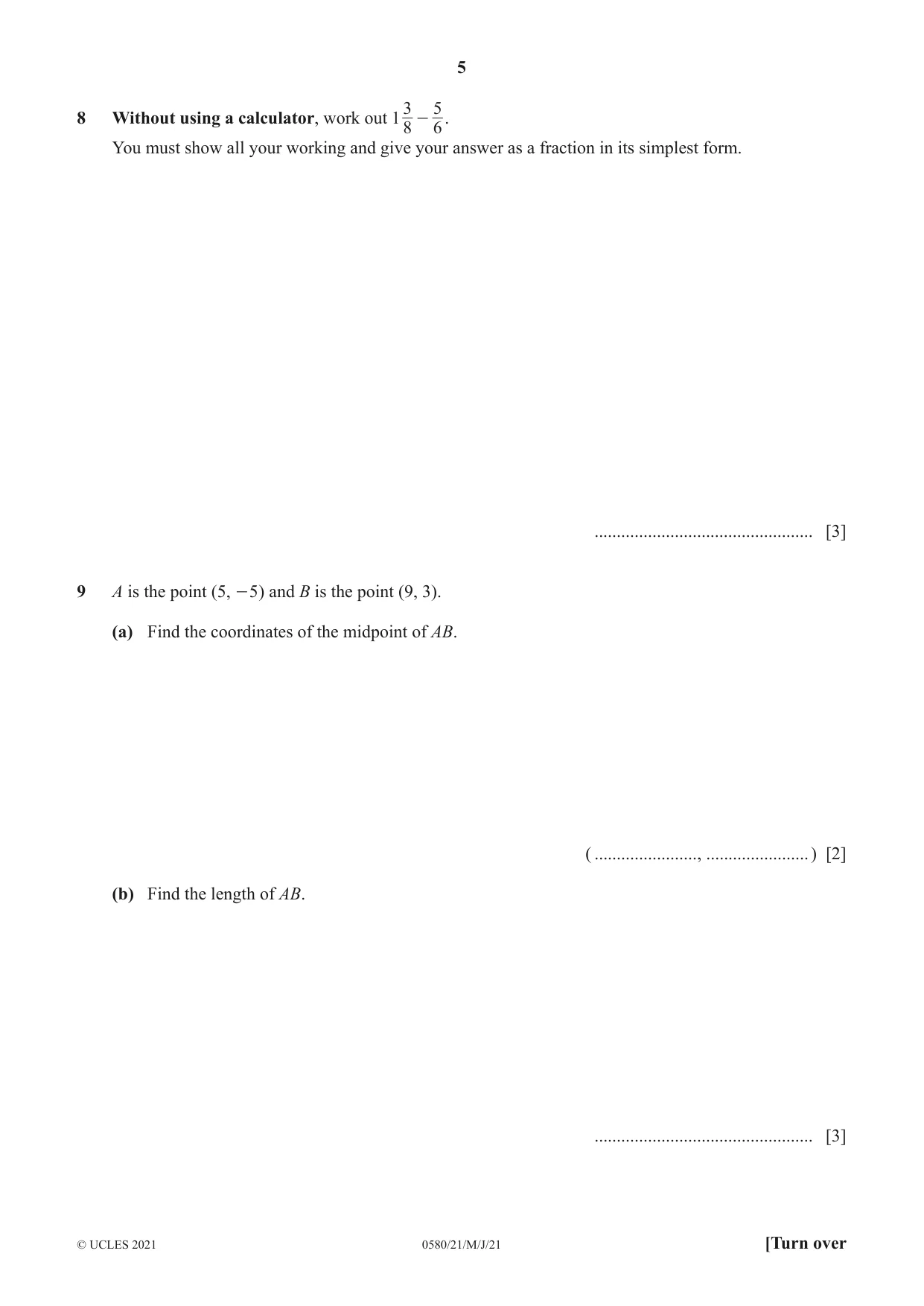
Q8 · 58 Without using a calculator, work out 1 -
3 58 Without using a calculator, work out 1 - . 8 6 You must show all your working and give your answer as a fraction in its simplest form. ................................................. [3]
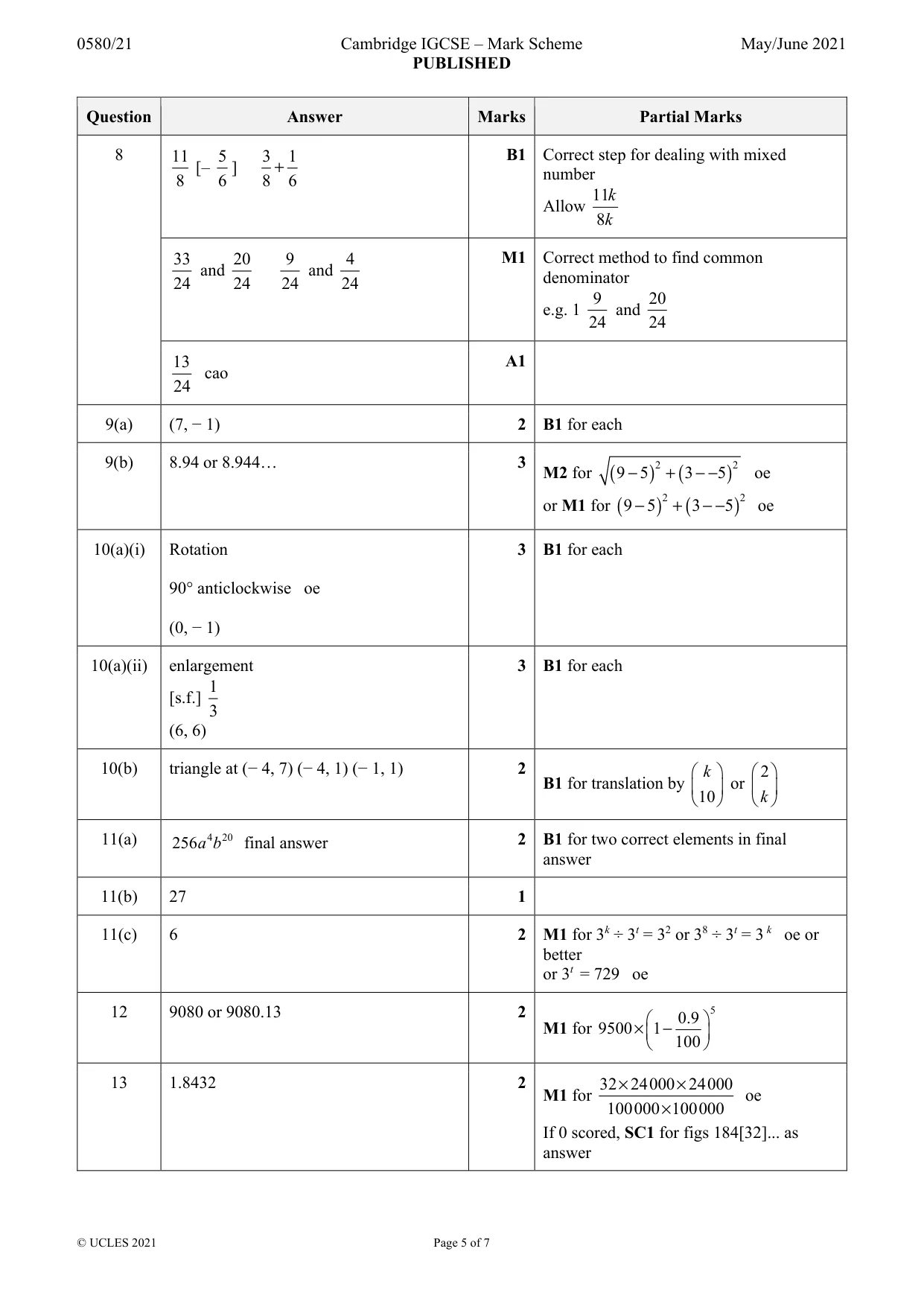
Mark scheme: 8 11 5 3 1 B1 Correct step for dealing with mixed [– ] + number 8 6 8 6 11k Allow 8k 33 20 9 4 M1 Correct method to find common and and denominator 24 24 24 24 9 20 e.g. 1 and 24 24 13 A1 cao 24
Q9 · A is the point (5, - 5 ) and B is the point (9, 3)
9 A is the point (5, - 5 ) and B is the point (9, 3). (a) Find the coordinates of the midpoint of AB. ( ......................., ....................... ) [2] (b) Find the length of AB. ................................................. [3]
Mark scheme: 9(a) (7, − 1) 2 B1 for each 9(b) 8.94 or 8.944… 3 2 2 M2 for ( 9 − 5 ) + ( 3 −−5 ) oe 2 2 or M1 for ( 9 − 5 ) + ( 3 −−5 ) oe
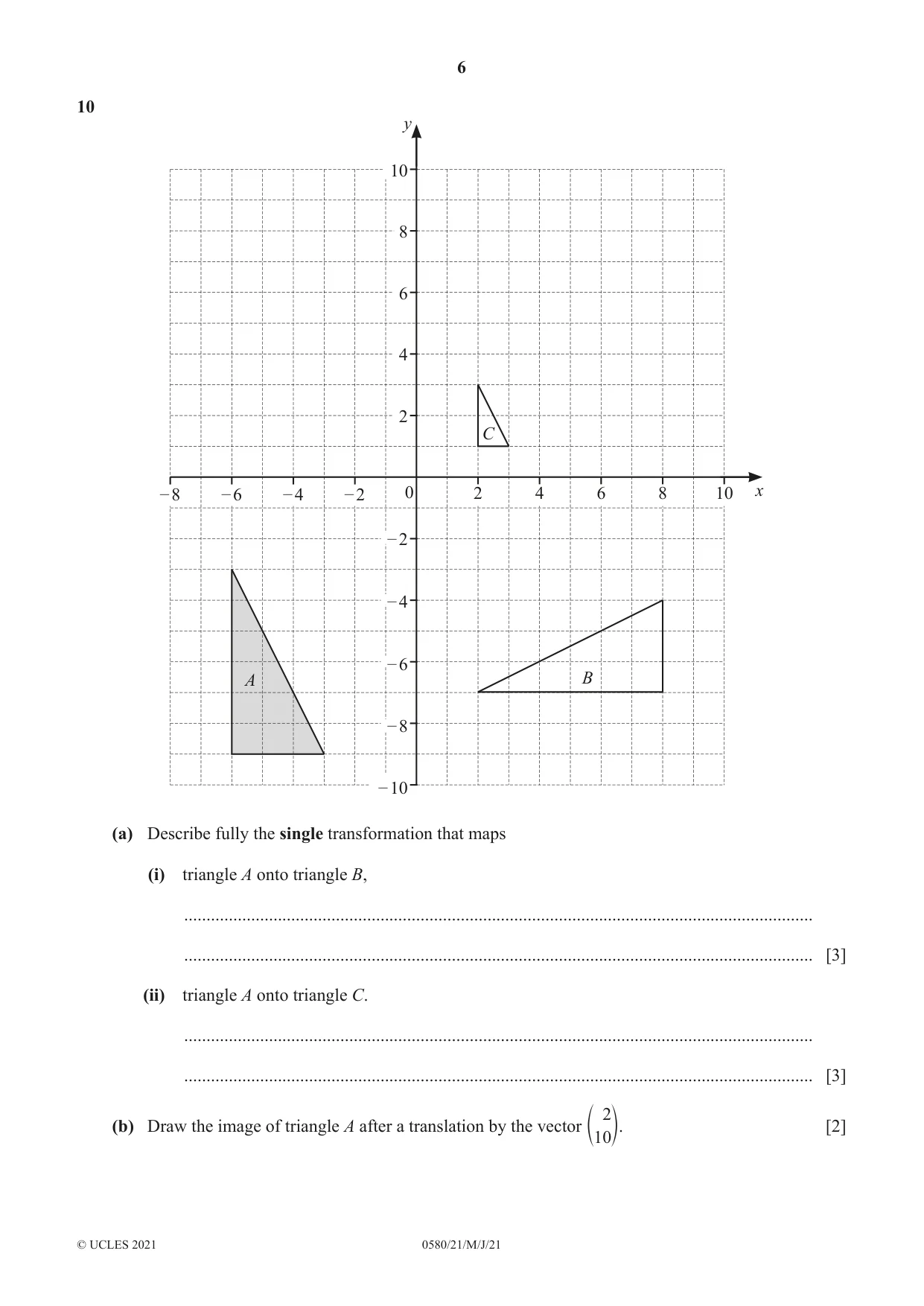
Q10 · Y 10 8 6 4 2 C – 8 – 6 – 4 – 2 0 2 4 6 8 10 x – 2 – 4 – 6 A B – 8 – 10 (a) Describe fully…
10 y 10 8 6 4 2 C – 8 – 6 – 4 – 2 0 2 4 6 8 10 x – 2 – 4 – 6 A B – 8 – 10 (a) Describe fully the single transformation that maps (i) triangle A onto triangle B, ............................................................................................................................................. ............................................................................................................................................. [3] (ii) triangle A onto triangle C. ............................................................................................................................................. ............................................................................................................................................. [3] 2 (b) Draw the image of triangle A after a translation by the vector [2] e10o.
Mark scheme: 10(a)(i) Rotation 3 B1 for each 90° anticlockwise oe (0, − 1) 10(a)(ii) enlargement 3 B1 for each 1 [s.f.] 3 (6, 6) 10(b) triangle at (− 4, 7) (− 4, 1) (− 1, 1) 2 k 2 B1 for translation by or 10 k
Question 11
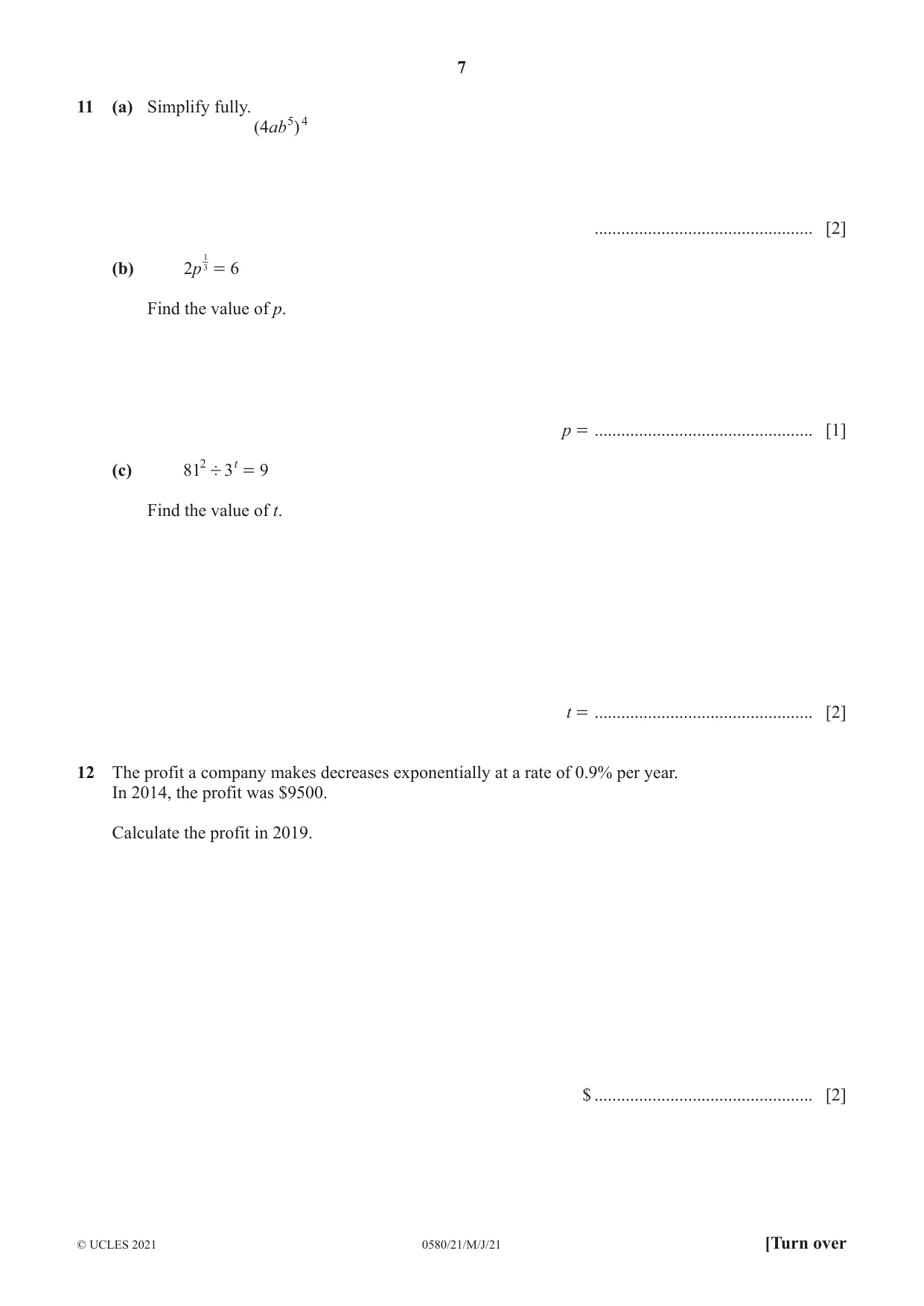
11 (a) Simplify fully. ( 4ab 5 ) 4 ................................................. [2] 3 = 6 (b) 2p 1 Find the value of p. p = ................................................. [1] (c) 812 ' 3 t = 9 Find the value of t. t = ................................................. [2]
Mark scheme: 11(a) 256a 4 b 20 final answer 2 B1 for two correct elements in final answer 11(b) 27 1 11(c) 6 2 M1 for 3k ÷ 3t = 32 or 38 ÷ 3t = 3 k oe or better or 3t = 729 oe
Q12 · The profit a company makes decreases exponentially at a rate of 0.9% per year
12 The profit a company makes decreases exponentially at a rate of 0.9% per year. In 2014, the profit was $9500. Calculate the profit in 2019. $ ................................................. [2]
Mark scheme: 12 9080 or 9080.13 2 5 0.9 M1 for 9500 × 1 − 100
Q13 · On a map, a lake has an area of 32 cm2
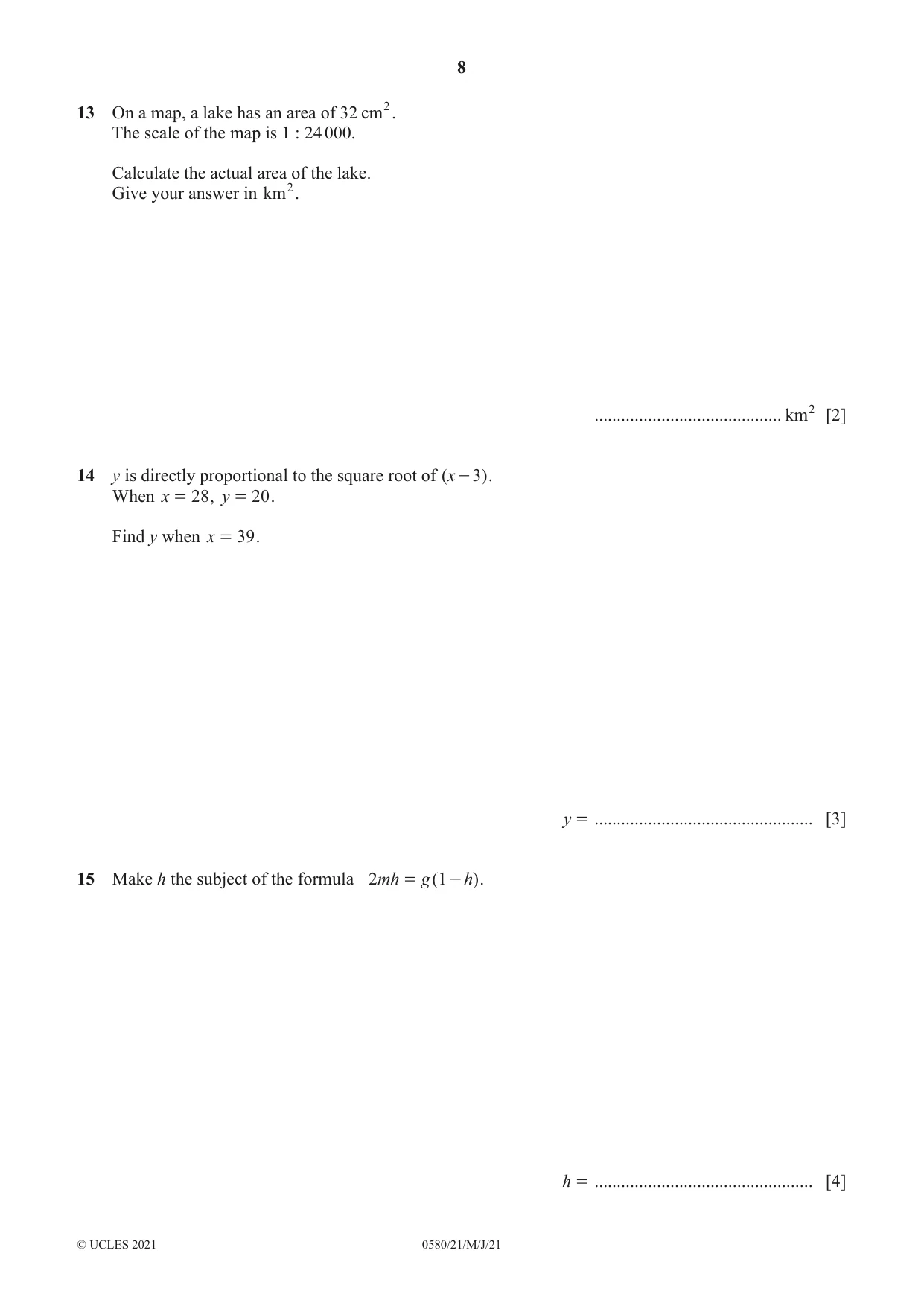
13 On a map, a lake has an area of 32 cm2. The scale of the map is 1 : 24 000. Calculate the actual area of the lake. Give your answer in km2. .......................................... km2 [2]
Mark scheme: 13 1.8432 2 32 × 24000 × 24000 M1 for oe 100000 × 100000 If 0 scored, SC1 for figs 184[32]... as answer
Q14 · Y is directly proportional to the square root of ( x - 3 )
14 y is directly proportional to the square root of ( x - 3 ) . When x = 28 , y = 20 . Find y when x = 39 . y = ................................................. [3]
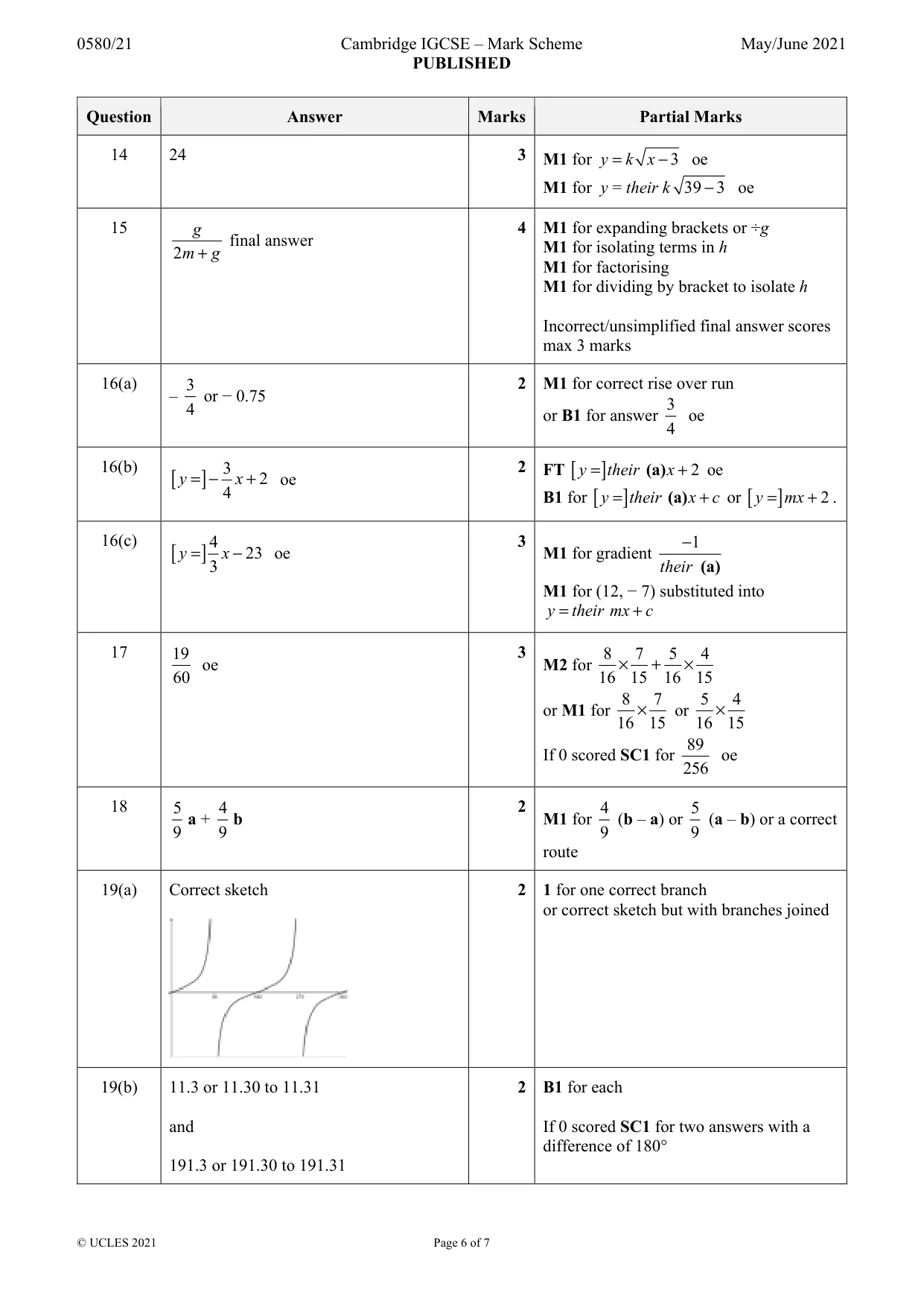
Mark scheme: 14 24 3 M1 for y = k x − 3 oe M1 for y = their k 39 − 3 oe
Q15 · Make h the subject of the formula 2mh = g ( 1 - h)
15 Make h the subject of the formula 2mh = g ( 1 - h) . h = ................................................. [4]
Mark scheme: 15 g 4 M1 for expanding brackets or ÷g final answer M1 for isolating terms in h 2 m + g M1 for factorising M1 for dividing by bracket to isolate h Incorrect/unsimplified final answer scores max 3 marks
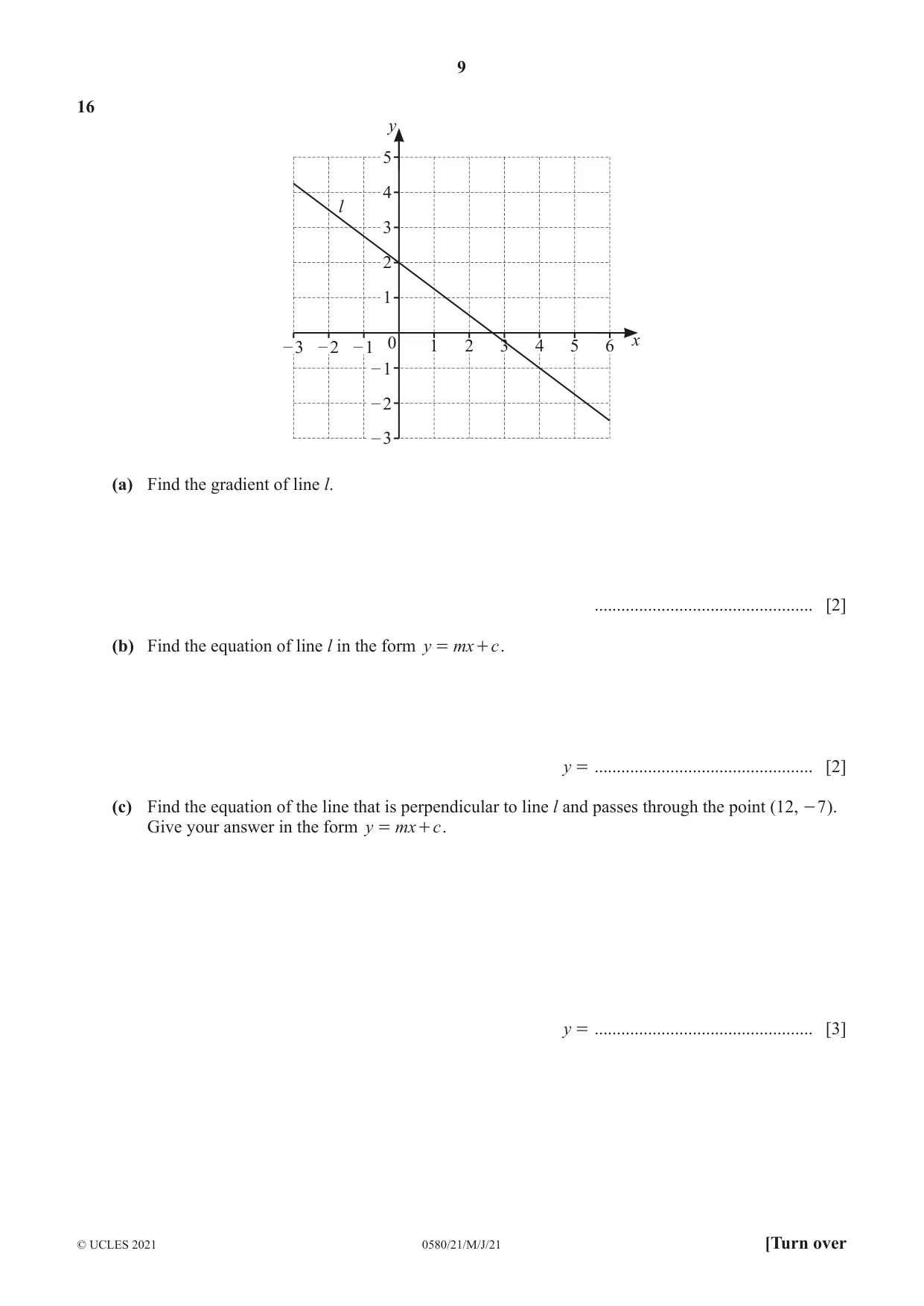
Q16 · Y 5 4 l 3 2 1 – 3 – 2 – 1 0 1 2 3 4 5 6 x – 1 – 2 – 3 (a) Find the gradient of line l
16 y 5 4 l 3 2 1 – 3 – 2 – 1 0 1 2 3 4 5 6 x – 1 – 2 – 3 (a) Find the gradient of line l. ................................................. [2] (b) Find the equation of line l in the form y = mx + c . y = ................................................. [2] (c) Find the equation of the line that is perpendicular to line l and passes through the point (12, - 7 ). Give your answer in the form y = m x + c . y = ................................................. [3]
Mark scheme: 16(a) 3 2 M1 for correct rise over run – or − 0.75 3 4 or B1 for answer oe 4 16(b) 3 2 FT [ y = ] their (a) x + 2 oe [ y = ] − x + 2 oe 4 B1 for [ y = ] their (a) x + c or [ y = ] mx + 2 . 16(c) 4 3 −1 [ y = ] x − 23 oe M1 for gradient 3 their (a) M1 for (12, − 7) substituted into y = their mx + c
Q17 · A bag contains 3 blue buttons, 8 white buttons and 5 red buttons
17 A bag contains 3 blue buttons, 8 white buttons and 5 red buttons. Two buttons are picked at random from the bag, without replacement. Work out the probability that the two buttons are either both red or both white. ................................................. [3]
Mark scheme: 17 19 3 8 7 5 4 oe M2 for × + × 60 16 15 16 15 8 7 5 4 or M1 for × or × 16 15 16 15 89 If 0 scored SC1 for oe 256
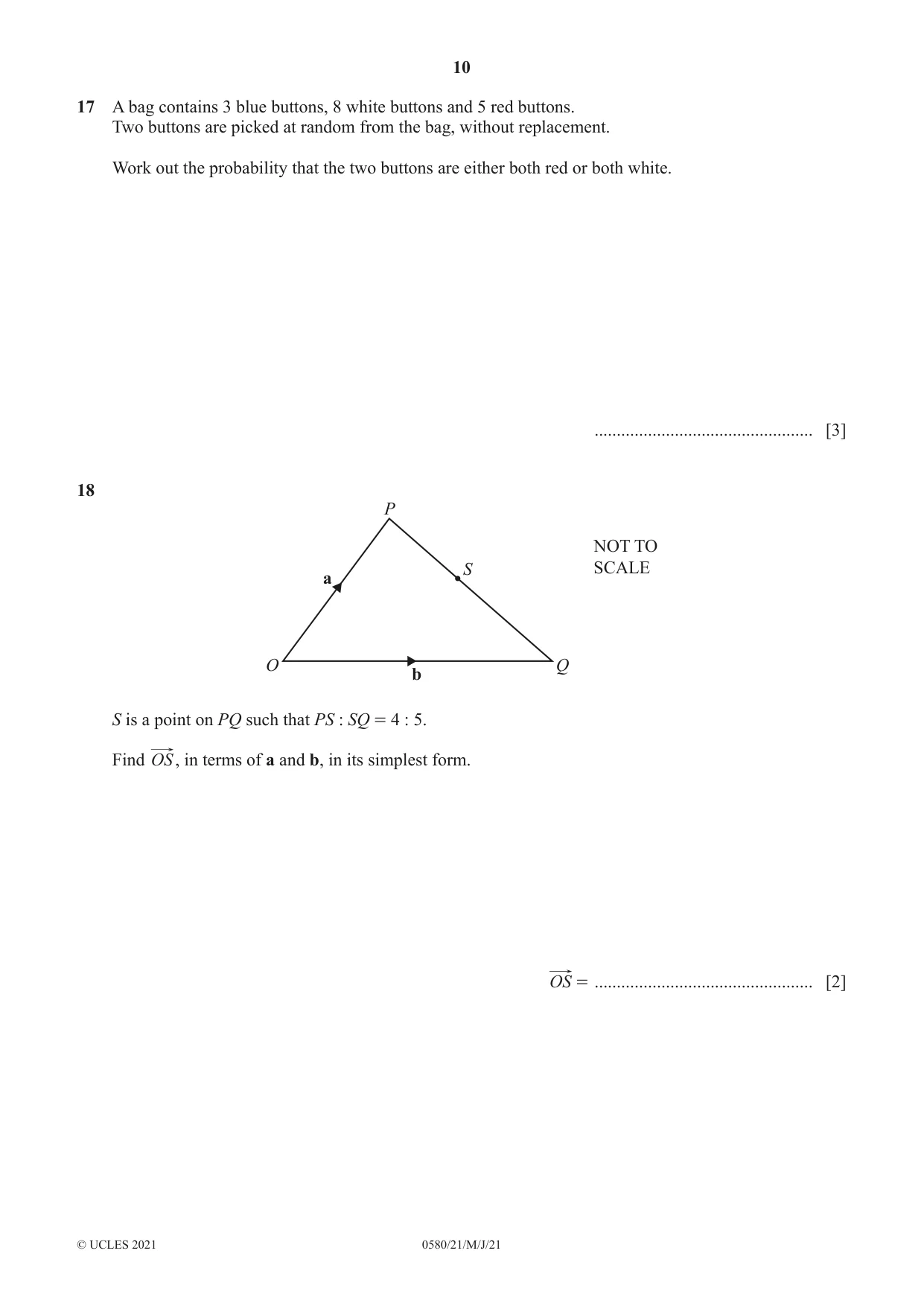
Q18 · P NOT TO S SCALE a O Q b S is a point on PQ such that PS : SQ = 4 : 5
18 P NOT TO S SCALE a O Q b S is a point on PQ such that PS : SQ = 4 : 5. Find OS, in terms of a and b, in its simplest form. OS = ................................................. [2]
Mark scheme: 18 5 4 2 4 5 a + b M1 for (b – a) or (a – b) or a correct 9 9 9 9 route
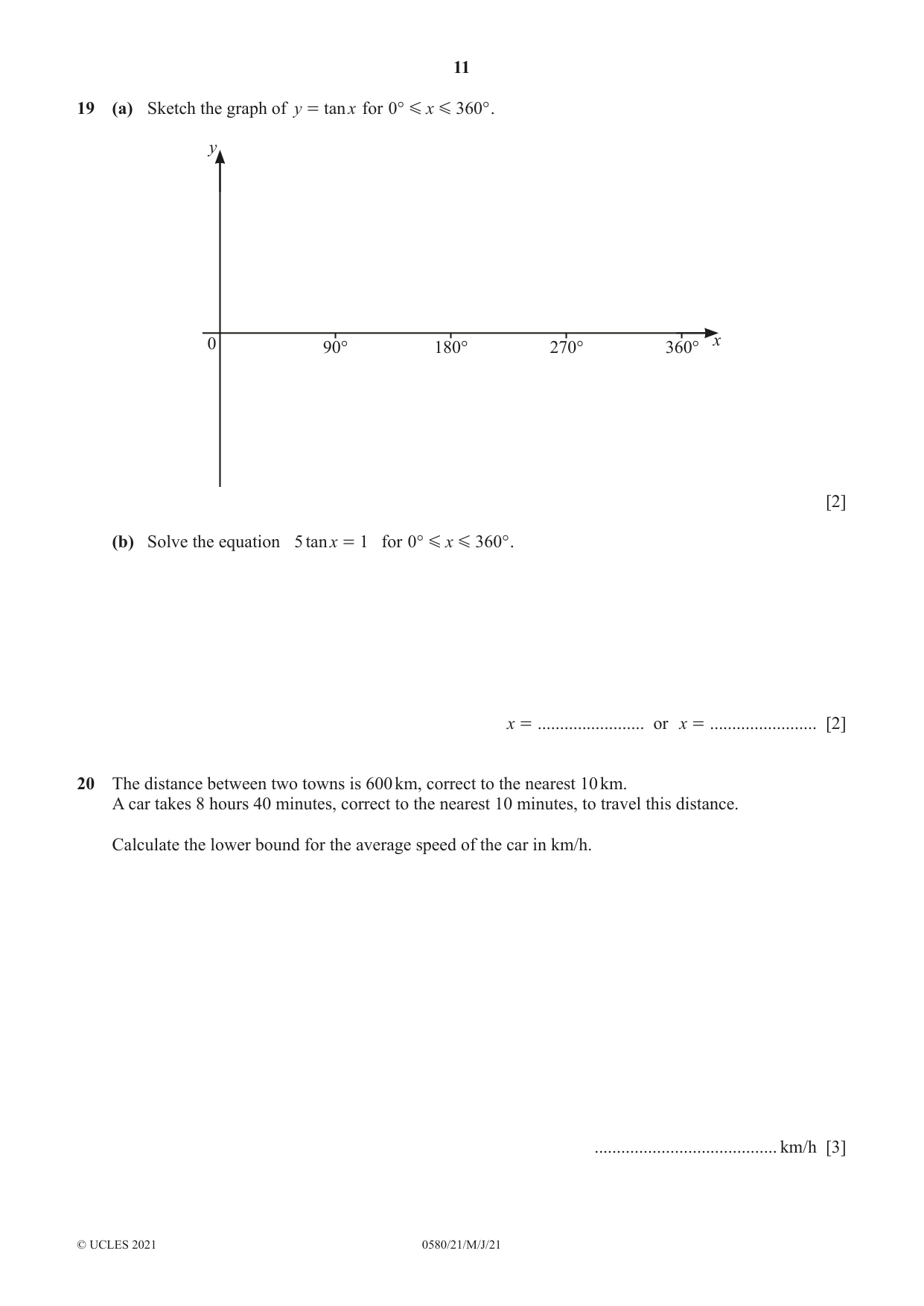
Q19 · Sketch the graph of y = tan x for 0 ° G x G 360°
19 (a) Sketch the graph of y = tan x for 0 ° G x G 360° . y 0 90° 180° 270° 360° x [2] (b) Solve the equation 5 tanx = 1 for 0° G x G 360 ° . x = ........................ or x = ........................ [2]
Mark scheme: 19(a) Correct sketch 2 1 for one correct branch or correct sketch but with branches joined 19(b) 11.3 or 11.30 to 11.31 2 B1 for each and If 0 scored SC1 for two answers with a difference of 180° 191.3 or 191.30 to 191.31
Q20 · The distance between two towns is 600 km, correct to the nearest 10 km
20 The distance between two towns is 600 km, correct to the nearest 10 km. A car takes 8 hours 40 minutes, correct to the nearest 10 minutes, to travel this distance. Calculate the lower bound for the average speed of the car in km/h. ......................................... km/h [3]
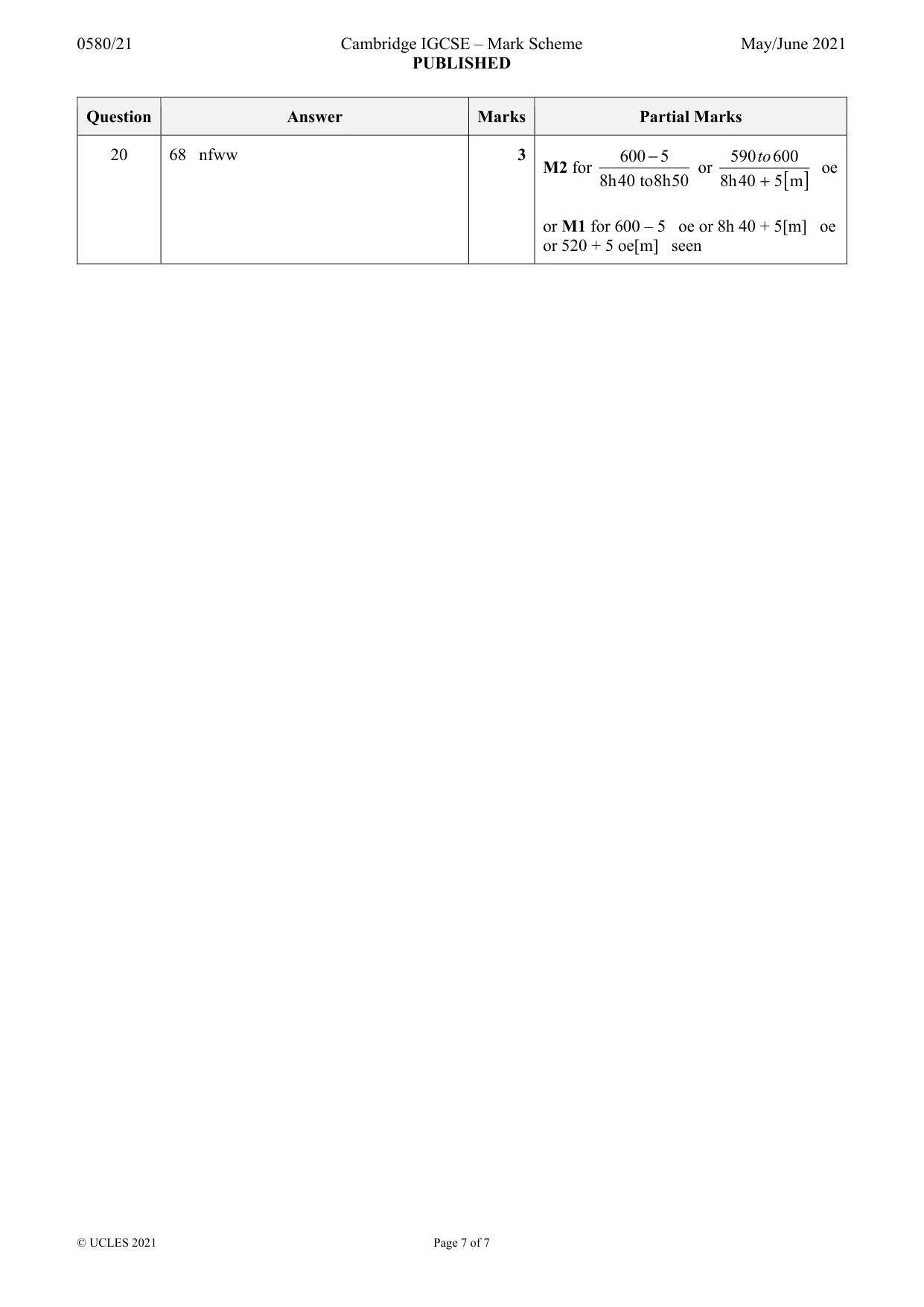
Mark scheme: 20 68 nfww 3 600 − 5 590 to 600 M2 for or oe 8h 40 to 8h 50 8h 40 + 5 [ m ] or M1 for 600 – 5 oe or 8h 40 + 5[m] oe or 520 + 5 oe[m] seen
What was in this paper
The subtopics covered by these 20 questions, and how many questions each got. Open one in a new tab to see every Cambridge question on it.
2Algebraic manipulation1Angles1Averages and measures of spread1Equations1Equations of linear graphs1Exponential growth and decay1Fractions, decimals and percentages1Graphs of functions1Indices I1Introduction to probability1Limits of accuracy1Probability of combined events1Pythagoras’ theorem1Ratio and proportion1Scale drawings1Sequences1Symmetry1Transformations1What you needed in this session
Cambridge’s own grade thresholds for 2021 May/June, Paper 2 · Variant 1. A higher threshold means an easier paper — the bar moves with how the cohort did.