Cambridge IGCSE Mathematics 0580 — 2014 Oct/Nov Paper 3 · Variant 3
0580/33/O/N/14 · 104 marks · ≈117 min
The question paper and its mark scheme, free to read here and free to download. This is Cambridge’s own paper, exactly as it was sat.
Question paper16 pages
Mark scheme
No mark scheme is in the library for this paper.
Paper as text
Question paper, page 1
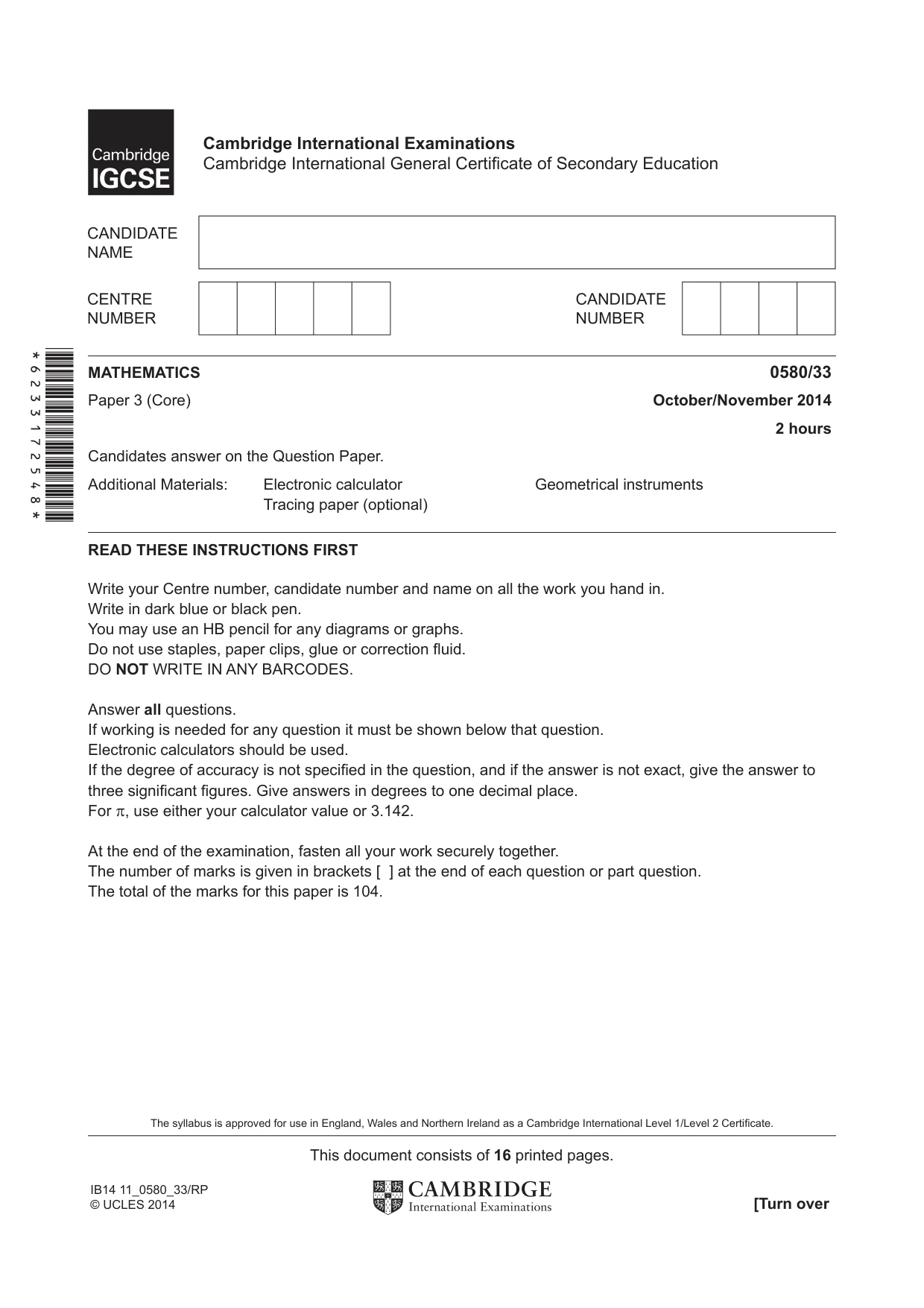
READ THESE INSTRUCTIONS FIRST Write your Centre number, candidate number and name on all the work you hand in. Write in dark blue or black pen. You may use an HB pencil for any diagrams or graphs. Do not use staples, paper clips, glue or correction fl uid. DO NOT WRITE IN ANY BARCODES. Answer all questions. If working is needed for any question it must be shown below that question. Electronic calculators should be used. If the degree of accuracy is not specifi ed in the question, and if the answer is not exact, give the answer to three signifi cant fi gures. Give answers in degrees to one decimal place. For π, use either your calculator value or 3.142. At the end of the examination, fasten all your work securely together. The number of marks is given in brackets [ ] at the end of each question or part question. The total of the marks for this paper is 104. MATHEMATICS 0580/33 Paper 3 (Core) October/November 2014 2 hours Candidates answer on the Question Paper. Additional Materials: Electronic calculator Geometrical instruments Tracing paper (optional) Cambridge International Examinations Cambridge International General Certifi cate of Secondary Education This document consists of 16 printed pages. [Turn over IB14 11_0580_33/RP © UCLES 2014 *6233172548* The syllabus is approved for use in England, Wales and Northern Ireland as a Cambridge International Level 1/Level 2 Certifi cate.
Question paper, page 2
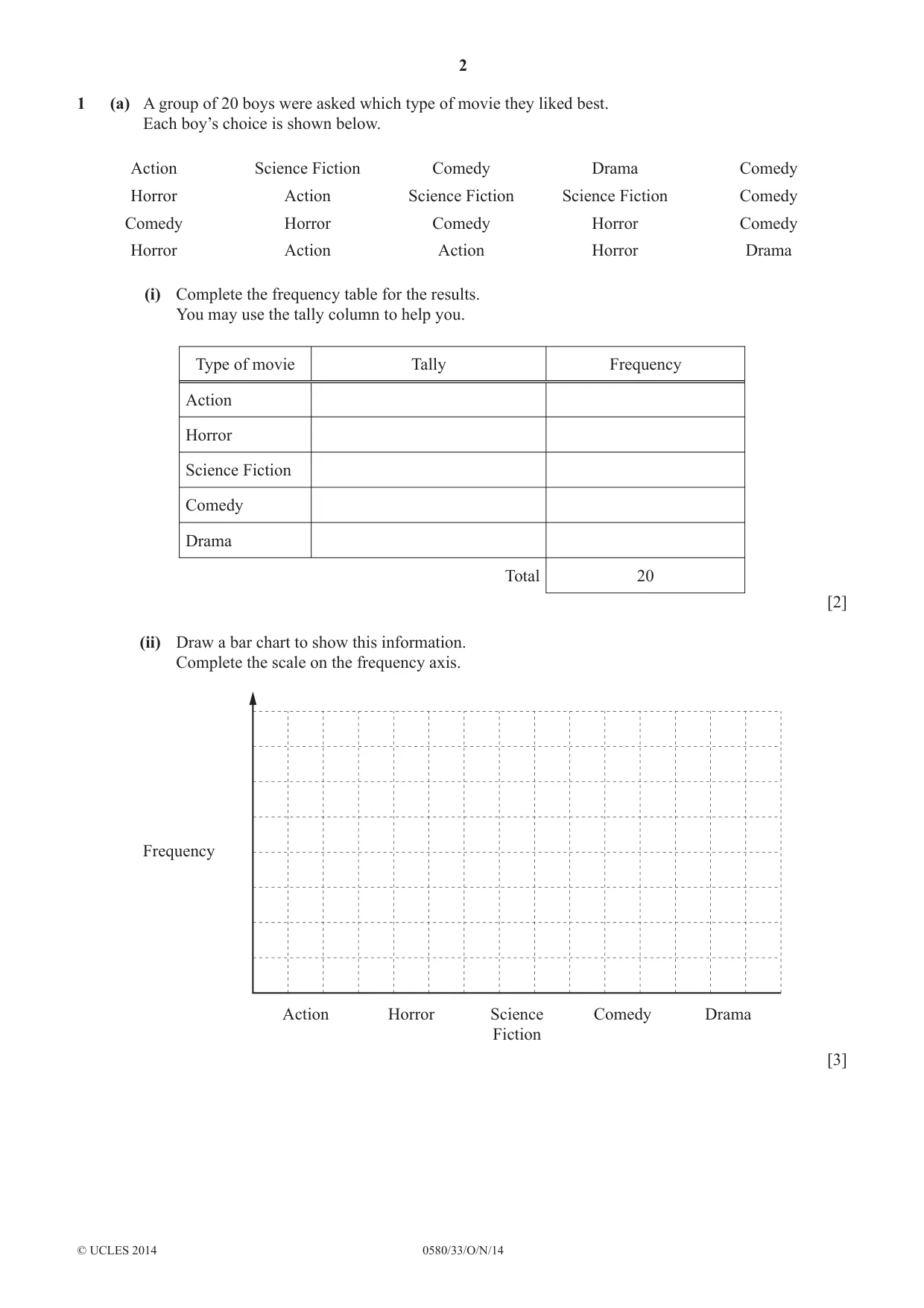
2 0580/33/O/N/14 © UCLES 2014 1 (a) A group of 20 boys were asked which type of movie they liked best. Each boy’s choice is shown below. Action Science Fiction Comedy Drama Comedy Horror Action Science Fiction Science Fiction Comedy Comedy Horror Comedy Horror Comedy Horror Action Action Horror Drama (i) Complete the frequency table for the results. You may use the tally column to help you. Type of movie Tally Frequency Action Horror Science Fiction Comedy Drama Total 20 [2] (ii) Draw a bar chart to show this information. Complete the scale on the frequency axis. Action Horror Science Fiction Comedy Drama Frequency [3]
Question paper, page 3
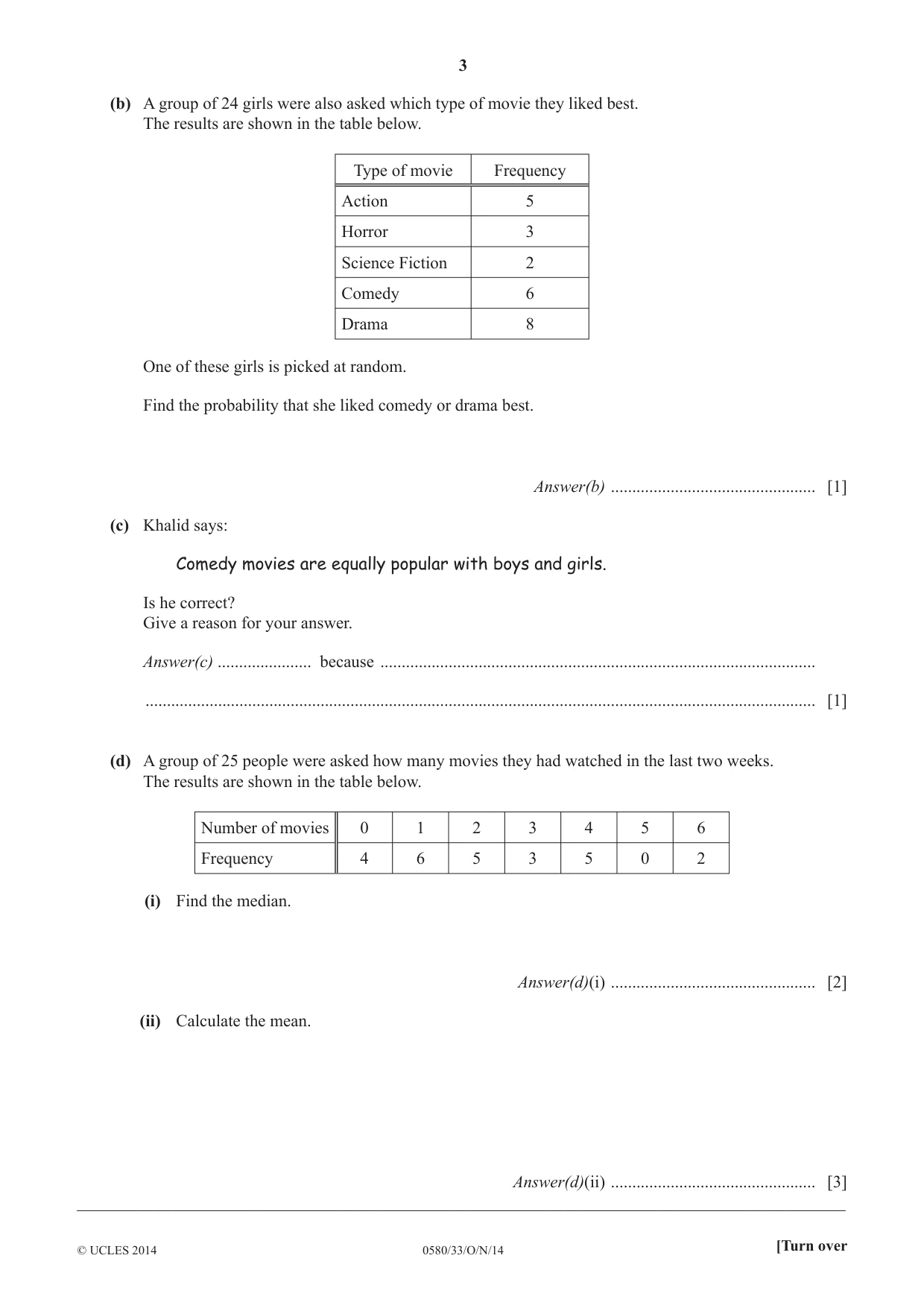
3 0580/33/O/N/14 © UCLES 2014 [Turn over (b) A group of 24 girls were also asked which type of movie they liked best. The results are shown in the table below. Type of movie Frequency Action 5 Horror 3 Science Fiction 2 Comedy 6 Drama 8 One of these girls is picked at random. Find the probability that she liked comedy or drama best. Answer(b) … [1] (c) Khalid says: Comedy movies are equally popular with boys and girls. Is he correct? Give a reason for your answer. Answer(c) … because … … [1] (d) A group of 25 people were asked how many movies they had watched in the last two weeks. The results are shown in the table below. Number of movies 0 1 2 3 4 5 6 Frequency 4 6 5 3 5 0 2 (i) Find the median. Answer(d)(i) … [2] (ii) Calculate the mean. Answer(d)(ii) … [3] __________________________________________________________________________________________
Question paper, page 4
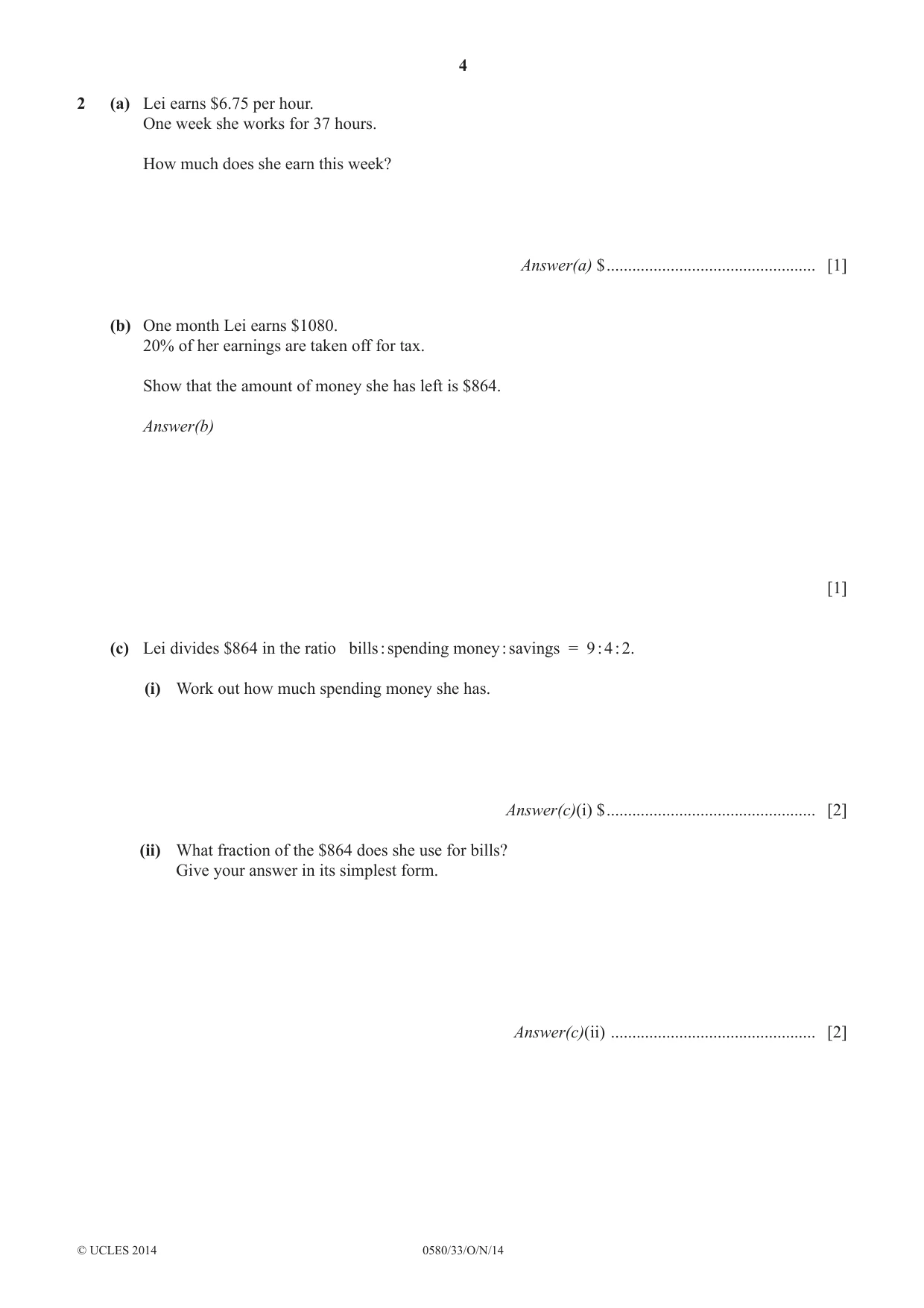
4 0580/33/O/N/14 © UCLES 2014 2 (a) Lei earns $6.75 per hour. One week she works for 37 hours. How much does she earn this week? Answer(a) $ … [1] (b) One month Lei earns $1080. 20% of her earnings are taken off for tax. Show that the amount of money she has left is $864. Answer(b) [1] (c) Lei divides $864 in the ratio bills : spending money : savings = 9 : 4 : 2. (i) Work out how much spending money she has. Answer(c)(i) $ … [2] (ii) What fraction of the $864 does she use for bills? Give your answer in its simplest form. Answer(c)(ii) … [2]
Question paper, page 5
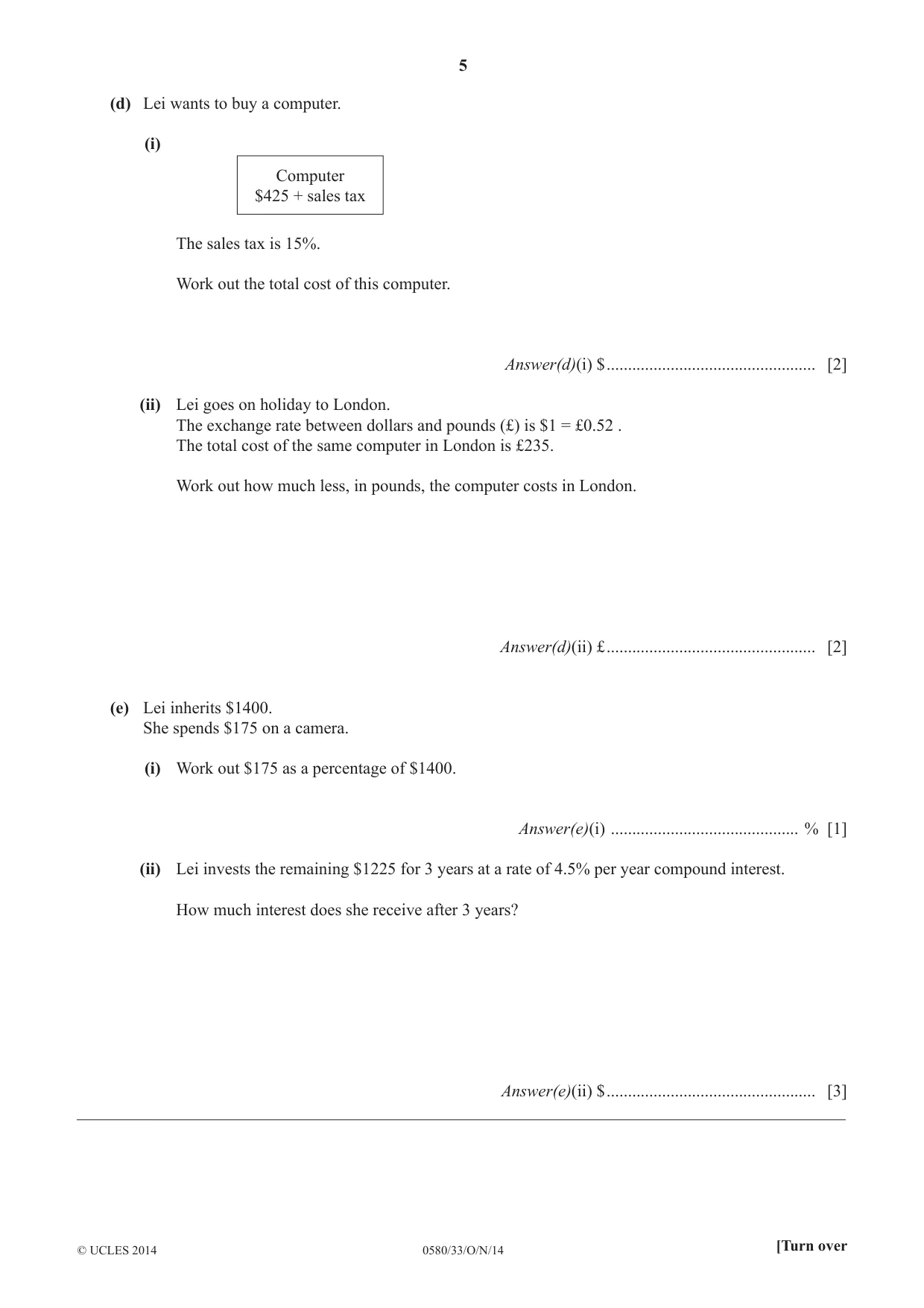
5 0580/33/O/N/14 © UCLES 2014 [Turn over (d) Lei wants to buy a computer. (i) Computer $425 + sales tax The sales tax is 15%. Work out the total cost of this computer. Answer(d)(i) $ … [2] (ii) Lei goes on holiday to London. The exchange rate between dollars and pounds (£) is $1 = £0.52 . The total cost of the same computer in London is £235. Work out how much less, in pounds, the computer costs in London. Answer(d)(ii) £ … [2] (e) Lei inherits $1400. She spends $175 on a camera. (i) Work out $175 as a percentage of $1400. Answer(e)(i) … % [1] (ii) Lei invests the remaining $1225 for 3 years at a rate of 4.5% per year compound interest. How much interest does she receive after 3 years? Answer(e)(ii) $ … [3] __________________________________________________________________________________________
Question paper, page 6
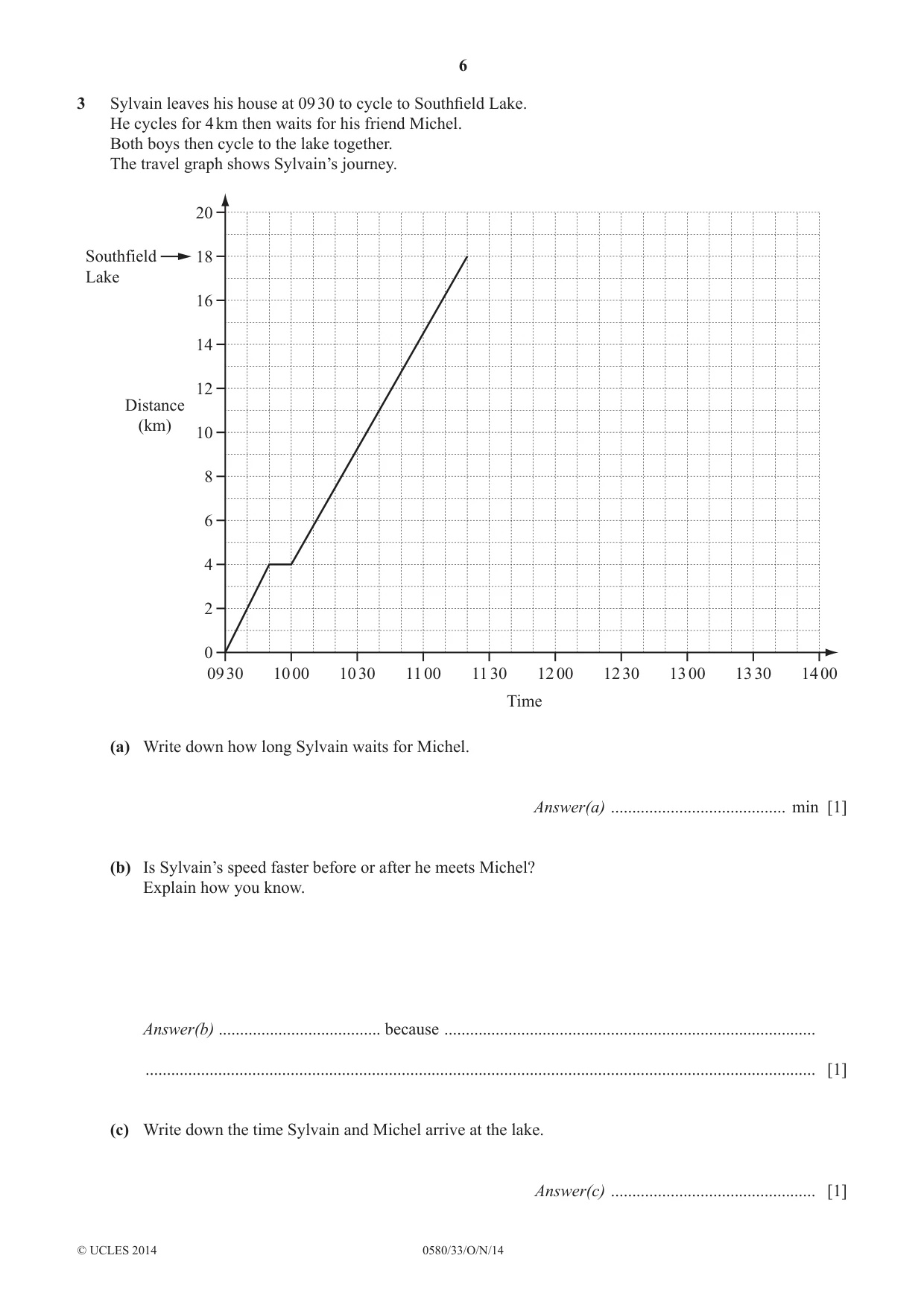
6 0580/33/O/N/14 © UCLES 2014 3 Sylvain leaves his house at 09 30 to cycle to Southfi eld Lake. He cycles for 4 km then waits for his friend Michel. Both boys then cycle to the lake together. The travel graph shows Sylvain’s journey. 20 18 16 14 12 10 8 6 4 2 0 09 30 10 00 10 30 11 00 11 30 12 00 12 30 13 00 13 30 14 00 Time Distance (km) Southfield Lake (a) Write down how long Sylvain waits for Michel. Answer(a) … min [1] (b) Is Sylvain’s speed faster before or after he meets Michel? Explain how you know. Answer(b) … because … … [1] (c) Write down the time Sylvain and Michel arrive at the lake. Answer(c) … [1]
Question paper, page 7
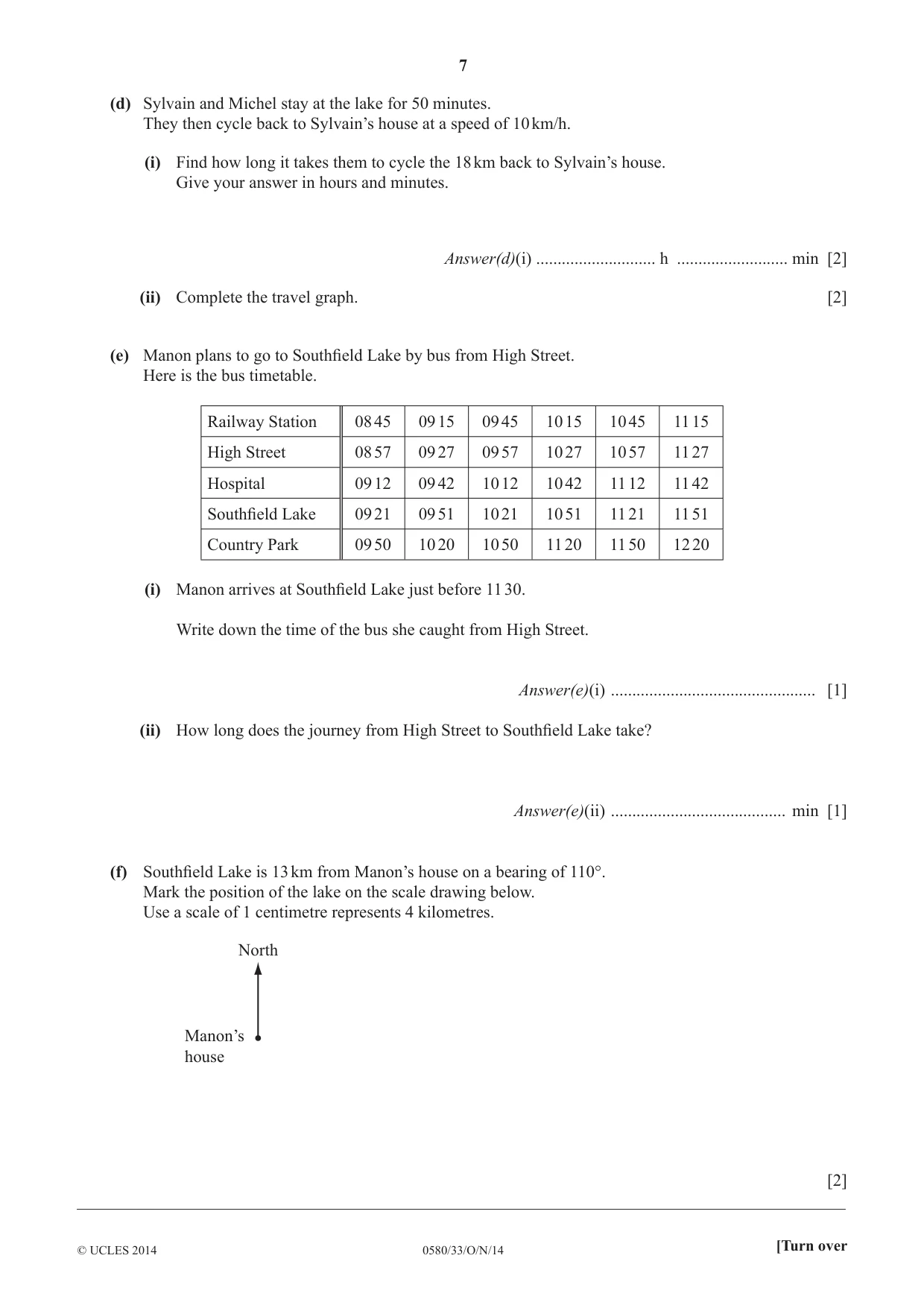
7 0580/33/O/N/14 © UCLES 2014 [Turn over (d) Sylvain and Michel stay at the lake for 50 minutes. They then cycle back to Sylvain’s house at a speed of 10 km/h. (i) Find how long it takes them to cycle the 18 km back to Sylvain’s house. Give your answer in hours and minutes. Answer(d)(i) … h … min [2] (ii) Complete the travel graph. [2] (e) Manon plans to go to Southfi eld Lake by bus from High Street. Here is the bus timetable. Railway Station 08 45 09 15 09 45 10 15 10 45 11 15 High Street 08 57 09 27 09 57 10 27 10 57 11 27 Hospital 09 12 09 42 10 12 10 42 11 12 11 42 Southfi eld Lake 09 21 09 51 10 21 10 51 11 21 11 51 Country Park 09 50 10 20 10 50 11 20 11 50 12 20 (i) Manon arrives at Southfi eld Lake just before 11 30. Write down the time of the bus she caught from High Street. Answer(e)(i) … [1] (ii) How long does the journey from High Street to Southfi eld Lake take? Answer(e)(ii) … min [1] (f) Southfi eld Lake is 13 km from Manon’s house on a bearing of 110°. Mark the position of the lake on the scale drawing below. Use a scale of 1 centimetre represents 4 kilometres. North Manon’s house [2] __________________________________________________________________________________________
Question paper, page 8
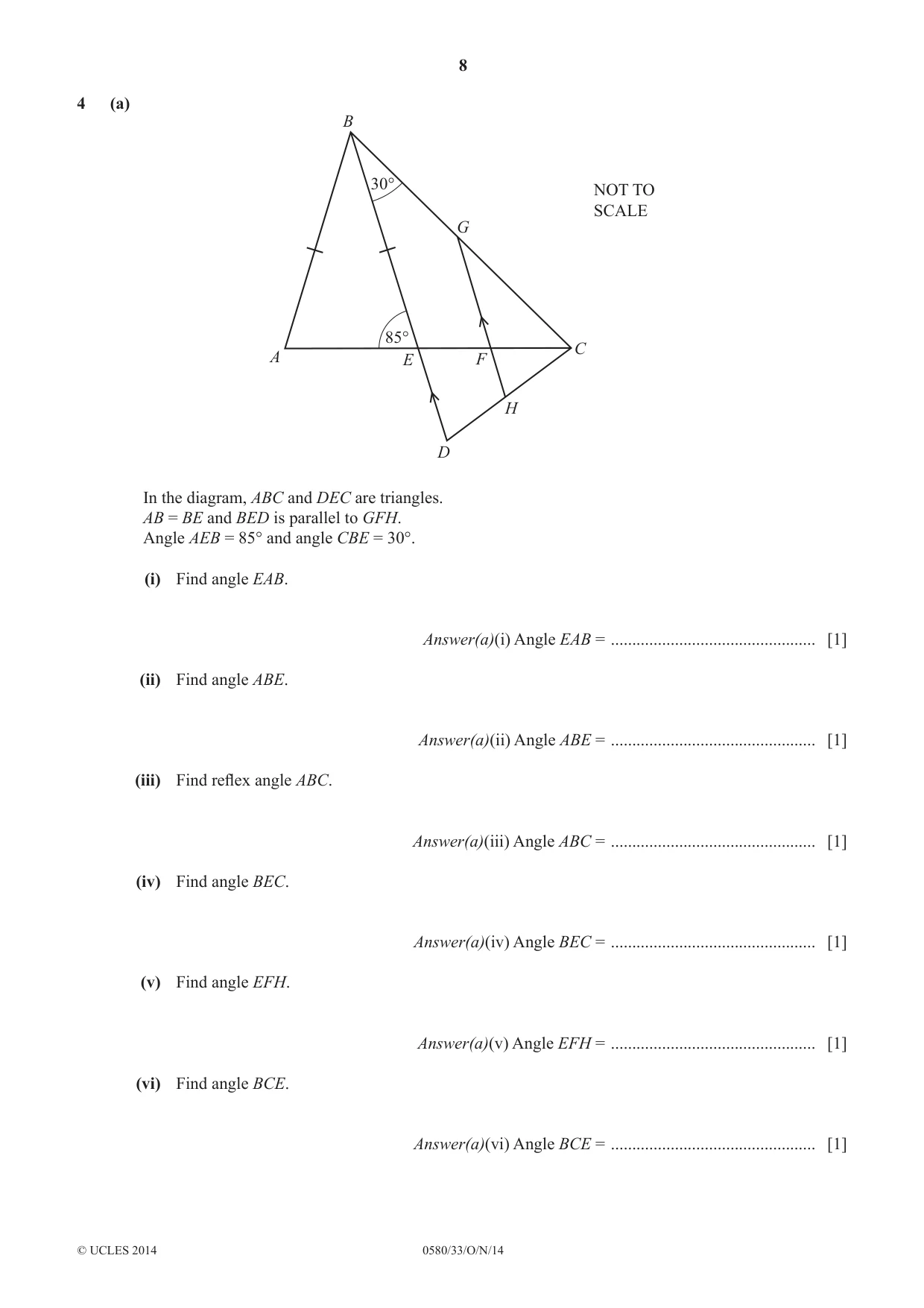
8 0580/33/O/N/14 © UCLES 2014 4 (a) A B G C D E F H 85° 30° NOT TO SCALE In the diagram, ABC and DEC are triangles. AB = BE and BED is parallel to GFH. Angle AEB = 85° and angle CBE = 30°. (i) Find angle EAB. Answer(a)(i) Angle EAB = … [1] (ii) Find angle ABE. Answer(a)(ii) Angle ABE = … [1] (iii) Find refl ex angle ABC. Answer(a)(iii) Angle ABC = … [1] (iv) Find angle BEC. Answer(a)(iv) Angle BEC = … [1] (v) Find angle EFH. Answer(a)(v) Angle EFH = … [1] (vi) Find angle BCE. Answer(a)(vi) Angle BCE = … [1]
Question paper, page 9
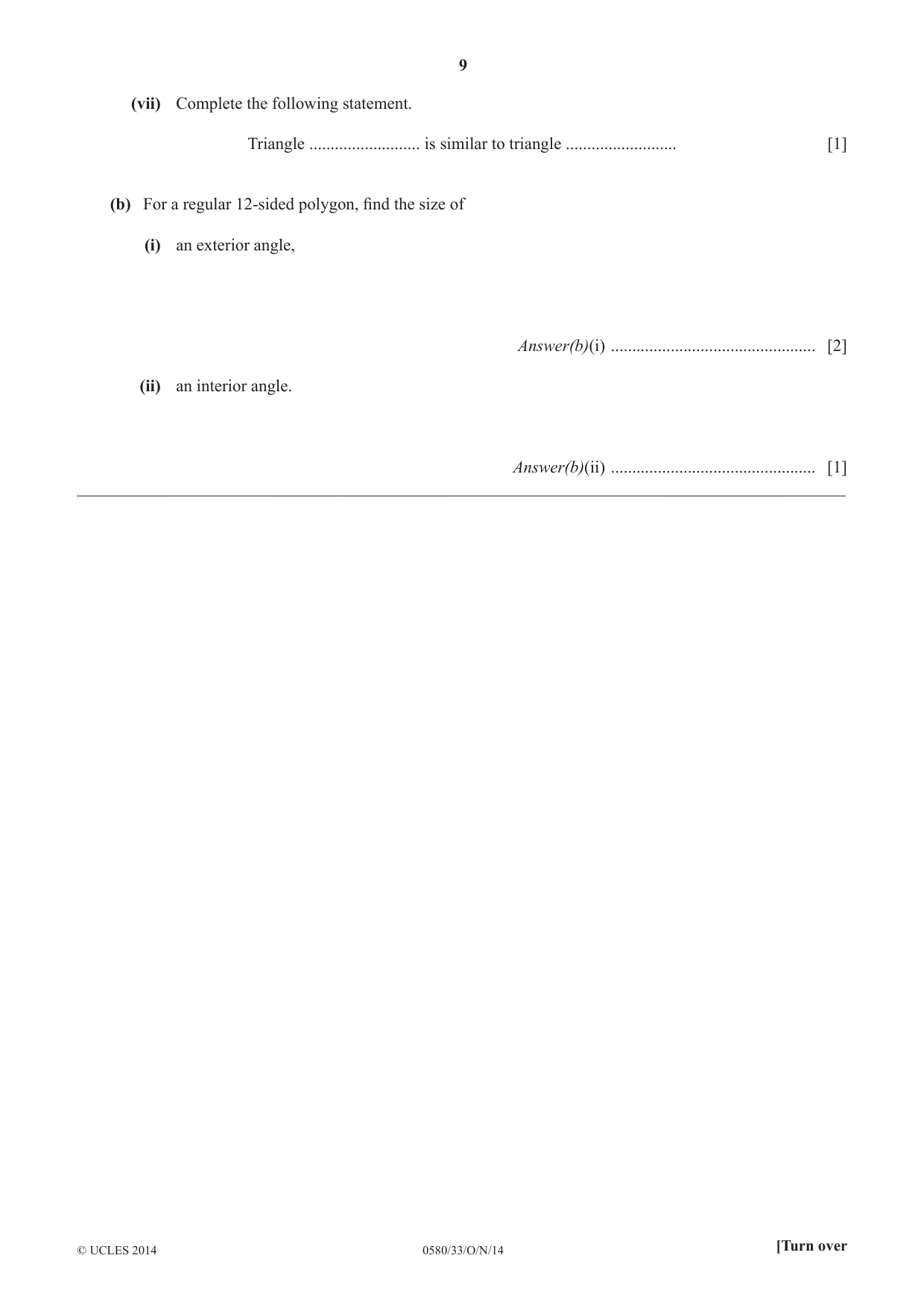
9 0580/33/O/N/14 © UCLES 2014 [Turn over (vii) Complete the following statement. Triangle … is similar to triangle … [1] (b) For a regular 12-sided polygon, fi nd the size of (i) an exterior angle, Answer(b)(i) … [2] (ii) an interior angle. Answer(b)(ii) … [1] __________________________________________________________________________________________
Question paper, page 10
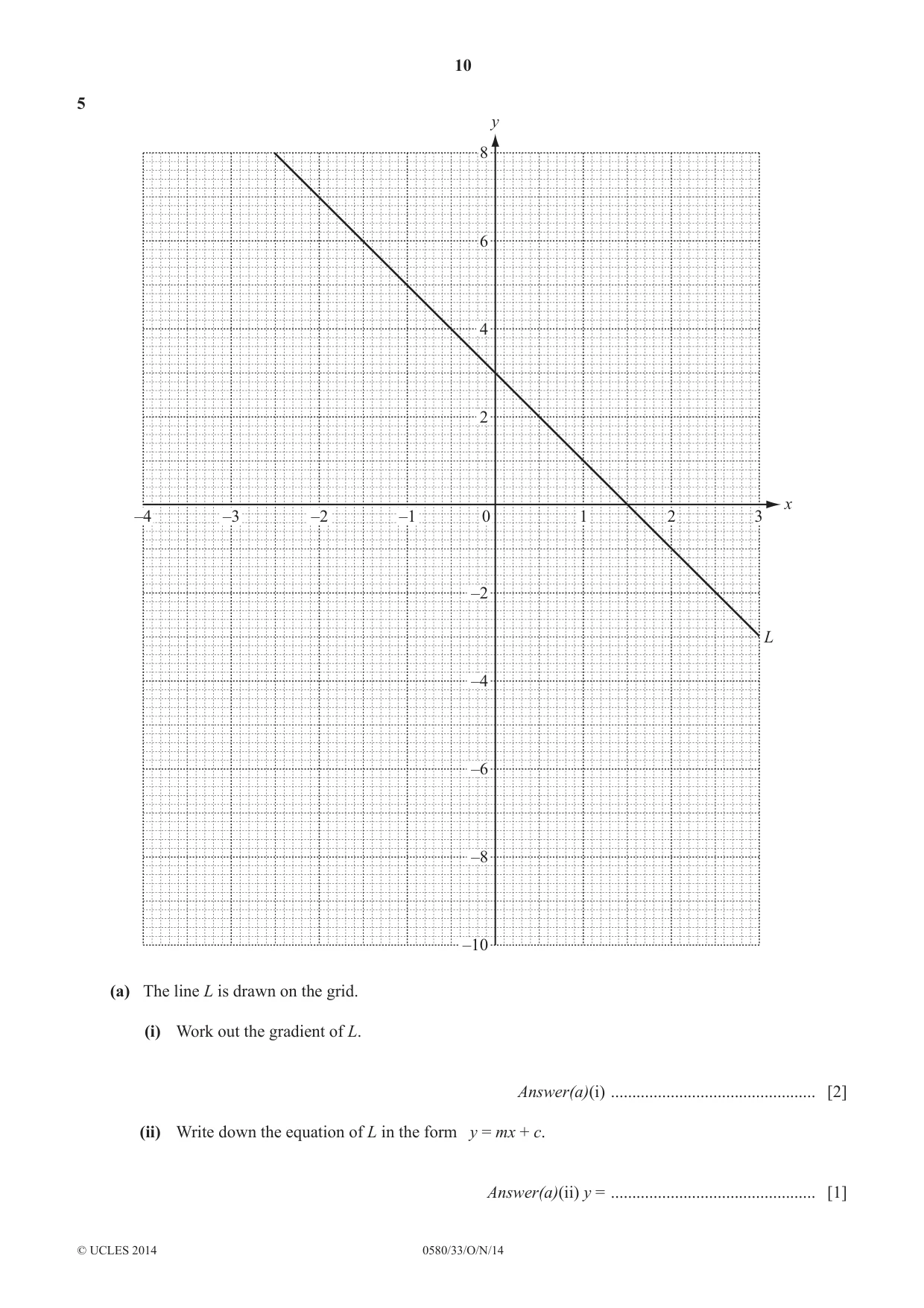
10 0580/33/O/N/14 © UCLES 2014 5 y x 8 6 4 2 –2 –4 –6 –8 –10 0 –1 –2 –3 –4 3 2 1 L (a) The line L is drawn on the grid. (i) Work out the gradient of L. Answer(a)(i) … [2] (ii) Write down the equation of L in the form y = mx + c. Answer(a)(ii) y = … [1]
Question paper, page 11
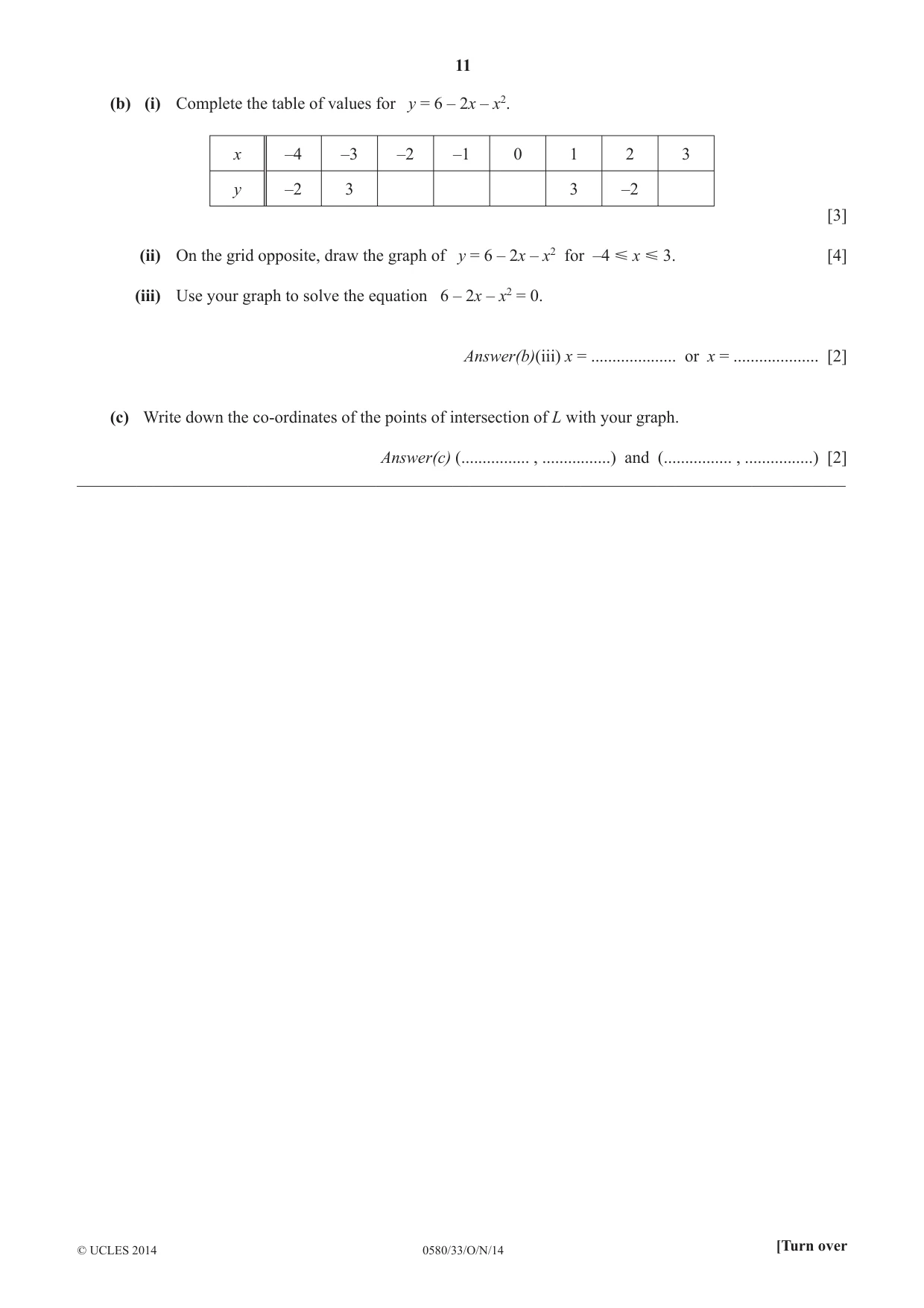
11 0580/33/O/N/14 © UCLES 2014 [Turn over (b) (i) Complete the table of values for y = 6 – 2x – x2. x –4 –3 –2 –1 0 1 2 3 y –2 3 3 –2 [3] (ii) On the grid opposite, draw the graph of y = 6 – 2x – x2 for –4 Y x Y 3. [4] (iii) Use your graph to solve the equation 6 – 2x – x2 = 0. Answer(b)(iii) x = … or x = … [2] (c) Write down the co-ordinates of the points of intersection of L with your graph. Answer(c) (… , …) and (… , …) [2] __________________________________________________________________________________________
Question paper, page 12
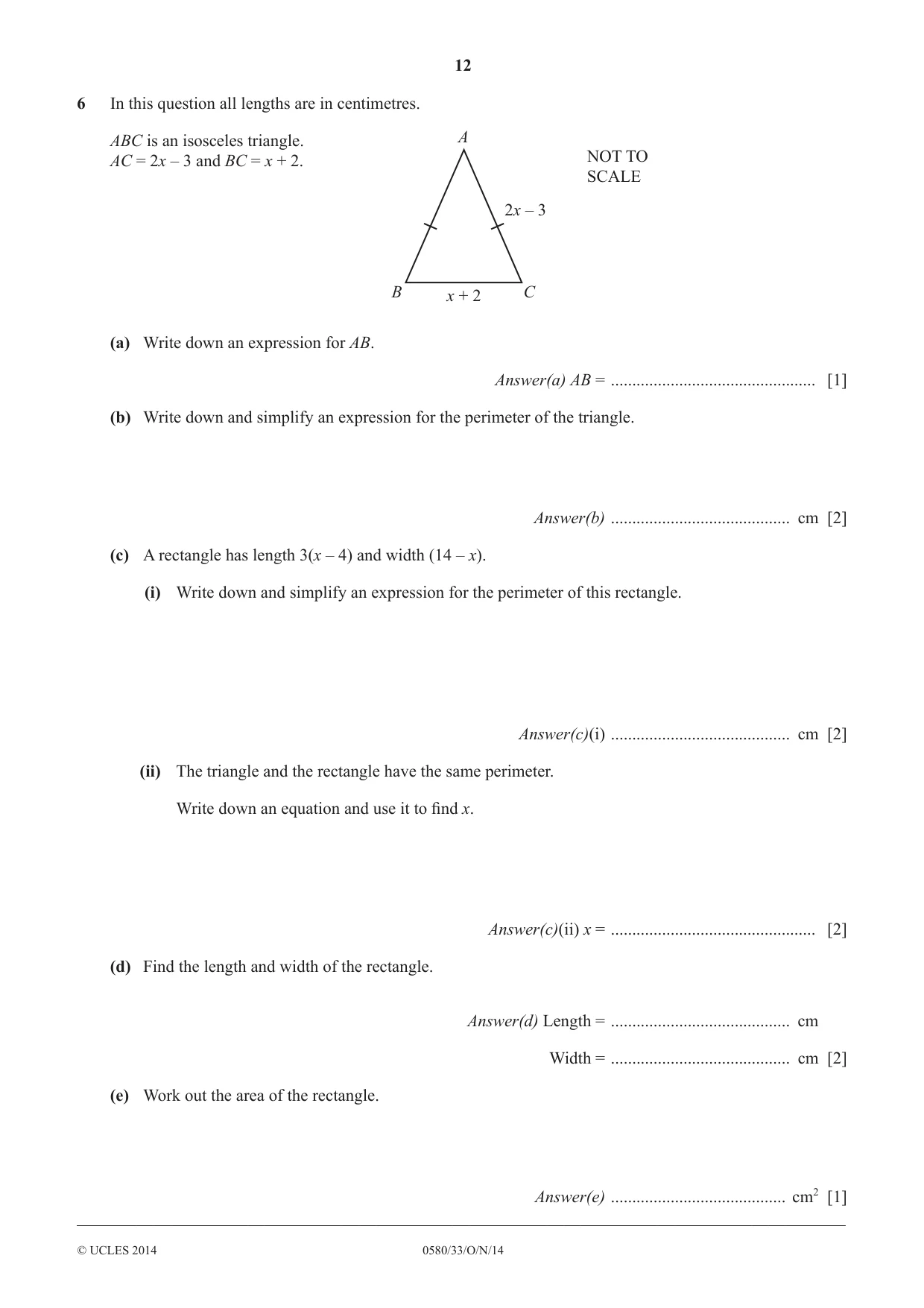
12 0580/33/O/N/14 © UCLES 2014 6 In this question all lengths are in centimetres. ABC is an isosceles triangle. AC = 2x – 3 and BC = x + 2. (a) Write down an expression for AB. Answer(a) AB = … [1] (b) Write down and simplify an expression for the perimeter of the triangle. Answer(b) … cm [2] (c) A rectangle has length 3(x – 4) and width (14 – x). (i) Write down and simplify an expression for the perimeter of this rectangle. Answer(c)(i) … cm [2] (ii) The triangle and the rectangle have the same perimeter. Write down an equation and use it to fi nd x. Answer(c)(ii) x = … [2] (d) Find the length and width of the rectangle. Answer(d) Length = … cm Width = … cm [2] (e) Work out the area of the rectangle. Answer(e) … cm2 [1] __________________________________________________________________________________________ A B C 2x – 3 x + 2 NOT TO SCALE
Question paper, page 13
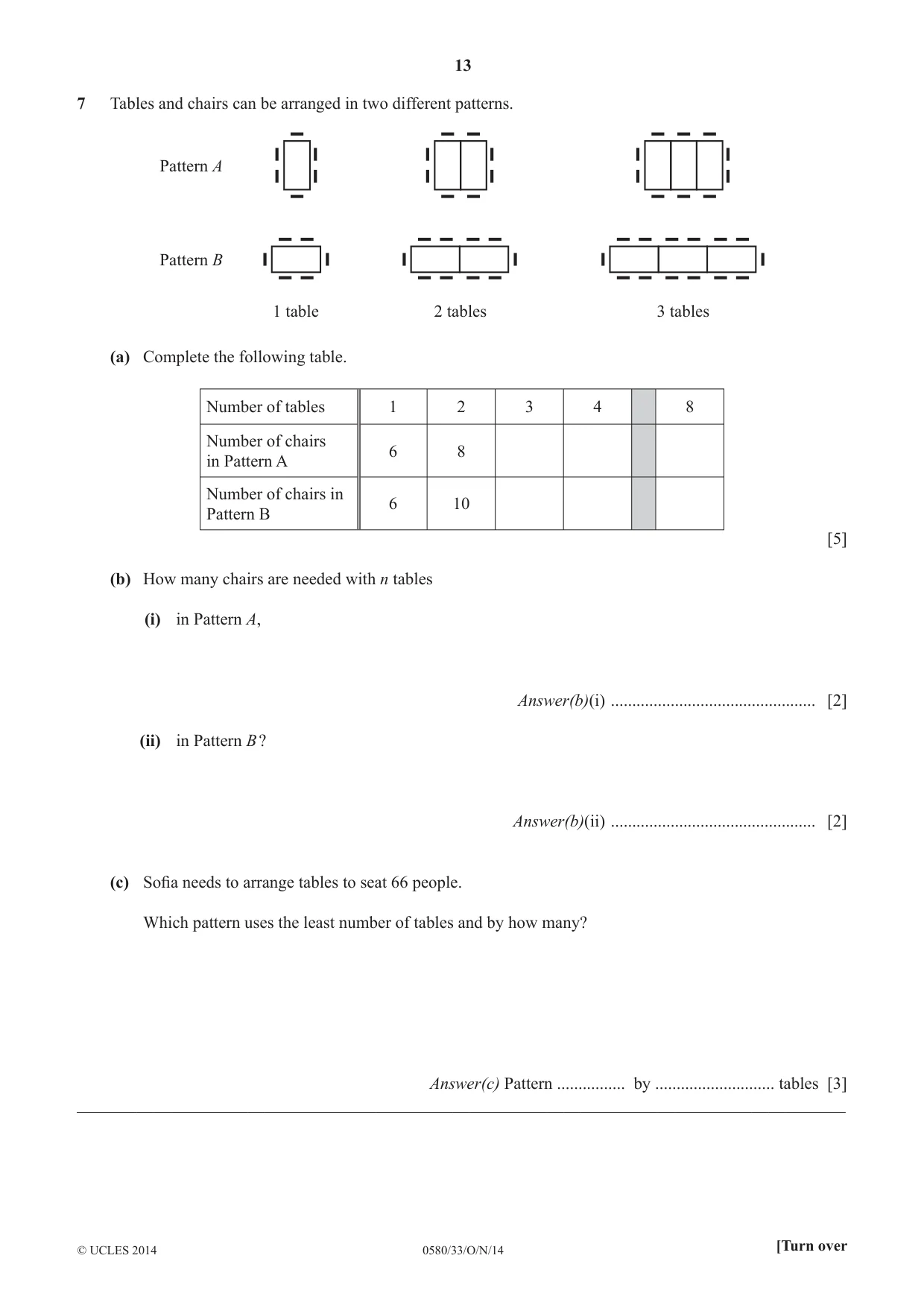
13 0580/33/O/N/14 © UCLES 2014 [Turn over 7 Tables and chairs can be arranged in two different patterns. Pattern A Pattern B 1 table 2 tables 3 tables (a) Complete the following table. Number of tables 1 2 3 4 8 Number of chairs in Pattern A 6 8 Number of chairs in Pattern B 6 10 [5] (b) How many chairs are needed with n tables (i) in Pattern A, Answer(b)(i) … [2] (ii) in Pattern B ? Answer(b)(ii) … [2] (c) Sofi a needs to arrange tables to seat 66 people. Which pattern uses the least number of tables and by how many? Answer(c) Pattern … by … tables [3] __________________________________________________________________________________________
Question paper, page 14
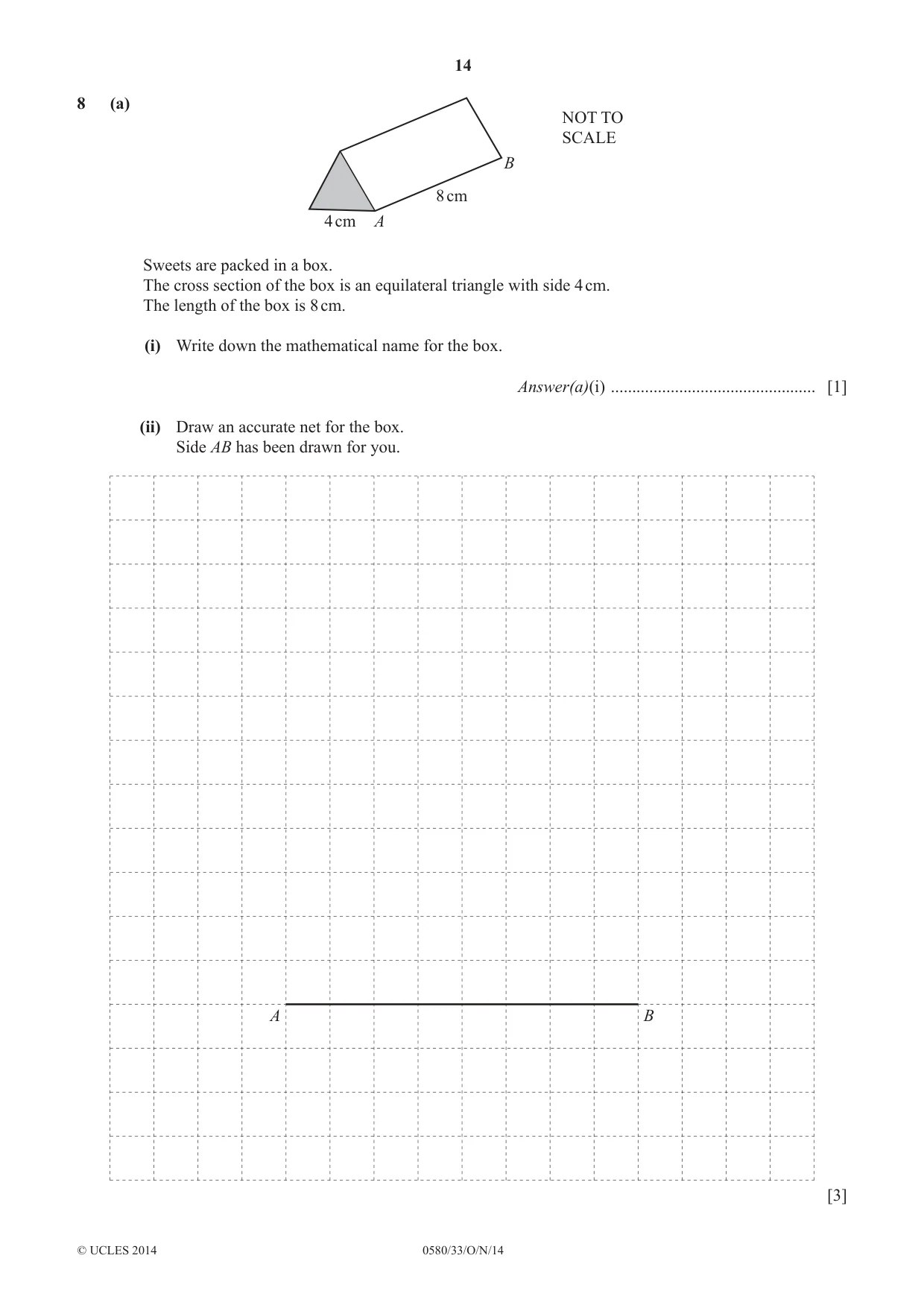
14 0580/33/O/N/14 © UCLES 2014 8 (a) Sweets are packed in a box. The cross section of the box is an equilateral triangle with side 4 cm. The length of the box is 8 cm. (i) Write down the mathematical name for the box. Answer(a)(i) … [1] (ii) Draw an accurate net for the box. Side AB has been drawn for you. A B [3] A B 8 cm 4 cm NOT TO SCALE
Question paper, page 15
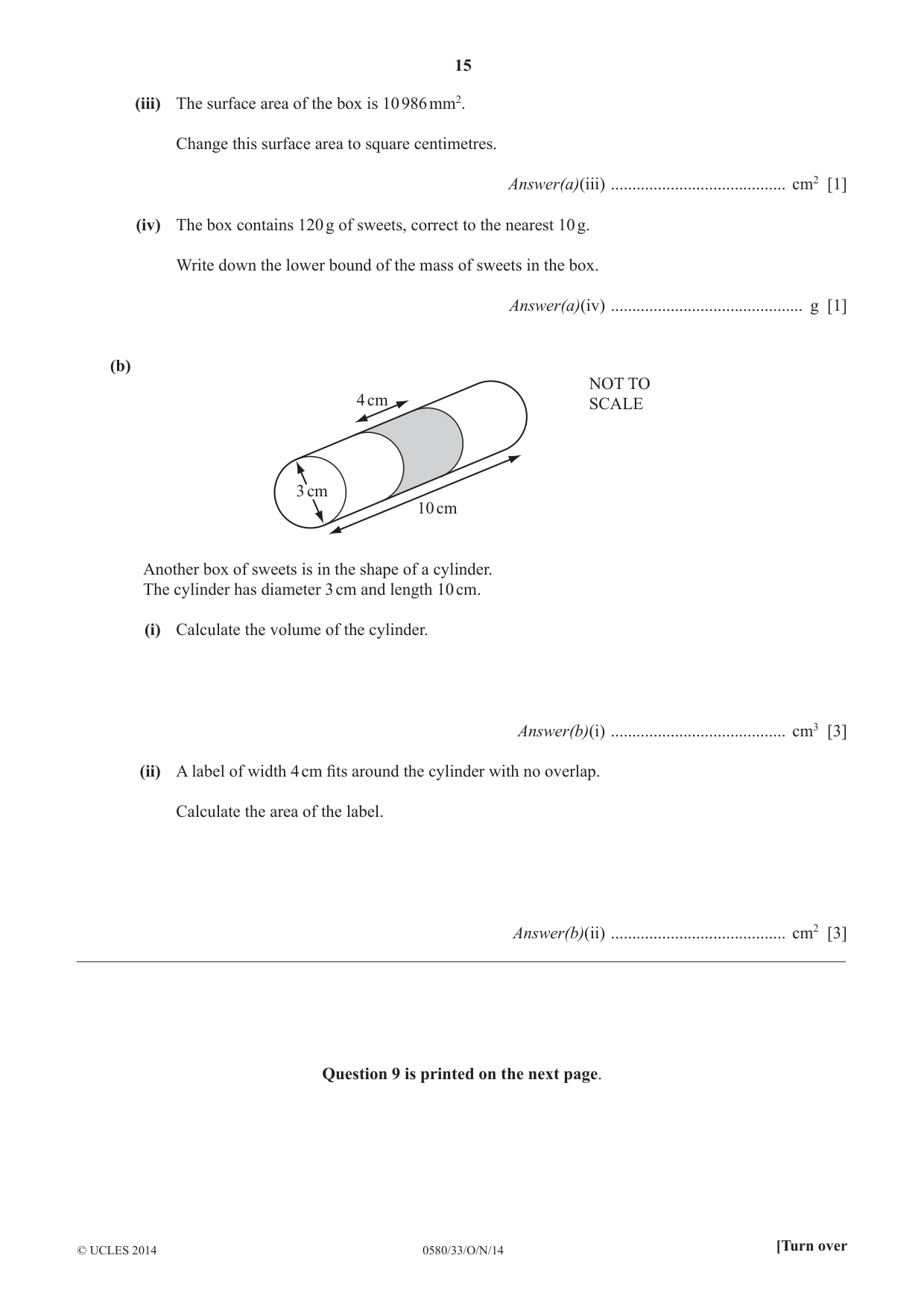
15 0580/33/O/N/14 © UCLES 2014 [Turn over (iii) The surface area of the box is 10 986 mm2. Change this surface area to square centimetres. Answer(a)(iii) … cm2 [1] (iv) The box contains 120 g of sweets, correct to the nearest 10 g. Write down the lower bound of the mass of sweets in the box. Answer(a)(iv) … g [1] (b) 3 cm 4 cm 10 cm NOT TO SCALE Another box of sweets is in the shape of a cylinder. The cylinder has diameter 3 cm and length 10 cm. (i) Calculate the volume of the cylinder. Answer(b)(i) … cm3 [3] (ii) A label of width 4 cm fi ts around the cylinder with no overlap. Calculate the area of the label. Answer(b)(ii) … cm2 [3] __________________________________________________________________________________________ Question 9 is printed on the next page.
Question paper, page 16
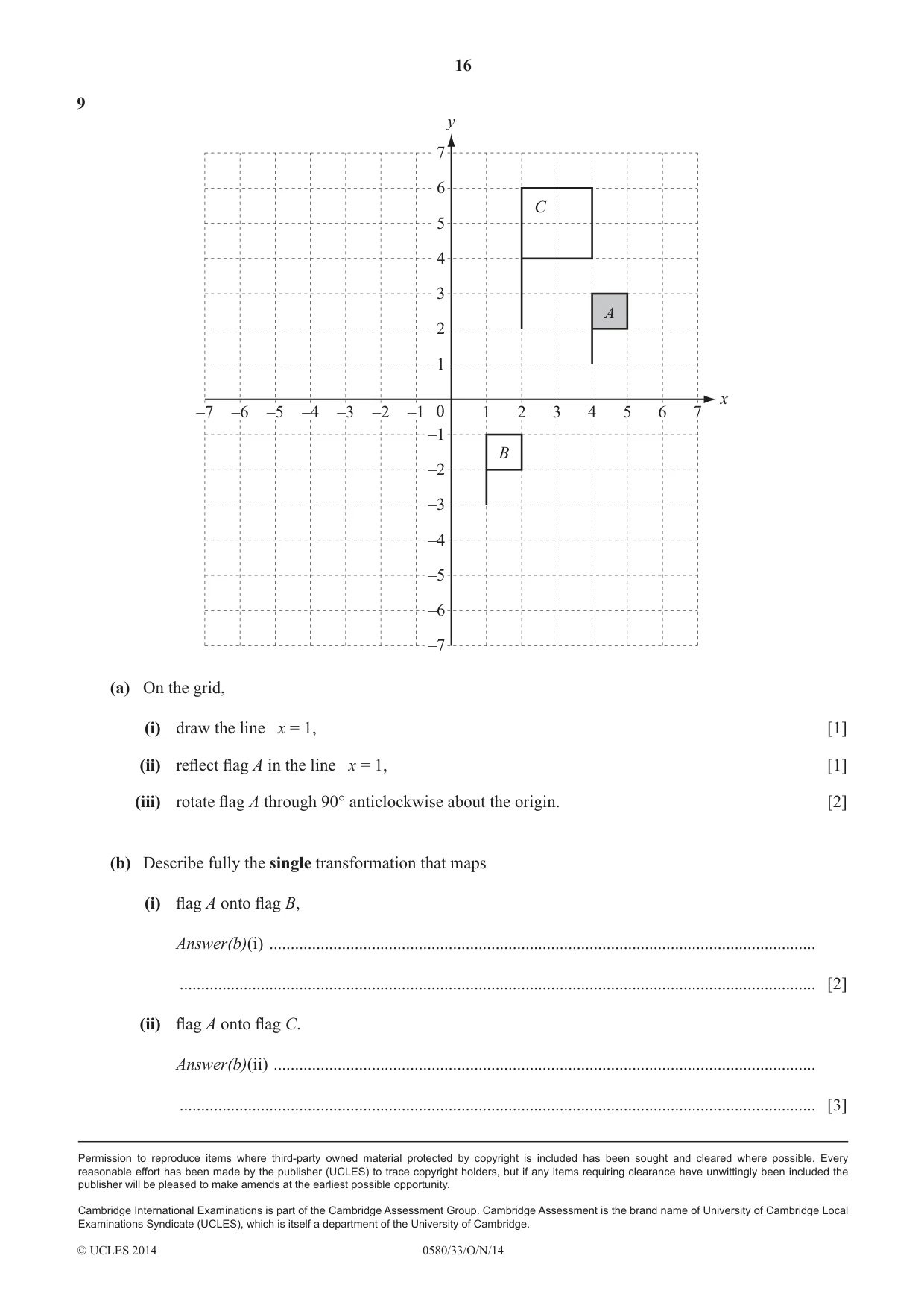
16 0580/33/O/N/14 © UCLES 2014 Permission to reproduce items where third-party owned material protected by copyright is included has been sought and cleared where possible. Every reasonable effort has been made by the publisher (UCLES) to trace copyright holders, but if any items requiring clearance have unwittingly been included the publisher will be pleased to make amends at the earliest possible opportunity. Cambridge International Examinations is part of the Cambridge Assessment Group. Cambridge Assessment is the brand name of University of Cambridge Local Examinations Syndicate (UCLES), which is itself a department of the University of Cambridge. 9 A C B 7 6 5 4 3 2 1 –1 –2 –3 –4 –5 –6 –7 –6 –7 –5 –4 –3 –2 –1 1 0 2 3 4 5 6 7 y x (a) On the grid, (i) draw the line x = 1, [1] (ii) refl ect fl ag A in the line x = 1, [1] (iii) rotate fl ag A through 90° anticlockwise about the origin. [2] (b) Describe fully the single transformation that maps (i) fl ag A onto fl ag B, Answer(b)(i) … … [2] (ii) fl ag A onto fl ag C. Answer(b)(ii) … … [3]
What you needed in this session
Cambridge’s own grade thresholds for 2014 Oct/Nov, Paper 3 · Variant 3. A higher threshold means an easier paper — the bar moves with how the cohort did.