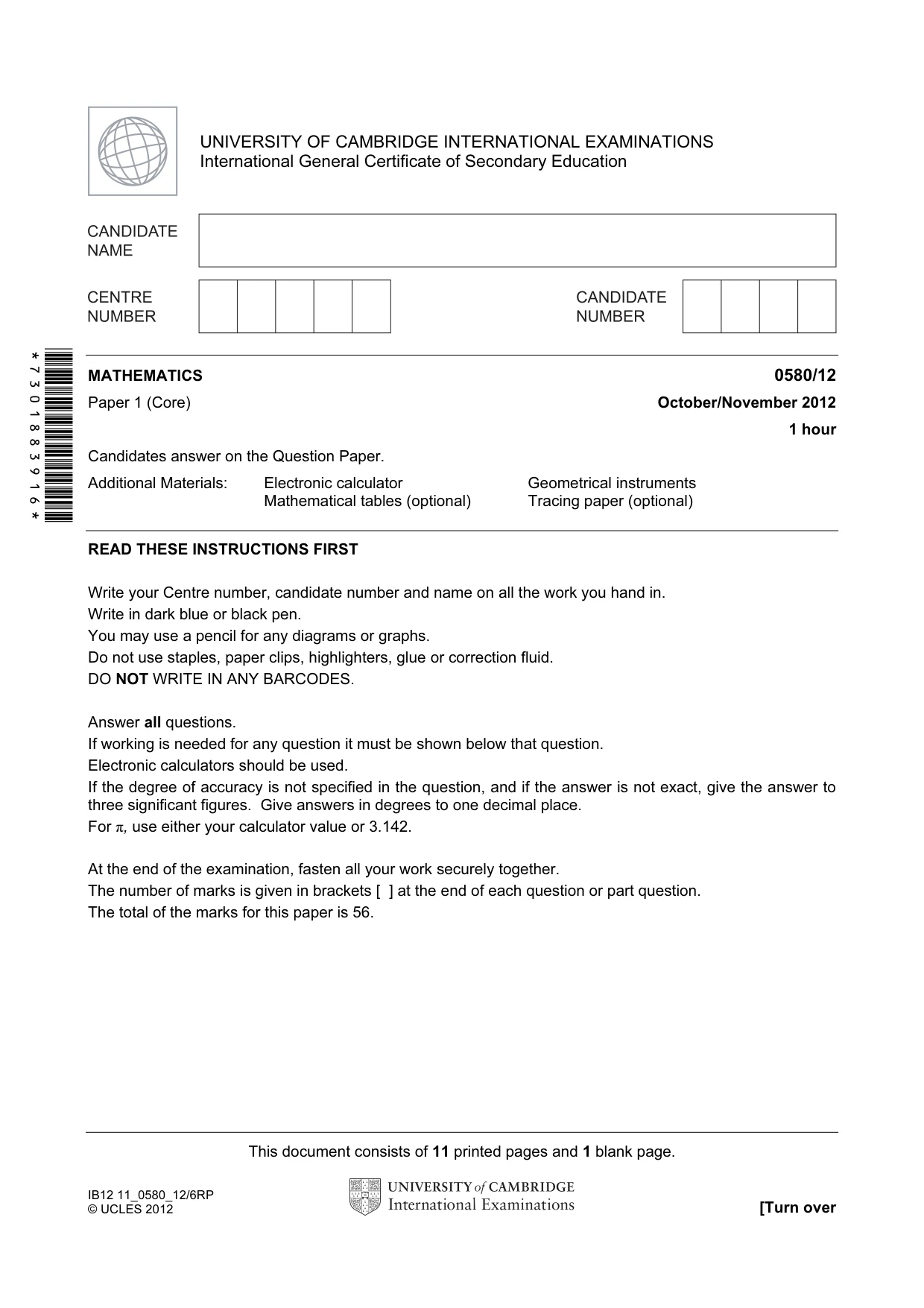
Cambridge IGCSE Mathematics 0580 — 2012 Oct/Nov Paper 1 · Variant 2
0580/12/O/N/12 · 20 questions · 56 marks · ≈63 min
The question paper and its mark scheme, free to read here and free to download. This is Cambridge’s own paper, exactly as it was sat.
Question paper12 pages
Mark scheme3 pages
Answers below. Sit the paper first if you are practising.
Questions as text
Q1 · 5 For 1 Work out ×
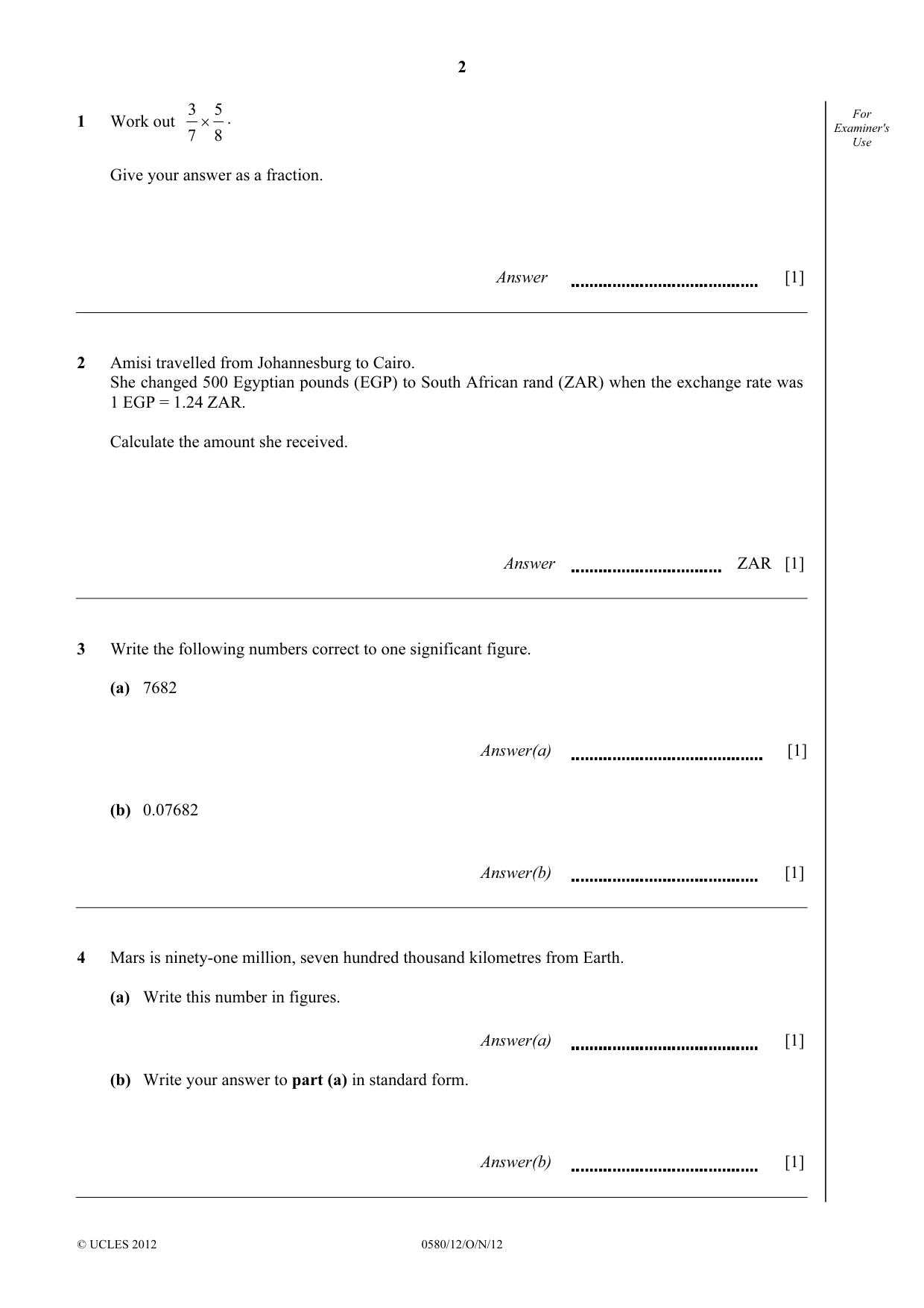
3 5 For 1 Work out × . Examiner's 7 8 Use Give your answer as a fraction. Answer [1]
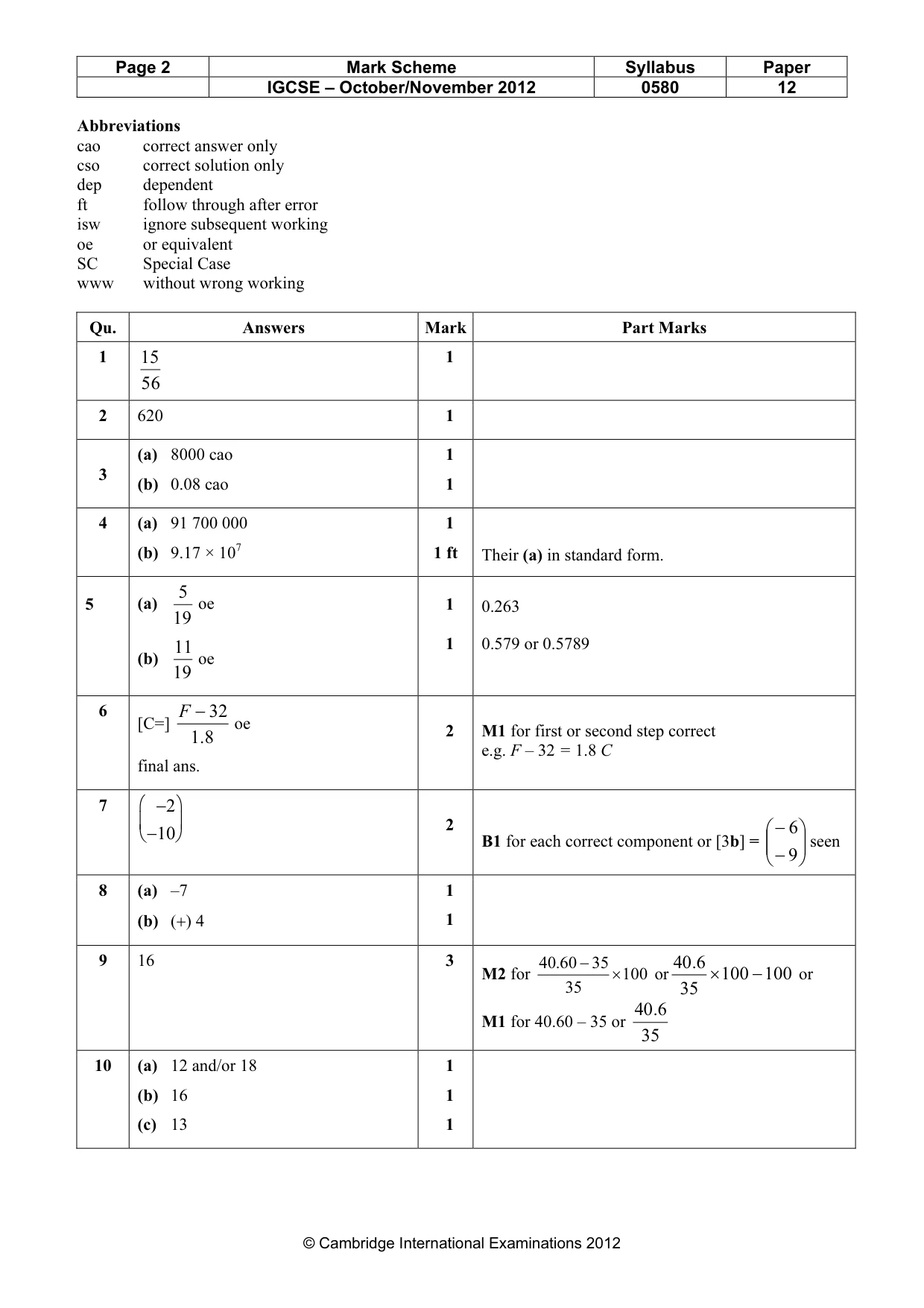
Mark scheme: 1 15 1 56
Q2 · Amisi travelled from Johannesburg to Cairo
2 Amisi travelled from Johannesburg to Cairo. She changed 500 Egyptian pounds (EGP) to South African rand (ZAR) when the exchange rate was 1 EGP = 1.24 ZAR. Calculate the amount she received. Answer ZAR [1]
Mark scheme: 2 620 1 (a) 8000 cao 1
Q3 · Write the following numbers correct to one significant figure
3 Write the following numbers correct to one significant figure. (a) 7682 Answer(a) [1] (b) 0.07682 Answer(b) [1]
Mark scheme: 3 (b) 0.08 cao 1
Q4 · Mars is ninety-one million, seven hundred thousand kilometres from Earth
4 Mars is ninety-one million, seven hundred thousand kilometres from Earth. (a) Write this number in figures. Answer(a) [1] (b) Write your answer to part (a) in standard form. Answer(b) [1]
Mark scheme: 4 (a) 91 700 000 1 (b) 9.17 × 10⁷ 1 ft Their (a) in standard form. 5
Q5 · A bowl of fruit contains only 8 peaches, 5 oranges and 6 apples
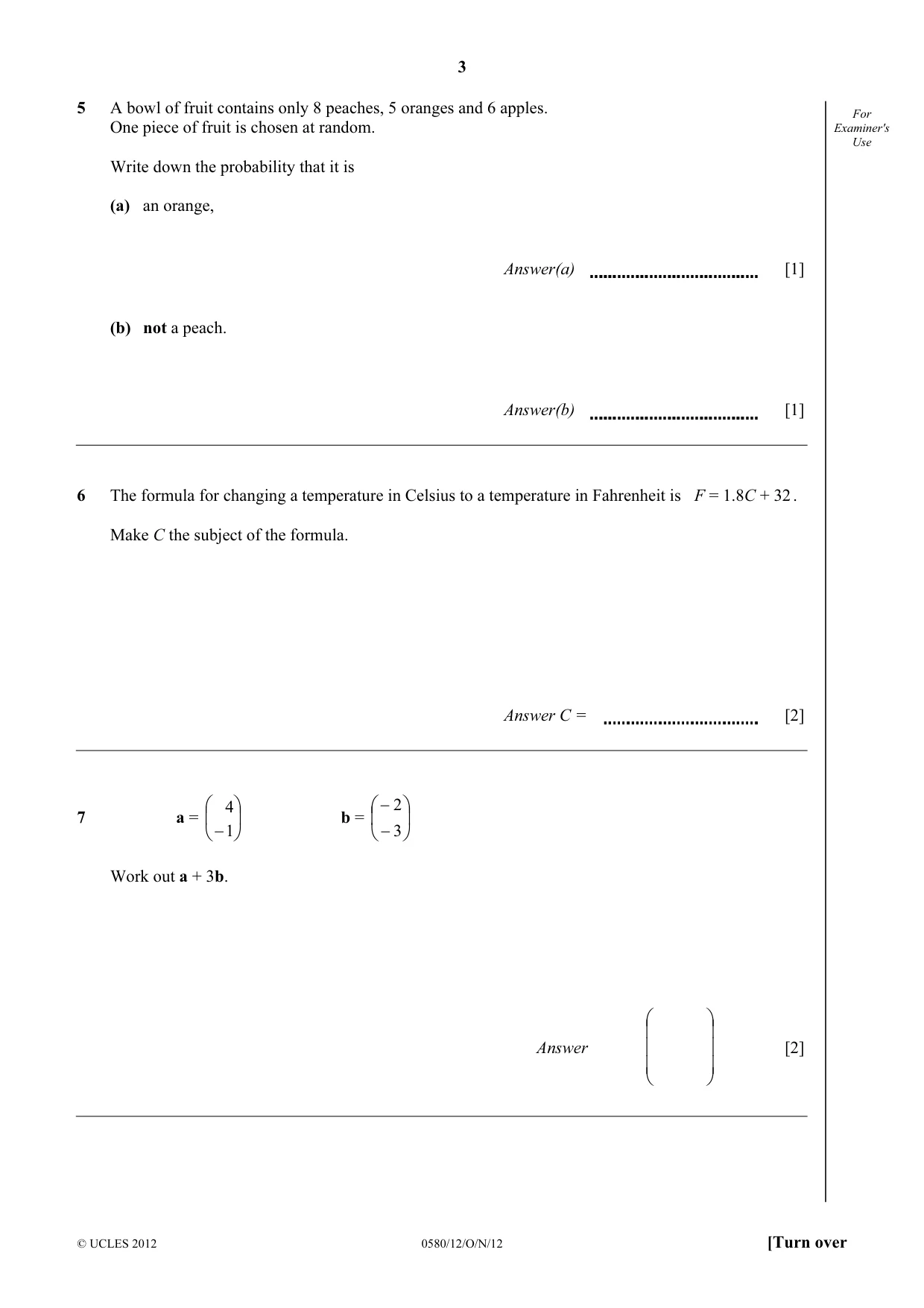
5 A bowl of fruit contains only 8 peaches, 5 oranges and 6 apples. For One piece of fruit is chosen at random. Examiner's Use Write down the probability that it is (a) an orange, Answer(a) [1] (b) not a peach. Answer(b) [1]
Mark scheme: 5 5 (a) oe 1 0.263 19 11 1 0.579 or 0.5789 (b) oe 19
Q6 · The formula for changing a temperature in Celsius to a temperature in Fahrenheit is F =…
6 The formula for changing a temperature in Celsius to a temperature in Fahrenheit is F = 1.8C + 32 . Make C the subject of the formula. Answer C = [2]
Mark scheme: 6 F −32 [C=] oe 1.8 2 M1 for first or second step correct e.g. F – 32 = 1.8 C final ans.
Q7 · 4 − 2 7 a = b = −1 − 3 Work out a + 3b
4 − 2 7 a = b = −1 − 3 Work out a + 3b. Answer [2]
Mark scheme: 7 −2 2 − 6 −10 B1 for each correct component or [3b] = seen − 9
Question 8
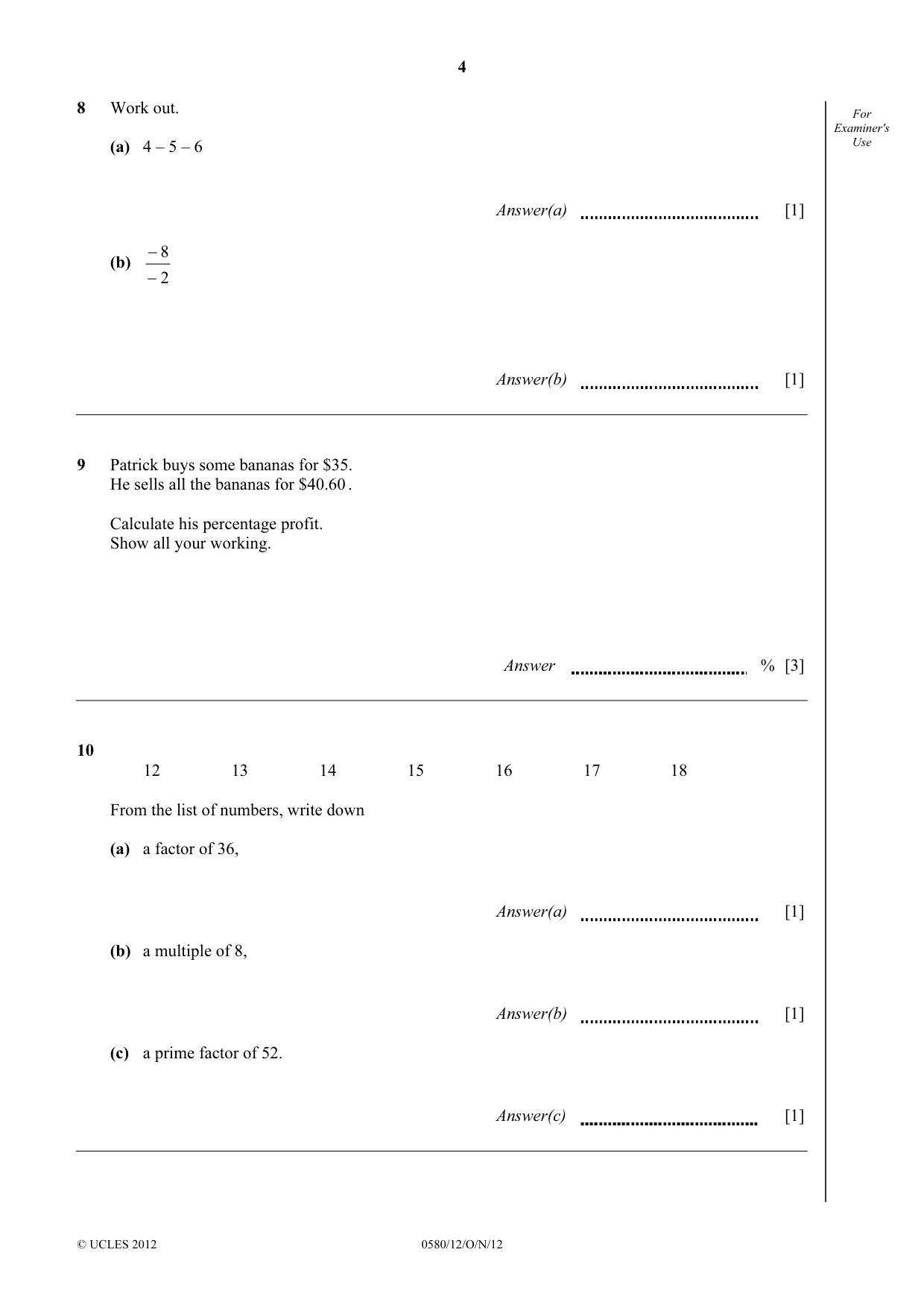
8 Work out. For Examiner's Use (a) 4 – 5 – 6 Answer(a) [1] − 8 (b) − 2 Answer(b) [1]
Mark scheme: 8 (a) –7 1 (b) (+) 4 1
Q9 · Patrick buys some bananas for $35
9 Patrick buys some bananas for $35. He sells all the bananas for $40.60 . Calculate his percentage profit. Show all your working. Answer % [3]
Mark scheme: 9 16 3 40.60 − 35 40 6. M2 for × 100 or × 100 − 100 or 35 35 40 6. M1 for 40.60 – 35 or 35
Q10 · 12 13 14 15 16 17 18 From the list of numbers, write down (a) a factor of 36, Answer(a)…
10 12 13 14 15 16 17 18 From the list of numbers, write down (a) a factor of 36, Answer(a) [1] (b) a multiple of 8, Answer(b) [1] (c) a prime factor of 52. Answer(c) [1]
Mark scheme: 10 (a) 12 and/or 18 1 (b) 16 1 (c) 13 1 IGCSE – October/November 2012 0580 12
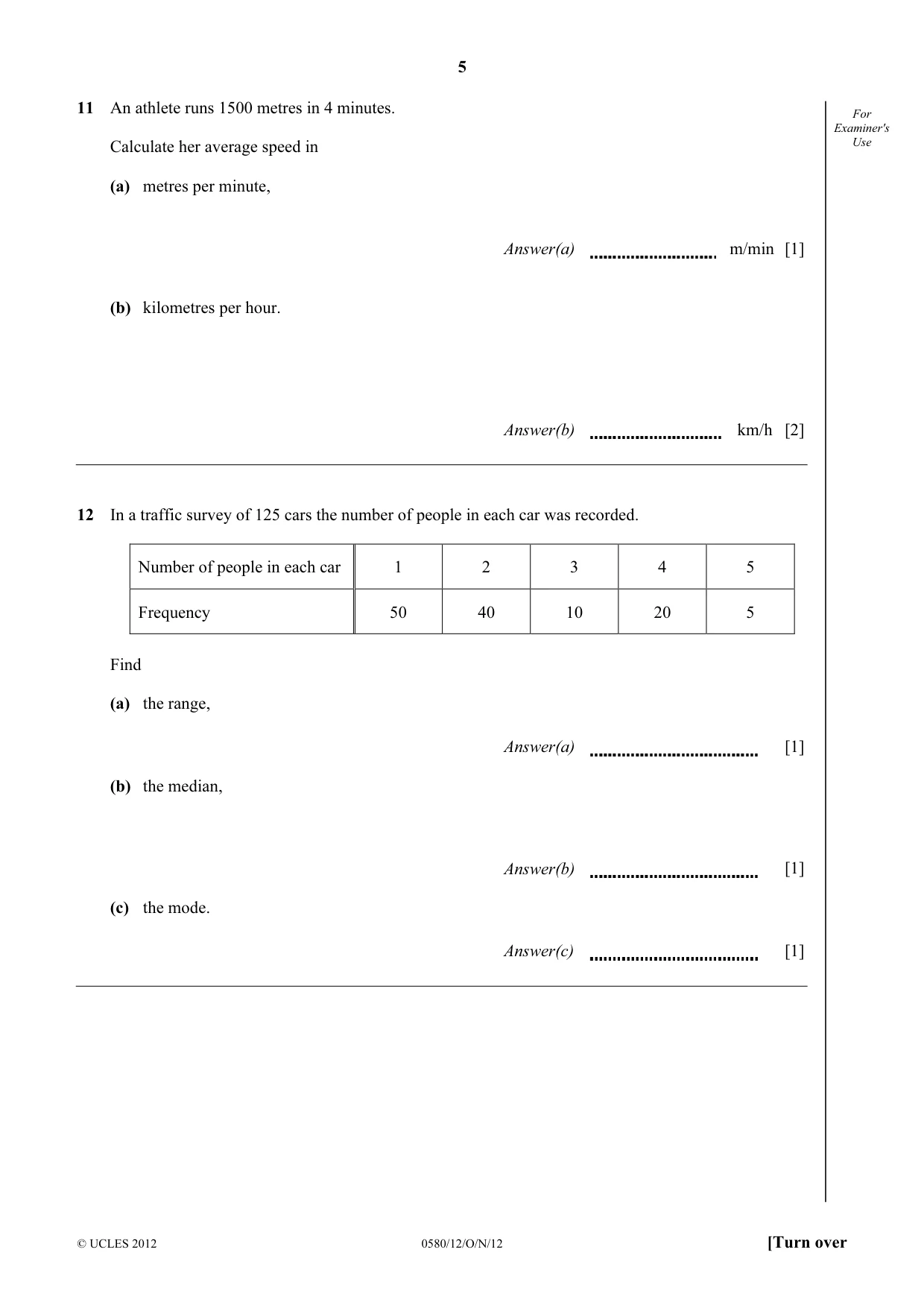
Q11 · An athlete runs 1500 metres in 4 minutes
11 An athlete runs 1500 metres in 4 minutes. For Examiner's Use Calculate her average speed in (a) metres per minute, Answer(a) m/min [1] (b) kilometres per hour. Answer(b) km/h [2]
Mark scheme: 11 (a) 375 1 (b) 22.5 2 ft M1 for their (a) ÷ 1000 × 60 or 1500 × 15 ÷ 1000 If zero SC1 for answer figs 225
Q12 · In a traffic survey of 125 cars the number of people in each car was recorded
12 In a traffic survey of 125 cars the number of people in each car was recorded. Number of people in each car 1 2 3 4 5 Frequency 50 40 10 20 5 Find (a) the range, Answer(a) [1] (b) the median, Answer(b) [1] (c) the mode. Answer(c) [1]
Mark scheme: 12 (a) 4 1 (b) 2 1 (c) 1 cao 1
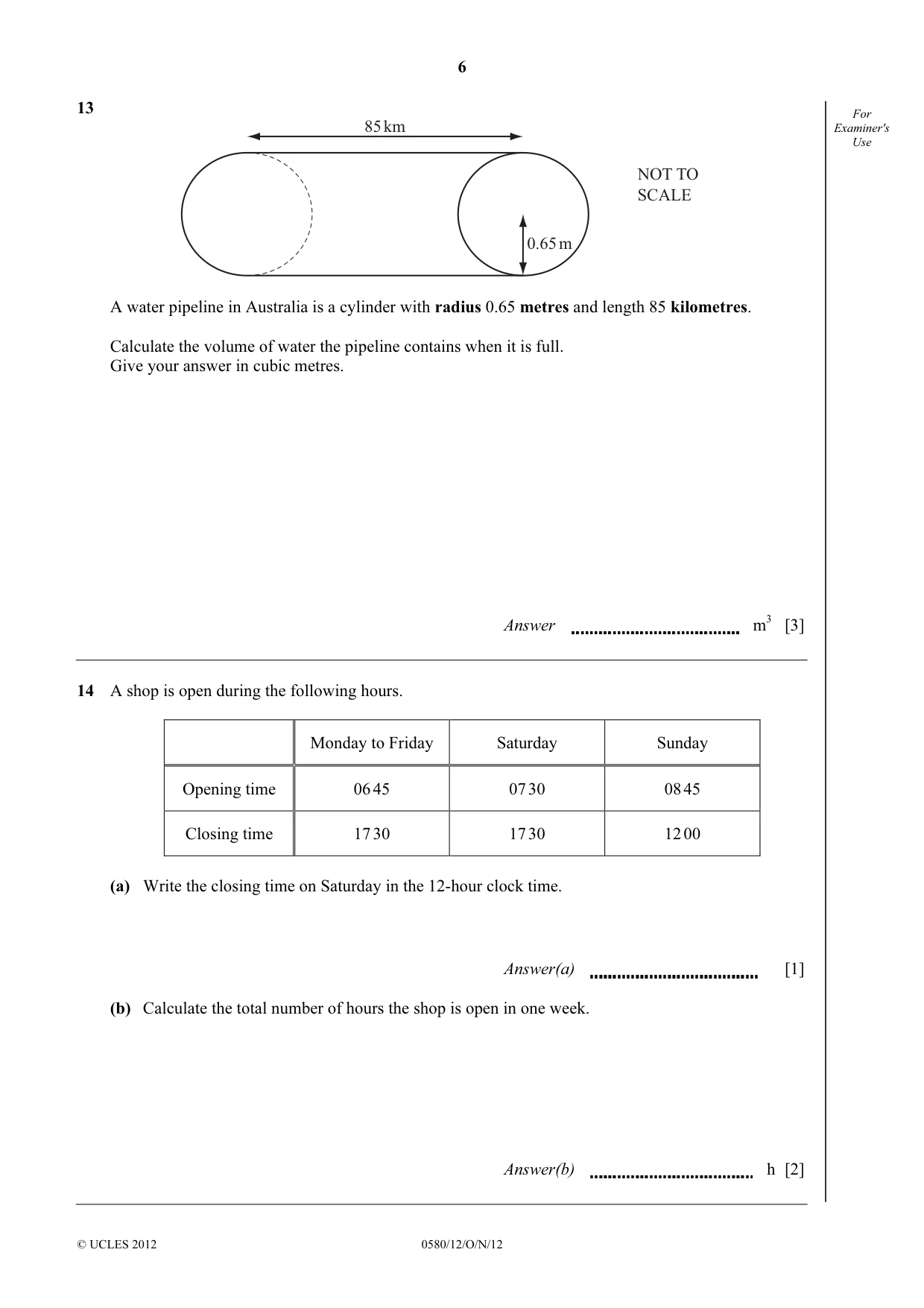
Q13 · For 85 km Examiner's Use NOT TO SCALE 0.65 m A water pipeline in Australia is a cylinder…
13 For 85 km Examiner's Use NOT TO SCALE 0.65 m A water pipeline in Australia is a cylinder with radius 0.65 metres and length 85 kilometres. Calculate the volume of water the pipeline contains when it is full. Give your answer in cubic metres. Answer m3 [3]
Mark scheme: 13 113 000 or 3 B1 for 85 000 112 795 to 112 840 M1 for π × 0.65 2 × figs 85
Q14 · A shop is open during the following hours
14 A shop is open during the following hours. Monday to Friday Saturday Sunday Opening time 06 45 07 30 08 45 Closing time 17 30 17 30 12 00 (a) Write the closing time on Saturday in the 12-hour clock time. Answer(a) [1] (b) Calculate the total number of hours the shop is open in one week. Answer(b) h [2]
Mark scheme: 14 (a) 5 30 pm 1 (b) 67 2 M1 for 10h 45min and 3h 15min, oe seen or 53.75 and 3.25 or 53.45 and 3.15
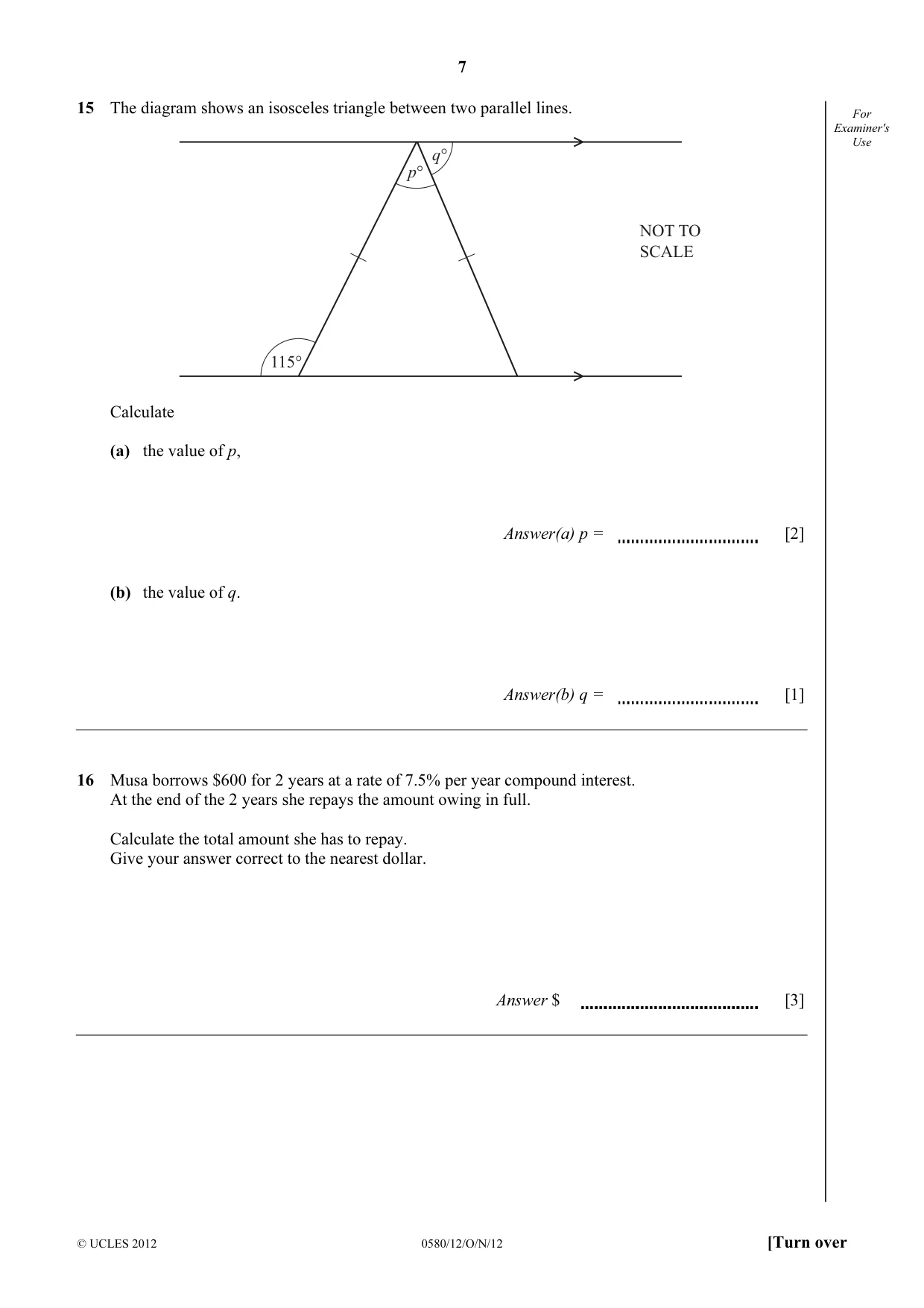
Q15 · The diagram shows an isosceles triangle between two parallel lines
15 The diagram shows an isosceles triangle between two parallel lines. For Examiner's Use q° p° NOT TO SCALE 115° Calculate (a) the value of p, Answer(a) p = [2] (b) the value of q. Answer(b) q = [1]
Mark scheme: 15 (a) 50 2 M1 for method of finding base angle of isosceles triangle (could be on diagram). (b) 65 1 ft 115 – their (a) or (180 – their (a)) ÷ 2 7 5 2 ($) 693 ( 00)
Q16 · Musa borrows $600 for 2 years at a rate of 7.5% per year compound interest
16 Musa borrows $600 for 2 years at a rate of 7.5% per year compound interest. At the end of the 2 years she repays the amount owing in full. Calculate the total amount she has to repay. Give your answer correct to the nearest dollar. Answer $ [3]
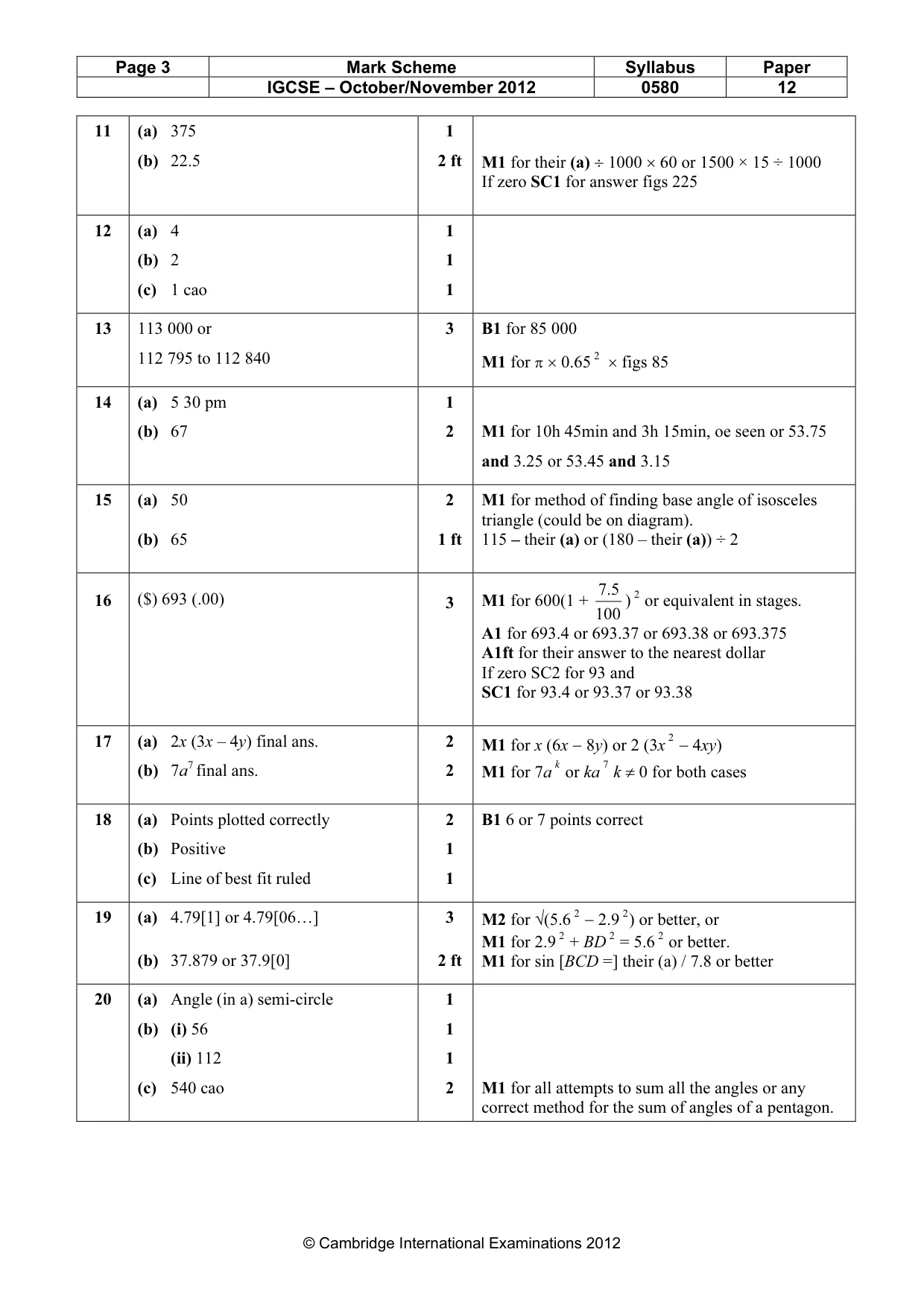
Mark scheme: 5.7 2 16 ($) 693 (.00) 3 M1 for 600(1 + ) or equivalent in stages. 100 A1 for 693.4 or 693.37 or 693.38 or 693.375 A1ft for their answer to the nearest dollar If zero SC2 for 93 and SC1 for 93.4 or 93.37 or 93.38
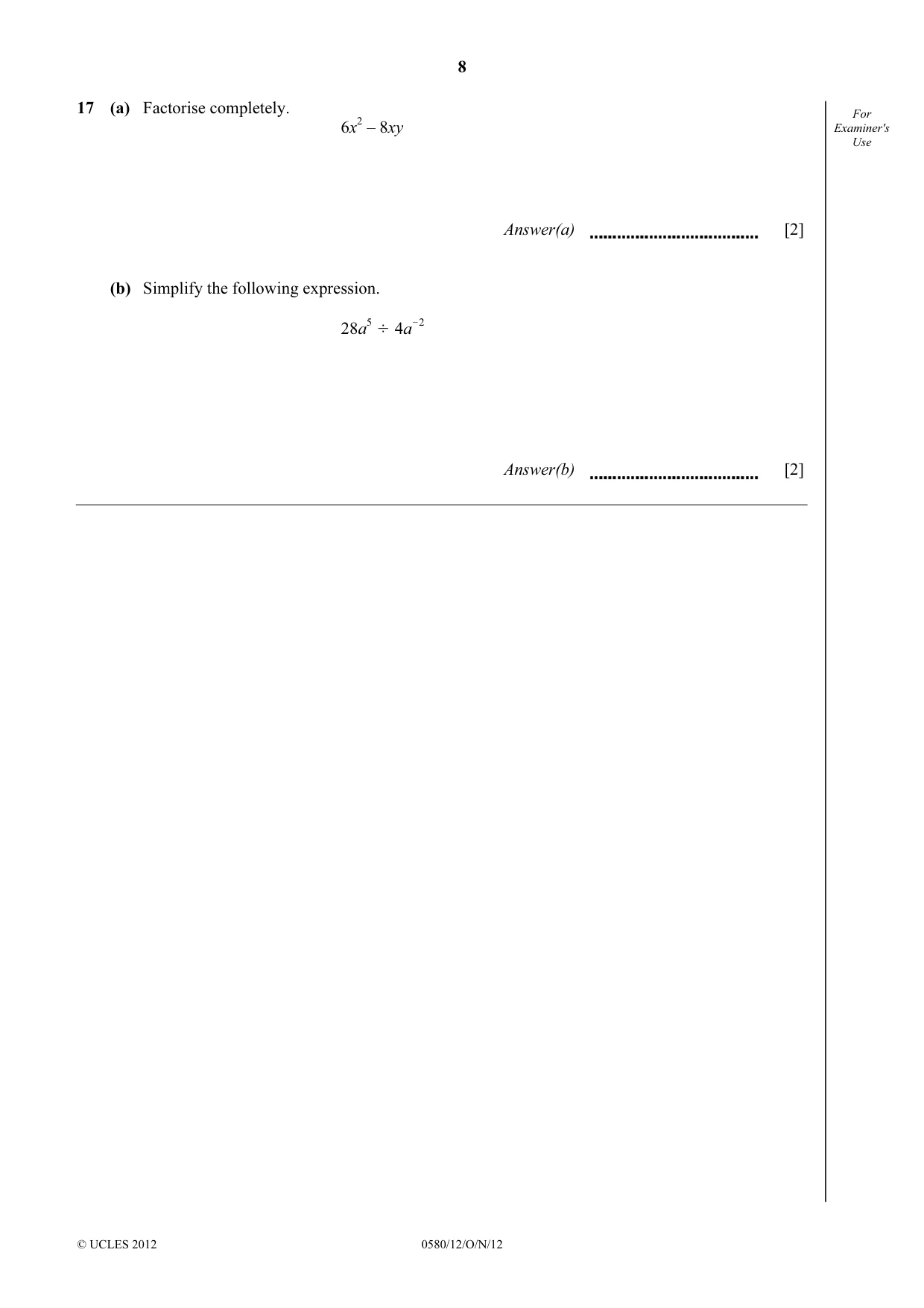
Question 17
17 (a) Factorise completely. For Examiner's 6x2 – 8xy Use Answer(a) [2] (b) Simplify the following expression. 28a5 Q 4aO2 Answer(b) [2]
Mark scheme: 17 (a) 2x (3x – 4y) final ans. 2 M1 for x (6x − 8y) or 2 (3x 2 − 4xy) (b) 7a7 final ans. 2 M1 for 7a k or ka 7 k ≠ 0 for both cases
Q18 · A company sends out ten different questionnaires to its customers
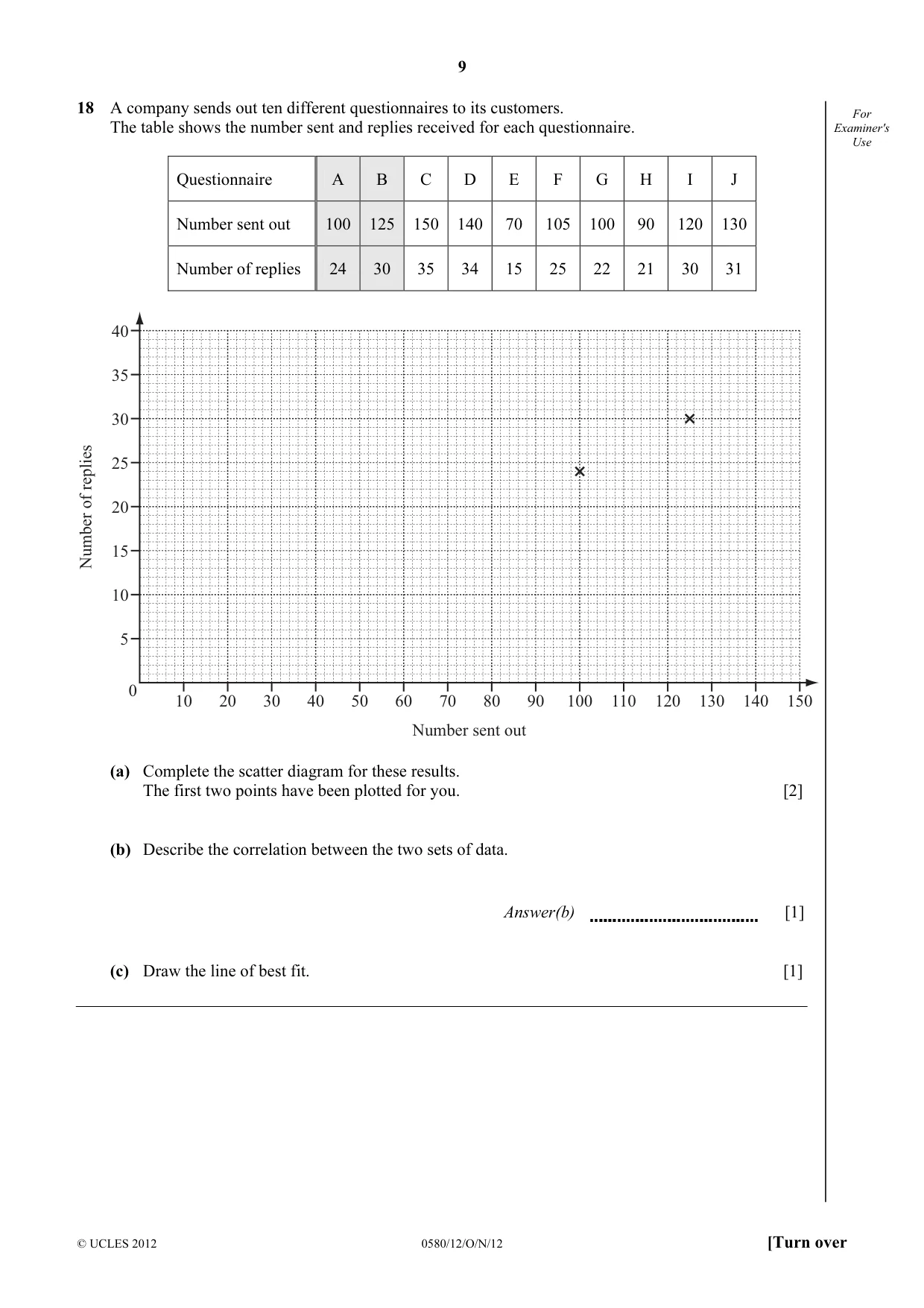
18 A company sends out ten different questionnaires to its customers. For The table shows the number sent and replies received for each questionnaire. Examiner's Use Questionnaire A B C D E F G H I J Number sent out 100 125 150 140 70 105 100 90 120 130 Number of replies 24 30 35 34 15 25 22 21 30 31 40 35 30 25replies of 20 15Number 10 5 0 10 20 30 40 50 60 70 80 90 100 110 120 130 140 150 Number sent out (a) Complete the scatter diagram for these results. The first two points have been plotted for you. [2] (b) Describe the correlation between the two sets of data. Answer(b) [1] (c) Draw the line of best fit. [1]
Mark scheme: 18 (a) Points plotted correctly 2 B1 6 or 7 points correct (b) Positive 1 (c) Line of best fit ruled 1 √
Q19 · For D Examiner's Use NOT TO SCALE 7.8 m 5.6 m A B C 2.9 m (a) Calculate BD
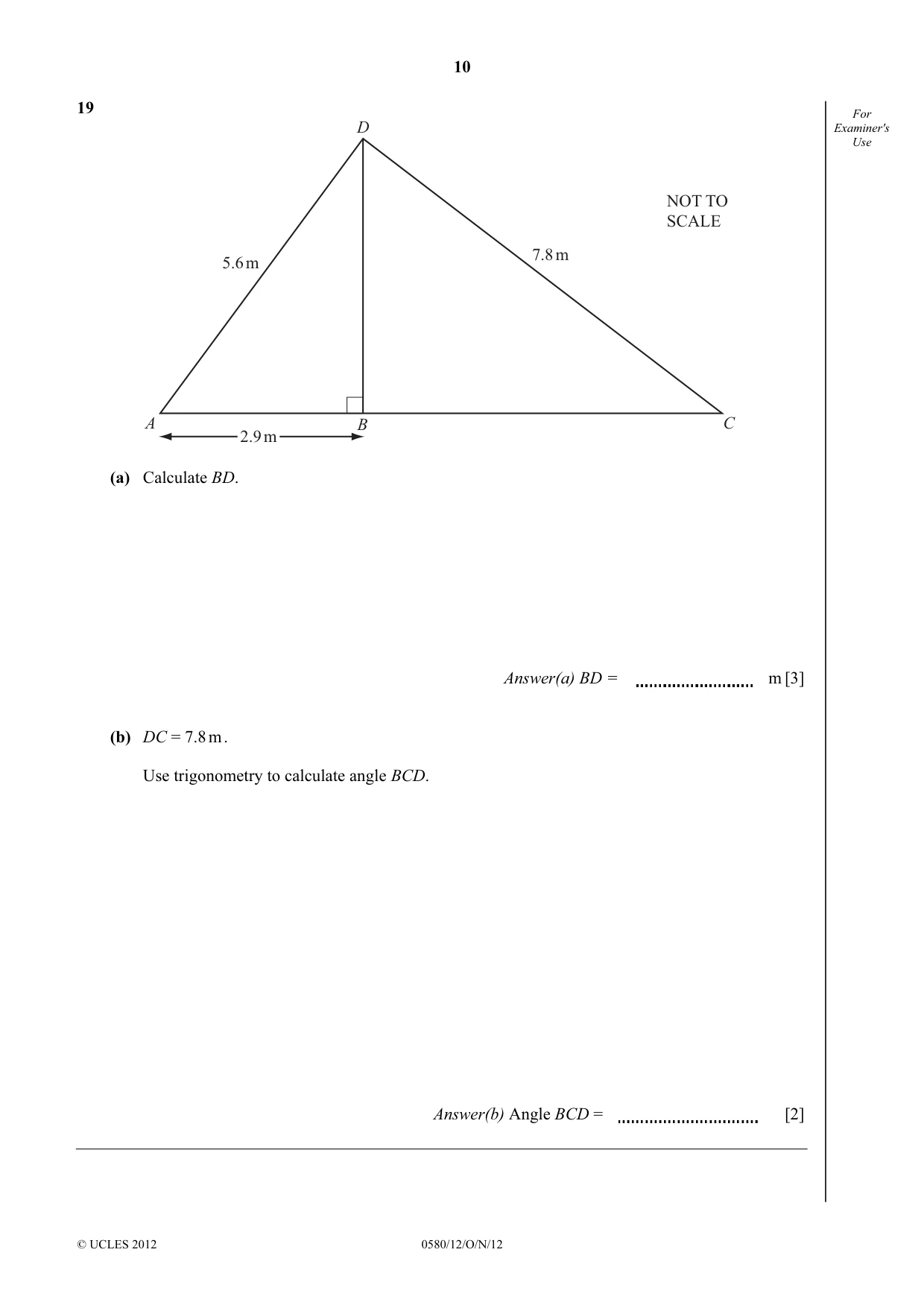
19 For D Examiner's Use NOT TO SCALE 7.8 m 5.6 m A B C 2.9 m (a) Calculate BD. Answer(a) BD = m [3] (b) DC = 7.8 m . Use trigonometry to calculate angle BCD. Answer(b) Angle BCD = [2]
Mark scheme: 19 (a) 4.79[1] or 4.79[06…] 3 M2 for √(5.6 2 − 2.9 2) or better, or 2 2 2 M1 for 2.9 + BD = 5.6 or better. (b) 37.879 or 37.9[0] 2 ft M1 for sin [BCD =] their (a) / 7.8 or better
Q20 · For A Examiner's Use B NOT TO 34° SCALE E 68° D C The points A, B, C, D and E lie on a…
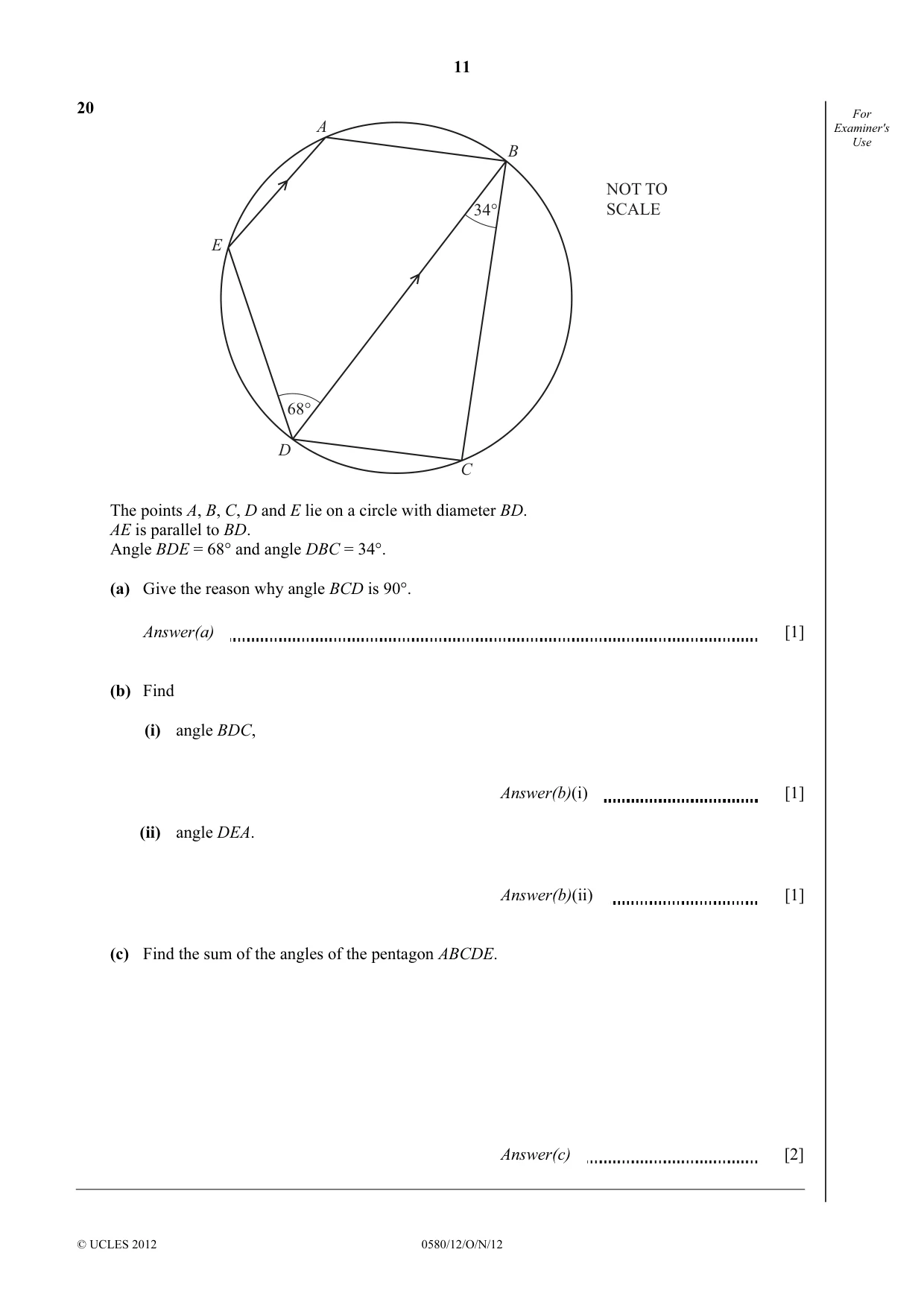
20 For A Examiner's Use B NOT TO 34° SCALE E 68° D C The points A, B, C, D and E lie on a circle with diameter BD. AE is parallel to BD. Angle BDE = 68° and angle DBC = 34°. (a) Give the reason why angle BCD is 90°. Answer(a) [1] (b) Find (i) angle BDC, Answer(b)(i) [1] (ii) angle DEA. Answer(b)(ii) [1] (c) Find the sum of the angles of the pentagon ABCDE. Answer(c) [2]
Mark scheme: 20 (a) Angle (in a) semi-circle 1 (b) (i) 56 1 (ii) 112 1 (c) 540 cao 2 M1 for all attempts to sum all the angles or any correct method for the sum of angles of a pentagon.
What was in this paper
The subtopics covered by these 20 questions, and how many questions each got. Open one in a new tab to see every Cambridge question on it.
2Percentages2Types of number2Angles1Averages and range1Circle theorems1Fractions, decimals and percentages1Introduction to probability1Limits of accuracy1Money1Pythagoras’ theorem1Rates1Scatter diagrams1Surface area and volume1The four operations1Time1Vectors in two dimensions1