Cambridge IGCSE Mathematics 0580 — 2010 May/June Paper 1 · Variant 1
0580/11/M/J/10 · 17 questions · 56 marks · ≈63 min
The question paper and its mark scheme, free to read here and free to download. This is Cambridge’s own paper, exactly as it was sat.
Question paper8 pages
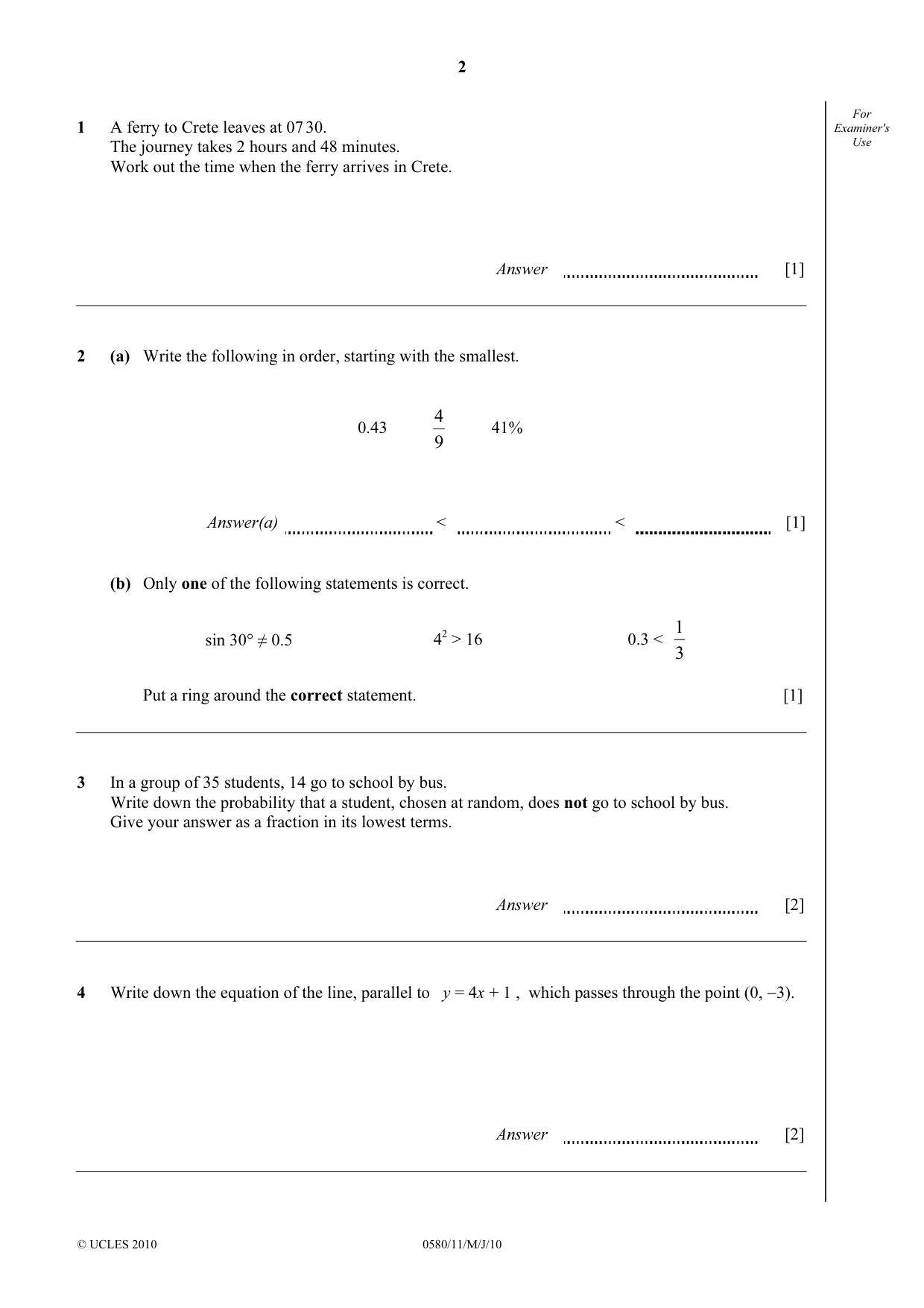
Mark scheme3 pages
Answers below. Sit the paper first if you are practising.
Questions as text
Q1 · A ferry to Crete leaves at 07 30
1 A ferry to Crete leaves at 07 30. Examiner's The journey takes 2 hours and 48 minutes. Use Work out the time when the ferry arrives in Crete. Answer [1]
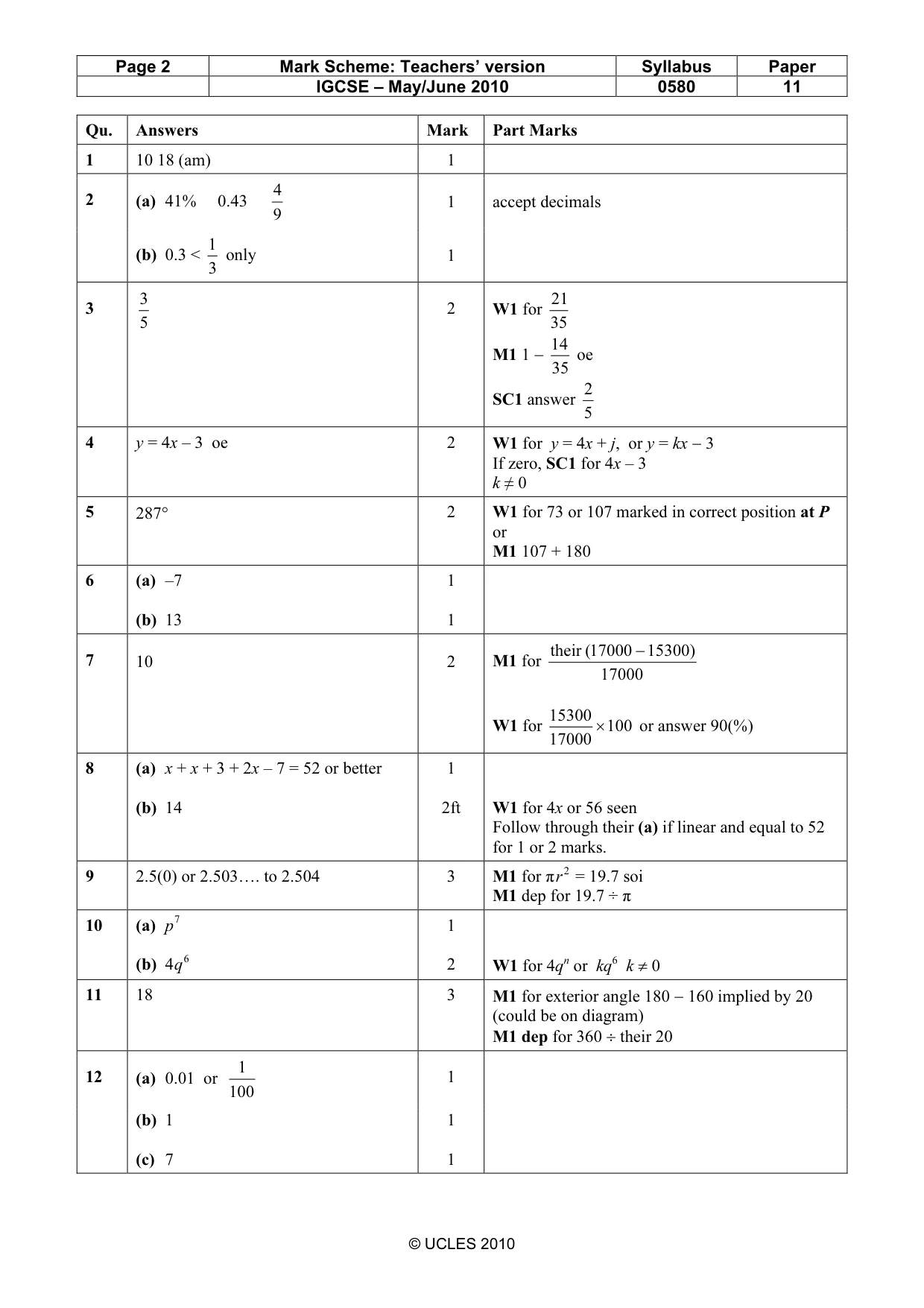
Mark scheme: Qu. Answers Mark Part Marks 1 10 18 (am) 1 4 2 (a) 41% 0.43 1 accept decimals 9 1 (b) 0.3 < only 1 3 3 21
Q3 · In a group of 35 students, 14 go to school by bus
3 In a group of 35 students, 14 go to school by bus. Write down the probability that a student, chosen at random, does not go to school by bus. Give your answer as a fraction in its lowest terms. Answer [2]
Mark scheme: 3 21 3 2 W1 for 5 35 14 M1 1 − oe 35 2 SC1 answer 5
Q4 · Write down the equation of the line, parallel to y = 4x + 1 , which passes through the…
4 Write down the equation of the line, parallel to y = 4x + 1 , which passes through the point (0, −3). Answer [2]
Mark scheme: 4 y = 4x – 3 oe 2 W1 for y = 4x + j, or y = kx − 3 If zero, SC1 for 4x – 3 k ≠ 0
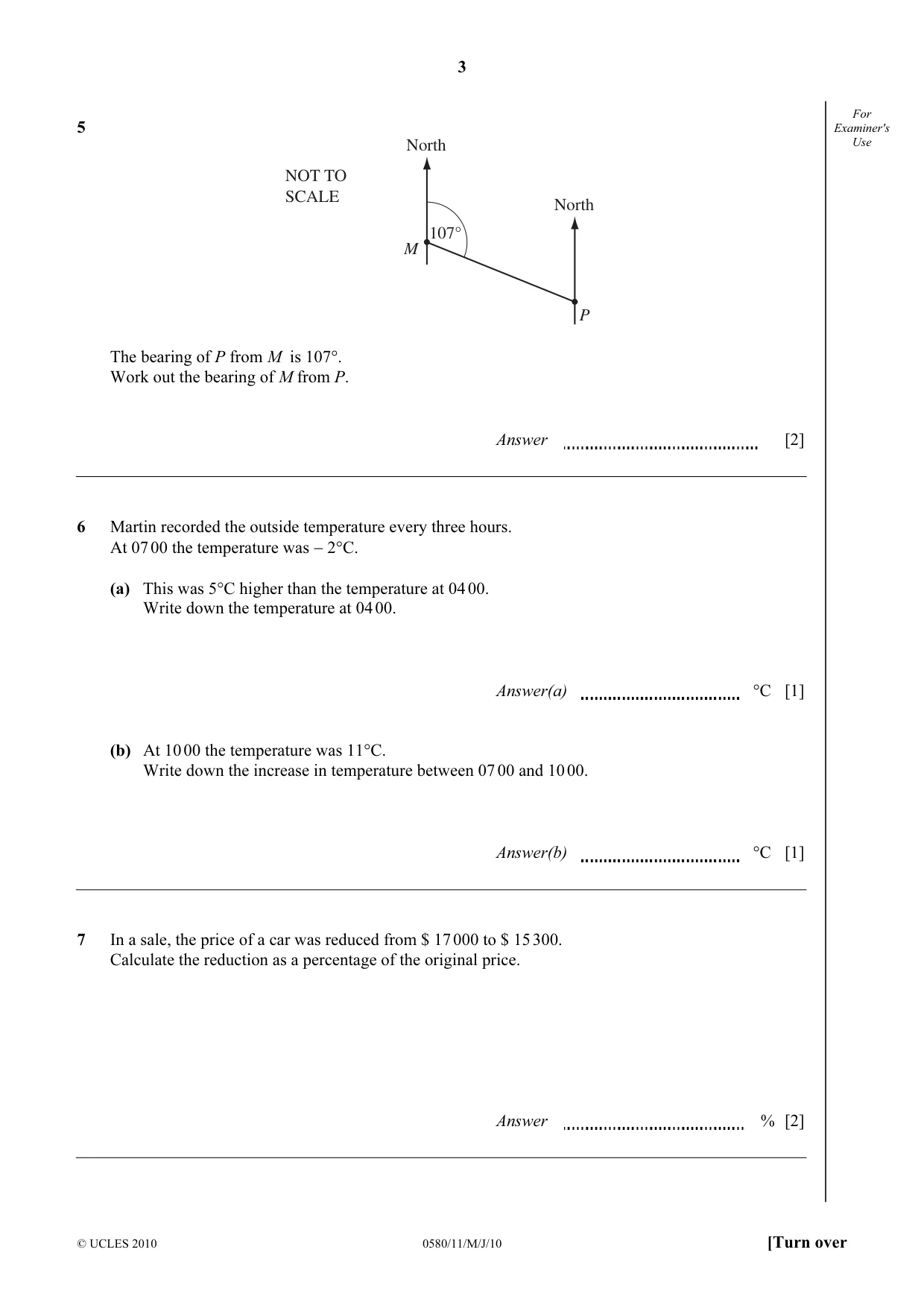
Q5 · Examiner's North Use NOT TO SCALE North 107° M P The bearing of P from M is 107°
5 Examiner's North Use NOT TO SCALE North 107° M P The bearing of P from M is 107°. Work out the bearing of M from P. Answer [2]
Mark scheme: 5 287° 2 W1 for 73 or 107 marked in correct position at P or M1 107 + 180
Q6 · Martin recorded the outside temperature every three hours
6 Martin recorded the outside temperature every three hours. At 07 00 the temperature was − 2°C. (a) This was 5°C higher than the temperature at 04 00. Write down the temperature at 04 00. Answer(a) °C [1] (b) At 10 00 the temperature was 11°C. Write down the increase in temperature between 07 00 and 10 00. Answer(b) °C [1]
Mark scheme: 6 (a) –7 1 (b) 13 1 their (17000 − 15300 )7 10 2 M1 for 17000 15300 W1 for × 100 or answer 90(%) 17000
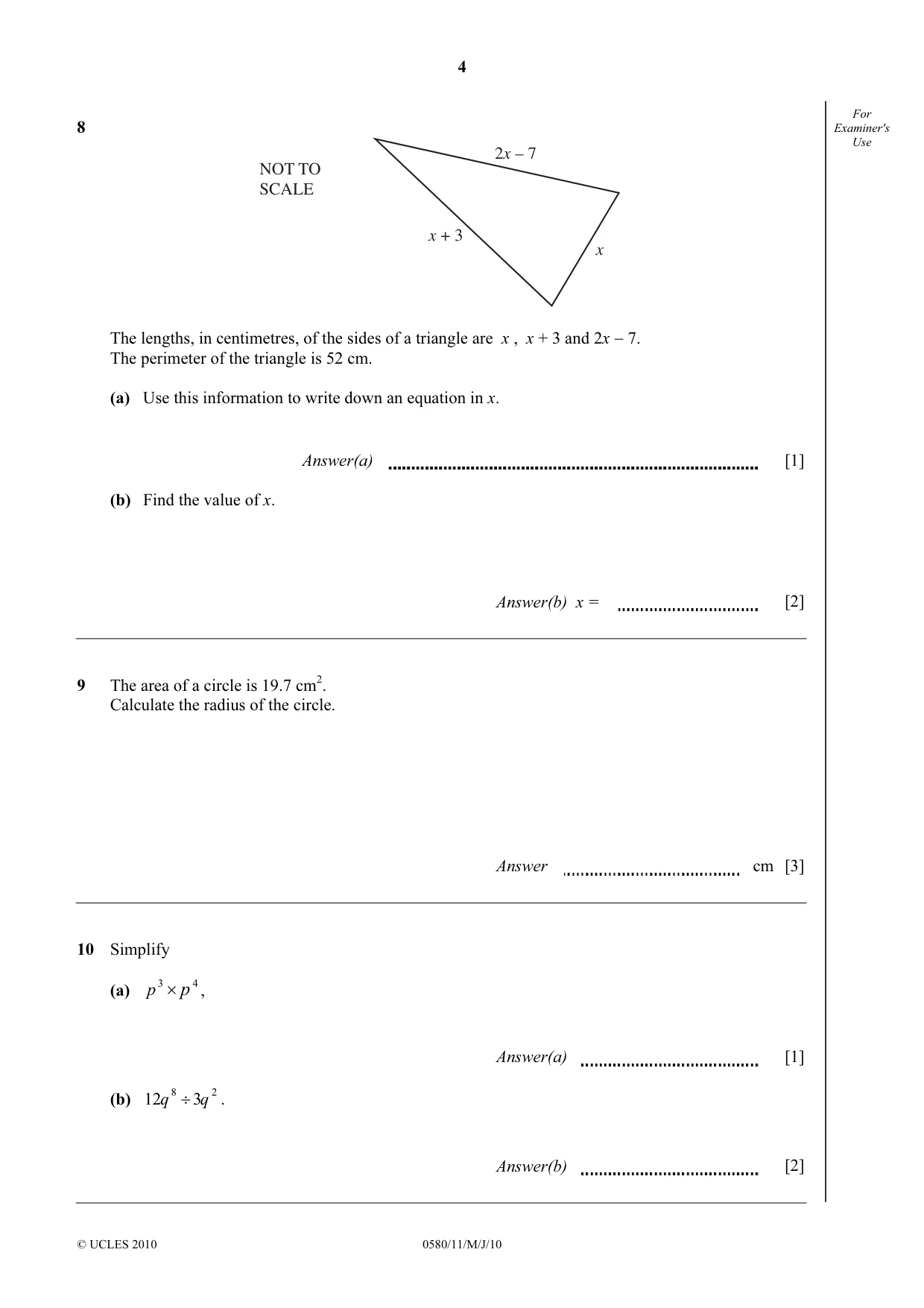
Q8 · Examiner's Use 2x – 7 NOT TO SCALE x + 3 x The lengths, in centimetres, of the sides of a…
8 Examiner's Use 2x – 7 NOT TO SCALE x + 3 x The lengths, in centimetres, of the sides of a triangle are x , x + 3 and 2x − 7. The perimeter of the triangle is 52 cm. (a) Use this information to write down an equation in x. Answer(a) [1] (b) Find the value of x. Answer(b) x = [2]
Mark scheme: 8 (a) x + x + 3 + 2x – 7 = 52 or better 1 (b) 14 2ft W1 for 4x or 56 seen Follow through their (a) if linear and equal to 52 for 1 or 2 marks.
Q9 · The area of a circle is 19.7 cm2
9 The area of a circle is 19.7 cm2. Calculate the radius of the circle. Answer cm [3]
Mark scheme: 9 2.5(0) or 2.503…. to 2.504 3 M1 for πr2 = 19.7 soi M1 dep for 19.7 ÷ π
Q10 · Simplify (a) p 3 × p 4 , Answer(a) [1] (b) 12q 8 ÷ 3q 2
10 Simplify (a) p 3 × p 4 , Answer(a) [1] (b) 12q 8 ÷ 3q 2 . Answer(b) [2]
Mark scheme: 10 (a) p7 1 (b) 4q6 2 W1 for 4qn or kq6 k ≠ 0
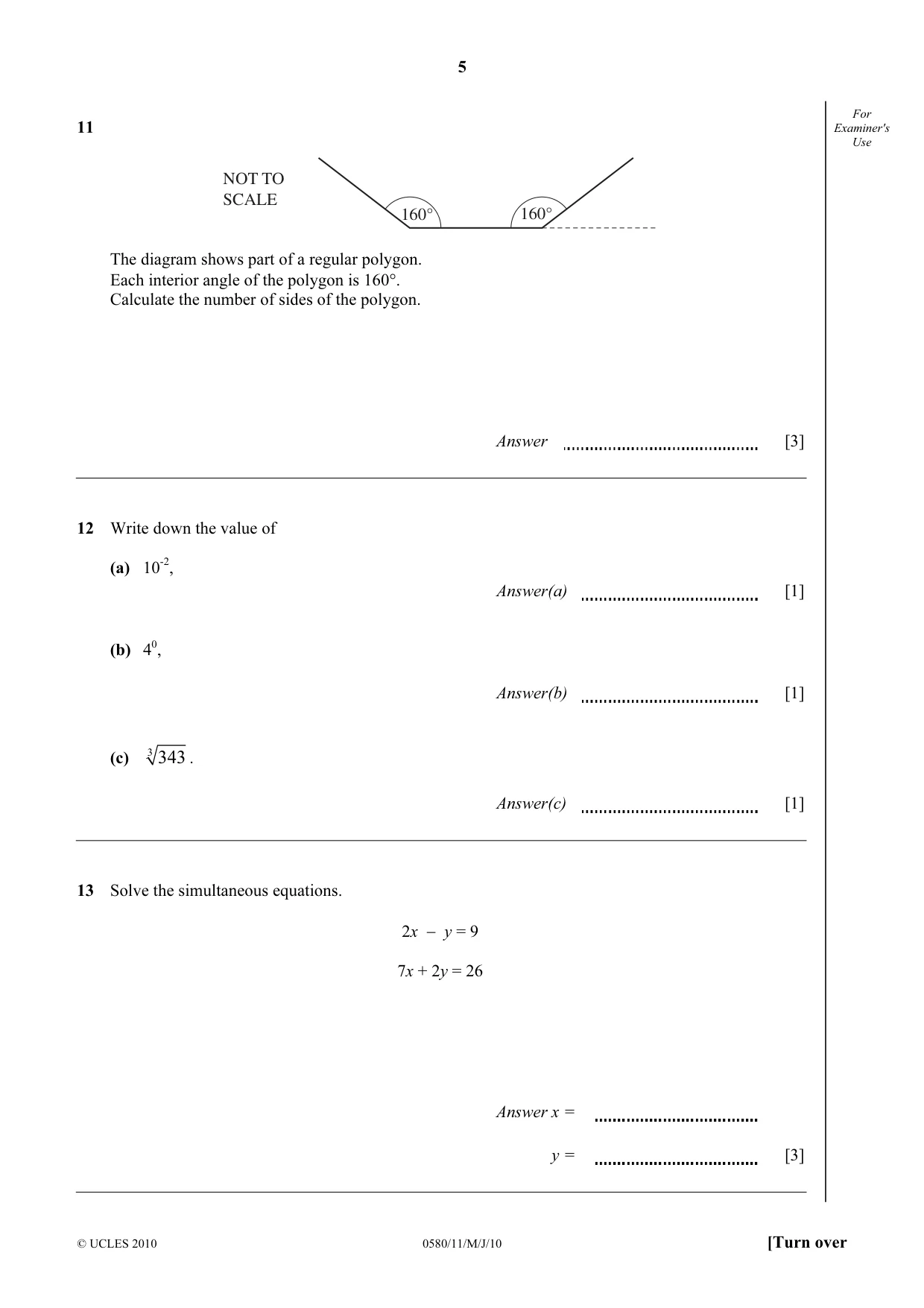
Q11 · Examiner's Use NOT TO SCALE 160° 160° The diagram shows part of a regular polygon
11 Examiner's Use NOT TO SCALE 160° 160° The diagram shows part of a regular polygon. Each interior angle of the polygon is 160°. Calculate the number of sides of the polygon. Answer [3]
Mark scheme: 11 18 3 M1 for exterior angle 180 − 160 implied by 20 (could be on diagram) M1 dep for 360 ÷ their 20 1
Q12 · Write down the value of (a) 10-2, Answer(a) [1] (b) 40, Answer(b) [1] (c) 3 343
12 Write down the value of (a) 10-2, Answer(a) [1] (b) 40, Answer(b) [1] (c) 3 343 . Answer(c) [1]
Mark scheme: 1 12 (a) 0.01 or 1 100 (b) 1 1 (c) 7 1 IGCSE – May/June 2010 0580 11
Q13 · Solve the simultaneous equations
13 Solve the simultaneous equations. 2x − y = 9 7x + 2y = 26 Answer x = y = [3]
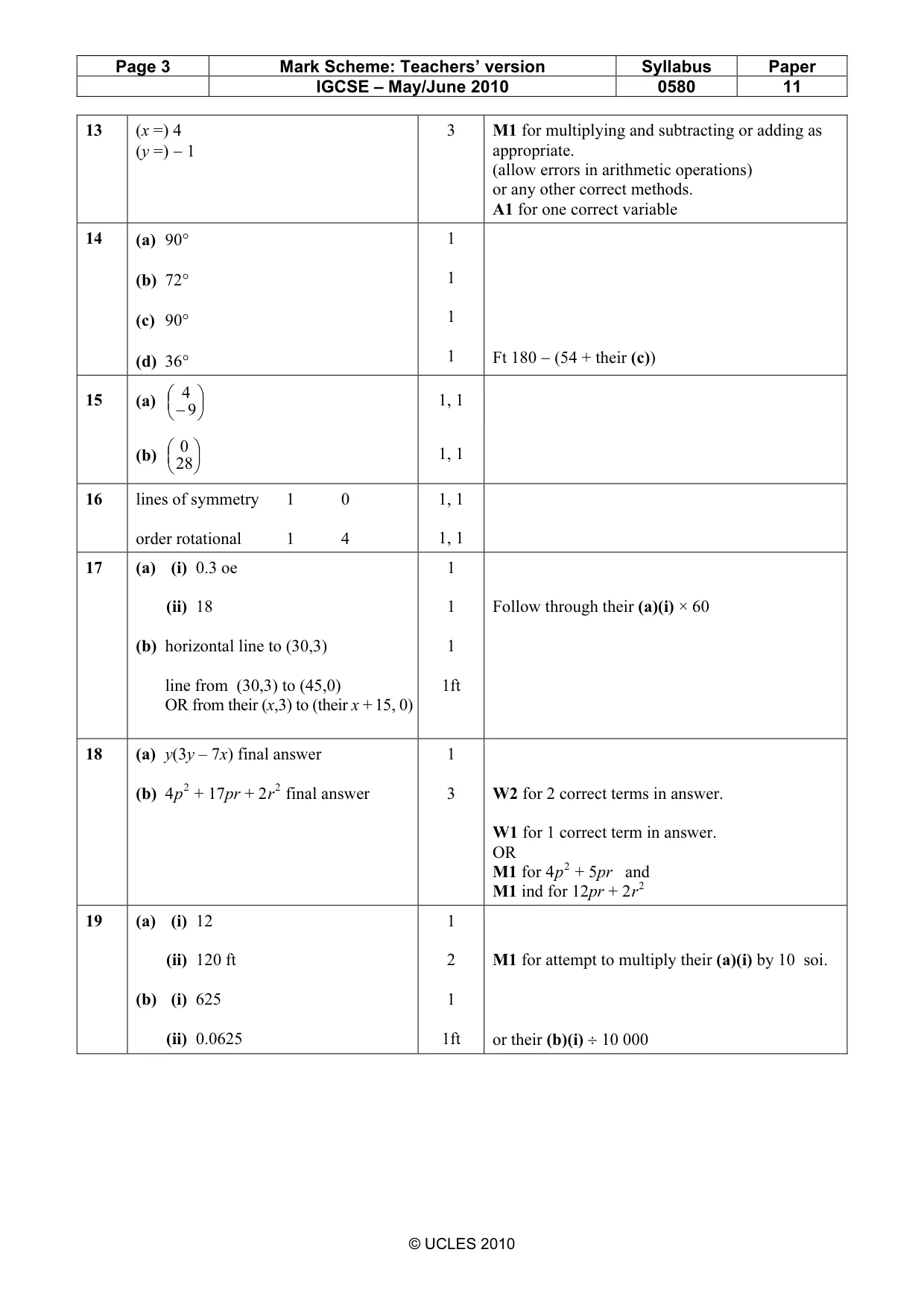
Mark scheme: 13 (x =) 4 3 M1 for multiplying and subtracting or adding as (y =) − 1 appropriate. (allow errors in arithmetic operations) or any other correct methods. A1 for one correct variable
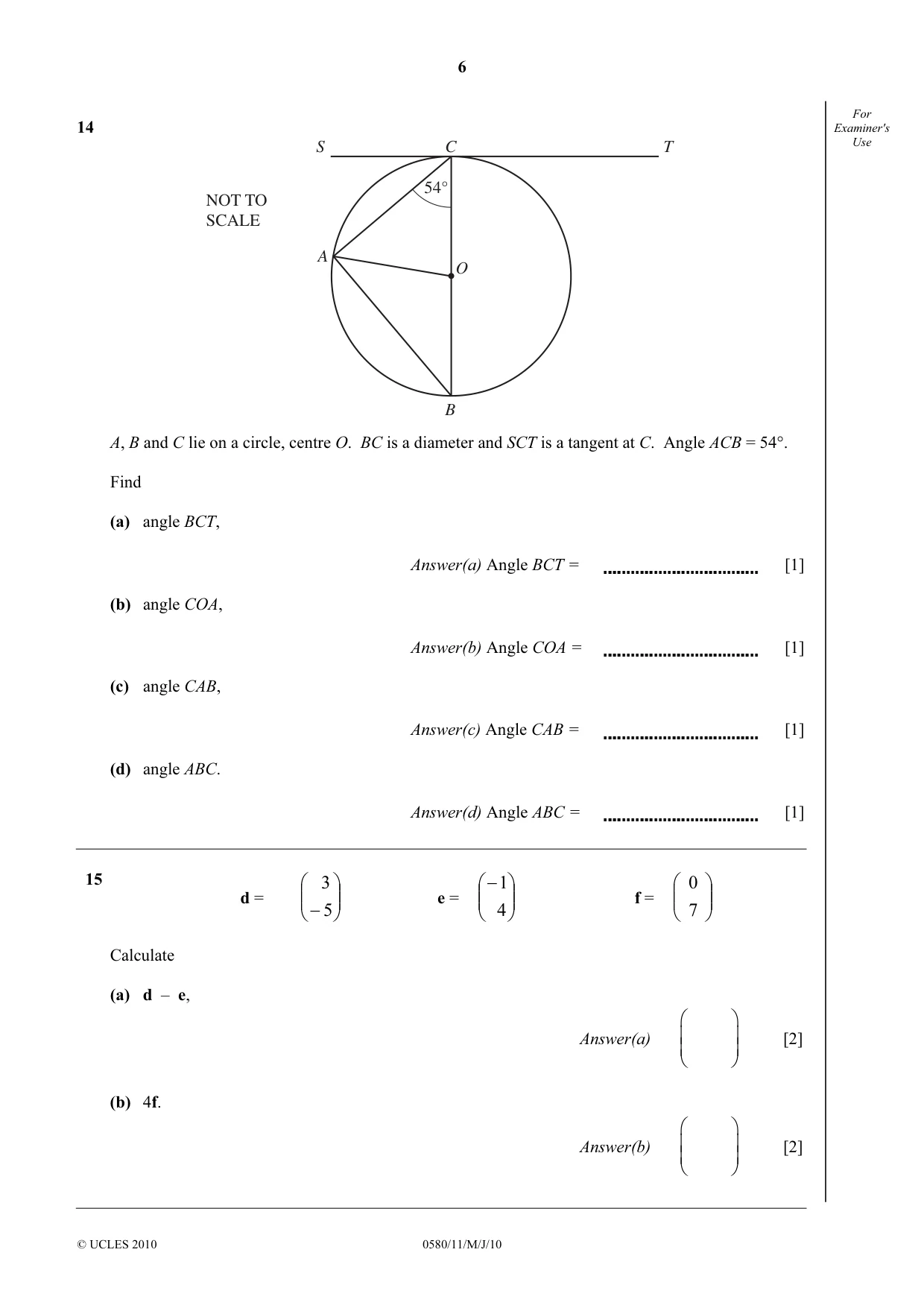
Q14 · Examiner's S C T Use 54° NOT TO SCALE A O B A, B and C lie on a circle, centre O
14 Examiner's S C T Use 54° NOT TO SCALE A O B A, B and C lie on a circle, centre O. BC is a diameter and SCT is a tangent at C. Angle ACB = 54°. Find (a) angle BCT, Answer(a) Angle BCT = [1] (b) angle COA, Answer(b) Angle COA = [1] (c) angle CAB, Answer(c) Angle CAB = [1] (d) angle ABC. Answer(d) Angle ABC = [1]
Mark scheme: 14 (a) 90° 1 (b) 72° 1 (c) 90° 1 (d) 36° 1 Ft 180 − (54 + their (c)) 4
Q15 · 3 − 1 0 d = e = f = −5 4 7 Calculate (a) d – e, …
15 3 − 1 0 d = e = f = −5 4 7 Calculate (a) d – e, Answer(a) [2] (b) 4f. Answer(b) [2]
Mark scheme: 15 (a) 4 1, 1 −9 (b) 0 1, 1 28
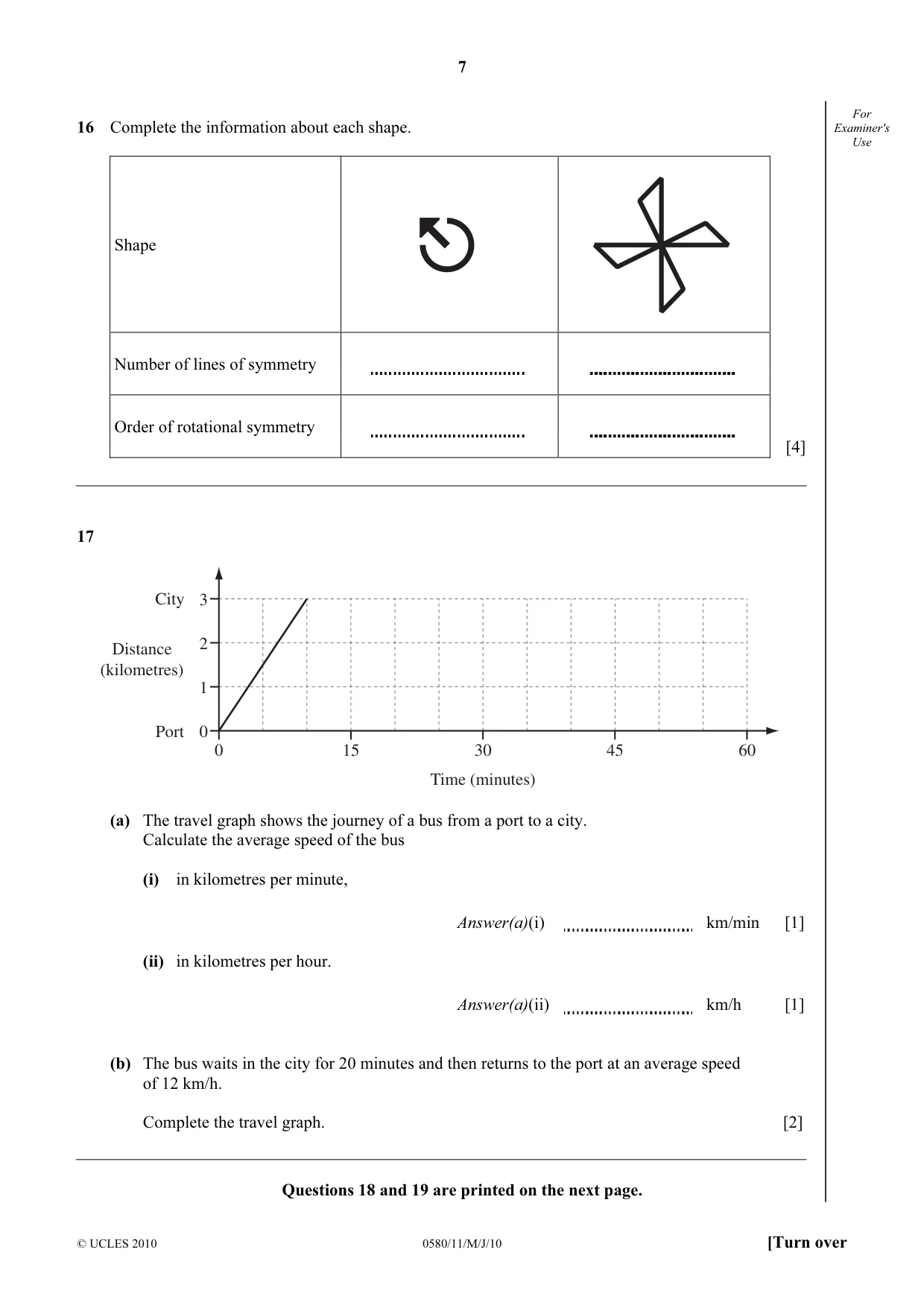
Q16 · Complete the information about each shape
16 Complete the information about each shape. Examiner's Use Shape Number of lines of symmetry Order of rotational symmetry [4]
Mark scheme: 16 lines of symmetry 1 0 1, 1 order rotational 1 4 1, 1
Q17 · City 3 2 Distance (kilometres) 1 Port 0 0 15 30 45 60 Time (minutes) (a) The travel graph…
17 City 3 2 Distance (kilometres) 1 Port 0 0 15 30 45 60 Time (minutes) (a) The travel graph shows the journey of a bus from a port to a city. Calculate the average speed of the bus (i) in kilometres per minute, Answer(a)(i) km/min [1] (ii) in kilometres per hour. Answer(a)(ii) km/h [1] (b) The bus waits in the city for 20 minutes and then returns to the port at an average speed of 12 km/h. Complete the travel graph. [2] Questions 18 and 19 are printed on the next page.
Mark scheme: 17 (a) (i) 0.3 oe 1 (ii) 18 1 Follow through their (a)(i) × 60 (b) horizontal line to (30,3) 1 line from (30,3) to (45,0) 1ft OR from their (x,3) to (their x + 15, 0)
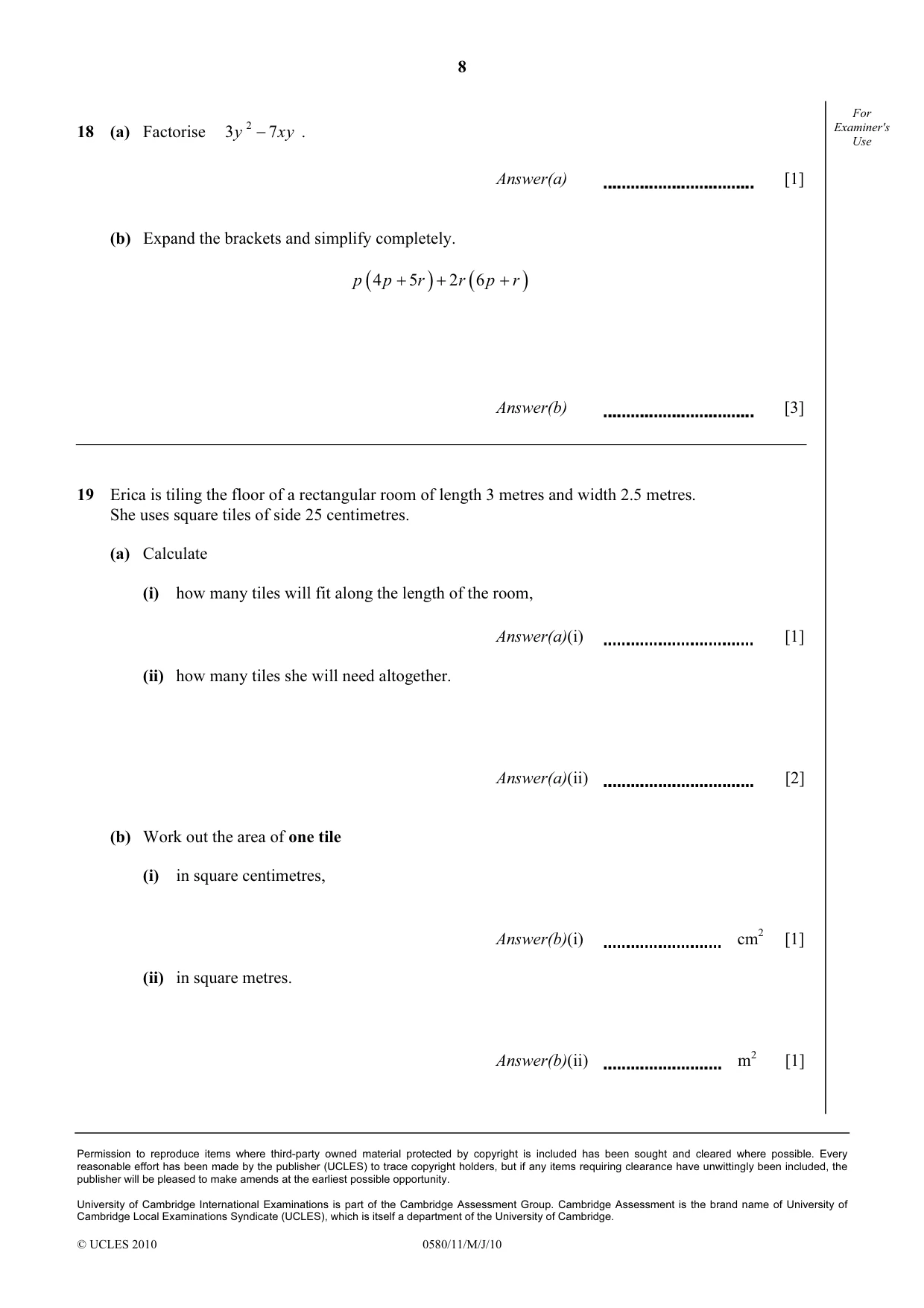
Q18 · Factorise 3 y − 7 xy
18 (a) Factorise 3 y − 7 xy . Examiner's Use Answer(a) [1] (b) Expand the brackets and simplify completely. p ( 4 p + 5 r ) + 2 r ( 6 p + r ) Answer(b) [3]
Mark scheme: 18 (a) y(3y – 7x) final answer 1 (b) 4p2 + 17pr + 2r2 final answer 3 W2 for 2 correct terms in answer. W1 for 1 correct term in answer. OR M1 for 4p2 + 5pr and M1 ind for 12pr + 2r2
Q19 · Erica is tiling the floor of a rectangular room of length 3 metres and width 2.5 metres
19 Erica is tiling the floor of a rectangular room of length 3 metres and width 2.5 metres. She uses square tiles of side 25 centimetres. (a) Calculate (i) how many tiles will fit along the length of the room, Answer(a)(i) [1] (ii) how many tiles she will need altogether. Answer(a)(ii) [2] (b) Work out the area of one tile (i) in square centimetres, Answer(b)(i) cm2 [1] (ii) in square metres. Answer(b)(ii) m2 [1]
Mark scheme: 19 (a) (i) 12 1 (ii) 120 ft 2 M1 for attempt to multiply their (a)(i) by 10 soi. (b) (i) 625 1 (ii) 0.0625 1ft or their (b)(i) ÷ 10 000
What was in this paper
The subtopics covered by these 17 questions, and how many questions each got. Open one in a new tab to see every Cambridge question on it.
What you needed in this session
Cambridge’s own grade thresholds for 2010 May/June, Paper 1 · Variant 1. A higher threshold means an easier paper — the bar moves with how the cohort did.