Cambridge IGCSE Marine Science (Maldives only) 0697 — 2022 May/June Paper 1 · Variant 0
0697/10/M/J/22 · 80 marks · ≈90 min
The question paper and its mark scheme, free to read here and free to download. This is Cambridge’s own paper, exactly as it was sat.
Question paper16 pages


Mark scheme
No mark scheme is in the library for this paper.
Paper as text
Question paper, page 1
This document has 16 pages. Any blank pages are indicated. Cambridge IGCSE™ DC (KN) 310948 © UCLES 2022 [Turn over * 8 5 7 5 1 1 4 1 9 8 * MARINE SCIENCE 0697/01 Paper 1 Structured May/June 2022 1 hour 30 minutes You must answer on the question paper. No additional materials are needed. INSTRUCTIONS ● Answer all questions. ● Use a black or dark blue pen. You may use an HB pencil for any diagrams or graphs. ● Write your name, centre number and candidate number in the boxes at the top of the page. ● Write your answer to each question in the space provided. ● Do not use an erasable pen or correction fluid. ● Do not write on any bar codes. ● You may use a calculator. ● You should show all your working and use appropriate units. INFORMATION ● The total mark for this paper is 80. ● The number of marks for each question or part question is shown in brackets [ ].
Question paper, page 2
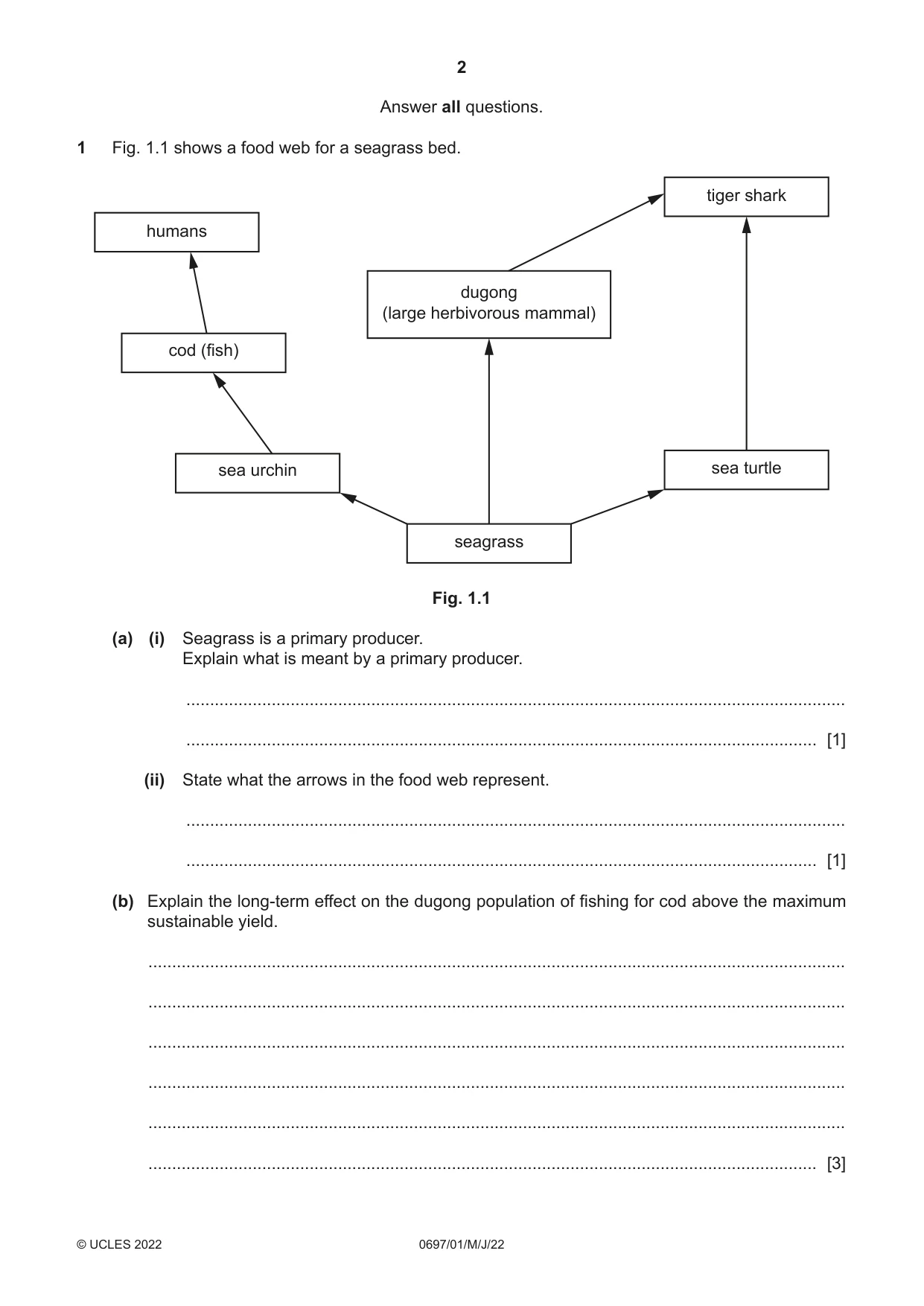
2 0697/01/M/J/22 © UCLES 2022 Answer all questions. 1 Fig. 1.1 shows a food web for a seagrass bed. humans cod (fish) sea urchin dugong (large herbivorous mammal) seagrass tiger shark sea turtle Fig. 1.1 (a) (i) Seagrass is a primary producer. Explain what is meant by a primary producer. … … [1] (ii) State what the arrows in the food web represent. … … [1] (b) Explain the long-term effect on the dugong population of fishing for cod above the maximum sustainable yield. … … … … … … [3]
Question paper, page 3
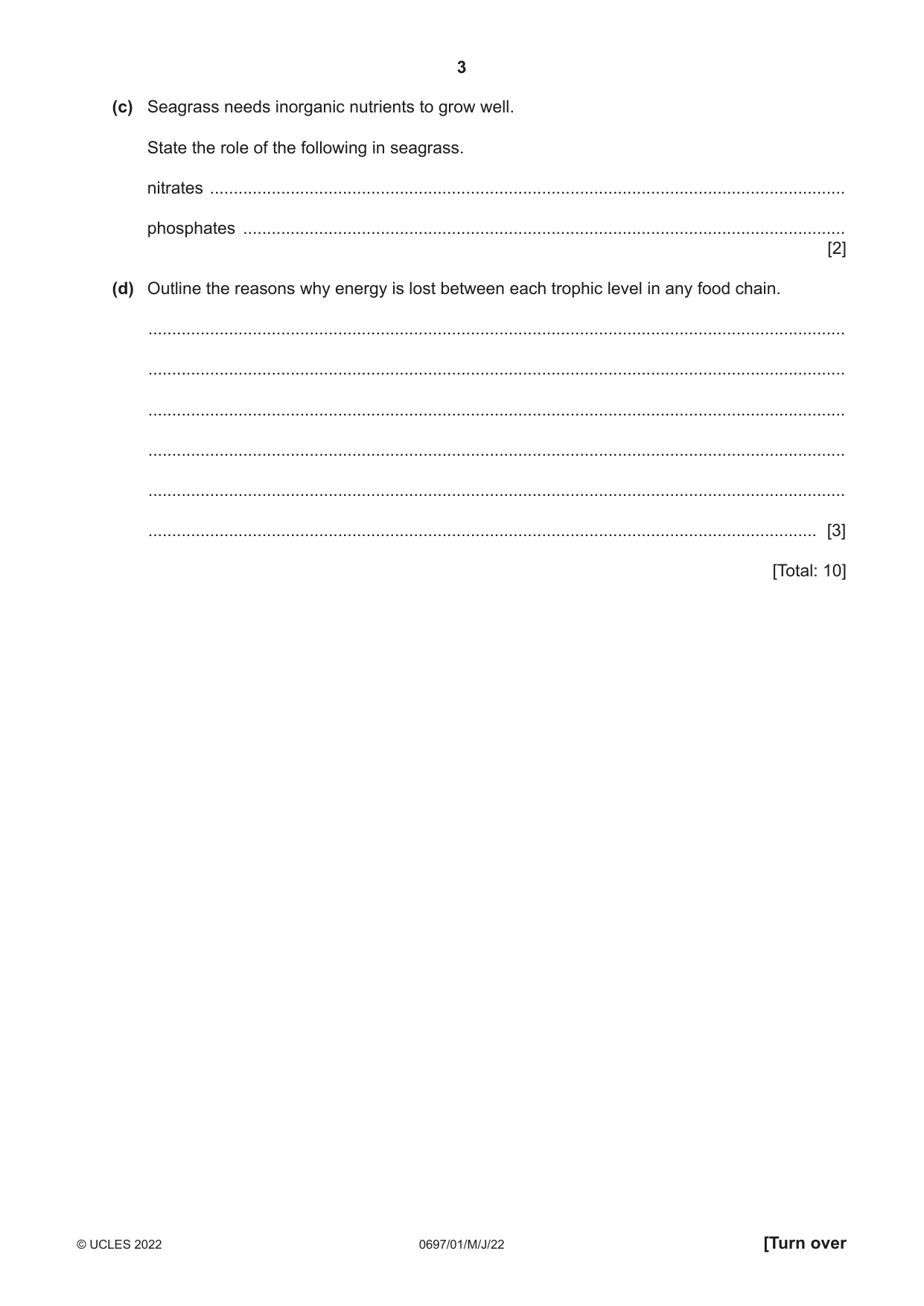
3 0697/01/M/J/22 © UCLES 2022 [Turn over (c) Seagrass needs inorganic nutrients to grow well. State the role of the following in seagrass. nitrates … phosphates … [2] (d) Outline the reasons why energy is lost between each trophic level in any food chain. … … … … … … [3] [Total: 10]
Question paper, page 4
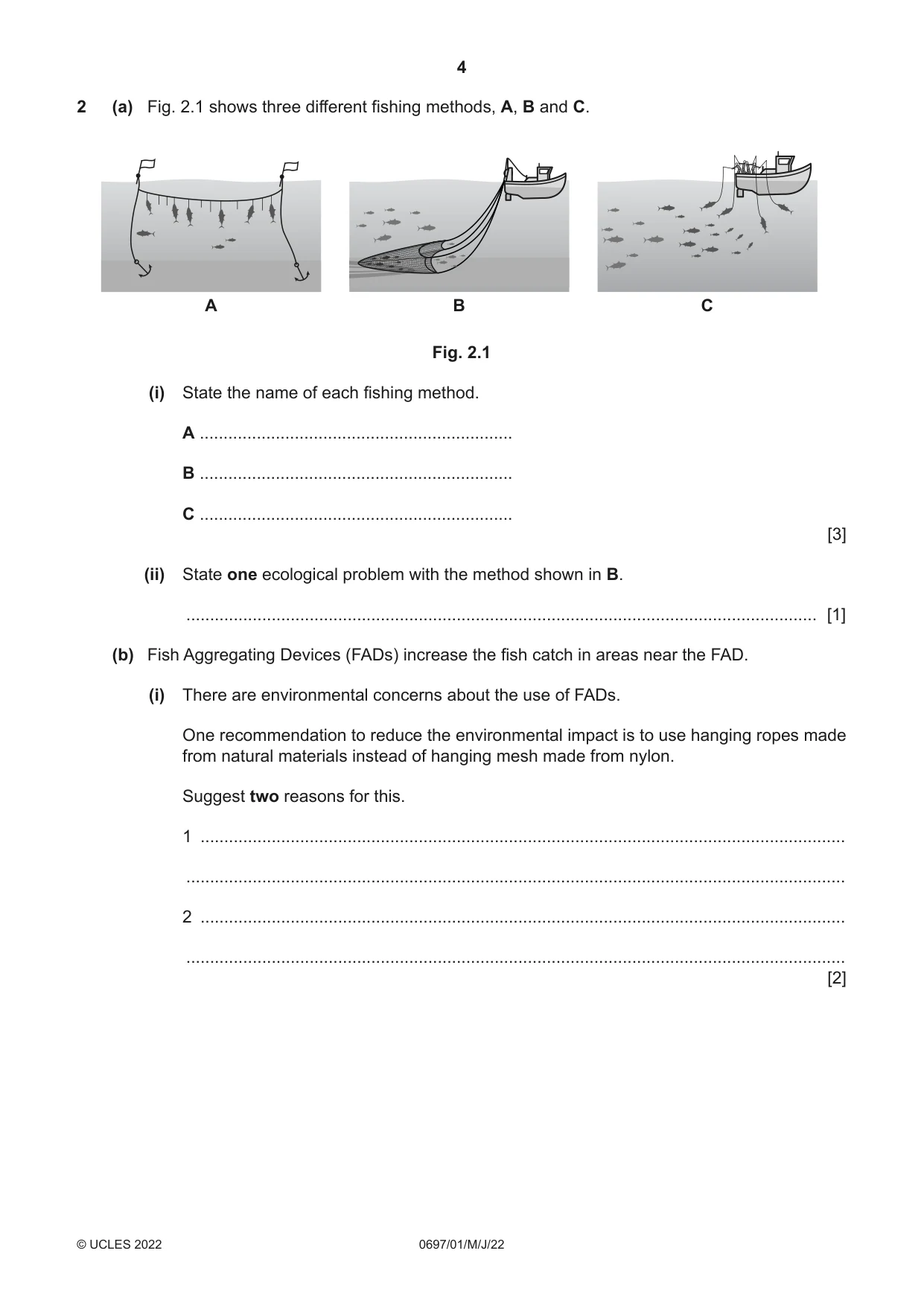
4 0697/01/M/J/22 © UCLES 2022 2 (a) Fig. 2.1 shows three different fishing methods, A, B and C. A B C Fig. 2.1 (i) State the name of each fishing method. A … B … C … [3] (ii) State one ecological problem with the method shown in B. … [1] (b) Fish Aggregating Devices (FADs) increase the fish catch in areas near the FAD. (i) There are environmental concerns about the use of FADs. One recommendation to reduce the environmental impact is to use hanging ropes made from natural materials instead of hanging mesh made from nylon. Suggest two reasons for this. 1 … … 2 … … [2]
Question paper, page 5
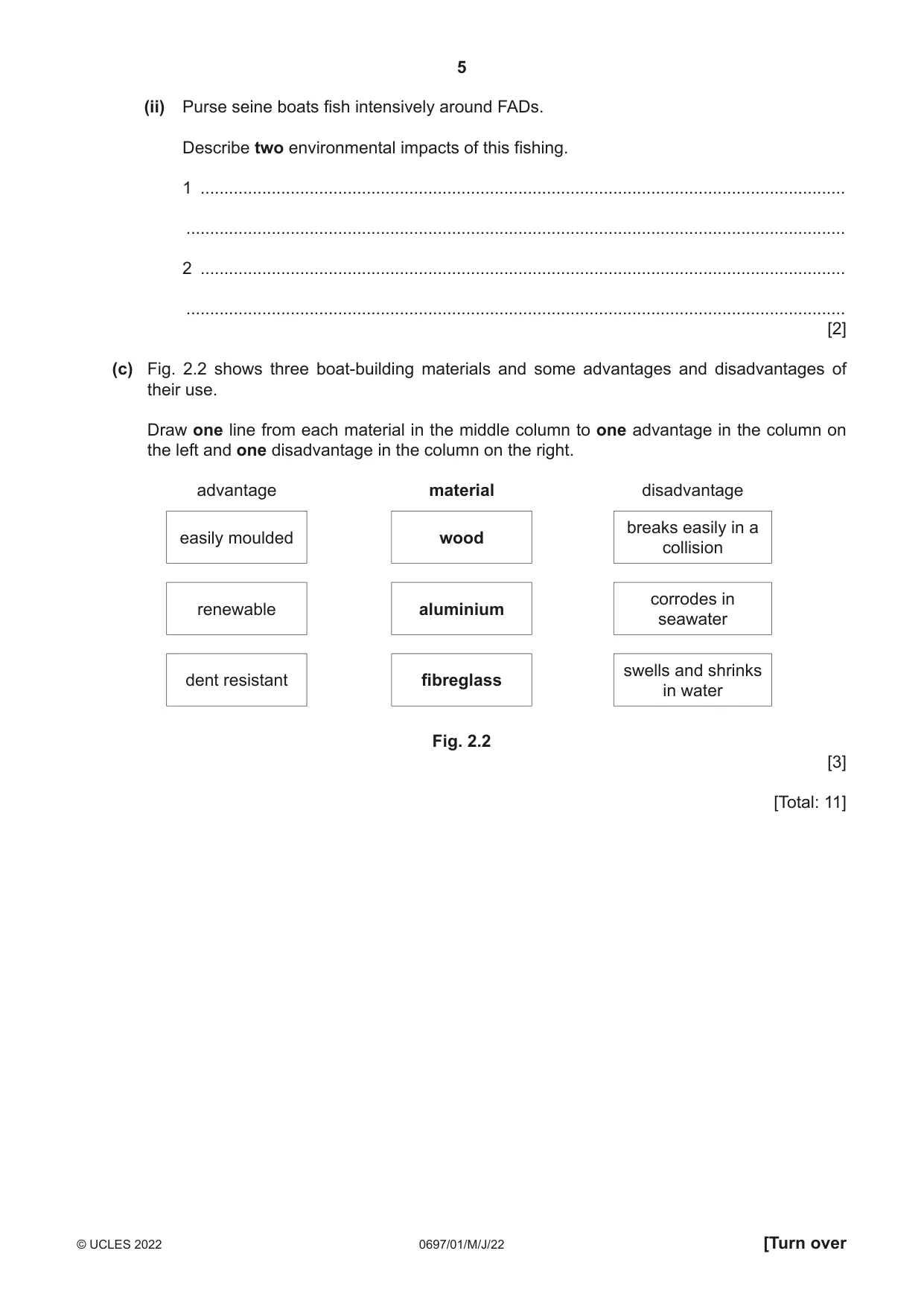
5 0697/01/M/J/22 © UCLES 2022 [Turn over (ii) Purse seine boats fish intensively around FADs. Describe two environmental impacts of this fishing. 1 … … 2 … … [2] (c) Fig. 2.2 shows three boat-building materials and some advantages and disadvantages of their use. Draw one line from each material in the middle column to one advantage in the column on the left and one disadvantage in the column on the right. advantage material disadvantage easily moulded wood breaks easily in a collision renewable aluminium corrodes in seawater dent resistant fibreglass swells and shrinks in water Fig. 2.2 [3] [Total: 11]
Question paper, page 6
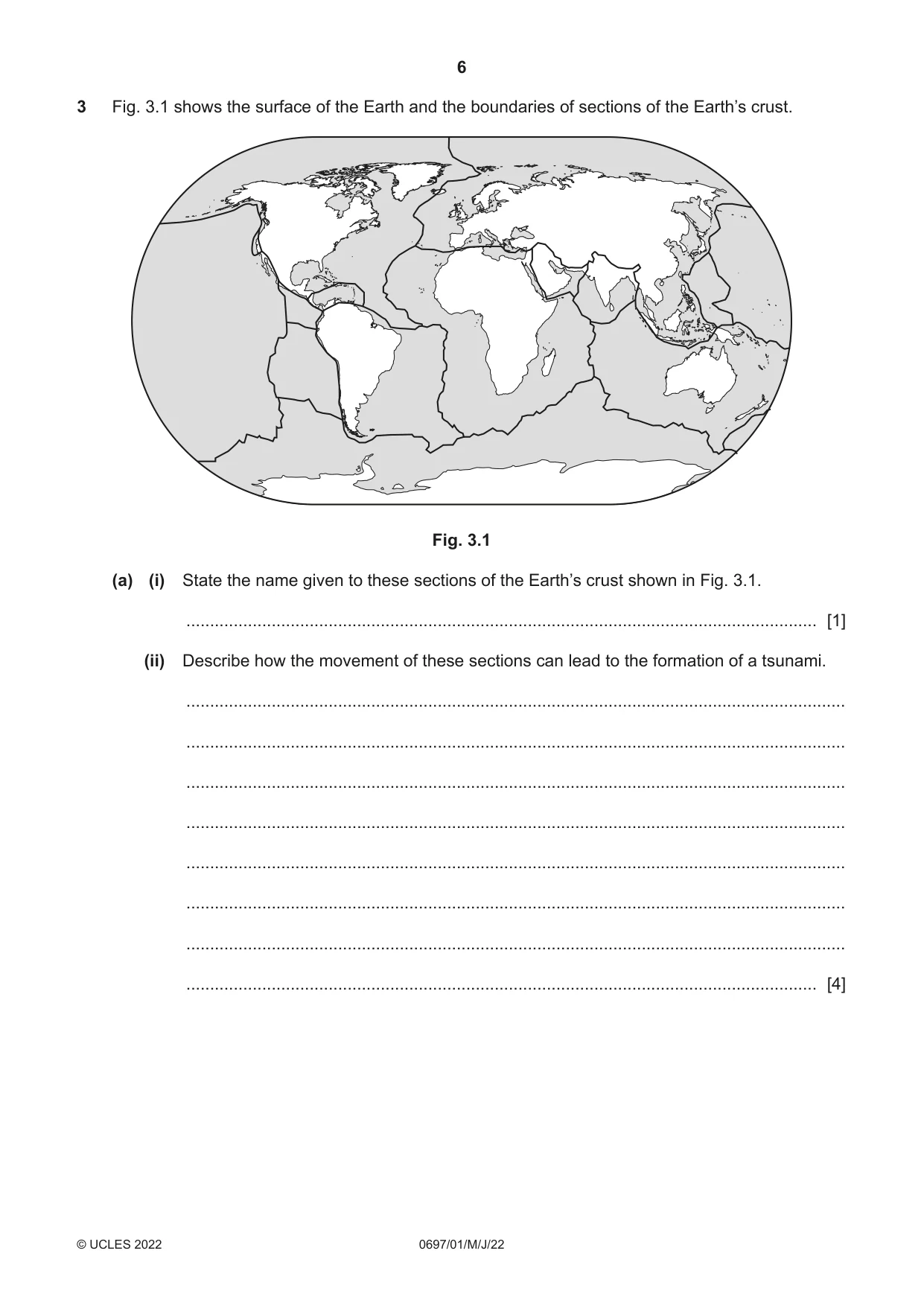
6 0697/01/M/J/22 © UCLES 2022 3 Fig. 3.1 shows the surface of the Earth and the boundaries of sections of the Earth’s crust. Fig. 3.1 (a) (i) State the name given to these sections of the Earth’s crust shown in Fig. 3.1. … [1] (ii) Describe how the movement of these sections can lead to the formation of a tsunami. … … … … … … … … [4]
Question paper, page 7
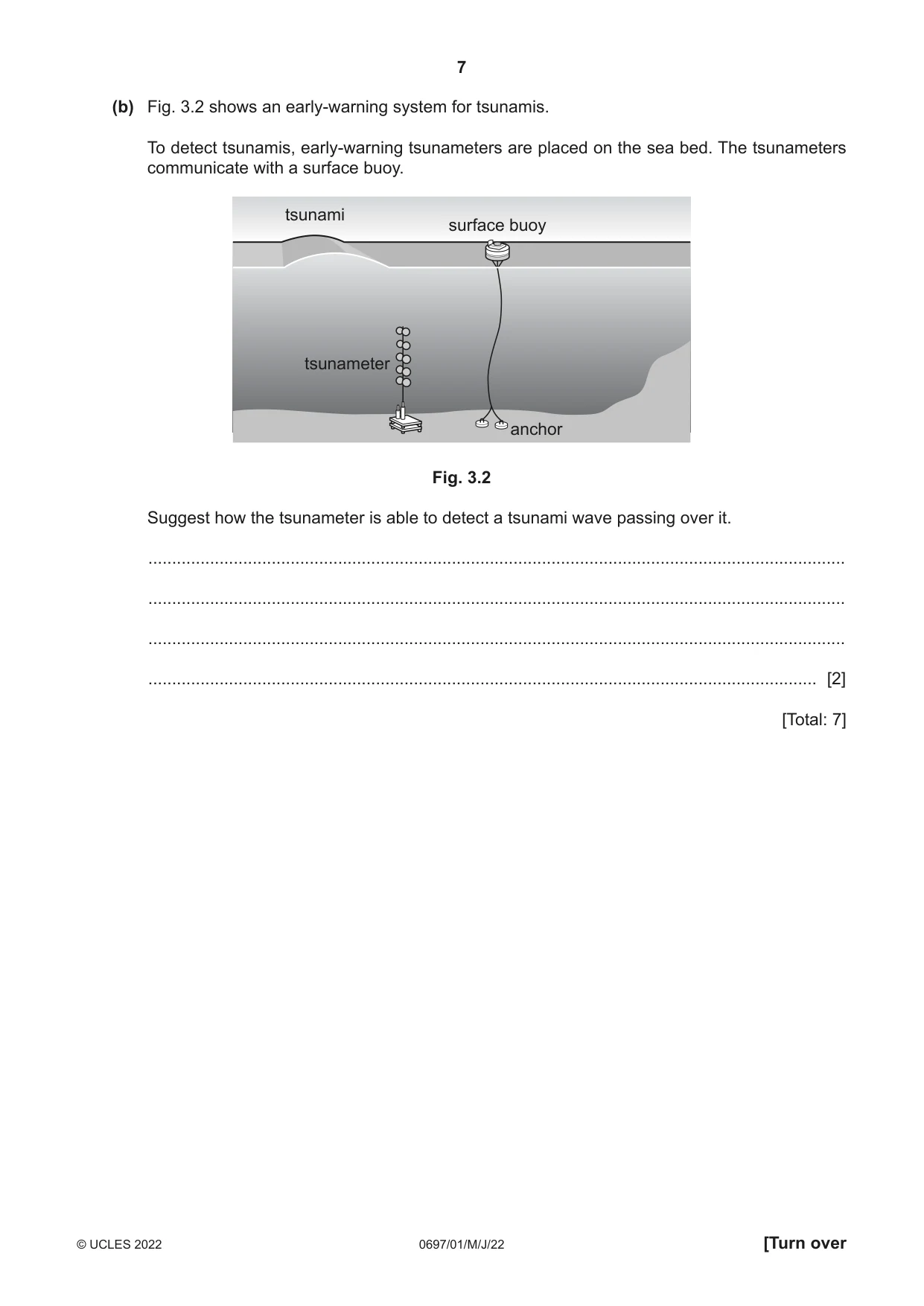
7 0697/01/M/J/22 © UCLES 2022 [Turn over (b) Fig. 3.2 shows an early-warning system for tsunamis. To detect tsunamis, early-warning tsunameters are placed on the sea bed. The tsunameters communicate with a surface buoy. tsunami tsunameter anchor surface buoy Fig. 3.2 Suggest how the tsunameter is able to detect a tsunami wave passing over it. … … … … [2] [Total: 7]
Question paper, page 8
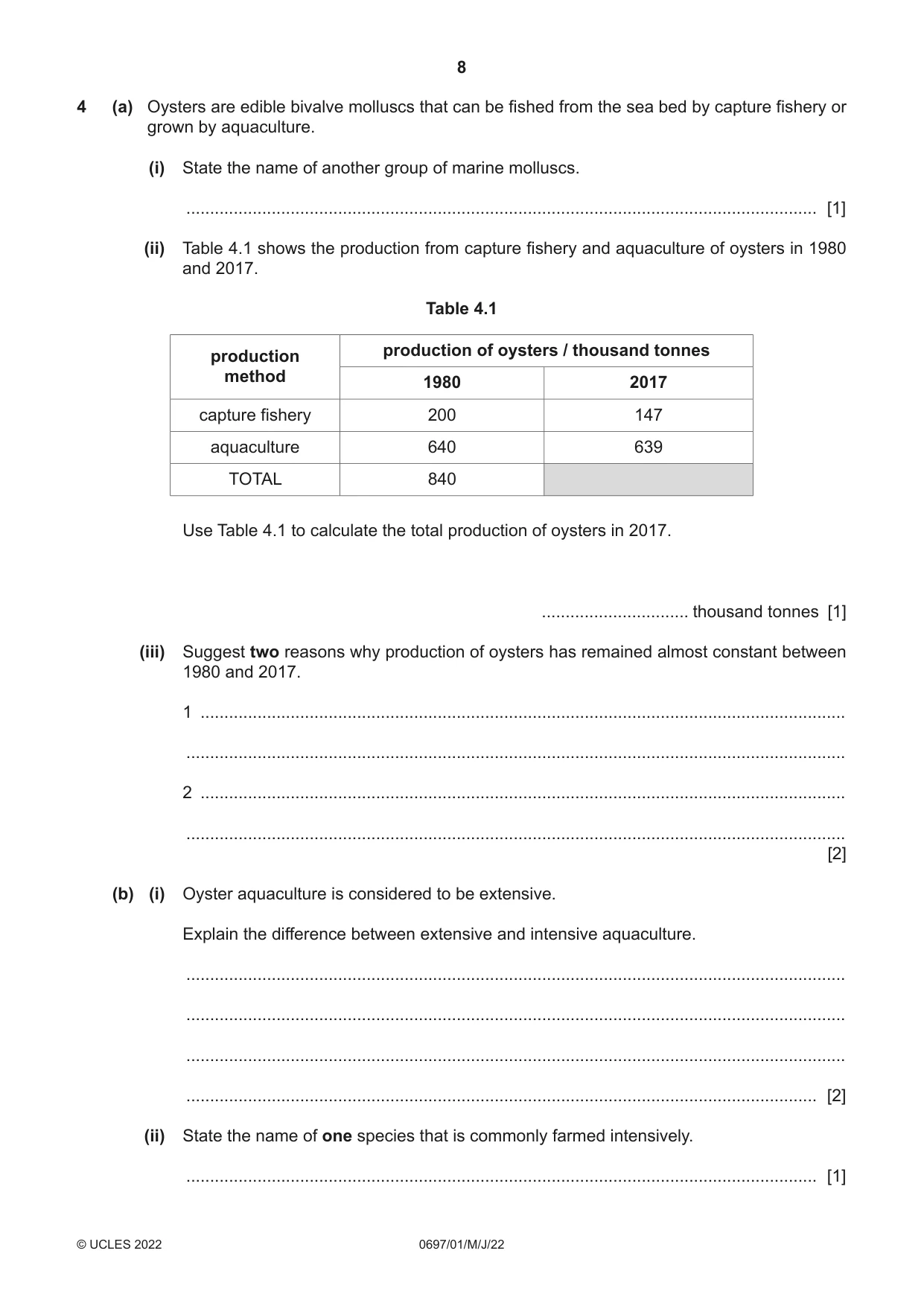
8 0697/01/M/J/22 © UCLES 2022 4 (a) Oysters are edible bivalve molluscs that can be fished from the sea bed by capture fishery or grown by aquaculture. (i) State the name of another group of marine molluscs. … [1] (ii) Table 4.1 shows the production from capture fishery and aquaculture of oysters in 1980 and 2017. Table 4.1 production method production of oysters / thousand tonnes 1980 2017 capture fishery 200 147 aquaculture 640 639 TOTAL 840 Use Table 4.1 to calculate the total production of oysters in 2017. … thousand tonnes [1] (iii) Suggest two reasons why production of oysters has remained almost constant between 1980 and 2017. 1 … … 2 … … [2] (b) (i) Oyster aquaculture is considered to be extensive. Explain the difference between extensive and intensive aquaculture. … … … … [2] (ii) State the name of one species that is commonly farmed intensively. … [1]
Question paper, page 9
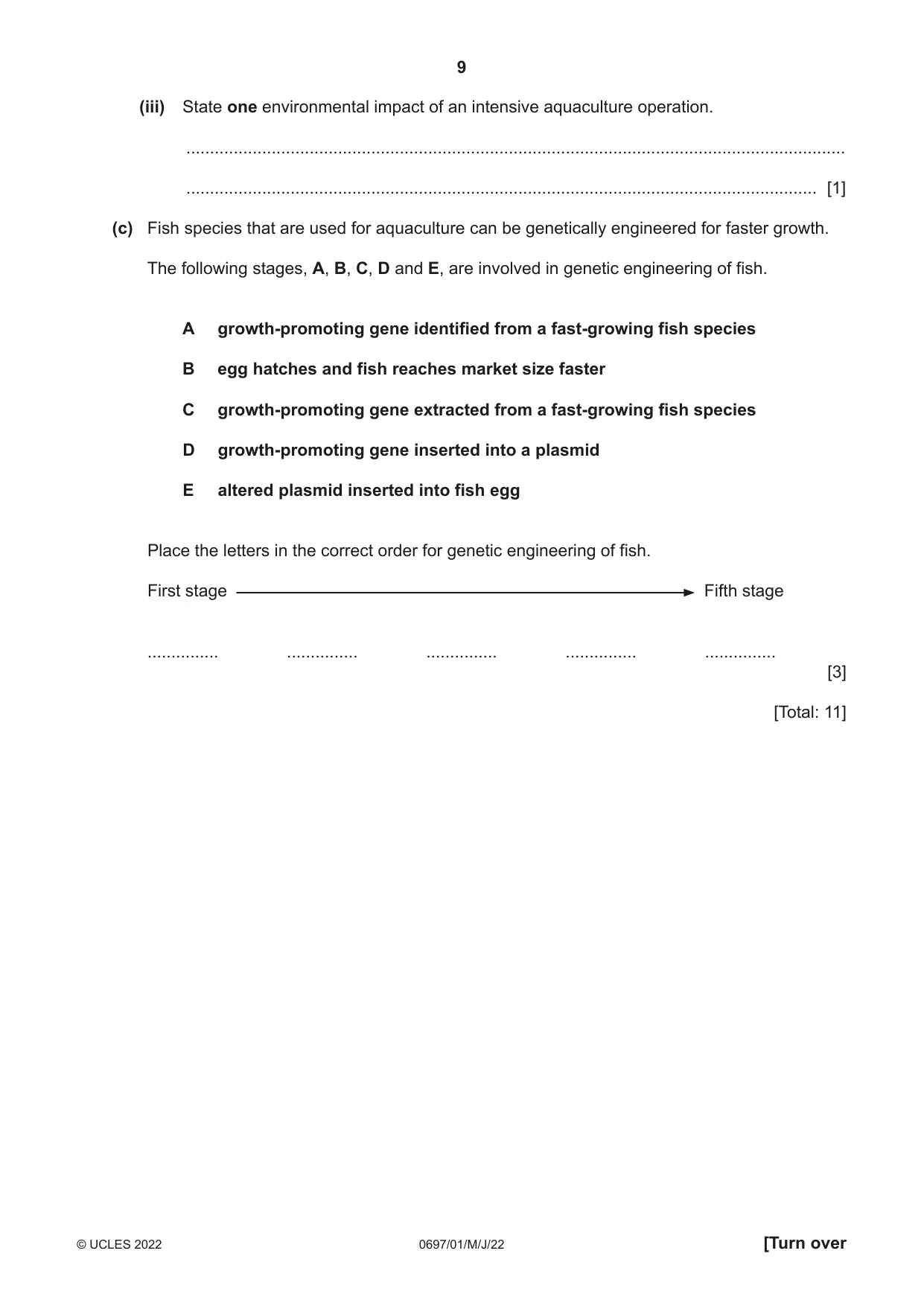
9 0697/01/M/J/22 © UCLES 2022 [Turn over (iii) State one environmental impact of an intensive aquaculture operation. … … [1] (c) Fish species that are used for aquaculture can be genetically engineered for faster growth. The following stages, A, B, C, D and E, are involved in genetic engineering of fish. A growth-promoting gene identified from a fast-growing fish species B egg hatches and fish reaches market size faster C growth-promoting gene extracted from a fast-growing fish species D growth-promoting gene inserted into a plasmid E altered plasmid inserted into fish egg Place the letters in the correct order for genetic engineering of fish. First stage Fifth stage … … … … … [3] [Total: 11]
Question paper, page 10
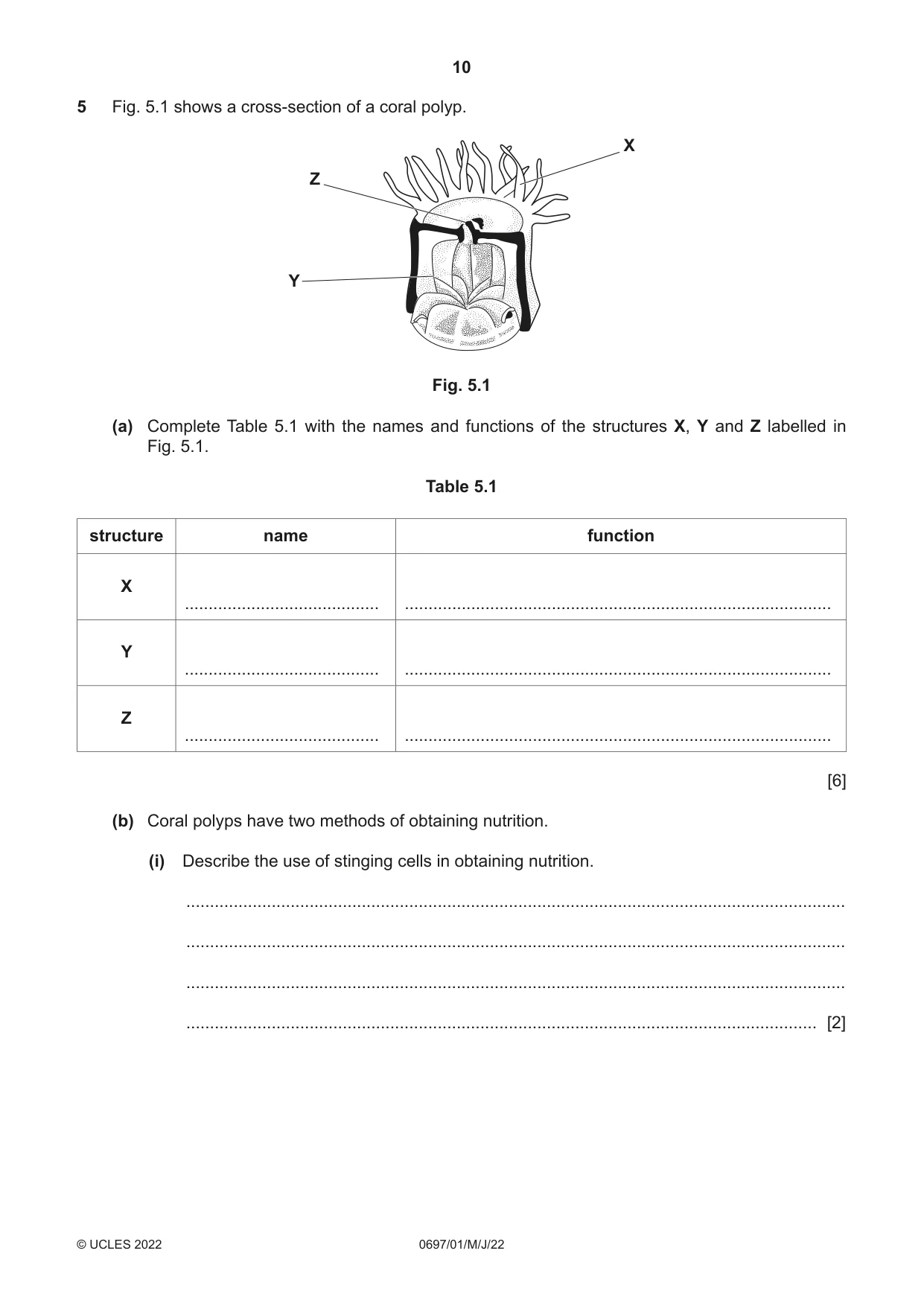
10 0697/01/M/J/22 © UCLES 2022 5 Fig. 5.1 shows a cross-section of a coral polyp. X Y Z Fig. 5.1 (a) Complete Table 5.1 with the names and functions of the structures X, Y and Z labelled in Fig. 5.1. Table 5.1 structure name function X … … Y … … Z … … [6] (b) Coral polyps have two methods of obtaining nutrition. (i) Describe the use of stinging cells in obtaining nutrition. … … … … [2]
Question paper, page 11
11 0697/01/M/J/22 © UCLES 2022 [Turn over (ii) Coral polyps may contain zooxanthellae. Explain how zooxanthellae provide nutrition to the polyp. … … … … … … … … [4] (c) Coral reefs may be mined to be used as building material. Explain the environmental impact of coral mining on fisheries. … … … … … … [3] [Total: 15]
Question paper, page 12
12 0697/01/M/J/22 © UCLES 2022 6 Japan has a large market for diamondback squid. (a) Explain the meaning of the term market. … … [1] (b) The catch of diamondback squid in Japan has decreased. (i) Suggest one reason for this decrease in catch. … … [1] (ii) Explain the effect of this decrease in catch on the price of diamondback squid in Japan. … … … … [2] (c) (i) Other countries in the region want to exploit their natural economic resources within their Exclusive Economic Zone (EEZ). Describe what is meant by a natural economic resource. … … … … [2] (ii) As a country develops a new diamondback squid fishery within their EEZ, both public and private ownership may work together. Describe the role of public ownership. … … … … [2]
Question paper, page 13
13 0697/01/M/J/22 © UCLES 2022 [Turn over (d) Suggest three methods a government can use to ensure the development of their diamondback squid fishery remains sustainable. 1 … … 2 … … 3 … … [3] [Total: 11]
Question paper, page 14
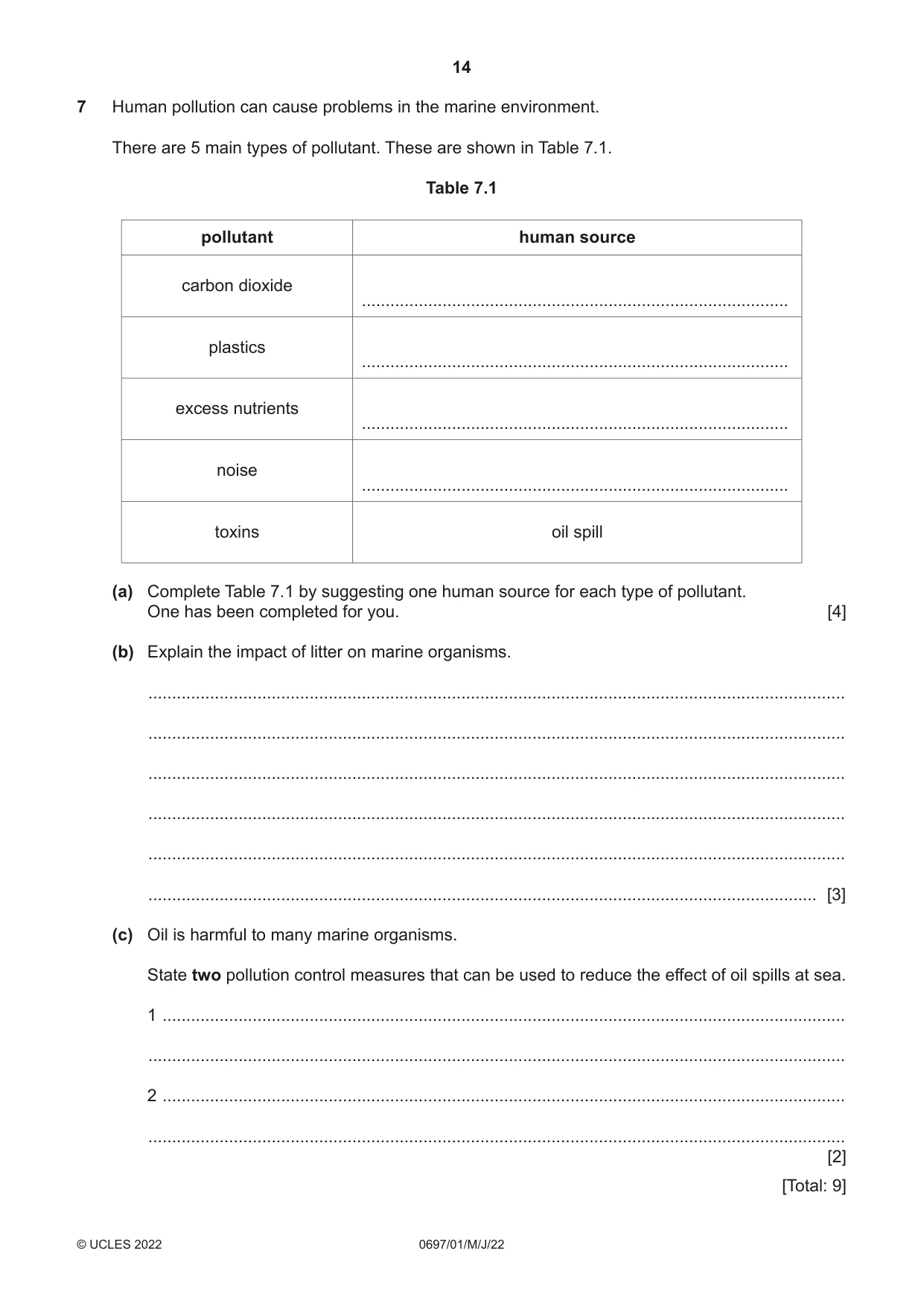
14 0697/01/M/J/22 © UCLES 2022 7 Human pollution can cause problems in the marine environment. There are 5 main types of pollutant. These are shown in Table 7.1. Table 7.1 pollutant human source carbon dioxide … plastics … excess nutrients … noise … toxins oil spill (a) Complete Table 7.1 by suggesting one human source for each type of pollutant. One has been completed for you. [4] (b) Explain the impact of litter on marine organisms. … … … … … … [3] (c) Oil is harmful to many marine organisms. State two pollution control measures that can be used to reduce the effect of oil spills at sea. 1 … … 2 … … [2] [Total: 9]
Question paper, page 15
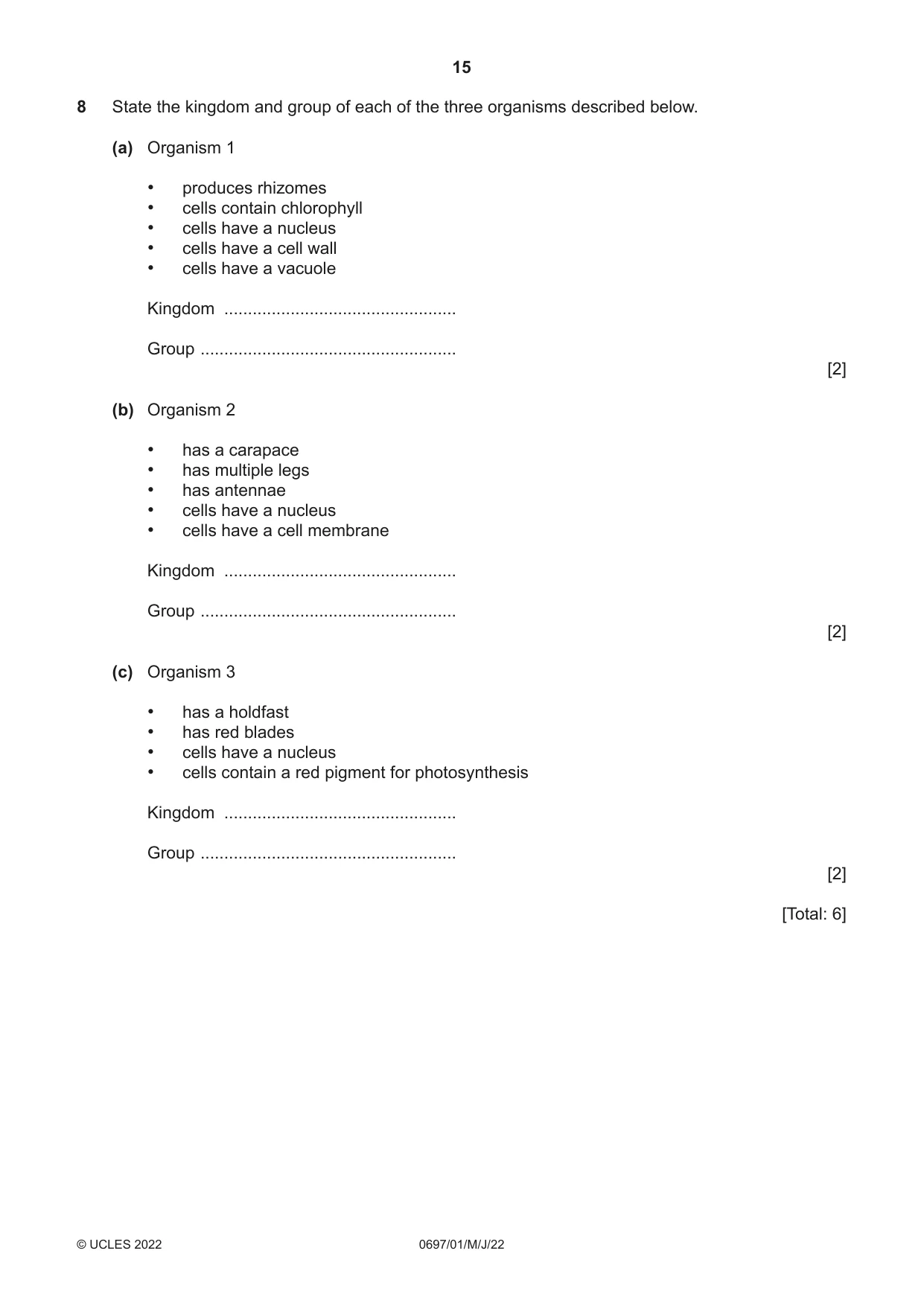
15 0697/01/M/J/22 © UCLES 2022 8 State the kingdom and group of each of the three organisms described below. (a) Organism 1 • produces rhizomes • cells contain chlorophyll • cells have a nucleus • cells have a cell wall • cells have a vacuole Kingdom … Group … [2] (b) Organism 2 • has a carapace • has multiple legs • has antennae • cells have a nucleus • cells have a cell membrane Kingdom … Group … [2] (c) Organism 3 • has a holdfast • has red blades • cells have a nucleus • cells contain a red pigment for photosynthesis Kingdom … Group … [2] [Total: 6]
Question paper, page 16
16 0697/01/M/J/22 © UCLES 2022 BLANK PAGE Permission to reproduce items where third-party owned material protected by copyright is included has been sought and cleared where possible. Every reasonable effort has been made by the publisher (UCLES) to trace copyright holders, but if any items requiring clearance have unwittingly been included, the publisher will be pleased to make amends at the earliest possible opportunity. To avoid the issue of disclosure of answer-related information to candidates, all copyright acknowledgements are reproduced online in the Cambridge Assessment International Education Copyright Acknowledgements Booklet. This is produced for each series of examinations and is freely available to download at www.cambridgeinternational.org after the live examination series. Cambridge Assessment International Education is part of Cambridge Assessment. Cambridge Assessment is the brand name of the University of Cambridge Local Examinations Syndicate (UCLES), which is a department of the University of Cambridge.
What you needed in this session
Cambridge’s own grade thresholds for 2022 May/June, Paper 1 · Variant 0. A higher threshold means an easier paper — the bar moves with how the cohort did.