Cambridge IGCSE Italian - Foreign Language 0535 — 2017 May/June Paper 1 · Variant 1
0535/11/M/J/17 · 45 marks · ≈51 min
The question paper and its mark scheme, free to read here and free to download. This is Cambridge’s own paper, exactly as it was sat.
Question paper16 pages




Mark scheme11 pages
Answers below. Sit the paper first if you are practising.
Paper as text
Question paper, page 1
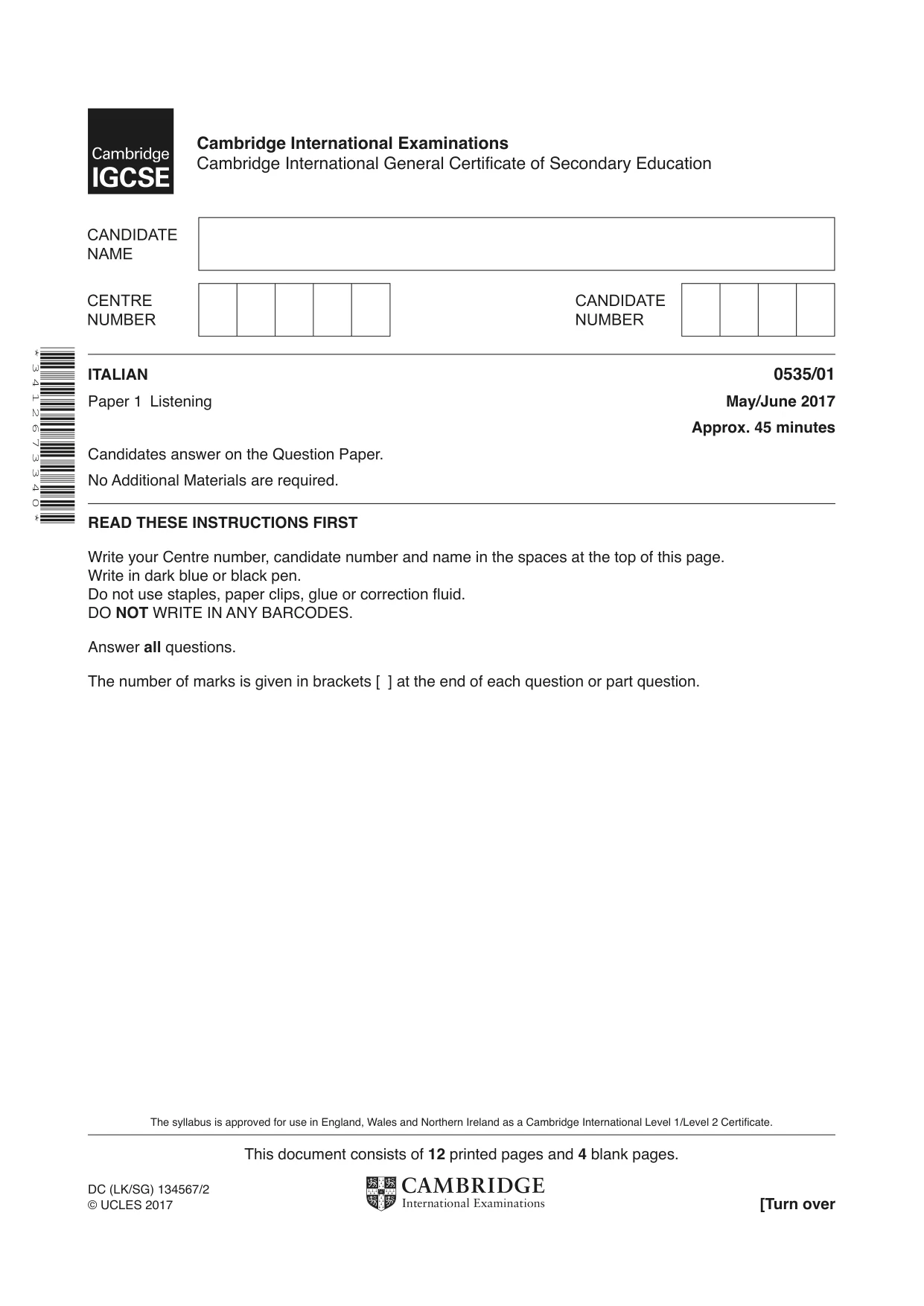
* 3 4 1 2 6 7 3 3 4 0 * This document consists of 12 printed pages and 4 blank pages. DC (LK/SG) 134567/2 © UCLES 2017 [Turn over Cambridge International Examinations Cambridge International General Certificate of Secondary Education ITALIAN 0535/01 Paper 1 Listening May/June 2017 Approx. 45 minutes Candidates answer on the Question Paper. No Additional Materials are required. READ THESE INSTRUCTIONS FIRST Write your Centre number, candidate number and name in the spaces at the top of this page. Write in dark blue or black pen. Do not use staples, paper clips, glue or correction fluid. DO NOT WRITE IN ANY BARCODES. Answer all questions. The number of marks is given in brackets [ ] at the end of each question or part question. The syllabus is approved for use in England, Wales and Northern Ireland as a Cambridge International Level 1/Level 2 Certificate.
Question paper, page 2
2 0535/01/M/J/17 © UCLES 2017 BLANK PAGE
Question paper, page 3
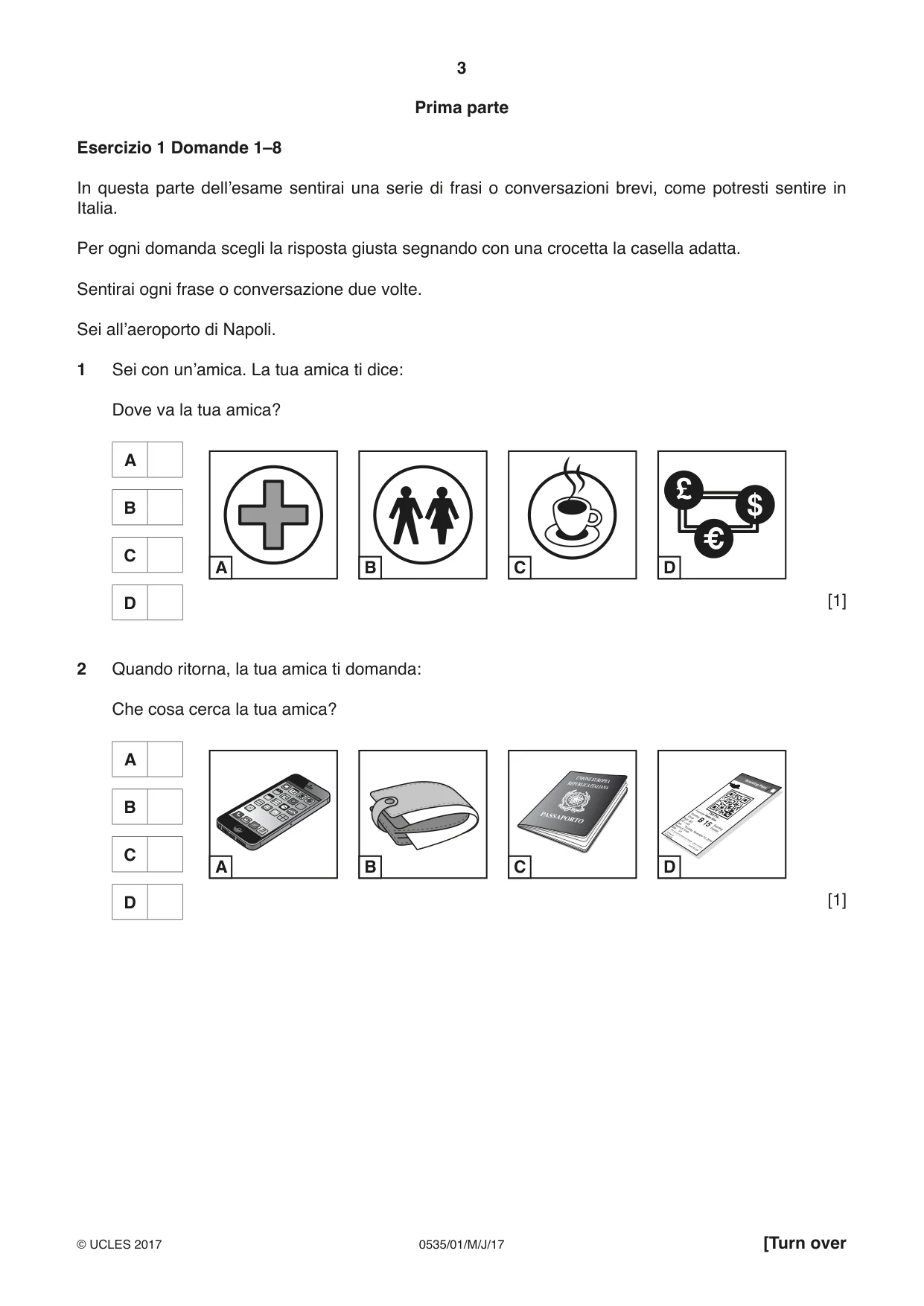
3 0535/01/M/J/17 © UCLES 2017 [Turn over Prima parte Esercizio 1 Domande 1–8 In questa parte dell’esame sentirai una serie di frasi o conversazioni brevi, come potresti sentire in Italia. Per ogni domanda scegli la risposta giusta segnando con una crocetta la casella adatta. Sentirai ogni frase o conversazione due volte. Sei all’aeroporto di Napoli. 1 Sei con un’amica. La tua amica ti dice: Dove va la tua amica? A £ € $ A B C D [1] B C D 2 Quando ritorna, la tua amica ti domanda: Che cosa cerca la tua amica? A A B C D [1] B C D
Question paper, page 4
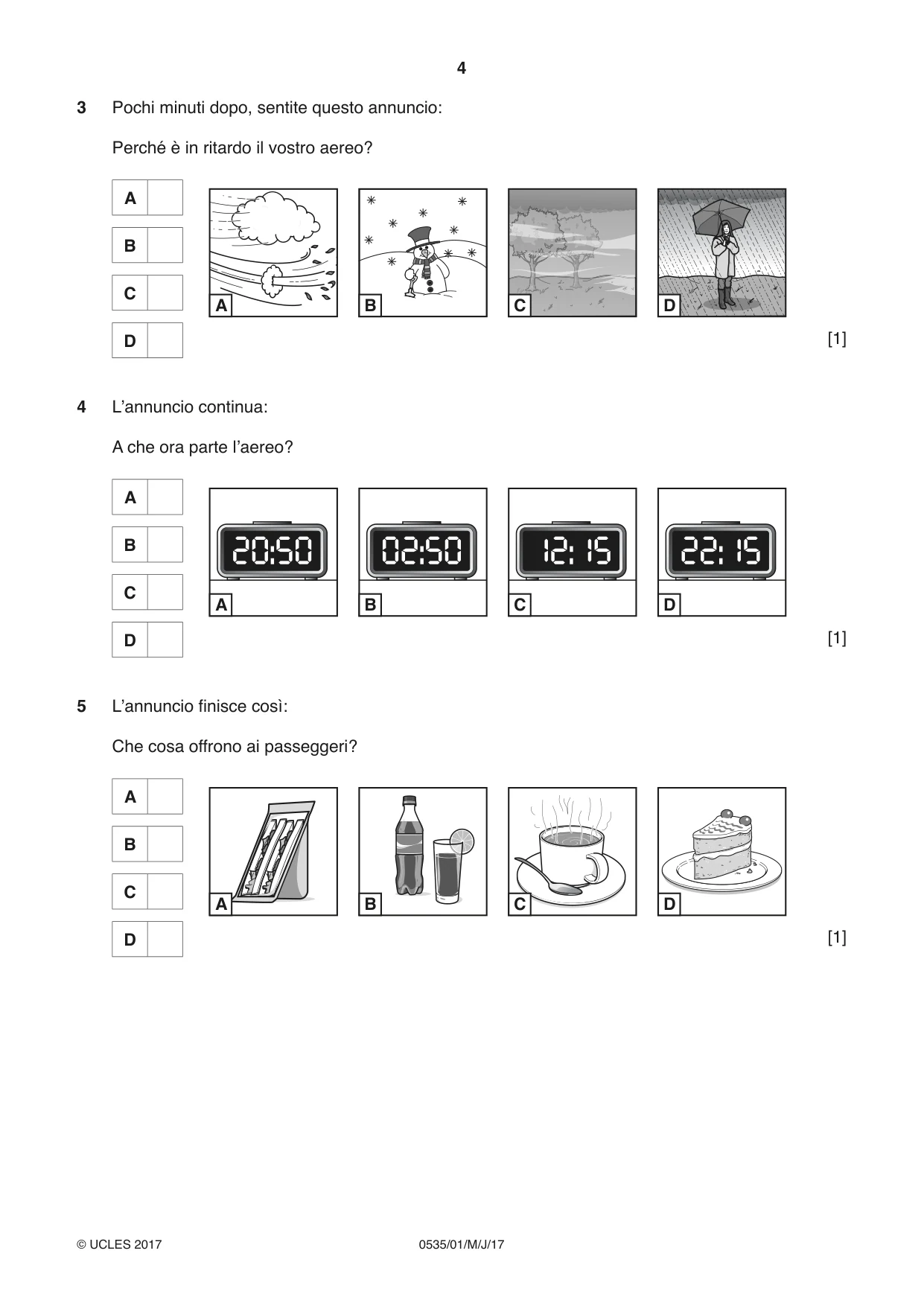
4 0535/01/M/J/17 © UCLES 2017 3 Pochi minuti dopo, sentite questo annuncio: Perché è in ritardo il vostro aereo? A A B C D [1] B C D 4 L’annuncio continua: A che ora parte l’aereo? A A B C D [1] B C D 5 L’annuncio finisce così: Che cosa offrono ai passeggeri? A A B C D [1] B C D
Question paper, page 5
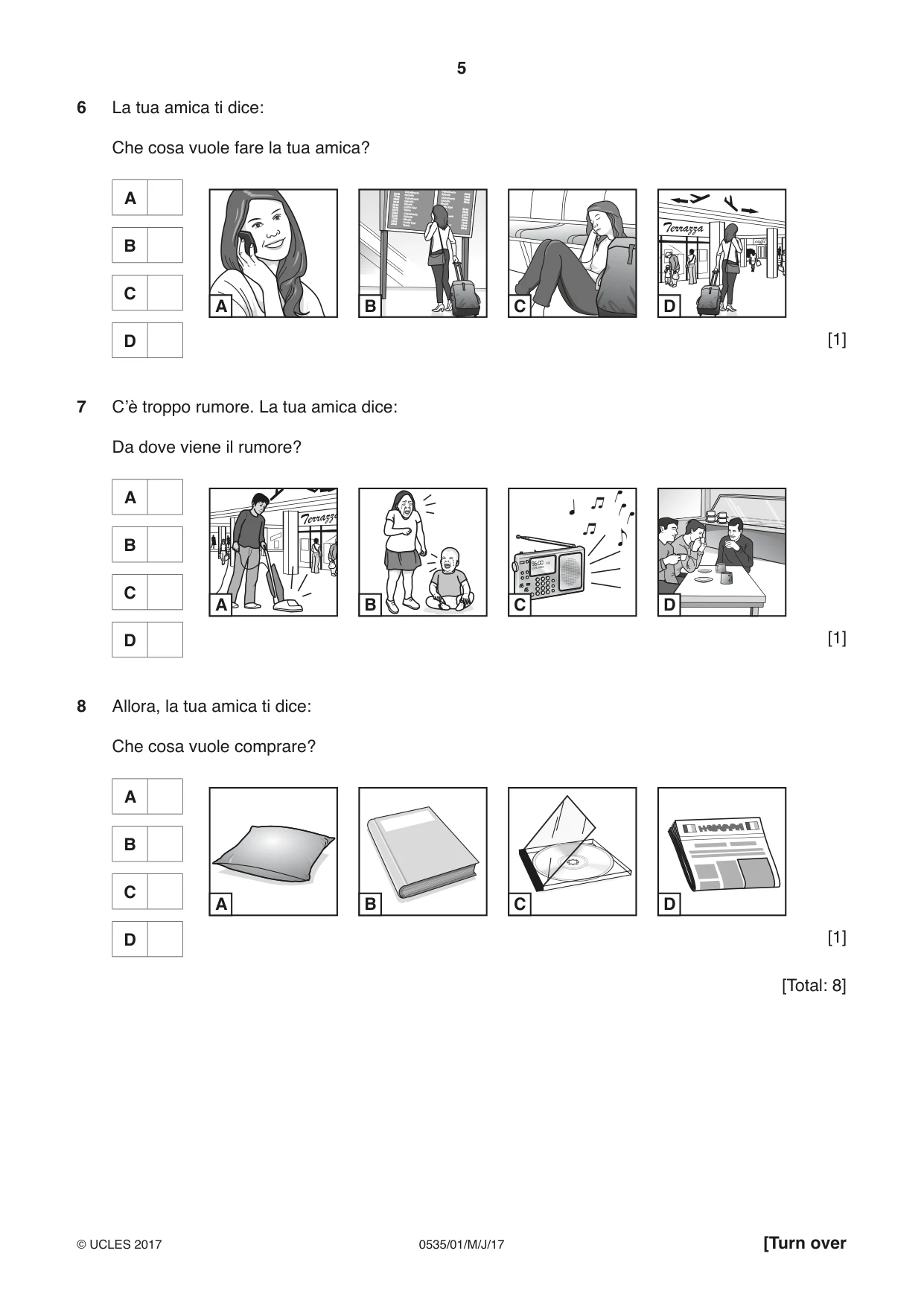
5 0535/01/M/J/17 © UCLES 2017 [Turn over 6 La tua amica ti dice: Che cosa vuole fare la tua amica? A Terrazza A B C D [1] B C D 7 C’è troppo rumore. La tua amica dice: Da dove viene il rumore? A Terrazza A B C D [1] B C D 8 Allora, la tua amica ti dice: Che cosa vuole comprare? A A B C D [1] B C D [Total: 8]
Question paper, page 6
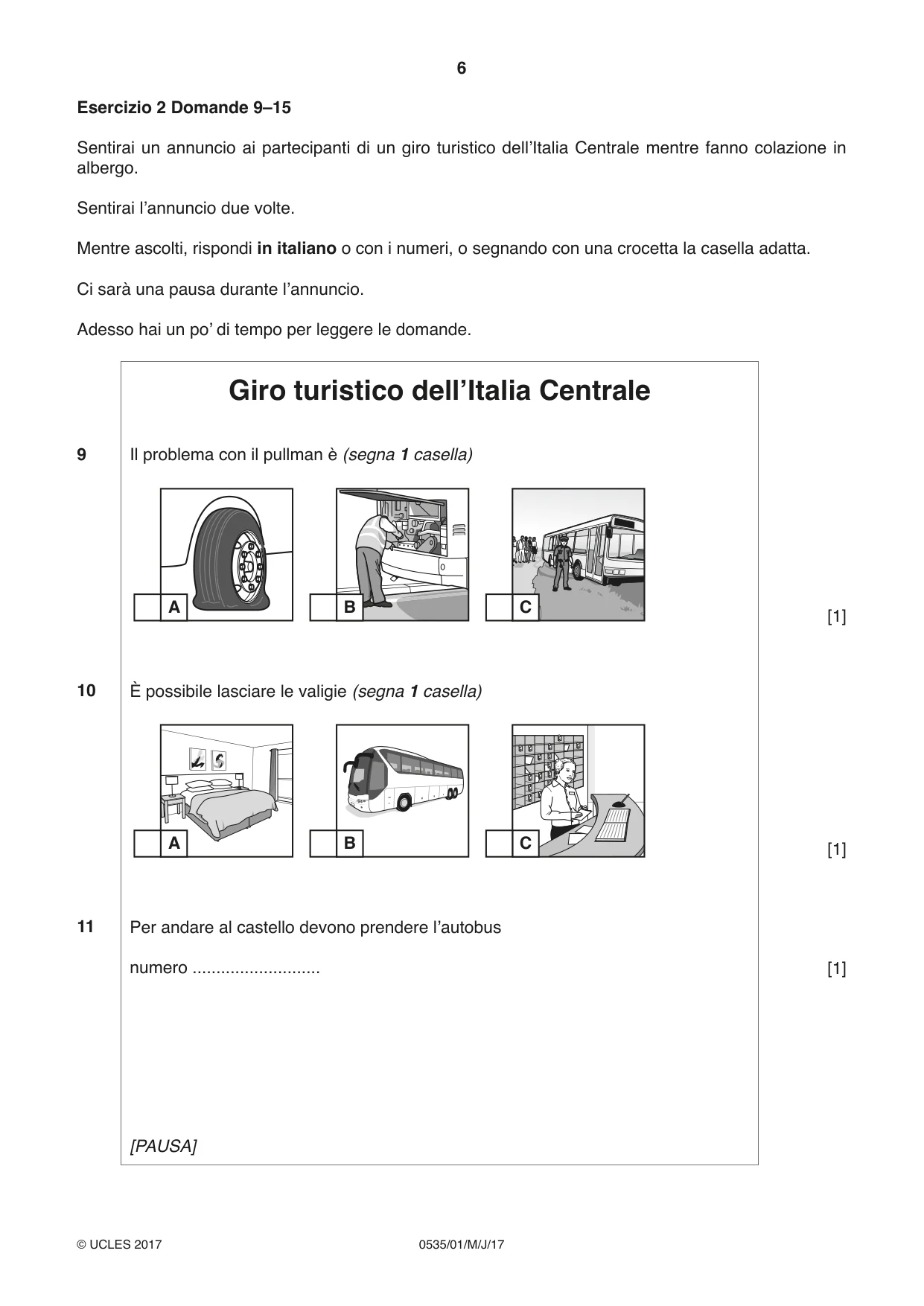
6 0535/01/M/J/17 © UCLES 2017 Esercizio 2 Domande 9–15 Sentirai un annuncio ai partecipanti di un giro turistico dell’Italia Centrale mentre fanno colazione in albergo. Sentirai l’annuncio due volte. Mentre ascolti, rispondi in italiano o con i numeri, o segnando con una crocetta la casella adatta. Ci sarà una pausa durante l’annuncio. Adesso hai un po’ di tempo per leggere le domande. 9 10 11 Giro turistico dell’Italia Centrale Il problema con il pullman è (segna 1 casella) A B C È possibile lasciare le valigie (segna 1 casella) A B C Per andare al castello devono prendere l’autobus numero … [PAUSA] [1] [1] [1]
Question paper, page 7
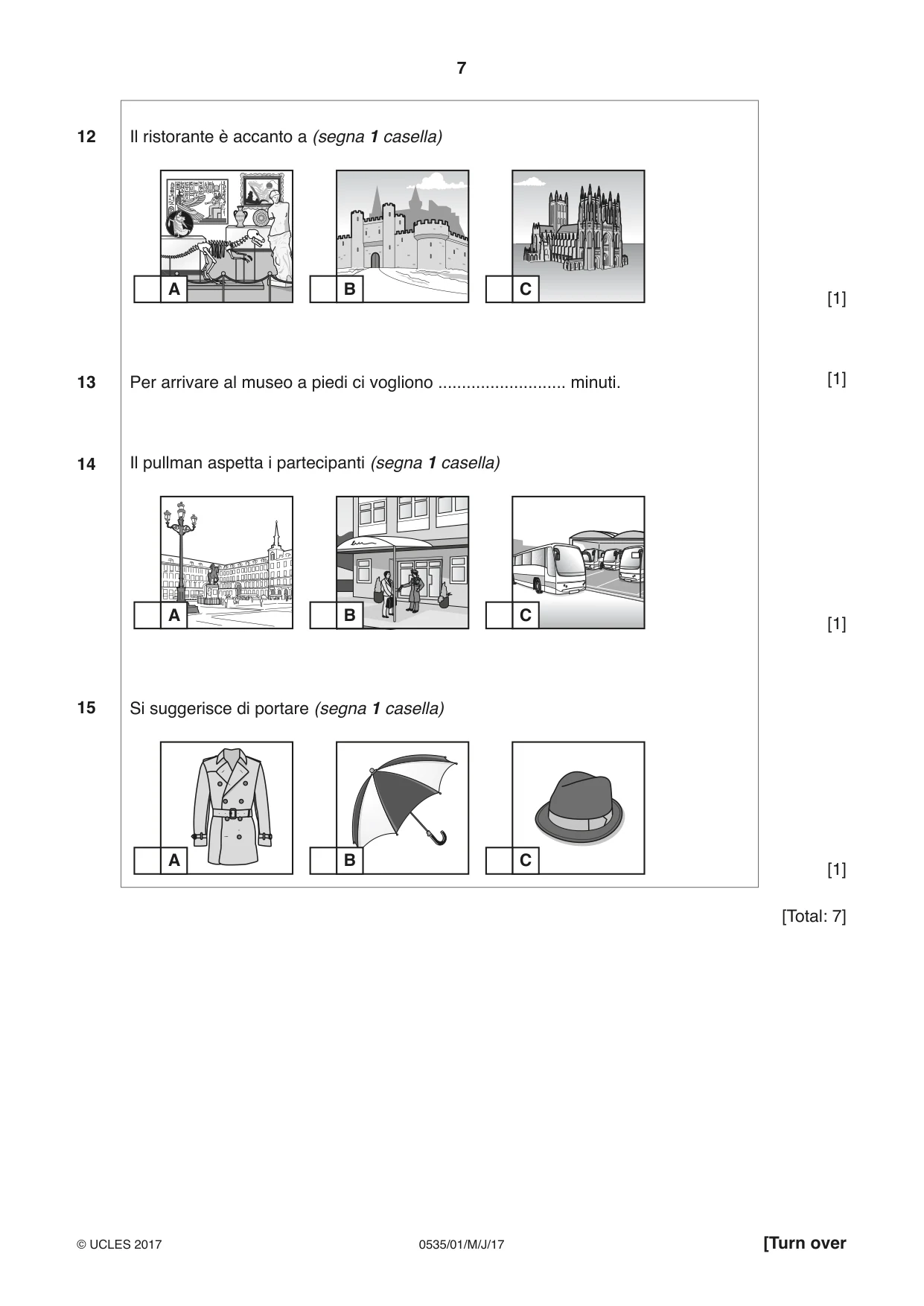
7 0535/01/M/J/17 © UCLES 2017 [Turn over 12 13 14 15 Il ristorante è accanto a (segna 1 casella) A B C Per arrivare al museo a piedi ci vogliono … minuti. Il pullman aspetta i partecipanti (segna 1 casella) A B C Si suggerisce di portare (segna 1 casella) A B C [1] [1] [1] [1] [Total: 7]
Question paper, page 8
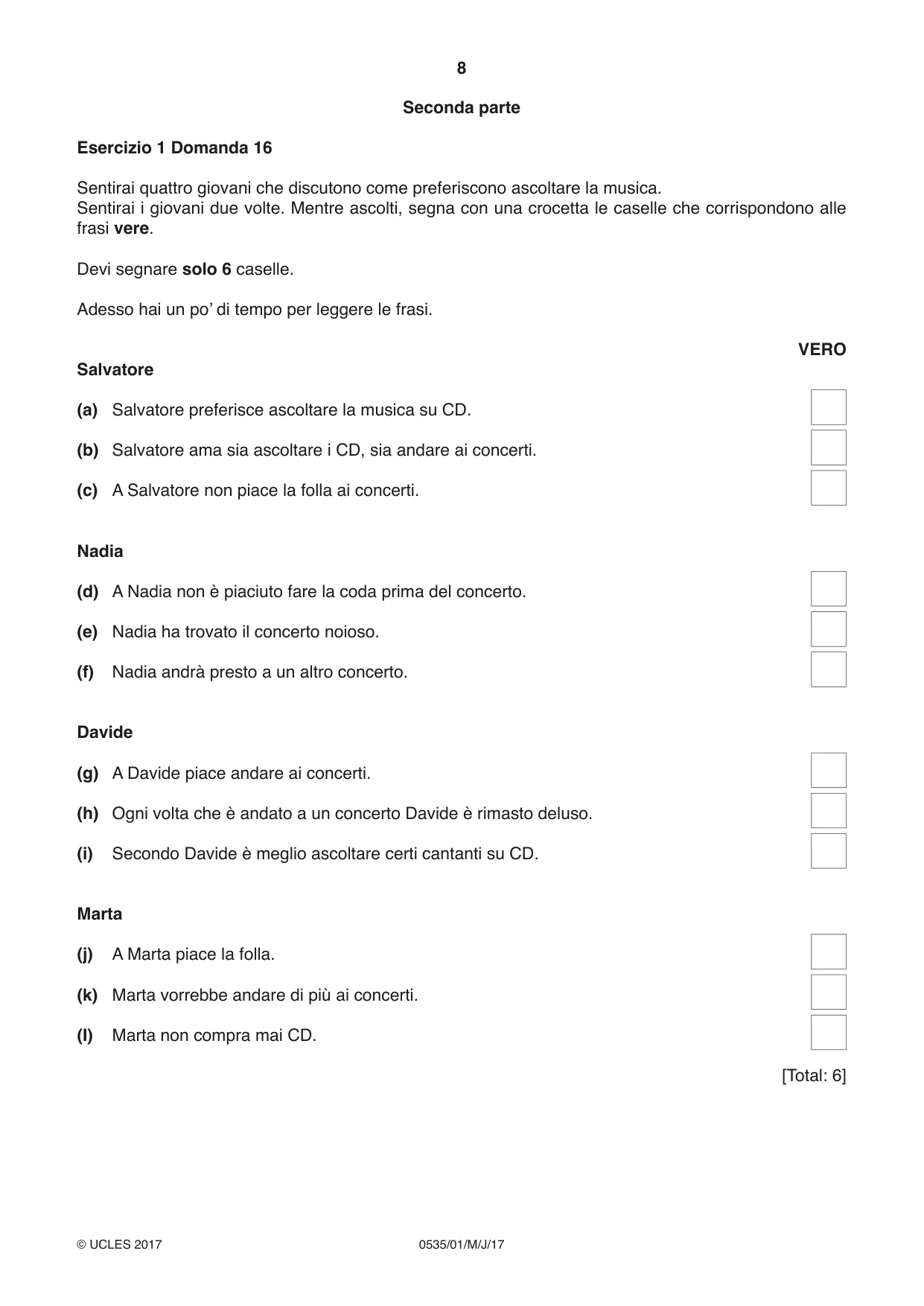
8 0535/01/M/J/17 © UCLES 2017 Seconda parte Esercizio 1 Domanda 16 Sentirai quattro giovani che discutono come preferiscono ascoltare la musica. Sentirai i giovani due volte. Mentre ascolti, segna con una crocetta le caselle che corrispondono alle frasi vere. Devi segnare solo 6 caselle. Adesso hai un po’ di tempo per leggere le frasi. VERO Salvatore (a) Salvatore preferisce ascoltare la musica su CD. (b) Salvatore ama sia ascoltare i CD, sia andare ai concerti. (c) A Salvatore non piace la folla ai concerti. Nadia (d) A Nadia non è piaciuto fare la coda prima del concerto. (e) Nadia ha trovato il concerto noioso. (f) Nadia andrà presto a un altro concerto. Davide (g) A Davide piace andare ai concerti. (h) Ogni volta che è andato a un concerto Davide è rimasto deluso. (i) Secondo Davide è meglio ascoltare certi cantanti su CD. Marta (j) A Marta piace la folla. (k) Marta vorrebbe andare di più ai concerti. (I) Marta non compra mai CD. [Total: 6]
Question paper, page 9
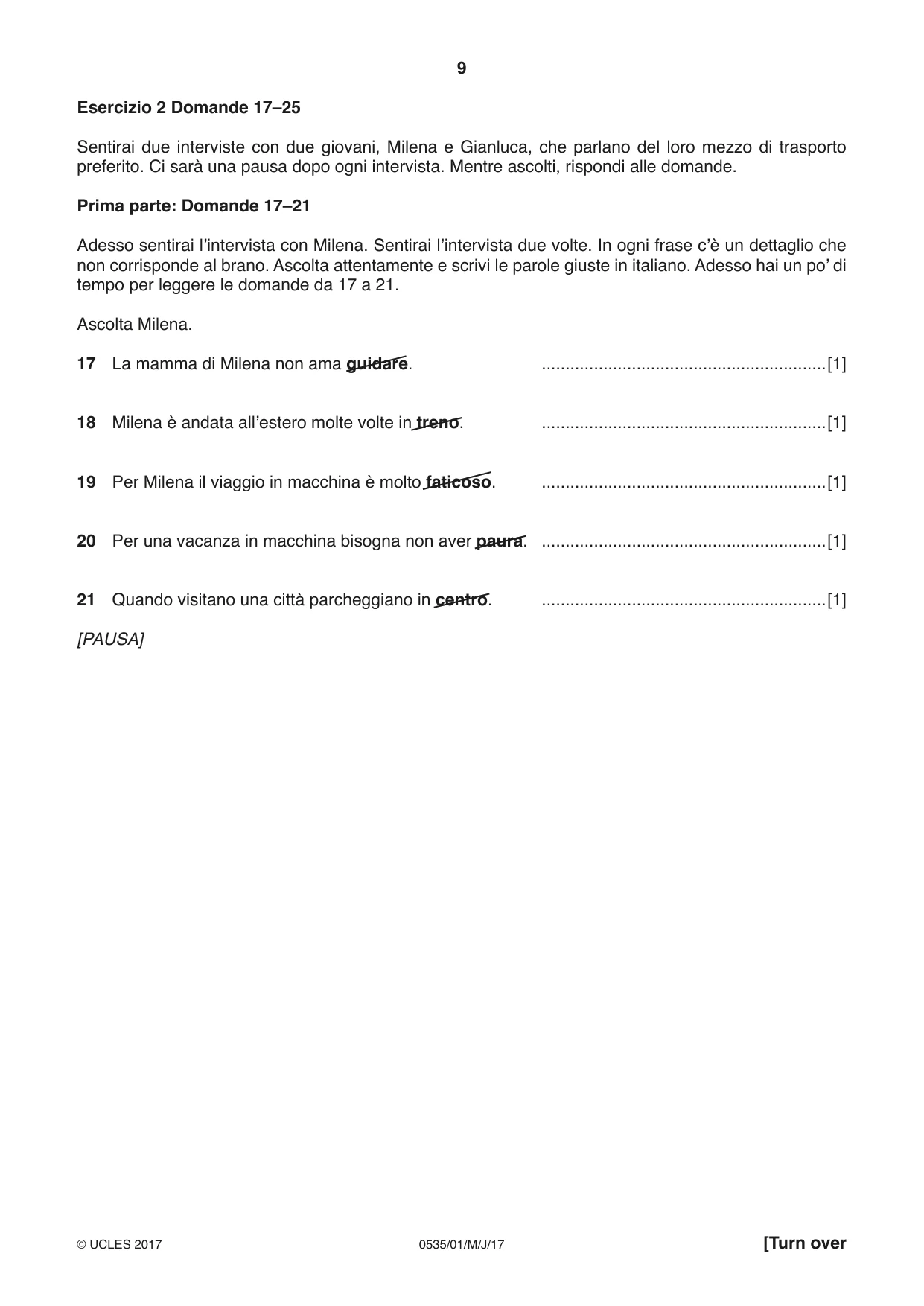
9 0535/01/M/J/17 © UCLES 2017 [Turn over Esercizio 2 Domande 17–25 Sentirai due interviste con due giovani, Milena e Gianluca, che parlano del loro mezzo di trasporto preferito. Ci sarà una pausa dopo ogni intervista. Mentre ascolti, rispondi alle domande. Prima parte: Domande 17–21 Adesso sentirai l’intervista con Milena. Sentirai l’intervista due volte. In ogni frase c’è un dettaglio che non corrisponde al brano. Ascolta attentamente e scrivi le parole giuste in italiano. Adesso hai un po’ di tempo per leggere le domande da 17 a 21. Ascolta Milena. 17 La mamma di Milena non ama guidare. …[1] 18 Milena è andata all’estero molte volte in treno. …[1] 19 Per Milena il viaggio in macchina è molto faticoso. …[1] 20 Per una vacanza in macchina bisogna non aver paura. …[1] 21 Quando visitano una città parcheggiano in centro. …[1] [PAUSA]
Question paper, page 10
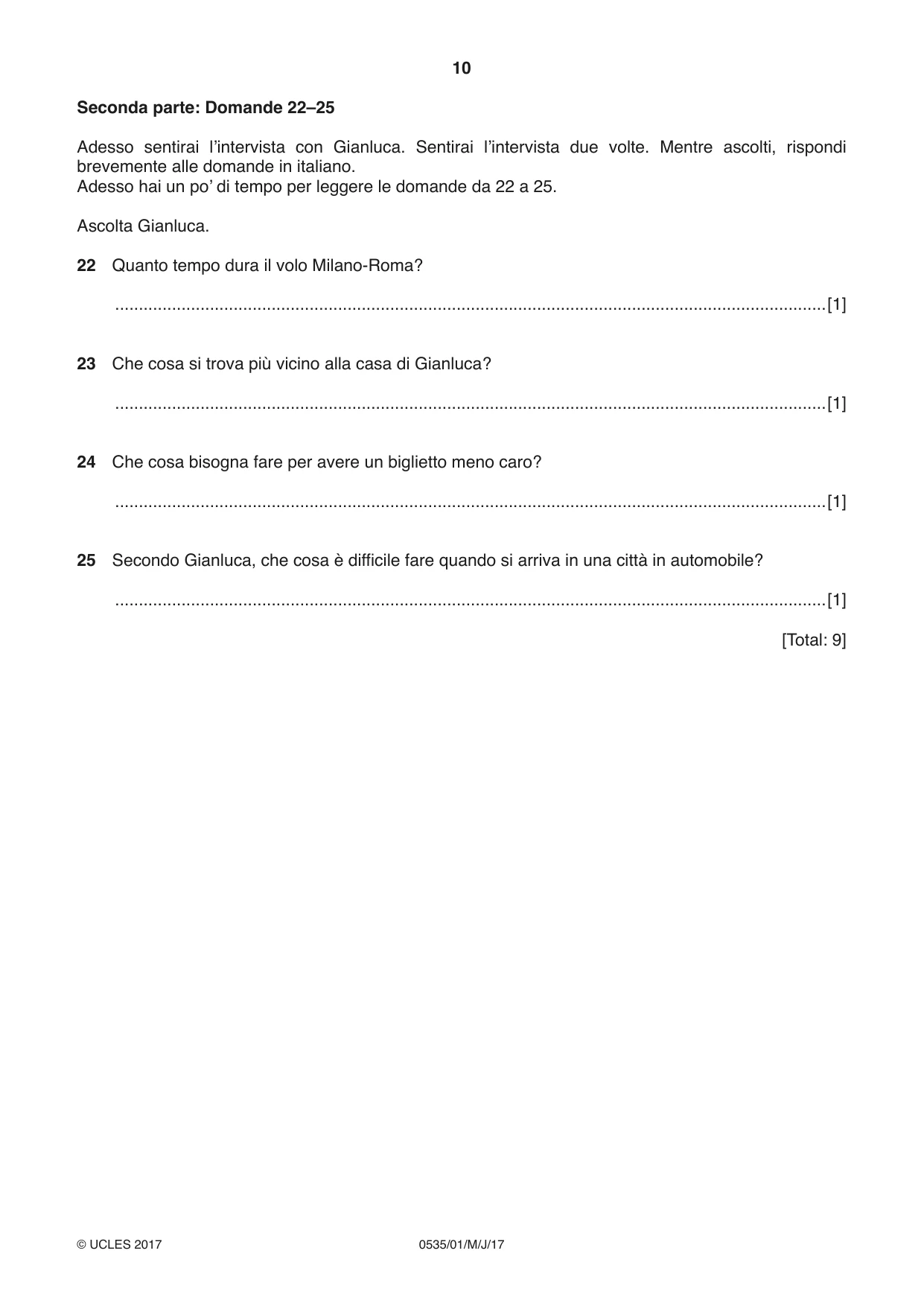
10 0535/01/M/J/17 © UCLES 2017 Seconda parte: Domande 22–25 Adesso sentirai l’intervista con Gianluca. Sentirai l’intervista due volte. Mentre ascolti, rispondi brevemente alle domande in italiano. Adesso hai un po’ di tempo per leggere le domande da 22 a 25. Ascolta Gianluca. 22 Quanto tempo dura il volo Milano-Roma? …[1] 23 Che cosa si trova più vicino alla casa di Gianluca? …[1] 24 Che cosa bisogna fare per avere un biglietto meno caro? …[1] 25 Secondo Gianluca, che cosa è difficile fare quando si arriva in una città in automobile? …[1] [Total: 9]
Question paper, page 11
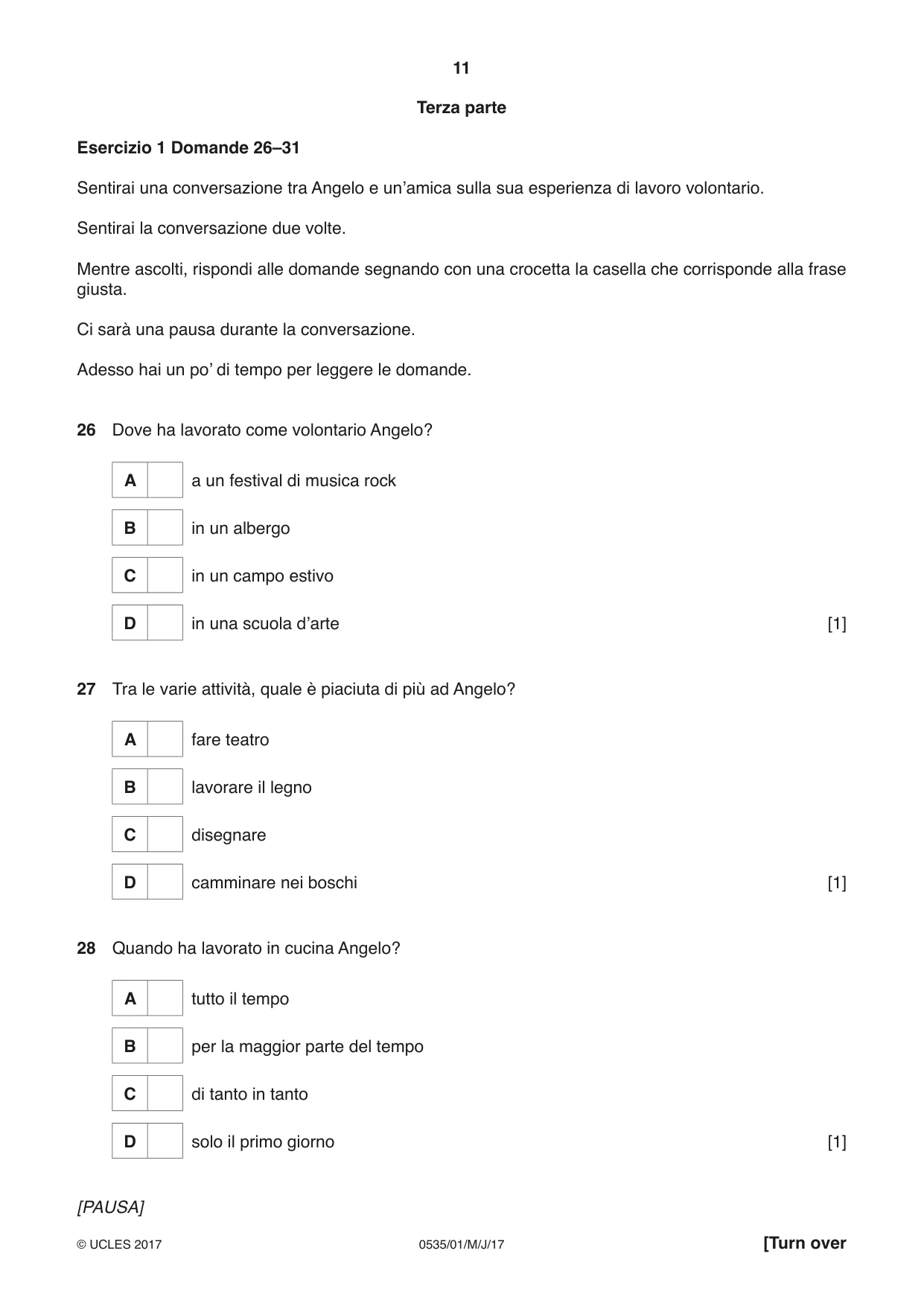
11 0535/01/M/J/17 © UCLES 2017 [Turn over Terza parte Esercizio 1 Domande 26–31 Sentirai una conversazione tra Angelo e un’amica sulla sua esperienza di lavoro volontario. Sentirai la conversazione due volte. Mentre ascolti, rispondi alle domande segnando con una crocetta la casella che corrisponde alla frase giusta. Ci sarà una pausa durante la conversazione. Adesso hai un po’ di tempo per leggere le domande. 26 Dove ha lavorato come volontario Angelo? A a un festival di musica rock B in un albergo C in un campo estivo D in una scuola d’arte [1] 27 Tra le varie attività, quale è piaciuta di più ad Angelo? A fare teatro B lavorare il legno C disegnare D camminare nei boschi [1] 28 Quando ha lavorato in cucina Angelo? A tutto il tempo B per la maggior parte del tempo C di tanto in tanto D solo il primo giorno [1] [PAUSA]
Question paper, page 12
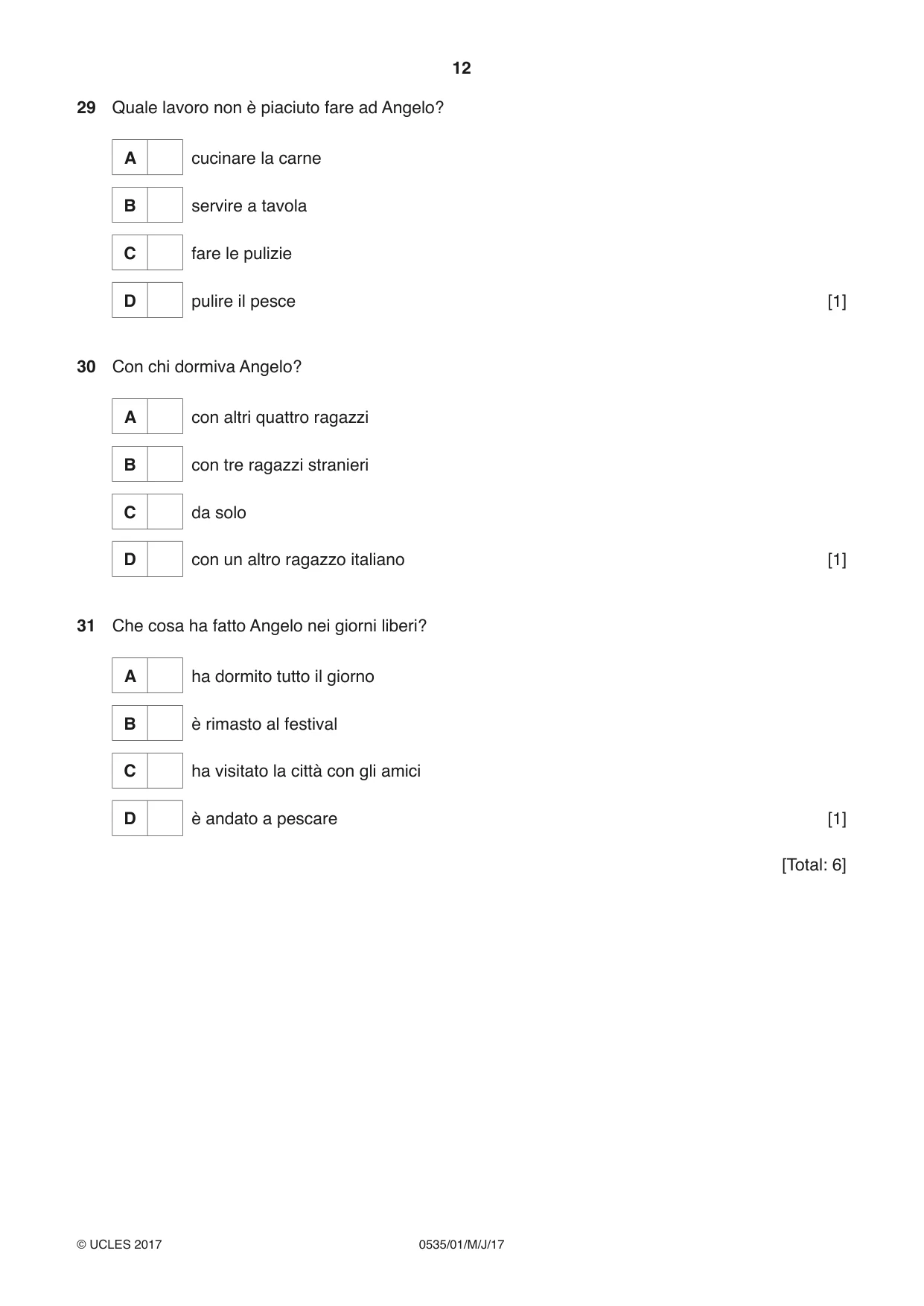
12 0535/01/M/J/17 © UCLES 2017 29 Quale lavoro non è piaciuto fare ad Angelo? A cucinare la carne B servire a tavola C fare le pulizie D pulire il pesce [1] 30 Con chi dormiva Angelo? A con altri quattro ragazzi B con tre ragazzi stranieri C da solo D con un altro ragazzo italiano [1] 31 Che cosa ha fatto Angelo nei giorni liberi? A ha dormito tutto il giorno B è rimasto al festival C ha visitato la città con gli amici D è andato a pescare [1] [Total: 6]
Question paper, page 13
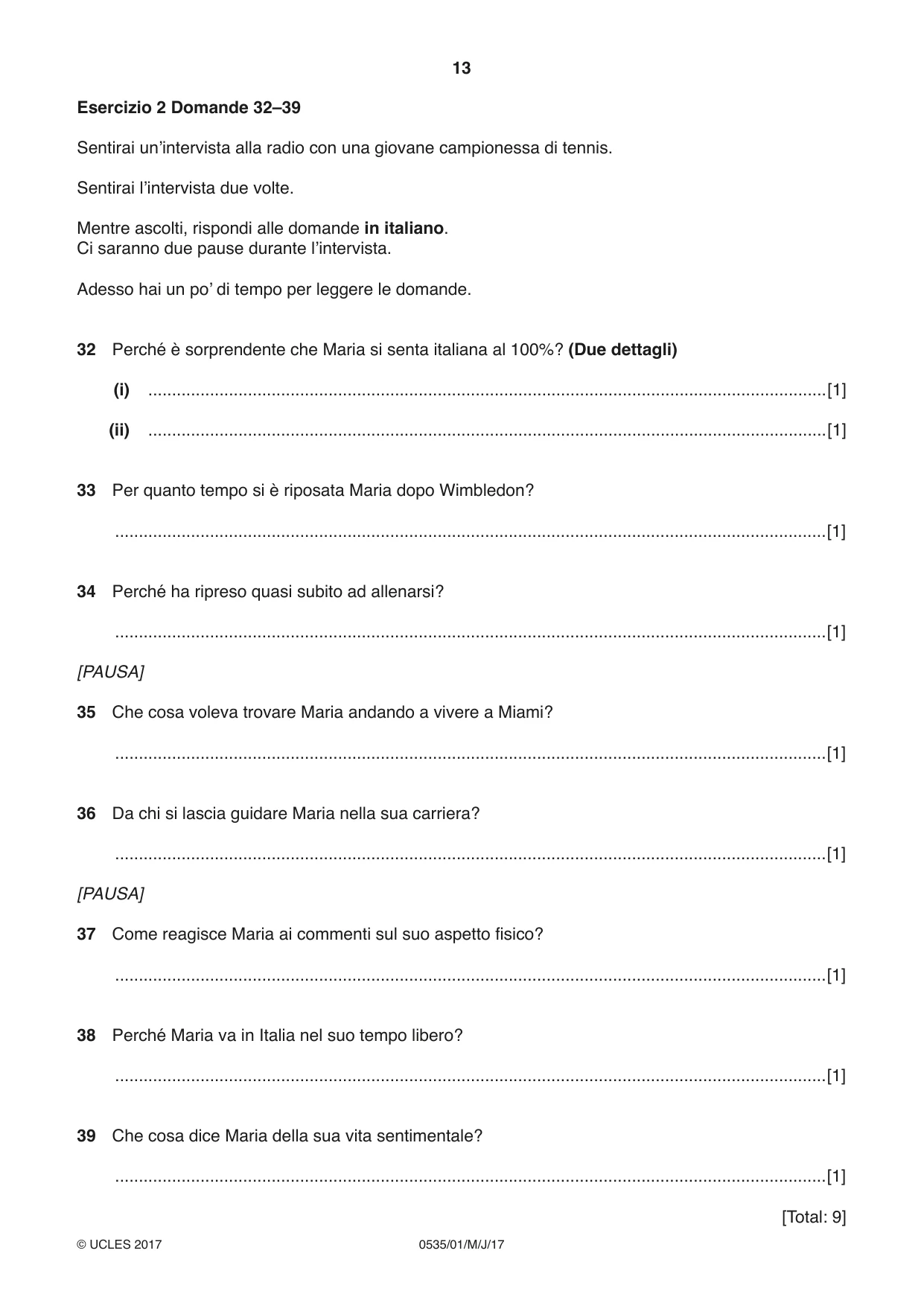
13 0535/01/M/J/17 © UCLES 2017 Esercizio 2 Domande 32–39 Sentirai un’intervista alla radio con una giovane campionessa di tennis. Sentirai l’intervista due volte. Mentre ascolti, rispondi alle domande in italiano. Ci saranno due pause durante l’intervista. Adesso hai un po’ di tempo per leggere le domande. 32 Perché è sorprendente che Maria si senta italiana al 100%? (Due dettagli) (i) …[1] (ii) …[1] 33 Per quanto tempo si è riposata Maria dopo Wimbledon? …[1] 34 Perché ha ripreso quasi subito ad allenarsi? …[1] [PAUSA] 35 Che cosa voleva trovare Maria andando a vivere a Miami? …[1] 36 Da chi si lascia guidare Maria nella sua carriera? …[1] [PAUSA] 37 Come reagisce Maria ai commenti sul suo aspetto fisico? …[1] 38 Perché Maria va in Italia nel suo tempo libero? …[1] 39 Che cosa dice Maria della sua vita sentimentale? …[1] [Total: 9]
Question paper, page 14
14 0535/01/M/J/17 © UCLES 2017 BLANK PAGE
Question paper, page 15
15 0535/01/M/J/17 © UCLES 2017 BLANK PAGE
Question paper, page 16
16 0535/01/M/J/17 © UCLES 2017 Permission to reproduce items where third-party owned material protected by copyright is included has been sought and cleared where possible. Every reasonable effort has been made by the publisher (UCLES) to trace copyright holders, but if any items requiring clearance have unwittingly been included, the publisher will be pleased to make amends at the earliest possible opportunity. To avoid the issue of disclosure of answer-related information to candidates, all copyright acknowledgements are reproduced online in the Cambridge International Examinations Copyright Acknowledgements Booklet. This is produced for each series of examinations and is freely available to download at www.cie.org.uk after the live examination series. Cambridge International Examinations is part of the Cambridge Assessment Group. Cambridge Assessment is the brand name of University of Cambridge Local Examinations Syndicate (UCLES), which is itself a department of the University of Cambridge. BLANK PAGE
Mark scheme, page 1
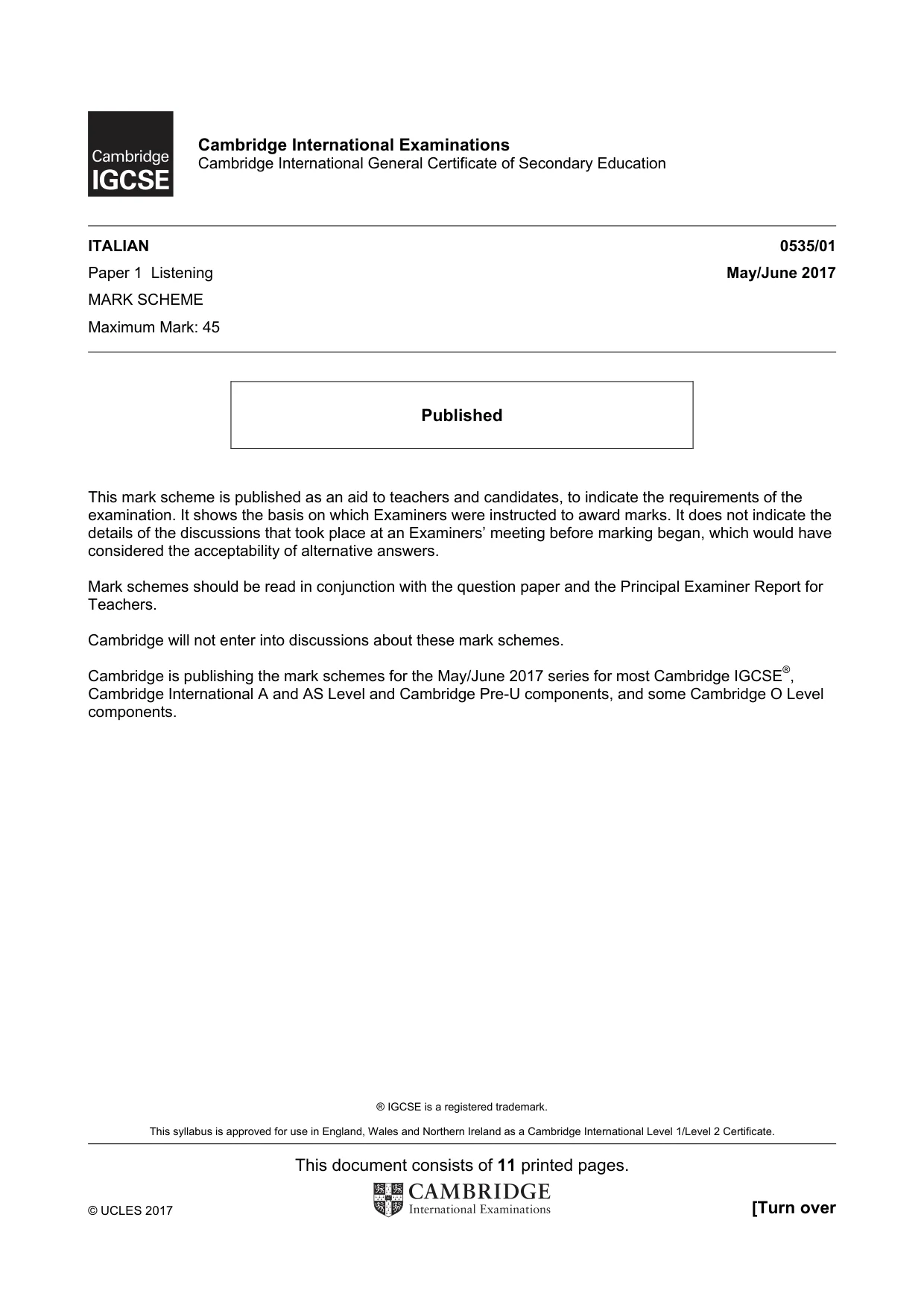
® IGCSE is a registered trademark. This syllabus is approved for use in England, Wales and Northern Ireland as a Cambridge International Level 1/Level 2 Certificate. This document consists of 11 printed pages. © UCLES 2017 [Turn over Cambridge International Examinations Cambridge International General Certificate of Secondary Education ITALIAN 0535/01 Paper 1 Listening May/June 2017 MARK SCHEME Maximum Mark: 45 Published This mark scheme is published as an aid to teachers and candidates, to indicate the requirements of the examination. It shows the basis on which Examiners were instructed to award marks. It does not indicate the details of the discussions that took place at an Examiners’ meeting before marking began, which would have considered the acceptability of alternative answers. Mark schemes should be read in conjunction with the question paper and the Principal Examiner Report for Teachers. Cambridge will not enter into discussions about these mark schemes. Cambridge is publishing the mark schemes for the May/June 2017 series for most Cambridge IGCSE®, Cambridge International A and AS Level and Cambridge Pre-U components, and some Cambridge O Level components.
Mark scheme, page 2
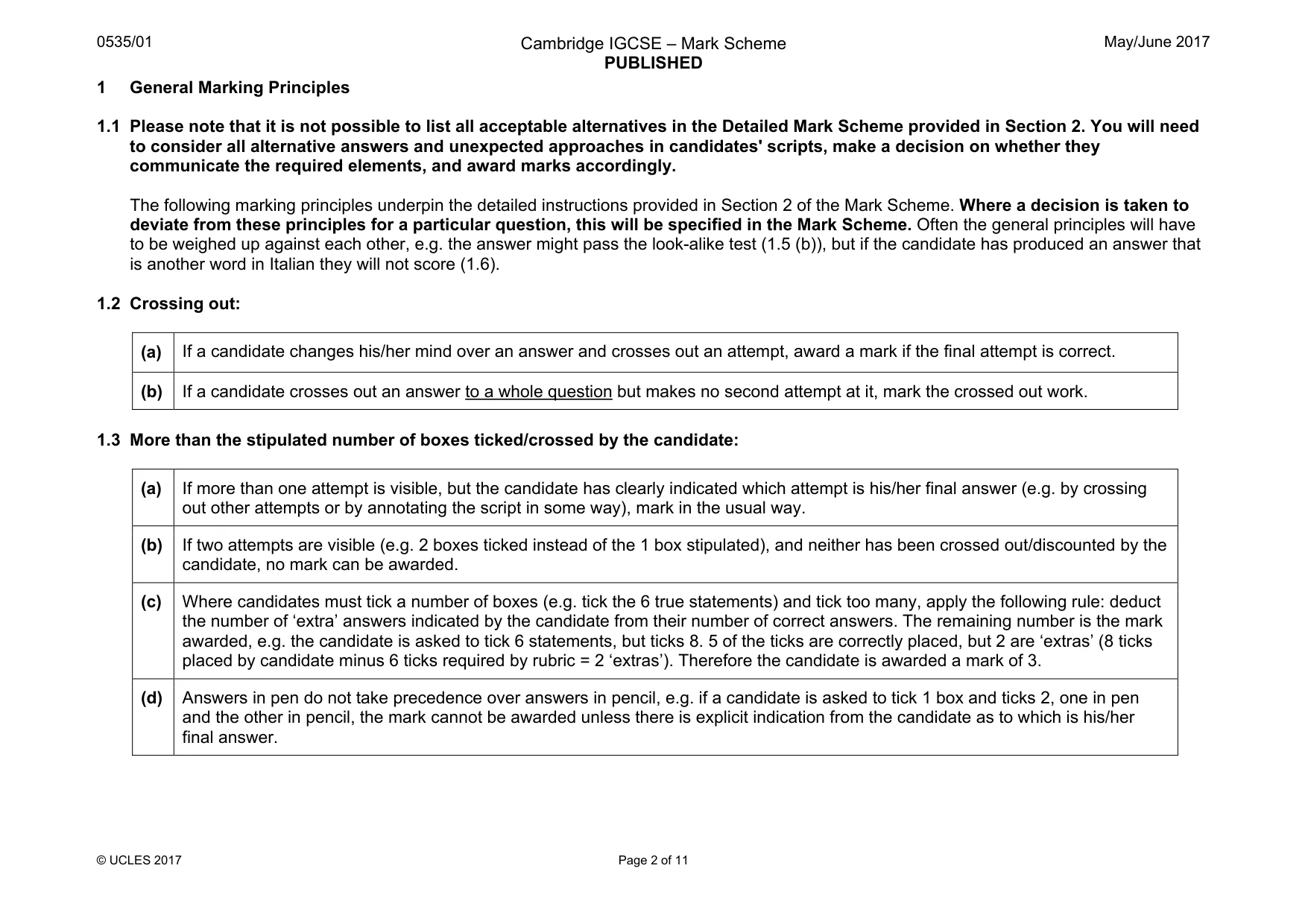
0535/01 Cambridge IGCSE – Mark Scheme PUBLISHED May/June 2017 © UCLES 2017 Page 2 of 11 1 General Marking Principles 1.1 Please note that it is not possible to list all acceptable alternatives in the Detailed Mark Scheme provided in Section 2. You will need to consider all alternative answers and unexpected approaches in candidates' scripts, make a decision on whether they communicate the required elements, and award marks accordingly. The following marking principles underpin the detailed instructions provided in Section 2 of the Mark Scheme. Where a decision is taken to deviate from these principles for a particular question, this will be specified in the Mark Scheme. Often the general principles will have to be weighed up against each other, e.g. the answer might pass the look-alike test (1.5 (b)), but if the candidate has produced an answer that is another word in Italian they will not score (1.6). 1.2 Crossing out: (a) If a candidate changes his/her mind over an answer and crosses out an attempt, award a mark if the final attempt is correct. (b) If a candidate crosses out an answer to a whole question but makes no second attempt at it, mark the crossed out work. 1.3 More than the stipulated number of boxes ticked/crossed by the candidate: (a) If more than one attempt is visible, but the candidate has clearly indicated which attempt is his/her final answer (e.g. by crossing out other attempts or by annotating the script in some way), mark in the usual way. (b) If two attempts are visible (e.g. 2 boxes ticked instead of the 1 box stipulated), and neither has been crossed out/discounted by the candidate, no mark can be awarded. (c) Where candidates must tick a number of boxes (e.g. tick the 6 true statements) and tick too many, apply the following rule: deduct the number of ‘extra’ answers indicated by the candidate from their number of correct answers. The remaining number is the mark awarded, e.g. the candidate is asked to tick 6 statements, but ticks 8. 5 of the ticks are correctly placed, but 2 are ‘extras’ (8 ticks placed by candidate minus 6 ticks required by rubric = 2 ‘extras’). Therefore the candidate is awarded a mark of 3. (d) Answers in pen do not take precedence over answers in pencil, e.g. if a candidate is asked to tick 1 box and ticks 2, one in pen and the other in pencil, the mark cannot be awarded unless there is explicit indication from the candidate as to which is his/her final answer.
Mark scheme, page 3
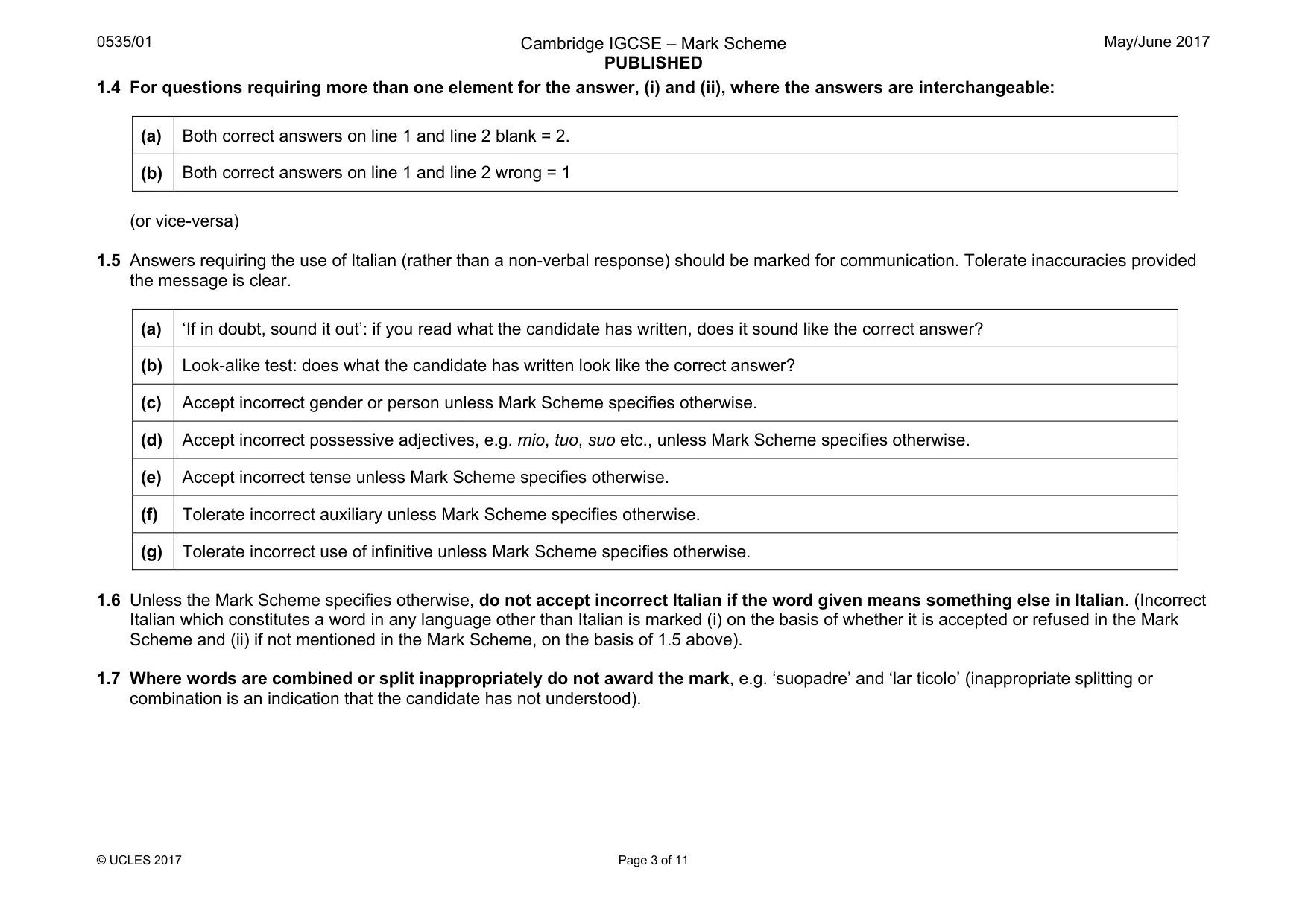
0535/01 Cambridge IGCSE – Mark Scheme PUBLISHED May/June 2017 © UCLES 2017 Page 3 of 11 1.4 For questions requiring more than one element for the answer, (i) and (ii), where the answers are interchangeable: (a) Both correct answers on line 1 and line 2 blank = 2. (b) Both correct answers on line 1 and line 2 wrong = 1 (or vice-versa) 1.5 Answers requiring the use of Italian (rather than a non-verbal response) should be marked for communication. Tolerate inaccuracies provided the message is clear. (a) ‘If in doubt, sound it out’: if you read what the candidate has written, does it sound like the correct answer? (b) Look-alike test: does what the candidate has written look like the correct answer? (c) Accept incorrect gender or person unless Mark Scheme specifies otherwise. (d) Accept incorrect possessive adjectives, e.g. mio, tuo, suo etc., unless Mark Scheme specifies otherwise. (e) Accept incorrect tense unless Mark Scheme specifies otherwise. (f) Tolerate incorrect auxiliary unless Mark Scheme specifies otherwise. (g) Tolerate incorrect use of infinitive unless Mark Scheme specifies otherwise. 1.6 Unless the Mark Scheme specifies otherwise, do not accept incorrect Italian if the word given means something else in Italian. (Incorrect Italian which constitutes a word in any language other than Italian is marked (i) on the basis of whether it is accepted or refused in the Mark Scheme and (ii) if not mentioned in the Mark Scheme, on the basis of 1.5 above). 1.7 Where words are combined or split inappropriately do not award the mark, e.g. ‘suopadre’ and ‘lar ticolo’ (inappropriate splitting or combination is an indication that the candidate has not understood).
Mark scheme, page 4
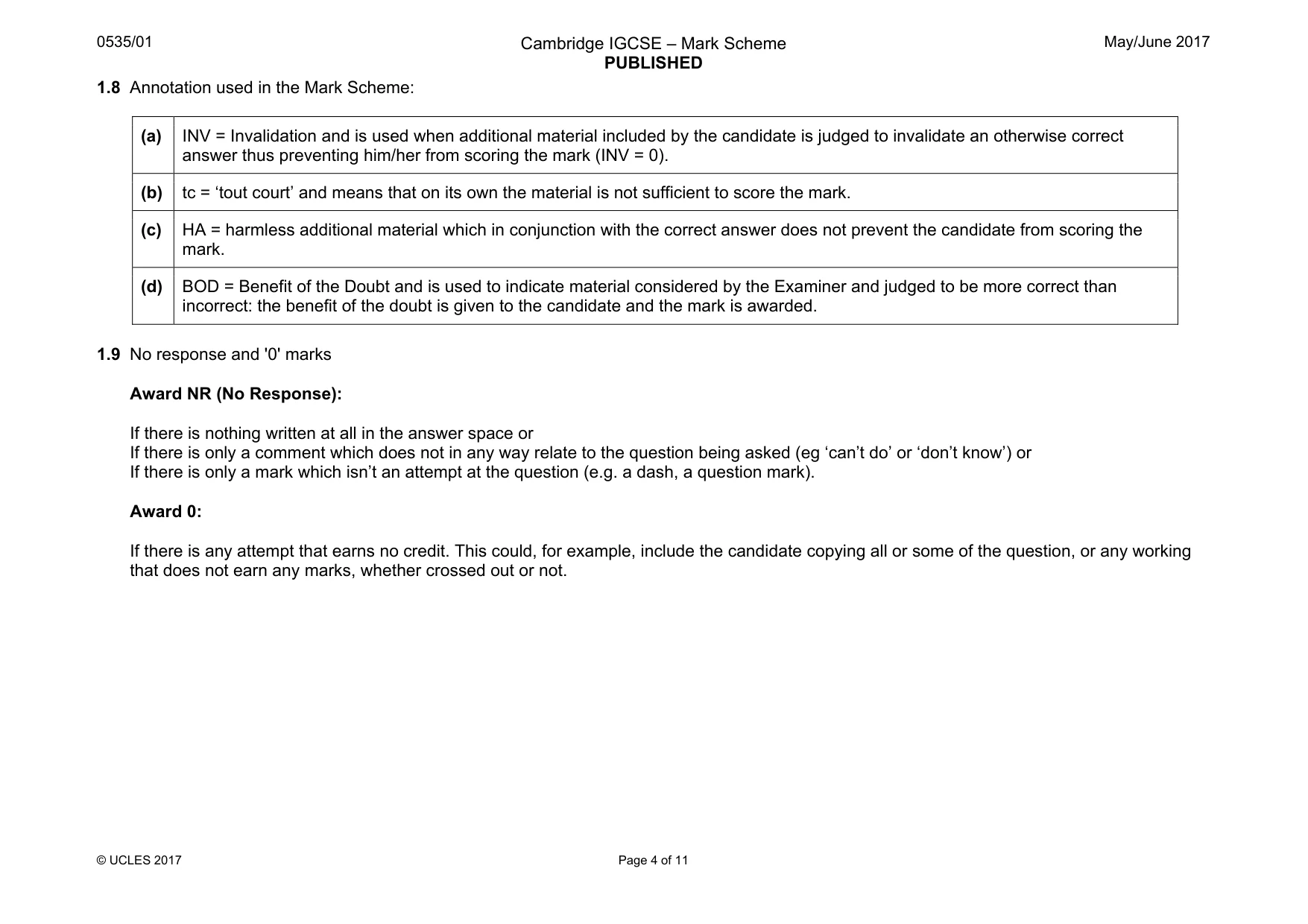
0535/01 Cambridge IGCSE – Mark Scheme PUBLISHED May/June 2017 © UCLES 2017 Page 4 of 11 1.8 Annotation used in the Mark Scheme: (a) INV = Invalidation and is used when additional material included by the candidate is judged to invalidate an otherwise correct answer thus preventing him/her from scoring the mark (INV = 0). (b) tc = ‘tout court’ and means that on its own the material is not sufficient to score the mark. (c) HA = harmless additional material which in conjunction with the correct answer does not prevent the candidate from scoring the mark. (d) BOD = Benefit of the Doubt and is used to indicate material considered by the Examiner and judged to be more correct than incorrect: the benefit of the doubt is given to the candidate and the mark is awarded. 1.9 No response and '0' marks Award NR (No Response): If there is nothing written at all in the answer space or If there is only a comment which does not in any way relate to the question being asked (eg ‘can’t do’ or ‘don’t know’) or If there is only a mark which isn’t an attempt at the question (e.g. a dash, a question mark). Award 0: If there is any attempt that earns no credit. This could, for example, include the candidate copying all or some of the question, or any working that does not earn any marks, whether crossed out or not.
Mark scheme, page 5
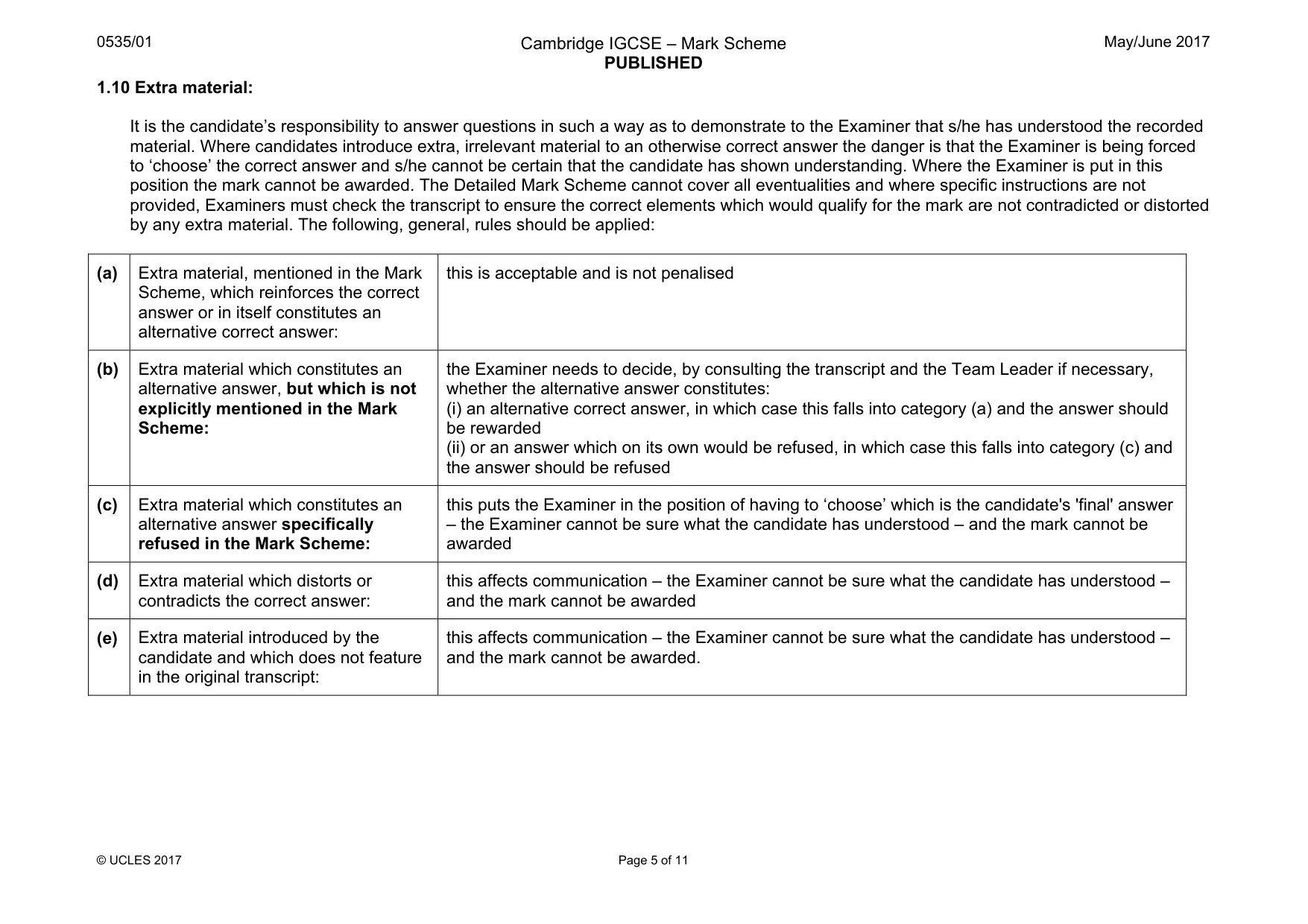
0535/01 Cambridge IGCSE – Mark Scheme PUBLISHED May/June 2017 © UCLES 2017 Page 5 of 11 1.10 Extra material: It is the candidate’s responsibility to answer questions in such a way as to demonstrate to the Examiner that s/he has understood the recorded material. Where candidates introduce extra, irrelevant material to an otherwise correct answer the danger is that the Examiner is being forced to ‘choose’ the correct answer and s/he cannot be certain that the candidate has shown understanding. Where the Examiner is put in this position the mark cannot be awarded. The Detailed Mark Scheme cannot cover all eventualities and where specific instructions are not provided, Examiners must check the transcript to ensure the correct elements which would qualify for the mark are not contradicted or distorted by any extra material. The following, general, rules should be applied: (a) Extra material, mentioned in the Mark Scheme, which reinforces the correct answer or in itself constitutes an alternative correct answer: this is acceptable and is not penalised (b) Extra material which constitutes an alternative answer, but which is not explicitly mentioned in the Mark Scheme: the Examiner needs to decide, by consulting the transcript and the Team Leader if necessary, whether the alternative answer constitutes: (i) an alternative correct answer, in which case this falls into category (a) and the answer should be rewarded (ii) or an answer which on its own would be refused, in which case this falls into category (c) and the answer should be refused (c) Extra material which constitutes an alternative answer specifically refused in the Mark Scheme: this puts the Examiner in the position of having to ‘choose’ which is the candidate's 'final' answer – the Examiner cannot be sure what the candidate has understood – and the mark cannot be awarded (d) Extra material which distorts or contradicts the correct answer: this affects communication – the Examiner cannot be sure what the candidate has understood – and the mark cannot be awarded (e) Extra material introduced by the candidate and which does not feature in the original transcript: this affects communication – the Examiner cannot be sure what the candidate has understood – and the mark cannot be awarded.
Mark scheme, page 6
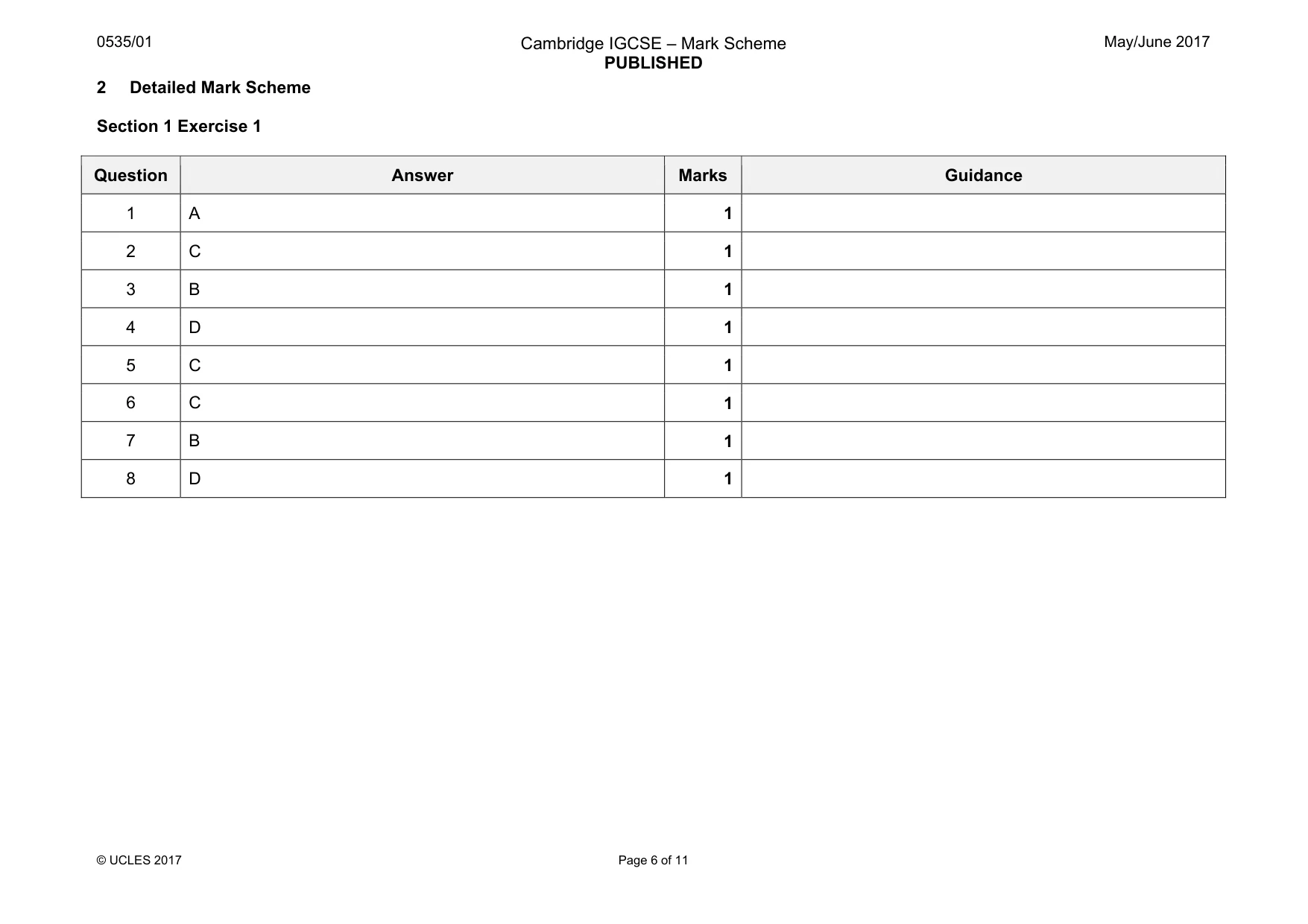
0535/01 Cambridge IGCSE – Mark Scheme PUBLISHED May/June 2017 © UCLES 2017 Page 6 of 11 2 Detailed Mark Scheme Section 1 Exercise 1 Question Answer Marks Guidance 1 A 1 2 C 1 3 B 1 4 D 1 5 C 1 6 C 1 7 B 1 8 D 1
Mark scheme, page 7
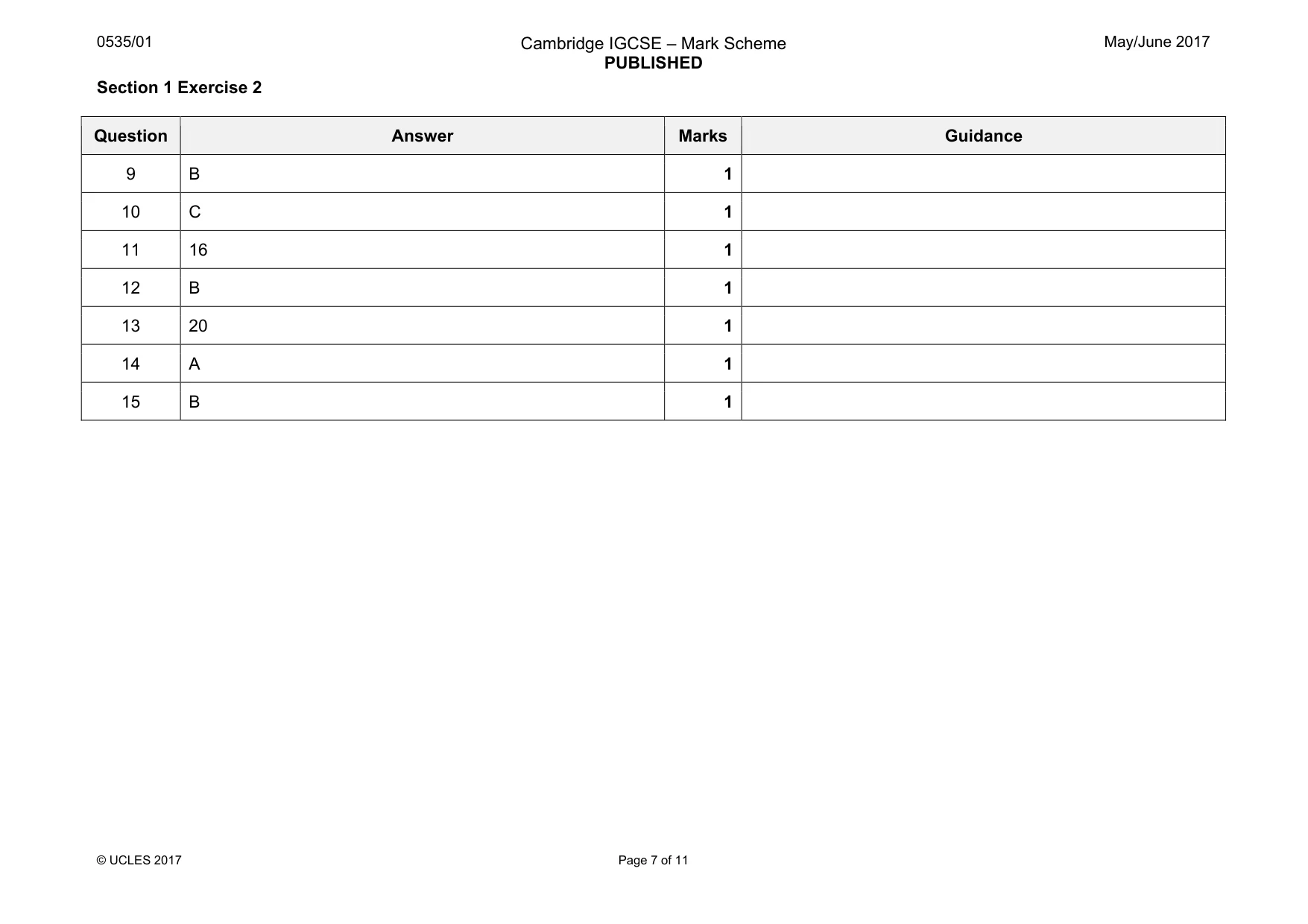
0535/01 Cambridge IGCSE – Mark Scheme PUBLISHED May/June 2017 © UCLES 2017 Page 7 of 11 Section 1 Exercise 2 Question Answer Marks Guidance 9 B 1 10 C 1 11 16 1 12 B 1 13 20 1 14 A 1 15 B 1
Mark scheme, page 8
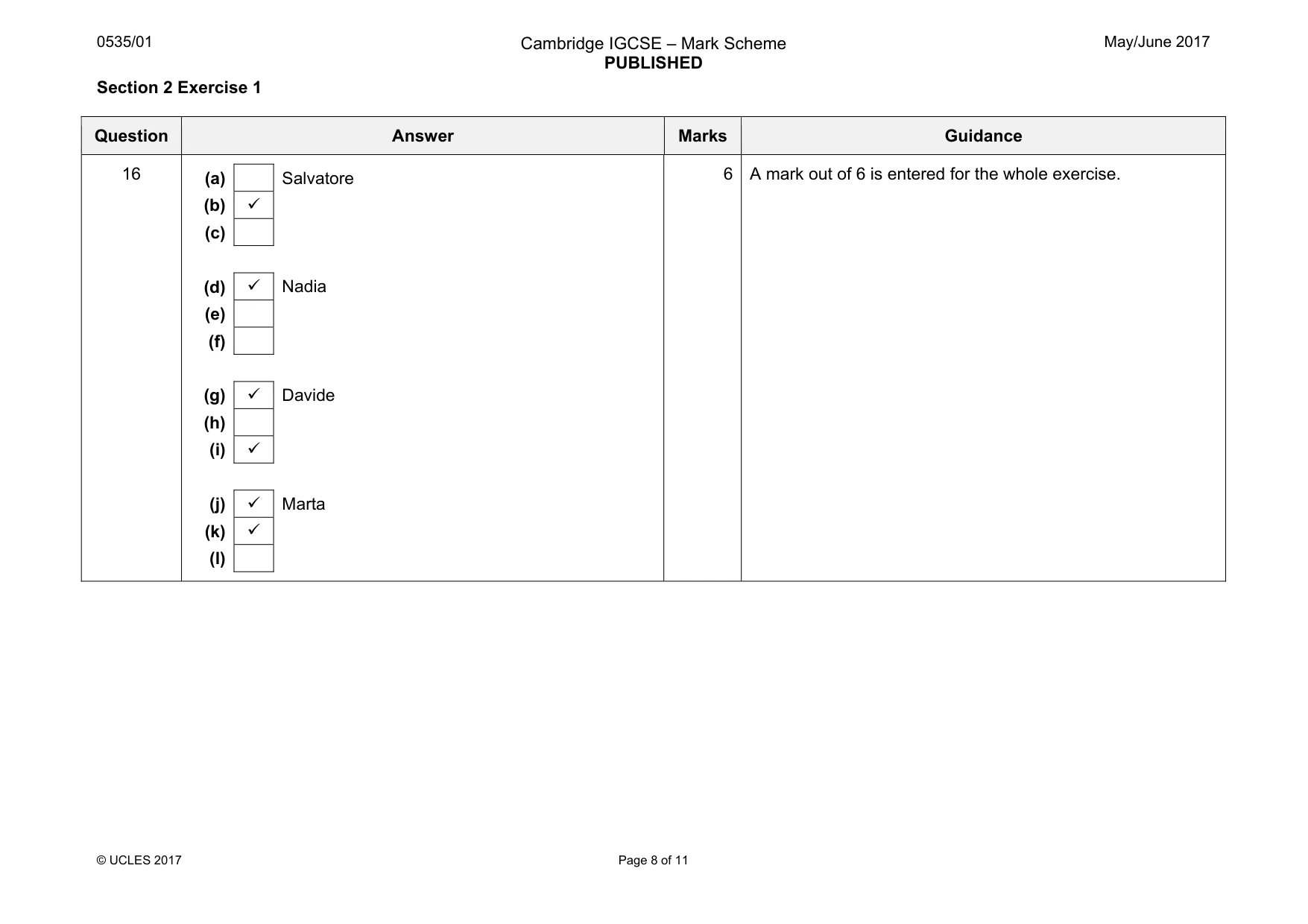
0535/01 Cambridge IGCSE – Mark Scheme PUBLISHED May/June 2017 © UCLES 2017 Page 8 of 11 Section 2 Exercise 1 Question Answer Marks Guidance 16 (a) Salvatore (b) 9 (c) (d) 9 Nadia (e) (f) (g) 9 Davide (h) (i) 9 (j) 9 Marta (k) 9 (l) 6 A mark out of 6 is entered for the whole exercise.
Mark scheme, page 9
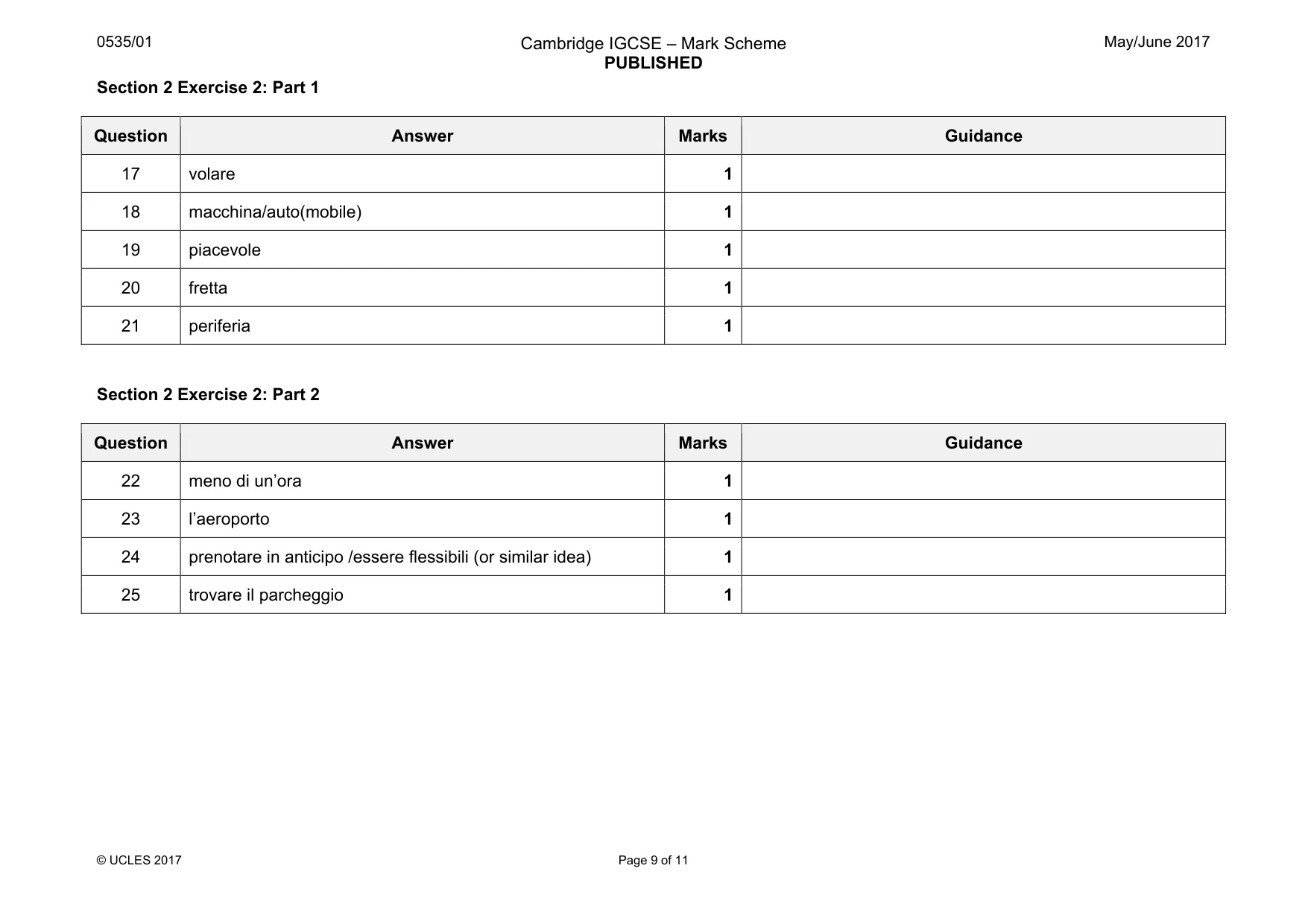
0535/01 Cambridge IGCSE – Mark Scheme PUBLISHED May/June 2017 © UCLES 2017 Page 9 of 11 Section 2 Exercise 2: Part 1 Question Answer Marks Guidance 17 volare 1 18 macchina/auto(mobile) 1 19 piacevole 1 20 fretta 1 21 periferia 1 Section 2 Exercise 2: Part 2 Question Answer Marks Guidance 22 meno di un’ora 1 23 l’aeroporto 1 24 prenotare in anticipo /essere flessibili (or similar idea) 1 25 trovare il parcheggio 1
Mark scheme, page 10
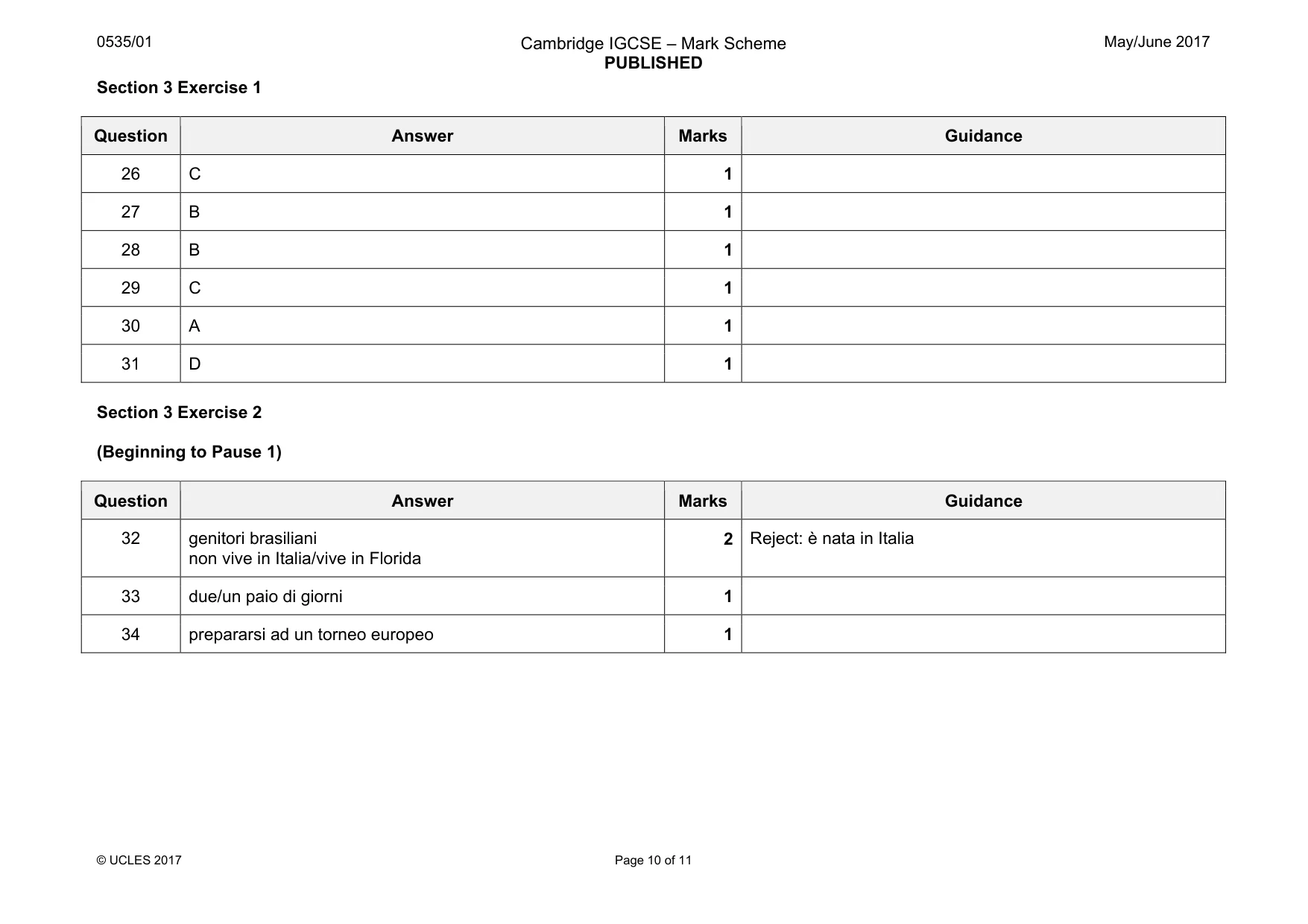
0535/01 Cambridge IGCSE – Mark Scheme PUBLISHED May/June 2017 © UCLES 2017 Page 10 of 11 Section 3 Exercise 1 Question Answer Marks Guidance 26 C 1 27 B 1 28 B 1 29 C 1 30 A 1 31 D 1 Section 3 Exercise 2 (Beginning to Pause 1) Question Answer Marks Guidance 32 genitori brasiliani non vive in Italia/vive in Florida 2 Reject: è nata in Italia 33 due/un paio di giorni 1 34 prepararsi ad un torneo europeo 1
Mark scheme, page 11
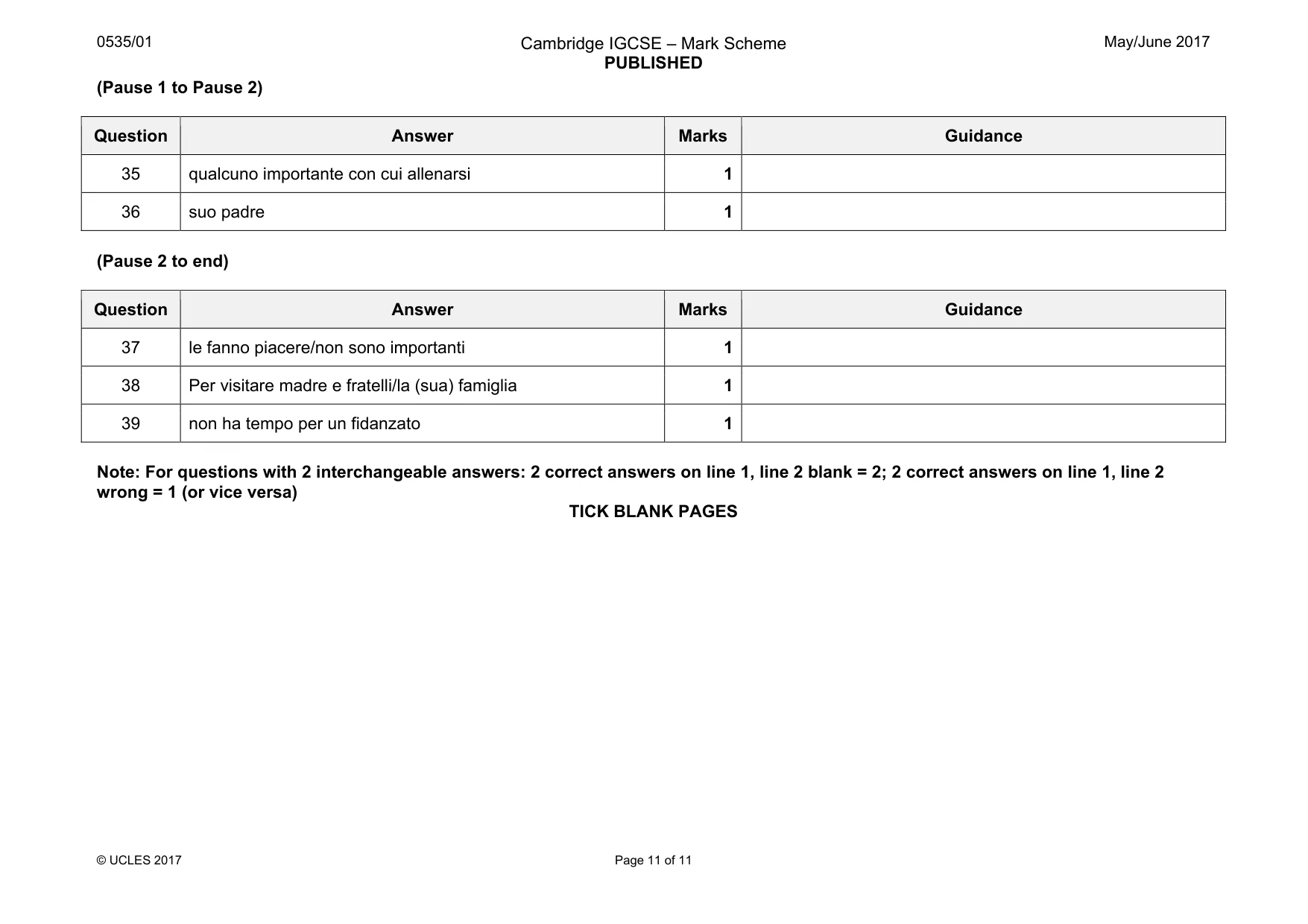
0535/01 Cambridge IGCSE – Mark Scheme PUBLISHED May/June 2017 © UCLES 2017 Page 11 of 11 (Pause 1 to Pause 2) Question Answer Marks Guidance 35 qualcuno importante con cui allenarsi 1 36 suo padre 1 (Pause 2 to end) Question Answer Marks Guidance 37 le fanno piacere/non sono importanti 1 38 Per visitare madre e fratelli/la (sua) famiglia 1 39 non ha tempo per un fidanzato 1 Note: For questions with 2 interchangeable answers: 2 correct answers on line 1, line 2 blank = 2; 2 correct answers on line 1, line 2 wrong = 1 (or vice versa) TICK BLANK PAGES
What you needed in this session
Cambridge’s own grade thresholds for 2017 May/June, Paper 1 · Variant 1. A higher threshold means an easier paper — the bar moves with how the cohort did.