Cambridge IGCSE Islamiyat 0493 — 2020 Oct/Nov Paper 1 · Variant 1
0493/11/O/N/20 · 50 marks · ≈56 min
The question paper and its mark scheme, free to read here and free to download. This is Cambridge’s own paper, exactly as it was sat.
Question paper16 pages




Mark scheme12 pages
Answers below. Sit the paper first if you are practising.
Paper as text
Question paper, page 1
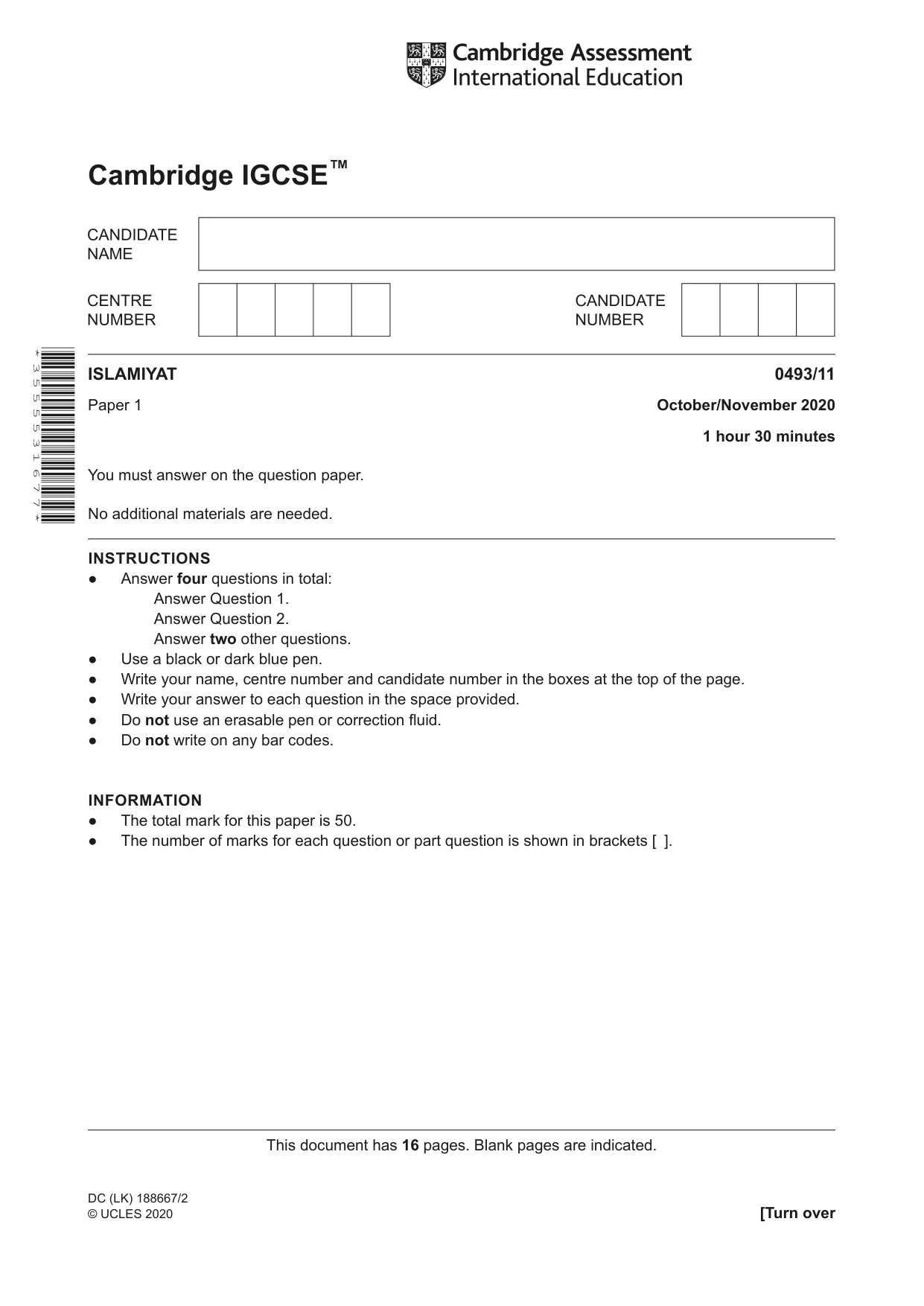
Cambridge IGCSE™ ISLAMIYAT 0493/11 Paper 1 October/November 2020 1 hour 30 minutes You must answer on the question paper. No additional materials are needed. INSTRUCTIONS ● Answer four questions in total: Answer Question 1. Answer Question 2. Answer two other questions. ● Use a black or dark blue pen. ● Write your name, centre number and candidate number in the boxes at the top of the page. ● Write your answer to each question in the space provided. ● Do not use an erasable pen or correction fluid. ● Do not write on any bar codes. INFORMATION ● The total mark for this paper is 50. ● The number of marks for each question or part question is shown in brackets [ ]. This document has 16 pages. Blank pages are indicated. DC (LK) 188667/2 © UCLES 2020 [Turn over * 3 5 5 5 5 3 1 6 7 7 *
Question paper, page 2
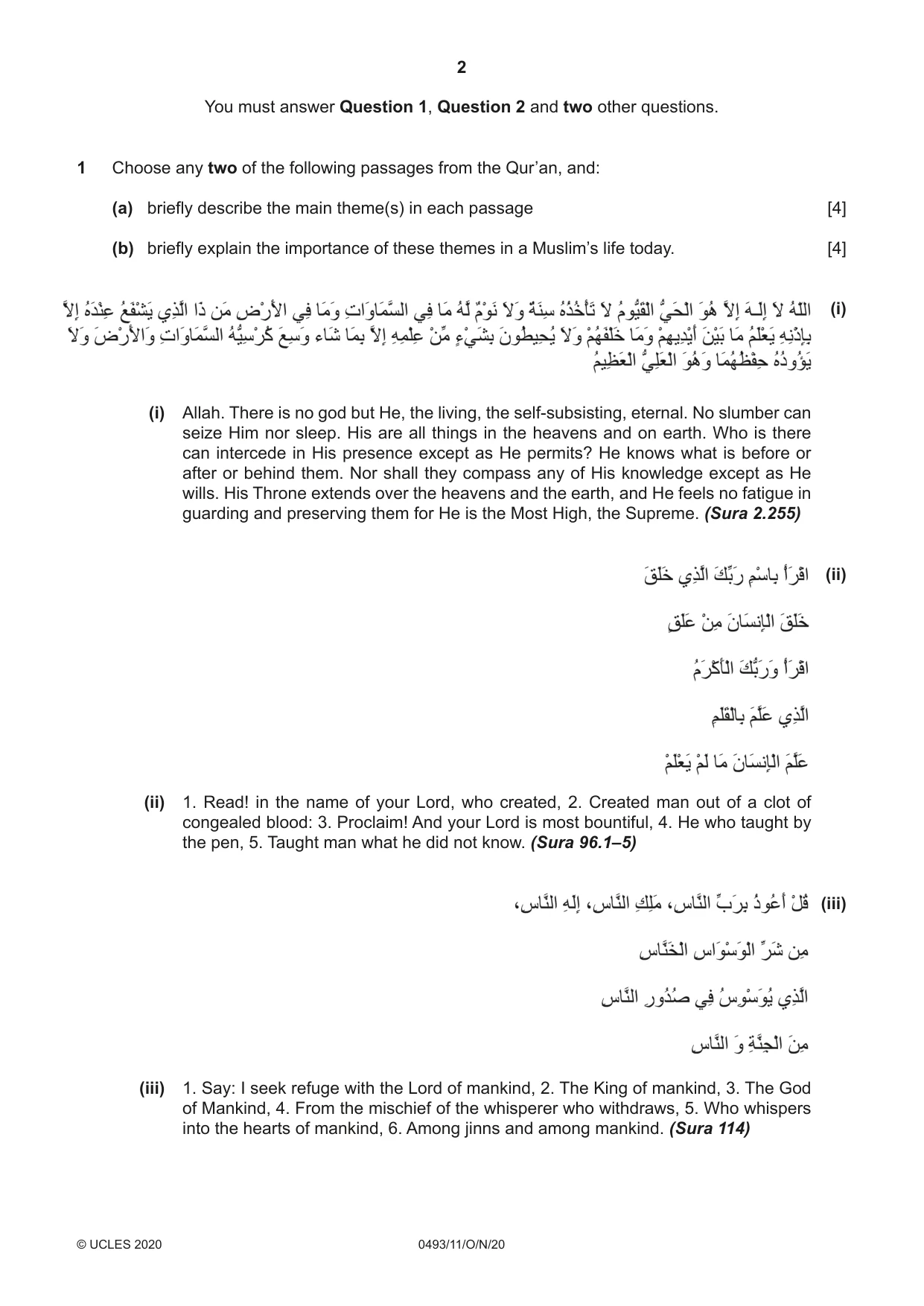
2 0493/11/O/N/20 © UCLES 2020 You must answer Question 1, Question 2 and two other questions. 1 Choose any two of the following passages from the Qur’an, and: (a) briefly describe the main theme(s) in each passage [4] (b) briefly explain the importance of these themes in a Muslim’s life today. [4] (i) (i) Allah. There is no god but He, the living, the self-subsisting, eternal. No slumber can seize Him nor sleep. His are all things in the heavens and on earth. Who is there can intercede in His presence except as He permits? He knows what is before or after or behind them. Nor shall they compass any of His knowledge except as He wills. His Throne extends over the heavens and the earth, and He feels no fatigue in guarding and preserving them for He is the Most High, the Supreme. (Sura 2.255) (ii) (ii) 1. Read! in the name of your Lord, who created, 2. Created man out of a clot of congealed blood: 3. Proclaim! And your Lord is most bountiful, 4. He who taught by the pen, 5. Taught man what he did not know. (Sura 96.1–5) (iii) (iii) 1. Say: I seek refuge with the Lord of mankind, 2. The King of mankind, 3. The God of Mankind, 4. From the mischief of the whisperer who withdraws, 5. Who whispers into the hearts of mankind, 6. Among jinns and among mankind. (Sura 114)
Question paper, page 3
3 0493/11/O/N/20 © UCLES 2020 [Turn over … … … … … … … … … … … … … … … … … … … … … … … … … … … …
Question paper, page 4
4 0493/11/O/N/20 © UCLES 2020 … … … … … … … … … … … … … … … … … … … … … … … … … … … …
Question paper, page 5
5 0493/11/O/N/20 © UCLES 2020 [Turn over 2 (a) Using passages from the syllabus write about what God says about His relationship with two of His Messengers. [10] (b) How might Muslims use the Qur’an to have a closer connection with God? [4] … … … … … … … … … … … … … … … … … … … … … … … … … …
Question paper, page 6
6 0493/11/O/N/20 © UCLES 2020 … … … … … … … … … … … … … … … … … … … … … … … … … … … …
Question paper, page 7
7 0493/11/O/N/20 © UCLES 2020 [Turn over … … … … … … … … … … … … … … … … … … … … … … … … … … … …
Question paper, page 8
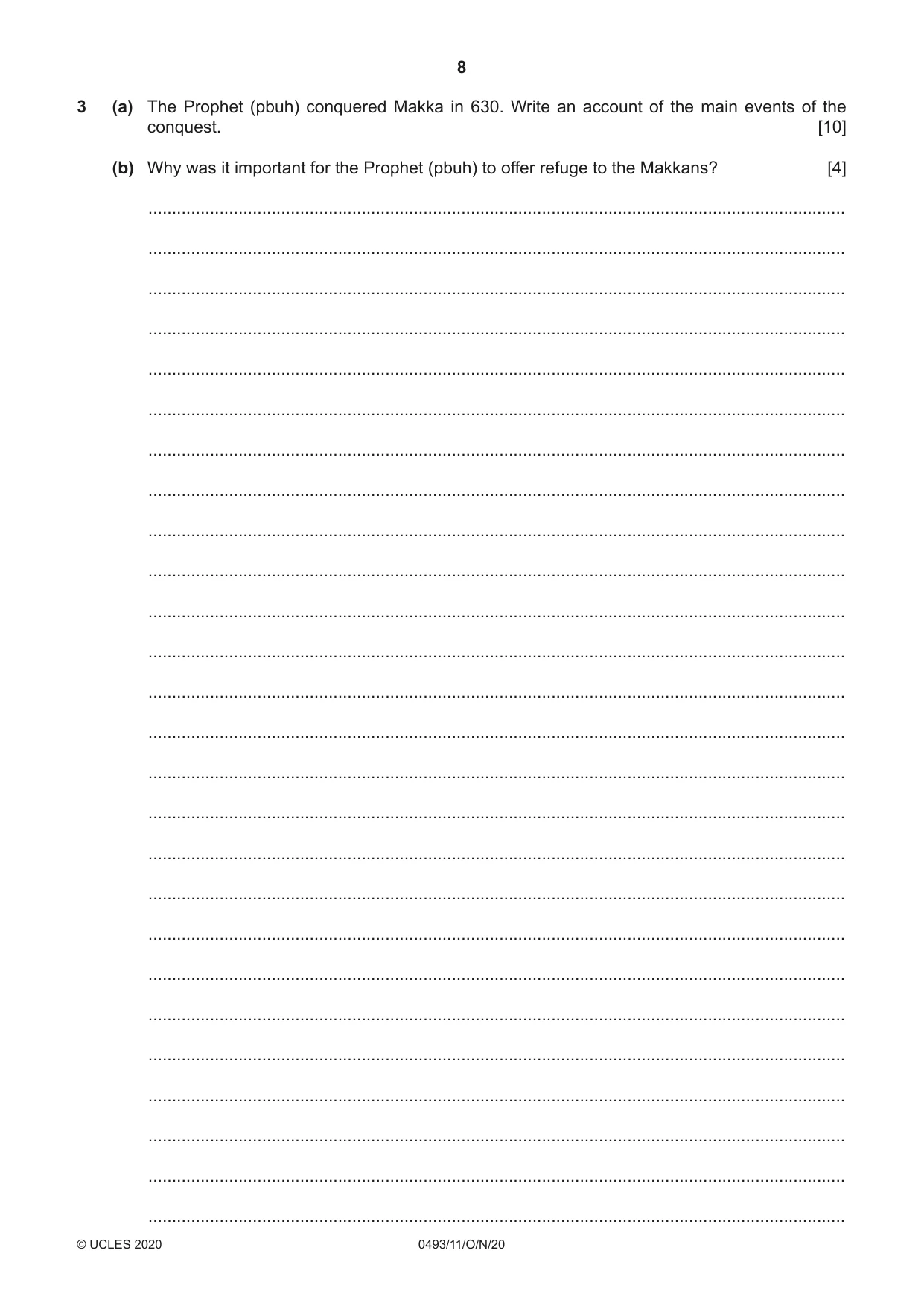
8 0493/11/O/N/20 © UCLES 2020 3 (a) The Prophet (pbuh) conquered Makka in 630. Write an account of the main events of the conquest. [10] (b) Why was it important for the Prophet (pbuh) to offer refuge to the Makkans? [4] … … … … … … … … … … … … … … … … … … … … … … … … … …
Question paper, page 9
9 0493/11/O/N/20 © UCLES 2020 [Turn over … … … … … … … … … … … … … … … … … … … … … … … … … … … …
Question paper, page 10
10 0493/11/O/N/20 © UCLES 2020 … … … … … … … … … … … … … … … … … … … … … … … … … … … …
Question paper, page 11
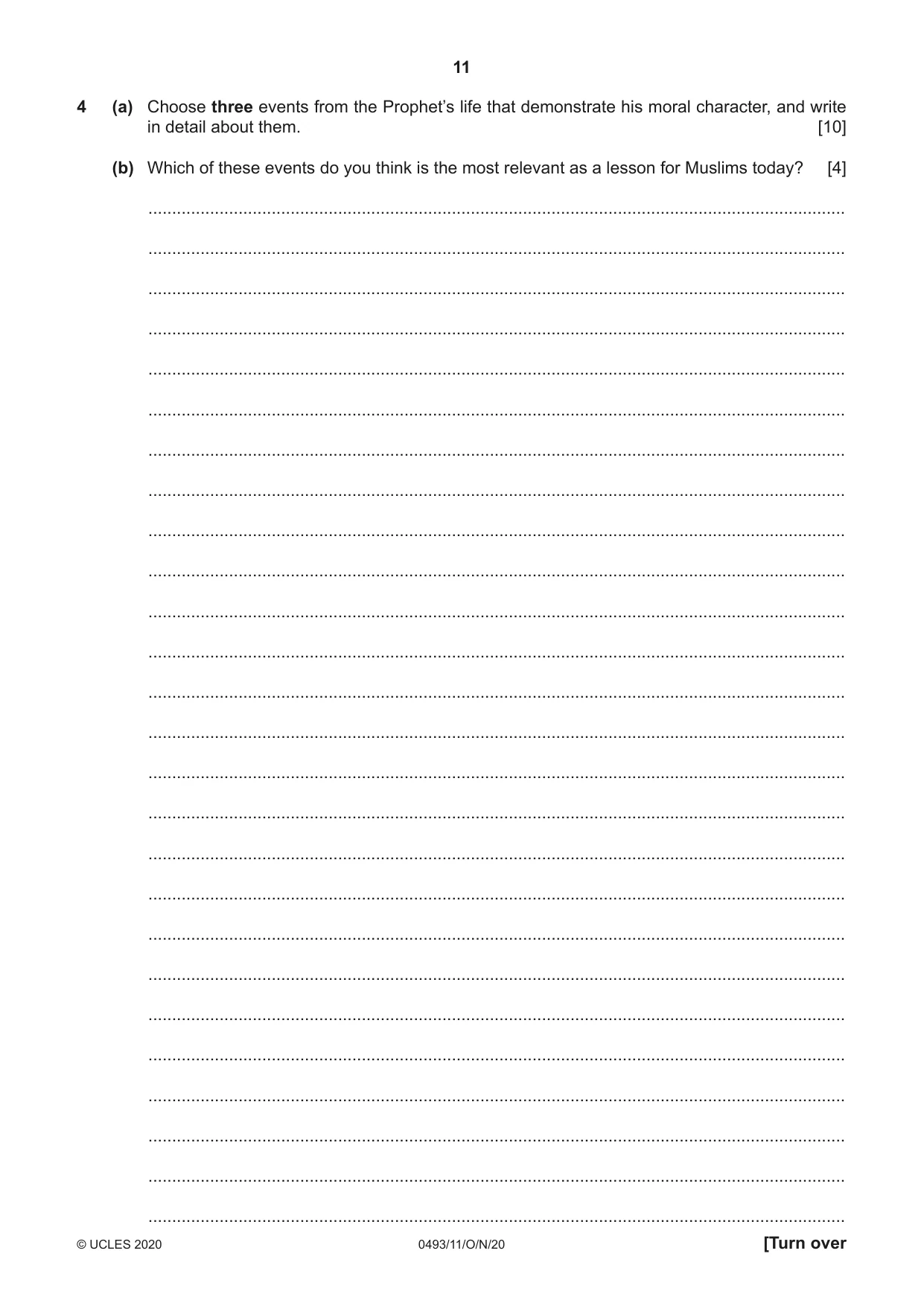
11 0493/11/O/N/20 © UCLES 2020 [Turn over 4 (a) Choose three events from the Prophet’s life that demonstrate his moral character, and write in detail about them. [10] (b) Which of these events do you think is the most relevant as a lesson for Muslims today? [4] … … … … … … … … … … … … … … … … … … … … … … … … … …
Question paper, page 12
12 0493/11/O/N/20 © UCLES 2020 … … … … … … … … … … … … … … … … … … … … … … … … … … … …
Question paper, page 13
13 0493/11/O/N/20 © UCLES 2020 [Turn over … … … … … … … … … … … … … … … … … … … … … … … … … … … …
Question paper, page 14
14 0493/11/O/N/20 © UCLES 2020 5 (a) Describe the main difficulties faced by the early followers of Islam. [10] (b) How can these events give hope to Muslims today? [4] … … … … … … … … … … … … … … … … … … … … … … … … … …
Question paper, page 15
15 0493/11/O/N/20 © UCLES 2020 [Turn over … … … … … … … … … … … … … … … … … … … … … … … … … … … …
Question paper, page 16
16 0493/11/O/N/20 © UCLES 2020 Permission to reproduce items where third-party owned material protected by copyright is included has been sought and cleared where possible. Every reasonable effort has been made by the publisher (UCLES) to trace copyright holders, but if any items requiring clearance have unwittingly been included, the publisher will be pleased to make amends at the earliest possible opportunity. To avoid the issue of disclosure of answer-related information to candidates, all copyright acknowledgements are reproduced online in the Cambridge Assessment International Education Copyright Acknowledgements Booklet. This is produced for each series of examinations and is freely available to download at www.cambridgeinternational.org after the live examination series. Cambridge Assessment International Education is part of the Cambridge Assessment Group. Cambridge Assessment is the brand name of the University of Cambridge Local Examinations Syndicate (UCLES), which itself is a department of the University of Cambridge. … … … … … … … … … … … … … … … … … … … … … … … …
Mark scheme, page 1
This document consists of 12 printed pages. © UCLES 2020 [Turn over Cambridge IGCSE™ ISLAMIYAT 0493/11 Paper 1 October/November 2020 MARK SCHEME Maximum Mark: 50 Published This mark scheme is published as an aid to teachers and candidates, to indicate the requirements of the examination. It shows the basis on which Examiners were instructed to award marks. It does not indicate the details of the discussions that took place at an Examiners’ meeting before marking began, which would have considered the acceptability of alternative answers. Mark schemes should be read in conjunction with the question paper and the Principal Examiner Report for Teachers. Cambridge International will not enter into discussions about these mark schemes. Cambridge International is publishing the mark schemes for the October/November 2020 series for most Cambridge IGCSE, Cambridge International A and AS Level and Cambridge Pre-U components, and some Cambridge O Level components.
Mark scheme, page 2
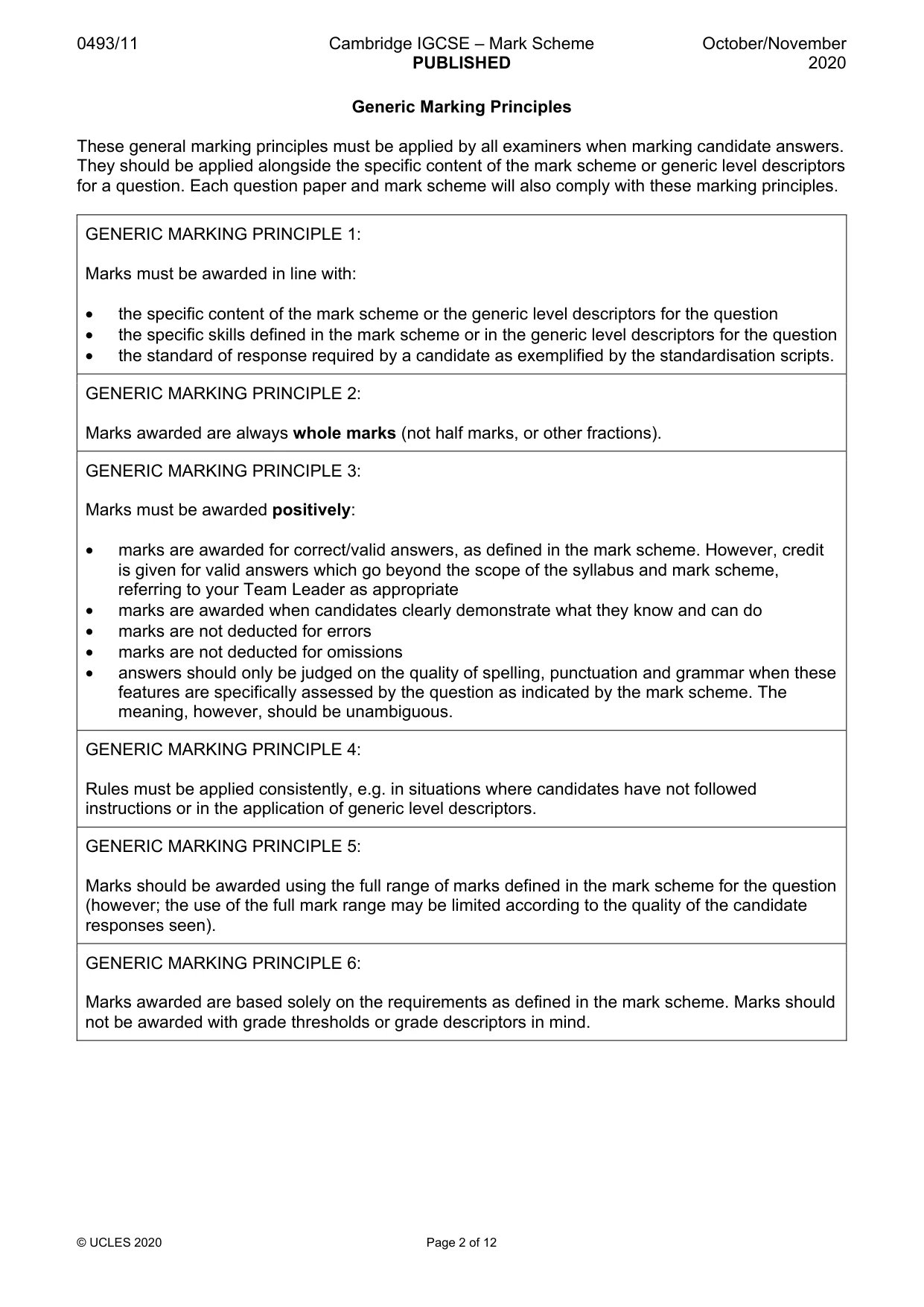
0493/11 Cambridge IGCSE – Mark Scheme PUBLISHED October/November 2020 © UCLES 2020 Page 2 of 12 Generic Marking Principles These general marking principles must be applied by all examiners when marking candidate answers. They should be applied alongside the specific content of the mark scheme or generic level descriptors for a question. Each question paper and mark scheme will also comply with these marking principles. GENERIC MARKING PRINCIPLE 1: Marks must be awarded in line with: • the specific content of the mark scheme or the generic level descriptors for the question • the specific skills defined in the mark scheme or in the generic level descriptors for the question • the standard of response required by a candidate as exemplified by the standardisation scripts. GENERIC MARKING PRINCIPLE 2: Marks awarded are always whole marks (not half marks, or other fractions). GENERIC MARKING PRINCIPLE 3: Marks must be awarded positively: • marks are awarded for correct/valid answers, as defined in the mark scheme. However, credit is given for valid answers which go beyond the scope of the syllabus and mark scheme, referring to your Team Leader as appropriate • marks are awarded when candidates clearly demonstrate what they know and can do • marks are not deducted for errors • marks are not deducted for omissions • answers should only be judged on the quality of spelling, punctuation and grammar when these features are specifically assessed by the question as indicated by the mark scheme. The meaning, however, should be unambiguous. GENERIC MARKING PRINCIPLE 4: Rules must be applied consistently, e.g. in situations where candidates have not followed instructions or in the application of generic level descriptors. GENERIC MARKING PRINCIPLE 5: Marks should be awarded using the full range of marks defined in the mark scheme for the question (however; the use of the full mark range may be limited according to the quality of the candidate responses seen). GENERIC MARKING PRINCIPLE 6: Marks awarded are based solely on the requirements as defined in the mark scheme. Marks should not be awarded with grade thresholds or grade descriptors in mind.
Mark scheme, page 3
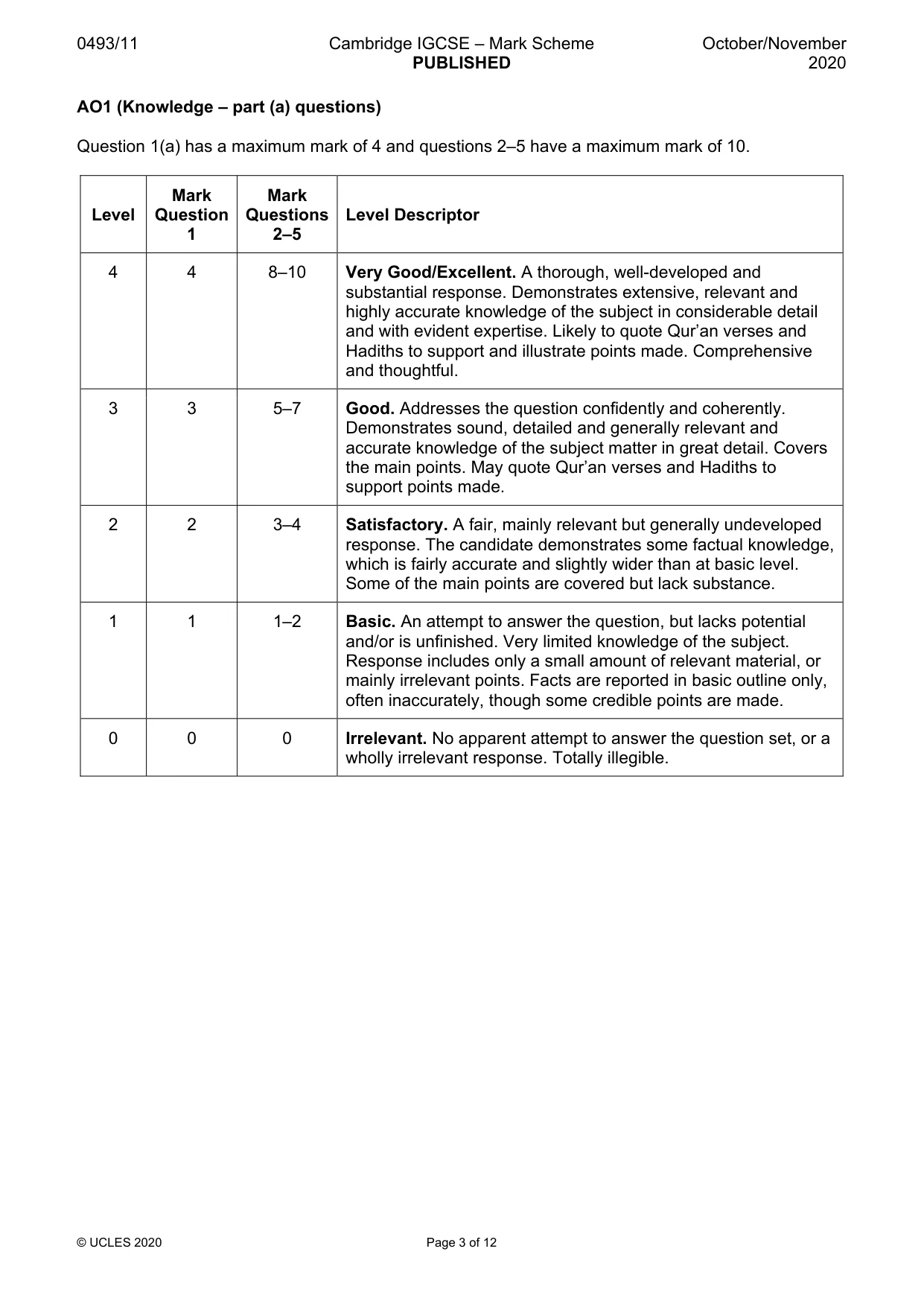
0493/11 Cambridge IGCSE – Mark Scheme PUBLISHED October/November 2020 © UCLES 2020 Page 3 of 12 AO1 (Knowledge – part (a) questions) Question 1(a) has a maximum mark of 4 and questions 2–5 have a maximum mark of 10. Level Mark Question 1 Mark Questions 2–5 Level Descriptor 4 4 8–10 Very Good/Excellent. A thorough, well-developed and substantial response. Demonstrates extensive, relevant and highly accurate knowledge of the subject in considerable detail and with evident expertise. Likely to quote Qur’an verses and Hadiths to support and illustrate points made. Comprehensive and thoughtful. 3 3 5–7 Good. Addresses the question confidently and coherently. Demonstrates sound, detailed and generally relevant and accurate knowledge of the subject matter in great detail. Covers the main points. May quote Qur’an verses and Hadiths to support points made. 2 2 3–4 Satisfactory. A fair, mainly relevant but generally undeveloped response. The candidate demonstrates some factual knowledge, which is fairly accurate and slightly wider than at basic level. Some of the main points are covered but lack substance. 1 1 1–2 Basic. An attempt to answer the question, but lacks potential and/or is unfinished. Very limited knowledge of the subject. Response includes only a small amount of relevant material, or mainly irrelevant points. Facts are reported in basic outline only, often inaccurately, though some credible points are made. 0 0 0 Irrelevant. No apparent attempt to answer the question set, or a wholly irrelevant response. Totally illegible.
Mark scheme, page 4
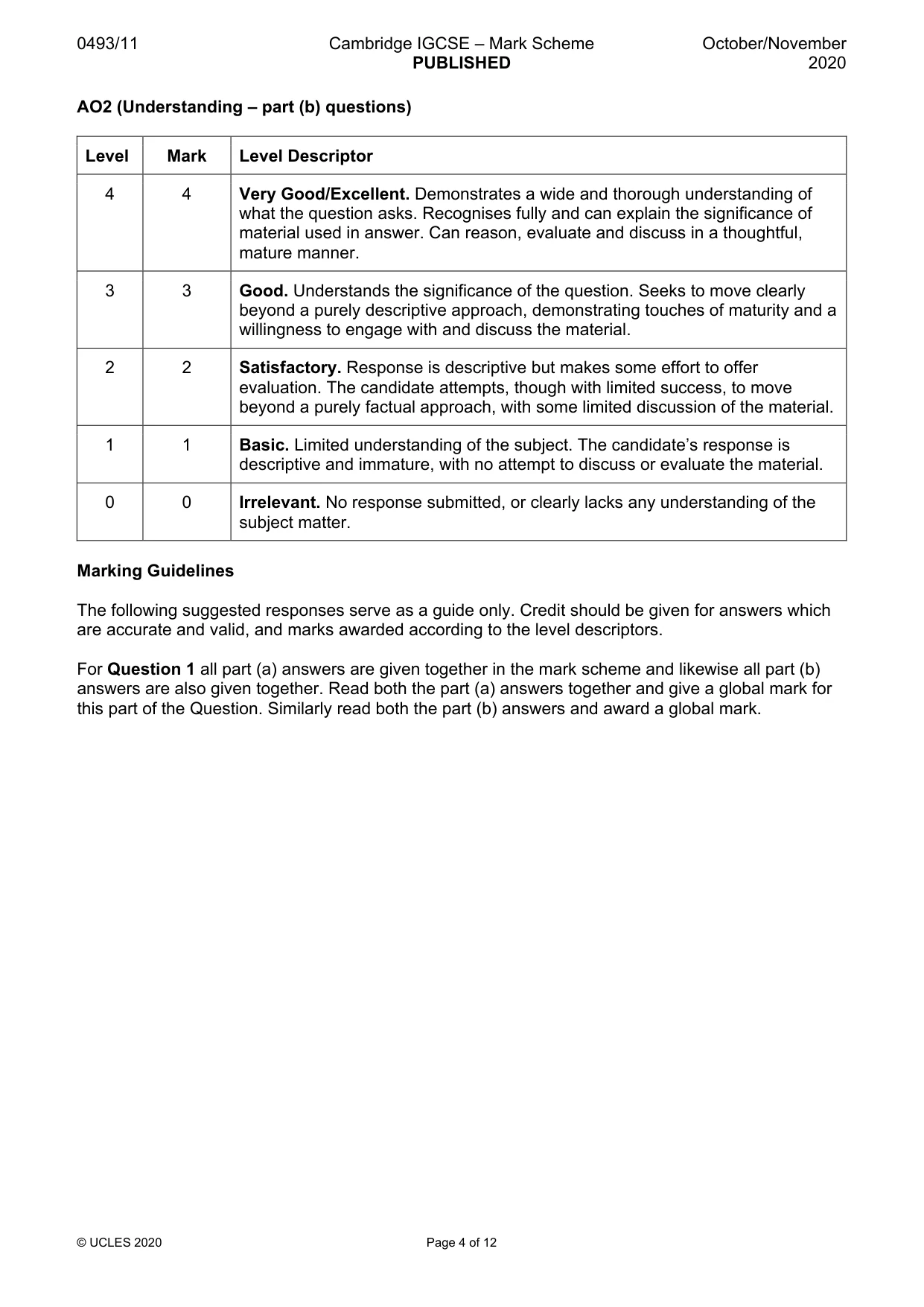
0493/11 Cambridge IGCSE – Mark Scheme PUBLISHED October/November 2020 © UCLES 2020 Page 4 of 12 AO2 (Understanding – part (b) questions) Level Mark Level Descriptor 4 4 Very Good/Excellent. Demonstrates a wide and thorough understanding of what the question asks. Recognises fully and can explain the significance of material used in answer. Can reason, evaluate and discuss in a thoughtful, mature manner. 3 3 Good. Understands the significance of the question. Seeks to move clearly beyond a purely descriptive approach, demonstrating touches of maturity and a willingness to engage with and discuss the material. 2 2 Satisfactory. Response is descriptive but makes some effort to offer evaluation. The candidate attempts, though with limited success, to move beyond a purely factual approach, with some limited discussion of the material. 1 1 Basic. Limited understanding of the subject. The candidate’s response is descriptive and immature, with no attempt to discuss or evaluate the material. 0 0 Irrelevant. No response submitted, or clearly lacks any understanding of the subject matter. Marking Guidelines The following suggested responses serve as a guide only. Credit should be given for answers which are accurate and valid, and marks awarded according to the level descriptors. For Question 1 all part (a) answers are given together in the mark scheme and likewise all part (b) answers are also given together. Read both the part (a) answers together and give a global mark for this part of the Question. Similarly read both the part (b) answers and award a global mark.
Mark scheme, page 5
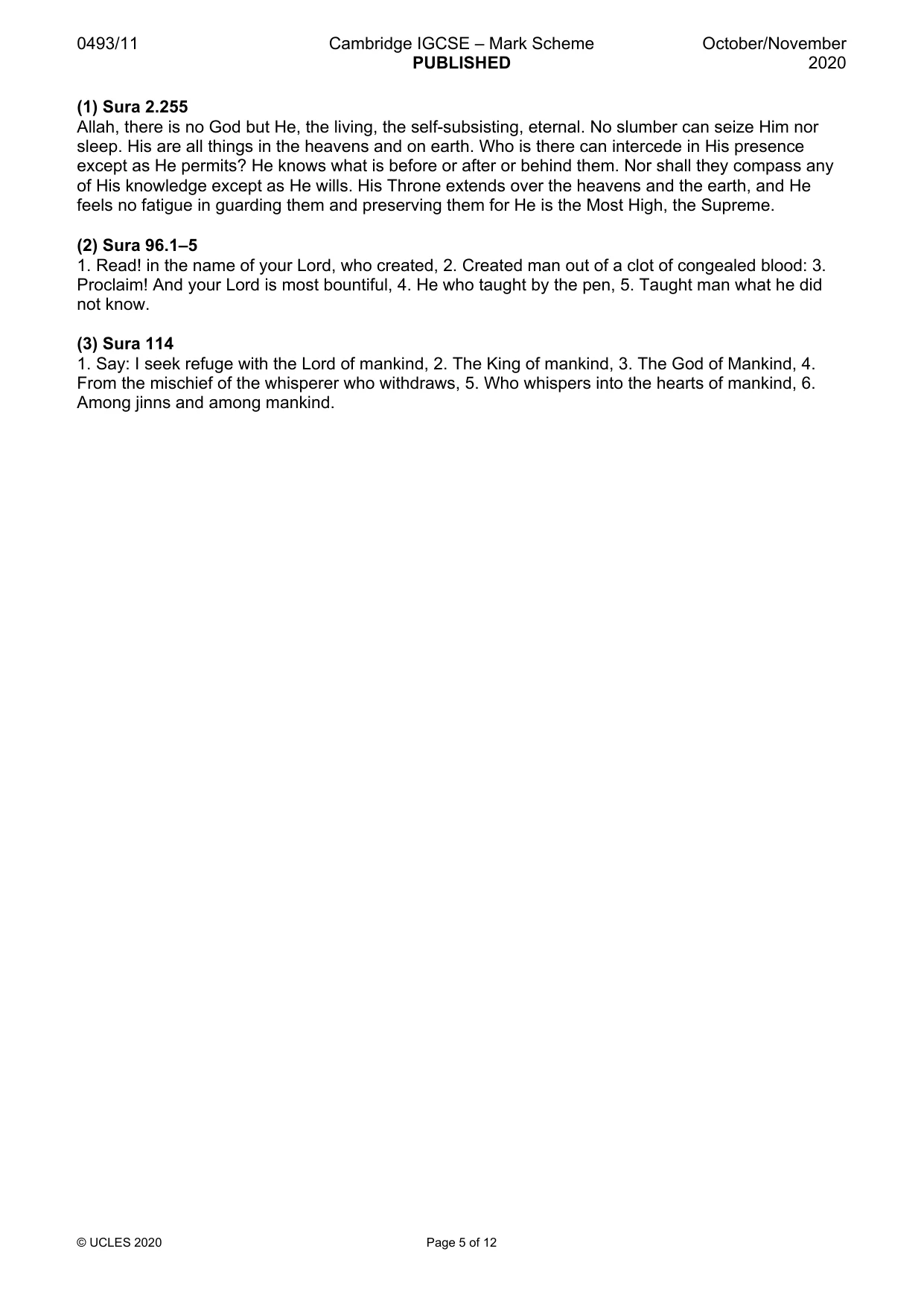
0493/11 Cambridge IGCSE – Mark Scheme PUBLISHED October/November 2020 © UCLES 2020 Page 5 of 12 (1) Sura 2.255 Allah, there is no God but He, the living, the self-subsisting, eternal. No slumber can seize Him nor sleep. His are all things in the heavens and on earth. Who is there can intercede in His presence except as He permits? He knows what is before or after or behind them. Nor shall they compass any of His knowledge except as He wills. His Throne extends over the heavens and the earth, and He feels no fatigue in guarding them and preserving them for He is the Most High, the Supreme. (2) Sura 96.1–5 1. Read! in the name of your Lord, who created, 2. Created man out of a clot of congealed blood: 3. Proclaim! And your Lord is most bountiful, 4. He who taught by the pen, 5. Taught man what he did not know. (3) Sura 114 1. Say: I seek refuge with the Lord of mankind, 2. The King of mankind, 3. The God of Mankind, 4. From the mischief of the whisperer who withdraws, 5. Who whispers into the hearts of mankind, 6. Among jinns and among mankind.
Mark scheme, page 6
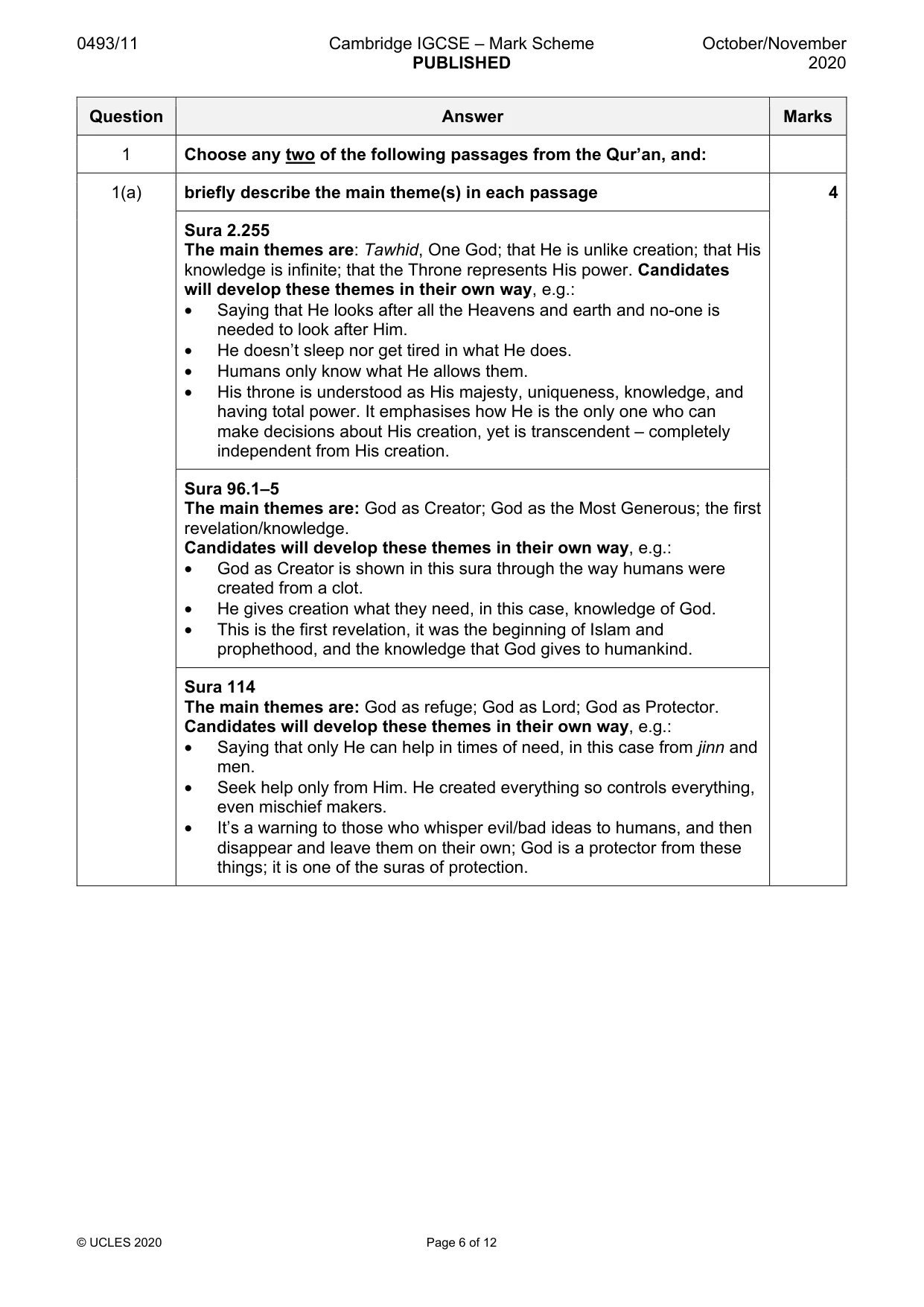
0493/11 Cambridge IGCSE – Mark Scheme PUBLISHED October/November 2020 © UCLES 2020 Page 6 of 12 Question Answer Marks 1 Choose any two of the following passages from the Qur’an, and: 1(a) briefly describe the main theme(s) in each passage 4 Sura 2.255 The main themes are: Tawhid, One God; that He is unlike creation; that His knowledge is infinite; that the Throne represents His power. Candidates will develop these themes in their own way, e.g.: • Saying that He looks after all the Heavens and earth and no-one is needed to look after Him. • He doesn’t sleep nor get tired in what He does. • Humans only know what He allows them. • His throne is understood as His majesty, uniqueness, knowledge, and having total power. It emphasises how He is the only one who can make decisions about His creation, yet is transcendent – completely independent from His creation. Sura 96.1–5 The main themes are: God as Creator; God as the Most Generous; the first revelation/knowledge. Candidates will develop these themes in their own way, e.g.: • God as Creator is shown in this sura through the way humans were created from a clot. • He gives creation what they need, in this case, knowledge of God. • This is the first revelation, it was the beginning of Islam and prophethood, and the knowledge that God gives to humankind. Sura 114 The main themes are: God as refuge; God as Lord; God as Protector. Candidates will develop these themes in their own way, e.g.: • Saying that only He can help in times of need, in this case from jinn and men. • Seek help only from Him. He created everything so controls everything, even mischief makers. • It’s a warning to those who whisper evil/bad ideas to humans, and then disappear and leave them on their own; God is a protector from these things; it is one of the suras of protection.
Mark scheme, page 7
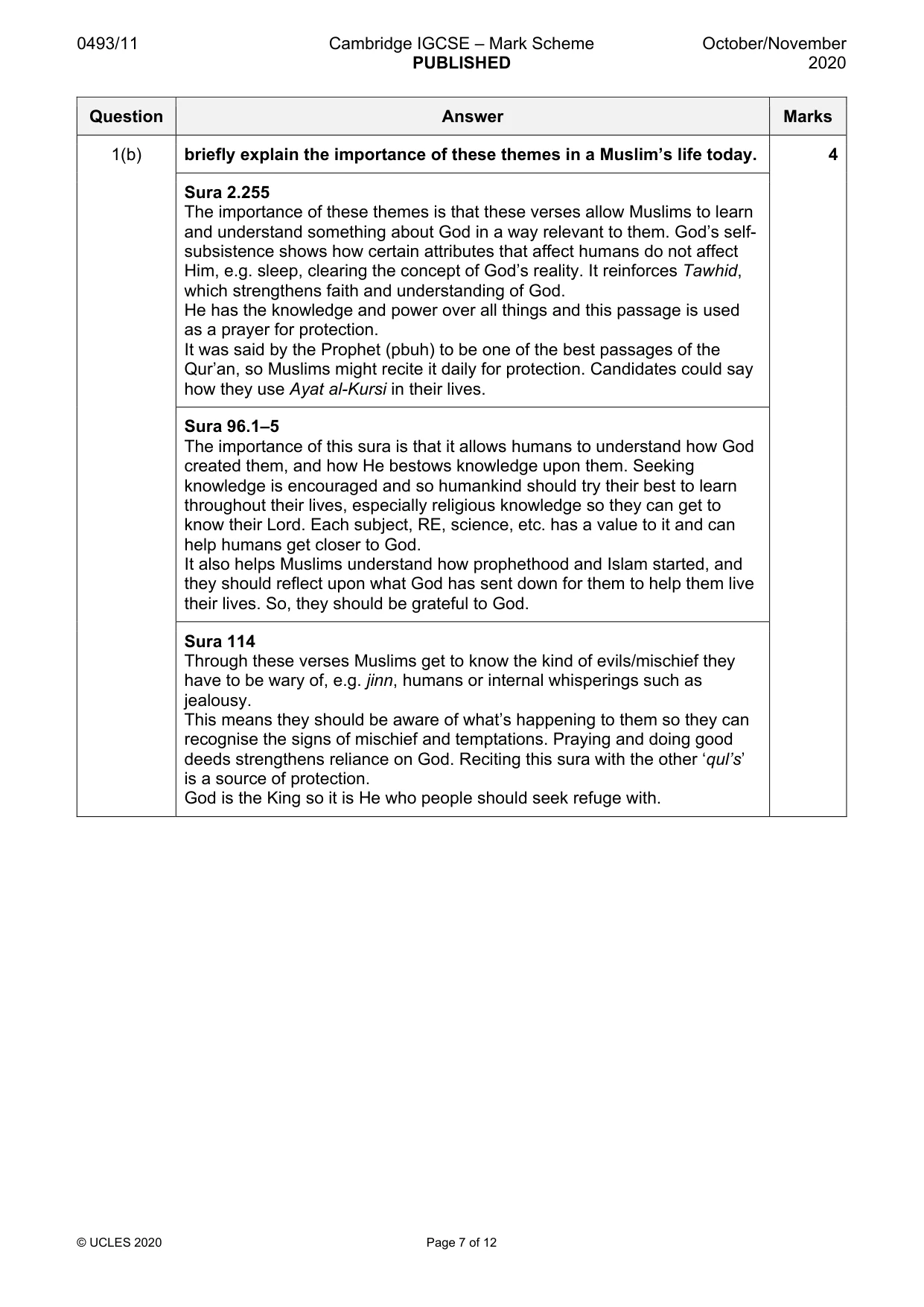
0493/11 Cambridge IGCSE – Mark Scheme PUBLISHED October/November 2020 © UCLES 2020 Page 7 of 12 Question Answer Marks 1(b) briefly explain the importance of these themes in a Muslim’s life today. 4 Sura 2.255 The importance of these themes is that these verses allow Muslims to learn and understand something about God in a way relevant to them. God’s self- subsistence shows how certain attributes that affect humans do not affect Him, e.g. sleep, clearing the concept of God’s reality. It reinforces Tawhid, which strengthens faith and understanding of God. He has the knowledge and power over all things and this passage is used as a prayer for protection. It was said by the Prophet (pbuh) to be one of the best passages of the Qur’an, so Muslims might recite it daily for protection. Candidates could say how they use Ayat al-Kursi in their lives. Sura 96.1–5 The importance of this sura is that it allows humans to understand how God created them, and how He bestows knowledge upon them. Seeking knowledge is encouraged and so humankind should try their best to learn throughout their lives, especially religious knowledge so they can get to know their Lord. Each subject, RE, science, etc. has a value to it and can help humans get closer to God. It also helps Muslims understand how prophethood and Islam started, and they should reflect upon what God has sent down for them to help them live their lives. So, they should be grateful to God. Sura 114 Through these verses Muslims get to know the kind of evils/mischief they have to be wary of, e.g. jinn, humans or internal whisperings such as jealousy. This means they should be aware of what’s happening to them so they can recognise the signs of mischief and temptations. Praying and doing good deeds strengthens reliance on God. Reciting this sura with the other ‘qul’s’ is a source of protection. God is the King so it is He who people should seek refuge with.
Mark scheme, page 8
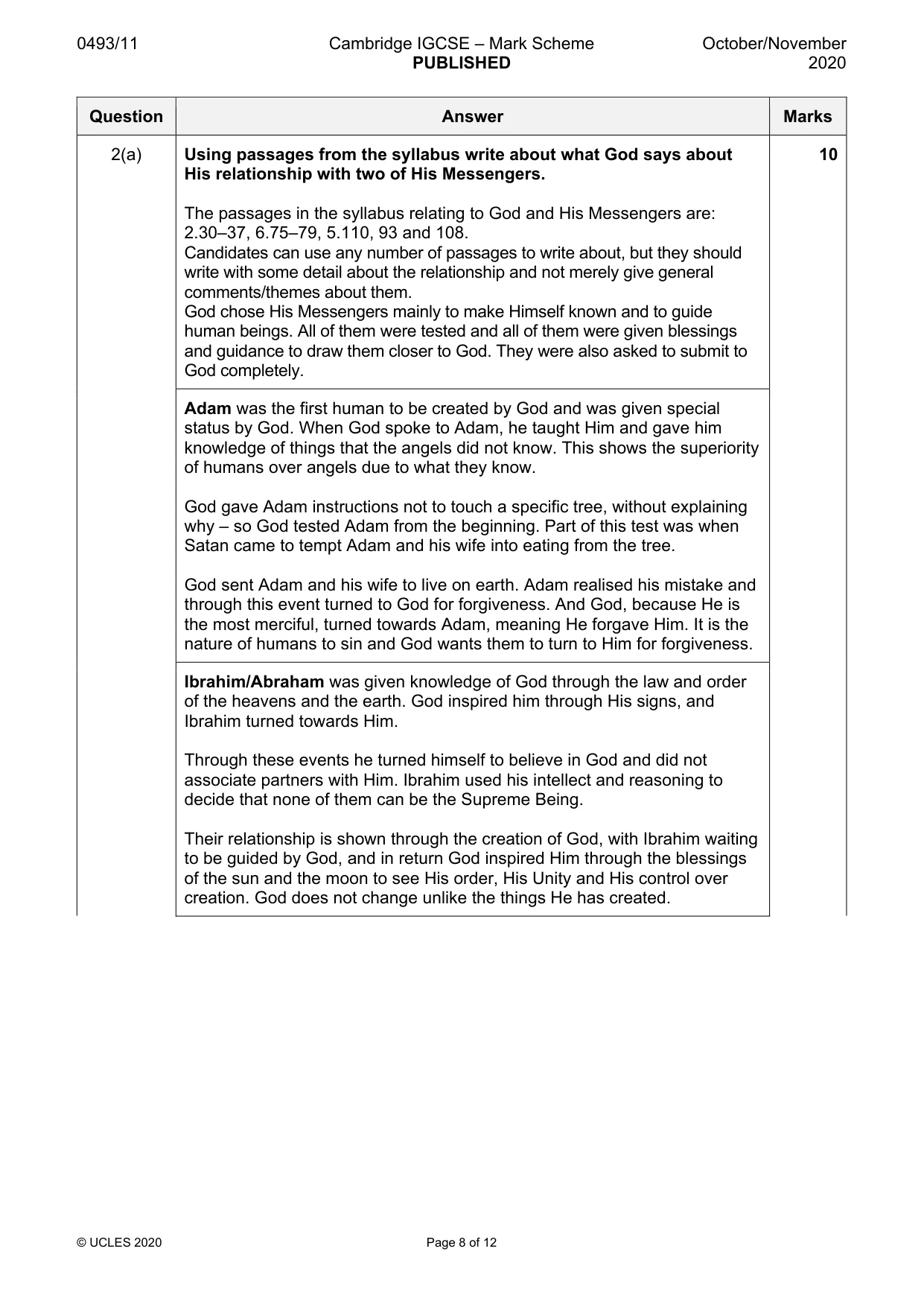
0493/11 Cambridge IGCSE – Mark Scheme PUBLISHED October/November 2020 © UCLES 2020 Page 8 of 12 Question Answer Marks 2(a) Using passages from the syllabus write about what God says about His relationship with two of His Messengers. The passages in the syllabus relating to God and His Messengers are: 2.30–37, 6.75–79, 5.110, 93 and 108. Candidates can use any number of passages to write about, but they should write with some detail about the relationship and not merely give general comments/themes about them. God chose His Messengers mainly to make Himself known and to guide human beings. All of them were tested and all of them were given blessings and guidance to draw them closer to God. They were also asked to submit to God completely. 10 Adam was the first human to be created by God and was given special status by God. When God spoke to Adam, he taught Him and gave him knowledge of things that the angels did not know. This shows the superiority of humans over angels due to what they know. God gave Adam instructions not to touch a specific tree, without explaining why – so God tested Adam from the beginning. Part of this test was when Satan came to tempt Adam and his wife into eating from the tree. God sent Adam and his wife to live on earth. Adam realised his mistake and through this event turned to God for forgiveness. And God, because He is the most merciful, turned towards Adam, meaning He forgave Him. It is the nature of humans to sin and God wants them to turn to Him for forgiveness. Ibrahim/Abraham was given knowledge of God through the law and order of the heavens and the earth. God inspired him through His signs, and Ibrahim turned towards Him. Through these events he turned himself to believe in God and did not associate partners with Him. Ibrahim used his intellect and reasoning to decide that none of them can be the Supreme Being. Their relationship is shown through the creation of God, with Ibrahim waiting to be guided by God, and in return God inspired Him through the blessings of the sun and the moon to see His order, His Unity and His control over creation. God does not change unlike the things He has created.
Mark scheme, page 9
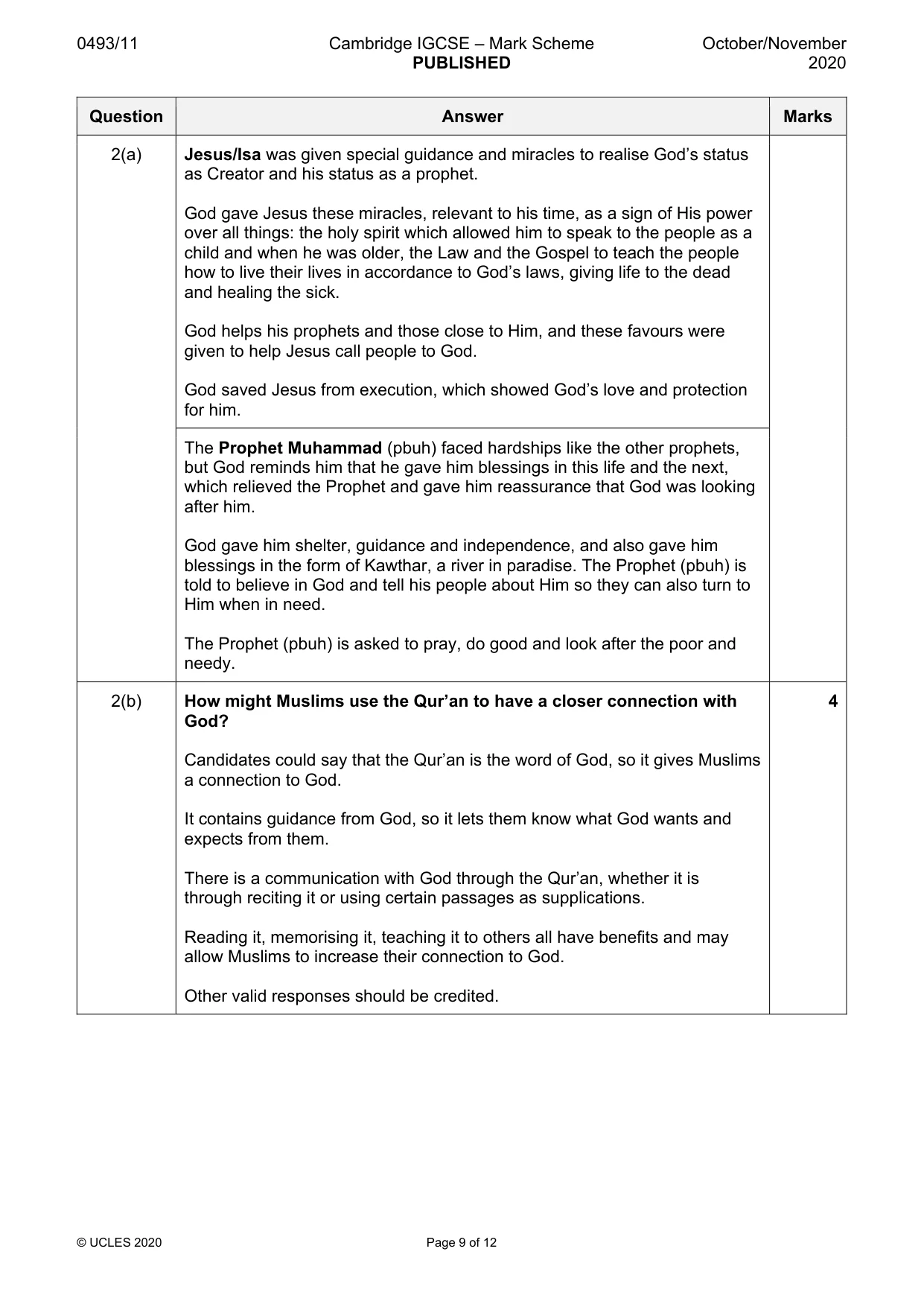
0493/11 Cambridge IGCSE – Mark Scheme PUBLISHED October/November 2020 © UCLES 2020 Page 9 of 12 Question Answer Marks 2(a) Jesus/Isa was given special guidance and miracles to realise God’s status as Creator and his status as a prophet. God gave Jesus these miracles, relevant to his time, as a sign of His power over all things: the holy spirit which allowed him to speak to the people as a child and when he was older, the Law and the Gospel to teach the people how to live their lives in accordance to God’s laws, giving life to the dead and healing the sick. God helps his prophets and those close to Him, and these favours were given to help Jesus call people to God. God saved Jesus from execution, which showed God’s love and protection for him. The Prophet Muhammad (pbuh) faced hardships like the other prophets, but God reminds him that he gave him blessings in this life and the next, which relieved the Prophet and gave him reassurance that God was looking after him. God gave him shelter, guidance and independence, and also gave him blessings in the form of Kawthar, a river in paradise. The Prophet (pbuh) is told to believe in God and tell his people about Him so they can also turn to Him when in need. The Prophet (pbuh) is asked to pray, do good and look after the poor and needy. 2(b) How might Muslims use the Qur’an to have a closer connection with God? Candidates could say that the Qur’an is the word of God, so it gives Muslims a connection to God. It contains guidance from God, so it lets them know what God wants and expects from them. There is a communication with God through the Qur’an, whether it is through reciting it or using certain passages as supplications. Reading it, memorising it, teaching it to others all have benefits and may allow Muslims to increase their connection to God. Other valid responses should be credited. 4
Mark scheme, page 10
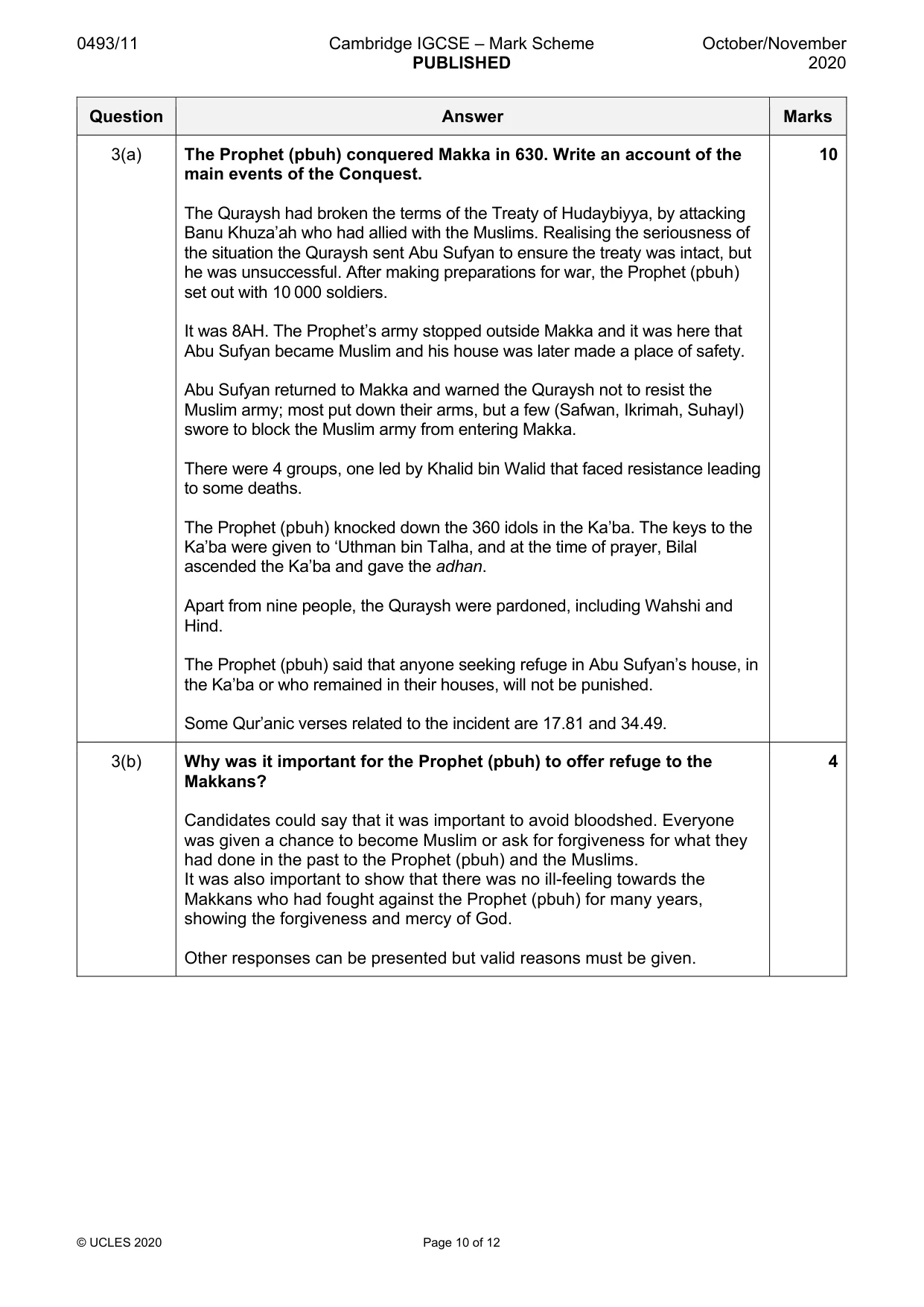
0493/11 Cambridge IGCSE – Mark Scheme PUBLISHED October/November 2020 © UCLES 2020 Page 10 of 12 Question Answer Marks 3(a) The Prophet (pbuh) conquered Makka in 630. Write an account of the main events of the Conquest. The Quraysh had broken the terms of the Treaty of Hudaybiyya, by attacking Banu Khuza’ah who had allied with the Muslims. Realising the seriousness of the situation the Quraysh sent Abu Sufyan to ensure the treaty was intact, but he was unsuccessful. After making preparations for war, the Prophet (pbuh) set out with 10 000 soldiers. It was 8AH. The Prophet’s army stopped outside Makka and it was here that Abu Sufyan became Muslim and his house was later made a place of safety. Abu Sufyan returned to Makka and warned the Quraysh not to resist the Muslim army; most put down their arms, but a few (Safwan, Ikrimah, Suhayl) swore to block the Muslim army from entering Makka. There were 4 groups, one led by Khalid bin Walid that faced resistance leading to some deaths. The Prophet (pbuh) knocked down the 360 idols in the Ka’ba. The keys to the Ka’ba were given to ‘Uthman bin Talha, and at the time of prayer, Bilal ascended the Ka’ba and gave the adhan. Apart from nine people, the Quraysh were pardoned, including Wahshi and Hind. The Prophet (pbuh) said that anyone seeking refuge in Abu Sufyan’s house, in the Ka’ba or who remained in their houses, will not be punished. Some Qur’anic verses related to the incident are 17.81 and 34.49. 10 3(b) Why was it important for the Prophet (pbuh) to offer refuge to the Makkans? Candidates could say that it was important to avoid bloodshed. Everyone was given a chance to become Muslim or ask for forgiveness for what they had done in the past to the Prophet (pbuh) and the Muslims. It was also important to show that there was no ill-feeling towards the Makkans who had fought against the Prophet (pbuh) for many years, showing the forgiveness and mercy of God. Other responses can be presented but valid reasons must be given. 4
Mark scheme, page 11
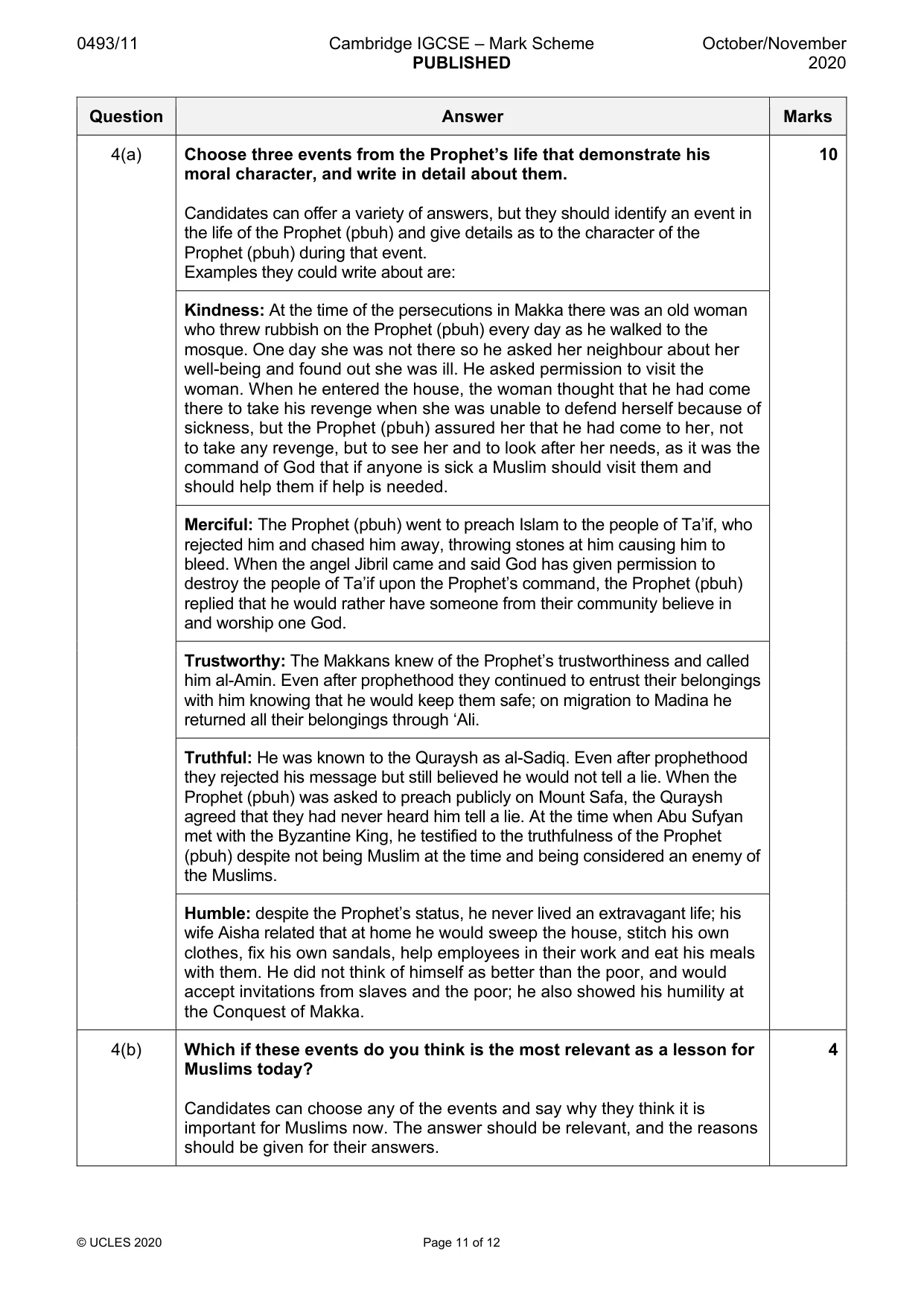
0493/11 Cambridge IGCSE – Mark Scheme PUBLISHED October/November 2020 © UCLES 2020 Page 11 of 12 Question Answer Marks 4(a) Choose three events from the Prophet’s life that demonstrate his moral character, and write in detail about them. Candidates can offer a variety of answers, but they should identify an event in the life of the Prophet (pbuh) and give details as to the character of the Prophet (pbuh) during that event. Examples they could write about are: 10 Kindness: At the time of the persecutions in Makka there was an old woman who threw rubbish on the Prophet (pbuh) every day as he walked to the mosque. One day she was not there so he asked her neighbour about her well-being and found out she was ill. He asked permission to visit the woman. When he entered the house, the woman thought that he had come there to take his revenge when she was unable to defend herself because of sickness, but the Prophet (pbuh) assured her that he had come to her, not to take any revenge, but to see her and to look after her needs, as it was the command of God that if anyone is sick a Muslim should visit them and should help them if help is needed. Merciful: The Prophet (pbuh) went to preach Islam to the people of Ta’if, who rejected him and chased him away, throwing stones at him causing him to bleed. When the angel Jibril came and said God has given permission to destroy the people of Ta’if upon the Prophet’s command, the Prophet (pbuh) replied that he would rather have someone from their community believe in and worship one God. Trustworthy: The Makkans knew of the Prophet’s trustworthiness and called him al-Amin. Even after prophethood they continued to entrust their belongings with him knowing that he would keep them safe; on migration to Madina he returned all their belongings through ‘Ali. Truthful: He was known to the Quraysh as al-Sadiq. Even after prophethood they rejected his message but still believed he would not tell a lie. When the Prophet (pbuh) was asked to preach publicly on Mount Safa, the Quraysh agreed that they had never heard him tell a lie. At the time when Abu Sufyan met with the Byzantine King, he testified to the truthfulness of the Prophet (pbuh) despite not being Muslim at the time and being considered an enemy of the Muslims. Humble: despite the Prophet’s status, he never lived an extravagant life; his wife Aisha related that at home he would sweep the house, stitch his own clothes, fix his own sandals, help employees in their work and eat his meals with them. He did not think of himself as better than the poor, and would accept invitations from slaves and the poor; he also showed his humility at the Conquest of Makka. 4(b) Which if these events do you think is the most relevant as a lesson for Muslims today? Candidates can choose any of the events and say why they think it is important for Muslims now. The answer should be relevant, and the reasons should be given for their answers. 4
Mark scheme, page 12
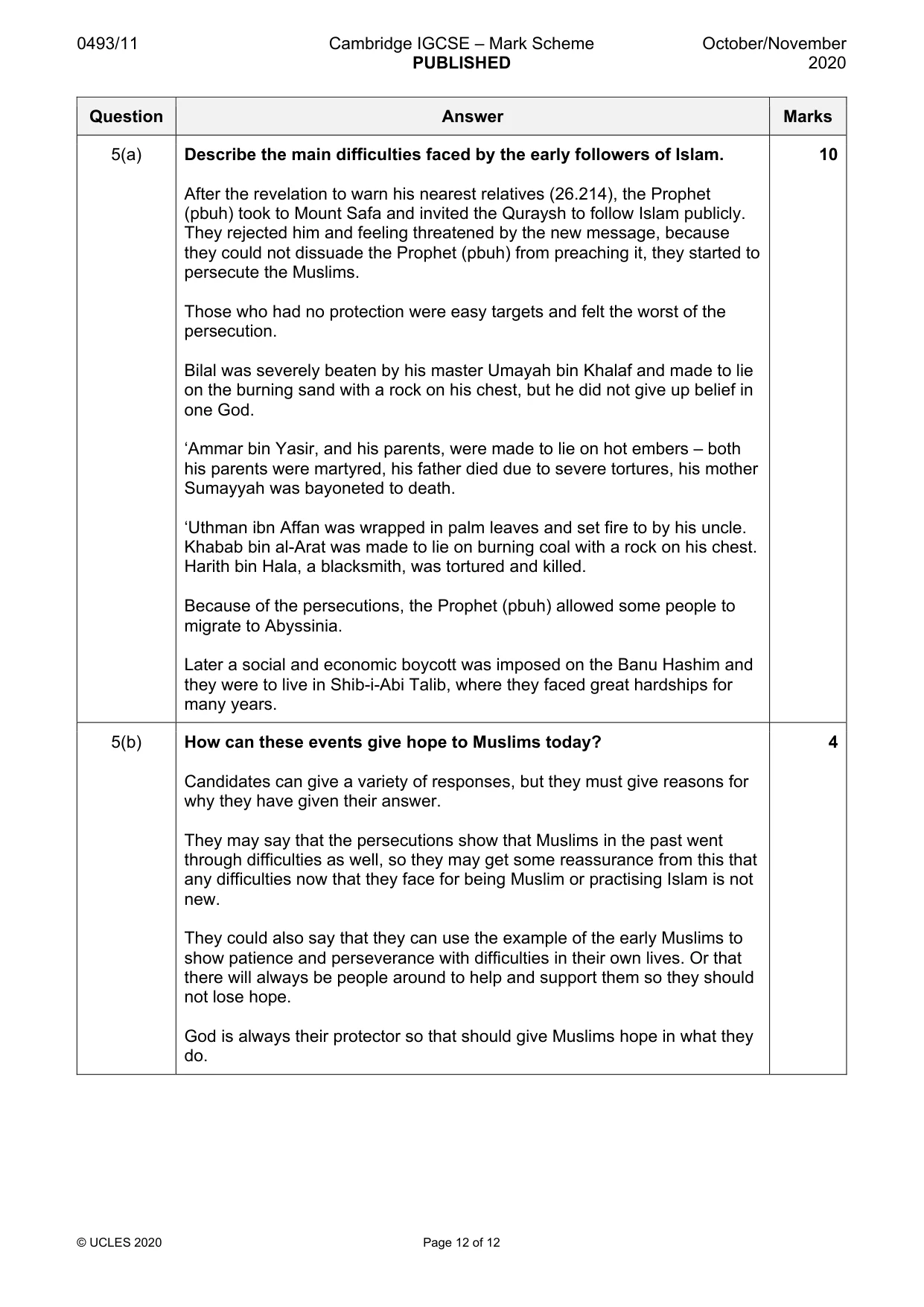
0493/11 Cambridge IGCSE – Mark Scheme PUBLISHED October/November 2020 © UCLES 2020 Page 12 of 12 Question Answer Marks 5(a) Describe the main difficulties faced by the early followers of Islam. After the revelation to warn his nearest relatives (26.214), the Prophet (pbuh) took to Mount Safa and invited the Quraysh to follow Islam publicly. They rejected him and feeling threatened by the new message, because they could not dissuade the Prophet (pbuh) from preaching it, they started to persecute the Muslims. Those who had no protection were easy targets and felt the worst of the persecution. Bilal was severely beaten by his master Umayah bin Khalaf and made to lie on the burning sand with a rock on his chest, but he did not give up belief in one God. ‘Ammar bin Yasir, and his parents, were made to lie on hot embers – both his parents were martyred, his father died due to severe tortures, his mother Sumayyah was bayoneted to death. ‘Uthman ibn Affan was wrapped in palm leaves and set fire to by his uncle. Khabab bin al-Arat was made to lie on burning coal with a rock on his chest. Harith bin Hala, a blacksmith, was tortured and killed. Because of the persecutions, the Prophet (pbuh) allowed some people to migrate to Abyssinia. Later a social and economic boycott was imposed on the Banu Hashim and they were to live in Shib-i-Abi Talib, where they faced great hardships for many years. 10 5(b) How can these events give hope to Muslims today? Candidates can give a variety of responses, but they must give reasons for why they have given their answer. They may say that the persecutions show that Muslims in the past went through difficulties as well, so they may get some reassurance from this that any difficulties now that they face for being Muslim or practising Islam is not new. They could also say that they can use the example of the early Muslims to show patience and perseverance with difficulties in their own lives. Or that there will always be people around to help and support them so they should not lose hope. God is always their protector so that should give Muslims hope in what they do. 4
What you needed in this session
Cambridge’s own grade thresholds for 2020 Oct/Nov, Paper 1 · Variant 1. A higher threshold means an easier paper — the bar moves with how the cohort did.