Cambridge IGCSE Islamiyat 0493 — 2014 Oct/Nov Paper 1 · Variant 1
0493/11/O/N/14 · 50 marks · ≈56 min
The question paper and its mark scheme, free to read here and free to download. This is Cambridge’s own paper, exactly as it was sat.
Question paper16 pages
Mark scheme7 pages
Answers below. Sit the paper first if you are practising.
Paper as text
Question paper, page 1
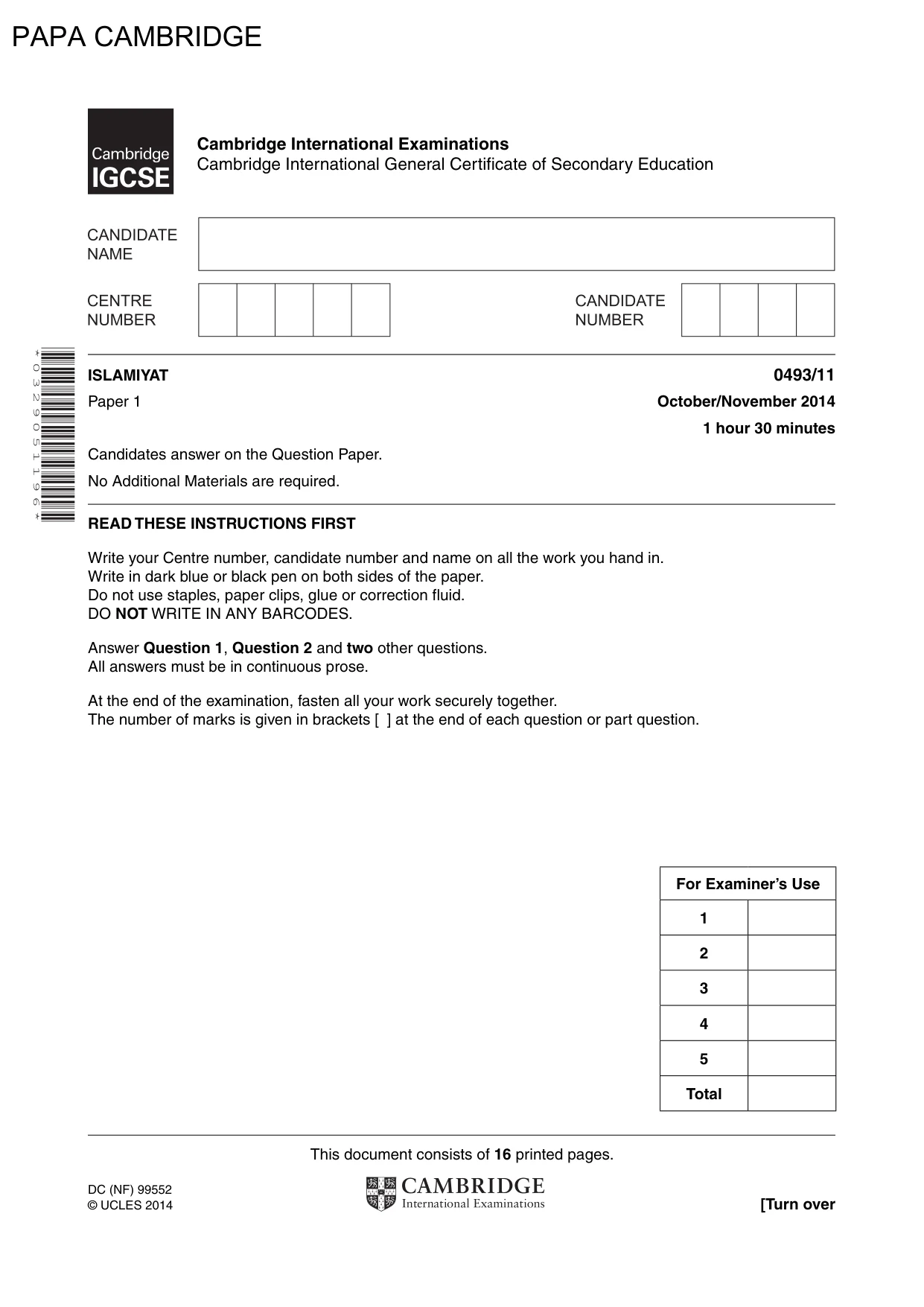
PAPA CAMBRIDGE This document consists of 16 printed pages. DC (NF) 99552 © UCLES 2014 [Turn over * 0 3 2 9 0 5 1 1 9 6 * ISLAMIYAT 0493/11 Paper 1 October/November 2014 1 hour 30 minutes Candidates answer on the Question Paper. No Additional Materials are required. READ THESE INSTRUCTIONS FIRST Write your Centre number, candidate number and name on all the work you hand in. Write in dark blue or black pen on both sides of the paper. Do not use staples, paper clips, glue or correction fluid. DO NOT WRITE IN ANY BARCODES. Answer Question 1, Question 2 and two other questions. All answers must be in continuous prose. At the end of the examination, fasten all your work securely together. The number of marks is given in brackets [ ] at the end of each question or part question. For Examiner’s Use 1 2 3 4 5 Total Cambridge International Examinations Cambridge International General Certificate of Secondary Education
Question paper, page 2
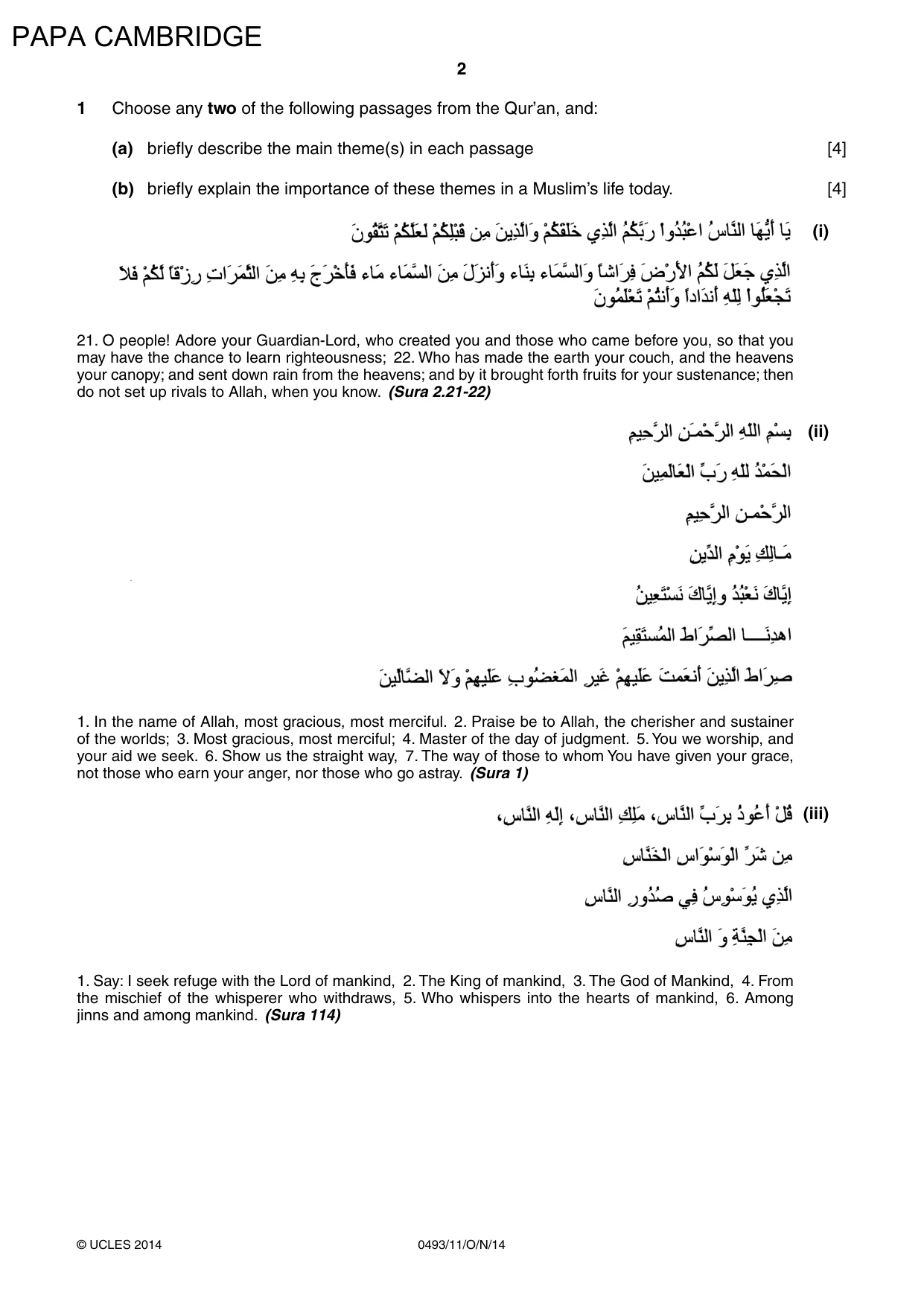
PAPA CAMBRIDGE 2 0493/11/O/N/14 © UCLES 2014 1 Choose any two of the following passages from the Qur’an, and: (a) briefly describe the main theme(s) in each passage [4] (b) briefly explain the importance of these themes in a Muslim’s life today. [4] 21. O people! Adore your Guardian-Lord, who created you and those who came before you, so that you may have the chance to learn righteousness; 22. Who has made the earth your couch, and the heavens your canopy; and sent down rain from the heavens; and by it brought forth fruits for your sustenance; then do not set up rivals to Allah, when you know. (Sura 2.21-22) 1. In the name of Allah, most gracious, most merciful. 2. Praise be to Allah, the cherisher and sustainer of the worlds; 3. Most gracious, most merciful; 4. Master of the day of judgment. 5. You we worship, and your aid we seek. 6. Show us the straight way, 7. The way of those to whom You have given your grace, not those who earn your anger, nor those who go astray. (Sura 1) 1. Say: I seek refuge with the Lord of mankind, 2. The King of ma nkind, 3. The God of Mankind, 4. From the mischief of the whisperer who withdraws, 5. Who whispers into the hearts of mankind, 6. Among jinns and among mankind. (Sura 114) (i) (ii) (iii)
Question paper, page 3
PAPA CAMBRIDGE 3 0493/11/O/N/14 © UCLES 2014 [Turn over … … … … … … … … … … … … … … … … … … … … … … … … … … … …
Question paper, page 4
PAPA CAMBRIDGE 4 0493/11/O/N/14 © UCLES 2014 … … … … … … … … … … … … … … … … … … … … … … … … … … … …
Question paper, page 5
PAPA CAMBRIDGE 5 0493/11/O/N/14 © UCLES 2014 [Turn over 2 (a) Write about how the Qur’an is used with the other three sources in Islamic law. [10] (b) How important is the use of ijma’ or qiyas in Islamic law in present day situations? Give reasons for your answers. [4] … … … … … … … … … … … … … … … … … … … … … … … … … …
Question paper, page 6
PAPA CAMBRIDGE 6 0493/11/O/N/14 © UCLES 2014 … … … … … … … … … … … … … … … … … … … … … … … … … … … …
Question paper, page 7
PAPA CAMBRIDGE 7 0493/11/O/N/14 © UCLES 2014 [Turn over … … … … … … … … … … … … … … … … … … … … … … … … … … … …
Question paper, page 8
PAPA CAMBRIDGE 8 0493/11/O/N/14 © UCLES 2014 3 (a) Describe the events of the Prophet’s visit to Ta’if. [10] (b) How can Muslims apply in practice the lessons learnt from the Prophet’s behaviour in this situation? [4] … … … … … … … … … … … … … … … … … … … … … … … … … …
Question paper, page 9
PAPA CAMBRIDGE 9 0493/11/O/N/14 © UCLES 2014 [Turn over … … … … … … … … … … … … … … … … … … … … … … … … … … … …
Question paper, page 10
PAPA CAMBRIDGE 10 0493/11/O/N/14 © UCLES 2014 … … … … … … … … … … … … … … … … … … … … … … … … … … … …
Question paper, page 11
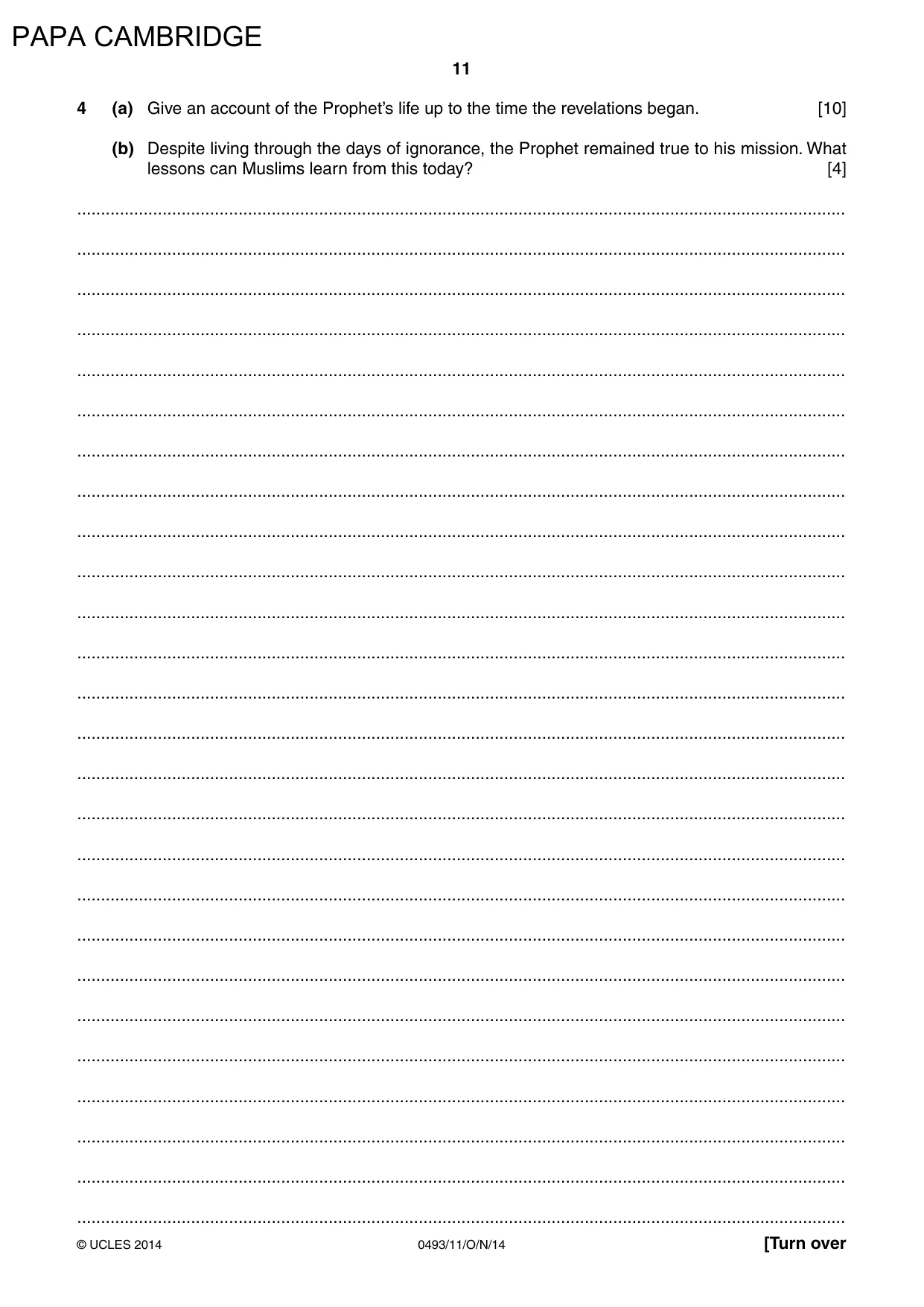
PAPA CAMBRIDGE 11 0493/11/O/N/14 © UCLES 2014 [Turn over 4 (a) Give an account of the Prophet’s life up to the time the revelations began. [10] (b) Despite living through the days of ignorance, the Prophet remained true to his mission. What lessons can Muslims learn from this today? [4] … … … … … … … … … … … … … … … … … … … … … … … … … …
Question paper, page 12
PAPA CAMBRIDGE 12 0493/11/O/N/14 © UCLES 2014 … … … … … … … … … … … … … … … … … … … … … … … … … … … …
Question paper, page 13
PAPA CAMBRIDGE 13 0493/11/O/N/14 © UCLES 2014 [Turn over … … … … … … … … … … … … … … … … … … … … … … … … … … … …
Question paper, page 14
PAPA CAMBRIDGE 14 0493/11/O/N/14 © UCLES 2014 5 (a) Write about the role played by Abu Bakr during the period between the first revelation and the death of the Prophet. [10] (b) What lessons can Muslims learn from Abu Bakr’s conduct in this period, and how are these lessons relevant now? [4] … … … … … … … … … … … … … … … … … … … … … … … … … …
Question paper, page 15
PAPA CAMBRIDGE 15 0493/11/O/N/14 © UCLES 2014 [Turn over … … … … … … … … … … … … … … … … … … … … … … … … … … … …
Question paper, page 16
PAPA CAMBRIDGE 16 0493/11/O/N/14 © UCLES 2014 Permission to reproduce items where third-party owned material protected by copyright is included has been sought and cleared where possible. Every reasonable effort has been made by the publisher (UCLES) to trace copyright holders, but if any items requiring clearance have unwittingly been included, the publisher will be pleased to make amends at the earliest possible opportunity. Cambridge International Examinations is part of the Cambridge Assessment Group. Cambridge Assessment is the brand name of University of Cambridge Local Examinations Syndicate (UCLES), which is itself a department of the University of Cambridge. … … … … … … … … … … … … … … … … … … … … … … … … …
Mark scheme, page 1
PAPA CAMBRIDGE ® IGCSE is the registered trademark of Cambridge International Examinations. CAMBRIDGE INTERNATIONAL EXAMINATIONS Cambridge International General Certificate of Secondary Education MARK SCHEME for the October/November 2014 series 0493 ISLAMIYAT 0493/11 Paper 1, maximum raw mark 50 This mark scheme is published as an aid to teachers and candidates, to indicate the requirements of the examination. It shows the basis on which Examiners were instructed to award marks. It does not indicate the details of the discussions that took place at an Examiners’ meeting before marking began, which would have considered the acceptability of alternative answers. Mark schemes should be read in conjunction with the question paper and the Principal Examiner Report for Teachers. Cambridge will not enter into discussions about these mark schemes. Cambridge is publishing the mark schemes for the October/November 2014 series for most Cambridge IGCSE®, Cambridge International A and AS Level components and some Cambridge O Level components.
Mark scheme, page 2
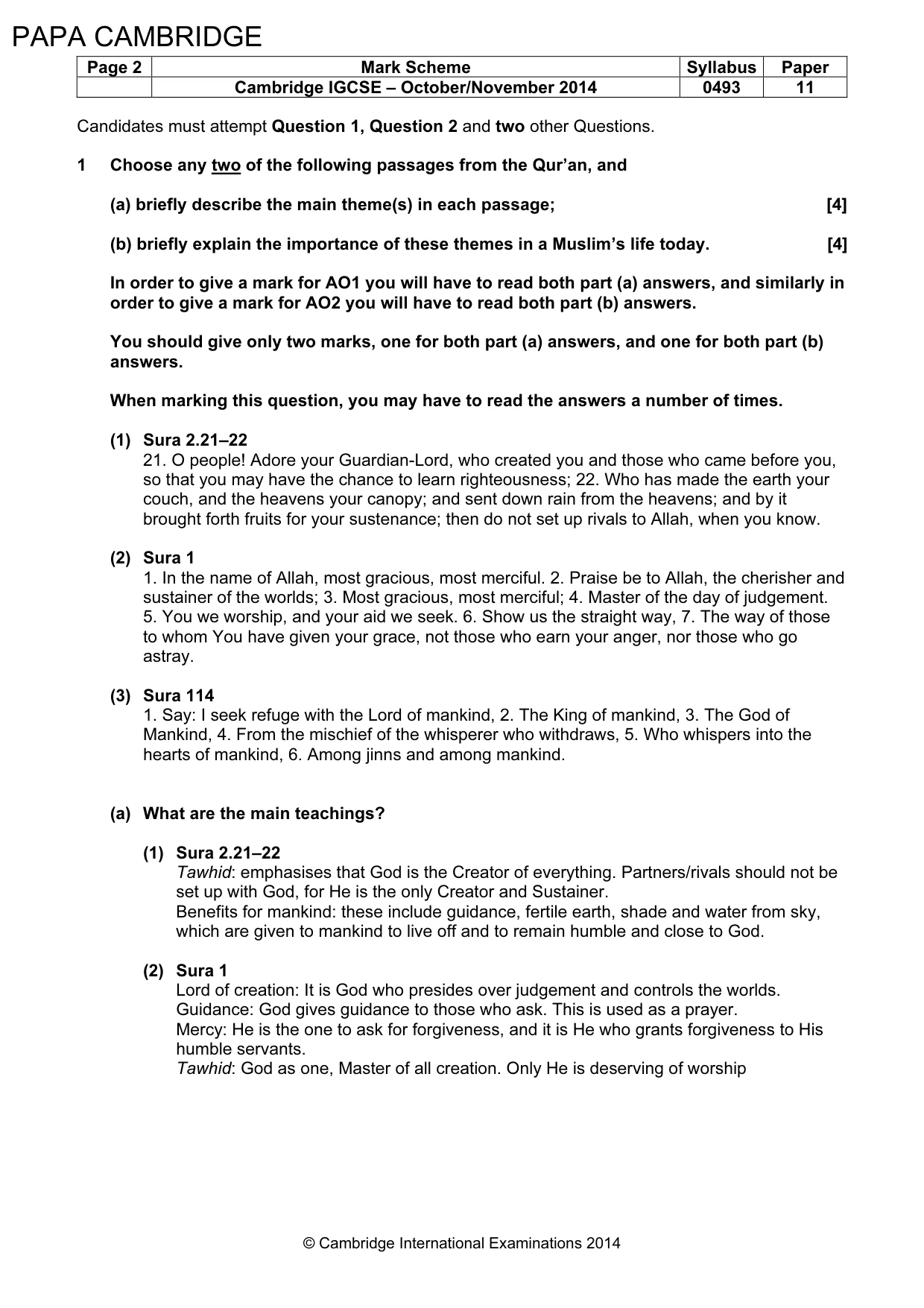
PAPA CAMBRIDGE Page 2 Mark Scheme Syllabus Paper Cambridge IGCSE – October/November 2014 0493 11 © Cambridge International Examinations 2014 Candidates must attempt Question 1, Question 2 and two other Questions. 1 Choose any two of the following passages from the Qur’an, and (a) briefly describe the main theme(s) in each passage; [4] (b) briefly explain the importance of these themes in a Muslim’s life today. [4] In order to give a mark for AO1 you will have to read both part (a) answers, and similarly in order to give a mark for AO2 you will have to read both part (b) answers. You should give only two marks, one for both part (a) answers, and one for both part (b) answers. When marking this question, you may have to read the answers a number of times. (1) Sura 2.21–22 21. O people! Adore your Guardian-Lord, who created you and those who came before you, so that you may have the chance to learn righteousness; 22. Who has made the earth your couch, and the heavens your canopy; and sent down rain from the heavens; and by it brought forth fruits for your sustenance; then do not set up rivals to Allah, when you know. (2) Sura 1 1. In the name of Allah, most gracious, most merciful. 2. Praise be to Allah, the cherisher and sustainer of the worlds; 3. Most gracious, most merciful; 4. Master of the day of judgement. 5. You we worship, and your aid we seek. 6. Show us the straight way, 7. The way of those to whom You have given your grace, not those who earn your anger, nor those who go astray. (3) Sura 114 1. Say: I seek refuge with the Lord of mankind, 2. The King of mankind, 3. The God of Mankind, 4. From the mischief of the whisperer who withdraws, 5. Who whispers into the hearts of mankind, 6. Among jinns and among mankind. (a) What are the main teachings? (1) Sura 2.21–22 Tawhid: emphasises that God is the Creator of everything. Partners/rivals should not be set up with God, for He is the only Creator and Sustainer. Benefits for mankind: these include guidance, fertile earth, shade and water from sky, which are given to mankind to live off and to remain humble and close to God. (2) Sura 1 Lord of creation: It is God who presides over judgement and controls the worlds. Guidance: God gives guidance to those who ask. This is used as a prayer. Mercy: He is the one to ask for forgiveness, and it is He who grants forgiveness to His humble servants. Tawhid: God as one, Master of all creation. Only He is deserving of worship
Mark scheme, page 3
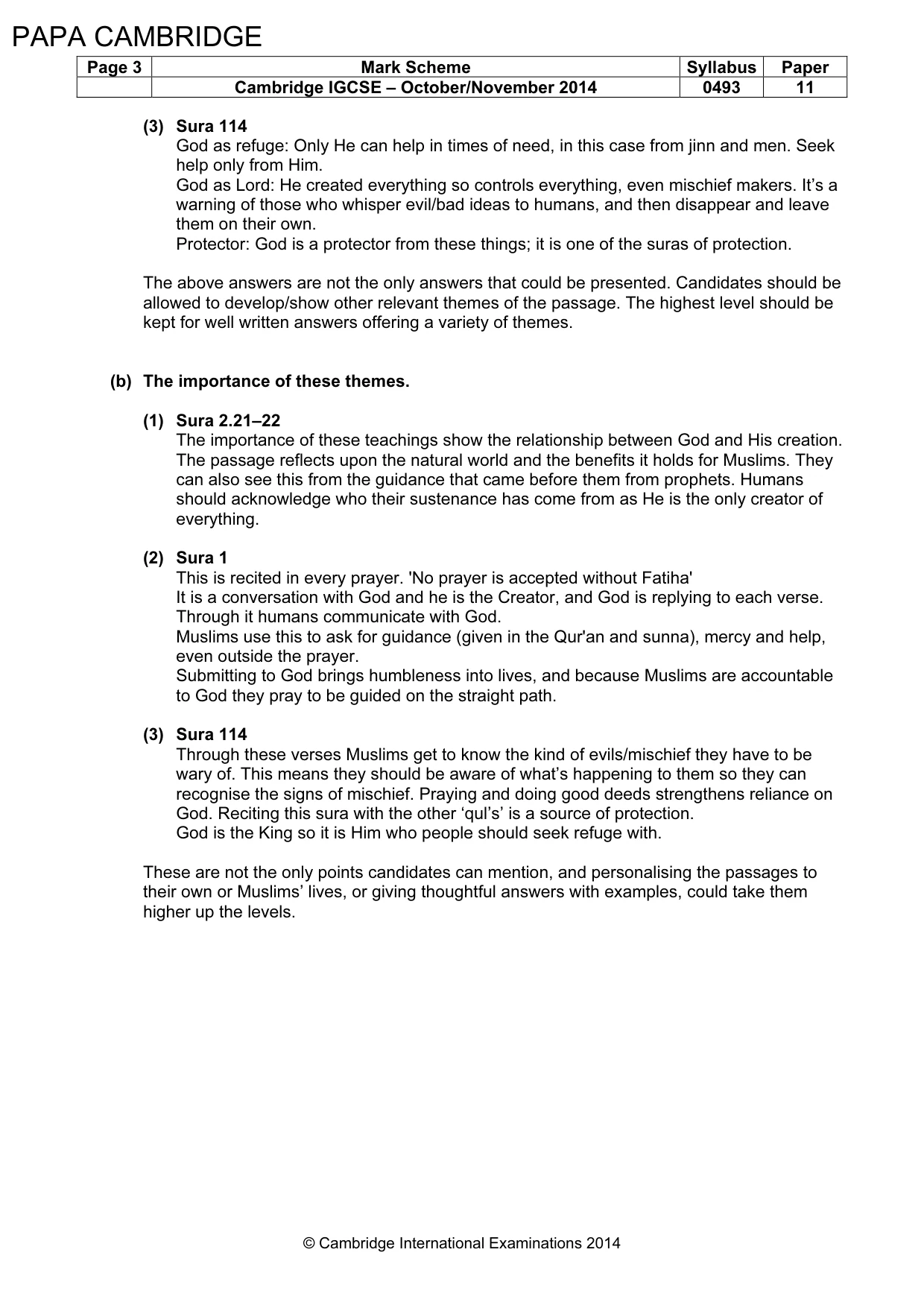
PAPA CAMBRIDGE Page 3 Mark Scheme Syllabus Paper Cambridge IGCSE – October/November 2014 0493 11 © Cambridge International Examinations 2014 (3) Sura 114 God as refuge: Only He can help in times of need, in this case from jinn and men. Seek help only from Him. God as Lord: He created everything so controls everything, even mischief makers. It’s a warning of those who whisper evil/bad ideas to humans, and then disappear and leave them on their own. Protector: God is a protector from these things; it is one of the suras of protection. The above answers are not the only answers that could be presented. Candidates should be allowed to develop/show other relevant themes of the passage. The highest level should be kept for well written answers offering a variety of themes. (b) The importance of these themes. (1) Sura 2.21–22 The importance of these teachings show the relationship between God and His creation. The passage reflects upon the natural world and the benefits it holds for Muslims. They can also see this from the guidance that came before them from prophets. Humans should acknowledge who their sustenance has come from as He is the only creator of everything. (2) Sura 1 This is recited in every prayer. 'No prayer is accepted without Fatiha' It is a conversation with God and he is the Creator, and God is replying to each verse. Through it humans communicate with God. Muslims use this to ask for guidance (given in the Qur'an and sunna), mercy and help, even outside the prayer. Submitting to God brings humbleness into lives, and because Muslims are accountable to God they pray to be guided on the straight path. (3) Sura 114 Through these verses Muslims get to know the kind of evils/mischief they have to be wary of. This means they should be aware of what’s happening to them so they can recognise the signs of mischief. Praying and doing good deeds strengthens reliance on God. Reciting this sura with the other ‘qul’s’ is a source of protection. God is the King so it is Him who people should seek refuge with. These are not the only points candidates can mention, and personalising the passages to their own or Muslims’ lives, or giving thoughtful answers with examples, could take them higher up the levels.
Mark scheme, page 4
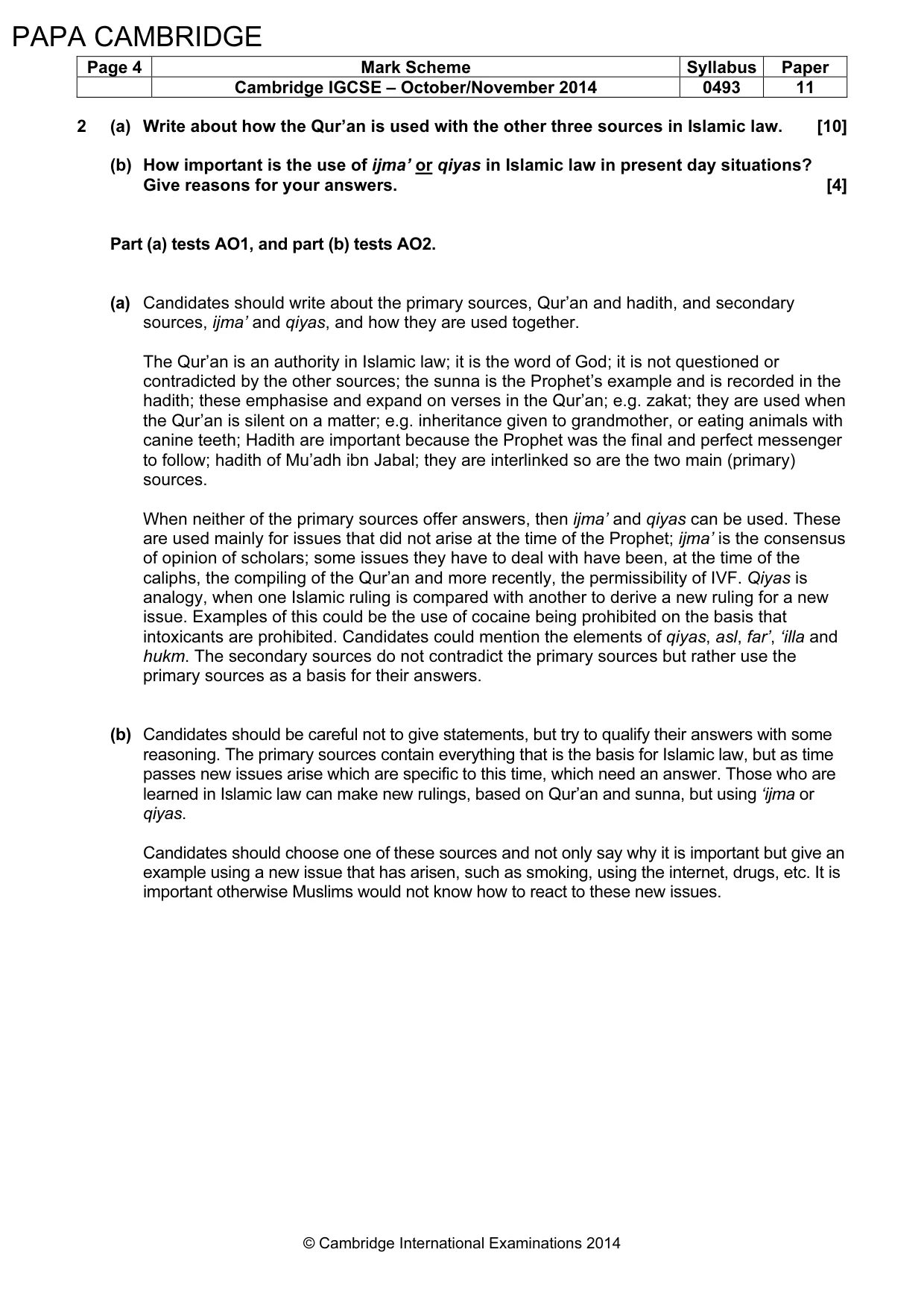
PAPA CAMBRIDGE Page 4 Mark Scheme Syllabus Paper Cambridge IGCSE – October/November 2014 0493 11 © Cambridge International Examinations 2014 2 (a) Write about how the Qur’an is used with the other three sources in Islamic law. [10] (b) How important is the use of ijma’ or qiyas in Islamic law in present day situations? Give reasons for your answers. [4] Part (a) tests AO1, and part (b) tests AO2. (a) Candidates should write about the primary sources, Qur’an and hadith, and secondary sources, ijma’ and qiyas, and how they are used together. The Qur’an is an authority in Islamic law; it is the word of God; it is not questioned or contradicted by the other sources; the sunna is the Prophet’s example and is recorded in the hadith; these emphasise and expand on verses in the Qur’an; e.g. zakat; they are used when the Qur’an is silent on a matter; e.g. inheritance given to grandmother, or eating animals with canine teeth; Hadith are important because the Prophet was the final and perfect messenger to follow; hadith of Mu’adh ibn Jabal; they are interlinked so are the two main (primary) sources. When neither of the primary sources offer answers, then ijma’ and qiyas can be used. These are used mainly for issues that did not arise at the time of the Prophet; ijma’ is the consensus of opinion of scholars; some issues they have to deal with have been, at the time of the caliphs, the compiling of the Qur’an and more recently, the permissibility of IVF. Qiyas is analogy, when one Islamic ruling is compared with another to derive a new ruling for a new issue. Examples of this could be the use of cocaine being prohibited on the basis that intoxicants are prohibited. Candidates could mention the elements of qiyas, asl, far’, ‘illa and hukm. The secondary sources do not contradict the primary sources but rather use the primary sources as a basis for their answers. (b) Candidates should be careful not to give statements, but try to qualify their answers with some reasoning. The primary sources contain everything that is the basis for Islamic law, but as time passes new issues arise which are specific to this time, which need an answer. Those who are learned in Islamic law can make new rulings, based on Qur’an and sunna, but using ‘ijma or qiyas. Candidates should choose one of these sources and not only say why it is important but give an example using a new issue that has arisen, such as smoking, using the internet, drugs, etc. It is important otherwise Muslims would not know how to react to these new issues.
Mark scheme, page 5
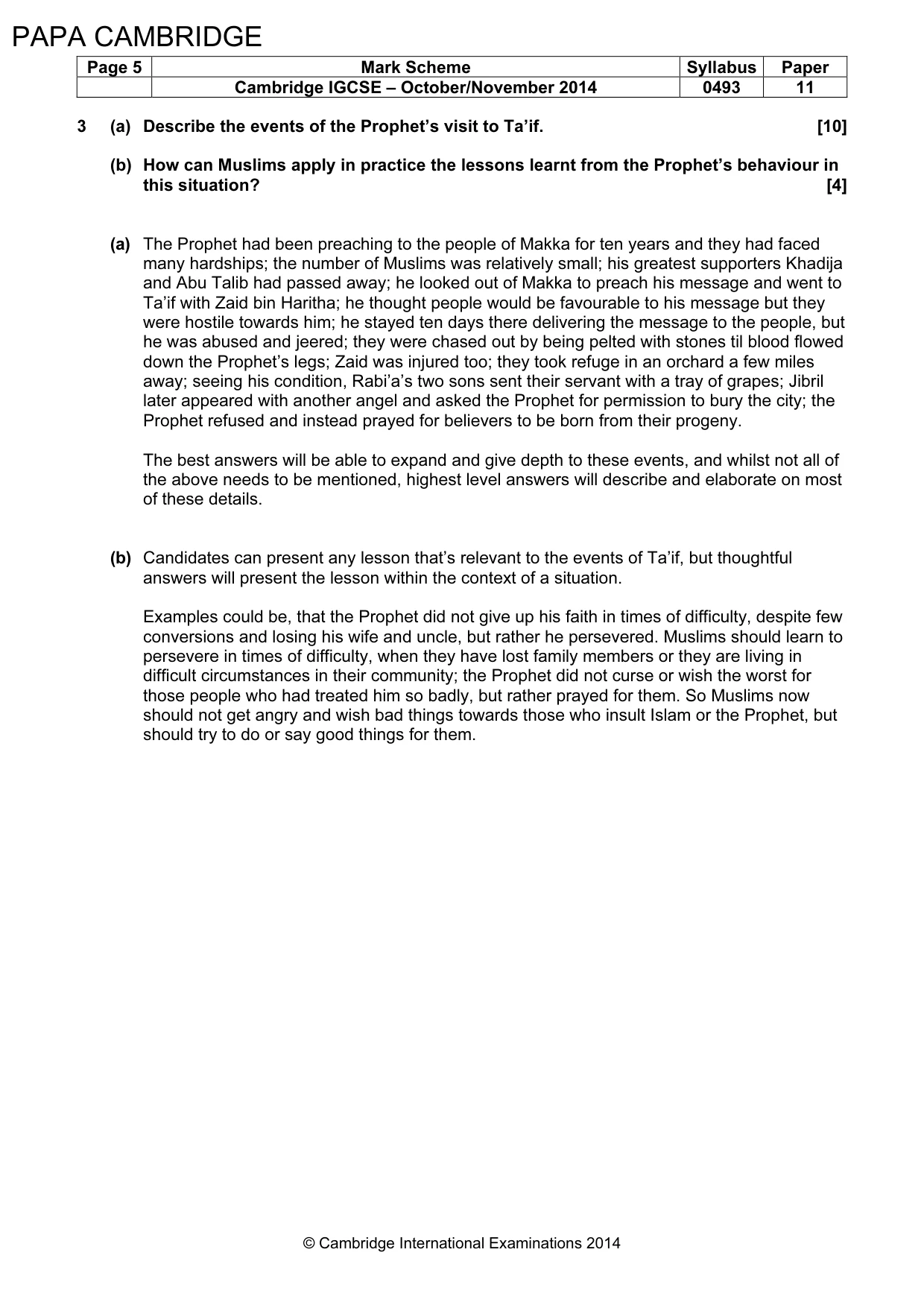
PAPA CAMBRIDGE Page 5 Mark Scheme Syllabus Paper Cambridge IGCSE – October/November 2014 0493 11 © Cambridge International Examinations 2014 3 (a) Describe the events of the Prophet’s visit to Ta’if. [10] (b) How can Muslims apply in practice the lessons learnt from the Prophet’s behaviour in this situation? [4] (a) The Prophet had been preaching to the people of Makka for ten years and they had faced many hardships; the number of Muslims was relatively small; his greatest supporters Khadija and Abu Talib had passed away; he looked out of Makka to preach his message and went to Ta’if with Zaid bin Haritha; he thought people would be favourable to his message but they were hostile towards him; he stayed ten days there delivering the message to the people, but he was abused and jeered; they were chased out by being pelted with stones til blood flowed down the Prophet’s legs; Zaid was injured too; they took refuge in an orchard a few miles away; seeing his condition, Rabi’a’s two sons sent their servant with a tray of grapes; Jibril later appeared with another angel and asked the Prophet for permission to bury the city; the Prophet refused and instead prayed for believers to be born from their progeny. The best answers will be able to expand and give depth to these events, and whilst not all of the above needs to be mentioned, highest level answers will describe and elaborate on most of these details. (b) Candidates can present any lesson that’s relevant to the events of Ta’if, but thoughtful answers will present the lesson within the context of a situation. Examples could be, that the Prophet did not give up his faith in times of difficulty, despite few conversions and losing his wife and uncle, but rather he persevered. Muslims should learn to persevere in times of difficulty, when they have lost family members or they are living in difficult circumstances in their community; the Prophet did not curse or wish the worst for those people who had treated him so badly, but rather prayed for them. So Muslims now should not get angry and wish bad things towards those who insult Islam or the Prophet, but should try to do or say good things for them.
Mark scheme, page 6
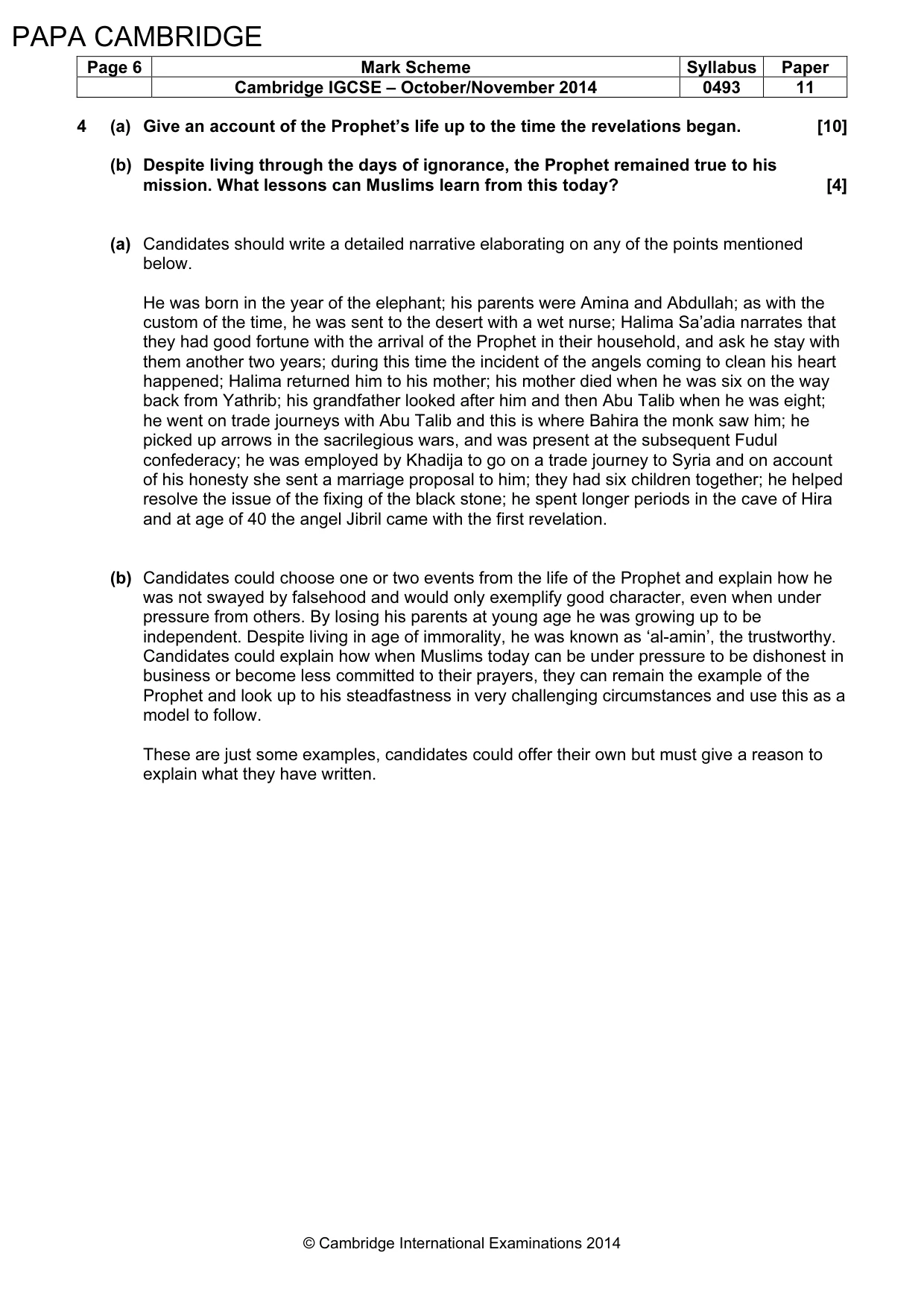
PAPA CAMBRIDGE Page 6 Mark Scheme Syllabus Paper Cambridge IGCSE – October/November 2014 0493 11 © Cambridge International Examinations 2014 4 (a) Give an account of the Prophet’s life up to the time the revelations began. [10] (b) Despite living through the days of ignorance, the Prophet remained true to his mission. What lessons can Muslims learn from this today? [4] (a) Candidates should write a detailed narrative elaborating on any of the points mentioned below. He was born in the year of the elephant; his parents were Amina and Abdullah; as with the custom of the time, he was sent to the desert with a wet nurse; Halima Sa’adia narrates that they had good fortune with the arrival of the Prophet in their household, and ask he stay with them another two years; during this time the incident of the angels coming to clean his heart happened; Halima returned him to his mother; his mother died when he was six on the way back from Yathrib; his grandfather looked after him and then Abu Talib when he was eight; he went on trade journeys with Abu Talib and this is where Bahira the monk saw him; he picked up arrows in the sacrilegious wars, and was present at the subsequent Fudul confederacy; he was employed by Khadija to go on a trade journey to Syria and on account of his honesty she sent a marriage proposal to him; they had six children together; he helped resolve the issue of the fixing of the black stone; he spent longer periods in the cave of Hira and at age of 40 the angel Jibril came with the first revelation. (b) Candidates could choose one or two events from the life of the Prophet and explain how he was not swayed by falsehood and would only exemplify good character, even when under pressure from others. By losing his parents at young age he was growing up to be independent. Despite living in age of immorality, he was known as ‘al-amin’, the trustworthy. Candidates could explain how when Muslims today can be under pressure to be dishonest in business or become less committed to their prayers, they can remain the example of the Prophet and look up to his steadfastness in very challenging circumstances and use this as a model to follow. These are just some examples, candidates could offer their own but must give a reason to explain what they have written.
Mark scheme, page 7
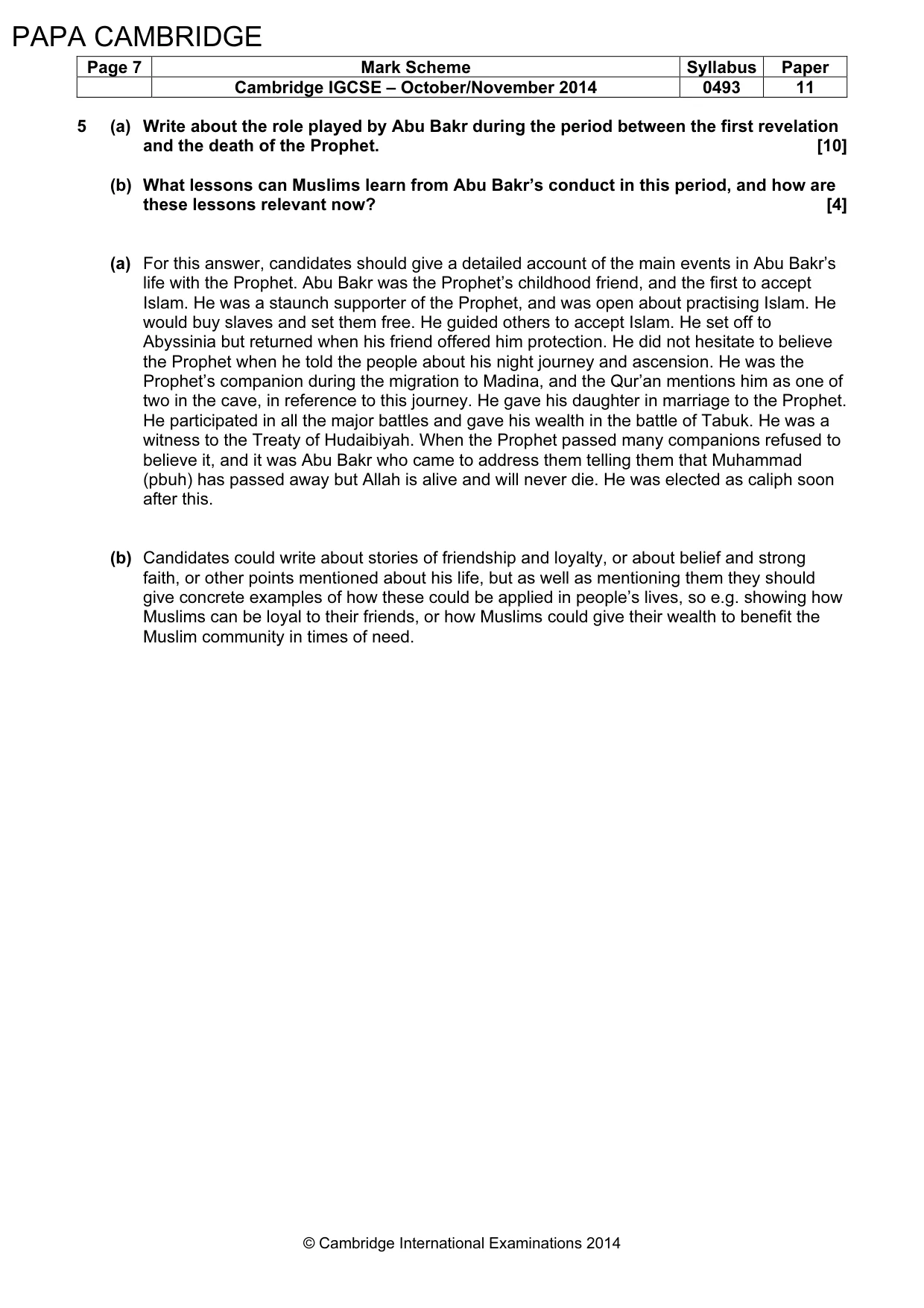
PAPA CAMBRIDGE Page 7 Mark Scheme Syllabus Paper Cambridge IGCSE – October/November 2014 0493 11 © Cambridge International Examinations 2014 5 (a) Write about the role played by Abu Bakr during the period between the first revelation and the death of the Prophet. [10] (b) What lessons can Muslims learn from Abu Bakr’s conduct in this period, and how are these lessons relevant now? [4] (a) For this answer, candidates should give a detailed account of the main events in Abu Bakr’s life with the Prophet. Abu Bakr was the Prophet’s childhood friend, and the first to accept Islam. He was a staunch supporter of the Prophet, and was open about practising Islam. He would buy slaves and set them free. He guided others to accept Islam. He set off to Abyssinia but returned when his friend offered him protection. He did not hesitate to believe the Prophet when he told the people about his night journey and ascension. He was the Prophet’s companion during the migration to Madina, and the Qur’an mentions him as one of two in the cave, in reference to this journey. He gave his daughter in marriage to the Prophet. He participated in all the major battles and gave his wealth in the battle of Tabuk. He was a witness to the Treaty of Hudaibiyah. When the Prophet passed many companions refused to believe it, and it was Abu Bakr who came to address them telling them that Muhammad (pbuh) has passed away but Allah is alive and will never die. He was elected as caliph soon after this. (b) Candidates could write about stories of friendship and loyalty, or about belief and strong faith, or other points mentioned about his life, but as well as mentioning them they should give concrete examples of how these could be applied in people’s lives, so e.g. showing how Muslims can be loyal to their friends, or how Muslims could give their wealth to benefit the Muslim community in times of need.
What you needed in this session
Cambridge’s own grade thresholds for 2014 Oct/Nov, Paper 1 · Variant 1. A higher threshold means an easier paper — the bar moves with how the cohort did.