Cambridge IGCSE India Studies 0447 — 2017 May/June Paper 1 · Variant 1
0447/11/M/J/17 · 75 marks · ≈84 min
The question paper and its mark scheme, free to read here and free to download. This is Cambridge’s own paper, exactly as it was sat.
Question paper12 pages
Mark scheme17 pages
Answers below. Sit the paper first if you are practising.
Paper as text
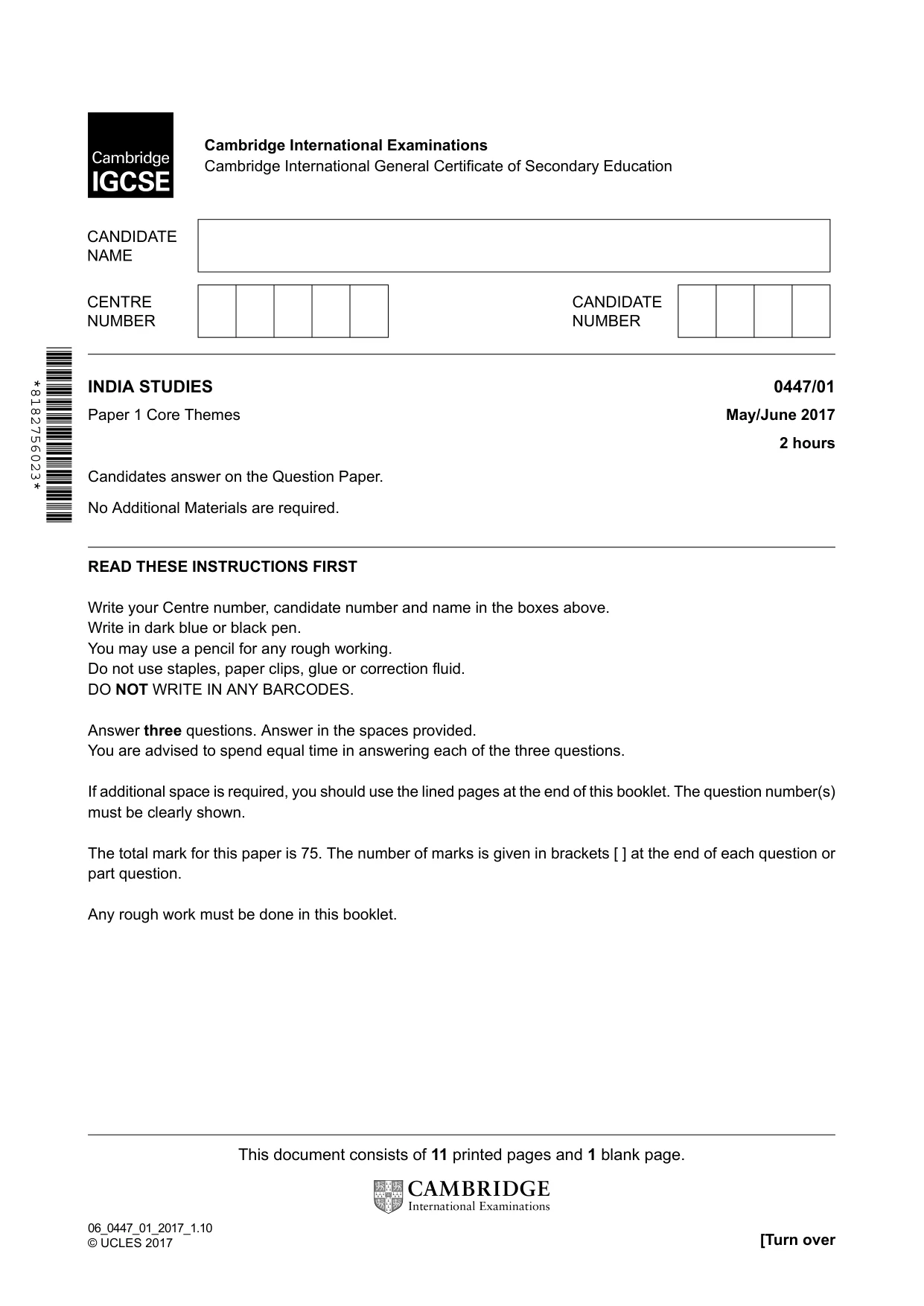
Question paper, page 1
Cambridge International Examinations Cambridge International General Certificate of Secondary Education 0447/01 May/June 2017 2 hours INDIA STUDIES Paper 1 Core Themes Candidates answer on the Question Paper. No Additional Materials are required. READ THESE INSTRUCTIONS FIRST Write your Centre number, candidate number and name in the boxes above. Write in dark blue or black pen. You may use a pencil for any rough working. Do not use staples, paper clips, glue or correction fluid. DO NOT WRITE IN ANY BARCODES. Answer three questions. Answer in the spaces provided. You are advised to spend equal time in answering each of the three questions. If additional space is required, you should use the lined pages at the end of this booklet. The question number(s) must be clearly shown. The total mark for this paper is 75. The number of marks is given in brackets [ ] at the end of each question or part question. Any rough work must be done in this booklet. This document consists of 11 printed pages and 1 blank page. [Turn over 06_0447_01_2017_1.10 © UCLES 2017 *8182756023*
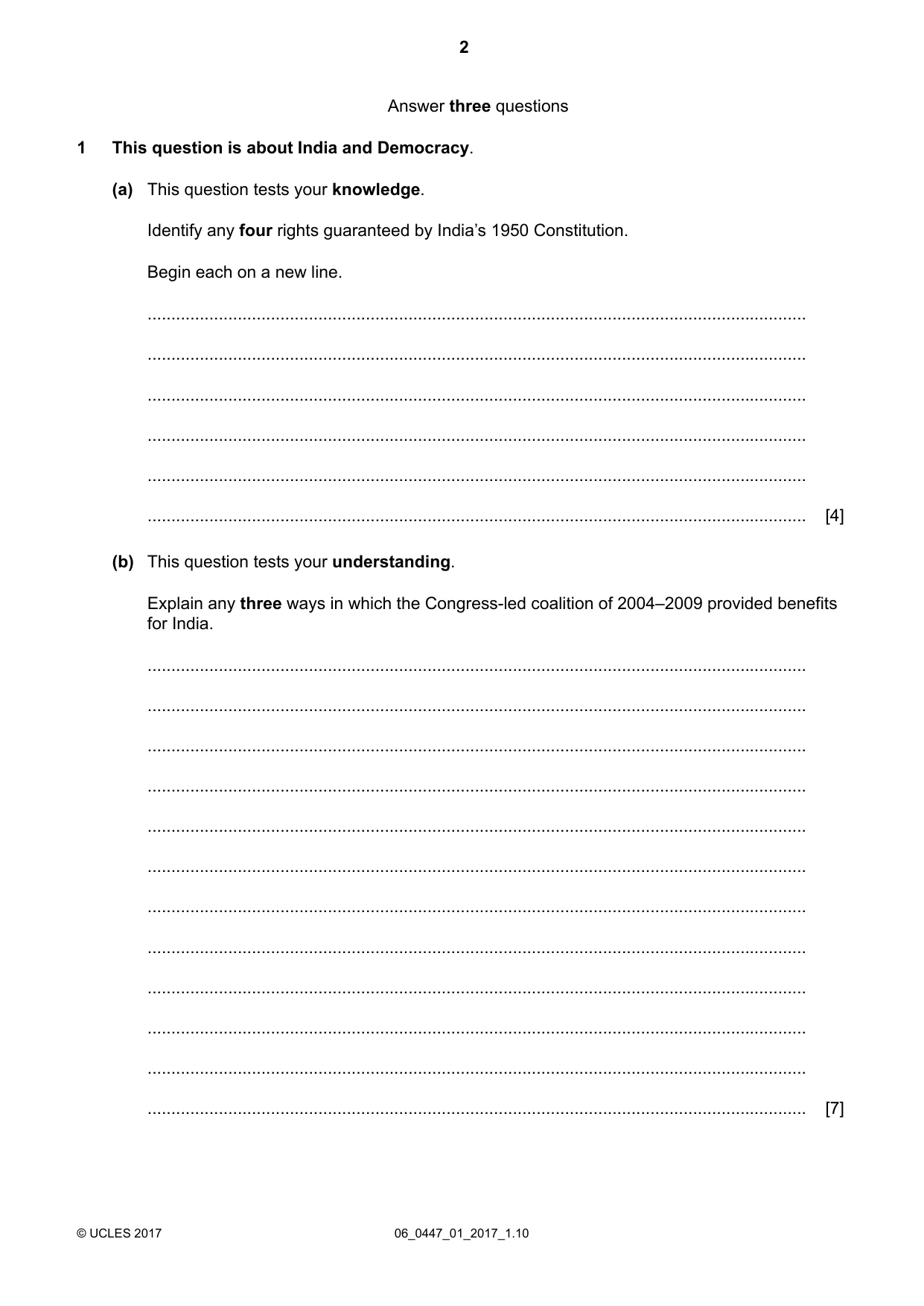
Question paper, page 2
Answer three questions This question is about India and Democracy. 1 This question tests your knowledge. Identify any four rights guaranteed by India’s 1950 Constitution. Begin each on a new line. (a) … … … … … … [4] This question tests your understanding. Explain any three ways in which the Congress-led coalition of 2004–2009 provided benefits for India. (b) … … … … … … … … … … … … [7] 06_0447_01_2017_1.10 © UCLES 2017 2
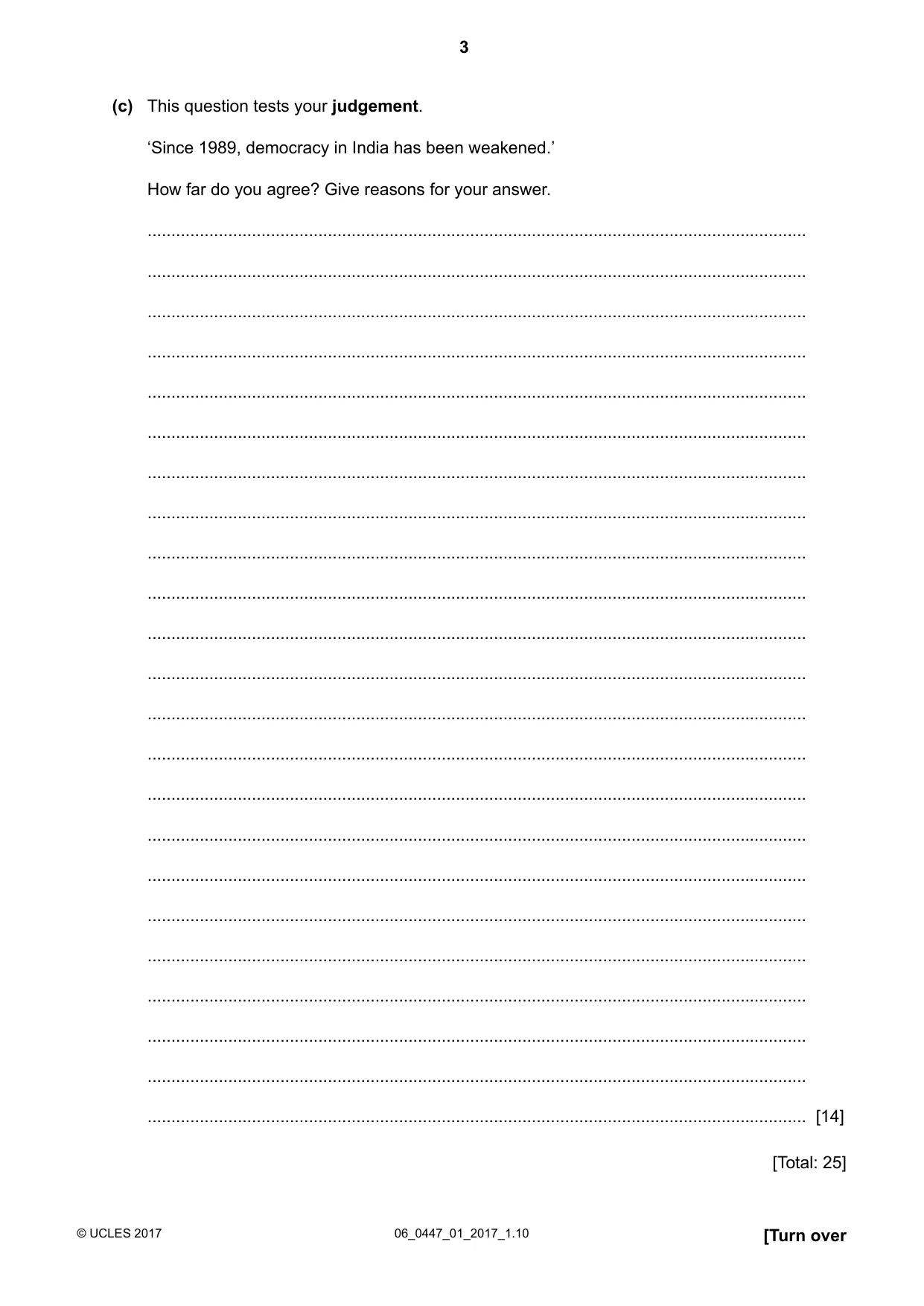
Question paper, page 3
This question tests your judgement. ‘Since 1989, democracy in India has been weakened.’ How far do you agree? Give reasons for your answer. (c) … … … … … … … … … … … … … … … … … … … … … … … [14] [Total: 25] [Turn over 06_0447_01_2017_1.10 © UCLES 2017 3
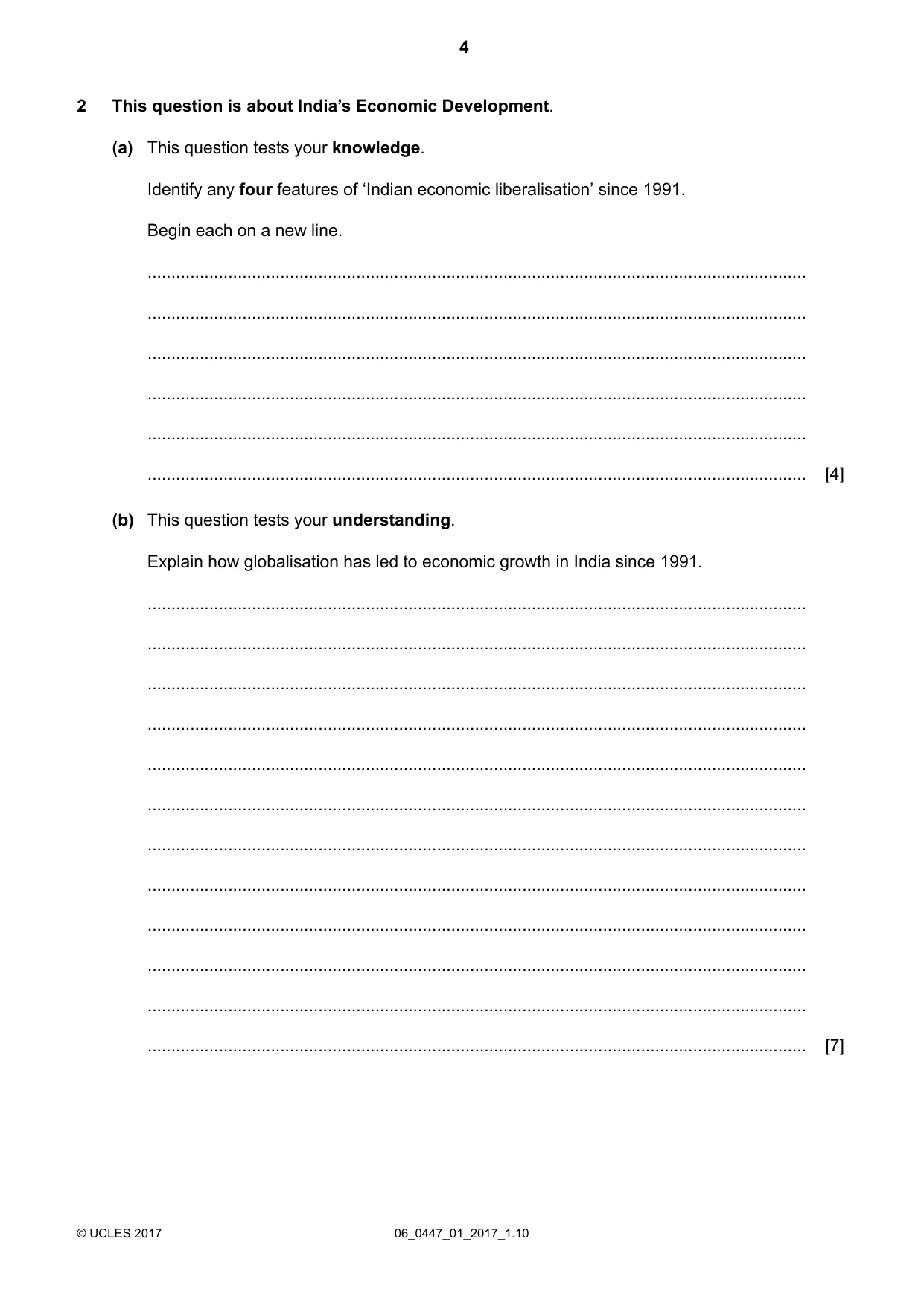
Question paper, page 4
This question is about India’s Economic Development. 2 This question tests your knowledge. Identify any four features of ‘Indian economic liberalisation’ since 1991. Begin each on a new line. (a) … … … … … … [4] This question tests your understanding. Explain how globalisation has led to economic growth in India since 1991. (b) … … … … … … … … … … … … [7] 06_0447_01_2017_1.10 © UCLES 2017 4
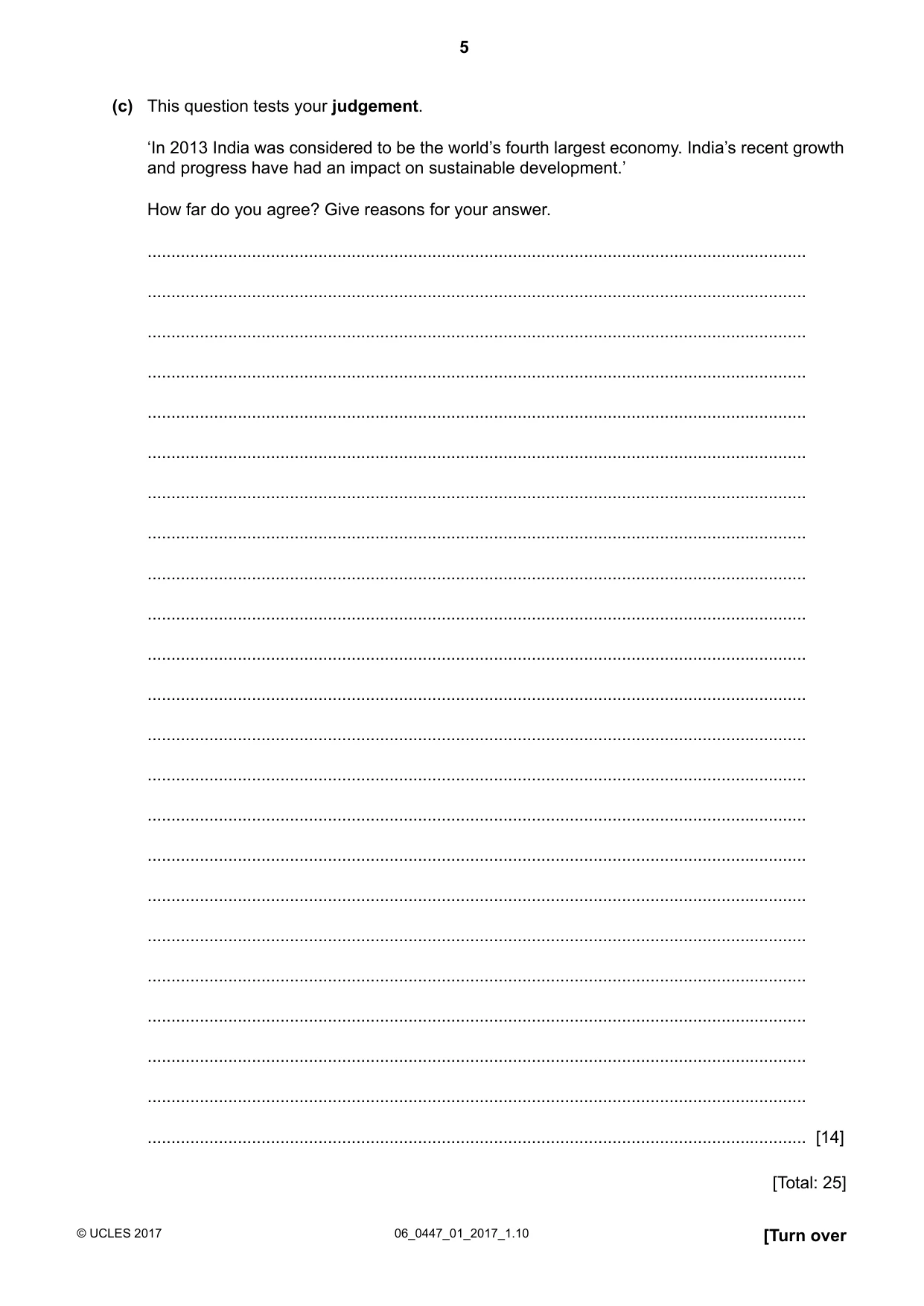
Question paper, page 5
This question tests your judgement. ‘In 2013 India was considered to be the world’s fourth largest economy. India’s recent growth and progress have had an impact on sustainable development.’ How far do you agree? Give reasons for your answer. (c) … … … … … … … … … … … … … … … … … … … … … … … [14] [Total: 25] [Turn over 06_0447_01_2017_1.10 © UCLES 2017 5
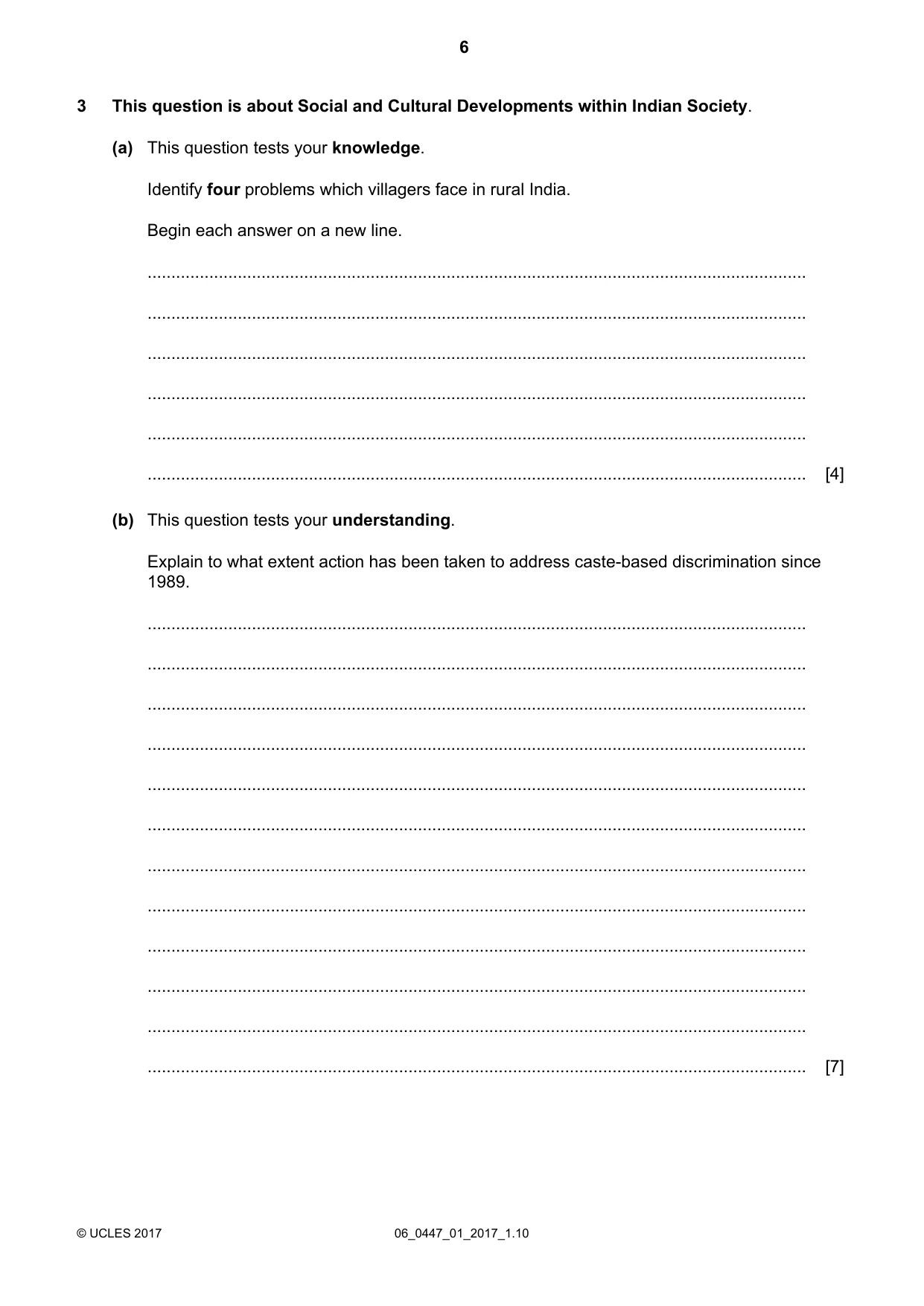
Question paper, page 6
This question is about Social and Cultural Developments within Indian Society. 3 This question tests your knowledge. Identify four problems which villagers face in rural India. Begin each answer on a new line. (a) … … … … … … [4] This question tests your understanding. Explain to what extent action has been taken to address caste-based discrimination since 1989. (b) … … … … … … … … … … … … [7] 06_0447_01_2017_1.10 © UCLES 2017 6
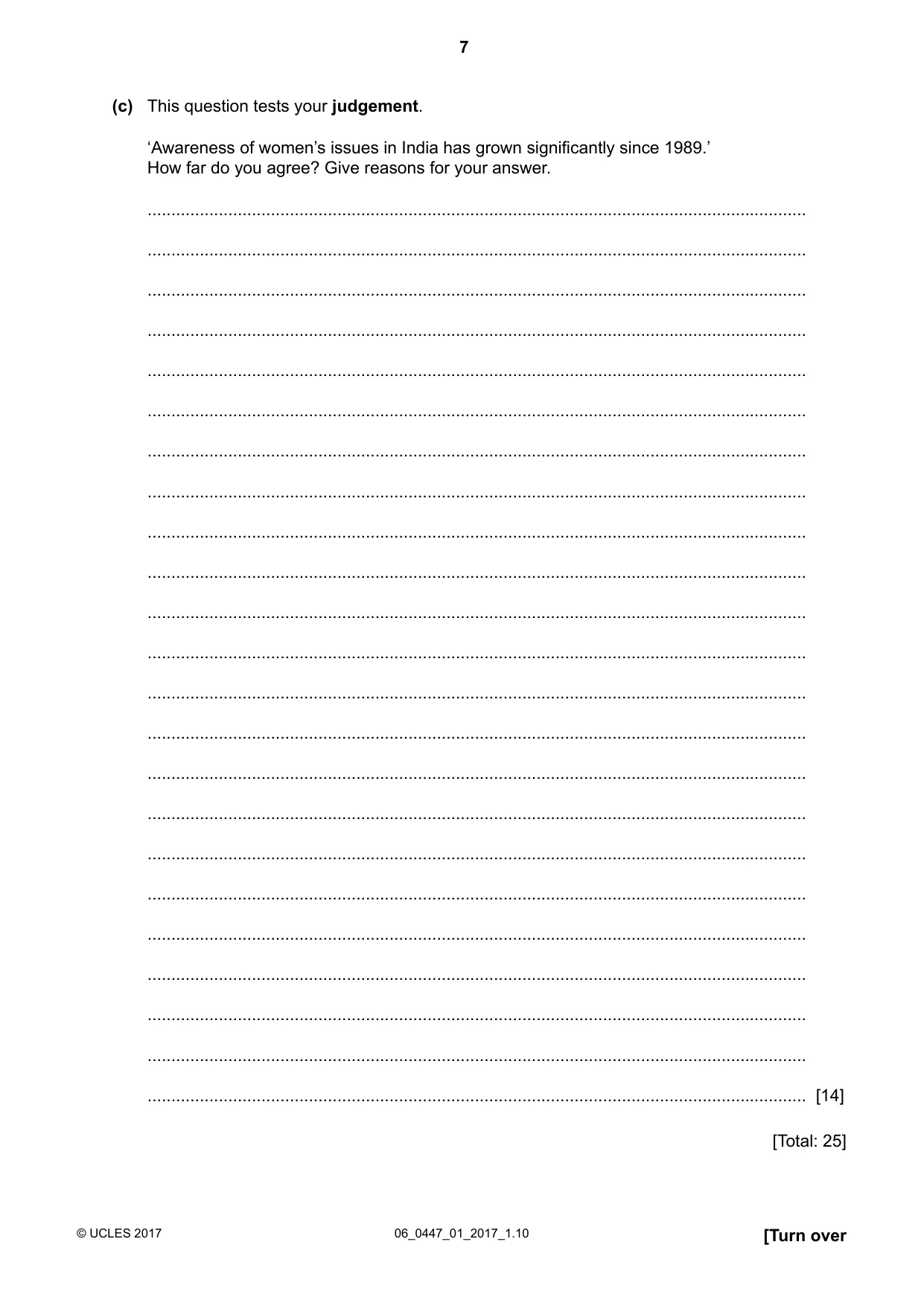
Question paper, page 7
This question tests your judgement. ‘Awareness of women’s issues in India has grown significantly since 1989.’ How far do you agree? Give reasons for your answer. (c) … … … … … … … … … … … … … … … … … … … … … … … [14] [Total: 25] [Turn over 06_0447_01_2017_1.10 © UCLES 2017 7
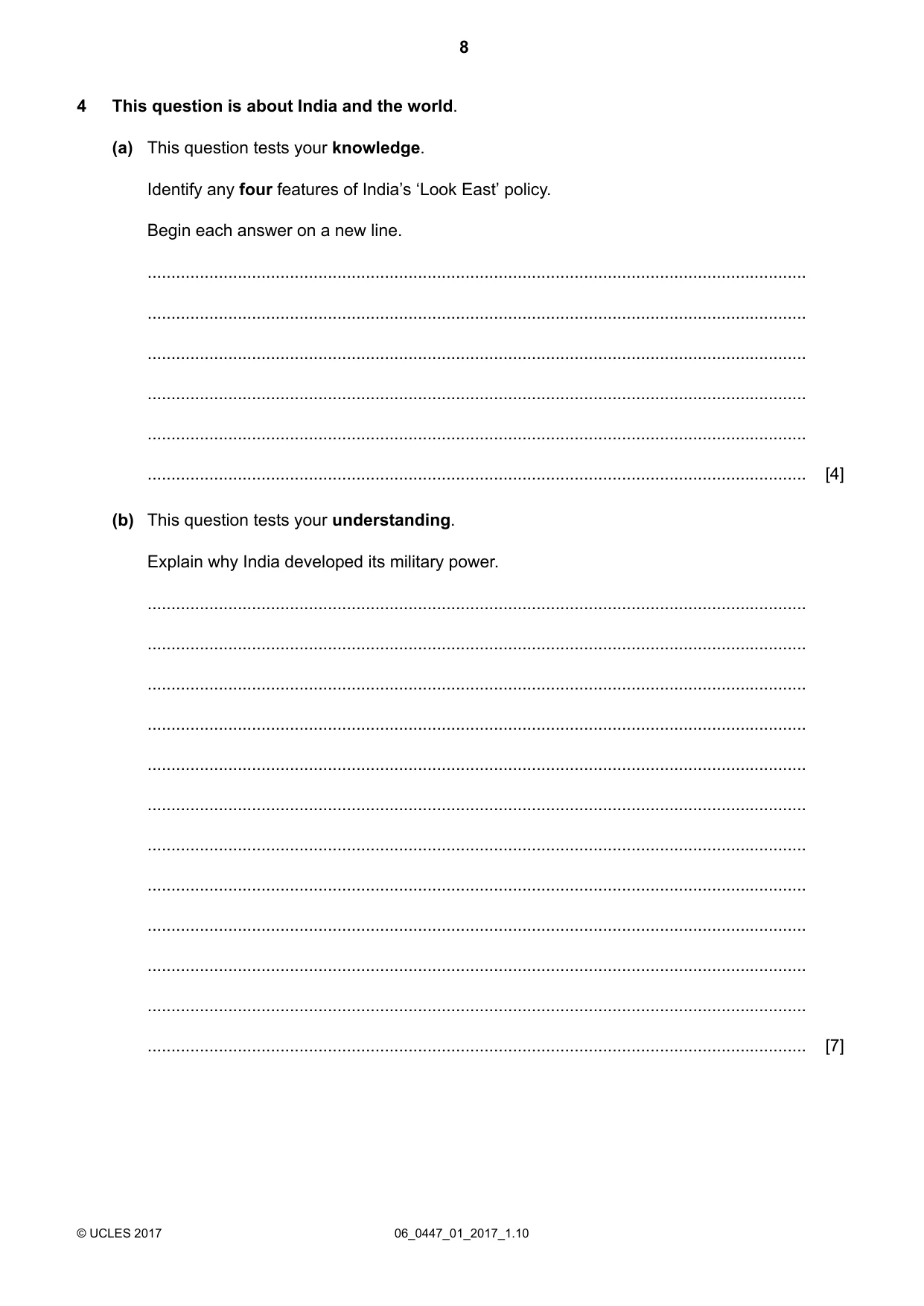
Question paper, page 8
This question is about India and the world. 4 This question tests your knowledge. Identify any four features of India’s ‘Look East’ policy. Begin each answer on a new line. (a) … … … … … … [4] This question tests your understanding. Explain why India developed its military power. (b) … … … … … … … … … … … … [7] 06_0447_01_2017_1.10 © UCLES 2017 8
Question paper, page 9
This question tests your judgement. ‘India’s relations with Pakistan have improved since 1989.’ How far do you agree? Give reasons for your answer. (c) … … … … … … … … … … … … … … … … … … … … … … … [14] [Total: 25] [Turn over 06_0447_01_2017_1.10 © UCLES 2017 9
Question paper, page 10
Additional Page If you use the following lined page to complete the answer(s) to any question(s), the question number(s) must be clearly shown. … … … … … … … … … … … … … … … … … … … … … … … … … 06_0447_01_2017_1.10 © UCLES 2017 10
Question paper, page 11
Additional Page If you use the following lined page to complete the answer(s) to any question(s), the question number(s) must be clearly shown. … … … … … … … … … … … … … … … … … … … … … … … … … 06_0447_01_2017_1.10 © UCLES 2017 11
Question paper, page 12
BLANK PAGE Permission to reproduce items where third-party owned material protected by copyright is included has been sought and cleared where possible. Every reasonable effort has been made by the publisher (UCLES) to trace copyright holders, but if any items requiring clearance have unwittingly been included, the publisher will be pleased to make amends at the earliest possible opportunity. To avoid the issue of disclosure of answer-related information to candidates, all copyright acknowledgements are reproduced online in the Cambridge International Examinations Copyright Acknowledgements Booklet. This is produced for each series of examinations and is freely available to download at www.cie.org.uk after the live examination series. Cambridge International Examinations is part of the Cambridge Assessment Group. Cambridge Assessment is the brand name of University of Cambridge Local Examinations Syndicate (UCLES), which is itself a department of the University of Cambridge. 06_0447_01_2017_1.10 © UCLES 2017 12
Mark scheme, page 1
® IGCSE is a registered trademark. This syllabus is approved for use in England, Wales and Northern Ireland as a Cambridge International Level 1/Level 2 Certificate. This document consists of 17 printed pages. © UCLES 2017 [Turn over Cambridge International Examinations Cambridge International General Certificate of Secondary Education INDIA STUDIES 0447/01 Paper 1 Core Themes May/June 2017 MARK SCHEME Maximum Mark: 75 Published This mark scheme is published as an aid to teachers and candidates, to indicate the requirements of the examination. It shows the basis on which Examiners were instructed to award marks. It does not indicate the details of the discussions that took place at an Examiners’ meeting before marking began, which would have considered the acceptability of alternative answers. Mark schemes should be read in conjunction with the question paper and the Principal Examiner Report for Teachers. Cambridge will not enter into discussions about these mark schemes. Cambridge is publishing the mark schemes for the May/June 2017 series for most Cambridge IGCSE®, Cambridge International A and AS Level and Cambridge Pre-U components, and some Cambridge O Level components.
Mark scheme, page 2
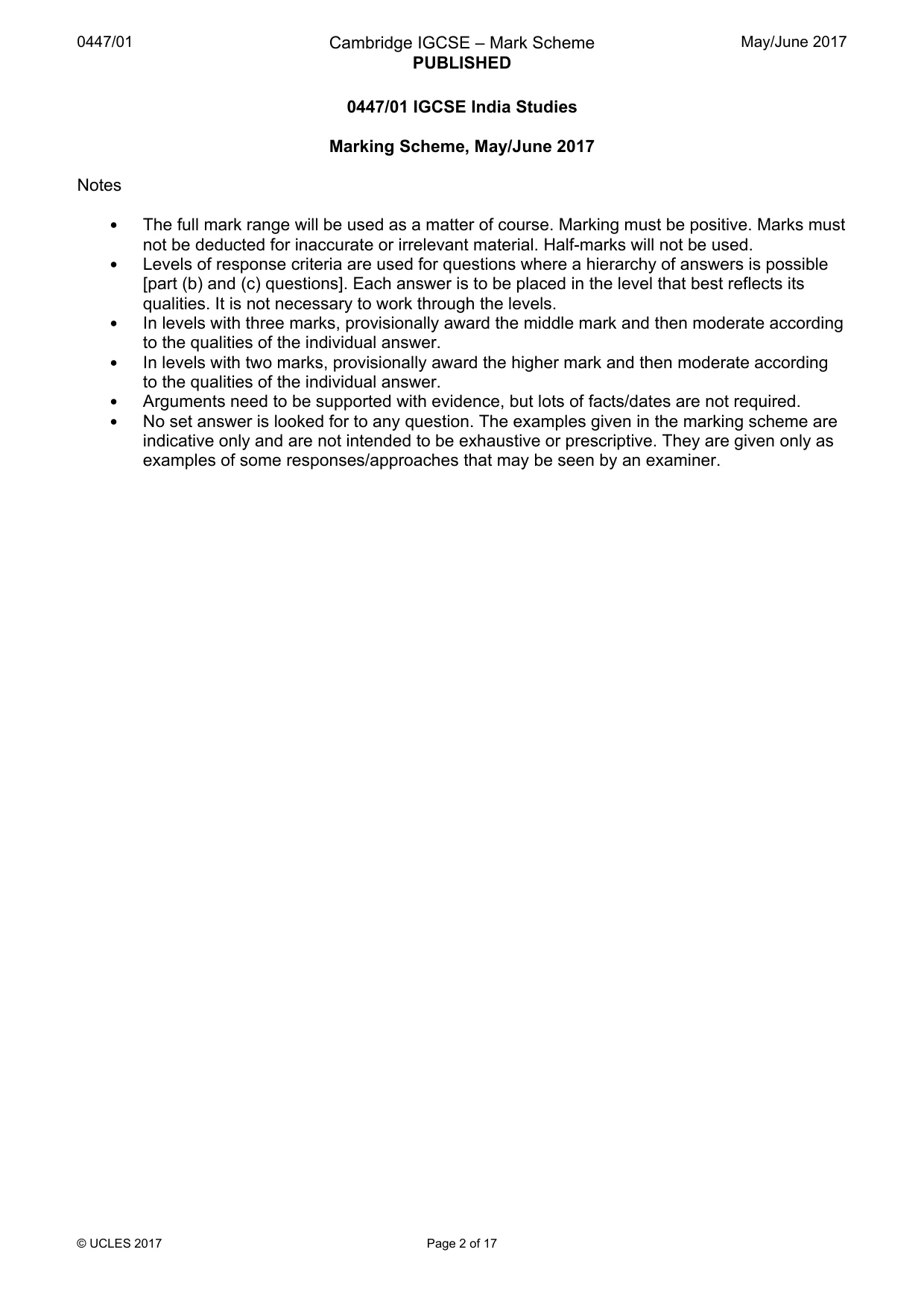
0447/01 Cambridge IGCSE – Mark Scheme PUBLISHED May/June 2017 © UCLES 2017 Page 2 of 17 0447/01 IGCSE India Studies Marking Scheme, May/June 2017 Notes • The full mark range will be used as a matter of course. Marking must be positive. Marks must not be deducted for inaccurate or irrelevant material. Half-marks will not be used. • Levels of response criteria are used for questions where a hierarchy of answers is possible [part (b) and (c) questions]. Each answer is to be placed in the level that best reflects its qualities. It is not necessary to work through the levels. • In levels with three marks, provisionally award the middle mark and then moderate according to the qualities of the individual answer. • In levels with two marks, provisionally award the higher mark and then moderate according to the qualities of the individual answer. • Arguments need to be supported with evidence, but lots of facts/dates are not required. • No set answer is looked for to any question. The examples given in the marking scheme are indicative only and are not intended to be exhaustive or prescriptive. They are given only as examples of some responses/approaches that may be seen by an examiner.
Mark scheme, page 3
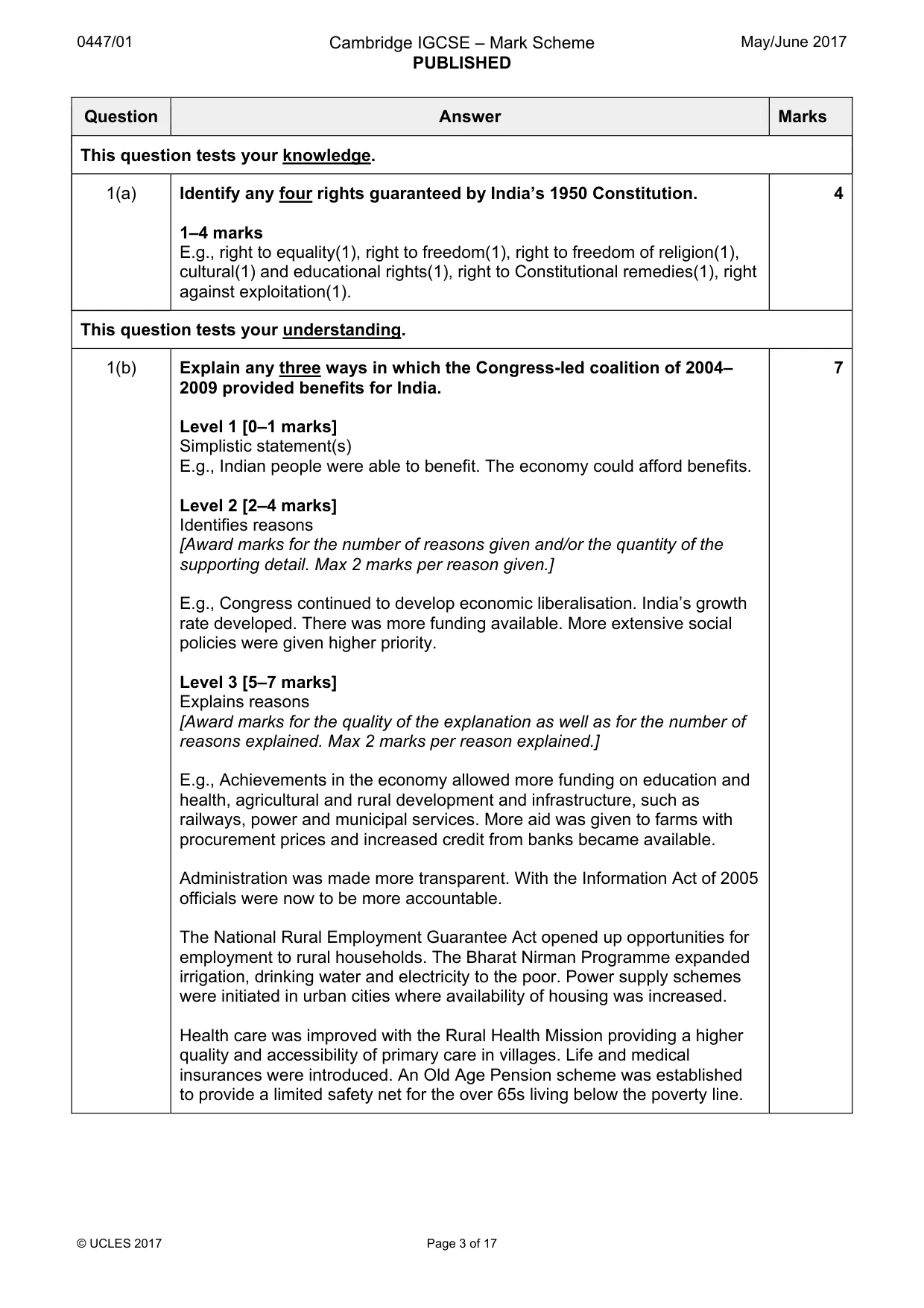
0447/01 Cambridge IGCSE – Mark Scheme PUBLISHED May/June 2017 © UCLES 2017 Page 3 of 17 Question Answer Marks This question tests your knowledge. 1(a) Identify any four rights guaranteed by India’s 1950 Constitution. 1–4 marks E.g., right to equality(1), right to freedom(1), right to freedom of religion(1), cultural(1) and educational rights(1), right to Constitutional remedies(1), right against exploitation(1). 4 This question tests your understanding. 1(b) Explain any three ways in which the Congress-led coalition of 2004– 2009 provided benefits for India. Level 1 [0–1 marks] Simplistic statement(s) E.g., Indian people were able to benefit. The economy could afford benefits. Level 2 [2–4 marks] Identifies reasons [Award marks for the number of reasons given and/or the quantity of the supporting detail. Max 2 marks per reason given.] E.g., Congress continued to develop economic liberalisation. India’s growth rate developed. There was more funding available. More extensive social policies were given higher priority. Level 3 [5–7 marks] Explains reasons [Award marks for the quality of the explanation as well as for the number of reasons explained. Max 2 marks per reason explained.] E.g., Achievements in the economy allowed more funding on education and health, agricultural and rural development and infrastructure, such as railways, power and municipal services. More aid was given to farms with procurement prices and increased credit from banks became available. Administration was made more transparent. With the Information Act of 2005 officials were now to be more accountable. The National Rural Employment Guarantee Act opened up opportunities for employment to rural households. The Bharat Nirman Programme expanded irrigation, drinking water and electricity to the poor. Power supply schemes were initiated in urban cities where availability of housing was increased. Health care was improved with the Rural Health Mission providing a higher quality and accessibility of primary care in villages. Life and medical insurances were introduced. An Old Age Pension scheme was established to provide a limited safety net for the over 65s living below the poverty line. 7
Mark scheme, page 4
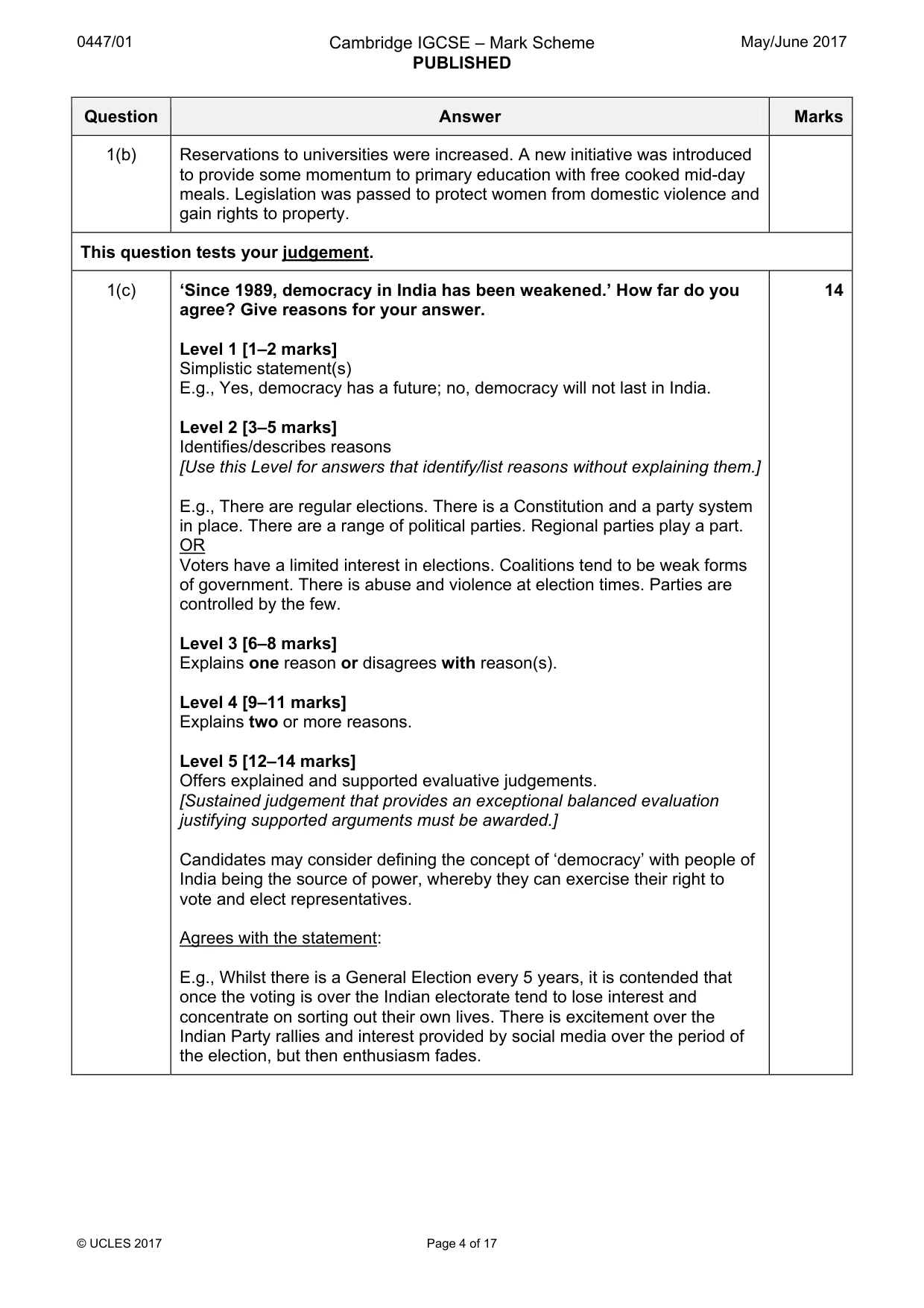
0447/01 Cambridge IGCSE – Mark Scheme PUBLISHED May/June 2017 © UCLES 2017 Page 4 of 17 Question Answer Marks 1(b) Reservations to universities were increased. A new initiative was introduced to provide some momentum to primary education with free cooked mid-day meals. Legislation was passed to protect women from domestic violence and gain rights to property. This question tests your judgement. 1(c) ‘Since 1989, democracy in India has been weakened.’ How far do you agree? Give reasons for your answer. Level 1 [1–2 marks] Simplistic statement(s) E.g., Yes, democracy has a future; no, democracy will not last in India. Level 2 [3–5 marks] Identifies/describes reasons [Use this Level for answers that identify/list reasons without explaining them.] E.g., There are regular elections. There is a Constitution and a party system in place. There are a range of political parties. Regional parties play a part. OR Voters have a limited interest in elections. Coalitions tend to be weak forms of government. There is abuse and violence at election times. Parties are controlled by the few. Level 3 [6–8 marks] Explains one reason or disagrees with reason(s). Level 4 [9–11 marks] Explains two or more reasons. Level 5 [12–14 marks] Offers explained and supported evaluative judgements. [Sustained judgement that provides an exceptional balanced evaluation justifying supported arguments must be awarded.] Candidates may consider defining the concept of ‘democracy’ with people of India being the source of power, whereby they can exercise their right to vote and elect representatives. Agrees with the statement: E.g., Whilst there is a General Election every 5 years, it is contended that once the voting is over the Indian electorate tend to lose interest and concentrate on sorting out their own lives. There is excitement over the Indian Party rallies and interest provided by social media over the period of the election, but then enthusiasm fades. 14
Mark scheme, page 5
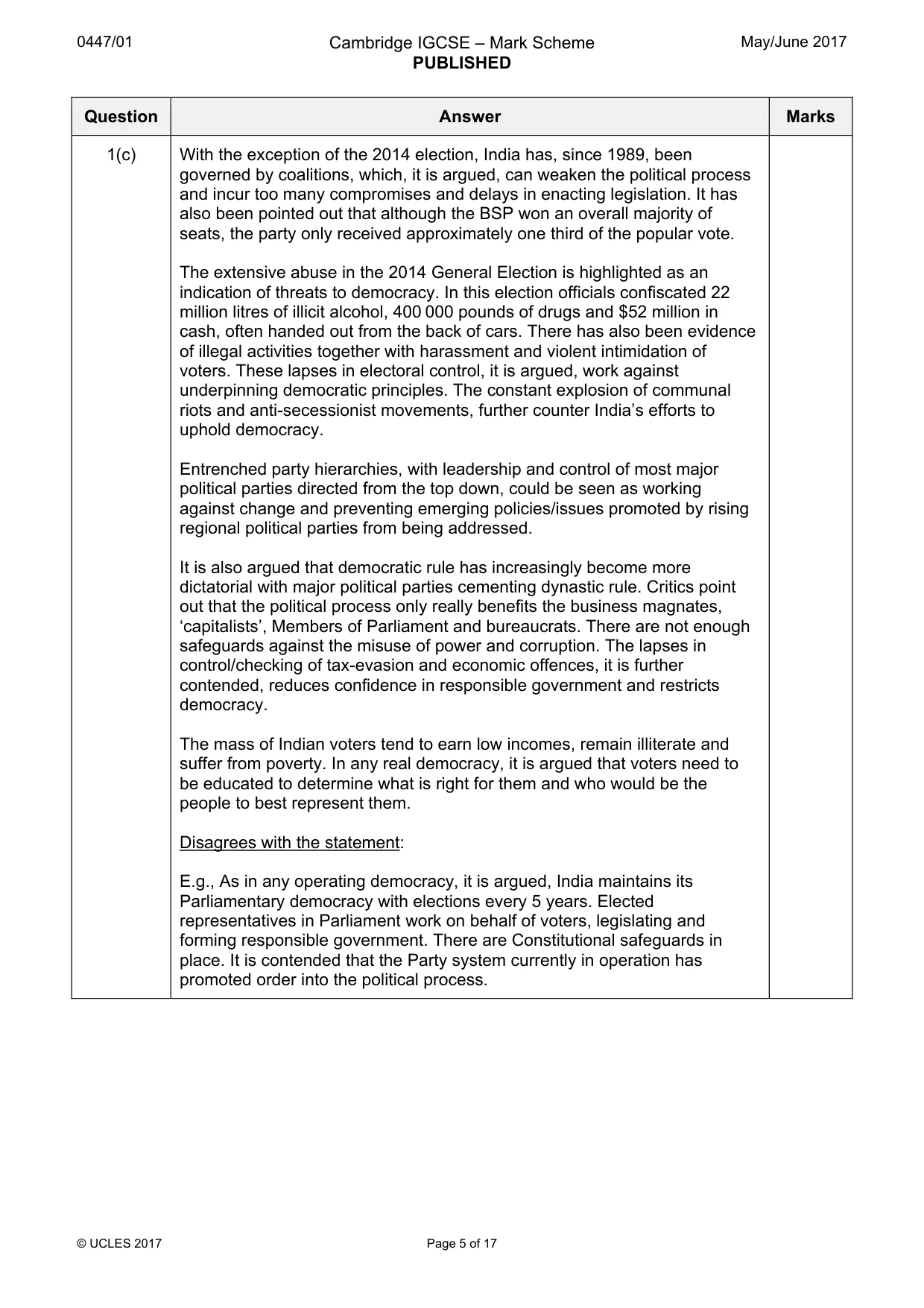
0447/01 Cambridge IGCSE – Mark Scheme PUBLISHED May/June 2017 © UCLES 2017 Page 5 of 17 Question Answer Marks 1(c) With the exception of the 2014 election, India has, since 1989, been governed by coalitions, which, it is argued, can weaken the political process and incur too many compromises and delays in enacting legislation. It has also been pointed out that although the BSP won an overall majority of seats, the party only received approximately one third of the popular vote. The extensive abuse in the 2014 General Election is highlighted as an indication of threats to democracy. In this election officials confiscated 22 million litres of illicit alcohol, 400 000 pounds of drugs and $52 million in cash, often handed out from the back of cars. There has also been evidence of illegal activities together with harassment and violent intimidation of voters. These lapses in electoral control, it is argued, work against underpinning democratic principles. The constant explosion of communal riots and anti-secessionist movements, further counter India’s efforts to uphold democracy. Entrenched party hierarchies, with leadership and control of most major political parties directed from the top down, could be seen as working against change and preventing emerging policies/issues promoted by rising regional political parties from being addressed. It is also argued that democratic rule has increasingly become more dictatorial with major political parties cementing dynastic rule. Critics point out that the political process only really benefits the business magnates, ‘capitalists’, Members of Parliament and bureaucrats. There are not enough safeguards against the misuse of power and corruption. The lapses in control/checking of tax-evasion and economic offences, it is further contended, reduces confidence in responsible government and restricts democracy. The mass of Indian voters tend to earn low incomes, remain illiterate and suffer from poverty. In any real democracy, it is argued that voters need to be educated to determine what is right for them and who would be the people to best represent them. Disagrees with the statement: E.g., As in any operating democracy, it is argued, India maintains its Parliamentary democracy with elections every 5 years. Elected representatives in Parliament work on behalf of voters, legislating and forming responsible government. There are Constitutional safeguards in place. It is contended that the Party system currently in operation has promoted order into the political process.
Mark scheme, page 6
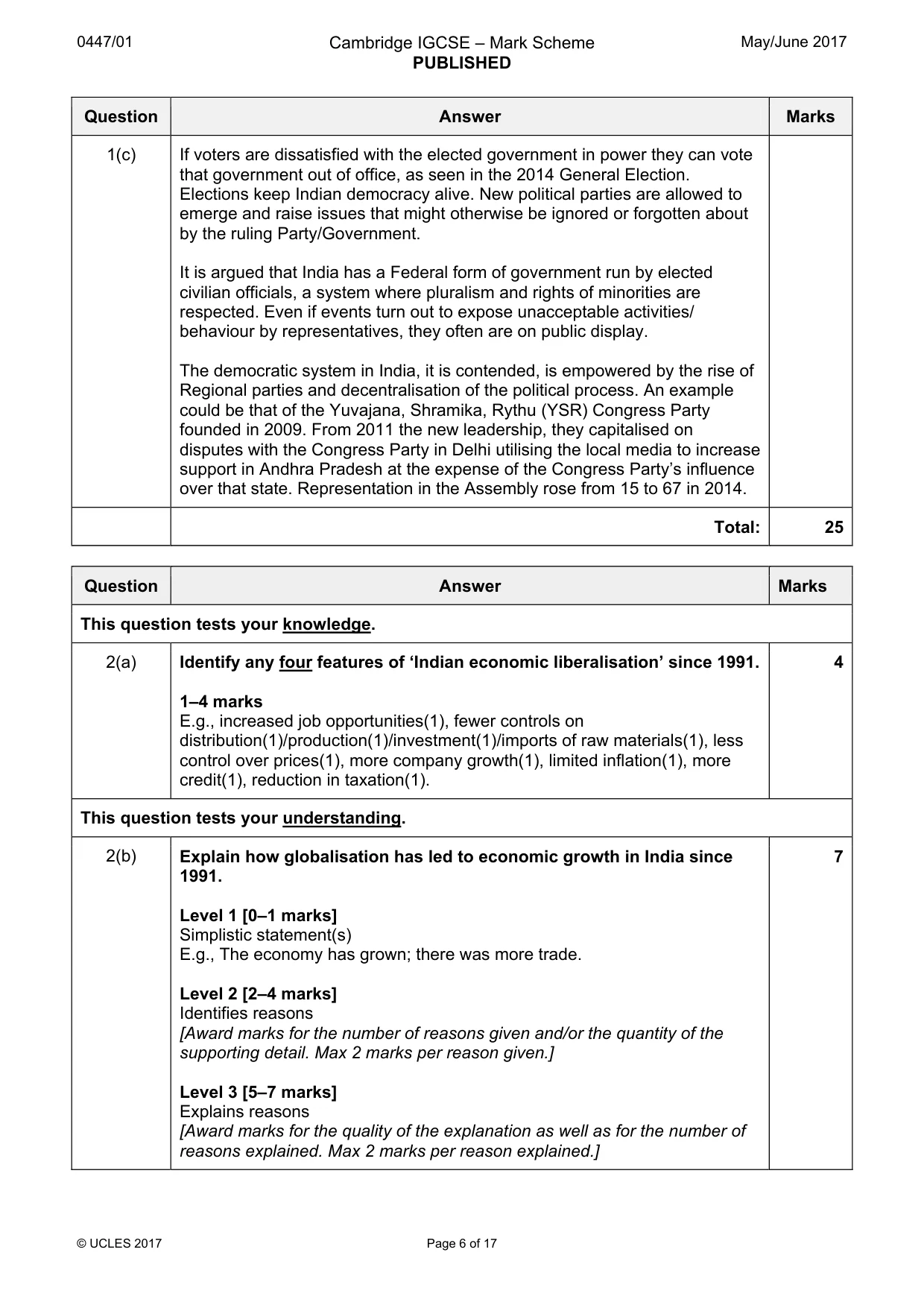
0447/01 Cambridge IGCSE – Mark Scheme PUBLISHED May/June 2017 © UCLES 2017 Page 6 of 17 Question Answer Marks 1(c) If voters are dissatisfied with the elected government in power they can vote that government out of office, as seen in the 2014 General Election. Elections keep Indian democracy alive. New political parties are allowed to emerge and raise issues that might otherwise be ignored or forgotten about by the ruling Party/Government. It is argued that India has a Federal form of government run by elected civilian officials, a system where pluralism and rights of minorities are respected. Even if events turn out to expose unacceptable activities/ behaviour by representatives, they often are on public display. The democratic system in India, it is contended, is empowered by the rise of Regional parties and decentralisation of the political process. An example could be that of the Yuvajana, Shramika, Rythu (YSR) Congress Party founded in 2009. From 2011 the new leadership, they capitalised on disputes with the Congress Party in Delhi utilising the local media to increase support in Andhra Pradesh at the expense of the Congress Party’s influence over that state. Representation in the Assembly rose from 15 to 67 in 2014. Total: 25 Question Answer Marks This question tests your knowledge. 2(a) Identify any four features of ‘Indian economic liberalisation’ since 1991. 1–4 marks E.g., increased job opportunities(1), fewer controls on distribution(1)/production(1)/investment(1)/imports of raw materials(1), less control over prices(1), more company growth(1), limited inflation(1), more credit(1), reduction in taxation(1). 4 This question tests your understanding. 2(b) Explain how globalisation has led to economic growth in India since 1991. Level 1 [0–1 marks] Simplistic statement(s) E.g., The economy has grown; there was more trade. Level 2 [2–4 marks] Identifies reasons [Award marks for the number of reasons given and/or the quantity of the supporting detail. Max 2 marks per reason given.] Level 3 [5–7 marks] Explains reasons [Award marks for the quality of the explanation as well as for the number of reasons explained. Max 2 marks per reason explained.] 7
Mark scheme, page 7
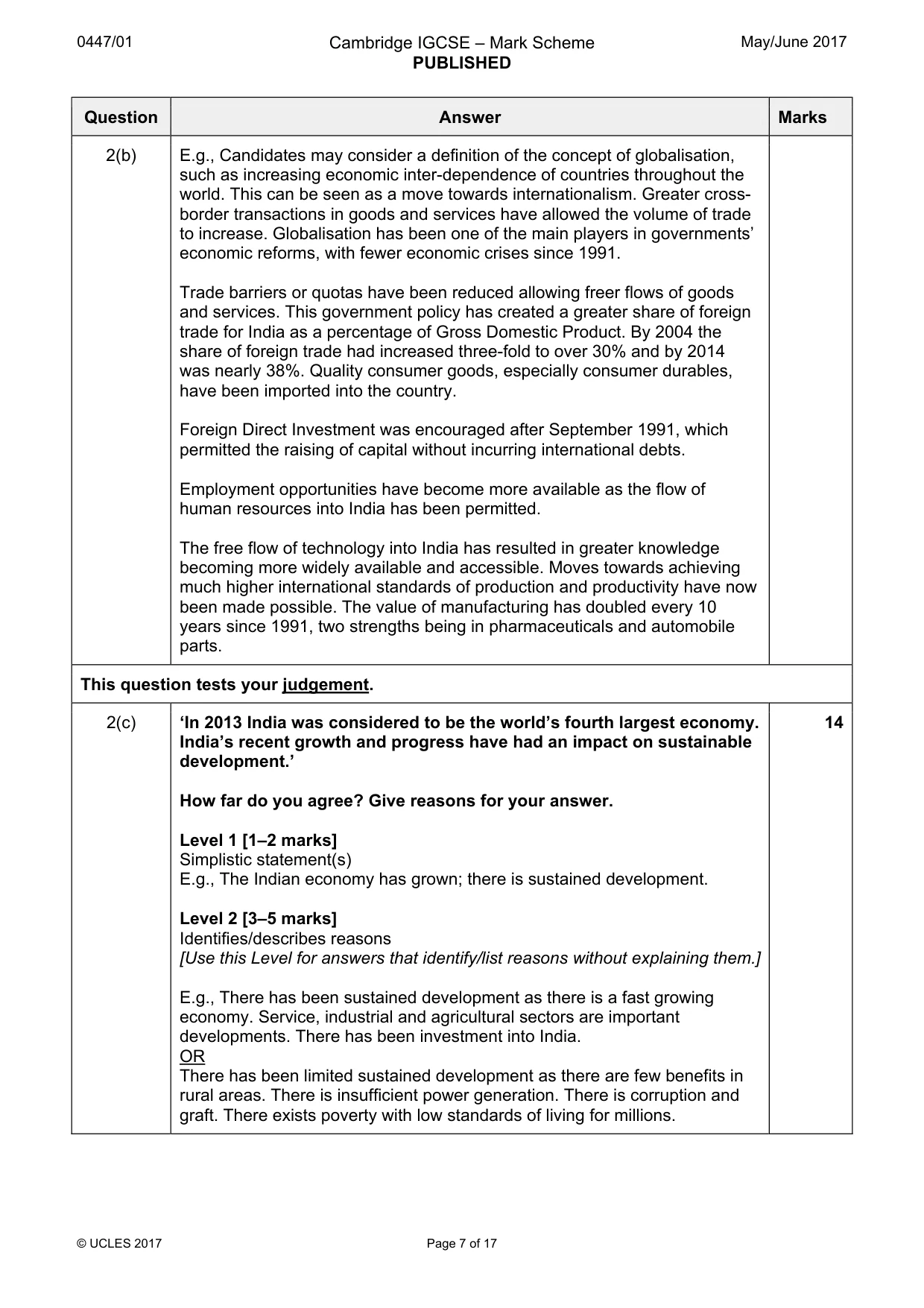
0447/01 Cambridge IGCSE – Mark Scheme PUBLISHED May/June 2017 © UCLES 2017 Page 7 of 17 Question Answer Marks 2(b) E.g., Candidates may consider a definition of the concept of globalisation, such as increasing economic inter-dependence of countries throughout the world. This can be seen as a move towards internationalism. Greater cross- border transactions in goods and services have allowed the volume of trade to increase. Globalisation has been one of the main players in governments’ economic reforms, with fewer economic crises since 1991. Trade barriers or quotas have been reduced allowing freer flows of goods and services. This government policy has created a greater share of foreign trade for India as a percentage of Gross Domestic Product. By 2004 the share of foreign trade had increased three-fold to over 30% and by 2014 was nearly 38%. Quality consumer goods, especially consumer durables, have been imported into the country. Foreign Direct Investment was encouraged after September 1991, which permitted the raising of capital without incurring international debts. Employment opportunities have become more available as the flow of human resources into India has been permitted. The free flow of technology into India has resulted in greater knowledge becoming more widely available and accessible. Moves towards achieving much higher international standards of production and productivity have now been made possible. The value of manufacturing has doubled every 10 years since 1991, two strengths being in pharmaceuticals and automobile parts. This question tests your judgement. 2(c) ‘In 2013 India was considered to be the world’s fourth largest economy. India’s recent growth and progress have had an impact on sustainable development.’ How far do you agree? Give reasons for your answer. Level 1 [1–2 marks] Simplistic statement(s) E.g., The Indian economy has grown; there is sustained development. Level 2 [3–5 marks] Identifies/describes reasons [Use this Level for answers that identify/list reasons without explaining them.] E.g., There has been sustained development as there is a fast growing economy. Service, industrial and agricultural sectors are important developments. There has been investment into India. OR There has been limited sustained development as there are few benefits in rural areas. There is insufficient power generation. There is corruption and graft. There exists poverty with low standards of living for millions. 14
Mark scheme, page 8
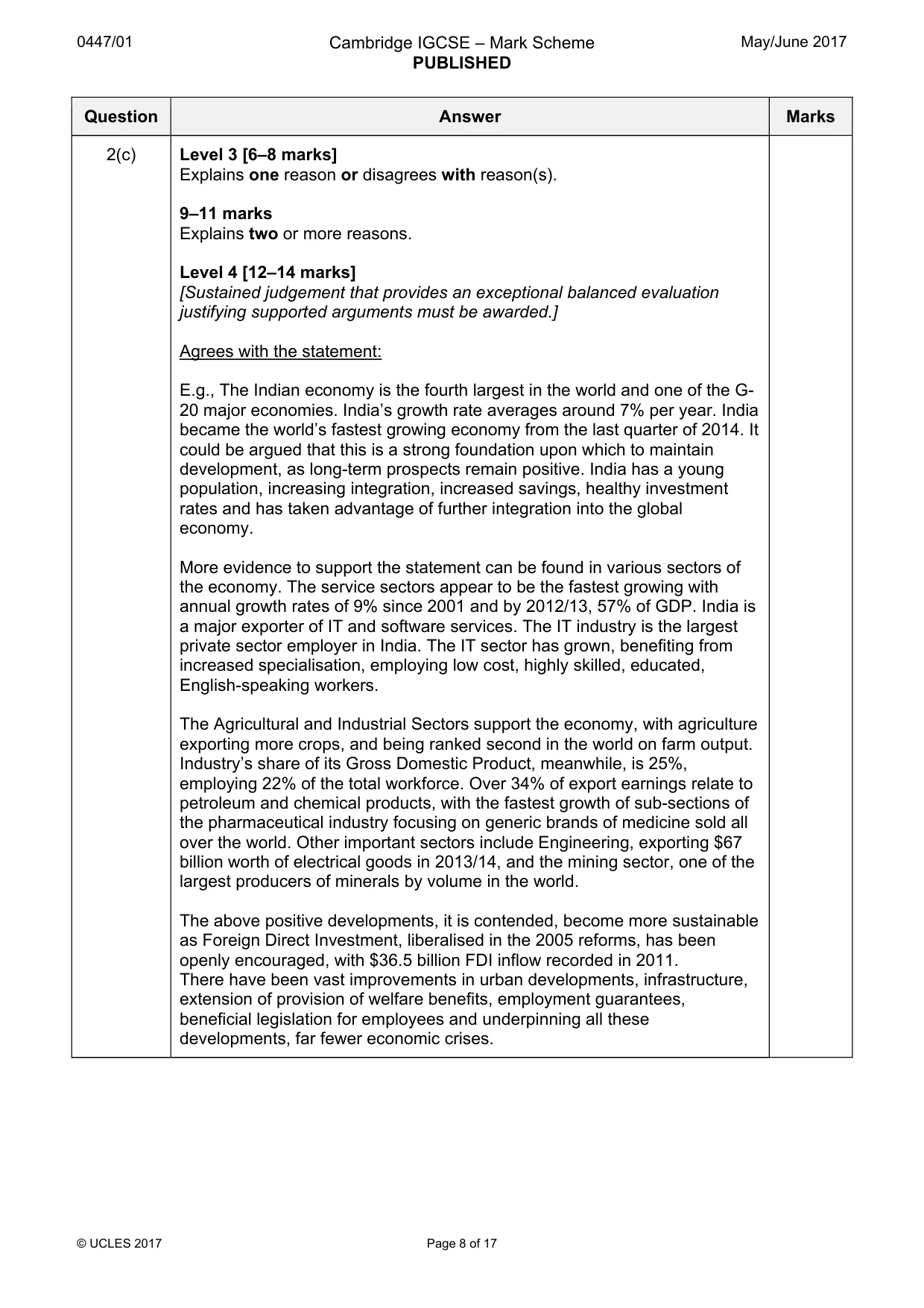
0447/01 Cambridge IGCSE – Mark Scheme PUBLISHED May/June 2017 © UCLES 2017 Page 8 of 17 Question Answer Marks 2(c) Level 3 [6–8 marks] Explains one reason or disagrees with reason(s). 9–11 marks Explains two or more reasons. Level 4 [12–14 marks] [Sustained judgement that provides an exceptional balanced evaluation justifying supported arguments must be awarded.] Agrees with the statement: E.g., The Indian economy is the fourth largest in the world and one of the G- 20 major economies. India’s growth rate averages around 7% per year. India became the world’s fastest growing economy from the last quarter of 2014. It could be argued that this is a strong foundation upon which to maintain development, as long-term prospects remain positive. India has a young population, increasing integration, increased savings, healthy investment rates and has taken advantage of further integration into the global economy. More evidence to support the statement can be found in various sectors of the economy. The service sectors appear to be the fastest growing with annual growth rates of 9% since 2001 and by 2012/13, 57% of GDP. India is a major exporter of IT and software services. The IT industry is the largest private sector employer in India. The IT sector has grown, benefiting from increased specialisation, employing low cost, highly skilled, educated, English-speaking workers. The Agricultural and Industrial Sectors support the economy, with agriculture exporting more crops, and being ranked second in the world on farm output. Industry’s share of its Gross Domestic Product, meanwhile, is 25%, employing 22% of the total workforce. Over 34% of export earnings relate to petroleum and chemical products, with the fastest growth of sub-sections of the pharmaceutical industry focusing on generic brands of medicine sold all over the world. Other important sectors include Engineering, exporting $67 billion worth of electrical goods in 2013/14, and the mining sector, one of the largest producers of minerals by volume in the world. The above positive developments, it is contended, become more sustainable as Foreign Direct Investment, liberalised in the 2005 reforms, has been openly encouraged, with $36.5 billion FDI inflow recorded in 2011. There have been vast improvements in urban developments, infrastructure, extension of provision of welfare benefits, employment guarantees, beneficial legislation for employees and underpinning all these developments, far fewer economic crises.
Mark scheme, page 9
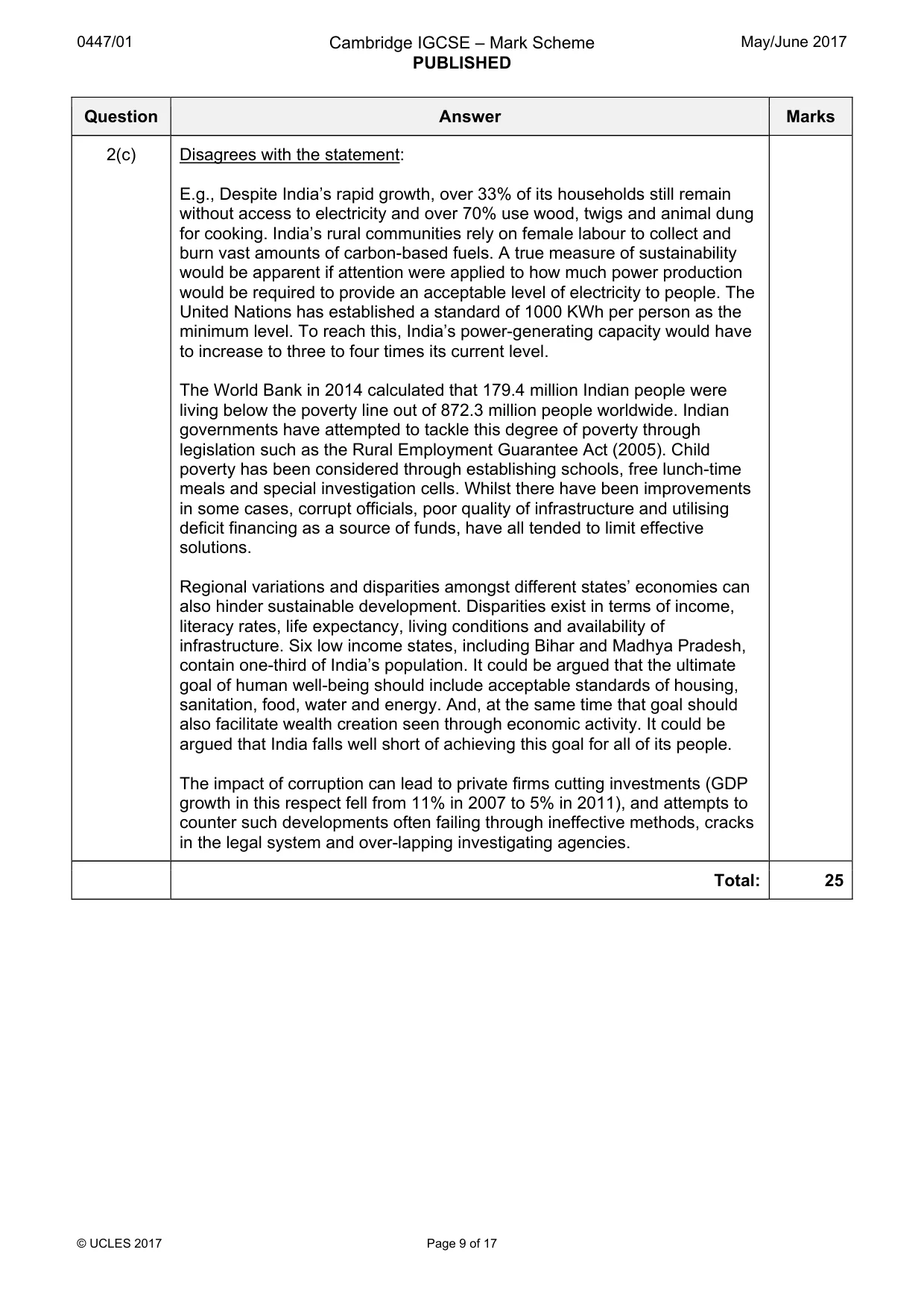
0447/01 Cambridge IGCSE – Mark Scheme PUBLISHED May/June 2017 © UCLES 2017 Page 9 of 17 Question Answer Marks 2(c) Disagrees with the statement: E.g., Despite India’s rapid growth, over 33% of its households still remain without access to electricity and over 70% use wood, twigs and animal dung for cooking. India’s rural communities rely on female labour to collect and burn vast amounts of carbon-based fuels. A true measure of sustainability would be apparent if attention were applied to how much power production would be required to provide an acceptable level of electricity to people. The United Nations has established a standard of 1000 KWh per person as the minimum level. To reach this, India’s power-generating capacity would have to increase to three to four times its current level. The World Bank in 2014 calculated that 179.4 million Indian people were living below the poverty line out of 872.3 million people worldwide. Indian governments have attempted to tackle this degree of poverty through legislation such as the Rural Employment Guarantee Act (2005). Child poverty has been considered through establishing schools, free lunch-time meals and special investigation cells. Whilst there have been improvements in some cases, corrupt officials, poor quality of infrastructure and utilising deficit financing as a source of funds, have all tended to limit effective solutions. Regional variations and disparities amongst different states’ economies can also hinder sustainable development. Disparities exist in terms of income, literacy rates, life expectancy, living conditions and availability of infrastructure. Six low income states, including Bihar and Madhya Pradesh, contain one-third of India’s population. It could be argued that the ultimate goal of human well-being should include acceptable standards of housing, sanitation, food, water and energy. And, at the same time that goal should also facilitate wealth creation seen through economic activity. It could be argued that India falls well short of achieving this goal for all of its people. The impact of corruption can lead to private firms cutting investments (GDP growth in this respect fell from 11% in 2007 to 5% in 2011), and attempts to counter such developments often failing through ineffective methods, cracks in the legal system and over-lapping investigating agencies. Total: 25
Mark scheme, page 10
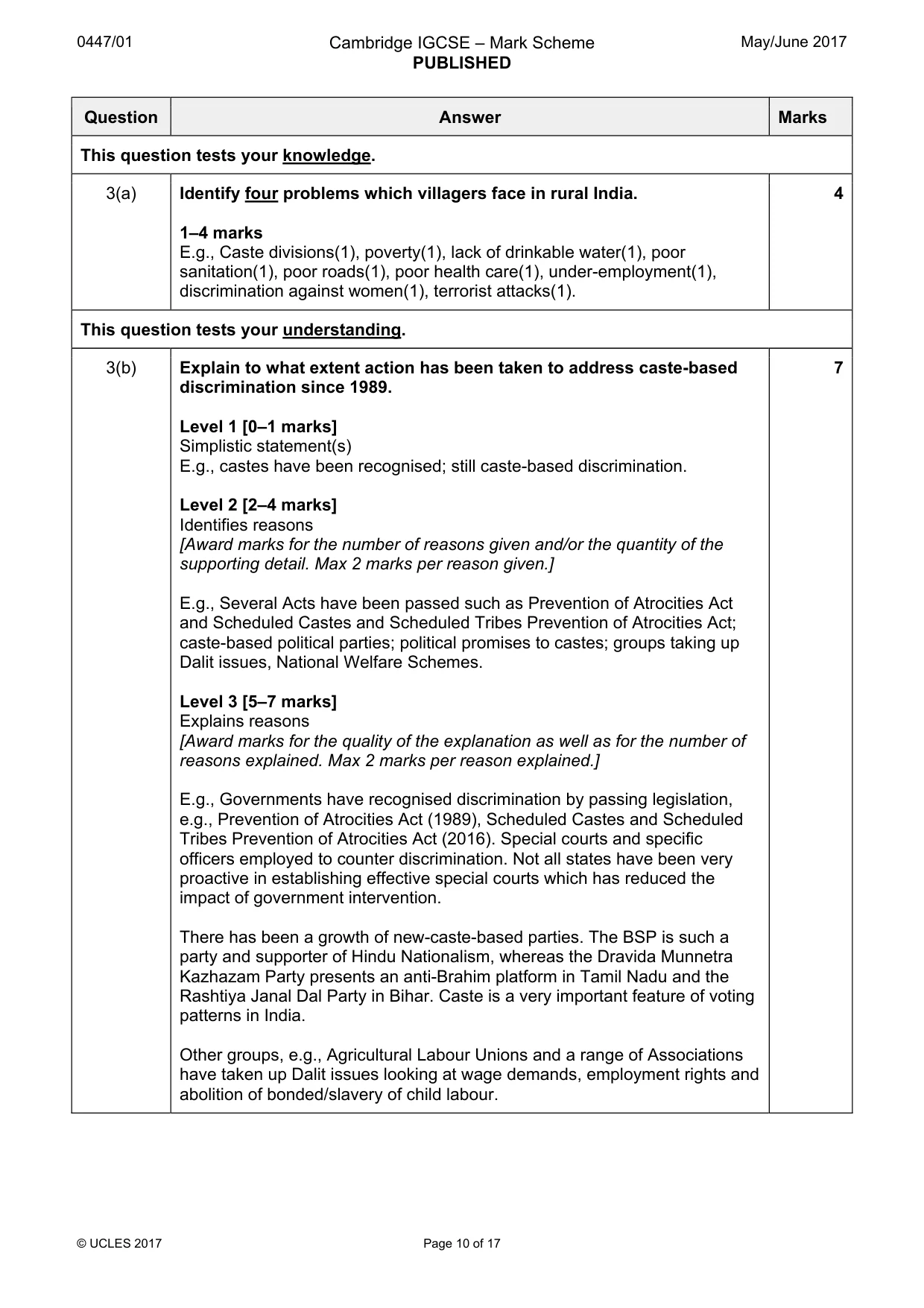
0447/01 Cambridge IGCSE – Mark Scheme PUBLISHED May/June 2017 © UCLES 2017 Page 10 of 17 Question Answer Marks This question tests your knowledge. 3(a) Identify four problems which villagers face in rural India. 1–4 marks E.g., Caste divisions(1), poverty(1), lack of drinkable water(1), poor sanitation(1), poor roads(1), poor health care(1), under-employment(1), discrimination against women(1), terrorist attacks(1). 4 This question tests your understanding. 3(b) Explain to what extent action has been taken to address caste-based discrimination since 1989. Level 1 [0–1 marks] Simplistic statement(s) E.g., castes have been recognised; still caste-based discrimination. Level 2 [2–4 marks] Identifies reasons [Award marks for the number of reasons given and/or the quantity of the supporting detail. Max 2 marks per reason given.] E.g., Several Acts have been passed such as Prevention of Atrocities Act and Scheduled Castes and Scheduled Tribes Prevention of Atrocities Act; caste-based political parties; political promises to castes; groups taking up Dalit issues, National Welfare Schemes. Level 3 [5–7 marks] Explains reasons [Award marks for the quality of the explanation as well as for the number of reasons explained. Max 2 marks per reason explained.] E.g., Governments have recognised discrimination by passing legislation, e.g., Prevention of Atrocities Act (1989), Scheduled Castes and Scheduled Tribes Prevention of Atrocities Act (2016). Special courts and specific officers employed to counter discrimination. Not all states have been very proactive in establishing effective special courts which has reduced the impact of government intervention. There has been a growth of new-caste-based parties. The BSP is such a party and supporter of Hindu Nationalism, whereas the Dravida Munnetra Kazhazam Party presents an anti-Brahim platform in Tamil Nadu and the Rashtiya Janal Dal Party in Bihar. Caste is a very important feature of voting patterns in India. Other groups, e.g., Agricultural Labour Unions and a range of Associations have taken up Dalit issues looking at wage demands, employment rights and abolition of bonded/slavery of child labour. 7
Mark scheme, page 11
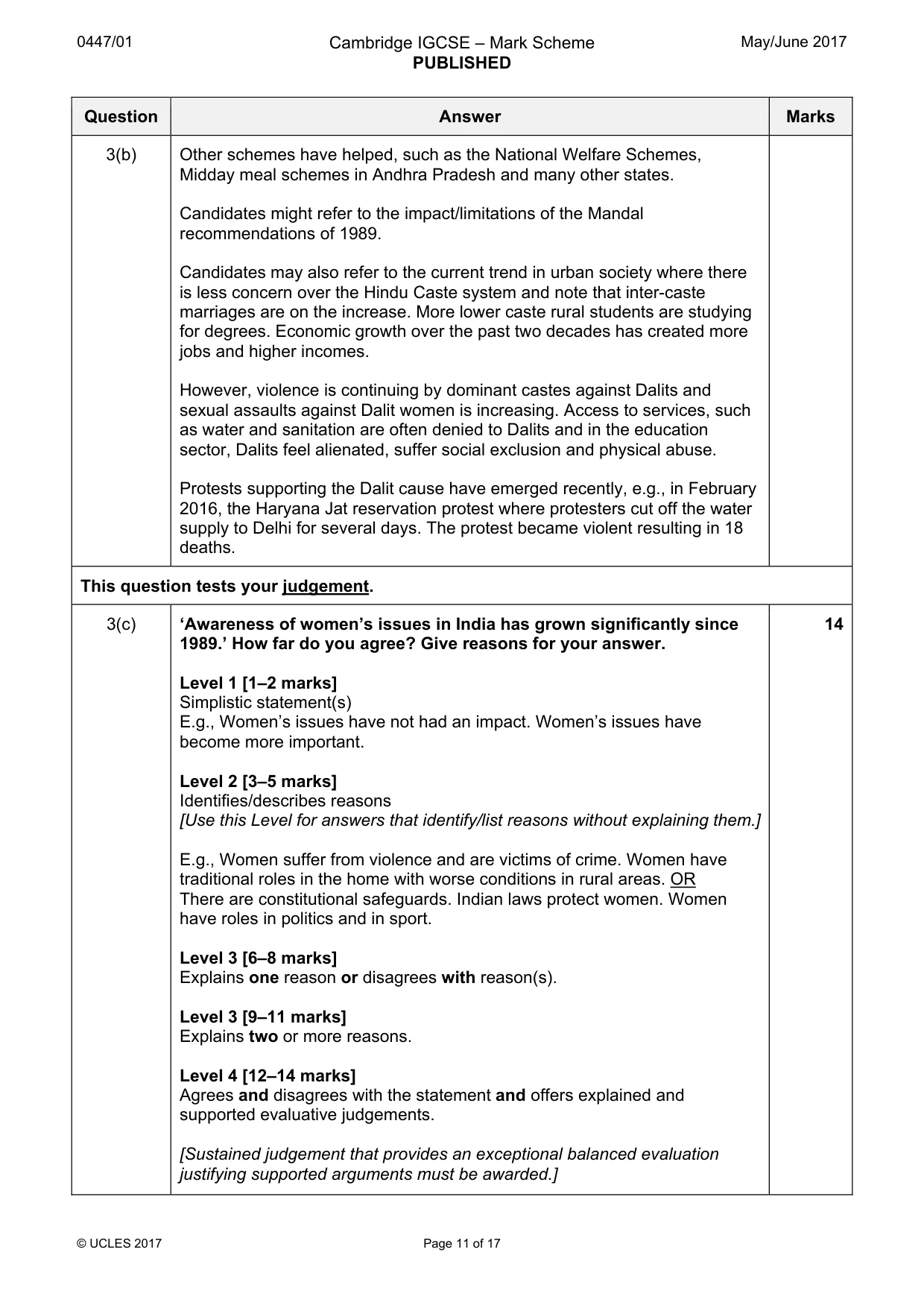
0447/01 Cambridge IGCSE – Mark Scheme PUBLISHED May/June 2017 © UCLES 2017 Page 11 of 17 Question Answer Marks 3(b) Other schemes have helped, such as the National Welfare Schemes, Midday meal schemes in Andhra Pradesh and many other states. Candidates might refer to the impact/limitations of the Mandal recommendations of 1989. Candidates may also refer to the current trend in urban society where there is less concern over the Hindu Caste system and note that inter-caste marriages are on the increase. More lower caste rural students are studying for degrees. Economic growth over the past two decades has created more jobs and higher incomes. However, violence is continuing by dominant castes against Dalits and sexual assaults against Dalit women is increasing. Access to services, such as water and sanitation are often denied to Dalits and in the education sector, Dalits feel alienated, suffer social exclusion and physical abuse. Protests supporting the Dalit cause have emerged recently, e.g., in February 2016, the Haryana Jat reservation protest where protesters cut off the water supply to Delhi for several days. The protest became violent resulting in 18 deaths. This question tests your judgement. 3(c) ‘Awareness of women’s issues in India has grown significantly since 1989.’ How far do you agree? Give reasons for your answer. Level 1 [1–2 marks] Simplistic statement(s) E.g., Women’s issues have not had an impact. Women’s issues have become more important. Level 2 [3–5 marks] Identifies/describes reasons [Use this Level for answers that identify/list reasons without explaining them.] E.g., Women suffer from violence and are victims of crime. Women have traditional roles in the home with worse conditions in rural areas. OR There are constitutional safeguards. Indian laws protect women. Women have roles in politics and in sport. Level 3 [6–8 marks] Explains one reason or disagrees with reason(s). Level 3 [9–11 marks] Explains two or more reasons. Level 4 [12–14 marks] Agrees and disagrees with the statement and offers explained and supported evaluative judgements. [Sustained judgement that provides an exceptional balanced evaluation justifying supported arguments must be awarded.] 14
Mark scheme, page 12
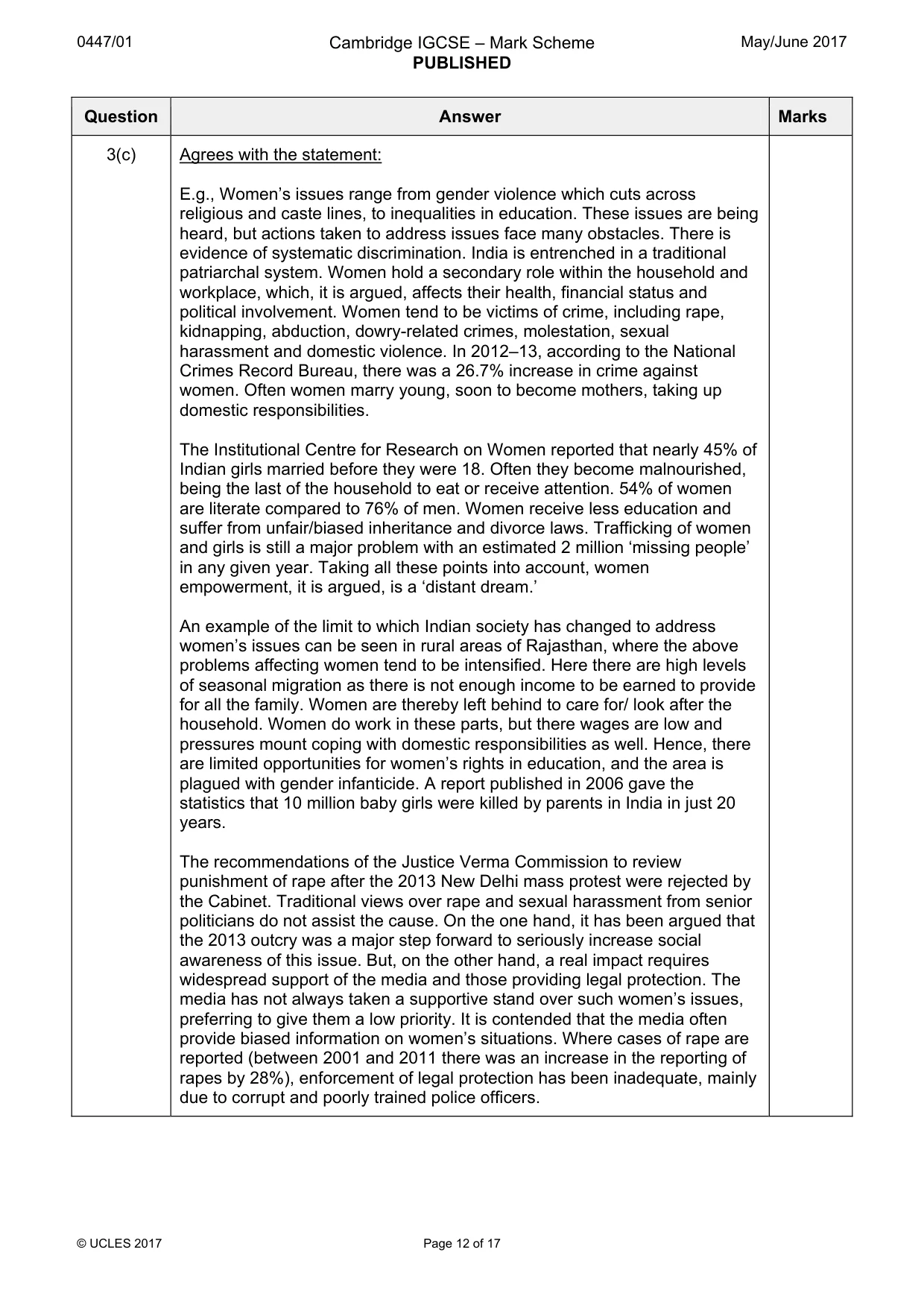
0447/01 Cambridge IGCSE – Mark Scheme PUBLISHED May/June 2017 © UCLES 2017 Page 12 of 17 Question Answer Marks 3(c) Agrees with the statement: E.g., Women’s issues range from gender violence which cuts across religious and caste lines, to inequalities in education. These issues are being heard, but actions taken to address issues face many obstacles. There is evidence of systematic discrimination. India is entrenched in a traditional patriarchal system. Women hold a secondary role within the household and workplace, which, it is argued, affects their health, financial status and political involvement. Women tend to be victims of crime, including rape, kidnapping, abduction, dowry-related crimes, molestation, sexual harassment and domestic violence. In 2012–13, according to the National Crimes Record Bureau, there was a 26.7% increase in crime against women. Often women marry young, soon to become mothers, taking up domestic responsibilities. The Institutional Centre for Research on Women reported that nearly 45% of Indian girls married before they were 18. Often they become malnourished, being the last of the household to eat or receive attention. 54% of women are literate compared to 76% of men. Women receive less education and suffer from unfair/biased inheritance and divorce laws. Trafficking of women and girls is still a major problem with an estimated 2 million ‘missing people’ in any given year. Taking all these points into account, women empowerment, it is argued, is a ‘distant dream.’ An example of the limit to which Indian society has changed to address women’s issues can be seen in rural areas of Rajasthan, where the above problems affecting women tend to be intensified. Here there are high levels of seasonal migration as there is not enough income to be earned to provide for all the family. Women are thereby left behind to care for/ look after the household. Women do work in these parts, but there wages are low and pressures mount coping with domestic responsibilities as well. Hence, there are limited opportunities for women’s rights in education, and the area is plagued with gender infanticide. A report published in 2006 gave the statistics that 10 million baby girls were killed by parents in India in just 20 years. The recommendations of the Justice Verma Commission to review punishment of rape after the 2013 New Delhi mass protest were rejected by the Cabinet. Traditional views over rape and sexual harassment from senior politicians do not assist the cause. On the one hand, it has been argued that the 2013 outcry was a major step forward to seriously increase social awareness of this issue. But, on the other hand, a real impact requires widespread support of the media and those providing legal protection. The media has not always taken a supportive stand over such women’s issues, preferring to give them a low priority. It is contended that the media often provide biased information on women’s situations. Where cases of rape are reported (between 2001 and 2011 there was an increase in the reporting of rapes by 28%), enforcement of legal protection has been inadequate, mainly due to corrupt and poorly trained police officers.
Mark scheme, page 13
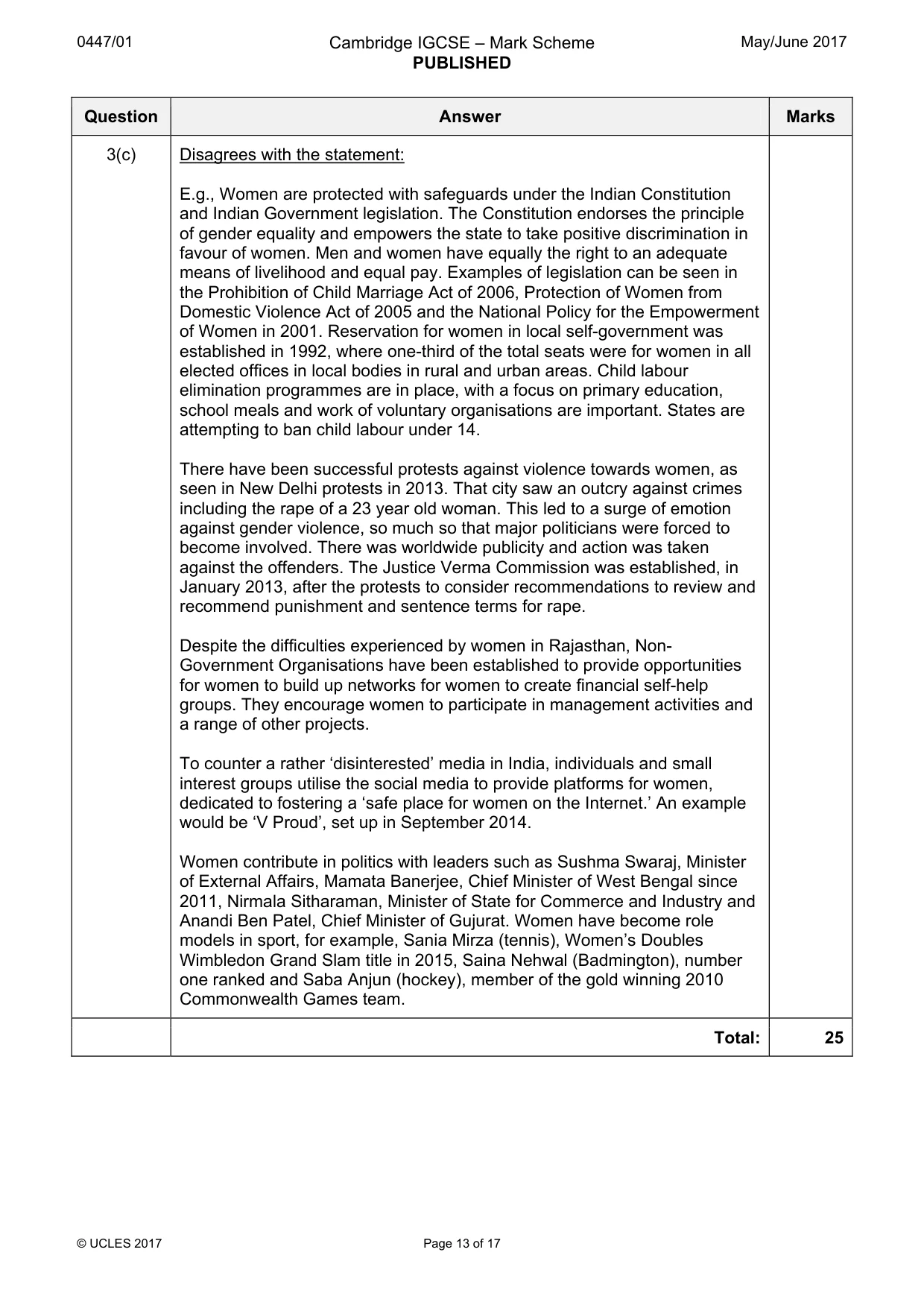
0447/01 Cambridge IGCSE – Mark Scheme PUBLISHED May/June 2017 © UCLES 2017 Page 13 of 17 Question Answer Marks 3(c) Disagrees with the statement: E.g., Women are protected with safeguards under the Indian Constitution and Indian Government legislation. The Constitution endorses the principle of gender equality and empowers the state to take positive discrimination in favour of women. Men and women have equally the right to an adequate means of livelihood and equal pay. Examples of legislation can be seen in the Prohibition of Child Marriage Act of 2006, Protection of Women from Domestic Violence Act of 2005 and the National Policy for the Empowerment of Women in 2001. Reservation for women in local self-government was established in 1992, where one-third of the total seats were for women in all elected offices in local bodies in rural and urban areas. Child labour elimination programmes are in place, with a focus on primary education, school meals and work of voluntary organisations are important. States are attempting to ban child labour under 14. There have been successful protests against violence towards women, as seen in New Delhi protests in 2013. That city saw an outcry against crimes including the rape of a 23 year old woman. This led to a surge of emotion against gender violence, so much so that major politicians were forced to become involved. There was worldwide publicity and action was taken against the offenders. The Justice Verma Commission was established, in January 2013, after the protests to consider recommendations to review and recommend punishment and sentence terms for rape. Despite the difficulties experienced by women in Rajasthan, Non- Government Organisations have been established to provide opportunities for women to build up networks for women to create financial self-help groups. They encourage women to participate in management activities and a range of other projects. To counter a rather ‘disinterested’ media in India, individuals and small interest groups utilise the social media to provide platforms for women, dedicated to fostering a ‘safe place for women on the Internet.’ An example would be ‘V Proud’, set up in September 2014. Women contribute in politics with leaders such as Sushma Swaraj, Minister of External Affairs, Mamata Banerjee, Chief Minister of West Bengal since 2011, Nirmala Sitharaman, Minister of State for Commerce and Industry and Anandi Ben Patel, Chief Minister of Gujurat. Women have become role models in sport, for example, Sania Mirza (tennis), Women’s Doubles Wimbledon Grand Slam title in 2015, Saina Nehwal (Badmington), number one ranked and Saba Anjun (hockey), member of the gold winning 2010 Commonwealth Games team. Total: 25
Mark scheme, page 14
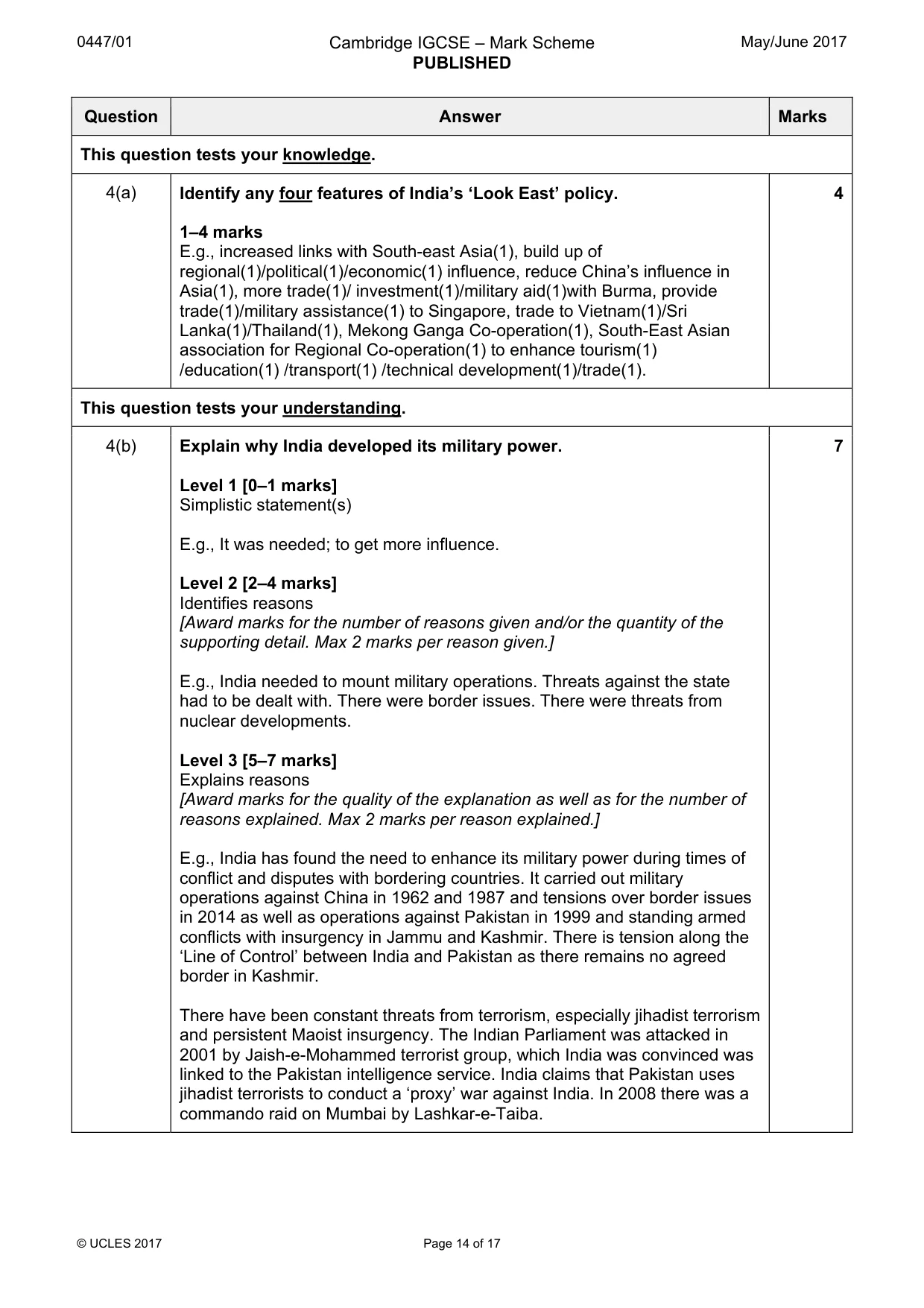
0447/01 Cambridge IGCSE – Mark Scheme PUBLISHED May/June 2017 © UCLES 2017 Page 14 of 17 Question Answer Marks This question tests your knowledge. 4(a) Identify any four features of India’s ‘Look East’ policy. 1–4 marks E.g., increased links with South-east Asia(1), build up of regional(1)/political(1)/economic(1) influence, reduce China’s influence in Asia(1), more trade(1)/ investment(1)/military aid(1)with Burma, provide trade(1)/military assistance(1) to Singapore, trade to Vietnam(1)/Sri Lanka(1)/Thailand(1), Mekong Ganga Co-operation(1), South-East Asian association for Regional Co-operation(1) to enhance tourism(1) /education(1) /transport(1) /technical development(1)/trade(1). 4 This question tests your understanding. 4(b) Explain why India developed its military power. Level 1 [0–1 marks] Simplistic statement(s) E.g., It was needed; to get more influence. Level 2 [2–4 marks] Identifies reasons [Award marks for the number of reasons given and/or the quantity of the supporting detail. Max 2 marks per reason given.] E.g., India needed to mount military operations. Threats against the state had to be dealt with. There were border issues. There were threats from nuclear developments. Level 3 [5–7 marks] Explains reasons [Award marks for the quality of the explanation as well as for the number of reasons explained. Max 2 marks per reason explained.] E.g., India has found the need to enhance its military power during times of conflict and disputes with bordering countries. It carried out military operations against China in 1962 and 1987 and tensions over border issues in 2014 as well as operations against Pakistan in 1999 and standing armed conflicts with insurgency in Jammu and Kashmir. There is tension along the ‘Line of Control’ between India and Pakistan as there remains no agreed border in Kashmir. There have been constant threats from terrorism, especially jihadist terrorism and persistent Maoist insurgency. The Indian Parliament was attacked in 2001 by Jaish-e-Mohammed terrorist group, which India was convinced was linked to the Pakistan intelligence service. India claims that Pakistan uses jihadist terrorists to conduct a ‘proxy’ war against India. In 2008 there was a commando raid on Mumbai by Lashkar-e-Taiba. 7
Mark scheme, page 15
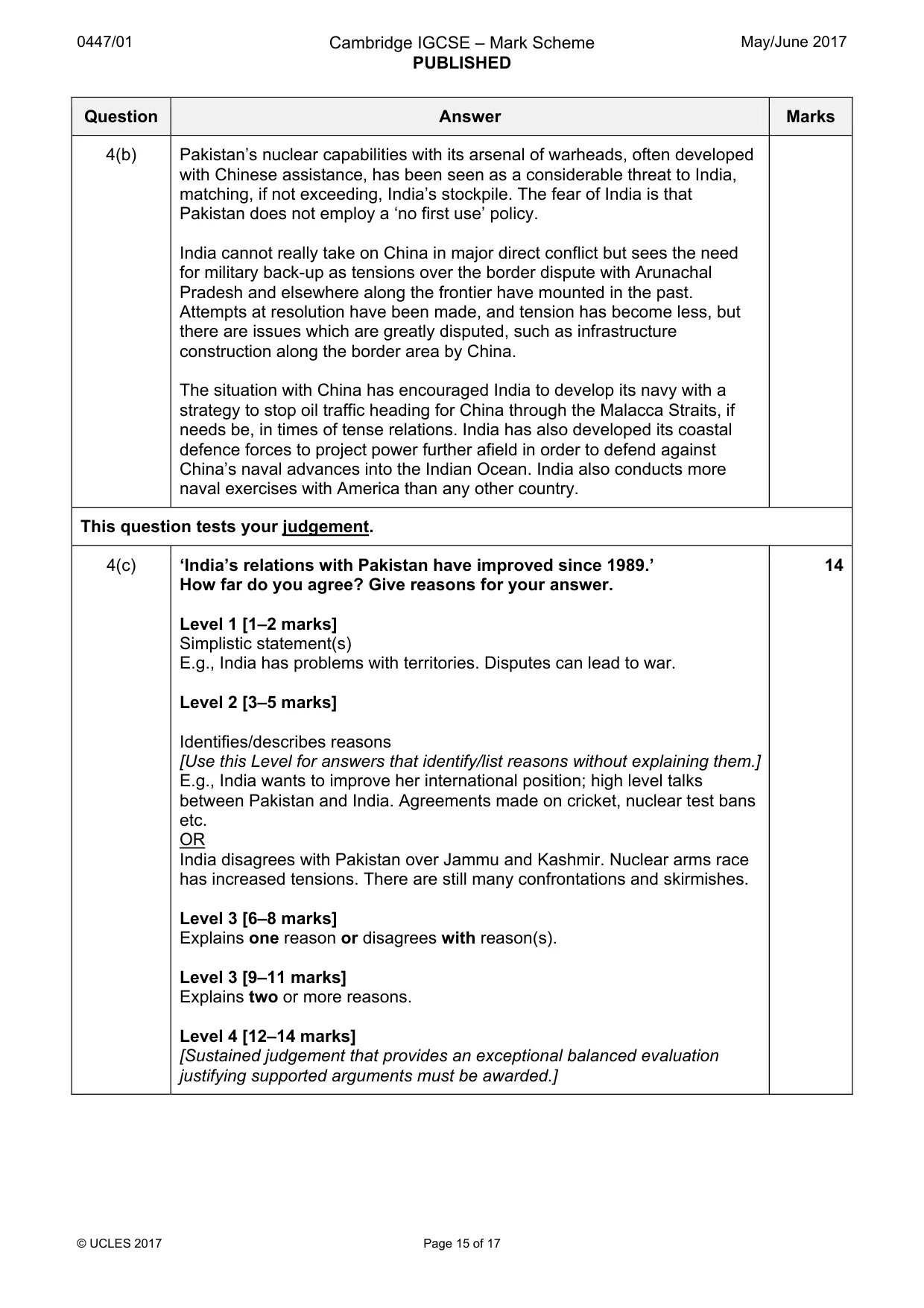
0447/01 Cambridge IGCSE – Mark Scheme PUBLISHED May/June 2017 © UCLES 2017 Page 15 of 17 Question Answer Marks 4(b) Pakistan’s nuclear capabilities with its arsenal of warheads, often developed with Chinese assistance, has been seen as a considerable threat to India, matching, if not exceeding, India’s stockpile. The fear of India is that Pakistan does not employ a ‘no first use’ policy. India cannot really take on China in major direct conflict but sees the need for military back-up as tensions over the border dispute with Arunachal Pradesh and elsewhere along the frontier have mounted in the past. Attempts at resolution have been made, and tension has become less, but there are issues which are greatly disputed, such as infrastructure construction along the border area by China. The situation with China has encouraged India to develop its navy with a strategy to stop oil traffic heading for China through the Malacca Straits, if needs be, in times of tense relations. India has also developed its coastal defence forces to project power further afield in order to defend against China’s naval advances into the Indian Ocean. India also conducts more naval exercises with America than any other country. This question tests your judgement. 4(c) ‘India’s relations with Pakistan have improved since 1989.’ How far do you agree? Give reasons for your answer. Level 1 [1–2 marks] Simplistic statement(s) E.g., India has problems with territories. Disputes can lead to war. Level 2 [3–5 marks] Identifies/describes reasons [Use this Level for answers that identify/list reasons without explaining them.] E.g., India wants to improve her international position; high level talks between Pakistan and India. Agreements made on cricket, nuclear test bans etc. OR India disagrees with Pakistan over Jammu and Kashmir. Nuclear arms race has increased tensions. There are still many confrontations and skirmishes. Level 3 [6–8 marks] Explains one reason or disagrees with reason(s). Level 3 [9–11 marks] Explains two or more reasons. Level 4 [12–14 marks] [Sustained judgement that provides an exceptional balanced evaluation justifying supported arguments must be awarded.] 14
Mark scheme, page 16
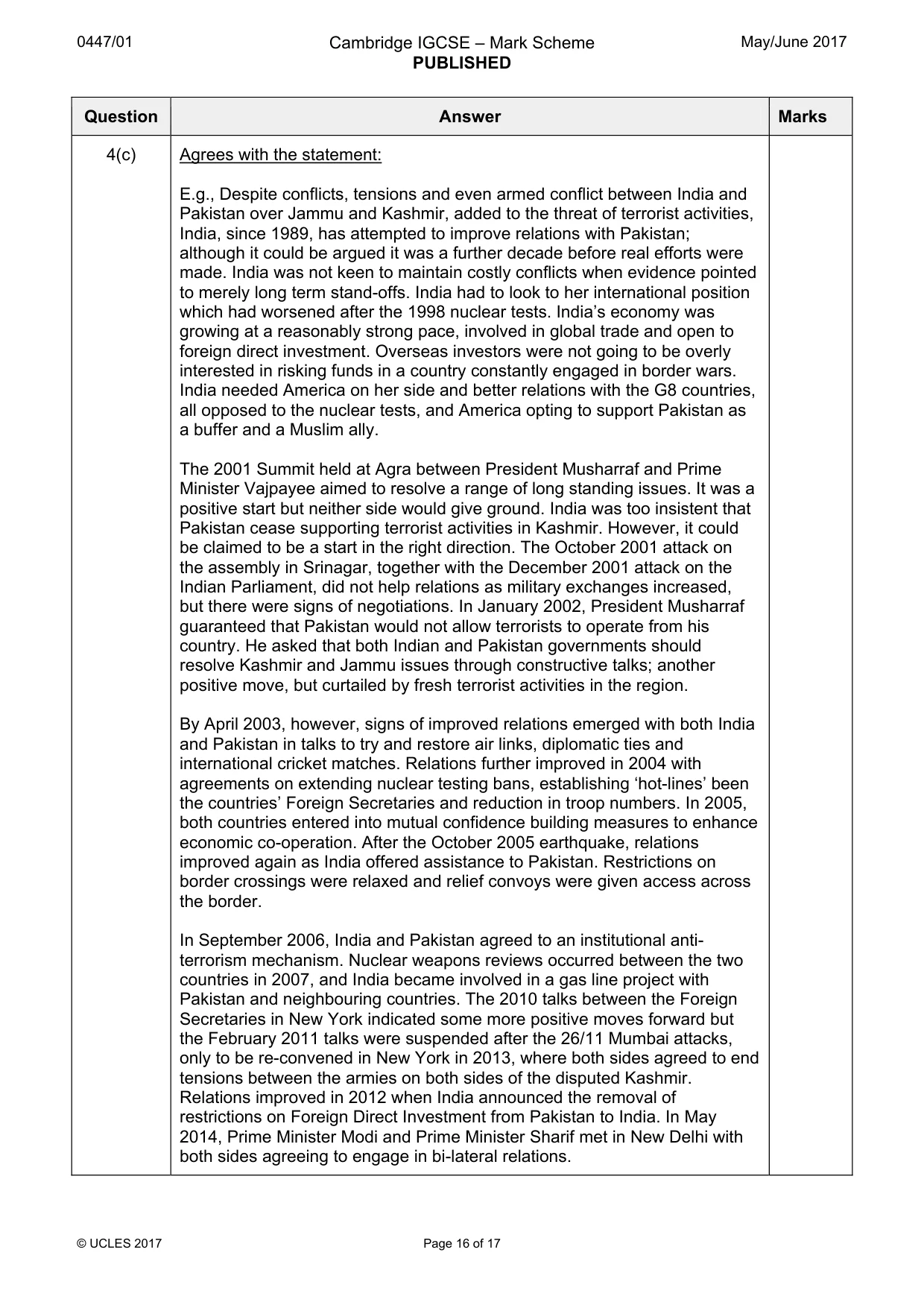
0447/01 Cambridge IGCSE – Mark Scheme PUBLISHED May/June 2017 © UCLES 2017 Page 16 of 17 Question Answer Marks 4(c) Agrees with the statement: E.g., Despite conflicts, tensions and even armed conflict between India and Pakistan over Jammu and Kashmir, added to the threat of terrorist activities, India, since 1989, has attempted to improve relations with Pakistan; although it could be argued it was a further decade before real efforts were made. India was not keen to maintain costly conflicts when evidence pointed to merely long term stand-offs. India had to look to her international position which had worsened after the 1998 nuclear tests. India’s economy was growing at a reasonably strong pace, involved in global trade and open to foreign direct investment. Overseas investors were not going to be overly interested in risking funds in a country constantly engaged in border wars. India needed America on her side and better relations with the G8 countries, all opposed to the nuclear tests, and America opting to support Pakistan as a buffer and a Muslim ally. The 2001 Summit held at Agra between President Musharraf and Prime Minister Vajpayee aimed to resolve a range of long standing issues. It was a positive start but neither side would give ground. India was too insistent that Pakistan cease supporting terrorist activities in Kashmir. However, it could be claimed to be a start in the right direction. The October 2001 attack on the assembly in Srinagar, together with the December 2001 attack on the Indian Parliament, did not help relations as military exchanges increased, but there were signs of negotiations. In January 2002, President Musharraf guaranteed that Pakistan would not allow terrorists to operate from his country. He asked that both Indian and Pakistan governments should resolve Kashmir and Jammu issues through constructive talks; another positive move, but curtailed by fresh terrorist activities in the region. By April 2003, however, signs of improved relations emerged with both India and Pakistan in talks to try and restore air links, diplomatic ties and international cricket matches. Relations further improved in 2004 with agreements on extending nuclear testing bans, establishing ‘hot-lines’ been the countries’ Foreign Secretaries and reduction in troop numbers. In 2005, both countries entered into mutual confidence building measures to enhance economic co-operation. After the October 2005 earthquake, relations improved again as India offered assistance to Pakistan. Restrictions on border crossings were relaxed and relief convoys were given access across the border. In September 2006, India and Pakistan agreed to an institutional anti- terrorism mechanism. Nuclear weapons reviews occurred between the two countries in 2007, and India became involved in a gas line project with Pakistan and neighbouring countries. The 2010 talks between the Foreign Secretaries in New York indicated some more positive moves forward but the February 2011 talks were suspended after the 26/11 Mumbai attacks, only to be re-convened in New York in 2013, where both sides agreed to end tensions between the armies on both sides of the disputed Kashmir. Relations improved in 2012 when India announced the removal of restrictions on Foreign Direct Investment from Pakistan to India. In May 2014, Prime Minister Modi and Prime Minister Sharif met in New Delhi with both sides agreeing to engage in bi-lateral relations.
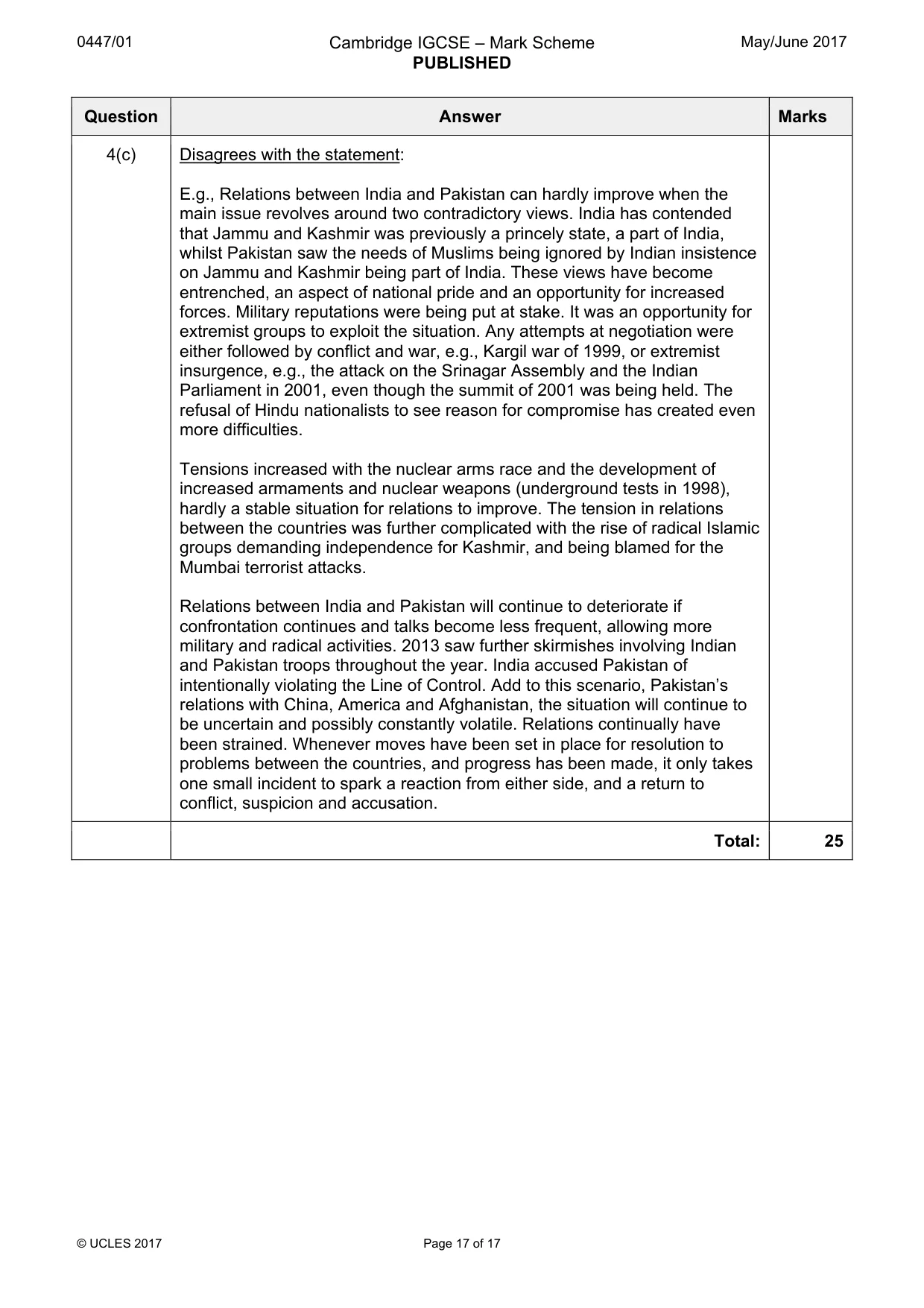
Mark scheme, page 17
0447/01 Cambridge IGCSE – Mark Scheme PUBLISHED May/June 2017 © UCLES 2017 Page 17 of 17 Question Answer Marks 4(c) Disagrees with the statement: E.g., Relations between India and Pakistan can hardly improve when the main issue revolves around two contradictory views. India has contended that Jammu and Kashmir was previously a princely state, a part of India, whilst Pakistan saw the needs of Muslims being ignored by Indian insistence on Jammu and Kashmir being part of India. These views have become entrenched, an aspect of national pride and an opportunity for increased forces. Military reputations were being put at stake. It was an opportunity for extremist groups to exploit the situation. Any attempts at negotiation were either followed by conflict and war, e.g., Kargil war of 1999, or extremist insurgence, e.g., the attack on the Srinagar Assembly and the Indian Parliament in 2001, even though the summit of 2001 was being held. The refusal of Hindu nationalists to see reason for compromise has created even more difficulties. Tensions increased with the nuclear arms race and the development of increased armaments and nuclear weapons (underground tests in 1998), hardly a stable situation for relations to improve. The tension in relations between the countries was further complicated with the rise of radical Islamic groups demanding independence for Kashmir, and being blamed for the Mumbai terrorist attacks. Relations between India and Pakistan will continue to deteriorate if confrontation continues and talks become less frequent, allowing more military and radical activities. 2013 saw further skirmishes involving Indian and Pakistan troops throughout the year. India accused Pakistan of intentionally violating the Line of Control. Add to this scenario, Pakistan’s relations with China, America and Afghanistan, the situation will continue to be uncertain and possibly constantly volatile. Relations continually have been strained. Whenever moves have been set in place for resolution to problems between the countries, and progress has been made, it only takes one small incident to spark a reaction from either side, and a return to conflict, suspicion and accusation. Total: 25
What you needed in this session
Cambridge’s own grade thresholds for 2017 May/June, Paper 1 · Variant 1. A higher threshold means an easier paper — the bar moves with how the cohort did.