Cambridge IGCSE India Studies 0447 — 2015 May/June Paper 1 · Variant 1
0447/11/M/J/15 · 75 marks · ≈84 min
The question paper and its mark scheme, free to read here and free to download. This is Cambridge’s own paper, exactly as it was sat.
Question paper12 pages



Mark scheme11 pages
Answers below. Sit the paper first if you are practising.
Paper as text
Question paper, page 1
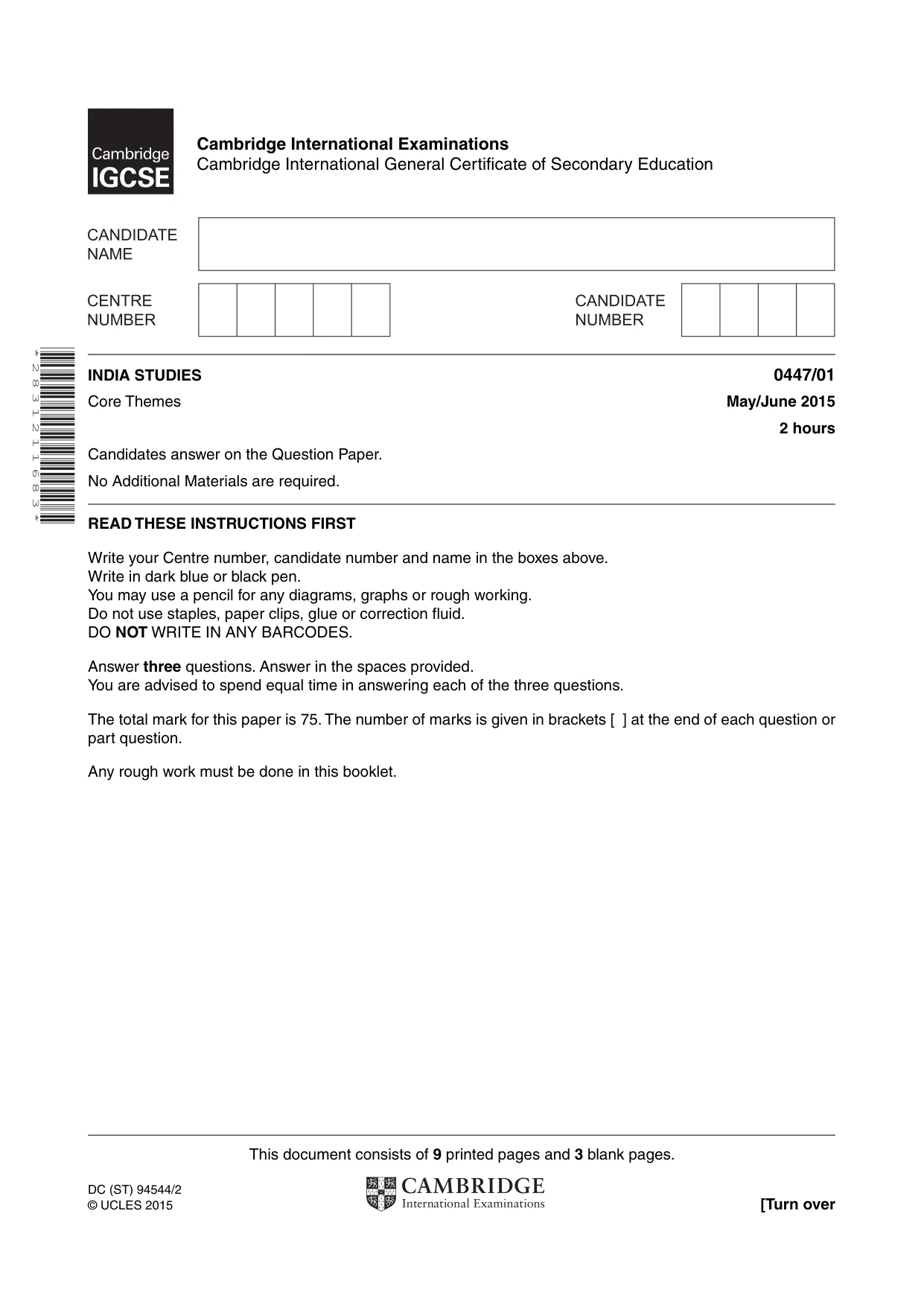
This document consists of 9 printed pages and 3 blank pages. DC (ST) 94544/2 © UCLES 2015 [Turn over Cambridge International Examinations Cambridge International General Certificate of Secondary Education * 2 8 3 1 2 1 1 6 8 3 * INDIA STUDIES 0447/01 Core Themes May/June 2015 2 hours Candidates answer on the Question Paper. No Additional Materials are required. READ THESE INSTRUCTIONS FIRST Write your Centre number, candidate number and name in the boxes above. Write in dark blue or black pen. You may use a pencil for any diagrams, graphs or rough working. Do not use staples, paper clips, glue or correction fluid. DO NOT WRITE IN ANY BARCODES. Answer three questions. Answer in the spaces provided. You are advised to spend equal time in answering each of the three questions. The total mark for this paper is 75. The number of marks is given in brackets [ ] at the end of each question or part question. Any rough work must be done in this booklet.
Question paper, page 2
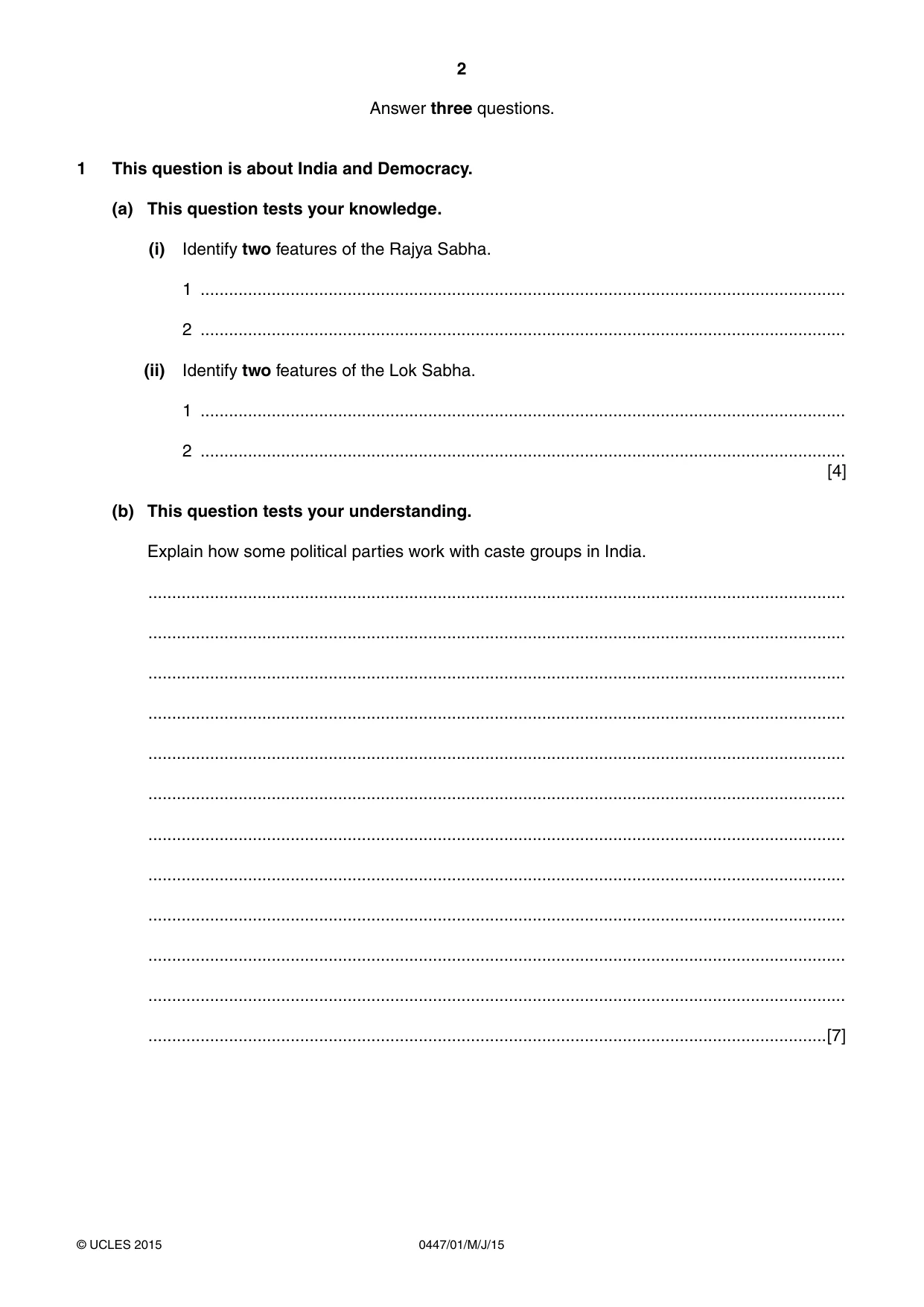
2 0447/01/M/J/15 © UCLES 2015 Answer three questions. 1 This question is about India and Democracy. (a) This question tests your knowledge. (i) Identify two features of the Rajya Sabha. 1 … 2 … (ii) Identify two features of the Lok Sabha. 1 … 2 … [4] (b) This question tests your understanding. Explain how some political parties work with caste groups in India. … … … … … … … … … … … …[7]
Question paper, page 3
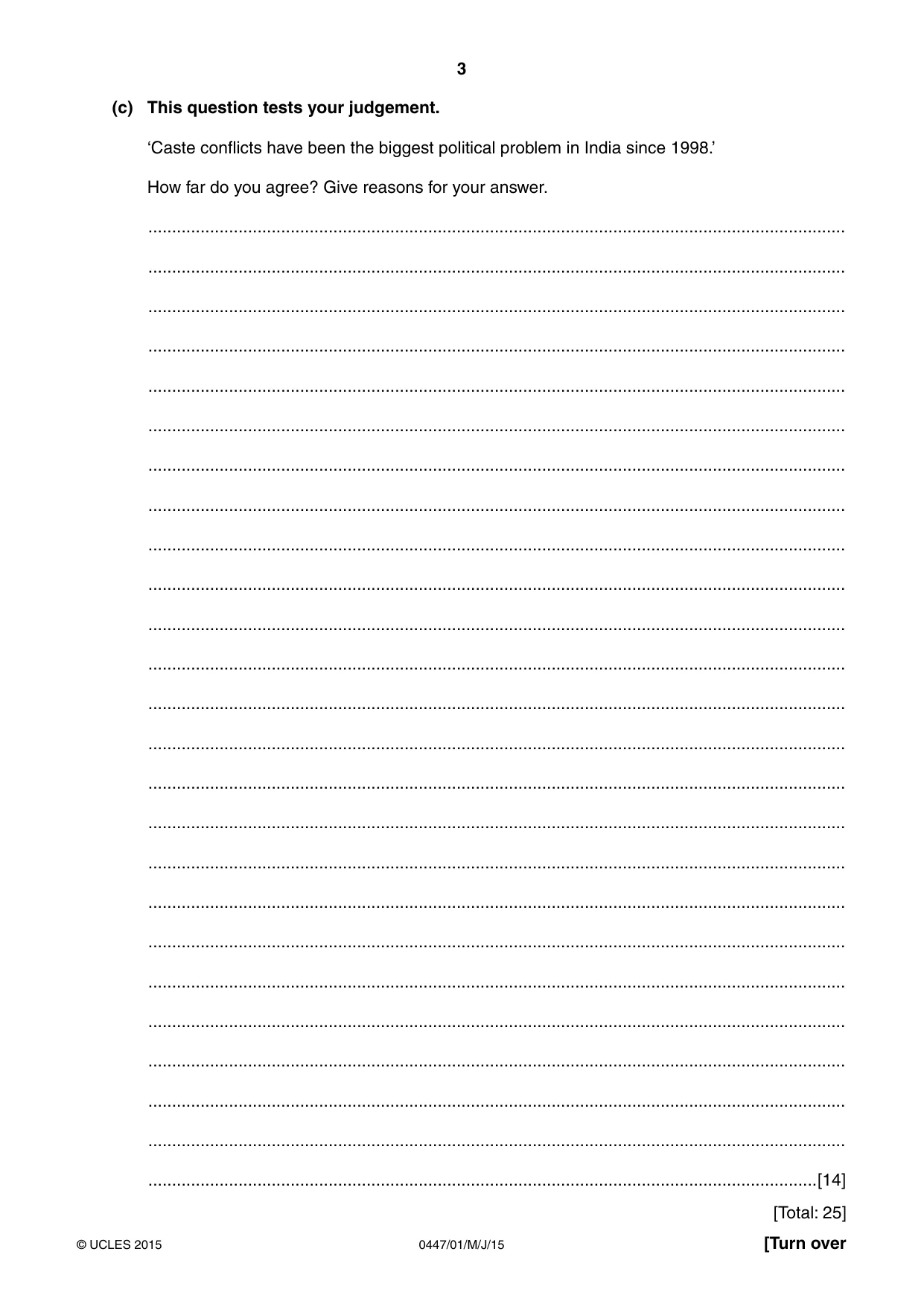
3 0447/01/M/J/15 © UCLES 2015 [Turn over (c) This question tests your judgement. ‘Caste conflicts have been the biggest political problem in India since 1998.’ How far do you agree? Give reasons for your answer. … … … … … … … … … … … … … … … … … … … … … … … … …[14] [Total: 25]
Question paper, page 4
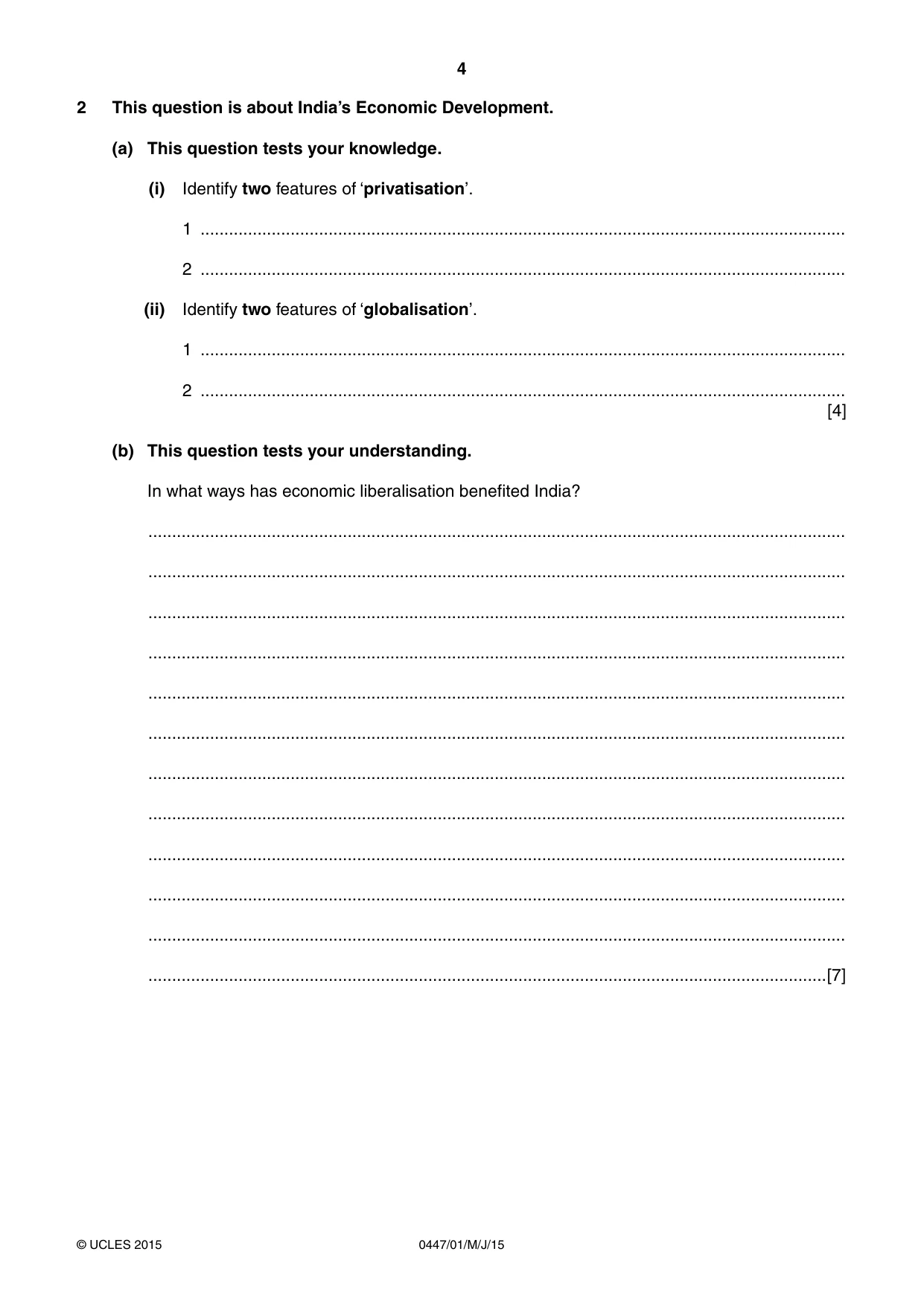
4 0447/01/M/J/15 © UCLES 2015 2 This question is about India’s Economic Development. (a) This question tests your knowledge. (i) Identify two features of ‘privatisation’. 1 … 2 … (ii) Identify two features of ‘globalisation’. 1 … 2 … [4] (b) This question tests your understanding. In what ways has economic liberalisation benefited India? … … … … … … … … … … … …[7]
Question paper, page 5
5 0447/01/M/J/15 © UCLES 2015 [Turn over (c) This question tests your judgement. ‘The growth of the telecommunications sector is the main reason for the development of the Indian economy.’ How far do you agree? Give reasons for your answer. … … … … … … … … … … … … … … … … … … … … … … … … …[14] [Total: 25]
Question paper, page 6
6 0447/01/M/J/15 © UCLES 2015 3 This question is about Social and Cultural Developments within Indian Society. (a) This question tests your knowledge. ‘Ayodhya was the location of the sixteenth century Babri Mosque. Some Hindus claimed that the same land was the site of the birth of Lord Rama. This led to a major dispute in 1992.’ Identify four features of this dispute. 1 … 2 … 3 … 4 … [4] (b) This question tests your understanding. Explain how the position of women in India has improved since 2004. … … … … … … … … … … … …[7]
Question paper, page 7
7 0447/01/M/J/15 © UCLES 2015 [Turn over (c) This question tests your judgement. How far have the people of India benefited from affirmative action? … … … … … … … … … … … … … … … … … … … … … … … … …[14] [Total: 25]
Question paper, page 8
8 0447/01/M/J/15 © UCLES 2015 4 This question is about India and the world. (a) This question tests your knowledge. Identify four key features of the relationship between the United States of America and India since 2001. 1 … 2 … 3 … 4 … [4] (b) This question tests your understanding. Explain why India developed a ‘Look East’ policy after 1991. … … … … … … … … … … … …[7]
Question paper, page 9
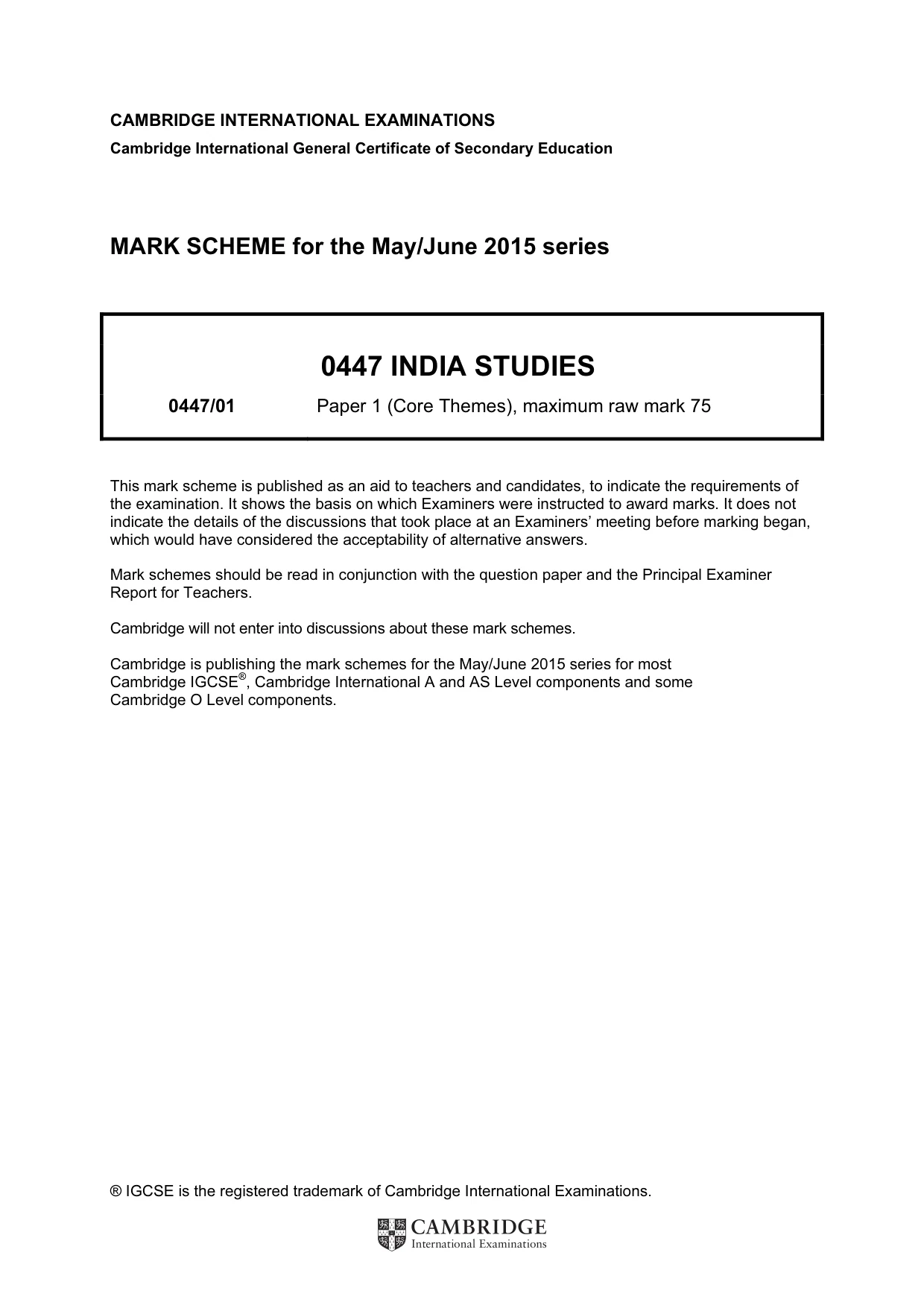
9 0447/01/M/J/15 © UCLES 2015 (c) This question tests your judgement. ‘The problem of territorial disputes has been the most serious challenge for India’s foreign policy since 1989.’ How far do you agree? Give reasons for your answer. … … … … … … … … … … … … … … … … … … … … … … … … …[14] [Total: 25]
Question paper, page 10
10 0447/01/M/J/15 © UCLES 2015 BLANK PAGE
Question paper, page 11
11 0447/01/M/J/15 © UCLES 2015 BLANK PAGE
Question paper, page 12
12 0447/01/M/J/15 © UCLES 2015 Permission to reproduce items where third-party owned material protected by copyright is included has been sought and cleared where possible. Every reasonable effort has been made by the publisher (UCLES) to trace copyright holders, but if any items requiring clearance have unwittingly been included, the publisher will be pleased to make amends at the earliest possible opportunity. To avoid the issue of disclosure of answer-related information to candidates, all copyright acknowledgements are reproduced online in the Cambridge International Examinations Copyright Acknowledgements Booklet. This is produced for each series of examinations and is freely available to download at www.cie.org.uk after the live examination series. Cambridge International Examinations is part of the Cambridge Assessment Group. Cambridge Assessment is the brand name of University of Cambridge Local Examinations Syndicate (UCLES), which is itself a department of the University of Cambridge. BLANK PAGE
Mark scheme, page 1
® IGCSE is the registered trademark of Cambridge International Examinations. CAMBRIDGE INTERNATIONAL EXAMINATIONS Cambridge International General Certificate of Secondary Education MARK SCHEME for the May/June 2015 series 0447 INDIA STUDIES 0447/01 Paper 1 (Core Themes), maximum raw mark 75 This mark scheme is published as an aid to teachers and candidates, to indicate the requirements of the examination. It shows the basis on which Examiners were instructed to award marks. It does not indicate the details of the discussions that took place at an Examiners’ meeting before marking began, which would have considered the acceptability of alternative answers. Mark schemes should be read in conjunction with the question paper and the Principal Examiner Report for Teachers. Cambridge will not enter into discussions about these mark schemes. Cambridge is publishing the mark schemes for the May/June 2015 series for most Cambridge IGCSE®, Cambridge International A and AS Level components and some Cambridge O Level components.
Mark scheme, page 2
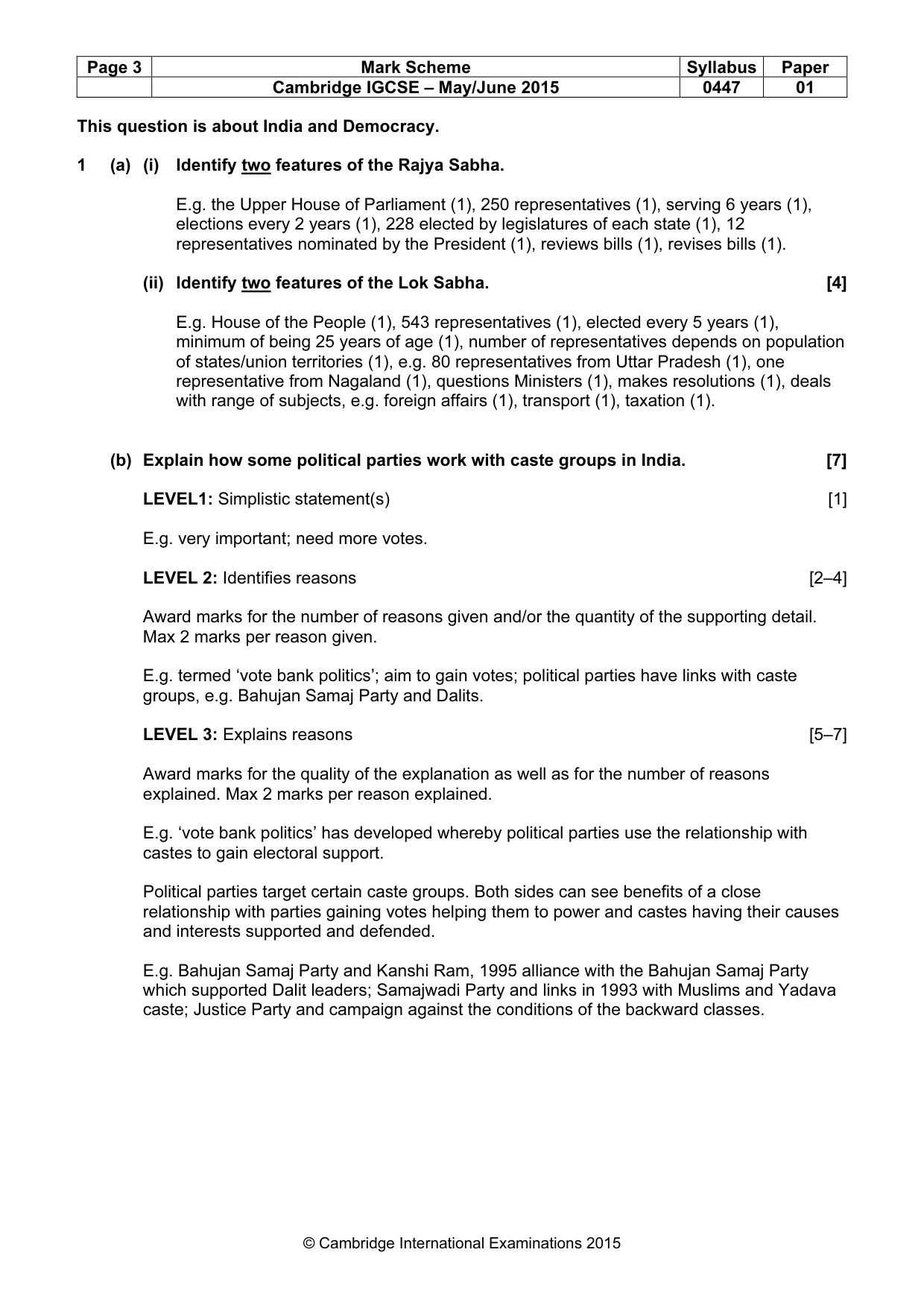
Page 2 Mark Scheme Syllabus Paper Cambridge IGCSE – May/June 2015 0447 01 © Cambridge International Examinations 2015 Notes • The full mark range will be used as a matter of course. Marking must be positive. Marks must not be deducted for inaccurate or irrelevant material. Half-marks will not be used. • Levels of response criteria are used for questions where a hierarchy of answers is possible [part (b) and (c) questions]. Each answer is to be placed in the level that best reflects its qualities. It is not necessary to work through the levels. • In levels with three marks, provisionally award the middle mark and then moderate according to the qualities of the individual answer. • In levels with two marks, provisionally award the higher mark and then moderate according to the qualities of the individual answer. • Arguments need to be supported with evidence, but lots of facts/dates are not required. • No set answer is looked for to any question. The examples given in the mark scheme are indicative only and are not intended to be exhaustive or prescriptive. They are given only as examples of some responses/approaches that may be seen by an Examiner.
Mark scheme, page 3
Page 3 Mark Scheme Syllabus Paper Cambridge IGCSE – May/June 2015 0447 01 © Cambridge International Examinations 2015 This question is about India and Democracy. 1 (a) (i) Identify two features of the Rajya Sabha. E.g. the Upper House of Parliament (1), 250 representatives (1), serving 6 years (1), elections every 2 years (1), 228 elected by legislatures of each state (1), 12 representatives nominated by the President (1), reviews bills (1), revises bills (1). (ii) Identify two features of the Lok Sabha. [4] E.g. House of the People (1), 543 representatives (1), elected every 5 years (1), minimum of being 25 years of age (1), number of representatives depends on population of states/union territories (1), e.g. 80 representatives from Uttar Pradesh (1), one representative from Nagaland (1), questions Ministers (1), makes resolutions (1), deals with range of subjects, e.g. foreign affairs (1), transport (1), taxation (1). (b) Explain how some political parties work with caste groups in India. [7] LEVEL1: Simplistic statement(s) [1] E.g. very important; need more votes. LEVEL 2: Identifies reasons [2–4] Award marks for the number of reasons given and/or the quantity of the supporting detail. Max 2 marks per reason given. E.g. termed ‘vote bank politics’; aim to gain votes; political parties have links with caste groups, e.g. Bahujan Samaj Party and Dalits. LEVEL 3: Explains reasons [5–7] Award marks for the quality of the explanation as well as for the number of reasons explained. Max 2 marks per reason explained. E.g. ‘vote bank politics’ has developed whereby political parties use the relationship with castes to gain electoral support. Political parties target certain caste groups. Both sides can see benefits of a close relationship with parties gaining votes helping them to power and castes having their causes and interests supported and defended. E.g. Bahujan Samaj Party and Kanshi Ram, 1995 alliance with the Bahujan Samaj Party which supported Dalit leaders; Samajwadi Party and links in 1993 with Muslims and Yadava caste; Justice Party and campaign against the conditions of the backward classes.
Mark scheme, page 4
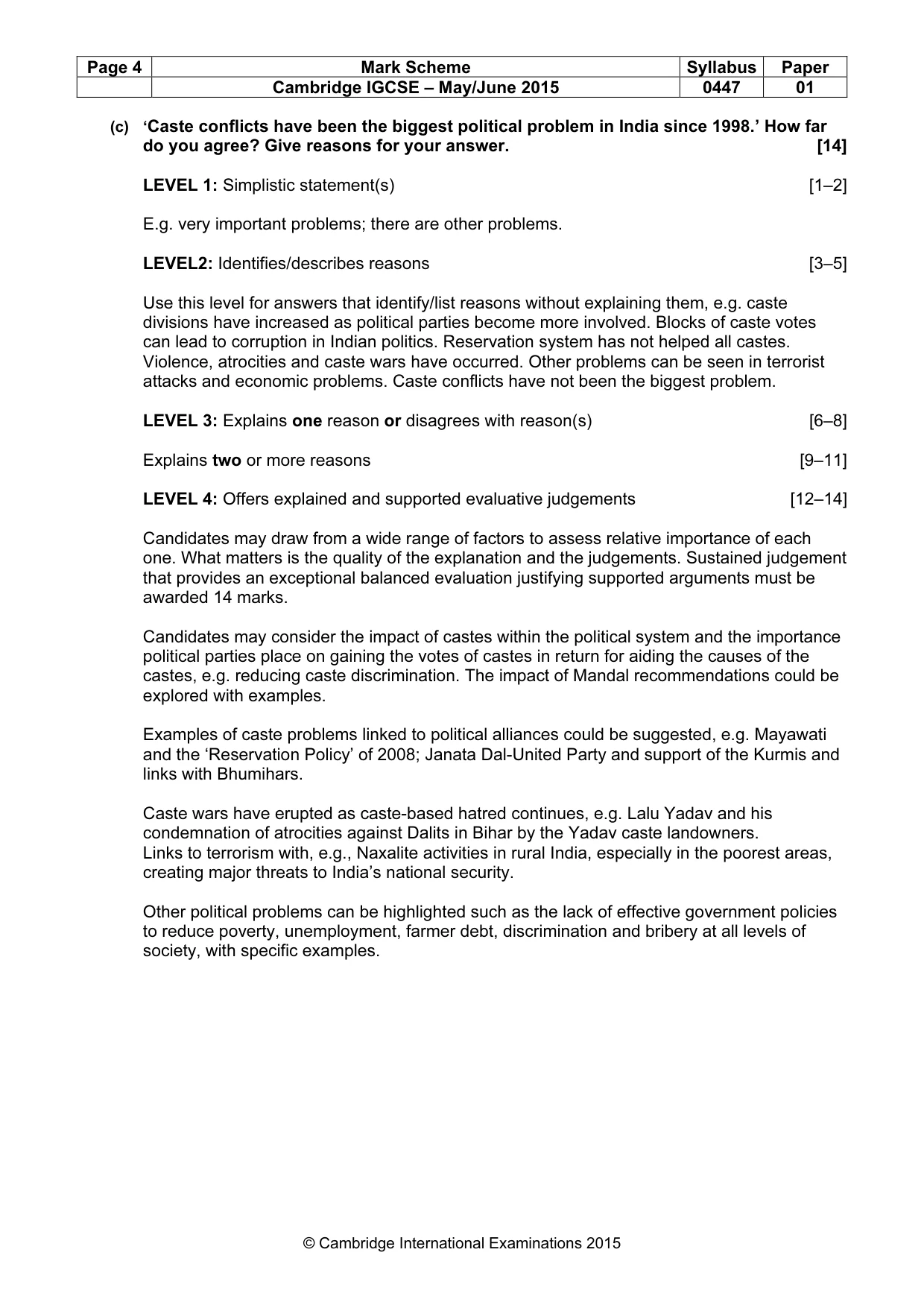
Page 4 Mark Scheme Syllabus Paper Cambridge IGCSE – May/June 2015 0447 01 © Cambridge International Examinations 2015 (c) ‘Caste conflicts have been the biggest political problem in India since 1998.’ How far do you agree? Give reasons for your answer. [14] LEVEL 1: Simplistic statement(s) [1–2] E.g. very important problems; there are other problems. LEVEL2: Identifies/describes reasons [3–5] Use this level for answers that identify/list reasons without explaining them, e.g. caste divisions have increased as political parties become more involved. Blocks of caste votes can lead to corruption in Indian politics. Reservation system has not helped all castes. Violence, atrocities and caste wars have occurred. Other problems can be seen in terrorist attacks and economic problems. Caste conflicts have not been the biggest problem. LEVEL 3: Explains one reason or disagrees with reason(s) [6–8] Explains two or more reasons [9–11] LEVEL 4: Offers explained and supported evaluative judgements [12–14] Candidates may draw from a wide range of factors to assess relative importance of each one. What matters is the quality of the explanation and the judgements. Sustained judgement that provides an exceptional balanced evaluation justifying supported arguments must be awarded 14 marks. Candidates may consider the impact of castes within the political system and the importance political parties place on gaining the votes of castes in return for aiding the causes of the castes, e.g. reducing caste discrimination. The impact of Mandal recommendations could be explored with examples. Examples of caste problems linked to political alliances could be suggested, e.g. Mayawati and the ‘Reservation Policy’ of 2008; Janata Dal-United Party and support of the Kurmis and links with Bhumihars. Caste wars have erupted as caste-based hatred continues, e.g. Lalu Yadav and his condemnation of atrocities against Dalits in Bihar by the Yadav caste landowners. Links to terrorism with, e.g., Naxalite activities in rural India, especially in the poorest areas, creating major threats to India’s national security. Other political problems can be highlighted such as the lack of effective government policies to reduce poverty, unemployment, farmer debt, discrimination and bribery at all levels of society, with specific examples.
Mark scheme, page 5
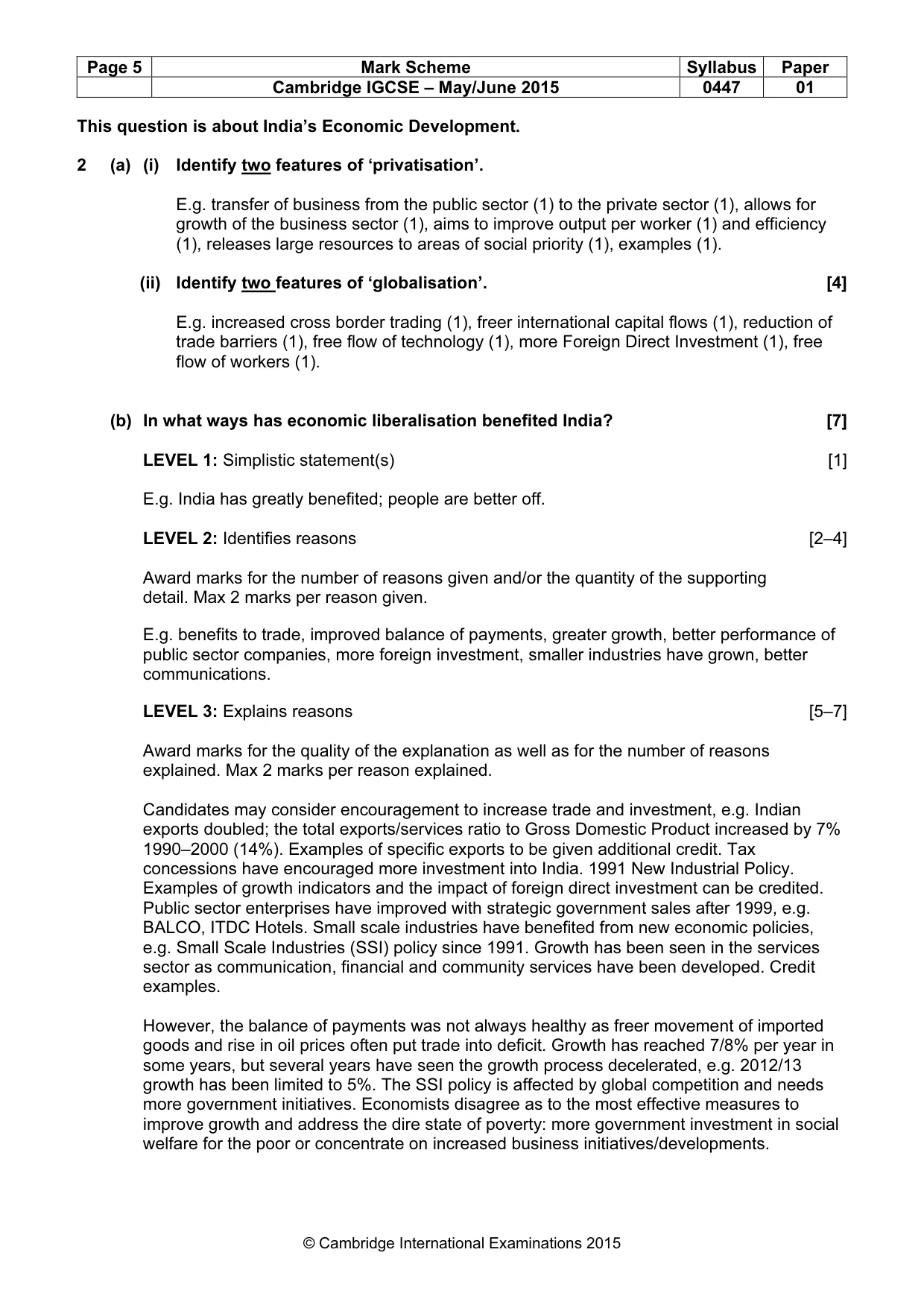
Page 5 Mark Scheme Syllabus Paper Cambridge IGCSE – May/June 2015 0447 01 © Cambridge International Examinations 2015 This question is about India’s Economic Development. 2 (a) (i) Identify two features of ‘privatisation’. E.g. transfer of business from the public sector (1) to the private sector (1), allows for growth of the business sector (1), aims to improve output per worker (1) and efficiency (1), releases large resources to areas of social priority (1), examples (1). (ii) Identify two features of ‘globalisation’. [4] E.g. increased cross border trading (1), freer international capital flows (1), reduction of trade barriers (1), free flow of technology (1), more Foreign Direct Investment (1), free flow of workers (1). (b) In what ways has economic liberalisation benefited India? [7] LEVEL 1: Simplistic statement(s) [1] E.g. India has greatly benefited; people are better off. LEVEL 2: Identifies reasons [2–4] Award marks for the number of reasons given and/or the quantity of the supporting detail. Max 2 marks per reason given. E.g. benefits to trade, improved balance of payments, greater growth, better performance of public sector companies, more foreign investment, smaller industries have grown, better communications. LEVEL 3: Explains reasons [5–7] Award marks for the quality of the explanation as well as for the number of reasons explained. Max 2 marks per reason explained. Candidates may consider encouragement to increase trade and investment, e.g. Indian exports doubled; the total exports/services ratio to Gross Domestic Product increased by 7% 1990–2000 (14%). Examples of specific exports to be given additional credit. Tax concessions have encouraged more investment into India. 1991 New Industrial Policy. Examples of growth indicators and the impact of foreign direct investment can be credited. Public sector enterprises have improved with strategic government sales after 1999, e.g. BALCO, ITDC Hotels. Small scale industries have benefited from new economic policies, e.g. Small Scale Industries (SSI) policy since 1991. Growth has been seen in the services sector as communication, financial and community services have been developed. Credit examples. However, the balance of payments was not always healthy as freer movement of imported goods and rise in oil prices often put trade into deficit. Growth has reached 7/8% per year in some years, but several years have seen the growth process decelerated, e.g. 2012/13 growth has been limited to 5%. The SSI policy is affected by global competition and needs more government initiatives. Economists disagree as to the most effective measures to improve growth and address the dire state of poverty: more government investment in social welfare for the poor or concentrate on increased business initiatives/developments.
Mark scheme, page 6
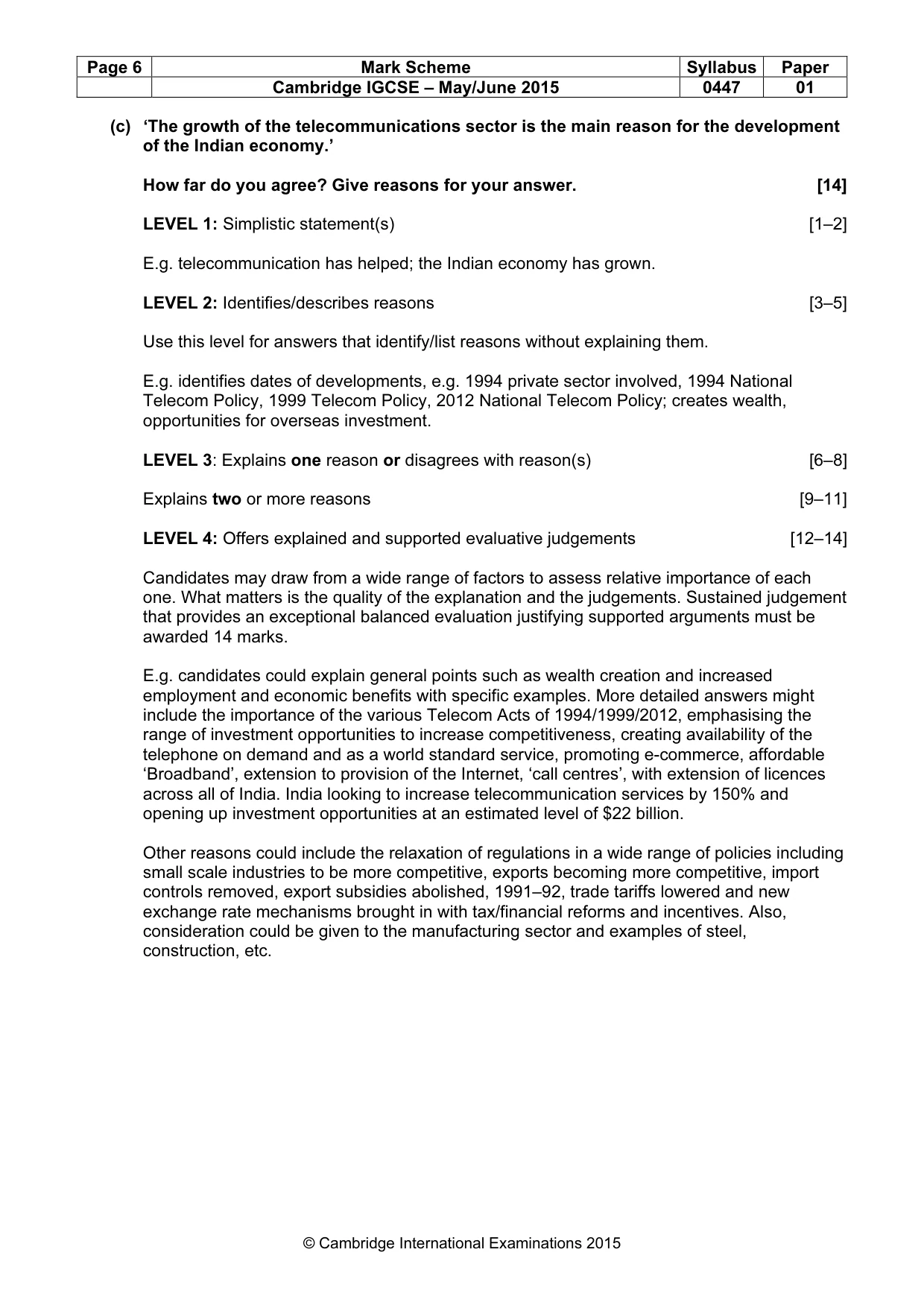
Page 6 Mark Scheme Syllabus Paper Cambridge IGCSE – May/June 2015 0447 01 © Cambridge International Examinations 2015 (c) ‘The growth of the telecommunications sector is the main reason for the development of the Indian economy.’ How far do you agree? Give reasons for your answer. [14] LEVEL 1: Simplistic statement(s) [1–2] E.g. telecommunication has helped; the Indian economy has grown. LEVEL 2: Identifies/describes reasons [3–5] Use this level for answers that identify/list reasons without explaining them. E.g. identifies dates of developments, e.g. 1994 private sector involved, 1994 National Telecom Policy, 1999 Telecom Policy, 2012 National Telecom Policy; creates wealth, opportunities for overseas investment. LEVEL 3: Explains one reason or disagrees with reason(s) [6–8] Explains two or more reasons [9–11] LEVEL 4: Offers explained and supported evaluative judgements [12–14] Candidates may draw from a wide range of factors to assess relative importance of each one. What matters is the quality of the explanation and the judgements. Sustained judgement that provides an exceptional balanced evaluation justifying supported arguments must be awarded 14 marks. E.g. candidates could explain general points such as wealth creation and increased employment and economic benefits with specific examples. More detailed answers might include the importance of the various Telecom Acts of 1994/1999/2012, emphasising the range of investment opportunities to increase competitiveness, creating availability of the telephone on demand and as a world standard service, promoting e-commerce, affordable ‘Broadband’, extension to provision of the Internet, ‘call centres’, with extension of licences across all of India. India looking to increase telecommunication services by 150% and opening up investment opportunities at an estimated level of $22 billion. Other reasons could include the relaxation of regulations in a wide range of policies including small scale industries to be more competitive, exports becoming more competitive, import controls removed, export subsidies abolished, 1991–92, trade tariffs lowered and new exchange rate mechanisms brought in with tax/financial reforms and incentives. Also, consideration could be given to the manufacturing sector and examples of steel, construction, etc.
Mark scheme, page 7
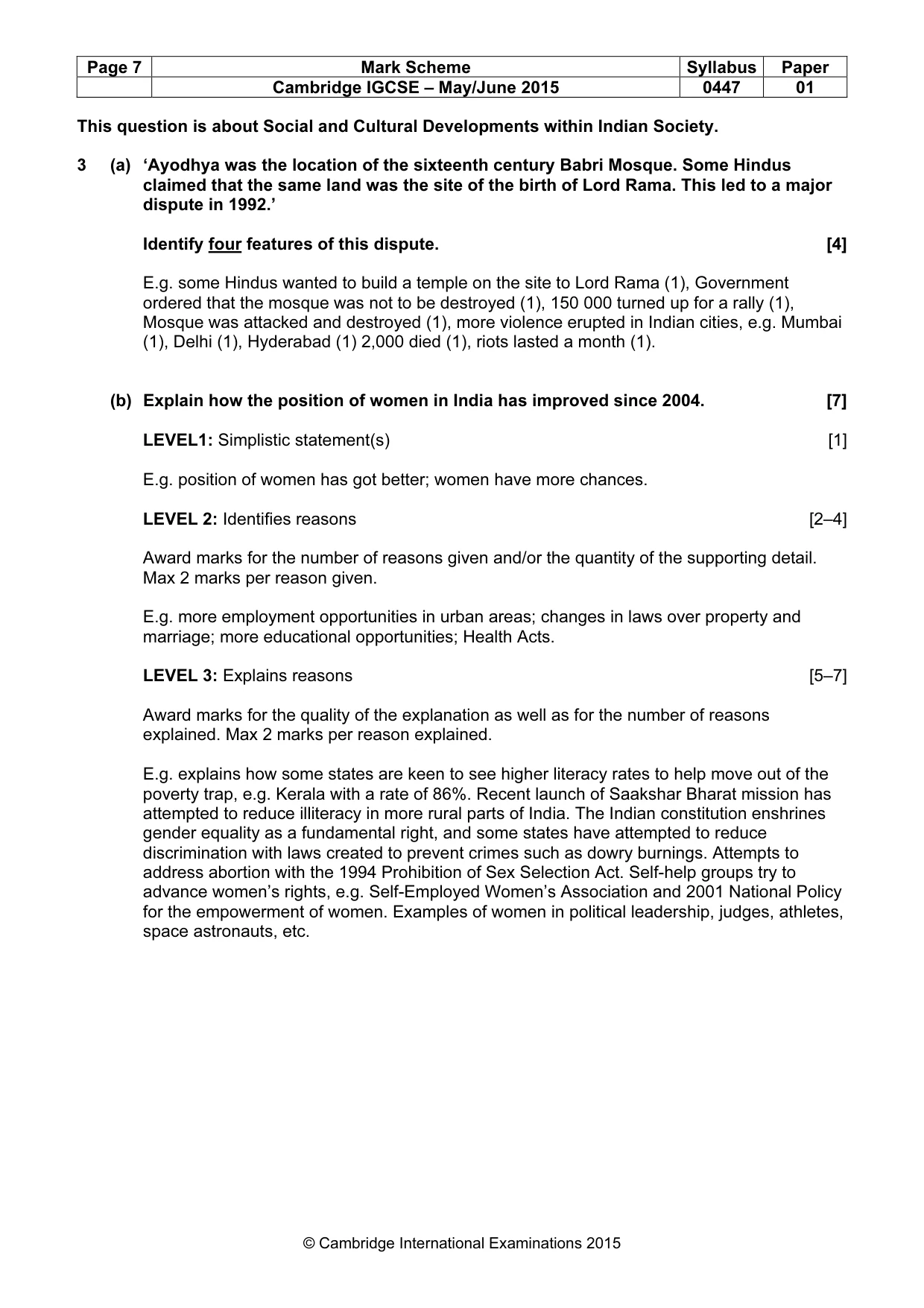
Page 7 Mark Scheme Syllabus Paper Cambridge IGCSE – May/June 2015 0447 01 © Cambridge International Examinations 2015 This question is about Social and Cultural Developments within Indian Society. 3 (a) ‘Ayodhya was the location of the sixteenth century Babri Mosque. Some Hindus claimed that the same land was the site of the birth of Lord Rama. This led to a major dispute in 1992.’ Identify four features of this dispute. [4] E.g. some Hindus wanted to build a temple on the site to Lord Rama (1), Government ordered that the mosque was not to be destroyed (1), 150 000 turned up for a rally (1), Mosque was attacked and destroyed (1), more violence erupted in Indian cities, e.g. Mumbai (1), Delhi (1), Hyderabad (1) 2,000 died (1), riots lasted a month (1). (b) Explain how the position of women in India has improved since 2004. [7] LEVEL1: Simplistic statement(s) [1] E.g. position of women has got better; women have more chances. LEVEL 2: Identifies reasons [2–4] Award marks for the number of reasons given and/or the quantity of the supporting detail. Max 2 marks per reason given. E.g. more employment opportunities in urban areas; changes in laws over property and marriage; more educational opportunities; Health Acts. LEVEL 3: Explains reasons [5–7] Award marks for the quality of the explanation as well as for the number of reasons explained. Max 2 marks per reason explained. E.g. explains how some states are keen to see higher literacy rates to help move out of the poverty trap, e.g. Kerala with a rate of 86%. Recent launch of Saakshar Bharat mission has attempted to reduce illiteracy in more rural parts of India. The Indian constitution enshrines gender equality as a fundamental right, and some states have attempted to reduce discrimination with laws created to prevent crimes such as dowry burnings. Attempts to address abortion with the 1994 Prohibition of Sex Selection Act. Self-help groups try to advance women’s rights, e.g. Self-Employed Women’s Association and 2001 National Policy for the empowerment of women. Examples of women in political leadership, judges, athletes, space astronauts, etc.
Mark scheme, page 8
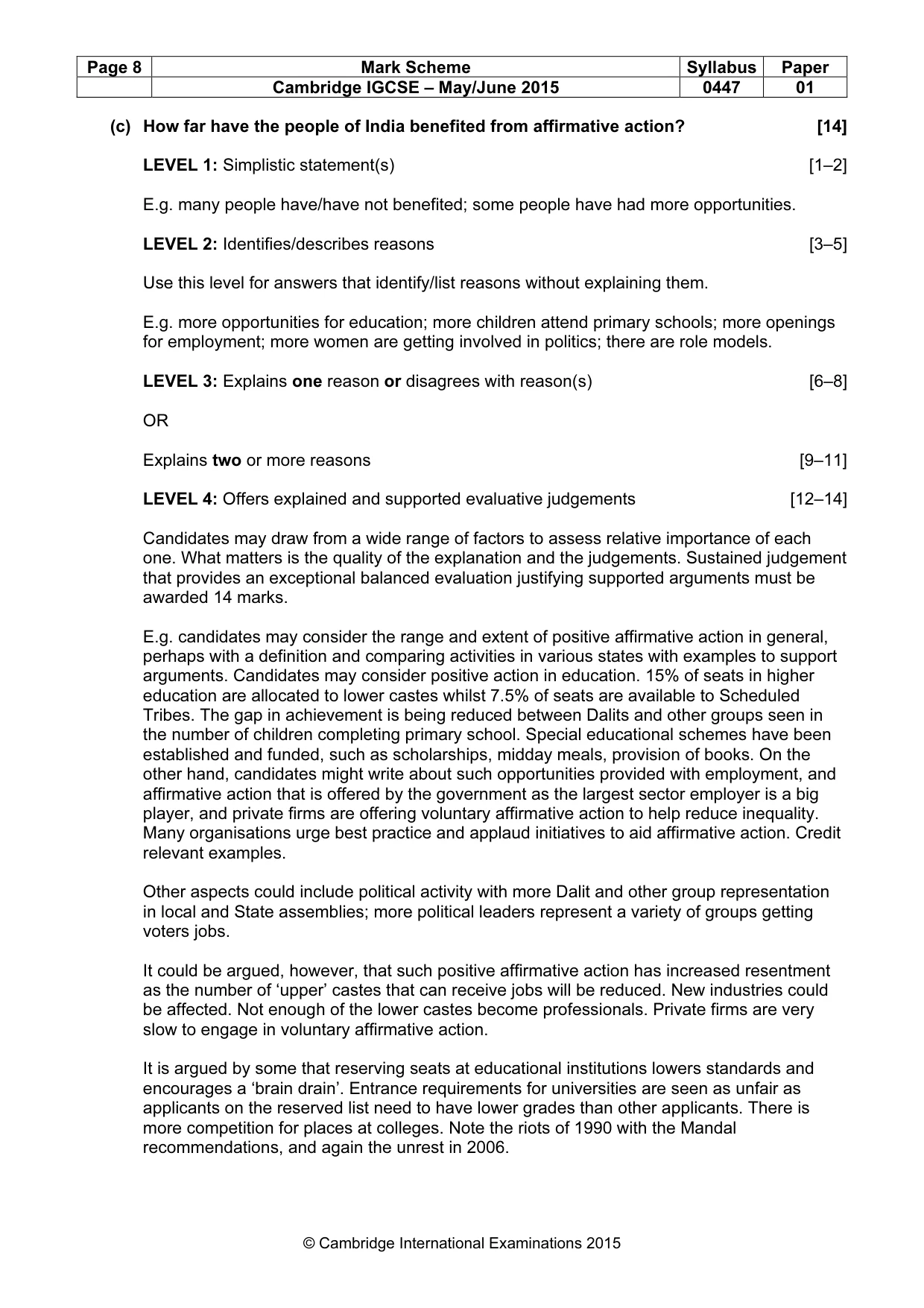
Page 8 Mark Scheme Syllabus Paper Cambridge IGCSE – May/June 2015 0447 01 © Cambridge International Examinations 2015 (c) How far have the people of India benefited from affirmative action? [14] LEVEL 1: Simplistic statement(s) [1–2] E.g. many people have/have not benefited; some people have had more opportunities. LEVEL 2: Identifies/describes reasons [3–5] Use this level for answers that identify/list reasons without explaining them. E.g. more opportunities for education; more children attend primary schools; more openings for employment; more women are getting involved in politics; there are role models. LEVEL 3: Explains one reason or disagrees with reason(s) [6–8] OR Explains two or more reasons [9–11] LEVEL 4: Offers explained and supported evaluative judgements [12–14] Candidates may draw from a wide range of factors to assess relative importance of each one. What matters is the quality of the explanation and the judgements. Sustained judgement that provides an exceptional balanced evaluation justifying supported arguments must be awarded 14 marks. E.g. candidates may consider the range and extent of positive affirmative action in general, perhaps with a definition and comparing activities in various states with examples to support arguments. Candidates may consider positive action in education. 15% of seats in higher education are allocated to lower castes whilst 7.5% of seats are available to Scheduled Tribes. The gap in achievement is being reduced between Dalits and other groups seen in the number of children completing primary school. Special educational schemes have been established and funded, such as scholarships, midday meals, provision of books. On the other hand, candidates might write about such opportunities provided with employment, and affirmative action that is offered by the government as the largest sector employer is a big player, and private firms are offering voluntary affirmative action to help reduce inequality. Many organisations urge best practice and applaud initiatives to aid affirmative action. Credit relevant examples. Other aspects could include political activity with more Dalit and other group representation in local and State assemblies; more political leaders represent a variety of groups getting voters jobs. It could be argued, however, that such positive affirmative action has increased resentment as the number of ‘upper’ castes that can receive jobs will be reduced. New industries could be affected. Not enough of the lower castes become professionals. Private firms are very slow to engage in voluntary affirmative action. It is argued by some that reserving seats at educational institutions lowers standards and encourages a ‘brain drain’. Entrance requirements for universities are seen as unfair as applicants on the reserved list need to have lower grades than other applicants. There is more competition for places at colleges. Note the riots of 1990 with the Mandal recommendations, and again the unrest in 2006.
Mark scheme, page 9
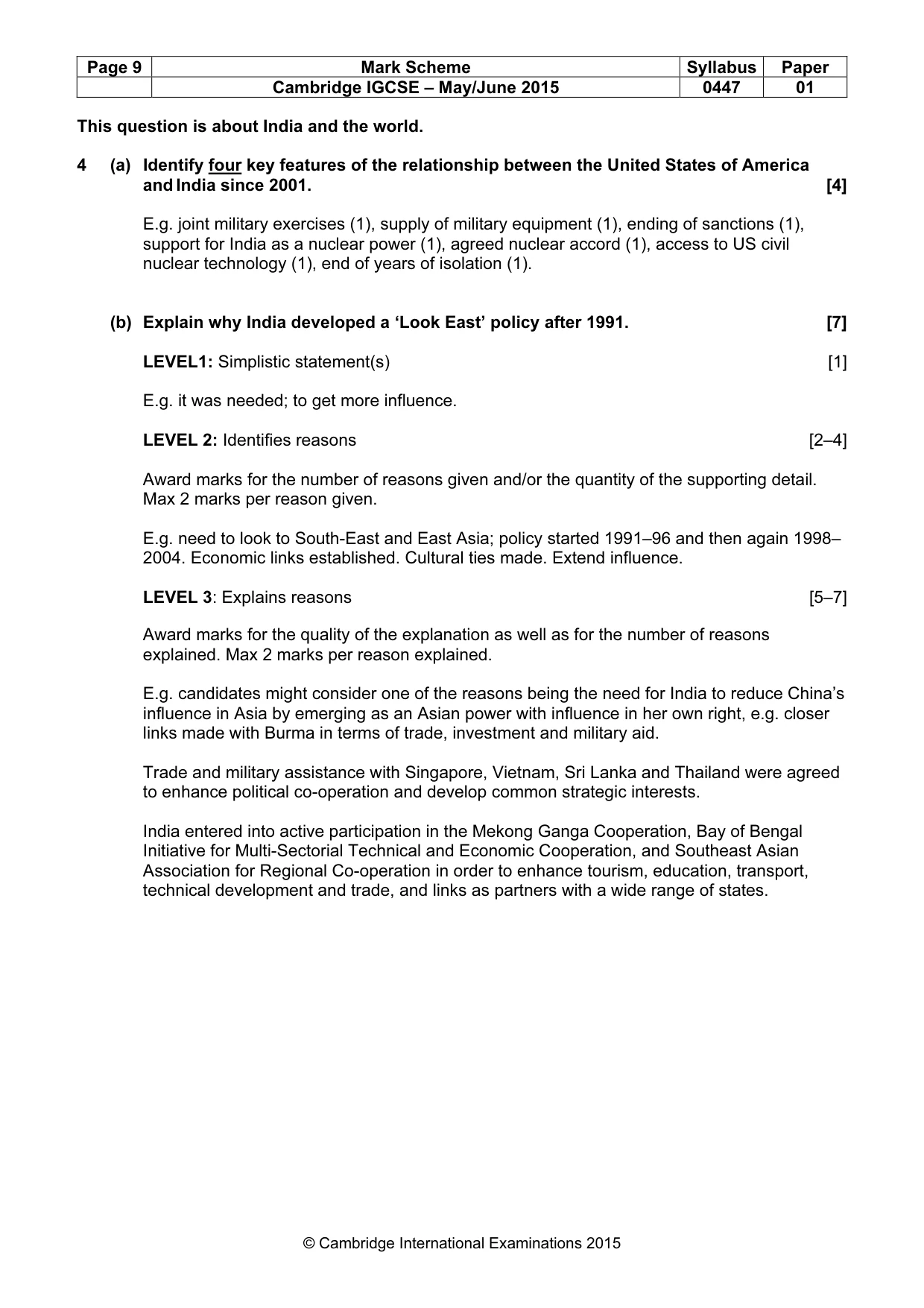
Page 9 Mark Scheme Syllabus Paper Cambridge IGCSE – May/June 2015 0447 01 © Cambridge International Examinations 2015 This question is about India and the world. 4 (a) Identify four key features of the relationship between the United States of America and India since 2001. [4] E.g. joint military exercises (1), supply of military equipment (1), ending of sanctions (1), support for India as a nuclear power (1), agreed nuclear accord (1), access to US civil nuclear technology (1), end of years of isolation (1). (b) Explain why India developed a ‘Look East’ policy after 1991. [7] LEVEL1: Simplistic statement(s) [1] E.g. it was needed; to get more influence. LEVEL 2: Identifies reasons [2–4] Award marks for the number of reasons given and/or the quantity of the supporting detail. Max 2 marks per reason given. E.g. need to look to South-East and East Asia; policy started 1991–96 and then again 1998– 2004. Economic links established. Cultural ties made. Extend influence. LEVEL 3: Explains reasons [5–7] Award marks for the quality of the explanation as well as for the number of reasons explained. Max 2 marks per reason explained. E.g. candidates might consider one of the reasons being the need for India to reduce China’s influence in Asia by emerging as an Asian power with influence in her own right, e.g. closer links made with Burma in terms of trade, investment and military aid. Trade and military assistance with Singapore, Vietnam, Sri Lanka and Thailand were agreed to enhance political co-operation and develop common strategic interests. India entered into active participation in the Mekong Ganga Cooperation, Bay of Bengal Initiative for Multi-Sectorial Technical and Economic Cooperation, and Southeast Asian Association for Regional Co-operation in order to enhance tourism, education, transport, technical development and trade, and links as partners with a wide range of states.
Mark scheme, page 10
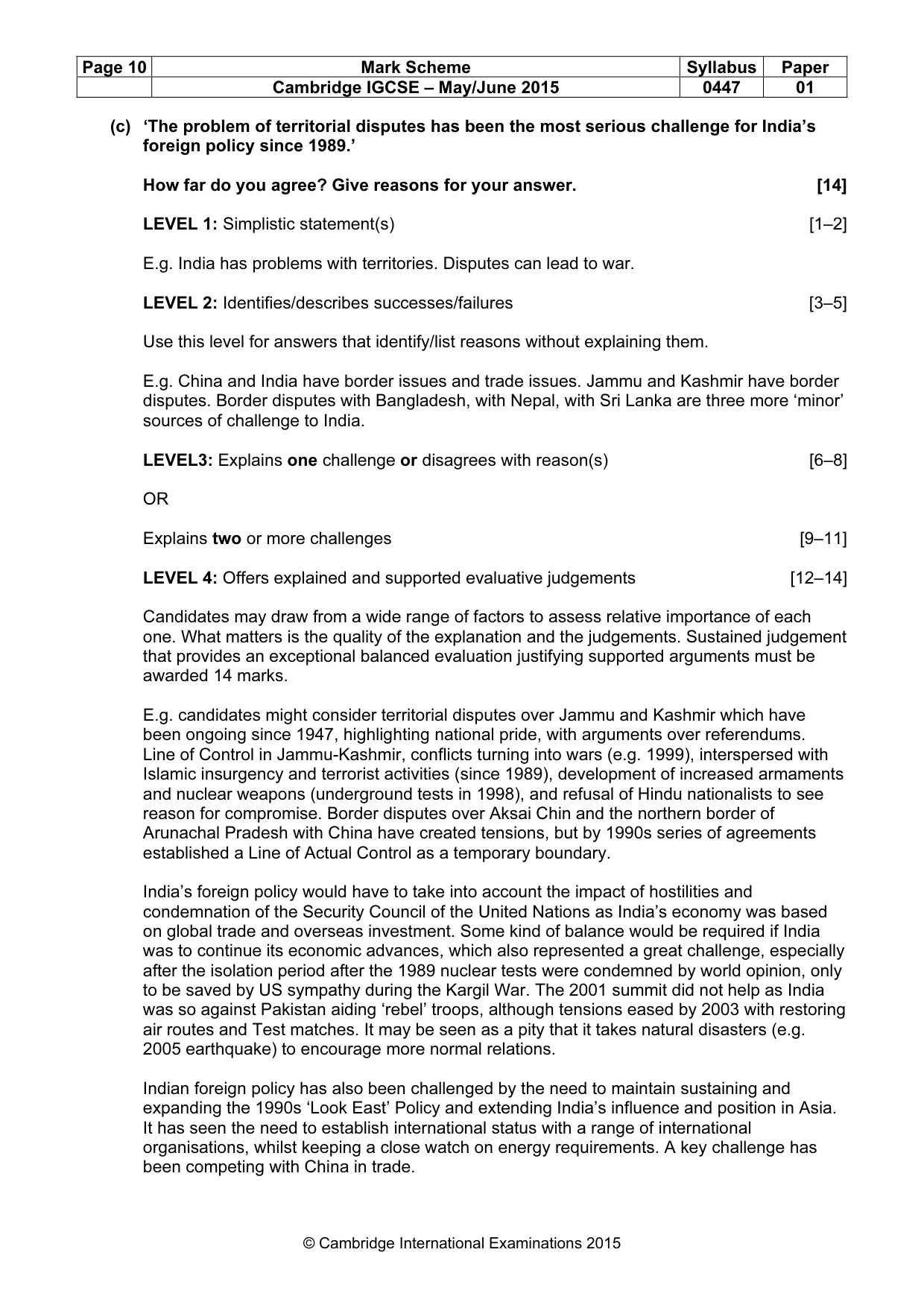
Page 10 Mark Scheme Syllabus Paper Cambridge IGCSE – May/June 2015 0447 01 © Cambridge International Examinations 2015 (c) ‘The problem of territorial disputes has been the most serious challenge for India’s foreign policy since 1989.’ How far do you agree? Give reasons for your answer. [14] LEVEL 1: Simplistic statement(s) [1–2] E.g. India has problems with territories. Disputes can lead to war. LEVEL 2: Identifies/describes successes/failures [3–5] Use this level for answers that identify/list reasons without explaining them. E.g. China and India have border issues and trade issues. Jammu and Kashmir have border disputes. Border disputes with Bangladesh, with Nepal, with Sri Lanka are three more ‘minor’ sources of challenge to India. LEVEL3: Explains one challenge or disagrees with reason(s) [6–8] OR Explains two or more challenges [9–11] LEVEL 4: Offers explained and supported evaluative judgements [12–14] Candidates may draw from a wide range of factors to assess relative importance of each one. What matters is the quality of the explanation and the judgements. Sustained judgement that provides an exceptional balanced evaluation justifying supported arguments must be awarded 14 marks. E.g. candidates might consider territorial disputes over Jammu and Kashmir which have been ongoing since 1947, highlighting national pride, with arguments over referendums. Line of Control in Jammu-Kashmir, conflicts turning into wars (e.g. 1999), interspersed with Islamic insurgency and terrorist activities (since 1989), development of increased armaments and nuclear weapons (underground tests in 1998), and refusal of Hindu nationalists to see reason for compromise. Border disputes over Aksai Chin and the northern border of Arunachal Pradesh with China have created tensions, but by 1990s series of agreements established a Line of Actual Control as a temporary boundary. India’s foreign policy would have to take into account the impact of hostilities and condemnation of the Security Council of the United Nations as India’s economy was based on global trade and overseas investment. Some kind of balance would be required if India was to continue its economic advances, which also represented a great challenge, especially after the isolation period after the 1989 nuclear tests were condemned by world opinion, only to be saved by US sympathy during the Kargil War. The 2001 summit did not help as India was so against Pakistan aiding ‘rebel’ troops, although tensions eased by 2003 with restoring air routes and Test matches. It may be seen as a pity that it takes natural disasters (e.g. 2005 earthquake) to encourage more normal relations. Indian foreign policy has also been challenged by the need to maintain sustaining and expanding the 1990s ‘Look East’ Policy and extending India’s influence and position in Asia. It has seen the need to establish international status with a range of international organisations, whilst keeping a close watch on energy requirements. A key challenge has been competing with China in trade.
Mark scheme, page 11
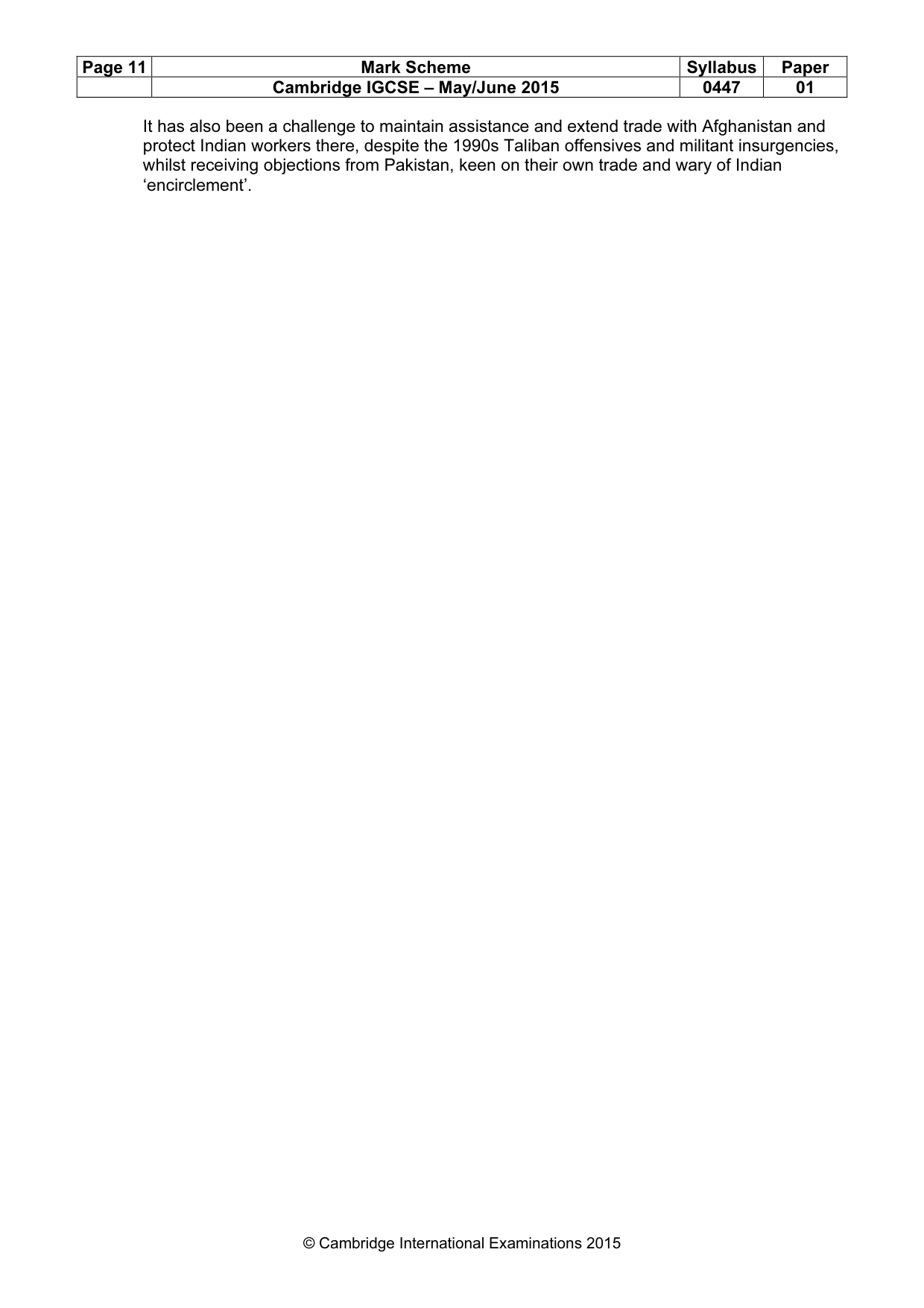
Page 11 Mark Scheme Syllabus Paper Cambridge IGCSE – May/June 2015 0447 01 © Cambridge International Examinations 2015 It has also been a challenge to maintain assistance and extend trade with Afghanistan and protect Indian workers there, despite the 1990s Taliban offensives and militant insurgencies, whilst receiving objections from Pakistan, keen on their own trade and wary of Indian ‘encirclement’.
What you needed in this session
Cambridge’s own grade thresholds for 2015 May/June, Paper 1 · Variant 1. A higher threshold means an easier paper — the bar moves with how the cohort did.