Cambridge IGCSE India Studies 0447 — 2011 May/June Paper 1 · Variant 1
0447/11/M/J/11 · 75 marks · ≈84 min
The question paper and its mark scheme, free to read here and free to download. This is Cambridge’s own paper, exactly as it was sat.
Question paper12 pages



Mark scheme9 pages
Answers below. Sit the paper first if you are practising.
Paper as text
Question paper, page 1
This document consists of 9 printed pages and 3 blank pages. DC (SM) 34155/1 © UCLES 2011 [Turn over UNIVERSITY OF CAMBRIDGE INTERNATIONAL EXAMINATIONS International General Certificate of Secondary Education * 7 7 9 6 6 5 1 8 5 5 * INDIA STUDIES 0447/01 Core Themes May/June 2011 2 hours Candidates answer on the Question Paper. No Additional Materials are required. READ THESE INSTRUCTIONS FIRST Write your Centre number, candidate number and name on all the work you hand in. Write in dark blue or black pen. You may use a soft pencil for any diagrams, graphs or rough working. Do not use staples, paper clips, highlighters, glue or correction fluid. DO NOT WRITE IN ANY BARCODES. Answer three questions. Answer in the spaces provided. You are advised to spend equal time in answering each of the three questions. The total mark for this paper is 75. The number of marks is given in brackets [ ] at the end of each question or part question. Any rough work must be done in this booklet.
Question paper, page 2
2 0447/01/M/J/11 © UCLES 2011 For Examiner’s Use Answer three questions. 1 This question is about Indian democracy. (a) This question tests your knowledge. Identify four domestic reforms of the Congress-led Coalition Government of 2004–2009. … … … … … …[4] (b) This question tests your understanding. Explain the growth of Hindu nationalism since 1989. … … … … … … … … … … … …[7]
Question paper, page 3
3 0447/01/M/J/11 © UCLES 2011 [Turn over For Examiner’s Use (c) This question tests your judgement. ‘Corruption is the most important problem in sustaining Indian democracy.’ How far do you agree with this statement? Give reasons for your answer. … … … … … … … … … … … … … … … … … … … … … … … … …[14] [Total: 25]
Question paper, page 4
4 0447/01/M/J/11 © UCLES 2011 For Examiner’s Use 2 This question is about economic development. (a) This question tests your knowledge. Identify four problems that limit economic growth in India. … … … … … …[4] (b) This question tests your understanding. Explain the main aims of India’s Five Year Development Plans. … … … … … … … … … … … …[7]
Question paper, page 5
5 0447/01/M/J/11 © UCLES 2011 [Turn over For Examiner’s Use (c) This question tests your judgement. ‘Over the last twenty years, India has experienced a wide range of economic reforms. These have included liberalisation policies, globalisation and financial sector reforms. Of these, liberalisation has been the most important.’ How far do you agree with this statement? Give reasons for your answer. … … … … … … … … … … … … … … … … … … … … … … … … …[14] [Total: 25]
Question paper, page 6
6 0447/01/M/J/11 © UCLES 2011 For Examiner’s Use 3 This question is about India’s electoral system. (a) This question tests your knowledge. Identify four features of the Indian electoral system. … … … … … …[4] (b) This question tests your understanding. Explain the importance of regional political parties in Indian politics. … … … … … … … … … … … …[7]
Question paper, page 7
7 0447/01/M/J/11 © UCLES 2011 [Turn over For Examiner’s Use (c) This question tests your judgement. Consider these two statements: Statement 1: ‘Indian General Elections show democratic politics in action and allow the will of the Indian people to be heard.’ Statement 2: ‘Indian General Elections are not as democratic as they appear.’ Assess these statements, showing which you most agree with, and explain why. … … … … … … … … … … … … … … … … … … … … … … … … …[14] [Total: 25]
Question paper, page 8
8 0447/01/M/J/11 © UCLES 2011 For Examiner’s Use 4 This question is about India and the world. (a) This question tests your knowledge. Identify four issues that affect relations between India and Pakistan. … … … … … …[4] (b) This question tests your understanding. Explain how the aims of India’s foreign policy have changed since 1998. … … … … … … … … … … … …[7]
Question paper, page 9
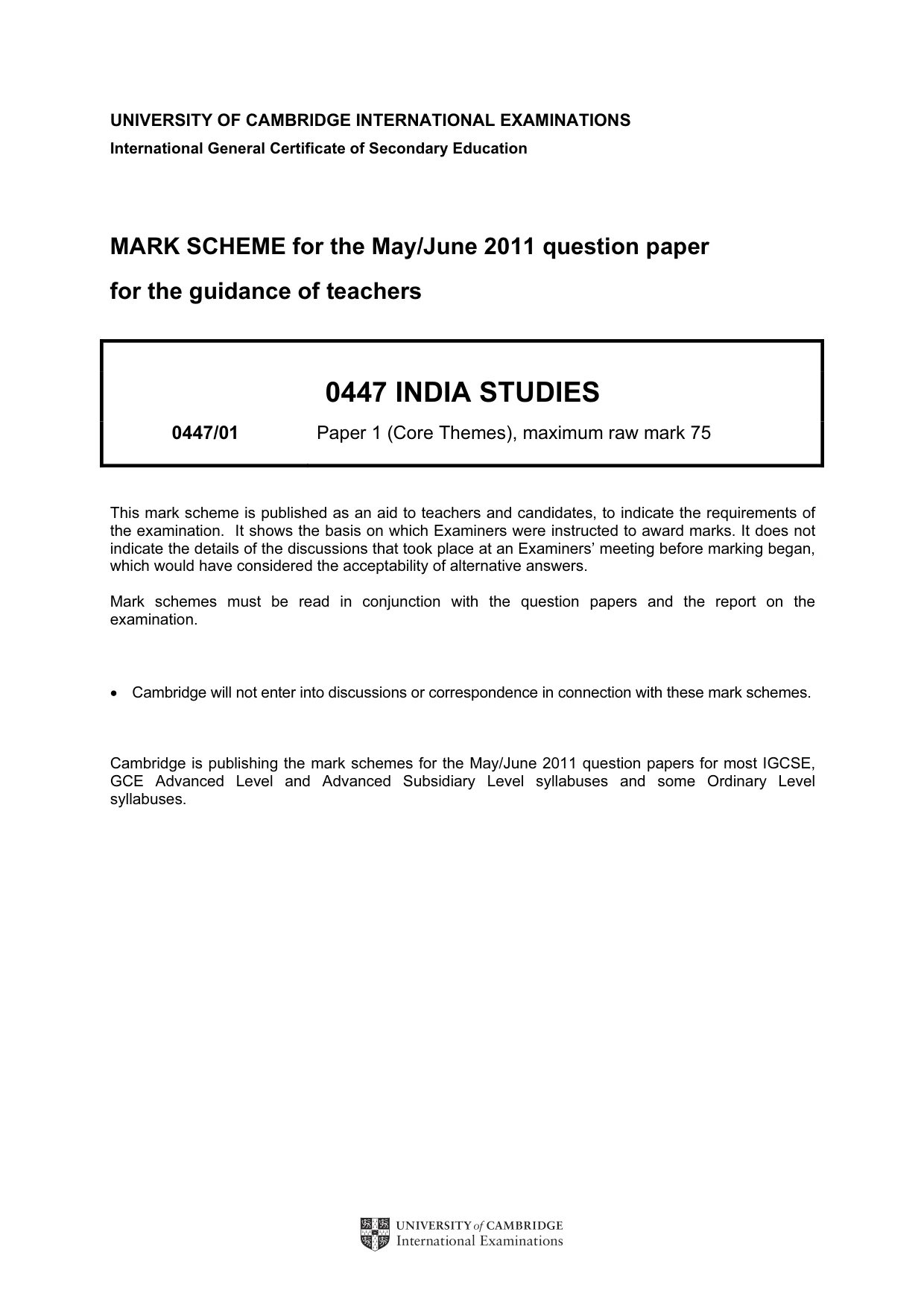
9 0447/01/M/J/11 © UCLES 2011 For Examiner’s Use (c) This question tests your judgement. ‘During the last twenty years, India has become a nuclear power and China sees her more and more as a threat.’ To what extent have relations with China improved or deteriorated? Explain your answer. … … … … … … … … … … … … … … … … … … … … … … … … …[14] [Total: 25]
Question paper, page 10
10 0447/01/M/J/11 © UCLES 2011 BLANK PAGE
Question paper, page 11
11 0447/01/M/J/11 © UCLES 2011 BLANK PAGE
Question paper, page 12
12 0447/01/M/J/11 © UCLES 2011 Permission to reproduce items where third-party owned material protected by copyright is included has been sought and cleared where possible. Every reasonable effort has been made by the publisher (UCLES) to trace copyright holders, but if any items requiring clearance have unwittingly been included, the publisher will be pleased to make amends at the earliest possible opportunity. University of Cambridge International Examinations is part of the Cambridge Assessment Group. Cambridge Assessment is the brand name of University of Cambridge Local Examinations Syndicate (UCLES), which is itself a department of the University of Cambridge. BLANK PAGE
Mark scheme, page 1
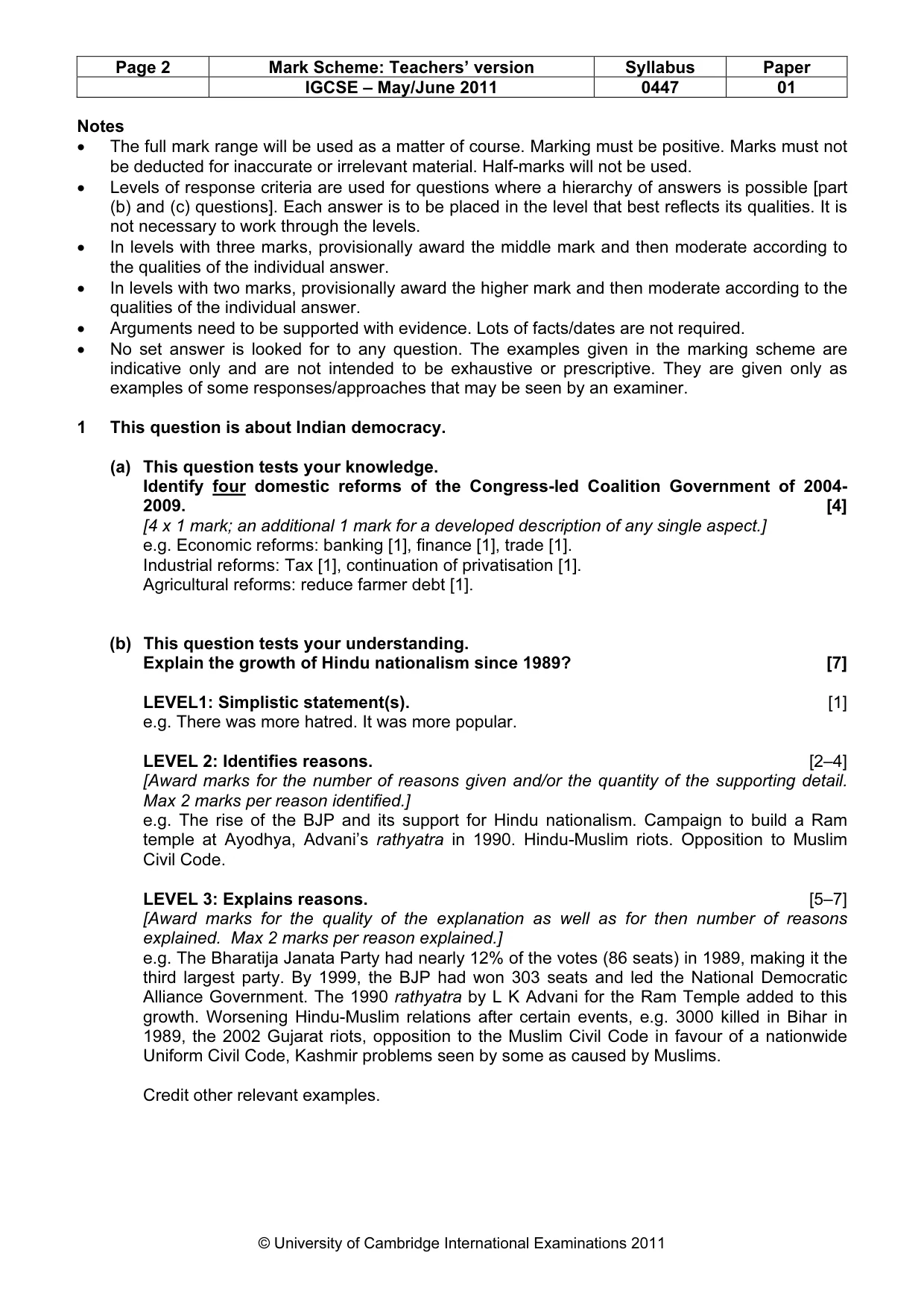
UNIVERSITY OF CAMBRIDGE INTERNATIONAL EXAMINATIONS International General Certificate of Secondary Education MARK SCHEME for the May/June 2011 question paper for the guidance of teachers 0447 INDIA STUDIES 0447/01 Paper 1 (Core Themes), maximum raw mark 75 This mark scheme is published as an aid to teachers and candidates, to indicate the requirements of the examination. It shows the basis on which Examiners were instructed to award marks. It does not indicate the details of the discussions that took place at an Examiners’ meeting before marking began, which would have considered the acceptability of alternative answers. Mark schemes must be read in conjunction with the question papers and the report on the examination. • Cambridge will not enter into discussions or correspondence in connection with these mark schemes. Cambridge is publishing the mark schemes for the May/June 2011 question papers for most IGCSE, GCE Advanced Level and Advanced Subsidiary Level syllabuses and some Ordinary Level syllabuses.
Mark scheme, page 2
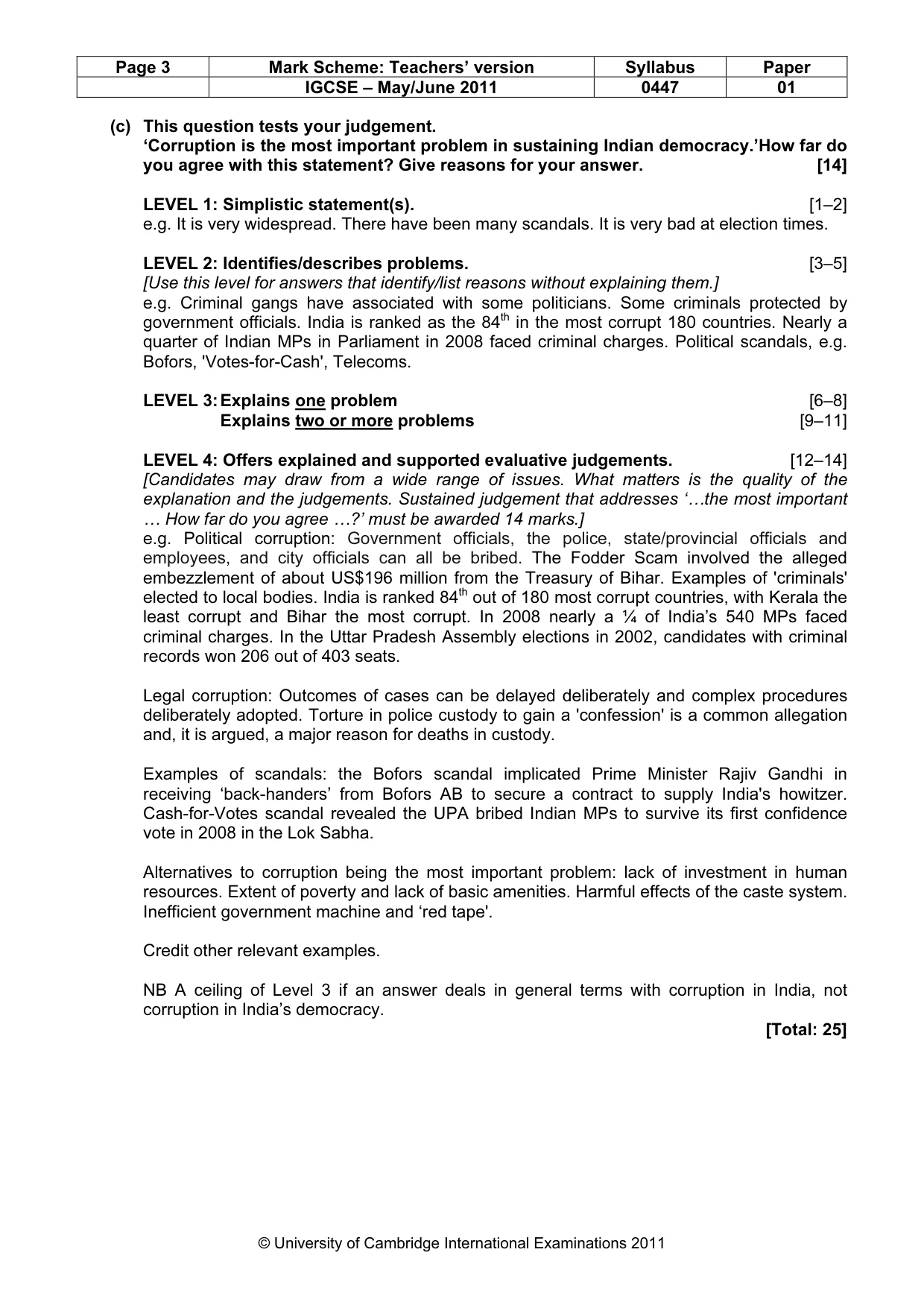
Page 2 Mark Scheme: Teachers’ version Syllabus Paper IGCSE – May/June 2011 0447 01 © University of Cambridge International Examinations 2011 Notes • The full mark range will be used as a matter of course. Marking must be positive. Marks must not be deducted for inaccurate or irrelevant material. Half-marks will not be used. • Levels of response criteria are used for questions where a hierarchy of answers is possible [part (b) and (c) questions]. Each answer is to be placed in the level that best reflects its qualities. It is not necessary to work through the levels. • In levels with three marks, provisionally award the middle mark and then moderate according to the qualities of the individual answer. • In levels with two marks, provisionally award the higher mark and then moderate according to the qualities of the individual answer. • Arguments need to be supported with evidence. Lots of facts/dates are not required. • No set answer is looked for to any question. The examples given in the marking scheme are indicative only and are not intended to be exhaustive or prescriptive. They are given only as examples of some responses/approaches that may be seen by an examiner. 1 This question is about Indian democracy. (a) This question tests your knowledge. Identify four domestic reforms of the Congress-led Coalition Government of 2004- 2009. [4] [4 x 1 mark; an additional 1 mark for a developed description of any single aspect.] e.g. Economic reforms: banking [1], finance [1], trade [1]. Industrial reforms: Tax [1], continuation of privatisation [1]. Agricultural reforms: reduce farmer debt [1]. (b) This question tests your understanding. Explain the growth of Hindu nationalism since 1989? [7] LEVEL1: Simplistic statement(s). [1] e.g. There was more hatred. It was more popular. LEVEL 2: Identifies reasons. [2–4] [Award marks for the number of reasons given and/or the quantity of the supporting detail. Max 2 marks per reason identified.] e.g. The rise of the BJP and its support for Hindu nationalism. Campaign to build a Ram temple at Ayodhya, Advani’s rathyatra in 1990. Hindu-Muslim riots. Opposition to Muslim Civil Code. LEVEL 3: Explains reasons. [5–7] [Award marks for the quality of the explanation as well as for then number of reasons explained. Max 2 marks per reason explained.] e.g. The Bharatija Janata Party had nearly 12% of the votes (86 seats) in 1989, making it the third largest party. By 1999, the BJP had won 303 seats and led the National Democratic Alliance Government. The 1990 rathyatra by L K Advani for the Ram Temple added to this growth. Worsening Hindu-Muslim relations after certain events, e.g. 3000 killed in Bihar in 1989, the 2002 Gujarat riots, opposition to the Muslim Civil Code in favour of a nationwide Uniform Civil Code, Kashmir problems seen by some as caused by Muslims. Credit other relevant examples.
Mark scheme, page 3
Page 3 Mark Scheme: Teachers’ version Syllabus Paper IGCSE – May/June 2011 0447 01 © University of Cambridge International Examinations 2011 (c) This question tests your judgement. ‘Corruption is the most important problem in sustaining Indian democracy.’How far do you agree with this statement? Give reasons for your answer. [14] LEVEL 1: Simplistic statement(s). [1–2] e.g. It is very widespread. There have been many scandals. It is very bad at election times. LEVEL 2: Identifies/describes problems. [3–5] [Use this level for answers that identify/list reasons without explaining them.] e.g. Criminal gangs have associated with some politicians. Some criminals protected by government officials. India is ranked as the 84th in the most corrupt 180 countries. Nearly a quarter of Indian MPs in Parliament in 2008 faced criminal charges. Political scandals, e.g. Bofors, 'Votes-for-Cash', Telecoms. LEVEL 3: Explains one problem [6–8] Explains two or more problems [9–11] LEVEL 4: Offers explained and supported evaluative judgements. [12–14] [Candidates may draw from a wide range of issues. What matters is the quality of the explanation and the judgements. Sustained judgement that addresses ‘…the most important … How far do you agree …?’ must be awarded 14 marks.] e.g. Political corruption: Government officials, the police, state/provincial officials and employees, and city officials can all be bribed. The Fodder Scam involved the alleged embezzlement of about US$196 million from the Treasury of Bihar. Examples of 'criminals' elected to local bodies. India is ranked 84th out of 180 most corrupt countries, with Kerala the least corrupt and Bihar the most corrupt. In 2008 nearly a ¼ of India’s 540 MPs faced criminal charges. In the Uttar Pradesh Assembly elections in 2002, candidates with criminal records won 206 out of 403 seats. Legal corruption: Outcomes of cases can be delayed deliberately and complex procedures deliberately adopted. Torture in police custody to gain a 'confession' is a common allegation and, it is argued, a major reason for deaths in custody. Examples of scandals: the Bofors scandal implicated Prime Minister Rajiv Gandhi in receiving ‘back-handers’ from Bofors AB to secure a contract to supply India's howitzer. Cash-for-Votes scandal revealed the UPA bribed Indian MPs to survive its first confidence vote in 2008 in the Lok Sabha. Alternatives to corruption being the most important problem: lack of investment in human resources. Extent of poverty and lack of basic amenities. Harmful effects of the caste system. Inefficient government machine and ‘red tape'. Credit other relevant examples. NB A ceiling of Level 3 if an answer deals in general terms with corruption in India, not corruption in India’s democracy. [Total: 25]
Mark scheme, page 4
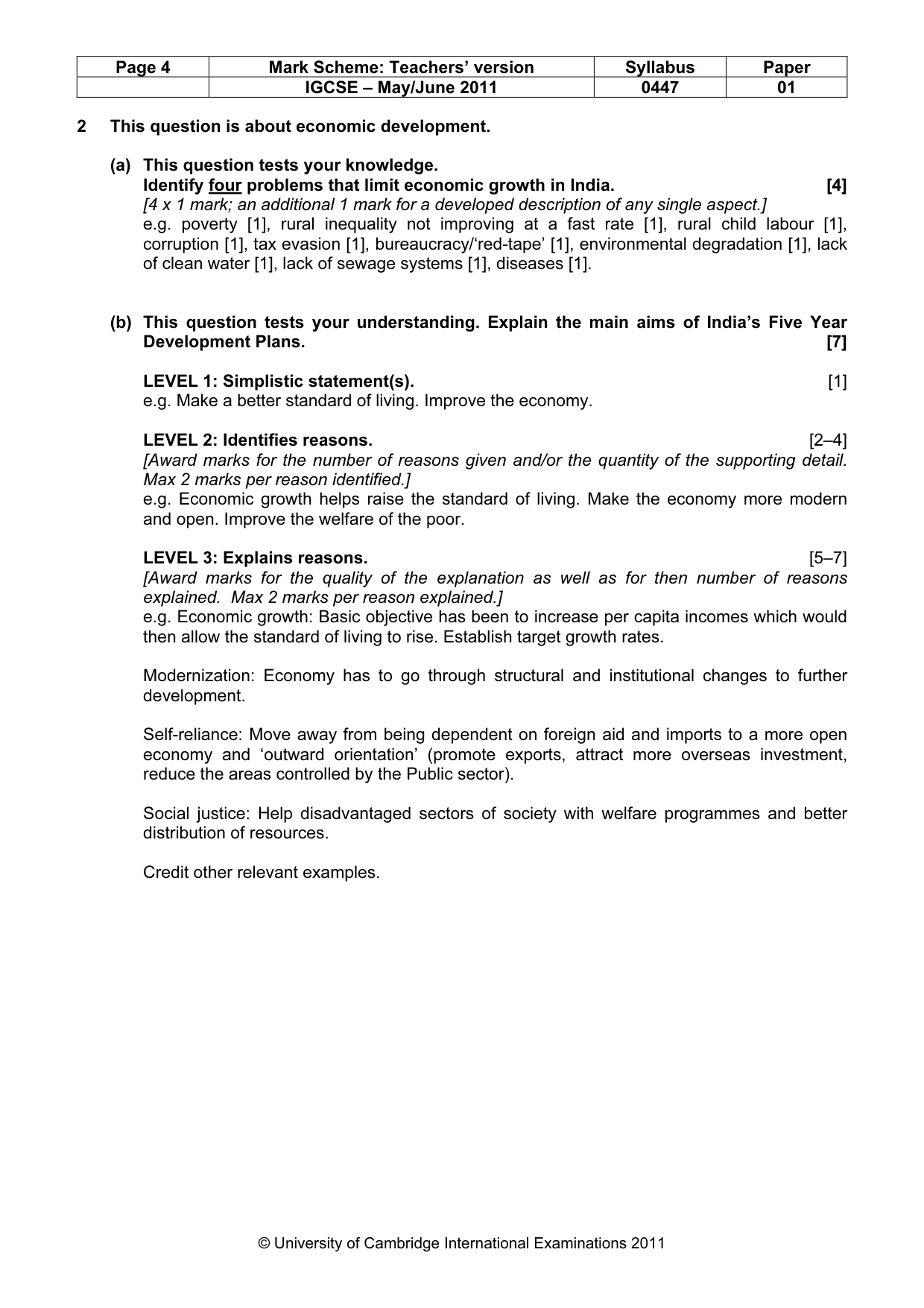
Page 4 Mark Scheme: Teachers’ version Syllabus Paper IGCSE – May/June 2011 0447 01 © University of Cambridge International Examinations 2011 2 This question is about economic development. (a) This question tests your knowledge. Identify four problems that limit economic growth in India. [4] [4 x 1 mark; an additional 1 mark for a developed description of any single aspect.] e.g. poverty [1], rural inequality not improving at a fast rate [1], rural child labour [1], corruption [1], tax evasion [1], bureaucracy/‘red-tape’ [1], environmental degradation [1], lack of clean water [1], lack of sewage systems [1], diseases [1]. (b) This question tests your understanding. Explain the main aims of India’s Five Year Development Plans. [7] LEVEL 1: Simplistic statement(s). [1] e.g. Make a better standard of living. Improve the economy. LEVEL 2: Identifies reasons. [2–4] [Award marks for the number of reasons given and/or the quantity of the supporting detail. Max 2 marks per reason identified.] e.g. Economic growth helps raise the standard of living. Make the economy more modern and open. Improve the welfare of the poor. LEVEL 3: Explains reasons. [5–7] [Award marks for the quality of the explanation as well as for then number of reasons explained. Max 2 marks per reason explained.] e.g. Economic growth: Basic objective has been to increase per capita incomes which would then allow the standard of living to rise. Establish target growth rates. Modernization: Economy has to go through structural and institutional changes to further development. Self-reliance: Move away from being dependent on foreign aid and imports to a more open economy and ‘outward orientation’ (promote exports, attract more overseas investment, reduce the areas controlled by the Public sector). Social justice: Help disadvantaged sectors of society with welfare programmes and better distribution of resources. Credit other relevant examples.
Mark scheme, page 5
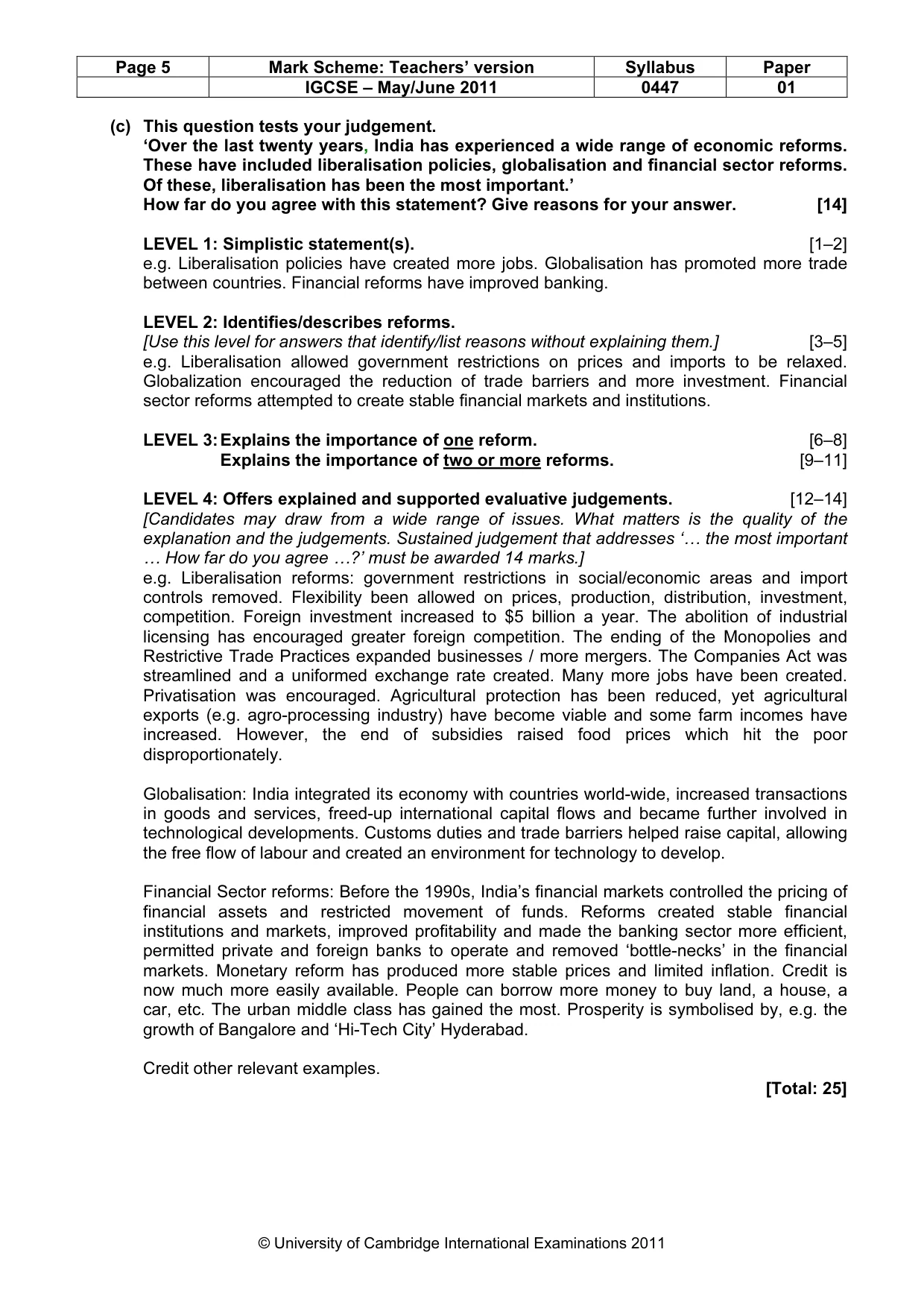
Page 5 Mark Scheme: Teachers’ version Syllabus Paper IGCSE – May/June 2011 0447 01 © University of Cambridge International Examinations 2011 (c) This question tests your judgement. ‘Over the last twenty years, India has experienced a wide range of economic reforms. These have included liberalisation policies, globalisation and financial sector reforms. Of these, liberalisation has been the most important.’ How far do you agree with this statement? Give reasons for your answer. [14] LEVEL 1: Simplistic statement(s). [1–2] e.g. Liberalisation policies have created more jobs. Globalisation has promoted more trade between countries. Financial reforms have improved banking. LEVEL 2: Identifies/describes reforms. [Use this level for answers that identify/list reasons without explaining them.] [3–5] e.g. Liberalisation allowed government restrictions on prices and imports to be relaxed. Globalization encouraged the reduction of trade barriers and more investment. Financial sector reforms attempted to create stable financial markets and institutions. LEVEL 3: Explains the importance of one reform. [6–8] Explains the importance of two or more reforms. [9–11] LEVEL 4: Offers explained and supported evaluative judgements. [12–14] [Candidates may draw from a wide range of issues. What matters is the quality of the explanation and the judgements. Sustained judgement that addresses ‘… the most important … How far do you agree …?’ must be awarded 14 marks.] e.g. Liberalisation reforms: government restrictions in social/economic areas and import controls removed. Flexibility been allowed on prices, production, distribution, investment, competition. Foreign investment increased to $5 billion a year. The abolition of industrial licensing has encouraged greater foreign competition. The ending of the Monopolies and Restrictive Trade Practices expanded businesses / more mergers. The Companies Act was streamlined and a uniformed exchange rate created. Many more jobs have been created. Privatisation was encouraged. Agricultural protection has been reduced, yet agricultural exports (e.g. agro-processing industry) have become viable and some farm incomes have increased. However, the end of subsidies raised food prices which hit the poor disproportionately. Globalisation: India integrated its economy with countries world-wide, increased transactions in goods and services, freed-up international capital flows and became further involved in technological developments. Customs duties and trade barriers helped raise capital, allowing the free flow of labour and created an environment for technology to develop. Financial Sector reforms: Before the 1990s, India’s financial markets controlled the pricing of financial assets and restricted movement of funds. Reforms created stable financial institutions and markets, improved profitability and made the banking sector more efficient, permitted private and foreign banks to operate and removed ‘bottle-necks’ in the financial markets. Monetary reform has produced more stable prices and limited inflation. Credit is now much more easily available. People can borrow more money to buy land, a house, a car, etc. The urban middle class has gained the most. Prosperity is symbolised by, e.g. the growth of Bangalore and ‘Hi-Tech City’ Hyderabad. Credit other relevant examples. [Total: 25]
Mark scheme, page 6
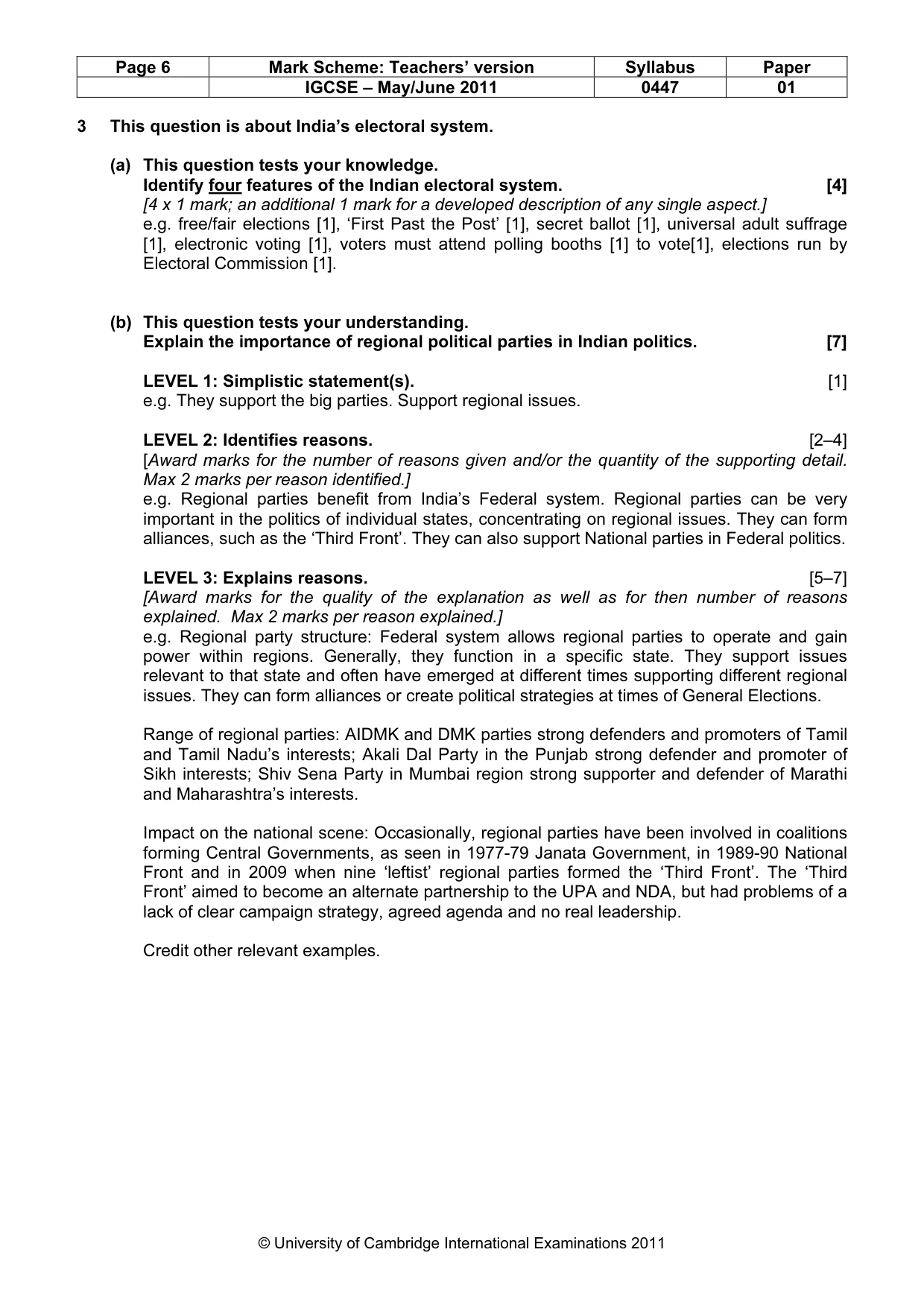
Page 6 Mark Scheme: Teachers’ version Syllabus Paper IGCSE – May/June 2011 0447 01 © University of Cambridge International Examinations 2011 3 This question is about India’s electoral system. (a) This question tests your knowledge. Identify four features of the Indian electoral system. [4] [4 x 1 mark; an additional 1 mark for a developed description of any single aspect.] e.g. free/fair elections [1], ‘First Past the Post’ [1], secret ballot [1], universal adult suffrage [1], electronic voting [1], voters must attend polling booths [1] to vote[1], elections run by Electoral Commission [1]. (b) This question tests your understanding. Explain the importance of regional political parties in Indian politics. [7] LEVEL 1: Simplistic statement(s). [1] e.g. They support the big parties. Support regional issues. LEVEL 2: Identifies reasons. [2–4] [Award marks for the number of reasons given and/or the quantity of the supporting detail. Max 2 marks per reason identified.] e.g. Regional parties benefit from India’s Federal system. Regional parties can be very important in the politics of individual states, concentrating on regional issues. They can form alliances, such as the ‘Third Front’. They can also support National parties in Federal politics. LEVEL 3: Explains reasons. [5–7] [Award marks for the quality of the explanation as well as for then number of reasons explained. Max 2 marks per reason explained.] e.g. Regional party structure: Federal system allows regional parties to operate and gain power within regions. Generally, they function in a specific state. They support issues relevant to that state and often have emerged at different times supporting different regional issues. They can form alliances or create political strategies at times of General Elections. Range of regional parties: AIDMK and DMK parties strong defenders and promoters of Tamil and Tamil Nadu’s interests; Akali Dal Party in the Punjab strong defender and promoter of Sikh interests; Shiv Sena Party in Mumbai region strong supporter and defender of Marathi and Maharashtra’s interests. Impact on the national scene: Occasionally, regional parties have been involved in coalitions forming Central Governments, as seen in 1977-79 Janata Government, in 1989-90 National Front and in 2009 when nine ‘leftist’ regional parties formed the ‘Third Front’. The ‘Third Front’ aimed to become an alternate partnership to the UPA and NDA, but had problems of a lack of clear campaign strategy, agreed agenda and no real leadership. Credit other relevant examples.
Mark scheme, page 7
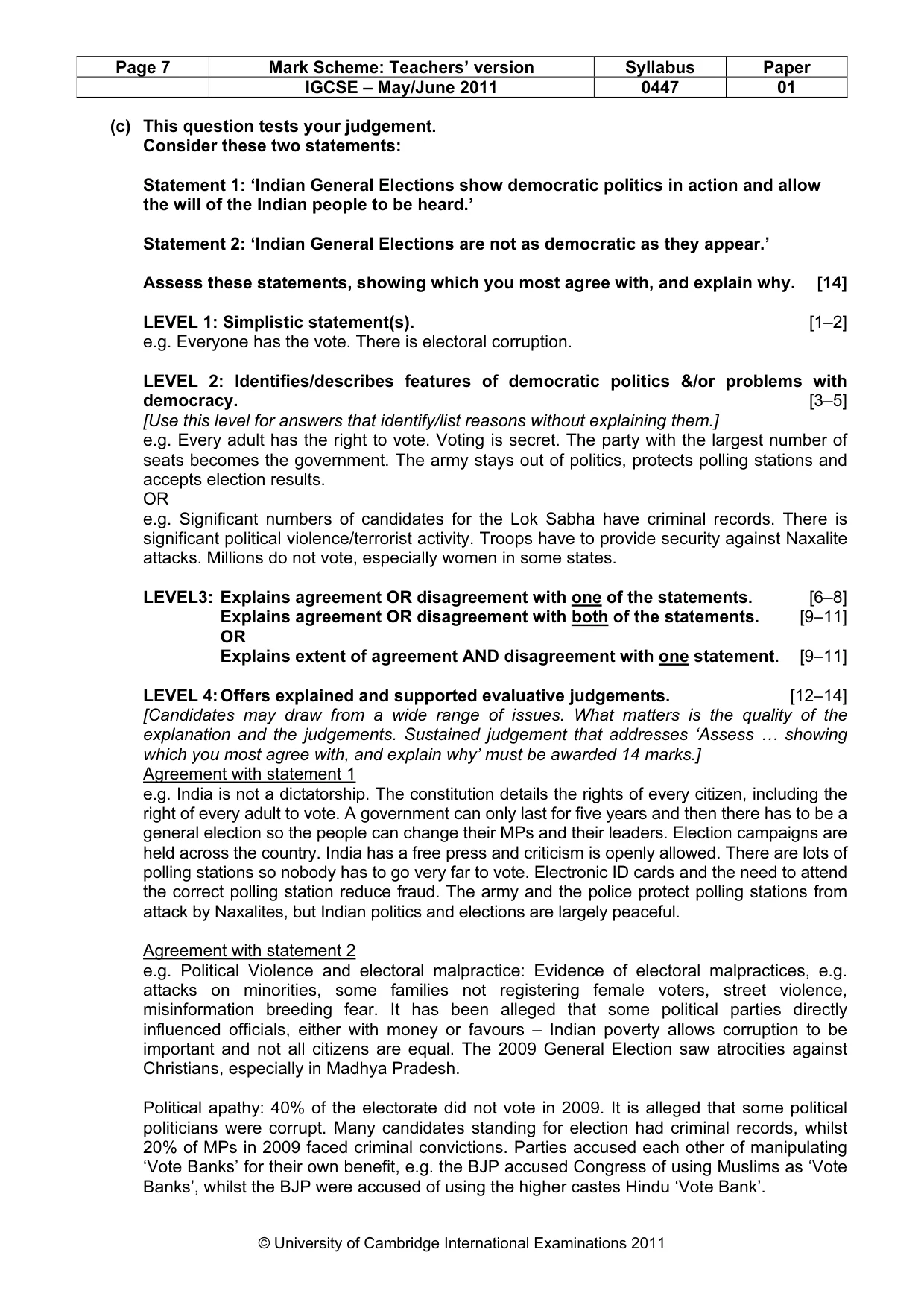
Page 7 Mark Scheme: Teachers’ version Syllabus Paper IGCSE – May/June 2011 0447 01 © University of Cambridge International Examinations 2011 (c) This question tests your judgement. Consider these two statements: Statement 1: ‘Indian General Elections show democratic politics in action and allow the will of the Indian people to be heard.’ Statement 2: ‘Indian General Elections are not as democratic as they appear.’ Assess these statements, showing which you most agree with, and explain why. [14] LEVEL 1: Simplistic statement(s). [1–2] e.g. Everyone has the vote. There is electoral corruption. LEVEL 2: Identifies/describes features of democratic politics &/or problems with democracy. [3–5] [Use this level for answers that identify/list reasons without explaining them.] e.g. Every adult has the right to vote. Voting is secret. The party with the largest number of seats becomes the government. The army stays out of politics, protects polling stations and accepts election results. OR e.g. Significant numbers of candidates for the Lok Sabha have criminal records. There is significant political violence/terrorist activity. Troops have to provide security against Naxalite attacks. Millions do not vote, especially women in some states. LEVEL3: Explains agreement OR disagreement with one of the statements. [6–8] Explains agreement OR disagreement with both of the statements. [9–11] OR Explains extent of agreement AND disagreement with one statement. [9–11] LEVEL 4: Offers explained and supported evaluative judgements. [12–14] [Candidates may draw from a wide range of issues. What matters is the quality of the explanation and the judgements. Sustained judgement that addresses ‘Assess … showing which you most agree with, and explain why’ must be awarded 14 marks.] Agreement with statement 1 e.g. India is not a dictatorship. The constitution details the rights of every citizen, including the right of every adult to vote. A government can only last for five years and then there has to be a general election so the people can change their MPs and their leaders. Election campaigns are held across the country. India has a free press and criticism is openly allowed. There are lots of polling stations so nobody has to go very far to vote. Electronic ID cards and the need to attend the correct polling station reduce fraud. The army and the police protect polling stations from attack by Naxalites, but Indian politics and elections are largely peaceful. Agreement with statement 2 e.g. Political Violence and electoral malpractice: Evidence of electoral malpractices, e.g. attacks on minorities, some families not registering female voters, street violence, misinformation breeding fear. It has been alleged that some political parties directly influenced officials, either with money or favours – Indian poverty allows corruption to be important and not all citizens are equal. The 2009 General Election saw atrocities against Christians, especially in Madhya Pradesh. Political apathy: 40% of the electorate did not vote in 2009. It is alleged that some political politicians were corrupt. Many candidates standing for election had criminal records, whilst 20% of MPs in 2009 faced criminal convictions. Parties accused each other of manipulating ‘Vote Banks’ for their own benefit, e.g. the BJP accused Congress of using Muslims as ‘Vote Banks’, whilst the BJP were accused of using the higher castes Hindu ‘Vote Bank’.
Mark scheme, page 8
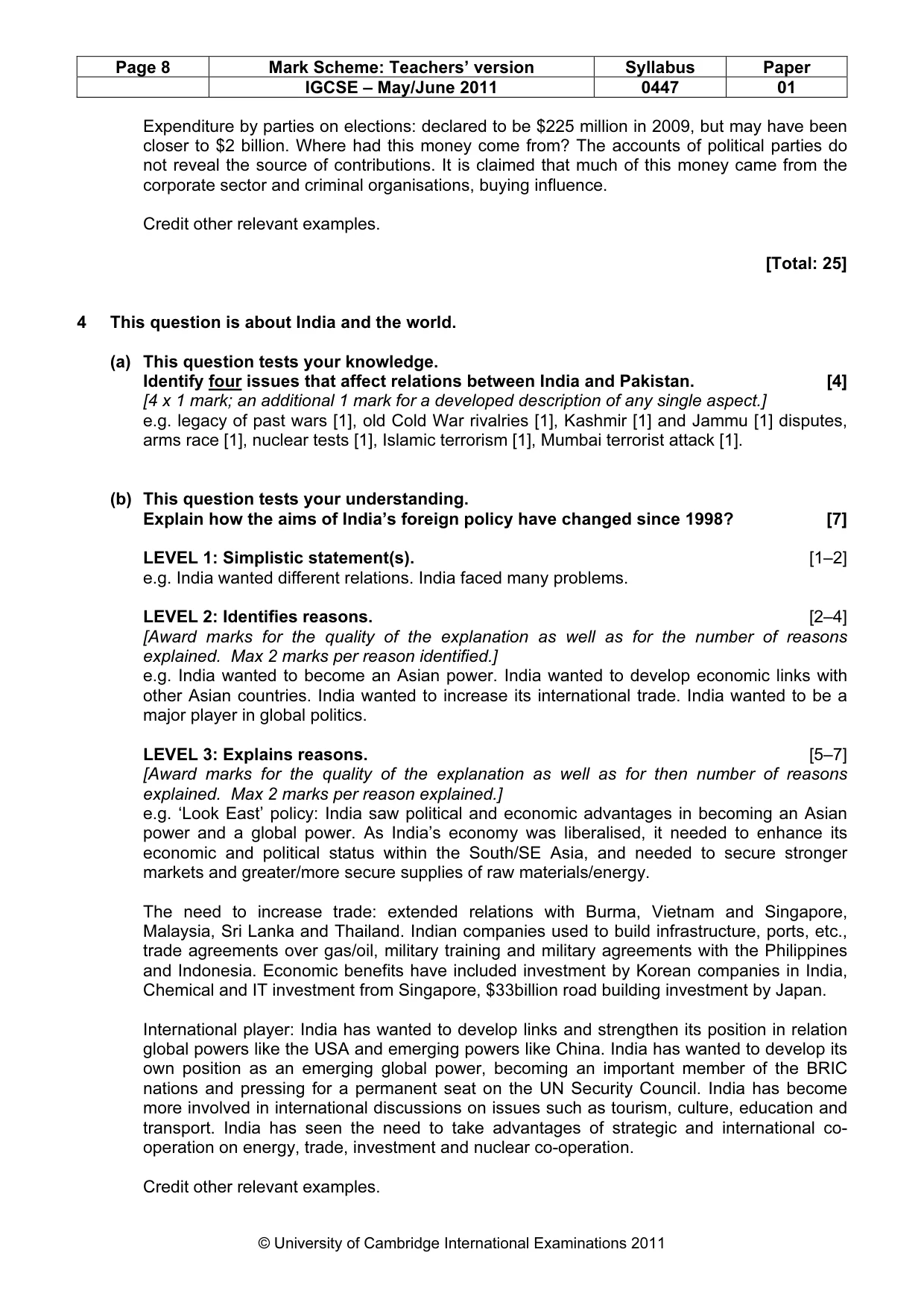
Page 8 Mark Scheme: Teachers’ version Syllabus Paper IGCSE – May/June 2011 0447 01 © University of Cambridge International Examinations 2011 Expenditure by parties on elections: declared to be $225 million in 2009, but may have been closer to $2 billion. Where had this money come from? The accounts of political parties do not reveal the source of contributions. It is claimed that much of this money came from the corporate sector and criminal organisations, buying influence. Credit other relevant examples. [Total: 25] 4 This question is about India and the world. (a) This question tests your knowledge. Identify four issues that affect relations between India and Pakistan. [4] [4 x 1 mark; an additional 1 mark for a developed description of any single aspect.] e.g. legacy of past wars [1], old Cold War rivalries [1], Kashmir [1] and Jammu [1] disputes, arms race [1], nuclear tests [1], Islamic terrorism [1], Mumbai terrorist attack [1]. (b) This question tests your understanding. Explain how the aims of India’s foreign policy have changed since 1998? [7] LEVEL 1: Simplistic statement(s). [1–2] e.g. India wanted different relations. India faced many problems. LEVEL 2: Identifies reasons. [2–4] [Award marks for the quality of the explanation as well as for the number of reasons explained. Max 2 marks per reason identified.] e.g. India wanted to become an Asian power. India wanted to develop economic links with other Asian countries. India wanted to increase its international trade. India wanted to be a major player in global politics. LEVEL 3: Explains reasons. [5–7] [Award marks for the quality of the explanation as well as for then number of reasons explained. Max 2 marks per reason explained.] e.g. ‘Look East’ policy: India saw political and economic advantages in becoming an Asian power and a global power. As India’s economy was liberalised, it needed to enhance its economic and political status within the South/SE Asia, and needed to secure stronger markets and greater/more secure supplies of raw materials/energy. The need to increase trade: extended relations with Burma, Vietnam and Singapore, Malaysia, Sri Lanka and Thailand. Indian companies used to build infrastructure, ports, etc., trade agreements over gas/oil, military training and military agreements with the Philippines and Indonesia. Economic benefits have included investment by Korean companies in India, Chemical and IT investment from Singapore, $33billion road building investment by Japan. International player: India has wanted to develop links and strengthen its position in relation global powers like the USA and emerging powers like China. India has wanted to develop its own position as an emerging global power, becoming an important member of the BRIC nations and pressing for a permanent seat on the UN Security Council. India has become more involved in international discussions on issues such as tourism, culture, education and transport. India has seen the need to take advantages of strategic and international co- operation on energy, trade, investment and nuclear co-operation. Credit other relevant examples.
Mark scheme, page 9
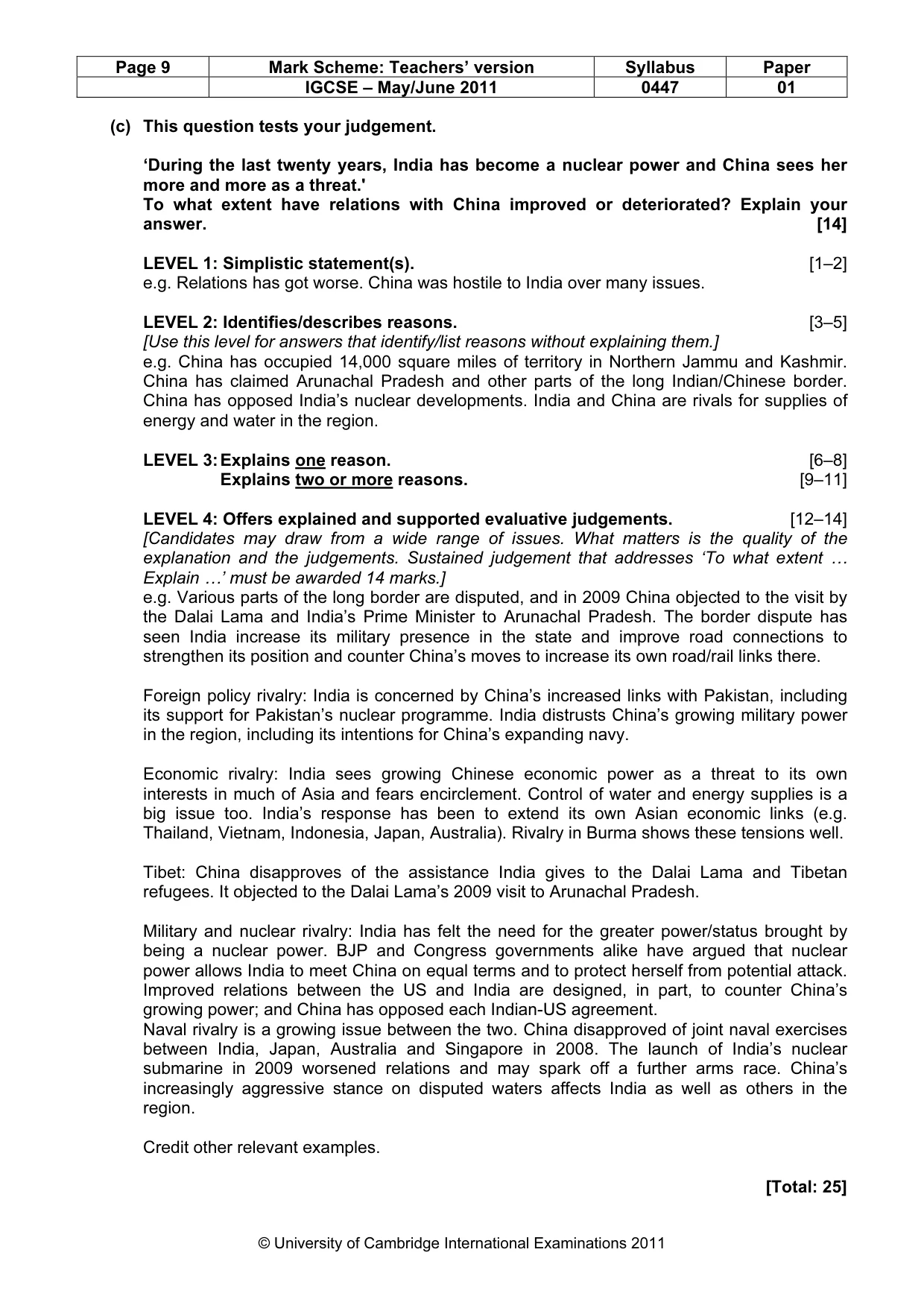
Page 9 Mark Scheme: Teachers’ version Syllabus Paper IGCSE – May/June 2011 0447 01 © University of Cambridge International Examinations 2011 (c) This question tests your judgement. ‘During the last twenty years, India has become a nuclear power and China sees her more and more as a threat.' To what extent have relations with China improved or deteriorated? Explain your answer. [14] LEVEL 1: Simplistic statement(s). [1–2] e.g. Relations has got worse. China was hostile to India over many issues. LEVEL 2: Identifies/describes reasons. [3–5] [Use this level for answers that identify/list reasons without explaining them.] e.g. China has occupied 14,000 square miles of territory in Northern Jammu and Kashmir. China has claimed Arunachal Pradesh and other parts of the long Indian/Chinese border. China has opposed India’s nuclear developments. India and China are rivals for supplies of energy and water in the region. LEVEL 3: Explains one reason. [6–8] Explains two or more reasons. [9–11] LEVEL 4: Offers explained and supported evaluative judgements. [12–14] [Candidates may draw from a wide range of issues. What matters is the quality of the explanation and the judgements. Sustained judgement that addresses ‘To what extent … Explain …’ must be awarded 14 marks.] e.g. Various parts of the long border are disputed, and in 2009 China objected to the visit by the Dalai Lama and India’s Prime Minister to Arunachal Pradesh. The border dispute has seen India increase its military presence in the state and improve road connections to strengthen its position and counter China’s moves to increase its own road/rail links there. Foreign policy rivalry: India is concerned by China’s increased links with Pakistan, including its support for Pakistan’s nuclear programme. India distrusts China’s growing military power in the region, including its intentions for China’s expanding navy. Economic rivalry: India sees growing Chinese economic power as a threat to its own interests in much of Asia and fears encirclement. Control of water and energy supplies is a big issue too. India’s response has been to extend its own Asian economic links (e.g. Thailand, Vietnam, Indonesia, Japan, Australia). Rivalry in Burma shows these tensions well. Tibet: China disapproves of the assistance India gives to the Dalai Lama and Tibetan refugees. It objected to the Dalai Lama’s 2009 visit to Arunachal Pradesh. Military and nuclear rivalry: India has felt the need for the greater power/status brought by being a nuclear power. BJP and Congress governments alike have argued that nuclear power allows India to meet China on equal terms and to protect herself from potential attack. Improved relations between the US and India are designed, in part, to counter China’s growing power; and China has opposed each Indian-US agreement. Naval rivalry is a growing issue between the two. China disapproved of joint naval exercises between India, Japan, Australia and Singapore in 2008. The launch of India’s nuclear submarine in 2009 worsened relations and may spark off a further arms race. China’s increasingly aggressive stance on disputed waters affects India as well as others in the region. Credit other relevant examples. [Total: 25]
What you needed in this session
Cambridge’s own grade thresholds for 2011 May/June, Paper 1 · Variant 1. A higher threshold means an easier paper — the bar moves with how the cohort did.