Cambridge IGCSE India Studies 0447 — 2015 May/June Paper 2 · Variant 1
0447/21/M/J/15 · 3 questions · 60 marks · ≈68 min
The question paper and its mark scheme, free to read here and free to download. This is Cambridge’s own paper, exactly as it was sat.
Question paper4 pages

Mark scheme6 pages
Answers below. Sit the paper first if you are practising.
Questions as text
Q1 · This question is about environmental sustainability
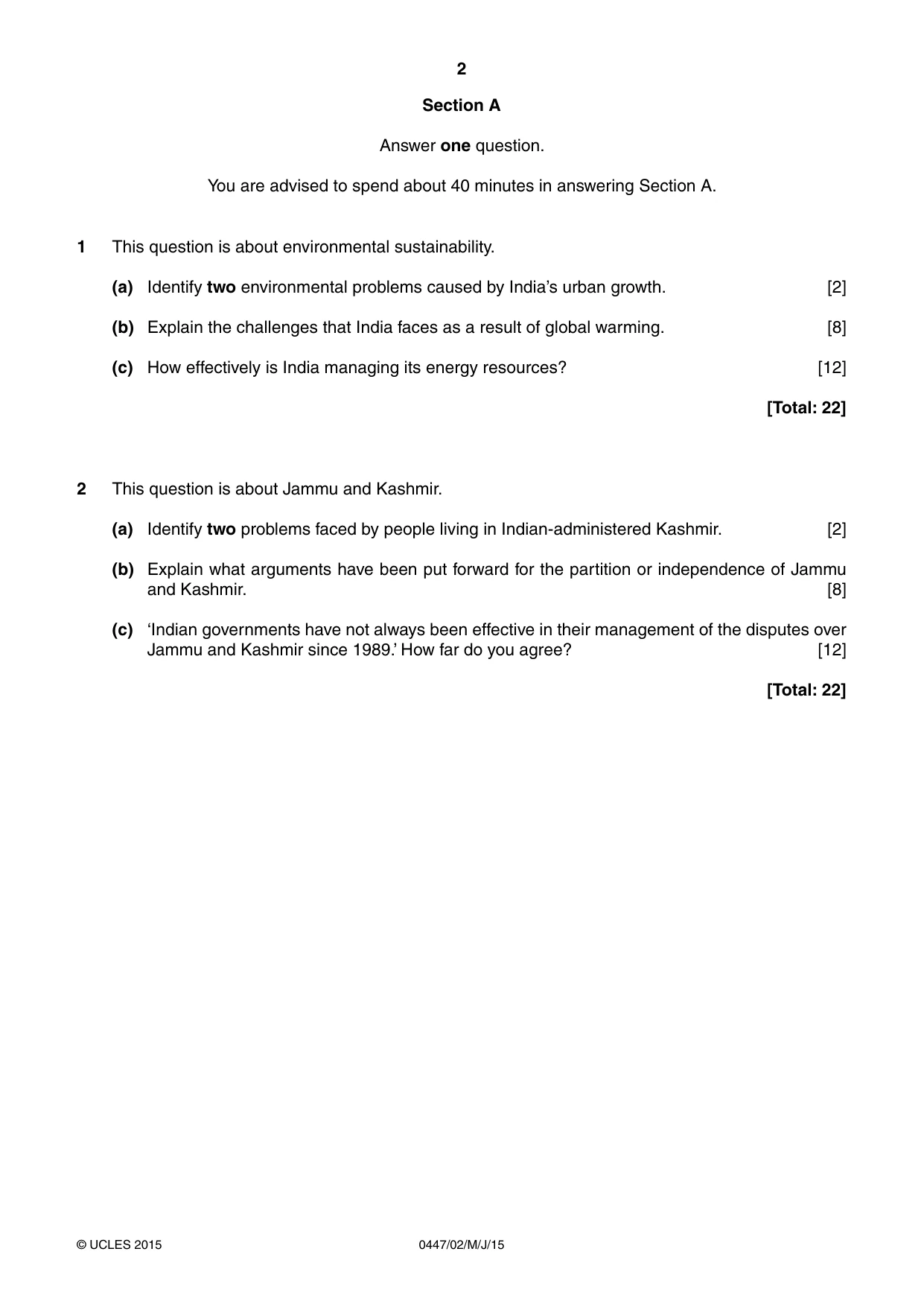
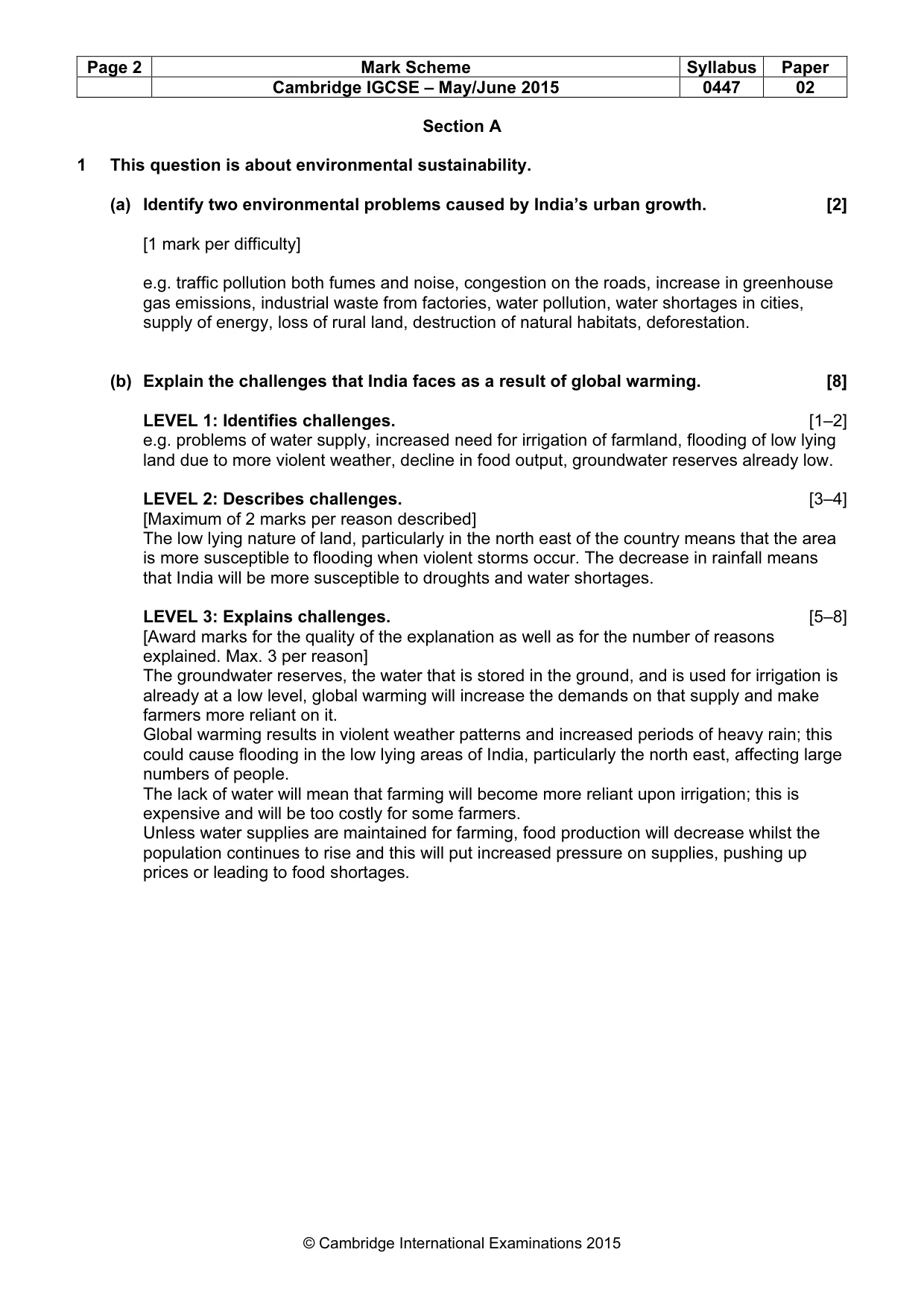
1 This question is about environmental sustainability. (a) Identify two environmental problems caused by India’s urban growth. [2] (b) Explain the challenges that India faces as a result of global warming. [8] (c) How effectively is India managing its energy resources? [12] [Total: 22]
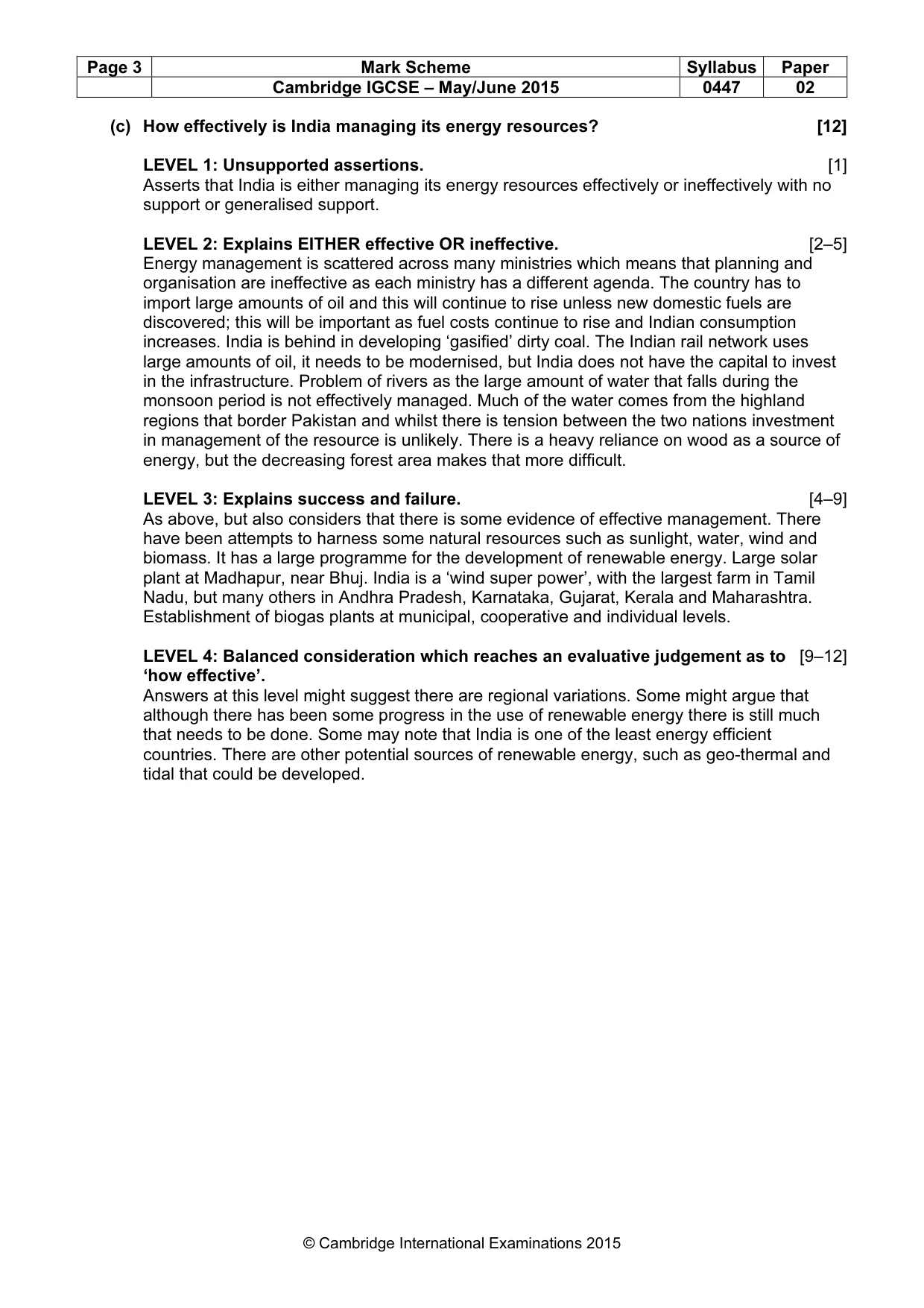
Mark scheme: 1 This question is about environmental sustainability. (a) Identify two environmental problems caused by India’s urban growth. [2] [1 mark per difficulty] e.g. traffic pollution both fumes and noise, congestion on the roads, increase in greenhouse gas emissions, industrial waste from factories, water pollution, water shortages in cities, supply of energy, loss of rural land, destruction of natural habitats, deforestation. (b) Explain the challenges that India faces as a result of global warming. [8] LEVEL 1: Identifies challenges. [1–2] e.g. problems of water supply, increased need for irrigation of farmland, flooding of low lying land due to more violent weather, decline in food output, groundwater reserves already low. LEVEL 2: Describes challenges. [3–4] [Maximum of 2 marks per reason described] The low lying nature of land, particularly in the north east of the country means that the area is more susceptible to flooding when violent storms occur. The decrease in rainfall means that India will be more susceptible to droughts and water shortages. LEVEL 3: Explains challenges. [5–8] [Award marks for the quality of the explanation as well as for the number of reasons explained. Max. 3 per reason] The groundwater reserves, the water that is stored in the ground, and is used for irrigation is already at a low level, global warming will increase the demands on that supply and make farmers more reliant on it. Global warming results in violent weather patterns and increased periods of heavy rain; this could cause flooding in the low lying areas of India, particularly the north east, affecting large numbers of people. The lack of water will mean that farming will become more reliant upon irrigation; this is expensive and will be too costly for some farmers. Unless water supplies are maintained for farming, food production will decrease whilst the population continues to rise and this will put increased pressure on supplies, pushing up prices or leading to food shortages. (c) How effectively is India managing its energy resources? [12] LEVEL 1: Unsupported assertions. [1] Asserts that India is either managing its energy resources effectively or ineffectively with no support or generalised support. LEVEL 2: Explains EITHER effective OR ineffective. [2–5] Energy management is scattered across many ministries which means that planning and organisation are ineffective as each ministry has a different agenda. The country has to import large amounts of oil and this will continue to rise unless new domestic fuels are discovered; this will be important as fuel costs continue to rise and Indian consumption increases. India is behind in developing ‘gasified’ dirty coal. The Indian rail network uses large amounts of oil, it needs to be modernised, but India does not have the capital to invest in the infrastructure. Problem of rivers as the large amount of water that falls during the monsoon period is not effectively managed. Much of the water comes from the highland regions that border Pakistan and whilst there is tension between the two nations investment in management of the resource is unlikely. There is a heavy reliance on wood as a source of energy, but the decreasing forest area makes that more difficult. LEVEL 3: Explains success and failure. [4–9] As above, but also considers that there is some evidence of effective management. There have been attempts to harness some natural resources such as sunlight, water, wind and biomass. It has a large programme for the development of renewable energy. Large solar plant at Madhapur, near Bhuj. India is a ‘wind super power’, with the largest farm in Tamil Nadu, but many others in Andhra Pradesh, Karnataka, Gujarat, Kerala and Maharashtra. Establishment of biogas plants at municipal, cooperative and individual levels. LEVEL 4: Balanced consideration which reaches an evaluative judgement as to [9–12] ‘how effective’. Answers at this level might suggest there are regional variations. Some might argue that although there has been some progress in the use of renewable energy there is still much that needs to be done. Some may note that India is one of the least energy efficient countries. There are other potential sources of renewable energy, such as geo-thermal and tidal that could be developed.
Q2 · This question is about Jammu and Kashmir
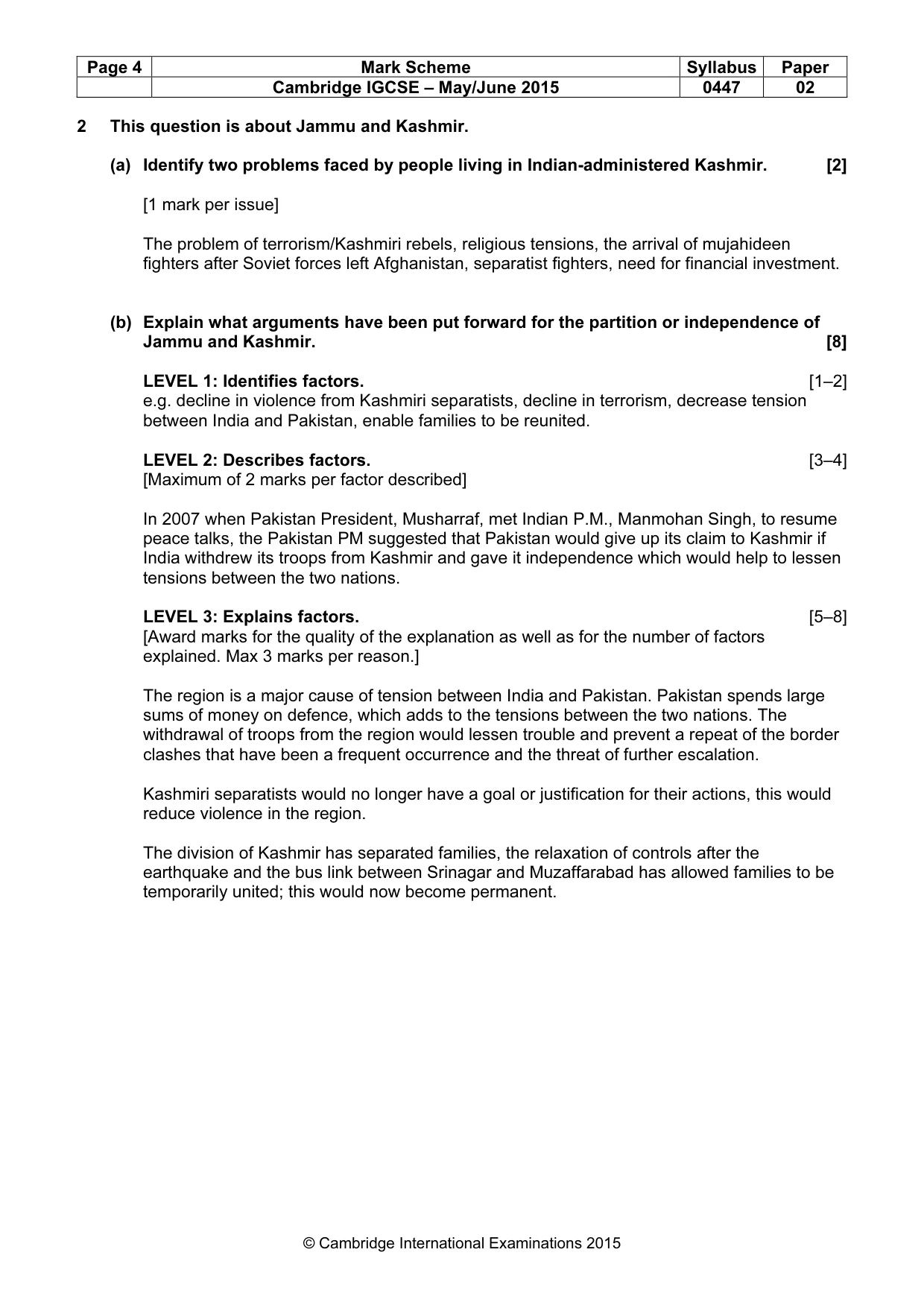
2 This question is about Jammu and Kashmir. (a) Identify two problems faced by people living in Indian-administered Kashmir. [2] (b) Explain what arguments have been put forward for the partition or independence of Jammu and Kashmir. [8] (c) ‘Indian governments have not always been effective in their management of the disputes over Jammu and Kashmir since 1989.’ How far do you agree? [12] [Total: 22]
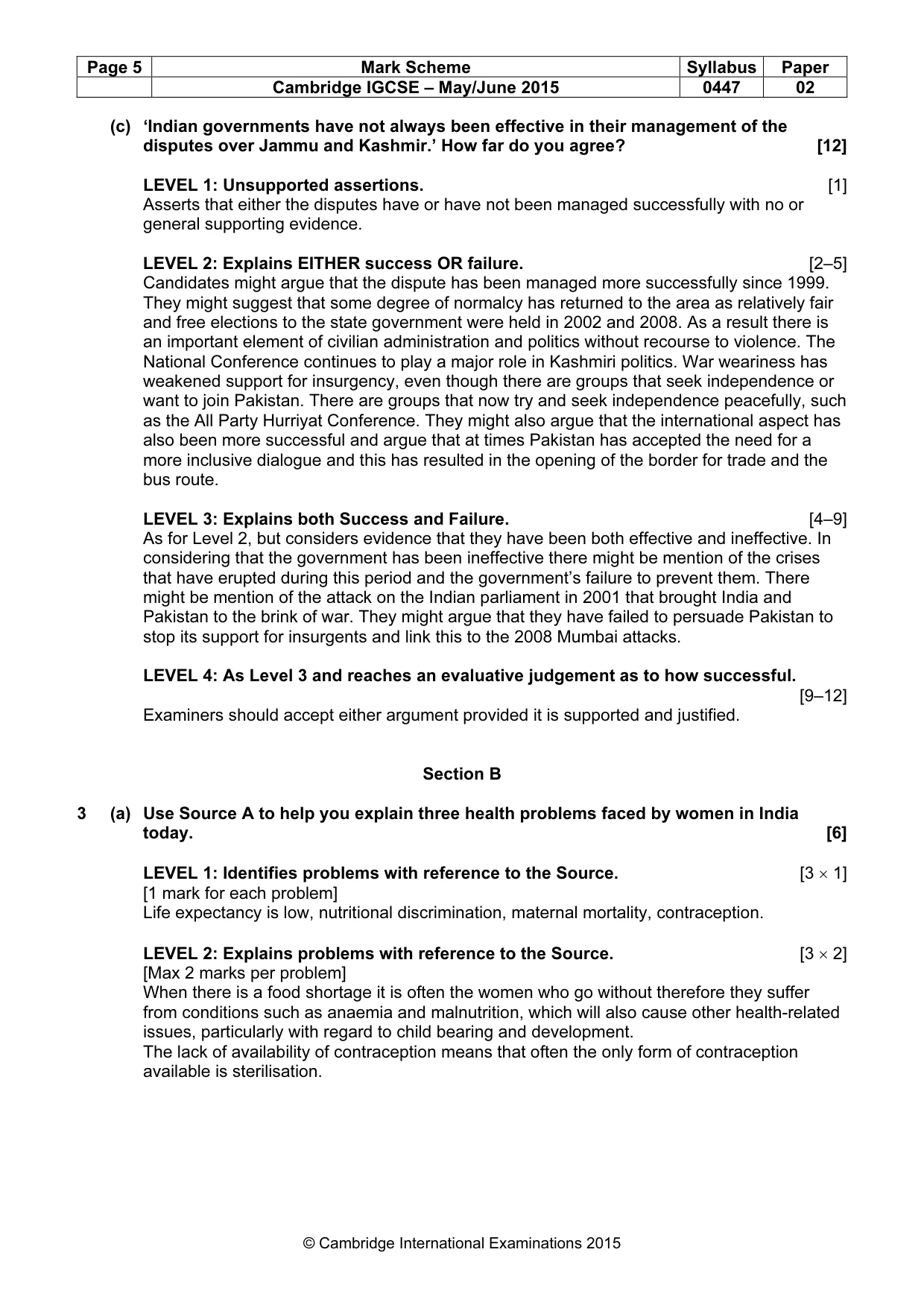
Mark scheme: 2 This question is about Jammu and Kashmir. (a) Identify two problems faced by people living in Indian-administered Kashmir. [2] [1 mark per issue] The problem of terrorism/Kashmiri rebels, religious tensions, the arrival of mujahideen fighters after Soviet forces left Afghanistan, separatist fighters, need for financial investment. (b) Explain what arguments have been put forward for the partition or independence of Jammu and Kashmir. [8] LEVEL 1: Identifies factors. [1–2] e.g. decline in violence from Kashmiri separatists, decline in terrorism, decrease tension between India and Pakistan, enable families to be reunited. LEVEL 2: Describes factors. [3–4] [Maximum of 2 marks per factor described] In 2007 when Pakistan President, Musharraf, met Indian P.M., Manmohan Singh, to resume peace talks, the Pakistan PM suggested that Pakistan would give up its claim to Kashmir if India withdrew its troops from Kashmir and gave it independence which would help to lessen tensions between the two nations. LEVEL 3: Explains factors. [5–8] [Award marks for the quality of the explanation as well as for the number of factors explained. Max 3 marks per reason.] The region is a major cause of tension between India and Pakistan. Pakistan spends large sums of money on defence, which adds to the tensions between the two nations. The withdrawal of troops from the region would lessen trouble and prevent a repeat of the border clashes that have been a frequent occurrence and the threat of further escalation. Kashmiri separatists would no longer have a goal or justification for their actions, this would reduce violence in the region. The division of Kashmir has separated families, the relaxation of controls after the earthquake and the bus link between Srinagar and Muzaffarabad has allowed families to be temporarily united; this would now become permanent. (c) ‘Indian governments have not always been effective in their management of the disputes over Jammu and Kashmir.’ How far do you agree? [12] LEVEL 1: Unsupported assertions. [1] Asserts that either the disputes have or have not been managed successfully with no or general supporting evidence. LEVEL 2: Explains EITHER success OR failure. [2–5] Candidates might argue that the dispute has been managed more successfully since 1999. They might suggest that some degree of normalcy has returned to the area as relatively fair and free elections to the state government were held in 2002 and 2008. As a result there is an important element of civilian administration and politics without recourse to violence. The National Conference continues to play a major role in Kashmiri politics. War weariness has weakened support for insurgency, even though there are groups that seek independence or want to join Pakistan. There are groups that now try and seek independence peacefully, such as the All Party Hurriyat Conference. They might also argue that the international aspect has also been more successful and argue that at times Pakistan has accepted the need for a more inclusive dialogue and this has resulted in the opening of the border for trade and the bus route. LEVEL 3: Explains both Success and Failure. [4–9] As for Level 2, but considers evidence that they have been both effective and ineffective. In considering that the government has been ineffective there might be mention of the crises that have erupted during this period and the government’s failure to prevent them. There might be mention of the attack on the Indian parliament in 2001 that brought India and Pakistan to the brink of war. They might argue that they have failed to persuade Pakistan to stop its support for insurgents and link this to the 2008 Mumbai attacks. LEVEL 4: As Level 3 and reaches an evaluative judgement as to how successful. [9–12] Examiners should accept either argument provided it is supported and justified. Section B
Q3 · Use Source A to help you explain three health problems faced by women in India today
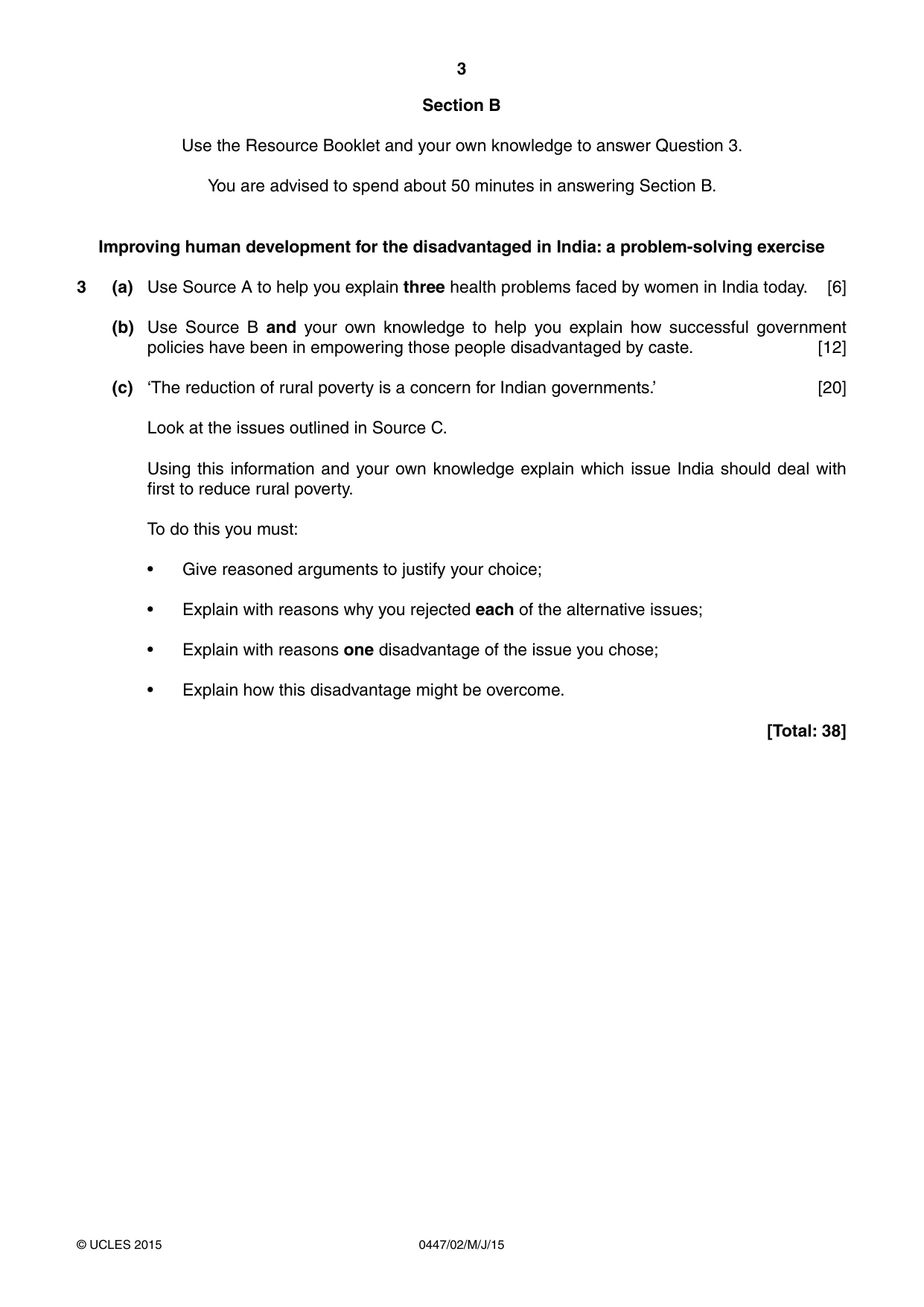
3 (a) Use Source A to help you explain three health problems faced by women in India today. [6] (b) Use Source B and your own knowledge to help you explain how successful government policies have been in empowering those people disadvantaged by caste. [12] (c) ‘The reduction of rural poverty is a concern for Indian governments.’ [20] Look at the issues outlined in Source C. Using this information and your own knowledge explain which issue India should deal with first to reduce rural poverty. To do this you must: • Give reasoned arguments to justify your choice; • Explain with reasons why you rejected each of the alternative issues; • Explain with reasons one disadvantage of the issue you chose; • Explain how this disadvantage might be overcome. [Total: 38]
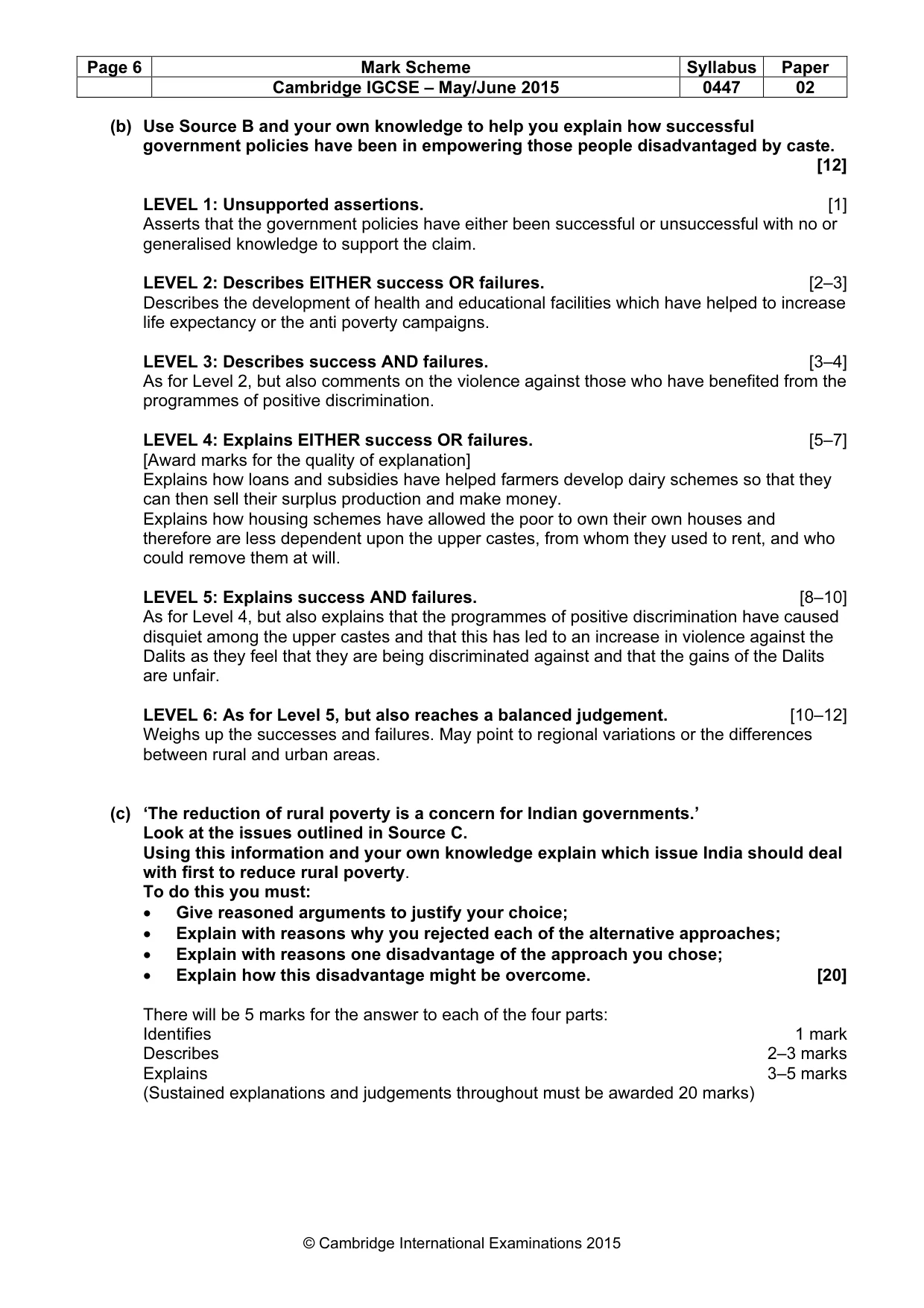
Mark scheme: 3 (a) Use Source A to help you explain three health problems faced by women in India today. [6] LEVEL 1: Identifies problems with reference to the Source. [3 × 1] [1 mark for each problem] Life expectancy is low, nutritional discrimination, maternal mortality, contraception. LEVEL 2: Explains problems with reference to the Source. [3 × 2] [Max 2 marks per problem] When there is a food shortage it is often the women who go without therefore they suffer from conditions such as anaemia and malnutrition, which will also cause other health-related issues, particularly with regard to child bearing and development. The lack of availability of contraception means that often the only form of contraception available is sterilisation. (b) Use Source B and your own knowledge to help you explain how successful government policies have been in empowering those people disadvantaged by caste. [12] LEVEL 1: Unsupported assertions. [1] Asserts that the government policies have either been successful or unsuccessful with no or generalised knowledge to support the claim. LEVEL 2: Describes EITHER success OR failures. [2–3] Describes the development of health and educational facilities which have helped to increase life expectancy or the anti poverty campaigns. LEVEL 3: Describes success AND failures. [3–4] As for Level 2, but also comments on the violence against those who have benefited from the programmes of positive discrimination. LEVEL 4: Explains EITHER success OR failures. [5–7] [Award marks for the quality of explanation] Explains how loans and subsidies have helped farmers develop dairy schemes so that they can then sell their surplus production and make money. Explains how housing schemes have allowed the poor to own their own houses and therefore are less dependent upon the upper castes, from whom they used to rent, and who could remove them at will. LEVEL 5: Explains success AND failures. [8–10] As for Level 4, but also explains that the programmes of positive discrimination have caused disquiet among the upper castes and that this has led to an increase in violence against the Dalits as they feel that they are being discriminated against and that the gains of the Dalits are unfair. LEVEL 6: As for Level 5, but also reaches a balanced judgement. [10–12] Weighs up the successes and failures. May point to regional variations or the differences between rural and urban areas. (c) ‘The reduction of rural poverty is a concern for Indian governments.’ Look at the issues outlined in Source C. Using this information and your own knowledge explain which issue India should deal with first to reduce rural poverty. To do this you must: • Give reasoned arguments to justify your choice; • Explain with reasons why you rejected each of the alternative approaches; • Explain with reasons one disadvantage of the approach you chose; • Explain how this disadvantage might be overcome. [20] There will be 5 marks for the answer to each of the four parts: Identifies 1 mark Describes 2–3 marks Explains 3–5 marks (Sustained explanations and judgements throughout must be awarded 20 marks)
What you needed in this session
Cambridge’s own grade thresholds for 2015 May/June, Paper 2 · Variant 1. A higher threshold means an easier paper — the bar moves with how the cohort did.