Cambridge IGCSE India Studies 0447 — 2011 May/June Paper 2 · Variant 1
0447/21/M/J/11 · 3 questions · 60 marks · ≈68 min
The question paper and its mark scheme, free to read here and free to download. This is Cambridge’s own paper, exactly as it was sat.
Question paper4 pages
Mark scheme7 pages
Answers below. Sit the paper first if you are practising.
Questions as text
Q1 · This question is about empowering women
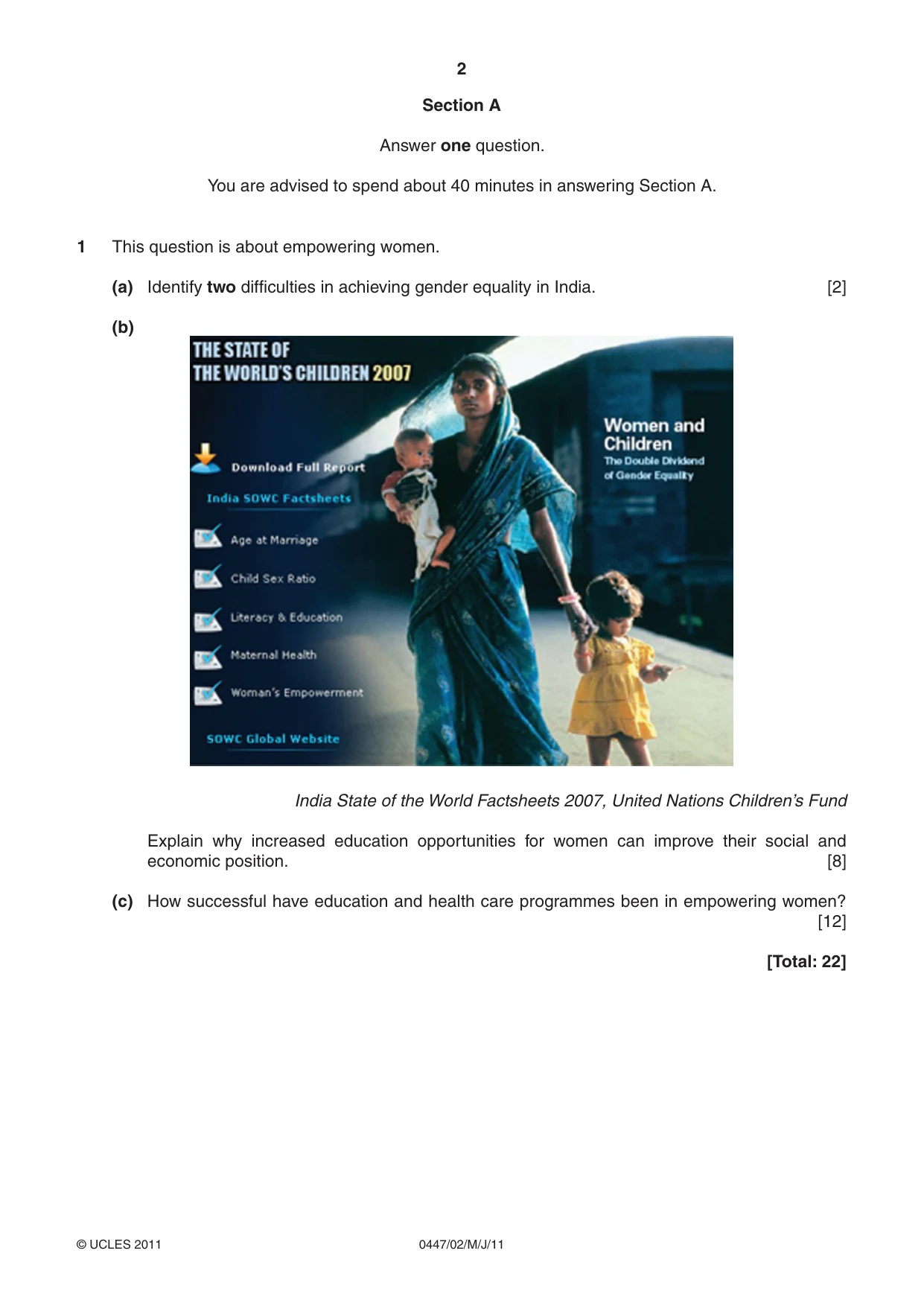
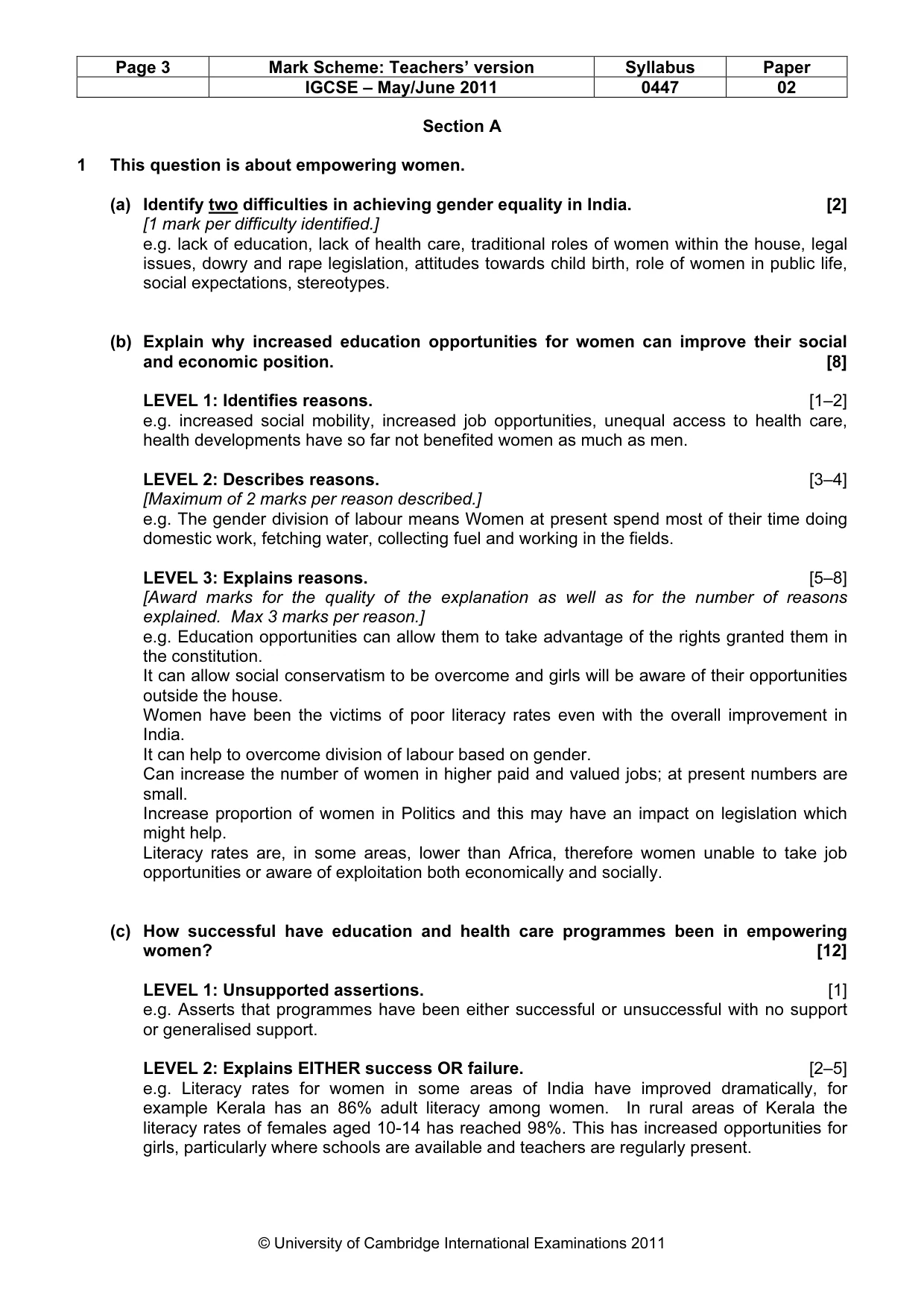
1 This question is about empowering women. (a) Identify two difficulties in achieving gender equality in India. [2] (b) India State of the World Factsheets 2007, United Nations Children’s Fund Explain why increased education opportunities for women can improve their social and economic position. [8] (c) How successful have education and health care programmes been in empowering women? [12] [Total: 22]
Mark scheme: 1 This question is about empowering women. (a) Identify two difficulties in achieving gender equality in India. [2] [1 mark per difficulty identified.] e.g. lack of education, lack of health care, traditional roles of women within the house, legal issues, dowry and rape legislation, attitudes towards child birth, role of women in public life, social expectations, stereotypes. (b) Explain why increased education opportunities for women can improve their social and economic position. [8] LEVEL 1: Identifies reasons. [1–2] e.g. increased social mobility, increased job opportunities, unequal access to health care, health developments have so far not benefited women as much as men. LEVEL 2: Describes reasons. [3–4] [Maximum of 2 marks per reason described.] e.g. The gender division of labour means Women at present spend most of their time doing domestic work, fetching water, collecting fuel and working in the fields. LEVEL 3: Explains reasons. [5–8] [Award marks for the quality of the explanation as well as for the number of reasons explained. Max 3 marks per reason.] e.g. Education opportunities can allow them to take advantage of the rights granted them in the constitution. It can allow social conservatism to be overcome and girls will be aware of their opportunities outside the house. Women have been the victims of poor literacy rates even with the overall improvement in India. It can help to overcome division of labour based on gender. Can increase the number of women in higher paid and valued jobs; at present numbers are small. Increase proportion of women in Politics and this may have an impact on legislation which might help. Literacy rates are, in some areas, lower than Africa, therefore women unable to take job opportunities or aware of exploitation both economically and socially. (c) How successful have education and health care programmes been in empowering women? [12] LEVEL 1: Unsupported assertions. [1] e.g. Asserts that programmes have been either successful or unsuccessful with no support or generalised support. LEVEL 2: Explains EITHER success OR failure. [2–5] e.g. Literacy rates for women in some areas of India have improved dramatically, for example Kerala has an 86% adult literacy among women. In rural areas of Kerala the literacy rates of females aged 10-14 has reached 98%. This has increased opportunities for girls, particularly where schools are available and teachers are regularly present. IGCSE – May/June 2011 0447 02 LEVEL 3: Explains success AND failure. [4–9] As above, but for example also considers that there have been failures and that the success is not countrywide. In these answers there may be consideration of regional variations. Across India the figures for attendance of girls aged 10-14 is only 42% and even lower for 5- 9 year olds. LEVEL 4: Balanced consideration which reaches an evaluative judgement. [9–12] e.g. Answers at this level are likely to suggest that there are regional variations and that much depends upon the history and tradition of the region. It is noticeable that the south has a better record and that there is no correlation between regional wealth and success; this is shown by the poor records of Punjab and Haryana. [Total: 22]
Q2 · This question is about Jammu and Kashmir
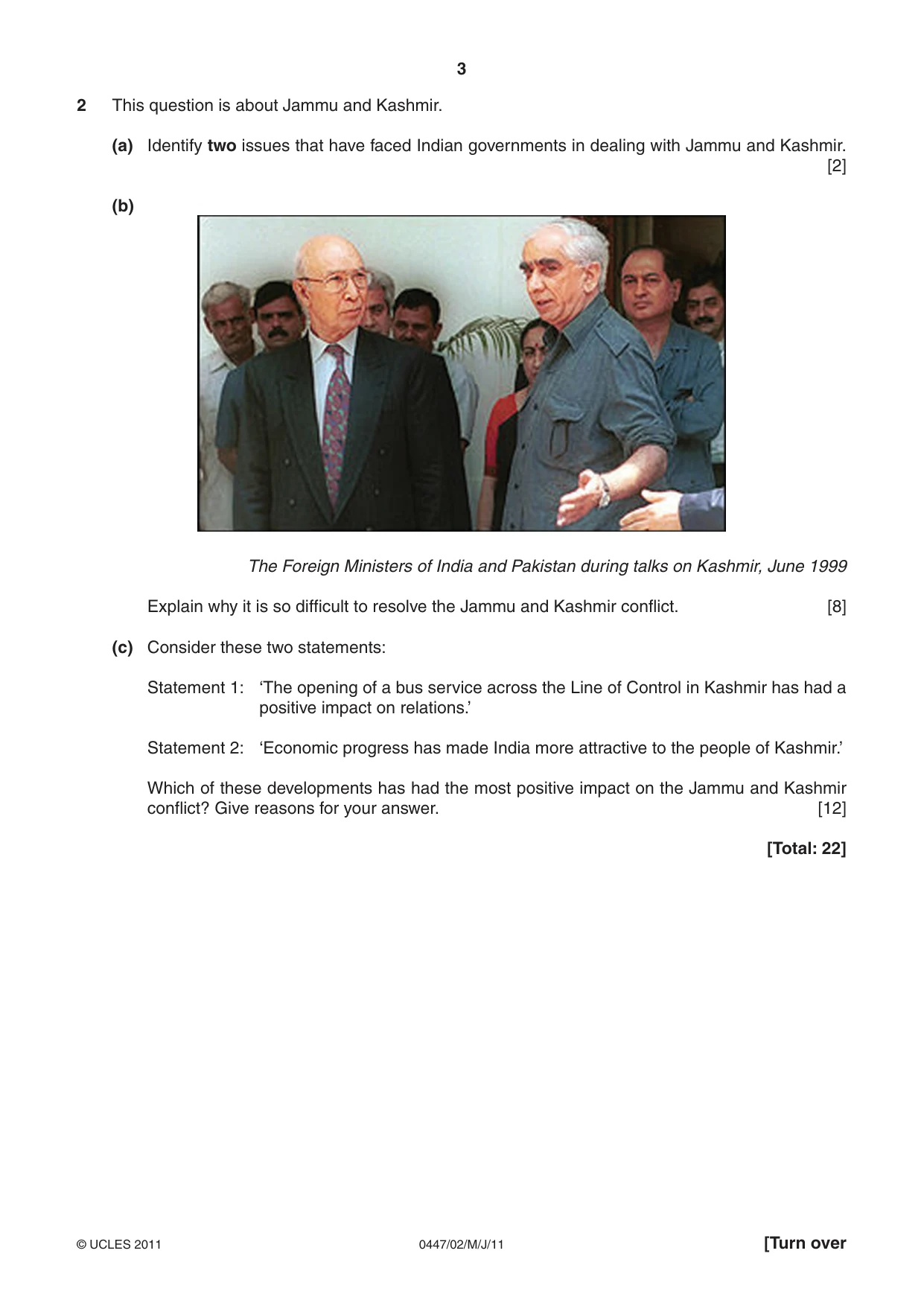
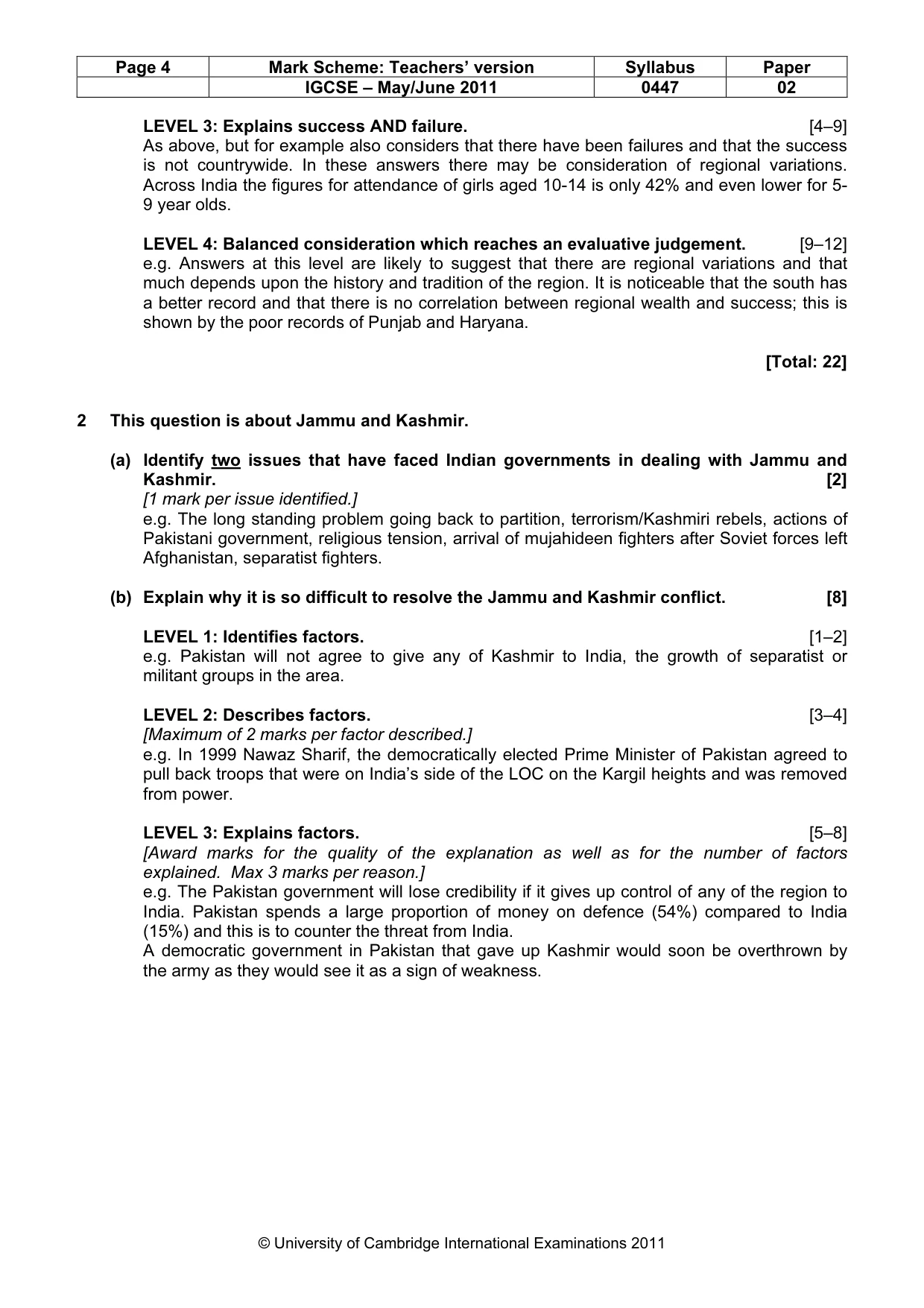
2 This question is about Jammu and Kashmir. (a) Identify two issues that have faced Indian governments in dealing with Jammu and Kashmir. [2] (b) The Foreign Ministers of India and Pakistan during talks on Kashmir, June 1999 Explain why it is so difficult to resolve the Jammu and Kashmir conflict. [8] (c) Consider these two statements: Statement 1: ‘The opening of a bus service across the Line of Control in Kashmir has had a positive impact on relations.’ Statement 2: ‘Economic progress has made India more attractive to the people of Kashmir.’ Which of these developments has had the most positive impact on the Jammu and Kashmir conflict? Give reasons for your answer. [12] [Total: 22]
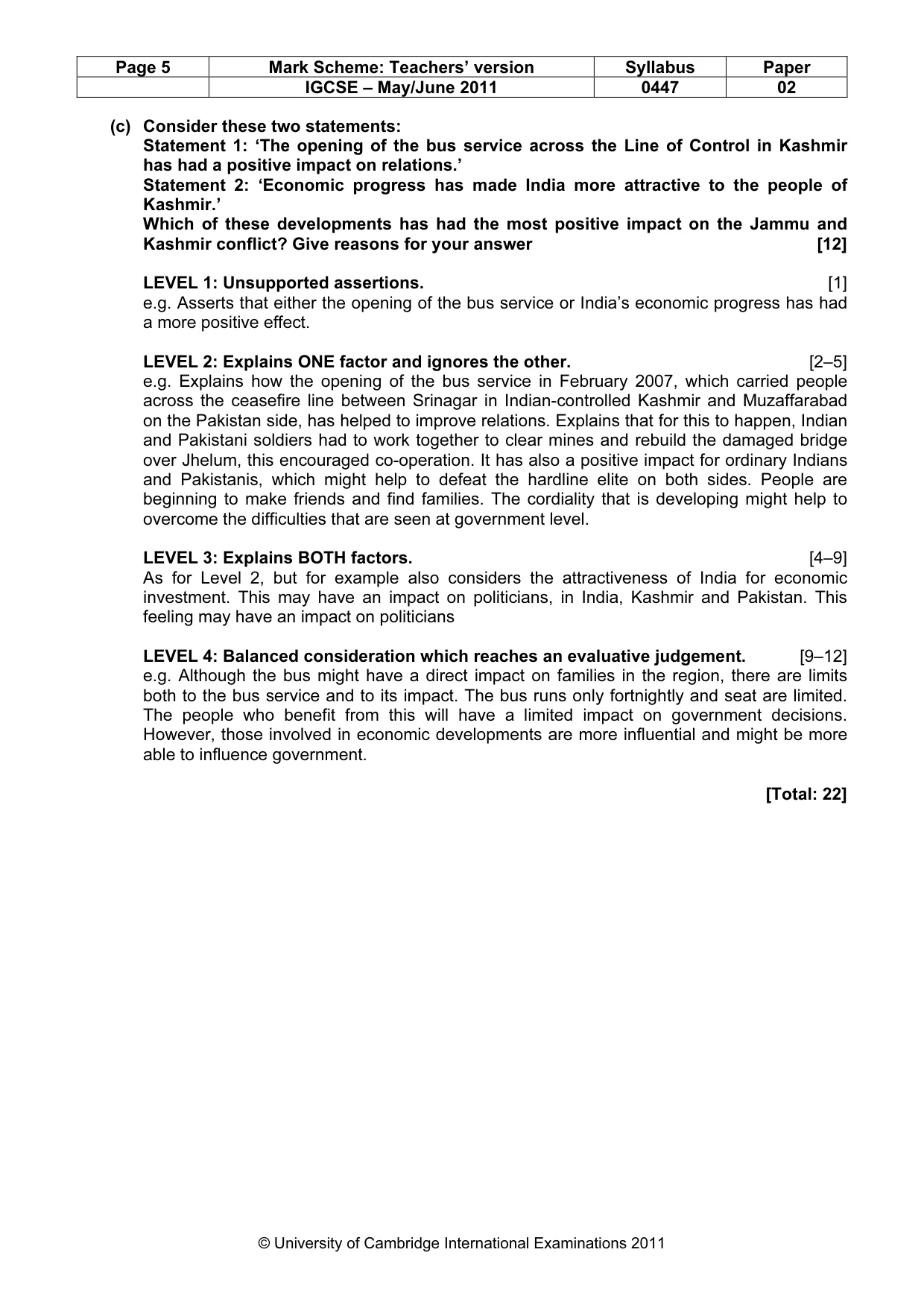
Mark scheme: 2 This question is about Jammu and Kashmir. (a) Identify two issues that have faced Indian governments in dealing with Jammu and Kashmir. [2] [1 mark per issue identified.] e.g. The long standing problem going back to partition, terrorism/Kashmiri rebels, actions of Pakistani government, religious tension, arrival of mujahideen fighters after Soviet forces left Afghanistan, separatist fighters. (b) Explain why it is so difficult to resolve the Jammu and Kashmir conflict. [8] LEVEL 1: Identifies factors. [1–2] e.g. Pakistan will not agree to give any of Kashmir to India, the growth of separatist or militant groups in the area. LEVEL 2: Describes factors. [3–4] [Maximum of 2 marks per factor described.] e.g. In 1999 Nawaz Sharif, the democratically elected Prime Minister of Pakistan agreed to pull back troops that were on India’s side of the LOC on the Kargil heights and was removed from power. LEVEL 3: Explains factors. [5–8] [Award marks for the quality of the explanation as well as for the number of factors explained. Max 3 marks per reason.] e.g. The Pakistan government will lose credibility if it gives up control of any of the region to India. Pakistan spends a large proportion of money on defence (54%) compared to India (15%) and this is to counter the threat from India. A democratic government in Pakistan that gave up Kashmir would soon be overthrown by the army as they would see it as a sign of weakness. IGCSE – May/June 2011 0447 02 (c) Consider these two statements: Statement 1: ‘The opening of the bus service across the Line of Control in Kashmir has had a positive impact on relations.’ Statement 2: ‘Economic progress has made India more attractive to the people of Kashmir.’ Which of these developments has had the most positive impact on the Jammu and Kashmir conflict? Give reasons for your answer [12] LEVEL 1: Unsupported assertions. [1] e.g. Asserts that either the opening of the bus service or India’s economic progress has had a more positive effect. LEVEL 2: Explains ONE factor and ignores the other. [2–5] e.g. Explains how the opening of the bus service in February 2007, which carried people across the ceasefire line between Srinagar in Indian-controlled Kashmir and Muzaffarabad on the Pakistan side, has helped to improve relations. Explains that for this to happen, Indian and Pakistani soldiers had to work together to clear mines and rebuild the damaged bridge over Jhelum, this encouraged co-operation. It has also a positive impact for ordinary Indians and Pakistanis, which might help to defeat the hardline elite on both sides. People are beginning to make friends and find families. The cordiality that is developing might help to overcome the difficulties that are seen at government level. LEVEL 3: Explains BOTH factors. [4–9] As for Level 2, but for example also considers the attractiveness of India for economic investment. This may have an impact on politicians, in India, Kashmir and Pakistan. This feeling may have an impact on politicians LEVEL 4: Balanced consideration which reaches an evaluative judgement. [9–12] e.g. Although the bus might have a direct impact on families in the region, there are limits both to the bus service and to its impact. The bus runs only fortnightly and seat are limited. The people who benefit from this will have a limited impact on government decisions. However, those involved in economic developments are more influential and might be more able to influence government. [Total: 22] IGCSE – May/June 2011 0447 02 Section B
Q3 · Use Source A to help you explain three problems in solving India’s drinking water supply
3 (a) Use Source A to help you explain three problems in solving India’s drinking water supply. [6] (b) Since the 1990s there has been a considerable increase in rural water supply. Use Source B and your own knowledge to help you explain how successful this programme has been. [12] (c) Meeting the needs of rural India is a challenging task. Look at the three possible approaches suggested in Source C. Using the information there and your own knowledge, explain which proposal you consider to be the most suitable for improving the quality of life in rural India. To do this you must: • Give reasoned arguments to justify your choice; • Explain with reasons why you rejected each of the alternative approaches; • Explain with reasons one disadvantage of the approach you chose; • Explain how this disadvantage might be overcome. [20] [Total: 38]
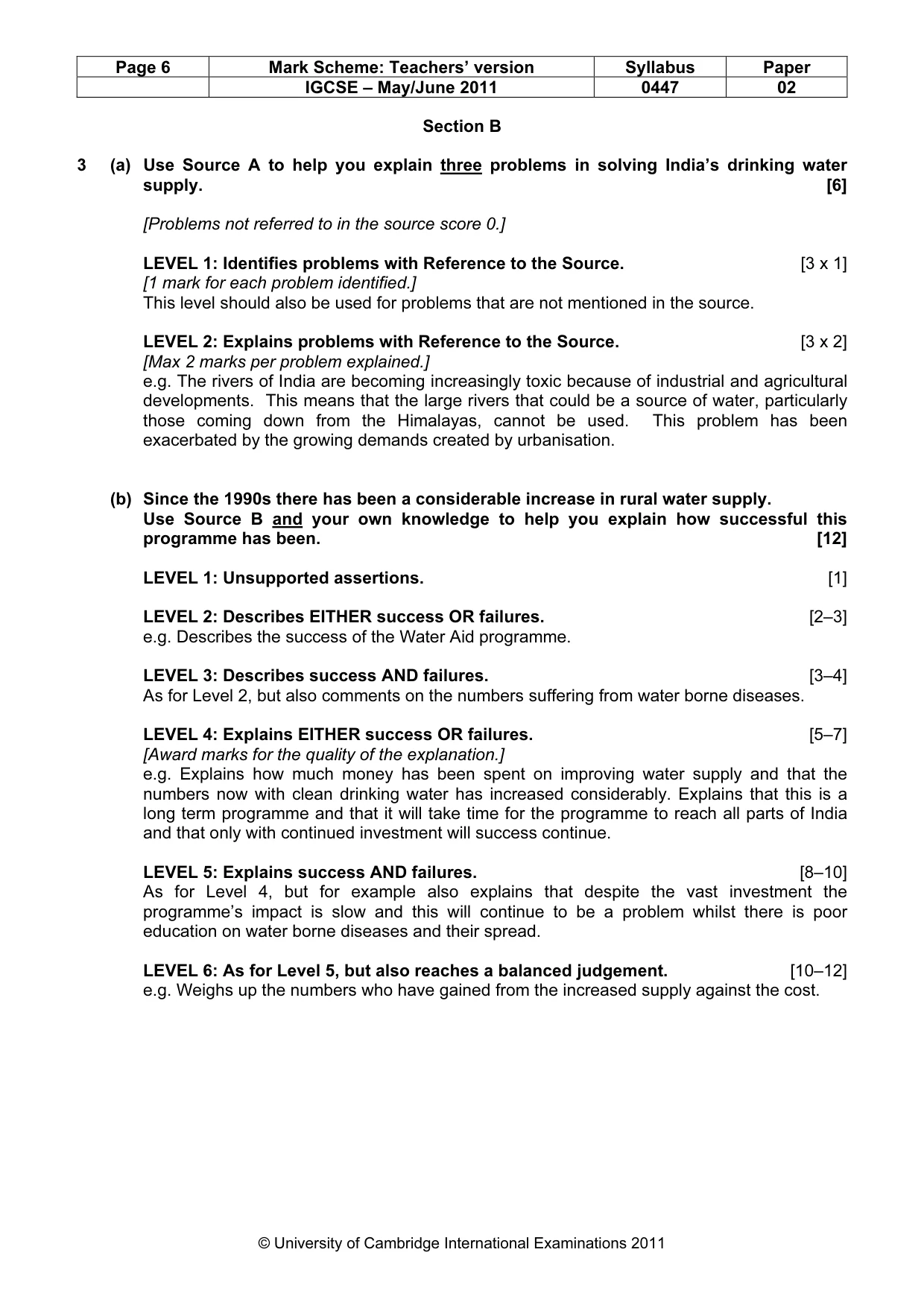
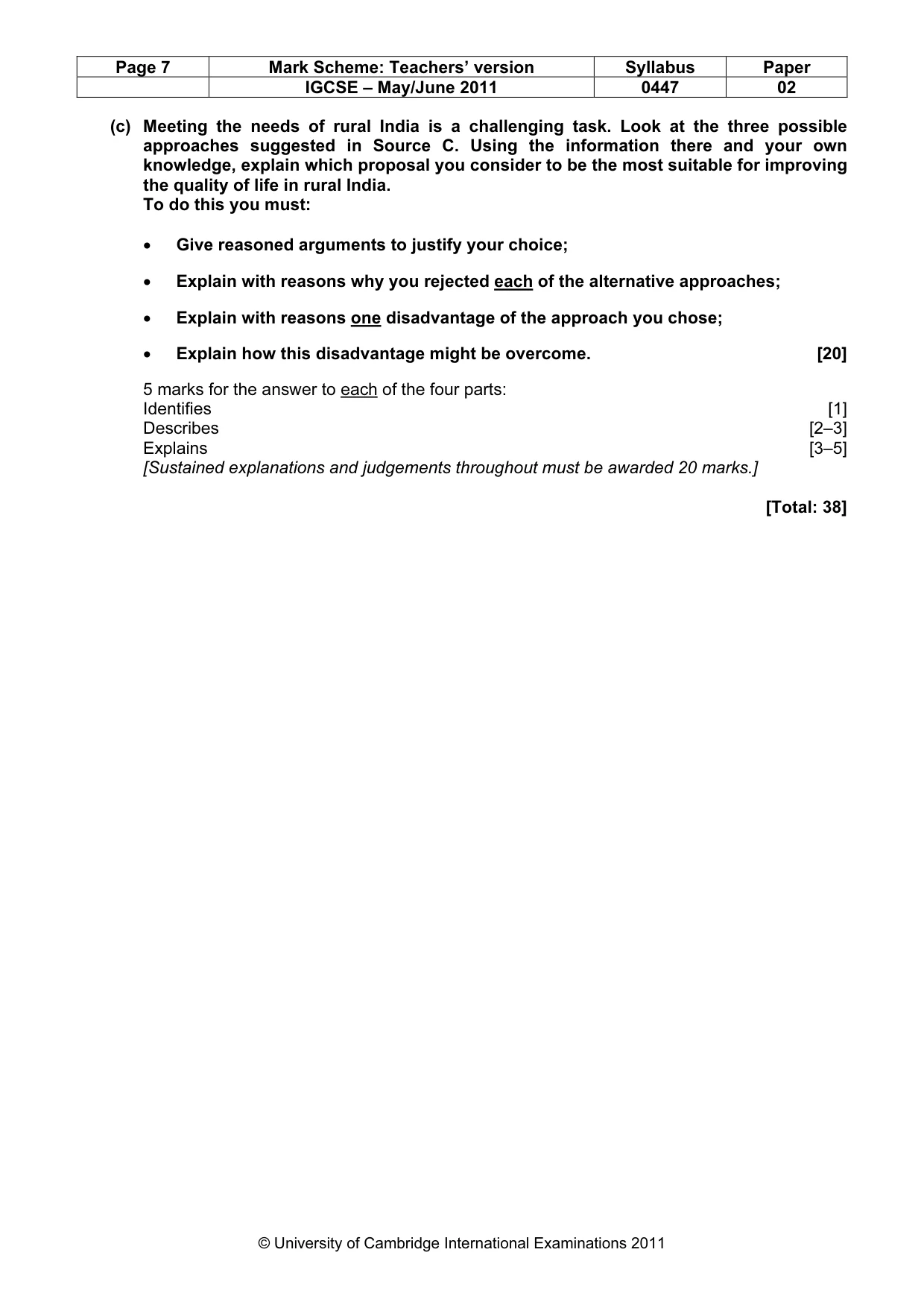
Mark scheme: 3 (a) Use Source A to help you explain three problems in solving India’s drinking water supply. [6] [Problems not referred to in the source score 0.] LEVEL 1: Identifies problems with Reference to the Source. [3 x 1] [1 mark for each problem identified.] This level should also be used for problems that are not mentioned in the source. LEVEL 2: Explains problems with Reference to the Source. [3 x 2] [Max 2 marks per problem explained.] e.g. The rivers of India are becoming increasingly toxic because of industrial and agricultural developments. This means that the large rivers that could be a source of water, particularly those coming down from the Himalayas, cannot be used. This problem has been exacerbated by the growing demands created by urbanisation. (b) Since the 1990s there has been a considerable increase in rural water supply. Use Source B and your own knowledge to help you explain how successful this programme has been. [12] LEVEL 1: Unsupported assertions. [1] LEVEL 2: Describes EITHER success OR failures. [2–3] e.g. Describes the success of the Water Aid programme. LEVEL 3: Describes success AND failures. [3–4] As for Level 2, but also comments on the numbers suffering from water borne diseases. LEVEL 4: Explains EITHER success OR failures. [5–7] [Award marks for the quality of the explanation.] e.g. Explains how much money has been spent on improving water supply and that the numbers now with clean drinking water has increased considerably. Explains that this is a long term programme and that it will take time for the programme to reach all parts of India and that only with continued investment will success continue. LEVEL 5: Explains success AND failures. [8–10] As for Level 4, but for example also explains that despite the vast investment the programme’s impact is slow and this will continue to be a problem whilst there is poor education on water borne diseases and their spread. LEVEL 6: As for Level 5, but also reaches a balanced judgement. [10–12] e.g. Weighs up the numbers who have gained from the increased supply against the cost. IGCSE – May/June 2011 0447 02 (c) Meeting the needs of rural India is a challenging task. Look at the three possible approaches suggested in Source C. Using the information there and your own knowledge, explain which proposal you consider to be the most suitable for improving the quality of life in rural India. To do this you must: • Give reasoned arguments to justify your choice; • Explain with reasons why you rejected each of the alternative approaches; • Explain with reasons one disadvantage of the approach you chose; • Explain how this disadvantage might be overcome. [20] 5 marks for the answer to each of the four parts: Identifies [1] Describes [2–3] Explains [3–5] [Sustained explanations and judgements throughout must be awarded 20 marks.] [Total: 38]
What you needed in this session
Cambridge’s own grade thresholds for 2011 May/June, Paper 2 · Variant 1. A higher threshold means an easier paper — the bar moves with how the cohort did.