Cambridge IGCSE Hindi as a Second Language 0549 — 2007 May/June Paper 1 · Variant 1
0549/11/M/J/07 · 60 marks · ≈68 min
The question paper and its mark scheme, free to read here and free to download. This is Cambridge’s own paper, exactly as it was sat.
Question paper12 pages
Mark scheme7 pages
Answers below. Sit the paper first if you are practising.
Paper as text
Question paper, page 1
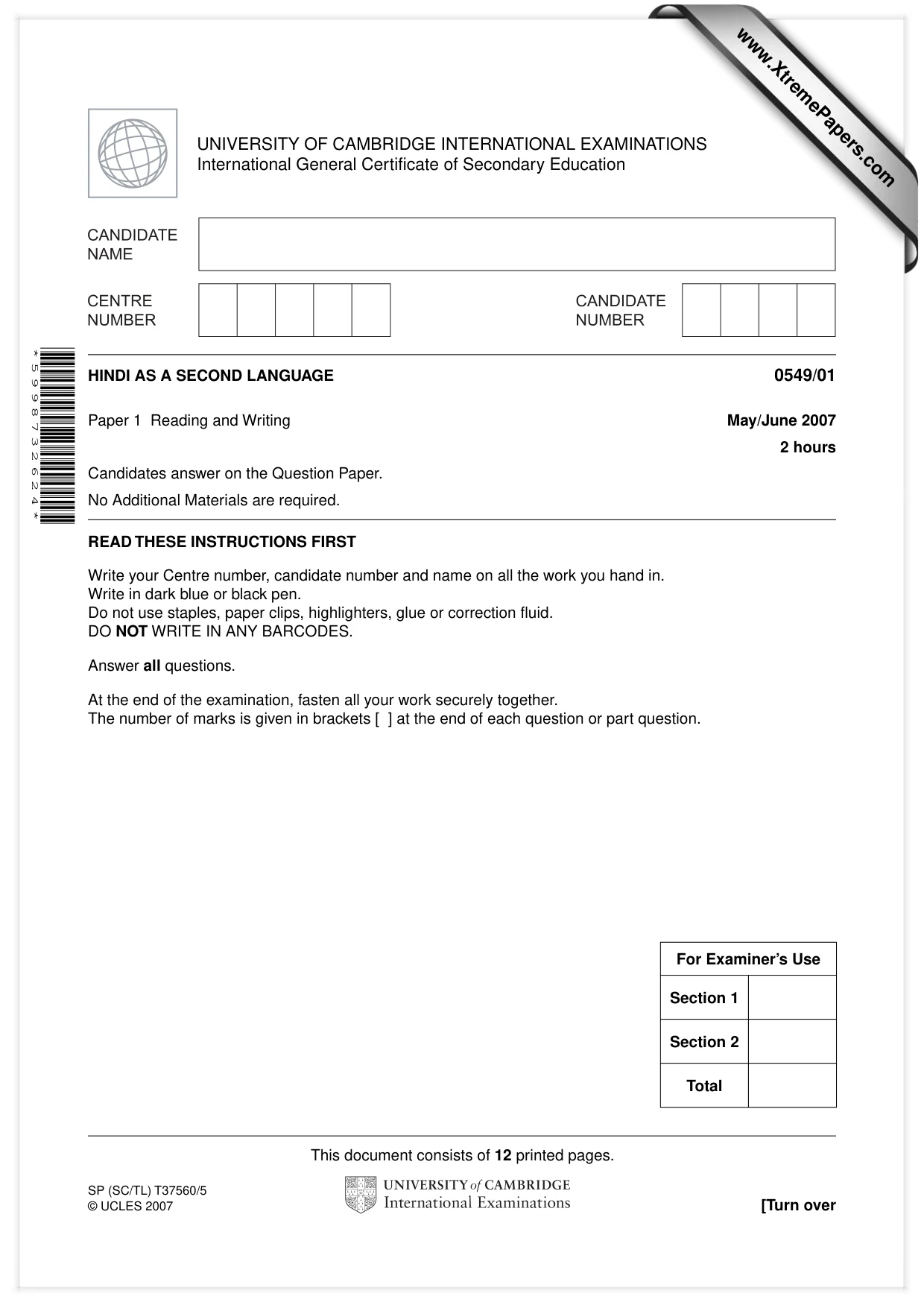
For Examiner’s Use Section 1 Section 2 Total This document consists of 12 printed pages. SP (SC/TL) T37560/5 © UCLES 2007 [Turn over UNIVERSITY OF CAMBRIDGE INTERNATIONAL EXAMINATIONS International General Certificate of Secondary Education READ THESE INSTRUCTIONS FIRST Write your Centre number, candidate number and name on all the work you hand in. Write in dark blue or black pen. Do not use staples, paper clips, highlighters, glue or correction fluid. DO NOT WRITE IN ANY BARCODES. Answer all questions. At the end of the examination, fasten all your work securely together. The number of marks is given in brackets [ ] at the end of each question or part question. * 5 9 9 8 7 3 2 6 2 4 * HINDI AS A SECOND LANGUAGE 0549/01 Paper 1 Reading and Writing May/June 2007 2 hours Candidates answer on the Question Paper. No Additional Materials are required. www.XtremePapers.com
Question paper, page 2
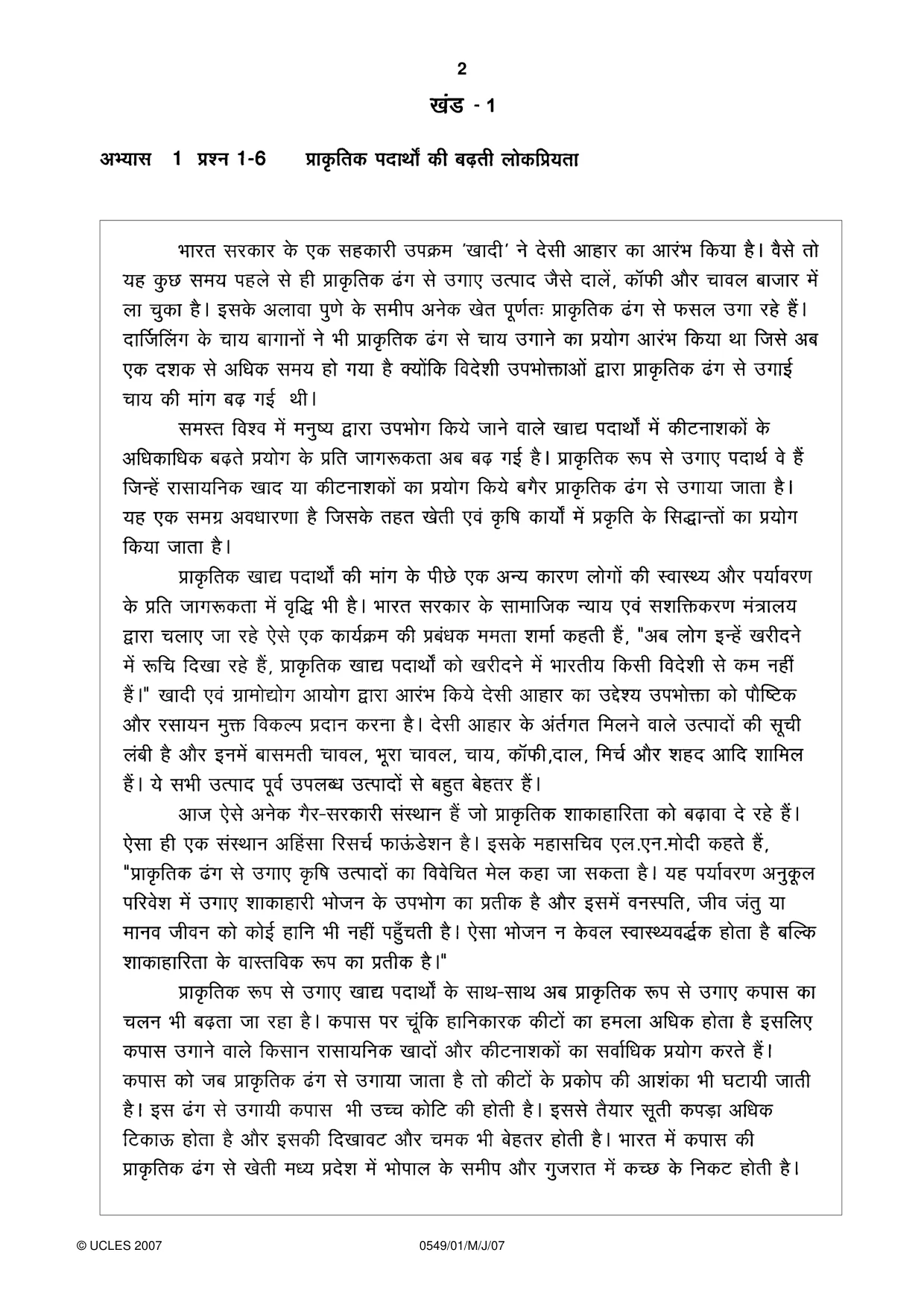
2 was -1 war 1 wet 1-6 0 weft varif at aed cteftaar ANT WOR & WH WEEN sows ‘Uret’ A Set sree ar anes fear FI BS a as HS waa ved S a wipfas s1 S UTy vee GS arel, Get sie aaa aR FA Ol Gar 8) eae sera PY & wy ame aa wha weirs S17 I wae Tw I afafet & aa anal aot wrepfte eS ara SAM aT war aks fear an fore are We are U afte waa a rar & aeaife faeet soukmet arr wefae dS og ara ot at ag ag ff wad foes F aq grr sont fa oF are |ret vareal A ptearerHt & aftette aed wart & afi urrena oa ag WE 81 wepfaw ws oy Tae as fire werahia are a ateareret or watt fea wie opie 1 S Sra ore 31 ae ve way saereon & fora ced Sel vd Hf oral F vole & Rrgrai or wart ferat oat 3 wrpfre wre carat at aT & WS ve ara oR at ot eared afk qatar & vfa arena 4 gfe A Sl ARG ROR & UP wae va Taka Fares ERT Wey UT Ve WA UH Oreima a wd HAT Wal Het &, “aa aT se Gite Ff wfe fear vw 3, wrpfte are serif at ater A adie fot foes 8 wa et alk wart am frecd wart Gea Sl Vet sree & sictta Pert aet veral at yet 81a wh sore od woe vere S aga aeae FT! art WS ate Tae Ter f a wpa weprear st agra FW EI! tar & we tem afte Red erodes 21 sae Ferafes va A wed &, “mrphtre StS Sry Ht vere or faafaa Aa Her TT WHar S| YE Tata syHer aRae 4 ony werent ater & oT oT ote S sie get areahe, via vig ar Arg vies oF ag eri of vel aga 81 Cen or a dae Caregen eter 8 afew mereka & arafte wr a mite 1" wophre wr 8 Sy Gre veil & wee sa apis wa S SIE Hoes HT ger Wt agen oT ter S) HoTE We Bh sora sel or ere afte seat 8 galery eI SIM ae fas were ural sie aieaerat a walftre wart aed €1 ou of we mopfre et SY wre creat s a atel & wears at anion ah wert ort Sl ga a SV ores oor A ee ae a eet 81 see GaN ah wos afte fears ara & afk gaat feerae otk are A deae ete 31 Hea A Hare a mpi oS Sct sea wee A aloe & wey sik Gora A Hew h He elit e1 © UCLES 2007 0549/01/M/J/07,
Question paper, page 3
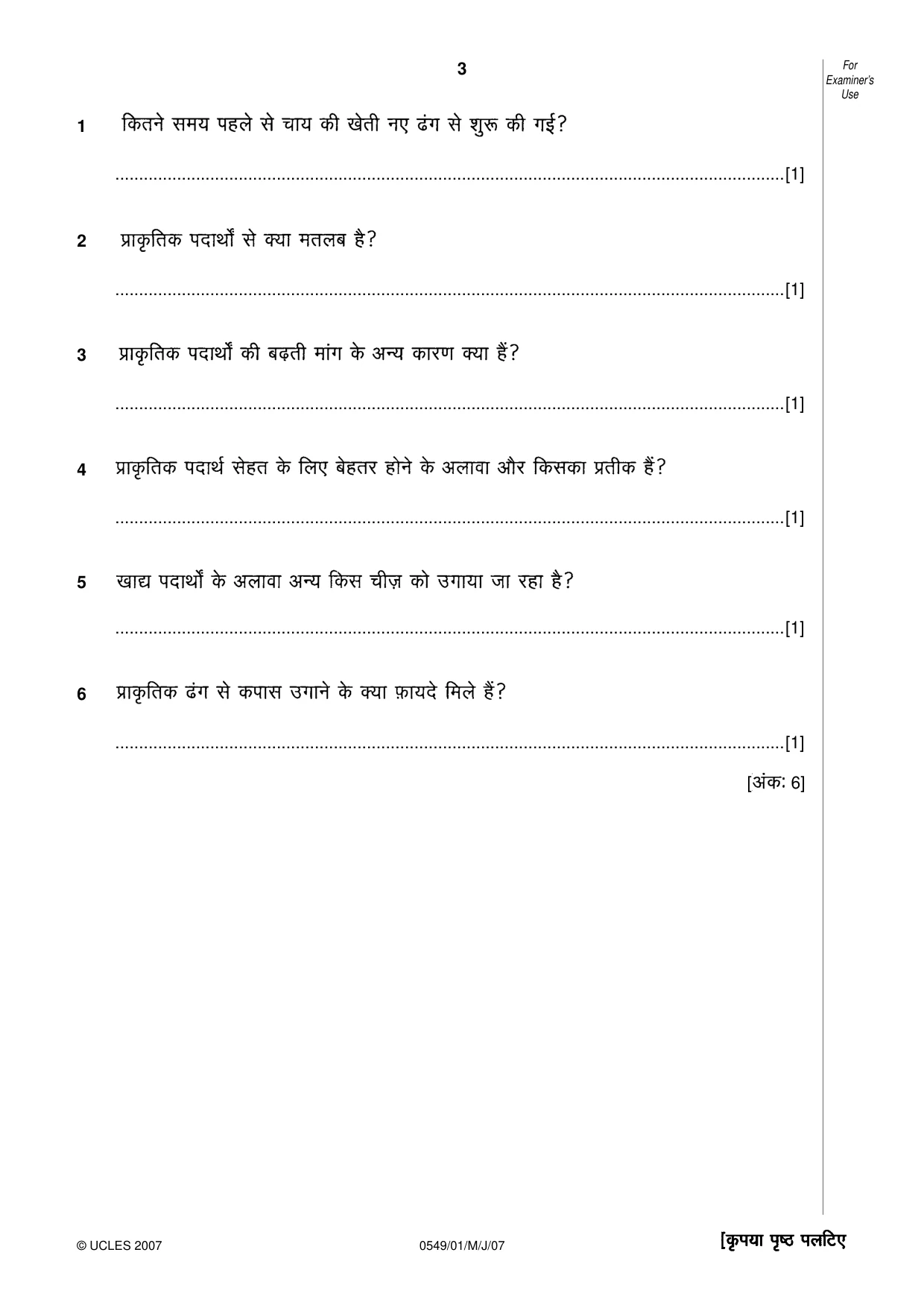
3 0549/01/M/J/07 For Examiner’s Use © UCLES 2007 1 …[1] 2 …[1] 3 …[1] 4 …[1] 5 …[1] 6 …[1] [ 6]
Question paper, page 4
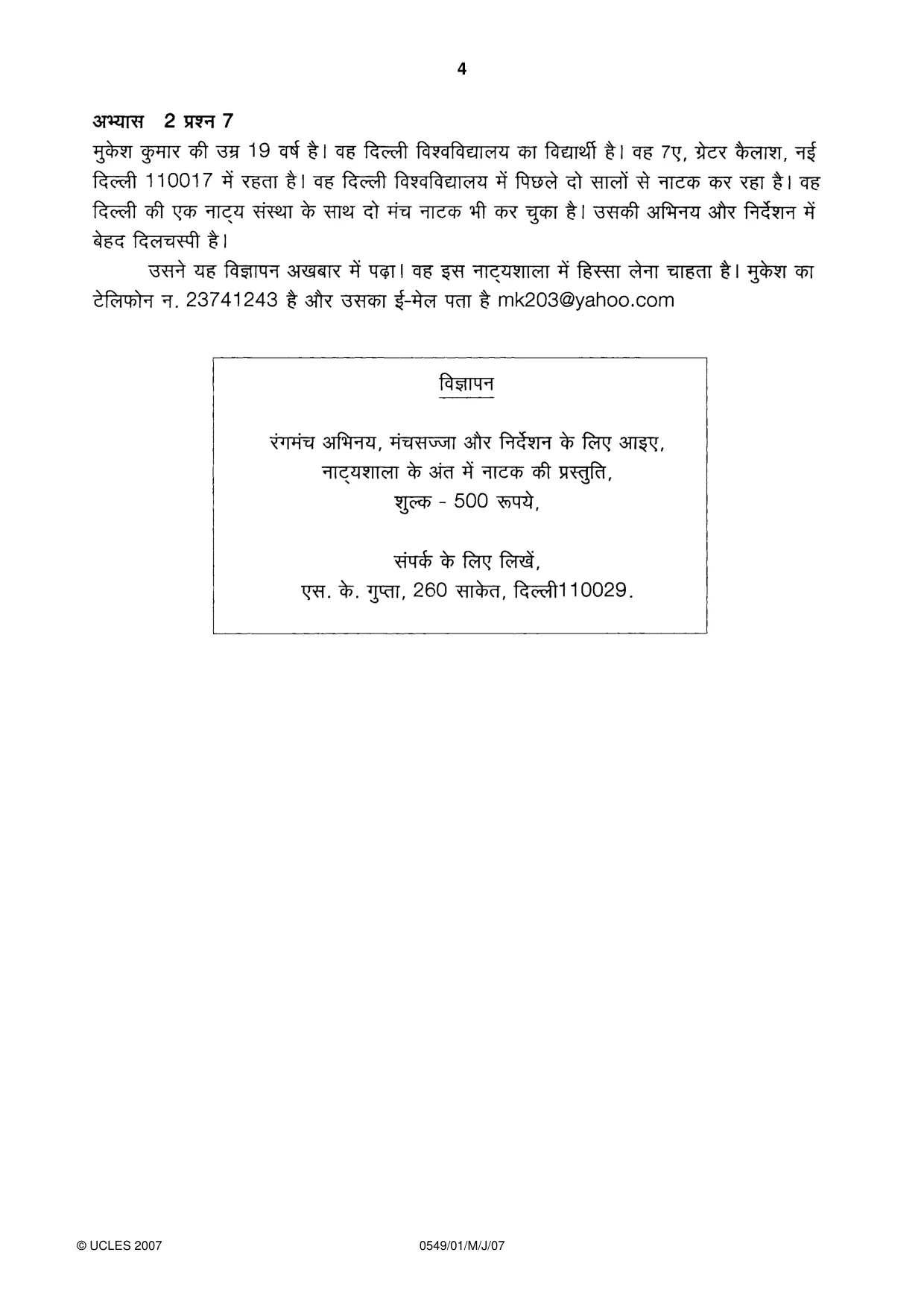
sngra 2 wea 7 Ho PAR H BH 19 a V1 ae feet favaftencra or fren si ae 7y, ex Hore, wT fees 110017 4 wear 8! oe facet favafteraa 4 faea at are S aem ax vel 81 aE feck a ve wea ten & we at da ew At oe Gar 81 Saat afta ok free A dec ferret e| Be we fIsos aaa F vet! ss sa Aeueren 4 fea AAT Tea F! Fo wT cfaar 4. 23741243 & a saa $Aa vat & Mk203@yahoo.com fest ew - 500 wa, Wa. &. Tar, 260 urva, feet 10029. © UCLES 2007 0549/01/M/J/07,
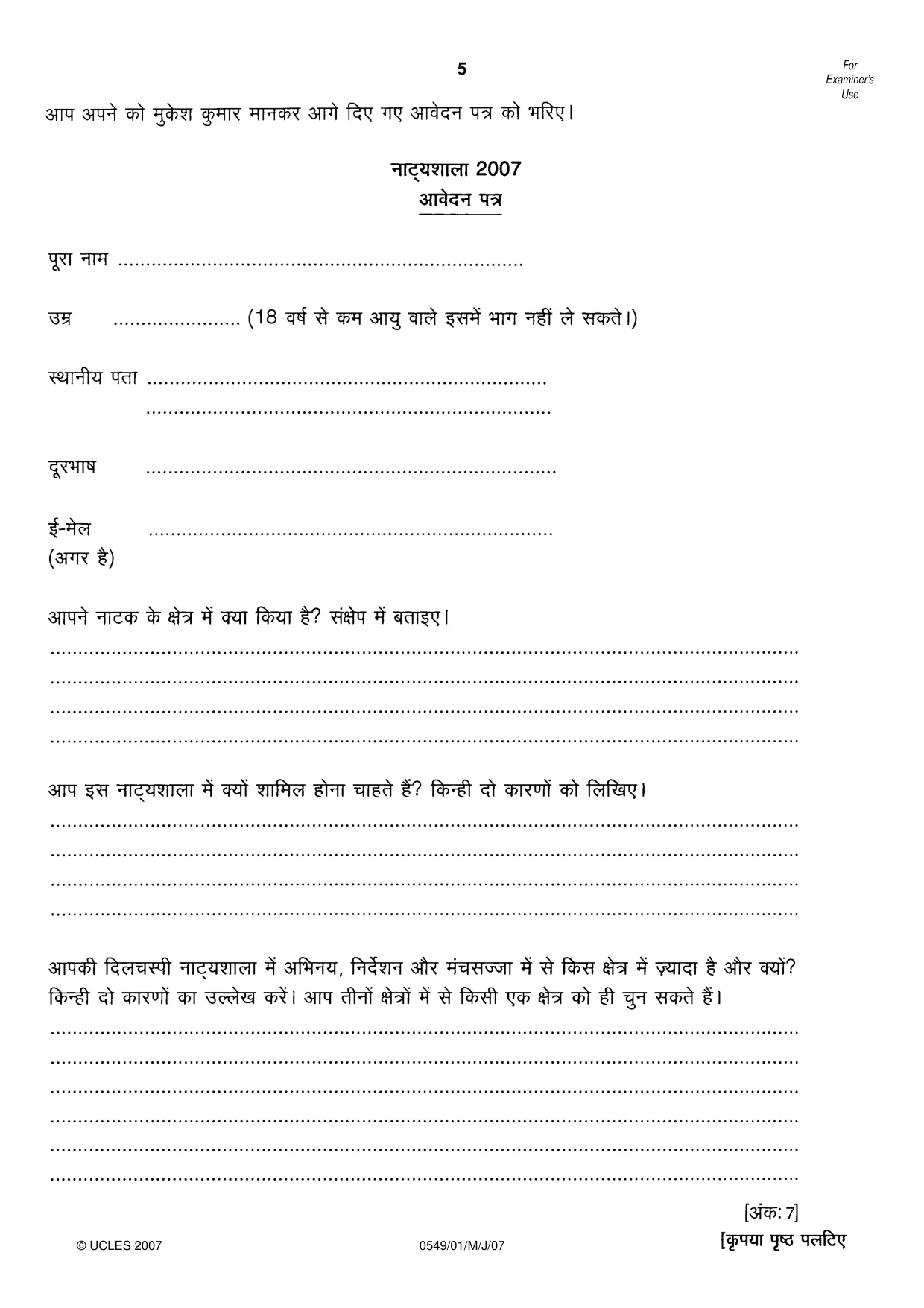
Question paper, page 5
5 0549/01/M/J/07 © UCLES 2007 For Examiner’s Use 7
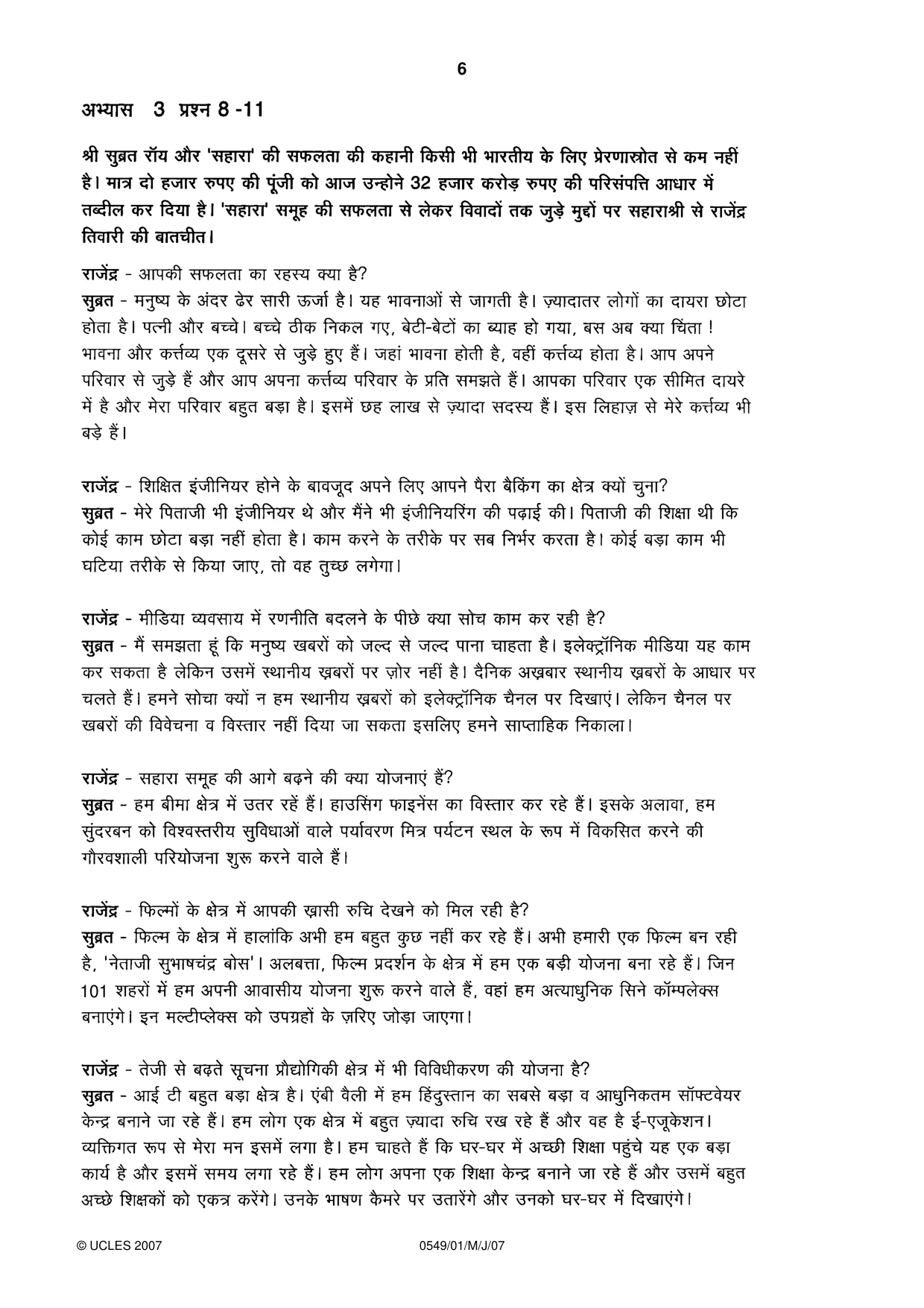
Question paper, page 6
ward 3 We 8-11 aft aaa Wa atk ‘wernt at arc at wert feet A aredia & fore deoreta B wa set 81 ara at soe Say St PST wt aio Ge 32 wore ants way at oR ore A aedla oy fear 21 ‘wert wy at UH B aay areal dH YS Fel oe VENI SB aig feandt ot areriict | Yaa - ATT & sige ee UN Ga 1 ae wane B UPA V1 varatae Sa) | erat Bret Ba Sl Veh ae ged] ged Stew Prva ay, ad-acl or are Bt TM, Fa oa HT fa! aren oi onter ve GER SG YS By Fl Tei WaT ah z, ae aia ser 81 ag ah uRar 8 YS & AR org so oar oRae & wis was &1 anger oRare ves Mra eraz As otk Au oRay aga agi 3) gaa ve ore S war wees J! ga fers BR aia a Bel wis - frites soiree a & sage am fey amy ther af or Aa BAY GA? Yaet - AR fare ah sohPrae & aie AA A sohPrafta at gers St flame at Aer oft fer we HHA Biel agi TE Ble 1 GH OSA } TMS W ug PR wea 3! Hg ast oA A afer atte & fear ony, at ae ges orm aaa - 4 wean & fe age wal wl ved S Ted WT Ted sl gage Asa ae TF a wed 8 cfea cel ware wal we GR al 31 the sar wire Gai & spa Ww aed 81 a4 Gen wal a Ba aria Gal oF scagiPre daa w fea! ofa daa Ww want ot facet o fear vel fear on wen gafery er arenes Frere! Yaa - 4 ar aa 4 oar ee F oO wigte oT fae ae Ss S1 BVH Hea, 4 dearer of fterenta yftensil art vataer fra wer wret & wo A fro oer at keene oRasrt ys SA Te gs! wig - feel & aa 4 araat anh ofa Sar at frat wet 8? Yaa - for & as 4 reife ooh oH aga go ae we vs S1 ant SA wo fires TH eT &, Aare Bares ate’ | srtacn, for wala & aa A ea WH aS short eT @ E1 hr 101 wel 4 em att snarta aor Bw HE ae @, set eH sea RA erat FT| gt Aedes Gl sae & wy ist GTET! weig - doh 8 aed qe wetfrat aa F aft fafaehtaeor at ator 8? Yaa - ang Haga ger a 1 UA cht F eH fUgeIM oF uae ast g onyHas BiscdaT oe TM OF ee E1 oF oT We aa 4 aga Vaal whe wa ww oie ae 8 ST afta wa O A aT get oT B1 eA Tred & fe aay 4 aed fan vga aE vH ast on & ok get aaa om XS 81 BF OT eT We Ren oa TAM OT Pe & aie UA age sree Rreret al vet pet | Sah argo Hay ue vant sie Gael aa 4 fare! © UCLES 2007 0549/01/M/J/07,
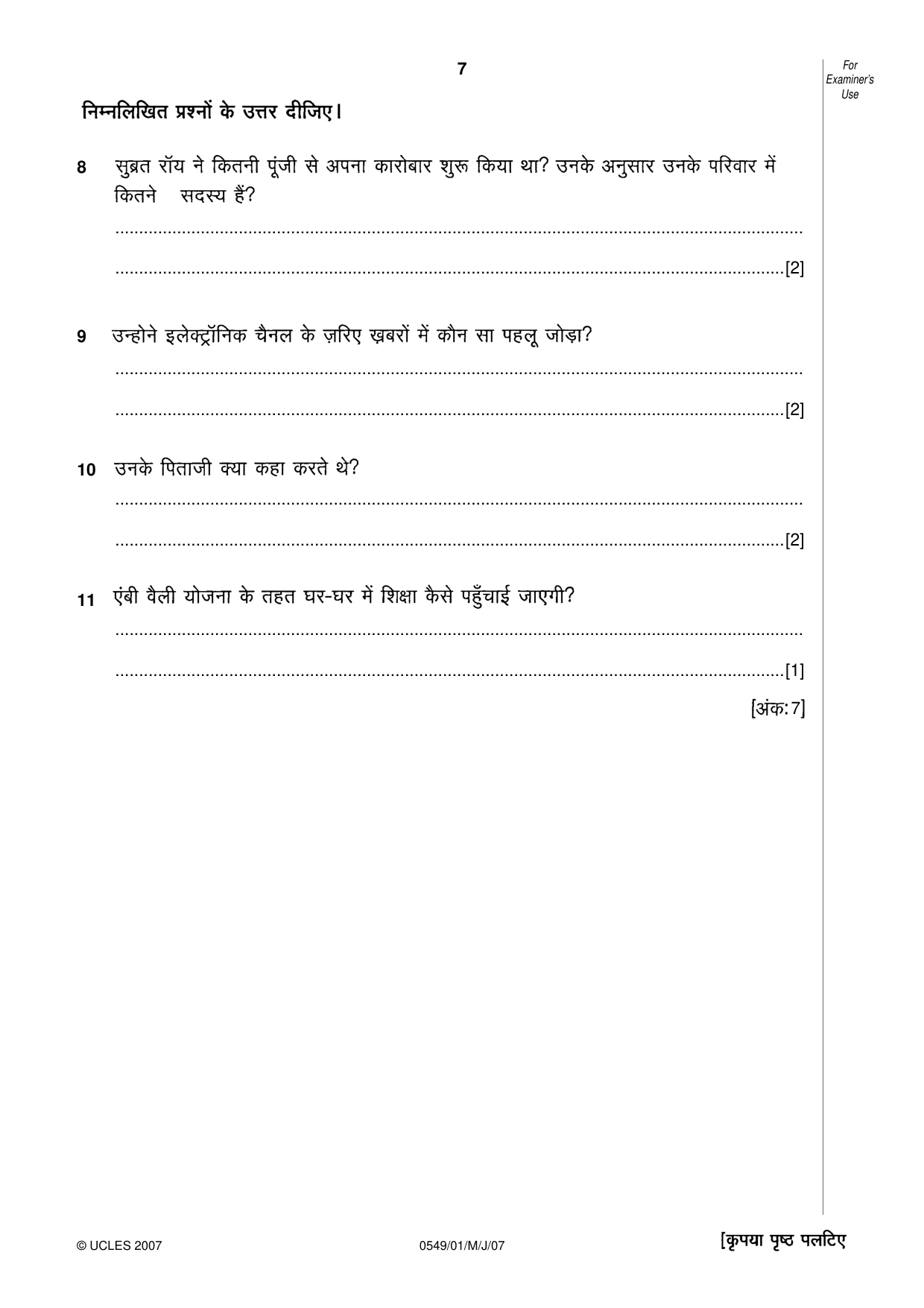
Question paper, page 7
7 0549/01/M/J/07 © UCLES 2007 7 8 … …[2] 9 … …[2] 10 … …[2] 11 … …[1] For Examiner’s Use
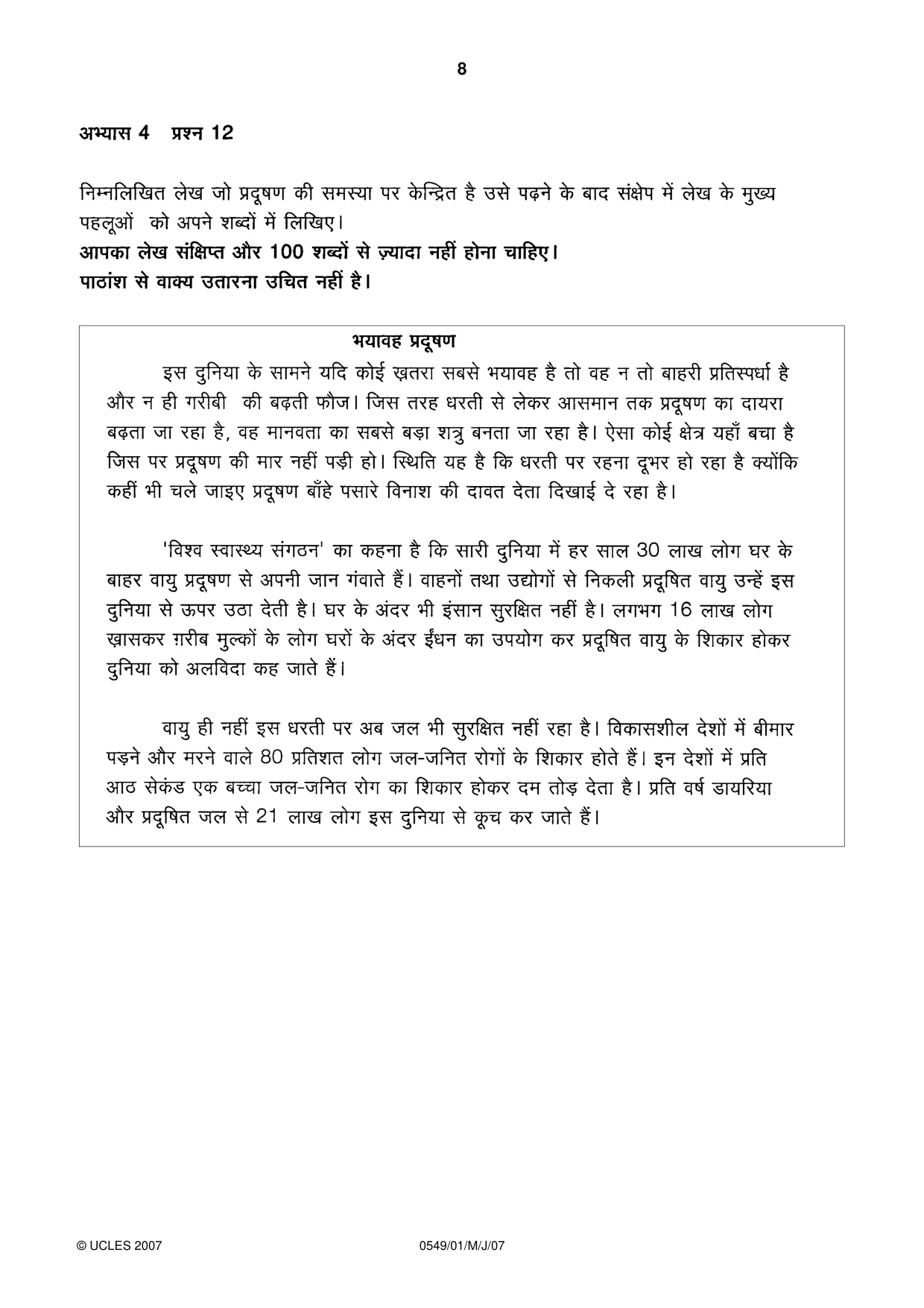
Question paper, page 8
mar 4 ww 12 Prafakad ce ot vga ot wre ue ofea & VS USA & ae day A Geo AVI aegelt By arr weal § Pf arent cre tiers sik 100 weal OY yarar set er ART! Wei 8 are VaR Viera wel F1 Wards WENT ga ghar & arm afe ay wae wae ware S Tt ae a a) aed ofereaet & ak 7 A wt ot aac wor fore axe oedl S dar asa TH WET BT START Fea OM Vel S, TE AAT GT WAS AS VA IAT VT Val Sl VT GS BI Ui gas PORT WR TAIT St A eT VS VT! fafa we s fe aed oe vet Guy at vat & waif el Ht ae orgy wage ais Ter fare at aaa en fears = vet B1 ‘ford coreg Uret' a wea & fe Unt ghar A ex we 30 are at RS TET ay WENT S ae GM tart S 1 creat cen vein S Pract vefia arg ws a gfra & way var och SI aE & sae A ers ERfdta ae 81 TT «16 ore aT Grier ita yoo! & ci Eni & siex Faq oT waar ox veka ay & Pare sox gf ot araftear oe ord 31 ag & wet se ot ® aa aa fh Uefa set ver 81 frerasicr eal 4 dae asa dk aA Tel 80 veer att Ge-ara Ui & Bro ea €1 sa Oeil 4 ft ane Was Ve sea Tre-ata WT oT Prare alex aa als Se 81 we at sTaRar afk vgita we @ 21 ore at ga gar 8 ga a ae ZI © UCLES 2007 0549/01/M/J/07,
Question paper, page 9
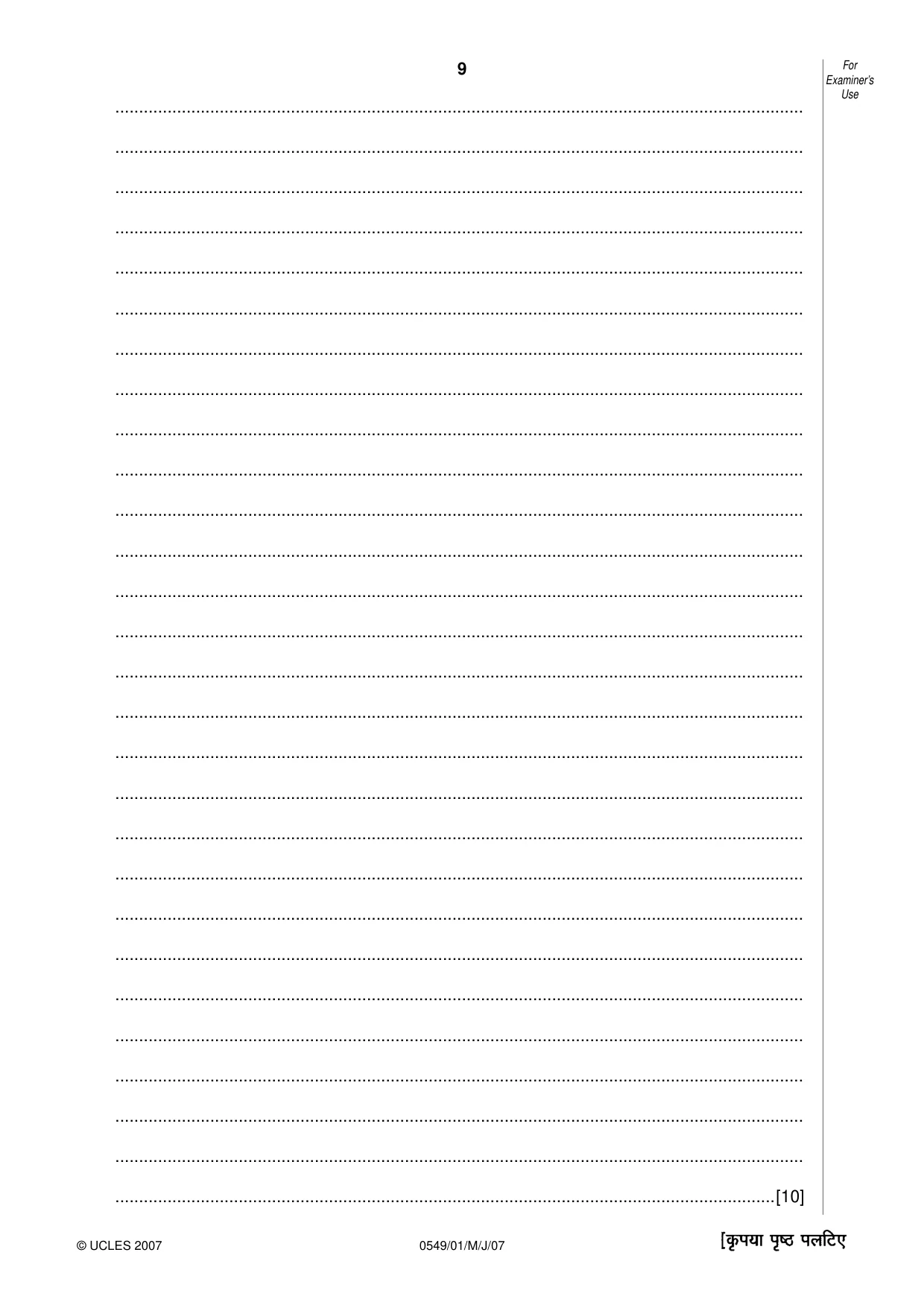
9 0549/01/M/J/07 For Examiner’s Use © UCLES 2007 … … … … … … … … … … … … … … … … … … … … … … … … … … … …[10]
Question paper, page 10
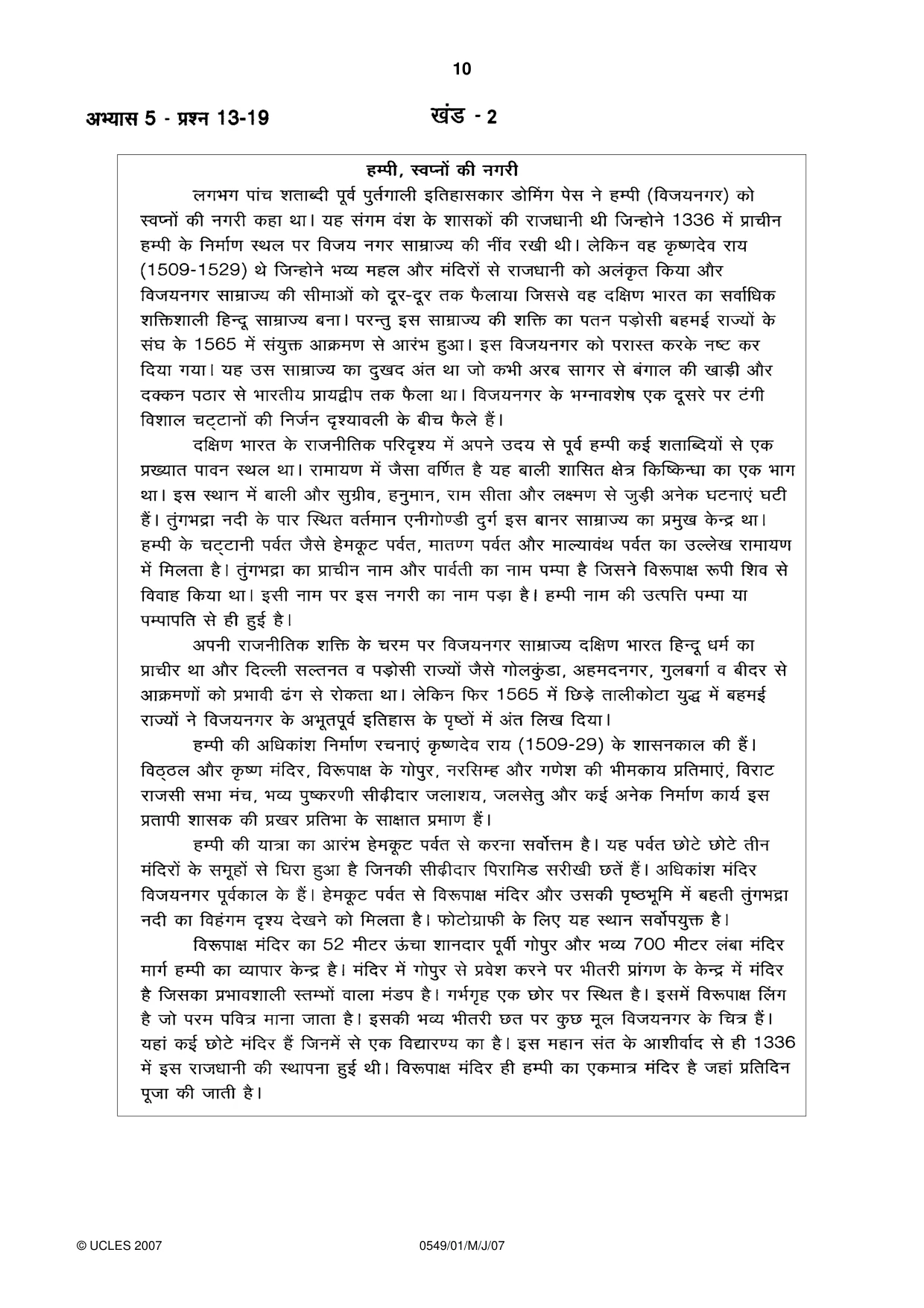
10 arara 5 - wa 13-19 @s -2 wah, wari at art wenn ore weredt od ger Sftrersore SifrT tet A sett (faoraae) ar aot ot TR wer al we HTH Ser & eel St wore eft fSrSA 1336 4 wis Baht & Prater wre oe faora TR erase wt fa TA of Cat TE Heres wa (1509-1529) & fore wer Heer sie AfeRT SG ovat wt steiga fear sit fiorerar aay ot sit et ge-ge ae bora rea ae ero aa or wale uftpencht fog Wares GT! WY ga TCT BI afte or at Te aes weal & a & 1565 4 Maw spay S onky Sarl Sa ASIA ST WRT HY AK BT fear Tal us Ve WEA oT Gua sig an aT anf saa UPR S Sra FH Ue six cand vor Bade wae ae thor ol flora & wTagry VHP Ga Ww Sat eft ard & woriftr aReee 4 at uaa S yd exit og erenferal GI wa Wea Wes We aT) Waar A Shar afera & we areht wnfta ats fofrn or ve art aml ga wire 4 aeft sie aaa, saa, wa Ver sie cea S USI ae wears wet 81 Grist ad & or fer ada ites OT Sa AAR UETST ST TE Hz aT H froat &1 Gar oT wre aa sie ode or ara wa & fore floret wit fra @ fears fear on) et ara oe Se NY HT ATA GST Bo eeht ara at wf GT aT ware B et Ey ze! at werifte aft & ae ue foray wranee afer wRa ferg eh oT ord en afk feech war ¢ SRA weal VA Aegsr, seqerR, Jar ¢ dex S spat wT ward St S Yew al cfs flex 1565 F fos crefwiler ye A aens weal 4 fierrer & engagd sfaera & yet 4 sia fare fear! wah at aftrnie Prat waar pwred wa (1509-29) & wmerara Ht S| flaca sik pon dfex, frame o& age, aes sie were at arpa were, fate wart were at wa wear a Mara WATT SI eh a arn a any tage oda U oer wataa 81 as oda wie wre dA Ffeel & wget V fer gor & ferret didier fries ata wd 1 alate Hex froma ydera & 81 spe oda S faore afex silk vaat gout 4 get Grast aa or fates gea tah a fret 3) wrelaret & fay as ws walogw 21 froma Hfex ot 52 Fer Gar wa at age sie yer 700 Alex cia Afax art seh or aro oe 81 Afee A age SG weer GA we Ala HTT & Ge A fax & fiver erage erat gen Asg o1 TS vH BR ue fra F1 sea fare fort 8 aes ofa AMT ore 8! gaat Har AN wa WK HE Fa fase & faa s! asi og wre Hfex & Ras SB we faerea aT 8! ga Herd Hit & aneflate S A 1336 F ge wont af wero eg of frome Ffee Ht seh or vpara fee & Tei wafer yer at ont 31 © UCLES 2007 0549/01/M/J/07,
Question paper, page 11
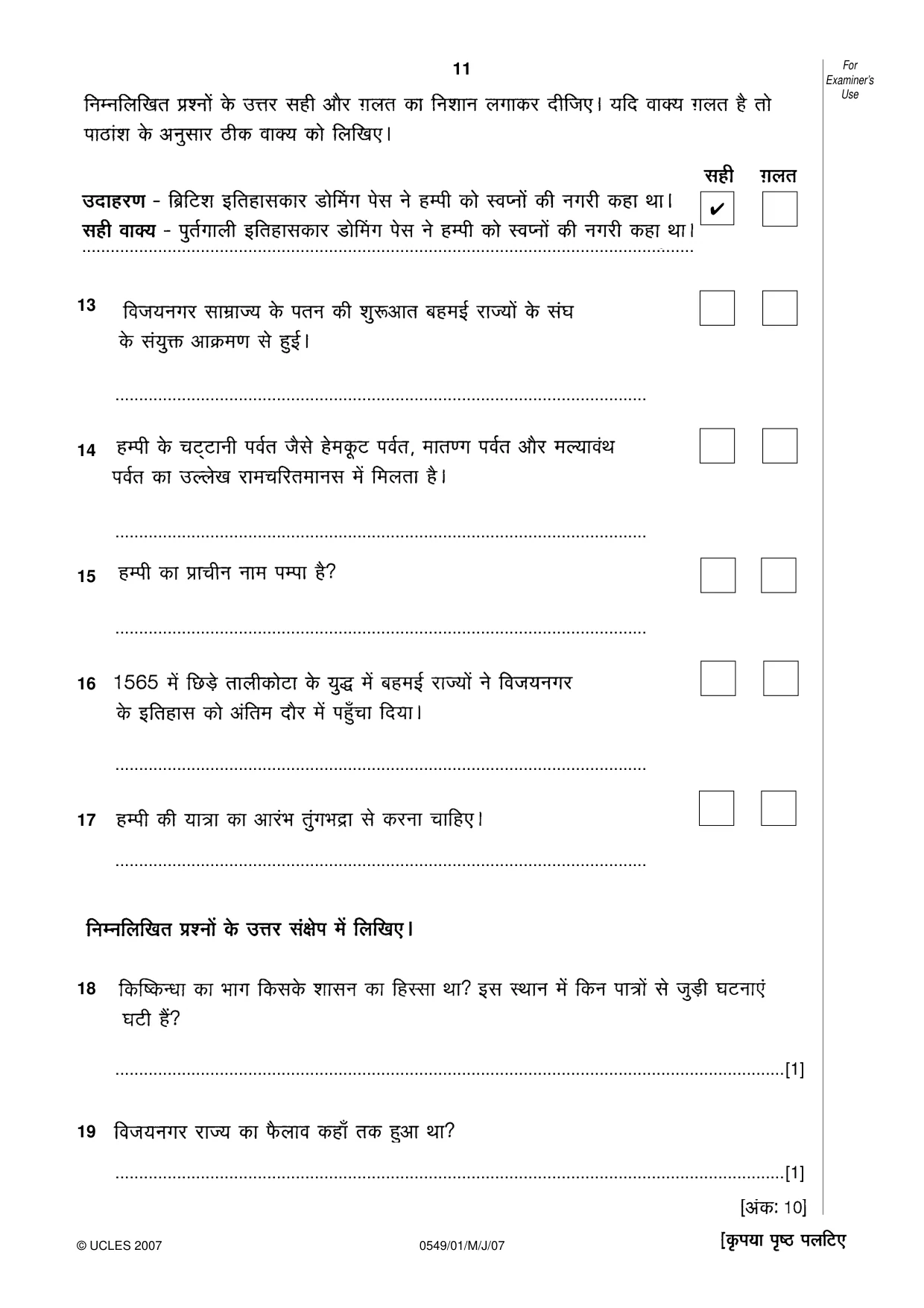
11 0549/01/M/J/07 For Examiner’s Use © UCLES 2007 … 13 … 14 … 15 … 16 … 17 … 18 …[1] 19 …[1]
Question paper, page 12
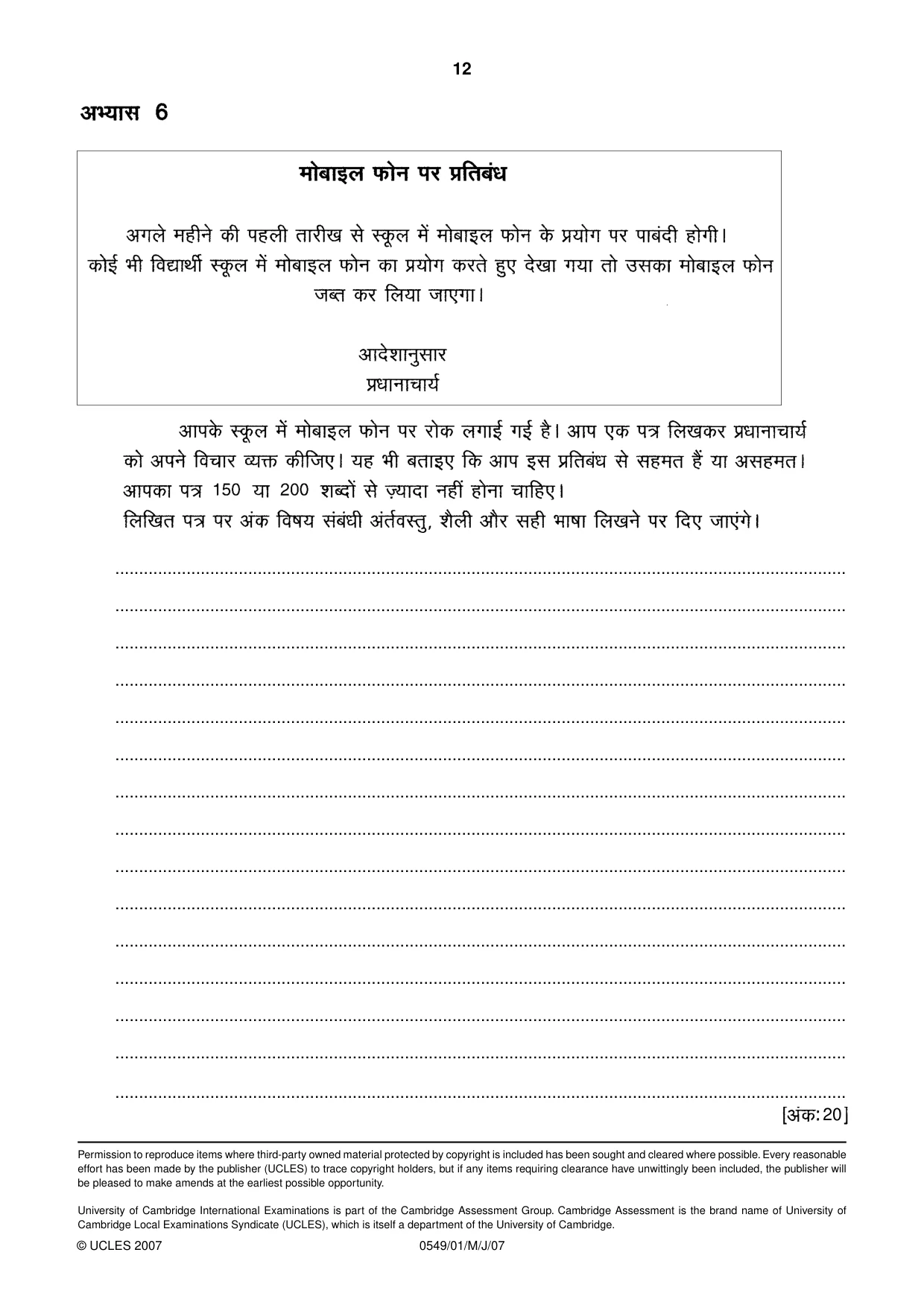
12 0549/01/M/J/07 © UCLES 2007 … … … … … … … … … … … … … … … 20 Permission to reproduce items where third-party owned material protected by copyright is included has been sought and cleared where possible. Every reasonable effort has been made by the publisher (UCLES) to trace copyright holders, but if any items requiring clearance have unwittingly been included, the publisher will be pleased to make amends at the earliest possible opportunity. University of Cambridge International Examinations is part of the Cambridge Assessment Group. Cambridge Assessment is the brand name of University of Cambridge Local Examinations Syndicate (UCLES), which is itself a department of the University of Cambridge.
Mark scheme, page 1
UNIVERSITY OF CAMBRIDGE INTERNATIONAL EXAMINATIONS International General Certificate of Secondary Education MARK SCHEME for the May/June 2007 question paper 0549 HINDI AS A SECOND LANGUAGE 0549/01 Paper 1 (Reading and Writing), maximum raw mark 60 This mark scheme is published as an aid to teachers and candidates, to indicate the requirements of the examination. It shows the basis on which Examiners were instructed to award marks. It does not indicate the details of the discussions that took place at an Examiners’ meeting before marking began. All Examiners are instructed that alternative correct answers and unexpected approaches in candidates’ scripts must be given marks that fairly reflect the relevant knowledge and skills demonstrated. Mark schemes must be read in conjunction with the question papers and the report on the examination. • CIE will not enter into discussions or correspondence in connection with these mark schemes. CIE is publishing the mark schemes for the May/June 2007 question papers for most IGCSE, GCE Advanced Level and Advanced Subsidiary Level syllabuses and some Ordinary Level syllabuses. www.XtremePapers.com
Mark scheme, page 2
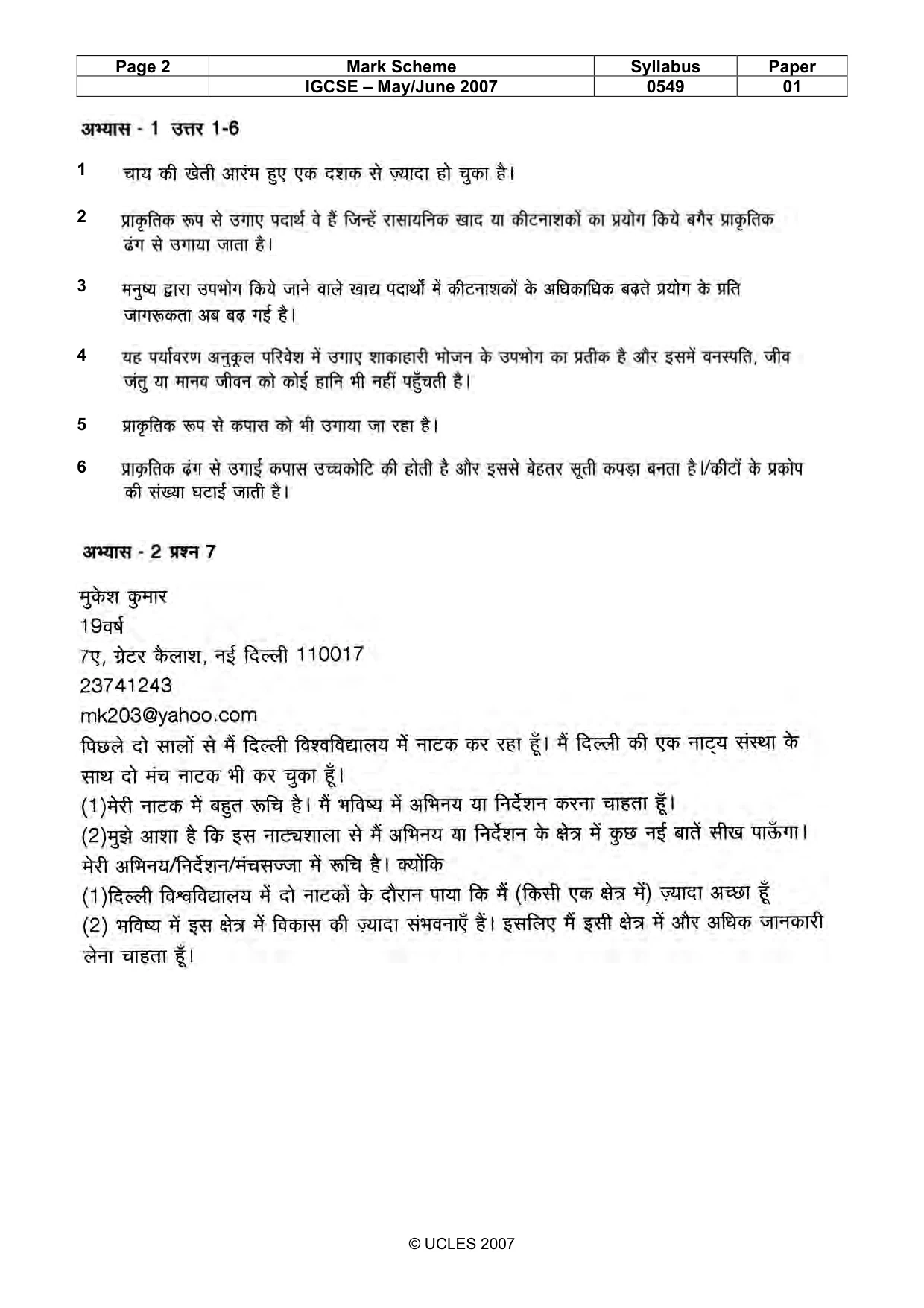
Page 2 Mark Scheme Syllabus Paper IGCSE – May/June 2007 0549 01 © UCLES 2007 1 2 3 4 5 6
Mark scheme, page 3
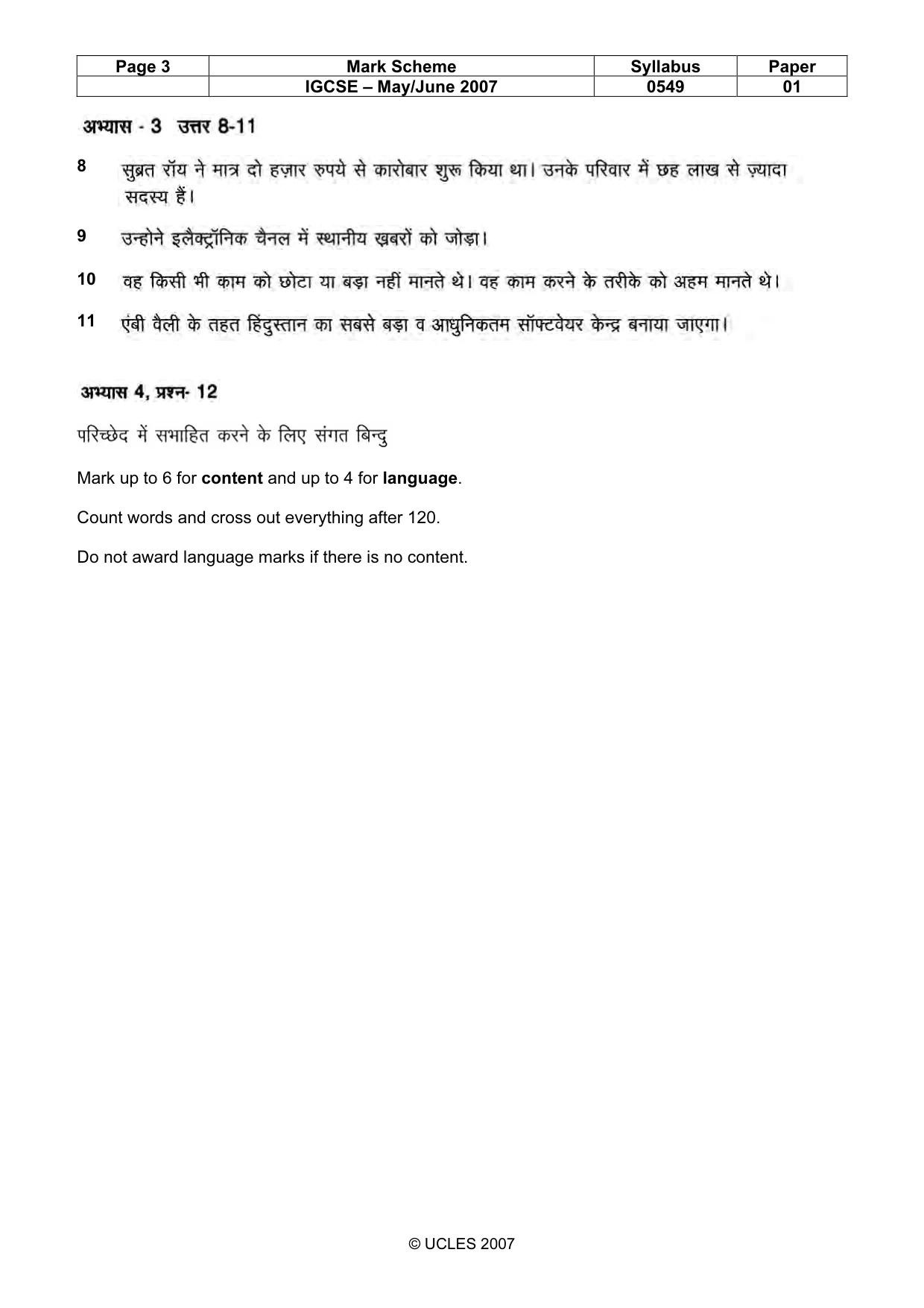
Page 3 Mark Scheme Syllabus Paper IGCSE – May/June 2007 0549 01 © UCLES 2007 8 9 10 11 Mark up to 6 for content and up to 4 for language. Count words and cross out everything after 120. Do not award language marks if there is no content.
Mark scheme, page 4
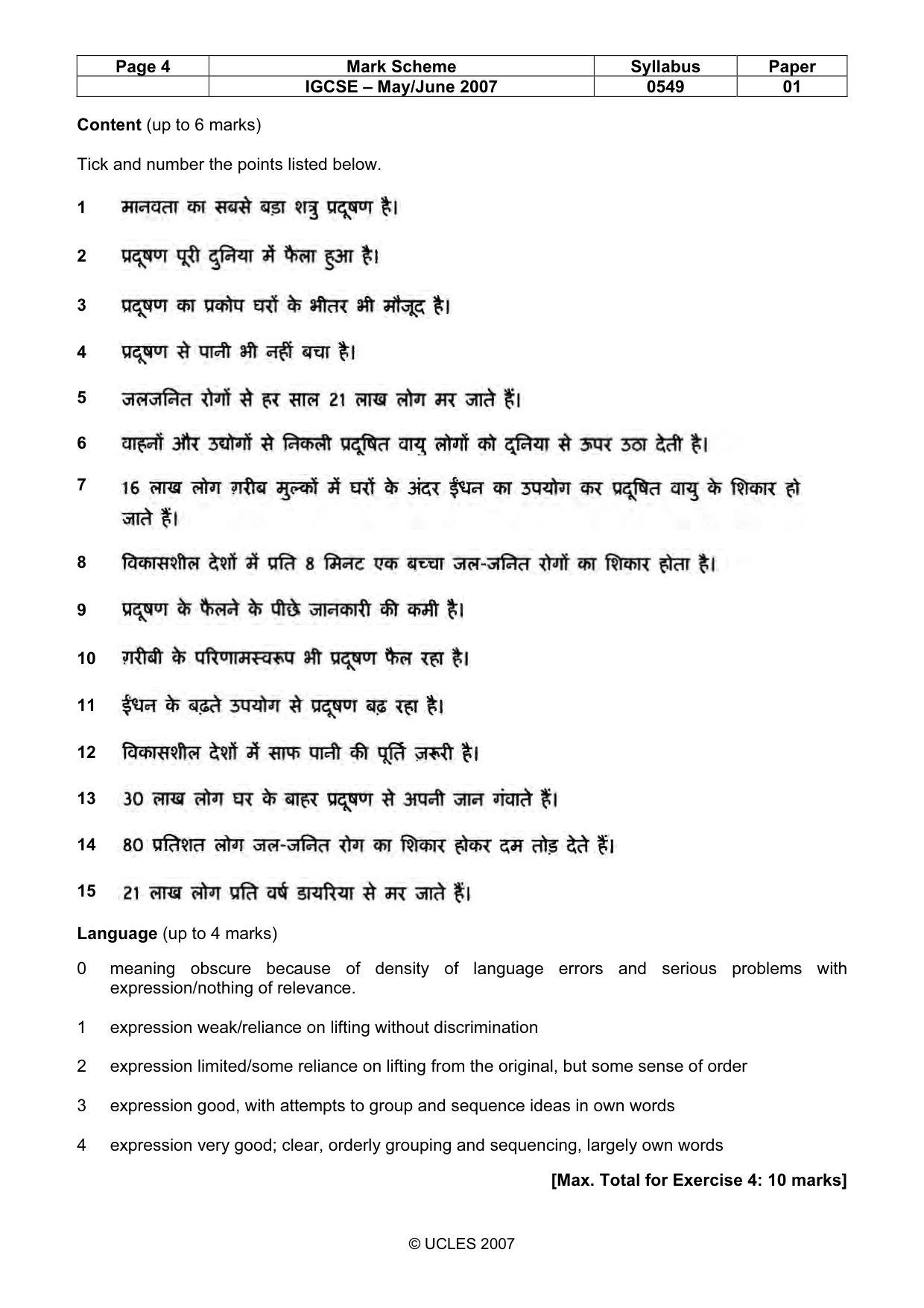
Page 4 Mark Scheme Syllabus Paper IGCSE – May/June 2007 0549 01 © UCLES 2007 Content (up to 6 marks) Tick and number the points listed below. 1 2 3 4 5 6 7 8 9 10 11 12 13 14 15 Language (up to 4 marks) 0 meaning obscure because of density of language errors and serious problems with expression/nothing of relevance. 1 expression weak/reliance on lifting without discrimination 2 expression limited/some reliance on lifting from the original, but some sense of order 3 expression good, with attempts to group and sequence ideas in own words 4 expression very good; clear, orderly grouping and sequencing, largely own words [Max. Total for Exercise 4: 10 marks]
Mark scheme, page 5
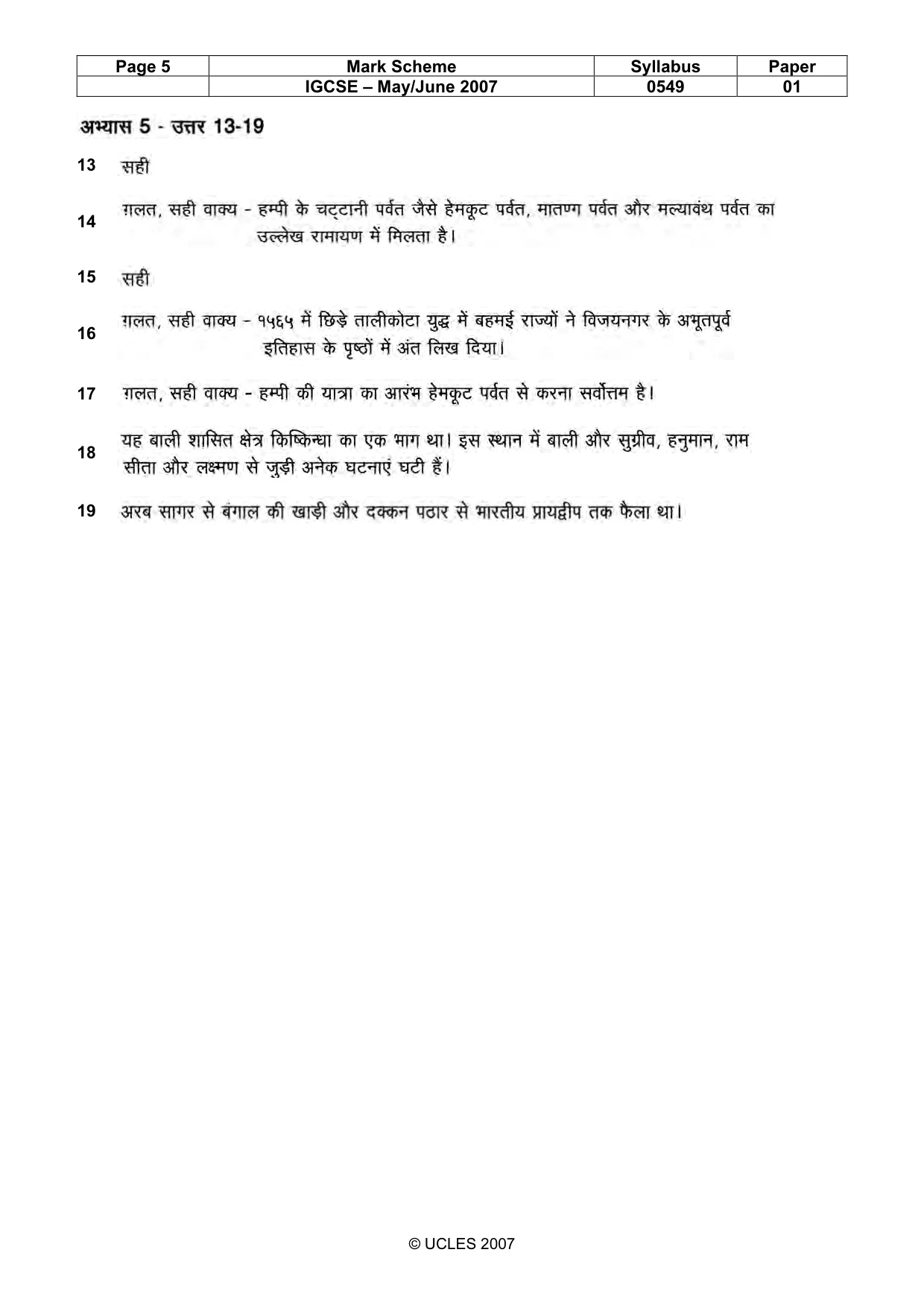
Page 5 Mark Scheme Syllabus Paper IGCSE – May/June 2007 0549 01 © UCLES 2007 13 14 15 16 17 18 19
Mark scheme, page 6
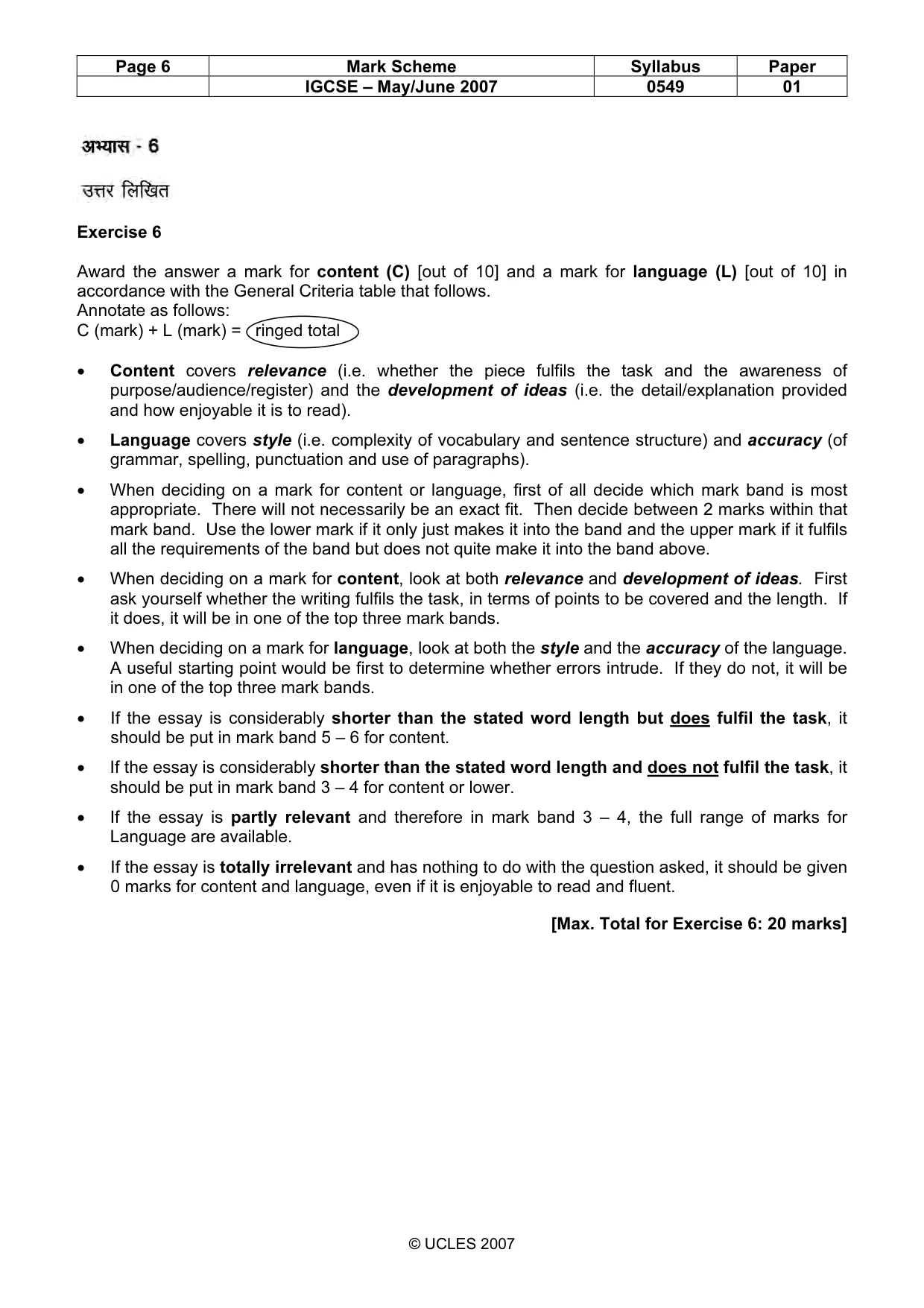
Page 6 Mark Scheme Syllabus Paper IGCSE – May/June 2007 0549 01 © UCLES 2007 Exercise 6 Award the answer a mark for content (C) [out of 10] and a mark for language (L) [out of 10] in accordance with the General Criteria table that follows. Annotate as follows: C (mark) + L (mark) = ringed total • Content covers relevance (i.e. whether the piece fulfils the task and the awareness of purpose/audience/register) and the development of ideas (i.e. the detail/explanation provided and how enjoyable it is to read). • Language covers style (i.e. complexity of vocabulary and sentence structure) and accuracy (of grammar, spelling, punctuation and use of paragraphs). • When deciding on a mark for content or language, first of all decide which mark band is most appropriate. There will not necessarily be an exact fit. Then decide between 2 marks within that mark band. Use the lower mark if it only just makes it into the band and the upper mark if it fulfils all the requirements of the band but does not quite make it into the band above. • When deciding on a mark for content, look at both relevance and development of ideas. First ask yourself whether the writing fulfils the task, in terms of points to be covered and the length. If it does, it will be in one of the top three mark bands. • When deciding on a mark for language, look at both the style and the accuracy of the language. A useful starting point would be first to determine whether errors intrude. If they do not, it will be in one of the top three mark bands. • If the essay is considerably shorter than the stated word length but does fulfil the task, it should be put in mark band 5 – 6 for content. • If the essay is considerably shorter than the stated word length and does not fulfil the task, it should be put in mark band 3 – 4 for content or lower. • If the essay is partly relevant and therefore in mark band 3 – 4, the full range of marks for Language are available. • If the essay is totally irrelevant and has nothing to do with the question asked, it should be given 0 marks for content and language, even if it is enjoyable to read and fluent. [Max. Total for Exercise 6: 20 marks]
Mark scheme, page 7
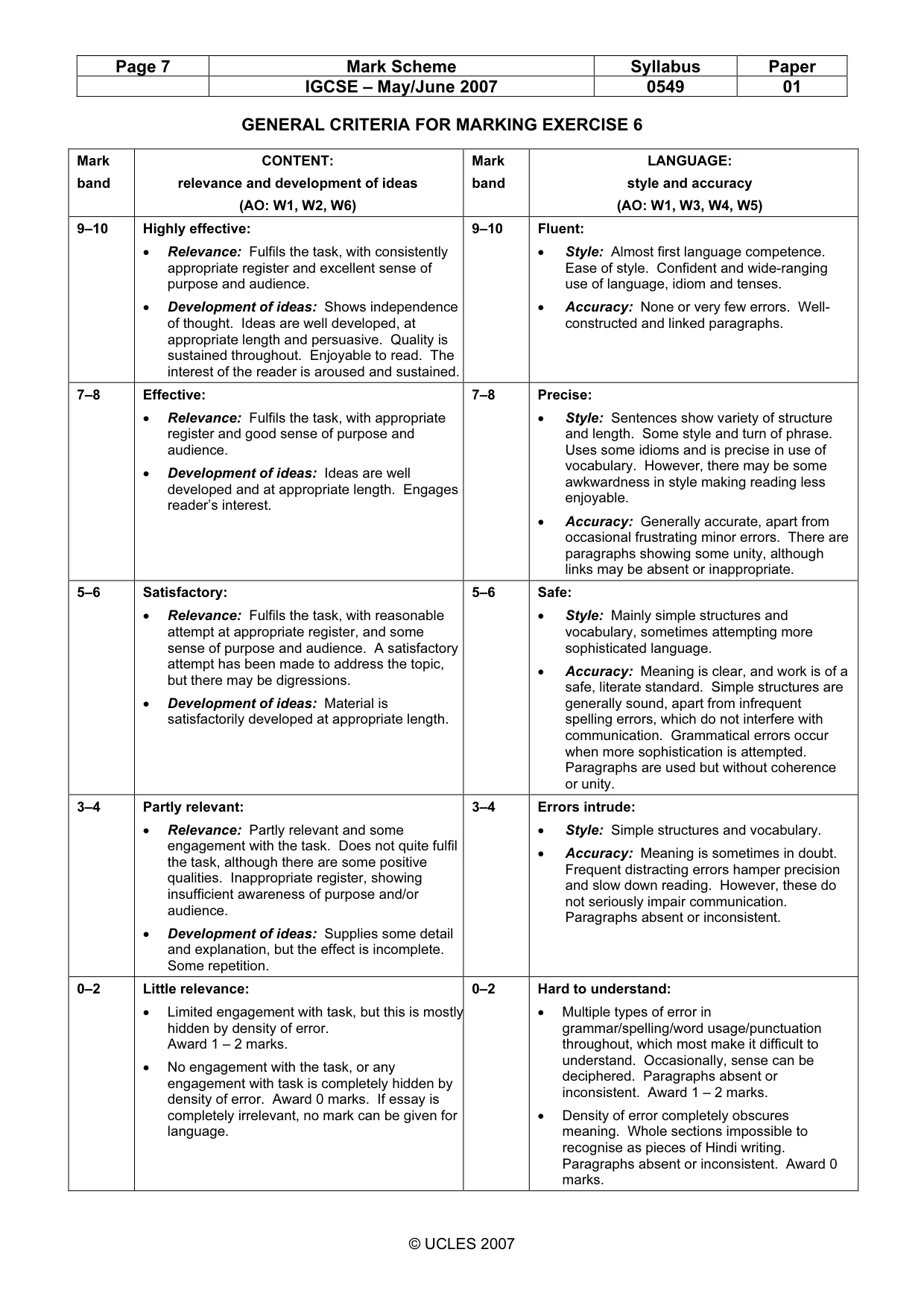
Page 7 Mark Scheme Syllabus Paper IGCSE – May/June 2007 0549 01 © UCLES 2007 GENERAL CRITERIA FOR MARKING EXERCISE 6 Mark band CONTENT: relevance and development of ideas (AO: W1, W2, W6) Mark band LANGUAGE: style and accuracy (AO: W1, W3, W4, W5) 9–10 Highly effective: • Relevance: Fulfils the task, with consistently appropriate register and excellent sense of purpose and audience. • Development of ideas: Shows independence of thought. Ideas are well developed, at appropriate length and persuasive. Quality is sustained throughout. Enjoyable to read. The interest of the reader is aroused and sustained. 9–10 Fluent: • Style: Almost first language competence. Ease of style. Confident and wide-ranging use of language, idiom and tenses. • Accuracy: None or very few errors. Well- constructed and linked paragraphs. 7–8 Effective: • Relevance: Fulfils the task, with appropriate register and good sense of purpose and audience. • Development of ideas: Ideas are well developed and at appropriate length. Engages reader’s interest. 7–8 Precise: • Style: Sentences show variety of structure and length. Some style and turn of phrase. Uses some idioms and is precise in use of vocabulary. However, there may be some awkwardness in style making reading less enjoyable. • Accuracy: Generally accurate, apart from occasional frustrating minor errors. There are paragraphs showing some unity, although links may be absent or inappropriate. 5–6 Satisfactory: • Relevance: Fulfils the task, with reasonable attempt at appropriate register, and some sense of purpose and audience. A satisfactory attempt has been made to address the topic, but there may be digressions. • Development of ideas: Material is satisfactorily developed at appropriate length. 5–6 Safe: • Style: Mainly simple structures and vocabulary, sometimes attempting more sophisticated language. • Accuracy: Meaning is clear, and work is of a safe, literate standard. Simple structures are generally sound, apart from infrequent spelling errors, which do not interfere with communication. Grammatical errors occur when more sophistication is attempted. Paragraphs are used but without coherence or unity. 3–4 Partly relevant: • Relevance: Partly relevant and some engagement with the task. Does not quite fulfil the task, although there are some positive qualities. Inappropriate register, showing insufficient awareness of purpose and/or audience. • Development of ideas: Supplies some detail and explanation, but the effect is incomplete. Some repetition. 3–4 Errors intrude: • Style: Simple structures and vocabulary. • Accuracy: Meaning is sometimes in doubt. Frequent distracting errors hamper precision and slow down reading. However, these do not seriously impair communication. Paragraphs absent or inconsistent. 0–2 Little relevance: • Limited engagement with task, but this is mostly hidden by density of error. Award 1 – 2 marks. • No engagement with the task, or any engagement with task is completely hidden by density of error. Award 0 marks. If essay is completely irrelevant, no mark can be given for language. 0–2 Hard to understand: • Multiple types of error in grammar/spelling/word usage/punctuation throughout, which most make it difficult to understand. Occasionally, sense can be deciphered. Paragraphs absent or inconsistent. Award 1 – 2 marks. • Density of error completely obscures meaning. Whole sections impossible to recognise as pieces of Hindi writing. Paragraphs absent or inconsistent. Award 0 marks.
What you needed in this session
Cambridge’s own grade thresholds for 2007 May/June, Paper 1 · Variant 1. A higher threshold means an easier paper — the bar moves with how the cohort did.