Cambridge IGCSE Hindi as a Second Language 0549 — 2017 Oct/Nov Paper 1 · Variant 1
0549/11/O/N/17 · 60 marks · ≈68 min
The question paper and its mark scheme, free to read here and free to download. This is Cambridge’s own paper, exactly as it was sat.
Question paper16 pages
Mark scheme14 pages
Answers below. Sit the paper first if you are practising.
Paper as text
Question paper, page 1
This document consists of 13 printed pages and 3 blank pages. DC (LK) 130227/4 © UCLES 2017 [Turn over Cambridge International Examinations Cambridge International General Certificate of Secondary Education * 6 2 4 8 5 2 2 2 2 2 * HINDI AS A SECOND LANGUAGE 0549/01 Paper 1 Reading and Writing October/November 2017 2 hours Candidates answer on the Question Paper. No Additional Materials are required. READ THESE INSTRUCTIONS FIRST Write your Centre number, candidate number and name on all the work you hand in. Write in dark blue or black pen. Do not use staples, paper clips, glue or correction fluid. DO NOT WRITE IN ANY BARCODES. Answer all questions. The number of marks is given in brackets [ ] at the end of each question or part question. The syllabus is approved for use in England, Wales and Northern Ireland as a Cambridge International Level 1/Level 2 Certificate.
Question paper, page 2
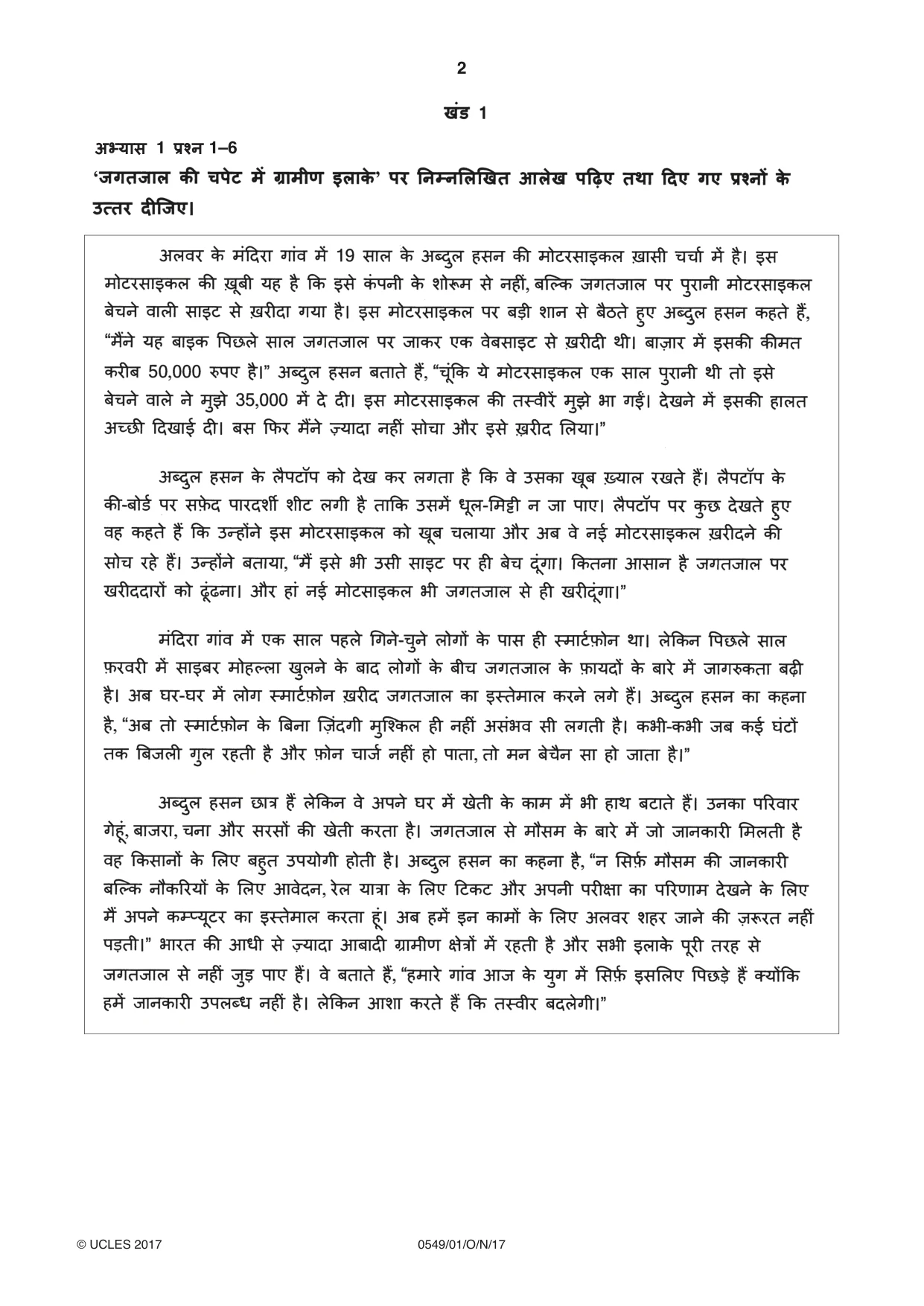
2 0549/01/O/N/17 © UCLES 2017 \ßा Ĥæ ्र 1 1–6
Question paper, page 3
3 0549/01/O/N/17 © UCLES 2017 [कृपया पृç उलटɅ] 1 मोटरसाइकल को 35,000 Ǿपये मɅ क्यɉ बेचा गया? अÞदुल हसन अपने लैपटॉप की देखभाल कैसे करते हɇ? मंिदरा गांव मɅ èमाटर्फोन संबंधी जानकारी बढ़ाने मɅ िकस का योगदान है? अÞदुल हसन कब धीरज खोने लगते हɇ? मंिदरा गांव मɅ जगतजाल से िकसानɉ को क्या लाभ िमलता है? जगतजाल के अभाव का ग्रामीण क्षेğɉ पर क्या प्रभाव पड़ा है? …[1] 2 …[1] 3 …[1] 4 …[1] 5 …[1] 6 …[1] [अंक:6]
Question paper, page 4
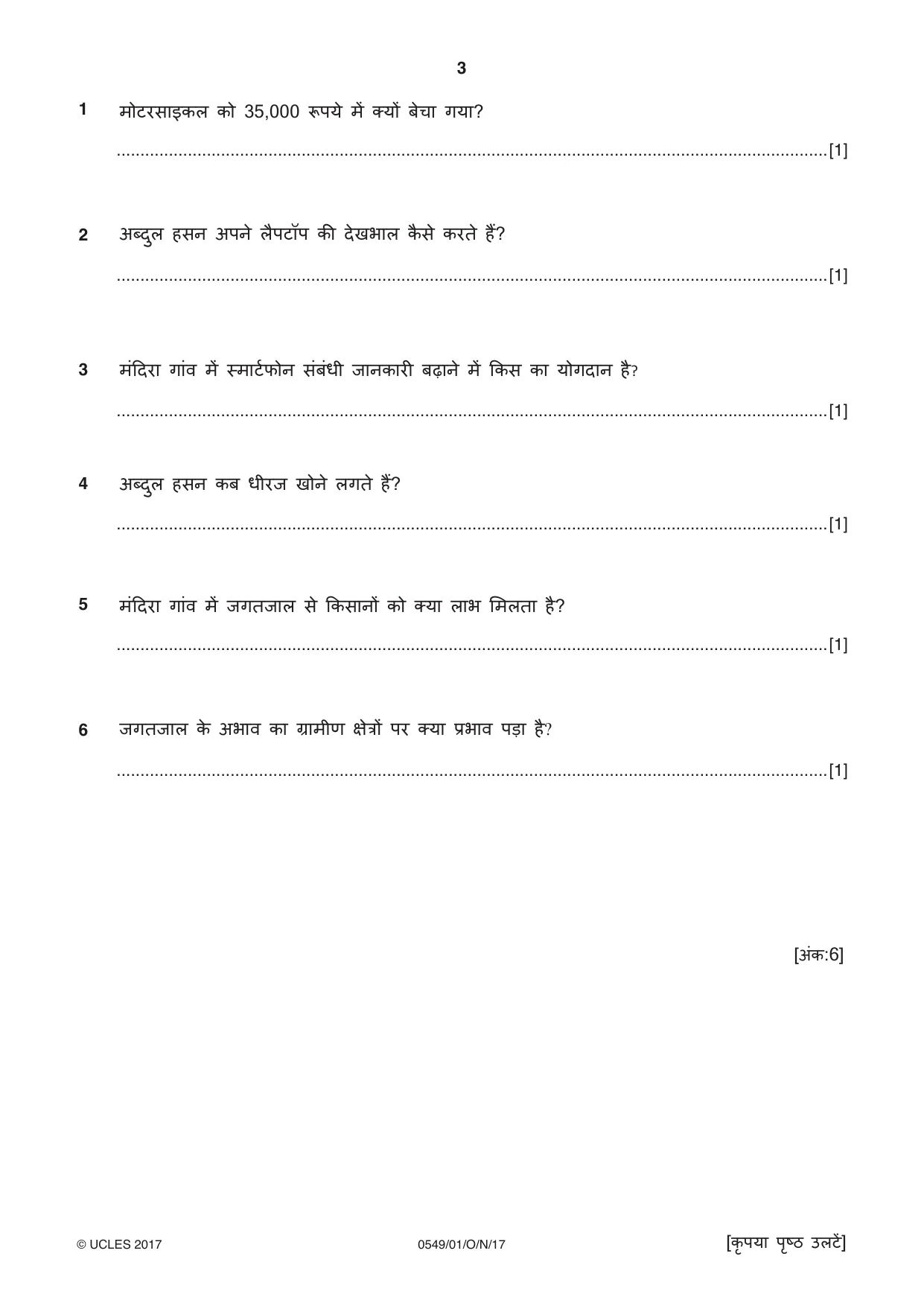
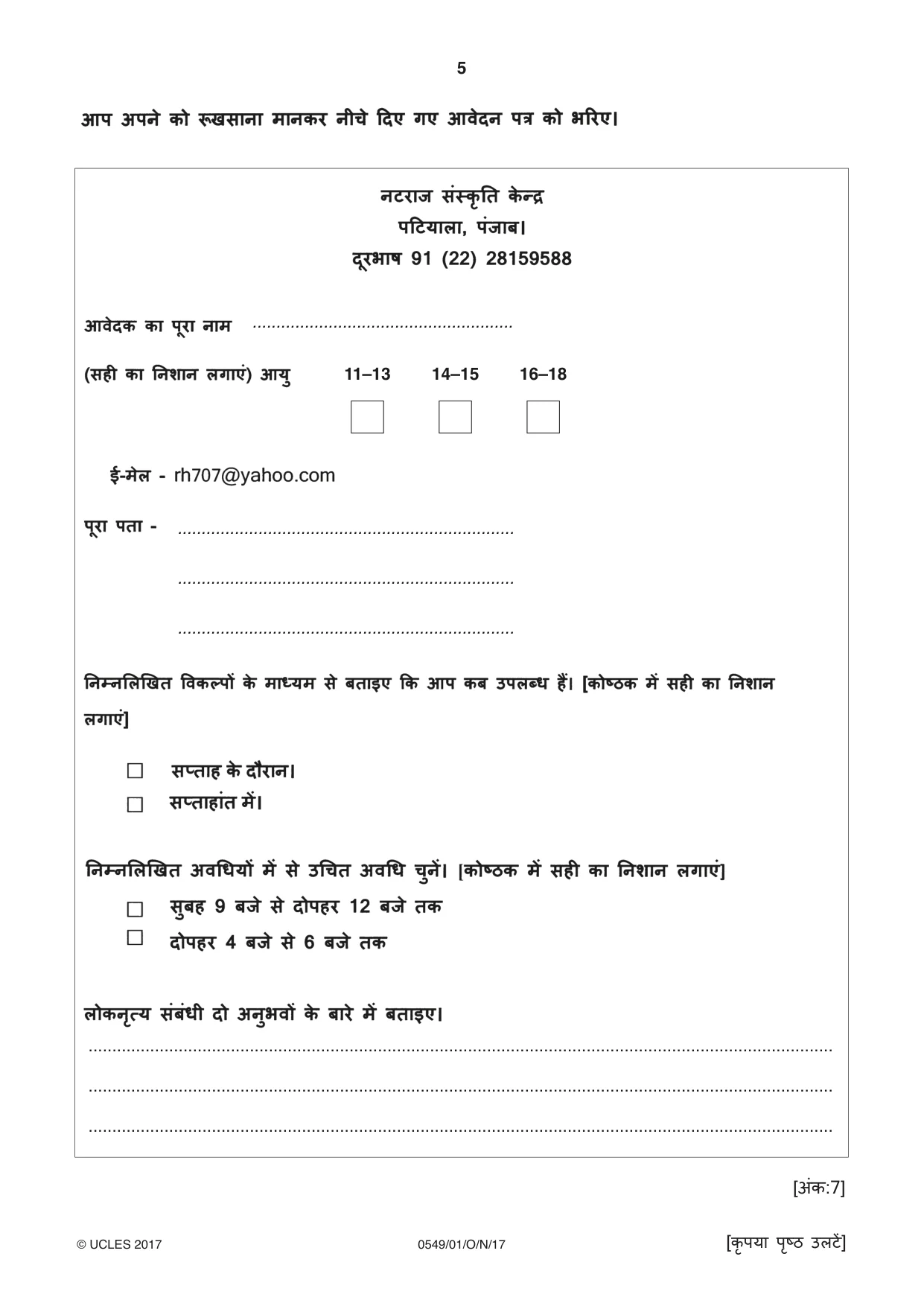
HFA 2 Wet 7 fafar sie qerent aetat Tepe ae afearer qoig| HTS 91 (22) 25958841 aes Hepa de oar & eaeh seat & fae atatepiat arlene sais FT Ver Sl Sepia seg ote sep afefatrat & axarr & fee fe Hel FX Ter Bl Hee A oN oes aca asa & ar A oiarh sean es ors a sarhet| arise A hae Grae s set a Gadi FI arieren a arene are ear sree! poar se Hreeen A ents set & fore aaeat TI wae sera FH sat 15 a8 Fl 3a tages A fare via o1 ae Pod 2 wa s Gardt atenayca tre vel 81 Spor Biepias ariwal A ataeca wedia ate 3a aga Tee Bl ag Peet 2 ash & star ws ceaieat & aT B afer ae cteaaca Fr animal at steta aed Fl Ms et ae set Spo A ceca H dics at H far va ofeaittrar sralista ater aedt $1 stat: ae ctenegca Fr arhtfevat at Taster & foe sa arene A ae wedt gl ag BAAN S Ya ah HHS st Fl TAHT FHI 2IF WAS ee Sl as Aare A caer H few ach F safe Aras H akreat atoext ar Bae a aalftte sft Bl ae Vora viet & oiearen wet A set oan & are faser fercet & 15 vat & Fae A edt 1 samt FATT th707@yahoo.com 3ix saat eferptet A. 24759348 FI © UCLES 2017 0549/01/O/N/17
Question paper, page 5
5 0549/01/O/N/17 © UCLES 2017 [कृपया पृç उलटɅ] … … … 11–13 14–15 16–18 … … … … [अंक:7]
Question paper, page 6
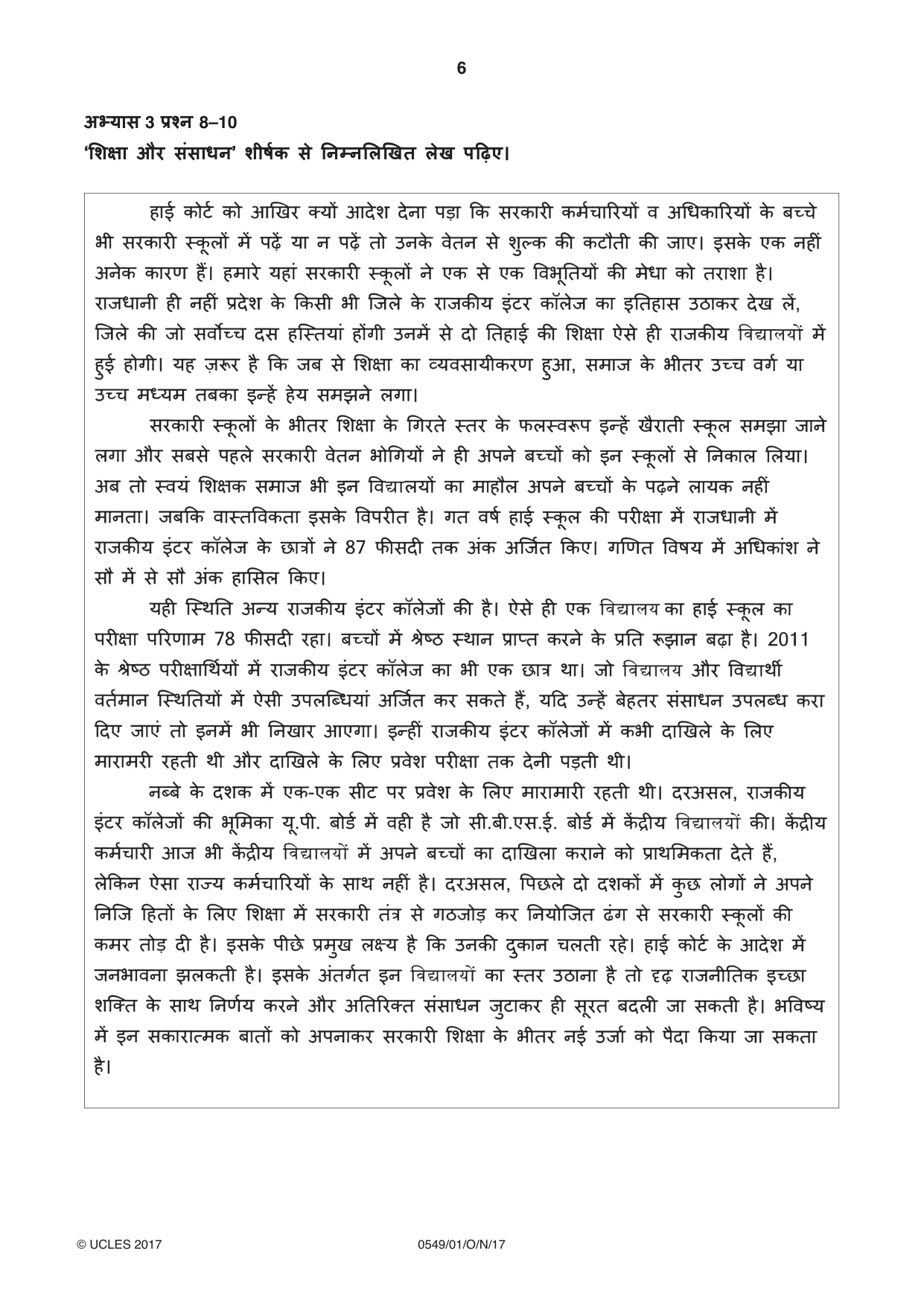
6 0549/01/O/N/17 © UCLES 2017 \ßास Ĥæन ‘िशक्षा और संसाधन’ शीषर्क से Ǔनàनिलͨख लेख पिढ़ए। ््् 3 8–10
Question paper, page 7
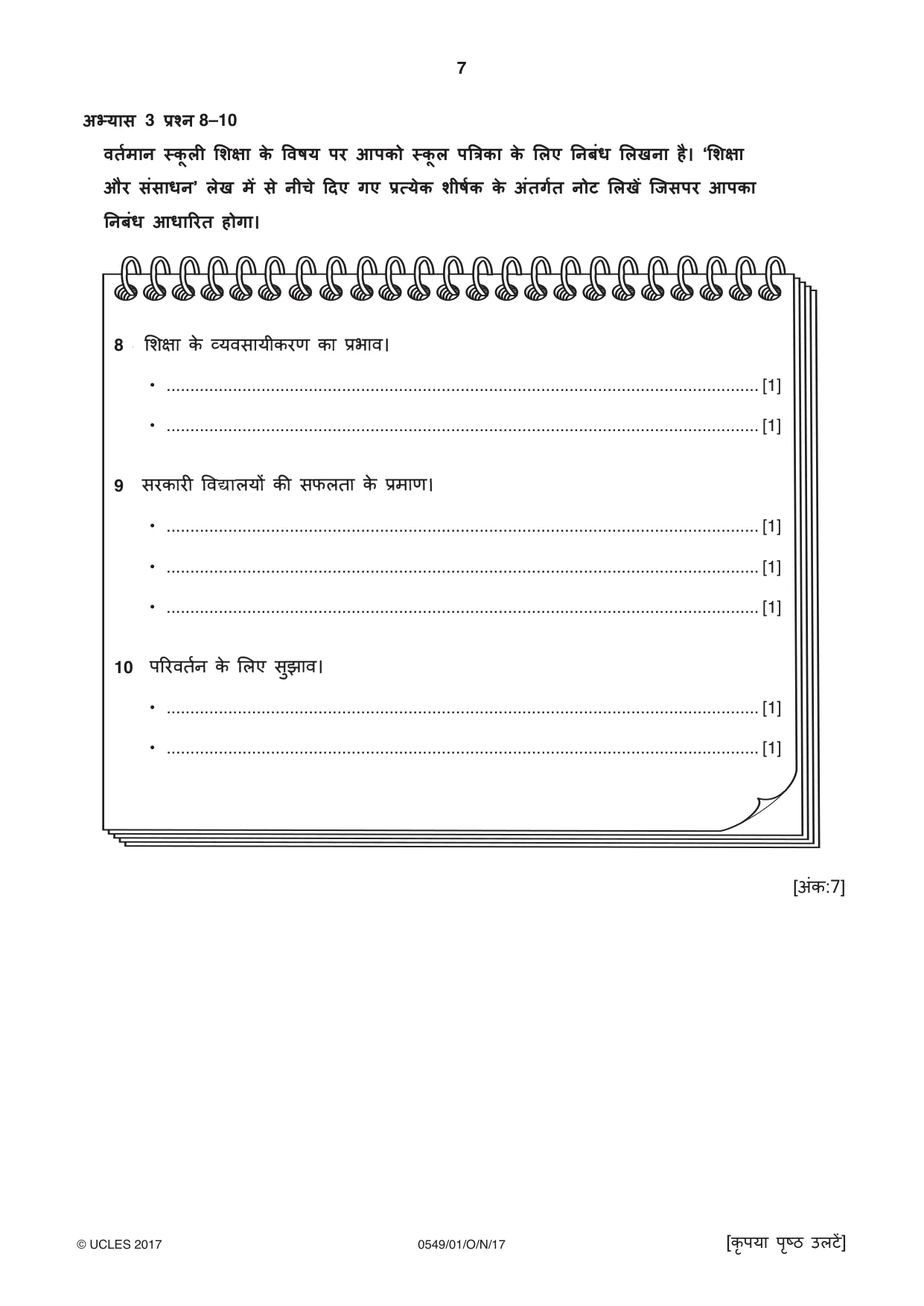
7 0549/01/O/N/17 © UCLES 2017 [कृपया पृç उलटɅ] अßयास Ĥæन वतर्मान èकूली िशक्षा के िवषय पर आपको èकूल पित्रका के िलए िनबंध िलखना है। ‘िशक्षा और संसाधन’ लेख मɅ से नीचे िदए गए Ĥ×येक शीषर्क के अंतगर्त नोट िलखɅ िजसपर आपका िनबंध आधािरत होगा। 3 8–10 8 • … [1] • … [1] 9 • … [1] • … [1] • … [1] 10 • … [1] • … [1] [अंक:7]
Question paper, page 8
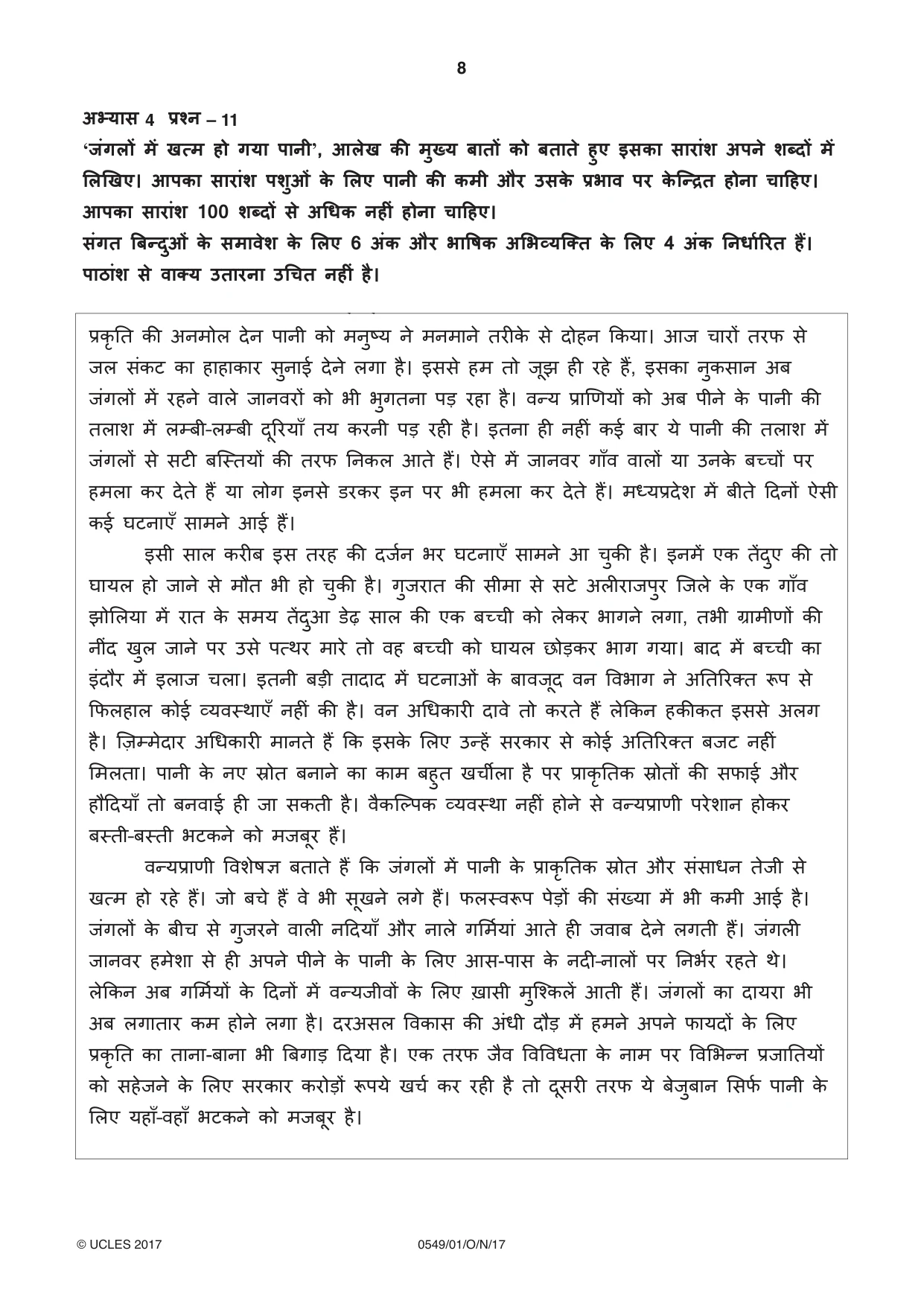
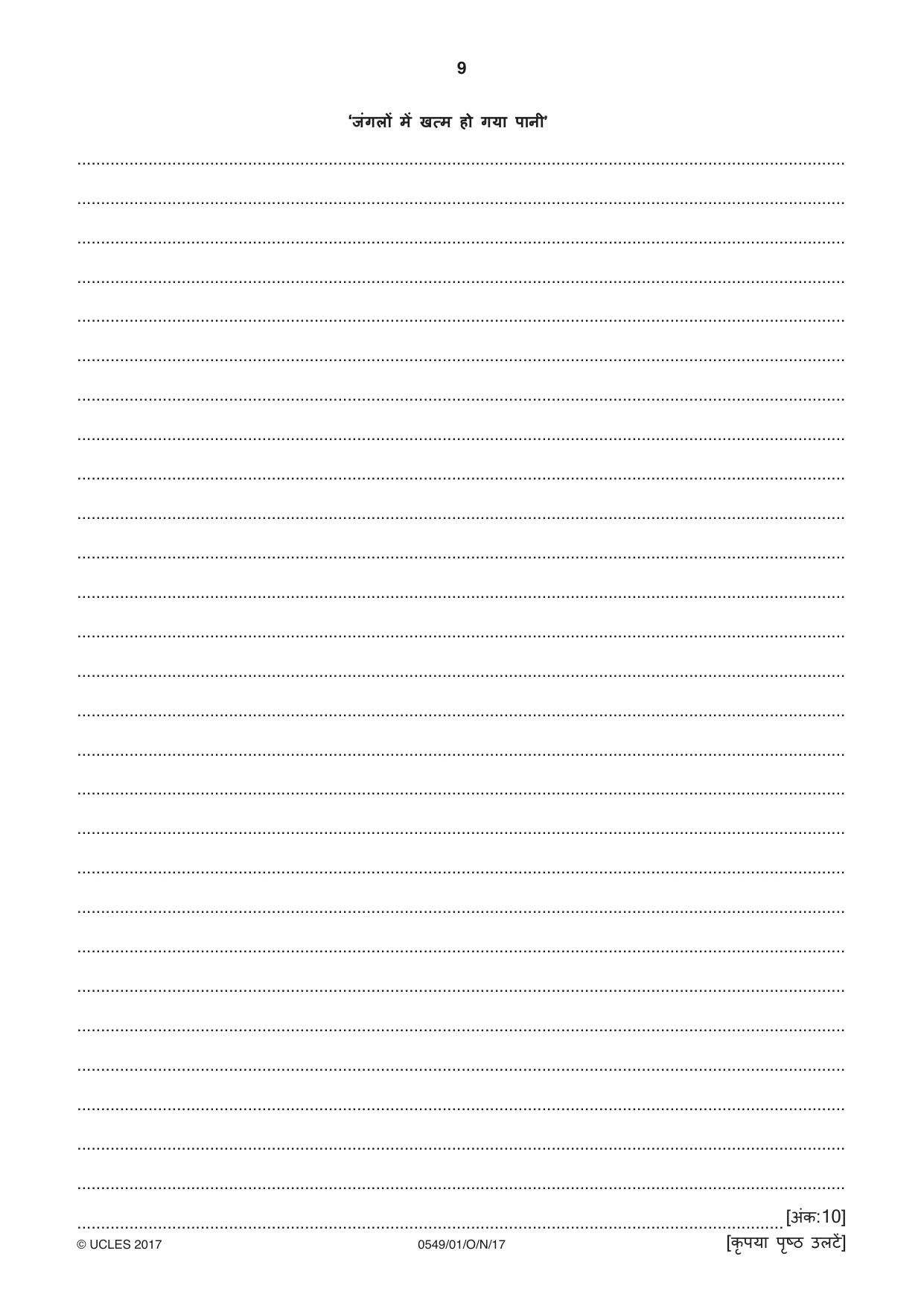
8 0549/01/O/N/17 © UCLES 2017 अßयास प्रæन ‘जंगलɉ मɅ ख×म हो गया पानी’, आलेख की मुख्य बातɉ को बताते हुए इसका सारांश अपने शÞɉ मɅ िलिखए। आपका सारांश पशुओं के िलए पानी की कमी और उसके प्रभाव पर केǔÛġत होना चािहए। आपका सारांश 100 शÞɉ से अिधक नहीं होना चािहए। संगत ǒबÛुओं के समावेश के िलए 6 अंक और भािषक अिभåयǔक्त के िलए 4 अंक िनधार्िरत हɇ। पाठांश से वाक्य उतारना उिचत नहीं है। ्र 4 – 11् हह प्रकृित की अनमोल देन पानी को मनुçय ने मनमाने तरीके से दोहन िकया। आज चारɉ तरफ से जल संकट का हाहाकार सुनाई देने लगा है। इससे हम तो जूझ ही रहे हɇ, इसका नुकसान अब जंगलɉ मɅ रहने वाले जानवरɉ को भी भुगतना पड़ रहा है। वÛय प्राͨयɉ को अब पीने के पानी की तलाश मɅ लàबी–लàबी दूिरयाँ तय करनी पड़ रही है। इतना ही नहीं कई बार ये पानी की तलाश मɅ जंगलɉ से सटी बिèतयɉ की तरफ िनकल आते हɇ। ऐसे मɅ जानवर गाँव वालɉ या उनके बÍचɉ पर हमला कर देते हɇ या लोग इनसे डरकर इन पर भी हमला कर देते हɇ। मÚयप्रदेश मɅ बीते िदनɉ ऐसी कई घटनाएँ सामने आई हɇ। इसी साल करीब इस तरह की दजर्न भर घटनाएँ सामने आ चुकी है। इनमɅ एक तɅदुए की तो घायल हो जाने से मौत भी हो चुकी है। गुजरात की सीमा से सटे अलीराजपुर िजले के एक गाँव झोिलया मɅ रात के समय तɅदुआ डेढ़ साल की एक बÍची को लेकर भागने लगा, तभी Ēामीɉ की नींद खुल जाने पर उसे प×थर मारे तो वह बÍची को घायल छोड़कर भाग गया। बाद मɅ बÍची का इंदौर मɅ इलाज चला। इतनी बड़ी तादाद मɅ घटनाओं के बावजूद वन िवभाग ने अितिरक्त Ǿप से िफलहाल कोई åयवèथाएँ नहीं की है। वन अिधकारी दावे तो करते हɇ लेिकन हकीकत इससे अलग है। ि«àमेदार अिधकारी मानते हɇ िक इसके िलए उÛहɅ सरकार से कोई अितिरक्त बजट नहीं िमलता। पानी के नए İोत बनाने का काम बहुत खचीर्ला है पर प्राकृितक İोतɉ की सफाई और हौिदयाँ तो बनवाई ही जा सकती है। वैकिãपक åयवèथा नहीं होने से वÛयप्राी परेशान होकर बèती–बèती भटकने को मजबूर हɇ। वÛयप्राी िवशेषज्ञ बताते हɇ िक जंगलɉ मɅ पानी के प्राकृितक İोत और संसाधन तेजी से ख×म हो रहे हɇ। जो बचे हɇ वे भी सूखने लगे हɇ। फलèवǾप पेड़ɉ की संख्या मɅ भी कमी आई है। जंगलɉ के बीच से गुजरने वाली निदयाँ और नाले गिमर्यां आते ही जवाब देने लगती हɇ। जंगली जानवर हमेशा से ही अपने पीने के पानी के िलए आस-पास के नदी–नालɉ पर िनभर्र रहते थे। लेिकन अब गिमर्यɉ के िदनɉ मɅ वÛयजीवɉ के िलए ख़ासी मुिæकलɅ आती हɇ। जंगलɉ का दायरा भी अब लगातार कम होने लगा है। दरअसल िवकास की अंधी दौड़ मɅ हमने अपने फायदɉ के िलए प्रकृित का ताना-बाना भी िबगाड़ िदया है। एक तरफ जैव िविवधता के नाम पर िविभÛन प्रजाितयɉ को सहेजने के िलए सरकार करोड़ɉ Ǿपये खचर् कर रही है तो दूसरी तरफ ये बेजुबान िसफर् पानी के िलए यहाँ–वहाँ भटकने को मजबूर है।
Question paper, page 9
9 0549/01/O/N/17 © UCLES 2017 [कृपया पृç उलटɅ] ‘जंगɉ मɅ ×म हो गया पानी’ … … … … … … … … … … … … … … … … … … … … … … … … … … … …[अंक:10]
Question paper, page 10
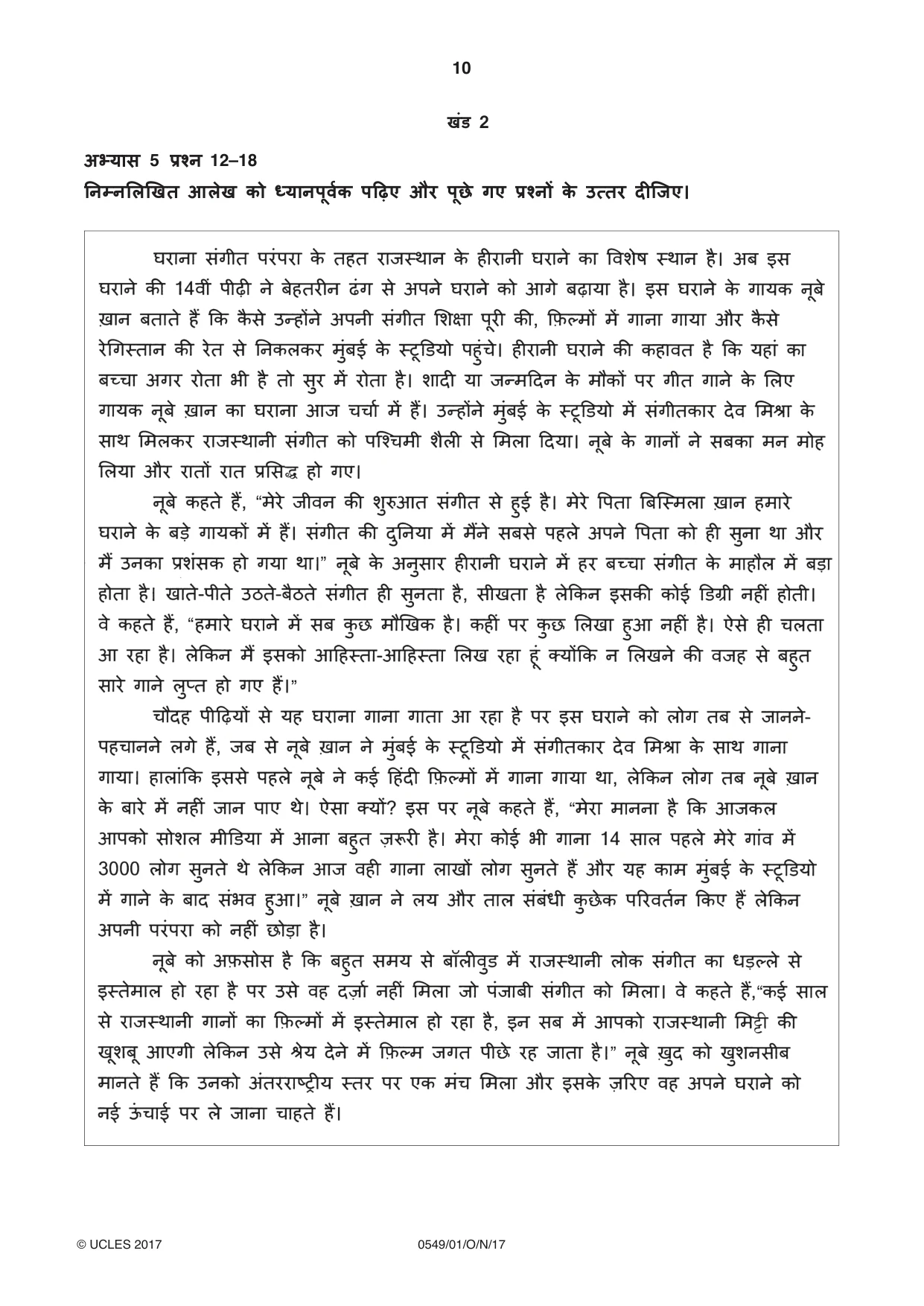
10 0549/01/O/N/17 © UCLES 2017 खंड 2 \ßȡ Ĥæ Ǔàͧलͨख आलेख को Úȡपूवर्क पिढ़ए और पूछे गए Ĥæɉ के `×र दीिजए। 5 12–18 “ ” “ ” “ ” “ ”
Question paper, page 11
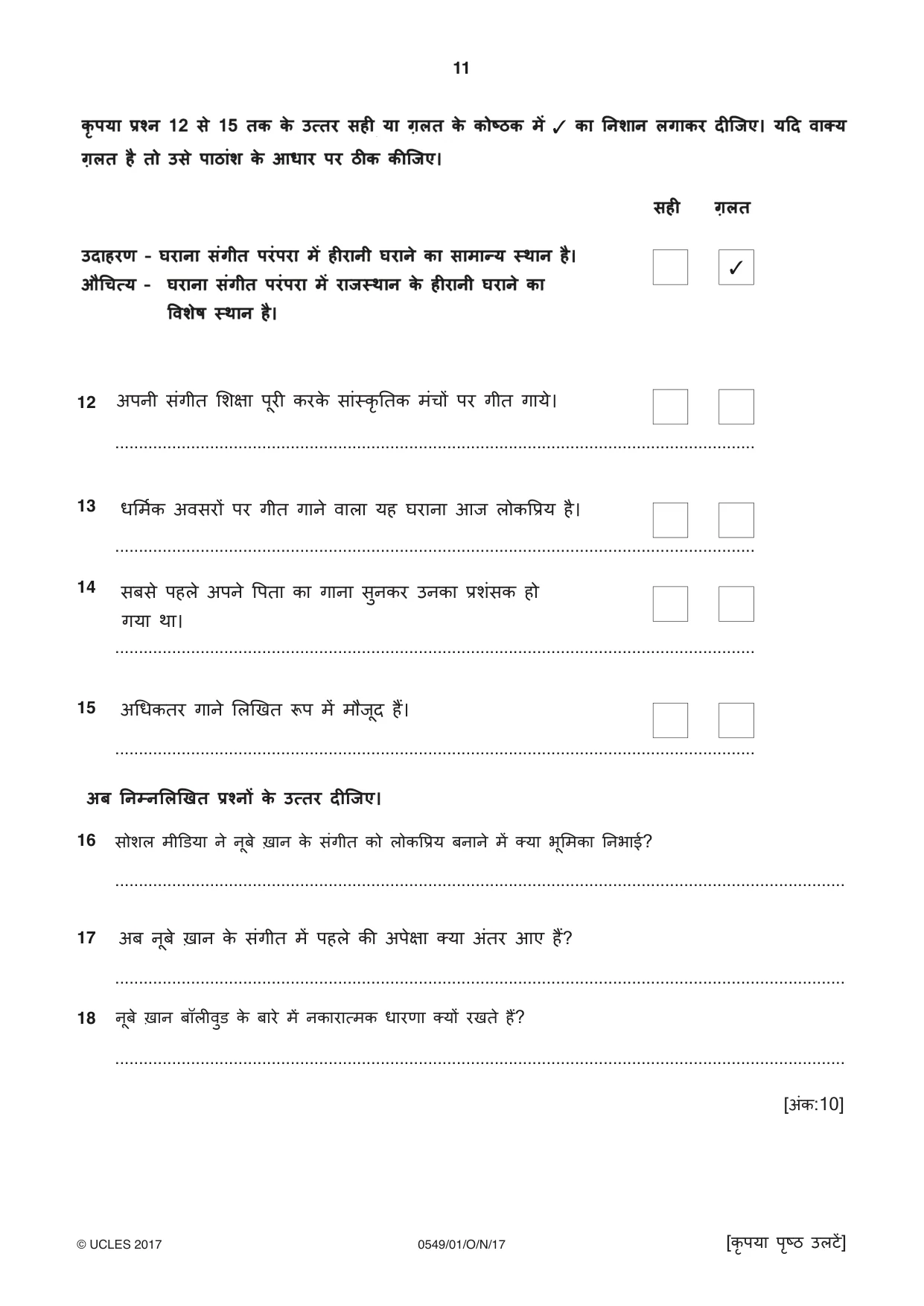
11 0549/01/O/N/17 © UCLES 2017 [कृपया पृç उलटɅ] अपनी संगीत िशक्षा पूरी करके सांèकृितक मं ɉ पर गीत गाये। धिमर्क अवसरɉ पर गीत गाने वाला यह घराना आज लोकिप्रय है। सबसे पहले अपने िपता का गाना सुनकर उनका प्रशंसक हो गया था। अिधकतर गाने िलिखत Ǿप मɅ मौजूद हɇ। अब िनàनͧलͨत Ĥæनɉ के उ×तर दीिजए। ्र् ✓ ✓ 12 … 13 … 14 … 15 … सोशल मीिडया ने नूबे ख़ान के संगीत को लोकिप्रय बनाने मɅ क्या भूिमका िनभाई? अब नूबे ख़ान के संगीत मɅ पहले की अपेक्षा क्या अंतर आए हɇ? नूबे ख़ान बॉलीवुड के बारे मɅ नकारा×मक धारणा क्यɉ रखते हɇ? 16 … 17 … 18 … [अंक:10]
Question paper, page 12
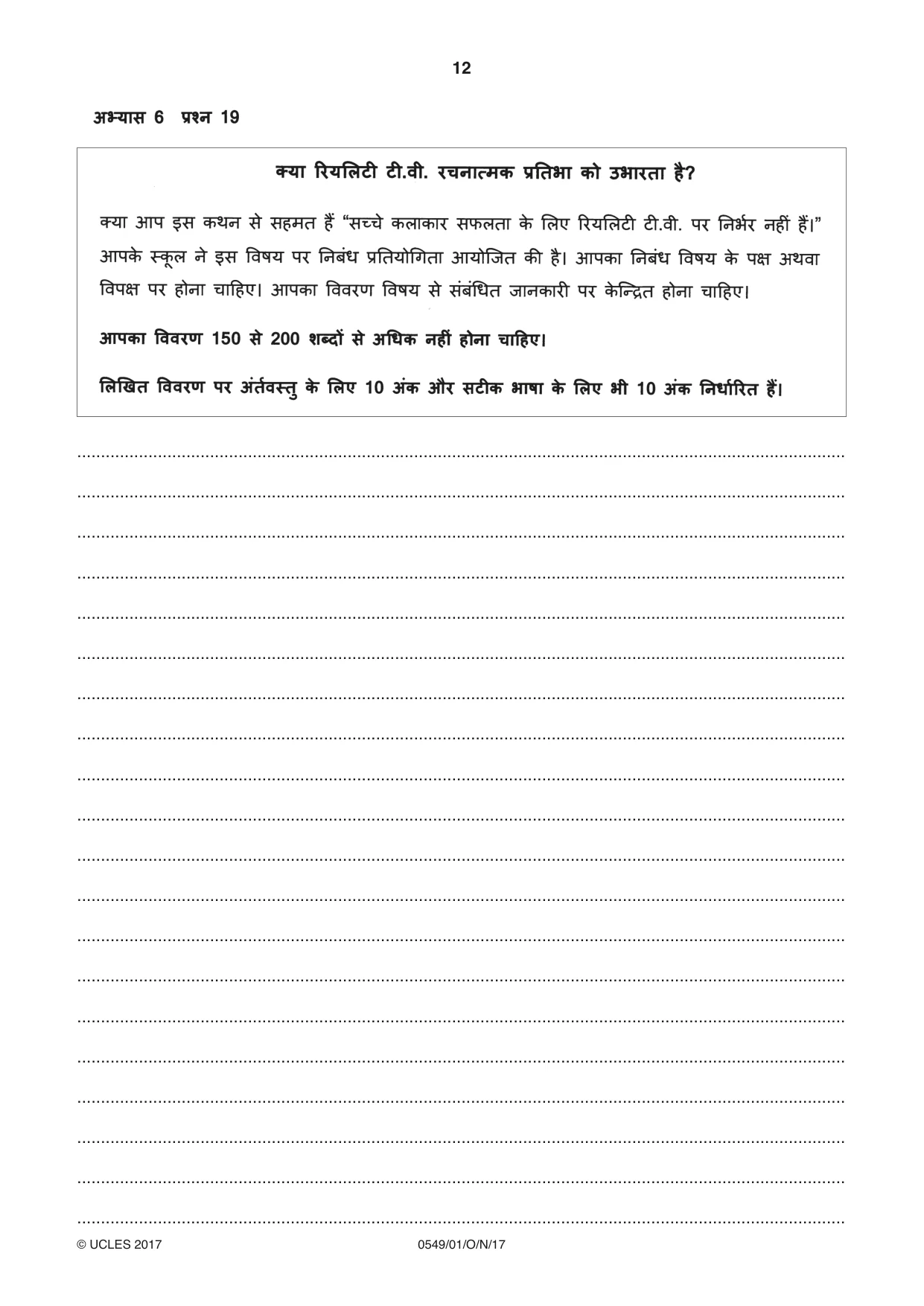
12 0549/01/O/N/17 © UCLES 2017 … … … … … … … … … … … … … … … … … … … …
Question paper, page 13
13 0549/01/O/N/17 © UCLES 2017 … … … … … … … … … … … … … … … [अंक:20]
Question paper, page 14
14 0549/01/O/N/17 © UCLES 2017 BLANK PAGE
Question paper, page 15
15 0549/01/O/N/17 © UCLES 2017 BLANK PAGE
Question paper, page 16
16 0549/01/O/N/17 © UCLES 2017 Permission to reproduce items where third-party owned material protected by copyright is included has been sought and cleared where possible. Every reasonable effort has been made by the publisher (UCLES) to trace copyright holders, but if any items requiring clearance have unwittingly been included, the publisher will be pleased to make amends at the earliest possible opportunity. To avoid the issue of disclosure of answer-related information to candidates, all copyright acknowledgements are reproduced online in the Cambridge International Examinations Copyright Acknowledgements Booklet. This is produced for each series of examinations and is freely available to download at www.cie.org.uk after the live examination series. Cambridge International Examinations is part of the Cambridge Assessment Group. Cambridge Assessment is the brand name of University of Cambridge Local Examinations Syndicate (UCLES), which is itself a department of the University of Cambridge. BLANK PAGE
Mark scheme, page 1
® IGCSE is a registered trademark. This syllabus is approved for use in England, Wales and Northern Ireland as a Cambridge International Level 1/Level 2 Certificate. This document consists of 14 printed pages. © UCLES 2017 [Turn over Cambridge Assessment International Education Cambridge International General Certificate of Secondary Education HINDI AS A SECOND LANGUAGE 0549/01 Paper 1 Reading and Writing October/November 2017 MARK SCHEME Maximum Mark: 60 Published This mark scheme is published as an aid to teachers and candidates, to indicate the requirements of the examination. It shows the basis on which Examiners were instructed to award marks. It does not indicate the details of the discussions that took place at an Examiners’ meeting before marking began, which would have considered the acceptability of alternative answers. Mark schemes should be read in conjunction with the question paper and the Principal Examiner Report for Teachers. Cambridge International will not enter into discussions about these mark schemes. Cambridge International is publishing the mark schemes for the October/November 2017 series for most Cambridge IGCSE®, Cambridge International A and AS Level components and some Cambridge O Level components.
Mark scheme, page 2
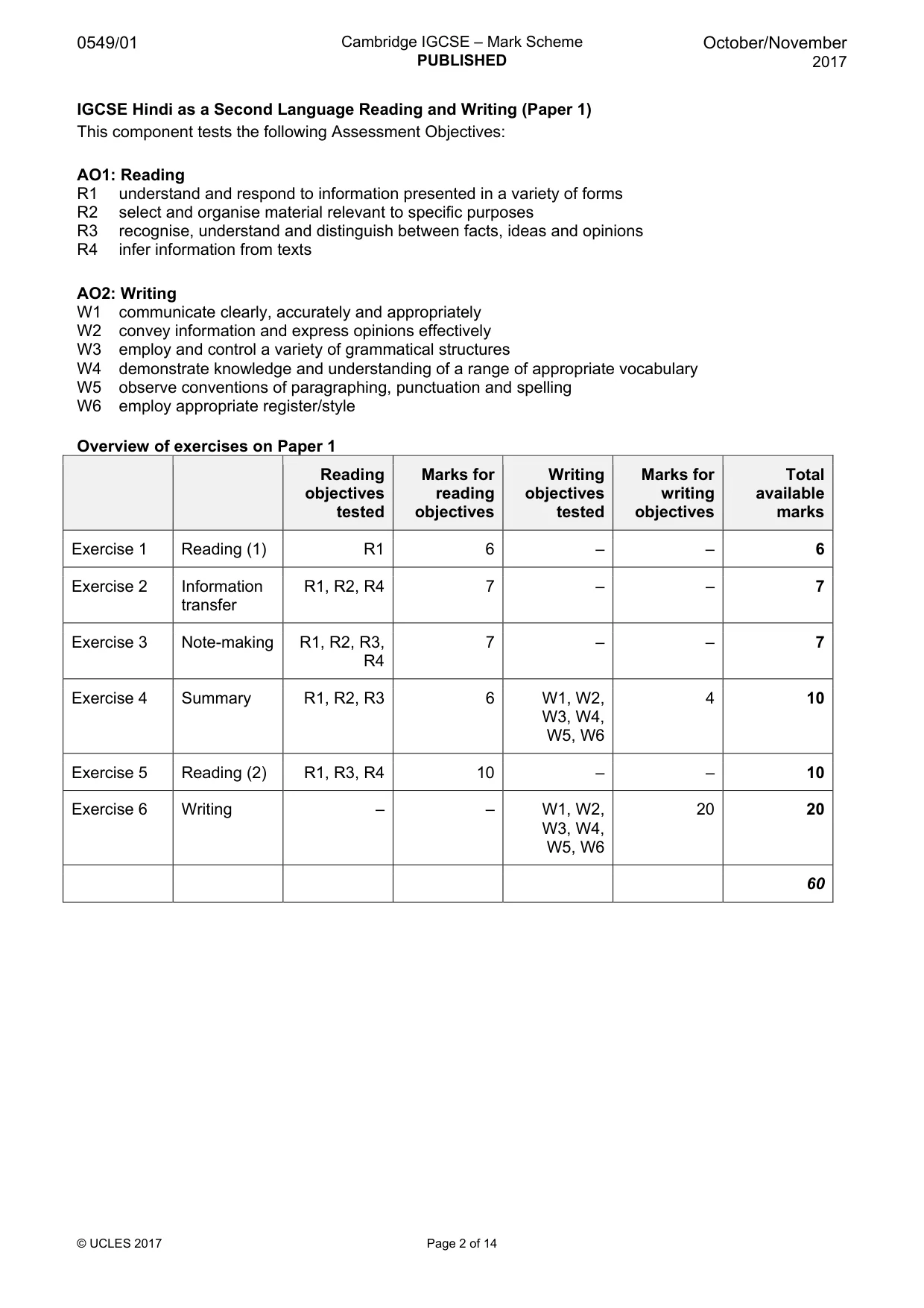
0549/01 Cambridge IGCSE – Mark Scheme PUBLISHED October/November 2017 © UCLES 2017 Page 2 of 14 IGCSE Hindi as a Second Language Reading and Writing (Paper 1) This component tests the following Assessment Objectives: AO1: Reading R1 understand and respond to information presented in a variety of forms R2 select and organise material relevant to specific purposes R3 recognise, understand and distinguish between facts, ideas and opinions R4 infer information from texts AO2: Writing W1 communicate clearly, accurately and appropriately W2 convey information and express opinions effectively W3 employ and control a variety of grammatical structures W4 demonstrate knowledge and understanding of a range of appropriate vocabulary W5 observe conventions of paragraphing, punctuation and spelling W6 employ appropriate register/style Overview of exercises on Paper 1 Reading objectives tested Marks for reading objectives Writing objectives tested Marks for writing objectives Total available marks Exercise 1 Reading (1) R1 6 – – 6 Exercise 2 Information transfer R1, R2, R4 7 – – 7 Exercise 3 Note-making R1, R2, R3, R4 7 – – 7 Exercise 4 Summary R1, R2, R3 6 W1, W2, W3, W4, W5, W6 4 10 Exercise 5 Reading (2) R1, R3, R4 10 – – 10 Exercise 6 Writing – – W1, W2, W3, W4, W5, W6 20 20 60
Mark scheme, page 3
0549/01 Cambridge IGCSE – Mark Scheme PUBLISHED October/November 2017 © UCLES 2017 Page 3 of 14 Marking rationale • In general, for the exercises which test only reading skills (Exercise 1, Exercise 3, Exercise 5) spelling errors are tolerated where they do not interfere with the communication of the correct answer. However, where the error creates another word with a different meaning, the mark is not awarded. • For Exercise 2 (form-filling) reading marks are awarded for the accurate transfer of information and spelling errors are therefore not tolerated. In addition, the conventions of form-filling (i.e. instructions to tick, delete, underline, circle) must be observed with total accuracy. • Any word or phrase underlined in the mark scheme is a key detail and must be included in the response for the award of marks. If a key detail generates another word with a different meaning, the mark(s) should not be awarded. • Any detail contained within brackets (like this) in the mark scheme is not required for the award of marks. It is additional information which it is anticipated a number of candidates will include. • Where candidates include additional unnecessary information, use the following rule: – If the excess detail is irrelevant and does not interfere with the communication of the correct answer, the mark(s) may be awarded – If the excess detail contains clearly incorrect information, i.e. negates the correct answer, the mark(s) should not be awarded • In general synonyms are accepted but where a candidate has rearranged or re-worded the answer please check carefully that the key information has been conveyed.
Mark scheme, page 4
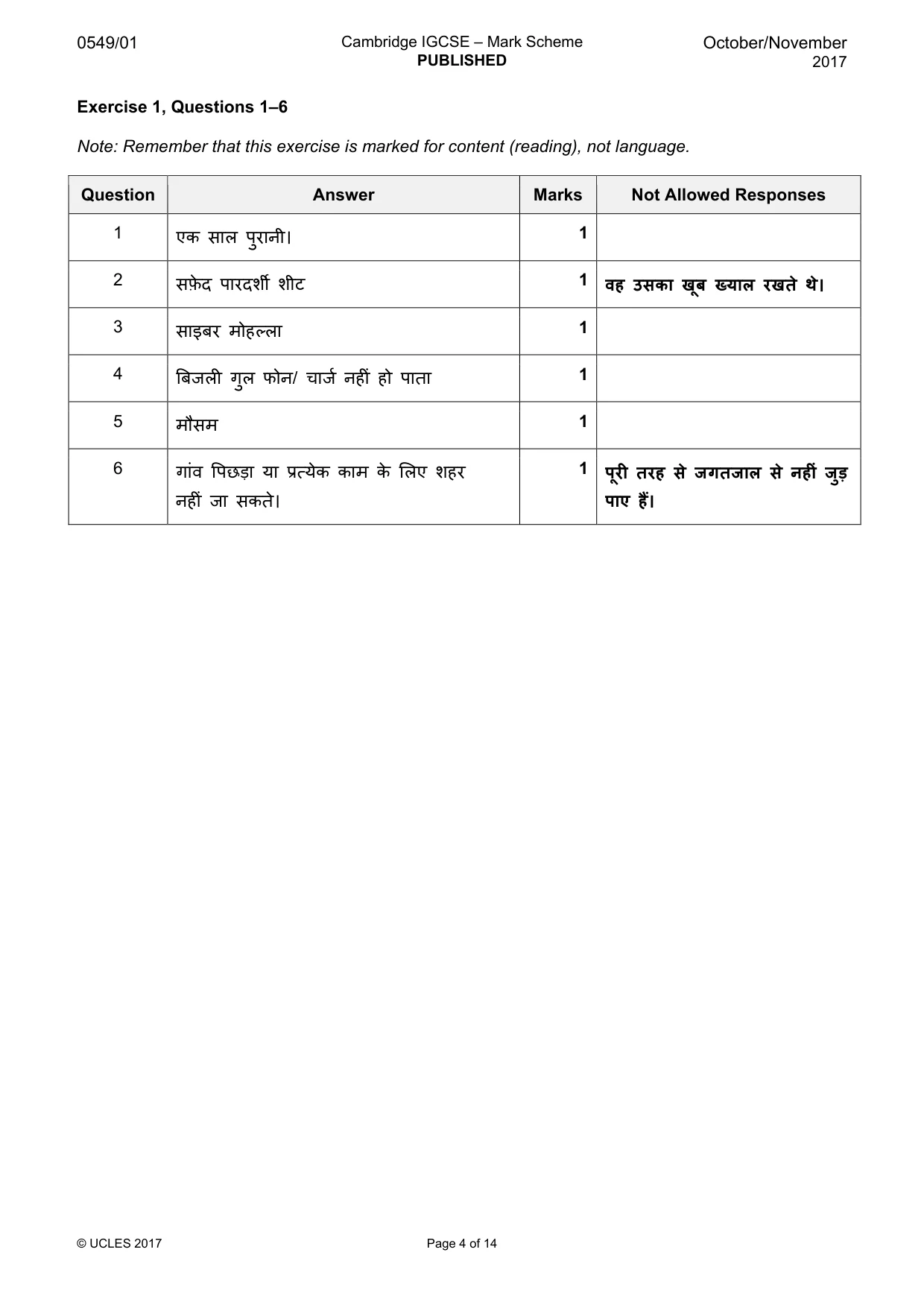
0549/01 Cambridge IGCSE – Mark Scheme PUBLISHED October/November 2017 © UCLES 2017 Page 4 of 14 Exercise 1, Questions 1–6 Note: Remember that this exercise is marked for content (reading), not language. Question Answer Marks Not Allowed Responses 1 एक साल पुरानी। 1 2 सफ़ेद पारदशȸ शीट 1 वह उसका खूब Éयाल रखते थे। 3 साइबर मोहãला 1 4 ǒबजलȣ गुल फोन/ चाज[ नहȣं हो पाता 1 5 मौसम 1 6 गांव ͪपछड़ा या Ĥ×येक काम के ͧलए शहर नहȣं जा सकते। 1 पूरȣ तरह से जगतजाल से नहȣं जुड़ पाए हɇ।
Mark scheme, page 5
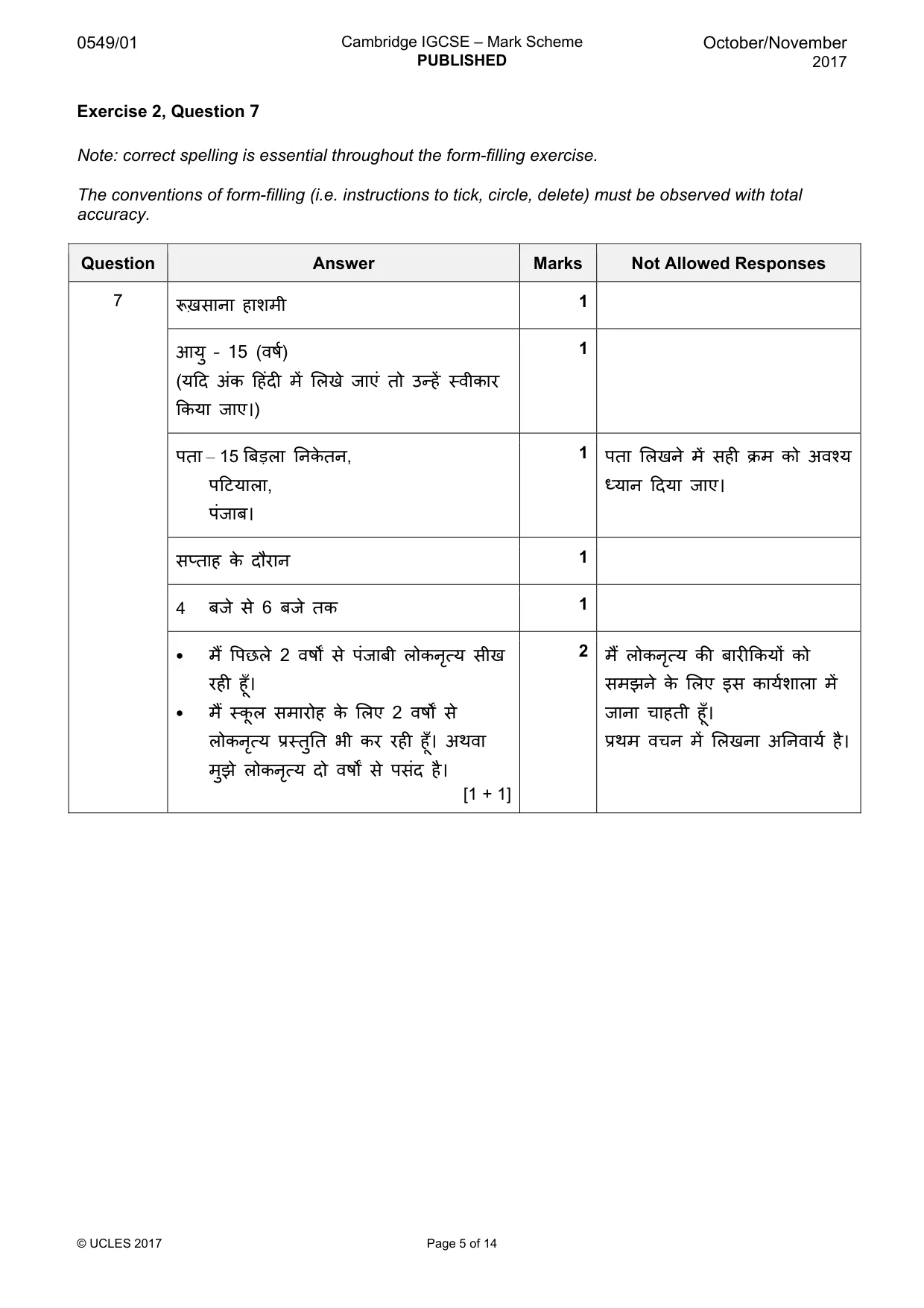
0549/01 Cambridge IGCSE – Mark Scheme PUBLISHED October/November 2017 © UCLES 2017 Page 5 of 14 Exercise 2, Question 7 Note: correct spelling is essential throughout the form-filling exercise. The conventions of form-filling (i.e. instructions to tick, circle, delete) must be observed with total accuracy. Question Answer Marks Not Allowed Responses 7 Ǿख़साना हाशमी 1 आयु – 15 (वष[) (यǑद अंक Ǒहंदȣ मɅ ͧलखे जाएं तो उÛहɅ èवीकार ͩकया जाए।) 1 पता – 15 ǒबड़ला Ǔनकेतन, पǑटयाला, पंजाब। 1 पता ͧलखने मɅ सहȣ Đम को अवæय Úयान Ǒदया जाए। सÜताह के दौरान 1 4 बजे से 6 बजे तक 1 • मɇ ͪपछले 2 वषɟ से पंजाबी लोकनृ×य सीख रहȣ हूँ। • मɇ èकूल समारोह के ͧलए 2 वषɟ से लोकनृ×य ĤèतुǓत भी कर रहȣ हूँ। अथवा मुझे लोकनृ×य दो वषɟ से पसंद है। [1 + 1] 2 मɇ लोकनृ×य कȧ बारȣͩकयɉ को समझने के ͧलए इस काय[शाला मɅ जाना चाहती हूँ। Ĥथम वचन मɅ ͧलखना अǓनवाय[ है।
Mark scheme, page 6
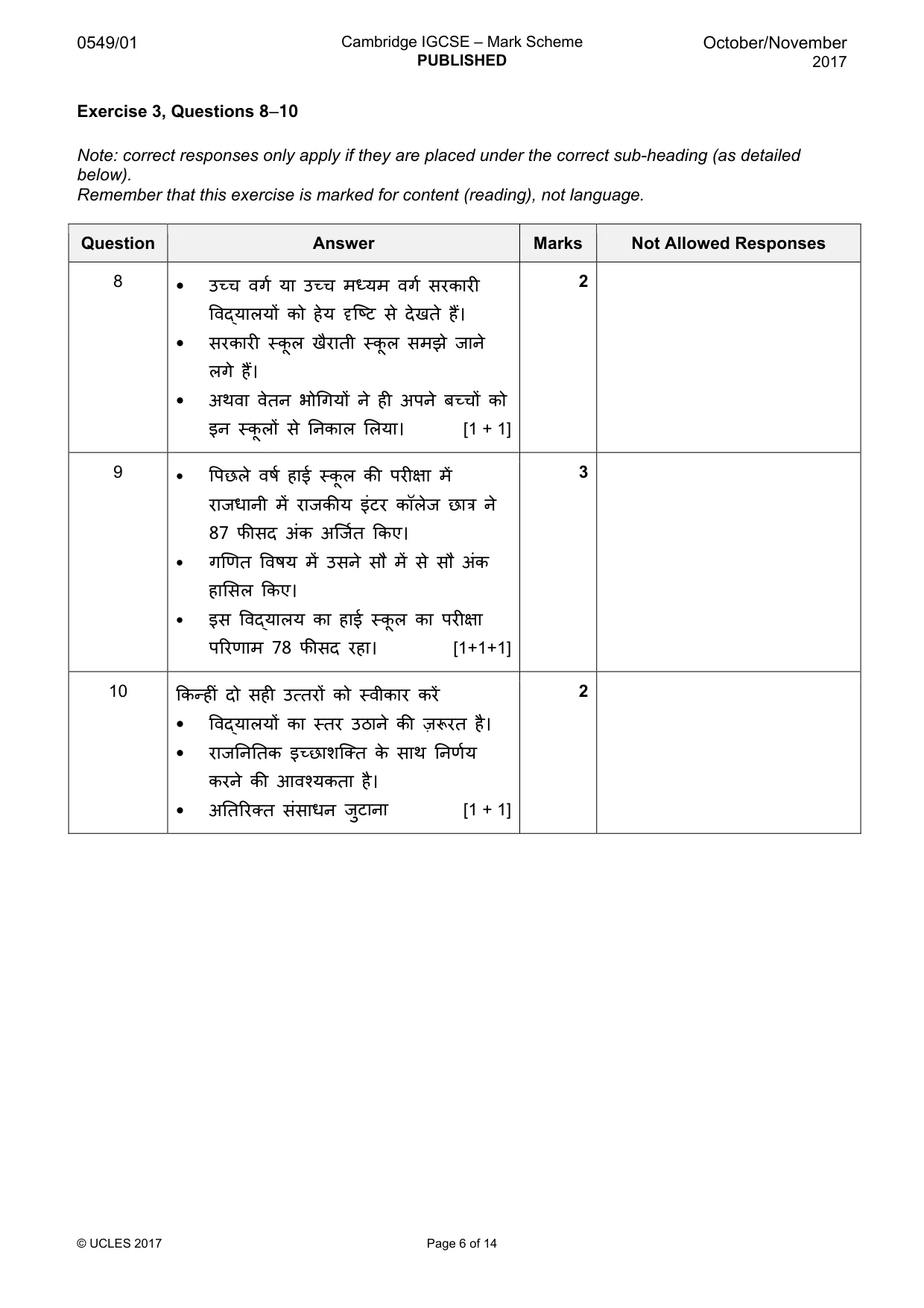
0549/01 Cambridge IGCSE – Mark Scheme PUBLISHED October/November 2017 © UCLES 2017 Page 6 of 14 Exercise 3, Questions 8–10 Note: correct responses only apply if they are placed under the correct sub-heading (as detailed below). Remember that this exercise is marked for content (reading), not language. Question Answer Marks Not Allowed Responses 8 • उÍच वग[ या उÍच मÚयम वग[ सरकारȣ ͪवɮयालयɉ को हेय Ǻिçट से देखते हɇ। • सरकारȣ èकूल खैराती èकूल समझे जाने लगे हɇ। • अथवा वेतन भोͬगयɉ ने हȣ अपने बÍचɉ को इन èकूलɉ से Ǔनकाल ͧलया। [1 + 1] 2 9 • ͪपछले वष[ हाई èकूल कȧ परȣ¢ामɅ राजधानी मɅ राजकȧय इंटर कॉलेज छाğ ने 87 फȧसद अंक अिज[त ͩकए। • गͨणत ͪवषय मɅ उसने सौ मɅ से सौ अंक हाͧसल ͩकए। • इस ͪवɮयालय का हाई èकूल का परȣ¢ा पǐरणाम 78 फȧसद रहा। [1+1+1] 3 10 ͩकÛहȣं दो सहȣ उ×तरɉ को èवीकार करɅ • ͪवɮयालयɉ का èतर उठाने कȧ ज़Ǿरत है। • राजǓनǓतक इÍछाशिÈत के साथ Ǔनण[य करने कȧ आवæयकता है। • अǓतǐरÈत संसाधन जुटाना [1 + 1] 2
Mark scheme, page 7
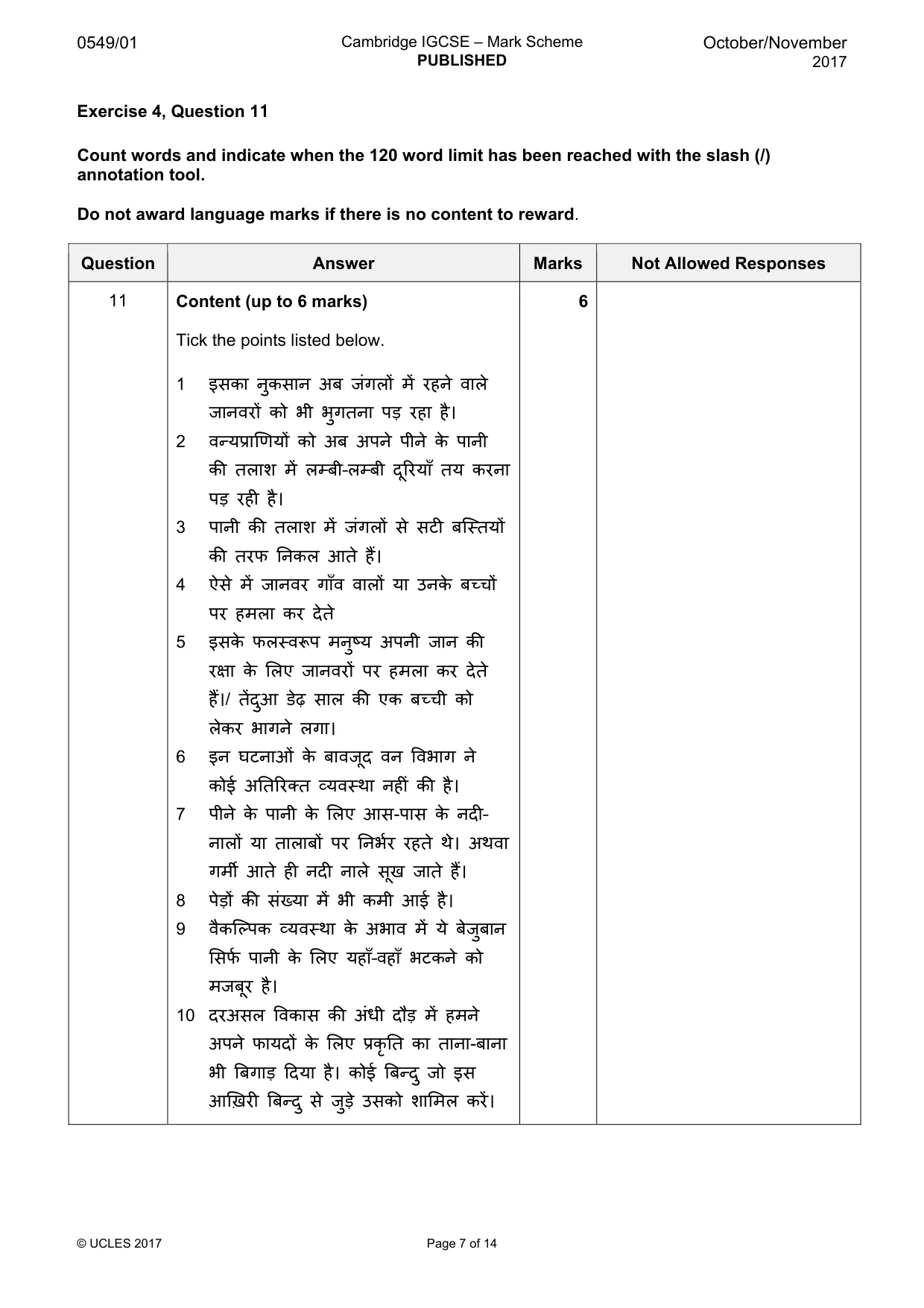
0549/01 Cambridge IGCSE – Mark Scheme PUBLISHED October/November 2017 © UCLES 2017 Page 7 of 14 Exercise 4, Question 11 Count words and indicate when the 120 word limit has been reached with the slash (/) annotation tool. Do not award language marks if there is no content to reward. Question Answer Marks Not Allowed Responses 11 Content (up to 6 marks) Tick the points listed below. 1 इसका नुकसान अब जंगलɉ मɅ रहने वाले जानवरɉ को भी भुगतना पड़ रहा है। 2 वÛयĤाͨणयɉ को अब अपने पीने के पानी कȧ तलाश मɅ लàबी–लàबी दूǐरयाँ तय करना पड़ रहȣ है। 3 पानी कȧ तलाश मɅ जंगलɉ से सटȣ बिèतयɉ कȧ तरफ Ǔनकल आते हɇ। 4 ऐसे मɅ जानवर गाँव वालɉ या उनके बÍचɉ पर हमला कर देते 5 इसके फलèवǾप मनुçय अपनी जान कȧ र¢ा के ͧलए जानवरɉ पर हमला कर देते हɇ।/ तɅदुआ डेढ़ साल कȧ एक बÍची को लेकर भागने लगा। 6 इन घटनाओं के बावजूद वन ͪवभाग ने कोई अǓतǐरÈत åयवèथा नहȣं कȧ है। 7 पीने के पानी के ͧलए आस-पास के नदȣ– नालɉ या तालाबɉ पर Ǔनभ[र रहते थे। अथवा गमȸ आते हȣ नदȣ नाले सूख जाते हɇ। 8 पेड़ɉ कȧ संÉया मɅ भी कमी आई है। 9 वैकिãपक åयवèथा के अभाव मɅ ये बेजुबान ͧसफ[ पानी के ͧलए यहाँ–वहाँ भटकने को मजबूर है। 10 दरअसल ͪवकास कȧ अंधी दौड़ मɅ हमने अपने फायदɉ के ͧलए ĤकृǓत का ताना-बाना भी ǒबगाड़ Ǒदया है। कोई ǒबÛदु जो इस आͨख़रȣ ǒबÛदु से जुड़े उसको शाͧमल करɅ। 6
Mark scheme, page 8
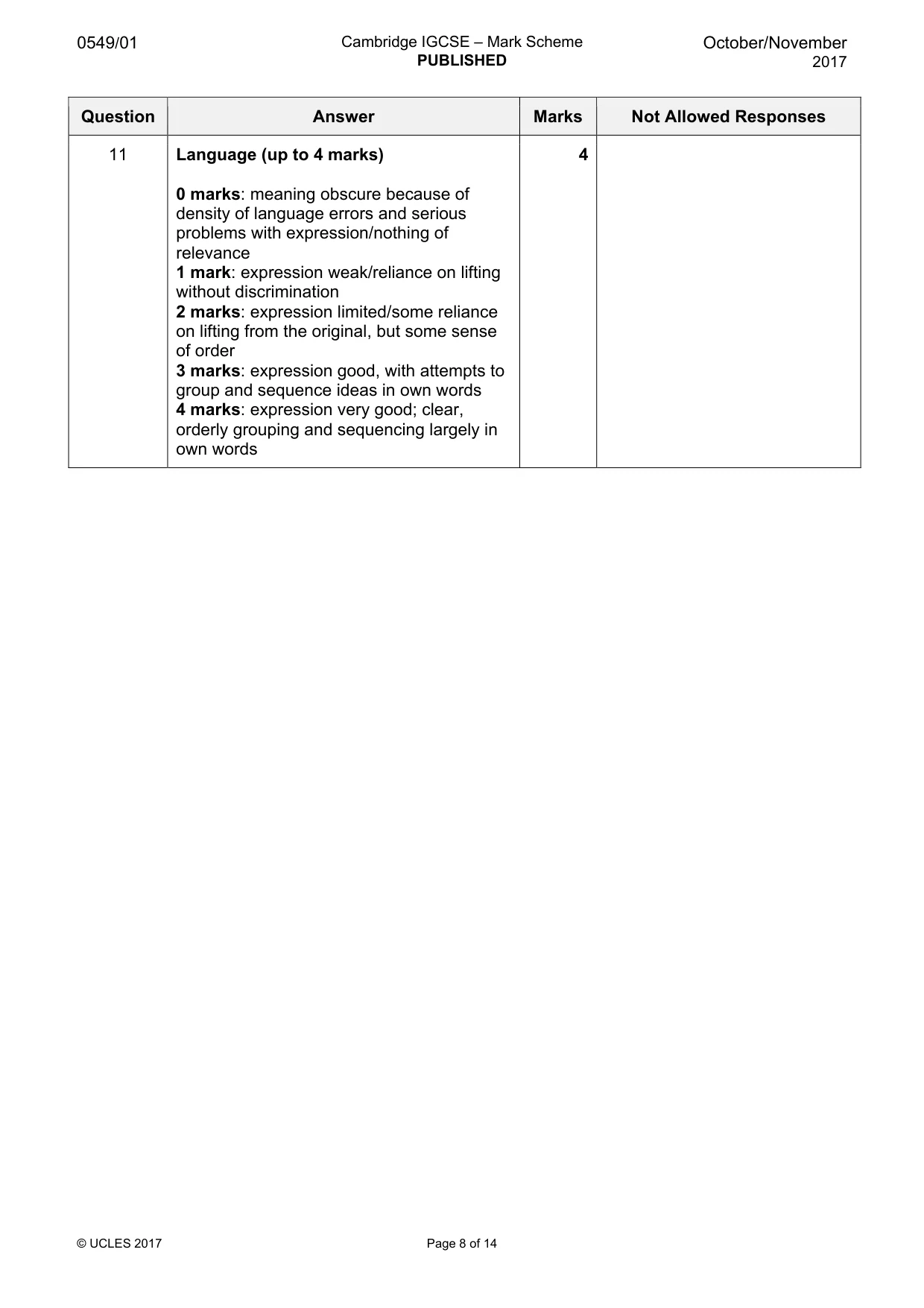
0549/01 Cambridge IGCSE – Mark Scheme PUBLISHED October/November 2017 © UCLES 2017 Page 8 of 14 Question Answer Marks Not Allowed Responses 11 Language (up to 4 marks) 0 marks: meaning obscure because of density of language errors and serious problems with expression/nothing of relevance 1 mark: expression weak/reliance on lifting without discrimination 2 marks: expression limited/some reliance on lifting from the original, but some sense of order 3 marks: expression good, with attempts to group and sequence ideas in own words 4 marks: expression very good; clear, orderly grouping and sequencing largely in own words 4
Mark scheme, page 9
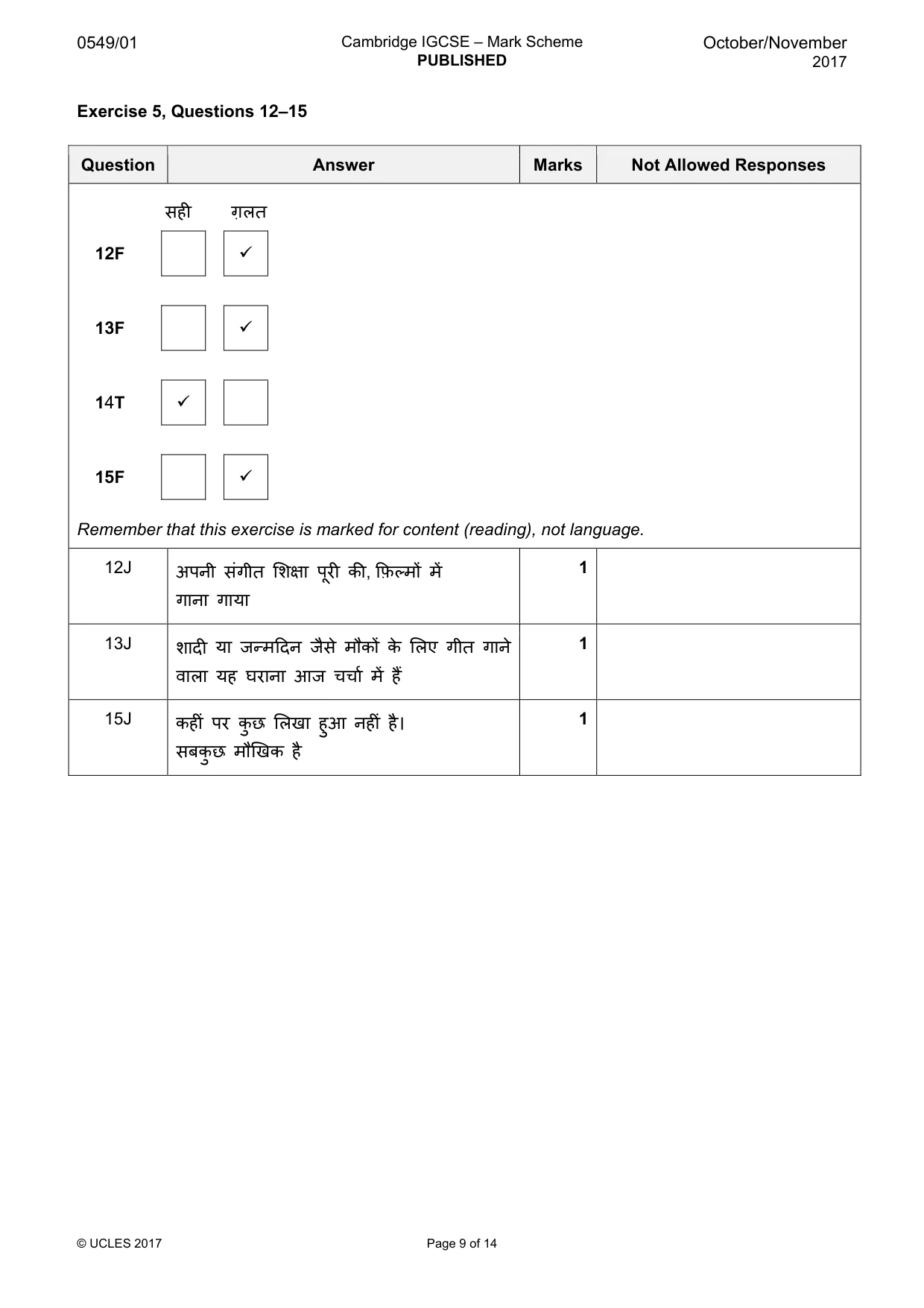
0549/01 Cambridge IGCSE – Mark Scheme PUBLISHED October/November 2017 © UCLES 2017 Page 9 of 14 Exercise 5, Questions 12–15 Question Answer Marks Not Allowed Responses सहȣ ग़लत 12F 9 13F 9 14T 9 15F 9 Remember that this exercise is marked for content (reading), not language. 12J अपनी संगीत ͧश¢ा पूरȣ कȧ, ͩफ़ãमɉ मɅ गाना गाया 1 13J शादȣ या जÛमǑदन जैसे मौकɉ केͧलएगीतगाने वाला यह घराना आज चचा[ मɅ हɇ 1 15J कहȣं पर कुछ ͧलखा हुआ नहȣं है। सबकुछ मौͨखक है 1
Mark scheme, page 10
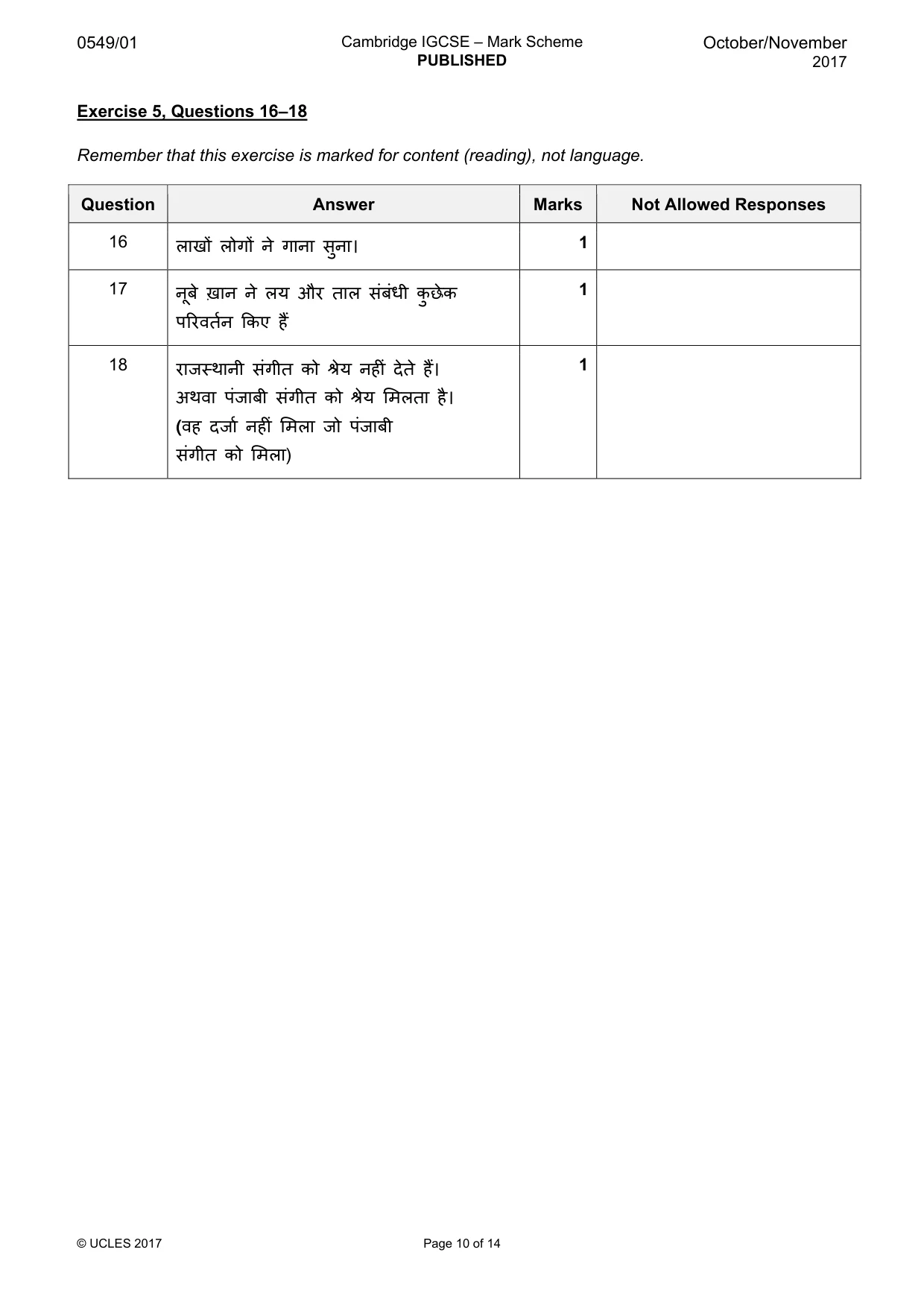
0549/01 Cambridge IGCSE – Mark Scheme PUBLISHED October/November 2017 © UCLES 2017 Page 10 of 14 Exercise 5, Questions 16–18 Remember that this exercise is marked for content (reading), not language. Question Answer Marks Not Allowed Responses 16 लाखɉ लोगɉ ने गाना सुना। 1 17 नूबे ख़ान ने लय और ताल संबंधीकुछेक पǐरवत[न ͩकए हɇ 1 18 राजèथानी संगीत को Įेय नहȣं देतेहɇ। अथवा पंजाबी संगीत को Įेय ͧमलता है। (वह दजा[ नहȣं ͧमला जो पंजाबी संगीत को ͧमला) 1
Mark scheme, page 11
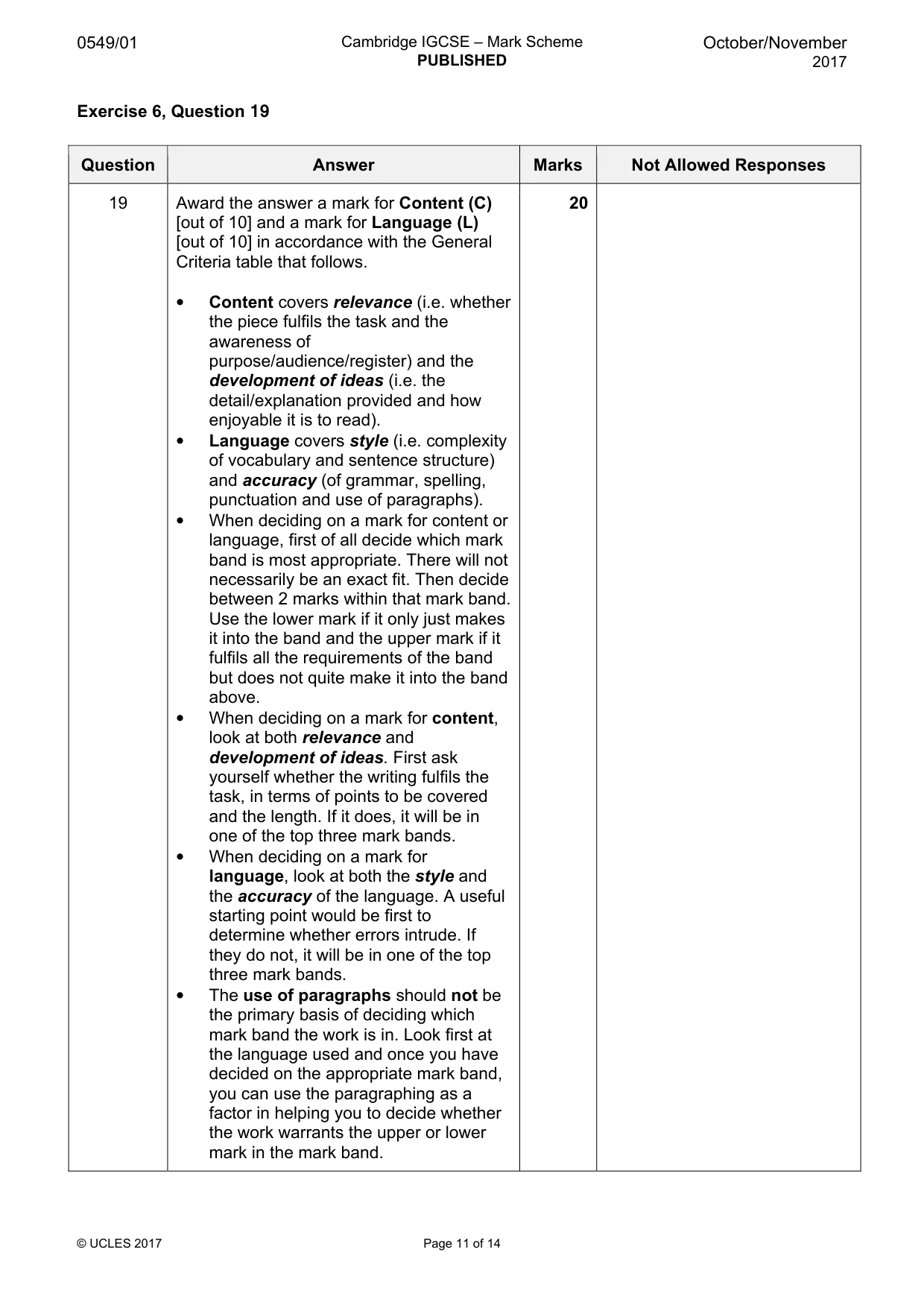
0549/01 Cambridge IGCSE – Mark Scheme PUBLISHED October/November 2017 © UCLES 2017 Page 11 of 14 Exercise 6, Question 19 Question Answer Marks Not Allowed Responses 19 Award the answer a mark for Content (C) [out of 10] and a mark for Language (L) [out of 10] in accordance with the General Criteria table that follows. • Content covers relevance (i.e. whether the piece fulfils the task and the awareness of purpose/audience/register) and the development of ideas (i.e. the detail/explanation provided and how enjoyable it is to read). • Language covers style (i.e. complexity of vocabulary and sentence structure) and accuracy (of grammar, spelling, punctuation and use of paragraphs). • When deciding on a mark for content or language, first of all decide which mark band is most appropriate. There will not necessarily be an exact fit. Then decide between 2 marks within that mark band. Use the lower mark if it only just makes it into the band and the upper mark if it fulfils all the requirements of the band but does not quite make it into the band above. • When deciding on a mark for content, look at both relevance and development of ideas. First ask yourself whether the writing fulfils the task, in terms of points to be covered and the length. If it does, it will be in one of the top three mark bands. • When deciding on a mark for language, look at both the style and the accuracy of the language. A useful starting point would be first to determine whether errors intrude. If they do not, it will be in one of the top three mark bands. • The use of paragraphs should not be the primary basis of deciding which mark band the work is in. Look first at the language used and once you have decided on the appropriate mark band, you can use the paragraphing as a factor in helping you to decide whether the work warrants the upper or lower mark in the mark band. 20
Mark scheme, page 12
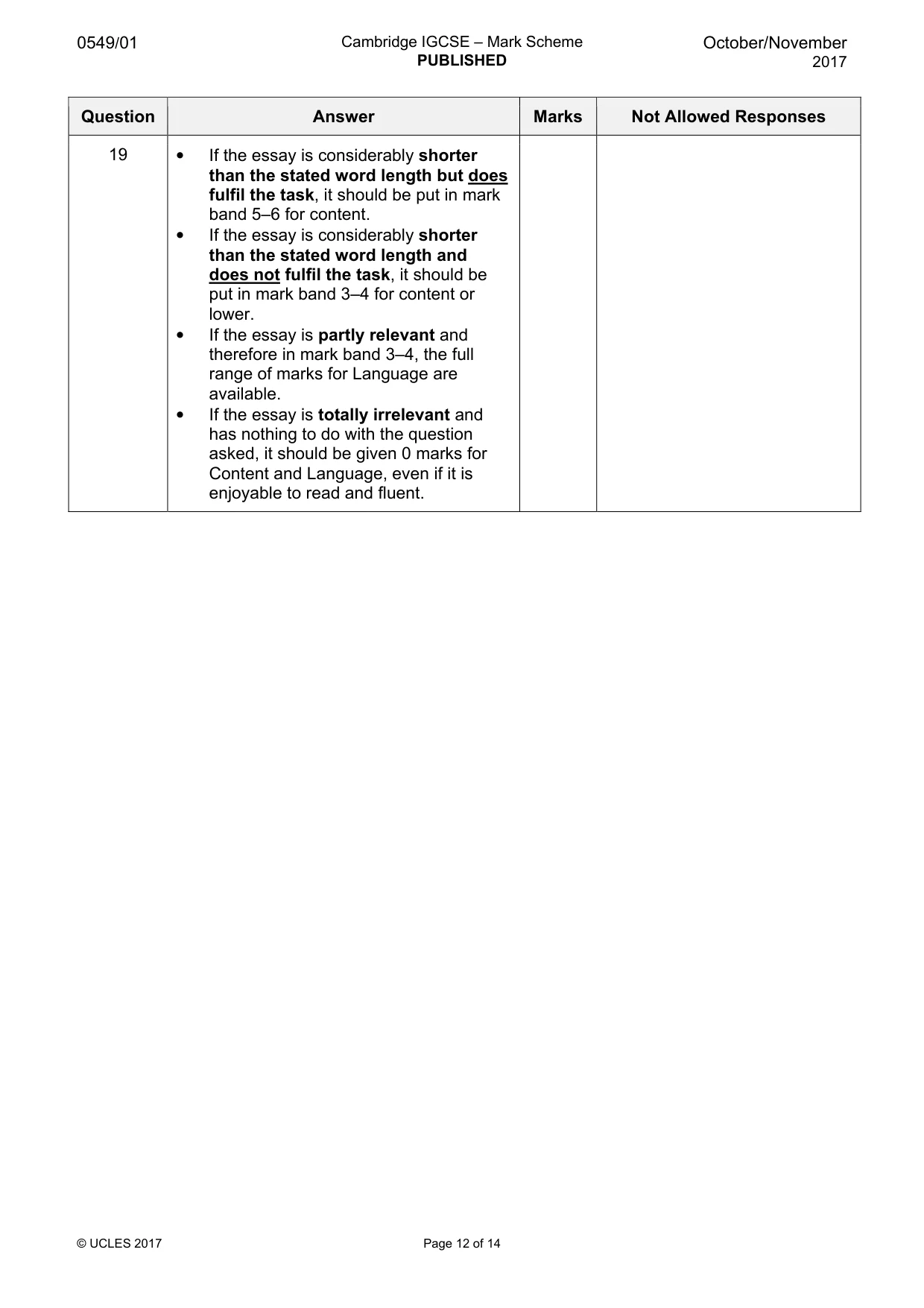
0549/01 Cambridge IGCSE – Mark Scheme PUBLISHED October/November 2017 © UCLES 2017 Page 12 of 14 Question Answer Marks Not Allowed Responses 19 • If the essay is considerably shorter than the stated word length but does fulfil the task, it should be put in mark band 5–6 for content. • If the essay is considerably shorter than the stated word length and does not fulfil the task, it should be put in mark band 3–4 for content or lower. • If the essay is partly relevant and therefore in mark band 3–4, the full range of marks for Language are available. • If the essay is totally irrelevant and has nothing to do with the question asked, it should be given 0 marks for Content and Language, even if it is enjoyable to read and fluent.
Mark scheme, page 13
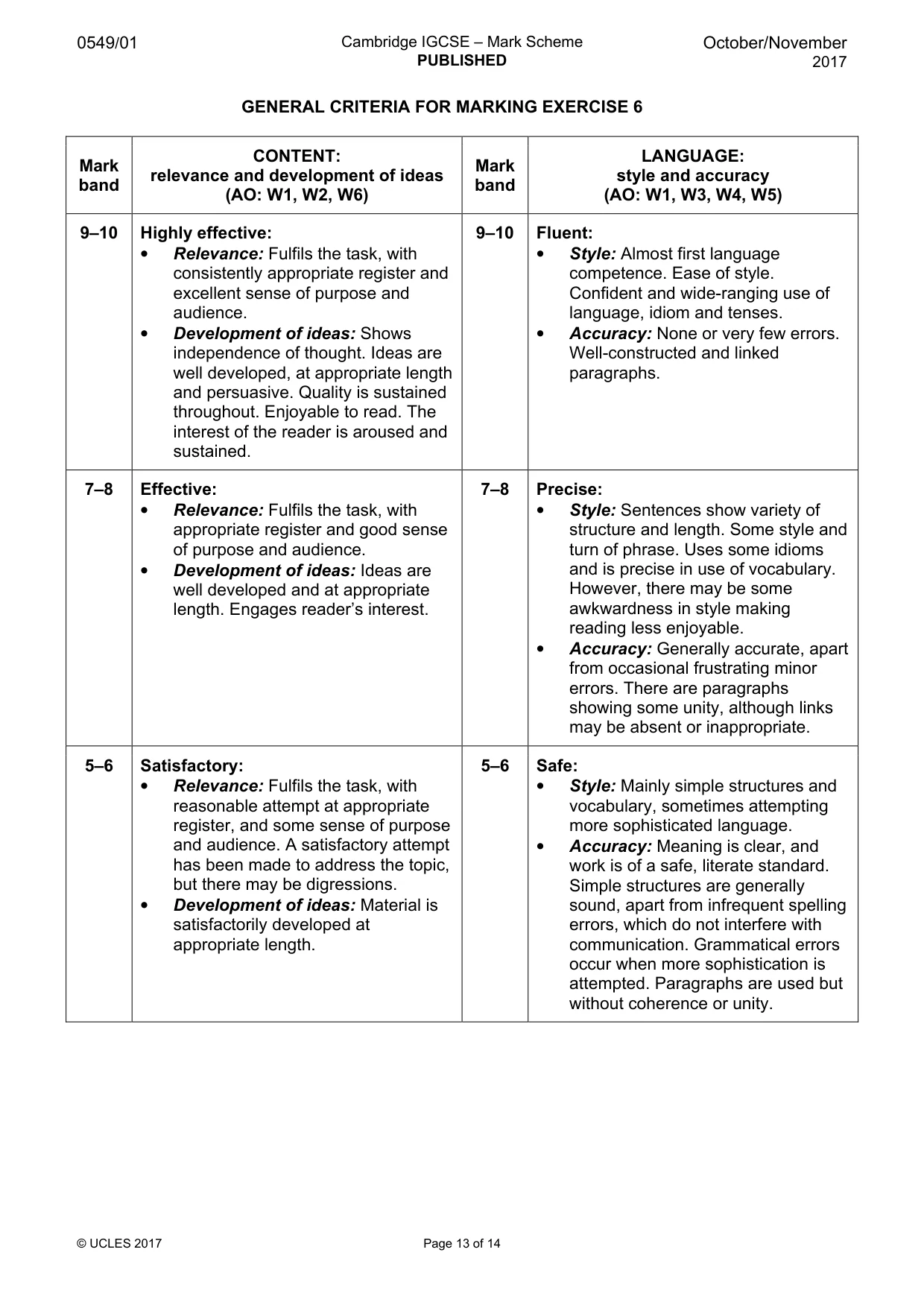
0549/01 Cambridge IGCSE – Mark Scheme PUBLISHED October/November 2017 © UCLES 2017 Page 13 of 14 GENERAL CRITERIA FOR MARKING EXERCISE 6 Mark band CONTENT: relevance and development of ideas (AO: W1, W2, W6) Mark band LANGUAGE: style and accuracy (AO: W1, W3, W4, W5) 9–10 Highly effective: • Relevance: Fulfils the task, with consistently appropriate register and excellent sense of purpose and audience. • Development of ideas: Shows independence of thought. Ideas are well developed, at appropriate length and persuasive. Quality is sustained throughout. Enjoyable to read. The interest of the reader is aroused and sustained. 9–10 Fluent: • Style: Almost first language competence. Ease of style. Confident and wide-ranging use of language, idiom and tenses. • Accuracy: None or very few errors. Well-constructed and linked paragraphs. 7–8 Effective: • Relevance: Fulfils the task, with appropriate register and good sense of purpose and audience. • Development of ideas: Ideas are well developed and at appropriate length. Engages reader’s interest. 7–8 Precise: • Style: Sentences show variety of structure and length. Some style and turn of phrase. Uses some idioms and is precise in use of vocabulary. However, there may be some awkwardness in style making reading less enjoyable. • Accuracy: Generally accurate, apart from occasional frustrating minor errors. There are paragraphs showing some unity, although links may be absent or inappropriate. 5–6 Satisfactory: • Relevance: Fulfils the task, with reasonable attempt at appropriate register, and some sense of purpose and audience. A satisfactory attempt has been made to address the topic, but there may be digressions. • Development of ideas: Material is satisfactorily developed at appropriate length. 5–6 Safe: • Style: Mainly simple structures and vocabulary, sometimes attempting more sophisticated language. • Accuracy: Meaning is clear, and work is of a safe, literate standard. Simple structures are generally sound, apart from infrequent spelling errors, which do not interfere with communication. Grammatical errors occur when more sophistication is attempted. Paragraphs are used but without coherence or unity.
Mark scheme, page 14
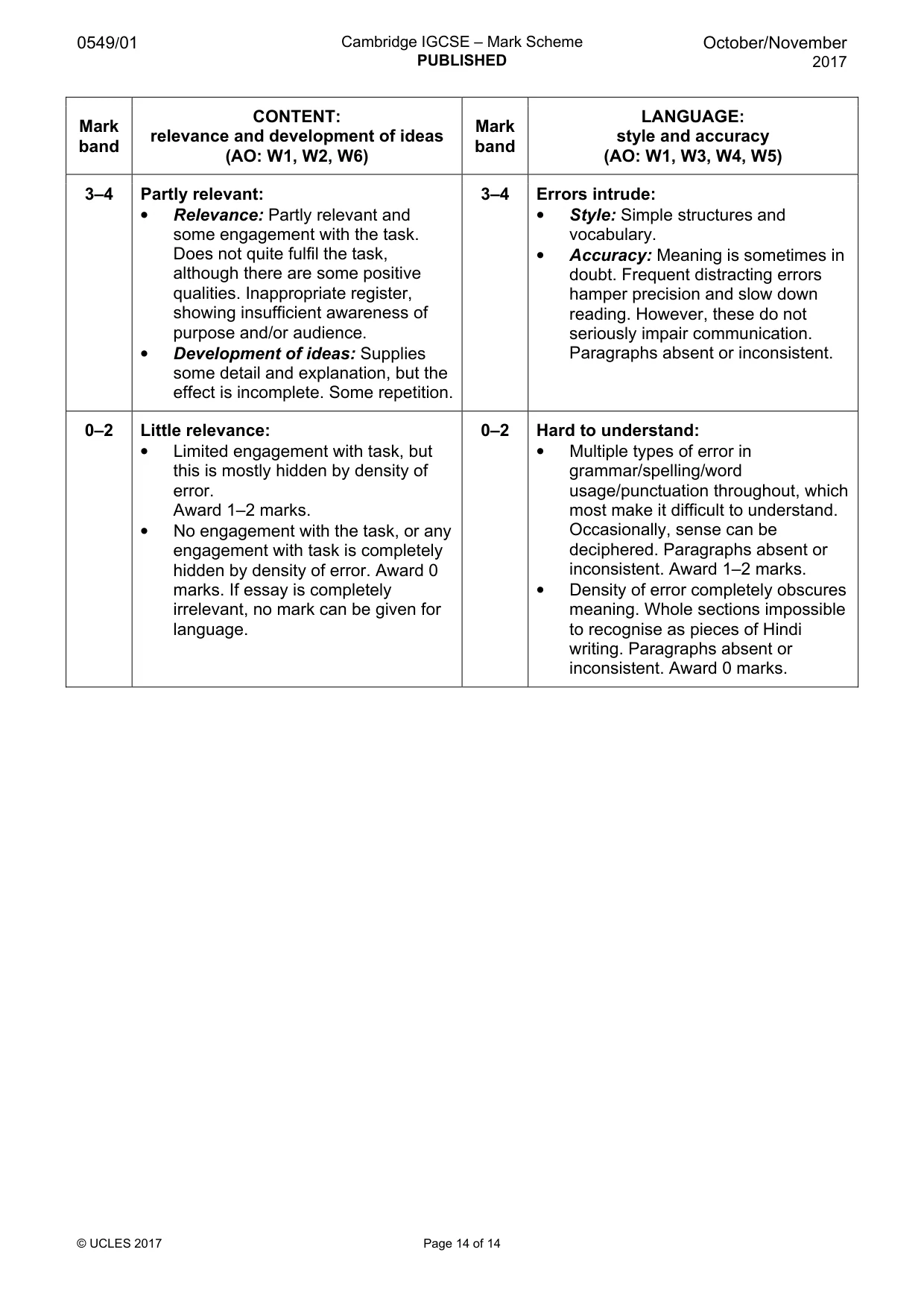
0549/01 Cambridge IGCSE – Mark Scheme PUBLISHED October/November 2017 © UCLES 2017 Page 14 of 14 Mark band CONTENT: relevance and development of ideas (AO: W1, W2, W6) Mark band LANGUAGE: style and accuracy (AO: W1, W3, W4, W5) 3–4 Partly relevant: • Relevance: Partly relevant and some engagement with the task. Does not quite fulfil the task, although there are some positive qualities. Inappropriate register, showing insufficient awareness of purpose and/or audience. • Development of ideas: Supplies some detail and explanation, but the effect is incomplete. Some repetition. 3–4 Errors intrude: • Style: Simple structures and vocabulary. • Accuracy: Meaning is sometimes in doubt. Frequent distracting errors hamper precision and slow down reading. However, these do not seriously impair communication. Paragraphs absent or inconsistent. 0–2 Little relevance: • Limited engagement with task, but this is mostly hidden by density of error. Award 1–2 marks. • No engagement with the task, or any engagement with task is completely hidden by density of error. Award 0 marks. If essay is completely irrelevant, no mark can be given for language. 0–2 Hard to understand: • Multiple types of error in grammar/spelling/word usage/punctuation throughout, which most make it difficult to understand. Occasionally, sense can be deciphered. Paragraphs absent or inconsistent. Award 1–2 marks. • Density of error completely obscures meaning. Whole sections impossible to recognise as pieces of Hindi writing. Paragraphs absent or inconsistent. Award 0 marks.
What you needed in this session
Cambridge’s own grade thresholds for 2017 Oct/Nov, Paper 1 · Variant 1. A higher threshold means an easier paper — the bar moves with how the cohort did.