Cambridge IGCSE Hindi as a Second Language 0549 — 2019 Oct/Nov Paper 1 · Variant 1
0549/11/O/N/19 · 60 marks · ≈68 min
The question paper and its mark scheme, free to read here and free to download. This is Cambridge’s own paper, exactly as it was sat.
Question paper16 pages





Mark scheme7 pages
Answers below. Sit the paper first if you are practising.
Paper as text
Question paper, page 1
This document consists of 14 printed pages and 2 blank pages. KI 169832/4 © UCLES 2019 [Turn over * 3 5 6 1 7 2 7 8 1 7 * HINDI AS A SECOND LANGUAGE 0549/01 Paper 1 Reading and Writing October/November 2019 2 hours Candidates answer on the Question Paper. No Additional Materials are required. READ THESE INSTRUCTIONS FIRST Write your centre number, candidate number and name on all the work you hand in. Write in dark blue or black pen. Do not use staples, paper clips, glue or correction fluid. DO NOT WRITE IN ANY BARCODES. Answer all questions. The number of marks is given in brackets [ ] at the end of each question or part question. Cambridge Assessment International Education Cambridge International General Certificate of Secondary Education
Question paper, page 2
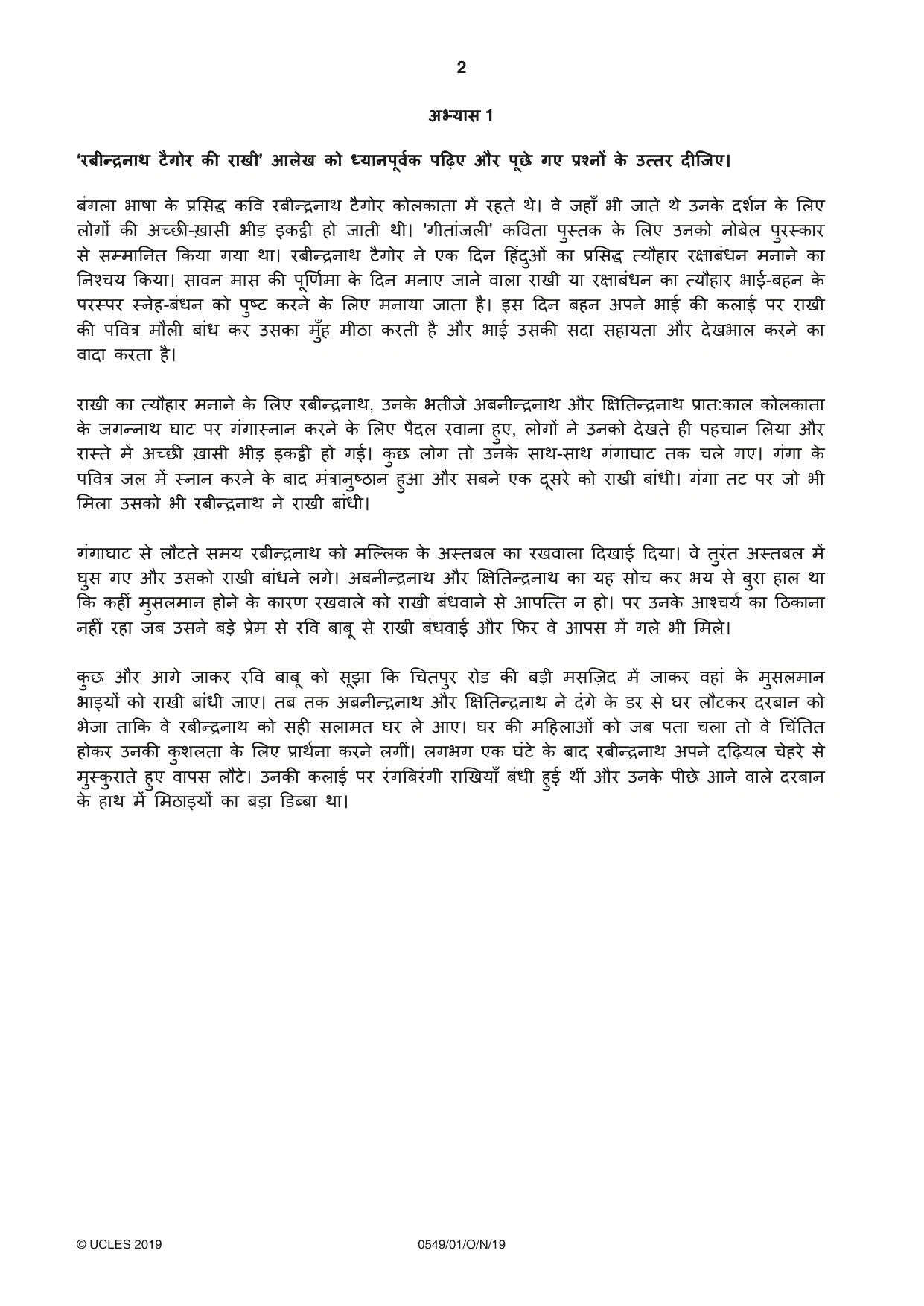
2 0549/01/O/N/19 © UCLES 2019 अभ्यास 1 ‘रबीन्द्रनयाथ टैगोर की रयाखी’ आलेख को ध्यानपूर्वक पढ़िए और पूछे गए प्रशनों के उत् तर दीजिए। बंगला भाषा के प्रसिƨ कवि रबीन्द्रनाथ टैगोर कोलकाता में रहते थे। िे जहाँ भी जाते थे उनके दर्शन के सलए लोगों की अच्छी-ख़ािी भीड़ इक͡ȣ हो जाती थी। 'गीतांजलȣ' कविता पुसतक के सलए उनको नोबेल पुरसकार िे िममाननत ककया गया था। रबीन्द्रनाथ टैगोर ने एक ददन दहंदुओं का प्रसिƨ तययौहार रक्ाबंधन मनाने का ननश्चय ककया। िािन माि की पूर््शमा के ददन मनाए जाने िाला राखी या रक्ाबंधन का तययौहार भाई-बहन के परसपर सनेह-बंधन को पुषट करने के सलए मनाया जाता है। इि ददन बहन अपने भाई की कलाई पर राखी की पवित्र मयौलȣ बांध कर उिका मुँह मीठा करती है और भाई उिकी िदा िहायता और देखभाल करने का िादा करता है। राखी का तययौहार मनाने के सलए रबीन्द्रनाथ, उनके भतीजे अबनीन्द्रनाथ और क्क्नतन्द्रनाथ प्रात:काल कोलकाता के जगन्नाथ घाट पर गंगासनान करने के सलए पैदल रिाना हुए, लोगों ने उनको देखते हȣ पह्चान सलया और रासते में अच्छी ख़ािी भीड़ इक͡ȣ हो गई। कु् लोग तो उनके िाथ-िाथ गंगाघाट तक ्चले गए। गंगा के पवित्र जल में सनान करने के बाद मंत्रानुषठान हुआ और िबने एक दूिरे को राखी बांधी। गंगा तट पर जो भी समला उिको भी रबीन्द्रनाथ ने राखी बांधी। गंगाघाट िे लयौटते िमय रबीन्द्रनाथ को मल्लक के असतबल का रखिाला ददखाई ददया। िे तुरंत असतबल में घुि गए और उिको राखी बांधने लगे। अबनीन्द्रनाथ और क्क्नतन्द्रनाथ का यह िो्च कर भय िे बुरा हाल था कक कहȣं मुिलमान होने के कार् रखिाले को राखी बंधिाने िे आपक्त त न हो। पर उनके आश्चय्श का दठकाना नहȣं रहा जब उिने बड़े प्रेम िे रवि बाबू िे राखी बंधिाई और किर िे आपि में गले भी समले। कु् और आगे जाकर रवि बाबू को िूझा कक च्चतपुर रोड की बड़ी मिलिद में जाकर िहां के मुिलमान भाइयों को राखी बांधी जाए। तब तक अबनीन्द्रनाथ और क्क्नतन्द्रनाथ ने दंगे के डर िे घर लयौटकर दरबान को भेजा ताकक िे रबीन्द्रनाथ को िहȣ िलामत घर ले आए। घर की मदहलाओं को जब पता ्चला तो िे च्चंनतत होकर उनकी कुरलता के सलए प्राथ्शना करने लगीं। लगभग एक घंटे के बाद रबीन्द्रनाथ अपने ददियल ्चेहरे िे मुसकुराते हुए िापि लयौटे। उनकी कलाई पर रंगबबरंगी रारखयाँ बंधी हुई थीं और उनके पी्े आने िाले दरबान के हाथ में समठाइयों का बड़ा डडबबा था।
Question paper, page 3
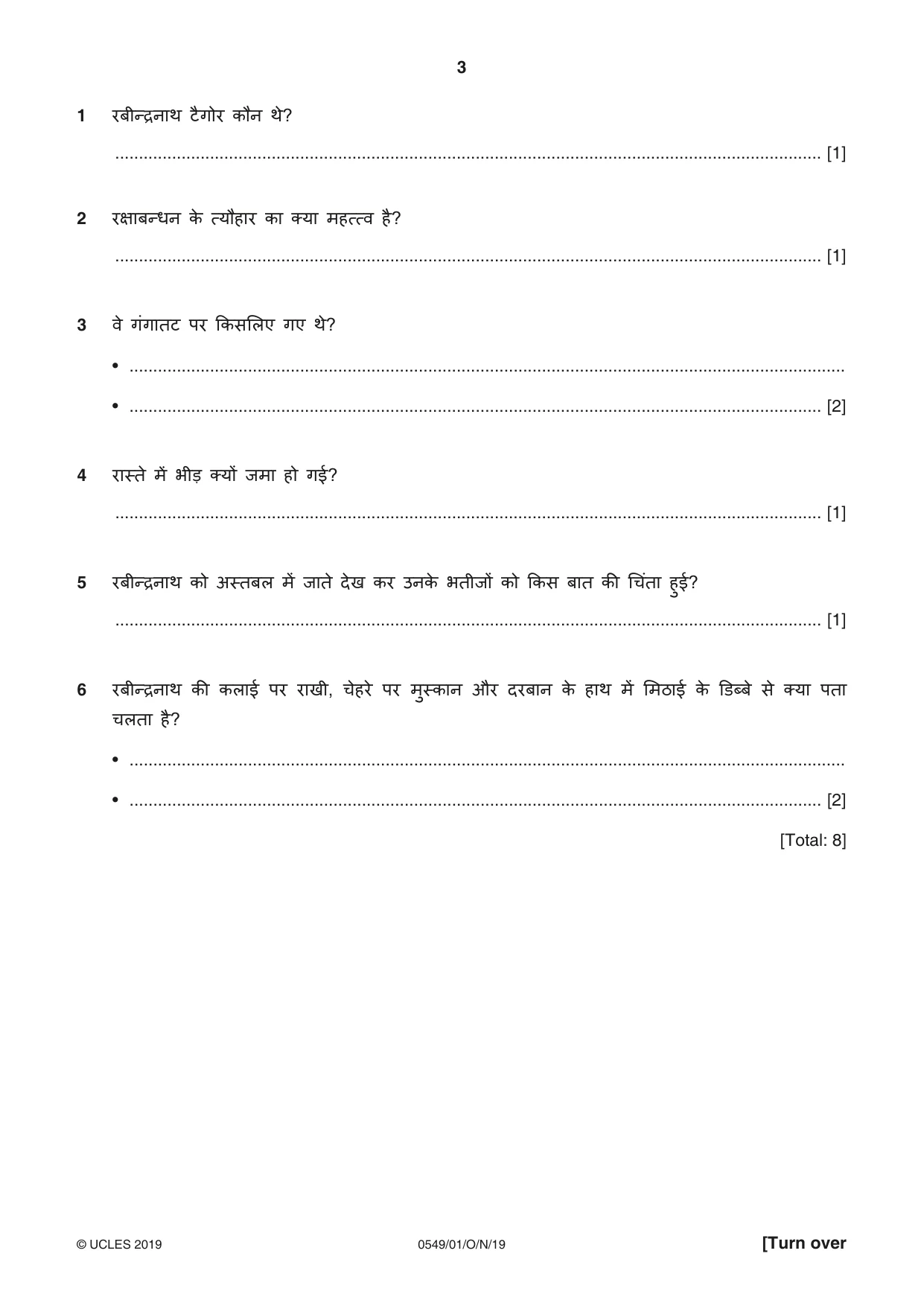
3 0549/01/O/N/19 © UCLES 2019 [Turn over 1 रबीन्द्रनाथ टैगोर कयौन थे? … [1] 2 रक्ाबन्धन के तययौहार का कया महत ति है? … [1] 3 िे गंगातट पर ककिसलए गए थे? • … • … [2] 4 रासते में भीड़ कयों जमा हो गई? … [1] 5 रबीन्द्रनाथ को असतबल में जाते देख कर उनके भतीजों को ककि बात की च्चंता हुई? … [1] 6 रबीन्द्रनाथ की कलाई पर राखी, ्चेहरे पर मुसकान और दरबान के हाथ में समठाई के डडबबे िे कया पता ्चलता है? • … • … [2] [Total: 8]
Question paper, page 4
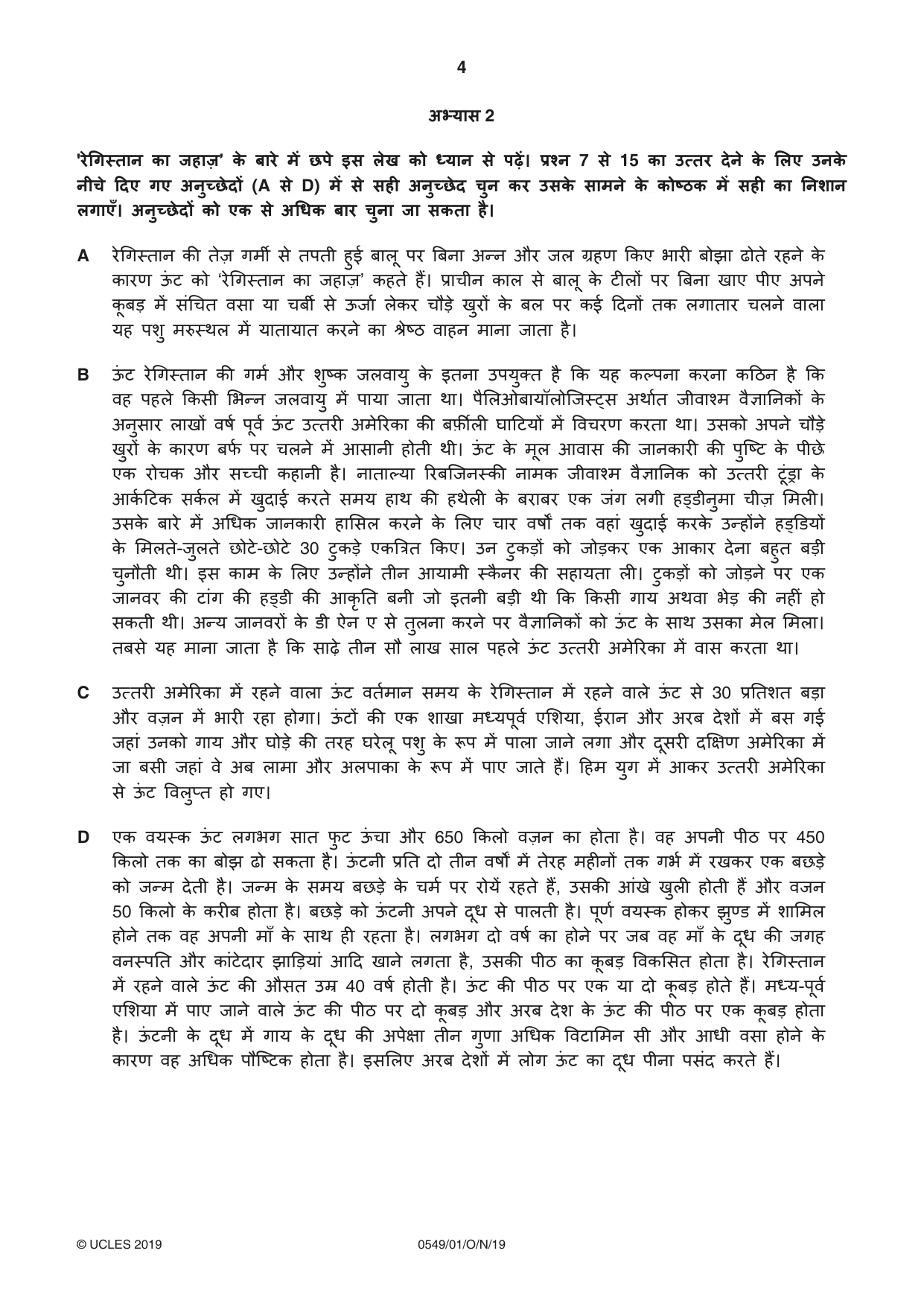
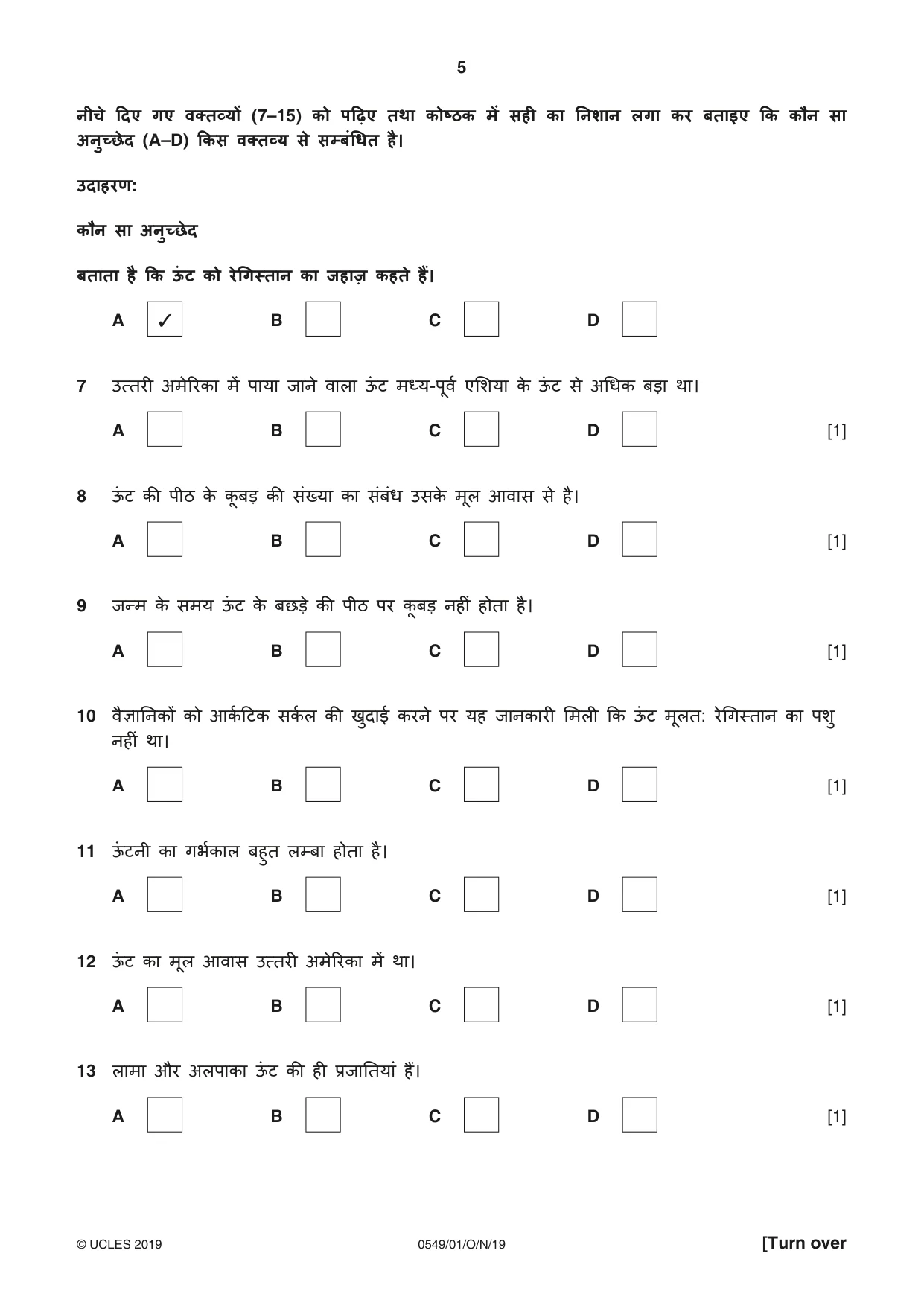
4 0549/01/O/N/19 © UCLES 2019 अभ्यास 2 'रेगगसतयान कया िहयाज़’ के बयारे में छपे इस लेख को ध्यान से पिें। प्रशन 7 से 15 कया उत् तर देने के ललए उनके नीचे ढ़दए गए अनुचछेदों (A से D) में से सही अनुचछेद चुन कर उसके सयामने के कोष्ठक में सही कया ननशयान लगयाएँ। अनुचछेदों को एक से अगिक बयार चुनया िया सकतया है। A रेचगसतान की तेि गममी िे तपती हुई बालू पर बबना अन्न और जल ग्रह् ककए भारȣ बोझा ढोते रहने के कार् ऊंट को ‘रेचगसतान का जहाि’ कहते हैं। प्रा्चीन काल िे बालू के टȣलों पर बबना खाए पीए अपने कूबड़ में िंच्चत ििा या ्चबमी िे ऊजा्श लेकर ्चयौड़े खुरों के बल पर कई ददनों तक लगातार ्चलने िाला यह परु मरुसथल में यातायात करने का श्ेषठ िाहन माना जाता है। B ऊंट रेचगसतान की गम्श और रुषक जलिायु के इतना उपयुकत है कक यह क्पना करना कदठन है कक िह पहले ककिी सभन्न जलिायु में पाया जाता था। पैसलओबायॉलोलजस्टि अथा्शत जीिाशम िैज्ाननकों के अनुिार लाखों िष्श पूि्श ऊंट उत तरȣ अमेररका की बर्फ़ीलȣ घादटयों में वि्चर् करता था। उिको अपने ्चयौड़े खुरों के कार् बि्श पर ्चलने में आिानी होती थी। ऊंट के मूल आिाि की जानकारȣ की पुलषट के पी्े एक रो्चक और िच्ची कहानी है। नाता्या ररबलजनसकी नामक जीिाशम िैज्ाननक को उत तरȣ टूंड्ा के आक्शदटक िक्शल में खुदाई करते िमय हाथ की हथेलȣ के बराबर एक जंग लगी हडडीनुमा ्चीि समलȣ। उिके बारे में अचधक जानकारȣ हासिल करने के सलए ्चार िषषों तक िहां खुदाई करके उन्होंने हडडडयों के समलते-जुलते ्ोटे-्ोटे 30 टुकड़े एकबत्रत ककए। उन टुकड़ों को जोड़कर एक आकार देना बहुत बड़ी ्चुनयौती थी। इि काम के सलए उन्होंने तीन आयामी सकैनर की िहायता लȣ। टुकड़ों को जोड़ने पर एक जानिर की टांग की हडडी की आकृनत बनी जो इतनी बड़ी थी कक ककिी गाय अथिा भेड़ की नहȣं हो िकती थी। अन्य जानिरों के डी ऐन ए िे तुलना करने पर िैज्ाननकों को ऊंट के िाथ उिका मेल समला। तबिे यह माना जाता है कक िािे तीन ियौ लाख िाल पहले ऊंट उत तरȣ अमेररका में िाि करता था। C उत तरȣ अमेररका में रहने िाला ऊंट ित्शमान िमय के रेचगसतान में रहने िाले ऊंट िे 30 प्रनतरत बड़ा और ििन में भारȣ रहा होगा। ऊंटों की एक राखा मधयपूि्श एसरया, ईरान और अरब देरों में बि गई जहां उनको गाय और घोड़े की तरह घरेलू परु के रूप में पाला जाने लगा और दूिरȣ दक्क्् अमेररका में जा बिी जहां िे अब लामा और अलपाका के रूप में पाए जाते हैं। दहम युग में आकर उत तरȣ अमेररका िे ऊंट विलुपत हो गए। D एक ियसक ऊंट लगभग िात िुट ऊं्चा और 650 ककलो ििन का होता है। िह अपनी पीठ पर 450 ककलो तक का बोझ ढो िकता है। ऊंटनी प्रनत दो तीन िषषों में तेरह महȣनों तक गभ्श में रखकर एक ब्ड़े को जन्म देती है। जन्म के िमय ब्ड़े के ्चम्श पर रोयें रहते हैं, उिकी आंखे खुलȣ होती हैं और िजन 50 ककलो के करȣब होता है। ब्ड़े को ऊंटनी अपने दूध िे पालती है। पू््श ियसक होकर झुणड में रासमल होने तक िह अपनी माँ के िाथ हȣ रहता है। लगभग दो िष्श का होने पर जब िह माँ के दूध की जगह िनसपनत और कांटेदार झाडड़यां आदद खाने लगता है, उिकी पीठ का कूबड़ विकसित होता है। रेचगसतान में रहने िाले ऊंट की औित उम्र 40 िष्श होती है। ऊंट की पीठ पर एक या दो कूबड़ होते हैं। मधय-पूि्श एसरया में पाए जाने िाले ऊंट की पीठ पर दो कूबड़ और अरब देर के ऊंट की पीठ पर एक कूबड़ होता है। ऊंटनी के दूध में गाय के दूध की अपेक्ा तीन गु्ा अचधक विटासमन िी और आधी ििा होने के कार् िह अचधक पयौलषटक होता है। इिसलए अरब देरों में लोग ऊंट का दूध पीना पिंद करते हैं।
Question paper, page 5
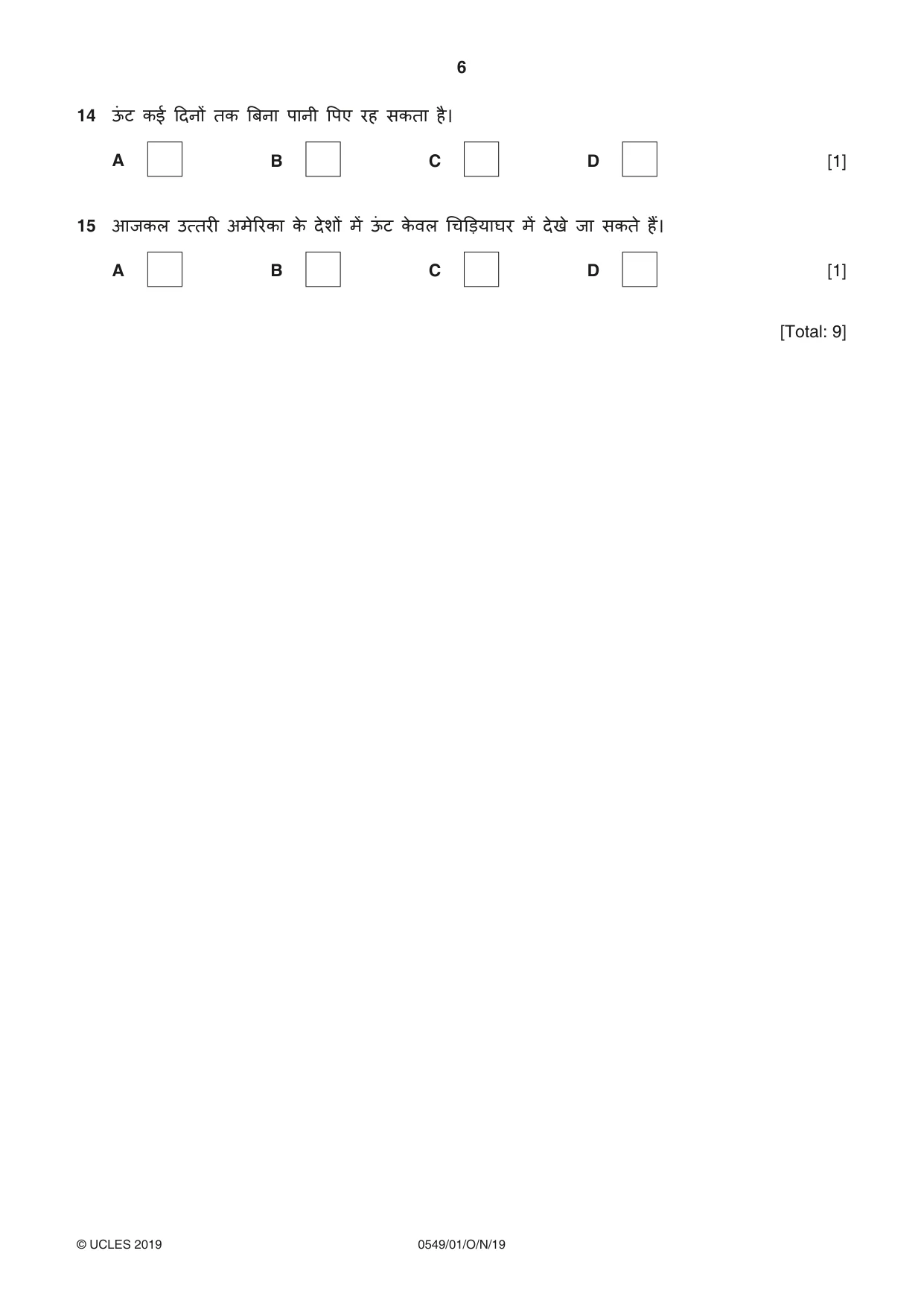
5 0549/01/O/N/19 © UCLES 2019 [Turn over नीचे ढ़दए गए रकतव्ों (7–15) को पढ़िए तथया कोष्ठक में सही कया ननशयान लगया कर बतयाइए कक कौन सया अनुचछेद (A–D) ककस रकतव् से समबबंगित है। उदयाहरण: कौन सया अनुचछेद बतयातया है कक ऊबंट को रेगगसतयान कया िहयाज़ कहते हैं। A B C D 7 उत तरȣ अमेररका में पाया जाने िाला ऊंट मधय-पूि्श एसरया के ऊंट िे अचधक बड़ा था। A B C D [1] 8 ऊंट की पीठ के कूबड़ की िंखया का िंबंध उिके मूल आिाि िे है। A B C D [1] 9 जन्म के िमय ऊंट के ब्ड़े की पीठ पर कूबड़ नहȣं होता है। A B C D [1] 10 िैज्ाननकों को आक्शदटक िक्शल की खुदाई करने पर यह जानकारȣ समलȣ कक ऊंट मूलत: रेचगसतान का परु नहȣं था। A B C D [1] 11 ऊंटनी का गभ्शकाल बहुत लमबा होता है। A B C D [1] 12 ऊंट का मूल आिाि उत तरȣ अमेररका में था। A B C D [1] 13 लामा और अलपाका ऊंट की हȣ प्रजानतयां हैं। A B C D [1]
Question paper, page 6
6 0549/01/O/N/19 © UCLES 2019 14 ऊंट कई ददनों तक बबना पानी वपए रह िकता है। A B C D [1] 15 आजकल उत तरȣ अमेररका के देरों में ऊंट केिल च्चडड़याघर में देखे जा िकते हैं। A B C D [1] [Total: 9]
Question paper, page 7
7 0549/01/O/N/19 © UCLES 2019 [Turn over BLANK PAGE
Question paper, page 8
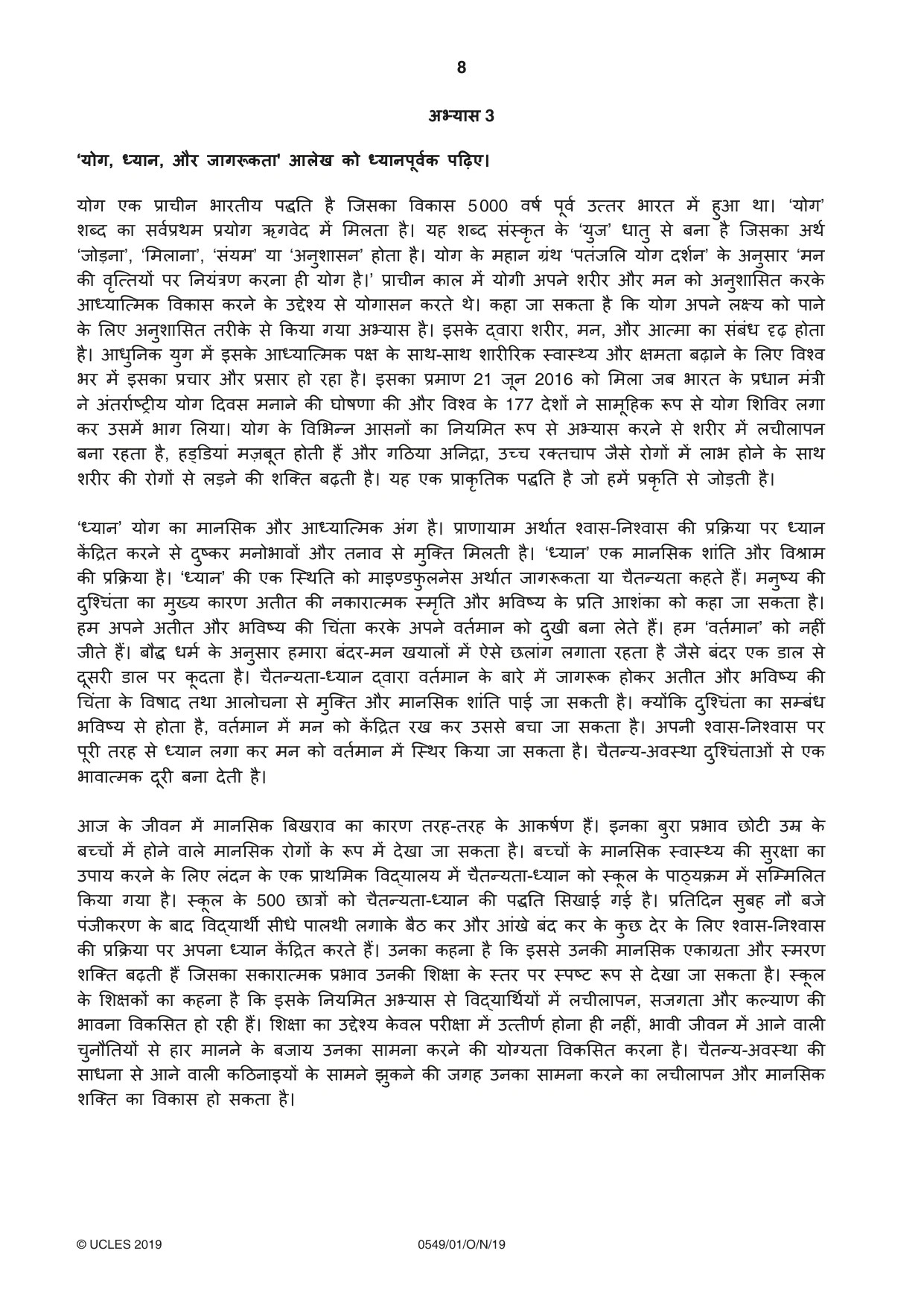
8 0549/01/O/N/19 © UCLES 2019 अभ्यास 3 ‘्ोग, ध्यान, और ियागरूकतया' आलेख को ध्यानपूर्वक पढ़िए। योग एक प्रा्चीन भारतीय पƨानत है लजिका विकाि 5 000 िष्श पूि्श उत तर भारत में हुआ था। ‘योग’ रबद का िि्शप्रथम प्रयोग ऋगिेद में समलता है। यह रबद िंसकृत के ‘युज’ धातु िे बना है लजिका अथ्श ‘जोड़ना’, ‘समलाना’, ‘िंयम’ या ‘अनुरािन’ होता है। योग के महान ग्रंथ ‘पतंजसल योग दर्शन’ के अनुिार ‘मन की िृरत तयों पर ननयंत्र् करना हȣ योग है।’ प्रा्चीन काल में योगी अपने ररȣर और मन को अनुरासित करके आधयालतमक विकाि करने के उƧेशय िे योगािन करते थे। कहा जा िकता है कक योग अपने लक्य को पाने के सलए अनुरासित तरȣके िे ककया गया अभयाि है। इिके दिारा ररȣर, मन, और आतमा का िंबंध दृि होता है। आधुननक युग में इिके आधयालतमक पक् के िाथ-िाथ रारȣररक सिास्थय और क्मता बिाने के सलए विशि भर में इिका प्र्चार और प्रिार हो रहा है। इिका प्रमा् 21 जून 2016 को समला जब भारत के प्रधान मंत्री ने अंतरा्शषट्ȣय योग ददिि मनाने की घोष्ा की और विशि के 177 देरों ने िामूदहक रूप िे योग सरविर लगा कर उिमें भाग सलया। योग के विसभन्न आिनों का ननयसमत रूप िे अभयाि करने िे ररȣर में ल्चीलापन बना रहता है, हडडडयां मिबूत होती हैं और गदठया अननद्रा, उच्च रकत्चाप जैिे रोगों में लाभ होने के िाथ ररȣर की रोगों िे लड़ने की रलकत बिती है। यह एक प्राकृनतक पƨानत है जो हमें प्रकृनत िे जोड़ती है। ‘धयान’ योग का मानसिक और आधयालतमक अंग है। प्रा्ायाम अथा्शत शिाि-ननशिाि की प्रकरिया पर धयान केंदद्रत करने िे दुषकर मनोभािों और तनाि िे मुलकत समलती है। ‘धयान’ एक मानसिक रांनत और विश्ाम की प्रकरिया है। ‘धयान’ की एक लसथनत को माइणडिुलनेि अथा्शत जागरूकता या ्चैतन्यता कहते हैं। मनुषय की दुलश्चंता का मुखय कार् अतीत की नकारातमक समृनत और भविषय के प्रनत आरंका को कहा जा िकता है। हम अपने अतीत और भविषय की च्चंता करके अपने ित्शमान को दुखी बना लेते हैं। हम ‘ित्शमान’ को नहȣं जीते हैं। बयौƨ धम्श के अनुिार हमारा बंदर-मन खयालों में ऐिे ्लांग लगाता रहता है जैिे बंदर एक डाल िे दूिरȣ डाल पर कूदता है। ्चैतन्यता-धयान दिारा ित्शमान के बारे में जागरूक होकर अतीत और भविषय की च्चंता के विषाद तथा आलो्चना िे मुलकत और मानसिक रांनत पाई जा िकती है। कयोंकक दुलश्चंता का िमबंध भविषय िे होता है, ित्शमान में मन को केंदद्रत रख कर उििे ब्चा जा िकता है। अपनी शिाि-ननशिाि पर पूरȣ तरह िे धयान लगा कर मन को ित्शमान में लसथर ककया जा िकता है। ्चैतन्य-अिसथा दुलश्चंताओं िे एक भािातमक दूरȣ बना देती है। आज के जीिन में मानसिक बबखराि का कार् तरह-तरह के आकष्श् हैं। इनका बुरा प्रभाि ्ोटȣ उम्र के बच्चों में होने िाले मानसिक रोगों के रूप में देखा जा िकता है। बच्चों के मानसिक सिास्थय की िुरक्ा का उपाय करने के सलए लंदन के एक प्राथसमक विदयालय में ्चैतन्यता-धयान को सकूल के पाठयरिम में िलममसलत ककया गया है। सकूल के 500 ्ात्रों को ्चैतन्यता-धयान की पƨानत सिखाई गई है। प्रनतददन िुबह नयौ बजे पंजीकर् के बाद विदयाथमी िीधे पालथी लगाके बैठ कर और आंखे बंद कर के कु् देर के सलए शिाि-ननशिाि की प्रकरिया पर अपना धयान केंदद्रत करते हैं। उनका कहना है कक इििे उनकी मानसिक एकाग्रता और समर् रलकत बिती हैं लजिका िकारातमक प्रभाि उनकी सरक्ा के सतर पर सपषट रूप िे देखा जा िकता है। सकूल के सरक्कों का कहना है कक इिके ननयसमत अभयाि िे विदयाचथ्शयों में ल्चीलापन, िजगता और क्या् की भािना विकसित हो रहȣ हैं। सरक्ा का उƧेशय केिल परȣक्ा में उत ती््श होना हȣ नहȣं, भािी जीिन में आने िालȣ ्चुनयौनतयों िे हार मानने के बजाय उनका िामना करने की योगयता विकसित करना है। ्चैतन्य-अिसथा की िाधना िे आने िालȣ कदठनाइयों के िामने झुकने की जगह उनका िामना करने का ल्चीलापन और मानसिक रलकत का विकाि हो िकता है।
Question paper, page 9
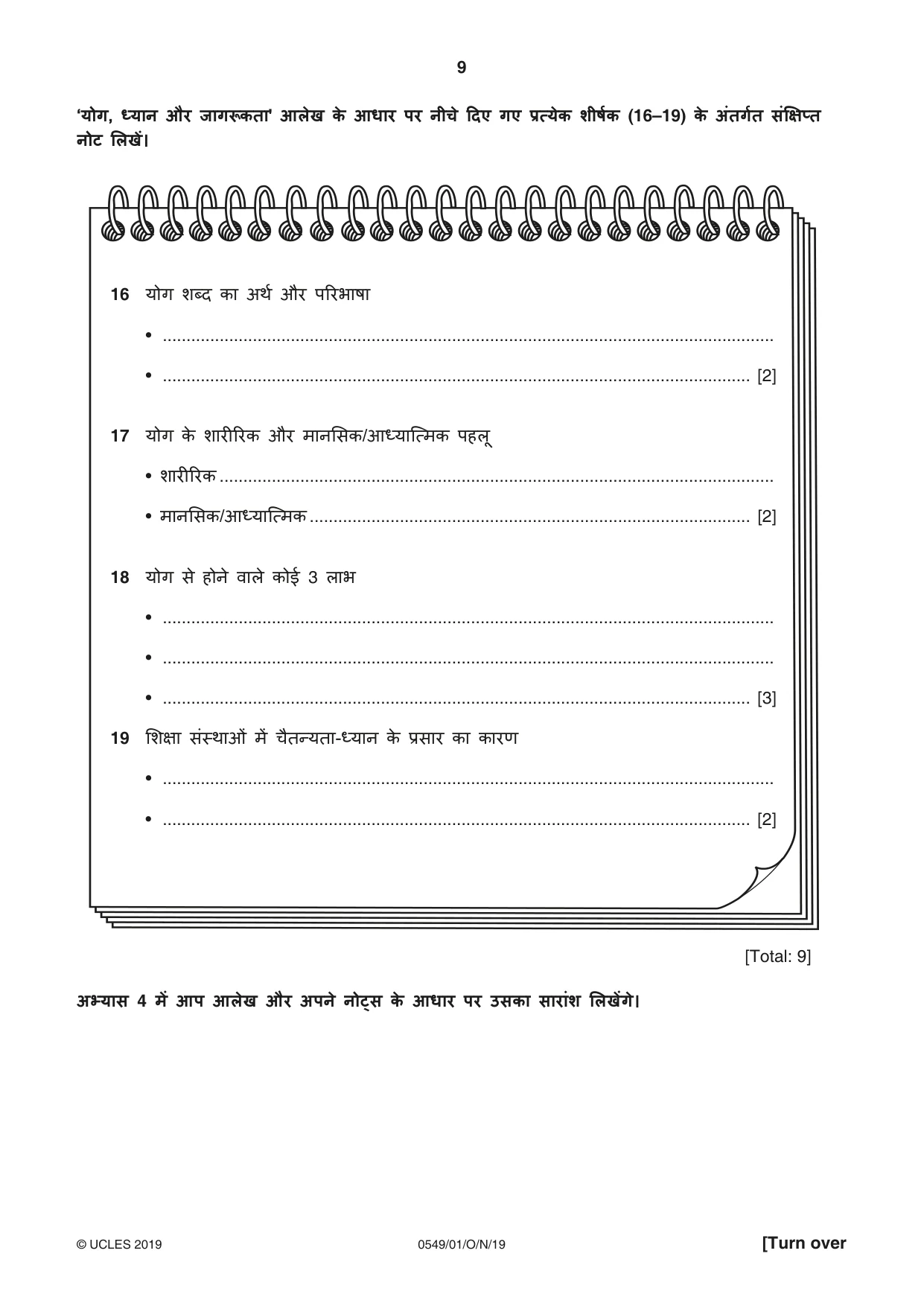
9 0549/01/O/N/19 © UCLES 2019 [Turn over ‘्ोग, ध्यान और ियागरूकतया' आलेख के आियार पर नीचे ढ़दए गए प्रत््ेक शीर्वक (16–19) के अबंतग्वत सबंक्षिपत नोट ललखें। 8 [Total: 9] अभ्यास 4 में आप आलेख और अपने नोटस के आियार पर उसकया सयारयाबंश ललखेंगे। 16 योग रबद का अथ्श और पररभाषा • … • … [2] 17 योग के रारȣररक और मानसिक/आधयालतमक पहलू • रारȣररक … • मानसिक/आधयालतमक … [2] 18 योग िे होने िाले कोई 3 लाभ • … • … • … [3] 19 सरक्ा िंसथाओं में ्चैतन्यता-धयान के प्रिार का कार् • … • … [2]
Question paper, page 10
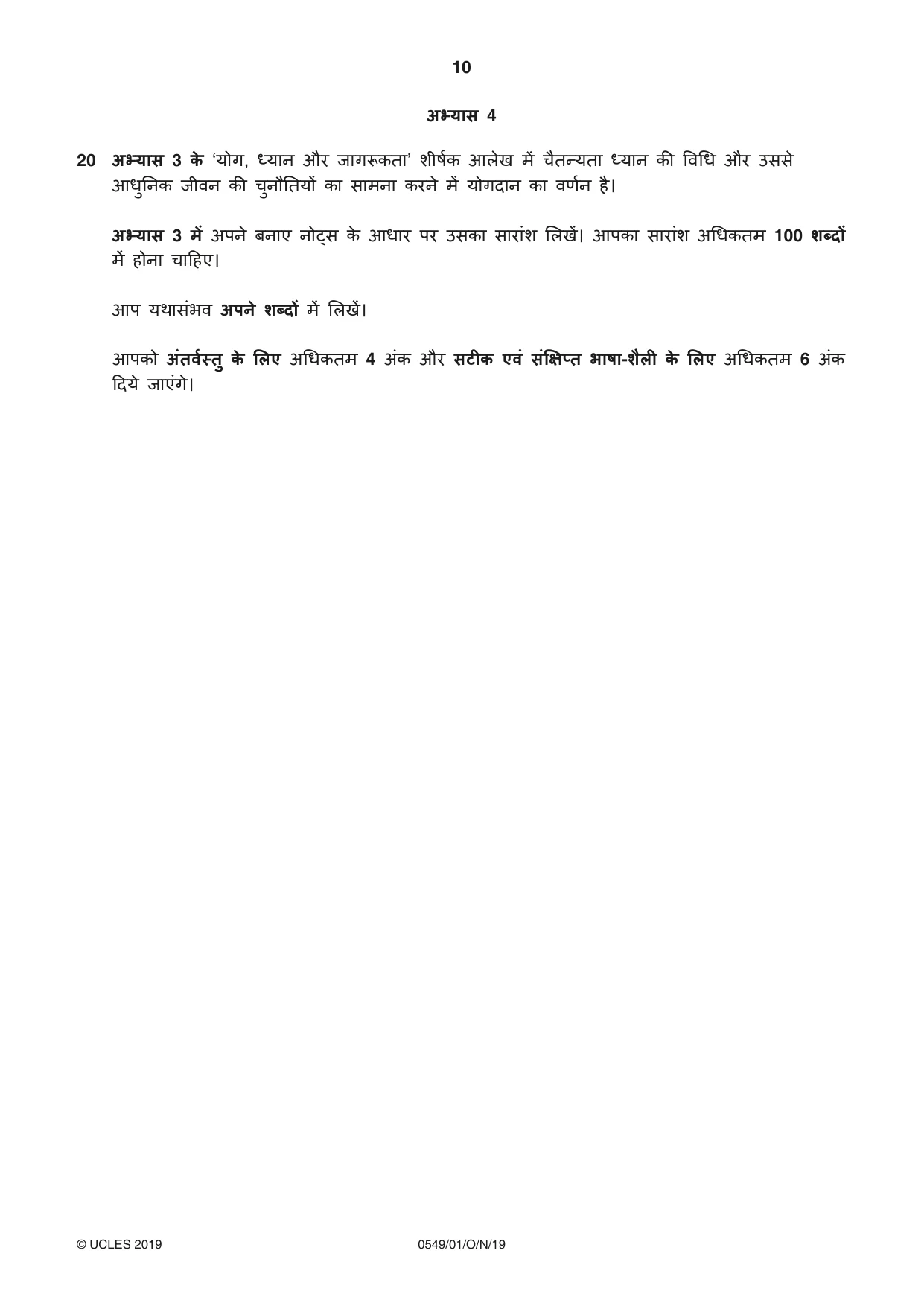
10 0549/01/O/N/19 © UCLES 2019 अभ्यास 4 20 अभ्यास 3 के ‘योग, धयान और जागरूकता’ रीष्शक आलेख में ्चैतन्यता धयान की विचध और उििे आधुननक जीिन की ्चुनयौनतयों का िामना करने में योगदान का ि््शन है। अभ्यास 3 में अपने बनाए नो्टि के आधार पर उिका िारांर सलखें। आपका िारांर अचधकतम 100 शबदों में होना ्चादहए। आप यथािंभि अपने शबदों में सलखें। आपको अबंतर्वसतु के ललए अचधकतम 4 अंक और सटीक एरबं सबंक्षिपत भयारया-शैली के ललए अचधकतम 6 अंक ददये जाएंगे।
Question paper, page 11
11 0549/01/O/N/19 © UCLES 2019 [Turn over … … … … … … … … … … … … … … … … … … … … … … … … … … … … … … [10] [Total: 10]
Question paper, page 12
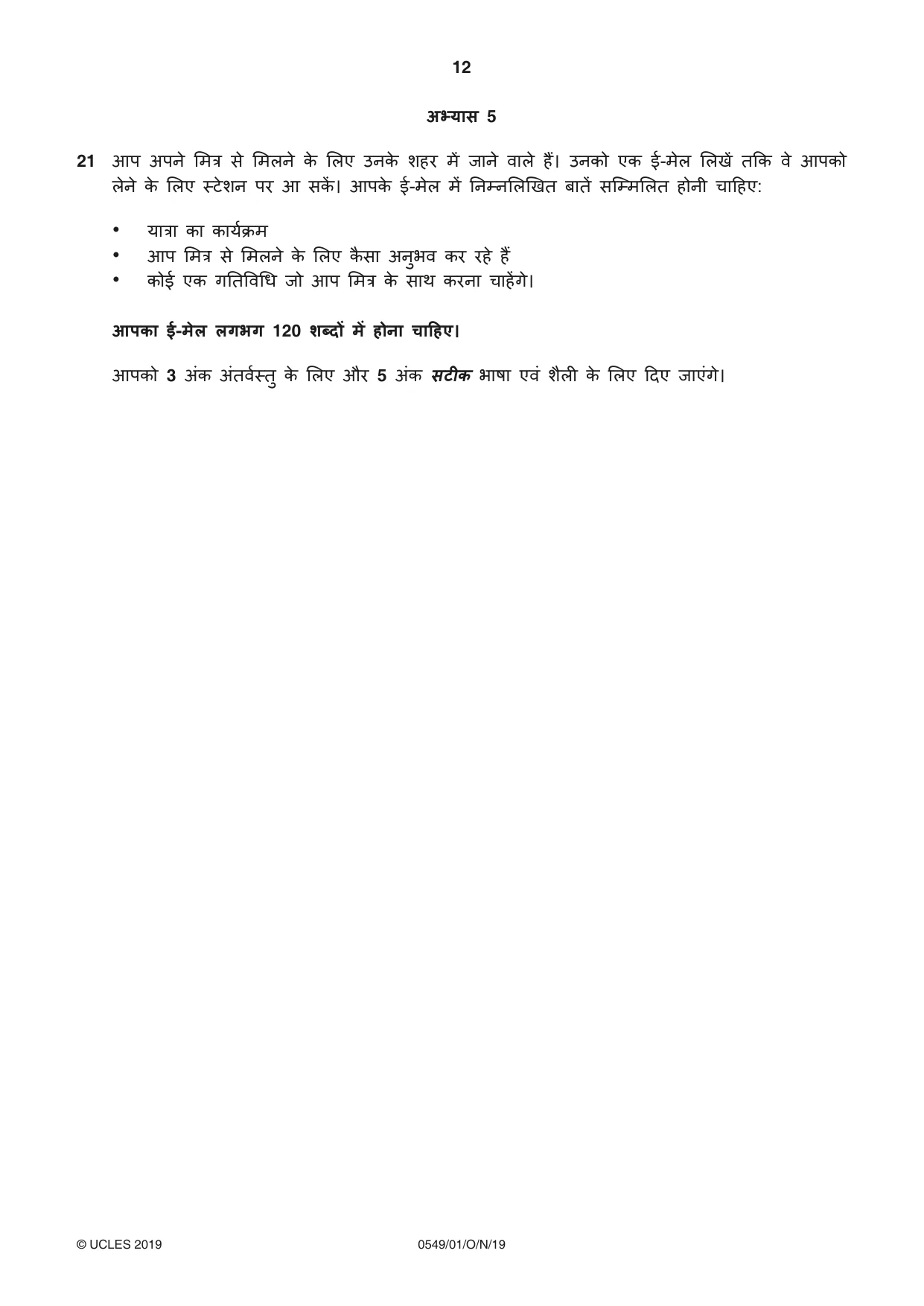
12 0549/01/O/N/19 © UCLES 2019 अभ्यास 5 21 आप अपने समत्र िे समलने के सलए उनके रहर में जाने िाले हैं। उनको एक ई-मेल सलखें तकक िे आपको लेने के सलए सटेरन पर आ िकें। आपके ई-मेल में ननमनसलरखत बातें िलममसलत होनी ्चादहए: • यात्रा का काय्शरिम • आप समत्र िे समलने के सलए कैिा अनुभि कर रहे हैं • कोई एक गनतविचध जो आप समत्र के िाथ करना ्चाहेंगे। आपकया ई-मेल लगभग 120 शबदों में होनया चयाढ़हए। आपको 3 अंक अंति्शसतु के सलए और 5 अंक सटीक भाषा एिं रैलȣ के सलए ददए जाएंगे।
Question paper, page 13
13 0549/01/O/N/19 © UCLES 2019 [Turn over … … … … … … … … … … … … … … … … … … … … … … … … … … … … … … [8] [Total: 8]
Question paper, page 14
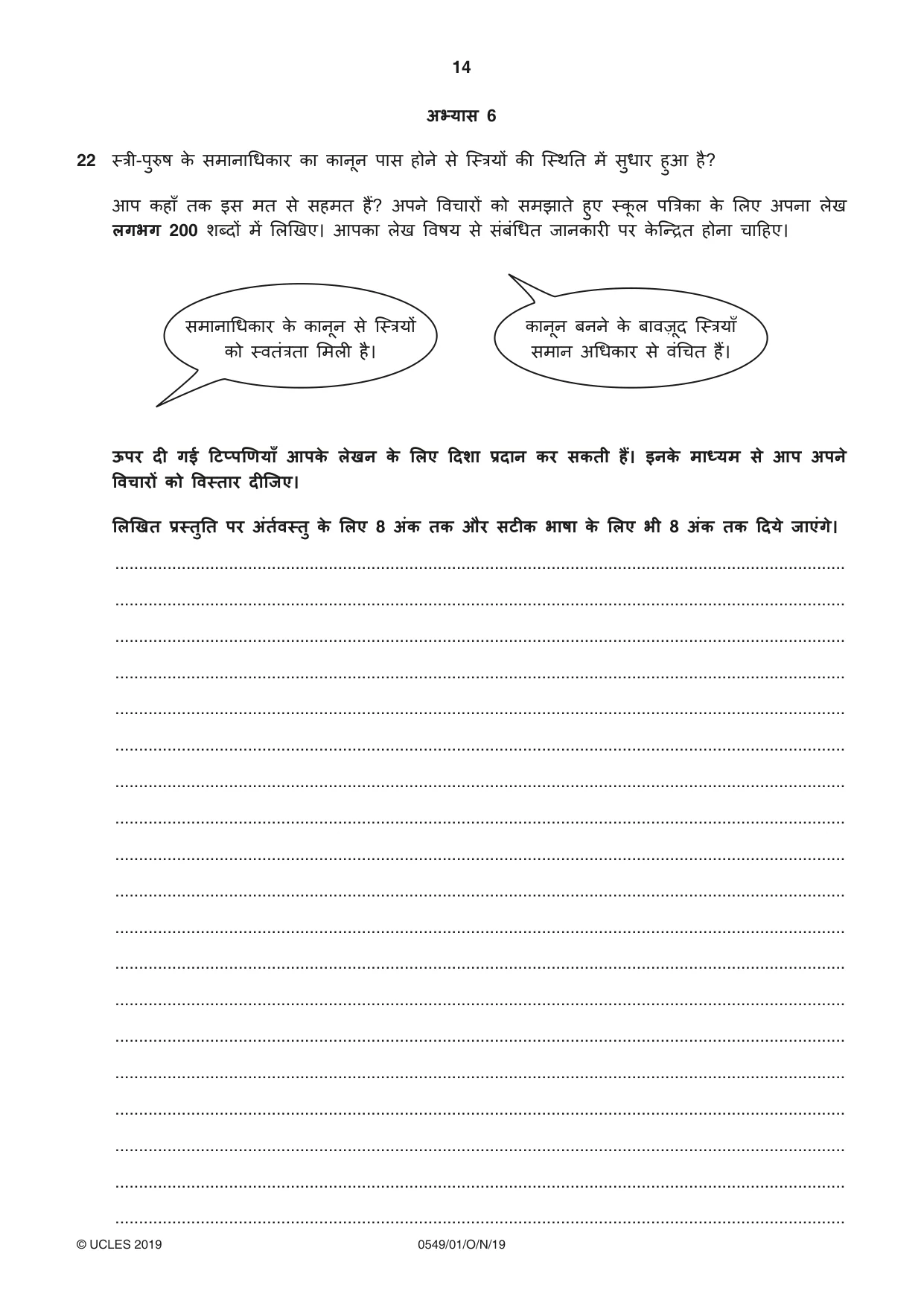
14 0549/01/O/N/19 © UCLES 2019 अभ्यास 6 22 सत्री-पुरुष के िमानाचधकार का कानून पाि होने िे लसत्रयों की लसथनत में िुधार हुआ है? आप कहाँ तक इि मत िे िहमत हैं? अपने वि्चारों को िमझाते हुए सकूल पबत्रका के सलए अपना लेख लगभग 200 रबदों में सलरखए। आपका लेख विषय िे िंबंचधत जानकारȣ पर केलन्द्रत होना ्चादहए। ऊपर दी गई ढ़टपपणण्याँ आपके लेखन के ललए ढ़दशया प्रदयान कर सकती हैं। इनके मयाध्म से आप अपने वरचयारों को वरसतयार दीजिए। ललणखत प्रसतुनत पर अबंत्वरसतु के ललए 8 अबंक तक और सटीक भयारया के ललए भी 8 अबंक तक ढ़द्े ियाएबंगे। … … … … … … … … … … … … … … … … … … … िमानाचधकार के कानून िे लसत्रयों को सितंत्रता समलȣ है। कानून बनने के बाििूद लसत्रयाँ िमान अचधकार िे िंच्चत हैं।
Question paper, page 15
15 0549/01/O/N/19 © UCLES 2019 [Turn over … … … … … … … … … … … … … … … … … … … … … … … … … … … … … … [16] [Total: 16]
Question paper, page 16
16 0549/01/O/N/19 © UCLES 2019 Permission to reproduce items where third-party owned material protected by copyright is included has been sought and cleared where possible. Every reasonable effort has been made by the publisher (UCLES) to trace copyright holders, but if any items requiring clearance have unwittingly been included, the publisher will be pleased to make amends at the earliest possible opportunity. To avoid the issue of disclosure of answer-related information to candidates, all copyright acknowledgements are reproduced online in the Cambridge Assessment International Education Copyright Acknowledgements Booklet. This is produced for each series of examinations and is freely available to download at www.cambridgeinternational.org after the live examination series. Cambridge Assessment International Education is part of the Cambridge Assessment Group. Cambridge Assessment is the brand name of the University of Cambridge Local Examinations Syndicate (UCLES), which itself is a department of the University of Cambridge. BLANK PAGE
Mark scheme, page 1
This document consists of 7 printed pages. © UCLES 2019 [Turn over Cambridge Assessment International Education Cambridge International General Certificate of Secondary Education HINDI AS A SECOND LANGUAGE 0549/01 Paper 1 Reading and Writing October/November 2019 MARK SCHEME Maximum Mark: 60 Published This mark scheme is published as an aid to teachers and candidates, to indicate the requirements of the examination. It shows the basis on which Examiners were instructed to award marks. It does not indicate the details of the discussions that took place at an Examiners’ meeting before marking began, which would have considered the acceptability of alternative answers. Mark schemes should be read in conjunction with the question paper and the Principal Examiner Report for Teachers. Cambridge International will not enter into discussions about these mark schemes. Cambridge International is publishing the mark schemes for the October/November 2019 series for most Cambridge IGCSE™, Cambridge International A and AS Level components and some Cambridge O Level components.
Mark scheme, page 2
0549/01 Cambridge IGCSE – Mark Scheme PUBLISHED October/November 2019 © UCLES 2019 Page 2 of 7 Generic Marking Principles These general marking principles must be applied by all examiners when marking candidate answers. They should be applied alongside the specific content of the mark scheme or generic level descriptors for a question. Each question paper and mark scheme will also comply with these marking principles. GENERIC MARKING PRINCIPLE 1: Marks must be awarded in line with: • the specific content of the mark scheme or the generic level descriptors for the question • the specific skills defined in the mark scheme or in the generic level descriptors for the question • the standard of response required by a candidate as exemplified by the standardisation scripts. GENERIC MARKING PRINCIPLE 2: Marks awarded are always whole marks (not half marks, or other fractions). GENERIC MARKING PRINCIPLE 3: Marks must be awarded positively: • marks are awarded for correct/valid answers, as defined in the mark scheme. However, credit is given for valid answers which go beyond the scope of the syllabus and mark scheme, referring to your Team Leader as appropriate • marks are awarded when candidates clearly demonstrate what they know and can do • marks are not deducted for errors • marks are not deducted for omissions • answers should only be judged on the quality of spelling, punctuation and grammar when these features are specifically assessed by the question as indicated by the mark scheme. The meaning, however, should be unambiguous. GENERIC MARKING PRINCIPLE 4: Rules must be applied consistently e.g. in situations where candidates have not followed instructions or in the application of generic level descriptors. GENERIC MARKING PRINCIPLE 5: Marks should be awarded using the full range of marks defined in the mark scheme for the question (however; the use of the full mark range may be limited according to the quality of the candidate responses seen). GENERIC MARKING PRINCIPLE 6: Marks awarded are based solely on the requirements as defined in the mark scheme. Marks should not be awarded with grade thresholds or grade descriptors in mind.
Mark scheme, page 3
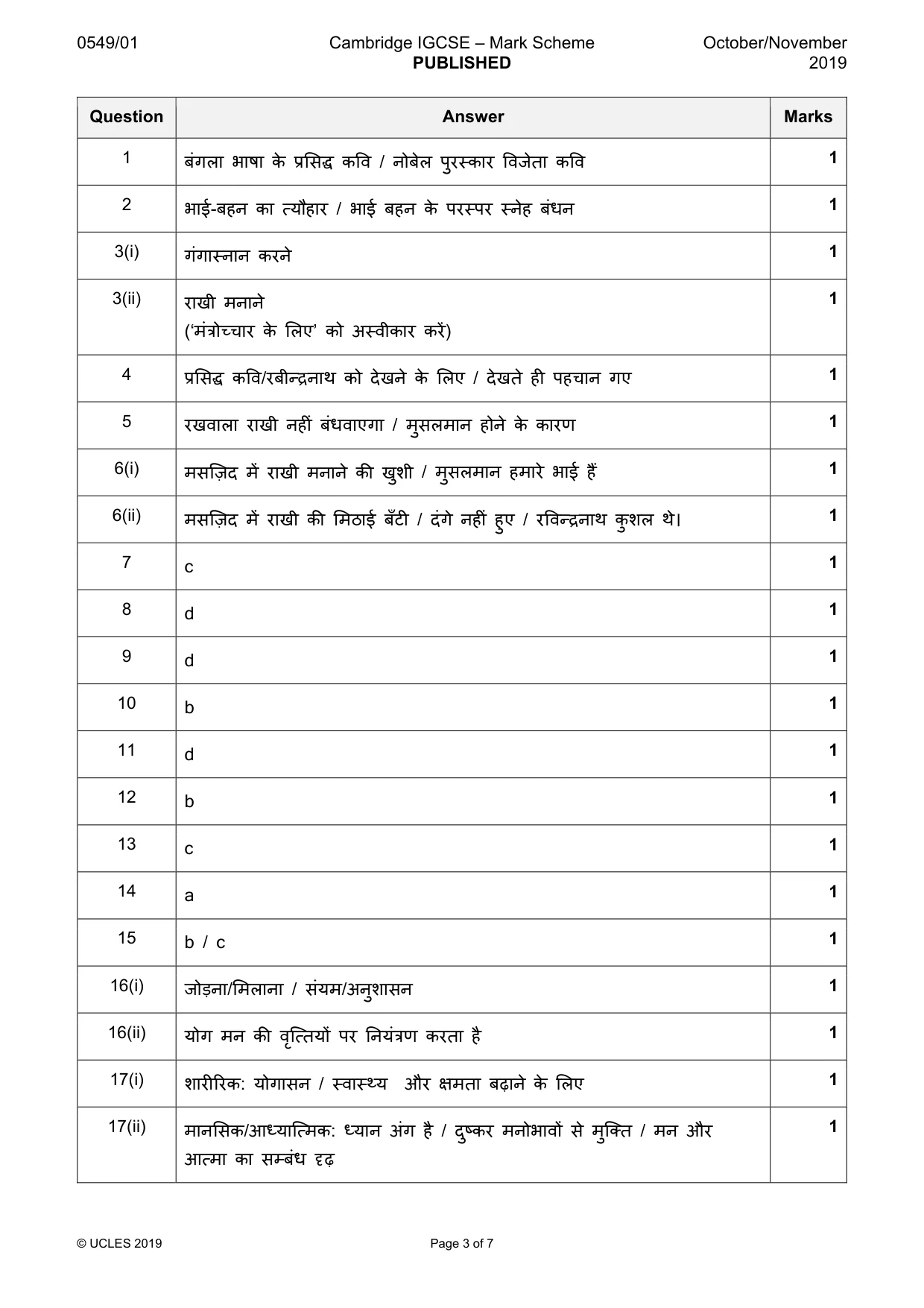
0549/01 Cambridge IGCSE – Mark Scheme PUBLISHED October/November 2019 © UCLES 2019 Page 3 of 7 Question Answer Marks 1 बंगला भाषा के Ĥͧसƨ कͪव / नोबेल पुरèकार ͪवजेता कͪव 1 2 भाई-बहन का ×यौहार / भाई बहन के परèपर èनेह बंधन 1 3(i) गंगाèनान करने 1 3(ii) राखी मनाने (‘मंğोÍचार के ͧलए’ को अèवीकार करɅ) 1 4 Ĥͧसƨ कͪव/रबीÛġनाथ को देखने के ͧलए / देखते हȣ पहचान गए 1 5 रखवाला राखी नहȣं बंधवाएगा/ मुसलमानहोनेकेकारण 1 6(i) मसिज़द मɅ राखी मनाने कȧ खुशी/ मुसलमानहमारेभाईहɇ 1 6(ii) मसिज़द मɅ राखी कȧ ͧमठाई बँटȣ / दंगेनहȣंहुए/ रͪवÛġनाथ कुशल थे। 1 7 c 1 8 d 1 9 d 1 10 b 1 11 d 1 12 b 1 13 c 1 14 a 1 15 b / c 1 16(i) जोड़ना/ͧमलाना/ संयम/अनुशासन 1 16(ii) योग मन कȧ वृि×तयɉ पर Ǔनयंğण करता है 1 17(i) शारȣǐरक: योगासन / èवाèØय और ¢मता बढ़ाने के ͧलए 1 17(ii) मानͧसक/आÚयाि×मक: Úयान अंग है / दुçकर मनोभावɉ से मुिÈत/ मन और आ×मा का सàबंध Ǻढ़ 1
Mark scheme, page 4
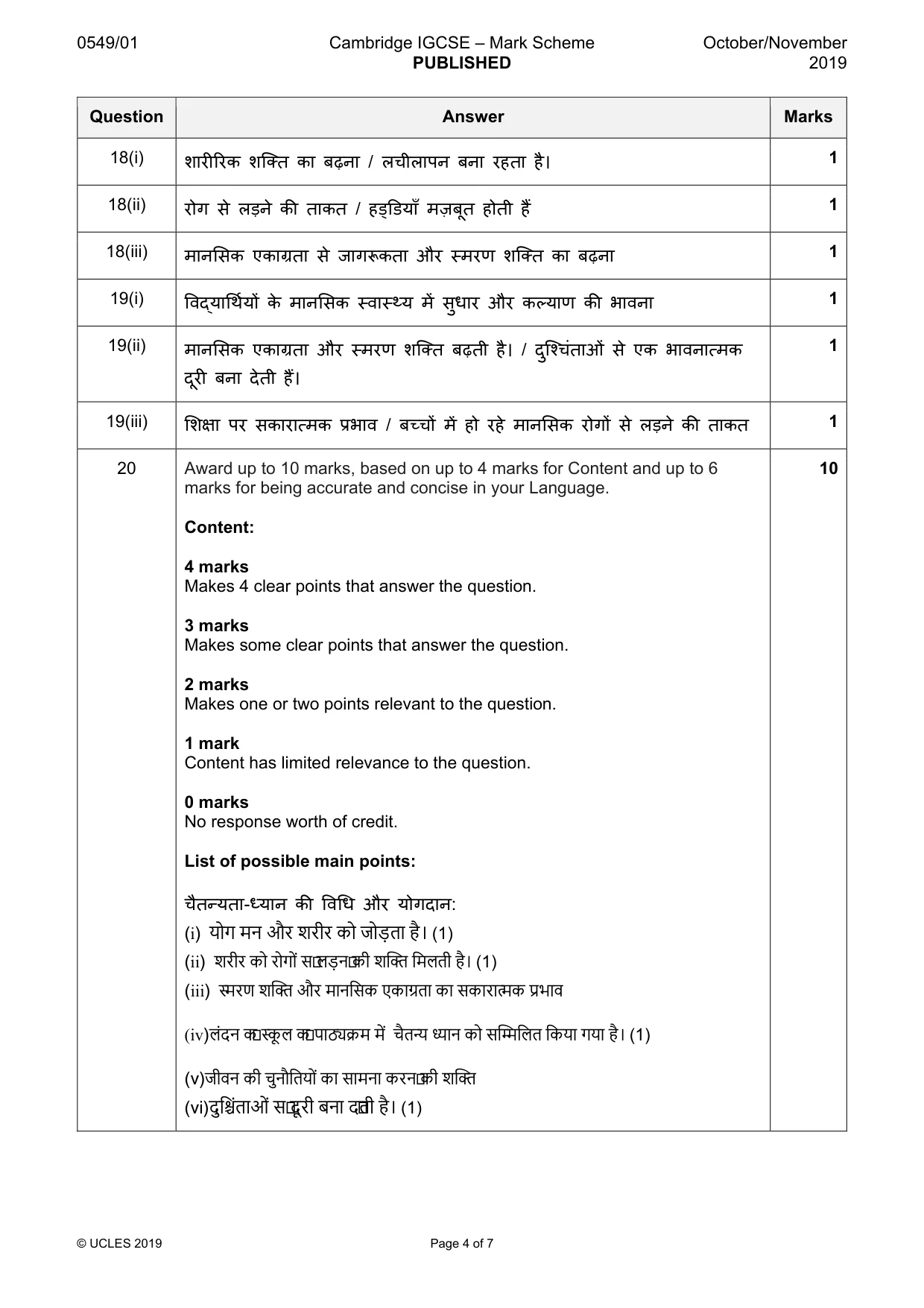
0549/01 Cambridge IGCSE – Mark Scheme PUBLISHED October/November 2019 © UCLES 2019 Page 4 of 7 Question Answer Marks 18(i) शारȣǐरक शिÈत का बढ़ना / लचीलापन बना रहता है। 1 18(ii) रोग से लड़ने कȧ ताकत / हɬͫडयाँ मज़बूत होती हɇ 1 18(iii) मानͧसक एकाĒता से जागǾकता और èमरण शिÈत का बढ़ना 1 19(i) ͪवɮयाͬथ[यɉ के मानͧसक èवाèØय मɅ सुधार और कãयाण कȧ भावना 1 19(ii) मानͧसक एकाĒता और èमरण शिÈत बढ़ती है।/ दुिæचंताओं से एक भावना×मक दूरȣ बना देती हɇ। 1 19(iii) ͧश¢ा पर सकारा×मक Ĥभाव / बÍचɉ मɅ हो रहे मानͧसक रोगɉ से लड़ने कȧ ताकत 1 20 Award up to 10 marks, based on up to 4 marks for Content and up to 6 marks for being accurate and concise in your Language. Content: 4 marks Makes 4 clear points that answer the question. 3 marks Makes some clear points that answer the question. 2 marks Makes one or two points relevant to the question. 1 mark Content has limited relevance to the question. 0 marks No response worth of credit. List of possible main points: चैतÛयता-Úयान कȧ ͪवͬध और योगदान: (i) योग मन और शरीर को जोड़ता है। (1) (ii) शरीर को रोगों से लड़ने की शİƅ िमलती है। (1) (iii) ˝रण शİƅ और मानिसक एकाŤता का सकाराȏक Ůभाव (iv)लंदन के ˋूल के पाǬŢम मŐ चैतɊ ȯान को सİʃिलत िकया गया है। (1) (v)जीवन की चुनौितयों का सामना करने की शİƅ (vi)दुिʮंताओं से दूरी बना देती है। (1) 10
Mark scheme, page 5
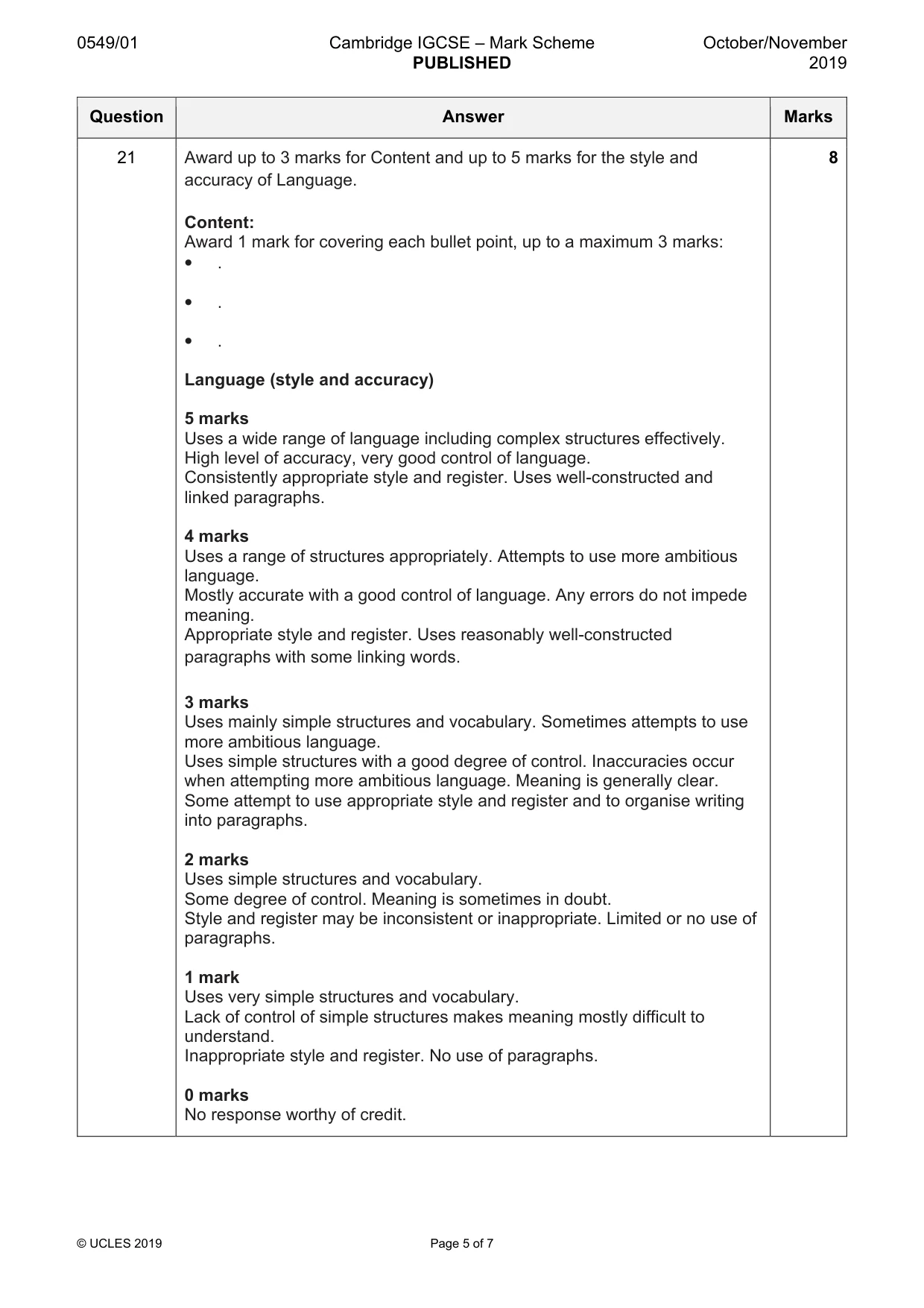
0549/01 Cambridge IGCSE – Mark Scheme PUBLISHED October/November 2019 © UCLES 2019 Page 5 of 7 Question Answer Marks 21 Award up to 3 marks for Content and up to 5 marks for the style and accuracy of Language. Content: Award 1 mark for covering each bullet point, up to a maximum 3 marks: • . • . • . Language (style and accuracy) 5 marks Uses a wide range of language including complex structures effectively. High level of accuracy, very good control of language. Consistently appropriate style and register. Uses well-constructed and linked paragraphs. 4 marks Uses a range of structures appropriately. Attempts to use more ambitious language. Mostly accurate with a good control of language. Any errors do not impede meaning. Appropriate style and register. Uses reasonably well-constructed paragraphs with some linking words. 3 marks Uses mainly simple structures and vocabulary. Sometimes attempts to use more ambitious language. Uses simple structures with a good degree of control. Inaccuracies occur when attempting more ambitious language. Meaning is generally clear. Some attempt to use appropriate style and register and to organise writing into paragraphs. 2 marks Uses simple structures and vocabulary. Some degree of control. Meaning is sometimes in doubt. Style and register may be inconsistent or inappropriate. Limited or no use of paragraphs. 1 mark Uses very simple structures and vocabulary. Lack of control of simple structures makes meaning mostly difficult to understand. Inappropriate style and register. No use of paragraphs. 0 marks No response worthy of credit. 8
Mark scheme, page 6
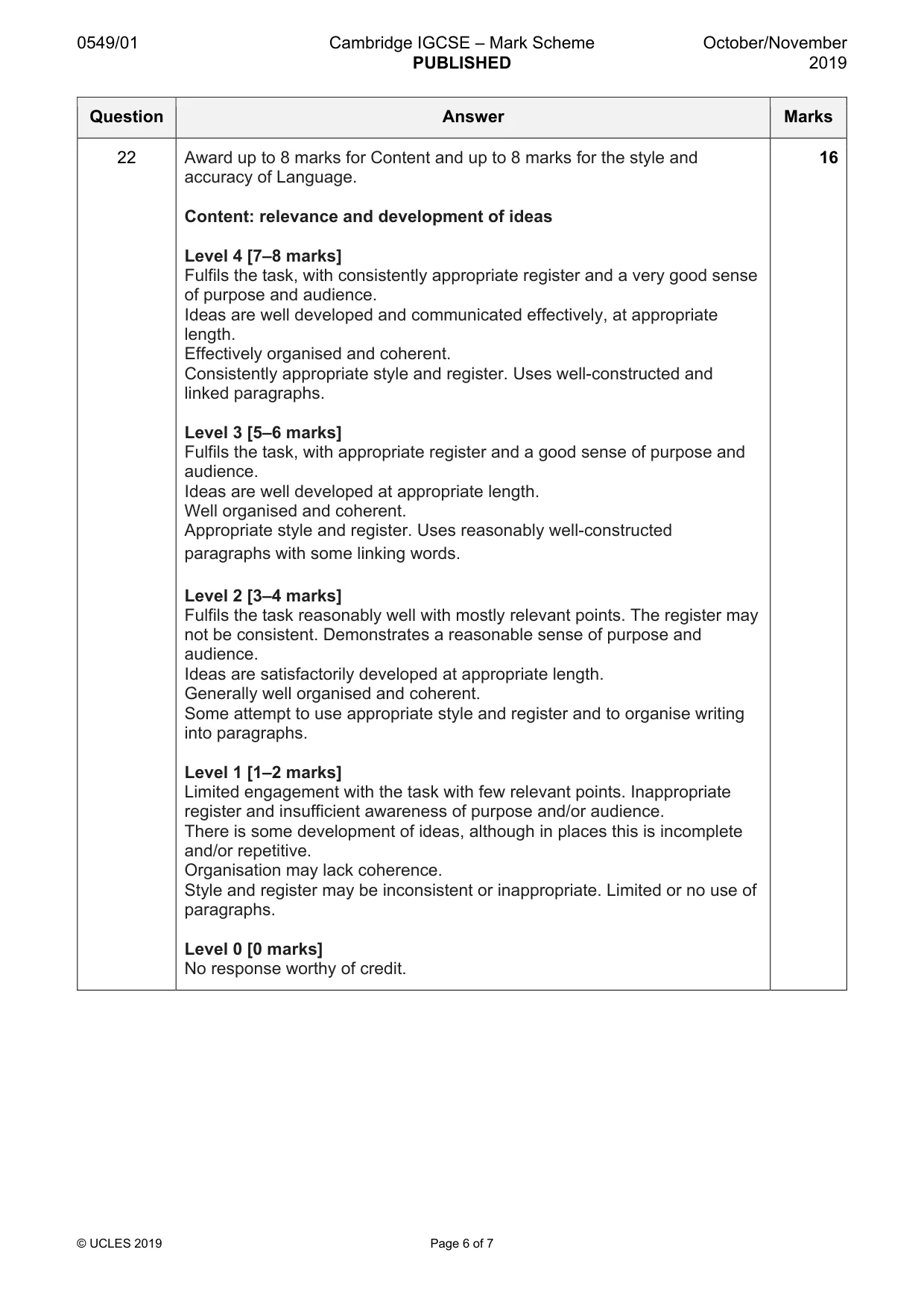
0549/01 Cambridge IGCSE – Mark Scheme PUBLISHED October/November 2019 © UCLES 2019 Page 6 of 7 Question Answer Marks 22 Award up to 8 marks for Content and up to 8 marks for the style and accuracy of Language. Content: relevance and development of ideas Level 4 [7–8 marks] Fulfils the task, with consistently appropriate register and a very good sense of purpose and audience. Ideas are well developed and communicated effectively, at appropriate length. Effectively organised and coherent. Consistently appropriate style and register. Uses well-constructed and linked paragraphs. Level 3 [5–6 marks] Fulfils the task, with appropriate register and a good sense of purpose and audience. Ideas are well developed at appropriate length. Well organised and coherent. Appropriate style and register. Uses reasonably well-constructed paragraphs with some linking words. Level 2 [3–4 marks] Fulfils the task reasonably well with mostly relevant points. The register may not be consistent. Demonstrates a reasonable sense of purpose and audience. Ideas are satisfactorily developed at appropriate length. Generally well organised and coherent. Some attempt to use appropriate style and register and to organise writing into paragraphs. Level 1 [1–2 marks] Limited engagement with the task with few relevant points. Inappropriate register and insufficient awareness of purpose and/or audience. There is some development of ideas, although in places this is incomplete and/or repetitive. Organisation may lack coherence. Style and register may be inconsistent or inappropriate. Limited or no use of paragraphs. Level 0 [0 marks] No response worthy of credit. 16
Mark scheme, page 7
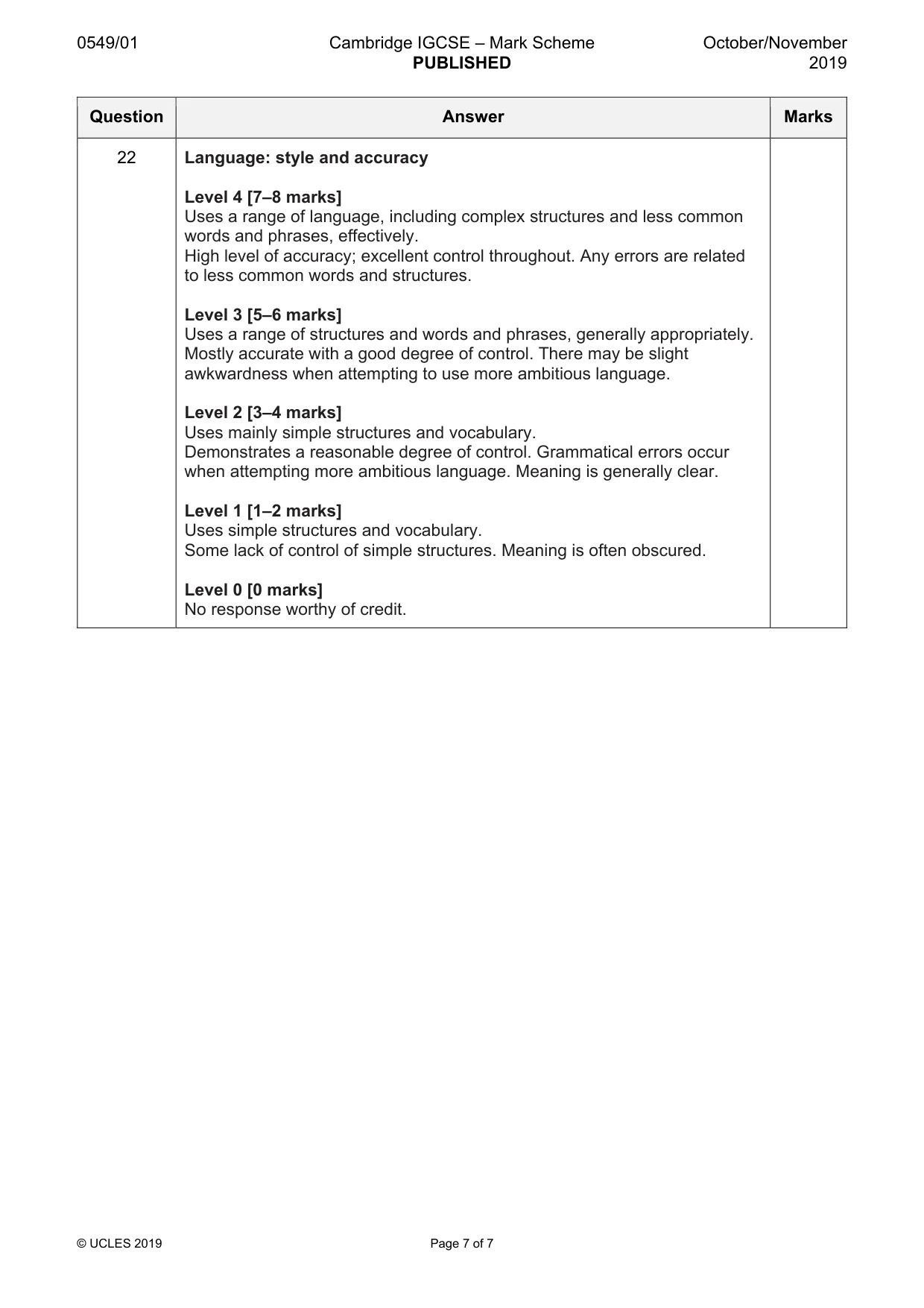
0549/01 Cambridge IGCSE – Mark Scheme PUBLISHED October/November 2019 © UCLES 2019 Page 7 of 7 Question Answer Marks 22 Language: style and accuracy Level 4 [7–8 marks] Uses a range of language, including complex structures and less common words and phrases, effectively. High level of accuracy; excellent control throughout. Any errors are related to less common words and structures. Level 3 [5–6 marks] Uses a range of structures and words and phrases, generally appropriately. Mostly accurate with a good degree of control. There may be slight awkwardness when attempting to use more ambitious language. Level 2 [3–4 marks] Uses mainly simple structures and vocabulary. Demonstrates a reasonable degree of control. Grammatical errors occur when attempting more ambitious language. Meaning is generally clear. Level 1 [1–2 marks] Uses simple structures and vocabulary. Some lack of control of simple structures. Meaning is often obscured. Level 0 [0 marks] No response worthy of credit.
What you needed in this session
Cambridge’s own grade thresholds for 2019 Oct/Nov, Paper 1 · Variant 1. A higher threshold means an easier paper — the bar moves with how the cohort did.