Cambridge IGCSE Greek - Foreign Language 0543 — 2019 May/June Paper 1 · Variant 1
0543/11/M/J/19 · 45 marks · ≈51 min
The question paper and its mark scheme, free to read here and free to download. This is Cambridge’s own paper, exactly as it was sat.
Question paper12 pages

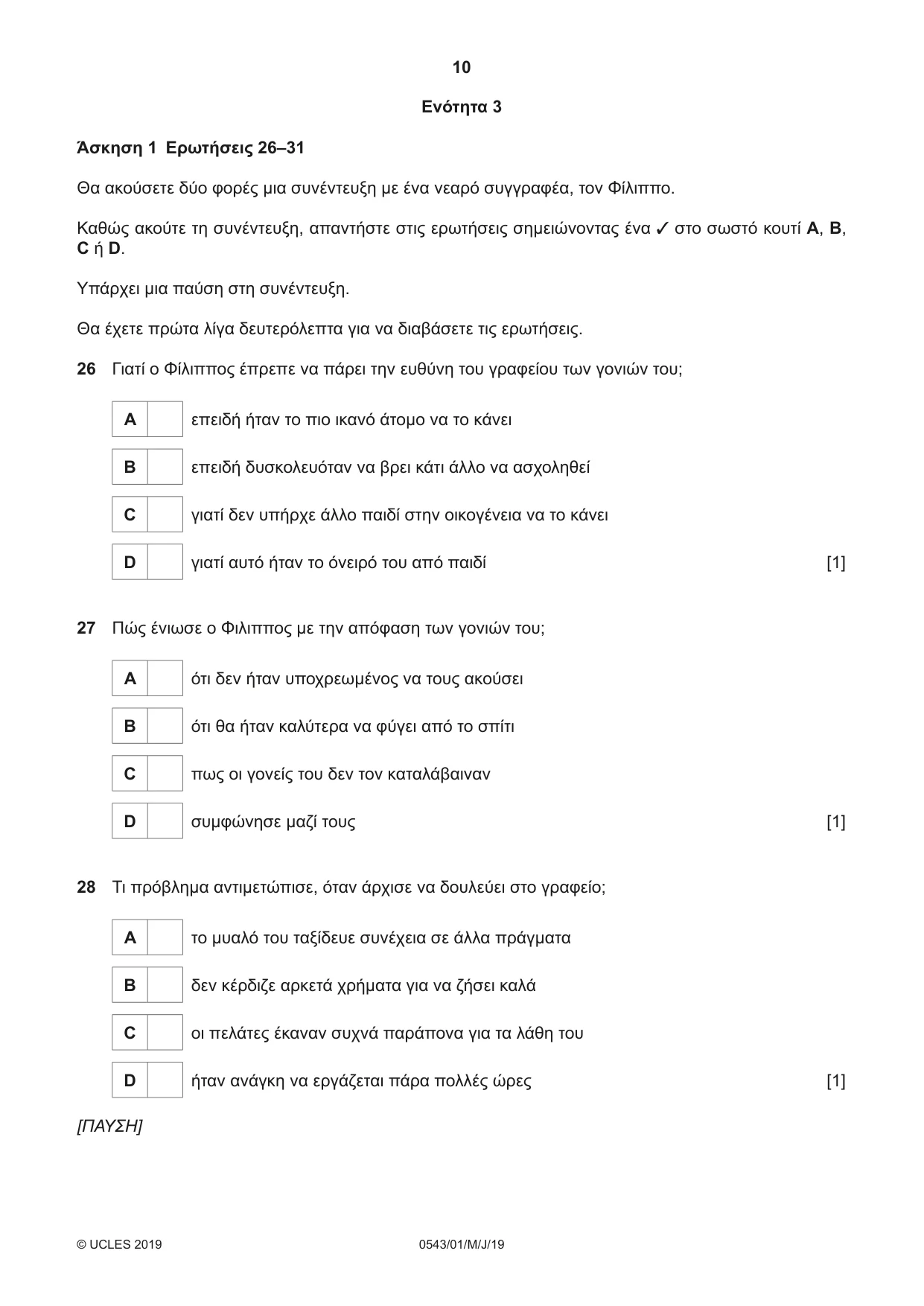
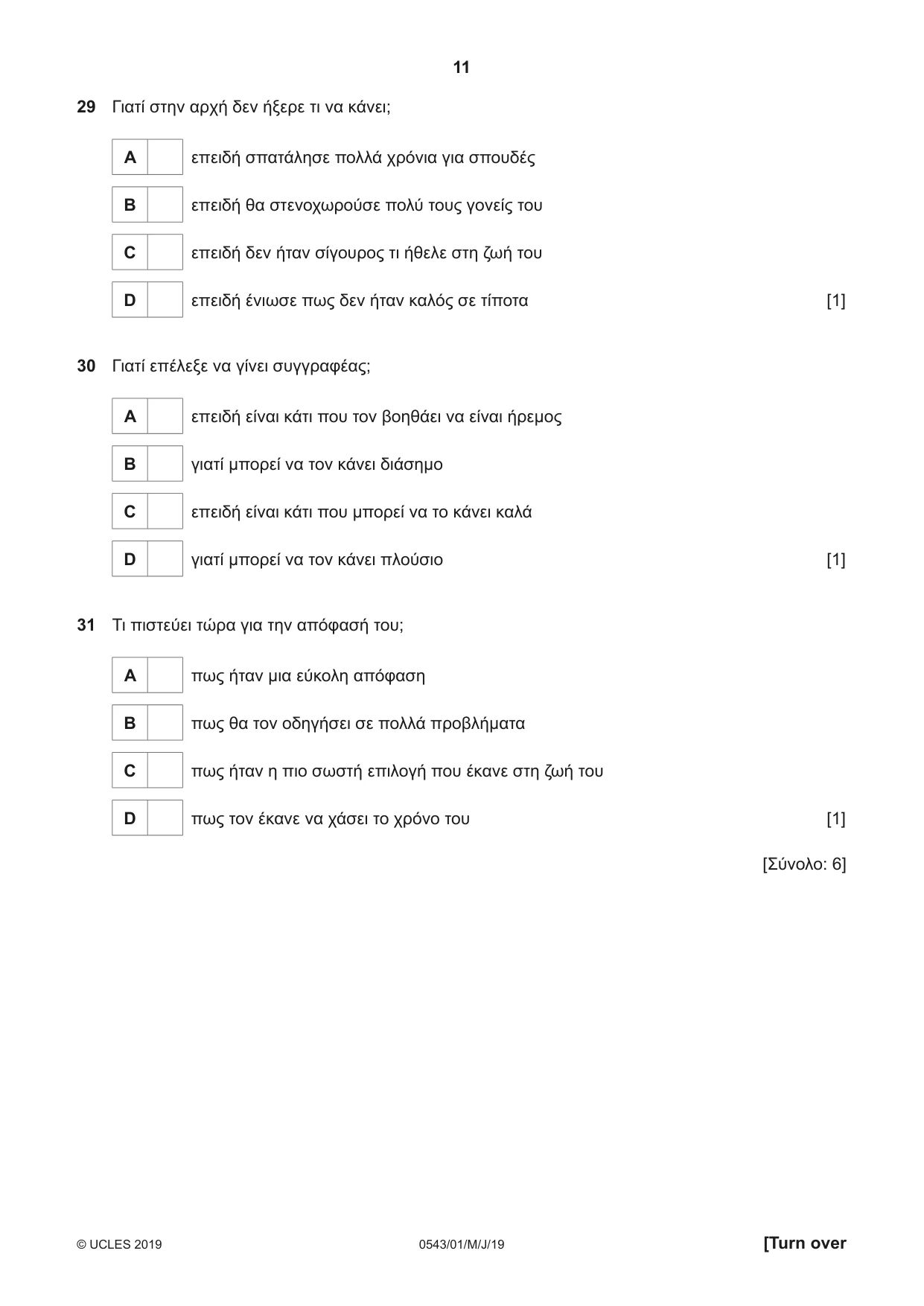
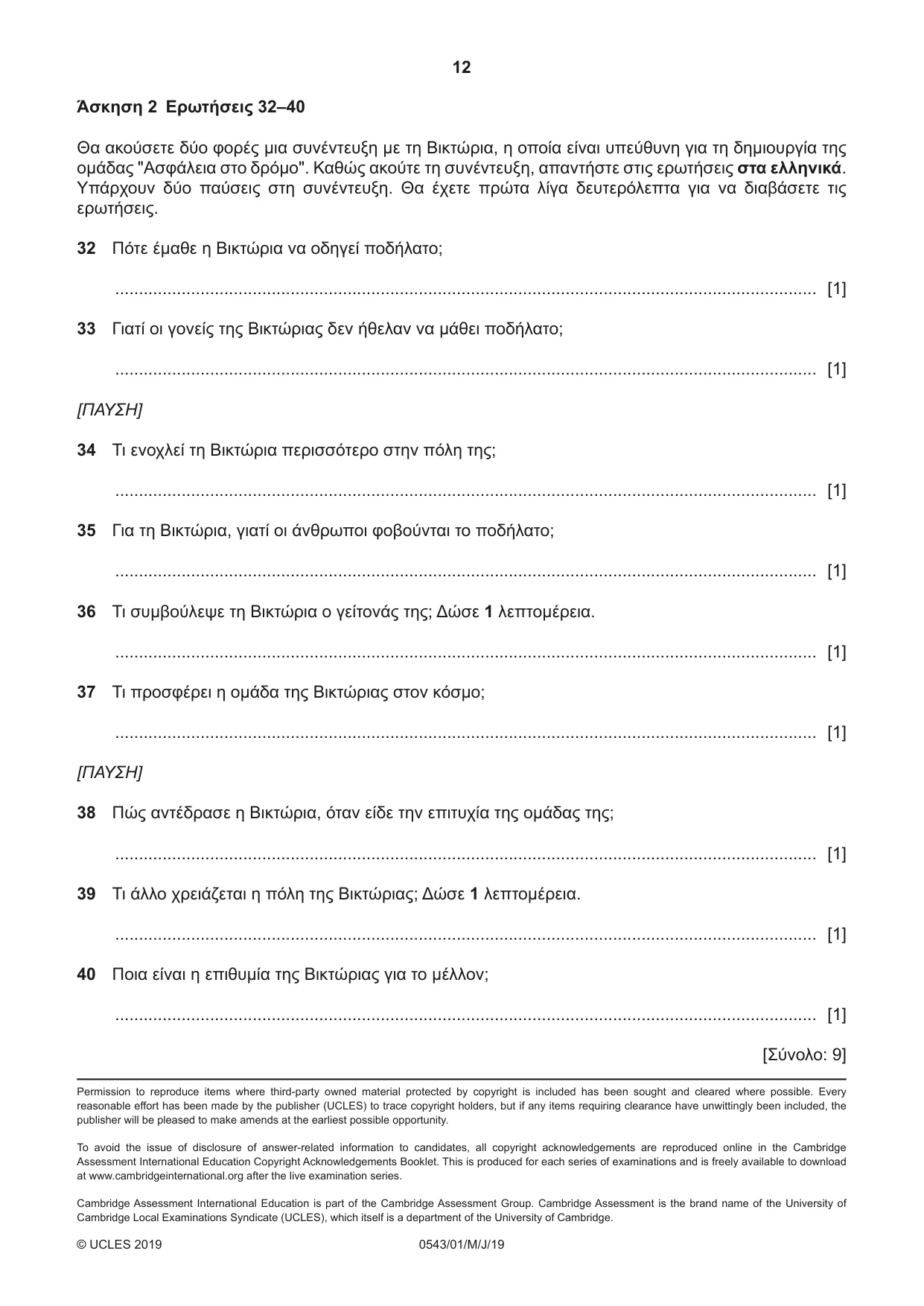
Mark scheme13 pages
Answers below. Sit the paper first if you are practising.
Paper as text
Question paper, page 1
This document consists of 11 printed pages and 1 blank page. DC (SC/TP) 163578/1 © UCLES 2019 [Turn over Cambridge Assessment International Education Cambridge International General Certificate of Secondary Education * 4 3 6 6 1 1 3 3 3 6 * GREEK 0543/01 Paper 1 Listening May/June 2019 Approx. 45 minutes Candidates answer on the Question Paper. No Additional Materials are required. READ THESE INSTRUCTIONS FIRST Write your centre number, candidate number and name in the spaces at the top of this page. Write in dark blue or black pen. Do not use staples, paper clips, glue or correction fluid. DO NOT WRITE IN ANY BARCODES. Answer all questions. The number of marks is given in brackets [ ] at the end of each question or part question. This syllabus is regulated for use in England, Wales and Northern Ireland as a Cambridge International Level 1/Level 2 Certificate.
Question paper, page 2
2 0543/01/M/J/19 © UCLES 2019 BLANK PAGE
Question paper, page 3
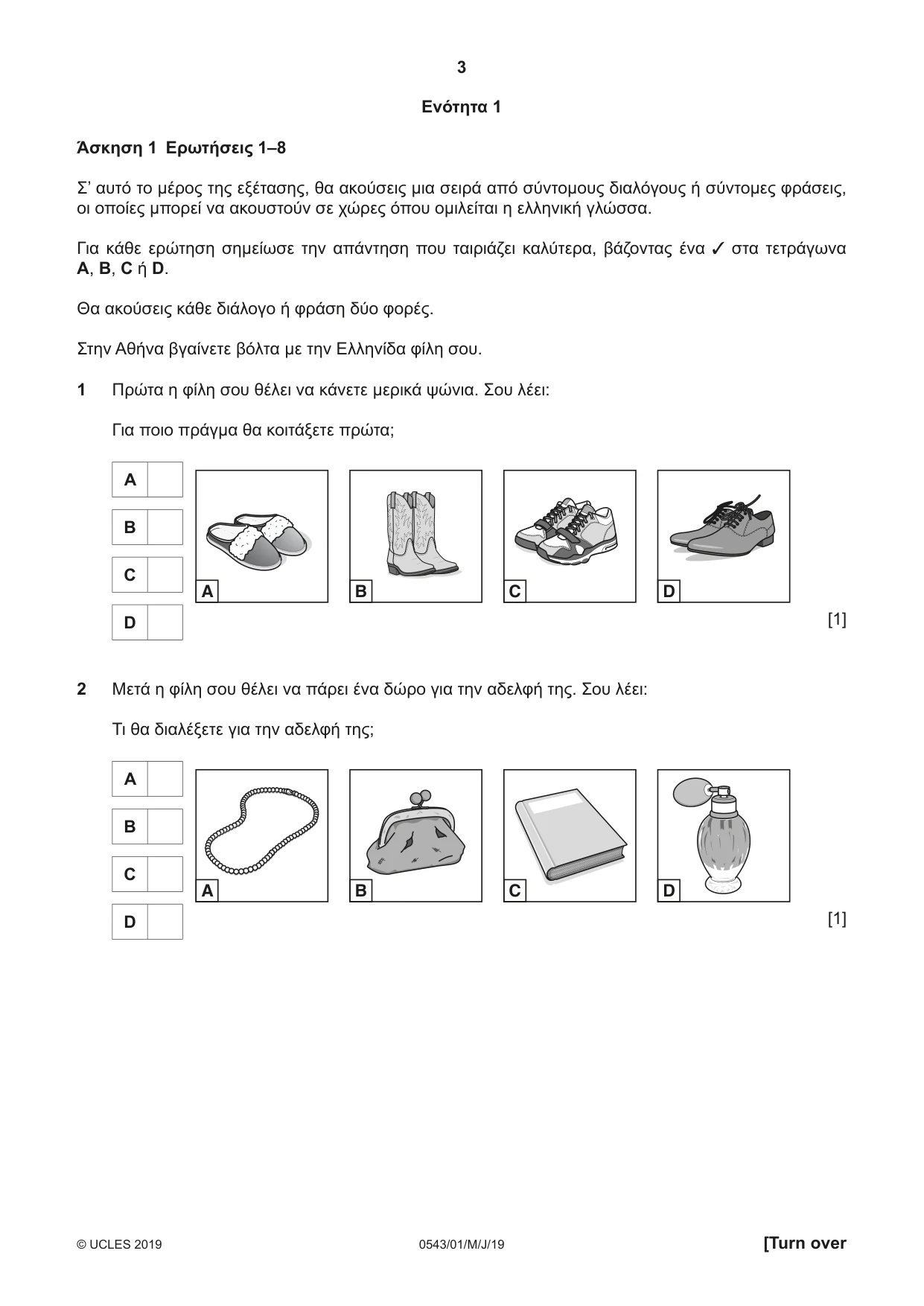
3 0543/01/M/J/19 © UCLES 2019 [Turn over Ενότητα 1 Άσκηση 1 Ερωτήσεις 1–8 Σ’ αυτό το μέρος της εξέτασης, θα ακούσεις μια σειρά από σύντομους διαλόγους ή σύντομες φράσεις, οι οποίες μπορεί να ακουστούν σε χώρες όπου ομιλείται η ελληνική γλώσσα. Για κάθε ερώτηση σημείωσε την απάντηση που ταιριάζει καλύτερα, βάζοντας ένα ✓ στα τετράγωνα Α, Β, C ή D. Θα ακούσεις κάθε διάλογο ή φράση δύο φορές. Στην Αθήνα βγαίνετε βόλτα με την Ελληνίδα φίλη σου. 1 Πρώτα η φίλη σου θέλει να κάνετε μερικά ψώνια. Σου λέει: Για ποιο πράγμα θα κοιτάξετε πρώτα; A A B C D [1] B C D 2 Μετά η φίλη σου θέλει να πάρει ένα δώρο για την αδελφή της. Σου λέει: Τι θα διαλέξετε για την αδελφή της; A A B C D [1] B C D
Question paper, page 4
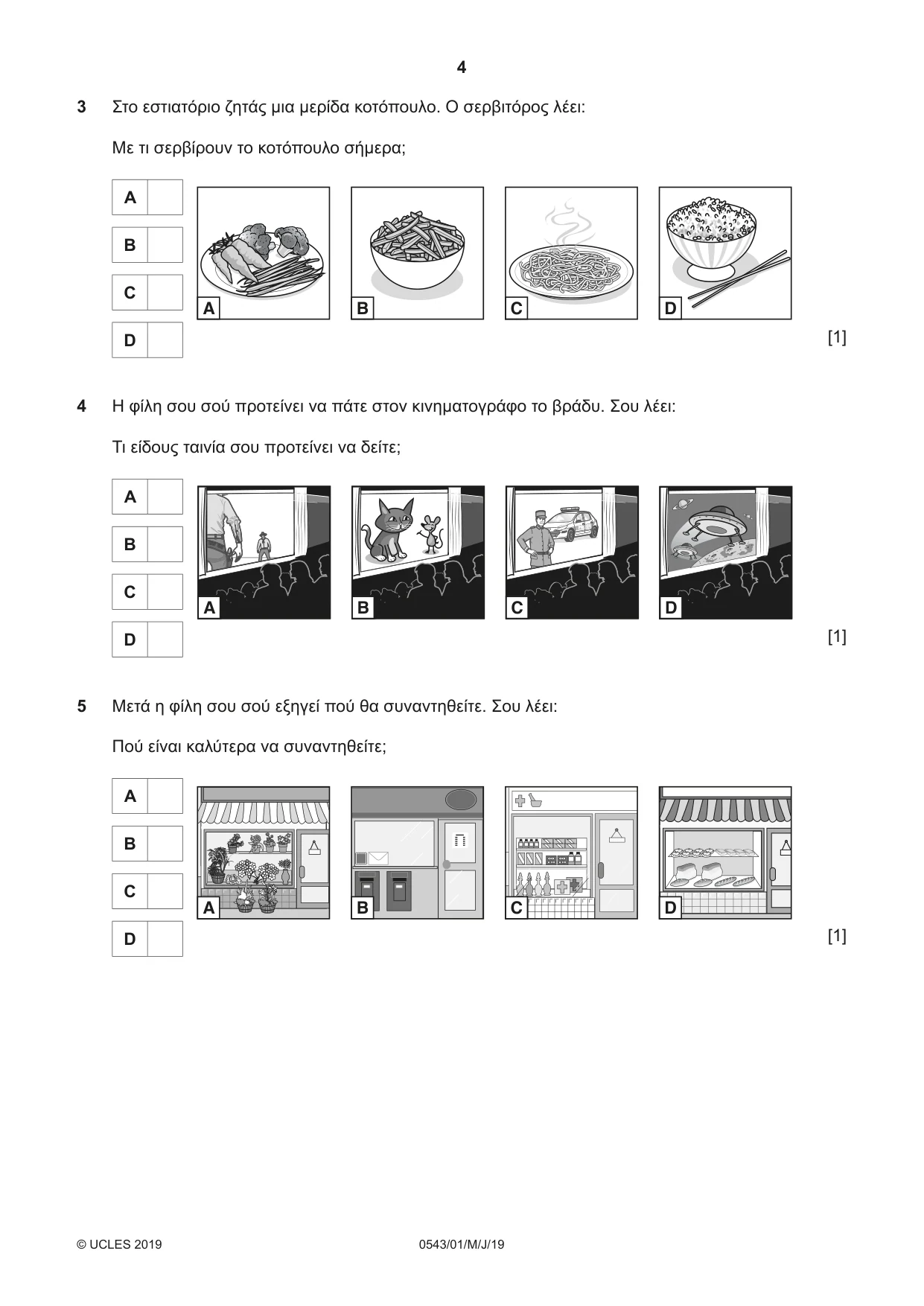
4 0543/01/M/J/19 © UCLES 2019 3 Στο εστιατόριο ζητάς μια μερίδα κοτόπουλο. Ο σερβιτόρος λέει: Με τι σερβίρουν το κοτόπουλο σήμερα; A A B C D [1] B C D 4 Η φίλη σου σού προτείνει να πάτε στον κινηματογράφο το βράδυ. Σου λέει: Τι είδους ταινία σου προτείνει να δείτε; A C B B B A B C D [1] B C D 5 Μετά η φίλη σου σού εξηγεί πού θα συναντηθείτε. Σου λέει: Πού είναι καλύτερα να συναντηθείτε; A A B C D [1] B C D
Question paper, page 5
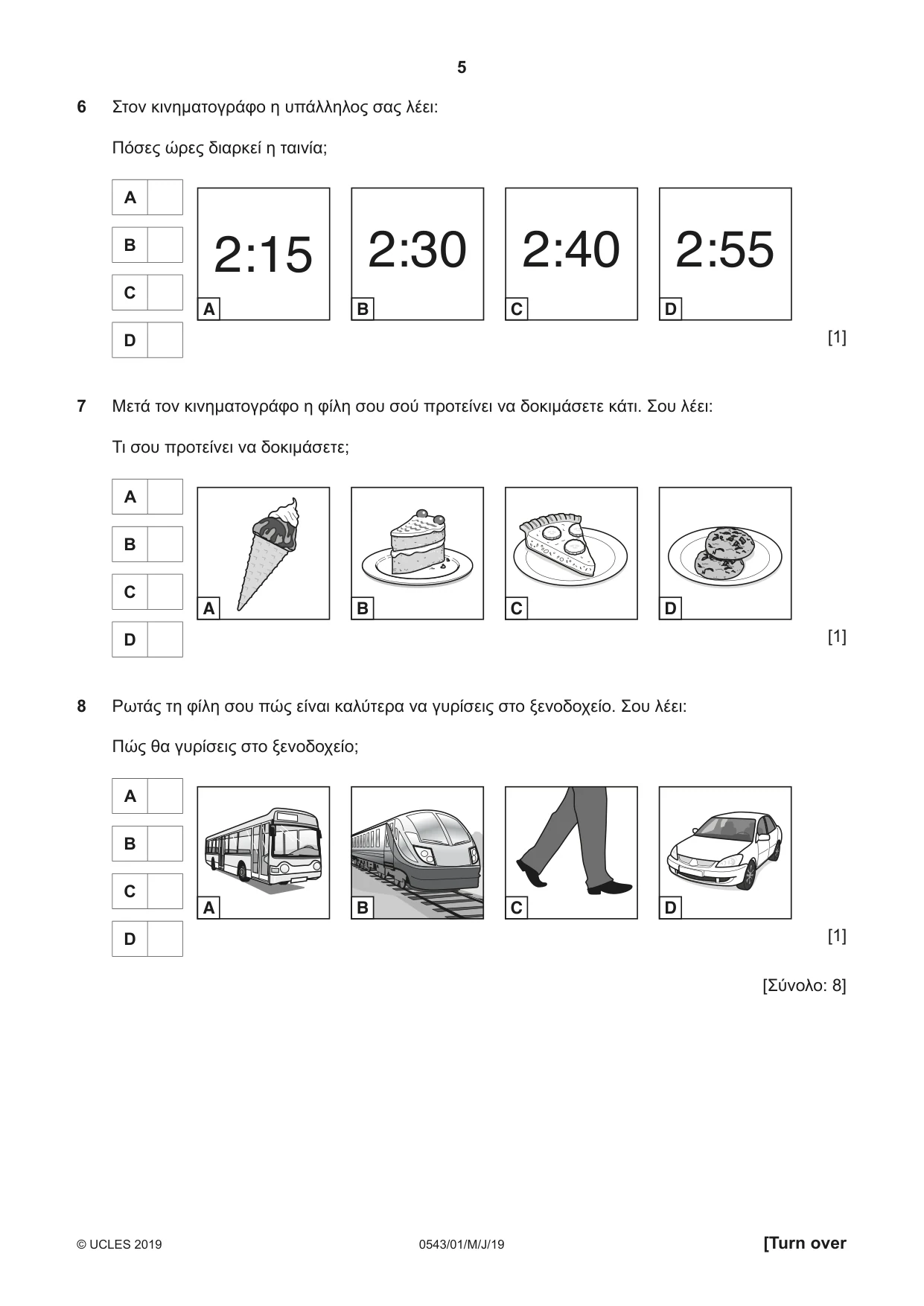
5 0543/01/M/J/19 © UCLES 2019 [Turn over 6 Στον κινηματογράφο η υπάλληλος σας λέει: Πόσες ώρες διαρκεί η ταινία; A 2:15 2:30 2:40 2:55 A B C D [1] B C D 7 Μετά τον κινηματογράφο η φίλη σου σού προτείνει να δοκιμάσετε κάτι. Σου λέει: Τι σου προτείνει να δοκιμάσετε; A A B C D [1] B C D 8 Ρωτάς τη φίλη σου πώς είναι καλύτερα να γυρίσεις στο ξενοδοχείο. Σου λέει: Πώς θα γυρίσεις στο ξενοδοχείο; A A B C D [1] B C D [Σύνολο: 8]
Question paper, page 6
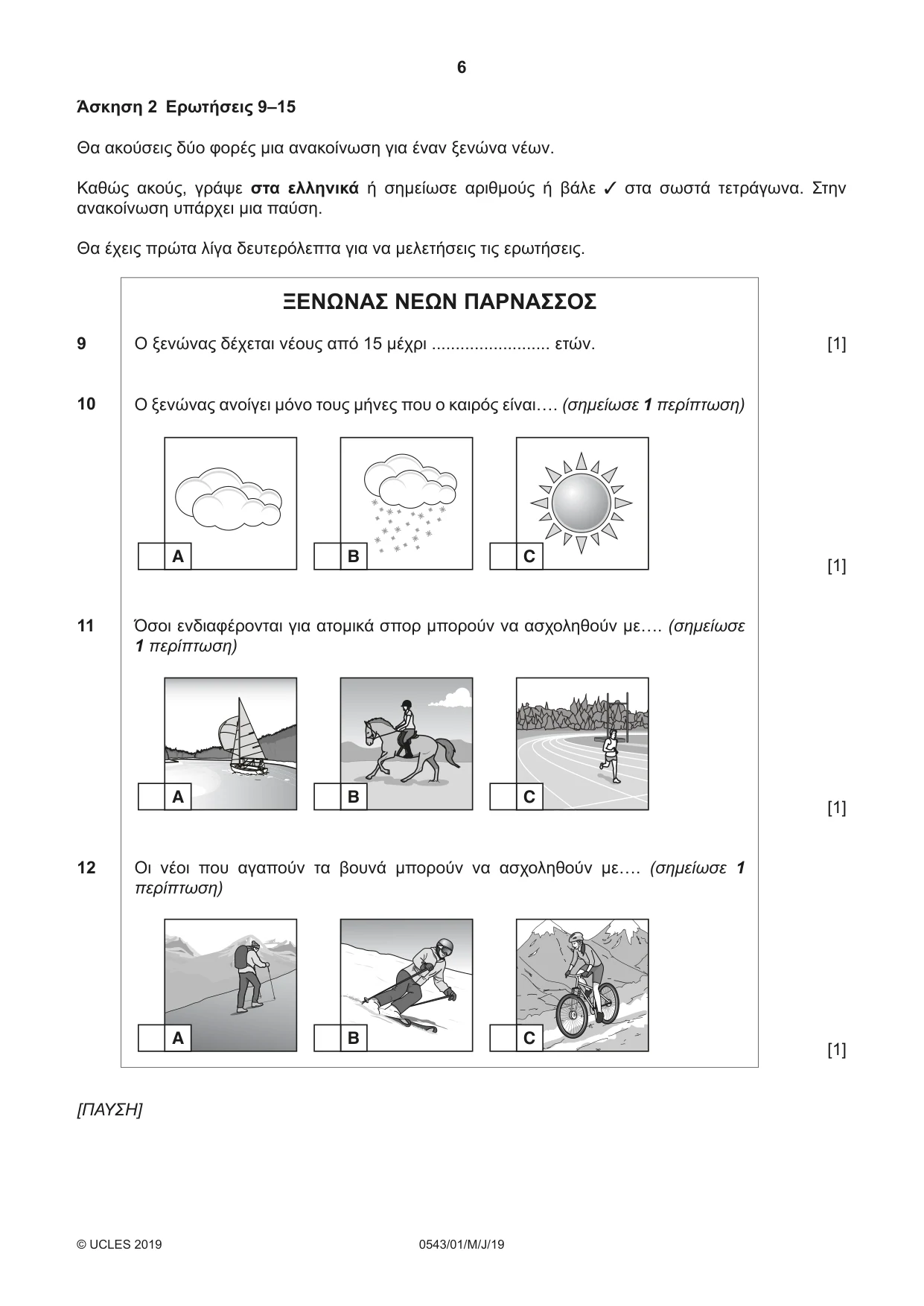
6 0543/01/M/J/19 © UCLES 2019 Άσκηση 2 Ερωτήσεις 9–15 Θα ακούσεις δύο φορές μια ανακοίνωση για έναν ξενώνα νέων. Καθώς ακούς, γράψε στα ελληνικά ή σημείωσε αριθμούς ή βάλε ✓ στα σωστά τετράγωνα. Στην ανακοίνωση υπάρχει μια παύση. Θα έχεις πρώτα λίγα δευτερόλεπτα για να μελετήσεις τις ερωτήσεις. ΞΕΝΩΝΑΣ ΝΕΩΝ ΠΑΡΝΑΣΣΟΣ Ο ξενώνας δέχεται νέους από 15 μέχρι … ετών. Ο ξενώνας ανοίγει μόνο τους μήνες που ο καιρός είναι…. (σημείωσε 1 περίπτωση) A B C Όσοι ενδιαφέρονται για ατομικά σπορ μπορούν να ασχοληθούν με…. (σημείωσε 1 περίπτωση) A B C Οι νέοι που αγαπούν τα βουνά μπορούν να ασχοληθούν με…. (σημείωσε 1 περίπτωση) A B C 9 10 11 12 [1] [1] [1] [1] [ΠΑΥΣΗ]
Question paper, page 7
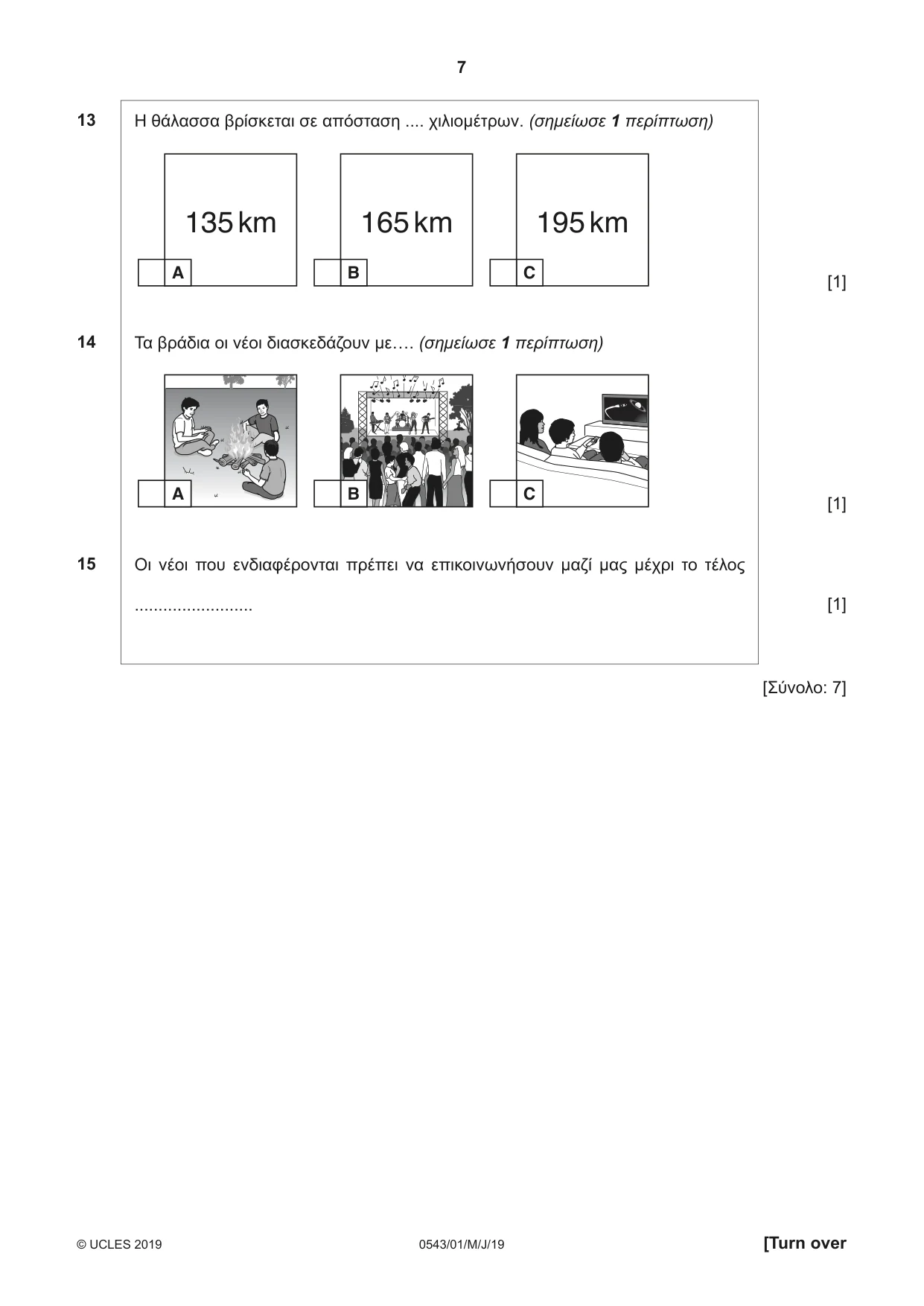
7 0543/01/M/J/19 © UCLES 2019 [Turn over Η θάλασσα βρίσκεται σε απόσταση … χιλιομέτρων. (σημείωσε 1 περίπτωση) 135 km 165 km 195 km A B C Τα βράδια οι νέοι διασκεδάζουν με…. (σημείωσε 1 περίπτωση) A B C Οι νέοι που ενδιαφέρονται πρέπει να επικοινωνήσουν μαζί μας μέχρι το τέλος … 13 14 15 [1] [1] [1] [Σύνολο: 7]
Question paper, page 8
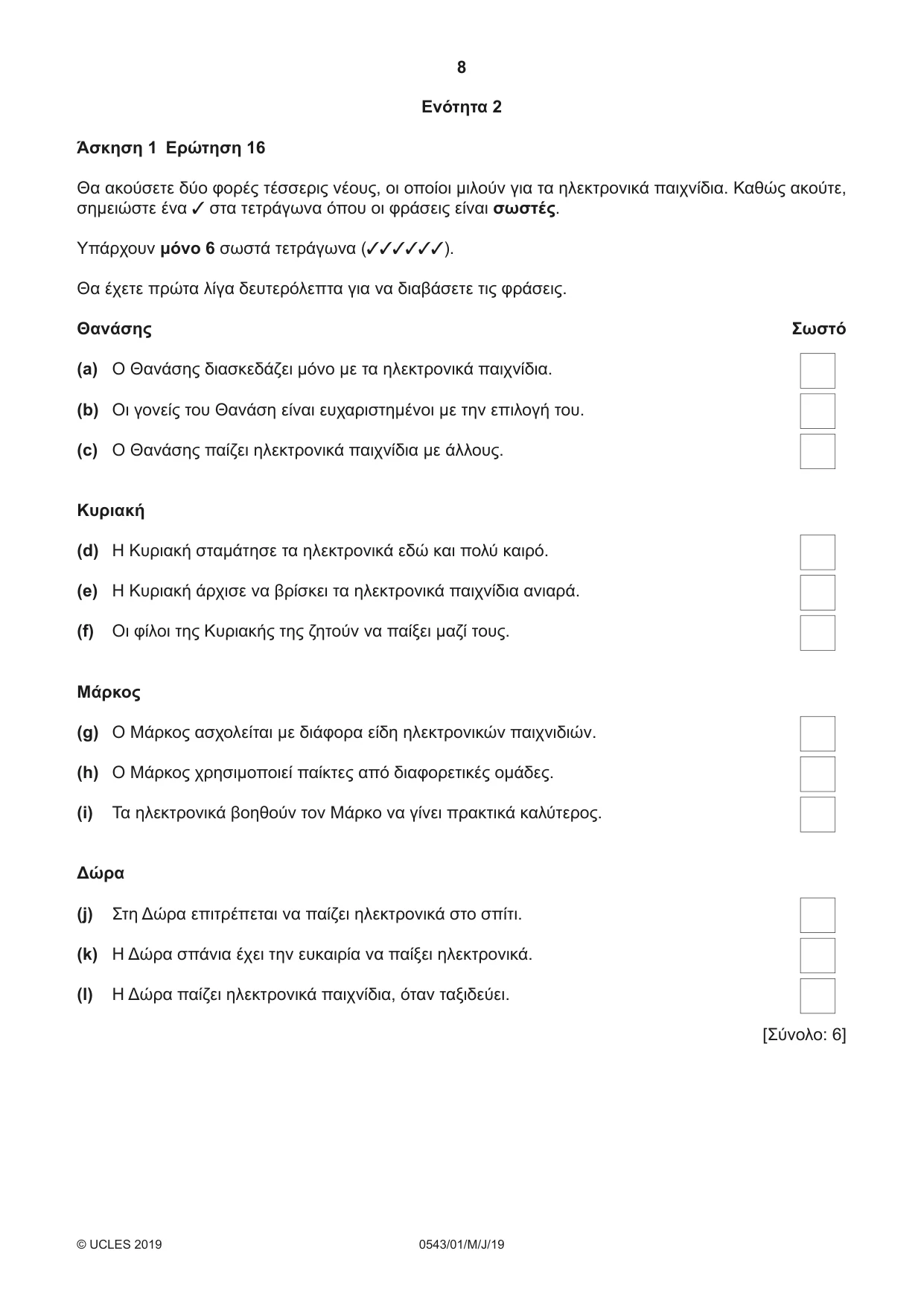
8 0543/01/M/J/19 © UCLES 2019 Ενότητα 2 Άσκηση 1 Ερώτηση 16 Θα ακούσετε δύο φορές τέσσερις νέους, οι οποίοι μιλούν για τα ηλεκτρονικά παιχνίδια. Καθώς ακούτε, σημειώστε ένα ✓ στα τετράγωνα όπου οι φράσεις είναι σωστές. Υπάρχουν μόνο 6 σωστά τετράγωνα (✓✓✓✓✓✓). Θα έχετε πρώτα λίγα δευτερόλεπτα για να διαβάσετε τις φράσεις. Θανάσης Σωστό (a) Ο Θανάσης διασκεδάζει μόνο με τα ηλεκτρονικά παιχνίδια. (b) Οι γονείς του Θανάση είναι ευχαριστημένοι με την επιλογή του. (c) Ο Θανάσης παίζει ηλεκτρονικά παιχνίδια με άλλους. Κυριακή (d) Η Κυριακή σταμάτησε τα ηλεκτρονικά εδώ και πολύ καιρό. (e) Η Κυριακή άρχισε να βρίσκει τα ηλεκτρονικά παιχνίδια ανιαρά. (f) Οι φίλοι της Κυριακής της ζητούν να παίξει μαζί τους. Μάρκος (g) Ο Μάρκος ασχολείται με διάφορα είδη ηλεκτρονικών παιχνιδιών. (h) Ο Μάρκος χρησιμοποιεί παίκτες από διαφορετικές ομάδες. (i) Τα ηλεκτρονικά βοηθούν τον Μάρκο να γίνει πρακτικά καλύτερος. Δώρα (j) Στη Δώρα επιτρέπεται να παίζει ηλεκτρονικά στο σπίτι. (k) Η Δώρα σπάνια έχει την ευκαιρία να παίξει ηλεκτρονικά. (l) Η Δώρα παίζει ηλεκτρονικά παιχνίδια, όταν ταξιδεύει. [Σύνολο: 6]
Question paper, page 9
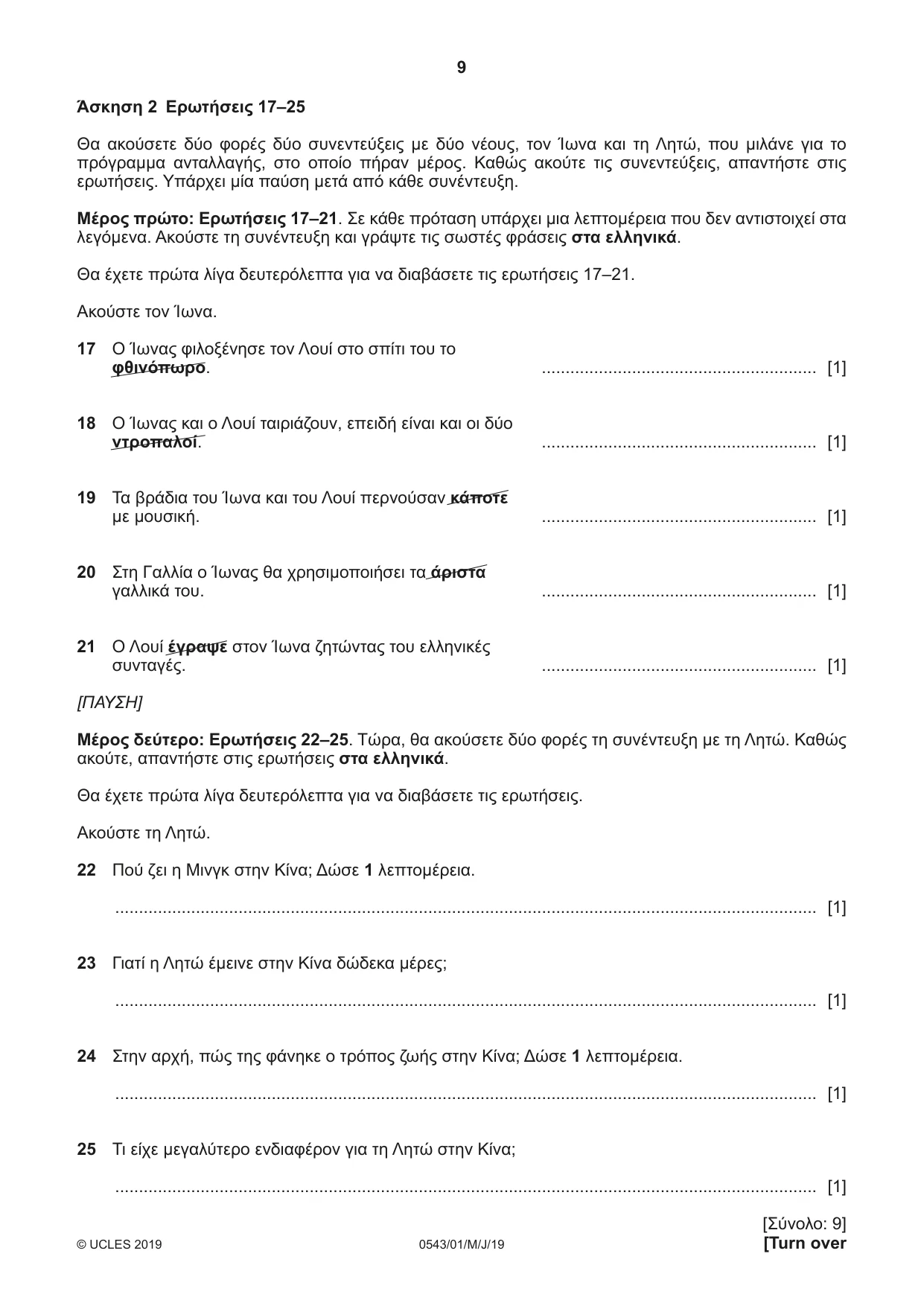
9 0543/01/M/J/19 © UCLES 2019 [Turn over Άσκηση 2 Ερωτήσεις 17–25 Θα ακούσετε δύο φορές δύο συνεντεύξεις με δύο νέους, τον Ίωνα και τη Λητώ, που μιλάνε για το πρόγραμμα ανταλλαγής, στο οποίο πήραν μέρος. Καθώς ακούτε τις συνεντεύξεις, απαντήστε στις ερωτήσεις. Υπάρχει μία παύση μετά από κάθε συνέντευξη. Μέρος πρώτο: Ερωτήσεις 17–21. Σε κάθε πρόταση υπάρχει μια λεπτομέρεια που δεν αντιστοιχεί στα λεγόμενα. Ακούστε τη συνέντευξη και γράψτε τις σωστές φράσεις στα ελληνικά. Θα έχετε πρώτα λίγα δευτερόλεπτα για να διαβάσετε τις ερωτήσεις 17–21. Ακούστε τον Ίωνα. 17 Ο Ίωνας φιλοξένησε τον Λουί στο σπίτι του το φθινόπωρο. … [1] 18 Ο Ίωνας και ο Λουί ταιριάζουν, επειδή είναι και οι δύο ντροπαλοί. … [1] 19 Τα βράδια του Ίωνα και του Λουί περνούσαν κάποτε με μουσική. … [1] 20 Στη Γαλλία ο Ίωνας θα χρησιμοποιήσει τα άριστα γαλλικά του. … [1] 21 Ο Λουί έγραψε στον Ίωνα ζητώντας του ελληνικές συνταγές. … [1] [ΠΑΥΣΗ] Μέρος δεύτερο: Ερωτήσεις 22–25. Τώρα, θα ακούσετε δύο φορές τη συνέντευξη με τη Λητώ. Καθώς ακούτε, απαντήστε στις ερωτήσεις στα ελληνικά. Θα έχετε πρώτα λίγα δευτερόλεπτα για να διαβάσετε τις ερωτήσεις. Ακούστε τη Λητώ. 22 Πού ζει η Μινγκ στην Κίνα; Δώσε 1 λεπτομέρεια. … [1] 23 Γιατί η Λητώ έμεινε στην Κίνα δώδεκα μέρες; … [1] 24 Στην αρχή, πώς της φάνηκε ο τρόπος ζωής στην Κίνα; Δώσε 1 λεπτομέρεια. … [1] 25 Τι είχε μεγαλύτερο ενδιαφέρον για τη Λητώ στην Κίνα; … [1] [Σύνολο: 9]
Question paper, page 10
10 0543/01/M/J/19 © UCLES 2019 Ενότητα 3 Άσκηση 1 Ερωτήσεις 26–31 Θα ακούσετε δύο φορές μια συνέντευξη με ένα νεαρό συγγραφέα, τον Φίλιππο. Καθώς ακούτε τη συνέντευξη, απαντήστε στις ερωτήσεις σημειώνοντας ένα ✓ στο σωστό κουτί A, B, C ή D. Υπάρχει μια παύση στη συνέντευξη. Θα έχετε πρώτα λίγα δευτερόλεπτα για να διαβάσετε τις ερωτήσεις. 26 Γιατί ο Φίλιππος έπρεπε να πάρει την ευθύνη του γραφείου των γονιών του; A επειδή ήταν το πιο ικανό άτομο να το κάνει B επειδή δυσκολευόταν να βρει κάτι άλλο να ασχοληθεί C γιατί δεν υπήρχε άλλο παιδί στην οικογένεια να το κάνει D γιατί αυτό ήταν το όνειρό του από παιδί [1] 27 Πώς ένιωσε ο Φιλιππος με την απόφαση των γονιών του; A ότι δεν ήταν υποχρεωμένος να τους ακούσει B ότι θα ήταν καλύτερα να φύγει από το σπίτι C πως οι γονείς του δεν τον καταλάβαιναν D συμφώνησε μαζί τους [1] 28 Τι πρόβλημα αντιμετώπισε, όταν άρχισε να δουλεύει στο γραφείο; A το μυαλό του ταξίδευε συνέχεια σε άλλα πράγματα B δεν κέρδιζε αρκετά χρήματα για να ζήσει καλά C οι πελάτες έκαναν συχνά παράπονα για τα λάθη του D ήταν ανάγκη να εργάζεται πάρα πολλές ώρες [1] [ΠΑΥΣΗ]
Question paper, page 11
11 0543/01/M/J/19 © UCLES 2019 [Turn over 29 Γιατί στην αρχή δεν ήξερε τι να κάνει; A επειδή σπατάλησε πολλά χρόνια για σπουδές B επειδή θα στενοχωρούσε πολύ τους γονείς του C επειδή δεν ήταν σίγουρος τι ήθελε στη ζωή του D επειδή ένιωσε πως δεν ήταν καλός σε τίποτα [1] 30 Γιατί επέλεξε να γίνει συγγραφέας; A επειδή είναι κάτι που τον βοηθάει να είναι ήρεμος B γιατί μπορεί να τον κάνει διάσημο C επειδή είναι κάτι που μπορεί να το κάνει καλά D γιατί μπορεί να τον κάνει πλούσιο [1] 31 Τι πιστεύει τώρα για την απόφασή του; A πως ήταν μια εύκολη απόφαση B πως θα τον οδηγήσει σε πολλά προβλήματα C πως ήταν η πιο σωστή επιλογή που έκανε στη ζωή του D πως τον έκανε να χάσει το χρόνο του [1] [Σύνολο: 6]
Question paper, page 12
12 0543/01/M/J/19 © UCLES 2019 Permission to reproduce items where third-party owned material protected by copyright is included has been sought and cleared where possible. Every reasonable effort has been made by the publisher (UCLES) to trace copyright holders, but if any items requiring clearance have unwittingly been included, the publisher will be pleased to make amends at the earliest possible opportunity. To avoid the issue of disclosure of answer-related information to candidates, all copyright acknowledgements are reproduced online in the Cambridge Assessment International Education Copyright Acknowledgements Booklet. This is produced for each series of examinations and is freely available to download at www.cambridgeinternational.org after the live examination series. Cambridge Assessment International Education is part of the Cambridge Assessment Group. Cambridge Assessment is the brand name of the University of Cambridge Local Examinations Syndicate (UCLES), which itself is a department of the University of Cambridge. Άσκηση 2 Ερωτήσεις 32–40 Θα ακούσετε δύο φορές μια συνέντευξη με τη Βικτώρια, η οποία είναι υπεύθυνη για τη δημιουργία της ομάδας "Ασφάλεια στο δρόμο". Καθώς ακούτε τη συνέντευξη, απαντήστε στις ερωτήσεις στα ελληνικά. Υπάρχουν δύο παύσεις στη συνέντευξη. Θα έχετε πρώτα λίγα δευτερόλεπτα για να διαβάσετε τις ερωτήσεις. 32 Πότε έμαθε η Βικτώρια να οδηγεί ποδήλατο; … [1] 33 Γιατί οι γονείς της Βικτώριας δεν ήθελαν να μάθει ποδήλατο; … [1] [ΠΑΥΣΗ] 34 Τι ενοχλεί τη Βικτώρια περισσότερο στην πόλη της; … [1] 35 Για τη Βικτώρια, γιατί οι άνθρωποι φοβούνται το ποδήλατο; … [1] 36 Τι συμβούλεψε τη Βικτώρια ο γείτονάς της; Δώσε 1 λεπτομέρεια. … [1] 37 Τι προσφέρει η ομάδα της Βικτώριας στον κόσμο; … [1] [ΠΑΥΣΗ] 38 Πώς αντέδρασε η Βικτώρια, όταν είδε την επιτυχία της ομάδας της; … [1] 39 Τι άλλο χρειάζεται η πόλη της Βικτώριας; Δώσε 1 λεπτομέρεια. … [1] 40 Ποια είναι η επιθυμία της Βικτώριας για το μέλλον; … [1] [Σύνολο: 9]
Mark scheme, page 1
This syllabus is regulated for use in England, Wales and Northern Ireland as a Cambridge International Level 1/Level 2 Certificate. This document consists of 13 printed pages. © UCLES 2019 [Turn over Cambridge Assessment International Education Cambridge International General Certificate of Secondary Education GREEK 0543/01 Paper 1 Listening May/June 2019 MARK SCHEME Maximum Mark: 45 Published This mark scheme is published as an aid to teachers and candidates, to indicate the requirements of the examination. It shows the basis on which Examiners were instructed to award marks. It does not indicate the details of the discussions that took place at an Examiners’ meeting before marking began, which would have considered the acceptability of alternative answers. Mark schemes should be read in conjunction with the question paper and the Principal Examiner Report for Teachers. Cambridge International will not enter into discussions about these mark schemes. Cambridge International is publishing the mark schemes for the May/June 2019 series for most Cambridge IGCSE™, Cambridge International A and AS Level and Cambridge Pre-U components, and some Cambridge O Level components.
Mark scheme, page 2
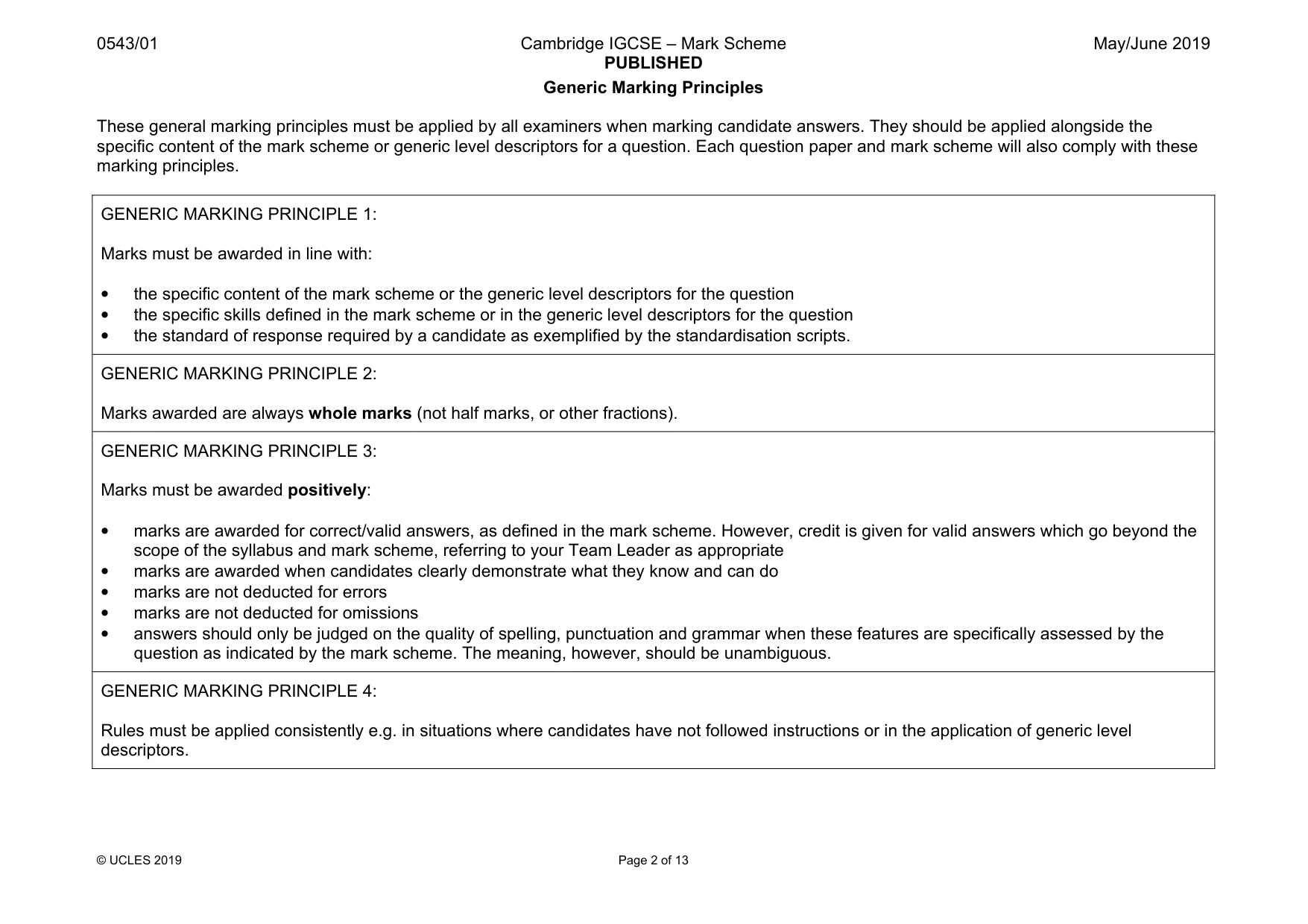
0543/01 Cambridge IGCSE – Mark Scheme PUBLISHED May/June 2019 © UCLES 2019 Page 2 of 13 Generic Marking Principles These general marking principles must be applied by all examiners when marking candidate answers. They should be applied alongside the specific content of the mark scheme or generic level descriptors for a question. Each question paper and mark scheme will also comply with these marking principles. GENERIC MARKING PRINCIPLE 1: Marks must be awarded in line with: • the specific content of the mark scheme or the generic level descriptors for the question • the specific skills defined in the mark scheme or in the generic level descriptors for the question • the standard of response required by a candidate as exemplified by the standardisation scripts. GENERIC MARKING PRINCIPLE 2: Marks awarded are always whole marks (not half marks, or other fractions). GENERIC MARKING PRINCIPLE 3: Marks must be awarded positively: • marks are awarded for correct/valid answers, as defined in the mark scheme. However, credit is given for valid answers which go beyond the scope of the syllabus and mark scheme, referring to your Team Leader as appropriate • marks are awarded when candidates clearly demonstrate what they know and can do • marks are not deducted for errors • marks are not deducted for omissions • answers should only be judged on the quality of spelling, punctuation and grammar when these features are specifically assessed by the question as indicated by the mark scheme. The meaning, however, should be unambiguous. GENERIC MARKING PRINCIPLE 4: Rules must be applied consistently e.g. in situations where candidates have not followed instructions or in the application of generic level descriptors.
Mark scheme, page 3
0543/01 Cambridge IGCSE – Mark Scheme PUBLISHED May/June 2019 © UCLES 2019 Page 3 of 13 GENERIC MARKING PRINCIPLE 5: Marks should be awarded using the full range of marks defined in the mark scheme for the question (however; the use of the full mark range may be limited according to the quality of the candidate responses seen). GENERIC MARKING PRINCIPLE 6: Marks awarded are based solely on the requirements as defined in the mark scheme. Marks should not be awarded with grade thresholds or grade descriptors in mind.
Mark scheme, page 4
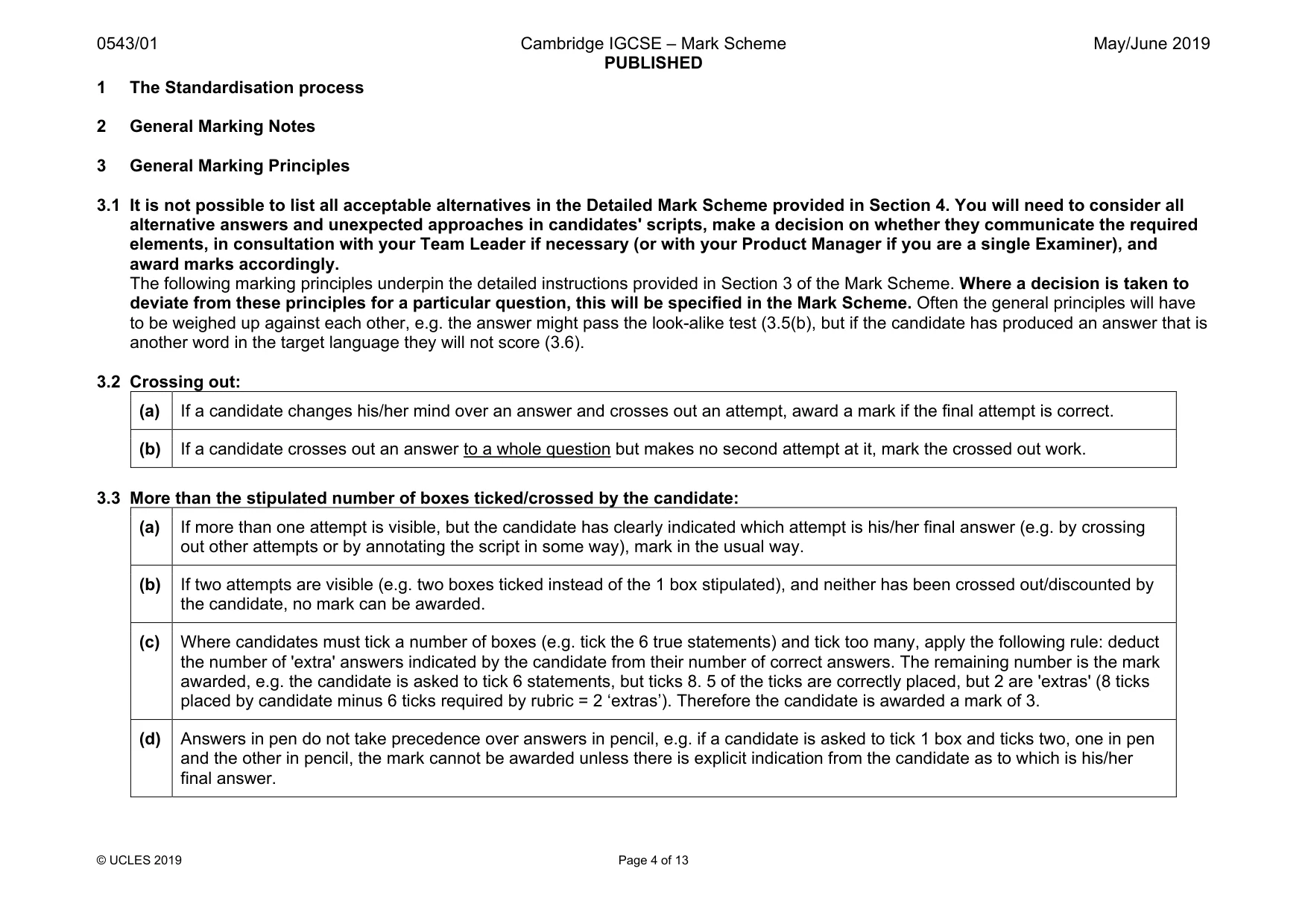
0543/01 Cambridge IGCSE – Mark Scheme PUBLISHED May/June 2019 © UCLES 2019 Page 4 of 13 1 The Standardisation process 2 General Marking Notes 3 General Marking Principles 3.1 It is not possible to list all acceptable alternatives in the Detailed Mark Scheme provided in Section 4. You will need to consider all alternative answers and unexpected approaches in candidates' scripts, make a decision on whether they communicate the required elements, in consultation with your Team Leader if necessary (or with your Product Manager if you are a single Examiner), and award marks accordingly. The following marking principles underpin the detailed instructions provided in Section 3 of the Mark Scheme. Where a decision is taken to deviate from these principles for a particular question, this will be specified in the Mark Scheme. Often the general principles will have to be weighed up against each other, e.g. the answer might pass the look-alike test (3.5(b), but if the candidate has produced an answer that is another word in the target language they will not score (3.6). 3.2 Crossing out: (a) If a candidate changes his/her mind over an answer and crosses out an attempt, award a mark if the final attempt is correct. (b) If a candidate crosses out an answer to a whole question but makes no second attempt at it, mark the crossed out work. 3.3 More than the stipulated number of boxes ticked/crossed by the candidate: (a) If more than one attempt is visible, but the candidate has clearly indicated which attempt is his/her final answer (e.g. by crossing out other attempts or by annotating the script in some way), mark in the usual way. (b) If two attempts are visible (e.g. two boxes ticked instead of the 1 box stipulated), and neither has been crossed out/discounted by the candidate, no mark can be awarded. (c) Where candidates must tick a number of boxes (e.g. tick the 6 true statements) and tick too many, apply the following rule: deduct the number of 'extra' answers indicated by the candidate from their number of correct answers. The remaining number is the mark awarded, e.g. the candidate is asked to tick 6 statements, but ticks 8. 5 of the ticks are correctly placed, but 2 are 'extras' (8 ticks placed by candidate minus 6 ticks required by rubric = 2 ‘extras’). Therefore the candidate is awarded a mark of 3. (d) Answers in pen do not take precedence over answers in pencil, e.g. if a candidate is asked to tick 1 box and ticks two, one in pen and the other in pencil, the mark cannot be awarded unless there is explicit indication from the candidate as to which is his/her final answer.
Mark scheme, page 5
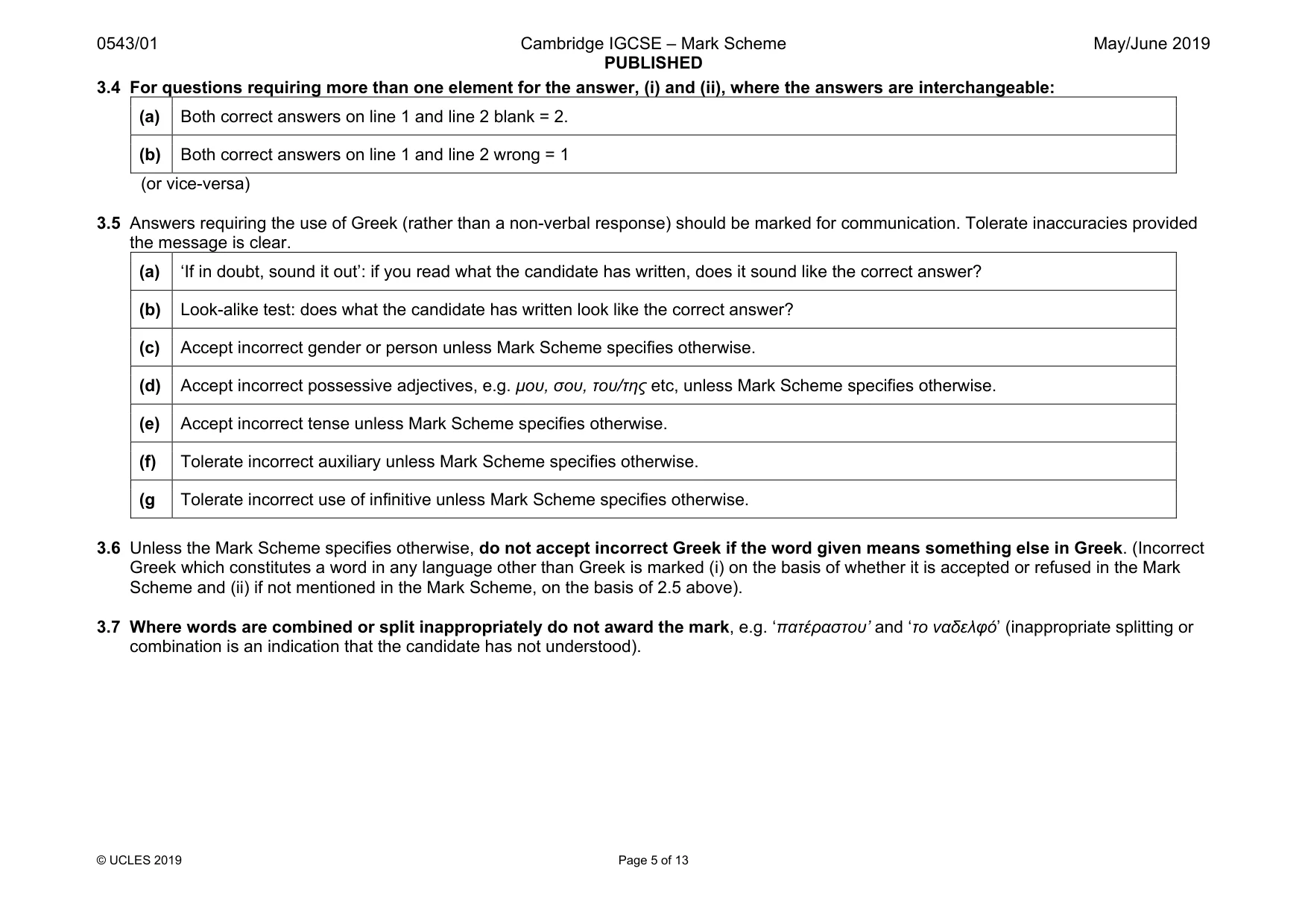
0543/01 Cambridge IGCSE – Mark Scheme PUBLISHED May/June 2019 © UCLES 2019 Page 5 of 13 3.4 For questions requiring more than one element for the answer, (i) and (ii), where the answers are interchangeable: (a) Both correct answers on line 1 and line 2 blank = 2. (b) Both correct answers on line 1 and line 2 wrong = 1 (or vice-versa) 3.5 Answers requiring the use of Greek (rather than a non-verbal response) should be marked for communication. Tolerate inaccuracies provided the message is clear. (a) ‘If in doubt, sound it out’: if you read what the candidate has written, does it sound like the correct answer? (b) Look-alike test: does what the candidate has written look like the correct answer? (c) Accept incorrect gender or person unless Mark Scheme specifies otherwise. (d) Accept incorrect possessive adjectives, e.g. µου, σου, του/της etc, unless Mark Scheme specifies otherwise. (e) Accept incorrect tense unless Mark Scheme specifies otherwise. (f) Tolerate incorrect auxiliary unless Mark Scheme specifies otherwise. (g Tolerate incorrect use of infinitive unless Mark Scheme specifies otherwise. 3.6 Unless the Mark Scheme specifies otherwise, do not accept incorrect Greek if the word given means something else in Greek. (Incorrect Greek which constitutes a word in any language other than Greek is marked (i) on the basis of whether it is accepted or refused in the Mark Scheme and (ii) if not mentioned in the Mark Scheme, on the basis of 2.5 above). 3.7 Where words are combined or split inappropriately do not award the mark, e.g. ‘πατέραστου’ and ‘το ναδελφό’ (inappropriate splitting or combination is an indication that the candidate has not understood).
Mark scheme, page 6
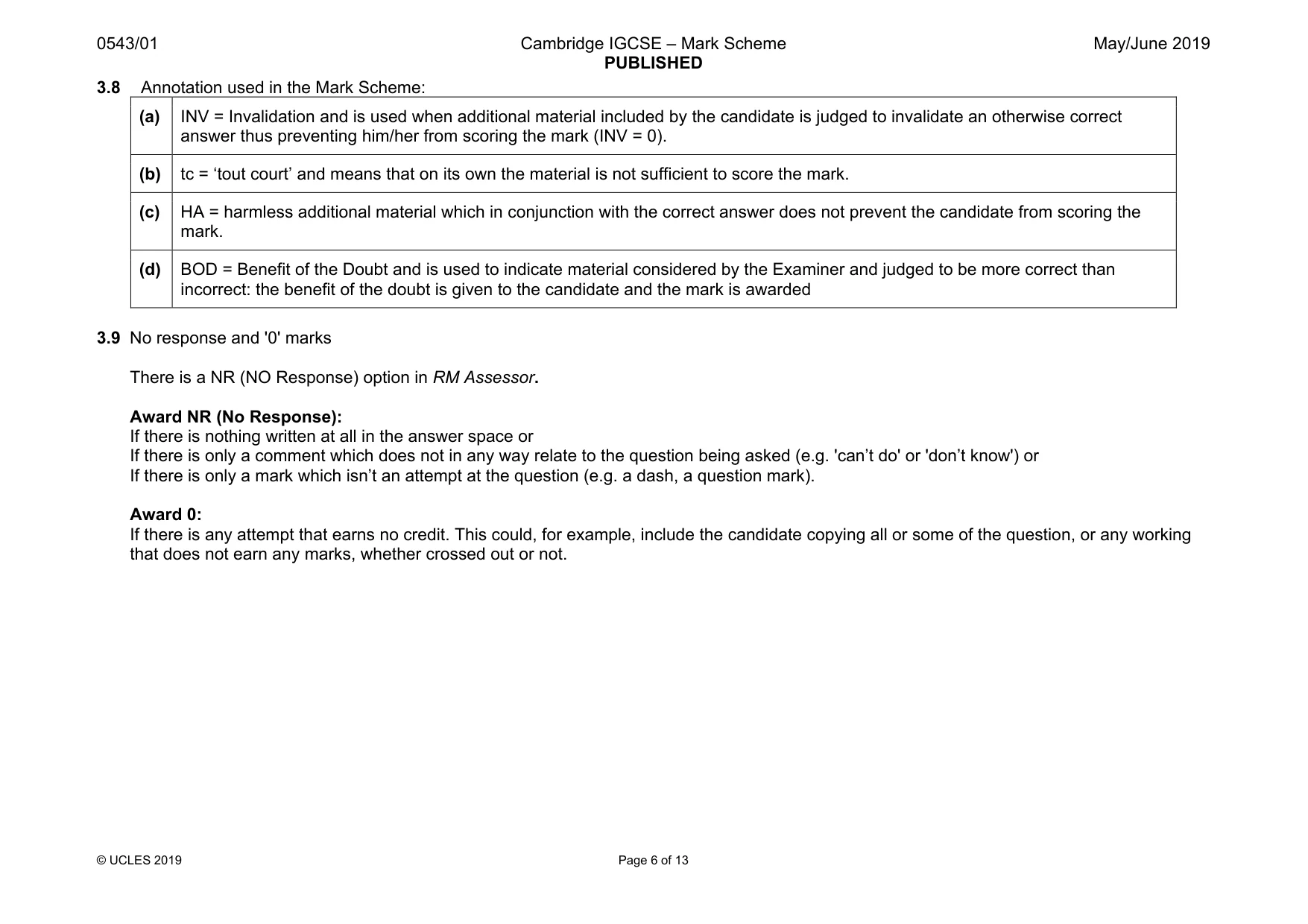
0543/01 Cambridge IGCSE – Mark Scheme PUBLISHED May/June 2019 © UCLES 2019 Page 6 of 13 3.8 Annotation used in the Mark Scheme: (a) INV = Invalidation and is used when additional material included by the candidate is judged to invalidate an otherwise correct answer thus preventing him/her from scoring the mark (INV = 0). (b) tc = ‘tout court’ and means that on its own the material is not sufficient to score the mark. (c) HA = harmless additional material which in conjunction with the correct answer does not prevent the candidate from scoring the mark. (d) BOD = Benefit of the Doubt and is used to indicate material considered by the Examiner and judged to be more correct than incorrect: the benefit of the doubt is given to the candidate and the mark is awarded 3.9 No response and '0' marks There is a NR (NO Response) option in RM Assessor. Award NR (No Response): If there is nothing written at all in the answer space or If there is only a comment which does not in any way relate to the question being asked (e.g. 'can’t do' or 'don’t know') or If there is only a mark which isn’t an attempt at the question (e.g. a dash, a question mark). Award 0: If there is any attempt that earns no credit. This could, for example, include the candidate copying all or some of the question, or any working that does not earn any marks, whether crossed out or not.
Mark scheme, page 7
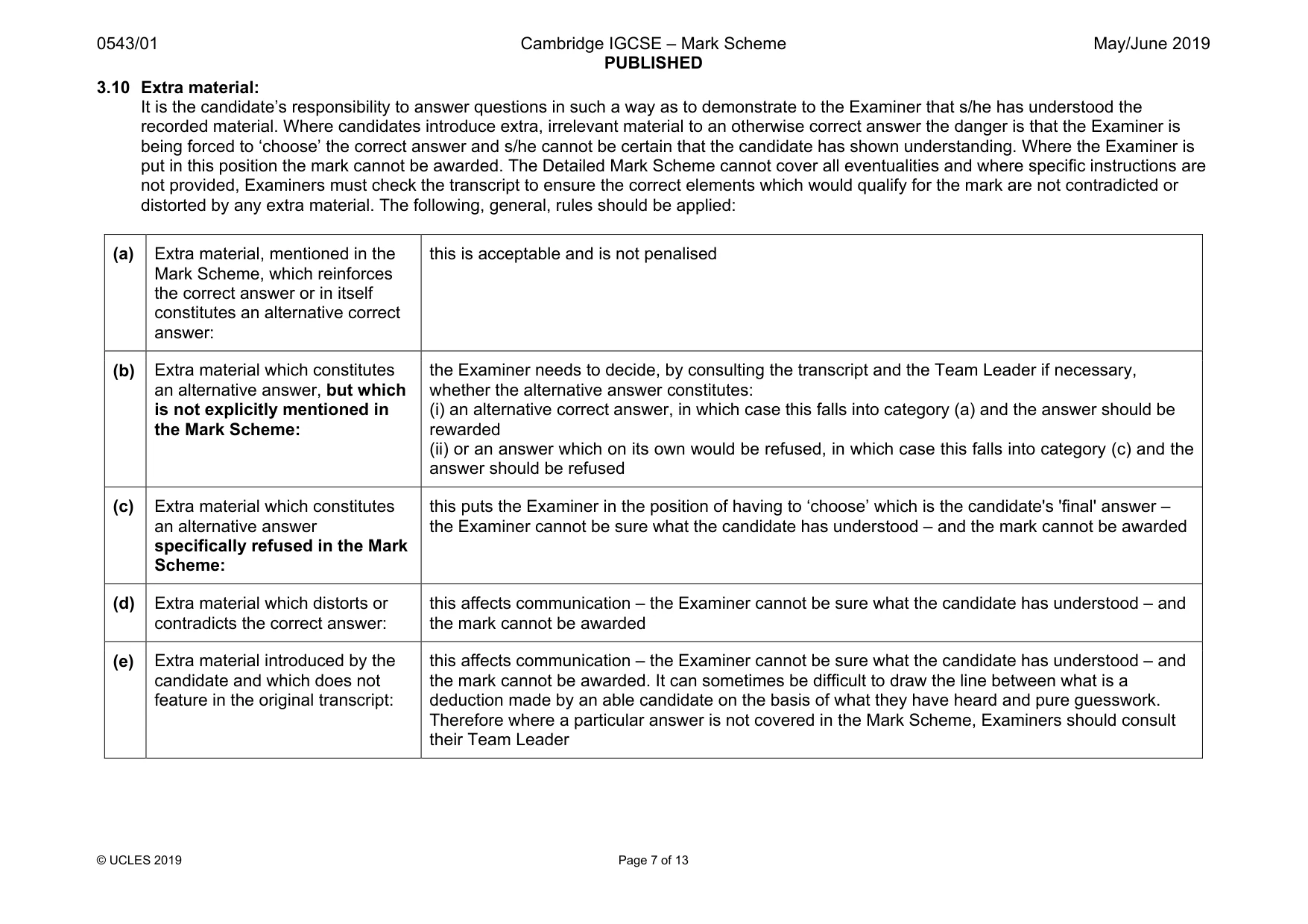
0543/01 Cambridge IGCSE – Mark Scheme PUBLISHED May/June 2019 © UCLES 2019 Page 7 of 13 3.10 Extra material: It is the candidate’s responsibility to answer questions in such a way as to demonstrate to the Examiner that s/he has understood the recorded material. Where candidates introduce extra, irrelevant material to an otherwise correct answer the danger is that the Examiner is being forced to ‘choose’ the correct answer and s/he cannot be certain that the candidate has shown understanding. Where the Examiner is put in this position the mark cannot be awarded. The Detailed Mark Scheme cannot cover all eventualities and where specific instructions are not provided, Examiners must check the transcript to ensure the correct elements which would qualify for the mark are not contradicted or distorted by any extra material. The following, general, rules should be applied: (a) Extra material, mentioned in the Mark Scheme, which reinforces the correct answer or in itself constitutes an alternative correct answer: this is acceptable and is not penalised (b) Extra material which constitutes an alternative answer, but which is not explicitly mentioned in the Mark Scheme: the Examiner needs to decide, by consulting the transcript and the Team Leader if necessary, whether the alternative answer constitutes: (i) an alternative correct answer, in which case this falls into category (a) and the answer should be rewarded (ii) or an answer which on its own would be refused, in which case this falls into category (c) and the answer should be refused (c) Extra material which constitutes an alternative answer specifically refused in the Mark Scheme: this puts the Examiner in the position of having to ‘choose’ which is the candidate's 'final' answer – the Examiner cannot be sure what the candidate has understood – and the mark cannot be awarded (d) Extra material which distorts or contradicts the correct answer: this affects communication – the Examiner cannot be sure what the candidate has understood – and the mark cannot be awarded (e) Extra material introduced by the candidate and which does not feature in the original transcript: this affects communication – the Examiner cannot be sure what the candidate has understood – and the mark cannot be awarded. It can sometimes be difficult to draw the line between what is a deduction made by an able candidate on the basis of what they have heard and pure guesswork. Therefore where a particular answer is not covered in the Mark Scheme, Examiners should consult their Team Leader
Mark scheme, page 8
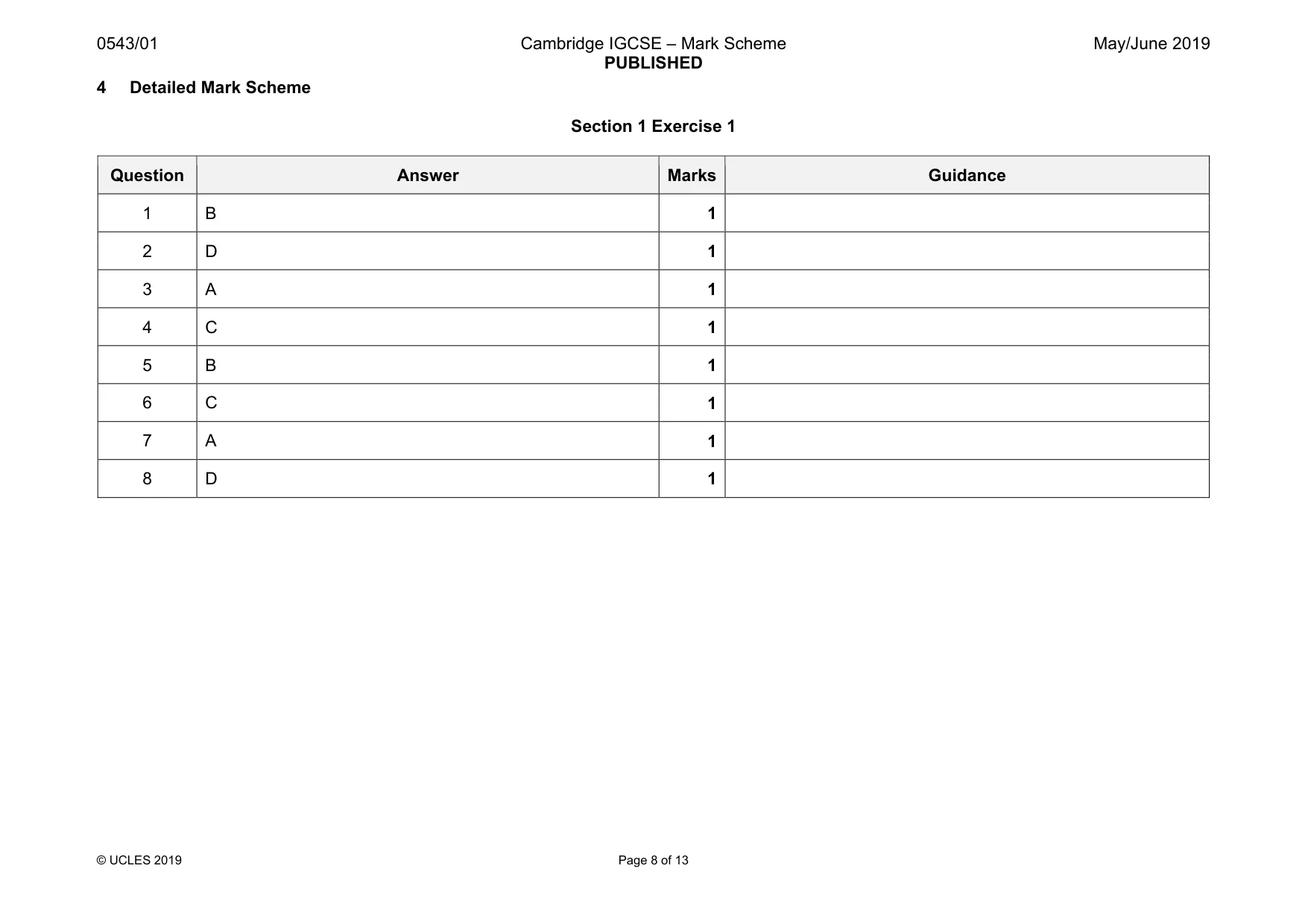
0543/01 Cambridge IGCSE – Mark Scheme PUBLISHED May/June 2019 © UCLES 2019 Page 8 of 13 4 Detailed Mark Scheme Section 1 Exercise 1 Question Answer Marks Guidance 1 B 1 2 D 1 3 A 1 4 C 1 5 B 1 6 C 1 7 A 1 8 D 1
Mark scheme, page 9
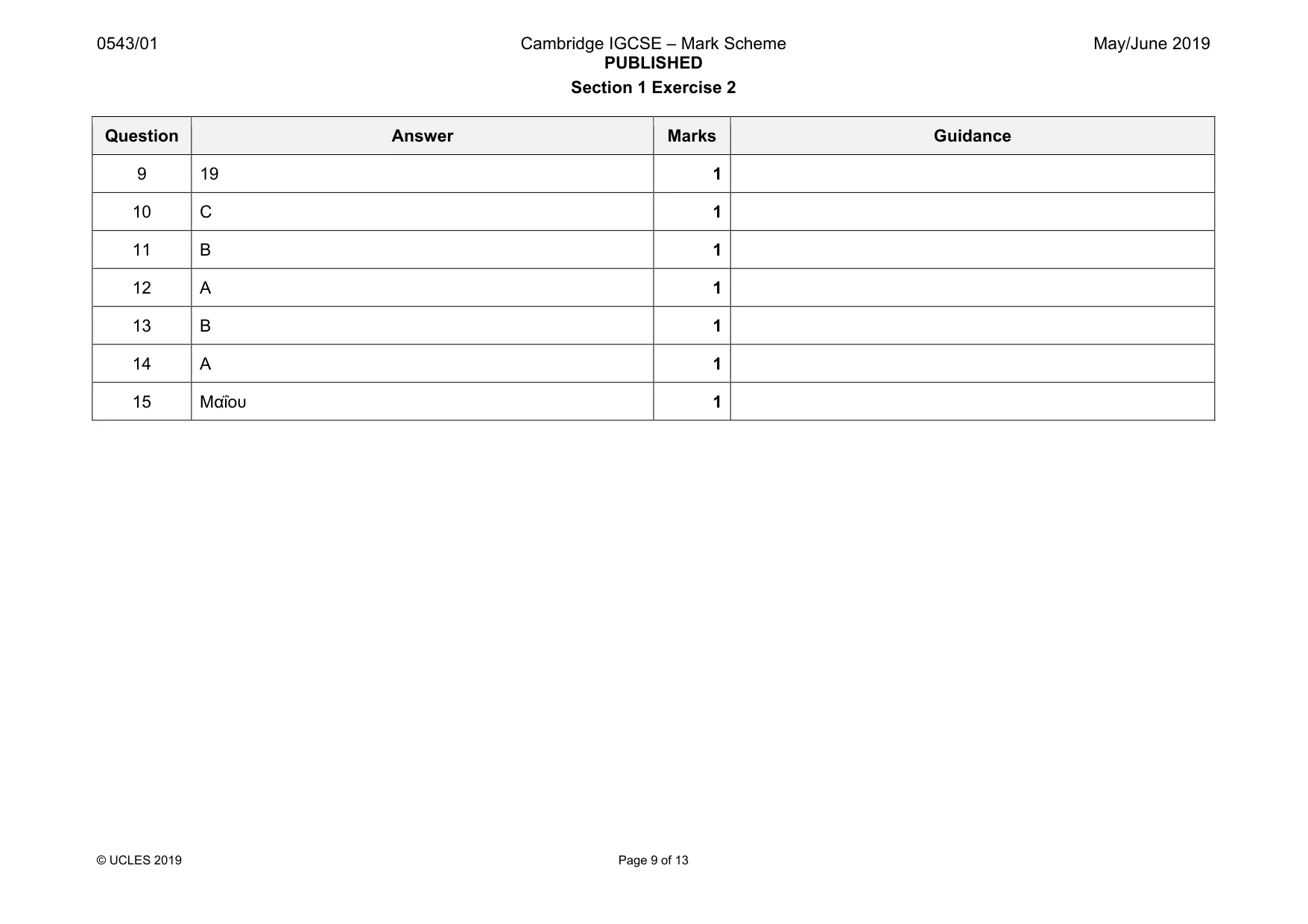
0543/01 Cambridge IGCSE – Mark Scheme PUBLISHED May/June 2019 © UCLES 2019 Page 9 of 13 Section 1 Exercise 2 Question Answer Marks Guidance 9 19 1 10 C 1 11 B 1 12 A 1 13 B 1 14 A 1 15 Μαΐου 1
Mark scheme, page 10
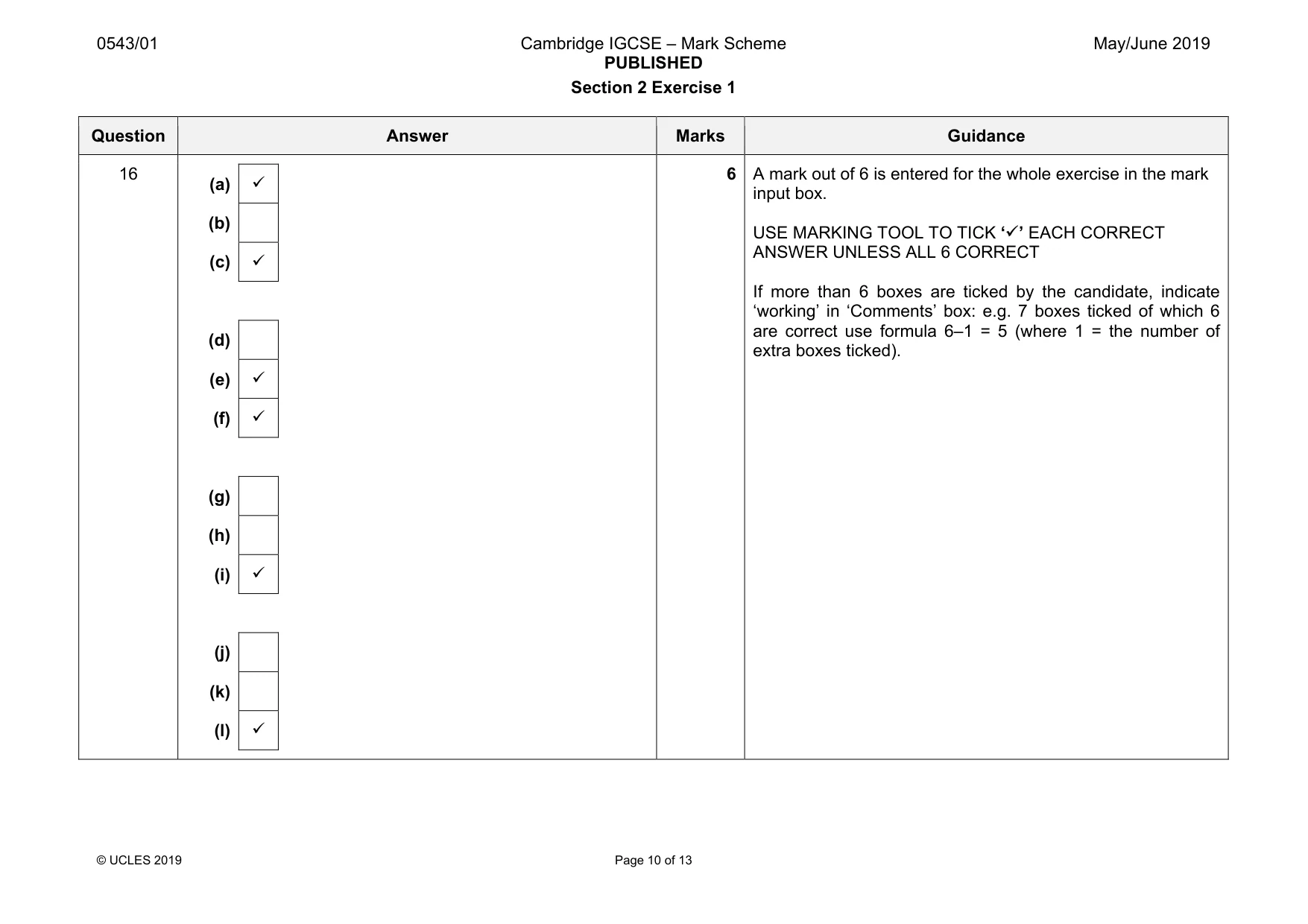
0543/01 Cambridge IGCSE – Mark Scheme PUBLISHED May/June 2019 © UCLES 2019 Page 10 of 13 Section 2 Exercise 1 Question Answer Marks Guidance 16 (a) 9 (b) (c) 9 (d) (e) 9 (f) 9 (g) (h) (i) 9 (j) (k) (l) 9 6 A mark out of 6 is entered for the whole exercise in the mark input box. USE MARKING TOOL TO TICK ‘9’ EACH CORRECT ANSWER UNLESS ALL 6 CORRECT If more than 6 boxes are ticked by the candidate, indicate ‘working’ in ‘Comments’ box: e.g. 7 boxes ticked of which 6 are correct use formula 6–1 = 5 (where 1 = the number of extra boxes ticked).
Mark scheme, page 11
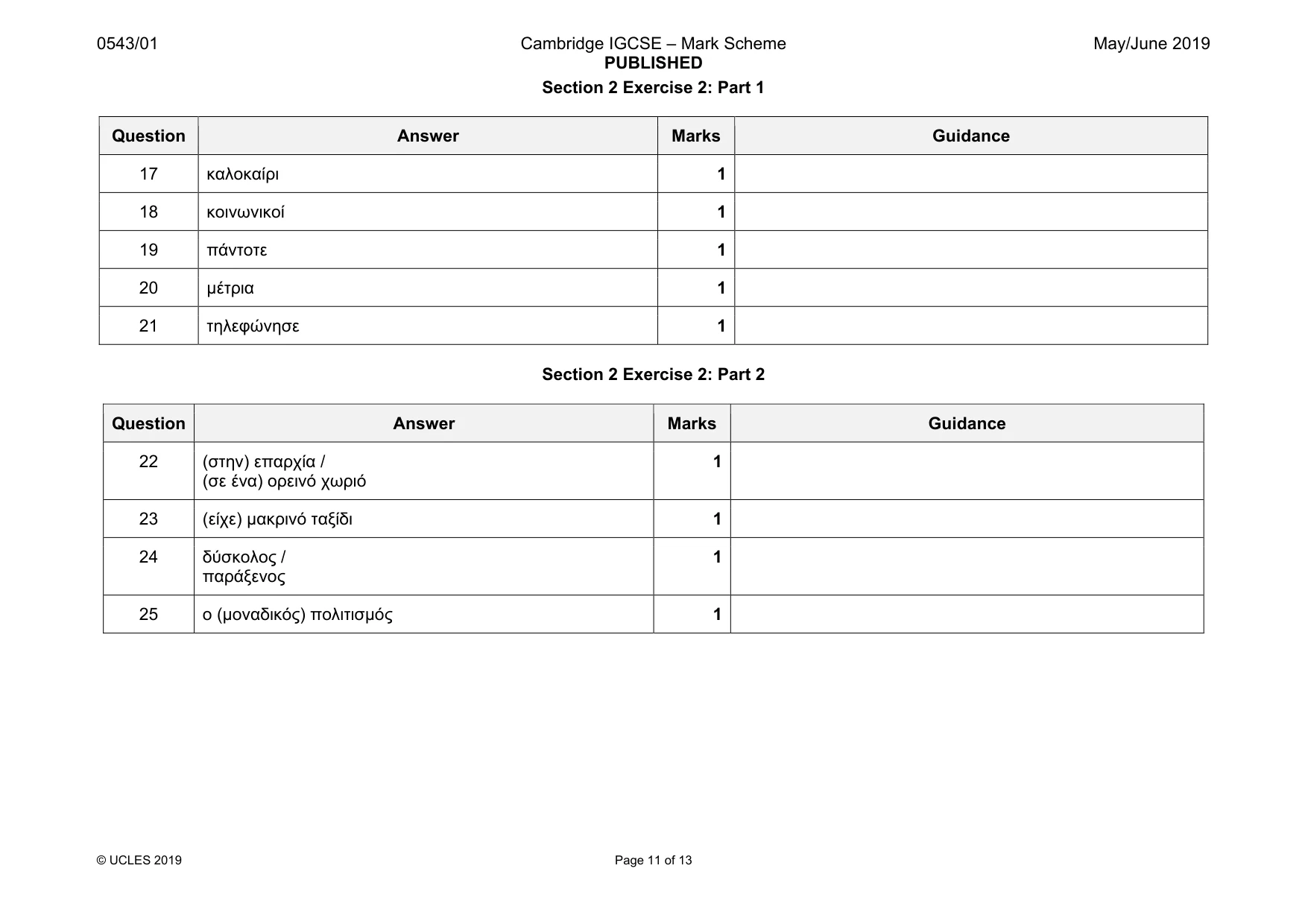
0543/01 Cambridge IGCSE – Mark Scheme PUBLISHED May/June 2019 © UCLES 2019 Page 11 of 13 Section 2 Exercise 2: Part 1 Question Answer Marks Guidance 17 καλοκαίρι 1 18 κοινωνικοί 1 19 πάντοτε 1 20 µέτρια 1 21 τηλεφώνησε 1 Section 2 Exercise 2: Part 2 Question Answer Marks Guidance 22 (στην) επαρχία / (σε ένα) ορεινό χωριó 1 23 (είχε) µακρινό ταξίδι 1 24 δύσκολος / παράξενος 1 25 o (µοναδικός) πολιτισµός 1
Mark scheme, page 12
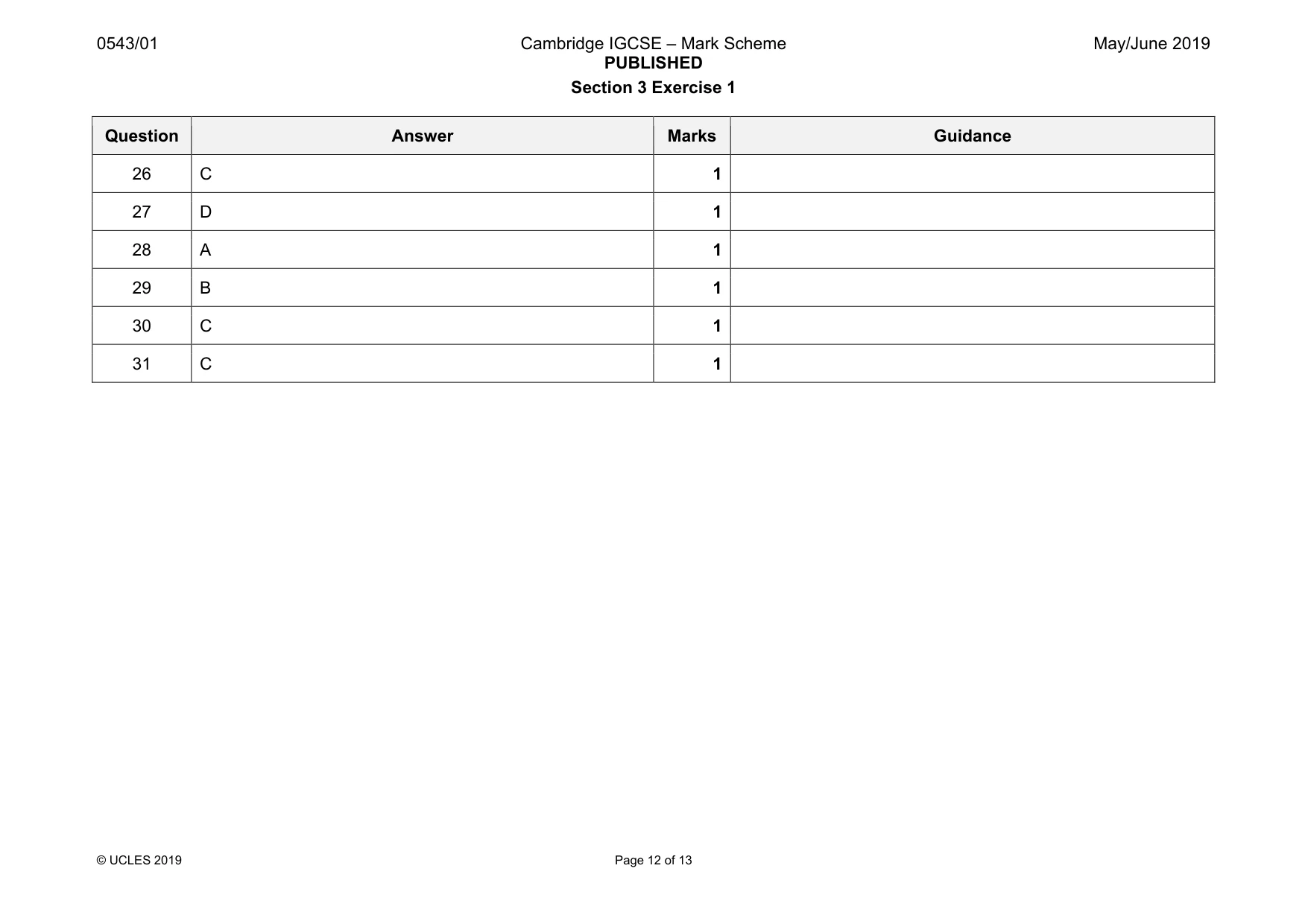
0543/01 Cambridge IGCSE – Mark Scheme PUBLISHED May/June 2019 © UCLES 2019 Page 12 of 13 Section 3 Exercise 1 Question Answer Marks Guidance 26 C 1 27 D 1 28 A 1 29 B 1 30 C 1 31 C 1
Mark scheme, page 13
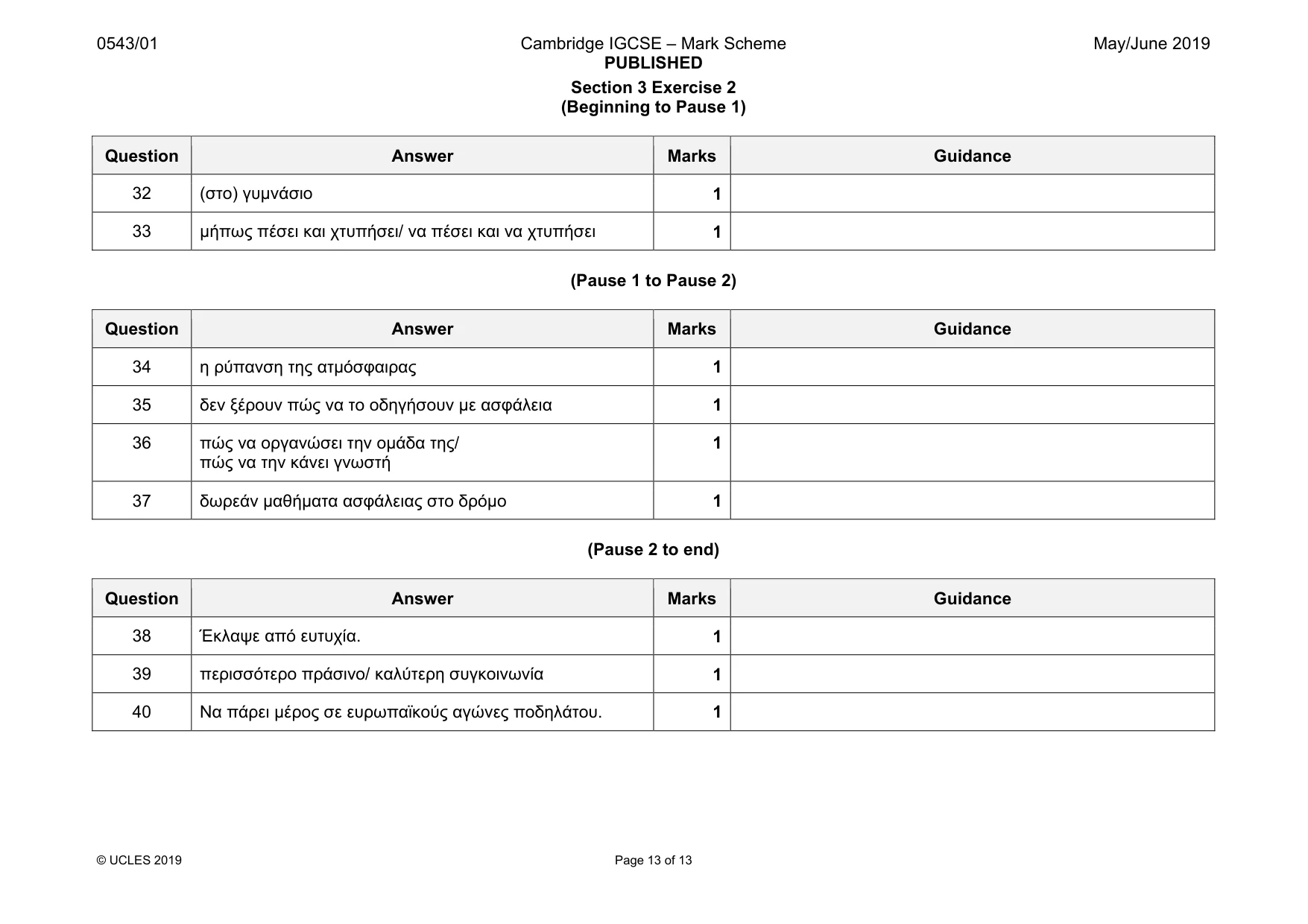
0543/01 Cambridge IGCSE – Mark Scheme PUBLISHED May/June 2019 © UCLES 2019 Page 13 of 13 Section 3 Exercise 2 (Beginning to Pause 1) Question Answer Marks Guidance 32 (στο) γυµνάσιο 1 33 µήπως πέσει και χτυπήσει/ να πέσει και να χτυπήσει 1 (Pause 1 to Pause 2) Question Answer Marks Guidance 34 η ρύπανση της ατµόσφαιρας 1 35 δεν ξέρουν πώς να το οδηγήσουν µε ασφάλεια 1 36 πώς να οργανώσει την οµάδα της/ πώς να την κάνει γνωστή 1 37 δωρεάν µαθήµατα ασφάλειας στο δρόµο 1 (Pause 2 to end) Question Answer Marks Guidance 38 Έκλαψε από ευτυχία. 1 39 περισσότερο πράσινο/ καλύτερη συγκοινωνία 1 40 Να πάρει µέρος σε ευρωπαϊκούς αγώνες ποδηλάτου. 1
What you needed in this session
Cambridge’s own grade thresholds for 2019 May/June, Paper 1 · Variant 1. A higher threshold means an easier paper — the bar moves with how the cohort did.