Cambridge IGCSE Greek - Foreign Language 0543 — 2017 May/June Paper 1 · Variant 1
0543/11/M/J/17 · 45 marks · ≈51 min
The question paper and its mark scheme, free to read here and free to download. This is Cambridge’s own paper, exactly as it was sat.
Question paper12 pages

Mark scheme11 pages
Answers below. Sit the paper first if you are practising.
Paper as text
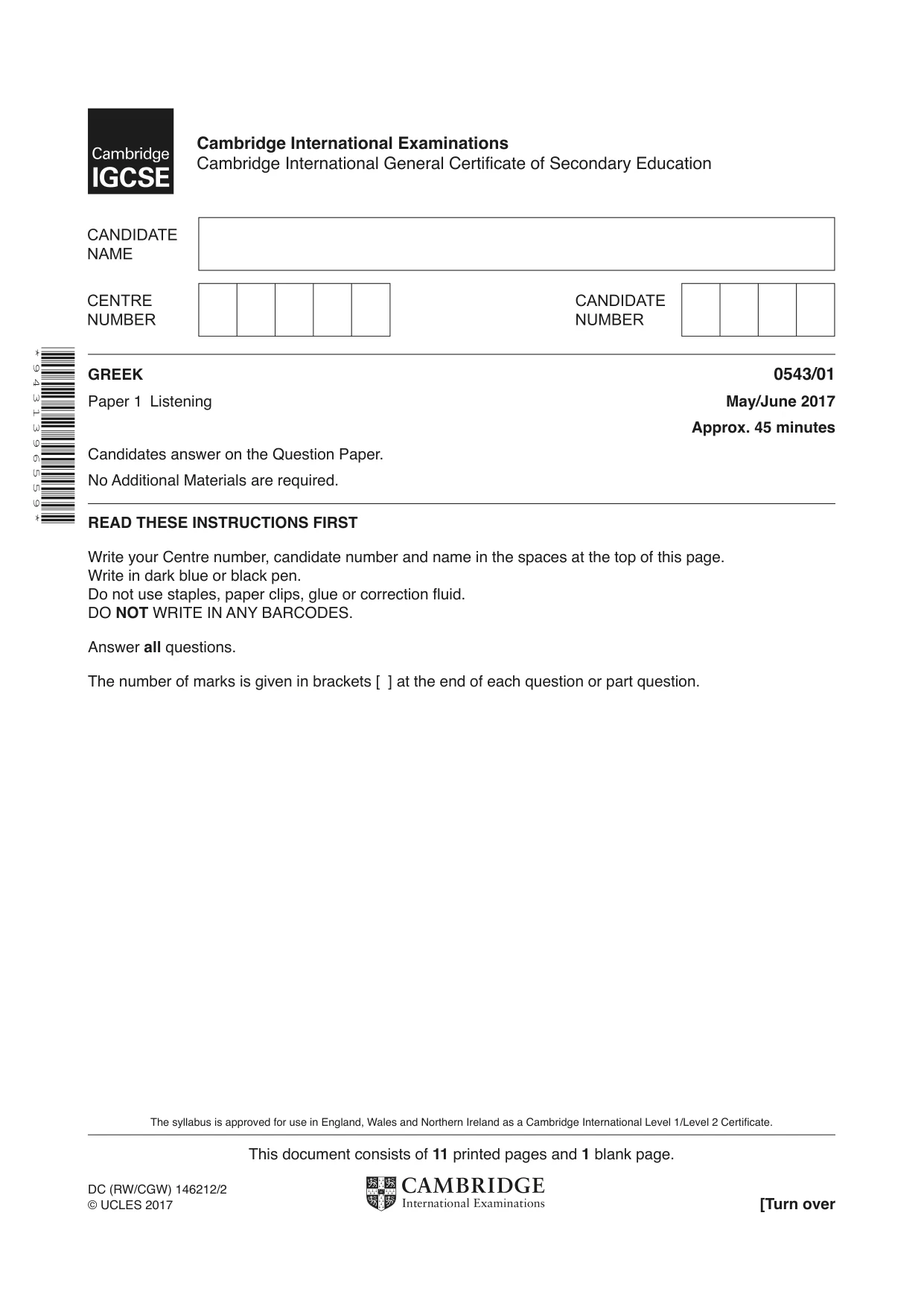
Question paper, page 1
* 9 4 3 1 3 9 6 5 5 9 * The syllabus is approved for use in England, Wales and Northern Ireland as a Cambridge International Level 1/Level 2 Certificate. This document consists of 11 printed pages and 1 blank page. DC (RW/CGW) 146212/2 © UCLES 2017 [Turn over GREEK 0543/01 Paper 1 Listening May/June 2017 Approx. 45 minutes Candidates answer on the Question Paper. No Additional Materials are required. READ THESE INSTRUCTIONS FIRST Write your Centre number, candidate number and name in the spaces at the top of this page. Write in dark blue or black pen. Do not use staples, paper clips, glue or correction fluid. DO NOT WRITE IN ANY BARCODES. Answer all questions. The number of marks is given in brackets [ ] at the end of each question or part question. Cambridge International Examinations Cambridge International General Certificate of Secondary Education
Question paper, page 2
2 0543/01/M/J/17 © UCLES 2017 BLANK PAGE
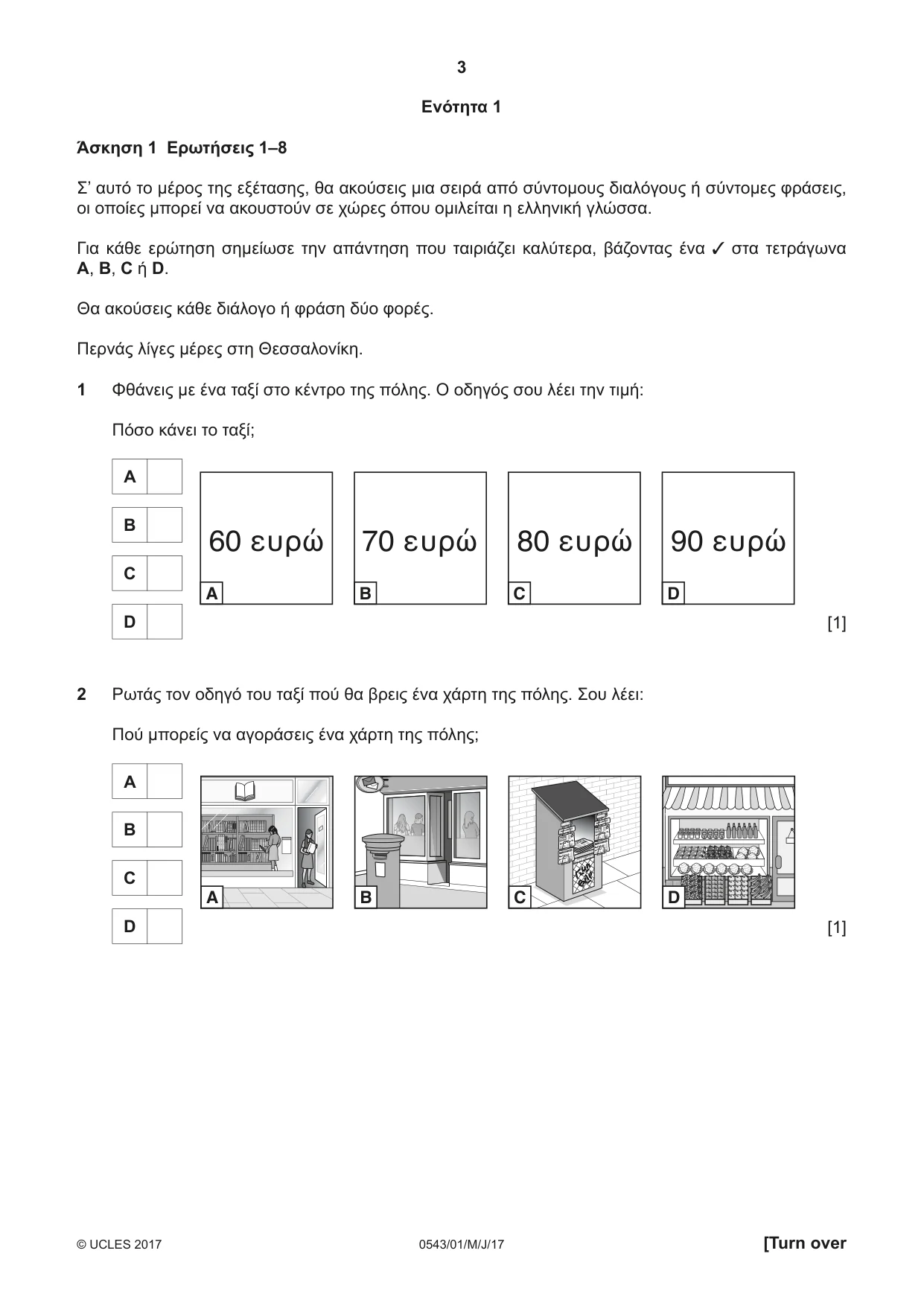
Question paper, page 3
3 0543/01/M/J/17 © UCLES 2017 [Turn over Ενότητα 1 Άσκηση 1 Ερωτήσεις 1–8 Σ’ αυτό το μέρος της εξέτασης, θα ακούσεις μια σειρά από σύντομους διαλόγους ή σύντομες φράσεις, οι οποίες μπορεί να ακουστούν σε χώρες όπου ομιλείται η ελληνική γλώσσα. Για κάθε ερώτηση σημείωσε την απάντηση που ταιριάζει καλύτερα, βάζοντας ένα ✓ στα τετράγωνα Α, Β, C ή D. Θα ακούσεις κάθε διάλογο ή φράση δύο φορές. Περνάς λίγες μέρες στη Θεσσαλονίκη. 1 Φθάνεις με ένα ταξί στο κέντρο της πόλης. Ο οδηγός σου λέει την τιμή: Πόσο κάνει το ταξί; A B C D 60 ευρώ 70 ευρώ 80 ευρώ 90 ευρώ A B C D [1] 2 Ρωτάς τον οδηγό του ταξί πού θα βρεις ένα χάρτη της πόλης. Σου λέει: Πού μπορείς να αγοράσεις ένα χάρτη της πόλης; A B C D A B C D [1]
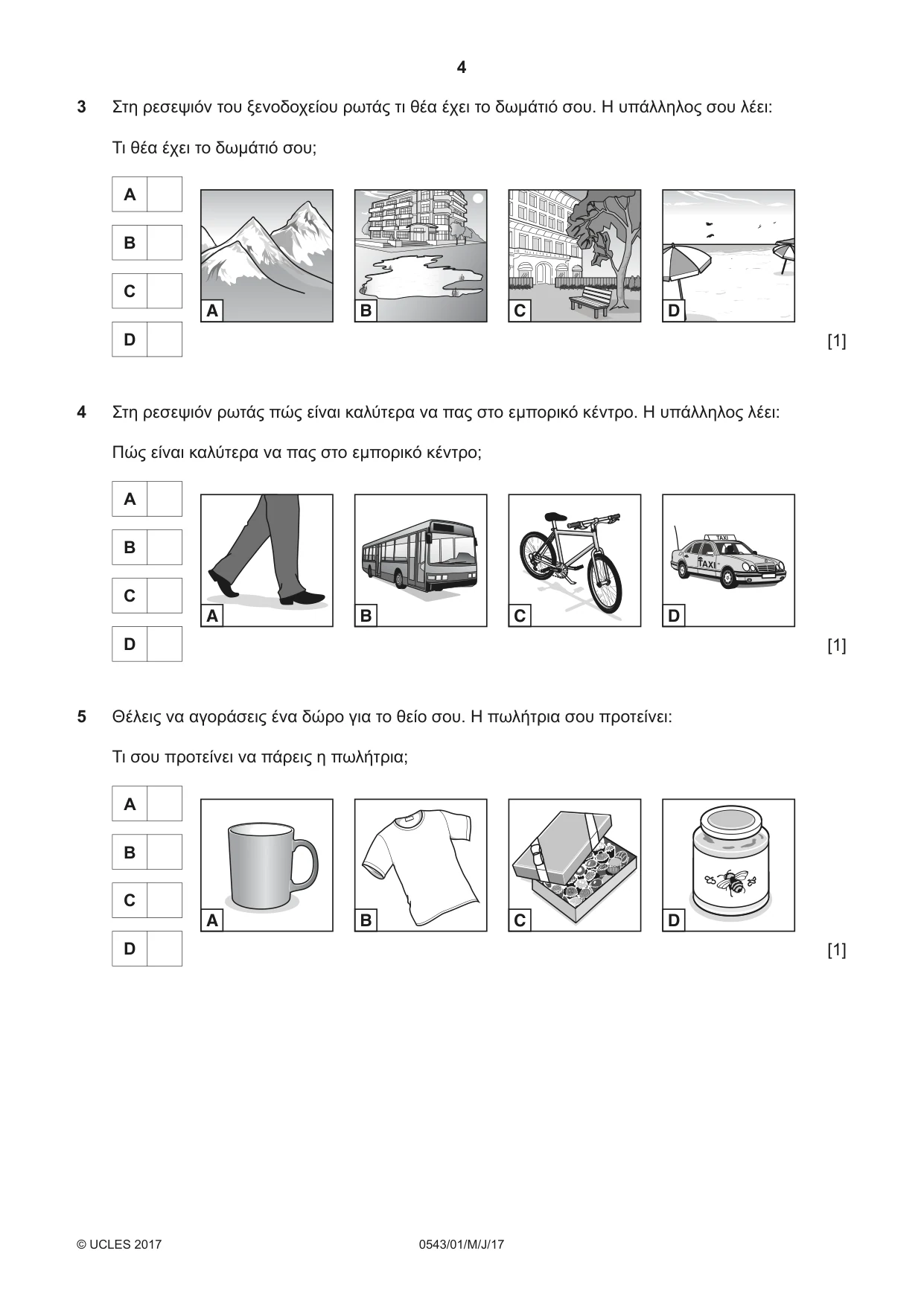
Question paper, page 4
4 0543/01/M/J/17 © UCLES 2017 3 Στη ρεσεψιόν του ξενοδοχείου ρωτάς τι θέα έχει το δωμάτιό σου. Η υπάλληλος σου λέει: Τι θέα έχει το δωμάτιό σου; A B C D A B C D [1] 4 Στη ρεσεψιόν ρωτάς πώς είναι καλύτερα να πας στο εμπορικό κέντρο. Η υπάλληλος λέει: Πώς είναι καλύτερα να πας στο εμπορικό κέντρο; A B C D A B C D [1] 5 Θέλεις να αγοράσεις ένα δώρο για το θείο σου. Η πωλήτρια σου προτείνει: Τι σου προτείνει να πάρεις η πωλήτρια; A B C D A B C D [1]
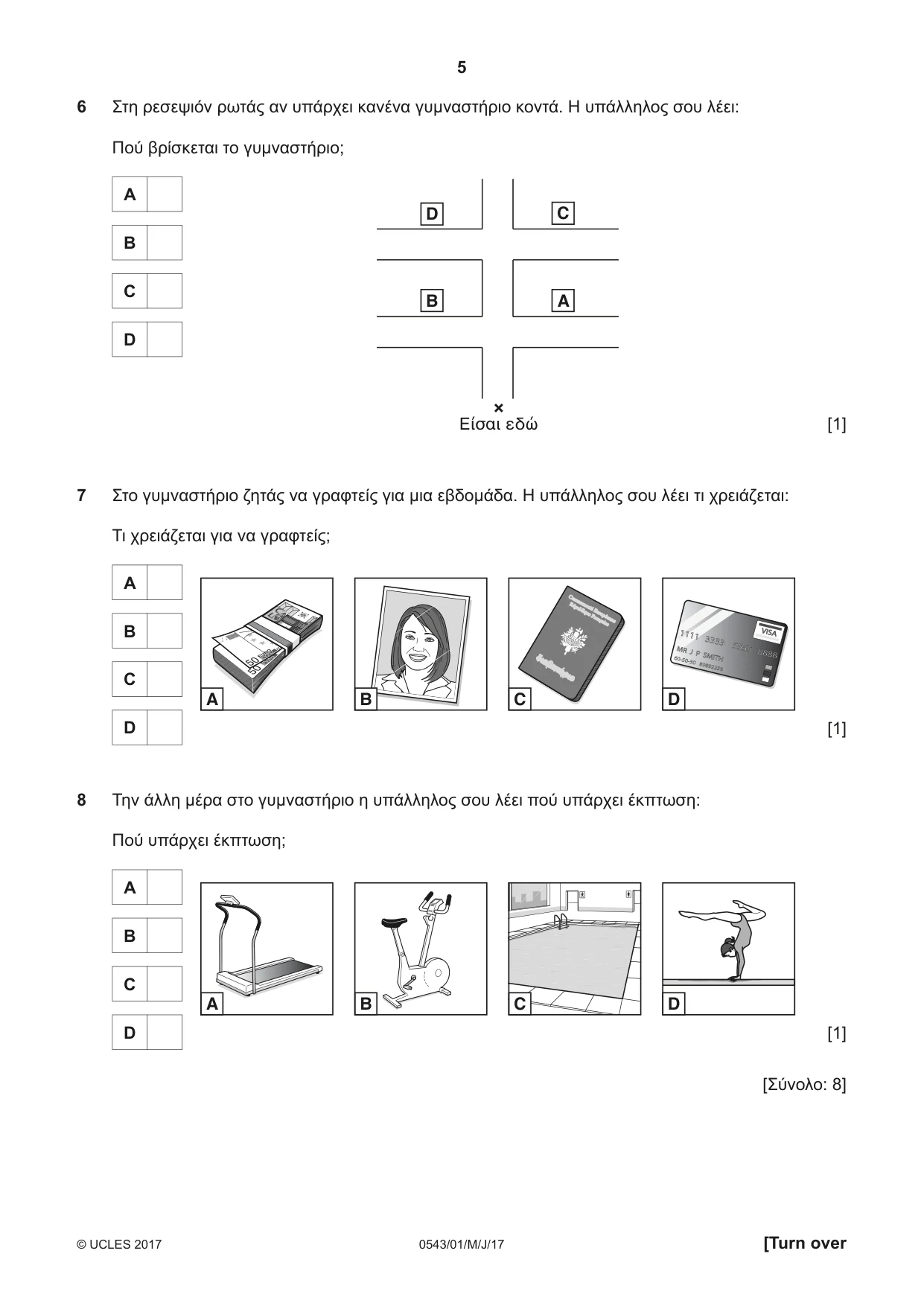
Question paper, page 5
5 0543/01/M/J/17 © UCLES 2017 [Turn over 6 Στη ρεσεψιόν ρωτάς αν υπάρχει κανένα γυμναστήριο κοντά. Η υπάλληλος σου λέει: Πού βρίσκεται το γυμναστήριο; B A × Είσαι εδώ C D A B C D [1] 7 Στο γυμναστήριο ζητάς να γραφτείς για μια εβδομάδα. Η υπάλληλος σου λέει τι χρειάζεται: Τι χρειάζεται για να γραφτείς; A B C D διαβατήριο A B C D [1] 8 Την άλλη μέρα στο γυμναστήριο η υπάλληλος σου λέει πού υπάρχει έκπτωση: Πού υπάρχει έκπτωση; A B C D A B C D [1] [Σύνολο: 8]
Question paper, page 6
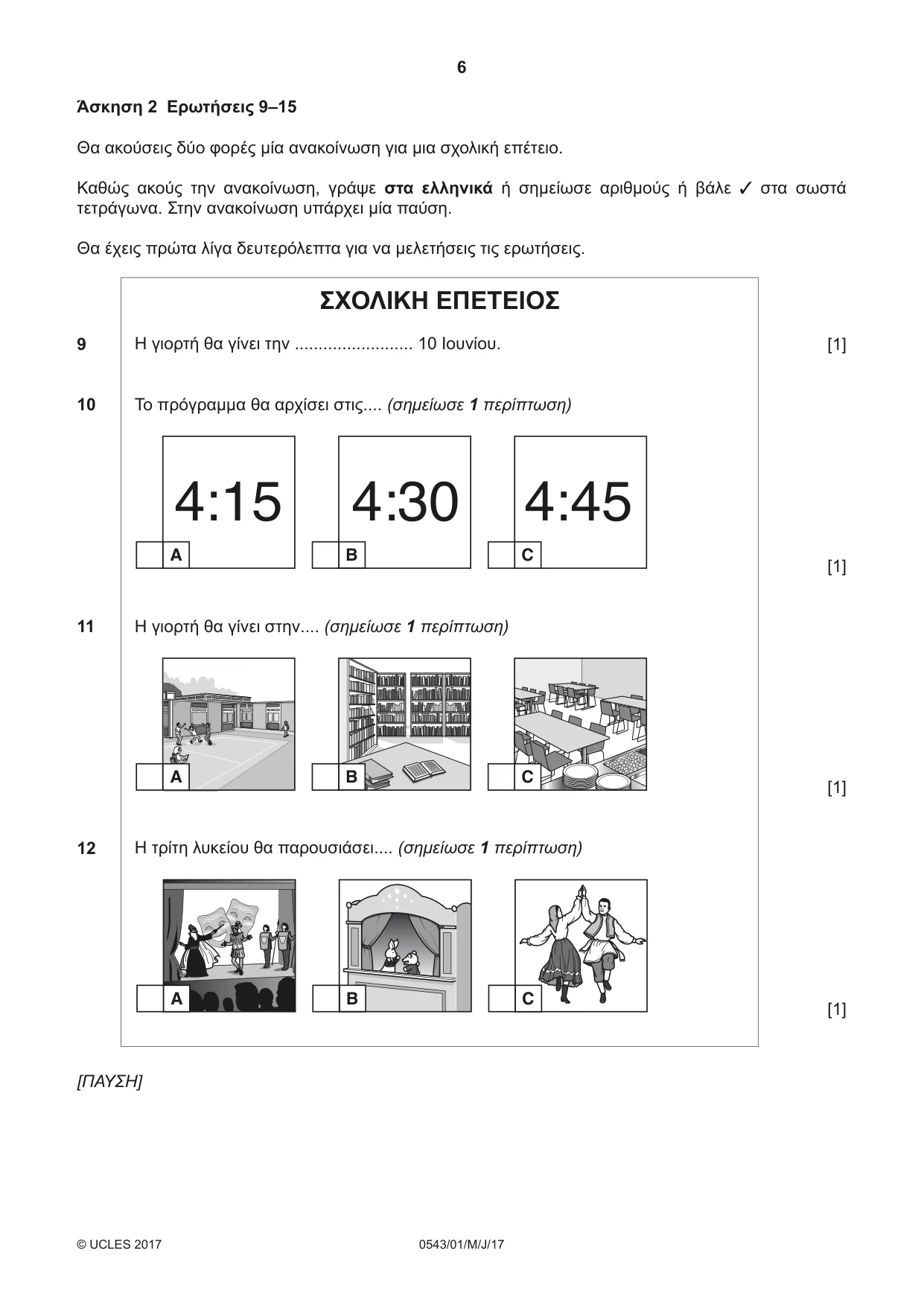
6 0543/01/M/J/17 © UCLES 2017 Άσκηση 2 Ερωτήσεις 9–15 Θα ακούσεις δύο φορές μία ανακοίνωση για μια σχολική επέτειο. Καθώς ακούς την ανακοίνωση, γράψε στα ελληνικά ή σημείωσε αριθμούς ή βάλε ✓ στα σωστά τετράγωνα. Στην ανακοίνωση υπάρχει μία παύση. Θα έχεις πρώτα λίγα δευτερόλεπτα για να μελετήσεις τις ερωτήσεις. 9 10 11 12 ΣΧΟΛΙΚΗ ΕΠΕΤΕΙΟΣ Η γιορτή θα γίνει την … 10 Ιουνίου. Το πρόγραμμα θα αρχίσει στις… (σημείωσε 1 περίπτωση) 4:15 4:30 4:45 A B C Η γιορτή θα γίνει στην… (σημείωσε 1 περίπτωση) A B C Η τρίτη λυκείου θα παρουσιάσει… (σημείωσε 1 περίπτωση) A B C [1] [1] [1] [1] [ΠΑΥΣΗ]
Question paper, page 7
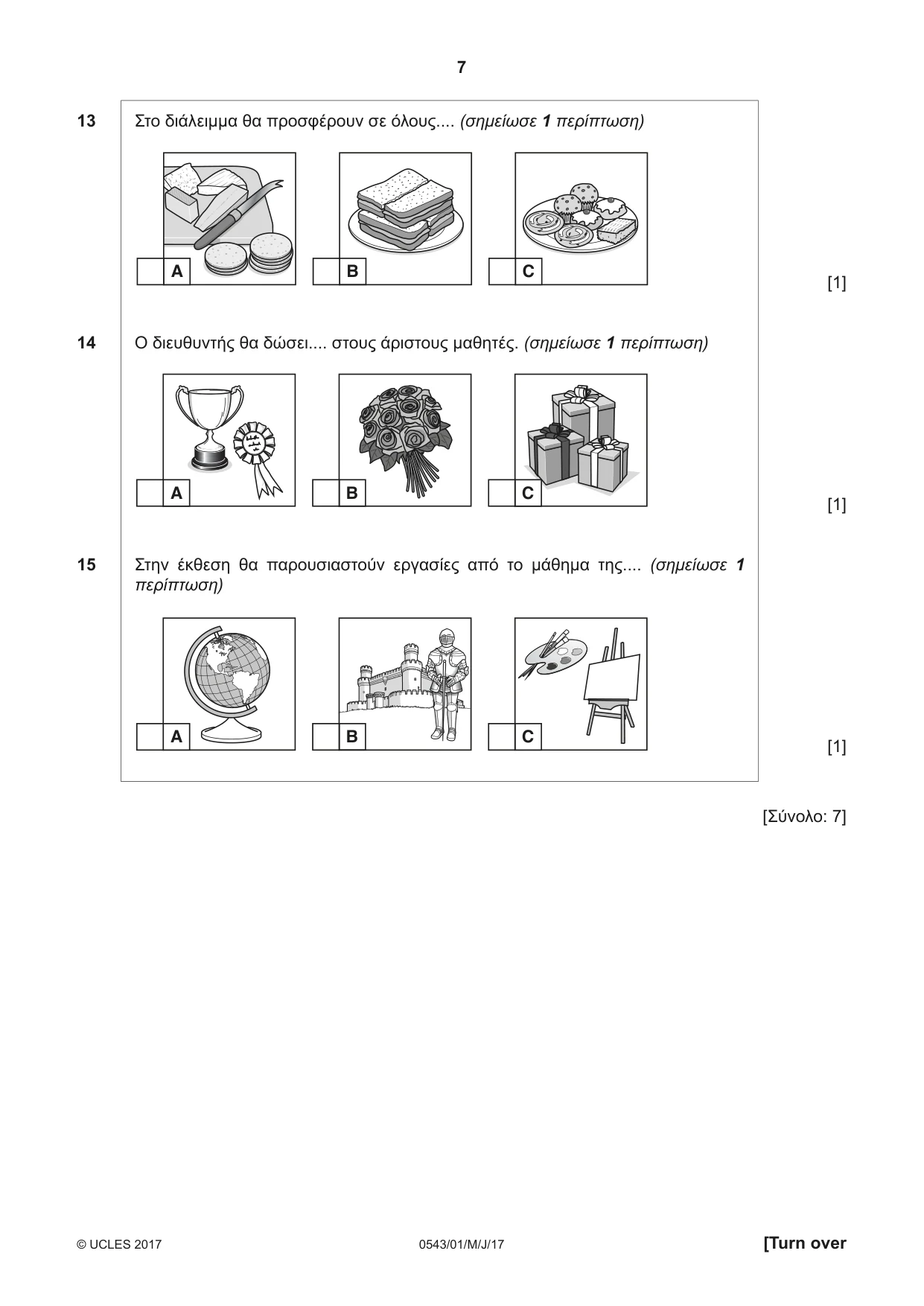
7 0543/01/M/J/17 © UCLES 2017 [Turn over 13 14 15 Στο διάλειμμα θα προσφέρουν σε όλους… (σημείωσε 1 περίπτωση) A B C Ο διευθυντής θα δώσει… στους άριστους μαθητές. (σημείωσε 1 περίπτωση) A B C Στην έκθεση θα παρουσιαστούν εργασίες από το μάθημα της… (σημείωσε 1 περίπτωση) A B C [1] [1] [1] [Σύνολο: 7]
Question paper, page 8
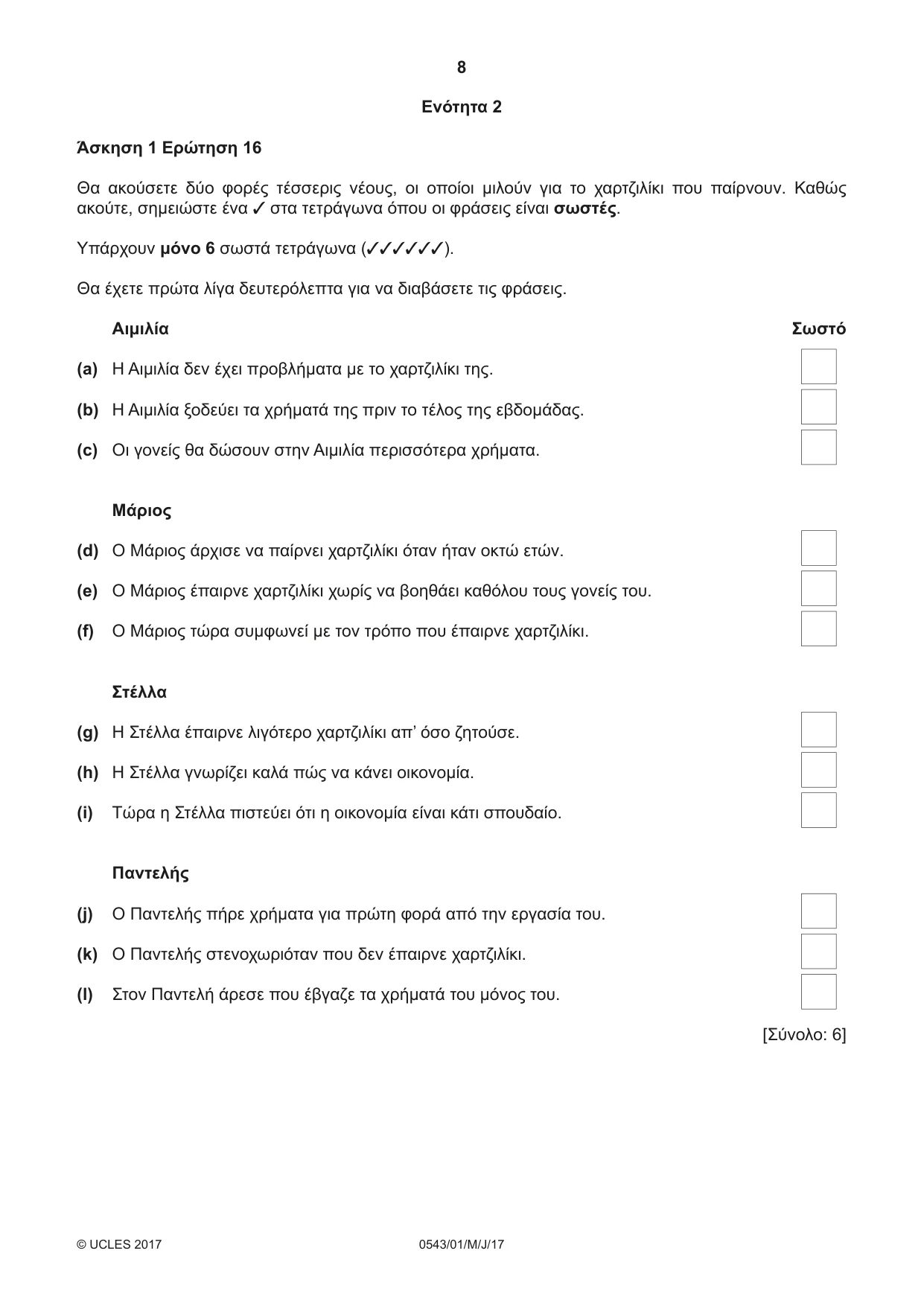
8 0543/01/M/J/17 © UCLES 2017 Ενότητα 2 Άσκηση 1 Ερώτηση 16 Θα ακούσετε δύο φορές τέσσερις νέους, οι οποίοι μιλούν για το χαρτζιλίκι που παίρνουν. Καθώς ακούτε, σημειώστε ένα ✓ στα τετράγωνα όπου οι φράσεις είναι σωστές. Υπάρχουν μόνο 6 σωστά τετράγωνα (✓✓✓✓✓✓). Θα έχετε πρώτα λίγα δευτερόλεπτα για να διαβάσετε τις φράσεις. Αιμιλία Σωστό (a) Η Αιμιλία δεν έχει προβλήματα με το χαρτζιλίκι της. (b) Η Αιμιλία ξοδεύει τα χρήματά της πριν το τέλος της εβδομάδας. (c) Οι γονείς θα δώσουν στην Αιμιλία περισσότερα χρήματα. Μάριος (d) Ο Μάριος άρχισε να παίρνει χαρτζιλίκι όταν ήταν οκτώ ετών. (e) Ο Μάριος έπαιρνε χαρτζιλίκι χωρίς να βοηθάει καθόλου τους γονείς του. (f) Ο Μάριος τώρα συμφωνεί με τον τρόπο που έπαιρνε χαρτζιλίκι. Στέλλα (g) Η Στέλλα έπαιρνε λιγότερο χαρτζιλίκι απ’ όσο ζητούσε. (h) Η Στέλλα γνωρίζει καλά πώς να κάνει οικονομία. (i) Τώρα η Στέλλα πιστεύει ότι η οικονομία είναι κάτι σπουδαίο. Παντελής (j) Ο Παντελής πήρε χρήματα για πρώτη φορά από την εργασία του. (k) Ο Παντελής στενοχωριόταν που δεν έπαιρνε χαρτζιλίκι. (l) Στον Παντελή άρεσε που έβγαζε τα χρήματά του μόνος του. [Σύνολο: 6]
Question paper, page 9
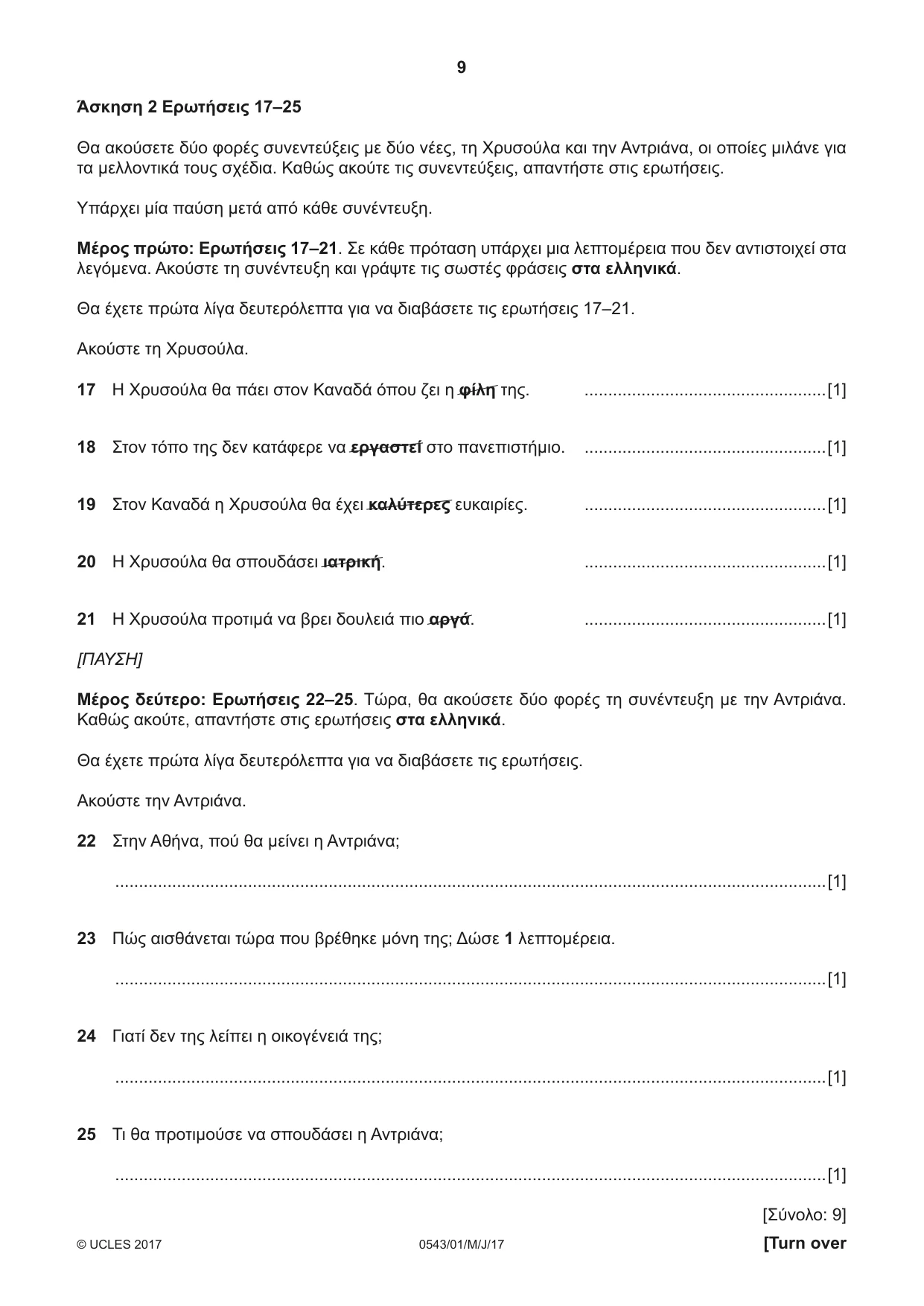
9 0543/01/M/J/17 © UCLES 2017 [Turn over Άσκηση 2 Ερωτήσεις 17–25 Θα ακούσετε δύο φορές συνεντεύξεις με δύο νέες, τη Χρυσούλα και την Αντριάνα, οι οποίες μιλάνε για τα μελλοντικά τους σχέδια. Καθώς ακούτε τις συνεντεύξεις, απαντήστε στις ερωτήσεις. Υπάρχει μία παύση μετά από κάθε συνέντευξη. Μέρος πρώτο: Ερωτήσεις 17–21. Σε κάθε πρόταση υπάρχει μια λεπτομέρεια που δεν αντιστοιχεί στα λεγόμενα. Ακούστε τη συνέντευξη και γράψτε τις σωστές φράσεις στα ελληνικά. Θα έχετε πρώτα λίγα δευτερόλεπτα για να διαβάσετε τις ερωτήσεις 17–21. Ακούστε τη Χρυσούλα. 17 Η Χρυσούλα θα πάει στον Καναδά όπου ζει η φίλη της. …[1] 18 Στον τόπο της δεν κατάφερε να εργαστεί στο πανεπιστήμιο. …[1] 19 Στον Καναδά η Χρυσούλα θα έχει καλύτερες ευκαιρίες. …[1] 20 Η Χρυσούλα θα σπουδάσει ιατρική. …[1] 21 Η Χρυσούλα προτιμά να βρει δουλειά πιο αργά. …[1] [ΠΑΥΣΗ] Μέρος δεύτερο: Ερωτήσεις 22–25. Τώρα, θα ακούσετε δύο φορές τη συνέντευξη με την Αντριάνα. Καθώς ακούτε, απαντήστε στις ερωτήσεις στα ελληνικά. Θα έχετε πρώτα λίγα δευτερόλεπτα για να διαβάσετε τις ερωτήσεις. Ακούστε την Αντριάνα. 22 Στην Αθήνα, πού θα μείνει η Αντριάνα; …[1] 23 Πώς αισθάνεται τώρα που βρέθηκε μόνη της; Δώσε 1 λεπτομέρεια. …[1] 24 Γιατί δεν της λείπει η οικογένειά της; …[1] 25 Τι θα προτιμούσε να σπουδάσει η Αντριάνα; …[1] [Σύνολο: 9]
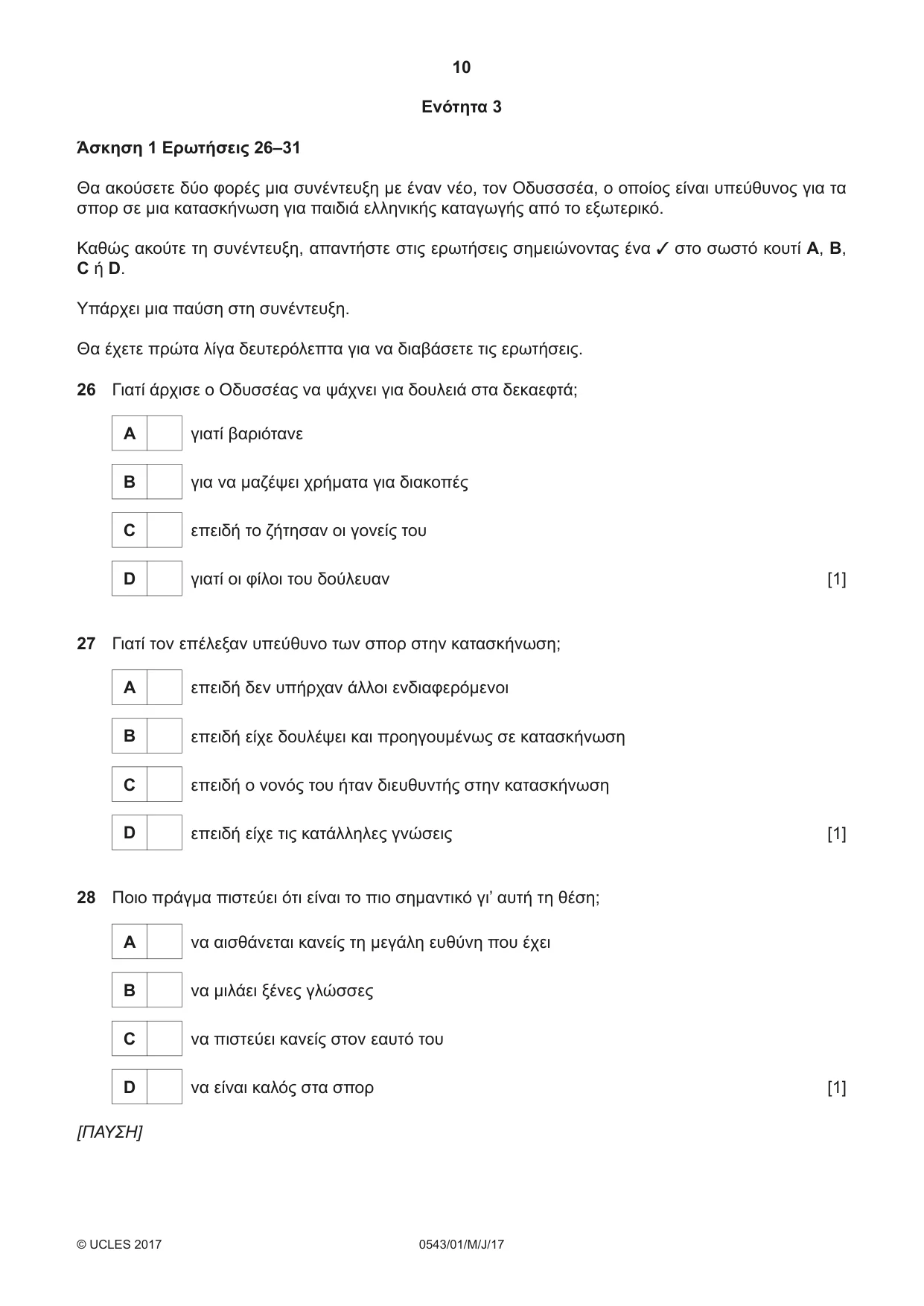
Question paper, page 10
10 0543/01/M/J/17 © UCLES 2017 Ενότητα 3 Άσκηση 1 Ερωτήσεις 26–31 Θα ακούσετε δύο φορές μια συνέντευξη με έναν νέο, τον Οδυσσσέα, ο οποίος είναι υπεύθυνος για τα σπορ σε μια κατασκήνωση για παιδιά ελληνικής καταγωγής από το εξωτερικό. Καθώς ακούτε τη συνέντευξη, απαντήστε στις ερωτήσεις σημειώνοντας ένα ✓ στο σωστό κουτί A, B, C ή D. Υπάρχει μια παύση στη συνέντευξη. Θα έχετε πρώτα λίγα δευτερόλεπτα για να διαβάσετε τις ερωτήσεις. 26 Γιατί άρχισε ο Οδυσσέας να ψάχνει για δουλειά στα δεκαεφτά; A γιατί βαριότανε B για να μαζέψει χρήματα για διακοπές C επειδή το ζήτησαν οι γονείς του D γιατί οι φίλοι του δούλευαν [1] 27 Γιατί τον επέλεξαν υπεύθυνο των σπορ στην κατασκήνωση; A επειδή δεν υπήρχαν άλλοι ενδιαφερόμενοι B επειδή είχε δουλέψει και προηγουμένως σε κατασκήνωση C επειδή ο νονός του ήταν διευθυντής στην κατασκήνωση D επειδή είχε τις κατάλληλες γνώσεις [1] 28 Ποιο πράγμα πιστεύει ότι είναι το πιο σημαντικό γι’ αυτή τη θέση; A να αισθάνεται κανείς τη μεγάλη ευθύνη που έχει B να μιλάει ξένες γλώσσες C να πιστεύει κανείς στον εαυτό του D να είναι καλός στα σπορ [1] [ΠΑΥΣΗ]
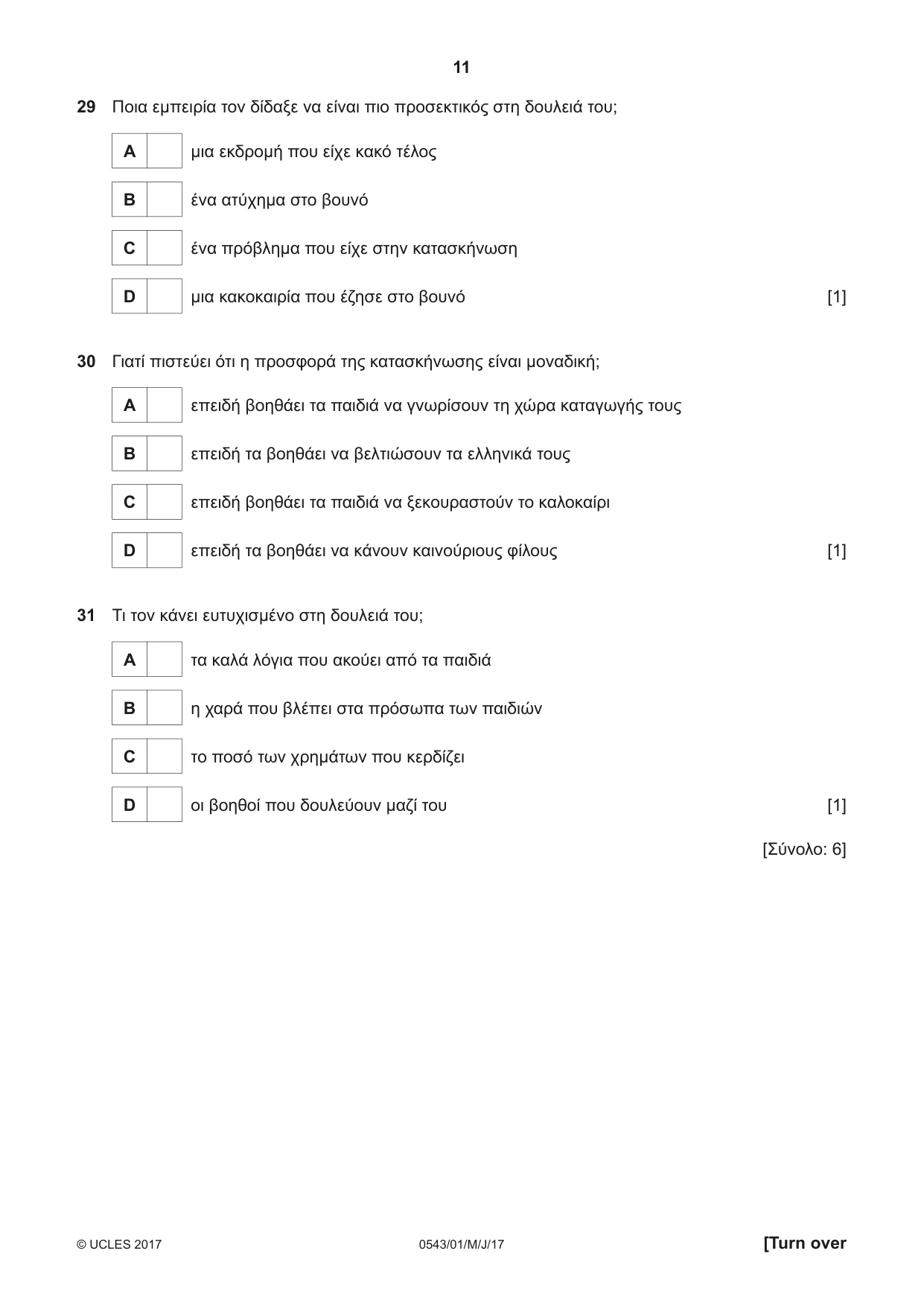
Question paper, page 11
11 0543/01/M/J/17 © UCLES 2017 [Turn over 29 Ποια εμπειρία τον δίδαξε να είναι πιο προσεκτικός στη δουλειά του; A μια εκδρομή που είχε κακό τέλος B ένα ατύχημα στο βουνό C ένα πρόβλημα που είχε στην κατασκήνωση D μια κακοκαιρία που έζησε στο βουνό [1] 30 Γιατί πιστεύει ότι η προσφορά της κατασκήνωσης είναι μοναδική; A επειδή βοηθάει τα παιδιά να γνωρίσουν τη χώρα καταγωγής τους B επειδή τα βοηθάει να βελτιώσουν τα ελληνικά τους C επειδή βοηθάει τα παιδιά να ξεκουραστούν το καλοκαίρι D επειδή τα βοηθάει να κάνουν καινούριους φίλους [1] 31 Τι τον κάνει ευτυχισμένο στη δουλειά του; A τα καλά λόγια που ακούει από τα παιδιά B η χαρά που βλέπει στα πρόσωπα των παιδιών C τo ποσό των χρημάτων που κερδίζει D οι βοηθοί που δουλεύουν μαζί του [1] [Σύνολο: 6]
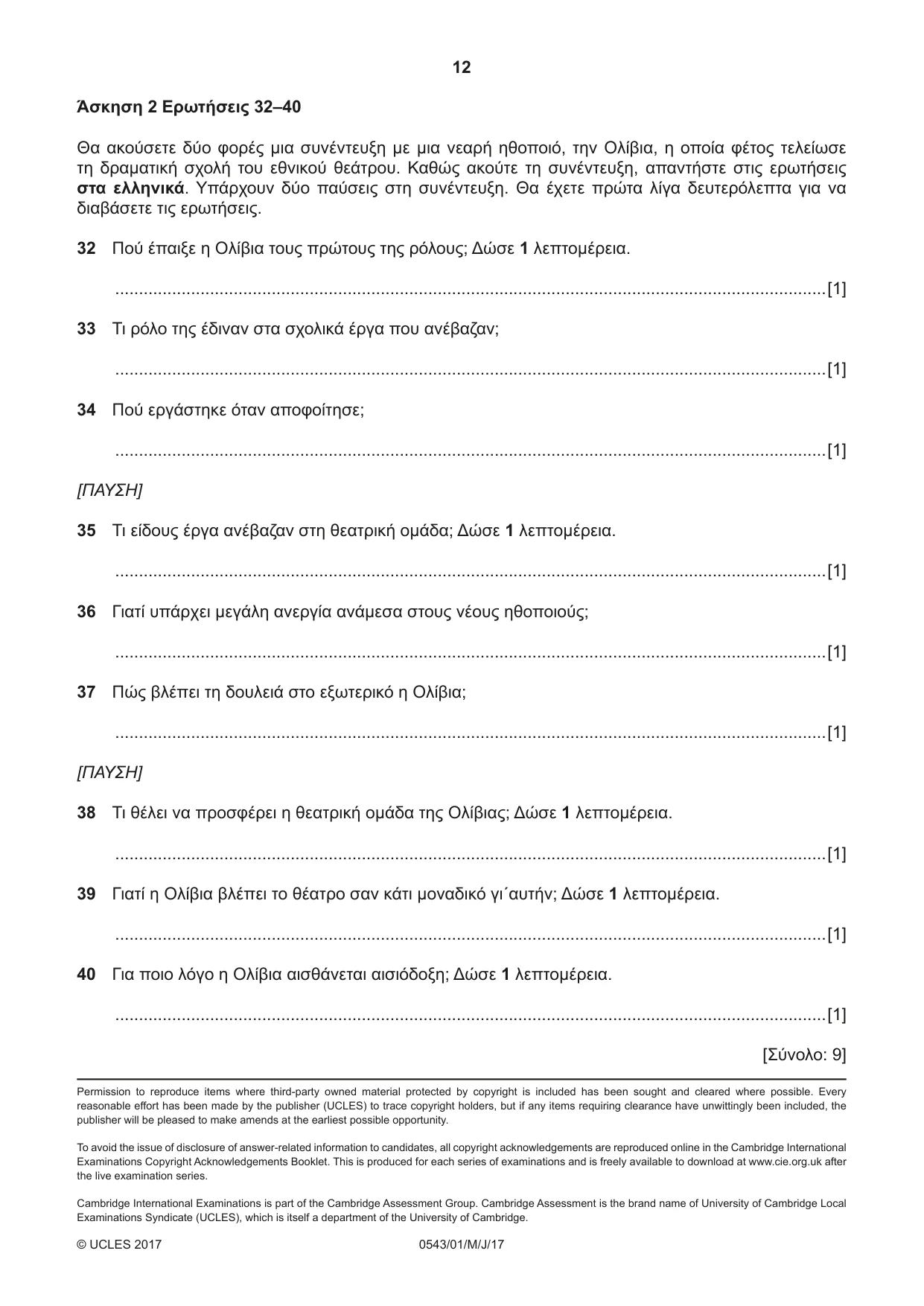
Question paper, page 12
12 0543/01/M/J/17 © UCLES 2017 Permission to reproduce items where third-party owned material protected by copyright is included has been sought and cleared where possible. Every reasonable effort has been made by the publisher (UCLES) to trace copyright holders, but if any items requiring clearance have unwittingly been included, the publisher will be pleased to make amends at the earliest possible opportunity. To avoid the issue of disclosure of answer-related information to candidates, all copyright acknowledgements are reproduced online in the Cambridge International Examinations Copyright Acknowledgements Booklet. This is produced for each series of examinations and is freely available to download at www.cie.org.uk after the live examination series. Cambridge International Examinations is part of the Cambridge Assessment Group. Cambridge Assessment is the brand name of University of Cambridge Local Examinations Syndicate (UCLES), which is itself a department of the University of Cambridge. Άσκηση 2 Ερωτήσεις 32–40 Θα ακούσετε δύο φορές μια συνέντευξη με μια νεαρή ηθοποιό, την Ολίβια, η οποία φέτος τελείωσε τη δραματική σχολή του εθνικού θεάτρου. Καθώς ακούτε τη συνέντευξη, απαντήστε στις ερωτήσεις στα ελληνικά. Υπάρχουν δύο παύσεις στη συνέντευξη. Θα έχετε πρώτα λίγα δευτερόλεπτα για να διαβάσετε τις ερωτήσεις. 32 Πού έπαιξε η Ολίβια τους πρώτους της ρόλους; Δώσε 1 λεπτομέρεια. …[1] 33 Τι ρόλο της έδιναν στα σχολικά έργα που ανέβαζαν; …[1] 34 Πού εργάστηκε όταν αποφοίτησε; …[1] [ΠΑΥΣΗ] 35 Τι είδους έργα ανέβαζαν στη θεατρική ομάδα; Δώσε 1 λεπτομέρεια. …[1] 36 Γιατί υπάρχει μεγάλη ανεργία ανάμεσα στους νέους ηθοποιούς; …[1] 37 Πώς βλέπει τη δουλειά στο εξωτερικό η Ολίβια; …[1] [ΠΑΥΣΗ] 38 Τι θέλει να προσφέρει η θεατρική ομάδα της Ολίβιας; Δώσε 1 λεπτομέρεια. …[1] 39 Γιατί η Ολίβια βλέπει το θέατρο σαν κάτι μοναδικό γι΄αυτήν; Δώσε 1 λεπτομέρεια. …[1] 40 Για ποιο λόγο η Ολίβια αισθάνεται αισιόδοξη; Δώσε 1 λεπτομέρεια. …[1] [Σύνολο: 9]
Mark scheme, page 1
® IGCSE is a registered trademark. This syllabus is approved for use in England, Wales and Northern Ireland as a Cambridge International Level 1/Level 2 Certificate. This document consists of 11 printed pages. © UCLES 2017 [Turn over Cambridge International Examinations Cambridge International General Certificate of Secondary Education GREEK 0543/01 Paper 1 Listening May/June 2017 MARK SCHEME Maximum Mark: 45 Published This mark scheme is published as an aid to teachers and candidates, to indicate the requirements of the examination. It shows the basis on which Examiners were instructed to award marks. It does not indicate the details of the discussions that took place at an Examiners’ meeting before marking began, which would have considered the acceptability of alternative answers. Mark schemes should be read in conjunction with the question paper and the Principal Examiner Report for Teachers. Cambridge will not enter into discussions about these mark schemes. Cambridge is publishing the mark schemes for the May/June 2017 series for most Cambridge IGCSE®, Cambridge International A and AS Level and Cambridge Pre-U components, and some Cambridge O Level components.
Mark scheme, page 2
0543/01 Cambridge IGCSE – Mark Scheme PUBLISHED May/June 2017 © UCLES 2017 Page 2 of 11 1 The Standardisation process 2 General Marking Notes 3 General Marking Principles 3.1 It is not possible to list all acceptable alternatives in the Detailed Mark Scheme provided in Section 4. You will need to consider all alternative answers and unexpected approaches in candidates' scripts, make a decision on whether they communicate the required elements, in consultation with your Team Leader if necessary (or with your Product Manager if you are a single Examiner), and award marks accordingly. The following marking principles underpin the detailed instructions provided in Section 4 of the Mark Scheme. Where a decision is taken to deviate from these principles for a particular question, this will be specified in the Mark Scheme. Often the general principles will have to be weighed up against each other, e.g. the answer might pass the look-alike test (3.5(b)), but if the candidate has produced an answer that is another word in the target language they will not score (3.6). 3.2 Crossing out: (a) If a candidate changes his/her mind over an answer and crosses out an attempt, award a mark if the final attempt is correct. (b) If a candidate crosses out an answer to a whole question but makes no second attempt at it, mark the crossed out work. 3.3 More than the stipulated number of boxes ticked/crossed by the candidate: (a) If more than one attempt is visible, but the candidate has clearly indicated which attempt is his/her final answer (eg by crossing out other attempts or by annotating the script in some way), mark in the usual way. (b) If two attempts are visible (e.g. two boxes ticked instead of the 1 box stipulated), and neither has been crossed out/discounted by the candidate, no mark can be awarded. (c) Where candidates must tick a number of boxes (eg tick the 6 true statements) and tick too many, apply the following rule: deduct the number of 'extra' answers indicated by the candidate from their number of correct answers. The remaining number is the mark awarded, eg the candidate is asked to tick 6 statements, but ticks 8. 5 of the ticks are correctly placed, but 2 are 'extras' (8 ticks placed by candidate minus 6 ticks required by rubric = 2 ‘extras’). Therefore the candidate is awarded a mark of 3. (d) Answers in pen do not take precedence over answers in pencil, eg if a candidate is asked to tick 1 box and ticks two, one in pen and the other in pencil, the mark cannot be awarded unless there is explicit indication from the candidate as to which is his/her final answer.
Mark scheme, page 3
0543/01 Cambridge IGCSE – Mark Scheme PUBLISHED May/June 2017 © UCLES 2017 Page 3 of 11 3.4 For questions requiring more than one element for the answer, (i) and (ii), where the answers are interchangeable: (a) Both correct answers on line 1 and line 2 blank = 2. (b) Both correct answers on line 1 and line 2 wrong = 1 (or vice-versa) 3.5 Answers requiring the use of Greek (rather than a non-verbal response) should be marked for communication. Tolerate inaccuracies provided the message is clear. (a) ‘If in doubt, sound it out’: if you read what the candidate has written, does it sound like the correct answer? (b) Look-alike test: does what the candidate has written look like the correct answer? (c) Accept incorrect gender or person unless Mark Scheme specifies otherwise. (d) Accept incorrect possessive adjectives, eg µου, σου, του/της etc, unless Mark Scheme specifies otherwise. (e) Accept incorrect tense unless Mark Scheme specifies otherwise. (f) Tolerate incorrect auxiliary unless Mark Scheme specifies otherwise. (g Tolerate incorrect use of infinitive unless Mark Scheme specifies otherwise. 3.6 Unless the Mark Scheme specifies otherwise, do not accept incorrect Greek if the word given means something else in Greek. (Incorrect Greek which constitutes a word in any language other than Greek is marked (i) on the basis of whether it is accepted or refused in the Mark Scheme and (ii) if not mentioned in the Mark Scheme, on the basis of 3.5 above). 3.7 Where words are combined or split inappropriately do not award the mark, eg ‘πατέραστου’ and ‘το ναδελφό’ (inappropriate splitting or combination is an indication that the candidate has not understood).
Mark scheme, page 4
0543/01 Cambridge IGCSE – Mark Scheme PUBLISHED May/June 2017 © UCLES 2017 Page 4 of 11 3.8 Annotation used in the Mark Scheme: (a) INV = Invalidation and is used when additional material included by the candidate is judged to invalidate an otherwise correct answer thus preventing him/her from scoring the mark (INV = 0). (b) tc = ‘tout court’ and means that on its own the material is not sufficient to score the mark. (c) HA = harmless additional material which in conjunction with the correct answer does not prevent the candidate from scoring the mark. (d) BOD = Benefit of the Doubt and is used to indicate material considered by the Examiner and judged to be more correct than incorrect: the benefit of the doubt is given to the candidate and the mark is awarded 3.9 No response and '0' marks There is a NR (NO Response) option. Award NR (No Response): If there is nothing written at all in the answer space or If there is only a comment which does not in any way relate to the question being asked (eg 'can’t do' or 'don’t know') or If there is only a mark which isn’t an attempt at the question (e.g. a dash, a question mark). Award 0: If there is any attempt that earns no credit. This could, for example, include the candidate copying all or some of the question, or any working that does not earn any marks, whether crossed out or not.
Mark scheme, page 5
0543/01 Cambridge IGCSE – Mark Scheme PUBLISHED May/June 2017 © UCLES 2017 Page 5 of 11 3.10 Extra material: It is the candidate’s responsibility to answer questions in such a way as to demonstrate to the Examiner that s/he has understood the recorded material. Where candidates introduce extra, irrelevant material to an otherwise correct answer the danger is that the Examiner is being forced to ‘choose’ the correct answer and s/he cannot be certain that the candidate has shown understanding. Where the Examiner is put in this position the mark cannot be awarded. The Detailed Mark Scheme cannot cover all eventualities and where specific instructions are not provided, Examiners must check the transcript to ensure the correct elements which would qualify for the mark are not contradicted or distorted by any extra material. The following, general, rules should be applied: (a) Extra material, mentioned in the Mark Scheme, which reinforces the correct answer or in itself constitutes an alternative correct answer: this is acceptable and is not penalised (b) Extra material which constitutes an alternative answer, but which is not explicitly mentioned in the Mark Scheme: the Examiner needs to decide, by consulting the transcript and the Team Leader if necessary, whether the alternative answer constitutes: (i) an alternative correct answer, in which case this falls into category (a) and the answer should be rewarded (ii) or an answer which on its own would be refused, in which case this falls into category (c) and the answer should be refused (c) Extra material which constitutes an alternative answer specifically refused in the Mark Scheme: this puts the Examiner in the position of having to ‘choose’ which is the candidate's 'final' answer – the Examiner cannot be sure what the candidate has understood – and the mark cannot be awarded (d) Extra material which distorts or contradicts the correct answer: this affects communication – the Examiner cannot be sure what the candidate has understood – and the mark cannot be awarded (e) Extra material introduced by the candidate and which does not feature in the original transcript: this affects communication – the Examiner cannot be sure what the candidate has understood – and the mark cannot be awarded. It can sometimes be difficult to draw the line between what is a deduction made by an able candidate on the basis of what they have heard and pure guesswork. Therefore where a particular answer is not covered in the Mark Scheme, Examiners should consult their Team Leader
Mark scheme, page 6
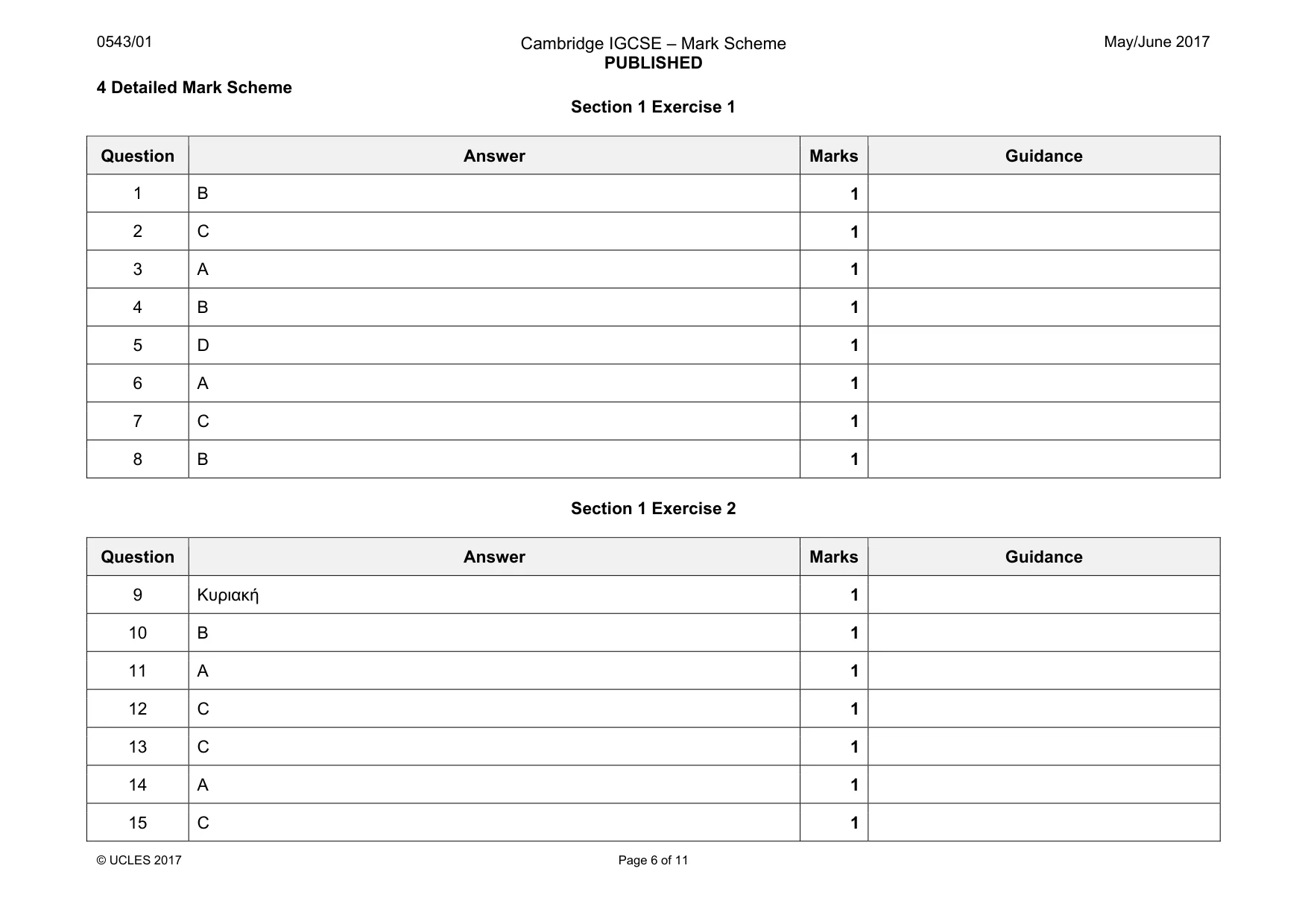
0543/01 Cambridge IGCSE – Mark Scheme PUBLISHED May/June 2017 © UCLES 2017 Page 6 of 11 4 Detailed Mark Scheme Section 1 Exercise 1 Question Answer Marks Guidance 1 B 1 2 C 1 3 A 1 4 B 1 5 D 1 6 A 1 7 C 1 8 B 1 Section 1 Exercise 2 Question Answer Marks Guidance 9 Κυριακή 1 10 B 1 11 A 1 12 C 1 13 C 1 14 A 1 15 C 1
Mark scheme, page 7
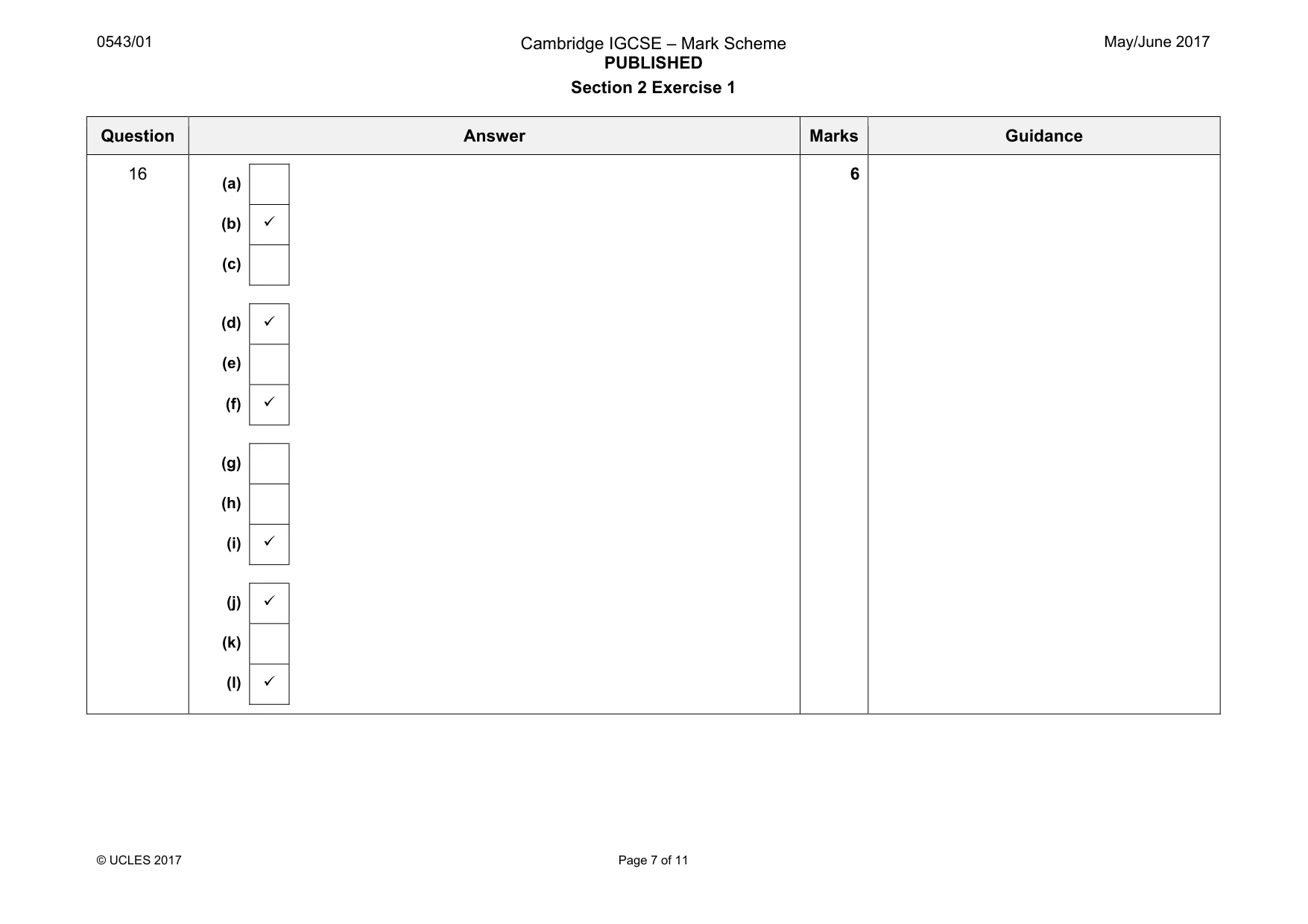
0543/01 Cambridge IGCSE – Mark Scheme PUBLISHED May/June 2017 © UCLES 2017 Page 7 of 11 Section 2 Exercise 1 Question Answer Marks Guidance 16 (a) (b) 9 (c) (d) 9 (e) (f) 9 (g) (h) (i) 9 (j) 9 (k) (l) 9 6
Mark scheme, page 8
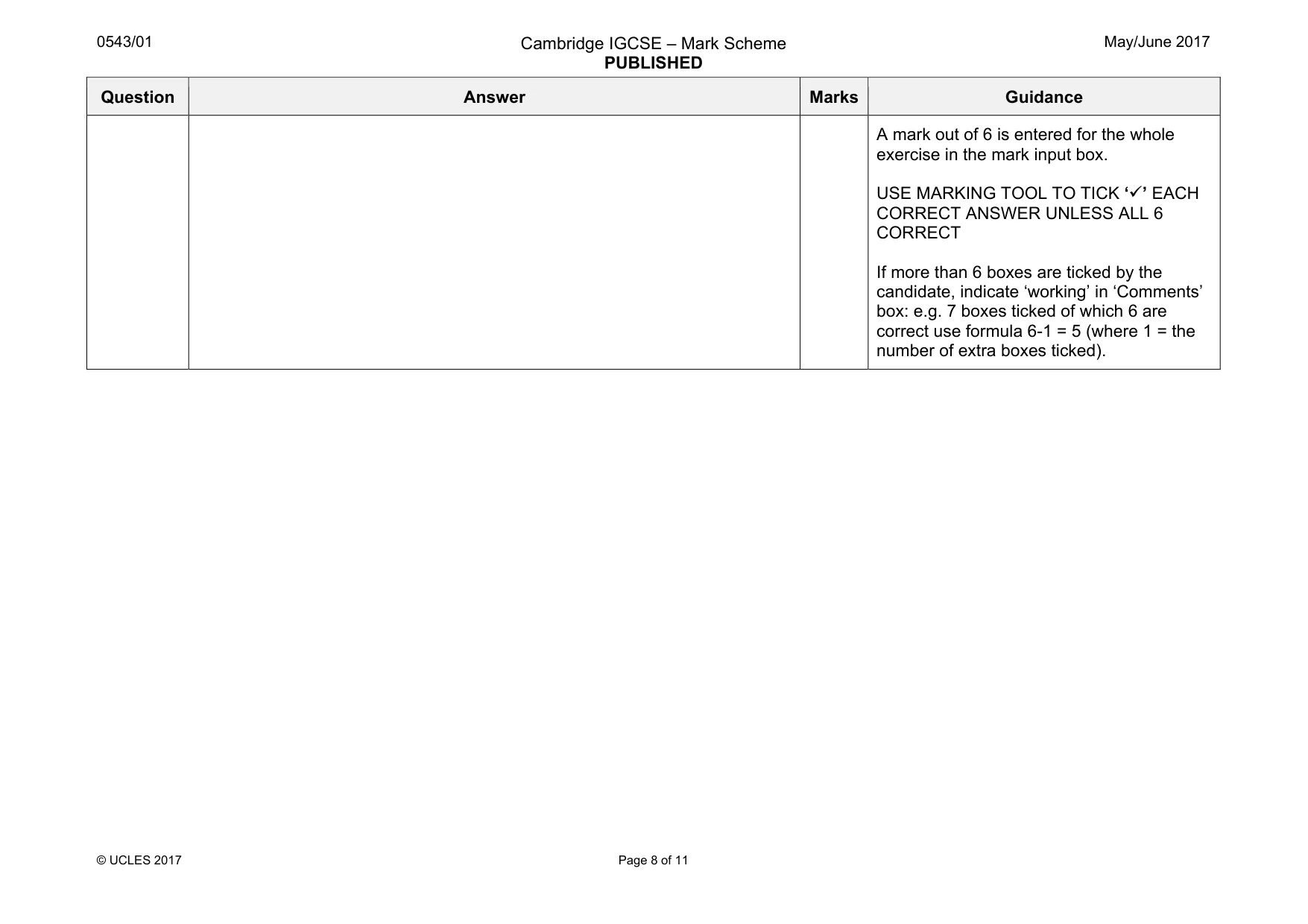
0543/01 Cambridge IGCSE – Mark Scheme PUBLISHED May/June 2017 © UCLES 2017 Page 8 of 11 Question Answer Marks Guidance A mark out of 6 is entered for the whole exercise in the mark input box. USE MARKING TOOL TO TICK ‘9’ EACH CORRECT ANSWER UNLESS ALL 6 CORRECT If more than 6 boxes are ticked by the candidate, indicate ‘working’ in ‘Comments’ box: e.g. 7 boxes ticked of which 6 are correct use formula 6-1 = 5 (where 1 = the number of extra boxes ticked).
Mark scheme, page 9
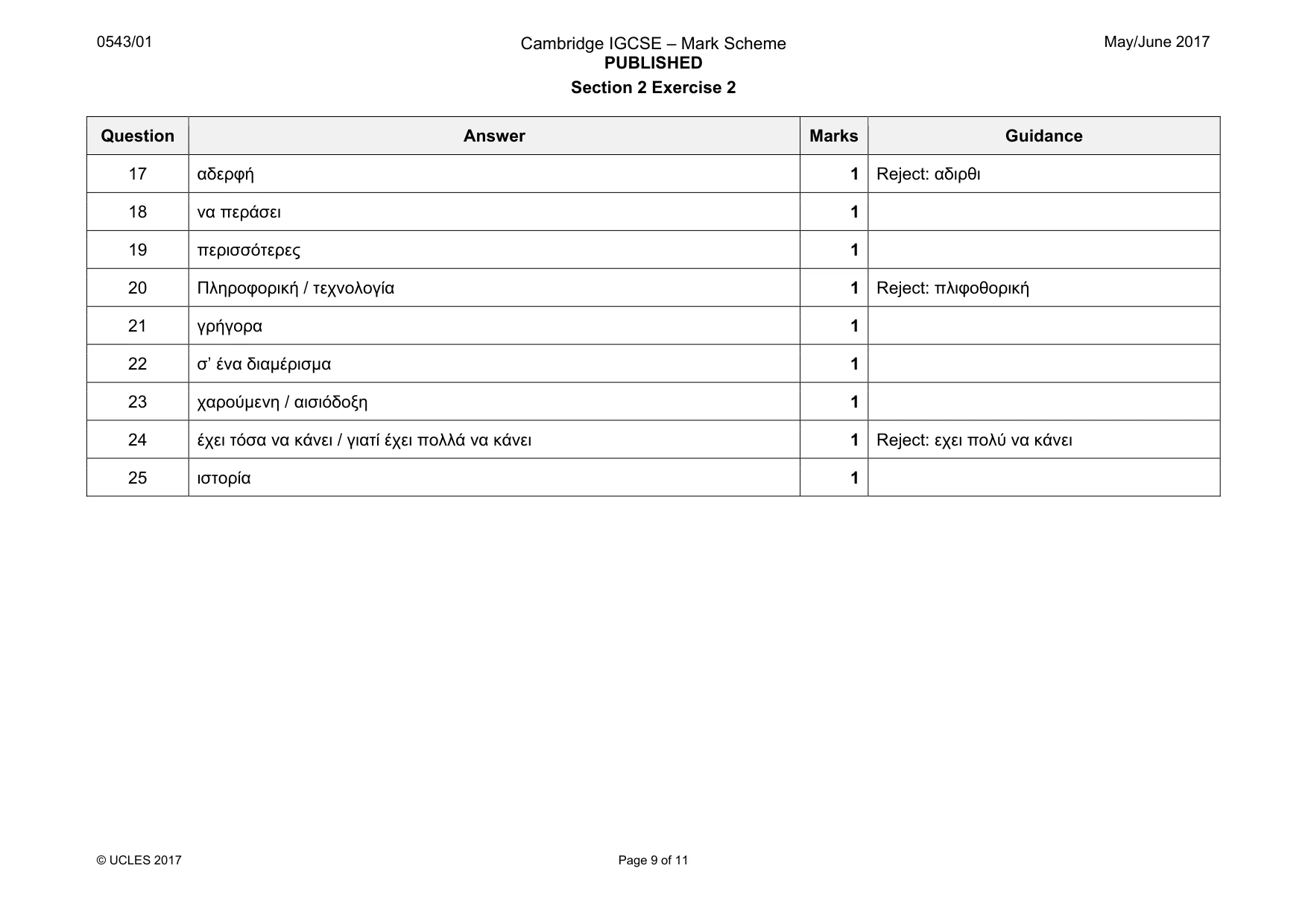
0543/01 Cambridge IGCSE – Mark Scheme PUBLISHED May/June 2017 © UCLES 2017 Page 9 of 11 Section 2 Exercise 2 Question Answer Marks Guidance 17 αδερφή 1 Reject: αδιρθι 18 να περάσει 1 19 περισσότερες 1 20 Πληροφορική / τεχνολογία 1 Reject: πλιφοθορική 21 γρήγορα 1 22 σ’ ένα διαµέρισµα 1 23 χαρούµενη / αισιόδοξη 1 24 έχει τόσα να κάνει / γιατί έχει πολλά να κάνει 1 Reject: εχει πολύ να κάνει 25 ιστορία 1
Mark scheme, page 10
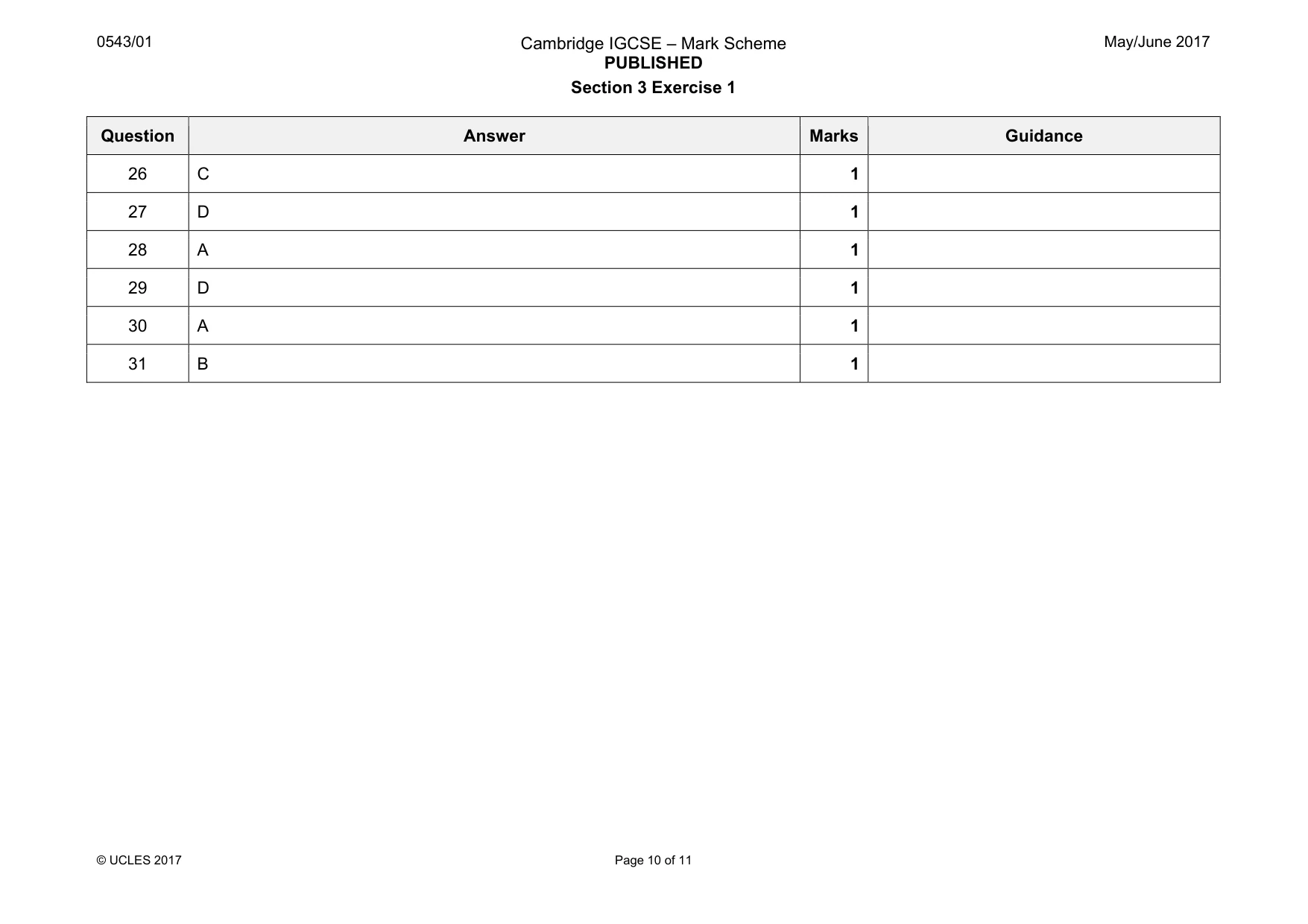
0543/01 Cambridge IGCSE – Mark Scheme PUBLISHED May/June 2017 © UCLES 2017 Page 10 of 11 Section 3 Exercise 1 Question Answer Marks Guidance 26 C 1 27 D 1 28 A 1 29 D 1 30 A 1 31 B 1
Mark scheme, page 11
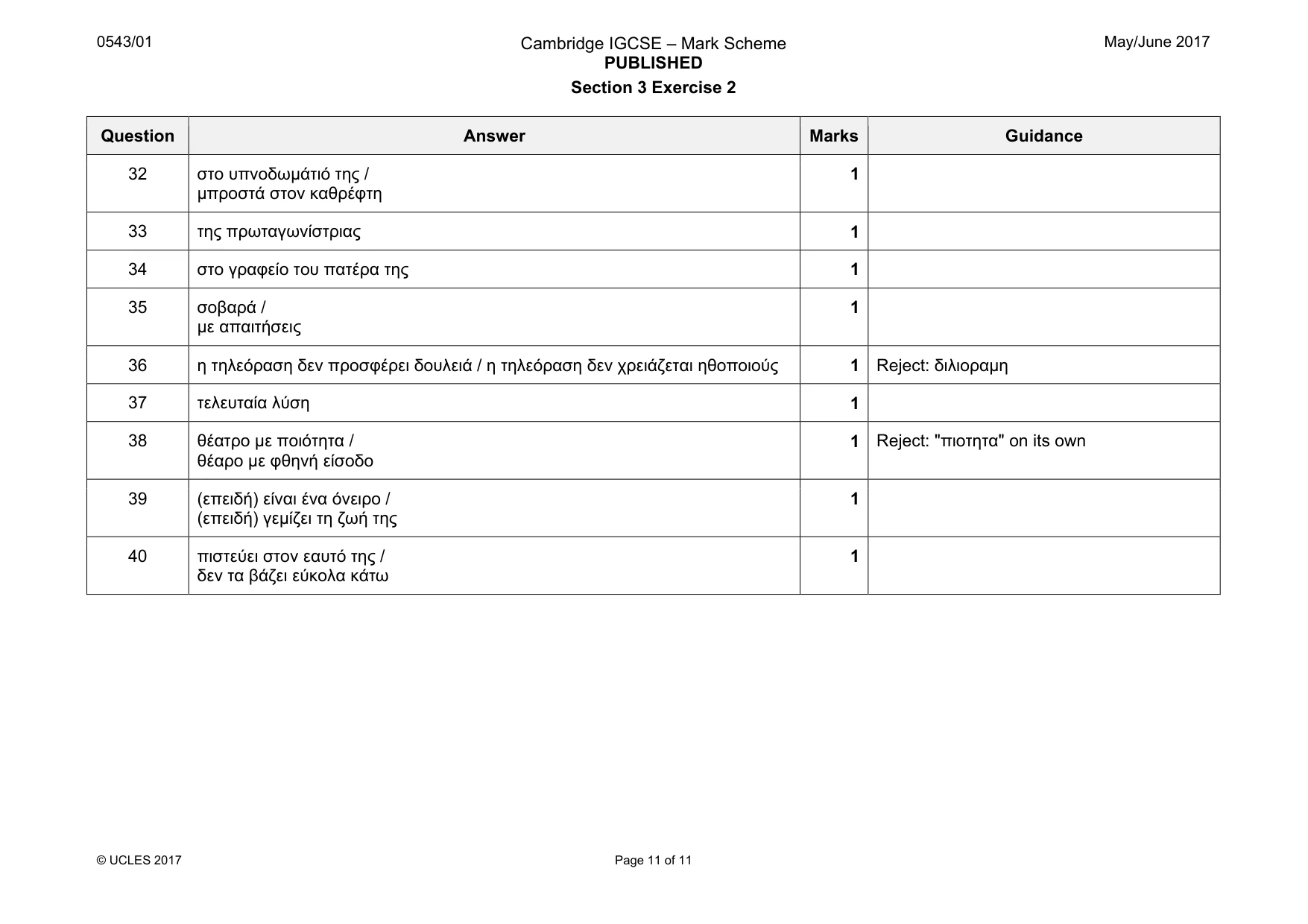
0543/01 Cambridge IGCSE – Mark Scheme PUBLISHED May/June 2017 © UCLES 2017 Page 11 of 11 Section 3 Exercise 2 Question Answer Marks Guidance 32 στο υπνοδωµάτιό της / µπρoστά στον καθρέφτη 1 33 της πρωταγωνίστριας 1 34 στο γραφείο του πατέρα της 1 35 σοβαρά / µε απαιτήσεις 1 36 η τηλεόραση δεν προσφέρει δουλειά / η τηλεόραση δεν χρειάζεται ηθοποιούς 1 Reject: διλιοραµη 37 τελευταία λύση 1 38 θέατρο µε ποιότητα / θέαρο µε φθηνή είσοδο 1 Reject: "πιοτητα" on its own 39 (επειδή) είναι ένα όνειρο / (επειδή) γεµίζει τη ζωή της 1 40 πιστεύει στον εαυτό της / δεν τα βάζει εύκολα κάτω 1
What you needed in this session
Cambridge’s own grade thresholds for 2017 May/June, Paper 1 · Variant 1. A higher threshold means an easier paper — the bar moves with how the cohort did.