Cambridge IGCSE German - Foreign Language 0525 — 2017 May/June Paper 1 · Variant 3
0525/13/M/J/17 · 45 marks · ≈51 min
The question paper and its mark scheme, free to read here and free to download. This is Cambridge’s own paper, exactly as it was sat.
Question paper16 pages



Mark scheme10 pages
Answers below. Sit the paper first if you are practising.
Paper as text
Question paper, page 1
This document consists of 13 printed pages and 3 blank pages. DC (ST/SW) 132453/2 © UCLES 2017 [Turn over Cambridge International Examinations Cambridge International General Certificate of Secondary Education * 9 0 2 0 2 4 4 8 8 4 * GERMAN 0525/13 Paper 1 Listening May/June 2017 Approx. 45 minutes Candidates answer on the Question Paper. No Additional Materials are required. READ THESE INSTRUCTIONS FIRST Write your Centre number, candidate number and name in the spaces at the top of this page. Write in dark blue or black pen. Do not use staples, paper clips, glue or correction fluid. DO NOT WRITE IN ANY BARCODES. Answer all questions. The number of marks is given in brackets [ ] at the end of each question or part question. The syllabus is approved for use in England, Wales and Northern Ireland as a Cambridge International Level 1/Level 2 Certificate.
Question paper, page 2
2 0525/13/M/J/17 © UCLES 2017 BLANK PAGE
Question paper, page 3
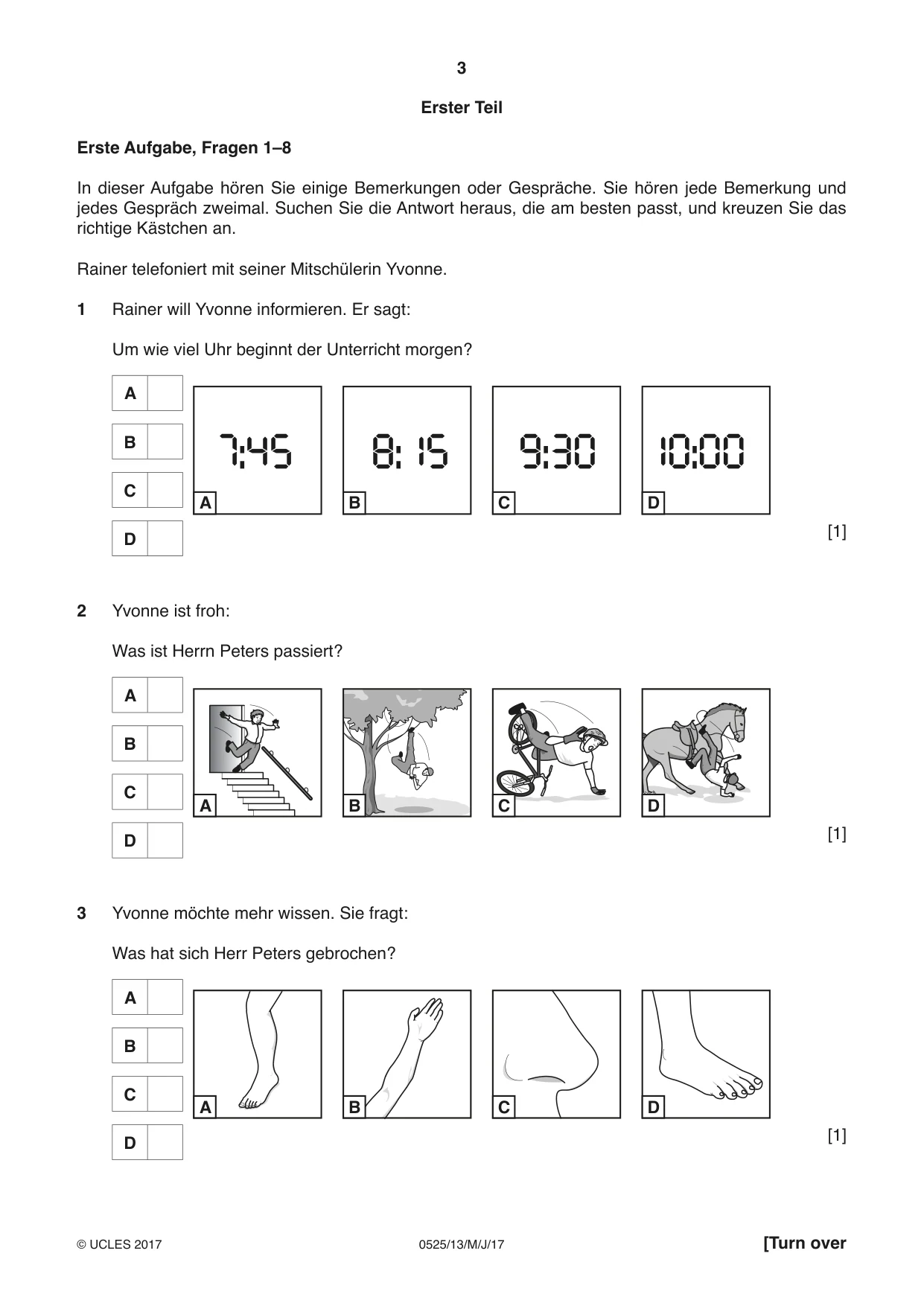
3 0525/13/M/J/17 © UCLES 2017 [Turn over Erster Teil Erste Aufgabe, Fragen 1–8 In dieser Aufgabe hören Sie einige Bemerkungen oder Gespräche. Sie hören jede Bemerkung und jedes Gespräch zweimal. Suchen Sie die Antwort heraus, die am besten passt, und kreuzen Sie das richtige Kästchen an. Rainer telefoniert mit seiner Mitschülerin Yvonne. 1 Rainer will Yvonne informieren. Er sagt: Um wie viel Uhr beginnt der Unterricht morgen? A A B C D [1] B C D 2 Yvonne ist froh: Was ist Herrn Peters passiert? A A B C D [1] B C D 3 Yvonne möchte mehr wissen. Sie fragt: Was hat sich Herr Peters gebrochen? A A B C D [1] B C D
Question paper, page 4
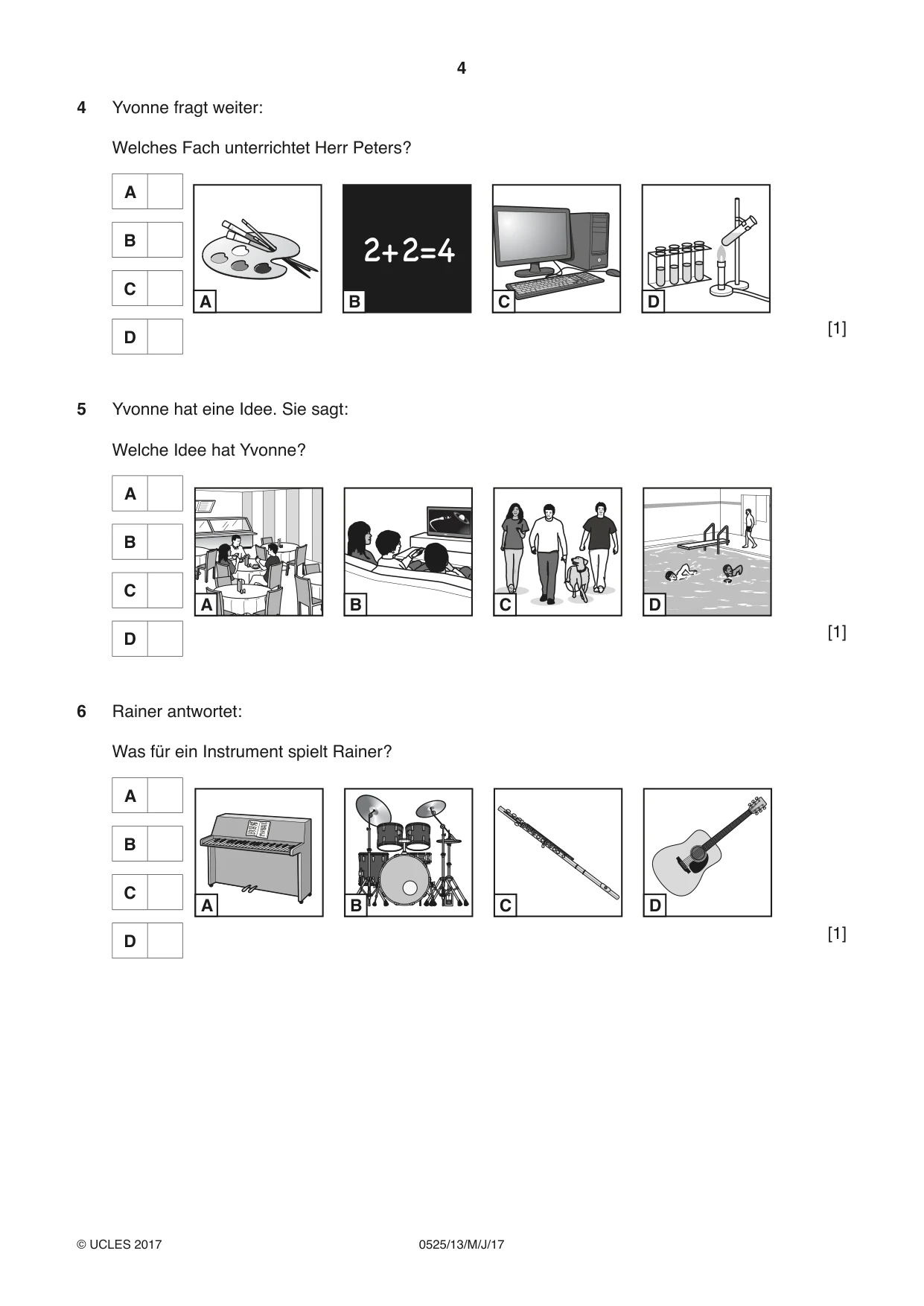
4 0525/13/M/J/17 © UCLES 2017 4 Yvonne fragt weiter: Welches Fach unterrichtet Herr Peters? A A B C D [1] B C D 5 Yvonne hat eine Idee. Sie sagt: Welche Idee hat Yvonne? A A B C D [1] B C D 6 Rainer antwortet: Was für ein Instrument spielt Rainer? A A B C D [1] B C D
Question paper, page 5
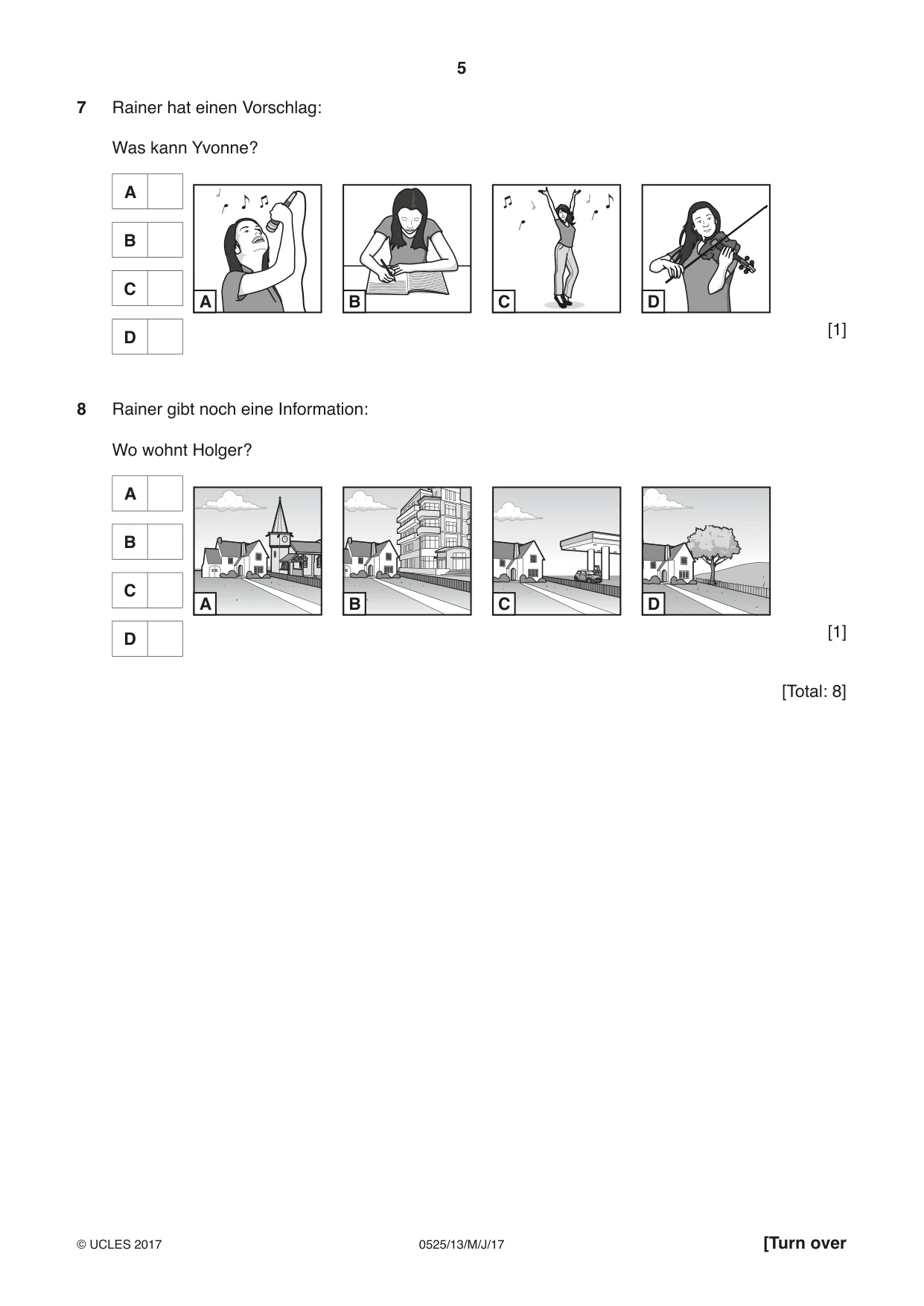
5 0525/13/M/J/17 © UCLES 2017 [Turn over 7 Rainer hat einen Vorschlag: Was kann Yvonne? A A B C D [1] B C D 8 Rainer gibt noch eine Information: Wo wohnt Holger? A A B C D [1] B C D [Total: 8]
Question paper, page 6
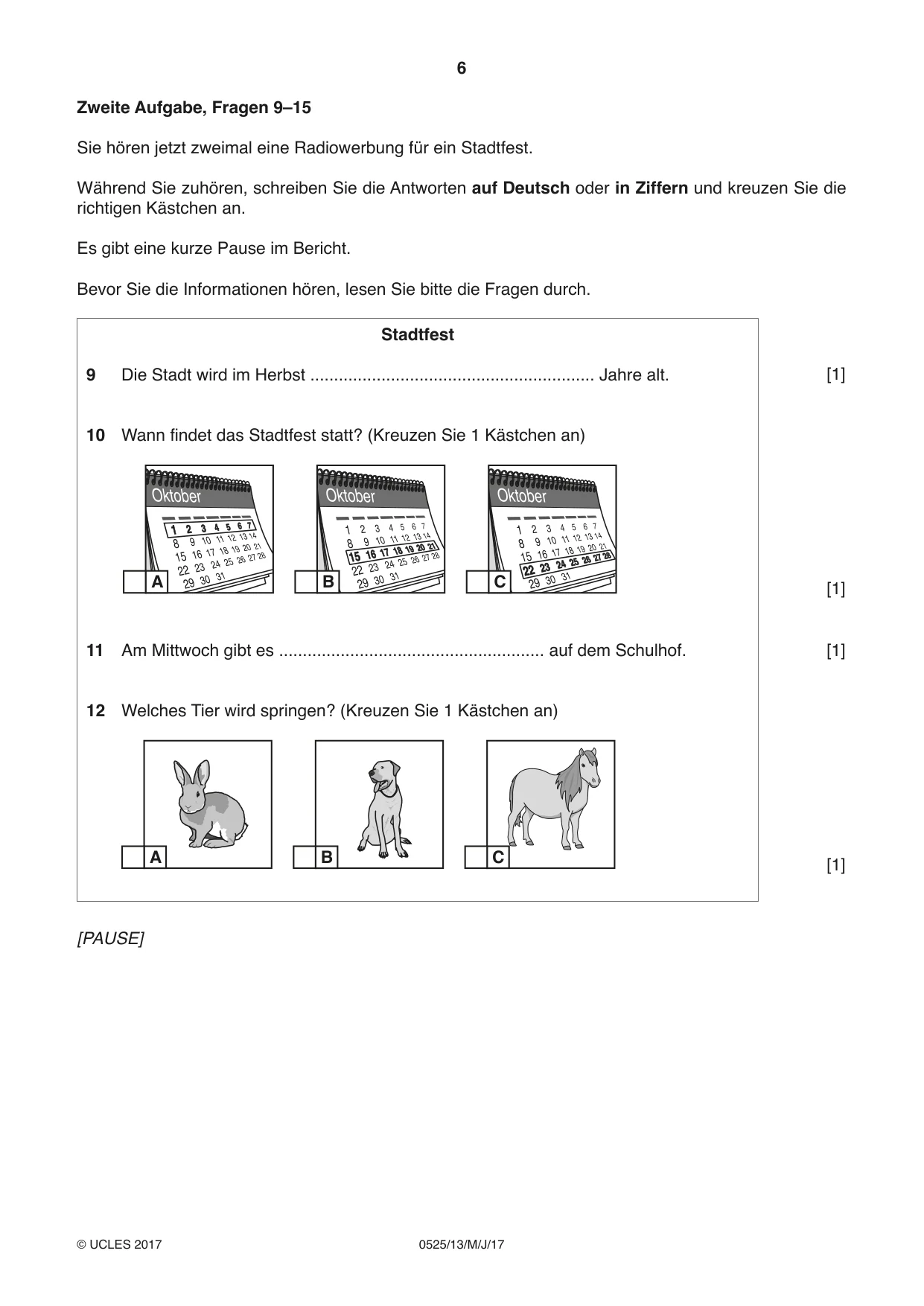
6 0525/13/M/J/17 © UCLES 2017 Zweite Aufgabe, Fragen 9–15 Sie hören jetzt zweimal eine Radiowerbung für ein Stadtfest. Während Sie zuhören, schreiben Sie die Antworten auf Deutsch oder in Ziffern und kreuzen Sie die richtigen Kästchen an. Es gibt eine kurze Pause im Bericht. Bevor Sie die Informationen hören, lesen Sie bitte die Fragen durch. Stadtfest 9 Die Stadt wird im Herbst … Jahre alt. 10 Wann findet das Stadtfest statt? (Kreuzen Sie 1 Kästchen an) Oktober Oktober Oktober A B C 11 Am Mittwoch gibt es … auf dem Schulhof. 12 Welches Tier wird springen? (Kreuzen Sie 1 Kästchen an) A B C [1] [1] [1] [1] [PAUSE]
Question paper, page 7
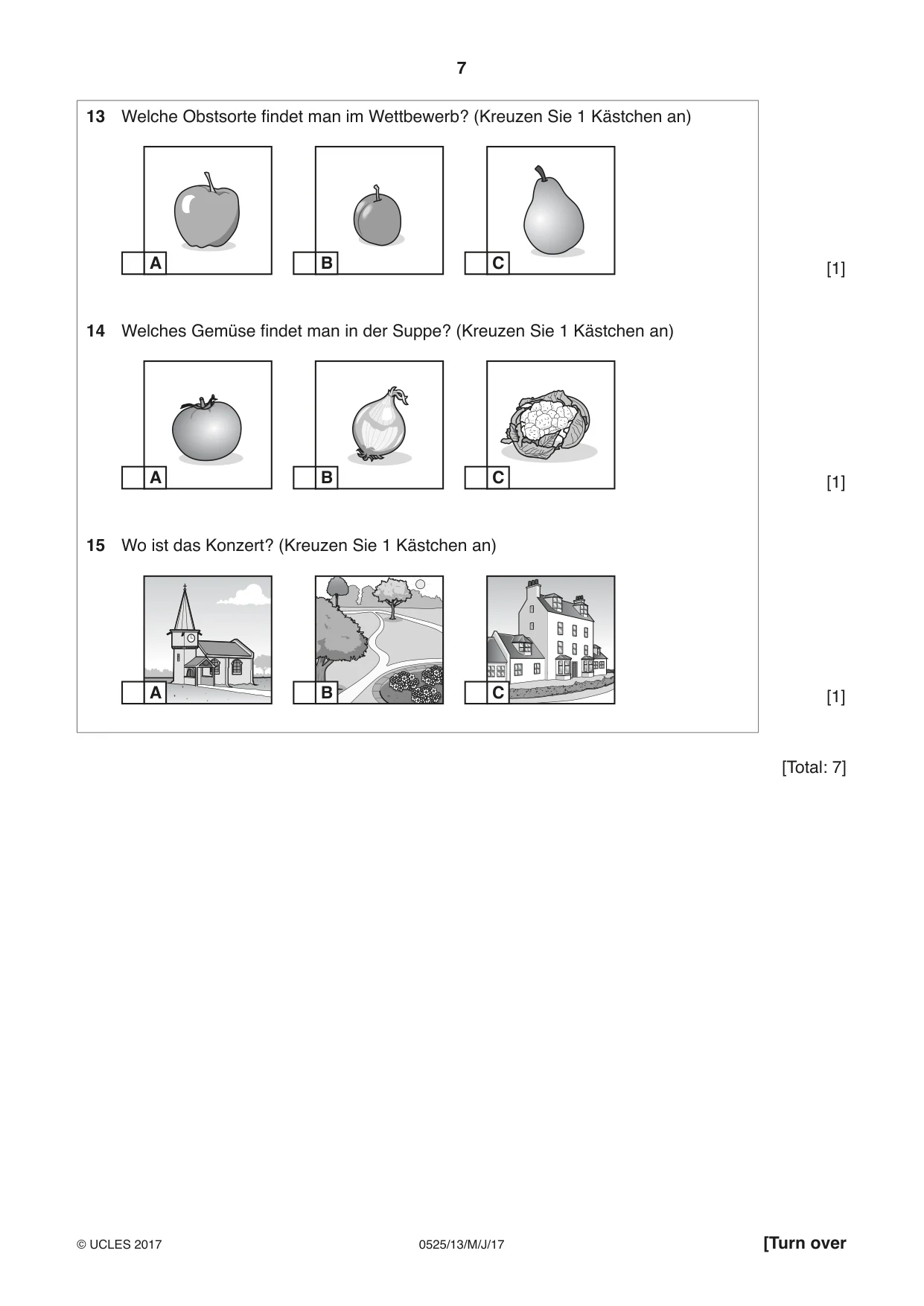
7 0525/13/M/J/17 © UCLES 2017 [Turn over 13 Welche Obstsorte findet man im Wettbewerb? (Kreuzen Sie 1 Kästchen an) A B C 14 Welches Gemüse findet man in der Suppe? (Kreuzen Sie 1 Kästchen an) A B C 15 Wo ist das Konzert? (Kreuzen Sie 1 Kästchen an) A B C [1] [1] [1] [Total: 7]
Question paper, page 8
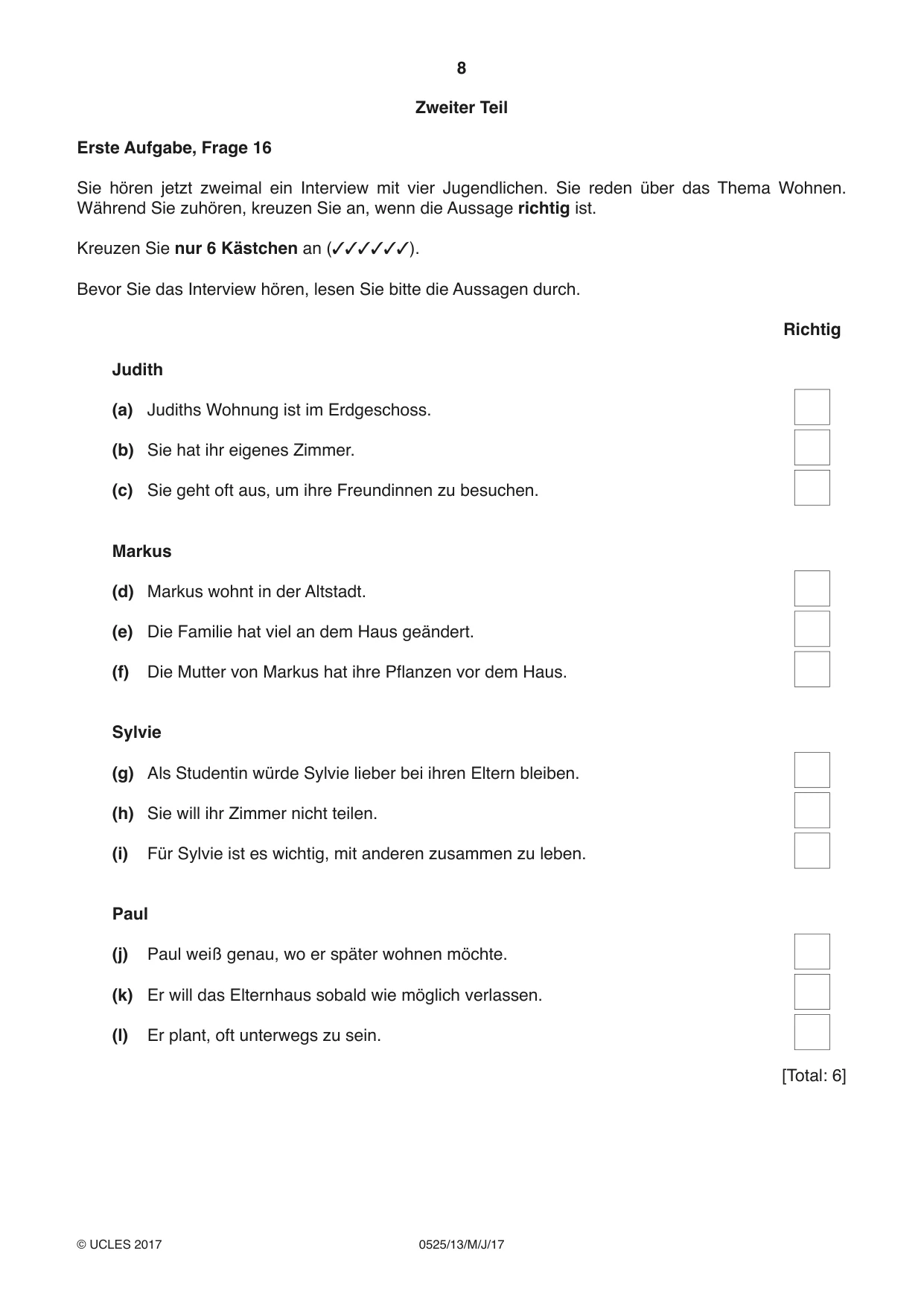
8 0525/13/M/J/17 © UCLES 2017 Zweiter Teil Erste Aufgabe, Frage 16 Sie hören jetzt zweimal ein Interview mit vier Jugendlichen. Sie reden über das Thema Wohnen. Während Sie zuhören, kreuzen Sie an, wenn die Aussage richtig ist. Kreuzen Sie nur 6 Kästchen an (333333). Bevor Sie das Interview hören, lesen Sie bitte die Aussagen durch. Richtig Judith (a) Judiths Wohnung ist im Erdgeschoss. (b) Sie hat ihr eigenes Zimmer. (c) Sie geht oft aus, um ihre Freundinnen zu besuchen. Markus (d) Markus wohnt in der Altstadt. (e) Die Familie hat viel an dem Haus geändert. (f) Die Mutter von Markus hat ihre Pflanzen vor dem Haus. Sylvie (g) Als Studentin würde Sylvie lieber bei ihren Eltern bleiben. (h) Sie will ihr Zimmer nicht teilen. (i) Für Sylvie ist es wichtig, mit anderen zusammen zu leben. Paul (j) Paul weiß genau, wo er später wohnen möchte. (k) Er will das Elternhaus sobald wie möglich verlassen. (l) Er plant, oft unterwegs zu sein. [Total: 6]
Question paper, page 9
9 0525/13/M/J/17 © UCLES 2017 [Turn over BLANK PAGE
Question paper, page 10
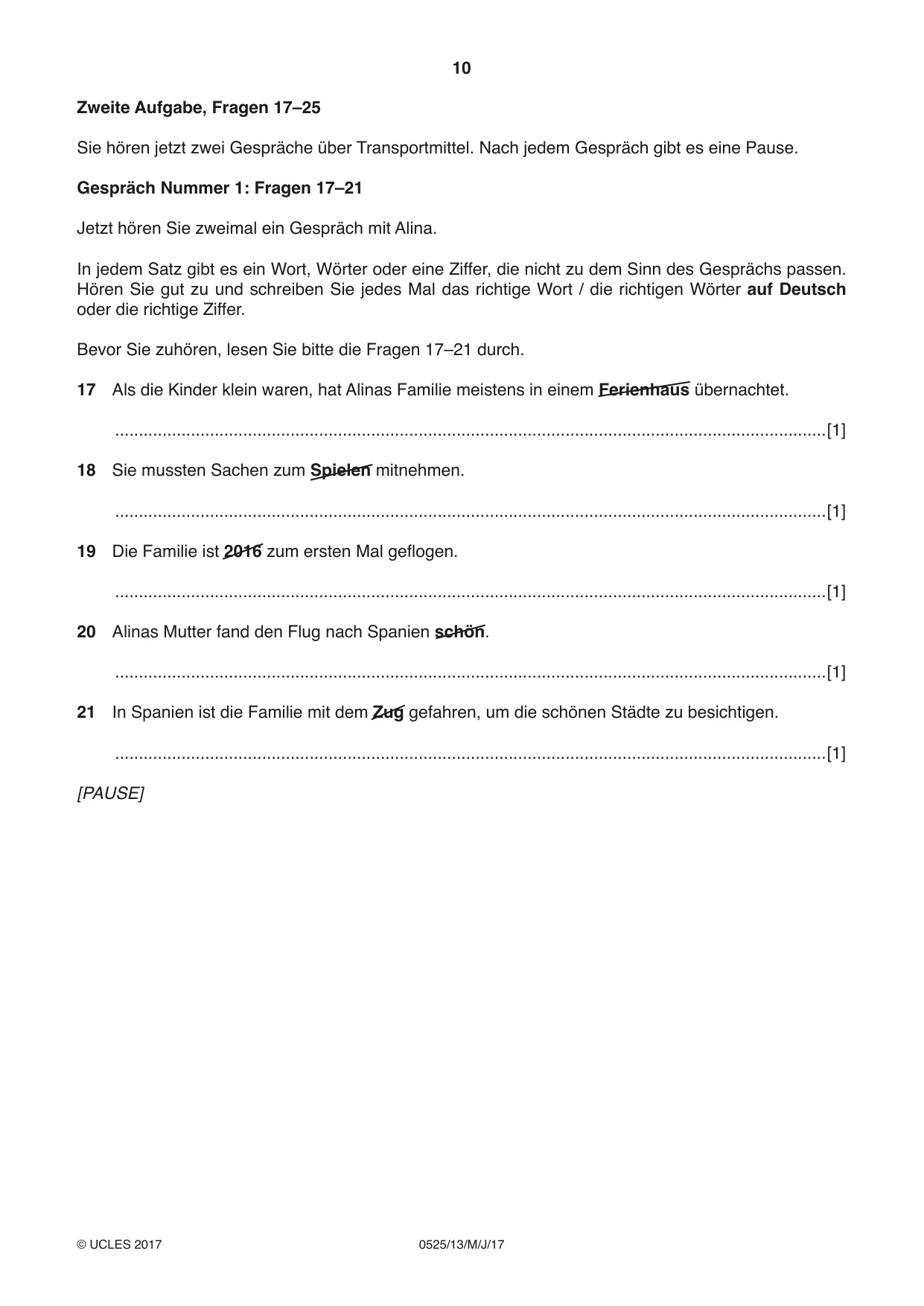
10 0525/13/M/J/17 © UCLES 2017 Zweite Aufgabe, Fragen 17–25 Sie hören jetzt zwei Gespräche über Transportmittel. Nach jedem Gespräch gibt es eine Pause. Gespräch Nummer 1: Fragen 17–21 Jetzt hören Sie zweimal ein Gespräch mit Alina. In jedem Satz gibt es ein Wort, Wörter oder eine Ziffer, die nicht zu dem Sinn des Gesprächs passen. Hören Sie gut zu und schreiben Sie jedes Mal das richtige Wort / die richtigen Wörter auf Deutsch oder die richtige Ziffer. Bevor Sie zuhören, lesen Sie bitte die Fragen 17–21 durch. 17 Als die Kinder klein waren, hat Alinas Familie meistens in einem Ferienhaus übernachtet. …[1] 18 Sie mussten Sachen zum Spielen mitnehmen. …[1] 19 Die Familie ist 2016 zum ersten Mal geflogen. …[1] 20 Alinas Mutter fand den Flug nach Spanien schön. …[1] 21 In Spanien ist die Familie mit dem Zug gefahren, um die schönen Städte zu besichtigen. …[1] [PAUSE]
Question paper, page 11
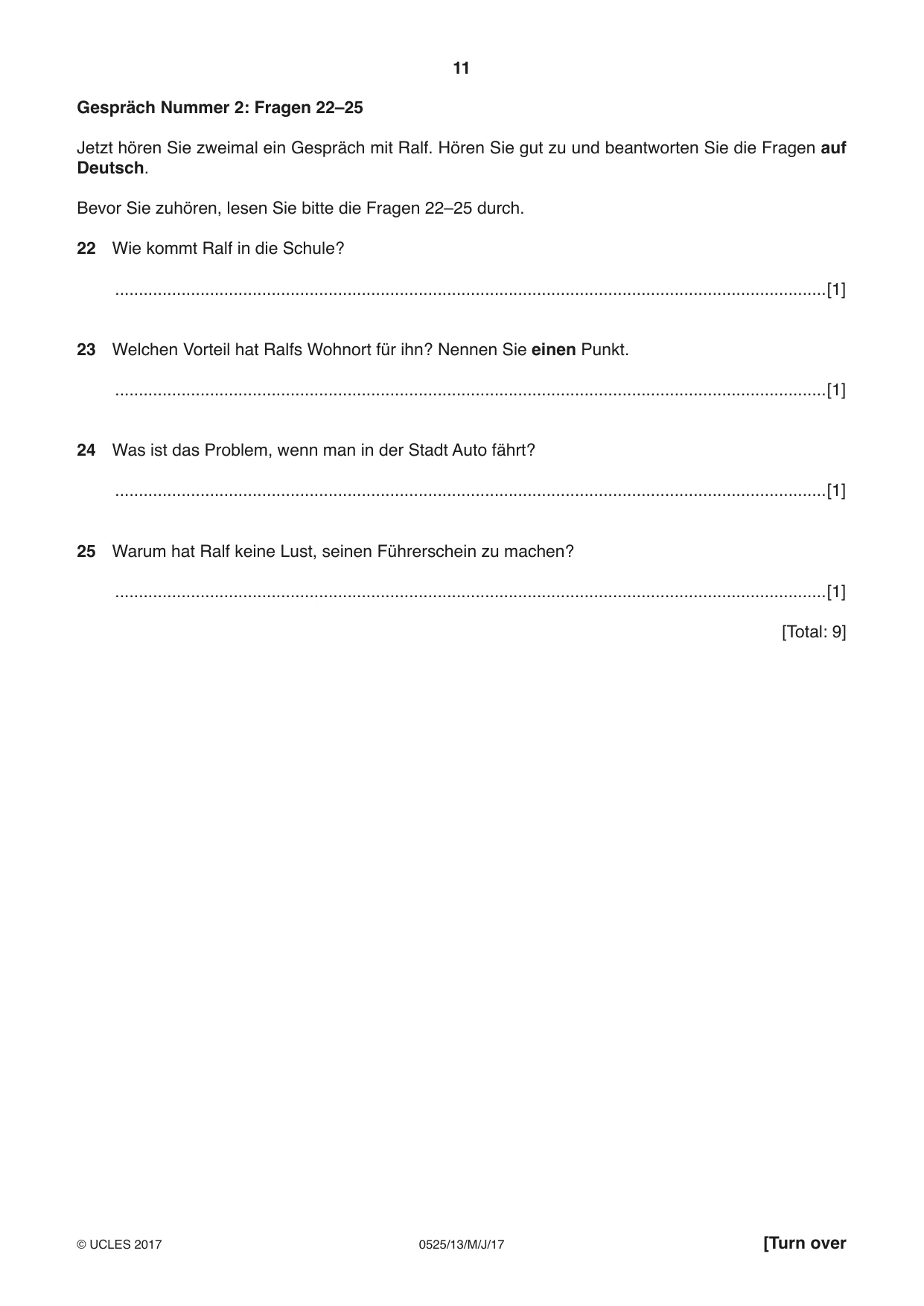
11 0525/13/M/J/17 © UCLES 2017 [Turn over Gespräch Nummer 2: Fragen 22–25 Jetzt hören Sie zweimal ein Gespräch mit Ralf. Hören Sie gut zu und beantworten Sie die Fragen auf Deutsch. Bevor Sie zuhören, lesen Sie bitte die Fragen 22–25 durch. 22 Wie kommt Ralf in die Schule? …[1] 23 Welchen Vorteil hat Ralfs Wohnort für ihn? Nennen Sie einen Punkt. …[1] 24 Was ist das Problem, wenn man in der Stadt Auto fährt? …[1] 25 Warum hat Ralf keine Lust, seinen Führerschein zu machen? …[1] [Total: 9]
Question paper, page 12
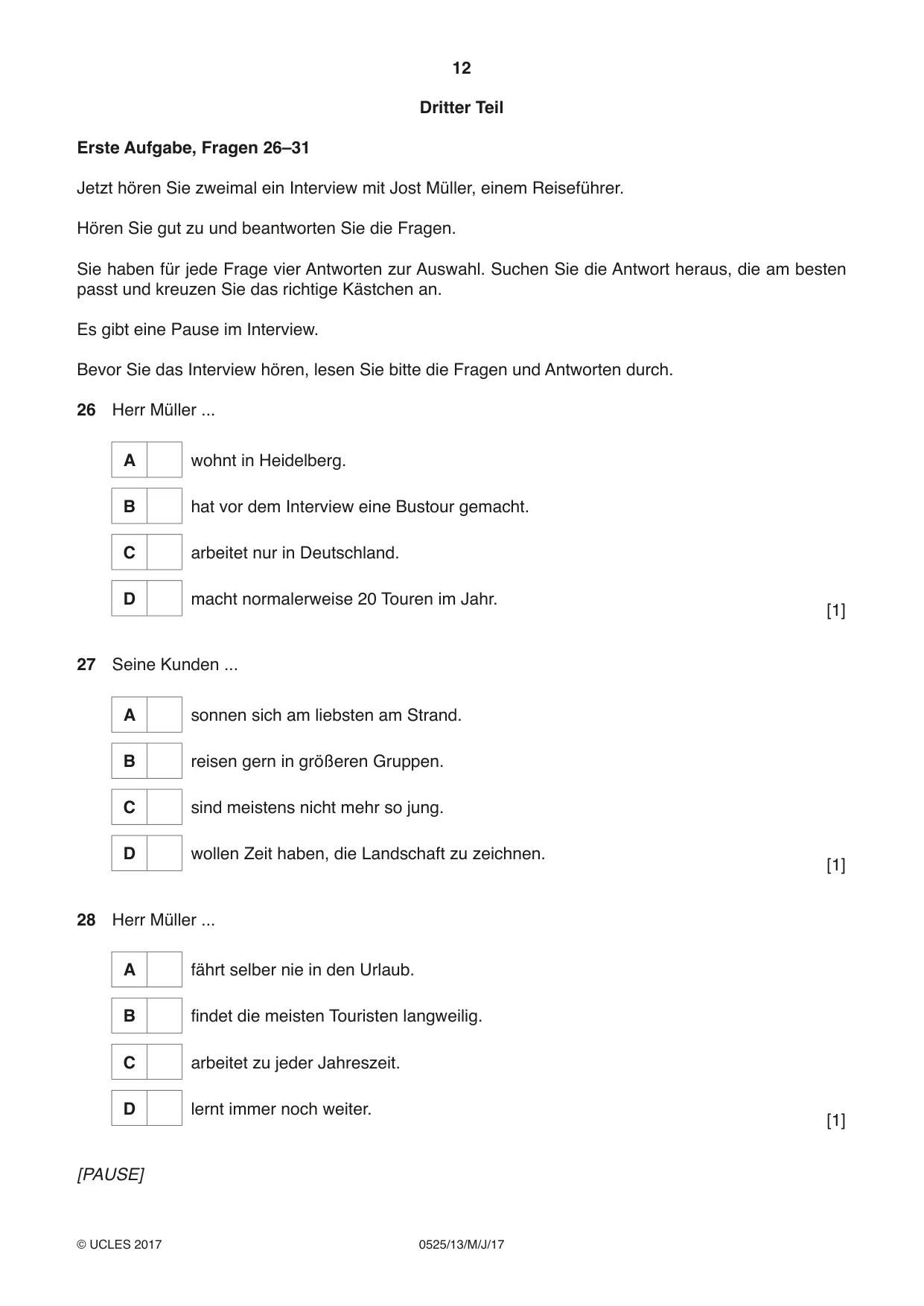
12 0525/13/M/J/17 © UCLES 2017 Dritter Teil Erste Aufgabe, Fragen 26–31 Jetzt hören Sie zweimal ein Interview mit Jost Müller, einem Reiseführer. Hören Sie gut zu und beantworten Sie die Fragen. Sie haben für jede Frage vier Antworten zur Auswahl. Suchen Sie die Antwort heraus, die am besten passt und kreuzen Sie das richtige Kästchen an. Es gibt eine Pause im Interview. Bevor Sie das Interview hören, lesen Sie bitte die Fragen und Antworten durch. 26 Herr Müller ... A wohnt in Heidelberg. [1] B hat vor dem Interview eine Bustour gemacht. C arbeitet nur in Deutschland. D macht normalerweise 20 Touren im Jahr. 27 Seine Kunden ... A sonnen sich am liebsten am Strand. [1] B reisen gern in größeren Gruppen. C sind meistens nicht mehr so jung. D wollen Zeit haben, die Landschaft zu zeichnen. 28 Herr Müller ... A fährt selber nie in den Urlaub. [1] B findet die meisten Touristen langweilig. C arbeitet zu jeder Jahreszeit. D lernt immer noch weiter. [PAUSE]
Question paper, page 13
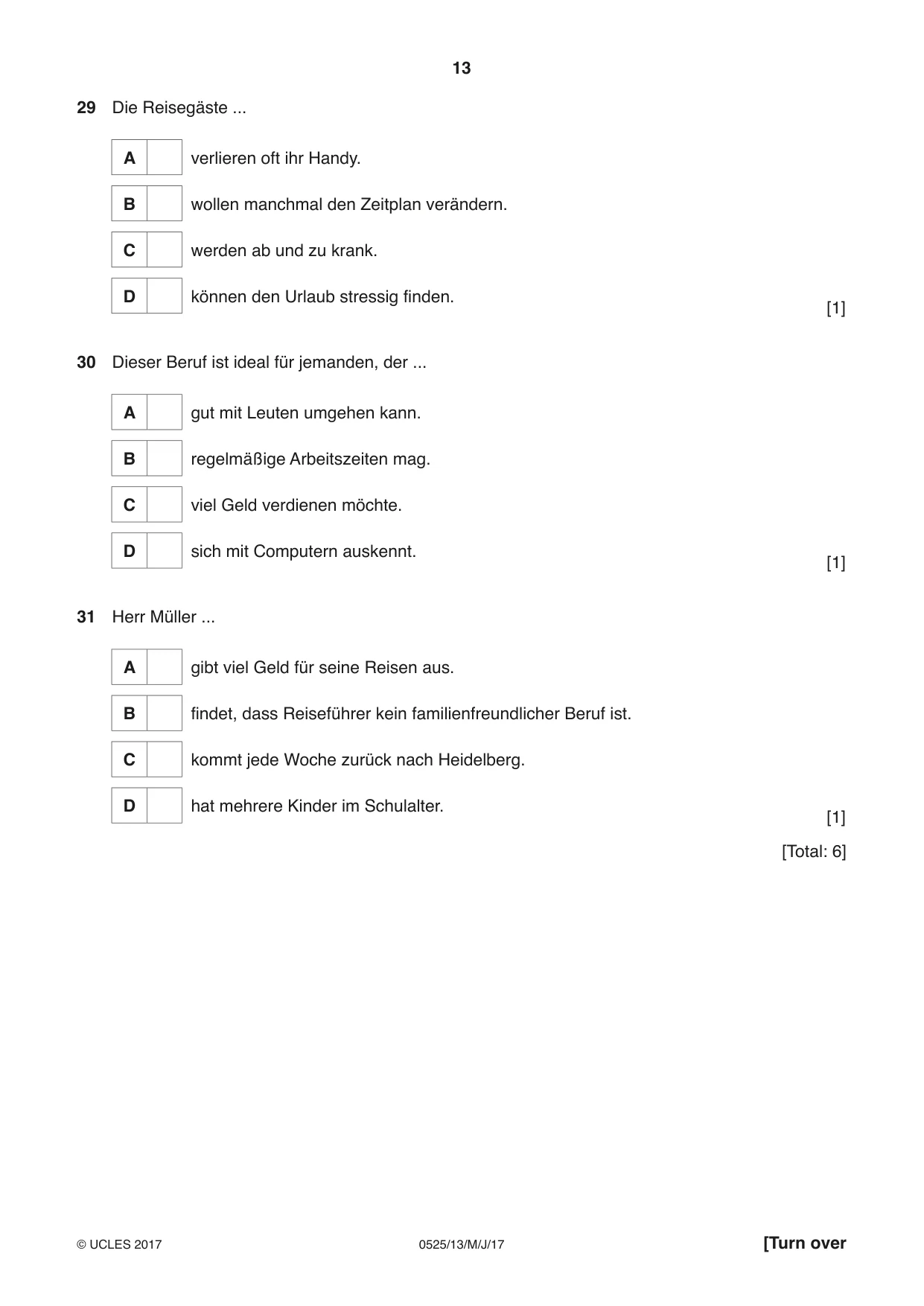
13 0525/13/M/J/17 © UCLES 2017 [Turn over 29 Die Reisegäste ... A verlieren oft ihr Handy. [1] B wollen manchmal den Zeitplan verändern. C werden ab und zu krank. D können den Urlaub stressig finden. 30 Dieser Beruf ist ideal für jemanden, der ... A gut mit Leuten umgehen kann. [1] B regelmäßige Arbeitszeiten mag. C viel Geld verdienen möchte. D sich mit Computern auskennt. 31 Herr Müller ... A gibt viel Geld für seine Reisen aus. [1] B findet, dass Reiseführer kein familienfreundlicher Beruf ist. C kommt jede Woche zurück nach Heidelberg. D hat mehrere Kinder im Schulalter. [Total: 6]
Question paper, page 14
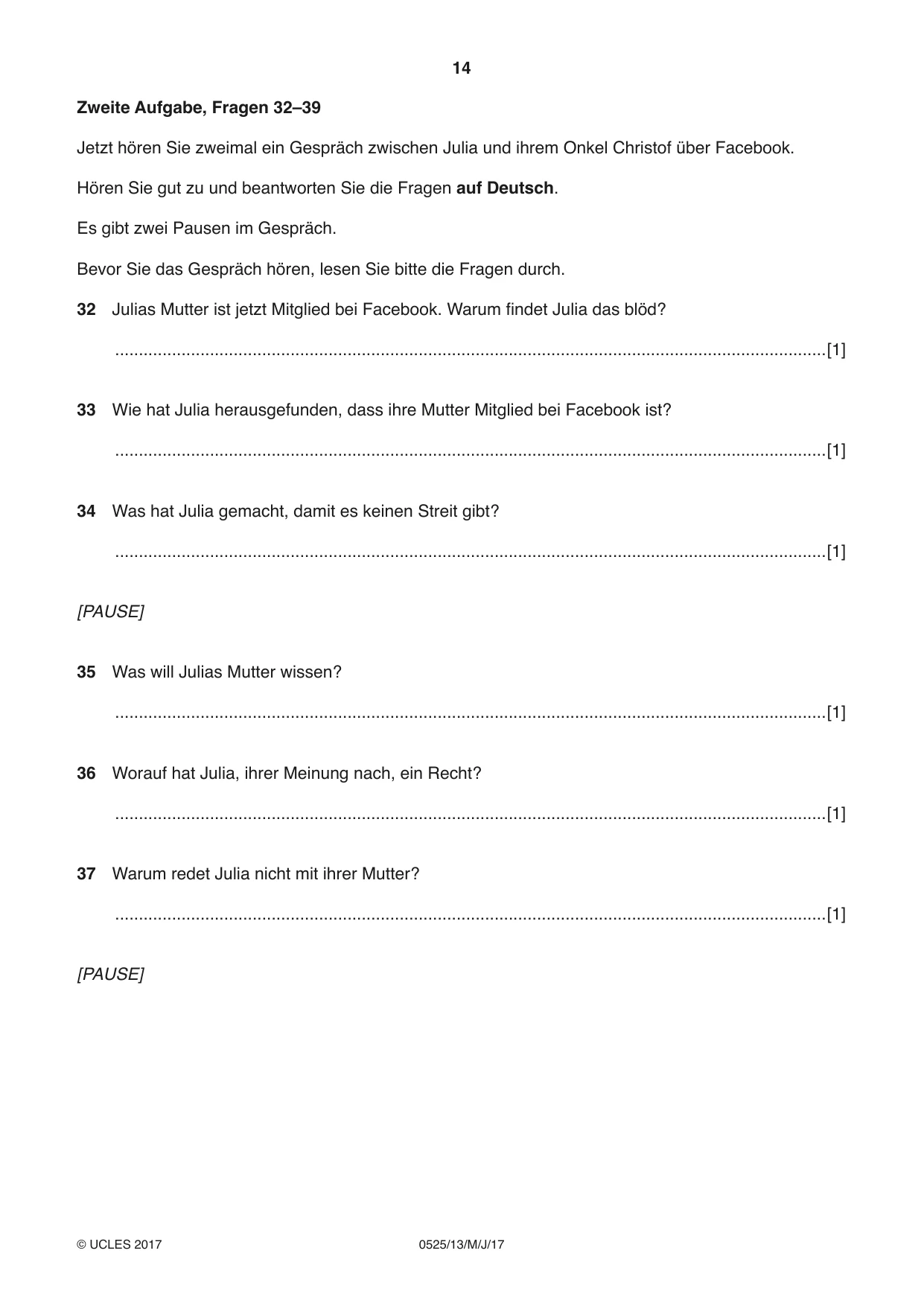
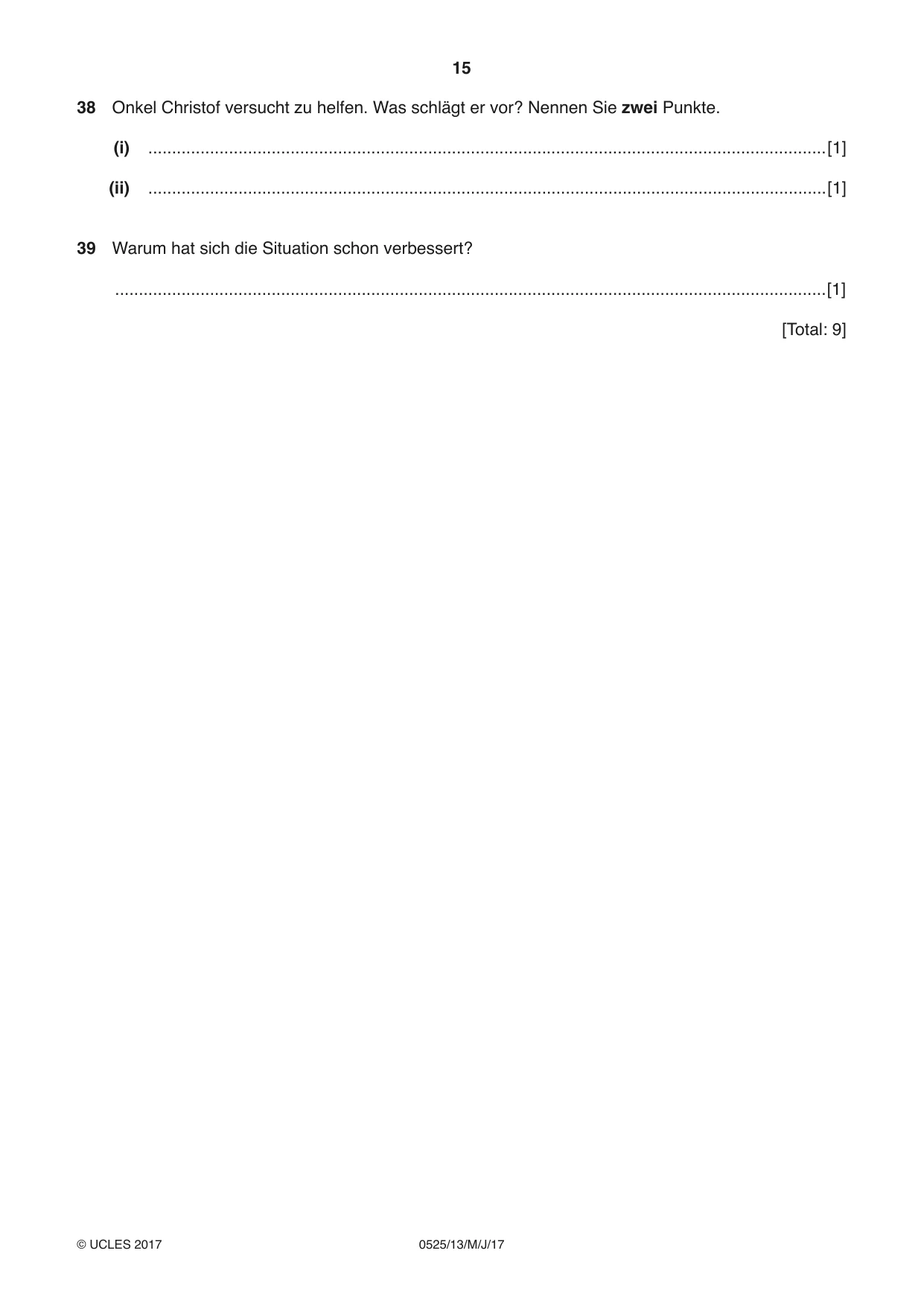
14 0525/13/M/J/17 © UCLES 2017 Zweite Aufgabe, Fragen 32–39 Jetzt hören Sie zweimal ein Gespräch zwischen Julia und ihrem Onkel Christof über Facebook. Hören Sie gut zu und beantworten Sie die Fragen auf Deutsch. Es gibt zwei Pausen im Gespräch. Bevor Sie das Gespräch hören, lesen Sie bitte die Fragen durch. 32 Julias Mutter ist jetzt Mitglied bei Facebook. Warum findet Julia das blöd? …[1] 33 Wie hat Julia herausgefunden, dass ihre Mutter Mitglied bei Facebook ist? …[1] 34 Was hat Julia gemacht, damit es keinen Streit gibt? …[1] [PAUSE] 35 Was will Julias Mutter wissen? …[1] 36 Worauf hat Julia, ihrer Meinung nach, ein Recht? …[1] 37 Warum redet Julia nicht mit ihrer Mutter? …[1] [PAUSE]
Question paper, page 15
15 0525/13/M/J/17 © UCLES 2017 38 Onkel Christof versucht zu helfen. Was schlägt er vor? Nennen Sie zwei Punkte. (i) …[1] (ii) …[1] 39 Warum hat sich die Situation schon verbessert? …[1] [Total: 9]
Question paper, page 16
16 0525/13/M/J/17 © UCLES 2017 Permission to reproduce items where third-party owned material protected by copyright is included has been sought and cleared where possible. Every reasonable effort has been made by the publisher (UCLES) to trace copyright holders, but if any items requiring clearance have unwittingly been included, the publisher will be pleased to make amends at the earliest possible opportunity. To avoid the issue of disclosure of answer-related information to candidates, all copyright acknowledgements are reproduced online in the Cambridge International Examinations Copyright Acknowledgements Booklet. This is produced for each series of examinations and is freely available to download at www.cie.org.uk after the live examination series. Cambridge International Examinations is part of the Cambridge Assessment Group. Cambridge Assessment is the brand name of University of Cambridge Local Examinations Syndicate (UCLES), which is itself a department of the University of Cambridge. BLANK PAGE
Mark scheme, page 1
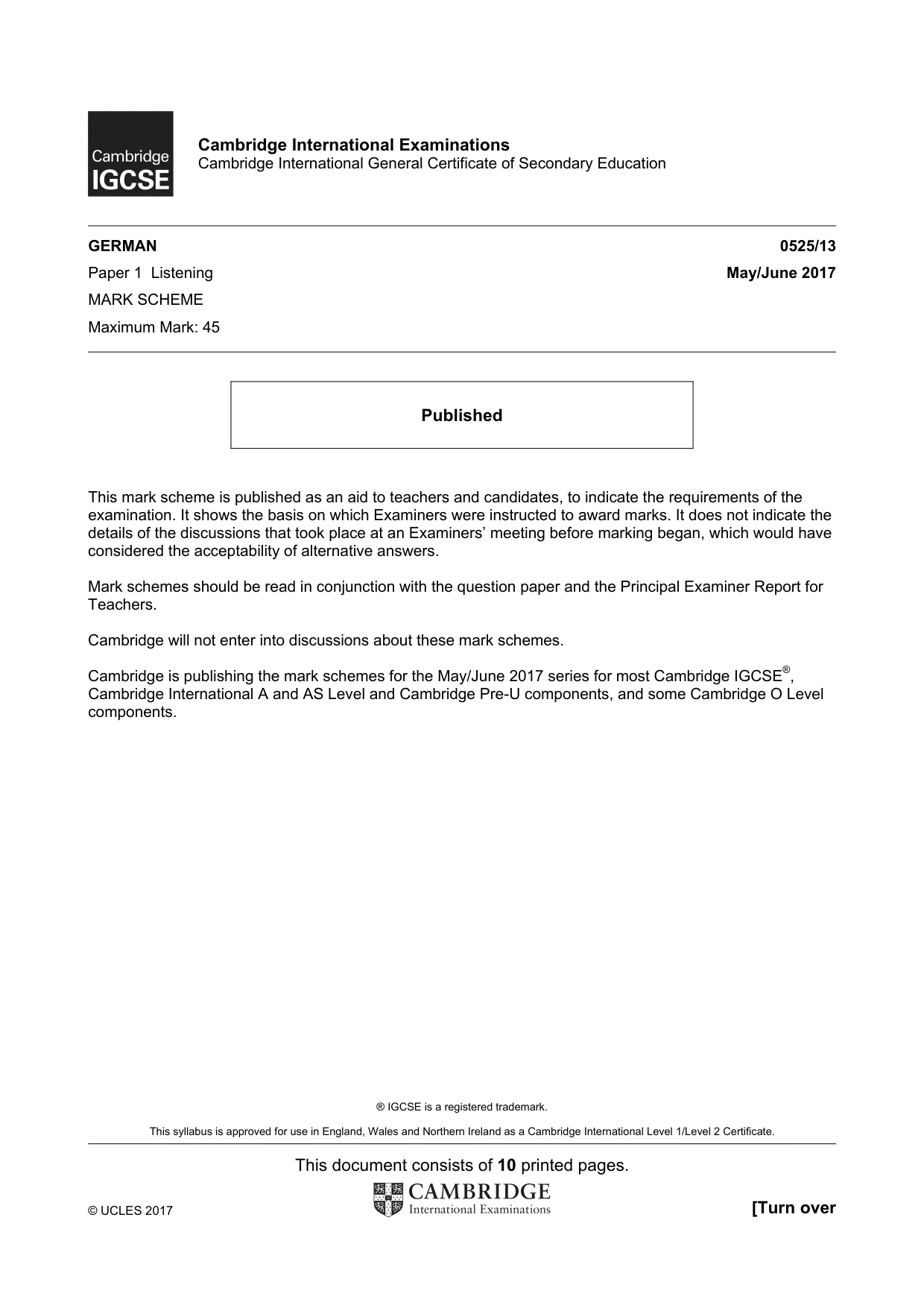
® IGCSE is a registered trademark. This syllabus is approved for use in England, Wales and Northern Ireland as a Cambridge International Level 1/Level 2 Certificate. This document consists of 10 printed pages. © UCLES 2017 [Turn over Cambridge International Examinations Cambridge International General Certificate of Secondary Education GERMAN 0525/13 Paper 1 Listening May/June 2017 MARK SCHEME Maximum Mark: 45 Published This mark scheme is published as an aid to teachers and candidates, to indicate the requirements of the examination. It shows the basis on which Examiners were instructed to award marks. It does not indicate the details of the discussions that took place at an Examiners’ meeting before marking began, which would have considered the acceptability of alternative answers. Mark schemes should be read in conjunction with the question paper and the Principal Examiner Report for Teachers. Cambridge will not enter into discussions about these mark schemes. Cambridge is publishing the mark schemes for the May/June 2017 series for most Cambridge IGCSE®, Cambridge International A and AS Level and Cambridge Pre-U components, and some Cambridge O Level components.
Mark scheme, page 2
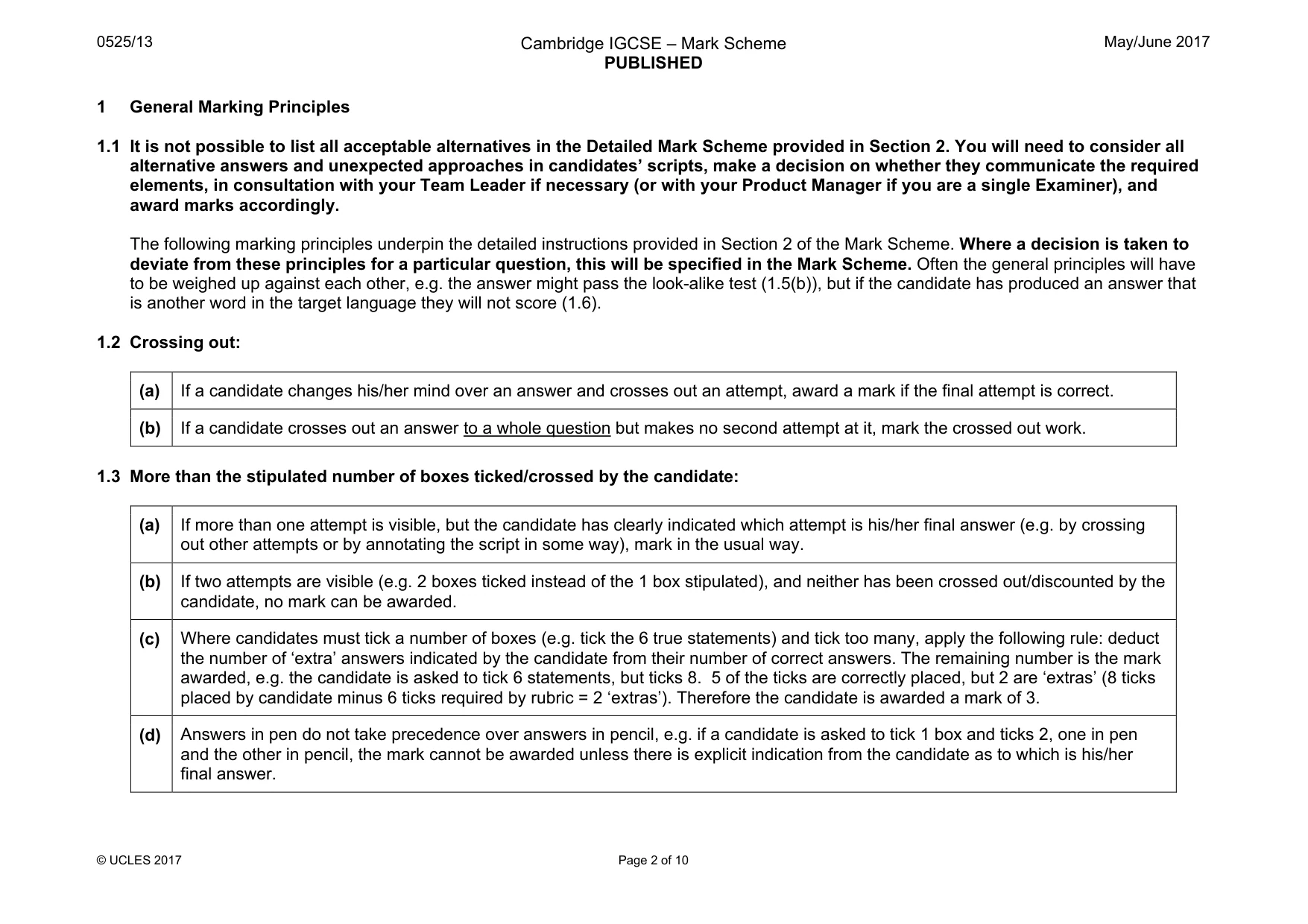
0525/13 Cambridge IGCSE – Mark Scheme PUBLISHED May/June 2017 © UCLES 2017 Page 2 of 10 1 General Marking Principles 1.1 It is not possible to list all acceptable alternatives in the Detailed Mark Scheme provided in Section 2. You will need to consider all alternative answers and unexpected approaches in candidates’ scripts, make a decision on whether they communicate the required elements, in consultation with your Team Leader if necessary (or with your Product Manager if you are a single Examiner), and award marks accordingly. The following marking principles underpin the detailed instructions provided in Section 2 of the Mark Scheme. Where a decision is taken to deviate from these principles for a particular question, this will be specified in the Mark Scheme. Often the general principles will have to be weighed up against each other, e.g. the answer might pass the look-alike test (1.5(b)), but if the candidate has produced an answer that is another word in the target language they will not score (1.6). 1.2 Crossing out: (a) If a candidate changes his/her mind over an answer and crosses out an attempt, award a mark if the final attempt is correct. (b) If a candidate crosses out an answer to a whole question but makes no second attempt at it, mark the crossed out work. 1.3 More than the stipulated number of boxes ticked/crossed by the candidate: (a) If more than one attempt is visible, but the candidate has clearly indicated which attempt is his/her final answer (e.g. by crossing out other attempts or by annotating the script in some way), mark in the usual way. (b) If two attempts are visible (e.g. 2 boxes ticked instead of the 1 box stipulated), and neither has been crossed out/discounted by the candidate, no mark can be awarded. (c) Where candidates must tick a number of boxes (e.g. tick the 6 true statements) and tick too many, apply the following rule: deduct the number of ‘extra’ answers indicated by the candidate from their number of correct answers. The remaining number is the mark awarded, e.g. the candidate is asked to tick 6 statements, but ticks 8. 5 of the ticks are correctly placed, but 2 are ‘extras’ (8 ticks placed by candidate minus 6 ticks required by rubric = 2 ‘extras’). Therefore the candidate is awarded a mark of 3. (d) Answers in pen do not take precedence over answers in pencil, e.g. if a candidate is asked to tick 1 box and ticks 2, one in pen and the other in pencil, the mark cannot be awarded unless there is explicit indication from the candidate as to which is his/her final answer.
Mark scheme, page 3
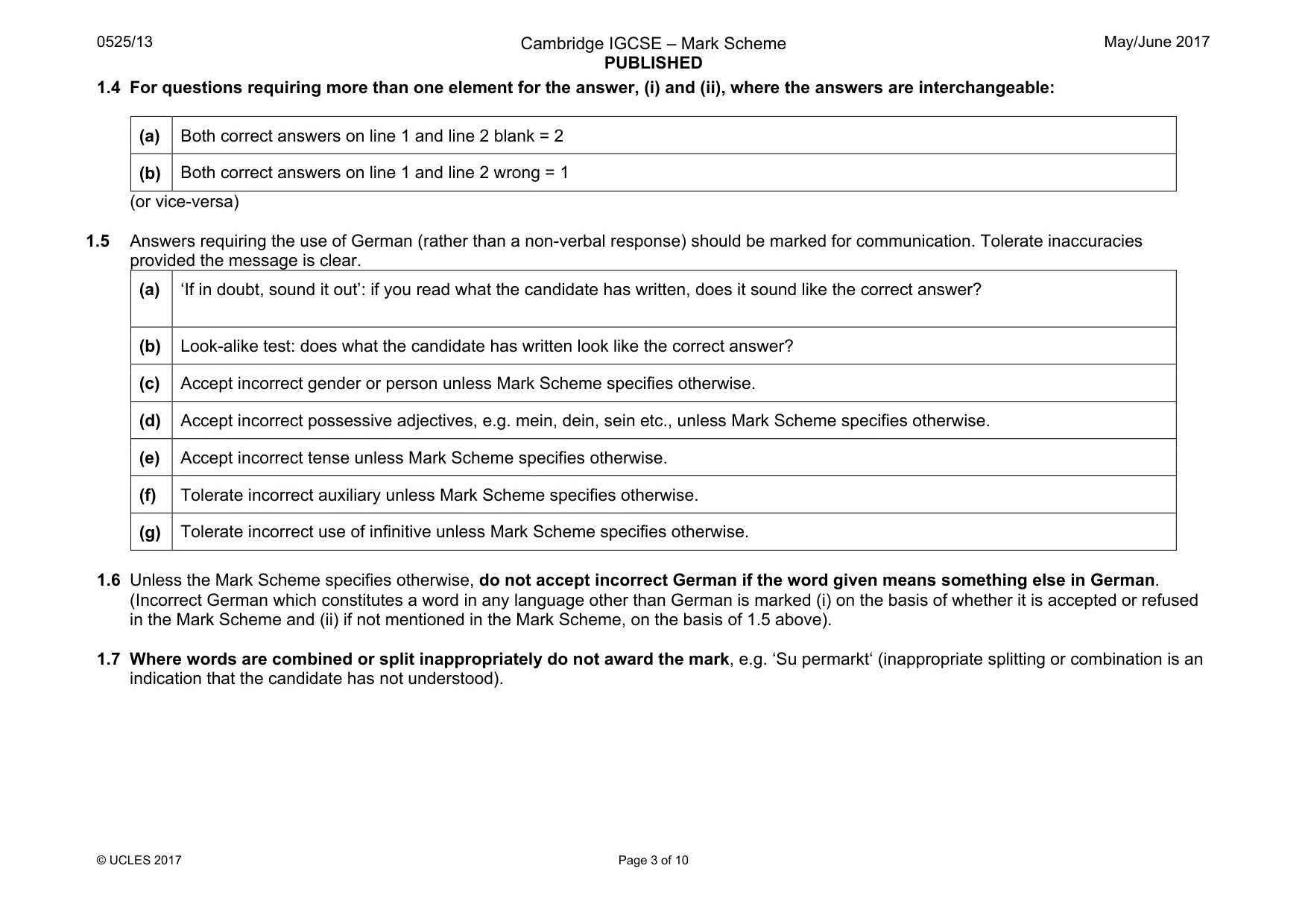
0525/13 Cambridge IGCSE – Mark Scheme PUBLISHED May/June 2017 © UCLES 2017 Page 3 of 10 1.4 For questions requiring more than one element for the answer, (i) and (ii), where the answers are interchangeable: (a) Both correct answers on line 1 and line 2 blank = 2 (b) Both correct answers on line 1 and line 2 wrong = 1 (or vice-versa) 1.5 Answers requiring the use of German (rather than a non-verbal response) should be marked for communication. Tolerate inaccuracies provided the message is clear. (a) ‘If in doubt, sound it out’: if you read what the candidate has written, does it sound like the correct answer? (b) Look-alike test: does what the candidate has written look like the correct answer? (c) Accept incorrect gender or person unless Mark Scheme specifies otherwise. (d) Accept incorrect possessive adjectives, e.g. mein, dein, sein etc., unless Mark Scheme specifies otherwise. (e) Accept incorrect tense unless Mark Scheme specifies otherwise. (f) Tolerate incorrect auxiliary unless Mark Scheme specifies otherwise. (g) Tolerate incorrect use of infinitive unless Mark Scheme specifies otherwise. 1.6 Unless the Mark Scheme specifies otherwise, do not accept incorrect German if the word given means something else in German. (Incorrect German which constitutes a word in any language other than German is marked (i) on the basis of whether it is accepted or refused in the Mark Scheme and (ii) if not mentioned in the Mark Scheme, on the basis of 1.5 above). 1.7 Where words are combined or split inappropriately do not award the mark, e.g. ‘Su permarkt‘ (inappropriate splitting or combination is an indication that the candidate has not understood).
Mark scheme, page 4
0525/13 Cambridge IGCSE – Mark Scheme PUBLISHED May/June 2017 © UCLES 2017 Page 4 of 10 1.8 Annotation used in the Mark Scheme: (a) INV = invalidation and is used when additional material included by the candidate is judged to invalidate an otherwise correct answer thus preventing him/her from scoring the mark (INV = 0). (b) tc = ‘tout court’ and means that on its own the material is not sufficient to score the mark. (c) HA = harmless additional material which in conjunction with the correct answer does not prevent the candidate from scoring the mark. (d) BOD = benefit of the doubt and is used to indicate material considered by the Examiner and judged to be more correct than incorrect: the benefit of the doubt is given to the candidate and the mark is awarded. 1.9 No response and ‘0’ marks Award NR (No Response): • If there is nothing written at all in the answer space or • If there is only a comment which does not in any way relate to the question being asked (e.g. ‘can’t do’ or ‘don’t know’), or • If there is only a mark which isn’t an attempt at the question (e.g. a dash, a question mark). Award 0: If there is any attempt that earns no credit. This could, for example, include the candidate copying all or some of the question, or any working that does not earn any marks, whether crossed out or not.
Mark scheme, page 5
0525/13 Cambridge IGCSE – Mark Scheme PUBLISHED May/June 2017 © UCLES 2017 Page 5 of 10 1.10 Extra material: It is the candidate’s responsibility to answer questions in such a way as to demonstrate to the Examiner that s/he has understood the recorded material. Where candidates introduce extra, irrelevant material to an otherwise correct answer the danger is that the Examiner is being forced to ‘choose’ the correct answer and s/he cannot be certain that the candidate has shown understanding. Where the Examiner is put in this position the mark cannot be awarded. The Detailed Mark Scheme cannot cover all eventualities and where specific instructions are not provided, Examiners must check the transcript to ensure the correct elements which would qualify for the mark are not contradicted or distorted by any extra material. The following, general, rules should be applied: (a) Extra material, mentioned in the Mark Scheme, which reinforces the correct answer or in itself constitutes an alternative correct answer: this is acceptable and is not penalised (b) Extra material which constitutes an alternative answer, but which is not explicitly mentioned in the Mark Scheme: the Examiner needs to decide, by consulting the transcript and the Team Leader if necessary, whether the alternative answer constitutes: (i) an alternative correct answer, in which case this falls into category (a) and the answer should be rewarded (ii) or an answer which on its own would be refused, in which case this falls into category (c) and the answer should be refused (c) Extra material which constitutes an alternative answer specifically refused in the Mark Scheme: this puts the Examiner in the position of having to ‘choose’ which is the candidate’s ‘final’ answer – the Examiner cannot be sure what the candidate has understood – and the mark cannot be awarded (d) Extra material which distorts or contradicts the correct answer: this affects communication – the Examiner cannot be sure what the candidate has understood – and the mark cannot be awarded (e) Extra material introduced by the candidate and which does not feature in the original transcript: this affects communication – the Examiner cannot be sure what the candidate has understood – and the mark cannot be awarded. It can sometimes be difficult to draw the line between what is a deduction made by an able candidate on the basis of what they have heard and pure guesswork. Therefore where a particular answer is not covered in the Mark Scheme, Examiners should consult their Team Leader
Mark scheme, page 6
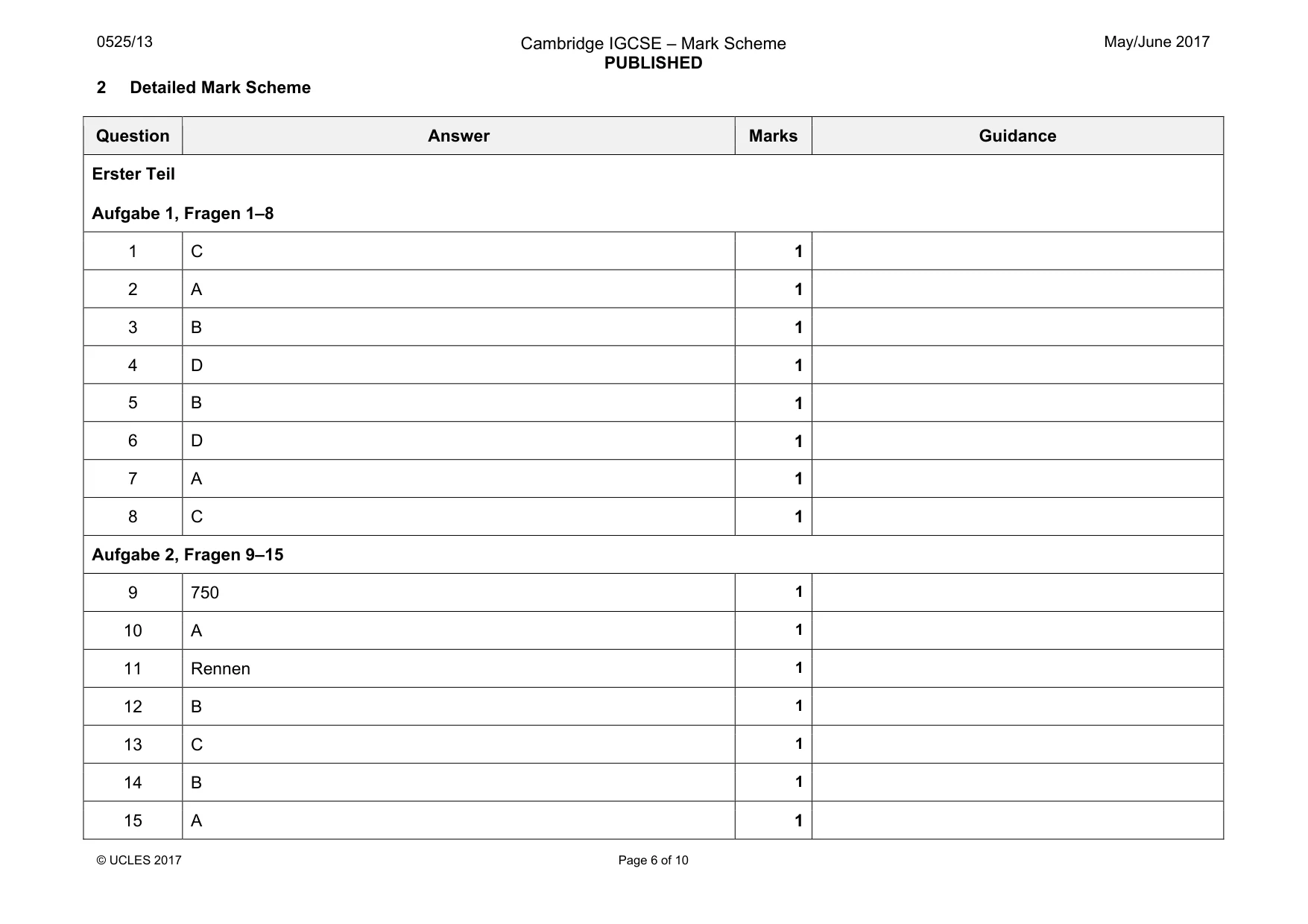
0525/13 Cambridge IGCSE – Mark Scheme PUBLISHED May/June 2017 © UCLES 2017 Page 6 of 10 2 Detailed Mark Scheme Question Answer Marks Guidance Erster Teil Aufgabe 1, Fragen 1–8 1 C 1 2 A 1 3 B 1 4 D 1 5 B 1 6 D 1 7 A 1 8 C 1 Aufgabe 2, Fragen 9–15 9 750 1 10 A 1 11 Rennen 1 12 B 1 13 C 1 14 B 1 15 A 1
Mark scheme, page 7
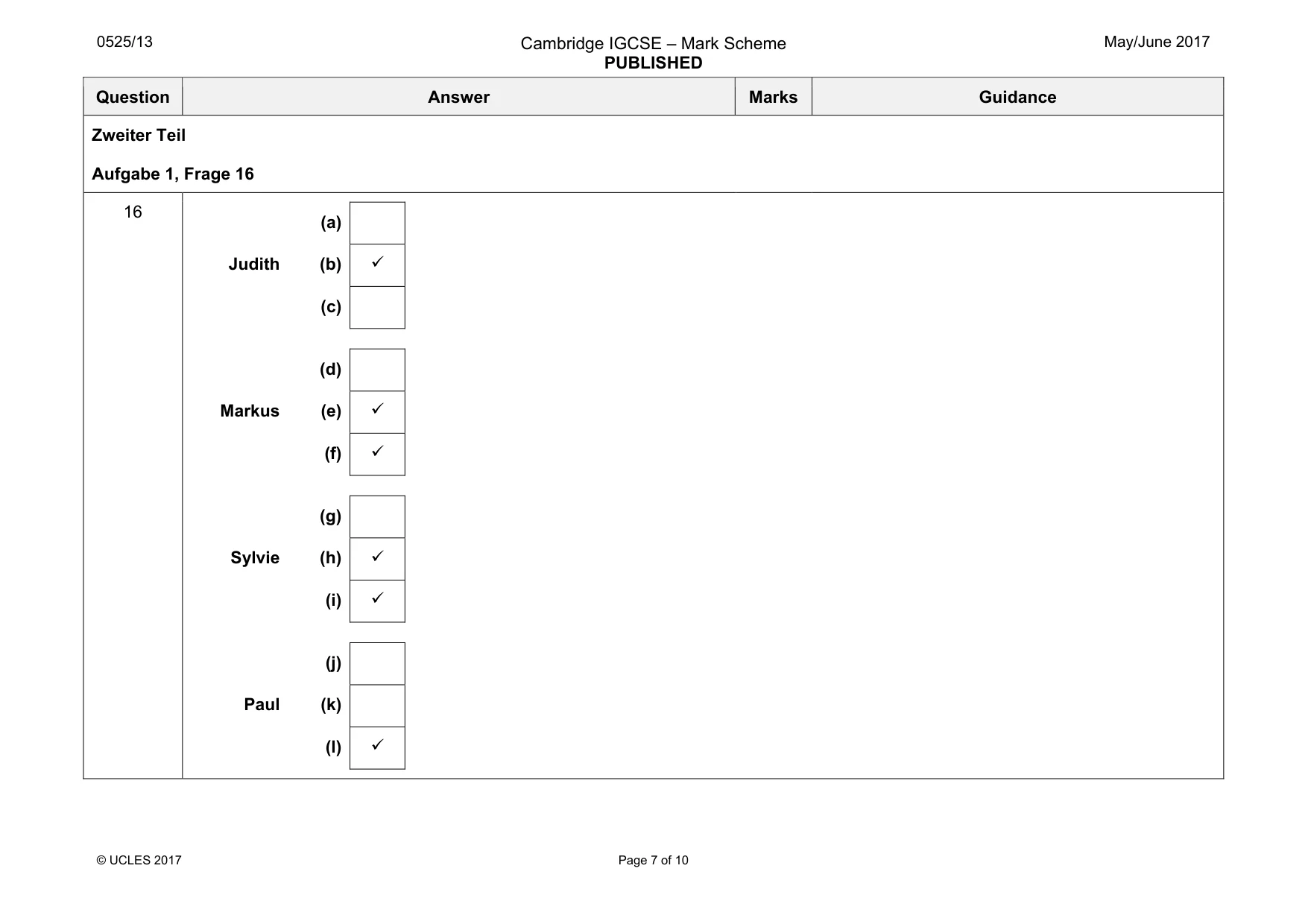
0525/13 Cambridge IGCSE – Mark Scheme PUBLISHED May/June 2017 © UCLES 2017 Page 7 of 10 Question Answer Marks Guidance Zweiter Teil Aufgabe 1, Frage 16 16 (a) Judith (b) 9 (c) (d) Markus (e) 9 (f) 9 (g) Sylvie (h) 9 (i) 9 (j) Paul (k) (l) 9
Mark scheme, page 8
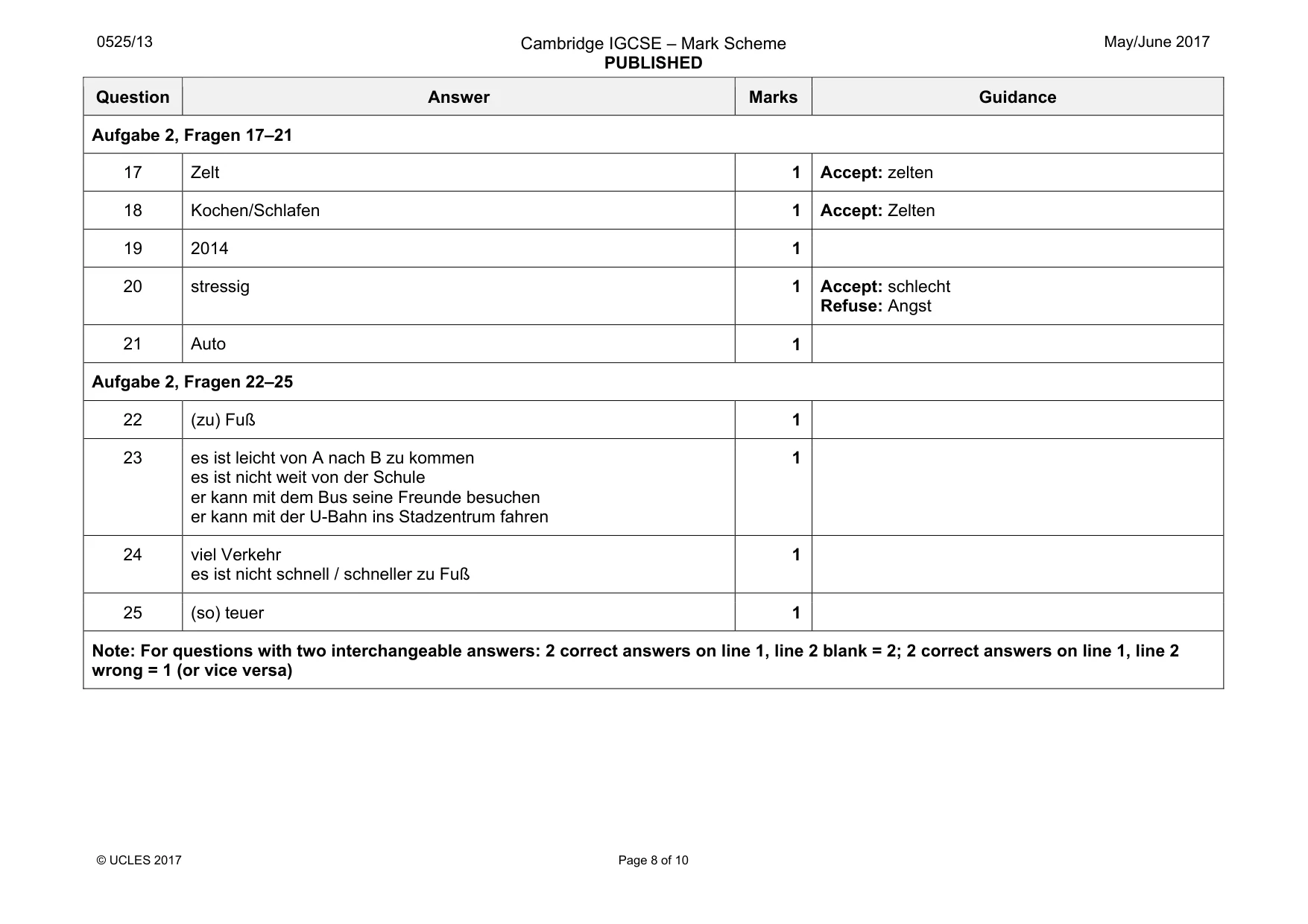
0525/13 Cambridge IGCSE – Mark Scheme PUBLISHED May/June 2017 © UCLES 2017 Page 8 of 10 Question Answer Marks Guidance Aufgabe 2, Fragen 17–21 17 Zelt 1 Accept: zelten 18 Kochen/Schlafen 1 Accept: Zelten 19 2014 1 20 stressig 1 Accept: schlecht Refuse: Angst 21 Auto 1 Aufgabe 2, Fragen 22–25 22 (zu) Fuß 1 23 es ist leicht von A nach B zu kommen es ist nicht weit von der Schule er kann mit dem Bus seine Freunde besuchen er kann mit der U-Bahn ins Stadzentrum fahren 1 24 viel Verkehr es ist nicht schnell / schneller zu Fuß 1 25 (so) teuer 1 Note: For questions with two interchangeable answers: 2 correct answers on line 1, line 2 blank = 2; 2 correct answers on line 1, line 2 wrong = 1 (or vice versa)
Mark scheme, page 9
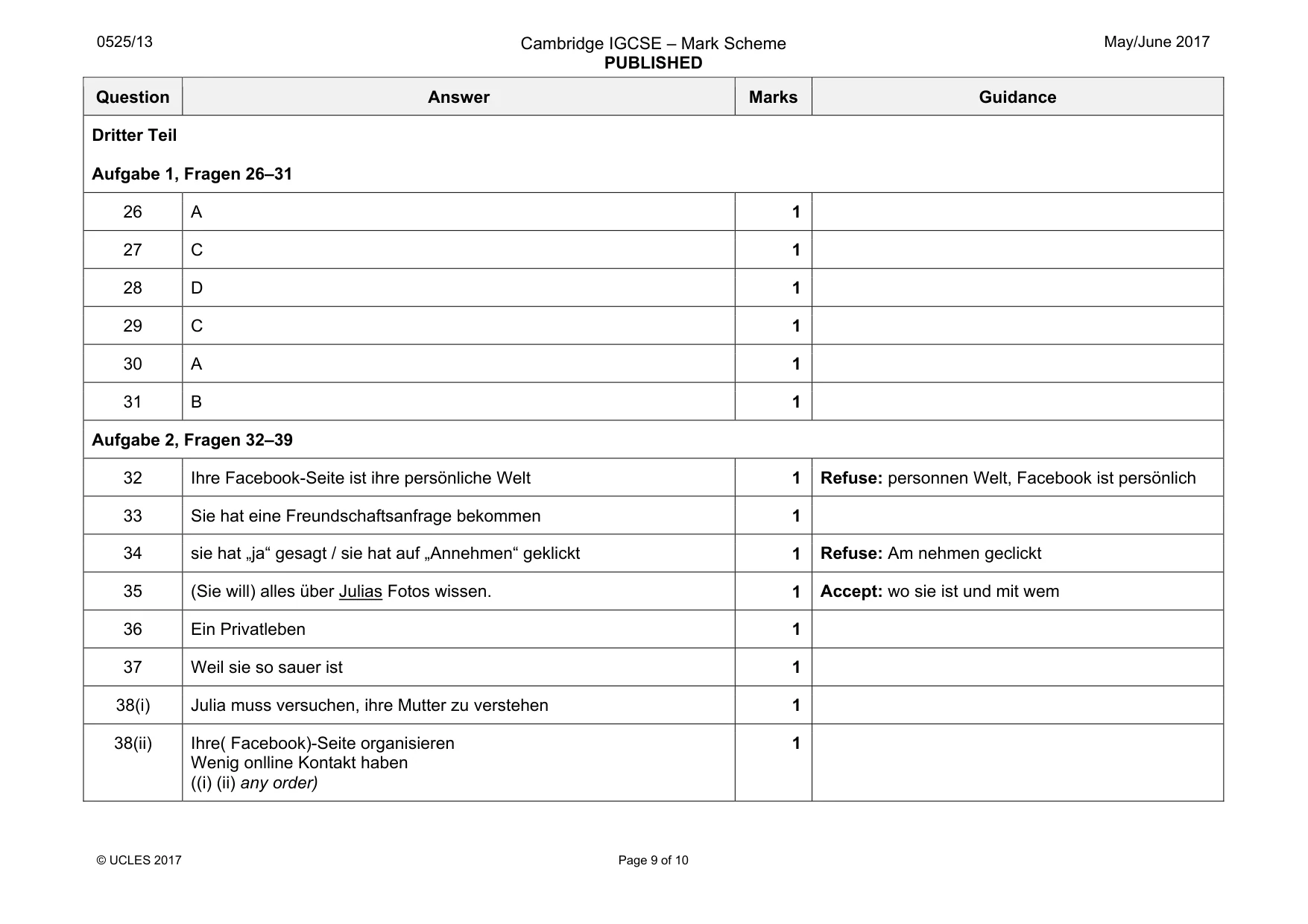
0525/13 Cambridge IGCSE – Mark Scheme PUBLISHED May/June 2017 © UCLES 2017 Page 9 of 10 Question Answer Marks Guidance Dritter Teil Aufgabe 1, Fragen 26–31 26 A 1 27 C 1 28 D 1 29 C 1 30 A 1 31 B 1 Aufgabe 2, Fragen 32–39 32 Ihre Facebook-Seite ist ihre persönliche Welt 1 Refuse: personnen Welt, Facebook ist persönlich 33 Sie hat eine Freundschaftsanfrage bekommen 1 34 sie hat „ja“ gesagt / sie hat auf „Annehmen“ geklickt 1 Refuse: Am nehmen geclickt 35 (Sie will) alles über Julias Fotos wissen. 1 Accept: wo sie ist und mit wem 36 Ein Privatleben 1 37 Weil sie so sauer ist 1 38(i) Julia muss versuchen, ihre Mutter zu verstehen 1 38(ii) Ihre( Facebook)-Seite organisieren Wenig onlline Kontakt haben ((i) (ii) any order) 1
Mark scheme, page 10
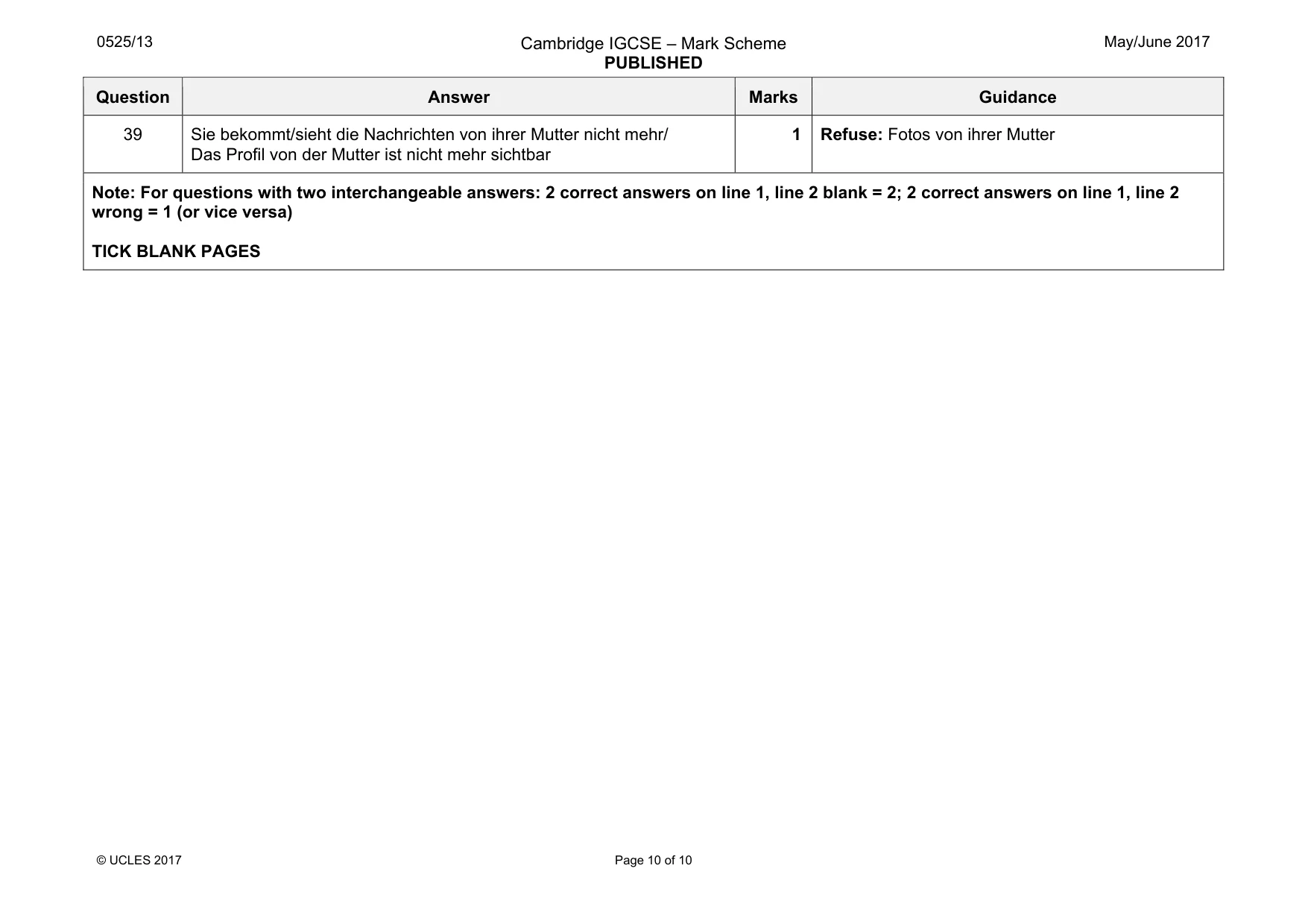
0525/13 Cambridge IGCSE – Mark Scheme PUBLISHED May/June 2017 © UCLES 2017 Page 10 of 10 Question Answer Marks Guidance 39 Sie bekommt/sieht die Nachrichten von ihrer Mutter nicht mehr/ Das Profil von der Mutter ist nicht mehr sichtbar 1 Refuse: Fotos von ihrer Mutter Note: For questions with two interchangeable answers: 2 correct answers on line 1, line 2 blank = 2; 2 correct answers on line 1, line 2 wrong = 1 (or vice versa) TICK BLANK PAGES
What you needed in this session
Cambridge’s own grade thresholds for 2017 May/June, Paper 1 · Variant 3. A higher threshold means an easier paper — the bar moves with how the cohort did.