Cambridge IGCSE Enterprise 0454 — 2024 May/June Paper 1 · Variant 2
0454/12/M/J/24 · 100 marks · ≈113 min
The question paper and its mark scheme, free to read here and free to download. This is Cambridge’s own paper, exactly as it was sat.
Question paper16 pages









Mark scheme25 pages
Answers below. Sit the paper first if you are practising.
Paper as text
Question paper, page 1
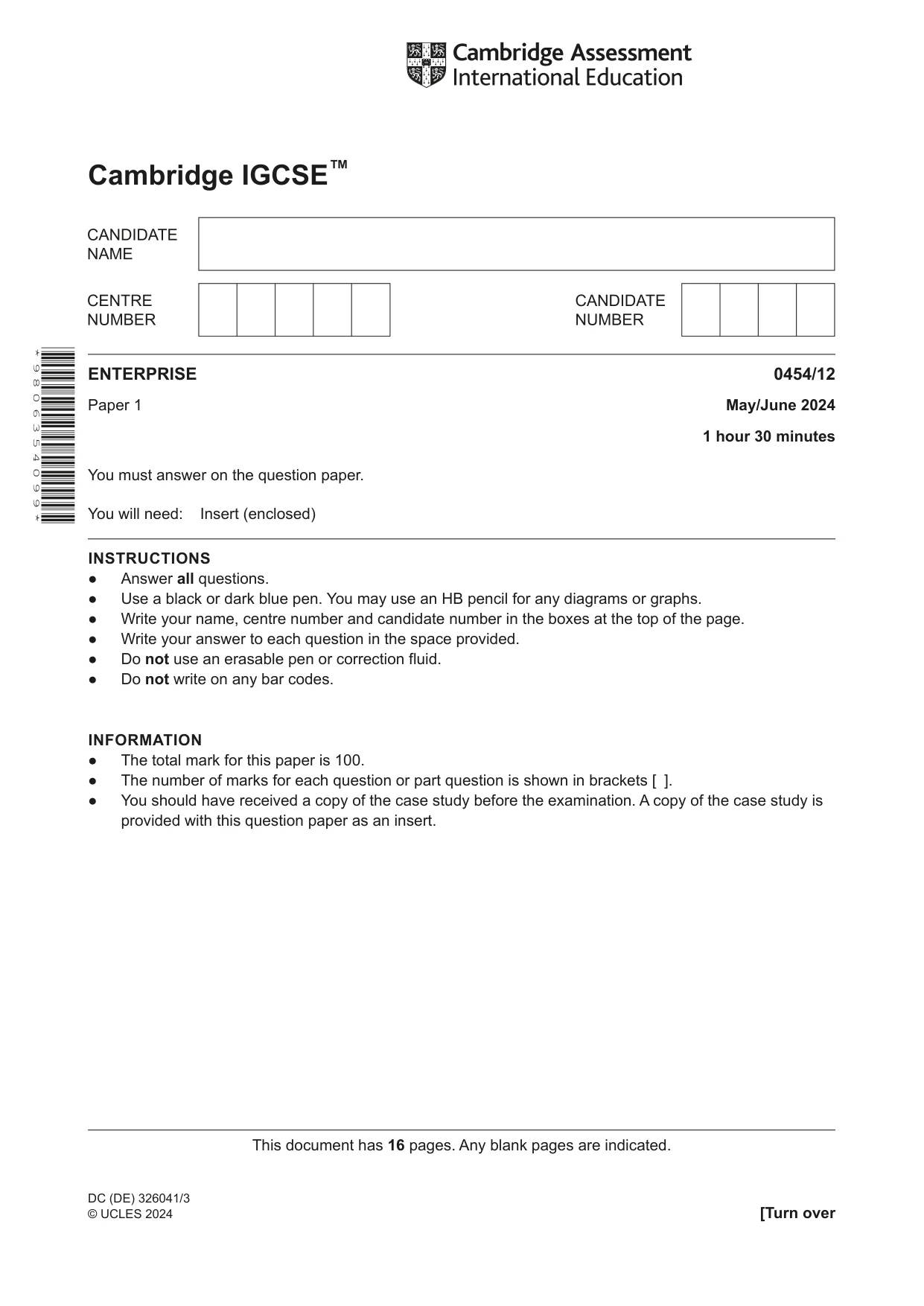
This document has 16 pages. Any blank pages are indicated. [Turn over Cambridge IGCSE™ * 9 8 0 6 3 5 4 0 9 9 * ENTERPRISE 0454/12 Paper 1 May/June 2024 1 hour 30 minutes You must answer on the question paper. You will need: Insert (enclosed) INSTRUCTIONS ● Answer all questions. ● Use a black or dark blue pen. You may use an HB pencil for any diagrams or graphs. ● Write your name, centre number and candidate number in the boxes at the top of the page. ● Write your answer to each question in the space provided. ● Do not use an erasable pen or correction fluid. ● Do not write on any bar codes. INFORMATION ● The total mark for this paper is 100. ● The number of marks for each question or part question is shown in brackets [ ]. ● You should have received a copy of the case study before the examination. A copy of the case study is provided with this question paper as an insert. DC (DE) 326041/3 © UCLES 2024
Question paper, page 2
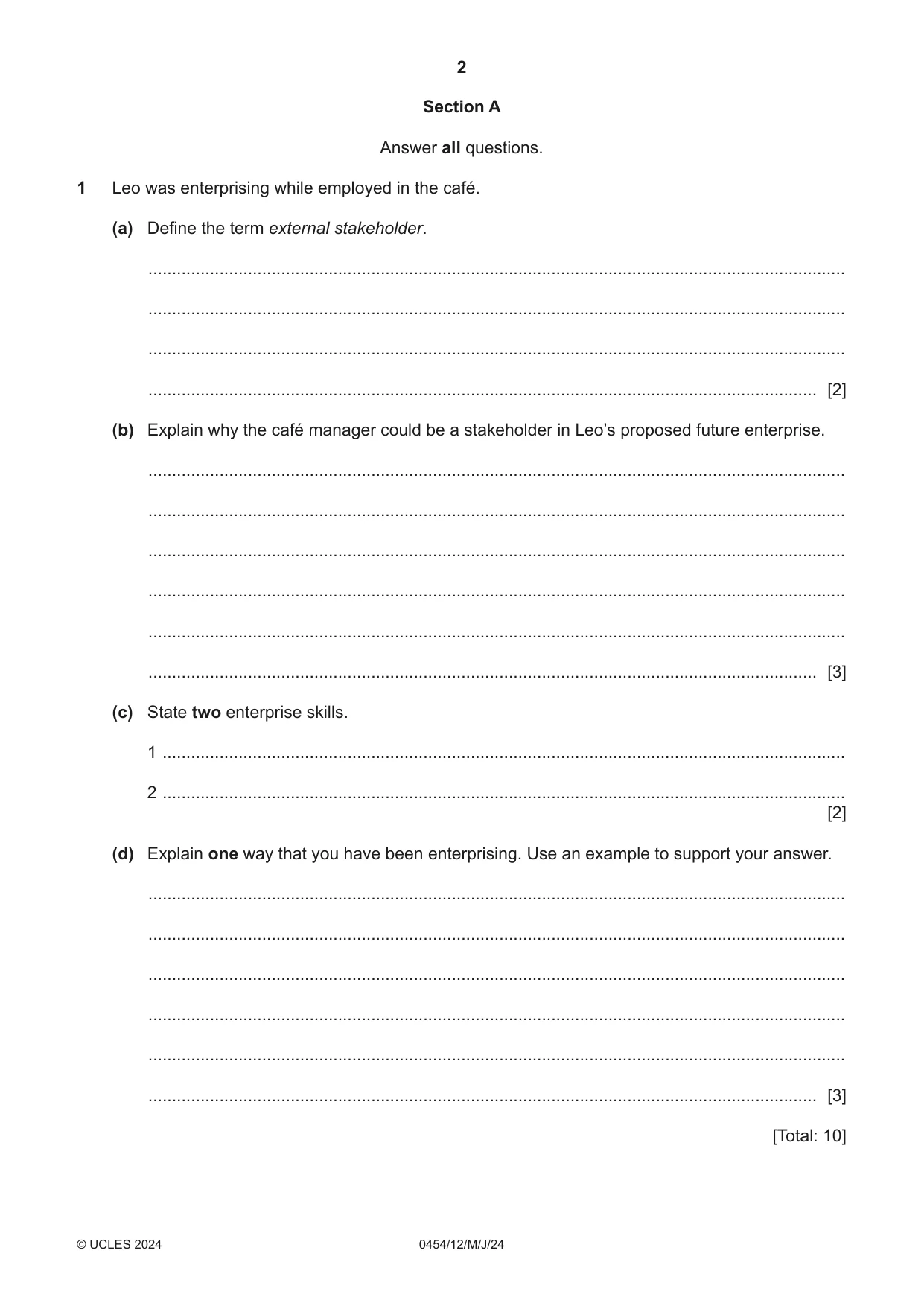
2 0454/12/M/J/24 © UCLES 2024 Section A Answer all questions. 1 Leo was enterprising while employed in the café. (a) Define the term external stakeholder. … … … … [2] (b) Explain why the café manager could be a stakeholder in Leo’s proposed future enterprise. … … … … … … [3] (c) State two enterprise skills. 1 … 2 … [2] (d) Explain one way that you have been enterprising. Use an example to support your answer. … … … … … … [3] [Total: 10]
Question paper, page 3
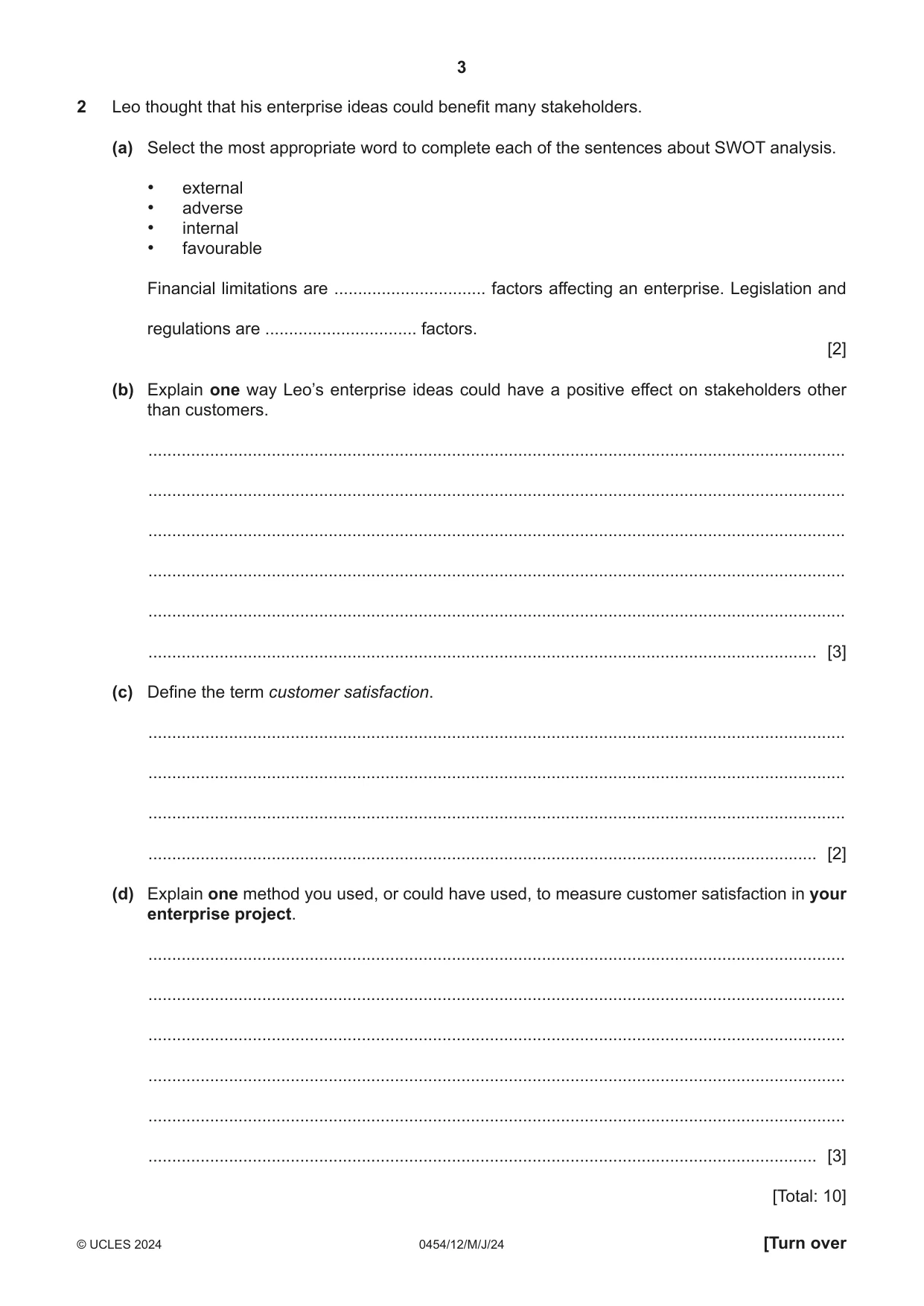
3 0454/12/M/J/24 © UCLES 2024 [Turn over 2 Leo thought that his enterprise ideas could benefit many stakeholders. (a) Select the most appropriate word to complete each of the sentences about SWOT analysis. • external • adverse • internal • favourable Financial limitations are … factors affecting an enterprise. Legislation and regulations are … factors. [2] (b) Explain one way Leo’s enterprise ideas could have a positive effect on stakeholders other than customers. … … … … … … [3] (c) Define the term customer satisfaction. … … … … [2] (d) Explain one method you used, or could have used, to measure customer satisfaction in your enterprise project. … … … … … … [3] [Total: 10]
Question paper, page 4
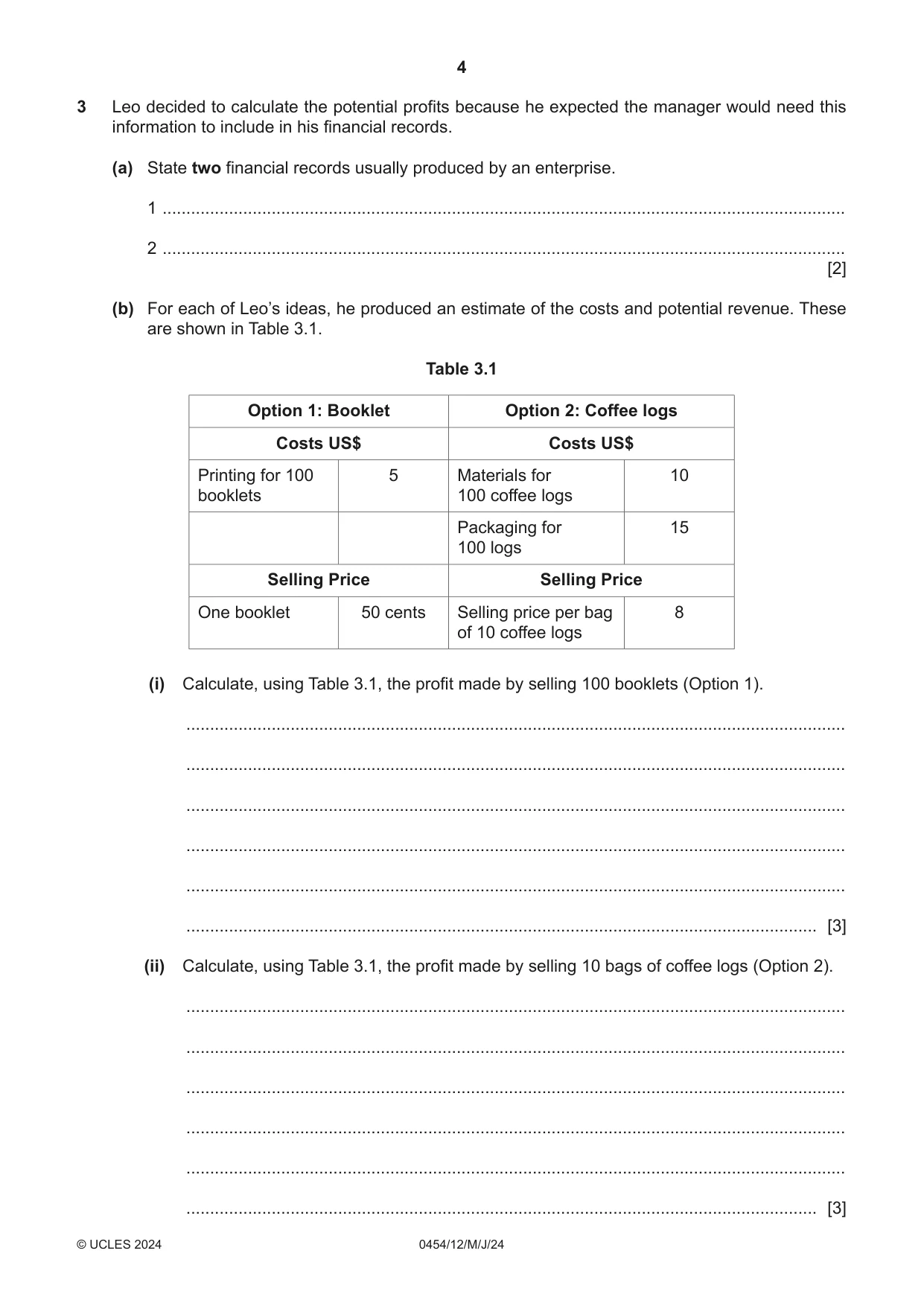
4 0454/12/M/J/24 © UCLES 2024 3 Leo decided to calculate the potential profits because he expected the manager would need this information to include in his financial records. (a) State two financial records usually produced by an enterprise. 1 … 2 … [2] (b) For each of Leo’s ideas, he produced an estimate of the costs and potential revenue. These are shown in Table 3.1. Table 3.1 Option 1: Booklet Option 2: Coffee logs Costs US$ Costs US$ Printing for 100 booklets 5 Materials for 100 coffee logs 10 Packaging for 100 logs 15 Selling Price Selling Price One booklet 50 cents Selling price per bag of 10 coffee logs 8 (i) Calculate, using Table 3.1, the profit made by selling 100 booklets (Option 1). … … … … … … [3] (ii) Calculate, using Table 3.1, the profit made by selling 10 bags of coffee logs (Option 2). … … … … … … [3]
Question paper, page 5
5 0454/12/M/J/24 © UCLES 2024 [Turn over (iii) Calculate the difference in profit between Option 1 and Option 2. … … … … [2] [Total: 10]
Question paper, page 6
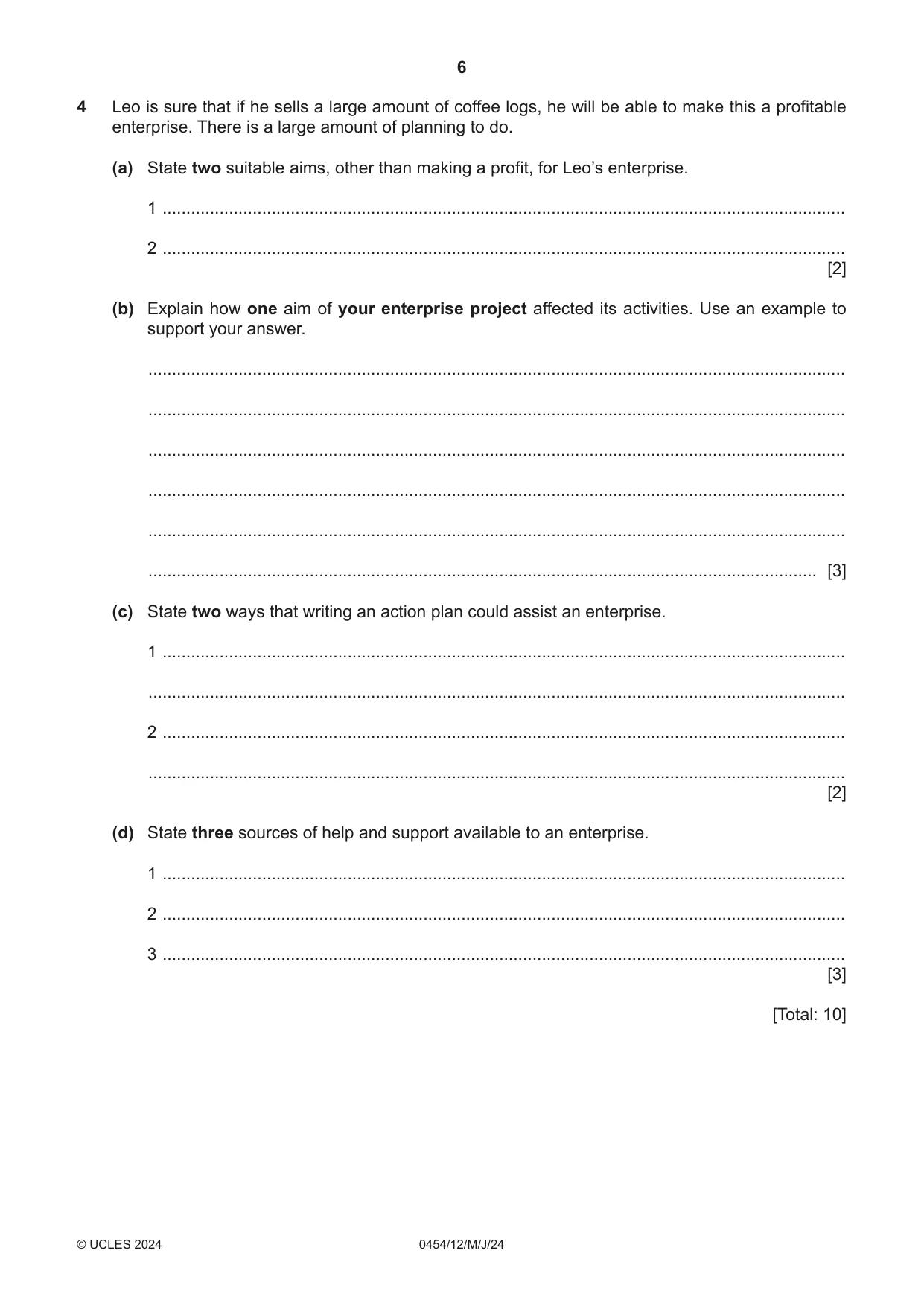
6 0454/12/M/J/24 © UCLES 2024 4 Leo is sure that if he sells a large amount of coffee logs, he will be able to make this a profitable enterprise. There is a large amount of planning to do. (a) State two suitable aims, other than making a profit, for Leo’s enterprise. 1 … 2 … [2] (b) Explain how one aim of your enterprise project affected its activities. Use an example to support your answer. … … … … … … [3] (c) State two ways that writing an action plan could assist an enterprise. 1 … … 2 … … [2] (d) State three sources of help and support available to an enterprise. 1 … 2 … 3 … [3] [Total: 10]
Question paper, page 7
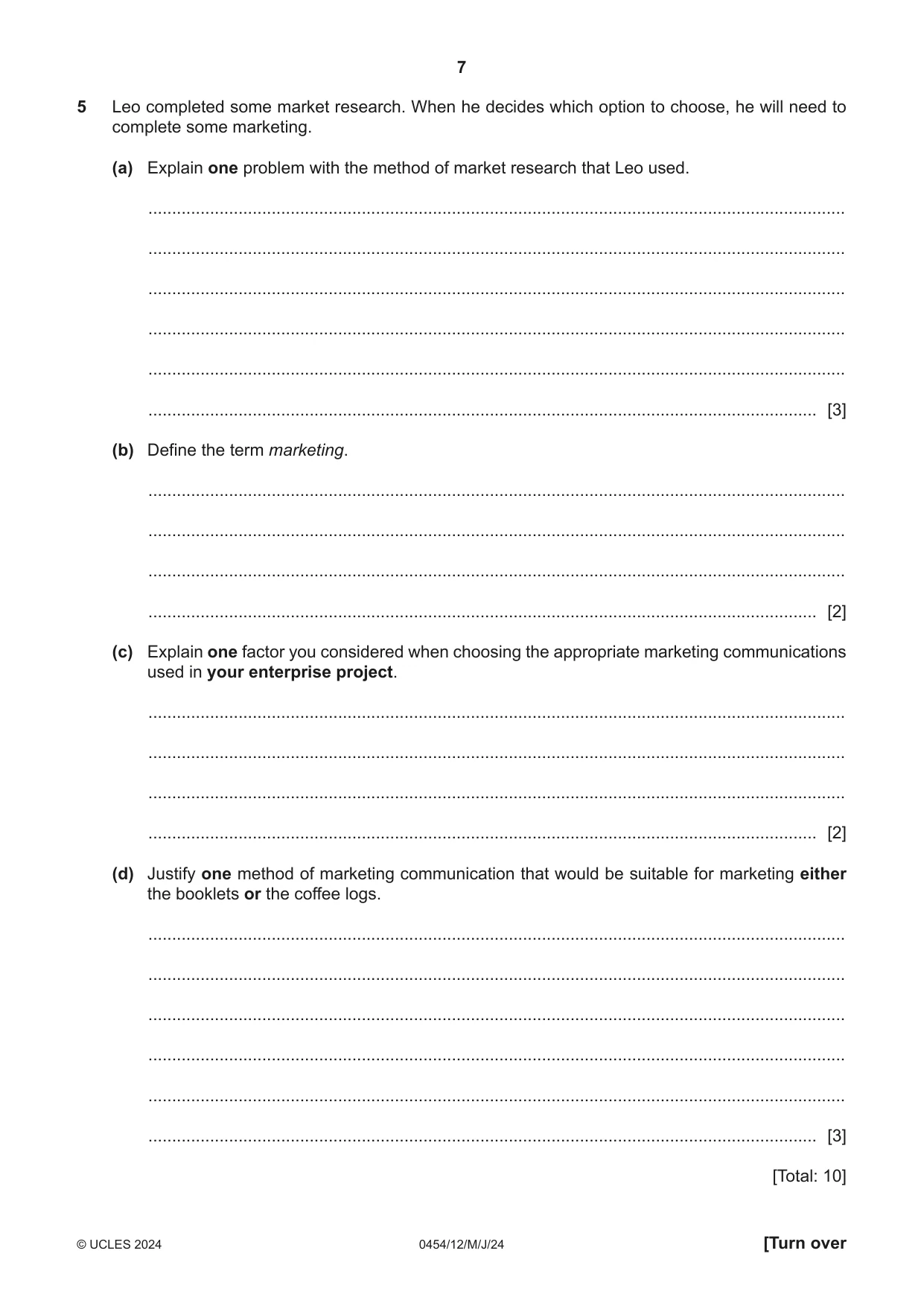
7 0454/12/M/J/24 © UCLES 2024 [Turn over 5 Leo completed some market research. When he decides which option to choose, he will need to complete some marketing. (a) Explain one problem with the method of market research that Leo used. … … … … … … [3] (b) Define the term marketing. … … … … [2] (c) Explain one factor you considered when choosing the appropriate marketing communications used in your enterprise project. … … … … [2] (d) Justify one method of marketing communication that would be suitable for marketing either the booklets or the coffee logs. … … … … … … [3] [Total: 10]
Question paper, page 8
8 0454/12/M/J/24 © UCLES 2024 Section B Answer all questions. 6 (a) Leo is writing a proposal for the booklet idea. He intends to use this proposal when explaining the booklet idea to the café manager. Analyse the importance of careful planning for the success of Leo’s meeting with the café manager. You should consider two reasons in your answer. … … … … … … … … … … … … … … … … … … … … … … … [10]
Question paper, page 9
9 0454/12/M/J/24 © UCLES 2024 [Turn over (b) Leo has two enterprise ideas: Option 1: producing booklets for the café to sell Option 2: setting up his own enterprise selling coffee logs. Evaluate which of these ideas you would recommend Leo should choose. Justify the option chosen, explaining why you rejected the other option. … … … … … … … … … … … … … … … … … … … … … … … …
Question paper, page 10
10 0454/12/M/J/24 © UCLES 2024 … … … … … … … … … … … … … … … … … … … … … … … … … … … [15] [Total: 25]
Question paper, page 11
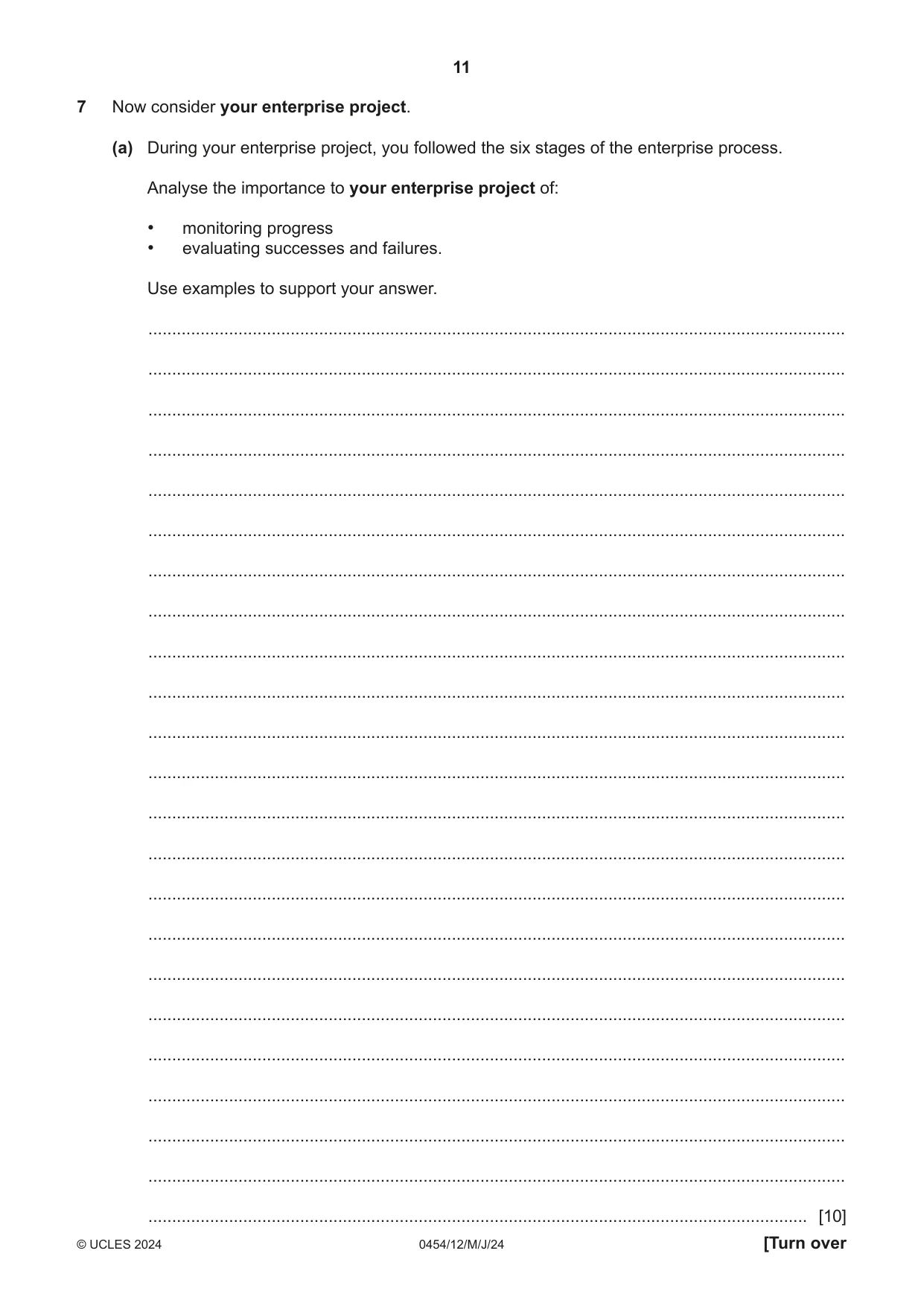
11 0454/12/M/J/24 © UCLES 2024 [Turn over 7 Now consider your enterprise project. (a) During your enterprise project, you followed the six stages of the enterprise process. Analyse the importance to your enterprise project of: • monitoring progress • evaluating successes and failures. Use examples to support your answer. … … … … … … … … … … … … … … … … … … … … … … … [10]
Question paper, page 12
12 0454/12/M/J/24 © UCLES 2024 (b) There are many sources of finance available to enterprises. Evaluate the potential impact on your enterprise project of two sources of finance you used, or could have used. Use examples to support your answer. … … … … … … … … … … … … … … … … … … … … … … … … … …
Question paper, page 13
13 0454/12/M/J/24 © UCLES 2024 … … … … … … … … … … … … … … … … … … … … … … … … … … … [15] [Total: 25]
Question paper, page 14
14 0454/12/M/J/24 © UCLES 2024 BLANK PAGE
Question paper, page 15
15 0454/12/M/J/24 © UCLES 2024 BLANK PAGE
Question paper, page 16
16 0454/12/M/J/24 © UCLES 2024 Permission to reproduce items where third-party owned material protected by copyright is included has been sought and cleared where possible. Every reasonable effort has been made by the publisher (UCLES) to trace copyright holders, but if any items requiring clearance have unwittingly been included, the publisher will be pleased to make amends at the earliest possible opportunity. To avoid the issue of disclosure of answer-related information to candidates, all copyright acknowledgements are reproduced online in the Cambridge Assessment International Education Copyright Acknowledgements Booklet. This is produced for each series of examinations and is freely available to download at www.cambridgeinternational.org after the live examination series. Cambridge Assessment International Education is part of Cambridge Assessment. Cambridge Assessment is the brand name of the University of Cambridge Local Examinations Syndicate (UCLES), which is a department of the University of Cambridge. BLANK PAGE
Mark scheme, page 1
This document consists of 25 printed pages. © Cambridge University Press & Assessment 2024 [Turn over Cambridge IGCSE™ ENTERPRISE 0454/12 Paper 1 Case Study May/June 2024 MARK SCHEME Maximum Mark: 100 Published This mark scheme is published as an aid to teachers and candidates, to indicate the requirements of the examination. It shows the basis on which Examiners were instructed to award marks. It does not indicate the details of the discussions that took place at an Examiners’ meeting before marking began, which would have considered the acceptability of alternative answers. Mark schemes should be read in conjunction with the question paper and the Principal Examiner Report for Teachers. Cambridge International will not enter into discussions about these mark schemes. Cambridge International is publishing the mark schemes for the May/June 2024 series for most Cambridge IGCSE, Cambridge International A and AS Level and Cambridge Pre-U components, and some Cambridge O Level components.
Mark scheme, page 2
0454/12 Cambridge IGCSE – Mark Scheme PUBLISHED May/June 2024 © Cambridge University Press & Assessment 2024 Page 2 of 25 Generic Marking Principles These general marking principles must be applied by all examiners when marking candidate answers. They should be applied alongside the specific content of the mark scheme or generic level descriptions for a question. Each question paper and mark scheme will also comply with these marking principles. GENERIC MARKING PRINCIPLE 1: Marks must be awarded in line with: the specific content of the mark scheme or the generic level descriptors for the question the specific skills defined in the mark scheme or in the generic level descriptors for the question the standard of response required by a candidate as exemplified by the standardisation scripts. GENERIC MARKING PRINCIPLE 2: Marks awarded are always whole marks (not half marks, or other fractions). GENERIC MARKING PRINCIPLE 3: Marks must be awarded positively: marks are awarded for correct/valid answers, as defined in the mark scheme. However, credit is given for valid answers which go beyond the scope of the syllabus and mark scheme, referring to your Team Leader as appropriate marks are awarded when candidates clearly demonstrate what they know and can do marks are not deducted for errors marks are not deducted for omissions answers should only be judged on the quality of spelling, punctuation and grammar when these features are specifically assessed by the question as indicated by the mark scheme. The meaning, however, should be unambiguous. GENERIC MARKING PRINCIPLE 4: Rules must be applied consistently, e.g. in situations where candidates have not followed instructions or in the application of generic level descriptors.
Mark scheme, page 3
0454/12 Cambridge IGCSE – Mark Scheme PUBLISHED May/June 2024 © Cambridge University Press & Assessment 2024 Page 3 of 25 GENERIC MARKING PRINCIPLE 5: Marks should be awarded using the full range of marks defined in the mark scheme for the question (however; the use of the full mark range may be limited according to the quality of the candidate responses seen). GENERIC MARKING PRINCIPLE 6: Marks awarded are based solely on the requirements as defined in the mark scheme. Marks should not be awarded with grade thresholds or grade descriptors in mind.
Mark scheme, page 4
0454/12 Cambridge IGCSE – Mark Scheme PUBLISHED May/June 2024 © Cambridge University Press & Assessment 2024 Page 4 of 25 Social Science-Specific Marking Principles (for point-based marking) 1 Components using point-based marking: Point marking is often used to reward knowledge, understanding and application of skills. We give credit where the candidate’s answer shows relevant knowledge, understanding and application of skills in answering the question. We do not give credit where the answer shows confusion. From this it follows that we: a DO credit answers which are worded differently from the mark scheme if they clearly convey the same meaning (unless the mark scheme requires a specific term) b DO credit alternative answers/examples which are not written in the mark scheme if they are correct c DO credit answers where candidates give more than one correct answer in one prompt/numbered/scaffolded space where extended writing is required rather than list-type answers. For example, questions that require n reasons (e.g. State two reasons …). d DO NOT credit answers simply for using a ‘key term’ unless that is all that is required. (Check for evidence it is understood and not used wrongly.) e DO NOT credit answers which are obviously self-contradicting or trying to cover all possibilities f DO NOT give further credit for what is effectively repetition of a correct point already credited unless the language itself is being tested. This applies equally to ‘mirror statements’ (i.e. polluted/not polluted). g DO NOT require spellings to be correct, unless this is part of the test. However spellings of syllabus terms must allow for clear and unambiguous separation from other syllabus terms with which they may be confused (e.g. Corrasion/Corrosion) 2 Presentation of mark scheme: Slashes (/) or the word ‘or’ separate alternative ways of making the same point. Semi colons (;) bullet points (•) or figures in brackets (1) separate different points. Content in the answer column in brackets is for examiner information/context to clarify the marking but is not required to earn the mark (except Accounting syllabuses where they indicate negative numbers).
Mark scheme, page 5
0454/12 Cambridge IGCSE – Mark Scheme PUBLISHED May/June 2024 © Cambridge University Press & Assessment 2024 Page 5 of 25 3 Calculation questions: The mark scheme will show the steps in the most likely correct method(s), the mark for each step, the correct answer(s) and the mark for each answer If working/explanation is considered essential for full credit, this will be indicated in the question paper and in the mark scheme. In all other instances, the correct answer to a calculation should be given full credit, even if no supporting working is shown. Where the candidate uses a valid method which is not covered by the mark scheme, award equivalent marks for reaching equivalent stages. Where an answer makes use of a candidate’s own incorrect figure from previous working, the ‘own figure rule’ applies: full marks will be given if a correct and complete method is used. Further guidance will be included in the mark scheme where necessary and any exceptions to this general principle will be noted. 4 Annotation: For point marking, ticks can be used to indicate correct answers and crosses can be used to indicate wrong answers. There is no direct relationship between ticks and marks. Ticks have no defined meaning for levels of response marking. For levels of response marking, the level awarded should be annotated on the script. Other annotations will be used by examiners as agreed during standardisation, and the meaning will be understood by all examiners who marked that paper.
Mark scheme, page 6
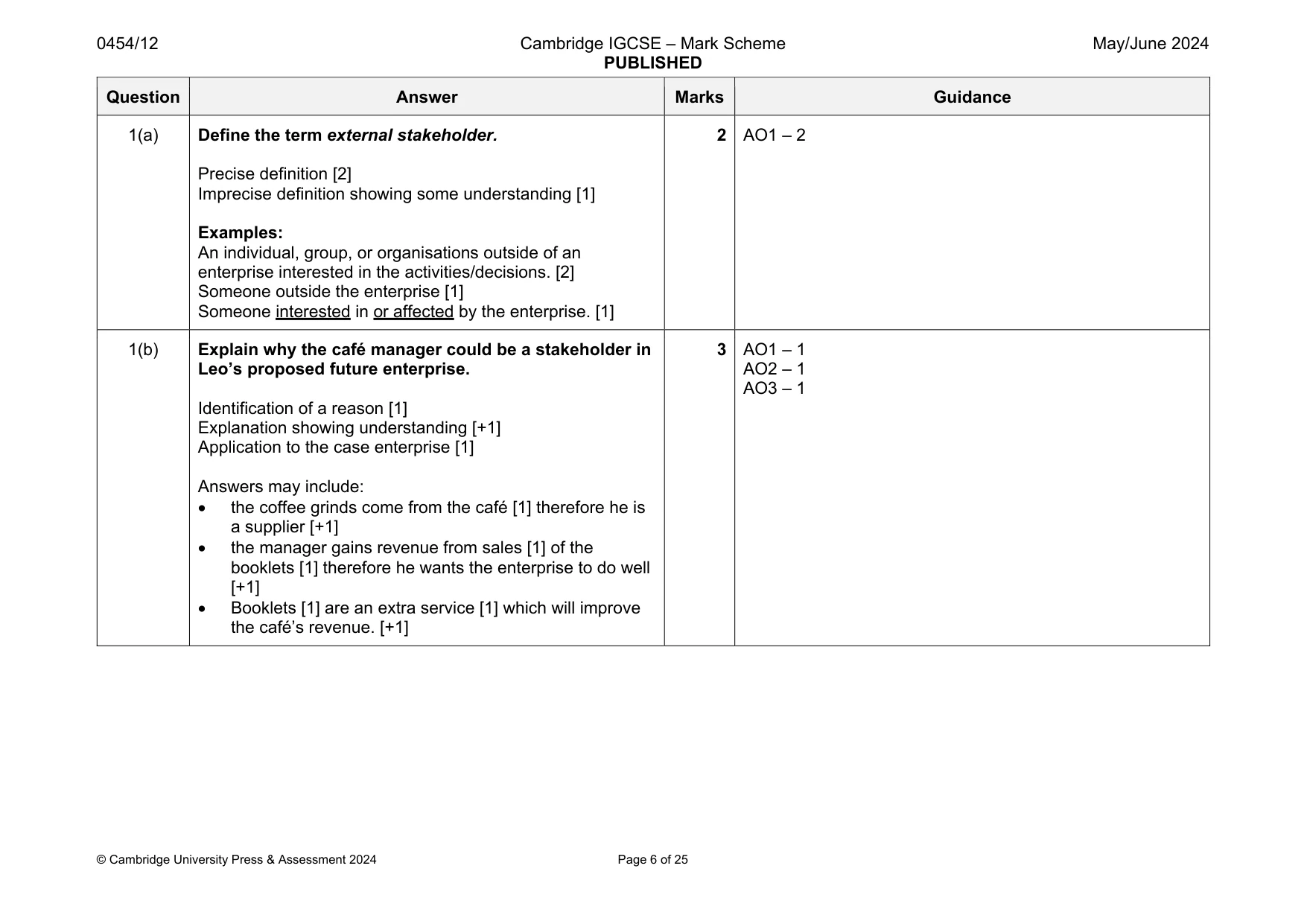
0454/12 Cambridge IGCSE – Mark Scheme PUBLISHED May/June 2024 © Cambridge University Press & Assessment 2024 Page 6 of 25 Question Answer Marks Guidance 1(a) Define the term external stakeholder. Precise definition [2] Imprecise definition showing some understanding [1] Examples: An individual, group, or organisations outside of an enterprise interested in the activities/decisions. [2] Someone outside the enterprise [1] Someone interested in or affected by the enterprise. [1] 2 AO1 – 2 1(b) Explain why the café manager could be a stakeholder in Leo’s proposed future enterprise. Identification of a reason [1] Explanation showing understanding [+1] Application to the case enterprise [1] Answers may include: the coffee grinds come from the café [1] therefore he is a supplier [+1] the manager gains revenue from sales [1] of the booklets [1] therefore he wants the enterprise to do well [+1] Booklets [1] are an extra service [1] which will improve the café’s revenue. [+1] 3 AO1 – 1 AO2 – 1 AO3 – 1
Mark scheme, page 7
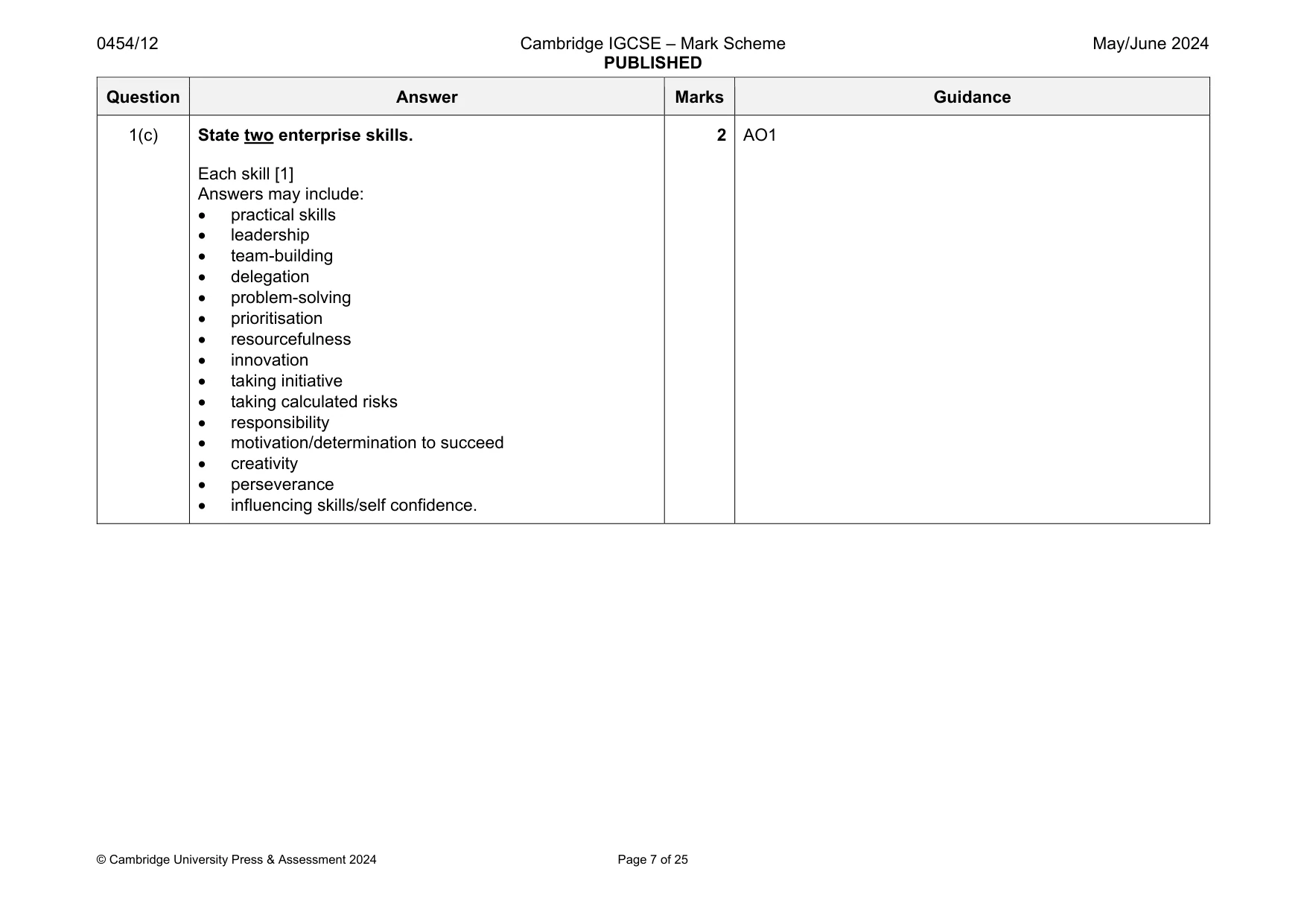
0454/12 Cambridge IGCSE – Mark Scheme PUBLISHED May/June 2024 © Cambridge University Press & Assessment 2024 Page 7 of 25 Question Answer Marks Guidance 1(c) State two enterprise skills. Each skill [1] Answers may include: practical skills leadership team-building delegation problem-solving prioritisation resourcefulness innovation taking initiative taking calculated risks responsibility motivation/determination to succeed creativity perseverance influencing skills/self confidence. 2 AO1
Mark scheme, page 8
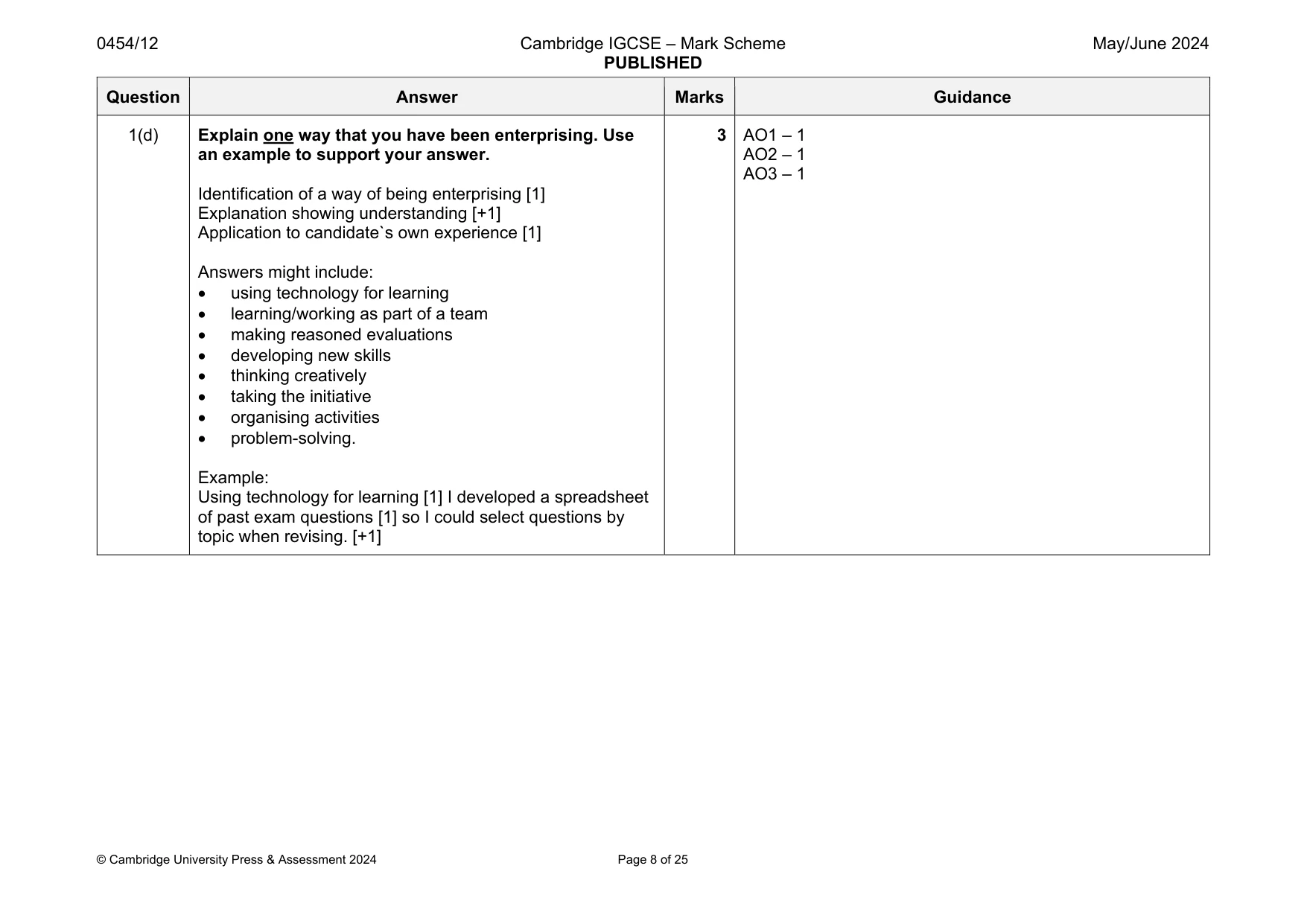
0454/12 Cambridge IGCSE – Mark Scheme PUBLISHED May/June 2024 © Cambridge University Press & Assessment 2024 Page 8 of 25 Question Answer Marks Guidance 1(d) Explain one way that you have been enterprising. Use an example to support your answer. Identification of a way of being enterprising [1] Explanation showing understanding [+1] Application to candidate`s own experience [1] Answers might include: using technology for learning learning/working as part of a team making reasoned evaluations developing new skills thinking creatively taking the initiative organising activities problem-solving. Example: Using technology for learning [1] I developed a spreadsheet of past exam questions [1] so I could select questions by topic when revising. [+1] 3 AO1 – 1 AO2 – 1 AO3 – 1
Mark scheme, page 9
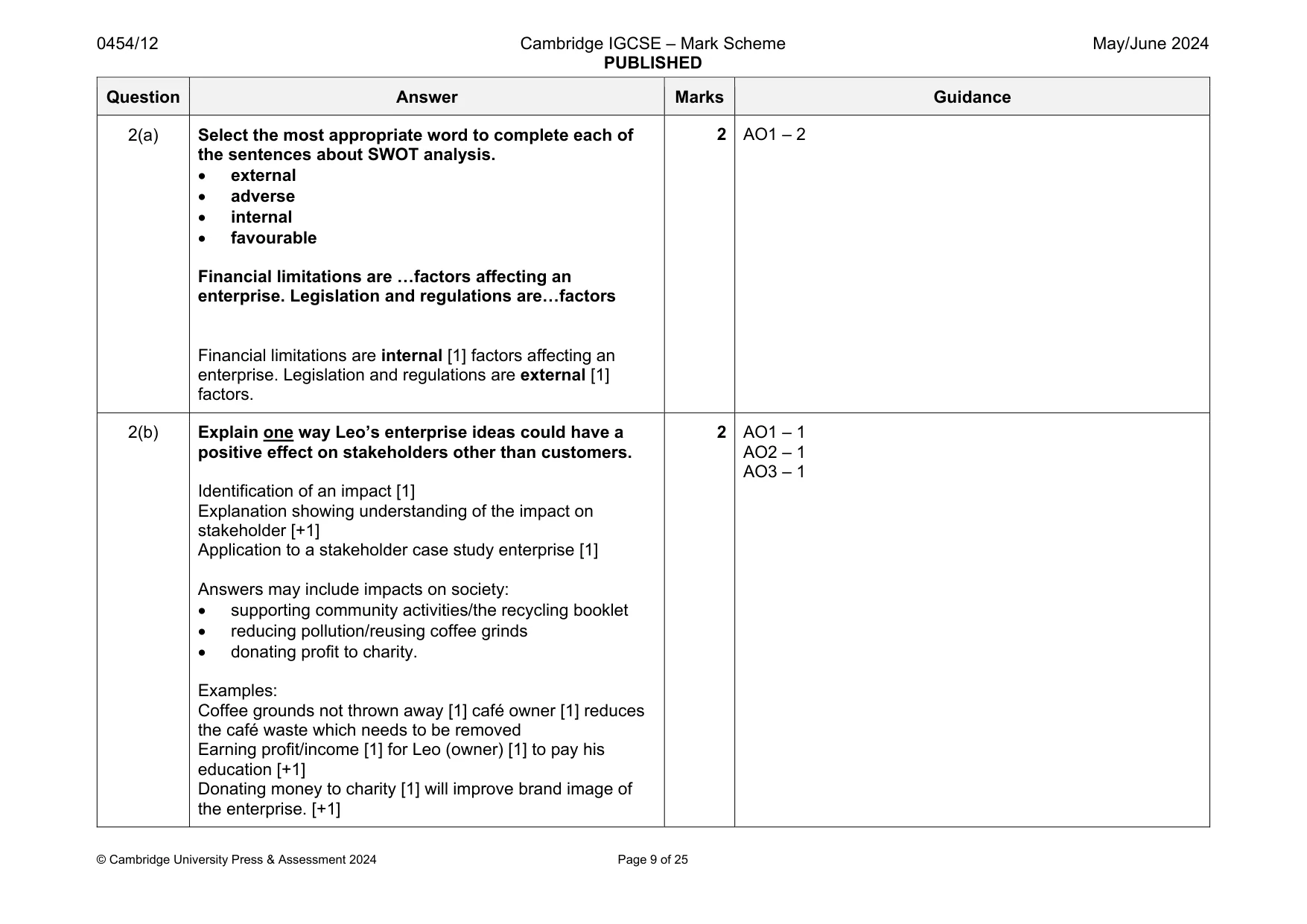
0454/12 Cambridge IGCSE – Mark Scheme PUBLISHED May/June 2024 © Cambridge University Press & Assessment 2024 Page 9 of 25 Question Answer Marks Guidance 2(a) Select the most appropriate word to complete each of the sentences about SWOT analysis. external adverse internal favourable Financial limitations are …factors affecting an enterprise. Legislation and regulations are…factors Financial limitations are internal [1] factors affecting an enterprise. Legislation and regulations are external [1] factors. 2 AO1 – 2 2(b) Explain one way Leo’s enterprise ideas could have a positive effect on stakeholders other than customers. Identification of an impact [1] Explanation showing understanding of the impact on stakeholder [+1] Application to a stakeholder case study enterprise [1] Answers may include impacts on society: supporting community activities/the recycling booklet reducing pollution/reusing coffee grinds donating profit to charity. Examples: Coffee grounds not thrown away [1] café owner [1] reduces the café waste which needs to be removed Earning profit/income [1] for Leo (owner) [1] to pay his education [+1] Donating money to charity [1] will improve brand image of the enterprise. [+1] 2 AO1 – 1 AO2 – 1 AO3 – 1
Mark scheme, page 10
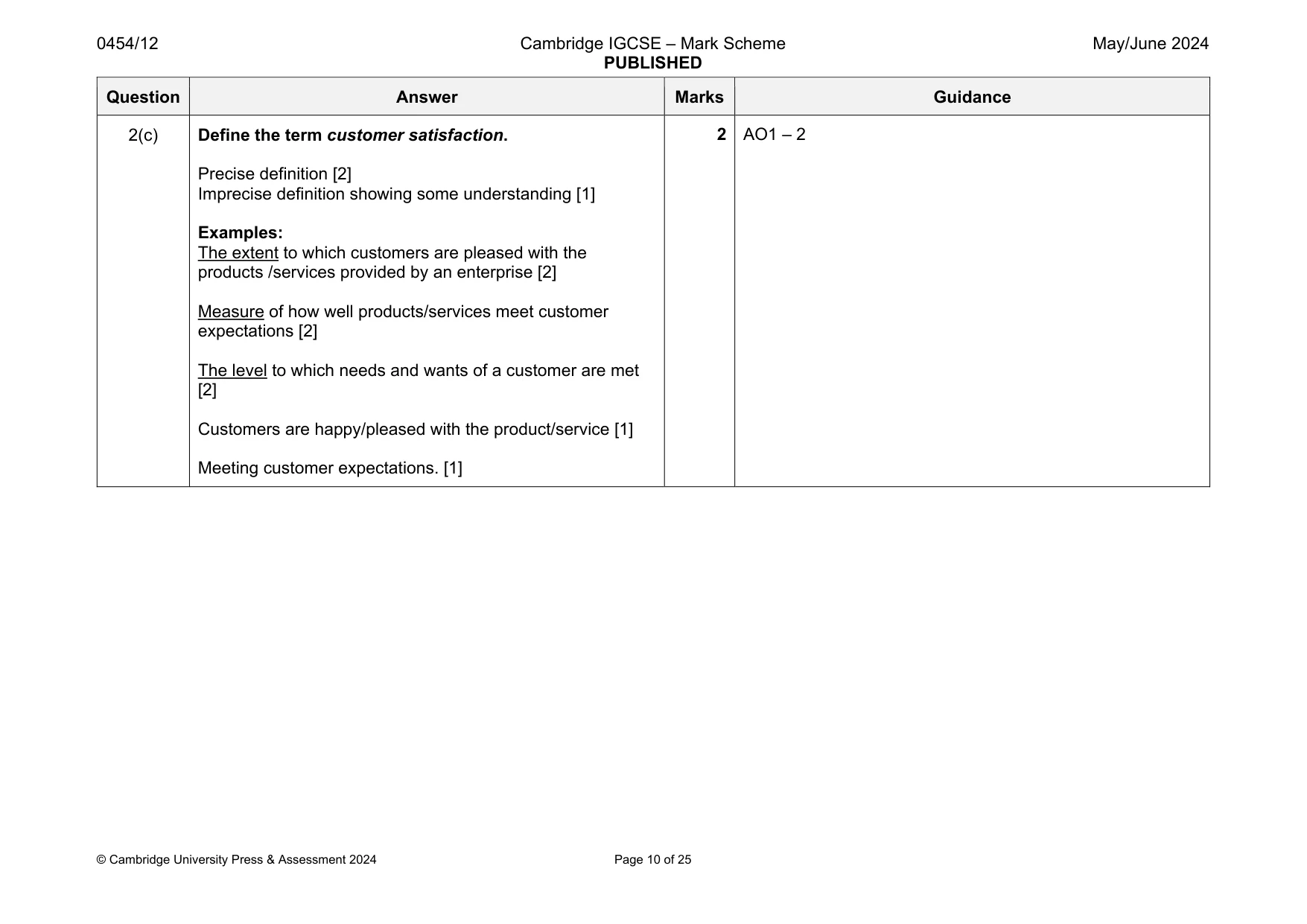
0454/12 Cambridge IGCSE – Mark Scheme PUBLISHED May/June 2024 © Cambridge University Press & Assessment 2024 Page 10 of 25 Question Answer Marks Guidance 2(c) Define the term customer satisfaction. Precise definition [2] Imprecise definition showing some understanding [1] Examples: The extent to which customers are pleased with the products /services provided by an enterprise [2] Measure of how well products/services meet customer expectations [2] The level to which needs and wants of a customer are met [2] Customers are happy/pleased with the product/service [1] Meeting customer expectations. [1] 2 AO1 – 2
Mark scheme, page 11
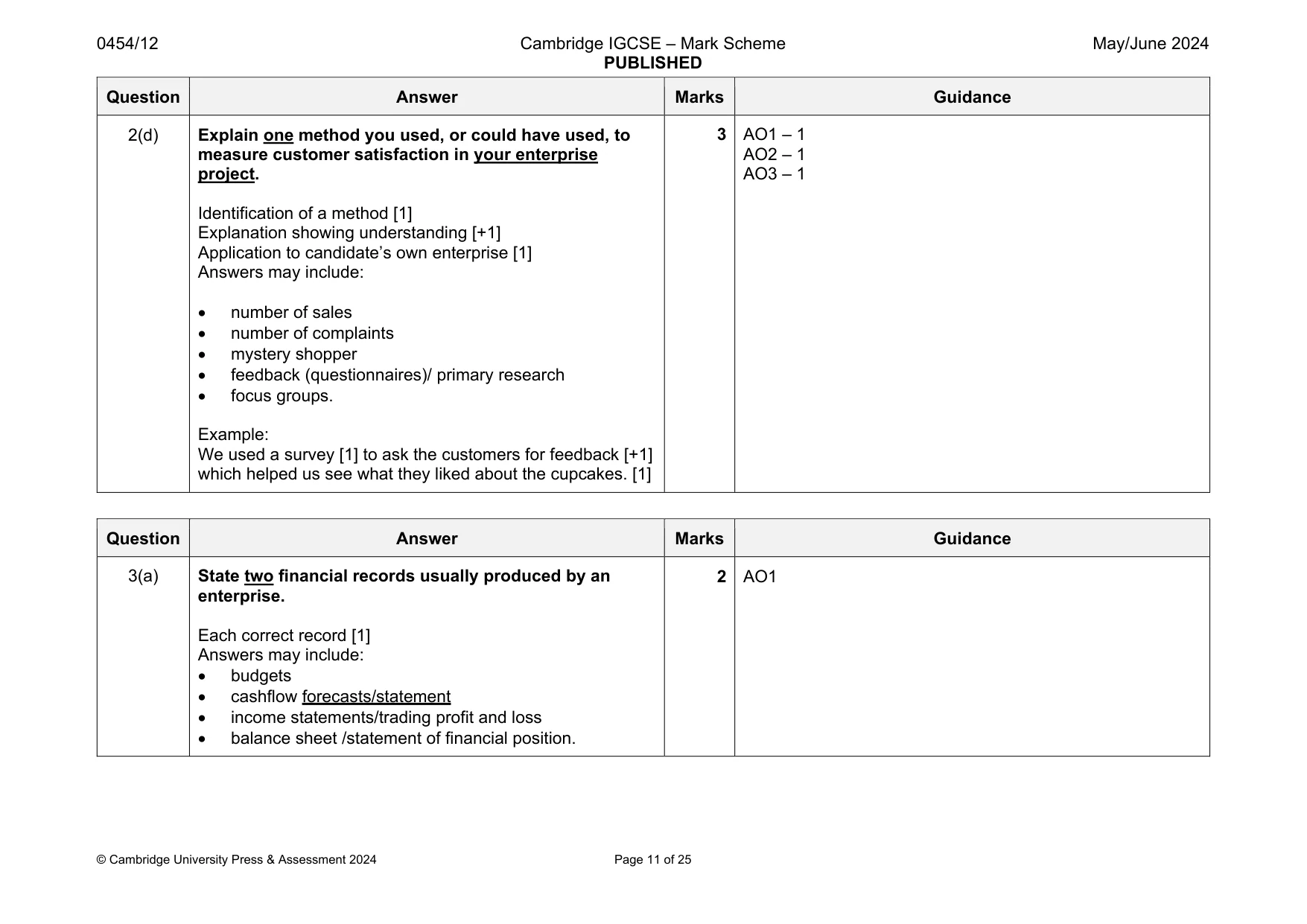
0454/12 Cambridge IGCSE – Mark Scheme PUBLISHED May/June 2024 © Cambridge University Press & Assessment 2024 Page 11 of 25 Question Answer Marks Guidance 2(d) Explain one method you used, or could have used, to measure customer satisfaction in your enterprise project. Identification of a method [1] Explanation showing understanding [+1] Application to candidate’s own enterprise [1] Answers may include: number of sales number of complaints mystery shopper feedback (questionnaires)/ primary research focus groups. Example: We used a survey [1] to ask the customers for feedback [+1] which helped us see what they liked about the cupcakes. [1] 3 AO1 – 1 AO2 – 1 AO3 – 1 Question Answer Marks Guidance 3(a) State two financial records usually produced by an enterprise. Each correct record [1] Answers may include: budgets cashflow forecasts/statement income statements/trading profit and loss balance sheet /statement of financial position. 2 AO1
Mark scheme, page 12
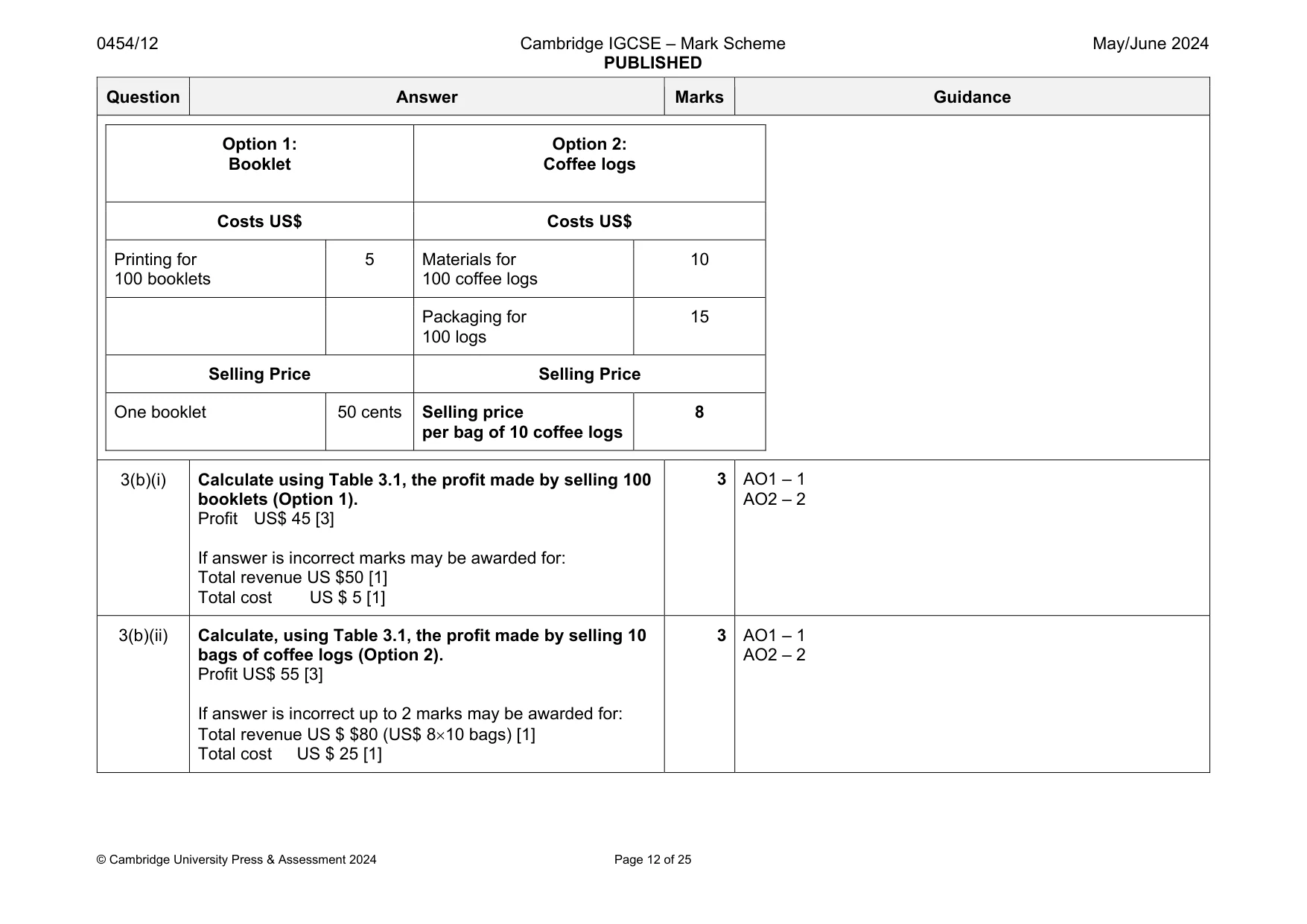
0454/12 Cambridge IGCSE – Mark Scheme PUBLISHED May/June 2024 © Cambridge University Press & Assessment 2024 Page 12 of 25 Question Answer Marks Guidance Option 1: Booklet Option 2: Coffee logs Costs US$ Costs US$ Printing for 100 booklets 5 Materials for 100 coffee logs 10 Packaging for 100 logs 15 Selling Price Selling Price One booklet 50 cents Selling price per bag of 10 coffee logs 8 3(b)(i) Calculate using Table 3.1, the profit made by selling 100 booklets (Option 1). Profit US$ 45 [3] If answer is incorrect marks may be awarded for: Total revenue US $50 [1] Total cost US $ 5 [1] 3 AO1 – 1 AO2 – 2 3(b)(ii) Calculate, using Table 3.1, the profit made by selling 10 bags of coffee logs (Option 2). Profit US$ 55 [3] If answer is incorrect up to 2 marks may be awarded for: Total revenue US $ $80 (US$ 810 bags) [1] Total cost US $ 25 [1] 3 AO1 – 1 AO2 – 2
Mark scheme, page 13
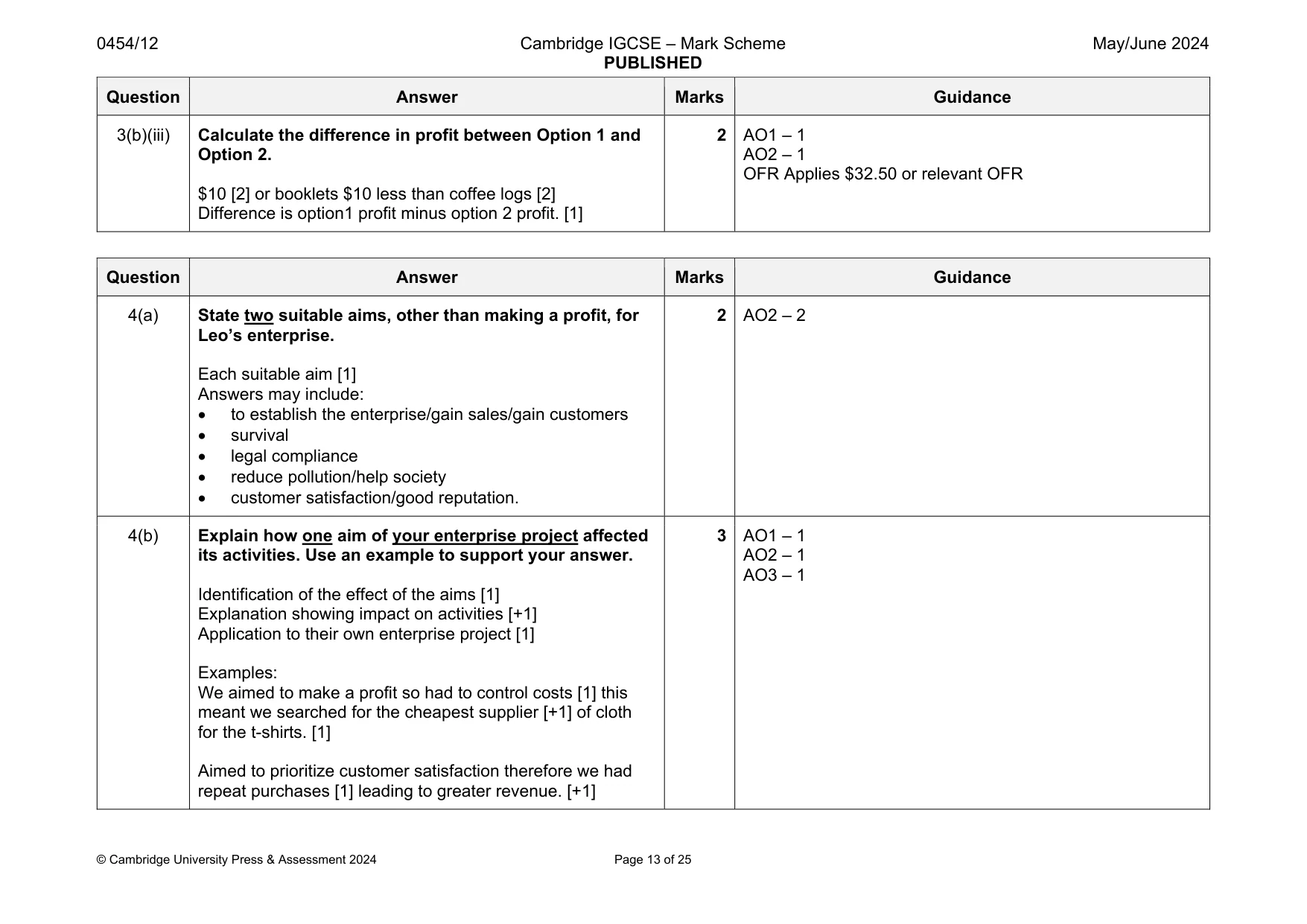
0454/12 Cambridge IGCSE – Mark Scheme PUBLISHED May/June 2024 © Cambridge University Press & Assessment 2024 Page 13 of 25 Question Answer Marks Guidance 3(b)(iii) Calculate the difference in profit between Option 1 and Option 2. $10 [2] or booklets $10 less than coffee logs [2] Difference is option1 profit minus option 2 profit. [1] 2 AO1 – 1 AO2 – 1 OFR Applies $32.50 or relevant OFR Question Answer Marks Guidance 4(a) State two suitable aims, other than making a profit, for Leo’s enterprise. Each suitable aim [1] Answers may include: to establish the enterprise/gain sales/gain customers survival legal compliance reduce pollution/help society customer satisfaction/good reputation. 2 AO2 – 2 4(b) Explain how one aim of your enterprise project affected its activities. Use an example to support your answer. Identification of the effect of the aims [1] Explanation showing impact on activities [+1] Application to their own enterprise project [1] Examples: We aimed to make a profit so had to control costs [1] this meant we searched for the cheapest supplier [+1] of cloth for the t-shirts. [1] Aimed to prioritize customer satisfaction therefore we had repeat purchases [1] leading to greater revenue. [+1] 3 AO1 – 1 AO2 – 1 AO3 – 1
Mark scheme, page 14
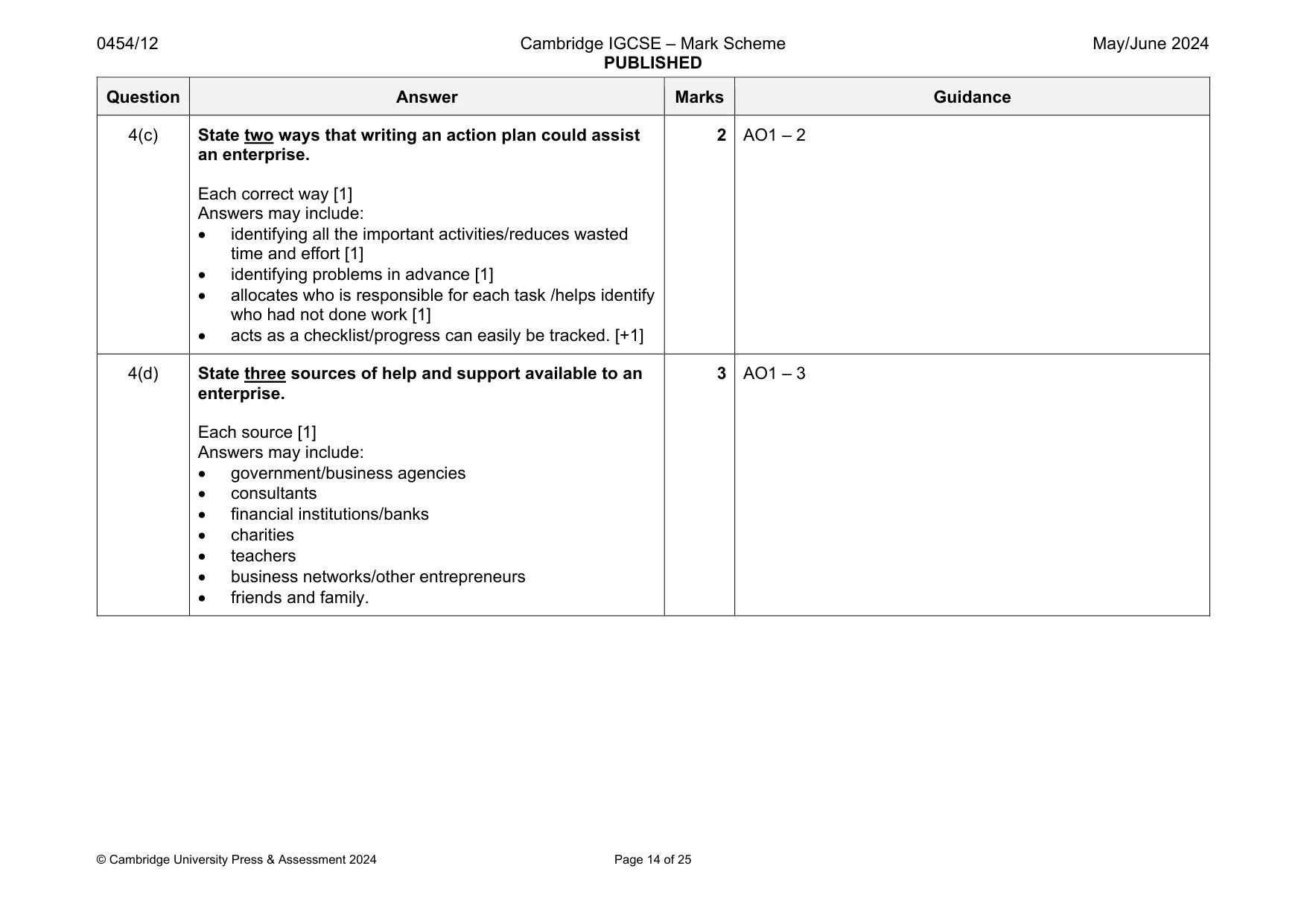
0454/12 Cambridge IGCSE – Mark Scheme PUBLISHED May/June 2024 © Cambridge University Press & Assessment 2024 Page 14 of 25 Question Answer Marks Guidance 4(c) State two ways that writing an action plan could assist an enterprise. Each correct way [1] Answers may include: identifying all the important activities/reduces wasted time and effort [1] identifying problems in advance [1] allocates who is responsible for each task /helps identify who had not done work [1] acts as a checklist/progress can easily be tracked. [+1] 2 AO1 – 2 4(d) State three sources of help and support available to an enterprise. Each source [1] Answers may include: government/business agencies consultants financial institutions/banks charities teachers business networks/other entrepreneurs friends and family. 3 AO1 – 3
Mark scheme, page 15
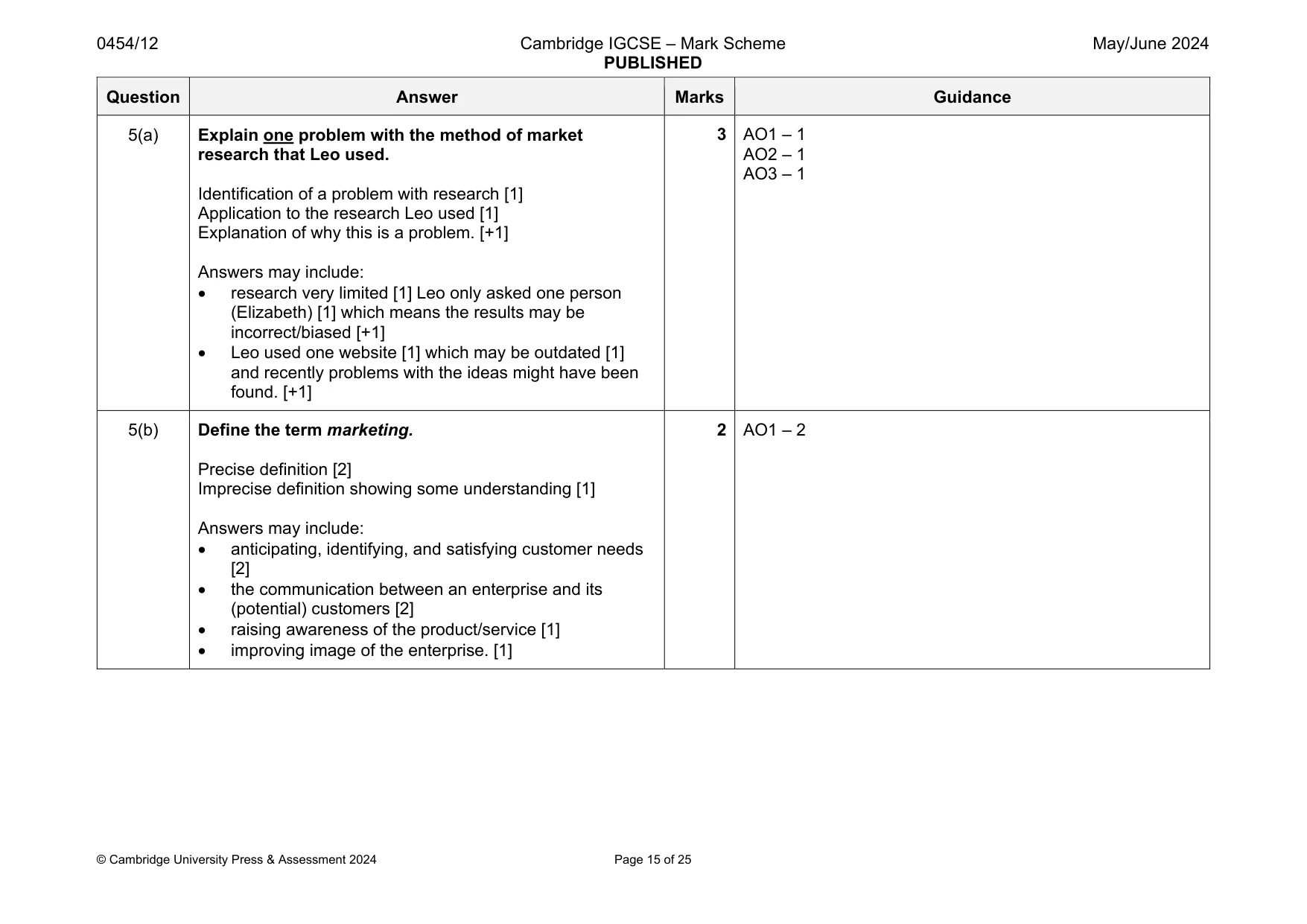
0454/12 Cambridge IGCSE – Mark Scheme PUBLISHED May/June 2024 © Cambridge University Press & Assessment 2024 Page 15 of 25 Question Answer Marks Guidance 5(a) Explain one problem with the method of market research that Leo used. Identification of a problem with research [1] Application to the research Leo used [1] Explanation of why this is a problem. [+1] Answers may include: research very limited [1] Leo only asked one person (Elizabeth) [1] which means the results may be incorrect/biased [+1] Leo used one website [1] which may be outdated [1] and recently problems with the ideas might have been found. [+1] 3 AO1 – 1 AO2 – 1 AO3 – 1 5(b) Define the term marketing. Precise definition [2] Imprecise definition showing some understanding [1] Answers may include: anticipating, identifying, and satisfying customer needs [2] the communication between an enterprise and its (potential) customers [2] raising awareness of the product/service [1] improving image of the enterprise. [1] 2 AO1 – 2
Mark scheme, page 16
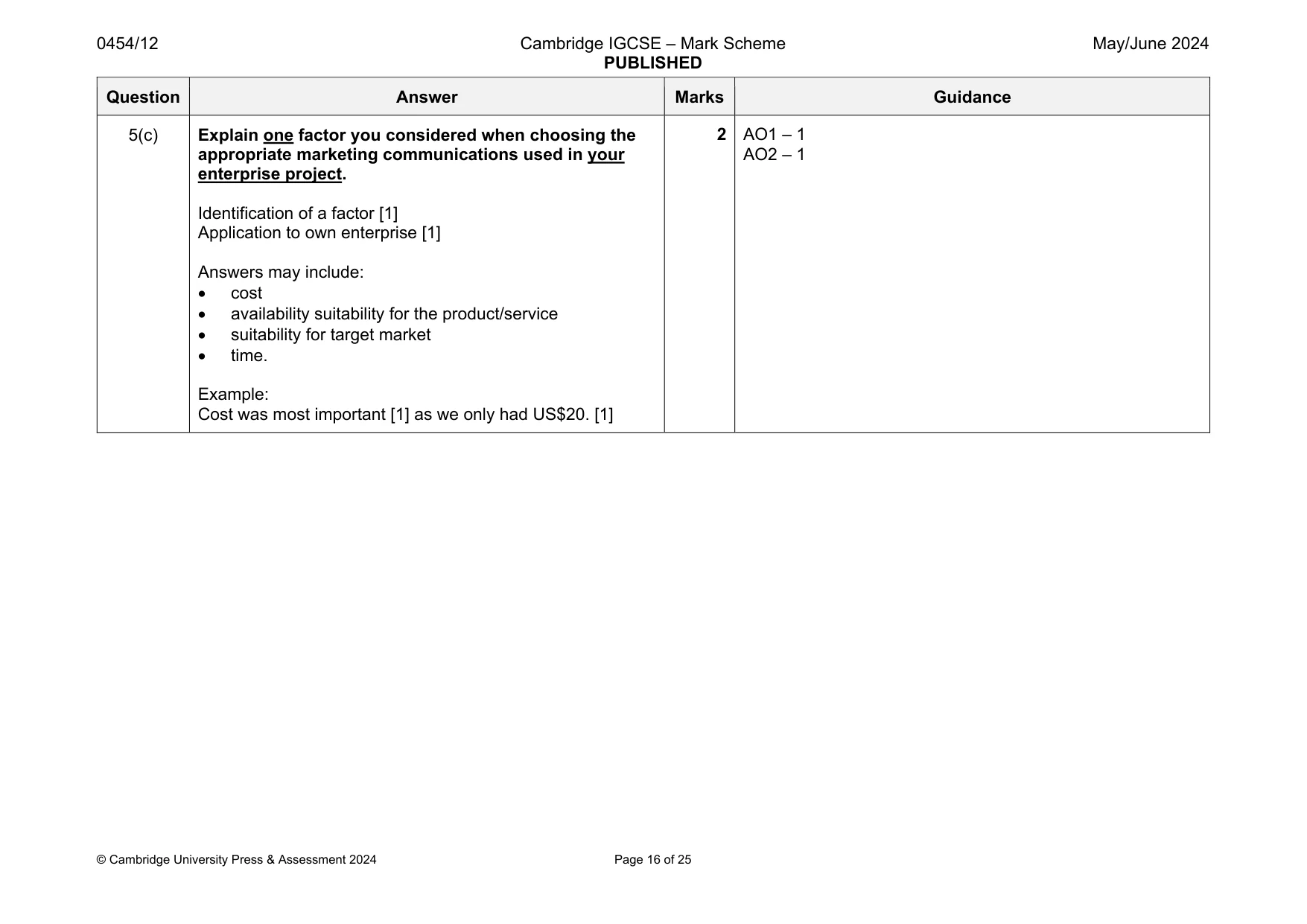
0454/12 Cambridge IGCSE – Mark Scheme PUBLISHED May/June 2024 © Cambridge University Press & Assessment 2024 Page 16 of 25 Question Answer Marks Guidance 5(c) Explain one factor you considered when choosing the appropriate marketing communications used in your enterprise project. Identification of a factor [1] Application to own enterprise [1] Answers may include: cost availability suitability for the product/service suitability for target market time. Example: Cost was most important [1] as we only had US$20. [1] 2 AO1 – 1 AO2 – 1
Mark scheme, page 17
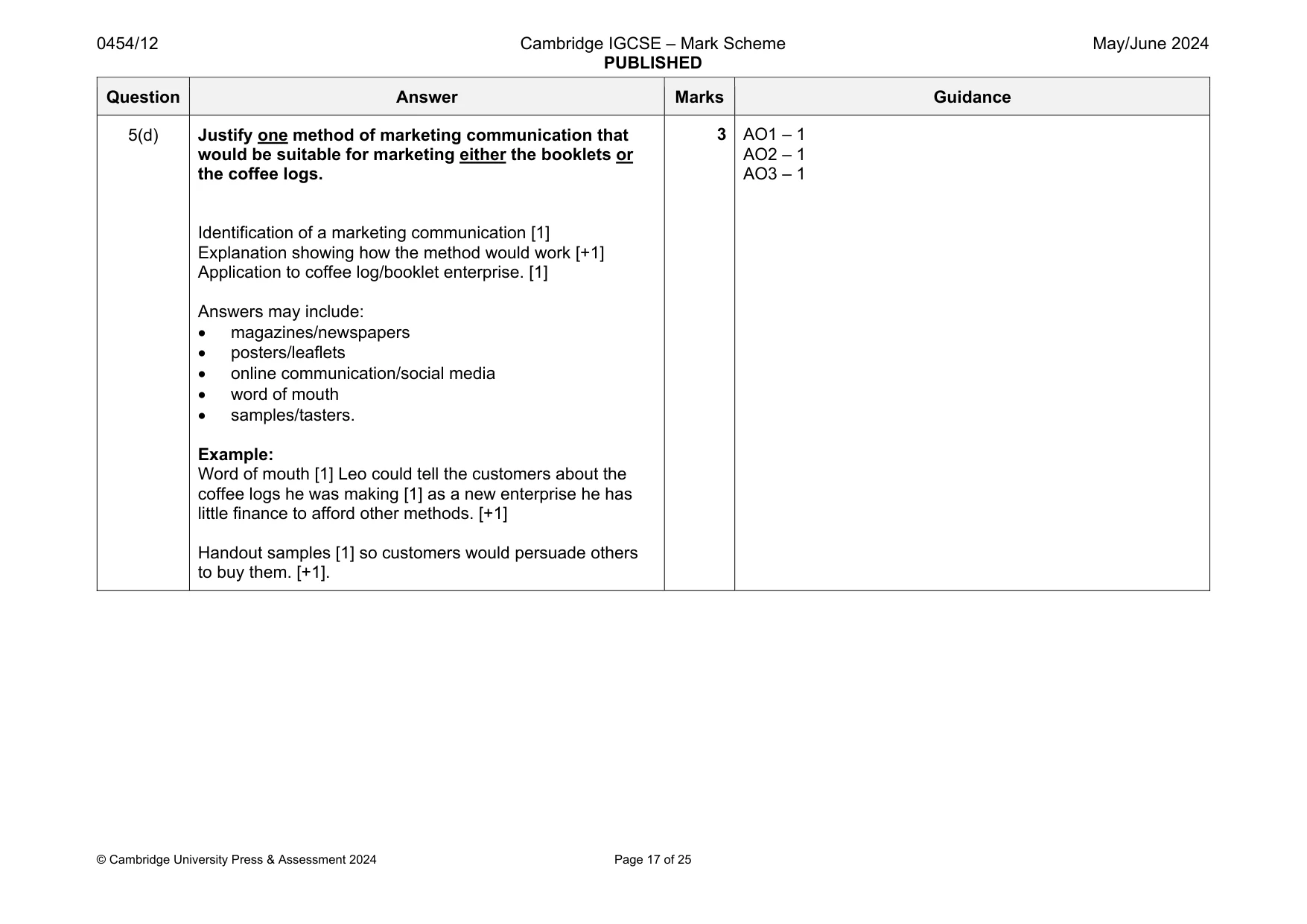
0454/12 Cambridge IGCSE – Mark Scheme PUBLISHED May/June 2024 © Cambridge University Press & Assessment 2024 Page 17 of 25 Question Answer Marks Guidance 5(d) Justify one method of marketing communication that would be suitable for marketing either the booklets or the coffee logs. Identification of a marketing communication [1] Explanation showing how the method would work [+1] Application to coffee log/booklet enterprise. [1] Answers may include: magazines/newspapers posters/leaflets online communication/social media word of mouth samples/tasters. Example: Word of mouth [1] Leo could tell the customers about the coffee logs he was making [1] as a new enterprise he has little finance to afford other methods. [+1] Handout samples [1] so customers would persuade others to buy them. [+1]. 3 AO1 – 1 AO2 – 1 AO3 – 1
Mark scheme, page 18
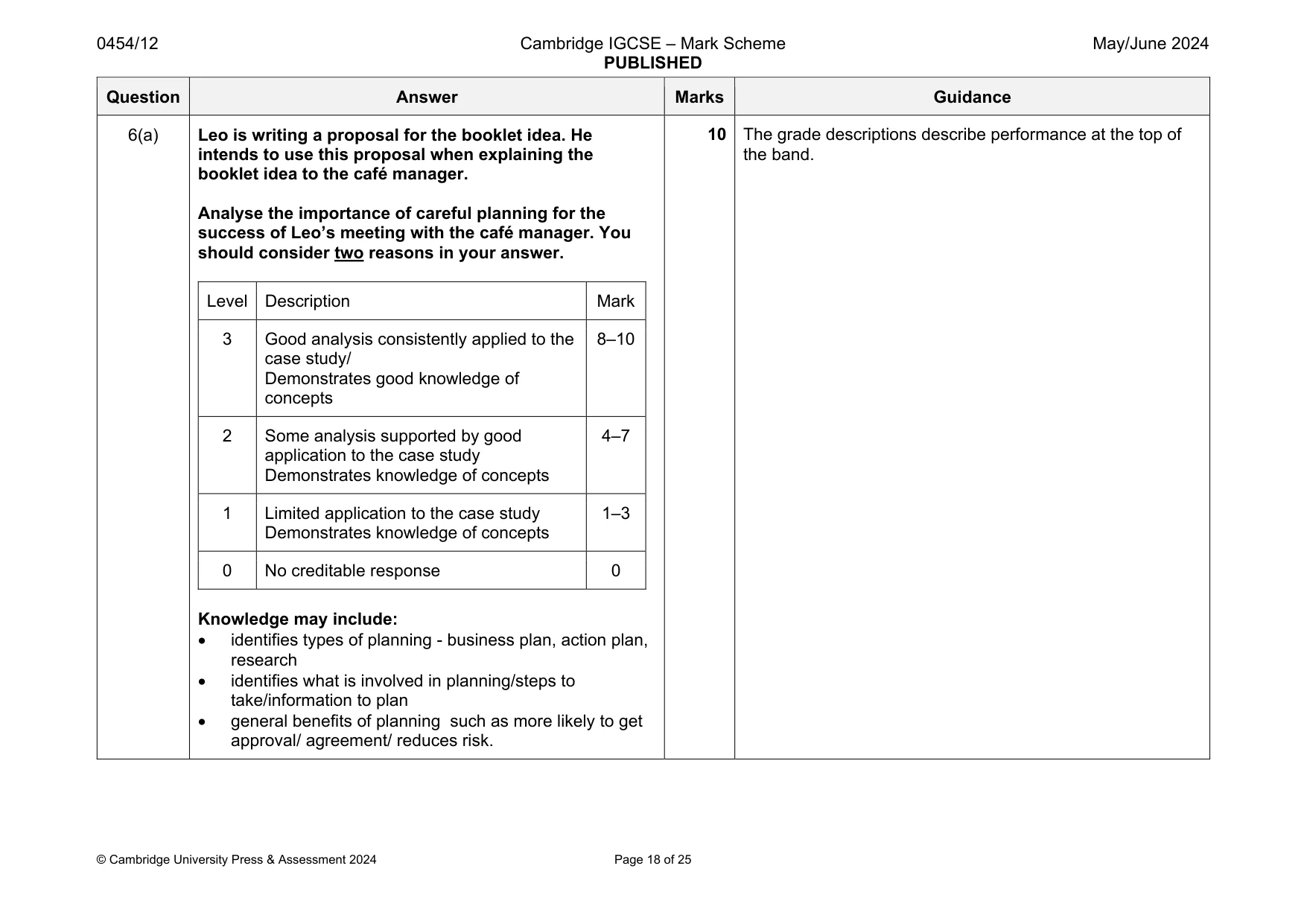
0454/12 Cambridge IGCSE – Mark Scheme PUBLISHED May/June 2024 © Cambridge University Press & Assessment 2024 Page 18 of 25 Question Answer Marks Guidance 6(a) Leo is writing a proposal for the booklet idea. He intends to use this proposal when explaining the booklet idea to the café manager. Analyse the importance of careful planning for the success of Leo’s meeting with the café manager. You should consider two reasons in your answer. Level Description Mark 3 Good analysis consistently applied to the case study/ Demonstrates good knowledge of concepts 8–10 2 Some analysis supported by good application to the case study Demonstrates knowledge of concepts 4–7 1 Limited application to the case study Demonstrates knowledge of concepts 1–3 0 No creditable response 0 Knowledge may include: identifies types of planning - business plan, action plan, research identifies what is involved in planning/steps to take/information to plan general benefits of planning such as more likely to get approval/ agreement/ reduces risk. 10 The grade descriptions describe performance at the top of the band.
Mark scheme, page 19
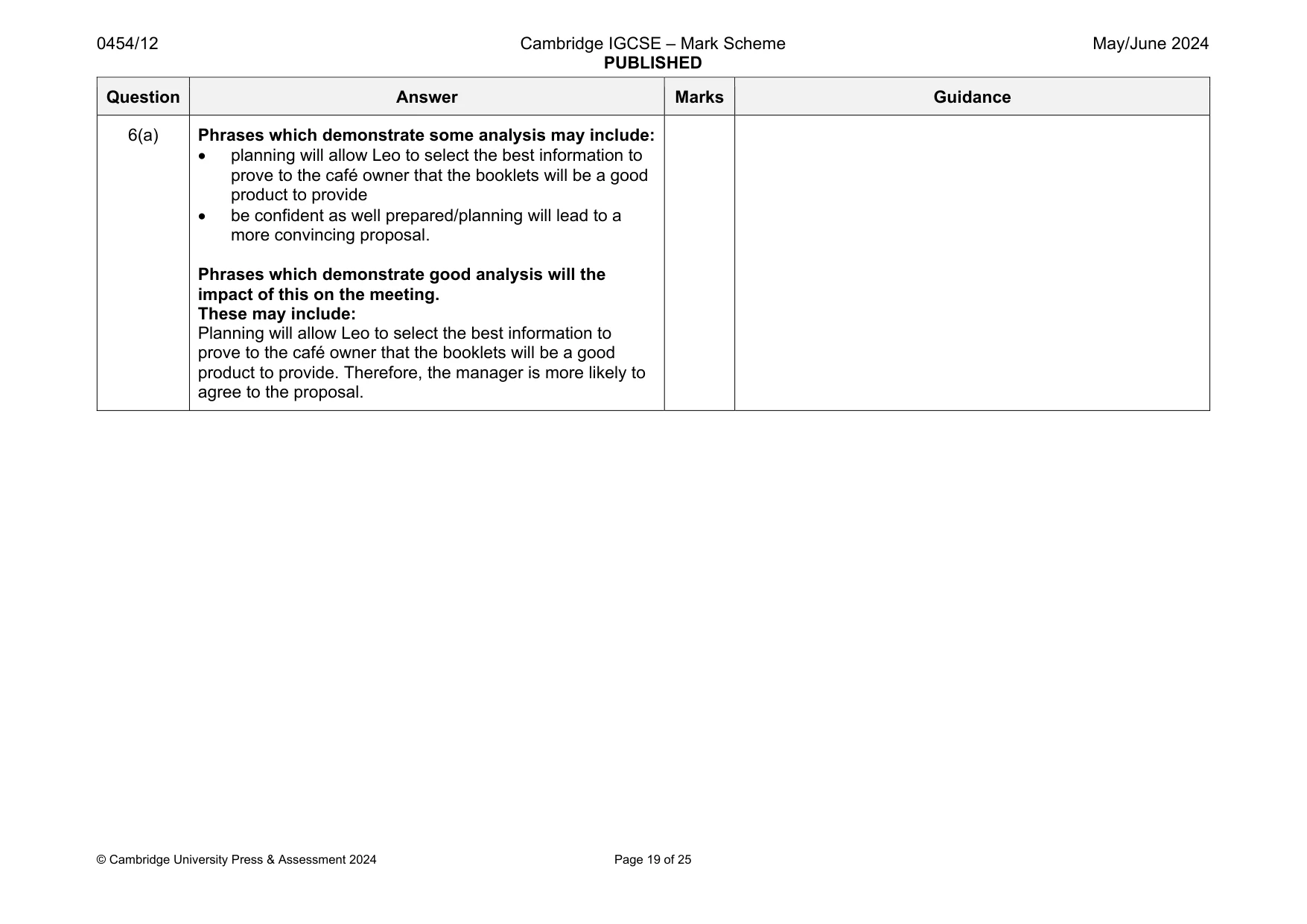
0454/12 Cambridge IGCSE – Mark Scheme PUBLISHED May/June 2024 © Cambridge University Press & Assessment 2024 Page 19 of 25 Question Answer Marks Guidance 6(a) Phrases which demonstrate some analysis may include: planning will allow Leo to select the best information to prove to the café owner that the booklets will be a good product to provide be confident as well prepared/planning will lead to a more convincing proposal. Phrases which demonstrate good analysis will the impact of this on the meeting. These may include: Planning will allow Leo to select the best information to prove to the café owner that the booklets will be a good product to provide. Therefore, the manager is more likely to agree to the proposal.
Mark scheme, page 20
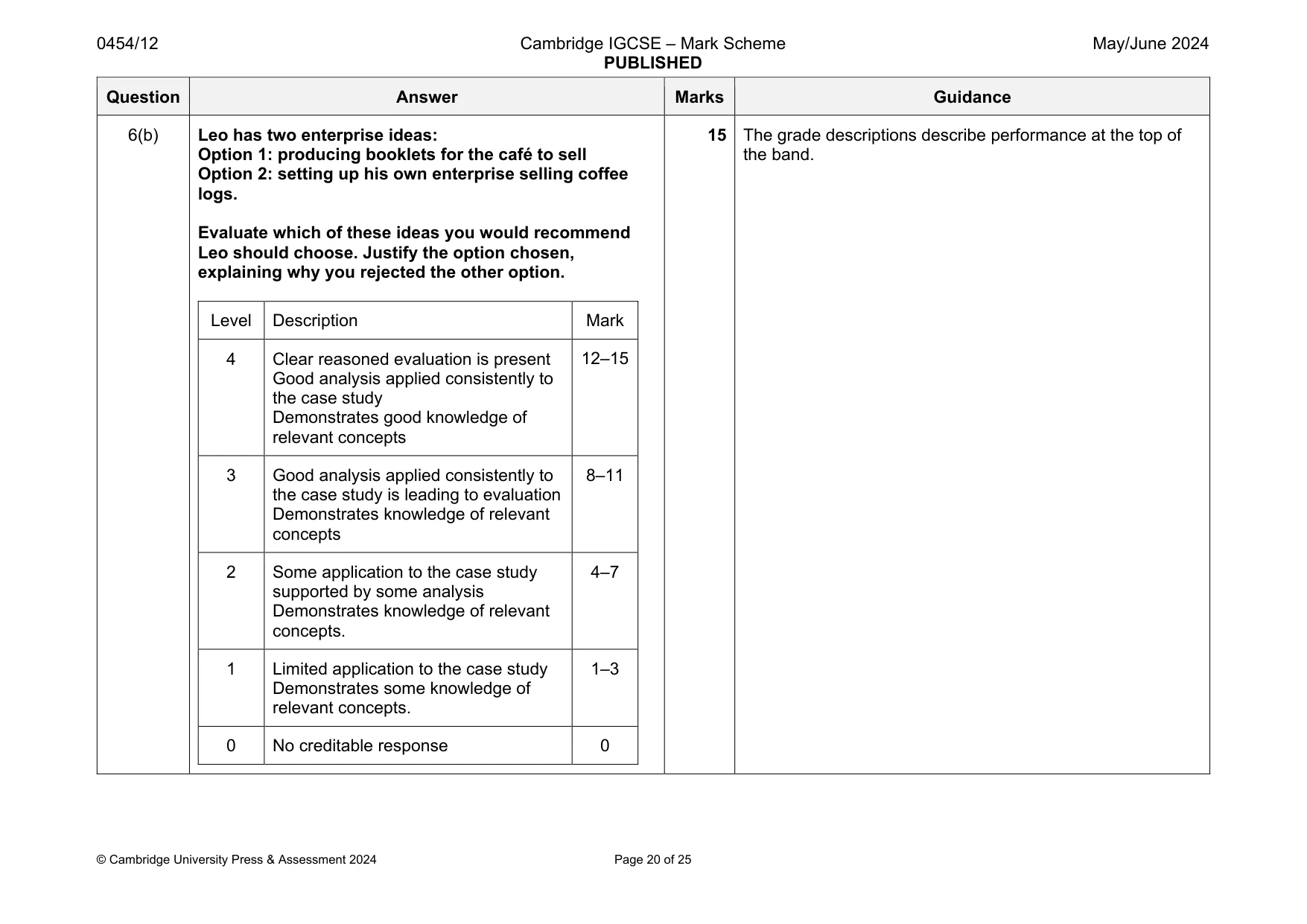
0454/12 Cambridge IGCSE – Mark Scheme PUBLISHED May/June 2024 © Cambridge University Press & Assessment 2024 Page 20 of 25 Question Answer Marks Guidance 6(b) Leo has two enterprise ideas: Option 1: producing booklets for the café to sell Option 2: setting up his own enterprise selling coffee logs. Evaluate which of these ideas you would recommend Leo should choose. Justify the option chosen, explaining why you rejected the other option. Level Description Mark 4 Clear reasoned evaluation is present Good analysis applied consistently to the case study Demonstrates good knowledge of relevant concepts 12–15 3 Good analysis applied consistently to the case study is leading to evaluation Demonstrates knowledge of relevant concepts 8–11 2 Some application to the case study supported by some analysis Demonstrates knowledge of relevant concepts. 4–7 1 Limited application to the case study Demonstrates some knowledge of relevant concepts. 1–3 0 No creditable response 0 15 The grade descriptions describe performance at the top of the band.
Mark scheme, page 21
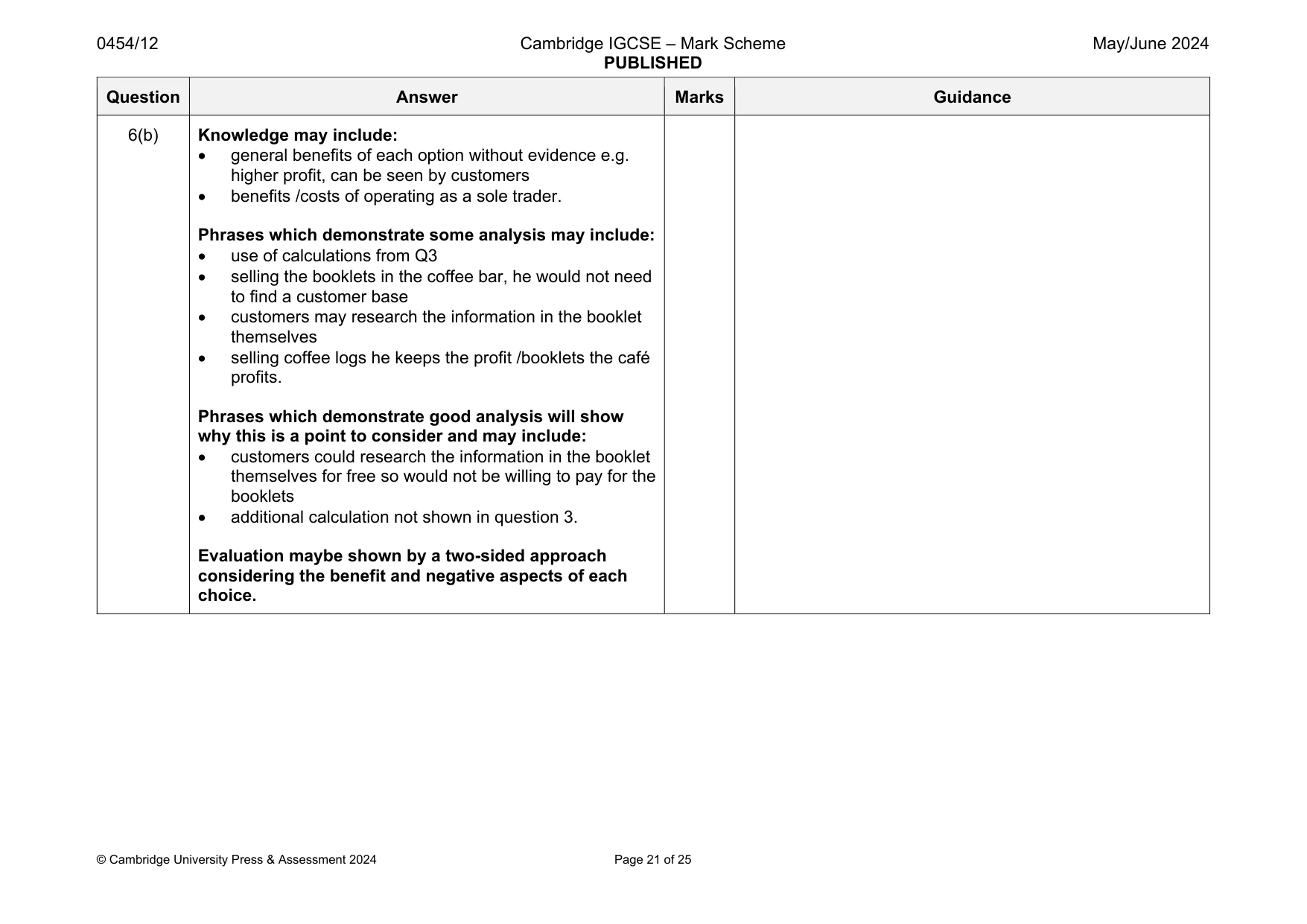
0454/12 Cambridge IGCSE – Mark Scheme PUBLISHED May/June 2024 © Cambridge University Press & Assessment 2024 Page 21 of 25 Question Answer Marks Guidance 6(b) Knowledge may include: general benefits of each option without evidence e.g. higher profit, can be seen by customers benefits /costs of operating as a sole trader. Phrases which demonstrate some analysis may include: use of calculations from Q3 selling the booklets in the coffee bar, he would not need to find a customer base customers may research the information in the booklet themselves selling coffee logs he keeps the profit /booklets the café profits. Phrases which demonstrate good analysis will show why this is a point to consider and may include: customers could research the information in the booklet themselves for free so would not be willing to pay for the booklets additional calculation not shown in question 3. Evaluation maybe shown by a two-sided approach considering the benefit and negative aspects of each choice.
Mark scheme, page 22
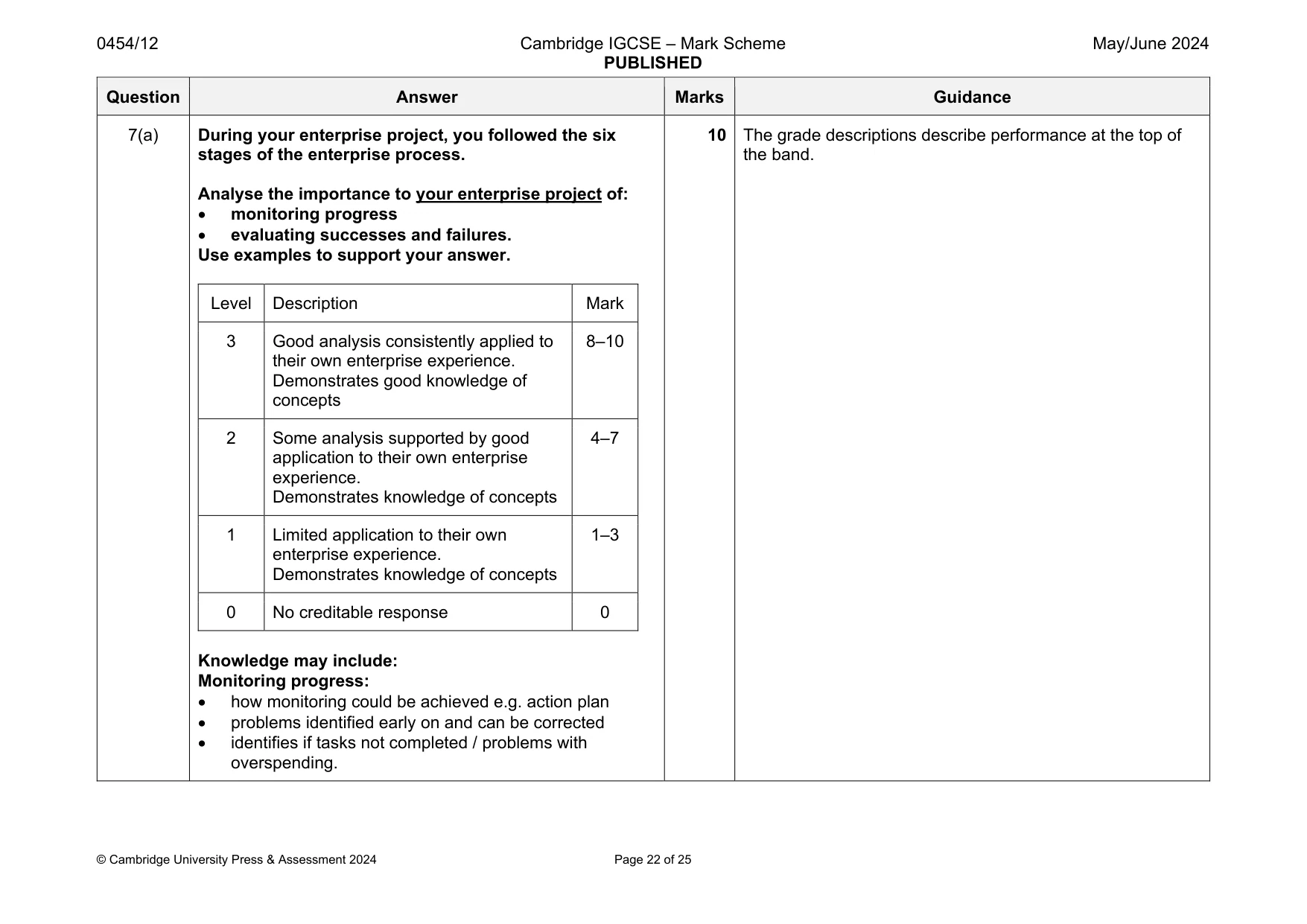
0454/12 Cambridge IGCSE – Mark Scheme PUBLISHED May/June 2024 © Cambridge University Press & Assessment 2024 Page 22 of 25 Question Answer Marks Guidance 7(a) During your enterprise project, you followed the six stages of the enterprise process. Analyse the importance to your enterprise project of: monitoring progress evaluating successes and failures. Use examples to support your answer. Level Description Mark 3 Good analysis consistently applied to their own enterprise experience. Demonstrates good knowledge of concepts 8–10 2 Some analysis supported by good application to their own enterprise experience. Demonstrates knowledge of concepts 4–7 1 Limited application to their own enterprise experience. Demonstrates knowledge of concepts 1–3 0 No creditable response 0 Knowledge may include: Monitoring progress: how monitoring could be achieved e.g. action plan problems identified early on and can be corrected identifies if tasks not completed / problems with overspending. 10 The grade descriptions describe performance at the top of the band.
Mark scheme, page 23
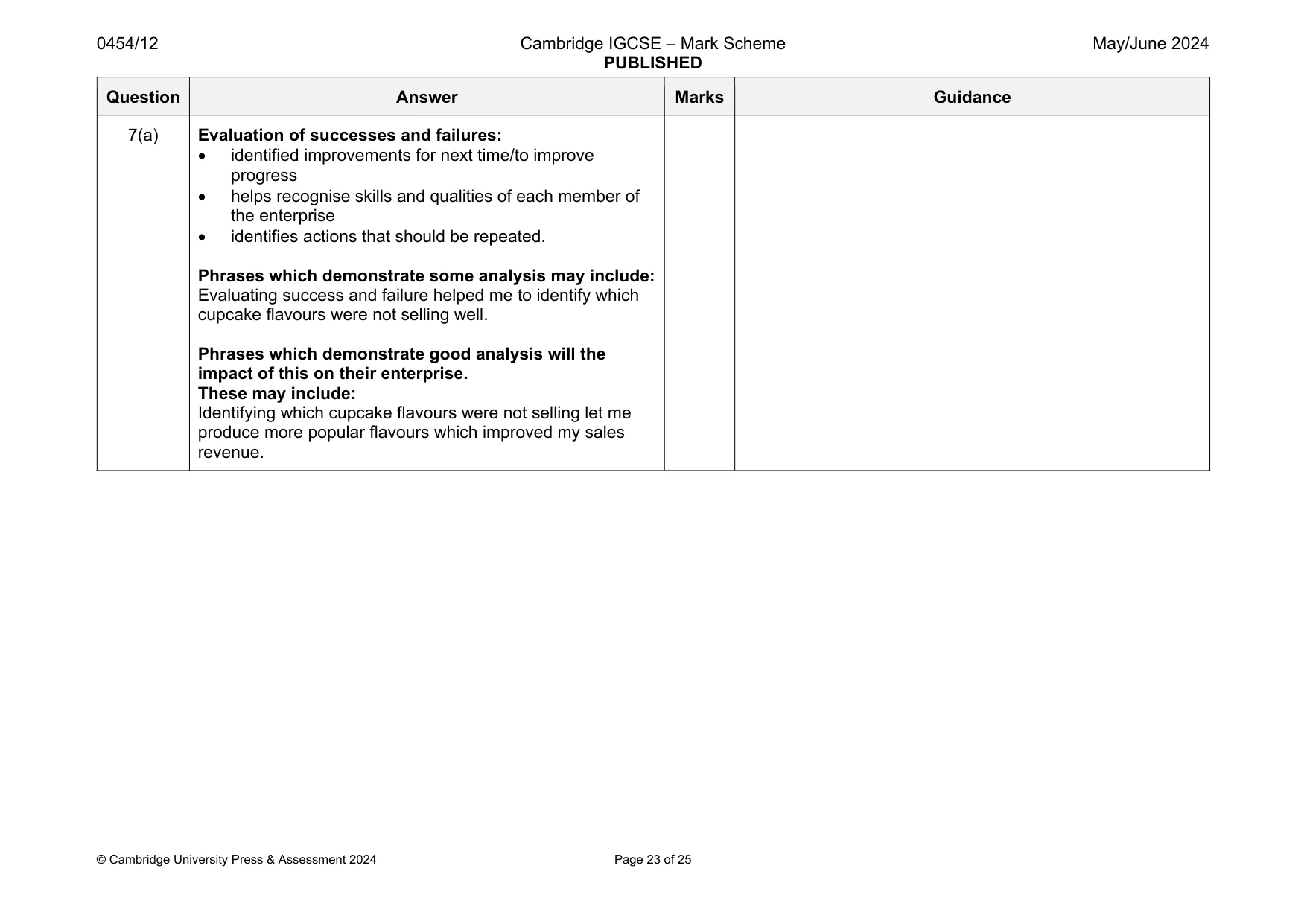
0454/12 Cambridge IGCSE – Mark Scheme PUBLISHED May/June 2024 © Cambridge University Press & Assessment 2024 Page 23 of 25 Question Answer Marks Guidance 7(a) Evaluation of successes and failures: identified improvements for next time/to improve progress helps recognise skills and qualities of each member of the enterprise identifies actions that should be repeated. Phrases which demonstrate some analysis may include: Evaluating success and failure helped me to identify which cupcake flavours were not selling well. Phrases which demonstrate good analysis will the impact of this on their enterprise. These may include: Identifying which cupcake flavours were not selling let me produce more popular flavours which improved my sales revenue.
Mark scheme, page 24
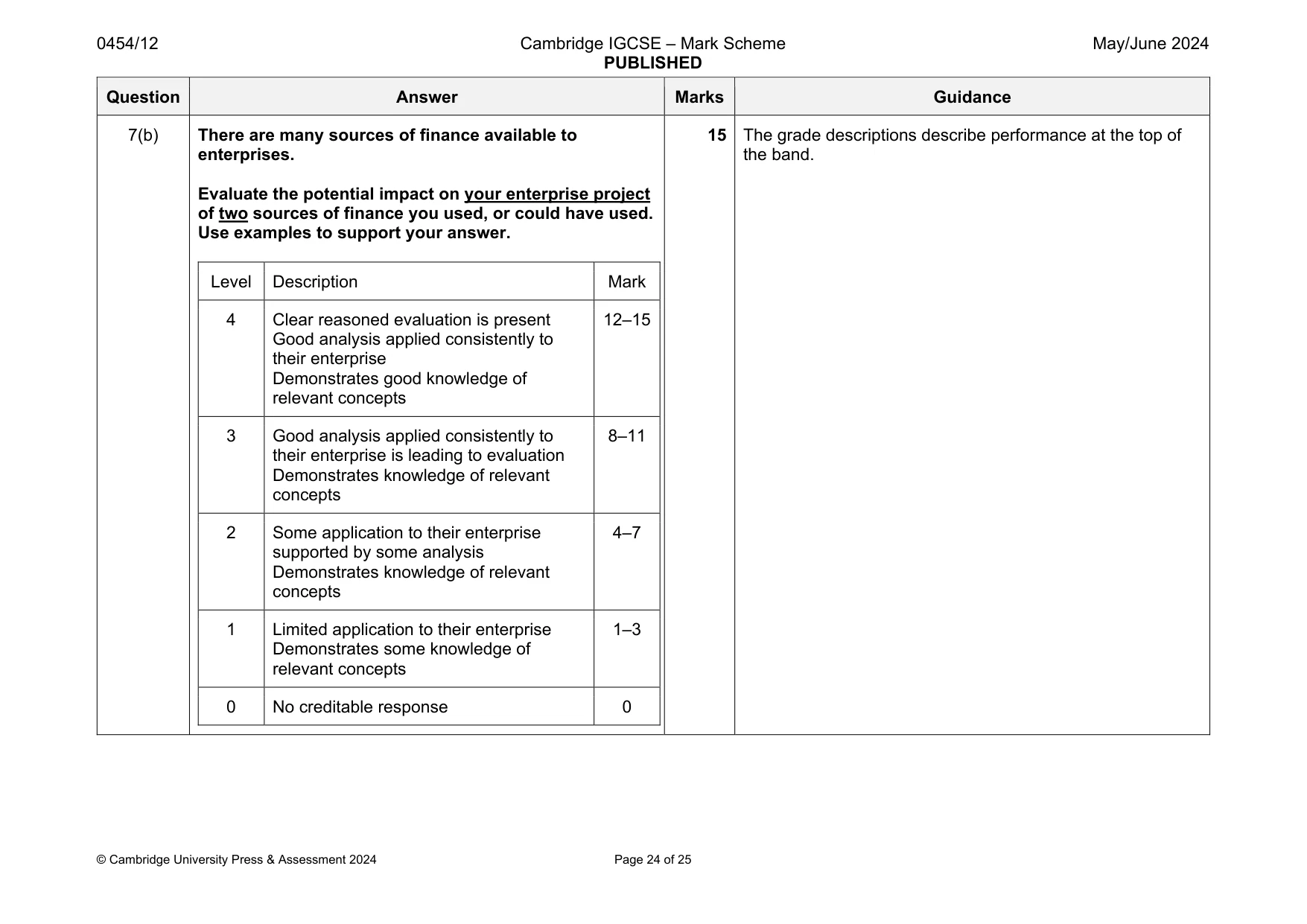
0454/12 Cambridge IGCSE – Mark Scheme PUBLISHED May/June 2024 © Cambridge University Press & Assessment 2024 Page 24 of 25 Question Answer Marks Guidance 7(b) There are many sources of finance available to enterprises. Evaluate the potential impact on your enterprise project of two sources of finance you used, or could have used. Use examples to support your answer. Level Description Mark 4 Clear reasoned evaluation is present Good analysis applied consistently to their enterprise Demonstrates good knowledge of relevant concepts 12–15 3 Good analysis applied consistently to their enterprise is leading to evaluation Demonstrates knowledge of relevant concepts 8–11 2 Some application to their enterprise supported by some analysis Demonstrates knowledge of relevant concepts 4–7 1 Limited application to their enterprise Demonstrates some knowledge of relevant concepts 1–3 0 No creditable response 0 15 The grade descriptions describe performance at the top of the band.
Mark scheme, page 25
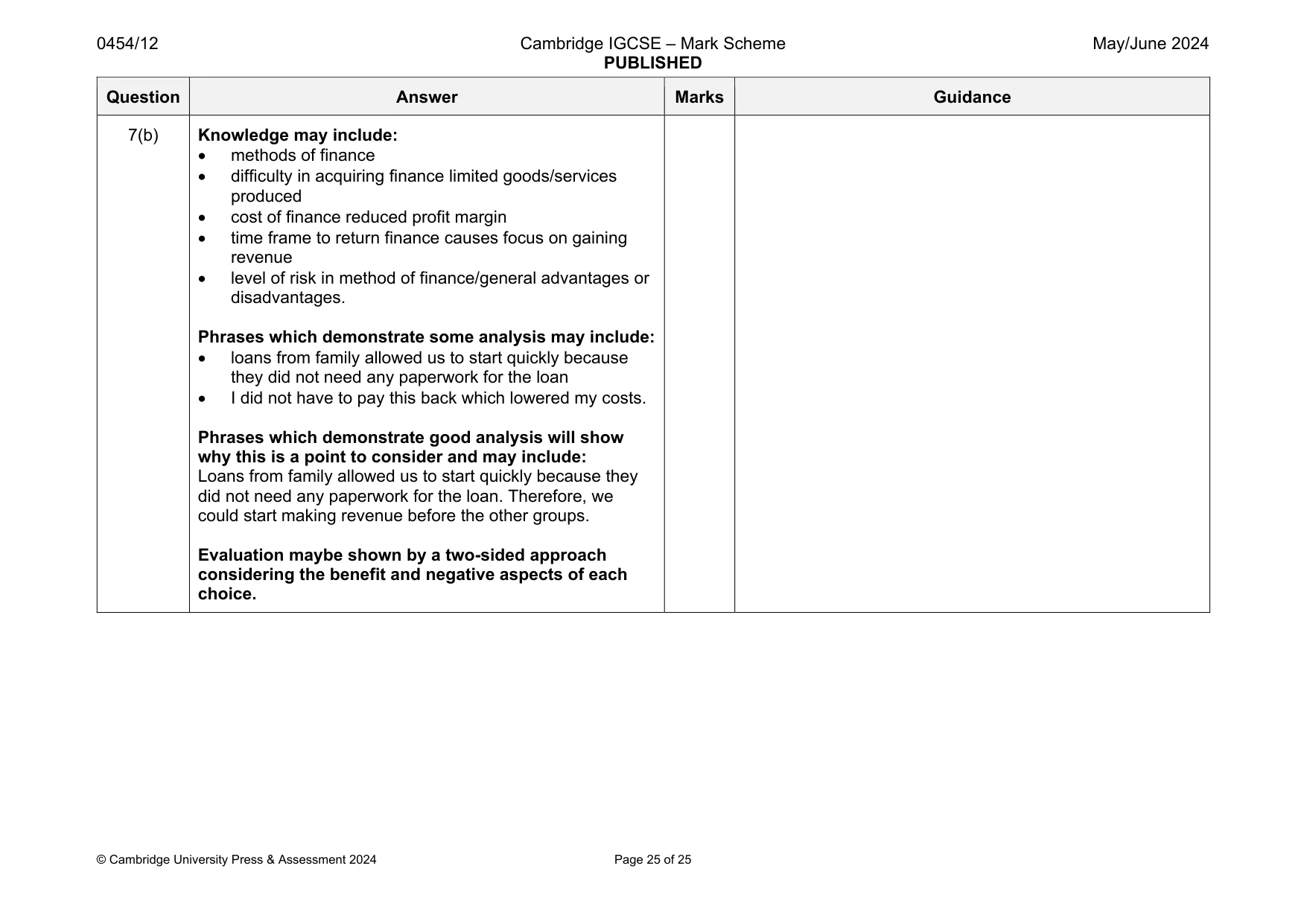
0454/12 Cambridge IGCSE – Mark Scheme PUBLISHED May/June 2024 © Cambridge University Press & Assessment 2024 Page 25 of 25 Question Answer Marks Guidance 7(b) Knowledge may include: methods of finance difficulty in acquiring finance limited goods/services produced cost of finance reduced profit margin time frame to return finance causes focus on gaining revenue level of risk in method of finance/general advantages or disadvantages. Phrases which demonstrate some analysis may include: loans from family allowed us to start quickly because they did not need any paperwork for the loan I did not have to pay this back which lowered my costs. Phrases which demonstrate good analysis will show why this is a point to consider and may include: Loans from family allowed us to start quickly because they did not need any paperwork for the loan. Therefore, we could start making revenue before the other groups. Evaluation maybe shown by a two-sided approach considering the benefit and negative aspects of each choice.
What you needed in this session
Cambridge’s own grade thresholds for 2024 May/June, Paper 1 · Variant 2. A higher threshold means an easier paper — the bar moves with how the cohort did.