Cambridge IGCSE Enterprise 0454 — 2019 May/June Paper 1 · Variant 3
0454/13/M/J/19 · 100 marks · ≈113 min
The question paper and its mark scheme, free to read here and free to download. This is Cambridge’s own paper, exactly as it was sat.
Question paper16 pages







Mark scheme14 pages
Answers below. Sit the paper first if you are practising.
Paper as text
Question paper, page 1
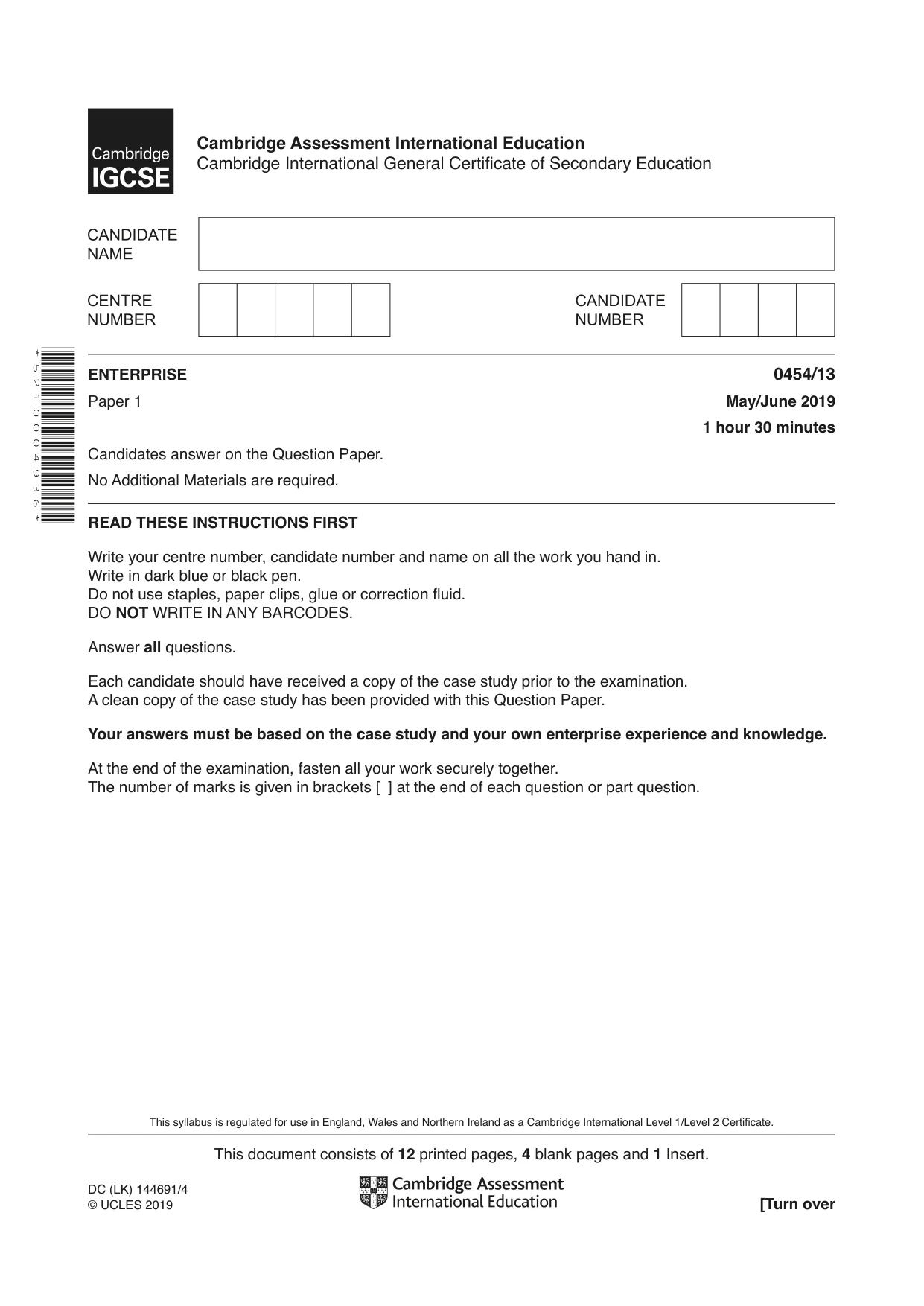
* 5 2 1 0 0 0 4 9 3 6 * This document consists of 12 printed pages, 4 blank pages and 1 Insert. DC (LK) 144691/4 © UCLES 2019 [Turn over Cambridge Assessment International Education Cambridge International General Certificate of Secondary Education ENTERPRISE 0454/13 Paper 1 May/June 2019 1 hour 30 minutes Candidates answer on the Question Paper. No Additional Materials are required. READ THESE INSTRUCTIONS FIRST Write your centre number, candidate number and name on all the work you hand in. Write in dark blue or black pen. Do not use staples, paper clips, glue or correction fluid. DO NOT WRITE IN ANY BARCODES. Answer all questions. Each candidate should have received a copy of the case study prior to the examination. A clean copy of the case study has been provided with this Question Paper. Your answers must be based on the case study and your own enterprise experience and knowledge. At the end of the examination, fasten all your work securely together. The number of marks is given in brackets [ ] at the end of each question or part question. This syllabus is regulated for use in England, Wales and Northern Ireland as a Cambridge International Level 1/Level 2 Certificate.
Question paper, page 2
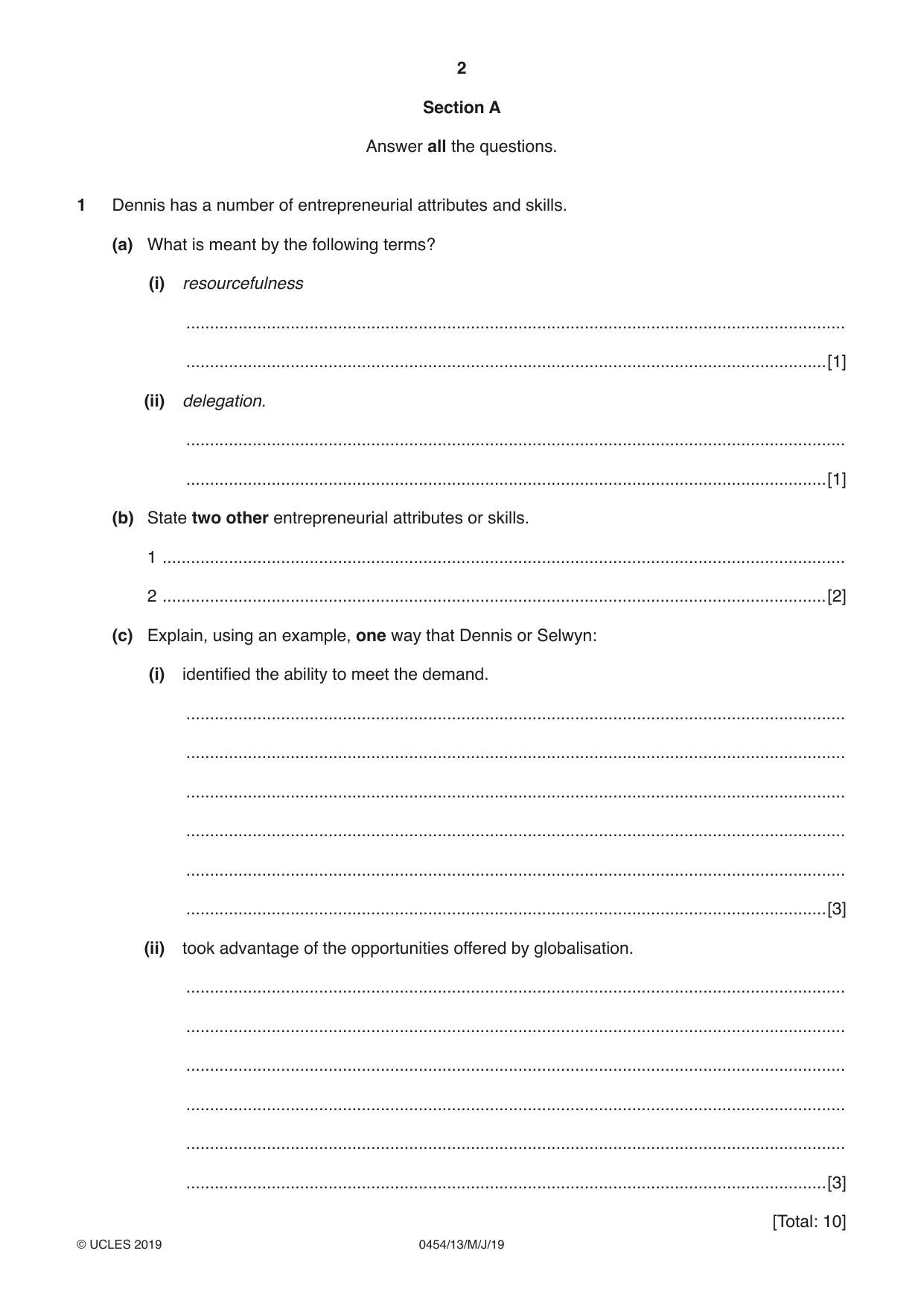
2 0454/13/M/J/19 © UCLES 2019 Section A Answer all the questions. 1 Dennis has a number of entrepreneurial attributes and skills. (a) What is meant by the following terms? (i) resourcefulness … …[1] (ii) delegation. … …[1] (b) State two other entrepreneurial attributes or skills. 1 … 2 …[2] (c) Explain, using an example, one way that Dennis or Selwyn: (i) identified the ability to meet the demand. … … … … … …[3] (ii) took advantage of the opportunities offered by globalisation. … … … … … …[3] [Total: 10]
Question paper, page 3
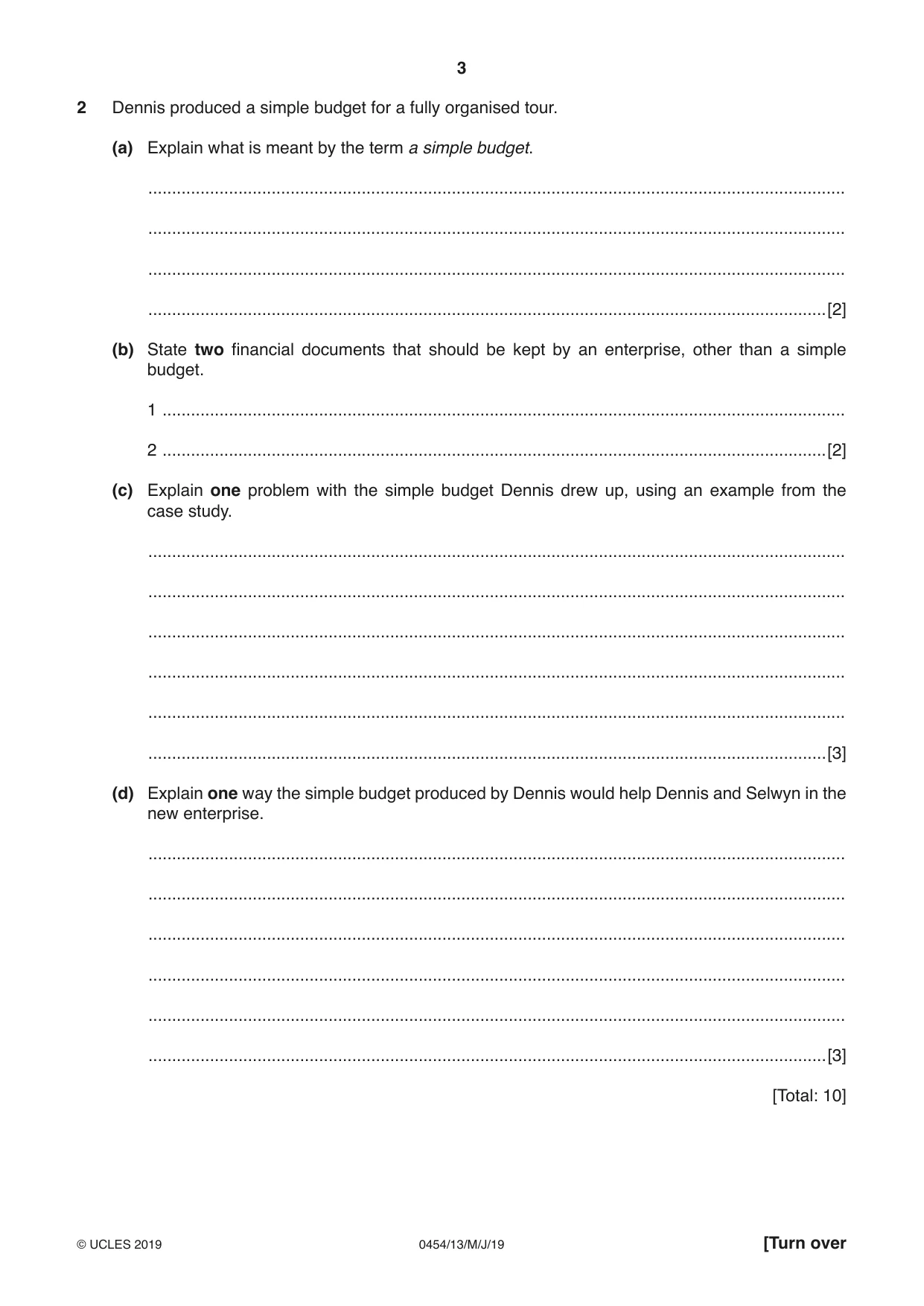
3 0454/13/M/J/19 © UCLES 2019 [Turn over 2 Dennis produced a simple budget for a fully organised tour. (a) Explain what is meant by the term a simple budget. … … … …[2] (b) State two financial documents that should be kept by an enterprise, other than a simple budget. 1 … 2 …[2] (c) Explain one problem with the simple budget Dennis drew up, using an example from the case study. … … … … … …[3] (d) Explain one way the simple budget produced by Dennis would help Dennis and Selwyn in the new enterprise. … … … … … …[3] [Total: 10]
Question paper, page 4
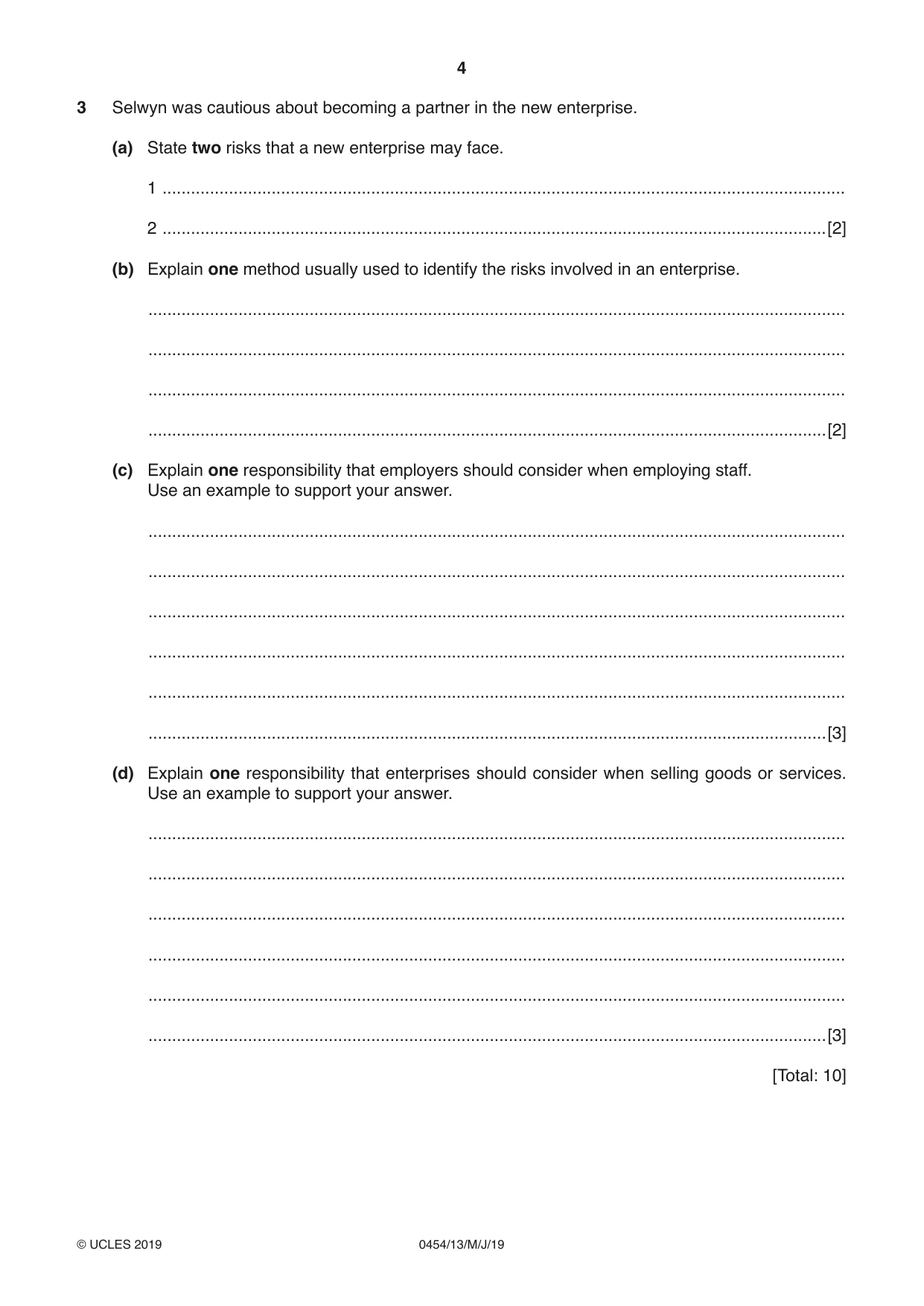
4 0454/13/M/J/19 © UCLES 2019 3 Selwyn was cautious about becoming a partner in the new enterprise. (a) State two risks that a new enterprise may face. 1 … 2 …[2] (b) Explain one method usually used to identify the risks involved in an enterprise. … … … …[2] (c) Explain one responsibility that employers should consider when employing staff. Use an example to support your answer. … … … … … …[3] (d) Explain one responsibility that enterprises should consider when selling goods or services. Use an example to support your answer. … … … … … …[3] [Total: 10]
Question paper, page 5
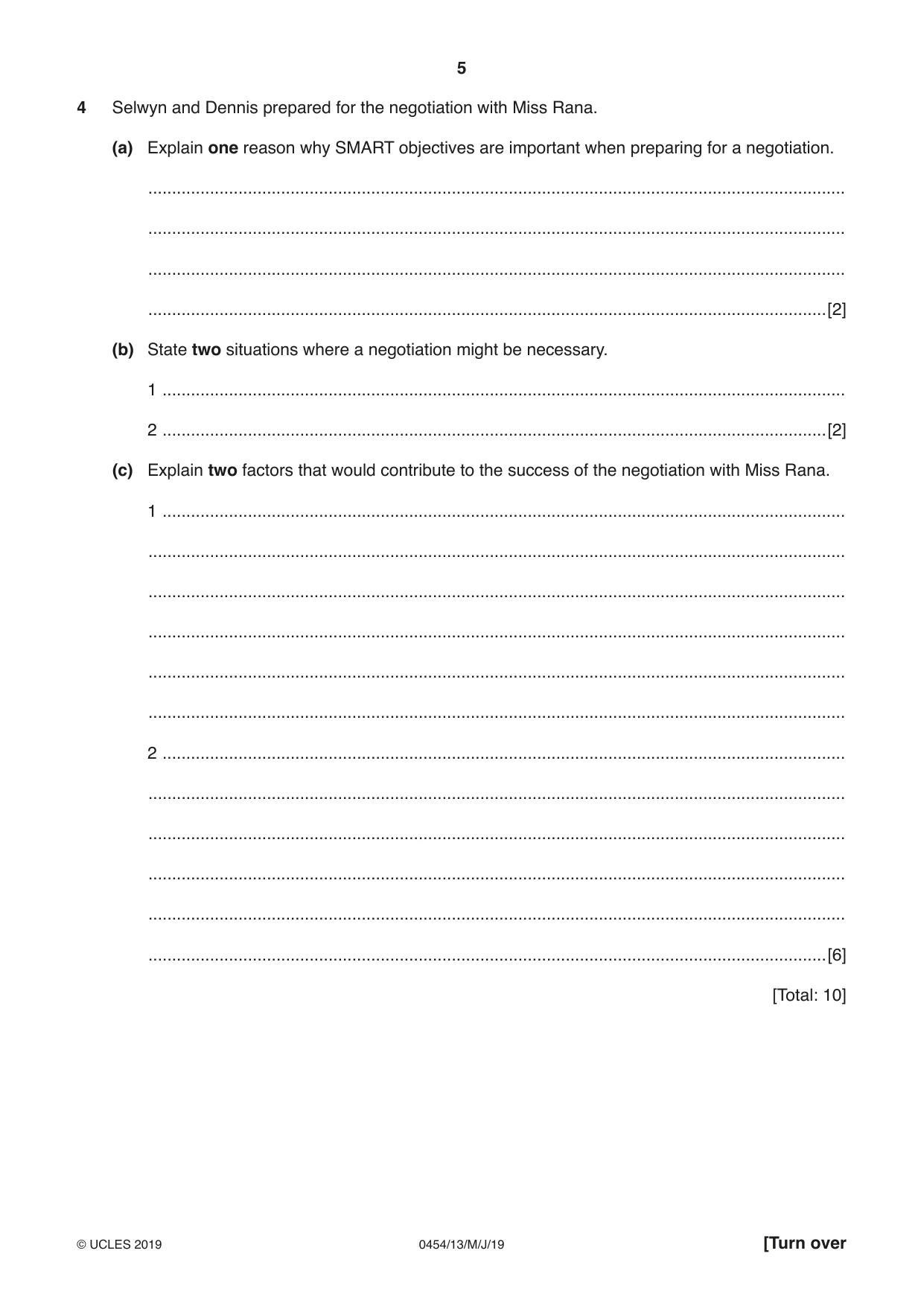
5 0454/13/M/J/19 © UCLES 2019 [Turn over 4 Selwyn and Dennis prepared for the negotiation with Miss Rana. (a) Explain one reason why SMART objectives are important when preparing for a negotiation. … … … …[2] (b) State two situations where a negotiation might be necessary. 1 … 2 …[2] (c) Explain two factors that would contribute to the success of the negotiation with Miss Rana. 1 … … … … … … 2 … … … … … …[6] [Total: 10]
Question paper, page 6
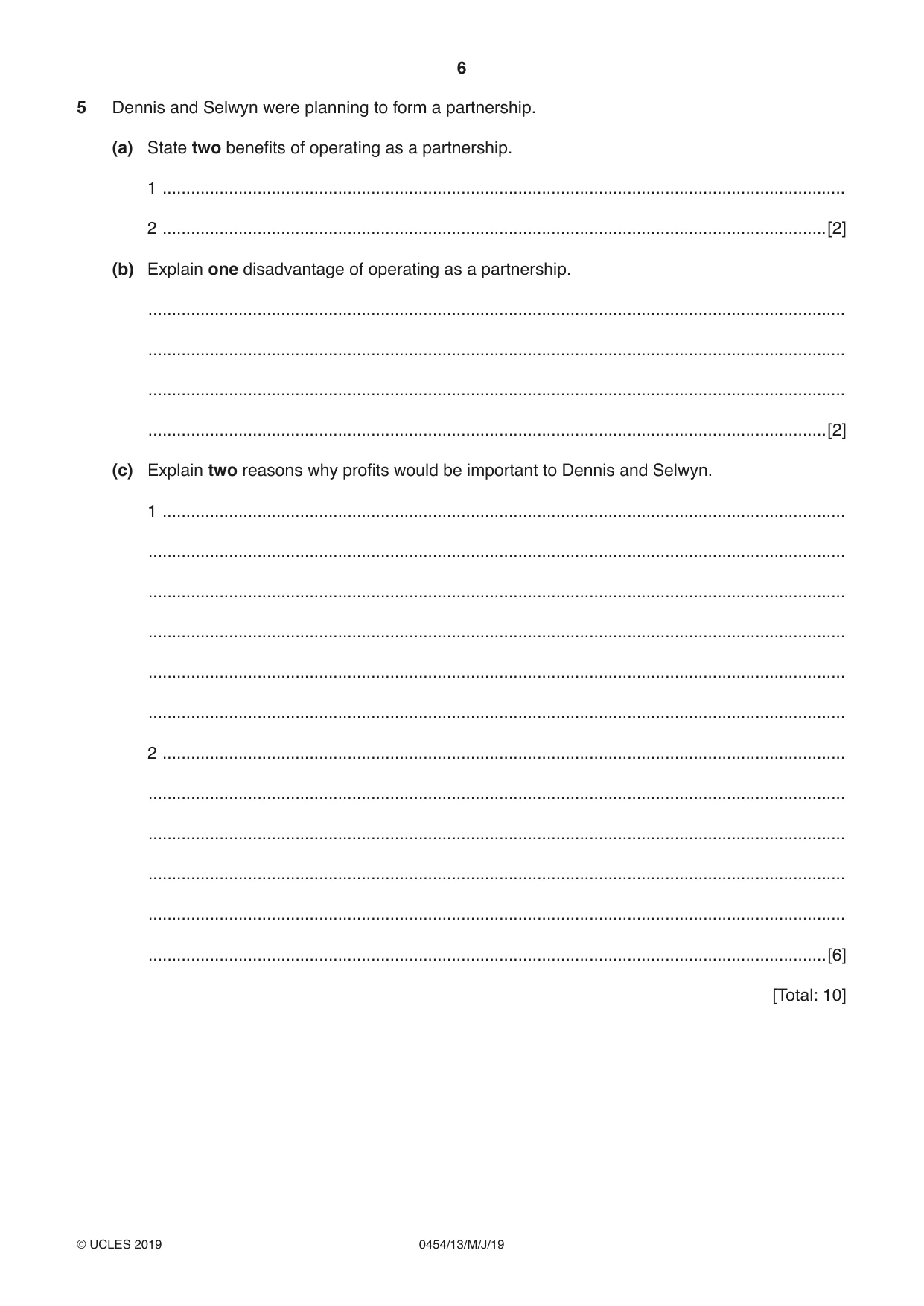
6 0454/13/M/J/19 © UCLES 2019 5 Dennis and Selwyn were planning to form a partnership. (a) State two benefits of operating as a partnership. 1 … 2 …[2] (b) Explain one disadvantage of operating as a partnership. … … … …[2] (c) Explain two reasons why profits would be important to Dennis and Selwyn. 1 … … … … … … 2 … … … … … …[6] [Total: 10]
Question paper, page 7
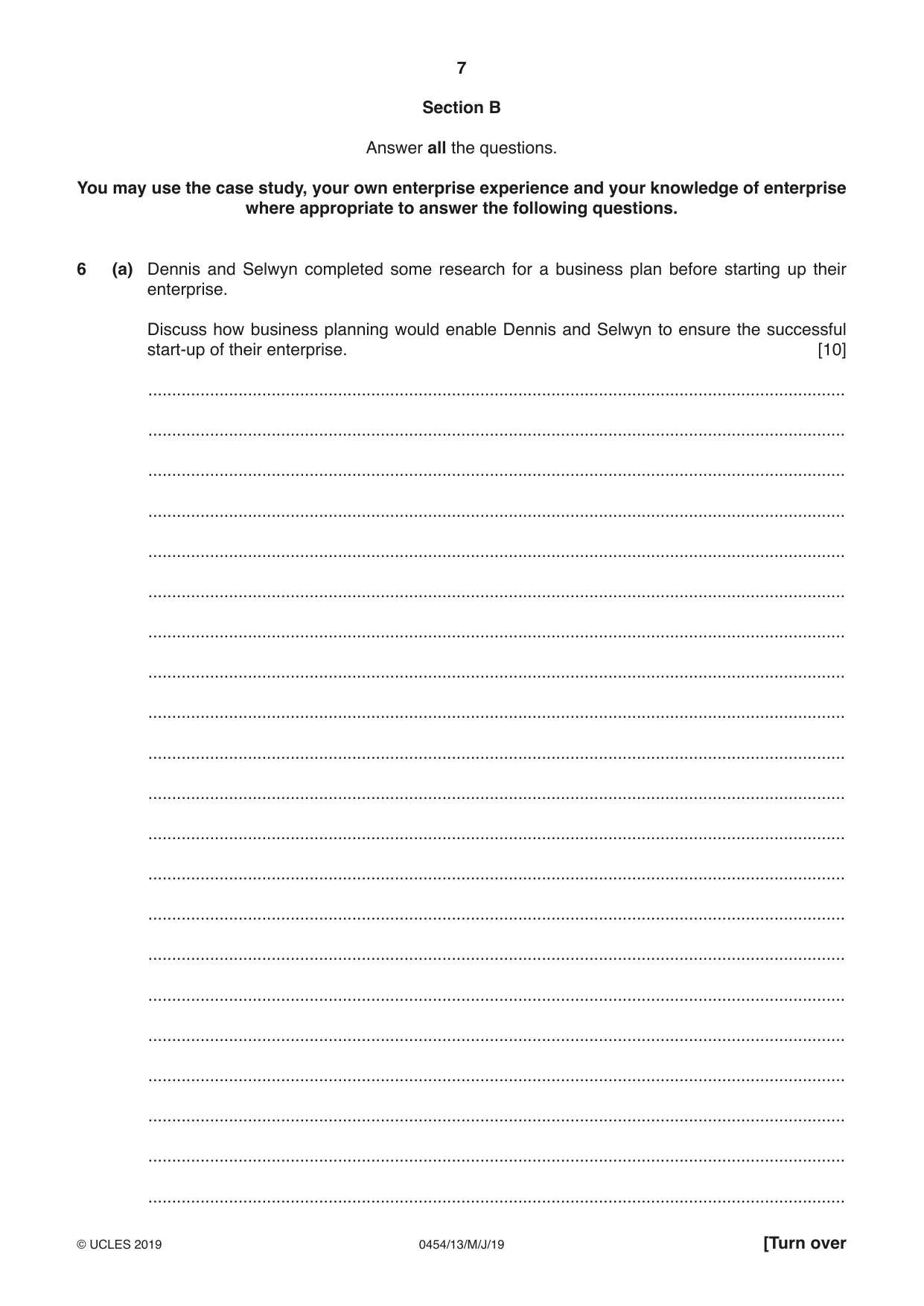
7 0454/13/M/J/19 © UCLES 2019 [Turn over Section B Answer all the questions. You may use the case study, your own enterprise experience and your knowledge of enterprise where appropriate to answer the following questions. 6 (a) Dennis and Selwyn completed some research for a business plan before starting up their enterprise. Discuss how business planning would enable Dennis and Selwyn to ensure the successful start-up of their enterprise. [10] … … … … … … … … … … … … … … … … … … … … …
Question paper, page 8
8 0454/13/M/J/19 © UCLES 2019 (b) Dennis needed to discuss Miss Rana’s offer with Selwyn. Recommend whether Dennis and Selwyn should accept the offer from Miss Rana or continue to sell tours on their own. Justify your recommendation. [15] … … … … … … … … … … … … … … … … … … … … … … … … … …
Question paper, page 9
9 0454/13/M/J/19 © UCLES 2019 [Turn over … … … … … … … … … … … … … … … … … … … … … … … … … … … [Total: 25]
Question paper, page 10
10 0454/13/M/J/19 © UCLES 2019 BLANK PAGE
Question paper, page 11
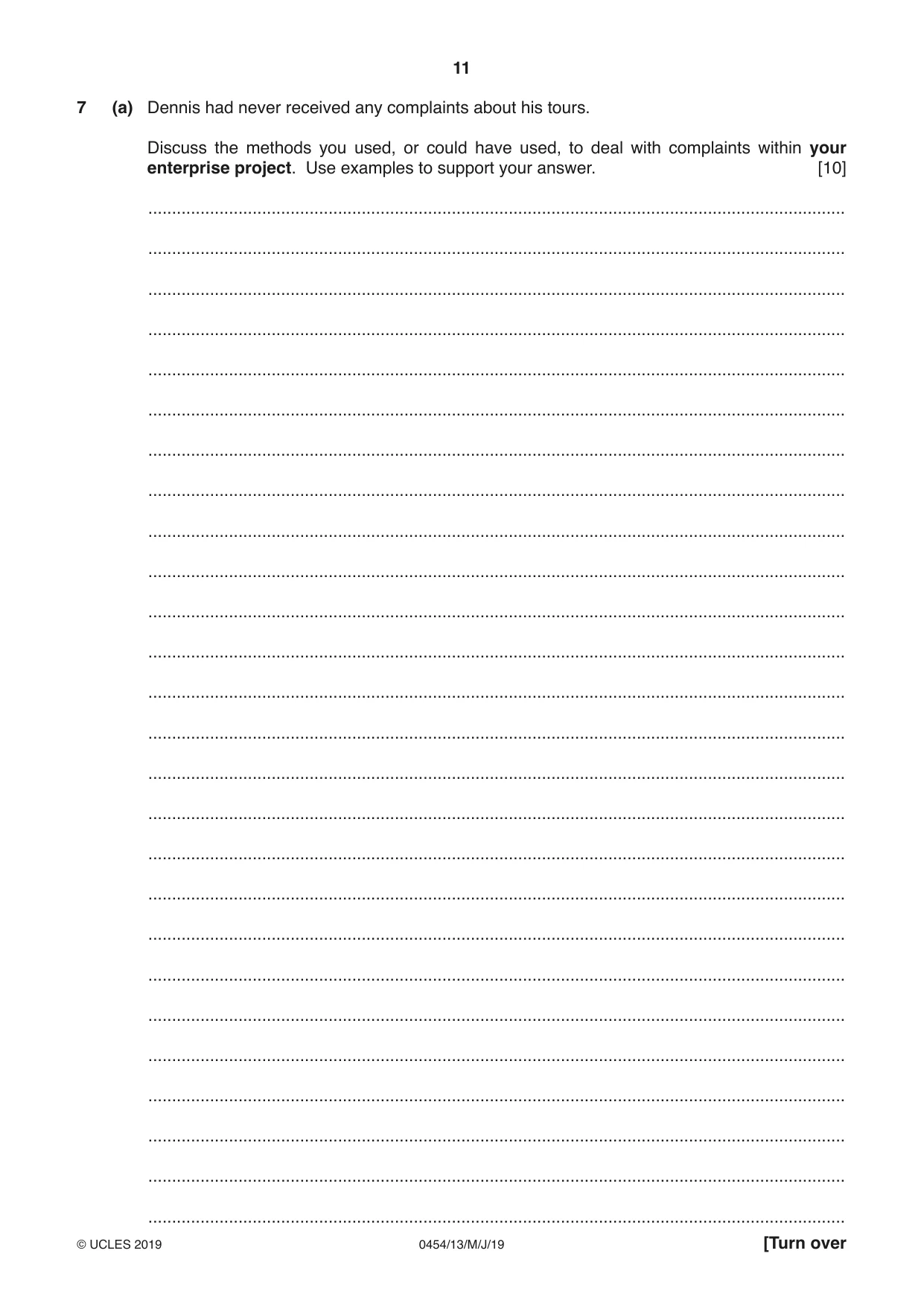
11 0454/13/M/J/19 © UCLES 2019 [Turn over 7 (a) Dennis had never received any complaints about his tours. Discuss the methods you used, or could have used, to deal with complaints within your enterprise project. Use examples to support your answer. [10] … … … … … … … … … … … … … … … … … … … … … … … … … …
Question paper, page 12
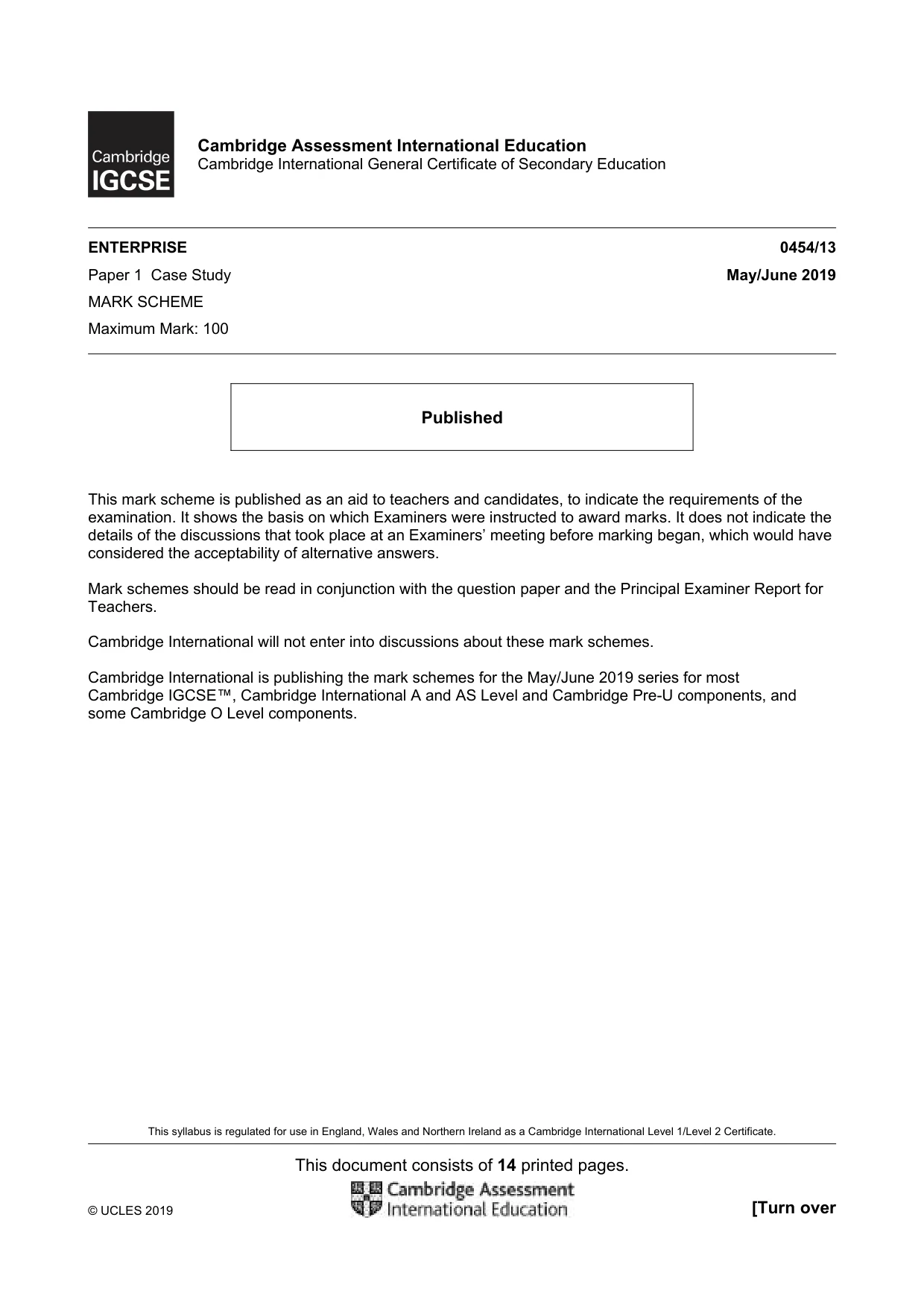
12 0454/13/M/J/19 © UCLES 2019 (b) Dennis and Selwyn used a variety of methods of communication when dealing with potential stakeholders. These methods might have included a: • face to face meeting • formal report • poster • presentation. Evaluate which two of these methods of communicating information would have been most appropriate for communicating with external stakeholders in your enterprise project. Justify why you have rejected the other methods. [15] … … … … … … … … … … … … … … … … … … … … … …
Question paper, page 13
13 0454/13/M/J/19 © UCLES 2019 … … … … … … … … … … … … … … … … … … … … … … … … … … … [Total: 25]
Question paper, page 14
14 0454/13/M/J/19 © UCLES 2019 BLANK PAGE
Question paper, page 15
15 0454/13/M/J/19 © UCLES 2019 BLANK PAGE
Question paper, page 16
16 0454/13/M/J/19 © UCLES 2019 Permission to reproduce items where third-party owned material protected by copyright is included has been sought and cleared where possible. Every reasonable effort has been made by the publisher (UCLES) to trace copyright holders, but if any items requiring clearance have unwittingly been included, the publisher will be pleased to make amends at the earliest possible opportunity. To avoid the issue of disclosure of answer-related information to candidates, all copyright acknowledgements are reproduced online in the Cambridge Assessment International Education Copyright Acknowledgements Booklet. This is produced for each series of examinations and is freely available to download at www.cambridgeinternational.org after the live examination series. Cambridge Assessment International Education is part of the Cambridge Assessment Group. Cambridge Assessment is the brand name of the University of Cambridge Local Examinations Syndicate (UCLES), which itself is a department of the University of Cambridge. BLANK PAGE
Mark scheme, page 1
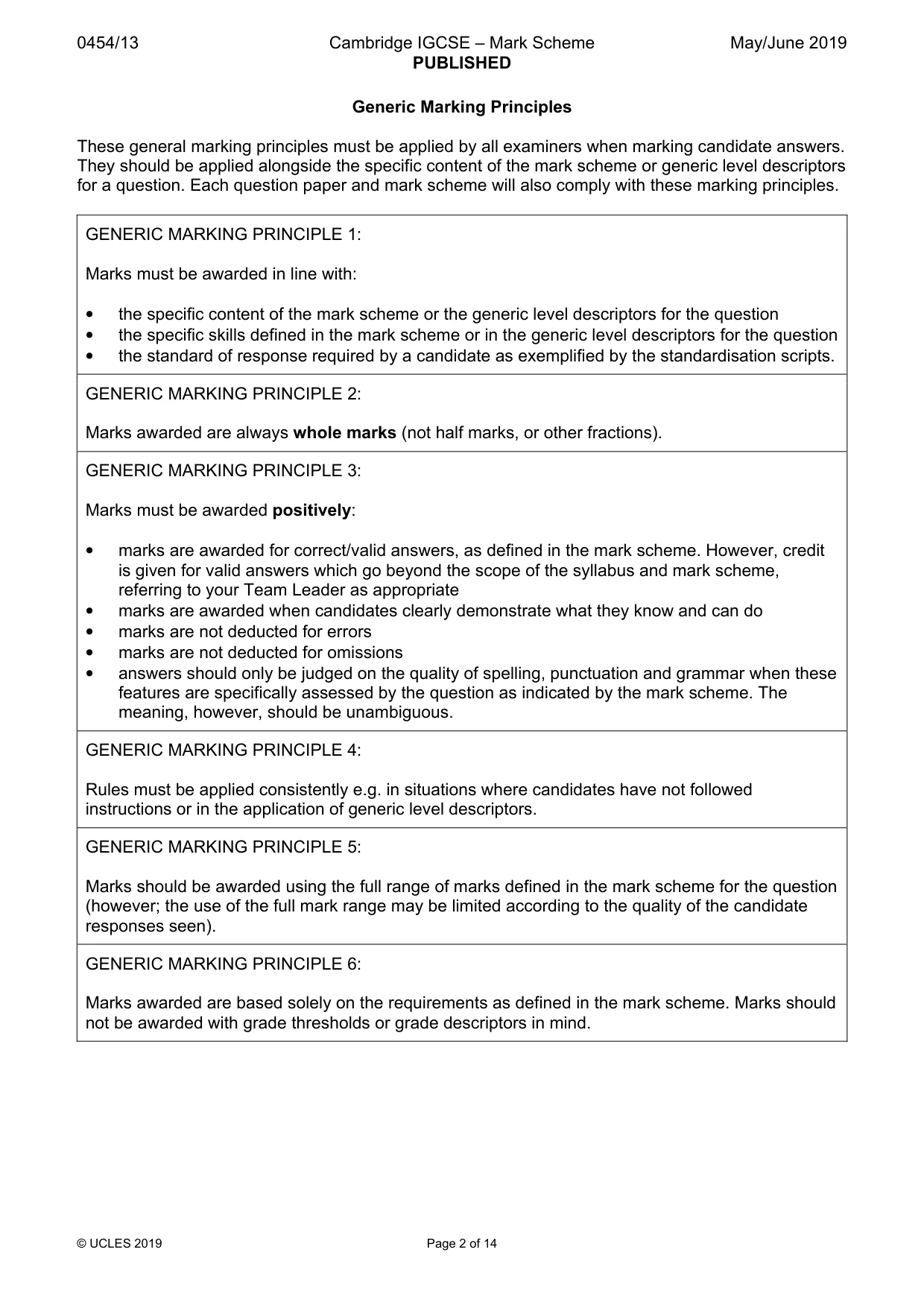
This syllabus is regulated for use in England, Wales and Northern Ireland as a Cambridge International Level 1/Level 2 Certificate. This document consists of 14 printed pages. © UCLES 2019 [Turn over Cambridge Assessment International Education Cambridge International General Certificate of Secondary Education ENTERPRISE 0454/13 Paper 1 Case Study May/June 2019 MARK SCHEME Maximum Mark: 100 Published This mark scheme is published as an aid to teachers and candidates, to indicate the requirements of the examination. It shows the basis on which Examiners were instructed to award marks. It does not indicate the details of the discussions that took place at an Examiners’ meeting before marking began, which would have considered the acceptability of alternative answers. Mark schemes should be read in conjunction with the question paper and the Principal Examiner Report for Teachers. Cambridge International will not enter into discussions about these mark schemes. Cambridge International is publishing the mark schemes for the May/June 2019 series for most Cambridge IGCSE™, Cambridge International A and AS Level and Cambridge Pre-U components, and some Cambridge O Level components.
Mark scheme, page 2
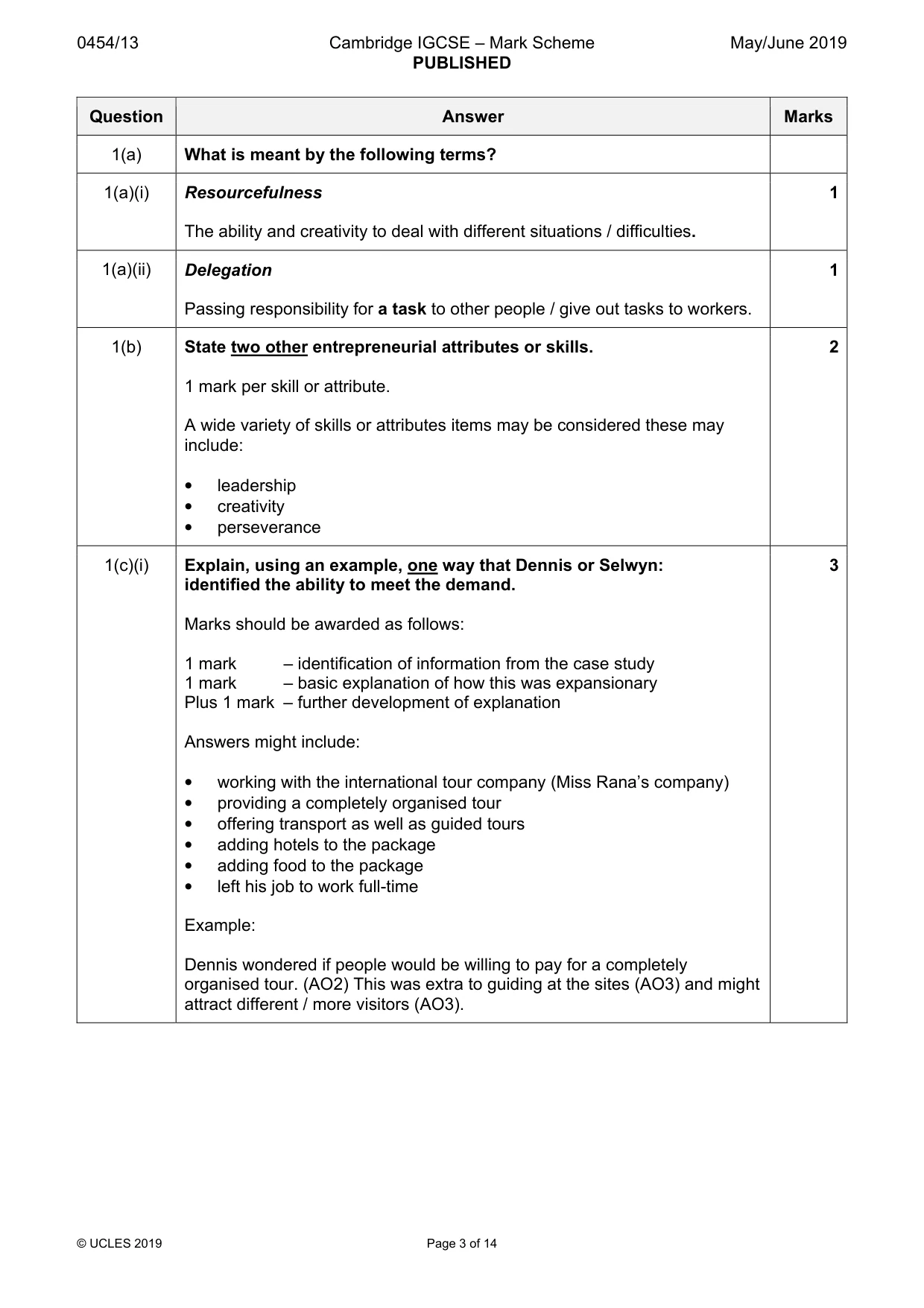
0454/13 Cambridge IGCSE – Mark Scheme PUBLISHED May/June 2019 © UCLES 2019 Page 2 of 14 Generic Marking Principles These general marking principles must be applied by all examiners when marking candidate answers. They should be applied alongside the specific content of the mark scheme or generic level descriptors for a question. Each question paper and mark scheme will also comply with these marking principles. GENERIC MARKING PRINCIPLE 1: Marks must be awarded in line with: • the specific content of the mark scheme or the generic level descriptors for the question • the specific skills defined in the mark scheme or in the generic level descriptors for the question • the standard of response required by a candidate as exemplified by the standardisation scripts. GENERIC MARKING PRINCIPLE 2: Marks awarded are always whole marks (not half marks, or other fractions). GENERIC MARKING PRINCIPLE 3: Marks must be awarded positively: • marks are awarded for correct/valid answers, as defined in the mark scheme. However, credit is given for valid answers which go beyond the scope of the syllabus and mark scheme, referring to your Team Leader as appropriate • marks are awarded when candidates clearly demonstrate what they know and can do • marks are not deducted for errors • marks are not deducted for omissions • answers should only be judged on the quality of spelling, punctuation and grammar when these features are specifically assessed by the question as indicated by the mark scheme. The meaning, however, should be unambiguous. GENERIC MARKING PRINCIPLE 4: Rules must be applied consistently e.g. in situations where candidates have not followed instructions or in the application of generic level descriptors. GENERIC MARKING PRINCIPLE 5: Marks should be awarded using the full range of marks defined in the mark scheme for the question (however; the use of the full mark range may be limited according to the quality of the candidate responses seen). GENERIC MARKING PRINCIPLE 6: Marks awarded are based solely on the requirements as defined in the mark scheme. Marks should not be awarded with grade thresholds or grade descriptors in mind.
Mark scheme, page 3
0454/13 Cambridge IGCSE – Mark Scheme PUBLISHED May/June 2019 © UCLES 2019 Page 3 of 14 Question Answer Marks 1(a) What is meant by the following terms? 1(a)(i) Resourcefulness The ability and creativity to deal with different situations / difficulties. 1 1(a)(ii) Delegation Passing responsibility for a task to other people / give out tasks to workers. 1 1(b) State two other entrepreneurial attributes or skills. 1 mark per skill or attribute. A wide variety of skills or attributes items may be considered these may include: • leadership • creativity • perseverance 2 1(c)(i) Explain, using an example, one way that Dennis or Selwyn: identified the ability to meet the demand. Marks should be awarded as follows: 1 mark – identification of information from the case study 1 mark – basic explanation of how this was expansionary Plus 1 mark – further development of explanation Answers might include: • working with the international tour company (Miss Rana’s company) • providing a completely organised tour • offering transport as well as guided tours • adding hotels to the package • adding food to the package • left his job to work full-time Example: Dennis wondered if people would be willing to pay for a completely organised tour. (AO2) This was extra to guiding at the sites (AO3) and might attract different / more visitors (AO3). 3
Mark scheme, page 4
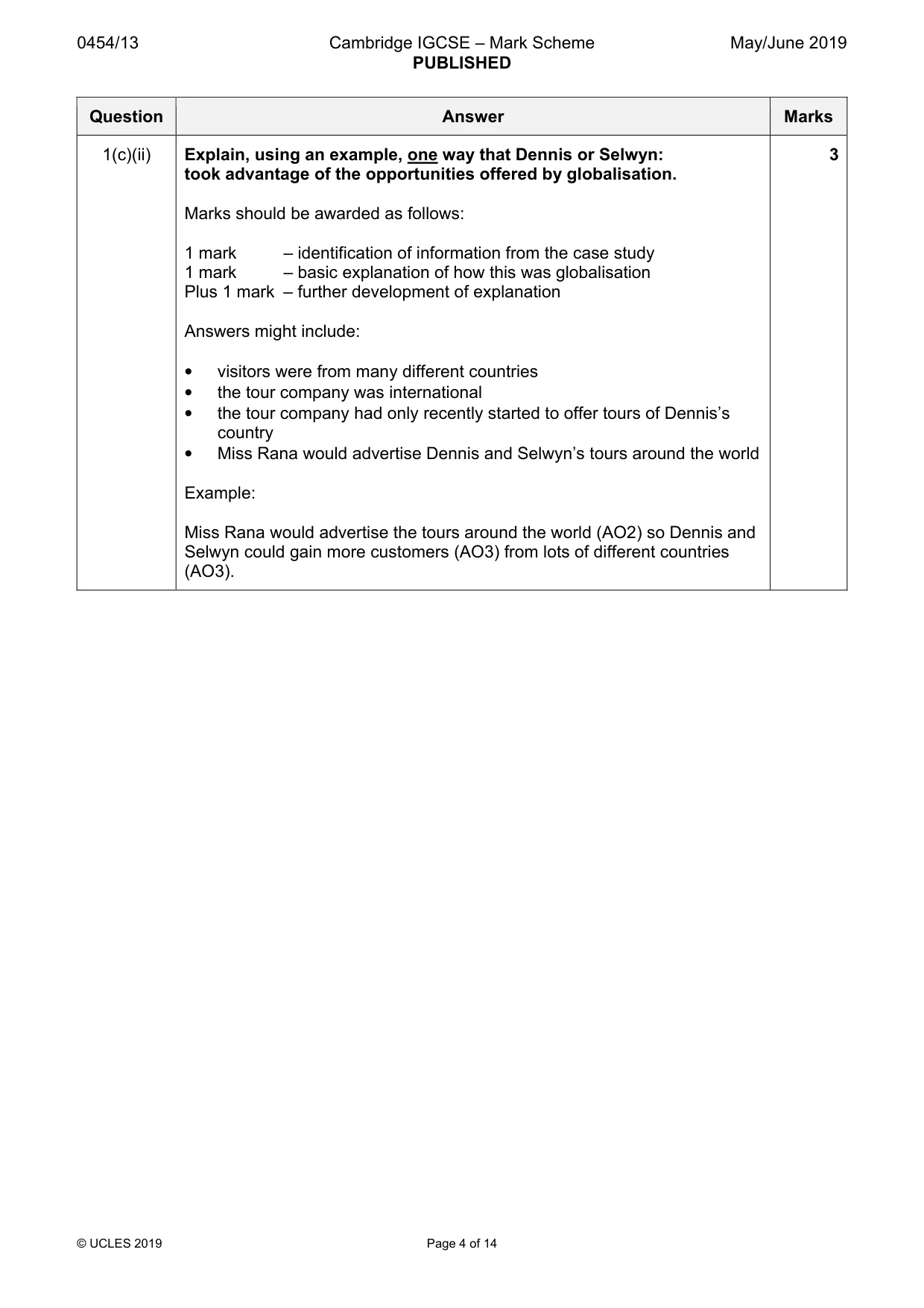
0454/13 Cambridge IGCSE – Mark Scheme PUBLISHED May/June 2019 © UCLES 2019 Page 4 of 14 Question Answer Marks 1(c)(ii) Explain, using an example, one way that Dennis or Selwyn: took advantage of the opportunities offered by globalisation. Marks should be awarded as follows: 1 mark – identification of information from the case study 1 mark – basic explanation of how this was globalisation Plus 1 mark – further development of explanation Answers might include: • visitors were from many different countries • the tour company was international • the tour company had only recently started to offer tours of Dennis’s country • Miss Rana would advertise Dennis and Selwyn’s tours around the world Example: Miss Rana would advertise the tours around the world (AO2) so Dennis and Selwyn could gain more customers (AO3) from lots of different countries (AO3). 3
Mark scheme, page 5
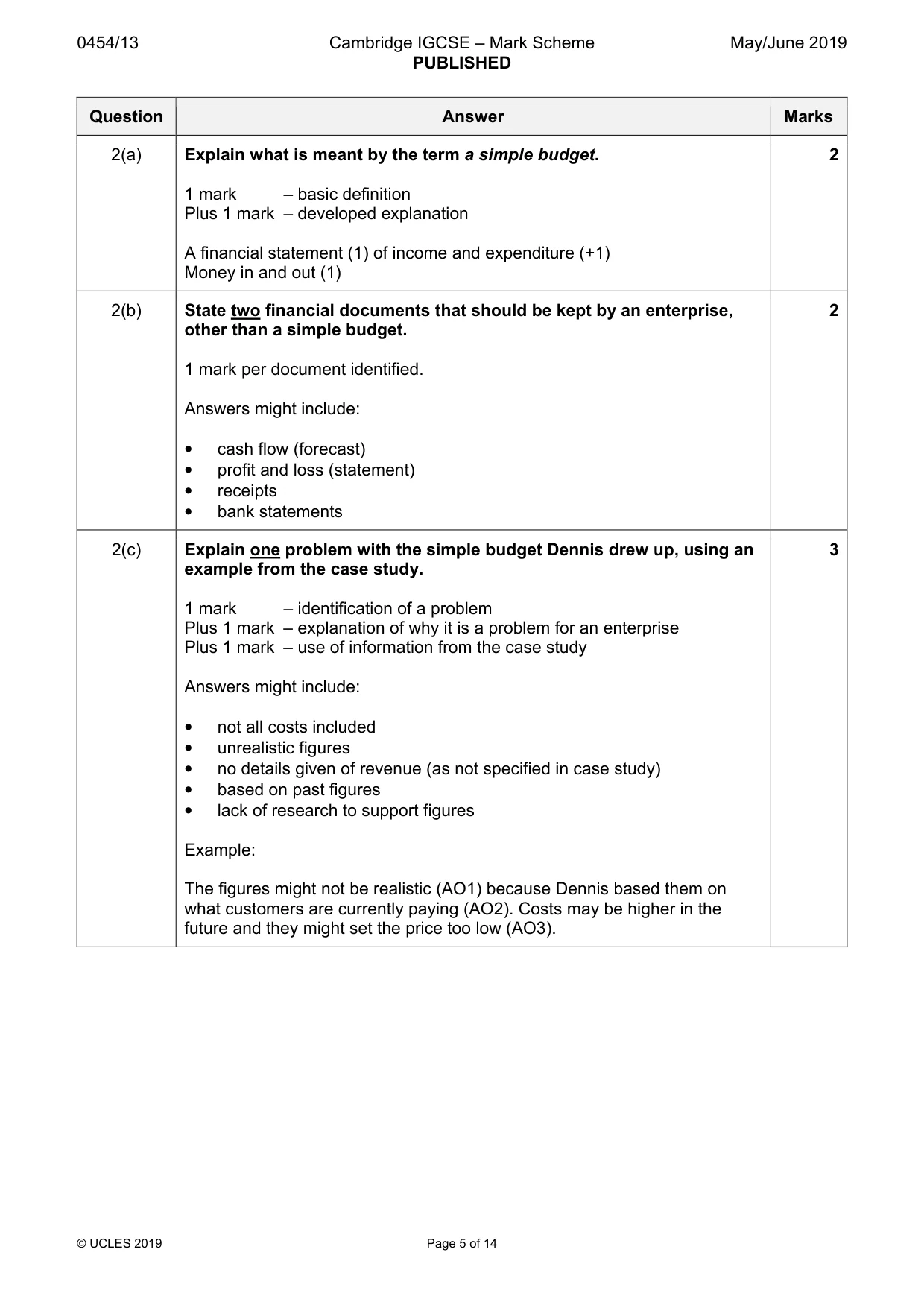
0454/13 Cambridge IGCSE – Mark Scheme PUBLISHED May/June 2019 © UCLES 2019 Page 5 of 14 Question Answer Marks 2(a) Explain what is meant by the term a simple budget. 1 mark – basic definition Plus 1 mark – developed explanation A financial statement (1) of income and expenditure (+1) Money in and out (1) 2 2(b) State two financial documents that should be kept by an enterprise, other than a simple budget. 1 mark per document identified. Answers might include: • cash flow (forecast) • profit and loss (statement) • receipts • bank statements 2 2(c) Explain one problem with the simple budget Dennis drew up, using an example from the case study. 1 mark – identification of a problem Plus 1 mark – explanation of why it is a problem for an enterprise Plus 1 mark – use of information from the case study Answers might include: • not all costs included • unrealistic figures • no details given of revenue (as not specified in case study) • based on past figures • lack of research to support figures Example: The figures might not be realistic (AO1) because Dennis based them on what customers are currently paying (AO2). Costs may be higher in the future and they might set the price too low (AO3). 3
Mark scheme, page 6
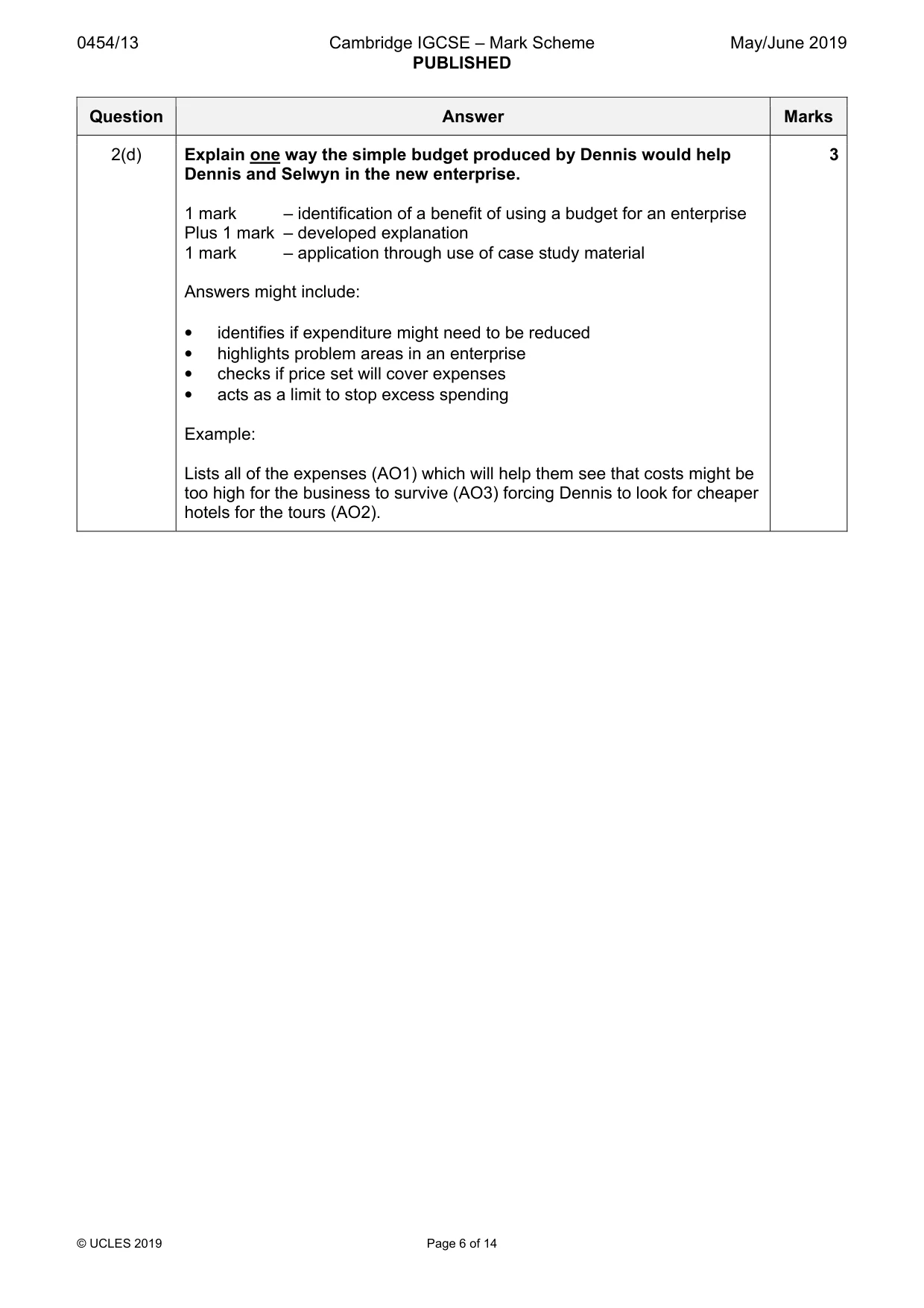
0454/13 Cambridge IGCSE – Mark Scheme PUBLISHED May/June 2019 © UCLES 2019 Page 6 of 14 Question Answer Marks 2(d) Explain one way the simple budget produced by Dennis would help Dennis and Selwyn in the new enterprise. 1 mark – identification of a benefit of using a budget for an enterprise Plus 1 mark – developed explanation 1 mark – application through use of case study material Answers might include: • identifies if expenditure might need to be reduced • highlights problem areas in an enterprise • checks if price set will cover expenses • acts as a limit to stop excess spending Example: Lists all of the expenses (AO1) which will help them see that costs might be too high for the business to survive (AO3) forcing Dennis to look for cheaper hotels for the tours (AO2). 3
Mark scheme, page 7
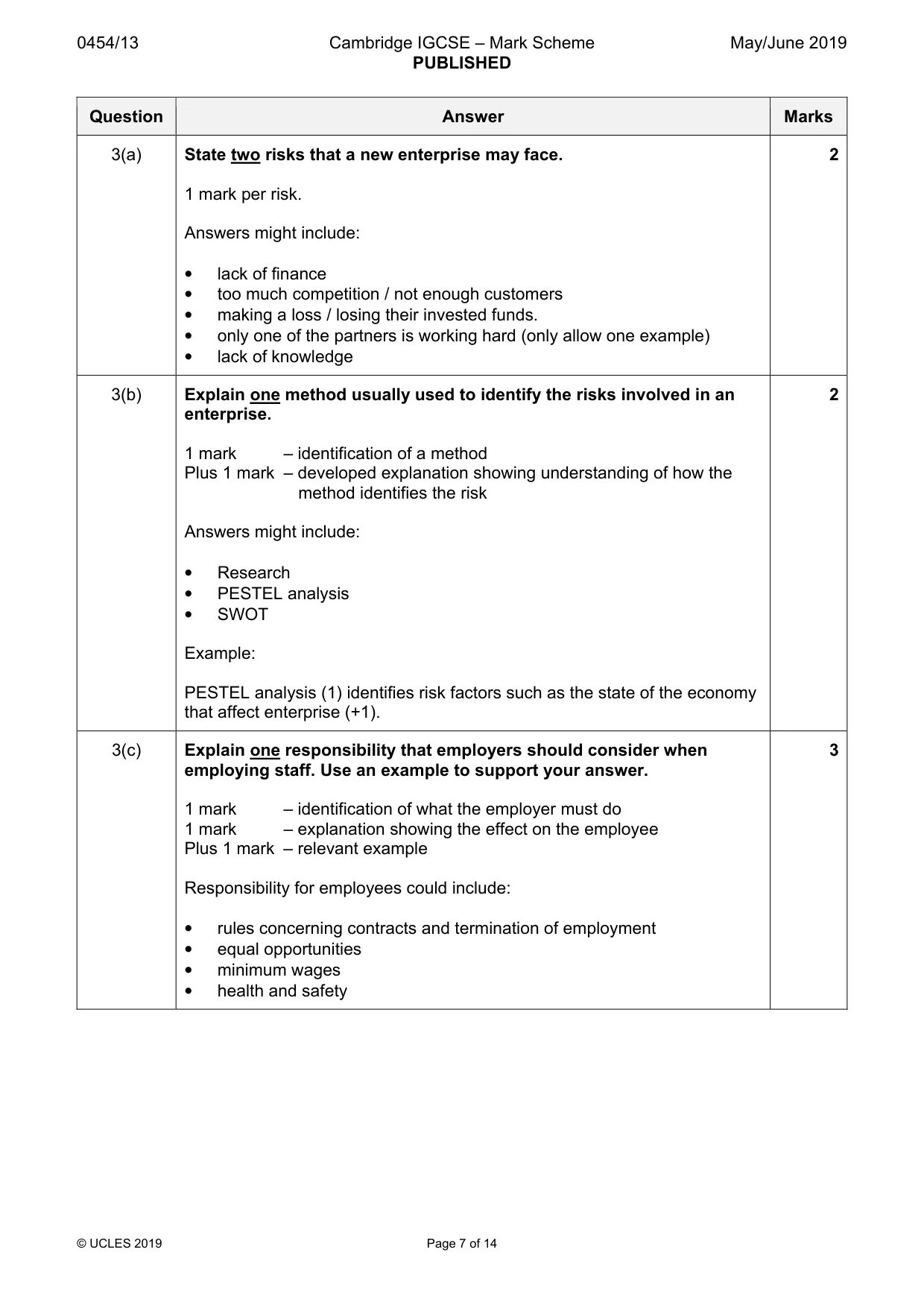
0454/13 Cambridge IGCSE – Mark Scheme PUBLISHED May/June 2019 © UCLES 2019 Page 7 of 14 Question Answer Marks 3(a) State two risks that a new enterprise may face. 1 mark per risk. Answers might include: • lack of finance • too much competition / not enough customers • making a loss / losing their invested funds. • only one of the partners is working hard (only allow one example) • lack of knowledge 2 3(b) Explain one method usually used to identify the risks involved in an enterprise. 1 mark – identification of a method Plus 1 mark – developed explanation showing understanding of how the method identifies the risk Answers might include: • Research • PESTEL analysis • SWOT Example: PESTEL analysis (1) identifies risk factors such as the state of the economy that affect enterprise (+1). 2 3(c) Explain one responsibility that employers should consider when employing staff. Use an example to support your answer. 1 mark – identification of what the employer must do 1 mark – explanation showing the effect on the employee Plus 1 mark – relevant example Responsibility for employees could include: • rules concerning contracts and termination of employment • equal opportunities • minimum wages • health and safety 3
Mark scheme, page 8
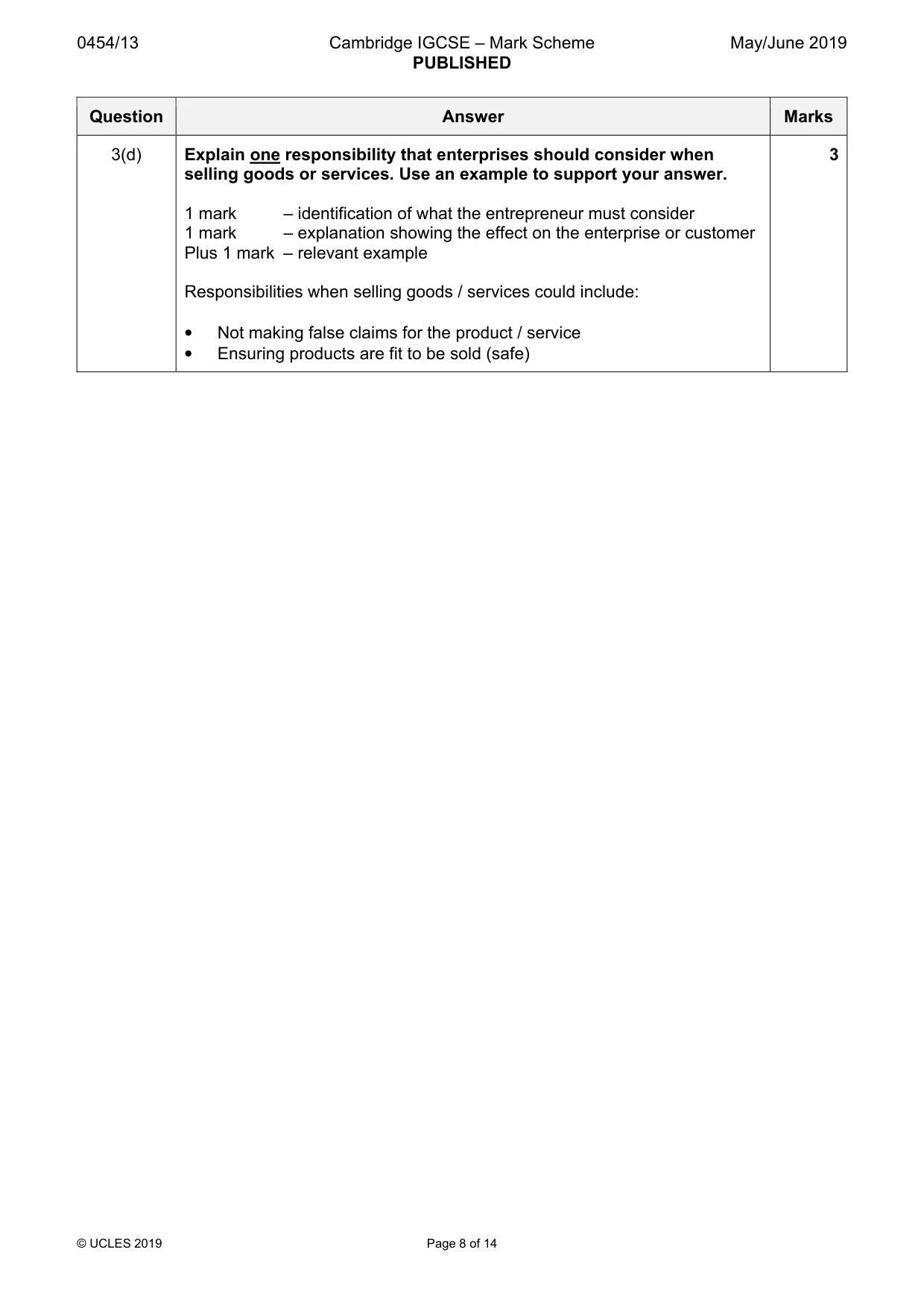
0454/13 Cambridge IGCSE – Mark Scheme PUBLISHED May/June 2019 © UCLES 2019 Page 8 of 14 Question Answer Marks 3(d) Explain one responsibility that enterprises should consider when selling goods or services. Use an example to support your answer. 1 mark – identification of what the entrepreneur must consider 1 mark – explanation showing the effect on the enterprise or customer Plus 1 mark – relevant example Responsibilities when selling goods / services could include: • Not making false claims for the product / service • Ensuring products are fit to be sold (safe) 3
Mark scheme, page 9
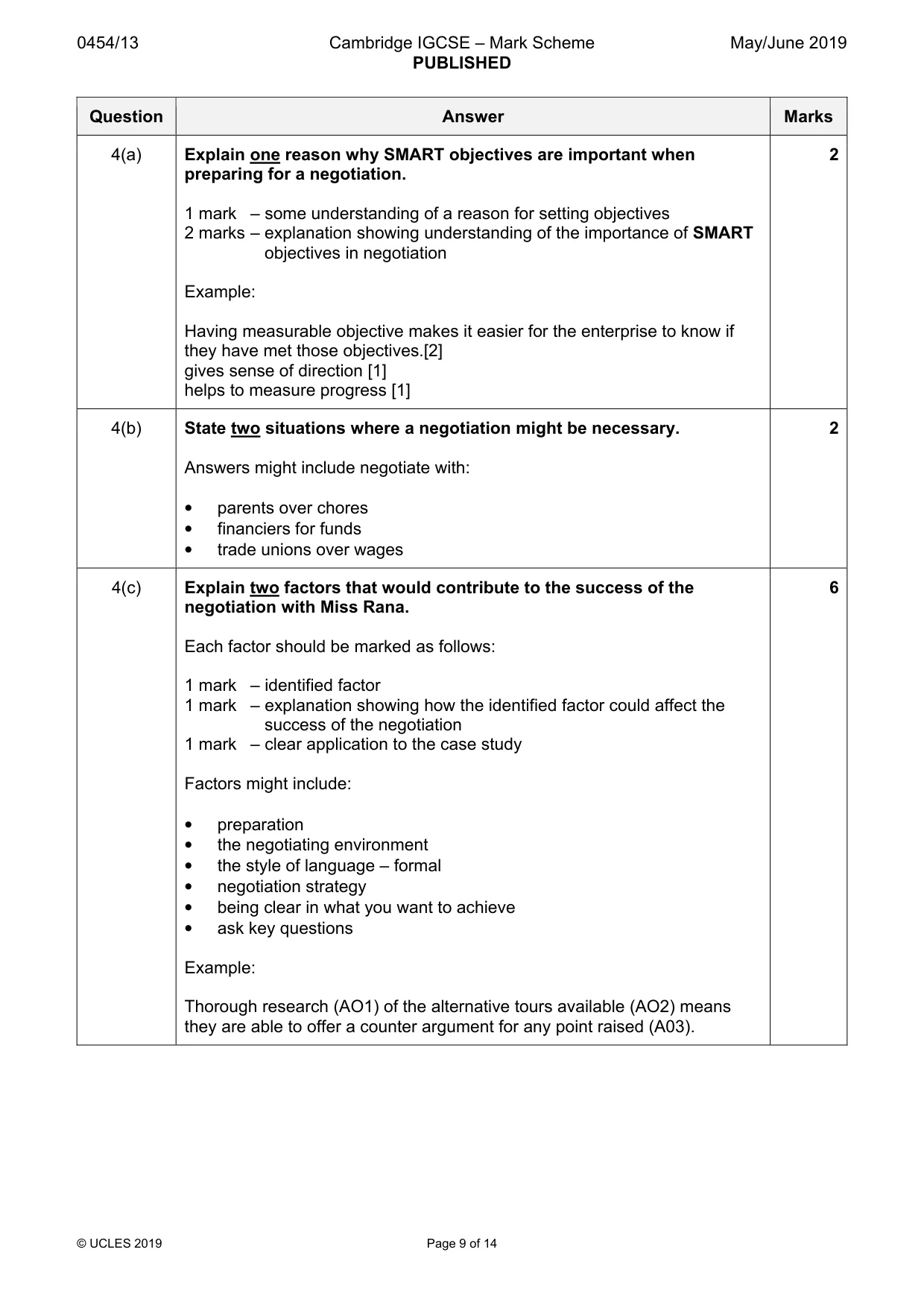
0454/13 Cambridge IGCSE – Mark Scheme PUBLISHED May/June 2019 © UCLES 2019 Page 9 of 14 Question Answer Marks 4(a) Explain one reason why SMART objectives are important when preparing for a negotiation. 1 mark – some understanding of a reason for setting objectives 2 marks – explanation showing understanding of the importance of SMART objectives in negotiation Example: Having measurable objective makes it easier for the enterprise to know if they have met those objectives.[2] gives sense of direction [1] helps to measure progress [1] 2 4(b) State two situations where a negotiation might be necessary. Answers might include negotiate with: • parents over chores • financiers for funds • trade unions over wages 2 4(c) Explain two factors that would contribute to the success of the negotiation with Miss Rana. Each factor should be marked as follows: 1 mark – identified factor 1 mark – explanation showing how the identified factor could affect the success of the negotiation 1 mark – clear application to the case study Factors might include: • preparation • the negotiating environment • the style of language – formal • negotiation strategy • being clear in what you want to achieve • ask key questions Example: Thorough research (AO1) of the alternative tours available (AO2) means they are able to offer a counter argument for any point raised (A03). 6
Mark scheme, page 10
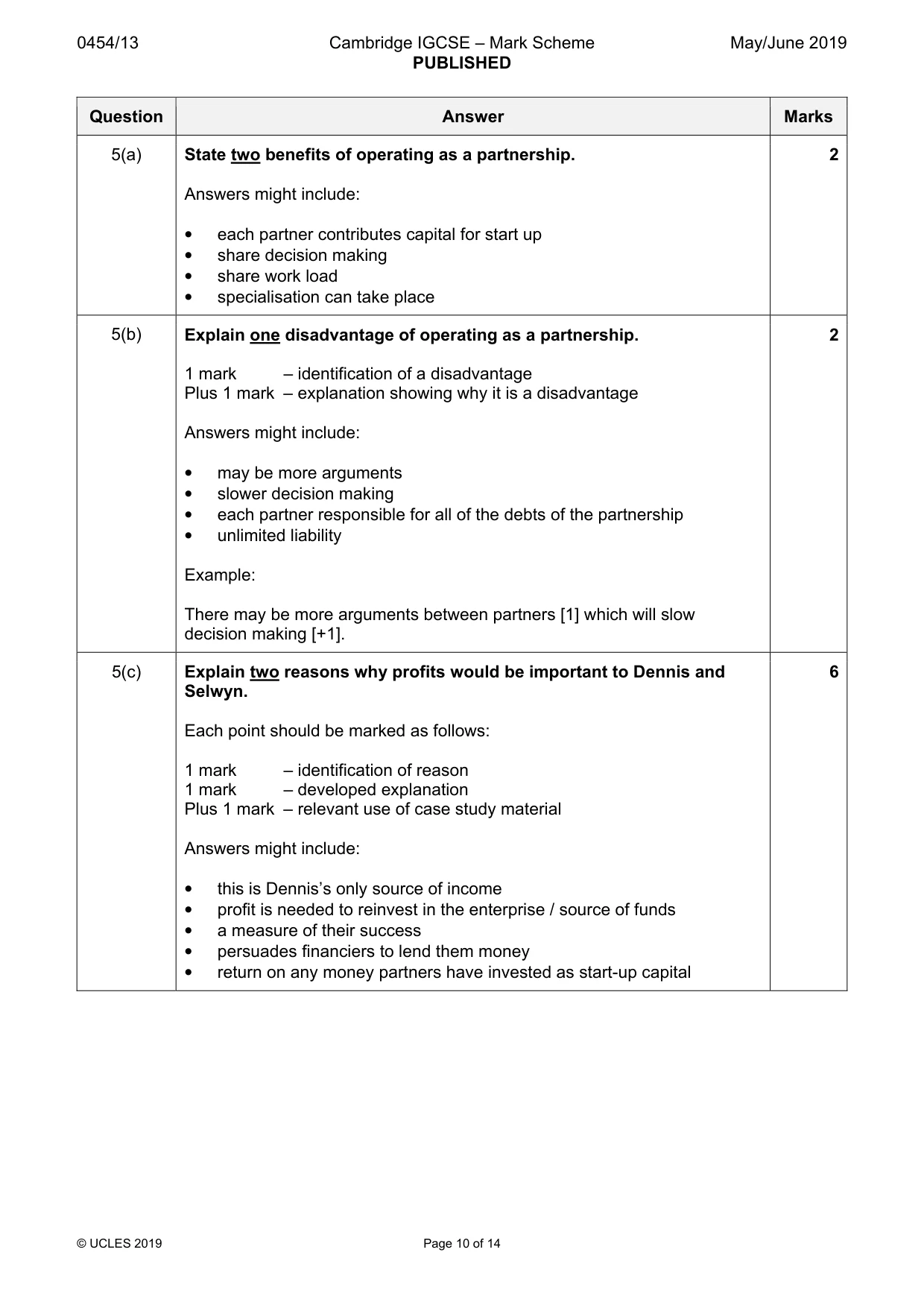
0454/13 Cambridge IGCSE – Mark Scheme PUBLISHED May/June 2019 © UCLES 2019 Page 10 of 14 Question Answer Marks 5(a) State two benefits of operating as a partnership. Answers might include: • each partner contributes capital for start up • share decision making • share work load • specialisation can take place 2 5(b) Explain one disadvantage of operating as a partnership. 1 mark – identification of a disadvantage Plus 1 mark – explanation showing why it is a disadvantage Answers might include: • may be more arguments • slower decision making • each partner responsible for all of the debts of the partnership • unlimited liability Example: There may be more arguments between partners [1] which will slow decision making [+1]. 2 5(c) Explain two reasons why profits would be important to Dennis and Selwyn. Each point should be marked as follows: 1 mark – identification of reason 1 mark – developed explanation Plus 1 mark – relevant use of case study material Answers might include: • this is Dennis’s only source of income • profit is needed to reinvest in the enterprise / source of funds • a measure of their success • persuades financiers to lend them money • return on any money partners have invested as start-up capital 6
Mark scheme, page 11
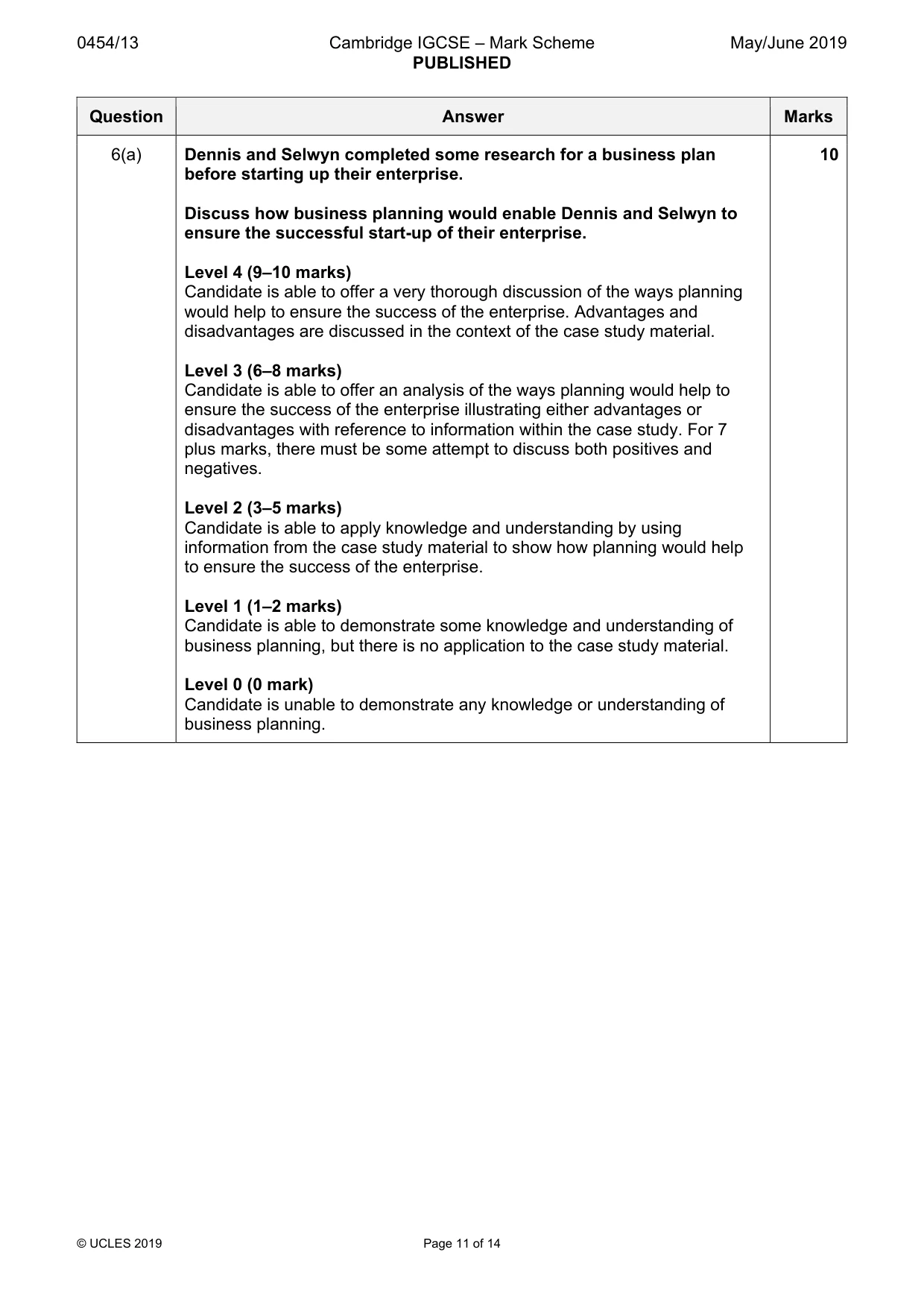
0454/13 Cambridge IGCSE – Mark Scheme PUBLISHED May/June 2019 © UCLES 2019 Page 11 of 14 Question Answer Marks 6(a) Dennis and Selwyn completed some research for a business plan before starting up their enterprise. Discuss how business planning would enable Dennis and Selwyn to ensure the successful start-up of their enterprise. Level 4 (9–10 marks) Candidate is able to offer a very thorough discussion of the ways planning would help to ensure the success of the enterprise. Advantages and disadvantages are discussed in the context of the case study material. Level 3 (6–8 marks) Candidate is able to offer an analysis of the ways planning would help to ensure the success of the enterprise illustrating either advantages or disadvantages with reference to information within the case study. For 7 plus marks, there must be some attempt to discuss both positives and negatives. Level 2 (3–5 marks) Candidate is able to apply knowledge and understanding by using information from the case study material to show how planning would help to ensure the success of the enterprise. Level 1 (1–2 marks) Candidate is able to demonstrate some knowledge and understanding of business planning, but there is no application to the case study material. Level 0 (0 mark) Candidate is unable to demonstrate any knowledge or understanding of business planning. 10
Mark scheme, page 12
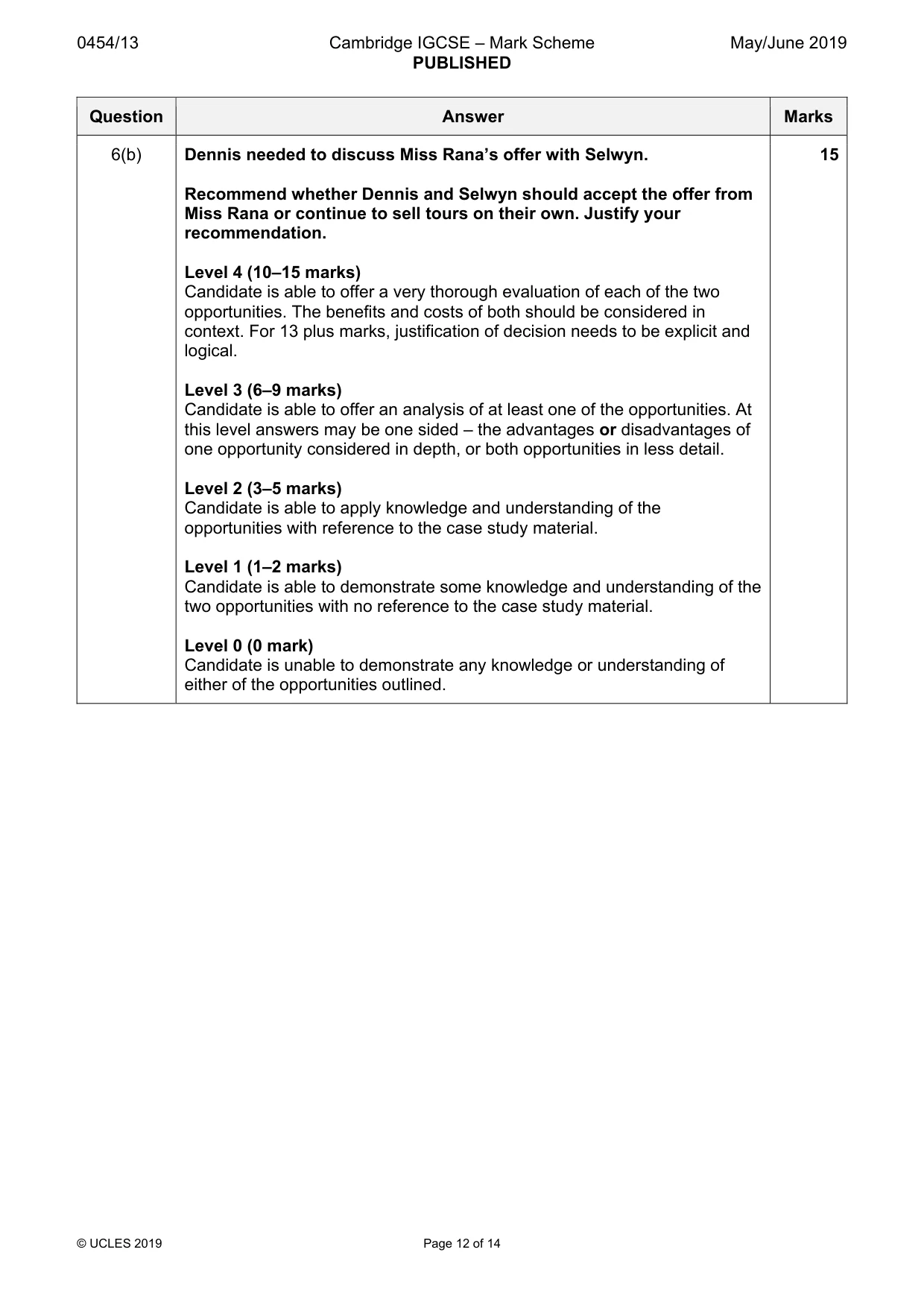
0454/13 Cambridge IGCSE – Mark Scheme PUBLISHED May/June 2019 © UCLES 2019 Page 12 of 14 Question Answer Marks 6(b) Dennis needed to discuss Miss Rana’s offer with Selwyn. Recommend whether Dennis and Selwyn should accept the offer from Miss Rana or continue to sell tours on their own. Justify your recommendation. Level 4 (10–15 marks) Candidate is able to offer a very thorough evaluation of each of the two opportunities. The benefits and costs of both should be considered in context. For 13 plus marks, justification of decision needs to be explicit and logical. Level 3 (6–9 marks) Candidate is able to offer an analysis of at least one of the opportunities. At this level answers may be one sided – the advantages or disadvantages of one opportunity considered in depth, or both opportunities in less detail. Level 2 (3–5 marks) Candidate is able to apply knowledge and understanding of the opportunities with reference to the case study material. Level 1 (1–2 marks) Candidate is able to demonstrate some knowledge and understanding of the two opportunities with no reference to the case study material. Level 0 (0 mark) Candidate is unable to demonstrate any knowledge or understanding of either of the opportunities outlined. 15
Mark scheme, page 13
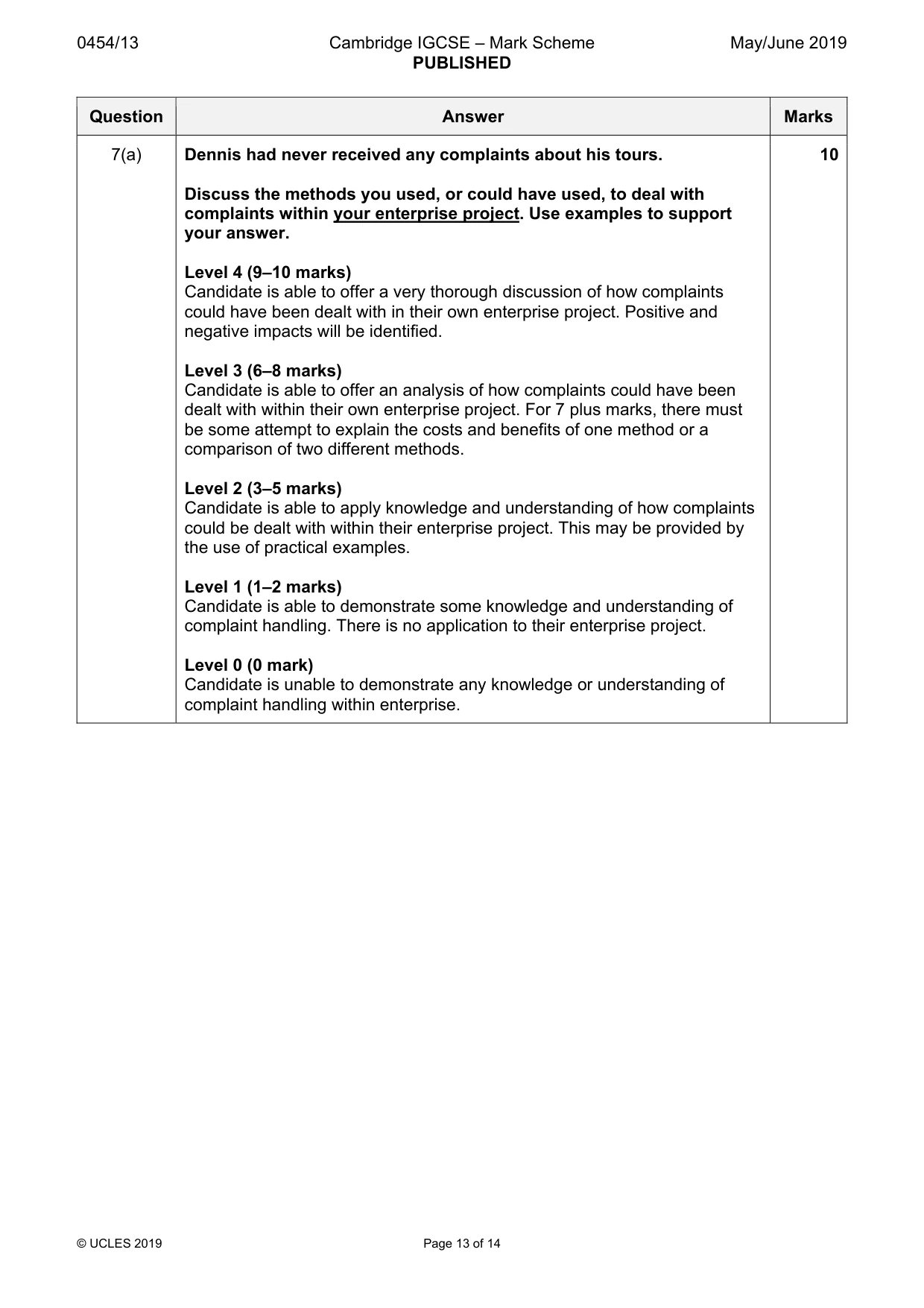
0454/13 Cambridge IGCSE – Mark Scheme PUBLISHED May/June 2019 © UCLES 2019 Page 13 of 14 Question Answer Marks 7(a) Dennis had never received any complaints about his tours. Discuss the methods you used, or could have used, to deal with complaints within your enterprise project. Use examples to support your answer. Level 4 (9–10 marks) Candidate is able to offer a very thorough discussion of how complaints could have been dealt with in their own enterprise project. Positive and negative impacts will be identified. Level 3 (6–8 marks) Candidate is able to offer an analysis of how complaints could have been dealt with within their own enterprise project. For 7 plus marks, there must be some attempt to explain the costs and benefits of one method or a comparison of two different methods. Level 2 (3–5 marks) Candidate is able to apply knowledge and understanding of how complaints could be dealt with within their enterprise project. This may be provided by the use of practical examples. Level 1 (1–2 marks) Candidate is able to demonstrate some knowledge and understanding of complaint handling. There is no application to their enterprise project. Level 0 (0 mark) Candidate is unable to demonstrate any knowledge or understanding of complaint handling within enterprise. 10
Mark scheme, page 14
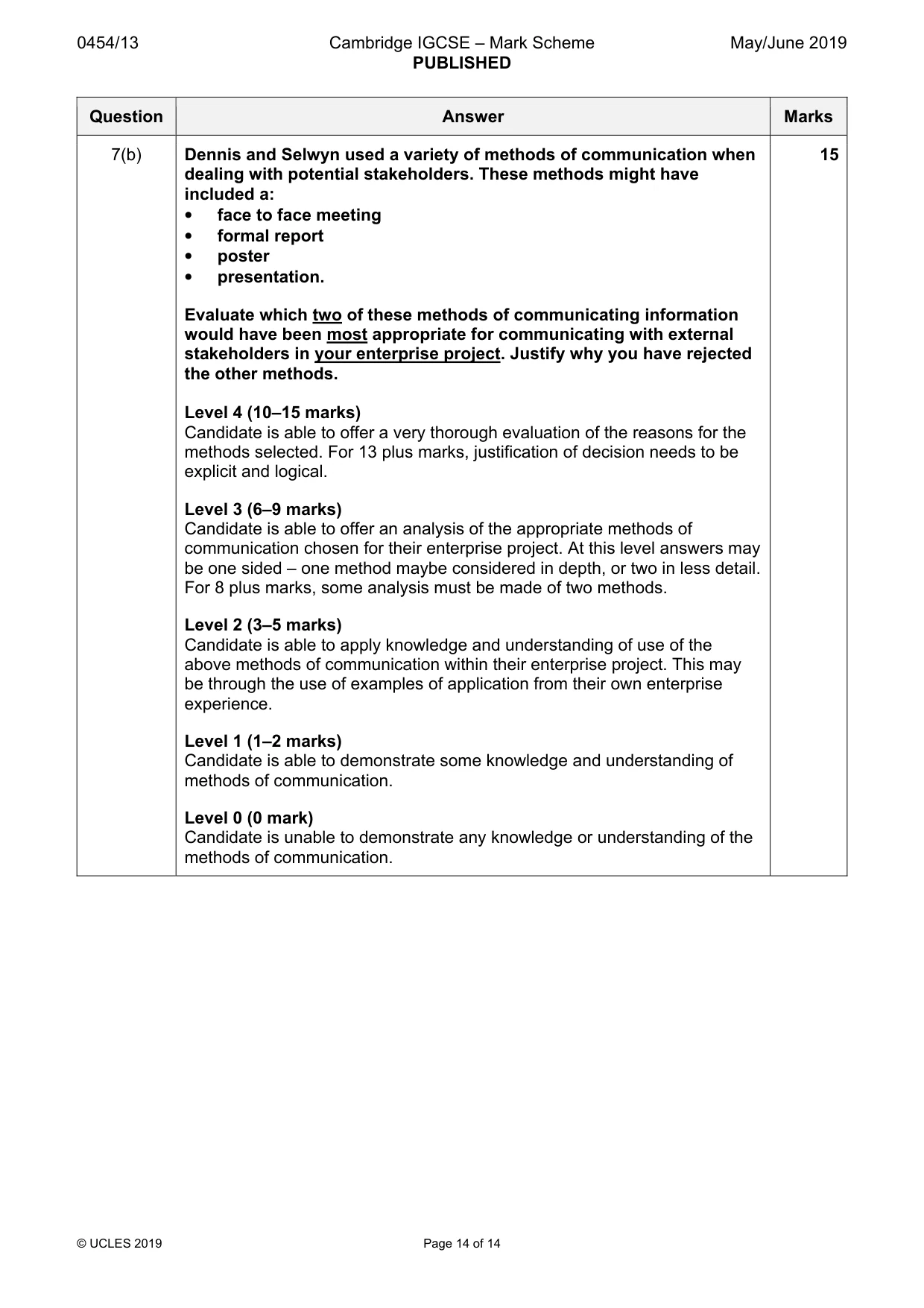
0454/13 Cambridge IGCSE – Mark Scheme PUBLISHED May/June 2019 © UCLES 2019 Page 14 of 14 Question Answer Marks 7(b) Dennis and Selwyn used a variety of methods of communication when dealing with potential stakeholders. These methods might have included a: • face to face meeting • formal report • poster • presentation. Evaluate which two of these methods of communicating information would have been most appropriate for communicating with external stakeholders in your enterprise project. Justify why you have rejected the other methods. Level 4 (10–15 marks) Candidate is able to offer a very thorough evaluation of the reasons for the methods selected. For 13 plus marks, justification of decision needs to be explicit and logical. Level 3 (6–9 marks) Candidate is able to offer an analysis of the appropriate methods of communication chosen for their enterprise project. At this level answers may be one sided – one method maybe considered in depth, or two in less detail. For 8 plus marks, some analysis must be made of two methods. Level 2 (3–5 marks) Candidate is able to apply knowledge and understanding of use of the above methods of communication within their enterprise project. This may be through the use of examples of application from their own enterprise experience. Level 1 (1–2 marks) Candidate is able to demonstrate some knowledge and understanding of methods of communication. Level 0 (0 mark) Candidate is unable to demonstrate any knowledge or understanding of the methods of communication. 15
What you needed in this session
Cambridge’s own grade thresholds for 2019 May/June, Paper 1 · Variant 3. A higher threshold means an easier paper — the bar moves with how the cohort did.