Cambridge IGCSE Enterprise 0454 — 2015 May/June Paper 1 · Variant 2
0454/12/M/J/15 · 100 marks · ≈113 min
The question paper and its mark scheme, free to read here and free to download. This is Cambridge’s own paper, exactly as it was sat.
Question paper16 pages






Mark scheme8 pages
Answers below. Sit the paper first if you are practising.
Paper as text
Question paper, page 1
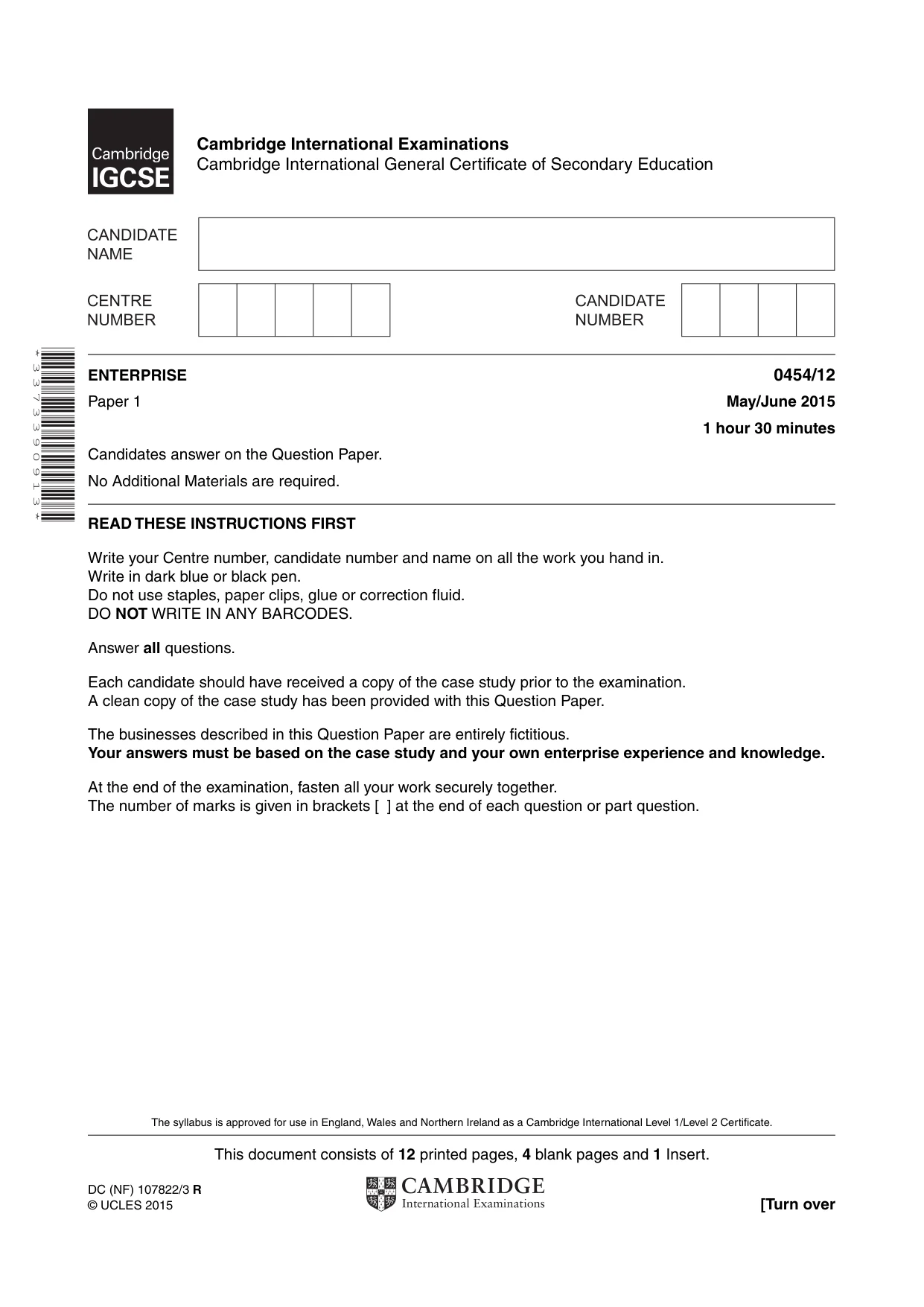
This document consists of 12 printed pages, 4 blank pages and 1 Insert. DC (NF) 107822/3 R © UCLES 2015 [Turn over Cambridge International Examinations Cambridge International General Certificate of Secondary Education * 3 3 7 3 3 9 0 9 1 3 * ENTERPRISE 0454/12 Paper 1 May/June 2015 1 hour 30 minutes Candidates answer on the Question Paper. No Additional Materials are required. READ THESE INSTRUCTIONS FIRST Write your Centre number, candidate number and name on all the work you hand in. Write in dark blue or black pen. Do not use staples, paper clips, glue or correction fluid. DO NOT WRITE IN ANY BARCODES. Answer all questions. Each candidate should have received a copy of the case study prior to the examination. A clean copy of the case study has been provided with this Question Paper. The businesses described in this Question Paper are entirely fictitious. Your answers must be based on the case study and your own enterprise experience and knowledge. At the end of the examination, fasten all your work securely together. The number of marks is given in brackets [ ] at the end of each question or part question. The syllabus is approved for use in England, Wales and Northern Ireland as a Cambridge International Level 1/Level 2 Certificate.
Question paper, page 2
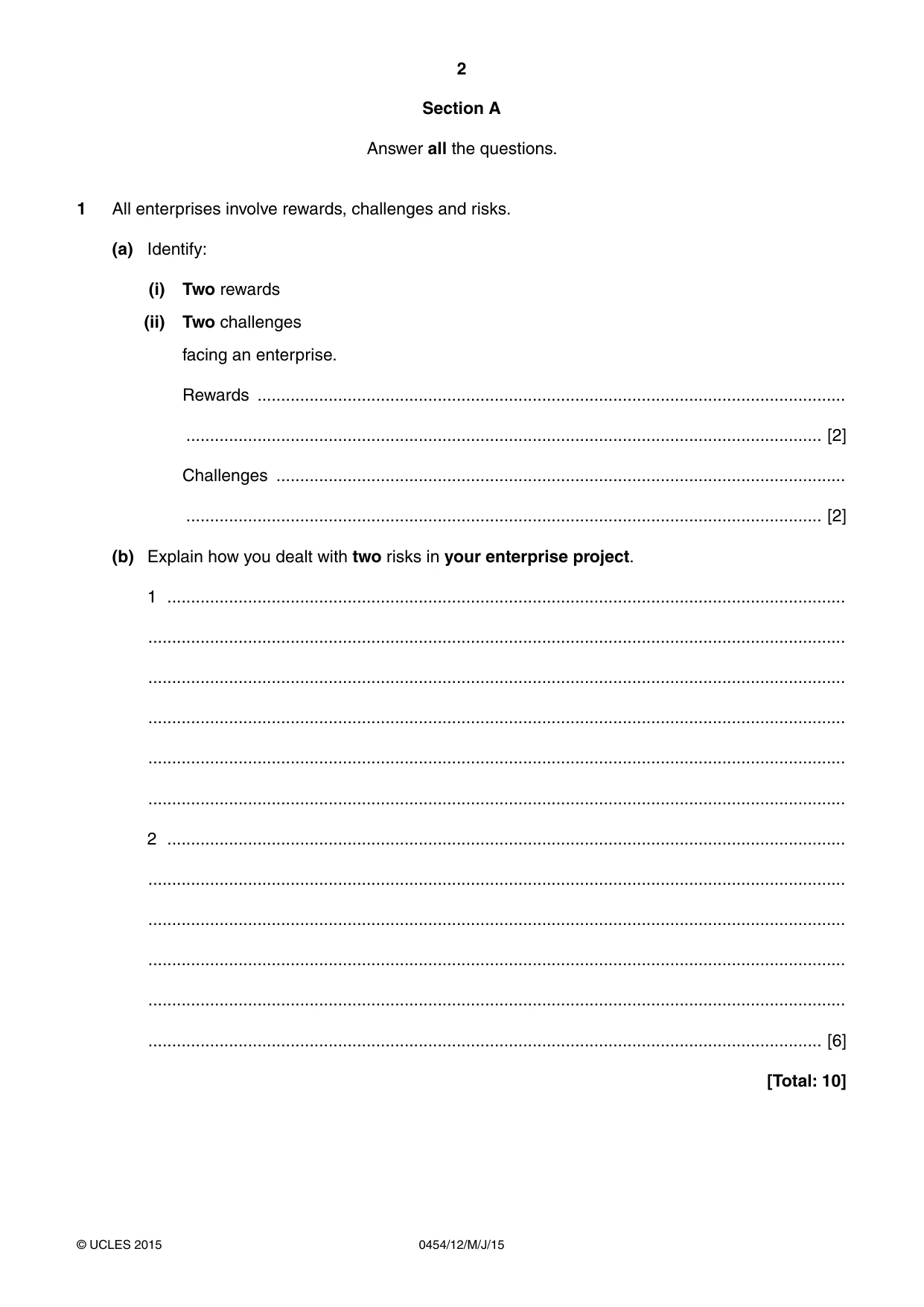
2 0454/12/M/J/15 © UCLES 2015 Section A Answer all the questions. 1 All enterprises involve rewards, challenges and risks. (a) Identify: (i) Two rewards (ii) Two challenges facing an enterprise. Rewards … … [2] Challenges … … [2] (b) Explain how you dealt with two risks in your enterprise project. 1 … … … … … … 2 … … … … … … [6] [Total: 10]
Question paper, page 3
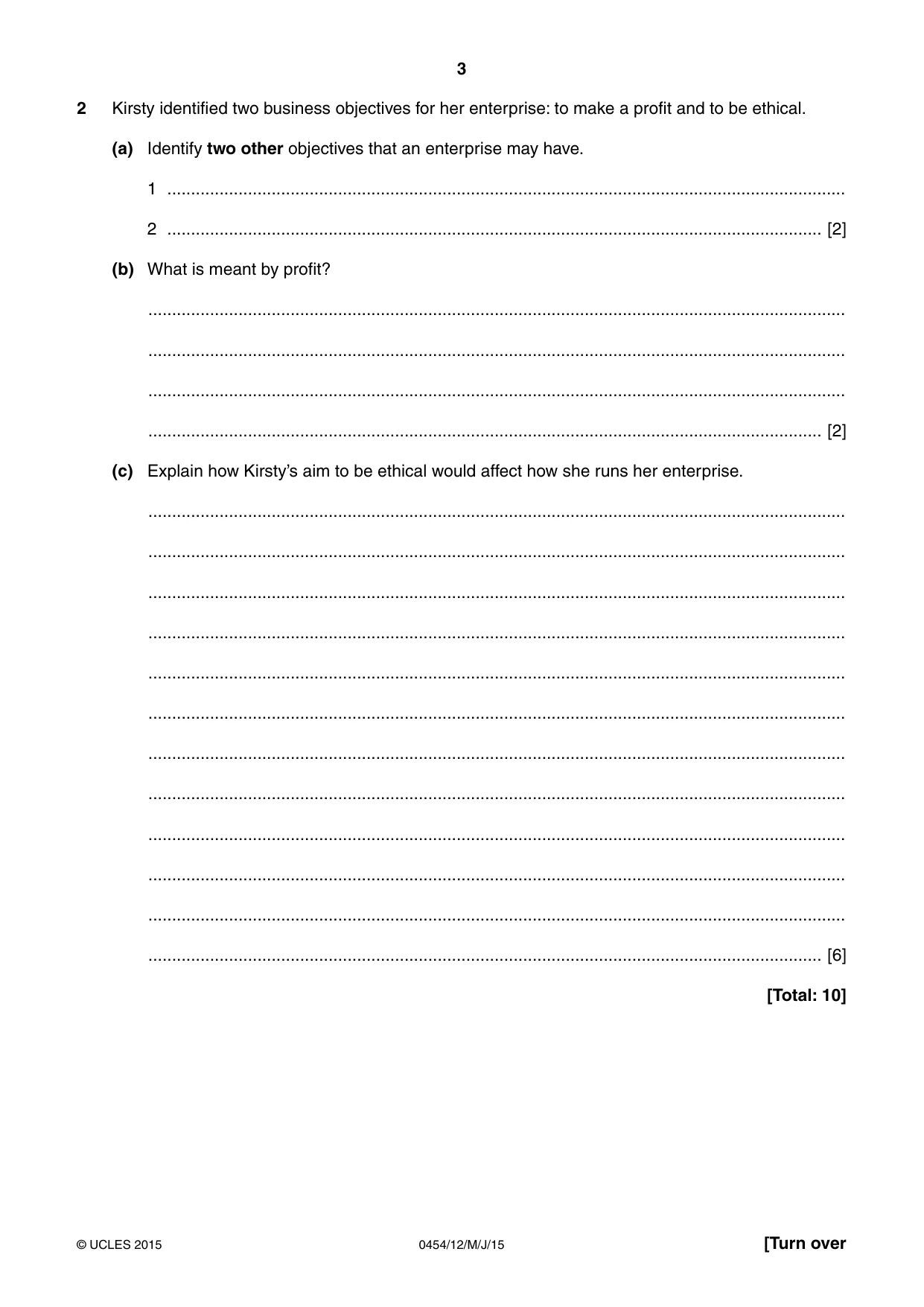
3 0454/12/M/J/15 © UCLES 2015 [Turn over 2 Kirsty identified two business objectives for her enterprise: to make a profit and to be ethical. (a) Identify two other objectives that an enterprise may have. 1 … 2 … [2] (b) What is meant by profit? … … … … [2] (c) Explain how Kirsty’s aim to be ethical would affect how she runs her enterprise. … … … … … … … … … … … … [6] [Total: 10]
Question paper, page 4
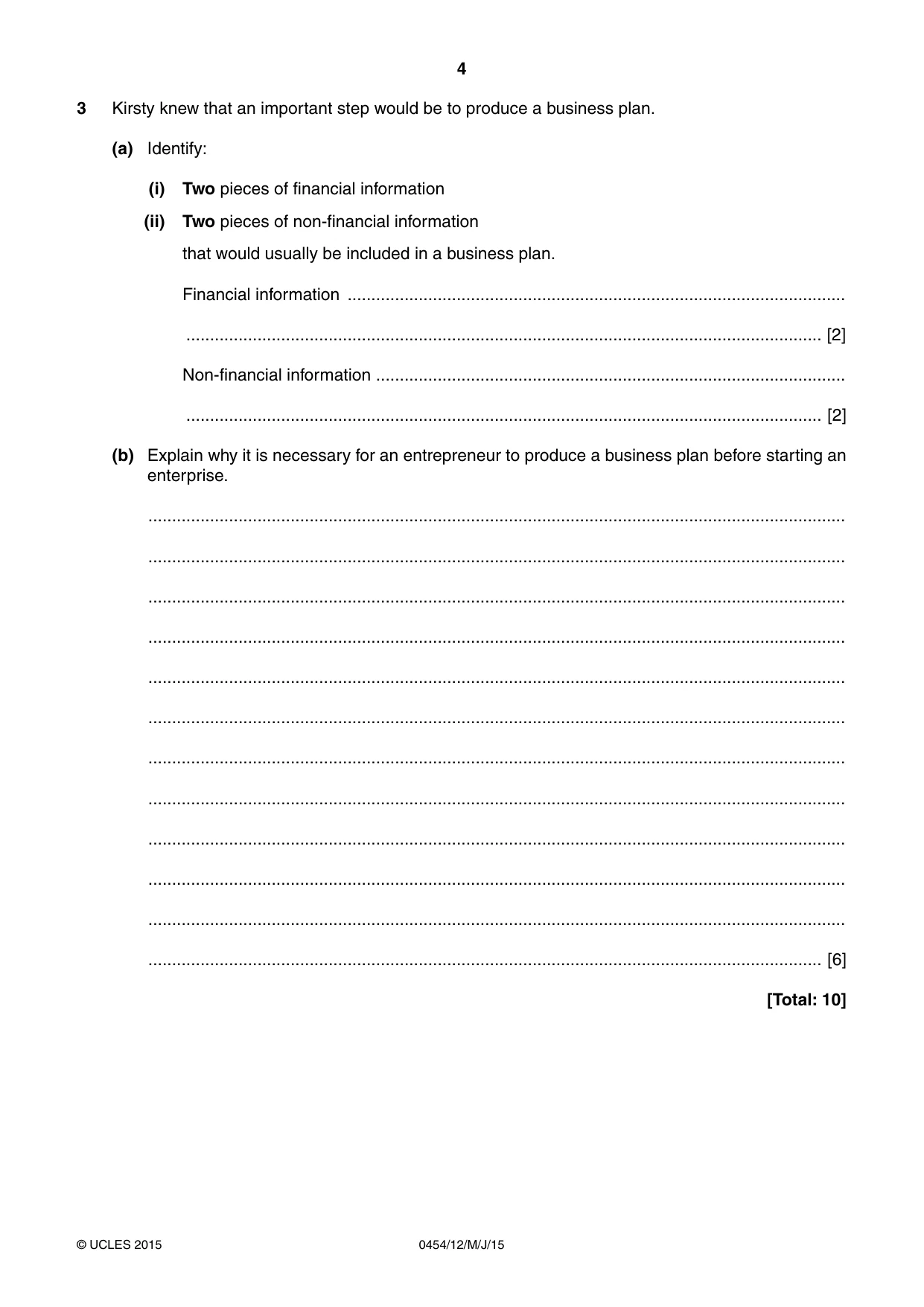
4 0454/12/M/J/15 © UCLES 2015 3 Kirsty knew that an important step would be to produce a business plan. (a) Identify: (i) Two pieces of financial information (ii) Two pieces of non-financial information that would usually be included in a business plan. Financial information … … [2] Non-financial information … … [2] (b) Explain why it is necessary for an entrepreneur to produce a business plan before starting an enterprise. … … … … … … … … … … … … [6] [Total: 10]
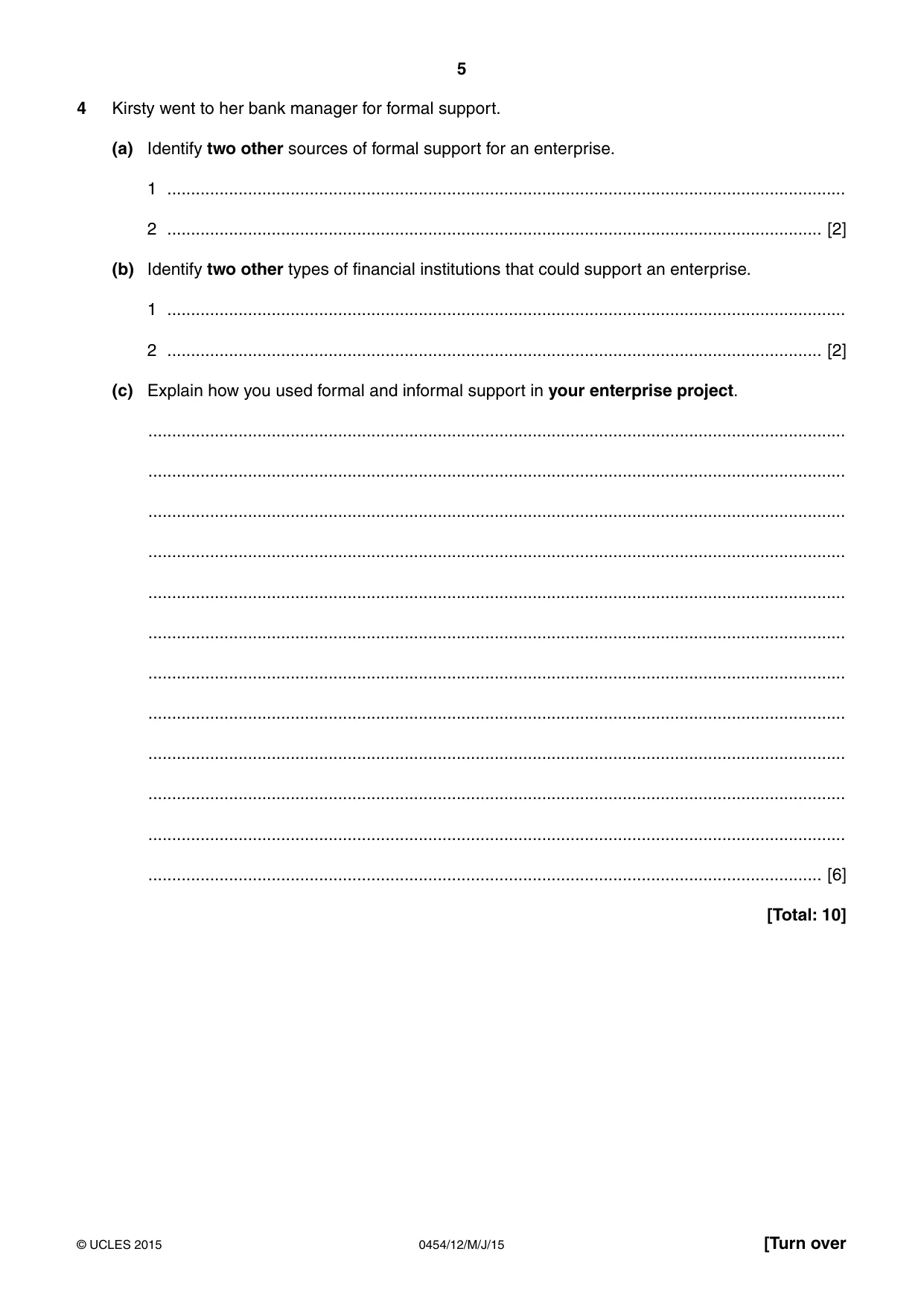
Question paper, page 5
5 0454/12/M/J/15 © UCLES 2015 [Turn over 4 Kirsty went to her bank manager for formal support. (a) Identify two other sources of formal support for an enterprise. 1 … 2 … [2] (b) Identify two other types of financial institutions that could support an enterprise. 1 … 2 … [2] (c) Explain how you used formal and informal support in your enterprise project. … … … … … … … … … … … … [6] [Total: 10]
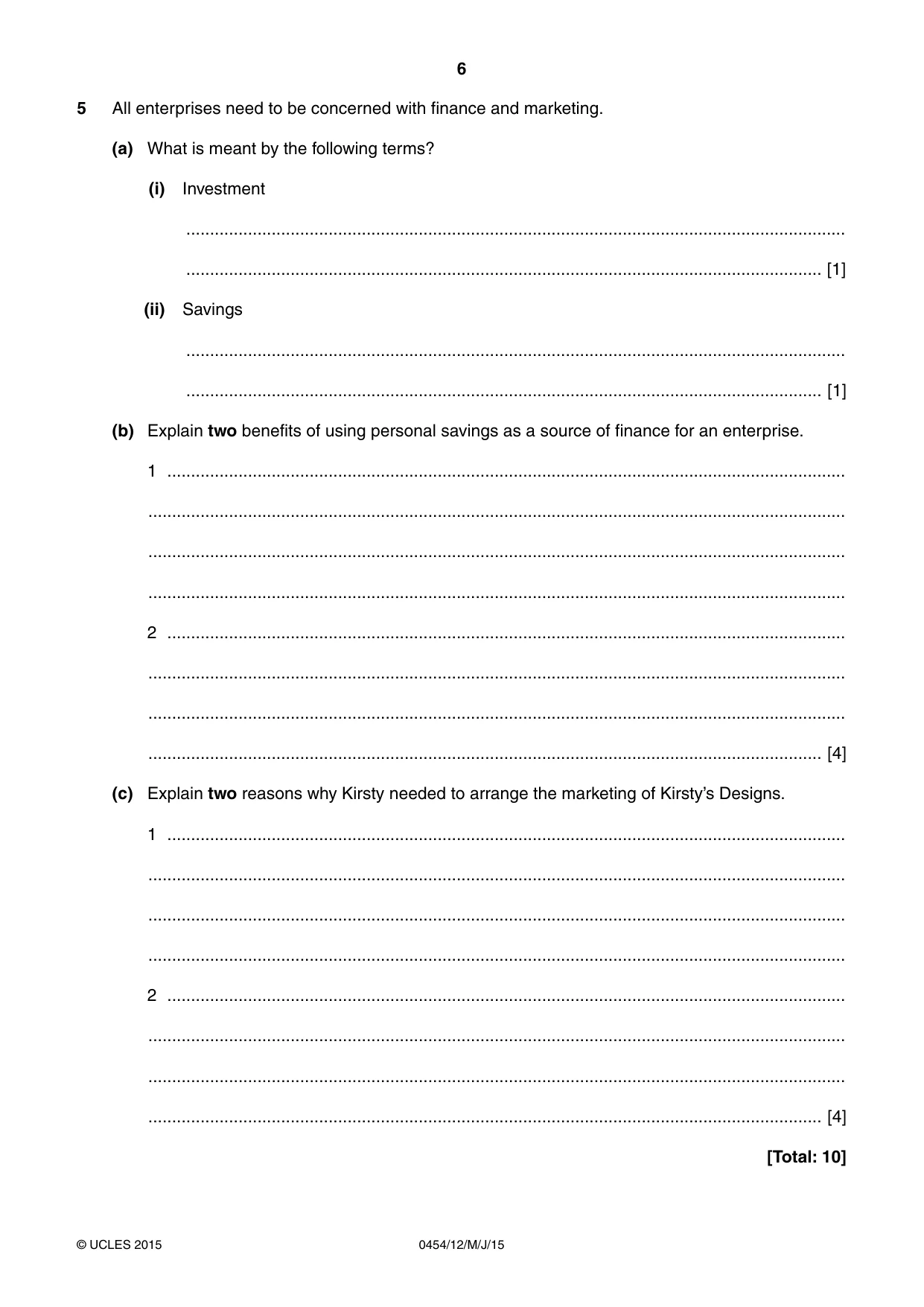
Question paper, page 6
6 0454/12/M/J/15 © UCLES 2015 5 All enterprises need to be concerned with finance and marketing. (a) What is meant by the following terms? (i) Investment … … [1] (ii) Savings … … [1] (b) Explain two benefits of using personal savings as a source of finance for an enterprise. 1 … … … … 2 … … … … [4] (c) Explain two reasons why Kirsty needed to arrange the marketing of Kirsty’s Designs. 1 … … … … 2 … … … … [4] [Total: 10]
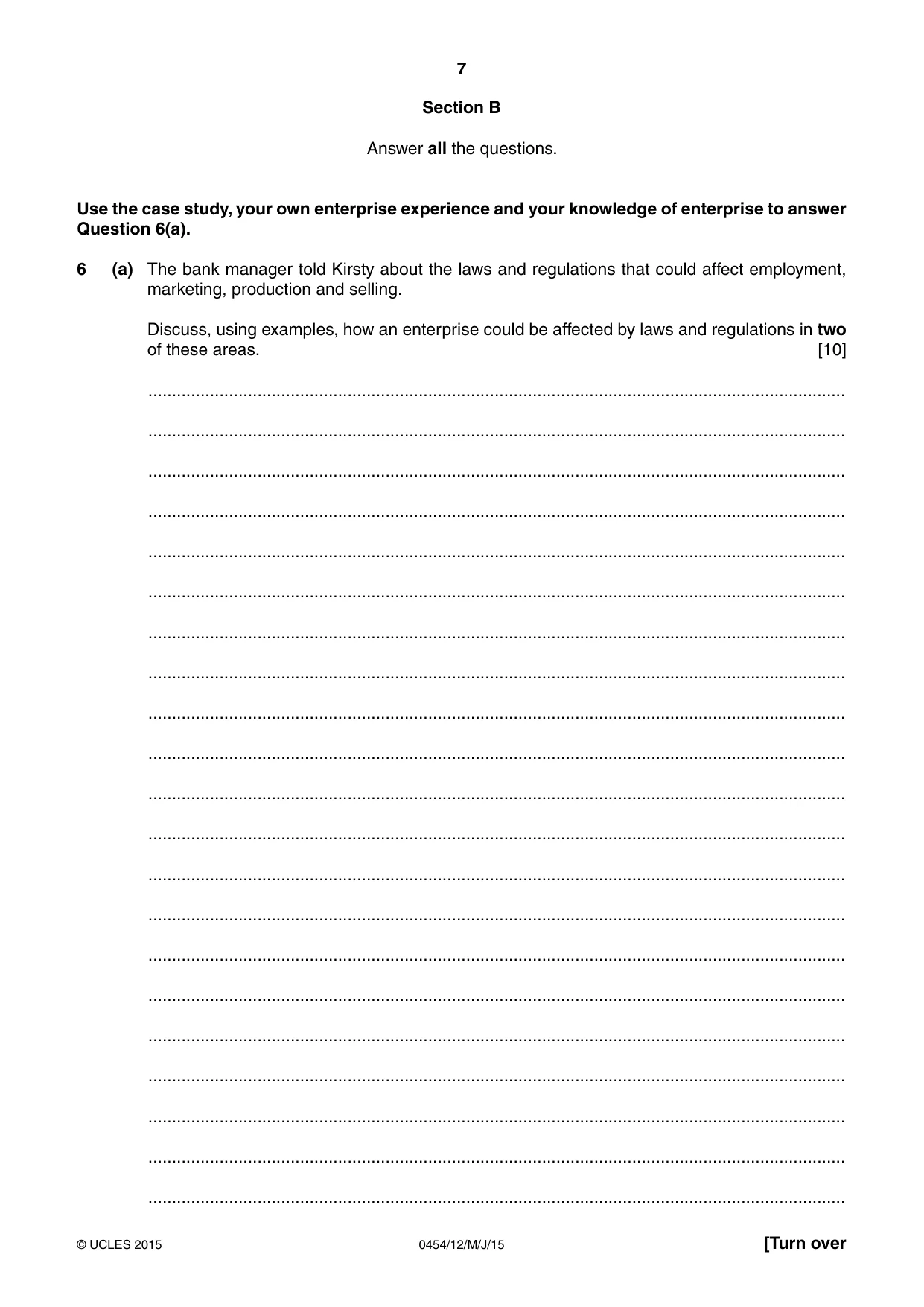
Question paper, page 7
7 0454/12/M/J/15 © UCLES 2015 [Turn over Section B Answer all the questions. Use the case study, your own enterprise experience and your knowledge of enterprise to answer Question 6(a). 6 (a) The bank manager told Kirsty about the laws and regulations that could affect employment, marketing, production and selling. Discuss, using examples, how an enterprise could be affected by laws and regulations in two of these areas. [10] … … … … … … … … … … … … … … … … … … … … …
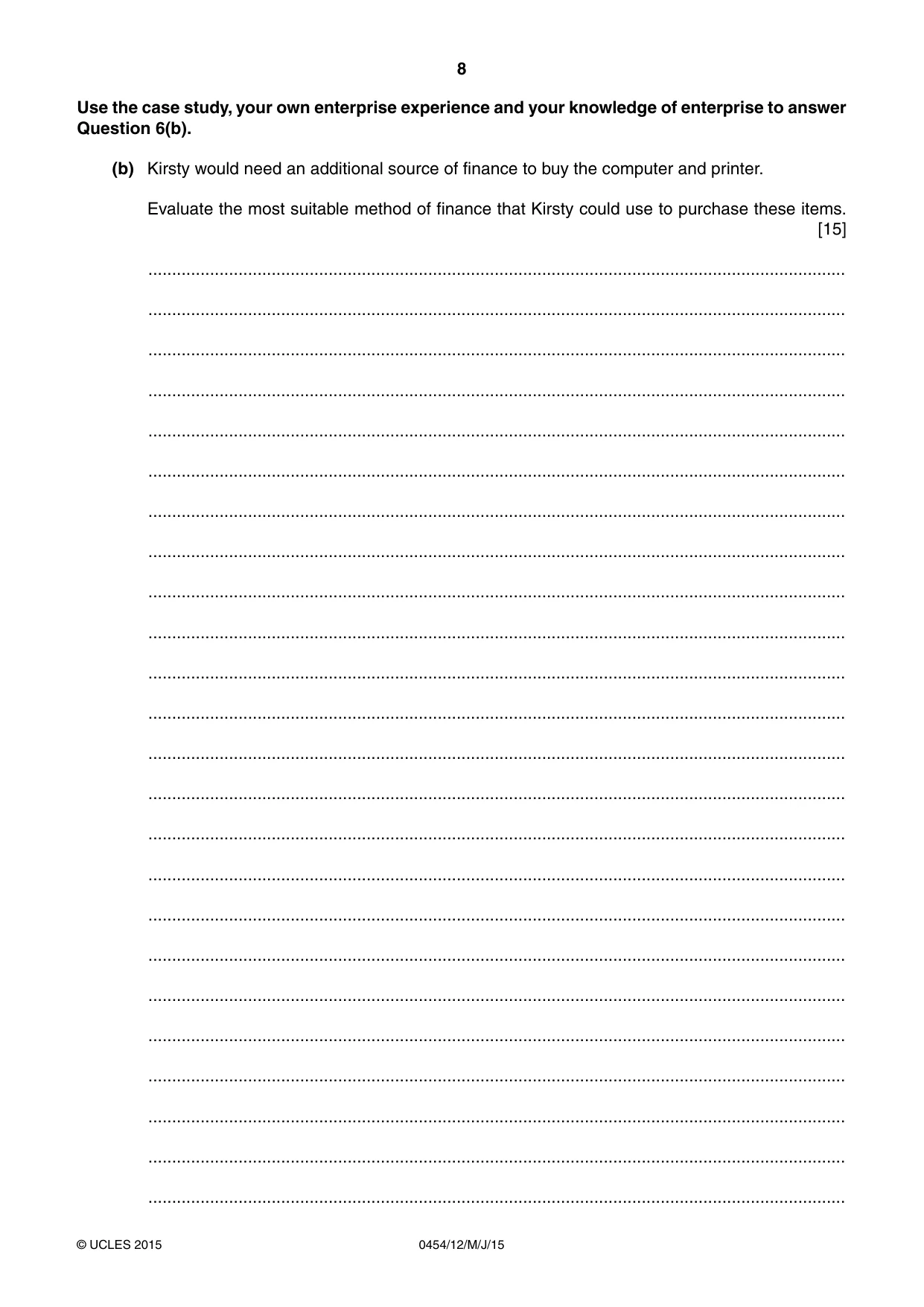
Question paper, page 8
8 0454/12/M/J/15 © UCLES 2015 Use the case study, your own enterprise experience and your knowledge of enterprise to answer Question 6(b). (b) Kirsty would need an additional source of finance to buy the computer and printer. Evaluate the most suitable method of finance that Kirsty could use to purchase these items. [15] … … … … … … … … … … … … … … … … … … … … … … … …
Question paper, page 9
9 0454/12/M/J/15 © UCLES 2015 [Turn over … … … … … … … … … … … … … … … … … … … … … … … … … … … [Total: 25]
Question paper, page 10
10 0454/12/M/J/15 © UCLES 2015 BLANK PAGE
Question paper, page 11
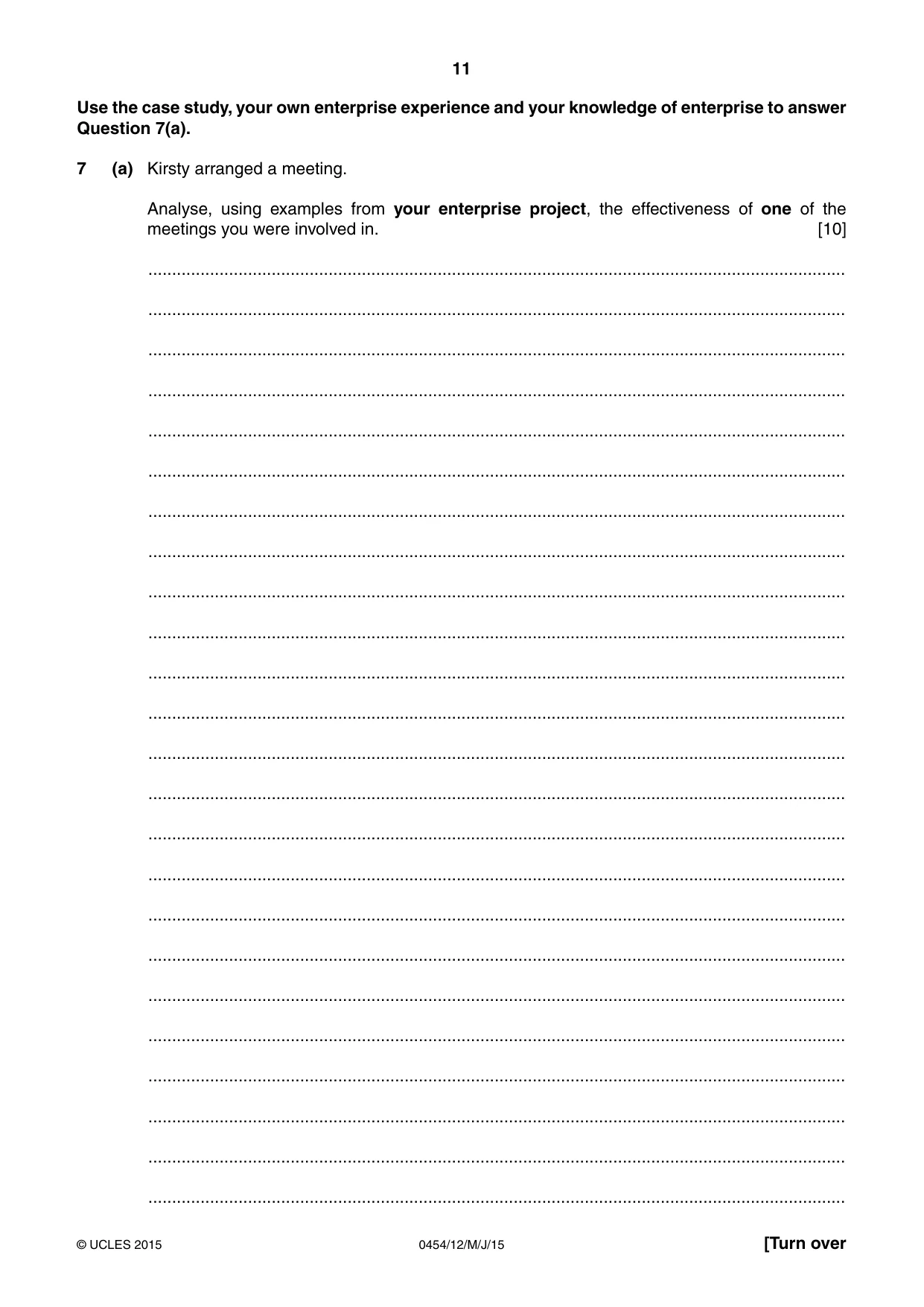
11 0454/12/M/J/15 © UCLES 2015 [Turn over Use the case study, your own enterprise experience and your knowledge of enterprise to answer Question 7(a). 7 (a) Kirsty arranged a meeting. Analyse, using examples from your enterprise project, the effectiveness of one of the meetings you were involved in. [10] … … … … … … … … … … … … … … … … … … … … … … … …
Question paper, page 12
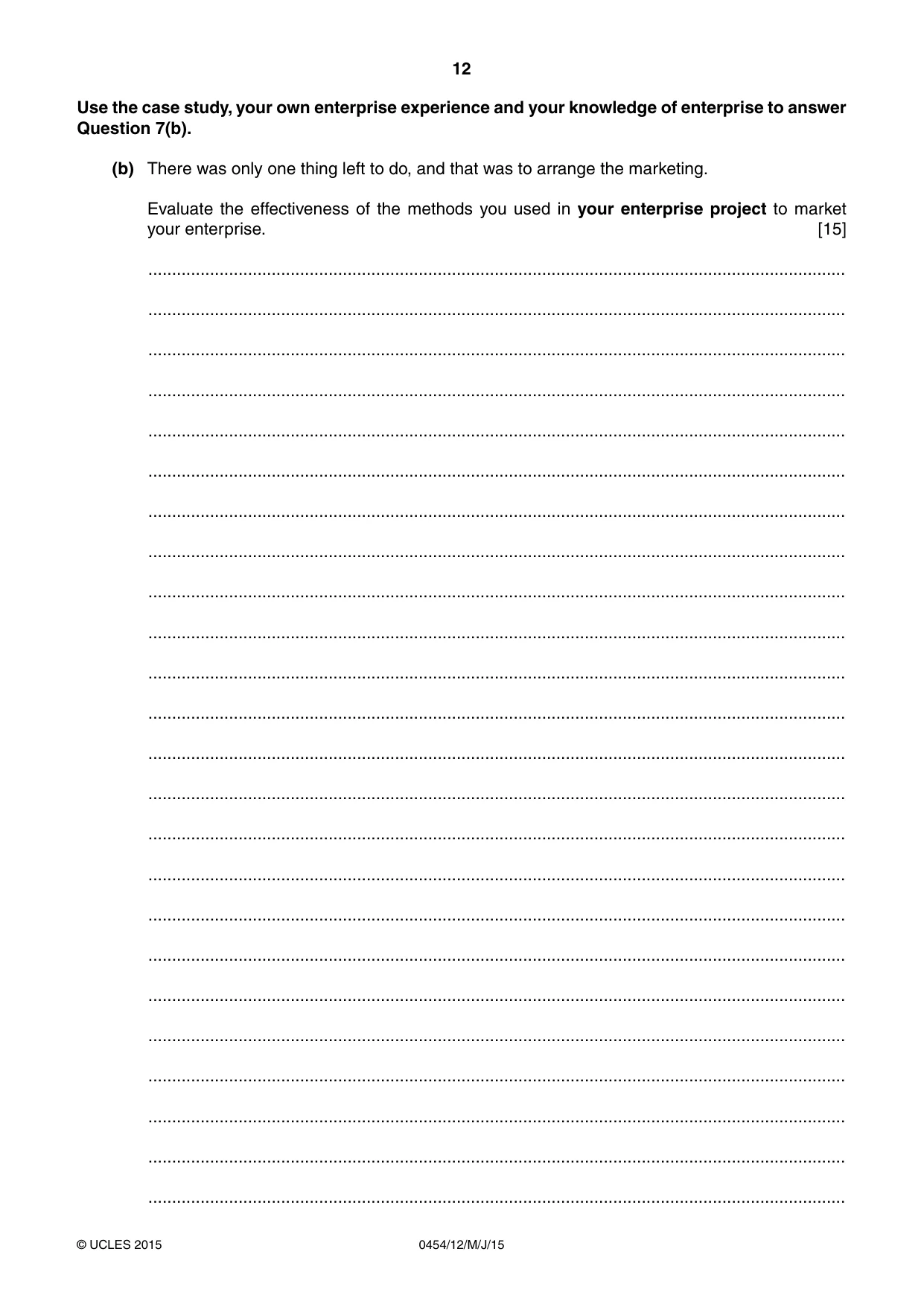
12 0454/12/M/J/15 © UCLES 2015 Use the case study, your own enterprise experience and your knowledge of enterprise to answer Question 7(b). (b) There was only one thing left to do, and that was to arrange the marketing. Evaluate the effectiveness of the methods you used in your enterprise project to market your enterprise. [15] … … … … … … … … … … … … … … … … … … … … … … … …
Question paper, page 13
13 0454/12/M/J/15 © UCLES 2015 … … … … … … … … … … … … … … … … … … … … … … … … … … … [Total: 25]
Question paper, page 14
14 0454/12/M/J/15 © UCLES 2015 BLANK PAGE
Question paper, page 15
15 0454/12/M/J/15 © UCLES 2015 BLANK PAGE
Question paper, page 16
16 0454/12/M/J/15 © UCLES 2015 Permission to reproduce items where third-party owned material protected by copyright is included has been sought and cleared where possible. Every reasonable effort has been made by the publisher (UCLES) to trace copyright holders, but if any items requiring clearance have unwittingly been included, the publisher will be pleased to make amends at the earliest possible opportunity. To avoid the issue of disclosure of answer-related information to candidates, all copyright acknowledgements are reproduced online in the Cambridge International Examinations Copyright Acknowledgements Booklet. This is produced for each series of examinations and is freely available to download at www.cie.org.uk after the live examination series. Cambridge International Examinations is part of the Cambridge Assessment Group. Cambridge Assessment is the brand name of University of Cambridge Local Examinations Syndicate (UCLES), which is itself a department of the University of Cambridge. BLANK PAGE
Mark scheme, page 1
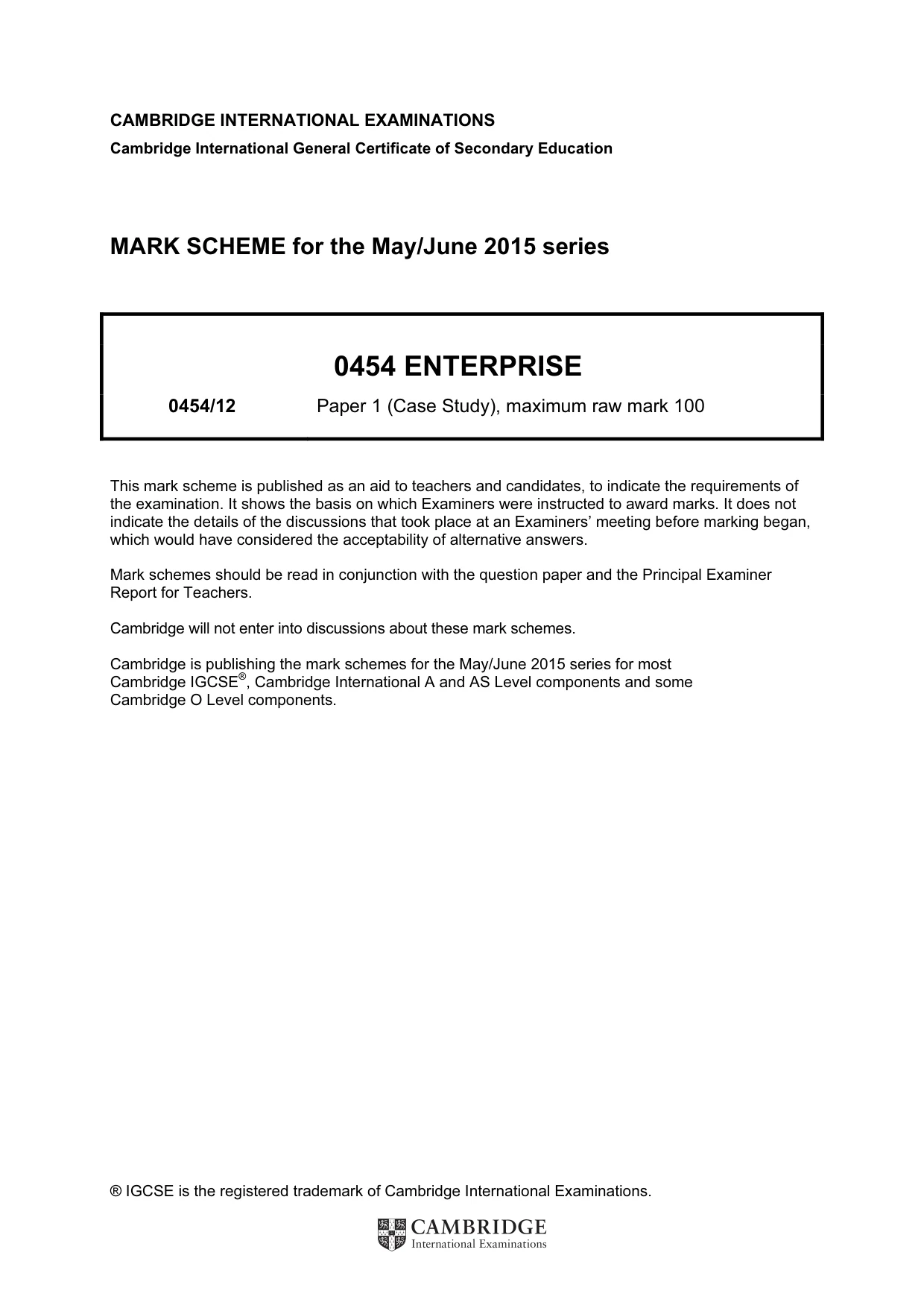
® IGCSE is the registered trademark of Cambridge International Examinations. CAMBRIDGE INTERNATIONAL EXAMINATIONS Cambridge International General Certificate of Secondary Education MARK SCHEME for the May/June 2015 series 0454 ENTERPRISE 0454/12 Paper 1 (Case Study), maximum raw mark 100 This mark scheme is published as an aid to teachers and candidates, to indicate the requirements of the examination. It shows the basis on which Examiners were instructed to award marks. It does not indicate the details of the discussions that took place at an Examiners’ meeting before marking began, which would have considered the acceptability of alternative answers. Mark schemes should be read in conjunction with the question paper and the Principal Examiner Report for Teachers. Cambridge will not enter into discussions about these mark schemes. Cambridge is publishing the mark schemes for the May/June 2015 series for most Cambridge IGCSE®, Cambridge International A and AS Level components and some Cambridge O Level components.
Mark scheme, page 2
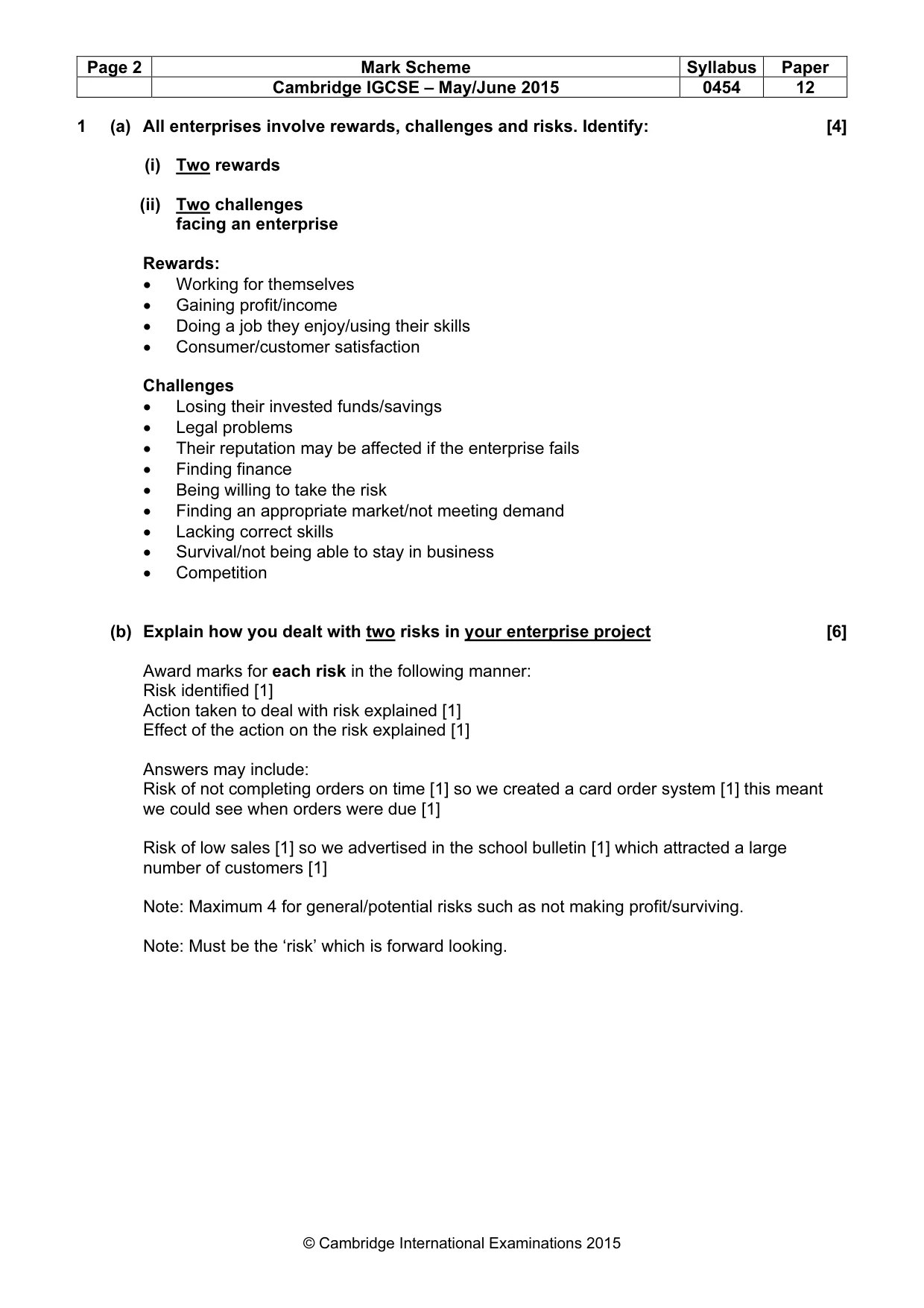
Page 2 Mark Scheme Syllabus Paper Cambridge IGCSE – May/June 2015 0454 12 © Cambridge International Examinations 2015 1 (a) All enterprises involve rewards, challenges and risks. Identify: [4] (i) Two rewards (ii) Two challenges facing an enterprise Rewards: • Working for themselves • Gaining profit/income • Doing a job they enjoy/using their skills • Consumer/customer satisfaction Challenges • Losing their invested funds/savings • Legal problems • Their reputation may be affected if the enterprise fails • Finding finance • Being willing to take the risk • Finding an appropriate market/not meeting demand • Lacking correct skills • Survival/not being able to stay in business • Competition (b) Explain how you dealt with two risks in your enterprise project [6] Award marks for each risk in the following manner: Risk identified [1] Action taken to deal with risk explained [1] Effect of the action on the risk explained [1] Answers may include: Risk of not completing orders on time [1] so we created a card order system [1] this meant we could see when orders were due [1] Risk of low sales [1] so we advertised in the school bulletin [1] which attracted a large number of customers [1] Note: Maximum 4 for general/potential risks such as not making profit/surviving. Note: Must be the ‘risk’ which is forward looking.
Mark scheme, page 3
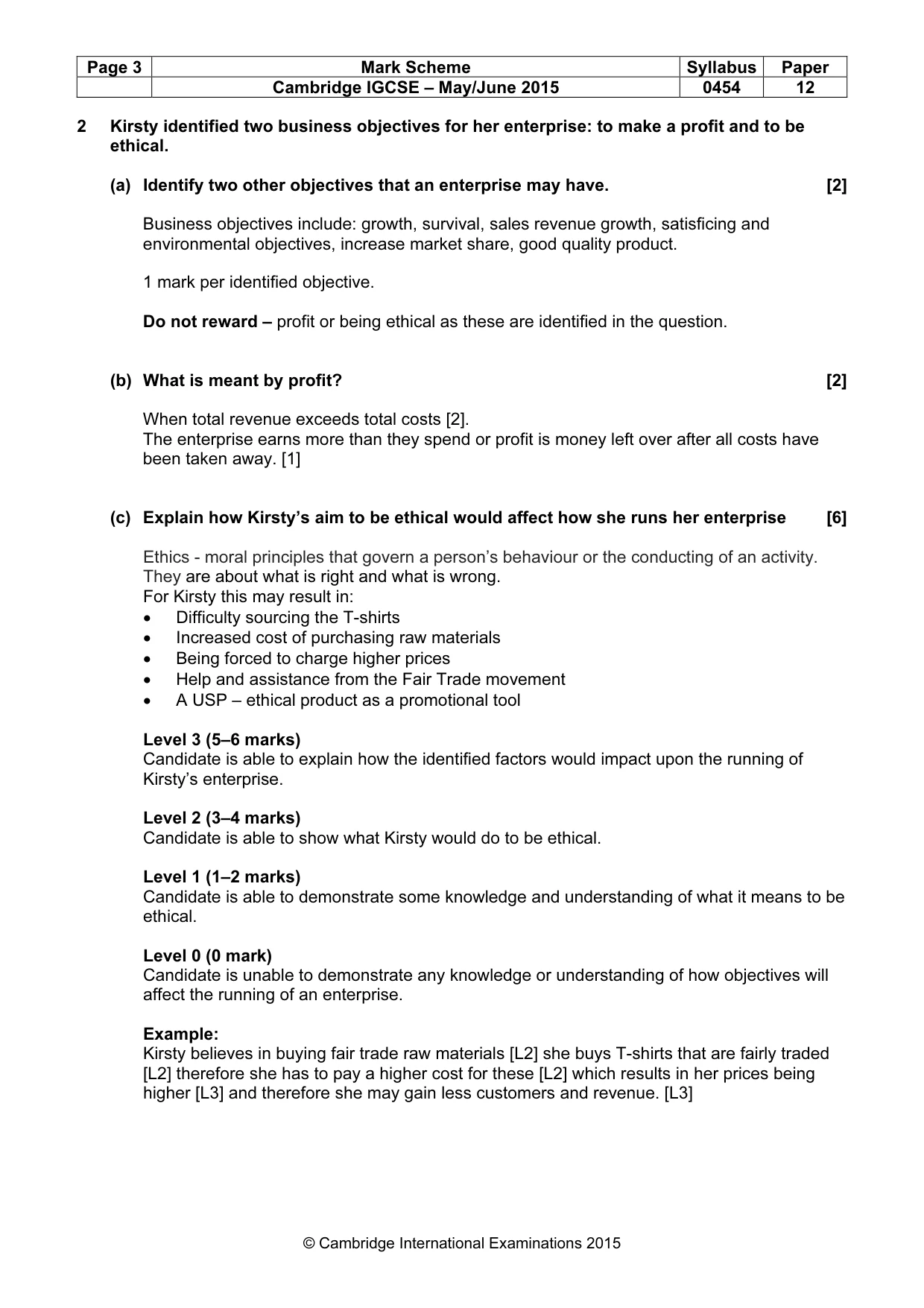
Page 3 Mark Scheme Syllabus Paper Cambridge IGCSE – May/June 2015 0454 12 © Cambridge International Examinations 2015 2 Kirsty identified two business objectives for her enterprise: to make a profit and to be ethical. (a) Identify two other objectives that an enterprise may have. [2] Business objectives include: growth, survival, sales revenue growth, satisficing and environmental objectives, increase market share, good quality product. 1 mark per identified objective. Do not reward – profit or being ethical as these are identified in the question. (b) What is meant by profit? [2] When total revenue exceeds total costs [2]. The enterprise earns more than they spend or profit is money left over after all costs have been taken away. [1] (c) Explain how Kirsty’s aim to be ethical would affect how she runs her enterprise [6] Ethics - moral principles that govern a person’s behaviour or the conducting of an activity. They are about what is right and what is wrong. For Kirsty this may result in: • Difficulty sourcing the T-shirts • Increased cost of purchasing raw materials • Being forced to charge higher prices • Help and assistance from the Fair Trade movement • A USP – ethical product as a promotional tool Level 3 (5–6 marks) Candidate is able to explain how the identified factors would impact upon the running of Kirsty’s enterprise. Level 2 (3–4 marks) Candidate is able to show what Kirsty would do to be ethical. Level 1 (1–2 marks) Candidate is able to demonstrate some knowledge and understanding of what it means to be ethical. Level 0 (0 mark) Candidate is unable to demonstrate any knowledge or understanding of how objectives will affect the running of an enterprise. Example: Kirsty believes in buying fair trade raw materials [L2] she buys T-shirts that are fairly traded [L2] therefore she has to pay a higher cost for these [L2] which results in her prices being higher [L3] and therefore she may gain less customers and revenue. [L3]
Mark scheme, page 4
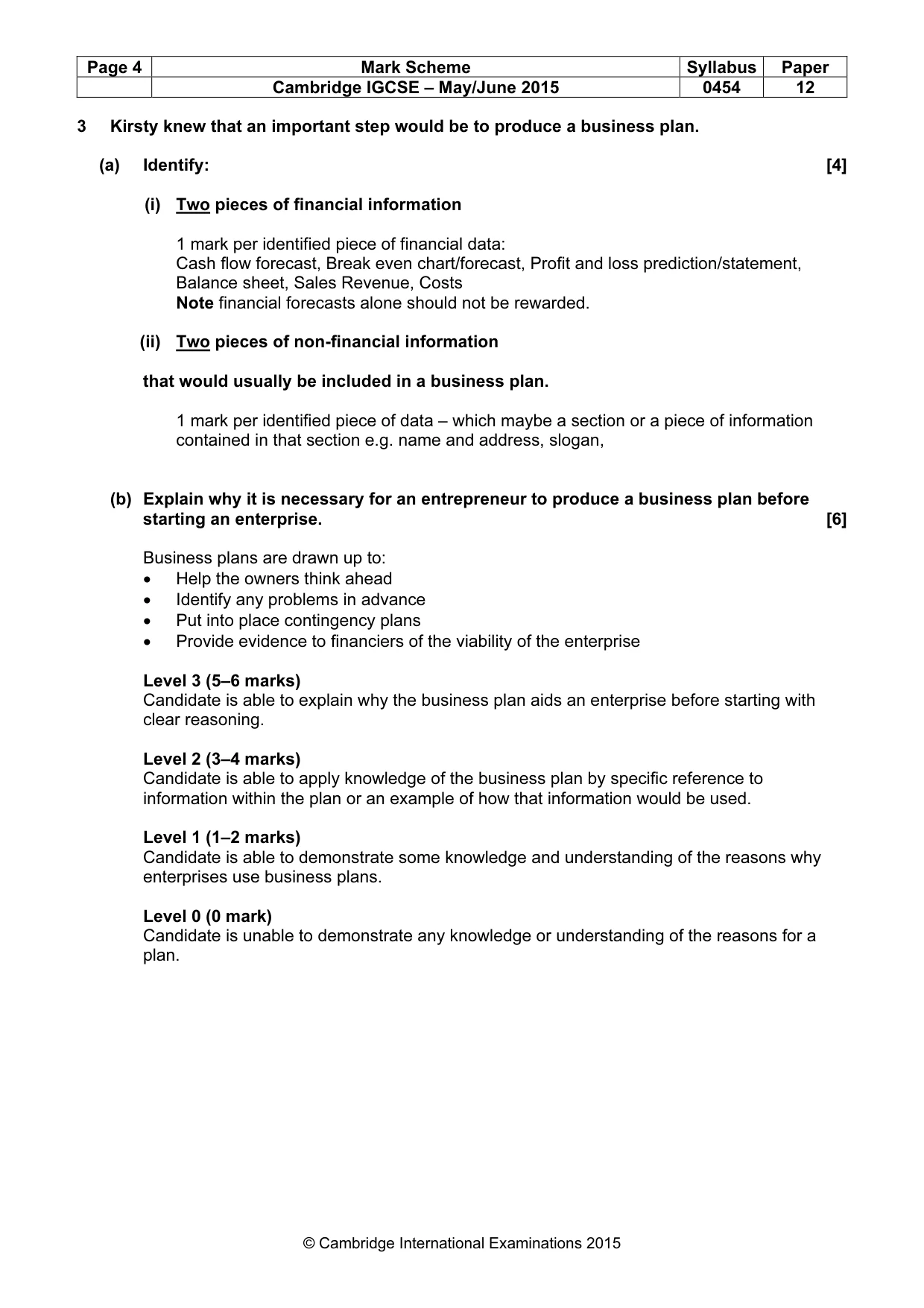
Page 4 Mark Scheme Syllabus Paper Cambridge IGCSE – May/June 2015 0454 12 © Cambridge International Examinations 2015 3 Kirsty knew that an important step would be to produce a business plan. (a) Identify: [4] (i) Two pieces of financial information 1 mark per identified piece of financial data: Cash flow forecast, Break even chart/forecast, Profit and loss prediction/statement, Balance sheet, Sales Revenue, Costs Note financial forecasts alone should not be rewarded. (ii) Two pieces of non-financial information that would usually be included in a business plan. 1 mark per identified piece of data – which maybe a section or a piece of information contained in that section e.g. name and address, slogan, (b) Explain why it is necessary for an entrepreneur to produce a business plan before starting an enterprise. [6] Business plans are drawn up to: • Help the owners think ahead • Identify any problems in advance • Put into place contingency plans • Provide evidence to financiers of the viability of the enterprise Level 3 (5–6 marks) Candidate is able to explain why the business plan aids an enterprise before starting with clear reasoning. Level 2 (3–4 marks) Candidate is able to apply knowledge of the business plan by specific reference to information within the plan or an example of how that information would be used. Level 1 (1–2 marks) Candidate is able to demonstrate some knowledge and understanding of the reasons why enterprises use business plans. Level 0 (0 mark) Candidate is unable to demonstrate any knowledge or understanding of the reasons for a plan.
Mark scheme, page 5
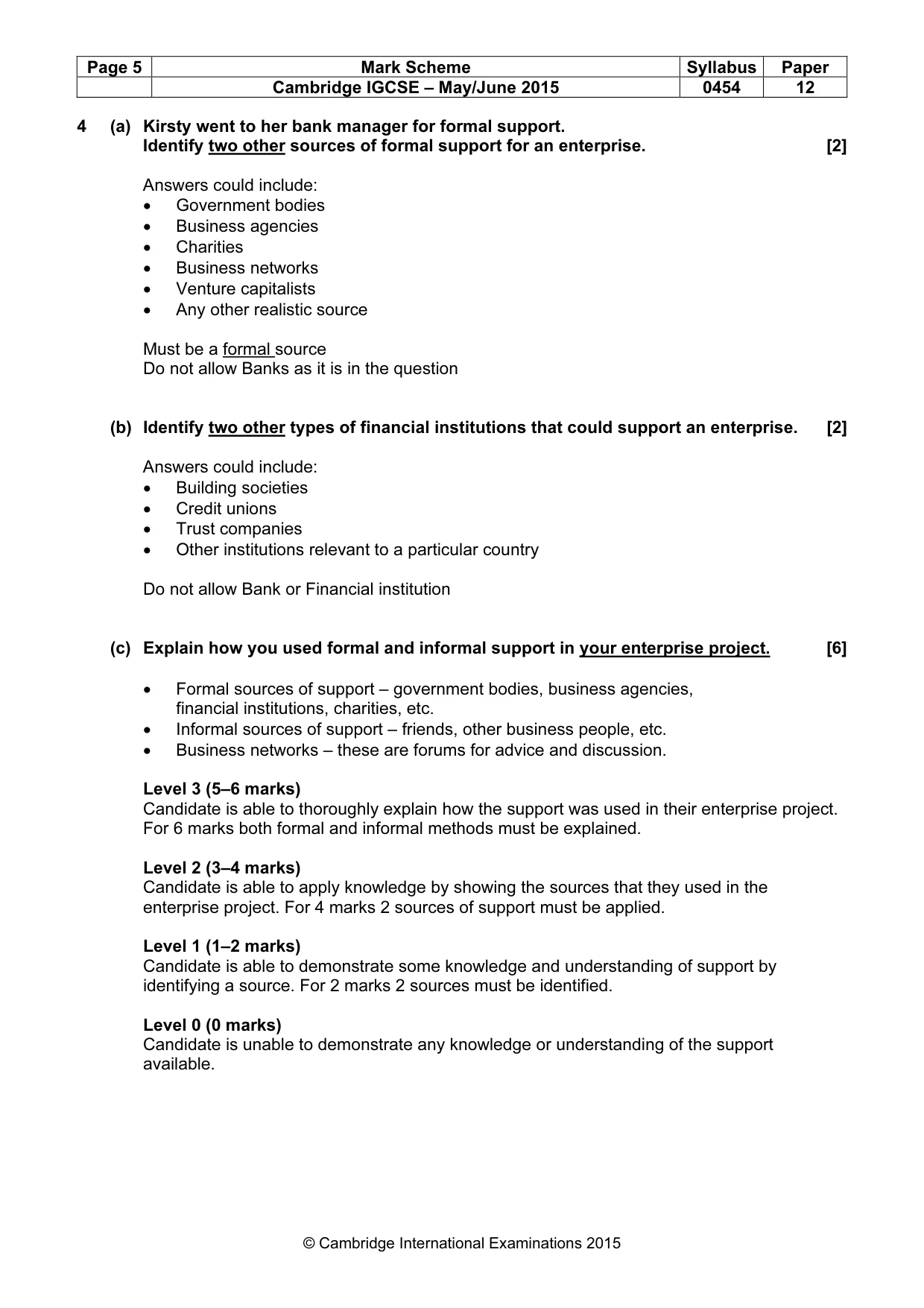
Page 5 Mark Scheme Syllabus Paper Cambridge IGCSE – May/June 2015 0454 12 © Cambridge International Examinations 2015 4 (a) Kirsty went to her bank manager for formal support. Identify two other sources of formal support for an enterprise. [2] Answers could include: • Government bodies • Business agencies • Charities • Business networks • Venture capitalists • Any other realistic source Must be a formal source Do not allow Banks as it is in the question (b) Identify two other types of financial institutions that could support an enterprise. [2] Answers could include: • Building societies • Credit unions • Trust companies • Other institutions relevant to a particular country Do not allow Bank or Financial institution (c) Explain how you used formal and informal support in your enterprise project. [6] • Formal sources of support – government bodies, business agencies, financial institutions, charities, etc. • Informal sources of support – friends, other business people, etc. • Business networks – these are forums for advice and discussion. Level 3 (5–6 marks) Candidate is able to thoroughly explain how the support was used in their enterprise project. For 6 marks both formal and informal methods must be explained. Level 2 (3–4 marks) Candidate is able to apply knowledge by showing the sources that they used in the enterprise project. For 4 marks 2 sources of support must be applied. Level 1 (1–2 marks) Candidate is able to demonstrate some knowledge and understanding of support by identifying a source. For 2 marks 2 sources must be identified. Level 0 (0 marks) Candidate is unable to demonstrate any knowledge or understanding of the support available.
Mark scheme, page 6
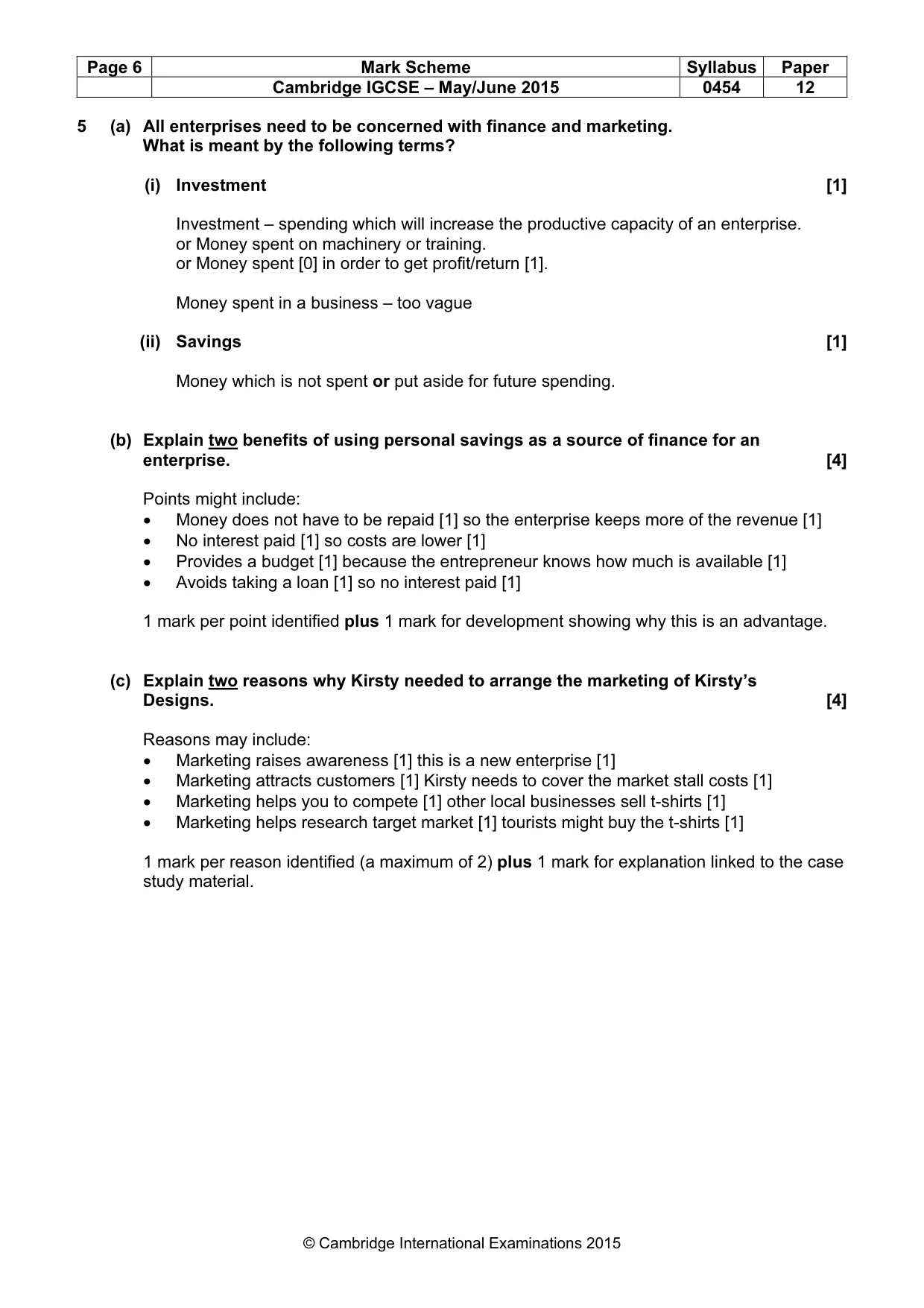
Page 6 Mark Scheme Syllabus Paper Cambridge IGCSE – May/June 2015 0454 12 © Cambridge International Examinations 2015 5 (a) All enterprises need to be concerned with finance and marketing. What is meant by the following terms? (i) Investment [1] Investment – spending which will increase the productive capacity of an enterprise. or Money spent on machinery or training. or Money spent [0] in order to get profit/return [1]. Money spent in a business – too vague (ii) Savings [1] Money which is not spent or put aside for future spending. (b) Explain two benefits of using personal savings as a source of finance for an enterprise. [4] Points might include: • Money does not have to be repaid [1] so the enterprise keeps more of the revenue [1] • No interest paid [1] so costs are lower [1] • Provides a budget [1] because the entrepreneur knows how much is available [1] • Avoids taking a loan [1] so no interest paid [1] 1 mark per point identified plus 1 mark for development showing why this is an advantage. (c) Explain two reasons why Kirsty needed to arrange the marketing of Kirsty’s Designs. [4] Reasons may include: • Marketing raises awareness [1] this is a new enterprise [1] • Marketing attracts customers [1] Kirsty needs to cover the market stall costs [1] • Marketing helps you to compete [1] other local businesses sell t-shirts [1] • Marketing helps research target market [1] tourists might buy the t-shirts [1] 1 mark per reason identified (a maximum of 2) plus 1 mark for explanation linked to the case study material.
Mark scheme, page 7
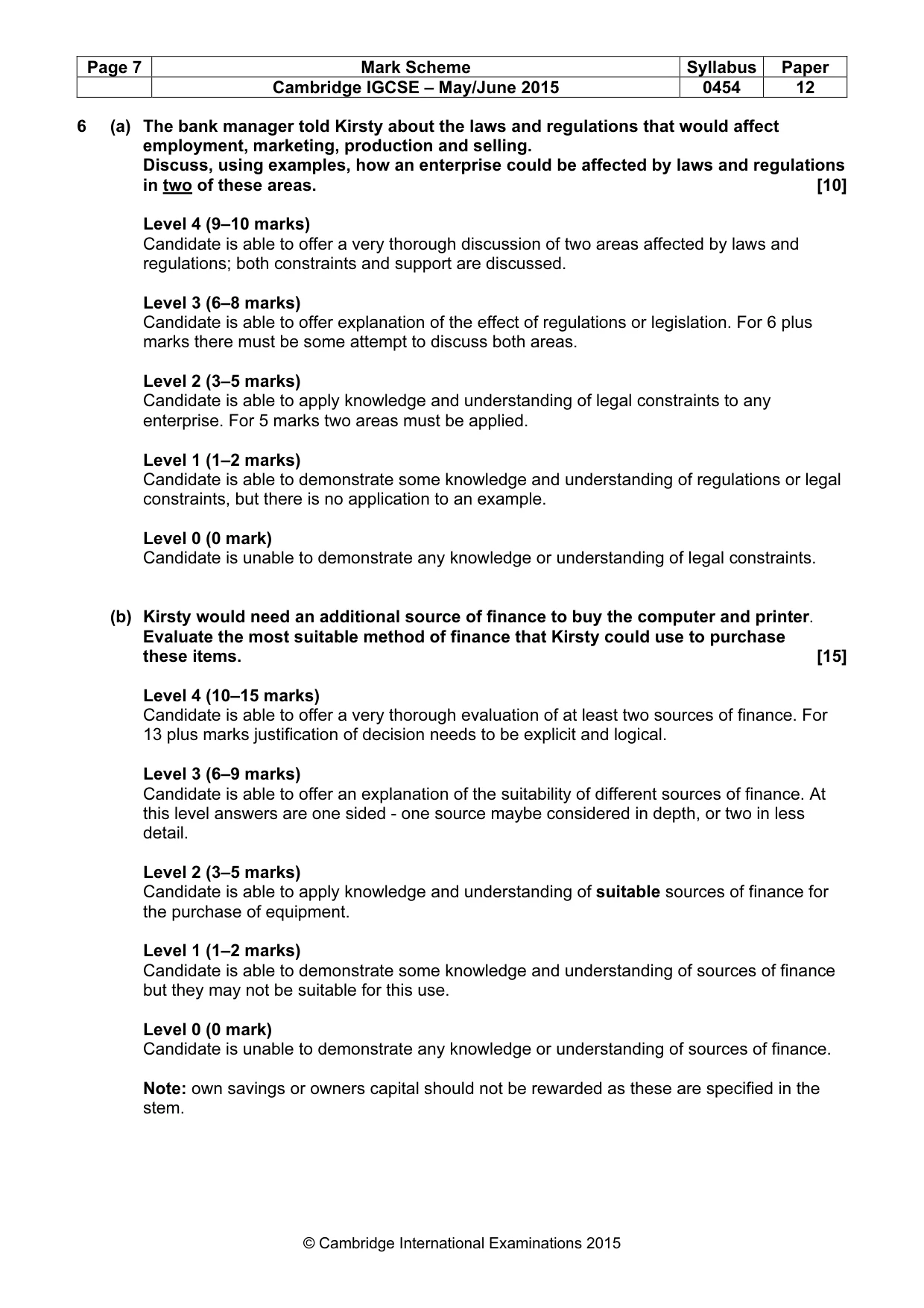
Page 7 Mark Scheme Syllabus Paper Cambridge IGCSE – May/June 2015 0454 12 © Cambridge International Examinations 2015 6 (a) The bank manager told Kirsty about the laws and regulations that would affect employment, marketing, production and selling. Discuss, using examples, how an enterprise could be affected by laws and regulations in two of these areas. [10] Level 4 (9–10 marks) Candidate is able to offer a very thorough discussion of two areas affected by laws and regulations; both constraints and support are discussed. Level 3 (6–8 marks) Candidate is able to offer explanation of the effect of regulations or legislation. For 6 plus marks there must be some attempt to discuss both areas. Level 2 (3–5 marks) Candidate is able to apply knowledge and understanding of legal constraints to any enterprise. For 5 marks two areas must be applied. Level 1 (1–2 marks) Candidate is able to demonstrate some knowledge and understanding of regulations or legal constraints, but there is no application to an example. Level 0 (0 mark) Candidate is unable to demonstrate any knowledge or understanding of legal constraints. (b) Kirsty would need an additional source of finance to buy the computer and printer. Evaluate the most suitable method of finance that Kirsty could use to purchase these items. [15] Level 4 (10–15 marks) Candidate is able to offer a very thorough evaluation of at least two sources of finance. For 13 plus marks justification of decision needs to be explicit and logical. Level 3 (6–9 marks) Candidate is able to offer an explanation of the suitability of different sources of finance. At this level answers are one sided - one source maybe considered in depth, or two in less detail. Level 2 (3–5 marks) Candidate is able to apply knowledge and understanding of suitable sources of finance for the purchase of equipment. Level 1 (1–2 marks) Candidate is able to demonstrate some knowledge and understanding of sources of finance but they may not be suitable for this use. Level 0 (0 mark) Candidate is unable to demonstrate any knowledge or understanding of sources of finance. Note: own savings or owners capital should not be rewarded as these are specified in the stem.
Mark scheme, page 8
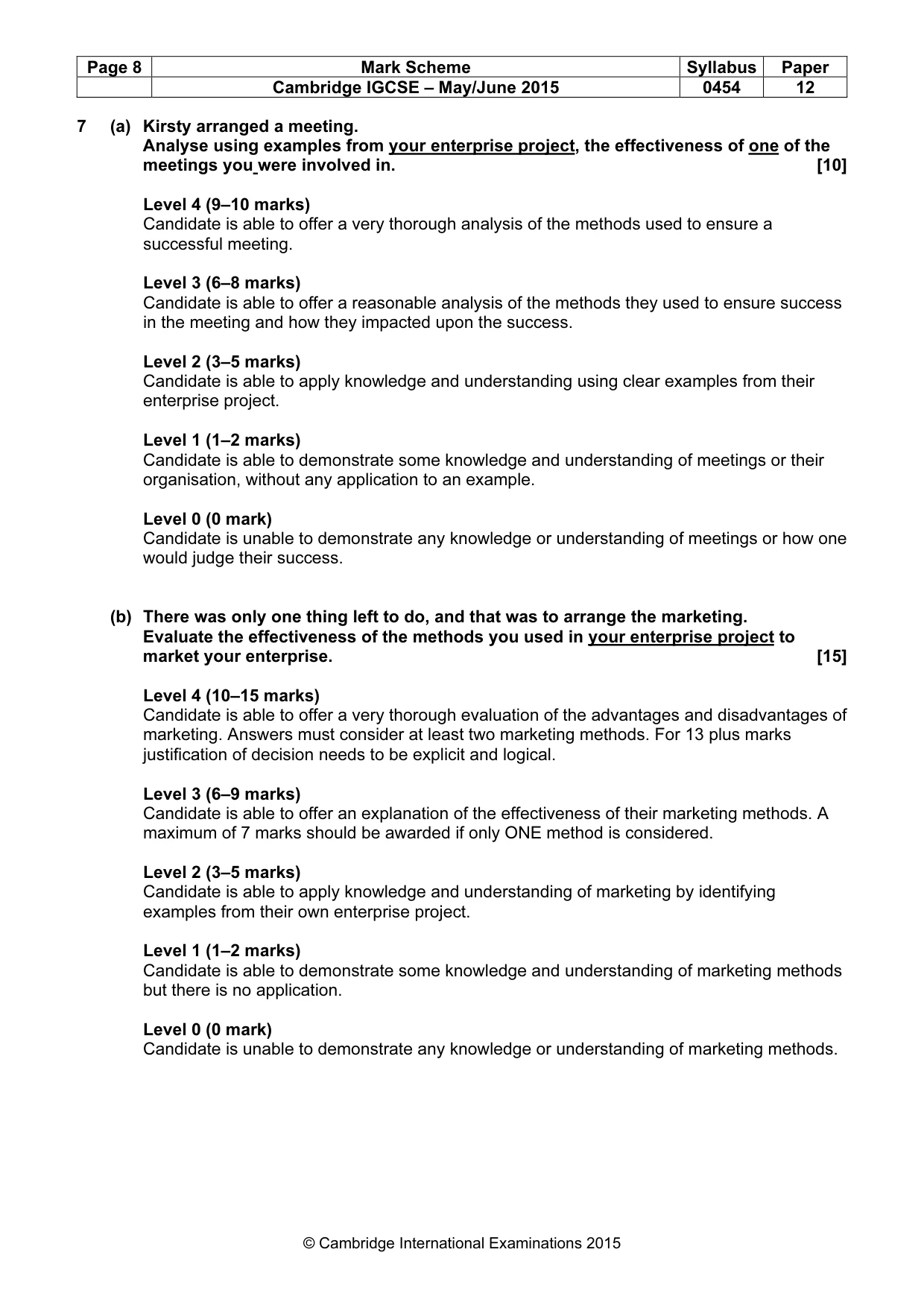
Page 8 Mark Scheme Syllabus Paper Cambridge IGCSE – May/June 2015 0454 12 © Cambridge International Examinations 2015 7 (a) Kirsty arranged a meeting. Analyse using examples from your enterprise project, the effectiveness of one of the meetings you were involved in. [10] Level 4 (9–10 marks) Candidate is able to offer a very thorough analysis of the methods used to ensure a successful meeting. Level 3 (6–8 marks) Candidate is able to offer a reasonable analysis of the methods they used to ensure success in the meeting and how they impacted upon the success. Level 2 (3–5 marks) Candidate is able to apply knowledge and understanding using clear examples from their enterprise project. Level 1 (1–2 marks) Candidate is able to demonstrate some knowledge and understanding of meetings or their organisation, without any application to an example. Level 0 (0 mark) Candidate is unable to demonstrate any knowledge or understanding of meetings or how one would judge their success. (b) There was only one thing left to do, and that was to arrange the marketing. Evaluate the effectiveness of the methods you used in your enterprise project to market your enterprise. [15] Level 4 (10–15 marks) Candidate is able to offer a very thorough evaluation of the advantages and disadvantages of marketing. Answers must consider at least two marketing methods. For 13 plus marks justification of decision needs to be explicit and logical. Level 3 (6–9 marks) Candidate is able to offer an explanation of the effectiveness of their marketing methods. A maximum of 7 marks should be awarded if only ONE method is considered. Level 2 (3–5 marks) Candidate is able to apply knowledge and understanding of marketing by identifying examples from their own enterprise project. Level 1 (1–2 marks) Candidate is able to demonstrate some knowledge and understanding of marketing methods but there is no application. Level 0 (0 mark) Candidate is unable to demonstrate any knowledge or understanding of marketing methods.
What you needed in this session
Cambridge’s own grade thresholds for 2015 May/June, Paper 1 · Variant 2. A higher threshold means an easier paper — the bar moves with how the cohort did.