Cambridge IGCSE Enterprise 0454 — 2015 May/June Paper 1 · Variant 1
0454/11/M/J/15 · 100 marks · ≈113 min
The question paper and its mark scheme, free to read here and free to download. This is Cambridge’s own paper, exactly as it was sat.
Question paper16 pages






Mark scheme10 pages
Answers below. Sit the paper first if you are practising.
Paper as text
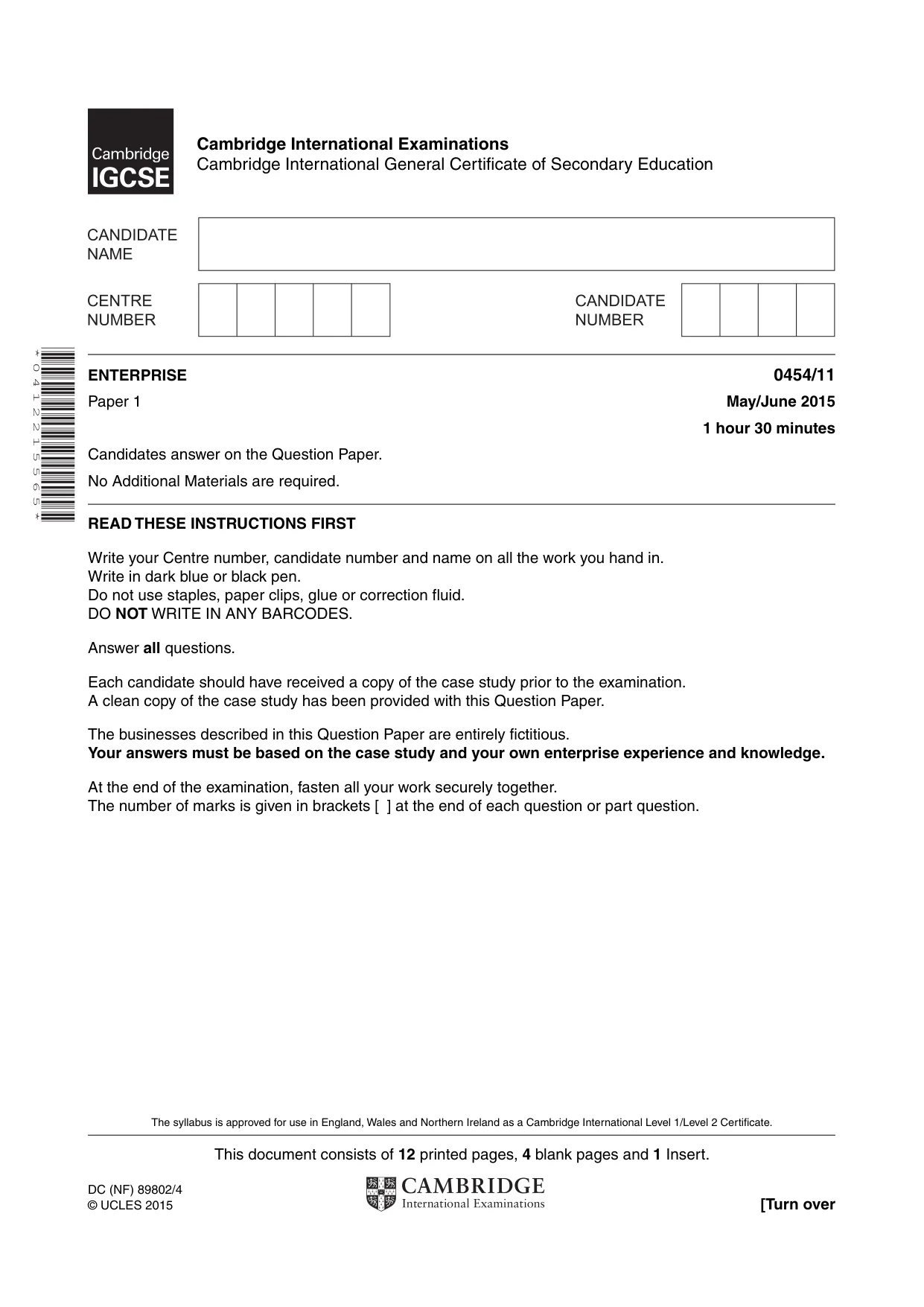
Question paper, page 1
This document consists of 12 printed pages, 4 blank pages and 1 Insert. DC (NF) 89802/4 © UCLES 2015 [Turn over Cambridge International Examinations Cambridge International General Certificate of Secondary Education * 0 4 1 2 2 1 5 5 6 5 * ENTERPRISE 0454/11 Paper 1 May/June 2015 1 hour 30 minutes Candidates answer on the Question Paper. No Additional Materials are required. READ THESE INSTRUCTIONS FIRST Write your Centre number, candidate number and name on all the work you hand in. Write in dark blue or black pen. Do not use staples, paper clips, glue or correction fluid. DO NOT WRITE IN ANY BARCODES. Answer all questions. Each candidate should have received a copy of the case study prior to the examination. A clean copy of the case study has been provided with this Question Paper. The businesses described in this Question Paper are entirely fictitious. Your answers must be based on the case study and your own enterprise experience and knowledge. At the end of the examination, fasten all your work securely together. The number of marks is given in brackets [ ] at the end of each question or part question. The syllabus is approved for use in England, Wales and Northern Ireland as a Cambridge International Level 1/Level 2 Certificate.
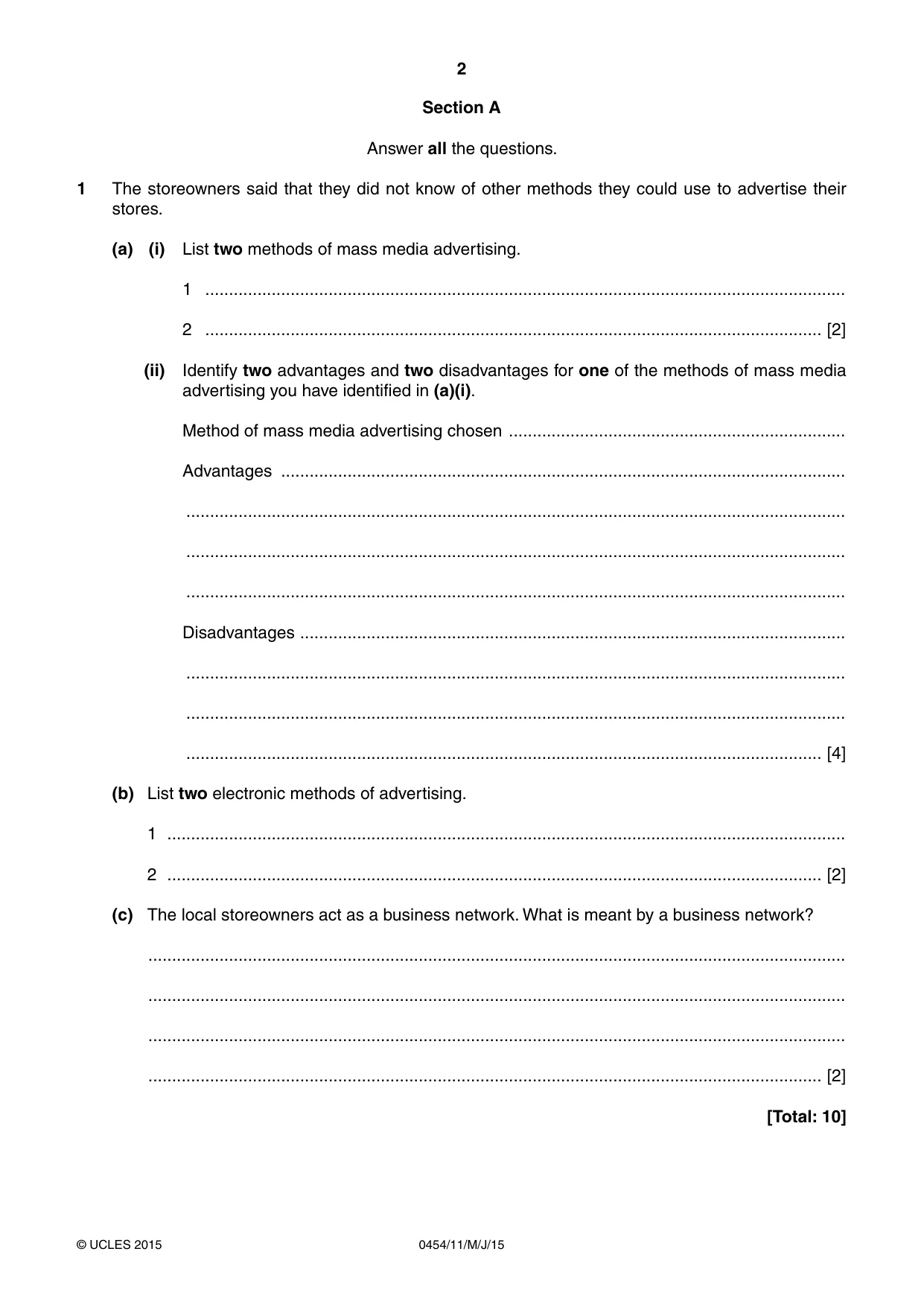
Question paper, page 2
2 0454/11/M/J/15 © UCLES 2015 Section A Answer all the questions. 1 The storeowners said that they did not know of other methods they could use to advertise their stores. (a) (i) List two methods of mass media advertising. 1 … 2 … [2] (ii) Identify two advantages and two disadvantages for one of the methods of mass media advertising you have identified in (a)(i). Method of mass media advertising chosen … Advantages … … … … Disadvantages … … … … [4] (b) List two electronic methods of advertising. 1 … 2 … [2] (c) The local storeowners act as a business network. What is meant by a business network? … … … … [2] [Total: 10]
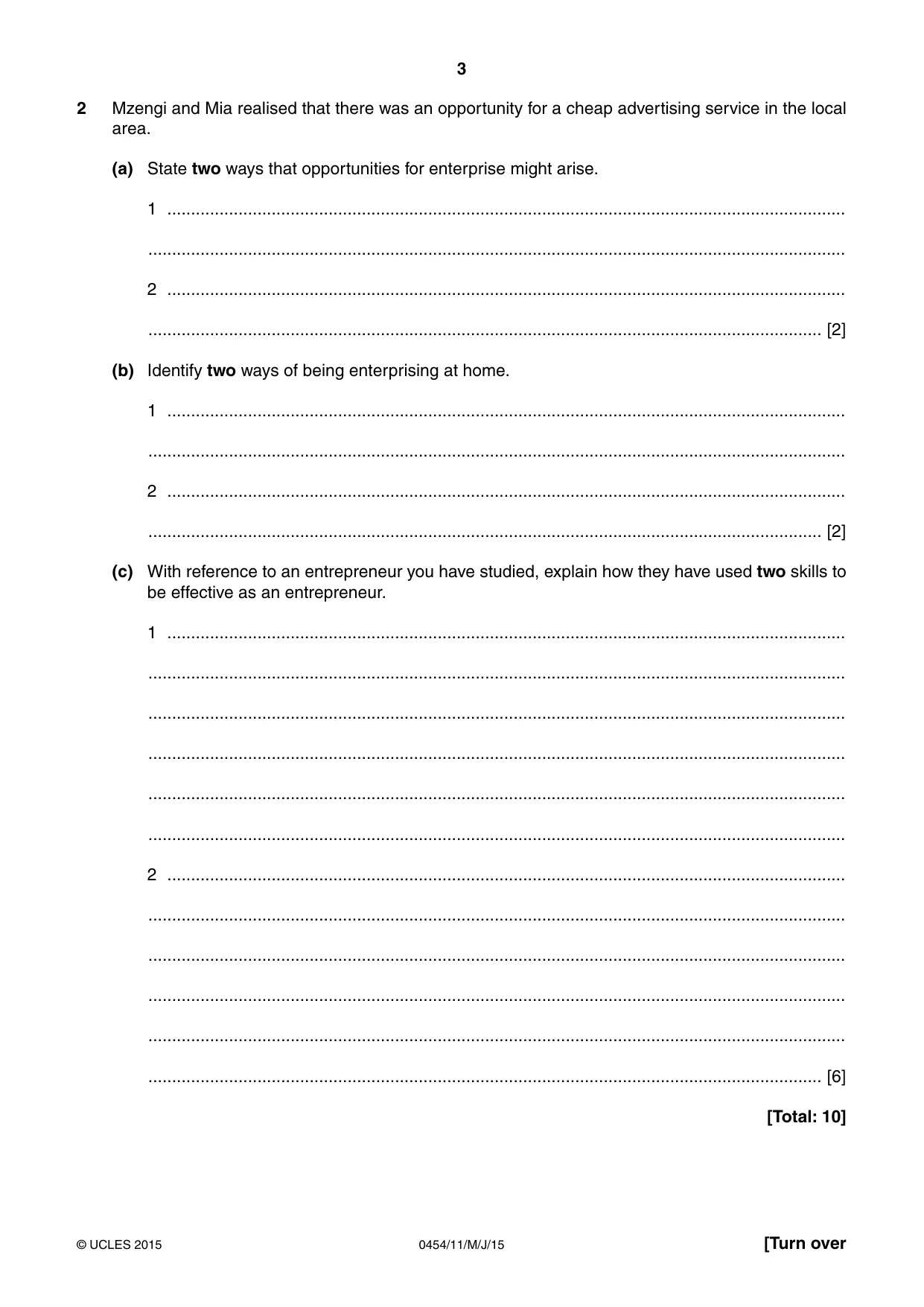
Question paper, page 3
3 0454/11/M/J/15 © UCLES 2015 [Turn over 2 Mzengi and Mia realised that there was an opportunity for a cheap advertising service in the local area. (a) State two ways that opportunities for enterprise might arise. 1 … … 2 … … [2] (b) Identify two ways of being enterprising at home. 1 … … 2 … … [2] (c) With reference to an entrepreneur you have studied, explain how they have used two skills to be effective as an entrepreneur. 1 … … … … … … 2 … … … … … … [6] [Total: 10]
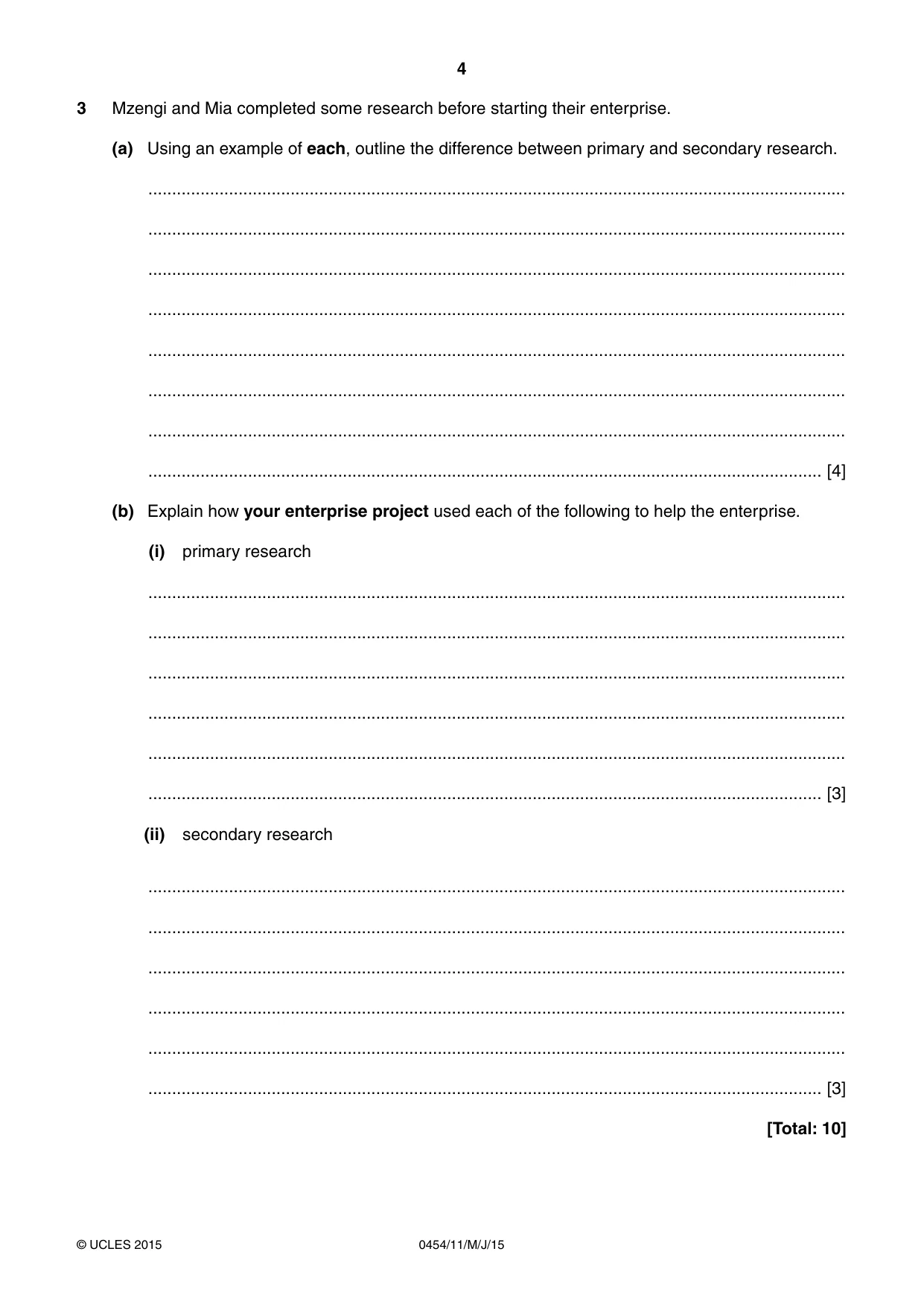
Question paper, page 4
4 0454/11/M/J/15 © UCLES 2015 3 Mzengi and Mia completed some research before starting their enterprise. (a) Using an example of each, outline the difference between primary and secondary research. … … … … … … … … [4] (b) Explain how your enterprise project used each of the following to help the enterprise. (i) primary research … … … … … … [3] (ii) secondary research … … … … … … [3] [Total: 10]
Question paper, page 5
5 0454/11/M/J/15 © UCLES 2015 [Turn over 4 The friends received complaints and knew that they must deal with them to retain customers. (a) Describe two actions an enterprise should take to deal with complaints. 1 … … … … 2 … … … … [4] (b) Explain two reasons why Mzengi and Mia need to retain their existing customers. 1 … … … … … … 2 … … … … … …[6] [Total: 10]
Question paper, page 6
6 0454/11/M/J/15 © UCLES 2015 5 Mzengi wanted to pay close attention to the financing of MM Newsletter. (a) Explain why an enterprise might fail due to poor cash flow. … … … … … … … … [4] (b) Explain two possible effects on your enterprise project of not keeping accurate financial records. 1 … … … … … … 2 … … … … … … [6] [Total: 10]
Question paper, page 7
7 0454/11/M/J/15 © UCLES 2015 [Turn over Section B Answer all the questions. Use the case study, your own enterprise experience and your knowledge of enterprise to answer Question 6(a). 6 (a) Mzengi and Mia did not produce a business plan at the start of their enterprise. Discuss how the production of a business plan would have helped the long-term success of their new enterprise. [10] … … … … … … … … … … … … … … … … … … … … …
Question paper, page 8
8 0454/11/M/J/15 © UCLES 2015 Use the case study, your own enterprise experience and your knowledge of enterprise to answer Question 6(b). (b) Mzengi and Mia organised their enterprise as a partnership. Evaluate whether a partnership was the most appropriate type of business organisation for Mzengi and Mia’s enterprise. Justify your recommendation. [15] … … … … … … … … … … … … … … … … … … … … … … … …
Question paper, page 9
9 0454/11/M/J/15 © UCLES 2015 [Turn over … … … … … … … … … … … … … … … … … … … … … … … … … … … [Total: 25]
Question paper, page 10
10 0454/11/M/J/15 © UCLES 2015 BLANK PAGE
Question paper, page 11
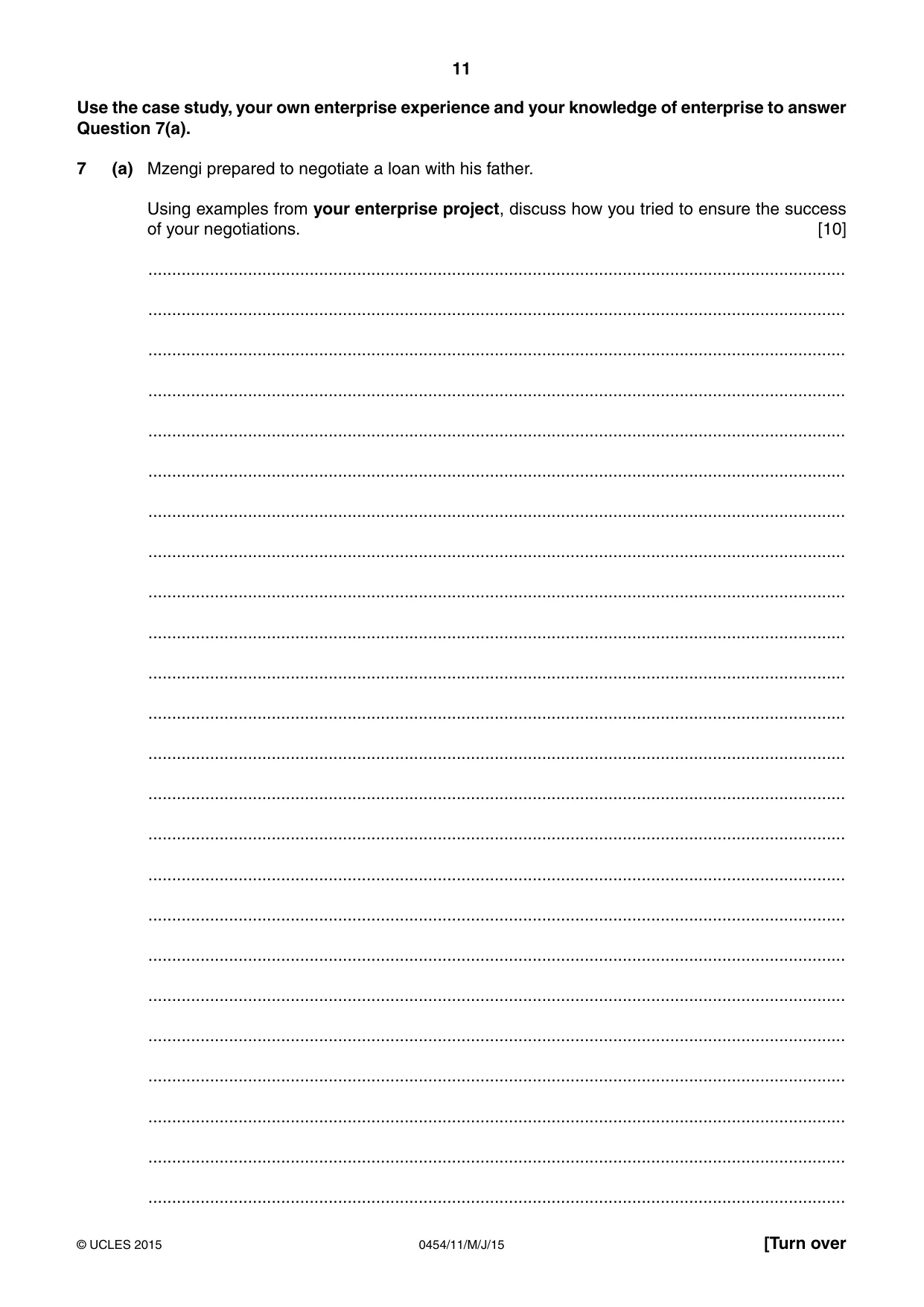
11 0454/11/M/J/15 © UCLES 2015 [Turn over Use the case study, your own enterprise experience and your knowledge of enterprise to answer Question 7(a). 7 (a) Mzengi prepared to negotiate a loan with his father. Using examples from your enterprise project, discuss how you tried to ensure the success of your negotiations. [10] … … … … … … … … … … … … … … … … … … … … … … … …
Question paper, page 12
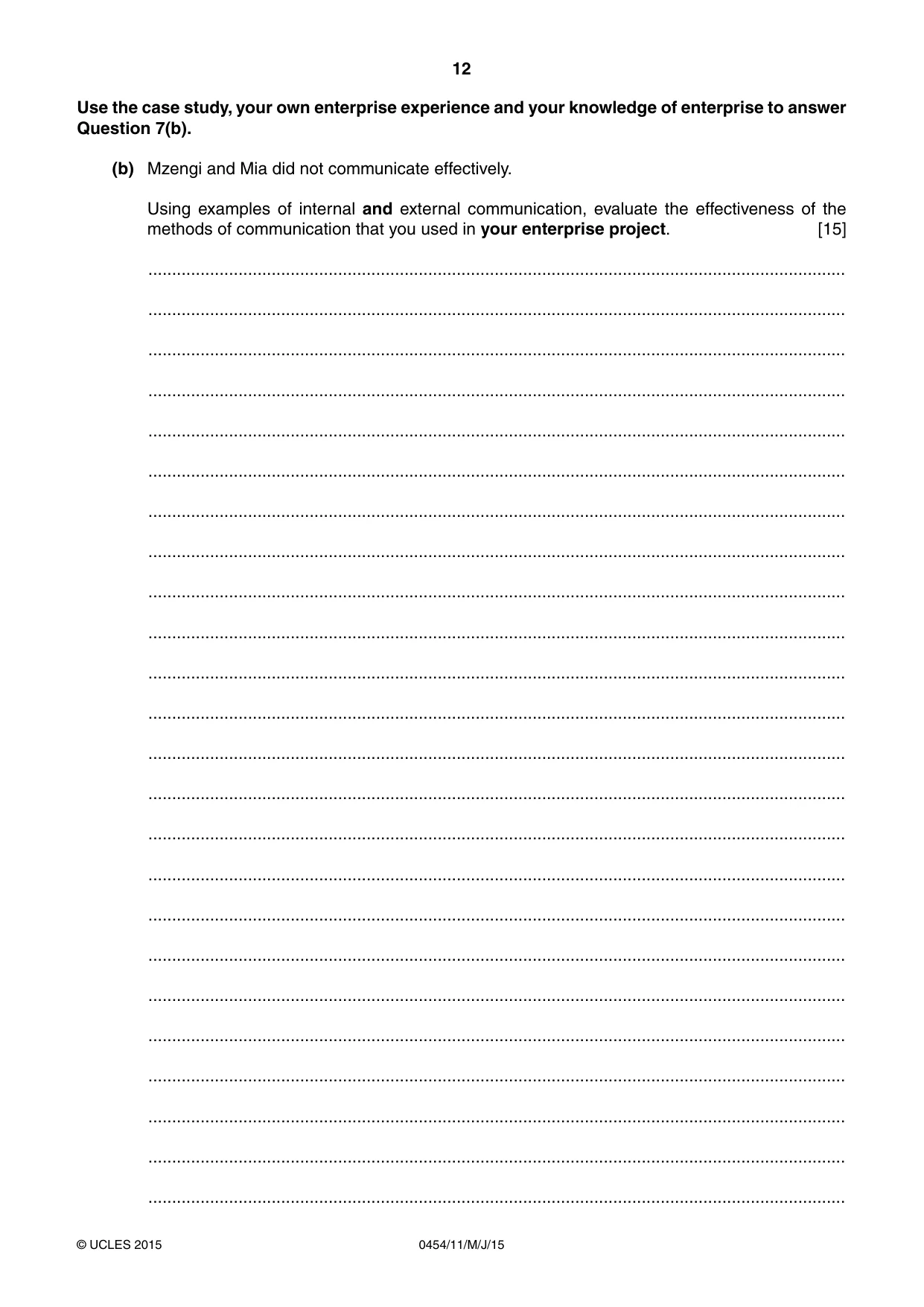
12 0454/11/M/J/15 © UCLES 2015 Use the case study, your own enterprise experience and your knowledge of enterprise to answer Question 7(b). (b) Mzengi and Mia did not communicate effectively. Using examples of internal and external communication, evaluate the effectiveness of the methods of communication that you used in your enterprise project. [15] … … … … … … … … … … … … … … … … … … … … … … … …
Question paper, page 13
13 0454/11/M/J/15 © UCLES 2015 … … … … … … … … … … … … … … … … … … … … … … … … … … … [Total: 25]
Question paper, page 14
14 0454/11/M/J/15 © UCLES 2015 BLANK PAGE
Question paper, page 15
15 0454/11/M/J/15 © UCLES 2015 BLANK PAGE
Question paper, page 16
16 0454/11/M/J/15 © UCLES 2015 BLANK PAGE Permission to reproduce items where third-party owned material protected by copyright is included has been sought and cleared where possible. Every reasonable effort has been made by the publisher (UCLES) to trace copyright holders, but if any items requiring clearance have unwittingly been included, the publisher will be pleased to make amends at the earliest possible opportunity. To avoid the issue of disclosure of answer-related information to candidates, all copyright acknowledgements are reproduced online in the Cambridge International Examinations Copyright Acknowledgements Booklet. This is produced for each series of examinations and is freely available to download at www.cie.org.uk after the live examination series. Cambridge International Examinations is part of the Cambridge Assessment Group. Cambridge Assessment is the brand name of University of Cambridge Local Examinations Syndicate (UCLES), which is itself a department of the University of Cambridge.
Mark scheme, page 1
® IGCSE is the registered trademark of Cambridge International Examinations. CAMBRIDGE INTERNATIONAL EXAMINATIONS Cambridge International General Certificate of Secondary Education MARK SCHEME for the May/June 2015 series 0454 ENTERPRISE 0454/11 Paper 1 (Case Study), maximum raw mark 100 This mark scheme is published as an aid to teachers and candidates, to indicate the requirements of the examination. It shows the basis on which Examiners were instructed to award marks. It does not indicate the details of the discussions that took place at an Examiners’ meeting before marking began, which would have considered the acceptability of alternative answers. Mark schemes should be read in conjunction with the question paper and the Principal Examiner Report for Teachers. Cambridge will not enter into discussions about these mark schemes. Cambridge is publishing the mark schemes for the May/June 2015 series for most Cambridge IGCSE®, Cambridge International A and AS Level components and some Cambridge O Level components.
Mark scheme, page 2
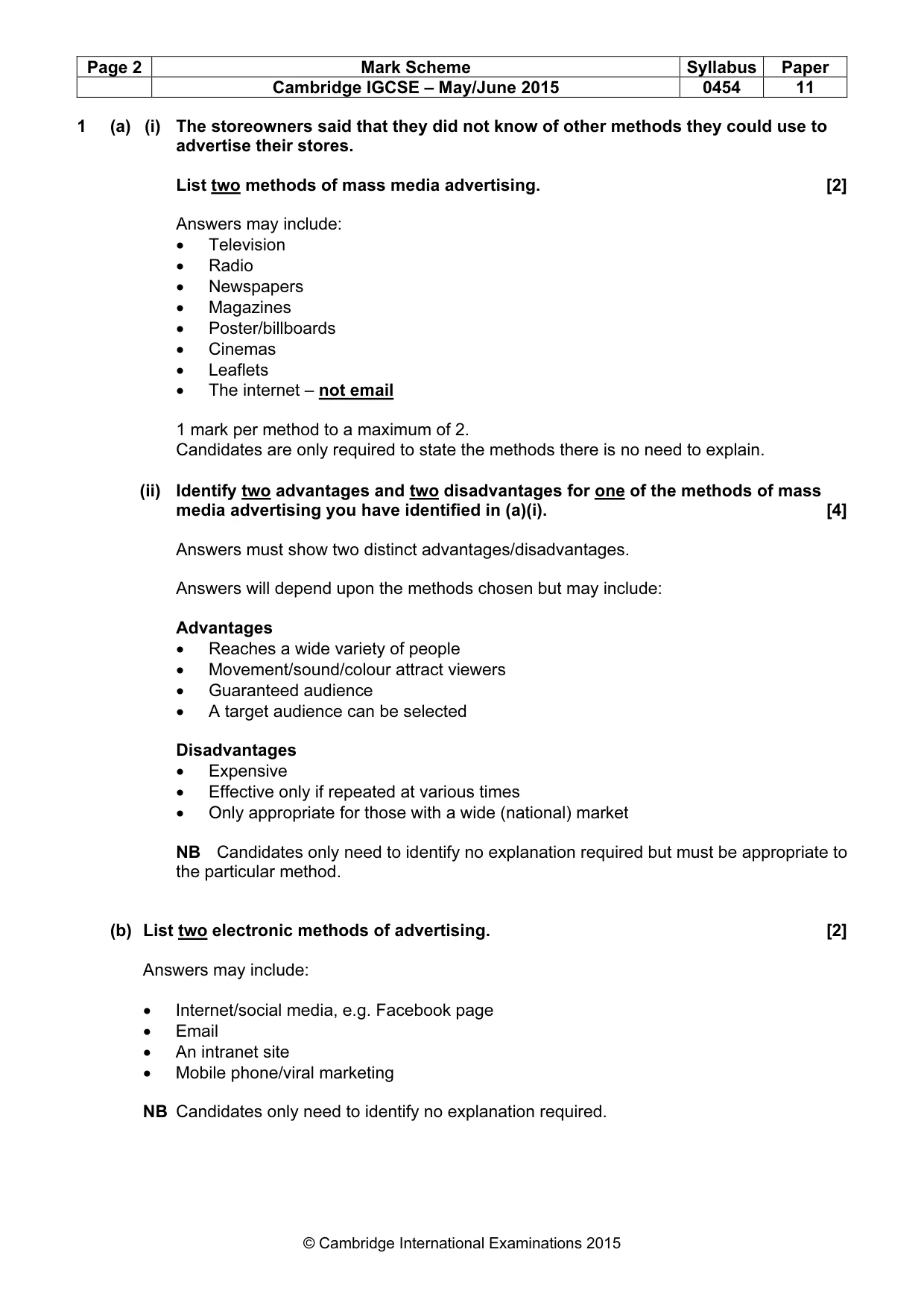
Page 2 Mark Scheme Syllabus Paper Cambridge IGCSE – May/June 2015 0454 11 © Cambridge International Examinations 2015 1 (a) (i) The storeowners said that they did not know of other methods they could use to advertise their stores. List two methods of mass media advertising. [2] Answers may include: • Television • Radio • Newspapers • Magazines • Poster/billboards • Cinemas • Leaflets • The internet – not email 1 mark per method to a maximum of 2. Candidates are only required to state the methods there is no need to explain. (ii) Identify two advantages and two disadvantages for one of the methods of mass media advertising you have identified in (a)(i). [4] Answers must show two distinct advantages/disadvantages. Answers will depend upon the methods chosen but may include: Advantages • Reaches a wide variety of people • Movement/sound/colour attract viewers • Guaranteed audience • A target audience can be selected Disadvantages • Expensive • Effective only if repeated at various times • Only appropriate for those with a wide (national) market NB Candidates only need to identify no explanation required but must be appropriate to the particular method. (b) List two electronic methods of advertising. [2] Answers may include: • Internet/social media, e.g. Facebook page • Email • An intranet site • Mobile phone/viral marketing NB Candidates only need to identify no explanation required.
Mark scheme, page 3
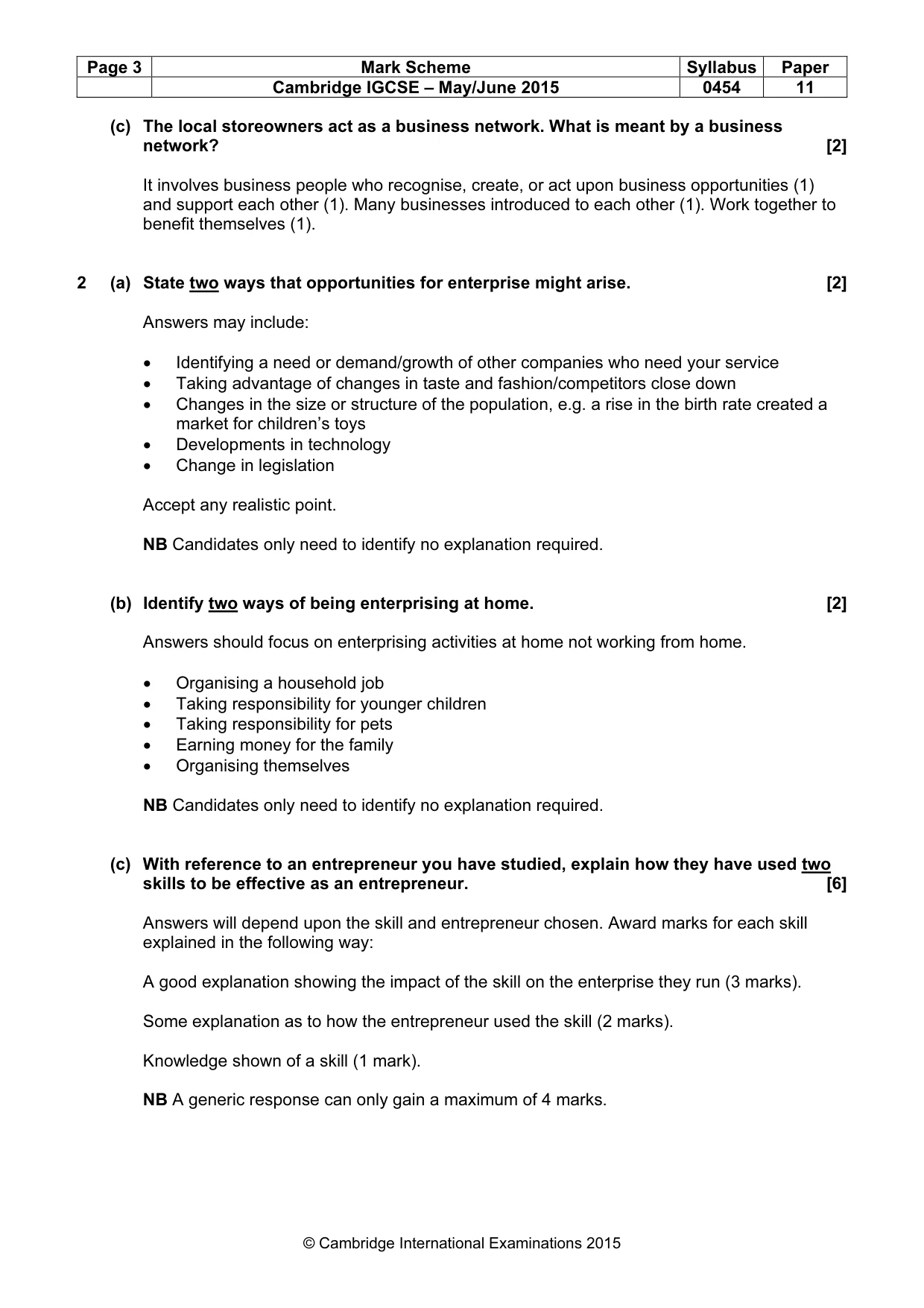
Page 3 Mark Scheme Syllabus Paper Cambridge IGCSE – May/June 2015 0454 11 © Cambridge International Examinations 2015 (c) The local storeowners act as a business network. What is meant by a business network? [2] It involves business people who recognise, create, or act upon business opportunities (1) and support each other (1). Many businesses introduced to each other (1). Work together to benefit themselves (1). 2 (a) State two ways that opportunities for enterprise might arise. [2] Answers may include: • Identifying a need or demand/growth of other companies who need your service • Taking advantage of changes in taste and fashion/competitors close down • Changes in the size or structure of the population, e.g. a rise in the birth rate created a market for children’s toys • Developments in technology • Change in legislation Accept any realistic point. NB Candidates only need to identify no explanation required. (b) Identify two ways of being enterprising at home. [2] Answers should focus on enterprising activities at home not working from home. • Organising a household job • Taking responsibility for younger children • Taking responsibility for pets • Earning money for the family • Organising themselves NB Candidates only need to identify no explanation required. (c) With reference to an entrepreneur you have studied, explain how they have used two skills to be effective as an entrepreneur. [6] Answers will depend upon the skill and entrepreneur chosen. Award marks for each skill explained in the following way: A good explanation showing the impact of the skill on the enterprise they run (3 marks). Some explanation as to how the entrepreneur used the skill (2 marks). Knowledge shown of a skill (1 mark). NB A generic response can only gain a maximum of 4 marks.
Mark scheme, page 4
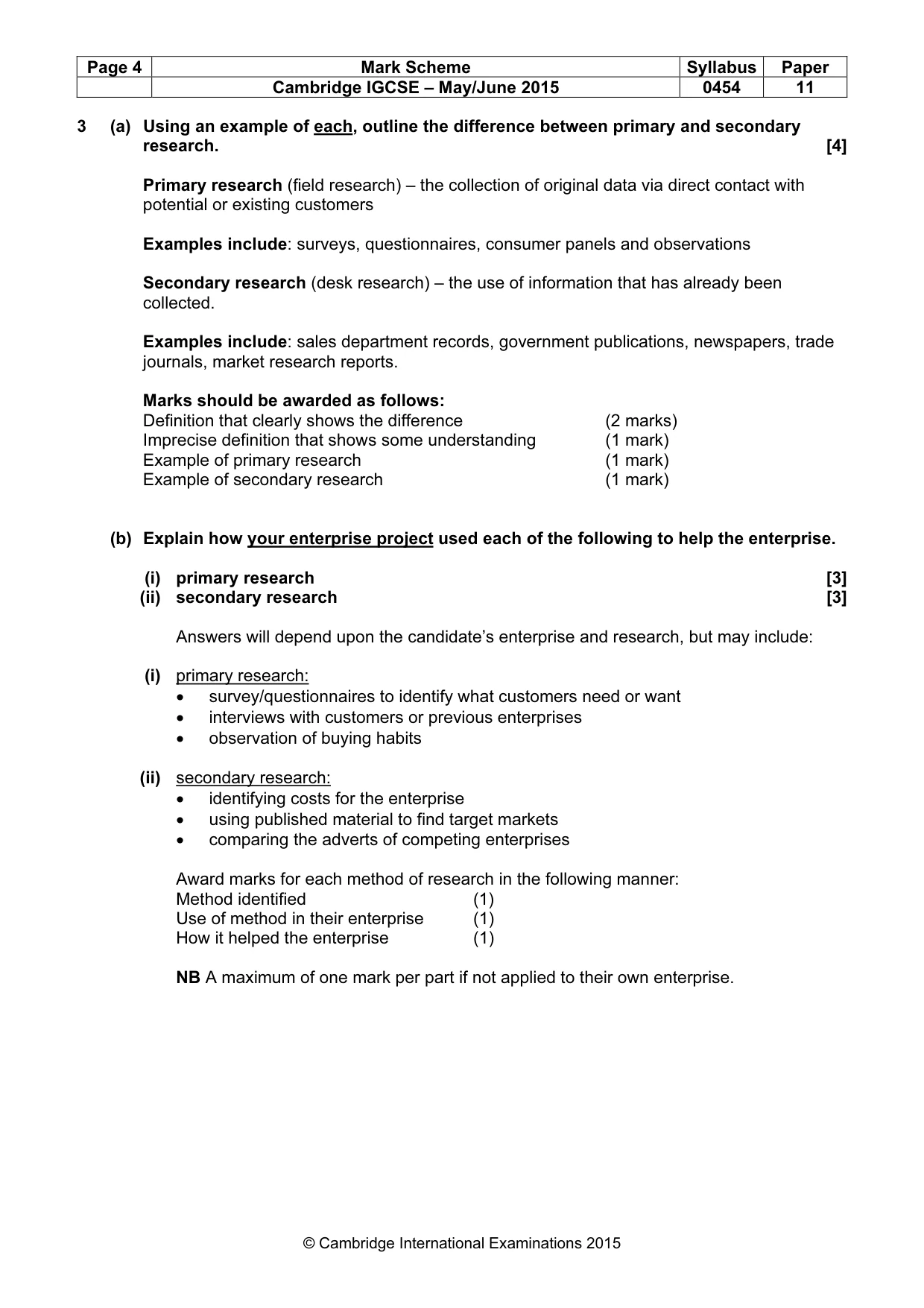
Page 4 Mark Scheme Syllabus Paper Cambridge IGCSE – May/June 2015 0454 11 © Cambridge International Examinations 2015 3 (a) Using an example of each, outline the difference between primary and secondary research. [4] Primary research (field research) – the collection of original data via direct contact with potential or existing customers Examples include: surveys, questionnaires, consumer panels and observations Secondary research (desk research) – the use of information that has already been collected. Examples include: sales department records, government publications, newspapers, trade journals, market research reports. Marks should be awarded as follows: Definition that clearly shows the difference (2 marks) Imprecise definition that shows some understanding (1 mark) Example of primary research (1 mark) Example of secondary research (1 mark) (b) Explain how your enterprise project used each of the following to help the enterprise. (i) primary research [3] (ii) secondary research [3] Answers will depend upon the candidate’s enterprise and research, but may include: (i) primary research: • survey/questionnaires to identify what customers need or want • interviews with customers or previous enterprises • observation of buying habits (ii) secondary research: • identifying costs for the enterprise • using published material to find target markets • comparing the adverts of competing enterprises Award marks for each method of research in the following manner: Method identified (1) Use of method in their enterprise (1) How it helped the enterprise (1) NB A maximum of one mark per part if not applied to their own enterprise.
Mark scheme, page 5
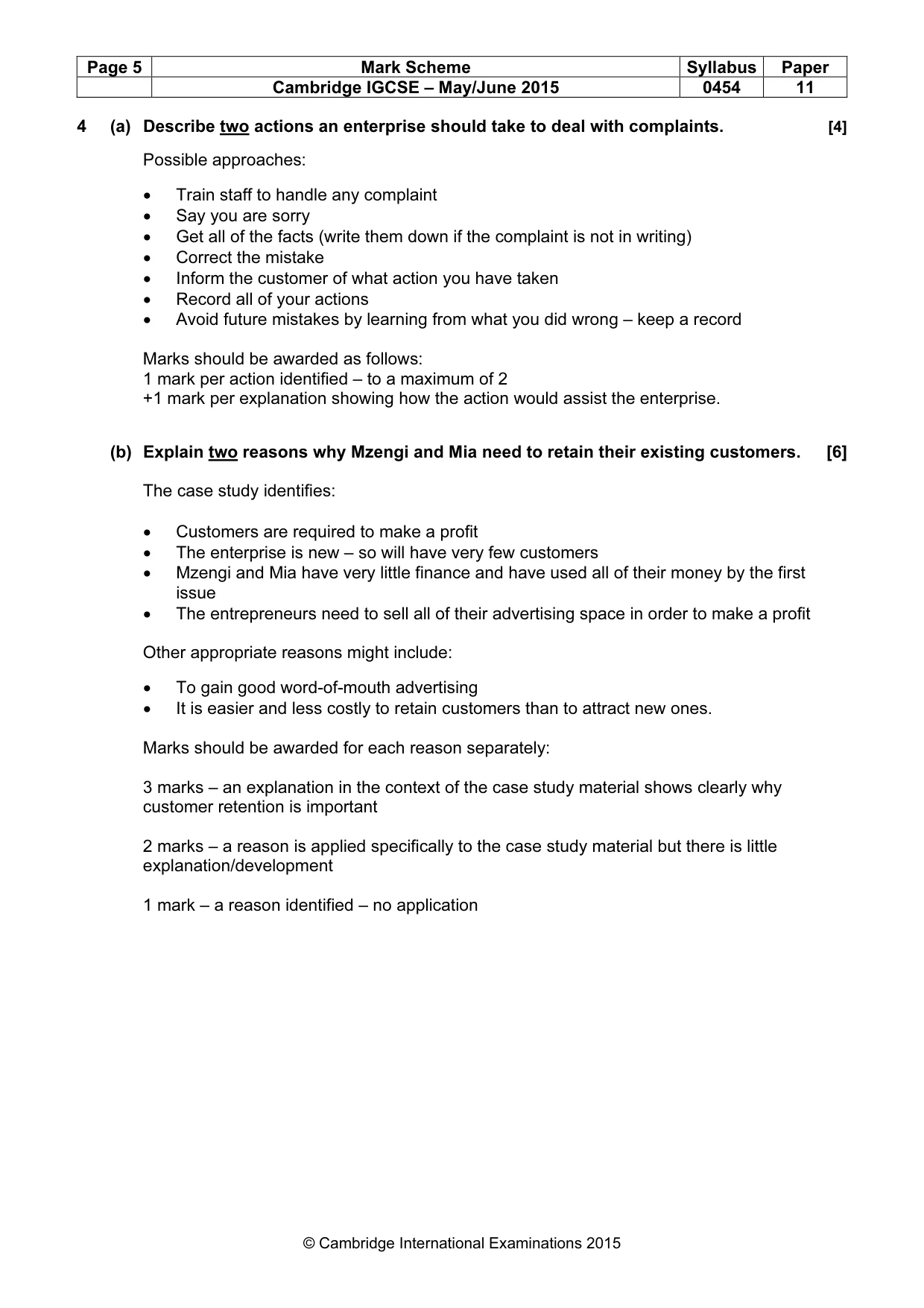
Page 5 Mark Scheme Syllabus Paper Cambridge IGCSE – May/June 2015 0454 11 © Cambridge International Examinations 2015 4 (a) Describe two actions an enterprise should take to deal with complaints. [4] Possible approaches: • Train staff to handle any complaint • Say you are sorry • Get all of the facts (write them down if the complaint is not in writing) • Correct the mistake • Inform the customer of what action you have taken • Record all of your actions • Avoid future mistakes by learning from what you did wrong – keep a record Marks should be awarded as follows: 1 mark per action identified – to a maximum of 2 +1 mark per explanation showing how the action would assist the enterprise. (b) Explain two reasons why Mzengi and Mia need to retain their existing customers. [6] The case study identifies: • Customers are required to make a profit • The enterprise is new – so will have very few customers • Mzengi and Mia have very little finance and have used all of their money by the first issue • The entrepreneurs need to sell all of their advertising space in order to make a profit Other appropriate reasons might include: • To gain good word-of-mouth advertising • It is easier and less costly to retain customers than to attract new ones. Marks should be awarded for each reason separately: 3 marks – an explanation in the context of the case study material shows clearly why customer retention is important 2 marks – a reason is applied specifically to the case study material but there is little explanation/development 1 mark – a reason identified – no application
Mark scheme, page 6
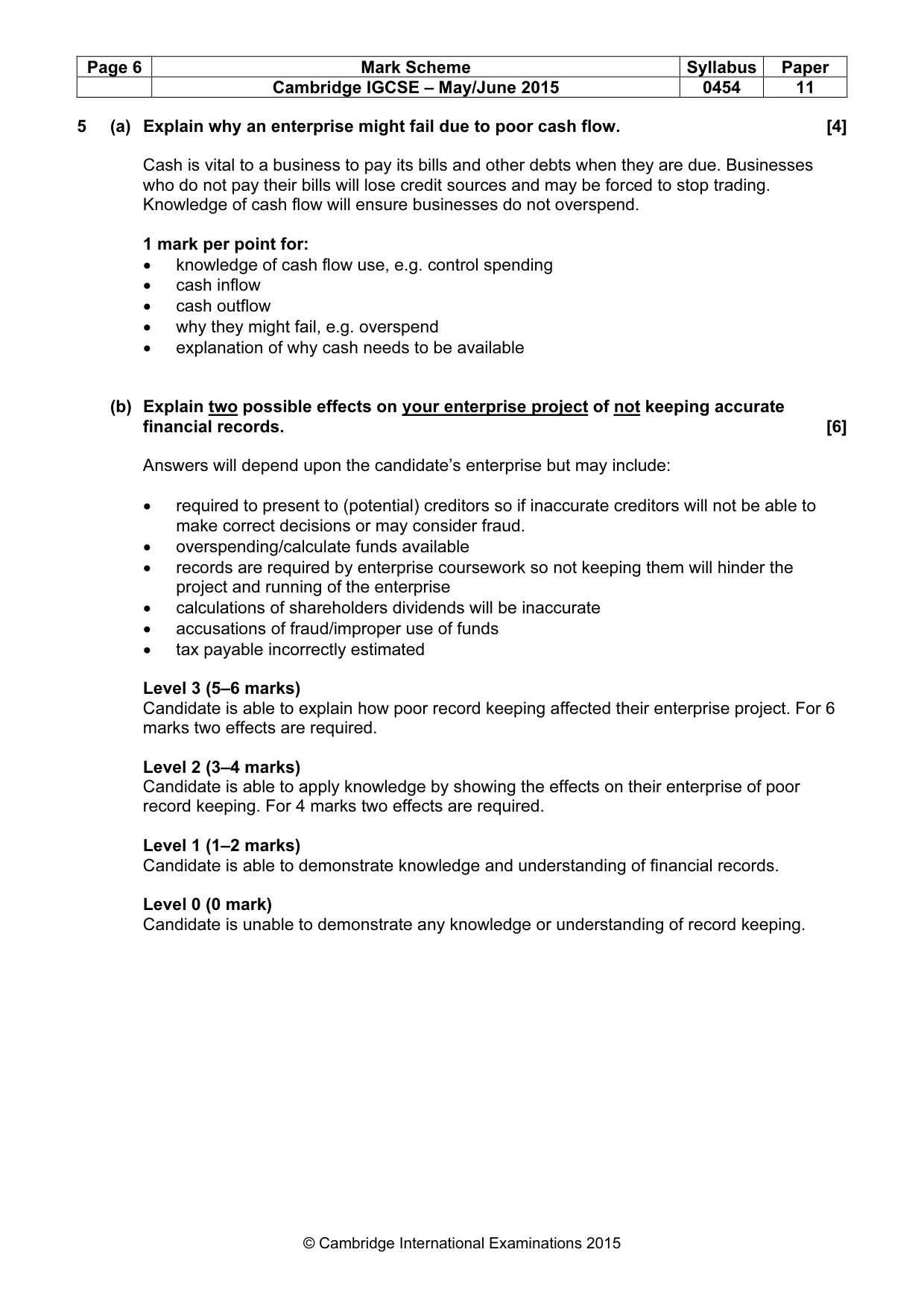
Page 6 Mark Scheme Syllabus Paper Cambridge IGCSE – May/June 2015 0454 11 © Cambridge International Examinations 2015 5 (a) Explain why an enterprise might fail due to poor cash flow. [4] Cash is vital to a business to pay its bills and other debts when they are due. Businesses who do not pay their bills will lose credit sources and may be forced to stop trading. Knowledge of cash flow will ensure businesses do not overspend. 1 mark per point for: • knowledge of cash flow use, e.g. control spending • cash inflow • cash outflow • why they might fail, e.g. overspend • explanation of why cash needs to be available (b) Explain two possible effects on your enterprise project of not keeping accurate financial records. [6] Answers will depend upon the candidate’s enterprise but may include: • required to present to (potential) creditors so if inaccurate creditors will not be able to make correct decisions or may consider fraud. • overspending/calculate funds available • records are required by enterprise coursework so not keeping them will hinder the project and running of the enterprise • calculations of shareholders dividends will be inaccurate • accusations of fraud/improper use of funds • tax payable incorrectly estimated Level 3 (5–6 marks) Candidate is able to explain how poor record keeping affected their enterprise project. For 6 marks two effects are required. Level 2 (3–4 marks) Candidate is able to apply knowledge by showing the effects on their enterprise of poor record keeping. For 4 marks two effects are required. Level 1 (1–2 marks) Candidate is able to demonstrate knowledge and understanding of financial records. Level 0 (0 mark) Candidate is unable to demonstrate any knowledge or understanding of record keeping.
Mark scheme, page 7
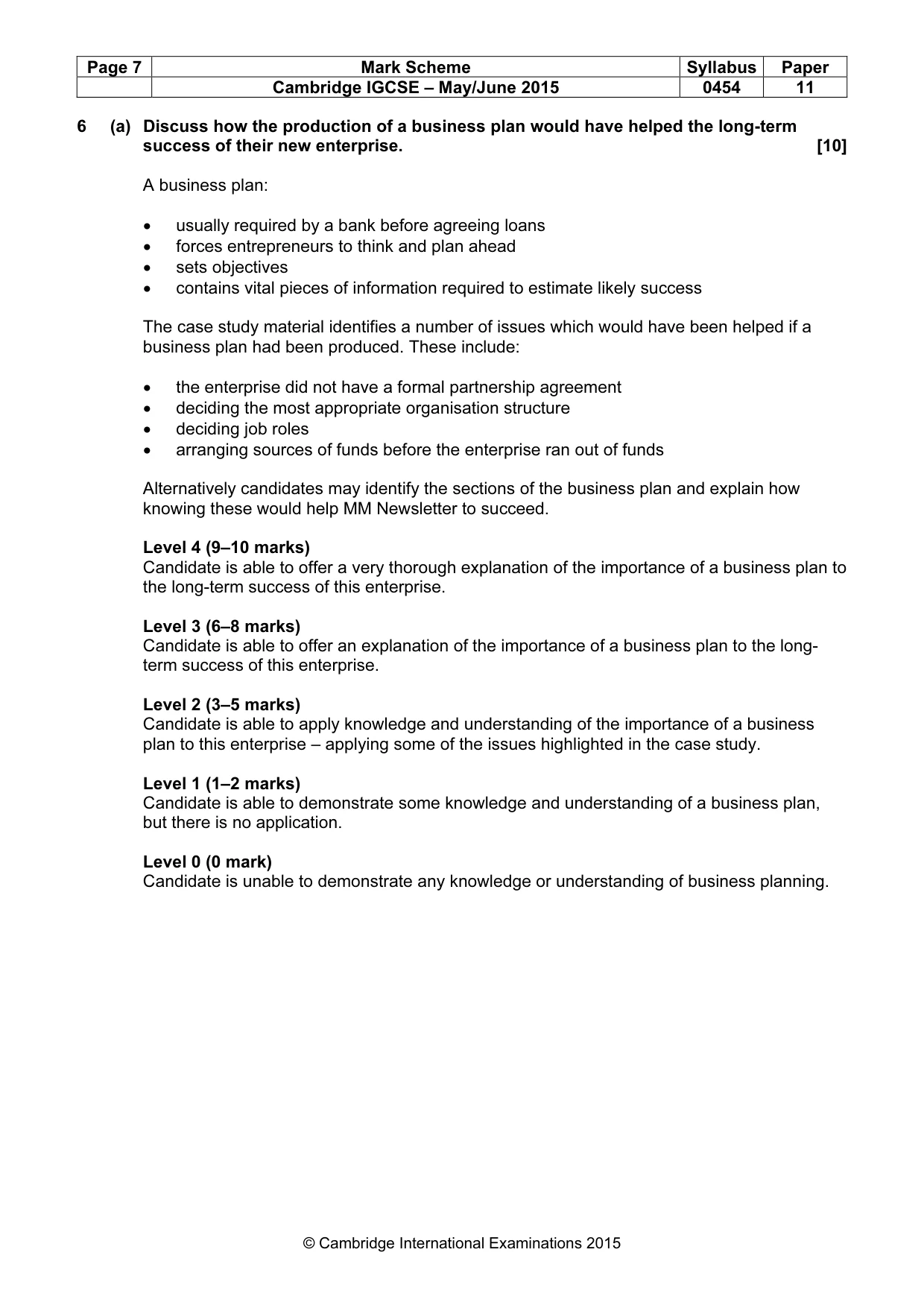
Page 7 Mark Scheme Syllabus Paper Cambridge IGCSE – May/June 2015 0454 11 © Cambridge International Examinations 2015 6 (a) Discuss how the production of a business plan would have helped the long-term success of their new enterprise. [10] A business plan: • usually required by a bank before agreeing loans • forces entrepreneurs to think and plan ahead • sets objectives • contains vital pieces of information required to estimate likely success The case study material identifies a number of issues which would have been helped if a business plan had been produced. These include: • the enterprise did not have a formal partnership agreement • deciding the most appropriate organisation structure • deciding job roles • arranging sources of funds before the enterprise ran out of funds Alternatively candidates may identify the sections of the business plan and explain how knowing these would help MM Newsletter to succeed. Level 4 (9–10 marks) Candidate is able to offer a very thorough explanation of the importance of a business plan to the long-term success of this enterprise. Level 3 (6–8 marks) Candidate is able to offer an explanation of the importance of a business plan to the long- term success of this enterprise. Level 2 (3–5 marks) Candidate is able to apply knowledge and understanding of the importance of a business plan to this enterprise – applying some of the issues highlighted in the case study. Level 1 (1–2 marks) Candidate is able to demonstrate some knowledge and understanding of a business plan, but there is no application. Level 0 (0 mark) Candidate is unable to demonstrate any knowledge or understanding of business planning.
Mark scheme, page 8
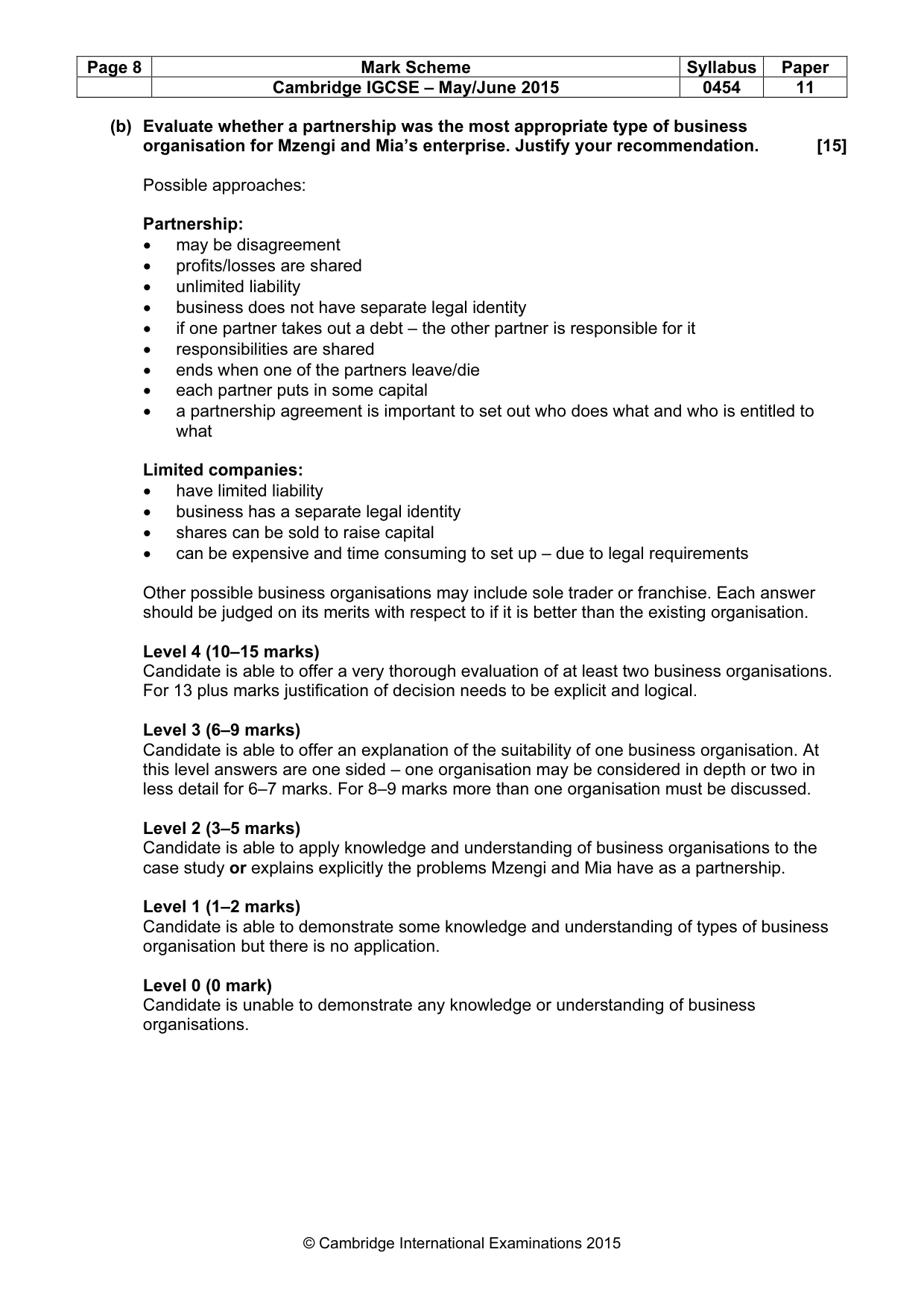
Page 8 Mark Scheme Syllabus Paper Cambridge IGCSE – May/June 2015 0454 11 © Cambridge International Examinations 2015 (b) Evaluate whether a partnership was the most appropriate type of business organisation for Mzengi and Mia’s enterprise. Justify your recommendation. [15] Possible approaches: Partnership: • may be disagreement • profits/losses are shared • unlimited liability • business does not have separate legal identity • if one partner takes out a debt – the other partner is responsible for it • responsibilities are shared • ends when one of the partners leave/die • each partner puts in some capital • a partnership agreement is important to set out who does what and who is entitled to what Limited companies: • have limited liability • business has a separate legal identity • shares can be sold to raise capital • can be expensive and time consuming to set up – due to legal requirements Other possible business organisations may include sole trader or franchise. Each answer should be judged on its merits with respect to if it is better than the existing organisation. Level 4 (10–15 marks) Candidate is able to offer a very thorough evaluation of at least two business organisations. For 13 plus marks justification of decision needs to be explicit and logical. Level 3 (6–9 marks) Candidate is able to offer an explanation of the suitability of one business organisation. At this level answers are one sided – one organisation may be considered in depth or two in less detail for 6–7 marks. For 8–9 marks more than one organisation must be discussed. Level 2 (3–5 marks) Candidate is able to apply knowledge and understanding of business organisations to the case study or explains explicitly the problems Mzengi and Mia have as a partnership. Level 1 (1–2 marks) Candidate is able to demonstrate some knowledge and understanding of types of business organisation but there is no application. Level 0 (0 mark) Candidate is unable to demonstrate any knowledge or understanding of business organisations.
Mark scheme, page 9
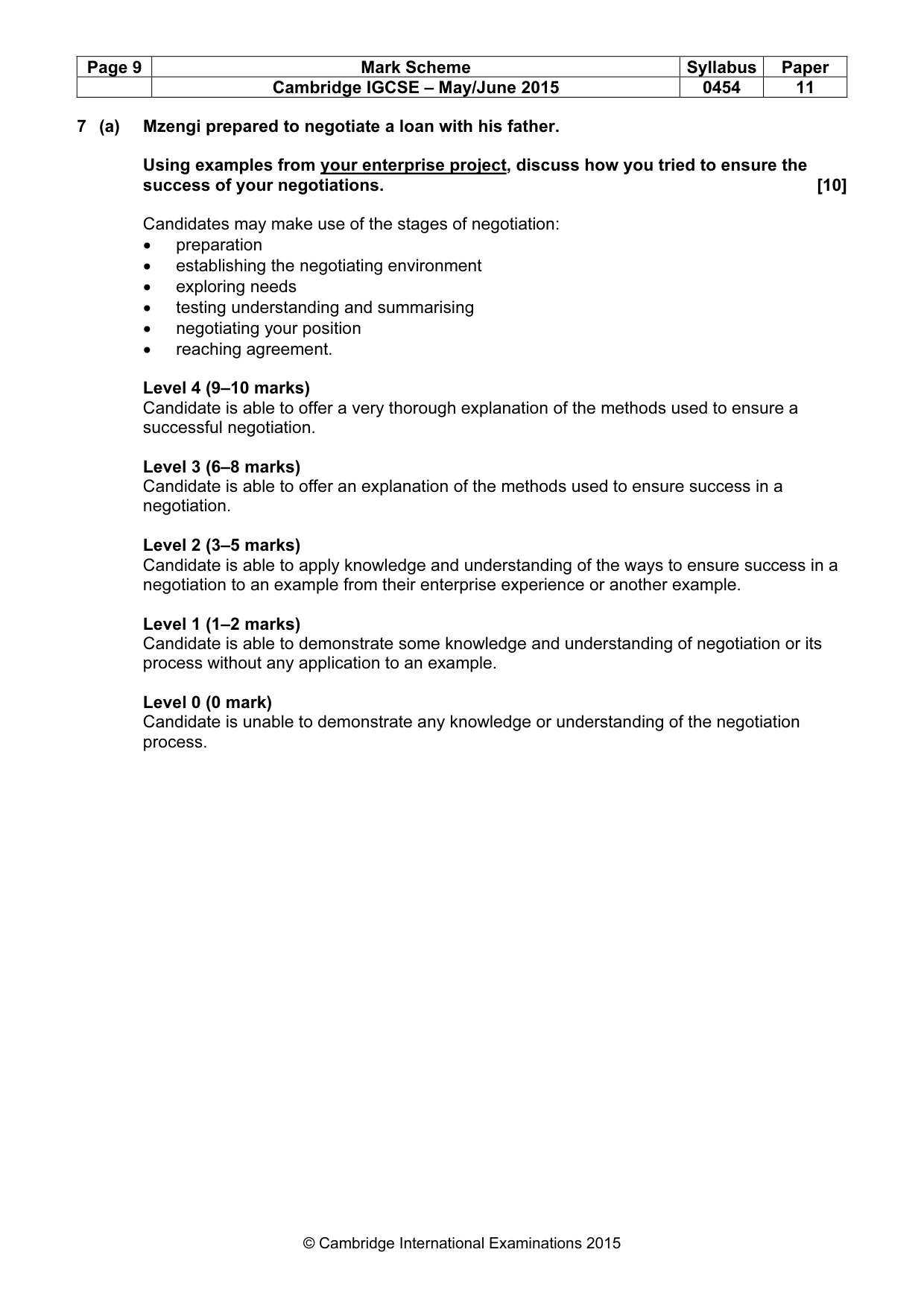
Page 9 Mark Scheme Syllabus Paper Cambridge IGCSE – May/June 2015 0454 11 © Cambridge International Examinations 2015 7 (a) Mzengi prepared to negotiate a loan with his father. Using examples from your enterprise project, discuss how you tried to ensure the success of your negotiations. [10] Candidates may make use of the stages of negotiation: • preparation • establishing the negotiating environment • exploring needs • testing understanding and summarising • negotiating your position • reaching agreement. Level 4 (9–10 marks) Candidate is able to offer a very thorough explanation of the methods used to ensure a successful negotiation. Level 3 (6–8 marks) Candidate is able to offer an explanation of the methods used to ensure success in a negotiation. Level 2 (3–5 marks) Candidate is able to apply knowledge and understanding of the ways to ensure success in a negotiation to an example from their enterprise experience or another example. Level 1 (1–2 marks) Candidate is able to demonstrate some knowledge and understanding of negotiation or its process without any application to an example. Level 0 (0 mark) Candidate is unable to demonstrate any knowledge or understanding of the negotiation process.
Mark scheme, page 10
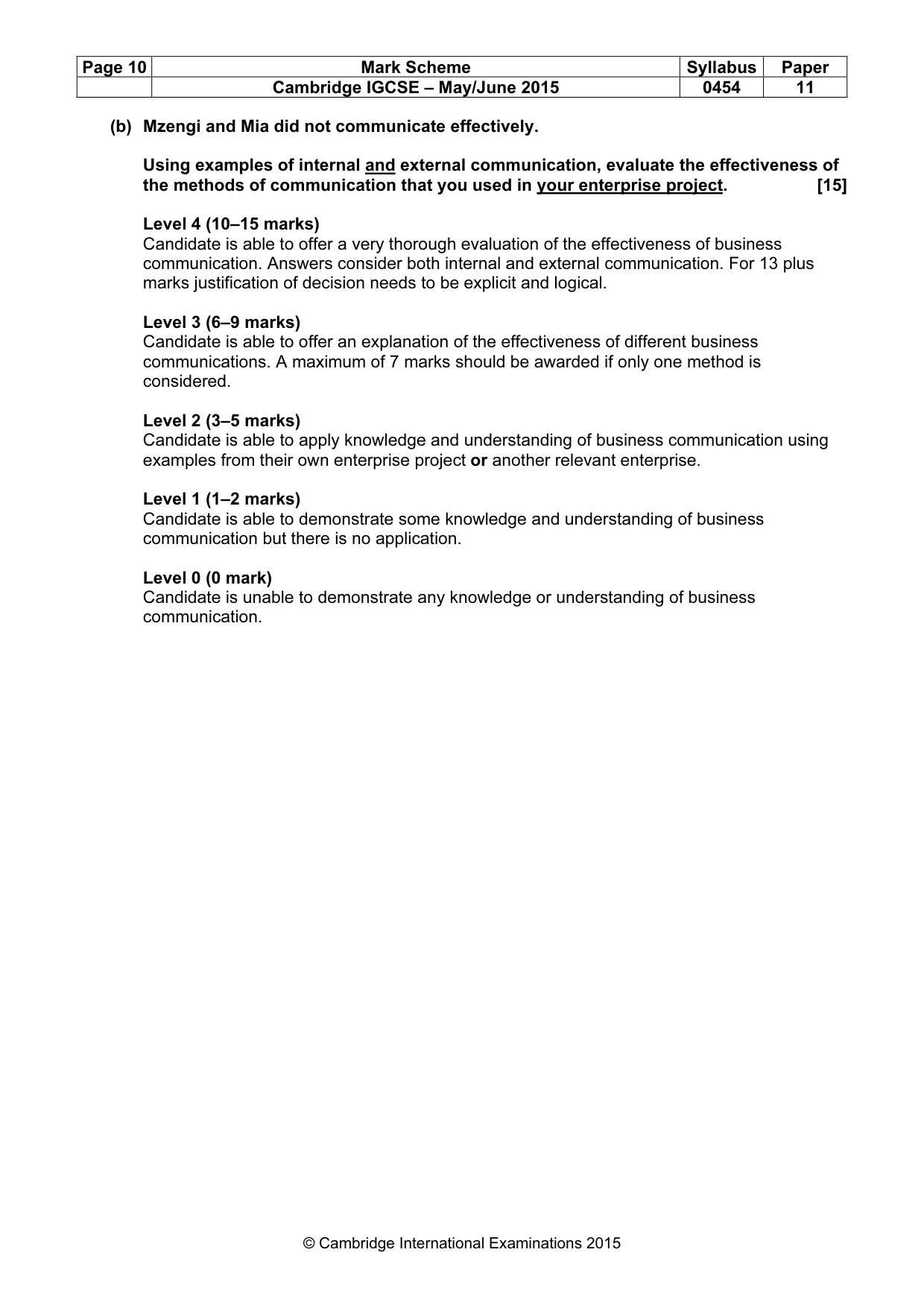
Page 10 Mark Scheme Syllabus Paper Cambridge IGCSE – May/June 2015 0454 11 © Cambridge International Examinations 2015 (b) Mzengi and Mia did not communicate effectively. Using examples of internal and external communication, evaluate the effectiveness of the methods of communication that you used in your enterprise project. [15] Level 4 (10–15 marks) Candidate is able to offer a very thorough evaluation of the effectiveness of business communication. Answers consider both internal and external communication. For 13 plus marks justification of decision needs to be explicit and logical. Level 3 (6–9 marks) Candidate is able to offer an explanation of the effectiveness of different business communications. A maximum of 7 marks should be awarded if only one method is considered. Level 2 (3–5 marks) Candidate is able to apply knowledge and understanding of business communication using examples from their own enterprise project or another relevant enterprise. Level 1 (1–2 marks) Candidate is able to demonstrate some knowledge and understanding of business communication but there is no application. Level 0 (0 mark) Candidate is unable to demonstrate any knowledge or understanding of business communication.
What you needed in this session
Cambridge’s own grade thresholds for 2015 May/June, Paper 1 · Variant 1. A higher threshold means an easier paper — the bar moves with how the cohort did.