Cambridge IGCSE English Second Language (Speaking Endorsement) (9-1) 0993 — 2025 May/June Paper 2 · Variant 1
0993/21/M/J/25 · 40 marks · ≈45 min
The question paper and its mark scheme, free to read here and free to download. This is Cambridge’s own paper, exactly as it was sat.
Question paper16 pages

Mark scheme3 pages
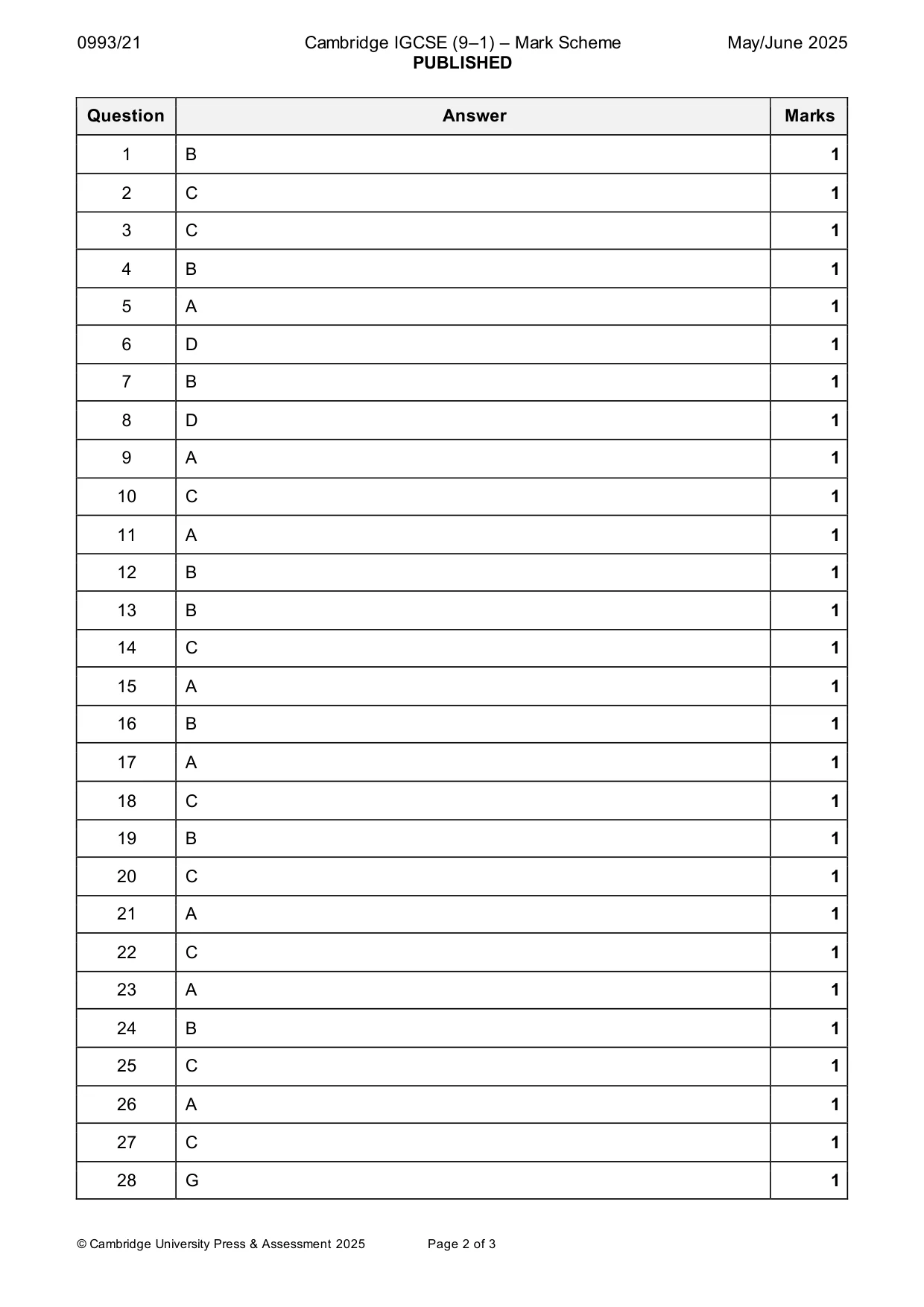
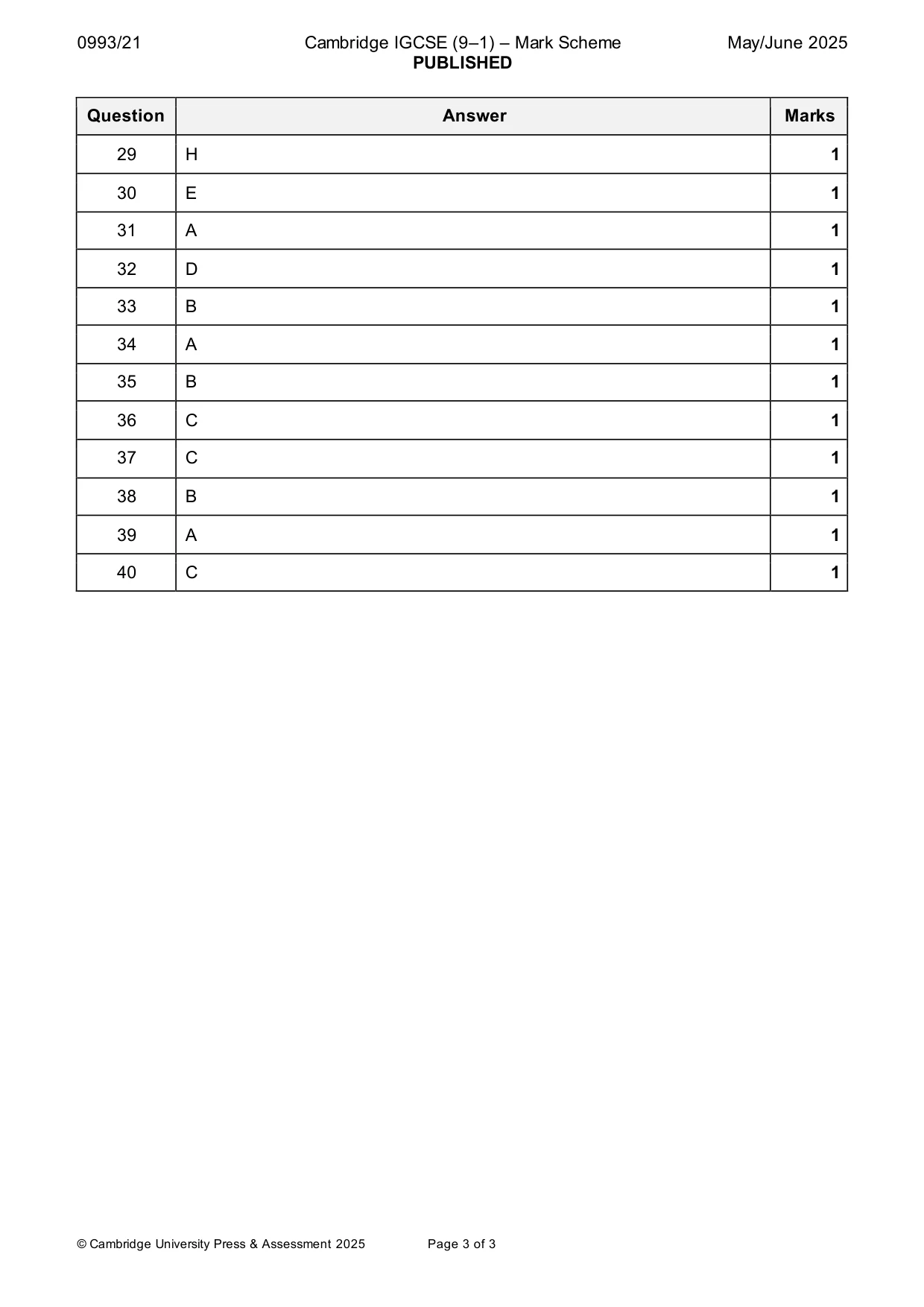
Answers below. Sit the paper first if you are practising.
Paper as text
Question paper, page 1
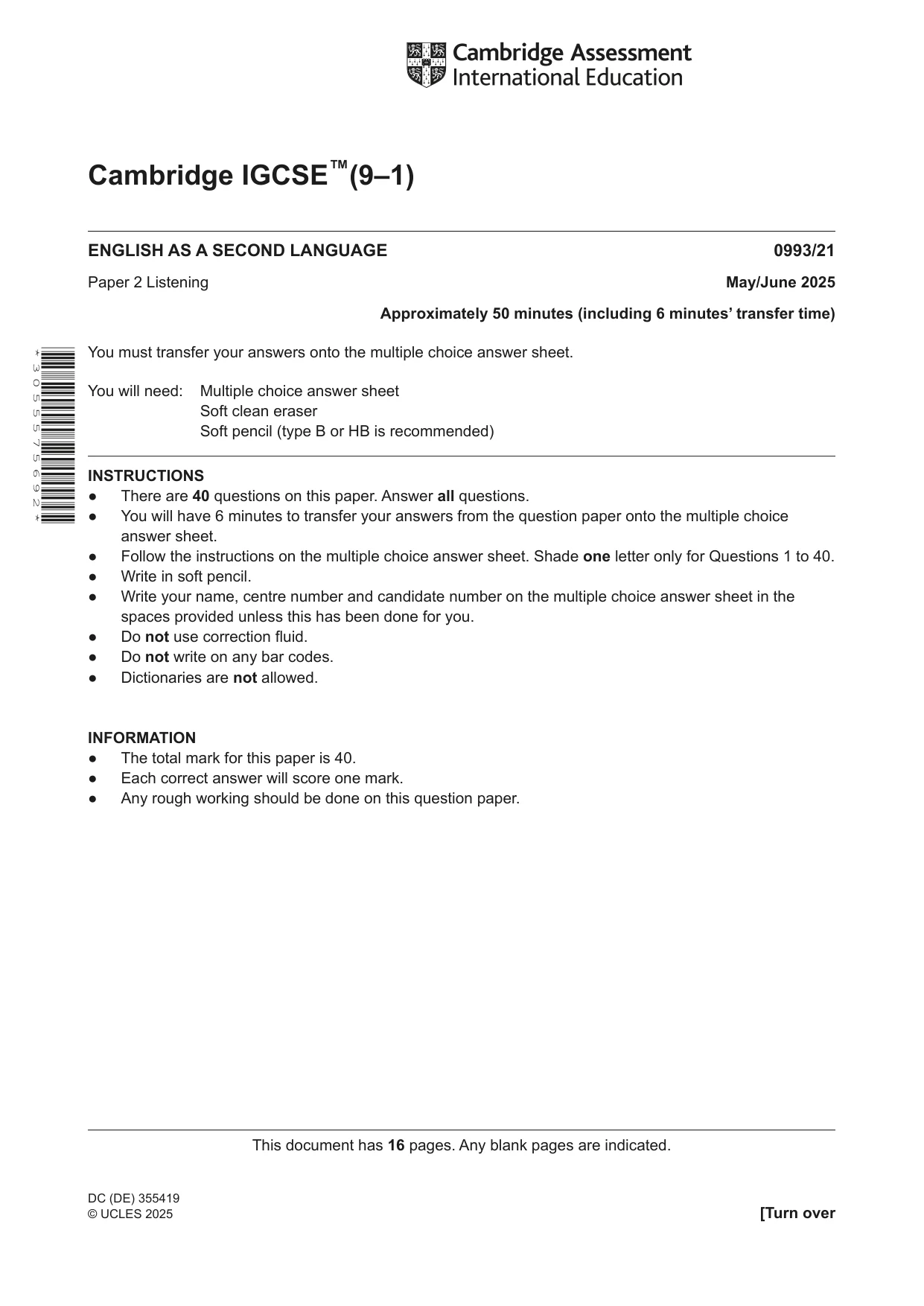
This document has 16 pages. Any blank pages are indicated. [Turn over DC (DE) 355419 © UCLES 2025 * 3 0 5 5 5 7 5 6 9 2 * Cambridge IGCSE™(9–1) ENGLISH AS A SECOND LANGUAGE 0993/21 Paper 2 Listening May/June 2025 Approximately 50 minutes (including 6 minutes’ transfer time) You must transfer your answers onto the multiple choice answer sheet. You will need: Multiple choice answer sheet Soft clean eraser Soft pencil (type B or HB is recommended) INSTRUCTIONS ● There are 40 questions on this paper. Answer all questions. ● You will have 6 minutes to transfer your answers from the question paper onto the multiple choice answer sheet. ● Follow the instructions on the multiple choice answer sheet. Shade one letter only for Questions 1 to 40. ● Write in soft pencil. ● Write your name, centre number and candidate number on the multiple choice answer sheet in the spaces provided unless this has been done for you. ● Do not use correction fluid. ● Do not write on any bar codes. ● Dictionaries are not allowed. INFORMATION ● The total mark for this paper is 40. ● Each correct answer will score one mark. ● Any rough working should be done on this question paper.
Question paper, page 2
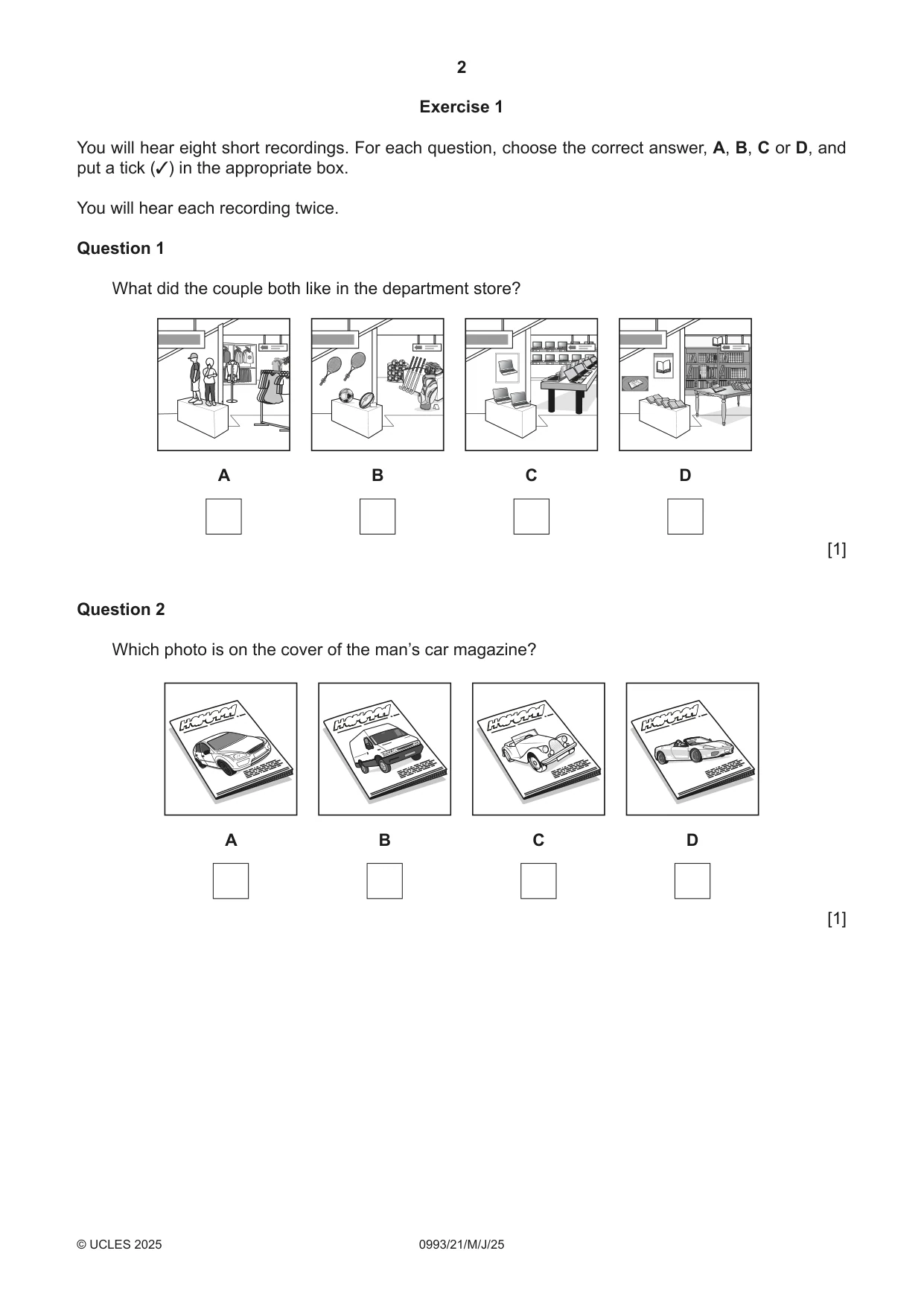
2 0993/21/ M/J/25 © UCLES 2025 Exercise 1 You will hear eight short recordings. For each question, choose the correct answer, A, B, C or D, and put a tick (3) in the appropriate box. You will hear each recording twice. Question 1 What did the couple both like in the department store? A B C D [1] Question 2 Which photo is on the cover of the man’s car magazine? A B C D [1]
Question paper, page 3
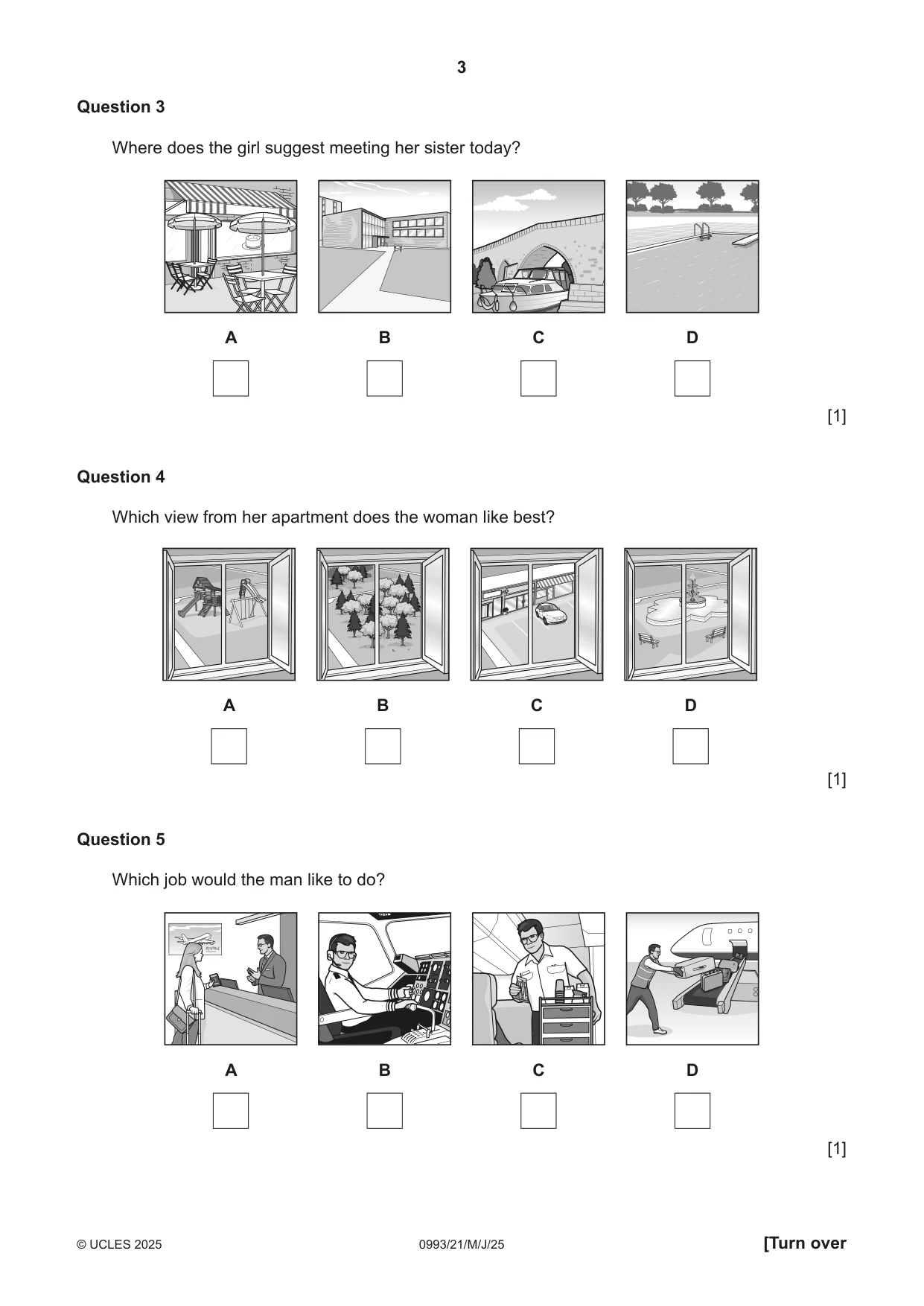
3 0993/21/ M/J/25 © UCLES 2025 [Turn over Question 3 Where does the girl suggest meeting her sister today? A B C D [1] Question 4 Which view from her apartment does the woman like best? A B C D [1] Question 5 Which job would the man like to do? A B C D [1]
Question paper, page 4
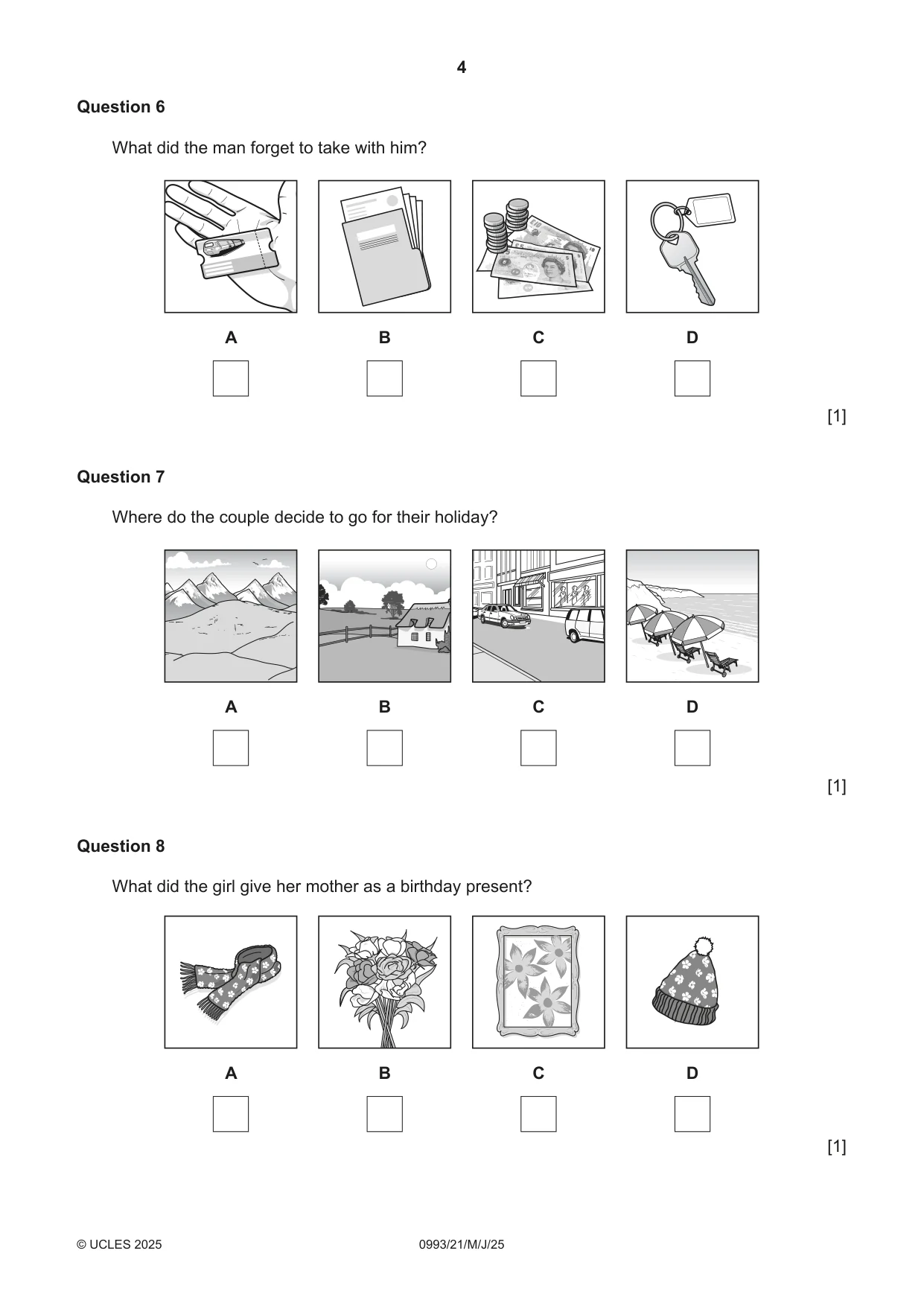
4 0993/21/ M/J/25 © UCLES 2025 Question 6 What did the man forget to take with him? A B C D [1] Question 7 Where do the couple decide to go for their holiday? A B C D [1] Question 8 What did the girl give her mother as a birthday present? A B C D [1]
Question paper, page 5
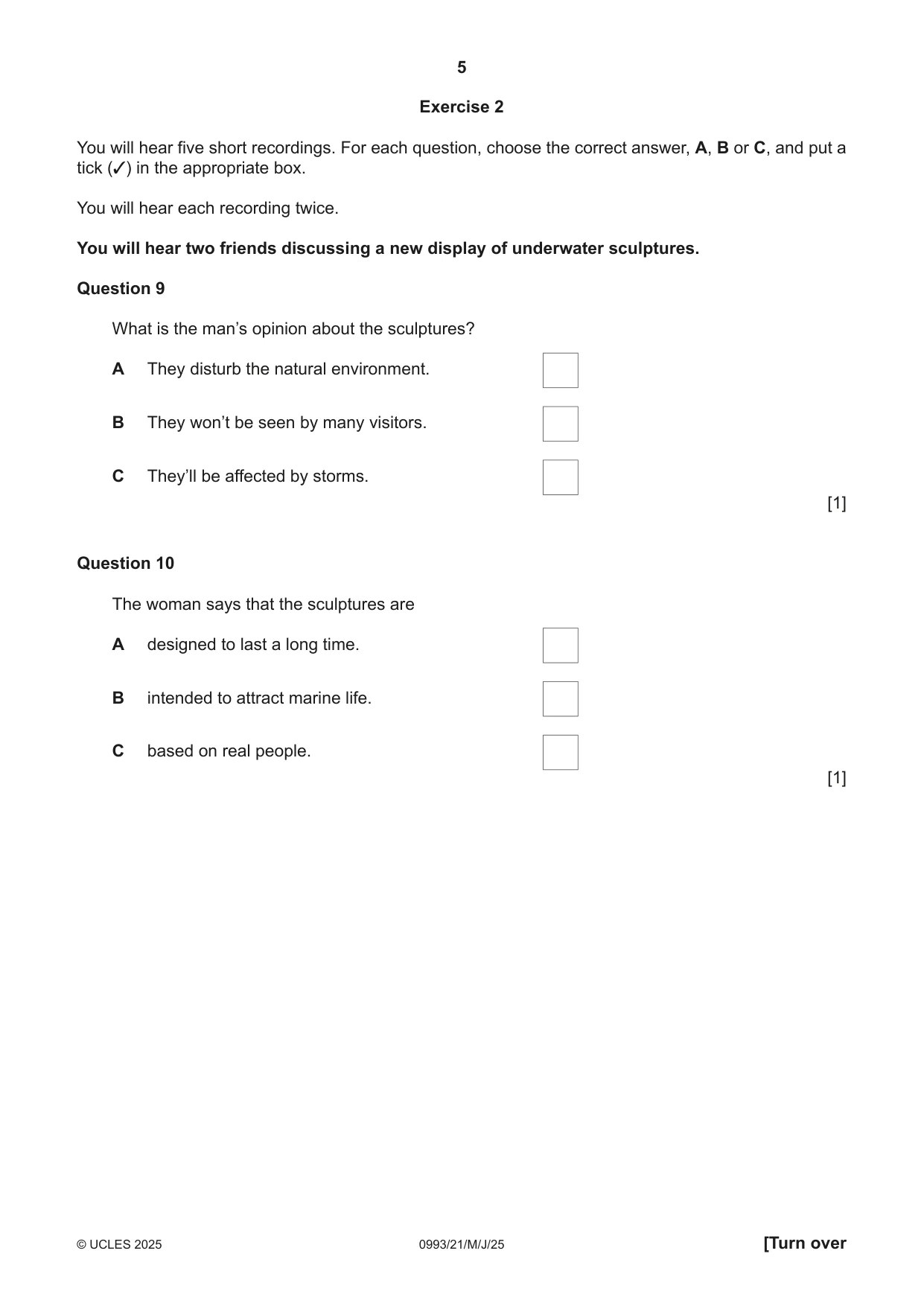
5 0993/21/M/J/25 © UCLES 2025 [Turn over Exercise 2 You will hear five short recordings. For each question, choose the correct answer, A, B or C, and put a tick (3) in the appropriate box. You will hear each recording twice. You will hear two friends discussing a new display of underwater sculptures. Question 9 What is the man’s opinion about the sculptures? A They disturb the natural environment. B They won’t be seen by many visitors. C They’ll be affected by storms. [1] Question 10 The woman says that the sculptures are A designed to last a long time. B intended to attract marine life. C based on real people. [1]
Question paper, page 6
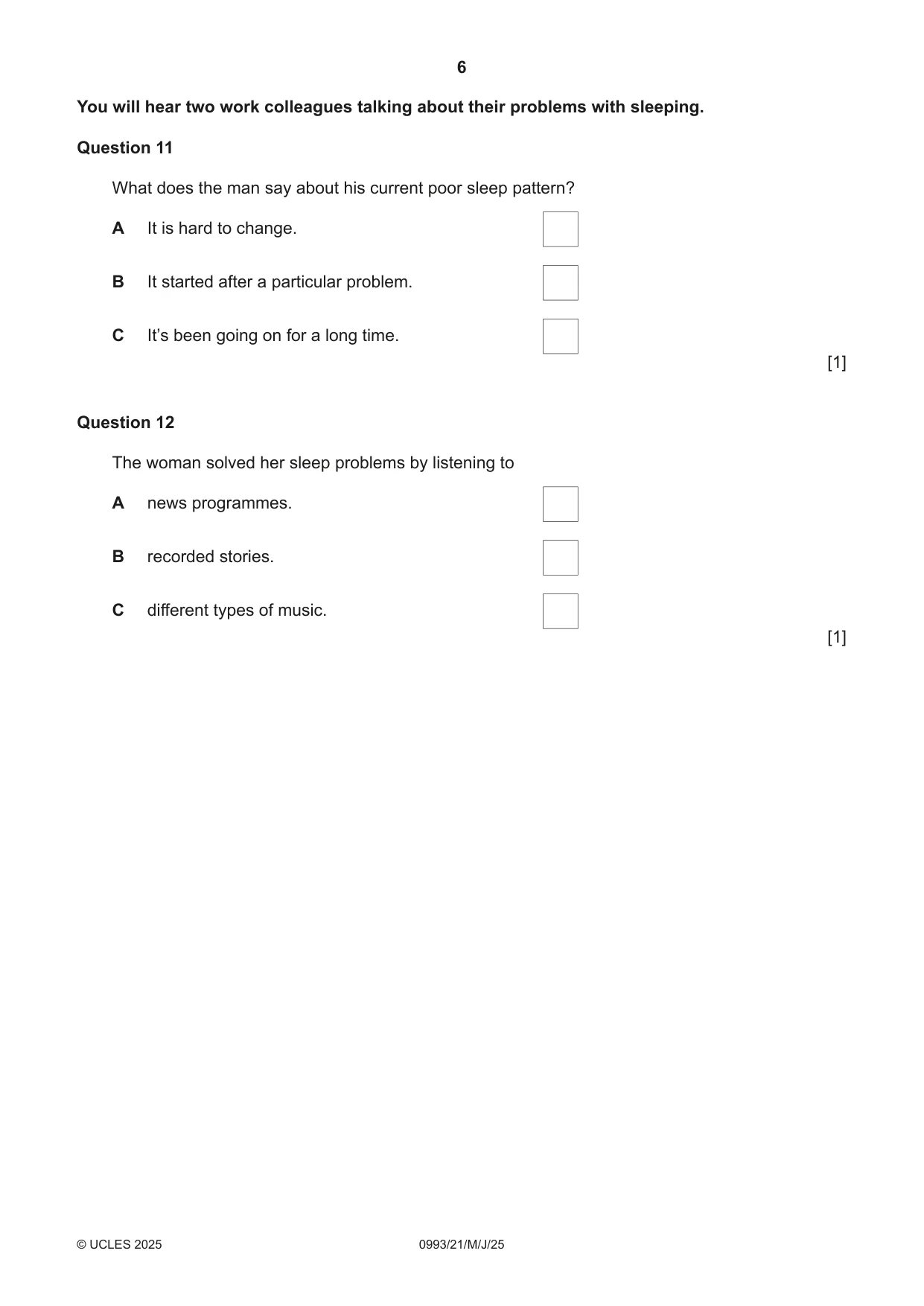
6 0993/21/M/J/25 © UCLES 2025 You will hear two work colleagues talking about their problems with sleeping. Question 11 What does the man say about his current poor sleep pattern? A It is hard to change. B It started after a particular problem. C It’s been going on for a long time. [1] Question 12 The woman solved her sleep problems by listening to A news programmes. B recorded stories. C different types of music. [1]
Question paper, page 7
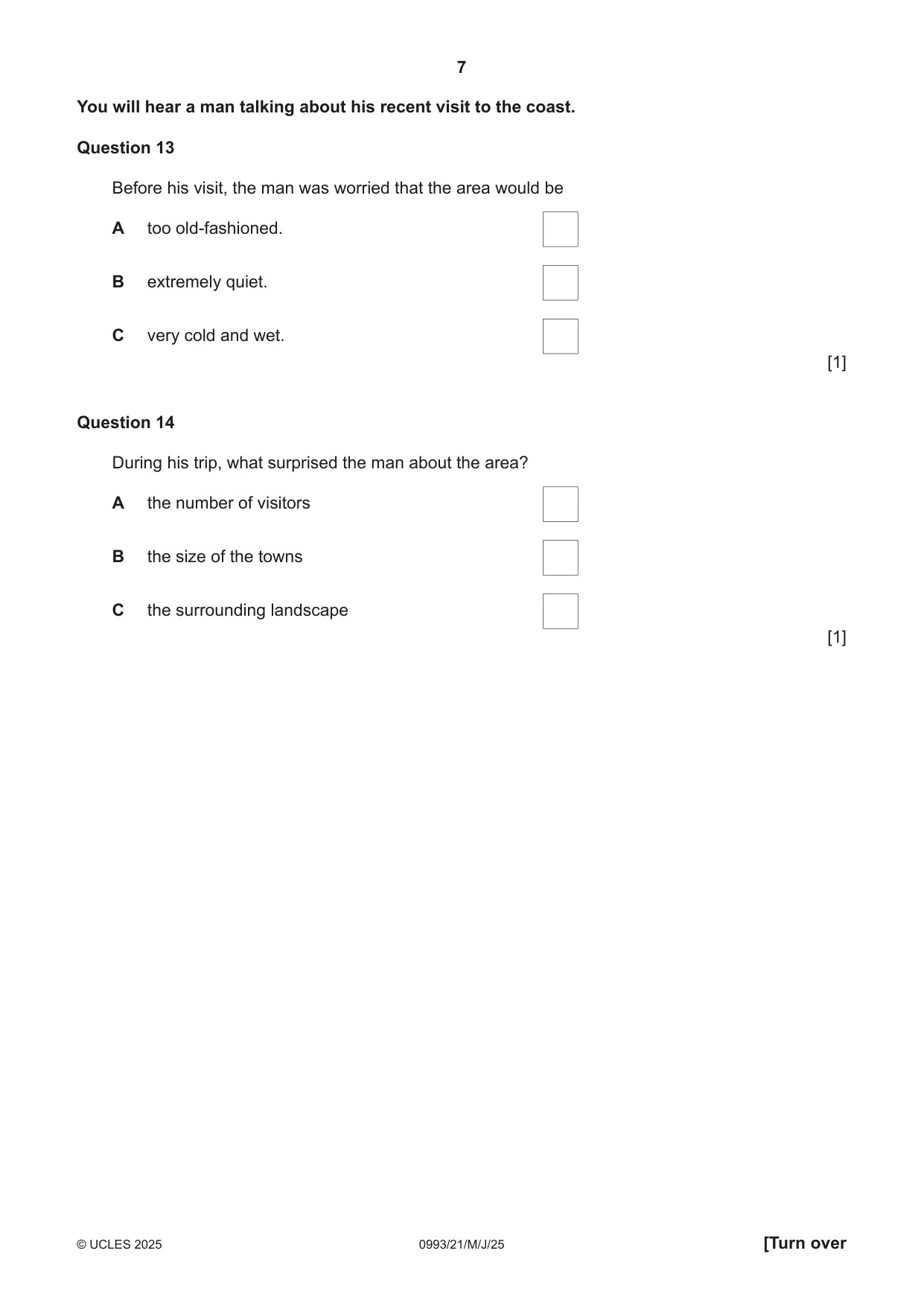
7 0993/21/M/J/25 © UCLES 2025 [Turn over You will hear a man talking about his recent visit to the coast. Question 13 Before his visit, the man was worried that the area would be A too old-fashioned. B extremely quiet. C very cold and wet. [1] Question 14 During his trip, what surprised the man about the area? A the number of visitors B the size of the towns C the surrounding landscape [1]
Question paper, page 8
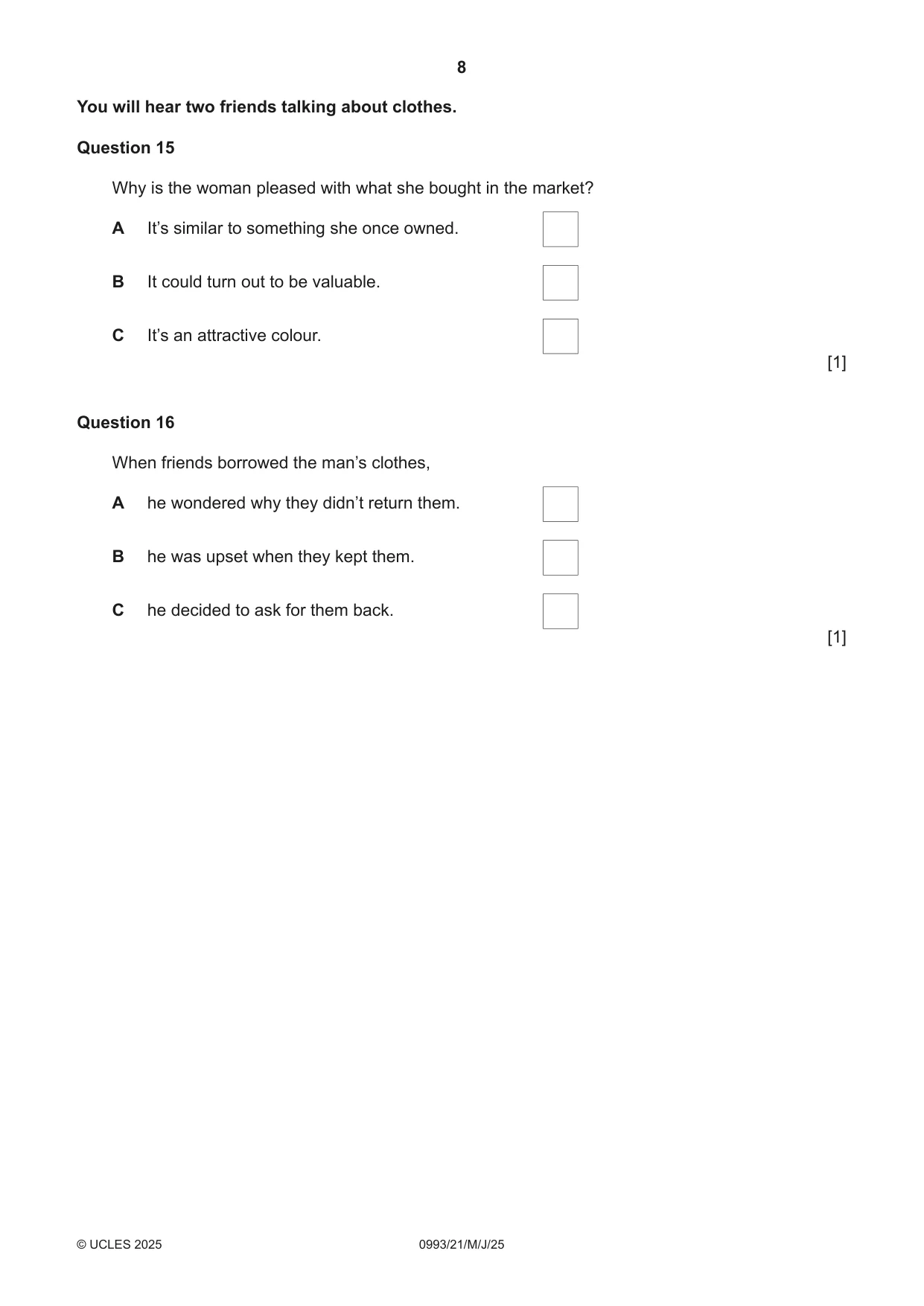
8 0993/21/M/J/25 © UCLES 2025 You will hear two friends talking about clothes. Question 15 Why is the woman pleased with what she bought in the market? A It’s similar to something she once owned. B It could turn out to be valuable. C It’s an attractive colour. [1] Question 16 When friends borrowed the man’s clothes, A he wondered why they didn’t return them. B he was upset when they kept them. C he decided to ask for them back. [1]
Question paper, page 9
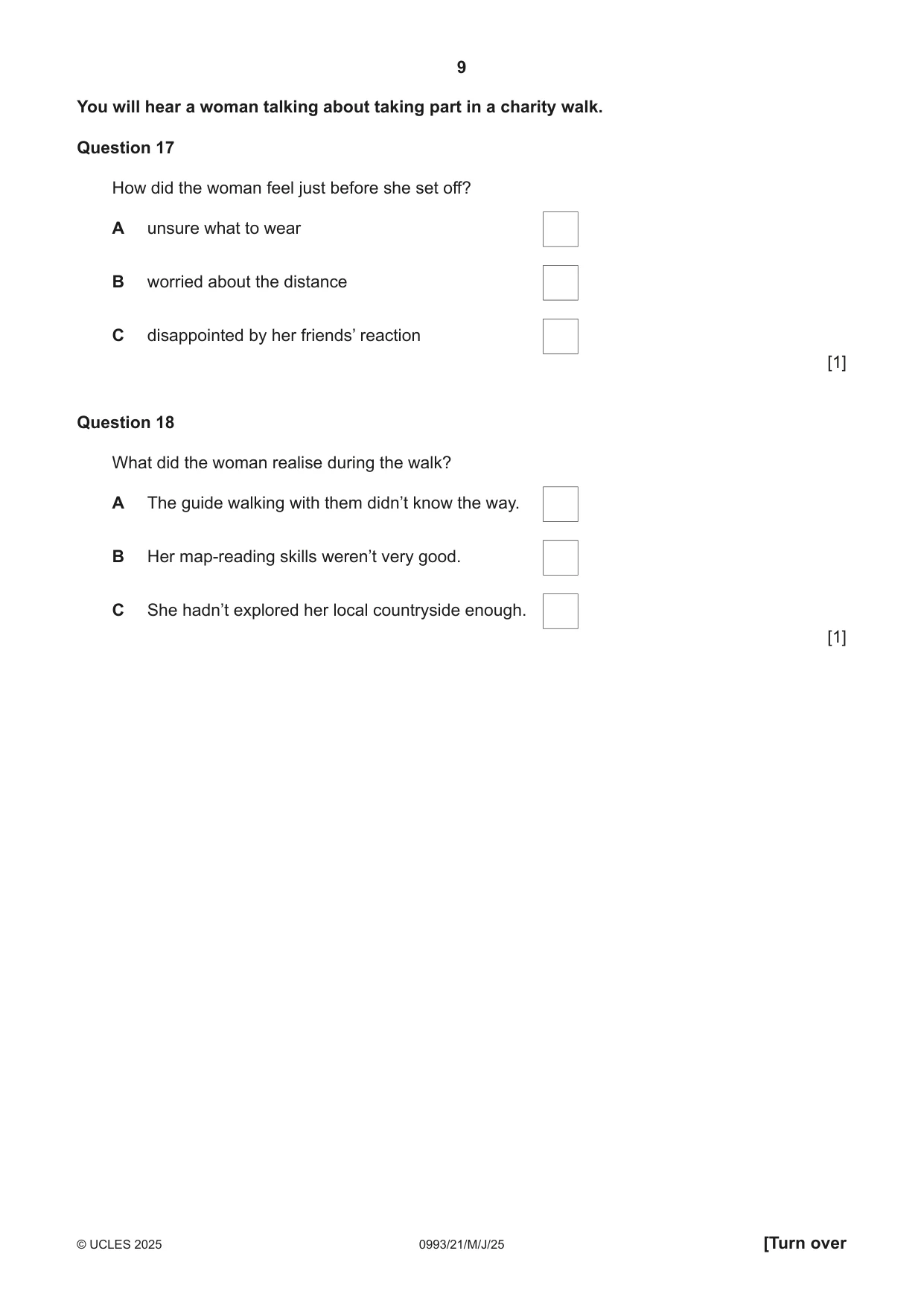
9 0993/21/M/J/25 © UCLES 2025 [Turn over You will hear a woman talking about taking part in a charity walk. Question 17 How did the woman feel just before she set off? A unsure what to wear B worried about the distance C disappointed by her friends’ reaction [1] Question 18 What did the woman realise during the walk? A The guide walking with them didn’t know the way. B Her map-reading skills weren’t very good. C She hadn’t explored her local countryside enough. [1]
Question paper, page 10
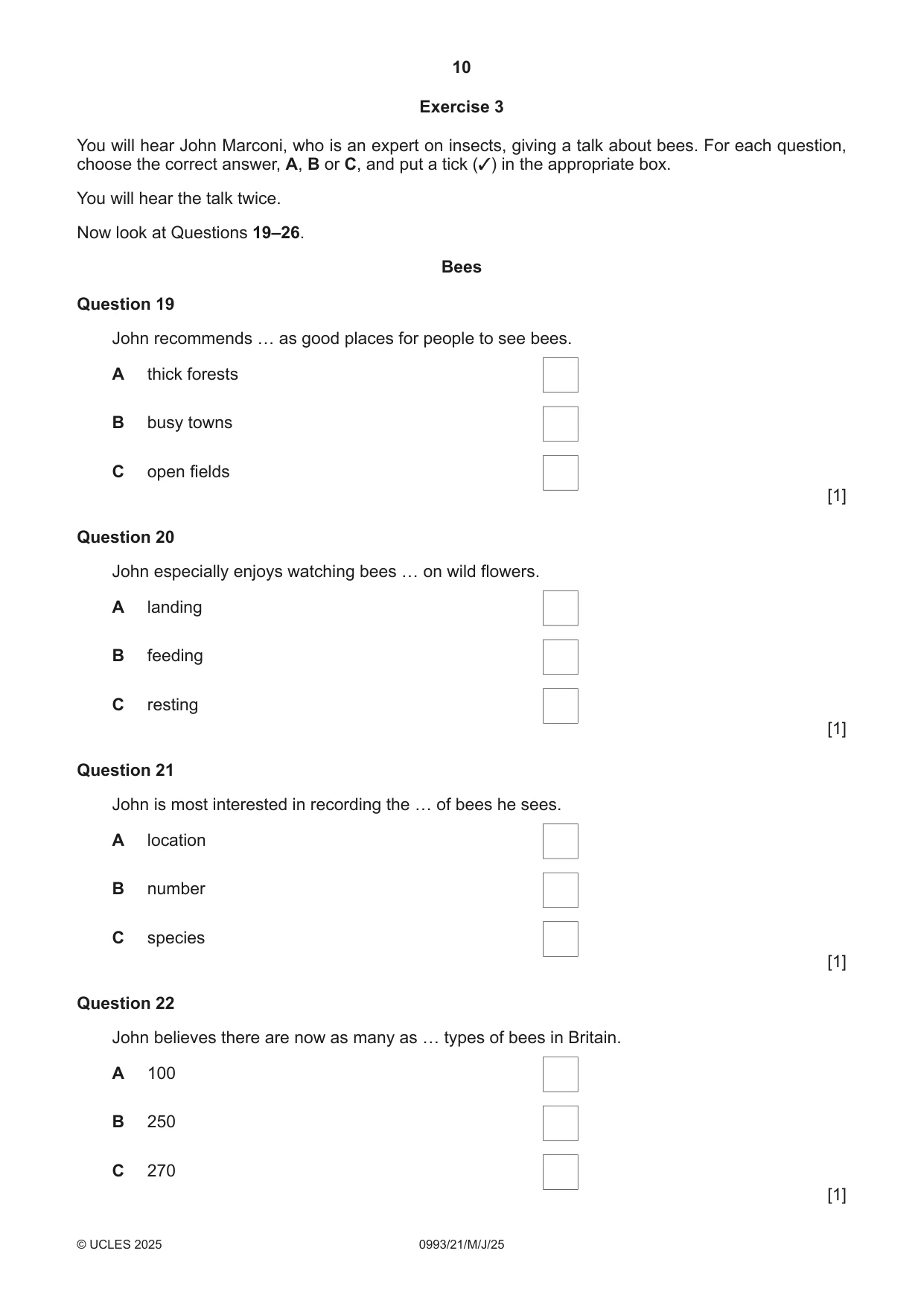
10 0993/21/M/J/25 © UCLES 2025 Exercise 3 You will hear John Marconi, who is an expert on insects, giving a talk about bees. For each question, choose the correct answer, A, B or C, and put a tick (3) in the appropriate box. You will hear the talk twice. Now look at Questions 19–26. Bees Question 19 John recommends … as good places for people to see bees. A thick forests B busy towns C open fields [1] Question 20 John especially enjoys watching bees … on wild flowers. A landing B feeding C resting [1] Question 21 John is most interested in recording the … of bees he sees. A location B number C species [1] Question 22 John believes there are now as many as … types of bees in Britain. A 100 B 250 C 270 [1]
Question paper, page 11
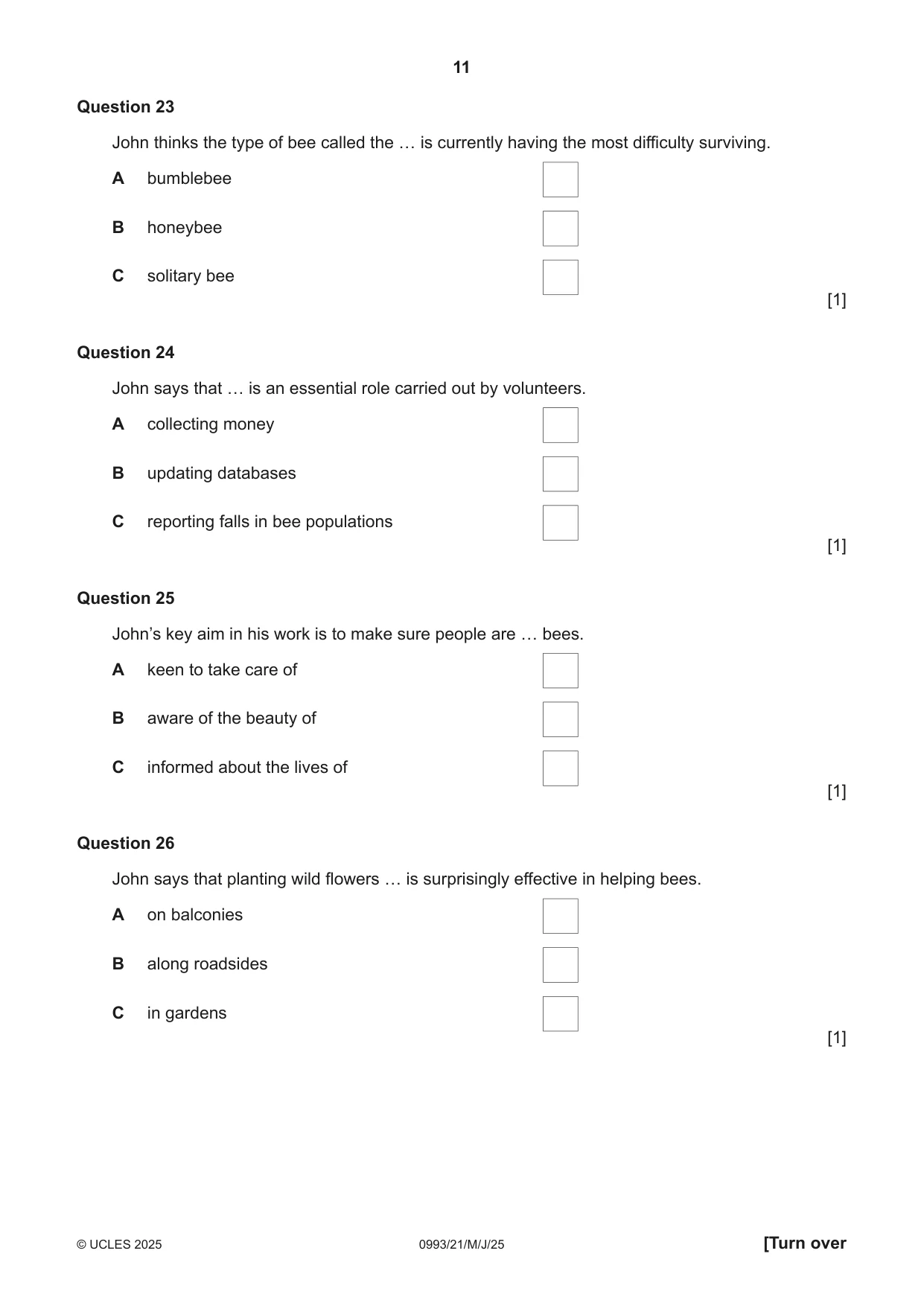
11 0993/21/M/J/25 © UCLES 2025 [Turn over Question 23 John thinks the type of bee called the … is currently having the most difficulty surviving. A bumblebee B honeybee C solitary bee [1] Question 24 John says that … is an essential role carried out by volunteers. A collecting money B updating databases C reporting falls in bee populations [1] Question 25 John’s key aim in his work is to make sure people are … bees. A keen to take care of B aware of the beauty of C informed about the lives of [1] Question 26 John says that planting wild flowers … is surprisingly effective in helping bees. A on balconies B along roadsides C in gardens [1]
Question paper, page 12
12 0993/21/M/J/25 © UCLES 2025 BLANK PAGE
Question paper, page 13
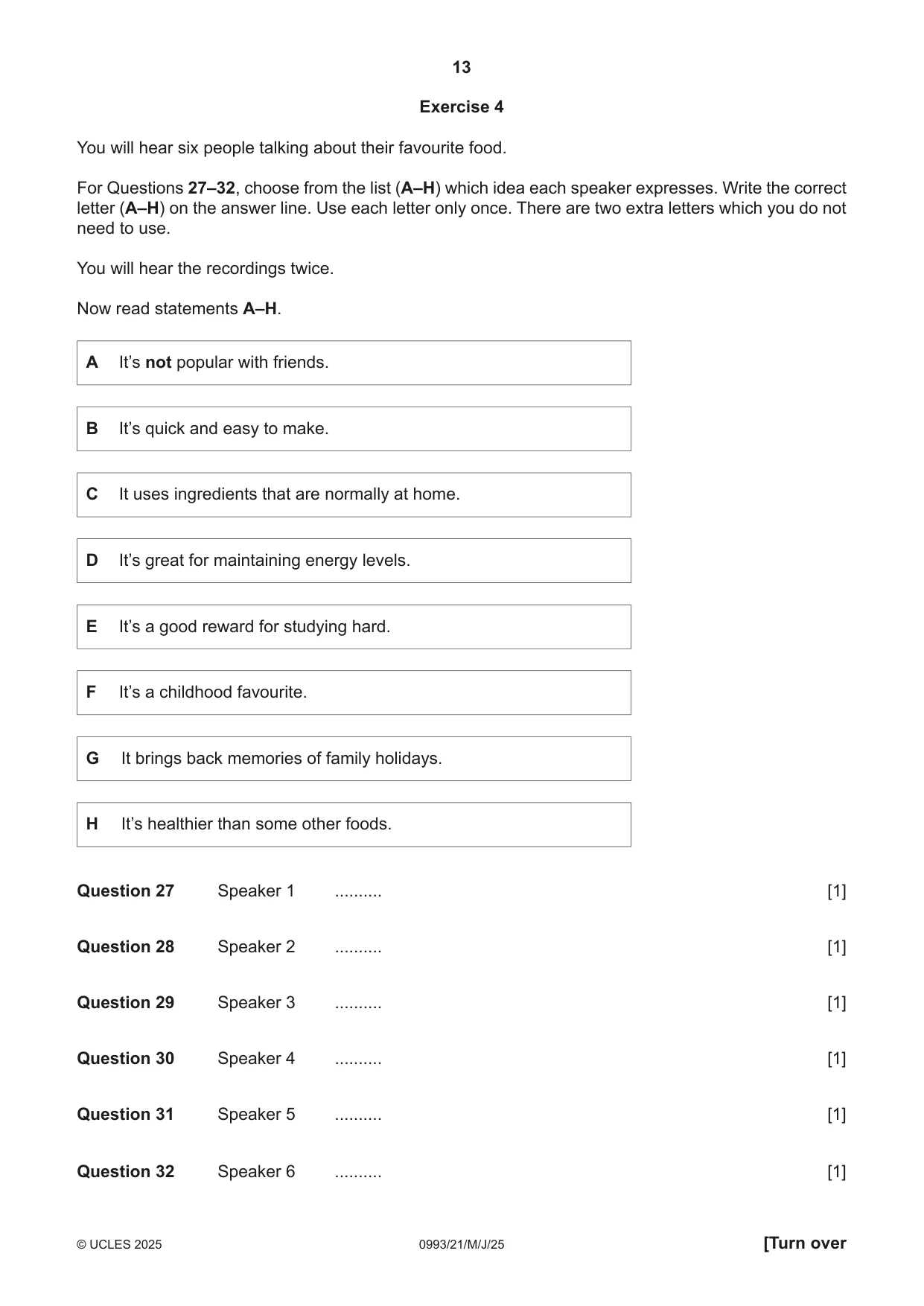
13 0993/21/M/J/25 © UCLES 2025 [Turn over Exercise 4 You will hear six people talking about their favourite food. For Questions 27–32, choose from the list (A–H) which idea each speaker expresses. Write the correct letter (A–H) on the answer line. Use each letter only once. There are two extra letters which you do not need to use. You will hear the recordings twice. Now read statements A–H. A It’s not popular with friends. B It’s quick and easy to make. C It uses ingredients that are normally at home. D It’s great for maintaining energy levels. E It’s a good reward for studying hard. F It’s a childhood favourite. G It brings back memories of family holidays. H It’s healthier than some other foods. Question 27 Speaker 1 … [1] Question 28 Speaker 2 … [1] Question 29 Speaker 3 … [1] Question 30 Speaker 4 … [1] Question 31 Speaker 5 … [1] Question 32 Speaker 6 … [1]
Question paper, page 14
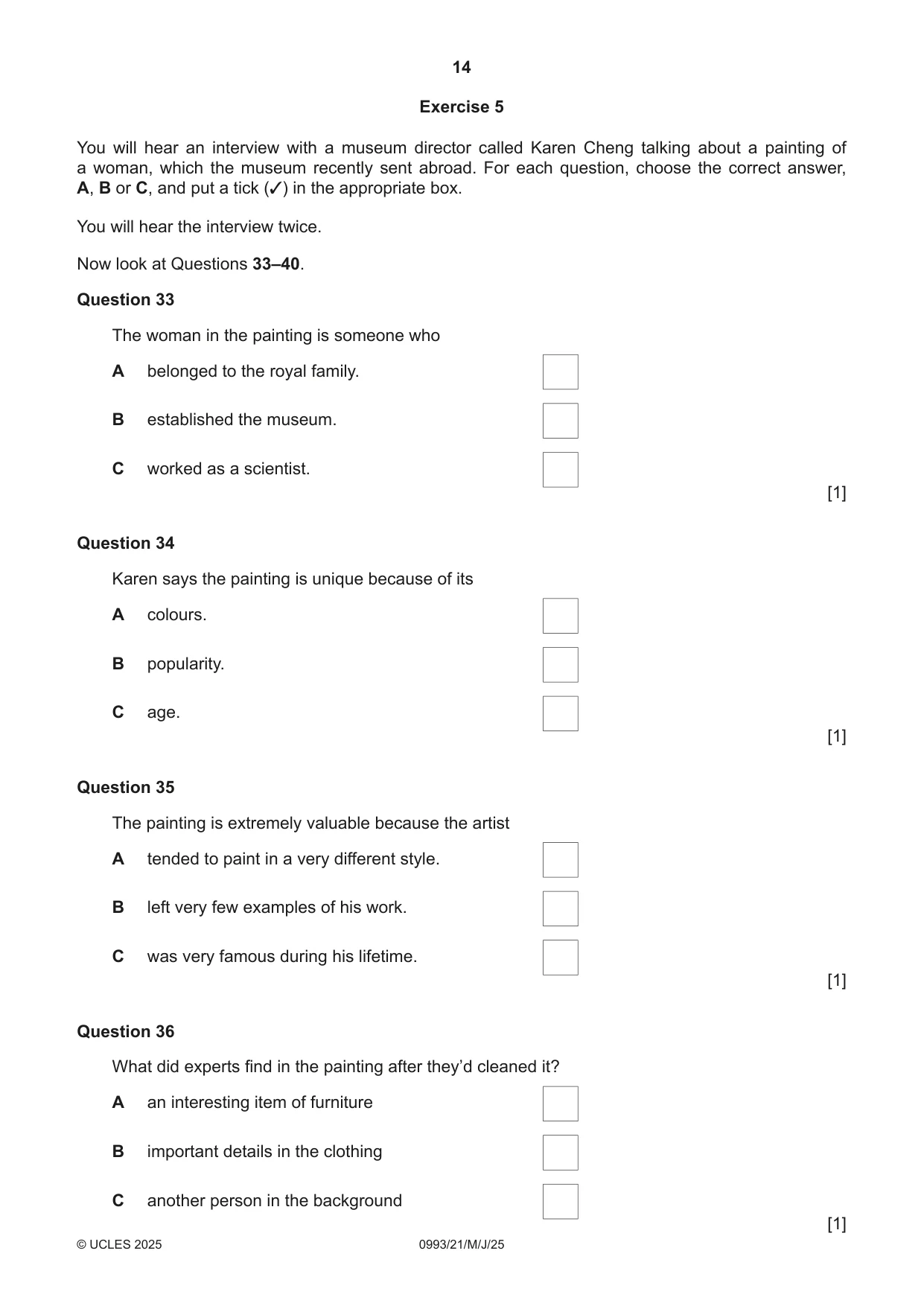
14 0993/21/M/J/25 © UCLES 2025 Exercise 5 You will hear an interview with a museum director called Karen Cheng talking about a painting of a woman, which the museum recently sent abroad. For each question, choose the correct answer, A, B or C, and put a tick (3) in the appropriate box. You will hear the interview twice. Now look at Questions 33–40. Question 33 The woman in the painting is someone who A belonged to the royal family. B established the museum. C worked as a scientist. [1] Question 34 Karen says the painting is unique because of its A colours. B popularity. C age. [1] Question 35 The painting is extremely valuable because the artist A tended to paint in a very different style. B left very few examples of his work. C was very famous during his lifetime. [1] Question 36 What did experts find in the painting after they’d cleaned it? A an interesting item of furniture B important details in the clothing C another person in the background [1]
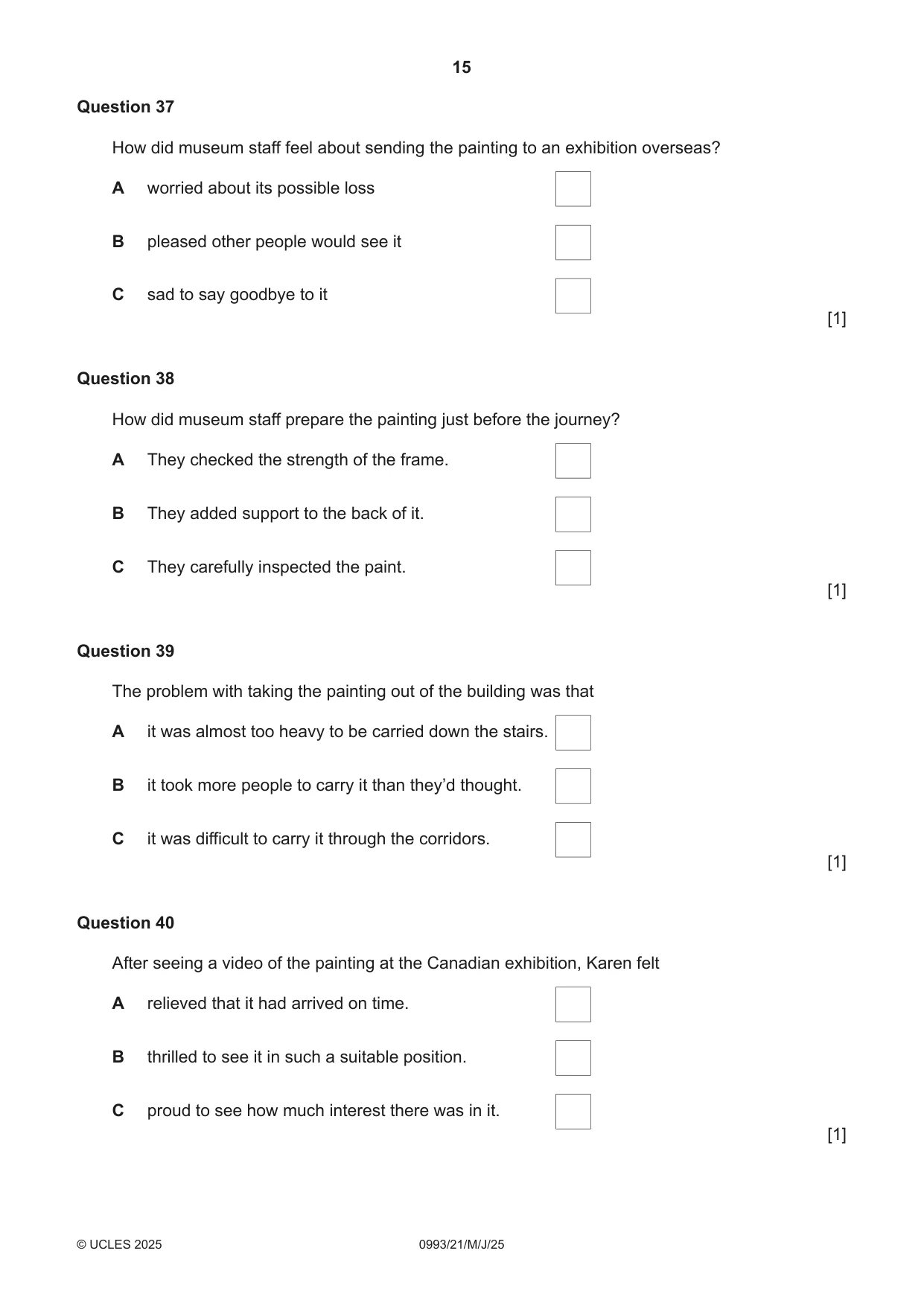
Question paper, page 15
15 0993/21/M/J/25 © UCLES 2025 Question 37 How did museum staff feel about sending the painting to an exhibition overseas? A worried about its possible loss B pleased other people would see it C sad to say goodbye to it [1] Question 38 How did museum staff prepare the painting just before the journey? A They checked the strength of the frame. B They added support to the back of it. C They carefully inspected the paint. [1] Question 39 The problem with taking the painting out of the building was that A it was almost too heavy to be carried down the stairs. B it took more people to carry it than they’d thought. C it was difficult to carry it through the corridors. [1] Question 40 After seeing a video of the painting at the Canadian exhibition, Karen felt A relieved that it had arrived on time. B thrilled to see it in such a suitable position. C proud to see how much interest there was in it. [1]
Question paper, page 16
16 0993/21/M/J/25 © UCLES 2025 Permission to reproduce items where third-party owned material protected by copyright is included has been sought and cleared where possible. Every reasonable effort has been made by the publisher (UCLES) to trace copyright holders, but if any items requiring clearance have unwittingly been included, the publisher will be pleased to make amends at the earliest possible opportunity. To avoid the issue of disclosure of answer-related information to candidates, all copyright acknowledgements are reproduced online in the Cambridge Assessment International Education Copyright Acknowledgements Booklet. This is produced for each series of examinations and is freely available to download at www.cambridgeinternational.org after the live examination series. Cambridge Assessment International Education is part of Cambridge Assessment. Cambridge Assessment is the brand name of the University of Cambridge Local Examinations Syndicate (UCLES), which is a department of the University of Cambridge. BLANK PAGE
Mark scheme, page 1
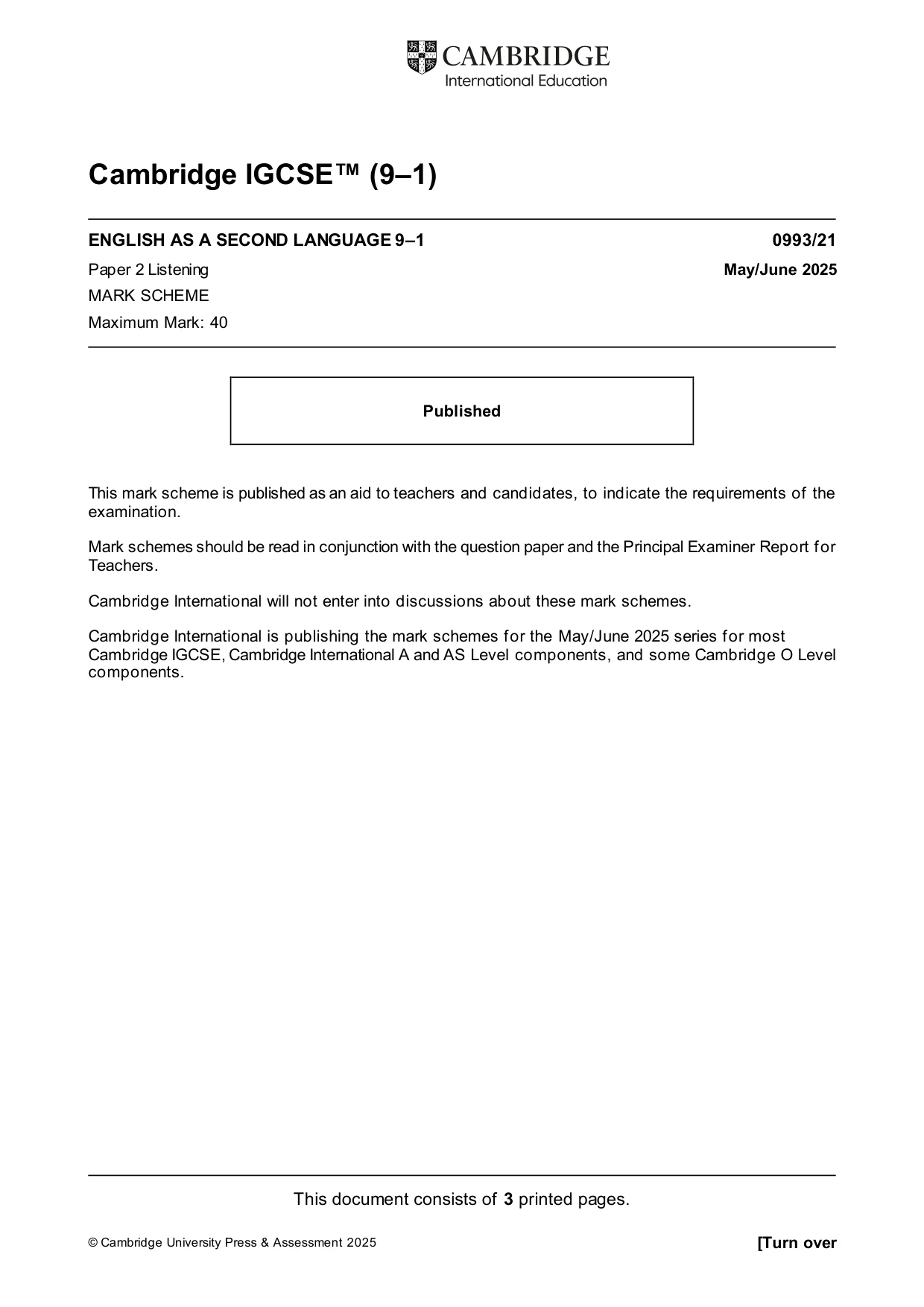
This document consists of 3 printed pages. © Cambridge University Press & Assessment 2025 [Turn over Cambridge IGCSE™ (9–1) ENGLISH AS A SECOND LANGUAGE 9–1 0993/21 Paper 2 Listening May/June 2025 MARK SCHEME Maximum Mark: 40 Published This mark scheme is published as an aid to teachers and candidates, to indicate the requirements of the examination. Mark schemes should be read in conjunction with the question paper and the Principal Examiner Report for Teachers. Cambridge International will not enter into discussions about these mark schemes. Cambridge International is publishing the mark schemes for the May/June 2025 series for most Cambridge IGCSE, Cambridge International A and AS Level components, and some Cambridge O Level components.
Mark scheme, page 2
0993/21 Cambridge IGCSE (9–1) – Mark Scheme PUBLISHED May/June 2025 © Cambridge University Press & Assessment 2025 Page 2 of 3 Question Answer Marks 1 B 1 2 C 1 3 C 1 4 B 1 5 A 1 6 D 1 7 B 1 8 D 1 9 A 1 10 C 1 11 A 1 12 B 1 13 B 1 14 C 1 15 A 1 16 B 1 17 A 1 18 C 1 19 B 1 20 C 1 21 A 1 22 C 1 23 A 1 24 B 1 25 C 1 26 A 1 27 C 1 28 G 1
Mark scheme, page 3
0993/21 Cambridge IGCSE (9–1) – Mark Scheme PUBLISHED May/June 2025 © Cambridge University Press & Assessment 2025 Page 3 of 3 Question Answer Marks 29 H 1 30 E 1 31 A 1 32 D 1 33 B 1 34 A 1 35 B 1 36 C 1 37 C 1 38 B 1 39 A 1 40 C 1
What you needed in this session
Cambridge’s own grade thresholds for 2025 May/June, Paper 2 · Variant 1. A higher threshold means an easier paper — the bar moves with how the cohort did.