Cambridge IGCSE English Second Language (Speaking Endorsement) (9-1) 0993 — 2023 May/June Paper 2 · Variant 1
0993/21/M/J/23 · 80 marks · ≈90 min
The question paper and its mark scheme, free to read here and free to download. This is Cambridge’s own paper, exactly as it was sat.
Question paper16 pages





Mark scheme11 pages
Answers below. Sit the paper first if you are practising.
Paper as text
Question paper, page 1
This document has 16 pages. Any blank pages are indicated. [Turn over Cambridge IGCSE™(9–1) ENGLISH AS A SECOND LANGUAGE 0993/21 Paper 2 Reading and Writing (Extended) May/June 2023 2 hours You must answer on the question paper. No additional materials are needed. INSTRUCTIONS ● Answer all questions. ● Use a black or dark blue pen. ● Write your name, centre number and candidate number in the boxes at the top of the page. ● Write your answer to each question in the space provided. ● Do not use an erasable pen or correction fluid. ● Do not write on any bar codes. ● Dictionaries are not allowed. INFORMATION ● The total mark for this paper is 80. ● The number of marks for each question or part question is shown in brackets [ ]. * 7 4 0 4 3 3 2 7 4 8 * DC (CJ) 326435 © UCLES 2023
Question paper, page 2
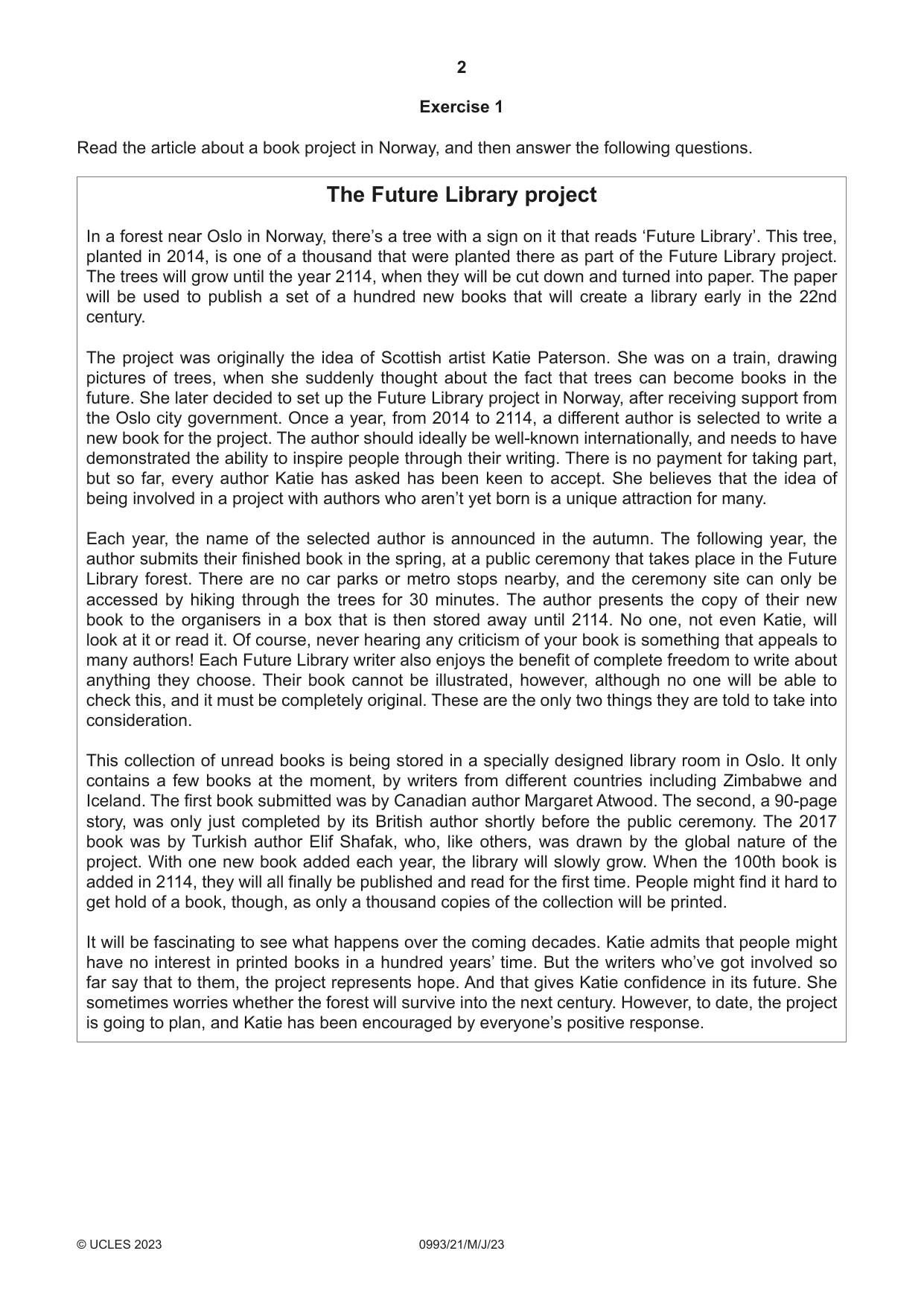
2 0993/21/M/J/23 © UCLES 2023 Exercise 1 Read the article about a book project in Norway, and then answer the following questions. The Future Library project In a forest near Oslo in Norway, there’s a tree with a sign on it that reads ‘Future Library’. This tree, planted in 2014, is one of a thousand that were planted there as part of the Future Library project. The trees will grow until the year 2114, when they will be cut down and turned into paper. The paper will be used to publish a set of a hundred new books that will create a library early in the 22nd century. The project was originally the idea of Scottish artist Katie Paterson. She was on a train, drawing pictures of trees, when she suddenly thought about the fact that trees can become books in the future. She later decided to set up the Future Library project in Norway, after receiving support from the Oslo city government. Once a year, from 2014 to 2114, a different author is selected to write a new book for the project. The author should ideally be well-known internationally, and needs to have demonstrated the ability to inspire people through their writing. There is no payment for taking part, but so far, every author Katie has asked has been keen to accept. She believes that the idea of being involved in a project with authors who aren’t yet born is a unique attraction for many. Each year, the name of the selected author is announced in the autumn. The following year, the author submits their finished book in the spring, at a public ceremony that takes place in the Future Library forest. There are no car parks or metro stops nearby, and the ceremony site can only be accessed by hiking through the trees for 30 minutes. The author presents the copy of their new book to the organisers in a box that is then stored away until 2114. No one, not even Katie, will look at it or read it. Of course, never hearing any criticism of your book is something that appeals to many authors! Each Future Library writer also enjoys the benefit of complete freedom to write about anything they choose. Their book cannot be illustrated, however, although no one will be able to check this, and it must be completely original. These are the only two things they are told to take into consideration. This collection of unread books is being stored in a specially designed library room in Oslo. It only contains a few books at the moment, by writers from different countries including Zimbabwe and Iceland. The first book submitted was by Canadian author Margaret Atwood. The second, a 90-page story, was only just completed by its British author shortly before the public ceremony. The 2017 book was by Turkish author Elif Shafak, who, like others, was drawn by the global nature of the project. With one new book added each year, the library will slowly grow. When the 100th book is added in 2114, they will all finally be published and read for the first time. People might find it hard to get hold of a book, though, as only a thousand copies of the collection will be printed. It will be fascinating to see what happens over the coming decades. Katie admits that people might have no interest in printed books in a hundred years’ time. But the writers who’ve got involved so far say that to them, the project represents hope. And that gives Katie confidence in its future. She sometimes worries whether the forest will survive into the next century. However, to date, the project is going to plan, and Katie has been encouraged by everyone’s positive response.
Question paper, page 3
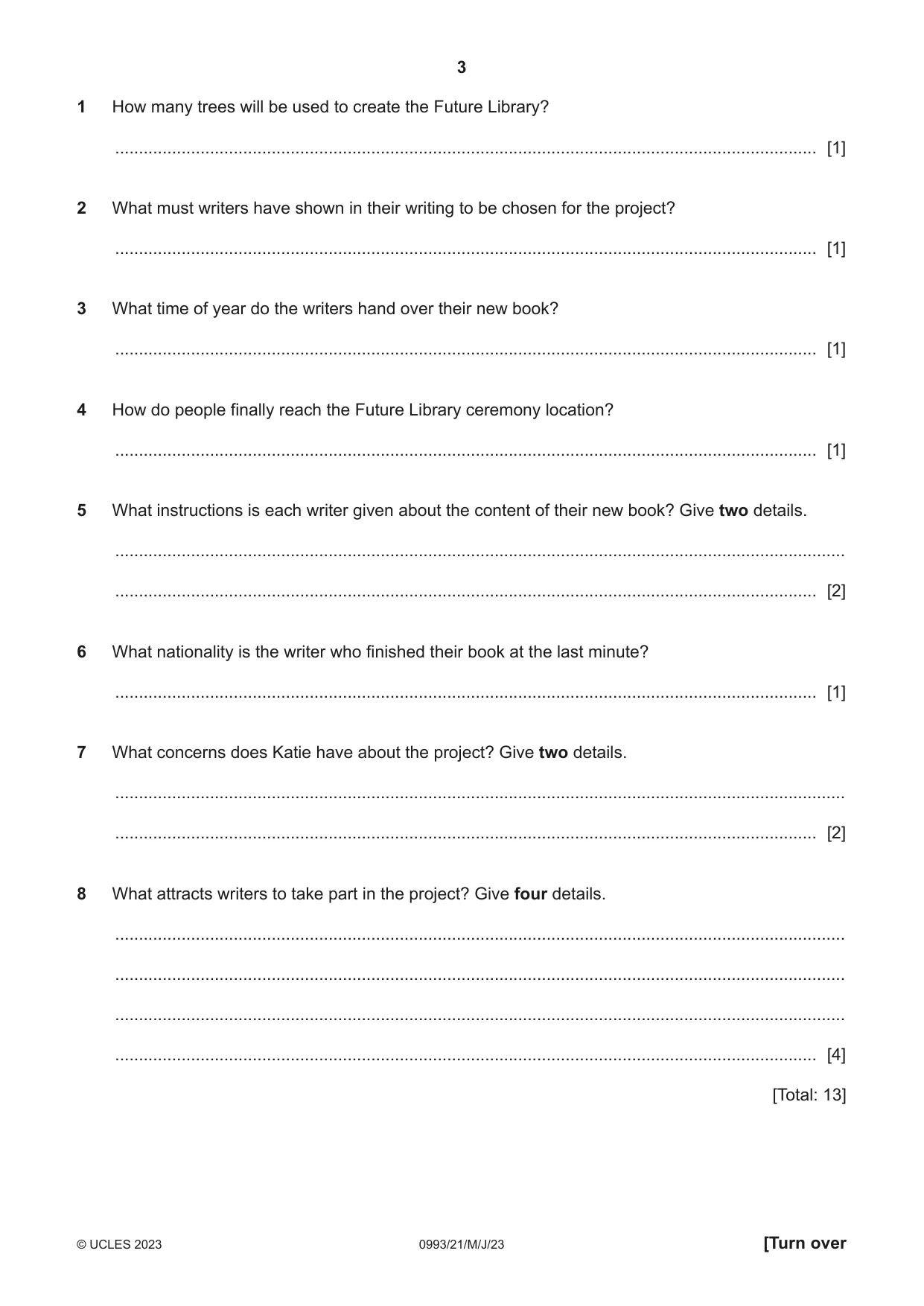
3 0993/21/M/J/23 © UCLES 2023 [Turn over 1 How many trees will be used to create the Future Library? … [1] 2 What must writers have shown in their writing to be chosen for the project? … [1] 3 What time of year do the writers hand over their new book? … [1] 4 How do people finally reach the Future Library ceremony location? … [1] 5 What instructions is each writer given about the content of their new book? Give two details. … … [2] 6 What nationality is the writer who finished their book at the last minute? … [1] 7 What concerns does Katie have about the project? Give two details. … … [2] 8 What attracts writers to take part in the project? Give four details. … … … … [4] [Total: 13]
Question paper, page 4
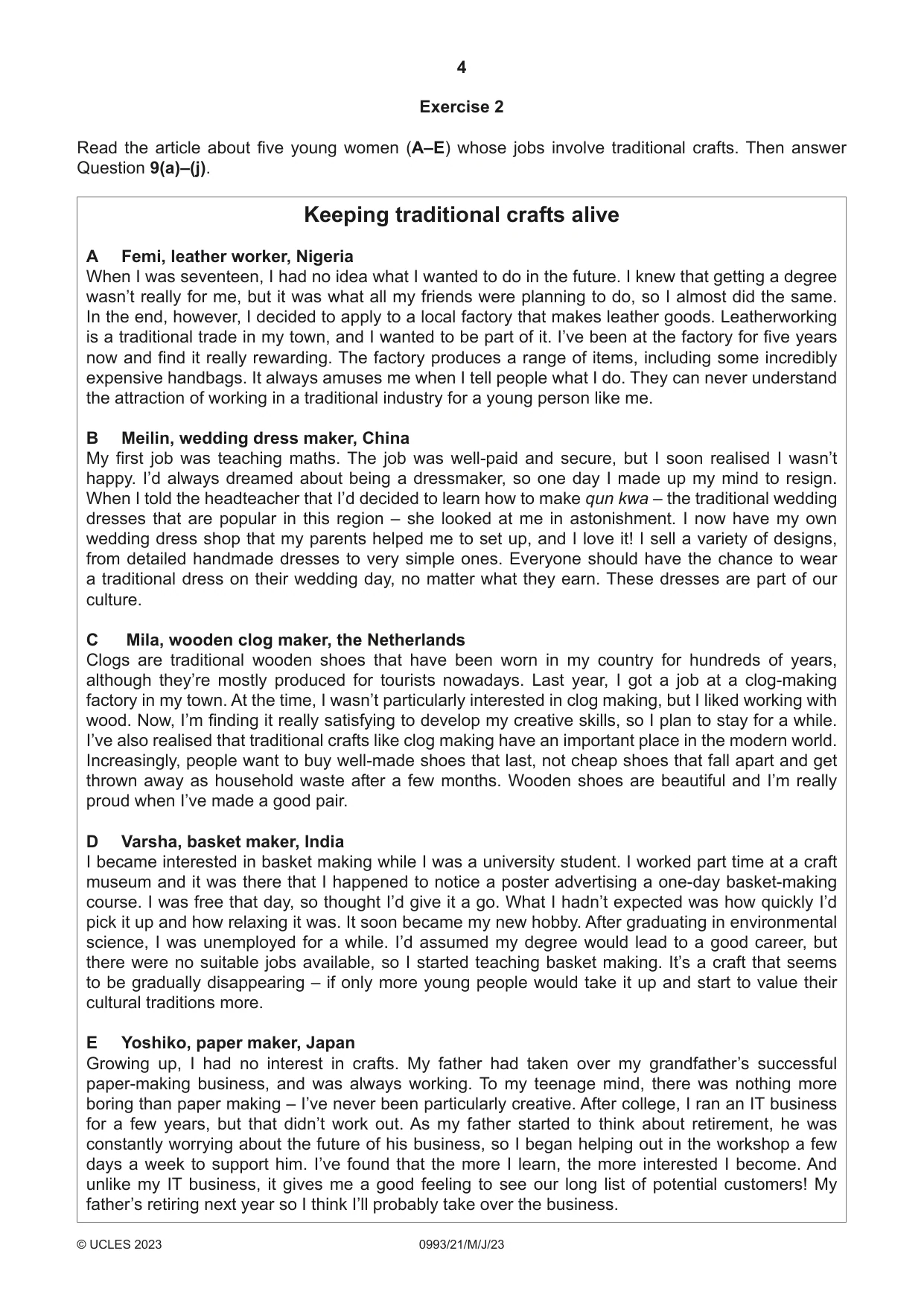
4 0993/21/M/J/23 © UCLES 2023 Exercise 2 Read the article about five young women (A–E) whose jobs involve traditional crafts. Then answer Question 9(a)–(j). Keeping traditional crafts alive A Femi, leather worker, Nigeria When I was seventeen, I had no idea what I wanted to do in the future. I knew that getting a degree wasn’t really for me, but it was what all my friends were planning to do, so I almost did the same. In the end, however, I decided to apply to a local factory that makes leather goods. Leatherworking is a traditional trade in my town, and I wanted to be part of it. I’ve been at the factory for five years now and find it really rewarding. The factory produces a range of items, including some incredibly expensive handbags. It always amuses me when I tell people what I do. They can never understand the attraction of working in a traditional industry for a young person like me. B Meilin, wedding dress maker, China My first job was teaching maths. The job was well-paid and secure, but I soon realised I wasn’t happy. I’d always dreamed about being a dressmaker, so one day I made up my mind to resign. When I told the headteacher that I’d decided to learn how to make qun kwa – the traditional wedding dresses that are popular in this region – she looked at me in astonishment. I now have my own wedding dress shop that my parents helped me to set up, and I love it! I sell a variety of designs, from detailed handmade dresses to very simple ones. Everyone should have the chance to wear a traditional dress on their wedding day, no matter what they earn. These dresses are part of our culture. C Mila, wooden clog maker, the Netherlands Clogs are traditional wooden shoes that have been worn in my country for hundreds of years, although they’re mostly produced for tourists nowadays. Last year, I got a job at a clog-making factory in my town. At the time, I wasn’t particularly interested in clog making, but I liked working with wood. Now, I’m finding it really satisfying to develop my creative skills, so I plan to stay for a while. I’ve also realised that traditional crafts like clog making have an important place in the modern world. Increasingly, people want to buy well-made shoes that last, not cheap shoes that fall apart and get thrown away as household waste after a few months. Wooden shoes are beautiful and I’m really proud when I’ve made a good pair. D Varsha, basket maker, India I became interested in basket making while I was a university student. I worked part time at a craft museum and it was there that I happened to notice a poster advertising a one-day basket-making course. I was free that day, so thought I’d give it a go. What I hadn’t expected was how quickly I’d pick it up and how relaxing it was. It soon became my new hobby. After graduating in environmental science, I was unemployed for a while. I’d assumed my degree would lead to a good career, but there were no suitable jobs available, so I started teaching basket making. It’s a craft that seems to be gradually disappearing – if only more young people would take it up and start to value their cultural traditions more. E Yoshiko, paper maker, Japan Growing up, I had no interest in crafts. My father had taken over my grandfather’s successful paper-making business, and was always working. To my teenage mind, there was nothing more boring than paper making – I’ve never been particularly creative. After college, I ran an IT business for a few years, but that didn’t work out. As my father started to think about retirement, he was constantly worrying about the future of his business, so I began helping out in the workshop a few days a week to support him. I’ve found that the more I learn, the more interested I become. And unlike my IT business, it gives me a good feeling to see our long list of potential customers! My father’s retiring next year so I think I’ll probably take over the business.
Question paper, page 5
5 0993/21/M/J/23 © UCLES 2023 [Turn over 9 For each question, write the correct letter A, B, C, D or E on the line. Which person … (a) is enjoying learning to be more artistic? … [1] (b) enjoys seeing the reactions of others at finding out what her job is? … [1] (c) suggests that she became involved in her craft out of a sense of family duty? … [1] (d) suggests that her craft benefits the environment? … [1] (e) believes that it’s important to produce items for all budgets? … [1] (f) expresses concern about the future of her particular craft? … [1] (g) admits that she was never interested in going to university? … [1] (h) is proud of the level of demand for her work? … [1] (i) says that she left a good job to do something she loved? … [1] (j) says that she first discovered her craft by chance? … [1] [Total: 10]
Question paper, page 6
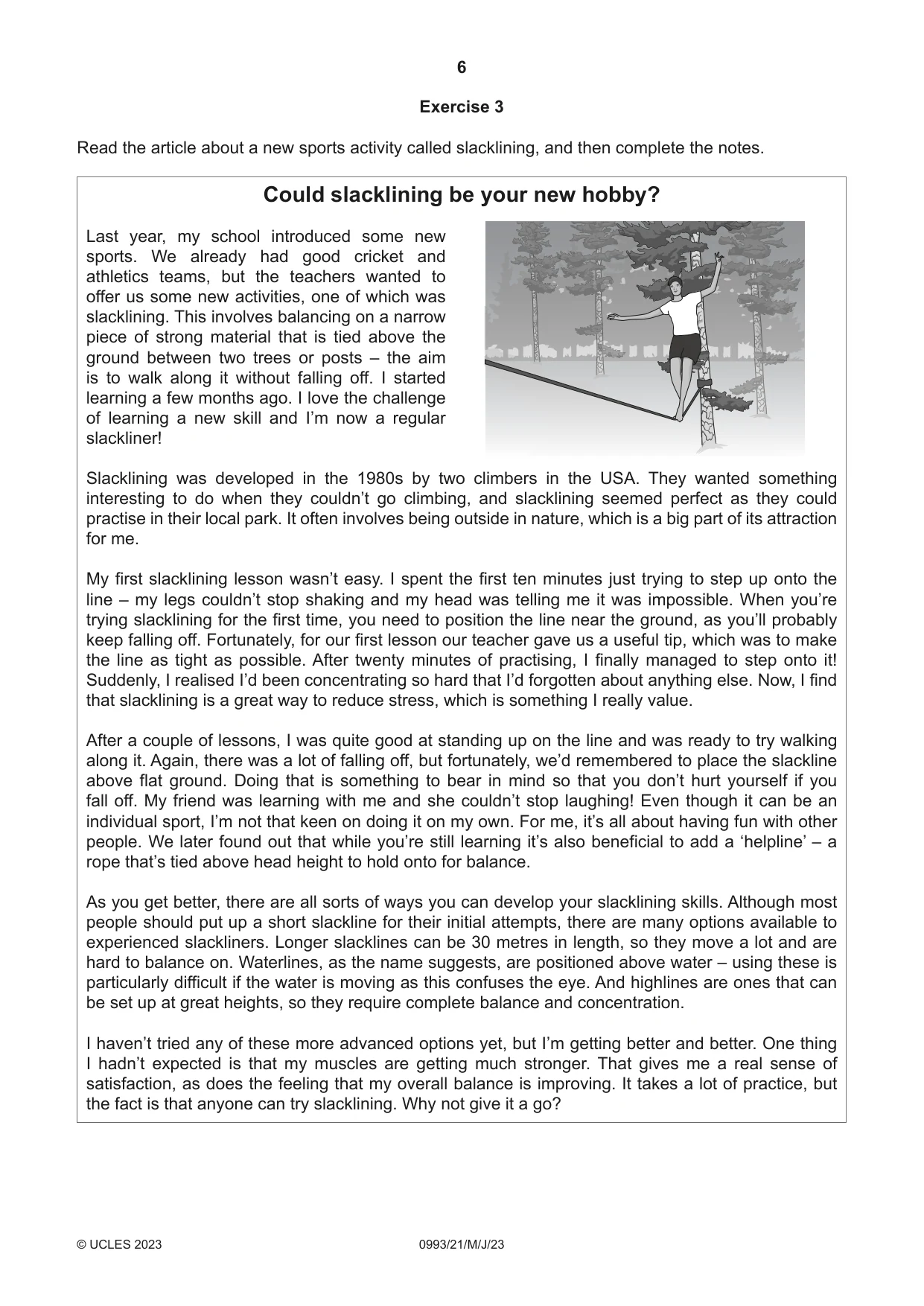
6 0993/21/ M / J /23 © UCLES 2023 Exercise 3 Read the article about a new sports activity called slacklining, and then complete the notes. Could slacklining be your new hobby? Last year, my school introduced some new sports. We already had good cricket and athletics teams, but the teachers wanted to offer us some new activities, one of which was slacklining. This involves balancing on a narrow piece of strong material that is tied above the ground between two trees or posts – the aim is to walk along it without falling off. I started learning a few months ago. I love the challenge of learning a new skill and I’m now a regular slackliner! Slacklining was developed in the 1980s by two climbers in the USA. They wanted something interesting to do when they couldn’t go climbing, and slacklining seemed perfect as they could practise in their local park. It often involves being outside in nature, which is a big part of its attraction for me. My first slacklining lesson wasn’t easy. I spent the first ten minutes just trying to step up onto the line – my legs couldn’t stop shaking and my head was telling me it was impossible. When you’re trying slacklining for the first time, you need to position the line near the ground, as you’ll probably keep falling off. Fortunately, for our first lesson our teacher gave us a useful tip, which was to make the line as tight as possible. After twenty minutes of practising, I finally managed to step onto it! Suddenly, I realised I’d been concentrating so hard that I’d forgotten about anything else. Now, I find that slacklining is a great way to reduce stress, which is something I really value. After a couple of lessons, I was quite good at standing up on the line and was ready to try walking along it. Again, there was a lot of falling off, but fortunately, we’d remembered to place the slackline above flat ground. Doing that is something to bear in mind so that you don’t hurt yourself if you fall off. My friend was learning with me and she couldn’t stop laughing! Even though it can be an individual sport, I’m not that keen on doing it on my own. For me, it’s all about having fun with other people. We later found out that while you’re still learning it’s also beneficial to add a ‘helpline’ – a rope that’s tied above head height to hold onto for balance. As you get better, there are all sorts of ways you can develop your slacklining skills. Although most people should put up a short slackline for their initial attempts, there are many options available to experienced slackliners. Longer slacklines can be 30 metres in length, so they move a lot and are hard to balance on. Waterlines, as the name suggests, are positioned above water – using these is particularly difficult if the water is moving as this confuses the eye. And highlines are ones that can be set up at great heights, so they require complete balance and concentration. I haven’t tried any of these more advanced options yet, but I’m getting better and better. One thing I hadn’t expected is that my muscles are getting much stronger. That gives me a real sense of satisfaction, as does the feeling that my overall balance is improving. It takes a lot of practice, but the fact is that anyone can try slacklining. Why not give it a go?
Question paper, page 7
7 0993/21/M/J/23 © UCLES 2023 [Turn over You are going to give a talk about slacklining to your class at school. Prepare some notes to use as the basis for your talk. Make short notes under each heading. 10 What appeals to the writer about slacklining: • … • … • … • … • … [5] 11 Advice for setting up slacklining equipment for beginners: • … • … • … • … [4] [Total: 9]
Question paper, page 8
8 0993/21/M/J/23 © UCLES 2023 Exercise 4 12 Read the article about light pollution. Write a summary about what the harmful effects of light pollution are AND what people can do to reduce light pollution. Your summary should be about 100 words long (and no more than 120 words long). You should use your own words as far as possible. You will receive up to 8 marks for the content of your summary, and up to 8 marks for the style and accuracy of your language. Losing the darkness I remember hearing a story a few years ago about a clear night in Los Angeles, when the electricity supply suddenly went off across the whole city. From the dark streets, people started phoning TV stations and emergency services to report seeing a strange cloud in the sky. That mysterious cloud turned out to be stars – hundreds of them – that weren’t normally visible from the city’s brightly lit streets. The power cut had suddenly enabled people to see the night sky like they’d never seen it before. It had never occurred to me before that electric lighting, which is such an essential feature of modern, industrial societies, might have a negative side. Of course, this lighting allows us to work late, play sport outside after dark and feel safe at night. But electric lighting can also have more serious consequences than just making people lose their connection to the natural world. We’ve all heard of air pollution and water pollution, but how often do people think about light pollution? It can be just as much of a problem. For millions of years, animal behaviour has depended on the predictable cycles of day and night, light and dark. In 21st-century cities, however, skies are lit up 24-hours a day, which can prevent wildlife from hunting successfully at night. Offices, factories and sporting venues often send electric light into the sky through all hours of the night – surely it wouldn’t be too difficult to turn lighting off when it’s not required. This light has been found to confuse birds that rely on moonlight to find their way. These are issues that scientists have only just begun to study, but they are ones that builders and architects could easily solve, by making sure that outdoor light is only aimed downwards to where it’s needed, for example. One of the main reasons why people install outdoor lighting is to ensure their safety at night. Unfortunately though, brighter doesn’t always mean safer – in fact, lights that are too bright can actually be dangerous. This is particularly true on roads in less densely populated areas, where drivers can be distracted by sudden bright lights. If you do need to install lighting near a road, it shouldn’t be too bright. Light pollution doesn’t just cause problems outside our homes. Inside our homes, we are using our computers, TVs and other electronic displays later and later into the night. The light from these can disturb our sleep even after we have switched them off. Although this is something I was aware of, I’d never really considered this to be a form of light pollution. I suppose the advice that parents often give children to stop using all these devices an hour before bedtime does actually make sense. Unlike most other types of pollution, light pollution can be easily undone and we can all make a difference. One of the simplest things is to keep your curtains closed at night. It seems obvious, but not everyone does it. There are clear benefits of having darker skies, especially the feeling of amazement you get when gazing up at the stars. Who doesn’t feel inspired by that?
Question paper, page 9
9 0993/21/M/J/23 © UCLES 2023 [Turn over … … … … … … … … … … … … … … … … … … … … … … … … … … … [Total: 16]
Question paper, page 10
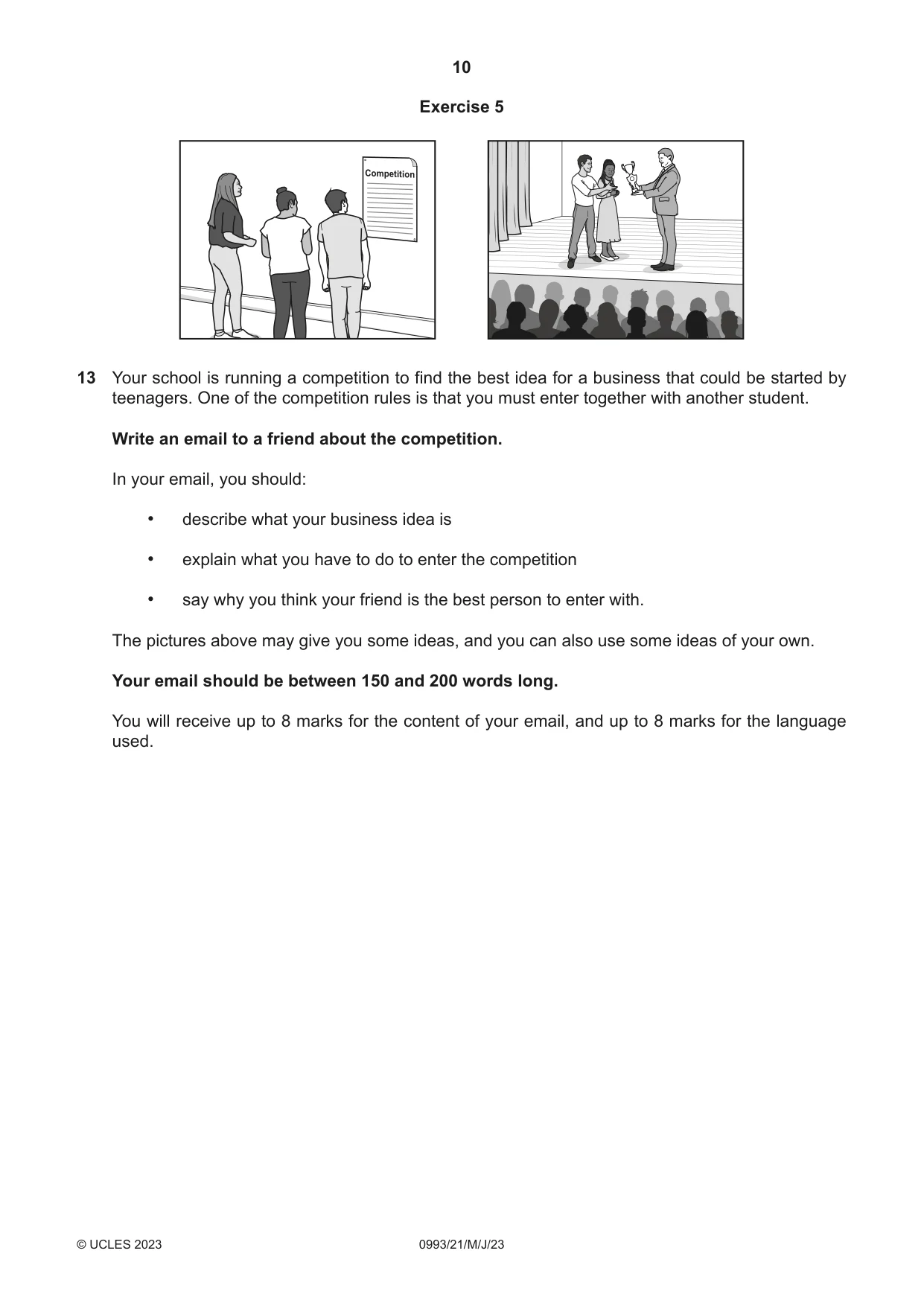
10 0993/21/ M / J /23 © UCLES 2023 Exercise 5 Competition 13 Your school is running a competition to find the best idea for a business that could be started by teenagers. One of the competition rules is that you must enter together with another student. Write an email to a friend about the competition. In your email, you should: • describe what your business idea is • explain what you have to do to enter the competition • say why you think your friend is the best person to enter with. The pictures above may give you some ideas, and you can also use some ideas of your own. Your email should be between 150 and 200 words long. You will receive up to 8 marks for the content of your email, and up to 8 marks for the language used.
Question paper, page 11
11 0993/21/M/J/23 © UCLES 2023 [Turn over … … … … … … … … … … … … … … … … … … … … … … … … … … … [Total: 16]
Question paper, page 12
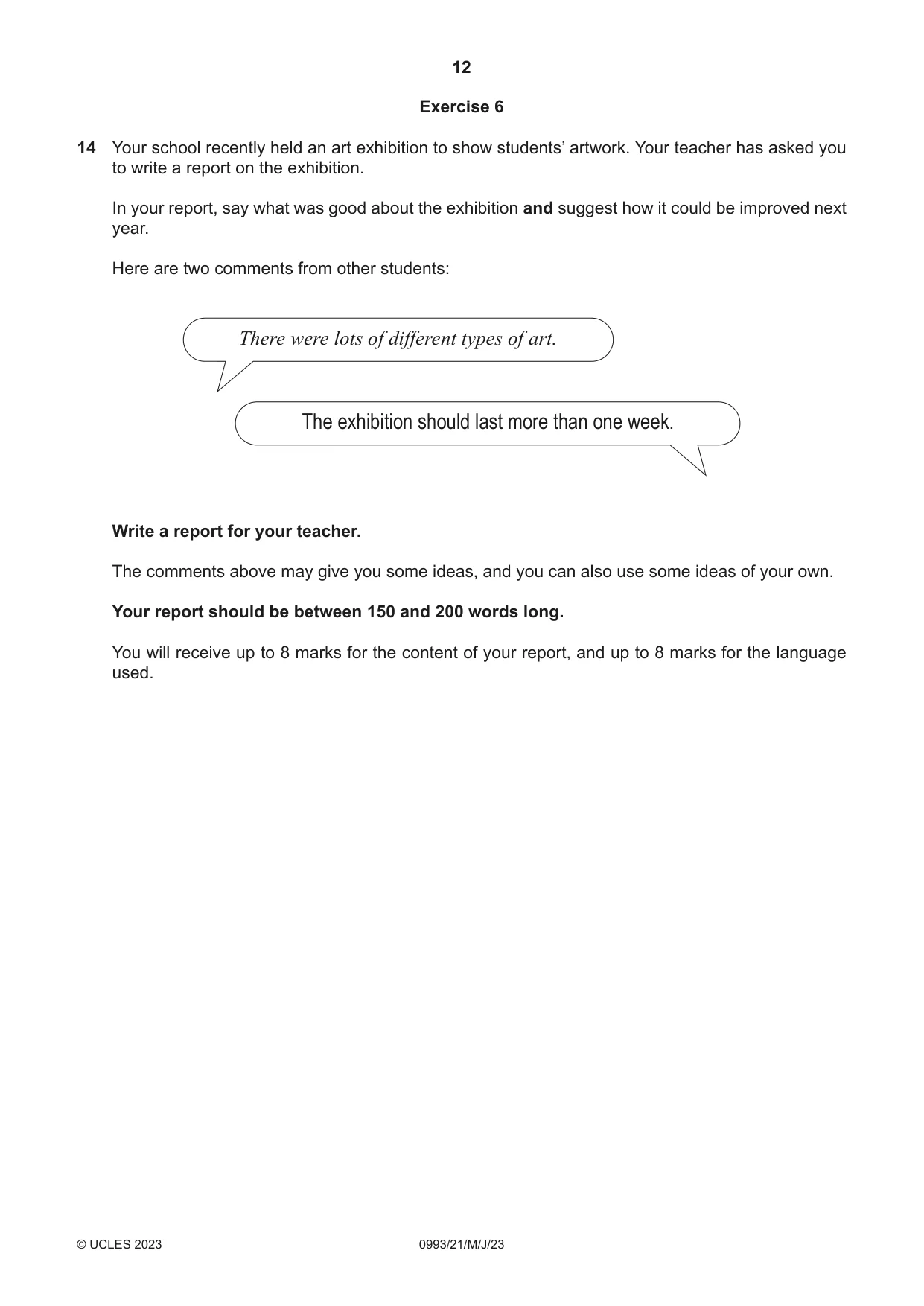
12 0993/21/M/J/23 © UCLES 2023 Exercise 6 14 Your school recently held an art exhibition to show students’ artwork. Your teacher has asked you to write a report on the exhibition. In your report, say what was good about the exhibition and suggest how it could be improved next year. Here are two comments from other students: There were lots of different types of art. The exhibition should last more than one week. Write a report for your teacher. The comments above may give you some ideas, and you can also use some ideas of your own. Your report should be between 150 and 200 words long. You will receive up to 8 marks for the content of your report, and up to 8 marks for the language used.
Question paper, page 13
13 0993/21/M/J/23 © UCLES 2023 … … … … … … … … … … … … … … … … … … … … … … … … … … … [Total: 16]
Question paper, page 14
14 0993/21/M/J/23 © UCLES 2023 BLANK PAGE
Question paper, page 15
15 0993/21/M/J/23 © UCLES 2023 BLANK PAGE
Question paper, page 16
16 0993/21/M/J/23 © UCLES 2023 Permission to reproduce items where third-party owned material protected by copyright is included has been sought and cleared where possible. Every reasonable effort has been made by the publisher (UCLES) to trace copyright holders, but if any items requiring clearance have unwittingly been included, the publisher will be pleased to make amends at the earliest possible opportunity. To avoid the issue of disclosure of answer-related information to candidates, all copyright acknowledgements are reproduced online in the Cambridge Assessment International Education Copyright Acknowledgements Booklet. This is produced for each series of examinations and is freely available to download at www.cambridgeinternational.org after the live examination series. Cambridge Assessment International Education is part of Cambridge Assessment. Cambridge Assessment is the brand name of the University of Cambridge Local Examinations Syndicate (UCLES), which is a department of the University of Cambridge. BLANK PAGE
Mark scheme, page 1
This document consists of 11 printed pages. © UCLES 2023 [Turn over Cambridge IGCSE™ (9–1) ENGLISH AS A SECOND LANGUAGE 9–1 0993/21 Paper 2 Reading and Writing (Extended) May/June 2023 MARK SCHEME Maximum Mark: 80 Published This mark scheme is published as an aid to teachers and candidates, to indicate the requirements of the examination. It shows the basis on which Examiners were instructed to award marks. It does not indicate the details of the discussions that took place at an Examiners’ meeting before marking began, which would have considered the acceptability of alternative answers. Mark schemes should be read in conjunction with the question paper and the Principal Examiner Report for Teachers. Cambridge International will not enter into discussions about these mark schemes. Cambridge International is publishing the mark schemes for the May/June 2023 series for most Cambridge IGCSE, Cambridge International A and AS Level and Cambridge Pre-U components, and some Cambridge O Level components.
Mark scheme, page 2
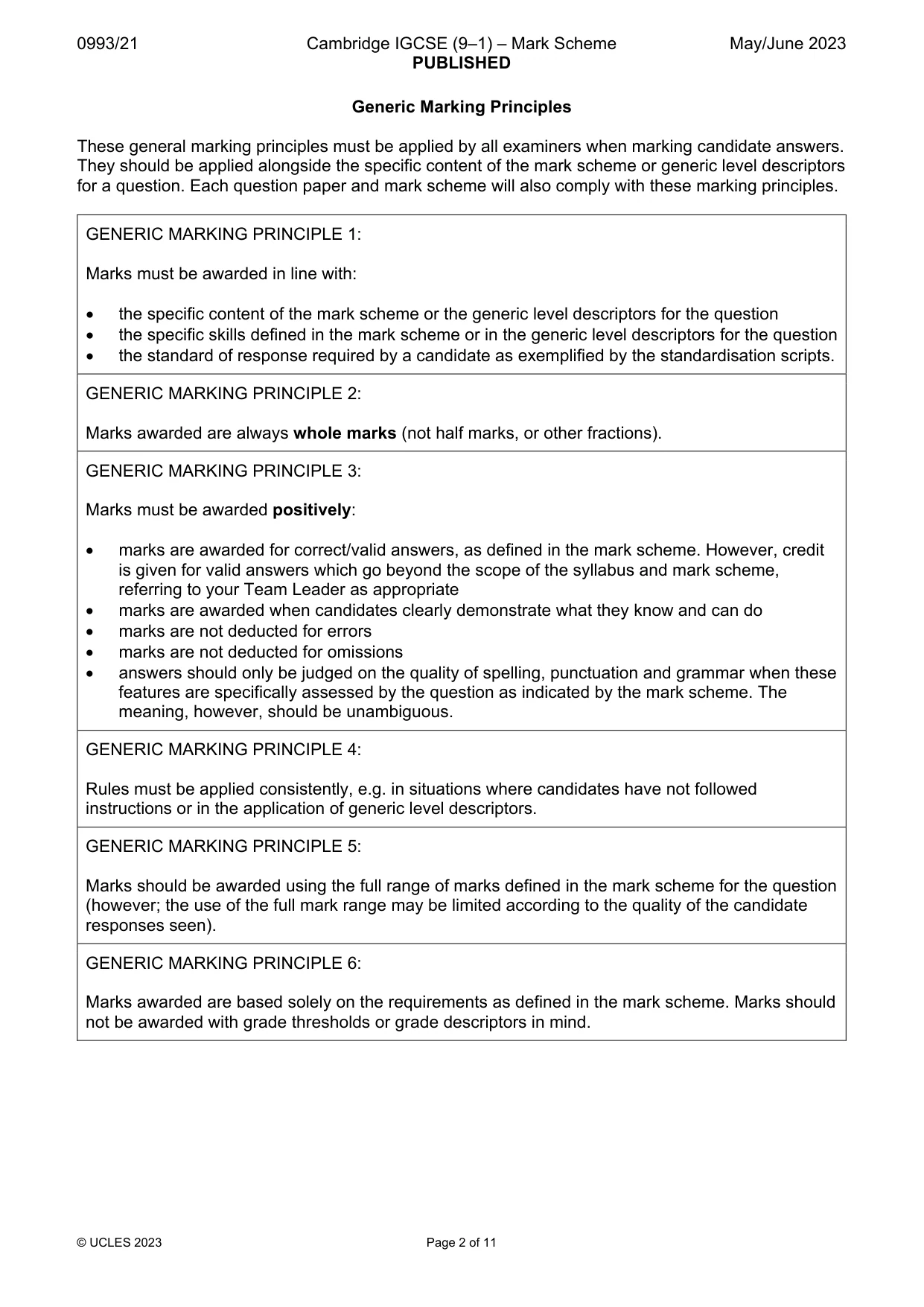
0993/21 Cambridge IGCSE (9–1) – Mark Scheme PUBLISHED May/June 2023 © UCLES 2023 Page 2 of 11 Generic Marking Principles These general marking principles must be applied by all examiners when marking candidate answers. They should be applied alongside the specific content of the mark scheme or generic level descriptors for a question. Each question paper and mark scheme will also comply with these marking principles. GENERIC MARKING PRINCIPLE 1: Marks must be awarded in line with: the specific content of the mark scheme or the generic level descriptors for the question the specific skills defined in the mark scheme or in the generic level descriptors for the question the standard of response required by a candidate as exemplified by the standardisation scripts. GENERIC MARKING PRINCIPLE 2: Marks awarded are always whole marks (not half marks, or other fractions). GENERIC MARKING PRINCIPLE 3: Marks must be awarded positively: marks are awarded for correct/valid answers, as defined in the mark scheme. However, credit is given for valid answers which go beyond the scope of the syllabus and mark scheme, referring to your Team Leader as appropriate marks are awarded when candidates clearly demonstrate what they know and can do marks are not deducted for errors marks are not deducted for omissions answers should only be judged on the quality of spelling, punctuation and grammar when these features are specifically assessed by the question as indicated by the mark scheme. The meaning, however, should be unambiguous. GENERIC MARKING PRINCIPLE 4: Rules must be applied consistently, e.g. in situations where candidates have not followed instructions or in the application of generic level descriptors. GENERIC MARKING PRINCIPLE 5: Marks should be awarded using the full range of marks defined in the mark scheme for the question (however; the use of the full mark range may be limited according to the quality of the candidate responses seen). GENERIC MARKING PRINCIPLE 6: Marks awarded are based solely on the requirements as defined in the mark scheme. Marks should not be awarded with grade thresholds or grade descriptors in mind.
Mark scheme, page 3
0993/21 Cambridge IGCSE (9–1) – Mark Scheme PUBLISHED May/June 2023 © UCLES 2023 Page 3 of 11 This component forms part of the Extended tier assessment of Cambridge IGCSE English as a Second Language and tests the following Assessment Objectives: AO1: Reading R1 identify and select relevant information R2 understand ideas, opinions and attitudes R3 show understanding of the connections between ideas, opinions and attitudes R4 understand what is implied but not directly stated, e.g. gist, writer’s purpose, intentions and feelings AO2: Writing W1 communicate information/ideas/opinions clearly, accurately and effectively W2 organise ideas into coherent paragraphs using a range of appropriate linking devices W3 use a range of grammatical structures accurately and effectively W4 show control of punctuation and spelling W5 use appropriate register and style/format for the given purpose and audience
Mark scheme, page 4
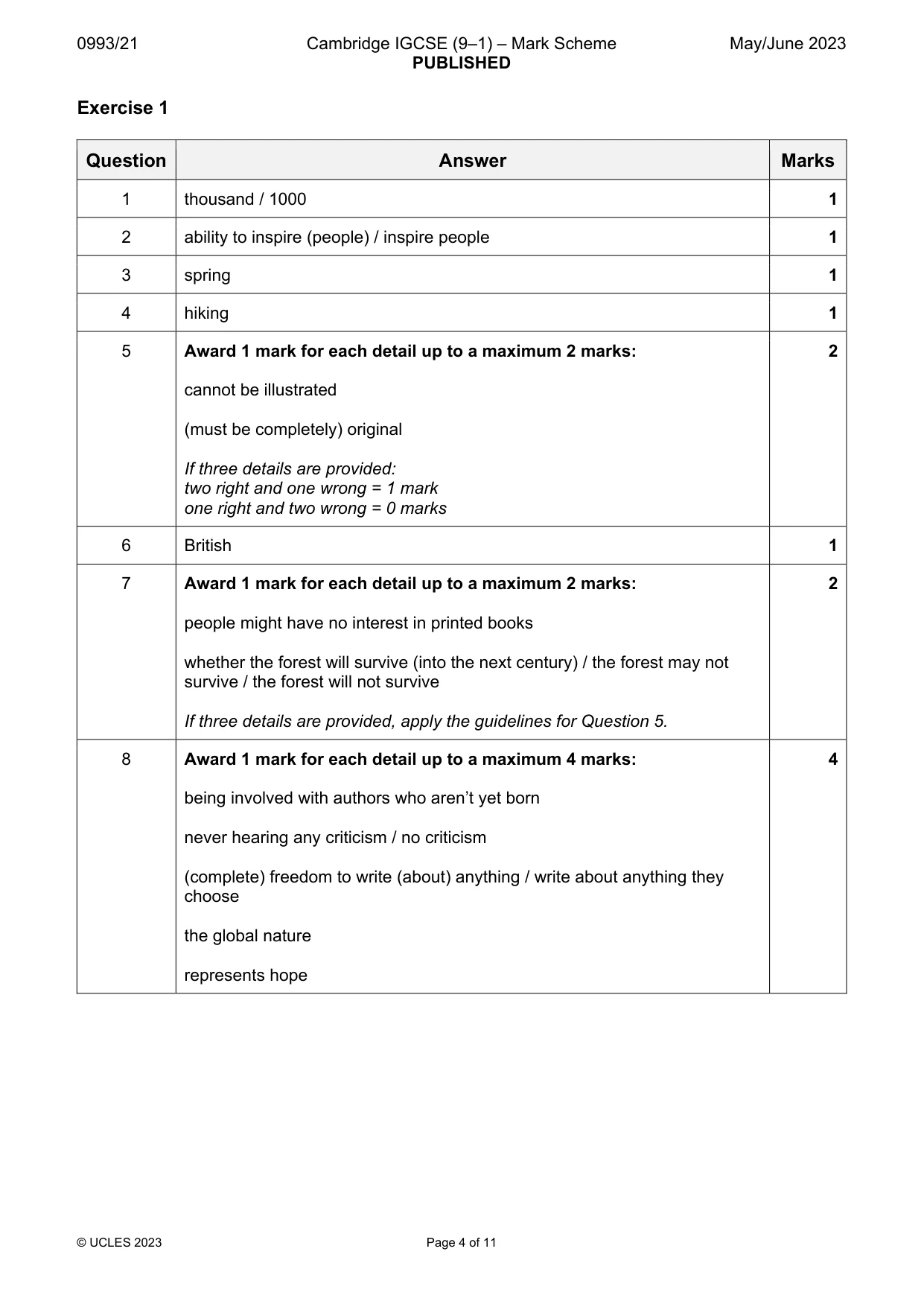
0993/21 Cambridge IGCSE (9–1) – Mark Scheme PUBLISHED May/June 2023 © UCLES 2023 Page 4 of 11 Exercise 1 Question Answer Marks 1 thousand / 1000 1 2 ability to inspire (people) / inspire people 1 3 spring 1 4 hiking 1 5 Award 1 mark for each detail up to a maximum 2 marks: cannot be illustrated (must be completely) original If three details are provided: two right and one wrong = 1 mark one right and two wrong = 0 marks 2 6 British 1 7 Award 1 mark for each detail up to a maximum 2 marks: people might have no interest in printed books whether the forest will survive (into the next century) / the forest may not survive / the forest will not survive If three details are provided, apply the guidelines for Question 5. 2 8 Award 1 mark for each detail up to a maximum 4 marks: being involved with authors who aren’t yet born never hearing any criticism / no criticism (complete) freedom to write (about) anything / write about anything they choose the global nature represents hope 4
Mark scheme, page 5
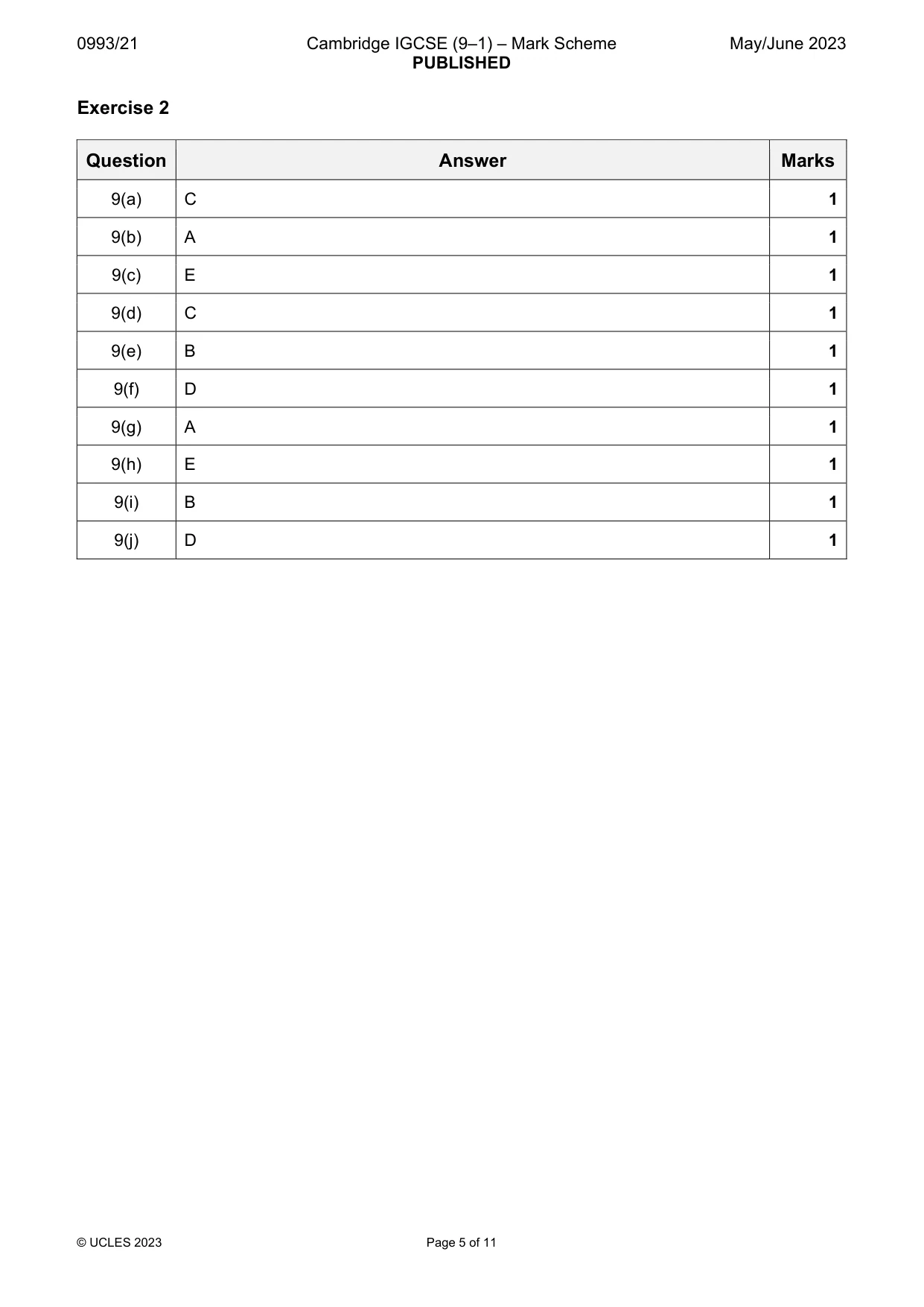
0993/21 Cambridge IGCSE (9–1) – Mark Scheme PUBLISHED May/June 2023 © UCLES 2023 Page 5 of 11 Exercise 2 Question Answer Marks 9(a) C 1 9(b) A 1 9(c) E 1 9(d) C 1 9(e) B 1 9(f) D 1 9(g) A 1 9(h) E 1 9(i) B 1 9(j) D 1
Mark scheme, page 6
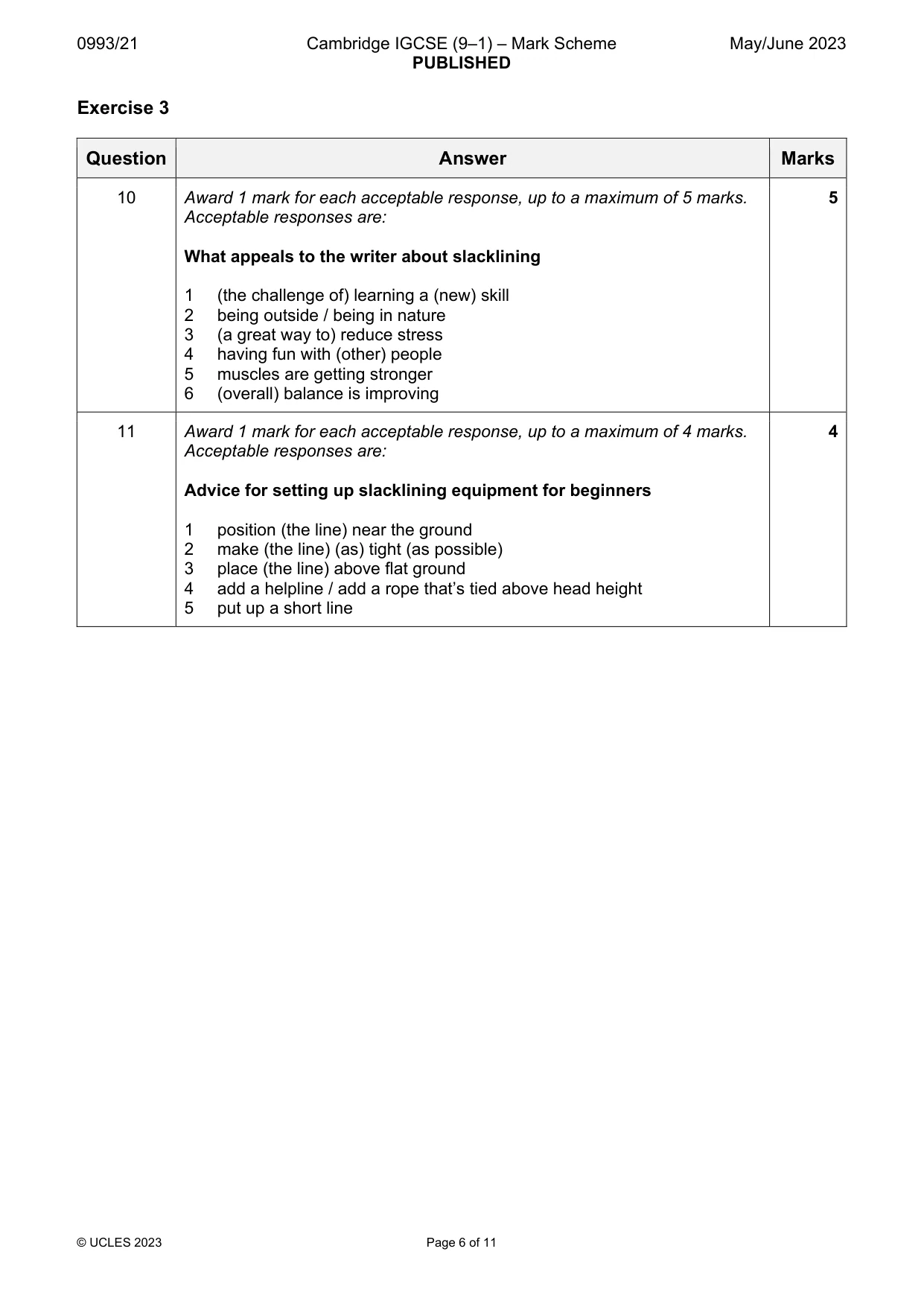
0993/21 Cambridge IGCSE (9–1) – Mark Scheme PUBLISHED May/June 2023 © UCLES 2023 Page 6 of 11 Exercise 3 Question Answer Marks 10 Award 1 mark for each acceptable response, up to a maximum of 5 marks. Acceptable responses are: What appeals to the writer about slacklining 1 (the challenge of) learning a (new) skill 2 being outside / being in nature 3 (a great way to) reduce stress 4 having fun with (other) people 5 muscles are getting stronger 6 (overall) balance is improving 5 11 Award 1 mark for each acceptable response, up to a maximum of 4 marks. Acceptable responses are: Advice for setting up slacklining equipment for beginners 1 position (the line) near the ground 2 make (the line) (as) tight (as possible) 3 place (the line) above flat ground 4 add a helpline / add a rope that’s tied above head height 5 put up a short line 4
Mark scheme, page 7
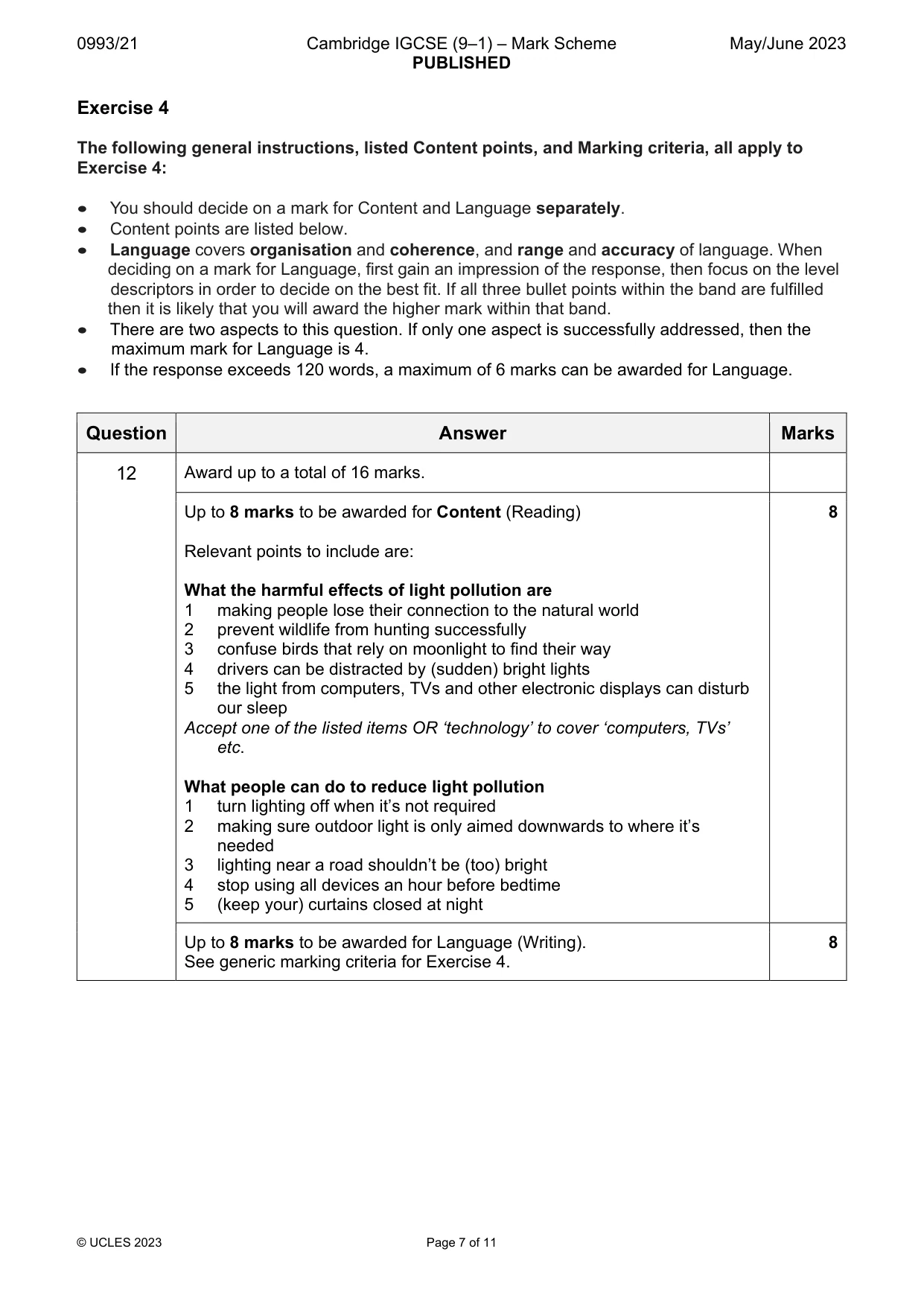
0993/21 Cambridge IGCSE (9–1) – Mark Scheme PUBLISHED May/June 2023 © UCLES 2023 Page 7 of 11 Exercise 4 The following general instructions, listed Content points, and Marking criteria, all apply to Exercise 4: You should decide on a mark for Content and Language separately. Content points are listed below. Language covers organisation and coherence, and range and accuracy of language. When deciding on a mark for Language, first gain an impression of the response, then focus on the level descriptors in order to decide on the best fit. If all three bullet points within the band are fulfilled then it is likely that you will award the higher mark within that band. There are two aspects to this question. If only one aspect is successfully addressed, then the maximum mark for Language is 4. If the response exceeds 120 words, a maximum of 6 marks can be awarded for Language. Question Answer Marks 12 Award up to a total of 16 marks. Up to 8 marks to be awarded for Content (Reading) Relevant points to include are: What the harmful effects of light pollution are 1 making people lose their connection to the natural world 2 prevent wildlife from hunting successfully 3 confuse birds that rely on moonlight to find their way 4 drivers can be distracted by (sudden) bright lights 5 the light from computers, TVs and other electronic displays can disturb our sleep Accept one of the listed items OR ‘technology’ to cover ‘computers, TVs’ etc. What people can do to reduce light pollution 1 turn lighting off when it’s not required 2 making sure outdoor light is only aimed downwards to where it’s needed 3 lighting near a road shouldn’t be (too) bright 4 stop using all devices an hour before bedtime 5 (keep your) curtains closed at night 8 Up to 8 marks to be awarded for Language (Writing). See generic marking criteria for Exercise 4. 8
Mark scheme, page 8
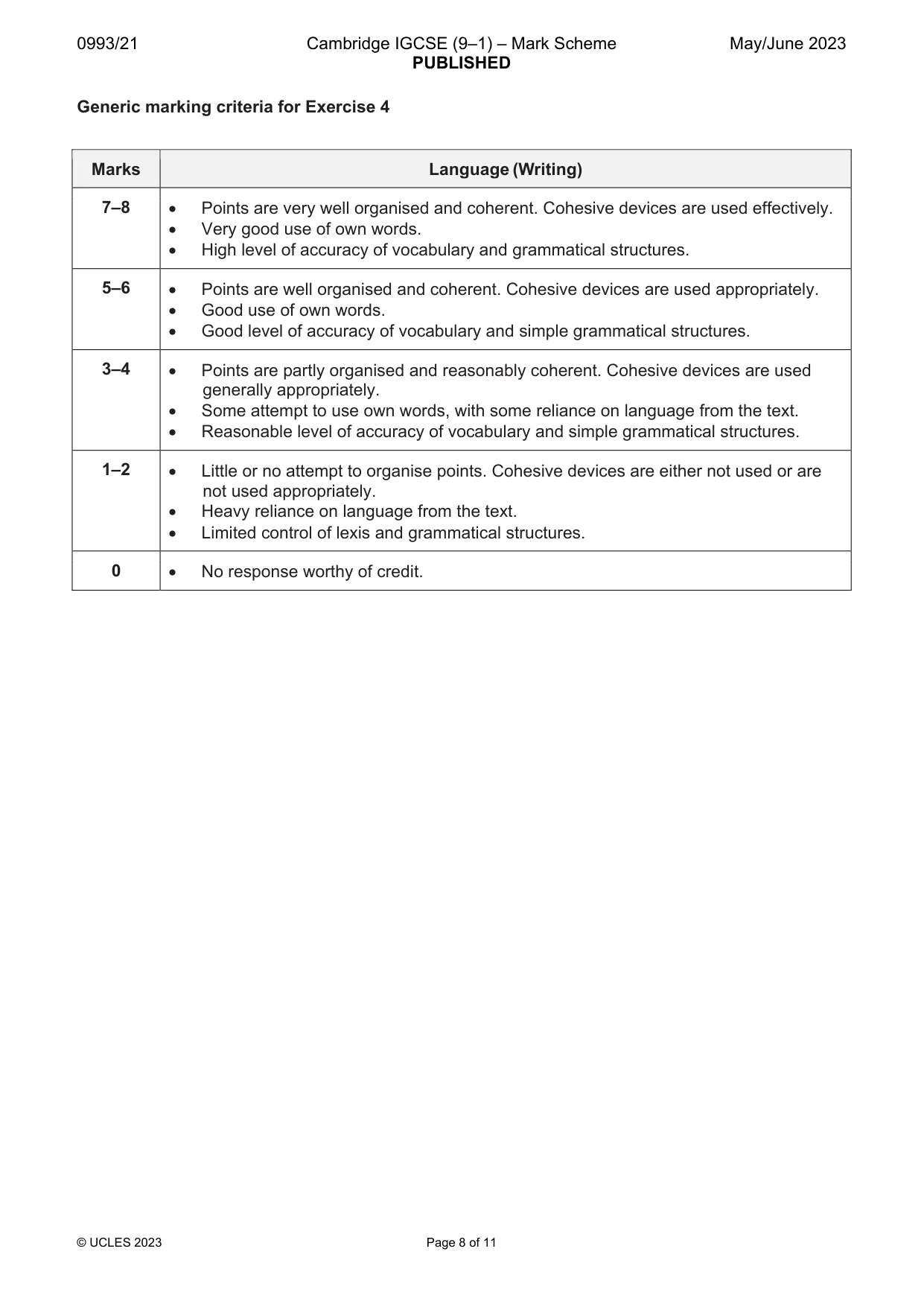
0993/21 Cambridge IGCSE (9–1) – Mark Scheme PUBLISHED May/June 2023 © UCLES 2023 Page 8 of 11 Generic marking criteria for Exercise 4 Marks Language (Writing) 7–8 Points are very well organised and coherent. Cohesive devices are used effectively. Very good use of own words. High level of accuracy of vocabulary and grammatical structures. 5–6 Points are well organised and coherent. Cohesive devices are used appropriately. Good use of own words. Good level of accuracy of vocabulary and simple grammatical structures. 3–4 Points are partly organised and reasonably coherent. Cohesive devices are used generally appropriately. Some attempt to use own words, with some reliance on language from the text. Reasonable level of accuracy of vocabulary and simple grammatical structures. 1–2 Little or no attempt to organise points. Cohesive devices are either not used or are not used appropriately. Heavy reliance on language from the text. Limited control of lexis and grammatical structures. 0 No response worthy of credit.
Mark scheme, page 9
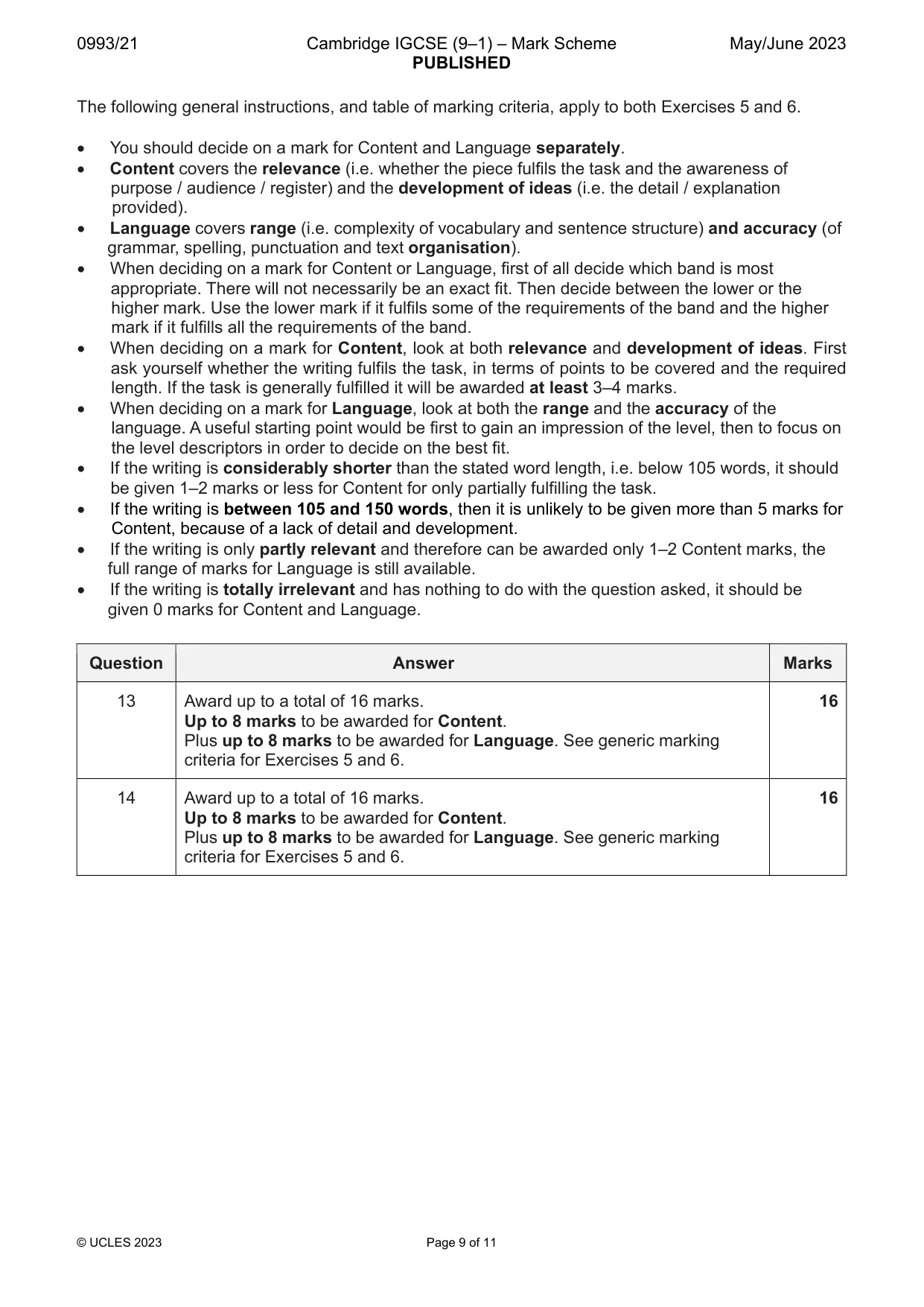
0993/21 Cambridge IGCSE (9–1) – Mark Scheme PUBLISHED May/June 2023 © UCLES 2023 Page 9 of 11 The following general instructions, and table of marking criteria, apply to both Exercises 5 and 6. You should decide on a mark for Content and Language separately. Content covers the relevance (i.e. whether the piece fulfils the task and the awareness of purpose / audience / register) and the development of ideas (i.e. the detail / explanation provided). Language covers range (i.e. complexity of vocabulary and sentence structure) and accuracy (of grammar, spelling, punctuation and text organisation). When deciding on a mark for Content or Language, first of all decide which band is most appropriate. There will not necessarily be an exact fit. Then decide between the lower or the higher mark. Use the lower mark if it fulfils some of the requirements of the band and the higher mark if it fulfills all the requirements of the band. When deciding on a mark for Content, look at both relevance and development of ideas. First ask yourself whether the writing fulfils the task, in terms of points to be covered and the required length. If the task is generally fulfilled it will be awarded at least 3–4 marks. When deciding on a mark for Language, look at both the range and the accuracy of the language. A useful starting point would be first to gain an impression of the level, then to focus on the level descriptors in order to decide on the best fit. If the writing is considerably shorter than the stated word length, i.e. below 105 words, it should be given 1–2 marks or less for Content for only partially fulfilling the task. If the writing is between 105 and 150 words, then it is unlikely to be given more than 5 marks for Content, because of a lack of detail and development. If the writing is only partly relevant and therefore can be awarded only 1–2 Content marks, the full range of marks for Language is still available. If the writing is totally irrelevant and has nothing to do with the question asked, it should be given 0 marks for Content and Language. Question Answer Marks 13 Award up to a total of 16 marks. Up to 8 marks to be awarded for Content. Plus up to 8 marks to be awarded for Language. See generic marking criteria for Exercises 5 and 6. 16 14 Award up to a total of 16 marks. Up to 8 marks to be awarded for Content. Plus up to 8 marks to be awarded for Language. See generic marking criteria for Exercises 5 and 6. 16
Mark scheme, page 10
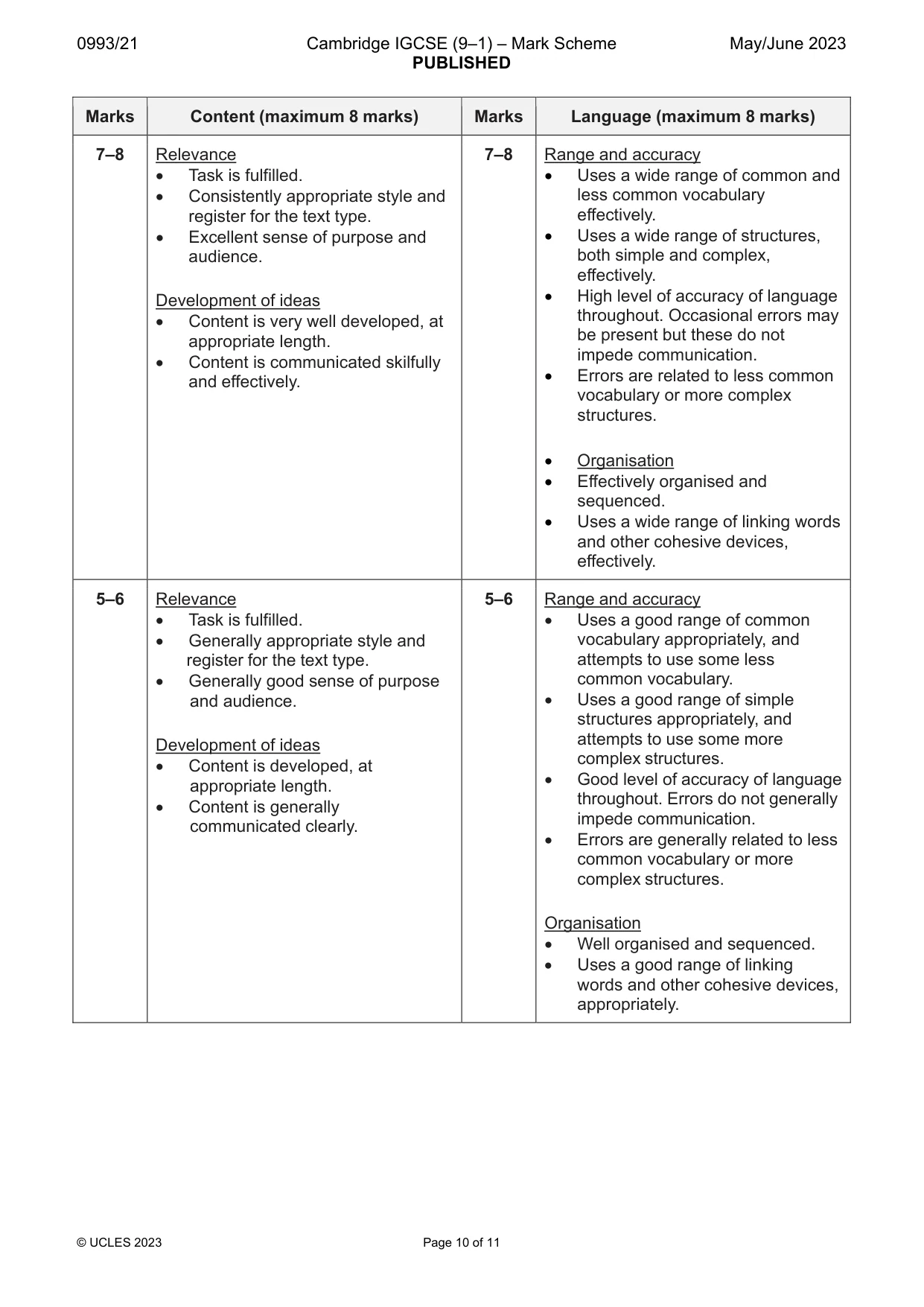
0993/21 Cambridge IGCSE (9–1) – Mark Scheme PUBLISHED May/June 2023 © UCLES 2023 Page 10 of 11 Marks Content (maximum 8 marks) Marks Language (maximum 8 marks) 7–8 Relevance Task is fulfilled. Consistently appropriate style and register for the text type. Excellent sense of purpose and audience. Development of ideas Content is very well developed, at appropriate length. Content is communicated skilfully and effectively. 7–8 Range and accuracy Uses a wide range of common and less common vocabulary effectively. Uses a wide range of structures, both simple and complex, effectively. High level of accuracy of language throughout. Occasional errors may be present but these do not impede communication. Errors are related to less common vocabulary or more complex structures. Organisation Effectively organised and sequenced. Uses a wide range of linking words and other cohesive devices, effectively. 5–6 Relevance Task is fulfilled. Generally appropriate style and register for the text type. Generally good sense of purpose and audience. Development of ideas Content is developed, at appropriate length. Content is generally communicated clearly. 5–6 Range and accuracy Uses a good range of common vocabulary appropriately, and attempts to use some less common vocabulary. Uses a good range of simple structures appropriately, and attempts to use some more complex structures. Good level of accuracy of language throughout. Errors do not generally impede communication. Errors are generally related to less common vocabulary or more complex structures. Organisation Well organised and sequenced. Uses a good range of linking words and other cohesive devices, appropriately.
Mark scheme, page 11
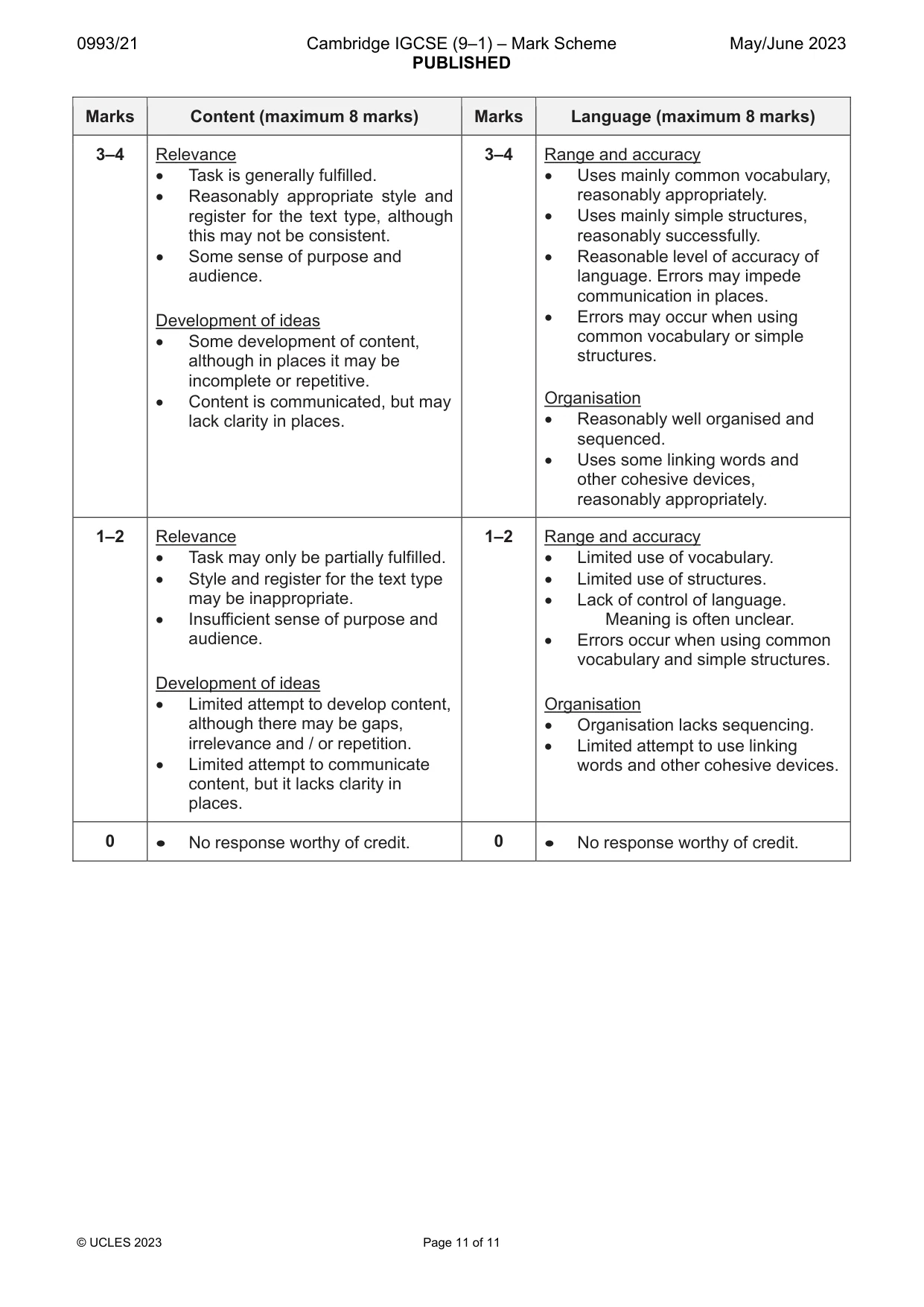
0993/21 Cambridge IGCSE (9–1) – Mark Scheme PUBLISHED May/June 2023 © UCLES 2023 Page 11 of 11 Marks Content (maximum 8 marks) Marks Language (maximum 8 marks) 3–4 Relevance Task is generally fulfilled. Reasonably appropriate style and register for the text type, although this may not be consistent. Some sense of purpose and audience. Development of ideas Some development of content, although in places it may be incomplete or repetitive. Content is communicated, but may lack clarity in places. 3–4 Range and accuracy Uses mainly common vocabulary, reasonably appropriately. Uses mainly simple structures, reasonably successfully. Reasonable level of accuracy of language. Errors may impede communication in places. Errors may occur when using common vocabulary or simple structures. Organisation Reasonably well organised and sequenced. Uses some linking words and other cohesive devices, reasonably appropriately. 1–2 Relevance Task may only be partially fulfilled. Style and register for the text type may be inappropriate. Insufficient sense of purpose and audience. Development of ideas Limited attempt to develop content, although there may be gaps, irrelevance and / or repetition. Limited attempt to communicate content, but it lacks clarity in places. 1–2 Range and accuracy Limited use of vocabulary. Limited use of structures. Lack of control of language. Meaning is often unclear. Errors occur when using common vocabulary and simple structures. Organisation Organisation lacks sequencing. Limited attempt to use linking words and other cohesive devices. 0 No response worthy of credit. 0 No response worthy of credit.
What you needed in this session
Cambridge’s own grade thresholds for 2023 May/June, Paper 2 · Variant 1. A higher threshold means an easier paper — the bar moves with how the cohort did.