Cambridge IGCSE English Second Language (Speaking Endorsement) (9-1) 0993 — 2023 Oct/Nov Paper 2 · Variant 1
0993/21/O/N/23 · 80 marks · ≈90 min
The question paper and its mark scheme, free to read here and free to download. This is Cambridge’s own paper, exactly as it was sat.
Question paper16 pages

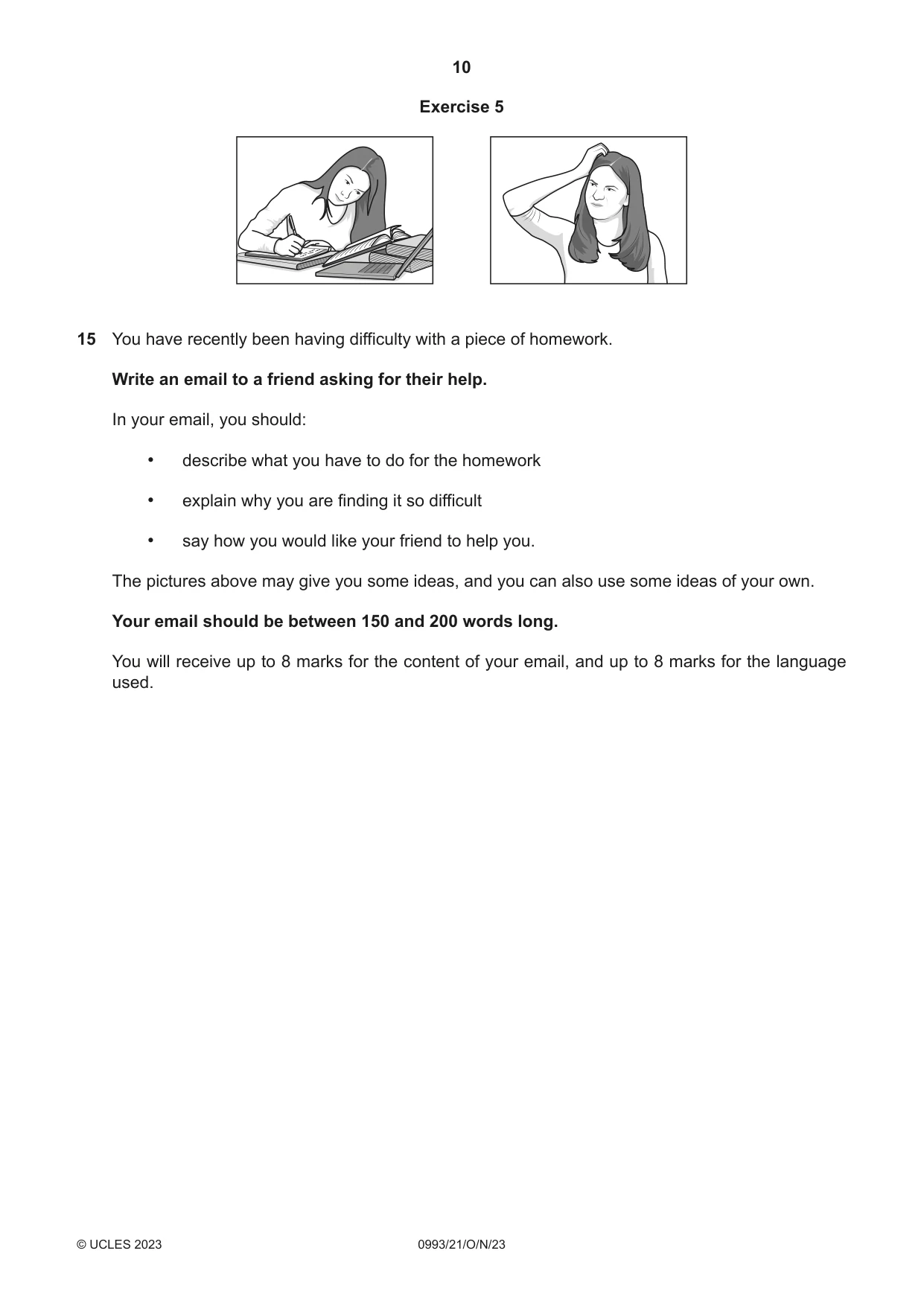





Mark scheme10 pages
Answers below. Sit the paper first if you are practising.
Paper as text
Question paper, page 1
This document has 16 pages. Any blank pages are indicated. [Turn over Cambridge IGCSE™(9–1) * 7 6 7 5 0 4 9 0 2 4 * ENGLISH AS A SECOND LANGUAGE 0993/21 Paper 2 Reading and Writing (Extended) October/November 2023 2 hours You must answer on the question paper. No additional materials are needed. INSTRUCTIONS ● Answer all questions. ● Use a black or dark blue pen. ● Write your name, centre number and candidate number in the boxes at the top of the page. ● Write your answer to each question in the space provided. ● Do not use an erasable pen or correction fluid. ● Do not write on any bar codes. ● Dictionaries are not allowed. INFORMATION ● The total mark for this paper is 80. ● The number of marks for each question or part question is shown in brackets [ ]. DC (AP) 332259 © UCLES 2023
Question paper, page 2
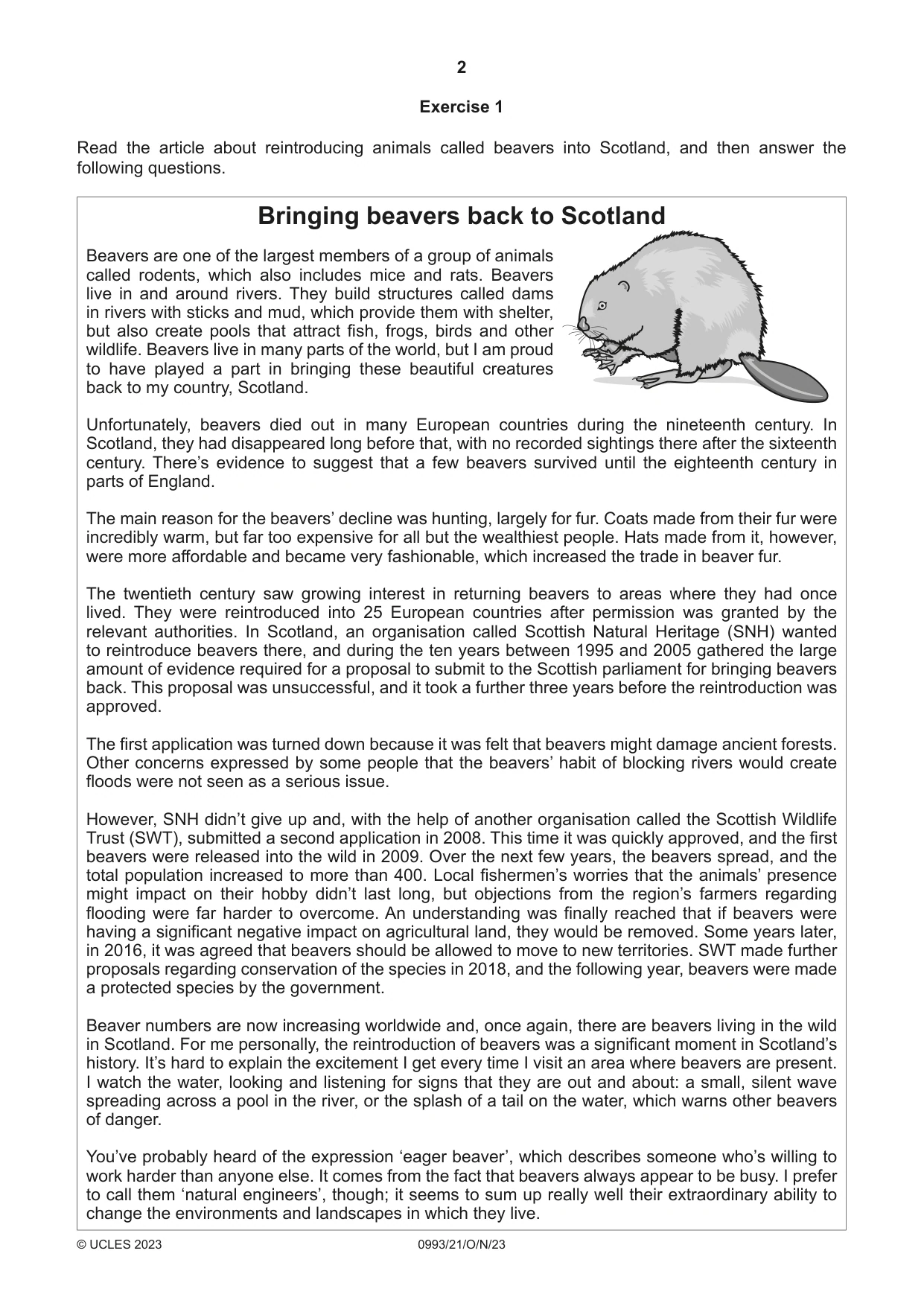
2 0993/21/O/N/23 © UCLES 2023 Exercise 1 Read the article about reintroducing animals called beavers into Scotland, and then answer the following questions. Bringing beavers back to Scotland Beavers are one of the largest members of a group of animals called rodents, which also includes mice and rats. Beavers live in and around rivers. They build structures called dams in rivers with sticks and mud, which provide them with shelter, but also create pools that attract fish, frogs, birds and other wildlife. Beavers live in many parts of the world, but I am proud to have played a part in bringing these beautiful creatures back to my country, Scotland. Unfortunately, beavers died out in many European countries during the nineteenth century. In Scotland, they had disappeared long before that, with no recorded sightings there after the sixteenth century. There’s evidence to suggest that a few beavers survived until the eighteenth century in parts of England. The main reason for the beavers’ decline was hunting, largely for fur. Coats made from their fur were incredibly warm, but far too expensive for all but the wealthiest people. Hats made from it, however, were more affordable and became very fashionable, which increased the trade in beaver fur. The twentieth century saw growing interest in returning beavers to areas where they had once lived. They were reintroduced into 25 European countries after permission was granted by the relevant authorities. In Scotland, an organisation called Scottish Natural Heritage (SNH) wanted to reintroduce beavers there, and during the ten years between 1995 and 2005 gathered the large amount of evidence required for a proposal to submit to the Scottish parliament for bringing beavers back. This proposal was unsuccessful, and it took a further three years before the reintroduction was approved. The first application was turned down because it was felt that beavers might damage ancient forests. Other concerns expressed by some people that the beavers’ habit of blocking rivers would create floods were not seen as a serious issue. However, SNH didn’t give up and, with the help of another organisation called the Scottish Wildlife Trust (SWT), submitted a second application in 2008. This time it was quickly approved, and the first beavers were released into the wild in 2009. Over the next few years, the beavers spread, and the total population increased to more than 400. Local fishermen’s worries that the animals’ presence might impact on their hobby didn’t last long, but objections from the region’s farmers regarding flooding were far harder to overcome. An understanding was finally reached that if beavers were having a significant negative impact on agricultural land, they would be removed. Some years later, in 2016, it was agreed that beavers should be allowed to move to new territories. SWT made further proposals regarding conservation of the species in 2018, and the following year, beavers were made a protected species by the government. Beaver numbers are now increasing worldwide and, once again, there are beavers living in the wild in Scotland. For me personally, the reintroduction of beavers was a significant moment in Scotland’s history. It’s hard to explain the excitement I get every time I visit an area where beavers are present. I watch the water, looking and listening for signs that they are out and about: a small, silent wave spreading across a pool in the river, or the splash of a tail on the water, which warns other beavers of danger. You’ve probably heard of the expression ‘eager beaver’, which describes someone who’s willing to work harder than anyone else. It comes from the fact that beavers always appear to be busy. I prefer to call them ‘natural engineers’, though; it seems to sum up really well their extraordinary ability to change the environments and landscapes in which they live.
Question paper, page 3
3 0993/21/O/N/23 © UCLES 2023 [Turn over 1 In which century did beavers die out in Scotland? … [1] 2 What clothing made from beaver fur was especially popular? … [1] 3 How long did it take to prepare the first application to reintroduce beavers to Scotland? … [1] 4 What reason was given for rejecting the first application to reintroduce beavers? … [1] 5 Which group of people was most strongly against the reintroduction of beavers? … [1] 6 What important decisions about Scottish beavers have been made since 2016? Give two details. … … [2] 7 What sound does the writer listen for to check if beavers are active? … [1] 8 Which phrase does the writer like to use to describe beavers? … [1] 9 What do we learn about beaver populations in places other than Scotland? Give four details. … … … … [4] [Total: 13]
Question paper, page 4
4 0993/21/O/N/23 © UCLES 2023 Exercise 2 Read the article about four people (A–D) who are describing accommodation they stayed in while on holiday. Then answer Question 10(a)–(j). Holiday accommodation A Hoda I’ve just got back from a week away in the mountains. There were eight of us in one rented house: me, my sister and parents, and my aunt, uncle and two cousins. The style of the place wouldn’t please some people and it was only just big enough for everyone, but it suited us. We’ve never had the slightest disagreement in all the times we’ve been away together. We stayed at a ski resort: it was warm, so there wasn’t any snow. I’d love to have been there when everything was frosty and white. We spent all day walking in the mountains and ate out in the evening, so we only went back to the house to sleep. The owners of the house lived nearby and gave us tips on the best walking routes. They clearly did loads of walking themselves, but perhaps they should have spent more time cleaning the holiday home – it could have done with it! B Phillip My wife and I have just spent two weeks in an apartment by the sea with our two children. There were lots of other families staying in the same block, so the kids weren’t short of friends. I can’t remember how many times we got lost while driving there, but the beach was great, and unlike many holidays I’d been on before, there was no need to clean the apartment when we arrived. Normally, pictures you see of holiday accommodation on websites are taken using special cameras to make the rooms look bigger than they actually are. The opposite seemed to be true there, though, which was a pleasant surprise. I can’t say the colours the owners had painted the walls were to my taste, but you can’t have everything, I guess. As well as the sea, there were hills behind the town, so we spent time hiking in those as well as relaxing on the beach. C Alicia My parents discovered the hotel we’ve just come back from a few years ago. We’ve been there in both summer and winter, and I’ve always enjoyed it whatever time of year it is. It belongs to a lovely family, who we’ve got to know well. I lost my passport when we were there this time, and I had to get them to translate when I reported it to the police. They were happy to do it, though. Our rooms are usually huge, but the only ones available this year were probably half the size, which was a bit of a shock. At least I had my own bedroom – I can’t think of anything worse than sharing. While I was there, I reserved a couple of rooms for my parents and me next spring. It’s their 25th wedding anniversary and my grandparents are going to pay as a special surprise. It’s a beautiful area and the perfect place to stay. D Hassan My family has been going away with my best friend and his parents for years. This time, we found a house by a lake, which seemed like a great place for a holiday, especially in summer. Getting there was relatively straightforward and, although the house was fairly small, we thought it’d be fine for the six of us. Anyway, according to the guidebook, there was a huge variety of things to do in the region, which my parents and I hoped to make the most of. Once we’d got there, all the others fancied doing, however, was swimming in the lake and relaxing at the house. Because we’d travelled there in their car, it meant we were stuck and ended up spending far more time in the house and at the lake than we were hoping. This created quite a bit of tension between us, and I was left wishing we’d rented two separate houses instead of just one!
Question paper, page 5
5 0993/21/O/N/23 © UCLES 2023 [Turn over 10 For each question write the correct letter A, B, C or D on the line. Which person … (a) says their accommodation was smaller than they were expecting? … [1] (b) felt uncomfortable sharing their accommodation with another family? … [1] (c) suggests that their accommodation was rather dirty? … [1] (d) admits to not liking how the accommodation was decorated? … [1] (e) says they spent little time in their accommodation during the holiday? … [1] (f) needed to ask the owners of the accommodation for help? … [1] (g) had difficulty finding the way to their accommodation? … [1] (h) wishes they’d stayed in the accommodation at a different time of year? … [1] (i) wanted to explore the area around their accommodation more? … [1] (j) has already booked to go back to the same accommodation? … [1] [Total: 10]
Question paper, page 6
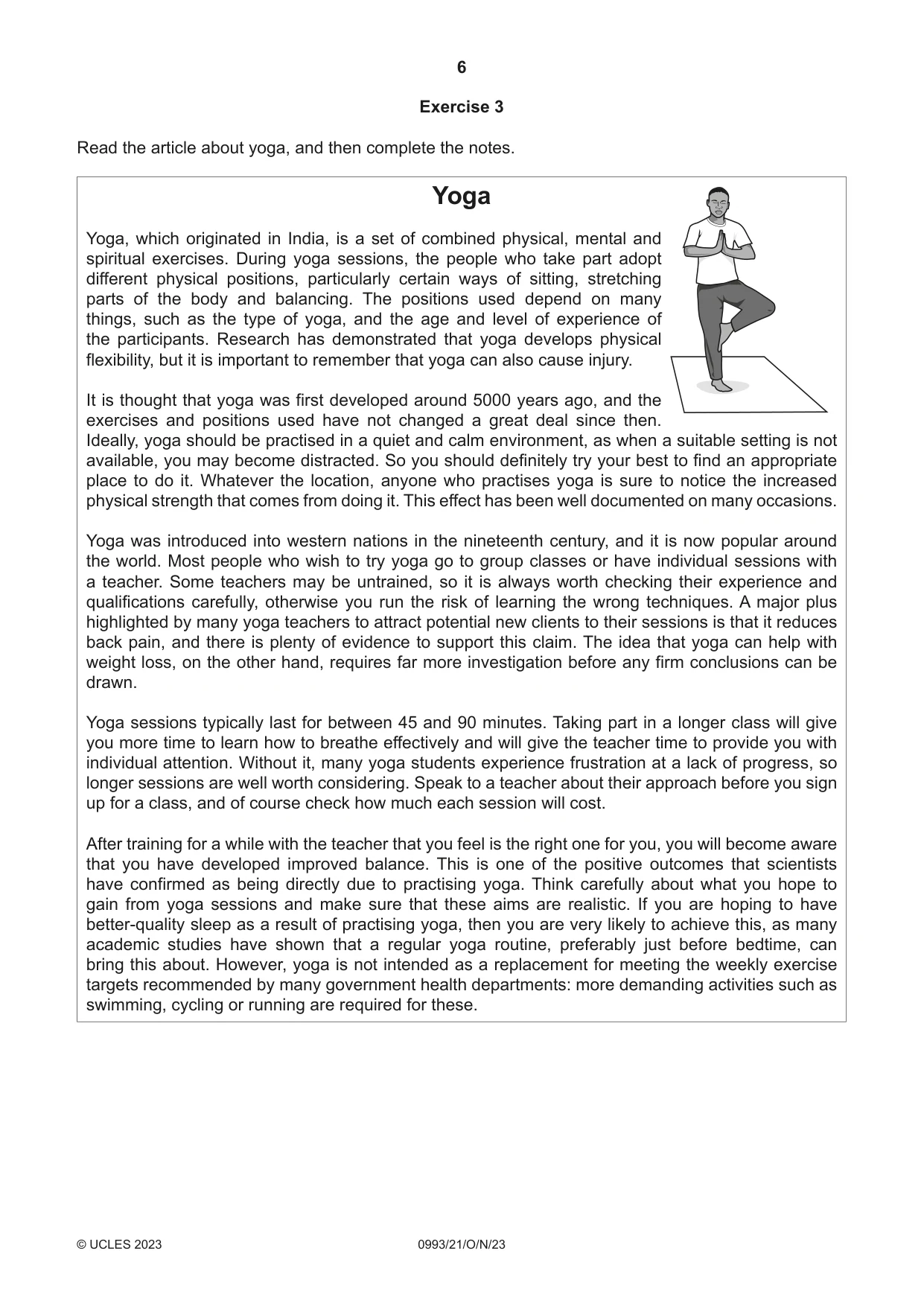
6 0993/21/O/N/23 © UCLES 2023 Exercise 3 Read the article about yoga, and then complete the notes. Yoga Yoga, which originated in India, is a set of combined physical, mental and spiritual exercises. During yoga sessions, the people who take part adopt different physical positions, particularly certain ways of sitting, stretching parts of the body and balancing. The positions used depend on many things, such as the type of yoga, and the age and level of experience of the participants. Research has demonstrated that yoga develops physical flexibility, but it is important to remember that yoga can also cause injury. It is thought that yoga was first developed around 5000 years ago, and the exercises and positions used have not changed a great deal since then. Ideally, yoga should be practised in a quiet and calm environment, as when a suitable setting is not available, you may become distracted. So you should definitely try your best to find an appropriate place to do it. Whatever the location, anyone who practises yoga is sure to notice the increased physical strength that comes from doing it. This effect has been well documented on many occasions. Yoga was introduced into western nations in the nineteenth century, and it is now popular around the world. Most people who wish to try yoga go to group classes or have individual sessions with a teacher. Some teachers may be untrained, so it is always worth checking their experience and qualifications carefully, otherwise you run the risk of learning the wrong techniques. A major plus highlighted by many yoga teachers to attract potential new clients to their sessions is that it reduces back pain, and there is plenty of evidence to support this claim. The idea that yoga can help with weight loss, on the other hand, requires far more investigation before any firm conclusions can be drawn. Yoga sessions typically last for between 45 and 90 minutes. Taking part in a longer class will give you more time to learn how to breathe effectively and will give the teacher time to provide you with individual attention. Without it, many yoga students experience frustration at a lack of progress, so longer sessions are well worth considering. Speak to a teacher about their approach before you sign up for a class, and of course check how much each session will cost. After training for a while with the teacher that you feel is the right one for you, you will become aware that you have developed improved balance. This is one of the positive outcomes that scientists have confirmed as being directly due to practising yoga. Think carefully about what you hope to gain from yoga sessions and make sure that these aims are realistic. If you are hoping to have better‑quality sleep as a result of practising yoga, then you are very likely to achieve this, as many academic studies have shown that a regular yoga routine, preferably just before bedtime, can bring this about. However, yoga is not intended as a replacement for meeting the weekly exercise targets recommended by many government health departments: more demanding activities such as swimming, cycling or running are required for these.
Question paper, page 7
7 0993/21/O/N/23 © UCLES 2023 [Turn over You are going to give a talk about yoga to your class at school. Prepare some notes to use as the basis for your talk. Make short notes under each heading. 11 The history of yoga: • … • … [2] 12 Proven benefits of yoga: • … • … • … • … [4] 13 Problems that can occur when doing yoga: • … • … • … [3] [Total: 9]
Question paper, page 8
8 0993/21/O/N/23 © UCLES 2023 Exercise 4 14 Read the article about growing your own fruit and vegetables. Write a summary about the advantages of growing your own fruit and vegetables and advice on what you should do to get started. Your summary should be about 100 words long (and no more than 120 words long). You should use your own words as far as possible. You will receive up to 8 marks for the content of your summary, and up to 8 marks for the style and accuracy of your language. Growing your own fruit and vegetables For a lot of people, growing fruit and vegetables is a way of life their families have followed for several generations. They often start doing this when they are very young and continue with it throughout their lives. Anyone new to growing fruit and vegetables, however, may be put off by the thought that it requires an awful lot of time and effort for very little reward at the end. So if you are one of those people who believe this and need convincing of the many advantages to growing your own fruit and vegetables, then read on. Home‑grown fruit and vegetables are usually higher in nutrients, such as vitamins and minerals, than shop‑bought products. This is because levels of vitamins in food, for example, decrease gradually over time. Fruit and vegetables in shops may well have been picked many days before they appeared in the store, as it took time to transport them from where they were grown to where they are sold. So what are you waiting for? After all, it can be done in many different locations. That’s one of the great things about it. The first thing to do is to choose a place with plenty of natural light and off you go! Lots of people use gardens or community areas for growing food, for example. Wherever you end up deciding to grow your fruit and vegetables, if you are buying plants rather than growing them from seeds, be sure to select your plants carefully. For example, plants with brown leaves or which are damaged are unlikely to do well or produce much. If you’re planting your new fruit and vegetables out into a garden, then you’ll get lots of physical exercise when you’re putting them in, looking after them and harvesting them. Having said that, it’s preferable to grow only a few to begin with. An unexpected result of growing your own fruit and vegetables that many people report is that it helps to increase your confidence. There may be many reasons why this is the case but what’s undoubtedly true is that you’ll be learning important new skills. There’s nothing worse than losing some or all of your crops when a few careful steps could have prevented it, so make sure that you protect your newly planted crops well, for instance, against the possible impact of bad weather, insects or disease. Whether your long‑term plan is to provide you and your family with all or most of your fresh fruit and vegetables, or just to produce a few different types, it’s always worth trying to avoid using harmful chemicals in any kind of gardening, even though lots of advertising attempts to persuade gardeners to use them. So if and when you decide to take up the challenge of producing your own fruit and vegetables, then the very best of luck with it, and happy growing!
Question paper, page 9
9 0993/21/O/N/23 © UCLES 2023 [Turn over … … … … … … … … … … … … … … … … … … … … … … … … … … … [Total: 16]
Question paper, page 10
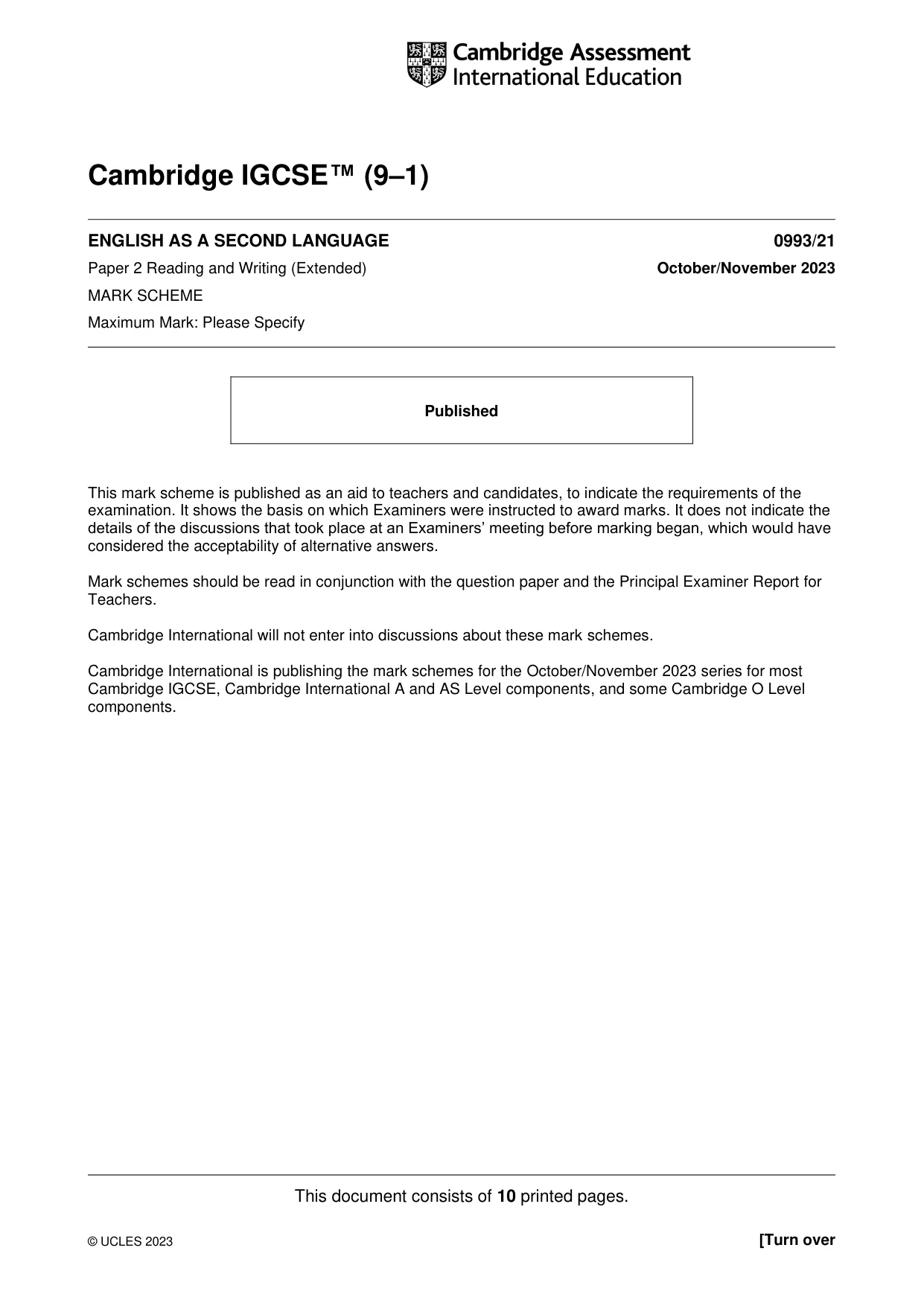
10 0993/21/O/N/23 © UCLES 2023 Exercise 5 15 You have recently been having difficulty with a piece of homework. Write an email to a friend asking for their help. In your email, you should: • describe what you have to do for the homework • explain why you are finding it so difficult • say how you would like your friend to help you. The pictures above may give you some ideas, and you can also use some ideas of your own. Your email should be between 150 and 200 words long. You will receive up to 8 marks for the content of your email, and up to 8 marks for the language used.
Question paper, page 11
11 0993/21/O/N/23 © UCLES 2023 [Turn over … … … … … … … … … … … … … … … … … … … … … … … … … … … [Total: 16]
Question paper, page 12
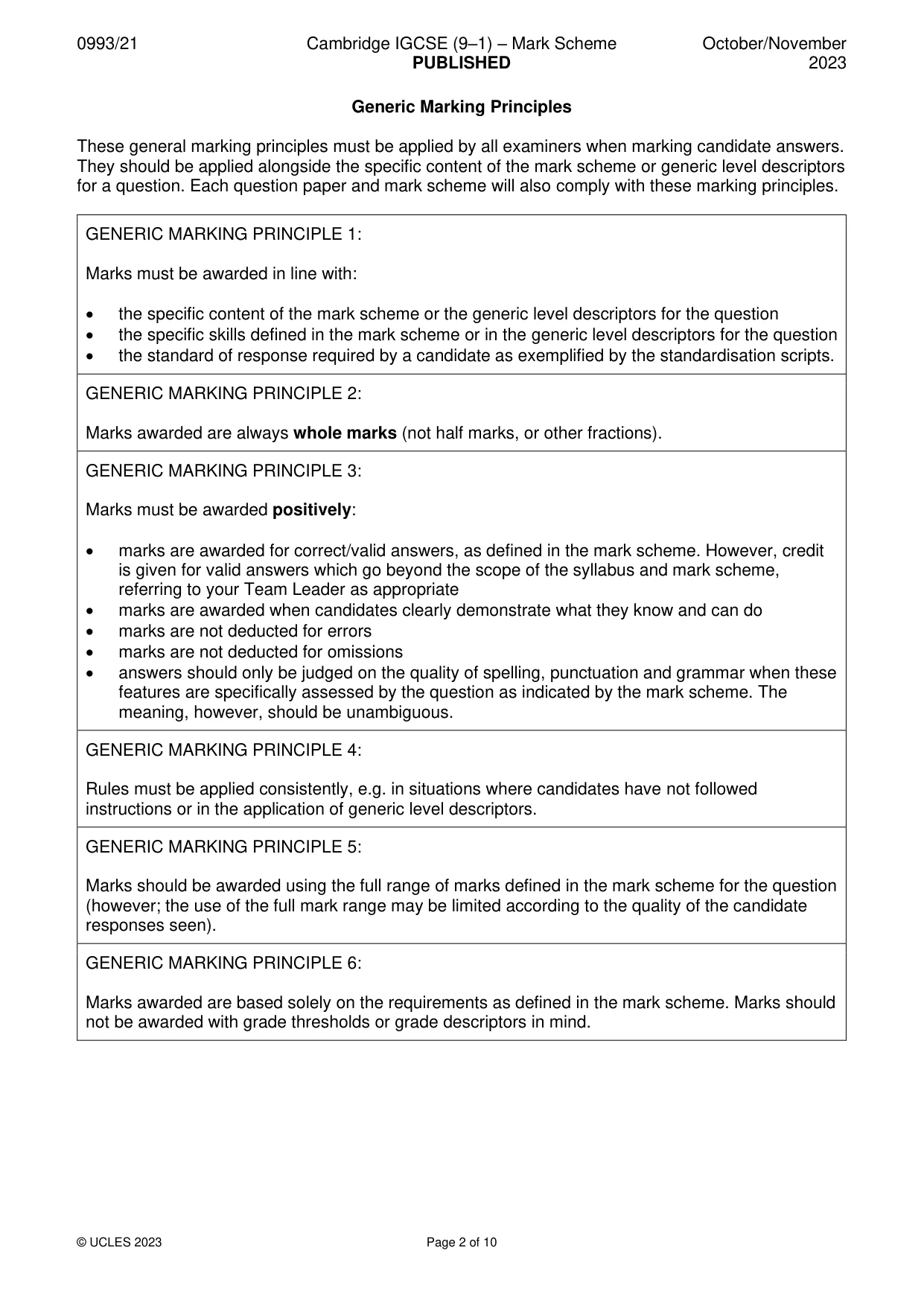
12 0993/21/O/N/23 © UCLES 2023 Exercise 6 16 Recently, your school held a sports day in which all students had to take part in sports competitions. Your headteacher has asked you to write a report about it. In your report, say what was good about the sports day, and suggest how it could be made more enjoyable for all students next year. Here are two comments from students: Seeing students who are great at sport makes me want to do better. I hate sport but I still have to take part, which isn’t fair. Write a report for your headteacher, giving your views. The comments above may give you some ideas, and you can also use some ideas of your own. Your report should be between 150 and 200 words long. You will receive up to 8 marks for the content of your report, and up to 8 marks for the language used.
Question paper, page 13
13 0993/21/O/N/23 © UCLES 2023 … … … … … … … … … … … … … … … … … … … … … … … … … … … [Total: 16]
Question paper, page 14
14 0993/21/O/N/23 © UCLES 2023 BLANK PAGE
Question paper, page 15
15 0993/21/O/N/23 © UCLES 2023 BLANK PAGE
Question paper, page 16
16 0993/21/O/N/23 © UCLES 2023 Permission to reproduce items where third‑party owned material protected by copyright is included has been sought and cleared where possible. Every reasonable effort has been made by the publisher (UCLES) to trace copyright holders, but if any items requiring clearance have unwittingly been included, the publisher will be pleased to make amends at the earliest possible opportunity. To avoid the issue of disclosure of answer‑related information to candidates, all copyright acknowledgements are reproduced online in the Cambridge Assessment International Education Copyright Acknowledgements Booklet. This is produced for each series of examinations and is freely available to download at www.cambridgeinternational.org after the live examination series. Cambridge Assessment International Education is part of Cambridge Assessment. Cambridge Assessment is the brand name of the University of Cambridge Local Examinations Syndicate (UCLES), which is a department of the University of Cambridge. BLANK PAGE
Mark scheme, page 1
This document consists of 10 printed pages. © UCLES 2023 [Turn over Cambridge IGCSE™ (9–1) ENGLISH AS A SECOND LANGUAGE 0993/21 Paper 2 Reading and Writing (Extended) October/November 2023 MARK SCHEME Maximum Mark: Please Specify Published This mark scheme is published as an aid to teachers and candidates, to indicate the requirements of the examination. It shows the basis on which Examiners were instructed to award marks. It does not indicate the details of the discussions that took place at an Examiners’ meeting before marking began, which would have considered the acceptability of alternative answers. Mark schemes should be read in conjunction with the question paper and the Principal Examiner Report for Teachers. Cambridge International will not enter into discussions about these mark schemes. Cambridge International is publishing the mark schemes for the October/November 2023 series for most Cambridge IGCSE, Cambridge International A and AS Level components, and some Cambridge O Level components.
Mark scheme, page 2
0993/21 Cambridge IGCSE (9–1) – Mark Scheme PUBLISHED October/November 2023 © UCLES 2023 Page 2 of 10 Generic Marking Principles These general marking principles must be applied by all examiners when marking candidate answers. They should be applied alongside the specific content of the mark scheme or generic level descriptors for a question. Each question paper and mark scheme will also comply with these marking principles. GENERIC MARKING PRINCIPLE 1: Marks must be awarded in line with: • the specific content of the mark scheme or the generic level descriptors for the question • the specific skills defined in the mark scheme or in the generic level descriptors for the question • the standard of response required by a candidate as exemplified by the standardisation scripts. GENERIC MARKING PRINCIPLE 2: Marks awarded are always whole marks (not half marks, or other fractions). GENERIC MARKING PRINCIPLE 3: Marks must be awarded positively: • marks are awarded for correct/valid answers, as defined in the mark scheme. However, credit is given for valid answers which go beyond the scope of the syllabus and mark scheme, referring to your Team Leader as appropriate • marks are awarded when candidates clearly demonstrate what they know and can do • marks are not deducted for errors • marks are not deducted for omissions • answers should only be judged on the quality of spelling, punctuation and grammar when these features are specifically assessed by the question as indicated by the mark scheme. The meaning, however, should be unambiguous. GENERIC MARKING PRINCIPLE 4: Rules must be applied consistently, e.g. in situations where candidates have not followed instructions or in the application of generic level descriptors. GENERIC MARKING PRINCIPLE 5: Marks should be awarded using the full range of marks defined in the mark scheme for the question (however; the use of the full mark range may be limited according to the quality of the candidate responses seen). GENERIC MARKING PRINCIPLE 6: Marks awarded are based solely on the requirements as defined in the mark scheme. Marks should not be awarded with grade thresholds or grade descriptors in mind.
Mark scheme, page 3
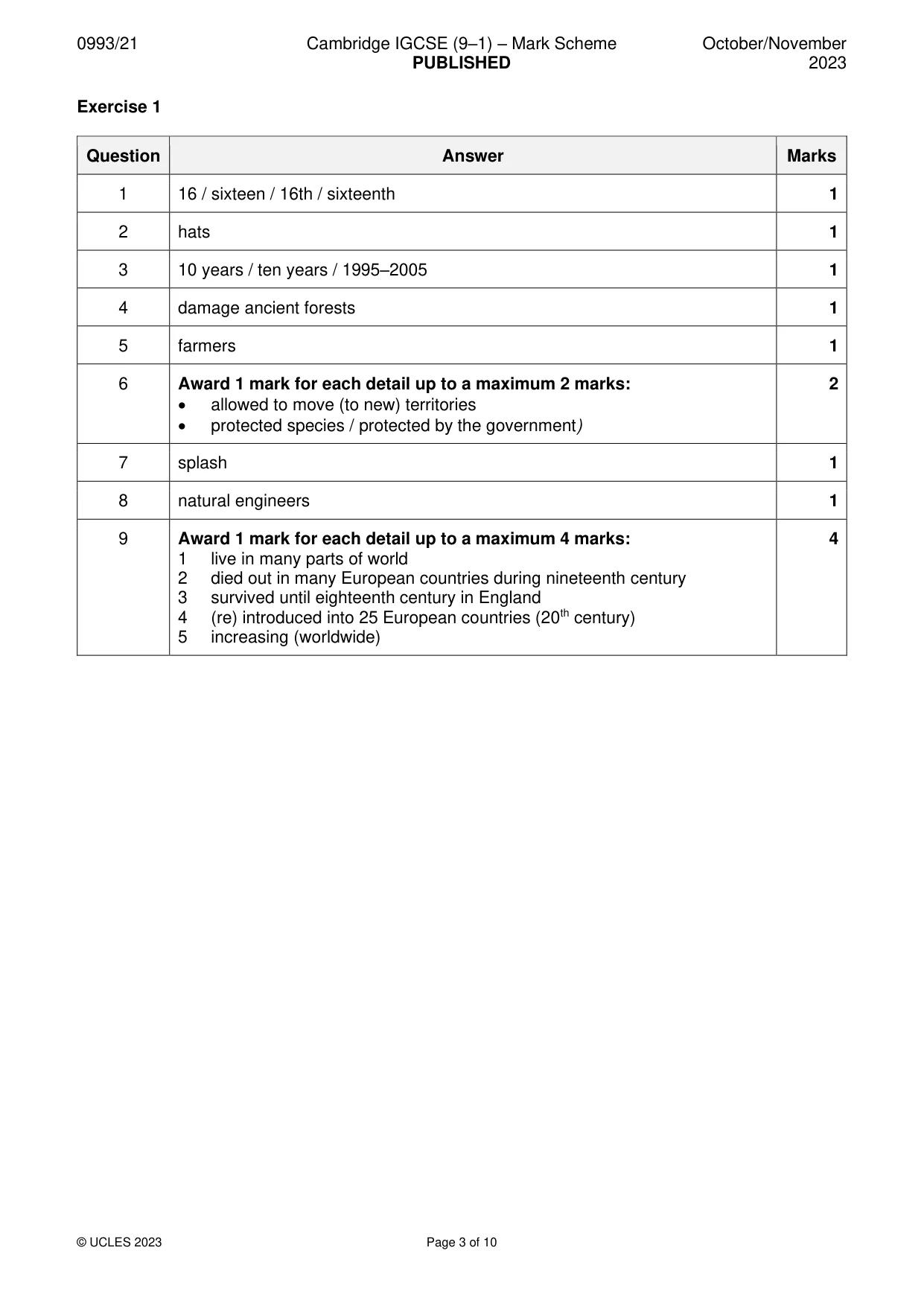
0993/21 Cambridge IGCSE (9–1) – Mark Scheme PUBLISHED October/November 2023 © UCLES 2023 Page 3 of 10 Exercise 1 Question Answer Marks 1 16 / sixteen / 16th / sixteenth 1 2 hats 1 3 10 years / ten years / 1995–2005 1 4 damage ancient forests 1 5 farmers 1 6 Award 1 mark for each detail up to a maximum 2 marks: • allowed to move (to new) territories • protected species / protected by the government) 2 7 splash 1 8 natural engineers 1 9 Award 1 mark for each detail up to a maximum 4 marks: 1 live in many parts of world 2 died out in many European countries during nineteenth century 3 survived until eighteenth century in England 4 (re) introduced into 25 European countries (20th century) 5 increasing (worldwide) 4
Mark scheme, page 4
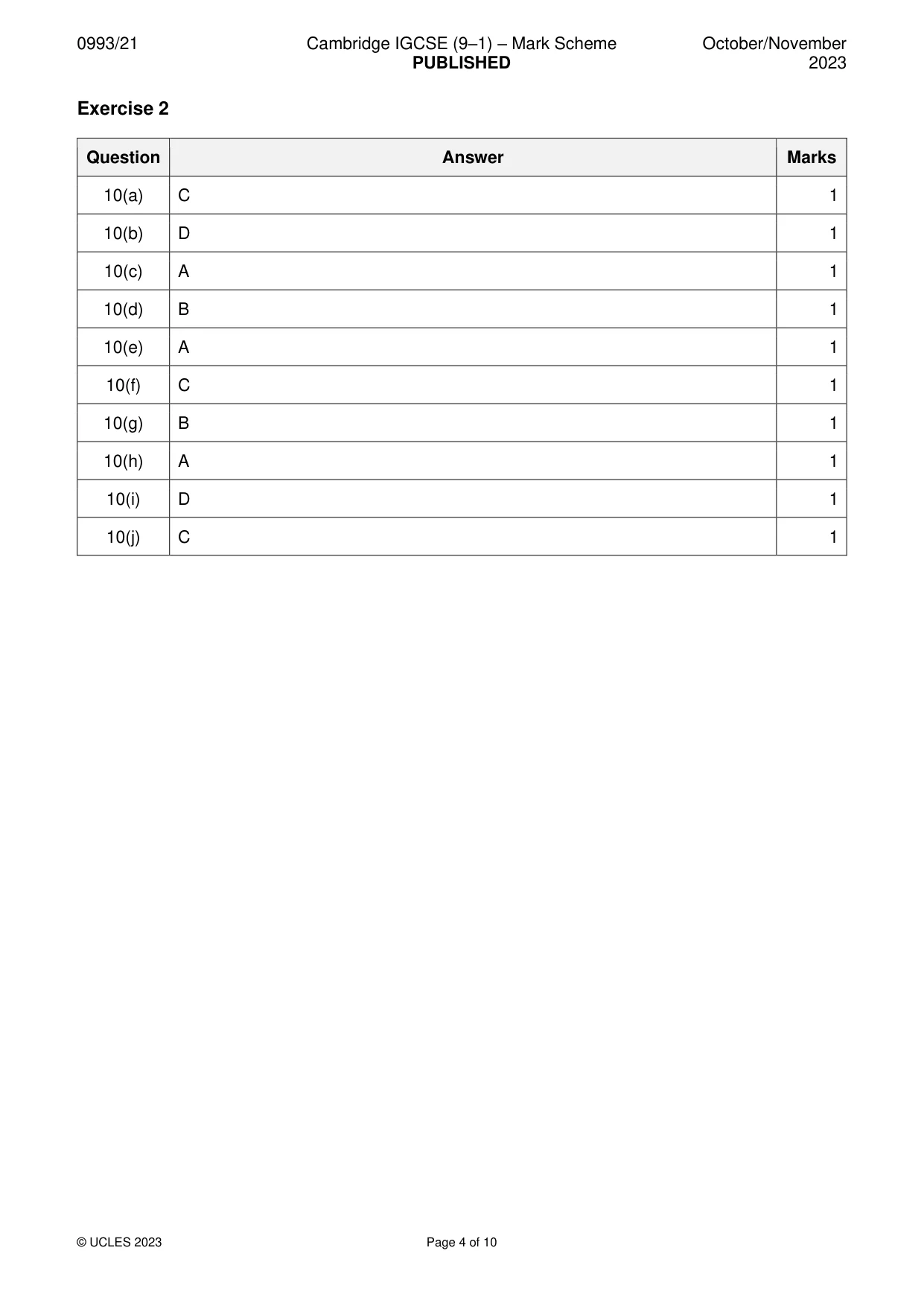
0993/21 Cambridge IGCSE (9–1) – Mark Scheme PUBLISHED October/November 2023 © UCLES 2023 Page 4 of 10 Exercise 2 Question Answer Marks 10(a) C 1 10(b) D 1 10(c) A 1 10(d) B 1 10(e) A 1 10(f) C 1 10(g) B 1 10(h) A 1 10(i) D 1 10(j) C 1
Mark scheme, page 5
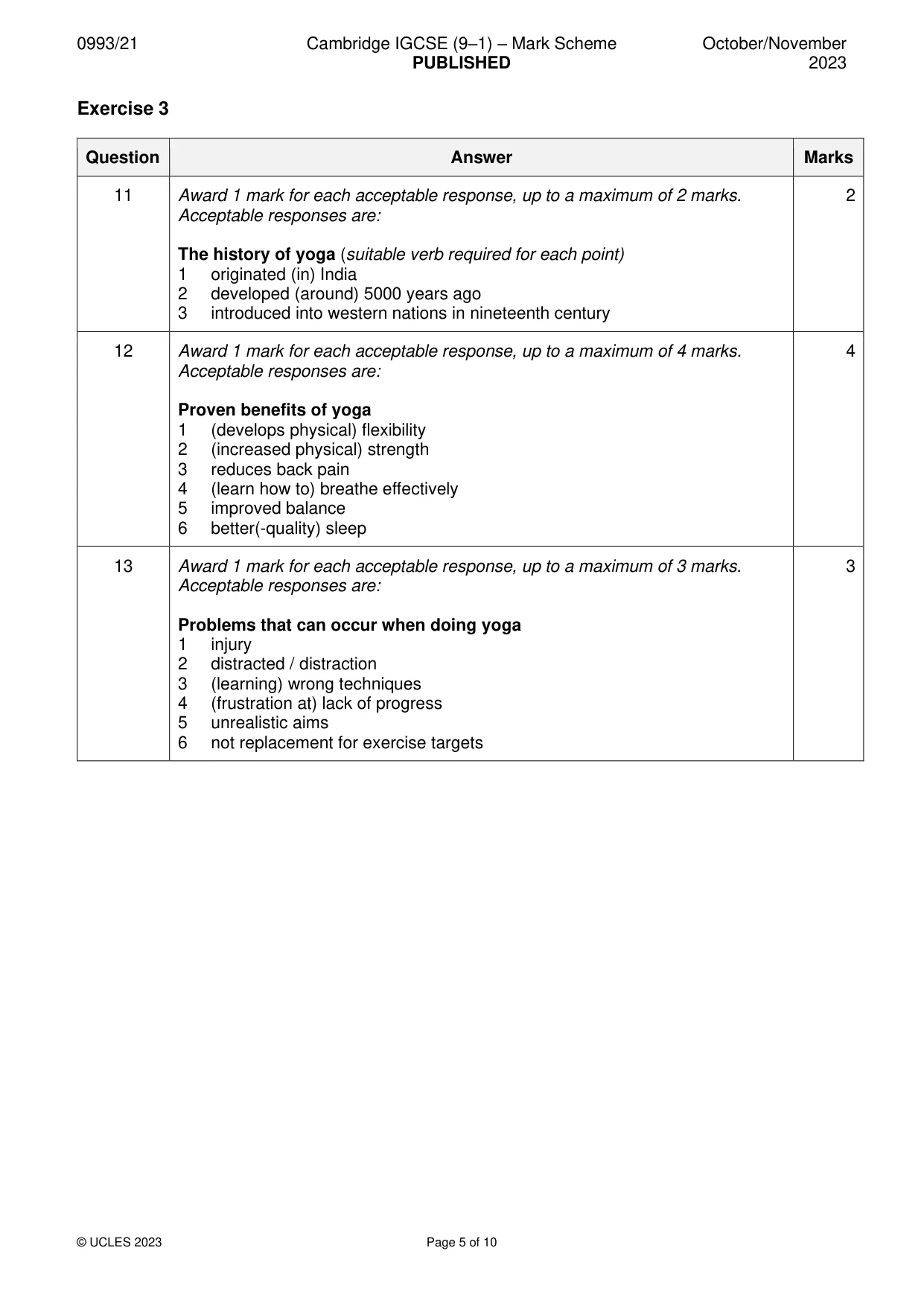
0993/21 Cambridge IGCSE (9–1) – Mark Scheme PUBLISHED October/November 2023 © UCLES 2023 Page 5 of 10 Exercise 3 Question Answer Marks 11 Award 1 mark for each acceptable response, up to a maximum of 2 marks. Acceptable responses are: The history of yoga (suitable verb required for each point) 1 originated (in) India 2 developed (around) 5000 years ago 3 introduced into western nations in nineteenth century 2 12 Award 1 mark for each acceptable response, up to a maximum of 4 marks. Acceptable responses are: Proven benefits of yoga 1 (develops physical) flexibility 2 (increased physical) strength 3 reduces back pain 4 (learn how to) breathe effectively 5 improved balance 6 better(-quality) sleep 4 13 Award 1 mark for each acceptable response, up to a maximum of 3 marks. Acceptable responses are: Problems that can occur when doing yoga 1 injury 2 distracted / distraction 3 (learning) wrong techniques 4 (frustration at) lack of progress 5 unrealistic aims 6 not replacement for exercise targets 3
Mark scheme, page 6
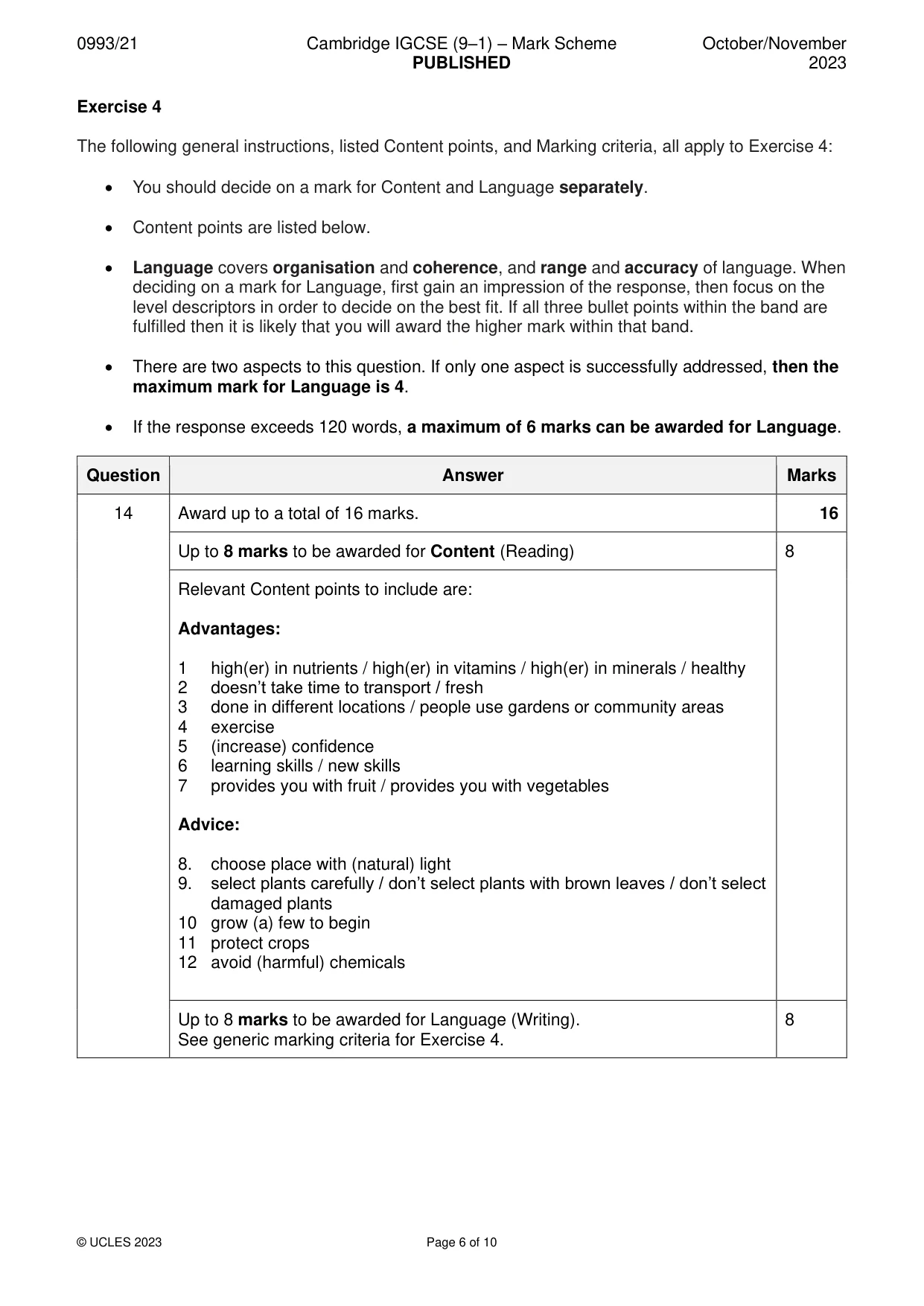
0993/21 Cambridge IGCSE (9–1) – Mark Scheme PUBLISHED October/November 2023 © UCLES 2023 Page 6 of 10 Exercise 4 The following general instructions, listed Content points, and Marking criteria, all apply to Exercise 4: • You should decide on a mark for Content and Language separately. • Content points are listed below. • Language covers organisation and coherence, and range and accuracy of language. When deciding on a mark for Language, first gain an impression of the response, then focus on the level descriptors in order to decide on the best fit. If all three bullet points within the band are fulfilled then it is likely that you will award the higher mark within that band. • There are two aspects to this question. If only one aspect is successfully addressed, then the maximum mark for Language is 4. • If the response exceeds 120 words, a maximum of 6 marks can be awarded for Language. Question Answer Marks 14 Award up to a total of 16 marks. 16 Up to 8 marks to be awarded for Content (Reading) 8 Relevant Content points to include are: Advantages: 1 high(er) in nutrients / high(er) in vitamins / high(er) in minerals / healthy 2 doesn’t take time to transport / fresh 3 done in different locations / people use gardens or community areas 4 exercise 5 (increase) confidence 6 learning skills / new skills 7 provides you with fruit / provides you with vegetables Advice: 8. choose place with (natural) light 9. select plants carefully / don’t select plants with brown leaves / don’t select damaged plants 10 grow (a) few to begin 11 protect crops 12 avoid (harmful) chemicals Up to 8 marks to be awarded for Language (Writing). See generic marking criteria for Exercise 4. 8
Mark scheme, page 7
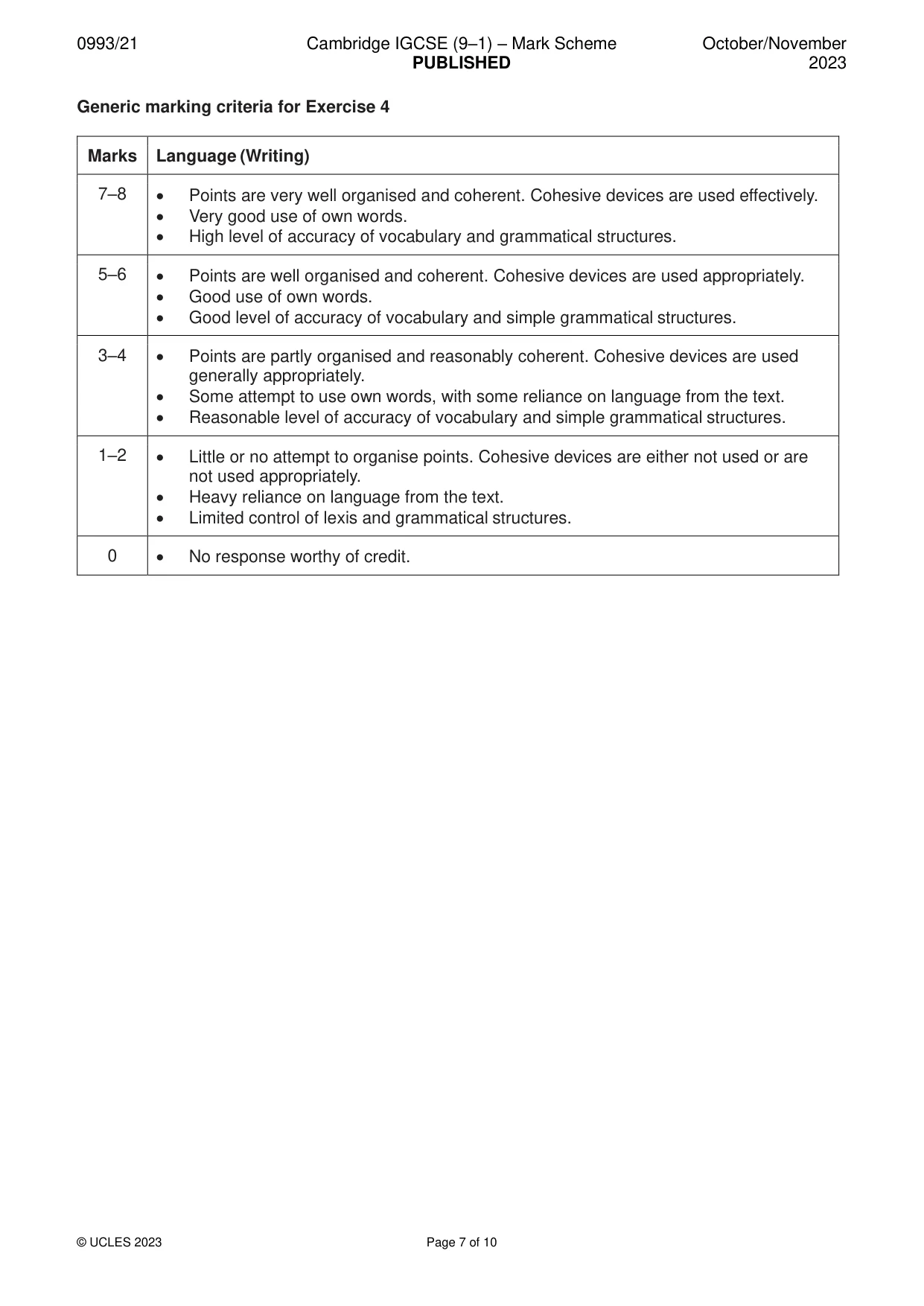
0993/21 Cambridge IGCSE (9–1) – Mark Scheme PUBLISHED October/November 2023 © UCLES 2023 Page 7 of 10 Generic marking criteria for Exercise 4 Marks Language (Writing) 7–8 • Points are very well organised and coherent. Cohesive devices are used effectively. • Very good use of own words. • High level of accuracy of vocabulary and grammatical structures. 5–6 • Points are well organised and coherent. Cohesive devices are used appropriately. • Good use of own words. • Good level of accuracy of vocabulary and simple grammatical structures. 3–4 • Points are partly organised and reasonably coherent. Cohesive devices are used generally appropriately. • Some attempt to use own words, with some reliance on language from the text. • Reasonable level of accuracy of vocabulary and simple grammatical structures. 1–2 • Little or no attempt to organise points. Cohesive devices are either not used or are not used appropriately. • Heavy reliance on language from the text. • Limited control of lexis and grammatical structures. 0 • No response worthy of credit.
Mark scheme, page 8
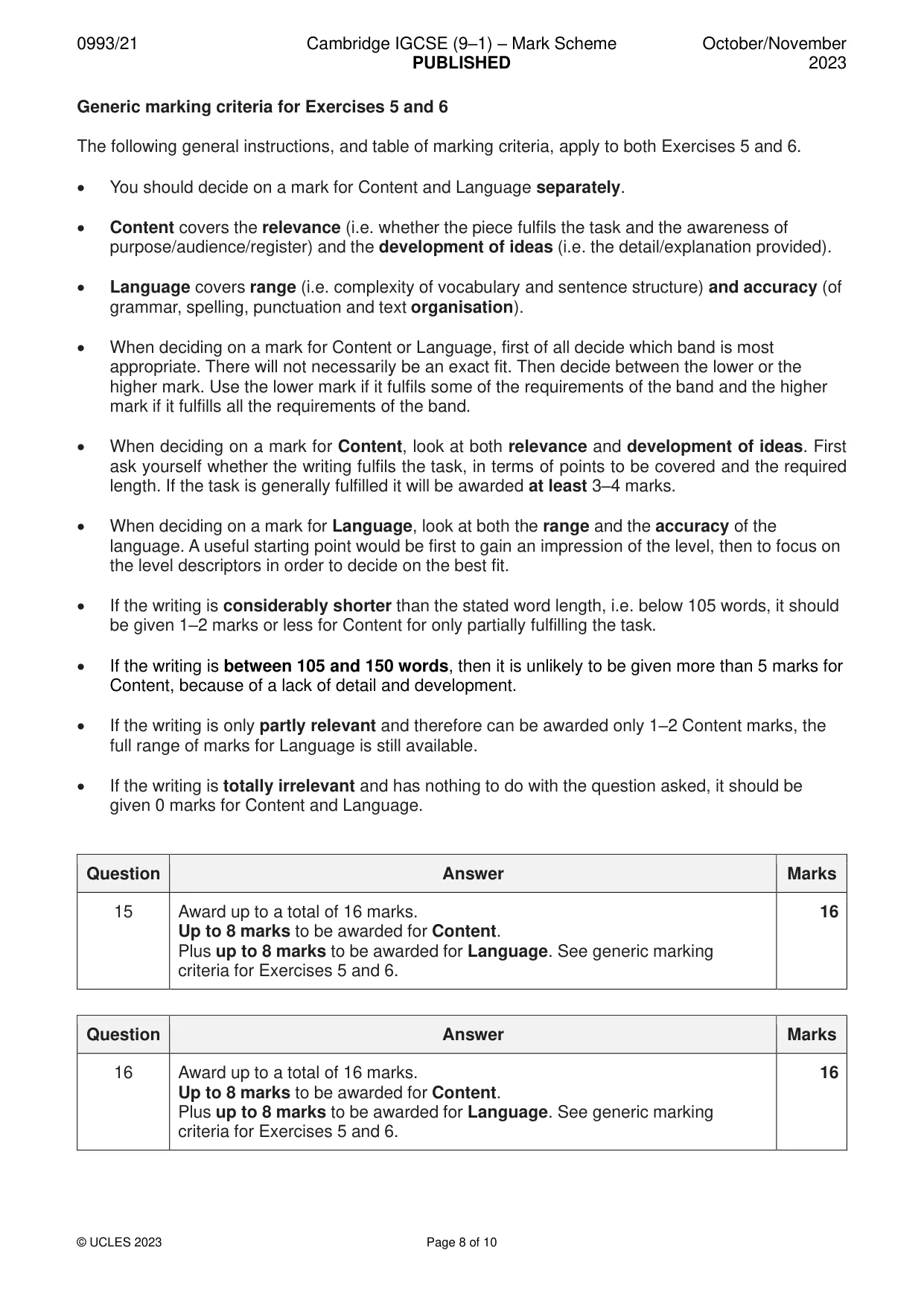
0993/21 Cambridge IGCSE (9–1) – Mark Scheme PUBLISHED October/November 2023 © UCLES 2023 Page 8 of 10 Generic marking criteria for Exercises 5 and 6 The following general instructions, and table of marking criteria, apply to both Exercises 5 and 6. • You should decide on a mark for Content and Language separately. • Content covers the relevance (i.e. whether the piece fulfils the task and the awareness of purpose/audience/register) and the development of ideas (i.e. the detail/explanation provided). • Language covers range (i.e. complexity of vocabulary and sentence structure) and accuracy (of grammar, spelling, punctuation and text organisation). • When deciding on a mark for Content or Language, first of all decide which band is most appropriate. There will not necessarily be an exact fit. Then decide between the lower or the higher mark. Use the lower mark if it fulfils some of the requirements of the band and the higher mark if it fulfills all the requirements of the band. • When deciding on a mark for Content, look at both relevance and development of ideas. First ask yourself whether the writing fulfils the task, in terms of points to be covered and the required length. If the task is generally fulfilled it will be awarded at least 3–4 marks. • When deciding on a mark for Language, look at both the range and the accuracy of the language. A useful starting point would be first to gain an impression of the level, then to focus on the level descriptors in order to decide on the best fit. • If the writing is considerably shorter than the stated word length, i.e. below 105 words, it should be given 1–2 marks or less for Content for only partially fulfilling the task. • If the writing is between 105 and 150 words, then it is unlikely to be given more than 5 marks for Content, because of a lack of detail and development. • If the writing is only partly relevant and therefore can be awarded only 1–2 Content marks, the full range of marks for Language is still available. • If the writing is totally irrelevant and has nothing to do with the question asked, it should be given 0 marks for Content and Language. Question Answer Marks 15 Award up to a total of 16 marks. Up to 8 marks to be awarded for Content. Plus up to 8 marks to be awarded for Language. See generic marking criteria for Exercises 5 and 6. 16 Question Answer Marks 16 Award up to a total of 16 marks. Up to 8 marks to be awarded for Content. Plus up to 8 marks to be awarded for Language. See generic marking criteria for Exercises 5 and 6. 16
Mark scheme, page 9
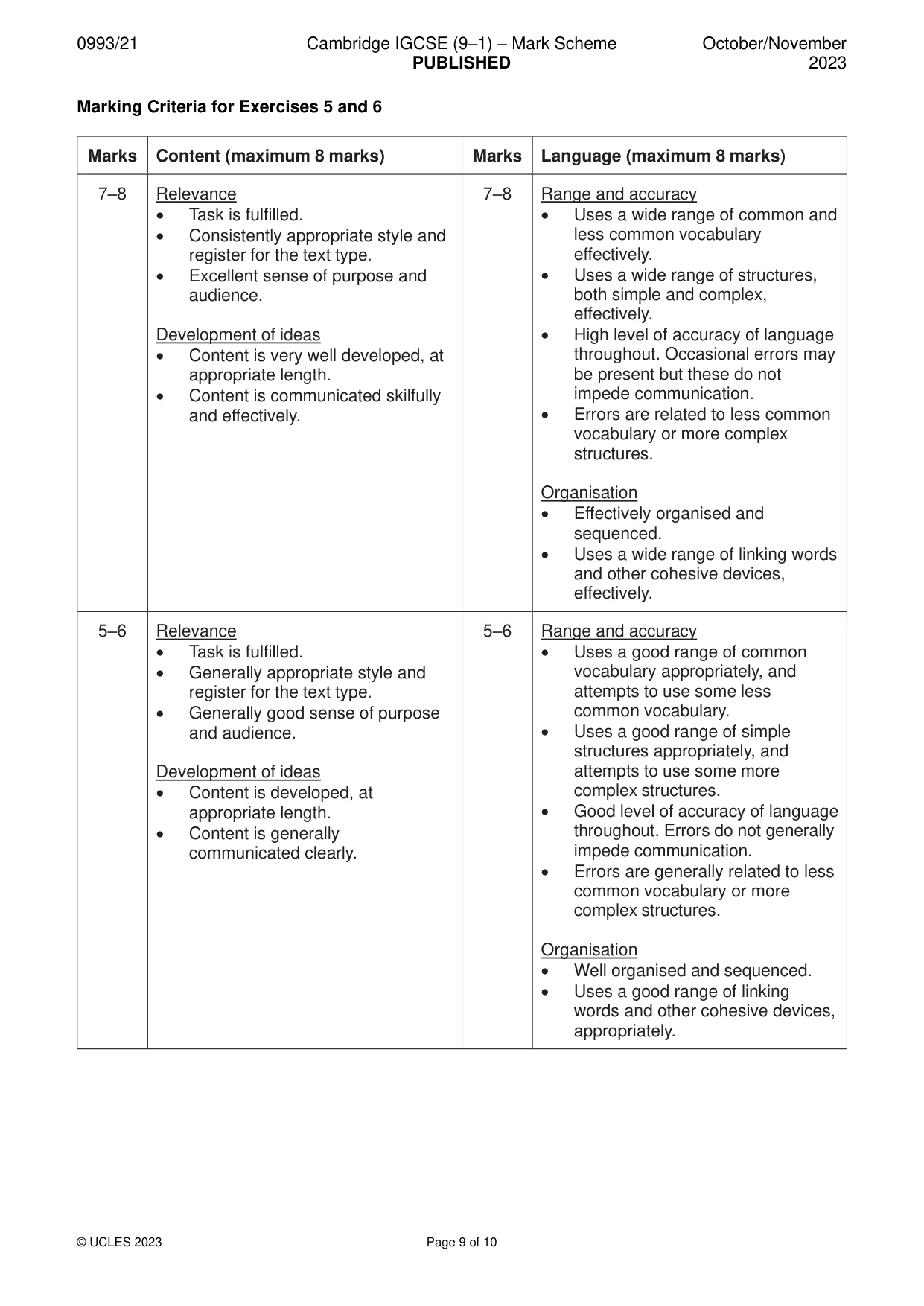
0993/21 Cambridge IGCSE (9–1) – Mark Scheme PUBLISHED October/November 2023 © UCLES 2023 Page 9 of 10 Marking Criteria for Exercises 5 and 6 Marks Content (maximum 8 marks) Marks Language (maximum 8 marks) 7–8 Relevance • Task is fulfilled. • Consistently appropriate style and register for the text type. • Excellent sense of purpose and audience. Development of ideas • Content is very well developed, at appropriate length. • Content is communicated skilfully and effectively. 7–8 Range and accuracy • Uses a wide range of common and less common vocabulary effectively. • Uses a wide range of structures, both simple and complex, effectively. • High level of accuracy of language throughout. Occasional errors may be present but these do not impede communication. • Errors are related to less common vocabulary or more complex structures. Organisation • Effectively organised and sequenced. • Uses a wide range of linking words and other cohesive devices, effectively. 5–6 Relevance • Task is fulfilled. • Generally appropriate style and register for the text type. • Generally good sense of purpose and audience. Development of ideas • Content is developed, at appropriate length. • Content is generally communicated clearly. 5–6 Range and accuracy • Uses a good range of common vocabulary appropriately, and attempts to use some less common vocabulary. • Uses a good range of simple structures appropriately, and attempts to use some more complex structures. • Good level of accuracy of language throughout. Errors do not generally impede communication. • Errors are generally related to less common vocabulary or more complex structures. Organisation • Well organised and sequenced. • Uses a good range of linking words and other cohesive devices, appropriately.
Mark scheme, page 10
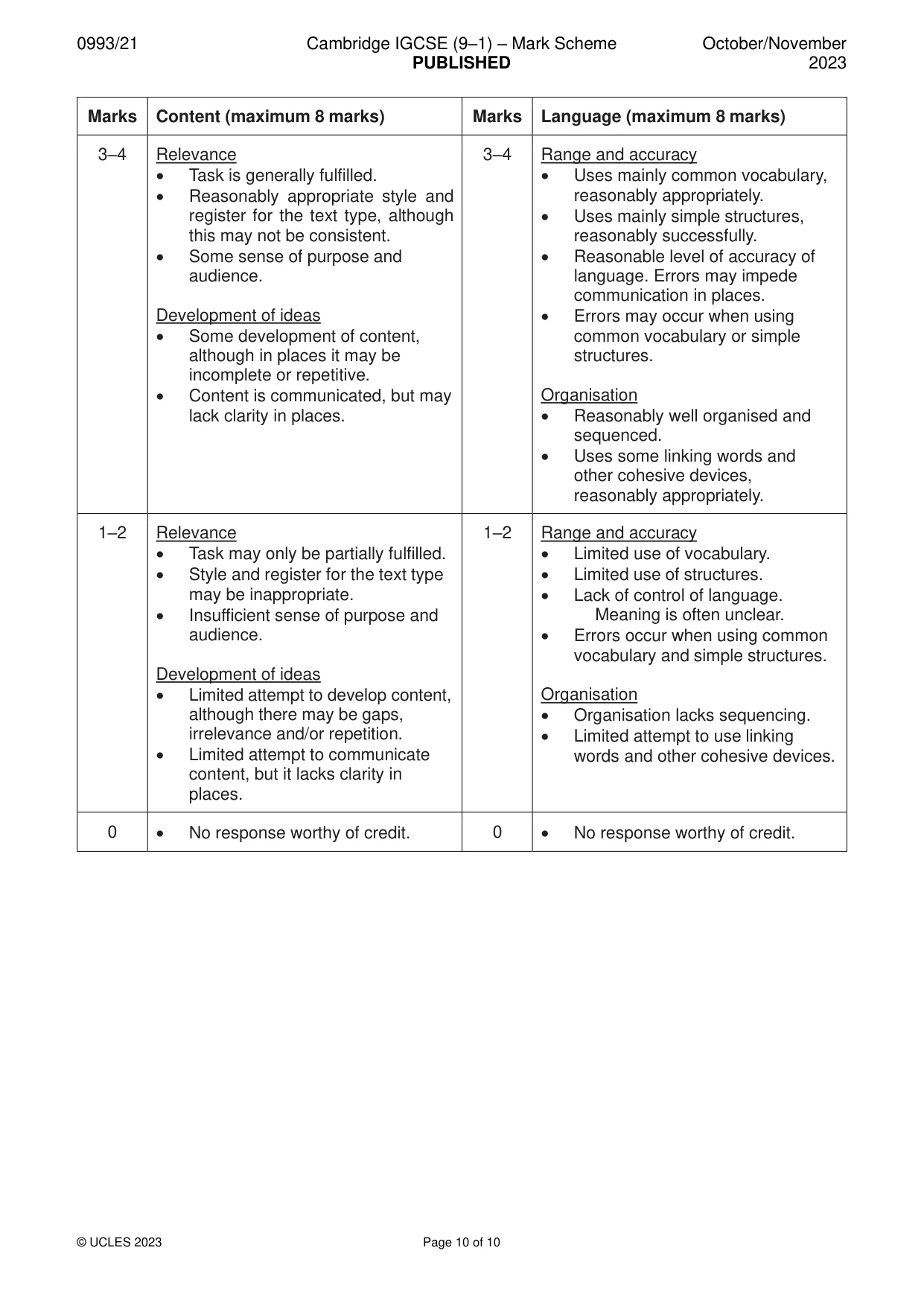
0993/21 Cambridge IGCSE (9–1) – Mark Scheme PUBLISHED October/November 2023 © UCLES 2023 Page 10 of 10 Marks Content (maximum 8 marks) Marks Language (maximum 8 marks) 3–4 Relevance • Task is generally fulfilled. • Reasonably appropriate style and register for the text type, although this may not be consistent. • Some sense of purpose and audience. Development of ideas • Some development of content, although in places it may be incomplete or repetitive. • Content is communicated, but may lack clarity in places. 3–4 Range and accuracy • Uses mainly common vocabulary, reasonably appropriately. • Uses mainly simple structures, reasonably successfully. • Reasonable level of accuracy of language. Errors may impede communication in places. • Errors may occur when using common vocabulary or simple structures. Organisation • Reasonably well organised and sequenced. • Uses some linking words and other cohesive devices, reasonably appropriately. 1–2 Relevance • Task may only be partially fulfilled. • Style and register for the text type may be inappropriate. • Insufficient sense of purpose and audience. Development of ideas • Limited attempt to develop content, although there may be gaps, irrelevance and/or repetition. • Limited attempt to communicate content, but it lacks clarity in places. 1–2 Range and accuracy • Limited use of vocabulary. • Limited use of structures. • Lack of control of language. Meaning is often unclear. • Errors occur when using common vocabulary and simple structures. Organisation • Organisation lacks sequencing. • Limited attempt to use linking words and other cohesive devices. 0 • No response worthy of credit. 0 • No response worthy of credit.
What you needed in this session
Cambridge’s own grade thresholds for 2023 Oct/Nov, Paper 2 · Variant 1. A higher threshold means an easier paper — the bar moves with how the cohort did.