Cambridge IGCSE English Second Language (Speaking Endorsement) (9-1) 0993 — 2021 Oct/Nov Paper 4 · Variant 1
0993/41/O/N/21 · 40 marks · ≈45 min
The question paper and its mark scheme, free to read here and free to download. This is Cambridge’s own paper, exactly as it was sat.
Question paper12 pages




Mark scheme5 pages
Answers below. Sit the paper first if you are practising.
Paper as text
Question paper, page 1
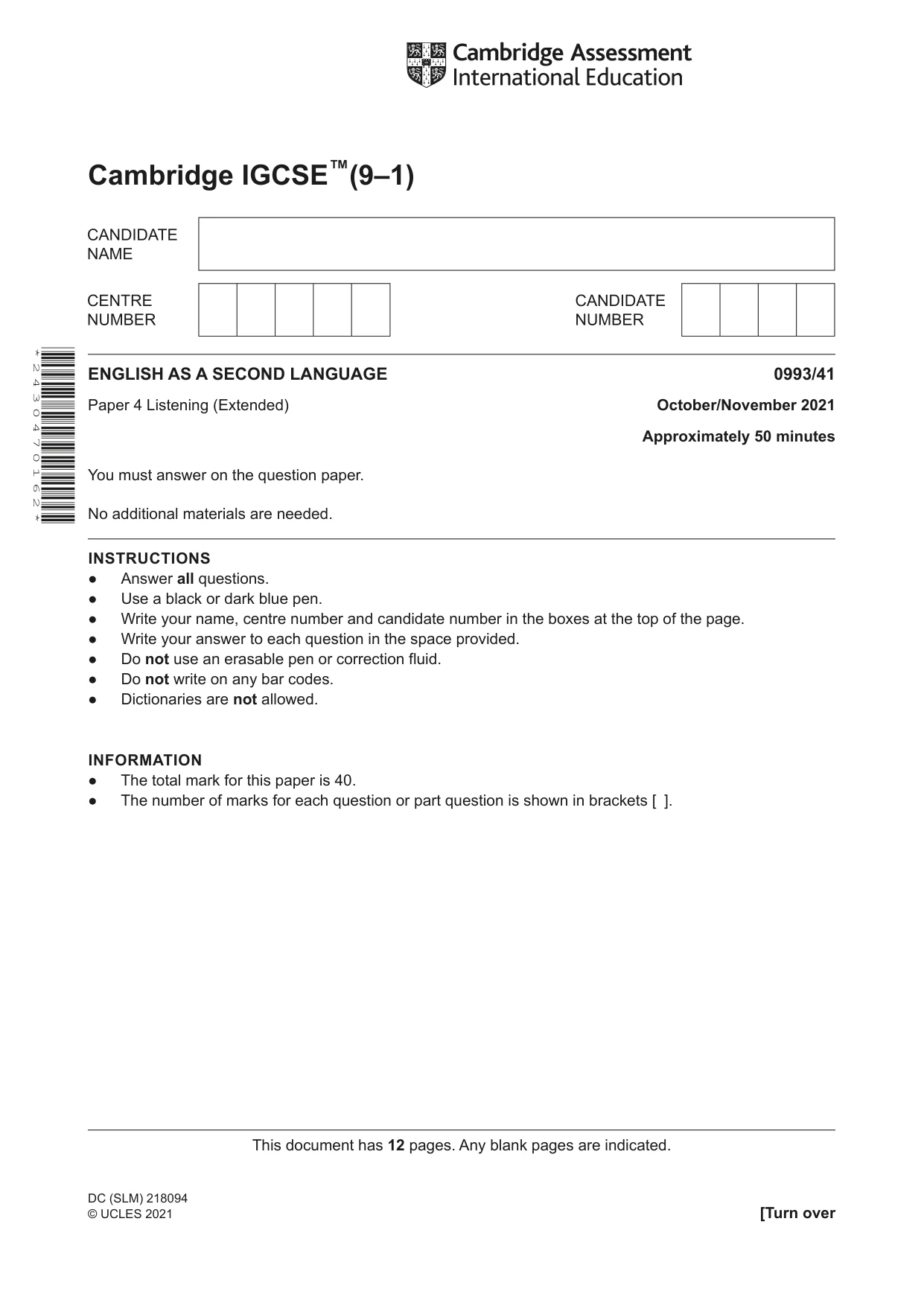
This document has 12 pages. Any blank pages are indicated. Cambridge IGCSE™(9–1) ENGLISH AS A SECOND LANGUAGE 0993/41 Paper 4 Listening (Extended) October/November 2021 Approximately 50 minutes You must answer on the question paper. No additional materials are needed. INSTRUCTIONS ● Answer all questions. ● Use a black or dark blue pen. ● Write your name, centre number and candidate number in the boxes at the top of the page. ● Write your answer to each question in the space provided. ● Do not use an erasable pen or correction fluid. ● Do not write on any bar codes. ● Dictionaries are not allowed. INFORMATION ● The total mark for this paper is 40. ● The number of marks for each question or part question is shown in brackets [ ]. * 2 4 3 0 4 7 0 1 6 2 * DC (SLM) 218094 © UCLES 2021 [Turn over
Question paper, page 2
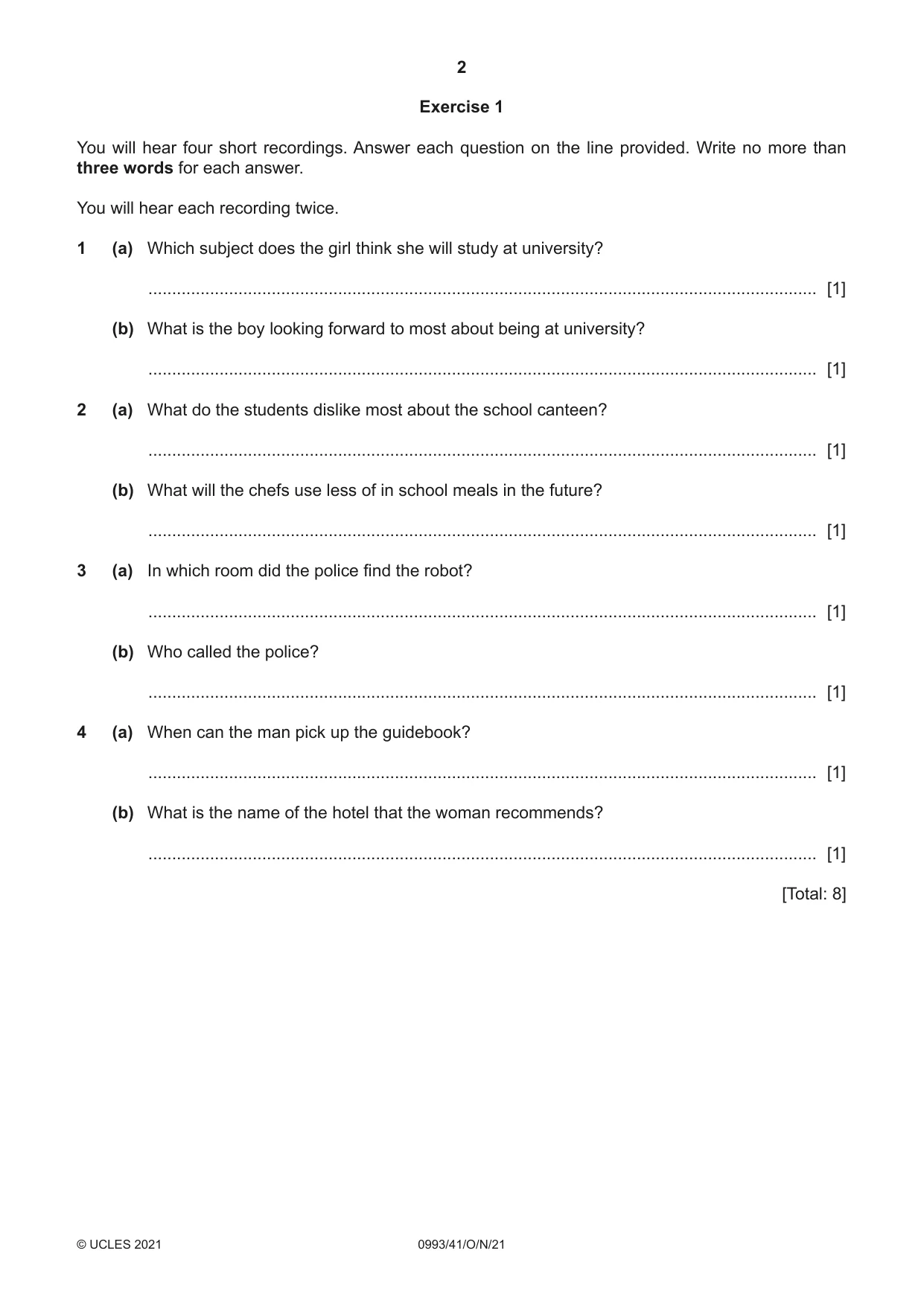
2 0993/41/O/N/21 © UCLES 2021 Exercise 1 You will hear four short recordings. Answer each question on the line provided. Write no more than three words for each answer. You will hear each recording twice. 1 (a) Which subject does the girl think she will study at university? … [1] (b) What is the boy looking forward to most about being at university? … [1] 2 (a) What do the students dislike most about the school canteen? … [1] (b) What will the chefs use less of in school meals in the future? … [1] 3 (a) In which room did the police find the robot? … [1] (b) Who called the police? … [1] 4 (a) When can the man pick up the guidebook? … [1] (b) What is the name of the hotel that the woman recommends? … [1] [Total: 8]
Question paper, page 3
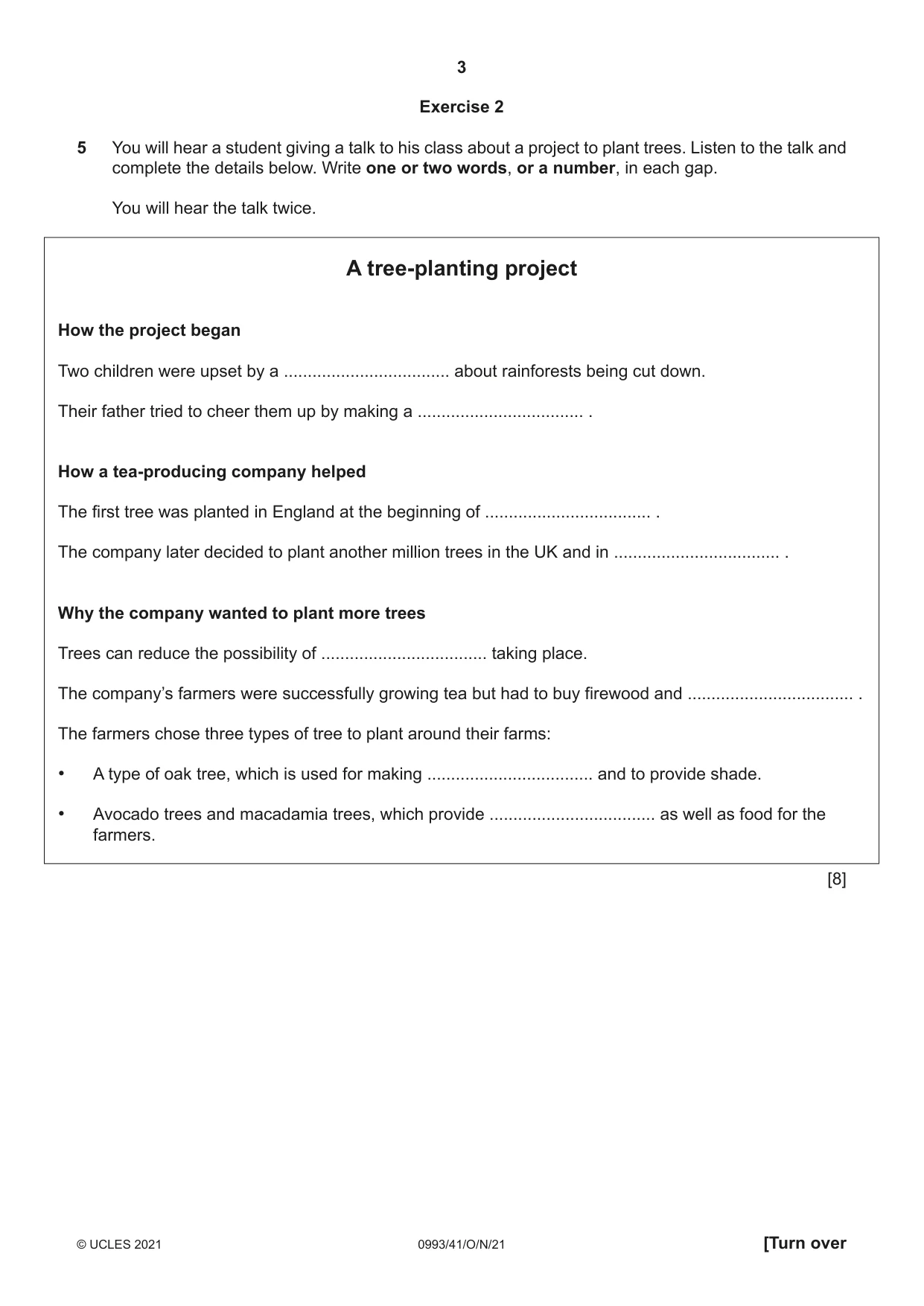
3 0993/41/O/N/21 © UCLES 2021 [Turn over Exercise 2 5 You will hear a student giving a talk to his class about a project to plant trees. Listen to the talk and complete the details below. Write one or two words, or a number, in each gap. You will hear the talk twice. A tree-planting project How the project began Two children were upset by a … about rainforests being cut down. Their father tried to cheer them up by making a … . How a tea-producing company helped The first tree was planted in England at the beginning of … . The company later decided to plant another million trees in the UK and in … . Why the company wanted to plant more trees Trees can reduce the possibility of … taking place. The company’s farmers were successfully growing tea but had to buy firewood and … . The farmers chose three types of tree to plant around their farms: • A type of oak tree, which is used for making … and to provide shade. • Avocado trees and macadamia trees, which provide … as well as food for the farmers. [8]
Question paper, page 4
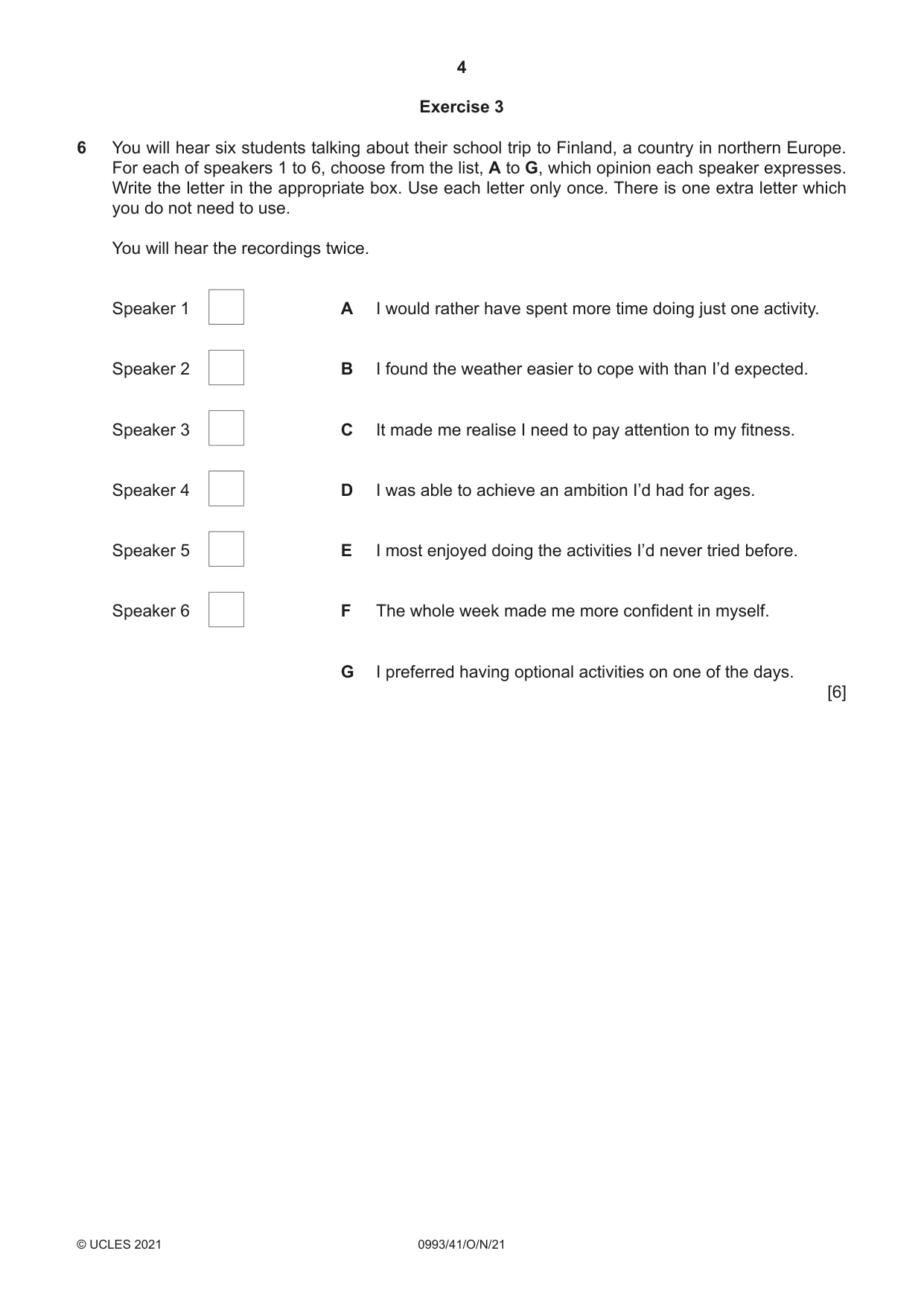
4 0993/41/O/N/21 © UCLES 2021 Exercise 3 6 You will hear six students talking about their school trip to Finland, a country in northern Europe. For each of speakers 1 to 6, choose from the list, A to G, which opinion each speaker expresses. Write the letter in the appropriate box. Use each letter only once. There is one extra letter which you do not need to use. You will hear the recordings twice. Speaker 1 A I would rather have spent more time doing just one activity. Speaker 2 B I found the weather easier to cope with than I’d expected. Speaker 3 C It made me realise I need to pay attention to my fitness. Speaker 4 D I was able to achieve an ambition I’d had for ages. Speaker 5 E I most enjoyed doing the activities I’d never tried before. Speaker 6 F The whole week made me more confident in myself. G I preferred having optional activities on one of the days. [6]
Question paper, page 5
5 0993/41/O/N/21 © UCLES 2021 [Turn over Please turn over for Exercise 4.
Question paper, page 6
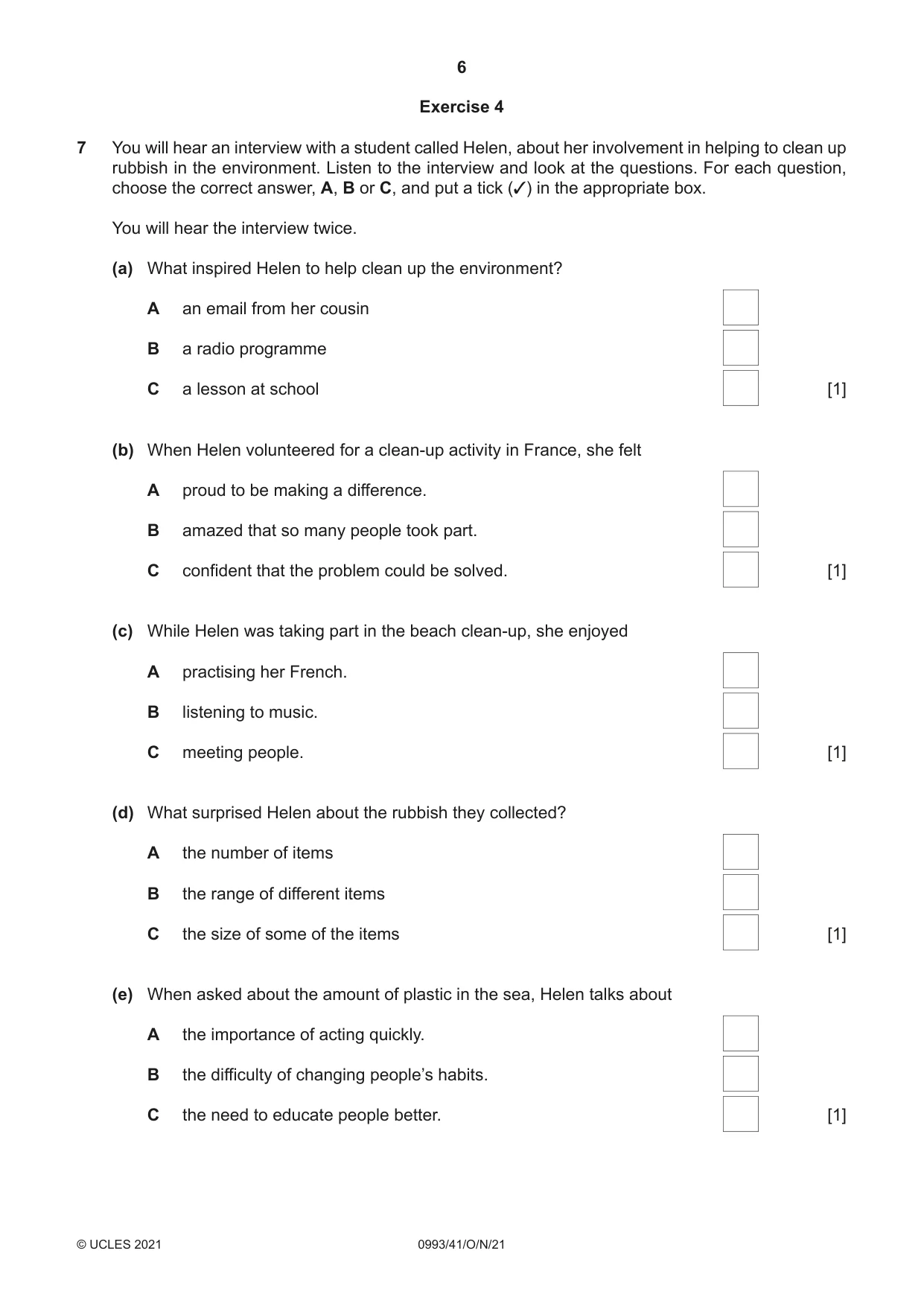
6 0993/41/O/N/21 © UCLES 2021 Exercise 4 7 You will hear an interview with a student called Helen, about her involvement in helping to clean up rubbish in the environment. Listen to the interview and look at the questions. For each question, choose the correct answer, A, B or C, and put a tick (3) in the appropriate box. You will hear the interview twice. (a) What inspired Helen to help clean up the environment? A an email from her cousin B a radio programme C a lesson at school [1] (b) When Helen volunteered for a clean-up activity in France, she felt A proud to be making a difference. B amazed that so many people took part. C confident that the problem could be solved. [1] (c) While Helen was taking part in the beach clean-up, she enjoyed A practising her French. B listening to music. C meeting people. [1] (d) What surprised Helen about the rubbish they collected? A the number of items B the range of different items C the size of some of the items [1] (e) When asked about the amount of plastic in the sea, Helen talks about A the importance of acting quickly. B the difficulty of changing people’s habits. C the need to educate people better. [1]
Question paper, page 7
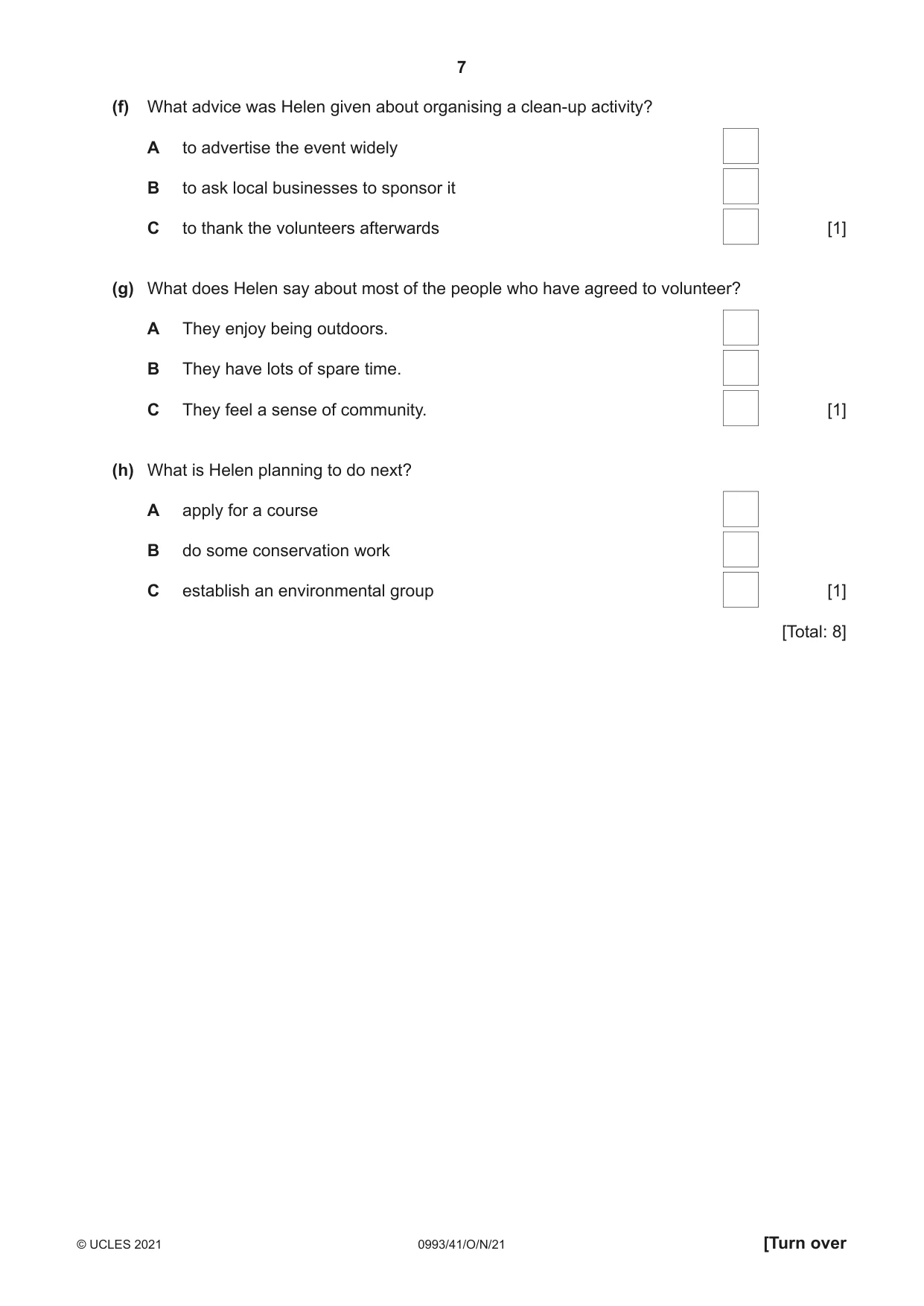
7 0993/41/O/N/21 © UCLES 2021 [Turn over (f) What advice was Helen given about organising a clean-up activity? A to advertise the event widely B to ask local businesses to sponsor it C to thank the volunteers afterwards [1] (g) What does Helen say about most of the people who have agreed to volunteer? A They enjoy being outdoors. B They have lots of spare time. C They feel a sense of community. [1] (h) What is Helen planning to do next? A apply for a course B do some conservation work C establish an environmental group [1] [Total: 8]
Question paper, page 8
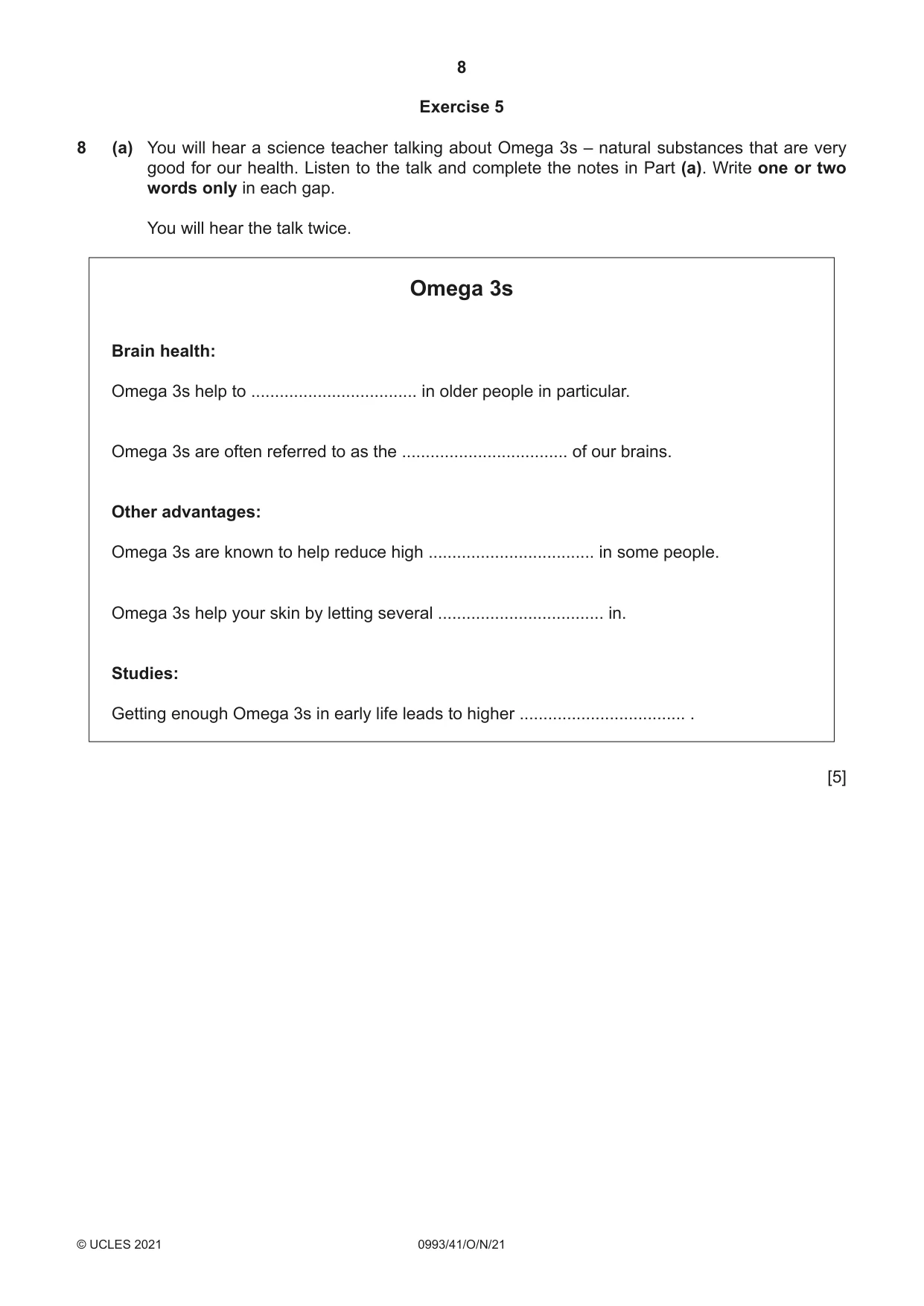
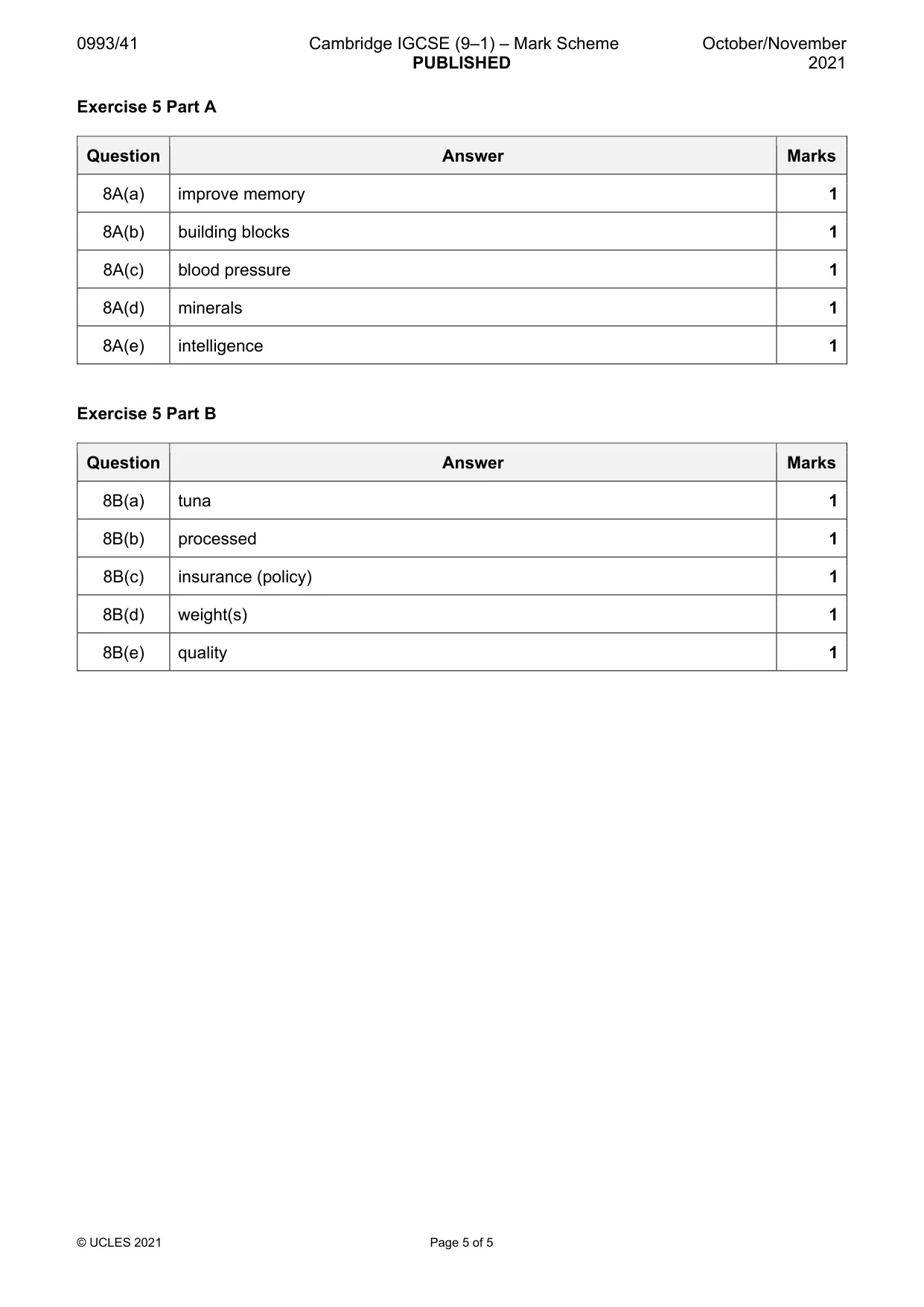
8 0993/41/O/N/21 © UCLES 2021 Exercise 5 8 (a) You will hear a science teacher talking about Omega 3s – natural substances that are very good for our health. Listen to the talk and complete the notes in Part (a). Write one or two words only in each gap. You will hear the talk twice. Omega 3s Brain health: Omega 3s help to … in older people in particular. Omega 3s are often referred to as the … of our brains. Other advantages: Omega 3s are known to help reduce high … in some people. Omega 3s help your skin by letting several … in. Studies: Getting enough Omega 3s in early life leads to higher … . [5]
Question paper, page 9
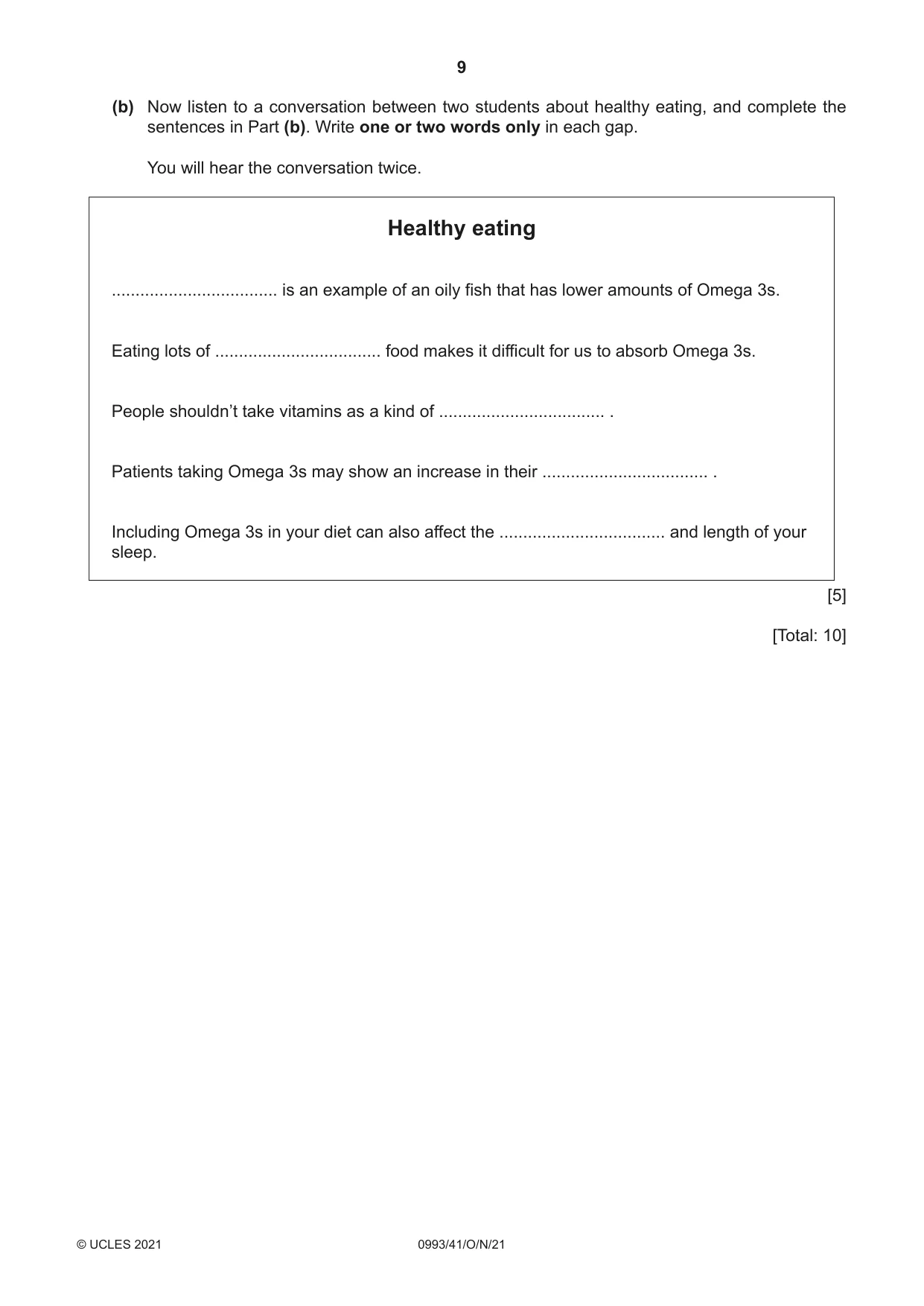
9 0993/41/O/N/21 © UCLES 2021 (b) Now listen to a conversation between two students about healthy eating, and complete the sentences in Part (b). Write one or two words only in each gap. You will hear the conversation twice. Healthy eating … is an example of an oily fish that has lower amounts of Omega 3s. Eating lots of … food makes it difficult for us to absorb Omega 3s. People shouldn’t take vitamins as a kind of … . Patients taking Omega 3s may show an increase in their … . Including Omega 3s in your diet can also affect the … and length of your sleep. [5] [Total: 10]
Question paper, page 10
10 0993/41/O/N/21 © UCLES 2021 BLANK PAGE
Question paper, page 11
11 0993/41/O/N/21 © UCLES 2021 BLANK PAGE
Question paper, page 12
12 0993/41/O/N/21 © UCLES 2021 Permission to reproduce items where third-party owned material protected by copyright is included has been sought and cleared where possible. Every reasonable effort has been made by the publisher (UCLES) to trace copyright holders, but if any items requiring clearance have unwittingly been included, the publisher will be pleased to make amends at the earliest possible opportunity. To avoid the issue of disclosure of answer-related information to candidates, all copyright acknowledgements are reproduced online in the Cambridge Assessment International Education Copyright Acknowledgements Booklet. This is produced for each series of examinations and is freely available to download at www.cambridgeinternational.org after the live examination series. Cambridge Assessment International Education is part of the Cambridge Assessment Group. Cambridge Assessment is the brand name of the University of Cambridge Local Examinations Syndicate (UCLES), which itself is a department of the University of Cambridge. BLANK PAGE
Mark scheme, page 1
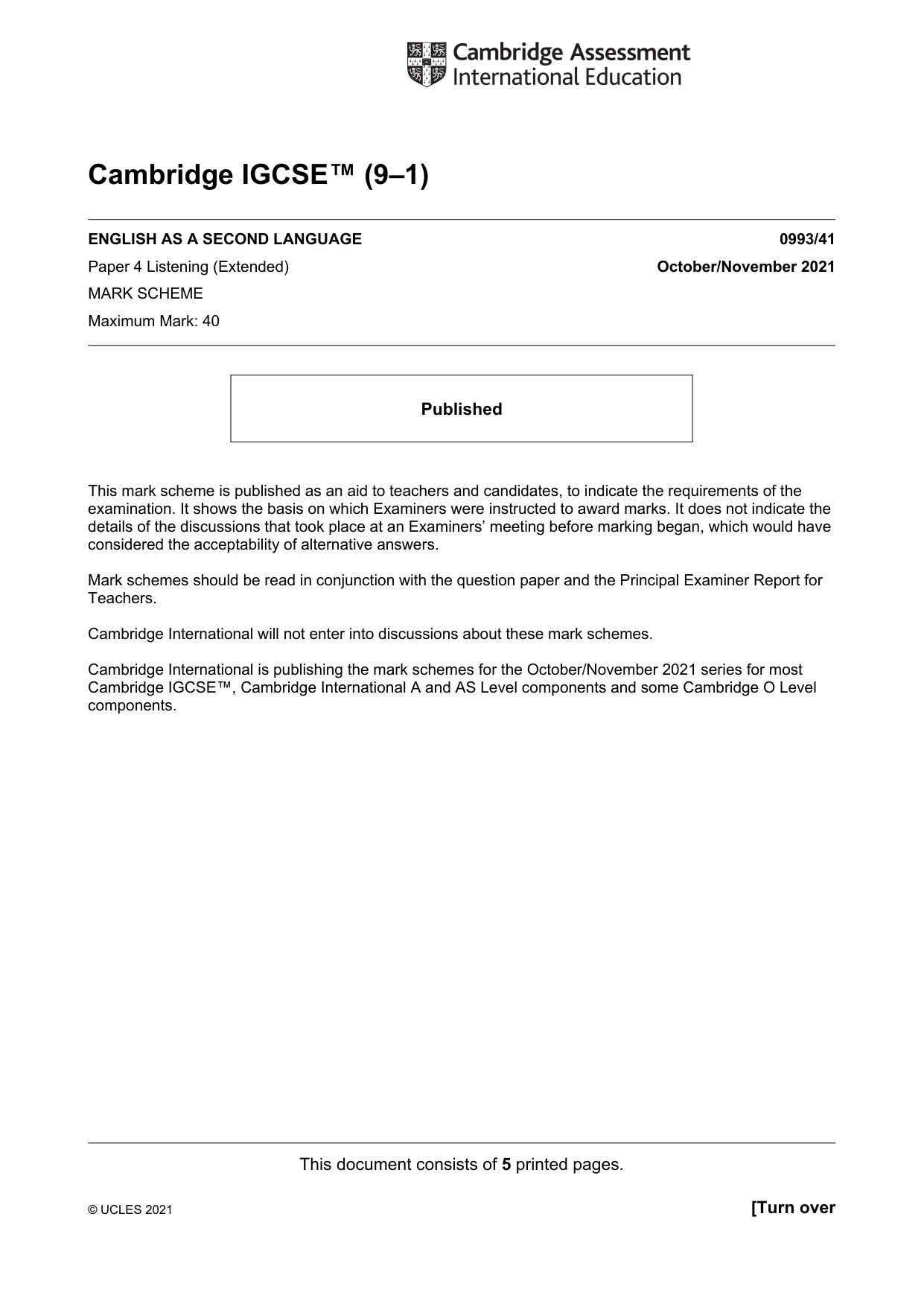
This document consists of 5 printed pages. © UCLES 2021 [Turn over Cambridge IGCSE™ (9–1) ENGLISH AS A SECOND LANGUAGE 0993/41 Paper 4 Listening (Extended) October/November 2021 MARK SCHEME Maximum Mark: 40 Published This mark scheme is published as an aid to teachers and candidates, to indicate the requirements of the examination. It shows the basis on which Examiners were instructed to award marks. It does not indicate the details of the discussions that took place at an Examiners’ meeting before marking began, which would have considered the acceptability of alternative answers. Mark schemes should be read in conjunction with the question paper and the Principal Examiner Report for Teachers. Cambridge International will not enter into discussions about these mark schemes. Cambridge International is publishing the mark schemes for the October/November 2021 series for most Cambridge IGCSE™, Cambridge International A and AS Level components and some Cambridge O Level components.
Mark scheme, page 2
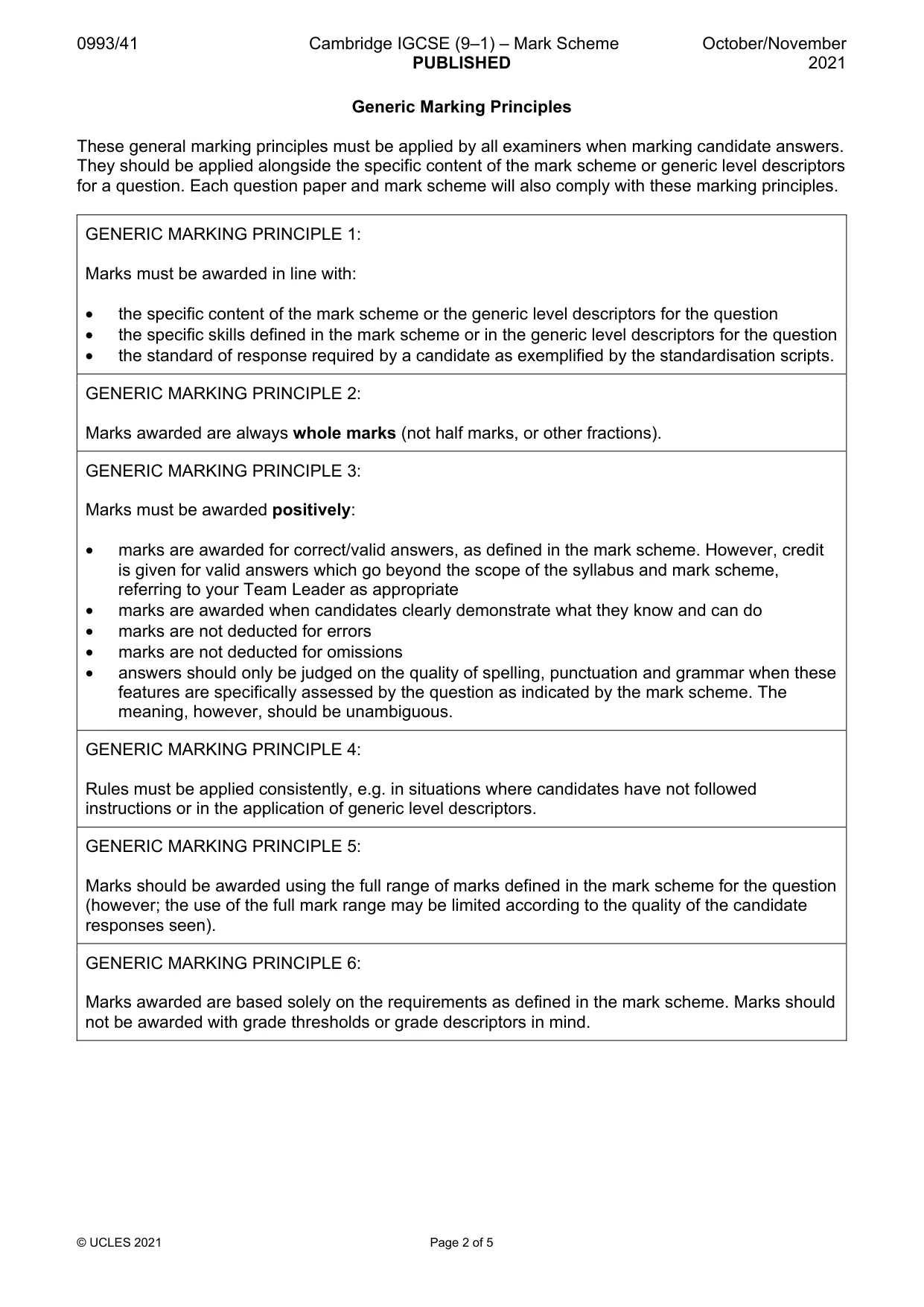
0993/41 Cambridge IGCSE (9–1) – Mark Scheme PUBLISHED October/November 2021 © UCLES 2021 Page 2 of 5 Generic Marking Principles These general marking principles must be applied by all examiners when marking candidate answers. They should be applied alongside the specific content of the mark scheme or generic level descriptors for a question. Each question paper and mark scheme will also comply with these marking principles. GENERIC MARKING PRINCIPLE 1: Marks must be awarded in line with: • the specific content of the mark scheme or the generic level descriptors for the question • the specific skills defined in the mark scheme or in the generic level descriptors for the question • the standard of response required by a candidate as exemplified by the standardisation scripts. GENERIC MARKING PRINCIPLE 2: Marks awarded are always whole marks (not half marks, or other fractions). GENERIC MARKING PRINCIPLE 3: Marks must be awarded positively: • marks are awarded for correct/valid answers, as defined in the mark scheme. However, credit is given for valid answers which go beyond the scope of the syllabus and mark scheme, referring to your Team Leader as appropriate • marks are awarded when candidates clearly demonstrate what they know and can do • marks are not deducted for errors • marks are not deducted for omissions • answers should only be judged on the quality of spelling, punctuation and grammar when these features are specifically assessed by the question as indicated by the mark scheme. The meaning, however, should be unambiguous. GENERIC MARKING PRINCIPLE 4: Rules must be applied consistently, e.g. in situations where candidates have not followed instructions or in the application of generic level descriptors. GENERIC MARKING PRINCIPLE 5: Marks should be awarded using the full range of marks defined in the mark scheme for the question (however; the use of the full mark range may be limited according to the quality of the candidate responses seen). GENERIC MARKING PRINCIPLE 6: Marks awarded are based solely on the requirements as defined in the mark scheme. Marks should not be awarded with grade thresholds or grade descriptors in mind.
Mark scheme, page 3
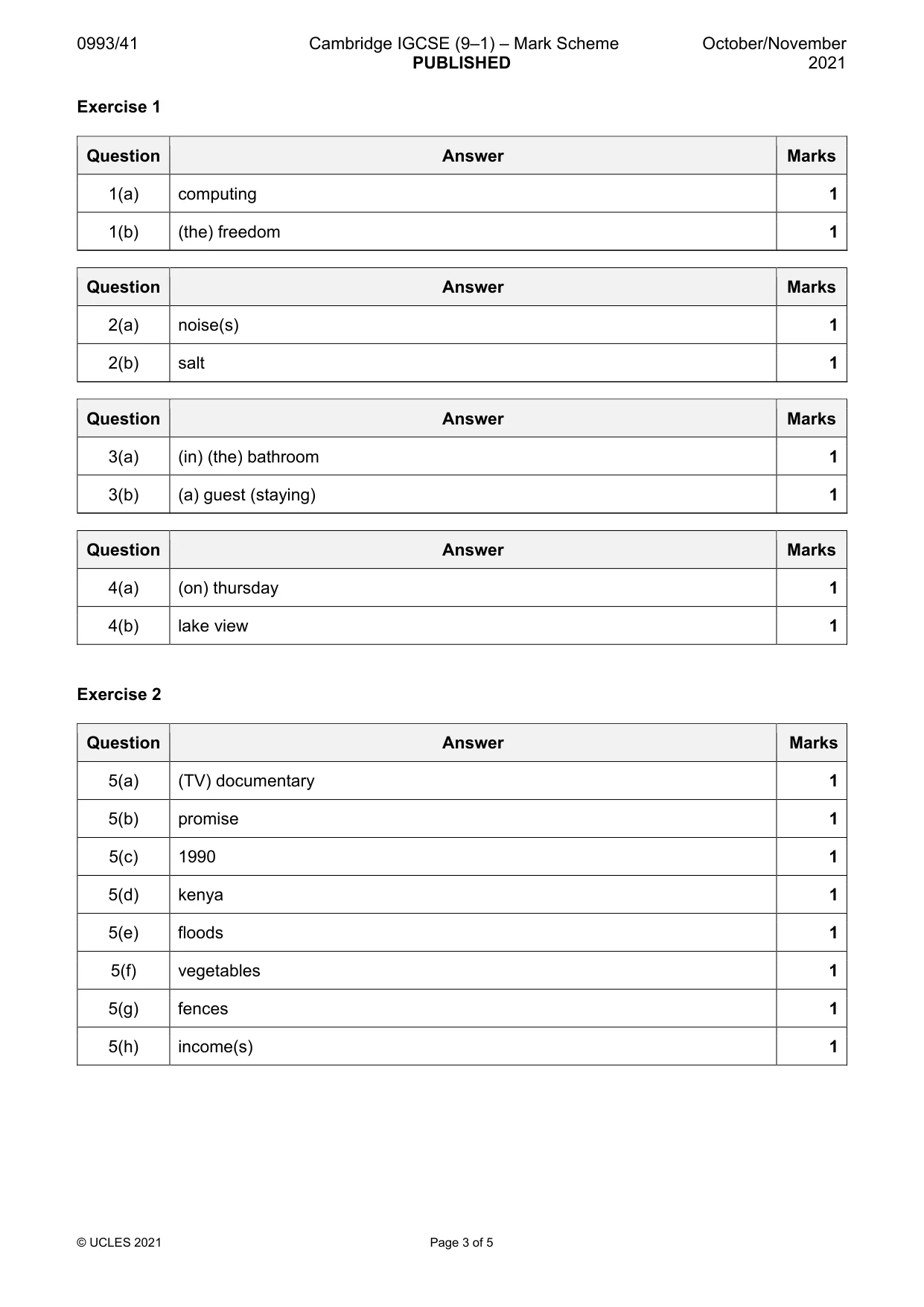
0993/41 Cambridge IGCSE (9–1) – Mark Scheme PUBLISHED October/November 2021 © UCLES 2021 Page 3 of 5 Exercise 1 Question Answer Marks 1(a) computing 1 1(b) (the) freedom 1 Question Answer Marks 2(a) noise(s) 1 2(b) salt 1 Question Answer Marks 3(a) (in) (the) bathroom 1 3(b) (a) guest (staying) 1 Question Answer Marks 4(a) (on) thursday 1 4(b) lake view 1 Exercise 2 Question Answer Marks 5(a) (TV) documentary 1 5(b) promise 1 5(c) 1990 1 5(d) kenya 1 5(e) floods 1 5(f) vegetables 1 5(g) fences 1 5(h) income(s) 1
Mark scheme, page 4
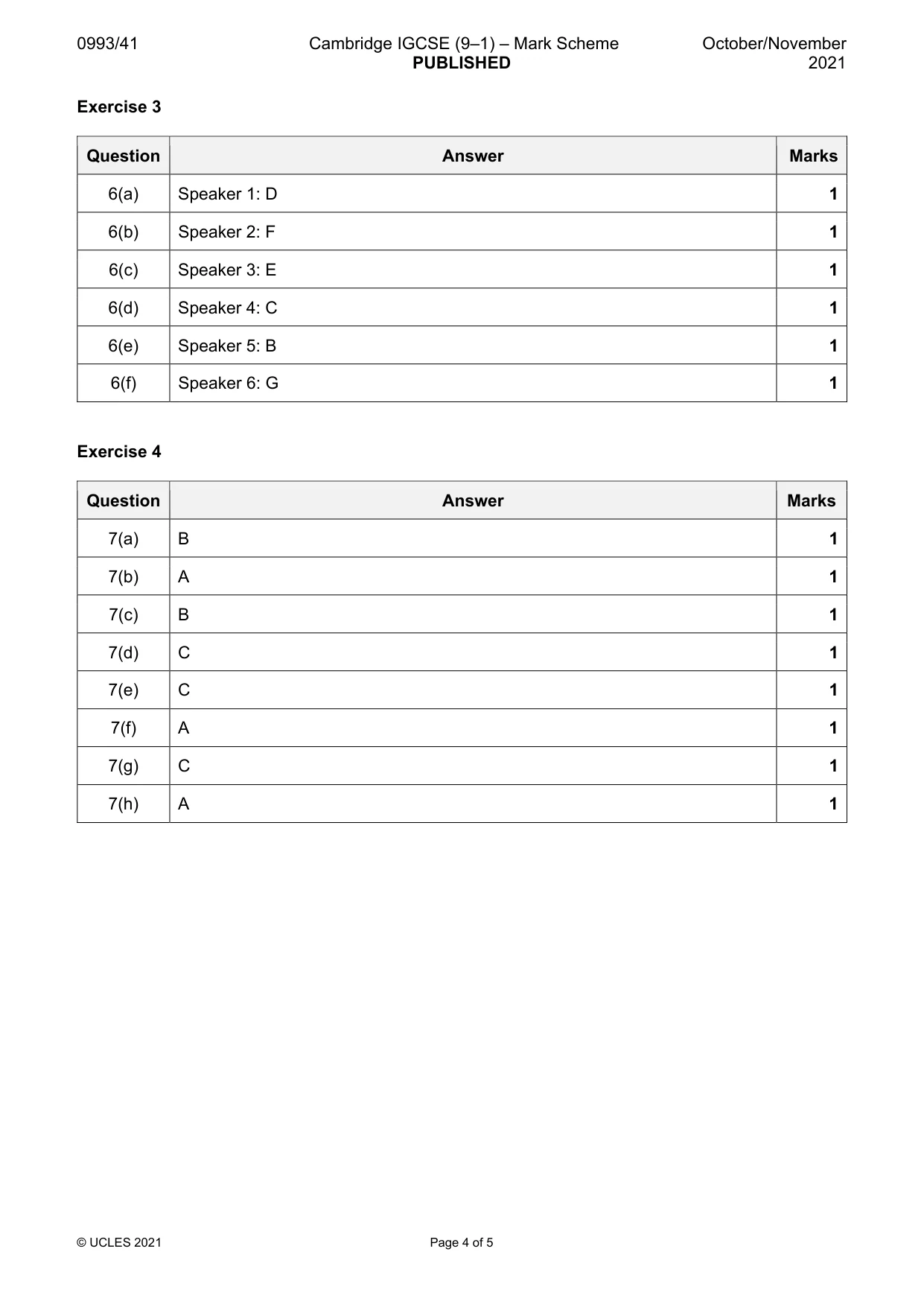
0993/41 Cambridge IGCSE (9–1) – Mark Scheme PUBLISHED October/November 2021 © UCLES 2021 Page 4 of 5 Exercise 3 Question Answer Marks 6(a) Speaker 1: D 1 6(b) Speaker 2: F 1 6(c) Speaker 3: E 1 6(d) Speaker 4: C 1 6(e) Speaker 5: B 1 6(f) Speaker 6: G 1 Exercise 4 Question Answer Marks 7(a) B 1 7(b) A 1 7(c) B 1 7(d) C 1 7(e) C 1 7(f) A 1 7(g) C 1 7(h) A 1
Mark scheme, page 5
0993/41 Cambridge IGCSE (9–1) – Mark Scheme PUBLISHED October/November 2021 © UCLES 2021 Page 5 of 5 Exercise 5 Part A Question Answer Marks 8A(a) improve memory 1 8A(b) building blocks 1 8A(c) blood pressure 1 8A(d) minerals 1 8A(e) intelligence 1 Exercise 5 Part B Question Answer Marks 8B(a) tuna 1 8B(b) processed 1 8B(c) insurance (policy) 1 8B(d) weight(s) 1 8B(e) quality 1
What you needed in this session
Cambridge’s own grade thresholds for 2021 Oct/Nov, Paper 4 · Variant 1. A higher threshold means an easier paper — the bar moves with how the cohort did.