Cambridge IGCSE English Second Language (Speaking Endorsement) (9-1) 0993 — 2020 May/June Paper 4 · Variant 1
0993/41/M/J/20
The question paper and its mark scheme, free to read here and free to download. This is Cambridge’s own paper, exactly as it was sat.
Question paper12 pages




Mark scheme4 pages
Answers below. Sit the paper first if you are practising.
Paper as text
Question paper, page 1
Cambridge IGCSE™(9–1) This document has 12 pages. Blank pages are indicated. DC (LK) 198072 © UCLES 2020 [Turn over ENGLISH AS A SECOND LANGUAGE 0993/41 Paper 4 Listening (Extended) May/June 2020 Approximately 50 minutes You must answer on the question paper. No additional materials are needed. INSTRUCTIONS ● Answer all questions. ● Use a black or dark blue pen. ● Write your name, centre number and candidate number in the boxes at the top of the page. ● Write your answer to each question in the space provided. ● Do not use an erasable pen or correction fluid. ● Do not write on any bar codes. ● Dictionaries are not allowed. INFORMATION ● The total mark for this paper is 40. ● The number of marks for each question or part question is shown in brackets [ ]. * 6 6 4 6 0 2 1 6 9 3 *
Question paper, page 2
2 0993/41/M/J/20 © UCLES 2020 Exercise 1 You will hear four short recordings. Answer each question on the line provided. Write no more than three words for each answer. You will hear each recording twice. 1 (a) Where would the girl like to work in the summer? … [1] (b) When is the girl able to start work? … [1] 2 (a) How did the man prefer to travel into New York City? … [1] (b) What was the name of the exhibition that the man visited? … [1] 3 (a) Which topic do the two students agree to give a presentation about? … [1] (b) What is the girl going to do this evening? … [1] 4 (a) What is the name of the organisation that the school concert is raising money for? … [1] (b) What does the teacher still need one student to do? … [1] [Total: 8]
Question paper, page 3
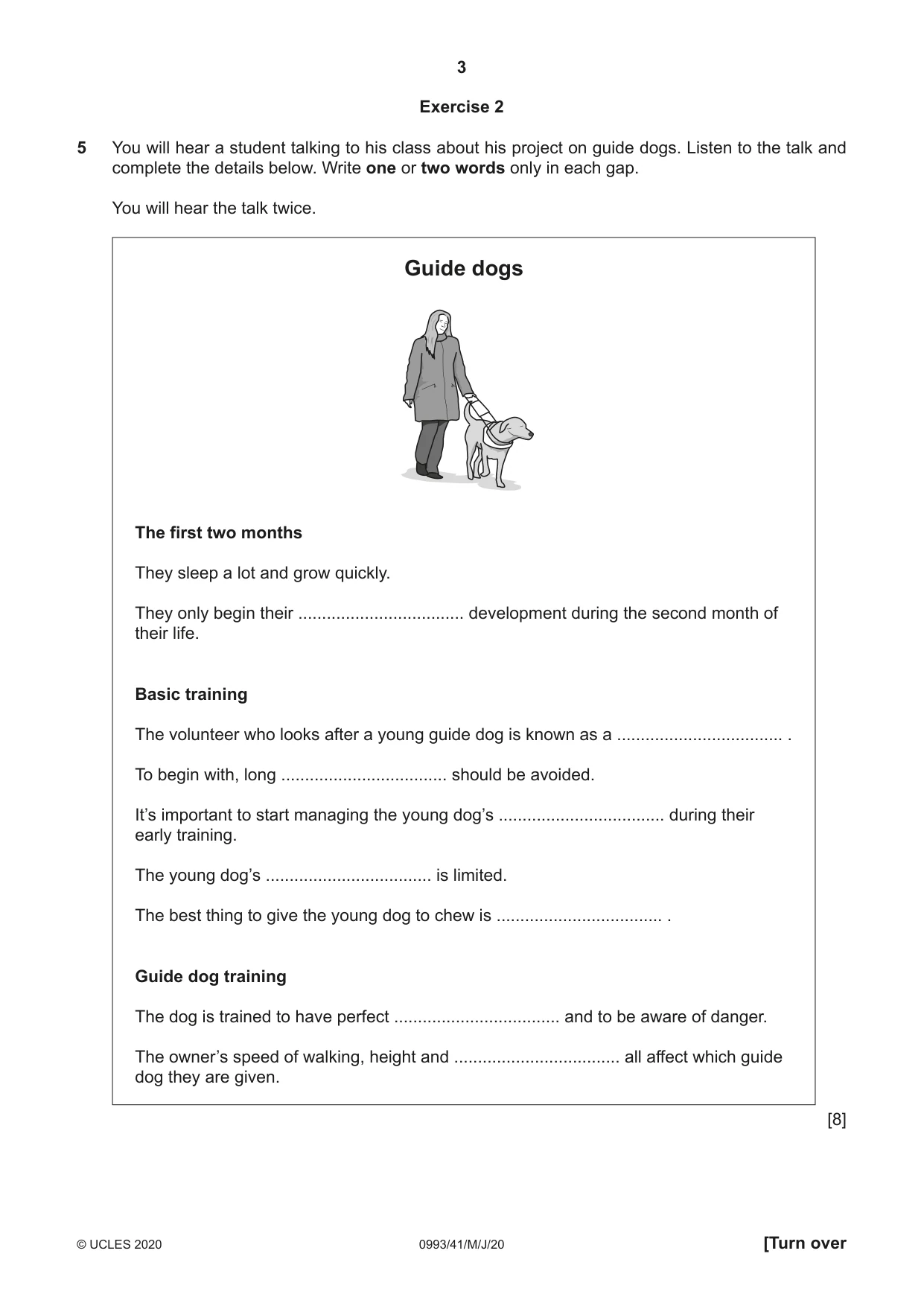
3 0993/41/M/J/20 © UCLES 2020 [Turn over Exercise 2 5 You will hear a student talking to his class about his project on guide dogs. Listen to the talk and complete the details below. Write one or two words only in each gap. You will hear the talk twice. Guide dogs The first two months They sleep a lot and grow quickly. They only begin their … development during the second month of their life. Basic training The volunteer who looks after a young guide dog is known as a … . To begin with, long … should be avoided. It’s important to start managing the young dog’s … during their early training. The young dog’s … is limited. The best thing to give the young dog to chew is … . Guide dog training The dog is trained to have perfect … and to be aware of danger. The owner’s speed of walking, height and … all affect which guide dog they are given. [8]
Question paper, page 4
4 0993/41/M/J/20 © UCLES 2020 Exercise 3 6 You will hear six people talking about how they like to organise their time. For each of speakers 1 to 6, choose from the list, A to G, which opinion each speaker expresses. Write the letter in the appropriate box. Use each letter only once. There is one extra letter which you do not need to use. You will hear the recordings twice. Speaker 1 A I prefer to be busy all the time. Speaker 2 B I work better in the mornings than in the afternoons. Speaker 3 C I always write down what I have to do each day. Speaker 4 D I like to do what feels right at the time. Speaker 5 E I let someone else organise my time for me. Speaker 6 F I try to have some time to sit quietly each day to relax. G I like feeling that I have enough time to do what I need to do. [6]
Question paper, page 5
5 0993/41/M/J/20 © UCLES 2020 [Turn over Please turn over for Exercise 4.
Question paper, page 6
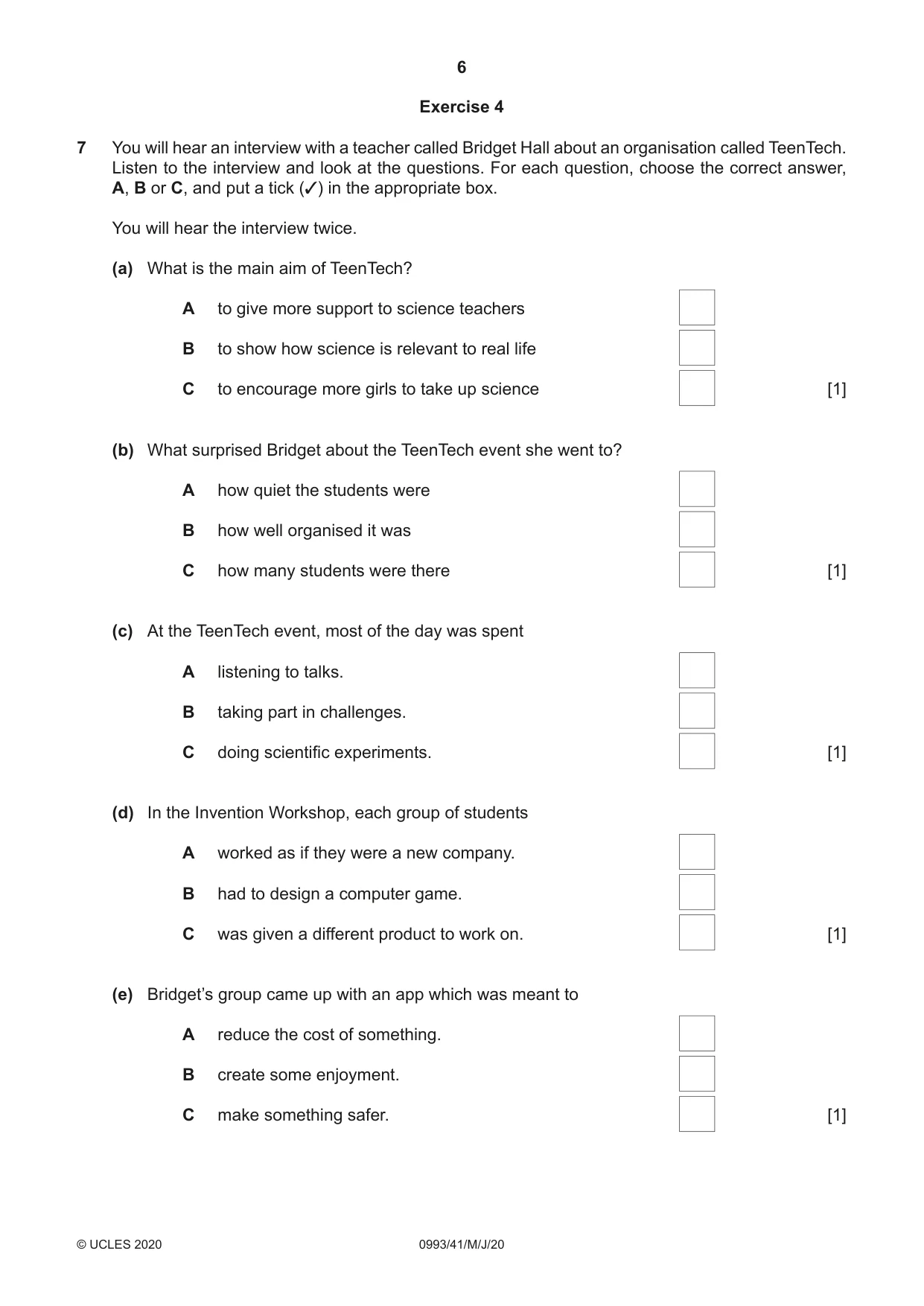
6 0993/41/M/J/20 © UCLES 2020 Exercise 4 7 You will hear an interview with a teacher called Bridget Hall about an organisation called TeenTech. Listen to the interview and look at the questions. For each question, choose the correct answer, A, B or C, and put a tick (3) in the appropriate box. You will hear the interview twice. (a) What is the main aim of TeenTech? A to give more support to science teachers B to show how science is relevant to real life C to encourage more girls to take up science [1] (b) What surprised Bridget about the TeenTech event she went to? A how quiet the students were B how well organised it was C how many students were there [1] (c) At the TeenTech event, most of the day was spent A listening to talks. B taking part in challenges. C doing scientific experiments. [1] (d) In the Invention Workshop, each group of students A worked as if they were a new company. B had to design a computer game. C was given a different product to work on. [1] (e) Bridget’s group came up with an app which was meant to A reduce the cost of something. B create some enjoyment. C make something safer. [1]
Question paper, page 7
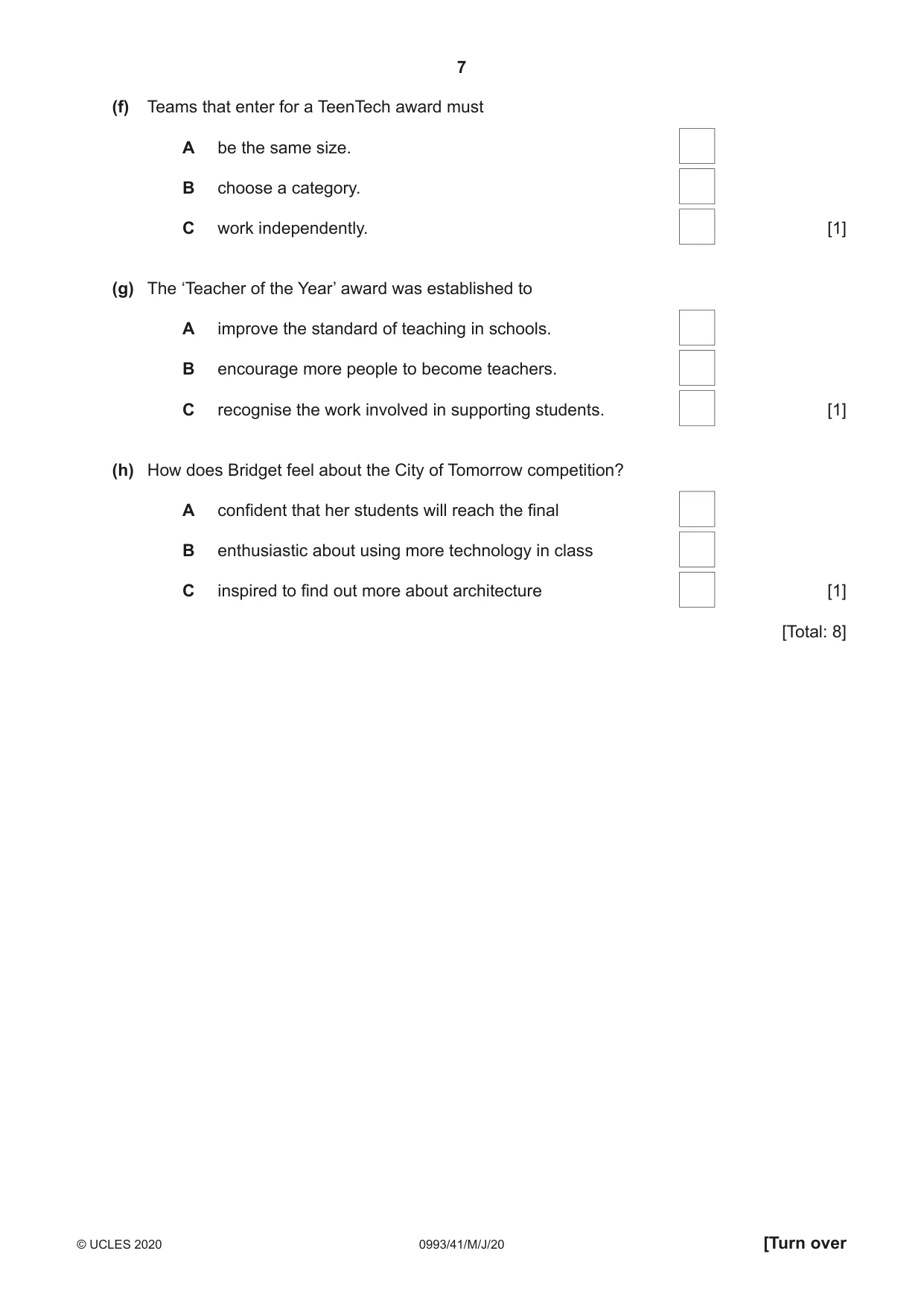
7 0993/41/M/J/20 © UCLES 2020 [Turn over (f) Teams that enter for a TeenTech award must A be the same size. B choose a category. C work independently. [1] (g) The ‘Teacher of the Year’ award was established to A improve the standard of teaching in schools. B encourage more people to become teachers. C recognise the work involved in supporting students. [1] (h) How does Bridget feel about the City of Tomorrow competition? A confident that her students will reach the final B enthusiastic about using more technology in class C inspired to find out more about architecture [1] [Total: 8]
Question paper, page 8
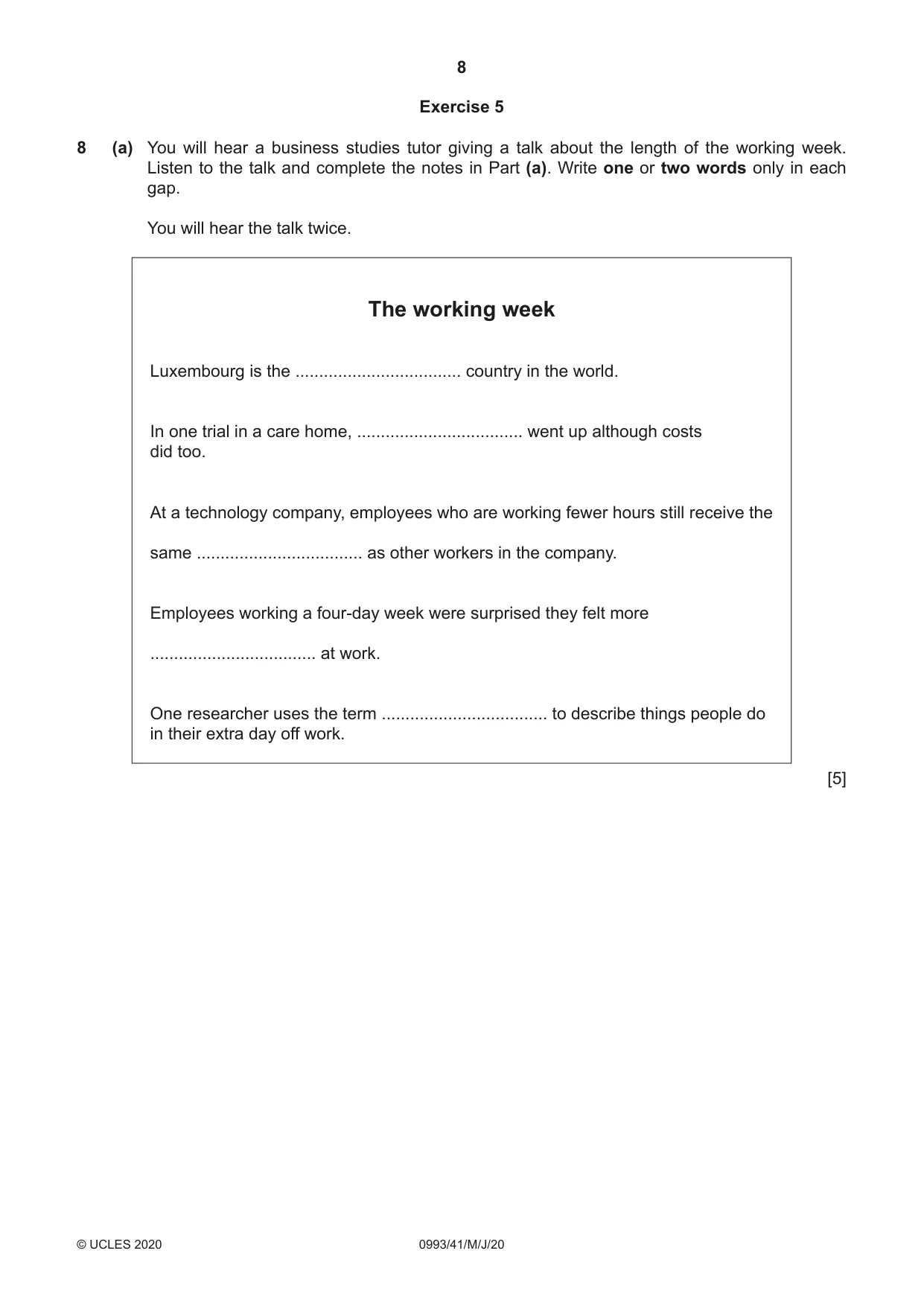
8 0993/41/M/J/20 © UCLES 2020 Exercise 5 8 (a) You will hear a business studies tutor giving a talk about the length of the working week. Listen to the talk and complete the notes in Part (a). Write one or two words only in each gap. You will hear the talk twice. The working week Luxembourg is the … country in the world. In one trial in a care home, … went up although costs did too. At a technology company, employees who are working fewer hours still receive the same … as other workers in the company. Employees working a four-day week were surprised they felt more … at work. One researcher uses the term … to describe things people do in their extra day off work. [5]
Question paper, page 9
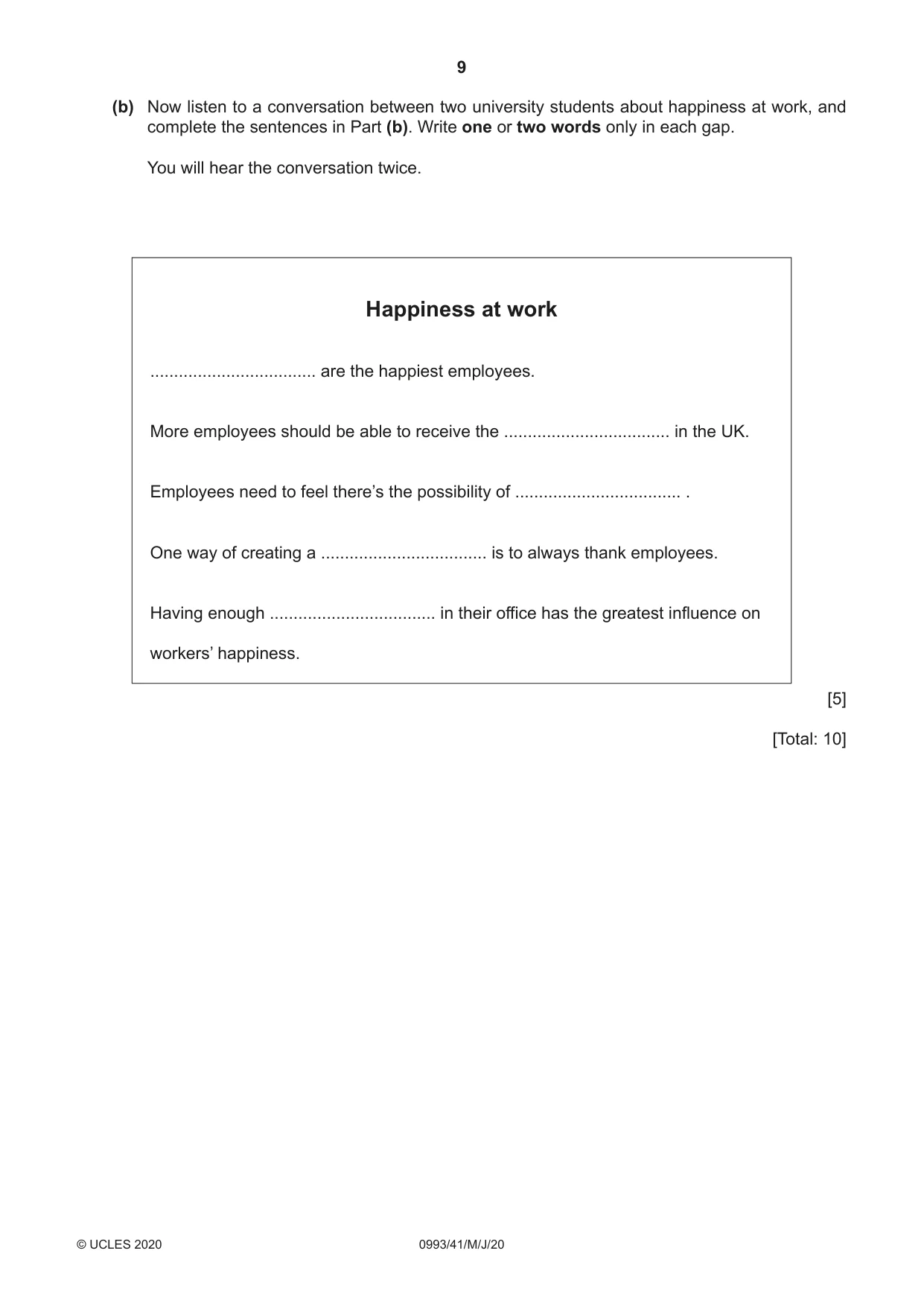
9 0993/41/M/J/20 © UCLES 2020 (b) Now listen to a conversation between two university students about happiness at work, and complete the sentences in Part (b). Write one or two words only in each gap. You will hear the conversation twice. Happiness at work … are the happiest employees. More employees should be able to receive the … in the UK. Employees need to feel there’s the possibility of … . One way of creating a … is to always thank employees. Having enough … in their office has the greatest influence on workers’ happiness. [5] [Total: 10]
Question paper, page 10
10 0993/41/M/J/20 © UCLES 2020 BLANK PAGE
Question paper, page 11
11 0993/41/M/J/20 © UCLES 2020 BLANK PAGE
Question paper, page 12
12 0993/41/M/J/20 © UCLES 2020 Permission to reproduce items where third-party owned material protected by copyright is included has been sought and cleared where possible. Every reasonable effort has been made by the publisher (UCLES) to trace copyright holders, but if any items requiring clearance have unwittingly been included, the publisher will be pleased to make amends at the earliest possible opportunity. To avoid the issue of disclosure of answer-related information to candidates, all copyright acknowledgements are reproduced online in the Cambridge Assessment International Education Copyright Acknowledgements Booklet. This is produced for each series of examinations and is freely available to download at www.cambridgeinternational.org after the live examination series. Cambridge Assessment International Education is part of the Cambridge Assessment Group. Cambridge Assessment is the brand name of the University of Cambridge Local Examinations Syndicate (UCLES), which itself is a department of the University of Cambridge. BLANK PAGE
Mark scheme, page 1
This document consists of 4 printed pages. © UCLES 2020 [Turn over Cambridge IGCSE™ (9–1) ENGLISH AS A SECOND LANGUAGE 9–1 (SPEAKING ENDORSEMENT) 0993/41 Paper 4 Listening (Extended) May/June 2020 MARK SCHEME Maximum Mark: 40 Published Students did not sit exam papers in the June 2020 series due to the Covid-19 global pandemic. This mark scheme is published to support teachers and students and should be read together with the question paper. It shows the requirements of the exam. The answer column of the mark scheme shows the proposed basis on which Examiners would award marks for this exam. Where appropriate, this column also provides the most likely acceptable alternative responses expected from students. Examiners usually review the mark scheme after they have seen student responses and update the mark scheme if appropriate. In the June series, Examiners were unable to consider the acceptability of alternative responses, as there were no student responses to consider. Mark schemes should usually be read together with the Principal Examiner Report for Teachers. However, because students did not sit exam papers, there is no Principal Examiner Report for Teachers for the June 2020 series. Cambridge International will not enter into discussions about these mark schemes. Cambridge International is publishing the mark schemes for the June 2020 series for most Cambridge IGCSE™ and Cambridge International A & AS Level components, and some Cambridge O Level components.
Mark scheme, page 2
0993/41 Cambridge IGCSE (9–1) – Mark Scheme PUBLISHED May/June 2020 © UCLES 2020 Page 2 of 4 Generic Marking Principles These general marking principles must be applied by all examiners when marking candidate answers. They should be applied alongside the specific content of the mark scheme or generic level descriptors for a question. Each question paper and mark scheme will also comply with these marking principles. GENERIC MARKING PRINCIPLE 1: Marks must be awarded in line with: • the specific content of the mark scheme or the generic level descriptors for the question • the specific skills defined in the mark scheme or in the generic level descriptors for the question • the standard of response required by a candidate as exemplified by the standardisation scripts. GENERIC MARKING PRINCIPLE 2: Marks awarded are always whole marks (not half marks, or other fractions). GENERIC MARKING PRINCIPLE 3: Marks must be awarded positively: • marks are awarded for correct/valid answers, as defined in the mark scheme. However, credit is given for valid answers which go beyond the scope of the syllabus and mark scheme, referring to your Team Leader as appropriate • marks are awarded when candidates clearly demonstrate what they know and can do • marks are not deducted for errors • marks are not deducted for omissions • answers should only be judged on the quality of spelling, punctuation and grammar when these features are specifically assessed by the question as indicated by the mark scheme. The meaning, however, should be unambiguous. GENERIC MARKING PRINCIPLE 4: Rules must be applied consistently e.g. in situations where candidates have not followed instructions or in the application of generic level descriptors. GENERIC MARKING PRINCIPLE 5: Marks should be awarded using the full range of marks defined in the mark scheme for the question (however; the use of the full mark range may be limited according to the quality of the candidate responses seen). GENERIC MARKING PRINCIPLE 6: Marks awarded are based solely on the requirements as defined in the mark scheme. Marks should not be awarded with grade thresholds or grade descriptors in mind.
Mark scheme, page 3
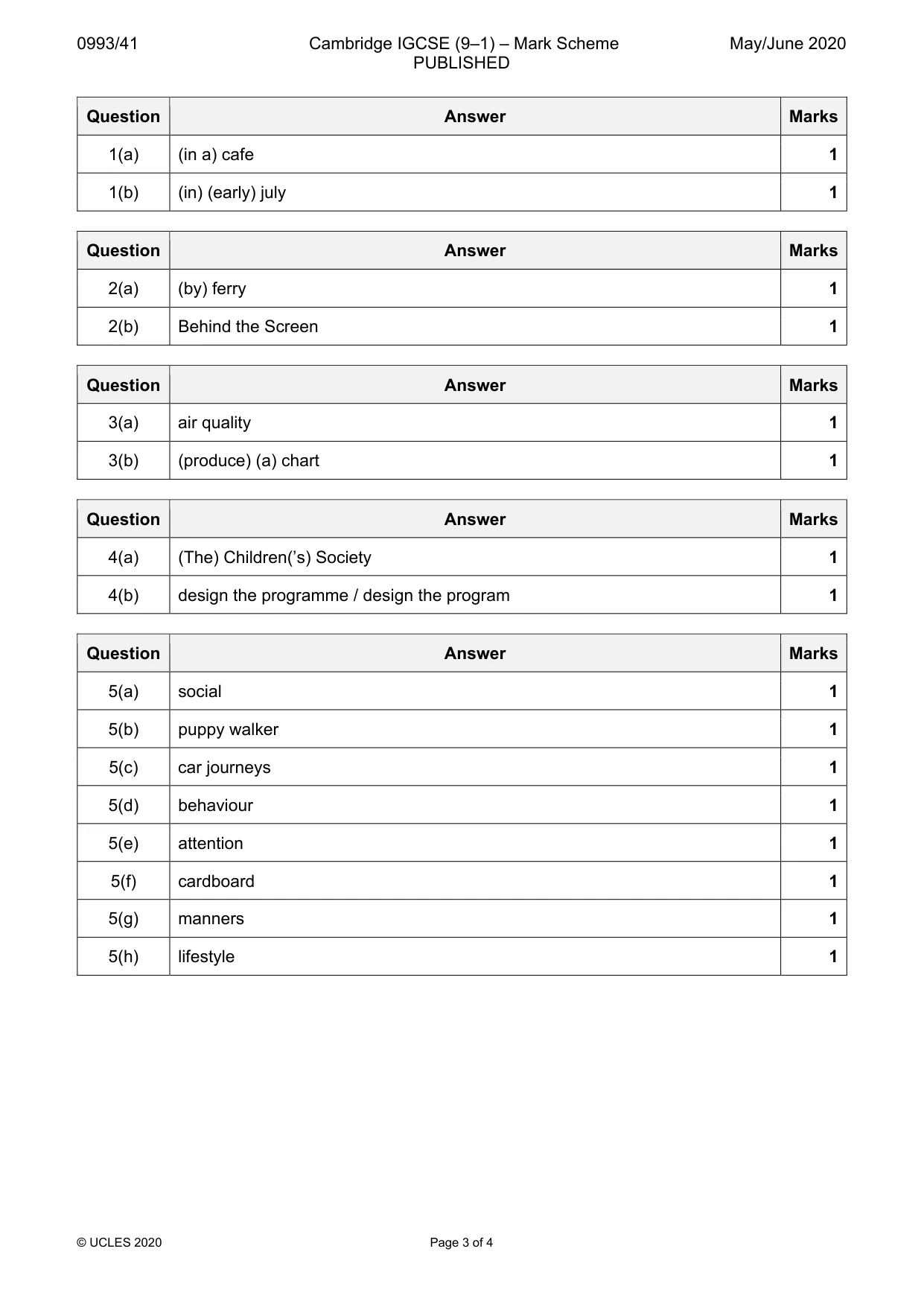
0993/41 Cambridge IGCSE (9–1) – Mark Scheme PUBLISHED May/June 2020 © UCLES 2020 Page 3 of 4 Question Answer Marks 1(a) (in a) cafe 1 1(b) (in) (early) july 1 Question Answer Marks 2(a) (by) ferry 1 2(b) Behind the Screen 1 Question Answer Marks 3(a) air quality 1 3(b) (produce) (a) chart 1 Question Answer Marks 4(a) (The) Children(’s) Society 1 4(b) design the programme / design the program 1 Question Answer Marks 5(a) social 1 5(b) puppy walker 1 5(c) car journeys 1 5(d) behaviour 1 5(e) attention 1 5(f) cardboard 1 5(g) manners 1 5(h) lifestyle 1
Mark scheme, page 4
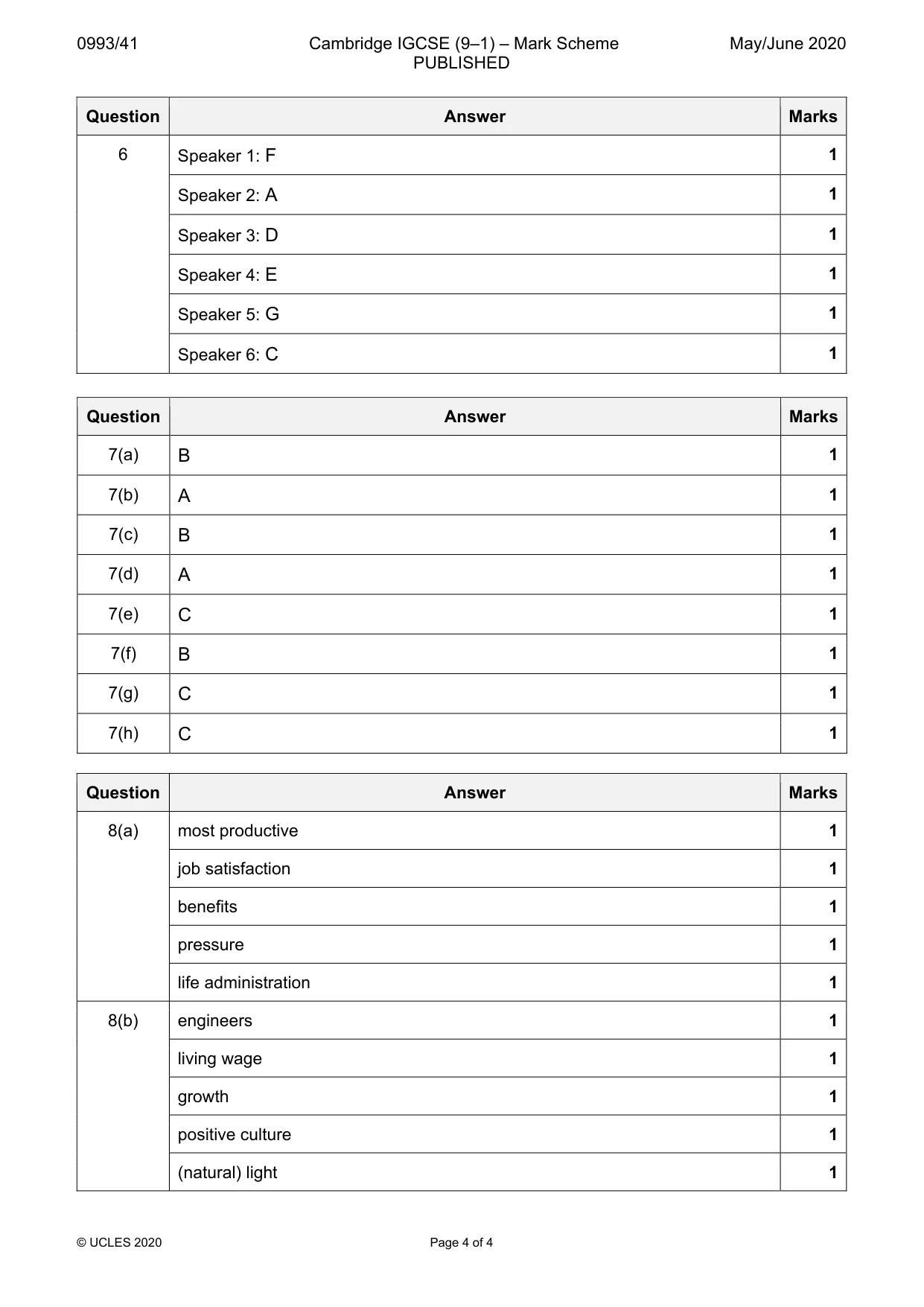
0993/41 Cambridge IGCSE (9–1) – Mark Scheme PUBLISHED May/June 2020 © UCLES 2020 Page 4 of 4 Question Answer Marks 6 Speaker 1: F 1 Speaker 2: A 1 Speaker 3: D 1 Speaker 4: E 1 Speaker 5: G 1 Speaker 6: C 1 Question Answer Marks 8(a) most productive 1 job satisfaction 1 benefits 1 pressure 1 life administration 1 8(b) engineers 1 living wage 1 growth 1 positive culture 1 (natural) light 1 Question Answer Marks 7(a) B 1 7(b) A 1 7(c) B 1 7(d) A 1 7(e) C 1 7(f) B 1 7(g) C 1 7(h) C 1