Cambridge IGCSE English - Second Language (oral endorsement) 0510 — 2022 Oct/Nov Paper 1 · Variant 3
0510/13/O/N/22 · 60 marks · ≈68 min
The question paper and its mark scheme, free to read here and free to download. This is Cambridge’s own paper, exactly as it was sat.
Question paper16 pages


Mark scheme11 pages
Answers below. Sit the paper first if you are practising.
Paper as text
Question paper, page 1
This document has 16 pages. Any blank pages are indicated. [Turn over Cambridge IGCSE™ DC (PQ/SG) 302602/3 © UCLES 2022 ENGLISH AS A SECOND LANGUAGE 0510/13 Paper 1 Reading and Writing (Core) October/November 2022 1 hour 30 minutes You must answer on the question paper. No additional materials are needed. INSTRUCTIONS ● Answer all questions. ● Use a black or dark blue pen. ● Write your name, centre number and candidate number in the boxes at the top of the page. ● Write your answer to each question in the space provided. ● Do not use an erasable pen or correction fluid. ● Do not write on any bar codes. ● Dictionaries are not allowed. INFORMATION ● The total mark for this paper is 60. ● The number of marks for each question or part question is shown in brackets [ ]. * 9 3 3 3 9 3 6 5 3 6 *
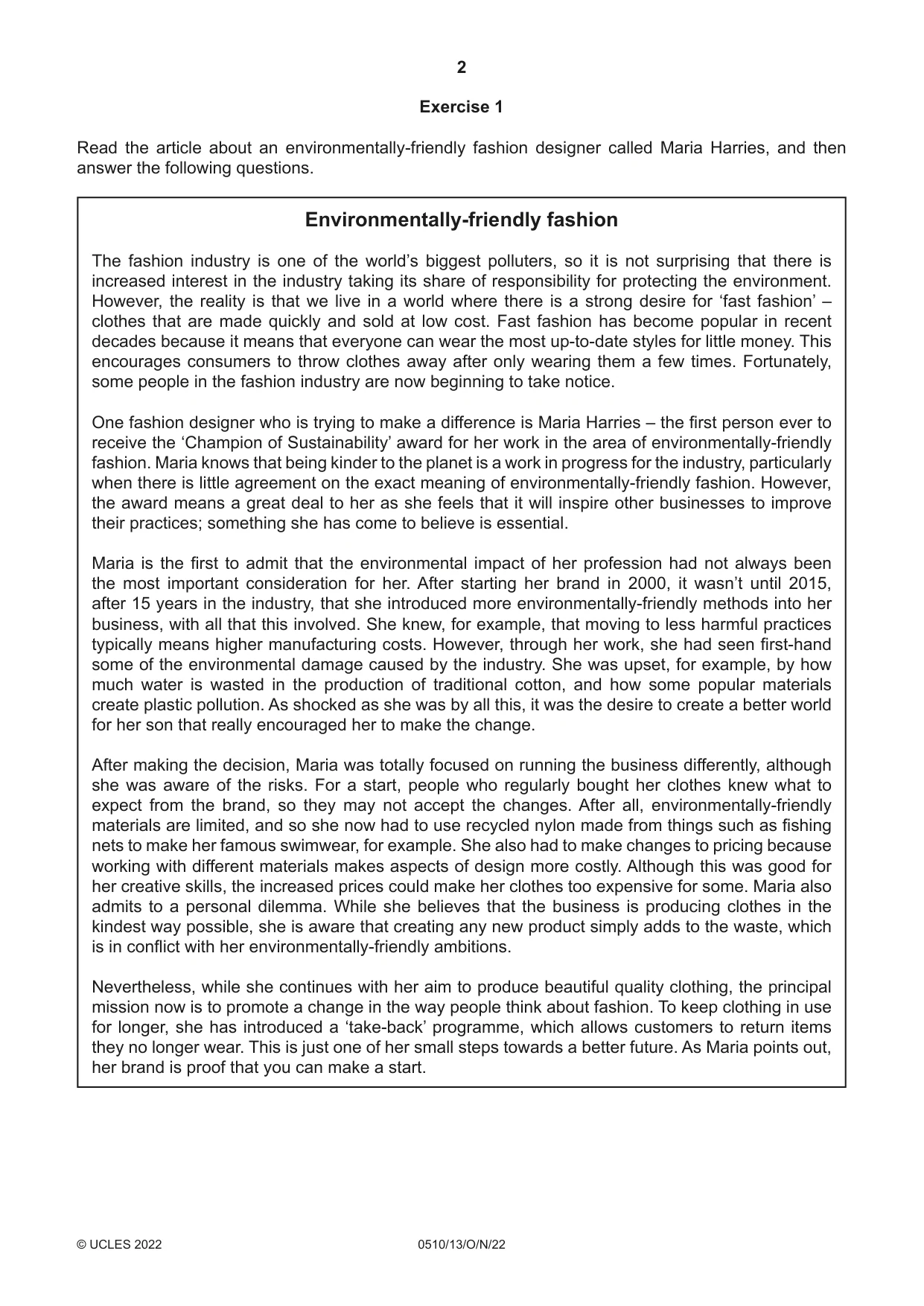
Question paper, page 2
2 0510/13/O/N/22 © UCLES 2022 Exercise 1 Read the article about an environmentally-friendly fashion designer called Maria Harries, and then answer the following questions. Environmentally-friendly fashion The fashion industry is one of the world’s biggest polluters, so it is not surprising that there is increased interest in the industry taking its share of responsibility for protecting the environment. However, the reality is that we live in a world where there is a strong desire for ‘fast fashion’ – clothes that are made quickly and sold at low cost. Fast fashion has become popular in recent decades because it means that everyone can wear the most up-to-date styles for little money. This encourages consumers to throw clothes away after only wearing them a few times. Fortunately, some people in the fashion industry are now beginning to take notice. One fashion designer who is trying to make a difference is Maria Harries – the first person ever to receive the ‘Champion of Sustainability’ award for her work in the area of environmentally-friendly fashion. Maria knows that being kinder to the planet is a work in progress for the industry, particularly when there is little agreement on the exact meaning of environmentally-friendly fashion. However, the award means a great deal to her as she feels that it will inspire other businesses to improve their practices; something she has come to believe is essential. Maria is the first to admit that the environmental impact of her profession had not always been the most important consideration for her. After starting her brand in 2000, it wasn’t until 2015, after 15 years in the industry, that she introduced more environmentally-friendly methods into her business, with all that this involved. She knew, for example, that moving to less harmful practices typically means higher manufacturing costs. However, through her work, she had seen first-hand some of the environmental damage caused by the industry. She was upset, for example, by how much water is wasted in the production of traditional cotton, and how some popular materials create plastic pollution. As shocked as she was by all this, it was the desire to create a better world for her son that really encouraged her to make the change. After making the decision, Maria was totally focused on running the business differently, although she was aware of the risks. For a start, people who regularly bought her clothes knew what to expect from the brand, so they may not accept the changes. After all, environmentally-friendly materials are limited, and so she now had to use recycled nylon made from things such as fishing nets to make her famous swimwear, for example. She also had to make changes to pricing because working with different materials makes aspects of design more costly. Although this was good for her creative skills, the increased prices could make her clothes too expensive for some. Maria also admits to a personal dilemma. While she believes that the business is producing clothes in the kindest way possible, she is aware that creating any new product simply adds to the waste, which is in conflict with her environmentally-friendly ambitions. Nevertheless, while she continues with her aim to produce beautiful quality clothing, the principal mission now is to promote a change in the way people think about fashion. To keep clothing in use for longer, she has introduced a ‘take-back’ programme, which allows customers to return items they no longer wear. This is just one of her small steps towards a better future. As Maria points out, her brand is proof that you can make a start.
Question paper, page 3
3 0510/13/O/N/22 © UCLES 2022 [Turn over 1 How does fast fashion cause waste? … [1] 2 According to Maria, what will winning the award achieve? … [1] 3 When did Maria change the way she runs her company? … [1] 4 What finally persuaded Maria to make her business more environmentally friendly? … [1] 5 What reactions did Maria think her customers might have to the changes to her business? Give two details. … … [2] 6 Why does Maria feel that her business may not be completely environmentally friendly? … [1] 7 What is Maria’s main business goal? … [1] 8 How is Maria’s company trying to reduce clothing waste? … [1] [Total: 9]
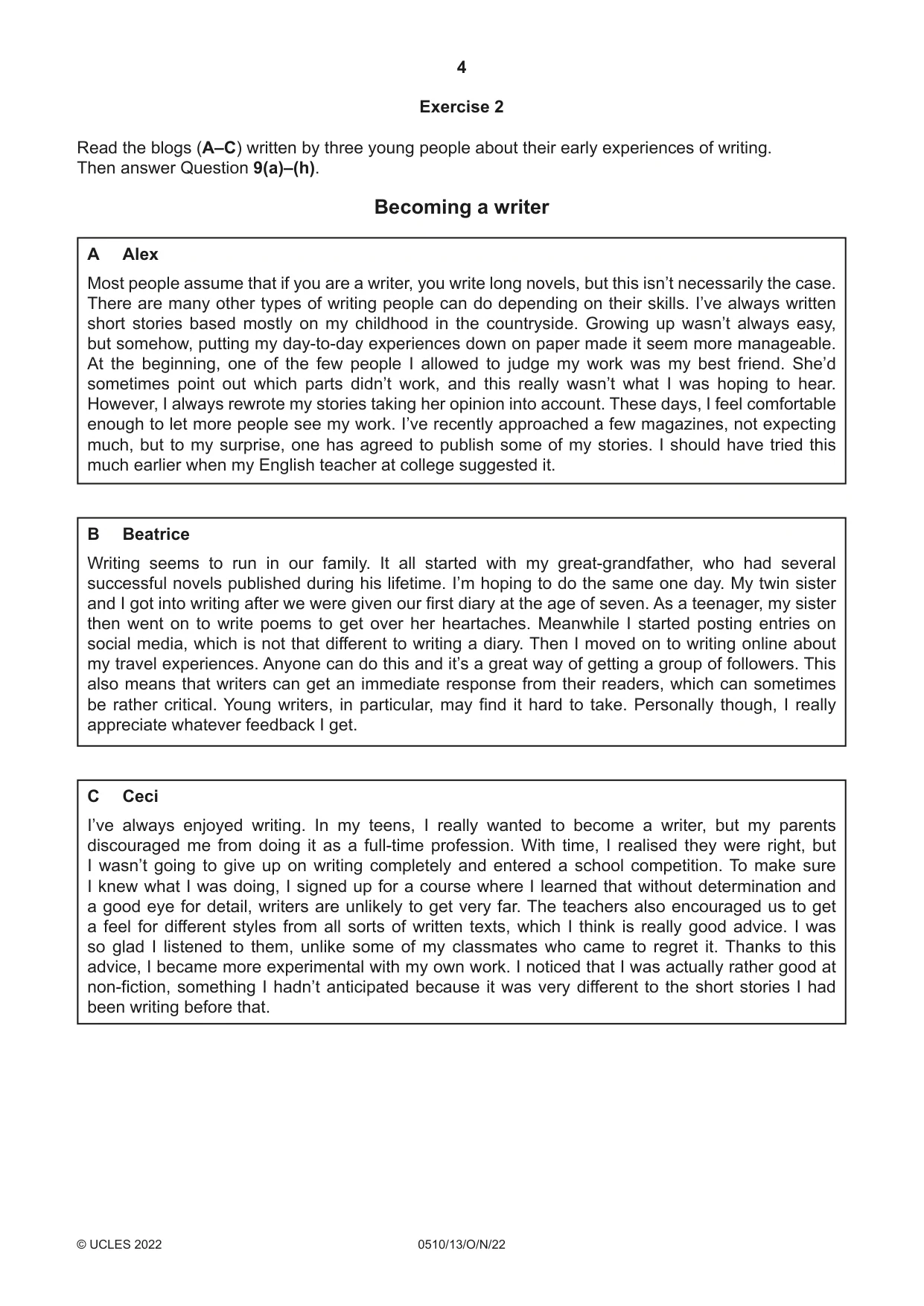
Question paper, page 4
4 0510/13/O/N/22 © UCLES 2022 Exercise 2 Read the blogs (A–C) written by three young people about their early experiences of writing. Then answer Question 9(a)–(h). Becoming a writer A Alex Most people assume that if you are a writer, you write long novels, but this isn’t necessarily the case. There are many other types of writing people can do depending on their skills. I’ve always written short stories based mostly on my childhood in the countryside. Growing up wasn’t always easy, but somehow, putting my day-to-day experiences down on paper made it seem more manageable. At the beginning, one of the few people I allowed to judge my work was my best friend. She’d sometimes point out which parts didn’t work, and this really wasn’t what I was hoping to hear. However, I always rewrote my stories taking her opinion into account. These days, I feel comfortable enough to let more people see my work. I’ve recently approached a few magazines, not expecting much, but to my surprise, one has agreed to publish some of my stories. I should have tried this much earlier when my English teacher at college suggested it. B Beatrice Writing seems to run in our family. It all started with my great-grandfather, who had several successful novels published during his lifetime. I’m hoping to do the same one day. My twin sister and I got into writing after we were given our first diary at the age of seven. As a teenager, my sister then went on to write poems to get over her heartaches. Meanwhile I started posting entries on social media, which is not that different to writing a diary. Then I moved on to writing online about my travel experiences. Anyone can do this and it’s a great way of getting a group of followers. This also means that writers can get an immediate response from their readers, which can sometimes be rather critical. Young writers, in particular, may find it hard to take. Personally though, I really appreciate whatever feedback I get. C Ceci I’ve always enjoyed writing. In my teens, I really wanted to become a writer, but my parents discouraged me from doing it as a full-time profession. With time, I realised they were right, but I wasn’t going to give up on writing completely and entered a school competition. To make sure I knew what I was doing, I signed up for a course where I learned that without determination and a good eye for detail, writers are unlikely to get very far. The teachers also encouraged us to get a feel for different styles from all sorts of written texts, which I think is really good advice. I was so glad I listened to them, unlike some of my classmates who came to regret it. Thanks to this advice, I became more experimental with my own work. I noticed that I was actually rather good at non-fiction, something I hadn’t anticipated because it was very different to the short stories I had been writing before that.
Question paper, page 5
5 0510/13/O/N/22 © UCLES 2022 [Turn over 9 For each question, write the correct letter A, B or C on the line. Which person … (a) discovered they had an unexpected talent after they started writing? … [1] (b) would like to become a professional writer? … [1] (c) claims a writer needs certain abilities to be successful? … [1] (d) was disappointed by someone’s reaction to their first attempts at writing? … [1] (e) believes new writers should read widely? … [1] (f) feels writing helped them cope with life’s problems? … [1] (g) thinks it is easy for new writers to make their work available to the public? … [1] (h) regrets not listening to somebody’s advice? … [1] [Total: 8]
Question paper, page 6
6 0510/13/O/N/22 © UCLES 2022 Exercise 3 Read the article about the fear of not having your mobile phone (cell phone), a condition called ‘nomophobia’, and then complete the notes. Nomophobia (‘No-mobile-phone-phobia’) The desire to connect with other people is natural in humans, and advances in mobile technology have provided new and exciting ways to do this. However, research has shown that the benefits we enjoy from our mobile phones have caused many of us to become dependent on them. When people begin to rely on their mobile phones too much, it can become an addiction. ‘Nomophobia’, or the fear of not having your mobile phone, is affecting an ever-increasing number of users, and it seems that younger people in particular are more likely to suffer. Many people do not realise that they are suffering from nomophobia, and indeed the first step in dealing with the issue is recognising that there is a problem. We all check our mobile phones throughout the day and many of us receive notifications telling us that a new message has arrived or somebody has posted on social media. While most of us don’t feel the need to check straightaway, someone with nomophobia will have to react to new information immediately. They can reduce these distractions and their impact by changing their mobile settings so that they no longer receive notifications. Most mobile phones offer a wide range of functions, from photography to music, and interactive games to online messaging, which have undoubtedly improved our lives in many ways. These have also led to us filling our screens with a huge number of apps all designed to attract and hold our attention. Carefully considering which apps to download can help those who are addicted to their mobile phones to minimise their use. Being addicted to your mobile phone is a serious issue that can have an impact on your emotional health. Sufferers will experience a sudden sense of panic when their mobile phone battery dies for example, or there is a loss of signal. Doing deep breathing exercises has been shown to be a very effective method in controlling some of the effects of nomophobia. And of course these exercises can be done anywhere and at any time. Feeling permanently anxious about losing your phone, even when it is in a safe place, is another symptom that addicts may experience. What’s more, the need to have their mobile phone close by is not limited to the daytime. Addicts typically can’t resist checking their mobile phone during the night. Leaving your phone outside your bedroom is an obvious solution. It goes without saying that mobile phones have multiple uses in school, and that the advantage of using them to do things like look up information or email teachers is clear. While some people are able to focus on one such activity at a time, people with nomophobia suffer from a reduction in the ability to concentrate on any one thing. In this situation, the indication is that the risks are outweighing the benefits. We all recognise that mobile phones are here to stay, and none of us would want to be without them, but like anything in life, finding the right balance is key. If you feel you can’t bear to be separated from your phone, downloading a special app to help you manage your use could be an option!
Question paper, page 7
7 0510/13/O/N/22 © UCLES 2022 [Turn over You are going to give a talk about nomophobia to your class at school. Prepare some notes to use as the basis for your talk. Make short notes under each heading. 10 Signs of nomophobia: • … • … • … [3] 11 How to overcome the effects of nomophobia: • … • … • … • … [4] [Total: 7]
Question paper, page 8
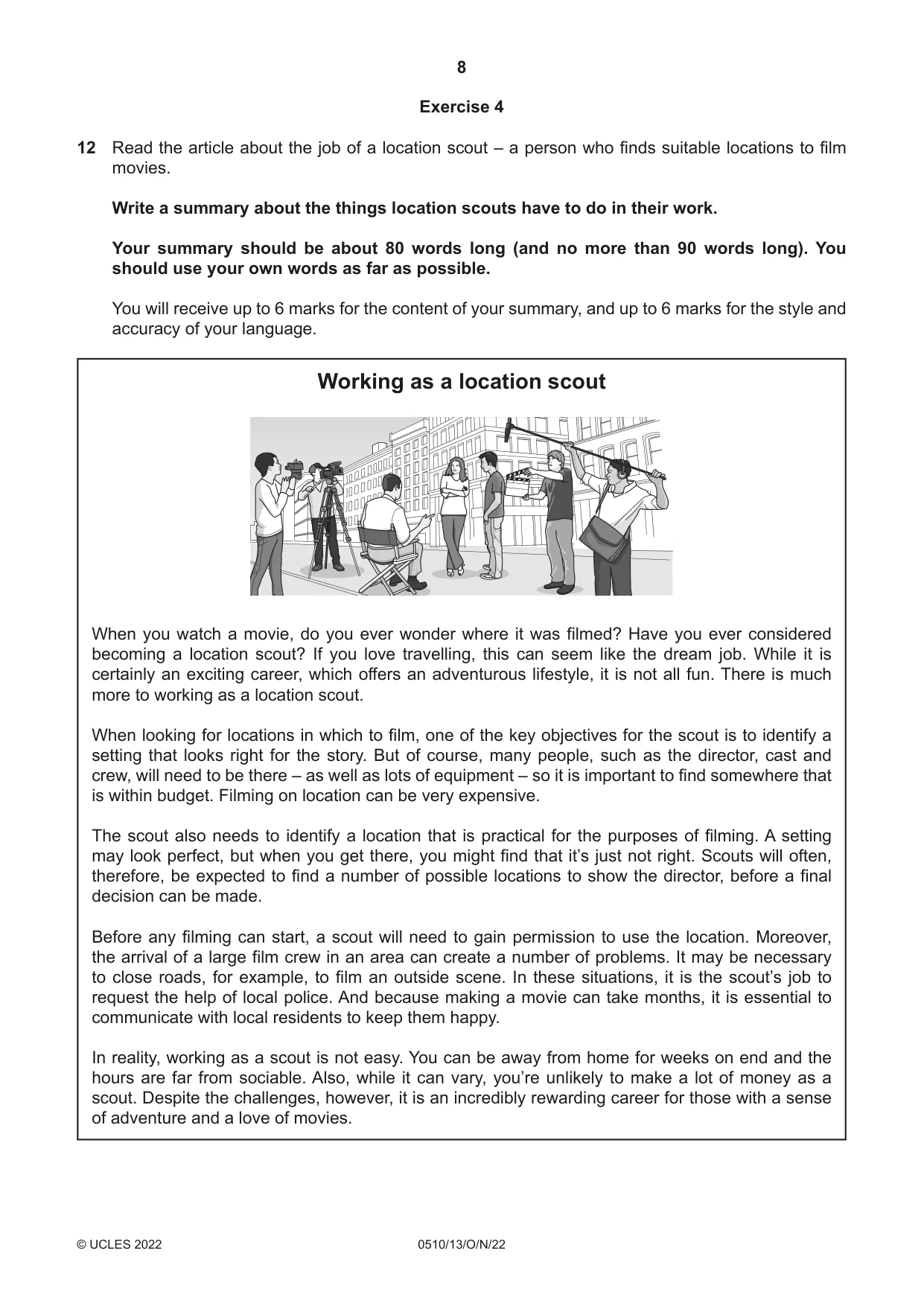
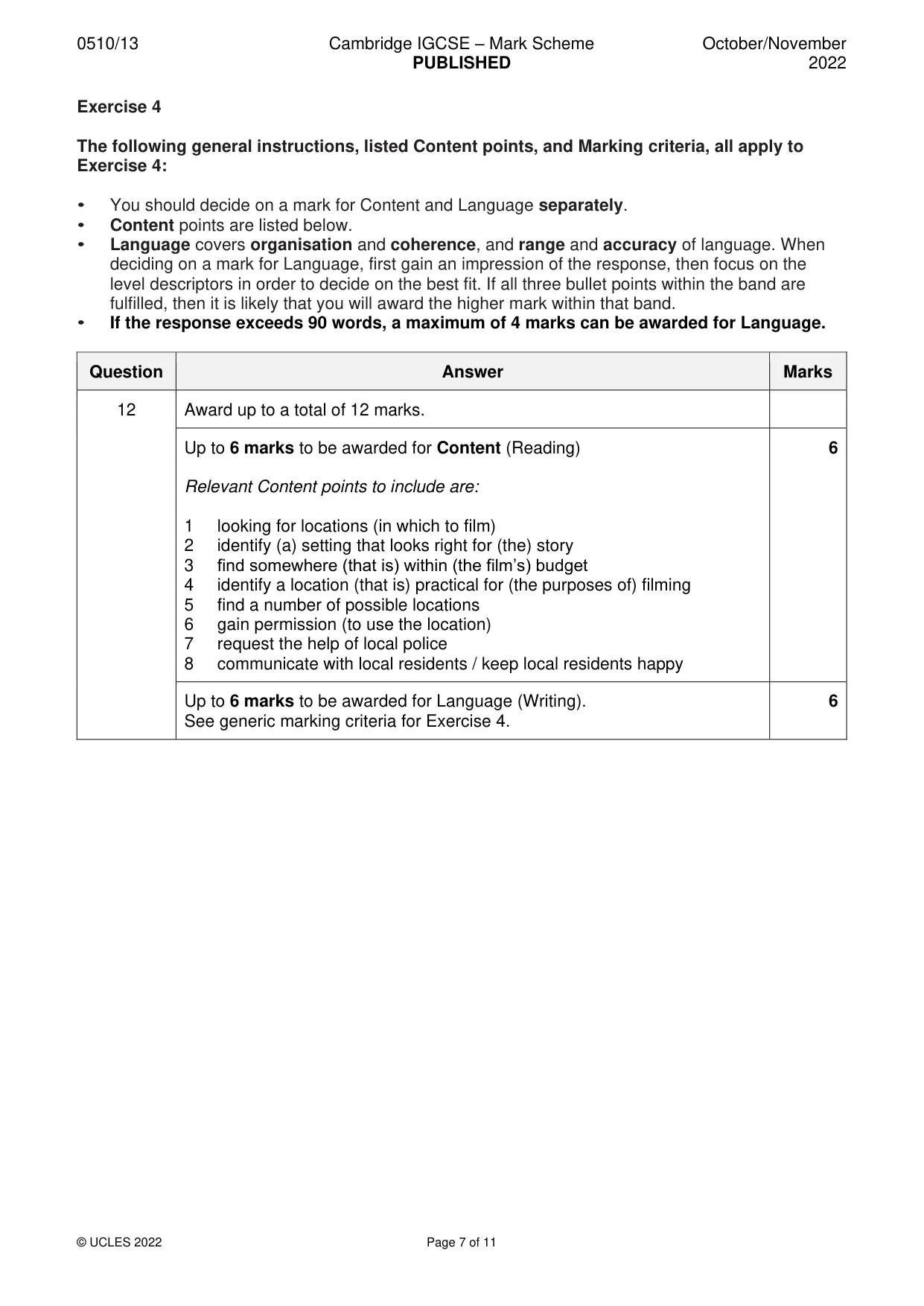
8 0510/13/O/N/22 © UCLES 2022 Exercise 4 12 Read the article about the job of a location scout – a person who finds suitable locations to film movies. Write a summary about the things location scouts have to do in their work. Your summary should be about 80 words long (and no more than 90 words long). You should use your own words as far as possible. You will receive up to 6 marks for the content of your summary, and up to 6 marks for the style and accuracy of your language. Working as a location scout When you watch a movie, do you ever wonder where it was filmed? Have you ever considered becoming a location scout? If you love travelling, this can seem like the dream job. While it is certainly an exciting career, which offers an adventurous lifestyle, it is not all fun. There is much more to working as a location scout. When looking for locations in which to film, one of the key objectives for the scout is to identify a setting that looks right for the story. But of course, many people, such as the director, cast and crew, will need to be there – as well as lots of equipment – so it is important to find somewhere that is within budget. Filming on location can be very expensive. The scout also needs to identify a location that is practical for the purposes of filming. A setting may look perfect, but when you get there, you might find that it’s just not right. Scouts will often, therefore, be expected to find a number of possible locations to show the director, before a final decision can be made. Before any filming can start, a scout will need to gain permission to use the location. Moreover, the arrival of a large film crew in an area can create a number of problems. It may be necessary to close roads, for example, to film an outside scene. In these situations, it is the scout’s job to request the help of local police. And because making a movie can take months, it is essential to communicate with local residents to keep them happy. In reality, working as a scout is not easy. You can be away from home for weeks on end and the hours are far from sociable. Also, while it can vary, you’re unlikely to make a lot of money as a scout. Despite the challenges, however, it is an incredibly rewarding career for those with a sense of adventure and a love of movies.
Question paper, page 9
9 0510/13/O/N/22 © UCLES 2022 [Turn over … … … … … … … … … … … … … … [Total: 12]
Question paper, page 10
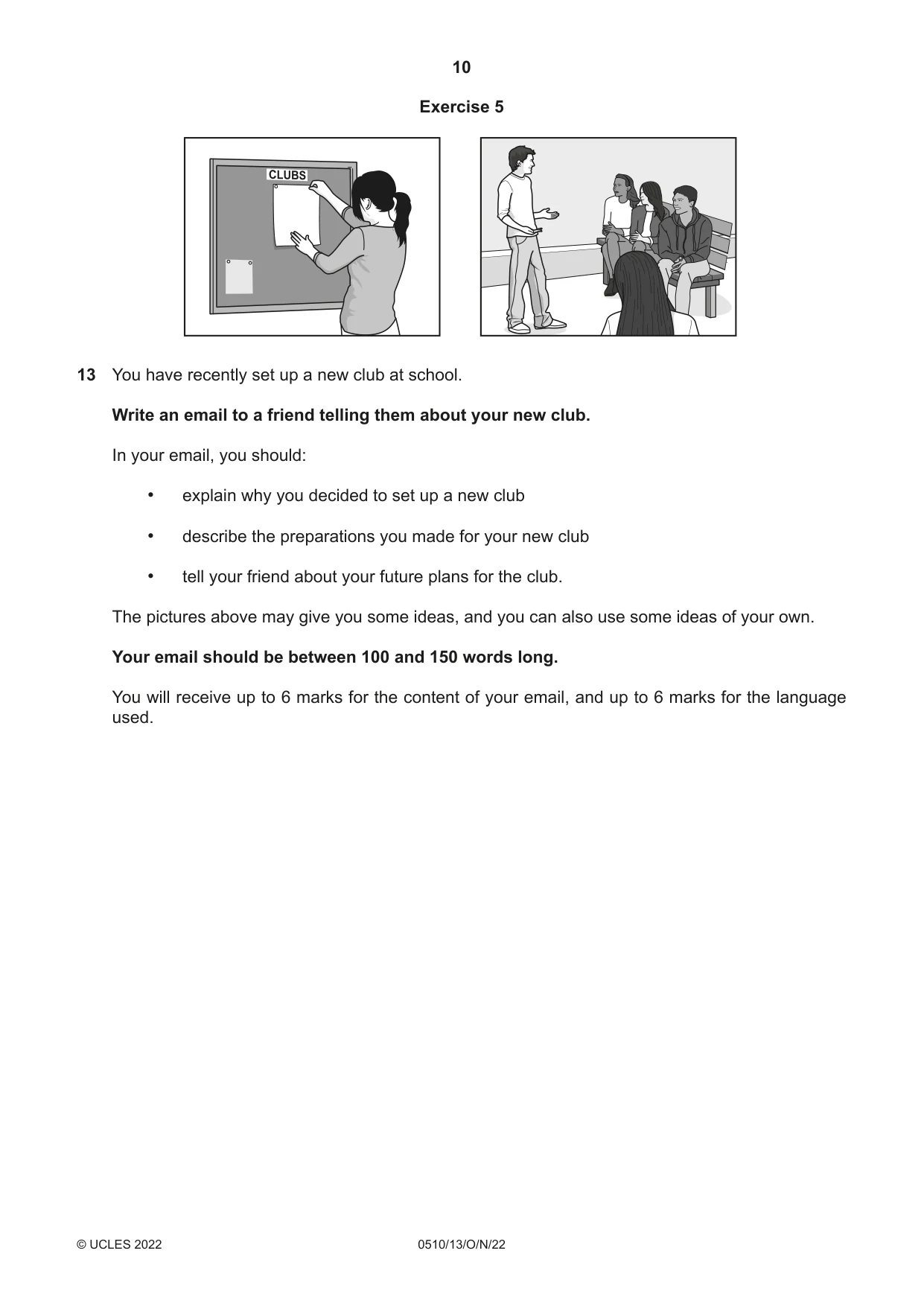
10 0510/13/O/N/22 © UCLES 2022 Exercise 5 13 You have recently set up a new club at school. Write an email to a friend telling them about your new club. In your email, you should: • explain why you decided to set up a new club • describe the preparations you made for your new club • tell your friend about your future plans for the club. The pictures above may give you some ideas, and you can also use some ideas of your own. Your email should be between 100 and 150 words long. You will receive up to 6 marks for the content of your email, and up to 6 marks for the language used.
Question paper, page 11
11 0510/13/O/N/22 © UCLES 2022 [Turn over … … … … … … … … … … … … … … … … … … … … … … … … … … … [Total: 12]
Question paper, page 12
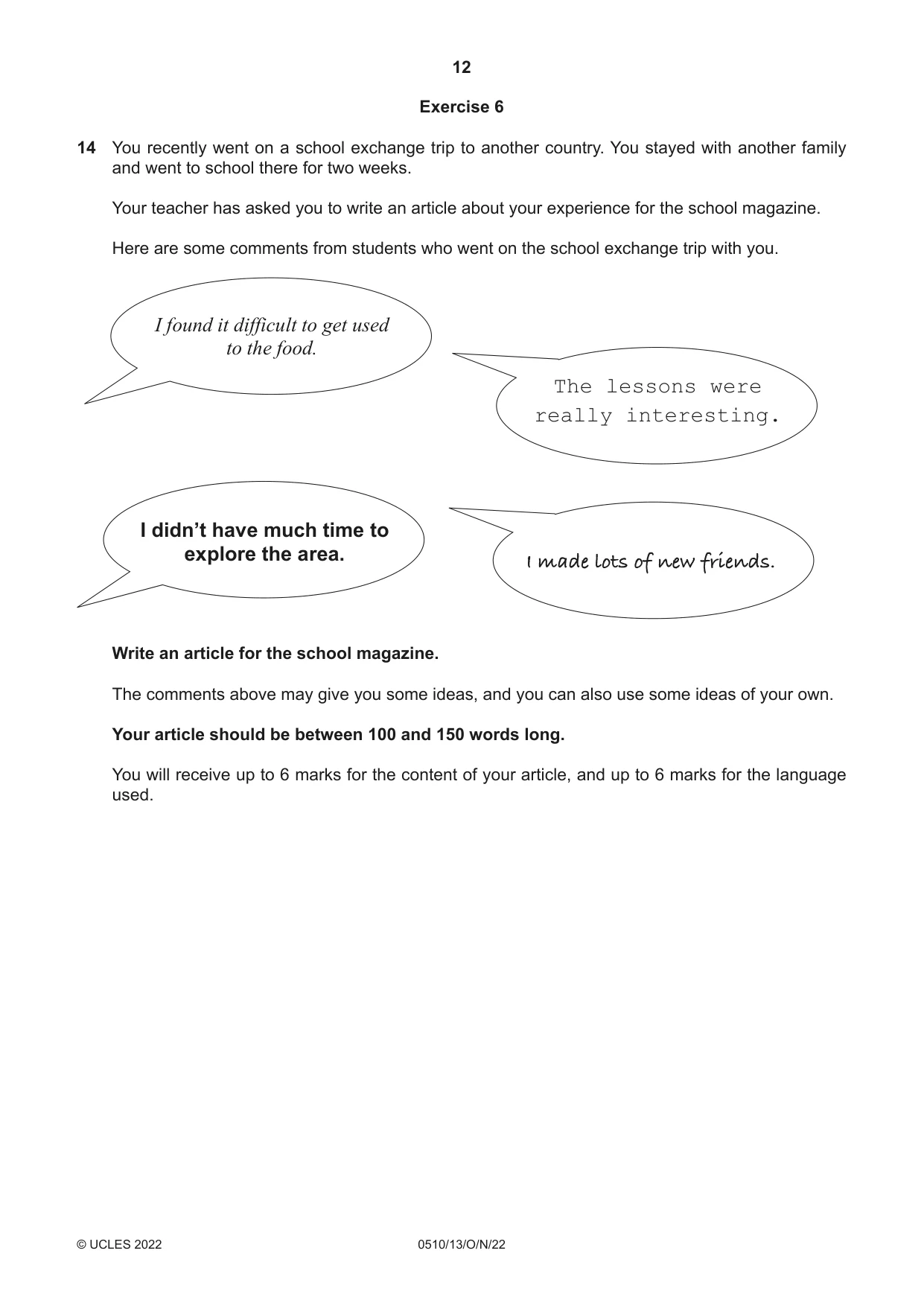
12 0510/13/O/N/22 © UCLES 2022 Exercise 6 14 You recently went on a school exchange trip to another country. You stayed with another family and went to school there for two weeks. Your teacher has asked you to write an article about your experience for the school magazine. Here are some comments from students who went on the school exchange trip with you. I found it difficult to get used to the food. I made lots of new friends. I didn’t have much time to explore the area. The lessons were really interesting. Write an article for the school magazine. The comments above may give you some ideas, and you can also use some ideas of your own. Your article should be between 100 and 150 words long. You will receive up to 6 marks for the content of your article, and up to 6 marks for the language used.
Question paper, page 13
13 0510/13/O/N/22 © UCLES 2022 … … … … … … … … … … … … … … … … … … … … … … … … … … … [Total: 12]
Question paper, page 14
14 0510/13/O/N/22 © UCLES 2022 BLANK PAGE
Question paper, page 15
15 0510/13/O/N/22 © UCLES 2022 BLANK PAGE
Question paper, page 16
16 0510/13/O/N/22 © UCLES 2022 Permission to reproduce items where third-party owned material protected by copyright is included has been sought and cleared where possible. Every reasonable effort has been made by the publisher (UCLES) to trace copyright holders, but if any items requiring clearance have unwittingly been included, the publisher will be pleased to make amends at the earliest possible opportunity. To avoid the issue of disclosure of answer-related information to candidates, all copyright acknowledgements are reproduced online in the Cambridge Assessment International Education Copyright Acknowledgements Booklet. This is produced for each series of examinations and is freely available to download at www.cambridgeinternational.org after the live examination series. Cambridge Assessment International Education is part of Cambridge Assessment. Cambridge Assessment is the brand name of the University of Cambridge Local Examinations Syndicate (UCLES), which is a department of the University of Cambridge. BLANK PAGE
Mark scheme, page 1
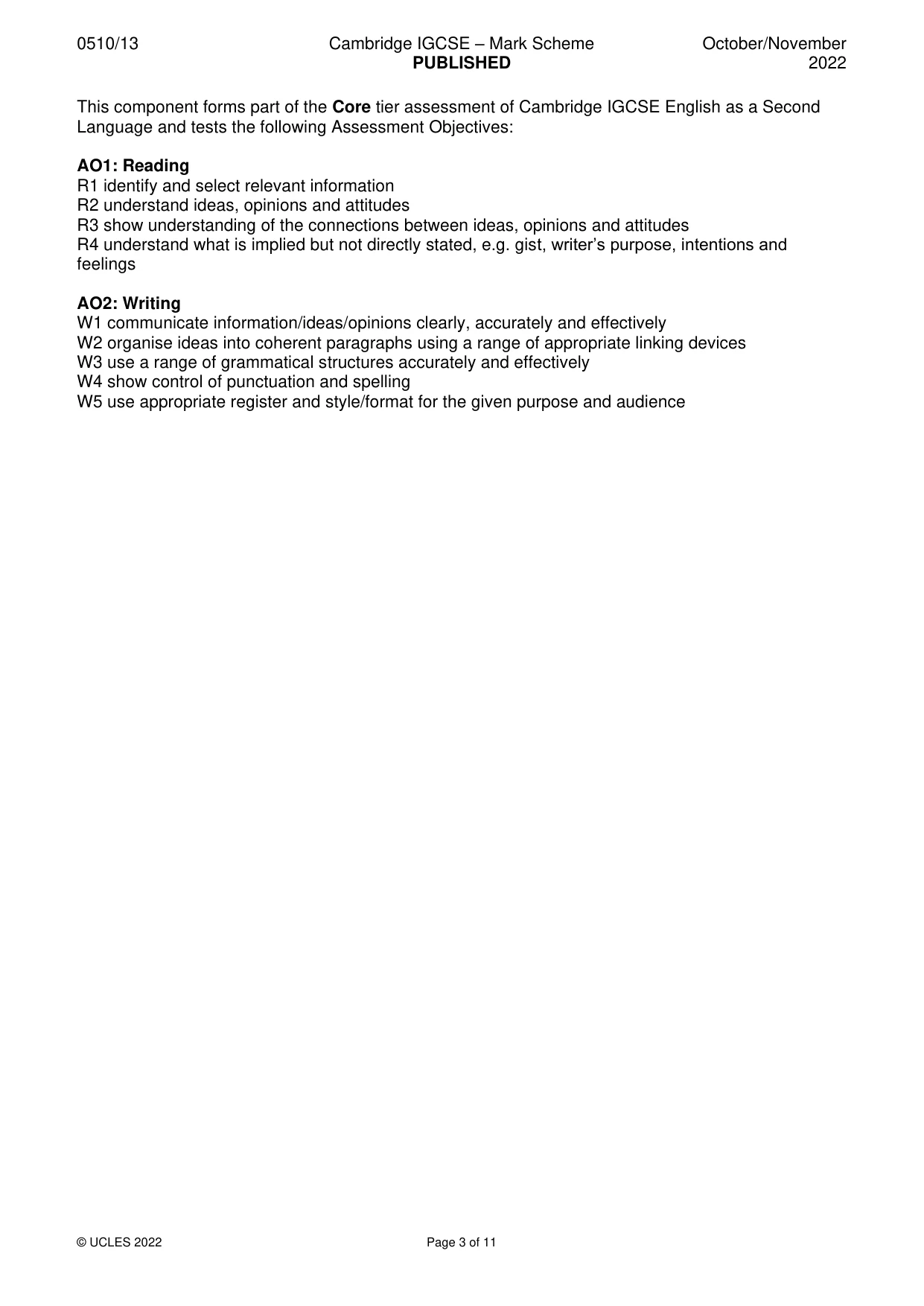
This document consists of 11 printed pages. © UCLES 2022 [Turn over Cambridge IGCSE™ ENGLISH AS A SECOND LANGUAGE 0510/13 Paper 1 Reading and Writing (Core) October/November 2022 MARK SCHEME Maximum Mark: 60 Published This mark scheme is published as an aid to teachers and candidates, to indicate the requirements of the examination. It shows the basis on which Examiners were instructed to award marks. It does not indicate the details of the discussions that took place at an Examiners’ meeting before marking began, which would have considered the acceptability of alternative answers. Mark schemes should be read in conjunction with the question paper and the Principal Examiner Report for Teachers. Cambridge International will not enter into discussions about these mark schemes. Cambridge International is publishing the mark schemes for the October/November 2022 series for most Cambridge IGCSE™, Cambridge International A and AS Level components and some Cambridge O Level components.
Mark scheme, page 2
0510/13 Cambridge IGCSE – Mark Scheme PUBLISHED October/November 2022 © UCLES 2022 Page 2 of 11 Generic Marking Principles These general marking principles must be applied by all examiners when marking candidate answers. They should be applied alongside the specific content of the mark scheme or generic level descriptors for a question. Each question paper and mark scheme will also comply with these marking principles. GENERIC MARKING PRINCIPLE 1: Marks must be awarded in line with: • the specific content of the mark scheme or the generic level descriptors for the question • the specific skills defined in the mark scheme or in the generic level descriptors for the question • the standard of response required by a candidate as exemplified by the standardisation scripts. GENERIC MARKING PRINCIPLE 2: Marks awarded are always whole marks (not half marks, or other fractions). GENERIC MARKING PRINCIPLE 3: Marks must be awarded positively: • marks are awarded for correct/valid answers, as defined in the mark scheme. However, credit is given for valid answers which go beyond the scope of the syllabus and mark scheme, referring to your Team Leader as appropriate • marks are awarded when candidates clearly demonstrate what they know and can do • marks are not deducted for errors • marks are not deducted for omissions • answers should only be judged on the quality of spelling, punctuation and grammar when these features are specifically assessed by the question as indicated by the mark scheme. The meaning, however, should be unambiguous. GENERIC MARKING PRINCIPLE 4: Rules must be applied consistently, e.g. in situations where candidates have not followed instructions or in the application of generic level descriptors. GENERIC MARKING PRINCIPLE 5: Marks should be awarded using the full range of marks defined in the mark scheme for the question (however; the use of the full mark range may be limited according to the quality of the candidate responses seen). GENERIC MARKING PRINCIPLE 6: Marks awarded are based solely on the requirements as defined in the mark scheme. Marks should not be awarded with grade thresholds or grade descriptors in mind.
Mark scheme, page 3
0510/13 Cambridge IGCSE – Mark Scheme PUBLISHED October/November 2022 © UCLES 2022 Page 3 of 11 This component forms part of the Core tier assessment of Cambridge IGCSE English as a Second Language and tests the following Assessment Objectives: AO1: Reading R1 identify and select relevant information R2 understand ideas, opinions and attitudes R3 show understanding of the connections between ideas, opinions and attitudes R4 understand what is implied but not directly stated, e.g. gist, writer’s purpose, intentions and feelings AO2: Writing W1 communicate information/ideas/opinions clearly, accurately and effectively W2 organise ideas into coherent paragraphs using a range of appropriate linking devices W3 use a range of grammatical structures accurately and effectively W4 show control of punctuation and spelling W5 use appropriate register and style/format for the given purpose and audience
Mark scheme, page 4
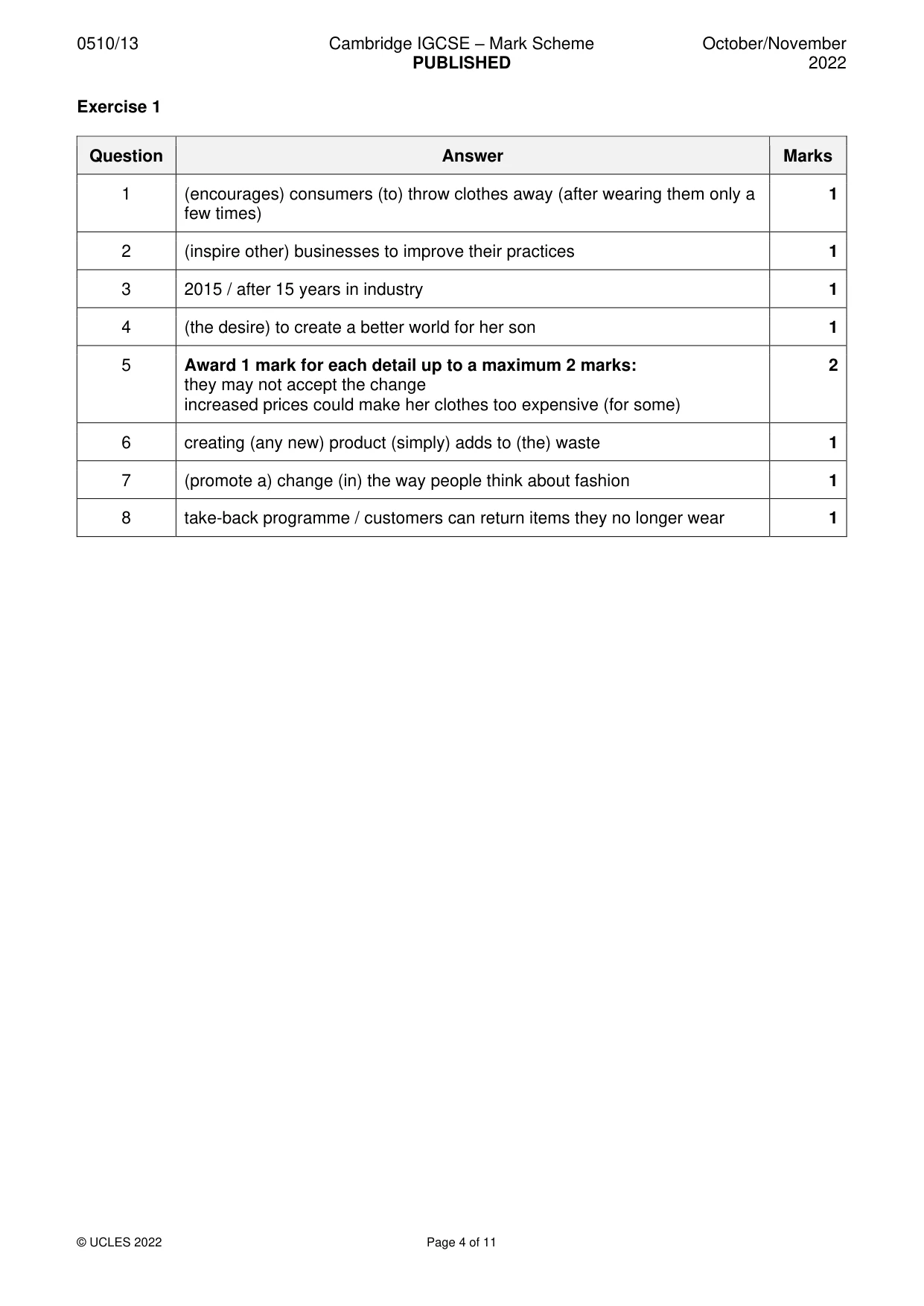
0510/13 Cambridge IGCSE – Mark Scheme PUBLISHED October/November 2022 © UCLES 2022 Page 4 of 11 Exercise 1 Question Answer Marks 1 (encourages) consumers (to) throw clothes away (after wearing them only a few times) 1 2 (inspire other) businesses to improve their practices 1 3 2015 / after 15 years in industry 1 4 (the desire) to create a better world for her son 1 5 Award 1 mark for each detail up to a maximum 2 marks: they may not accept the change increased prices could make her clothes too expensive (for some) 2 6 creating (any new) product (simply) adds to (the) waste 1 7 (promote a) change (in) the way people think about fashion 1 8 take-back programme / customers can return items they no longer wear 1
Mark scheme, page 5
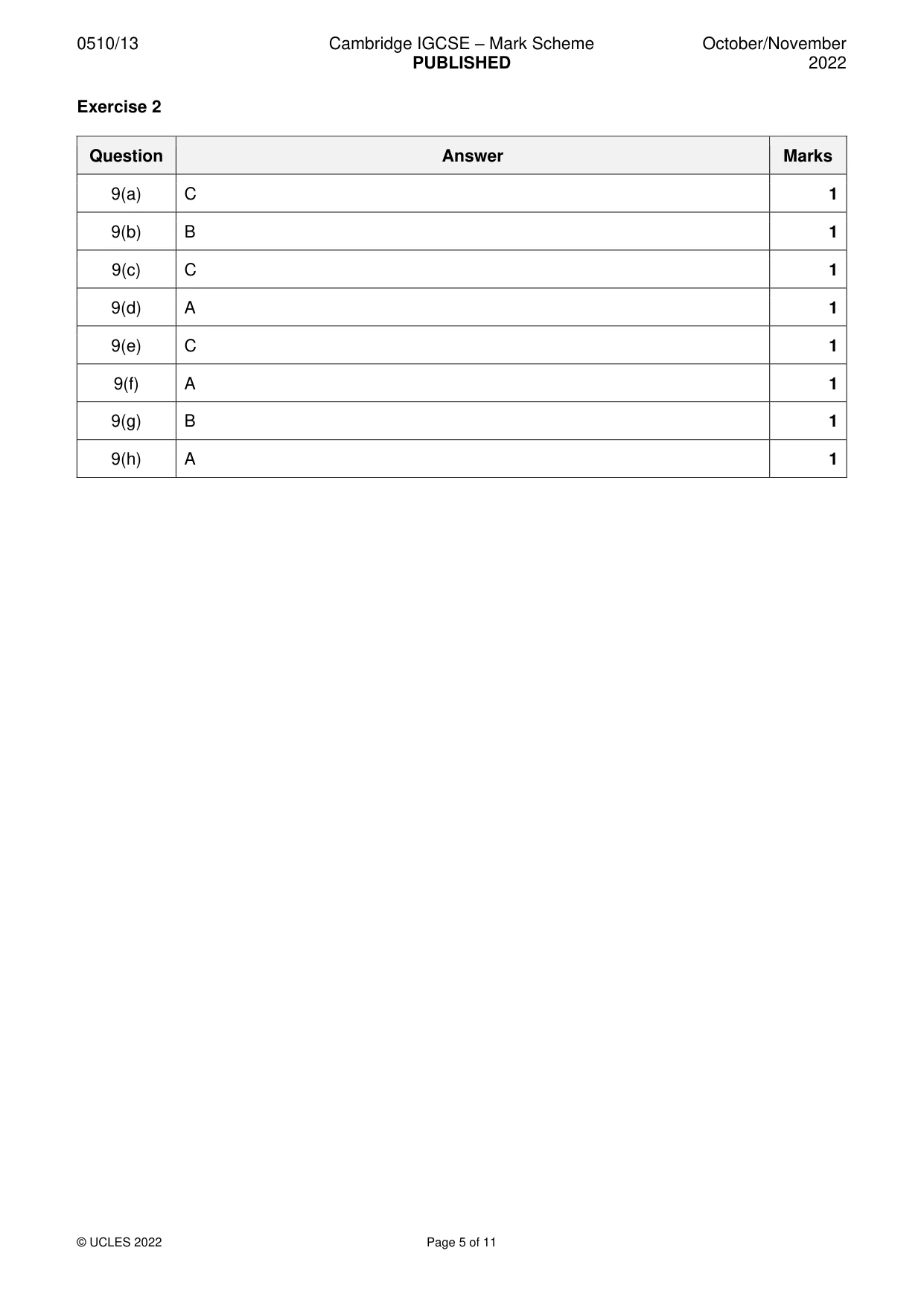
0510/13 Cambridge IGCSE – Mark Scheme PUBLISHED October/November 2022 © UCLES 2022 Page 5 of 11 Exercise 2 Question Answer Marks 9(a) C 1 9(b) B 1 9(c) C 1 9(d) A 1 9(e) C 1 9(f) A 1 9(g) B 1 9(h) A 1
Mark scheme, page 6
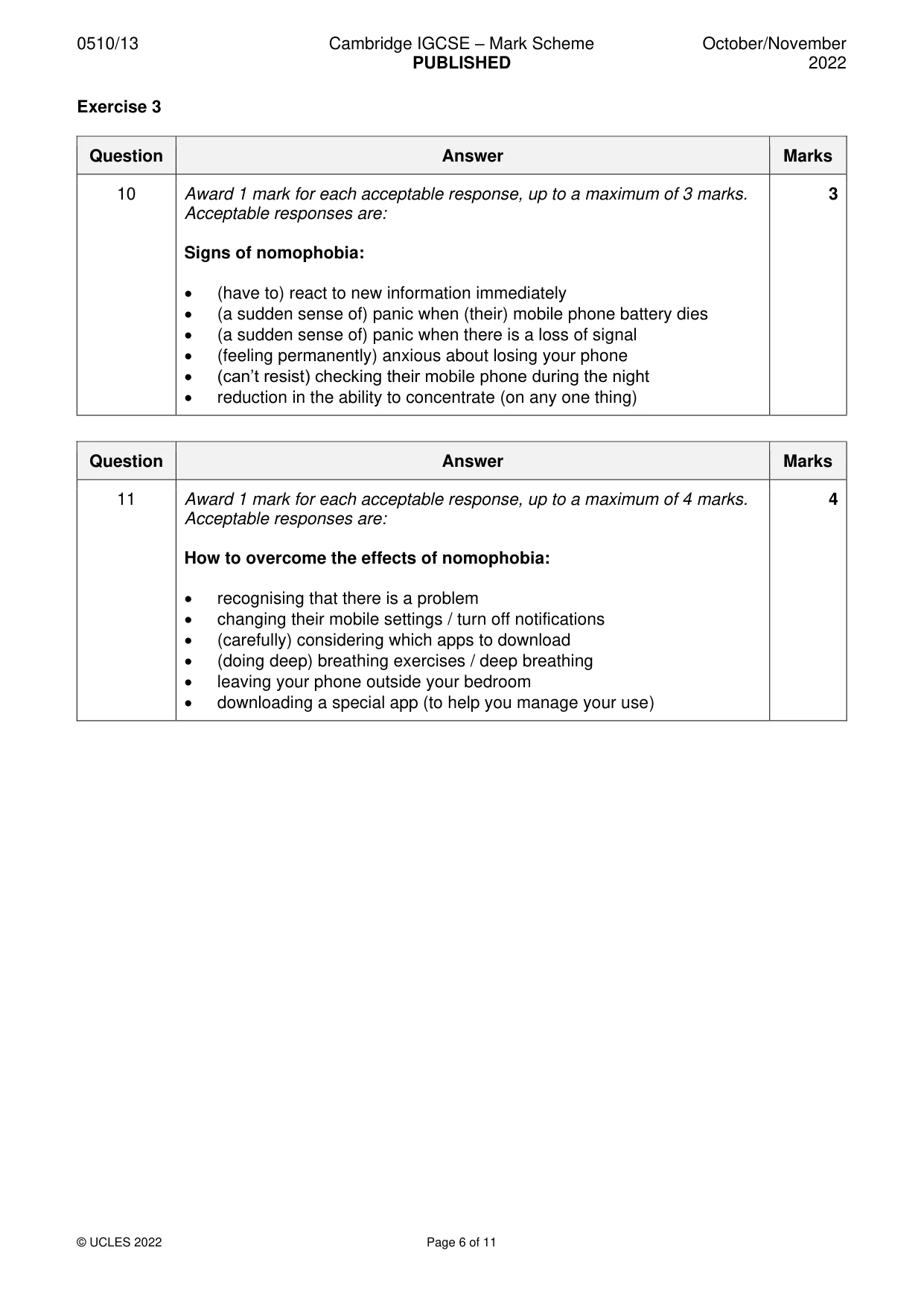
0510/13 Cambridge IGCSE – Mark Scheme PUBLISHED October/November 2022 © UCLES 2022 Page 6 of 11 Exercise 3 Question Answer Marks 10 Award 1 mark for each acceptable response, up to a maximum of 3 marks. Acceptable responses are: Signs of nomophobia: • (have to) react to new information immediately • (a sudden sense of) panic when (their) mobile phone battery dies • (a sudden sense of) panic when there is a loss of signal • (feeling permanently) anxious about losing your phone • (can’t resist) checking their mobile phone during the night • reduction in the ability to concentrate (on any one thing) 3 Question Answer Marks 11 Award 1 mark for each acceptable response, up to a maximum of 4 marks. Acceptable responses are: How to overcome the effects of nomophobia: • recognising that there is a problem • changing their mobile settings / turn off notifications • (carefully) considering which apps to download • (doing deep) breathing exercises / deep breathing • leaving your phone outside your bedroom • downloading a special app (to help you manage your use) 4
Mark scheme, page 7
0510/13 Cambridge IGCSE – Mark Scheme PUBLISHED October/November 2022 © UCLES 2022 Page 7 of 11 Exercise 4 The following general instructions, listed Content points, and Marking criteria, all apply to Exercise 4: • You should decide on a mark for Content and Language separately. • Content points are listed below. • Language covers organisation and coherence, and range and accuracy of language. When deciding on a mark for Language, first gain an impression of the response, then focus on the level descriptors in order to decide on the best fit. If all three bullet points within the band are fulfilled, then it is likely that you will award the higher mark within that band. • If the response exceeds 90 words, a maximum of 4 marks can be awarded for Language. Question Answer Marks 12 Award up to a total of 12 marks. Up to 6 marks to be awarded for Content (Reading) Relevant Content points to include are: 1 looking for locations (in which to film) 2 identify (a) setting that looks right for (the) story 3 find somewhere (that is) within (the film’s) budget 4 identify a location (that is) practical for (the purposes of) filming 5 find a number of possible locations 6 gain permission (to use the location) 7 request the help of local police 8 communicate with local residents / keep local residents happy 6 Up to 6 marks to be awarded for Language (Writing). See generic marking criteria for Exercise 4. 6
Mark scheme, page 8
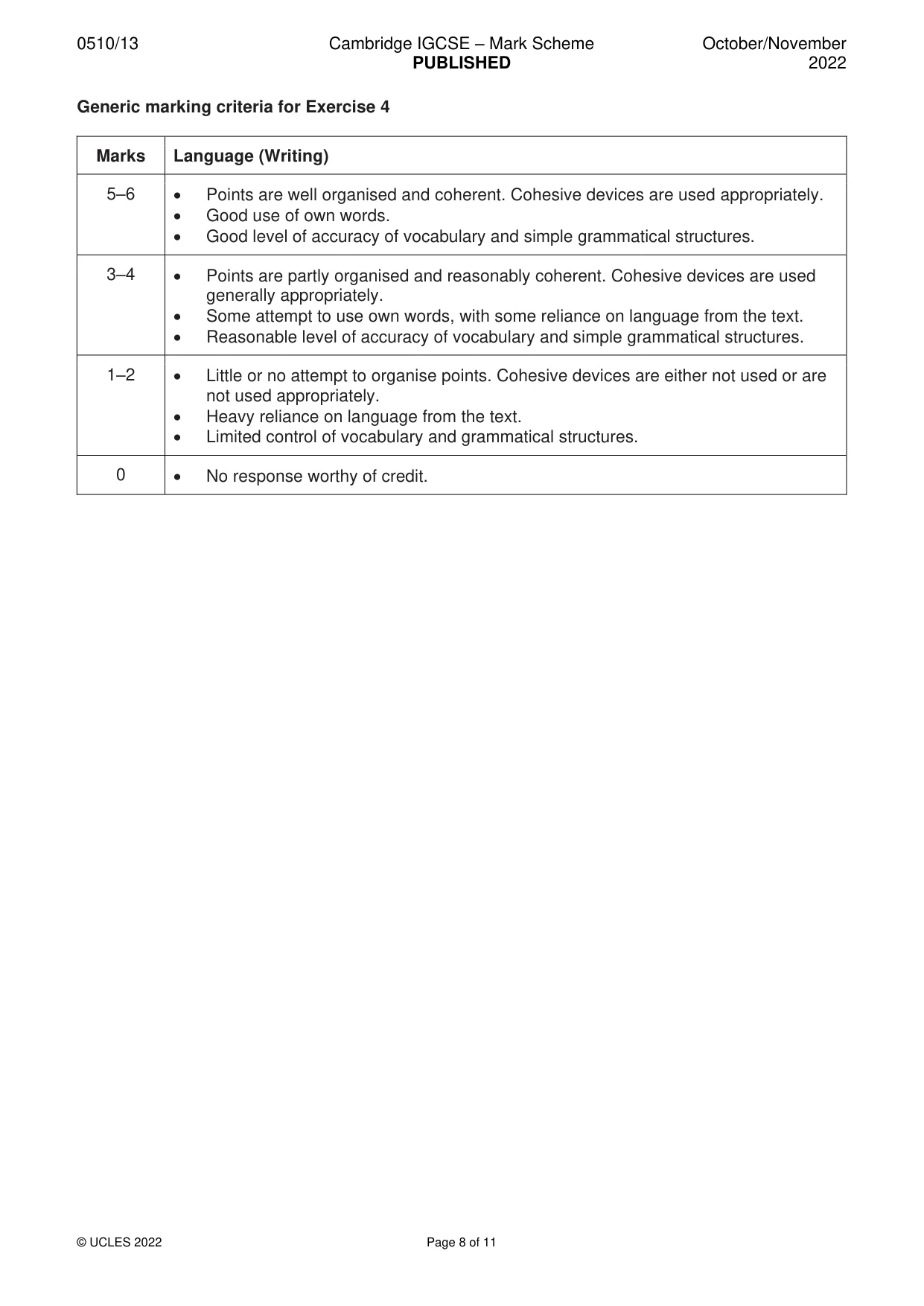
0510/13 Cambridge IGCSE – Mark Scheme PUBLISHED October/November 2022 © UCLES 2022 Page 8 of 11 Generic marking criteria for Exercise 4 Marks Language (Writing) 5–6 • Points are well organised and coherent. Cohesive devices are used appropriately. • Good use of own words. • Good level of accuracy of vocabulary and simple grammatical structures. 3–4 • Points are partly organised and reasonably coherent. Cohesive devices are used generally appropriately. • Some attempt to use own words, with some reliance on language from the text. • Reasonable level of accuracy of vocabulary and simple grammatical structures. 1–2 • Little or no attempt to organise points. Cohesive devices are either not used or are not used appropriately. • Heavy reliance on language from the text. • Limited control of vocabulary and grammatical structures. 0 • No response worthy of credit.
Mark scheme, page 9
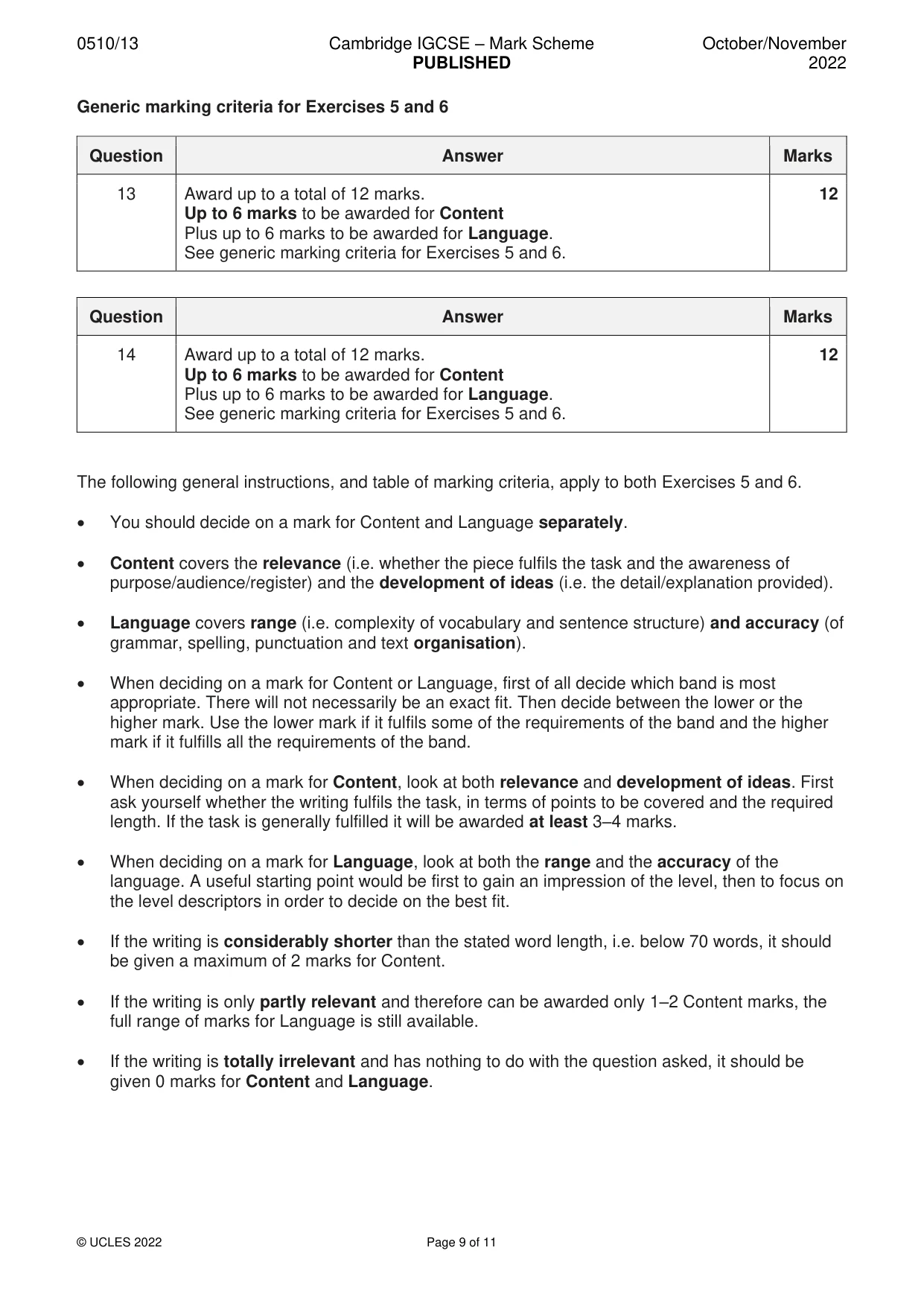
0510/13 Cambridge IGCSE – Mark Scheme PUBLISHED October/November 2022 © UCLES 2022 Page 9 of 11 Generic marking criteria for Exercises 5 and 6 Question Answer Marks 13 Award up to a total of 12 marks. Up to 6 marks to be awarded for Content Plus up to 6 marks to be awarded for Language. See generic marking criteria for Exercises 5 and 6. 12 Question Answer Marks 14 Award up to a total of 12 marks. Up to 6 marks to be awarded for Content Plus up to 6 marks to be awarded for Language. See generic marking criteria for Exercises 5 and 6. 12 The following general instructions, and table of marking criteria, apply to both Exercises 5 and 6. • You should decide on a mark for Content and Language separately. • Content covers the relevance (i.e. whether the piece fulfils the task and the awareness of purpose/audience/register) and the development of ideas (i.e. the detail/explanation provided). • Language covers range (i.e. complexity of vocabulary and sentence structure) and accuracy (of grammar, spelling, punctuation and text organisation). • When deciding on a mark for Content or Language, first of all decide which band is most appropriate. There will not necessarily be an exact fit. Then decide between the lower or the higher mark. Use the lower mark if it fulfils some of the requirements of the band and the higher mark if it fulfills all the requirements of the band. • When deciding on a mark for Content, look at both relevance and development of ideas. First ask yourself whether the writing fulfils the task, in terms of points to be covered and the required length. If the task is generally fulfilled it will be awarded at least 3–4 marks. • When deciding on a mark for Language, look at both the range and the accuracy of the language. A useful starting point would be first to gain an impression of the level, then to focus on the level descriptors in order to decide on the best fit. • If the writing is considerably shorter than the stated word length, i.e. below 70 words, it should be given a maximum of 2 marks for Content. • If the writing is only partly relevant and therefore can be awarded only 1–2 Content marks, the full range of marks for Language is still available. • If the writing is totally irrelevant and has nothing to do with the question asked, it should be given 0 marks for Content and Language.
Mark scheme, page 10
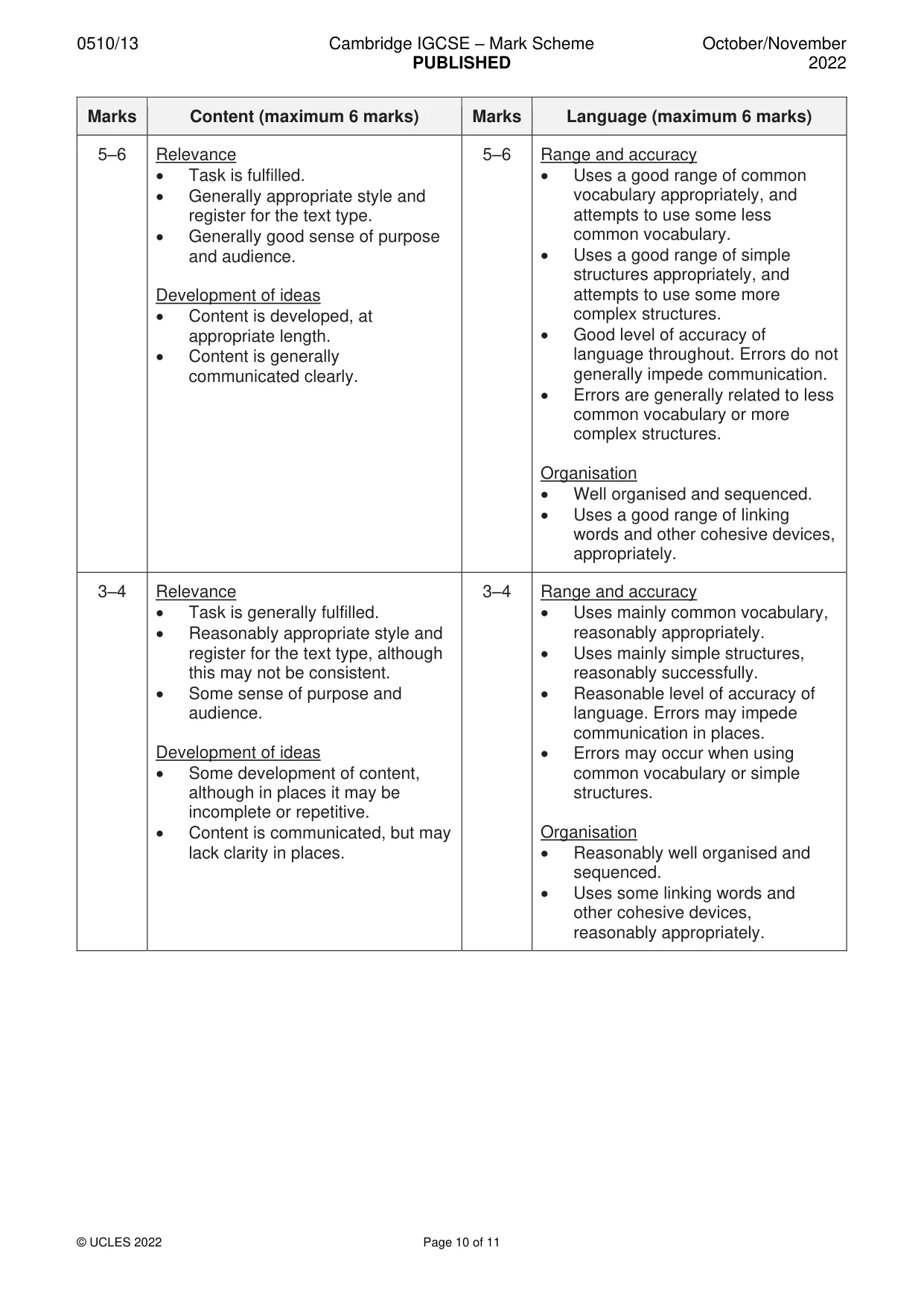
0510/13 Cambridge IGCSE – Mark Scheme PUBLISHED October/November 2022 © UCLES 2022 Page 10 of 11 Marks Content (maximum 6 marks) Marks Language (maximum 6 marks) 5–6 Relevance • Task is fulfilled. • Generally appropriate style and register for the text type. • Generally good sense of purpose and audience. Development of ideas • Content is developed, at appropriate length. • Content is generally communicated clearly. 5–6 Range and accuracy • Uses a good range of common vocabulary appropriately, and attempts to use some less common vocabulary. • Uses a good range of simple structures appropriately, and attempts to use some more complex structures. • Good level of accuracy of language throughout. Errors do not generally impede communication. • Errors are generally related to less common vocabulary or more complex structures. Organisation • Well organised and sequenced. • Uses a good range of linking words and other cohesive devices, appropriately. 3–4 Relevance • Task is generally fulfilled. • Reasonably appropriate style and register for the text type, although this may not be consistent. • Some sense of purpose and audience. Development of ideas • Some development of content, although in places it may be incomplete or repetitive. • Content is communicated, but may lack clarity in places. 3–4 Range and accuracy • Uses mainly common vocabulary, reasonably appropriately. • Uses mainly simple structures, reasonably successfully. • Reasonable level of accuracy of language. Errors may impede communication in places. • Errors may occur when using common vocabulary or simple structures. Organisation • Reasonably well organised and sequenced. • Uses some linking words and other cohesive devices, reasonably appropriately.
Mark scheme, page 11
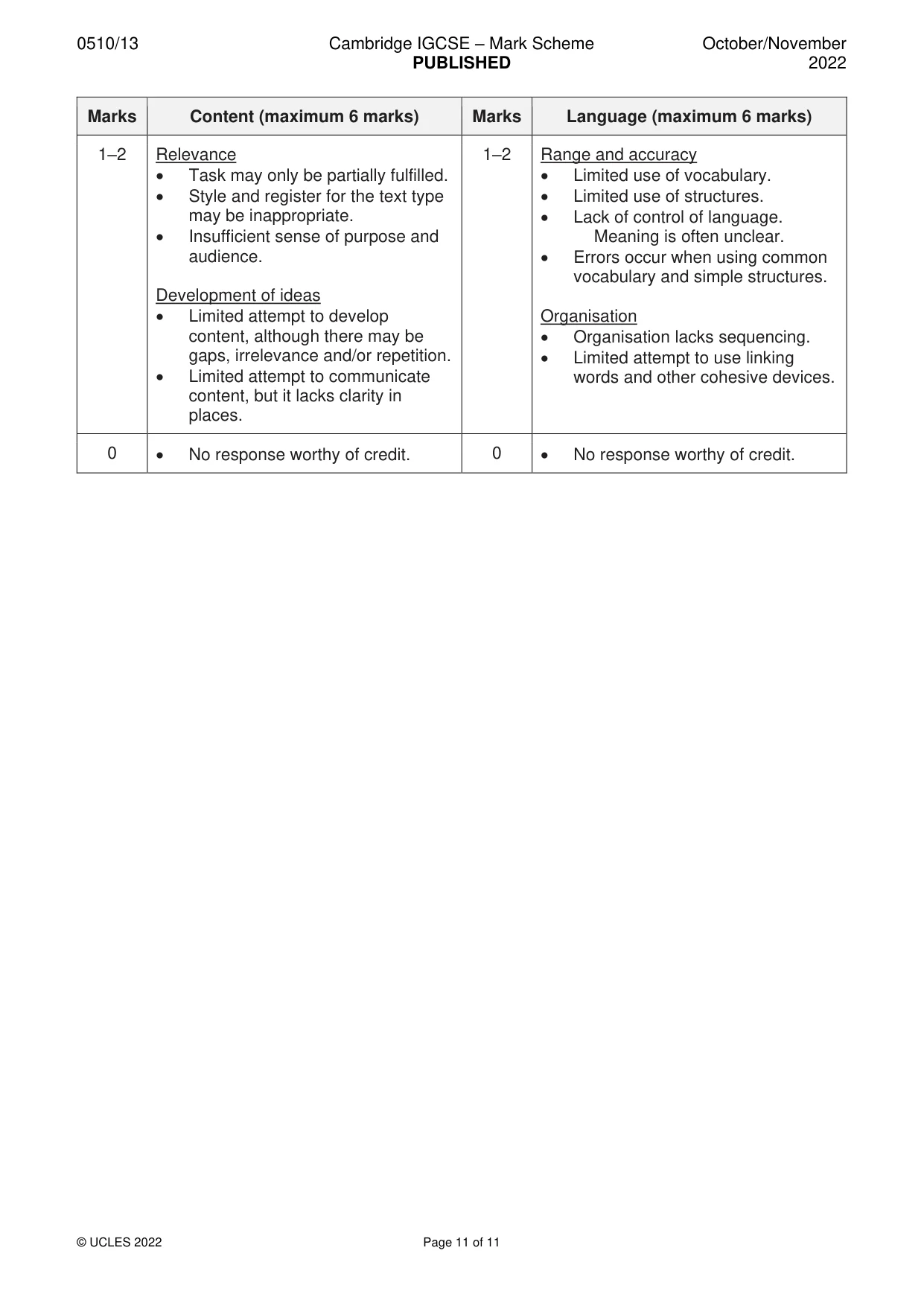
0510/13 Cambridge IGCSE – Mark Scheme PUBLISHED October/November 2022 © UCLES 2022 Page 11 of 11 Marks Content (maximum 6 marks) Marks Language (maximum 6 marks) 1–2 Relevance • Task may only be partially fulfilled. • Style and register for the text type may be inappropriate. • Insufficient sense of purpose and audience. Development of ideas • Limited attempt to develop content, although there may be gaps, irrelevance and/or repetition. • Limited attempt to communicate content, but it lacks clarity in places. 1–2 Range and accuracy • Limited use of vocabulary. • Limited use of structures. • Lack of control of language. Meaning is often unclear. • Errors occur when using common vocabulary and simple structures. Organisation • Organisation lacks sequencing. • Limited attempt to use linking words and other cohesive devices. 0 • No response worthy of credit. 0 • No response worthy of credit.
What you needed in this session
Cambridge’s own grade thresholds for 2022 Oct/Nov, Paper 1 · Variant 3. A higher threshold means an easier paper — the bar moves with how the cohort did.