Cambridge IGCSE English - Second Language (oral endorsement) 0510 — 2022 Oct/Nov Paper 1 · Variant 1
0510/11/O/N/22 · 60 marks · ≈68 min
The question paper and its mark scheme, free to read here and free to download. This is Cambridge’s own paper, exactly as it was sat.
Question paper16 pages





Mark scheme11 pages
Answers below. Sit the paper first if you are practising.
Paper as text
Question paper, page 1
This document has 16 pages. Any blank pages are indicated. [Turn over Cambridge IGCSE™ * 1 8 5 8 9 7 3 4 2 1 * DC (CJ/CGW) 302972/2 © UCLES 2022 ENGLISH AS A SECOND LANGUAGE 0510/11 Paper 1 Reading and Writing (Core) October/November 2022 1 hour 30 minutes You must answer on the question paper. No additional materials are needed. INSTRUCTIONS ● Answer all questions. ● Use a black or dark blue pen. ● Write your name, centre number and candidate number in the boxes at the top of the page. ● Write your answer to each question in the space provided. ● Do not use an erasable pen or correction fluid. ● Do not write on any bar codes. ● Dictionaries are not allowed. INFORMATION ● The total mark for this paper is 60. ● The number of marks for each question or part question is shown in brackets [ ].
Question paper, page 2
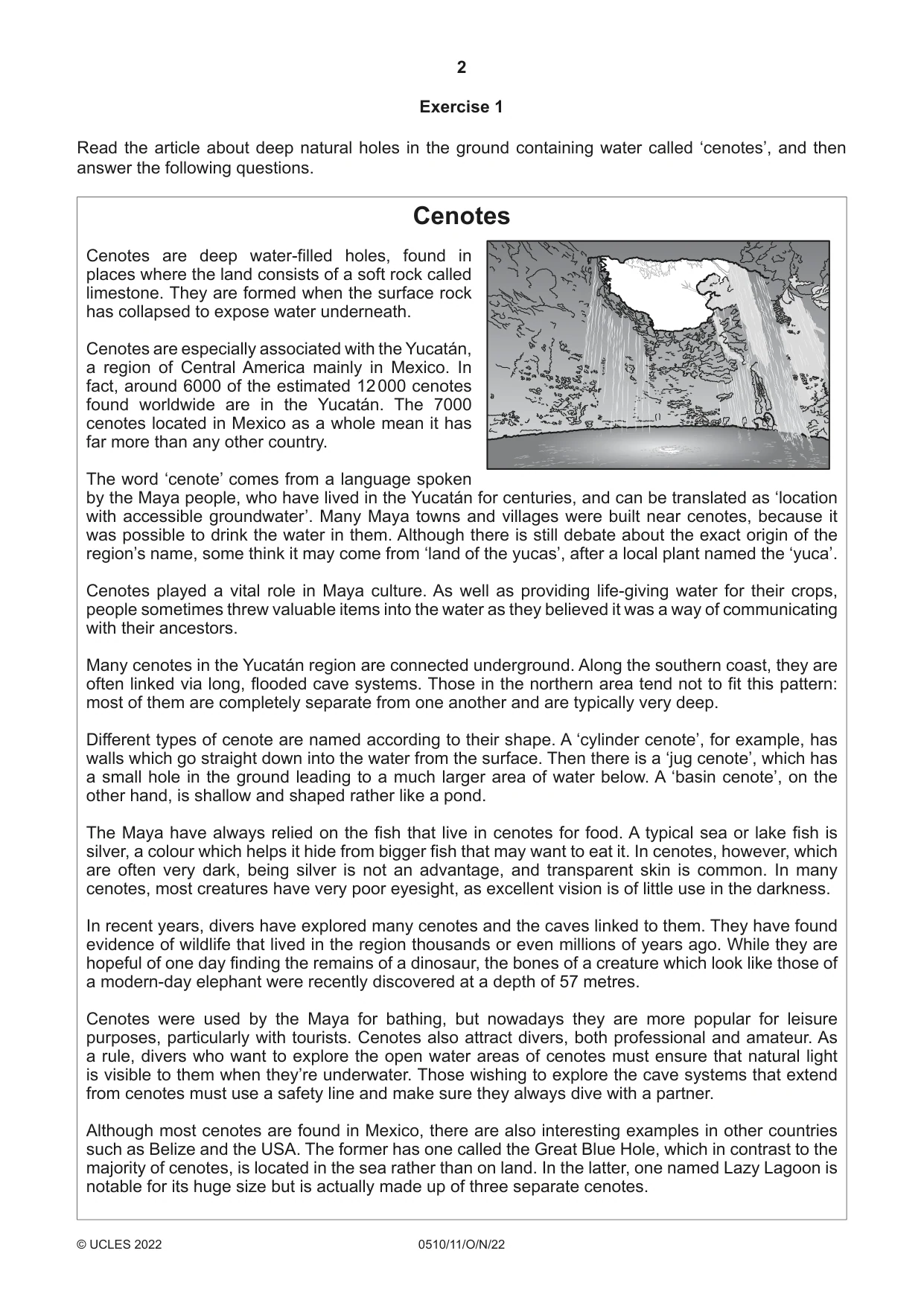
2 0510/11/O/N/22 © UCLES 2022 Exercise 1 Read the article about deep natural holes in the ground containing water called ‘cenotes’, and then answer the following questions. Cenotes Cenotes are deep water-filled holes, found in places where the land consists of a soft rock called limestone. They are formed when the surface rock has collapsed to expose water underneath. Cenotes are especially associated with the Yucatán, a region of Central America mainly in Mexico. In fact, around 6000 of the estimated 12 000 cenotes found worldwide are in the Yucatán. The 7000 cenotes located in Mexico as a whole mean it has far more than any other country. The word ‘cenote’ comes from a language spoken by the Maya people, who have lived in the Yucatán for centuries, and can be translated as ‘location with accessible groundwater’. Many Maya towns and villages were built near cenotes, because it was possible to drink the water in them. Although there is still debate about the exact origin of the region’s name, some think it may come from ‘land of the yucas’, after a local plant named the ‘yuca’. Cenotes played a vital role in Maya culture. As well as providing life-giving water for their crops, people sometimes threw valuable items into the water as they believed it was a way of communicating with their ancestors. Many cenotes in the Yucatán region are connected underground. Along the southern coast, they are often linked via long, flooded cave systems. Those in the northern area tend not to fit this pattern: most of them are completely separate from one another and are typically very deep. Different types of cenote are named according to their shape. A ‘cylinder cenote’, for example, has walls which go straight down into the water from the surface. Then there is a ‘jug cenote’, which has a small hole in the ground leading to a much larger area of water below. A ‘basin cenote’, on the other hand, is shallow and shaped rather like a pond. The Maya have always relied on the fish that live in cenotes for food. A typical sea or lake fish is silver, a colour which helps it hide from bigger fish that may want to eat it. In cenotes, however, which are often very dark, being silver is not an advantage, and transparent skin is common. In many cenotes, most creatures have very poor eyesight, as excellent vision is of little use in the darkness. In recent years, divers have explored many cenotes and the caves linked to them. They have found evidence of wildlife that lived in the region thousands or even millions of years ago. While they are hopeful of one day finding the remains of a dinosaur, the bones of a creature which look like those of a modern-day elephant were recently discovered at a depth of 57 metres. Cenotes were used by the Maya for bathing, but nowadays they are more popular for leisure purposes, particularly with tourists. Cenotes also attract divers, both professional and amateur. As a rule, divers who want to explore the open water areas of cenotes must ensure that natural light is visible to them when they’re underwater. Those wishing to explore the cave systems that extend from cenotes must use a safety line and make sure they always dive with a partner. Although most cenotes are found in Mexico, there are also interesting examples in other countries such as Belize and the USA. The former has one called the Great Blue Hole, which in contrast to the majority of cenotes, is located in the sea rather than on land. In the latter, one named Lazy Lagoon is notable for its huge size but is actually made up of three separate cenotes.
Question paper, page 3
3 0510/11/O/N/22 © UCLES 2022 [Turn over 1 How many cenotes are there in the Yucatán? … [1] 2 What does ‘cenote’ mean in the language of the Maya people? … [1] 3 Which part of the Yucatán contains cenotes which are generally not joined together? … [1] 4 What kind of cenote has a narrow opening above a wider pool of water? … [1] 5 What are the typical features of the fish found in many cenotes? Give two details. … … [2] 6 Which animal’s skeleton is similar to the one found by cenote divers? … [1] 7 What equipment should divers have when diving in caves connected to cenotes? … [1] 8 What is unusual about one cenote in Belize? … [1] [Total: 9]
Question paper, page 4
4 0510/11/O/N/22 © UCLES 2022 Exercise 2 Read the article about three people (A–C) who recently learned to drive. Then answer Question 9(a)–(h). Learning to drive Three young people share their experiences of learning to drive. A Mohammed I qualified to drive a month ago. To be honest, I had to be persuaded to start taking lessons. I live in a big city where the public transport’s great, so I couldn’t see much point in being able to drive. I’m glad my friends convinced me, though, as it’s given me more freedom. I booked twelve lessons with the person who’d taught my older sister to drive. She was great, but even by the twelfth lesson, I still hadn’t got used to the size of her car. It wasn’t as if I had an accident: it just felt as though it was designed for someone much shorter than me. My instructor noticed that one week I’d be full of confidence while I was driving, and the next I’d be as nervous as I was in my first lesson. My college course was pretty stressful at various points while I was learning, so maybe that showed in the way I handled the car. B Jing I felt very nervous the first time I climbed into my driving instructor’s car. It looked so shiny and expensive! I remember thinking, ‘please don’t let me damage it!’ It all worked out fine, thankfully. My instructor couldn’t believe that I’d never driven before, because I seemed to pick up everything he was teaching me straight away. I must admit, I was just as astonished as he was. My parents were worried about how often I’d want to borrow their car after I got my full driving licence, so they said they’d get me one of my own. It was incredibly kind of them, but it made me rush things and take my driving test a bit too soon. I passed, but I should have developed my skills further by doing a few additional sessions with my instructor. It would have been far more beneficial than trying to understand my dad’s complicated explanations when I ask him about things I’m not sure of. C Serge There was no question about whether I’d learn to drive or not. You have to be seventeen where I live, and I’d talk about it all the time before I was even old enough to start. I felt jealous when I saw friends whose seventeenth birthdays were before mine out with a driving instructor. When my turn came, I felt like I knew what I was doing, even as I got into the instructor’s car for the first lesson. I was expecting to be able to do everything perfectly within four or five lessons, but of course that never happened. My dad reassured me that it takes time to be able to do things automatically, so I should just relax and enjoy it, which really helped. I’d love to have got a car as soon as I qualified, but my parents have promised that I can use theirs, more or less when I want, until I’ve saved up enough for my own.
Question paper, page 5
5 0510/11/O/N/22 © UCLES 2022 [Turn over 9 For each question, write the correct letter A, B or C on the line. Which person … (a) was unhappy with their driving instructor’s vehicle? … [1] (b) received some useful advice from a family member? … [1] (c) was promised a car when they qualified to drive? … [1] (d) wishes they’d had more lessons with their instructor? … [1] (e) was initially unsure whether they wanted to learn to drive? … [1] (f) was confident when they started learning to drive? … [1] (g) suggests how well they drove during lessons depended on their mood? … [1] (h) was surprised by how quickly they learned new skills? … [1] [Total: 8]
Question paper, page 6
6 0510/11/O/N/22 © UCLES 2022 Exercise 3 Read the article about the famous American inventor, Thomas Edison, and then complete the notes. Thomas Edison Thomas Edison, the great American businessman and inventor, came from modest beginnings to become one of the world’s best-known inventors. Edison was born on February 11, 1847, in Ohio, USA, the youngest of seven children. His father was involved in politics, while his mother was a talented schoolteacher and a major influence in Edison’s early life. In 1854, Edison’s family moved to Port Huron, Michigan. Thomas attended school for only 12 weeks. He was unable to stay still for more than a few minutes in the classroom, and as a result of this was described as ‘difficult’ by his schoolteacher. His mother decided he should learn at home instead. Although he was easily distracted from whatever he was doing, once he was free from the limitations of the school environment, Edison developed his own way of learning independently that would help him throughout his life. At the age of 12, Edison convinced his parents to let him sell magazines at stations along a nearby railway line. Seeing his customers’ dissatisfaction with how out-of-date many of the stories were, Edison began publishing his own small newspaper, which became a hit with passengers because it was so up-to-date. This was the first of many business projects where Edison saw a need and took advantage of the opportunity. When he was 15, Edison started working as a telegrapher. This involved using an early electronic device called a telegraph to send messages across long distances. However, his real love in life was experimenting and inventing things, so he spent much of his free time doing this. Edison’s first commercially successful invention came from working with people whose job involved buying and selling things on international markets. They used machines which reported the prices on international markets. Edison noticed how poorly they worked, so he developed an improved stock ticker, as the devices were known, selling the design for $40 000. This enabled him to quit his job and spend all of his time inventing. In 1877, after realising there was money to be made from it, Edison invented a machine for recording sound: the phonograph. While not commercially successful for another decade, it brought him worldwide fame. Edison is famous for a range of inventions, although not all of them can be attributed to him. He was aware of the potential that developments in science and engineering at that time had for transforming people’s lives, so he designed the first reliable light bulb. However, Edison realised that they would never sell in the quantities he hoped for if there were no businesses to provide power for people’s homes. Therefore, in 1880, he set up a company to deliver electricity. At the beginning of the 20th century, the motor car was in its early stages of development. As its popularity began to grow, Edison spotted that cars would benefit from a way of starting that didn’t involve having to push them or turn a heavy handle, as was the case with early designs. His solution was a car battery, which was used to self-start the first mass-produced car, the Ford Model T. His model was used extensively in vehicles for many years. Edison died on October 18, 1931, leaving behind a long list of useful inventions for future generations.
Question paper, page 7
7 0510/11/O/N/22 © UCLES 2022 [Turn over You are going to give a talk about Thomas Edison to your class at school. Prepare some notes to use as the basis for your talk. Make short notes under each heading. 10 Details of Edison’s education: • … • … • … [3] 11 Examples of what Edison created: • … • … • … • … [4] [Total: 7]
Question paper, page 8
8 0510/11/ O/ N/22 © UCLES 2022 Exercise 4 12 Read the article about small devices called drones which can be used to deliver items to homes and businesses. Write a summary about the advantages of using drones for deliveries. Your summary should be about 80 words long (and no more than 90 words long). You should use your own words as far as possible. You will receive up to 6 marks for the content of your summary, and up to 6 marks for the style and accuracy of your language. Using drones for deliveries Although some people think of drones as sophisticated toys, they have a wide range of other possible uses. In fact, some drones already deliver mail and other goods to homes and businesses. Compared to traditional means of delivery, drones are cheap. After all, it costs far more to pay a human delivery driver than a drone! You might think that having large numbers of drones from different delivery companies all flying round a neighbourhood at the same time would cause accidents. In reality, however, they are relatively safe. In addition to this, replacing cars and vans with drones for deliveries results in less traffic on the road. Very few residents of towns and cities would be against that. Most people who use drones report that they are easy to learn how to control. One reason for this is that many of them are fitted with cameras so the operator can see where they are going. However, this also means that these machines can be used in ways which affect our privacy, a concern that many people share. Some consumers are worried about drone delivery services and report concerns that packages can be lost or delivered to the wrong place. However, research indicates that drones can bring supplies faster than normal services, especially in locations such as cities. In some emergency situations, the time saved can make a huge difference. This means medicines or medical equipment, for example, could be flown to the intended site in just a few minutes. What is also an important consideration is the fact that drones can deliver to places where there are no roads, for example to isolated rural locations. Drones need battery power in order to fly and their flight is nearly pollution-free if the batteries are charged using green energy, such as solar or wind power. However, one issue with drones is that they make an annoying noise when they fly. Whether you are for or against them, perhaps the next takeaway pizza you order will be delivered by a drone!
Question paper, page 9
9 0510/11/O/N/22 © UCLES 2022 [Turn over … … … … … … … … … … … … … … [Total: 12]
Question paper, page 10
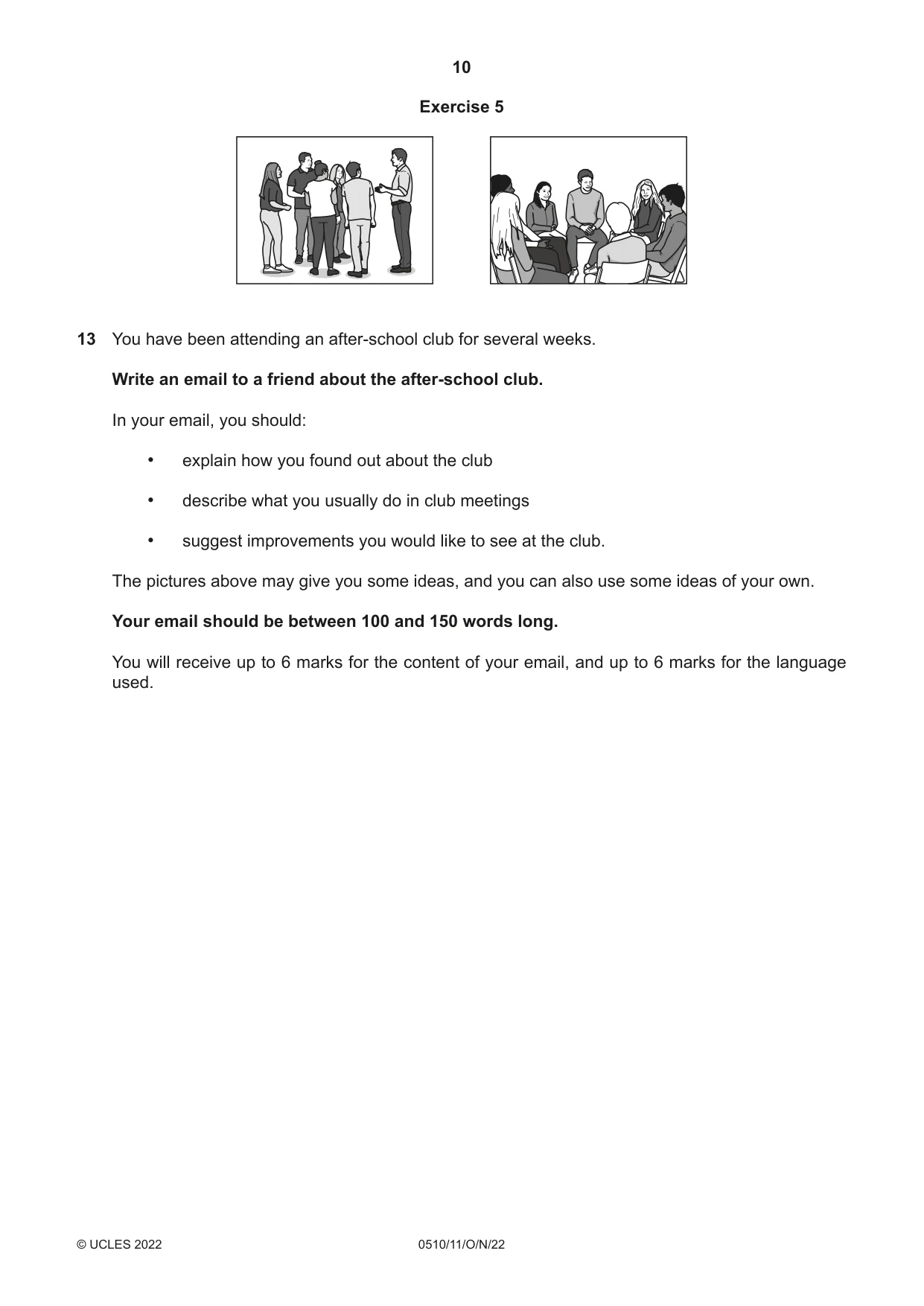
10 0510/11/O/N/22 © UCLES 2022 Exercise 5 13 You have been attending an after-school club for several weeks. Write an email to a friend about the after-school club. In your email, you should: • explain how you found out about the club • describe what you usually do in club meetings • suggest improvements you would like to see at the club. The pictures above may give you some ideas, and you can also use some ideas of your own. Your email should be between 100 and 150 words long. You will receive up to 6 marks for the content of your email, and up to 6 marks for the language used.
Question paper, page 11
11 0510/11/O/N/22 © UCLES 2022 [Turn over … … … … … … … … … … … … … … … … … … … … … … … … … … … [Total: 12]
Question paper, page 12
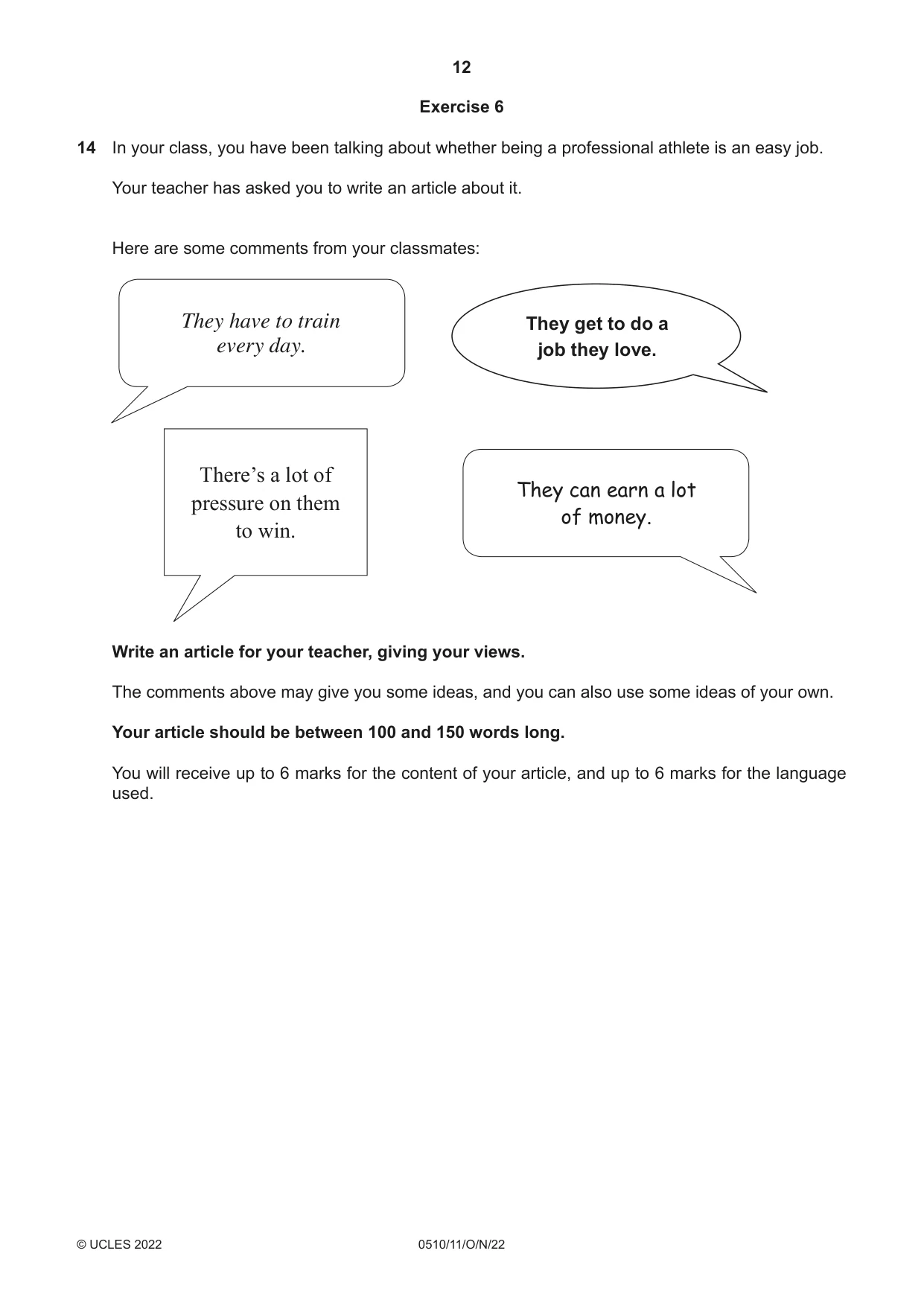
12 0510/11/O/N/22 © UCLES 2022 Exercise 6 14 In your class, you have been talking about whether being a professional athlete is an easy job. Your teacher has asked you to write an article about it. Here are some comments from your classmates: Write an article for your teacher, giving your views. The comments above may give you some ideas, and you can also use some ideas of your own. Your article should be between 100 and 150 words long. You will receive up to 6 marks for the content of your article, and up to 6 marks for the language used. They have to train every day. They can earn a lot of money. They get to do a job they love. There’s a lot of pressure on them to win.
Question paper, page 13
13 0510/11/O/N/22 © UCLES 2022 … … … … … … … … … … … … … … … … … … … … … … … … … … … [Total: 12]
Question paper, page 14
14 0510/11/O/N/22 © UCLES 2022 BLANK PAGE
Question paper, page 15
15 0510/11/O/N/22 © UCLES 2022 BLANK PAGE
Question paper, page 16
16 0510/11/O/N/22 © UCLES 2022 Permission to reproduce items where third-party owned material protected by copyright is included has been sought and cleared where possible. Every reasonable effort has been made by the publisher (UCLES) to trace copyright holders, but if any items requiring clearance have unwittingly been included, the publisher will be pleased to make amends at the earliest possible opportunity. To avoid the issue of disclosure of answer-related information to candidates, all copyright acknowledgements are reproduced online in the Cambridge Assessment International Education Copyright Acknowledgements Booklet. This is produced for each series of examinations and is freely available to download at www.cambridgeinternational.org after the live examination series. Cambridge Assessment International Education is part of Cambridge Assessment. Cambridge Assessment is the brand name of the University of Cambridge Local Examinations Syndicate (UCLES), which is a department of the University of Cambridge. BLANK PAGE
Mark scheme, page 1
This document consists of 11 printed pages. © UCLES 2022 [Turn over Cambridge IGCSE™ ENGLISH AS A SECOND LANGUAGE 0510/11 Paper 1 Reading and Writing (Core) October/November 2022 MARK SCHEME Maximum Mark: 60 Published This mark scheme is published as an aid to teachers and candidates, to indicate the requirements of the examination. It shows the basis on which Examiners were instructed to award marks. It does not indicate the details of the discussions that took place at an Examiners’ meeting before marking began, which would have considered the acceptability of alternative answers. Mark schemes should be read in conjunction with the question paper and the Principal Examiner Report for Teachers. Cambridge International will not enter into discussions about these mark schemes. Cambridge International is publishing the mark schemes for the October/November 2022 series for most Cambridge IGCSE™, Cambridge International A and AS Level components and some Cambridge O Level components.
Mark scheme, page 2
0510/11 Cambridge IGCSE – Mark Scheme PUBLISHED October/November 2022 © UCLES 2022 Page 2 of 11 Generic Marking Principles These general marking principles must be applied by all examiners when marking candidate answers. They should be applied alongside the specific content of the mark scheme or generic level descriptors for a question. Each question paper and mark scheme will also comply with these marking principles. GENERIC MARKING PRINCIPLE 1: Marks must be awarded in line with: • the specific content of the mark scheme or the generic level descriptors for the question • the specific skills defined in the mark scheme or in the generic level descriptors for the question • the standard of response required by a candidate as exemplified by the standardisation scripts. GENERIC MARKING PRINCIPLE 2: Marks awarded are always whole marks (not half marks, or other fractions). GENERIC MARKING PRINCIPLE 3: Marks must be awarded positively: • marks are awarded for correct/valid answers, as defined in the mark scheme. However, credit is given for valid answers which go beyond the scope of the syllabus and mark scheme, referring to your Team Leader as appropriate • marks are awarded when candidates clearly demonstrate what they know and can do • marks are not deducted for errors • marks are not deducted for omissions • answers should only be judged on the quality of spelling, punctuation and grammar when these features are specifically assessed by the question as indicated by the mark scheme. The meaning, however, should be unambiguous. GENERIC MARKING PRINCIPLE 4: Rules must be applied consistently, e.g. in situations where candidates have not followed instructions or in the application of generic level descriptors. GENERIC MARKING PRINCIPLE 5: Marks should be awarded using the full range of marks defined in the mark scheme for the question (however; the use of the full mark range may be limited according to the quality of the candidate responses seen). GENERIC MARKING PRINCIPLE 6: Marks awarded are based solely on the requirements as defined in the mark scheme. Marks should not be awarded with grade thresholds or grade descriptors in mind.
Mark scheme, page 3
0510/11 Cambridge IGCSE – Mark Scheme PUBLISHED October/November 2022 © UCLES 2022 Page 3 of 11 This component forms part of the Core tier assessment of Cambridge IGCSE English as a Second Language and tests the following Assessment Objectives: AO1: Reading R1 identify and select relevant information R2 understand ideas, opinions and attitudes R3 show understanding of the connections between ideas, opinions and attitudes R4 understand what is implied but not directly stated, e.g. gist, writer’s purpose, intentions and feelings AO2: Writing W1 communicate information/ideas/opinions clearly, accurately and effectively W2 organise ideas into coherent paragraphs using a range of appropriate linking devices W3 use a range of grammatical structures accurately and effectively W4 show control of punctuation and spelling W5 use appropriate register and style/format for the given purpose and audience
Mark scheme, page 4
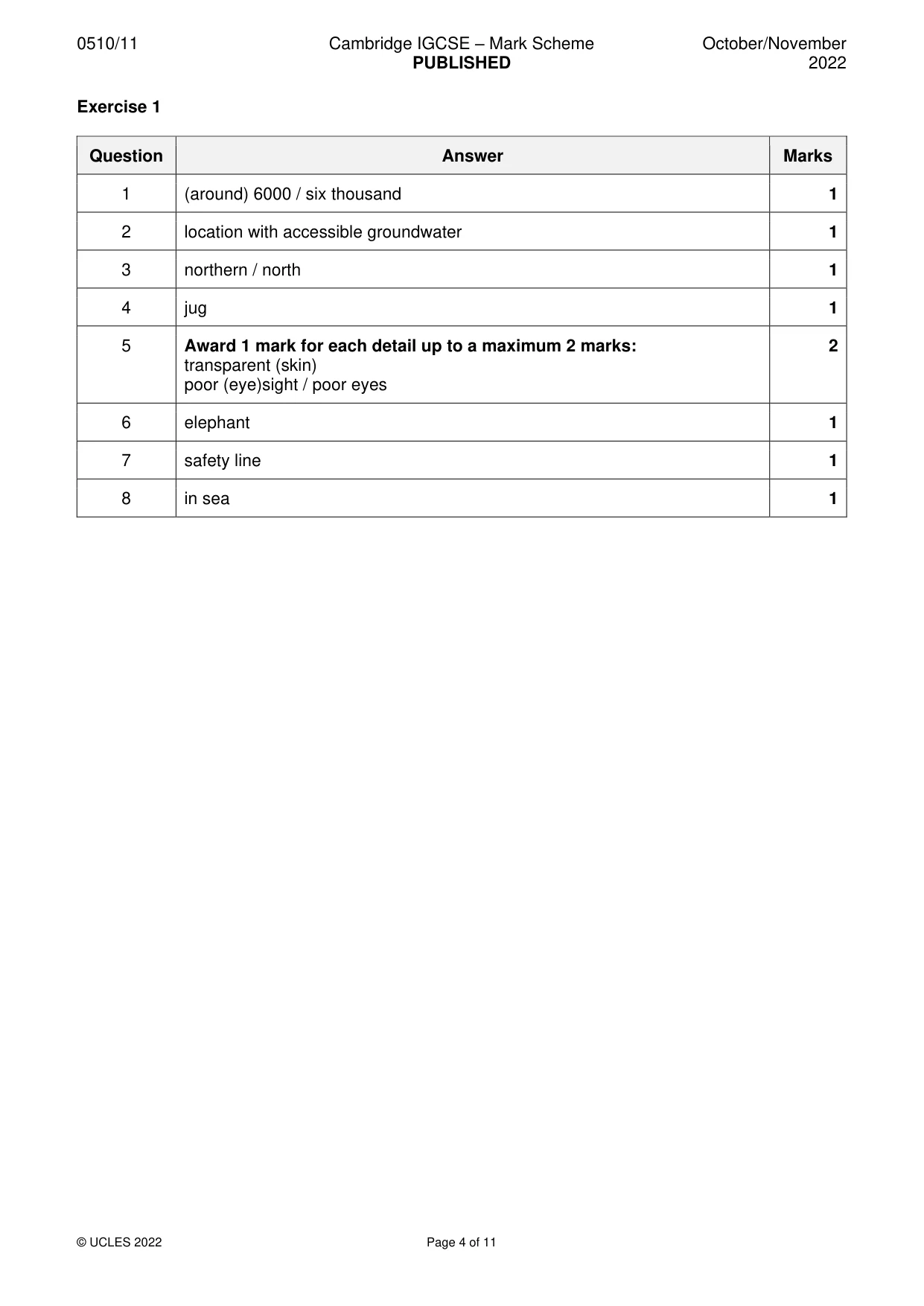
0510/11 Cambridge IGCSE – Mark Scheme PUBLISHED October/November 2022 © UCLES 2022 Page 4 of 11 Exercise 1 Question Answer Marks 1 (around) 6000 / six thousand 1 2 location with accessible groundwater 1 3 northern / north 1 4 jug 1 5 Award 1 mark for each detail up to a maximum 2 marks: transparent (skin) poor (eye)sight / poor eyes 2 6 elephant 1 7 safety line 1 8 in sea 1
Mark scheme, page 5
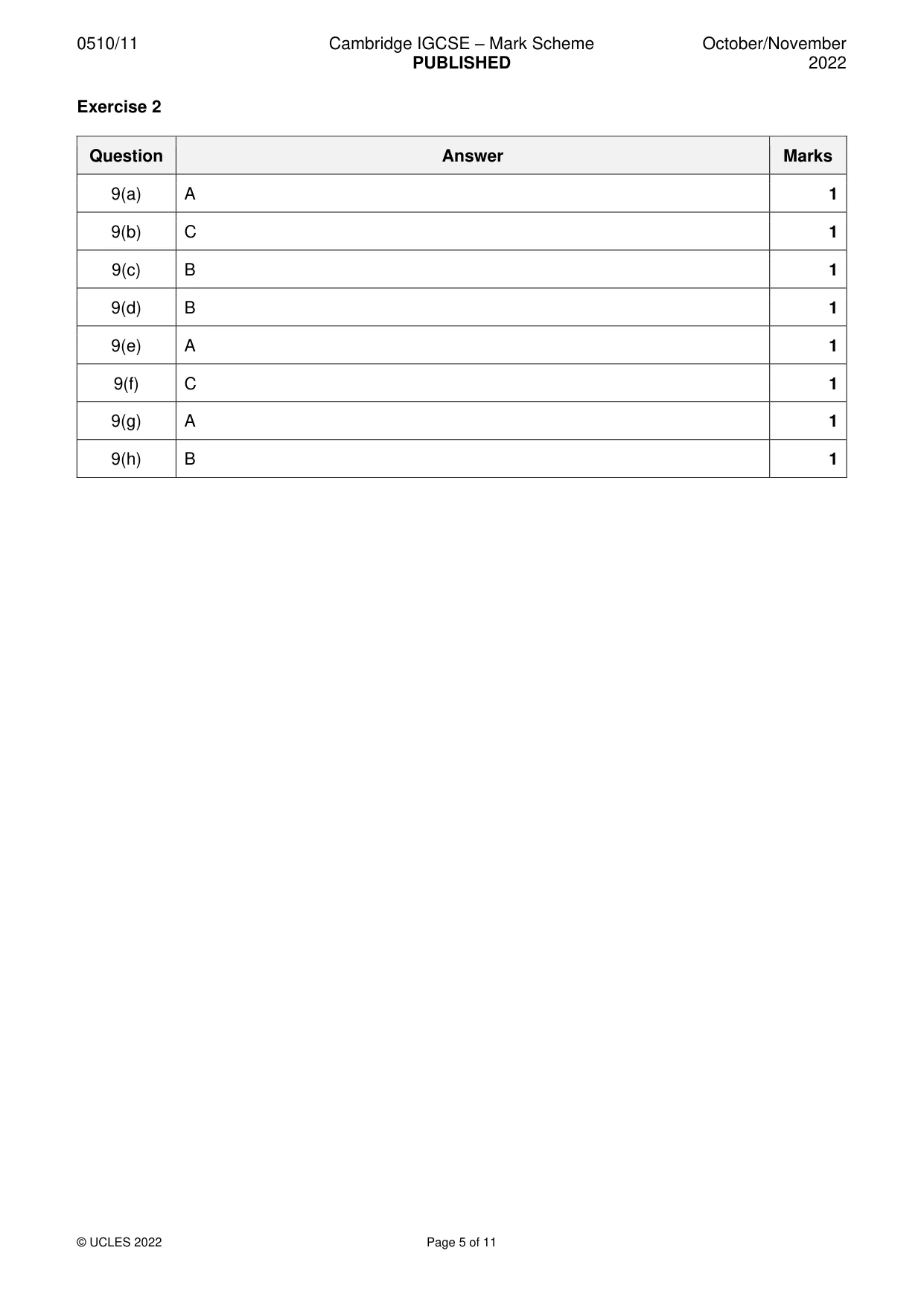
0510/11 Cambridge IGCSE – Mark Scheme PUBLISHED October/November 2022 © UCLES 2022 Page 5 of 11 Exercise 2 Question Answer Marks 9(a) A 1 9(b) C 1 9(c) B 1 9(d) B 1 9(e) A 1 9(f) C 1 9(g) A 1 9(h) B 1
Mark scheme, page 6
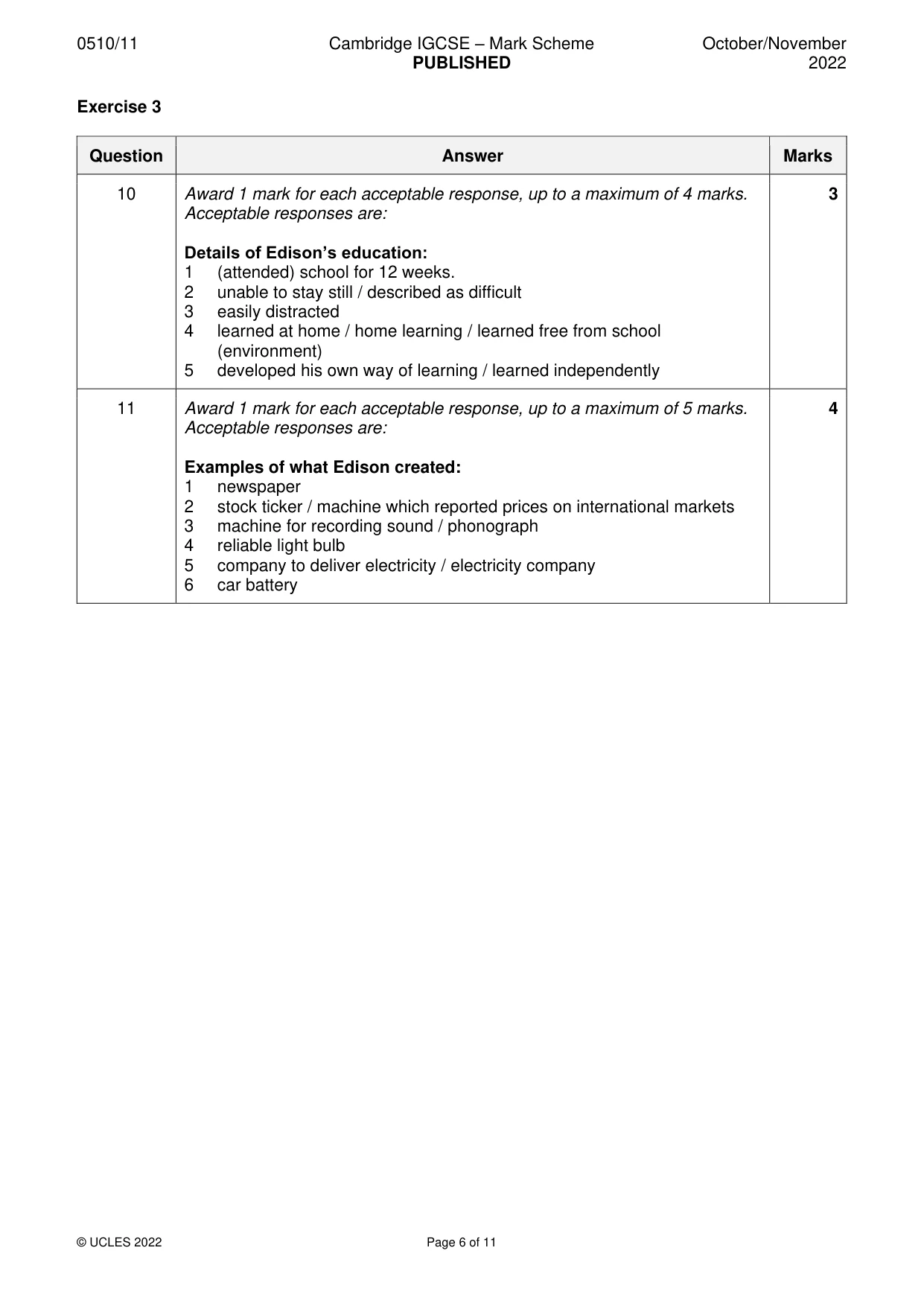
0510/11 Cambridge IGCSE – Mark Scheme PUBLISHED October/November 2022 © UCLES 2022 Page 6 of 11 Exercise 3 Question Answer Marks 10 Award 1 mark for each acceptable response, up to a maximum of 4 marks. Acceptable responses are: Details of Edison’s education: 1 (attended) school for 12 weeks. 2 unable to stay still / described as difficult 3 easily distracted 4 learned at home / home learning / learned free from school (environment) 5 developed his own way of learning / learned independently 3 11 Award 1 mark for each acceptable response, up to a maximum of 5 marks. Acceptable responses are: Examples of what Edison created: 1 newspaper 2 stock ticker / machine which reported prices on international markets 3 machine for recording sound / phonograph 4 reliable light bulb 5 company to deliver electricity / electricity company 6 car battery 4
Mark scheme, page 7
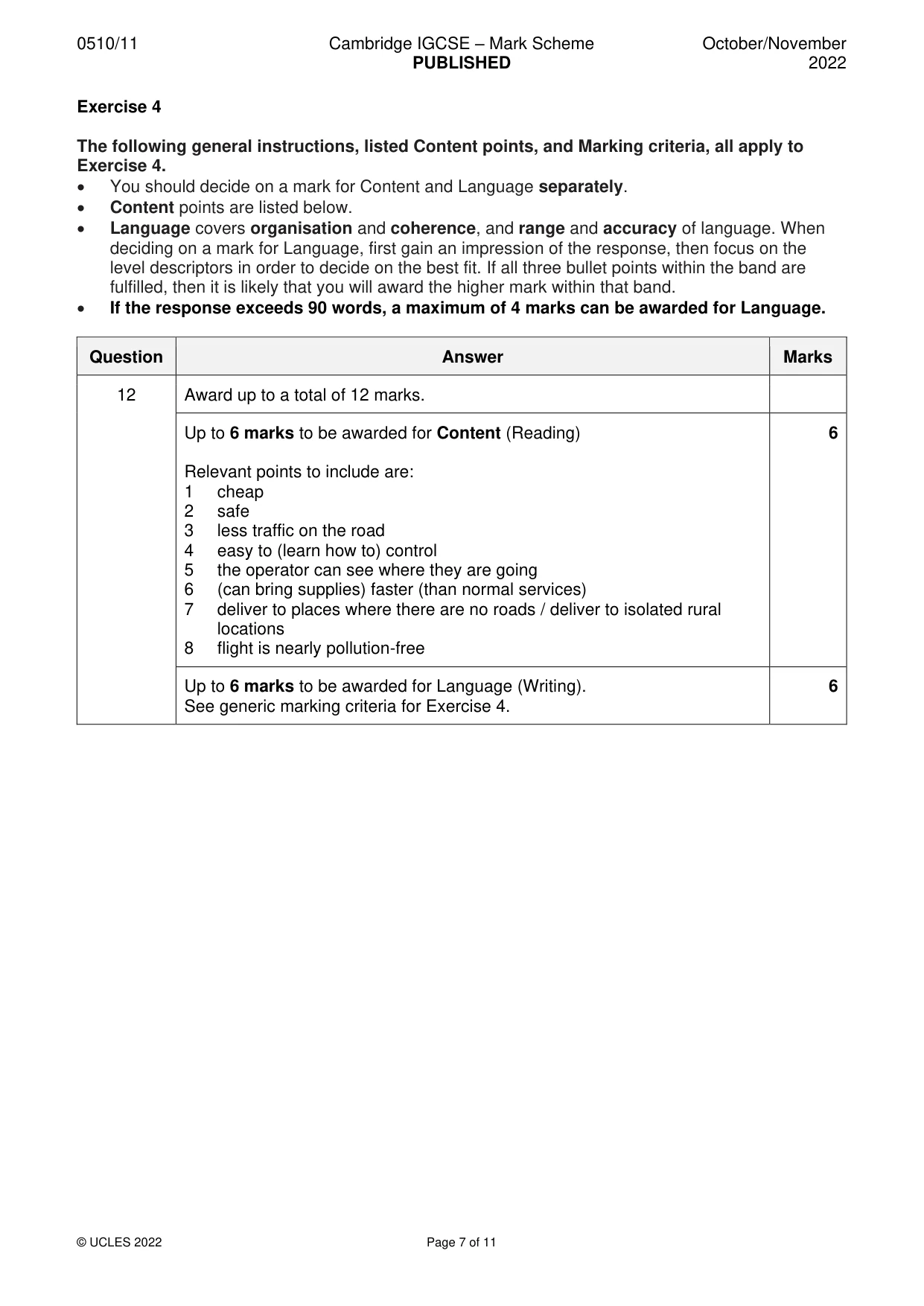
0510/11 Cambridge IGCSE – Mark Scheme PUBLISHED October/November 2022 © UCLES 2022 Page 7 of 11 Exercise 4 The following general instructions, listed Content points, and Marking criteria, all apply to Exercise 4. • You should decide on a mark for Content and Language separately. • Content points are listed below. • Language covers organisation and coherence, and range and accuracy of language. When deciding on a mark for Language, first gain an impression of the response, then focus on the level descriptors in order to decide on the best fit. If all three bullet points within the band are fulfilled, then it is likely that you will award the higher mark within that band. • If the response exceeds 90 words, a maximum of 4 marks can be awarded for Language. Question Answer Marks 12 Award up to a total of 12 marks. Up to 6 marks to be awarded for Content (Reading) Relevant points to include are: 1 cheap 2 safe 3 less traffic on the road 4 easy to (learn how to) control 5 the operator can see where they are going 6 (can bring supplies) faster (than normal services) 7 deliver to places where there are no roads / deliver to isolated rural locations 8 flight is nearly pollution-free 6 Up to 6 marks to be awarded for Language (Writing). See generic marking criteria for Exercise 4. 6
Mark scheme, page 8
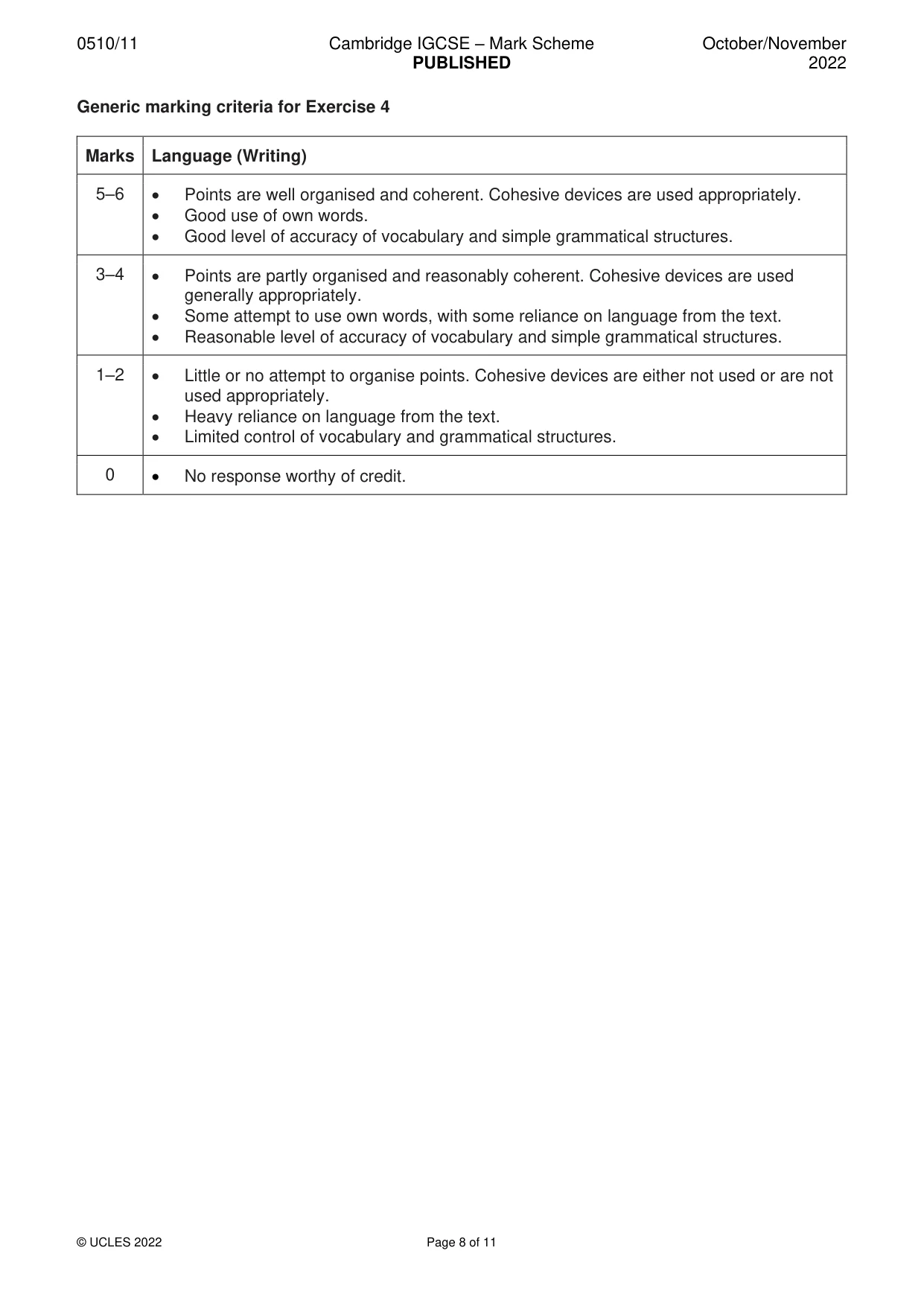
0510/11 Cambridge IGCSE – Mark Scheme PUBLISHED October/November 2022 © UCLES 2022 Page 8 of 11 Generic marking criteria for Exercise 4 Marks Language (Writing) 5–6 • Points are well organised and coherent. Cohesive devices are used appropriately. • Good use of own words. • Good level of accuracy of vocabulary and simple grammatical structures. 3–4 • Points are partly organised and reasonably coherent. Cohesive devices are used generally appropriately. • Some attempt to use own words, with some reliance on language from the text. • Reasonable level of accuracy of vocabulary and simple grammatical structures. 1–2 • Little or no attempt to organise points. Cohesive devices are either not used or are not used appropriately. • Heavy reliance on language from the text. • Limited control of vocabulary and grammatical structures. 0 • No response worthy of credit.
Mark scheme, page 9
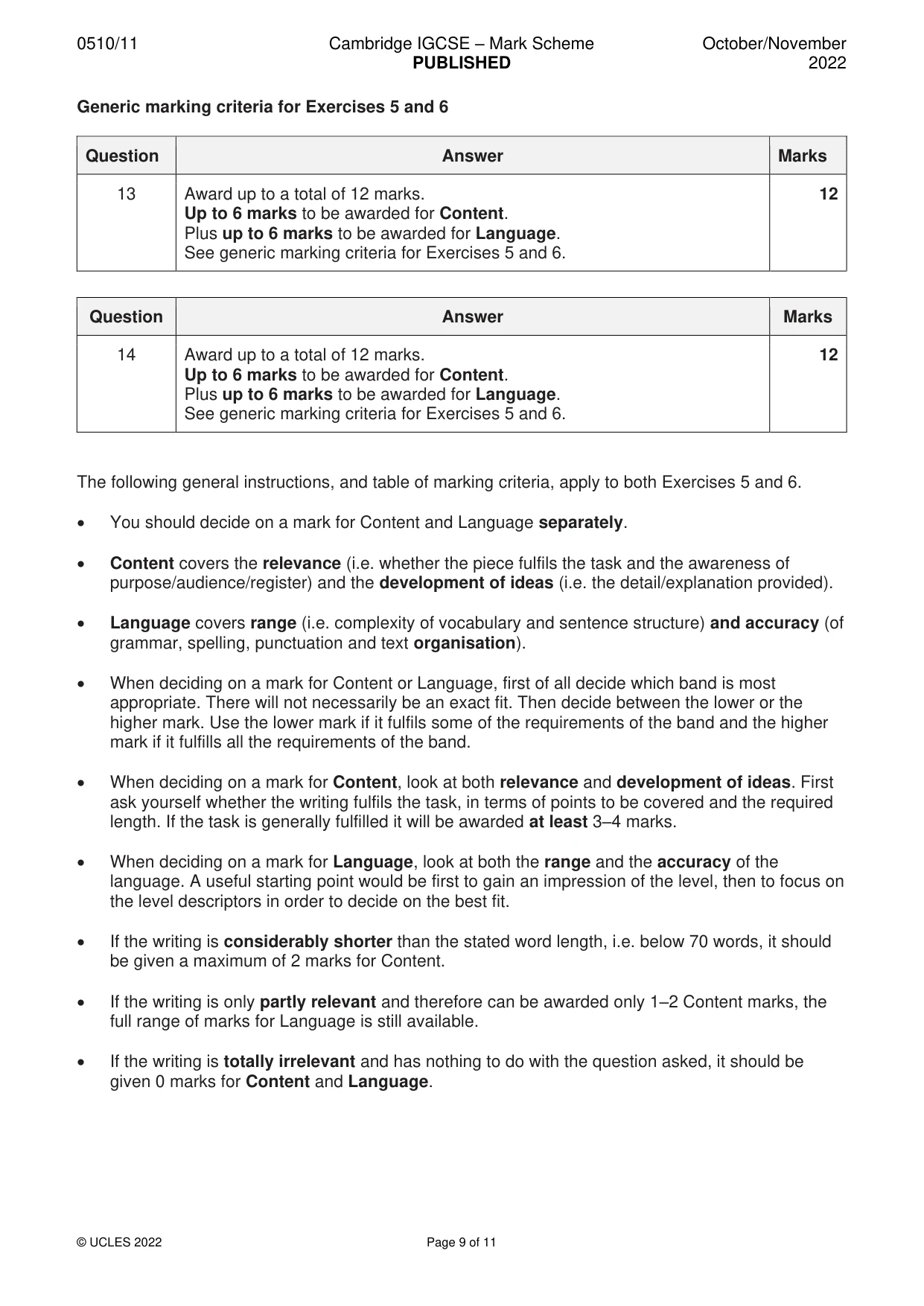
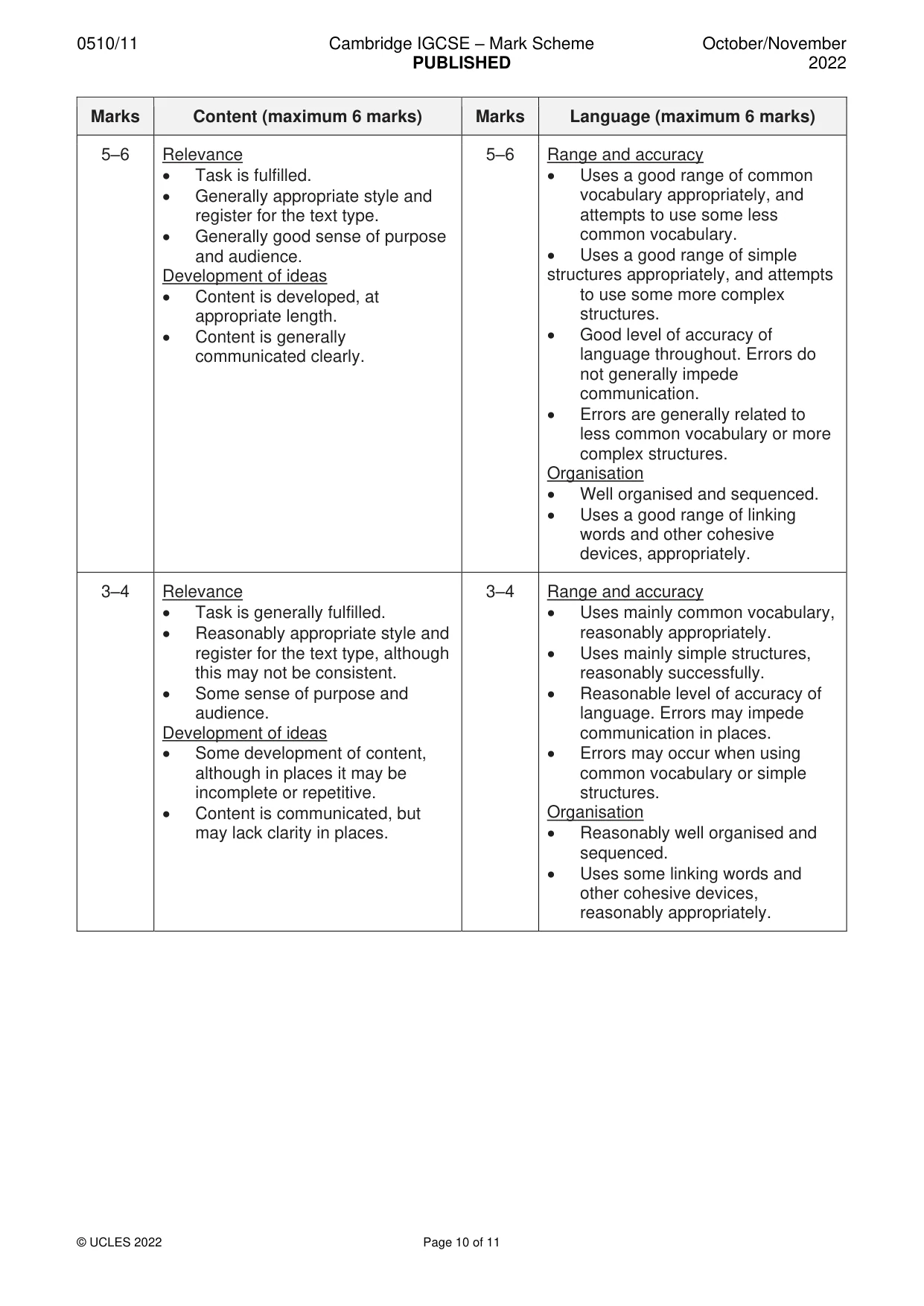
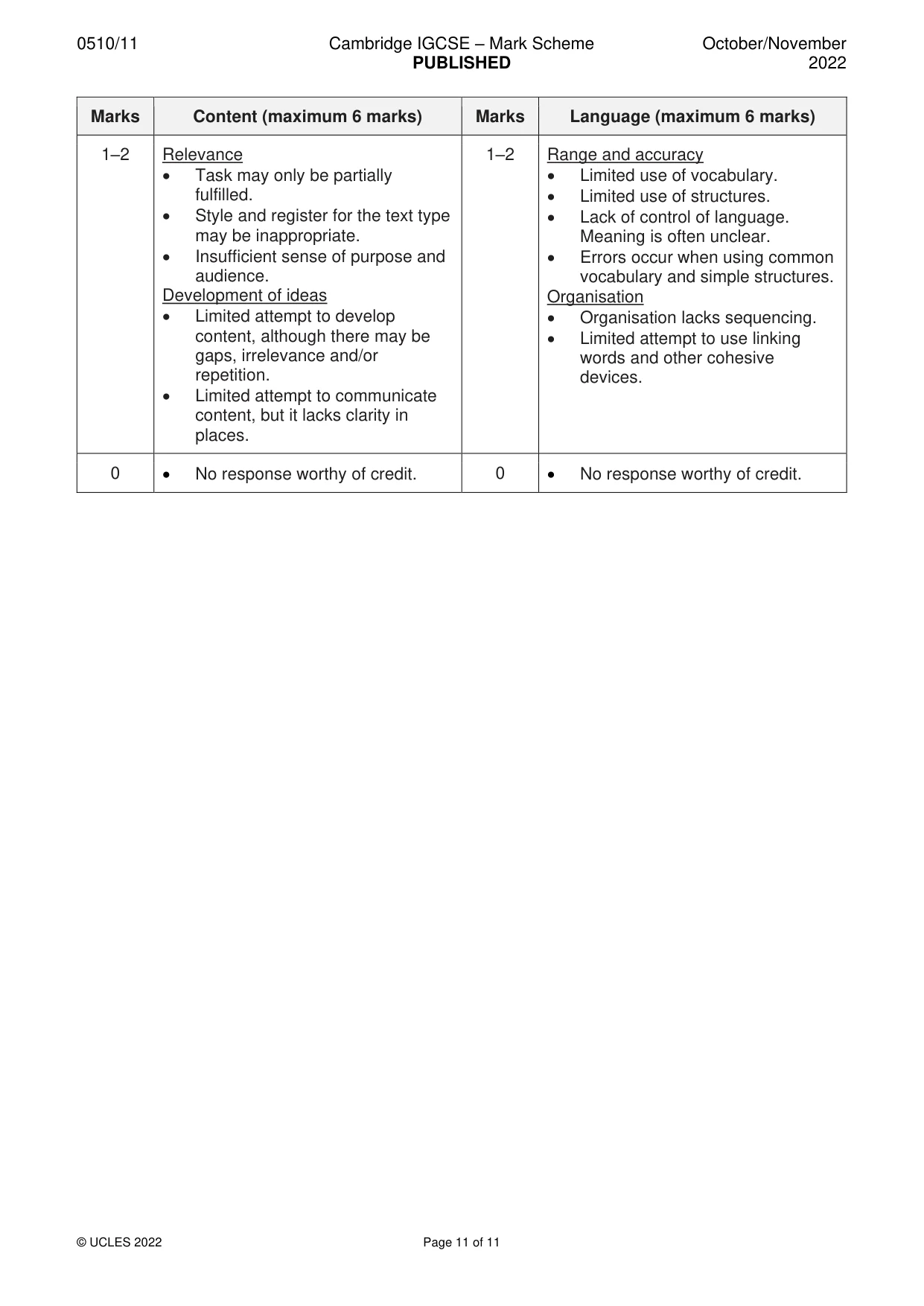
0510/11 Cambridge IGCSE – Mark Scheme PUBLISHED October/November 2022 © UCLES 2022 Page 9 of 11 Generic marking criteria for Exercises 5 and 6 Question Answer Marks 13 Award up to a total of 12 marks. Up to 6 marks to be awarded for Content. Plus up to 6 marks to be awarded for Language. See generic marking criteria for Exercises 5 and 6. 12 Question Answer Marks 14 Award up to a total of 12 marks. Up to 6 marks to be awarded for Content. Plus up to 6 marks to be awarded for Language. See generic marking criteria for Exercises 5 and 6. 12 The following general instructions, and table of marking criteria, apply to both Exercises 5 and 6. • You should decide on a mark for Content and Language separately. • Content covers the relevance (i.e. whether the piece fulfils the task and the awareness of purpose/audience/register) and the development of ideas (i.e. the detail/explanation provided). • Language covers range (i.e. complexity of vocabulary and sentence structure) and accuracy (of grammar, spelling, punctuation and text organisation). • When deciding on a mark for Content or Language, first of all decide which band is most appropriate. There will not necessarily be an exact fit. Then decide between the lower or the higher mark. Use the lower mark if it fulfils some of the requirements of the band and the higher mark if it fulfills all the requirements of the band. • When deciding on a mark for Content, look at both relevance and development of ideas. First ask yourself whether the writing fulfils the task, in terms of points to be covered and the required length. If the task is generally fulfilled it will be awarded at least 3–4 marks. • When deciding on a mark for Language, look at both the range and the accuracy of the language. A useful starting point would be first to gain an impression of the level, then to focus on the level descriptors in order to decide on the best fit. • If the writing is considerably shorter than the stated word length, i.e. below 70 words, it should be given a maximum of 2 marks for Content. • If the writing is only partly relevant and therefore can be awarded only 1–2 Content marks, the full range of marks for Language is still available. • If the writing is totally irrelevant and has nothing to do with the question asked, it should be given 0 marks for Content and Language.
Mark scheme, page 10
0510/11 Cambridge IGCSE – Mark Scheme PUBLISHED October/November 2022 © UCLES 2022 Page 10 of 11 Marks Content (maximum 6 marks) Marks Language (maximum 6 marks) 5–6 Relevance • Task is fulfilled. • Generally appropriate style and register for the text type. • Generally good sense of purpose and audience. Development of ideas • Content is developed, at appropriate length. • Content is generally communicated clearly. 5–6 Range and accuracy • Uses a good range of common vocabulary appropriately, and attempts to use some less common vocabulary. • Uses a good range of simple structures appropriately, and attempts to use some more complex structures. • Good level of accuracy of language throughout. Errors do not generally impede communication. • Errors are generally related to less common vocabulary or more complex structures. Organisation • Well organised and sequenced. • Uses a good range of linking words and other cohesive devices, appropriately. 3–4 Relevance • Task is generally fulfilled. • Reasonably appropriate style and register for the text type, although this may not be consistent. • Some sense of purpose and audience. Development of ideas • Some development of content, although in places it may be incomplete or repetitive. • Content is communicated, but may lack clarity in places. 3–4 Range and accuracy • Uses mainly common vocabulary, reasonably appropriately. • Uses mainly simple structures, reasonably successfully. • Reasonable level of accuracy of language. Errors may impede communication in places. • Errors may occur when using common vocabulary or simple structures. Organisation • Reasonably well organised and sequenced. • Uses some linking words and other cohesive devices, reasonably appropriately.
Mark scheme, page 11
0510/11 Cambridge IGCSE – Mark Scheme PUBLISHED October/November 2022 © UCLES 2022 Page 11 of 11 Marks Content (maximum 6 marks) Marks Language (maximum 6 marks) 1–2 Relevance • Task may only be partially fulfilled. • Style and register for the text type may be inappropriate. • Insufficient sense of purpose and audience. Development of ideas • Limited attempt to develop content, although there may be gaps, irrelevance and/or repetition. • Limited attempt to communicate content, but it lacks clarity in places. 1–2 Range and accuracy • Limited use of vocabulary. • Limited use of structures. • Lack of control of language. Meaning is often unclear. • Errors occur when using common vocabulary and simple structures. Organisation • Organisation lacks sequencing. • Limited attempt to use linking words and other cohesive devices. 0 • No response worthy of credit. 0 • No response worthy of credit.
What you needed in this session
Cambridge’s own grade thresholds for 2022 Oct/Nov, Paper 1 · Variant 1. A higher threshold means an easier paper — the bar moves with how the cohort did.