Cambridge IGCSE English - Second Language (oral endorsement) 0510 — 2021 Oct/Nov Paper 2 · Variant 3
0510/23/O/N/21 · 80 marks · ≈90 min
The question paper and its mark scheme, free to read here and free to download. This is Cambridge’s own paper, exactly as it was sat.
Question paper16 pages






Mark scheme9 pages
Answers below. Sit the paper first if you are practising.
Paper as text
Question paper, page 1
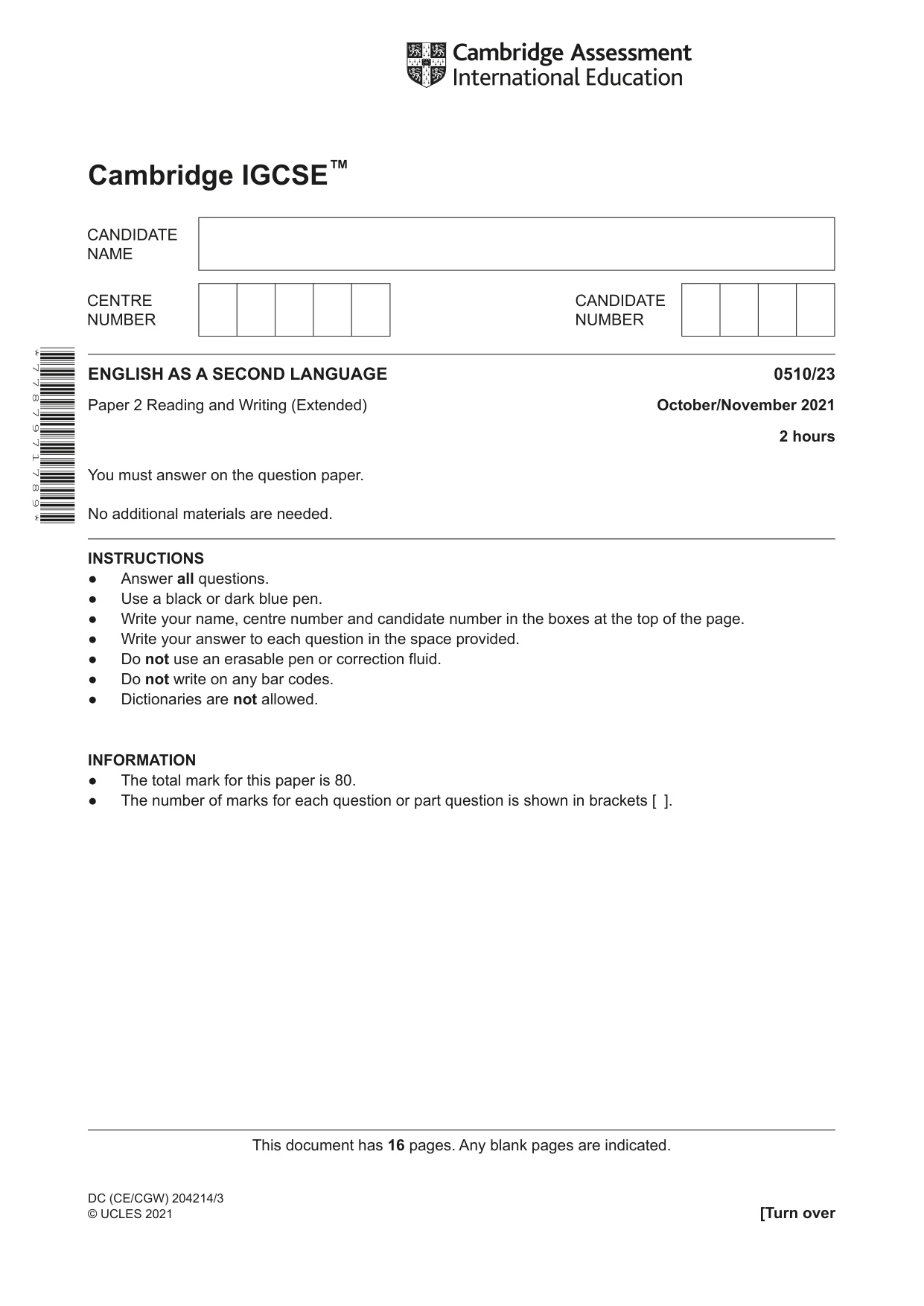
This document has 16 pages. Any blank pages are indicated. Cambridge IGCSE™ DC (CE/CGW) 204214/3 © UCLES 2021 [Turn over ENGLISH AS A SECOND LANGUAGE 0510/23 Paper 2 Reading and Writing (Extended) October/November 2021 2 hours You must answer on the question paper. No additional materials are needed. INSTRUCTIONS ● Answer all questions. ● Use a black or dark blue pen. ● Write your name, centre number and candidate number in the boxes at the top of the page. ● Write your answer to each question in the space provided. ● Do not use an erasable pen or correction fluid. ● Do not write on any bar codes. ● Dictionaries are not allowed. INFORMATION ● The total mark for this paper is 80. ● The number of marks for each question or part question is shown in brackets [ ]. * 7 7 8 7 9 7 1 7 8 9 *
Question paper, page 2
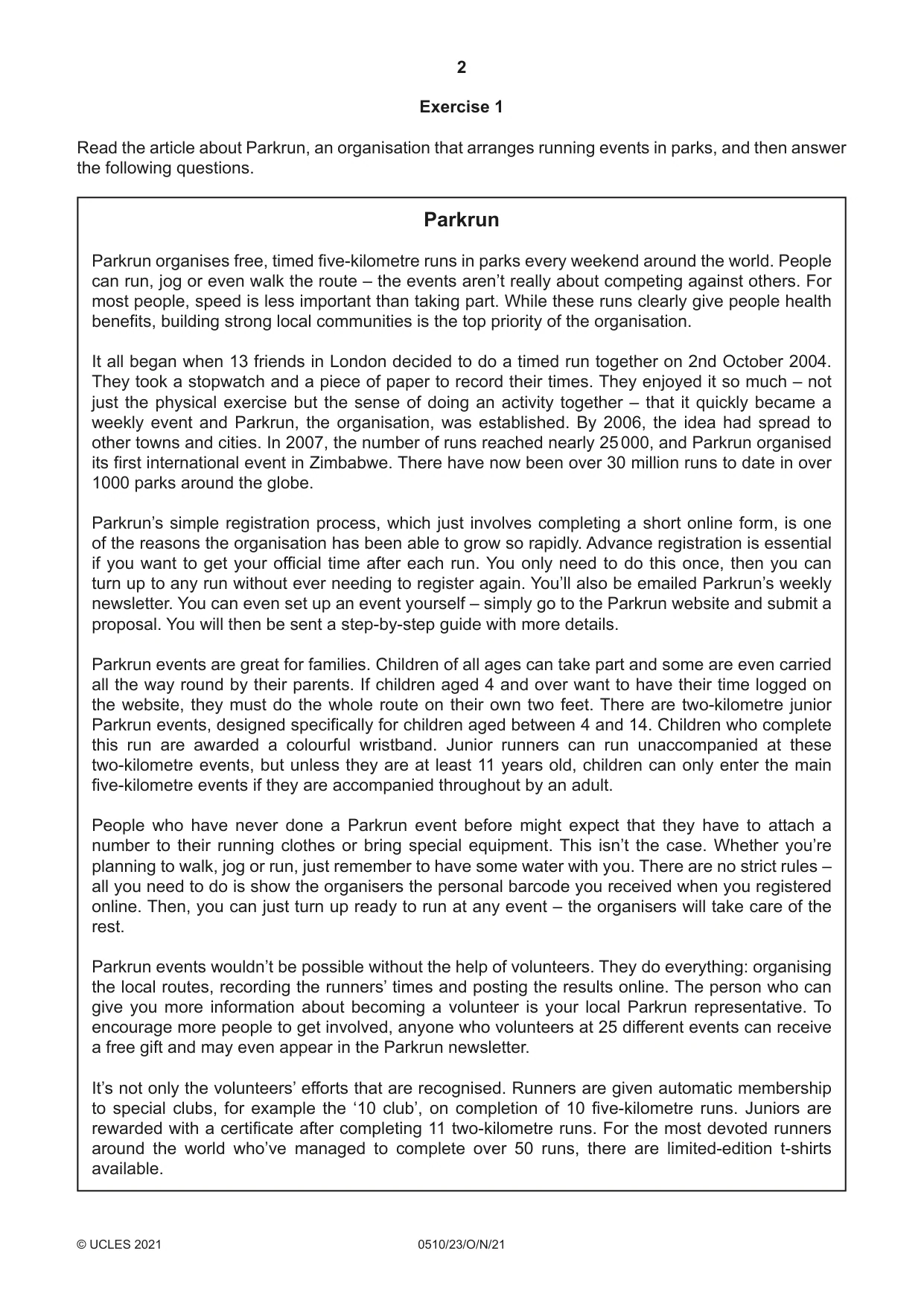
2 0510/23/O/N/21 © UCLES 2021 Exercise 1 Read the article about Parkrun, an organisation that arranges running events in parks, and then answer the following questions. Parkrun Parkrun organises free, timed five-kilometre runs in parks every weekend around the world. People can run, jog or even walk the route – the events aren’t really about competing against others. For most people, speed is less important than taking part. While these runs clearly give people health benefits, building strong local communities is the top priority of the organisation. It all began when 13 friends in London decided to do a timed run together on 2nd October 2004. They took a stopwatch and a piece of paper to record their times. They enjoyed it so much – not just the physical exercise but the sense of doing an activity together – that it quickly became a weekly event and Parkrun, the organisation, was established. By 2006, the idea had spread to other towns and cities. In 2007, the number of runs reached nearly 25 000, and Parkrun organised its first international event in Zimbabwe. There have now been over 30 million runs to date in over 1000 parks around the globe. Parkrun’s simple registration process, which just involves completing a short online form, is one of the reasons the organisation has been able to grow so rapidly. Advance registration is essential if you want to get your official time after each run. You only need to do this once, then you can turn up to any run without ever needing to register again. You’ll also be emailed Parkrun’s weekly newsletter. You can even set up an event yourself – simply go to the Parkrun website and submit a proposal. You will then be sent a step-by-step guide with more details. Parkrun events are great for families. Children of all ages can take part and some are even carried all the way round by their parents. If children aged 4 and over want to have their time logged on the website, they must do the whole route on their own two feet. There are two-kilometre junior Parkrun events, designed specifically for children aged between 4 and 14. Children who complete this run are awarded a colourful wristband. Junior runners can run unaccompanied at these two-kilometre events, but unless they are at least 11 years old, children can only enter the main five-kilometre events if they are accompanied throughout by an adult. People who have never done a Parkrun event before might expect that they have to attach a number to their running clothes or bring special equipment. This isn’t the case. Whether you’re planning to walk, jog or run, just remember to have some water with you. There are no strict rules – all you need to do is show the organisers the personal barcode you received when you registered online. Then, you can just turn up ready to run at any event – the organisers will take care of the rest. Parkrun events wouldn’t be possible without the help of volunteers. They do everything: organising the local routes, recording the runners’ times and posting the results online. The person who can give you more information about becoming a volunteer is your local Parkrun representative. To encourage more people to get involved, anyone who volunteers at 25 different events can receive a free gift and may even appear in the Parkrun newsletter. It’s not only the volunteers’ efforts that are recognised. Runners are given automatic membership to special clubs, for example the ‘10 club’, on completion of 10 five-kilometre runs. Juniors are rewarded with a certificate after completing 11 two-kilometre runs. For the most devoted runners around the world who’ve managed to complete over 50 runs, there are limited-edition t-shirts available.
Question paper, page 3
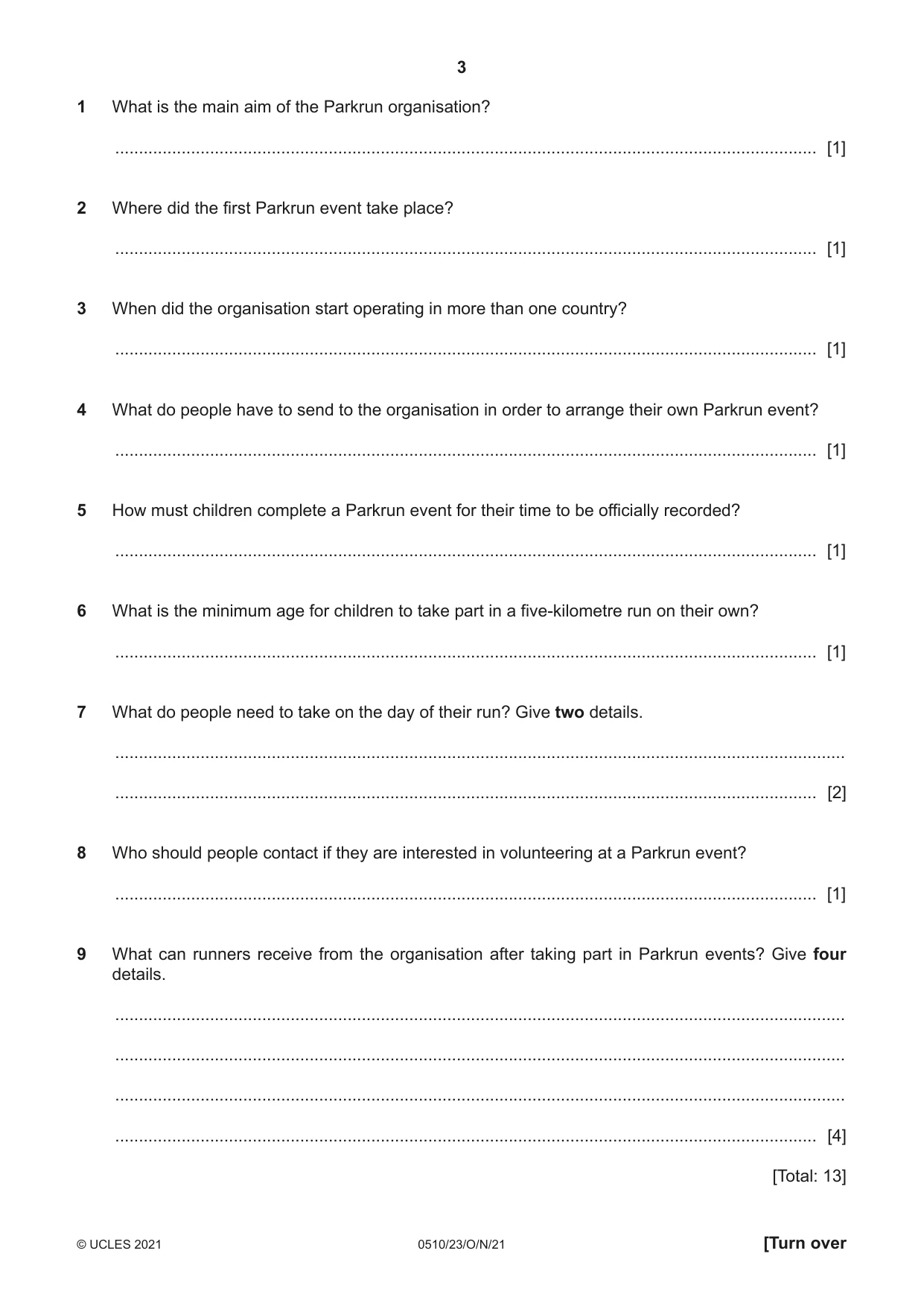
3 0510/23/O/N/21 © UCLES 2021 [Turn over 1 What is the main aim of the Parkrun organisation? … [1] 2 Where did the first Parkrun event take place? … [1] 3 When did the organisation start operating in more than one country? … [1] 4 What do people have to send to the organisation in order to arrange their own Parkrun event? … [1] 5 How must children complete a Parkrun event for their time to be officially recorded? … [1] 6 What is the minimum age for children to take part in a five-kilometre run on their own? … [1] 7 What do people need to take on the day of their run? Give two details. … … [2] 8 Who should people contact if they are interested in volunteering at a Parkrun event? … [1] 9 What can runners receive from the organisation after taking part in Parkrun events? Give four details. … … … … [4] [Total: 13]
Question paper, page 4
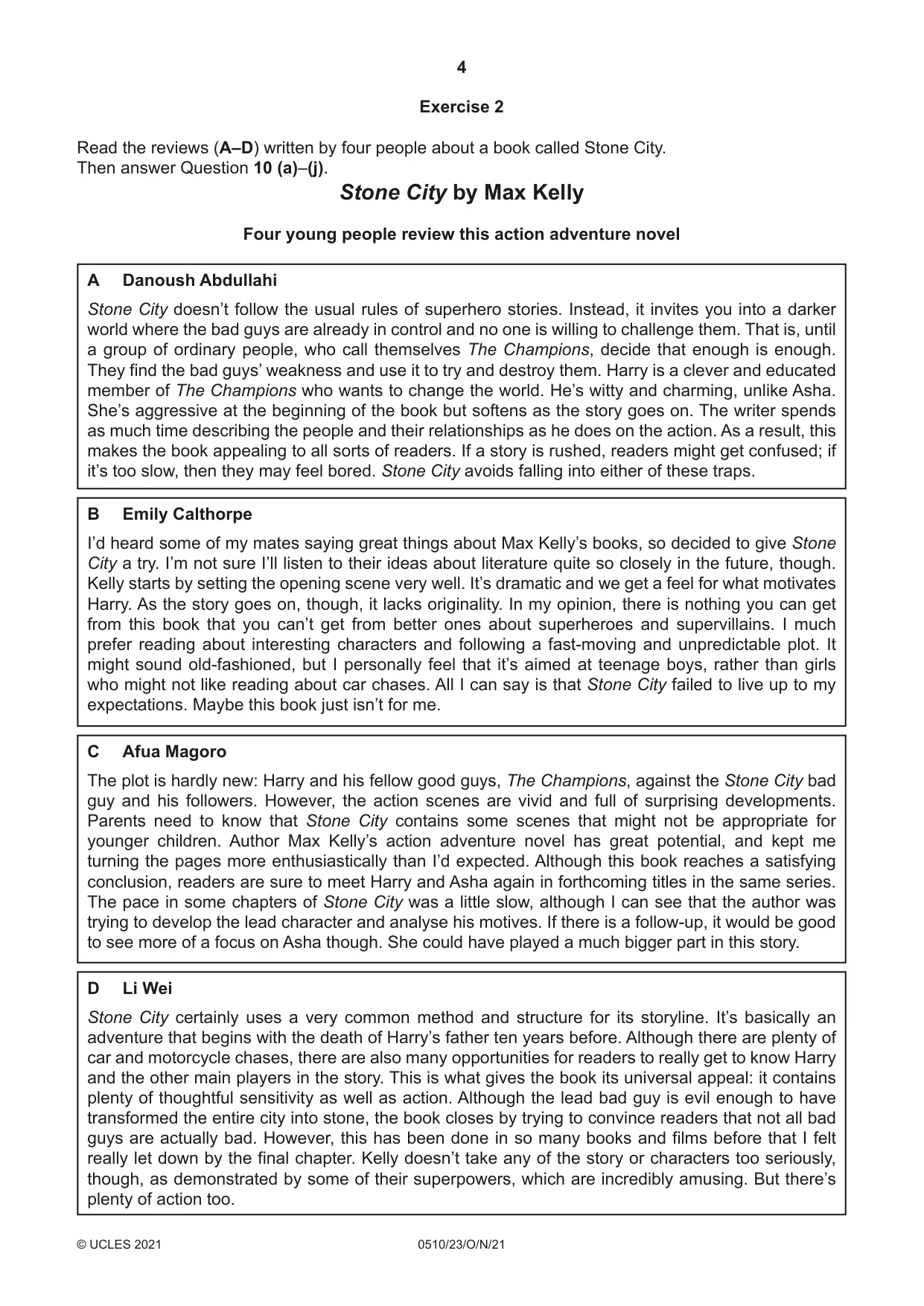
4 0510/23/O/N/21 © UCLES 2021 Exercise 2 Read the reviews (A–D) written by four people about a book called Stone City. Then answer Question 10 (a)–(j). Stone City by Max Kelly Four young people review this action adventure novel A Danoush Abdullahi Stone City doesn’t follow the usual rules of superhero stories. Instead, it invites you into a darker world where the bad guys are already in control and no one is willing to challenge them. That is, until a group of ordinary people, who call themselves The Champions, decide that enough is enough. They find the bad guys’ weakness and use it to try and destroy them. Harry is a clever and educated member of The Champions who wants to change the world. He’s witty and charming, unlike Asha. She’s aggressive at the beginning of the book but softens as the story goes on. The writer spends as much time describing the people and their relationships as he does on the action. As a result, this makes the book appealing to all sorts of readers. If a story is rushed, readers might get confused; if it’s too slow, then they may feel bored. Stone City avoids falling into either of these traps. B Emily Calthorpe I’d heard some of my mates saying great things about Max Kelly’s books, so decided to give Stone City a try. I’m not sure I’ll listen to their ideas about literature quite so closely in the future, though. Kelly starts by setting the opening scene very well. It’s dramatic and we get a feel for what motivates Harry. As the story goes on, though, it lacks originality. In my opinion, there is nothing you can get from this book that you can’t get from better ones about superheroes and supervillains. I much prefer reading about interesting characters and following a fast-moving and unpredictable plot. It might sound old-fashioned, but I personally feel that it’s aimed at teenage boys, rather than girls who might not like reading about car chases. All I can say is that Stone City failed to live up to my expectations. Maybe this book just isn’t for me. C Afua Magoro The plot is hardly new: Harry and his fellow good guys, The Champions, against the Stone City bad guy and his followers. However, the action scenes are vivid and full of surprising developments. Parents need to know that Stone City contains some scenes that might not be appropriate for younger children. Author Max Kelly’s action adventure novel has great potential, and kept me turning the pages more enthusiastically than I’d expected. Although this book reaches a satisfying conclusion, readers are sure to meet Harry and Asha again in forthcoming titles in the same series. The pace in some chapters of Stone City was a little slow, although I can see that the author was trying to develop the lead character and analyse his motives. If there is a follow-up, it would be good to see more of a focus on Asha though. She could have played a much bigger part in this story. D Li Wei Stone City certainly uses a very common method and structure for its storyline. It’s basically an adventure that begins with the death of Harry’s father ten years before. Although there are plenty of car and motorcycle chases, there are also many opportunities for readers to really get to know Harry and the other main players in the story. This is what gives the book its universal appeal: it contains plenty of thoughtful sensitivity as well as action. Although the lead bad guy is evil enough to have transformed the entire city into stone, the book closes by trying to convince readers that not all bad guys are actually bad. However, this has been done in so many books and films before that I felt really let down by the final chapter. Kelly doesn’t take any of the story or characters too seriously, though, as demonstrated by some of their superpowers, which are incredibly amusing. But there’s plenty of action too.
Question paper, page 5
5 0510/23/O/N/21 © UCLES 2021 [Turn over 10 For each question, write the correct letter A, B, C or D on the line. Which person… (a) feels that not enough attention is given to the lead female character? … [1] (b) states that Stone City is different from most novels of this type? … [1] (c) thinks the beginning of the book was more enjoyable than the rest of it? … [1] (d) thinks the ending of the book is a bit disappointing? … [1] (e) mentions the kind of person this book will appeal to? … [1] (f) thinks the plot develops at about the right speed? … [1] (g) disagrees with their friends’ opinions of the book? … [1] (h) likes the fact that the book is funny as well as exciting? … [1] (i) gives a warning that the content of the book may be unsuitable for some readers? … [1] (j) mentions that the personality of one of the characters changes throughout the book? … [1] [Total: 10]
Question paper, page 6
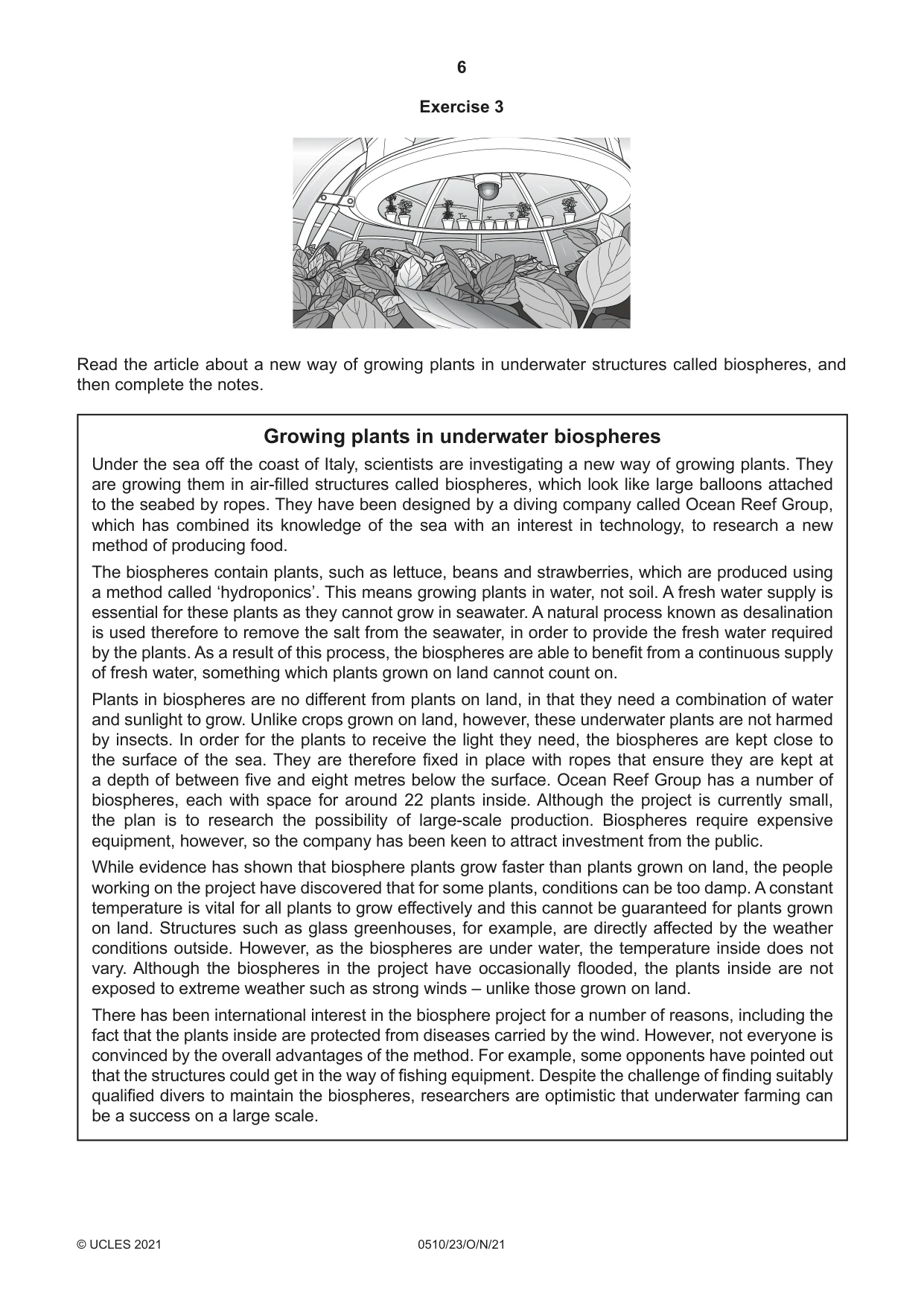
6 0510/23/ O/ N/21 © UCLES 2021 Exercise 3 Read the article about a new way of growing plants in underwater structures called biospheres, and then complete the notes. Growing plants in underwater biospheres Under the sea off the coast of Italy, scientists are investigating a new way of growing plants. They are growing them in air-filled structures called biospheres, which look like large balloons attached to the seabed by ropes. They have been designed by a diving company called Ocean Reef Group, which has combined its knowledge of the sea with an interest in technology, to research a new method of producing food. The biospheres contain plants, such as lettuce, beans and strawberries, which are produced using a method called ‘hydroponics’. This means growing plants in water, not soil. A fresh water supply is essential for these plants as they cannot grow in seawater. A natural process known as desalination is used therefore to remove the salt from the seawater, in order to provide the fresh water required by the plants. As a result of this process, the biospheres are able to benefit from a continuous supply of fresh water, something which plants grown on land cannot count on. Plants in biospheres are no different from plants on land, in that they need a combination of water and sunlight to grow. Unlike crops grown on land, however, these underwater plants are not harmed by insects. In order for the plants to receive the light they need, the biospheres are kept close to the surface of the sea. They are therefore fixed in place with ropes that ensure they are kept at a depth of between five and eight metres below the surface. Ocean Reef Group has a number of biospheres, each with space for around 22 plants inside. Although the project is currently small, the plan is to research the possibility of large-scale production. Biospheres require expensive equipment, however, so the company has been keen to attract investment from the public. While evidence has shown that biosphere plants grow faster than plants grown on land, the people working on the project have discovered that for some plants, conditions can be too damp. A constant temperature is vital for all plants to grow effectively and this cannot be guaranteed for plants grown on land. Structures such as glass greenhouses, for example, are directly affected by the weather conditions outside. However, as the biospheres are under water, the temperature inside does not vary. Although the biospheres in the project have occasionally flooded, the plants inside are not exposed to extreme weather such as strong winds – unlike those grown on land. There has been international interest in the biosphere project for a number of reasons, including the fact that the plants inside are protected from diseases carried by the wind. However, not everyone is convinced by the overall advantages of the method. For example, some opponents have pointed out that the structures could get in the way of fishing equipment. Despite the challenge of finding suitably qualified divers to maintain the biospheres, researchers are optimistic that underwater farming can be a success on a large scale.
Question paper, page 7
7 0510/23/O/N/21 © UCLES 2021 [Turn over You are going to give a talk to your class about underwater biospheres. Prepare some notes to use as the basis for your talk. Make short notes under each heading. 11 Reasons why it’s better to grow plants in underwater biospheres: • … • … • … • … • … [5] 12 Difficulties of growing plants in underwater biospheres: • … • … • … • … [4] [Total: 9]
Question paper, page 8
8 0510/23/O/N/21 © UCLES 2021 Exercise 4 13 Read the article about the positive effects of singing on the body. Write a summary about the benefits that singing can bring to people’s physical health. Your summary should be about 100 words long (and no more than 120 words long). You should use your own words as far as possible. You will receive up to 8 marks for the content of your summary and up to 8 marks for the style and accuracy of your language. Singing is good for you! After years of singing to myself in the shower at home, I have finally joined a local singing group, the ‘Welcome Choir’. Every Thursday evening I go to a hall, where, along with 30 others, I spend two hours singing songs including pop, rock and some real classics! Even getting the tune wrong or forgetting the words occasionally can’t take anything away from how much I enjoy it, and it’s a wonderful chance to get out of the house and meet people. It is perhaps not surprising to find that there are many benefits to singing. Researchers at a Swedish university found that singing can relax the body as effectively as yoga. In the experiment, participants were asked to perform singing exercises and their heart rates were monitored during each one. The results showed that singing helps to make your heart beat in a more regular rhythm. There is also evidence from other studies that with each breath, singing brings more oxygen into the body. What is more, when people sing frequently, they tend to find that their lung capacity increases over time. Perhaps it’s no wonder then that people are joining choirs in their thousands, and enjoying the self-confidence that comes from singing. There are now more than 3000 groups listed on the British Choirs website, and it’s even said there are more choirs in the UK now than fish and chip shops! There are other reasons to take up this popular activity. As well as being creatively satisfying, it gives your stomach muscles a great workout as you need to use them to control your voice. Also, the way you need to sit or stand when singing can be helpful in preventing back pain. A less well-known, but equally positive, effect that many singers report is that their snoring – the noisy breathing problem that some people suffer from when they sleep – decreases over time. And even those who don’t have this condition notice the general quality of their sleep improves after a singing session. Finally, you might think that if one person in a choir group has a cold then everybody else will catch it too, as they usually stand so close together. However, scientists have noticed that singers are in fact less likely to get ill. This has certainly been my experience. Group singing has long been used as a form of music therapy. After all, many people enjoy being part of a group, and doesn’t everyone have a favourite song that cheers them up when they’re sad? It’s not just about lifting your mood, singing has also been found to improve your memory, which makes singing a particularly good hobby for the elderly. Clearly, there are all sorts of benefits to singing: you can do it anywhere, alone or in a group, and at any age. It doesn’t matter how good you are and you don’t need an audience. In the words of the famous singer Ella Fitzgerald, “the only thing better than singing is more singing!”
Question paper, page 9
9 0510/23/O/N/21 © UCLES 2021 [Turn over … … … … … … … … … … … … … … … … … … … … … … … … … … … [Total: 16]
Question paper, page 10
10 0510/23/ O/ N/21 © UCLES 2021 Exercise 5 14 Your family recently moved to a new town to live. Write an email to a friend telling them about your new town. In your email, you should: • compare the new town to the place where you lived before • describe your new school • suggest how you and your friend could spend the day together in your new town. The pictures above may give you some ideas, and you can also use some ideas of your own. Your email should be between 150 and 200 words long. You will receive up to 8 marks for the content of your email, and up to 8 marks for the language used.
Question paper, page 11
11 0510/23/O/N/21 © UCLES 2021 [Turn over … … … … … … … … … … … … … … … … … … … … … … … … … … … [Total: 16]
Question paper, page 12
12 0510/23/O/N/21 © UCLES 2021 Exercise 6 15 Your school has recently received some money to improve the library. Your teacher has asked you to write a report. In your report, describe what students use the school library for and suggest how the school library could be improved. Here are two comments from students who use the school library: I’ve found lots of useful information in the library. Sometimes the library is really noisy. Write a report for your teacher. The comments above may give you some ideas, and you can also use some ideas of your own. Your report should be between 150 and 200 words long. You will receive up to 8 marks for the content of your report, and up to 8 marks for the language used.
Question paper, page 13
13 0510/23/O/N/21 © UCLES 2021 … … … … … … … … … … … … … … … … … … … … … … … … … … … [Total: 16]
Question paper, page 14
14 0510/23/O/N/21 © UCLES 2021 BLANK PAGE
Question paper, page 15
15 0510/23/O/N/21 © UCLES 2021 BLANK PAGE
Question paper, page 16
16 0510/23/O/N/21 © UCLES 2021 Permission to reproduce items where third-party owned material protected by copyright is included has been sought and cleared where possible. Every reasonable effort has been made by the publisher (UCLES) to trace copyright holders, but if any items requiring clearance have unwittingly been included, the publisher will be pleased to make amends at the earliest possible opportunity. To avoid the issue of disclosure of answer-related information to candidates, all copyright acknowledgements are reproduced online in the Cambridge Assessment International Education Copyright Acknowledgements Booklet. This is produced for each series of examinations and is freely available to download at www.cambridgeinternational.org after the live examination series. Cambridge Assessment International Education is part of the Cambridge Assessment Group. Cambridge Assessment is the brand name of the University of Cambridge Local Examinations Syndicate (UCLES), which itself is a department of the University of Cambridge. BLANK PAGE
Mark scheme, page 1
This document consists of 9 printed pages. © UCLES 2021 [Turn over Cambridge IGCSE™ ENGLISH AS A SECOND LANGUAGE 0510/23 Paper 2 Reading and Writing (Extended) October/November 2021 MARK SCHEME Maximum Mark: 80 Published This mark scheme is published as an aid to teachers and candidates, to indicate the requirements of the examination. It shows the basis on which Examiners were instructed to award marks. It does not indicate the details of the discussions that took place at an Examiners’ meeting before marking began, which would have considered the acceptability of alternative answers. Mark schemes should be read in conjunction with the question paper and the Principal Examiner Report for Teachers. Cambridge International will not enter into discussions about these mark schemes. Cambridge International is publishing the mark schemes for the October/November 2021 series for most Cambridge IGCSE™, Cambridge International A and AS Level components and some Cambridge O Level components.
Mark scheme, page 2
0510/23 Cambridge IGCSE – Mark Scheme PUBLISHED October/November 2021 © UCLES 2021 Page 2 of 9 Generic Marking Principles These general marking principles must be applied by all examiners when marking candidate answers. They should be applied alongside the specific content of the mark scheme or generic level descriptors for a question. Each question paper and mark scheme will also comply with these marking principles. GENERIC MARKING PRINCIPLE 1: Marks must be awarded in line with: • the specific content of the mark scheme or the generic level descriptors for the question • the specific skills defined in the mark scheme or in the generic level descriptors for the question • the standard of response required by a candidate as exemplified by the standardisation scripts. GENERIC MARKING PRINCIPLE 2: Marks awarded are always whole marks (not half marks, or other fractions). GENERIC MARKING PRINCIPLE 3: Marks must be awarded positively: • marks are awarded for correct/valid answers, as defined in the mark scheme. However, credit is given for valid answers which go beyond the scope of the syllabus and mark scheme, referring to your Team Leader as appropriate • marks are awarded when candidates clearly demonstrate what they know and can do • marks are not deducted for errors • marks are not deducted for omissions • answers should only be judged on the quality of spelling, punctuation and grammar when these features are specifically assessed by the question as indicated by the mark scheme. The meaning, however, should be unambiguous. GENERIC MARKING PRINCIPLE 4: Rules must be applied consistently, e.g. in situations where candidates have not followed instructions or in the application of generic level descriptors. GENERIC MARKING PRINCIPLE 5: Marks should be awarded using the full range of marks defined in the mark scheme for the question (however; the use of the full mark range may be limited according to the quality of the candidate responses seen). GENERIC MARKING PRINCIPLE 6: Marks awarded are based solely on the requirements as defined in the mark scheme. Marks should not be awarded with grade thresholds or grade descriptors in mind.
Mark scheme, page 3
0510/23 Cambridge IGCSE – Mark Scheme PUBLISHED October/November 2021 © UCLES 2021 Page 3 of 9 This component forms part of the Extended tier assessment of Cambridge IGCSE English as a Second Language and tests the following Assessment Objectives: AO1: Reading R1 identify and select relevant information R2 understand ideas, opinions and attitudes R3 show understanding of the connections between ideas, opinions and attitudes R4 understand what is implied but not directly stated, e.g. gist, writer’s purpose, intentions and feelings AO2: Writing W1 communicate information/ideas/opinions clearly, accurately and effectively W2 organise ideas into coherent paragraphs using a range of appropriate linking devices W3 use a range of grammatical structures accurately and effectively W4 show control of punctuation and spelling W5 use appropriate register and style/format for the given purpose and audience
Mark scheme, page 4
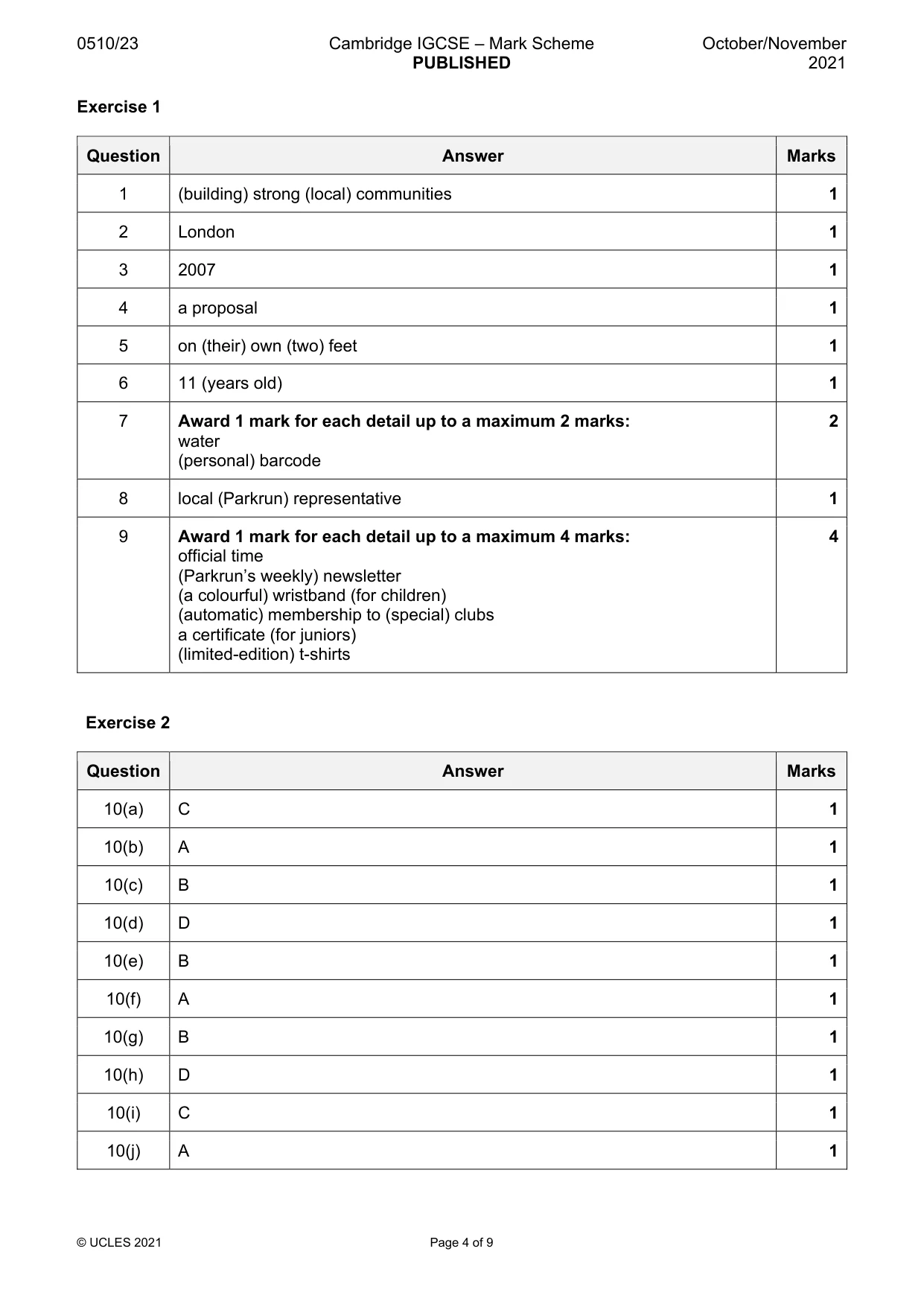
0510/23 Cambridge IGCSE – Mark Scheme PUBLISHED October/November 2021 © UCLES 2021 Page 4 of 9 Exercise 1 Question Answer Marks 1 (building) strong (local) communities 1 2 London 1 3 2007 1 4 a proposal 1 5 on (their) own (two) feet 1 6 11 (years old) 1 7 Award 1 mark for each detail up to a maximum 2 marks: water (personal) barcode 2 8 local (Parkrun) representative 1 9 Award 1 mark for each detail up to a maximum 4 marks: official time (Parkrun’s weekly) newsletter (a colourful) wristband (for children) (automatic) membership to (special) clubs a certificate (for juniors) (limited-edition) t-shirts 4 Exercise 2 Question Answer Marks 10(a) C 1 10(b) A 1 10(c) B 1 10(d) D 1 10(e) B 1 10(f) A 1 10(g) B 1 10(h) D 1 10(i) C 1 10(j) A 1
Mark scheme, page 5
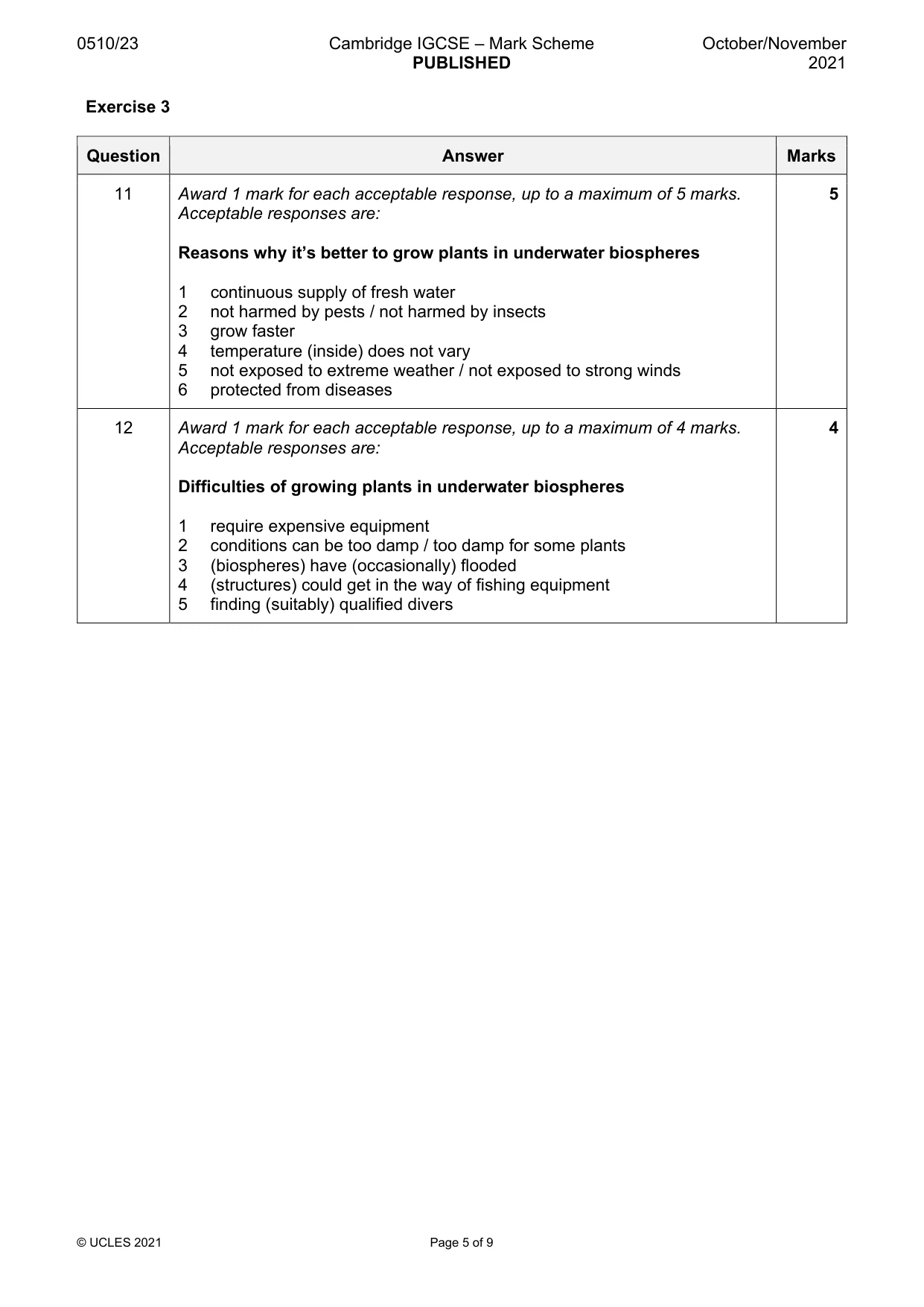
0510/23 Cambridge IGCSE – Mark Scheme PUBLISHED October/November 2021 © UCLES 2021 Page 5 of 9 Exercise 3 Question Answer Marks 11 Award 1 mark for each acceptable response, up to a maximum of 5 marks. Acceptable responses are: Reasons why it’s better to grow plants in underwater biospheres 1 continuous supply of fresh water 2 not harmed by pests / not harmed by insects 3 grow faster 4 temperature (inside) does not vary 5 not exposed to extreme weather / not exposed to strong winds 6 protected from diseases 5 12 Award 1 mark for each acceptable response, up to a maximum of 4 marks. Acceptable responses are: Difficulties of growing plants in underwater biospheres 1 require expensive equipment 2 conditions can be too damp / too damp for some plants 3 (biospheres) have (occasionally) flooded 4 (structures) could get in the way of fishing equipment 5 finding (suitably) qualified divers 4
Mark scheme, page 6
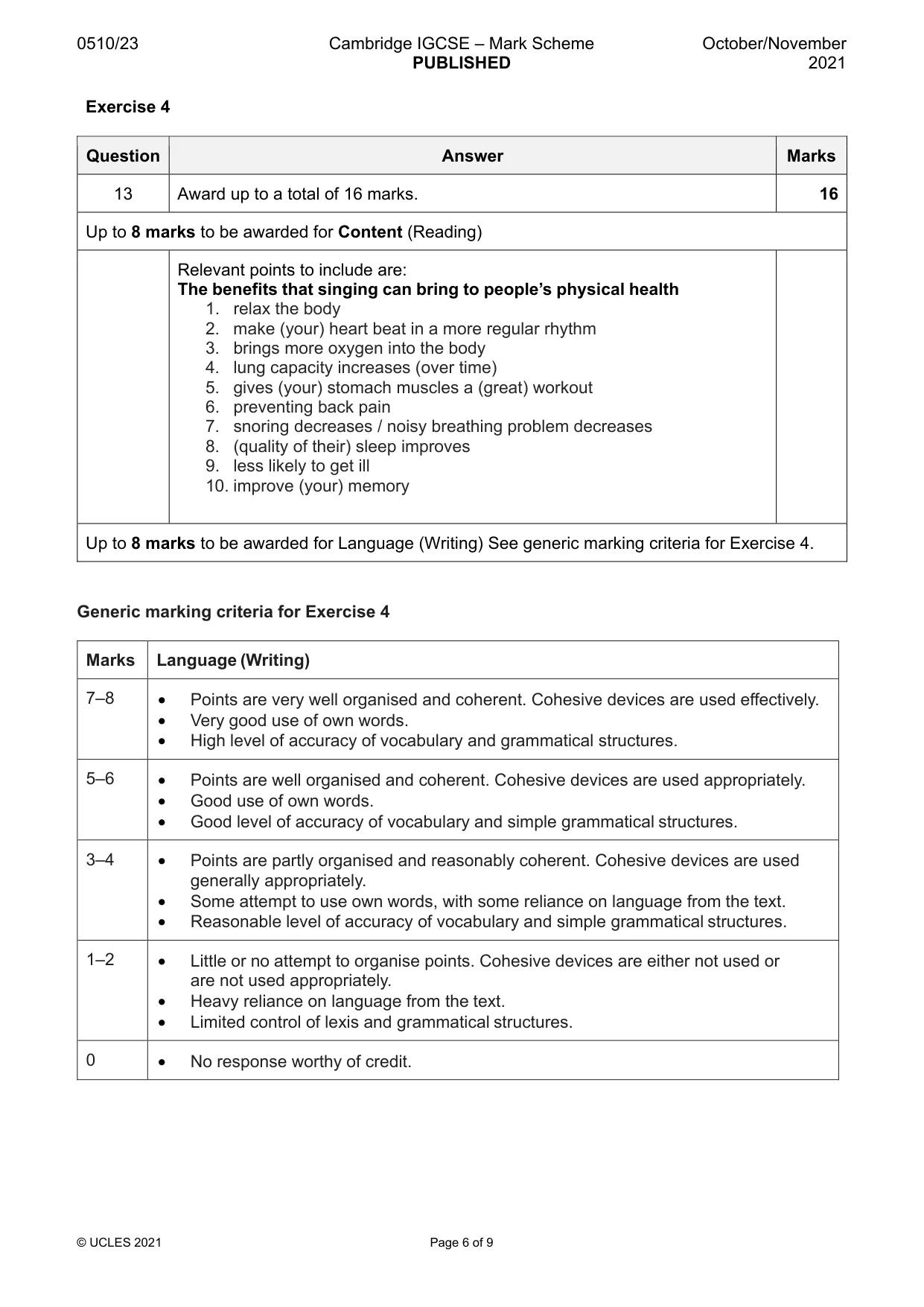
0510/23 Cambridge IGCSE – Mark Scheme PUBLISHED October/November 2021 © UCLES 2021 Page 6 of 9 Exercise 4 Question Answer Marks 13 Award up to a total of 16 marks. 16 Up to 8 marks to be awarded for Content (Reading) Relevant points to include are: The benefits that singing can bring to people’s physical health 1. relax the body 2. make (your) heart beat in a more regular rhythm 3. brings more oxygen into the body 4. lung capacity increases (over time) 5. gives (your) stomach muscles a (great) workout 6. preventing back pain 7. snoring decreases / noisy breathing problem decreases 8. (quality of their) sleep improves 9. less likely to get ill 10. improve (your) memory Up to 8 marks to be awarded for Language (Writing) See generic marking criteria for Exercise 4. Generic marking criteria for Exercise 4 Marks Language (Writing) 7–8 • Points are very well organised and coherent. Cohesive devices are used effectively. • Very good use of own words. • High level of accuracy of vocabulary and grammatical structures. 5–6 • Points are well organised and coherent. Cohesive devices are used appropriately. • Good use of own words. • Good level of accuracy of vocabulary and simple grammatical structures. 3–4 • Points are partly organised and reasonably coherent. Cohesive devices are used generally appropriately. • Some attempt to use own words, with some reliance on language from the text. • Reasonable level of accuracy of vocabulary and simple grammatical structures. 1–2 • Little or no attempt to organise points. Cohesive devices are either not used or are not used appropriately. • Heavy reliance on language from the text. • Limited control of lexis and grammatical structures. 0 • No response worthy of credit.
Mark scheme, page 7
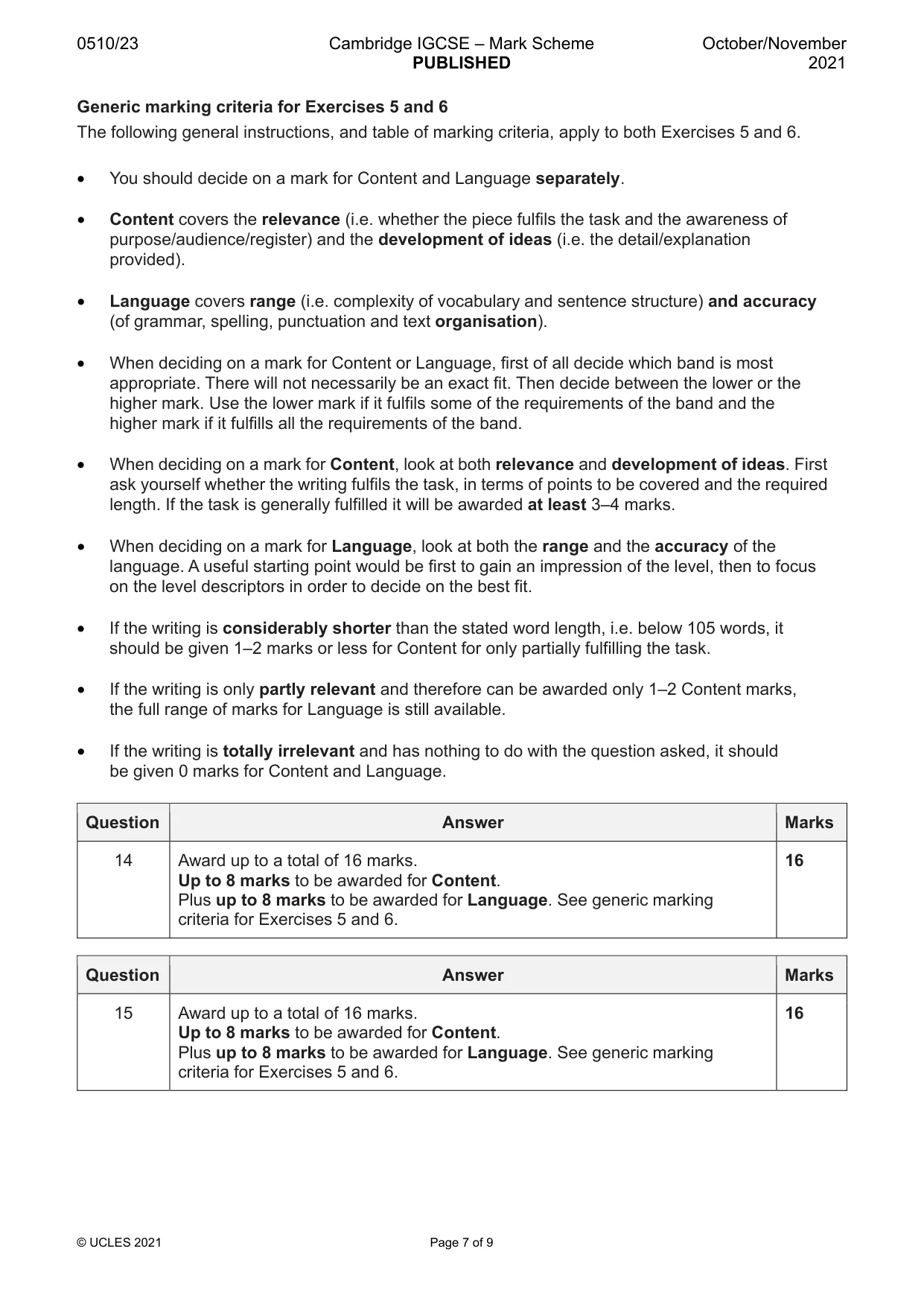
0510/23 Cambridge IGCSE – Mark Scheme PUBLISHED October/November 2021 © UCLES 2021 Page 7 of 9 Generic marking criteria for Exercises 5 and 6 The following general instructions, and table of marking criteria, apply to both Exercises 5 and 6. • You should decide on a mark for Content and Language separately. • Content covers the relevance (i.e. whether the piece fulfils the task and the awareness of purpose/audience/register) and the development of ideas (i.e. the detail/explanation provided). • Language covers range (i.e. complexity of vocabulary and sentence structure) and accuracy (of grammar, spelling, punctuation and text organisation). • When deciding on a mark for Content or Language, first of all decide which band is most appropriate. There will not necessarily be an exact fit. Then decide between the lower or the higher mark. Use the lower mark if it fulfils some of the requirements of the band and the higher mark if it fulfills all the requirements of the band. • When deciding on a mark for Content, look at both relevance and development of ideas. First ask yourself whether the writing fulfils the task, in terms of points to be covered and the required length. If the task is generally fulfilled it will be awarded at least 3–4 marks. • When deciding on a mark for Language, look at both the range and the accuracy of the language. A useful starting point would be first to gain an impression of the level, then to focus on the level descriptors in order to decide on the best fit. • If the writing is considerably shorter than the stated word length, i.e. below 105 words, it should be given 1–2 marks or less for Content for only partially fulfilling the task. • If the writing is only partly relevant and therefore can be awarded only 1–2 Content marks, the full range of marks for Language is still available. • If the writing is totally irrelevant and has nothing to do with the question asked, it should be given 0 marks for Content and Language. Question Answer Marks 14 Award up to a total of 16 marks. Up to 8 marks to be awarded for Content. Plus up to 8 marks to be awarded for Language. See generic marking criteria for Exercises 5 and 6. 16 Question Answer Marks 15 Award up to a total of 16 marks. Up to 8 marks to be awarded for Content. Plus up to 8 marks to be awarded for Language. See generic marking criteria for Exercises 5 and 6. 16
Mark scheme, page 8
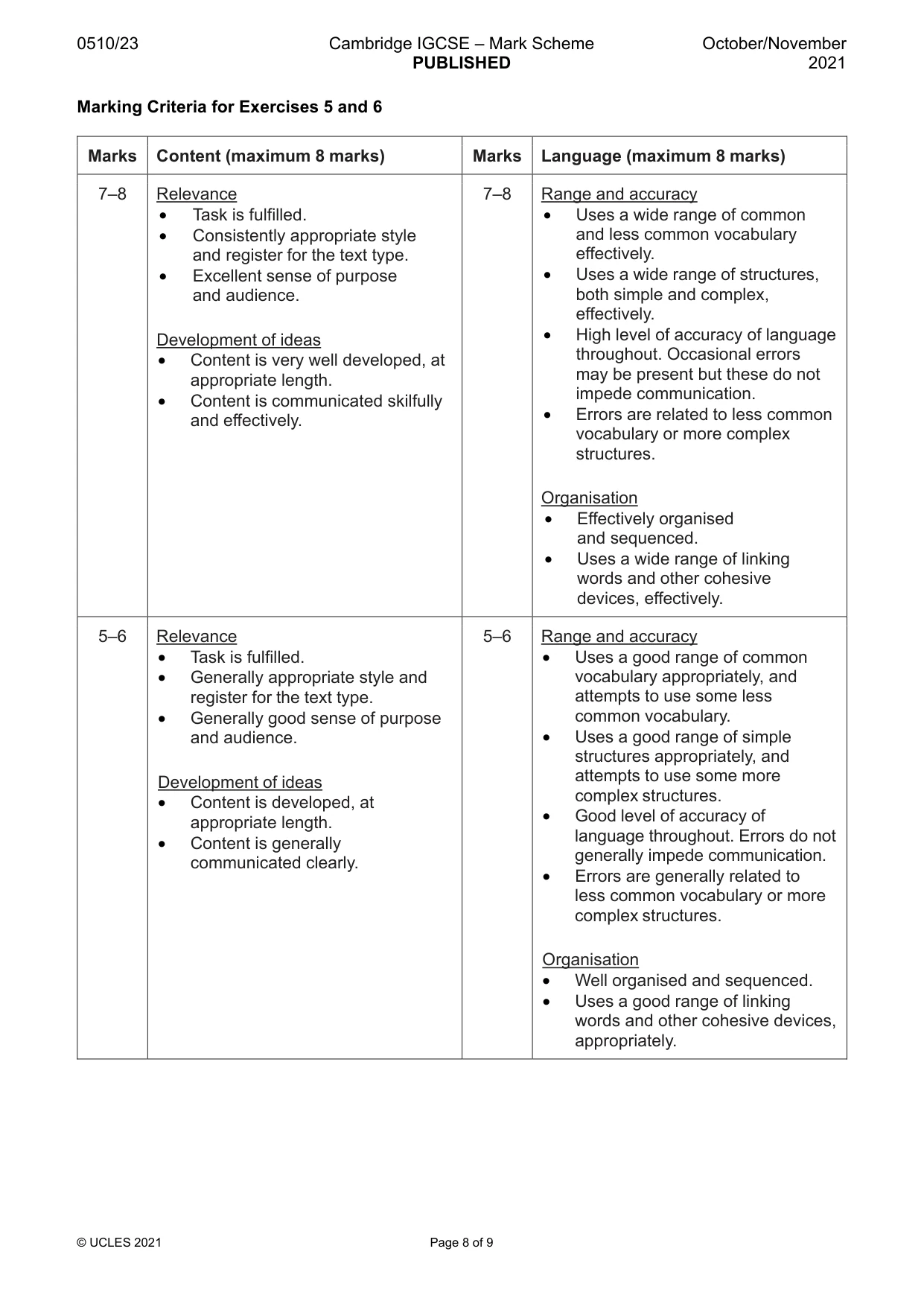
0510/23 Cambridge IGCSE – Mark Scheme PUBLISHED October/November 2021 © UCLES 2021 Page 8 of 9 Marking Criteria for Exercises 5 and 6 Marks Content (maximum 8 marks) Marks Language (maximum 8 marks) 7–8 Relevance • Task is fulfilled. • Consistently appropriate style and register for the text type. • Excellent sense of purpose and audience. Development of ideas • Content is very well developed, at appropriate length. • Content is communicated skilfully and effectively. 7–8 Range and accuracy • Uses a wide range of common and less common vocabulary effectively. • Uses a wide range of structures, both simple and complex, effectively. • High level of accuracy of language throughout. Occasional errors may be present but these do not impede communication. • Errors are related to less common vocabulary or more complex structures. Organisation • Effectively organised and sequenced. • Uses a wide range of linking words and other cohesive devices, effectively. 5–6 Relevance • Task is fulfilled. • Generally appropriate style and register for the text type. • Generally good sense of purpose and audience. Development of ideas • Content is developed, at appropriate length. • Content is generally communicated clearly. 5–6 Range and accuracy • Uses a good range of common vocabulary appropriately, and attempts to use some less common vocabulary. • Uses a good range of simple structures appropriately, and attempts to use some more complex structures. • Good level of accuracy of language throughout. Errors do not generally impede communication. • Errors are generally related to less common vocabulary or more complex structures. Organisation • Well organised and sequenced. • Uses a good range of linking words and other cohesive devices, appropriately.
Mark scheme, page 9
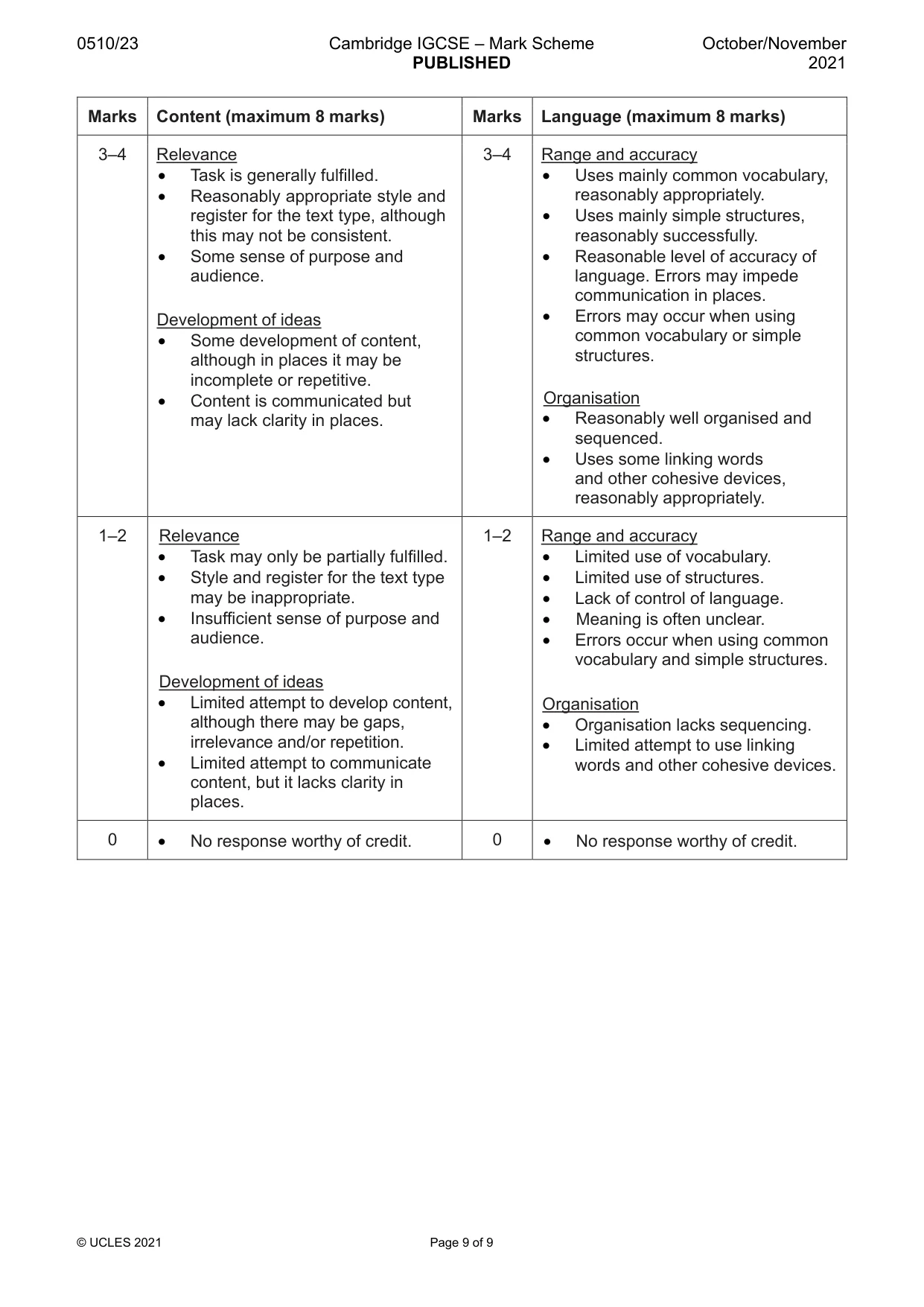
0510/23 Cambridge IGCSE – Mark Scheme PUBLISHED October/November 2021 © UCLES 2021 Page 9 of 9 Marks Content (maximum 8 marks) Marks Language (maximum 8 marks) 3–4 Relevance • Task is generally fulfilled. • Reasonably appropriate style and register for the text type, although this may not be consistent. • Some sense of purpose and audience. Development of ideas • Some development of content, although in places it may be incomplete or repetitive. • Content is communicated but may lack clarity in places. 3–4 Range and accuracy • Uses mainly common vocabulary, reasonably appropriately. • Uses mainly simple structures, reasonably successfully. • Reasonable level of accuracy of language. Errors may impede communication in places. • Errors may occur when using common vocabulary or simple structures. Organisation • Reasonably well organised and sequenced. • Uses some linking words and other cohesive devices, reasonably appropriately. 1–2 Relevance • Task may only be partially fulfilled. • Style and register for the text type may be inappropriate. • Insufficient sense of purpose and audience. Development of ideas • Limited attempt to develop content, although there may be gaps, irrelevance and/or repetition. • Limited attempt to communicate content, but it lacks clarity in places. 1–2 Range and accuracy • Limited use of vocabulary. • Limited use of structures. • Lack of control of language. • Meaning is often unclear. • Errors occur when using common vocabulary and simple structures. Organisation • Organisation lacks sequencing. • Limited attempt to use linking words and other cohesive devices. 0 • No response worthy of credit. 0 • No response worthy of credit.
What you needed in this session
Cambridge’s own grade thresholds for 2021 Oct/Nov, Paper 2 · Variant 3. A higher threshold means an easier paper — the bar moves with how the cohort did.