Cambridge IGCSE English - Second Language (oral endorsement) 0510 — 2021 May/June Paper 1 · Variant 3
0510/13/M/J/21 · 60 marks · ≈68 min
The question paper and its mark scheme, free to read here and free to download. This is Cambridge’s own paper, exactly as it was sat.
Question paper16 pages



Mark scheme9 pages
Answers below. Sit the paper first if you are practising.
Paper as text
Question paper, page 1
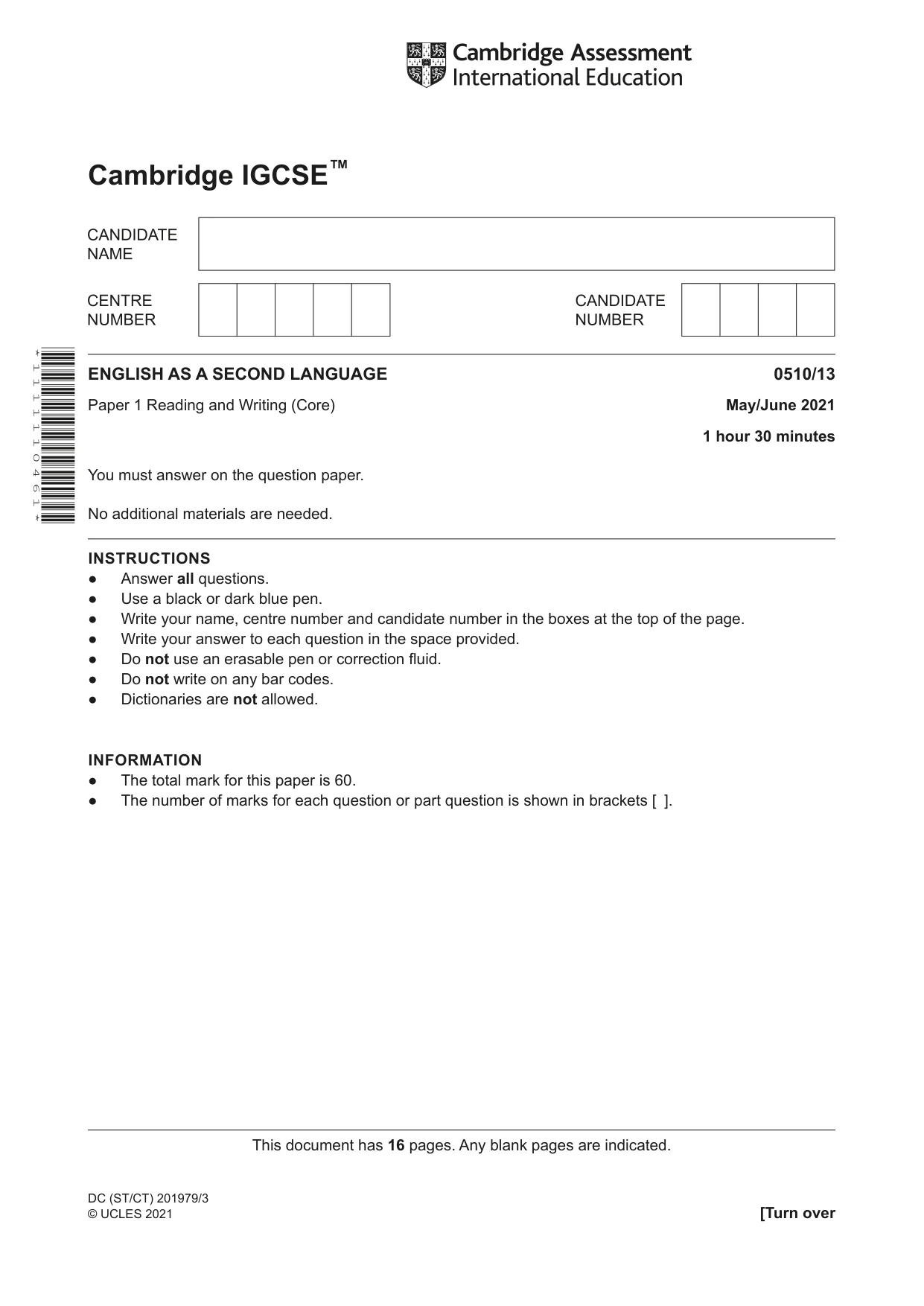
This document has 16 pages. Any blank pages are indicated. Cambridge IGCSE™ DC (ST/CT) 201979/3 © UCLES 2021 [Turn over ENGLISH AS A SECOND LANGUAGE 0510/13 Paper 1 Reading and Writing (Core) May/June 2021 1 hour 30 minutes You must answer on the question paper. No additional materials are needed. INSTRUCTIONS ● Answer all questions. ● Use a black or dark blue pen. ● Write your name, centre number and candidate number in the boxes at the top of the page. ● Write your answer to each question in the space provided. ● Do not use an erasable pen or correction fluid. ● Do not write on any bar codes. ● Dictionaries are not allowed. INFORMATION ● The total mark for this paper is 60. ● The number of marks for each question or part question is shown in brackets [ ]. * 1 1 1 1 1 1 0 4 6 1 *
Question paper, page 2
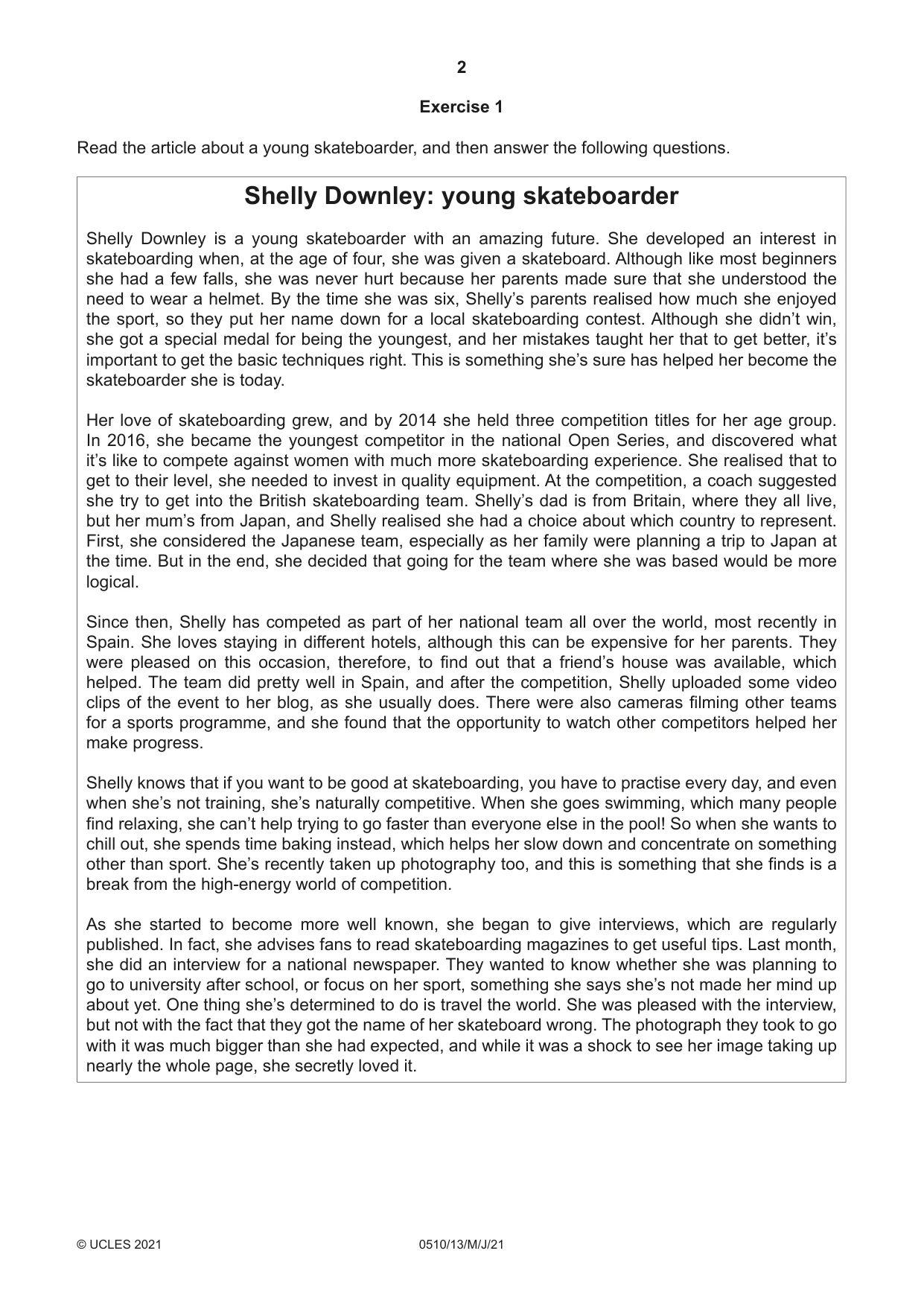
2 0510/13/M/J/21 © UCLES 2021 Exercise 1 Read the article about a young skateboarder, and then answer the following questions. Shelly Downley: young skateboarder Shelly Downley is a young skateboarder with an amazing future. She developed an interest in skateboarding when, at the age of four, she was given a skateboard. Although like most beginners she had a few falls, she was never hurt because her parents made sure that she understood the need to wear a helmet. By the time she was six, Shelly’s parents realised how much she enjoyed the sport, so they put her name down for a local skateboarding contest. Although she didn’t win, she got a special medal for being the youngest, and her mistakes taught her that to get better, it’s important to get the basic techniques right. This is something she’s sure has helped her become the skateboarder she is today. Her love of skateboarding grew, and by 2014 she held three competition titles for her age group. In 2016, she became the youngest competitor in the national Open Series, and discovered what it’s like to compete against women with much more skateboarding experience. She realised that to get to their level, she needed to invest in quality equipment. At the competition, a coach suggested she try to get into the British skateboarding team. Shelly’s dad is from Britain, where they all live, but her mum’s from Japan, and Shelly realised she had a choice about which country to represent. First, she considered the Japanese team, especially as her family were planning a trip to Japan at the time. But in the end, she decided that going for the team where she was based would be more logical. Since then, Shelly has competed as part of her national team all over the world, most recently in Spain. She loves staying in different hotels, although this can be expensive for her parents. They were pleased on this occasion, therefore, to find out that a friend’s house was available, which helped. The team did pretty well in Spain, and after the competition, Shelly uploaded some video clips of the event to her blog, as she usually does. There were also cameras filming other teams for a sports programme, and she found that the opportunity to watch other competitors helped her make progress. Shelly knows that if you want to be good at skateboarding, you have to practise every day, and even when she’s not training, she’s naturally competitive. When she goes swimming, which many people find relaxing, she can’t help trying to go faster than everyone else in the pool! So when she wants to chill out, she spends time baking instead, which helps her slow down and concentrate on something other than sport. She’s recently taken up photography too, and this is something that she finds is a break from the high-energy world of competition. As she started to become more well known, she began to give interviews, which are regularly published. In fact, she advises fans to read skateboarding magazines to get useful tips. Last month, she did an interview for a national newspaper. They wanted to know whether she was planning to go to university after school, or focus on her sport, something she says she’s not made her mind up about yet. One thing she’s determined to do is travel the world. She was pleased with the interview, but not with the fact that they got the name of her skateboard wrong. The photograph they took to go with it was much bigger than she had expected, and while it was a shock to see her image taking up nearly the whole page, she secretly loved it.
Question paper, page 3
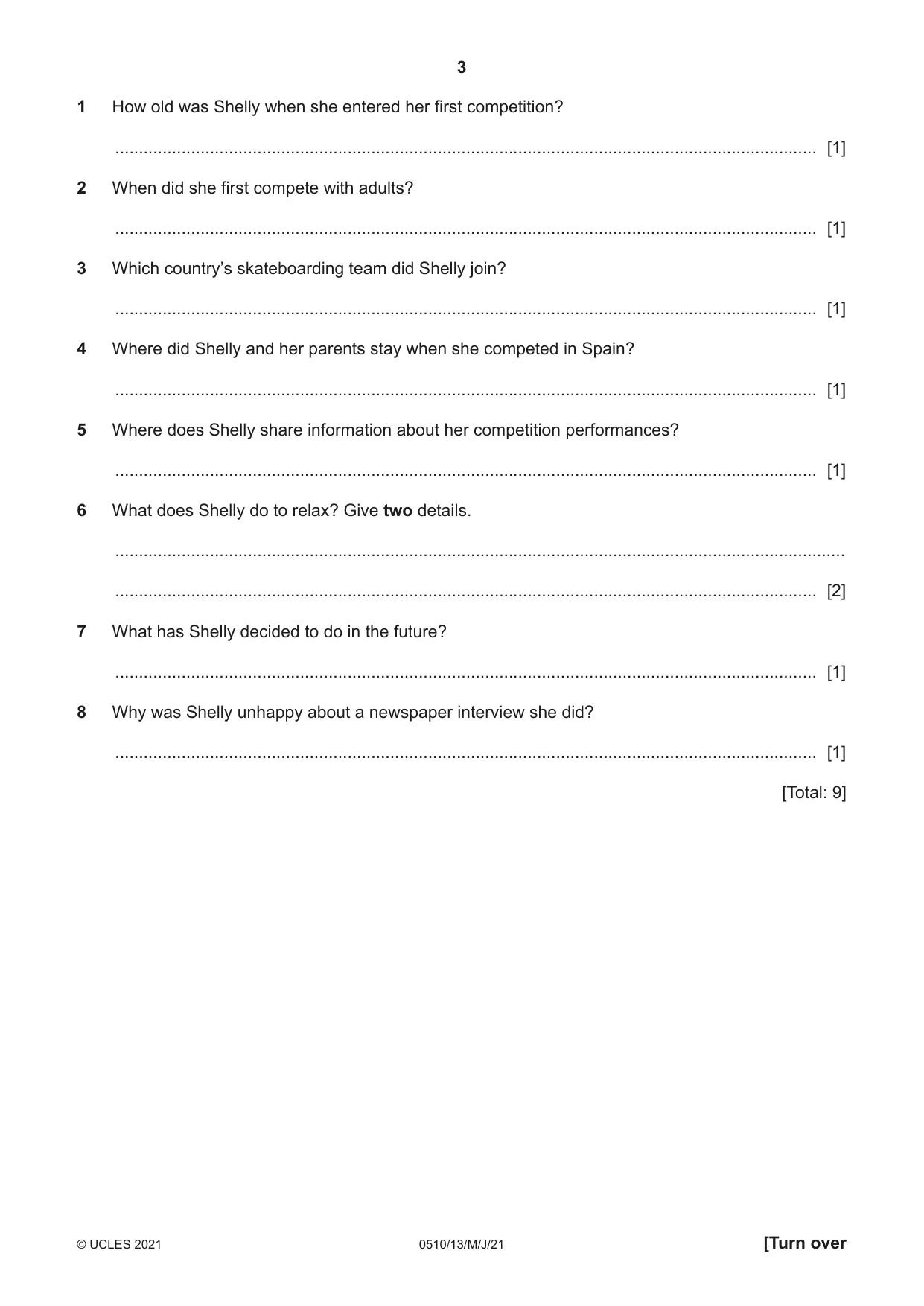
3 0510/13/M/J/21 © UCLES 2021 [Turn over 1 How old was Shelly when she entered her first competition? … [1] 2 When did she first compete with adults? … [1] 3 Which country’s skateboarding team did Shelly join? … [1] 4 Where did Shelly and her parents stay when she competed in Spain? … [1] 5 Where does Shelly share information about her competition performances? … [1] 6 What does Shelly do to relax? Give two details. … … [2] 7 What has Shelly decided to do in the future? … [1] 8 Why was Shelly unhappy about a newspaper interview she did? … [1] [Total: 9]
Question paper, page 4
4 0510/13/M/J/21 © UCLES 2021 Exercise 2 Read the reviews from three people (A–C) who have written about different TV series. Then answer Question 9(a)–(h). TV reviews Content removed due to copyright restrictions.
Question paper, page 5
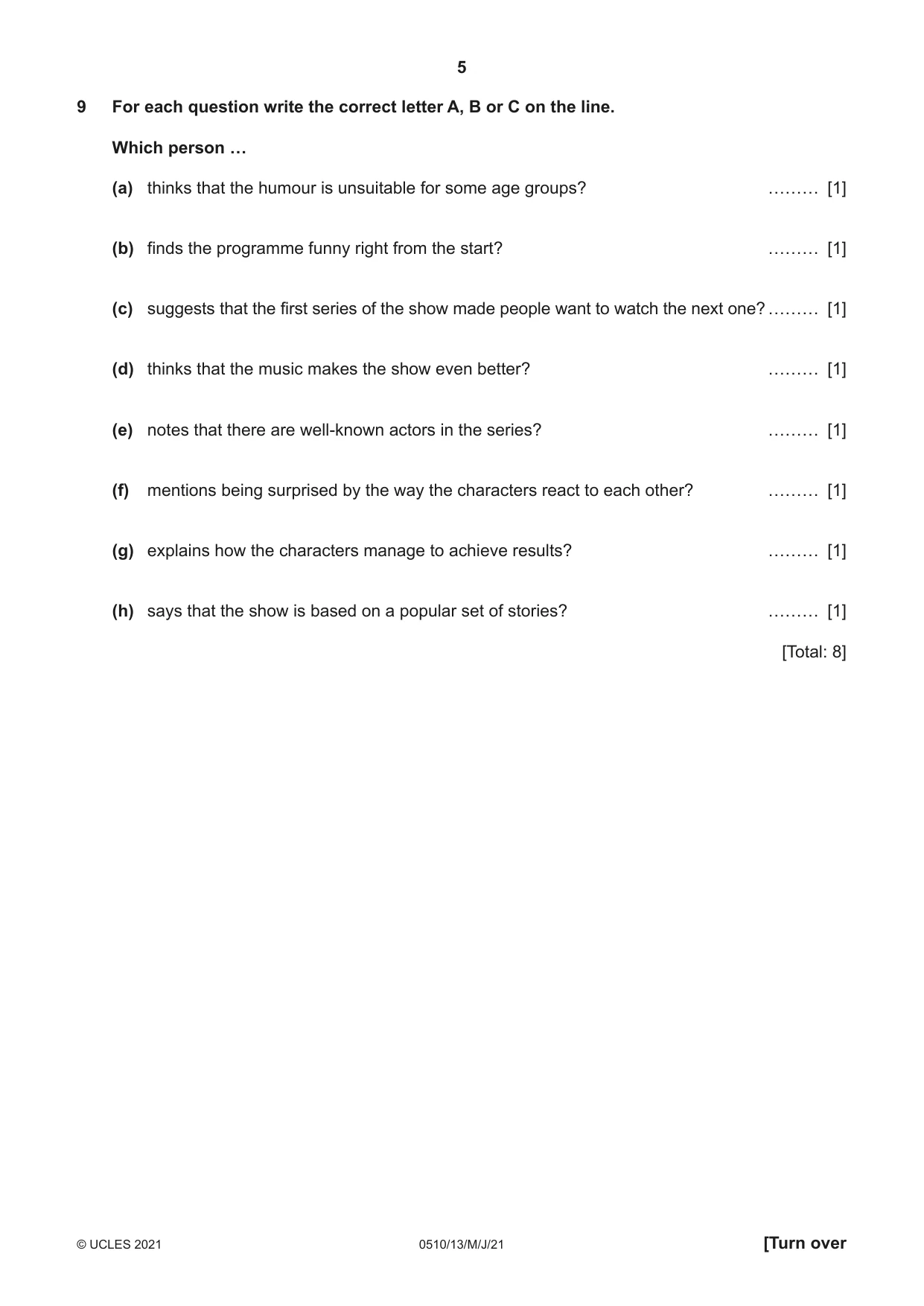
5 0510/13/M/J/21 © UCLES 2021 [Turn over 9 For each question write the correct letter A, B or C on the line. Which person … (a) thinks that the humour is unsuitable for some age groups? ……… [1] (b) finds the programme funny right from the start? ……… [1] (c) suggests that the first series of the show made people want to watch the next one? ……… [1] (d) thinks that the music makes the show even better? ……… [1] (e) notes that there are well-known actors in the series? ……… [1] (f) mentions being surprised by the way the characters react to each other? ……… [1] (g) explains how the characters manage to achieve results? ……… [1] (h) says that the show is based on a popular set of stories? ……… [1] [Total: 8]
Question paper, page 6
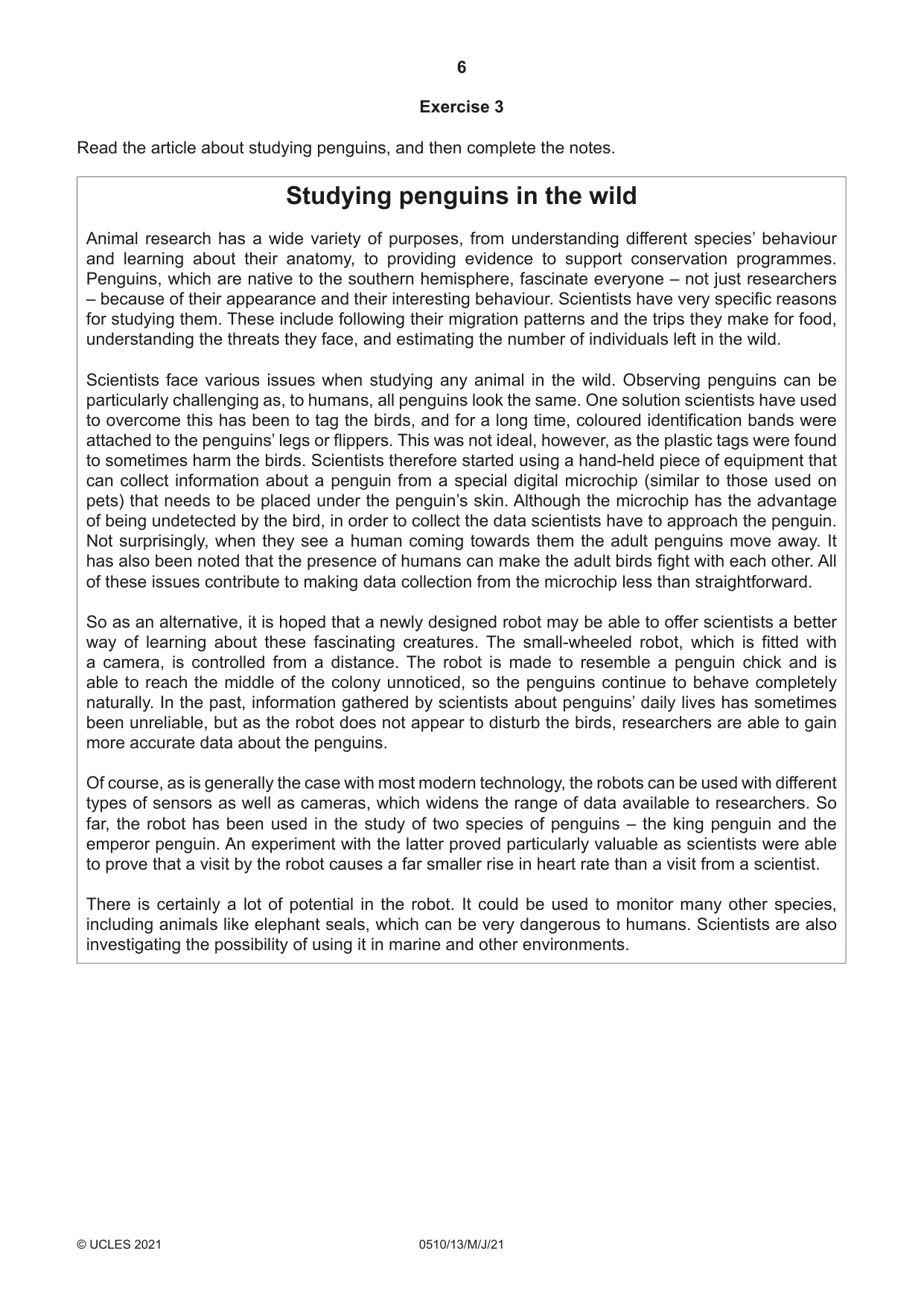
6 0510/13/M/J/21 © UCLES 2021 Exercise 3 Read the article about studying penguins, and then complete the notes. Studying penguins in the wild Animal research has a wide variety of purposes, from understanding different species’ behaviour and learning about their anatomy, to providing evidence to support conservation programmes. Penguins, which are native to the southern hemisphere, fascinate everyone – not just researchers – because of their appearance and their interesting behaviour. Scientists have very specific reasons for studying them. These include following their migration patterns and the trips they make for food, understanding the threats they face, and estimating the number of individuals left in the wild. Scientists face various issues when studying any animal in the wild. Observing penguins can be particularly challenging as, to humans, all penguins look the same. One solution scientists have used to overcome this has been to tag the birds, and for a long time, coloured identification bands were attached to the penguins’ legs or flippers. This was not ideal, however, as the plastic tags were found to sometimes harm the birds. Scientists therefore started using a hand-held piece of equipment that can collect information about a penguin from a special digital microchip (similar to those used on pets) that needs to be placed under the penguin’s skin. Although the microchip has the advantage of being undetected by the bird, in order to collect the data scientists have to approach the penguin. Not surprisingly, when they see a human coming towards them the adult penguins move away. It has also been noted that the presence of humans can make the adult birds fight with each other. All of these issues contribute to making data collection from the microchip less than straightforward. So as an alternative, it is hoped that a newly designed robot may be able to offer scientists a better way of learning about these fascinating creatures. The small-wheeled robot, which is fitted with a camera, is controlled from a distance. The robot is made to resemble a penguin chick and is able to reach the middle of the colony unnoticed, so the penguins continue to behave completely naturally. In the past, information gathered by scientists about penguins’ daily lives has sometimes been unreliable, but as the robot does not appear to disturb the birds, researchers are able to gain more accurate data about the penguins. Of course, as is generally the case with most modern technology, the robots can be used with different types of sensors as well as cameras, which widens the range of data available to researchers. So far, the robot has been used in the study of two species of penguins – the king penguin and the emperor penguin. An experiment with the latter proved particularly valuable as scientists were able to prove that a visit by the robot causes a far smaller rise in heart rate than a visit from a scientist. There is certainly a lot of potential in the robot. It could be used to monitor many other species, including animals like elephant seals, which can be very dangerous to humans. Scientists are also investigating the possibility of using it in marine and other environments.
Question paper, page 7
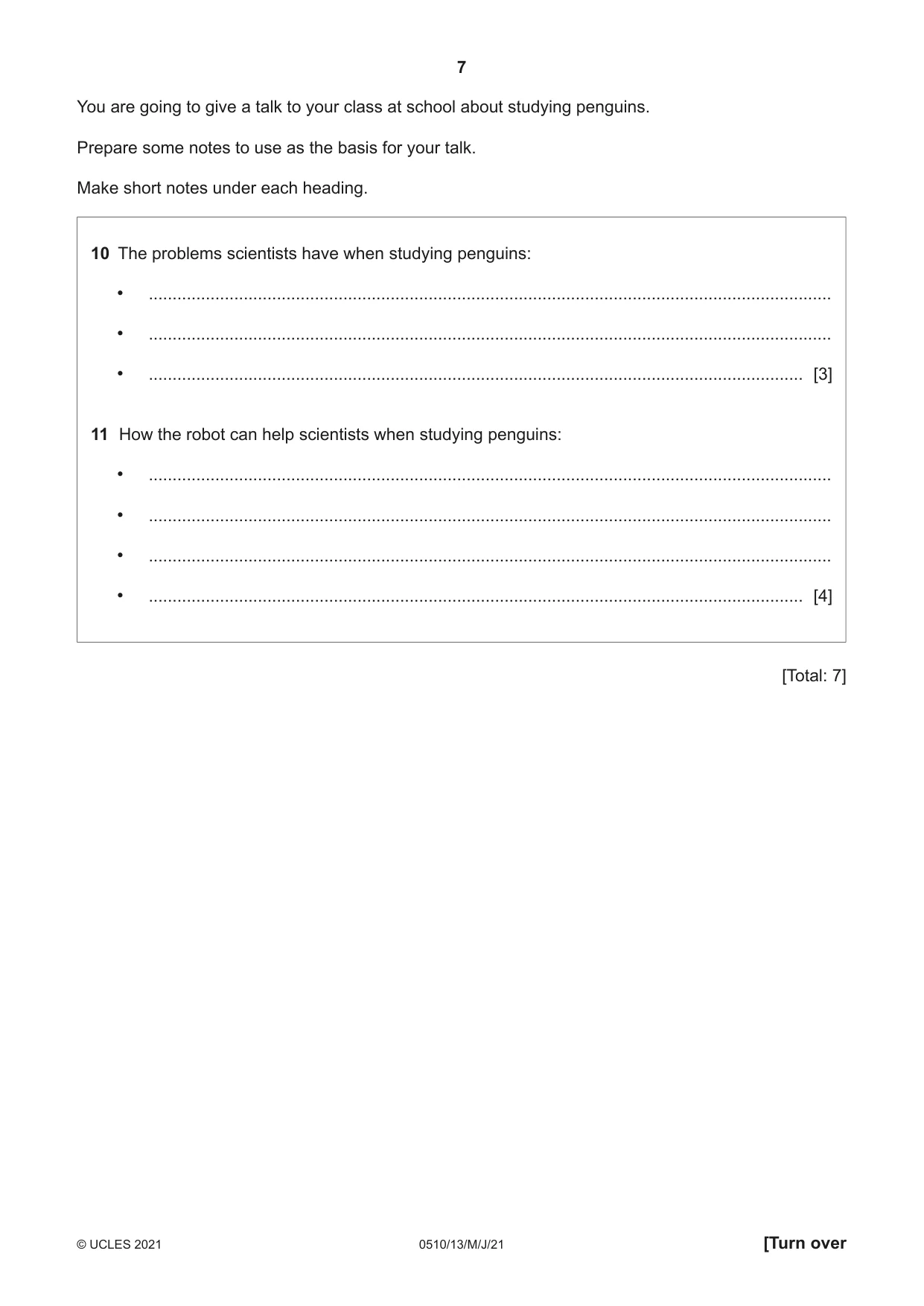
7 0510/13/M/J/21 © UCLES 2021 [Turn over You are going to give a talk to your class at school about studying penguins. Prepare some notes to use as the basis for your talk. Make short notes under each heading. 10 The problems scientists have when studying penguins: • … • … • … [3] 11 How the robot can help scientists when studying penguins: • … • … • … • … [4] [Total: 7]
Question paper, page 8
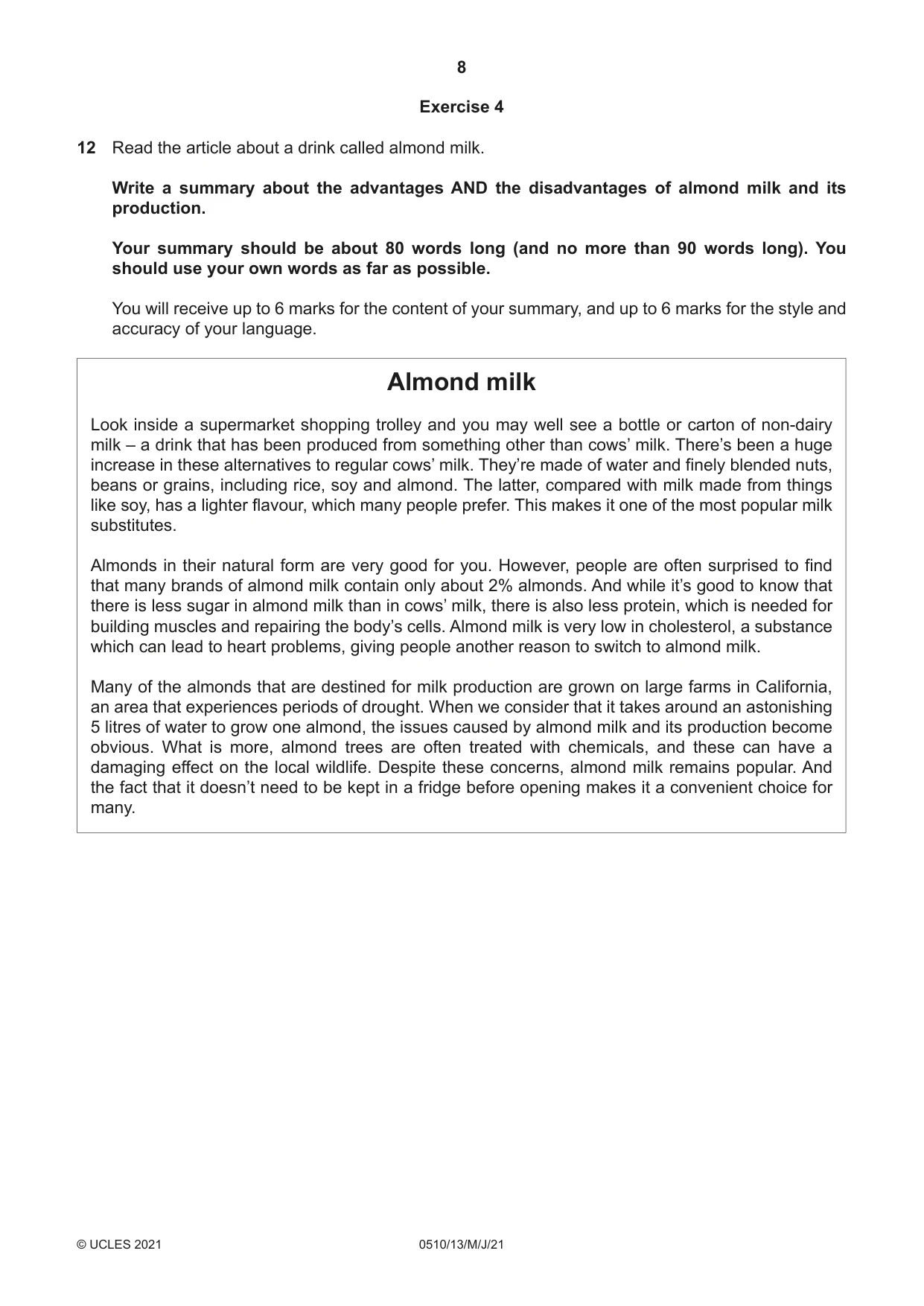
8 0510/13/M/J/21 © UCLES 2021 Exercise 4 12 Read the article about a drink called almond milk. Write a summary about the advantages AND the disadvantages of almond milk and its production. Your summary should be about 80 words long (and no more than 90 words long). You should use your own words as far as possible. You will receive up to 6 marks for the content of your summary, and up to 6 marks for the style and accuracy of your language. Almond milk Look inside a supermarket shopping trolley and you may well see a bottle or carton of non-dairy milk – a drink that has been produced from something other than cows’ milk. There’s been a huge increase in these alternatives to regular cows’ milk. They’re made of water and finely blended nuts, beans or grains, including rice, soy and almond. The latter, compared with milk made from things like soy, has a lighter flavour, which many people prefer. This makes it one of the most popular milk substitutes. Almonds in their natural form are very good for you. However, people are often surprised to find that many brands of almond milk contain only about 2% almonds. And while it’s good to know that there is less sugar in almond milk than in cows’ milk, there is also less protein, which is needed for building muscles and repairing the body’s cells. Almond milk is very low in cholesterol, a substance which can lead to heart problems, giving people another reason to switch to almond milk. Many of the almonds that are destined for milk production are grown on large farms in California, an area that experiences periods of drought. When we consider that it takes around an astonishing 5 litres of water to grow one almond, the issues caused by almond milk and its production become obvious. What is more, almond trees are often treated with chemicals, and these can have a damaging effect on the local wildlife. Despite these concerns, almond milk remains popular. And the fact that it doesn’t need to be kept in a fridge before opening makes it a convenient choice for many.
Question paper, page 9
9 0510/13/M/J/21 © UCLES 2021 [Turn over … … … … … … … … … … … … … … [Total: 12]
Question paper, page 10
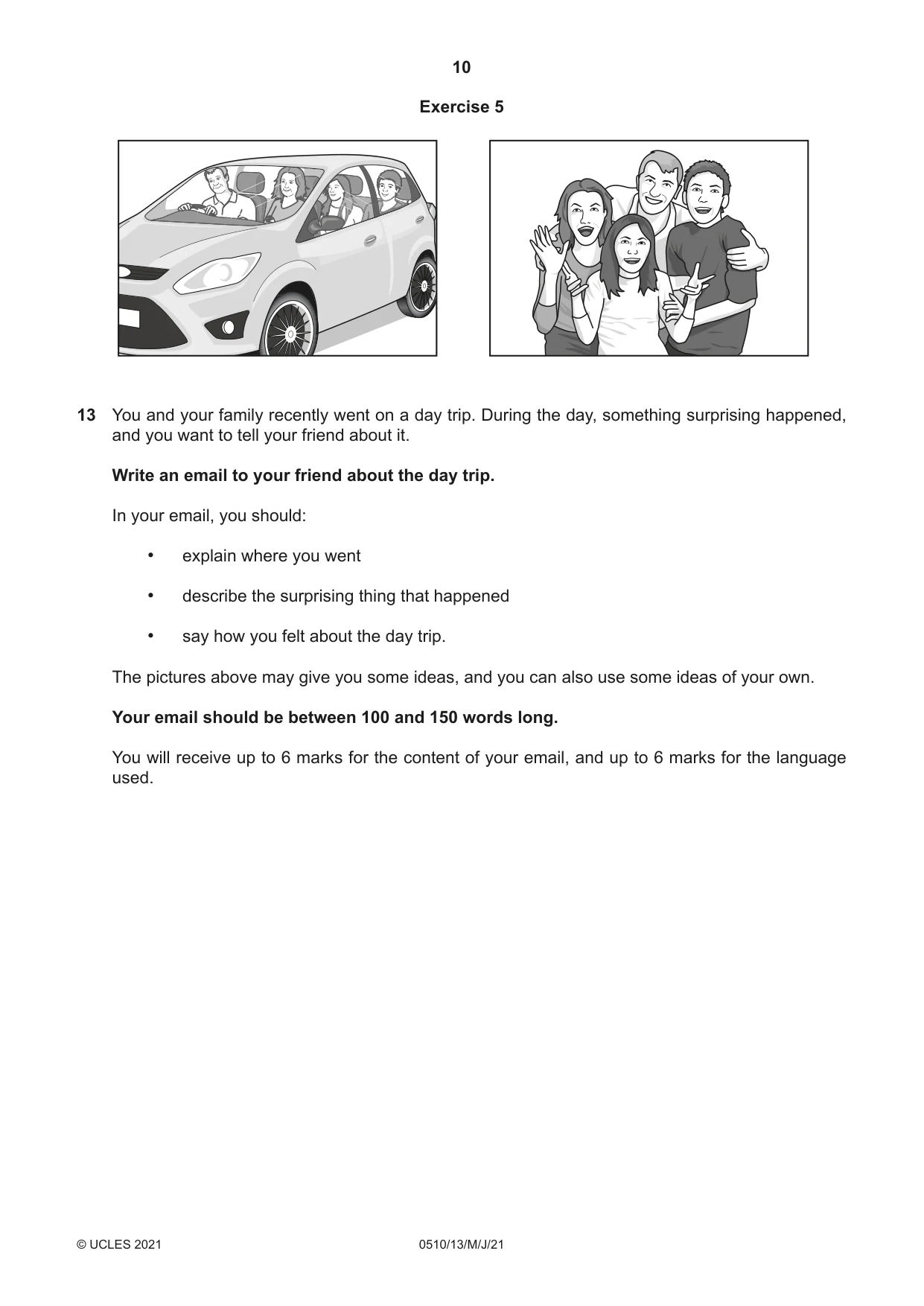
10 0510/13/ M / J /21 © UCLES 2021 Exercise 5 13 You and your family recently went on a day trip. During the day, something surprising happened, and you want to tell your friend about it. Write an email to your friend about the day trip. In your email, you should: • explain where you went • describe the surprising thing that happened • say how you felt about the day trip. The pictures above may give you some ideas, and you can also use some ideas of your own. Your email should be between 100 and 150 words long. You will receive up to 6 marks for the content of your email, and up to 6 marks for the language used.
Question paper, page 11
11 0510/13/M/J/21 © UCLES 2021 [Turn over … … … … … … … … … … … … … … … … … … … … … … … … … … … [Total: 12]
Question paper, page 12
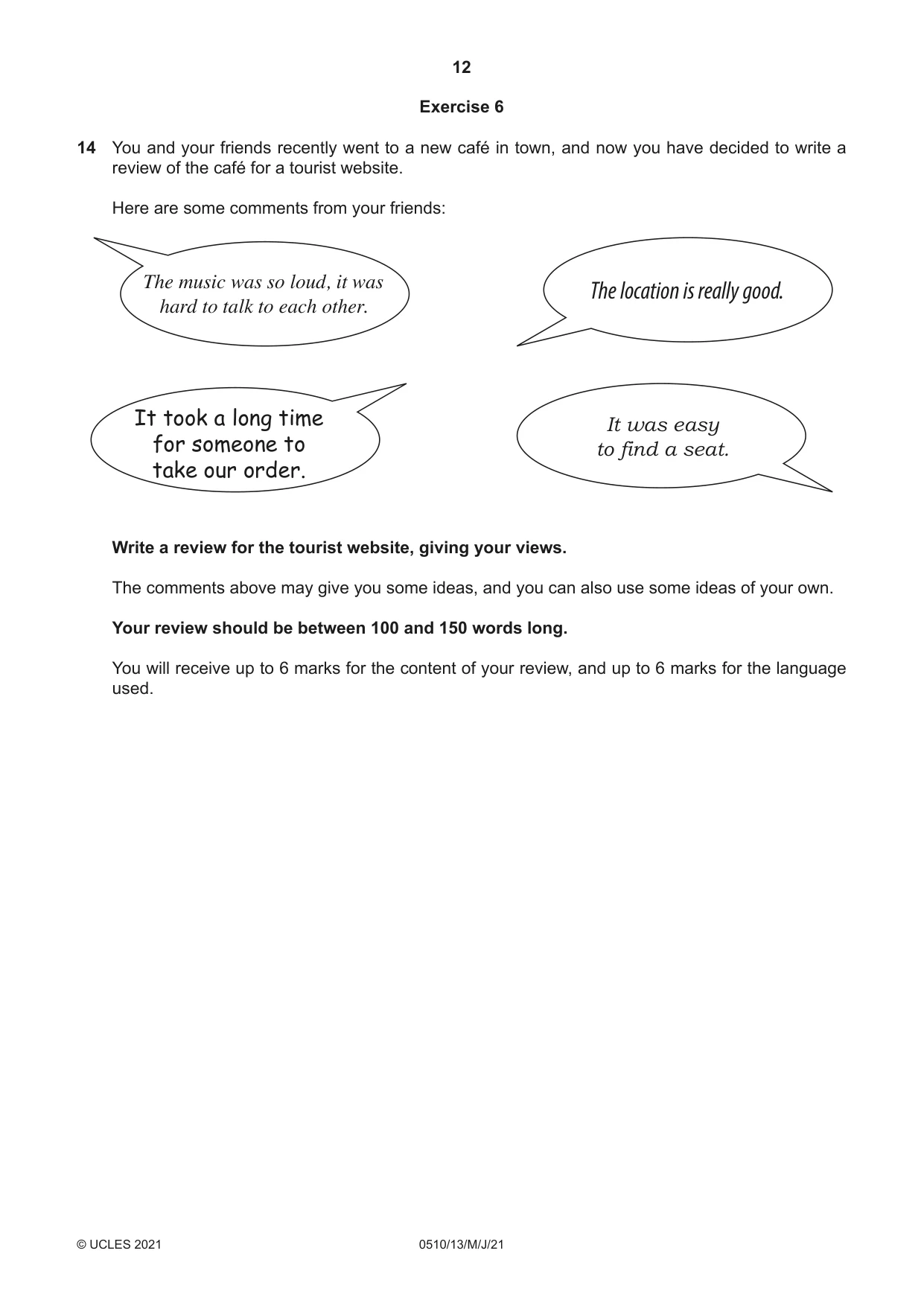
12 0510/13/M/J/21 © UCLES 2021 Exercise 6 14 You and your friends recently went to a new café in town, and now you have decided to write a review of the café for a tourist website. Here are some comments from your friends: The music was so loud, it was hard to talk to each other. It took a long time for someone to take our order. The location is really good. It was easy to find a seat. Write a review for the tourist website, giving your views. The comments above may give you some ideas, and you can also use some ideas of your own. Your review should be between 100 and 150 words long. You will receive up to 6 marks for the content of your review, and up to 6 marks for the language used.
Question paper, page 13
13 0510/13/M/J/21 © UCLES 2021 … … … … … … … … … … … … … … … … … … … … … … … … … … … [Total: 12]
Question paper, page 14
14 0510/13/M/J/21 © UCLES 2021 BLANK PAGE
Question paper, page 15
15 0510/13/M/J/21 © UCLES 2021 BLANK PAGE
Question paper, page 16
16 0510/13/M/J/21 © UCLES 2021 Permission to reproduce items where third-party owned material protected by copyright is included has been sought and cleared where possible. Every reasonable effort has been made by the publisher (UCLES) to trace copyright holders, but if any items requiring clearance have unwittingly been included, the publisher will be pleased to make amends at the earliest possible opportunity. To avoid the issue of disclosure of answer-related information to candidates, all copyright acknowledgements are reproduced online in the Cambridge Assessment International Education Copyright Acknowledgements Booklet. This is produced for each series of examinations and is freely available to download at www.cambridgeinternational.org after the live examination series. Cambridge Assessment International Education is part of the Cambridge Assessment Group. Cambridge Assessment is the brand name of the University of Cambridge Local Examinations Syndicate (UCLES), which itself is a department of the University of Cambridge. BLANK PAGE
Mark scheme, page 1
This document consists of 9 printed pages. © UCLES 2021 [Turn over Cambridge IGCSE™ ENGLISH AS A SECOND LANGUAGE 0510/13 Paper 1 Reading and Writing (Core) May/June 2021 MARK SCHEME Maximum Mark: 60 Published This mark scheme is published as an aid to teachers and candidates, to indicate the requirements of the examination. It shows the basis on which Examiners were instructed to award marks. It does not indicate the details of the discussions that took place at an Examiners’ meeting before marking began, which would have considered the acceptability of alternative answers. Mark schemes should be read in conjunction with the question paper and the Principal Examiner Report for Teachers. Cambridge International will not enter into discussions about these mark schemes. Cambridge International is publishing the mark schemes for the May/June 2021 series for most Cambridge IGCSE™, Cambridge International A and AS Level components and some Cambridge O Level components.
Mark scheme, page 2
0510/13 Cambridge IGCSE – Mark Scheme PUBLISHED May/June 2021 © UCLES 2021 Page 2 of 9 Generic Marking Principles These general marking principles must be applied by all examiners when marking candidate answers. They should be applied alongside the specific content of the mark scheme or generic level descriptors for a question. Each question paper and mark scheme will also comply with these marking principles. GENERIC MARKING PRINCIPLE 1: Marks must be awarded in line with: • the specific content of the mark scheme or the generic level descriptors for the question • the specific skills defined in the mark scheme or in the generic level descriptors for the question • the standard of response required by a candidate as exemplified by the standardisation scripts. GENERIC MARKING PRINCIPLE 2: Marks awarded are always whole marks (not half marks, or other fractions). GENERIC MARKING PRINCIPLE 3: Marks must be awarded positively: • marks are awarded for correct/valid answers, as defined in the mark scheme. However, credit is given for valid answers which go beyond the scope of the syllabus and mark scheme, referring to your Team Leader as appropriate • marks are awarded when candidates clearly demonstrate what they know and can do • marks are not deducted for errors • marks are not deducted for omissions • answers should only be judged on the quality of spelling, punctuation and grammar when these features are specifically assessed by the question as indicated by the mark scheme. The meaning, however, should be unambiguous. GENERIC MARKING PRINCIPLE 4: Rules must be applied consistently, e.g. in situations where candidates have not followed instructions or in the application of generic level descriptors. GENERIC MARKING PRINCIPLE 5: Marks should be awarded using the full range of marks defined in the mark scheme for the question (however; the use of the full mark range may be limited according to the quality of the candidate responses seen). GENERIC MARKING PRINCIPLE 6: Marks awarded are based solely on the requirements as defined in the mark scheme. Marks should not be awarded with grade thresholds or grade descriptors in mind.
Mark scheme, page 3
0510/13 Cambridge IGCSE – Mark Scheme PUBLISHED May/June 2021 © UCLES 2021 Page 3 of 9 This component forms part of the Core tier assessment of Cambridge IGCSE English as a Second Language and tests the following Assessment Objectives: AO1: Reading R1 identify and select relevant information R2 understand ideas, opinions and attitudes R3 show understanding of the connections between ideas, opinions and attitudes R4 understand what is implied but not directly stated, e.g. gist, writer’s purpose, intentions and feelings AO2: Writing W1 communicate information/ideas/opinions clearly, accurately and effectively W2 organise ideas into coherent paragraphs using a range of appropriate linking devices W3 use a range of grammatical structures accurately and effectively W4 show control of punctuation and spelling W5 use appropriate register and style/format for the given purpose and audience
Mark scheme, page 4
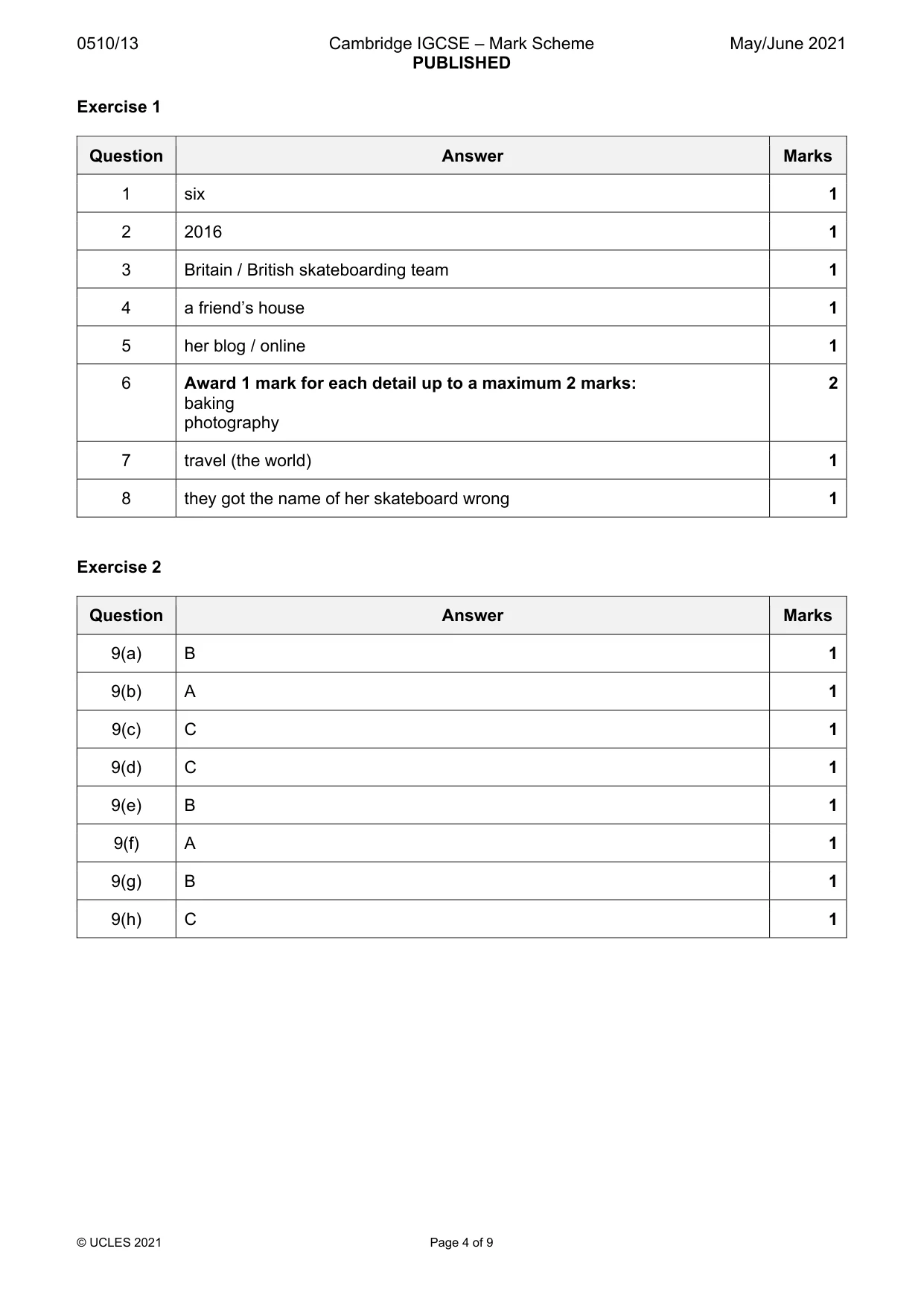
0510/13 Cambridge IGCSE – Mark Scheme PUBLISHED May/June 2021 © UCLES 2021 Page 4 of 9 Exercise 1 Question Answer Marks 1 six 1 2 2016 1 3 Britain / British skateboarding team 1 4 a friend’s house 1 5 her blog / online 1 6 Award 1 mark for each detail up to a maximum 2 marks: baking photography 2 7 travel (the world) 1 8 they got the name of her skateboard wrong 1 Exercise 2 Question Answer Marks 9(a) B 1 9(b) A 1 9(c) C 1 9(d) C 1 9(e) B 1 9(f) A 1 9(g) B 1 9(h) C 1
Mark scheme, page 5
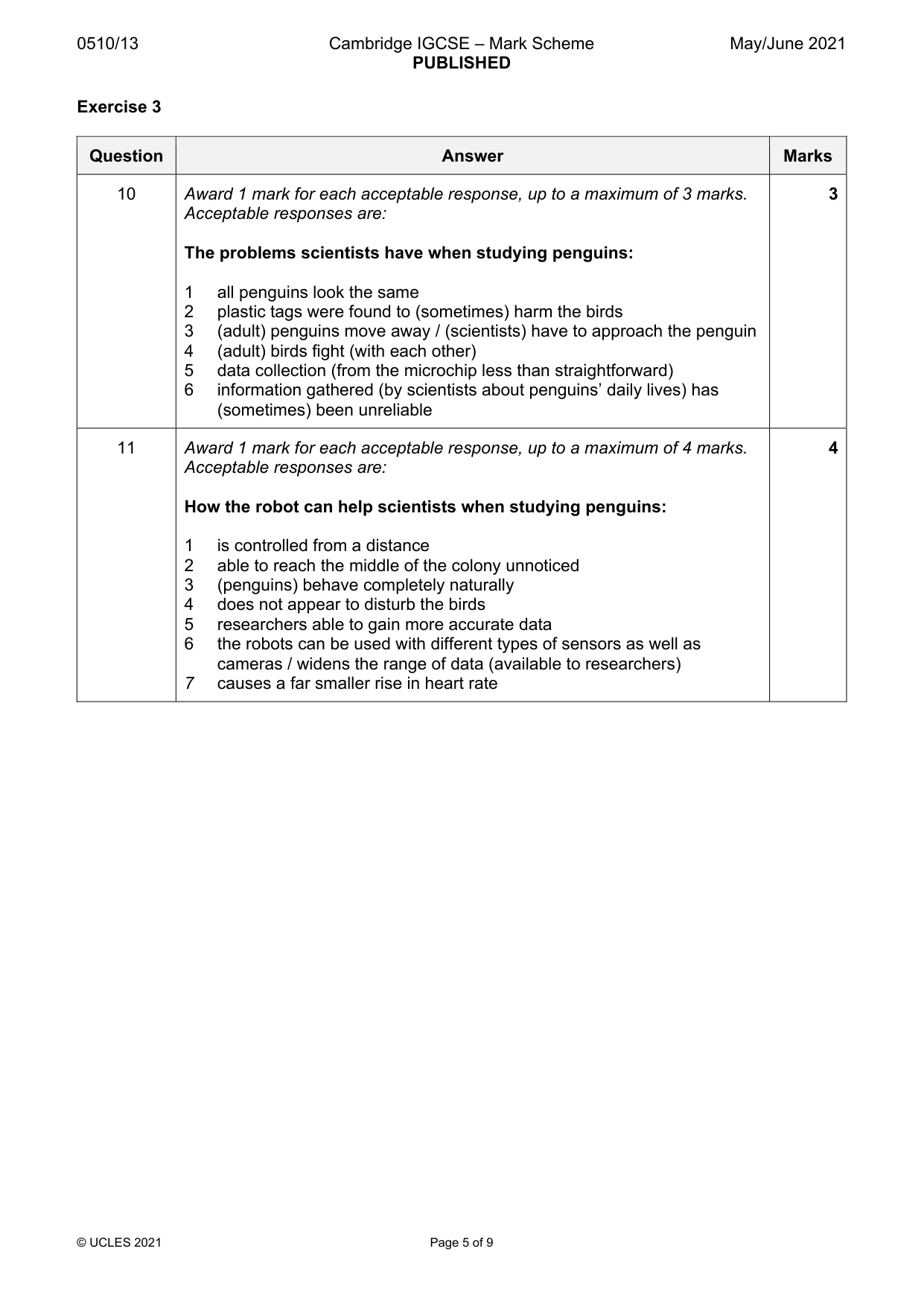
0510/13 Cambridge IGCSE – Mark Scheme PUBLISHED May/June 2021 © UCLES 2021 Page 5 of 9 Exercise 3 Question Answer Marks 10 Award 1 mark for each acceptable response, up to a maximum of 3 marks. Acceptable responses are: The problems scientists have when studying penguins: 1 all penguins look the same 2 plastic tags were found to (sometimes) harm the birds 3 (adult) penguins move away / (scientists) have to approach the penguin 4 (adult) birds fight (with each other) 5 data collection (from the microchip less than straightforward) 6 information gathered (by scientists about penguins’ daily lives) has (sometimes) been unreliable 3 11 Award 1 mark for each acceptable response, up to a maximum of 4 marks. Acceptable responses are: How the robot can help scientists when studying penguins: 1 is controlled from a distance 2 able to reach the middle of the colony unnoticed 3 (penguins) behave completely naturally 4 does not appear to disturb the birds 5 researchers able to gain more accurate data 6 the robots can be used with different types of sensors as well as cameras / widens the range of data (available to researchers) 7 causes a far smaller rise in heart rate 4
Mark scheme, page 6
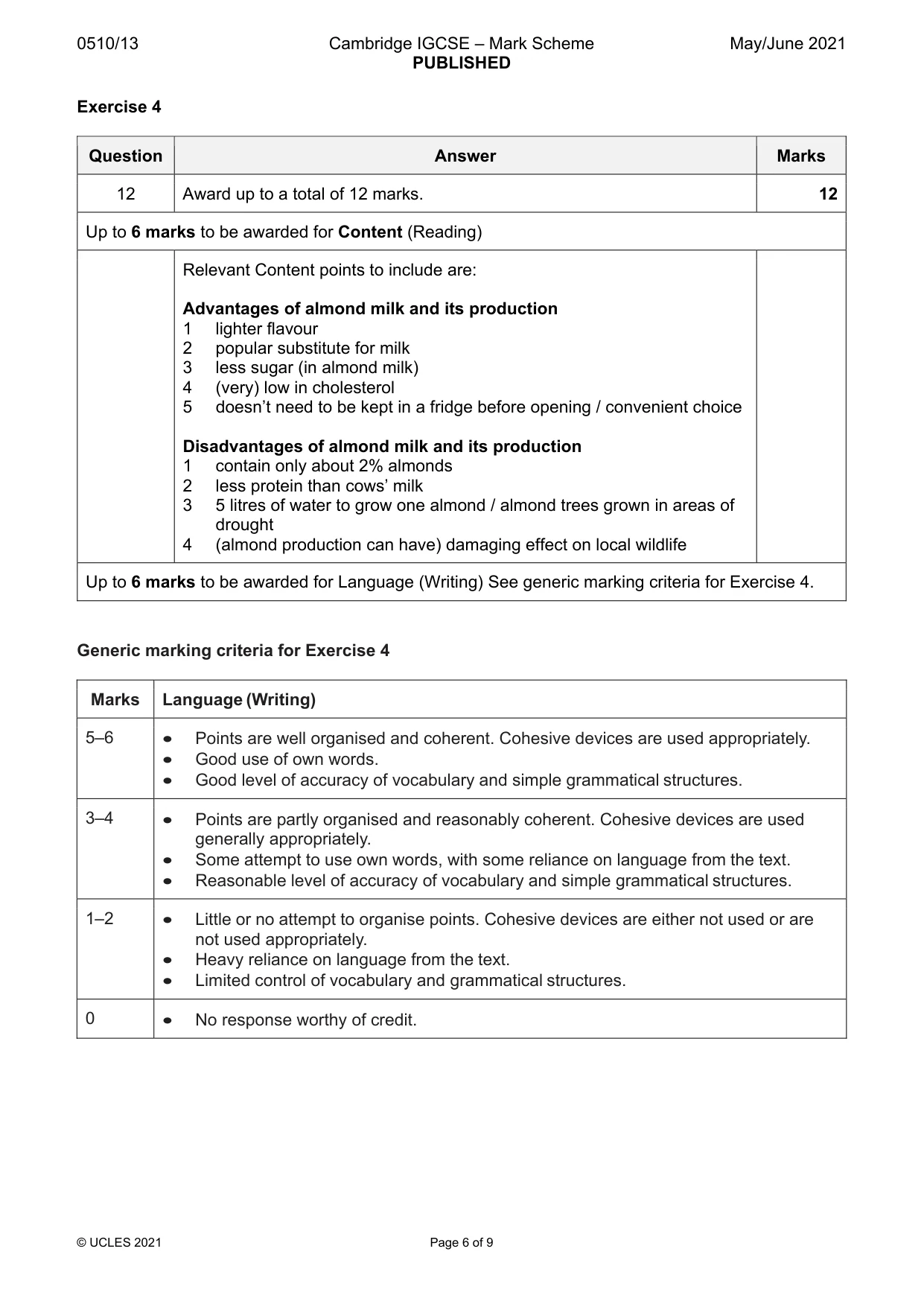
0510/13 Cambridge IGCSE – Mark Scheme PUBLISHED May/June 2021 © UCLES 2021 Page 6 of 9 Exercise 4 Question Answer Marks 12 Award up to a total of 12 marks. 12 Up to 6 marks to be awarded for Content (Reading) Relevant Content points to include are: Advantages of almond milk and its production 1 lighter flavour 2 popular substitute for milk 3 less sugar (in almond milk) 4 (very) low in cholesterol 5 doesn’t need to be kept in a fridge before opening / convenient choice Disadvantages of almond milk and its production 1 contain only about 2% almonds 2 less protein than cows’ milk 3 5 litres of water to grow one almond / almond trees grown in areas of drought 4 (almond production can have) damaging effect on local wildlife Up to 6 marks to be awarded for Language (Writing) See generic marking criteria for Exercise 4. Generic marking criteria for Exercise 4 Marks Language (Writing) 5–6 • Points are well organised and coherent. Cohesive devices are used appropriately. • Good use of own words. • Good level of accuracy of vocabulary and simple grammatical structures. 3–4 • Points are partly organised and reasonably coherent. Cohesive devices are used generally appropriately. • Some attempt to use own words, with some reliance on language from the text. • Reasonable level of accuracy of vocabulary and simple grammatical structures. 1–2 • Little or no attempt to organise points. Cohesive devices are either not used or are not used appropriately. • Heavy reliance on language from the text. • Limited control of vocabulary and grammatical structures. 0 • No response worthy of credit.
Mark scheme, page 7
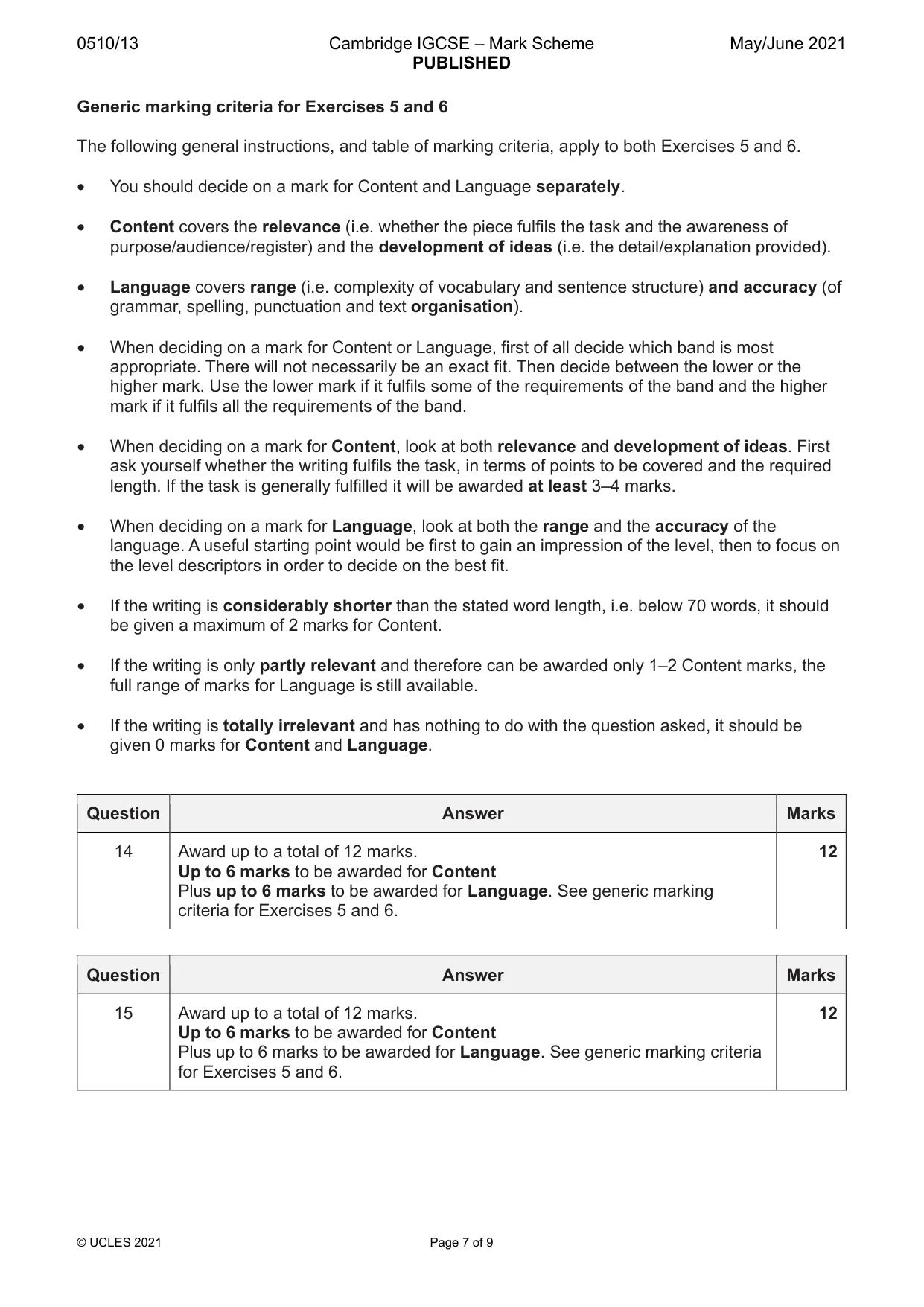
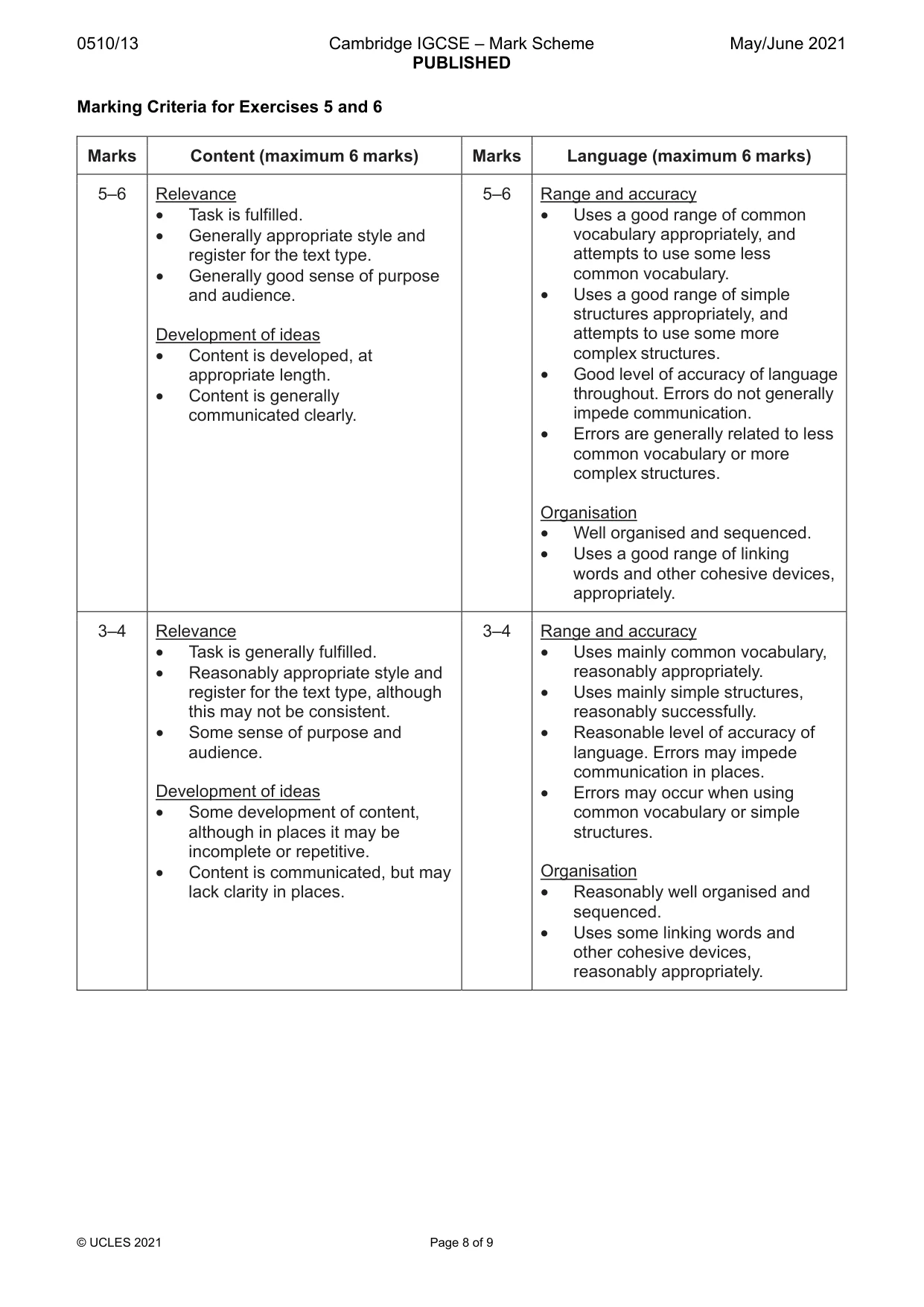
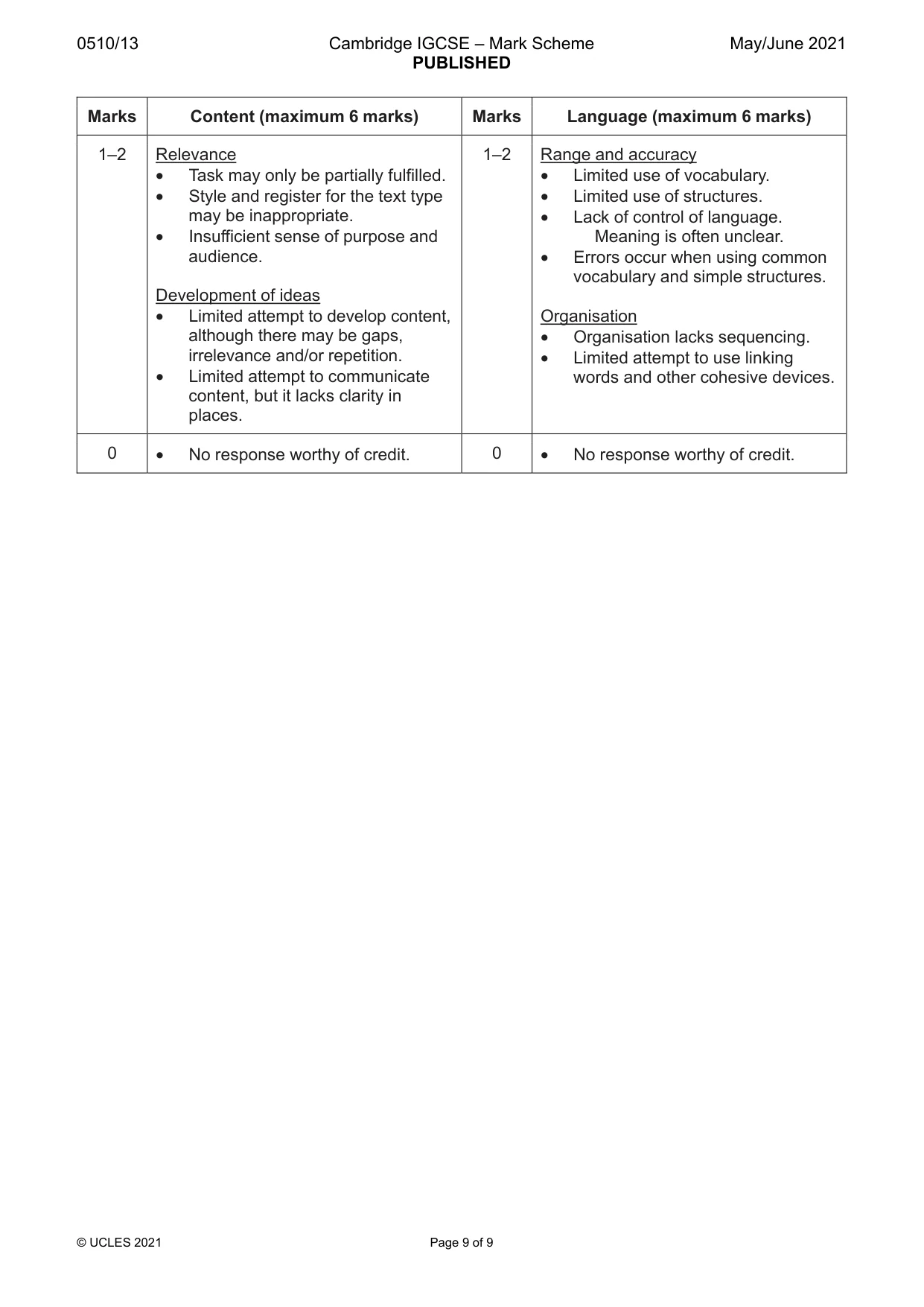
0510/13 Cambridge IGCSE – Mark Scheme PUBLISHED May/June 2021 © UCLES 2021 Page 7 of 9 Generic marking criteria for Exercises 5 and 6 The following general instructions, and table of marking criteria, apply to both Exercises 5 and 6. • You should decide on a mark for Content and Language separately. • Content covers the relevance (i.e. whether the piece fulfils the task and the awareness of purpose/audience/register) and the development of ideas (i.e. the detail/explanation provided). • Language covers range (i.e. complexity of vocabulary and sentence structure) and accuracy (of grammar, spelling, punctuation and text organisation). • When deciding on a mark for Content or Language, first of all decide which band is most appropriate. There will not necessarily be an exact fit. Then decide between the lower or the higher mark. Use the lower mark if it fulfils some of the requirements of the band and the higher mark if it fulfils all the requirements of the band. • When deciding on a mark for Content, look at both relevance and development of ideas. First ask yourself whether the writing fulfils the task, in terms of points to be covered and the required length. If the task is generally fulfilled it will be awarded at least 3–4 marks. • When deciding on a mark for Language, look at both the range and the accuracy of the language. A useful starting point would be first to gain an impression of the level, then to focus on the level descriptors in order to decide on the best fit. • If the writing is considerably shorter than the stated word length, i.e. below 70 words, it should be given a maximum of 2 marks for Content. • If the writing is only partly relevant and therefore can be awarded only 1–2 Content marks, the full range of marks for Language is still available. • If the writing is totally irrelevant and has nothing to do with the question asked, it should be given 0 marks for Content and Language. Question Answer Marks 14 Award up to a total of 12 marks. Up to 6 marks to be awarded for Content Plus up to 6 marks to be awarded for Language. See generic marking criteria for Exercises 5 and 6. 12 Question Answer Marks 15 Award up to a total of 12 marks. Up to 6 marks to be awarded for Content Plus up to 6 marks to be awarded for Language. See generic marking criteria for Exercises 5 and 6. 12
Mark scheme, page 8
0510/13 Cambridge IGCSE – Mark Scheme PUBLISHED May/June 2021 © UCLES 2021 Page 8 of 9 Marking Criteria for Exercises 5 and 6 Marks Content (maximum 6 marks) Marks Language (maximum 6 marks) 5–6 Relevance • Task is fulfilled. • Generally appropriate style and register for the text type. • Generally good sense of purpose and audience. Development of ideas • Content is developed, at appropriate length. • Content is generally communicated clearly. 5–6 Range and accuracy • Uses a good range of common vocabulary appropriately, and attempts to use some less common vocabulary. • Uses a good range of simple structures appropriately, and attempts to use some more complex structures. • Good level of accuracy of language throughout. Errors do not generally impede communication. • Errors are generally related to less common vocabulary or more complex structures. Organisation • Well organised and sequenced. • Uses a good range of linking words and other cohesive devices, appropriately. 3–4 Relevance • Task is generally fulfilled. • Reasonably appropriate style and register for the text type, although this may not be consistent. • Some sense of purpose and audience. Development of ideas • Some development of content, although in places it may be incomplete or repetitive. • Content is communicated, but may lack clarity in places. 3–4 Range and accuracy • Uses mainly common vocabulary, reasonably appropriately. • Uses mainly simple structures, reasonably successfully. • Reasonable level of accuracy of language. Errors may impede communication in places. • Errors may occur when using common vocabulary or simple structures. Organisation • Reasonably well organised and sequenced. • Uses some linking words and other cohesive devices, reasonably appropriately.
Mark scheme, page 9
0510/13 Cambridge IGCSE – Mark Scheme PUBLISHED May/June 2021 © UCLES 2021 Page 9 of 9 Marks Content (maximum 6 marks) Marks Language (maximum 6 marks) 1–2 Relevance • Task may only be partially fulfilled. • Style and register for the text type may be inappropriate. • Insufficient sense of purpose and audience. Development of ideas • Limited attempt to develop content, although there may be gaps, irrelevance and/or repetition. • Limited attempt to communicate content, but it lacks clarity in places. 1–2 Range and accuracy • Limited use of vocabulary. • Limited use of structures. • Lack of control of language. Meaning is often unclear. • Errors occur when using common vocabulary and simple structures. Organisation • Organisation lacks sequencing. • Limited attempt to use linking words and other cohesive devices. 0 • No response worthy of credit. 0 • No response worthy of credit.
What you needed in this session
Cambridge’s own grade thresholds for 2021 May/June, Paper 1 · Variant 3. A higher threshold means an easier paper — the bar moves with how the cohort did.