Cambridge IGCSE English - Second Language (oral endorsement) 0510 — 2021 May/June Paper 1 · Variant 1
0510/11/M/J/21 · 60 marks · ≈68 min
The question paper and its mark scheme, free to read here and free to download. This is Cambridge’s own paper, exactly as it was sat.
Question paper16 pages





Mark scheme9 pages
Answers below. Sit the paper first if you are practising.
Paper as text
Question paper, page 1
This document has 16 pages. Any blank pages are indicated. Cambridge IGCSE™ DC (MS/JG) 198852/2 © UCLES 2021 [Turn over * 9 8 9 8 9 1 2 1 6 5 * ENGLISH AS A SECOND LANGUAGE 0510/11 Paper 1 Reading and Writing (Core) May/June 2021 1 hour 30 minutes You must answer on the question paper. No additional materials are needed. INSTRUCTIONS ● Answer all questions. ● Use a black or dark blue pen. ● Write your name, centre number and candidate number in the boxes at the top of the page. ● Write your answer to each question in the space provided. ● Do not use an erasable pen or correction fluid. ● Do not write on any bar codes. ● Dictionaries are not allowed. INFORMATION ● The total mark for this paper is 60. ● The number of marks for each question or part question is shown in brackets [ ].
Question paper, page 2
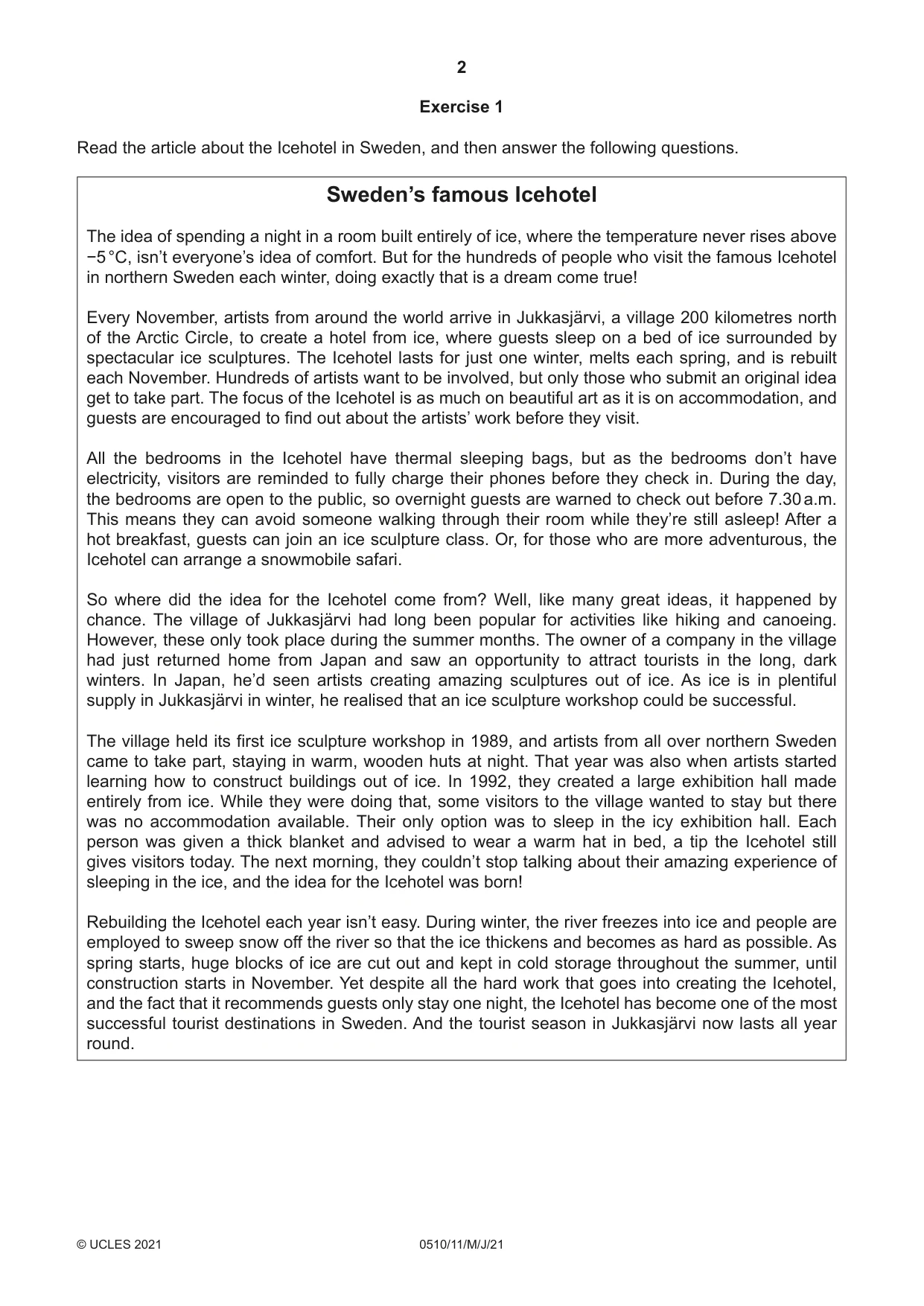
2 0510/11/M/J/21 © UCLES 2021 Exercise 1 Read the article about the Icehotel in Sweden, and then answer the following questions. Sweden’s famous Icehotel The idea of spending a night in a room built entirely of ice, where the temperature never rises above −5 °C, isn’t everyone’s idea of comfort. But for the hundreds of people who visit the famous Icehotel in northern Sweden each winter, doing exactly that is a dream come true! Every November, artists from around the world arrive in Jukkasjärvi, a village 200 kilometres north of the Arctic Circle, to create a hotel from ice, where guests sleep on a bed of ice surrounded by spectacular ice sculptures. The Icehotel lasts for just one winter, melts each spring, and is rebuilt each November. Hundreds of artists want to be involved, but only those who submit an original idea get to take part. The focus of the Icehotel is as much on beautiful art as it is on accommodation, and guests are encouraged to find out about the artists’ work before they visit. All the bedrooms in the Icehotel have thermal sleeping bags, but as the bedrooms don’t have electricity, visitors are reminded to fully charge their phones before they check in. During the day, the bedrooms are open to the public, so overnight guests are warned to check out before 7.30 a.m. This means they can avoid someone walking through their room while they’re still asleep! After a hot breakfast, guests can join an ice sculpture class. Or, for those who are more adventurous, the Icehotel can arrange a snowmobile safari. So where did the idea for the Icehotel come from? Well, like many great ideas, it happened by chance. The village of Jukkasjärvi had long been popular for activities like hiking and canoeing. However, these only took place during the summer months. The owner of a company in the village had just returned home from Japan and saw an opportunity to attract tourists in the long, dark winters. In Japan, he’d seen artists creating amazing sculptures out of ice. As ice is in plentiful supply in Jukkasjärvi in winter, he realised that an ice sculpture workshop could be successful. The village held its first ice sculpture workshop in 1989, and artists from all over northern Sweden came to take part, staying in warm, wooden huts at night. That year was also when artists started learning how to construct buildings out of ice. In 1992, they created a large exhibition hall made entirely from ice. While they were doing that, some visitors to the village wanted to stay but there was no accommodation available. Their only option was to sleep in the icy exhibition hall. Each person was given a thick blanket and advised to wear a warm hat in bed, a tip the Icehotel still gives visitors today. The next morning, they couldn’t stop talking about their amazing experience of sleeping in the ice, and the idea for the Icehotel was born! Rebuilding the Icehotel each year isn’t easy. During winter, the river freezes into ice and people are employed to sweep snow off the river so that the ice thickens and becomes as hard as possible. As spring starts, huge blocks of ice are cut out and kept in cold storage throughout the summer, until construction starts in November. Yet despite all the hard work that goes into creating the Icehotel, and the fact that it recommends guests only stay one night, the Icehotel has become one of the most successful tourist destinations in Sweden. And the tourist season in Jukkasjärvi now lasts all year round.
Question paper, page 3
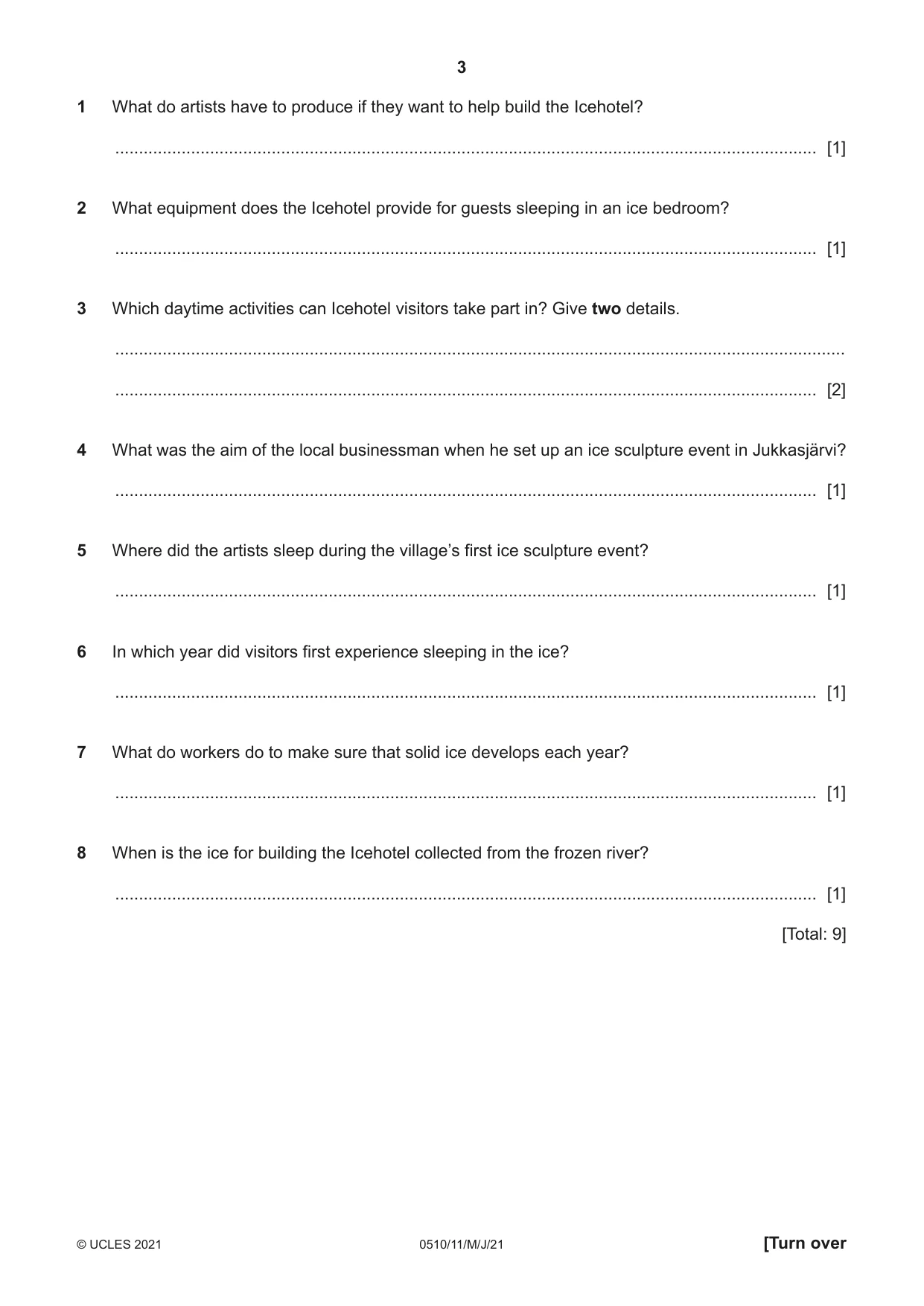
3 0510/11/M/J/21 © UCLES 2021 [Turn over 1 What do artists have to produce if they want to help build the Icehotel? … [1] 2 What equipment does the Icehotel provide for guests sleeping in an ice bedroom? … [1] 3 Which daytime activities can Icehotel visitors take part in? Give two details. … … [2] 4 What was the aim of the local businessman when he set up an ice sculpture event in Jukkasjärvi? … [1] 5 Where did the artists sleep during the village’s first ice sculpture event? … [1] 6 In which year did visitors first experience sleeping in the ice? … [1] 7 What do workers do to make sure that solid ice develops each year? … [1] 8 When is the ice for building the Icehotel collected from the frozen river? … [1] [Total: 9]
Question paper, page 4
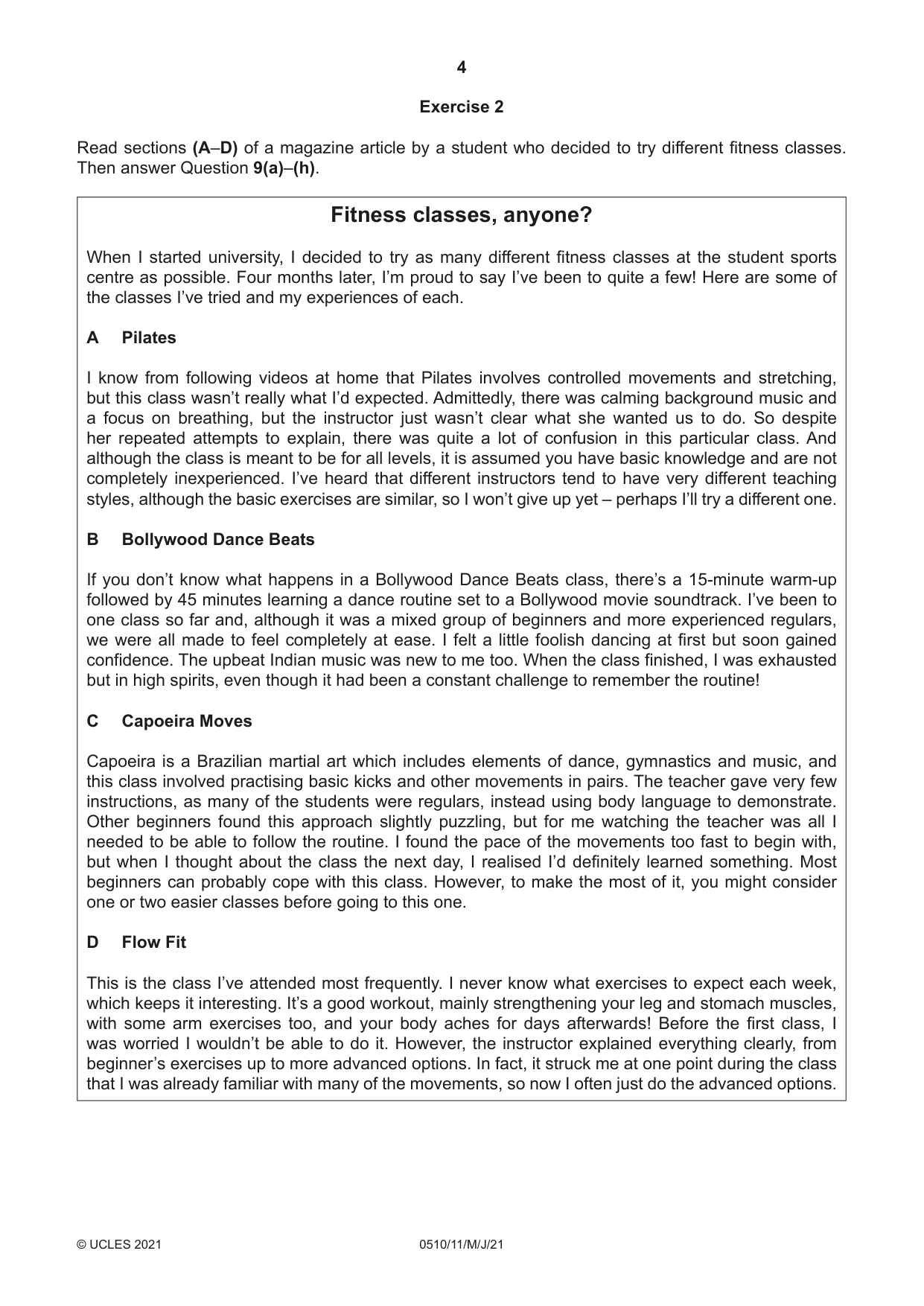
4 0510/11/M/J/21 © UCLES 2021 Exercise 2 Read sections (A–D) of a magazine article by a student who decided to try different fitness classes. Then answer Question 9(a)–(h). Fitness classes, anyone? When I started university, I decided to try as many different fitness classes at the student sports centre as possible. Four months later, I’m proud to say I’ve been to quite a few! Here are some of the classes I’ve tried and my experiences of each. A Pilates I know from following videos at home that Pilates involves controlled movements and stretching, but this class wasn’t really what I’d expected. Admittedly, there was calming background music and a focus on breathing, but the instructor just wasn’t clear what she wanted us to do. So despite her repeated attempts to explain, there was quite a lot of confusion in this particular class. And although the class is meant to be for all levels, it is assumed you have basic knowledge and are not completely inexperienced. I’ve heard that different instructors tend to have very different teaching styles, although the basic exercises are similar, so I won’t give up yet – perhaps I’ll try a different one. B Bollywood Dance Beats If you don’t know what happens in a Bollywood Dance Beats class, there’s a 15-minute warm-up followed by 45 minutes learning a dance routine set to a Bollywood movie soundtrack. I’ve been to one class so far and, although it was a mixed group of beginners and more experienced regulars, we were all made to feel completely at ease. I felt a little foolish dancing at first but soon gained confidence. The upbeat Indian music was new to me too. When the class finished, I was exhausted but in high spirits, even though it had been a constant challenge to remember the routine! C Capoeira Moves Capoeira is a Brazilian martial art which includes elements of dance, gymnastics and music, and this class involved practising basic kicks and other movements in pairs. The teacher gave very few instructions, as many of the students were regulars, instead using body language to demonstrate. Other beginners found this approach slightly puzzling, but for me watching the teacher was all I needed to be able to follow the routine. I found the pace of the movements too fast to begin with, but when I thought about the class the next day, I realised I’d definitely learned something. Most beginners can probably cope with this class. However, to make the most of it, you might consider one or two easier classes before going to this one. D Flow Fit This is the class I’ve attended most frequently. I never know what exercises to expect each week, which keeps it interesting. It’s a good workout, mainly strengthening your leg and stomach muscles, with some arm exercises too, and your body aches for days afterwards! Before the first class, I was worried I wouldn’t be able to do it. However, the instructor explained everything clearly, from beginner’s exercises up to more advanced options. In fact, it struck me at one point during the class that I was already familiar with many of the movements, so now I often just do the advanced options.
Question paper, page 5
5 0510/11/M/J/21 © UCLES 2021 [Turn over 9 For each question, write the correct letter A, B, C or D on the line. Which section includes the following information? (a) the use of music for relaxation … [1] (b) a welcoming atmosphere for people of all levels … [1] (c) the fact that each class is unpredictable … [1] (d) a positive feeling at the end of the class … [1] (e) the writer’s negative opinion of the teacher … [1] (f) advice for getting maximum benefit from the class … [1] (g) the writer realising in the class that she knew more than she thought … [1] (h) an initial struggle to keep up with the exercises … [1] [Total: 8]
Question paper, page 6
6 0510/11/M/J/21 © UCLES 2021 Exercise 3 Read the article about a teenager who decided to wear the same dress for a month, and then complete the notes. One month, one dress When 17-year-old Sophia Aleman arrived to meet her friends wearing a plain, grey dress, they didn’t take much notice. The next day she had the same dress on, and her friends still didn’t comment. After a week of turning up in the same dress, Sophia revealed her ‘One month, one dress’ challenge – to wear the same dress every day for a month. She worked out that she’d be able to wash her dress before going to bed and still wear it the next day. Sophia’s aim was to get people, boys and girls, thinking about how their choice of clothes affects the environment. Fashion is influenced by the latest trends and celebrities, and nowadays it’s produced very quickly and cheaply. New styles replace old ones almost instantly, at a price that most can afford. ‘My friends and I love fashion, but it comes at an environmental cost,’ says Sophia. ‘People throw good clothes away. That means tons of clothing is buried as waste. Unbelievably only 15% is actually recycled – people should at least pass on their unwanted clothes to others. And, every year, as a result of clothes production, 1.2 billion tonnes of carbon dioxide is added to our atmosphere. I had to do something.’ Sophia chose the dress for her challenge carefully. She decided on a plain design as she could combine it with different scarves that she already owned. She now encourages people to use their existing clothes more creatively. This means they’ll be less tempted to buy new clothes. She knew that chemicals used in the production of clothes pollute the soil. That’s why she chose a dress made from bamboo, a material free of chemicals. ‘My friends had never heard of clothes made from bamboo before, so I used this dress as a way of persuading them to buy clothes made from natural materials. So many clothes these days include some man-made material. When they’re washed, tiny bits of plastic end up in the oceans, but that doesn’t happen with natural material.’ In week two of the challenge, Sophia accidentally ripped the sleeve of her dress. She thought she might have to wear something different and her challenge might fail. Fortunately, she managed to sew it back together herself. To create publicity, Sophia posted on social media every day, attracting lots of attention. ‘One day, I wrote that mass production of clothes uses vast quantities of water. That’s hardly going to help the environment, is it? The post really got all my friends talking. They began to understand the point I was trying to make – it’s better to buy quality clothes that last longer.’ Sophia wore the dress for the whole month. ‘It made me think that appearance isn’t everything – although the next day I did enjoy wearing my favourite red skirt, which I’d really missed!’ The teenager intends to continue promoting environmentally friendly fashion. ‘I’m not saying that everyone should do this particular challenge, but I am encouraging all my friends to use recycled materials to make their own clothes.’ She has even thought about taking her grey dress apart to make a shirt from the material. ‘For now though, I still enjoy wearing the dress occasionally.’
Question paper, page 7
7 0510/11/M/J/21 © UCLES 2021 [Turn over You are going to give a talk about fashion to your class at school. Prepare some notes to use as the basis for your talk. Make short notes under each heading. 10 What Sophia says are the negative impacts of fashion on the environment: • … • … • … [3] 11 What Sophia suggests people do to reduce the negative impacts of fashion on the environment: • … • … • … • … [4] [Total: 7]
Question paper, page 8
8 0510/11/ M / J /21 © UCLES 2021 Exercise 4 12 Read the article about a teenager who enjoys geocaching, an activity which involves searching for hidden objects outdoors. Write a summary about what is good about geocaching. Your summary should be about 80 words long (and no more than 90 words long). You should use your own words as far as possible. You will receive up to 6 marks for the content of your summary, and up to 6 marks for the style and accuracy of your language. Geocaching – searching for hidden treasure the 21st-century way I used to think there was nothing much to do in the small town where I live. My friends and I would spend our holidays wondering how to fill our time – that is, until we discovered geocaching. Now, geocaching gives me something to do whenever I have some spare time. So, what is geocaching? It’s an outdoor activity which involves looking for small containers, usually plastic boxes, hidden in different locations. You download an app onto your mobile phone and use a map to work out where to find them. It’s a bit like a digital treasure hunt! My teacher introduced our class to geocaching during a school trip to a local forest. We were divided into teams and then we set off, following the directions on our phones. Each team wanted to be first to find the hidden container. Geocaching really helps you notice your surroundings. My team quickly realised from the map that we needed to find a square-shaped rock and we ran off to look for it. Suddenly there it was! We looked all around and soon found the container hidden under a pile of leaves – we were the winners! We all agreed that it’s a fun way to exercise outdoors. It can help us to improve our technological skills too. Back in the classroom, we learned more about geocaching, which started in 2001. It’s not just a team activity – you can either do it with other people or alone. Inside every container, there’s a notebook which people sometimes leave messages in. Some containers also have small objects in them. If you want, you can exchange the objects for something of your own, which most people like to do. Geocaching can be done anywhere. Since that first school trip, I’ve done geocaching at home, and even during holidays in Dubai, New York and Australia. No matter where I do it, I always get a feeling of satisfaction. My boring, small town is now my adventure playground – every week geocaching gives me new places to explore.
Question paper, page 9
9 0510/11/ M / J /21 © UCLES 2021 [Turn over … … … … … … … … … … … … … … [Total: 12]
Question paper, page 10
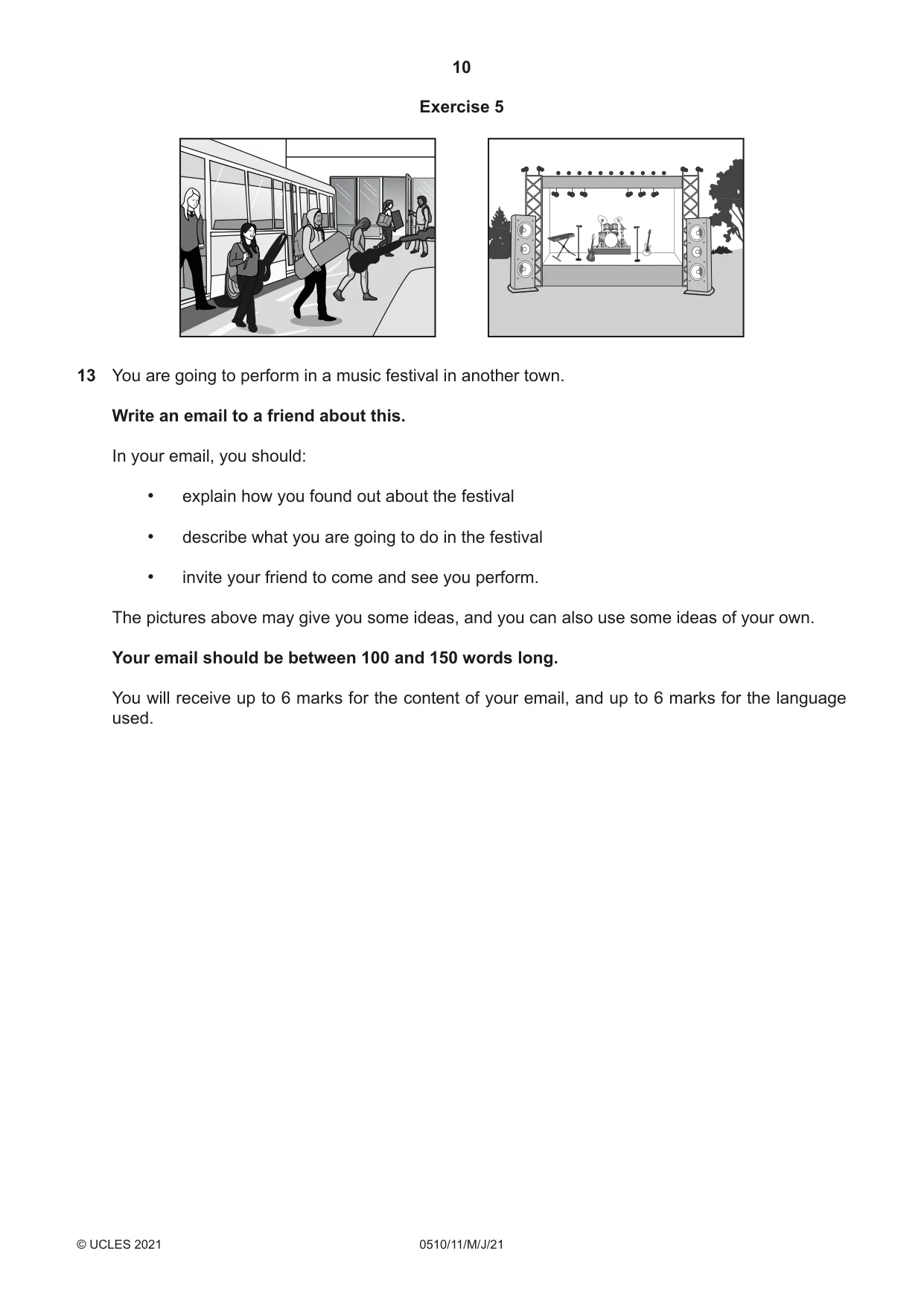
10 0510/11/ M / J /21 © UCLES 2021 Exercise 5 13 You are going to perform in a music festival in another town. Write an email to a friend about this. In your email, you should: • explain how you found out about the festival • describe what you are going to do in the festival • invite your friend to come and see you perform. The pictures above may give you some ideas, and you can also use some ideas of your own. Your email should be between 100 and 150 words long. You will receive up to 6 marks for the content of your email, and up to 6 marks for the language used.
Question paper, page 11
11 0510/11/M/J/21 © UCLES 2021 [Turn over … … … … … … … … … … … … … … … … … … … … … … … … … … … [Total: 12]
Question paper, page 12
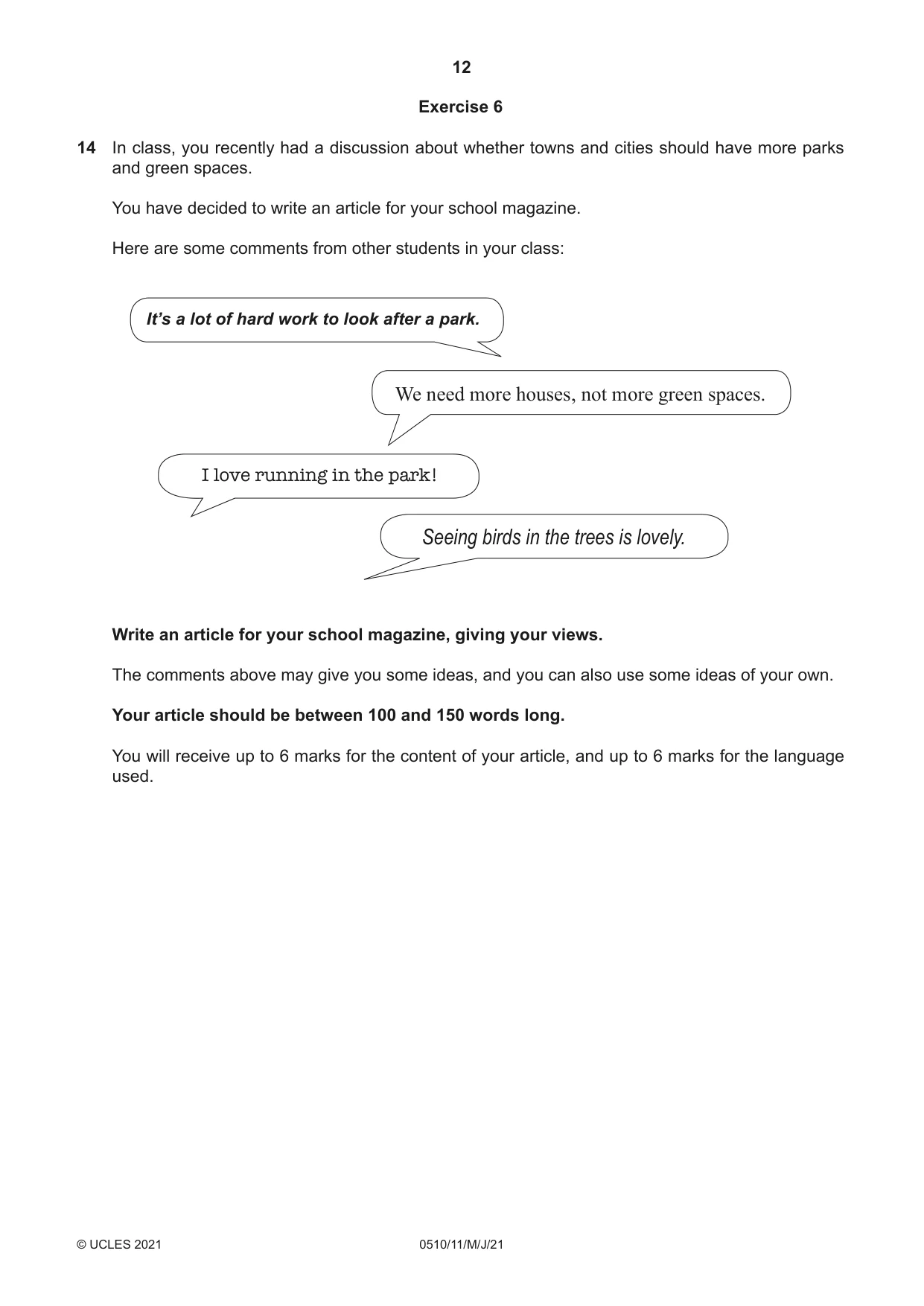
12 0510/11/M/J/21 © UCLES 2021 Exercise 6 14 In class, you recently had a discussion about whether towns and cities should have more parks and green spaces. You have decided to write an article for your school magazine. Here are some comments from other students in your class: Seeing birds in the trees is lovely. I love running in the park! We need more houses, not more green spaces. It’s a lot of hard work to look after a park. Write an article for your school magazine, giving your views. The comments above may give you some ideas, and you can also use some ideas of your own. Your article should be between 100 and 150 words long. You will receive up to 6 marks for the content of your article, and up to 6 marks for the language used.
Question paper, page 13
13 0510/11/M/J/21 © UCLES 2021 … … … … … … … … … … … … … … … … … … … … … … … … … … … [Total: 12]
Question paper, page 14
14 0510/11/M/J/21 © UCLES 2021 BLANK PAGE
Question paper, page 15
15 0510/11/M/J/21 © UCLES 2021 BLANK PAGE
Question paper, page 16
16 0510/11/M/J/21 © UCLES 2021 Permission to reproduce items where third-party owned material protected by copyright is included has been sought and cleared where possible. Every reasonable effort has been made by the publisher (UCLES) to trace copyright holders, but if any items requiring clearance have unwittingly been included, the publisher will be pleased to make amends at the earliest possible opportunity. To avoid the issue of disclosure of answer-related information to candidates, all copyright acknowledgements are reproduced online in the Cambridge Assessment International Education Copyright Acknowledgements Booklet. This is produced for each series of examinations and is freely available to download at www.cambridgeinternational.org after the live examination series. Cambridge Assessment International Education is part of the Cambridge Assessment Group. Cambridge Assessment is the brand name of the University of Cambridge Local Examinations Syndicate (UCLES), which itself is a department of the University of Cambridge. BLANK PAGE
Mark scheme, page 1
This document consists of 9 printed pages. © UCLES 2021 [Turn over Cambridge IGCSE™ ENGLISH AS A SECOND LANGUAGE 0510/11 Paper 1 Reading and Writing (Core) May/June 2021 MARK SCHEME Maximum Mark: 60 Published This mark scheme is published as an aid to teachers and candidates, to indicate the requirements of the examination. It shows the basis on which Examiners were instructed to award marks. It does not indicate the details of the discussions that took place at an Examiners’ meeting before marking began, which would have considered the acceptability of alternative answers. Mark schemes should be read in conjunction with the question paper and the Principal Examiner Report for Teachers. Cambridge International will not enter into discussions about these mark schemes. Cambridge International is publishing the mark schemes for the May/June 2021 series for most Cambridge IGCSE™, Cambridge International A and AS Level components and some Cambridge O Level components.
Mark scheme, page 2
0510/11 Cambridge IGCSE – Mark Scheme PUBLISHED May/June 2021 © UCLES 2021 Page 2 of 9 Generic Marking Principles These general marking principles must be applied by all examiners when marking candidate answers. They should be applied alongside the specific content of the mark scheme or generic level descriptors for a question. Each question paper and mark scheme will also comply with these marking principles. GENERIC MARKING PRINCIPLE 1: Marks must be awarded in line with: • the specific content of the mark scheme or the generic level descriptors for the question • the specific skills defined in the mark scheme or in the generic level descriptors for the question • the standard of response required by a candidate as exemplified by the standardisation scripts. GENERIC MARKING PRINCIPLE 2: Marks awarded are always whole marks (not half marks, or other fractions). GENERIC MARKING PRINCIPLE 3: Marks must be awarded positively: • marks are awarded for correct/valid answers, as defined in the mark scheme. However, credit is given for valid answers which go beyond the scope of the syllabus and mark scheme, referring to your Team Leader as appropriate • marks are awarded when candidates clearly demonstrate what they know and can do • marks are not deducted for errors • marks are not deducted for omissions • answers should only be judged on the quality of spelling, punctuation and grammar when these features are specifically assessed by the question as indicated by the mark scheme. The meaning, however, should be unambiguous. GENERIC MARKING PRINCIPLE 4: Rules must be applied consistently, e.g. in situations where candidates have not followed instructions or in the application of generic level descriptors. GENERIC MARKING PRINCIPLE 5: Marks should be awarded using the full range of marks defined in the mark scheme for the question (however; the use of the full mark range may be limited according to the quality of the candidate responses seen). GENERIC MARKING PRINCIPLE 6: Marks awarded are based solely on the requirements as defined in the mark scheme. Marks should not be awarded with grade thresholds or grade descriptors in mind.
Mark scheme, page 3
0510/11 Cambridge IGCSE – Mark Scheme PUBLISHED May/June 2021 © UCLES 2021 Page 3 of 9 This component forms part of the Core tier assessment of Cambridge IGCSE English as a Second Language and tests the following Assessment Objectives: AO1: Reading R1 identify and select relevant information R2 understand ideas, opinions and attitudes R3 show understanding of the connections between ideas, opinions and attitudes R4 understand what is implied but not directly stated, e.g. gist, writer’s purpose, intentions and feelings AO2: Writing W1 communicate information/ideas/opinions clearly, accurately and effectively W2 organise ideas into coherent paragraphs using a range of appropriate linking devices W3 use a range of grammatical structures accurately and effectively W4 show control of punctuation and spelling W5 use appropriate register and style/format for the given purpose and audience
Mark scheme, page 4
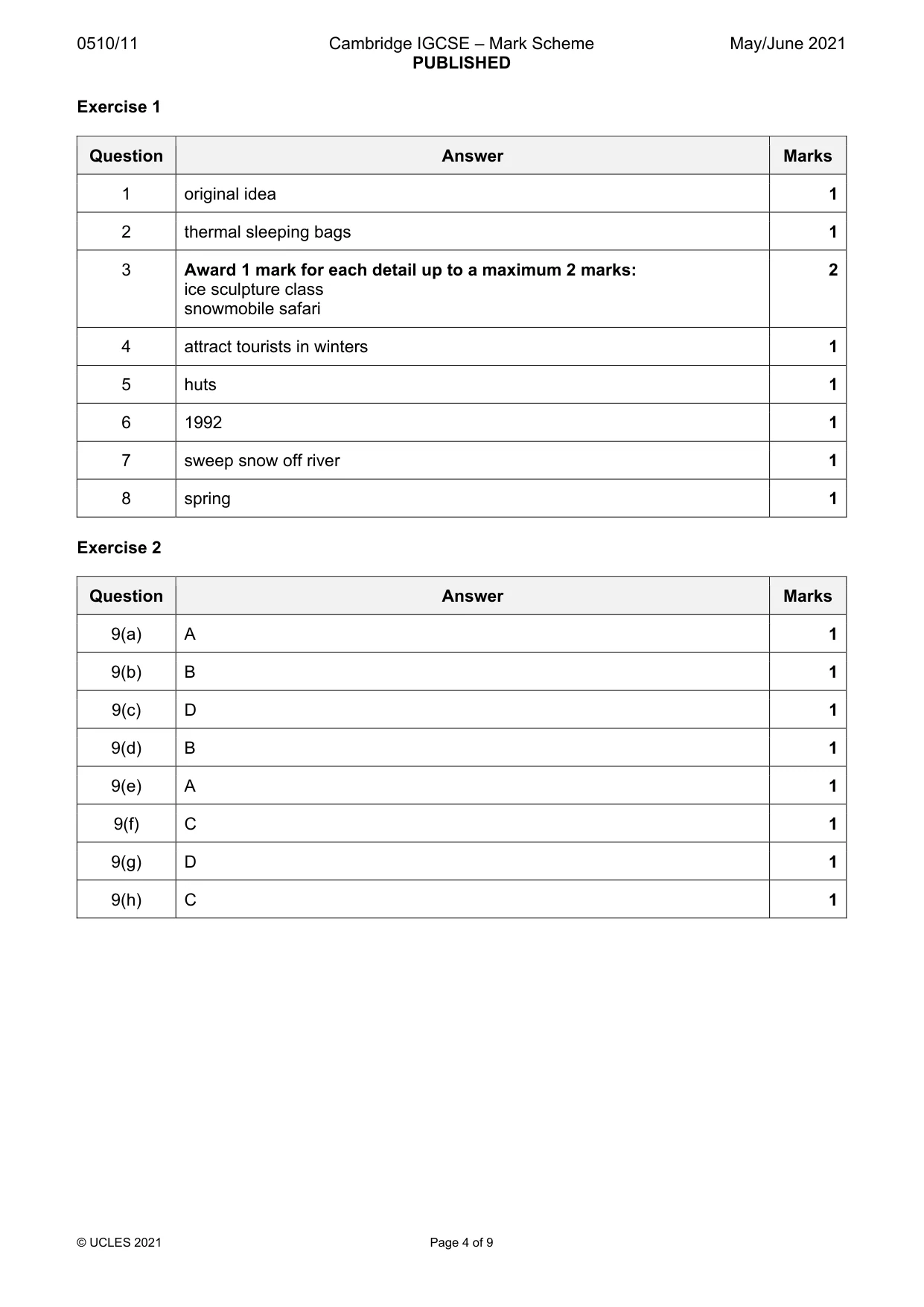
0510/11 Cambridge IGCSE – Mark Scheme PUBLISHED May/June 2021 © UCLES 2021 Page 4 of 9 Exercise 1 Question Answer Marks 1 original idea 1 2 thermal sleeping bags 1 3 Award 1 mark for each detail up to a maximum 2 marks: ice sculpture class snowmobile safari 2 4 attract tourists in winters 1 5 huts 1 6 1992 1 7 sweep snow off river 1 8 spring 1 Exercise 2 Question Answer Marks 9(a) A 1 9(b) B 1 9(c) D 1 9(d) B 1 9(e) A 1 9(f) C 1 9(g) D 1 9(h) C 1
Mark scheme, page 5
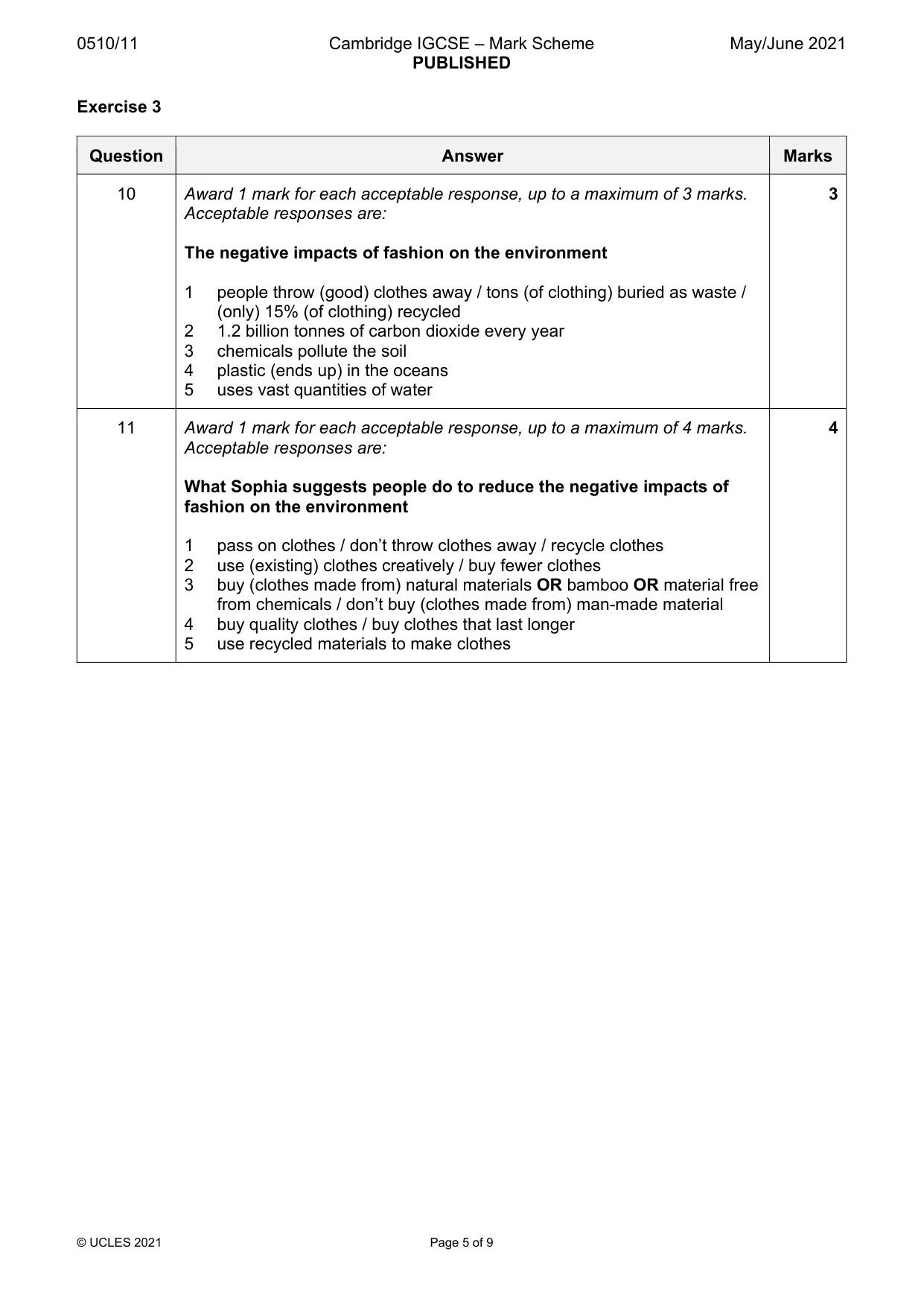
0510/11 Cambridge IGCSE – Mark Scheme PUBLISHED May/June 2021 © UCLES 2021 Page 5 of 9 Exercise 3 Question Answer Marks 10 Award 1 mark for each acceptable response, up to a maximum of 3 marks. Acceptable responses are: The negative impacts of fashion on the environment 1 people throw (good) clothes away / tons (of clothing) buried as waste / (only) 15% (of clothing) recycled 2 1.2 billion tonnes of carbon dioxide every year 3 chemicals pollute the soil 4 plastic (ends up) in the oceans 5 uses vast quantities of water 3 11 Award 1 mark for each acceptable response, up to a maximum of 4 marks. Acceptable responses are: What Sophia suggests people do to reduce the negative impacts of fashion on the environment 1 pass on clothes / don’t throw clothes away / recycle clothes 2 use (existing) clothes creatively / buy fewer clothes 3 buy (clothes made from) natural materials OR bamboo OR material free from chemicals / don’t buy (clothes made from) man-made material 4 buy quality clothes / buy clothes that last longer 5 use recycled materials to make clothes 4
Mark scheme, page 6
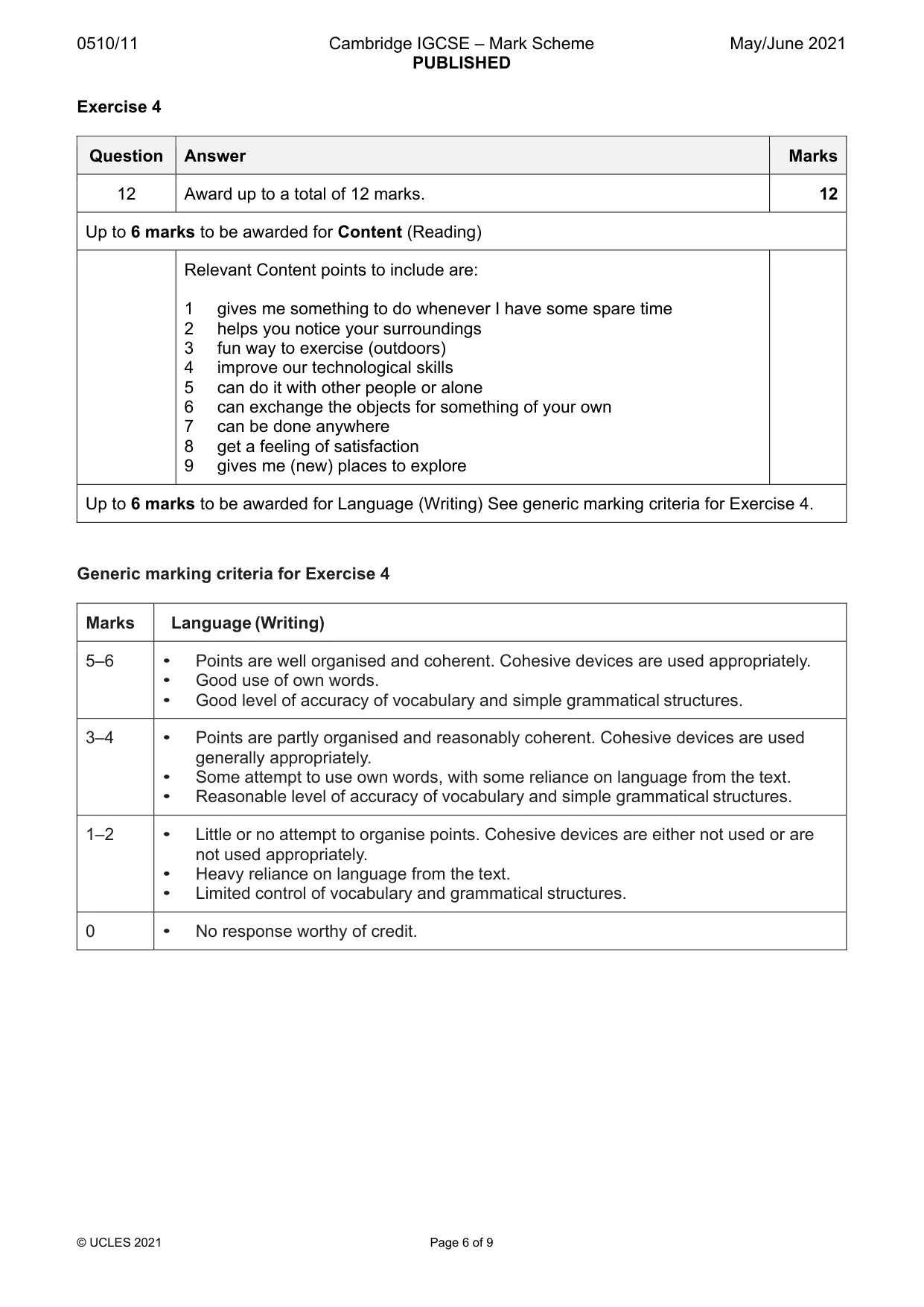
0510/11 Cambridge IGCSE – Mark Scheme PUBLISHED May/June 2021 © UCLES 2021 Page 6 of 9 Exercise 4 Question Answer Marks 12 Award up to a total of 12 marks. 12 Up to 6 marks to be awarded for Content (Reading) Relevant Content points to include are: 1 gives me something to do whenever I have some spare time 2 helps you notice your surroundings 3 fun way to exercise (outdoors) 4 improve our technological skills 5 can do it with other people or alone 6 can exchange the objects for something of your own 7 can be done anywhere 8 get a feeling of satisfaction 9 gives me (new) places to explore Up to 6 marks to be awarded for Language (Writing) See generic marking criteria for Exercise 4. Generic marking criteria for Exercise 4 Marks Language (Writing) 5–6 • Points are well organised and coherent. Cohesive devices are used appropriately. • Good use of own words. • Good level of accuracy of vocabulary and simple grammatical structures. 3–4 • Points are partly organised and reasonably coherent. Cohesive devices are used generally appropriately. • Some attempt to use own words, with some reliance on language from the text. • Reasonable level of accuracy of vocabulary and simple grammatical structures. 1–2 • Little or no attempt to organise points. Cohesive devices are either not used or are not used appropriately. • Heavy reliance on language from the text. • Limited control of vocabulary and grammatical structures. 0 • No response worthy of credit.
Mark scheme, page 7
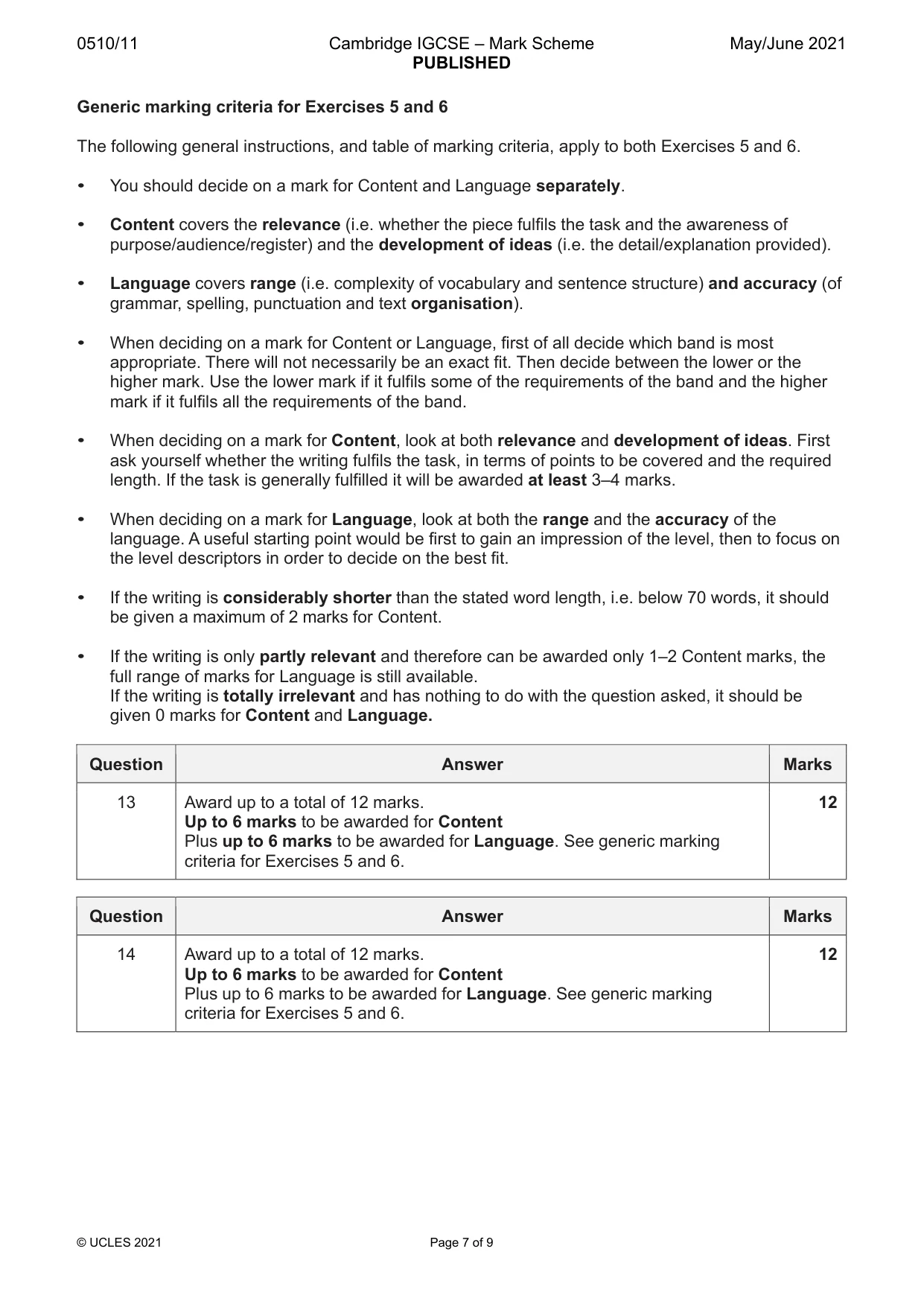
0510/11 Cambridge IGCSE – Mark Scheme PUBLISHED May/June 2021 © UCLES 2021 Page 7 of 9 Generic marking criteria for Exercises 5 and 6 The following general instructions, and table of marking criteria, apply to both Exercises 5 and 6. • You should decide on a mark for Content and Language separately. • Content covers the relevance (i.e. whether the piece fulfils the task and the awareness of purpose/audience/register) and the development of ideas (i.e. the detail/explanation provided). • Language covers range (i.e. complexity of vocabulary and sentence structure) and accuracy (of grammar, spelling, punctuation and text organisation). • When deciding on a mark for Content or Language, first of all decide which band is most appropriate. There will not necessarily be an exact fit. Then decide between the lower or the higher mark. Use the lower mark if it fulfils some of the requirements of the band and the higher mark if it fulfils all the requirements of the band. • When deciding on a mark for Content, look at both relevance and development of ideas. First ask yourself whether the writing fulfils the task, in terms of points to be covered and the required length. If the task is generally fulfilled it will be awarded at least 3–4 marks. • When deciding on a mark for Language, look at both the range and the accuracy of the language. A useful starting point would be first to gain an impression of the level, then to focus on the level descriptors in order to decide on the best fit. • If the writing is considerably shorter than the stated word length, i.e. below 70 words, it should be given a maximum of 2 marks for Content. • If the writing is only partly relevant and therefore can be awarded only 1–2 Content marks, the full range of marks for Language is still available. If the writing is totally irrelevant and has nothing to do with the question asked, it should be given 0 marks for Content and Language. Question Answer Marks 13 Award up to a total of 12 marks. Up to 6 marks to be awarded for Content Plus up to 6 marks to be awarded for Language. See generic marking criteria for Exercises 5 and 6. 12 Question Answer Marks 14 Award up to a total of 12 marks. Up to 6 marks to be awarded for Content Plus up to 6 marks to be awarded for Language. See generic marking criteria for Exercises 5 and 6. 12
Mark scheme, page 8
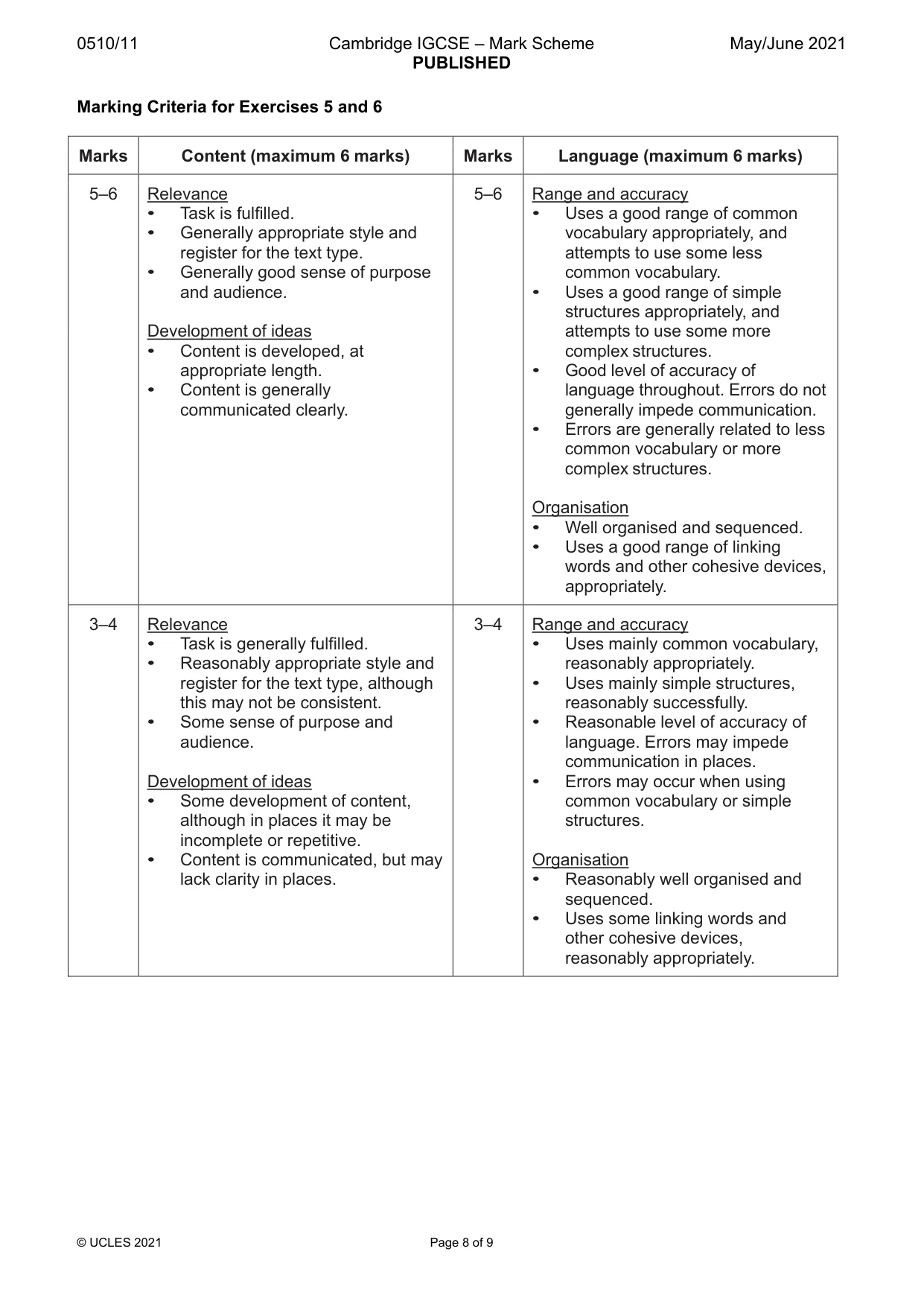
0510/11 Cambridge IGCSE – Mark Scheme PUBLISHED May/June 2021 © UCLES 2021 Page 8 of 9 Marking Criteria for Exercises 5 and 6 Marks Content (maximum 6 marks) Marks Language (maximum 6 marks) 5–6 Relevance • Task is fulfilled. • Generally appropriate style and register for the text type. • Generally good sense of purpose and audience. Development of ideas • Content is developed, at appropriate length. • Content is generally communicated clearly. 5–6 Range and accuracy • Uses a good range of common vocabulary appropriately, and attempts to use some less common vocabulary. • Uses a good range of simple structures appropriately, and attempts to use some more complex structures. • Good level of accuracy of language throughout. Errors do not generally impede communication. • Errors are generally related to less common vocabulary or more complex structures. Organisation • Well organised and sequenced. • Uses a good range of linking words and other cohesive devices, appropriately. 3–4 Relevance • Task is generally fulfilled. • Reasonably appropriate style and register for the text type, although this may not be consistent. • Some sense of purpose and audience. Development of ideas • Some development of content, although in places it may be incomplete or repetitive. • Content is communicated, but may lack clarity in places. 3–4 Range and accuracy • Uses mainly common vocabulary, reasonably appropriately. • Uses mainly simple structures, reasonably successfully. • Reasonable level of accuracy of language. Errors may impede communication in places. • Errors may occur when using common vocabulary or simple structures. Organisation • Reasonably well organised and sequenced. • Uses some linking words and other cohesive devices, reasonably appropriately.
Mark scheme, page 9
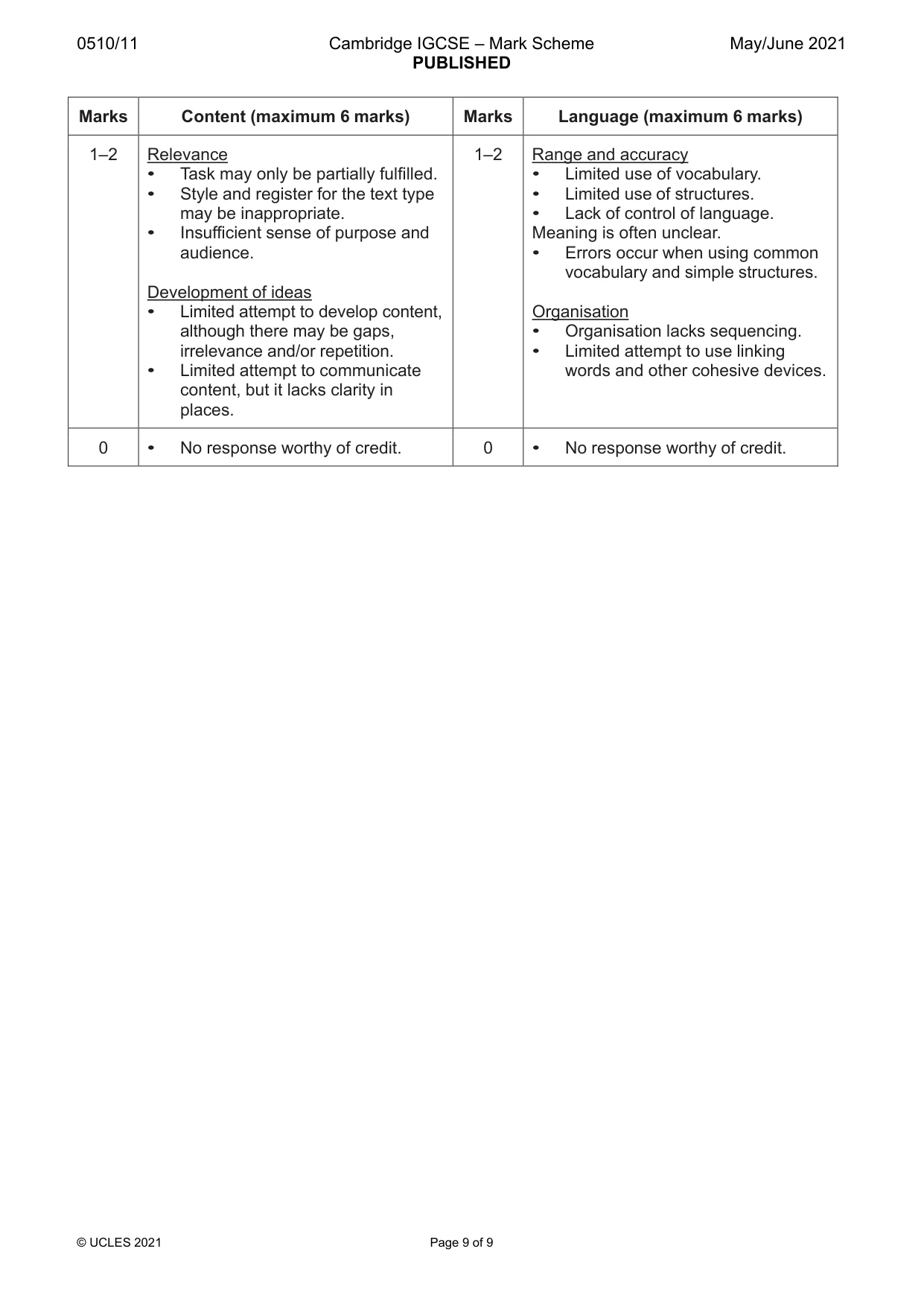
0510/11 Cambridge IGCSE – Mark Scheme PUBLISHED May/June 2021 © UCLES 2021 Page 9 of 9 Marks Content (maximum 6 marks) Marks Language (maximum 6 marks) 1–2 Relevance • Task may only be partially fulfilled. • Style and register for the text type may be inappropriate. • Insufficient sense of purpose and audience. Development of ideas • Limited attempt to develop content, although there may be gaps, irrelevance and/or repetition. • Limited attempt to communicate content, but it lacks clarity in places. 1–2 Range and accuracy • Limited use of vocabulary. • Limited use of structures. • Lack of control of language. Meaning is often unclear. • Errors occur when using common vocabulary and simple structures. Organisation • Organisation lacks sequencing. • Limited attempt to use linking words and other cohesive devices. 0 • No response worthy of credit. 0 • No response worthy of credit.
What you needed in this session
Cambridge’s own grade thresholds for 2021 May/June, Paper 1 · Variant 1. A higher threshold means an easier paper — the bar moves with how the cohort did.