Cambridge IGCSE English - Second Language (oral endorsement) 0510 — 2019 Oct/Nov Paper 4 · Variant 1
0510/41/O/N/19 · 40 marks · ≈45 min
The question paper and its mark scheme, free to read here and free to download. This is Cambridge’s own paper, exactly as it was sat.
Question paper12 pages




Mark scheme4 pages
Answers below. Sit the paper first if you are practising.
Paper as text
Question paper, page 1
This document consists of 9 printed pages and 3 blank pages. DC (LK/SG) 164535/4 © UCLES 2019 [Turn over Cambridge Assessment International Education Cambridge International General Certificate of Secondary Education * 6 0 2 0 4 9 2 1 8 8 * ENGLISH AS A SECOND LANGUAGE 0510/41 Paper 4 Listening (Extended) October/November 2019 Approx. 50 minutes Candidates answer on the Question Paper. No Additional Materials are required. READ THESE INSTRUCTIONS FIRST Write your centre number, candidate number and name on all the work you hand in. Write in dark blue or black pen. Do not use staples, paper clips, glue or correction fluid. DO NOT WRITE IN ANY BARCODES. Answer all questions. Dictionaries are not permitted. The number of marks is given in brackets [ ] at the end of each question or part question.
Question paper, page 2
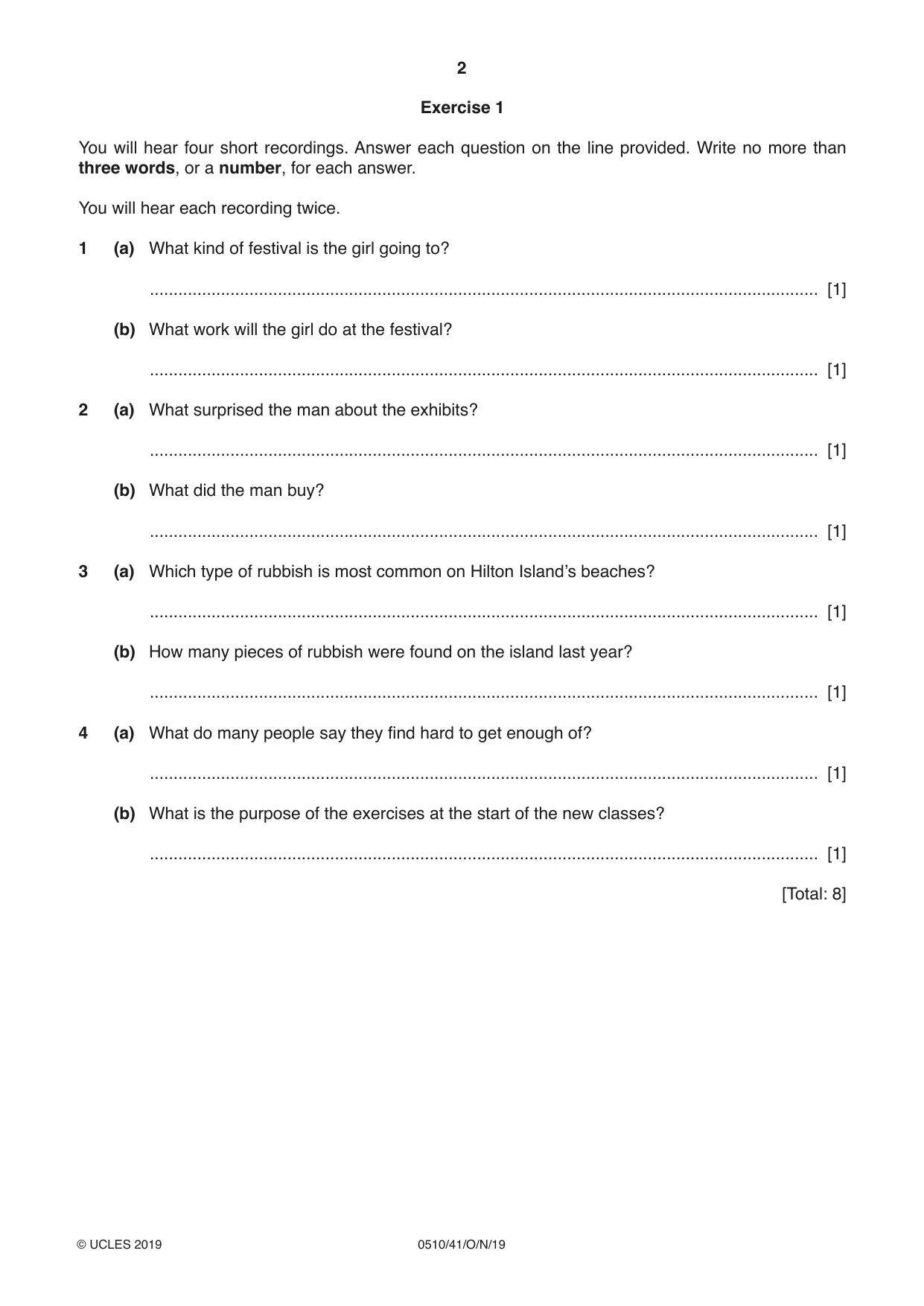
2 0510/41/O/N/19 © UCLES 2019 Exercise 1 You will hear four short recordings. Answer each question on the line provided. Write no more than three words, or a number, for each answer. You will hear each recording twice. 1 (a) What kind of festival is the girl going to? … [1] (b) What work will the girl do at the festival? … [1] 2 (a) What surprised the man about the exhibits? … [1] (b) What did the man buy? … [1] 3 (a) Which type of rubbish is most common on Hilton Island’s beaches? … [1] (b) How many pieces of rubbish were found on the island last year? … [1] 4 (a) What do many people say they find hard to get enough of? … [1] (b) What is the purpose of the exercises at the start of the new classes? … [1] [Total: 8]
Question paper, page 3
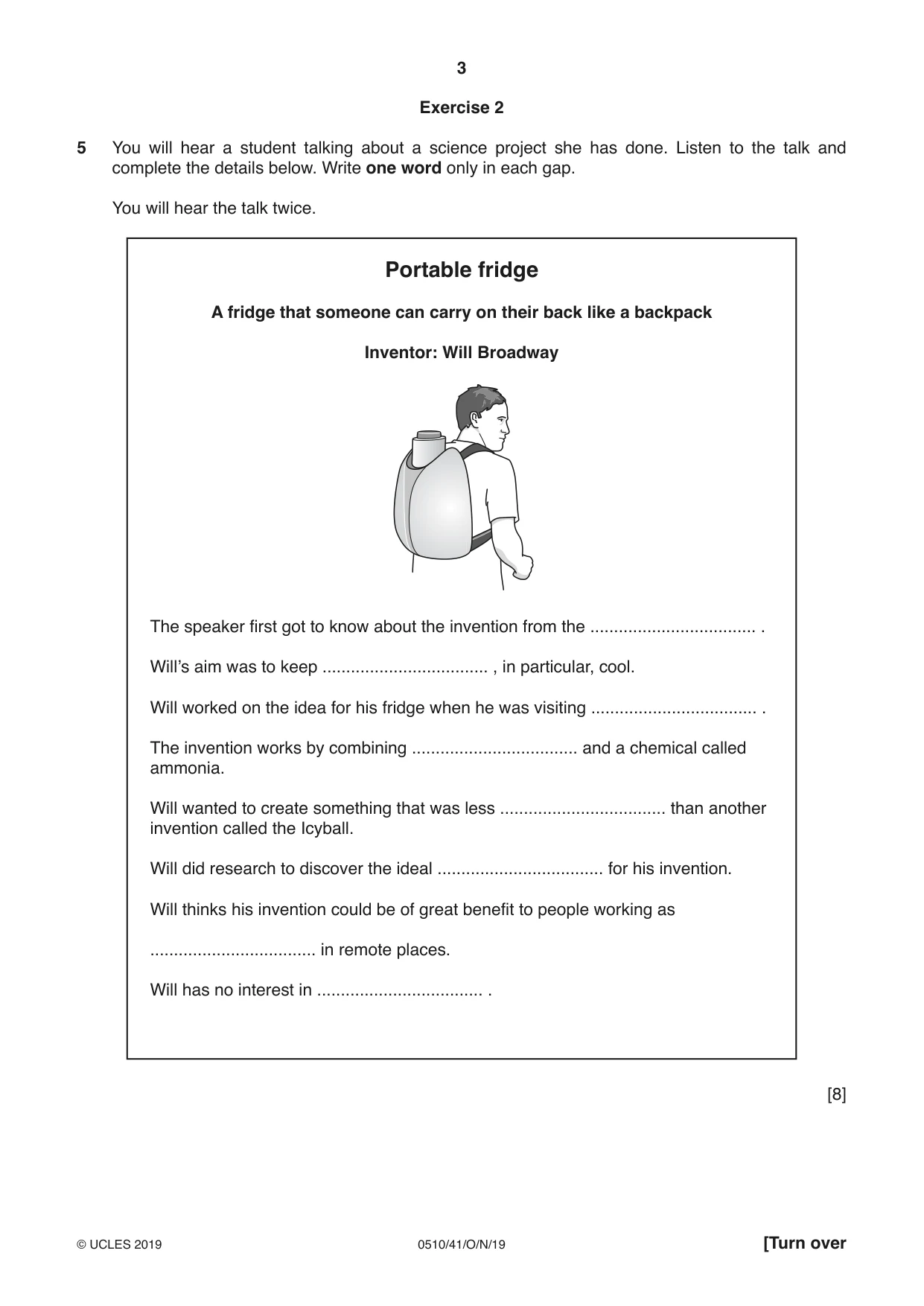
3 0510/41/O/N/19 © UCLES 2019 [Turn over Exercise 2 5 You will hear a student talking about a science project she has done. Listen to the talk and complete the details below. Write one word only in each gap. You will hear the talk twice. Portable fridge A fridge that someone can carry on their back like a backpack Inventor: Will Broadway The speaker first got to know about the invention from the … . Will’s aim was to keep … , in particular, cool. Will worked on the idea for his fridge when he was visiting … . The invention works by combining … and a chemical called ammonia. Will wanted to create something that was less … than another invention called the Icyball. Will did research to discover the ideal … for his invention. Will thinks his invention could be of great benefit to people working as … in remote places. Will has no interest in … . [8]
Question paper, page 4
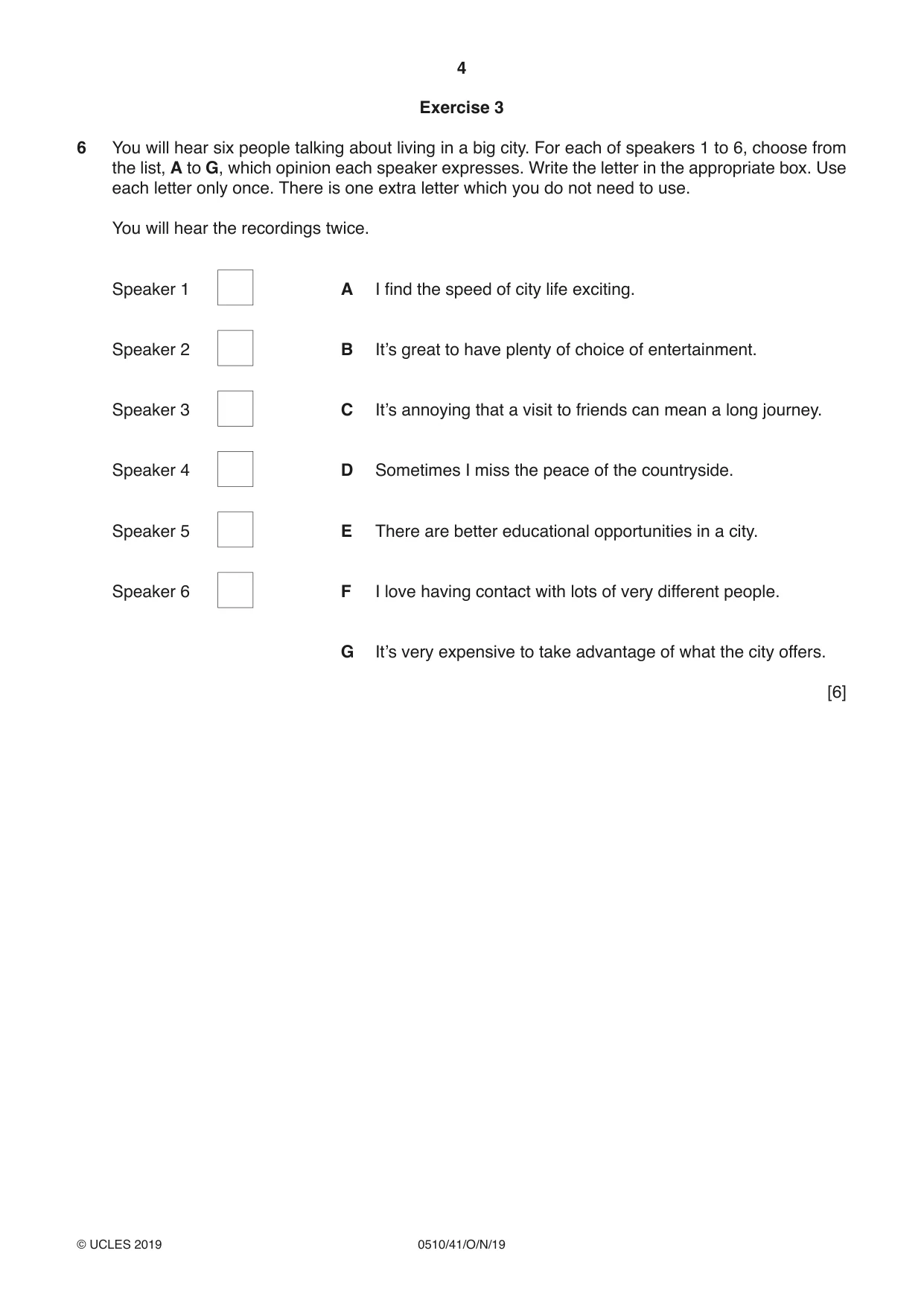
4 0510/41/O/N/19 © UCLES 2019 Exercise 3 6 You will hear six people talking about living in a big city. For each of speakers 1 to 6, choose from the list, A to G, which opinion each speaker expresses. Write the letter in the appropriate box. Use each letter only once. There is one extra letter which you do not need to use. You will hear the recordings twice. Speaker 1 A I find the speed of city life exciting. Speaker 2 B It’s great to have plenty of choice of entertainment. Speaker 3 C It’s annoying that a visit to friends can mean a long journey. Speaker 4 D Sometimes I miss the peace of the countryside. Speaker 5 E There are better educational opportunities in a city. Speaker 6 F I love having contact with lots of very different people. G It’s very expensive to take advantage of what the city offers. [6]
Question paper, page 5
5 0510/41/O/N/19 © UCLES 2019 [Turn over Please turn over for Exercise 4.
Question paper, page 6
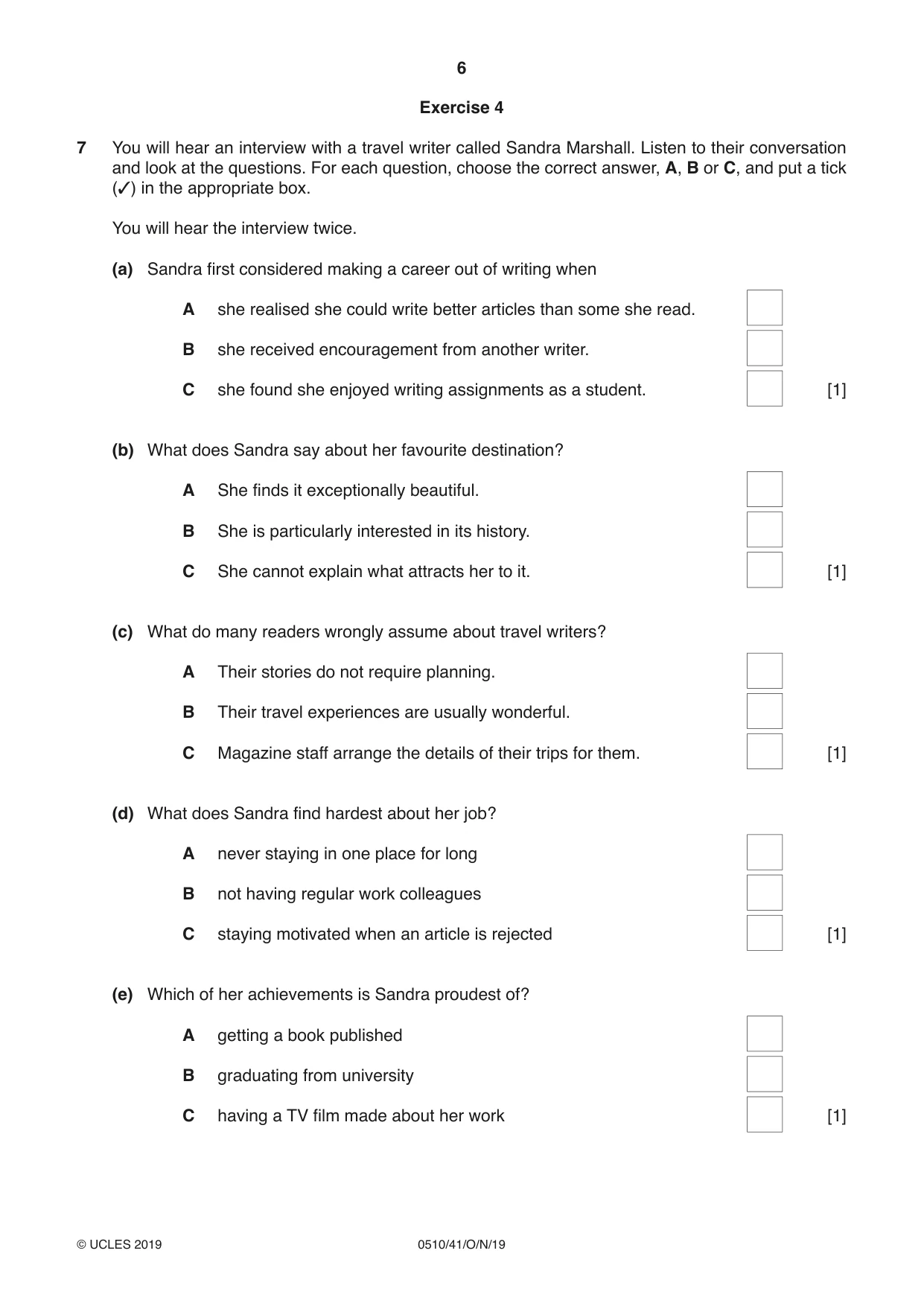
6 0510/41/O/N/19 © UCLES 2019 Exercise 4 7 You will hear an interview with a travel writer called Sandra Marshall. Listen to their conversation and look at the questions. For each question, choose the correct answer, A, B or C, and put a tick (3) in the appropriate box. You will hear the interview twice. (a) Sandra first considered making a career out of writing when A she realised she could write better articles than some she read. B she received encouragement from another writer. C she found she enjoyed writing assignments as a student. [1] (b) What does Sandra say about her favourite destination? A She finds it exceptionally beautiful. B She is particularly interested in its history. C She cannot explain what attracts her to it. [1] (c) What do many readers wrongly assume about travel writers? A Their stories do not require planning. B Their travel experiences are usually wonderful. C Magazine staff arrange the details of their trips for them. [1] (d) What does Sandra find hardest about her job? A never staying in one place for long B not having regular work colleagues C staying motivated when an article is rejected [1] (e) Which of her achievements is Sandra proudest of? A getting a book published B graduating from university C having a TV film made about her work [1]
Question paper, page 7
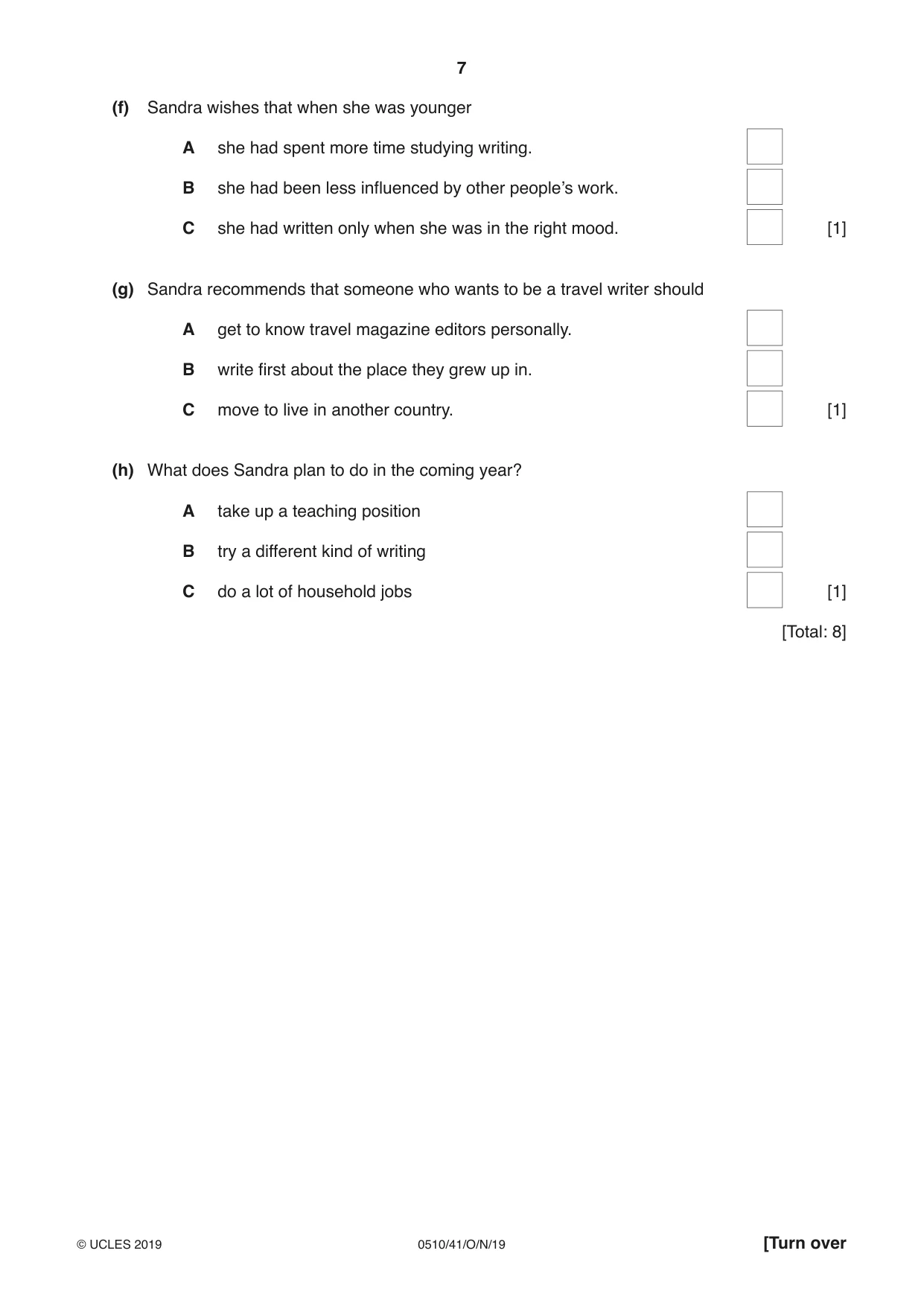
7 0510/41/O/N/19 © UCLES 2019 [Turn over (f) Sandra wishes that when she was younger A she had spent more time studying writing. B she had been less influenced by other people’s work. C she had written only when she was in the right mood. [1] (g) Sandra recommends that someone who wants to be a travel writer should A get to know travel magazine editors personally. B write first about the place they grew up in. C move to live in another country. [1] (h) What does Sandra plan to do in the coming year? A take up a teaching position B try a different kind of writing C do a lot of household jobs [1] [Total: 8]
Question paper, page 8
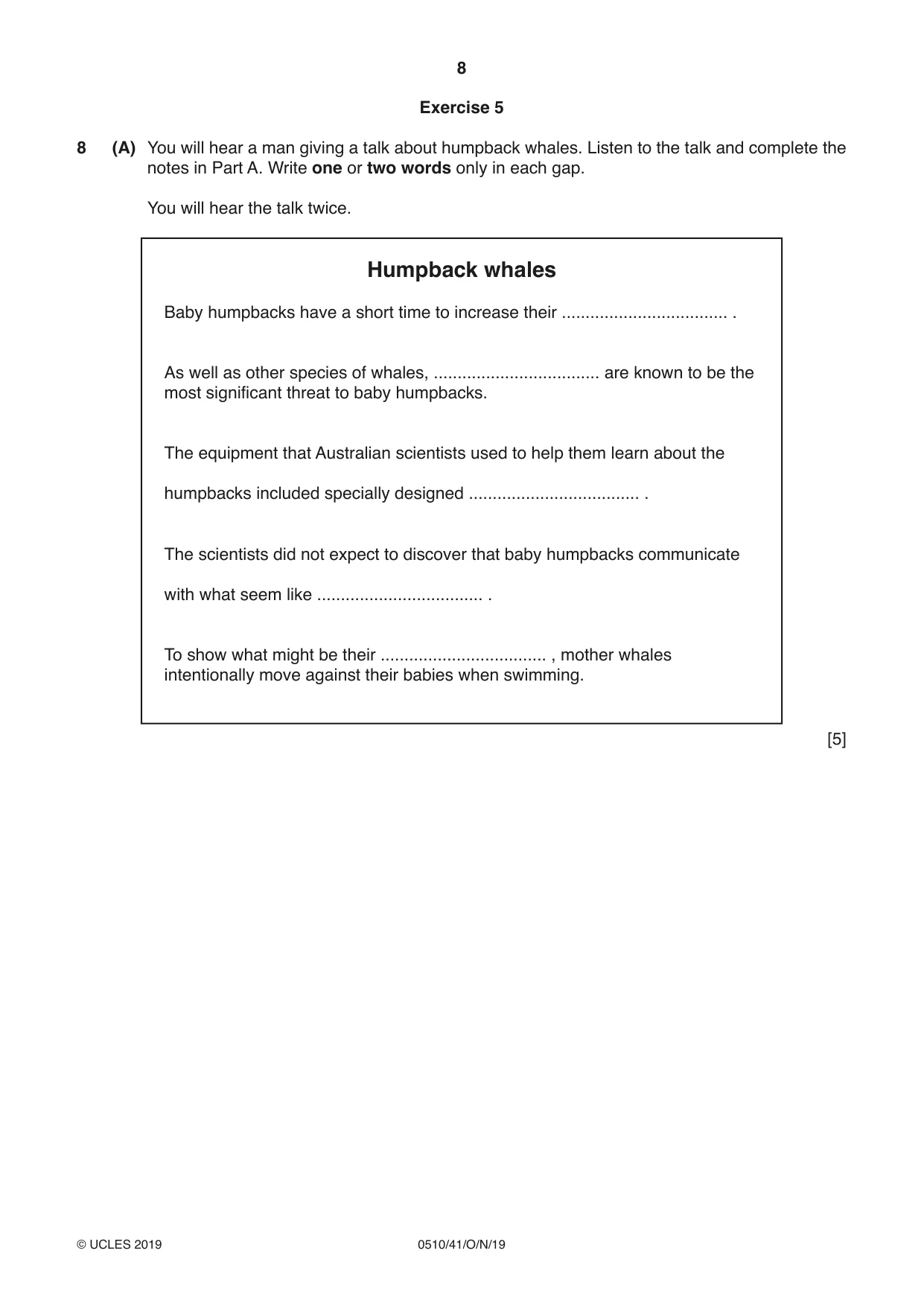
8 0510/41/O/N/19 © UCLES 2019 Exercise 5 8 (A) You will hear a man giving a talk about humpback whales. Listen to the talk and complete the notes in Part A. Write one or two words only in each gap. You will hear the talk twice. Humpback whales Baby humpbacks have a short time to increase their … . As well as other species of whales, … are known to be the most significant threat to baby humpbacks. The equipment that Australian scientists used to help them learn about the humpbacks included specially designed … . The scientists did not expect to discover that baby humpbacks communicate with what seem like … . To show what might be their … , mother whales intentionally move against their babies when swimming. [5]
Question paper, page 9
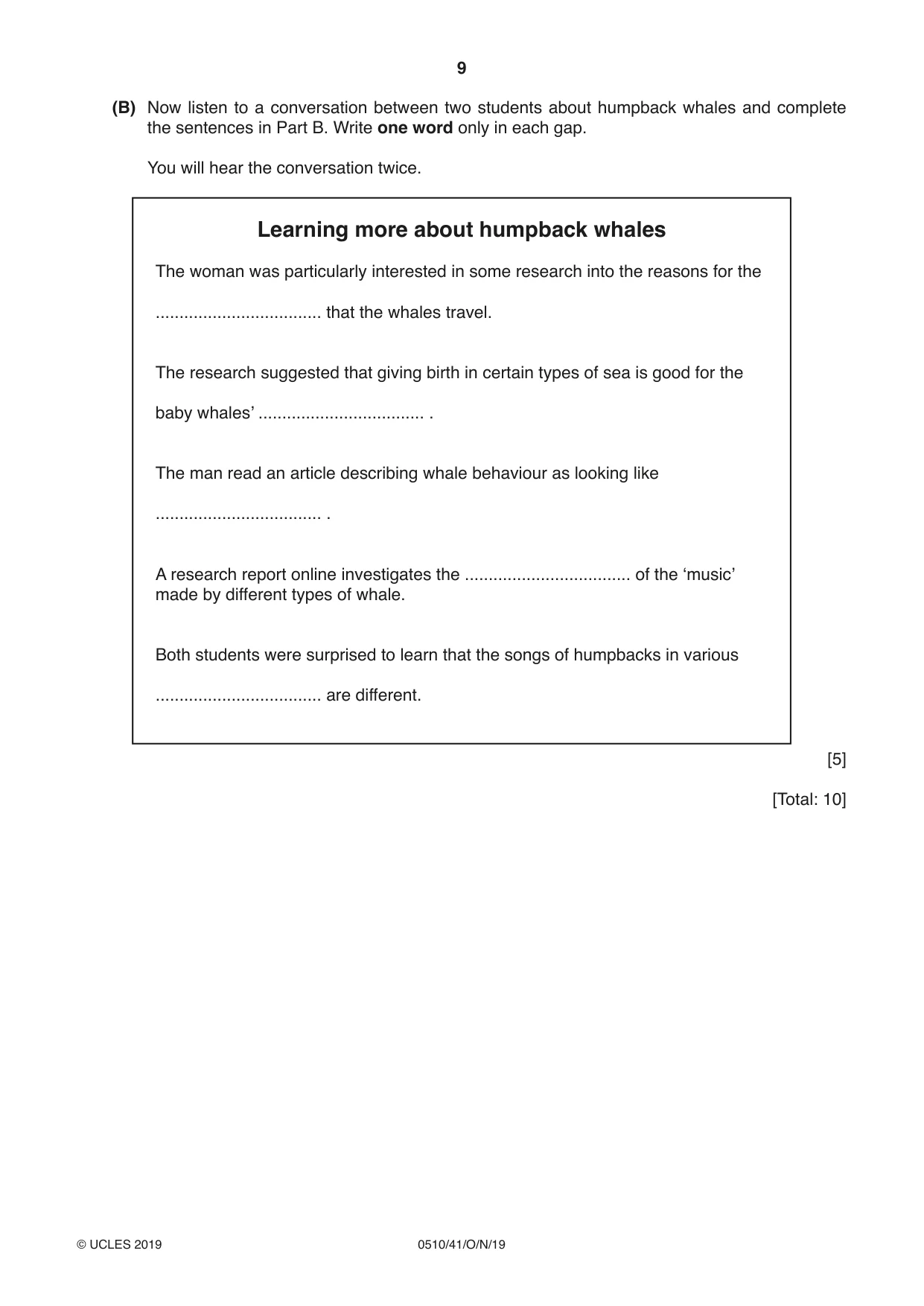
9 0510/41/O/N/19 © UCLES 2019 (B) Now listen to a conversation between two students about humpback whales and complete the sentences in Part B. Write one word only in each gap. You will hear the conversation twice. Learning more about humpback whales The woman was particularly interested in some research into the reasons for the … that the whales travel. The research suggested that giving birth in certain types of sea is good for the baby whales’ … . The man read an article describing whale behaviour as looking like … . A research report online investigates the … of the ‘music’ made by different types of whale. Both students were surprised to learn that the songs of humpbacks in various … are different. [5] [Total: 10]
Question paper, page 10
10 0510/41/O/N/19 © UCLES 2019 BLANK PAGE
Question paper, page 11
11 0510/41/O/N/19 © UCLES 2019 BLANK PAGE
Question paper, page 12
12 0510/41/O/N/19 © UCLES 2019 Permission to reproduce items where third-party owned material protected by copyright is included has been sought and cleared where possible. Every reasonable effort has been made by the publisher (UCLES) to trace copyright holders, but if any items requiring clearance have unwittingly been included, the publisher will be pleased to make amends at the earliest possible opportunity. To avoid the issue of disclosure of answer-related information to candidates, all copyright acknowledgements are reproduced online in the Cambridge Assessment International Education Copyright Acknowledgements Booklet. This is produced for each series of examinations and is freely available to download at www.cambridgeinternational.org after the live examination series. Cambridge Assessment International Education is part of the Cambridge Assessment Group. Cambridge Assessment is the brand name of the University of Cambridge Local Examinations Syndicate (UCLES), which itself is a department of the University of Cambridge. BLANK PAGE
Mark scheme, page 1
This document consists of 4 printed pages. © UCLES 2019 [Turn over Cambridge Assessment International Education Cambridge International General Certificate of Secondary Education ENGLISH AS A SECOND LANGUAGE (SPEAKING ENDORSEMENT) 0510/41 Paper 4 Listening (Extended) October/November 2019 MARK SCHEME Maximum Mark: 40 Published This mark scheme is published as an aid to teachers and candidates, to indicate the requirements of the examination. It shows the basis on which Examiners were instructed to award marks. It does not indicate the details of the discussions that took place at an Examiners’ meeting before marking began, which would have considered the acceptability of alternative answers. Mark schemes should be read in conjunction with the question paper and the Principal Examiner Report for Teachers. Cambridge International will not enter into discussions about these mark schemes. Cambridge International is publishing the mark schemes for the October/November 2019 series for most Cambridge IGCSE™, Cambridge International A and AS Level components and some Cambridge O Level components.
Mark scheme, page 2
0510/41 Cambridge IGCSE – Mark Scheme PUBLISHED October/November 2019 © UCLES 2019 Page 2 of 4 Generic Marking Principles These general marking principles must be applied by all examiners when marking candidate answers. They should be applied alongside the specific content of the mark scheme or generic level descriptors for a question. Each question paper and mark scheme will also comply with these marking principles. GENERIC MARKING PRINCIPLE 1: Marks must be awarded in line with: • the specific content of the mark scheme or the generic level descriptors for the question • the specific skills defined in the mark scheme or in the generic level descriptors for the question • the standard of response required by a candidate as exemplified by the standardisation scripts. GENERIC MARKING PRINCIPLE 2: Marks awarded are always whole marks (not half marks, or other fractions). GENERIC MARKING PRINCIPLE 3: Marks must be awarded positively: • marks are awarded for correct/valid answers, as defined in the mark scheme. However, credit is given for valid answers which go beyond the scope of the syllabus and mark scheme, referring to your Team Leader as appropriate • marks are awarded when candidates clearly demonstrate what they know and can do • marks are not deducted for errors • marks are not deducted for omissions • answers should only be judged on the quality of spelling, punctuation and grammar when these features are specifically assessed by the question as indicated by the mark scheme. The meaning, however, should be unambiguous. GENERIC MARKING PRINCIPLE 4: Rules must be applied consistently e.g. in situations where candidates have not followed instructions or in the application of generic level descriptors. GENERIC MARKING PRINCIPLE 5: Marks should be awarded using the full range of marks defined in the mark scheme for the question (however; the use of the full mark range may be limited according to the quality of the candidate responses seen). GENERIC MARKING PRINCIPLE 6: Marks awarded are based solely on the requirements as defined in the mark scheme. Marks should not be awarded with grade thresholds or grade descriptors in mind.
Mark scheme, page 3
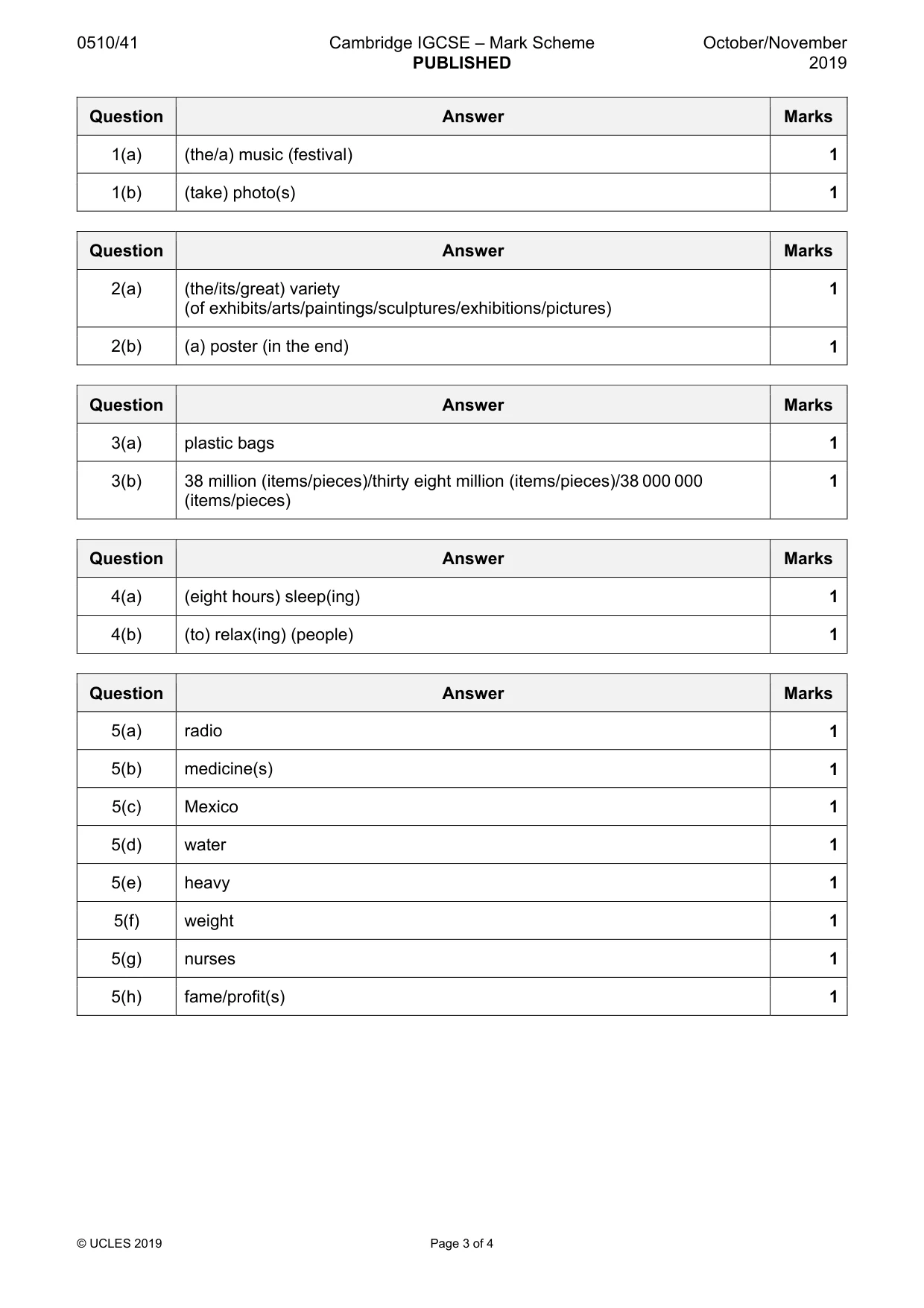
0510/41 Cambridge IGCSE – Mark Scheme PUBLISHED October/November 2019 © UCLES 2019 Page 3 of 4 Question Answer Marks 1(a) (the/a) music (festival) 1 1(b) (take) photo(s) 1 Question Answer Marks 2(a) (the/its/great) variety (of exhibits/arts/paintings/sculptures/exhibitions/pictures) 1 2(b) (a) poster (in the end) 1 Question Answer Marks 3(a) plastic bags 1 3(b) 38 million (items/pieces)/thirty eight million (items/pieces)/38 000 000 (items/pieces) 1 Question Answer Marks 4(a) (eight hours) sleep(ing) 1 4(b) (to) relax(ing) (people) 1 Question Answer Marks 5(a) radio 1 5(b) medicine(s) 1 5(c) Mexico 1 5(d) water 1 5(e) heavy 1 5(f) weight 1 5(g) nurses 1 5(h) fame/profit(s) 1
Mark scheme, page 4
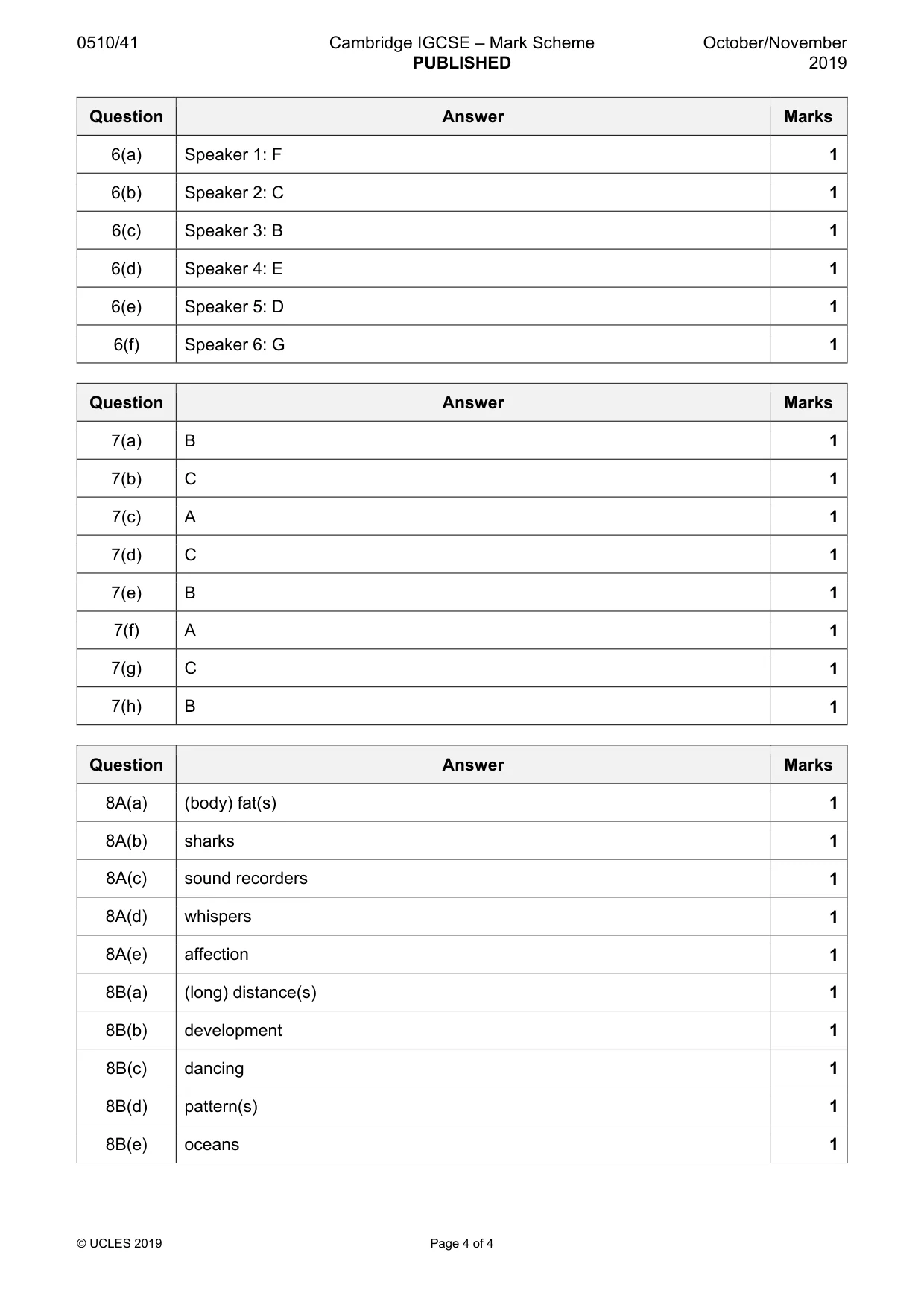
0510/41 Cambridge IGCSE – Mark Scheme PUBLISHED October/November 2019 © UCLES 2019 Page 4 of 4 Question Answer Marks 6(a) Speaker 1: F 1 6(b) Speaker 2: C 1 6(c) Speaker 3: B 1 6(d) Speaker 4: E 1 6(e) Speaker 5: D 1 6(f) Speaker 6: G 1 Question Answer Marks 7(a) B 1 7(b) C 1 7(c) A 1 7(d) C 1 7(e) B 1 7(f) A 1 7(g) C 1 7(h) B 1 Question Answer Marks 8A(a) (body) fat(s) 1 8A(b) sharks 1 8A(c) sound recorders 1 8A(d) whispers 1 8A(e) affection 1 8B(a) (long) distance(s) 1 8B(b) development 1 8B(c) dancing 1 8B(d) pattern(s) 1 8B(e) oceans 1
What you needed in this session
Cambridge’s own grade thresholds for 2019 Oct/Nov, Paper 4 · Variant 1. A higher threshold means an easier paper — the bar moves with how the cohort did.