Cambridge IGCSE English - Second Language (oral endorsement) 0510 — 2019 May/June Paper 3 · Variant 2
0510/32/M/J/19 · 7 questions · 30 marks · ≈34 min
The question paper and its mark scheme, free to read here and free to download. This is Cambridge’s own paper, exactly as it was sat.
Question paper8 pages


Mark scheme4 pages
Answers below. Sit the paper first if you are practising.
Questions as text
Q1 · What does the man miss about his home country?
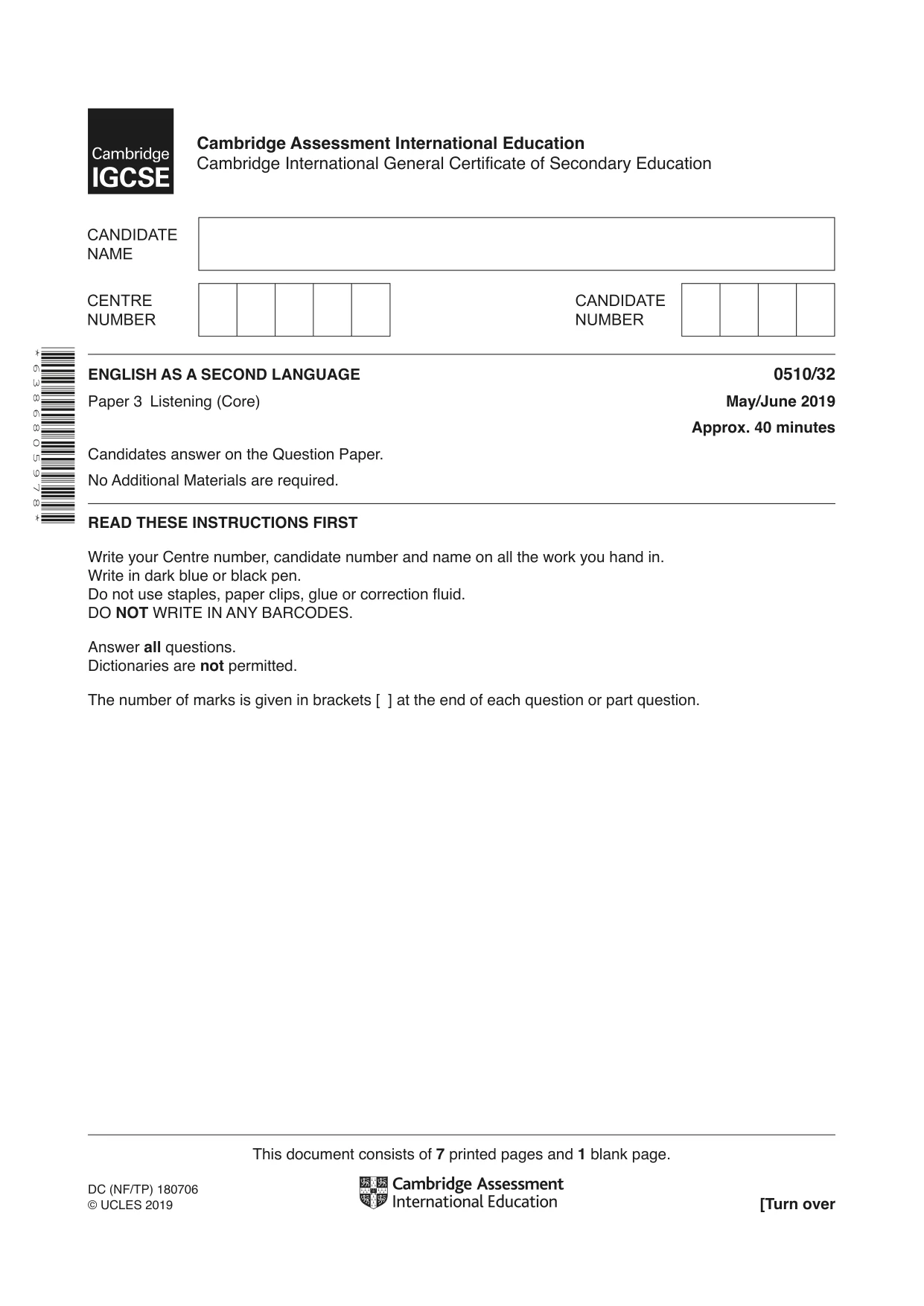
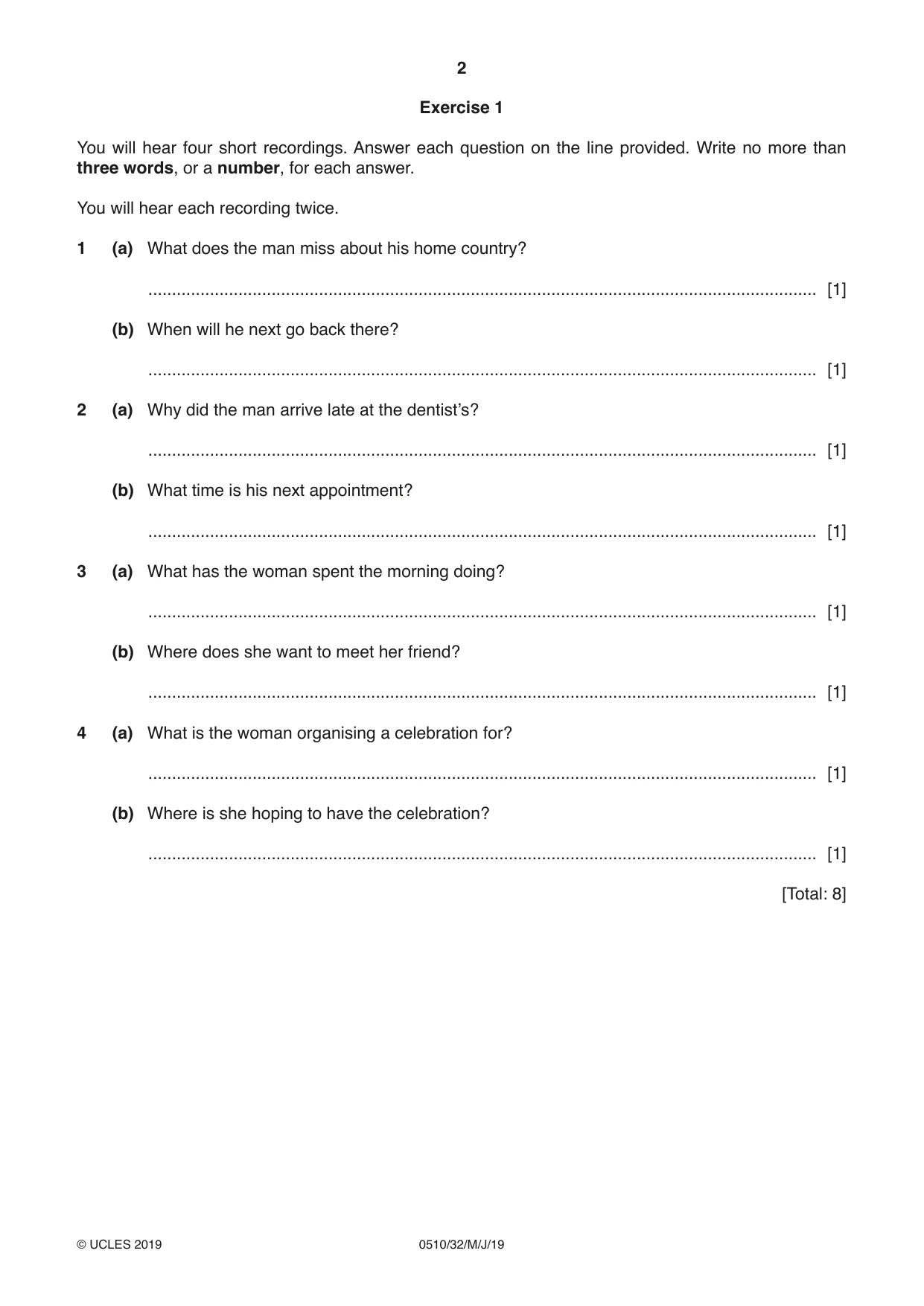
1 (a) What does the man miss about his home country? ............................................................................................................................................. [1] (b) When will he next go back there? ............................................................................................................................................. [1]
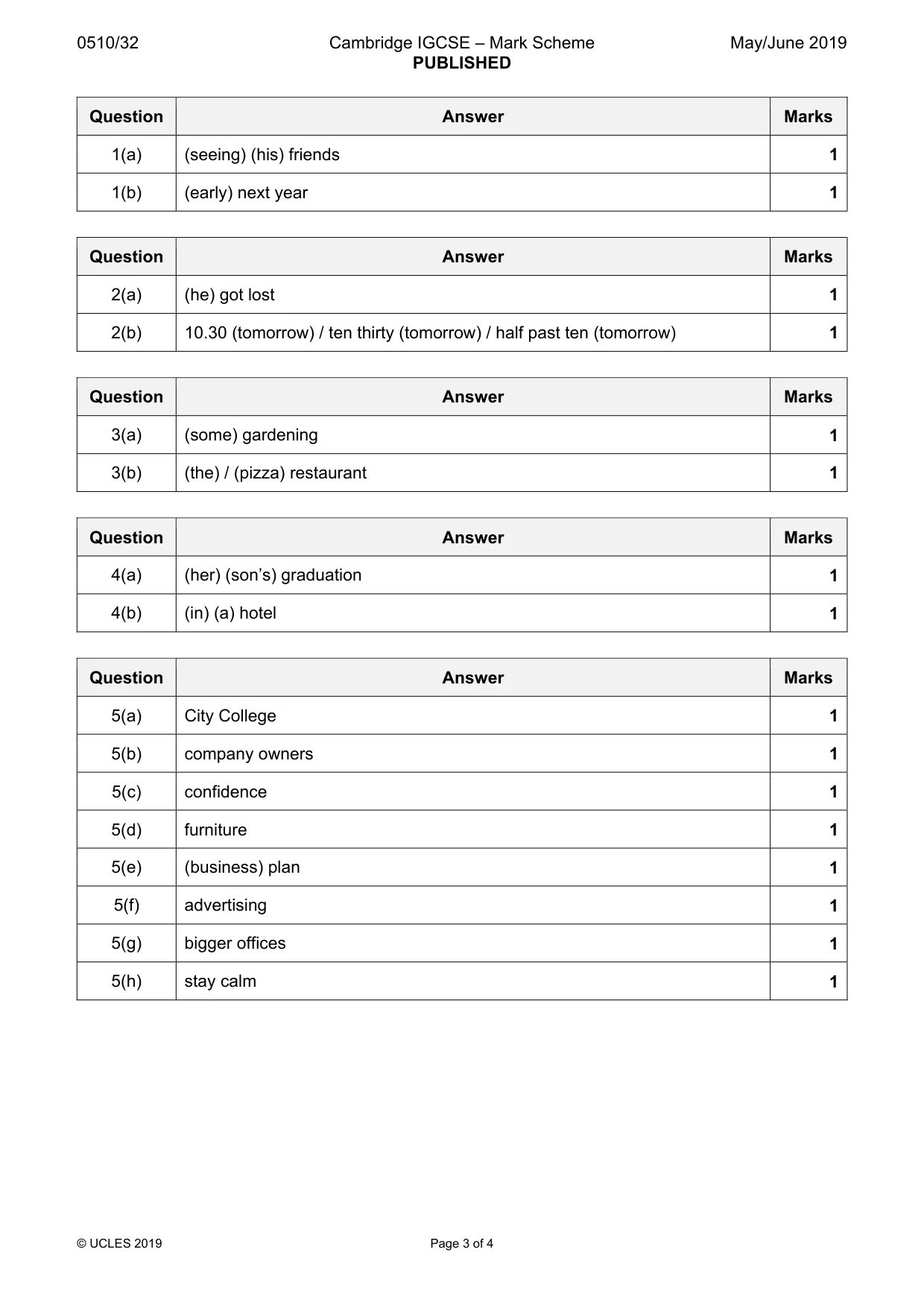
Mark scheme: Question Answer Marks 1(a) (seeing) (his) friends 1 1(b) (early) next year 1
Q2 · Why did the man arrive late at the dentist’s?
2 (a) Why did the man arrive late at the dentist’s? ............................................................................................................................................. [1] (b) What time is his next appointment? ............................................................................................................................................. [1]
Mark scheme: 2(a) (he) got lost 1 2(b) 10.30 (tomorrow) / ten thirty (tomorrow) / half past ten (tomorrow) 1
Q3 · What has the woman spent the morning doing?
3 (a) What has the woman spent the morning doing? ............................................................................................................................................. [1] (b) Where does she want to meet her friend? ............................................................................................................................................. [1]
Mark scheme: 3(a) (some) gardening 1 3(b) (the) / (pizza) restaurant 1
Q4 · What is the woman organising a celebration for?
4 (a) What is the woman organising a celebration for? ............................................................................................................................................. [1] (b) Where is she hoping to have the celebration? ............................................................................................................................................. [1] [Total: 8] Exercise 2
Mark scheme: 4(a) (her) (son’s) graduation 1 4(b) (in) (a) hotel 1
Q5 · You will hear a young businesswoman called Alem talking to students about setting up a…
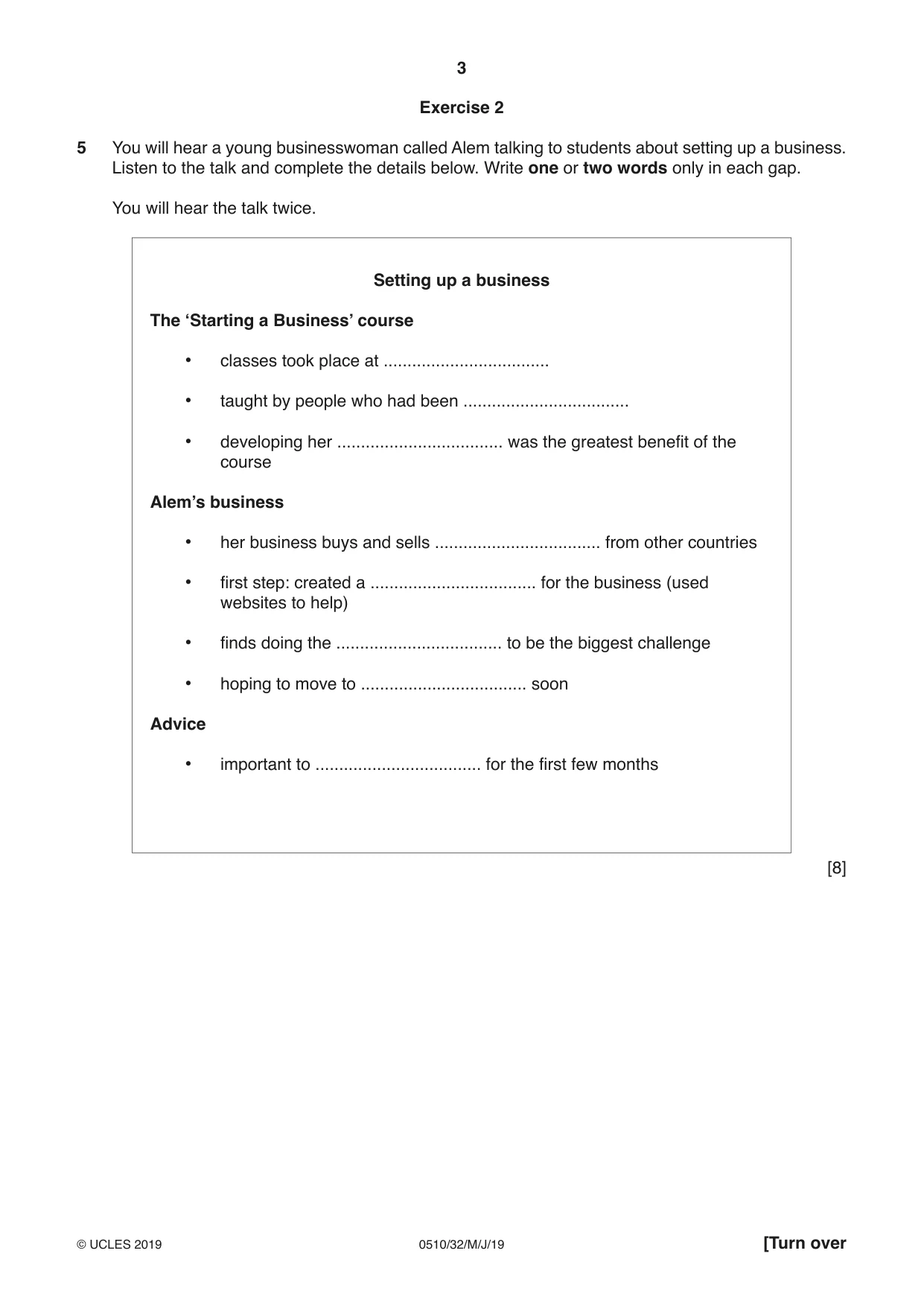
5 You will hear a young businesswoman called Alem talking to students about setting up a business. Listen to the talk and complete the details below. Write one or two words only in each gap. You will hear the talk twice. Setting up a business The ‘Starting a Business’ course • classes took place at ................................... • taught by people who had been ................................... • developing her ................................... was the greatest benefit of the course Alem’s business • her business buys and sells ................................... from other countries • first step: created a ................................... for the business (used websites to help) • finds doing the ................................... to be the biggest challenge • hoping to move to ................................... soon Advice • important to ................................... for the first few months [8] Exercise 3
Mark scheme: 5(a) City College 1 5(b) company owners 1 5(c) confidence 1 5(d) furniture 1 5(e) (business) plan 1 5(f) advertising 1 5(g) bigger offices 1 5(h) stay calm 1
Q6 · You will hear six people talking about what makes them laugh
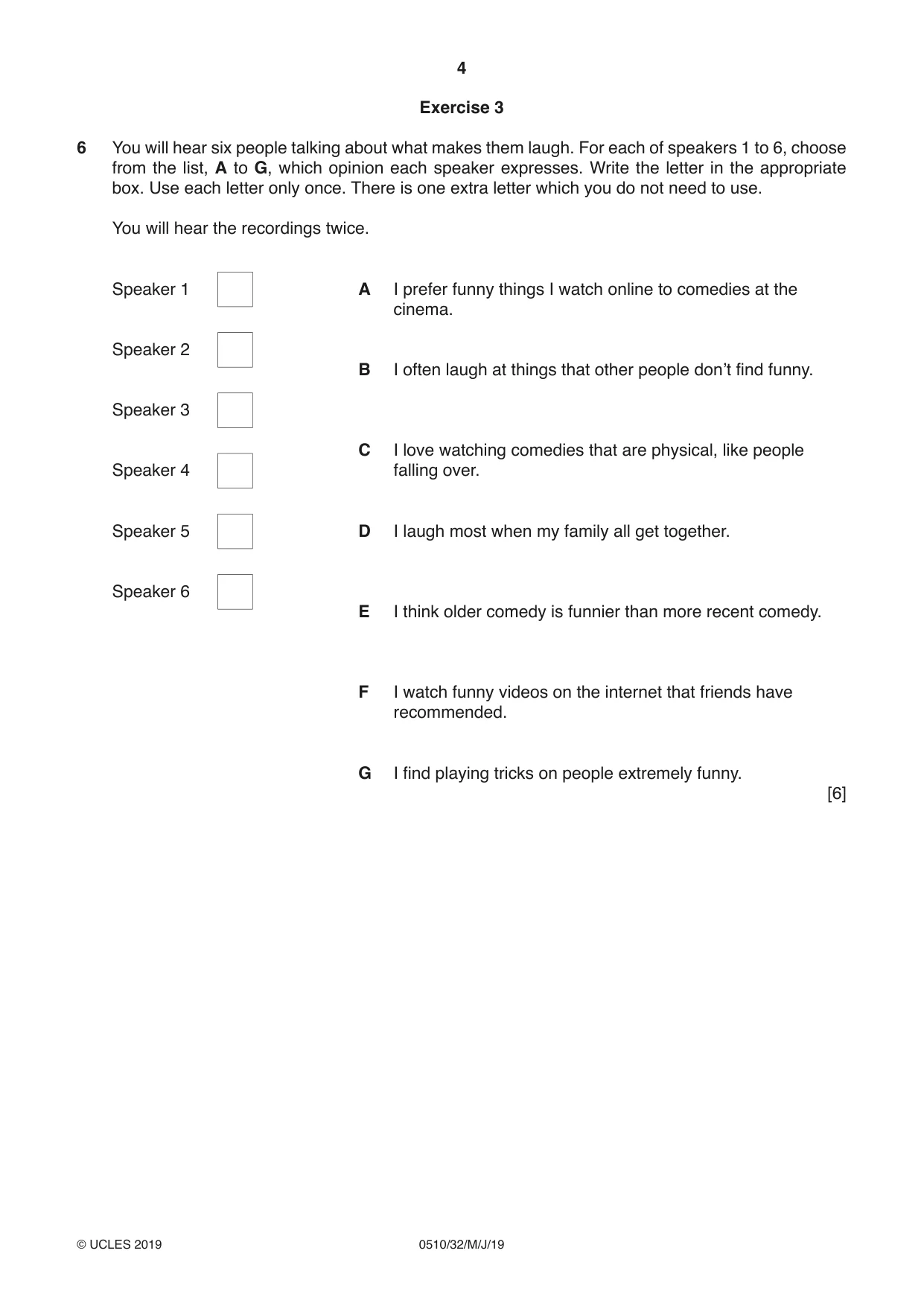
6 You will hear six people talking about what makes them laugh. For each of speakers 1 to 6, choose from the list, A to G, which opinion each speaker expresses. Write the letter in the appropriate box. Use each letter only once. There is one extra letter which you do not need to use. You will hear the recordings twice. Speaker 1 A I prefer funny things I watch online to comedies at the cinema. Speaker 2 B I often laugh at things that other people don’t find funny. Speaker 3 C I love watching comedies that are physical, like people Speaker 4 falling over. Speaker 5 D I laugh most when my family all get together. Speaker 6 E I think older comedy is funnier than more recent comedy. F I watch funny videos on the internet that friends have recommended. G I find playing tricks on people extremely funny. [6] Please turn over for Exercise 4. Exercise 4
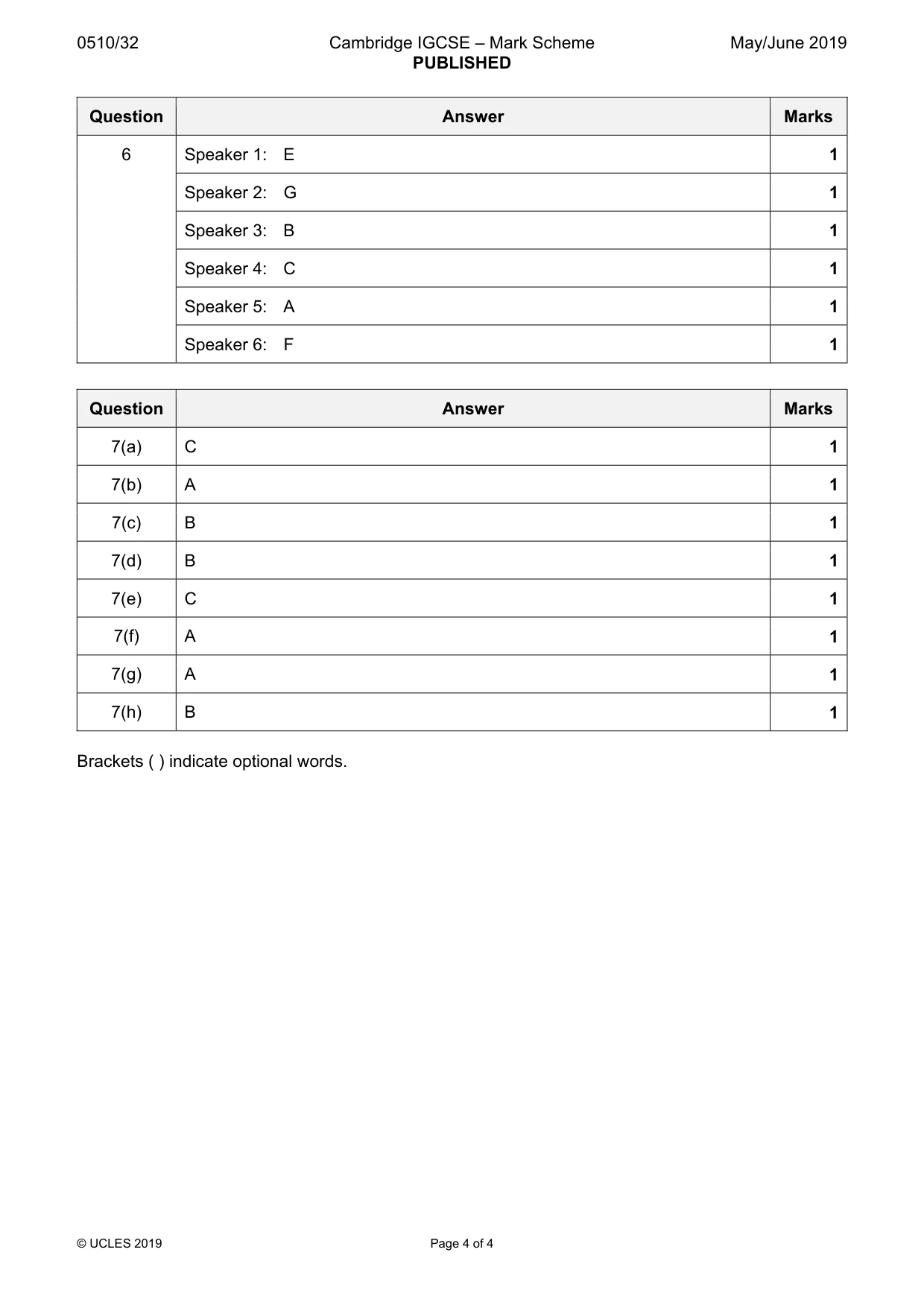
Mark scheme: 6 Speaker 1: E 1 Speaker 2: G 1 Speaker 3: B 1 Speaker 4: C 1 Speaker 5: A 1 Speaker 6: F 1
Q7 · You will hear an interview with a woman called Lisa Holanova, who is a choreographer…
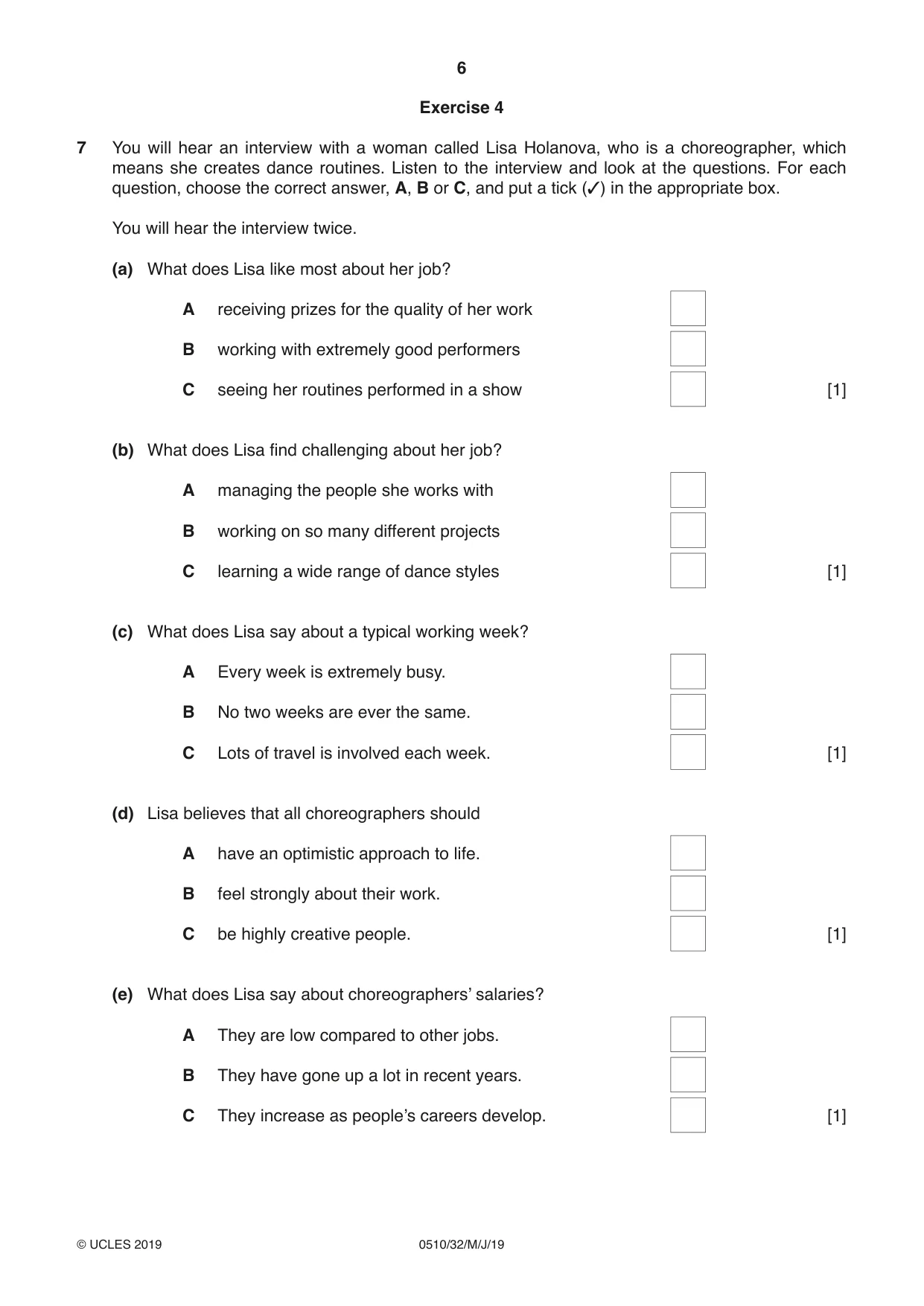
7 You will hear an interview with a woman called Lisa Holanova, who is a choreographer, which means she creates dance routines. Listen to the interview and look at the questions. For each question, choose the correct answer, A, B or C, and put a tick (3) in the appropriate box. You will hear the interview twice. (a) What does Lisa like most about her job? A receiving prizes for the quality of her work B working with extremely good performers C seeing her routines performed in a show [1] (b) What does Lisa find challenging about her job? A managing the people she works with B working on so many different projects C learning a wide range of dance styles [1] (c) What does Lisa say about a typical working week? A Every week is extremely busy. B No two weeks are ever the same. C Lots of travel is involved each week. [1] (d) Lisa believes that all choreographers should A have an optimistic approach to life. B feel strongly about their work. C be highly creative people. [1] (e) What does Lisa say about choreographers’ salaries? A They are low compared to other jobs. B They have gone up a lot in recent years. C They increase as people’s careers develop. [1] (f) What does Lisa say about holidays? A She spends them with friends and family. B She usually goes away somewhere. C She never has the chance to take them. [1] (g) Before trying to find work as a choreographer, Lisa recommends A taking classes with a range of professionals. B getting a certificate in a related subject. C watching as many performances as possible. [1] (h) What does Lisa think about her career so far? A Hard work has been the main reason for her success. B She has been very lucky in getting interesting work. C Her career has been based on careful planning. [1] [Total: 8]
Mark scheme: 7(a) C 1 7(b) A 1 7(c) B 1 7(d) B 1 7(e) C 1 7(f) A 1 7(g) A 1 7(h) B 1 Brackets ( ) indicate optional words.
What you needed in this session
Cambridge’s own grade thresholds for 2019 May/June, Paper 3 · Variant 2. A higher threshold means an easier paper — the bar moves with how the cohort did.