Cambridge IGCSE English - Second Language (oral endorsement) 0510 — 2019 May/June Paper 3 · Variant 3
0510/33/M/J/19 · 7 questions · 30 marks · ≈34 min
The question paper and its mark scheme, free to read here and free to download. This is Cambridge’s own paper, exactly as it was sat.
Question paper8 pages


Mark scheme4 pages
Answers below. Sit the paper first if you are practising.
Questions as text
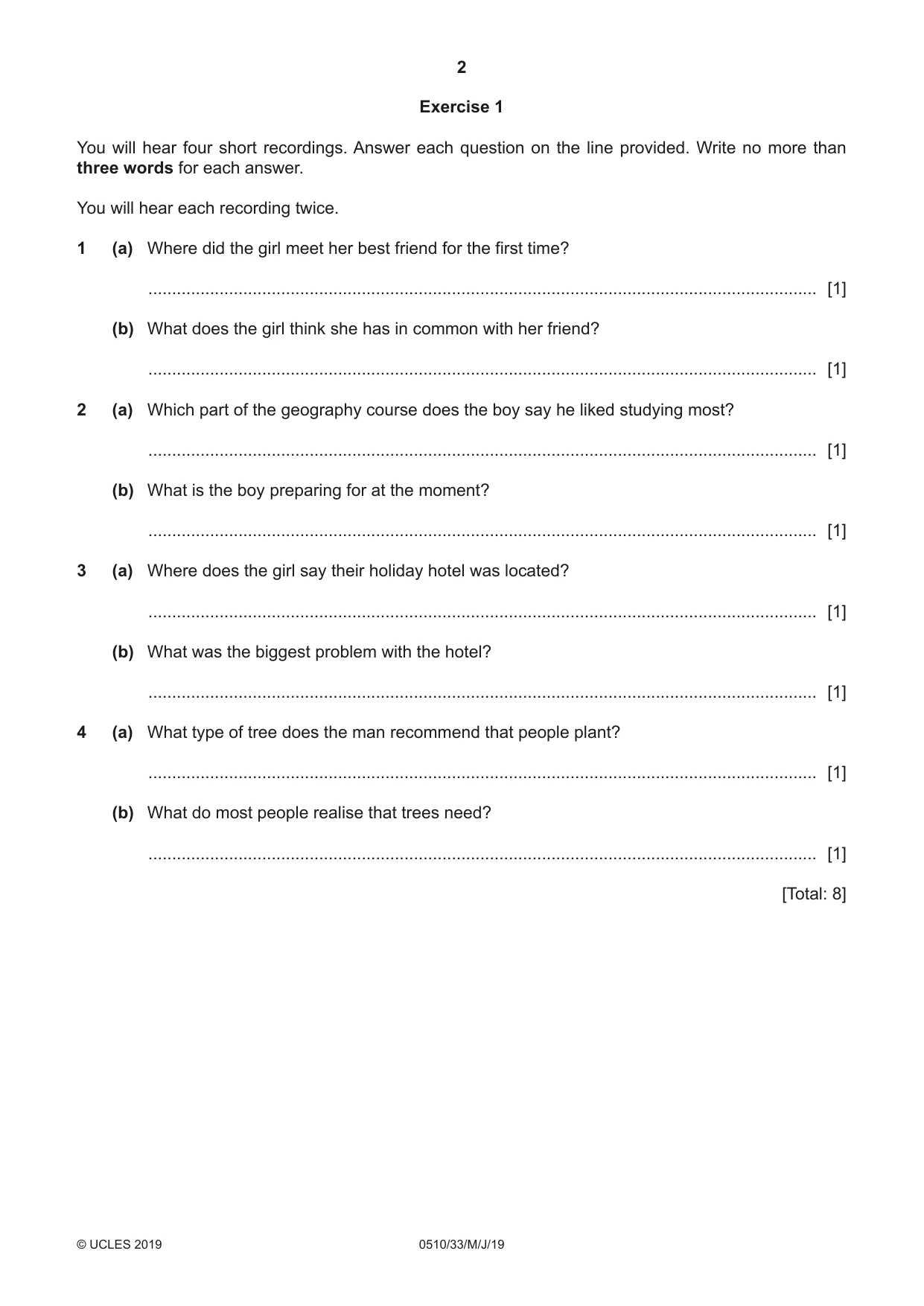
Q1 · Where did the girl meet her best friend for the first time?
1 (a) Where did the girl meet her best friend for the first time? ............................................................................................................................................. [1] (b) What does the girl think she has in common with her friend? ............................................................................................................................................. [1]
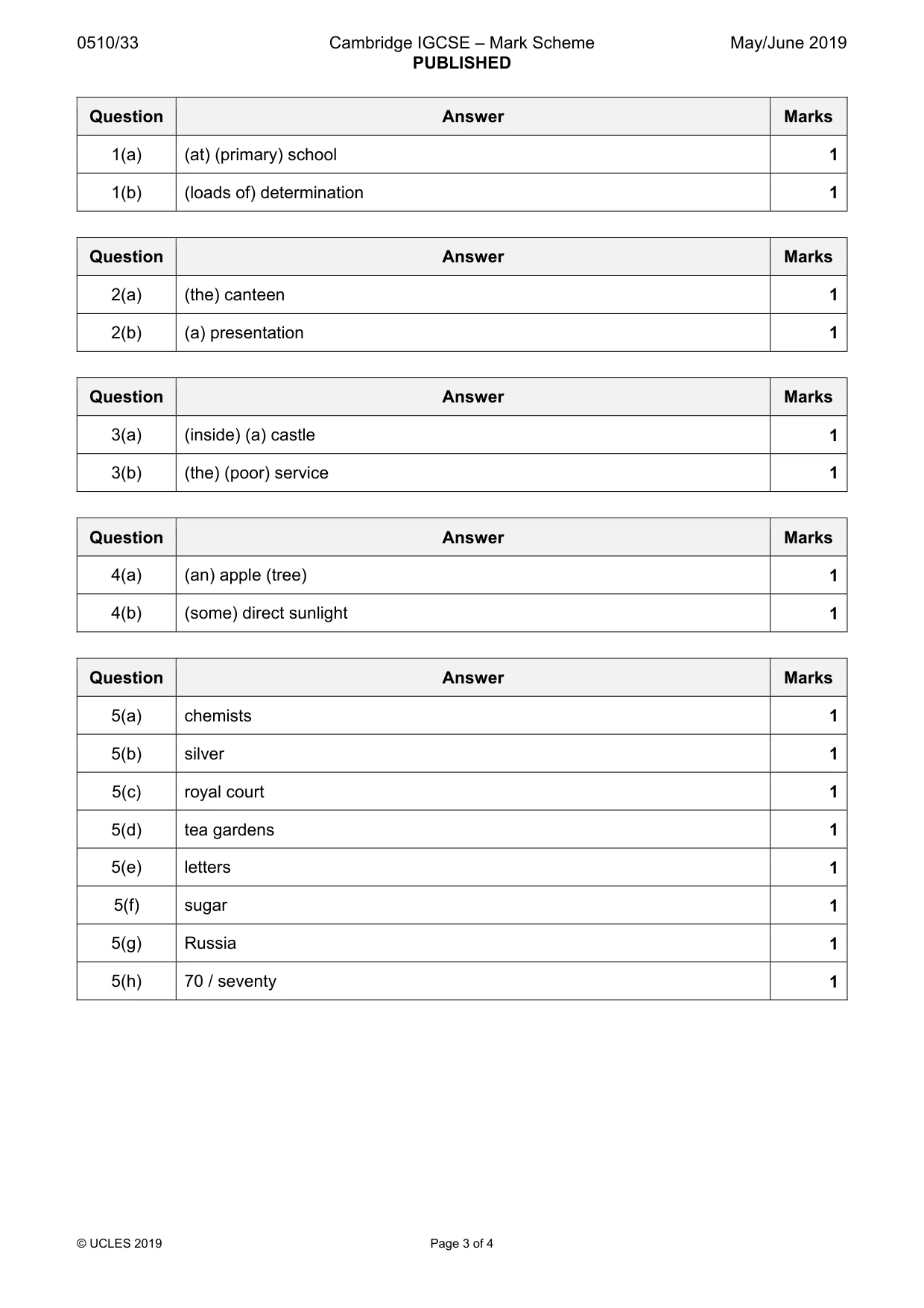
Mark scheme: Question Answer Marks 1(a) (at) (primary) school 1 1(b) (loads of) determination 1
Q2 · Which part of the geography course does the boy say he liked studying most?
2 (a) Which part of the geography course does the boy say he liked studying most? ............................................................................................................................................. [1] (b) What is the boy preparing for at the moment? ............................................................................................................................................. [1]
Mark scheme: 2(a) (the) canteen 1 2(b) (a) presentation 1
Q3 · Where does the girl say their holiday hotel was located?
3 (a) Where does the girl say their holiday hotel was located? ............................................................................................................................................. [1] (b) What was the biggest problem with the hotel? ............................................................................................................................................. [1]
Mark scheme: 3(a) (inside) (a) castle 1 3(b) (the) (poor) service 1
Q4 · What type of tree does the man recommend that people plant?
4 (a) What type of tree does the man recommend that people plant? ............................................................................................................................................. [1] (b) What do most people realise that trees need? ............................................................................................................................................. [1] [Total: 8] Exercise 2
Mark scheme: 4(a) (an) apple (tree) 1 4(b) (some) direct sunlight 1
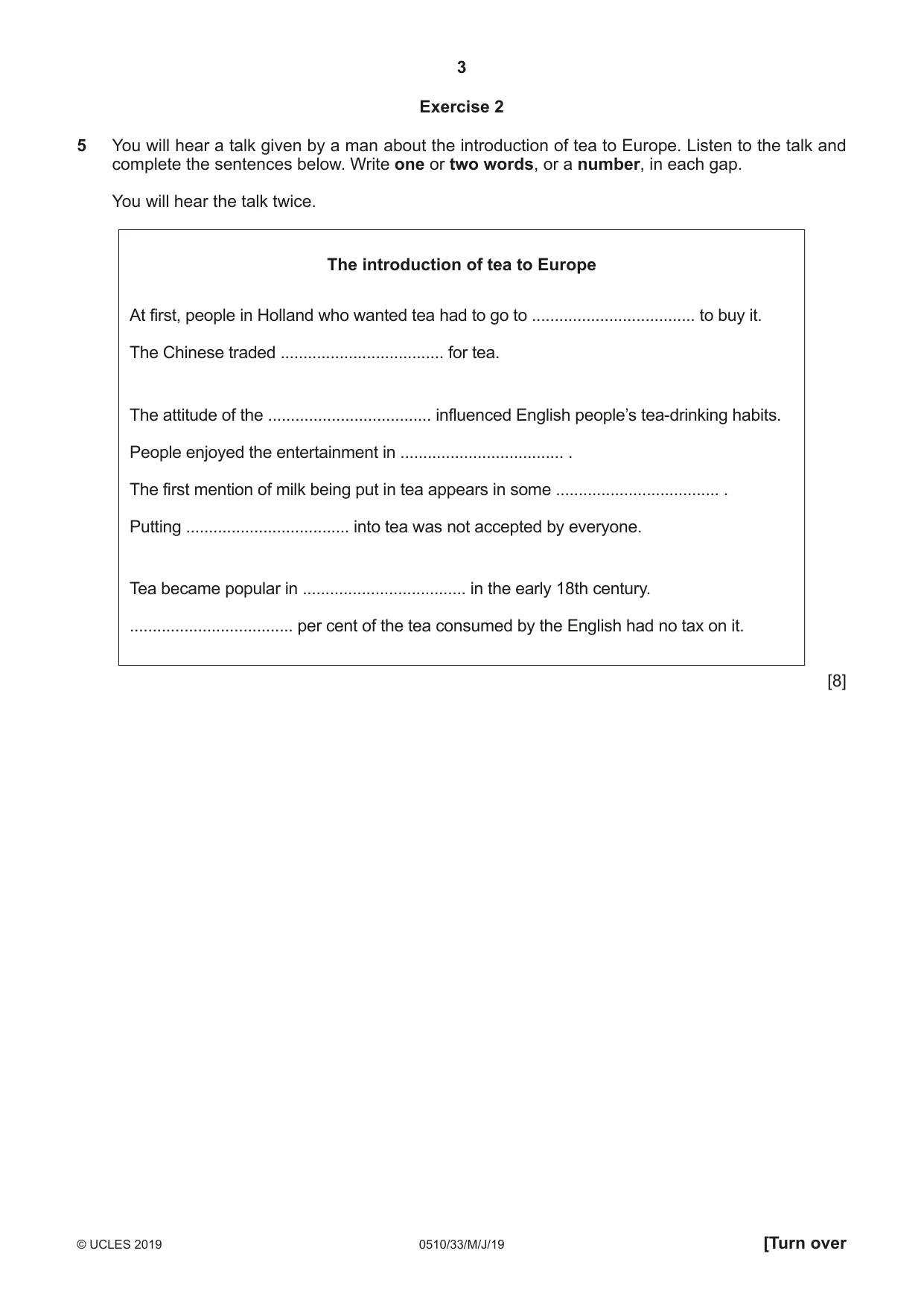
Q5 · You will hear a talk given by a man about the introduction of tea to Europe
5 You will hear a talk given by a man about the introduction of tea to Europe. Listen to the talk and complete the sentences below. Write one or two words, or a number, in each gap. You will hear the talk twice. The introduction of tea to Europe At first, people in Holland who wanted tea had to go to .................................... to buy it. The Chinese traded .................................... for tea. The attitude of the .................................... influenced English people’s tea-drinking habits. People enjoyed the entertainment in .................................... . The first mention of milk being put in tea appears in some .................................... . Putting .................................... into tea was not accepted by everyone. Tea became popular in .................................... in the early 18th century. .................................... per cent of the tea consumed by the English had no tax on it. [8] Exercise 3
Mark scheme: 5(a) chemists 1 5(b) silver 1 5(c) royal court 1 5(d) tea gardens 1 5(e) letters 1 5(f) sugar 1 5(g) Russia 1 5(h) 70 / seventy 1
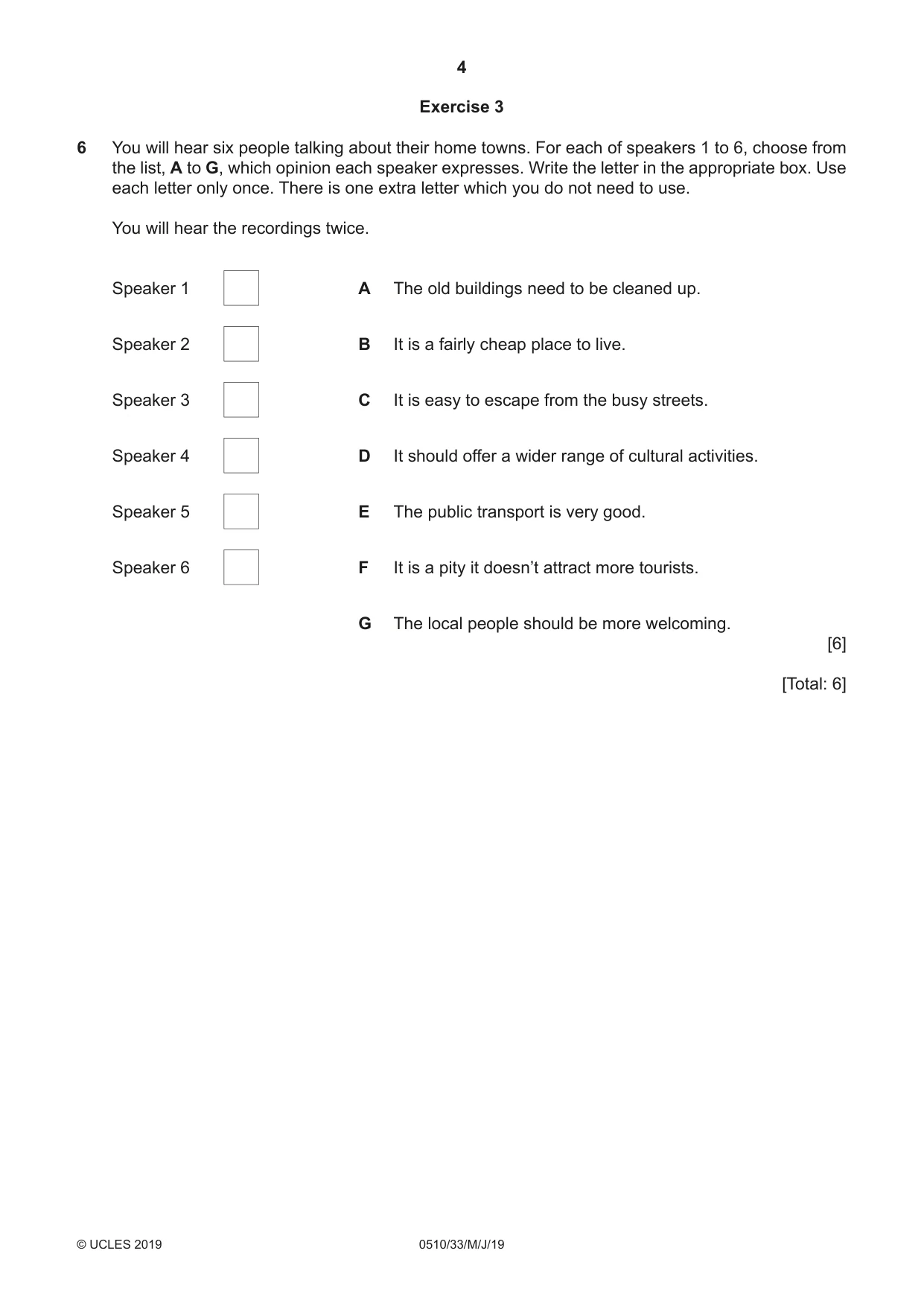
Q6 · You will hear six people talking about their home towns
6 You will hear six people talking about their home towns. For each of speakers 1 to 6, choose from the list, A to G, which opinion each speaker expresses. Write the letter in the appropriate box. Use each letter only once. There is one extra letter which you do not need to use. You will hear the recordings twice. Speaker 1 A The old buildings need to be cleaned up. Speaker 2 B It is a fairly cheap place to live. Speaker 3 C It is easy to escape from the busy streets. Speaker 4 D It should offer a wider range of cultural activities. Speaker 5 E The public transport is very good. Speaker 6 F It is a pity it doesn’t attract more tourists. G The local people should be more welcoming. [6] [Total: 6] Please turn over for Exercise 4. Exercise 4
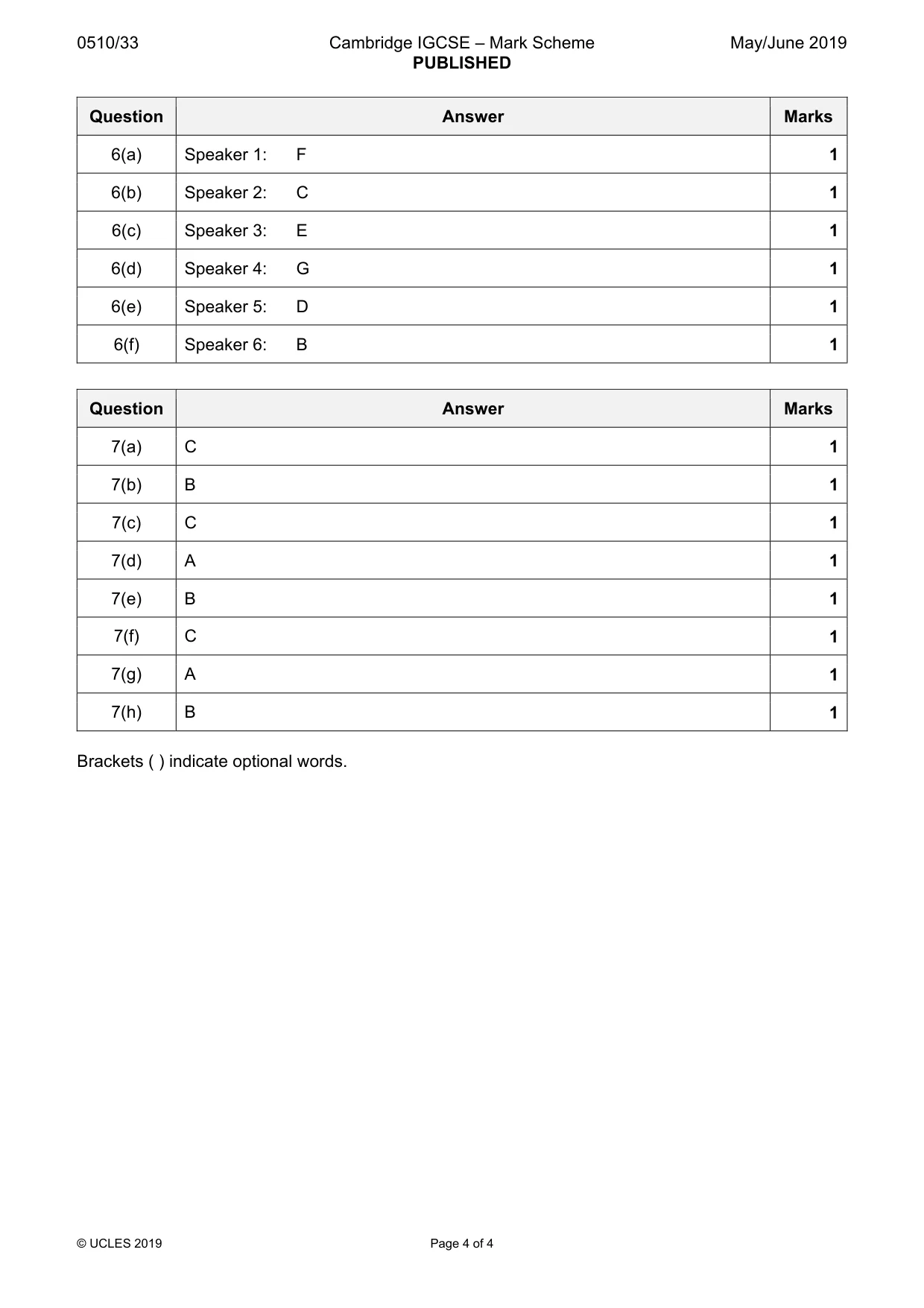
Mark scheme: 6(a) Speaker 1: F 1 6(b) Speaker 2: C 1 6(c) Speaker 3: E 1 6(d) Speaker 4: G 1 6(e) Speaker 5: D 1 6(f) Speaker 6: B 1
Q7 · You will hear an interview with a woman called Maggie Lee, who is a gymnast
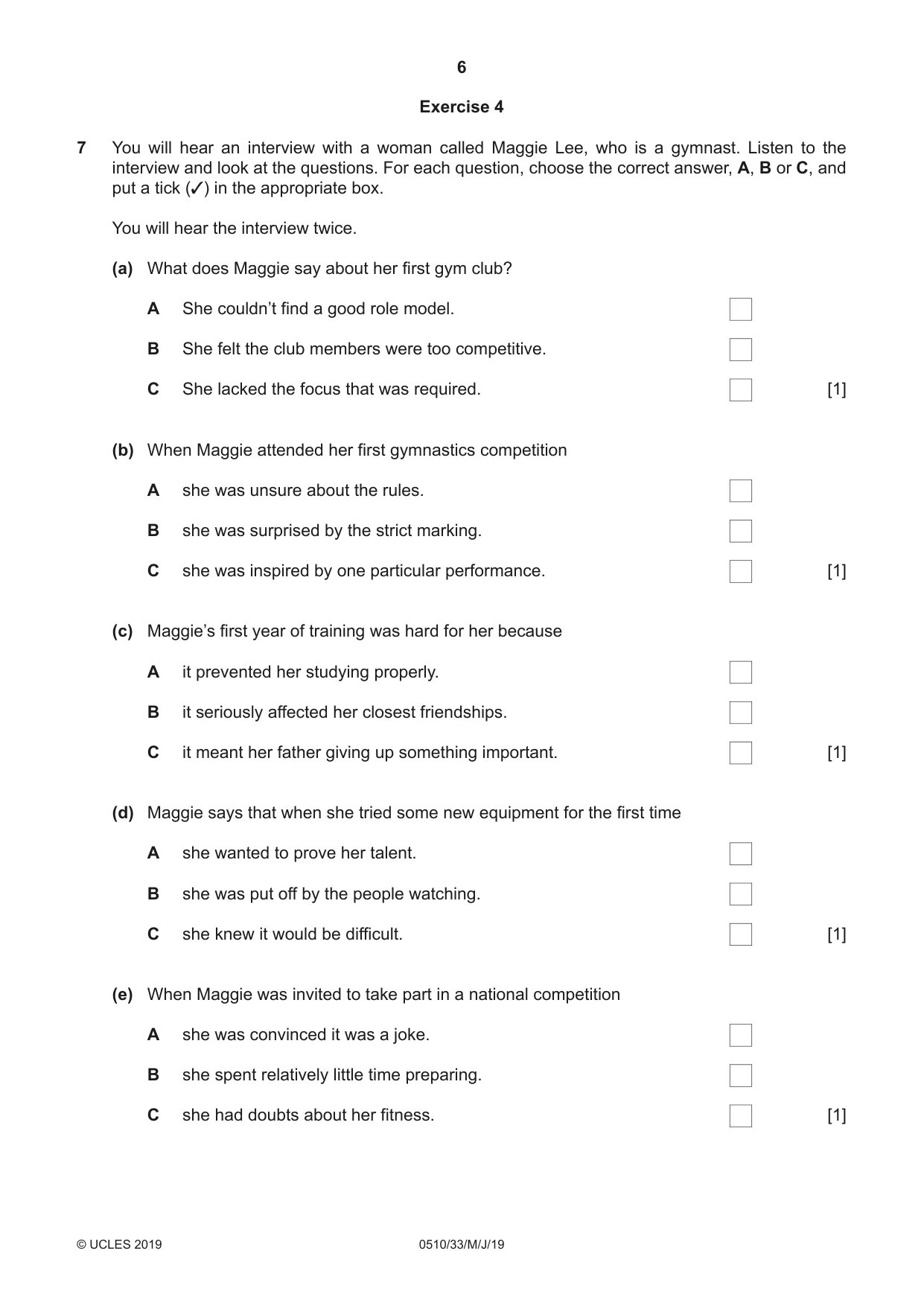
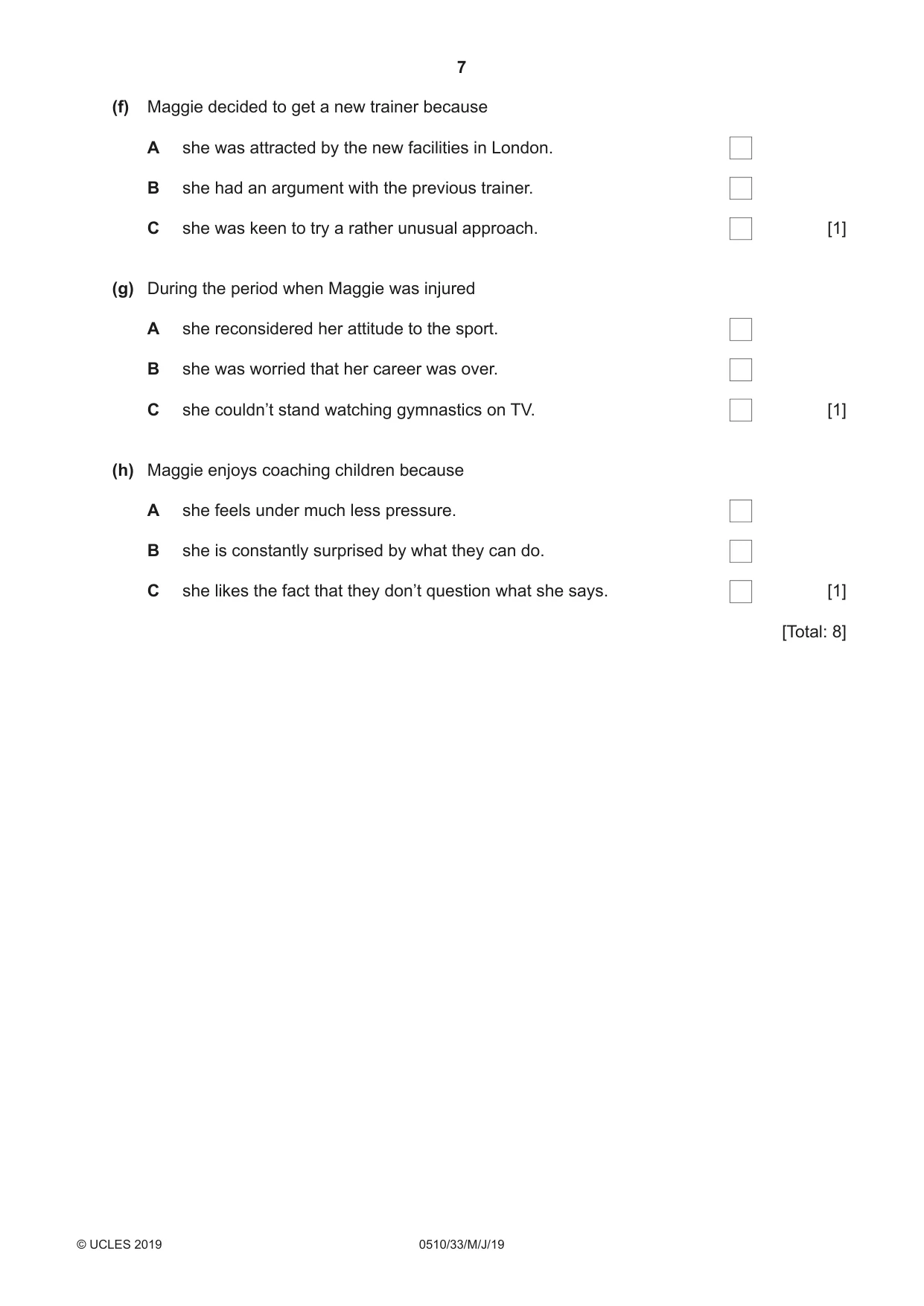
7 You will hear an interview with a woman called Maggie Lee, who is a gymnast. Listen to the interview and look at the questions. For each question, choose the correct answer, A, B or C, and put a tick (✓) in the appropriate box. You will hear the interview twice. (a) What does Maggie say about her first gym club? A She couldn’t find a good role model. B She felt the club members were too competitive. C She lacked the focus that was required. [1] (b) When Maggie attended her first gymnastics competition A she was unsure about the rules. B she was surprised by the strict marking. C she was inspired by one particular performance. [1] (c) Maggie’s first year of training was hard for her because A it prevented her studying properly. B it seriously affected her closest friendships. C it meant her father giving up something important. [1] (d) Maggie says that when she tried some new equipment for the first time A she wanted to prove her talent. B she was put off by the people watching. C she knew it would be difficult. [1] (e) When Maggie was invited to take part in a national competition A she was convinced it was a joke. B she spent relatively little time preparing. C she had doubts about her fitness. [1] (f) Maggie decided to get a new trainer because A she was attracted by the new facilities in London. B she had an argument with the previous trainer. C she was keen to try a rather unusual approach. [1] (g) During the period when Maggie was injured A she reconsidered her attitude to the sport. B she was worried that her career was over. C she couldn’t stand watching gymnastics on TV. [1] (h) Maggie enjoys coaching children because A she feels under much less pressure. B she is constantly surprised by what they can do. C she likes the fact that they don’t question what she says. [1] [Total: 8]
Mark scheme: 7(a) C 1 7(b) B 1 7(c) C 1 7(d) A 1 7(e) B 1 7(f) C 1 7(g) A 1 7(h) B 1 Brackets ( ) indicate optional words.
What you needed in this session
Cambridge’s own grade thresholds for 2019 May/June, Paper 3 · Variant 3. A higher threshold means an easier paper — the bar moves with how the cohort did.